JP2005298852A - Rotating body for brake - Google Patents
Rotating body for brake Download PDFInfo
- Publication number
- JP2005298852A JP2005298852A JP2004113164A JP2004113164A JP2005298852A JP 2005298852 A JP2005298852 A JP 2005298852A JP 2004113164 A JP2004113164 A JP 2004113164A JP 2004113164 A JP2004113164 A JP 2004113164A JP 2005298852 A JP2005298852 A JP 2005298852A
- Authority
- JP
- Japan
- Prior art keywords
- layer
- brake
- aluminum alloy
- aluminum
- rotating body
- Prior art date
- Legal status (The legal status is an assumption and is not a legal conclusion. Google has not performed a legal analysis and makes no representation as to the accuracy of the status listed.)
- Pending
Links
- 239000000919 ceramic Substances 0.000 claims abstract description 49
- 229910000838 Al alloy Inorganic materials 0.000 claims abstract description 28
- 229910052782 aluminium Inorganic materials 0.000 claims abstract description 23
- XAGFODPZIPBFFR-UHFFFAOYSA-N aluminium Chemical compound [Al] XAGFODPZIPBFFR-UHFFFAOYSA-N 0.000 claims abstract description 23
- 239000000463 material Substances 0.000 claims description 22
- PNEYBMLMFCGWSK-UHFFFAOYSA-N aluminium oxide Inorganic materials [O-2].[O-2].[O-2].[Al+3].[Al+3] PNEYBMLMFCGWSK-UHFFFAOYSA-N 0.000 claims description 12
- 239000007921 spray Substances 0.000 abstract description 7
- 238000007743 anodising Methods 0.000 abstract description 4
- 239000010410 layer Substances 0.000 description 87
- PXHVJJICTQNCMI-UHFFFAOYSA-N Nickel Chemical compound [Ni] PXHVJJICTQNCMI-UHFFFAOYSA-N 0.000 description 10
- 239000000758 substrate Substances 0.000 description 9
- 229910052759 nickel Inorganic materials 0.000 description 5
- 229910018072 Al 2 O 3 Inorganic materials 0.000 description 4
- 230000035882 stress Effects 0.000 description 4
- 239000002344 surface layer Substances 0.000 description 4
- 229910000975 Carbon steel Inorganic materials 0.000 description 3
- 239000010962 carbon steel Substances 0.000 description 3
- 239000011247 coating layer Substances 0.000 description 3
- 229910052751 metal Inorganic materials 0.000 description 3
- 239000002184 metal Substances 0.000 description 3
- 238000012986 modification Methods 0.000 description 3
- 230000004048 modification Effects 0.000 description 3
- 239000010935 stainless steel Substances 0.000 description 3
- 229910001220 stainless steel Inorganic materials 0.000 description 3
- 238000012360 testing method Methods 0.000 description 3
- 239000011248 coating agent Substances 0.000 description 2
- 238000000576 coating method Methods 0.000 description 2
- 230000000694 effects Effects 0.000 description 2
- 229910001018 Cast iron Inorganic materials 0.000 description 1
- 229910004298 SiO 2 Inorganic materials 0.000 description 1
- GEIAQOFPUVMAGM-UHFFFAOYSA-N ZrO Inorganic materials [Zr]=O GEIAQOFPUVMAGM-UHFFFAOYSA-N 0.000 description 1
- 238000005299 abrasion Methods 0.000 description 1
- 238000013459 approach Methods 0.000 description 1
- 230000000052 comparative effect Effects 0.000 description 1
- 239000002131 composite material Substances 0.000 description 1
- 238000012790 confirmation Methods 0.000 description 1
- 238000007796 conventional method Methods 0.000 description 1
- 238000001816 cooling Methods 0.000 description 1
- 230000007423 decrease Effects 0.000 description 1
- 230000001771 impaired effect Effects 0.000 description 1
- CPLXHLVBOLITMK-UHFFFAOYSA-N magnesium oxide Inorganic materials [Mg]=O CPLXHLVBOLITMK-UHFFFAOYSA-N 0.000 description 1
- 238000004519 manufacturing process Methods 0.000 description 1
- 238000002844 melting Methods 0.000 description 1
- 230000008018 melting Effects 0.000 description 1
- 229910003465 moissanite Inorganic materials 0.000 description 1
- 229910010271 silicon carbide Inorganic materials 0.000 description 1
- 238000005507 spraying Methods 0.000 description 1
- 230000008646 thermal stress Effects 0.000 description 1
- 239000013585 weight reducing agent Substances 0.000 description 1
Images
Landscapes
- Braking Arrangements (AREA)
- Coating By Spraying Or Casting (AREA)
Abstract
Description
この発明はブレーキディスク、ブレーキドラム等のブレーキ用回転体、殊に軽量なアルミ合金製(アルミMMCを含む)のブレーキ用回転体に関するものであり、その摺動面にセラミックスを溶射してセラミックス溶射層を形成してその耐摩耗性を向上させたアルミ合金製のブレーキ用回転体について、アルミ合金製基材表面に対するセラミックス溶射層の結合を強化し、かつその耐久性を向上させることができるものであり、特に、自動車、自動二輪車、マウンティングバイク、鉄道車両等のブレーキ用回転体に利用するとき極めて有効なものである。 The present invention relates to a brake rotating body such as a brake disk and a brake drum, and more particularly to a lightweight rotating body for a brake made of an aluminum alloy (including aluminum MMC). Aluminum alloy brake rotating body with improved wear resistance by forming a layer, which can strengthen the bonding of the ceramic sprayed layer to the aluminum alloy substrate surface and improve its durability In particular, it is extremely effective when used for a brake rotating body such as an automobile, a motorcycle, a mounting bike, and a railway vehicle.
ディスクブレーキ、ブレーキドラム等のブレーキ用回転体には、強度、耐摩耗性、熱伝導性などの様々な特性が求められるために鋳鉄(FC)製のものが一般的に用いられている。
他方、自動車等の乗り物のブレーキ装置のブレーキ用回転体はバネ下部品であり、しかも高速で回転し、急速に加速・減速されるものであることから、近年では軽量化のため、さらには操縦性向上のためにアルミ合金製のブレーキディスクが実用され、その1つとして、アルミMMC(アルミ複合体)、すなわち、アルミ合金中にセラミックス(Al2 03 ,SiC,MgO,SiO2 ,ZrO2 ,WC等)を添加して耐摩耗性を向上させたものがある。しかし、アルミMMC等のアルミ合金は、熱伝導性は高いものの融点が比較的低い(660℃)ので、高ブレーキ負荷、高温下での耐摩耗性に問題があり、したがって耐久性に問題がある。
For rotating bodies for brakes such as disc brakes and brake drums, cast iron (FC) is generally used because various characteristics such as strength, wear resistance, and thermal conductivity are required.
On the other hand, since the rotating body for braking of a vehicle brake device such as an automobile is an unsprung part, and it rotates at high speed and accelerates and decelerates rapidly, in recent years it has been further controlled for weight reduction. Aluminum alloy brake discs have been put into practical use to improve the performance. One of them is aluminum MMC (aluminum composite), that is, ceramics (Al 2 O 3 , SiC, MgO, SiO 2 , ZrO 2 in aluminum alloy). , WC, etc.) to improve wear resistance. However, although aluminum alloys such as aluminum MMC have high thermal conductivity, their melting point is relatively low (660 ° C.), so there is a problem in wear resistance under high brake load and high temperature, and therefore there is a problem in durability. .
また、アルミ合金製のブレーキディスクの耐久性向上のために、その摺動面に耐摩耗性が高い炭素鋼、ステンレス鋼などを溶射して当該摺動面を耐摩性溶射層で被覆するものがあり、この場合、アルミ合金製基材と被覆層との密着性、結合性を高めて金属溶射層の剥離を防止するために、ニッケルを主成分とする溶射中間層を介在させたものがある(特開平7−224868号公報)。このものは被覆層が炭素鋼、ステンレス鋼等の耐摩性金属溶射層であることから、その耐久性が必ずしも十分ではない。 Also, in order to improve the durability of brake discs made of aluminum alloy, there are those in which the sliding surface is thermally sprayed with carbon steel, stainless steel, etc. with high wear resistance, and the sliding surface is covered with a wear resistant sprayed layer. In this case, in order to improve adhesion and bondability between the aluminum alloy base material and the coating layer and prevent the metal sprayed layer from peeling off, there is one in which a thermal spray intermediate layer mainly composed of nickel is interposed. (JP-A-7-224868). Since the coating layer is a wear-resistant metal sprayed layer such as carbon steel or stainless steel, its durability is not always sufficient.
また、アルミ合金製ブレーキディスクの耐久性向上のために、その摺動面をセラミックス溶射層で被覆したものがあり、このものは被覆層がセラミックス溶射層であることから炭素鋼、ステンレス鋼等の耐摩性金属溶射層で被覆したものに比して耐摩性が優れている。ところが、アルミMMC(熱膨張率:17×10- 6℃)とセラミックス溶射層(熱膨張率:9×10⁻⁶℃)は熱膨張率の差が大きいため、両者間の温度差のためにセラミックス溶射層がアルミMMC製ディスク基材表面から剥離する。この温度差を可及的に小さくするためにセラミックス溶射層を0.2〜0.5mmにしているが、セラミックス溶射層が薄いために耐久性に問題がある。 In addition, to improve the durability of aluminum alloy brake discs, there are those whose sliding surfaces are coated with a ceramic sprayed layer, which is made of carbon steel, stainless steel, etc. because the coating layer is a ceramic sprayed layer. Abrasion resistance is superior to those coated with a wear resistant metal sprayed layer. However, aluminum MMC (thermal expansion coefficient: 17 × 10 - 6 ℃) the ceramic thermal sprayed layer (coefficient of thermal expansion: 9 × 10 -6 ℃) because the difference in thermal expansion coefficient is large, because of the temperature difference between the two The ceramic sprayed layer peels from the surface of the aluminum MMC disk substrate. In order to make this temperature difference as small as possible, the ceramic sprayed layer is 0.2 to 0.5 mm. However, since the ceramic sprayed layer is thin, there is a problem in durability.
アルミ合金製ディスク基材表面に対するセラミックス溶射層の結合を強化してその剥離性を低減するために、ニッケルを主成分とする中間層を溶射して形成するものがある(特開平5−44753号公報、以下これを「従来技術」という)。これは、アルミMMCとセラミックス溶射層の両方に対して優れた結合性を有するニッケル主成分の中間層を介在させることによってアルミMMC基材に対するセラミックス溶射層の結合を強化しものであるが、ニッケル主成分の中間層が介在するためのアルミMMC基材とセラミックス溶射層間の温度差が増大することからその間の熱膨張差が大きくなり、界面にかかる応力が増大するために、セラミックス溶射層を厚くすることができず、したがって、耐久性の問題が残されている。
この発明は、アルミ合金(アルミMMCを含む)製基材の摩擦摺動面をセラミックス溶射層で被覆したブレーキ用回転体について、アルミ合金製基材表面に直接溶射されたセラミックス溶射層との結合強度を高めて剥離を防止しつつ耐久性を向上させられるようにすることをその課題とするものである。 This invention relates to a rotating body for brake in which a friction sliding surface of an aluminum alloy (including aluminum MMC) base material is coated with a ceramic sprayed layer, and bonding with the ceramic sprayed layer directly sprayed onto the surface of the aluminum alloy base material. An object of the present invention is to increase the strength and prevent the peeling while improving the durability.
上記課題を解決するための手段は、ブレーキ用回転体のアルミ合金製基材の摺動面をアルマイト処理してアルマイト層(陽極酸化被膜)を形成し、当該アルマイト層の上にセラミックス溶射層を形成したことである。 Means for solving the above-mentioned problem is that an alumite layer (anodized coating) is formed by anodizing the sliding surface of the aluminum alloy base material of the brake rotor, and a ceramic sprayed layer is formed on the anodized layer. It is formed.
〔作用〕
アルミ合金製基材の摺動面にアルマイト処理で形成されたアルマイト層は基材表層の一部(基材層から成長した酸化層)であり、その間の界面強度は極めて高い。また、上記アルマイト層はセラミックス溶射層と同様のアルミナであるので溶着性が高く、アルマイト層表面は微小凹凸面であるから、セラミックス溶射層とアルマイト層とが機械的に結合し一体化されて強固に結合され、さらに、アルマイト層とセラミックス溶射層はともにアルミナであることから熱膨張率がほぼ同じである。したがって、アルミ合金製基材表層とセラミックス溶射層間の結合強度は強く、しかもその界面にかかる応力は小さいので熱膨張差によってセラミックス溶射層がアルマイト層から剥離することはない。
したがって、アルミ合金製基材表面層に比較的厚いセラミックス溶射層を形成してもこれがアルミ合金製基材から剥離することはないので、セラミックス溶射層を厚くすることができ、セラミックス溶射層を厚くできる分だけその耐久性が向上される。
[Action]
The alumite layer formed by alumite treatment on the sliding surface of the aluminum alloy base material is a part of the surface layer of the base material (an oxide layer grown from the base material layer), and the interfacial strength therebetween is extremely high. In addition, since the above-mentioned anodized layer is the same alumina as the ceramic sprayed layer, the weldability is high and the surface of the anodized layer is a micro uneven surface, so that the ceramic sprayed layer and the anodized layer are mechanically combined and firmly Furthermore, since the anodized layer and the ceramic sprayed layer are both alumina, the thermal expansion coefficient is almost the same. Therefore, since the bonding strength between the aluminum alloy substrate surface layer and the ceramic sprayed layer is strong and the stress applied to the interface is small, the ceramic sprayed layer does not peel from the alumite layer due to the difference in thermal expansion.
Therefore, even if a relatively thick ceramic sprayed layer is formed on the aluminum alloy substrate surface layer, it does not peel off from the aluminum alloy substrate, so the ceramic sprayed layer can be made thicker and the ceramic sprayed layer thickened. The durability is improved as much as possible.
以上のとおり、ブレーキ用回転体のアルミ合金製回転体基材のブレーキ面にアルマイト処理によるアルマイト層を形成し、その上にセラミックス溶射層を形成したことで、温度差によって応力がかかる位置を基材表面層とアルマイト層との界面にすることで、セラミックス溶射層との界面に上記応力がかかることを回避し、これによって、熱応力によってセラミックス溶射層が剥離することを確実に防止することができ、その結果、セラミックス溶射層を厚く形成することができるので、ブレーキ用回転体の耐久性を著しく向上させることができる。
また、上記のアルマイト処理は低コストでなされるので、セラミックス溶射層の剥離防止のためにニッケル主成分の溶射層を中間層とする従来技術に比して、ブレーキ回転体の製造コストが著しく低い。
As described above, an alumite layer formed by anodizing is formed on the brake surface of the aluminum alloy rotor base material of the brake rotor, and a ceramic sprayed layer is formed on the anodized layer. By making the interface between the material surface layer and the alumite layer, it is possible to avoid applying the above stress to the interface with the ceramic sprayed layer, thereby reliably preventing the ceramic sprayed layer from peeling off due to thermal stress. As a result, since the ceramic sprayed layer can be formed thick, the durability of the brake rotating body can be remarkably improved.
In addition, since the alumite treatment described above is performed at a low cost, the manufacturing cost of the brake rotating body is remarkably low as compared with the conventional technique in which a nickel-based thermal spray layer is used as an intermediate layer in order to prevent the ceramic thermal spray layer from peeling off. .
〔実施態様1〕
実施態様1は、上記解決手段における、アルマイト処理によるアルマイト層の厚さが、0.01〜0.1mmであることである。
〔作用〕
アルマイト処理にアルマイト層の厚さが0.01mm以下では、アルマイト層が介在することによる上記作用効果が顕著でなく、他方、0.1mm以上では、比較的靭性に劣る上記アルマイト層が厚すぎて、衝撃等によりアルマイト層が破壊されるので、その結果、セラミックス溶射層のアルミ合金製基材への結合強度が損なわれる可能性がある。
[Embodiment 1]
[Action]
When the thickness of the alumite layer is 0.01 mm or less in the alumite treatment, the above-mentioned effect due to the presence of the alumite layer is not remarkable, whereas when it is 0.1 mm or more, the alumite layer having relatively poor toughness is too thick. Since the alumite layer is destroyed by impact or the like, the bonding strength of the ceramic sprayed layer to the aluminum alloy substrate may be impaired as a result.
〔実施態様2〕
実施態様2は、上記解決手段におけるセラミックス溶射層の厚さが0.6〜1.0mmであることである。
〔作用〕
セラミックス溶射層の厚さを0.6以上にすることで上記従来技術によるものよりも耐久性が高い。他方、セラミックス溶射層の厚さが1.0mm以上では、セラミックス溶射層形成のためのコストが著しく高くなり、またこれ以上厚くても格別のメリットはない。
[Embodiment 2]
[Action]
By setting the thickness of the ceramic sprayed layer to 0.6 or more, durability is higher than that according to the above prior art. On the other hand, when the thickness of the ceramic sprayed layer is 1.0 mm or more, the cost for forming the ceramic sprayed layer is remarkably high.
〔実施態様3〕
実施態様3は、上記解決手段におけるブレーキ用回転体のアルミ合金製基材が、アルミMMC製であり、そのアルミMMCのセラミックス体積含有率が15〜50%であることである。
〔作用〕
アルミMMC中のセラミックス体積含有率が15%以下では、熱膨張率が20×10-6℃以上と大きく、溶射層(9×10⁻⁶℃)との熱膨張差が大きくなり、結合強度が低く、剥離してしまう。
他方、セラミックス体積含有率が50%を越えると熱膨張率は低下し、溶射層の9×10⁻⁶℃に近づくが、切削加工性が悪く、コストアップの要因となる。
[Embodiment 3]
[Action]
When the ceramic volume content in aluminum MMC is 15% or less, the coefficient of thermal expansion is as large as 20 × 10 −6 ° C. or more, the difference in thermal expansion from the sprayed layer (9 × 10 −6 ° C.) is large, and the bond strength is high. Low and peels off.
On the other hand, when the ceramic volume content exceeds 50%, the coefficient of thermal expansion decreases and approaches the thermal sprayed layer of 9 × 10 −6 ° C., but the machinability is poor and causes an increase in cost.
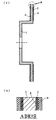
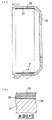
この発明は鉄道車両、自動車等の過酷な条件下で作動するブレーキ装置に適用するのが最も効果的であるから、この発明を自動車用ディスクブレーキに適用した実施例1、自動車用ドラムブレーキに適用した実施例2を図面を参照しながら説明する。 Since the present invention is most effective when applied to a brake device that operates under harsh conditions such as railway vehicles and automobiles, the present invention is applied to a first embodiment in which the present invention is applied to an automobile disc brake and an automobile drum brake. Example 2 will be described with reference to the drawings.
実施例1の外径275mmのブレーキディスク基材1はアルミMMC製であり、このアルミMMCのセラミックス体積含有率は40%である。このブレーキディスクのブレーキパッドとの摺動面をアルマイト処理して、厚さ(深さ)0.03mmのアルマイト層2を形成している。このときのブレーキディスク基材1の熱膨張率は17×10-6℃であり、アルマイト層2の熱膨張率は7〜9×10⁻⁶℃である。
そして、上記アルマイト層2の上にアルミナ(Al2 03 )を溶射して厚さ0.8mmのアルミナ溶射層3を形成している。
アルマイト層2表面は微小凹凸面であるから、セラミックス溶射層3とアルマイト層2とが機械的に結合一体化して強固に結合する。さらに、アルミナ溶射層3の熱膨張率は9〜10×10-6℃であって、アルマイト層2の熱膨張率とほとんど違いがないので、両者の結合面(界面)における熱膨張差による応力は極めて小さい。
なお、ブレーキディスク基材1とアルマイト層2間の熱膨張差は大きいが、アルマイト層2は上記基材から成長した酸化層であるので、これらの界面4の界面強度は極めて強いので、この界面4が熱膨張差のために破壊されることはない。
The brake
Then, alumina (Al 2 O 3 ) is sprayed on the
Since the surface of the
Although the thermal expansion difference between the brake
実施例2の内径228.6mmのブレーキドラム基材21はアルミMMC製であり、セラミックスの体積含有率が40%のものである。このブレーキドラムのブレーキ面をアルマイト処理して、厚さ(深さ)0.05mmのアルマイト層22を形成している。このときのブレーキドラム基材21の熱膨張率は17×10-6℃であり、アルマイト層22の熱膨張率は7〜9×10⁻⁶℃である。
そして、上記アルマイト層22の上にアルミナ(Al2 03 )を溶射して厚さ0.6mmのアルミナ溶射層23を形成している。
ブレーキドラム基材21とアルマイト層22間の熱膨張差は大きいが、上述のように、これらの界面24の界面強度は極めて強いので、この界面24が熱膨張差のために破壊されることはない。
The brake
Then, alumina (Al 2 O 3 ) is sprayed on the
Although the difference in thermal expansion between the brake
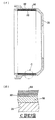
〔変形例〕
図3は実施例2の変形例であり、ブレーキドラム基材31をアルミ合金製とし、これに厚さ5mmのアルミMMC製(セラミックスの体積含有率が40%)円筒体30を嵌着している。この円筒体の内面を予めアルマイト処理して厚さ(深さ)0.05mmのアルマイト層32を形成してあり、このアルマイト層32の内表面にアルミナ(Al2 03 )を溶射して厚さ0.6mmのアルミナ溶射層33を形成している。
[Modification]
FIG. 3 shows a modification of the second embodiment. The
〔効果確認〕
実施例1のものと従来技術との耐久性比較試験結果について説明する。
比較対象の従来技術によるものは、そのニッケル主成分の中間層の厚さが0.2mm、アルミナ溶射層の厚さが0.3mmである。
試験条件は、減速度5.88m/s2(0.6G),速度100Km/h→0Km/h制動後冷却を行い、制動開始温度100℃として繰り返して制動を行った。制動回数50回である。
〔Effect confirmation〕
The results of the durability comparison test between Example 1 and the prior art will be described.
In the comparative prior art, the nickel-based intermediate layer has a thickness of 0.2 mm and the alumina sprayed layer has a thickness of 0.3 mm.
The test conditions were a deceleration of 5.88 m / s 2 (0.6 G), a speed of 100 km / h → 0 km / h, cooling after braking, and repeated braking at a braking start temperature of 100 ° C. The number of braking is 50 times.
試験結果
従来技術によるものロータ摺動面に微小クラックが発生し、摩擦係数は0.2μと低下した。
制動面の最高温度590℃。
実施例1:ロータ摺動面に大きなダメージがなく摩擦係数は0.25μであった。
制動面の最高温度610℃。
Test results According to the prior art A minute crack was generated on the rotor sliding surface, and the friction coefficient was reduced to 0.2 μm.
Maximum braking surface temperature of 590 ° C.
Example 1: The rotor sliding surface was not significantly damaged and the friction coefficient was 0.25 μm.
Maximum braking surface temperature of 610 ° C.
1・・・ブレーキディスク基材
2,22,32・・・アルマイト層(陽極酸化被膜)
3,23,33・・・アルミナ溶射層
21・・・ブレーキドラム基材
30・・・円筒体
1 ... Brake
3, 23, 33 ... Alumina sprayed
Claims (5)
上記アルミ合金製基材の上記摺動面をアルマイト処理してアルマイト層を形成し、当該アルマイト層の上に上記セラミックス溶射層を形成しているブレーキ用回転体。 In a brake rotating body in which a friction sliding surface of an aluminum alloy (including aluminum MMC) base material is coated with a ceramic sprayed layer,
A brake rotating body in which the sliding surface of the aluminum alloy base material is anodized to form an anodized layer, and the ceramic sprayed layer is formed on the anodized layer.
Priority Applications (1)
| Application Number | Priority Date | Filing Date | Title |
|---|---|---|---|
| JP2004113164A JP2005298852A (en) | 2004-04-07 | 2004-04-07 | Rotating body for brake |
Applications Claiming Priority (1)
| Application Number | Priority Date | Filing Date | Title |
|---|---|---|---|
| JP2004113164A JP2005298852A (en) | 2004-04-07 | 2004-04-07 | Rotating body for brake |
Publications (1)
| Publication Number | Publication Date |
|---|---|
| JP2005298852A true JP2005298852A (en) | 2005-10-27 |
Family
ID=35330766
Family Applications (1)
| Application Number | Title | Priority Date | Filing Date |
|---|---|---|---|
| JP2004113164A Pending JP2005298852A (en) | 2004-04-07 | 2004-04-07 | Rotating body for brake |
Country Status (1)
| Country | Link |
|---|---|
| JP (1) | JP2005298852A (en) |
Cited By (4)
| Publication number | Priority date | Publication date | Assignee | Title |
|---|---|---|---|---|
| JP2017009105A (en) * | 2015-06-16 | 2017-01-12 | 現代自動車株式会社Hyundai Motor Company | Drum-in hat brake disc and manufacture process thereof |
| JP2017523353A (en) * | 2014-06-14 | 2017-08-17 | ダイムラー・アクチェンゲゼルシャフトDaimler AG | Brake disc for automobile |
| CN116356319A (en) * | 2022-12-13 | 2023-06-30 | 沈阳富创精密设备股份有限公司 | A preparation method of a high-density, corrosion-resistant and high-clean composite coating |
| DE102012111072B4 (en) | 2011-11-24 | 2023-07-06 | Shimano Inc. | Bicycle disc brake rotor |
-
2004
- 2004-04-07 JP JP2004113164A patent/JP2005298852A/en active Pending
Cited By (4)
| Publication number | Priority date | Publication date | Assignee | Title |
|---|---|---|---|---|
| DE102012111072B4 (en) | 2011-11-24 | 2023-07-06 | Shimano Inc. | Bicycle disc brake rotor |
| JP2017523353A (en) * | 2014-06-14 | 2017-08-17 | ダイムラー・アクチェンゲゼルシャフトDaimler AG | Brake disc for automobile |
| JP2017009105A (en) * | 2015-06-16 | 2017-01-12 | 現代自動車株式会社Hyundai Motor Company | Drum-in hat brake disc and manufacture process thereof |
| CN116356319A (en) * | 2022-12-13 | 2023-06-30 | 沈阳富创精密设备股份有限公司 | A preparation method of a high-density, corrosion-resistant and high-clean composite coating |
Similar Documents
| Publication | Publication Date | Title |
|---|---|---|
| KR102590480B1 (en) | Manufacturing method of brake disc and brake disc for disc brake | |
| CN103392079B (en) | Brake disc and manufacturing method thereof | |
| JP3679444B2 (en) | Composite disc for high energy braking | |
| EP3350468B1 (en) | Method for manufacturing a brake disc and brake disc for disc brakes | |
| CN115190916B (en) | Brake disc with wear resistance and corrosion resistance and method for producing the same | |
| JP6347790B2 (en) | Brake disc manufacturing method, disc brake brake disc, and disc brake | |
| JP2010534807A (en) | Double-coated cast iron brake rotor and manufacturing method | |
| US11396207B2 (en) | Wheel hub unit with thermally insulating coating for reducing the thermal load on a wheel bearing | |
| CN105299103B (en) | Method for producing a brake disc and brake disc | |
| US20160348744A1 (en) | Method for producing a brake disc and brake disc | |
| JP2017523353A (en) | Brake disc for automobile | |
| CN102422045A (en) | Coated Lightweight Metal Disk | |
| KR20230062416A (en) | Method for producing a brake disc, and a brake disc | |
| JPH06501289A (en) | metal matrix composite components | |
| JP2005298852A (en) | Rotating body for brake | |
| JPH08145092A (en) | Disc rotor | |
| JP2001003152A (en) | Brake disk for railway vehicle | |
| JP2024543857A (en) | Friction brakes, especially for locomotives | |
| JP2001317573A (en) | Disc rotor for brake | |
| CN210128033U (en) | Automobile brake disc and vehicle | |
| JPH0686891B2 (en) | Disc pad | |
| JPH09143670A (en) | Oxide ceramic coating disk rotor | |
| JP7820137B2 (en) | disc brake pads | |
| JPH1089389A (en) | Manufacturing method of lightweight composite brake disc | |
| JP3262365B2 (en) | Manufacturing method of brake disc |