JP2005297215A - Laminated stretched polyester film - Google Patents
Laminated stretched polyester film Download PDFInfo
- Publication number
- JP2005297215A JP2005297215A JP2004112297A JP2004112297A JP2005297215A JP 2005297215 A JP2005297215 A JP 2005297215A JP 2004112297 A JP2004112297 A JP 2004112297A JP 2004112297 A JP2004112297 A JP 2004112297A JP 2005297215 A JP2005297215 A JP 2005297215A
- Authority
- JP
- Japan
- Prior art keywords
- film
- polyester
- light
- light scattering
- polyester film
- Prior art date
- Legal status (The legal status is an assumption and is not a legal conclusion. Google has not performed a legal analysis and makes no representation as to the accuracy of the status listed.)
- Pending
Links
Landscapes
- Laminated Bodies (AREA)
Abstract
【課題】 他の材料との接着性に優れ、高温に長時間さらされても光散乱性が変化しなく、また光散乱性特性に優れ、全光線透過率も大きい易接着光散乱性積層延伸ポリエステルフィルムを提供する。
【解決手段】 塗布層と0.05〜4.0重量%の光散乱剤を含有する共押出層とを有するポリエステルフィルムであって、フィルムの可視吸収スペクトルにおける波長750nmと波長450nmの透過率の差が20%以内であることを特徴とする積層延伸ポリエステルフィルム。
【選択図】なし
PROBLEM TO BE SOLVED: To provide an easy-adhesive light-scattering laminated stretch that has excellent adhesion to other materials, does not change light scattering even when exposed to high temperatures for a long time, has excellent light-scattering properties, and has high total light transmittance Provide a polyester film.
SOLUTION: A polyester film having a coating layer and a coextruded layer containing 0.05 to 4.0% by weight of a light scattering agent, which has a transmittance at a wavelength of 750 nm and a wavelength of 450 nm in the visible absorption spectrum of the film. A laminated stretched polyester film characterized in that the difference is within 20%.
[Selection figure] None
Description
本発明は、ポリエステルフィルムの表面に接着剤層や紫外線硬化樹脂層などを設けて使用される、艶消し性を必要とするガラスや成形体貼り合わせ用途や包装用途、また液晶ディスプレイの構成部品に用いられる易接着性光拡散性のフィルムに関する。 The present invention can be used by providing an adhesive layer or an ultraviolet curable resin layer on the surface of a polyester film, and for glass and molded product bonding and packaging applications that require matte properties, as well as for components of liquid crystal displays. It is related with the easily-adhesive light-diffusing film used.
光拡散剤を含有させた積層延伸ポリエステルフィルムについて、例えば、内層に光拡散性を有する微粒子を含有させ実質的にボイドが発生しない全光線透過率の高い光散乱性フィルムが提案されている(特許文献1)。しかしながら、フィルムが高温に長時間さらされる環境下では、光散乱層の結晶化(白化)が起こり、ヘーズの値や全光線透過率が変化するという問題がある。また、特許文献2には、非晶質ポリエステルに光散乱成分を含有させることで表面が平坦で光散乱性に優れたフィルムが記載されている。しかしながら、溶融特性の異なる2種類のポリエステルを積層するため、製膜工程におけるTダイからの冷却ロールへ押し出し条件調整が難しく、また光散乱成分の熱劣化によりフィルムの色相に影響を与えることがある。また、特許文献3には、光散乱性や全光線透過率の値の大きな光散乱性積層延伸ポリエステルフィルムが記載されているが、必要とされる易接着性を有するとともにヘーズ変化の少ないポリエステルフィルムを達成するものではない。 Regarding a laminated stretched polyester film containing a light diffusing agent, for example, a light scattering film having a high total light transmittance that contains fine particles having light diffusibility in the inner layer and substantially does not generate voids has been proposed (patent) Reference 1). However, in an environment where the film is exposed to a high temperature for a long time, crystallization (whitening) of the light scattering layer occurs, causing a problem that the haze value and the total light transmittance change. Patent Document 2 describes a film having a flat surface and excellent light scattering properties by incorporating a light scattering component into amorphous polyester. However, since two types of polyesters with different melting characteristics are laminated, it is difficult to adjust the extrusion conditions from the T-die to the cooling roll in the film forming process, and the hue of the film may be affected by thermal degradation of the light scattering component. . Patent Document 3 describes a light-scattering laminated stretched polyester film having a large value of light scattering property and total light transmittance. However, the polyester film has the required easy adhesion and little haze change. Is not to achieve.
本発明は、上記実情に鑑みなされたものであって、その解決課題は、他の材料との接着性に優れ、高温に長時間さらされても光散乱性が変化しなく、また光散乱性特性に優れ、全光線透過率も大きい易接着光散乱性積層延伸ポリエステルフィルムを提供することにある。 The present invention has been made in view of the above circumstances, and its solution is excellent in adhesiveness with other materials, the light scattering property does not change even when exposed to high temperature for a long time, and the light scattering property. An object of the present invention is to provide an easy-adhesive light-scattering laminated stretched polyester film having excellent characteristics and high total light transmittance.
本発明者は、上記課題に鑑み鋭意検討した結果、特定の構成を有する積層延伸ポリエステルフィルムによれば、上記課題を容易に解決できることを見いだし、本発明を完成するに至った。 As a result of intensive studies in view of the above problems, the present inventor has found that the above problems can be easily solved by a laminated stretched polyester film having a specific configuration, and has completed the present invention.
すなわち、本発明の要旨は、塗布層と0.05〜4.0重量%の光散乱剤を含有する共押出層とを有するポリエステルフィルムであって、フィルムの可視吸収スペクトルにおける波長750nmと波長450nmの透過率の差が20%以内であることを特徴とする積層延伸ポリエステルフィルムに存する。 That is, the gist of the present invention is a polyester film having a coating layer and a coextruded layer containing 0.05 to 4.0% by weight of a light scattering agent, and has a wavelength of 750 nm and a wavelength of 450 nm in the visible absorption spectrum of the film. The difference in transmittance is 20% or less in the laminated stretched polyester film.
以下、本発明を詳細に説明する。
本発明におけるポリエステルとは、テレフタル酸、イソフタル酸、ナフタレン−2,6−ジカルボン酸等のような芳香族ジカルボン酸と、エチレングリコール、ジエチレングリコール、トリメチレングリコール、テトラメチレングリコール、ネオペンチルグリコール、1,4−シクロヘキサンジメタノール等のようなグリコールとのエステルを主たる成分とするポリエステルである。当該ポリエステルは、芳香族ジカルボン酸とグリコールとを直接重合させて得られるほか、芳香族ジカルボン酸ジアルキルエステルとグリコールとをエステル交換反応させた後、重縮合させる方法、あるいは芳香族ジカルボン酸のジグリコールエステルを重縮合させる等の方法によっても得られる。当該ポリエステルの代表的なものとしては、ポリエチレンテレフタレート、ポリエチレン−2,6−ナフタレンジカルボキシレート(PEN)、ボリブチレンテレフタレート等が例示される。かかるポリエステルは、共重合されないホモポリマーであってもよく、またジカルボン酸成分の40モル%以下が主成分以外のジカルボン酸成分であり、ジオール成分の40モル%以下が主成分以外のジオール成分であるような共重合ポリエステルであってもよく、またそれらの混合物であってもよい。
Hereinafter, the present invention will be described in detail.
The polyester in the present invention is an aromatic dicarboxylic acid such as terephthalic acid, isophthalic acid, naphthalene-2,6-dicarboxylic acid, ethylene glycol, diethylene glycol, trimethylene glycol, tetramethylene glycol, neopentyl glycol, 1, This polyester is mainly composed of an ester with glycol such as 4-cyclohexanedimethanol. The polyester is obtained by directly polymerizing an aromatic dicarboxylic acid and a glycol, or by a transesterification reaction between an aromatic dicarboxylic acid dialkyl ester and a glycol, followed by polycondensation, or an aromatic dicarboxylic acid diglycol. It can also be obtained by a method such as polycondensation of an ester. Typical examples of the polyester include polyethylene terephthalate, polyethylene-2,6-naphthalene dicarboxylate (PEN), boribylene terephthalate and the like. Such a polyester may be a homopolymer that is not copolymerized, and 40 mol% or less of the dicarboxylic acid component is a dicarboxylic acid component other than the main component, and 40 mol% or less of the diol component is a diol component other than the main component. It may be a certain copolyester or a mixture thereof.
本発明のフィルムは、光散乱剤を含有する共押出層(以下、単に光散乱層と記述する)を有する。光散乱層は、易接着機能を有する塗布層(以下単の易接着層と記述する)を除くフィルムの構成層の一部であって、内層であっても表層であってもよい。例えば、二層の内の一層とすることもできるが、通常少なくとも3層からなる共押出層の内層を光散乱層にすることが好ましい。表層を光散乱層にすると光散乱剤の脱落が起こりやすくなり、製膜工程やフィルム加工工程のクリーン度を落とす傾向があり、付着ブツの原因となる場合がある。 The film of the present invention has a coextruded layer (hereinafter simply referred to as a light scattering layer) containing a light scattering agent. The light scattering layer is a part of a constituent layer of the film excluding a coating layer having an easy adhesion function (hereinafter referred to as a single easy adhesion layer), and may be an inner layer or a surface layer. For example, one of the two layers can be used, but it is preferable that the inner layer of the coextruded layer usually composed of at least three layers be a light scattering layer. When the surface layer is a light scattering layer, the light scattering agent is likely to drop off, which tends to reduce the cleanliness of the film forming process and the film processing process, and may cause adhesion.
光散乱層に用いる光散乱剤としては、ポリエステルと非相溶の樹脂や不活性粒子を通常用いることができる。これらの光拡散剤の5%熱分解温度は、280℃以上であることが好ましく、さらに好ましくは290℃以上である。光拡散剤の5%熱分解温度が280℃未満では、熱劣化によりフィルムが黄色または茶色を帯びてしまうことがある。
具体的な光拡散剤の例としては、アクリル樹脂、メラミン樹脂、ポリエチレン、ポリスチレン、有機シリコーン樹脂、アクリル−スチレン共重合体等の有機質微粒子および炭酸カルシウム、シリカ、酸化アルミニウム、炭酸バリウム、硫酸バリウム、ガラス等の無機質微粒子で単体もしくは混合体が挙げられる。
As the light scattering agent used for the light scattering layer, a resin or inert particles incompatible with polyester can be usually used. The 5% thermal decomposition temperature of these light diffusing agents is preferably 280 ° C. or higher, more preferably 290 ° C. or higher. When the 5% thermal decomposition temperature of the light diffusing agent is less than 280 ° C, the film may be yellowish or brownish due to thermal deterioration.
Specific examples of light diffusing agents include organic fine particles such as acrylic resin, melamine resin, polyethylene, polystyrene, organosilicone resin, acrylic-styrene copolymer, and calcium carbonate, silica, aluminum oxide, barium carbonate, barium sulfate, A simple substance or a mixture of inorganic fine particles such as glass.
また光散乱層における光散乱剤の含有量は、0.05〜4.0重量%の範囲であり、好ましくは0.1〜3.0重量%の範囲である。含有量が0.05重量%未満では、光散乱性を十分に発揮できない。一方、含有量が4.0重量%を超えると、全光線透過率の低下が大きくなる。 The content of the light scattering agent in the light scattering layer is in the range of 0.05 to 4.0% by weight, preferably in the range of 0.1 to 3.0% by weight. If the content is less than 0.05% by weight, the light scattering property cannot be sufficiently exhibited. On the other hand, when the content exceeds 4.0% by weight, the decrease in the total light transmittance becomes large.
光散乱剤の平均粒径は、通常2.5〜50μm、好ましくは3〜40μm、さらに好ましくは4〜30μmである。平均粒径が2.5μm未満の場合、低波の可視光線が乱反射されやすく、透過光が黄色みを帯びてしまうことがあり、また光散乱性能も劣る傾向がある。一方、50μmを超える光散乱剤を用いた場合は、製膜性に劣ることがある。 The average particle diameter of the light scattering agent is usually 2.5 to 50 μm, preferably 3 to 40 μm, and more preferably 4 to 30 μm. When the average particle size is less than 2.5 μm, low-wave visible light is easily diffusely reflected, the transmitted light may be yellowish, and the light scattering performance tends to be inferior. On the other hand, when a light scattering agent exceeding 50 μm is used, the film forming property may be inferior.
なお光散乱層には、必要に応じて、紫外線吸収剤、帯電防止剤、酸化防止剤、蛍光増白剤等の添加剤を含有してもよい。 In addition, you may contain additives, such as a ultraviolet absorber, an antistatic agent, antioxidant, and a fluorescent whitening agent, in a light-scattering layer as needed.
また本発明における積層延伸ポリエステルフィルムを構成する光散乱層以外の共押出層の厚みは、光散乱剤の平均粒径をd(μm)とすると、0.2d〜3d(μm)の範囲が好ましい。厚みが0.2d(μm)未満では光拡散剤の脱落する場合があり、3d(μm)を超えるとブロッキングが発生することがあったり、ブロッキング抑制のため新たに不活性粒子を添加することになり全光線透過率の低下を招いたりすることがある。
なお、これらの共押出層にも、必要に応じて微細不活性粒子や紫外線吸収剤、帯電防止剤、酸化防止剤、蛍光増白剤等の添加剤を含有してもよい。
The thickness of the coextruded layer other than the light scattering layer constituting the laminated stretched polyester film in the present invention is preferably in the range of 0.2d to 3d (μm), where d (μm) is the average particle size of the light scattering agent. . If the thickness is less than 0.2d (μm), the light diffusing agent may drop off, and if it exceeds 3d (μm), blocking may occur or new inert particles are added to suppress blocking. The total light transmittance may be reduced.
These coextruded layers may also contain additives such as fine inert particles, ultraviolet absorbers, antistatic agents, antioxidants, and fluorescent brighteners as necessary.
本発明のフィルムは、100℃24時間加熱後のヘーズ上昇が好ましくは10%以下であり、さらに好ましくは5%以下、特に好ましくは3%以下である。100℃24時間加熱後のヘーズ上昇が10%を超えると、たとえば、レトルト加熱処理後の包装用フィルムの外観が変化する、また例えば車に搭載された液晶表示板の部材に使用された場合、画面の明るさが変化するので好ましくない。 In the film of the present invention, the haze increase after heating at 100 ° C. for 24 hours is preferably 10% or less, more preferably 5% or less, and particularly preferably 3% or less. When the haze increase after heating at 100 ° C. for 24 hours exceeds 10%, for example, the appearance of the packaging film after the retort heat treatment changes, and for example, when used for a member of a liquid crystal display board mounted on a car, This is not preferable because the brightness of the screen changes.
100℃の加熱でフィルムのヘーズが変化する原因としては、結晶性ポリエステルが非晶状態でフィルム中に存在する場合が考えられる。結晶性ポリエステルを非晶状態で存在しないようにするには、たとえば積層フィルムのある層を低融点の共重合ポリエテルで設計した場合は、製膜工程における延伸後の熱処理をその共重合ポリエステルの融点より低い温度に設定することで達成できる。 As a cause of changing the haze of the film by heating at 100 ° C., it is conceivable that the crystalline polyester is present in the film in an amorphous state. In order to prevent the crystalline polyester from being present in an amorphous state, for example, when a layer of a laminated film is designed with a low-melting copolymer polyester, the heat treatment after stretching in the film-forming process is performed at the melting point of the copolymer polyester. This can be achieved by setting a lower temperature.
本発明のフィルムは、可視吸収スペクトルおける波長750nmと波長400nmの透過率の差が20%以内であり、好ましくは15%以内である。かかる透過率の差が20%を超えると、フィルムの外観が黄色みを帯びていたり、透過光の光が黄色みを帯びたりするため、貼合せされた成形体や包装フィルムの外観品質の低下や光散乱性が不十分になり、例えば液晶表示板の品位低下が起こる。 In the film of the present invention, the difference in transmittance between a wavelength of 750 nm and a wavelength of 400 nm in the visible absorption spectrum is within 20%, preferably within 15%. If the difference in transmittance exceeds 20%, the appearance of the film is yellowish or the light of the transmitted light is yellowish, so the appearance quality of the bonded molded product or packaging film is degraded. In addition, the light scattering property becomes insufficient, and for example, the quality of the liquid crystal display panel is lowered.
本発明のフィルムの全光線透過率は、好ましくは80%以上、さらに好ましくは82%以上、特に好ましくは85%以上である。全光線透過率が80%未満では液晶表示板のような光学用途に使用された場合、有効に利用できる光の量が減るため好ましくない。 The total light transmittance of the film of the present invention is preferably 80% or more, more preferably 82% or more, and particularly preferably 85% or more. When the total light transmittance is less than 80%, the amount of light that can be effectively used is reduced when used for optical applications such as a liquid crystal display panel.
本発明のフィルムの表面粗さRa(中心線平均粗さ)は、好ましくは0.01〜0.5μmであり、さらに好ましくは0.02〜0.4μmである。フィルムの表面粗さが、0.01μm未満では、フィルムの巻取作業性が悪い傾向がある。一方、0.5μmを超えると、摩耗紛が発生しやすくなる場合がある。 The surface roughness Ra (centerline average roughness) of the film of the present invention is preferably 0.01 to 0.5 μm, more preferably 0.02 to 0.4 μm. If the surface roughness of the film is less than 0.01 μm, the film winding workability tends to be poor. On the other hand, if it exceeds 0.5 μm, wear powder may be easily generated.
本発明のフィルムの少なくとも片面には、その上に存在する層との接着性を向上させるための易接着層を設ける。この易接着層は、通常、ポリマーおよび架橋剤等を主成分として構成される。ポリマーは、水性ポリウレタン、水性ポリエステルおよび水性アクリル樹脂の少なくとも1つからなり、好ましくは、ガラス転移温度(Tg)が0℃以上、さらには40℃以上のものであり、さらに好ましくはポリウレタンの中でもポリエステルポリウレタンであり、カルボン酸残基を持ち、その少なくとも一部はアミンまたはアンモニアを用いて水性化されているものである。また架橋剤は、メラミン系、エポキシ系、オキサゾリン系樹脂が一般に用いられるが、塗布性、耐久接着性の点で、メラミン系樹脂が好ましい。 At least one surface of the film of the present invention is provided with an easy-adhesion layer for improving the adhesion with the layer existing thereon. This easy-adhesion layer is usually composed mainly of a polymer and a crosslinking agent. The polymer comprises at least one of water-based polyurethane, water-based polyester, and water-based acrylic resin, and preferably has a glass transition temperature (Tg) of 0 ° C. or higher, more preferably 40 ° C. or higher, and more preferably polyester among polyurethanes. A polyurethane having a carboxylic acid residue, at least a part of which is made aqueous with an amine or ammonia. As the crosslinking agent, melamine-based, epoxy-based, or oxazoline-based resins are generally used, but melamine-based resins are preferable from the viewpoints of coating properties and durable adhesiveness.
塗布剤の塗布方法としては、例えば、原崎勇次著、槙書店、1979年発行、「コーティング方式」に示されるような、リバースロールコーター、グラビアコーター、ロッドコーター、エアドクターコーターまたはこれら以外の塗布装置を使用することができる。塗布層は、ポリエステルフィルムの片面だけに形成してもよいし、両面に形成してもよい。片面にのみ形成した場合、その反対面には必要に応じて上記の塗布層と異なる塗布層を形成して他の特性を付与することもできる。なお、塗布剤のフィルムへの塗布性や接着性を改良するため、塗布前にフィルムに化学処理や放電処理を施してもよい。また、表面特性をさらに改良するため、塗布層形成後に放電処理を施してもよい。 As a coating method of the coating agent, for example, a reverse roll coater, a gravure coater, a rod coater, an air doctor coater, or a coating apparatus other than these as shown in Yuji Harasaki, Tsuji Shoten, published in 1979, “Coating Method” Can be used. The coating layer may be formed only on one side of the polyester film or on both sides. When formed only on one side, other characteristics can be imparted by forming a coating layer different from the above-mentioned coating layer on the opposite surface as necessary. In addition, in order to improve the applicability | paintability and adhesiveness to the film of a coating agent, you may give a chemical process and an electrical discharge process to a film before application | coating. Further, in order to further improve the surface characteristics, a discharge treatment may be performed after the coating layer is formed.
塗布層の厚みは、最終的な乾燥厚さとして、通常0.02〜0.5μm、好ましくは0.03〜0.3μmの範囲である。塗布層の厚さが0.02μm未満の場合は、接着性が劣る。一方塗布層の厚さが0.5μmを超える場合は、フィルムが相互に固着しやすくなったり、特にフィルムの高強度化のために塗布処理フィルムを再延伸する場合は、工程中のロールに粘着しやすくなったりする傾向がある。上記の固着の問題は、特にフィルムの両面に同一の塗布層を形成する場合に顕著に現れる
本発明のフィルムの厚みは、特に限定しないが20〜300μmである。20μm未満では、加工作業性が悪い場合がある。一方、300μmを超えると重量増加や取り扱い性の悪化が起こることがある。
The thickness of the coating layer is usually in the range of 0.02 to 0.5 μm, preferably 0.03 to 0.3 μm, as the final dry thickness. When the thickness of the coating layer is less than 0.02 μm, the adhesiveness is inferior. On the other hand, when the thickness of the coating layer exceeds 0.5 μm, the films tend to stick to each other, or when the coated film is re-stretched to increase the strength of the film, it adheres to the roll in the process. It tends to be easy to do. The above problem of sticking appears particularly when the same coating layer is formed on both sides of the film. The thickness of the film of the present invention is not particularly limited, but is 20 to 300 μm. If it is less than 20 μm, the workability may be poor. On the other hand, when the thickness exceeds 300 μm, the weight may increase or the handleability may deteriorate.
次に本発明のフィルムの製造方法を具体的に説明するが、本発明の構成要件を満足する限り、以下の例示に特に限定されるものではない。 Next, although the manufacturing method of the film of this invention is demonstrated concretely, as long as the structural requirements of this invention are satisfied, it is not specifically limited to the following illustrations.
本発明のフィルムを製造するときには、乾燥したポリエステルを押出機に供給し、各ポリエステルの融点以上の温度に加熱してそれぞれ溶融させる。次いで、Tダイから溶融シートとして押出すが、この場合、2台以上の押出機を用い多層シートとする。続いて、溶融シートを回転冷却ドラム上でガラス転位温度未満にまで急冷し、非晶質の未延伸フィルムを得る。このとき、未延伸フィルムの平面性を向上させるために、静電印加密着法や液体塗布密着法等によって、未延伸フィルムと回転冷却ドラムとの密着性を向上させてもよい。そして、ロール延伸機を用いて、未延伸フィルムをその長手方向に延伸(縦延伸)することにより一軸延伸フィルムを得る。このときの延伸温度は、原料レジンのガラス転移温度(Tg)のマイナス10℃からプラス40℃の温度範囲で延伸する。また、延伸倍率は、好ましくは2.5〜7.0倍、さらに好ましくは3.0〜6.0倍である。さらに、縦延伸を一段階のみで行ってもよいし、二段階以上に分けて行ってもよい。次いで、易接着層を設けるためコーターにより水性塗布剤を塗布する。その後、テンターに導きテンター延伸機を用いて、一軸延伸フィルムをその幅方向に延伸(横延伸)することにより二軸延伸フィルムを得る。このときの延伸温度は、原料レジンのガラス転移温度(Tg)からプラス50℃の温度範囲で延伸する。また、延伸倍率は、好ましくは2.5〜7.0倍、さらに好ましくは3.5〜6.0倍である。さらに、横延伸を一段階のみで行ってもよいし、二段以上に分けて行ってもよい。また縦と横を同時に行う同時二軸延伸を行ってもよい。そして二軸延伸フィルムを熱処理することにより積層フィルムが製造される。このときの熱処理温度は、130〜250℃である。二軸延伸フィルムを熱処理するときには、二軸延伸フィルムに対して20%以内の弛緩を行ってもよい。 When the film of the present invention is produced, the dried polyester is supplied to an extruder and heated to a temperature equal to or higher than the melting point of each polyester to be melted. Next, it is extruded as a molten sheet from a T-die. In this case, a multilayer sheet is formed using two or more extruders. Subsequently, the molten sheet is rapidly cooled to below the glass transition temperature on a rotary cooling drum to obtain an amorphous unstretched film. At this time, in order to improve the flatness of the unstretched film, the adhesion between the unstretched film and the rotating cooling drum may be improved by an electrostatic application adhesion method, a liquid application adhesion method, or the like. And a uniaxially stretched film is obtained by extending | stretching an unstretched film in the longitudinal direction (longitudinal stretching) using a roll stretching machine. The stretching temperature at this time is stretched in a temperature range of minus 10 ° C. to plus 40 ° C. of the glass transition temperature (Tg) of the raw material resin. The draw ratio is preferably 2.5 to 7.0 times, more preferably 3.0 to 6.0 times. Furthermore, longitudinal stretching may be performed in only one stage, or may be performed in two or more stages. Next, an aqueous coating agent is applied by a coater to provide an easy adhesion layer. Thereafter, the biaxially stretched film is obtained by stretching the uniaxially stretched film in the width direction (lateral stretching) using a tenter stretching machine. The stretching temperature at this time is stretched in a temperature range of + 50 ° C. from the glass transition temperature (Tg) of the raw material resin. The draw ratio is preferably 2.5 to 7.0 times, more preferably 3.5 to 6.0 times. Further, the transverse stretching may be performed only in one stage, or may be performed in two or more stages. Moreover, you may perform simultaneous biaxial stretching which performs vertical and horizontal simultaneously. And a laminated film is manufactured by heat-processing a biaxially stretched film. The heat processing temperature at this time is 130-250 degreeC. When the biaxially stretched film is heat-treated, the biaxially stretched film may be relaxed within 20%.
本発明によれば、易接着性が良好で、かつ光散乱性を有する二軸延伸ポリエステルフィルムを提供することができ、本発明の工業的価値は高い。 According to the present invention, it is possible to provide a biaxially stretched polyester film having good easy adhesion and light scattering properties, and the industrial value of the present invention is high.
以下、本発明を実施例によりさらに詳細に説明するが、本発明はその要旨を越えない限り、以下の実施例に限定されるものではない。なお、実施例および本発明で用いた測定法および用語の定義は次のとおりである。 EXAMPLES Hereinafter, although an Example demonstrates this invention further in detail, this invention is not limited to a following example, unless the summary is exceeded. The measurement methods and terms used in the examples and the present invention are defined as follows.
(1)平均粒径
電子顕微鏡を用いて粒子を観察して最大径と最小径を求め、その平均を不活性粒子1個の粒径とした。フィルム中の少なくとも100個の不活性粒子についてこれを行う。粒子群の平均粒径は、これらの粒子の重量平均径とする。
(1) Average particle diameter The maximum diameter and the minimum diameter were obtained by observing particles using an electron microscope, and the average was defined as the particle diameter of one inert particle. This is done for at least 100 inert particles in the film. The average particle diameter of the particle group is the weight average diameter of these particles.
(2)ヘーズ 全光線透過率 散乱光透過率
分球式濁度計NDH−300A(日本電色工業株式会社製)を用いてそのヘーズ値を測定した。
(2) Haze Total light transmittance Scattered light transmittance The haze value was measured using a divided turbidimeter NDH-300A (manufactured by Nippon Denshoku Industries Co., Ltd.).
(3)100℃24時間加熱後のヘーズ上昇
100℃に保ったオーブンでフィルムを24時間加熱し、加熱後のヘーズを測定し、過熱前の値との差を求めた。
(3) Haze rise after heating at 100 ° C. for 24 hours The film was heated in an oven kept at 100 ° C. for 24 hours, the haze after heating was measured, and the difference from the value before overheating was determined.
(4)光硬化性樹脂との接着性
易接着面の表面にアクリル系光硬化樹脂(日本化薬製KAYANOVA FOP−1700)を硬化後の厚さが6μmになるように塗布し、120W/cmのエネルギーの高圧水銀灯を使用し、照射距離100mmにて約10秒間照射して、表面硬化フィルムを得た。アクリル系光硬化層形成直後、当該層に1インチ幅に碁盤目が100個になるようクロスカットを入れ、直ちに、同一箇所について3回セロテープ(登録商標)急速剥離テストを実施し、剥離面積により評価した。判定基準は以下のとおりである。
◎:碁盤目剥離個数=0
○:1≦碁盤目剥離個数≦10
△:11≦碁盤目剥離個数≦20
×:21<碁盤目剥離個数
(5)可視吸収スペクトルにおける波長750nmと400nmの透過率の差
分光光度計UV−3100PC(島津製作所(株)製)を用いて測定した。波長800nmから300nmまでの光透過率を測定し、波長750nmと波長400nmの透過率の差を求めた。
(6)光散乱性
変角光度計(オプテック(株) GP−3)を用いてフィルムの透過光の散乱パターンを測定した。測定条件は、受光部スリット幅2.5mm、測定角度−30〜30°で1°刻みで光度を計測した。光散乱性は以下のように評価した。
○:±3°の角度における光度が0°の光度の90%以上(散乱性良好)
△:±3°の角度における光度が0°の光度の80%以上90%未満(光散乱性やや不良)
×:±3°の角度における光度が0°の光度の80%未満(光散乱性不良)
(4) Adhesiveness with photo-curing resin An acrylic photo-curing resin (KAYANOVA FOP-1700 manufactured by Nippon Kayaku Co., Ltd.) was applied to the surface of the easy-adhesion surface so that the thickness after curing was 6 μm, and 120 W / cm. The surface cured film was obtained by irradiating at an irradiation distance of 100 mm for about 10 seconds using a high-pressure mercury lamp having the following energy. Immediately after the acrylic photocured layer is formed, a crosscut is made on the layer so that there are 100 grids in a 1-inch width, and a cellotape (registered trademark) rapid peel test is performed three times at the same location. evaluated. The judgment criteria are as follows.
A: Number of cross-cuts = 0
○: 1 ≦ Number of cross cuts ≦ 10
Δ: 11 ≦ number of cross-cuts ≦ 20
X: 21 <Number of cross-cuts peeled off (5) Difference in transmittance between wavelengths of 750 nm and 400 nm in visible absorption spectrum Measured using a spectrophotometer UV-3100PC (manufactured by Shimadzu Corporation). The light transmittance from a wavelength of 800 nm to 300 nm was measured, and the difference in transmittance between the wavelength of 750 nm and the wavelength of 400 nm was determined.
(6) Light scattering property The scattering pattern of the transmitted light of the film was measured using a goniophotometer (Optec Corporation GP-3). The measurement conditions were a light-receiving portion slit width of 2.5 mm and a measurement angle of −30 to 30 °, and the luminous intensity was measured in increments of 1 °. The light scattering property was evaluated as follows.
○: The luminous intensity at an angle of ± 3 ° is 90% or more of the luminous intensity of 0 ° (good scattering property)
Δ: The luminous intensity at an angle of ± 3 ° is not less than 80% and less than 90% of the luminous intensity at 0 ° (light scattering property is slightly poor).
X: The luminous intensity at an angle of ± 3 ° is less than 80% of the luminous intensity of 0 ° (poor light scattering property)
(原料の調整)
・ポリエステルA
常法の重縮合で合成された極限粘度0.65、融点253℃のポリエチレンテレフタレート樹脂である。
(Raw material adjustment)
・ Polyester A
It is a polyethylene terephthalate resin having an intrinsic viscosity of 0.65 and a melting point of 253 ° C. synthesized by a conventional polycondensation.
・ポリエステルB
常法の重縮合で合成された極限粘度0.68、融点253℃のポリエチレンテレフタレート樹脂に平均粒径4.5μmの球状シリカを練り込み2.0重量%含有させたものである。
・ Polyester B
A polyethylene terephthalate resin having an intrinsic viscosity of 0.68 and a melting point of 253 ° C. synthesized by a conventional polycondensation is kneaded with spherical silica having an average particle size of 4.5 μm and contained at 2.0% by weight.
・ポリエステルC
常法の重縮合で合成された極限粘度0.68、融点253℃のポリエチレンテレフタレート樹脂に乳化重合で合成された平均粒径2.0μmの球状架橋高分子粒子を練り混み7.0重量%含有させたものである。
・ Polyester C
Contains 7.0 wt% spherical cross-linked polymer particles with an average particle size of 2.0 μm synthesized by emulsion polymerization in polyethylene terephthalate resin with an intrinsic viscosity of 0.68 and a melting point of 253 ° C. synthesized by conventional polycondensation It has been made.
・ポリエステルD
常法の重縮合で合成された極限粘度0.68、融点253℃のポリエチレンテレフタレート樹脂に平均粒径2.0μmの球状架橋高分子粒子を練り混み0.2重量%含有させたものである。
・ Polyester D
A polyethylene terephthalate resin having an intrinsic viscosity of 0.68 and a melting point of 253 ° C. synthesized by a conventional polycondensation is kneaded and mixed with 0.2% by weight of spherical crosslinked polymer particles having an average particle size of 2.0 μm.
・ポリエステルE
常法の重縮合で合成されたイソフタル酸成分を22モル%含有する、極限粘度0.70、融点190℃のポリエチレンテレフタレート共重合体レジンである。
・ Polyester E
This is a polyethylene terephthalate copolymer resin having an intrinsic viscosity of 0.70 and a melting point of 190 ° C. containing 22 mol% of an isophthalic acid component synthesized by a conventional polycondensation.
・水性塗布剤A
水性塗布剤は下記a、b、c、dの化合物を47/20/30/3の重量比で混合した混合物である。
・ Water-based coating agent A
The aqueous coating agent is a mixture in which the following compounds a, b, c and d are mixed at a weight ratio of 47/20/30/3.
a:テレフタル酸/イソフタル酸/5−ソジウムスルホイソフタル酸/エチレングリコール/1.4−ブタンジオール/ジエチレングリコールを各々28/20/2/35/10/5のモル比で反応させたポリエステル水分散体 a: Polyester water dispersion obtained by reacting terephthalic acid / isophthalic acid / 5-sodiumsulfoisophthalic acid / ethylene glycol / 1.4-butanediol / diethylene glycol in a molar ratio of 28/20/2/35/10/5, respectively body
b:メチルメタクリレート/エチルアクリレート/アクリロニトリル/N−メチロールメタアクリルアミドを各々45/45/5/5のモル比で重合された重合物水分散体(乳化剤:アニオン系界面活性剤)
c:メラミン系架橋剤(ヘキサメトキシメチルメラミン)
d:平均粒径0.06μmの酸化ケイ素の水分散体
b: Polymer aqueous dispersion obtained by polymerizing methyl methacrylate / ethyl acrylate / acrylonitrile / N-methylol methacrylamide at a molar ratio of 45/45/5/5 (emulsifier: anionic surfactant)
c: Melamine-based crosslinking agent (hexamethoxymethyl melamine)
d: An aqueous dispersion of silicon oxide having an average particle size of 0.06 μm
ポリエステルBが45重量%とポリエステルEが55重量%の混合物をベント付き2軸押出機(メイン)に供給し、ポリエステルAを別のベント付き2軸押出機(サブ)に供給して溶融温度280℃で溶融し、サブ押出機の溶融ポリマーと、メイン押出機からの溶融ポリマーとをギヤポンプフィルターを介してフィードブロックで分流させ、ダイを通してキャスティングドラムに引き取り2種3層の未延伸フィルムを得た。かくして得られた未延伸フィルムを縦延伸ロールに送り込み、まずフィルム温度83℃で3.7倍延伸した後、片面に水性塗布剤Aを塗布しテンターに導き95℃で横方向に4.0倍延伸して二軸配向フィルムを得た。次いで、得られた二軸配向フィルムを熱固定ゾーンに導き、220℃で5秒間幅方向に3%弛緩させながら熱固定し、易接着層厚み0.1μmを有する厚み50μmのポリエステルフィルムを得た。次いで、易接着面の表面に上述した方法に従いアクリル系光硬化樹脂を形成した。 A mixture of 45% by weight of polyester B and 55% by weight of polyester E is fed to a twin-screw extruder with a vent (main), and polyester A is fed to another twin-screw extruder with a vent (sub). The molten polymer from the sub-extruder and the molten polymer from the main extruder were separated by a feed block through a gear pump filter and taken up on a casting drum through a die to obtain an unstretched film of two types and three layers. . The unstretched film thus obtained was fed into a longitudinal stretching roll, first stretched 3.7 times at a film temperature of 83 ° C., then coated with an aqueous coating agent A on one side, led to a tenter, and 4.0 times laterally at 95 ° C. Stretched to obtain a biaxially oriented film. Next, the obtained biaxially oriented film was guided to a heat setting zone and heat fixed while being relaxed 3% in the width direction at 220 ° C. for 5 seconds to obtain a polyester film having a thickness of 0.1 μm and a thickness of 50 μm. . Next, an acrylic photo-curing resin was formed on the surface of the easy adhesion surface according to the method described above.
ポリエステルBが35重量%とポリエステルAが65重量%の混合物をベント付き2軸押出機(メイン)に供給し、ポリエステルAを別のベント付き2軸押出機(サブ)に供給して溶融温度280℃で溶融し、サブ押出機の溶融ポリマーとメイン押出機からの溶融ポリマーとを、ギヤポンプフィルターを介してフィードブロックで分流させ、ダイを通してキャスティングドラムに引き取り2種3層の未延伸フィルムを得たほかは実施例1と同じ条件でフィルムを得た。 A mixture of 35% by weight of polyester B and 65% by weight of polyester A is fed to a twin-screw extruder with a vent (main), and polyester A is fed to another twin-screw extruder with a vent (sub). The molten polymer from the sub-extruder and the molten polymer from the main extruder were separated by a feed block through a gear pump filter and taken up on a casting drum through a die to obtain an unstretched film of two types and three layers. Otherwise, a film was obtained under the same conditions as in Example 1.
(比較例1)
易接着層を設けなかったほかは実施例2と同じ条件とした。
(Comparative Example 1)
The conditions were the same as in Example 2 except that the easy adhesion layer was not provided.
(比較例2)
ポリエステルDが10重量%とポリエステルAが90重量%の混合物をベント付き2軸押出機(メイン)に供給しに用いたほかは実施例1と同じ条件とした。
(Comparative Example 2)
The conditions were the same as in Example 1 except that a mixture of 10% by weight of polyester D and 90% by weight of polyester A was used to feed a twin-screw extruder with a vent (main).
(比較例3)
ポリエステルC 100重量%をベント付き2軸押出機(メイン)に供給したほかは実施例1と同じように製膜しようとしたが、メルトラインのフィルター圧力が上昇し限界圧力に近づいたため停止した。フィルムの製造はできなかった。
(Comparative Example 3)
An attempt was made to form a film in the same manner as in Example 1 except that 100% by weight of polyester C was supplied to a vented twin-screw extruder (main), but stopped because the filter pressure of the melt line rose and approached the limit pressure. The film could not be manufactured.
(比較例4)
ポリエステルCが11.4重量%とポリエステルAが88.6重量%の混合物をベント付き2軸押出機(メイン)に供給したほかは実施例1と同じ条件とした。
以上、得られた結果をまとめて下記表1に示す。
(Comparative Example 4)
The conditions were the same as in Example 1 except that a mixture of 11.4% by weight of polyester C and 88.6% by weight of polyester A was fed to a twin screw extruder with a vent (main).
The obtained results are summarized in Table 1 below.
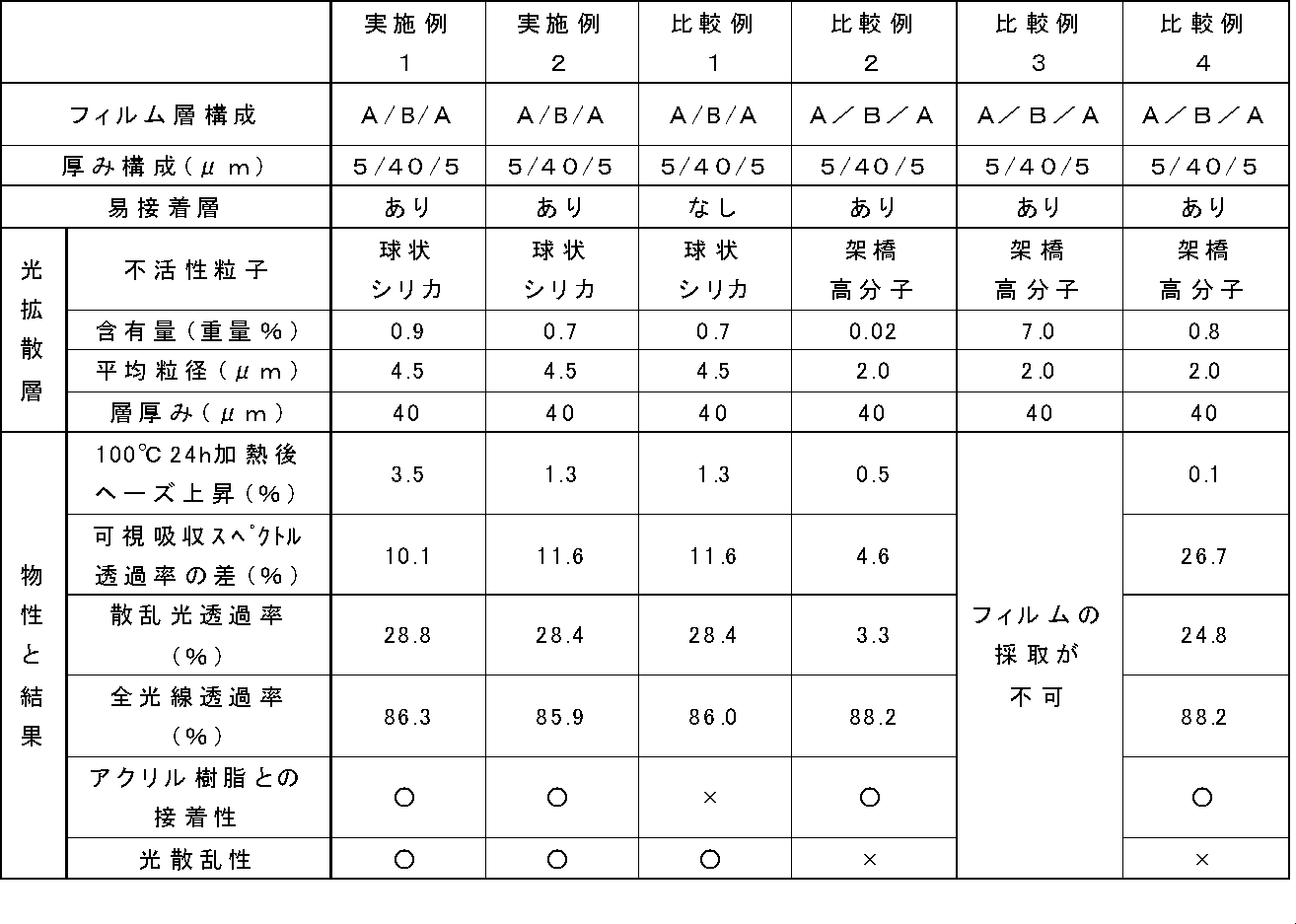
実施例1〜2においては、アクリル系光硬化樹脂との接着性に優れ、光散乱性にも優れる。特に実施例2は、100℃で加熱されたあとのヘーズ変化が小さい。一方、比較例1は、易接着層を有していないためアクリル系光硬化樹脂との接着性に劣る。比較例2は、光散乱剤の含有量が小さいため、光散乱性がほとんどなかった。比較例3は、光散乱剤の含有量が大きいためフィルムの製膜が困難であった。比較例4は、フィルムの可視スペクトルの吸収において波長750nmと波長450nmの透過率の差が20%を超えるため、やや透過光が黄色みを帯びていた。また光散乱性能も劣っていた。 In Examples 1-2, it is excellent in adhesiveness with acrylic type photocurable resin, and is excellent also in light-scattering property. Particularly in Example 2, the change in haze after heating at 100 ° C. is small. On the other hand, since Comparative Example 1 does not have an easy-adhesion layer, the adhesiveness with the acrylic photocurable resin is inferior. Comparative Example 2 had almost no light scattering property because the content of the light scattering agent was small. In Comparative Example 3, it was difficult to form a film because the content of the light scattering agent was large. In Comparative Example 4, since the difference in transmittance between the wavelength of 750 nm and the wavelength of 450 nm exceeded 20% in the absorption of the visible spectrum of the film, the transmitted light was slightly yellowish. Also, the light scattering performance was inferior.
本発明のフィルムは、例えば、艶消し性を必要とするガラスや成形体貼り合わせ用途や包装用途、また液晶ディスプレイの構成部品に用いることができる。 The film of the present invention can be used, for example, for glass and molded body bonding applications and packaging applications that require matte properties, and for components of liquid crystal displays.
Claims (1)
A polyester film having a coating layer and a coextruded layer containing 0.05 to 4.0% by weight of a light scattering agent, wherein the difference in transmittance between a wavelength of 750 nm and a wavelength of 450 nm in the visible absorption spectrum of the film is 20% A laminated stretched polyester film characterized by being within.
Priority Applications (1)
| Application Number | Priority Date | Filing Date | Title |
|---|---|---|---|
| JP2004112297A JP2005297215A (en) | 2004-04-06 | 2004-04-06 | Laminated stretched polyester film |
Applications Claiming Priority (1)
| Application Number | Priority Date | Filing Date | Title |
|---|---|---|---|
| JP2004112297A JP2005297215A (en) | 2004-04-06 | 2004-04-06 | Laminated stretched polyester film |
Publications (1)
| Publication Number | Publication Date |
|---|---|
| JP2005297215A true JP2005297215A (en) | 2005-10-27 |
Family
ID=35329363
Family Applications (1)
| Application Number | Title | Priority Date | Filing Date |
|---|---|---|---|
| JP2004112297A Pending JP2005297215A (en) | 2004-04-06 | 2004-04-06 | Laminated stretched polyester film |
Country Status (1)
| Country | Link |
|---|---|
| JP (1) | JP2005297215A (en) |
Cited By (1)
| Publication number | Priority date | Publication date | Assignee | Title |
|---|---|---|---|---|
| JP2011194715A (en) * | 2010-03-19 | 2011-10-06 | Sumitomo Chemical Co Ltd | Stretched film |
-
2004
- 2004-04-06 JP JP2004112297A patent/JP2005297215A/en active Pending
Cited By (1)
| Publication number | Priority date | Publication date | Assignee | Title |
|---|---|---|---|---|
| JP2011194715A (en) * | 2010-03-19 | 2011-10-06 | Sumitomo Chemical Co Ltd | Stretched film |
Similar Documents
| Publication | Publication Date | Title |
|---|---|---|
| JP5052716B2 (en) | Infrared filter | |
| JP4979105B2 (en) | Optical polyester film | |
| JP2005181648A (en) | Light scattering polyester film for prism sheet | |
| US20090035544A1 (en) | Laminated film for reflection plate | |
| JP4583105B2 (en) | Coextrusion laminated polyester film | |
| JP5536524B2 (en) | Biaxially stretched polyester film for window pasting | |
| JP4906160B2 (en) | Biaxially stretched polyester film | |
| JP4766995B2 (en) | Biaxially stretched polyester film | |
| JP5147470B2 (en) | Laminated biaxially stretched polyester film | |
| JP2007030278A (en) | Biaxially oriented polyester film for optics | |
| JP2011242733A (en) | Polyester film for protecting polarizing plate | |
| JP2009214489A (en) | Method of manufacturing laminated biaxially stretched polyester film | |
| JP5014616B2 (en) | Optical laminated polyester film | |
| JP2006249210A (en) | Light-scattering biaxially stretched polyether film | |
| JP5876750B2 (en) | Translucent biaxially stretched polyester film for glass lamination | |
| JP6167628B2 (en) | Polyester film for glass lamination | |
| KR101671817B1 (en) | White polyester film with low surface gloss and method of manufacturing the same and reflective sheet using the same | |
| JP2016122032A (en) | Polyester film roll for optics | |
| JP2010052139A (en) | Biaxially oriented polyester film | |
| JP2012250446A (en) | Optical biaxially-stretched polyester film roll | |
| JP2012218153A (en) | Optical polyester film | |
| JP2007154001A (en) | Optical laminated polyester film | |
| JP2007161937A (en) | Optical polyester film | |
| JP5787736B2 (en) | Translucent biaxially stretched polyester film for glass lamination | |
| JP2018062151A (en) | Laminated polyester film for transparent conductive film substrates |
Legal Events
| Date | Code | Title | Description |
|---|---|---|---|
| A621 | Written request for application examination |
Free format text: JAPANESE INTERMEDIATE CODE: A621 Effective date: 20070208 |
|
| A711 | Notification of change in applicant |
Effective date: 20080425 Free format text: JAPANESE INTERMEDIATE CODE: A712 |
|
| A131 | Notification of reasons for refusal |
Free format text: JAPANESE INTERMEDIATE CODE: A131 Effective date: 20090609 |
|
| A02 | Decision of refusal |
Free format text: JAPANESE INTERMEDIATE CODE: A02 Effective date: 20091027 |