JP2005296721A - Method to prevent scale adhesion to the filler in the cooling tower of vacuum degassing equipment for molten steel - Google Patents
Method to prevent scale adhesion to the filler in the cooling tower of vacuum degassing equipment for molten steel Download PDFInfo
- Publication number
- JP2005296721A JP2005296721A JP2004112776A JP2004112776A JP2005296721A JP 2005296721 A JP2005296721 A JP 2005296721A JP 2004112776 A JP2004112776 A JP 2004112776A JP 2004112776 A JP2004112776 A JP 2004112776A JP 2005296721 A JP2005296721 A JP 2005296721A
- Authority
- JP
- Japan
- Prior art keywords
- cooling tower
- condensed water
- molten steel
- filler
- vacuum degassing
- Prior art date
- Legal status (The legal status is an assumption and is not a legal conclusion. Google has not performed a legal analysis and makes no representation as to the accuracy of the status listed.)
- Withdrawn
Links
Images

Landscapes
- Treatment Of Steel In Its Molten State (AREA)
- Degasification And Air Bubble Elimination (AREA)
- Physical Water Treatments (AREA)
Abstract
【課題】溶鋼脱ガス設備の駆動用蒸気凝縮水冷却のための冷却塔内充填材へのスケール付着に関して、Ca系のスケール付着防止方法は提案されているが、溶鋼脱ガス設備特有のZn系スケール抑制方法に関しては確立されていない。そこで本発明は、真空脱ガス設備の蒸気凝縮水系で発生するZn系スケールの付着防止方法を提供する。
【解決手段】溶鋼脱ガス設備の駆動用蒸気の凝縮水系において、凝縮水を冷却塔に送水する前に、空気を吹き込み凝縮水から炭酸ガスを放散させる。炭酸ガスの放散により、凝縮水のPHを吹き込み前に比べ0.5以上上げ、冷却塔に送水する前に沈殿物を析出させることで、冷却塔内での充填材へのスケール付着を防止する。
【選択図】なし[Problem] Regarding the scale adhesion to the filler in the cooling tower for cooling the steam condensate for driving the molten steel degassing equipment, a Ca-based scale adhesion preventing method has been proposed. No scale suppression method has been established. Therefore, the present invention provides a method for preventing adhesion of Zn-based scales generated in a vapor condensed water system of a vacuum degassing facility.
In a condensed water system for driving steam of a molten steel degassing facility, before supplying condensed water to a cooling tower, air is blown to dissipate carbon dioxide from the condensed water. By releasing carbon dioxide gas, the pH of condensed water is raised by 0.5 or more compared to before blowing, and deposits are deposited before water is sent to the cooling tower, thereby preventing scale from adhering to the filler in the cooling tower. .
[Selection figure] None
Description
本発明は、溶鋼の真空脱ガス設備駆動用蒸気の凝縮水を冷却する際に使用する冷却塔内の充填材へのスケール付着防止に関する。 The present invention relates to prevention of scale adhesion to a filler in a cooling tower used when cooling condensed water of steam for driving a vacuum degassing facility for molten steel.
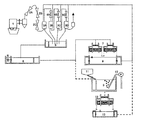
溶鋼の清浄化や成分調整等の目的で真空・減圧精錬が実施されるが、この過程で一般的に採用されるDH法やRH法に基づく真空・減圧精錬プロセスでは、かなりの高真空度(1Torr以下程度)が要求されるため、真空・減圧精錬プロセスに接続する真空排気設備としても、それに対応する規模のものが必要とされる。図1に一般的な真空脱ガスプロセスにおける真空排気系統の構成例を示す。 Vacuum / vacuum refining is carried out for the purpose of cleaning the molten steel and adjusting the components. In the vacuum / vacuum refining process based on the DH method and RH method generally adopted in this process, a considerably high degree of vacuum ( Therefore, the vacuum exhaust equipment connected to the vacuum / reduced pressure refining process is required to have a scale corresponding to that. FIG. 1 shows a configuration example of a vacuum exhaust system in a general vacuum degassing process.
図1において、溶鋼鍋等の溶鋼精錬容器に接続する脱ガス槽1の排気ダクト下流側には、多段のブースター2A、2B、2C、多段のエゼクター4A、4B、4Cを順次設置して構成した真空排気設備が設けられている。炉内発生ガス(排ガス)はこの真空排気設備で吸引されることになり、そのため炉内は要求される高真空度(1Torr以下)領域に保たれる。真空・減圧処理装置による真空精錬を実施する場合、ブースター2A、2B、2Cおよびエゼクター4A、4B、4Cに駆動用蒸気を流し、コンデンサー3A、3B、3C、3Dで冷却凝縮する。凝縮した水は、ホットウェル5に全て集められ、沈殿池6へ送水される。沈殿池6では凝縮水中に含まれているダスト等の大型の粒子を沈殿除去する。沈殿池6でダストを除去した凝縮水は冷却塔7へ送水され、空気との熱交換を行うことで冷却され、冷却後は冷水槽8に溜められる。冷水槽8に溜められた水は、駆動用蒸気の凝縮に再利用するため、コンデンサー3A、3B、3C、3Dへ送水される。
In FIG. 1, a
真空脱ガス処理においては、主に溶鋼の脱C処理を行うが、脱C処理を行う事で多量の炭酸ガスが発生する。発生した炭酸ガスは排ガスとして系外に排出されるが、その際に蒸気凝縮水と接触し、一部は蒸気凝縮水中に溶け込む。従って、蒸気凝縮水中には多量の炭酸ガスが溶け込み多量の炭酸イオンが存在している。 In vacuum degassing, molten steel is mainly de-C treated, but a large amount of carbon dioxide is generated by de-C treatment. The generated carbon dioxide gas is discharged out of the system as exhaust gas. At that time, it comes into contact with the steam condensed water, and a part thereof is dissolved in the steam condensed water. Therefore, a large amount of carbon dioxide gas dissolves in the steam condensed water, and a large amount of carbonate ions exist.
真空脱ガス処理においては、溶鋼の脱C処理と合わせて溶鋼の脱酸、Mn、Si等の成分調整も行う。特に脱酸は、連続鋳造を行う際のブレークアウト防止の観点から、ほとんど全ての処理において実施される。脱酸を行う際には、通常、酸素との親和力の強いAlを使用する。一般的に使用されるAlには、2〜3%のZnが含まれているが、Znは沸点が低いため溶鋼温度では蒸発する。従って、Alを投入すると、Al中のZnは蒸発し、排ガスと共に系外に排出される。その際に、蒸気凝縮水と接触し、一部は蒸気凝縮水中に溶け込みZnイオンとなっている。さらに、蒸気凝縮水は循環使用しているため、蒸気凝縮水にはZnイオンが飽和状態になっている。 In the vacuum degassing treatment, components such as deoxidation of molten steel, Mn, and Si are adjusted together with de-C treatment of molten steel. In particular, deoxidation is carried out in almost all processes from the viewpoint of preventing breakout during continuous casting. When deoxidizing, Al having a strong affinity for oxygen is usually used. Al generally used contains 2-3% Zn, but Zn evaporates at the molten steel temperature because of its low boiling point. Therefore, when Al is introduced, Zn in Al evaporates and is discharged out of the system together with the exhaust gas. At that time, it comes into contact with the steam condensed water, and a part thereof is dissolved in the steam condensed water to become Zn ions. Furthermore, since the steam condensed water is circulated, Zn ions are saturated in the steam condensed water.
また、ホットウェルから出た蒸気凝縮水は、沈殿池で大型のダストを沈殿させた後に、熱交換のため冷却塔へ送られる。一般的な冷却塔の冷却原理は、上部から縦方向に流される温水に対して、下部から上部への通風が冷却ファンによりなされて、気液接触により熱交換される。冷却塔の気液接触部では、波板状や突起状の充填材が空気または水の流路を複雑化し、気液接触面積を大きくして冷却効果を高めている。 The steam condensate discharged from the hot well is sent to the cooling tower for heat exchange after large dust is settled in the sedimentation basin. The general cooling principle of the cooling tower is that heat is exchanged by gas-liquid contact with hot water flowing in the vertical direction from the upper part, with ventilation from the lower part to the upper part by a cooling fan. In the gas-liquid contact portion of the cooling tower, corrugated or protruding fillers complicate the flow path of air or water, increasing the gas-liquid contact area and enhancing the cooling effect.
冷却塔内で気液接触による熱交換を行う際に、蒸気凝縮水中に溶けていた炭酸イオンが炭酸ガスとして放出されるため、水のPHが上昇する。その結果、飽和濃度でとけ込んでいたZnイオンが過飽和となり水酸化物等のスケールが析出し、充填材に付着する。充填材へのスケール付着により、空気経路がふさがれたり、充填材表面での流路が短絡化されて熱交換機能が低下する。 When heat exchange is performed by gas-liquid contact in the cooling tower, the carbonate ions dissolved in the steam condensed water are released as carbon dioxide gas, so that the pH of water increases. As a result, Zn ions that have melted at the saturated concentration become supersaturated, and scales such as hydroxide precipitate and adhere to the filler. Due to the scale adhering to the filler, the air path is blocked, or the flow path on the surface of the filler is short-circuited, and the heat exchange function is lowered.
スケール付着防止対策はこれまでにも実施されており、例えば特許文献1には、高炉、もしくは転炉ガス集塵水系にCa(OH)2またはMg(OH)2を発生させる物質を添加する方法が開示されている。しかし、この方法ではCaやMg系のスケールには効果があるが、Zn系スケールの付着抑制は困難である。さらに、前記方法ではPHを8.0以上に保つことが必要であるが、仮にPHが8.0以上であっても脱炭酸反応が発生すれば、PHがさらに上昇し、スケールは析出する。
上記のように、Ca系スケール付着抑制方法は提案されているが、真空脱ガス処理設備特有のZn系スケール抑制方法に関しては確立されていない。そこで本発明は、真空脱ガス設備の蒸気凝縮水系で発生するZn系スケールの付着抑制方法を提供することにある。 As described above, a Ca-based scale adhesion suppression method has been proposed, but a Zn-based scale suppression method specific to vacuum degassing equipment has not been established. Then, this invention is providing the adhesion suppression method of the Zn-type scale generate | occur | produced in the vapor | steam condensed water system of a vacuum degassing equipment.
本発明は前記課題を解決するためになされた発明であり、その要旨は以下の通りである。
(1)溶鋼の真空脱ガス設備駆動用蒸気の凝縮水系において、凝縮水を冷却塔に送水する前に、凝縮水のPHを0.5以上上げるように凝縮水から炭酸ガスを放散させることを特徴とする溶鋼の真空脱ガス設備冷却塔内の充填材へのスケール付着防止方法
(2)凝縮水に空気を吹き込み、凝縮水中の炭酸ガスを放散させることを特徴とする(1)に記載の溶鋼の真空脱ガス設備冷却塔内の充填材へのスケール付着防止方法
(3)溶鋼の真空脱ガス設備駆動用蒸気の凝縮水系において、凝縮水を冷却塔に送水する前に、空気の吹き込み量を蒸気凝縮水の単位時間当たりに流れる体積の0.5倍以上とすることを特徴とする(1)または(2)に記載の溶鋼の真空脱ガス設備冷却塔内の充填材へのスケール付着防止方法。
The present invention has been made to solve the above-mentioned problems, and the gist thereof is as follows.
(1) In the condensed water system of the steam for driving the vacuum degassing equipment for molten steel, before sending the condensed water to the cooling tower, carbon dioxide gas should be diffused from the condensed water so as to raise the pH of the condensed water by 0.5 or more. A method for preventing adhesion of scale to a filler in a vacuum degassing equipment cooling tower of molten steel (2) The air is blown into the condensed water to dissipate carbon dioxide in the condensed water as described in (1) Method for preventing scale from adhering to filler in vacuum degassing equipment cooling tower of molten steel (3) In the condensed water system of steam for driving vacuum degassing equipment of molten steel, the amount of air blown before the condensed water is sent to the cooling tower The scale adheres to the filler in the cooling tower of the vacuum degassing equipment for molten steel according to (1) or (2), characterized in that the volume of the steam condensed water is 0.5 times or more of the volume per unit time Prevention method.
本発明では、溶鋼脱ガス設備冷却塔内で発生する凝縮水からの脱炭酸反応を事前に強制的に行うことで、冷却塔内充填材へのスケール付着を防止でき、冷却能力を健全に保つことができる。 In the present invention, the decarbonation reaction from the condensed water generated in the molten steel degassing equipment cooling tower is forcibly performed in advance, thereby preventing the scale from adhering to the filler in the cooling tower and keeping the cooling capacity healthy. be able to.
冷却塔での冷却能力を十分に発揮させるには、充填材へのスケール付着を防止することが重要である。特に、真空脱ガス設備の蒸気凝縮水系の冷却塔においては、Zn系スケール析出を防止することが重要である。そこで、Zn系スケール析出防止方法についての検討を行った。 In order to fully exhibit the cooling capacity in the cooling tower, it is important to prevent the scale from adhering to the filler. In particular, it is important to prevent Zn-based scale precipitation in a steam condensate cooling tower of a vacuum degassing facility. Then, examination about the Zn system scale precipitation prevention method was performed.
析出を防止する方法としては、以下の事が考えられる。冷却塔の前であらかじめPHを上げておけば、その時点で析出物を生じ、凝縮水中のZnイオン濃度は低下するが、上昇したPHにおけるZnイオン飽和溶液になっているので、冷却塔内で脱炭酸反応が起これば、水酸化亜鉛が析出してしまう。また逆に、冷却塔前でPHを低下させれば、溶解度が上昇し析出しにくくなるが、PHを上げた際と同様に、低下したPHにおけるZnイオン飽和溶液になる。さらに、PH7.0未満の酸性側になると、配管にダメージを与えてしまう。そこで本発明では、冷却塔前で、事前に脱炭酸反応させることで、冷却塔内で脱炭酸反応を抑制し、析出物生成を防止する。冷却塔内部での析出物発生が無くなれば、充填材への付着もなくなり、熱交換能力の低下を防止できる。 The following can be considered as a method for preventing the precipitation. If PH is raised in front of the cooling tower in advance, precipitates are formed at that time, and the concentration of Zn ions in the condensed water decreases. However, since it is a saturated solution of Zn ions in the raised PH, If a decarboxylation reaction occurs, zinc hydroxide will precipitate. Conversely, if the pH is lowered in front of the cooling tower, the solubility is increased and it is difficult to precipitate. However, similarly to the case where the pH is raised, a Zn ion saturated solution in the lowered PH is obtained. Furthermore, if it becomes the acidic side of less than PH7.0, it will damage a piping. Therefore, in the present invention, by performing a decarboxylation reaction in front of the cooling tower in advance, the decarboxylation reaction is suppressed in the cooling tower and the formation of precipitates is prevented. If the generation of precipitates in the cooling tower is eliminated, adhesion to the packing material is eliminated, and a decrease in heat exchange capacity can be prevented.
脱炭酸反応を起こすためには、蒸気凝縮水と気体を接触させれば分圧の差から炭酸ガスを放散させることができる。接触させる気体は炭酸ガス以外であれば、何でも構わないが、工業生産上、容易かつ安価に実施するには空気を用いる事が望ましい。空気と接触させる方法としては水車を回したり、滝のように上方から流すなど、どのような方法でも構わないが、空気を吹き込む事がよりよい。理由は、空気を吹き込むことで小さな気泡が大量に凝縮水中に入るため、気−液界面積が大きくなるからである。 In order to cause the decarboxylation reaction, carbon dioxide gas can be diffused from the difference in partial pressure by bringing vapor condensed water and gas into contact with each other. Any gas can be used as long as it is other than carbon dioxide, but it is desirable to use air for easy and inexpensive implementation in industrial production. Any method can be used to contact the air, such as turning a water wheel or flowing from above like a waterfall, but it is better to blow in air. The reason is that a large amount of small bubbles enter the condensed water by blowing air, so that the gas-liquid interface area becomes large.
脱炭酸反応は冷却塔へ送水する以前であれば、どこで実施してもかまわないが、前記のように空気と接触させるため凝縮水が強く撹拌される。従って、凝縮水中のダストが沈殿、除去させる沈殿池の上流で実施すると、沈殿池でのダスト除去効果が低下する可能性があるので、沈殿池より下流で実施することが望ましい。 The decarboxylation reaction may be performed anywhere before the water is sent to the cooling tower, but the condensed water is vigorously stirred in order to contact with air as described above. Therefore, since it may reduce the dust removal effect in a sedimentation basin when it carries out upstream of the sedimentation basin which the dust in condensed water settles and removes, it is desirable to implement downstream from a sedimentation basin.
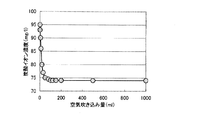
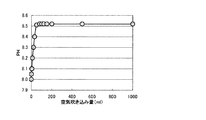
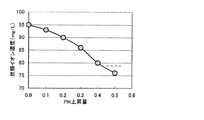
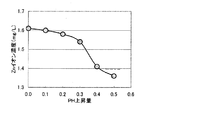
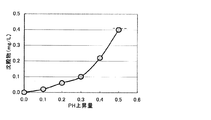
空気吹き込みによる脱炭酸効果をラボ試験により確認した。冷却塔に入る前の凝縮水を100ml採取しビーカーに入れ、ガラス管からビーカー内へ1000mlの空気を吹き込んだ。試験に用いた凝縮水のPHは8.0であった。空気吹き込みによる炭酸イオン濃度およびPHの変化を図2、図3に示す。空気を吹き込んだことにより脱炭酸反応が起こり、炭酸イオン濃度が低下し、PHは上昇した。また、多量の空気を吹き込み続けても、脱炭酸反応が空気中の炭酸ガスと平衡状態になり停滞するため、PHは0.5程度しか上昇しなかった。次に、空気吹き込み中のPHの変化による炭酸イオン濃度、Znイオン濃度、沈殿物生成量の関係を図4、図5、図6に示す。PHの上昇に伴って、蒸気凝縮水中の炭酸イオン濃度、Znイオン濃度は低下した。一方、沈殿物生成量はPHの上昇に伴って増加した。PHの上昇と共にZn系の沈殿物が発生するため、Znイオン濃度が減少したと推定される。また、空気吹き込みによりPH上昇が0.5程度になると、PH上昇が止まるため炭酸イオン、Znイオン濃度の低下度合が鈍り、沈殿物析出が少なくなる。故に、PHを0.5上げるように脱炭酸反応を起こせばよい。 The decarboxylation effect by air blowing was confirmed by a laboratory test. 100 ml of condensed water before entering the cooling tower was collected and placed in a beaker, and 1000 ml of air was blown into the beaker from the glass tube. The pH of the condensed water used in the test was 8.0. Changes in carbonate ion concentration and PH due to air blowing are shown in FIGS. By blowing air, a decarboxylation reaction occurred, the carbonate ion concentration decreased, and the PH increased. Even if a large amount of air was continuously blown in, the decarboxylation reaction was in equilibrium with the carbon dioxide in the air and stagnated, so that the PH increased only by about 0.5. Next, FIGS. 4, 5, and 6 show the relationship between the carbonate ion concentration, the Zn ion concentration, and the amount of precipitate generated due to the change in pH during air blowing. As the pH increased, the carbonate ion concentration and the Zn ion concentration in the steam condensed water decreased. On the other hand, the amount of precipitate produced increased with increasing PH. It is presumed that the Zn ion concentration decreased because a Zn-based precipitate was generated with an increase in PH. Further, when the PH increase is about 0.5 due to air blowing, since the PH increase stops, the degree of decrease in the carbonate ion and Zn ion concentration becomes dull, and precipitation is reduced. Therefore, the decarboxylation reaction may be caused to raise the pH by 0.5.
次に、蒸気凝縮水のPHを変化させ、同様の試験を行った。PHを変化させることで、凝縮水中に存在する炭酸イオン、Znイオン濃度は変化したが、そのPHに応じた飽和濃度になっていた。そこへ、空気吹き込みを行うと脱炭酸反応が起こり、空気吹き込み前に比べて、PHが上昇し析出物が生じた。PH=8.0の凝縮水を使用したときと同様に、多量の空気を吹き込み続けても、脱炭酸反応が空気中の炭酸ガスと平衡状態になり停滞するため、PHは0.5程度しか上昇しなかった。従って、空気吹き込みによりPHを0.5上げるように脱炭酸反応を起こさせると、PH上昇が止まるため炭酸イオン、Znイオンの低下が鈍り沈殿物の析出量も低下した。従って、凝縮水PHが変化しても、凝縮水中の炭酸イオン、ZnイオンがそのPHに応じた飽和濃度で存在するため、脱炭酸反応が起これば析出物が生じた。 Next, the same test was performed by changing the pH of the steam condensed water. By changing PH, the concentration of carbonate ions and Zn ions present in the condensed water changed, but the saturation concentration was in accordance with the PH. When air was blown there, a decarboxylation reaction occurred, and the pH increased and precipitates were formed compared to before air was blown. As in the case of using condensed water with a pH of 8.0, even if a large amount of air continues to be blown, the decarboxylation reaction is in equilibrium with the carbon dioxide in the air and stagnates. It did not rise. Therefore, when the decarboxylation reaction was caused to raise the pH by 0.5 by blowing air, the increase in PH stopped, so the decrease in carbonate ions and Zn ions slowed down, and the precipitation amount of precipitates also decreased. Therefore, even if the condensed water PH changes, carbonate ions and Zn ions in the condensed water are present at a saturated concentration corresponding to the PH, so that precipitates are generated when the decarboxylation reaction occurs.
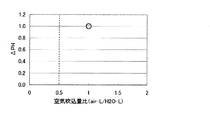
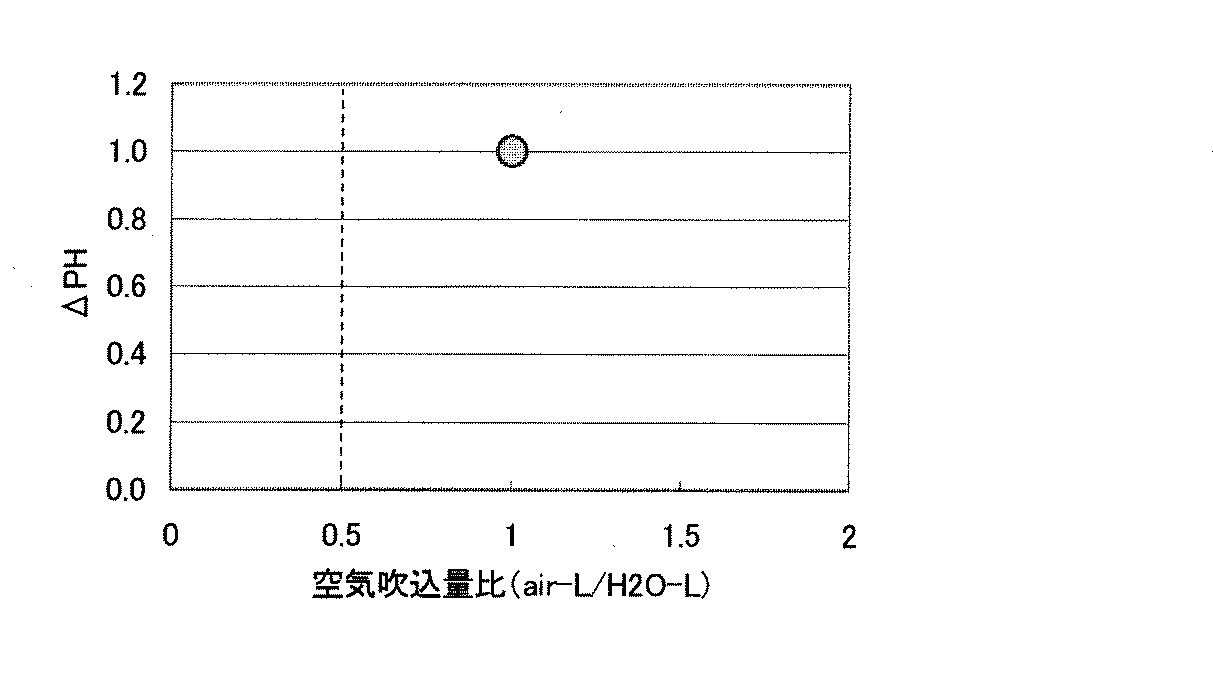
前記の通り、空気吹き込みによりPHが上昇するが、多量に空気を吹き込んでも空気中炭酸ガスとの平衡に達するため脱炭酸反応が停滞し、PHは0.5程度しか上昇しない。そこで、空気吹き込み量の最適値の確認のため、空気吹き込み量とPH上昇値のと関係を調査した。結果を図7に示す。空気吹き込み量が増加するに従ってPHも上昇し、吹き込み量が蒸気凝縮水体積の0.5倍の空気を吹き込んだ時点でPHは0.5上昇した。従って、蒸気凝縮水体積の0.5倍以上の空気を吹き込めばよい。吹き込み量を増加させていくと、蒸気凝縮水体積の0.55倍の時にPHが0.51まで上昇したが、それ以上吹き込んでも、PHは上昇しなかった。蒸気凝縮水体積の1.5倍以上吹き込むためには、大型のポンプが必要となり、電力消費量も増大するため、経済的な観点から、吹き込み量が蒸気凝縮水体積の1.5倍以下にすることが望ましい。 As described above, PH increases by blowing air, but even if a large amount of air is blown, the decarbonation reaction stagnates because of reaching equilibrium with carbon dioxide in the air, and PH increases only by about 0.5. Therefore, in order to confirm the optimum value of the air blowing amount, the relationship between the air blowing amount and the PH increase value was investigated. The results are shown in FIG. The PH also increased as the air blowing amount increased, and the PH rose by 0.5 when the blowing amount blown 0.5 times the volume of steam condensed water. Therefore, it is only necessary to blow in air that is 0.5 times or more the volume of steam condensed water. When the amount of blowing was increased, PH rose to 0.51 when the volume of steam condensed water was 0.55 times, but PH did not rise even when blowing more. In order to blow more than 1.5 times the volume of steam condensate, a large pump is required and the power consumption also increases. From an economical point of view, the volume of blow is less than 1.5 times the volume of steam condensate. It is desirable to do.
真空脱ガス設備であるRHの冷却塔でのスケール付着に関して、試験冷却塔を用いて調査を行った。試験設備を図8に示す。沈殿池6に流入した蒸気凝縮水を通常使用している冷却塔7と並列に設置した試験用冷却塔12に送った。また試験冷却塔12の前には、ピット9を設置した。ピット9でCa(OH)2を添加後、試験冷却塔12に送る場合と、空気吹き込みを行った後に試験冷却塔12に送る場合の2種類の試験を行った。Ca(OH)2は単位時間当たり投入速度一定でホッパー11から切り出して添加した。空気吹き込みは、空気吹き込み用の配管10を設置し、ポンプを介し配管から種々の流量の空気を凝縮水に吹き込んだ。各条件で10日間、蒸気凝縮水を試験用冷却塔に流した。試験前後の冷却塔の冷却能力、風量、スケール付着による充填材重量変化を測定した。試験結果を表1に示す。
Ca(OH)2を添加した場合(従来例)は、ピット内でのPHは上昇したが空気吹き込みを行っていないため冷却塔内で脱炭酸反応が起こり、冷却塔内で更にPHが上昇した。そのため、冷却塔内でスケールが析出し、充填材へのスケール付着が起こった結果、風量が低下し、冷却効率劣化率が上昇した。(評価×) When Ca (OH) 2 was added (conventional example), PH in the pit increased, but no air was blown, so decarboxylation occurred in the cooling tower, and PH further increased in the cooling tower. . As a result, scale was deposited in the cooling tower and the scale adhered to the filler. As a result, the air flow decreased and the cooling efficiency deterioration rate increased. (Evaluation x)
次にピット9での空気を吹き込む試験を行った。空気吹き込みを行った場合でも、空気吹き込み前後で、PH上昇が0.5未満の場合(比較例1、2)は、脱炭酸反応が十分に起こっていないため、冷却塔内でも脱炭酸反応が起こり、冷却塔内でPHが上昇した。そのため、冷却塔内でスケールが析出し、充填材へのスケール付着が起こった結果、風量が低下し、冷却効率劣化率が上昇した。(評価×) Next, a test for blowing air in the pit 9 was performed. Even when air blowing is performed, when the pH increase is less than 0.5 before and after the air blowing (Comparative Examples 1 and 2), the decarboxylation reaction does not occur sufficiently. Happened and PH increased in the cooling tower. As a result, scale was deposited in the cooling tower and the scale adhered to the filler. As a result, the air flow decreased and the cooling efficiency deterioration rate increased. (Evaluation x)
空気吹き込みを行い、空気吹き込み前後でPHが0.5以上上がった場合(本発明1〜3)は、脱炭酸反応が十分に起こっているため、冷却塔内での脱炭酸反応が起こらず、スケール析出は起こらなかった。そのため、風量の低下もなく、冷却効率の劣化もなかった(評価○)。しかしながら、大型のポンプを使用しなければならず、前記本発明1,2に比べ、電力消費量が2倍になった。
When PH is increased by 0.5 or more before and after air blowing (invention 1 to 3), decarboxylation reaction has occurred sufficiently, so decarboxylation reaction in the cooling tower does not occur, Scale precipitation did not occur. Therefore, there was no decrease in the air volume, and there was no deterioration in cooling efficiency (evaluation ○). However, a large pump must be used, and the power consumption is doubled compared to the first and second aspects of the present invention.
1 脱ガス槽
2A 1段目ブースター
2B 2段目ブースター
2C 3段目ブースター
3A 1段目コンデンサー
3B 2段目コンデンサー
3C 3段目コンデンサー
3D 4段目コンデンサー
4A 1段目エゼクター
4B 2段目エゼクター
4C 3段目エゼクター
5 ホットウェル
6 沈殿池
7 冷却塔
8 冷水槽
9 ピット
10 空気吹き込み配管
11 水酸化カルシウム添加ホッパー
12 試験用冷却塔
13 試験用冷水槽
1
Claims (3)
Priority Applications (1)
| Application Number | Priority Date | Filing Date | Title |
|---|---|---|---|
| JP2004112776A JP2005296721A (en) | 2004-04-07 | 2004-04-07 | Method to prevent scale adhesion to the filler in the cooling tower of vacuum degassing equipment for molten steel |
Applications Claiming Priority (1)
| Application Number | Priority Date | Filing Date | Title |
|---|---|---|---|
| JP2004112776A JP2005296721A (en) | 2004-04-07 | 2004-04-07 | Method to prevent scale adhesion to the filler in the cooling tower of vacuum degassing equipment for molten steel |
Publications (1)
| Publication Number | Publication Date |
|---|---|
| JP2005296721A true JP2005296721A (en) | 2005-10-27 |
Family
ID=35328920
Family Applications (1)
| Application Number | Title | Priority Date | Filing Date |
|---|---|---|---|
| JP2004112776A Withdrawn JP2005296721A (en) | 2004-04-07 | 2004-04-07 | Method to prevent scale adhesion to the filler in the cooling tower of vacuum degassing equipment for molten steel |
Country Status (1)
| Country | Link |
|---|---|
| JP (1) | JP2005296721A (en) |
Cited By (1)
| Publication number | Priority date | Publication date | Assignee | Title |
|---|---|---|---|---|
| CN118043115A (en) * | 2021-09-22 | 2024-05-14 | 达涅利机械设备股份公司 | Vacuum degassing equipment and autogenous powder inerting process |
-
2004
- 2004-04-07 JP JP2004112776A patent/JP2005296721A/en not_active Withdrawn
Cited By (1)
| Publication number | Priority date | Publication date | Assignee | Title |
|---|---|---|---|---|
| CN118043115A (en) * | 2021-09-22 | 2024-05-14 | 达涅利机械设备股份公司 | Vacuum degassing equipment and autogenous powder inerting process |
Similar Documents
| Publication | Publication Date | Title |
|---|---|---|
| KR20080035688A (en) | Ammonium / Ammonia Removal from the Stream | |
| JPWO2009072612A1 (en) | Method for producing boron-containing glass product and method for purifying exhaust gas generated during production of boron-containing glass product | |
| JPH10290919A (en) | Stack gas treatment equipment and treatment of stack gas | |
| JP2015071141A (en) | Method and apparatus for desulfurization of gas containing sulfur oxide | |
| EP1476708B1 (en) | Cooling process and apparatus for cooling a fluid using coolant water | |
| JP5577571B2 (en) | Scale inhibitor for circulating cooling water system in steel manufacturing process, and scale prevention method | |
| CN1042650C (en) | Smelting method of aluminium killed steel for steel sheet | |
| JP4139581B2 (en) | Operation method of reduction furnace | |
| CN102560002A (en) | Method for removing fine inclusions in molten steel and blowing device | |
| CN110981011A (en) | High-gravity high-salinity water decarbonization and acid recovery system and use method | |
| JP5544716B2 (en) | Method for cleaning circulating cooling water in steel manufacturing process | |
| JP4735615B2 (en) | Steam boiler equipment | |
| CN214914642U (en) | Separation device for hood-type furnace tail gas treatment | |
| US3766019A (en) | MgCO{11 {11 ADDITION TO CaSO{11 {11 CONTAINING SEA WATER TO PREVENT CORROSION | |
| KR20230096964A (en) | Exhaust gas treatment equipment | |
| JP5353033B2 (en) | Corrosion prevention method for exhaust gas cooler | |
| JP2000510040A (en) | Process for treating gas wash water from the gas treatment process of an iron ore reduction plant | |
| JP7807645B2 (en) | High-purity steel melting method | |
| CN205988673U (en) | A kind of ore pulp processes the high effective desulphurization device of sulfur dioxide flue gas | |
| JP2735004B2 (en) | Corrosion prevention method for high and medium pressure steam return piping | |
| JP5024693B2 (en) | Vacuum deaerator | |
| CN212017232U (en) | An integrated multi-stage biological filtration tower | |
| RU2176987C2 (en) | Degassing plant | |
| JP5874674B2 (en) | Vacuum degassing apparatus and dust collection method for vacuum degassing apparatus | |
| JPH0240284A (en) | Apparatus for treating water |
Legal Events
| Date | Code | Title | Description |
|---|---|---|---|
| A300 | Withdrawal of application because of no request for examination |
Free format text: JAPANESE INTERMEDIATE CODE: A300 Effective date: 20070703 |