JP2005295548A - Improved apparatus and method for managing transmission of a block of data on an HS-DSCH downlink channel of a mobile communication network - Google Patents
Improved apparatus and method for managing transmission of a block of data on an HS-DSCH downlink channel of a mobile communication network Download PDFInfo
- Publication number
- JP2005295548A JP2005295548A JP2005090730A JP2005090730A JP2005295548A JP 2005295548 A JP2005295548 A JP 2005295548A JP 2005090730 A JP2005090730 A JP 2005090730A JP 2005090730 A JP2005090730 A JP 2005090730A JP 2005295548 A JP2005295548 A JP 2005295548A
- Authority
- JP
- Japan
- Prior art keywords
- variable
- values
- value
- transmission
- sequence
- Prior art date
- Legal status (The legal status is an assumption and is not a legal conclusion. Google has not performed a legal analysis and makes no representation as to the accuracy of the status listed.)
- Pending
Links
Images



Classifications
-
- H—ELECTRICITY
- H04—ELECTRIC COMMUNICATION TECHNIQUE
- H04L—TRANSMISSION OF DIGITAL INFORMATION, e.g. TELEGRAPHIC COMMUNICATION
- H04L1/00—Arrangements for detecting or preventing errors in the information received
- H04L1/12—Arrangements for detecting or preventing errors in the information received by using return channel
- H04L1/16—Arrangements for detecting or preventing errors in the information received by using return channel in which the return channel carries supervisory signals, e.g. repetition request signals
- H04L1/18—Automatic repetition systems, e.g. Van Duuren systems
- H04L1/1812—Hybrid protocols; Hybrid automatic repeat request [HARQ]
- H04L1/1819—Hybrid protocols; Hybrid automatic repeat request [HARQ] with retransmission of additional or different redundancy
-
- H—ELECTRICITY
- H04—ELECTRIC COMMUNICATION TECHNIQUE
- H04L—TRANSMISSION OF DIGITAL INFORMATION, e.g. TELEGRAPHIC COMMUNICATION
- H04L1/00—Arrangements for detecting or preventing errors in the information received
- H04L1/004—Arrangements for detecting or preventing errors in the information received by using forward error control
- H04L1/0056—Systems characterized by the type of code used
- H04L1/0064—Concatenated codes
- H04L1/0066—Parallel concatenated codes
-
- H—ELECTRICITY
- H04—ELECTRIC COMMUNICATION TECHNIQUE
- H04L—TRANSMISSION OF DIGITAL INFORMATION, e.g. TELEGRAPHIC COMMUNICATION
- H04L1/00—Arrangements for detecting or preventing errors in the information received
- H04L1/004—Arrangements for detecting or preventing errors in the information received by using forward error control
- H04L1/0056—Systems characterized by the type of code used
- H04L1/0067—Rate matching
- H04L1/0068—Rate matching by puncturing
-
- H—ELECTRICITY
- H04—ELECTRIC COMMUNICATION TECHNIQUE
- H04L—TRANSMISSION OF DIGITAL INFORMATION, e.g. TELEGRAPHIC COMMUNICATION
- H04L1/00—Arrangements for detecting or preventing errors in the information received
- H04L1/12—Arrangements for detecting or preventing errors in the information received by using return channel
- H04L1/16—Arrangements for detecting or preventing errors in the information received by using return channel in which the return channel carries supervisory signals, e.g. repetition request signals
- H04L1/18—Automatic repetition systems, e.g. Van Duuren systems
- H04L1/1867—Arrangements specially adapted for the transmitter end
- H04L1/1893—Physical mapping arrangements
-
- H—ELECTRICITY
- H04—ELECTRIC COMMUNICATION TECHNIQUE
- H04L—TRANSMISSION OF DIGITAL INFORMATION, e.g. TELEGRAPHIC COMMUNICATION
- H04L1/00—Arrangements for detecting or preventing errors in the information received
- H04L1/0001—Systems modifying transmission characteristics according to link quality, e.g. power backoff
- H04L1/0002—Systems modifying transmission characteristics according to link quality, e.g. power backoff by adapting the transmission rate
- H04L1/0003—Systems modifying transmission characteristics according to link quality, e.g. power backoff by adapting the transmission rate by switching between different modulation schemes
-
- H—ELECTRICITY
- H04—ELECTRIC COMMUNICATION TECHNIQUE
- H04L—TRANSMISSION OF DIGITAL INFORMATION, e.g. TELEGRAPHIC COMMUNICATION
- H04L1/00—Arrangements for detecting or preventing errors in the information received
- H04L1/0001—Systems modifying transmission characteristics according to link quality, e.g. power backoff
- H04L1/0009—Systems modifying transmission characteristics according to link quality, e.g. power backoff by adapting the channel coding
- H04L1/0013—Rate matching, e.g. puncturing or repetition of code symbols
Landscapes
- Engineering & Computer Science (AREA)
- Computer Networks & Wireless Communication (AREA)
- Signal Processing (AREA)
- Mobile Radio Communication Systems (AREA)
- Detection And Prevention Of Errors In Transmission (AREA)
Abstract
【課題】移動通信ネットワークのHS−DSCHダウンリンクチャネルのデータのブロックの送信を管理するための改善された装置および方法を提供すること。
【解決手段】装置(D)は、通信ネットワークの基地局とユーザの装置の間に設定されたHS−DSCHダウンリンクトランスポートチャネルで、デジタルデータブロックの送信を管理することを専用とする。装置(D)は、所与のブロックがトランスポートチャネルを介してユーザの装置に送信されることが必要になる度に、組織化されたビットの送信に優先権を与えるために第1のブロックの送信に使用される冗長パラメータXRVの値が選択される、1つの選択されたシーケンスに従い、冗長パラメータXRVの連続値を選択するように構成された処理手段(MT)を含む。
【選択図】 図4An improved apparatus and method for managing transmission of a block of data on an HS-DSCH downlink channel of a mobile communication network.
Device (D) is dedicated to managing the transmission of digital data blocks on an HS-DSCH downlink transport channel set up between a base station of a communication network and a user device. The device (D) uses the first block to give priority to the transmission of the organized bits each time a given block needs to be transmitted to the user's device via the transport channel. A processing means (MT) configured to select a continuous value of the redundancy parameter X RV according to one selected sequence, wherein the value of the redundancy parameter X RV used for transmission of is selected.
[Selection] Figure 4
Description
本発明は、移動通信ネットワークの分野に関し、より詳細には、そのようなネットワークのHS−DSCHトランスポートチャネルにおけるデジタルデータブロックの送信を管理することに関する。 The present invention relates to the field of mobile communication networks, and more particularly to managing the transmission of digital data blocks in the HS-DSCH transport channel of such networks.
当業者ならば気付いているだろうが、GSM/GPRS、UMTSおよびEDGEネットワークなどのような移動(またはセルラ)通信ネットワークにおけるマルチメディアデータの伝送を制御する3GPP仕様の第5版は、ダウンリンクパケットトラフィックを伝送するために高いビットレートを提供することを1つの具体的な目的とした、実質的に、伝送遅延に敏感でないインターネットトラフィックなどのような、高速ダウンリンクパケットアクセス(HSDPA)機構を提案する。これは、ユーザの装置間で共用される、高速−ダウンリンクシェアドチャネル(HS−DSCH)として知られるトランスポートチャネルを使用することに基づく。 As those skilled in the art are aware, the fifth edition of the 3GPP specification that controls the transmission of multimedia data in mobile (or cellular) communication networks such as GSM / GPRS, UMTS and EDGE networks is Proposed high-speed downlink packet access (HSDPA) mechanisms, such as Internet traffic that is virtually insensitive to transmission delays, with one specific goal to provide high bit rates for transporting traffic To do. This is based on the use of a transport channel known as High Speed-Downlink Shared Channel (HS-DSCH) that is shared between user devices.
HS−DSCHトランスポートチャネルは、MAC層と物理層の間に位置する。HS−DSCHトランスポートチャネルから来るデータビットは、物理層のレベルに位置しておりHS−PDSCHと呼ばれる少なくとも1つの物理チャネルから構成される一組の物理チャネルで、ユーザの装置に送信される。 The HS-DSCH transport channel is located between the MAC layer and the physical layer. Data bits coming from the HS-DSCH transport channel are transmitted to the user's device on a set of physical channels that are located at the physical layer level and are composed of at least one physical channel called HS-PDSCH.
この場合、「ユーザの装置」という表現は、移動(またはセルラ)通信ネットワークと無線によってデータを交換することのできるいかなる通信端末をも意味する。 In this case, the expression “user device” means any communication terminal capable of exchanging data wirelessly with a mobile (or cellular) communication network.
高いビットレートを得ることは、具体的には、ハイブリッド自動再送要求(HARQ)技術を利用することに依存し、これにより、ユーザの装置が、HS−DSCHトランスポートチャネル上でその基地局から不正確なデータブロックを受信する度に、その基地局には、不正確な受信を示す否定応答(NACK)メッセージが送信され、その結果、その基地局はそのユーザの装置に、HS−DSCHトランスポートチャネルでデータビットの新しいブロックを送信する。この新しいブロックを受信すると、ユーザの装置は、それが含んでいるデータを、専用バッファに一時記憶されている、既に不正確に受信された1つまたは複数のブロックに含まれるデータと結合する。 Obtaining a high bit rate depends in particular on the use of hybrid automatic repeat request (HARQ) technology, which allows the user's equipment to be disconnected from its base station on the HS-DSCH transport channel. Each time an accurate data block is received, a negative acknowledgment (NACK) message is transmitted to the base station indicating an inaccurate reception, so that the base station sends HS-DSCH transport to the user's device. Send a new block of data bits on the channel. Upon receiving this new block, the user's device combines the data it contains with the data contained in one or more previously received blocks that are temporarily stored in a dedicated buffer.
「チェース結合」(CC)と呼ばれるモードと「インクリメンタル冗長」(IR)と呼ばれるモードの、2つの再送モードがある。それぞれ、CCモードは、元のブロックと同じデータの組を含むブロックを再送し、IRモードは、それぞれが部分的に互いに異なるデータの組を含むブロックを再送する。IRモードでは、ブロックによって異なり、レートマッチングの段階で使用される、冗長パラメータXRVの値に応じて各データの組が選択される。 There are two retransmission modes: a mode called “chase combining” (CC) and a mode called “incremental redundancy” (IR). The CC mode retransmits a block including the same data set as the original block, and the IR mode retransmits a block including a data set partially different from each other. In the IR mode, each data set is selected according to the value of the redundancy parameter X RV , which differs depending on the block and is used in the rate matching stage.
当業者ならば気付いているだろうが、IR管理モードはCC管理モードよりも効率がよく、したがって、冗長パラメータXRVの最適値を選択することが特に重要である。 As those skilled in the art will be aware, the IR management mode is more efficient than the CC management mode, so it is particularly important to select an optimal value for the redundancy parameter X RV .
本発明の目的は、伝送されるべき各ブロックのデータの組を定義するために、レートマッチングの段階で使用される冗長パラメータXRVの値の、所与の基地局に対する選択を最適化することである。 The object of the present invention is to optimize the selection for a given base station of the value of the redundancy parameter X RV used in the rate matching stage to define the data set of each block to be transmitted. It is.
この目的で、本発明は、トランスポートチャネル符号化システムに対して、通信ネットワークの基地局とユーザの装置の間に設定されたHS−DSCHダウンリンクトランスポートチャネルで、(「組織化された」タイプおよび/または「パリティ1または2」タイプの)デジタルデータブロックの送信を管理する装置を提案する。 For this purpose, the present invention is directed to a transport channel coding system with ("organized") an HS-DSCH downlink transport channel established between a base station of a communication network and a user equipment. An apparatus for managing the transmission of digital data blocks (of type and / or “parity 1 or 2” type) is proposed.
この装置は、冗長パラメータXRVの値に応じて選択されたデジタルデータの第1の組を含むブロックを前記ユーザの装置に送信するために、冗長パラメータXRVの値を選択し、前記ユーザの装置によるブロックの不正確な受信の場合に、XRVの前記他の値に応じて選択されたデジタルデータの別の組を含む少なくとも1つの他のブロックを前記ユーザの装置に送信するために、前記冗長パラメータXRVの少なくとも1つの他の値を選択するように構成された処理手段を含む。 This device, to transmit a block including the first set of digital data selected according to the value of the redundancy parameter X RV in the device of the user, select the value of the redundancy parameter X RV, the user In order to send to the user's device at least one other block that includes another set of digital data selected in response to the other value of X RV in case of incorrect reception of the block by the device. Processing means configured to select at least one other value of the redundancy parameter X RV .
本発明によれば、処理手段は、所与のブロックを前記チャネルで送信する必要がある度に、第1のブロックの送信のために使用される冗長パラメータXRVの値が組織化されたビットの送信に優先権を与えるように選択される、選択されたシーケンスに従い、冗長パラメータXRVの連続値を選択するようにさらに構成される。 According to the present invention, the processing means is an organized bit of the value of the redundancy parameter X RV used for transmission of the first block each time a given block needs to be transmitted on the channel. Is further configured to select a continuous value of the redundancy parameter X RV according to a selected sequence that is selected to give priority to the transmission of.
処理手段が、パリティ1またはパリティ2ビットの送信と組織化されたビットの送信に交互に優先権を与えるように、第1の送信の後に各ブロックの送信のために使用される冗長パラメータXRVの値が選択される、選択されたシーケンスに従い、冗長パラメータXRVの前記連続値を選択するように構成されることが好ましい。 The redundancy parameter X RV used for the transmission of each block after the first transmission so that the processing means alternately gives priority to the transmission of parity 1 or parity 2 bits and the transmission of organized bits. Is preferably configured to select the continuous value of the redundancy parameter X RV according to a selected sequence.
処理手段が、これに加えて、かつ/またはこれの代わりに、各送信でマッチングするビット/記号を交替させるように冗長パラメータXRVの各値が選択される、選択されたシーケンスに従い、冗長パラメータXRVの前記連続値を選択するように構成することができる。 In addition to and / or instead of this, the redundancy parameter X RV is selected according to a selected sequence in which each value of the redundancy parameter X RV is selected to alternate the matching bit / symbol in each transmission. The continuous value of X RV can be selected.
本発明は、XRVが第1の変数sと第2の変数rにより現在のUMTS標準で定義され、例えば変数sは0と1から選択される2つの値を取ることができ、変数rは0、1、2および3から選択した少なくとも2つの値を取ることができる、QPSK変調を使用する送信と、XRVが第1の変数s、第2の変数rおよび第3の変数により現在のUMTS標準で定義され、例えば第1の変数sは0と1から選択される2つの値を取ることができ、第2の変数rは0と1から選択される少なくとも2つの値を取ることができ、第3の変数(例えば、値b)はビット/記号のマッチングを定義するためのものであり、変数bは、一般に、0、1、2および3から選択される少なくとも2つの値である、16QAM変調を使用する送信とに等しく適用することができる。 In the present invention, X RV is defined in the current UMTS standard by a first variable s and a second variable r, for example, the variable s can take two values selected from 0 and 1, where the variable r is A transmission using QPSK modulation, which can take at least two values selected from 0, 1, 2 and 3, and X RV is current by the first variable s, the second variable r and the third variable As defined in the UMTS standard, for example, the first variable s can take two values selected from 0 and 1, and the second variable r can take at least two values selected from 0 and 1. The third variable (eg, value b) is for defining bit / symbol matching, and variable b is generally at least two values selected from 0, 1, 2, and 3 Equally suitable for transmission using 16QAM modulation It can be.
QPSK変調の場合、処理手段は、第1の送信に対応する第1の値が偶数である、XRVの一連の値を構成するように、各シーケンスを選択するように構成することができる。この一連の値は、第1の送信に対応する第1の値を偶数として、XRVの偶数値と奇数値を交替させることを含むことが好ましい。 In the case of QPSK modulation, the processing means can be configured to select each sequence so as to constitute a series of values of X RV , where the first value corresponding to the first transmission is an even number. The series of values preferably includes alternating the even and odd values of X RV , with the first value corresponding to the first transmission being an even number.
例えば、UMTS標準では、XRVがパラメータrおよびsのみに依存する場合、XRVは、式XRV=2r+1−sによって定義することができる。 For example, in the UMTS standard, if X RV depends only on the parameters r and s, X RV can be defined by the equation X RV = 2r + 1-s .
さらに、処理手段は、一連の交替する、1に等しい変数sに対応するXRVの偶数値と、0に等しい変数sに対応するXRVの奇数値を構成するように、各シーケンスを選択するように構成することができる。 Further, the processing means selects each sequence to form a series of alternating even values of X RV corresponding to variable s equal to 1, and odd values of X RV corresponding to variable s equal to 0. It can be constituted as follows.
また、処理手段が、変数rの値がXRVの各値またはXRVの各2つの値とともに変わる、XRVの一連の値を構成するように、各シーケンスを選択するように構成することができる。 Further, that the processing means, the value of the variable r is changed with each two values of each value or X RV of X RV, so as to constitute a series of values of X RV, configured to select each sequence it can.
例えば、処理手段は、各シーケンスを、例えば少なくともこれらの最初の4つの値を含む、一連の{0,1,2,3,4,5,6,7}、{0,1,2,3}および{2,1,0,3,4}の少なくとも一部から選択された、一連の冗長値XRVの形式で構成するように構成することができる。ここで、値0、1、2、3、4、5、6および7はそれぞれに、一対の(s,r)値である(1,0)、(0,0)、(1,1)、(0,1)、(1,2)、(0,2)、(1,3)および(0,3)に対応する。 For example, the processing means may represent each sequence as a series of {0, 1, 2, 3, 4, 5, 6, 7}, {0, 1, 2, 3 including, for example, at least these first four values. } And {2, 1, 0, 3, 4}, and can be configured in the form of a series of redundant values X RV . Here, the values 0, 1, 2, 3, 4, 5, 6 and 7 are a pair of (s, r) values (1, 0), (0, 0), (1, 1), respectively. , (0,1), (1,2), (0,2), (1,3) and (0,3).
16QAM変調の場合、処理手段は、例えば少なくとも最初の2つ、3つまたは4つの送信で、第2の変数rの値がXRVの各値またはXRVの各2つの値と共に変わる、XRVの一連の値を構成するように、各シーケンスを選択するように構成することができる。この代わりに、またはこれに加えて、処理手段は、例えば少なくとも最初の2つ、3つまたは4つの送信で、第3の変数bの値がXRVの各値またはXRVの各2つの値と共に変わる、XRVの一連の値を構成するように、各シーケンスを選択するように構成することができる。これに加えて、かつ/またはこれの代わりに、処理手段は、例えば最初の2つ、3つまたは4つの送信で、第2の変数rと第3の変数sの値が同時にまたは交互に変化する、XRVの一連の値を構成するように、各シーケンスを選択するように構成することができる。 For 16QAM modulation, the processing means, two for example, at least the first, in three or four transmission, the value of the second variable r varies with each two values of each value or X RV of X RV, X RV Each sequence can be configured to select a series of values. Alternatively, or additionally, the processing means, for example, at least the first two, three or four transmission, the two values of each value or X RV values of the third variable b is X RV Each sequence can be configured to be selected to configure a series of values of X RV that vary with. In addition and / or alternatively, the processing means may change the values of the second variable r and the third variable s simultaneously or alternately, for example in the first two, three or four transmissions. Each sequence can be configured to select a sequence of values of X RV .
この場合、処理手段は、例えば、一連の{0,3,5,1,2}、{0,3,5,1,4}{0,3,5,1,6}、{0,3,5,1,7}、{0,3,6,1,2}、{0,3,6,1,4}、{0,3,6,1,5}、{0,3,6,1,7}、{6,3,7,1,0}、{6,3,7,1,2}、{6,3,7,1,4}および{6,3,7,1,5}の少なくとも一部から選択された、冗長パラメータXRVの一連値の形式で各シーケンスを構成するように構成することができる。ここで、0、1、2、3、4、5、6および7の値は、(1,0,0)、(0,0,0)、(1,1,1)、(0,1,1)、(1,0,1)、(1,0,2)、(1,0,3)および(1,1,0)のように、第1、第2および第3の変数の3つ組みの値(s,r,b)のそれぞれに対応する。 In this case, the processing means is, for example, a series of {0, 3, 5, 1, 2}, {0, 3, 5, 1, 4} {0, 3, 5, 1, 6}, {0, 3 , 5, 1, 7}, {0, 3, 6, 1, 2}, {0, 3, 6, 1, 4}, {0, 3, 6, 1, 5}, {0, 3, 6 , 1,7}, {6,3,7,1,0}, {6,3,7,1,2}, {6,3,7,1,4} and {6,3,7,1 , 5}, each sequence can be configured in the form of a series value of the redundancy parameter X RV . Here, the values of 0, 1, 2, 3, 4, 5, 6 and 7 are (1, 0, 0), (0, 0, 0), (1, 1, 1), (0, 1 , 1), (1, 0, 1), (1, 0, 2), (1, 0, 3) and (1, 1, 0) of the first, second and third variables Corresponds to each of the triplet values (s, r, b).
処理手段は、最初の変数sが1に等しいかまたは0に等しい、冗長パラメータXRVの一連の交替する値を構成するように、各シーケンスを選択するように構成されることが好ましい。 The processing means is preferably arranged to select each sequence so as to constitute a series of alternating values of the redundancy parameter X RV , the first variable s being equal to 1 or equal to 0.
どのタイプの変調が使用されても、処理手段は、選択されたシーケンスを循環的に使用するように構成することができる。 Whatever type of modulation is used, the processing means can be configured to use the selected sequence cyclically.
本発明は、第1に移動通信ネットワーク用の基地局、第2に移動通信ネットワーク用の基地局のトランスポートチャネル符号化システムのためのレートマッチングシステム、および第3に移動通信ネットワークの基地局用のトランスポートチャネル符号化システムも提案し、これらすべてに上記タイプの管理装置が装備されている。 The present invention relates first to a base station for a mobile communication network, second to a rate matching system for a transport channel coding system of the base station for the mobile communication network, and third to a base station for the mobile communication network. Transport channel coding systems are also proposed, all of which are equipped with a management device of the type described above.
本発明は、ネットワークの基地局に冗長パラメータXRVの複数の一連の値を提供するように構成された、上記タイプの管理装置を含んだ、移動通信ネットワーク用の無線ネットワークコントローラ(RNC)をさらに提案する。 The present invention further comprises a radio network controller (RNC) for a mobile communication network, comprising a management device of the above type, configured to provide a plurality of values of the redundancy parameter X RV to a base station of the network. suggest.
本発明は、3GPP無線通信の分野、具体的にはW−CDMA、CDMA 2000、IS95、UMTS、GSM/GPRSおよびEDGEネットワークに専用というわけではないが、これに特に適している。 The present invention is not particularly dedicated to the field of 3GPP wireless communications, specifically W-CDMA, CDMA 2000, IS95, UMTS, GSM / GPRS and EDGE networks, but is particularly suitable for this.
本発明の他の特性および利点は、以下の詳細な説明を読み、添付の図面を検討することにより、明らかになろう。 Other features and advantages of the present invention will become apparent upon reading the following detailed description and review of the accompanying drawings.
添付の図面は、本発明の説明の一部を構成し、必要に応じて、本発明の定義に寄与しうるものである。 The accompanying drawings constitute part of the description of the invention and, if necessary, may contribute to the definition of the invention.
本発明の目的は、移動通信ネットワークの基地局で冗長パラメータXRVの値の選択を最適化することである。 The object of the present invention is to optimize the selection of the value of the redundancy parameter X RV at the base station of the mobile communication network.
本発明は、1つまたは複数のHS−PDSCH物理チャネルに関連付けられ、3GPP仕様のバージョン5(アドレスhttp://www.3GPP.orgの3GPPサイトで入手可能)で定義されたHS−DSCHダウンリンクを基地局と1つまたは複数のユーザの装置間で設定することのできる、いかなるタイプの移動通信ネットワークにでも関する。したがって、これは、3GPP無線(または移動)通信、具体的にはW−CDMA、CDMA 2000、IS95、UMTS、GSM/GPRSおよびEDGEネットワークに適用される。以下では、UMTSネットワークを一例とする。 The present invention is associated with one or more HS-PDSCH physical channels and is defined in 3GPP specification version 5 (available at the 3GPP site at address http://www.3GPP.org) Can be set up between a base station and one or more users' devices. This therefore applies to 3GPP wireless (or mobile) communications, specifically W-CDMA, CDMA 2000, IS95, UMTS, GSM / GPRS and EDGE networks. In the following, the UMTS network is taken as an example.
「ユーザの装置」という表現は、データを無線により信号形式で、他のユーザの装置またはその親ネットワークの装置、例えば基地局と交換することのできる、いかなる通信端末をも意味する。それは、例えば、移動電話、携帯情報端末(PDA)または無線通信システムを装備した携帯コンピュータなどであってよい。 The expression “user equipment” means any communication terminal capable of exchanging data wirelessly in signal form with other user equipment or with its parent network equipment, eg a base station. It can be, for example, a mobile phone, a personal digital assistant (PDA) or a portable computer equipped with a wireless communication system.
本発明を実施することのできる移動通信ネットワーク(この場合はUMTSネットワーク)を、図1を参照してまず説明する。 A mobile communication network (in this case a UMTS network) in which the present invention can be implemented will first be described with reference to FIG.
本発明を理解するには十分に詳細ではあるが、一般的に言って、UMTSネットワークは、ノードBとして知られている、1つまたは複数の無線ネットワークコントローラ(RNC)によってコアネットワークCNに接続された、1つまたは複数の基地局を含む、無線アクセスネットワークに連結されたコアネットワーク(CN)とみなすことができる。図示した例では、UMTSネットワークは、ノードRNC1およびRNC2のそれぞれによってコアネットワークCNに接続された2つの基地局、ノードB1およびノードB2を含む。この例で、各基地局、ノードB1、ノードB2は、1つまたは複数のユーザの装置UEがある無線エリアをカバーする単一セルC1、C2に関連付けられる。 Although detailed enough to understand the present invention, generally speaking, a UMTS network is connected to a core network CN by one or more radio network controllers (RNCs) known as Node Bs. Further, it can be regarded as a core network (CN) connected to a radio access network including one or a plurality of base stations. In the illustrated example, the UMTS network includes two base stations, Node B1 and Node B2, connected to the core network CN by nodes RNC1 and RNC2, respectively. In this example, each base station, Node B1, Node B2 is associated with a single cell C1, C2 covering a radio area with one or more user devices UE.
各ノードBi(ここで、i=1,2)は、信号処理、特に、それが制御するセルCiでユーザの装置UEによって発信されたUMTSネットワークに対するアクセスの要求を管理すること、およびそのセルCiにあるユーザの装置UEと設定したHS−DSCHトランスポートチャネルを管理する役割を担う。 Each node Bi (where i = 1, 2) manages signal processing, in particular the request for access to the UMTS network originated by the user's device UE in the cell Ci it controls and the cell Ci It plays a role of managing the user's device UE and the set HS-DSCH transport channel.
HS−DSCHトランスポートチャネルを管理する目的で、各ノードBiは、図2に一例として示したタイプのトランスポートチャネル符号化システムSCCTを含む。SCCTシステムは、当業者には良く知られており、本発明の主要な主題を構成しないので、本明細書では詳細に説明しない。一般に、SCTTシステムが以下に示すものを含むことを述べるだけで十分であろう。
− 連接モジュールCCによって提供されたデータに周期冗長検査(CRC)フィールドを追加するための、モジュールMACC(データがアドレス指定されたユーザの装置UEは、データ送信エラーを検出するためにCRCフィールドを使用する)、
− 一部の特定ビットシーケンスによってその性能が低下する可能性のあるターボコーディング(TC)モジュールの性能を最適化するために、MACCモジュールによって提供されたデータビットを擬似乱数順に配置するための、ビットスクランブリングモジュールMBS、
− 技術仕様3GPP TS 25.212によって定義されるチャネルコーダによってサポートされる、最大サイズより小さいブロックを提供するために、モジュールMBSによって提供されたデータブロックをより小さいブロックにセグメント化するための、コードブロックセグメント化モジュールMSBC、
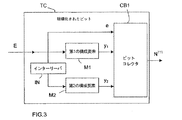
− 以下で入力ビットストリームと呼ぶ、「組織化された」「パリティ1」および「パリティ2」のタイプの符号化されたビットストリームNTTIを提供するために、コードブロックセグメント化モジュールMSBCによって提供されるデータビットを符号化するための、図3に示すタイプのターボコーディング(またはターボコーダ)モジュールTCであり、これはその目的のために以下の、
・ 符号化されていないデータビットが供給された入力E
・ 入力Eから直接来た符号化されていないビットが供給され、パリティ1の符号化されたビット(y1ビット)を出力する第1の符号化モジュールM1、
・ インターリーバINを介して入力Eから来た符号化されていないビットが供給され、パリティ2の符号化されたビット(y2ビット)を出力する第2の符号化モジュールM2、
・ 入力Eから直接来た符号化されていない組織化されたビット(e)が供給され、第1のモジュールM1から来たパリティ1符号化ビット(y1ビット)と、第2のモジュールM2から来たパリティ2符号化ビット(y2ビット)とが供給され、符号化されたビットストリームNTTIを出力するビット収集モジュール、および
・ 3つの異なる符号化されたビットストリームNTTIを出力する出力S1、
を含み、
− 図4を参照して以下で説明するように、ターボコーダTCによって提供された様々なタイプの入力ビット(組織化された、パリティ1、パリティ2)のそれぞれのビットレートをマッチングし、「出力」ビットを提供するための、レートマッチングシステムSOD、
− レートマッチングシステムSODによって提供され、また様々なHS−PDSCH物理チャネル間で分割できるようにHS−DSCHトランスポートチャネルによって転送された出力ビットをセグメント化する(または分離する)ことを担当する、物理チャネルセグメント化モジュールMSC、
− 無線チャネルに対する誤り訂正符号化(TC)性能を向上させるために、物理チャネルセグメント化モジュールMSCによって提供されたビットを混合するようにインターリーブするための、インターリービングモジュールME、
− 適用可能な場合、16QAM変調が使用されるときには、インターリービングモジュールMEによって提供されたデータビットを再配列するための、ビット再配列モジュールMRB、および、
− 1つ以上のHS−PDSCH物理チャネルに、インターリービングモジュールMEまたはビット再配列モジュールMRBによって提供されたビットを供給するための、物理チャネルレートマッチングモジュールMOCP。
For the purpose of managing the HS-DSCH transport channel, each node Bi includes a transport channel coding system SCCT of the type shown as an example in FIG. SCCT systems are well known to those skilled in the art and do not form the main subject of the present invention, so they will not be described in detail here. In general, it will suffice to state that the SCTT system includes:
A module MACC for adding a cyclic redundancy check (CRC) field to the data provided by the concatenation module CC (the device UE of the data addressed user uses the CRC field to detect data transmission errors) )
-Bits for placing the data bits provided by the MACC module in pseudo-random order to optimize the performance of the turbo coding (TC) module, whose performance may be degraded by some specific bit sequences Scrambling module MBS,
A code for segmenting the data blocks provided by the module MBS into smaller blocks to provide blocks smaller than the maximum size supported by the channel coder defined by technical specification 3GPP TS 25.212 Block segmentation module MSBC,
- referred to as an input bit stream in the following, in order to provide a type of coded bit streams N TTI of "organized""Parity1" and "Parity 2", are provided by the code block segmentation module MSBC A turbo coding (or turbo coder) module TC of the type shown in FIG. 3 for encoding the data bits
• Input E supplied with unencoded data bits
A first encoding module M1, which is supplied with uncoded bits coming directly from input E and outputs the encoded bits of parity 1 (y 1 bit);
A second encoding module M2, which is supplied with uncoded bits coming from the input E via the interleaver IN and outputs the encoded bits (y 2 bits) of parity 2;
An uncoded organized bit (e) coming directly from input E is supplied, a parity 1 coded bit (y 1 bit) coming from the first module M1 and from the second module M2 came parity 2 coded bits and (y 2 bits) are supplied, encoded bit streams N bits collection module for outputting TTI, and outputs a-3 different coded bit streams N TTI outputs S1 ,
Including
-Matching the bit rate of each of the various types of input bits (organized, parity 1, parity 2) provided by the turbocoder TC, as described below with reference to FIG. "Rate matching system SOD to provide bits,"
The physical provided by the rate matching system SOD and responsible for segmenting (or separating) the output bits transferred by the HS-DSCH transport channel so that it can be divided between the various HS-PDSCH physical channels Channel segmentation module MSC,
An interleaving module ME for interleaving to mix bits provided by the physical channel segmentation module MSC to improve error correction coding (TC) performance for the radio channel;
If applicable, a bit reordering module MRB for reordering the data bits provided by the interleaving module ME when 16QAM modulation is used; and
A physical channel rate matching module MOCP for supplying one or more HS-PDSCH physical channels with bits provided by the interleaving module ME or the bit reordering module MRB;
所与の伝送時間間隔(TTI)でHS−DSCHトランスポートチャネルに関連付けられたN個の(N>0)HS−PDSCH物理チャネルで送信することのできる出力ビットの最大数は、変調のタイプによって異なり、合計期間2msの3つのスロット(各2msに送信される1ブロックに相当する)から構成される送信時間間隔TTIごとに、QPSK変調の場合、最大ビット数はN×960に等しく、16QAM変調の場合、この数はN×1920に等しく、ここで、Nは、HS−DSCHトランスポートチャネルのデータビットのブロックを転送するために使用されるHS−PDSCH物理チャネル数、すなわちコード数を表す(物理チャネル当たり1つのコードがある)。レートマッチングシステムSODによって行なわれるレートマッチングが与えられると、物理チャネル組織化モジュールMOCPは、HS−DSCHトランスポートチャネルに関連付けられたN個のHS−PDSCH物理チャネルを最適に充填するデジタルデータのブロックを構成する。 The maximum number of output bits that can be transmitted on the N (N> 0) HS-PDSCH physical channels associated with the HS-DSCH transport channel in a given transmission time interval (TTI) depends on the type of modulation. In contrast, for each transmission time interval TTI composed of 3 slots with a total duration of 2 ms (corresponding to one block transmitted in 2 ms each), in the case of QPSK modulation, the maximum number of bits is equal to N × 960, and 16QAM modulation In this case, this number is equal to N × 1920, where N represents the number of HS-PDSCH physical channels, ie the number of codes, used to transfer the block of data bits of the HS-DSCH transport channel ( There is one code per physical channel). Given the rate matching performed by the rate matching system SOD, the physical channel organizing module MOCP generates a block of digital data that optimally fills the N HS-PDSCH physical channels associated with the HS-DSCH transport channel. Constitute.
レートマッチングシステムSODは、NACKメッセージにより、ハイブリッド自動再送要求(HARQ)技術に従い、(前の)第1のブロックを正確に受信しなかったことを通知したユーザの装置UEに、HS−DSCHトランスポートチャネルに関連付けられた1つまたは複数のHS−PDSCH物理チャネルで、ブロック形式により、ノードBが最高の優先順位で再送する必要のあるデータビットを選択する。 The rate matching system SOD uses the NACK message according to the hybrid automatic repeat request (HARQ) technique to notify the user equipment UE that has not correctly received the (previous) first block, the HS-DSCH transport. In one or more HS-PDSCH physical channels associated with the channel, the block format selects the data bits that the Node B needs to retransmit with the highest priority.
本発明のレートマッチングシステムSODは、図4を参照して以下で詳細に説明する。 The rate matching system SOD of the present invention will be described in detail below with reference to FIG.
序論で指摘したように、本発明は、第1のブロックの不正確な受信の結果として再送されるブロックが含んでいるデータビットの組が、少なくとも一部には、それに先行するブロックのデータビットの組と異なる、インクリメンタル冗長(IR)モードでのビットレートの組織化に関連する。この目的は、前に送信された以外のそれぞれ新しい再送ビットのために使用することである。これは、第1の送信時に削除されたビットの送信、または第1の送信時にビットを受信した場合の他のビットの改善された保護を可能にする。ブロックは、瞬間的にアッタチされたノードBにより連続的に送信されたその様々なバージョンの内容と一時的にバッファに記憶されたその様々なバージョンの内容とを組み合わせることによって、宛先ユーザの装置UEで復号される。 As pointed out in the introduction, the present invention provides that the set of data bits contained in a block that is retransmitted as a result of inaccurate reception of the first block is at least partly the data bits of the preceding block. Is related to bit rate organization in incremental redundancy (IR) mode, which is different from the above set. The purpose of this is to use for each new retransmission bit other than previously transmitted. This allows improved transmission of bits that were deleted during the first transmission, or other bits when a bit is received during the first transmission. The block combines the contents of the various versions successively transmitted by the Node B that is instantaneously attached with the contents of the various versions temporarily stored in the buffer, thereby allowing the destination user equipment UE Decrypted with
上記のように、HARQ手順の場合に第1の送信および後続の再送の両方で送信されるべきビットは、冗長パラメータXRVの値に応じてレートマッチングシステムSODによって選択される。インクリメンタル冗長(IR)モードでのレートマッチングの全体的な性能は、主として、各(再送)送信のために使用されるXRVの連続的な値に依存する。 As described above, the bits to be transmitted in both the first transmission and the subsequent retransmission in the case of the HARQ procedure are selected by the rate matching system SOD depending on the value of the redundancy parameter X RV . The overall performance of rate matching in incremental redundancy (IR) mode mainly depends on the continuous value of X RV used for each (retransmission) transmission.
その値により、このパラメータXRVは、最高の優先順位で送信される必要のあるビットのそしてそれゆえに削除または反復のための最高の優先順位のビットのタイプ(組織化された、パリティ1またはパリティ2)を指定する。 Depending on its value, this parameter X RV makes the bit type (organized, parity 1 or parity) of the bits that need to be transmitted with the highest priority and hence for deletion or repetition. 2) is specified.
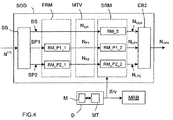
図4に示すように、レートマッチングシステムSODは、ターボコーダTCによって入力ビットストリームNTTIが供給されるビット分離モジュールSBを含み、第1のレートマッチングの段階FRMによってそれらが個別に処理されるように、様々なタイプの入力ビット(組織化された(BS)ビット、パリティ1(BP1)ビットおよびパリティ2(BP2)ビット)を分離する。 As shown in FIG. 4, the rate matching system SOD includes a bit separation module SB that is supplied with an input bitstream N TTI by a turbo coder TC so that they are individually processed by a first rate matching stage FRM. And separate different types of input bits (organized (BS) bits, parity 1 (BP1) bits and parity 2 (BP2) bits).
第1のレートマッチングの段階FRMは、ターボコーダTCによって提供されたNTTI個の入力ビットの、本発明のIR仮想バッファ(MTV)が含むことのできる「中間」ビットの数へのマッチを行なう。 The first rate matching stage FRM performs a match of the N TTI input bits provided by the turbo coder TC to the number of “intermediate” bits that the IR virtual buffer (MTV) of the present invention can contain. .
この目的で、第1のレートマッチングの段階FRMは、それらの出力にパリティ1ビットストリームNP1およびパリティ2ビットストリームNP2を提供するために、パリティ1ビットBP1とパリティ2ビットBP2をそれぞれ処理する2つのレートマッチングモジュールRM_P1_1およびRM_P2_1を含む。 For this purpose, stage FRM of the first rate matching, to provide a parity 1 bit stream N P1 and parity 2 bit stream N P2 at their output, processes the parity 1 bit BP1 and parity 2 bits BP2 respectively It includes two rate matching modules RM_P1_1 and RM_P2_1.
NTTI個の入力ビットは、一般に、仮想バッファMTVが含むことのできる中間ビット数よりも多く、レートマッチングモジュールRM_P1_1およびRM_P2_1は、それらの一部を削除し、これは、「パンクチャリング」として知られている。このビット削除または「パンクチャリング」技術は、技術仕様3GPP TS 25.212、バージョン5.3.0によって定義される。 The N TTI input bits are generally more than the number of intermediate bits that the virtual buffer MTV can contain, and the rate matching modules RM_P1_1 and RM_P2_1 remove some of them, which is known as “puncturing” It has been. This bit removal or “puncturing” technique is defined by technical specification 3GPP TS 25.212, version 5.3.0.
組織化されたビットは、第1のレートマッチングの段階FRMにおいていかなる削除処理も受けず、組織化されたビットストリームNsysの形式で第3の出力に直接提供される。 The organized bits are not subject to any deletion processing in the first rate matching stage FRM and are provided directly to the third output in the form of an organized bitstream N sys .
3つのビットストリームNsys、Np1およびNp2は、仮想バッファMTVに供給される。バッファMTVのサイズは、宛先ユーザの装置UEが第1のブロックを正確に受信し、HARQ技術に従い肯定応答メッセージACKを前記ノードBに送信するまで、ノードBに記憶されることを必要とする(中間)ビット数に依存する。 The three bitstreams N sys , N p1 and N p2 are supplied to the virtual buffer MTV. The size of the buffer MTV needs to be stored in the Node B until the destination user device UE has correctly received the first block and sent an acknowledgment message ACK to the Node B according to the HARQ technique ( Depends on the number of intermediate bits.
レートマッチングシステムSODは、冗長パラメータXRVの値に応じて再送ごとに各タイプのビットストリームの優先順位ビットレートを定義し、仮想バッファMTVに記憶された中間ビット数を、所与の時間間隔(TTI)中にHS−DSCHトランスポートチャネルに関連付けられたN個のHS−PDSCH物理チャネルによって送信することのできる「出力」ビットの最大数にマッチングさせるための、第2のレートマッチングの段階SRMも含む。 The rate matching system SOD defines the priority bit rate of each type of bit stream for each retransmission according to the value of the redundancy parameter X RV , and calculates the number of intermediate bits stored in the virtual buffer MTV for a given time interval ( A second rate matching stage SRM to match the maximum number of “egress” bits that can be transmitted by the N HS-PDSCH physical channels associated with the HS-DSCH transport channel during TTI) Including.
この目的で、これは、組織化されたビットストリームNsys、パリティ1ビットストリームNP1およびパリティ2ビットストリームNP2をそれぞれ処理するための3つのレートマッチングモジュールRM_S、RM_P1およびRM_P2_2を含み、それらの出力に、組織化されたビットストリームNt,sys、パリティ1ビットストリームNt,p1およびパリティ2ビットストリームNt,p2を提供し、これらのビットストリームは、ビットコレクタCB2に供給され、ビットコレクタCB2は、出力で、選択された様々なビットストリームを共にグループ化する出力ビットストリームNdataを供給し、そして、物理チャネルセグメント化モジュールMSCに供給される。 For this purpose, it includes three rate matching modules RM_S, RM_P1 and RM_P2_2 for processing the organized bitstream N sys , the parity 1 bitstream N P1 and the parity 2 bitstream N P2 respectively. At the output, an organized bit stream N t, sys , a parity 1 bit stream N t, p 1 and a parity 2 bit stream N t, p 2 are provided, which are fed to the bit collector CB 2 CB2 at the output provides an output bitstream N data that groups together the various selected bitstreams and is supplied to the physical channel segmentation module MSC.
HS−DSCHトランスポートチャネルに関連付けられた一組のN個のHS−PDSCH物理チャネルによって送信することのできる出力ビットの最大数に従い、所与の時間間隔(TTI)中に、レートマッチングモジュールRM_S、RM_P1_2およびRM_P2_2は、反復処理により、中間ビットを削除(またはパンクチャ)するか、またはビットを追加する。 According to the maximum number of output bits that can be transmitted by a set of N HS-PDSCH physical channels associated with the HS-DSCH transport channel, during a given time interval (TTI), the rate matching module RM_S, RM_P1_2 and RM_P2_2 delete (or puncture) intermediate bits or add bits by iterative processing.
ノードBがユーザの装置UEからNACKメッセージを受信する度に、そのレートマッチングシステムSODの第2のレートマッチングの段階SRMは、バッファMTVに記憶された中間ビットから再送されるべきブロックに対して一組の出力ビットを決定する。この一組は、CC送信の場合には既に(再送)送信された組と同じでありまたは、IR伝送の場合には既に(再送)送信された組とは異なる。 Each time the Node B receives a NACK message from the user equipment UE, the second rate matching stage SRM of its rate matching system SOD is one for the block to be retransmitted from the intermediate bits stored in the buffer MTV. Determine a set of output bits. This set is the same as the already transmitted (retransmitted) set in the case of CC transmission, or is different from the already transmitted (retransmitted) set in the case of IR transmission.
本発明の管理装置Dは、レートマッチングシステムSODの第2のレートマッチングの段階SRMによって使用され、適用可能な場合、変調が16QAM変調のときは、トランスポートチャネル符号化システムSCCTのモジュールMRBにより使用される、各パラメータ値XRVを選択する。 The management device D of the present invention is used by the second rate matching stage SRM of the rate matching system SOD and, if applicable, used by the module MRB of the transport channel coding system SCCT when the modulation is 16QAM modulation. Each parameter value X RV is selected.
これは、トランスポートチャネル符号化システムSCCTの統合部分を形成し、そのレートマッチングシステムSODとそのビット再配列モジュールMRBとに連結され、またはトランスポートチャネル符号化システムSCCTの外部にあって(例えば、基地局にインストールされて)レートマッチングシステムSODとビット再配列モジュールMRBとに連結されることができる。変調がQPSK変調の場合、前記システムのみが管理装置Dを使用するので、管理装置Dは、レートマッチングシステムSODの統合部分であってもよい。また、これは、1つまたは複数の基地局に連結される無線ネットワークコントローラ(RNC)の一部を構成することもできる。 This forms an integral part of the transport channel coding system SCCT and is linked to its rate matching system SOD and its bit reordering module MRB or external to the transport channel coding system SCCT (eg It can be connected to the rate matching system SOD and the bit reordering module MRB (installed in the base station). When the modulation is QPSK modulation, since only the system uses the management device D, the management device D may be an integrated part of the rate matching system SOD. It can also form part of a radio network controller (RNC) that is coupled to one or more base stations.
さらに正確には、管理装置Dは、レートマッチングシステムSODによって、そして適用可能な場合はビット再配列モジュールMRBによって使用されるべき、冗長パラメータXRVの各値を選択するために、処理モジュールMTを含む。 More precisely, the management device D uses the processing module MT to select each value of the redundancy parameter X RV to be used by the rate matching system SOD and, if applicable, by the bit reordering module MRB. Including.
UMTS標準の現在のバージョンでは、冗長パラメータXRVは、少なくとも第1の変数sおよび第2の変数rによって定義される。 In the current version of the UMTS standard, the redundancy parameter X RV is defined by at least a first variable s and a second variable r.
さらに正確には、UMTS標準の現在のバージョンでは、送信がQPSK変調を使用するHS−DSCHチャネルで行なわれる場合には、XRVは、第1の変数sおよび第2の変数rによって定義される。この場合、変数sは一般に値0と1を取り、変数rは値0と1、または値0、1および2、または値0、1、2および3を取る。 More precisely, in the current version of the UMTS standard, X RV is defined by a first variable s and a second variable r when transmission takes place on an HS-DSCH channel using QPSK modulation. . In this case, the variable s generally takes the values 0 and 1, and the variable r takes the values 0 and 1, or the values 0, 1 and 2, or the values 0, 1, 2 and 3.
さらに、UMTS標準の現在のバージョンでは、送信が16QAM変調によりHS−DSCHチャネルにより行なわれる場合には、XRVは第1の変数s、第2の変数rおよび第3の「コンステレーションバージョン」変数bによって定義される。この場合、変数sは一般に値0および1を取り、変数rは一般に値0と1を取り、変数bは値0と1または、値0、1および2、またはより一般的には、値0、1、2および3を取る。3つの値r、sおよびbは、パラメータXRVを定義する。変数bは、より具体的には、トランスポートチャネル符号化システムSCCTのビット再配列モジュールMRBにビットおよび記号をマッチさせる方法を示す。 Further, in the current version of the UMTS standard, when transmission is performed over the HS-DSCH channel with 16QAM modulation, X RV is the first variable s, the second variable r and the third “constellation version” variable. defined by b. In this case, the variable s generally takes the values 0 and 1, the variable r generally takes the values 0 and 1, and the variable b takes the values 0 and 1 or the values 0, 1 and 2, or more generally the value 0. Take 1, 2 and 3. The three values r, s and b define the parameter X RV . The variable b more specifically indicates how to match bits and symbols to the bit reordering module MRB of the transport channel coding system SCCT.
本発明によれば、所与のブロックがHS−DSCHチャネルで送信されなければならなくなる度に、処理モジュールMTは、所与のシーケンスに従った冗長パラメータXRVの連続値を選択する。 According to the present invention, each time a given block has to be transmitted on the HS-DSCH channel, the processing module MT selects a continuous value of the redundancy parameter X RV according to a given sequence.
各シーケンス内で、ブロックの第1の送信のために使用されるXRVの値が、組織化されたビットを送信することに最高の優先順位を与えるように選択される。 Within each sequence, the value of X RV used for the first transmission of the block is selected to give the highest priority to transmitting the organized bits.
第1の送信の後のブロック(再送)送信ごとに使用されるXRVの値が、パリティ1または2ビットと組織化されたビットの交互の送信に最高の優先順位を与えるように選択されることが好ましい。言い換えると、組織化されたビットが第1の送信で最高の優先順位を有するとするならば、1つの送信から別の送信に、組織化されたビットとパリティ1または2ビットの優先順位を交替することが好ましい。 The value of X RV used for each block (retransmission) transmission after the first transmission is selected to give the highest priority to alternating transmission of parity 1 or 2 bits and organized bits. It is preferable. In other words, if the organized bits have the highest priority in the first transmission, the priorities of the organized bits and parity 1 or 2 bits are swapped from one transmission to another. It is preferable to do.
優先順位を条件付けるのは、変数sである。より正確には、sが1に等しい場合、組織化されたビットを送信することに最高の優先順位が与えられ、sが0に等しい場合、パリティ1または2ビットを送信することに最高の優先順位が与えられる。 It is the variable s that conditions the priority. More precisely, when s is equal to 1, the highest priority is given to sending organized bits, and when s is equal to 0, the highest priority is given to sending parity 1 or 2 bits. Ranking is given.
変数rは、第2のレートマッチングの段階SRMの3つの組織化モジュールRM_S、RM_P1_2およびRM_P2_2によって使用される反復図または削除図を、この3つのタイプのビットのストリームのビットレートを決定するために変更する。 The variable r is an iterative or deleted diagram used by the three organizing modules RM_S, RM_P1_2 and RM_P2_2 of the second rate matching stage SRM to determine the bit rate of the stream of these three types of bits. change.
さらに、各送信中にビット/記号のマッチングの交替を可能にするために、冗長パラメータXRBの各値が選択される、選ばれたシーケンスに合わせて冗長パラメータXRVの連続値を選択するために、処理モジュールMTを構成することができる。 Furthermore, in order to select the continuous value of the redundancy parameter X RV in accordance with the chosen sequence, each value of the redundancy parameter X RB is selected in order to allow the alternation of bit / symbol matching during each transmission. In addition, the processing module MT can be configured.
より大きなシーケンス、またはより小さなシーケンスを定義することができる。例えば、シーケンスは、XRVの一連の2、3、4、5、6、7またはこれ以上の数の値でさえ含むことができる。 Larger or smaller sequences can be defined. For example, the sequence may include a series of 2, 3, 4, 5, 6, 7 or even more values of X RV .
例えば、シーケンスは、一連の値{0,1,2,3,4,5,6,7}または一連の値{0,1,2,3,4}から構成することができる。 For example, the sequence can consist of a series of values {0, 1, 2, 3, 4, 5, 6, 7} or a series of values {0, 1, 2, 3, 4}.
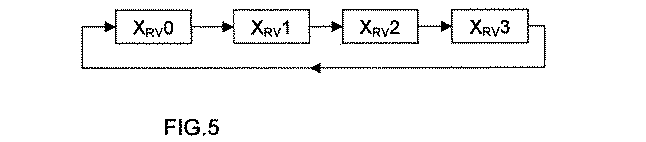
しかし、4回以上の送信が必須の場合は、処理モジュールMTが、複数の送信、例えば4回の送信(最高の優先順位で組織化されたビットに向かう第1の送信と、パリティ1または2ビットと組織化されたビットの間で最高の優先順位が交替する3回の再送)に対して最初に提供されたシーケンスを循環的に反復するように、処理モジュールMTを構成することも同様に可能である。図5は、この種類の状態を示す。より正確には、この例では、処理モジュールMTは、一連の値{XRV0、XRV1、XRV2、XRV3}から構成されたループされたシーケンスを使用する。このシーケンスの最後の値(XRV3)が第4の送信のために使用される場合、必須ならば、第5の送信にもこのシーケンスの第1の値(XRV0)が再度使用され、次いで第2の値(XRV1)、次いで第3の値(XRV2)、次いで第4の値(XRV3)、次いで再び第5の値(XRV0)等々が再度使用される。 However, if four or more transmissions are required, the processing module MT may send multiple transmissions, for example four transmissions (first transmission towards the bit organized in the highest priority and parity 1 or 2 Similarly, the processing module MT can be configured to cyclically repeat the sequence provided initially for the three retransmissions with the highest priority alternating between bits and organized bits). Is possible. FIG. 5 shows this type of situation. More precisely, in this example, the processing module MT uses a looped sequence composed of a series of values {X RV 0, X RV 1, X RV 2, X RV 3}. If the last value of this sequence (X RV 3) is used for the fourth transmission, the first value (X RV 0) of this sequence is again used for the fifth transmission if required. Then the second value (X RV 1), then the third value (X RV 2), then the fourth value (X RV 3), then again the fifth value (X RV 0), etc. The
言い換えると、ブロックがn番目に送信されるべき場合、使用されるXRVの値は、式、XRV=T「Lを法とする(n−1)」により定義され、ここで、Tは、選ばれたシーケンスの値XRV(n)を指定し、Lは、シーケンスの長さである(すなわち、それが含んでいる値の数は、IRモードでは2またはそれ以上、又は、CCモードでは1であり、それはXRVの同じ値で再送されるのは常に同じビットのシーケンスである)。 In other words, if the block is to be transmitted nth, the value of X RV used is defined by the equation, X RV = T “modulo L (n−1)”, where T is Specify the value X RV (n) of the chosen sequence, and L is the length of the sequence (ie the number of values it contains is 2 or more in IR mode, or CC mode Is 1 and it is always the same sequence of bits that is retransmitted with the same value of X RV ).
実際には、XRVの異なる値の最大数を使用することが好ましい。 In practice, it is preferred to use the maximum number of different values of X RV .
QPSK変調の場合、処理モジュールMTは、XRVの交替する一連の偶数値と奇数値を構成し、第1の送信に対応する第1の値を偶数とするように、各シーケンスを選択することができる。UMTS標準の現在のバージョンでは、XRV=2r+1−sのような式によって、パラメータXRVを定義することが可能である。 In the case of QPSK modulation, the processing module MT constitutes a series of alternating even and odd values of X RV and selects each sequence so that the first value corresponding to the first transmission is even. Can do. In the current version of the UMTS standard, the parameter X RV can be defined by an expression such as X RV = 2r + 1−s.
この種類の式により、変数sが1に等しい場合はいつでもXRVは偶数であり、変数sが0に等しい場合はいつでもXRVは奇数である。したがって、XRVが偶数の場合はいつでも、最高の優先順位が組織化されたビットに割り当てられ、XRVが奇数の場合はいつでも、最高の優先順位がパリティ1または2ビットに割り当てられる。 According to this type of equation, whenever the variable s is equal to 1, X RV is an even number, and whenever the variable s is equal to 0, X RV is an odd number. Thus, whenever X RV is even, the highest priority is assigned to the organized bits, and whenever X RV is odd, the highest priority is assigned to parity 1 or 2 bits.
処理モジュールMTは、それが、変数rの値が交替ごとに、またはXRVの2つごとの値で異なる、XRVの交替する一連の値を構成するように、各シーケンスを選ぶこともできる。 The processing module MT can also choose each sequence so that it constitutes a series of alternating values of X RV where the value of the variable r is different for every alternation or every two values of X RV. .
例えば、シーケンス内で、rは、0,1,2,3,0,1,2,3,0,...,または0,0,1,1,2,2,3,3,0,0,1,1,...,または2,2,1,1,2,2,1,1,2,2,...の様に変わることができる。 For example, in the sequence, r is 0, 1, 2, 3, 0, 1, 2, 3, 0,. . . , Or 0, 0, 1, 1, 2, 2, 3, 3, 0, 0, 1, 1,. . . , Or 2, 2, 1, 1, 2, 2, 1, 1, 2, 2,. . . Can be changed.
次に示す表は、XRVの異なる値を生じる、変数sとrの値の組み合わせの一例を示す。
XRVの交替する偶数と奇数の値を使用することは、組織化されたビットとパリティ1または2ビットの間で優先順位を交替させることに等しいことに留意することが重要である。これは、第1の送信中にsを1に等しくなければならず、後続の再送の場合は0と1の間で交替させなければならず、同時にrは各(再送)送信または各2回の(再送)送信中に変更しなければならないと言うことに等しい。 It is important to note that using alternating even and odd values of X RV is equivalent to alternating priority between organized bits and parity 1 or 2 bits. This means that s must be equal to 1 during the first transmission, and for subsequent retransmissions it must be alternated between 0 and 1 and at the same time r is each (retransmission) transmission or 2 times each Is equivalent to saying that it must be changed during (retransmission) transmission.
XRVの値が必ずしもそのシーケンス内のそれらの位置と共に増加する必要はないということに留意することも重要である。重要なのは、XRVの値の順序が、sの1および0値の交替に対応することである。例えば、シーケンスは、一連の増加する値{0,1,2,3,4,5,6,7}によって定義することができるが、同様に、特に順番のない一連の値{2,5,6,1,0,3,4,7}によって定義することもできる。これらの様々な、純粋に例示としての実施例では、シーケンスのXRVの値は、上記の表で定義された一対の値(s,r)に対応する。 It is also important to note that the value of X RV does not necessarily increase with their position in the sequence. Importantly, the order of the values of X RV corresponds to the alternation of the 1 and 0 values of s. For example, a sequence can be defined by a series of increasing values {0, 1, 2, 3, 4, 5, 6, 7}, but likewise a particularly unordered series of values {2, 5, 6, 1, 0, 3, 4, 7}. In these various, purely illustrative examples, the value of the sequence's X RV corresponds to the pair of values (s, r) defined in the table above.
16QAM変調の場合、処理モジュールMTは、例えば(必須ではないが)少なくとも最初の4回の送信中に、変数rの値がXRVの各値またはXRVの各2つの値で変わる、XRVの一連の値を構成するように、各シーケンスを選択することができる。 For 16QAM modulation, the processing module MT, for example, during the transmission of (mandatory but not) at least the first four, the value of the variable r is changed in each of two values for each value or X RV of X RV, X RV Each sequence can be selected to constitute a series of values.
例えば、これに加えて、またはこの代わりに、処理モジュールMTは、例えば(必須ではないが)少なくとも最初の4回の送信中に、変数bの値がXRVの各値またはXRVの各2つの値で変わる、XRVの一連の値を構成するように、各出力シーケンスを選択することができる。 For example, in addition to or instead of this, the processing module MT may, for example (but not necessarily), at least during the first four transmissions, the value of the variable b is X RV values or X RV values 2 Each output sequence can be selected to constitute a series of values of X RV that vary with one value.
可能ならば、各送信中にrを変更することが好ましく、さらにまた可能ならば、各送信中にbを変更することが好ましい。言い換えると、rとbを、例えば各送信中に同時に変更するか、または例えば各2回の送信ごとに交互に変更することが可能である。 If possible, it is preferable to change r during each transmission, and if possible, it is preferable to change b during each transmission. In other words, r and b can be changed simultaneously, for example, during each transmission, or alternately, for example, every two transmissions.
さらに、QPSK変調の場合のように、処理モジュールMTは、変数sが1に等しいか、または0に等しい冗長パラメータXRVの交互になった一連の値を構成するように、各シーケンスを選択するよう構成されることが好ましい。 Further, as in the case of QPSK modulation, the processing module MT selects each sequence to constitute an alternating series of values of the redundancy parameter X RV where the variable s is equal to 1 or equal to 0. It is preferable that it is comprised.
以下の表は、UMTS標準の現在のバージョンの場合に、XRVの異なる値をもたらす、変数s、rおよびbの値の組み合わせの一例を示す。
XRVの値は、そのシーケンス内のそれらの位置と共に必ずしも増加する必要はないことに留意することが重要である。重要なのは、XRVの値の順番は、sの交互の0と1の値に対応することである。 It is important to note that the value of X RV does not necessarily increase with their position in the sequence. Importantly, the order of the values of X RV corresponds to alternating 0 and 1 values of s.
16QAM変調の場合は、1に等しいsの値に対応するXRVの値は、偶数のみではないことに留意することも重要である(上の表を参照のこと)。この結果、変数sに対して値0と1が交替するシーケンスは、もはや、XRVのパリティが交替するシーケンスではない。 It is also important to note that for 16QAM modulation, the value of X RV corresponding to a value of s equal to 1 is not only an even number (see table above). As a result, the sequence in which the values 0 and 1 alternate with respect to the variable s is no longer the sequence in which the parity of the X RV alternates.
例えば、シーケンスは、交替する一連の偶数値と奇数値である、一連の増加する値{0,1,2,3,4,1,6,3}によって定義することができるが、同様に、次のように特別な順番のない一連の値{0,1,2,3,4,1,5,3}、または次のように特別な順番のない一連の値{0,3,5,1}、または次のように特別な順番のない一連の値{0,3,6,1}、または次のように特別な順番のない一連の値{5,3,7,1}、または次のように特別な順番のない一連の値{6,3,7,1}によって定義することもできる。これらの種種のおよび純粋に例示のための実施例において、このシーケンスのXRVの値は、上の表で定義された3つ組の値(s,r,b)に対応する。 For example, a sequence can be defined by a series of increasing values {0, 1, 2, 3, 4, 1, 6, 3}, which are a series of alternating even and odd values, A series of values {0, 1, 2, 3, 4, 1, 5, 3} without a special order as follows, or a series of values {0, 3, 5, 5 without a special order as follows: 1}, or a series of values {0, 3, 6, 1} without a special order as follows, or a series of values {5, 3, 7, 1} without a special order as follows, or It can also be defined by a series of values {6, 3, 7, 1} without any special order as follows. In these various and purely illustrative examples, the X RV values for this sequence correspond to the triple values (s, r, b) defined in the table above.
管理装置Dが、そのシーケンスを構成するためのXRVの様々な値が記憶されるメモリMを有することが好ましいことに留意することが重要である。このメモリMは、シーケンスの定義を記憶することもできる。したがって、装置Dが介入する必要がある場合、その処理モジュールMTは、XRVの値を第2のレートマッチングの段階SRMに転送し、適用可能な場合はビット再配列モジュールMRBに転送するために、メモリMからXRVの値を抽出するだけでよい。シーケンスの値および/または定義は、永続的に、または一時的にメモリMに記憶することができる。言い換えると、メモリMの内容を、例えばローカル端末、トランスポートチャネル符号化システム(SCCT)がインストールされた基地局(ノードB)に接続された無線ネットワークコントローラRNC、またはOMCによって、動的に変更することを考えるという選択肢がある。別の選択肢は、ネットワークの少なくとも1つの基地局に冗長パラメータXRVの一連の値を供給するために、無線ネットワークコントローラRNCに本発明の管理装置Dをインストールすることである。 It is important to note that the management device D preferably has a memory M in which the various values of X RV for constituting the sequence are stored. This memory M can also store sequence definitions. Thus, if device D needs to intervene, its processing module MT forwards the value of X RV to the second rate matching stage SRM and, if applicable, to the bit reordering module MRB. It is only necessary to extract the value of X RV from the memory M. The value and / or definition of the sequence can be stored permanently or temporarily in the memory M. In other words, the contents of the memory M are dynamically changed by, for example, a local terminal, a radio network controller RNC connected to a base station (Node B) in which a transport channel coding system (SCCT) is installed, or an OMC. There is an option of thinking. Another option is to install the inventive management device D in the radio network controller RNC in order to supply a series of values of the redundancy parameter X RV to at least one base station of the network.
本発明の処理装置D、特にその処理モジュールPMは、例えば、電子回路、ソフトウェア(またはデータ処理)モジュール、または回路とソフトウェアの組み合わせの形式で実施することができる。レートマッチングシステムSODおよびトランスポートチャネル符号化システムSCCTについても同様のことが言える。 The processing apparatus D of the present invention, particularly its processing module PM, can be implemented in the form of, for example, an electronic circuit, a software (or data processing) module, or a combination of circuit and software. The same is true for the rate matching system SOD and the transport channel coding system SCCT.
本発明は、通信ネットワークとユーザの装置UEの間に設定されたHS−DSCHダウンリンクトランスポートチャネルにおいてデジタルデータブロックの送信を管理する方法とみなすこともでき、ここで、例えば少なくとも第1の変数sと第2の変数rによって定義された、冗長パラメータXRVの値に応じて選択されたデジタルデータの第1の組を含むブロックのユーザの装置UEによる不正確な受信が生じた場合、そのユーザの装置UEに対して、冗長パラメータの別の値に応じて選択されたデジタルデータの別の組を含む少なくとも別の1つのブロックが送信される。 The invention can also be regarded as a method for managing the transmission of digital data blocks in the HS-DSCH downlink transport channel set up between the communication network and the user equipment UE, where, for example, at least a first variable if inaccurate reception by the user's device UE of a block containing a first set of digital data selected according to the value of the redundancy parameter X RV , defined by s and the second variable r, At least another block including another set of digital data selected according to another value of the redundancy parameter is transmitted to the user equipment UE.
上記の方法は、特に、上記のレートマッチングシステムSODとトランスポートチャネル符号化システムSCCTの管理装置Dによって実施することができる。この方法の主要な任意選択の機能およびサブ機能は、管理装置Dおよび/またはレートマッチングシステムSODおよび/またはトランスポートチャネル符号化システムSCTTを構成する様々な手段の機能およびサブ機能と実質的に同一であり、以下では、本発明のこの方法の主要な機能を実施する段階だけをまとめた。 The above method can be implemented in particular by the rate matching system SOD and the management device D of the transport channel coding system SCCT. The main optional functions and sub-functions of this method are substantially the same as the functions and sub-functions of the various means constituting the management device D and / or the rate matching system SOD and / or the transport channel coding system SCTT. In the following, only the steps for carrying out the main functions of this method of the invention are summarized.
この方法は、所与のブロックを送信する必要がある度に、各第1のブロック送信に使用される冗長パラメータXRVの値が組織化されたビットの優先順位の送信に対応する選択されたシーケンスで、冗長パラメータXRVの連続値が使用されることを特徴とする。 This method is such that each time a given block needs to be transmitted, the value of the redundancy parameter X RV used for each first block transmission is selected corresponding to an organized bit priority transmission. In the sequence, a continuous value of the redundancy parameter X RV is used.
さらに、第1の送信後の各ブロック送信のために使用される冗長パラメータXRVの値が、パリティ1または2ビットの優先順位の送信と組織化されたビットの送信の交替に対応する、選択されたシーケンスに従い、冗長パラメータXRVの連続値を選択することが好ましい。 In addition, the value of the redundancy parameter X RV used for each block transmission after the first transmission corresponds to an alternation of parity 1 or 2 bit priority transmission and organized bit transmission It is preferable to select a continuous value of the redundancy parameter X RV according to the sequence made.
本発明によれば、所与のビットレートを得るために必要なパワーを大幅に低減することが可能である。例えば、このパワーは、3つのブロック送信後に、実質的に3.5に等しいファクタだけ低減することができる。 According to the present invention, the power required to obtain a given bit rate can be greatly reduced. For example, this power can be reduced by a factor substantially equal to 3.5 after three block transmissions.
本発明は、管理装置、レートマッチングシステム、トランスポートチャネル符号化システムおよび一例としてのみ上記で説明した管理方法の実施形態に限定されず、当業者が特許請求の範囲に含まれると想像することのできるすべての変形を含む。 The present invention is not limited to the management device, the rate matching system, the transport channel coding system, and the management method embodiment described above by way of example only, and those skilled in the art will envision that it is within the scope of the claims. Includes all possible variants.
上記の説明では、例えば16QAM変調の場合に、XRVの値をそのレートマッチングシステムおよびそのビット再配列モジュール(MRB)に供給するために、本発明の管理装置がトランスポートチャネル符号化システムにインストールされた一実施形態を、図2および4を参照して説明した。しかし、本発明の管理装置は、同様に、16QAM変調の場合にレートマッチングシステムにインストールすることもできる。これは、トランスポートチャネル符号化システムがインストールされた基地局、またはその基地局に連結された無線ネットワークコントローラに、同様にインストールすることもできる。 In the above description, for example, in the case of 16QAM modulation, the management device of the present invention is installed in the transport channel coding system to supply the value of X RV to the rate matching system and the bit reordering module (MRB). One such embodiment has been described with reference to FIGS. However, the management device of the present invention can also be installed in the rate matching system in the case of 16QAM modulation. It can also be installed in the base station in which the transport channel coding system is installed, or in the radio network controller connected to the base station.
SOD レートマッチングシステム
FRM 第1のレートマッチングの段階
MTV 仮想バッファ
SRM 第2のレートマッチングの段階
CB2 ビットコレクタ
BS 組織化されたビット
BP1 パリティ1ビット
BP2 パリティ2ビット
MT 処理モジュール
MRB ビット再配列モジュール
XRV 冗長パラメータ
SB ビット分離モジュール
Nt,sys 組織化されたビットストリーム
Nt,p1 パリティ1ビットストリーム
Nt,p2 パリティ2ビットストリーム
Ndata 出力ビットストリーム
SOD rate matching system FRM first rate matching stage MTV virtual buffer SRM second rate matching stage CB2 bit collector BS organized bits BP1 parity 1 bit BP2 parity 2 bits MT processing module MRB bit reordering module X RV Redundant parameter SB Bit separation module N t, sys organized bit stream N t, p1 parity 1 bit stream N t, p2 parity 2 bit stream N data output bit stream
Claims (23)
Applications Claiming Priority (1)
| Application Number | Priority Date | Filing Date | Title |
|---|---|---|---|
| FR0450631A FR2868646B1 (en) | 2004-03-31 | 2004-03-31 | IMPROVED DEVICE AND METHOD FOR MANAGING THE TRANSMISSION OF DATA BLOCKS IN A DOWNLINK CHANNEL OF THE HS-DSCH TYPE OF A MOBILE COMMUNICATIONS NETWORK |
Publications (2)
| Publication Number | Publication Date |
|---|---|
| JP2005295548A true JP2005295548A (en) | 2005-10-20 |
| JP2005295548A5 JP2005295548A5 (en) | 2008-05-08 |
Family
ID=34878503
Family Applications (1)
| Application Number | Title | Priority Date | Filing Date |
|---|---|---|---|
| JP2005090730A Pending JP2005295548A (en) | 2004-03-31 | 2005-03-28 | Improved apparatus and method for managing transmission of a block of data on an HS-DSCH downlink channel of a mobile communication network |
Country Status (5)
| Country | Link |
|---|---|
| US (1) | US7539122B2 (en) |
| EP (1) | EP1583276A1 (en) |
| JP (1) | JP2005295548A (en) |
| CN (1) | CN1677914A (en) |
| FR (1) | FR2868646B1 (en) |
Families Citing this family (10)
| Publication number | Priority date | Publication date | Assignee | Title |
|---|---|---|---|---|
| BRPI0617270B1 (en) * | 2005-10-11 | 2019-05-21 | Panasonic Intellectual Property Corporation Of America | TRANSMISSION APPARATUS AND TRANSMISSION METHOD |
| EP1943861B9 (en) * | 2005-10-31 | 2014-09-03 | Telefonaktiebolaget LM Ericsson (publ) | Method and arrangement for activity detection in a telecommunication system |
| EP1858190B1 (en) * | 2006-05-16 | 2012-01-11 | Nokia Siemens Networks GmbH & Co. KG | Method for safely transmitting short ACK/NACK bitmaps in ARQ process inside edge compliant systems |
| US7823040B2 (en) * | 2006-10-11 | 2010-10-26 | Telefonaktiebolaget L M Ericsson (Publ) | Method and apparatus for optimal redundancy version (RV) selection for UMTS HSDPA transmissions |
| US20080256424A1 (en) * | 2007-04-13 | 2008-10-16 | Broadcom Corporation | Information bit puncturing for turbo coding with parameter selectable rate matching tailored to lower eb/no without degrading bler (block error rate) performance |
| KR100911304B1 (en) * | 2007-06-18 | 2009-08-11 | 엘지전자 주식회사 | Data transmission method of radio bearers having priority in wireless communication system |
| US8737517B2 (en) | 2008-03-26 | 2014-05-27 | Qualcomm Incorporated | Scrambling and modulation to constrain the constellation size of ACK/NAK transmission on the data channel |
| CN102710405B (en) * | 2012-05-23 | 2016-08-03 | 北京创毅讯联科技股份有限公司 | The processing method of Downlink Control Information and system, base station and subscriber equipment |
| CN105765894B (en) * | 2013-11-28 | 2019-06-07 | 瑞典爱立信有限公司 | Method, apparatus and user equipment for hybrid automatic repeat request transmission |
| CN105790865B (en) * | 2014-12-25 | 2019-03-22 | 普天信息技术有限公司 | A kind of frequency spectrum perception detection method and system |
Citations (7)
| Publication number | Priority date | Publication date | Assignee | Title |
|---|---|---|---|---|
| US20030081690A1 (en) * | 2001-10-29 | 2003-05-01 | Samsung Electronics Co., Ltd. | Apparatus and method for transmitting/receiving data in a CDMA mobile communication system |
| JP2003152680A (en) * | 2001-10-31 | 2003-05-23 | Samsung Electronics Co Ltd | Transmission / reception apparatus and method for packet retransmission in wireless communication system |
| US20030133497A1 (en) * | 2001-10-26 | 2003-07-17 | Shigenori Kinjo | Incremental redundancy using two stage rate matching for automatic repeat request to obtain high speed transmission |
| JP2003229813A (en) * | 2001-11-02 | 2003-08-15 | Samsung Electronics Co Ltd | Transmission / reception apparatus and method for efficient retransmission of high-speed packet data |
| JP2003333668A (en) * | 2002-04-09 | 2003-11-21 | Nec Corp | Signaling method for packet access in high-speed downlink and mobile communication system |
| JP2004080640A (en) * | 2002-08-21 | 2004-03-11 | Ntt Docomo Inc | Wireless communication system, wireless communication method, wireless base station, and wireless terminal |
| JP2005518140A (en) * | 2002-02-15 | 2005-06-16 | シーメンス アクチエンゲゼルシヤフト | Method for speed matching |
-
2004
- 2004-03-31 FR FR0450631A patent/FR2868646B1/en not_active Expired - Fee Related
-
2005
- 2005-03-25 EP EP05290672A patent/EP1583276A1/en not_active Ceased
- 2005-03-28 JP JP2005090730A patent/JP2005295548A/en active Pending
- 2005-03-30 US US11/092,745 patent/US7539122B2/en active Active
- 2005-03-31 CN CN200510059826.6A patent/CN1677914A/en active Pending
Patent Citations (7)
| Publication number | Priority date | Publication date | Assignee | Title |
|---|---|---|---|---|
| US20030133497A1 (en) * | 2001-10-26 | 2003-07-17 | Shigenori Kinjo | Incremental redundancy using two stage rate matching for automatic repeat request to obtain high speed transmission |
| US20030081690A1 (en) * | 2001-10-29 | 2003-05-01 | Samsung Electronics Co., Ltd. | Apparatus and method for transmitting/receiving data in a CDMA mobile communication system |
| JP2003152680A (en) * | 2001-10-31 | 2003-05-23 | Samsung Electronics Co Ltd | Transmission / reception apparatus and method for packet retransmission in wireless communication system |
| JP2003229813A (en) * | 2001-11-02 | 2003-08-15 | Samsung Electronics Co Ltd | Transmission / reception apparatus and method for efficient retransmission of high-speed packet data |
| JP2005518140A (en) * | 2002-02-15 | 2005-06-16 | シーメンス アクチエンゲゼルシヤフト | Method for speed matching |
| JP2003333668A (en) * | 2002-04-09 | 2003-11-21 | Nec Corp | Signaling method for packet access in high-speed downlink and mobile communication system |
| JP2004080640A (en) * | 2002-08-21 | 2004-03-11 | Ntt Docomo Inc | Wireless communication system, wireless communication method, wireless base station, and wireless terminal |
Also Published As
| Publication number | Publication date |
|---|---|
| US7539122B2 (en) | 2009-05-26 |
| FR2868646A1 (en) | 2005-10-07 |
| US20050220204A1 (en) | 2005-10-06 |
| EP1583276A1 (en) | 2005-10-05 |
| CN1677914A (en) | 2005-10-05 |
| FR2868646B1 (en) | 2006-07-14 |
Similar Documents
| Publication | Publication Date | Title |
|---|---|---|
| US12107690B2 (en) | Autonomous transmission for extended coverage | |
| JP5481201B2 (en) | Method and apparatus for multicasting feedback information | |
| US7983305B2 (en) | Apparatus and method for transmitting and receiving wireless packet data | |
| KR100557167B1 (en) | Retransmission device and method in mobile communication system | |
| KR100646799B1 (en) | Method and apparatus for determining rate matching parameter of transport channels in mobile communication system | |
| CN1864422B (en) | Redundancy strategy selection scheme | |
| CN1233181C (en) | Improved command plan for high speed downward chain package connection | |
| JP4589055B2 (en) | Method and apparatus for enhanced uplink data transmission | |
| EP1911165B1 (en) | Methods of channel coding for communication systems | |
| US7545731B2 (en) | Virtual buffer size management system for the transmission of blocks of data bits in an HS-DSCH downlink channel of a mobile communications network | |
| CN1471254A (en) | Device and method for encoding and decoding channel quality identification information | |
| CN101167285A (en) | Transmitting station, receiving station, and wireless communication method | |
| CN118944824A (en) | A method for sending and receiving retransmitted data and a device thereof | |
| CN100411329C (en) | Method and apparatus for controlling transmission, reception and retransmission | |
| JP2006033157A (en) | Wireless communication apparatus and mobile station | |
| US7539122B2 (en) | Device and method for management of the transmission of blocks of data in an HS-DSCH downlink channel of a mobile communications network | |
| TWI313987B (en) | ||
| WO2011064676A2 (en) | Data transmission method and system | |
| HK1094930B (en) | Redundancy strategy selection scheme |
Legal Events
| Date | Code | Title | Description |
|---|---|---|---|
| A521 | Request for written amendment filed |
Free format text: JAPANESE INTERMEDIATE CODE: A523 Effective date: 20080326 |
|
| A621 | Written request for application examination |
Free format text: JAPANESE INTERMEDIATE CODE: A621 Effective date: 20080326 |
|
| A977 | Report on retrieval |
Free format text: JAPANESE INTERMEDIATE CODE: A971007 Effective date: 20100729 |
|
| A131 | Notification of reasons for refusal |
Free format text: JAPANESE INTERMEDIATE CODE: A131 Effective date: 20100831 |
|
| A601 | Written request for extension of time |
Free format text: JAPANESE INTERMEDIATE CODE: A601 Effective date: 20101124 |
|
| A602 | Written permission of extension of time |
Free format text: JAPANESE INTERMEDIATE CODE: A602 Effective date: 20101129 |
|
| A02 | Decision of refusal |
Free format text: JAPANESE INTERMEDIATE CODE: A02 Effective date: 20110426 |