JP2005290350A - Processed object purification method and aggregate production method - Google Patents
Processed object purification method and aggregate production method Download PDFInfo
- Publication number
- JP2005290350A JP2005290350A JP2004198340A JP2004198340A JP2005290350A JP 2005290350 A JP2005290350 A JP 2005290350A JP 2004198340 A JP2004198340 A JP 2004198340A JP 2004198340 A JP2004198340 A JP 2004198340A JP 2005290350 A JP2005290350 A JP 2005290350A
- Authority
- JP
- Japan
- Prior art keywords
- fluorine
- containing surfactant
- polymer
- substance
- water
- Prior art date
- Legal status (The legal status is an assumption and is not a legal conclusion. Google has not performed a legal analysis and makes no representation as to the accuracy of the status listed.)
- Granted
Links
Images
Landscapes
- Addition Polymer Or Copolymer, Post-Treatments, Or Chemical Modifications (AREA)
Abstract
【課題】 フッ素含有界面活性剤を含有している処理対象物からフッ素含有界面活性剤を除去する方法、及び、水性分散体からポリマーからなる凝集体を製造する方法を提供する。
【解決手段】 フッ素含有界面活性剤を含有している処理対象物に物質〔A〕を接触させることにより上記フッ素含有界面活性剤の除去処理を行うことよりなる処理対象物精製方法であって、上記物質〔A〕は、標準状態(105Pa、0℃)において気体であるものであることを特徴とする処理対象物精製方法。
【選択図】 なしPROBLEM TO BE SOLVED: To provide a method for removing a fluorine-containing surfactant from an object to be treated containing a fluorine-containing surfactant and a method for producing an aggregate made of a polymer from an aqueous dispersion.
A processing object purification method comprising removing a fluorine-containing surfactant by bringing a substance [A] into contact with a processing object containing a fluorine-containing surfactant. The said substance [A] is a gas in a standard state (10 < 5 > Pa, 0 degreeC), The processing target object purification method characterized by the above-mentioned.
[Selection figure] None
Description
本発明は、処理対象物精製方法及び凝集体製造方法に関する。 The present invention relates to a treatment object purification method and an aggregate production method.
フッ素含有界面活性剤は、ポリマー等の乳化重合の乳化剤、凝析安定剤として利用されてきた。近時、製品中におけるフッ素含有界面活性剤の含有率の低減について盛んに開発されており、例えば、水溶液中のフッ素含有界面活性剤を回収する方法として、逆浸透膜法(例えば、特許文献1参照。)、イオン交換膜法(例えば、特許文献2参照。)等が検討されてきた。しかしながら、これらの膜を用いる方法は、未凝析ポリマーを含むフッ素含有界面活性剤溶液を処理すると、膜が汚染されやすく、その度に膜の交換が必要となり、コスト面に問題があった。 Fluorine-containing surfactants have been used as emulsifiers and coagulation stabilizers for emulsion polymerization such as polymers. Recently, active efforts have been made to reduce the content of fluorine-containing surfactants in products. For example, as a method for recovering fluorine-containing surfactants in an aqueous solution, a reverse osmosis membrane method (for example, Patent Document 1). The ion exchange membrane method (see, for example, Patent Document 2) and the like have been studied. However, in the method using these membranes, when a fluorine-containing surfactant solution containing an uncoagulated polymer is treated, the membrane is easily contaminated, and each time the membrane needs to be replaced, there is a problem in cost.
フッ素含有界面活性剤は、なかでも、フルオロポリマーの乳化重合に利用されてきた。フルオロポリマーとして4フッ化エチレン樹脂粉末(商品名:ルブロンL−2)を超臨界二酸化炭素により精製する技術が提案されている(例えば、特許文献3参照。)。しかしながら、ルブロンL−2はγ線照射により低分子量化したものであり、フッ素含有界面活性剤は残存していないものと考えられる。 Fluorine-containing surfactants have been used, among other things, for emulsion polymerization of fluoropolymers. As a fluoropolymer, a technology for purifying tetrafluoroethylene resin powder (trade name: Lubron L-2) with supercritical carbon dioxide has been proposed (for example, see Patent Document 3). However, it is considered that Lubron L-2 has a low molecular weight by γ-ray irradiation and no fluorine-containing surfactant remains.
ポリマーは、乳化重合等により水性分散体として得ることができるが、粉末等に製品化するための凝析方法としては、従来、この水性分散体に電解質、水溶性有機溶剤等の凝析助剤を添加して攪拌することにより、凝析する方法が確立され、長年行われてきた。 The polymer can be obtained as an aqueous dispersion by emulsion polymerization or the like, but as a coagulation method for commercialization into a powder or the like, conventionally, a coagulation aid such as an electrolyte or a water-soluble organic solvent is added to the aqueous dispersion. The method of coagulating by adding and stirring has been established for many years.
フッ素含有界面活性剤の回収時又はポリマーの凝析時には、ポリマーを実質的に含まないフッ素含有界面活性剤水溶液を生じる。この水溶液は、従来、工業排水として廃棄されてきたが、廃棄処理上、フッ素含有界面活性剤の含有率の低減が望ましい。
本発明の目的は、上記現状に鑑み、フッ素含有界面活性剤を含有している処理対象物からフッ素含有界面活性剤を除去する方法、及び、ポリマーからなる凝集体を水性分散体から製造する方法を提供することにあり、後者の方法は、新規の凝析方法を用いることによる方法を含む。 An object of the present invention is to provide a method for removing a fluorine-containing surfactant from an object to be treated containing a fluorine-containing surfactant, and a method for producing a polymer aggregate from an aqueous dispersion. The latter method includes a method by using a novel coagulation method.
本発明は、フッ素含有界面活性剤を含有している処理対象物に物質〔A〕を接触させることにより上記フッ素含有界面活性剤の除去処理を行うことよりなる処理対象物精製方法であって、上記物質〔A〕は、標準状態(105Pa、0℃)において気体であるものであることを特徴とする処理対象物精製方法である。
本発明は、上記処理対象物精製方法を用いてポリマーからなる凝集体を製造することを特徴とする凝集体製造方法である。
本発明は、上記処理対象物精製方法を用いてフッ素含有界面活性剤の含有率を低減させたフッ素含有界面活性剤低減水を調製することを特徴とするフッ素含有界面活性剤低減水調製方法である。
本発明は、ポリマーからなる凝集体を製造するための凝集体製造方法であって、上記凝集体製造方法は、上記ポリマーからなる粒子が分散している水性分散体に物質〔A〕を接触させることにより上記水性分散体の凝析処理を行う工程を有するものであり、上記物質〔A〕は、標準状態(105Pa、0℃)において気体であるものであることを特徴とする凝集体製造方法である。
以下に本発明を詳細に説明する。
The present invention is a treatment object purification method comprising removing the fluorine-containing surfactant by bringing the substance [A] into contact with a treatment object containing a fluorine-containing surfactant, The substance [A] is a method for purifying an object to be treated, which is a gas in a standard state (10 5 Pa, 0 ° C.).
The present invention is an agglomerate production method characterized in that an agglomerate comprising a polymer is produced using the above-described treatment object purification method.
The present invention provides a fluorine-containing surfactant-reduced water preparation method characterized by preparing fluorine-containing surfactant-reduced water in which the content of fluorine-containing surfactant is reduced using the above-described treatment object purification method. is there.
The present invention relates to an aggregate production method for producing an aggregate made of a polymer, wherein the aggregate production method contacts a substance [A] with an aqueous dispersion in which particles made of the polymer are dispersed. The substance [A] is a gas in a standard state (10 5 Pa, 0 ° C.). It is a manufacturing method.
The present invention is described in detail below.
本発明の処理対象物精製方法は、フッ素含有界面活性剤を含有している処理対象物に物質〔A〕を接触させることにより上記フッ素含有界面活性剤の除去処理を行うことよりなるものである。 The processing object purification method of this invention consists of performing the removal process of the said fluorine-containing surfactant by making a substance [A] contact the process target containing the fluorine-containing surfactant. .
上記処理対象物は、上記除去処理において物質〔A〕を接触させる対象となるものである。上記処理対象物について、以下、例えば水含有等の説明をするが、処理対象物についての記述内容は、少なくとも、物質〔A〕接触開始時に充足すればよい。上記処理対象物は、20℃、105Paのような常温常圧において、固体であってもよいし、液体であってもよい。
上記処理対象物は、フッ素含有界面活性剤を含有しているものである。
The object to be treated is an object to be brought into contact with the substance [A] in the removal treatment. Hereinafter, the treatment object will be described, for example, as to whether water is contained or the like. However, the description content of the treatment object may be satisfied at least at the start of contact with the substance [A]. The object to be treated may be a solid or a liquid at a normal temperature and a normal pressure such as 20 ° C. and 10 5 Pa.
The said process target object contains the fluorine-containing surfactant.
上記フッ素含有界面活性剤は、分子構造内にフッ素原子を有し、ミセル形成能更に親水基と疎水基とを有するものである。
上記フッ素含有界面活性剤は、1分子あたりの炭素数が38個以下であるフッ素含有化合物からなるものであることが好ましい。1分子あたりの炭素数が38個を超えると界面活性剤能が低下する場合がある。上記1分子あたりの炭素数のより好ましい上限は、14個、更に好ましい上限は10個であり、好ましい下限は4個、より好ましい下限は6個である。上記1分子あたりの炭素数は、8個が好ましい。上記フッ素含有化合物は、フッ素原子の他にヘテロ原子を含むものであってもよい。本明細書において、上記「ヘテロ原子」は、炭素でも水素でもない原子であり、上記原子としては、例えば、酸素、窒素、塩素、臭素、ヨウ素等が挙げられる。上記酸素原子は、エーテル結合を形成しているものであってもよい。
The fluorine-containing surfactant has a fluorine atom in the molecular structure, has a micelle forming ability, and further has a hydrophilic group and a hydrophobic group.
The fluorine-containing surfactant is preferably composed of a fluorine-containing compound having 38 or less carbon atoms per molecule. If the number of carbon atoms per molecule exceeds 38, the surfactant ability may decrease. The more preferable upper limit of the number of carbon atoms per molecule is 14, and the more preferable upper limit is 10, the preferable lower limit is 4, and the more preferable lower limit is 6. The number of carbon atoms per molecule is preferably 8. The fluorine-containing compound may contain a hetero atom in addition to the fluorine atom. In the present specification, the “heteroatom” is an atom that is neither carbon nor hydrogen, and examples of the atom include oxygen, nitrogen, chlorine, bromine, and iodine. The oxygen atom may form an ether bond.
上記フッ素含有化合物は、下記一般式(1)
Y−(CF2)x1−(CH2)y1−A (1)
(式中、Yは、H又はFを表す。x1は、4〜13の整数を、y1は、0〜3の整数を表す。Aは、−SO3M又は−COOMを表し、Mは、H、NH4、Li、Na又はKを表す。)で表されるエーテル酸素を有しないアニオン性化合物、又は、下記一般式(2)
F(CF2)x2O(CFXCF2O)y2−CFX−A (2)
(式中、x2は、1〜5の整数を、y2は、0〜10の整数を表す。Xは、F又はCF3を表す。Aは、上記の通り。)で表されるエーテル酸素を有するアニオン性化合物であることが好ましい。
The fluorine-containing compound is represented by the following general formula (1)
Y- (CF 2) x1 - ( CH 2) y1 -A (1)
(In the formula, Y represents H or F. x1 represents an integer of 4 to 13, y1 represents an integer of 0 to 3. A represents —SO 3 M or —COOM, and M represents H, NH 4 , Li, Na or K)) an anionic compound having no ether oxygen, or the following general formula (2)
F (CF 2) x2 O ( CFXCF 2 O) y2 -CFX-A (2)
(Wherein x2 represents an integer of 1 to 5, y2 represents an integer of 0 to 10. X represents F or CF 3, and A is as described above). It is preferable that it is an anionic compound.
上記エーテル酸素を有しないアニオン性化合物としては、下記一般式(1a)
Y−(CF2)x3−(CH2)y3−A (1a)
(式中、x3は、6〜10の整数を表し、y3は、0〜2の整数を表す。Y及びAは、上記の通り。)で表される化合物がより好ましく、下記一般式(1b)
Y−(CF2)x4−A (1b)
(式中、x4は、6〜10の整数を表す。Y及びAは、上記の通り。)で表される化合物であることが更に好ましい。
Examples of the anionic compound having no ether oxygen include the following general formula (1a)
Y- (CF 2) x3 - ( CH 2) y3 -A (1a)
(Wherein x3 represents an integer of 6 to 10, y3 represents an integer of 0 to 2. Y and A are as described above), and a compound represented by the following general formula (1b) is more preferable. )
Y- (CF 2) x4 -A ( 1b)
(In the formula, x4 represents an integer of 6 to 10. Y and A are as described above.) Is more preferable.
上記エーテル酸素を有するアニオン性化合物としては、下記一般式(2a)
F(CF2)x5O(CFXCF2O)y4−CFX−COOM (2a)
(式中、x5は、1〜5の整数を、y4は、0〜3の整数を表す。X及びMは、上記の通り。)で表される化合物がより好ましく、下記一般式(2b)
F(CF2)x6O(CF(CF3)CF2O)y5−CF(CF3)−COOM (2b)
(式中、x6は、1〜3の整数を、y5は、0〜3の整数を表す。Mは、上記の通り。)で表される化合物が更に好ましい。
上記Mは、フルオロポリマーから容易に除去しうる点で、NH4が好ましい。
Examples of the anionic compound having ether oxygen include the following general formula (2a)
F (CF 2) x5 O ( CFXCF 2 O) y4 -CFX-COOM (2a)
(Wherein x5 represents an integer of 1 to 5, y4 represents an integer of 0 to 3. X and M are as described above), and a compound represented by the following general formula (2b) is more preferable.
F (CF 2) x6 O ( CF (CF 3) CF 2 O) y5 -CF (CF 3) -COOM (2b)
(In the formula, x6 represents an integer of 1 to 3, y5 represents an integer of 0 to 3. M is as described above.)
The above M is preferably NH 4 in that it can be easily removed from the fluoropolymer.
本発明において、上記フッ素含有界面活性剤としては特に限定されず、例えば、水性媒体中におけるラジカル重合によりポリマーを得るに際し、乳化剤として上記水性媒体中に存在させたものであってもよい。上記ラジカル重合としては、乳化重合、懸濁重合等が挙げられるが、乳化重合が好ましい。上記水性媒体は、重合を行わせる反応媒体であって、水を含む液体を意味する。上記水性媒体は、水を含むものであれば特に限定されず、水と、例えば、アルコール、エーテル、ケトン等のフッ素非含有有機溶媒、及び/又は、沸点が40℃以下であるフッ素含有有機溶媒とを含むものであってもよい。例えば、懸濁重合を行うとき、フッ素含有有機溶媒を用いることができる。 In the present invention, the fluorine-containing surfactant is not particularly limited. For example, when a polymer is obtained by radical polymerization in an aqueous medium, it may be present as an emulsifier in the aqueous medium. Examples of the radical polymerization include emulsion polymerization and suspension polymerization, and emulsion polymerization is preferred. The aqueous medium is a reaction medium for performing polymerization and means a liquid containing water. The aqueous medium is not particularly limited as long as it contains water, and water and, for example, a fluorine-free organic solvent such as alcohol, ether, and ketone, and / or a fluorine-containing organic solvent having a boiling point of 40 ° C. or lower. May be included. For example, when carrying out suspension polymerization, a fluorine-containing organic solvent can be used.
本発明の処理対象物精製方法における処理対象物は、上記フッ素含有界面活性剤と、更に、水とを含有しているものが好ましい。
上記フッ素含有界面活性剤と水とを含有しているものとしては、例えば、水からなる水性媒体中に分散質が上記フッ素含有界面活性剤の存在下に分散している水性分散体、水性非分散体、湿潤粉末、後述の処理対象物(3)等が挙げられる。
本発明の処理対象物精製方法は、処理対象物が水を含有しているものである場合、例えばメチルエチルケトン等のケトン類、酢酸エチル等のエステル類等の有機溶剤をエントレーナとして添加する必要がない。
The processing target in the processing target purification method of the present invention preferably contains the fluorine-containing surfactant and further water.
Examples of those containing the fluorine-containing surfactant and water include an aqueous dispersion in which a dispersoid is dispersed in an aqueous medium composed of water in the presence of the fluorine-containing surfactant. Examples thereof include a dispersion, a wet powder, and a processing object (3) described later.
The treatment object purification method of the present invention does not require the addition of an organic solvent such as a ketone such as methyl ethyl ketone or an ester such as ethyl acetate as the entrainer when the treatment object contains water. .
本発明の処理対象物精製方法における処理対象物は、上記フッ素含有界面活性剤と、更に、ポリマーと水とを含有しているものであってもよい。
上記フッ素含有界面活性剤とポリマーと水とからなる処理対象物(以下、「処理対象物(1)」ということがある。)としては、例えば、水からなる水性媒体中に上記ポリマーが上記フッ素含有界面活性剤の存在下に分散している水性分散体等が挙げられる。本明細書において、上記処理対象物(1)並びに後述の処理対象物(2)及び処理対象物(3)のように(1)、(2)又は(3)を付すことなく単に「処理対象物」というときは、特に別の記載をしない限り、上記処理対象物(1)、処理対象物(2)又は処理対象物(3)を区別することなくこれら3つを含む概念である。
The processing object in the processing object purification method of this invention may contain the said fluorine-containing surfactant, and also a polymer and water.
Examples of the treatment object composed of the fluorine-containing surfactant, the polymer and water (hereinafter sometimes referred to as “treatment object (1)”) include the above polymer in the aqueous medium composed of water. Examples thereof include an aqueous dispersion dispersed in the presence of the contained surfactant. In the present specification, like the processing object (1) and the processing object (2) and the processing object (3) described later, the “processing object” is simply added without attaching (1), (2) or (3). The term “product” is a concept including these three objects without distinguishing the processing object (1), the processing object (2), or the processing object (3) unless otherwise specified.
上記水性分散体としては、上述の水性媒体中においてフッ素含有界面活性剤の存在下にラジカル重合を行うことにより得られたポリマーからなる粒子(一次粒子)が上記フッ素含有界面活性剤の存在下に上記水性媒体中に分散している水性分散体(以下、「水性分散体(1)」ということがある。)等が挙げられる。上記水性分散体(1)としては、濃縮操作を経たものであってもよい。上記水性分散体(1)は、通常、更に凝析等の操作を行うが、上記一次粒子は、上記凝析等の操作により、通常、凝集して粒子径が増大した粒子(二次粒子)を形成する。上記処理対象物(1)としては、上記凝析等の操作を行う前の水性分散体(1)であってもよいが、フッ素含有界面活性剤の除去効率等の点で、上記凝析等の操作を行った後の水性分散体(以下、「水性分散体(2)」ということがある。)が好ましい。本明細書において、上記水性分散体(2)は、水性媒体中に、沈殿若しくは浮遊する二次粒子、又は、一次粒子が凝集若しくは合一してなる塊状物を有するものを含む概念である。上記凝析の方法としては特に限定されず、例えば、電解質、水溶性有機溶剤等の凝析助剤を添加する、酸を添加する等の従来公知の方法等が挙げられる。 As the aqueous dispersion, particles (primary particles) made of a polymer obtained by performing radical polymerization in the presence of the fluorine-containing surfactant in the aqueous medium described above are in the presence of the fluorine-containing surfactant. Examples thereof include an aqueous dispersion (hereinafter sometimes referred to as “aqueous dispersion (1)”) dispersed in the aqueous medium. The aqueous dispersion (1) may be subjected to a concentration operation. The aqueous dispersion (1) is usually further subjected to operations such as coagulation, but the primary particles are usually aggregated and increased in particle diameter (secondary particles) by the operation such as coagulation. Form. The treatment object (1) may be the aqueous dispersion (1) before performing the operation such as coagulation, but the coagulation and the like in terms of the removal efficiency of the fluorine-containing surfactant. The aqueous dispersion after the above operation (hereinafter sometimes referred to as “aqueous dispersion (2)”) is preferred. In the present specification, the aqueous dispersion (2) is a concept including a secondary particle that precipitates or floats in an aqueous medium, or a mass that is formed by aggregation or coalescence of primary particles. The coagulation method is not particularly limited, and examples thereof include conventionally known methods such as addition of coagulation aids such as an electrolyte and a water-soluble organic solvent, and addition of an acid.
上記処理対象物(1)としては、また、上記フッ素含有界面活性剤と、更にポリマーと水とを含有しているものであり水性非分散体又は湿潤粉末であるものであってもよい。
本明細書において、上記「水性非分散体又は湿潤粉末」は、上記水性分散体ではないものであり、かつ、液状体、固体、又は、液状体と固体との2層分離体であるものである。本明細書において、上記「水性非分散体」は、沈殿物を有するものであってもよい。
上記水性非分散体としては、固体とフッ素含有界面活性剤水溶液とが肉眼で層分離が観察される程度に混じりあわずに存在しているもの等が挙げられる。上記水性非分散体は、例えば、上記水性分散体(1)に対して攪拌による機械的剪断、上述の凝析助剤の添加等を行うことによりポリマーを沈殿させたもの、また、ポリマーとフッ素含有界面活性剤とからなる粉末に水を上記層分離が崩壊しない程度に添加してなる液状体等であってもよい。上記水性非分散体において、フッ素含有界面活性剤は主に、沈殿等したポリマーに付着していると考えられる。
The object to be treated (1) may contain the fluorine-containing surfactant, a polymer and water, and may be an aqueous non-dispersion or a wet powder.
In the present specification, the “aqueous non-dispersion or wet powder” is not the above-mentioned aqueous dispersion and is a liquid, a solid, or a two-layer separated body of a liquid and a solid. is there. In the present specification, the “aqueous non-dispersion” may have a precipitate.
Examples of the aqueous non-dispersion include those in which a solid and an aqueous solution containing a fluorine-containing surfactant are present without being mixed to such an extent that layer separation is observed with the naked eye. The aqueous non-dispersion is, for example, one obtained by precipitating a polymer by mechanically stirring the aqueous dispersion (1), adding the coagulation aid described above, or the like. It may be a liquid or the like obtained by adding water to a powder composed of the contained surfactant to such an extent that the above layer separation does not collapse. In the aqueous non-dispersion, it is considered that the fluorine-containing surfactant is mainly attached to the precipitated polymer.
上記湿潤粉末は、フッ素含有界面活性剤と水とを含有しポリマーからなる粉末である。上記湿潤粉末は、水が、水以外の非水物100質量部に対し0.1質量部を超えるものが好ましく、1質量部を超えるものがより好ましい。上記湿潤粉末中に含有される水は、上記範囲内であれば、通常、水以外の非水物100質量部に対し300質量部以下が好ましく、150質量部以下がより好ましい。
上記湿潤粉末としては、例えば、上記水性非分散体から濾別して得られるもの等が挙げられる。
上記処理対象物(1)としては、フッ素含有界面活性剤の除去効率の点で、上述の水性非分散体又は湿潤粉末が好ましい。水性非分散体又は湿潤粉末は、フッ素含有界面活性剤が付着しているポリマー粒子の表面積が凝析等により水性分散体よりも通常低減しているので、物質〔A〕を接触させた際、物質〔A〕側にフッ素含有界面活性剤が移動しやすい結果、フッ素含有界面活性剤の抽出速度が高く、効率良く除去できるものと考えられる。
The wet powder is a powder containing a fluorine-containing surfactant and water and made of a polymer. As for the said wet powder, what exceeds 0.1 mass part with respect to 100 mass parts of non-aqueous substances other than water is preferable, and what exceeds 1 mass part is more preferable. If the water contained in the said wet powder is in the said range, 300 mass parts or less are normally preferable with respect to 100 mass parts of non-aqueous substances other than water, and 150 mass parts or less are more preferable.
Examples of the wet powder include those obtained by filtering from the aqueous non-dispersion.
As said process target (1), the above-mentioned aqueous non-dispersion or wet powder is preferable at the point of the removal efficiency of a fluorine-containing surfactant. When the aqueous non-dispersion or wet powder is brought into contact with the substance [A], the surface area of the polymer particles to which the fluorine-containing surfactant is attached is usually lower than that of the aqueous dispersion due to coagulation. As a result of the easy movement of the fluorine-containing surfactant to the substance [A], the extraction rate of the fluorine-containing surfactant is high, and it is considered that it can be efficiently removed.
上記処理対象物(1)は、例えば後述の物質〔A〕として超臨界二酸化炭素を用いる場合、例えば、上記水性分散体(1)を凝析、沈殿させ濾過等により水(水性媒体)をあらく切って得られる湿潤粉末に超臨界二酸化炭素を吹き込む方法等を用いることにより上記フッ素含有界面活性剤を効率的に除去することができ、含水率等の条件によっては実質的に完全に除去することも可能であり、また、凝析後に通常行う乾燥工程が不要となる点で工程を簡便化することにもなる。 For example, in the case where supercritical carbon dioxide is used as the substance [A] described later, the treatment object (1), for example, coagulates and precipitates the aqueous dispersion (1) and produces water (aqueous medium) by filtration or the like. The above fluorine-containing surfactant can be efficiently removed by using a method of blowing supercritical carbon dioxide into the wet powder obtained by cutting, and it can be completely removed depending on conditions such as moisture content. It is also possible to simplify the process in that the drying step normally performed after coagulation is not necessary.
上記処理対象物は、また、上記フッ素含有界面活性剤と、更に、ポリマーとを含有しているものであり、上記処理対象物は、実質的に水を含有していないものであってもよい。
本明細書において、上記フッ素含有界面活性剤とポリマーとからなり実質的に水を含有していない処理対象物(以下、「処理対象物(2)」ということがある。)について上記「実質的に水を含有していない」とは、ポリマーとフッ素含有界面活性剤との合計質量に対する水の含有量が、好ましくは、1%以下であることを意味する。
The object to be treated also contains the fluorine-containing surfactant and a polymer, and the object to be treated may be substantially free of water. .
In the present specification, the above-mentioned “substantially” the treatment object (hereinafter sometimes referred to as “treatment object (2)”) which is composed of the fluorine-containing surfactant and the polymer and does not substantially contain water. The phrase “does not contain water” means that the content of water with respect to the total mass of the polymer and the fluorine-containing surfactant is preferably 1% or less.
上記処理対象物(2)としては、例えば、上記ポリマーからなる粉末であって、上記フッ素含有界面活性剤が混在しているもの等が挙げられる。
上記粉末は、上述した湿潤粉末を乾燥して得られる乾燥粉末であってよい。上記粉末は、凝析等の操作を行った後の水性分散体(2)から得られるものであり、上記凝析等の操作により形成された二次粒子からなるものである。
As said process target (2), it is the powder which consists of said polymer, Comprising: The thing in which the said fluorine-containing surfactant is mixed is mentioned, for example.
The powder may be a dry powder obtained by drying the wet powder described above. The powder is obtained from the aqueous dispersion (2) after an operation such as coagulation, and is composed of secondary particles formed by the operation such as coagulation.
上記処理対象物(1)及び処理対象物(2)におけるポリマーは、フルオロポリマーであることが好ましい。
上記フルオロポリマーがエラストマー性である場合、本発明における処理対象物は、通常、上記二次粒子が水性媒体中に存在しているもの、即ち、上記処理対象物(1)として本発明を適用することができる。上記フルオロポリマーがエラストマー性である場合、処理対象物は、また、一次粒子が凝集又は合一してなる塊状物であってもよい。上記塊状物は、エラストマー性のフルオロポリマーが、一般にガラス転移点が低いために、室温で一次粒子又は二次粒子の形を保つことができず互いに融着した結果、塊状の形態となったものである。上記塊状物をクラム(crumb)ということがある。上記塊状物は、その水含有率により、上記処理対象物(1)又は処理対象物(2)として本発明を適用することができる。
上記フルオロポリマーが樹脂状である場合、本発明における処理対象物は、二次粒子が水性媒体中に存在しているものであってもよいし、二次粒子からなる粉末であってもよく、即ち、その何れであるかに応じて上記処理対象物(1)又は上記処理対象物(2)として本発明を適用することができる。
The polymer in the treatment object (1) and the treatment object (2) is preferably a fluoropolymer.
When the fluoropolymer is elastomeric, the object to be treated in the present invention is usually one in which the secondary particles are present in an aqueous medium, that is, the present invention is applied as the object to be treated (1). be able to. When the fluoropolymer is elastomeric, the object to be treated may be a mass formed by aggregation or coalescence of primary particles. The agglomerates are those in which the elastomeric fluoropolymer generally has a low glass transition point, so that it cannot maintain the shape of primary particles or secondary particles at room temperature and is fused together as a result of fusing together. It is. The mass may be referred to as a crumb. The said lump can apply this invention as said process target object (1) or process target object (2) by the water content rate.
When the fluoropolymer is resinous, the object to be treated in the present invention may be those in which secondary particles are present in an aqueous medium, or may be a powder comprising secondary particles, That is, the present invention can be applied as the processing object (1) or the processing object (2) depending on which one is used.
本明細書において、上記「フルオロポリマー」は、炭素原子に結合しているフッ素原子を有する重合体である。本発明において、上記フルオロポリマーは、フッ素含有単量体の1種又は2種以上を重合することにより得られるものであるが、フッ素原子を有しない非フッ素系の単量体をも共重合させて得られるものであってもよい。上記「フッ素含有単量体」は、炭素原子に結合しているフッ素原子を少なくとも1個有する単量体である。上記フルオロポリマーについては、後述する。 In the present specification, the “fluoropolymer” is a polymer having a fluorine atom bonded to a carbon atom. In the present invention, the fluoropolymer is obtained by polymerizing one or more of fluorine-containing monomers, but it is also possible to copolymerize a non-fluorinated monomer having no fluorine atom. May be obtained. The “fluorine-containing monomer” is a monomer having at least one fluorine atom bonded to a carbon atom. The fluoropolymer will be described later.
上記処理対象物は、また、上記フッ素含有界面活性剤と、更に、水を含有しているものであり、上記処理対象物は、実質的に上述したポリマーを含有しないものであってもよい。
上記フッ素含有界面活性剤と水とからなり、実質的に上述したポリマーを含有しない処理対象物(以下、「処理対象物(3)」ということがある。)としては、例えば、フッ素含有界面活性剤によって水中に分散しているポリマーを、凝析させた後の上澄み液であってもよいし、単にフッ素含有界面活性剤を水に溶解して得られたフッ素含有界面活性剤溶液であってもよい。前者の上澄み液としては、例えば、上述の水性分散体(1)に対し凝析操作を行うことにより得られる上澄み液等が挙げられる。
The object to be treated also contains the fluorine-containing surfactant and water, and the object to be treated may contain substantially no polymer as described above.
Examples of the processing object (hereinafter, sometimes referred to as “processing object (3)”) that includes the fluorine-containing surfactant and water and does not substantially contain the polymer described above include, for example, fluorine-containing surfactant. The polymer dispersed in water by the agent may be a supernatant after coagulation, or simply a fluorine-containing surfactant solution obtained by dissolving a fluorine-containing surfactant in water. Also good. Examples of the former supernatant include supernatant obtained by performing a coagulation operation on the aqueous dispersion (1) described above.
本発明の処理対象物精製方法における処理対象物は、(i)水と、(ii)上記(i)水以外の非水物でありフッ素含有界面活性剤を含有しているものとから構成されるものであり、上記(ii)非水物は、更に、ポリマーを含有しているか又は含有していないものであり、上記(i)水は、上記(ii)非水物100質量部に対し0.1質量部を超える量であるものが好ましい。水が少なすぎても多すぎても、フッ素含有界面活性剤の除去が不充分となりやすい。より好ましい下限は、100質量部、更に好ましい下限は、400質量部である。上記(i)水は、上記範囲内であれば、接触させる物質〔A〕の量にもよるが、フッ素含有界面活性剤の除去効率の点で好ましい上限を、1012質量部とすることができる。 The processing target in the processing target purification method of the present invention is composed of (i) water, and (ii) (i) a non-aqueous material other than water and containing a fluorine-containing surfactant. The above (ii) non-aqueous substance further contains or does not contain a polymer, and the above (i) water is based on 100 parts by mass of the above (ii) non-aqueous substance. What is the quantity exceeding 0.1 mass part is preferable. If there is too little or too much water, removal of the fluorine-containing surfactant tends to be insufficient. A more preferable lower limit is 100 parts by mass, and a still more preferable lower limit is 400 parts by mass. If the above (i) water is within the above range, it depends on the amount of the substance [A] to be contacted, but the preferable upper limit is 10 12 parts by mass in terms of the removal efficiency of the fluorine-containing surfactant. it can.
上記処理対象物が上記(ii)非水物がポリマーを含有している上述の処理対象物(1)である場合、上記(i)水の上記(ii)非水物100質量部に対するより好ましい下限は、10質量部、更に好ましい下限は、150質量部、より好ましい上限は、106質量部、更に好ましい上限は、104質量部、特に好ましい上限は、5000質量部である。
上記処理対象物が上記(ii)非水物がポリマーを含有していないもの、即ち、上述の処理対象物(3)である場合、上記(i)水の上記(iii)非水物100質量部に対するより好ましい下限は、100質量部、更に好ましい下限は、400質量部、より好ましい上限は、1011質量部、更に好ましい上限は、1010質量部である。
When the processing object is the above processing object (1) in which the above (ii) non-aqueous material contains a polymer, it is more preferable to (ii) 100 parts by mass of the above (ii) non-aqueous material. The lower limit is 10 parts by mass, the still more preferred lower limit is 150 parts by mass, the more preferred upper limit is 10 6 parts by mass, the still more preferred upper limit is 10 4 parts by mass, and the particularly preferred upper limit is 5000 parts by mass.
When the treatment object is (ii) the non-aqueous material does not contain a polymer, that is, the treatment object (3), the (i) the water (iii) the
本発明の処理対象物精製方法は、上記処理対象物に物質〔A〕を接触させることにより、フッ素含有界面活性剤の除去処理を行うことよりなるものである。
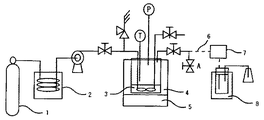
上記フッ素含有界面活性剤の除去処理は、処理対象物に含有されているフッ素含有界面活性剤の一部又は全部を上記処理対象物から除去するための処理である。上記フッ素含有界面活性剤の除去処理は、処理対象物に物質〔A〕を接触させることにより行うものであり、フッ素含有界面活性剤は、物質〔A〕に溶解させ抽出し、物質〔A〕とともに処理対象物から分離させることにより、上記処理対象物から除去されることとなる。上記フッ素含有界面活性剤の除去処理の方法としては特に限定されず、例えば、処理対象物(1)や処理対象物(3)については、図1の模式図に示すような回分式の装置を用いて行ってもよいし、フッ素含有界面活性剤を抽出した後、物質〔A〕と分離し、物質〔A〕を再度除去処理に用いる半流通式装置を用いて行ってもよい。例えば、樹脂やエラストマーの湿潤粉末等の処理対象物(2)については、押し出し機内で行ってもよい。
The method for purifying an object to be treated of the present invention comprises removing the fluorine-containing surfactant by bringing the substance [A] into contact with the object to be treated.
The removal treatment of the fluorine-containing surfactant is a treatment for removing a part or all of the fluorine-containing surfactant contained in the treatment object from the treatment object. The removal treatment of the fluorine-containing surfactant is performed by bringing the substance [A] into contact with the object to be treated. The fluorine-containing surfactant is dissolved and extracted in the substance [A], and the substance [A] is removed. At the same time, it is removed from the processing object by separating it from the processing object. The method for removing the fluorine-containing surfactant is not particularly limited. For example, for the processing object (1) and the processing object (3), a batch-type apparatus as shown in the schematic diagram of FIG. 1 is used. Alternatively, after extracting the fluorine-containing surfactant, it may be separated from the substance [A], and the substance [A] may be used again using a semi-flow apparatus for the removal treatment. For example, the processing object (2) such as a wet powder of resin or elastomer may be performed in an extruder.
上記物質〔A〕は、標準状態(105Pa、0℃)において気体であるものである。
上記標準状態は、物性値を定めるための基準となる温度及び圧力で規定される状態である。
上記物質〔A〕としては、例えば、エタン、プロパン、一酸化二窒素、アンモニア、フロロホルム等のフロン、二酸化炭素等が挙げられ、なかでも、化学的に安定で、安価であり比較的低温低圧で超臨界状態を実現することができる点で、二酸化炭素が好ましい。
二酸化炭素は、上記標準状態(105Pa、0℃)において液体である物質、例えば、有機溶媒、水等の液体溶媒とは異なり、温度と圧力との2変数を変えることにより密度等の溶媒物性を幅広く制御することができる。
また二酸化炭素は、無毒であるので、環境調和型溶媒として好適である。
The substance [A] is a gas in a standard state (10 5 Pa, 0 ° C.).
The standard state is a state defined by a temperature and a pressure serving as a reference for determining physical property values.
Examples of the substance [A] include ethane, propane, dinitrogen monoxide, ammonia, fluorocarbons such as fluoroform, carbon dioxide, etc., among others, chemically stable, inexpensive, relatively low temperature and low pressure. Carbon dioxide is preferred in that a supercritical state can be realized.
Carbon dioxide is different from a substance that is liquid in the standard state (10 5 Pa, 0 ° C.), for example, a liquid solvent such as an organic solvent or water, and a solvent such as density by changing two variables of temperature and pressure. A wide range of physical properties can be controlled.
Carbon dioxide is suitable as an environmentally conscious solvent because it is non-toxic.
フッ素含有界面活性剤の除去処理の過程において、処理対象物が水を含有しているものである場合、上記二酸化炭素は、水に溶解して上記処理対象物が酸性の水溶液となることにより、又は、更にHCl等の酸性物質を添加して上記処理対象物を酸性の水溶液とすることにより、例えば、パーフルオロオクタン酸アンモニウム〔APFO〕等の塩型のフッ素含有界面活性剤は、比較的抽出されやすいパーフルオロオクタン酸〔PFOA〕等の酸型のフッ素含有界面活性剤に変換されていると考えられる。 In the process of removing the fluorine-containing surfactant, when the treatment object contains water, the carbon dioxide dissolves in water and the treatment object becomes an acidic aqueous solution. Alternatively, an acidic substance such as HCl is further added to make the treatment object an acidic aqueous solution, so that, for example, a salt-type fluorine-containing surfactant such as ammonium perfluorooctanoate [APFO] is relatively extracted. It is considered that it has been converted to an acid-type fluorine-containing surfactant such as perfluorooctanoic acid [PFOA] which is easily treated.
上記フッ素含有界面活性剤の除去処理は、物質〔A〕として二酸化炭素を用いる場合、上記二酸化炭素が気体である処理温度と処理圧力において、二酸化炭素を接触させることにより行うものであってもよいが、生産性や効率の点で、20℃以上の温度において4MPa以上の圧力下に行うものであることが好ましく、二酸化炭素の臨界温度以上の温度において二酸化炭素の臨界圧力以上の圧力下に行うものであることがより好ましい。上記二酸化炭素の臨界温度は、31.1℃、臨界圧力は、7.38MPaである。上記フッ素含有界面活性剤の除去処理は、物質〔A〕として超臨界状態における二酸化炭素を用いる場合、230℃以下、好ましくは150℃未満の温度において60MPa以下の圧力下に行うものであることが好ましく、150℃未満、好ましくは130℃未満の温度において40MPa以下の圧力下に行うものであることがより好ましい。 In the case where carbon dioxide is used as the substance [A], the fluorine-containing surfactant removal treatment may be performed by contacting carbon dioxide at a treatment temperature and a treatment pressure at which the carbon dioxide is a gas. However, in terms of productivity and efficiency, it is preferable that the reaction be performed under a pressure of 4 MPa or higher at a temperature of 20 ° C. or higher, and under a pressure higher than the critical pressure of carbon dioxide at a temperature higher than the critical temperature of carbon dioxide. More preferably. Carbon dioxide has a critical temperature of 31.1 ° C. and a critical pressure of 7.38 MPa. In the case where carbon dioxide in a supercritical state is used as the substance [A], the fluorine-containing surfactant removal treatment is performed at a temperature of 230 ° C. or less, preferably at a temperature of less than 150 ° C., and a pressure of 60 MPa or less. More preferably, it is performed under a pressure of 40 MPa or less at a temperature of less than 150 ° C, preferably less than 130 ° C.
上記フッ素含有界面活性剤の除去処理は、物質〔A〕として超臨界状態における二酸化炭素を用いる場合、二酸化炭素の密度を高くすることにより、フッ素含有界面活性剤の除去効率を向上することができる。この機構としては明確ではないが、二酸化炭素の密度が高い方がAPFO等のフッ素含有界面活性剤の二酸化炭素に対する溶解度が上昇するからと考えられる。 The fluorine-containing surfactant removal treatment can improve the removal efficiency of the fluorine-containing surfactant by increasing the density of carbon dioxide when carbon dioxide in a supercritical state is used as the substance [A]. . Although this mechanism is not clear, it is considered that the higher the density of carbon dioxide, the higher the solubility of fluorine-containing surfactants such as APFO in carbon dioxide.
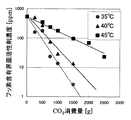
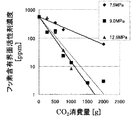
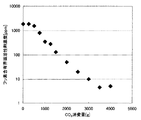
フッ素含有界面活性剤の除去処理に要する二酸化炭素の量は、図2及び図3のグラフに示すように二酸化炭素の消費量に対してフッ素含有界面活性剤の濃度が指数関数的に減少する関係があることから、目安としてはフッ素含有界面活性剤の濃度をX倍率に希釈するために、X倍量の二酸化炭素を要するとみればよい。 The amount of carbon dioxide required for the removal treatment of the fluorine-containing surfactant is such that the concentration of the fluorine-containing surfactant decreases exponentially with respect to the consumption of carbon dioxide as shown in the graphs of FIGS. Therefore, as a guideline, in order to dilute the concentration of the fluorine-containing surfactant to X magnification, it may be considered that X times the amount of carbon dioxide is required.
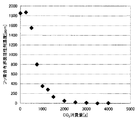
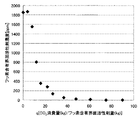
図4のグラフに示すように、縦軸を、二酸化炭素消費量、横軸を、二酸化炭素消費量をフッ素含有界面活性剤の量で除した無次元量、として整理すると、一般的に超臨界二酸化炭素を用いた抽出では抽出物の量は上記無次元量が50〜60となったところでほぼ平衡に達する。本明細書において、上記「平衡」に達した状態は、二酸化炭素の消費量を増やしてもフッ素含有界面活性剤の濃度が低下しなくなった状態である。 As shown in the graph of FIG. 4, when the vertical axis is the carbon dioxide consumption and the horizontal axis is a dimensionless amount obtained by dividing the carbon dioxide consumption by the amount of the fluorine-containing surfactant, it is generally supercritical. In the extraction using carbon dioxide, the amount of the extract reaches almost equilibrium when the dimensionless amount reaches 50-60. In the present specification, the state of reaching the “equilibrium” is a state in which the concentration of the fluorine-containing surfactant does not decrease even when the consumption of carbon dioxide is increased.
フッ素含有界面活性剤の除去処理に要する二酸化炭素の量は、処理対象物によって変わり、例えば、処理対象物が上述のポリマーと水とからなる水性分散体である場合、上述の実質的にポリマーを含有しないフッ素含有界面活性剤の溶液よりも、平衡に達するまでに要する二酸化炭素の消費量が少ない傾向がある。この傾向は、二酸化炭素によりポリマーが凝析しやすく、この凝析粒子に吸着する等して、水中に存在していたフッ素含有界面活性剤が処理対象物から除去されやすくなることによると考えられる。 The amount of carbon dioxide required for the treatment for removing the fluorine-containing surfactant varies depending on the object to be treated. For example, when the object to be treated is an aqueous dispersion composed of the above polymer and water, There is a tendency that less carbon dioxide is required to reach equilibrium than a solution of a fluorine-containing surfactant that does not contain. This tendency is considered to be due to the fact that the polymer is easily coagulated by carbon dioxide and the fluorine-containing surfactant existing in the water is easily removed from the object to be treated by adsorbing to the coagulated particles. .
本発明の凝集体製造方法は、上記処理対象物精製方法を用いてポリマーからなる凝集体を製造することを特徴とするものである。本明細書において、上記処理対象物精製方法を用いる本発明の凝集体製造方法を、以下、本発明の「凝集体製造方法(1)」ということがある。 The method for producing an aggregate of the present invention is characterized in that an aggregate composed of a polymer is produced by using the above-described treatment object purification method. In the present specification, the aggregate production method of the present invention using the treatment object purification method is sometimes referred to as “aggregate production method (1)” of the present invention.
本発明の凝集体製造方法(1)は、上記処理対象物精製方法として処理対象物(1)又は処理対象物(2)を用いるものである。上記処理対象物(1)としては、上述のポリマーからなる一次粒子がフッ素含有界面活性剤の存在下に水性媒体中に分散している水性分散体(1)であってもよいが、上述の水性分散体(2)が好ましい。上記処理対象物(2)としては、上述のポリマーからなる粉末であって、フッ素含有界面活性剤が混在しているものが好ましい。 The aggregate production method (1) of the present invention uses the treatment object (1) or the treatment object (2) as the treatment object purification method. The treatment object (1) may be an aqueous dispersion (1) in which primary particles composed of the above-described polymer are dispersed in an aqueous medium in the presence of a fluorine-containing surfactant. Aqueous dispersion (2) is preferred. As said process target (2), it is the powder which consists of the above-mentioned polymer, Comprising: The thing in which the fluorine-containing surfactant is mixed is preferable.
本発明の凝集体製造方法(1)は、上記処理対象物(1)又は処理対象物(2)に上述の物質〔A〕を接触させて上述のフッ素含有界面活性剤の除去処理を行うことにより、ポリマーからなる凝集体(以下、「ポリマー凝集体」という。)を製造するものである。上記物質〔A〕としては、本発明の処理対象物精製方法におけるものと同様、二酸化炭素が好ましい。 In the aggregate production method (1) of the present invention, the above-mentioned substance [A] is brought into contact with the treatment object (1) or the treatment object (2) to perform the removal treatment of the fluorine-containing surfactant. Thus, an aggregate composed of a polymer (hereinafter referred to as “polymer aggregate”) is produced. As said substance [A], a carbon dioxide is preferable like the thing in the processing target object purification method of this invention.
上記ポリマー凝集体は、上記一次粒子が水性媒体中に分散している水性分散体(1)に対して凝析等の操作を行う工程を経て得られるものであり、上記凝析等の操作を行うことにより形成された二次粒子からなるものである。上記ポリマー凝集体は、水性媒体中に存在している二次粒子であってもよいし、二次粒子からなる粉末であってもよい。 The polymer aggregate is obtained through a step of performing an operation such as coagulation on the aqueous dispersion (1) in which the primary particles are dispersed in an aqueous medium. It consists of secondary particles formed by performing. The polymer aggregate may be a secondary particle present in an aqueous medium or may be a powder composed of secondary particles.
上記ポリマーとしては、フルオロポリマーが好ましい。
上記フルオロポリマーは、フッ素含有単量体を重合することにより得られるものであり、目的に応じて、フッ素非含有単量体をも共重合させたものであってもよい。
The polymer is preferably a fluoropolymer.
The fluoropolymer is obtained by polymerizing a fluorine-containing monomer, and may be obtained by copolymerizing a fluorine-free monomer depending on the purpose.
上記フッ素含有単量体としては、フルオロオレフィン、好ましくは炭素原子2〜10個を有するフルオロオレフィン;環式のフッ素化された単量体;式CY2=CYOR又はCY2=CYOR1OR(Yは、H又はFであり、Rは、水素原子の一部又は全てがフッ素原子で置換されている炭素数1〜8のアルキル基であり、R1は、水素原子の一部又は全てがフッ素原子で置換されている炭素数1〜8のアルキレン基である。)で表されるフッ素化アルキルビニルエーテル等が挙げられる。 The fluorine-containing monomer may be a fluoroolefin, preferably a fluoroolefin having 2 to 10 carbon atoms; a cyclic fluorinated monomer; a formula CY 2 = CYOR or CY 2 = CYOR 1 OR (Y Is H or F, R is an alkyl group having 1 to 8 carbon atoms in which part or all of the hydrogen atoms are substituted with fluorine atoms, and R 1 is a part or all of the hydrogen atoms in fluorine. And a fluorinated alkyl vinyl ether represented by a C1-C8 alkylene group substituted with an atom).
上記フルオロオレフィンは、好ましくは、炭素原子2〜6個を有するものである。上記炭素原子2〜6個を有するフルオロオレフィンとしては、例えば、テトラフルオロエチレン[TFE]、ヘキサフルオロプロピレン[HFP]、クロロトリフルオロエチレン[CTFE]、フッ化ビニル、フッ化ビニリデン[VdF]、トリフルオロエチレン、ヘキサフルオロイソブチレン及びパーフルオロブチルエチレン等が挙げられる。上記環式のフッ素化された単量体としては、好ましくは、パーフルオロ−2,2−ジメチル−1,3−ジオキソール[PDD]、パーフルオロ−2−メチレン−4−メチル−1,3−ジオキソラン[PMD]等が挙げられる。
上記フッ素化アルキルビニルエーテルにおいて、上記Rは、好ましくは、炭素原子1〜4個を有するものであり、より好ましくは水素原子の全てがフッ素によって置換されているものであり、上記R1は、好ましくは、炭素原子2〜4個を有するものであり、より好ましくは、水素原子の全てがフッ素原子によって置換されているものである。
The fluoroolefin preferably has 2 to 6 carbon atoms. Examples of the fluoroolefin having 2 to 6 carbon atoms include tetrafluoroethylene [TFE], hexafluoropropylene [HFP], chlorotrifluoroethylene [CTFE], vinyl fluoride, vinylidene fluoride [VdF], Fluoroethylene, hexafluoroisobutylene, perfluorobutylethylene and the like can be mentioned. The cyclic fluorinated monomer is preferably perfluoro-2,2-dimethyl-1,3-dioxole [PDD], perfluoro-2-methylene-4-methyl-1,3- And dioxolane [PMD].
In the fluorinated alkyl vinyl ether, R preferably has 1 to 4 carbon atoms, more preferably all of the hydrogen atoms are replaced by fluorine, and R 1 is preferably Has from 2 to 4 carbon atoms, more preferably all of the hydrogen atoms are replaced by fluorine atoms.
上記フッ素非含有単量体としては、上記フッ素含有単量体と反応性を有する炭化水素系単量体等が挙げられる。上記炭化水素系単量体としては、例えば、エチレン、プロピレン、ブチレン、イソブチレン等のアルケン類;エチルビニルエーテル、プロピルビニルエーテル、ブチルビニルエーテル、イソブチルビニルエーテル、シクロヘキシルビニルエーテル等のアルキルビニルエーテル類;酢酸ビニル、プロピオン酸ビニル、n−酪酸ビニル、イソ酪酸ビニル、吉草酸ビニル、ピバリン酸ビニル、カプロン酸ビニル、カプリル酸ビニル、カプリン酸ビニル、バーサチック酸ビニル、ラウリン酸ビニル、ミリスチン酸ビニル、パルミチン酸ビニル、ステアリン酸ビニル、安息香酸ビニル、パラ−t−ブチル安息香酸ビニル、シクロヘキサンカルボン酸ビニル、モノクロル酢酸ビニル、アジピン酸ビニル、アクリル酸ビニル、メタクリル酸ビニル、クロトン酸ビニル、ソルビン酸ビニル、桂皮酸ビニル、ウンデシレン酸ビニル、ヒドロキシ酢酸ビニル、ヒドロキシプロピオイン酸ビニル、ヒドロキシ酪酸ビニル、ヒドロキシ吉草酸ビニル、ヒドロキシイソ酪酸ビニル、ヒドロキシシクロヘキサンカルボン酸ビニル等のビニルエステル類;エチルアリルエーテル、プロピルアリルエーテル、ブチルアリルエーテル、イソブチルアリルエーテル、シクロヘキシルアリルエーテル等のアルキルアリルエーテル類;エチルアリルエステル、プロピルアリルエステル、ブチルアリルエステル、イソブチルアリルエステル、シクロヘキシルアリルエステル等のアルキルアリルエステル類等が挙げられる。 Examples of the fluorine-free monomer include hydrocarbon monomers having reactivity with the fluorine-containing monomer. Examples of the hydrocarbon monomers include, for example, alkenes such as ethylene, propylene, butylene, and isobutylene; alkyl vinyl ethers such as ethyl vinyl ether, propyl vinyl ether, butyl vinyl ether, isobutyl vinyl ether, and cyclohexyl vinyl ether; vinyl acetate and vinyl propionate. , N-vinyl butyrate, vinyl isobutyrate, vinyl valerate, vinyl pivalate, vinyl caproate, vinyl caprylate, vinyl caprate, vinyl versatate, vinyl laurate, vinyl myristate, vinyl palmitate, vinyl stearate, Vinyl benzoate, vinyl para-t-butyl benzoate, vinyl cyclohexanecarboxylate, vinyl monochloroacetate, vinyl adipate, vinyl acrylate, vinyl methacrylate, croton Vinyl esters such as vinyl, vinyl sorbate, vinyl cinnamate, vinyl undecylenate, vinyl hydroxyacetate, vinyl hydroxypropioate, vinyl hydroxybutyrate, vinyl hydroxyvalerate, vinyl hydroxyisobutyrate and vinyl hydroxycyclohexanecarboxylate; Alkyl allyl ethers such as ethyl allyl ether, propyl allyl ether, butyl allyl ether, isobutyl allyl ether, cyclohexyl allyl ether; alkyl allyl esters such as ethyl allyl ester, propyl allyl ester, butyl allyl ester, isobutyl allyl ester, cyclohexyl allyl ester And the like.
上記フッ素非含有単量体としては、また、官能基含有炭化水素系単量体であってもよい。上記官能基含有炭化水素系単量体としては、例えば、ヒドロキシエチルビニルエーテル、ヒドロキシプロピルビニルエーテル、ヒドロキシブチルビニルエーテル、ヒドロキシイソブチルビニルエーテル、ヒドロキシシクロヘキシルビニルエーテル等のヒドロキシアルキルビニルエーテル類;イタコン酸、コハク酸、無水コハク酸、フマル酸、無水フマル酸、クロトン酸、マレイン酸、無水マレイン酸、パーフルオロブテン酸等のカルボキシル基を有するフッ素非含有単量体;グリシジルビニルエーテル、グリシジルアリルエーテル等のグリシジル基を有するフッ素非含有単量体;アミノアルキルビニルエーテル、アミノアルキルアリルエーテル等のアミノ基を有するフッ素非含有単量体;(メタ)アクリルアミド、メチロールアクリルアミド等のアミド基を有するフッ素非含有単量体等が挙げられる。 The fluorine-free monomer may also be a functional group-containing hydrocarbon monomer. Examples of the functional group-containing hydrocarbon monomer include hydroxyalkyl vinyl ethers such as hydroxyethyl vinyl ether, hydroxypropyl vinyl ether, hydroxybutyl vinyl ether, hydroxyisobutyl vinyl ether, hydroxycyclohexyl vinyl ether; itaconic acid, succinic acid, succinic anhydride , Fluorine-free monomers having a carboxyl group such as fumaric acid, fumaric anhydride, crotonic acid, maleic acid, maleic anhydride, perfluorobutenoic acid; fluorine-free monomers having a glycidyl group such as glycidyl vinyl ether and glycidyl allyl ether Monomer; Fluorine-free monomer having amino group such as aminoalkyl vinyl ether and aminoalkyl allyl ether; (meth) acrylamide, methylolacrylamide Include fluorine-free monomer having a amide group is.
上記フッ素非含有単量体を重合してなるフルオロポリマーとして、例えば、重合体における単量体のモル分率が最も多い単量体(以下、「最多単量体」)がTFEであるTFE重合体、最多単量体がVdFであるVdF重合体、及び、最多単量体がCTFEであるCTFE重合体等が挙げられる。 As a fluoropolymer obtained by polymerizing the above fluorine-free monomer, for example, a TFE heavy polymer in which the monomer having the highest molar fraction of the polymer (hereinafter referred to as “most monomer”) is TFE. Examples thereof include a VdF polymer in which the most monomer is VdF, and a CTFE polymer in which the most monomer is CTFE.
TFE重合体としては、好適には、TFE単独重合体であってもよいし、(1)TFE、(2)炭素原子2〜8個を有する1つ又は2つ以上のTFE以外のフッ素含有単量体、特にHFP若しくはCTFE、及び、(3)その他の単量体からなる共重合体であってもよい。上記(3)その他の単量体としては、例えば、炭素原子1〜5個、特に炭素原子1〜3個を有するアルキル基を持つフルオロ(アルキルビニルエーテル);フルオロジオキソール;パーフルオロアルキルエチレン;ω―ヒドロパーフルオロオレフィン等が挙げられる。
TFE重合体としては、また、TFEと、1つ又は2つ以上のフッ素非含有単量体との共重合体であってもよい。上記フッ素非含有単量体としては、例えば、エチレン、プロピレン等のアルケン類;ビニルエステル類;ビニルエーテル類が挙げられる。TFE重合体としては、また、TFEと、炭素原子2〜8個を有する1つ又は2つ以上のフッ素含有単量体と、1つ又は2つ以上のフッ素非含有単量体との共重合体であってもよい。
The TFE polymer may suitably be a TFE homopolymer, or (1) TFE, (2) a fluorine-containing unit other than one or two or more TFEs having 2 to 8 carbon atoms. It may be a copolymer comprising a monomer, particularly HFP or CTFE, and (3) other monomers. Examples of the other monomer (3) include fluoro (alkyl vinyl ether) having an alkyl group having 1 to 5 carbon atoms, particularly 1 to 3 carbon atoms; fluorodioxole; perfluoroalkylethylene; ω-hydroperfluoroolefin and the like.
The TFE polymer may also be a copolymer of TFE and one or more fluorine-free monomers. Examples of the fluorine-free monomer include alkenes such as ethylene and propylene; vinyl esters; vinyl ethers. The TFE polymer may also be a co-polymer of TFE, one or more fluorine-containing monomers having 2 to 8 carbon atoms, and one or more fluorine-free monomers. It may be a coalescence.
VdF重合体としては、好適には、VdF単独重合体[PVdF]であってもよいし、(1)VdF、(2)炭素原子2〜8個を有する1つ又は2つ以上のVdF以外のフルオロオレフィン、特にTFE、HFP若しくはCTFE、及び、(3)炭素原子1〜5個、特に炭素原子1〜3個を有するアルキル基を持つパーフルオロ(アルキルビニルエーテル)〔PAVE〕からなる共重合体等であってもよい。 The VdF polymer may suitably be a VdF homopolymer [PVdF], or (1) VdF, (2) other than one or two or more VdFs having 2 to 8 carbon atoms. Copolymers comprising fluoroolefins, particularly TFE, HFP or CTFE, and (3) perfluoro (alkyl vinyl ether) [PAVE] having an alkyl group having 1 to 5 carbon atoms, particularly 1 to 3 carbon atoms It may be.
CTFE重合体としては、好適には、CTFE単独重合体であってもよいし、(1)CTFE、(2)炭素原子2〜8個を有する1つ又は2つ以上のCTFE以外のフルオロオレフィン、特に、TFE若しくはHFP、及び、(3)炭素原子1〜5個、特に炭素原子1〜3個を有するアルキル基を持つパーフルオロ(アルキルビニルエーテル)からなる共重合体であってもよい。
CTFE重合体としては、また、CTFEと、1つ又は2つ以上のフッ素非含有単量体との共重合体であってもよく、上記フッ素非含有単量体としては、エチレン、プロピレン等のアルケン類;ビニルエステル類;ビニルエーテル類等が挙げられる。
The CTFE polymer may suitably be a CTFE homopolymer, (1) CTFE, (2) one or more fluoroolefins other than CTFE having 2 to 8 carbon atoms, In particular, the copolymer may be composed of TFE or HFP and (3) perfluoro (alkyl vinyl ether) having an alkyl group having 1 to 5 carbon atoms, particularly 1 to 3 carbon atoms.
The CTFE polymer may also be a copolymer of CTFE and one or more fluorine-free monomers. Examples of the fluorine-free monomers include ethylene and propylene. Alkenes; vinyl esters; vinyl ethers and the like.
上記フルオロポリマーは、樹脂状、エラストマー性等であり得る。
上記フルオロポリマーがエラストマー性である場合、好ましいモノマーの組み合わせとしては、TFE/PAVE共重合体、VdF/HFP共重合体、VdF/TFE/HFP共重合体、VdF/PAVE/TFE共重合体、VdF/パーフルオロ(メチルビニルエーテル)〔PMVE〕共重合体、VdF/HFP/PMVE共重合体、VdF/TFE/PMVE共重合体、VdF/PMVE/HFP/TFE共重合体、TFEとプロピレン〔Pr〕とその他の単量体との共重合体等が挙げられる。
上記TFE/PAVE共重合体における組成は、40〜90/10〜60(モル%)であることが好ましく、上記VdF/TFE/HFP共重合体における組成は、30〜85/0〜30/15〜40(モル%)であることが好ましく、上記VdF/PAVE/TFEにおける組成は、10〜90/10〜40/0〜80(モル%)であることが好ましい。また、上記VdF/PMVE共重合体における組成は、65〜90/10〜35(モル%)、上記VdF/HFP/PMVE共重合体における組成は、65〜90/3〜25/3〜25(モル%)、上記VdF/TFE/PMVE共重合体における組成は、40〜80/3〜40/15〜35(モル%)、上記VdF/PMVE/HFP/TFE共重合体における組成は、40〜80/3〜25/3〜25/3〜40(モル%)であることが好ましい。また、上記TFEとPrとその他の単量体との共重合体における組成は、40〜70/30〜60/0〜20(モル%)であることが好ましい。
The fluoropolymer can be resinous, elastomeric, and the like.
When the fluoropolymer is elastomeric, preferred monomer combinations include TFE / PAVE copolymer, VdF / HFP copolymer, VdF / TFE / HFP copolymer, VdF / PAVE / TFE copolymer, VdF. / Perfluoro (methyl vinyl ether) [PMVE] copolymer, VdF / HFP / PMVE copolymer, VdF / TFE / PMVE copolymer, VdF / PMVE / HFP / TFE copolymer, TFE and propylene [Pr] Examples thereof include copolymers with other monomers.
The composition in the TFE / PAVE copolymer is preferably 40 to 90/10 to 60 (mol%), and the composition in the VdF / TFE / HFP copolymer is 30 to 85/0 to 30/15. It is preferable that it is -40 (mol%), and it is preferable that the composition in the said VdF / PAVE / TFE is 10-90 / 10-40 / 0-80 (mol%). The composition of the VdF / PMVE copolymer is 65 to 90/10 to 35 (mol%), and the composition of the VdF / HFP / PMVE copolymer is 65 to 90/3 to 25/3 to 25 ( Mol%), the composition in the VdF / TFE / PMVE copolymer is 40 to 80/3 to 40/15 to 35 (mol%), and the composition in the VdF / PMVE / HFP / TFE copolymer is 40 to 40 It is preferably 80/3 to 25/3 to 25/3 to 40 (mol%). Moreover, it is preferable that the composition in the copolymer of the said TFE, Pr, and another monomer is 40-70 / 30-60 / 0-20 (mol%).
本発明において、上記フルオロポリマーは、ポリテトラフルオロエチレン重合体であることが好ましい。
本明細書において、ポリテトラフルオロエチレン重合体[PTFE重合体]は、TFE単独重合体のみならず、TFEと変性モノマーとの共重合体であって、非溶融加工性であるもの(以下、「変性ポリテトラフルオロエチレン(変性PTFE)」という。)をも含む概念である。
上記変性モノマーとしては、例えば、HFP、CTFE等のパーハロオレフィン;炭素原子1〜5個、特に炭素原子1〜3個を有するアルキル基を持つフルオロ(アルキルビニルエーテル);フルオロジオキソール等の環式のフッ素化された単量体;パーハロアルキルエチレン;ω―ヒドロパーハロオレフィン等が挙げられる。
変性PTFE中の変性モノマー含有率は、通常、0.001〜2モル%の範囲である。
In the present invention, the fluoropolymer is preferably a polytetrafluoroethylene polymer.
In the present specification, the polytetrafluoroethylene polymer [PTFE polymer] is not only a TFE homopolymer but also a copolymer of TFE and a modified monomer, which is non-melt processable (hereinafter referred to as “ This is a concept including a modified polytetrafluoroethylene (modified PTFE) ”.
Examples of the modifying monomer include perhaloolefins such as HFP and CTFE; fluoro (alkyl vinyl ether) having an alkyl group having 1 to 5 carbon atoms, particularly 1 to 3 carbon atoms; and a ring such as fluorodioxole. Fluorinated monomers of the formula; perhaloalkylethylenes; ω-hydroperhaloolefins and the like.
The modified monomer content in the modified PTFE is usually in the range of 0.001 to 2 mol%.
本発明の凝集体製造方法(1)は、上述の処理対象物精製方法を用いるものであので、上記ポリマー凝集体として、フッ素含有界面活性剤の含有量を充分に低減したものを得ることができる。 Since the aggregate production method (1) of the present invention uses the above-described method for purifying an object to be treated, it is possible to obtain a polymer aggregate having a sufficiently reduced content of a fluorine-containing surfactant. it can.
本発明のフッ素含有界面活性剤低減水調製方法は、上述した処理対象物精製方法を用いてフッ素含有界面活性剤の含有率を低減させたフッ素含有界面活性剤低減水を調製するものである。上記フッ素含有界面活性剤低減水調製方法は、上述の処理対象物精製方法における処理対象物(3)について行うことができる。上記フッ素含有界面活性剤低減水は、上記処理対象物(3)に上述の物質〔A〕を接触させることによりフッ素含有界面活性剤の除去処理を行い、その除去処理により、フッ素含有界面活性剤の含有率を低減させたものである。
本明細書において、上記「フッ素含有界面活性剤の含有率を低減」するとは、上記処理対象物精製方法によりフッ素含有界面活性剤の除去処理を行った後の処理対象物の総質量に占めるフッ素含有界面活性剤の含有率を1000ppm以下、好ましくは、100ppm以下、より好ましくは、10ppm以下にすることを意味する。
The fluorine-containing surfactant-reduced water preparation method of the present invention is to prepare fluorine-containing surfactant-reduced water in which the content of the fluorine-containing surfactant is reduced using the above-described treatment object purification method. The said fluorine-containing surfactant reduction water preparation method can be performed about the process target object (3) in the above-mentioned process target object purification method. The fluorine-containing surfactant-reduced water is used to remove the fluorine-containing surfactant by bringing the substance [A] into contact with the object to be treated (3). The content of is reduced.
In the present specification, “reducing the content of fluorine-containing surfactant” means that fluorine accounts for the total mass of the object to be treated after removing the fluorine-containing surfactant by the above-described object purification method. It means that the content ratio of the contained surfactant is 1000 ppm or less, preferably 100 ppm or less, more preferably 10 ppm or less.
本発明のフッ素含有界面活性剤低減水調製方法によれば、本発明の処理対象物精製方法について上述したように、処理対象物から除去したフッ素含有界面活性剤を物質〔A〕を分離して回収することも容易に行うことができる。
本発明の処理対象物精製方法は、上記範囲内のようにフッ素含有界面活性剤の含有率を充分に低減させることができるので、例えば、水性媒体中においてフッ素含有界面活性剤の存在下に重合して得られたポリマーからなる粒子が分散している水性分散体を凝析させて回収した上澄みは、上記フッ素含有界面活性剤と水とからなり実質的にポリマーを含有しないものである。ところが、凝析剤を用いて凝析させて回収した上澄みには、凝析されずに残存した未凝析ポリマーを含む水性分散体が実質的に残るため、従来、産業廃棄物として廃棄する際には、フッ素含有界面活性剤と、上記未凝析ポリマーを含む水性分散体の両者を分離・回収しなくてはならず、非常に手間がかかった。
本発明のフッ素含有界面活性剤低減水調製方法を用いることにより、一般的な実験室で汎用されている装置と同様の原理による工業用装置を用いて上記フッ素含有界面活性剤を除去・回収することができ、上記上澄みの廃棄を容易に行うことができる。
According to the fluorine-containing surfactant-reduced water preparation method of the present invention, the substance [A] is separated from the fluorine-containing surfactant removed from the process target as described above for the process target purification method of the present invention. It can also be easily recovered.
Since the method for purifying the object to be treated of the present invention can sufficiently reduce the content of the fluorine-containing surfactant as in the above range, for example, polymerization is performed in an aqueous medium in the presence of the fluorine-containing surfactant. The supernatant obtained by coagulating and recovering the aqueous dispersion in which the particles made of the polymer are dispersed is composed of the above-mentioned fluorine-containing surfactant and water and does not substantially contain a polymer. However, since the aqueous dispersion containing the uncoagulated polymer that remains without being coagulated remains substantially in the supernatant collected by coagulation using a coagulant, conventionally, when it is discarded as industrial waste, In this case, both the fluorine-containing surfactant and the aqueous dispersion containing the uncoagulated polymer had to be separated and recovered, which was very laborious.
By using the fluorine-containing surfactant-reduced water preparation method of the present invention, the fluorine-containing surfactant is removed and recovered using an industrial apparatus based on the same principle as that used in general laboratories. The supernatant can be easily discarded.
本発明の凝集体製造方法は、ポリマーからなる凝集体を製造するための方法であって、上記凝集体製造方法は、上記ポリマーからなる粒子が分散している水性分散体に物質〔A〕を接触させることにより上記水性分散体の凝析処理を行う工程を有するものである。本明細書において、上記凝析処理を行う工程を有する本発明の凝集体製造方法を、以下、本発明の「凝集体製造方法(2)」ということがある。 The aggregate production method of the present invention is a method for producing an aggregate composed of a polymer, and the aggregate production method comprises adding the substance [A] to an aqueous dispersion in which particles composed of the polymer are dispersed. It has the process of performing the coagulation process of the said aqueous dispersion by making it contact. In the present specification, the aggregate production method of the present invention having the step of performing the coagulation treatment may be hereinafter referred to as “aggregate production method (2)” of the present invention.
上記物質〔A〕は、標準状態(105Pa、0℃)において気体であるものであり、本発明の処理対象物精製方法について上述した物質〔A〕と同じものであり、好ましくは二酸化炭素である。
上記「ポリマーからなる粒子が分散している水性分散体」としては、ポリマーからなる一次粒子が水性媒体中に分散している水性分散体が好ましい。上記「物質〔A〕を接触させる」方法は、上述の本発明の処理対象物精製方法において、処理対象物(1)に物質〔A〕を接触させる方法と同じであり、上記処理対象物(1)として、上記一次粒子が水性媒体中に分散している水性分散体を用いることが好ましい。
The substance [A] is a gas in the standard state (10 5 Pa, 0 ° C.), and is the same as the substance [A] described above for the method for purifying a treatment target of the present invention, preferably carbon dioxide. It is.
The “aqueous dispersion in which particles made of polymer are dispersed” is preferably an aqueous dispersion in which primary particles made of polymer are dispersed in an aqueous medium. The method of “contacting the substance [A]” is the same as the method of bringing the substance [A] into contact with the object to be treated (1) in the above-described method for purifying the object to be treated of the present invention. As 1), it is preferable to use an aqueous dispersion in which the primary particles are dispersed in an aqueous medium.
上記「ポリマーからなる粒子が分散している水性分散体」としては、ポリマーからなる一次粒子が水性媒体中に分散している水性分散体が好ましい。上記水性分散体は、フッ素含有界面活性剤を含有しているものである必要はないが、フッ素含有界面活性剤を含有しているものであってもよい。上記水性分散体がフッ素含有界面活性剤を含有しているものである場合、上記水性分散体の凝析処理とともに、本発明の処理対象物精製方法において上述したフッ素含有界面活性剤の除去処理をも行うことができる。 The “aqueous dispersion in which particles made of polymer are dispersed” is preferably an aqueous dispersion in which primary particles made of polymer are dispersed in an aqueous medium. The aqueous dispersion does not need to contain a fluorine-containing surfactant, but may contain a fluorine-containing surfactant. When the aqueous dispersion contains a fluorine-containing surfactant, the fluorine-containing surfactant removal treatment described above in the processing object purification method of the present invention is performed together with the coagulation treatment of the aqueous dispersion. Can also be done.
水性分散体中に分散しているポリマーからなる粒子は、上記物質〔A〕を接触させることにより、凝集させポリマー凝集体を形成することができる。水性分散体中に分散しているポリマーからなる粒子は、上記水性分散体がフッ素含有界面活性剤を含有しているものである場合、上述の処理対象物(1)に物質〔A〕を接触させることによって水性分散体中のフッ素含有界面活性剤の含有率が低減する結果、水性分散体中における分散力が低下し、粒子同士が寄り集まって凝集体を形成するものと考えられる。上記フッ素含有界面活性剤を含有している水性分散体としては、ラジカル重合を行うことにより得られた水性分散体(1)を用いることができる。この水性分散体(1)は、通常、濃縮しない状態で含水率が約70質量%程度であり、この含水率は上述の(ii)非水物に対する(i)水の好ましい量の範囲に入り、フッ素含有界面活性剤を効率良く除去し得る含水率の範囲と重なる。上記凝集体の形成は、また、攪拌による機械的剪断にもよると考えられる。上記凝集体を取り除いた後、水性分散体は透明になる。
本発明の凝集体製造方法は、上記水性分散体がフッ素含有界面活性剤を含有しているものである場合、フッ素含有界面活性剤の除去処理と凝析処理とを同時に進行させることも可能とするものである。即ち、従来、酸を添加して凝析を行っていたときのように凝析体を取り除いた後の残液に対して改めてフッ素含有界面活性剤の除去処理を行わなくとも凝析処理の過程でフッ素含有界面活性剤が実質的に除去されているので、凝析排水をそのまま廃棄することができる。
Particles made of a polymer dispersed in an aqueous dispersion can be aggregated to form a polymer aggregate by contacting the substance [A]. When the aqueous dispersion contains a fluorine-containing surfactant, the particles made of the polymer dispersed in the aqueous dispersion contact the substance [A] with the treatment object (1) described above. As a result, the content of the fluorine-containing surfactant in the aqueous dispersion is reduced, and as a result, the dispersion force in the aqueous dispersion is lowered, and the particles gather together to form an aggregate. As the aqueous dispersion containing the fluorine-containing surfactant, an aqueous dispersion (1) obtained by performing radical polymerization can be used. This aqueous dispersion (1) usually has a water content of about 70% by mass without being concentrated, and this water content falls within the range of (ii) the preferred amount of water relative to the above (ii) non-aqueous matter. This overlaps with the water content range in which the fluorine-containing surfactant can be efficiently removed. The formation of the aggregate is also considered to be due to mechanical shearing by stirring. After removing the agglomerates, the aqueous dispersion becomes transparent.
In the aggregate production method of the present invention, when the aqueous dispersion contains a fluorine-containing surfactant, the fluorine-containing surfactant removal treatment and the coagulation treatment can be simultaneously performed. To do. That is, the process of coagulation treatment without removing the fluorine-containing surfactant again from the residual liquid after removing the coagulate as in the case of coagulation by adding acid. Since the fluorine-containing surfactant is substantially removed, the coagulation waste water can be discarded as it is.
本発明の凝集体製造方法によって得られる上記凝集体の粒径は、従来公知の凝析方法によって得られる粒子の粒径と同程度とすることができ、通常10〜2000μmである。好ましい下限は、180μm、より好ましい下限は、200μm、好ましい上限は、700μmである。 The particle size of the aggregate obtained by the method for producing an aggregate according to the present invention can be approximately the same as the particle size of particles obtained by a conventionally known coagulation method, and is usually 10 to 2000 μm. A preferable lower limit is 180 μm, a more preferable lower limit is 200 μm, and a preferable upper limit is 700 μm.
本発明の凝集体製造方法において、水性分散体の凝析処理は、特定の処理温度(T℃)において特定の処理圧力(P Pa)下に行うものであることが好ましく、上記特定の処理温度(T℃)と、物質〔A〕の臨界温度(Tc℃)との比(T/Tc)が0.8以上であり、上記特定の処理圧力(P Pa)と、上記物質〔A〕の臨界圧力(Pc Pa)との比(P/Pc)が0.8以上であることが好ましい。 In the aggregate production method of the present invention, the coagulation treatment of the aqueous dispersion is preferably performed at a specific processing temperature (T ° C.) under a specific processing pressure (P Pa). (T ° C) and the critical temperature (Tc ° C) of the substance [A] are not less than 0.8 (T / Tc), the specific processing pressure (P Pa) and the substance [A] The ratio (P / Pc) to the critical pressure (Pc Pa) is preferably 0.8 or more.
特定の処理温度(T)は、物質〔A〕の臨界温度(Tc)以上の温度であり、特定の処理圧力(P)は、上記物質〔A〕の臨界圧力(Pc)以上の圧力であることがより好ましく、物質〔A〕として超臨界状態における二酸化炭素を用いる場合、上限を本発明の処理対象物精製方法について上述した上限と同様にすることが好ましい。 The specific processing temperature (T) is a temperature higher than the critical temperature (Tc) of the substance [A], and the specific processing pressure (P) is a pressure higher than the critical pressure (Pc) of the substance [A]. More preferably, when carbon dioxide in a supercritical state is used as the substance [A], the upper limit is preferably set to be the same as the upper limit described above for the method for purifying an object to be treated of the present invention.
本発明の凝集体製造方法において、ポリマーは、フルオロポリマーであることが好ましく、フルオロポリマーは、テトラフルオロエチレン重合体であることが好ましい。上記フルオロポリマー及びテトラフルオロエチレン重合体は、本発明の凝集体製造方法(1)において上述した通りである。 In the aggregate production method of the present invention, the polymer is preferably a fluoropolymer, and the fluoropolymer is preferably a tetrafluoroethylene polymer. The fluoropolymer and the tetrafluoroethylene polymer are as described above in the aggregate production method (1) of the present invention.
本発明の処理対象物精製方法は、上述の構成よりなるので、フッ素含有界面活性剤を含有している処理対象物からフッ素含有界面活性剤を回収すると同時にポリマーからなる凝集体を得ることができる。 Since the method for purifying an object to be treated of the present invention has the above-described configuration, an aggregate made of a polymer can be obtained simultaneously with the recovery of the fluorine-containing surfactant from the object to be treated containing the fluorine-containing surfactant. .
以下に実施例を挙げて本発明を更に詳しく説明するが、本発明はこれら実施例のみに限定されるものではない。
実施例1 フッ素含有界面活性剤水溶液からのフッ素含有界面活性剤の除去処理
(1)実験装置は図1の概略図に示すような流通式装置を用いて行った。即ち、CO2ボンベ1から供給される二酸化炭素ガスを冷却器2で冷却した後、圧力と温度とを超臨界状態となるように調整し、得られた超臨界二酸化炭素を、スターラー(攪拌速度800rpm)で攪拌したフッ素含有界面活性剤水溶液(界面活性剤名:パーフルオロオクタン酸アンモニウム〔APFO〕、初期界面活性剤濃度=550ppm)に流量12.2g/分で4000gの二酸化炭素を流通させた。流通後の超臨界二酸化炭素を含む流体は、排圧弁を通すことによって圧力を0.1MPaまで下げ、密度ρを2.0g/lまで低下させ、氷浴中でフッ素含有界面活性剤を回収した。
以上の除去処理操作を圧力又は温度の一方を固定し、他方を変えて、除去処理前後のフッ素含有界面活性剤濃度(前:C0、後:C)〔ppm〕を調べた。上記フッ素含有界面活性剤濃度は、高速液体クロマトグラフ〔HPLC〕(東ソー社製 本体ユニットSC8010)を用いて測定した。結果を図2及び図3に示す。
フッ素含有界面活性剤の抽出効率(速度)は、実験した範囲において、図2から、温度を下げることにより、また図3から、圧力を上昇させることにより、それぞれ向上する傾向があることがわかった。
EXAMPLES Hereinafter, the present invention will be described in more detail with reference to examples, but the present invention is not limited only to these examples.
Example 1 Removal Treatment of Fluorine-Containing Surfactant from Fluorine-Containing Surfactant Aqueous Solution (1) The experimental apparatus was a flow-type apparatus as shown in the schematic diagram of FIG. That is, after the carbon dioxide gas supplied from the CO 2 cylinder 1 is cooled by the cooler 2, the pressure and temperature are adjusted so as to be in a supercritical state, and the obtained supercritical carbon dioxide is mixed with a stirrer (stirring speed). 800 g of carbon dioxide was circulated at a flow rate of 12.2 g / min in a fluorine-containing surfactant aqueous solution (surfactant name: ammonium perfluorooctanoate [APFO], initial surfactant concentration = 550 ppm) stirred at 800 rpm). . The fluid containing supercritical carbon dioxide after circulation was reduced in pressure to 0.1 MPa by passing through a discharge pressure valve, the density ρ was reduced to 2.0 g / l, and the fluorine-containing surfactant was recovered in an ice bath. .
With the above removal treatment operation, one of the pressure and temperature was fixed and the other was changed, and the fluorine-containing surfactant concentration (before: C 0 , after: C) [ppm] before and after the removal treatment was examined. The fluorine-containing surfactant concentration was measured using a high performance liquid chromatograph [HPLC] (main unit SC8010 manufactured by Tosoh Corporation). The results are shown in FIGS.
From the experimental range, the extraction efficiency (rate) of the fluorine-containing surfactant was found to tend to improve by decreasing the temperature and from FIG. 3 by increasing the pressure. .
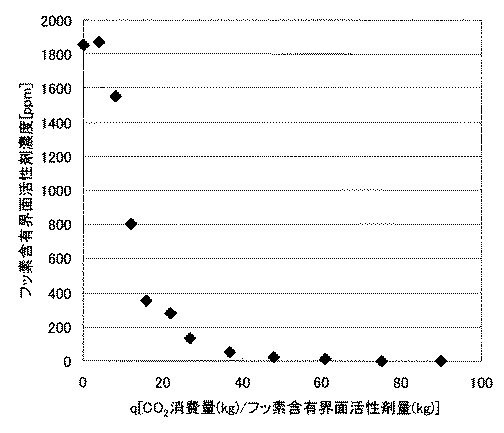
(2)処理対象物として、実施例1(1)にて超臨界二酸化炭素を流通させる前のフッ素含有界面活性剤水溶液と同じもの(界面活性剤名:パーフルオロオクタン酸アンモニウム、初期界面活性剤濃度=1855ppm)を66.5g用い、超臨界二酸化炭素(ρ=662g/l)を表1に示す消費量とする以外は、実施例1(1)と同様に流通式装置を用いて流通させ、流通前後のフッ素含有界面活性剤水溶液中のフッ素含有界面活性剤濃度を測定した。結果を表1及び図4に示す。
表1と図4に示すように、例えば、フッ素含有界面活性剤水溶液を用いた場合、除去処理前に1855ppmあったものが、二酸化炭素を4000g消費した時点で、3.2ppmにまで低下した。表1のうちフッ素含有界面活性剤水溶液におけるフッ素含有界面活性剤濃度の対数を縦軸に、二酸化炭素濃度を横軸にとった片対数プロットを図5に示す。図5に示すように、二酸化炭素消費量が250g以上、3500g以下の領域でほぼ直線に乗っており、この領域においては、同じ倍率を希釈するためには同じ量の二酸化炭素を用いればよいことがわかった。直線の傾きの値から、例えば、フッ素含有界面活性剤の水溶液を10倍希釈するためには1280gの二酸化炭素が必要であることがわかった。図6は、横軸を無次元量q(被抽出物たるフッ素含有界面活性剤量に対する二酸化炭素消費量)として整理したものである。図6から、qが50付近で定常状態に達していることがわかった。
(2) The same treatment object as the fluorine-containing surfactant aqueous solution before supercritical carbon dioxide is circulated in Example 1 (1) (surfactant name: ammonium perfluorooctanoate, initial surfactant) Except for using 66.5 g (concentration = 1855 ppm) and the consumption shown in Table 1 for supercritical carbon dioxide (ρ = 662 g / l), it was circulated using a flow-type apparatus as in Example 1 (1). The fluorine-containing surfactant concentration in the fluorine-containing surfactant aqueous solution before and after distribution was measured. The results are shown in Table 1 and FIG.
As shown in Table 1 and FIG. 4, for example, when a fluorine-containing surfactant aqueous solution was used, what was 1855 ppm before the removal treatment decreased to 3.2 ppm when 4000 g of carbon dioxide was consumed. FIG. 5 shows a semilogarithmic plot in which the logarithm of the fluorine-containing surfactant concentration in the fluorine-containing surfactant aqueous solution in Table 1 is taken on the vertical axis and the carbon dioxide concentration is taken on the horizontal axis. As shown in FIG. 5, the carbon dioxide consumption is almost linear in the region of 250 g or more and 3500 g or less, and in this region, the same amount of carbon dioxide should be used to dilute the same magnification. I understood. From the value of the slope of the straight line, it was found that, for example, 1280 g of carbon dioxide was required to dilute the aqueous solution of the fluorine-containing
実施例2 水性分散体からのフッ素含有界面活性剤の除去処理
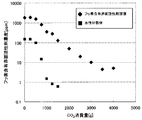
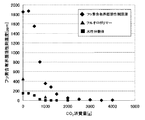
処理対象物として、フッ素含有界面活性剤水溶液の代わりに、フッ素含有界面活性剤としてパーフルオロオクタン酸アンモニウムを147.0ppm含むフルオロポリマー(TFE単独重合体)水性分散体(フルオロポリマー濃度0.2質量%)を51.3g用い、超臨界二酸化炭素(密度662g/l、9MPa、35℃)の流量を12.3g/分とした以外は、実施例1(1)と同様にして除去処理を行った。結果を実施例1(2)の結果とともに表1、図7及び図8に示す。表1から、水性分散体中のフッ素含有界面活性剤は、実施例1(1)と同様に二酸化炭素により抽出されており、二酸化炭素を1500g消費した時点でフッ素含有界面活性剤濃度は、0.6ppmであった。また、図7からフッ素含有界面活性剤水溶液に除去処理を行った場合よりも水性分散体に除去処理を行った場合の方が、抽出効率が高く、平衡に達するまでに要する二酸化炭素量が少ないことがわかった。更に、除去処理前後の溶液の様子を写真で比較したところ、除去処理後の溶液は透明になっており、フッ素含有界面活性剤の抽出と同時に凝析が進行していることがわかった。
Example 2 Removal of Fluorine-Containing Surfactant from Aqueous Dispersion As an object to be treated, a fluoropolymer containing 147.0 ppm of ammonium perfluorooctanoate as a fluorine-containing surfactant instead of a fluorine-containing surfactant aqueous solution ( TFE homopolymer) Other than using 51.3 g of an aqueous dispersion (fluoropolymer concentration 0.2% by mass) and setting the flow rate of supercritical carbon dioxide (density 662 g / l, 9 MPa, 35 ° C.) to 12.3 g / min. Were removed in the same manner as in Example 1 (1). The results are shown in Table 1, FIG. 7 and FIG. 8 together with the results of Example 1 (2). From Table 1, the fluorine-containing surfactant in the aqueous dispersion was extracted with carbon dioxide as in Example 1 (1), and when 1500 g of carbon dioxide was consumed, the fluorine-containing surfactant concentration was 0. 0.6 ppm. Also, from FIG. 7, the extraction efficiency is higher and the amount of carbon dioxide required to reach equilibrium is lower when the aqueous dispersion is subjected to the removal treatment than when the fluorine-containing surfactant aqueous solution is removed. I understood it. Furthermore, when the state of the solution before and after the removal treatment was compared with photographs, it was found that the solution after the removal treatment was transparent and coagulation proceeded simultaneously with the extraction of the fluorine-containing surfactant.
実施例3 フルオロポリマー粉末中からのフッ素含有界面活性剤の除去処理
処理対象物として、フッ素含有界面活性剤〔APFO〕を含むフルオロポリマー粉末1.86gを用いた以外は実施例2と同様にして除去処理を行った。除去処理前後のフルオロポリマー中のフッ素含有界面活性剤濃度は、ポリマーからアセトンで界面活性剤を抽出し、45℃でアセトンを蒸発させた後、水を加え、HPLCを用いて測定した。結果を実施例1(2)及び実施例2の結果とともに表1及び図8に示す。フルオロポリマー中のフッ素含有界面活性剤の除去処理を行った結果、最初443.0ppmあったフッ素含有界面活性剤が二酸化炭素を1000g使用した時点で86.5ppmまで低下したことがわかった。
Example 3 In the same manner as in Example 2 except that 1.86 g of a fluoropolymer powder containing a fluorine-containing surfactant [APFO] was used as an object to be treated for removing the fluorine-containing surfactant from the fluoropolymer powder. A removal process was performed. The fluorine-containing surfactant concentration in the fluoropolymer before and after the removal treatment was measured using HPLC after extracting the surfactant from the polymer with acetone, evaporating the acetone at 45 ° C., and adding water. The results are shown in Table 1 and FIG. 8 together with the results of Example 1 (2) and Example 2. As a result of removing the fluorine-containing surfactant in the fluoropolymer, it was found that the fluorine-containing surfactant that was initially 443.0 ppm was reduced to 86.5 ppm when 1000 g of carbon dioxide was used.
実施例4 水性分散体からのフルオロポリマーの凝析処理
図1の流通式装置を用い、水性分散体100g(フルオロポリマー濃度30質量%)に9MPa、35℃の超臨界二酸化炭素を245.3g流通することによって、水性分散体中のフルオロポリマーの25.2%が凝析した。
凝析したフルオロポリマーを走査型電子顕微鏡〔SEM〕で観察したところ、既製品(商品名:ポリフロンPTFEファインパウダーF−104、ダイキン工業社製)と同程度の粒径(平均粒径=200μm)であることがわかった。
Example 4 Coagulation treatment of fluoropolymer from aqueous dispersion 245.3g of supercritical carbon dioxide at 9MPa and 35 ° C was passed through 100g of aqueous dispersion (
When the coagulated fluoropolymer was observed with a scanning electron microscope [SEM], the particle size (average particle size = 200 μm) was about the same as that of an existing product (trade name: Polyflon PTFE fine powder F-104, manufactured by Daikin Industries, Ltd.). I found out that
実施例5 処理対象物の含水率とフッ素含有界面活性剤抽出率との関係
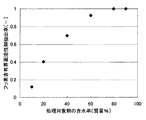
図1の流通式装置を用い、容器内に処理対象物としてフルオロポリマー(TFE単独重合体)乾燥粉末(フッ素含有界面活性剤〔APFO〕を含む)3gとともに表2に示す量の水を予め入れ、容器内を15MPa、35℃の超臨界状態に調整して超臨界二酸化炭素(密度815g/l)を流量12.2g/分にて500g流通させることにより、フルオロポリマー乾燥粉末に含まれるフッ素含有界面活性剤の抽出を行った。処理対象物の含水率とフッ素含有界面活性剤の抽出率との関係を調べた結果を表2及び図9に示す。
なお、上記フッ素含有界面活性剤の抽出率は、下記式
抽出率〔−〕=1−(CAPFO/C0,APFO)
上記式中、C0、APFOは、抽出前のフルオロポリマー乾燥粉末 a0グラム中に存在するフッ素含有界面活性剤 b0グラムの濃度(b0/a0 ppm)を表す。上記C0、APFOとしては、処理対象物として用いたフルオロポリマー乾燥粉末0.5gにメタノール5gを加え、遠心分離(10000rpm、30分間)を行い、得られた上澄みに含まれるフッ素含有界面活性剤の濃度をHPLCにより定量し得られた値を用いた。CAPFOは、処理対象物から抽出した後におけるフルオロポリマー aグラムに対する残存するフッ素含有界面活性剤 bグラムの濃度(b/a ppm)を表す。CAPFOは、フルオロポリマー乾燥粉末の代わりに、処理対象物から抽出した後の残存物(フルオロポリマーとフッ素含有界面活性剤とを含む)を用い、上記C0、APFOと同様に求めた。
Example 5 Relationship between moisture content of processing object and extraction ratio of fluorine-containing surfactant Using the flow-type apparatus of FIG. 1, fluoropolymer (TFE homopolymer) dry powder (fluorine-containing interface) as a processing object in a container The amount of water shown in Table 2 is added in advance together with 3 g of the activator (including APFO), the inside of the container is adjusted to a supercritical state of 15 MPa and 35 ° C., and supercritical carbon dioxide (density 815 g / l) is supplied at a flow rate of 12. By allowing 500 g to flow at 2 g / min, the fluorine-containing surfactant contained in the dried fluoropolymer powder was extracted. Table 2 and FIG. 9 show the results of examining the relationship between the moisture content of the treatment object and the extraction rate of the fluorine-containing surfactant.
Incidentally, the extraction rate of the fluorine-containing surfactant represented by the following formula extraction rate [-] = 1- (C APFO / C 0 , APFO)
In the above formula, C 0 and APFO represent the concentration (b 0 / a 0 ppm) of the fluorine-containing surfactant b 0 g present in 0 g of the fluoropolymer dry powder a before extraction. As the C 0 and APFO , a fluorine-containing surfactant contained in the resulting supernatant is obtained by adding 5 g of methanol to 0.5 g of the dried fluoropolymer powder used as a treatment target and centrifuging (10000 rpm, 30 minutes). The value obtained by quantifying the concentration of the product by HPLC was used. C APFO represents the concentration (b / a ppm) of b grams of fluorine-containing surfactant remaining relative to a grams of fluoropolymer after extraction from the treatment object. C APFO was determined in the same manner as C 0 and APFO, using the residue (including fluoropolymer and fluorine-containing surfactant) after extraction from the object to be treated, instead of the fluoropolymer dry powder.
表2及び図9に示すように、処理対象物の含水率の増加に伴い、一定量のCO2消費に対するフッ素含有界面活性剤の抽出率が向上することがわかった。 As shown in Table 2 and FIG. 9, it was found that the extraction rate of the fluorine-containing surfactant with respect to a certain amount of CO 2 consumption was improved as the water content of the treatment object increased.
実施例6 処理対象物の含水率とフッ素含有界面活性剤抽出率とCO2消費量との関係
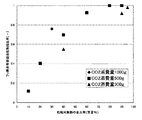
二酸化炭素ガスの消費量(流通量)を300g、1000gに代えた以外は実施例5と同様にして、フッ素含有界面活性剤の抽出を行い、フッ素含有界面活性剤の抽出率を求めた。結果を実施例5の結果とともに図10に示す。
図10から、実験した処理対象物の含水率の範囲内では、CO2消費量が多く、処理対象物の含水率が多いほどフッ素含有界面活性剤の抽出率が向上する傾向にあることがわかった。
Example 6 Relationship between water content of treatment object, fluorine-containing surfactant extraction rate, and CO 2 consumption amount The same as Example 5 except that the consumption amount (circulation amount) of carbon dioxide gas was changed to 300 g and 1000 g. Then, the fluorine-containing surfactant was extracted, and the extraction rate of the fluorine-containing surfactant was determined. The results are shown in FIG. 10 together with the results of Example 5.
From FIG. 10, it can be seen that within the range of the moisture content of the treatment object tested, the CO 2 consumption is large, and the extraction rate of the fluorine-containing surfactant tends to improve as the moisture content of the treatment object increases. It was.
本発明の処理対象物精製方法は、フッ素含有界面活性剤を含有している処理対象物からフッ素含有界面活性剤を効率的に除去する方法として好適に用いることができる。 The treatment object purification method of the present invention can be suitably used as a method for efficiently removing a fluorine-containing surfactant from a treatment object containing a fluorine-containing surfactant.
1 CO2ボンベ
2 冷却器
3 界面活性剤溶液
4 水浴
5 スターラー
6 ヒーター
7 自動排圧弁
8 氷浴
1 CO 2 cylinder 2
Claims (20)
前記物質〔A〕は、標準状態(105Pa、0℃)において気体であるものである
ことを特徴とする処理対象物精製方法。 A treatment object purification method comprising removing the fluorine-containing surfactant by bringing the substance [A] into contact with the treatment object containing the fluorine-containing surfactant,
The said substance [A] is a gas in the standard state (10 < 5 > Pa, 0 degreeC), The processing target object purification method characterized by the above-mentioned.
Y−(CF2)x1−(CH2)y1−A (1)
(式中、Yは、H又はFを表す。x1は、4〜13の整数を表し、y1は、0〜3の整数を表す。Aは、−SO3M又は−COOMを表し、Mは、H、NH4、Li、Na又はKを表す。)で表されるエーテル酸素を有しないアニオン性化合物、又は、下記一般式(2)
F(CF2)x2O(CFXCF2O)y2−CFX−A (2)
(式中、x2は、1〜5の整数を表し、y2は、0〜10の整数を表す。Xは、F又はCF3を表す。Aは、−SO3M又は−COOMを表し、Mは、H、NH4、Li、Na又はKを表す。)で表されるエーテル酸素を有するアニオン性化合物である請求項2記載の処理対象物精製方法。 The fluorine-containing compound has the following general formula (1)
Y- (CF 2) x1 - ( CH 2) y1 -A (1)
(In the formula, Y represents H or F. x1 represents an integer of 4 to 13, y1 represents an integer of 0 to 3. A represents —SO 3 M or —COOM, and M represents , H, NH 4 , Li, Na or K)), or an anionic compound having no ether oxygen, or the following general formula (2)
F (CF 2) x2 O ( CFXCF 2 O) y2 -CFX-A (2)
(In the formula, x2 represents an integer of 1 to 5, y2 represents an integer of 0 to 10. X represents F or CF 3 , A represents —SO 3 M or —COOM, M Represents an anionic compound having an ether oxygen represented by H, NH 4 , Li, Na, or K).
前記(ii)非水物は、更に、ポリマーを含有しているか又は含有していないものであり、
前記(i)水は、前記(ii)非水物100質量部に対し0.1質量部を超える量である請求項7記載の処理対象物精製方法。 The object to be treated is composed of (i) water and (ii) (i) a non-aqueous material other than water and containing a fluorine-containing surfactant,
The (ii) non-aqueous material further contains a polymer or does not contain a polymer,
The processing object purification method according to claim 7, wherein the amount of (i) water exceeds 0.1 parts by mass with respect to 100 parts by mass of (ii) non-aqueous substances.
前記処理対象物は、実質的にポリマーを含有しないものである請求項1、2、3、4、5又は6記載の処理対象物精製方法。 The object to be treated further contains water,
The method for purifying a processing object according to claim 1, wherein the processing object does not substantially contain a polymer.
ことを特徴とする凝集体製造方法。 A method for producing an agglomerate, comprising producing an agglomerate comprising a polymer using the method for purifying an object to be treated according to claim 9, 10, 11, or 12.
ことを特徴とするフッ素含有界面活性剤低減水調製方法。 A fluorine-containing surfactant-reduced water preparation method comprising preparing a fluorine-containing surfactant-reduced water in which the content of the fluorine-containing surfactant is reduced by using the treatment object purification method according to claim 13.
前記凝集体製造方法は、前記ポリマーからなる粒子が分散している水性分散体に物質〔A〕を接触させることにより前記水性分散体の凝析処理を行う工程を有するものであり、
前記物質〔A〕は、標準状態(105Pa、0℃)において気体であるものである
ことを特徴とする凝集体製造方法。 An aggregate production method for producing an aggregate composed of a polymer,
The aggregate production method includes a step of coagulating the aqueous dispersion by bringing the substance [A] into contact with an aqueous dispersion in which particles of the polymer are dispersed,
Said substance [A] is a gas in a standard state (10 < 5 > Pa, 0 degreeC), The aggregate manufacturing method characterized by the above-mentioned.
前記特定の処理温度(T℃)と、物質〔A〕の臨界温度(Tc℃)との比(T/Tc)が0.8以上であり、
前記特定の処理圧力(P Pa)と、前記物質〔A〕の臨界圧力(Pc Pa)との比(P/Pc)が0.8以上である請求項16記載の凝集体製造方法。 The coagulation treatment of the aqueous dispersion is performed at a specific processing temperature (T ° C.) under a specific processing pressure (P Pa).
The ratio (T / Tc) between the specific treatment temperature (T ° C.) and the critical temperature (Tc ° C.) of the substance [A] is 0.8 or more,
The method for producing an aggregate according to claim 16, wherein a ratio (P / Pc) between the specific processing pressure (P Pa) and a critical pressure (Pc Pa) of the substance [A] is 0.8 or more.
特定の処理圧力(P)は、前記物質〔A〕の臨界圧力(Pc)以上の圧力である請求項17記載の凝集体製造方法。 The specific processing temperature (T) is a temperature equal to or higher than the critical temperature (Tc) of the substance [A],
The method for producing an aggregate according to claim 17, wherein the specific processing pressure (P) is a pressure equal to or higher than a critical pressure (Pc) of the substance [A].
Priority Applications (1)
| Application Number | Priority Date | Filing Date | Title |
|---|---|---|---|
| JP2004198340A JP4275019B2 (en) | 2003-07-03 | 2004-07-05 | Processed object purification method and aggregate production method |
Applications Claiming Priority (3)
| Application Number | Priority Date | Filing Date | Title |
|---|---|---|---|
| JP2003191416 | 2003-07-03 | ||
| JP2004071744 | 2004-03-12 | ||
| JP2004198340A JP4275019B2 (en) | 2003-07-03 | 2004-07-05 | Processed object purification method and aggregate production method |
Publications (2)
| Publication Number | Publication Date |
|---|---|
| JP2005290350A true JP2005290350A (en) | 2005-10-20 |
| JP4275019B2 JP4275019B2 (en) | 2009-06-10 |
Family
ID=35323635
Family Applications (1)
| Application Number | Title | Priority Date | Filing Date |
|---|---|---|---|
| JP2004198340A Expired - Fee Related JP4275019B2 (en) | 2003-07-03 | 2004-07-05 | Processed object purification method and aggregate production method |
Country Status (1)
| Country | Link |
|---|---|
| JP (1) | JP4275019B2 (en) |
Cited By (5)
| Publication number | Priority date | Publication date | Assignee | Title |
|---|---|---|---|---|
| WO2006022385A1 (en) * | 2004-08-26 | 2006-03-02 | Daikin Industries, Ltd. | Method for refining fluorine-containing polymer, method for producing fluorine-containing polymer, and fluorine-containing elastomer |
| WO2007049517A1 (en) * | 2005-10-26 | 2007-05-03 | Asahi Glass Company, Limited | Fluororesin with low fluorine-containing emulsifier residual and method for producing same |
| JP2009173776A (en) * | 2008-01-24 | 2009-08-06 | Daikin Ind Ltd | Resin dispersion continuous coagulation method |
| JP2011065031A (en) * | 2009-09-18 | 2011-03-31 | Fuji Xerox Co Ltd | Carrier for electrostatic charge image development, developer for electrostatic charge image development, developer cartridge for electrostatic charge image development, process cartridge, and image forming apparatus |
| JP2021011581A (en) * | 2017-03-31 | 2021-02-04 | ダイキン工業株式会社 | Method for producing fluoropolymer, surfactant for polymerization, and use of surfactant |
-
2004
- 2004-07-05 JP JP2004198340A patent/JP4275019B2/en not_active Expired - Fee Related
Cited By (9)
| Publication number | Priority date | Publication date | Assignee | Title |
|---|---|---|---|---|
| WO2006022385A1 (en) * | 2004-08-26 | 2006-03-02 | Daikin Industries, Ltd. | Method for refining fluorine-containing polymer, method for producing fluorine-containing polymer, and fluorine-containing elastomer |
| WO2007049517A1 (en) * | 2005-10-26 | 2007-05-03 | Asahi Glass Company, Limited | Fluororesin with low fluorine-containing emulsifier residual and method for producing same |
| RU2409592C2 (en) * | 2005-10-26 | 2011-01-20 | Асахи Гласс Компани, Лимитед | Fluorine-containing polymer with low residual content of fluorinated emulsifying agent and method of producing said polymer |
| JP5343355B2 (en) * | 2005-10-26 | 2013-11-13 | 旭硝子株式会社 | Fluororesin with little residual amount of fluorine-containing emulsifier and method for producing the same |
| JP2009173776A (en) * | 2008-01-24 | 2009-08-06 | Daikin Ind Ltd | Resin dispersion continuous coagulation method |
| JP2011065031A (en) * | 2009-09-18 | 2011-03-31 | Fuji Xerox Co Ltd | Carrier for electrostatic charge image development, developer for electrostatic charge image development, developer cartridge for electrostatic charge image development, process cartridge, and image forming apparatus |
| JP2021011581A (en) * | 2017-03-31 | 2021-02-04 | ダイキン工業株式会社 | Method for producing fluoropolymer, surfactant for polymerization, and use of surfactant |
| JP7112000B2 (en) | 2017-03-31 | 2022-08-03 | ダイキン工業株式会社 | Method for producing fluoropolymer, surfactant for polymerization and use of surfactant |
| CN117304372A (en) * | 2017-03-31 | 2023-12-29 | 大金工业株式会社 | Fluoropolymer compositions and molded bodies |
Also Published As
| Publication number | Publication date |
|---|---|
| JP4275019B2 (en) | 2009-06-10 |
Similar Documents
| Publication | Publication Date | Title |
|---|---|---|
| EP1939222B2 (en) | Process for producing an AQUEOUS POLYTETRAFLUOROETHYLENE EMULSION, AND POLYTETRAFLUOROETHYLENE FINE POWDER AND POROUS MATERIAL PRODUCED FROM THE SAME | |
| JP7315863B2 (en) | Method for producing fluoropolymer | |
| EP1526142B1 (en) | Process for preparing fluoropolymer dispersions | |
| CN100404566C (en) | Aqueous tetrafluoroethylene polymer dispersion, method for producing same, tetrafluoroethylene polymer powder, and tetrafluoroethylene polymer molded article | |
| JP5319055B2 (en) | Fine fluoropolymer powder and processing method for obtaining the same | |
| CN115433300A (en) | Process for making fluoropolymers | |
| JP7674666B2 (en) | Method for producing a fluoropolymer composition | |
| JP7674667B2 (en) | Method for producing a fluoropolymer composition | |
| JP4042724B2 (en) | Fluoropolymer aggregate and method for producing the same | |
| RU2448982C2 (en) | Method of producing fluoropolymer using fluorocarboxylic acid derivative | |
| KR20190126390A (en) | Method for producing fluoropolymer | |
| US7683118B2 (en) | Process for preparing fluoropolymer dispersions | |
| TW553956B (en) | Aqueous emulsion polymerization process for the manufacturing of fluoropolymers | |
| JP4275019B2 (en) | Processed object purification method and aggregate production method | |
| JP2010037365A (en) | Preparation method of fluorine-containing polymer | |
| WO2005003190A1 (en) | Method for purifying material to be treated and method for producing coagulated material | |
| CN100417668C (en) | Method for purifying object to be treated and method for producing aggregate | |
| JPH11300121A (en) | Method for solid-liquid separation of fluoropolymer particles | |
| RU2824595C1 (en) | Method of producing fluoropolymer composition | |
| RU2824594C1 (en) | Method of producing fluoropolymer composition | |
| WO2005007709A1 (en) | Fluoropolymer aggregate and method for producing same | |
| JP4492612B2 (en) | Process object purification method | |
| JPWO2006022385A1 (en) | Fluorine-containing polymer purification method, fluorine-containing polymer production method, and fluorine-containing elastomer | |
| JP2006316242A (en) | Method for producing aqueous fluoropolymer dispersion |
Legal Events
| Date | Code | Title | Description |
|---|---|---|---|
| RD04 | Notification of resignation of power of attorney |
Free format text: JAPANESE INTERMEDIATE CODE: A7424 Effective date: 20060421 |
|
| A02 | Decision of refusal |
Free format text: JAPANESE INTERMEDIATE CODE: A02 Effective date: 20061003 |
|
| A521 | Written amendment |
Free format text: JAPANESE INTERMEDIATE CODE: A523 Effective date: 20061201 |
|
| A911 | Transfer of reconsideration by examiner before appeal (zenchi) |
Free format text: JAPANESE INTERMEDIATE CODE: A911 Effective date: 20061213 |
|
| A912 | Removal of reconsideration by examiner before appeal (zenchi) |
Free format text: JAPANESE INTERMEDIATE CODE: A912 Effective date: 20070413 |
|
| A521 | Written amendment |
Free format text: JAPANESE INTERMEDIATE CODE: A523 Effective date: 20090205 |
|
| RD02 | Notification of acceptance of power of attorney |
Free format text: JAPANESE INTERMEDIATE CODE: A7422 Effective date: 20090205 |
|
| A01 | Written decision to grant a patent or to grant a registration (utility model) |
Free format text: JAPANESE INTERMEDIATE CODE: A01 |
|
| A61 | First payment of annual fees (during grant procedure) |
Free format text: JAPANESE INTERMEDIATE CODE: A61 Effective date: 20090303 |
|
| R150 | Certificate of patent or registration of utility model |
Free format text: JAPANESE INTERMEDIATE CODE: R150 |
|
| FPAY | Renewal fee payment (event date is renewal date of database) |
Free format text: PAYMENT UNTIL: 20120313 Year of fee payment: 3 |
|
| FPAY | Renewal fee payment (event date is renewal date of database) |
Free format text: PAYMENT UNTIL: 20120313 Year of fee payment: 3 |
|
| FPAY | Renewal fee payment (event date is renewal date of database) |
Free format text: PAYMENT UNTIL: 20130313 Year of fee payment: 4 |
|
| FPAY | Renewal fee payment (event date is renewal date of database) |
Free format text: PAYMENT UNTIL: 20140313 Year of fee payment: 5 |
|
| LAPS | Cancellation because of no payment of annual fees |