JP2005290001A - Method for producing organomagnesium compound - Google Patents
Method for producing organomagnesium compound Download PDFInfo
- Publication number
- JP2005290001A JP2005290001A JP2005106858A JP2005106858A JP2005290001A JP 2005290001 A JP2005290001 A JP 2005290001A JP 2005106858 A JP2005106858 A JP 2005106858A JP 2005106858 A JP2005106858 A JP 2005106858A JP 2005290001 A JP2005290001 A JP 2005290001A
- Authority
- JP
- Japan
- Prior art keywords
- formula
- reaction
- liy
- reagent
- compound
- Prior art date
- Legal status (The legal status is an assumption and is not a legal conclusion. Google has not performed a legal analysis and makes no representation as to the accuracy of the status listed.)
- Granted
Links
Images

Classifications
-
- C—CHEMISTRY; METALLURGY
- C07—ORGANIC CHEMISTRY
- C07B—GENERAL METHODS OF ORGANIC CHEMISTRY; APPARATUS THEREFOR
- C07B49/00—Grignard reactions
-
- C—CHEMISTRY; METALLURGY
- C07—ORGANIC CHEMISTRY
- C07F—ACYCLIC, CARBOCYCLIC OR HETEROCYCLIC COMPOUNDS CONTAINING ELEMENTS OTHER THAN CARBON, HYDROGEN, HALOGEN, OXYGEN, NITROGEN, SULFUR, SELENIUM OR TELLURIUM
- C07F3/00—Compounds containing elements of Groups 2 or 12 of the Periodic Table
- C07F3/02—Magnesium compounds
Landscapes
- Chemical & Material Sciences (AREA)
- Organic Chemistry (AREA)
- Chemical Kinetics & Catalysis (AREA)
- Organic Low-Molecular-Weight Compounds And Preparation Thereof (AREA)
- Pyridine Compounds (AREA)
- Heterocyclic Compounds Containing Sulfur Atoms (AREA)
- Thiazole And Isothizaole Compounds (AREA)
- Steroid Compounds (AREA)
Abstract
【課題】 有機マグネシウム化合物の製造において使用する試薬、並びにそのような有機マグネシウム化合物の製造方法を提供すること。更には、官能性を有する又は有しない有機化合物の製造方法、並びに有機金属化合物の製造における本発明の試薬の使用、並びにそれらと求電子剤との反応を提供すること。
【解決手段】 有機金属化合物の製造におけるリチウム塩−LiYの使用、及び求電子剤とそれらの反応、及び開示された方法によって得られる有機金属化合物。
【選択図】 なし
PROBLEM TO BE SOLVED: To provide a reagent used in the production of an organic magnesium compound and a method for producing such an organic magnesium compound. Furthermore, it provides a process for the production of organic compounds with or without functionality, as well as the use of the reagents of the invention in the production of organometallic compounds and their reaction with electrophiles.
Use of lithium salt-LiY in the production of organometallic compounds, and electrophiles and their reactions, and organometallic compounds obtained by the disclosed methods.
[Selection figure] None
Description
本発明は、有機マグネシウム化合物の製造において使用するための試薬、並びにそのような有機マグネシウム化合物の製造方法に向けられている。本発明は、更に、有機化合物の製造方法をも提供する。それは更には、有機金属化合物の製造に並びにそれらと求電子剤との反応における、本発明の試薬の使用をも提供する。最後に、本発明は、有機金属化合物の製造における及びそれらと求電子剤との反応における、リチウム塩LiYの使用に、並びに、それら開示された方法によって得ることのできる有機金属化合物に向けられている。 The present invention is directed to reagents for use in the production of organomagnesium compounds, as well as methods for producing such organomagnesium compounds. The present invention further provides a method for producing an organic compound. It further provides for the use of the reagents of the present invention in the preparation of organometallic compounds as well as in their reaction with electrophiles. Finally, the present invention is directed to the use of the lithium salt LiY in the preparation of organometallic compounds and in the reaction of them with electrophiles, and to organometallic compounds obtainable by the disclosed methods. Yes.
多官能性有機金属は、現代の有機合成において重要な中間体である(1)。
これらの試薬の最もよい製造方法の1つは、ハロゲン−金属交換反応である。Br/Li交換は低い温度で起きる素早い反応であるが、対応するBr/Mg交換は、これよりかなり遅く、幾つかの理由で重大な合成上の制限となっている。すなわち、
(i) 交換に、より高温が必要であり、従って多くの官能基と両立しない、
(ii) 特に電子に富んだ芳香族臭化物上での遅いBr/Mg交換は、反応中にやはり生成するものである臭化アルキル(通常、イソプロピルブロマイド)からのHBrの脱離と競合し、このため、低収率に終わる。Br/Mg交換の触媒反応があれば、極めて望ましい方法となろう。
Polyfunctional organometallics are important intermediates in modern organic synthesis (1) .
One of the best methods for producing these reagents is a halogen-metal exchange reaction. While the Br / Li exchange is a fast reaction that occurs at low temperatures, the corresponding Br / Mg exchange is much slower than this, which is a significant synthetic limitation for several reasons. That is,
(i) exchange requires higher temperatures and is therefore incompatible with many functional groups,
(ii) The slow Br / Mg exchange, particularly on electron-rich aromatic bromides, competes with the elimination of HBr from the alkyl bromide (usually isopropyl bromide), which is also produced during the reaction, Therefore, the yield is low. A catalytic reaction of Br / Mg exchange would be a highly desirable method.
最近、本発明者は、高度に官能性を有するハロゲン化アリール−及びヘテロアリールマグネシウムが、ヨウ素−マグネシウム交換反応を用いることによって容易に製造できることを示した(2)。交換試薬として、i−PrMgX(X=Cl、Br)が、最も便利であることが判明している。ある場合には、この交換反応は、i−PrMgXに配位しBr−Mgを「分子内」交換させる強力な電子吸引性の及び(又は)キレート性の基が存在している場合には、幾つかのアリール及びヘテロアリールブロマイドへと拡張できた(3)。 Recently, the inventor has shown that highly functional aryl- and heteroaryl magnesium halides can be easily prepared by using an iodine-magnesium exchange reaction (2) . As an exchange reagent, i-PrMgX (X = Cl, Br) has been found to be most convenient. In some cases, this exchange reaction may involve a strong electron withdrawing and / or chelating group that coordinates to i-PrMgX and exchanges Br—Mg “intramolecularly”. It could be extended to several aryl and heteroaryl bromides (3) .
基本的には、I/Mg交換反応は、官能性を有するアリール及びヘテロアリール化合物を製造するための卓越した方法である。それは、1つの主要な欠点として、時に不安定で、しばしば高価であり又は商業的に入手できない、有機ヨウ化物の使用を必要とする。Br/Mg交換のための基質としてアリールブロマイドを使用するという代替法は知られているが、i−PrMgCl又はi−Pr2Mgを用いる交換反応の遅い反応速度のために、非常に反応性に富んだアリールブロマイド(数個の電子吸引性基を有する)だけに強く限定されていた。 Basically, the I / Mg exchange reaction is an excellent method for producing functional aryl and heteroaryl compounds. One major drawback is the use of organic iodides, which are sometimes unstable, often expensive or not commercially available. Alternative methods of using aryl bromide as a substrate for Br / Mg exchange are known, but are very reactive due to the slow rate of exchange reactions using i-PrMgCl or i-Pr 2 Mg. It was strongly limited to rich aryl bromides (having several electron withdrawing groups).
従って、本発明の基礎をなす課題は、有機マグネシウム化合物の製造の改良方法を提供することである。また、本発明の基礎をなす更なる課題は、求電子剤(E+)に対し、より高い反応性を有する有機マグネシウム化合物を提供することである。
これらの課題は、独立請求項の主題によって解決される。好ましい具体例は、従属請求項に提示されている。
The problem underlying the present invention is therefore to provide an improved process for the production of organomagnesium compounds. Moreover, the further subject which forms the basis of this invention is providing the organomagnesium compound which has higher reactivity with respect to an electrophile (E +).
These problems are solved by the subject matter of the independent claims. Preferred embodiments are given in the dependent claims.
本発明者は、混合有機金属R1(MgX)n・LiYを用いることにより、温和な条件にて、高収率で望みのグリニヤール(Grignard)試薬をもたらし、従来はBr/Mg交換反応によって凡庸な収率でのみ可能であった多くの、官能基を有するグリニヤール化合物の製造を可能にする、迅速な交換反応が起こることを見出した。本発明の方法は、特に、アリール、ヘテロアリール、アルケニル、アルキニル又はアルキルマグネシウム化合物の製造を大きく効率化し、大学における並びに企業の研究室における、大規模な使用に広い用途を有する。基本的には、本発明の方法は、次の反応スキームに対応する。 By using mixed organic metal R 1 (MgX) n · LiY, the present inventor provides the desired Grignard reagent in a high yield under mild conditions. Conventionally, it has been generally performed by Br / Mg exchange reaction. It has been found that a rapid exchange reaction takes place which makes it possible to produce many functionalized Grignard compounds which were only possible in good yields. The process of the present invention greatly increases the production of aryl, heteroaryl, alkenyl, alkynyl or alkylmagnesium compounds, and has wide application for large scale use in universities as well as in corporate laboratories. Basically, the method of the invention corresponds to the following reaction scheme.
第1の側面によれば、本発明は、有機マグネシウム化合物の製造に使用するための試薬に向けられており、該試薬は、一般式R1(MgX)n・LiYを有し、
ここに、nは1又は2であり;
R1は、1個又はより多くのヘテロ原子B、O、N、S、Se、P、F、Cl、Br、I若しくはSiを含む、置換された又は無置換の、C4〜C24のアリール又はC3〜C24のヘテロアリールであるか;直鎖状の又は分枝のある、置換された又は無置換の、C1〜C20のアルキル、C2〜C20のアルケニル又はC2〜C20のアルキニルであるか;又は、置換された若しくは無置換のC3〜C20のシクロアルキルであるか;又はそれらの誘導体であり;
X及びYは、独立して又は双方ともに、Cl、Br又はI、好ましくはClであるか;HalOn(ここに、n=3、4)であるか;式RCO2のカルボキシレートであるか;式ROのアルコキシド又はフェノキシドであるか;式LiO−R−Oのジアルコキシドであるか;式(R3Si)2Nのジシラジドであるか;式SRのチオレートであるか、RP(O)O2であるか;又はSCORであり;ここにRは上記にR1として定義されたものであるか;式RNHの、直鎖状の又は分枝のある、置換された又は無置換の、C1〜C20アルキル又はC3〜C20シクロアルキルアミンであるか;式R2N(ここに、Rは、上記定義に同じであるか又はR2Nはヘテロ環状アルキルアミンを表す)のジアルキル/アリールアミンであるか;式PR2(ここに、Rは、上記定義に同じであるか又はPR2はヘテロ環状ホスフィンを表す)のホスフィンであるか;OnSR(ここに、n=2又は3であり、Rは上記定義に同じ)であるか;又はNOn(ここに、n=2又は3)であるか;又はXは、上記に定義されたR1であるか;またはそれらの誘導体である。
According to a first aspect, the present invention is directed to a reagent for use in the production of an organomagnesium compound, which reagent has the general formula R 1 (MgX) n · LiY,
Where n is 1 or 2;
R 1 is a substituted or unsubstituted C 4 -C 24 containing one or more heteroatoms B, O, N, S, Se, P, F, Cl, Br, I or Si. Is aryl or C 3 -C 24 heteroaryl; linear or branched, substituted or unsubstituted, C 1 -C 20 alkyl, C 2 -C 20 alkenyl or C 2 ˜C 20 alkynyl; or substituted or unsubstituted C 3 to C 20 cycloalkyl; or a derivative thereof;
X and Y independently or both are Cl, Br or I, preferably Cl; is HalO n (where n = 3, 4); is a carboxylate of the formula RCO 2 Whether it is an alkoxide or phenoxide of the formula RO; a dialkoxide of the formula LiO—R—O; a disilazide of the formula (R 3 Si) 2 N; a thiolate of the formula SR or RP (O) O 2 ; or SCOR; where R is as defined above for R 1 ; linear or branched, substituted or unsubstituted, of the formula RNH C 1 -C 20 alkyl or C 3 -C 20 cycloalkylamine; of formula R 2 N, where R is as defined above or R 2 N represents a heterocyclic alkylamine or dialkyl / arylamine; formula PR 2 (this To, R represents either or PR 2 is defined the same as above is phosphine represents a heterocyclic phosphine); O n SR (where a n = 2 or 3, R is the same as defined above) Or NO n (where n = 2 or 3); or X is R 1 as defined above; or a derivative thereof.
X及びR1は、X=R1の場合、通常は同じ置換基であるが、しかしながら、R1について示した定義の範囲内において、異なったものであり得ることに注意しなければならない。 It should be noted that X and R 1 are usually the same substituent when X = R 1 , however, they can be different within the definition given for R 1 .
本発明はまた、式XMg−R1−MgX・LiY(すなわち、n=2の場合)の化合物をも含むことが、明示的に言及されている。更には、「R2」が本出願において示されているとき(例えば、R2N又はPR2)は常に、両Rは、上記定義に従って、同一であっても異なっていてもよい。 It is explicitly mentioned that the present invention also includes compounds of the formula XMg—R 1 —MgX · LiY (ie when n = 2). Furthermore, whenever “R 2 ” is indicated in this application (eg, R 2 N or PR 2 ), both R may be the same or different according to the above definition.
加えて、驚くべきことに、R1(MgX)n・LiYを用いたときの交換速度が、もしX=R1であれば、更に促進されることが判明した。この試薬は、新しい試薬(R1)2Mg・LiYの形成をもたらすポリエーテル又はポリアミンの添加によって達成される。
従って、好ましい一具体例において、本試薬は、(R1)2Mg・LiYである。
In addition, it has surprisingly been found that the exchange rate when using R 1 (MgX) n · LiY is further enhanced if X = R 1 . This reagent is achieved by the addition of a polyether or polyamine that results in the formation of a new reagent (R 1 ) 2 Mg · LiY.
Thus, in a preferred embodiment, the reagent is (R 1 ) 2 Mg · LiY.
この予想外の発見に関わるメカニズムは、次のように説明し得る: The mechanism involved in this unexpected discovery can be explained as follows:
本システムは、通常は、以下に概説するように少なくとも1種の溶媒、及び少なくとも1種の添加剤(やはり下記を参照)を使用することを必要とすることに注意すべきである。例えば、THFは、溶媒として単独で又は他の溶媒と組み合わせて使用でき、そしてクラウンエーテルが上に概説したように添加剤として使用でき、それは直接、試薬(R1)2Mg・LiYの形成に関与する。 It should be noted that the system typically requires the use of at least one solvent and at least one additive (see also below) as outlined below. For example, THF can be used as a solvent alone or in combination with other solvents, and crown ether can be used as an additive as outlined above, which directly forms the reagent (R 1 ) 2 Mg · LiY. Involved.
その一般則には、幾つかの溶媒は添加剤としても使用できまたその逆も真であるという点において、例外があり得る。例えば、純粋なジオキサン中で、下に概説するように、(R1)2Mg・LiYを製造することが可能である。 The general rule can be exceptions in that some solvents can also be used as additives and vice versa. For example, (R 1 ) 2 Mg · LiY can be prepared in pure dioxane as outlined below.
ジオキサンは、幾つかの有利な性質を有しており、それは、例えば、安価で、無毒で、工業的であり、容易に引火せず、高沸点で、余り吸湿性のない、取り扱い易く乾燥させ易い溶媒であり、従って、実際上理想的な溶媒であり且つ添加剤である。そして、それは適した添加剤且つ溶媒として、上記の反応に役立つ。 Dioxane has several advantageous properties, for example, it is inexpensive, non-toxic, industrial, not easily flammable, has a high boiling point, is not very hygroscopic, easy to handle and dry. It is an easy solvent and is therefore an ideal solvent and an additive in practice. It then serves the above reaction as a suitable additive and solvent.
上記反応の一例として、本試薬は、i−PrMgCl・LiClの溶液を、15−クラウン−5(これは、最もよい結果を与える;表3の項目4を参照)等のようなクラウンエーテルで、又はより一般には、他のポリエーテル若しくはポリアミンで、単に処理することによってその場において(in situ)作られる。表3を参照。顕著なことに、且つ上述したとおり、速度の増大を達成する最も安価な方法は、ジオキサン(10体積%)の添加を用いることであり、これは、24時間の反応時間の後に、100%の変換(4−ブロモアニソールを4−メトキシ−フェニルマグネシウムにクロライド)をもたらす。比較として、THF中でのi−PrMgCl・LiClとの同じ反応の実施は、同じ時間の後に僅かに31〜39%の変換を与えるに過ぎない。LiClなしに15−クラウン−5又はジオキサンをi−PrMgClに添加することは、何らの速度増大ももたらさないことに注目するのも重要である。 As an example of the above reaction, the reagent can be used to make a solution of i-PrMgCl.LiCl with a crown ether such as 15-crown-5 (which gives the best results; see item 4 in Table 3), etc. Or more generally, it is made in situ simply by treatment with other polyethers or polyamines. See Table 3. Notably, and as mentioned above, the cheapest way to achieve the increased rate is to use the addition of dioxane (10% by volume), which is 100% after 24 hours reaction time. Conversion (4-bromoanisole to chloride to 4-methoxy-phenylmagnesium) results. As a comparison, carrying out the same reaction with i-PrMgCl.LiCl in THF gives only 31-39% conversion after the same time. It is also important to note that adding 15-crown-5 or dioxane to i-PrMgCl without LiCl does not result in any rate increase.
従って、1,4−ジオキサン(又は、オリゴ若しくはポリエチレングリコールエーテル若しくはポリアミドのような関連したポリエーテル)の添加は、Br/Mg交換のような交換反応を更に高め、例えば、従来は不完全な反応をもたらした条件下に、臭化物を、対応するグリニヤール試薬へと変換することを可能にするであろう。これについての更なる説明は、「実施例」の章に見出されよう。 Thus, the addition of 1,4-dioxane (or related polyethers such as oligo or polyethylene glycol ethers or polyamides) further enhances exchange reactions such as Br / Mg exchange, eg, incomplete reactions in the past. Would be able to convert the bromide to the corresponding Grignard reagent. Further explanation on this will be found in the “Examples” section.
一具体例によれば、本試薬は、R1(MgX)n 及びLiYを、モル比0.05〜6.0の間に含んでなる。 According to one embodiment, the reagent comprises R 1 (MgX) n and LiY in a molar ratio of 0.05 to 6.0.
好ましい一具体例によれば、R1(MgX)n・LiY又はLiY中において、YはClである。尚も更に好ましい一具体例においては、R1(MgX)n・LiYは、i−PrMgCl・LiCl又はsec−BuMgCl・LiClである。i−PrMgCl又はsec−BuMgClとLiClとの間の好ましいモル比は、0.05〜6.0である。 According to one preferred embodiment, Y is Cl in R 1 (MgX) n .LiY or LiY. In an even more preferred embodiment, R 1 (MgX) n · LiY is i-PrMgCl·LiCl or sec-BuMgCl·LiCl. A preferred molar ratio between i-PrMgCl or sec-BuMgCl and LiCl is 0.05 to 6.0.
更なる好ましい一具体例によれば、R1(MgX)n・LiY又はLiY中において、Yはtert−ブチレート又はsec−ブチレートである。過塩素酸リチウム、リチウムアセチルアセトネート、臭化リチウム、ヨウ化リチウム、及びテトラフルオロホウ酸リチウム等のような他のリチウム塩もまた本発明に含まれるが、好ましさは、より低い。 According to a further preferred embodiment, in R 1 (MgX) n · LiY or LiY, Y is tert-butylate or sec-butylate. Other lithium salts such as lithium perchlorate, lithium acetylacetonate, lithium bromide, lithium iodide, lithium tetrafluoroborate, and the like are also included in the present invention, but are less preferred.
第2の側面によれば、本発明は、有機マグネシウム化合物の製造方法であって:
a)一般式R2Aを有する化合物であって、
ここに、R2は、R1として定義されたものであるか;又は、置換された若しくは無置換の、フェロセン等のようなメタロセンであるか又はそれらの誘導体であり、
Aは、H、Cl、Br、I、好ましくはBrであるか又は一般式:
S(O)n−R3
ここに、n=0、1又は2である基であるか、
又は、一般式:
P(O)R3 2
ここに、R3は、独立して、R1として上に定義されている基であるか(本文脈においてR3は、同一でも異なっていてもよいことに注意すべきである)又は;
P(O)R3 2は、ヘテロ環状ホスフィンオキシドを表すものである、
化合物を準備するステップと、
b)上に定義された式R1(MgX)n・LiYに従った試薬を準備するステップと、
c)ステップa)及びb)で得られた化合物を、適した条件下に反応させるステップ;
とを含んでなり、それによりそれぞれの有機マグネシウム化合物を得るものである、方法。
According to a second aspect, the present invention is a method for producing an organomagnesium compound comprising:
a) a compound having the general formula R 2 A,
Where R 2 is defined as R 1 ; or is a substituted or unsubstituted metallocene such as ferrocene or a derivative thereof;
A is H, Cl, Br, I, preferably Br, or the general formula:
S (O) n -R 3
Where n = 0, 1 or 2;
Or the general formula:
P (O) R 3 2
Where R 3 is independently a group as defined above as R 1 (note that in this context R 3 may be the same or different) or;
P (O) R 3 2 represents a heterocyclic phosphine oxide,
Preparing a compound;
b) providing a reagent according to the formula R 1 (MgX) n · LiY defined above;
c) reacting the compounds obtained in steps a) and b) under suitable conditions;
And thereby obtaining the respective organomagnesium compound.
c)で得られる有機マグネシウム化合物は、更に単離することができる。 The organomagnesium compound obtained in c) can be further isolated.
R2がアリール又はヘテロアリール化合物である場合、それは、1個又はより多くの基FGで置換されていてよく、ここにFGは、好ましくはF、Cl、Br、CN、CO2R,OR、OH、NR2、NHR、NH2、PR2、P(O)R2、CONR2、CONHR、SR、SH,CF3、NO2、C=NR、R(ここにRは、R1についての上記定義に同じ)より選ばれるであることに、注意すべきである。R2Aの好ましい例は、ブロモナフタレン、ブロモフェナントレン、ブロモアニソール、ブロモチオフェン、ブロモチアゾール、ブロモピリジン、1−ブロモ−3−フルオロベンゼン、3−ブロモベンゾチオフェン、1,2−ジブロモベンゼン、1,2,4−トリブロモベンゼン及びそれらの誘導体、並びに、以下に記載される更なる化合物である。 When R 2 is an aryl or heteroaryl compound, it may be substituted with one or more groups FG, where FG is preferably F, Cl, Br, CN, CO 2 R, OR, OH, NR 2 , NHR, NH 2 , PR 2 , P (O) R 2 , CONR 2 , CONHR, SR, SH, CF 3 , NO 2 , C = NR, R (where R is about R 1 It should be noted that the same definition as above) is selected. Preferred examples of R 2 A include bromonaphthalene, bromophenanthrene, bromoanisole, bromothiophene, bromothiazole, bromopyridine, 1-bromo-3-fluorobenzene, 3-bromobenzothiophene, 1,2-dibromobenzene, 1, 2,4-tribromobenzene and derivatives thereof, and further compounds described below.
原理的に、例えば以下の参考文献に引用されているあらゆる種類の官能基FGを使用することが可能であるが、それらに限定されない:
a)Handbook of Grignard reagents; edited by Gary S. Silverman and Philip E. Rakita (Chemical industries; v. 64).
b)Grignard reagents New Developments; edited by Herman G. Richey, Jr., 2000, John Wiley & Sons Ltd.
c)Methoden der Organischen Chemie, Houben-Weyl, Band XIII/2a, Metallorganische Verbindungen Be, Mg, Ca, Sr, Ba, Zn, Cd. 1973.
d)The chemistry of the metal-carbon bond, vol 4. edited by Frank R. Hartley. 1987, John Wiley & Sons.
In principle, it is possible to use, for example, but not limited to, all kinds of functional groups FG cited in the following references:
a) Handbook of Grignard reagents; edited by Gary S. Silverman and Philip E. Rakita (Chemical industries; v. 64).
b) Grignard reagents New Developments; edited by Herman G. Richey, Jr., 2000, John Wiley & Sons Ltd.
c) Methoden der Organischen Chemie, Houben-Weyl, Band XIII / 2a, Metallorganische Verbindungen Be, Mg, Ca, Sr, Ba, Zn, Cd. 1973.
d) The chemistry of the metal-carbon bond, vol 4. edited by Frank R. Hartley. 1987, John Wiley & Sons.
更なる具体例によれば、一般式R1(MgX)n・LiYの試薬は、R1X、Mg及びLiYを反応させることにより、又は、R1(MgX)n及びLiYを反応させることによって、又はR1LiとMgXYとを反応させることによって、提供される。この反応において使用するための幾つかの成分は、商業的に入手可能であり、従って、新たに合成する必要はないことに注意すべきである(例えば、R1MgXとしてi−PrMgClは、Aldrich又はStrem CAS [1068-55-9]から商業的に入手可能である)。 According to a further embodiment, the reagent of the general formula R 1 (MgX) n · LiY is obtained by reacting R 1 X, Mg and LiY or by reacting R 1 (MgX) n and LiY. Or by reacting R 1 Li with MgXY. It should be noted that some components for use in this reaction are commercially available and therefore need not be newly synthesized (eg, i-PrMgCl as R 1 MgX is Aldrich Or commercially available from Strem CAS [1068-55-9]).
一具体例によれば、ステップb)で準備される試薬は、ステップa)で準備される化合物1モル当たり0.4−6.0モルのモル量で使用される。一般に、一般式R1(MgX)n・LiYを有する本発明の試薬は、a)で準備される化合物(一般式R2A)1モル当たり、試薬6.0モルまでを加えることができる。R2Aの1モル当たりの下限である0.4モルは、本発明の効果、すなわち、慣用の反応: According to one embodiment, the reagent prepared in step b) is used in a molar amount of 0.4-6.0 mol per mole of compound prepared in step a). In general, the reagent of the present invention having the general formula R 1 (MgX) n · LiY can be added up to 6.0 moles of reagent per mole of the compound prepared in a) (general formula R 2 A). The lower limit of 0.4 mol per mol of R 2 A is the effect of the present invention, that is, the conventional reaction:
における目覚しい速度上昇が、この下限より下の値を使用した場合には達成されないかもしれないことを意味する。 This means that a noticeable speed increase in may not be achieved if values below this lower limit are used.
上記式において、R1(MgX)n・LiY及びR2(MgX)n・LiYにおいて、nが異なってよいことに、注意すべきである。 In the above formula, it should be noted that n may be different in R 1 (MgX) n · LiY and R 2 (MgX) n · LiY.
上記反応は、適切な溶媒中において行われる。好ましくは、R1(MgX)n・LiYを溶解させる溶媒は、不活性の非プロトン性溶媒であり、例えば、テトラヒドロフラン、ジエチルエーテル、2−メチルテトラヒドロフラン、ジブチルエーテル、tert−ブチルメチルエーテル、ジメトキシエタン、ジオキサン、トリエチルアミン、ピリジン、エチルジイソプロピルアミン、ジクロルメタン、1,2−ジクロルエタン、ジメチルスルフィド、ジブチルスルフィド、ベンゼン、トルエン、キシレン、ペンタン、ヘキサン若しくはヘプタン、又はそれらの組み合わせ、及び/又は、上に引用した文献中で示されているグリニヤール反応の実施のために通常使用される溶媒である。 The above reaction is carried out in a suitable solvent. Preferably, the solvent for dissolving R 1 (MgX) n · LiY is an inert aprotic solvent such as tetrahydrofuran, diethyl ether, 2-methyltetrahydrofuran, dibutyl ether, tert-butyl methyl ether, dimethoxyethane. , Dioxane, triethylamine, pyridine, ethyldiisopropylamine, dichloromethane, 1,2-dichloroethane, dimethyl sulfide, dibutyl sulfide, benzene, toluene, xylene, pentane, hexane or heptane, or combinations thereof and / or cited above It is a commonly used solvent for carrying out the Grignard reaction shown in the literature.
上に概説されているように、溶媒への1種又はより多くの添加剤の添加は、改良された試薬(R1)2Mg・LiYを与え得る。この添加剤は、ポリエーテル又はポリアミン、特にクラウンエーテル、ジオキサン、オリゴ−又はポリエチレングリコールエーテル、尿素の誘導体、一般式RCONR2のアミド(ここに、Rは、請求項1における定義に同じであり、置換基は、同一でも異なっていてもよい)、から選択でき、最も好ましくは、1,4−ジオキサン又は15−クラウン−5又はこれらの組み合わせである。本発明において使用してよい添加剤の更なる例は、下の表3に掲げられている。 As outlined above, the addition of one or more additives to the solvent can give an improved reagent (R 1 ) 2 Mg · LiY. These additives are polyethers or polyamines, in particular crown ethers, dioxanes, oligo- or polyethylene glycol ethers, derivatives of urea, amides of the general formula RCONR 2 (where R is as defined in claim 1, The substituents may be the same or different), most preferably 1,4-dioxane or 15-crown-5 or combinations thereof. Further examples of additives that may be used in the present invention are listed in Table 3 below.
更なる具体例によれば、R1(MgX)n・LiYの上記溶液は、0.05〜3.0M、好ましくは、1.0〜2.5Mである。原則として、この溶液の濃度が高いほど、全体としての反応は一層良好に起こる。しかしながら、一般に、3Mを超えるR1(MgX)n・LiYの溶液は、それ以上の可溶性がなく、従って本発明においては機能しないであろう。 According to a further embodiment, the above solution of R 1 (MgX) n · LiY is 0.05 to 3.0M, preferably 1.0 to 2.5M. In principle, the higher the concentration of this solution, the better the overall reaction takes place. In general, however, solutions of R 1 (MgX) n .LiY above 3M are not more soluble and therefore will not function in the present invention.
粉末としてのR1(MgX)n・LiYの使用(溶媒なしで又は配位した溶媒と共に)もまた可能であり、貯蔵のためには特に便利である。 The use of R 1 (MgX) n · LiY as a powder (without solvent or with a coordinated solvent) is also possible and is particularly convenient for storage.
更なる一側面によれば、本発明は、官能基を有する又は官能基を有しない有機化合物を製造するための方法であって;
上記のステップa)〜c)及び、
d)得られた有機マグネシウム化合物を有機又は無機の求電子剤(E+)又は(E)と反応させるステップ
を含んでなる方法を提供する。
According to a further aspect, the present invention is a method for producing an organic compound with or without a functional group;
Steps a) to c) above and
d) A method comprising the step of reacting the obtained organomagnesium compound with an organic or inorganic electrophile (E +) or (E) is provided.
この反応は、次の反応スキームに従う: This reaction follows the following reaction scheme:
グリニヤール試薬との反応に一般に用いられる求電子剤の例が、上記の参考文献a)〜d)に引用されているが、それらに限定されない。 Examples of electrophiles that are commonly used in reactions with Grignard reagents are cited in the above references a) to d), but are not limited thereto.
求電子剤の具体例は、RCHO、 RCOX、 XnPR3-n(n=1,2,3)、XnP(O)R3-n(n=1,2,3)、RX、RCO2R、RCN、RnSi−X4-n(n =0,1,2,3),RnSnX4-n(n=0,1,2,3)又はRSSOnR(n= 0,1,2),RNO2,RNO,RN=NSO2R,RC=NR,B(OR)3であり、
ここに、Xは、ハロゲン又はS(O)nR基であり、ここにn=0、1又は2であり、Rは、通常、上記R1で定義される。
Examples of electrophiles, RCHO, RCOX, X n PR 3-n (n = 1,2,3), X n P (O) R 3-n (n = 1,2,3), RX, RCO 2 R, RCN, R n Si—X 4-n (n = 0, 1, 2, 3), R n SnX 4-n (n = 0, 1, 2, 3) or RSSO n R (n = 0, 1, 2), RNO 2 , RNO, RN = NSO 2 R, RC = NR, B (OR) 3 ,
Here, X is a halogen or a S (O) n R group, where n = 0, 1 or 2, and R is usually defined by R 1 above.
またも、2個又は3個のRが1つの式に含まれるとき、それらは同一でも相互に異なっていてもよいことに注意すべきである。 It should also be noted that when two or three R are included in one formula, they may be the same or different from each other.
しかしながら、本発明は、これらの例に限定されず、LiYと複合体形成したグリニヤール試薬の改良反応が、全てのタイプの求電子剤について観察される。 However, the invention is not limited to these examples, and improved reactions of Grignard reagents complexed with LiY are observed for all types of electrophiles.
上記の方法は、−78℃〜80℃の範囲の温度にて、好ましくは室温にて、行われる。温度範囲の上限は、一般に、使用した溶媒それぞれの沸点である。 The above method is performed at a temperature in the range of −78 ° C. to 80 ° C., preferably at room temperature. The upper limit of the temperature range is generally the boiling point of each solvent used.
更なる一側面によれば、本発明は、有機金属化合物の製造における試薬R1(MgX)n・LiYの使用、及び求電子剤とそれらとの反応に向けられている。 According to a further aspect, the present invention is directed to the use of the reagent R 1 (MgX) n · LiY in the production of organometallic compounds and the reaction of electrophiles with them.
本発明の更なる一側面は、有機金属化合物の製造におけるLiYの使用、及び求電子剤とのそれらの反応に向けられており、ここにYは、上記に同じである。特にLiClが上記の交換反応の変換速度を劇的に増大させることが判明したことに、注意すべきである。比較のため、添付の表2を参照。 A further aspect of the invention is directed to the use of LiY in the preparation of organometallic compounds and their reaction with electrophiles, where Y is the same as above. In particular, it should be noted that LiCl has been found to dramatically increase the conversion rate of the above exchange reaction. For comparison, see attached Table 2.
最後の一側面によれば、本発明は、有機金属化合物を提供し、それは、上記の第2の側面による方法によって得られる。本反応の複合体化した生成物、すなわち一般式R2(MgX)n・LiYの生成物は、求電子剤(E+)または(E)に対して、従来技術の試薬より遥かに高い反応性を有し、また適切な各溶媒(上記参照)へのその溶解度も、優れている。 According to a last aspect, the present invention provides an organometallic compound, which is obtained by the method according to the second aspect described above. The complexed product of this reaction, ie the product of general formula R 2 (MgX) n · LiY, is much more reactive towards electrophiles (E +) or (E) than the prior art reagents. And its solubility in suitable solvents (see above) is also excellent.
こうして、本発明の方法により、従来技術の方法の凡庸でしかない収率に比して、100%までの変換率を達成することが可能である。 Thus, the process according to the invention makes it possible to achieve a conversion rate of up to 100% compared to the yield which is only a mediocre of the prior art process.
本発明は、以下の図面及び実施例を参照して更に記述されよう。しかしながら、本発明がそのような図面及び実施例に限定されないということ、理解しなければならない。 The invention will be further described with reference to the following drawings and examples. However, it should be understood that the invention is not limited to such drawings and examples.
本発明は、添付の図面参照して、今や、以下に一層完全に記述されよう。以下の具体例は、本開示が徹底し且つ完全になるよう、そして当業者に本発明の範囲を完全に理解させるように提供されている。 The present invention will now be described more fully hereinafter with reference to the accompanying drawings. The following specific examples are provided so that this disclosure will be thorough and complete, and will fully convey the scope of the invention to those skilled in the art.
別に定義しない限り、本明細において用いられている全ての技術的及び科学的用語は、本発明の当業者に一般に理解されているのと同じ意味を有する。本明細書に述べられている全ての刊行物及び他の参考文献は、それらの全体が参照により導入されている。 Unless defined otherwise, all technical and scientific terms used herein have the same meaning as commonly understood by one of ordinary skill in the art of the invention. All publications and other references mentioned in this specification are incorporated by reference in their entirety.
本明細書において用いられている、「アルキル」、「アルケニル」及び「アルキニル」の語は、直鎖状及び分枝鎖状の、置換された及び無置換の、C1〜C20化合物をいう。これらの化合物についての好ましい範囲は、C1〜C10、好ましくはC1〜C5(低級アルキル)、並びに、アルケニル及びアルキニルにつき、それぞれ、C2〜C10及び好ましくはC2〜C5である。「シクロアルキル」の語は、一般に、直鎖状及び分枝鎖状の、置換された及び無置換の、C3〜C20をいう。ここに、好ましい範囲は、C3〜C15であり、より好ましくはC3〜C8である。 As used herein, the terms “alkyl”, “alkenyl” and “alkynyl” refer to linear and branched, substituted and unsubstituted C 1 -C 20 compounds. . Preferred ranges for these compounds are C 1 -C 10 , preferably C 1 -C 5 (lower alkyl), and C 2 -C 10 and preferably C 2 -C 5 for alkenyl and alkynyl, respectively. is there. The term “cycloalkyl” generally refers to linear and branched, substituted and unsubstituted, C 3 -C 20 . Here, preferred ranges are C 3 -C 15, more preferably a C 3 -C 8.
本明細書において用いられている「アリール」の語は、置換された又は無置換のC4〜C24アリールをいう。「ヘテロアリール」により、B、O、N、S、Se、Pのようなヘテロ原子の1個又はより多くを含む、置換された又は無置換のC3〜C24ヘテロアリールを意味する。双方について好ましい範囲は、C4〜C15であり、より好ましくはC4〜C10である。 As used herein, the term “aryl” refers to substituted or unsubstituted C 4 -C 24 aryl. By “heteroaryl” is meant a substituted or unsubstituted C 3 -C 24 heteroaryl containing one or more of the heteroatoms such as B, O, N, S, Se, P. A preferred range for both is C 4 to C 15 , more preferably C 4 to C 10 .
本発明者は、今や、複合体R1(MgX)n・LiY、例えばi−PrMgCl・LiClを用いることにより、交換反応、例えばBr/Mg交換反応、を触媒することが可能なことを見出した。一例として、1−ブロモ−3−フルオロベンゼン(1a)は、i−Pr2Mgと遅く不完全な交換反応しかせず(1.1当量、室温、3時間)、ベンズアルデヒドとの反応後に対応するアルコール2aを50%の単離収率でもたらす(3a)。他方、同じ条件下におけるi−PrMgCl・LiClとの反応は、中間体マグネシウム試薬3aを、テトラデカンを内部標準として用いてGC分析により判定したところによれば、95%の収率で与える。ベンズアルデヒドとの反応後に、アルコール2aが、85%の単離収率で得られる(スキーム1)。 The present inventor has now found that it is possible to catalyze exchange reactions, such as Br / Mg exchange reactions, by using complexes R 1 (MgX) n .LiY, for example i-PrMgCl.LiCl. . As an example, 1-bromo-3-fluorobenzene (1a) does not undergo a slow and incomplete exchange reaction with i-Pr 2 Mg (1.1 eq, room temperature, 3 hours) and corresponds after reaction with benzaldehyde. Alcohol 2a is obtained in 3 % isolated yield (3a) . On the other hand, the reaction with i-PrMgCl·LiCl under the same conditions gives the intermediate magnesium reagent 3a in a yield of 95% according to GC analysis using tetradecane as an internal standard. After reaction with benzaldehyde, alcohol 2a is obtained with an isolated yield of 85% (Scheme 1).
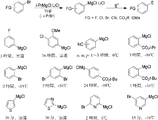
種々のフルオロ−及びクロロ−置換アリールブロマイドが、i−PrMgCl・LiClを用いて、対応するマグネシウム試薬へと室温で容易に変換される。この変換は、0.5〜3時間で完了し、これは、i−PrMgCl又はi−Pr2Mgを用いる従来の手順とは強い対照をなしている(スキーム2)。 Various fluoro- and chloro-substituted aryl bromides are readily converted to the corresponding magnesium reagent using i-PrMgCl.LiCl at room temperature. This conversion is completed in 0.5 to 3 hours, which forms a strong contrast with conventional procedures using i-PrMgCl or i-Pr 2 Mg (Scheme 2).
同様に、この触媒は、2,6−ジブロモピリジン(1b)のような、ヘテロ環状系にも適用できる。このジブロマイドはまた、Br/Mg交換反応を行うには、i−Pr2Mg(3a)又はi−PrMgCl(3f)の使用も必要とする。これらの条件下において、ベンズアルデヒドとの反応は、所望のアルコール2baを、僅か42%の収率でしか与えない(3f)。我々は、ここでも、交換試薬としてのi−PrMgCl・LiClの優秀性を観察し、試薬i−Pr2Mgの使用が4時間という反応時間を要するのに対し、25℃にて1時間の反応時間の後92%の変換を観察した。この新しい試薬i−PrMgCl・LiClを用いて、その所望の反応性生物(2ba)は89%の単離収率で得られる(スキーム1)。やはり優れた結果が、2,6−ジブロモピリジン(1b)から形成されたグリニヤール試薬(3b)と他の求電子剤(表1、番号1〜3)との反応においても観察された。3,5−ジブロモピリジンの場合のBr/Mg交換は、−10℃にて15分で行うことができ、アリルブロマイドとの反応は、アリル化されたピリジン2caを卓越した収率(表1、番号4)で与える。活性のより低い3−ブロモピリジンもまた、対応するグリニヤール試薬3vへと室温にて5分以内で容易に変換することができ、アリルブロマイドとの反応後3−アリルピリジン2vaを、殆ど定量的収率でもたらす。2−ブロモチオフェン、3−ブロモチオフェン、3−ブロモベンゾチオフェン及び2−ブロモチアゾール等のような他のヘテロ環状系が、室温にて容易にi−PrMgCl・LiClと反応し、種々の求電子剤との反応後、対応する生成物2ra〜2uaを、優れた乃至卓越した収率で、与える(表1、番号29〜32)。チアゾール基が容易にアルデヒド官能性へ変換できることから、我々のアプローチが、グリニヤール試薬3rと種々の求電子剤とのの反応を介した種々のアルデヒドの合成に途を開いたことに、特に注意すべきである。 Similarly, the catalyst is applicable to heterocyclic systems such as 2,6-dibromopyridine (1b). This dibromide also requires the use of i-Pr 2 Mg (3a) or i-PrMgCl (3f) to perform the Br / Mg exchange reaction. Under these conditions, reaction with benzaldehyde gives the desired alcohol 2ba in only 42% yield (3f) . We again observed the superiority of i-PrMgCl·LiCl as an exchange reagent, and the reaction time of 1 hour at 25 ° C was compared to the reaction time of 4 hours when the reagent i-Pr 2 Mg was used. After time, 92% conversion was observed. With this new reagent i-PrMgCl.LiCl, the desired reactive organism (2ba) is obtained in 89% isolated yield (Scheme 1). Excellent results were also observed in the reaction of Grignard reagent (3b) formed from 2,6-dibromopyridine (1b) with other electrophiles (Table 1, Nos. 1-3). The Br / Mg exchange in the case of 3,5-dibromopyridine can be carried out at −10 ° C. in 15 minutes, and the reaction with allyl bromide is an excellent yield of allylated pyridine 2ca (Table 1, It is given by number 4). The less active 3-bromopyridine can also be easily converted to the corresponding Grignard reagent 3v within 5 minutes at room temperature, and after reaction with allyl bromide 3-allylpyridine 2va is almost quantitatively recovered. Bring in rate. Other heterocyclic systems such as 2-bromothiophene, 3-bromothiophene, 3-bromobenzothiophene, 2-bromothiazole and the like readily react with i-PrMgCl·LiCl at room temperature to produce various electrophiles After reaction with, the corresponding products 2ra-2ua are obtained in excellent to excellent yields (Table 1, numbers 29-32). Of particular note is that our approach has opened the way to the synthesis of various aldehydes through the reaction of Grignard reagent 3r with various electrophiles, as the thiazole group can be easily converted to aldehyde functionality. Should.
この挙動は、全般的であり、i−PrMgCl・LiClの使用は、i−PrMgCl 又はi−Pr2Mgに比して、より素早いBr/Mg交換を可能にする。また、過剰の試薬の必要なしに(通常1.1又は1.05当量のi−PrMgCl・LiClが使用される)、望みの有機マグネシウム試薬への変換を、劇的に増大する。更には、得られるマグネシウム試薬の反応性は、改善もされるようであり、求電子剤との捕捉反応において、より高い収率をもたらす。31のような、オルト位に置換基を有する立体的に障害されたグリニヤール試薬が、室温での12時間の反応時間内に得られ、ベンズアルデヒドの添加後、望みのアルコール21aを90%の収率で与える(表1、番号21)。芳香環が電子に富んでいればいる程、i−PrMgClを用いた交換反応は、より遅い。2−メトキシ−1−ブロモベンゼン(1h)は、しかしながら、室温にて24時間の反応時間の後に、90%を超える収率で望みのマグネシウム試薬3hへと変換される。PhSSPhとのその反応の後、チオエーテル2haが、90%の収率で得られる(番号12)。広範な種々の求電子剤が、CuCN・2LiCl(4)とのトランスメタル化ステップの後これらのグリニヤール試薬と反応して、アリル化及びアシル化の実施を可能にする(番号14)。 This behavior is general and the use of i-PrMgCl·LiCl allows for faster Br / Mg exchange compared to i-PrMgCl 2 or i-Pr 2 Mg. It also dramatically increases the conversion to the desired organomagnesium reagent without the need for excess reagents (usually 1.1 or 1.05 equivalents of i-PrMgCl.LiCl is used). Furthermore, the reactivity of the resulting magnesium reagent appears to be improved, resulting in a higher yield in the capture reaction with the electrophile. A sterically hindered Grignard reagent having a substituent in the ortho position, such as 31, is obtained within a reaction time of 12 hours at room temperature, and after addition of benzaldehyde, the desired alcohol 21a is obtained in 90% yield. (Table 1, number 21). The more aromatic rings are rich in electrons, the slower the exchange reaction with i-PrMgCl. 2-Methoxy-1-bromobenzene (1h), however, is converted to the desired magnesium reagent 3h in more than 90% yield after a reaction time of 24 hours at room temperature. After that reaction with PhSSPh, the thioether 2ha is obtained in 90% yield (number 12). A wide variety of electrophiles react with these Grignard reagents after the transmetallation step with CuCN.2LiCl (4) to enable allylation and acylation to take place (number 14).
高度に置換されたクロロ及びメトキシアリールブロマイドが、望みのグリニヤール試薬3i,jへと、容易に変換できる。ClPPh2との反応及び酸化的処理の後、ホスフィンオキシド2ia,jaが、高収率で得られる(番号15、16)。このタイプの化合物は、非対称の触媒のためのP−リガンドとの関係において、興味深い(5)。シアノ基等のような官能基もまた許容される。従って、−7℃のTHF中での4−ブロモベンゾニトリルの反応は、i−PrMgClを用いては望みのアリールマグネシウム試薬(3d)を50%の変換でしかもたらさないのに対し、i−PrMgCl・LiClとでは90%を超えるのが観察される(スキーム3)。ベンズアルデヒドの添加は、アルコール2daを81%の収率で与えるが、アリルブロマイドによるアリールマグネシウム試薬(3d)のアリル化は、92%の収率で、対応する4−アリルベンゾニトリルをもたらす(表1の番号5,6)。更なる情報については図3を参照のこと。 Highly substituted chloro and methoxyaryl bromides can be easily converted to the desired Grignard reagent 3i, j. After reaction with ClPPh 2 and oxidative treatment, the phosphine oxide 2ia, ja is obtained in high yield (numbers 15, 16). This type of compound is interesting in the context of P-ligands for asymmetric catalysts (5) . Functional groups such as cyano groups are also acceptable. Thus, the reaction of 4-bromobenzonitrile in THF at −7 ° C. yields the desired arylmagnesium reagent (3d) with only 50% conversion using i-PrMgCl, whereas i-PrMgCl. • Over 90% is observed with LiCl (Scheme 3). Addition of benzaldehyde gives alcohol 2da in 81% yield, while allylation of arylmagnesium reagent (3d) with allyl bromide yields the corresponding 4-allylbenzonitrile in 92% yield (Table 1). Number 5, 6). See Figure 3 for more information.
グリニヤール試薬3e,fは、0℃にて3時間以内に形成され、種々の求電子剤との反応の後、優れた収率を示した(番号5〜10)。ブロモナフタレンやブロモフェナントレン誘導体のような、通常は非反応性の化合物が、ベンズアルデヒド(番号22、24)及びアリルブロマイドの双方と容易に反応する対応するグリニヤール試薬3m,n(番号22〜25)へと、優れた収率で容易に変換される(番号23)。CuCN・2LiCl(0.2当量)との触媒的トランスメタル化及びエチル4−ヨードブチレートとの−10℃での4時間の反応の後、望みの交差カップリング生成物2nbが81%の収率で得られる(番号25)。上で指摘したように、3o及び3pのような、種々のジクロロ置換グリニヤール試薬が、容易に製造でき、芳香族及び脂肪族アルデヒドと反応して、対応するアルコール2oa、2paを、83%及び92%の収率で与える(番号26、27)。エステル基もまた、オルト位に許容され、従って、マグネシウム試薬3qが、−45℃で12時間以内に製造され、アリルブロマイドとの反応は、対応するアリル化されたエステル2qaを82%の収率でもたらす。 The Grignard reagents 3e, f were formed within 3 hours at 0 ° C. and showed excellent yields after reaction with various electrophiles (numbers 5-10). To the corresponding Grignard reagent 3m, n (numbers 22-25) where normally non-reactive compounds such as bromonaphthalene and bromophenanthrene derivatives readily react with both benzaldehyde (numbers 22,24) and allyl bromide. And easily converted in excellent yield (No. 23). After catalytic transmetalation with CuCN · 2LiCl (0.2 eq) and reaction with ethyl 4-iodobutyrate at −10 ° C. for 4 hours, the desired cross-coupling product 2nb was 81% yield. Obtained at a rate (number 25). As pointed out above, various dichloro-substituted Grignard reagents, such as 3o and 3p, can be readily prepared and reacted with aromatic and aliphatic aldehydes to yield the corresponding alcohols 2oa, 2pa, 83% and 92%. % Yield (numbers 26, 27). The ester group is also tolerated in the ortho position, so the magnesium reagent 3q is prepared within 12 hours at -45 ° C. and the reaction with allyl bromide yields the corresponding allylated ester 2qa in 82% yield. Bring in.
目覚しいことに、1,2−ジブロモベンゼンの場合、モノ交換反応のみが起こり、望みのグリニヤール試薬(3k)を、反応サンプルのGC分析により示されるところでは、殆ど定量的収率で与える(−15℃、1.5時間)。2−ブロモフェニルマグネシウムクロライド(3k)と3−ヨード−2−シクロヘキセン−1−オンとの反応は、予期されたエノン(2kc)を86%の収率で生成する。グリニヤール試薬3kもまた、種々の求電子剤に対して優れた活性を示す(番号17〜20)。これらの反応の種々の変形及び数種の重要な新しいマグネシウム試薬が、表1の番号21〜33に報告されている。 Remarkably, in the case of 1,2-dibromobenzene, only a mono-exchange reaction occurs, giving the desired Grignard reagent (3k) in almost quantitative yield, as shown by GC analysis of the reaction sample (−15 ° C, 1.5 hours). Reaction of 2-bromophenylmagnesium chloride (3k) with 3-iodo-2-cyclohexen-1-one produces the expected enone (2kc) in 86% yield. Grignard reagent 3k also exhibits excellent activity against various electrophiles (numbers 17-20). Various variations of these reactions and several important new magnesium reagents are reported in Tables 21-33.
立体化学的に十分定義されたE−又はZ−アルケニルマグネシウム化合物の立体選択的な製造は、E−又はZ−アルケニルハライド(halide)へのマグネシウムの直接挿入によっては不可能であることから、このヨード・マグネシウム交換反応は、立体化学的に純粋なE−又はZ−アルケニルマグネシウム誘導体の製造の特異な方法であろう(6)。最近、我々は、アルケニルヨーダイドの場合のヨード・マグネシウム交換反応が、交換反応の促進には、α又はβ位に電子吸引基の存在を要求することを示した(7)。このことは、我々を、非活性化ヨード・アルケンからのI/Mg交換を経た、アルケニルマグネシウム試薬の立体選択的な製造の研究へと導いた。こうして、(E)−1−ブロモヘキセン交換の反応が起こり、(E)−1−ヘキセニルマグネシウムクロライド(4a)を、殆ど定量的な収率で与える(−25℃、10時間)(反応サンプルのGC−分析)。グリニヤール試薬4aとt−BuCHOとの反応は、卓越した収率で、対応するアルコール5aの形成をもたらした。この、顕著に低い温度は、多数の官能基の存在を可能にするであろう。また我々は、キラル(chral)な環状アルケニルヨーダイドの場合において、優れた変換(GC)と共に素早い交換反応をも観察した。マグネシウム試薬4bとアリルブロマイドとのその後の反応は、優れた収率で進み、種々のα−置換されたキラルなアリルアルコールの入手に途を開いた(スキーム3)。 The stereoselective preparation of stereochemically well-defined E- or Z-alkenyl magnesium compounds is not possible by direct insertion of magnesium into E- or Z-alkenyl halides. The iodo-magnesium exchange reaction may be a unique method for the preparation of stereochemically pure E- or Z-alkenylmagnesium derivatives (6) . Recently, we have shown that the iodo-magnesium exchange reaction in the case of alkenyl iodides requires the presence of an electron withdrawing group at the α or β position to facilitate the exchange reaction (7) . This led us to the study of stereoselective production of alkenyl magnesium reagents via I / Mg exchange from non-activated iodoalkenes. Thus, the reaction of (E) -1-bromohexene exchange occurs, giving (E) -1-hexenylmagnesium chloride (4a) in an almost quantitative yield (−25 ° C., 10 hours) (reaction sample GC-analysis). Reaction of Grignard reagent 4a with t-BuCHO resulted in the formation of the corresponding alcohol 5a in excellent yield. This significantly lower temperature will allow the presence of multiple functional groups. We have also observed a fast exchange reaction with excellent conversion (GC) in the case of a chiral cyclic alkenyl iodide. Subsequent reaction of magnesium reagent 4b with allyl bromide proceeded in excellent yields, opening the door to the availability of various α-substituted chiral allyl alcohols (Scheme 3).
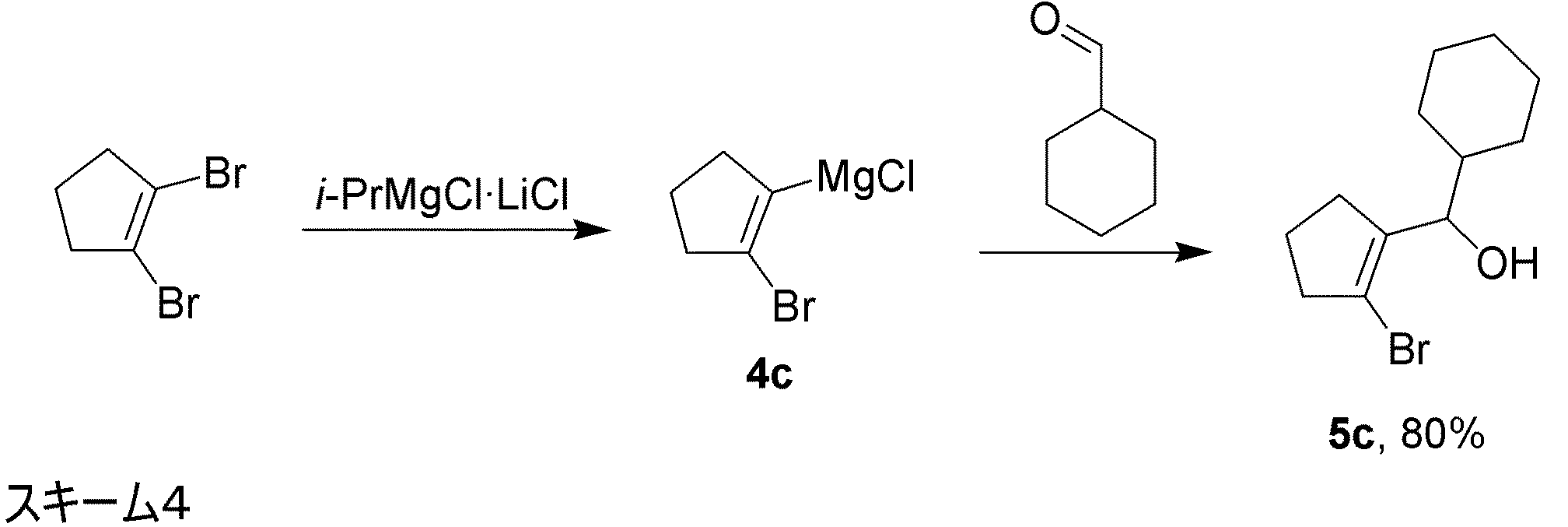
Br/Mg交換をビニル系において行うことも可能である。すなわち、1,2−ジブロモシクロペンテンは、i−PrMgCl・LiClと室温で容易に反応して、安定なグリニヤール試薬4cを生成し、これはシクロヘキシルアルデヒドと反応後、対応するアルコール5bを優れた収率で与えた。 It is also possible to perform Br / Mg exchange in a vinyl system. That is, 1,2-dibromocyclopentene easily reacts with i-PrMgCl·LiCl at room temperature to produce a stable Grignard reagent 4c, which, after reaction with cyclohexylaldehyde, yields the corresponding alcohol 5b in excellent yield. Gave in.
試薬4cは、室温で何週間もの間完全に安定であるが、触媒量のCu(I)又はCu(II)の添加は、シクロペンチンの形成をもたらし、マグネシウム又はリチウム化合物の等量の更なる存在下に反応して、新たなグリニヤール種4d,eを形成する。ベンズアルデヒドの添加は、対応するアルコールを優れた収率で与える。 Reagent 4c is completely stable for many weeks at room temperature, but the addition of a catalytic amount of Cu (I) or Cu (II) results in the formation of cyclopentine and an additional equivalent of magnesium or lithium compound. Reacts below to form new Grignard species 4d, e. The addition of benzaldehyde gives the corresponding alcohol in excellent yield.
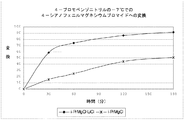
過塩素酸リチウム、リチウムアセチルアセトネート、臭化リチウム、ヨウ化リチウム及びテトラフルオロホウ酸リチウムのような他のリチウム塩もまた試験したが、触媒作用は劣っていた(図2)。 Other lithium salts such as lithium perchlorate, lithium acetylacetonate, lithium bromide, lithium iodide and lithium tetrafluoroborate were also tested, but the catalytic activity was poor (FIG. 2).
この触媒作用のメカニズムは明らかになっていないが、本発明者は、塩化リチウムの役割は、タイプ7の中間体をもたらし最終的には有機マグネシウム種PhMgCl・LiCl(8)をもたらすタイプ6のマグネシウム酸種を形成することによって、イソプロピル基の求核性を高めてi−PrMgClを活性化させることであると考えている。 Although the mechanism of this catalysis is not clear, the inventor has shown that the role of lithium chloride is type 6 magnesium, which results in a type 7 intermediate and ultimately the organomagnesium species PhMgCl.LiCl (8). It is believed that the formation of acid species increases the nucleophilicity of the isopropyl group and activates i-PrMgCl.
LiClとのアリールマグネシウム種の複合体形成もまた、8(スキーム6)に示したように、これらのマグネシウム有機金属の高められた反応性の原因となっている可能性がある(4)。 Complex formation of arylmagnesium species with LiCl may also be responsible for the increased reactivity of these magnesium organometallics, as shown in 8 (Scheme 6) (4) .
一例として、本発明者は、アリール及びヘテロアリールブロマイドと複合体i−PrMgCl・LiClとのBr/Mg交換反応を触媒するための簡単な手順を見出した。それは、有機合成に最も重要な諸々の官能性を有する安価なアリール及びヘテロアリールブロマイドから出発して、種々の新規な多官能性の有機マグネシウム化合物を、製造することを可能にする。 As an example, the inventors have found a simple procedure for catalyzing the Br / Mg exchange reaction of aryl and heteroaryl bromides with the complex i-PrMgCl.LiCl. It makes it possible to produce a variety of novel multifunctional organomagnesium compounds starting from cheap aryl and heteroaryl bromides with the functions most important for organic synthesis.
試薬i−PrMgCl・LiClの製造: マグネシウム削り屑(110mmole)をアルゴン置換したフラスコ中に無水LiCl(100mmole)と共に入れ、50mlのTHFを加えた。i−PrCl(100mmole)のTHF溶液50mlをゆっくりと加え、混合物を室温にて撹拌し、グリニヤール形成が2,3分以内に開始。発熱反応の完了後、反応混合物を更に12時間室温にて撹拌した。i−PrMgCl・LiClのやや黒っぽい溶液を、アルゴン下に新しいフラスコに移し、そうすることによって過剰のMgから取り出した。 Preparation of Reagent i-PrMgCl·LiCl: Magnesium shavings (110 mmole) was placed in a flask purged with argon together with anhydrous LiCl (100 mmole), and 50 ml of THF was added. 50 ml of i-PrCl (100 mmole) in THF is slowly added and the mixture is stirred at room temperature and Grignard formation begins within a few minutes. After completion of the exothermic reaction, the reaction mixture was stirred for an additional 12 hours at room temperature. A slightly dark solution of i-PrMgCl.LiCl was transferred to a new flask under argon and thereby removed from excess Mg.
典型的な手順。フェニル−(4−シアノフェニル)メタノール 2daの製造:
マグネティックスターラー及び隔壁を備えた、乾燥し且つアルゴン置換した10mLのフラスコに4−ブロモベンゾニトリル(182mg、1mmole)を仕込んだ。乾燥したTHF(1mL)を加え、反応混合物を−7℃まで冷却し、次いでi−PrMgCl・LiCl(1mL、THF中1.1M、1.1mmole)を滴下して加えた。Br/Mg交換は3時間後に完了し(反応サンプルのGC分析により確認、変換率90%超)、そしてベンズアルデヒド(116.6mg、1.1mmole)を加えた。反応混合物を0.5時間、−7℃にて撹拌し、次いで、飽和NH4Cl溶液(2mL)により反応停止させた。水相をエーテルで抽出し(3回、各4mL)、有機画分を食塩水で洗浄し(5mL)、乾燥させ(Na2SO4)、そして減圧濃縮した。粗製残渣をフラッシュクロマトグラフィー(ジクロロメタン)により精製し、ベンジルアルコール(2da)を、無色油状物として得た(169.5mg、81%):1H−NMR(CDCl3,200≡MHz):δ=7.91〜7.85(m,2≡H);7.65〜7.46(m,3≡H);7.38〜7.30(m, 4≡H);5.86(s,1≡H);2.42(s,1≡H,OH).
Typical procedure. Preparation of phenyl- (4-cyanophenyl) methanol 2da:
4-Bromobenzonitrile (182 mg, 1 mmole) was charged to a dry and argon-substituted 10 mL flask equipped with a magnetic stirrer and septum. Dry THF (1 mL) was added and the reaction mixture was cooled to −7 ° C., then i-PrMgCl·LiCl (1 mL, 1.1 M in THF, 1.1 mmole) was added dropwise. The Br / Mg exchange was complete after 3 hours (confirmed by GC analysis of reaction sample, conversion> 90%) and benzaldehyde (116.6 mg, 1.1 mmole) was added. The reaction mixture was stirred for 0.5 h at −7 ° C. and then quenched with saturated NH 4 Cl solution (2 mL). The aqueous phase was extracted with ether (3 times, 4 mL each) and the organic fraction was washed with brine (5 mL), dried (Na 2 SO 4 ), and concentrated in vacuo. The crude residue was purified by flash chromatography (dichloromethane) to give benzyl alcohol (2da) as a colorless oil (169.5 mg, 81%): 1 H-NMR (CDCl 3 , 200≡MHz): δ = 7.91-7.85 (m, 2≡H); 7.65-7.46 (m, 3≡H); 7.38-7.30 (m, 4≡H); 5.86 (s , 1≡H); 2.42 (s, 1≡H, OH).
3−アリル−5−ブロモピリジン2caの製造:
マグネティックスターラー及び隔壁を備えた、乾燥しアルゴン置換した10mLのフラスコにi−PrMgCl・LiCl(1≡mL,THF中1.05≡M,1.05≡mmole)を仕込み、反応混合物を−15℃まで冷却し、次いで3,5−ジブロモピリジン(236.9mg、1mmole)を一度に加えた。温度が次いで−10℃まで上昇し、Br/Mg交換は15分後に完了し(反応サンプルのGC分析により確認、変換は98%超)、アリルブロマイド(140.6≡mg、1≡mmole)を加えた。反応混合物を−10℃にて1時間撹拌し、次いで飽和NH4Cl溶液(2mL)の添加により反応停止させた。水相をエーテルで抽出し(3回、各4mL)、乾燥させ(Na2SO4)そして減圧濃縮した。粗製残渣を、フラッシュクロマトグラフィー(ジクロロメタン)で精製し、3−アリル−5−ブロモピリジン(2ca)を、無色湯状物として得た(184.2mg、93%)。1H−NMR(CDCl3,200≡MHz):δ=8.48(d,J=2.2≡Hz,1≡H);8.32(d,J=1.6≡Hz,1≡H);7.61(dd,J=2.2≡Hz,J=1.6≡Hz,1≡H);5.89≡〜5.68(m,1≡H);5.08〜5.01(m,1≡H);3.32(brd,J=6.8≡Hz,1≡H).
Preparation of 3-allyl-5-bromopyridine 2ca:
A dry, argon-substituted 10 mL flask equipped with a magnetic stirrer and septum was charged with i-PrMgCl·LiCl (1≡mL, 1.05≡M, 1.05≡mmole in THF) and the reaction mixture was −15 ° C. And then 3,5-dibromopyridine (236.9 mg, 1 mmole) was added in one portion. The temperature then rose to −10 ° C. and the Br / Mg exchange was complete after 15 minutes (confirmed by GC analysis of reaction sample, conversion> 98%) and allyl bromide (140.6≡mg, 1≡mmole) added. The reaction mixture was stirred at −10 ° C. for 1 hour and then quenched by the addition of saturated NH 4 Cl solution (2 mL). The aqueous phase was extracted with ether (3 times, 4 mL each), dried (Na 2 SO 4 ) and concentrated in vacuo. The crude residue was purified by flash chromatography (dichloromethane) to give 3-allyl-5-bromopyridine (2ca) as a colorless hot water (184.2 mg, 93%). 1 H-NMR (CDCl 3 , 200≡MHz): δ = 8.48 (d, J = 2.2≡Hz, 1≡H); 8.32 (d, J = 1.6≡Hz, 1≡ H); 7.61 (dd, J = 2.2≡Hz, J = 1.6≡Hz, 1≡H); 5.89≡-5.68 (m, 1≡H); 5.08- 5.01 (m, 1≡H); 3.32 (brd, J = 6.8≡Hz, 1≡H).
(2−ブロモフェニル)(フェニル)メタノン2kaの製造:
マグネティックスターラー及び隔壁を備えた乾燥しアルゴン置換した10mLのフラスコに、i−PrMgCl・LiCl(1≡mL,THF中1.05≡M,1.05≡mmole)を仕込み、反応混合物を−15℃まで冷却し、1,2−ジブロモベンゼン(235.9≡mg,1≡mmole)を滴下して加えた。Br/Mg交換は1.5時間後に完了し(反応サンプルのGC分析により確認、変換率98%超)、CuCN・2LiCl溶液(0.1≡mL,THF中1.0≡M,0.1 mmole)を加えた。−15℃にて10分間撹拌した後、塩化ベンゾイル(140.6≡mg,1≡mmole)を加えた。反応混合物を1時間、−15℃にて撹拌し、次いで飽和NH4Cl溶液(2mL)により反応停止させ、更に濃NH3を5滴加えた。水相をエーテルで抽出し(3回、各4mL)、有機画分を食塩水(5mL)で洗浄し、乾燥させ(Na2SO4)、減圧濃縮した。粗製残渣をフラッシュクロマトグラフィー(ジクロロエタン)で精製し、ケトン(2ka)を白色結晶として得た(219.3≡mg,84 %)。1H−NMR(CDCl3,200≡MHz):δ=7.86〜7.78(m,2≡H);7.68〜7.56(m,2≡H);7.52〜7.30(m,5≡H).
Production of (2-bromophenyl) (phenyl) methanone 2ka:
A dry, argon-substituted 10 mL flask equipped with a magnetic stirrer and septum was charged with i-PrMgCl.LiCl (1≡mL, 1.05≡M, 1.05≡mmole in THF) and the reaction mixture was −15 ° C. The mixture was cooled to 1,2-dibromobenzene (235.9≡mg, 1≡mmole) was added dropwise. The Br / Mg exchange was completed after 1.5 hours (confirmed by GC analysis of reaction sample, conversion> 98%), CuCN · 2LiCl solution (0.1≡mL, 1.0≡M in THF, 0.1 mmole) was added. After stirring at −15 ° C. for 10 minutes, benzoyl chloride (140.6≡mg, 1≡mmole) was added. The reaction mixture was stirred for 1 h at −15 ° C., then quenched with saturated NH 4 Cl solution (2 mL), and 5 more drops of concentrated NH 3 were added. The aqueous phase was extracted with ether (3 times, 4 mL each) and the organic fraction was washed with brine (5 mL), dried (Na 2 SO 4 ) and concentrated in vacuo. The crude residue was purified by flash chromatography (dichloroethane) to give the ketone (2ka) as white crystals (219.3≡mg, 84%). 1 H-NMR (CDCl 3 , 200≡MHz): δ = 7.86-7.78 (m, 2≡H); 7.68-7.56 (m, 2≡H); 7.52-7 .30 (m, 5≡H).
[a]X=Cl・LiCl;[b]分析上純粋な生成物の単離収率;[c]求電子剤との反応の前に、グリニヤール試薬はCuCN・2LiClによりトランスメタル化された;[d]反応混合物を過酸化水素水で酸化的に後処理した。 prior to the reaction with [c] electrophile, Grignard reagents were transmetalation with CuCN · 2LiCl; [a] X = Cl · LiCl; isolated yield of [b] analytically pure product; [d] The reaction mixture was treated oxidatively with aqueous hydrogen peroxide.
[a]反応の変換率は、反応物サンプルのガスクロマトグラフィー分析によって決定した;精度±2%。
[b]i−PrMgCl・LiClの濃度は2.22Mであった。
[a] Reaction conversion was determined by gas chromatographic analysis of reactant samples; accuracy ± 2%.
[b] The concentration of i-PrMgCl·LiCl was 2.22M.
試薬(R1)2Mg・LiYの挙動の改善のための実験:
アリールブロマイド1のi−PrMgCl・LiClとの反応は、混合物をもたらすに過ぎず、これに対して15−クラウン−5を添加したTHF中におけるi−PrMgCl・LiClとの反応は、91%変換率で対応するグリニヤール試薬2をもたらす。
Experiments to improve the behavior of the reagent (R 1 ) 2 Mg · LiY:
Reaction of aryl bromide 1 with i-PrMgCl·LiCl only resulted in a mixture, whereas reaction with i-PrMgCl·LiCl in THF with 15-crown-5 added gave 91% conversion. Yields the corresponding Grignard reagent 2.
[a]反応の変換率は、ガスクロマトグラフィー分析により決定した;精度±2%。
[b]i−PrMgCl・LiClの濃度は、2.22Mであった。[c]括弧内は、ろ過した試薬による反応についての変換率である。
[a] Reaction conversion was determined by gas chromatography analysis; accuracy ± 2%.
[b] The concentration of i-PrMgCl·LiCl was 2.22M. [c] In parentheses are conversion rates for reactions with filtered reagents.
15−C−5:15−クラウン−5
PEG250:ポリエチレングリコール、平均分子量250g/mol
DMPU:テトラヒドロ−1,3−ジメチル−2(1H)−ピリミジノン
MTBE:2−メトキシ−2−メチルプロパン
TMU:N,N,N’,N’−テトラメチルウレア
NMM:N−メチルモルホリン
15-C-5: 15-crown-5
PEG250: Polyethylene glycol, average molecular weight 250 g / mol
DMPU: tetrahydro-1,3-dimethyl-2 (1H) -pyrimidinone MTBE: 2-methoxy-2-methylpropane TMU: N, N, N ′, N′-tetramethylurea NMM: N-methylmorpholine
方法A: 25℃にて予め撹拌してあるsec−BuMgCl・LiClと添加剤との混合物に、4−ブロモアニソールを添加した。
方法B: 予め撹拌してあるsec−BuMgCl・LiClと4−ブロモアニソールとの混合物に、添加剤を添加した。
Method A: 4-Bromoanisole was added to a mixture of sec-BuMgCl·LiCl and additive previously stirred at 25 ° C.
Method B: The additive was added to the pre-stirred mixture of sec-BuMgCl.LiCl and 4-bromoanisole.
参考文献:
[1] A. Boudier, L. O. Bromm, M. Lotz, P. Knochel, Angew. Chem., 2000, 112, 4584; Angew. Chem. Int. Ed. 2000, 39, 4414.
[2] a P. Knochel, W. Dohle, N. Gommermann, F. F. Kneisel, F. Kopp, T. Korn, I. Sapountzis, V. A. Vu, Angew. Chem. 2003, 115, 4438, Angew. Chem. Int. Ed. 2003, 42, 4302; b) L. Boymond, M. Rottlander, G. Cahiez, P. Knochel, Angew. Chem. 1998, 110, 1801; Angew. Chem. Int. Ed. 1998, 37, 1701;
3 a M. Abarbri, F. Dehmel, P. Knochel, Tetrahedron Lett. 1999, 40, 7449; for the synthesis of arylmagnesium species starting from aryl bromides using lithium organomagnesiates for performing the Br/Mg-exchange reaction: b K. Kitagawa, A Inoue, H. Shinokubo, K. Oshima, Angew. Chem. 2000 112, 2594; Angew. Chem. Int. Ed. 2000 39, 2481; c A Inoue, K. Kitagawa, H. Shinokubo, K. Oshima, J. Org. Chem. 2001, 66, 4333; d A. Inoue, K. Kitagawa, H. Shinokubo, K. Oshima, Tetrahedron 2000, 56, 9601; e F. Trecourt, G. Breton, V. Bonnet, F. Mongin, F. Marsais,; G. Queguiner, Tetrahedron Lett. 1999, 40, 4339. f F. Trecourt, G. Breton, V. Bonnet, F. Mongin, F. Marsais,; G. Queguiner, Tetrahedron 2000, 56, 1349.
4 a P. Knochel, M. C. P. Yeh, S. C. Berk, J. Talbert, J. Org. Chem. 1988, 53, 2390; b P. Knochel, N. Millot, A. L. Rodriguez, C. E. Tucker, Org. React. 2001, 58, 417.
5 P. Torsten, P. Thomas, G. Guido, S. Wolfgram. Eur. Pat. Appl. (2002).
6 The direct insertion of magnesium into alkenyl halides is not stereoselective. For example, the reaction of (Z)-1-bromooctene with magnesium in THF produces a 15:85 E:Z mixture of 1-octenylmagnesium bromide. The same behaviour is observed for the insertion of zinc dust into alkenyl iodides. In both cases, a radical mechanism operates. T. N. Majid and P. Knochel, Tetrahedron. Lett., 1990, 31, 4413.
7 I. Sapountzis, W. Dohle, P. Knochel, Chem. Commun. 2001, 2068.
References:
[1] A. Boudier, LO Bromm, M. Lotz, P. Knochel, Angew. Chem., 2000, 112, 4584; Angew. Chem. Int. Ed. 2000, 39, 4414.
[2] a P. Knochel, W. Dohle, N. Gommermann, FF Kneisel, F. Kopp, T. Korn, I. Sapountzis, VA Vu, Angew. Chem. 2003, 115, 4438, Angew. Chem. Int. Ed. 2003, 42, 4302; b) L. Boymond, M. Rottlander, G. Cahiez, P. Knochel, Angew. Chem. 1998, 110, 1801; Angew. Chem. Int. Ed. 1998, 37, 1701;
3 a M. Abarbri, F. Dehmel, P. Knochel, Tetrahedron Lett. 1999, 40, 7449; for the synthesis of arylmagnesium species starting from aryl bromides using lithium organomagnesiates for performing the Br / Mg-exchange reaction: b K. Kitagawa , A Inoue, H. Shinokubo, K. Oshima, Angew. Chem. 2000 112, 2594; Angew. Chem. Int. Ed. 2000 39, 2481; c A Inoue, K. Kitagawa, H. Shinokubo, K. Oshima, J. Org. Chem. 2001, 66, 4333; d A. Inoue, K. Kitagawa, H. Shinokubo, K. Oshima, Tetrahedron 2000, 56, 9601; e F. Trecourt, G. Breton, V. Bonnet, F Mongin, F. Marsais ,; G. Queguiner, Tetrahedron Lett. 1999, 40, 4339.f F. Trecourt, G. Breton, V. Bonnet, F. Mongin, F. Marsais ,; G. Queguiner, Tetrahedron 2000, 56, 1349.
4 a P. Knochel, MCP Yeh, SC Berk, J. Talbert, J. Org. Chem. 1988, 53, 2390; b P. Knochel, N. Millot, AL Rodriguez, CE Tucker, Org. React. 2001, 58 , 417.
5 P. Torsten, P. Thomas, G. Guido, S. Wolfgram. Eur. Pat. Appl. (2002).
6 The direct insertion of magnesium into alkenyl halides is not stereoselective.For example, the reaction of (Z) -1-bromooctene with magnesium in THF produces a 15:85 E: Z mixture of 1-octenylmagnesium bromide.The same behavior is observed for the insertion of zinc dust into alkenyl iodides.In both cases, a radical mechanism operates.TN Majid and P. Knochel, Tetrahedron.Lett., 1990, 31, 4413.
7 I. Sapountzis, W. Dohle, P. Knochel, Chem. Commun. 2001, 2068.
Claims (17)
ここに、nは1又は2であり;
R1は、1個又はより多くのヘテロ原子B、O、N、S、Se、P、F、Cl、Br、I若しくはSiを含む、置換された又は無置換の、C4〜C24のアリール又はC3〜C24のヘテロアリールであるか;直鎖状の又は分枝のある、置換された又は無置換の、C1〜C20のアルキル、C2〜C20のアルケニル又はC2〜C20のアルキニルであるか;又は、置換された若しくは無置換のC3〜C20のシクロアルキルであるか;又はそれらの誘導体であり;
X及びYは、独立して又は双方ともに、Cl、Br又はI、好ましくはClであるか;HalOn(ここに、n=3、4)であるか;式RCO2のカルボキシレートであるか;式ROのアルコキシド又はフェノキシドであるか;式LiO−R−Oのジアルコキシドであるか;式(R3Si)2Nのジシラジドであるか;式SRのチオレートであるか、RP(O)O2であるか;又はSCORであり;ここにRは上記にR1として定義されたものであるか;式RNHの、直鎖状の又は分枝のある、置換された又は無置換の、C1〜C20アルキル又はC3〜C20シクロアルキルアミンであるか;式R2N(ここに、Rは、上記定義に同じであるか又はR2Nはヘテロ環状アルキルアミンを表す)のジアルキル/アリールアミンであるか;式PR2(ここに、Rは、上記定義に同じであるか又はPR2はヘテロ環状ホスフィンを表す)のホスフィンであるか;OnSR(ここに、n=2又は3であり、Rは上記定義に同じ)であるか;又はNOn(ここに、n=2又は3)であるか;又はXは、上記に定義されたR1であるか;またはそれらの誘導体である、試薬。 A reagent having the general formula R 1 (MgX) n · LiY,
Where n is 1 or 2;
R 1 is a substituted or unsubstituted C 4 -C 24 containing one or more heteroatoms B, O, N, S, Se, P, F, Cl, Br, I or Si. Is aryl or C 3 -C 24 heteroaryl; linear or branched, substituted or unsubstituted, C 1 -C 20 alkyl, C 2 -C 20 alkenyl or C 2 ˜C 20 alkynyl; or substituted or unsubstituted C 3 to C 20 cycloalkyl; or a derivative thereof;
X and Y independently or both are Cl, Br or I, preferably Cl; is HalO n (where n = 3, 4); is a carboxylate of the formula RCO 2 Whether it is an alkoxide or phenoxide of the formula RO; a dialkoxide of the formula LiO—R—O; a disilazide of the formula (R 3 Si) 2 N; a thiolate of the formula SR or RP (O) O 2 ; or SCOR; where R is as defined above for R 1 ; linear or branched, substituted or unsubstituted, of the formula RNH C 1 -C 20 alkyl or C 3 -C 20 cycloalkylamine; of formula R 2 N, where R is as defined above or R 2 N represents a heterocyclic alkylamine or dialkyl / arylamine; formula PR 2 (this To, R represents either or PR 2 is defined the same as above is phosphine represents a heterocyclic phosphine); O n SR (where a n = 2 or 3, R is the same as defined above) Or NO n (where n = 2 or 3); or X is R 1 as defined above; or a derivative thereof.
a)一般式R2Aを有する化合物であって、
ここに、R2は、R1として定義されたものであるか;又は、置換された若しくは無置換の、フェロセン等のようなメタロセンであるか;又はそれらの誘導体であり、
Aは、H、Cl、Br、I、好ましくはBrであるか又は一般式:
S(O)n−R3
ここに、n=0、1又は2である基であるか、
又は、一般式:
P(O)R3 2
ここに、R3は独立してR1として定義されるものであるか又は;
P(O)R3 2は、ヘテロ環状ホスフィンオキシドを表すものである、
化合物を準備するステップと、
b)請求項1ないし5の何れかの試薬を準備するステップと、
c)ステップa)及びb)で得られた化合物を、適した条件下に反応させるステップ;
とを含んでなり、それによりそれぞれの有機マグネシウム化合物を得るものである、方法。 A method for producing an organomagnesium compound comprising:
a) a compound having the general formula R 2 A,
Wherein R 2 is as defined as R 1 ; or is a substituted or unsubstituted metallocene such as ferrocene; or a derivative thereof;
A is H, Cl, Br, I, preferably Br, or the general formula:
S (O) n -R 3
Where n = 0, 1 or 2;
Or the general formula:
P (O) R 3 2
Where R 3 is independently defined as R 1 ;
P (O) R 3 2 represents a heterocyclic phosphine oxide,
Preparing a compound;
b) preparing the reagent of any one of claims 1 to 5;
c) reacting the compounds obtained in steps a) and b) under suitable conditions;
And thereby obtaining the respective organomagnesium compound.
請求項6ないし12の何れかのステップa)〜c)を含み、そして
d)得られた有機マグネシウム化合物を有機又は無機の求電子剤(E+)又は(E)と反応させることを含む方法。 A method for producing an organic compound with or without functionality, comprising:
A process comprising steps a) to c) according to any of claims 6 to 12, and d) reacting the resulting organomagnesium compound with an organic or inorganic electrophile (E +) or (E).
An organometallic compound obtainable by the method according to claim 6.
Applications Claiming Priority (2)
| Application Number | Priority Date | Filing Date | Title |
|---|---|---|---|
| EP04008081.4 | 2004-04-02 | ||
| EP04008081A EP1582523A1 (en) | 2004-04-02 | 2004-04-02 | Method of preparing organomagnesium compounds |
Publications (2)
| Publication Number | Publication Date |
|---|---|
| JP2005290001A true JP2005290001A (en) | 2005-10-20 |
| JP5059294B2 JP5059294B2 (en) | 2012-10-24 |
Family
ID=34878257
Family Applications (1)
| Application Number | Title | Priority Date | Filing Date |
|---|---|---|---|
| JP2005106858A Expired - Lifetime JP5059294B2 (en) | 2004-04-02 | 2005-04-01 | Method for producing organomagnesium compound |
Country Status (6)
| Country | Link |
|---|---|
| US (2) | US7384580B2 (en) |
| EP (1) | EP1582523A1 (en) |
| JP (1) | JP5059294B2 (en) |
| AT (1) | ATE404569T1 (en) |
| DE (1) | DE602005008793D1 (en) |
| ES (1) | ES2314508T3 (en) |
Cited By (8)
| Publication number | Priority date | Publication date | Assignee | Title |
|---|---|---|---|---|
| JP2006045095A (en) * | 2004-08-03 | 2006-02-16 | Central Glass Co Ltd | 3-formyl-5-trifluoromethylbenzonitrile derivative and method for producing the same |
| JP2009523765A (en) * | 2006-01-18 | 2009-06-25 | ルートヴィヒ−マクシミリアンズ−ウニヴェルズィテート ミュンヘン | Preparation and use of magnesium amide |
| JP2009532433A (en) * | 2006-04-03 | 2009-09-10 | ルードヴィッヒ・マクシミリアンス・ウニベルジテート ミュンヘン | Synthesis method of organic element compounds |
| JP2015523375A (en) * | 2012-08-06 | 2015-08-13 | エッフェ・イ・エッセ − ファッブリカ・イタリアーナ・シンテテイチ・ソチエタ・ペル・アツィオーニF.I.S. − Fabbrica Italiana Sintetici S.p.A. | Process for producing 2-cyanophenylboronic acid and its ester |
| JP2020535207A (en) * | 2017-09-27 | 2020-12-03 | アルベマール・ジャーマニー・ゲゼルシャフト・ミット・ベシュレンクテル・ハフツング | Hydrocarbon-soluble halogen and thiolate / magnesium exchange reagents |
| JP2021038196A (en) * | 2019-08-27 | 2021-03-11 | 東ソー・ファインケム株式会社 | Process for producing oxystyrene compound having polysubstituted etheric substituent |
| JP2023009942A (en) * | 2021-07-08 | 2023-01-20 | 関東化学株式会社 | Method for producing cyclopentadienyl group-containing hydrocarbon compound or cyclopentadienyl group-containing silicon-substituted hydrocarbon compound by using magnesium halide |
| JP2024046451A (en) * | 2022-09-22 | 2024-04-03 | 株式会社トクヤマ | Method for producing ketone derivatives |
Families Citing this family (27)
| Publication number | Priority date | Publication date | Assignee | Title |
|---|---|---|---|---|
| GB0521083D0 (en) * | 2005-10-17 | 2005-11-23 | Novartis Ag | Organic compounds |
| DE102005052195A1 (en) | 2005-10-28 | 2007-05-03 | Reuter Chemischer Apparatebau Kg | Process for the preparation of chiral octenoic acid derivatives |
| IES20060424A2 (en) | 2006-06-08 | 2007-10-31 | Schwarz Pharma Ltd | Accelerated synthesis of (3-Diisopropylamino-1-phenylpropyl)-4-(hydroxymethyl)phenol and its phenolic monoesters |
| IES20060435A2 (en) | 2006-06-12 | 2007-12-12 | Schwarz Pharma Ltd | Shortened synthesis using paraformaldehyde or trioxane |
| US8288508B2 (en) | 2006-09-01 | 2012-10-16 | Carnegie Mellon University | Universal grignard metathesis polymerization |
| ES2536923T3 (en) | 2006-09-12 | 2015-05-29 | Gilead Sciences, Inc. | Process and intermediates to prepare HIV integrase inhibitors |
| LV13735B (en) | 2006-12-28 | 2008-09-20 | Vjaceslavs Tribulovics | Method for manufacturing substituted adamantylarylmagnesium chalogenides |
| US20100113816A1 (en) * | 2006-12-29 | 2010-05-06 | Ivars Kalvinsh | Method for prepartion of substituted adamantylarymagnesium halides |
| EP2144949A2 (en) * | 2007-05-15 | 2010-01-20 | Plextronics, Inc. | Mixed halogen polymerization |
| AR068403A1 (en) | 2007-09-11 | 2009-11-18 | Gilead Sciences Inc | PROCESS AND INTERMEDIARIES FOR THE PREPARATION OF INTEGRASA INHIBITORS |
| EP2396337B1 (en) | 2009-02-13 | 2016-07-13 | Ludwig-Maximilians-Universität München | Preparation and use of zinc-amides |
| US20100273007A1 (en) * | 2009-04-10 | 2010-10-28 | Plextronics, Inc. | Dehalogenation |
| CA2789079A1 (en) * | 2010-02-09 | 2011-08-18 | Saltigo Gmbh | Method for allylating and vinylating aryl, heteroaryl, alkyl, and alkene halogenides using transition metal catalysis |
| EP2621922A1 (en) | 2010-09-30 | 2013-08-07 | Basf Se | A process for the synthesis of thio-triazolo-group containing compounds |
| WO2013152476A1 (en) | 2012-04-10 | 2013-10-17 | Theracos, Inc. | Process for the preparation of benzylbenzene sglt2 inhibitors |
| EP2880017B1 (en) | 2012-08-03 | 2016-10-05 | Gilead Sciences, Inc. | Process and intermediates for preparing integrase inhibitors |
| WO2018166855A1 (en) | 2017-03-16 | 2018-09-20 | Basf Se | Heterobicyclic substituted dihydroisoxazoles |
| WO2018224455A1 (en) | 2017-06-07 | 2018-12-13 | Basf Se | Substituted cyclopropyl derivatives |
| WO2018234488A1 (en) | 2017-06-23 | 2018-12-27 | Basf Se | SUBSTITUTED CYCLOPROPYL DERIVATIVES |
| WO2019121143A1 (en) | 2017-12-20 | 2019-06-27 | Basf Se | Substituted cyclopropyl derivatives |
| EP3560934A1 (en) * | 2018-04-26 | 2019-10-30 | F.I.S.- Fabbrica Italiana Sintetici S.p.A. | Process for the preparation of pure 2-cyanophenylboronic acid and esters thereof, intermediates of perampanel or of e2040 |
| CN109020784B (en) * | 2018-08-04 | 2020-04-28 | 浙江大学 | Preparation method of 2-methyl-1-phenyl-1-propanol |
| CN112028739A (en) * | 2019-06-04 | 2020-12-04 | 湖北大学 | Method for functionalizing o-dihalogenated aromatic compounds |
| GB202007594D0 (en) * | 2020-05-21 | 2020-07-08 | Syngenta Crop Protection Ag | Chemical process |
| EP4222140A1 (en) | 2020-10-01 | 2023-08-09 | Bayer Aktiengesellschaft | Benzaldehyde oximes and method for producing same |
| CN114394926B (en) * | 2022-02-28 | 2023-06-27 | 大连大学 | High-yield synthesis method of N, 3-disubstituted-1-isoindolinone compound |
| CN114539124B (en) * | 2022-02-28 | 2023-07-21 | 大连大学 | A method for enantioselective synthesis of N,3-disubstituted-1-isoindolinone compounds |
Citations (4)
| Publication number | Priority date | Publication date | Assignee | Title |
|---|---|---|---|---|
| JPS63258480A (en) * | 1987-03-30 | 1988-10-25 | リチウム コーポレーシヨン オブ アメリカ | Production of organometal and organobimetal compound |
| JPH0532674A (en) * | 1987-03-13 | 1993-02-09 | Lithium Corp Of America | Organometallic amide composition containing no ether |
| WO2001057046A1 (en) * | 2000-02-02 | 2001-08-09 | Banyu Pharmaceutical Co., Ltd. | Method of converting functional group through halogen-metal exchange reaction |
| JP2001354605A (en) * | 2000-06-09 | 2001-12-25 | Idemitsu Petrochem Co Ltd | Method for producing tertiary alcohol |
Family Cites Families (5)
| Publication number | Priority date | Publication date | Assignee | Title |
|---|---|---|---|---|
| EP0162908A4 (en) * | 1983-11-15 | 1986-04-15 | Lithium Corp | Preparation of alkaline earth metal organometallic compounds. |
| JPS6367481A (en) * | 1986-09-10 | 1988-03-26 | Nippon Benkan Kogyo Kk | Diaphragm valve |
| US4887740A (en) * | 1988-06-03 | 1989-12-19 | Bar-Master International | Valve for beverage dispenser and the like |
| JPH07103189A (en) * | 1993-10-04 | 1995-04-18 | Mitsubishi Heavy Ind Ltd | Oil film seal oil supply device |
| US5610227A (en) * | 1995-06-07 | 1997-03-11 | Bridgestone/Firestone, Inc. | Lithium amino magnesiate polymerization initiators and elastomers having reduced hysteresis |
-
2004
- 2004-04-02 EP EP04008081A patent/EP1582523A1/en not_active Withdrawn
-
2005
- 2005-04-01 ES ES05007179T patent/ES2314508T3/en not_active Expired - Lifetime
- 2005-04-01 AT AT05007179T patent/ATE404569T1/en active
- 2005-04-01 JP JP2005106858A patent/JP5059294B2/en not_active Expired - Lifetime
- 2005-04-01 US US11/097,707 patent/US7384580B2/en not_active Expired - Lifetime
- 2005-04-01 DE DE602005008793T patent/DE602005008793D1/en not_active Expired - Lifetime
-
2007
- 2007-04-18 US US11/787,974 patent/US7387751B2/en not_active Expired - Lifetime
Patent Citations (4)
| Publication number | Priority date | Publication date | Assignee | Title |
|---|---|---|---|---|
| JPH0532674A (en) * | 1987-03-13 | 1993-02-09 | Lithium Corp Of America | Organometallic amide composition containing no ether |
| JPS63258480A (en) * | 1987-03-30 | 1988-10-25 | リチウム コーポレーシヨン オブ アメリカ | Production of organometal and organobimetal compound |
| WO2001057046A1 (en) * | 2000-02-02 | 2001-08-09 | Banyu Pharmaceutical Co., Ltd. | Method of converting functional group through halogen-metal exchange reaction |
| JP2001354605A (en) * | 2000-06-09 | 2001-12-25 | Idemitsu Petrochem Co Ltd | Method for producing tertiary alcohol |
Cited By (11)
| Publication number | Priority date | Publication date | Assignee | Title |
|---|---|---|---|---|
| JP2006045095A (en) * | 2004-08-03 | 2006-02-16 | Central Glass Co Ltd | 3-formyl-5-trifluoromethylbenzonitrile derivative and method for producing the same |
| JP2009523765A (en) * | 2006-01-18 | 2009-06-25 | ルートヴィヒ−マクシミリアンズ−ウニヴェルズィテート ミュンヘン | Preparation and use of magnesium amide |
| JP2009532433A (en) * | 2006-04-03 | 2009-09-10 | ルードヴィッヒ・マクシミリアンス・ウニベルジテート ミュンヘン | Synthesis method of organic element compounds |
| JP2015523375A (en) * | 2012-08-06 | 2015-08-13 | エッフェ・イ・エッセ − ファッブリカ・イタリアーナ・シンテテイチ・ソチエタ・ペル・アツィオーニF.I.S. − Fabbrica Italiana Sintetici S.p.A. | Process for producing 2-cyanophenylboronic acid and its ester |
| JP2020535207A (en) * | 2017-09-27 | 2020-12-03 | アルベマール・ジャーマニー・ゲゼルシャフト・ミット・ベシュレンクテル・ハフツング | Hydrocarbon-soluble halogen and thiolate / magnesium exchange reagents |
| JP7391837B2 (en) | 2017-09-27 | 2023-12-05 | アルベマール・ジャーマニー・ゲゼルシャフト・ミット・ベシュレンクテル・ハフツング | Hydrocarbon Soluble Halogen and Thiolate/Magnesium Exchange Reagents |
| JP2021038196A (en) * | 2019-08-27 | 2021-03-11 | 東ソー・ファインケム株式会社 | Process for producing oxystyrene compound having polysubstituted etheric substituent |
| JP7509573B2 (en) | 2019-08-27 | 2024-07-02 | 東ソー・ファインケム株式会社 | Method for producing oxystyrene compounds having polysubstituted ether substituents |
| JP2023009942A (en) * | 2021-07-08 | 2023-01-20 | 関東化学株式会社 | Method for producing cyclopentadienyl group-containing hydrocarbon compound or cyclopentadienyl group-containing silicon-substituted hydrocarbon compound by using magnesium halide |
| JP7654493B2 (en) | 2021-07-08 | 2025-04-01 | 関東化学株式会社 | Method for producing cyclopentadienyl group-containing hydrocarbon compounds or cyclopentadienyl group-containing silicon-substituted hydrocarbon compounds using magnesium halide |
| JP2024046451A (en) * | 2022-09-22 | 2024-04-03 | 株式会社トクヤマ | Method for producing ketone derivatives |
Also Published As
| Publication number | Publication date |
|---|---|
| US20050218532A1 (en) | 2005-10-06 |
| US20070194468A1 (en) | 2007-08-23 |
| US7384580B2 (en) | 2008-06-10 |
| JP5059294B2 (en) | 2012-10-24 |
| US7387751B2 (en) | 2008-06-17 |
| ATE404569T1 (en) | 2008-08-15 |
| ES2314508T3 (en) | 2009-03-16 |
| DE602005008793D1 (en) | 2008-09-25 |
| EP1582523A1 (en) | 2005-10-05 |
Similar Documents
| Publication | Publication Date | Title |
|---|---|---|
| JP5059294B2 (en) | Method for producing organomagnesium compound | |
| RU2440355C2 (en) | Method for synthesis of organoelement compounds | |
| US20100144516A1 (en) | Preparation and use of magnesium amides | |
| CN102395593B (en) | Preparation and use of zinc amides | |
| EP1582524B1 (en) | Method of preparing organomagnesium compounds | |
| JP7391837B2 (en) | Hydrocarbon Soluble Halogen and Thiolate/Magnesium Exchange Reagents | |
| JPH0471896B2 (en) | ||
| WO2024152408A1 (en) | Alkylzinc reagent, and preparation method therefor and use thereof | |
| JP4649733B2 (en) | Method for producing acetophenone compound containing trifluoromethyl group | |
| KR101536041B1 (en) | Method for allylating and vinylating aryl, heteroaryl, alkyl, and alkene halogenides using transition metal catalysis | |
| CN109096338B (en) | Benzazepine phosphinophosphine oxygen ligand and complex containing the same, preparation method and application | |
| JP2005041791A (en) | Optically active quaternary ammonium salt, process for producing the same, and process for producing optically active α-amino acid derivative using the same | |
| CN117865765B (en) | A method for synthesizing chiral β-amino alcohols | |
| JP3751713B2 (en) | Method for producing triarylborane phosphine complex | |
| KR101654787B1 (en) | Catalyst Composition Comprising Palladium Ketoiminate Complex and Preparation Method for Cross-Coupling Compound Using the Composition | |
| JP3762994B2 (en) | Alkynyl S, N-acetal derivative and method for producing the same | |
| JP4244177B2 (en) | Production of β-dicarbonyl compounds | |
| JP2026071819A (en) | Method for producing aryl diadamantylphosphine derivatives | |
| JPH10130178A (en) | Production of gem-difluoroolefins, zirconocene for the production, and production thereof | |
| CN117447462A (en) | A chiral triazole-oxazoline compound and its preparation method and application | |
| Hoffmann‐Röder et al. | Metal‐Mediated Synthesis of Allenes | |
| JP2946678B2 (en) | Chiral ferrocene derivatives | |
| JPH05320085A (en) | P-tertiary butoxyphenyldimethylcarbinol and its production | |
| JPS5869820A (en) | Preparation of olefin compound | |
| JP2023546688A (en) | Selective alkylation of cyclopentadiene |
Legal Events
| Date | Code | Title | Description |
|---|---|---|---|
| A621 | Written request for application examination |
Free format text: JAPANESE INTERMEDIATE CODE: A621 Effective date: 20080218 |
|
| A977 | Report on retrieval |
Free format text: JAPANESE INTERMEDIATE CODE: A971007 Effective date: 20101110 |
|
| A131 | Notification of reasons for refusal |
Free format text: JAPANESE INTERMEDIATE CODE: A131 Effective date: 20101130 |
|
| A601 | Written request for extension of time |
Free format text: JAPANESE INTERMEDIATE CODE: A601 Effective date: 20110222 |
|
| A602 | Written permission of extension of time |
Free format text: JAPANESE INTERMEDIATE CODE: A602 Effective date: 20110225 |
|
| A601 | Written request for extension of time |
Free format text: JAPANESE INTERMEDIATE CODE: A601 Effective date: 20110324 |
|
| A602 | Written permission of extension of time |
Free format text: JAPANESE INTERMEDIATE CODE: A602 Effective date: 20110329 |
|
| A601 | Written request for extension of time |
Free format text: JAPANESE INTERMEDIATE CODE: A601 Effective date: 20110422 |
|
| A602 | Written permission of extension of time |
Free format text: JAPANESE INTERMEDIATE CODE: A602 Effective date: 20110427 |
|
| A521 | Request for written amendment filed |
Free format text: JAPANESE INTERMEDIATE CODE: A523 Effective date: 20110530 |
|
| A131 | Notification of reasons for refusal |
Free format text: JAPANESE INTERMEDIATE CODE: A131 Effective date: 20110621 |
|
| A601 | Written request for extension of time |
Free format text: JAPANESE INTERMEDIATE CODE: A601 Effective date: 20110919 |
|
| A602 | Written permission of extension of time |
Free format text: JAPANESE INTERMEDIATE CODE: A602 Effective date: 20110926 |
|
| A601 | Written request for extension of time |
Free format text: JAPANESE INTERMEDIATE CODE: A601 Effective date: 20111020 |
|
| A602 | Written permission of extension of time |
Free format text: JAPANESE INTERMEDIATE CODE: A602 Effective date: 20111025 |
|
| A601 | Written request for extension of time |
Free format text: JAPANESE INTERMEDIATE CODE: A601 Effective date: 20111119 |
|
| A602 | Written permission of extension of time |
Free format text: JAPANESE INTERMEDIATE CODE: A602 Effective date: 20111125 |
|
| A521 | Request for written amendment filed |
Free format text: JAPANESE INTERMEDIATE CODE: A523 Effective date: 20111215 |
|
| TRDD | Decision of grant or rejection written | ||
| A01 | Written decision to grant a patent or to grant a registration (utility model) |
Free format text: JAPANESE INTERMEDIATE CODE: A01 Effective date: 20120710 |
|
| A01 | Written decision to grant a patent or to grant a registration (utility model) |
Free format text: JAPANESE INTERMEDIATE CODE: A01 |
|
| A61 | First payment of annual fees (during grant procedure) |
Free format text: JAPANESE INTERMEDIATE CODE: A61 Effective date: 20120802 |
|
| FPAY | Renewal fee payment (event date is renewal date of database) |
Free format text: PAYMENT UNTIL: 20150810 Year of fee payment: 3 |
|
| R150 | Certificate of patent or registration of utility model |
Ref document number: 5059294 Country of ref document: JP Free format text: JAPANESE INTERMEDIATE CODE: R150 Free format text: JAPANESE INTERMEDIATE CODE: R150 |
|
| R250 | Receipt of annual fees |
Free format text: JAPANESE INTERMEDIATE CODE: R250 |
|
| R250 | Receipt of annual fees |
Free format text: JAPANESE INTERMEDIATE CODE: R250 |
|
| R250 | Receipt of annual fees |
Free format text: JAPANESE INTERMEDIATE CODE: R250 |
|
| R250 | Receipt of annual fees |
Free format text: JAPANESE INTERMEDIATE CODE: R250 |
|
| R250 | Receipt of annual fees |
Free format text: JAPANESE INTERMEDIATE CODE: R250 |
|
| R250 | Receipt of annual fees |
Free format text: JAPANESE INTERMEDIATE CODE: R250 |
|
| R250 | Receipt of annual fees |
Free format text: JAPANESE INTERMEDIATE CODE: R250 |
|
| R250 | Receipt of annual fees |
Free format text: JAPANESE INTERMEDIATE CODE: R250 |
|
| R250 | Receipt of annual fees |
Free format text: JAPANESE INTERMEDIATE CODE: R250 |
|
| R250 | Receipt of annual fees |
Free format text: JAPANESE INTERMEDIATE CODE: R250 |
|
| EXPY | Cancellation because of completion of term |