JP2004217841A - Ink that can be distinguished by UV irradiation - Google Patents
Ink that can be distinguished by UV irradiation Download PDFInfo
- Publication number
- JP2004217841A JP2004217841A JP2003008991A JP2003008991A JP2004217841A JP 2004217841 A JP2004217841 A JP 2004217841A JP 2003008991 A JP2003008991 A JP 2003008991A JP 2003008991 A JP2003008991 A JP 2003008991A JP 2004217841 A JP2004217841 A JP 2004217841A
- Authority
- JP
- Japan
- Prior art keywords
- ink
- printing
- food
- confirmed
- foods
- Prior art date
- Legal status (The legal status is an assumption and is not a legal conclusion. Google has not performed a legal analysis and makes no representation as to the accuracy of the status listed.)
- Granted
Links
Landscapes
- Inks, Pencil-Leads, Or Crayons (AREA)
Abstract
【課題】目視では印刷の確認ができないが、紫外線の照射により印字が確認でき、溶出がなく、衛生性に優れ、迅速な可変情報を瞬時にマーキングし、食品類の品質管理、流通管理の形態を向上させるインキを提供する。
【解決手段】麹酸もしくはニコチンアミドから選ばれる食品添加物材料とエタノール等の溶剤と樹脂と電導度調整剤とを含有することを特徴とする目視では印刷の確認ができないが、紫外線の照射により印字が確認できるインキ。
【選択図】なし[PROBLEMS] Although the printing cannot be confirmed visually, the printing can be confirmed by irradiation of ultraviolet rays, there is no elution, the hygiene is excellent, the rapid variable information is instantly marked, and the form of quality control and distribution control of foods is provided. Provide ink that improves
SOLUTION: The printing cannot be confirmed by visual inspection characterized by containing a food additive material selected from kojic acid or nicotinamide, a solvent such as ethanol, a resin, and an electric conductivity adjusting agent. Ink whose print can be confirmed.
[Selection diagram] None
Description
【0001】
【発明の属する技術分野】
本発明は、生鮮食品表面または食品に接触するおそれのある食品包装材料に対しても安全性の高いマーキングするのに適し、一般の可視光での判別がしにくく、紫外線によって確認のとれるインキに関する。
【0002】
【従来の技術】
生鮮食品をはじめとする食品類には、近年、製造年月日、賞味期限等の表示が必要とされる状況があり、商品の一部に、製造年月日等をマーキングすることが必要不可欠となっている。生鮮食品は、その1個1個について、収穫年月日、生産地域等の表示を行うことにより品質上の管理が向上する。
しかしながら、表示による確認を行なう一般のマーキングとは別に、一般には確認できない方法にて商品類のマーキングを行ない、商品のトレーサビリティーをとる必要がある。
従来、種々の特殊用途において、可視光では確認がしにくいが特殊な光によって可視化したり、センサーでの読み取りを可能にするインキの開発が行われている。このような用途には、蛍光増白剤のように紫色に発光するものが用いられているが、あくまでも、食品を対象とするものではなく、蛍光増白剤にて食品類へのマーキングをすることは、食品衛生上の問題があり用いることが制限される。
【0003】
特許文献1には、紫外線照射により赤橙色に発光するインキが記載されている。このインキは、水および親水性のグリコールエーテルを主体とするインキであり高速で印刷処理する用途においては、水の量が多くグリコールエーテル類の乾燥も遅いことから、十分な乾燥が得られなかった。とくに、被印刷物が、紙以外の非ポーラスなフィルム等の上への印字においては、特に十分な乾燥速度は得られなかった。ここで、もちいられている色素も重金属からなるもので食品および食品包装の分野でのマーキングには適していない。
【0004】
特許文献2には、紫外線にて赤橙色に発光する乾燥性の良好なインキが記載されている。これらは、溶剤として、キシレン、メチルエチルケトンを使用している。したがって、非ポーラスなフィルム等への密着、乾燥性が良好であるが、使用している溶剤は、溶剤の臭気、取り扱い上の制約があった。
【0005】
特許文献3は、上記のメチルエチルケトンのような溶剤に代えてアルコールを70%以上使用するものであるが、使用する発光材は、やはり食品および食品包装剤へのマーキングには適性の有るものではない。
【0006】
従来、トレーサビリティーの確認をマーキングするような可変の情報については、通常の印刷機を用いた方法では、迅速な可変情報のマーキングができない。また、生鮮食品のマーキングに使用されるインキは食品に準じたインキであることが衛生上からも好ましい。
【0007】
一方、従来、食品等の缶詰、パックに製造年月日やロット番号を記録するためにインクジェットプリンターや熱転写プリンターが使われている。これらのプリンターは、可変情報をダイレクトに記録できるため印刷の版を作成する必要がなく、コンピューターによる情報の変更が容易であり、生産現場において種々の用途展開がなされている。
【0008】
特に、インクジェットプリンターは、高速での印字ができ、必要なインキを吐出させるだけでインキの量が少量で済むことから、極めて広い範囲において使用されている。また、非接触で印字できるため曲面あるいは柔らかな対象物へのマーキングに適している。インクジェットプリンターに用いられるインキとしては、食品添加物着色料である水溶性染料を水に溶解したものがあるが、耐水性が劣り、水に接触する対象物には使用できなかった。
【0009】
これに対して、特許文献4には、耐水性に優れ、食品の表面に印字するのに適したインクジェットインキとして、バインダがセラックであり、水およびエタノールから成る溶剤と鉄クロロフィリンナトリウムまたは(および)銅クロロフィリンナトリウムを着色剤として含む緑色インク組成物が開示されている。しかし、このインクは本質的に着色したインキであり、一般には目視でよく確認できるようにするインキであり、本発明との目的を異にするものである。
【0010】
また、耐水性に優れたインクジェットインキとしては、油溶性染料をメチルエチルケトン、エタノール等の揮発性の溶剤に溶解したものや、さらにこれに塩酢ビ、キシレン樹脂、ブチラール樹脂等を溶解したインキもあり、速乾性インキとして広く用いられている。これらのインキは、耐水性に優れ、擦っても落ちないような耐性を有しているが、食品添加物で構成されていないため、口に触れるような用途への使用は好ましくない。
また、以上のようなインキは、通常の条件下で印字を目視確認できるものであり、隠しインキとして使えるようなインキでもない。
【0011】
【特許文献1】
特公昭54−22336号公報
【特許文献2】
特公平8−26264号公報
【特許文献3】
特開2000−160083号公報
【特許文献4】
特開昭53−127010号公報
【0012】
【発明が解決しようとする課題】
本発明は、目視では印刷の確認ができないが、紫外線の照射により印字が確認でき、溶出がなく、衛生性に優れたインキを提供することを目的とする。又、本発明は、迅速な可変情報を瞬時にマーキングし、食品類の品質管理、流通管理の形態を向上させるインキを提供することを目的とするものである。
【0013】
【課題を解決するための手段】
すなわち、本発明は、食品添加物材料と溶剤とを含有することを特徴とする紫外線照射により判別可能なインキに関する。
また本発明は、食品添加物材料が、麹酸もしくはニコチンアミドである上記インキに関する。
【0014】
更に本発明は、更に樹脂を含有する上記インキに関する。
更に本発明は、溶剤がエタノールである上記インキに関する。
更に本発明は、インキがインクジェットインキである上記インキに関する。
更に本発明は、更に電導度調整剤を含有する上記インキに関する。
【0015】
【発明の実施の形態】
本発明のインキは本質的に紫外線の照射により識別可能となる色素として食品添加物材料を用いるものである。食品添加物材料が、麹酸およびもしくは、ニコチンアミドから選ばれる1種である。麹酸およびミコチンアミドは、食添用の材料として認められている。
【0016】
本発明では、紫外線照射において、無色であった印字面が青色ないし黄緑色発光を示すので、印字基材との発光の差違による識別を果たす。この識別のため、麹酸、ニコチンアミドは、インキ中に少なくとも0.1重量%の濃度を必要とする。また、インキの種類によっては、含有量を多くすることも可能であるが、隠しインキとしての特性から印字部分の識別のしにくい範囲にてもちいる。また、インクジェット用としては、吐出の信頼性を容易とするため10重量%以下にて用いることが好ましい。
【0017】
本発明において溶剤は、食添用材料を溶解ないし分散溶媒として使用できるものであれば限定されない。しかしながら、食品関連での用途においては、エタノールが好ましい。また、乾燥性の制御を目的とするときは、グリセリン、プロピレングリコール等の使用もできる。エタノールとしては、食品用のエタノールまたは食品用変性エタノールであってもよい。水分量としてはエタノール溶剤中5重量%までであれば許容することができる。エタノールはインキ中に75〜95重量%の範囲で含有されることが好ましい。
【0018】
本発明で使用する樹脂は、無色ないし淡い色の透明性が必要とされる。また、食添用としてこれに類似する扱いのできる材料が好ましい。このような樹脂としては、シェラック、コーパル樹脂、ダンマル樹脂、ニューコウ、ロジン、ファーバルサム、マスチック、酢酸ビニル、ポリイソブチレン、ポリブテン、グアヤク樹脂等がある。これらの樹脂は、組み合わせて用いることも可能である。更に、樹脂としては、アルコール可溶性の樹脂が好ましい。このような樹脂は、アルコールに溶解してインキの粘度を上昇させ、更に、被印刷体に対してのバインダーとして機能する。
【0019】
本発明において樹脂は、インキ中に0.1〜15重量%の範囲で含まれることが好ましい。含有量が0.1重量%より少ないと、適度な粘度が得られない。15重量%以上では連続運転での安定性が低下する。また、一般の可視光においての識別が容易になる恐れがある。
【0020】
本発明のインキは、オフセットインキ、グラビアインキ、フレキソインキ、スクリーンインキとして処方化が可能である。 しかしながら、可変情報の印字においては、インクジェット方式が優れている。 インクジェット方式としては、種々の方式があり、いずれの方式のヘッドにおいてもインキ化の調整は可能であるが、大文字での印字としては、ノズル径が大きくインキの液滴量の大きな電磁弁方式のプリンター、また、文字は小さめとなるが、高速での対応が可能なコンティニュアス方式のプリンターにてマーキングすることが適している。
【0021】
本発明のインクジェットインキには、特にオンディマンドタイプのインクジェットプリンターを想定するときは、インキのノズルでの乾燥を防止するために、プロピレングリコールまたはグリセリンを使用することができる。これらの溶剤は、インキ中に0.5〜15重量%の範囲で含有させることが好ましい。含有量が1重量%より少ないと、乾燥防止効果が不十分でノズルの目詰りの原因となり、20重量%を越えるとマーキング面の乾燥が遅くなり、生産スピードの低下となる。また、搬送容器の汚れ等の悪影響を与える。
【0022】
本発明のインクジェットインキをコンティニュアスタイプのプリンターにて用いるときには、インキの導電性を調整する必要があり、電導度調整剤を用いる。電導度調整剤としては、エタノールに対して良好な溶解性と電導性を与え、かつ食品添加物であるものが好ましい。このような電導度調整剤としては、乳酸ナトリウム、酢酸ナトリウム、乳酸カリウム、パントテン酸ナトリウム、安息香酸ナトリウムがある。好ましい電導度調整剤は、乳酸ナトリウム、酢酸ナトリウム、乳酸カリウム、パントテン酸ナトリウムである。これらの電導度調整剤は、インキ中0.5〜10重量%配合することが好ましい。0.5重量%より少ないと充分な導電性が得られず、含有量が10重量%を越えると、溶解性が不足し析出等の不良を招く。
【0023】
本発明のインクジェットインキは、さらに、色素の安定な溶解性を維持するためのpH緩衝剤などを用いることもできる。
本発明のインキの製造は、これらの成分を処方にしたがって計量し、混合攪拌した後、0.2〜3.0μmのメンブランフィルターで濾過することにより、製造することができる。混合攪拌は、通常の羽根を具備した攪拌機のほか、高速の分散機、乳化機により行うこともできる。
【0024】
本発明のインクジェットインキの25℃における粘度は、1.1〜20 mPa・sの範囲に調整することが好ましい。粘度が低すぎると、被印刷体でのインキのドットの形成が不良となり、印字濃度が低くなる。一方、粘度が高すぎると、吐出の不良、乾燥不良の問題が出てくる。
【0025】
表面張力は、プリンターとの適性もあるが、22〜35mN/mの範囲に調整することが好ましい。また、コンティニュアスタイプのプリンターによりマーキングする場合には、インキの電導度は、0.5〜10mS/cmの範囲に調整することが好ましい。
【0026】
食品および食品包装材表面に本発明のインクジェットインキを用いてマーキングする場合は、インクジェット方式により行われ、マーキングした食品ないし食品包装材が得られる。インクジェット方式には、コンティニュアス方式(多値偏向、2値偏向)、ドロップオンデマンド方式(バブルジェット(登録商標)方式、ピエゾ方式、電磁弁方式等)等が挙げられるが、高速でのマーキングおよび生鮮食品のような曲面および柔軟な表面のマーキングは、コンティニュアス方式が適している。インクジェットプリンターのノズル孔径は、8〜150μmであることが好ましい。
【0027】
なお、食品としては、生鮮食品類、りんご、みかん、スイカ、レモン、トマト等のくだものおよび野菜類、卵、加工食品、インスタント食品、乾燥食品、液体食品、貯蔵用食品等種々のものが対象物であり、とくに、品質の特性である製造年月日、生産地、生産場所、生産工程、製品情報、品質情報等の管理、記憶、測定器等のデータを連動させてマーキングを行うと、品質管理、流通管理ができる。
又、本発明のインクジェットインキは、食品に直接接触する恐れのある包装材料に使用することができる。このような包装材料はポリエチレンテレフタレート、ポリスチレン、ポリプロピレン、ポリエチレン、ナイロンのようなプラスチック材料である。
【0028】
マーキングするデータは、生産地、収穫日時、生産者、日付、特殊記号等もあわせて表記できる。
【0029】
これらの表記は、経路の確実な表示方法として商品の流通形態への信頼性を付与する。マーキングにおいては、生鮮食品の特性上、表面への水滴等の付着も生じるが、このようなものにおいては、マーキング直前での加圧エアー(エアーガン)によるマーキング面の強制乾燥ないし、温風の付与にて水滴の強制除去は有効な処理手段である。
【0030】
生産地、収穫日、糖度等のマーキングの施された生鮮食品としては、みかん、りんご、スイカ等の果物、野菜、肉類、鮮魚等がある。
食品包材としては、パン、菓子、ラーメン、麺類、ジュース、牛乳、
また、食品同様、薬剤、化粧品、シップ薬、等の口にするもの、食品と同様に注意の必要なもの等への適用が可能である。
【0031】
【実施例】
以下、本発明を実施例により詳細に説明する。例中、部および%は、重量部および重量%をそれぞれ示す。
(実施例1)
下記の原料を混合、溶解した後、0.8μmのメンブランフィルターで濾過しインクジェットインキを調製した。
ニコチンアミド 3.0部
白色シェラック 8.0部
コーパル樹脂 3.0部
乳酸ナトリウム 2.0部
エタノール 84.0部
【0032】
(実施例2)
下記処方とした他は実施例1と同様にしてインクジェットインキを製造した。
ニコチンアミド 5.0部
白色シェラック 8.0部
コーパル樹脂 3.0部
パントテン酸ナトリウム 2.5部
エタノール 84.5部
【0033】
(実施例3)
下記処方とした他は実施例1と同様にしてインクジェットインキを製造した。
ニコチンアミド 2.0部
白色シェラック 9.0部
コーパル樹脂 4.0部
乳酸ナトリウム 2.7部
精製水 1.3部
エタノール 81.0部
【0034】
(実施例4)
下記の原料を混合、メディアレス分散機にて分散した後、1.0μmのメンブランフィルターで濾過しインクジェットインキを調製した。
麹酸 2.0部
白色シェラック 9.0部
コーパル樹脂 4.0部
乳酸ナトリウム 2.7部
精製水 1.3部
プロピレングリコール 1.0部
エタノール 80.0部
【0035】
実施例で得られたインキについて、25℃における粘度( mPa・s)、表面張力(mN/m)および電導度(mS/cm)を測定した。なお、粘度の測定は粘度計(YAMAICHI社製「デジタルビスコメイト」)を用いて行い、表面張力の測定は表面張力計(KYOWA INTERFACE社製「サーフェイステンシオメーター」)を用いて行い、電導度の測定は電導度計(HORIBA社製「コンダクティビティメーター」)を用いて行った。
また、実施例および比較例で得られたインキをコンティニュアスタイプのインクジェットプリンターのインクタンクに入れてポリエステルフィルムにマーキングし、得られたマーキング物について下記の評価を行った。また、3ヶ月間連続してマーキングを行い、ノズル目詰まりの発生の有無およびインキ循環系でのトラブルの発生の有無を評価した。さらに、3時間連続してマーキングを行い、吐出安定性を評価した(良:吐出の停止なし、不良:吐出の停止あり)。結果を表1に示す。
【0036】
・印字濃度 マーキング物の紫外線照射(ブラックライト 254nm)による暗室での目視の確認の可否。
・乾燥性 マーキング面を5秒後指触し、色素取れの有無を目視で確認した。 (良:色素取れなし、不良:色素取れあり)
・印字適性 連続吐出性 300時間での異常の有無
・接着性 メンディングテープによるはがれの有無
【0037】
【表1】
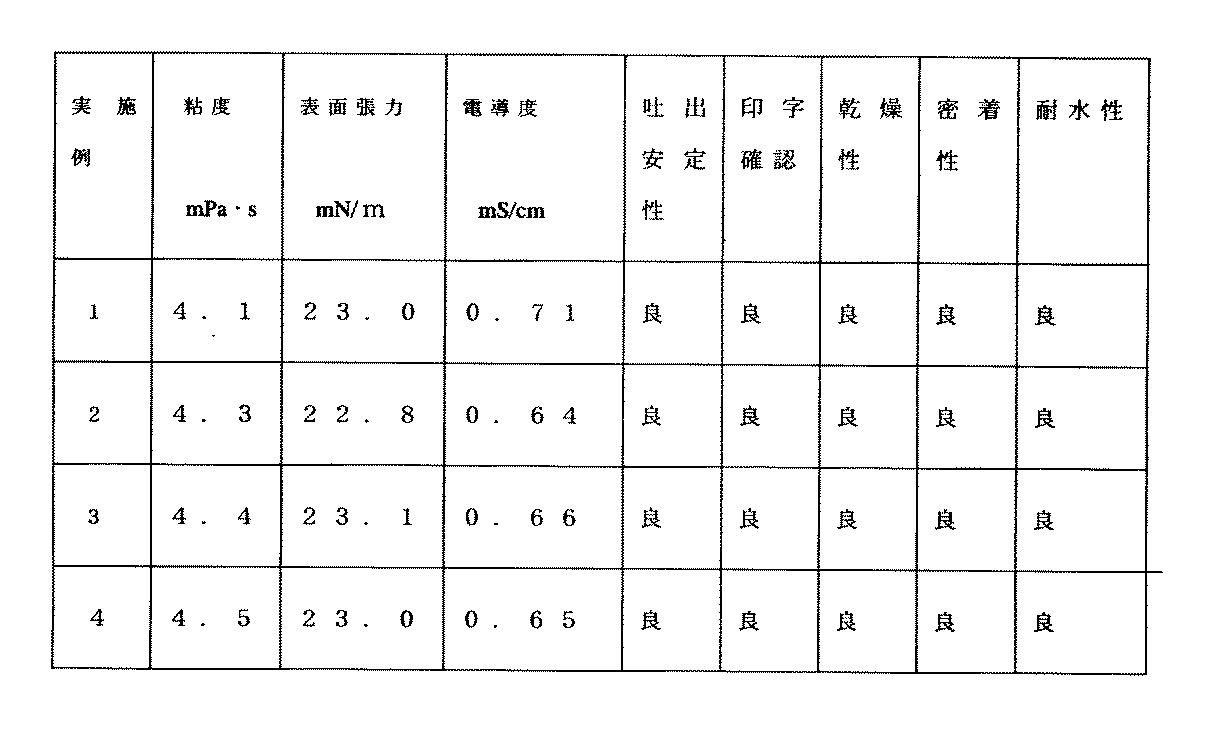
【発明の効果】
本発明のインキは、衛生性に優れた材料を使用し、目視では印刷の確認ができないが、紫外線の照射により印字が確認できる。
又、本発明のインキは、迅速な可変情報を瞬時にマーキングし、食品類の品質管理、流通管理の形態を向上させることができる。[0001]
TECHNICAL FIELD OF THE INVENTION
The present invention relates to an ink which is suitable for highly safe marking even on a food packaging material which may come into contact with the surface of a fresh food or a food, is difficult to be distinguished by general visible light, and can be confirmed by ultraviolet rays. .
[0002]
[Prior art]
In recent years, foods such as fresh foods have been required to display the date of manufacture, expiration date, etc., and it is essential to mark the date of manufacture on some products. It has become. For fresh food, quality management is improved by indicating the harvest date, production area, and the like for each piece.
However, apart from the general marking for confirming by display, it is necessary to mark products by a method that cannot be generally confirmed to obtain the traceability of the products.
2. Description of the Related Art Conventionally, for various special uses, inks that are difficult to confirm with visible light but are made visible by special light or capable of being read by a sensor have been developed. For such uses, those that emit violet light such as a fluorescent whitening agent are used, but are not intended for foods, and are used to mark foods with fluorescent whitening agents. This means that there are food hygiene problems and their use is restricted.
[0003]
Patent Literature 1 describes an ink that emits red-orange light when irradiated with ultraviolet light. This ink is an ink mainly composed of water and hydrophilic glycol ether. In applications where printing is performed at high speed, sufficient drying was not obtained because the amount of water was large and the drying of glycol ethers was slow. . In particular, when printing is performed on a non-porous film or the like other than paper, a sufficiently high drying speed cannot be obtained. Here, the pigment used is also made of heavy metal and is not suitable for marking in the field of food and food packaging.
[0004]
Patent Literature 2 describes an ink having good drying properties that emits red-orange light under ultraviolet light. These use xylene and methyl ethyl ketone as solvents. Therefore, although the adhesiveness to a non-porous film and the like and the drying property are good, the solvent used has odor of the solvent and restrictions on handling.
[0005]
Patent Literature 3 uses alcohol in an amount of 70% or more in place of a solvent such as methyl ethyl ketone described above, but the luminescent material used is still not suitable for marking on foods and food packaging. .
[0006]
Conventionally, for variable information that marks the confirmation of traceability, it is not possible to quickly mark the variable information by a method using an ordinary printing press. In addition, it is preferable from the viewpoint of hygiene that the ink used for marking fresh food is an ink conforming to food.
[0007]
On the other hand, conventionally, an ink jet printer or a thermal transfer printer has been used to record the production date and lot number on cans and packs of foods and the like. Since these printers can directly record variable information, there is no need to create a printing plate, and it is easy to change information by a computer, and various applications have been developed at production sites.
[0008]
In particular, ink jet printers are used in an extremely wide range because they can perform printing at high speed and require only a small amount of ink by discharging required ink. In addition, since printing can be performed in a non-contact manner, it is suitable for marking on a curved surface or a soft object. As an ink used for an ink jet printer, there is a water-soluble dye which is a food additive colorant dissolved in water, but the water resistance is poor and the ink cannot be used for an object which comes into contact with water.
[0009]
On the other hand, Patent Literature 4 discloses that an inkjet ink having excellent water resistance and suitable for printing on the surface of food has a binder of shellac, a solvent composed of water and ethanol, and sodium iron chlorophyllin or (and) A green ink composition containing sodium copper chlorophyllin as a colorant is disclosed. However, this ink is essentially a colored ink, and is generally an ink that can be easily visually confirmed, and has a different purpose from the present invention.
[0010]
Inkjet inks having excellent water resistance include those in which an oil-soluble dye is dissolved in a volatile solvent such as methyl ethyl ketone and ethanol, and those in which vinyl chloride vinegar, xylene resin, butyral resin, and the like are further dissolved. Widely used as fast drying ink. These inks are excellent in water resistance and have such resistance that they do not fall off even when rubbed, but are not composed of food additives, so that they are not preferably used for applications that touch the mouth.
In addition, the above-mentioned inks can be visually checked for printing under ordinary conditions, and are not inks that can be used as hidden inks.
[0011]
[Patent Document 1]
Japanese Patent Publication No. 54-22336 [Patent Document 2]
Japanese Patent Publication No. Hei 8-26264 [Patent Document 3]
Japanese Patent Application Laid-Open No. 2000-160083 [Patent Document 4]
JP-A-53-127010
[Problems to be solved by the invention]
An object of the present invention is to provide an ink which can not confirm printing by visual inspection, can confirm printing by irradiation of ultraviolet rays, has no elution, and is excellent in hygiene. It is another object of the present invention to provide an ink that quickly marks variable information and improves the quality control and distribution control of foods.
[0013]
[Means for Solving the Problems]
That is, the present invention relates to an ink that can be distinguished by irradiation with ultraviolet light, characterized by containing a food additive material and a solvent.
The present invention also relates to the above ink, wherein the food additive material is kojic acid or nicotinamide.
[0014]
Further, the present invention relates to the above ink further containing a resin.
Furthermore, the present invention relates to the above ink, wherein the solvent is ethanol.
Furthermore, the present invention relates to the above-mentioned ink, wherein the ink is an inkjet ink.
Furthermore, the present invention relates to the above-mentioned ink, which further contains a conductivity adjusting agent.
[0015]
BEST MODE FOR CARRYING OUT THE INVENTION
The ink of the present invention essentially uses a food additive material as a dye that can be identified by irradiation with ultraviolet light. The food additive material is one selected from kojic acid and / or nicotinamide. Kojic acid and mycotinamide are recognized as food ingredients.
[0016]
In the present invention, since the colorless printing surface emits blue or yellow-green light when irradiated with ultraviolet light, identification is achieved by a difference in light emission from the printing substrate. For this identification, kojic acid, nicotinamide requires a concentration of at least 0.1% by weight in the ink. Depending on the type of ink, it is possible to increase the content, but the ink is used in a range where it is difficult to identify the printed portion due to the characteristics as a hidden ink. In addition, for ink jet, it is preferable to use 10% by weight or less in order to facilitate discharge reliability.
[0017]
In the present invention, the solvent is not limited as long as it can dissolve or add the foodstuff as a solvent. However, for food-related applications, ethanol is preferred. For the purpose of controlling the drying property, glycerin, propylene glycol or the like can be used. The ethanol may be food-grade ethanol or food-grade denatured ethanol. The water content is acceptable if it is up to 5% by weight in an ethanol solvent. Ethanol is preferably contained in the ink in a range of 75 to 95% by weight.
[0018]
The resin used in the present invention is required to have colorless or pale color transparency. Further, a material that can be treated similarly to this for food addition is preferable. Examples of such a resin include shellac, copal resin, dammar resin, New Ko, rosin, fabal sam, mastic, vinyl acetate, polyisobutylene, polybutene, and guaiac resin. These resins can be used in combination. Further, the resin is preferably an alcohol-soluble resin. Such a resin is dissolved in alcohol to increase the viscosity of the ink, and further functions as a binder for the printing medium.
[0019]
In the present invention, the resin is preferably contained in the ink in a range of 0.1 to 15% by weight. If the content is less than 0.1% by weight, an appropriate viscosity cannot be obtained. If it is 15% by weight or more, the stability in continuous operation decreases. In addition, there is a possibility that identification with general visible light may be facilitated.
[0020]
The ink of the present invention can be formulated as an offset ink, a gravure ink, a flexographic ink, and a screen ink. However, in printing variable information, the ink jet system is superior. There are various types of ink jet systems, and it is possible to adjust ink formation with any of the heads.However, for printing in capital letters, a solenoid valve system with a large nozzle diameter and a large amount of ink droplets is used. It is suitable to perform marking with a printer or a continuous type printer capable of responding at high speed although the characters are smaller.
[0021]
The propylene glycol or glycerin can be used as the inkjet ink of the present invention, particularly when an on-demand type inkjet printer is assumed, in order to prevent the ink from drying at the nozzle. These solvents are preferably contained in the ink in a range of 0.5 to 15% by weight. When the content is less than 1% by weight, the effect of preventing drying is insufficient and causes clogging of the nozzle. When the content is more than 20% by weight, drying of the marking surface becomes slow and the production speed is lowered. In addition, there is an adverse effect such as contamination of the transport container.
[0022]
When the inkjet ink of the present invention is used in a continuous type printer, it is necessary to adjust the conductivity of the ink, and a conductivity adjuster is used. As the conductivity adjuster, one that gives good solubility and conductivity to ethanol and is a food additive is preferable. Such conductivity adjusters include sodium lactate, sodium acetate, potassium lactate, sodium pantothenate, and sodium benzoate. Preferred conductivity adjusters are sodium lactate, sodium acetate, potassium lactate and sodium pantothenate. These conductivity adjusters are preferably incorporated in the ink in an amount of 0.5 to 10% by weight. If the content is less than 0.5% by weight, sufficient conductivity cannot be obtained, and if the content exceeds 10% by weight, the solubility is insufficient and defects such as precipitation are caused.
[0023]
The inkjet ink of the present invention may further use a pH buffer or the like for maintaining stable solubility of the dye.
The ink of the present invention can be produced by weighing these components according to the formulation, mixing and stirring, and then filtering the mixture with a 0.2-3.0 μm membrane filter. Mixing and stirring can be performed by a high-speed disperser or emulsifier in addition to a normal stirrer equipped with blades.
[0024]
The viscosity at 25 ° C. of the inkjet ink of the present invention is preferably adjusted to a range of 1.1 to 20 mPa · s. If the viscosity is too low, formation of ink dots on the printing medium will be poor, and the print density will be low. On the other hand, if the viscosity is too high, problems such as poor ejection and poor drying come out.
[0025]
Although the surface tension is suitable for a printer, it is preferable to adjust the surface tension to a range of 22 to 35 mN / m. When marking is performed with a continuous-type printer, the conductivity of the ink is preferably adjusted to a range of 0.5 to 10 mS / cm.
[0026]
When marking is performed on the surface of food and food packaging material using the inkjet ink of the present invention, the marking is performed by an inkjet method, and a marked food or food packaging material is obtained. The inkjet method includes a continuous method (multi-valued deflection, binary deflection), a drop-on-demand method (bubble jet (registered trademark) method, a piezo method, a solenoid valve method, and the like). For the marking of curved and flexible surfaces such as fresh foods, the continuous method is suitable. The nozzle hole diameter of the ink jet printer is preferably from 8 to 150 μm.
[0027]
In addition, various foods such as fresh foods, fruits such as apples, tangerines, watermelons, lemons, tomatoes and vegetables, eggs, processed foods, instant foods, dried foods, liquid foods, foods for storage, etc. In particular, if the marking is performed by linking data such as the manufacturing date, production location, production place, production process, product information, quality information, etc. Management and distribution management.
In addition, the inkjet ink of the present invention can be used for packaging materials that may come into direct contact with food. Such packaging materials are plastic materials such as polyethylene terephthalate, polystyrene, polypropylene, polyethylene, nylon.
[0028]
The data to be marked can include the production place, harvest date and time, producer, date, special symbols, and the like.
[0029]
These notations give reliability to the distribution form of the product as a reliable display method of the route. In the case of marking, water droplets and the like may adhere to the surface due to the characteristics of fresh food, but in such cases, forced drying of the marking surface by pressurized air (air gun) immediately before marking or application of hot air Forcibly removing water droplets is an effective processing means.
[0030]
Fresh foods with markings such as production place, harvest date and sugar content include fruits such as tangerines, apples and watermelons, vegetables, meats and fresh fish.
Food packaging materials include bread, confectionery, ramen, noodles, juice, milk,
In addition, it can be applied to medicines, cosmetics, shipping medicines, and the like, as well as foods, and foods that require attention as in the case of foods.
[0031]
【Example】
Hereinafter, the present invention will be described in detail with reference to examples. In the examples, parts and% indicate parts by weight and% by weight, respectively.
(Example 1)
After mixing and dissolving the following raw materials, the mixture was filtered through a 0.8 μm membrane filter to prepare an inkjet ink.
Nicotinamide 3.0 parts White shellac 8.0 parts Copal resin 3.0 parts Sodium lactate 2.0 parts Ethanol 84.0 parts
(Example 2)
An ink-jet ink was manufactured in the same manner as in Example 1 except that the following formulation was used.
Nicotinamide 5.0 parts White shellac 8.0 parts Copal resin 3.0 parts Sodium pantothenate 2.5 parts Ethanol 84.5 parts
(Example 3)
An ink-jet ink was manufactured in the same manner as in Example 1 except that the following formulation was used.
Nicotinamide 2.0 parts White shellac 9.0 parts Copal resin 4.0 parts Sodium lactate 2.7 parts Purified water 1.3 parts Ethanol 81.0 parts
(Example 4)
The following materials were mixed and dispersed by a medialess disperser, and then filtered through a 1.0 μm membrane filter to prepare an inkjet ink.
Kojic acid 2.0 parts White shellac 9.0 parts Copal resin 4.0 parts Sodium lactate 2.7 parts Purified water 1.3 parts Propylene glycol 1.0 parts Ethanol 80.0 parts
The viscosity at 25 ° C. (mPa · s), the surface tension (mN / m), and the conductivity (mS / cm) of the inks obtained in the examples were measured. The viscosity was measured using a viscometer (“Digital Viscomate”, manufactured by YAMAICHI), and the surface tension was measured using a surface tensiometer (“Surface Tensiometer”, manufactured by KYOWA INTERFACE). Was measured using a conductivity meter (“Conductivity meter” manufactured by HORIBA).
In addition, the inks obtained in the examples and comparative examples were put into an ink tank of a continuous type ink jet printer and marked on a polyester film, and the obtained markings were evaluated as follows. In addition, marking was performed continuously for three months, and the presence or absence of nozzle clogging and the occurrence of trouble in the ink circulation system were evaluated. Further, marking was performed continuously for three hours, and the ejection stability was evaluated (good: no ejection stop, defective: ejection stop). Table 1 shows the results.
[0036]
-Print density Whether or not visual confirmation in a dark room by ultraviolet irradiation (black light 254 nm) of the marking material is possible.
Drying property The marking surface was touched with a finger after 5 seconds, and the presence or absence of dye removal was visually checked. (Good: no pigment removal, poor: pigment removal)
・ Printability Continuous dischargeability Abnormality after 300 hours ・ Adhesiveness Peeling by mending tape 【0037】
[Table 1]
【The invention's effect】
The ink of the present invention uses a material having excellent hygiene properties, and although printing cannot be confirmed visually, printing can be confirmed by irradiation with ultraviolet rays.
Further, the ink of the present invention can quickly mark variable information and improve quality control and distribution control of foods.
Claims (6)
Priority Applications (1)
| Application Number | Priority Date | Filing Date | Title |
|---|---|---|---|
| JP2003008991A JP4207576B2 (en) | 2003-01-17 | 2003-01-17 | Ink that can be identified by UV irradiation |
Applications Claiming Priority (1)
| Application Number | Priority Date | Filing Date | Title |
|---|---|---|---|
| JP2003008991A JP4207576B2 (en) | 2003-01-17 | 2003-01-17 | Ink that can be identified by UV irradiation |
Publications (2)
| Publication Number | Publication Date |
|---|---|
| JP2004217841A true JP2004217841A (en) | 2004-08-05 |
| JP4207576B2 JP4207576B2 (en) | 2009-01-14 |
Family
ID=32898614
Family Applications (1)
| Application Number | Title | Priority Date | Filing Date |
|---|---|---|---|
| JP2003008991A Expired - Fee Related JP4207576B2 (en) | 2003-01-17 | 2003-01-17 | Ink that can be identified by UV irradiation |
Country Status (1)
| Country | Link |
|---|---|
| JP (1) | JP4207576B2 (en) |
Cited By (1)
| Publication number | Priority date | Publication date | Assignee | Title |
|---|---|---|---|---|
| US8080097B2 (en) * | 2003-11-06 | 2011-12-20 | Hewlett-Packard Development Company, L.P. | System and a method for the creation of edible, optically invisible images |
-
2003
- 2003-01-17 JP JP2003008991A patent/JP4207576B2/en not_active Expired - Fee Related
Cited By (1)
| Publication number | Priority date | Publication date | Assignee | Title |
|---|---|---|---|---|
| US8080097B2 (en) * | 2003-11-06 | 2011-12-20 | Hewlett-Packard Development Company, L.P. | System and a method for the creation of edible, optically invisible images |
Also Published As
| Publication number | Publication date |
|---|---|
| JP4207576B2 (en) | 2009-01-14 |
Similar Documents
| Publication | Publication Date | Title |
|---|---|---|
| JP2011241312A (en) | Ink discernible by ultraviolet irradiation | |
| JP5028442B2 (en) | Ink jet ink, method for producing the same, and method for using the same | |
| JP5744082B2 (en) | Ink jet ink, method for producing the same, and method for using the same | |
| US20100166934A1 (en) | Edible inks | |
| JP6133702B2 (en) | Ink jet ink, method for producing the same, and method for using the same | |
| JP2018044074A (en) | Inkjet ink | |
| US12516210B2 (en) | Thermochromic ink composition for ink jet printing | |
| JP2008179737A (en) | Charcoal ink | |
| JP2020029537A (en) | Inkjet ink and method for producing the same | |
| CN115521660B (en) | Ink, method for producing printed tablet using same, and tablet printing apparatus | |
| JP4241413B2 (en) | Inkjet ink | |
| JP2004196833A (en) | Ink that can be distinguished by UV irradiation | |
| JP2005348667A (en) | Discrimination method | |
| JP2005272762A (en) | Inkjet ink | |
| JP4207576B2 (en) | Ink that can be identified by UV irradiation | |
| JP2007056190A (en) | Inkjet ink. | |
| JP4696653B2 (en) | Egg marking method and marked egg | |
| JP4872243B2 (en) | ink | |
| JP2007056189A (en) | Inkjet ink | |
| JP2004075730A (en) | Inkjet ink | |
| JP2005350590A (en) | Ink that can be distinguished by ultraviolet irradiation. | |
| JP4581465B2 (en) | ink | |
| Sapkal et al. | Recent Development in Edible Inks for Food Printing and Packaging Applications: A Review | |
| JP2021001246A (en) | Inkjet ink composition | |
| JPH11172167A (en) | Ink jet ink, method of marking eggshell using it, and marked eggs |
Legal Events
| Date | Code | Title | Description |
|---|---|---|---|
| A711 | Notification of change in applicant |
Free format text: JAPANESE INTERMEDIATE CODE: A711 Effective date: 20041119 |
|
| A521 | Written amendment |
Free format text: JAPANESE INTERMEDIATE CODE: A523 Effective date: 20041224 |
|
| A621 | Written request for application examination |
Free format text: JAPANESE INTERMEDIATE CODE: A621 Effective date: 20050805 |
|
| A131 | Notification of reasons for refusal |
Free format text: JAPANESE INTERMEDIATE CODE: A131 Effective date: 20080219 |
|
| A521 | Written amendment |
Free format text: JAPANESE INTERMEDIATE CODE: A523 Effective date: 20080328 |
|
| A521 | Written amendment |
Free format text: JAPANESE INTERMEDIATE CODE: A523 Effective date: 20080328 |
|
| TRDD | Decision of grant or rejection written | ||
| A01 | Written decision to grant a patent or to grant a registration (utility model) |
Free format text: JAPANESE INTERMEDIATE CODE: A01 Effective date: 20080930 |
|
| A01 | Written decision to grant a patent or to grant a registration (utility model) |
Free format text: JAPANESE INTERMEDIATE CODE: A01 |
|
| A61 | First payment of annual fees (during grant procedure) |
Free format text: JAPANESE INTERMEDIATE CODE: A61 Effective date: 20081013 |
|
| R150 | Certificate of patent or registration of utility model |
Ref document number: 4207576 Country of ref document: JP Free format text: JAPANESE INTERMEDIATE CODE: R150 Free format text: JAPANESE INTERMEDIATE CODE: R150 |
|
| FPAY | Renewal fee payment (event date is renewal date of database) |
Free format text: PAYMENT UNTIL: 20111031 Year of fee payment: 3 |
|
| S533 | Written request for registration of change of name |
Free format text: JAPANESE INTERMEDIATE CODE: R313533 |
|
| FPAY | Renewal fee payment (event date is renewal date of database) |
Free format text: PAYMENT UNTIL: 20111031 Year of fee payment: 3 |
|
| R350 | Written notification of registration of transfer |
Free format text: JAPANESE INTERMEDIATE CODE: R350 |
|
| FPAY | Renewal fee payment (event date is renewal date of database) |
Free format text: PAYMENT UNTIL: 20111031 Year of fee payment: 3 |
|
| FPAY | Renewal fee payment (event date is renewal date of database) |
Free format text: PAYMENT UNTIL: 20121031 Year of fee payment: 4 |
|
| FPAY | Renewal fee payment (event date is renewal date of database) |
Free format text: PAYMENT UNTIL: 20131031 Year of fee payment: 5 |
|
| R250 | Receipt of annual fees |
Free format text: JAPANESE INTERMEDIATE CODE: R250 |
|
| R250 | Receipt of annual fees |
Free format text: JAPANESE INTERMEDIATE CODE: R250 |
|
| R250 | Receipt of annual fees |
Free format text: JAPANESE INTERMEDIATE CODE: R250 |
|
| R250 | Receipt of annual fees |
Free format text: JAPANESE INTERMEDIATE CODE: R250 |
|
| LAPS | Cancellation because of no payment of annual fees |