JP2004106901A - Multilayer plastic container - Google Patents
Multilayer plastic container Download PDFInfo
- Publication number
- JP2004106901A JP2004106901A JP2002272852A JP2002272852A JP2004106901A JP 2004106901 A JP2004106901 A JP 2004106901A JP 2002272852 A JP2002272852 A JP 2002272852A JP 2002272852 A JP2002272852 A JP 2002272852A JP 2004106901 A JP2004106901 A JP 2004106901A
- Authority
- JP
- Japan
- Prior art keywords
- oxygen
- plastic container
- layer
- container
- multilayer plastic
- Prior art date
- Legal status (The legal status is an assumption and is not a legal conclusion. Google has not performed a legal analysis and makes no representation as to the accuracy of the status listed.)
- Pending
Links
- 229920003023 plastic Polymers 0.000 title claims abstract description 65
- 239000004033 plastic Substances 0.000 title claims abstract description 65
- 229920005989 resin Polymers 0.000 claims abstract description 56
- 239000011347 resin Substances 0.000 claims abstract description 56
- 229920006230 thermoplastic polyester resin Polymers 0.000 claims description 20
- 229910052760 oxygen Inorganic materials 0.000 abstract description 56
- 239000001301 oxygen Substances 0.000 abstract description 56
- QVGXLLKOCUKJST-UHFFFAOYSA-N atomic oxygen Chemical compound [O] QVGXLLKOCUKJST-UHFFFAOYSA-N 0.000 abstract description 55
- 238000010521 absorption reaction Methods 0.000 abstract description 4
- 230000000149 penetrating effect Effects 0.000 abstract description 3
- 239000010410 layer Substances 0.000 description 132
- 230000004888 barrier function Effects 0.000 description 19
- 101150015738 Fev gene Proteins 0.000 description 10
- 102100037681 Protein FEV Human genes 0.000 description 10
- 238000002347 injection Methods 0.000 description 10
- 239000007924 injection Substances 0.000 description 10
- -1 polyethylene terephthalate Polymers 0.000 description 9
- 229920000139 polyethylene terephthalate Polymers 0.000 description 6
- 239000005020 polyethylene terephthalate Substances 0.000 description 6
- 239000004677 Nylon Substances 0.000 description 5
- 239000004952 Polyamide Substances 0.000 description 5
- 239000005062 Polybutadiene Substances 0.000 description 5
- 239000007789 gas Substances 0.000 description 5
- 238000001746 injection moulding Methods 0.000 description 5
- 229920001778 nylon Polymers 0.000 description 5
- 229920002647 polyamide Polymers 0.000 description 5
- 229920002857 polybutadiene Polymers 0.000 description 5
- 238000000071 blow moulding Methods 0.000 description 4
- 239000003054 catalyst Substances 0.000 description 4
- 238000000465 moulding Methods 0.000 description 4
- 230000001590 oxidative effect Effects 0.000 description 4
- 229910052723 transition metal Inorganic materials 0.000 description 4
- 150000003624 transition metals Chemical class 0.000 description 4
- 229910017052 cobalt Inorganic materials 0.000 description 3
- 239000010941 cobalt Substances 0.000 description 3
- GUTLYIVDDKVIGB-UHFFFAOYSA-N cobalt atom Chemical compound [Co] GUTLYIVDDKVIGB-UHFFFAOYSA-N 0.000 description 3
- 238000001816 cooling Methods 0.000 description 3
- 239000012792 core layer Substances 0.000 description 3
- 230000006866 deterioration Effects 0.000 description 3
- 238000004519 manufacturing process Methods 0.000 description 3
- 229920006122 polyamide resin Polymers 0.000 description 3
- 230000002000 scavenging effect Effects 0.000 description 3
- KWOLFJPFCHCOCG-UHFFFAOYSA-N Acetophenone Chemical compound CC(=O)C1=CC=CC=C1 KWOLFJPFCHCOCG-UHFFFAOYSA-N 0.000 description 2
- FDLQZKYLHJJBHD-UHFFFAOYSA-N [3-(aminomethyl)phenyl]methanamine Chemical compound NCC1=CC=CC(CN)=C1 FDLQZKYLHJJBHD-UHFFFAOYSA-N 0.000 description 2
- 235000013361 beverage Nutrition 0.000 description 2
- 239000011203 carbon fibre reinforced carbon Substances 0.000 description 2
- IVSZLXZYQVIEFR-UHFFFAOYSA-N m-xylene Chemical group CC1=CC=CC(C)=C1 IVSZLXZYQVIEFR-UHFFFAOYSA-N 0.000 description 2
- 229910052751 metal Inorganic materials 0.000 description 2
- 239000002184 metal Substances 0.000 description 2
- 238000000034 method Methods 0.000 description 2
- 239000000203 mixture Substances 0.000 description 2
- 239000003504 photosensitizing agent Substances 0.000 description 2
- 229920001225 polyester resin Polymers 0.000 description 2
- 239000004645 polyester resin Substances 0.000 description 2
- 229920000642 polymer Polymers 0.000 description 2
- MMINFSMURORWKH-UHFFFAOYSA-N 3,6-dioxabicyclo[6.2.2]dodeca-1(10),8,11-triene-2,7-dione Chemical group O=C1OCCOC(=O)C2=CC=C1C=C2 MMINFSMURORWKH-UHFFFAOYSA-N 0.000 description 1
- YPIFGDQKSSMYHQ-UHFFFAOYSA-N 7,7-dimethyloctanoic acid Chemical compound CC(C)(C)CCCCCC(O)=O YPIFGDQKSSMYHQ-UHFFFAOYSA-N 0.000 description 1
- 229920001634 Copolyester Polymers 0.000 description 1
- RYGMFSIKBFXOCR-UHFFFAOYSA-N Copper Chemical compound [Cu] RYGMFSIKBFXOCR-UHFFFAOYSA-N 0.000 description 1
- 229920000219 Ethylene vinyl alcohol Polymers 0.000 description 1
- YCKRFDGAMUMZLT-UHFFFAOYSA-N Fluorine atom Chemical compound [F] YCKRFDGAMUMZLT-UHFFFAOYSA-N 0.000 description 1
- YGYAWVDWMABLBF-UHFFFAOYSA-N Phosgene Chemical compound ClC(Cl)=O YGYAWVDWMABLBF-UHFFFAOYSA-N 0.000 description 1
- 239000004743 Polypropylene Substances 0.000 description 1
- 239000004372 Polyvinyl alcohol Substances 0.000 description 1
- 229920001328 Polyvinylidene chloride Polymers 0.000 description 1
- 230000002745 absorbent Effects 0.000 description 1
- 239000002250 absorbent Substances 0.000 description 1
- 239000000654 additive Substances 0.000 description 1
- 150000008431 aliphatic amides Chemical class 0.000 description 1
- 125000003277 amino group Chemical group 0.000 description 1
- 239000002216 antistatic agent Substances 0.000 description 1
- 239000004760 aramid Substances 0.000 description 1
- 229920003235 aromatic polyamide Polymers 0.000 description 1
- RWCCWEUUXYIKHB-UHFFFAOYSA-N benzophenone Chemical compound C=1C=CC=CC=1C(=O)C1=CC=CC=C1 RWCCWEUUXYIKHB-UHFFFAOYSA-N 0.000 description 1
- 239000012965 benzophenone Substances 0.000 description 1
- 229910002091 carbon monoxide Inorganic materials 0.000 description 1
- KDMCQAXHWIEEDE-UHFFFAOYSA-L cobalt(2+);7,7-dimethyloctanoate Chemical compound [Co+2].CC(C)(C)CCCCCC([O-])=O.CC(C)(C)CCCCCC([O-])=O KDMCQAXHWIEEDE-UHFFFAOYSA-L 0.000 description 1
- 229920001577 copolymer Polymers 0.000 description 1
- 229910052802 copper Inorganic materials 0.000 description 1
- 239000010949 copper Substances 0.000 description 1
- 238000010586 diagram Methods 0.000 description 1
- 239000003814 drug Substances 0.000 description 1
- 230000000694 effects Effects 0.000 description 1
- 238000010894 electron beam technology Methods 0.000 description 1
- 239000000796 flavoring agent Substances 0.000 description 1
- 235000019634 flavors Nutrition 0.000 description 1
- 239000011737 fluorine Substances 0.000 description 1
- 229910052731 fluorine Inorganic materials 0.000 description 1
- 235000013305 food Nutrition 0.000 description 1
- 238000010438 heat treatment Methods 0.000 description 1
- 230000001771 impaired effect Effects 0.000 description 1
- 239000003999 initiator Substances 0.000 description 1
- 230000001678 irradiating effect Effects 0.000 description 1
- 239000011368 organic material Substances 0.000 description 1
- 150000002926 oxygen Chemical class 0.000 description 1
- 230000035515 penetration Effects 0.000 description 1
- 239000012466 permeate Substances 0.000 description 1
- 229920000728 polyester Polymers 0.000 description 1
- 229920001195 polyisoprene Polymers 0.000 description 1
- 229920001155 polypropylene Polymers 0.000 description 1
- 229920002451 polyvinyl alcohol Polymers 0.000 description 1
- 239000005033 polyvinylidene chloride Substances 0.000 description 1
- 229910052703 rhodium Inorganic materials 0.000 description 1
- 239000010948 rhodium Substances 0.000 description 1
- MHOVAHRLVXNVSD-UHFFFAOYSA-N rhodium atom Chemical compound [Rh] MHOVAHRLVXNVSD-UHFFFAOYSA-N 0.000 description 1
- 150000003839 salts Chemical class 0.000 description 1
- 229920005992 thermoplastic resin Polymers 0.000 description 1
- 239000006097 ultraviolet radiation absorber Substances 0.000 description 1
Images

Landscapes
- Containers Having Bodies Formed In One Piece (AREA)
- Packages (AREA)
- Wrappers (AREA)
- Laminated Bodies (AREA)
Abstract
Description
【0001】
【発明の属する技術分野】
この発明は、多層プラスチック容器に関し、酸素吸収性樹脂層により容器内外の酸素を効率良く吸収できるようにしたものである。
【0002】
【従来の技術】
従来から各種飲料、食品、医薬品などの容器として広く使用されているプラスチック容器では、内容物によって容器内に残存する酸素や容器壁を透過する酸素によって変質したり、味や香りの低下が生じる場合がある。
【0003】
このため、プラスチック容器の容器壁を多層構造とし、例えばポリエチレンテレフタレート(PET)などのポリエステル樹脂等の間にメタキシレン基含有ポリアミドなどのガスバリア層を設けることで、容器内にガスが透過することを防止するようにしたものがある。
【0004】
ところが、このガスバリア層を設けるだけでは、容器壁を透過して侵入する酸素などのガスを抑えることができるに過ぎず、容器内に残存する酸素を除去することができない。
【0005】
そこで、容器内に残存する酸素を除去できる多層プラスチック容器として、容器壁に酸化性樹脂層を少なくとも1層設けることが提案されている。
【0006】
例えば特許文献1に記載された多層プラスチック容器では、酸素捕捉性を有する層を、使用済みポリエチレンテレフタレート(PC−PET)、芳香族ポリアミドまたは脂肪族アミド、金属触媒で構成し、この酸素捕捉性を有する層をコア層として3層構造のプラスチック容器または5層構造のプラスチック容器としており、コア層によって内容物からの酸素を捕捉し、外部の酸素が内容物に到達することを防止するようになっている。
【0007】
【特許文献1】
特表平11−514385号公報
【0008】
【発明が解決しようとする課題】
ところが、このような酸素捕捉性を有する層を多層の容器壁の中心にコア層として設けた多層プラスチック容器では、容器内部の残存酸素に比べ、容器外部の酸素が多いことから、コア層による酸素の捕捉吸収で容器外部からの酸素の侵入を防止することができるものの、必ずしも内容物からの酸素や容器内の残存酸素を捕捉することができないという問題がある。
【0009】
この発明は上記従来技術の有する課題に鑑みてなされたもので、容器内の残存酸素を捕捉吸収できるとともに、容器外からの酸素を捕捉吸収して内部に侵入することを防止できる多層プラスチック容器を提供しようとするものである。
【0010】
【課題を解決するための手段】
上記課題を解決するため多層プラスチック容器の酸素吸収性樹脂層の配置について検討を重ねた結果、酸素吸収性樹脂層を2つの層にし、それぞれを容器の内側表面と外側表面に接近させることで、捕捉吸収される酸素を容器内のものと、容器外のものに分離できることを見出だし、この発明を完成したもので、その具体的な構成は以下の通りである。
【0011】
すなわち、この発明の請求項1記載の多層プラスチック容器は、3層の熱可塑性ポリエステル樹脂からなるプラスチック層の間に2つの中間層として酸素吸収性樹脂層を設けた多層プラスチック容器であって、当該多層プラスチック容器の底部では、前記2つの中間層を構成する酸素吸収性樹脂層をそれぞれ内側表面および外側表面に接近させて配置したことを特徴とするものである。
【0012】
この多層プラスチック容器によれば、多層プラスチック容器の底部の2つの中間層を構成する酸素吸収性樹脂層をそれぞれ内側表面および外側表面に接近させて配置するようにしており、捕捉吸収すべき酸素に接近させた酸素吸収性樹脂層で主として捕捉吸収される酸素を定まるようにし、一層効率的に容器内の残存酸素を吸収できるようになる。
【0013】
また、この発明の請求項2記載の多層プラスチック容器は、請求項1記載の構成に加え、前記多層プラスチック容器の胴下部及び肩部の前記酸素吸収性樹脂層がほぼ同一肉厚であることを特徴とするものである。
【0014】
この多層プラスチック容器によれば、多層プラスチック容器の胴下部及び肩部の前記酸素吸収性樹脂層がほぼ同一肉厚とするようにしており、2軸延伸ブロー成形などによって多層プラスチック容器を成形する場合に生じる肩部の薄肉化を防止して酸素吸収性を確保できるようにしている。
【0015】
【発明の実施の形態】
以下、この発明の実施の形態について図面に基づき詳細に説明する。
図1および図2はこの発明の多層プラスチック容器の一実施の形態にかかり、図1は縦断面図、図2は部分拡大縦断面図である。
【0016】
この多層プラスチック容器10は、例えば内層11、中央層12および外層13の3層のプラスチック層とこれら3層のプラスチック層11,12,13の間に設けられた2つの中間層14,15との5層構造とされ、例えば3つのプラスチック層11,12,13がいずれも熱可塑性ポリエステル樹脂層とされ、2つの中間層14,15がいずれも酸素吸収性樹脂層された2種5層のプラスチック容器となっている。
【0017】
そして、この多層プラスチック容器10は、結晶化した口部21、5層構造の肩部22、胴部23および底部24を有して構成されており、熱可塑性ポリエステル樹脂と酸素吸収性樹脂とを5層構造に射出成形することで得られる有底の管状のプリフォームを加熱昇温した後、延伸ブロー成形することで成形されて、例えば飲料用のボトルとされる。
【0018】
この延伸ブロー成形された多層プラスチック容器10では、5層構造の底部24の酸素吸収性樹脂層で構成される2つの中間層14,15のうち、内層11と中央層12の間の内側の中間層14が多層プラスチック容器10の内側表面10aに接近して配置され、中央層12と外層13との間の外側の中間層15が多層プラスチック容器10の外側表面10bに接近して配置してあり、相対的に中央層12部分が肉厚になっている。
【0019】
すなわち、この多層プラスチック容器10の底部24では、接地部24aから底傾斜部24bおよび底天面部24cにかけて内外2つの中間層14,15が内側表面10aまたは外側表面10bに沿って離れるように位置することで、内側の中間層14が内側表面10aに接近して配置され、外側の中間層15が外側表面10bに接近して配置されて延伸ブロー成形されている。
【0020】
このように酸素吸収性樹脂層の内外2つの中間層14,15を内側表面10aと外側表面10bにそれぞれ接近させて配置することで、内側の酸素吸収性樹脂層で構成される中間層14によって内側表面10aおよび薄い内層11を介して容器10内部の残存酸素や内容物からの酸素を捕捉吸収することができる一方、外側の酸素吸収性樹脂層で構成される中間層15によって容器10外部から外側表面10bおよび薄い外層13を介して透過する酸素を捕捉吸収することができる。
【0021】
これにより、この多層プラスチック容器10では、外部からの酸素の侵入を主として外側の中間層15で阻止できるので、内側の中間層14が外部から侵入する酸素の影響を受けずに主として内部の残存酸素や内容物からの酸素を捕捉吸収することができ、これまでの酸素吸収性樹脂層に比べ、一層効率的に内容物の変質やフレーバー低下を防止することができる。
【0022】
また、この多層プラスチック容器10では、延伸ブロー成形された状態で胴下部23aの中間層14,15の肉厚t1 ,t1 と肩部22の中間層14,15の肉厚t2 ,t2 がほぼ同一にしてある。通常、プリフォームを2軸延伸ブロー成形すると、肩部22の延伸倍率が高くなってこの部分が薄肉になり、多層構造のプリフォームであっても同様に、酸素吸収性樹脂の2つの中間層14,15が薄肉tになってしまうが、この多層プラスチック容器10では、肩部22全体の肉厚t3 が胴下部23aの肉厚t4 に比べて薄くなっても2つの中間層14,15の肉厚t2 ,t2 を確保するようにし、酸素吸収機能の低下を防止するようにしている。
【0023】
このように多層プラスチック容器10肩部22の中間層14,15の肉厚t2 ,t2 を胴下部23aの中間層14,15の肉厚t1 ,t1 とほぼ同一としてあるので、容器全体の酸素吸収能力をほぼ均一に保つことができ、中間層14,15の肉厚の薄い部分からの酸素の侵入を防止することができる。
【0024】
次に、このような底部24の中間層14,15を内側表面10aまたは外側表面10bに接近させるとともに、肩部22の中間層14,15の肉厚t2 ,t2 を胴下部23aの中間層14,15の肉厚t1 ,t1 とほぼ同一にする多層プラスチック容器10の製造方法について説明する。
【0025】
この多層プラスチック容器10を製造するには、まず5層構造の管状のプリフォーム30を成形する必要があり、例えば図3に示すようなプリフォームの射出成形機40が用いられ、内外層11,13用の射出シリンダ41と、中間層14,15用の射出シリンダ42と、中央層12用の射出シリンダ43とによってホットランナー金型44を介してプリフォーム金型45に順次樹脂を射出することで成形する。
【0026】
このプリフオーム30の射出成形は、例えば図4(b)に示すように、タイムチャートに従って各射出シリンダ41,42,43からそれぞれの樹脂が射出され、まず第1行程▲1▼として内外層11,13用の射出シリンダ41から内外層11,13用の熱可塑性ポリエステル樹脂PET1をバルブゲート46を介して所定量プリフォーム金型45に射出する。
【0027】
すると、プリフォーム金型45の途中まで内外層11,13用の熱可塑性ポリエステル樹脂PET1が射出充填された状態となる。
【0028】
この後、第2行程▲2▼として中間層14,15用の射出シリンダ42から中間層14,15用の酸素吸収性樹脂バリヤーを所定量プリフォーム金型45に射出する。
【0029】
すると、既に充填されている内外層11,13用の熱可塑性ポリエステル樹脂PET1の後方から中間層14,15用の酸素吸収性樹脂バリヤーが射出充填されることで内外層11,13用の熱可塑性ポリエステル樹脂PET1の間に中間層14,15用の酸素吸収性樹脂バリヤーが入り込んだ3層状態となる。
【0030】
次に、第3,4行程▲3▼,▲4▼として中央層12用の射出シリンダ43から中央層12用の熱可塑性ポリエステル樹脂PET2をプリフォーム金型45に射出する。
【0031】
すると、既に充填されている内外層11,13用の熱可塑性ポリエステル樹脂PET1の間に中間層14,15用の酸素吸収性樹脂バリヤーが入り込んだ3層状態となる後方から中央層12用の熱可塑性ポリエステル樹脂PET2を充填することで、中間層14,15用の酸素吸収性樹脂バリヤーの間に中央層12用の熱可塑性ポリエステル樹脂PET2が入り込んで5層状態となってプリフォーム金型45に所定の樹脂が充填された状態となる。
【0032】
このプリフォーム30を成形する際には、熱可塑性ポリエステル樹脂PET1、酸素吸収性樹脂バリヤー、熱可塑性ポリエステル樹脂PET2の重量比がPET1:バリヤー:PET2=61〜70:2〜5:25〜37となるようにすることが好ましい。熱可塑性ポリエステル樹脂PET1、酸素吸収性樹脂バリヤー、熱可塑性ポリエステル樹脂PET2の重量比を上記範囲とすることにより、口部21に中間層、すなわち酸素吸収性樹脂バリヤーが存在せず、熱可塑性ポリエステル樹脂の単層構造となり、口部21の耐熱性、寸法安定性の優れた多層プラスチック容器を得ることができる。
【0033】
この後、第5行程▲5▼として保圧・冷却が行われて5層構造のプリフォーム30が完成する。
【0034】
このようにして射出成形したプリフォーム30では、多層プラスチック容器10の底部24となるプリフォーム底部31は、ホットランナー金型44から順次高温の樹脂が充填されるとともに、プリフォーム金型45では周囲からの冷却によりプリフォーム金型45と接する部分から冷却硬化が起こることから、第2〜第4行程▲2▼〜▲4▼で射出された中間層14,15用の酸素吸収性樹脂バリヤーはプリフォーム胴部32等プリフォーム30の他の部分に比べて温度が高くなって外側に位置することになる。
【0035】
これによって、プリフォーム30の底部31の中間層14,15はプリフォーム30の内側表面30aまたは外側表面30bに接近して配置された状態にすることができる。
【0036】
したがって、このプリフォーム30を通常の2軸延伸ブロー成形することで、既に説明した多層プラスチック容器10のように、底部24の内側の中間層14を内側表面10aに接近させ、外側の中間層15を外側表面10bに接近させて成形することができる。
【0037】
また、このプリフォーム30では、多層プラスチック容器10の肩部22となる部分33では、図4(a)の第3,第4行程▲3▼,▲4▼に示すように、先に充填された内外層11,13となる熱可塑性ポリエステル樹脂PET1がプリフォーム金型35の先端まで押されて硬化が始まると、その後方から充填される中間層14,15用の酸素吸収性樹脂バリヤーも多層プラスチック容器10の口部21となる部分に至った後硬化し始め、次第に硬化が進行しながらその厚さが増大することになり、プリフォーム胴部32等プリフォーム30の他の部分に比べてこの肩部33の中間層14,15用の酸素吸収性樹脂バリヤーが厚くなる。
【0038】
これによって、プリフォーム30の肩部33の中間層14,15はプリフォーム胴部32等プリフォーム30の他の部分に比べて酸素吸収性樹脂バリヤーを厚くすることができる。
【0039】
したがって、このプリフォーム30を通常の2軸延伸ブロー成形することで、既に説明した多層プラスチック容器10のように肩部22の全体の肉厚t3 が薄く延伸されても中間層14,15の肉厚t2 ,t2 を胴部23の中間層14,15の肉厚t1 ,t1 とほぼ同様に保持した状態で成形することができる。
【0040】
このような多層プラスチック容器10の内外層11,13および中央層12の3層の熱可塑性ポリエステル樹脂には、例えば同一の樹脂が用いられ、具体的な樹脂として、例えばポリエチレンテレフタレート(PET)が好適に使用されるがポリエチレンテレフタレートの本質を損なわない限り、エチレンテレフタレート単位を主体とし、他のポリエステル単位を含むコポリエステルをも使用することができる。
【0041】
なお、この熱可塑性ポリエステル樹脂に紫外線吸収剤や帯電防止剤などの添加剤を混合しても良い。
【0042】
また、中間層14,15の酸素吸収性樹脂としては、酸素バリヤー性樹脂と酸化性重合体と遷移金属触媒との混合した組成物が用いられ、例えばMXDナイロン、無水マレイン酸変性ポリブタジエン、ネオデカン酸コバルトの3成分とされ、その組成比が重量比率で、96.74:3.0:0.26とされる。
【0043】
このような中間層14,15では、MXDナイロン(メタキシリレン基含有ポリアミド)が酸素バリヤーの役割を担い、主としてプラスチック容器外部からの酸素侵入を防止する。
【0044】
また、無水マレイン酸変性ポリブタジエンは酸素吸収剤であり、ポリブタジエンの炭素・炭素の二重結合を使って、プラスチック容器の内層11を浸透してくる容器内酸素を吸収する。
【0045】
さらに、ネオデカン酸コバルトは、無水マレイン酸変性ポリブタジエンのポリブタジエンの炭素・炭素の二重結合によって酸素を吸収する際の触媒の役割を担っている。
【0046】
なお、酸素吸収性樹脂としては、上記のもののほか次のようなものを用いることもできる。
【0047】
まず、酸素バリヤー性樹脂としては、既に知られている酸素バリヤー性樹脂のいずれも用いることができ、例えばエチレンービニルアルコール共重合体、ポリアミド、ポリ塩化ビニリデン系樹脂、ポリビニルアルコール、フッ素樹脂等があげられるが、焼却時に有害ガスを発生する恐れのない塩素を含まない樹脂が好ましい。
【0048】
なお、ポリアミド樹脂を用いる場合には、末端アミノ基濃度が40eq/106 g以上、好ましくは50eq/106 gを越えるポリアミド樹脂であることが、ポリアミド樹脂自体の酸化劣化を防止する上で好ましい。
【0049】
次に、酸化性重合体としては、酸化性の有機材料、例えばポリブタジエン、ポリイソプレン、ポリプロピレン、エチレン−一酸化炭素共重合体、6−ナイロン、12−ナイロン、メタキシリレンジアミン(MX)ナイロンのようなポリアミド類などに、酸化触媒としてコバルト、ロジウム、銅等の遷移金属を含む有機酸塩類やベンゾフェノン、アセトフェノン、クロロケトン類のような光増感剤を加えたものが使用される。なお、これらに紫外線、電子線のような高エネルギー線を照射することによって、一層酸素吸収性を増大できる。
【0050】
遷移金属系触媒としては、遷移金属の有機酸塩あるいは有機鎖塩や、ラジカル開始剤あるいは光増感剤が好適に使用されるが、金属成分のうちでもコバルト成分が酸素吸収速度が大きく、特に適したものである。
【0051】
なお、上記実施の形態では、多層プラスチック容器を2種5層構造としたが、内外層と中央層の樹脂を変更して3種5層構造とすることもできる。
【0052】
【発明の効果】
以上、一実施の形態とともに具体的に説明したようにこの発明の請求項1記載の多層プラスチック容器によれば、多層プラスチック容器の底部の2つの中間層を構成する酸素吸収性樹脂層をそれぞれ内側表面および外側表面に接近させて配置するようにしたので、捕捉吸収すべき酸素に接近させた酸素吸収性樹脂層で主として捕捉吸収される酸素を定めることができ、一層効率的に容器内の残存酸素を吸収することができる。
【0053】
また、この発明の請求項2記載の多層プラスチック容器によれば、多層プラスチック容器の胴下部及び肩部の前記酸素吸収性樹脂層がほぼ同一肉厚とするようにしたので、2軸延伸ブロー成形などによって多層プラスチック容器を成形する場合に生じる肩部の薄肉化を防止して酸素吸収性を確保することができる。
【図面の簡単な説明】
【図1】この発明の多層プラスチック容器の一実施の形態にかかる縦断面図である。
【図2】この発明の多層プラスチック容器の一実施の形態にかかる部分拡大縦断面図である。
【図3】この発明の多層プラスチック容器の一実施の形態にかかり、容器の製造に必要なプリフォームの射出成形機の概略構成図である。
【図4】この発明の多層プラスチック容器の一実施の形態にかかり、容器の製造に必要なプリフォームの成形行程図および成形行程のタイムチャートである。
【符号の説明】
10 多層プラスチック容器
10a 内側表面
11b 外側表面
11 内層
12 中央層
13 外層
14 中間層(内側)
15 中間層(外側)
21 口部
22 肩部
23 胴部
23a 胴下部
24 底部
24a 接地部
24b 底傾斜部
24c 底天面部
30 プリフォーム
30a 内側表面
30b 外側表面
31 底部
32 胴部
40 射出成形機
41 内外層用の射出シリンダ
42 中間層用の射出シリンダ
43 中央層用の射出シリンダ
44 ホットランナー金型
45 プリフォーム金型
46 バルブゲート
PET1 内外層用の熱可塑性ポリエステル樹脂
PET2 中央層用の熱可塑性ポリエステル樹脂
バリヤー 中間層用の酸素吸収性樹脂[0001]
TECHNICAL FIELD OF THE INVENTION
The present invention relates to a multilayer plastic container, wherein an oxygen absorbing resin layer can efficiently absorb oxygen inside and outside the container.
[0002]
[Prior art]
Conventionally, plastic containers that have been widely used as containers for various beverages, foods, pharmaceuticals, etc., when the contents change due to oxygen remaining in the container or oxygen permeating the container wall, or the taste or aroma is reduced There is.
[0003]
For this reason, the container wall of the plastic container has a multilayer structure, and a gas barrier layer such as a meta-xylene-containing polyamide is provided between a polyester resin such as polyethylene terephthalate (PET) and the like, so that the gas permeates into the container. There is something to prevent.
[0004]
However, merely providing the gas barrier layer can only suppress gas such as oxygen penetrating through the container wall and cannot remove oxygen remaining in the container.
[0005]
Therefore, it has been proposed to provide at least one oxidizable resin layer on the container wall as a multilayer plastic container capable of removing oxygen remaining in the container.
[0006]
For example, in a multilayer plastic container described in Patent Literature 1, a layer having oxygen scavenging properties is composed of used polyethylene terephthalate (PC-PET), aromatic polyamide or aliphatic amide, and a metal catalyst, and this oxygen scavenging property is determined. The layer has a core layer as a plastic container having a three-layer structure or a plastic container having a five-layer structure. The core layer captures oxygen from the contents and prevents external oxygen from reaching the contents. ing.
[0007]
[Patent Document 1]
Japanese Unexamined Patent Publication No. Hei 11-514385
[Problems to be solved by the invention]
However, in a multilayer plastic container in which such a layer having oxygen scavenging properties is provided as a core layer at the center of the multilayer container wall, the amount of oxygen outside the container is larger than the residual oxygen inside the container. Although the intrusion of oxygen from the outside of the container can be prevented by trapping and absorbing oxygen, there is a problem that it is not always possible to trap oxygen from the contents or oxygen remaining in the container.
[0009]
The present invention has been made in view of the above-mentioned problems of the related art, and provides a multilayer plastic container that can capture and absorb residual oxygen in a container and prevent oxygen from outside the container from being captured and absorbed and entering the inside. It is what we are going to offer.
[0010]
[Means for Solving the Problems]
As a result of repeated studies on the arrangement of the oxygen-absorbing resin layer of the multilayer plastic container to solve the above-described problems, the oxygen-absorbing resin layer was made into two layers, and each was brought closer to the inner surface and the outer surface of the container, It has been found that oxygen that is trapped and absorbed can be separated into one inside the container and one outside the container, and the present invention has been completed, and the specific configuration is as follows.
[0011]
That is, the multilayer plastic container according to claim 1 of the present invention is a multilayer plastic container in which an oxygen-absorbing resin layer is provided as two intermediate layers between three plastic layers made of a thermoplastic polyester resin. At the bottom of the multilayer plastic container, the oxygen-absorbing resin layers constituting the two intermediate layers are arranged close to the inner surface and the outer surface, respectively.
[0012]
According to this multilayer plastic container, the oxygen-absorbing resin layers constituting the two intermediate layers at the bottom of the multilayer plastic container are arranged close to the inner surface and the outer surface, respectively. Oxygen mainly captured and absorbed by the oxygen absorbing resin layer approached is determined, and the oxygen remaining in the container can be more efficiently absorbed.
[0013]
According to a second aspect of the present invention, in addition to the first aspect, the oxygen-absorbing resin layers of the lower body portion and the shoulder portion of the multilayer plastic container have substantially the same thickness. It is a feature.
[0014]
According to this multilayer plastic container, the oxygen-absorbing resin layers at the lower portion and the shoulder portion of the multilayer plastic container have substantially the same thickness, and when the multilayer plastic container is molded by biaxial stretch blow molding or the like. This prevents the shoulder from becoming thinner, thereby ensuring oxygen absorption.
[0015]
BEST MODE FOR CARRYING OUT THE INVENTION
Hereinafter, embodiments of the present invention will be described in detail with reference to the drawings.
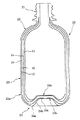
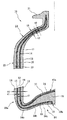
1 and 2 relate to an embodiment of the multilayer plastic container of the present invention. FIG. 1 is a longitudinal sectional view, and FIG. 2 is a partially enlarged longitudinal sectional view.
[0016]
The multi-layer
[0017]
The multilayer
[0018]
In the stretch blow-molded multilayer
[0019]
That is, at the
[0020]
By arranging the two inner and outer
[0021]
Thus, in the multilayer
[0022]
In the multilayer
[0023]
As described above, the thicknesses t2 and t2 of the
[0024]
Next, the
[0025]
In order to manufacture this multilayer
[0026]
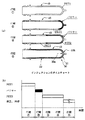
In the injection molding of the
[0027]
Then, the thermoplastic polyester resin PET1 for the inner and
[0028]
Thereafter, as a second step (2), a predetermined amount of the oxygen-absorbing resin barrier for the
[0029]
Then, the oxygen-absorbing resin barrier for the
[0030]
Next, thermoplastic polyester resin PET2 for the
[0031]
Then, the heat for the
[0032]
When the
[0033]
Thereafter, as a fifth step (5), pressure holding and cooling are performed to complete the
[0034]
In the
[0035]
This allows the
[0036]
Therefore, by performing the normal biaxial stretch blow molding of the
[0037]
Further, in the
[0038]
Thus, the
[0039]
Therefore, by performing the normal biaxial stretch blow molding of the
[0040]
For example, the same resin is used as the thermoplastic polyester resin of the three layers of the inner and
[0041]
Note that additives such as an ultraviolet absorber and an antistatic agent may be mixed with the thermoplastic polyester resin.
[0042]
As the oxygen-absorbing resin for the
[0043]
In such
[0044]
The maleic anhydride-modified polybutadiene is an oxygen absorbent, and absorbs oxygen inside the plastic container penetrating through the
[0045]
Furthermore, cobalt neodecanoate plays a role of a catalyst when oxygen is absorbed by a carbon-carbon double bond of maleic anhydride-modified polybutadiene.
[0046]
As the oxygen-absorbing resin, the following can be used in addition to the above-mentioned ones.
[0047]
First, as the oxygen barrier resin, any of the known oxygen barrier resins can be used, for example, ethylene-vinyl alcohol copolymer, polyamide, polyvinylidene chloride resin, polyvinyl alcohol, fluorine resin, etc. However, a chlorine-free resin that does not generate harmful gas during incineration is preferable.
[0048]
When a polyamide resin is used, it is preferable to use a polyamide resin having a terminal amino group concentration of 40 eq / 10 6 g or more, preferably more than 50 eq / 10 6 g in order to prevent oxidative deterioration of the polyamide resin itself. .
[0049]
Next, as the oxidizing polymer, oxidizing organic materials such as polybutadiene, polyisoprene, polypropylene, ethylene-carbon monoxide copolymer, 6-nylon, 12-nylon, and meta-xylylenediamine (MX) nylon A polyamide obtained by adding an organic acid salt containing a transition metal such as cobalt, rhodium, copper, or the like, or a photosensitizer such as benzophenone, acetophenone, or chloroketone to such a polyamide is used. By irradiating these with high energy rays such as ultraviolet rays and electron beams, the oxygen absorbability can be further increased.
[0050]
As the transition metal catalyst, an organic acid salt or an organic chain salt of a transition metal, a radical initiator or a photosensitizer is preferably used. Among the metal components, the cobalt component has a large oxygen absorption rate, and It is suitable.
[0051]
In the above-described embodiment, the multilayer plastic container has a two-layer, five-layer structure. However, a resin of the inner and outer layers and the center layer may be changed to have a three-layer, five-layer structure.
[0052]
【The invention's effect】
According to the multilayer plastic container according to the first aspect of the present invention, as specifically described above with reference to one embodiment, the oxygen absorbing resin layers constituting the two intermediate layers at the bottom of the multilayer plastic container are respectively provided inside. Since it is arranged close to the surface and the outer surface, the oxygen that is mainly captured and absorbed by the oxygen-absorbing resin layer that is close to the oxygen to be captured and absorbed can be determined, and the remaining in the container can be more efficiently. It can absorb oxygen.
[0053]
According to the multi-layer plastic container according to the second aspect of the present invention, the oxygen-absorbing resin layers at the lower part of the body and at the shoulder of the multi-layer plastic container have substantially the same thickness. For example, it is possible to prevent the shoulder portion from becoming thinner when molding a multilayer plastic container by molding or the like, thereby ensuring oxygen absorption.
[Brief description of the drawings]
FIG. 1 is a longitudinal sectional view according to an embodiment of a multilayer plastic container of the present invention.
FIG. 2 is a partially enlarged longitudinal sectional view of one embodiment of the multilayer plastic container of the present invention.
FIG. 3 is a schematic view of a preform injection molding machine required for manufacturing a container according to an embodiment of the multilayer plastic container of the present invention.
FIG. 4 is a diagram showing a molding process of a preform necessary for manufacturing the container and a time chart of the molding process according to an embodiment of the multilayer plastic container of the present invention.
[Explanation of symbols]
15 Middle layer (outside)
21
Claims (2)
Priority Applications (1)
| Application Number | Priority Date | Filing Date | Title |
|---|---|---|---|
| JP2002272852A JP2004106901A (en) | 2002-09-19 | 2002-09-19 | Multilayer plastic container |
Applications Claiming Priority (1)
| Application Number | Priority Date | Filing Date | Title |
|---|---|---|---|
| JP2002272852A JP2004106901A (en) | 2002-09-19 | 2002-09-19 | Multilayer plastic container |
Publications (1)
| Publication Number | Publication Date |
|---|---|
| JP2004106901A true JP2004106901A (en) | 2004-04-08 |
Family
ID=32269766
Family Applications (1)
| Application Number | Title | Priority Date | Filing Date |
|---|---|---|---|
| JP2002272852A Pending JP2004106901A (en) | 2002-09-19 | 2002-09-19 | Multilayer plastic container |
Country Status (1)
| Country | Link |
|---|---|
| JP (1) | JP2004106901A (en) |
Cited By (1)
| Publication number | Priority date | Publication date | Assignee | Title |
|---|---|---|---|---|
| JP2007283565A (en) * | 2006-04-14 | 2007-11-01 | Mitsubishi Plastics Ind Ltd | Gas barrier film, and packaging material and package using the film |
Citations (4)
| Publication number | Priority date | Publication date | Assignee | Title |
|---|---|---|---|---|
| JPS61268434A (en) * | 1985-05-22 | 1986-11-27 | 東洋製罐株式会社 | Multilayer plastic vessel and manufacture thereof |
| JPS63178930A (en) * | 1986-12-27 | 1988-07-23 | 三菱瓦斯化学株式会社 | multilayer container |
| JPH11514385A (en) * | 1994-12-14 | 1999-12-07 | コンチネンタル・ペット・テクノロジー・インコーポレーテッド | Multilayer preform and oxygen scavenging composition for container |
| JP2001088817A (en) * | 1999-09-24 | 2001-04-03 | Toyo Seikan Kaisha Ltd | Multi-layer bottle |
-
2002
- 2002-09-19 JP JP2002272852A patent/JP2004106901A/en active Pending
Patent Citations (4)
| Publication number | Priority date | Publication date | Assignee | Title |
|---|---|---|---|---|
| JPS61268434A (en) * | 1985-05-22 | 1986-11-27 | 東洋製罐株式会社 | Multilayer plastic vessel and manufacture thereof |
| JPS63178930A (en) * | 1986-12-27 | 1988-07-23 | 三菱瓦斯化学株式会社 | multilayer container |
| JPH11514385A (en) * | 1994-12-14 | 1999-12-07 | コンチネンタル・ペット・テクノロジー・インコーポレーテッド | Multilayer preform and oxygen scavenging composition for container |
| JP2001088817A (en) * | 1999-09-24 | 2001-04-03 | Toyo Seikan Kaisha Ltd | Multi-layer bottle |
Cited By (1)
| Publication number | Priority date | Publication date | Assignee | Title |
|---|---|---|---|---|
| JP2007283565A (en) * | 2006-04-14 | 2007-11-01 | Mitsubishi Plastics Ind Ltd | Gas barrier film, and packaging material and package using the film |
Similar Documents
| Publication | Publication Date | Title |
|---|---|---|
| KR100742077B1 (en) | Polyester resin lamination vessel and molding method therefor | |
| AU2007283094B2 (en) | Multilayer sheet- or tube-shaped food casing or food film | |
| JPH0813499B2 (en) | Multilayer container and manufacturing method thereof | |
| JPH053376B2 (en) | ||
| JPH05228988A (en) | Multilayer stretch blow container and manufacture thereof | |
| JPH0579494B2 (en) | ||
| EP0161625B1 (en) | Process for producing multi-layer parison | |
| CZ298276B6 (en) | Thermoplastic container, thermoplastic bottle and process for producing multilayered thermoplastic bottle | |
| JPH0444561B2 (en) | ||
| JP4547843B2 (en) | Primary molded product and casing of biaxially stretched blow molded casing | |
| JP3918168B2 (en) | Polyester resin laminated container and molding method thereof | |
| JP2004106901A (en) | Multilayer plastic container | |
| JP4072715B2 (en) | Multilayer preform inspection method and apparatus | |
| JPH0460826B2 (en) | ||
| JPS629007B2 (en) | ||
| JP4270687B2 (en) | Manufacturing method of tube containers | |
| WO2003082697A1 (en) | Container prepared from polyethylene terephthalate resin | |
| JPH0659681B2 (en) | Method for producing multi-layer stretch-molded container in which intermediate layer is arranged with its inner surface biased | |
| JPH07186190A (en) | Multi-layer injection molded article and manufacturing method thereof | |
| JPS6228332A (en) | Multilayer gas barrier polyester vessel and manufacture thereof | |
| JP2009173033A (en) | Multi-layer container with gas barrier property | |
| JPH08119248A (en) | Composite container and manufacturing method thereof | |
| JPH0735086B2 (en) | Method for producing multi-layer stretch-molded container in which intermediate layer is arranged with its inner surface biased | |
| JPH05193636A (en) | Preformed molding of resin with hollow wall and method for its manufacture and container produced therefrom by biaxially stretching blow molding | |
| JPH01278335A (en) | Plastic multi-layer container |
Legal Events
| Date | Code | Title | Description |
|---|---|---|---|
| A621 | Written request for application examination |
Free format text: JAPANESE INTERMEDIATE CODE: A621 Effective date: 20050823 |
|
| A977 | Report on retrieval |
Free format text: JAPANESE INTERMEDIATE CODE: A971007 Effective date: 20070627 |
|
| A131 | Notification of reasons for refusal |
Free format text: JAPANESE INTERMEDIATE CODE: A131 Effective date: 20070703 |
|
| A521 | Written amendment |
Free format text: JAPANESE INTERMEDIATE CODE: A523 Effective date: 20070830 |
|
| A02 | Decision of refusal |
Free format text: JAPANESE INTERMEDIATE CODE: A02 Effective date: 20071122 |