JP2004046830A - Display of communication context - Google Patents
Display of communication context Download PDFInfo
- Publication number
- JP2004046830A JP2004046830A JP2003164288A JP2003164288A JP2004046830A JP 2004046830 A JP2004046830 A JP 2004046830A JP 2003164288 A JP2003164288 A JP 2003164288A JP 2003164288 A JP2003164288 A JP 2003164288A JP 2004046830 A JP2004046830 A JP 2004046830A
- Authority
- JP
- Japan
- Prior art keywords
- response
- communication
- content
- analyzing
- communications
- Prior art date
- Legal status (The legal status is an assumption and is not a legal conclusion. Google has not performed a legal analysis and makes no representation as to the accuracy of the status listed.)
- Granted
Links
Images


Classifications
-
- G—PHYSICS
- G06—COMPUTING OR CALCULATING; COUNTING
- G06Q—INFORMATION AND COMMUNICATION TECHNOLOGY [ICT] SPECIALLY ADAPTED FOR ADMINISTRATIVE, COMMERCIAL, FINANCIAL, MANAGERIAL OR SUPERVISORY PURPOSES; SYSTEMS OR METHODS SPECIALLY ADAPTED FOR ADMINISTRATIVE, COMMERCIAL, FINANCIAL, MANAGERIAL OR SUPERVISORY PURPOSES, NOT OTHERWISE PROVIDED FOR
- G06Q10/00—Administration; Management
- G06Q10/10—Office automation; Time management
- G06Q10/107—Computer-aided management of electronic mailing [e-mailing]
-
- H—ELECTRICITY
- H04—ELECTRIC COMMUNICATION TECHNIQUE
- H04L—TRANSMISSION OF DIGITAL INFORMATION, e.g. TELEGRAPHIC COMMUNICATION
- H04L67/00—Network arrangements or protocols for supporting network services or applications
- H04L67/50—Network services
- H04L67/75—Indicating network or usage conditions on the user display
Landscapes
- Engineering & Computer Science (AREA)
- Business, Economics & Management (AREA)
- Human Resources & Organizations (AREA)
- Entrepreneurship & Innovation (AREA)
- Strategic Management (AREA)
- Quality & Reliability (AREA)
- Physics & Mathematics (AREA)
- Economics (AREA)
- Marketing (AREA)
- Operations Research (AREA)
- Computer Hardware Design (AREA)
- Tourism & Hospitality (AREA)
- Data Mining & Analysis (AREA)
- General Business, Economics & Management (AREA)
- General Physics & Mathematics (AREA)
- Theoretical Computer Science (AREA)
- Computer Networks & Wireless Communication (AREA)
- Signal Processing (AREA)
- Information Transfer Between Computers (AREA)
- User Interface Of Digital Computer (AREA)
Abstract
Description
【0001】
【発明の属する技術分野】
本発明は、全般的にはメッセージング通信に関し、具体的には、メッセージング通信の内容のコンテキストを提供することに関する。さらに具体的には、本発明は、通信のコンテキストに関連する反応応答を介する通信の内容の表示に関する。
【0002】
【従来の技術】
インターネットおよびテレフォニが発展するにつれて、異なる位置にいる個人の間の通信のしやすさも発展する。しかし、同時に発生する電子通信または遅延された電子通信では、直面しての会話中に利用できる検出可能な内容の多くが、減らされるか除去される。
【0003】
直面しての会話中に、通常は、単語に基づく会話以上のものが伝えられる。「言語」情報と「非言語」情報が組み合わされて、通信の内容のコンテキストが提供される。言語情報には、たとえば、音、声の調子、および音量を含めることができる。非言語情報は、たとえば、アイコンタクト、身振り、顔の動き、および身体言語を介して交換されることができる。たとえば、話し手は、聞き手の応答を観察することができ、話された言葉に対する応答の感情を判断することができる。さらに、話し手は、聞き手を観察して、聞き手が話し手の言葉を理解したかどうかに関する非言語的な手がかりを受け取ることができる可能性がある。さらに、聞き手は、話し手の動きおよび調子を観察して、話し手が伝えようとしている感情のタイプをよりよく理解することができる。
【0004】
直面しての通信の要素がなければ、通信内容のコンテキストを提供する言語情報および非言語情報が、失われるか除去されることがしばしばである。通信のこれらの一体化された部分がなければ、通信での誤解の可能性が高くなる。たとえば、直面しての通信がない時にすぐには明白にならない文化的相違に起因する誤解がより大きくなる可能性がある。さらに、直面しての同時に存在する通信がなければすばやく訂正されない、通信で生じたり受け取られる感情に関する誤解がある場合がある。
【0005】
たとえば、電子メール・メッセージは、貴重なタイプの電子通信をもたらすが、同時に発生する直面しての通信をもたらさない。電子メール・メッセージを送信する人は、電子メール・メッセージを読むことに応答する受信側の身体言語を観察して、受信側が通信を理解したかどうかを判定するという利益を有しない。さらに、電子メール・メッセージの受信側は、送信側が内容を通信するために選択する形に影響する可能性がある、年齢、性別、人種的背景、地位、地理的位置、または他の背景情報を完全には知らない場合がある。さらに、受信側は、送信側を見て、送信側が電子メール・メッセージを書く際の感情的コンテキストを判定するという利益を有しない。送信側は失望しているだけであるが、受信側が怒りに関連付ける単語を使用すると、送信側が書いたものに誤解が生じる場合がある。
【0006】
したがって、前述に鑑みて、電子通信内に電子通信のコンテキストを含める方法、システム、およびプログラムを提供することが有利である。さらに、送信側が通信を調整するか通信の内容の示されたコンテキストを調整する機会を得るように、メッセージを送信する前に所期の受信側による通信に対する予想される反応応答を送信側に示すことが有利である。さらに、通信の所期のコンテキストを受信側に示し、受信側による通信に対する実際の反応応答を記録することが有利である。
【0007】
【発明が解決しようとする課題】
前述に鑑みて、本発明の目的は、改善されたメッセージング通信を提供することである。
【0008】
本発明のもう1つの目的は、メッセージング通信の内容のコンテキストを提供する方法、システム、およびプログラムを提供することである。
【0009】
本発明のもう1つの目的は、通信の内容に関連する反応応答を介して通信のコンテキストを示す方法、システム、およびプログラムを提供することである。
【0010】
【課題を解決するための手段】
本発明の一態様によれば、通信の内容のさまざまな部分が分析されて、内容のさまざまな部分のそれぞれに関連する特定の反応応答が識別される。通信の内容の表示中に、さまざまな部分のどれかの中での着色によって、通信の関連する反応応答を示して、通信のコンテキストを提供する。
【0011】
本発明のもう1つの態様によれば、通信の内容のさまざまな部分が分析されて、少なくとも1つの所期の受信側による予想される応答が識別される。通信の内容の表示中に、予想される応答に関連する色が、内容のさまざまな部分に示される。送信側は、通信の内容を編集して、所望の予想される応答を達成することができる。
【0012】
本発明のすべての目的、特徴、および長所は、以下の詳細に記述された説明で明白になる。
【0013】
本発明の特性を示すと思われる新規の特徴を、請求項に示す。しかし、本発明自体、ならびに本発明の使用の好ましい態様、さらなる目的および長所は、添付図面と共に読まれる時の下記の例示的実施形態の詳細な説明を参照することによって最もよく理解される。
【0014】
【発明の実施の形態】
通信の内容に関連する反応応答を示す方法、システム、およびプログラムを提供する。好ましい実施形態では、反応応答が、通信内の色に従って示される。しかし、代替実施形態では、当業者に理解されるように、反応応答を、テキスト、グラフィックス、アイコン、イメージ、またはサウンドなどの他の表示可能な属性を介して示すこともできる。テキストの、フォント、フォント・サイズ、フォント・スタイル、添字、上付き文字、および他のテキスト処理を変更して、反応応答を示すことができる。さらに、半透明のオーバーレイ、グラディエント・バー、および他のグラフィカル要素を使用して、反応応答を示すことができる。
【0015】
通信には、文書、電子通信、音声通信、ビデオ通信、グラフィカル通信、およびグラフィックスベースの媒体を介する他の通信を含めることができるが、これに制限はされない。文書には、テキスト文書、手書き、書籍テキスト、ソフトウェア・コード、および他のタイプの英数字およびグラフィカル・ベースのファイルを含めることができるが、これに制限はされない。電子通信には、電子メール、インスタント・メッセージング、チャット・ルーム通信、両方向テキスト・メッセージング、音声テキスト変換メッセージング、振動−振動メッセージング、および他のネットワーク対応通信を含めることができるが、これに制限はされない。音声通信には、音声メッセージング、電話通信、電話会議、および他の音声ベースの通信方法を含めることができる。ビデオ通信には、ビデオ会議、ビデオ・メッセージング、および他のビデオベースの通信方法を含めることができるが、これに制限はされない。
【0016】
本発明の好ましい実施形態では、通信が、少なくとも1つの送信側から少なくとも1つの受信側への間でネットワークを介して転送される。しかし、通信を、データ・ストレージ媒体または他のプラットフォームを介して転送することもできる。さらに、ネットワークを介する通信は、同時に発生するものまたは遅延されるものとすることができる。
【0017】
通信のどのタイプの内容にも、テキスト、アイコン、ビデオ・イメージ、サウンド、グラフィックス、アバタの身振り、および他のタイプの出力を含めることができるが、これに制限はされない。本発明の長所によれば、通信の内容のコンテキストが、その内容の反応応答によって提供される。
【0018】
反応応答を、たとえば、通信の選択された部分、通信のさまざまな部分、通信全体、または複数の通信について分析することができる。反応応答を、通信の選択された部分、通信のさまざまな部分、通信全体、または複数の通信について識別することができる。
【0019】
反応応答には、受信側の予想される応答、送信側の所期の応答、および受信側の実際の応答を含めることができるが、これに制限はされない。送信側に、提案される通信に関する受信側の予想される応答を与えることができる。さらに、送信側は、提案される通信に関する所期の応答を提供することができ、あるいは、通信の内容の分析を、企図された応答にすることができる。予想される応答または所期の応答あるいはこの両方を、通信と共に送信して、受信側に追加のコンテキストを与えることができる。さらに、受信側は、通信に対する実際の応答を示すことができる。実際の応答を、カタログ化し保管するか、通信と共に送信側に返すか、その両方を行うことができる。
【0020】
通信の内容および通信に対する反応応答によって、通信のコンテキストが与えられる。コンテキストによって、送信側および受信側に、伝えられることを意図された内容の強化された理解および内容が理解される形が与えられることが好ましい。
【0021】
以下の説明では、説明のために、本発明の完全な理解を提供するために、多数の具体的な詳細を示す。しかし、本発明をこれらの具体的な詳細なしで実践できることは、当業者に明白であろう。他の場合には、本発明を不必要に不明瞭にしないように、周知の構造および装置をブロック図の形で示す。
【0022】
ハードウェアの概要
本発明は、多数の異なるオペレーティング・システム上のさまざまなコンピュータ・システムおよび電子装置を含む、さまざまなシステムで実行されることができる。本発明の一実施形態では、コンピュータ・システムが、ノートブック・コンピュータ、パームトップ・コンピュータ、携帯情報端末、電話機、またはテレフォニ、機能強化されたテレフォニ、メッセージング、および情報サービスを提供する通信機能も組み込むことができる他の電子コンピュータ・システムなどの、ポータブル・コンピュータ・システムである。しかし、コンピュータ・システムを、たとえば、デスクトップ・コンピュータ、ネットワーク・コンピュータ、ミッドレンジ・コンピュータ、サーバ・システム、またはメインフレーム・コンピュータにすることもできる。したがって、一般に、本発明は、コンピュータ・システムからアクセス可能なストレージ内のデータの操作などの計算タスクを実行するコンピュータ・システム内で実行されることが好ましい。さらに、コンピュータ・システムには、少なくとも1つの出力装置および少なくとも1つの入力装置が含まれることが好ましい。
【0023】
ここで図面、具体的には図1を参照すると、本発明の方法、システム、およびプログラムを有利に使用することができるコンピュータ・システムの一実施形態が示されている。コンピュータ・システム10には、コンピュータ・システム10内で情報を通信するバス22または他の通信装置と、情報を処理するためにバス22に結合された、プロセッサ12などの少なくとも1つの処理装置が含まれる。バス22には、ブリッジによって接続され、複数のバス・コントローラによってコンピュータ・システム10内で制御される、低待ち時間パスおよび高待ち時間パスが含まれることが好ましい。
【0024】
プロセッサ12は、通常動作中に、ランダム・アクセス・メモリ(RAM)14などのダイナミック・ストレージ・デバイスおよび読取専用メモリ(ROM)16などのスタティック・ストレージ・デバイスに保管されたオペレーティング・システムおよびアプリケーション・ソフトウェアの制御の下でデータを処理する、IBM社のPowerPC(R)プロセッサなどの汎用プロセッサとすることができる。オペレーティング・システムは、ユーザにグラフィカル・ユーザ・インターフェース(GUI)を提供することが好ましい。好ましい実施形態では、アプリケーション・ソフトウェアに、プロセッサ12で実行される時に、図14の流れ図に示された動作および本明細書に記載の他の動作を実行する計算機実行可能命令が含まれる。代替案では、本発明のステップを、ステップを実行するハードワイヤード論理を含む特定のハードウェア構成要素によって、またはプログラムされたコンピュータ構成要素およびカスタム・ハードウェア構成要素の任意の組合せによって、実行することができる。
【0025】
本発明は、本発明による処理を実行するためにコンピュータ・システム10をプログラムするのに使用される計算機実行可能命令をその上に保管された計算機可読媒体に含まれる、コンピュータ・プログラム製品として提供することができる。本明細書で使用される用語「計算機可読媒体」には、実行のためにプロセッサ12またはコンピュータ・システム10の他の構成要素に命令を供給するために使用するいかなる媒体も含まれる。そのような媒体は、不揮発性媒体、揮発性媒体、および伝送媒体を含むが、これに制限されない多数の形態とすることができる。不揮発性媒体の一般的な形に、たとえば、フロッピ(R)・ディスク、フレキシブル・ディスク、ハード・ディスク、磁気テープ、または他の磁気媒体、コンパクト・ディスクROM(CD−ROM)または他の光媒体、パンチ・カードまたは穴のパターンを有する他の物理媒体、プログラマブルROM(PROM)、消去可能PROM(EPROM)、電気的EPROM(EEPROM)、フラッシュ・メモリ、および他のメモリ・チップまたはメモリ・カートリッジ、あるいは、そこからコンピュータ・システム10が読み取ることができ、命令を保管するのに適するいかなる他の媒体も含まれる。この実施形態では、不揮発性媒体の例が、大容量記憶装置18である。揮発性媒体には、RAM14などのダイナミック・メモリが含まれる。伝送媒体には、バス22を含むワイヤを含む、同軸ケーブル、銅線、または光ファイバが含まれる。伝送媒体は、ラジオ周波数通信または赤外線通信中に生成されるものなどの、音波または光波の形をとることもできる。
【0026】
さらに、本発明は、コンピュータ・プログラム製品としてダウンロードされることができ、プログラム命令を、バス22に結合された通信インターフェース32へのネットワーク・リンク34(たとえばモデムまたはネットワーク接続)を介して搬送波または他の伝搬媒体で実施されるデータ信号によって、サーバ39などのリモート・コンピュータから要求元のコンピュータ・システム10に転送することができる。通信インターフェース32が、たとえばローカル・エリア・ネットワーク(LAN)に、広域ネットワーク(WAN)に、または、この図に示されているように、インターネット・サービス・プロバイダ(ISP)37に直接に接続することができるネットワーク・リンク34に結合された両方向データ通信を提供する。具体的に言うと、ネットワーク・リンク34は、1つまたは複数のネットワークへの有線または無線あるいはその両方のネットワーク通信を提供することができる。
【0027】
ISP37は、インターネット38または他のネットワークを介するデータ通信サービスを提供する。インターネット38は、伝送制御プロトコル(TCP)およびインターネット・プロトコル(IP)などの特定のプロトコルを使用して互いに通信するネットワークおよびゲートウェイの全世界の集合を指す。ISP37およびインターネット38の両方で、ディジタル・データ・ストリームを搬送する電気信号、電磁信号、または光信号が使用される。さまざまなネットワークを介する信号およびネットワーク・リンク34上の通信インターフェース32を介する信号は、コンピュータ・システム10との間でディジタル・データを搬送し、情報を移送する搬送波の例示的形態である。
【0028】
さらに、複数の周辺構成要素を、コンピュータ・システム10に追加し、バス22に結合された入出力コントローラ11に接続することができる。たとえば、オーディオ入力27が、マイクロホンまたは他の音声取込装置あるいは唇の動きを取り込む装置を介するオーディオ入力を制御するために、入出力コントローラ11に接続される。オーディオ出力28が、スピーカまたは他のオーディオ投影装置を介するオーディオ出力を制御するために入出力コントローラ11に接続される。ディスプレイ24も、視覚、触覚、または他のグラフィカル表現フォーマットを提供するために入出力コントローラ11に接続される。キーボード26と、マウス、トラックボール、またはカーソル矢印キーなどのカーソル制御装置30が、コンピュータ・システム10へのユーザ入力のインターフェースとして入出力コントローラ11に結合される。本発明の代替実施形態では、追加の入力周辺構成要素および出力周辺構成要素を追加することができる。
【0029】
メッセージング・システム・コンテキスト
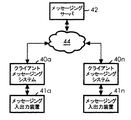
図2を参照すると、電子メッセージング通信が通常は本発明の方法、システム、およびプログラムに従って行われるクライアント/サーバ環境の単純化されたブロック図が示されている。クライアント/サーバ環境は、多数のネットワーク・アーキテクチャで実施される。たとえば、ワールド・ワイド・ウェブ(ウェブ)のアーキテクチャは、従来のクライアント/サーバ・モデル環境に従う。
【0030】
用語「クライアント」および「サーバ」は、データの要求側(クライアント)またはデータの提供側(サーバ)としてのコンピュータの全般的な役割を指すのに使用される。ウェブ環境では、Netscape Navigatorなどのウェブ・ブラウザが、通常は、クライアント・メッセージング・システム40a−40nに常駐し、メッセージング・サーバ42などの少なくとも1つのメッセージング・サーバによってサービスされるウェブ文書(ページ)をレンダリングする。さらに、クライアント・メッセージング・システム40a−40nのそれぞれおよびメッセージング・サーバ42は、「クライアント」および「サーバ」の両方として機能することができ、図1のコンピュータ・システム10などのコンピュータ・システムを使用して実施されることができる。さらに、本発明を、メッセージング・セッションを制御するメッセージング・サーバ42を強調して説明するが、本発明は、ネットワーク44を介してピアツーピア・ネットワーク通信にかかわるクライアント・メッセージング・システム40a−40nによって実行することもできる。
【0031】
ウェブは、全世界のサーバに常駐する相互リンクされたハイパーテキスト文書の組全体を指すことができる。インターネットなどのネットワーク44は、これらのハイパーテキスト文書をクライアント・メッセージング・システム40a−40nとメッセージング・サーバ42の間で伝送するインフラストラクチャを提供する。ウェブの文書(ページ)は、ハイパーテキスト・マークアップ言語(HTML)またはXML(Extensible Markup Language)などの複数の言語で記述されることができ、それによってファイルにアクセスできる特定のメッセージング・サーバ42およびパス名を指定するURI(UniformResource Indicator)によって識別され、メッセージング・サーバ42から、HTTP(Hypertext Transfer Protocol)などのプロトコルを使用してエンド・ユーザに送信される。ウェブ・ページには、さらに、テキスト、グラフィック・イメージ、ムービー・ファイル、およびサウンド、ならびに、ユーザがリンクをクリックすることによって活動化する時に実行されるJava(R)アプレットおよび他の小さい埋込みソフトウェア・プログラムを含めることができる。ネットワーク44を、インターネットに関して説明するが、ネットワーク44は、WANまたはLANを介して動作することもできる。
【0032】
送信側は、クライアント・メッセージング・システム40aなどのクライアント・メッセージング・システムで、メッセージング・セッションに関して、メッセージング入出力装置41a−41nの1つを介してメッセージを入力する。メッセージ入力は、メッセージング・サーバ42に送信される。メッセージング・サーバ42は、メッセージング・セッションに参加するユーザまたは特定の受信側に、ネットワーク44を介してメッセージ項目を配布する。
【0033】
有利なことに、送信側は、メッセージング・セッションに参加する他のユーザまたは特定の受信側に送信されるメッセージを提案することができる。メッセージング・サーバ42は、提案されたメッセージを分析して、提案されたメッセージの内容に関連する予想される応答を識別する。予想される応答は、提案されたメッセージ内で識別され、色によってマークされ、これを、入出力装置を用いて表示することができる。予想される応答は、メッセージング・セッションに参加するユーザのそれぞれについて、ユーザのグループについて、または特定の受信側について示されることができる。予想される応答は、受信側クライアント・メッセージング・システムに送達される時に、メッセージング・サーバ42によってメッセージに添付されることができる。予想される応答は、受信側について個人別、地域別、国別、および他の判断基準に従ってカタログ化された応答に関してメッセージの内容を分析することによって、メッセージング・サーバ42によって判定されることができる。
【0034】
送信側は、メッセージを受信側に送信する前に、提案されたメッセージの内容を編集して、所望の予想される応答を達成することができる。提案の全般的な編集は、メッセージング・サーバ42によって提供される。さらに、送信側は、提案されたメッセージ対する所期の応答を示し、メッセージに関する、所期の応答と同一またはこれに類似する予想された応答を作る特定の編集提案をメッセージング・サーバ42に要求することができる。
【0035】
送信側は、色によってメッセージ内で識別される、メッセージに関する全体的な所期の応答を示すことができる。たとえば、送信側は、メッセージを書き込む際の送信側の気分が楽しかったことを示すことができる。メッセージの背景の色を、黄色にして、楽しい気分を示すことができる。
【0036】
さらに、送信側は、メッセージの諸部分を選択し、セクションのそれぞれに対する所期の応答を示すことができる。たとえば、送信側は、挨拶が誠心誠意であることを意図されていること、第1段落が知識を与えるものであること、第2段落が熱意をもって書かれたこと、および結びが丁寧であることが意図されていることを示すことができ、ここで、所期の応答が、メッセージ内でカラー・コーディングされる。
【0037】
所期の応答も、送信側について個人別、地域別、国別、および他の判断基準に従ってカタログ化された応答に関してメッセージの内容を分析することによって、メッセージング・サーバ42によって判定されることができる。これらの所期の応答を、メッセージ内で色によって識別することができ、送信側によって特に指定された他の所期の応答と組み合わせることができる。さらに、メッセージング・サーバ42によって判定される所期の応答を示すのに使用される着色を、送信側によって特に指定された所期の応答と区別することができる。
【0038】
メッセージング・サーバ42が、メッセージング・セッションでの受信側への出力のためにクライアント・メッセージング・システム40a−40nにメッセージを転送する時に、そのメッセージに、送信側に与えられた場合とそうでない場合があるメッセージング・サーバ42によって分析された予想される応答および送信側の所期の応答を示す着色を含めることができる。受信側は、メッセージを受信する入出力装置が着色を表示するかどうかを選択することができる。
【0039】
さらに、メッセージング・サーバ42は、受信側がメッセージに対する実際の応答を示すことを要求することができる。受信側は、全体的な実際の応答またはメッセージのさまざまな部分に対する実際の応答を示すことができる。たとえば、受信側は、受信側がメッセージを読む時の全体的な気分、受信側がメッセージ全体に対して有する応答、特定のアイコンまたは言葉遣いなど、メッセージの異なる部分に対する反応を示すことができる。
【0040】
メッセージング・サーバ42は、予想される応答、所期の応答、および実際の応答と共に保管するためにメッセージをカタログ化することができる。さらに、メッセージング・サーバ42は、メッセージに対する実際の応答を送信側に送り返し、送信側が実際の応答に応答できるようにすることができる。
【0041】
この実施形態では、メッセージング・サーバ42が、予想される応答の分析と所期の応答および実際の応答の追跡を処理するが、代替実施形態では、反応応答情報を、クライアント・メッセージング・システム40a−40nで動作するメッセージング反応コントローラによって分析し、示すことができる。さらに、メッセージング・サーバ42に、メッセージの分析を実行する複数の統合されたシステムを組み込むことができる。当業者が理解するように、他のタイプのメッセージング・システムによって、本発明を実施することができる。
【0042】
さらに、この実施形態では、通信の伝送を、同時に発生するか遅延されるメッセージング・システム・プラットフォームに関して説明するが、代替実施形態では、他のタイプのプラットフォームによって、メッセージングおよび他のタイプの通信をサポートすることができる。たとえば、通信は、従来のワイヤライン電話網、無線ネットワーク、データ記憶媒体、および情報の伝送の他のプラットフォームを介して伝送可能である。
【0043】
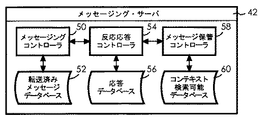
図3を参照すると、本発明の方法、システム、およびプログラムによるメッセージング・システム・サーバのブロック図が示されている。図からわかるように、メッセージング・サーバ42には、単一のサーバ・システム内または複数のサーバ・システム内に配置される複数のコントローラおよびデータベースが含まれ、複数のサーバ・システムは、統合されるか、ネットワーク44を介してアクセス可能である。
【0044】
メッセージング・コントローラ50は、メッセージング・サーバ42によって提供されるメッセージング・システムのメッセージ通信の配布を制御することが好ましい。本発明において、メッセージング・コントローラ50を、インスタント・メッセージング、電子メール・メッセージング、またはチャット・ルーム・メッセージングなどのメッセージング通信に関して説明するが、メッセージング・コントローラ50によって、多数のタイプの使用可能な通信を制御することができる。
【0045】
メッセージング・コントローラ50は、少なくとも1つの送信側から少なくとも1つの受信側へ、送信側によって選択されたメッセージングのタイプに従って、メッセージ通信を配布する。たとえば、送信側が、チャット・ルーム・セッションに参加している場合に、メッセージ通信は、チャット・セッションのメッセージング・コントローラ50によって開かれるチャネルに参加する他のユーザに送信される。もう1つの例では、送信側が、電子メール・メッセージを送信している場合に、メッセージ通信は、識別された受信側の電子メールを処理するサーバに経路指定される。送信側および受信側は、スクリーン・ネーム、電子メール・アドレス、または他のネットワーク識別子などの識別子によって表現されることが好ましいが、送信側および受信側を、匿名、グループ化される、または他の形で識別することができる。
【0046】
メッセージング・コントローラ50によって制御される、少なくとも1つの送信側から少なくとも受信側への間で転送されるメッセージ通信は、指定された時間の期間の間、転送済みメッセージ・データベース52に保管されることが好ましい。インスタント・メッセージング・セッションまたはチャット・ルーム・セッションについて、セッションのすべての入力が、転送済みメッセージ・データベース52内で一緒にカタログ化されることが好ましい。
【0047】
反応応答コントローラ54は、メッセージ通信を分析して、反応応答を判定する。反応応答を分析するために、反応応答コントローラ54が、応答データベース56にアクセスすることが好ましく、この応答データベース56には、個人別、国別、地域別、および他の判断基準に従ってカタログ化された応答のデータベースが含まれる。通信の出力について、着色または他の表示可能属性が、反応応答を示すために通信の内容に追加される。
【0048】
メッセージ保管コントローラ58が、メッセージ通信の保管および保管されたメッセージ通信へのアクセスを制御する。メッセージ通信は、コンテキスト検索可能データベース60に付加された反応応答と共に保管されることが好ましい。具体的に言うと、コンテキスト検索可能データベース60に保管される反応応答は、送信側、受信側、反応応答、および反応応答を識別する色に従って検索可能であることが好ましい。
【0049】
転送済みメッセージ・データベース52、応答データベース56、およびコンテキスト検索可能データベース60は、内部的に、外部的に、およびネットワークを介して、メッセージング・サーバ42によってアクセス可能である。さらに、転送済みメッセージ・データベース52、応答データベース56、およびコンテキスト検索可能データベース60を、それぞれ、ネットワークを介してアクセス可能な複数のデータベース記憶システムに分散させるか、単一のデータ記憶システム内に配置することができる。
【0050】
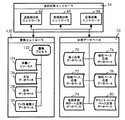
図4を参照すると、本発明の方法、システム、およびプログラムによる反応応答コントローラおよび反応応答コントローラによってアクセスされる応答データベースのブロック図が示されている。図からわかるように、反応応答コントローラ54には、送信側分析コントローラ62、受信側分析コントローラ64、および応答収集コントローラ66が含まれる。これらのコントローラのそれぞれが、ネットワーク・リンクまたはハードワイヤード・リンクを介して応答データベース56にアクセスすることができる。
【0051】
送信側分析コントローラ62が、メッセージ通信の送信側の反応応答分析を実行することが好ましい。1つの機能に従って、送信側分析コントローラ62は、提案されたメッセージ通信を分析し、そのメッセージ通信に対する予想される応答を送信側に示す。もう1つの機能に従って、送信側分析コントローラ62は、提案されたメッセージ通信に対する調整を推奨する。また、送信側分析コントローラ62は、メッセージ通信を分析し、メッセージ通信に対する送信側の所期の応答を示す。さらに、送信側分析コントローラ62は、送信側によって特に指定された所期の応答を検出し、すべての所期の応答をメッセージ通信に付加する。
【0052】
さらに、送信側分析コントローラ62は、提案されたメッセージの調整に関する提案を推奨するために、置換コントローラ130にアクセスする。置換コントローラ130には、提案されたメッセージ通信の内容の一部分に関する置換の範囲を判定する置換プロセス132が含まれる。具体的に言うと、置換コントローラ130には、単語調整提案のための辞書およびシソーラス134、文法的調整提案のための文法データベース136、記号調整提案のための記号データベース138、およびアバタの身振り調整提案のためのアバタ身振りデータベース139が含まれるが、これに限定されない。置換コントローラ130は、さらに説明するように、応答データベース56にさらにアクセスして、内容の異なるタイプに関する予想される応答および所期の応答を検索し、その結果、提案を、そのような反応応答に従って調整できるようにする。
【0053】
受信側分析コントローラ64は、メッセージ通信の受信側に関する反応応答分析を実行することが好ましい。1つの機能に従って、受信側分析コントローラ64は、受信したメッセージ通信を分析し、受信したメッセージ通信内でマークされる予想される応答および所期の応答を示す。さらに、受信側分析コントローラ64は、受信したメッセージ通信を分析して、送信側の所期の応答を判定することができる。
【0054】
もう1つの機能に従って、受信側分析コントローラ64は、受信側に、メッセージ通信に対する実際の応答を供給するように要求する。実際の応答は、受信側が特定の応答を示す色でメッセージを強調表示することによって、応答を記述する複数の単語を入力することによって、および心拍数などの生物測定の検出によって、選択されることができる。さらに、受信側分析コントローラ64は、送信側に実際の応答を返すのを制御し、メッセージ通信が受信側によってどのように理解されたかに関する追加の通信を送信側が受信できるようにすることができる。
【0055】
反応応答を判定するためのメッセージ通信の分析で、送信側分析コントローラ62および受信側分析コントローラ64が、反応応答を含めるように通信をエンコードすることが好ましい。反応応答エンコーディングでは、予想される応答、所期の応答、または実際の応答があるかどうか、応答の記述、および色などの応答に割り当てられる表示可能属性が示されることが好ましい。しかし、エンコーディングは、応答記述を示すことだけができ、あるいは、応答を示す色と共に通信をエンコードすることだけができる。
【0056】
反応応答についてメッセージを分析する際に、送信側分析コントローラ62は、応答データベース56にアクセスする。応答データベース56には、互いに独立または互いに組み込むことができる複数のデータベースが含まれる。さらに、複数のデータベースを、単一のデータ記憶位置内に配置するか、ネットワーク・リンクまたはハードワイヤード・リンクによってリンクされた複数のデータ記憶システムにまたがって分散させることができる。
【0057】
通信の送信側および受信側の識別子が、通信に含まれる。送信側識別子および受信側識別子から、個人プロファイルにアクセスすることができる。個人プロファイル情報には、名前、出生の地域、国語、会社交際、メンバシップ、および個人的特性を含めることができるが、これに制限はされない。
【0058】
送信側および受信側によって通信に使用されるコンピュータ・システムに、反応応答コントローラ54からアクセス可能な個人プロファイルを保管することができる。ネットワーク・サービス・プロバイダが、反応応答コントローラ54からアクセス可能な、顧客識別子ごとの個人プロファイルを保管することができる。さらに、ネットワークを介してアクセス可能な個人識別データベースに、識別子によって個人プロファイルを保管することができる。個人プロファイルへのアクセスのセキュリティおよび要件の複数の層を、個人プロファイルを保管するコンピュータ・システムのそれぞれが提供することができる。
【0059】
応答データベース56の構成要素であるデータベースの例には、個人応答データベース70、地域ベース応答データベース72、各国言語サポート(NLS)応答データベース74、会社ベース応答データベース76、特性ベース応答データベース78、およびチャット・ルーム・ベース応答データベース80が含まれるが、これに制限はされない。
【0060】
個人応答データベース70には、個人の応答が保管される。特定の個人の予想される応答は、前のメッセージ通信に対する個人による実際の応答から収集される。さらに、特定の個人の予想される応答は、サンプル内容に対する個人による事前に記録された応答から収集される。さらに、個人のスケジュールにアクセスして、位置、アクティビティ、最近の睡眠または食事(またはそれらがないこと)、および、特定のタイプの内容に対する応答を予想するのを助ける可能性がある他のスケジュール要因に基づいて応答を予想することができる。
【0061】
通信に対する個人による所期の応答は、前の通信で送信側によって指定された、送信側指定の所期の応答から収集される。さらに、個人による所期の応答は、サンプル内容に対する特定の個人について事前に記録された応答から収集されることができる。
【0062】
地域ベース応答データベース72には、送信側または受信側に関連する地域による所期の応答および予想される応答が保管される。地域ベース応答には、単語、口語体の語句、句、話題、および熟語に対する地域固有の応答が含まれることが好ましい。たとえば、挨拶「y’all」は、一般に、米国南部の在住者から否定的な応答を引き出さない。しかし、米国北部の在住者は、この単語の使用に対して否定的に応答する可能性がある。所期の応答は、送信側に関連する地域に従って、地域ベース応答データベース72から判定されるが、予想される応答は、受信側に関連する地域に従って、地域ベース応答データベース72から判定される。
【0063】
NLS応答データベース74には、各国言語サポート標準による応答が保管される。NLSを用いると、アプリケーションが、複数の言語的および文化的な規約をサポートできるようになる。NLSの下で、各ユーザが、言語、国、および文化の情報を含むプロファイルを選択する。NLSシステムの通常の機能は、ユーザ・プロファイルに従い表示のための日時フォーマットおよび通貨記号の交換である。
【0064】
本発明の利点によれば、NLSは、さらに、通信の内容が受信側のNSLプロファイルに従ってどのように交換されるかを予想することによって、反応応答を判定するのに使用される。さらに、本発明の利点によれば、NLSが、文化的規約以上のもののサポートを提供するように拡張される。実際の言語の規約を提供することも有利である。したがって、NLS応答データベース74には、メッセージの内容が別の言語に基づくフォーマットに交換される場合に、言語の規約が、予想される意味と所期の意味について交換されるように、言語の規約に対する応答が保管される。
【0065】
会社ベース応答データベース76には、会社または他の組織による応答が保管される。会社および組織は、しばしば、製品、サービス、および会社または組織内の人員を指すのに使用される専門語を有する。さらに、1企業の文化内で、通常は、是認される主題および単語の選択があり、それ以外は否定的に見られる。さらに、特定のプロジェクトへの参照が、オフィスによって異なる場合がある。会社ベース応答データベース76には、これらの製品およびサービスの参照および主題が保管され、その結果、従業員が互いに通信するか、第三者が従業員と通信する時に、会社ベースの予想される応答および所期の応答にアクセスし、分析することができる。
【0066】
特性ベース応答データベース78に、個人的特性による一般的な応答が保管される。個人的特性には、たとえば、プロファイルおよびプリファレンスを含めることができる。たとえば、プリファレンスに、音楽プリファレンス、映画プリファレンス、または食物プリファレンスを含めることができる。個人的特性のそれぞれに、一般的な応答を関連付けることができる。受信側の一般的な個人的特性の予想される応答を、さらに、受信側および送信側の個人的特性に従って指定することができる。さらに、送信側の一般的な個人的特性の所期の応答を、さらに、受信側および送信側の個人的特性に従って指定することができる。
【0067】
チャット・ルーム・ベース応答データベース80には、特定のチャット・ルームに関する応答が保管される。チャット・ルームは、しばしば、特定の話題に関連する。しかし、通常、チャット・ルームでの会話のタイプおよびチャット・ルームで何が適当であるかは、そのチャット・ルームをしばしば訪れる人によって決定される。チャット・ルーム・ベース応答データベース80には、チャット・ルーム通信の将来の予想される応答および所期の応答を判定するために、チャット・ルーム内のメッセージ通信に対する予想される応答、所期の応答、および実際の応答が保管される。特定のチャット・ルームの常連参加者は、ある語彙の使用に対して、特定の話題に対して、および特定の時間帯中に予想されなければならない応答のタイプを設定することもできる。
【0068】
応答データベース56に加えて、反応応答コントローラ54は、送信側と特定の受信側の間の前の通信について保管された反応応答のレコードを、メッセージ保管コントローラ58に要求する。特定の送信側と特定の受信側の間の前の通信ヒストリは、現在の通信に関する加重ヒストリ値を判定するのに使用される。たとえば、「0」と「100」の間の加重ヒストリ値を、各前の通信の反応応答に割り当てることができ、ここで、「0」の値が、極度に友好的な雰囲気を表し、「50」の値が、中立の雰囲気を表し、「100」の値が、極度に敵意のある雰囲気を表す。前の通信ヒストリ値の平均値が、判定され、送信側および受信側に示される。受信側が、値を割り当てることができ、あるいは、値を、反応応答コントローラ54によって判定することができる。
【0069】
送信側は、他者の間の通信の集合に関する加重通信ヒストリ値にもアクセスすることができる。たとえば、送信側が、1週間前に受信側の上司への通信で受信側を罵倒した場合に、送信側は、罵倒メールの日付以降の送信側と受信側の間の通信に関する加重通信ヒストリ値を要求することができる。「罵倒」メールは、通常は、怒りを伴う通信が送信されることを示すメールである。
【0070】
送信側から受信側によって受信される通信の平均の加重通信ヒストリ値によって、送信側に、受信側がその送信側からの将来の通信を読む時の評価基準に関するさらなる情報が与えられる。さらに、平均の加重通信ヒストリ値に基づいて、送信側が、送信側と受信側の間の平均の加重通信ヒストリ値を調整することを試みて通信を調整することができる。会社は、従業員がお互いおよび顧客と通信して、指定された範囲内の平均の加重通信ヒストリ値の通信を達成するための奨励金を提供することができる。
【0071】
送信側分析コントローラ62は、通常は口述された音声通信をテキスト通信に変換する、音声−テキスト変換のためにアクセス可能であることが好ましい。通信を音声からテキストに変換する際に、送信側分析コントローラ62が、身体言語および調子を検出し、これらの反応をテキストにエンコードし、機能強化された反応応答を使用可能にすることが好ましい。
【0072】
送信側分析コントローラ62および受信側分析コントローラ64は、応答判断基準を用いて現在の通信を分析するために応答データベース56にアクセスするが、応答収集コントローラ66は、送信側および受信側にサンプル内容のプロンプトを出し、送信側および受信側にその内容に対する応答を示すように要求する。応答収集コントローラ66によって収集された情報は、適当な個人データベースへの保管のために応答データベース56に配布される。
【0073】
サンプル内容は、複数の通信媒体を介して送信側または受信側に提示されることができる。たとえば、応答収集コントローラ66は、送信側または受信側による特定のアクションの検出に応答して、ウェブ・ページを自動的に開始することができる。さらに、応答収集コントローラ66は、選択された内容に対する応答を要求する、インスタント・メッセージング・セッション、電子メール、チャット・ルーム、テキスト・メッセージング、または通信の他の形を開始することができ、これらの応答が、分析および保管のために応答収集コントローラ66に返される。
【0074】
サンプル内容に応答する個人は、個人の応答に関するプライバシの好ましいレベルを指定することができる。たとえば、個人は、応答が、公に使用可能である、要求された判断基準に合格するシステムに半公開される、その個人によって指定される他の個人、組織、および会社だけに半公開される、または、サンプル内容に応答することを具体的に要求する個人、組織、または会社だけがプライベートに使用可能であることを指定することができる。具体的に言うと、半公開プライバシについて、ネットワーク・プロバイダが、個人、組織、会社、および他のネットワーク・プロバイダに、あるセキュリティおよび信頼性のインフラストラクチャが、個人による予想される応答へのアクセスを受け取るために実施されていることを証明するように要求することができる。
【0075】
応答収集コントローラ66によって使用されるサンプル内容に、たとえば、提案された通信の内容または既に送信された通信の内容を含めることができる。電子メール・オプションを用いて、提案されたメッセージを応答に関する要求と共に選択された所期の受信側に送信することを、送信側が要求できるようにすることができる。応答収集コントローラ66は、選択された所期の受信側からの応答に関する要求で、提案されたメッセージをサンプル内容として使用する。予想される応答を、選択された所期の受信側および送信側の間で共用して、残りの所期の受信側への送信の前に、電子メールの内容に対してどのタイプの調整を行わなければならないかを判定することができる。
【0076】
さらに、会社は、応答収集コントローラ66によって使用されるサンプル内容を提供して、従業員、顧客、および他者からの応答のプロンプトを出し、それらの応答を検索することができ、このサンプル内容は、会社内で通常の適当である通信の内容のタイプに固有である。会社のサンプル内容からの応答は、その会社の従業員によって開始される通信の分析でのその会社のみによるアクセスのために応答データベース56に保管されることができる。
【0077】
さらに、ISPは、顧客またはそのサービスを介して顧客と通信するすべてのものからの予想される応答を得るために、サンプル内容を設計することができる。具体的に言うと、ISPは、サンプル内容を設計して、個々のユーザおよびユーザ全般がスパムまたは他の望ましくない通信とみなす情報のタイプを判定することができる。サンプル内容に対する個人の応答および一般の応答に基づいて、ISPは、望ましくない通信が顧客に到達するのをよりよくフィルタリングすることができる。
【0078】
サンプル内容を、フォーカス・グループについて設計して、より幅広い聴衆への配布の前に、特定の宣伝通信に対する応答を予想することができる。フォーカス・グループには、フォーカス・グループの一部になることに同意した個人と、マーケット・リサーチによってフォーカス・グループの理想的特性に合うと判定された個人を含めることができる。
【0079】
応答収集コントローラ66は、個人の旅行を監視し、他の地域での旅行の後にサンプル内容に対する応答を更新するように個人に要求することができる。たとえば、主に米国テキサス州で働き、そこで生活する個人が、米国ニューヨーク州に旅行することが検出された時に、応答収集コントローラ66は、その個人が、別の地域でのあるタイプの内容の使用にさらされた後に、その内容のタイプに対する予想される応答および所期の応答を変更したかどうかをテストするために、サンプル内容通信を開始することができる。当業者が理解するように、他のタイプのサンプル内容を、指定し、配布することができる。
【0080】
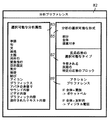
図5を参照すると、本発明の方法、システム、およびプログラムによる通信の分析の選択可能なカテゴリの例示的表現が示されている。分析プリファレンス・ウィンドウ82に、通信内で分析することができる内容のタイプ83の例が示されている。送信側または受信側が、内容のタイプ83の中から選択することによって、メッセージの応答分析のタイプを指定できることが好ましい。
【0081】
まず、通信に含まれる単語を、予想される応答に関して、個人応答データベースで指定される特定の単語と比較することができる。具体的に言うと、通信が翻訳アプリケーションによって翻訳される場合に、翻訳アプリケーションが、特定の単語をどのように翻訳するかを選択する際に、その単語に対する予想される応答を、送信側の所期の応答に関して、特定の単語と比較する。
【0082】
さらに、通信の句を分析することが有利である。具体的に言うと、単一の言語の熟語は、地域によってすぐに変化する可能性があり、ある地域のある言語の話し手が、別の地域で話される熟語の意味を理解できない場合があり、その熟語に対して意図されたものと異なる応答を有する場合がある。
【0083】
文全体および段落全体の分析が有利である。たとえば、送信側が、個々の単語を選ぶのではなく、文全体および段落全体に対する全体的な所期の応答を示すことができる。さらに、分析コントローラが、文および段落内の単語および句のタイプに応じて文または段落の全体的な調子を判定することができる。
【0084】
各タイプの通信に関して、通信の追加内容を提供する、その通信の独自の特性がある。たとえば、電子メールには、送信側によって書き込まれる件名行がある。しばしば、受信側は、件名行を使用して、電子メールを開く順序を決定する。また、受信側は、あるタイプの件名行を、望ましくないメールを示すものとして識別し、そのような電子メールをビューから自動的に除去する場合がある。有利なことに、提案された電子メールの件名行を分析して、そのような件名行に対する予想される応答を判定することができる。
【0085】
電子メールは、しばしば、緊急性設定という追加の属性を有する。送信側は、メッセージが通常の重要度であるか、緊急または極度に緊急であるかを示すことができる。さらに、本発明では、締切期限までに読まれるか応答されることが必要な電子メールについて、ユーザが、電子メールに関する適時緊急性を示すことができる。電子メールが、受信側の電子メール・ボックスに示される時に、これらの緊急性設定がサポートされる場合に、緊急性設定を提供することができる。この設定によって、電子メールの内容が機能強化される。しかし、ある人にとって極度に緊急であるものが、別の人にとって限られた緊急性だけを有する場合があり、したがって、誤った伝達または欲求不満を引き起こす可能性がある。さらに、すべての電子メールを緊急として指定することが、ある送信側の習慣であり、受信側が経時的に特定の送信側からの電子メールが必ず緊急であることを悟る場合に、そのような選択の有効性が減る場合がある。
【0086】
本発明では、特定のタイプの通信で使用可能である可能性がある緊急性設定に加えて、すべてのタイプの通信に関する目的設定を提供することによって、通信が機能強化される。目的設定によって、送信側が、通信がたとえば業務、個人的、または他のタイプの目的のものであることを示すことができるようになる。
【0087】
さらに、送信側は、通信の内容を分析することによって、または送信側選択に基づいて、通信が送信される際の全般的な感情または気分を示すことができる。所期の受信側が目的設定を理解する枠組みを、分析によって予想することができる。所期の受信側に関する現在の気分には、現在の通信または別の通信セッションで所期の受信側によって指定された気分からアクセスすることができる。
【0088】
分析される単語および句の特定の区域に、挨拶および結びを含めることができる。上級管理職に対して従業員によって提案された通信を分析して、たとえば、提案される通信の挨拶および結びが、その特定の上級管理職にとって十分に礼儀に適ったものであるかどうかを判定することができる。通信が受信され、受信側が、通信を翻訳することを選択する時に、挨拶および結びが、これらの挨拶に対する送信側の所期の応答に従って翻訳されることが好ましい。たとえば、送信側は、挨拶および結びを、仕事の上での丁寧なものにすることを意図する場合がある。
【0089】
追加の内容を、グラフィックス、サウンド、およびビデオを介して通信に与えることができる。エモティコンなどのアイコンが、しばしば、文に関連する感情を示すために通信で使用される。たとえば、冗談である文に、その文が冗談であることを一部の読者に示す笑顔のエモティコンを続けることができる。しかし、異なるエモティコンおよび他のアイコンに対する異なる受信側の応答は、地域、国、インターネット・ベースの通信の経験、年齢、および他の要因によって大きく変化する可能性がある。ウインクするエモティコンが、ある受信側には軽薄なものとして理解され、別の受取り側に冗談として受け取られる可能性がある。
【0090】
いくつかのタイプの通信では、その通信の参加者を表すグラフィカル・ベースまたはビデオ・ベースのアバタが提供される。通常、アバタは、インスタント・メッセージングおよびチャット・ルームなど、より瞬間的なタイプの通信で表示されるが、これらのタイプの通信に制限はされない。アバタは、通常は、身振りをし、各参加者によって供給されるテキストを話し、通信中に表示区域を移動する。参加者が、アバタに行わせたい身振りを選択することができ、あるいは、アバタが、使用可能な身振りの選択範囲からある身振りを自動的に行うことができる。有利なことに、参加者が、アバタが身振りをするための所期の感情を選択することができる。さらに、本発明では、ある身振りに対するある参加者の予想される応答を判定し、他の参加者に提供し、通信を機能強化することができる。
【0091】
通信で提供されるサウンド内容、ビデオ内容、およびグラフィック内容が、応答を判定するために分析される。サウンド内容には、音声メール、サウンド・クリップ、または他のオーディオ添付ファイルを含めることができる。サウンド内容に対する予想される応答および所期の応答は、たとえば、サウンドのトーン、サウンドの音量、または意味を強めるためのサウンドの他の属性の調整によって実行される。サウンド内容の分析は、サウンド内容添付ファイルをテキストに変換し、そのテキストを分析することによって実行されることができる。さらに、ビデオ内容およびグラフィック内容を、同様に変換し分析することができる。ビデオは、ビデオに関連するレーティングを分析することおよびビデオに含まれるイメージのタイプを分析することによっても分析されることができる。
【0092】
電子通信の有利な機能に、通信に文書を添付する機能が含まれる。たとえば、送信側は、電子メール・メッセージにテキスト・ファイル、サウンド・ファイル、グラフィック・ファイル、またはビデオ・ファイルを添付することができる。有利なことに、必要な場合に添付ファイルをテキストの同等物に変換することによって、添付ファイルの内容が分析される。
【0093】
さらに、分析プリファレンス・ウィンドウ82に、分析を送信側または受信側に出力できる形式85が示されている。たとえば、送信側または受信側は、分析される内容の部分ごとに色によって反応応答を表示すること、メッセージに関する全体的な反応応答を色によって表示すること、および調整の提案と共に反応応答を表示することを要求することができる。さらに、送信側または受信側は、送信側と受信側の間の前の通信または前の通信の他の集合に関する加重通信ヒストリ値を表示することを要求することができる。
【0094】
通信に関する全体的な反応応答を判定する際に、現在の通信の加重ヒストリ値を判定することができる。具体的に言うと、メッセージの単語、文、段落、ページ、章、および他の部分のそれぞれに、メッセージの前の単語、文、段落、ページ、章、および他の部分によって重みを付けて、現在の部分のコンテキストが、前の部分の内容によって変更されるかどうかを判定する。たとえば、通信の最初の段落が敵意のあるものである場合に、その後の他の段落自体が敵意のあるものとして読まれないのに、最初の段落に割り当てられる反応応答値によって、最初の段落の敵意に鑑みて他の段落について判定される反応応答値に重みを付けることができる。
【0095】
さらに、分析プリファレンス・ウィンドウ82に、通信と共に出力するために選択することができる反応応答のタイプ設定87が示されている。送信側および受信側は、それぞれ、反応応答のタイプ設定87のどれを通信について出力するかを指定することができる。たとえば、送信側が、予想される応答の出力、所期の応答の出力、および提案されるメッセージ内の特定の応答だけのブロックを要求することができる。特定の応答をブロックする際に、受信側は、予想される応答だけの表示を要求することができる。さらに、たとえば、送信側が、通信内のアイコンに対する反応応答のすべてを表示しないようにブロックすることを指定することができる。
【0096】
分析プリファレンス・ウィンドウ82には、アクション・プリファレンス設定89も示されている。送信側は、受信側コンピュータに接続された出力装置が通信に関連する反応応答に従って通信を受信する際のプリファレンスを指定することができる。さらに、受信側は、内容に関する全体的な反応応答に基づく、受信された通信に関するフィルタリングを指定することができる。たとえば、受信側は、すべての「罵倒」通信のポケットベルへの転送およびテキストのすべての友好的な通信のディジタル電話への転送を指定することができる。
【0097】
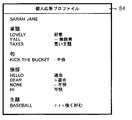
図6を参照すると、本発明の方法、システム、およびプログラムによる個人応答プロファイルの例示的表現が示されている。図からわかるように、個人応答プロファイル84は、個人について個人応答データベース70に保管された応答の例である。
【0098】
個人応答プロファイル84に保管される応答は、通信に対する実際の応答および所期の応答から収集されることができる。さらに、個人応答プロファイル84に保管される応答は、サンプル内容に対する個人の応答から収集されることができる。
【0099】
個人応答プロファイル84の例に、特定の単語、句、挨拶、および主題に対する個人の応答が示されている。代替実施形態では、内容の他のカテゴリ内の内容に対する応答を示すことができる。
【0100】
通信での誤解は、しばしば、通信の内容が、ある人にとってある意味を持ち、別の人にとって別の意味を持つ場合に生じる。たとえば、この個人は、句「kickthe bucket(くたばる)」に対して不快な形で応答するが、別の個人のプロファイルに、その個人がこの句を滑稽とみなすことが示される場合がある。
【0101】
表示される応答によって、内容のタイプに関連する感覚が示される。さらに、肯定(+)および否定(−)の記号によって、感覚の強さがさらに示される。たとえば、挨拶がないことが不快であること見つけることのほかに、この個人は、二重の否定を示して、不快の強さを示している。もう1つの例では、この個人は、野球という主題を有するすべての通信への強い興味を示す、三重の肯定を示している。図示の応答インディケータのタイプのほかに、他のタイプの応答インディケータを使用することができる。たとえば、不満/満足の応答インディケータを使用することができる。
【0102】
この例では、応答が、個人がどのように応答するか、ならびに、個人が通信で単語を使用した場合に他人がどのように応答することを意図するかに適用されると仮定される。しかし、代替実施形態では、個人が、特定のコメントを有する通信の受信にある形で応答する(予想される応答)が、同一の内容がその個人によって送信される場合に異なる応答を意図する(所期の応答)ことを指定することができる。
【0103】
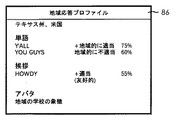
図7を参照すると、本発明の方法、システム、およびプログラムによる地域応答プロファイルの例示的表現が示されている。図からわかるように、地域応答プロファイル86は、テキサス地域について地域ベース応答データベース72に地域について保管された応答の例である。
【0104】
地域応答プロファイル86に保管される応答は、地域に関連する通信に対する実際の応答および所期の応答から収集されることができる。具体的に言うと、広い範囲の通信を分析して、地域に関する一般的な応答を統計的に判定することができる。さらに、サンプル内容に対する特定の地域の個人の応答を分析して、地域に関する一般的な応答を統計的に判定することができる。図からわかるように、統計的判定に、一般的な応答のそれぞれが提供される。
【0105】
地域は、たとえば、特定の地理的境界、市の境界、郡の境界、州の境界、国境、または大陸の境界によって定義されることができる。さらに、地域は、州の境界など、より大きい境界内のハイテク産業で働く個人のすべての「ハイテク」地域など、特性に従って定義されることができる。
【0106】
地域応答に関する通信の分析によって、異なる地域の送信側および受信側が、よりよく通信できるようになる。たとえば、図示の地域について、挨拶としての「howdy」の使用が、適当であり、友好的な挨拶として暗示される。送信側が図示の地域からであり、受信側がそうでない場合には、受信側は、友好的な挨拶としてのこの挨拶に対する所期の応答を示す通信を受信する。
【0107】
ある地域の個人が、その地域の一般的な応答と異なる場合がある。たとえば、単語「y’all」は、一般に、南部の在住者から否定的な応答を引き出さず、したがって、一般的にその地域で適当である。しかし、北部の在住者は、この単語の使用について否定的に応答する場合がある。
【0108】
身振りは、しばしば、地域に基づく意味またはエクスフォーメーション(身振りが意味を有することを知らない人には無駄な、身振りの意味に関する当事者間の共用される知識)を与えられる。たとえば、ほとんどの大学が、学校の歓呼(school cheer)とその歓呼に関連する身振りを有する。大学に基づく身振りの知識は、通常は地域的であり、互いに競争する大学は、互いの歓呼を知っている。これらの大学に基づく身振りに対する地域応答が、アバタによって実行されるときのそのような身振りに意味を追加するように指定されることは好ましい。
【0109】
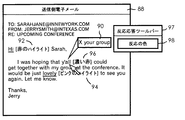
図8を参照すると、本発明の方法、システム、およびプログラムに従って提案された電子メールの例示的表現が示されている。図からわかるように、送信側電子メール88に、送信側によって提案された通信の例が含まれる。提案された電子メール通信に、送信側が特定の受信側に送信することを提案したメッセージが含まれる。
【0110】
例において、図6の個人応答プロファイル84は、所期の受信側の個人応答プロファイルを表し、図7の地域応答プロファイル86は、送信側に関する地域応答プロファイルを表す。さらに、例において、提案された電子メールのさまざまな部分が、全体的な予想される応答の分析ではなく、予想される応答について分析される。しかし、代替実施形態では、電子メールに対する全体的な予想される応答を分析することができ、あるいは、電子メールの他のさまざまな部分を、予想される応答について分析することができる。
【0111】
この例では、メッセージの提案される挨拶が、「Hi Sarah」である。符号92に示されているように、挨拶の「Hi」部分が、赤で強調表示される。例において、赤の色は、受信側が挨拶によって感情を損なわれることの予想を表す。
【0112】
異なる陰影の赤を使用して、感情を損なわれる強さを区別できることが好ましい。たとえば、符号96に示されているように、単語「y’all」が、受信側が挨拶よりもこの単語によって感情を損なわれることを予想して、濃い赤で強調表示される。単語「y’all」が感情を損なうレベルは、個人応答プロファイル84で示される。
【0113】
異なる色が、異なるタイプの応答を表すことが好ましい。たとえば、好意の予想される応答が、ピンクの強調表示によって表される。送信側電子メール88では、単語「lovely」に対する受信側の予想される応答が、好意に関するものであり、したがって、ピンクで強調表示される。各送信側または受信側は、異なる応答を表す色を指定することができ、あるいは、応答のタイプごとに標準色選択を固定することができる。
【0114】
提案された電子メールに対する予想される応答が、送信側の望む応答でない場合には、送信側は、提案された電子メールの変更に関する提案を要求することができる。送信側分析コントローラが、肯定的、否定的、または中立の結果を作る変更を判定することが好ましい。
【0115】
この実施形態によれば、送信側は、提案された電子メッセージのうちで送信側が提案を求める部分にカーソル95を位置決めすることによって、提案を要求することができる。この例では、カーソル95の位置に応答して、ポップアップ・ウィンドウ90に、提案された電子メールの調整に関する提案と、各提案に対する予想される応答が表示される。
【0116】
提案は、他の文法的提案のほかに、受信側の個人応答および送信側の地域応答に基づく。たとえば、「y’all」の使用は、送信側にとって地域的に適当であるが、所期の受信側によって無教育な単語と見なされる。しかし、「your group」という推奨は、「X」によって示されるように、中立の文法的変更提案である。中立の文法的変更提案は、否定的または肯定的な反応応答を伝えない、提案される変更である。
【0117】
さらに、送信側は、提案された電子メールに対する所期の応答を示すことができる。送信側の所期の応答は、受信側に表示される電子メール内でマークされることが好ましい。さらに、所期の応答をマークすることによって、送信側は、所期の応答に最もよく一致する予想される応答を有する提案を表示することを要求することができる。たとえば、送信側が、より真剣なメッセージを送信することを望む場合に、送信側は、メッセージの意図が真剣であることを示し、所期の受信側によって真剣と解釈されることが予想される、通信の修正された版を要求することができる。
【0118】
提案された電子メールに対する所期の応答を示すために、送信側は、色で強調表示された区域を選択解除し、意図された応答を表す色で他の強調表示される色区域を追加することができる。具体的に言うと、ツール・バー97に、反応応答強調表示用の選択可能ツール98が含まれる。送信側は、このツールと強調表示の色を選択する。有利なことに、これらの色を、反応応答の関連するタイプと共にリストすることができる。送信側が選択可能ツール98を使用する場合に、強調表示によって、特定の所期の応答が示される。受信側が選択可能ツール98を使用する場合に、強調表示によって、特定の実際の応答が示される。
【0119】
図示の例では、送信側が、薄い青色を用いて符号94に示された単語「lovely」を強調表示して、友情を示すことができる。予想される応答を表す色と異なる色で単語「lovely」を強調表示することによって、送信側が、送信側の所期の意味をその単語に適用する。受信側への電子メールの表示では、単語「lovely」が、薄い青で強調表示され、送信側が、その単語をどのように解釈しなければならないかに関する誤った伝達を消すことができるようになる。送信側は、電子メールの編集を要求することを選択することもでき、この場合に、送信側の意図をよりよく表す単語が提案される。
【0120】
図9を参照すると、本発明の方法、システム、およびプログラムによる各国言語サポート・プロファイルの例示的実施形態が示されている。図からわかるように、各国言語サポート・プロファイル100には、特定の国語に基づいて保管された応答の例が含まれる。各国言語サポートによって、アプリケーションが、複数の言語的および文化的な規約をサポートできるようになる。NLSの下で、各ユーザが、言語、国、および文化の情報を含むプロファイルを選択する。NLSシステムの通常の機能は、ユーザ・プロファイルによる表示のための日時フォーマットおよび通貨記号の交換である。
【0121】
本発明の利点によれば、NLSは、通信の内容が受信側のNSLプロファイルに従ってどのように交換されるかを予想することによって、反応応答を判定するのに使用される。さらに、本発明の利点によれば、NLSが、文化的規約以上のもののサポートを提供するように拡張される。実際の言語の規約を提供することも有利である。
【0122】
たとえば、各国言語サポート・プロファイル100は、言語として英語、国として米国に一致するプロファイルについて保管された応答の例を提供する。まず、テキスト処理のタイプに対する応答が提供される。従来のNLSは、ユーザ・プロファイルに応じた使用されるフォントの交換を提供する。しかし、フォントの処理によって、追加の通信を提供することができる。例のプロファイルでは、単語がすべて大文字である場合に、これらの単語が、通常は興奮した通信として受け取られる。単語が、すべて大文字かつ太字である場合に、これらの単語は、通常は、怒って送信された通信として受け取られる。さらに、複数の感嘆符の使用によって、通常は、通信される単語に関連する強い感情が暗示される。
【0123】
通信が、別の言語に交換される場合には、テキスト処理に関連する応答も交換されることが好ましい。たとえば、受信側の言語に、通信される単語に関連する強い感情を示すテキスト処理がある場合に、そのテキスト文字または他の記号が交換される。しかし、着色が交換可能である場合の、応答を示すための言語の着色が、テキスト処理を示すもう1つの方法である。さらに、通信が、同一の国プロファイルを有する別の人物によって受信される場合でも、通信を機能強化するために、色を介して所期の応答または予想される応答を示すことが有利である。
【0124】
同一の国言語プロファイルを有するすべてのユーザが、異なる文字、テキスト処理、アバタの身振り、およびグラフィックスに関連する微妙な意味を理解するわけではない。たとえば、各国言語サポート・プロファイル100のすべてのユーザが、文がすべて大文字でタイプされるときに、そのテキスト処理が興奮または「罵倒」通信であるとみなされることを理解するわけではない。さらに、インターネット通信規約が変更されるときに、異なる規約に対する応答を一般化するための各国言語サポートの基礎を提供することが有利である。
【0125】
各国言語サポート・プロファイル100には、特定の言語および国プロファイルに関する分析の他のカテゴリ内の内容に対する応答も含まれる。一般に、特定の言語および地域で、ある単語および句が、通常関連する応答を有する。たとえば、idiot、moron、およびzit−facedなどの単語が、定義により、軽蔑的な意味を有する。incompetentおよびhorribleなどの他の単語が、定義により、通常には強い調子で使用される。さらに、一部の言語に、関連する一般的な応答を有する熟語が含まれる。
【0126】
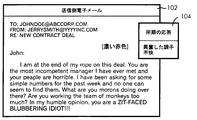
図10を参照すると、本発明の方法、システム、およびプログラムによる、全体的な反応応答分析を用いて提案された電子メールの例示的表現が示されている。図からわかるように、送信側電子メール102に、送信側から所期の受信側への提案されたメッセージが含まれる。
【0127】
例において、提案されたメッセージの内容が、図9の各国言語サポート・プロファイル100と一致するプロファイルを有する送信側に関して分析される。提案された電子メールを各国言語サポート・プロファイル100に関して分析する際に、提案された電子メールで使用されるテキスト処理、単語、および句によって、これらのタイプの内容が、使用される時に、興奮した形および感情を損なう形で意図されていることが示される。
【0128】
この例では、送信側電子メール102に使用されるウィンドウが、濃い赤に着色されて、提案された電子メールに対する所期の応答を表す。通信を含む、表示されるウィンドウまたは他のグラフィカル区域に陰影が付けられる場合に、その陰影の色によって、予想される応答、所期の応答、またはその両方を示すことができる。
【0129】
さらに、ポップアップ・ウィンドウ104で、濃い赤色の意味が具体的に指定される。具体的に言うと、全体的な所期の応答は、興奮した調子で感情を損なう形でメッセージを伝えることである。図示されていないが、全体的な所期の応答を判定するために分析される特定のテキスト処理、単語、および句も、ポップアップ・ウィンドウ104にリストするか、送信側電子メール102のテキスト内容内で特に着色することができる。さらに、ポップアップ・ウィンドウが、この例では全体的な所期の応答を表示するのに使用されるグラフィカル要素であるが、代替の例では、他のタイプの出力を使用して、メッセージ内で示される特定の着色属性に関連する全体的な所期の応答を示すことができる。
【0130】
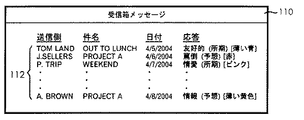
図11を参照すると、本発明の方法、システム、およびプログラムによる、応答によって分類される受信箱の例示的実施形態が示されている。図からわかるように、受信箱メッセージ・ウィンドウ110に、特定の受信側によって受信された複数のメッセージ項目112がリストされる。
【0131】
選択可能なメッセージ項目112のそれぞれによって、送信側、メッセージの件名、日付および時間スタンプ、および反応応答が示される。反応応答によって、送信側による所期の応答、受信側による予想される応答、またはその両方を示すことができる。選択可能なメッセージ項目112のどれかを選択することによって、その項目に関連するメッセージが、表示されるか再生される。
【0132】
この例では、友好的および情愛のあるものとして意図されたメッセージが示されている。さらに、罵倒メッセージとして予想されるメッセージおよび情報ベースのメッセージが示されている。代替実施形態では、代替のタイプの応答を指定することができる。
【0133】
図からわかるように、各メッセージと共に記述される反応応答は、各メッセージに関連する全体的な所期の応答または予想される応答である。しかし、代替実施形態では、各メッセージのさまざまな部分に関連する所期の応答および予想される応答を表示することができる。
【0134】
各反応応答は、さらに、反応応答を表す色によって強調表示される。たとえば、薄い青色は、友好的なメッセージに関連するが、赤色は、「罵倒」または怒りに関連する。ピンク色は、情愛のあるメッセージに関連し、薄い黄色は、情報メッセージに関連する。代替実施形態では、各メッセージ項目に関連する反応応答を具体的にリストするのではなく、各メッセージ項目を、関連する反応応答に関連する色によって強調表示することができる。
【0135】
本発明の利点として、受信側が、反応応答によってメッセージ項目をソートすることができる。たとえば、受信側は、日付/時刻または他のソート判断基準によるのではなく、各項目に関連する反応応答によるグループで、受信されたすべてのメッセージ項目をリストすることを要求することができる。したがって、情愛メッセージのすべてが、一緒にリストされる。さらに、ユーザは、特定の反応応答を有するメッセージを自動的に捨てることを選択することができ、特定の反応応答を有するメッセージを特別なフォルダに置くことができる。
【0136】
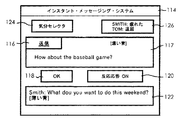
図12を参照すると、本発明の方法、システム、およびプログラムに従って識別される反応応答を有するインスタント・メッセージング・セッションの例示的実施形態が示されている。図からわかるように、インスタント・メッセージング・セッション・ウィンドウ114に、提案されるメッセージが入力されるメッセージ入力区域116と、メッセージ・セッション中のすべての入力が表示されるメッセージ・セッション区域122が含まれる。
【0137】
この例では、提案されたメッセージ117が、濃い青色で強調表示される。提案されたメッセージ117の着色によって、所期の受信側がすべての野球の話題を強く好むことが示される。
【0138】
送信側は、選択可能なボタン120の選択によって、反応応答コントローラをオンまたはオフにすることを選択することができる。反応応答コントローラがオンであるときには、送信側の提案されたメッセージが分析されて、予想される応答および所期の応答が判定される。送信側は、選択可能なボタン118の選択によって、メッセージをメッセージング・セッションへの入力として追加することを選択する前に、提案されたメッセージに対する調整を行うことができる。
【0139】
メッセージ・セッション区域122に、項目が送信された順序でメッセージング・セッションのメッセージ項目が表示されることが好ましい。反応応答を示す着色を、表示されるメッセージ項目に含めることができる。たとえば、セッションの最初の項目を、薄い青で強調表示して、友好的なメッセージを示す。
【0140】
さらに、メッセージ・セッションの各参加者が、現在の気分を示すことができる。具体的に言うと、気分セレクタ124を用いると、インスタント・メッセージング・セッションの参加者が、複数の気分の中から選択できるようになり、選択されたものが、インスタント・メッセージング・セッションに関する現在の気分のリスト126に追加される。この例では、受信側であるSmithが、疲れた気分を示し、送信側であるTomが、退屈な気分を示す。参加者は、メッセージング・セッション中に現在の気分を変更することができる。さらに、各参加者の気分は、反応応答の分析および判定で考慮に入れられる。
【0141】
ユーザが、そのユーザが参加するすべての通信で指定される現在の気分を示すことができることが好ましい。たとえば、インスタント・メッセージング・セッション・ウィンドウ114で送信側によって示される気分は、その送信側が参加する後続のチャット・セッションで自動的に更新される。チャット・セッションなど、通信に参加する複数のユーザがいる場合に、記号または色をユーザの名前に適用して、通信中にユーザによって行われる入力のそれぞれについてユーザの気分を示すことができる。
【0142】
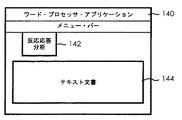
図13を参照すると、本発明の方法、システム、およびプログラムによる反応応答分析機能を有するワード・プロセッサの例示的実施形態が示されている。図からわかるように、ワード・プロセッサ・アプリケーション・ウィンドウ140に、テキスト文書144が表示される。有利なことに、ワード・プロセッシング・アプリケーションに、テキスト文書に関する反応応答を分析し、指定する、反応応答分析機能が含まれる。ユーザは、キー入力またはメニュー・リスト142からの選択によるなど、複数のタイプの入力によって反応応答分析を選択できることが好ましい。
【0143】
テキスト文書144を、テキスト文書144を受信する特定の1つまたは複数の受信側に関して、反応応答について分析することができる。さらに、テキスト文書144を、テキスト文書を受信する特定のビジネス・コンテキストに関して、反応応答について分析することができる。さらに、分析の他の基礎を選択することができる。
【0144】
分析を実行するために、ワード・プロセッシング・アプリケーションが、ネットワークを介して反応応答コントローラにアクセスすることができる。代替案では、ワード・プロセッシング・アプリケーションに、ローカル反応応答コントローラを含めることができる。
【0145】
着色をテキスト文書144に追加して、送信側および受信側のそれぞれについての予想される反応応答または所期の反応応答を表すことができる。さらに、テキスト文書144を調整する提案を行うことができる。さらに、テキスト文書が複数のユーザによって更新される場合に、テキスト文書144のそれぞれの改訂について反応応答を更新することができる。特定のテキスト処理を追加して、各ユーザに関連する反応応答を区別することができる。
【0146】
テキスト文書144について判定される反応応答および関連する着色を、テキスト文書144と共に保管することができ、テキスト文書144がその後に開かれる時に、反応応答を表す着色が表示される。さらに、ユーザは、テキスト文書内の反応応答着色をオフまたはオンにすることを選択することができる。
【0147】
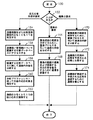
図14を参照すると、反応応答分析の処理およびプログラムの高水準論理流れ図が示されている。図からわかるように、この処理は、ブロック150で開始され、その後、ブロック152に進む。この処理ステップは、反応応答の分析を実行できるようにされたサーバまたは他のコンピュータ・システムによって実行されることができる。
【0148】
ブロック152に、入力を受け取ったかどうかに関する判定が示されている。反応応答分析の要求を受け取った場合には、処理はブロック154に移る。提案の要求を受け取った場合には、処理はブロック166に移る。所期の応答を達成するための通信の編集の要求を受け取った場合には、処理はブロック170に移る。
【0149】
まず、反応応答分析の要求は、送信側、受信側、または反応応答分析を自動的に実行するプロセスによって開始される可能性がある。反応応答分析を提供する際に、ブロック154に、送信側識別または受信側識別の少なくとも1つを判定することが示されている。識別を判定する際に、スクリーン・ネーム、識別番号、または他の識別子にアクセスすることができる。識別に関連するプロファイルもアクセス可能であることが好ましい。プロファイルには、送信側または受信側に関する、個人情報および特性を含めることができる。送信側および受信側の両方を識別することができ、反応応答分析によって、受信側の予想される応答と送信側の所期の応答の両方を作ることができる。
【0150】
次に、ブロック156に、送信側識別または受信側識別あるいはその両方による、関連する応答データベースへのアクセスが示されている。関連する応答データベースには、個人ベース、地域ベース、各国言語サポート・ベース、特性ベース、会社ベース、および基礎の他のカテゴリによって保管される反応応答を含めることができる。
【0151】
その後、ブロック158に、関連する応答データベースからの反応応答に関する通信の内容の分析が示されている。具体的に言うと、分析に、通信の単語、句、文、記号、グラフィックス、サウンド、および他の内容を、内容のさまざまなタイプに対する所期の応答および予想される応答の表示を有するデータベースとの比較を含めることができる。さらに、具体的に言うと、送信側または受信側が、通信内で実行される分析のタイプに関するプリファレンスを指定することができる。たとえば、送信側が、単語、句、および文を分析することを要求し、記号およびテキスト添付ファイルを分析することを要求しないことができる。
【0152】
次に、ブロック160に、分析プリファレンスに従って内容の反応応答を指定することが示されている。通信の内容内で、送信側または受信側によって分析について要求された内容の部分のそれぞれに関連する反応応答を指定するタグ、マーカー、または他のコマンド・インディケータを、追加または記録することができる。たとえば、XML(Extensible Markup Language)フォーマットのメッセージを、ノードに分解することができ、ここで、分析される内容を有するノードは、反応応答を示すことを意図された属性によって指定される。
【0153】
その後、ブロック162に、通信の少なくとも1つの部分の色を調整することが示され、その後、処理が終了する。有利なことに、要求元は、各反応応答の着色を表示するかどうか、全体的な反応応答の着色を表示するかどうか、または指定されたタイプの反応応答の着色を表示するかどうかに関するプリファレンスを指定する。要求元が、全体的な反応応答に関する要求を指定する場合に、着色を、通信が表示されるウィンドウまたは他の表示インターフェースのために調整することができる。具体的に言うと、反応応答が通信について判定されない場合に、着色が追加されないが、別のタイプのグラフィカル・インディケータによって、反応応答が判定されないことを示すことができる。
【0154】
具体的に言うと、通信の色は、メッセージング・サーバによって調整されることができ、あるいは、送信側または受信側によって使用されるコンピュータ・システムで調整されることができる。メッセージング・サーバは、反応応答の各タイプに関連する色を指定し、これらの指定された色に従って、通信の着色を調整する。送信側または受信側のコンピュータ・システムでは、送信側または受信側が、どの色を各反応応答に関連付けるかを個別に指定することができる。送信側は、さらに、受信側への通信で表示される通信の諸部分の色を指定することができる。
【0155】
提案の要求は、通常は、提案された通信の送信側によって、反応応答分析の要求と同時に開始される。ブロック166に、置換提案の範囲を判定するための、置換プロセスを用いる通信の内容の分析が示されている。置換プロセスには、辞書、シソーラス、文法データベース、および、内容の意味を比較し、置換として類似する意味を有する他の内容を見つけるために使用可能な他のデータベースへのアクセスが含まれる。具体的に言うと、置換プロセスでは、置換提案に対する予想される応答および所期の応答を提供するために、送信側および受信側の関連する応答データベースも使用される。
【0156】
次に、ブロック168に、置換の範囲の提案および関連する反応応答を表示するために通信を調整することが示され、その後、処理が終了する。具体的に言うと、置換の範囲の表示のために通信を調整する際に、ユーザが特定の内容の上にカーソルを位置決めすることによって開始することができるポップアップ・ウィンドウを提供することができる。代替案では、提案の範囲を、通信内の選択可能なオプションとして表示することができる。送信側は、置換の範囲から選択的に選択して、現在の内容を置換することができる。送信側からの選択に応答して、選択された置換によって、現在の内容が置換され、内容の着色が、新しいコンテキストを示すように更新される。
【0157】
編集の要求は、通常は、提案される通信の送信側によって、予想される応答を送信側によって指定される所望の所期の応答に一致させるために通信を調整する試みで開始される。通信は、既に分析されて、所期の受信側による予想される反応応答が判定されている。その後、ブロック170に、ブロック166に記載されたものなどの置換提案の範囲を判定するために、置換プロセスを用いて通信の内容を分析することが示されている。次に、ブロック172に、送信側の所期の応答を、予想される応答および置換提案の範囲と比較することが示されている。その後、ブロック174に、送信側が意図する予想される応答を達成するために通信を修正することが示され、その後、処理が終了する。具体的に言うと、置換提案の範囲が、送信側の所期の応答に一致する受信側の予想される応答を達成する可能性が最も高い提案を選択するようにフィルタリングされる。
【0158】
通信の自動編集は、広告主が特定のマーケティング・セグメントによる特定の所期の応答を有する広告材料を作成することを望む場合に、特に有利である。所期の受信側は、個人的特性、地域、国語、会社交際、または応答データベース内で指定される他のカテゴリによって指定することができるマーケティング・セグメントである。たとえば、所期の受信側が、米国中西部のマーケティング・セグメントである場合に、提案される広告材料が、中西部地域ベースの応答データベースに保管された応答を使用して分析される。提案される広告材料が、その後、所期の応答を達成するように自動的に修正される。
【0159】
本発明を、完全に機能するデータ処理システムに関して説明したが、本発明の処理を、命令のコンピュータ可読媒体の形およびさまざまな形で配布することができることと、本発明が、配布の実行に実際に使用される信号担持媒体の特定のタイプに無関係に同等に適用されることを、当業者が諒解することに留意することが重要である。コンピュータ可読媒体の例には、フロッピ(R)・ディスク、ハード・ディスク・ドライブ、RAM、CD−ROM、DVD−ROMなどの記録可能型媒体と、ディジタル通信リンク、アナログ通信リンク、たとえばラジオ周波数伝送および光波伝送などの伝送形態を使用する有線および無線の通信リンクなどの伝送型媒体が含まれる。コンピュータ可読媒体は、特定のデータ処理システムでの実際の使用のためにデコードされる、コード化されたフォーマットの形とすることができる。
【0160】
好ましい実施形態を参照して本発明を具体的に図示し、説明してきたが、形態および詳細におけるさまざまな変更を、本発明の趣旨および範囲から逸脱せずに行うことができることを、当業者は理解するであろう。
【0161】
まとめとして、本発明の構成に関して以下の事項を開示する。
【0162】
(1)通信を分析する方法であって、
通信の内容のさまざまな部分のそれぞれに関連する特定の反応応答を識別するために、前記内容の前記さまざまな部分を分析するステップと、
前記通信の前記内容の表示中に、前記特定の反応応答に関連する表示可能属性で前記さまざまな部分の任意の1つを示すステップと
を含む、通信を分析する方法。
(2)前記さまざまな部分が、単語、句、文、段落、主題、件名行、気分、緊急性インディケータ、挨拶、結び、アイコン、グラフィック、アバタの身振り、サウンド・クリップ、ビデオ・クリップ、添付文書、および前記通信の前記内容の全体の中からの少なくとも1つを含む、上記(1)に記載の通信を分析する方法。
(3)前記表示可能属性が、色、テキスト処理、スタイル処理、およびグラフィカル要素の中からの少なくとも1つを含む、上記(1)に記載の通信を分析する方法。
(4)前記反応応答が、前記通信の所期の受信側の予想される応答、前記通信の送信側の所期の応答、および前記通信に対する前記所期の受信側の実際の応答の中からの少なくとも1つを含む、上記(1)に記載の通信を分析する方法。
(5)前記通信の前記内容内でマークされた前記表示可能属性と共に前記通信を受信側に送信するステップ
をさらに含む、上記(1)に記載の通信を分析する方法。
(6)送信側への前記内容の前記表示中に、前記通信を受信側に送信する前に、前記さまざまな部分のどれかに関連する前記表示可能属性を示すステップ
をさらに含む、上記(1)に記載の通信を分析する方法。
(7)送信側が、前記表示可能属性表示を選択的に選択解除できるようにし、受信側への送信について前記通信に表示可能属性表示を選択的に追加できるようにするステップ
をさらに含む、上記(1)に記載の通信を分析する方法。
(8)前記通信の受信側に、ディスプレイ内で前記表示可能属性表示を示すステップ
をさらに含む、上記(1)に記載の通信を分析する方法。
(9)通信の内容のさまざまな部分を分析するステップが、
通信の内容のさまざまな部分を、内容の選択されたタイプに応答して少なくとも1つの所期の受信側の予想される応答を指定した少なくとも1つの応答データベースと比較するステップ
をさらに含む、上記(1)に記載の通信を分析する方法。
(10)前記少なくとも1つの応答データベースが、個人応答データベース、地域応答データベース、各国言語サポート応答データベース、会社応答データベース、および特性応答データベースの中からの少なくとも1つを含む、上記(9)に記載の通信を分析する方法。
(11)前記通信が、文書、電子通信、音声通信、ビデオ通信、およびグラフィカル通信の中からの少なくとも1つである、上記(1)に記載の通信を分析する方法。
(12)所望の予想される応答が達成されるまで、繰り返して、ユーザから前記通信の前記内容の編集された改訂を受け取り、内容の前記さまざまな部分のそれぞれを調整するステップ
をさらに含む、上記(1)に記載の通信を分析する方法。
(13)前記内容の前記さまざまな部分のどれかに関する置換提案の範囲を判定するステップと、
前記内容の選択可能な置換として置換提案の前記範囲を前記ディスプレイに示すステップと
をさらに含む、上記(1)に記載の通信を分析する方法。
(14)前記内容の前記さまざまな部分に対する所期の応答の指定を検出するステップと、
前記少なくとも1つの所期の受信側からの予想される応答としての所期の応答の前記指定を達成するために、前記内容の前記さまざまな部分について置換を判定するステップと
をさらに含む、上記(1)に記載の通信を分析する方法。
(15)通信を分析するシステムであって、前記システムが
ネットワークに接続されたコンピュータ・システム
を含み、前記コンピュータ・システムが、さらに、
前記通信の内容のさまざまな部分のそれぞれに関連する特定の反応応答を識別するために、前記内容の前記さまざまな部分を分析する手段と、
前記通信の前記内容の表示中に、前記特定の反応応答に関連する表示可能属性で前記さまざまな部分の任意の1つを示す手段と
を含む、通信を分析するシステム。
(16)前記さまざまな部分が、単語、句、文、段落、主題、件名行、気分、緊急性インディケータ、挨拶、結び、アイコン、グラフィック、アバタの身振り、サウンド・クリップ、ビデオ・クリップ、添付文書、および前記通信の前記内容の全体の中からの少なくとも1つを含む、上記(15)に記載の通信を分析するシステム。
(17)前記表示可能属性が、色、テキスト処理、スタイル処理、およびグラフィカル要素の中からの少なくとも1つを含む、上記(15)に記載の通信を分析するシステム。
(18)前記反応応答が、前記通信の所期の受信側の予想される応答、前記通信の送信側の所期の応答、および前記通信に対する前記所期の受信側の実際の応答の中からの少なくとも1つを含む、上記(15)に記載の通信を分析するシステム。
(19)前記通信の前記内容内でマークされた前記表示可能属性と共に、メッセージング・システムを介して前記通信を受信側に転送する手段
をさらに含む、上記(15)に記載の通信を分析するシステム。
(20)送信側への前記内容の前記表示中に、前記通信を受信側に送信する前に、前記さまざまな部分のどれかに関連する前記表示可能属性を示す手段
をさらに含む、上記(15)に記載の通信を分析するシステム。
(21)送信側が、前記表示可能属性表示を選択的に選択解除できるようにし、受信側への送信について前記通信に表示可能属性表示を選択的に追加できるようにする手段
をさらに含む、上記(15)に記載の通信を分析するシステム。
(22)前記通信の受信側のディスプレイ内に前記表示可能属性表示を示す手段
をさらに含む、上記(15)に記載の通信を分析するシステム。
(23)通信の内容のさまざまな部分を分析する前記手段が、
通信の内容のさまざまな部分を、内容の選択されたタイプに応答して少なくとも1つの所期の受信側の予想される応答を指定した少なくとも1つの応答データベースと比較する手段
をさらに含む、上記(15)に記載の通信を分析するシステム。
(24)前記少なくとも1つの応答データベースが、個人応答データベース、地域応答データベース、各国言語サポート応答データベース、会社応答データベース、および特性応答データベースの中からの少なくとも1つを含む、上記(23)に記載の通信を分析するシステム。
(25)前記通信が、文書、電子通信、音声通信、ビデオ通信、およびグラフィカル通信の中からの少なくとも1つである、上記(15)に記載の通信を分析するシステム。
(26)所望の予想される応答が達成されるまで、繰り返して、ユーザから前記通信の前記内容の編集された改訂を受け取り、内容の前記さまざまな部分のそれぞれを調整する手段
をさらに含む、上記(15)に記載の通信を分析するシステム。
(27)前記内容の前記さまざまな部分のどれかに関する置換提案の範囲を判定する手段と、
前記内容の選択可能な置換として置換提案の前記範囲を前記ディスプレイに示す手段と
をさらに含む、上記(15)に記載の通信を分析するシステム。
(28)前記内容の前記さまざまな部分に対する所期の応答の指定を検出する手段と、
前記少なくとも1つの所期の受信側からの予想される応答としての所期の応答の前記指定を達成するために、前記内容の前記さまざまな部分について置換を判定する手段と
をさらに含む、上記(15)に記載の通信を分析するシステム。
(29)通信を分析するコンピュータ・プログラム製品であって、
記録媒体と、
通信の内容のさまざまな部分のそれぞれに関連する特定の反応応答を識別するために、前記内容の前記さまざまな部分を分析する、前記記録媒体に記録された手段と、
前記通信の前記内容の表示中に、前記特定の反応応答に関連する表示可能属性で前記さまざまな部分の任意の1つを示す、前記記録媒体に記録された手段と
を含む、コンピュータ・プログラム製品。
(30)前記通信の前記内容内でマークされた前記表示可能属性と共に、メッセージング・システムを介して前記通信を受信側に転送する、前記記録媒体に記録された手段
をさらに含む、上記(29)に記載の通信を分析するコンピュータ・プログラム製品。
(31)送信側への前記内容の前記表示中に、前記通信を受信側に送信する前に、前記さまざまな部分のどれかに関連する前記表示可能属性を示す、前記記録媒体に記録された手段
をさらに含む、上記(29)に記載の通信を分析するコンピュータ・プログラム製品。
(32)送信側が、前記表示可能属性表示を選択的に選択解除できるようにし、受信側への送信について前記通信に表示可能属性表示を選択的に追加できるようにする、前記記録媒体に記録された手段
をさらに含む、上記(29)に記載の通信を分析するコンピュータ・プログラム製品。
(33)前記通信の受信側にディスプレイ内で前記表示可能属性表示を示す、前記記録媒体に記録された手段
をさらに含む、上記(29)に記載の通信を分析するコンピュータ・プログラム製品。
(34)通信の内容のさまざまな部分を、内容の選択されたタイプに応答して少なくとも1つの所期の受信側の予想される応答を指定した少なくとも1つのデータベースと比較する、前記記録媒体に記録された手段
をさらに含む、上記(29)に記載の通信を分析するコンピュータ・プログラム製品。
(35)所望の予想される応答が達成されるまで、繰り返して、ユーザから前記通信の前記内容の編集された改訂を受け取り、内容の前記さまざまな部分のそれぞれを調整する、前記記録媒体に記録された手段
をさらに含む、上記(29)に記載の通信を分析するコンピュータ・プログラム製品。
(36)前記内容の前記さまざまな部分のどれかに関する置換提案の範囲を判定する、前記記録媒体に記録された手段と、
前記内容の選択可能な置換として置換提案の前記範囲を前記ディスプレイに表示する、前記記録媒体に記録された手段と
をさらに含む、上記(29)に記載の通信を分析するコンピュータ・プログラム製品。
(37)前記内容の前記さまざまな部分に対する所期の応答の指定を検出する、前記記録媒体に記録された手段と、
前記少なくとも1つの所期の受信側からの予想される応答としての所期の応答の前記指定を達成するために、前記内容の前記さまざまな部分について置換を判定する、前記記録媒体に記録された手段と
をさらに含む、上記(29)に記載の予想される反応について通信を分析するコンピュータ・プログラム製品。
(38)通信の全体的な応答を分析する方法であって、
特定の通信の内容のさまざまな部分のそれぞれに関連する反応応答を識別するために、前記内容の前記さまざまな部分を分析するステップと、
前記内容の前記さまざまな部分のそれぞれに関連する前記反応応答のそれぞれを表す、前記特定の通信の前記内容に関連する全体的な反応応答を判定するステップと、
受信側によって受信される複数の通信のリストの表示中に、前記全体的な反応応答に関連する色によって前記特定の通信に対する前記全体的な反応応答を示すステップと
を含む、通信の全体的な応答を分析する方法。
(39)文書に関する全体的な反応応答を分析する方法であって、
ワード・プロセッシング・アプリケーションで開かれた文書の内容のさまざまな部分のそれぞれに関連する反応応答を識別するために、前記内容の前記さまざまな部分を分析するステップと、
前記文書の表示内に、識別された前記反応応答の選択に関連する色によって前記内容の前記さまざまな部分に対する識別された前記反応応答のいかなる前記選択も示すステップと
を含む、文書に関する全体的な反応応答を分析する方法。
(40)反応応答に基づいて通信を配布する方法であって、
特定の通信の内容のさまざまな部分のそれぞれに関連する反応応答を識別するために、前記内容の前記さまざまな部分を分析するステップと、
識別された前記反応応答について指定される特定の通信出力インターフェースに前記特定の通信を転送するステップと
を含む、反応応答に基づいて通信を配布する方法。
(41)前記特定の通信出力インターフェースが、インスタント・メッセージング・インターフェース、電子メール・インターフェース、チャット・ルーム・インターフェース、テレフォニ・デバイス・インターフェース、およびポケットベル・インターフェースの中からの少なくとも1つを含む、上記(40)に記載の反応応答に基づいて通信を配布する方法。
(42)反応応答に基づいて通信を配布するシステムであって、
ネットワークに接続されたコンピュータ・システム
を含み、前記コンピュータ・システムが、さらに、
特定の通信の内容のさまざまな部分のそれぞれに関連する反応応答を識別するために、前記内容の前記さまざまな部分を分析する手段と、
識別された前記反応応答について指定される特定の通信出力インターフェースに前記特定の通信を転送する手段と
を含む、反応応答に基づいて通信を配布するシステム。
(43)前記転送する手段が、
インスタント・メッセージング・インターフェース、電子メール・インターフェース、チャット・ルーム・インターフェース、テレフォニ・デバイス・インターフェース、およびポケットベル・インターフェースの中からの少なくとも1つを含む前記特定の通信出力インターフェースに、前記特定の通信を転送する手段をさらに含む、上記(42)に記載の反応応答に基づいて通信を配布するシステム。
(44)反応応答に基づいて通信を配布するコンピュータ・プログラム製品であって、
記録媒体と、
特定の通信の内容のさまざまな部分のそれぞれに関連する反応応答を識別するために、前記内容の前記さまざまな部分を分析する、前記記録媒体に記録された手段と、
識別された前記反応応答について指定される特定の通信出力インターフェースに前記特定の通信を転送する、前記記録媒体に記録された手段と
を含む、反応応答に基づいて通信を配布するコンピュータ・プログラム製品。(45)インスタント・メッセージング・インターフェース、電子メール・インターフェース、チャット・ルーム・インターフェース、テレフォニ・デバイス・インターフェース、およびポケットベル・インターフェースの中からの少なくとも1つを含む前記特定の通信出力インターフェースに、前記特定の通信を転送する、前記記録媒体に記録された手段
を含む、上記(44)に記載の反応応答に基づいて通信を配布するコンピュータ・プログラム製品。
(46)通信を作成する方法であって、
特定の受信側のために意図された提案される通信に対する前記特定の受信側による予想される応答を判定するために、前記通信の内容のさまざまな部分を分析するステップと、
前記特定の受信側による予想される応答が、前記通信に対する所期の応答と一致する、修正された通信を指定するために、前記予想される応答に応答して前記通信を自動的に編集するステップと
を含む、通信を作成する方法。
(47)前記通信が、広告主のための広告材料の一部であり、前記所期の受信側が、特定のマーケット・セグメントである、上記(46)に記載の通信を作成する方法。
(48)前記通信の内容のさまざまな部分を分析するステップが
前記通信の内容の前記さまざまな部分を、内容の選択されたタイプに応答して前記所期の受信側の予想される応答を指定したデータベースと比較するステップ
をさらに含む、上記(46)に記載の通信を作成する方法。
(49)通信を作成するシステムであって、
ネットワークに接続されたコンピュータ・システム
を含み、前記コンピュータ・システムが、さらに、
特定の受信側のために意図された提案される通信に対する前記特定の受信側による予想される応答を判定するために、前記通信の内容のさまざまな部分を分析する手段と、
前記特定の受信側による予想される応答が、前記通信に対する所期の応答と一致する、修正された通信を指定するために、前記予想される応答に応答して前記通信を自動的に編集する手段と
を含む、通信を作成するシステム。
(50)前記通信が、広告主のための広告材料の一部であり、前記所期の受信側が、特定のマーケット・セグメントである、上記(49)に記載の通信を作成するシステム。
(51)前記通信の内容のさまざまな部分を分析する前記手段が
前記通信の内容の前記さまざまな部分を、内容の選択されたタイプに応答して前記所期の受信側の予想される応答を指定したデータベースと比較する手段
をさらに含む、上記(49)に記載の通信を作成するシステム。
(52)通信に対するユーザ応答を反映する方法であって、
前記通信に関連する少なくとも1人のユーザによる前記通信の内容に対する少なくとも1つの反応応答を示す前記通信を検出するステップと、
前記通信の前記内容と共に表示可能属性によって前記少なくとも1つの反応応答を示す前記通信をグラフィカルに表示するステップと
を含む、通信に対するユーザ応答を反映する方法。
【図面の簡単な説明】
【図1】本発明の方法、システム、およびプログラムを使用することができるコンピュータ・システムの実施形態を示す図である。
【図2】本発明の方法、システム、およびプログラムに従って電子メッセージングが通常に行われるクライアント/サーバ環境の単純化されたブロック図である。
【図3】本発明の方法、システム、およびプログラムによるメッセージング・システム・サーバのブロック図である。
【図4】本発明の方法、システム、およびプログラムによる反応応答コントローラおよび反応応答コントローラによってアクセスされる応答データベースのブロック図である。
【図5】本発明の方法、システム、およびプログラムによる通信の分析のカテゴリの例示的表現を示す図である。
【図6】本発明の方法、システム、およびプログラムによる個人応答プロファイルの例示的表現を示す図である。
【図7】本発明の方法、システム、およびプログラムによる地域応答プロファイルの例示的表現を示す図である。
【図8】本発明の方法、システム、およびプログラムに従って提案された電子メールの例示的表現を示す図である。
【図9】本発明の方法、システム、およびプログラムによる各国言語サポート・プロファイルの例示的実施形態を示す図である。
【図10】本発明の方法、システム、およびプログラムによる、全体的な反応応答分析を用いて提案された電子メールの例示的表現を示す図である。
【図11】本発明の方法、システム、およびプログラムによる、応答によって分類される受信箱の例示的実施形態を示す図である。
【図12】本発明の方法、システム、およびプログラムに従って識別される反応応答を有するインスタント・メッセージング・セッションの例示的実施形態を示す図である。
【図13】本発明の方法、システム、およびプログラムによる反応応答分析機能を有するワード・プロセッサの例示的実施形態を示す図である。
【図14】反応応答分析の処理およびプログラムの高水準論理流れ図である。
【符号の説明】
42 メッセージング・サーバ
50 メッセージング・コントローラ
52 転送済みメッセージ・データベース
54 反応応答コントローラ
56 応答データベース
58 メッセージ保管コントローラ
60 コンテキスト検索可能データベース[0001]
TECHNICAL FIELD OF THE INVENTION
The present invention relates generally to messaging communications, and in particular, to providing context for the content of messaging communications. More specifically, the invention relates to displaying the content of a communication via a reaction response associated with the context of the communication.
[0002]
[Prior art]
As the Internet and telephony evolve, so does the ease of communication between individuals at different locations. However, with concurrent or delayed electronic communications, much of the detectable content available during a face-to-face conversation is reduced or eliminated.
[0003]
During face-to-face conversations, more than just word-based conversations are usually conveyed. The combination of "language" and "non-language" information provides a context for the content of the communication. The linguistic information can include, for example, sound, tone, and volume. Non-verbal information can be exchanged, for example, via eye contact, gestures, facial movements, and body language. For example, a speaker can observe the listener's response and determine the sentiment of the response to the spoken words. Further, the speaker may be able to observe the listener and receive non-verbal clues as to whether the listener understood the speaker's words. In addition, the listener can observe the speaker's movement and tone to better understand the type of emotion that the speaker is trying to convey.
[0004]
Without the elements of the communication being faced, linguistic and non-verbal information that provides context for the communication content is often lost or removed. Without these integrated parts of the communication, there is a high probability of misunderstanding in the communication. For example, misunderstandings may be greater due to cultural differences that are not immediately apparent in the absence of a facing communication. In addition, there may be misunderstandings about the emotions generated or received in a communication that would not be quickly corrected without a concurrent communication in the face.
[0005]
For example, electronic mail messages provide a valuable type of electronic communication, but do not provide concurrent communication in the face. The person sending the e-mail message does not have the benefit of observing the recipient's body language in response to reading the e-mail message and determining whether the recipient understood the communication. In addition, the recipient of the e-mail message may affect the way the sender chooses to communicate the content, such as age, gender, ethnic background, status, geographic location, or other background information. You may not know completely. Further, the recipient does not have the benefit of looking at the sender and determining the emotional context in which the sender writes the email message. Although the sender is only disappointed, the use of words associated with anger by the recipient can cause misunderstandings in what the sender wrote.
[0006]
Thus, in view of the foregoing, it would be advantageous to provide a method, system, and program for including an electronic communication context within an electronic communication. In addition, indicating to the sender the expected response to the communication by the intended receiver before sending the message, so that the sender has the opportunity to adjust the communication or adjust the indicated context of the content of the communication. It is advantageous. In addition, it is advantageous to show the intended context of the communication to the recipient and record the actual response to the communication by the recipient.
[0007]
[Problems to be solved by the invention]
In view of the foregoing, it is an object of the present invention to provide an improved messaging communication.
[0008]
It is another object of the present invention to provide a method, system, and program for providing context for the content of a messaging communication.
[0009]
It is another object of the present invention to provide a method, system, and program for indicating the context of a communication via a reaction response related to the content of the communication.
[0010]
[Means for Solving the Problems]
According to one aspect of the invention, various portions of the content of the communication are analyzed to identify particular reaction responses associated with each of the various portions of the content. During the display of the content of the communication, the coloring in any of the various parts indicates the relevant response of the communication and provides the context of the communication.
[0011]
According to another aspect of the invention, various portions of the content of the communication are analyzed to identify expected responses by at least one intended recipient. During the display of the content of the communication, the colors associated with the expected response are shown in various parts of the content. The sender can edit the content of the communication to achieve the desired expected response.
[0012]
All objects, features and advantages of the present invention will become apparent in the following detailed written description.
[0013]
The novel features believed characteristic of the invention are set forth in the following claims. However, the invention itself, as well as preferred aspects, further objects and advantages of its use, are best understood by referring to the following detailed description of illustrative embodiments when read in conjunction with the accompanying drawings.
[0014]
BEST MODE FOR CARRYING OUT THE INVENTION
Provided are a method, a system, and a program for indicating a response response related to the content of a communication. In a preferred embodiment, the response is indicated according to the color in the communication. However, in alternative embodiments, the reaction response may be indicated via other displayable attributes such as text, graphics, icons, images, or sounds, as will be appreciated by those skilled in the art. The font, font size, font style, subscripts, superscripts, and other text processing of the text can be changed to indicate a responsive response. In addition, translucent overlays, gradient bars, and other graphical elements can be used to indicate the response.
[0015]
Communications can include, but are not limited to, documents, electronic communications, audio communications, video communications, graphical communications, and other communications over graphics-based media. Documents can include, but are not limited to, text documents, handwriting, book text, software code, and other types of alphanumeric and graphical-based files. Electronic communications may include, but are not limited to, email, instant messaging, chat room communications, two-way text messaging, transcribed messaging, vibration-to-vibration messaging, and other network-enabled communications. . Voice communications can include voice messaging, telephony, teleconferencing, and other voice-based communication methods. Video communication can include, but is not limited to, video conferencing, video messaging, and other video-based communication methods.
[0016]
In a preferred embodiment of the invention, the communication is transferred over the network between at least one sender and at least one receiver. However, communications can also be transferred via data storage media or other platforms. Further, communications over a network can be simultaneous or delayed.
[0017]
Any type of communication content can include, but is not limited to, text, icons, video images, sounds, graphics, avatar gestures, and other types of output. According to an advantage of the present invention, the context of the content of a communication is provided by a response response of the content.
[0018]
The response can be analyzed, for example, for a selected portion of the communication, various portions of the communication, the entire communication, or multiple communications. The response may be identified for a selected portion of the communication, various portions of the communication, the entire communication, or multiple communications.
[0019]
The response response can include, but is not limited to, the expected response of the receiver, the expected response of the sender, and the actual response of the receiver. The sender can be provided with the expected response of the receiver for the proposed communication. In addition, the sender can provide an intended response for the proposed communication, or the analysis of the content of the communication can be an intended response. Expected and / or expected responses can be sent with the communication to provide additional context to the recipient. Further, the receiver can indicate the actual response to the communication. The actual response can be cataloged and stored, returned to the sender along with the communication, or both.
[0020]
The context of the communication is given by the content of the communication and the response to the communication. Preferably, the context gives the sender and the recipient an enhanced understanding of the content intended to be conveyed and a form in which the content is understood.
[0021]
In the following description, for purposes of explanation, numerous specific details are set forth in order to provide a thorough understanding of the present invention. However, it will be apparent to one skilled in the art that the present invention may be practiced without these specific details. In other instances, well-known structures and devices are shown in block diagram form in order not to obscure the present invention unnecessarily.
[0022]
Hardware overview
The invention can be implemented with various systems, including various computer systems and electronic devices on a number of different operating systems. In one embodiment of the present invention, the computer system also incorporates a notebook computer, a palmtop computer, a personal digital assistant, a telephone, or telephony, enhanced telephony, messaging, and communication capabilities to provide information services. Portable computer systems, such as other electronic computer systems that can. However, the computer system can be, for example, a desktop computer, a network computer, a midrange computer, a server system, or a mainframe computer. Accordingly, it is generally preferred that the invention be implemented in a computer system that performs computing tasks, such as manipulating data in storage accessible by the computer system. Further, the computer system preferably includes at least one output device and at least one input device.
[0023]
Referring now to the drawings, and more particularly to FIG. 1, there is shown one embodiment of a computer system in which the methods, systems, and programs of the present invention may be advantageously employed.
[0024]
During normal operation, the
[0025]
The present invention provides computer-executable instructions used to program
[0026]
In addition, the present invention can be downloaded as a computer program product that transfers program instructions to a carrier or other device via a network link 34 (eg, a modem or network connection) to a
[0027]
The
[0028]
Further, a plurality of peripheral components can be added to the
[0029]
Messaging system context
Referring to FIG. 2, there is shown a simplified block diagram of a client / server environment in which electronic messaging communications typically take place according to the methods, systems, and programs of the present invention. The client / server environment is implemented in a number of network architectures. For example, the architecture of the World Wide Web (Web) follows a traditional client / server model environment.
[0030]
The terms "client" and "server" are used to refer to the general role of a computer as a data requestor (client) or a data provider (server). In a web environment, a web browser, such as Netscape Navigator, typically resides on the client messaging systems 40a-40n and renders web documents (pages) served by at least one messaging server, such as
[0031]
The web can refer to an entire set of interlinked hypertext documents residing on servers worldwide. A
[0032]
The sender enters a message via a one of messaging input /
[0033]
Advantageously, the sender can propose a message to be sent to other users participating in the messaging session or to a particular recipient. The messaging server analyzes the proposed message to identify expected responses associated with the content of the proposed message. The expected response is identified in the proposed message and marked by a color, which can be displayed using an input / output device. The expected response may be indicated for each user participating in the messaging session, for a group of users, or for a particular recipient. The expected response can be attached to the message by the
[0034]
Before sending the message to the recipient, the sender can edit the content of the proposed message to achieve the desired expected response. General editing of the proposal is provided by the
[0035]
The sender can indicate the overall intended response for the message, identified in the message by color. For example, the sender can indicate that the sender was happy when writing the message. The background color of the message can be changed to yellow to show a pleasant mood.
[0036]
In addition, the sender can select portions of the message and indicate the intended response for each of the sections. For example, the sender must state that the greeting is intended to be cordial, that the first paragraph gives knowledge, that the second paragraph is written with enthusiasm, and that the closing is polite. Is intended, where the intended response is color coded in the message.
[0037]
The intended response can also be determined by the
[0038]
When the
[0039]
Further, the
[0040]
[0041]
In this embodiment, the
[0042]
Further, while this embodiment describes the transmission of communications with respect to a simultaneously occurring or delayed messaging system platform, alternative embodiments support messaging and other types of communications with other types of platforms. can do. For example, communication can be transmitted over a conventional wireline telephone network, wireless network, data storage media, and other platforms for transmitting information.
[0043]
Referring to FIG. 3, a block diagram of a messaging system server according to the method, system, and program of the present invention is shown. As can be seen,
[0044]
The
[0045]
The
[0046]
The message communication transferred from at least one sender to at least the receiver, controlled by the
[0047]
The
[0048]
A
[0049]
The forwarded
[0050]
Referring to FIG. 4, there is shown a block diagram of a method, system, and programmatic response controller of the present invention and a response database accessed by the response controller. As can be seen, the
[0051]
Preferably, the
[0052]
In addition, the
[0053]
The
[0054]
According to another function, the
[0055]
In the analysis of the message communication to determine the response, the sending
[0056]
In analyzing the message for a response response, the
[0057]
The identifiers of the sender and receiver of the communication are included in the communication. From the sender identifier and the receiver identifier, a personal profile can be accessed. Personal profile information can include, but is not limited to, name, region of birth, national language, company dating, membership, and personal characteristics.
[0058]
A personal profile accessible by the
[0059]
Examples of databases that are components of the
[0060]
The
[0061]
The intended response by the individual to the communication is collected from the sender-specified expected response specified by the sender in a previous communication. Further, the intended response by the individual can be gathered from pre-recorded responses for the particular individual to the sample content.
[0062]
The region-based
[0063]
The
[0064]
According to an advantage of the present invention, the NLS is further used to determine a response response by anticipating how the content of the communication will be exchanged according to the receiving party's NSL profile. Further, according to an advantage of the present invention, the NLS is extended to provide support for more than cultural conventions. It would also be advantageous to provide actual language conventions. Thus, the
[0065]
The company-based
[0066]
A general response based on personal characteristics is stored in the characteristic-based
[0067]
The chat room-based
[0068]
In addition to the
[0069]
The sender can also access the weighted communication history values for the set of communications between others. For example, if the sender abuses the receiver one week ago in a communication to the receiver's boss, the sender determines the weighted communication history value for the communication between the sender and the receiver after the date of the abusive email. Can be requested. The “swearing” mail is usually a mail indicating that communication with anger is transmitted.
[0070]
The average weighted communication history value of the communication received by the receiver from the sender gives the sender more information about the criteria by which the receiver reads future communications from the sender. Further, based on the average weighted communication history value, the sender can attempt to adjust the average weighted communication history value between the sender and the receiver to adjust the communication. The company may provide incentives for employees to communicate with each other and with customers to achieve communication of an average weighted communication history value within a specified range.
[0071]
The sending
[0072]
The
[0073]
The sample content can be presented to the sender or receiver via multiple communication media. For example,
[0074]
Individuals responding to the sample content can specify a preferred level of privacy regarding the individual's response. For example, an individual is semi-published to a system whose response is publicly available, passes the required criteria, and is only semi-public to other individuals, organizations, and companies designated by that individual. Or, it can be specified that only individuals, organizations, or companies specifically requesting to respond to the sample content are privately available. Specifically, for semi-public privacy, network providers provide individuals, organizations, companies, and other network providers with certain security and reliability infrastructure to provide individuals with access to expected responses. You may be required to prove that it is being performed to receive.
[0075]
The sample content used by the
[0076]
In addition, the company can provide sample content used by the
[0077]
Further, the ISP can design the sample content to obtain the expected response from the customer or anything that communicates with the customer via its services. Specifically, the ISP can design the sample content to determine the type of information that individual users and users in general consider as spam or other unwanted communications. Based on personal and general responses to sample content, the ISP can better filter unwanted communications from reaching the customer.
[0078]
Sample content can be designed for focus groups to anticipate responses to specific promotional communications before distribution to a wider audience. A focus group can include individuals who have agreed to be part of the focus group and those individuals determined by market research to meet the ideal characteristics of the focus group.
[0079]
The
[0080]
Referring to FIG. 5, there is shown an exemplary representation of selectable categories of communication analysis by the methods, systems, and programs of the present invention. An example of a content type 83 that can be analyzed in the communication is shown in the
[0081]
First, the words included in the communication can be compared with the specific words specified in the personal response database for expected responses. Specifically, when the communication is translated by a translation application, the translation application, when selecting how to translate a particular word, sends the expected response to that word at the sender's location. Compare with specific words for period response.
[0082]
Further, it is advantageous to analyze the phrases of the communication. Specifically, idioms in a single language can change quickly from one region to another, and speakers of one language in one region may not be able to understand the meaning of a idiom spoken in another region. May have a different response to the idiom than intended.
[0083]
Analysis of entire sentences and paragraphs is advantageous. For example, rather than picking individual words, the sender may indicate the overall intended response to the entire sentence and the entire paragraph. Further, the analysis controller can determine the overall tone of the sentence or paragraph depending on the type of words and phrases in the sentence and paragraph.
[0084]
For each type of communication, there are unique characteristics of that communication that provide additional content for the communication. For example, an email has a subject line written by the sender. Often, recipients use the subject line to determine the order in which emails are opened. Also, the recipient may identify certain types of subject lines as indicating unwanted mail and automatically remove such emails from the view. Advantageously, the subject line of the proposed email can be analyzed to determine an expected response to such a subject line.
[0085]
Email often has the additional attribute of urgency settings. The sender can indicate whether the message is of normal importance, urgent or extremely urgent. Further, the present invention allows a user to indicate a timely urgency for an email that needs to be read or answered by the deadline. Urgency settings can be provided if these urgency settings are supported when the e-mail is shown in the receiving e-mail box. This setting enhances the content of the e-mail. However, what is extremely urgent for one person may have only limited urgency for another person, and thus can cause false communication or frustration. In addition, it is a sender's habit to designate all emails as urgent, and such choices may be made if the recipient realizes over time that emails from a particular sender will always be urgent. May be less effective.
[0086]
The present invention enhances communications by providing purpose settings for all types of communications in addition to the urgency settings that may be available for particular types of communications. The purpose setting allows the sender to indicate that the communication is for business, personal, or other type of purpose.
[0087]
In addition, the sender can indicate the general emotion or mood when the communication is sent by analyzing the content of the communication or based on the sender's selection. The framework by which the intended receiver understands the goal setting can be predicted by analysis. The current mood for the intended recipient can be accessed from the mood specified by the intended recipient in the current communication or another communication session.
[0088]
Greetings and closings can be included in certain areas of the words and phrases analyzed. Analyze the communication proposed by the employee to senior management to determine, for example, whether the greeting and closing of the proposed communication is sufficiently polite for that particular senior management can do. When the communication is received and the recipient chooses to translate the communication, the greetings and closings are preferably translated according to the sender's intended response to these greetings. For example, the sender may wish to make greetings and closings work-friendly.
[0089]
Additional content can be provided to the communication via graphics, sound, and video. Icons such as emoticons are often used in communications to indicate sentiment-related emotions. For example, a sentence that is a joke can be followed by a smiling emoticon that indicates to some readers that the sentence is a joke. However, different recipient responses to different emoticons and other icons can vary widely depending on region, country, experience with Internet-based communication, age, and other factors. A winking emoticon may be perceived as frivolous by one recipient and received as a joke by another recipient.
[0090]
Some types of communication provide a graphical or video-based avatar that represents participants in the communication. Avatars are typically displayed in more instantaneous types of communications, such as instant messaging and chat rooms, but are not limited to these types of communications. Avatars typically gesture, speak text provided by each participant, and move through display areas during communication. The participant can select the gesture he wants the avatar to perform, or the avatar can automatically make a gesture from a range of available gestures. Advantageously, the participant can select the desired emotion for the avatar to gesture. Further, the present invention can determine the expected response of a participant to a gesture and provide it to other participants to enhance communication.
[0091]
The sound, video, and graphic content provided in the communication is analyzed to determine a response. The sound content may include a voicemail, sound clip, or other audio attachment. The expected and expected response to the sound content is performed, for example, by adjusting the tone of the sound, the volume of the sound, or other attributes of the sound to enhance its meaning. Analysis of the sound content can be performed by converting the sound content attachment to text and analyzing the text. In addition, video and graphic content can be similarly converted and analyzed. A video can also be analyzed by analyzing ratings associated with the video and by analyzing the types of images contained in the video.
[0092]
Advantageous features of electronic communications include the ability to attach documents to communications. For example, the sender can attach a text file, sound file, graphic file, or video file to the email message. Advantageously, the content of the attachment is analyzed by converting the attachment to its text equivalent, if necessary.
[0093]
In addition, the
[0094]
In determining the overall response response for a communication, a weighted history value for the current communication can be determined. Specifically, each word, sentence, paragraph, page, chapter, and other part of the message is weighted by the word, sentence, paragraph, page, chapter, and other parts before the message, Determines whether the context of the current part is changed by the contents of the previous part. For example, if the first paragraph of the communication is hostile, then the response response value assigned to the first paragraph, even though other subsequent paragraphs themselves are not read as hostile, the A response response value determined for another paragraph in consideration of hostility can be weighted.
[0095]
In addition, the
[0096]
The
[0097]
Referring to FIG. 6, an exemplary representation of a personal response profile according to the method, system, and program of the present invention is shown. As can be seen,
[0098]
The responses stored in the
[0099]
The example
[0100]
Misunderstandings in communication often arise when the content of the communication has a certain meaning for one person and another for another person. For example, the individual may respond in an unpleasant way to the phrase "kickthe bucket", but the profile of another individual may indicate that the individual considers the phrase humorous.
[0101]
The displayed response indicates the sensation associated with the type of content. In addition, positive (+) and negative (-) symbols further indicate the strength of the sensation. For example, besides finding that absence of a greeting is unpleasant, this individual shows double denial and shows the strength of the discomfort. In another example, the individual has shown a triple affirmation, indicating a strong interest in all communications having the subject of baseball. In addition to the types of response indicators shown, other types of response indicators can be used. For example, a dissatisfied / satisfied response indicator can be used.
[0102]
In this example, it is assumed that the response applies to how the individual responds and how others intend to respond if the individual used the word in a communication. However, in an alternative embodiment, the individual responds in some way to the receipt of the communication with the particular comment (expected response), but intends a different response if the same content is sent by the individual ( Expected response).
[0103]
Referring to FIG. 7, an exemplary representation of a regional response profile according to the method, system, and program of the present invention is shown. As can be seen, the
[0104]
The responses stored in the
[0105]
A region may be defined, for example, by a particular geographical boundary, city boundary, county boundary, state boundary, national border, or continental boundary. In addition, regions can be defined according to characteristics, such as all "high-tech" regions of individuals working in high-tech industries within larger boundaries, such as state boundaries.
[0106]
Analysis of communications for regional responses allows senders and receivers in different regions to better communicate. For example, for the area shown, the use of "howdy" as a greeting is appropriate and is implied as a friendly greeting. If the sender is from the region shown and the receiver is not, the receiver receives a communication indicating a desired response to this greeting as a friendly greeting.
[0107]
Individuals in an area may differ from the general response in that area. For example, the word "y'all" generally does not elicit a negative response from residents of the south, and is therefore generally appropriate in the area. However, residents of the north may respond negatively to the use of this word.
[0108]
Gestures are often given geographical meaning or information (a shared knowledge between the parties about the meaning of the gesture, which is useless for those who do not know the gesture has meaning). For example, most universities have school cheers and gestures associated with the cheers. Knowledge of university-based gestures is usually regional, and universities competing with each other know each other cheers. Preferably, the regional responses to these college-based gestures are specified to add meaning to such gestures when performed by the avatar.
[0109]
Referring to FIG. 8, an exemplary representation of an email proposed according to the methods, systems, and programs of the present invention is shown. As can be seen, the
[0110]
In the example, the
[0111]
In this example, the suggested greeting of the message is "Hi Sarah". As shown at 92, the "Hi" portion of the greeting is highlighted in red. In the example, the color red represents the expectation that the recipient will be impaired by the greeting.
[0112]
Preferably, different shades of red can be used to distinguish emotionally impaired strengths. For example, as shown at 96, the word "y'all" is highlighted in dark red, with the expectation that the recipient will be more emotionally affected by the word than a greeting. The level at which the word "y'all" impairs emotion is indicated by the
[0113]
Preferably, different colors represent different types of response. For example, a favorable expected response is represented by a pink highlight. In the sender's
[0114]
If the expected response to the proposed e-mail is not the response desired by the sender, the sender may request a proposal for a change to the proposed e-mail. Preferably, the sending analytics controller determines changes that produce a positive, negative, or neutral result.
[0115]
According to this embodiment, the sender can request a proposal by positioning the cursor 95 on the portion of the proposed electronic message for which the sender seeks the proposal. In this example, in response to the position of the cursor 95, a pop-up
[0116]
The proposal is based on the recipient's personal response and the sender's local response, in addition to other grammatical proposals. For example, the use of "y'all" is geographically appropriate for the sender, but is considered an uneducated word by the intended recipient. However, the recommendation "your group" is a neutral grammatical change proposal, as indicated by the "X". A neutral grammatical change proposal is a proposed change that does not convey a negative or positive response.
[0117]
In addition, the sender can indicate the intended response to the proposed email. The intended response of the sender is preferably marked in the email displayed to the recipient. In addition, by marking the intended response, the sender can request that the proposal with the expected response that best matches the intended response be displayed. For example, if the sender wants to send a more serious message, the sender indicates that the intent of the message is serious and is expected to be interpreted by the intended recipient as serious, You can request a modified version of the communication.
[0118]
To indicate the intended response to the proposed email, the sender deselects the highlighted area in color and adds another highlighted colored area in a color that represents the intended response be able to. Specifically, the
[0119]
In the example shown, the sender can indicate friendship by highlighting the word "lovely" indicated by
[0120]
Referring to FIG. 9, an exemplary embodiment of a national language support profile according to the method, system, and program of the present invention is shown. As can be seen, the national
[0121]
According to an advantage of the present invention, NLS is used to determine a response response by anticipating how the content of a communication will be exchanged according to the receiving NSL profile. Further, according to an advantage of the present invention, the NLS is extended to provide support for more than cultural conventions. It would also be advantageous to provide actual language conventions.
[0122]
For example, the national
[0123]
If the communication is exchanged into another language, the responses associated with the text processing are preferably also exchanged. For example, if the receiving language has text processing that indicates strong emotions associated with the word being communicated, the text characters or other symbols are exchanged. However, coloring a language to indicate a response when coloring is interchangeable is another way to indicate text processing. Furthermore, it is advantageous to show the intended or expected response via color to enhance the communication, even if the communication is received by another person with the same country profile.
[0124]
Not all users with the same national language profile will understand the subtle meanings associated with different characters, text processing, avatar gestures, and graphics. For example, not all users of the national
[0125]
The national
[0126]
Referring to FIG. 10, there is shown an exemplary representation of an email proposed using global response analysis according to the methods, systems, and programs of the present invention. As can be seen, the
[0127]
In the example, the content of the proposed message is analyzed for a sender having a profile that matches the national
[0128]
In this example, the window used for
[0129]
Further, in the pop-up
[0130]
Referring to FIG. 11, there is shown an exemplary embodiment of an inbox categorized by response according to the method, system, and program of the present invention. As can be seen,
[0131]
Each of the
[0132]
In this example, a message intended to be friendly and affectionate is shown. Further, a message expected as an abusive message and an information-based message are shown. In alternative embodiments, alternative types of responses may be specified.
[0133]
As can be seen, the response responses described with each message are the overall expected or expected responses associated with each message. However, in alternative embodiments, the expected and expected responses associated with various portions of each message can be displayed.
[0134]
Each response is further highlighted by a color representing the response. For example, light blue is associated with a friendly message, while red is associated with "curse" or anger. Pink is associated with affectionate messages and pale yellow is associated with informational messages. In an alternative embodiment, rather than specifically listing the response associated with each message item, each message item may be highlighted by a color associated with the associated response response.
[0135]
An advantage of the present invention is that the recipient can sort message items by response response. For example, the recipient may request that all received message items be listed in a group by response associated with each item, rather than by date / time or other sorting criteria. Therefore, all affection messages are listed together. In addition, the user can choose to automatically discard messages with a particular response and put messages with a particular response in a special folder.
[0136]
Referring to FIG. 12, there is shown an exemplary embodiment of an instant messaging session with a response identified according to the method, system, and program of the present invention. As can be seen, the instant
[0137]
In this example, the proposed
[0138]
The sender can choose to turn the response controller on or off by selecting the
[0139]
Preferably, the
[0140]
In addition, each participant in the message session can indicate their current mood. Specifically, the
[0141]
Preferably, the user can indicate the current mood specified in all communications in which the user participates. For example, the mood indicated by the sender in the instant
[0142]
Referring to FIG. 13, there is illustrated an exemplary embodiment of a method, system, and word processor with programmed response analysis capabilities of the present invention. As can be seen, a
[0143]
The
[0144]
To perform the analysis, a word processing application can access the response controller via the network. Alternatively, the word processing application may include a local response controller.
[0145]
Coloring can be added to the
[0146]
The response response and the associated color determined for the
[0147]
Referring to FIG. 14, there is shown a high-level logic flow diagram of the process and program for reaction response analysis. As can be seen, the process begins at block 150 and thereafter proceeds to block 152. This processing step may be performed by a server or other computer system adapted to perform an analysis of the response.
[0148]
At
[0149]
First, a response response analysis request may be initiated by a sender, a receiver, or a process that automatically performs a response response analysis. In providing a response response analysis, block 154 illustrates determining at least one of a sender identity or a recipient identity. In determining the identity, a screen name, identification number, or other identifier can be accessed. Preferably, the profile associated with the identification is also accessible. A profile can include personal information and characteristics about the sender or recipient. Both the sender and the receiver can be identified, and the response analysis can produce both the expected response of the receiver and the expected response of the sender.
[0150]
Next, at
[0151]
Thereafter, block 158 illustrates the analysis of the content of the communication regarding the response from the associated response database. More specifically, the analysis includes a database of words, phrases, sentences, symbols, graphics, sounds, and other content of the communication, with indications of expected and expected responses to various types of content. And can include comparisons. Further, specifically, a sender or receiver can specify preferences regarding the type of analysis to be performed within the communication. For example, a sender may require that words, phrases, and sentences be analyzed, but not symbols and text attachments.
[0152]
Next, block 160 illustrates designating a response response of the content according to the analysis preferences. Within the content of the communication, tags, markers, or other command indicators may be added or recorded that specify a response associated with each of the portions of content requested for analysis by the sender or recipient. For example, a message in Extensible Markup Language (XML) format can be broken down into nodes, where the node whose content is to be analyzed is specified by an attribute intended to indicate a response response.
[0153]
Thereafter, block 162 illustrates adjusting the color of at least one portion of the communication, and the process ends thereafter. Advantageously, the requestor may have a preference regarding whether to display the coloring of each response, whether to display the coloring of the overall response, or whether to display the coloring of the specified type of response. Specify a reference. The coloring can be tailored for the window or other display interface in which the communication is displayed if the requester specifies a request for an overall response response. Specifically, if no response is determined for the communication, no coloring is added, but another type of graphical indicator may indicate that no response is determined.
[0154]
Specifically, the color of the communication can be coordinated by the messaging server, or can be coordinated by the computer system used by the sender or receiver. The messaging server specifies colors associated with each type of response and adjusts the coloring of the communication according to these specified colors. In a sending or receiving computer system, the sending or receiving party can individually specify which colors are associated with each response. The sender can also specify the colors of the parts of the communication displayed in the communication to the receiver.
[0155]
The request for proposal is usually initiated by the sender of the proposed communication at the same time as the request for response analysis. At
[0156]
Next, block 168 indicates that the communication is adjusted to display the proposed replacement range and the associated response response, and the process ends thereafter. In particular, a pop-up window can be provided that allows the user to begin by positioning the cursor over a particular content when adjusting the communication for display of the scope of the replacement. In the alternative, the scope of the proposal may be displayed as a selectable option in the communication. The sender can selectively select from the range of replacement to replace the current content. In response to the selection from the sender, the selected replacement replaces the current content and the coloring of the content is updated to indicate the new context.
[0157]
A request for editing is typically initiated by the sender of the proposed communication in an attempt to adjust the communication to match the expected response to the desired expected response specified by the sender. The communication has been analyzed to determine the expected response by the intended recipient. Thereafter, block 170 illustrates analyzing the content of the communication using a replacement process to determine the scope of the replacement proposal, such as that described in
[0158]
Automatic editing of communications is particularly advantageous if the advertiser wants to create advertising material with a particular intended response by a particular marketing segment. The intended recipient is a marketing segment that can be specified by personal characteristics, region, national language, company association, or other categories specified in the response database. For example, if the intended recipient is the Midwest United States marketing segment, the proposed advertising material is analyzed using responses stored in a Midwest region-based response database. The proposed advertising material is then automatically modified to achieve the desired response.
[0159]
Although the present invention has been described in terms of a fully functioning data processing system, it will be appreciated that the process of the present invention may be distributed in the form of computer readable media of instructions and in various forms, and It is important to note that those skilled in the art will appreciate that the same applies irrespective of the particular type of signal-bearing medium used. Examples of computer readable media include recordable media such as a floppy disk, hard disk drive, RAM, CD-ROM, DVD-ROM, and digital or analog communication links, eg, radio frequency transmissions. And transmission-type media such as wired and wireless communication links using transmission forms such as lightwave transmission. Computer readable media can be in an encoded format that is decoded for actual use in a particular data processing system.
[0160]
Although the present invention has been specifically shown and described with reference to preferred embodiments, those skilled in the art will recognize that various changes in form and detail can be made without departing from the spirit and scope of the invention. Will understand.
[0161]
In summary, the following matters are disclosed regarding the configuration of the present invention.
[0162]
(1) a method for analyzing communication,
Analyzing the various portions of the communication to identify a particular response response associated with each of the various portions of the content;
Indicating any one of the various parts with a displayable attribute associated with the particular response response during display of the content of the communication;
A method for analyzing communications, including:
(2) The various parts are words, phrases, sentences, paragraphs, subjects, subject lines, moods, urgency indicators, greetings, knots, icons, graphics, avatar gestures, sound clips, video clips, attachments And analyzing the communication according to (1), comprising at least one of the whole of the content of the communication.
(3) The method for analyzing communication according to (1), wherein the displayable attribute includes at least one of a color, a text processing, a style processing, and a graphical element.
(4) the response response is selected from the expected response of the intended recipient of the communication, the intended response of the sender of the communication, and the actual response of the intended recipient to the communication; A method for analyzing communication according to (1), comprising at least one of the following.
(5) transmitting the communication to the recipient with the displayable attribute marked in the content of the communication;
The method for analyzing communication according to (1), further comprising:
(6) indicating the displayable attribute associated with any of the various parts during the display of the content to a transmitting side and before transmitting the communication to a receiving side.
The method for analyzing communication according to (1), further comprising:
(7) enabling the transmitting side to selectively deselect the displayable attribute display and selectively adding the displayable attribute display to the communication for transmission to the receiving side.
The method for analyzing communication according to (1), further comprising:
(8) showing the displayable attribute display in a display to the receiving side of the communication.
The method for analyzing communication according to (1), further comprising:
(9) analyzing various parts of the content of the communication,
Comparing various portions of the content of the communication with at least one response database specifying at least one expected recipient expected response in response to the selected type of content;
The method for analyzing communication according to (1), further comprising:
(10) The above-mentioned (9), wherein the at least one response database includes at least one of a personal response database, a regional response database, a national language support response database, a company response database, and a characteristic response database. How to analyze communications.
(11) The method for analyzing communication according to (1), wherein the communication is at least one of a document, an electronic communication, a voice communication, a video communication, and a graphical communication.
(12) repeatedly receiving an edited revision of the content of the communication from a user and adjusting each of the various portions of the content until a desired expected response is achieved;
The method for analyzing communication according to (1), further comprising:
(13) determining the scope of a replacement proposal for any of the various parts of the content;
Showing said range of replacement suggestions on said display as a selectable replacement of said content;
The method for analyzing communication according to (1), further comprising:
(14) detecting a designation of an intended response to the various portions of the content;
Determining a replacement for said various portions of said content to achieve said designation of an intended response as an expected response from said at least one intended recipient;
The method for analyzing communication according to (1), further comprising:
(15) A system for analyzing communication, wherein the system is
Computer system connected to the network
Wherein said computer system further comprises:
Means for analyzing the various portions of the content to identify particular response responses associated with each of the various portions of the content;
Means for indicating any one of the various parts with a displayable attribute associated with the particular response response during display of the content of the communication.
A system for analyzing communications, including:
(16) The various parts are words, phrases, sentences, paragraphs, subjects, subject lines, moods, urgency indicators, greetings, knots, icons, graphics, avatar gestures, sound clips, video clips, attachments , And at least one of the entirety of the communication.
(17) The system for analyzing communication according to (15), wherein the displayable attribute includes at least one of a color, a text processing, a style processing, and a graphical element.
(18) The response response is selected from an expected response of an intended receiver of the communication, an expected response of a sender of the communication, and an actual response of the intended receiver to the communication. The system for analyzing communication according to (15), comprising at least one of the following.
(19) means for forwarding the communication to a recipient via a messaging system, with the displayable attribute marked in the content of the communication.
The system for analyzing communication according to (15), further comprising:
(20) means for indicating the displayable attribute associated with any of the various portions during the display of the content to a sender and prior to transmitting the communication to a receiver.
The system for analyzing communication according to (15), further comprising:
(21) Means for enabling the transmitting side to selectively deselect the displayable attribute display and selectively adding the displayable attribute display to the communication for transmission to the receiving side.
The system for analyzing communication according to (15), further comprising:
(22) Means for indicating the displayable attribute display in the display on the receiving side of the communication
The system for analyzing communication according to (15), further comprising:
(23) said means for analyzing various parts of the content of the communication,
Means for comparing various portions of the content of the communication to at least one response database specifying at least one expected recipient expected response in response to a selected type of content.
The system for analyzing communication according to (15), further comprising:
(24) The at least one response database according to (23), wherein the at least one response database includes at least one of a personal response database, a regional response database, a national language support response database, a company response database, and a characteristic response database. A system that analyzes communications.
(25) The system for analyzing communication according to (15), wherein the communication is at least one of a document, an electronic communication, a voice communication, a video communication, and a graphical communication.
(26) means for repeatedly receiving an edited revision of the content of the communication from a user and adjusting each of the various portions of the content until a desired expected response is achieved;
The system for analyzing communication according to (15), further comprising:
(27) means for determining the scope of a replacement proposal for any of the various parts of the content;
Means for showing said range of replacement suggestions on said display as a selectable replacement of said content;
The system for analyzing communication according to (15), further comprising:
(28) means for detecting a designation of an intended response to the various portions of the content;
Means for determining a substitution for the various portions of the content to achieve the designation of the expected response as an expected response from the at least one intended recipient;
The system for analyzing communication according to (15), further comprising:
(29) A computer program product for analyzing communication,
A recording medium;
Means for analyzing the various portions of the content to identify a particular response response associated with each of the various portions of the content of the communication;
Means recorded on the recording medium, indicating during the display of the content of the communication any one of the various portions with a displayable attribute associated with the particular response response;
Computer program products, including:
(30) means recorded on the recording medium, for forwarding the communication to a recipient via a messaging system, with the displayable attribute marked in the content of the communication.
A computer program product for analyzing communications according to (29), further comprising:
(31) during the display of the content to the transmitting side, before transmitting the communication to the receiving side, wherein the displayable attribute associated with any of the various portions is recorded on the recording medium. means
A computer program product for analyzing communications according to (29), further comprising:
(32) The recording medium recorded on the recording medium, wherein the transmitting side can selectively deselect the displayable attribute display and selectively add the displayable attribute display to the communication for transmission to the receiving side. Means
A computer program product for analyzing communications according to (29), further comprising:
(33) Means recorded on the recording medium, showing the displayable attribute display on a display to the receiving side of the communication.
A computer program product for analyzing communications according to (29), further comprising:
(34) In the recording medium, comparing various parts of the content of the communication with at least one database specifying expected responses of at least one intended recipient in response to the selected type of content. Recorded means
A computer program product for analyzing communications according to (29), further comprising:
(35) recording on the recording medium, repeatedly receiving an edited revision of the content of the communication from a user and adjusting each of the various portions of content until a desired expected response is achieved; Done means
A computer program product for analyzing communications according to (29), further comprising:
(36) means recorded on the recording medium for determining a range of a replacement proposal for any of the various parts of the content;
Displaying the range of a replacement proposal on the display as a selectable replacement of the content, means recorded on the recording medium;
A computer program product for analyzing communications according to (29), further comprising:
(37) means recorded on the recording medium for detecting designation of an intended response to the various parts of the content;
Determining a replacement for the various portions of the content to achieve the designation of the intended response as an expected response from the at least one intended recipient, recorded on the recording medium. Means
A computer program product for analyzing communications for an expected response according to (29), further comprising:
(38) A method for analyzing an overall response of a communication,
Analyzing the various portions of the content of a particular communication to identify response responses associated with each of the various portions of the content;
Determining an overall response response associated with the content of the particular communication, representing each of the response responses associated with each of the various portions of the content;
Indicating the overall response to the particular communication by displaying a color associated with the overall response while displaying the list of communications received by the recipient.
A method for analyzing the overall response of a communication, including:
(39) A method for analyzing an overall reaction response of a document,
Analyzing the various portions of the content of the document opened in a word processing application to identify response responses associated with each of the various portions of the content;
Indicating in the display of the document any such selection of the identified response to the various portions of the content by a color associated with the selection of the identified response.
A method for analyzing the overall response of a document, including:
(40) A method of distributing communication based on a response,
Analyzing the various portions of the content of a particular communication to identify response responses associated with each of the various portions of the content;
Forwarding the particular communication to a particular communication output interface specified for the identified response response;
A method for distributing communications based on response responses, comprising:
(41) The specific communication output interface includes at least one of an instant messaging interface, an email interface, a chat room interface, a telephony device interface, and a pager interface. A method for distributing communication based on the response described in (40).
(42) A system for distributing communication based on a response,
Computer system connected to the network
Wherein said computer system further comprises:
Means for analyzing the various portions of the content of the particular communication to identify response responses associated with each of the various portions of the content;
Means for forwarding the particular communication to a particular communication output interface specified for the identified response response;
A system for distributing communications based on response responses, including:
(43) The means for transferring includes:
Providing said specific communication to said specific communication output interface, including at least one of an instant messaging interface, an email interface, a chat room interface, a telephony device interface, and a pager interface. A system for distributing communication based on a response response according to (42), further comprising means for transferring.
(44) A computer program product for distributing communication based on a response,
A recording medium;
Means for analyzing the various portions of the content of the particular communication to identify reaction responses associated with each of the various portions of the content, the means being recorded on the recording medium;
Means recorded on the recording medium for forwarding the specific communication to a specific communication output interface specified for the identified response response;
A computer program product that distributes communications based on response responses, including: (45) The specific communication output interface including at least one of an instant messaging interface, an email interface, a chat room interface, a telephony device interface, and a pager interface. Means recorded on the recording medium for transferring communication
A computer program product for distributing communication based on the response according to (44), comprising:
(46) A method for creating a communication, comprising:
Analyzing various parts of the content of the communication to determine an expected response by the particular recipient to a proposed communication intended for the particular recipient;
Automatically compiling the communication in response to the expected response to specify a modified communication in which the expected response by the particular recipient matches the intended response to the communication Steps and
How to create a communication, including.
(47) The method according to (46), wherein the communication is part of advertising material for an advertiser, and the intended recipient is a specific market segment.
(48) analyzing various parts of the content of the communication;
Comparing the various parts of the content of the communication with a database specifying the expected response of the intended recipient in response to a selected type of content
The method of creating a communication according to (46), further comprising:
(49) A system for creating a communication,
Computer system connected to the network
Wherein said computer system further comprises:
Means for analyzing various portions of the content of the communication to determine an expected response by the particular recipient to a proposed communication intended for the particular recipient;
Automatically compiling the communication in response to the expected response to specify a modified communication in which the expected response by the particular recipient matches the intended response to the communication Means
A system for creating communications, including.
(50) The system for creating a communication according to (49), wherein the communication is part of advertising material for an advertiser, and the intended recipient is a specific market segment.
(51) The means for analyzing various parts of the content of the communication includes:
Means for comparing the various portions of the content of the communication with a database specifying the expected response of the intended recipient in response to a selected type of content.
The system for creating communication according to (49), further comprising:
(52) A method for reflecting a user response to communication,
Detecting the communication indicating at least one response to the content of the communication by at least one user associated with the communication;
Graphically displaying the communication indicating the at least one response response by a displayable attribute with the content of the communication;
A method of reflecting a user response to a communication, including:
[Brief description of the drawings]
FIG. 1 illustrates an embodiment of a computer system that can use the methods, systems, and programs of the present invention.
FIG. 2 is a simplified block diagram of a client / server environment in which electronic messaging typically occurs in accordance with the methods, systems, and programs of the present invention.
FIG. 3 is a block diagram of a messaging system server according to the method, system, and program of the present invention.
FIG. 4 is a block diagram of a response controller according to the method, system, and program of the present invention and a response database accessed by the response controller.
FIG. 5 illustrates an exemplary representation of a category of communication analysis by the methods, systems, and programs of the present invention.
FIG. 6 illustrates an exemplary representation of a personal response profile according to the method, system, and program of the present invention.
FIG. 7 illustrates an exemplary representation of a regional response profile according to the method, system, and program of the present invention.
FIG. 8 illustrates an exemplary representation of an email proposed according to the methods, systems, and programs of the present invention.
FIG. 9 illustrates an exemplary embodiment of a national language support profile according to the method, system, and program of the present invention.
FIG. 10 illustrates an exemplary representation of an email proposed using global response analysis according to the methods, systems, and programs of the present invention.
FIG. 11 illustrates an exemplary embodiment of an inbox sorted by response according to the methods, systems, and programs of the present invention.
FIG. 12 illustrates an exemplary embodiment of an instant messaging session with a reaction response identified according to the methods, systems, and programs of the present invention.
FIG. 13 illustrates an exemplary embodiment of a method, system, and word processor with programmatic response analysis capabilities of the present invention.
FIG. 14 is a high-level logic flow diagram of a process and program for reaction response analysis.
[Explanation of symbols]
42 Messaging Server
50 Messaging Controller
52 Forwarded Message Database
54 Reaction Response Controller
56 Response Database
58 Message Storage Controller
60 Context Searchable Database
Claims (52)
通信の内容のさまざまな部分のそれぞれに関連する特定の反応応答を識別するために、前記内容の前記さまざまな部分を分析するステップと、
前記通信の前記内容の表示中に、前記特定の反応応答に関連する表示可能属性で前記さまざまな部分の任意の1つを示すステップと
を含む、通信を分析する方法。A method of analyzing communications,
Analyzing the various portions of the communication to identify a particular response response associated with each of the various portions of the content;
Indicating any one of the various parts with a displayable attribute associated with the particular response response during display of the content of the communication.
をさらに含む、請求項1に記載の通信を分析する方法。The method of analyzing communications of claim 1, further comprising transmitting the communications to a recipient with the displayable attributes marked in the content of the communications.
をさらに含む、請求項1に記載の通信を分析する方法。2. The method of claim 1, further comprising, during the display of the content to a sender, indicating the displayable attribute associated with any of the various portions before transmitting the communication to a recipient. How to analyze communications.
をさらに含む、請求項1に記載の通信を分析する方法。2. The method of claim 1, further comprising the step of allowing a sender to selectively deselect the displayable attribute indication and selectively adding a displayable attribute indication to the communication for transmission to a recipient. To analyze your communication.
をさらに含む、請求項1に記載の通信を分析する方法。The method of analyzing communications according to claim 1, further comprising indicating to the recipient of the communications the displayable attribute indication in a display.
通信の内容のさまざまな部分を、内容の選択されたタイプに応答して少なくとも1つの所期の受信側の予想される応答を指定した少なくとも1つの応答データベースと比較するステップ
をさらに含む、請求項1に記載の通信を分析する方法。Analyzing various parts of the content of the communication,
Claims further comprising comparing various portions of the content of the communication with at least one response database specifying at least one expected recipient expected response in response to the selected type of content. A method for analyzing communication according to claim 1.
をさらに含む、請求項1に記載の通信を分析する方法。The method of claim 1, further comprising repeatedly receiving an edited revision of the content of the communication from a user and adjusting each of the various portions of the content until a desired expected response is achieved. How to analyze the described communication.
前記内容の選択可能な置換として置換提案の前記範囲を前記ディスプレイに示すステップと
をさらに含む、請求項1に記載の通信を分析する方法。Determining the scope of a replacement proposal for any of the various portions of the content;
Showing the range of replacement suggestions on the display as a selectable replacement of the content.
前記少なくとも1つの所期の受信側からの予想される応答としての所期の応答の前記指定を達成するために、前記内容の前記さまざまな部分について置換を判定するステップと
をさらに含む、請求項1に記載の通信を分析する方法。Detecting a designation of an intended response to the various portions of the content;
Determining a replacement for the various portions of the content to achieve the designation of the intended response as an expected response from the at least one intended recipient. A method for analyzing communication according to claim 1.
ネットワークに接続されたコンピュータ・システム
を含み、前記コンピュータ・システムが、さらに、
前記通信の内容のさまざまな部分のそれぞれに関連する特定の反応応答を識別するために、前記内容の前記さまざまな部分を分析する手段と、
前記通信の前記内容の表示中に、前記特定の反応応答に関連する表示可能属性で前記さまざまな部分の任意の1つを示す手段と
を含む、通信を分析するシステム。A system for analyzing communications, said system comprising a computer system connected to a network, wherein said computer system further comprises:
Means for analyzing the various portions of the content to identify particular response responses associated with each of the various portions of the content;
Means for indicating any one of the various parts with a displayable attribute associated with the particular response response during display of the content of the communication.
をさらに含む、請求項15に記載の通信を分析するシステム。16. The system for analyzing communications of claim 15, further comprising: means for forwarding the communications to a recipient via a messaging system with the displayable attributes marked in the content of the communications.
をさらに含む、請求項15に記載の通信を分析するシステム。16. The method of claim 15, further comprising: during the display of the content to a sender, indicating the displayable attribute associated with any of the various portions prior to transmitting the communication to a recipient. A system that analyzes communications.
をさらに含む、請求項15に記載の通信を分析するシステム。16. The method of claim 15, further comprising: means for allowing a sender to selectively deselect the displayable attribute display and selectively adding a displayable attribute display to the communication for transmission to a receiver. A system that analyzes communication.
をさらに含む、請求項15に記載の通信を分析するシステム。16. The system for analyzing communications of claim 15, further comprising: means for indicating the displayable attribute indication in a display of the recipient of the communications.
通信の内容のさまざまな部分を、内容の選択されたタイプに応答して少なくとも1つの所期の受信側の予想される応答を指定した少なくとも1つの応答データベースと比較する手段
をさらに含む、請求項15に記載の通信を分析するシステム。Said means for analyzing various parts of the content of the communication,
Claims further comprising means for comparing various portions of the content of the communication with at least one response database specifying at least one expected recipient expected response in response to the selected type of content. A system for analyzing communication according to claim 15.
をさらに含む、請求項15に記載の通信を分析するシステム。16. The method of claim 15, further comprising: means for repeatedly receiving an edited revision of the content of the communication from a user and adjusting each of the various portions of content until a desired expected response is achieved. A system that analyzes the described communication.
前記内容の選択可能な置換として置換提案の前記範囲を前記ディスプレイに示す手段と
をさらに含む、請求項15に記載の通信を分析するシステム。Means for determining the scope of a replacement proposal for any of the various portions of the content;
Means for indicating the range of replacement suggestions on the display as a selectable replacement of the content.
をさらに含む、請求項15に記載の通信を分析するシステム。Means for detecting a designation of an intended response to the various portions of the content; and to achieve the designation of the intended response as an expected response from the at least one intended recipient; Means for determining a replacement for the various portions of the content.
記録媒体と、
通信の内容のさまざまな部分のそれぞれに関連する特定の反応応答を識別するために、前記内容の前記さまざまな部分を分析する、前記記録媒体に記録された手段と、
前記通信の前記内容の表示中に、前記特定の反応応答に関連する表示可能属性で前記さまざまな部分の任意の1つを示す、前記記録媒体に記録された手段と
を含む、コンピュータ・プログラム製品。A computer program product for analyzing communications, comprising:
A recording medium;
Means for analyzing the various portions of the content to identify a particular response response associated with each of the various portions of the content of the communication;
Means for indicating any one of the various portions with a displayable attribute associated with the particular response response during display of the content of the communication, wherein the means is for recording on the storage medium. .
をさらに含む、請求項29に記載の通信を分析するコンピュータ・プログラム製品。30. The communication of claim 29, further comprising means recorded on the recording medium for forwarding the communication to a recipient via a messaging system, with the displayable attribute marked in the content of the communication. A computer program product that analyzes.
をさらに含む、請求項29に記載の通信を分析するコンピュータ・プログラム製品。Means for indicating the displayable attribute associated with any of the various portions during the displaying of the content to a transmitting side and prior to transmitting the communication to a receiving side, further comprising means recorded on the recording medium. 30. A computer program product for analyzing communications according to claim 29.
をさらに含む、請求項29に記載の通信を分析するコンピュータ・プログラム製品。Means recorded on the recording medium, wherein the transmitting side can selectively deselect the displayable attribute display and selectively add the displayable attribute display to the communication for transmission to the receiving side. 30. The computer program product for analyzing communications according to claim 29, further comprising:
をさらに含む、請求項29に記載の通信を分析するコンピュータ・プログラム製品。30. The computer program product for analyzing communications according to claim 29, further comprising means recorded on said recording medium for indicating said displayable attribute indication in a display to a recipient of said communications.
をさらに含む、請求項29に記載の通信を分析するコンピュータ・プログラム製品。The various portions of the content of the communication are recorded on the recording medium, wherein the various portions of the communication are compared with at least one database specifying expected responses of at least one intended recipient in response to the selected type of content. 30. The computer program product for analyzing communications according to claim 29, further comprising means.
をさらに含む、請求項29に記載の通信を分析するコンピュータ・プログラム製品。Means recorded on the recording medium for repeatedly receiving an edited revision of the content of the communication from a user and adjusting each of the various portions of the content until a desired expected response is achieved 30. The computer program product for analyzing communications of claim 29, further comprising:
前記内容の選択可能な置換として置換提案の前記範囲を前記ディスプレイに表示する、前記記録媒体に記録された手段と
をさらに含む、請求項29に記載の通信を分析するコンピュータ・プログラム製品。Means recorded on the recording medium, determining a scope of a replacement proposal for any of the various portions of the content;
30. The computer program product of claim 29, further comprising: displaying on the display the range of replacement suggestions as a selectable replacement of the content.
前記少なくとも1つの所期の受信側からの予想される応答としての所期の応答の前記指定を達成するために、前記内容の前記さまざまな部分について置換を判定する、前記記録媒体に記録された手段と
をさらに含む、請求項29に記載の予想される反応について通信を分析するコンピュータ・プログラム製品。Means recorded on the recording medium, for detecting designation of an intended response to the various parts of the content;
Determining a replacement for the various portions of the content to achieve the designation of the intended response as an expected response from the at least one intended recipient, recorded on the recording medium. 30. A computer program product for analyzing communications for expected responses according to claim 29, further comprising means.
特定の通信の内容のさまざまな部分のそれぞれに関連する反応応答を識別するために、前記内容の前記さまざまな部分を分析するステップと、
前記内容の前記さまざまな部分のそれぞれに関連する前記反応応答のそれぞれを表す、前記特定の通信の前記内容に関連する全体的な反応応答を判定するステップと、
受信側によって受信される複数の通信のリストの表示中に、前記全体的な反応応答に関連する色によって前記特定の通信に対する前記全体的な反応応答を示すステップと
を含む、通信の全体的な応答を分析する方法。A method of analyzing the overall response of a communication,
Analyzing the various portions of the content of a particular communication to identify response responses associated with each of the various portions of the content;
Determining an overall response response associated with the content of the particular communication, representing each of the response responses associated with each of the various portions of the content;
Indicating the overall response to the particular communication by a color associated with the overall response during the display of the list of communications received by the recipient. How to analyze the response.
ワード・プロセッシング・アプリケーションで開かれた文書の内容のさまざまな部分のそれぞれに関連する反応応答を識別するために、前記内容の前記さまざまな部分を分析するステップと、
前記文書の表示内に、識別された前記反応応答の選択に関連する色によって前記内容の前記さまざまな部分に対する識別された前記反応応答のいかなる前記選択も示すステップと
を含む、文書に関する全体的な反応応答を分析する方法。A method of analyzing the overall response of a document,
Analyzing the various portions of the content of the document opened in a word processing application to identify response responses associated with each of the various portions of the content;
Indicating any such selection of the identified response to the various portions of the content by a color associated with the selection of the identified response in the display of the document. How to analyze the response.
特定の通信の内容のさまざまな部分のそれぞれに関連する反応応答を識別するために、前記内容の前記さまざまな部分を分析するステップと、
識別された前記反応応答について指定される特定の通信出力インターフェースに前記特定の通信を転送するステップと
を含む、反応応答に基づいて通信を配布する方法。A method of distributing communications based on response responses,
Analyzing the various portions of the content of a particular communication to identify response responses associated with each of the various portions of the content;
Forwarding the particular communication to a particular communication output interface specified for the identified response response.
ネットワークに接続されたコンピュータ・システム
を含み、前記コンピュータ・システムが、さらに、
特定の通信の内容のさまざまな部分のそれぞれに関連する反応応答を識別するために、前記内容の前記さまざまな部分を分析する手段と、
識別された前記反応応答について指定される特定の通信出力インターフェースに前記特定の通信を転送する手段と
を含む、反応応答に基づいて通信を配布するシステム。A system for distributing communications based on response responses,
A computer system connected to a network, the computer system further comprising:
Means for analyzing the various portions of the content of the particular communication to identify response responses associated with each of the various portions of the content;
Means for forwarding the particular communication to a particular communication output interface specified for the identified response response.
インスタント・メッセージング・インターフェース、電子メール・インターフェース、チャット・ルーム・インターフェース、テレフォニ・デバイス・インターフェース、およびポケットベル・インターフェースの中からの少なくとも1つを含む前記特定の通信出力インターフェースに、前記特定の通信を転送する手段をさらに含む、請求項42に記載の反応応答に基づいて通信を配布するシステム。The means for transferring is:
Providing said specific communication to said specific communication output interface, including at least one of an instant messaging interface, an email interface, a chat room interface, a telephony device interface, and a pager interface. 43. The system for distributing communications based on a response response according to claim 42, further comprising means for forwarding.
記録媒体と、
特定の通信の内容のさまざまな部分のそれぞれに関連する反応応答を識別するために、前記内容の前記さまざまな部分を分析する、前記記録媒体に記録された手段と、
識別された前記反応応答について指定される特定の通信出力インターフェースに前記特定の通信を転送する、前記記録媒体に記録された手段と
を含む、反応応答に基づいて通信を配布するコンピュータ・プログラム製品。A computer program product that distributes communications based on response responses,
A recording medium;
Means for analyzing the various portions of the content of the particular communication to identify reaction responses associated with each of the various portions of the content, the means being recorded on the recording medium;
Transferring the specific communication to a specific communication output interface specified for the identified response response; and means recorded on the recording medium for distributing the communication based on the response response.
を含む、請求項44に記載の反応応答に基づいて通信を配布するコンピュータ・プログラム製品。Providing said specific communication to said specific communication output interface, including at least one of an instant messaging interface, an email interface, a chat room interface, a telephony device interface, and a pager interface. 45. The computer program product for distributing communications based on a response response according to claim 44, comprising means for transferring, recorded on said recording medium.
特定の受信側のために意図された提案される通信に対する前記特定の受信側による予想される応答を判定するために、前記通信の内容のさまざまな部分を分析するステップと、
前記特定の受信側による予想される応答が、前記通信に対する所期の応答と一致する、修正された通信を指定するために、前記予想される応答に応答して前記通信を自動的に編集するステップと
を含む、通信を作成する方法。A method of creating a communication,
Analyzing various parts of the content of the communication to determine an expected response by the particular recipient to a proposed communication intended for the particular recipient;
Automatically compiling the communication in response to the expected response to specify a modified communication in which the expected response by the particular recipient matches the intended response to the communication And a method for creating a communication.
前記通信の内容の前記さまざまな部分を、内容の選択されたタイプに応答して前記所期の受信側の予想される応答を指定したデータベースと比較するステップ
をさらに含む、請求項46に記載の通信を作成する方法。Analyzing the various parts of the content of the communication with the database specifying the expected response of the intended recipient in response to the selected type of content; 47. The method of creating a communication of claim 46, further comprising the step of comparing.
ネットワークに接続されたコンピュータ・システム
を含み、前記コンピュータ・システムが、さらに、
特定の受信側のために意図された提案される通信に対する前記特定の受信側による予想される応答を判定するために、前記通信の内容のさまざまな部分を分析する手段と、
前記特定の受信側による予想される応答が、前記通信に対する所期の応答と一致する、修正された通信を指定するために、前記予想される応答に応答して前記通信を自動的に編集する手段と
を含む、通信を作成するシステム。A system for creating a communication,
A computer system connected to a network, the computer system further comprising:
Means for analyzing various portions of the content of the communication to determine an expected response by the particular recipient to a proposed communication intended for the particular recipient;
Automatically compiling the communication in response to the expected response to specify a modified communication in which the expected response by the particular recipient matches the intended response to the communication And a system for creating a communication.
前記通信の内容の前記さまざまな部分を、内容の選択されたタイプに応答して前記所期の受信側の予想される応答を指定したデータベースと比較する手段
をさらに含む、請求項49に記載の通信を作成するシステム。A database in which the means for analyzing various portions of the content of the communication specifies the various portions of the content of the communication in response to a selected type of content and the expected response of the intended recipient. 50. The system for creating a communication of claim 49, further comprising means for comparing with.
前記通信に関連する少なくとも1人のユーザによる前記通信の内容に対する少なくとも1つの反応応答を示す前記通信を検出するステップと、
前記通信の前記内容と共に表示可能属性によって前記少なくとも1つの反応応答を示す前記通信をグラフィカルに表示するステップと
を含む、通信に対するユーザ応答を反映する方法。A method of reflecting a user response to a communication,
Detecting the communication indicating at least one response to the content of the communication by at least one user associated with the communication;
Graphically displaying the communication indicating the at least one response response with a displayable attribute along with the content of the communication.
Applications Claiming Priority (1)
| Application Number | Priority Date | Filing Date | Title |
|---|---|---|---|
| US10/185,343 US8495503B2 (en) | 2002-06-27 | 2002-06-27 | Indicating the context of a communication |
Publications (2)
| Publication Number | Publication Date |
|---|---|
| JP2004046830A true JP2004046830A (en) | 2004-02-12 |
| JP4027271B2 JP4027271B2 (en) | 2007-12-26 |
Family
ID=29779604
Family Applications (1)
| Application Number | Title | Priority Date | Filing Date |
|---|---|---|---|
| JP2003164288A Expired - Fee Related JP4027271B2 (en) | 2002-06-27 | 2003-06-09 | Display communication context |
Country Status (2)
| Country | Link |
|---|---|
| US (1) | US8495503B2 (en) |
| JP (1) | JP4027271B2 (en) |
Cited By (2)
| Publication number | Priority date | Publication date | Assignee | Title |
|---|---|---|---|---|
| JP2005236428A (en) * | 2004-02-17 | 2005-09-02 | Fuji Xerox Co Ltd | Communication device, system and display method |
| JP2006236264A (en) * | 2005-02-28 | 2006-09-07 | Toshiba Corp | Communication management device |
Families Citing this family (303)
| Publication number | Priority date | Publication date | Assignee | Title |
|---|---|---|---|---|
| US7607097B2 (en) * | 2003-09-25 | 2009-10-20 | International Business Machines Corporation | Translating emotion to braille, emoticons and other special symbols |
| US7523301B2 (en) * | 2003-10-28 | 2009-04-21 | Rsa Security | Inferring content sensitivity from partial content matching |
| US7954151B1 (en) * | 2003-10-28 | 2011-05-31 | Emc Corporation | Partial document content matching using sectional analysis |
| US8523572B2 (en) * | 2003-11-19 | 2013-09-03 | Raanan Liebermann | Touch language |
| US20130289970A1 (en) * | 2003-11-19 | 2013-10-31 | Raanan Liebermann | Global Touch Language as Cross Translation Between Languages |
| US20050131744A1 (en) * | 2003-12-10 | 2005-06-16 | International Business Machines Corporation | Apparatus, system and method of automatically identifying participants at a videoconference who exhibit a particular expression |
| US20050131697A1 (en) * | 2003-12-10 | 2005-06-16 | International Business Machines Corporation | Speech improving apparatus, system and method |
| US20050289148A1 (en) * | 2004-06-10 | 2005-12-29 | Steven Dorner | Method and apparatus for detecting suspicious, deceptive, and dangerous links in electronic messages |
| US20060031318A1 (en) * | 2004-06-14 | 2006-02-09 | Gellens Randall C | Communicating information about the content of electronic messages to a server |
| US8671144B2 (en) * | 2004-07-02 | 2014-03-11 | Qualcomm Incorporated | Communicating information about the character of electronic messages to a client |
| US9071464B2 (en) * | 2004-07-23 | 2015-06-30 | International Business Machines Corporation | Message notification in instant messaging |
| WO2006094335A1 (en) * | 2005-03-07 | 2006-09-14 | Ciscop International Pty Ltd | Method and apparatus for analysing and monitoring an electronic communication |
| AU2006222536B2 (en) * | 2005-03-07 | 2012-08-16 | Protecting Kids The World Over (Pktwo) Limited | Method and apparatus for analysing and monitoring an electronic communication |
| US20080086695A1 (en) * | 2006-10-10 | 2008-04-10 | International Business Machines Corporation | Method to color tag e-mail content containing multiple replies to ease reading |
| US9020963B2 (en) * | 2007-01-10 | 2015-04-28 | International Business Machines Corporation | Providing relevant assets in collaboration mediums |
| US20090128567A1 (en) * | 2007-11-15 | 2009-05-21 | Brian Mark Shuster | Multi-instance, multi-user animation with coordinated chat |
| US9026598B2 (en) * | 2007-12-10 | 2015-05-05 | International Business Machines Corporation | Automatically generating request-specific backup contact information in an out of office message |
| US8140528B2 (en) * | 2008-02-06 | 2012-03-20 | Disney Enterprises, Inc. | Method and system for managing discourse in a virtual community |
| US9514442B2 (en) * | 2008-05-09 | 2016-12-06 | International Business Machines Corporation | Interlacing responses within an instant messaging system |
| US7529804B1 (en) | 2008-05-15 | 2009-05-05 | International Business Machines Corporation | System and method for comprehensive automatic color customization in an email message based on cultural perspective |
| US9161715B2 (en) * | 2008-05-23 | 2015-10-20 | Invention Science Fund I, Llc | Determination of extent of congruity between observation of authoring user and observation of receiving user |
| US8615664B2 (en) * | 2008-05-23 | 2013-12-24 | The Invention Science Fund I, Llc | Acquisition and particular association of inference data indicative of an inferred mental state of an authoring user and source identity data |
| US9192300B2 (en) * | 2008-05-23 | 2015-11-24 | Invention Science Fund I, Llc | Acquisition and particular association of data indicative of an inferred mental state of an authoring user |
| US7904507B2 (en) | 2008-05-23 | 2011-03-08 | The Invention Science Fund I, Llc | Determination of extent of congruity between observation of authoring user and observation of receiving user |
| US8429225B2 (en) | 2008-05-21 | 2013-04-23 | The Invention Science Fund I, Llc | Acquisition and presentation of data indicative of an extent of congruence between inferred mental states of authoring users |
| US9101263B2 (en) * | 2008-05-23 | 2015-08-11 | The Invention Science Fund I, Llc | Acquisition and association of data indicative of an inferred mental state of an authoring user |
| US20090292658A1 (en) * | 2008-05-23 | 2009-11-26 | Searete Llc, A Limited Liability Corporation Of The State Of Delaware | Acquisition and particular association of inference data indicative of inferred mental states of authoring users |
| US8200578B2 (en) * | 2008-07-09 | 2012-06-12 | Hill Matthew D | Methods and systems for account management and virtual agent design and implementation |
| US9105014B2 (en) | 2009-02-03 | 2015-08-11 | International Business Machines Corporation | Interactive avatar in messaging environment |
| US8457948B2 (en) * | 2010-05-13 | 2013-06-04 | Expedia, Inc. | Systems and methods for automated content generation |
| US20130158986A1 (en) * | 2010-07-15 | 2013-06-20 | The University Of Queensland | Communications analysis system and process |
| US8620850B2 (en) | 2010-09-07 | 2013-12-31 | Blackberry Limited | Dynamically manipulating an emoticon or avatar |
| US20120096354A1 (en) * | 2010-10-14 | 2012-04-19 | Park Seungyong | Mobile terminal and control method thereof |
| US9215506B2 (en) * | 2011-03-31 | 2015-12-15 | Tivo Inc. | Phrase-based communication system |
| WO2012143069A1 (en) | 2011-04-21 | 2012-10-26 | Sony Corporation | A method for determining a sentiment from a text |
| US10155168B2 (en) | 2012-05-08 | 2018-12-18 | Snap Inc. | System and method for adaptable avatars |
| US9122312B2 (en) | 2012-07-19 | 2015-09-01 | Infosys Limited | System and method for interacting with a computing device |
| US20140149887A1 (en) * | 2012-11-29 | 2014-05-29 | Facebook, Inc. | Methods and systems for providing customized resolution in response to users' objection to posted content |
| US20140181221A1 (en) * | 2012-12-21 | 2014-06-26 | Longsand Limited | Analyzing a message using location-based processing |
| US9716599B1 (en) * | 2013-03-14 | 2017-07-25 | Ca, Inc. | Automated assessment of organization mood |
| US20140359021A1 (en) | 2013-05-29 | 2014-12-04 | International Business Machines Corporation | Context driven modification of attachments in a messaging session |
| CN103369477B (en) | 2013-07-02 | 2016-12-07 | 华为技术有限公司 | Display media method, device, client, graphical control display packing and device |
| JP5818377B2 (en) * | 2013-08-07 | 2015-11-18 | 本田技研工業株式会社 | Information distribution system and client terminal |
| US10586570B2 (en) | 2014-02-05 | 2020-03-10 | Snap Inc. | Real time video processing for changing proportions of an object in the video |
| US9736099B2 (en) | 2014-06-05 | 2017-08-15 | International Business Machines Corporation | Preventing messages from being sent using inappropriate communication accounts |
| US9866511B2 (en) * | 2015-06-09 | 2018-01-09 | International Business Machines Corporation | Ensuring that a composed message is being sent to the appropriate recipient |
| US10540431B2 (en) | 2015-11-23 | 2020-01-21 | Microsoft Technology Licensing, Llc | Emoji reactions for file content and associated activities |
| KR102540311B1 (en) | 2015-12-08 | 2023-06-07 | 삼성전자주식회사 | User terminal device and control method thereof |
| WO2017099338A1 (en) * | 2015-12-08 | 2017-06-15 | 삼성전자 주식회사 | User terminal device and control method therefor |
| US10339365B2 (en) | 2016-03-31 | 2019-07-02 | Snap Inc. | Automated avatar generation |
| US10474353B2 (en) | 2016-05-31 | 2019-11-12 | Snap Inc. | Application control using a gesture based trigger |
| PL3261320T3 (en) | 2016-06-24 | 2020-08-10 | Deutsche Telekom Ag | System and method for communication with the involvement of a digital aura of a user |
| US10360708B2 (en) | 2016-06-30 | 2019-07-23 | Snap Inc. | Avatar based ideogram generation |
| US10855632B2 (en) | 2016-07-19 | 2020-12-01 | Snap Inc. | Displaying customized electronic messaging graphics |
| US10609036B1 (en) | 2016-10-10 | 2020-03-31 | Snap Inc. | Social media post subscribe requests for buffer user accounts |
| US10198626B2 (en) | 2016-10-19 | 2019-02-05 | Snap Inc. | Neural networks for facial modeling |
| US10432559B2 (en) | 2016-10-24 | 2019-10-01 | Snap Inc. | Generating and displaying customized avatars in electronic messages |
| US10593116B2 (en) | 2016-10-24 | 2020-03-17 | Snap Inc. | Augmented reality object manipulation |
| US10242503B2 (en) | 2017-01-09 | 2019-03-26 | Snap Inc. | Surface aware lens |
| US11616745B2 (en) | 2017-01-09 | 2023-03-28 | Snap Inc. | Contextual generation and selection of customized media content |
| US10242477B1 (en) | 2017-01-16 | 2019-03-26 | Snap Inc. | Coded vision system |
| US10951562B2 (en) | 2017-01-18 | 2021-03-16 | Snap. Inc. | Customized contextual media content item generation |
| US20180210628A1 (en) | 2017-01-23 | 2018-07-26 | Snap Inc. | Three-dimensional interaction system |
| US10454857B1 (en) | 2017-01-23 | 2019-10-22 | Snap Inc. | Customized digital avatar accessories |
| US10657166B2 (en) | 2017-02-07 | 2020-05-19 | International Business Machines Corporation | Real-time sentiment analysis for conflict mitigation using cognative analytics and identifiers |
| US10587565B2 (en) | 2017-02-10 | 2020-03-10 | International Business Machines Corporation | Automatic response system based on body language |
| US11069103B1 (en) | 2017-04-20 | 2021-07-20 | Snap Inc. | Customized user interface for electronic communications |
| US10212541B1 (en) | 2017-04-27 | 2019-02-19 | Snap Inc. | Selective location-based identity communication |
| KR20240067287A (en) | 2017-04-27 | 2024-05-16 | 스냅 인코포레이티드 | Friend location sharing mechanism for social media platforms |
| US11893647B2 (en) | 2017-04-27 | 2024-02-06 | Snap Inc. | Location-based virtual avatars |
| US10679428B1 (en) | 2017-05-26 | 2020-06-09 | Snap Inc. | Neural network-based image stream modification |
| US10922490B2 (en) | 2017-06-22 | 2021-02-16 | Microsoft Technology Licensing, Llc | System and method for authoring electronic messages |
| US11122094B2 (en) | 2017-07-28 | 2021-09-14 | Snap Inc. | Software application manager for messaging applications |
| US10771529B1 (en) * | 2017-08-04 | 2020-09-08 | Grammarly, Inc. | Artificial intelligence communication assistance for augmenting a transmitted communication |
| US10586368B2 (en) | 2017-10-26 | 2020-03-10 | Snap Inc. | Joint audio-video facial animation system |
| US10657695B2 (en) | 2017-10-30 | 2020-05-19 | Snap Inc. | Animated chat presence |
| US11460974B1 (en) | 2017-11-28 | 2022-10-04 | Snap Inc. | Content discovery refresh |
| KR102517427B1 (en) | 2017-11-29 | 2023-04-03 | 스냅 인코포레이티드 | Graphic rendering for electronic messaging applications |
| KR102433817B1 (en) | 2017-11-29 | 2022-08-18 | 스냅 인코포레이티드 | Group stories in an electronic messaging application |
| US10949648B1 (en) | 2018-01-23 | 2021-03-16 | Snap Inc. | Region-based stabilized face tracking |
| US10979752B1 (en) | 2018-02-28 | 2021-04-13 | Snap Inc. | Generating media content items based on location information |
| US10726603B1 (en) | 2018-02-28 | 2020-07-28 | Snap Inc. | Animated expressive icon |
| US11310176B2 (en) | 2018-04-13 | 2022-04-19 | Snap Inc. | Content suggestion system |
| KR20200143464A (en) | 2018-04-18 | 2020-12-23 | 스냅 인코포레이티드 | Augmented expression system |
| US10740680B2 (en) | 2018-05-15 | 2020-08-11 | Ringcentral, Inc. | System and method for message reaction analysis |
| US11074675B2 (en) | 2018-07-31 | 2021-07-27 | Snap Inc. | Eye texture inpainting |
| US11030813B2 (en) | 2018-08-30 | 2021-06-08 | Snap Inc. | Video clip object tracking |
| US10896534B1 (en) | 2018-09-19 | 2021-01-19 | Snap Inc. | Avatar style transformation using neural networks |
| US10895964B1 (en) | 2018-09-25 | 2021-01-19 | Snap Inc. | Interface to display shared user groups |
| US11245658B2 (en) | 2018-09-28 | 2022-02-08 | Snap Inc. | System and method of generating private notifications between users in a communication session |
| US10698583B2 (en) | 2018-09-28 | 2020-06-30 | Snap Inc. | Collaborative achievement interface |
| US10904181B2 (en) | 2018-09-28 | 2021-01-26 | Snap Inc. | Generating customized graphics having reactions to electronic message content |
| US11189070B2 (en) | 2018-09-28 | 2021-11-30 | Snap Inc. | System and method of generating targeted user lists using customizable avatar characteristics |
| US11103795B1 (en) | 2018-10-31 | 2021-08-31 | Snap Inc. | Game drawer |
| US10872451B2 (en) | 2018-10-31 | 2020-12-22 | Snap Inc. | 3D avatar rendering |
| US11176737B2 (en) | 2018-11-27 | 2021-11-16 | Snap Inc. | Textured mesh building |
| US10902661B1 (en) | 2018-11-28 | 2021-01-26 | Snap Inc. | Dynamic composite user identifier |
| US10861170B1 (en) | 2018-11-30 | 2020-12-08 | Snap Inc. | Efficient human pose tracking in videos |
| US11199957B1 (en) | 2018-11-30 | 2021-12-14 | Snap Inc. | Generating customized avatars based on location information |
| US11055514B1 (en) | 2018-12-14 | 2021-07-06 | Snap Inc. | Image face manipulation |
| KR20250152660A (en) | 2018-12-20 | 2025-10-23 | 스냅 인코포레이티드 | Virtual surface modification |
| US11516173B1 (en) | 2018-12-26 | 2022-11-29 | Snap Inc. | Message composition interface |
| US11032670B1 (en) | 2019-01-14 | 2021-06-08 | Snap Inc. | Destination sharing in location sharing system |
| US10939246B1 (en) | 2019-01-16 | 2021-03-02 | Snap Inc. | Location-based context information sharing in a messaging system |
| US11294936B1 (en) | 2019-01-30 | 2022-04-05 | Snap Inc. | Adaptive spatial density based clustering |
| US10984575B2 (en) | 2019-02-06 | 2021-04-20 | Snap Inc. | Body pose estimation |
| US10656797B1 (en) | 2019-02-06 | 2020-05-19 | Snap Inc. | Global event-based avatar |
| US11138265B2 (en) * | 2019-02-11 | 2021-10-05 | Verizon Media Inc. | Computerized system and method for display of modified machine-generated messages |
| US10936066B1 (en) | 2019-02-13 | 2021-03-02 | Snap Inc. | Sleep detection in a location sharing system |
| US10964082B2 (en) | 2019-02-26 | 2021-03-30 | Snap Inc. | Avatar based on weather |
| US10852918B1 (en) | 2019-03-08 | 2020-12-01 | Snap Inc. | Contextual information in chat |
| US12242979B1 (en) | 2019-03-12 | 2025-03-04 | Snap Inc. | Departure time estimation in a location sharing system |
| US11868414B1 (en) | 2019-03-14 | 2024-01-09 | Snap Inc. | Graph-based prediction for contact suggestion in a location sharing system |
| US11852554B1 (en) | 2019-03-21 | 2023-12-26 | Snap Inc. | Barometer calibration in a location sharing system |
| US11166123B1 (en) | 2019-03-28 | 2021-11-02 | Snap Inc. | Grouped transmission of location data in a location sharing system |
| US10674311B1 (en) | 2019-03-28 | 2020-06-02 | Snap Inc. | Points of interest in a location sharing system |
| US12070682B2 (en) | 2019-03-29 | 2024-08-27 | Snap Inc. | 3D avatar plugin for third-party games |
| US12335213B1 (en) | 2019-03-29 | 2025-06-17 | Snap Inc. | Generating recipient-personalized media content items |
| US10938762B2 (en) * | 2019-04-04 | 2021-03-02 | International Business Machines Corporation | Methods and systems for managing multiple recipient electronic communications |
| US10992619B2 (en) | 2019-04-30 | 2021-04-27 | Snap Inc. | Messaging system with avatar generation |
| USD916872S1 (en) | 2019-05-28 | 2021-04-20 | Snap Inc. | Display screen or portion thereof with a graphical user interface |
| USD916871S1 (en) | 2019-05-28 | 2021-04-20 | Snap Inc. | Display screen or portion thereof with a transitional graphical user interface |
| USD916810S1 (en) | 2019-05-28 | 2021-04-20 | Snap Inc. | Display screen or portion thereof with a graphical user interface |
| USD916811S1 (en) | 2019-05-28 | 2021-04-20 | Snap Inc. | Display screen or portion thereof with a transitional graphical user interface |
| USD916809S1 (en) | 2019-05-28 | 2021-04-20 | Snap Inc. | Display screen or portion thereof with a transitional graphical user interface |
| US10893385B1 (en) | 2019-06-07 | 2021-01-12 | Snap Inc. | Detection of a physical collision between two client devices in a location sharing system |
| US11189098B2 (en) | 2019-06-28 | 2021-11-30 | Snap Inc. | 3D object camera customization system |
| US11676199B2 (en) | 2019-06-28 | 2023-06-13 | Snap Inc. | Generating customizable avatar outfits |
| US11188190B2 (en) | 2019-06-28 | 2021-11-30 | Snap Inc. | Generating animation overlays in a communication session |
| US11307747B2 (en) | 2019-07-11 | 2022-04-19 | Snap Inc. | Edge gesture interface with smart interactions |
| US11611608B1 (en) | 2019-07-19 | 2023-03-21 | Snap Inc. | On-demand camera sharing over a network |
| US11455081B2 (en) | 2019-08-05 | 2022-09-27 | Snap Inc. | Message thread prioritization interface |
| US10911387B1 (en) | 2019-08-12 | 2021-02-02 | Snap Inc. | Message reminder interface |
| US11232646B2 (en) | 2019-09-06 | 2022-01-25 | Snap Inc. | Context-based virtual object rendering |
| US11320969B2 (en) | 2019-09-16 | 2022-05-03 | Snap Inc. | Messaging system with battery level sharing |
| US11425062B2 (en) | 2019-09-27 | 2022-08-23 | Snap Inc. | Recommended content viewed by friends |
| US11343209B2 (en) | 2019-09-27 | 2022-05-24 | Snap Inc. | Presenting reactions from friends |
| US11080917B2 (en) | 2019-09-30 | 2021-08-03 | Snap Inc. | Dynamic parameterized user avatar stories |
| US11218838B2 (en) | 2019-10-31 | 2022-01-04 | Snap Inc. | Focused map-based context information surfacing |
| US11544921B1 (en) | 2019-11-22 | 2023-01-03 | Snap Inc. | Augmented reality items based on scan |
| US11063891B2 (en) | 2019-12-03 | 2021-07-13 | Snap Inc. | Personalized avatar notification |
| US11128586B2 (en) | 2019-12-09 | 2021-09-21 | Snap Inc. | Context sensitive avatar captions |
| US11036989B1 (en) | 2019-12-11 | 2021-06-15 | Snap Inc. | Skeletal tracking using previous frames |
| US11227442B1 (en) | 2019-12-19 | 2022-01-18 | Snap Inc. | 3D captions with semantic graphical elements |
| US11263817B1 (en) | 2019-12-19 | 2022-03-01 | Snap Inc. | 3D captions with face tracking |
| US11140515B1 (en) | 2019-12-30 | 2021-10-05 | Snap Inc. | Interfaces for relative device positioning |
| US11128715B1 (en) | 2019-12-30 | 2021-09-21 | Snap Inc. | Physical friend proximity in chat |
| US11169658B2 (en) | 2019-12-31 | 2021-11-09 | Snap Inc. | Combined map icon with action indicator |
| US11284144B2 (en) | 2020-01-30 | 2022-03-22 | Snap Inc. | Video generation system to render frames on demand using a fleet of GPUs |
| US11991419B2 (en) | 2020-01-30 | 2024-05-21 | Snap Inc. | Selecting avatars to be included in the video being generated on demand |
| US11036781B1 (en) | 2020-01-30 | 2021-06-15 | Snap Inc. | Video generation system to render frames on demand using a fleet of servers |
| KR102890744B1 (en) | 2020-01-30 | 2025-11-26 | 스냅 인코포레이티드 | System for generating media content items on demand |
| US11356720B2 (en) | 2020-01-30 | 2022-06-07 | Snap Inc. | Video generation system to render frames on demand |
| US11619501B2 (en) | 2020-03-11 | 2023-04-04 | Snap Inc. | Avatar based on trip |
| US11217020B2 (en) | 2020-03-16 | 2022-01-04 | Snap Inc. | 3D cutout image modification |
| US11818286B2 (en) | 2020-03-30 | 2023-11-14 | Snap Inc. | Avatar recommendation and reply |
| US11625873B2 (en) | 2020-03-30 | 2023-04-11 | Snap Inc. | Personalized media overlay recommendation |
| KR20250117750A (en) | 2020-03-31 | 2025-08-05 | 스냅 인코포레이티드 | Augmented reality beauty product tutorials |
| US11676354B2 (en) | 2020-03-31 | 2023-06-13 | Snap Inc. | Augmented reality beauty product tutorials |
| US11956190B2 (en) | 2020-05-08 | 2024-04-09 | Snap Inc. | Messaging system with a carousel of related entities |
| US11922010B2 (en) | 2020-06-08 | 2024-03-05 | Snap Inc. | Providing contextual information with keyboard interface for messaging system |
| US11543939B2 (en) | 2020-06-08 | 2023-01-03 | Snap Inc. | Encoded image based messaging system |
| US11356392B2 (en) | 2020-06-10 | 2022-06-07 | Snap Inc. | Messaging system including an external-resource dock and drawer |
| US11423652B2 (en) | 2020-06-10 | 2022-08-23 | Snap Inc. | Adding beauty products to augmented reality tutorials |
| US12184809B2 (en) | 2020-06-25 | 2024-12-31 | Snap Inc. | Updating an avatar status for a user of a messaging system |
| EP4172948B1 (en) | 2020-06-25 | 2026-02-18 | Snap Inc. | Updating avatar clothing in a messaging system |
| US11580682B1 (en) | 2020-06-30 | 2023-02-14 | Snap Inc. | Messaging system with augmented reality makeup |
| US11863513B2 (en) | 2020-08-31 | 2024-01-02 | Snap Inc. | Media content playback and comments management |
| US11360733B2 (en) | 2020-09-10 | 2022-06-14 | Snap Inc. | Colocated shared augmented reality without shared backend |
| CN120017629A (en) | 2020-09-16 | 2025-05-16 | 斯纳普公司 | Augmented reality automatic response |
| US11452939B2 (en) | 2020-09-21 | 2022-09-27 | Snap Inc. | Graphical marker generation system for synchronizing users |
| US11470025B2 (en) | 2020-09-21 | 2022-10-11 | Snap Inc. | Chats with micro sound clips |
| US11910269B2 (en) | 2020-09-25 | 2024-02-20 | Snap Inc. | Augmented reality content items including user avatar to share location |
| US11615592B2 (en) | 2020-10-27 | 2023-03-28 | Snap Inc. | Side-by-side character animation from realtime 3D body motion capture |
| US11660022B2 (en) | 2020-10-27 | 2023-05-30 | Snap Inc. | Adaptive skeletal joint smoothing |
| US11450051B2 (en) | 2020-11-18 | 2022-09-20 | Snap Inc. | Personalized avatar real-time motion capture |
| US11734894B2 (en) | 2020-11-18 | 2023-08-22 | Snap Inc. | Real-time motion transfer for prosthetic limbs |
| US11748931B2 (en) | 2020-11-18 | 2023-09-05 | Snap Inc. | Body animation sharing and remixing |
| CN116710978B (en) | 2020-12-30 | 2026-04-10 | 斯纳普公司 | Select representative video frames using machine learning. |
| EP4272173A1 (en) | 2020-12-30 | 2023-11-08 | Snap Inc. | Flow-guided motion retargeting |
| US12008811B2 (en) | 2020-12-30 | 2024-06-11 | Snap Inc. | Machine learning-based selection of a representative video frame within a messaging application |
| US12321577B2 (en) | 2020-12-31 | 2025-06-03 | Snap Inc. | Avatar customization system |
| US11790531B2 (en) | 2021-02-24 | 2023-10-17 | Snap Inc. | Whole body segmentation |
| US12106486B2 (en) | 2021-02-24 | 2024-10-01 | Snap Inc. | Whole body visual effects |
| US11798201B2 (en) | 2021-03-16 | 2023-10-24 | Snap Inc. | Mirroring device with whole-body outfits |
| US11978283B2 (en) | 2021-03-16 | 2024-05-07 | Snap Inc. | Mirroring device with a hands-free mode |
| US11809633B2 (en) | 2021-03-16 | 2023-11-07 | Snap Inc. | Mirroring device with pointing based navigation |
| US11734959B2 (en) | 2021-03-16 | 2023-08-22 | Snap Inc. | Activating hands-free mode on mirroring device |
| US11908243B2 (en) | 2021-03-16 | 2024-02-20 | Snap Inc. | Menu hierarchy navigation on electronic mirroring devices |
| US11544885B2 (en) | 2021-03-19 | 2023-01-03 | Snap Inc. | Augmented reality experience based on physical items |
| US12067804B2 (en) | 2021-03-22 | 2024-08-20 | Snap Inc. | True size eyewear experience in real time |
| US11562548B2 (en) | 2021-03-22 | 2023-01-24 | Snap Inc. | True size eyewear in real time |
| US12165243B2 (en) | 2021-03-30 | 2024-12-10 | Snap Inc. | Customizable avatar modification system |
| US12034680B2 (en) | 2021-03-31 | 2024-07-09 | Snap Inc. | User presence indication data management |
| US12175570B2 (en) | 2021-03-31 | 2024-12-24 | Snap Inc. | Customizable avatar generation system |
| US12170638B2 (en) | 2021-03-31 | 2024-12-17 | Snap Inc. | User presence status indicators generation and management |
| US12100156B2 (en) | 2021-04-12 | 2024-09-24 | Snap Inc. | Garment segmentation |
| US12327277B2 (en) | 2021-04-12 | 2025-06-10 | Snap Inc. | Home based augmented reality shopping |
| US12062084B2 (en) | 2021-05-19 | 2024-08-13 | Snap Inc. | Method, system, and machine-readable storage medium for VR-based connected portal shopping |
| US11636654B2 (en) | 2021-05-19 | 2023-04-25 | Snap Inc. | AR-based connected portal shopping |
| US11580592B2 (en) | 2021-05-19 | 2023-02-14 | Snap Inc. | Customized virtual store |
| US12182583B2 (en) | 2021-05-19 | 2024-12-31 | Snap Inc. | Personalized avatar experience during a system boot process |
| US11941227B2 (en) | 2021-06-30 | 2024-03-26 | Snap Inc. | Hybrid search system for customizable media |
| US11854069B2 (en) | 2021-07-16 | 2023-12-26 | Snap Inc. | Personalized try-on ads |
| US11983462B2 (en) | 2021-08-31 | 2024-05-14 | Snap Inc. | Conversation guided augmented reality experience |
| US11908083B2 (en) | 2021-08-31 | 2024-02-20 | Snap Inc. | Deforming custom mesh based on body mesh |
| US11670059B2 (en) | 2021-09-01 | 2023-06-06 | Snap Inc. | Controlling interactive fashion based on body gestures |
| US12198664B2 (en) | 2021-09-02 | 2025-01-14 | Snap Inc. | Interactive fashion with music AR |
| US11673054B2 (en) | 2021-09-07 | 2023-06-13 | Snap Inc. | Controlling AR games on fashion items |
| US11663792B2 (en) | 2021-09-08 | 2023-05-30 | Snap Inc. | Body fitted accessory with physics simulation |
| US11900506B2 (en) | 2021-09-09 | 2024-02-13 | Snap Inc. | Controlling interactive fashion based on facial expressions |
| US11734866B2 (en) | 2021-09-13 | 2023-08-22 | Snap Inc. | Controlling interactive fashion based on voice |
| US11798238B2 (en) | 2021-09-14 | 2023-10-24 | Snap Inc. | Blending body mesh into external mesh |
| US11836866B2 (en) | 2021-09-20 | 2023-12-05 | Snap Inc. | Deforming real-world object using an external mesh |
| USD1089291S1 (en) | 2021-09-28 | 2025-08-19 | Snap Inc. | Display screen or portion thereof with a graphical user interface |
| US11983826B2 (en) | 2021-09-30 | 2024-05-14 | Snap Inc. | 3D upper garment tracking |
| US11636662B2 (en) | 2021-09-30 | 2023-04-25 | Snap Inc. | Body normal network light and rendering control |
| US11651572B2 (en) | 2021-10-11 | 2023-05-16 | Snap Inc. | Light and rendering of garments |
| US11790614B2 (en) | 2021-10-11 | 2023-10-17 | Snap Inc. | Inferring intent from pose and speech input |
| US11836862B2 (en) | 2021-10-11 | 2023-12-05 | Snap Inc. | External mesh with vertex attributes |
| US11763481B2 (en) | 2021-10-20 | 2023-09-19 | Snap Inc. | Mirror-based augmented reality experience |
| US12086916B2 (en) | 2021-10-22 | 2024-09-10 | Snap Inc. | Voice note with face tracking |
| US12020358B2 (en) | 2021-10-29 | 2024-06-25 | Snap Inc. | Animated custom sticker creation |
| US11995757B2 (en) | 2021-10-29 | 2024-05-28 | Snap Inc. | Customized animation from video |
| US11996113B2 (en) | 2021-10-29 | 2024-05-28 | Snap Inc. | Voice notes with changing effects |
| US11748958B2 (en) | 2021-12-07 | 2023-09-05 | Snap Inc. | Augmented reality unboxing experience |
| US11960784B2 (en) | 2021-12-07 | 2024-04-16 | Snap Inc. | Shared augmented reality unboxing experience |
| US12315495B2 (en) | 2021-12-17 | 2025-05-27 | Snap Inc. | Speech to entity |
| US12223672B2 (en) | 2021-12-21 | 2025-02-11 | Snap Inc. | Real-time garment exchange |
| US12096153B2 (en) | 2021-12-21 | 2024-09-17 | Snap Inc. | Avatar call platform |
| US11880947B2 (en) | 2021-12-21 | 2024-01-23 | Snap Inc. | Real-time upper-body garment exchange |
| US12198398B2 (en) | 2021-12-21 | 2025-01-14 | Snap Inc. | Real-time motion and appearance transfer |
| US11887260B2 (en) | 2021-12-30 | 2024-01-30 | Snap Inc. | AR position indicator |
| US12499626B2 (en) | 2021-12-30 | 2025-12-16 | Snap Inc. | AR item placement in a video |
| US12412205B2 (en) | 2021-12-30 | 2025-09-09 | Snap Inc. | Method, system, and medium for augmented reality product recommendations |
| US11928783B2 (en) | 2021-12-30 | 2024-03-12 | Snap Inc. | AR position and orientation along a plane |
| US11823346B2 (en) | 2022-01-17 | 2023-11-21 | Snap Inc. | AR body part tracking system |
| KR20240139063A (en) | 2022-01-17 | 2024-09-20 | 스냅 인코포레이티드 | AR body part tracking system |
| US11954762B2 (en) | 2022-01-19 | 2024-04-09 | Snap Inc. | Object replacement system |
| US12142257B2 (en) | 2022-02-08 | 2024-11-12 | Snap Inc. | Emotion-based text to speech |
| US12002146B2 (en) | 2022-03-28 | 2024-06-04 | Snap Inc. | 3D modeling based on neural light field |
| US12148105B2 (en) | 2022-03-30 | 2024-11-19 | Snap Inc. | Surface normals for pixel-aligned object |
| US12254577B2 (en) | 2022-04-05 | 2025-03-18 | Snap Inc. | Pixel depth determination for object |
| US12586562B2 (en) | 2022-04-11 | 2026-03-24 | Snap Inc. | Animated speech refinement using machine learning |
| US12293433B2 (en) | 2022-04-25 | 2025-05-06 | Snap Inc. | Real-time modifications in augmented reality experiences |
| US11949527B2 (en) | 2022-04-25 | 2024-04-02 | Snap Inc. | Shared augmented reality experience in video chat |
| US12277632B2 (en) | 2022-04-26 | 2025-04-15 | Snap Inc. | Augmented reality experiences with dual cameras |
| US12164109B2 (en) | 2022-04-29 | 2024-12-10 | Snap Inc. | AR/VR enabled contact lens |
| US12062144B2 (en) | 2022-05-27 | 2024-08-13 | Snap Inc. | Automated augmented reality experience creation based on sample source and target images |
| US12020384B2 (en) | 2022-06-21 | 2024-06-25 | Snap Inc. | Integrating augmented reality experiences with other components |
| US12020386B2 (en) | 2022-06-23 | 2024-06-25 | Snap Inc. | Applying pregenerated virtual experiences in new location |
| US11870745B1 (en) | 2022-06-28 | 2024-01-09 | Snap Inc. | Media gallery sharing and management |
| US12699802B2 (en) | 2022-07-06 | 2026-08-04 | Snap Inc. | Obscuring elements based on user input |
| US12235991B2 (en) | 2022-07-06 | 2025-02-25 | Snap Inc. | Obscuring elements based on browser focus |
| US12307564B2 (en) | 2022-07-07 | 2025-05-20 | Snap Inc. | Applying animated 3D avatar in AR experiences |
| US12361934B2 (en) | 2022-07-14 | 2025-07-15 | Snap Inc. | Boosting words in automated speech recognition |
| US12284698B2 (en) | 2022-07-20 | 2025-04-22 | Snap Inc. | Secure peer-to-peer connections between mobile devices |
| US12062146B2 (en) | 2022-07-28 | 2024-08-13 | Snap Inc. | Virtual wardrobe AR experience |
| US12472435B2 (en) | 2022-08-12 | 2025-11-18 | Snap Inc. | External controller for an eyewear device |
| US12236512B2 (en) | 2022-08-23 | 2025-02-25 | Snap Inc. | Avatar call on an eyewear device |
| US12051163B2 (en) | 2022-08-25 | 2024-07-30 | Snap Inc. | External computer vision for an eyewear device |
| US12154232B2 (en) | 2022-09-30 | 2024-11-26 | Snap Inc. | 9-DoF object tracking |
| US12229901B2 (en) | 2022-10-05 | 2025-02-18 | Snap Inc. | External screen streaming for an eyewear device |
| US12499638B2 (en) | 2022-10-17 | 2025-12-16 | Snap Inc. | Stylizing a whole-body of a person |
| US12288273B2 (en) | 2022-10-28 | 2025-04-29 | Snap Inc. | Avatar fashion delivery |
| US11893166B1 (en) | 2022-11-08 | 2024-02-06 | Snap Inc. | User avatar movement control using an augmented reality eyewear device |
| US12504866B2 (en) | 2022-11-29 | 2025-12-23 | Snap Inc | Automated tagging of content items |
| US12199931B2 (en) * | 2022-12-02 | 2025-01-14 | At&T Intellectual Property I, L.P. | Apparatuses and methods for monitoring and managing messages and messaging content |
| US12429953B2 (en) | 2022-12-09 | 2025-09-30 | Snap Inc. | Multi-SoC hand-tracking platform |
| US12475658B2 (en) | 2022-12-09 | 2025-11-18 | Snap Inc. | Augmented reality shared screen space |
| US12243266B2 (en) | 2022-12-29 | 2025-03-04 | Snap Inc. | Device pairing using machine-readable optical label |
| US12530847B2 (en) | 2023-01-23 | 2026-01-20 | Snap Inc. | Image generation from text and 3D object |
| US12499483B2 (en) | 2023-01-25 | 2025-12-16 | Snap Inc. | Adaptive zoom try-on experience |
| US12417562B2 (en) | 2023-01-25 | 2025-09-16 | Snap Inc. | Synthetic view for try-on experience |
| US12340453B2 (en) | 2023-02-02 | 2025-06-24 | Snap Inc. | Augmented reality try-on experience for friend |
| US12299775B2 (en) | 2023-02-20 | 2025-05-13 | Snap Inc. | Augmented reality experience with lighting adjustment |
| US12149489B2 (en) | 2023-03-14 | 2024-11-19 | Snap Inc. | Techniques for recommending reply stickers |
| US12555310B2 (en) | 2023-03-28 | 2026-02-17 | Snap Inc. | Continuous rendering for mobile apparatuses |
| US12530852B2 (en) | 2023-04-06 | 2026-01-20 | Snap Inc. | Optical character recognition for augmented images |
| US12614359B2 (en) | 2023-04-12 | 2026-04-28 | Snap Inc. | Stationary extended reality device |
| US12394154B2 (en) | 2023-04-13 | 2025-08-19 | Snap Inc. | Body mesh reconstruction from RGB image |
| US12614354B2 (en) | 2023-04-13 | 2026-04-28 | Snap Inc. | Animatable garment extraction through volumetric reconstruction |
| US12602842B2 (en) | 2023-04-18 | 2026-04-14 | Snap Inc. | Texture generation using multimodal embeddings |
| US12646266B2 (en) | 2023-04-18 | 2026-06-02 | Snap Inc. | Overlaying visual content using model adaptation |
| US12475621B2 (en) | 2023-04-20 | 2025-11-18 | Snap Inc. | Product image generation based on diffusion model |
| US12548267B2 (en) | 2023-05-01 | 2026-02-10 | Snap Inc. | Techniques for using 3-D avatars in augmented reality messaging |
| US12436598B2 (en) | 2023-05-01 | 2025-10-07 | Snap Inc. | Techniques for using 3-D avatars in augmented reality messaging |
| US12518437B2 (en) | 2023-05-11 | 2026-01-06 | Snap Inc. | Diffusion model virtual try-on experience |
| US12620216B2 (en) | 2023-05-26 | 2026-05-05 | Snap Inc. | Latent diffusion model autodecoders |
| US12620188B2 (en) | 2023-05-30 | 2026-05-05 | Snap Inc. | Avatar generation from digital media content items |
| US12517626B2 (en) | 2023-06-13 | 2026-01-06 | Snap Inc. | Sticker search icon with multiple states |
| US12513098B2 (en) | 2023-06-13 | 2025-12-30 | Snap Inc. | Sticker search icon providing dynamic previews |
| US12579204B1 (en) | 2023-06-13 | 2026-03-17 | Snap Inc. | Automatic evaluation of sticker recommendations |
| US12047337B1 (en) | 2023-07-03 | 2024-07-23 | Snap Inc. | Generating media content items during user interaction |
| US12482131B2 (en) | 2023-07-10 | 2025-11-25 | Snap Inc. | Extended reality tracking using shared pose data |
| US12536751B2 (en) | 2023-08-16 | 2026-01-27 | Snap Inc. | Pixel-based deformation of fashion items |
| US12632890B2 (en) | 2023-08-30 | 2026-05-19 | Snap Inc. | Recommending fashion item fit style using landmarks |
| US12555274B2 (en) | 2023-10-13 | 2026-02-17 | Snap Inc. | Applying augmented reality animations to an image |
| US12633073B2 (en) | 2023-10-24 | 2026-05-19 | Snap Inc. | Efficient avatar creation with mesh penetration avoidance |
| US12651409B2 (en) | 2023-12-18 | 2026-06-09 | Snap Inc. | Refining 3D model geometry using normals prediction |
| US12541930B2 (en) | 2023-12-28 | 2026-02-03 | Snap Inc. | Pixel-based multi-view garment transfer |
| US12682508B2 (en) | 2024-01-29 | 2026-07-14 | Snap Inc. | N-flows estimation for garment transfer |
| US12670674B2 (en) | 2024-02-08 | 2026-06-30 | Snap Inc. | Maintaining AR/VR content at a re-defined position |
Family Cites Families (57)
| Publication number | Priority date | Publication date | Assignee | Title |
|---|---|---|---|---|
| US4831583A (en) * | 1986-05-05 | 1989-05-16 | International Business Machines Corporation | System for saving previous format parameters and using the saved format parameters and changed format parameters to format data output |
| US4870579A (en) * | 1987-10-01 | 1989-09-26 | Neonics, Inc. | System and method of predicting subjective reactions |
| CA2036859C (en) * | 1990-04-30 | 1994-04-05 | Eric M. Hesse | System and method for editing a structured document to modify emphasis characteristics |
| US5835922A (en) * | 1992-09-30 | 1998-11-10 | Hitachi, Ltd. | Document processing apparatus and method for inputting the requirements of a reader or writer and for processing documents according to the requirements |
| US5696981A (en) * | 1993-09-30 | 1997-12-09 | Shovers; Aaron H. | Personality analyzer |
| US5508718A (en) * | 1994-04-25 | 1996-04-16 | Canon Information Systems, Inc. | Objective-based color selection system |
| JP3647518B2 (en) * | 1994-10-06 | 2005-05-11 | ゼロックス コーポレイション | Device that highlights document images using coded word tokens |
| JP3166555B2 (en) * | 1995-04-13 | 2001-05-14 | 富士ゼロックス株式会社 | Document processing device |
| US6031549A (en) | 1995-07-19 | 2000-02-29 | Extempo Systems, Inc. | System and method for directed improvisation by computer controlled characters |
| US5880731A (en) | 1995-12-14 | 1999-03-09 | Microsoft Corporation | Use of avatars with automatic gesturing and bounded interaction in on-line chat session |
| US5781879A (en) * | 1996-01-26 | 1998-07-14 | Qpl Llc | Semantic analysis and modification methodology |
| US6069622A (en) | 1996-03-08 | 2000-05-30 | Microsoft Corporation | Method and system for generating comic panels |
| CA2248909A1 (en) | 1996-03-15 | 1997-09-25 | Zapa Digital Arts Ltd. | System for producing an animation sequence according to character behaviour characteristics |
| US6314411B1 (en) | 1996-06-11 | 2001-11-06 | Pegasus Micro-Technologies, Inc. | Artificially intelligent natural language computational interface system for interfacing a human to a data processor having human-like responses |
| US6085201A (en) * | 1996-06-28 | 2000-07-04 | Intel Corporation | Context-sensitive template engine |
| US6026387A (en) * | 1996-07-15 | 2000-02-15 | Kesel; Brad | Consumer comment reporting apparatus and method |
| US5802533A (en) * | 1996-08-07 | 1998-09-01 | Walker; Randall C. | Text processor |
| US6064383A (en) * | 1996-10-04 | 2000-05-16 | Microsoft Corporation | Method and system for selecting an emotional appearance and prosody for a graphical character |
| US5812126A (en) | 1996-12-31 | 1998-09-22 | Intel Corporation | Method and apparatus for masquerading online |
| JP3932462B2 (en) | 1997-05-27 | 2007-06-20 | ソニー株式会社 | Client device, image display control method, shared virtual space providing device and method, and recording medium |
| US6278465B1 (en) * | 1997-06-23 | 2001-08-21 | Sun Microsystems, Inc. | Adaptive font sizes for network browsing |
| US5974262A (en) * | 1997-08-15 | 1999-10-26 | Fuller Research Corporation | System for generating output based on involuntary and voluntary user input without providing output information to induce user to alter involuntary input |
| US6353813B1 (en) * | 1998-01-22 | 2002-03-05 | Microsoft Corporation | Method and apparatus, using attribute set harmonization and default attribute values, for matching entities and predicting an attribute of an entity |
| JPH11213179A (en) | 1998-01-23 | 1999-08-06 | Sony Corp | Shared virtual space providing apparatus and method, and providing medium |
| US6405225B1 (en) * | 1998-06-17 | 2002-06-11 | Microsoft Corporation | Integrating email functionality into a word processor by incorporating an email GUI within the word processor |
| US6161130A (en) * | 1998-06-23 | 2000-12-12 | Microsoft Corporation | Technique which utilizes a probabilistic classifier to detect "junk" e-mail by automatically updating a training and re-training the classifier based on the updated training set |
| US6725227B1 (en) * | 1998-10-02 | 2004-04-20 | Nec Corporation | Advanced web bookmark database system |
| US6547831B1 (en) * | 1999-05-26 | 2003-04-15 | Todd Kueny | Method of generating documents having variable data fields |
| US6718367B1 (en) * | 1999-06-01 | 2004-04-06 | General Interactive, Inc. | Filter for modeling system and method for handling and routing of text-based asynchronous communications |
| US6711585B1 (en) * | 1999-06-15 | 2004-03-23 | Kanisa Inc. | System and method for implementing a knowledge management system |
| US6523001B1 (en) * | 1999-08-11 | 2003-02-18 | Wayne O. Chase | Interactive connotative thesaurus system |
| US6529864B1 (en) * | 1999-08-11 | 2003-03-04 | Roedy-Black Publishing, Inc. | Interactive connotative dictionary system |
| US6332143B1 (en) * | 1999-08-11 | 2001-12-18 | Roedy Black Publishing Inc. | System for connotative analysis of discourse |
| US6697457B2 (en) * | 1999-08-31 | 2004-02-24 | Accenture Llp | Voice messaging system that organizes voice messages based on detected emotion |
| US6707472B1 (en) * | 1999-10-18 | 2004-03-16 | Thomas Grauman | Method of graphically formatting e-mail message headers |
| US6897867B2 (en) * | 1999-12-17 | 2005-05-24 | Fujitsu Limited | Information comparison display apparatus using colors and a method thereof |
| IT1316301B1 (en) | 2000-01-26 | 2003-04-10 | Castelli Clino Trini | METHOD AND DEVICE FOR CATALOGING AND INFORMATION SEARCH |
| JP2001216228A (en) | 2000-01-31 | 2001-08-10 | Nippon Telegr & Teleph Corp <Ntt> | INFORMATION TERMINAL CONTROL DEVICE, ITS CONTROL METHOD, AND RECORDING MEDIUM RECORDING ITS CONTROL PROGRAM |
| US20010049597A1 (en) * | 2000-03-16 | 2001-12-06 | Matthew Klipstein | Method and system for responding to a user based on a textual input |
| US6721734B1 (en) * | 2000-04-18 | 2004-04-13 | Claritech Corporation | Method and apparatus for information management using fuzzy typing |
| JP3727865B2 (en) | 2000-06-05 | 2005-12-21 | 富士通株式会社 | E-mail system and e-mail transmission method for broadcast communication |
| US6655963B1 (en) * | 2000-07-31 | 2003-12-02 | Microsoft Corporation | Methods and apparatus for predicting and selectively collecting preferences based on personality diagnosis |
| US6999914B1 (en) * | 2000-09-28 | 2006-02-14 | Manning And Napier Information Services Llc | Device and method of determining emotive index corresponding to a message |
| JP3372532B2 (en) | 2000-10-11 | 2003-02-04 | 日本電信電話株式会社 | Computer-readable recording medium for emotion information extraction method and emotion information extraction program |
| US6622140B1 (en) * | 2000-11-15 | 2003-09-16 | Justsystem Corporation | Method and apparatus for analyzing affect and emotion in text |
| KR20020042248A (en) | 2000-11-30 | 2002-06-05 | 한가람 | Method and system for perceiving emotion from the text and visualizing the perceived emotion |
| US20020107726A1 (en) * | 2000-12-22 | 2002-08-08 | Torrance Andrew W. | Collecting user responses over a network |
| US7209261B2 (en) * | 2000-12-22 | 2007-04-24 | Xerox Corporation | Color management system |
| US7058566B2 (en) * | 2001-01-24 | 2006-06-06 | Consulting & Clinical Psychology, Ltd. | System and method for computer analysis of computer generated communications to produce indications and warning of dangerous behavior |
| US6941466B2 (en) * | 2001-02-22 | 2005-09-06 | International Business Machines Corporation | Method and apparatus for providing automatic e-mail filtering based on message semantics, sender's e-mail ID, and user's identity |
| US6876728B2 (en) * | 2001-07-02 | 2005-04-05 | Nortel Networks Limited | Instant messaging using a wireless interface |
| US6947162B2 (en) * | 2001-08-30 | 2005-09-20 | Hewlett-Packard Development Company, L.P. | Systems and methods for converting the format of information |
| US7289949B2 (en) * | 2001-10-09 | 2007-10-30 | Right Now Technologies, Inc. | Method for routing electronic correspondence based on the level and type of emotion contained therein |
| US7480855B2 (en) * | 2001-11-15 | 2009-01-20 | International Business Machines Corporation | Apparatus and method of highlighting parts of web documents based on intended readers |
| US7853863B2 (en) * | 2001-12-12 | 2010-12-14 | Sony Corporation | Method for expressing emotion in a text message |
| US7137070B2 (en) * | 2002-06-27 | 2006-11-14 | International Business Machines Corporation | Sampling responses to communication content for use in analyzing reaction responses to other communications |
| US20040225640A1 (en) * | 2002-06-27 | 2004-11-11 | International Business Machines Corporation | Context searchable communications |
-
2002
- 2002-06-27 US US10/185,343 patent/US8495503B2/en not_active Expired - Fee Related
-
2003
- 2003-06-09 JP JP2003164288A patent/JP4027271B2/en not_active Expired - Fee Related
Cited By (2)
| Publication number | Priority date | Publication date | Assignee | Title |
|---|---|---|---|---|
| JP2005236428A (en) * | 2004-02-17 | 2005-09-02 | Fuji Xerox Co Ltd | Communication device, system and display method |
| JP2006236264A (en) * | 2005-02-28 | 2006-09-07 | Toshiba Corp | Communication management device |
Also Published As
| Publication number | Publication date |
|---|---|
| JP4027271B2 (en) | 2007-12-26 |
| US8495503B2 (en) | 2013-07-23 |
| US20040001090A1 (en) | 2004-01-01 |
Similar Documents
| Publication | Publication Date | Title |
|---|---|---|
| JP4027271B2 (en) | Display communication context | |
| US7137070B2 (en) | Sampling responses to communication content for use in analyzing reaction responses to other communications | |
| US20040225640A1 (en) | Context searchable communications | |
| Jowett et al. | Online interviewing in psychology: Reflections on the process | |
| KR100984446B1 (en) | User interface for managing electronic messages, methods related to message delivery, methods for delivering messages to devices, and user interfaces for adaptive prioritization and routing systems | |
| US7809117B2 (en) | Method and system for processing messages within the framework of an integrated message system | |
| US6938213B2 (en) | Tracking user availability for participation in messaging sessions | |
| US20030046421A1 (en) | Controls and displays for acquiring preferences, inspecting behavior, and guiding the learning and decision policies of an adaptive communications prioritization and routing system | |
| US20170359277A1 (en) | Electronic reply message compositor and prioritization apparatus and method of operation | |
| US20090003540A1 (en) | Automatic analysis of voice mail content | |
| US20150215253A1 (en) | System and method for automatically mining corpus of communications and identifying messages or phrases that require the recipient's attention, response, or action | |
| CN106856447A (en) | Processing method of interactive content information, related device, and terminal equipment | |
| US20130197902A1 (en) | System, method and computer program for sharing audible word tags | |
| Do et al. | Exploring AI-driven affective avatars for autistic adults and adults with social anxiety in virtual meetings | |
| Lee et al. | The hidden toll of instant messaging use in remote work: Interaction dynamics between subordinates and supervisors | |
| WO2014068745A1 (en) | Message-based management system | |
| Duskaeva | Etiquette line of online communication in the community | |
| Spagnolli et al. | Similarities and differences across settings: The case of turn continuations in instant messaging | |
| JP2019125011A (en) | Artificial intelligence loudspeaker system, and application software | |
| Yus | Alterations of relevance in cyber-media | |
| Das | Linguistic politeness and interpersonal ties among Bengalis on the social network site Orkut®: The bulge theory revisited | |
| Okonji et al. | Adaptation to loss of visual function: Implications for rehabilitation on subtle nuances of communication | |
| Hasan | Minority ethnic vulnerabilities in the use of digital housing services across age groups | |
| Zullaicha et al. | Dry Text Reception as Digital Body Language on WhatsApp: A Study of Meaning Interpretation Based on Stuart Hall’s Reception Theory | |
| Chiad | Structural and linguistic analysis of SMS text messages |
Legal Events
| Date | Code | Title | Description |
|---|---|---|---|
| A131 | Notification of reasons for refusal |
Free format text: JAPANESE INTERMEDIATE CODE: A131 Effective date: 20060704 |
|
| A521 | Request for written amendment filed |
Free format text: JAPANESE INTERMEDIATE CODE: A821 Effective date: 20061003 Free format text: JAPANESE INTERMEDIATE CODE: A523 Effective date: 20061003 |
|
| RD12 | Notification of acceptance of power of sub attorney |
Free format text: JAPANESE INTERMEDIATE CODE: A7432 Effective date: 20061003 |
|
| A521 | Request for written amendment filed |
Free format text: JAPANESE INTERMEDIATE CODE: A821 Effective date: 20061003 |
|
| A131 | Notification of reasons for refusal |
Free format text: JAPANESE INTERMEDIATE CODE: A131 Effective date: 20070615 |
|
| A521 | Request for written amendment filed |
Free format text: JAPANESE INTERMEDIATE CODE: A523 Effective date: 20070912 Free format text: JAPANESE INTERMEDIATE CODE: A821 Effective date: 20070912 |
|
| TRDD | Decision of grant or rejection written | ||
| A521 | Request for written amendment filed |
Free format text: JAPANESE INTERMEDIATE CODE: A821 Effective date: 20071005 |
|
| RD14 | Notification of resignation of power of sub attorney |
Free format text: JAPANESE INTERMEDIATE CODE: A7434 Effective date: 20071005 |
|
| A01 | Written decision to grant a patent or to grant a registration (utility model) |
Free format text: JAPANESE INTERMEDIATE CODE: A01 Effective date: 20071005 |
|
| A61 | First payment of annual fees (during grant procedure) |
Free format text: JAPANESE INTERMEDIATE CODE: A61 Effective date: 20071009 |
|
| FPAY | Renewal fee payment (event date is renewal date of database) |
Free format text: PAYMENT UNTIL: 20101019 Year of fee payment: 3 |
|
| R150 | Certificate of patent or registration of utility model |
Free format text: JAPANESE INTERMEDIATE CODE: R150 |
|
| FPAY | Renewal fee payment (event date is renewal date of database) |
Free format text: PAYMENT UNTIL: 20101019 Year of fee payment: 3 |
|
| FPAY | Renewal fee payment (event date is renewal date of database) |
Free format text: PAYMENT UNTIL: 20111019 Year of fee payment: 4 |
|
| FPAY | Renewal fee payment (event date is renewal date of database) |
Free format text: PAYMENT UNTIL: 20121019 Year of fee payment: 5 |
|
| FPAY | Renewal fee payment (event date is renewal date of database) |
Free format text: PAYMENT UNTIL: 20121019 Year of fee payment: 5 |
|
| FPAY | Renewal fee payment (event date is renewal date of database) |
Free format text: PAYMENT UNTIL: 20131019 Year of fee payment: 6 |
|
| LAPS | Cancellation because of no payment of annual fees |