ES2895800A2 - VIRAL PROTEINS WITH ANTIBACTERIAL ACTIVITY AGAINST Escherichia coli - Google Patents
VIRAL PROTEINS WITH ANTIBACTERIAL ACTIVITY AGAINST Escherichia coli Download PDFInfo
- Publication number
- ES2895800A2 ES2895800A2 ES202130815A ES202130815A ES2895800A2 ES 2895800 A2 ES2895800 A2 ES 2895800A2 ES 202130815 A ES202130815 A ES 202130815A ES 202130815 A ES202130815 A ES 202130815A ES 2895800 A2 ES2895800 A2 ES 2895800A2
- Authority
- ES
- Spain
- Prior art keywords
- present
- coli
- polypeptide
- nucleic acid
- antibacterial activity
- Prior art date
- Legal status (The legal status is an assumption and is not a legal conclusion. Google has not performed a legal analysis and makes no representation as to the accuracy of the status listed.)
- Granted
Links
- 241000588724 Escherichia coli Species 0.000 title claims abstract description 27
- 108010067390 Viral Proteins Proteins 0.000 title description 5
- 230000000844 anti-bacterial effect Effects 0.000 title description 4
- 108090000765 processed proteins & peptides Proteins 0.000 claims abstract description 24
- 229920001184 polypeptide Polymers 0.000 claims abstract description 22
- 102000004196 processed proteins & peptides Human genes 0.000 claims abstract description 22
- 238000011282 treatment Methods 0.000 claims abstract description 12
- 239000000203 mixture Substances 0.000 claims abstract description 11
- 201000010099 disease Diseases 0.000 claims abstract description 5
- 208000037265 diseases, disorders, signs and symptoms Diseases 0.000 claims abstract description 5
- 125000003275 alpha amino acid group Chemical group 0.000 claims abstract 2
- 108020004707 nucleic acids Proteins 0.000 claims description 11
- 102000039446 nucleic acids Human genes 0.000 claims description 11
- 150000007523 nucleic acids Chemical class 0.000 claims description 11
- 239000013598 vector Substances 0.000 claims description 8
- 239000004599 antimicrobial Substances 0.000 claims description 7
- 230000000845 anti-microbial effect Effects 0.000 claims description 6
- 239000000546 pharmaceutical excipient Substances 0.000 claims description 3
- FWMNVWWHGCHHJJ-SKKKGAJSSA-N 4-amino-1-[(2r)-6-amino-2-[[(2r)-2-[[(2r)-2-[[(2r)-2-amino-3-phenylpropanoyl]amino]-3-phenylpropanoyl]amino]-4-methylpentanoyl]amino]hexanoyl]piperidine-4-carboxylic acid Chemical compound C([C@H](C(=O)N[C@H](CC(C)C)C(=O)N[C@H](CCCCN)C(=O)N1CCC(N)(CC1)C(O)=O)NC(=O)[C@H](N)CC=1C=CC=CC=1)C1=CC=CC=C1 FWMNVWWHGCHHJJ-SKKKGAJSSA-N 0.000 abstract description 4
- 108091028043 Nucleic acid sequence Proteins 0.000 abstract 1
- 108090000623 proteins and genes Proteins 0.000 description 11
- 102000004169 proteins and genes Human genes 0.000 description 11
- 235000018102 proteins Nutrition 0.000 description 10
- 108010062010 N-Acetylmuramoyl-L-alanine Amidase Proteins 0.000 description 9
- 241001515965 unidentified phage Species 0.000 description 9
- 241000894006 Bacteria Species 0.000 description 8
- 150000001413 amino acids Chemical class 0.000 description 8
- 239000003242 anti bacterial agent Substances 0.000 description 7
- KDXKERNSBIXSRK-UHFFFAOYSA-N lysine Chemical compound NCCCCC(N)C(O)=O KDXKERNSBIXSRK-UHFFFAOYSA-N 0.000 description 7
- 210000004027 cell Anatomy 0.000 description 6
- 235000013305 food Nutrition 0.000 description 6
- 230000014509 gene expression Effects 0.000 description 6
- 239000000047 product Substances 0.000 description 6
- UCSJYZPVAKXKNQ-HZYVHMACSA-N streptomycin Chemical compound CN[C@H]1[C@H](O)[C@@H](O)[C@H](CO)O[C@H]1O[C@@H]1[C@](C=O)(O)[C@H](C)O[C@H]1O[C@@H]1[C@@H](NC(N)=N)[C@H](O)[C@@H](NC(N)=N)[C@H](O)[C@H]1O UCSJYZPVAKXKNQ-HZYVHMACSA-N 0.000 description 6
- 235000001014 amino acid Nutrition 0.000 description 5
- 229940088710 antibiotic agent Drugs 0.000 description 5
- 210000002421 cell wall Anatomy 0.000 description 5
- 238000000034 method Methods 0.000 description 5
- 108090000790 Enzymes Proteins 0.000 description 4
- 102000004190 Enzymes Human genes 0.000 description 4
- 238000010367 cloning Methods 0.000 description 4
- 229940088598 enzyme Drugs 0.000 description 4
- 208000015181 infectious disease Diseases 0.000 description 4
- 239000002609 medium Substances 0.000 description 4
- 238000012360 testing method Methods 0.000 description 4
- 230000001580 bacterial effect Effects 0.000 description 3
- 230000029087 digestion Effects 0.000 description 3
- 230000000688 enterotoxigenic effect Effects 0.000 description 3
- 238000002474 experimental method Methods 0.000 description 3
- 230000002101 lytic effect Effects 0.000 description 3
- 238000004519 manufacturing process Methods 0.000 description 3
- 241000894007 species Species 0.000 description 3
- 229960005322 streptomycin Drugs 0.000 description 3
- 239000013589 supplement Substances 0.000 description 3
- IJGRMHOSHXDMSA-UHFFFAOYSA-N Atomic nitrogen Chemical compound N#N IJGRMHOSHXDMSA-UHFFFAOYSA-N 0.000 description 2
- 241000271566 Aves Species 0.000 description 2
- 238000009010 Bradford assay Methods 0.000 description 2
- 241000607142 Salmonella Species 0.000 description 2
- 241000700605 Viruses Species 0.000 description 2
- 239000002537 cosmetic Substances 0.000 description 2
- 230000000694 effects Effects 0.000 description 2
- 230000002068 genetic effect Effects 0.000 description 2
- 238000010353 genetic engineering Methods 0.000 description 2
- 238000011534 incubation Methods 0.000 description 2
- 239000007788 liquid Substances 0.000 description 2
- 239000002773 nucleotide Substances 0.000 description 2
- 125000003729 nucleotide group Chemical group 0.000 description 2
- 230000008823 permeabilization Effects 0.000 description 2
- 108091008146 restriction endonucleases Proteins 0.000 description 2
- 239000007787 solid Substances 0.000 description 2
- 239000006228 supernatant Substances 0.000 description 2
- 230000009466 transformation Effects 0.000 description 2
- XLYOFNOQVPJJNP-UHFFFAOYSA-N water Substances O XLYOFNOQVPJJNP-UHFFFAOYSA-N 0.000 description 2
- WRDABNWSWOHGMS-UHFFFAOYSA-N AEBSF hydrochloride Chemical compound Cl.NCCC1=CC=C(S(F)(=O)=O)C=C1 WRDABNWSWOHGMS-UHFFFAOYSA-N 0.000 description 1
- 102000002260 Alkaline Phosphatase Human genes 0.000 description 1
- 108020004774 Alkaline Phosphatase Proteins 0.000 description 1
- 108010062877 Bacteriocins Proteins 0.000 description 1
- 102000012410 DNA Ligases Human genes 0.000 description 1
- 108010061982 DNA Ligases Proteins 0.000 description 1
- 102000007260 Deoxyribonuclease I Human genes 0.000 description 1
- 108010008532 Deoxyribonuclease I Proteins 0.000 description 1
- 241000701533 Escherichia virus T4 Species 0.000 description 1
- 239000006137 Luria-Bertani broth Substances 0.000 description 1
- 241000736262 Microbiota Species 0.000 description 1
- 102000016943 Muramidase Human genes 0.000 description 1
- 108010014251 Muramidase Proteins 0.000 description 1
- 241000701553 Myoviridae Species 0.000 description 1
- FAPWRFPIFSIZLT-UHFFFAOYSA-M Sodium chloride Chemical compound [Na+].[Cl-] FAPWRFPIFSIZLT-UHFFFAOYSA-M 0.000 description 1
- 241000191967 Staphylococcus aureus Species 0.000 description 1
- 230000004075 alteration Effects 0.000 description 1
- 230000003321 amplification Effects 0.000 description 1
- 238000013459 approach Methods 0.000 description 1
- 239000007864 aqueous solution Substances 0.000 description 1
- PYMYPHUHKUWMLA-WDCZJNDASA-N arabinose Chemical compound OC[C@@H](O)[C@@H](O)[C@H](O)C=O PYMYPHUHKUWMLA-WDCZJNDASA-N 0.000 description 1
- PYMYPHUHKUWMLA-UHFFFAOYSA-N arabinose Natural products OCC(O)C(O)C(O)C=O PYMYPHUHKUWMLA-UHFFFAOYSA-N 0.000 description 1
- SRBFZHDQGSBBOR-UHFFFAOYSA-N beta-D-Pyranose-Lyxose Natural products OC1COC(O)C(O)C1O SRBFZHDQGSBBOR-UHFFFAOYSA-N 0.000 description 1
- 230000008827 biological function Effects 0.000 description 1
- 238000009932 biopreservation Methods 0.000 description 1
- 239000000872 buffer Substances 0.000 description 1
- 210000004899 c-terminal region Anatomy 0.000 description 1
- 230000003197 catalytic effect Effects 0.000 description 1
- 239000012677 causal agent Substances 0.000 description 1
- 230000006037 cell lysis Effects 0.000 description 1
- 210000000170 cell membrane Anatomy 0.000 description 1
- 238000012512 characterization method Methods 0.000 description 1
- 238000004587 chromatography analysis Methods 0.000 description 1
- 238000003776 cleavage reaction Methods 0.000 description 1
- 239000003086 colorant Substances 0.000 description 1
- 230000000052 comparative effect Effects 0.000 description 1
- 238000012790 confirmation Methods 0.000 description 1
- 230000009089 cytolysis Effects 0.000 description 1
- 230000008030 elimination Effects 0.000 description 1
- 238000003379 elimination reaction Methods 0.000 description 1
- 239000000839 emulsion Substances 0.000 description 1
- 239000013604 expression vector Substances 0.000 description 1
- 239000000706 filtrate Substances 0.000 description 1
- 238000001914 filtration Methods 0.000 description 1
- 230000009422 growth inhibiting effect Effects 0.000 description 1
- 230000009036 growth inhibition Effects 0.000 description 1
- 125000001475 halogen functional group Chemical group 0.000 description 1
- 235000014304 histidine Nutrition 0.000 description 1
- 150000002411 histidines Chemical class 0.000 description 1
- 230000002779 inactivation Effects 0.000 description 1
- 230000002458 infectious effect Effects 0.000 description 1
- 238000003780 insertion Methods 0.000 description 1
- 230000037431 insertion Effects 0.000 description 1
- 230000003834 intracellular effect Effects 0.000 description 1
- BPHPUYQFMNQIOC-NXRLNHOXSA-N isopropyl beta-D-thiogalactopyranoside Chemical compound CC(C)S[C@@H]1O[C@H](CO)[C@H](O)[C@H](O)[C@H]1O BPHPUYQFMNQIOC-NXRLNHOXSA-N 0.000 description 1
- 150000002632 lipids Chemical class 0.000 description 1
- 239000006166 lysate Substances 0.000 description 1
- 230000002934 lysing effect Effects 0.000 description 1
- 239000012139 lysis buffer Substances 0.000 description 1
- 229960000274 lysozyme Drugs 0.000 description 1
- 235000010335 lysozyme Nutrition 0.000 description 1
- 239000004325 lysozyme Substances 0.000 description 1
- 239000012528 membrane Substances 0.000 description 1
- 229910052757 nitrogen Inorganic materials 0.000 description 1
- 231100000252 nontoxic Toxicity 0.000 description 1
- 230000003000 nontoxic effect Effects 0.000 description 1
- 238000003199 nucleic acid amplification method Methods 0.000 description 1
- 239000013612 plasmid Substances 0.000 description 1
- 239000011148 porous material Substances 0.000 description 1
- 238000001742 protein purification Methods 0.000 description 1
- 239000012460 protein solution Substances 0.000 description 1
- 238000000746 purification Methods 0.000 description 1
- 239000002096 quantum dot Substances 0.000 description 1
- 230000001850 reproductive effect Effects 0.000 description 1
- 238000012552 review Methods 0.000 description 1
- 230000007017 scission Effects 0.000 description 1
- 239000011780 sodium chloride Substances 0.000 description 1
- 239000000243 solution Substances 0.000 description 1
- 239000000725 suspension Substances 0.000 description 1
- 230000001225 therapeutic effect Effects 0.000 description 1
Classifications
-
- C—CHEMISTRY; METALLURGY
- C07—ORGANIC CHEMISTRY
- C07K—PEPTIDES
- C07K14/00—Peptides having more than 20 amino acids; Gastrins; Somatostatins; Melanotropins; Derivatives thereof
- C07K14/005—Peptides having more than 20 amino acids; Gastrins; Somatostatins; Melanotropins; Derivatives thereof from viruses
-
- A—HUMAN NECESSITIES
- A61—MEDICAL OR VETERINARY SCIENCE; HYGIENE
- A61K—PREPARATIONS FOR MEDICAL, DENTAL OR TOILETRY PURPOSES
- A61K38/00—Medicinal preparations containing peptides
- A61K38/16—Peptides having more than 20 amino acids; Gastrins; Somatostatins; Melanotropins; Derivatives thereof
- A61K38/43—Enzymes; Proenzymes; Derivatives thereof
- A61K38/46—Hydrolases (3)
-
- A—HUMAN NECESSITIES
- A61—MEDICAL OR VETERINARY SCIENCE; HYGIENE
- A61P—SPECIFIC THERAPEUTIC ACTIVITY OF CHEMICAL COMPOUNDS OR MEDICINAL PREPARATIONS
- A61P31/00—Antiinfectives, i.e. antibiotics, antiseptics, chemotherapeutics
- A61P31/04—Antibacterial agents
-
- Y—GENERAL TAGGING OF NEW TECHNOLOGICAL DEVELOPMENTS; GENERAL TAGGING OF CROSS-SECTIONAL TECHNOLOGIES SPANNING OVER SEVERAL SECTIONS OF THE IPC; TECHNICAL SUBJECTS COVERED BY FORMER USPC CROSS-REFERENCE ART COLLECTIONS [XRACs] AND DIGESTS
- Y02—TECHNOLOGIES OR APPLICATIONS FOR MITIGATION OR ADAPTATION AGAINST CLIMATE CHANGE
- Y02A—TECHNOLOGIES FOR ADAPTATION TO CLIMATE CHANGE
- Y02A50/00—TECHNOLOGIES FOR ADAPTATION TO CLIMATE CHANGE in human health protection, e.g. against extreme weather
- Y02A50/30—Against vector-borne diseases, e.g. mosquito-borne, fly-borne, tick-borne or waterborne diseases whose impact is exacerbated by climate change
Landscapes
- Health & Medical Sciences (AREA)
- Chemical & Material Sciences (AREA)
- Life Sciences & Earth Sciences (AREA)
- Organic Chemistry (AREA)
- General Health & Medical Sciences (AREA)
- Medicinal Chemistry (AREA)
- Veterinary Medicine (AREA)
- Gastroenterology & Hepatology (AREA)
- Public Health (AREA)
- Animal Behavior & Ethology (AREA)
- Pharmacology & Pharmacy (AREA)
- Proteomics, Peptides & Aminoacids (AREA)
- Bioinformatics & Cheminformatics (AREA)
- Communicable Diseases (AREA)
- Molecular Biology (AREA)
- Immunology (AREA)
- Genetics & Genomics (AREA)
- Epidemiology (AREA)
- Biophysics (AREA)
- Biochemistry (AREA)
- Virology (AREA)
- Engineering & Computer Science (AREA)
- Oncology (AREA)
- Chemical Kinetics & Catalysis (AREA)
- General Chemical & Material Sciences (AREA)
- Nuclear Medicine, Radiotherapy & Molecular Imaging (AREA)
- Peptides Or Proteins (AREA)
- Medicines That Contain Protein Lipid Enzymes And Other Medicines (AREA)
- Medicines Containing Material From Animals Or Micro-Organisms (AREA)
Abstract
Description
DESCRIPCIÓNDESCRIPTION
PROTEÍNAS VÍRICAS CON ACTIVIDAD ANTIBACTERIANA FRENTE A Escherichia coli VIRAL PROTEINS WITH ANTIBACTERIAL ACTIVITY AGAINST Escherichia coli
Campo de la invenciónfield of invention
La presente invención se encuadra en el campo general de la ingeniería genética y en particular, se refiere a proteínas víricas que han sido modificadas mediante la adición de una cola policatiónica de aminoácidos en su extremo C-terminal, de tal forma que presentan actividad antibacteriana específica frente a Escherichia coli (E. coli) sin necesidad de tratamientos previos de permeabilización de la envoltura.The present invention falls within the general field of genetic engineering and, in particular, refers to viral proteins that have been modified by adding a polycationic tail of amino acids at their C-terminal end, in such a way that they present specific antibacterial activity. against Escherichia coli ( E. coli) without the need for previous treatments to permeabilize the envelope.
Estado de la técnicaState of the art
Las endolisinas son enzimas producidas por bacteriófagos (virus que infectan bacterias). La función biológica de estas endolisinas es hidrolizar enlaces en la pared celular bacteriana al finalizar el ciclo reproductivo del virus, provocando así la lisis celular y la consiguiente liberación de los nuevos bacteriófagos producidos durante su etapa intracelular. Para poder acceder a su diana en la pared celular, estas enzimas necesitan de la participación de otras proteínas, denominadas holinas (Gutiérrez D, Fernández L, Rodríguez A, and García P (2018). Are Phage Lytic Proteins the Secret Weapon To Kill Staphylococcus aureus? MBio.Endolysins are enzymes produced by bacteriophages (viruses that infect bacteria). The biological function of these endolysins is to hydrolyze bonds in the bacterial cell wall at the end of the reproductive cycle of the virus, thus causing cell lysis and the consequent release of new bacteriophages produced during its intracellular stage. In order to access their target in the cell wall, these enzymes need the participation of other proteins, called holines (Gutiérrez D, Fernández L, Rodríguez A, and García P (2018). Are Phage Lytic Proteins the Secret Weapon To Kill Staphylococcus aureus ?MBio.
9(1)), que forman poros en la membrana citoplasmática.9(1)), which form pores in the cytoplasmic membrane.
Las endolisinas (junto con las holinas) son una de las familias de proteínas más diversas conocidas. Estructuralmente, pueden estar formadas por un único dominio globular, o compuestas por uno o dos dominios de unión a la pared celular y un dominio catalítico (García P, Rodríguez L, Rodríguez A, and Martínez B (2010). Food biopreservation: promising strategies using bacteriocins, bacteriophages and endolysins. Trends Food Sci Technol.21(8): 373-382; Oliveira H, Meló LDR, Santos SB, Nóbrega FL, Ferreira EC, Cerca N, Azeredo J, and Kluskens LD (2013). Molecular aspects and comparative genomics of bacteriophage endolysins. J Virol. 87(8): 4558-70).The endolysins (along with the holins) are one of the most diverse families of proteins known. Structurally, they can be formed by a single globular domain, or composed of one or two cell wall binding domains and a catalytic domain (García P, Rodríguez L, Rodríguez A, and Martínez B (2010). Food biopreservation: promising strategies using bacteriocins, bacteriophages and endolysins. Trends Food Sci Technol.21(8): 373-382; Oliveira H, Meló LDR, Santos SB, Nóbrega FL, Ferreira EC, Cerca N, Azeredo J, and Kluskens LD (2013). Molecular aspects and comparative genomics of bacteriophage endolysins. J Virol. 87(8): 4558-70).
Debido a su capacidad de lisar bacterias, las endolisinas se han propuesto como agentes antibacterianos alternativos al empleo de antibióticos, ya que el uso de estos últimos ha dado lugar a la aparición de resistencias disminuyendo de manera considerable su eficacia (Love MJ, Bhandari D, Dobson RCJ, and Billington C (2018). Potential for Bacteriophage Endolysins to Supplement or Replace Antibiotics in Food Production and Clinical Care. Antibiot (Basel, Switzerland). 7(1)).Due to their ability to lyse bacteria, endolysins have been proposed as alternative antibacterial agents to the use of antibiotics, since the use of the latter has led to the appearance of resistance, considerably reducing their efficacy (Love MJ, Bhandari D, Dobson RCJ, and Billington C (2018).Potential for Bacteriophage Endolysins to Supplement or Replace Antibiotics in Food Production and Clinical Care. Antibiot (Basel, Switzerland). 7(1)).
Adicionalmente, el amplio espectro de actuación de muchos antibióticos puede dar lugar a efectos secundarios durante el tratamiento de infecciones, tales como la alteración de la microbiota natural del paciente al afectar a diferentes especies además del agente causal (Love MJ, Bhandari D, Dobson RCJ, and Billington C (2018). Potential for Bacteriophage Endolysins to Supplement or Replace Antibiotics in Food Production and Clinical Care. Antibiot (Basel, Switzerland). 7(1); O’Flaherty S, Ross RP, and Coffey A (2009). Bacteriophage and their lysins for elimination of infectious bacteria: Review article. FEMS Microbiol Rev. 33(4): 801-819).Additionally, the broad spectrum of action of many antibiotics can lead to side effects during the treatment of infections, such as the alteration of the patient's natural microbiota by affecting different species in addition to the causal agent (Love MJ, Bhandari D, Dobson RCJ , and Billington C (2018). Potential for Bacteriophage Endolysins to Supplement or Replace Antibiotics in Food Production and Clinical Care. Antibiot (Basel, Switzerland). 7(1); O'Flaherty S, Ross RP, and Coffey A (2009) Bacteriophage and their lysins for elimination of infectious bacteria: Review article FEMS Microbiol Rev. 33(4): 801-819).
Sin embargo, la utilización de endolisinas como agente antibacteriano en el grupo concreto de las bacterias Gram-negativas (G-) tiene varias limitaciones. En primer lugar, debido a problemas de accesibilidad a su diana en la pared celular por la presencia de una membrana lipídica externa (ME). Para paliar este problema se podría emplear un tratamiento permeabilizante de la ME o añadir a la endolisina colas policatiónicas (de aminoácidos con carga neta positiva) que ayuden a vencer las repulsiones electrostáticas debidas a la red de cargas negativas de la superficie celular (Walmagh M, Briers Y, Santos SB dos, Azeredo J, and Lavigne R (2012). Characterization of Modular Bacteriophage Endolysins from Myoviridae Phages OBP, 201^2-1 and PVP-SE1. PLoS One. 7(5): e36991). En segundo lugar, hay muy poca variabilidad en la composición de la pared celular de las distintas especies de G-, comprometiendo la especificidad (Love MJ, Bhandari D, Dobson RCJ, and Billington C (2018). Potential for Bacteriophage Endolysins to Supplement or Replace Antibiotics in Food Production and Clinical Care. Antibiot (Basel, Switzerland). 7(1); Zampara A, Sorensen MCH, Grimon D, Antenucci F, Briers Y, and Brondsted L (2018). Innolysins: A novel approach to engineer endolysins to kill Gram-negative bacteria. bioRxiv. 408948).However, the use of endolysins as an antibacterial agent in the specific group of Gram-negative bacteria (G-) has several limitations. In the first place, due to problems of accessibility to its target in the cell wall due to the presence of an external lipid membrane (EM). To alleviate this problem, an EM permeabilizing treatment could be used or polycationic tails (of amino acids with a net positive charge) could be added to the endolysin to help overcome electrostatic repulsions due to the network of negative charges on the cell surface (Walmagh M, Briers Y, Santos SB dos, Azeredo J, and Lavigne R (2012). Characterization of Modular Bacteriophage Endolysins from Myoviridae Phages OBP, 201^2-1 and PVP-SE1. PLoS One. 7(5): e36991). Second, there is very little variability in cell wall composition across G-species, compromising specificity (Love MJ, Bhandari D, Dobson RCJ, and Billington C (2018). Potential for Bacteriophage Endolysins to Supplement or Replace Antibiotics in Food Production and Clinical Care. Antibiot (Basel, Switzerland). 7(1); Zampara A, Sorensen MCH, Grimon D, Antenucci F, Briers Y, and Brondsted L (2018). Innolysins: A novel approach to engineer endolysins to kill Gram-negative bacteria. bioRxiv. 408948).
Por los motivos anteriormente expuestos, derivados de la problemática que en general afecta al empleo de endolisinas en G-, existe pues la necesidad de proporcionar proteínas con adecuada actividad lítica que no requieran tratamientos permeabilizantes, y que sean específicas de un grupo concreto de bacterias. For the reasons explained above, derived from the problem that generally affects the use of endolysins in G-, there is therefore a need to provide proteins with adequate lytic activity that do not require permeabilizing treatments, and that are specific to a specific group of bacteria.
Breve descripción de la invenciónBrief description of the invention
La presente invención soluciona los problemas descritos en el estado de la técnica ya que proporciona proteínas con actividad antibacteriana específica frente a E. coli sin necesidad de tratamientos previos de permeabilización de su envoltura.The present invention solves the problems described in the state of the art since it provides proteins with specific antibacterial activity against E. coli without the need for prior permeabilization treatments of their envelope.
Así pues, en un primer aspecto, la presente invención se refiere a un polipéptido con actividad endolisina (de aquí en adelante, péptido de la presente invención) que comprende la secuencia de aminoácidos según la SEQ ID NO: 2 o un derivado del mismo. El polipéptido de la presente invención comprende una cola policatiónica de aminoácidos en el extremo C-terminal (SEQ ID NO: 2). En particular, comprende una cola policatiónica de histidinas.Thus, in a first aspect, the present invention relates to a polypeptide with endolysin activity (hereinafter, peptide of the present invention) comprising the amino acid sequence according to SEQ ID NO: 2 or a derivative thereof. The polypeptide of the present invention comprises a polycationic tail of amino acids at the C-terminus (SEQ ID NO: 2). In particular, it comprises a polycationic tail of histidines.
En la presente invención el término “polipéptido” es sinónimo del término “proteína”. En la presente invención el término “polipéptido” se refiere a una secuencia de aminoácidos, donde dichos aminoácidos están unidos entre sí, por enlaces peptídicos.In the present invention the term "polypeptide" is synonymous with the term "protein". In the present invention the term "polypeptide" refers to a sequence of amino acids, where said amino acids are linked to each other, by peptide bonds.
En una realización particular de la presente invención, el derivado del péptido de la presente invención comprende una , adición y/o inserción en la secuencia aminoácídica SEQ ID NO: 2.In a particular embodiment of the present invention, the peptide derivative of the present invention comprises an addition and/or insertion in the amino acid sequence SEQ ID NO: 2.
En otro aspecto, la presente invención se refiere a un ácido nucleico aislado, que codifica el polipéptido de la presente invención (de aquí en adelante, ácido nucleico de la presente invención). Más en particular, el ácido nucleico de la presente invención, una vez clonado, codifica el polipéptido de secuencia aminoacídica según la SEQ ID NO:2. Más en particular, el ácido nucleico de la presente invención, comprende la secuencia nucleotídica según la SEQ ID NO: 1.In another aspect, the present invention relates to an isolated nucleic acid encoding the polypeptide of the present invention (hereinafter, nucleic acid of the present invention). More particularly, the nucleic acid of the present invention, once cloned, encodes the polypeptide with the amino acid sequence according to SEQ ID NO:2. More particularly, the nucleic acid of the present invention comprises the nucleotide sequence according to SEQ ID NO: 1.
En otro aspecto, la presente invención se refiere a un vector que comprende el ácido nucleico de la presente invención (de aquí en adelante vector de la presente invención).In another aspect, the present invention relates to a vector comprising the nucleic acid of the present invention (hereinafter vector of the present invention).
En otro aspecto, la presente invención se refiere a una célula hospedadora, que contiene el ácido nucleico de la presente invención, y/o el vector de la presente invención, y/o la proteína de la presente invención.In another aspect, the present invention relates to a host cell, which contains the nucleic acid of the present invention, and/or the vector of the present invention, and/or the protein of the present invention.
En otro aspecto de la presente invención, se refiere a un método para la transformación genética de una célula huésped mediante la introducción del ácido nucleico de la presente invención para que exprese el polipéptido de la presente invención. El polipéptido de la presente invención una vez expresado es purificado. La transformación genética, la expresión del polipéptido de la presente invención, y la purificación, pueden llevarse a cabo por métodos de ingeniería genética conocidos por el experto en la materia.In another aspect of the present invention, it relates to a method for the genetic transformation of a host cell by introducing the nucleic acid of the present invention so that it expresses the polypeptide of the present invention. Once expressed, the polypeptide of the present invention is purified. Genetic transformation, expression of the polypeptide of the present invention, and the purification, can be carried out by genetic engineering methods known to those skilled in the art.
En otro aspecto, la presente invención se refiere al polipéptido de la presente invención para su uso como antimicrobiano frente a E. coli. En una realización particular, la presente invención se refiere al polipéptido de la presente invención como antimicrobiano en alimentos, cosméticos, aguas contaminados con E. coli. In another aspect, the present invention relates to the polypeptide of the present invention for use as an antimicrobial against E. coli. In a particular embodiment, the present invention refers to the polypeptide of the present invention as an antimicrobial in food, cosmetics, water contaminated with E. coli.
En otro aspecto, la presente invención se refiere al polipéptido de la presente invención para su uso en el tratamiento de enfermedades producidas por E. coli. Más en particular, para el tratamiento de infecciones causadas por E. coli. In another aspect, the present invention relates to the polypeptide of the present invention for use in treating diseases caused by E. coli. More particularly, for the treatment of infections caused by E. coli.
En otro aspecto, la presente invención se refiere a una composición que comprende el polipéptido de la presente invención (de aquí en adelante composición de la presente invención). Más en particular, la composición de la presente invención comprende un excipiente química y/o farmacéuticamente aceptable.In another aspect, the present invention relates to a composition comprising the polypeptide of the present invention (hereinafter, composition of the present invention). More particularly, the composition of the present invention comprises a chemically and/or pharmaceutically acceptable excipient.
En la presente invención por “excipiente” se refiere a cualquier componente que no tiene actividad terapéutica y que es no tóxico, principalmente se refiere a vehículos y tampones tales como soluciones salinas, soluciones acuosas, emulsiones, colorantes, saborizantes, aromatizantes, etc.In the present invention, by "excipient" it refers to any component that does not have therapeutic activity and that is non-toxic, mainly it refers to vehicles and buffers such as saline solutions, aqueous solutions, emulsions, colorants, flavorings, aromatizers, etc.
En una realización más en particular, la presente invención se refiere a la composición de la presente invención para su uso como antimicrobiano frente a E. coli. En una realización particular, como antimicrobiano en alimentos, cosméticos, aguas contaminadas con E. coli. In a more particular embodiment, the present invention refers to the composition of the present invention for its use as an antimicrobial against E. coli. In a particular embodiment, as an antimicrobial in food, cosmetics, water contaminated with E. coli.
En otro aspecto, la presente invención se refiere a la composición de la presente invención para su uso en el tratamiento de enfermedades producidas por E. coli. Más en particular, para el tratamiento de infecciones causadas por E. coli. In another aspect, the present invention relates to the composition of the present invention for use in the treatment of diseases caused by E. coli. More particularly, for the treatment of infections caused by E. coli.
Descripción de las figurasDescription of the figures
Figura 1. Muestra el vector de expresión pCDF-1b, utilizado para clonar las endolisinas de la presente invención. El vector presenta un sitio de clonación múltiple que incluye las secuencias de corte para las enzimas de restricción Ncol y BamHI, un casete de resistencia a estreptomicina (Sm) para la selección de transformantes, así como un promotor T7 y un operador lac para inducir la expresión del gen clonado. Figure 1 shows the expression vector pCDF-1b, used to clone the endolysins of the present invention. The vector has a multiple cloning site that includes the cleavage sequences for the restriction enzymes Ncol and BamHI, a streptomycin resistance cassette (Sm) for selection of transformants, as well as a T7 promoter and a lac operator to induce streptomycin resistance. cloned gene expression.
Figura 2. Muestra el resultado de un experimento de spot test realizado con UK-C a una concentración de 16 pg/mL sobre una cepa de E. coli. El halo de claridad alrededor del punto donde se ha depositado la solución de la proteína indica el efecto inhibidor del crecimiento producido por la endolisina.Figure 2. Shows the result of a spot test experiment carried out with UK-C at a concentration of 16 pg/mL on an E. coli strain. The light halo around the point where the protein solution has been deposited indicates the growth inhibitory effect produced by endolysin.
Descripción detallada de la invenciónDetailed description of the invention
Ejemplo 1: Clonación y expresión de la proteína vírica modificada UK-C.Example 1: Cloning and expression of the modified viral protein UK-C.
El gen sintético de la endolisina, de secuencia nucleotídica identificada en la presente invención como SEQ ID NO:1, aislado del profago (genoma de un fago insertado en una bacteria) identificado en el genoma de la cepa enterotoxigénica UMNK-88 de E. coli, se amplificó por PCR con los cebadores descritos en la tabla 1, bajo las siguientes condiciones: 1 ciclo de 5 min a 95°C; seguido por 25 ciclos de 10 s a 95°C, 30 s a 52°C, y 2 min a 72°C, y finalmente 1 ciclo de 10 min a 72 °C. El producto de la amplificación fue purificado y posteriormente digerido con la enzima de restricción BamHI durante 3 h a 37 °C para finalizar con una digestión mediante NcoI a 37 °C durante 24 h. Tras cada digestión, las enzimas se inactivaron a 80 °C durante 20 min, y los productos de digestión se purificaron así mismo tras cada inactivación. El mismo procedimiento de restricción fue llevado a cabo con el plásmido pCDF-1b, el vector usado para la clonación (Figura 1), el cual fue finalmente tratado con fosfatasa alcalina, y posteriormente purificado de forma equivalente. Los productos digeridos de vector e inserto se mezclaron en una proporción 1:3yse ligaron a16 °C durante 16h con la enzima DNA ligasa del bacteriófago T4. Las cantidades de cada una de las moléculas de DNA se estimaron fluorimétricamente con un dispositivo Qubit (Invitrogen®).The synthetic endolysin gene, with a nucleotide sequence identified in the present invention as SEQ ID NO:1, isolated from the prophage (genome of a phage inserted into a bacterium) identified in the genome of the enterotoxigenic strain UMNK-88 of E. coli , was amplified by PCR with the primers described in Table 1, under the following conditions: 1 cycle of 5 min at 95°C; followed by 25 cycles of 10 s at 95°C, 30 s at 52°C, and 2 min at 72°C, and finally 1 cycle of 10 min at 72°C. The amplification product was purified and subsequently digested with the restriction enzyme BamHI for 3 h at 37 °C to finish with digestion using NcoI at 37 °C for 24 h. After each digestion, the enzymes were inactivated at 80 °C for 20 min, and the digestion products were purified after each inactivation. The same restriction procedure was carried out with plasmid pCDF-1b, the vector used for cloning (Figure 1), which was finally treated with alkaline phosphatase, and subsequently purified in an equivalent manner. The digested products of vector and insert were mixed in a 1:3 ratio and ligated at 16 °C for 16 h with the DNA ligase enzyme of bacteriophage T4. The amounts of each of the DNA molecules were estimated fluorimetrically with a Qubit device (Invitrogen®).
Tabla 1: cebadores empleados en la clonación y expresión de la proteína vírica modificada UK-C Table 1: Primers used in the cloning and expression of the modified viral protein UK-C

El producto de ligación se transformó en células de BL21(AI) quimiocompetentes, preparadas de acuerdo al método descrito por Green y Rogers ([Green R, and Rogers EJ (2013). Transformaron of chemically competent E. coli. Methods Enzymol. 529: 329-36). Los transformantes se seleccionaron mediante crecimiento en medio sólido LB conteniendo 100 pg/mL de estreptomicina. Posteriormente se amplificaron mediante PCR utilizando los cebadores correspondientes de confirmación (Tabla 1), bajo las siguientes condiciones: 1 ciclo inicial de 5 min a 95 °C; seguido por 25 ciclos de 30 s a 94 °C, 30 s a 53 °C, 80 s a 72 °C; y 1 ciclo final de 7 min a 72 °C.The ligation product was transformed into chemocompetent BL21(AI) cells, prepared according to the method described by Green and Rogers ([Green R, and Rogers EJ (2013). Transformaron of chemically competent E. coli. Methods Enzymol. 529: 329-36). Transformants were selected by growth on solid LB medium containing 100 pg/mL streptomycin. Subsequently, they were amplified by PCR using the corresponding confirmation primers (Table 1), under the following conditions: 1 initial cycle of 5 min at 95 °C; followed by 25 cycles of 30s at 94°C, 30s at 53°C, 80s at 72°C; and 1 final cycle of 7 min at 72 °C.
Los productos de PCR de clones portadores de inserto se secuenciaron para confirmar su identidad y en tal caso se procedió a su expresión y la purificación de la proteína siguiendo el siguiente procedimiento. Una de las colonias transformantes confirmadas de esta manera, se transfirió a un matraz con 100 mL de caldo LB, incubando el cultivo a 37 °C y 200 rpm. Cuando la DO600 alcanzó un valor de 0,3 se indujo la expresión de la proteína mediante la adición de IPTG y arabinosa, a las concentraciones finales de 1 mM y 0,3%, respectivamente. Tras 4 h de incubación del cultivo en las mismas condiciones, se centrifugó a 4000 g durante 30 min a 4 °C. Tras descartar el sobrenadante, las células se resuspendieron en tampón de lisis (50 mM Tris-HCI, pH 7,6; 1 mM Pefabloc; 0,1 mg/mL lisozima; 10 pg/mL DNAsa I) y se sonicaron en hielo, administrando 30 pulsos de 30 s a intervalos de 30 s. El lisado resultante se centrifugó a 4000 g durante 30 min a 4 °C, y el sobrenadante se filtró a través de un filtro estéril de 0,45 pm seguido por una segunda filtración con un filtro de 0,22 pm. La proteína se purificó a partir del último filtrado con una columna HispurTM Ni-NTA Chromatography (Thermo Fisher Scientific™) a 4 °C. La cantidad total de proteína purificada se determina por el método de Bradford (Kruger NJ (2009). The Bradford Method For Protein Quantitation. Humana Press, Totowa, NJ; pp 17-24). El producto obtenido se congeló en nitrógeno líquido, tras lo cual se almacenó a -80 °C en alícuotas.The PCR products of insert-carrying clones were sequenced to confirm their identity and, in this case, their expression and protein purification were carried out following the following procedure. One of the transformant colonies confirmed in this way was transferred to a flask with 100 mL of LB broth, incubating the culture at 37 °C and 200 rpm. When the OD600 reached a value of 0.3, protein expression was induced by adding IPTG and arabinose, at final concentrations of 1 mM and 0.3%, respectively. After 4 h of incubation of the culture under the same conditions, it was centrifuged at 4000 g for 30 min at 4 °C. After discarding the supernatant, cells were resuspended in lysis buffer (50 mM Tris-HCI, pH 7.6; 1 mM Pefabloc; 0.1 mg/mL lysozyme; 10 pg/mL DNase I) and sonicated on ice, administering 30 pulses of 30 s at 30 s intervals. The resulting lysate was centrifuged at 4000 g for 30 min at 4°C, and the supernatant was filtered through a 0.45 pm sterile filter followed by a second filtration with a 0.22 pm filter. The protein was purified from the last filtrate with a HispurTM Ni-NTA Chromatography column (Thermo Fisher Scientific™) at 4 °C. The total amount of purified protein is determined by the Bradford method (Kruger NJ (2009). The Bradford Method For Protein Quantitation. Humana Press, Totowa, NJ; pp 17-24). The product obtained was frozen in liquid nitrogen, after which it was stored at -80 °C in aliquots.
La eficacia de la endolisina UK-C purificada fue testada mediante experimentos de “spot test” frente a distintas cepas bacterianas. Cultivos de estas cepas crecidos en medio LB líquido a 37 °C hasta una DO600 de 0,3 se mezclaron con 5 mL de LB fundido a 50 °C y se vertieron seguidamente sobre placas con medio LB sólido. Una vez solidificado todo el medio, se depositaron en su superficie alícuotas de 10 pL de suspensiones de la enzima UK-C a distintas concentraciones. Tras incubar a 37 °C durante 12 h, se observó la aparición de zonas de inhibición del crecimiento producidos por la lisis (Figura 3). The efficacy of the purified endolysin UK-C was tested by spot test experiments against different bacterial strains. Cultures of these strains grown in liquid LB medium at 37°C to an OD600 of 0.3 were mixed with 5 mL of molten LB at 50°C and then poured onto solid LB medium plates. Once all the medium solidified, aliquots of 10 pL of suspensions of the UK-C enzyme at different concentrations were deposited on its surface. After incubation at 37 °C for 12 h, the appearance of growth inhibition zones produced by lysis was observed (Figure 3).
Los resultados obtenidos (tabla 2) demuestran que UK-C es capaz de lisar de forma directa a la mayoría (91,2 %) de cepas de E. coli testadas (159 en total), sin necesidad de ningún tratamiento previo de permeabilización de su superficie celular. Además, su acción lítica se limita a esta especie sin afectar a ninguna de las bacterias ensayadas pertenecientes a otras especies, incluso aquellas próximamente emparentadas. En base a estos resultados, la endolisina UK-C se confirma como un agente antimicrobiano con alta especificidad frente a E. coli. The results obtained (table 2) show that UK-C is capable of directly lysing the majority (91.2%) of the E. coli strains tested (159 in total), without the need for any prior permeabilization treatment. its cell surface. In addition, its lytic action is limited to this species without affecting any of the tested bacteria belonging to other species, even those closely related. Based on these results, endolysin UK-C is confirmed as an antimicrobial agent with high specificity against E. coli.
Tabla 2. Resultados de los experimentos de “spot test” obtenidos con la endolisina UK-C frente a distintas cepas bacterianas. Table 2. Results of the "spot test" experiments obtained with endolysin UK-C against different bacterial strains.


i i


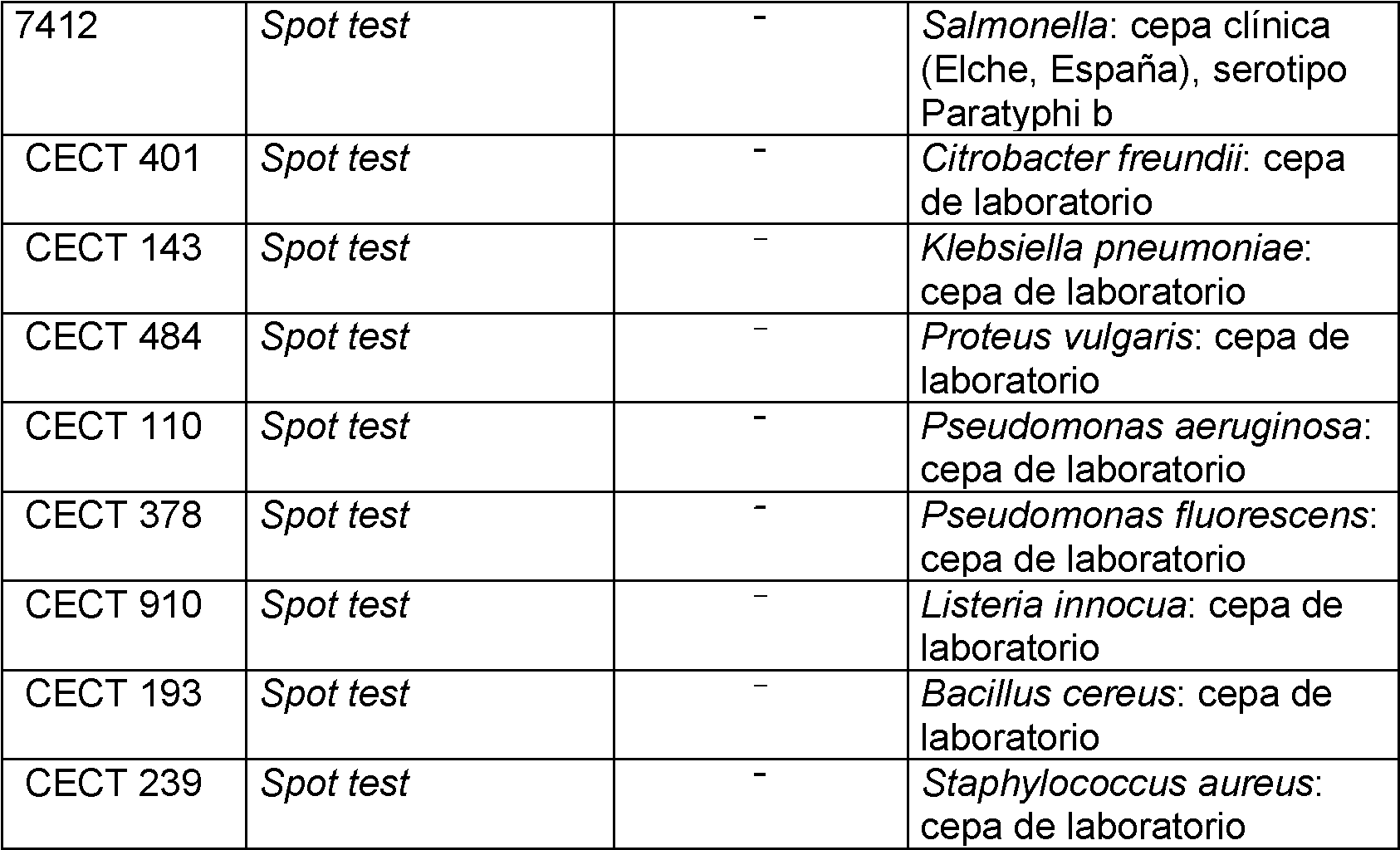
1, Aparición (+) o no (-) de claridad en el crecimiento en el ensayo de spot test en la zona donde se añade una concentración de endolisina de16 pg/mL.1, Appearance (+) or not (-) of clarity in growth in the spot test in the area where an endolysin concentration of 16 pg/mL is added.
2, Ochman H, and Selander R (1984). Standard reference strains of E. coli from natural populations. J Bacteriol. 157(2): 690-693.2, Ochman H, and Selander R (1984). Standard reference strains of E. coli from natural populations. J Bacteriol. 157(2): 690-693.
3, Cepas enterotoxigénicas de E. coli, por cortesía del Dr. Anders Nilsson (Universidad de Estocolmo, Suecia).3, Enterotoxigenic strains of E. coli, courtesy of Dr. Anders Nilsson (Stockholm University, Sweden).
4, Cepas enterotoxigénicas de E. coli aisladas por la Universidad de Alicante en salidas de campo a granjas porcinas, por cortesía de DHESA (Fortuna, Murcia, España).4, Enterotoxigenic strains of E. coli isolated by the University of Alicante during field trips to pig farms, courtesy of DHESA (Fortuna, Murcia, Spain).
5, Cepas aviares de E. coli, por cortesía del Dr. Pablo Catalá (CECAV, Castellón, España).5, Avian strains of E. coli, courtesy of Dr. Pablo Catalá (CECAV, Castellón, Spain).
6, Cepas aviares de Salmonella, por cortesía del Dr. Pablo Catalá (CECAV, Castellón, España).6, Avian strains of Salmonella, courtesy of Dr. Pablo Catalá (CECAV, Castellón, Spain).
7, Cepas clínicas de Salmonella, por cortesía del servicio de Microbiología de1Hospital General Universitario de Elche (Alicante, España). 7, Clinical strains of Salmonella, courtesy of the Microbiology service of the Hospital General Universitario de Elche (Alicante, Spain).
Claims (1)
Priority Applications (1)
| Application Number | Priority Date | Filing Date | Title |
|---|---|---|---|
| ES202130815A ES2895800B2 (en) | 2019-10-10 | 2019-10-10 | USES OF VIRAL PROTEINS WITH ANTIBACTERIAL ACTIVITY AGAINST Escherichia coli |
Applications Claiming Priority (1)
| Application Number | Priority Date | Filing Date | Title |
|---|---|---|---|
| ES202130815A ES2895800B2 (en) | 2019-10-10 | 2019-10-10 | USES OF VIRAL PROTEINS WITH ANTIBACTERIAL ACTIVITY AGAINST Escherichia coli |
Publications (4)
| Publication Number | Publication Date |
|---|---|
| ES2895800A2 true ES2895800A2 (en) | 2022-02-22 |
| ES2895800R1 ES2895800R1 (en) | 2022-06-08 |
| ES2895800A8 ES2895800A8 (en) | 2023-12-12 |
| ES2895800B2 ES2895800B2 (en) | 2024-01-22 |
Family
ID=80442306
Family Applications (1)
| Application Number | Title | Priority Date | Filing Date |
|---|---|---|---|
| ES202130815A Active ES2895800B2 (en) | 2019-10-10 | 2019-10-10 | USES OF VIRAL PROTEINS WITH ANTIBACTERIAL ACTIVITY AGAINST Escherichia coli |
Country Status (1)
| Country | Link |
|---|---|
| ES (1) | ES2895800B2 (en) |
Family Cites Families (1)
| Publication number | Priority date | Publication date | Assignee | Title |
|---|---|---|---|---|
| TWI527521B (en) * | 2010-04-27 | 2016-04-01 | 利山鐸公司 | Method of reducing biofilm |
-
2019
- 2019-10-10 ES ES202130815A patent/ES2895800B2/en active Active
Also Published As
| Publication number | Publication date |
|---|---|
| ES2895800B2 (en) | 2024-01-22 |
| ES2895800R1 (en) | 2022-06-08 |
| ES2895800A8 (en) | 2023-12-12 |
Similar Documents
| Publication | Publication Date | Title |
|---|---|---|
| US10676721B2 (en) | Bacteriophages expressing antimicrobial peptides and uses thereof | |
| CN112143747B (en) | Phage lyase, gene thereof, gene recombination expression vector and application | |
| JP2023062086A (en) | Modified Gram-negative endolysin | |
| EA024794B1 (en) | VARIANT OF ENDOLYSIN WITH INTEGRATED CATION PEPTIDE WITH ACTIVITY DESTRUCTING LIPOPOLYSACCHARIDE | |
| RS55230B1 (en) | Chimeric polypeptides and their applications in bacterial decolonization | |
| US20240148840A1 (en) | Chimeric endolysin polypeptide | |
| Heselpoth et al. | Enzybiotics: endolysins and bacteriocins | |
| Keary et al. | Characterization of a bacteriophage-derived murein peptidase for elimination of antibiotic-resistant Staphylococcus aureus | |
| Lim et al. | Eradication of drug-resistant Acinetobacter baumannii by cell-penetrating peptide fused endolysin | |
| Heselpoth et al. | Enzybiotics: endolysins and bacteriocins | |
| CN106854247A (en) | A kind of preparation method of the bacterial virus catenase that can crack Escherichia coli and salmonella | |
| ES2895800B2 (en) | USES OF VIRAL PROTEINS WITH ANTIBACTERIAL ACTIVITY AGAINST Escherichia coli | |
| ES2827850B2 (en) | VIRAL PROTEINS WITH ANTIBACTERIAL ACTIVITY AGAINST Escherichia coli | |
| CN114107271B (en) | Heat-resistant and nutrient-resistant salmonella broad spectrum lyase with in-vitro cleavage activity, and preparation and application thereof | |
| KR101595976B1 (en) | Lysin fusion Protein Having Antibacterial Activity Specific to Staphylococcus aureus and use thereof | |
| CN102120760A (en) | Antibacterial peptide derived from phage and application thereof | |
| Kelley | DEVELOPMENT OF RECOMBINANT ENDOLYSINS AGAINST GRAM-NEGATIVE AND GRAM-POSITIVE BACTERIA | |
| Attama et al. | Bacteriophage: Clinical Applications | |
| EP4702981A1 (en) | Targeted antibacterial treatment | |
| Bilal et al. | Bacteriophage Therapy: An Innovative Approach to Combating Antibiotic Resistance in Bacteria | |
| Zagoskin et al. | COMPLEX ANTIBACTERIAL ACTION OF ENZYMES ACTING ON STAPHYLOCOCCUS AUREUS BIOFILMS | |
| Komijani et al. | Unlocking the Potential of Bacteriophage Endolysins: A Promising Alternative for Combating Antibiotic Resistance in Poultry | |
| KR20240154659A (en) | Chimeric endolysin polypeptide | |
| Antonova et al. | Broad Bactericidal Activity of the Myoviridae Bacteriophage Lysins LysAm24, LysECD7, and LysSi3 | |
| JP2025542397A (en) | Chimeric endolysin polypeptides |
Legal Events
| Date | Code | Title | Description |
|---|---|---|---|
| BA2A | Patent application published |
Ref document number: 2895800 Country of ref document: ES Kind code of ref document: A2 Effective date: 20220222 |
|
| EC2A | Search report published |
Ref document number: 2895800 Country of ref document: ES Kind code of ref document: R1 Effective date: 20220601 |
|
| FG2A | Definitive protection |
Ref document number: 2895800 Country of ref document: ES Kind code of ref document: B2 Effective date: 20240122 |