ES2719136T3 - Organic monobactam compounds for the treatment of bacterial infections - Google Patents
Organic monobactam compounds for the treatment of bacterial infections Download PDFInfo
- Publication number
- ES2719136T3 ES2719136T3 ES15714147T ES15714147T ES2719136T3 ES 2719136 T3 ES2719136 T3 ES 2719136T3 ES 15714147 T ES15714147 T ES 15714147T ES 15714147 T ES15714147 T ES 15714147T ES 2719136 T3 ES2719136 T3 ES 2719136T3
- Authority
- ES
- Spain
- Prior art keywords
- mmol
- alkyl
- amino
- methyl
- acid
- Prior art date
- Legal status (The legal status is an assumption and is not a legal conclusion. Google has not performed a legal analysis and makes no representation as to the accuracy of the status listed.)
- Active
Links
- 208000035143 Bacterial infection Diseases 0.000 title claims description 22
- 208000022362 bacterial infectious disease Diseases 0.000 title claims description 22
- 238000011282 treatment Methods 0.000 title description 27
- WZPBZJONDBGPKJ-VEHQQRBSSA-N aztreonam Chemical class O=C1N(S([O-])(=O)=O)[C@@H](C)[C@@H]1NC(=O)C(=N/OC(C)(C)C(O)=O)\C1=CSC([NH3+])=N1 WZPBZJONDBGPKJ-VEHQQRBSSA-N 0.000 title description 5
- 150000001875 compounds Chemical class 0.000 claims abstract description 379
- 125000002924 primary amino group Chemical group [H]N([H])* 0.000 claims abstract description 217
- -1 R14 Chemical group 0.000 claims abstract description 198
- 125000004178 (C1-C4) alkyl group Chemical group 0.000 claims abstract description 97
- 125000000623 heterocyclic group Chemical group 0.000 claims abstract description 57
- 150000003839 salts Chemical class 0.000 claims abstract description 54
- 229910052760 oxygen Inorganic materials 0.000 claims abstract description 45
- 125000000229 (C1-C4)alkoxy group Chemical group 0.000 claims abstract description 43
- 229910052717 sulfur Inorganic materials 0.000 claims abstract description 43
- 125000002887 hydroxy group Chemical group [H]O* 0.000 claims abstract description 38
- 125000005842 heteroatom Chemical group 0.000 claims abstract description 31
- 229910052799 carbon Inorganic materials 0.000 claims abstract description 29
- OKTJSMMVPCPJKN-UHFFFAOYSA-N Carbon Chemical group [C] OKTJSMMVPCPJKN-UHFFFAOYSA-N 0.000 claims abstract description 26
- 101001043818 Mus musculus Interleukin-31 receptor subunit alpha Proteins 0.000 claims abstract description 20
- 125000005843 halogen group Chemical group 0.000 claims abstract description 20
- 125000003178 carboxy group Chemical group [H]OC(*)=O 0.000 claims abstract description 18
- 101150020251 NR13 gene Proteins 0.000 claims abstract description 16
- 125000004043 oxo group Chemical group O=* 0.000 claims abstract description 16
- 125000001997 phenyl group Chemical group [H]C1=C([H])C([H])=C(*)C([H])=C1[H] 0.000 claims abstract description 15
- 229910052731 fluorine Inorganic materials 0.000 claims abstract description 13
- 125000005913 (C3-C6) cycloalkyl group Chemical group 0.000 claims abstract description 12
- 229910052739 hydrogen Inorganic materials 0.000 claims abstract description 12
- 125000001424 substituent group Chemical group 0.000 claims abstract description 12
- 125000001072 heteroaryl group Chemical group 0.000 claims abstract description 11
- 125000006570 (C5-C6) heteroaryl group Chemical group 0.000 claims abstract description 10
- 125000002947 alkylene group Chemical group 0.000 claims abstract description 9
- 125000006583 (C1-C3) haloalkyl group Chemical group 0.000 claims abstract description 8
- 125000000753 cycloalkyl group Chemical group 0.000 claims abstract description 8
- 229910052757 nitrogen Inorganic materials 0.000 claims abstract description 8
- 125000003118 aryl group Chemical group 0.000 claims abstract description 6
- 125000004093 cyano group Chemical group *C#N 0.000 claims abstract description 5
- 125000004433 nitrogen atom Chemical group N* 0.000 claims abstract description 5
- 238000000034 method Methods 0.000 claims description 225
- 239000000203 mixture Substances 0.000 claims description 100
- 239000003814 drug Substances 0.000 claims description 35
- 125000000217 alkyl group Chemical group 0.000 claims description 26
- 239000008194 pharmaceutical composition Substances 0.000 claims description 24
- 229940124597 therapeutic agent Drugs 0.000 claims description 16
- 239000000546 pharmaceutical excipient Substances 0.000 claims description 12
- IZXIZTKNFFYFOF-UHFFFAOYSA-N 2-Oxazolidone Chemical compound O=C1NCCO1 IZXIZTKNFFYFOF-UHFFFAOYSA-N 0.000 claims description 11
- 241000894007 species Species 0.000 claims description 10
- 208000027096 gram-negative bacterial infections Diseases 0.000 claims description 6
- 125000003545 alkoxy group Chemical group 0.000 claims description 5
- 208000015181 infectious disease Diseases 0.000 claims description 5
- 241000588921 Enterobacteriaceae Species 0.000 claims description 4
- YAMHXTCMCPHKLN-UHFFFAOYSA-N imidazolidin-2-one Chemical compound O=C1NCCN1 YAMHXTCMCPHKLN-UHFFFAOYSA-N 0.000 claims description 4
- 206010035664 Pneumonia Diseases 0.000 claims description 3
- 125000001559 cyclopropyl group Chemical group [H]C1([H])C([H])([H])C1([H])* 0.000 claims description 3
- HNJBEVLQSNELDL-UHFFFAOYSA-N gamma-butyrolactam Natural products O=C1CCCN1 HNJBEVLQSNELDL-UHFFFAOYSA-N 0.000 claims description 3
- 238000002560 therapeutic procedure Methods 0.000 claims description 3
- 208000008745 Healthcare-Associated Pneumonia Diseases 0.000 claims description 2
- 208000036209 Intraabdominal Infections Diseases 0.000 claims description 2
- HNJBEVLQSNELDL-YZRHJBSPSA-N pyrrolidin-2-one Chemical group O=C1CC[14CH2]N1 HNJBEVLQSNELDL-YZRHJBSPSA-N 0.000 claims description 2
- 210000001635 urinary tract Anatomy 0.000 claims 1
- 239000001257 hydrogen Substances 0.000 abstract description 7
- 125000004435 hydrogen atom Chemical class [H]* 0.000 abstract description 3
- XEKOWRVHYACXOJ-UHFFFAOYSA-N Ethyl acetate Chemical compound CCOC(C)=O XEKOWRVHYACXOJ-UHFFFAOYSA-N 0.000 description 232
- 239000002253 acid Substances 0.000 description 214
- ZMXDDKWLCZADIW-UHFFFAOYSA-N N,N-Dimethylformamide Chemical compound CN(C)C=O ZMXDDKWLCZADIW-UHFFFAOYSA-N 0.000 description 194
- YMWUJEATGCHHMB-UHFFFAOYSA-N Dichloromethane Chemical compound ClCCl YMWUJEATGCHHMB-UHFFFAOYSA-N 0.000 description 188
- 239000000243 solution Substances 0.000 description 170
- 238000004895 liquid chromatography mass spectrometry Methods 0.000 description 140
- 125000002496 methyl group Chemical group [H]C([H])([H])* 0.000 description 121
- OKKJLVBELUTLKV-UHFFFAOYSA-N Methanol Chemical compound OC OKKJLVBELUTLKV-UHFFFAOYSA-N 0.000 description 115
- 235000019439 ethyl acetate Nutrition 0.000 description 115
- XLYOFNOQVPJJNP-UHFFFAOYSA-N water Substances O XLYOFNOQVPJJNP-UHFFFAOYSA-N 0.000 description 93
- 238000003756 stirring Methods 0.000 description 91
- PMZURENOXWZQFD-UHFFFAOYSA-L Sodium Sulfate Chemical compound [Na+].[Na+].[O-]S([O-])(=O)=O PMZURENOXWZQFD-UHFFFAOYSA-L 0.000 description 81
- 229910052938 sodium sulfate Inorganic materials 0.000 description 81
- 235000011152 sodium sulphate Nutrition 0.000 description 81
- 239000007832 Na2SO4 Substances 0.000 description 78
- 239000007787 solid Substances 0.000 description 77
- 239000012267 brine Substances 0.000 description 74
- HPALAKNZSZLMCH-UHFFFAOYSA-M sodium;chloride;hydrate Chemical compound O.[Na+].[Cl-] HPALAKNZSZLMCH-UHFFFAOYSA-M 0.000 description 74
- BDAGIHXWWSANSR-UHFFFAOYSA-N methanoic acid Natural products OC=O BDAGIHXWWSANSR-UHFFFAOYSA-N 0.000 description 68
- 238000010898 silica gel chromatography Methods 0.000 description 53
- 239000012074 organic phase Substances 0.000 description 52
- JGFZNNIVVJXRND-UHFFFAOYSA-N N,N-Diisopropylethylamine (DIPEA) Chemical compound CCN(C(C)C)C(C)C JGFZNNIVVJXRND-UHFFFAOYSA-N 0.000 description 50
- QTBSBXVTEAMEQO-UHFFFAOYSA-N Acetic acid Chemical compound CC(O)=O QTBSBXVTEAMEQO-UHFFFAOYSA-N 0.000 description 44
- 238000005160 1H NMR spectroscopy Methods 0.000 description 43
- 150000001412 amines Chemical class 0.000 description 43
- PUJDIJCNWFYVJX-UHFFFAOYSA-N benzyl carbamate Chemical compound NC(=O)OCC1=CC=CC=C1 PUJDIJCNWFYVJX-UHFFFAOYSA-N 0.000 description 43
- YXFVVABEGXRONW-UHFFFAOYSA-N Toluene Chemical compound CC1=CC=CC=C1 YXFVVABEGXRONW-UHFFFAOYSA-N 0.000 description 39
- 239000000843 powder Substances 0.000 description 39
- 239000008346 aqueous phase Substances 0.000 description 38
- LFQSCWFLJHTTHZ-UHFFFAOYSA-N Ethanol Chemical compound CCO LFQSCWFLJHTTHZ-UHFFFAOYSA-N 0.000 description 37
- 239000012071 phase Substances 0.000 description 37
- IAZDPXIOMUYVGZ-WFGJKAKNSA-N Dimethyl sulfoxide Chemical compound [2H]C([2H])([2H])S(=O)C([2H])([2H])[2H] IAZDPXIOMUYVGZ-WFGJKAKNSA-N 0.000 description 35
- OSWFIVFLDKOXQC-UHFFFAOYSA-N 4-(3-methoxyphenyl)aniline Chemical compound COC1=CC=CC(C=2C=CC(N)=CC=2)=C1 OSWFIVFLDKOXQC-UHFFFAOYSA-N 0.000 description 34
- 235000019253 formic acid Nutrition 0.000 description 34
- 125000004495 thiazol-4-yl group Chemical group S1C=NC(=C1)* 0.000 description 34
- PBCJIPOGFJYBJE-UHFFFAOYSA-N acetonitrile;hydrate Chemical compound O.CC#N PBCJIPOGFJYBJE-UHFFFAOYSA-N 0.000 description 33
- 239000000543 intermediate Substances 0.000 description 33
- 239000002955 immunomodulating agent Substances 0.000 description 32
- 239000003607 modifier Substances 0.000 description 32
- 238000004007 reversed phase HPLC Methods 0.000 description 32
- 229940121354 immunomodulator Drugs 0.000 description 31
- 125000000738 acetamido group Chemical group [H]C([H])([H])C(=O)N([H])[*] 0.000 description 30
- DTQVDTLACAAQTR-UHFFFAOYSA-N Trifluoroacetic acid Chemical class OC(=O)C(F)(F)F DTQVDTLACAAQTR-UHFFFAOYSA-N 0.000 description 29
- 239000003795 chemical substances by application Substances 0.000 description 26
- WEVYAHXRMPXWCK-UHFFFAOYSA-N Acetonitrile Chemical compound CC#N WEVYAHXRMPXWCK-UHFFFAOYSA-N 0.000 description 25
- ZPWVASYFFYYZEW-UHFFFAOYSA-L dipotassium hydrogen phosphate Chemical compound [K+].[K+].OP([O-])([O-])=O ZPWVASYFFYYZEW-UHFFFAOYSA-L 0.000 description 25
- 229910000396 dipotassium phosphate Inorganic materials 0.000 description 25
- 235000019797 dipotassium phosphate Nutrition 0.000 description 25
- WYURNTSHIVDZCO-UHFFFAOYSA-N Tetrahydrofuran Chemical compound C1CCOC1 WYURNTSHIVDZCO-UHFFFAOYSA-N 0.000 description 24
- 238000010511 deprotection reaction Methods 0.000 description 24
- 125000001841 imino group Chemical group [H]N=* 0.000 description 24
- 239000013067 intermediate product Substances 0.000 description 24
- KWGKDLIKAYFUFQ-UHFFFAOYSA-M lithium chloride Chemical compound [Li+].[Cl-] KWGKDLIKAYFUFQ-UHFFFAOYSA-M 0.000 description 24
- 230000002584 immunomodulator Effects 0.000 description 23
- 229910002567 K2S2O8 Inorganic materials 0.000 description 22
- 238000005481 NMR spectroscopy Methods 0.000 description 22
- 230000001404 mediated effect Effects 0.000 description 22
- BWHMMNNQKKPAPP-UHFFFAOYSA-L potassium carbonate Chemical compound [K+].[K+].[O-]C([O-])=O BWHMMNNQKKPAPP-UHFFFAOYSA-L 0.000 description 22
- 235000019394 potassium persulphate Nutrition 0.000 description 22
- 239000000725 suspension Substances 0.000 description 22
- 239000003921 oil Substances 0.000 description 21
- 235000019198 oils Nutrition 0.000 description 21
- ZMANZCXQSJIPKH-UHFFFAOYSA-N Triethylamine Chemical compound CCN(CC)CC ZMANZCXQSJIPKH-UHFFFAOYSA-N 0.000 description 20
- WGLUMOCWFMKWIL-UHFFFAOYSA-N dichloromethane;methanol Chemical compound OC.ClCCl WGLUMOCWFMKWIL-UHFFFAOYSA-N 0.000 description 20
- 239000002904 solvent Substances 0.000 description 20
- 239000003112 inhibitor Substances 0.000 description 19
- 239000007821 HATU Substances 0.000 description 18
- 102100024216 Programmed cell death 1 ligand 1 Human genes 0.000 description 18
- 229910052805 deuterium Inorganic materials 0.000 description 18
- 208000037265 diseases, disorders, signs and symptoms Diseases 0.000 description 18
- 241000588914 Enterobacter Species 0.000 description 17
- 101100519207 Mus musculus Pdcd1 gene Proteins 0.000 description 17
- KDLHZDBZIXYQEI-UHFFFAOYSA-N palladium Substances [Pd] KDLHZDBZIXYQEI-UHFFFAOYSA-N 0.000 description 17
- 108010074708 B7-H1 Antigen Proteins 0.000 description 16
- 241000894006 Bacteria Species 0.000 description 16
- YZCKVEUIGOORGS-OUBTZVSYSA-N Deuterium Chemical compound [2H] YZCKVEUIGOORGS-OUBTZVSYSA-N 0.000 description 16
- XLYOFNOQVPJJNP-ZSJDYOACSA-N Heavy water Chemical compound [2H]O[2H] XLYOFNOQVPJJNP-ZSJDYOACSA-N 0.000 description 16
- VYPSYNLAJGMNEJ-UHFFFAOYSA-N Silicium dioxide Chemical compound O=[Si]=O VYPSYNLAJGMNEJ-UHFFFAOYSA-N 0.000 description 16
- PFKFTWBEEFSNDU-UHFFFAOYSA-N carbonyldiimidazole Chemical compound C1=CN=CN1C(=O)N1C=CN=C1 PFKFTWBEEFSNDU-UHFFFAOYSA-N 0.000 description 16
- RIOQSEWOXXDEQQ-UHFFFAOYSA-N triphenylphosphine Chemical compound C1=CC=CC=C1P(C=1C=CC=CC=1)C1=CC=CC=C1 RIOQSEWOXXDEQQ-UHFFFAOYSA-N 0.000 description 16
- 230000000844 anti-bacterial effect Effects 0.000 description 15
- UIIMBOGNXHQVGW-UHFFFAOYSA-M sodium bicarbonate Substances [Na+].OC([O-])=O UIIMBOGNXHQVGW-UHFFFAOYSA-M 0.000 description 15
- LFKDJXLFVYVEFG-UHFFFAOYSA-N tert-butyl carbamate Chemical compound CC(C)(C)OC(N)=O LFKDJXLFVYVEFG-UHFFFAOYSA-N 0.000 description 15
- 239000002552 dosage form Substances 0.000 description 14
- PEDCQBHIVMGVHV-UHFFFAOYSA-N Glycerine Chemical compound OCC(O)CO PEDCQBHIVMGVHV-UHFFFAOYSA-N 0.000 description 13
- 241000607142 Salmonella Species 0.000 description 13
- 230000001580 bacterial effect Effects 0.000 description 13
- 239000002585 base Substances 0.000 description 13
- 229940079593 drug Drugs 0.000 description 13
- 238000009472 formulation Methods 0.000 description 13
- 230000002401 inhibitory effect Effects 0.000 description 13
- VLKZOEOYAKHREP-UHFFFAOYSA-N n-Hexane Chemical compound CCCCCC VLKZOEOYAKHREP-UHFFFAOYSA-N 0.000 description 13
- 201000010099 disease Diseases 0.000 description 12
- 239000003937 drug carrier Substances 0.000 description 12
- 125000000219 ethylidene group Chemical group [H]C(=[*])C([H])([H])[H] 0.000 description 12
- 239000000706 filtrate Substances 0.000 description 12
- 238000010438 heat treatment Methods 0.000 description 12
- 241000589291 Acinetobacter Species 0.000 description 11
- QGZKDVFQNNGYKY-UHFFFAOYSA-O Ammonium Chemical compound [NH4+] QGZKDVFQNNGYKY-UHFFFAOYSA-O 0.000 description 11
- 229930186147 Cephalosporin Natural products 0.000 description 11
- RTZKZFJDLAIYFH-UHFFFAOYSA-N Diethyl ether Chemical compound CCOCC RTZKZFJDLAIYFH-UHFFFAOYSA-N 0.000 description 11
- 229940124587 cephalosporin Drugs 0.000 description 11
- 239000003153 chemical reaction reagent Substances 0.000 description 11
- 239000006260 foam Substances 0.000 description 11
- 229960003301 nivolumab Drugs 0.000 description 11
- 229910000027 potassium carbonate Inorganic materials 0.000 description 11
- 238000005406 washing Methods 0.000 description 11
- HEDRZPFGACZZDS-UHFFFAOYSA-N Chloroform Chemical compound ClC(Cl)Cl HEDRZPFGACZZDS-UHFFFAOYSA-N 0.000 description 10
- 241000588923 Citrobacter Species 0.000 description 10
- 101100407308 Mus musculus Pdcd1lg2 gene Proteins 0.000 description 10
- 108700030875 Programmed Cell Death 1 Ligand 2 Proteins 0.000 description 10
- 102100024213 Programmed cell death 1 ligand 2 Human genes 0.000 description 10
- 241000588769 Proteus <enterobacteria> Species 0.000 description 10
- 241000589516 Pseudomonas Species 0.000 description 10
- 241000607720 Serratia Species 0.000 description 10
- 239000004480 active ingredient Substances 0.000 description 10
- 239000003242 anti bacterial agent Substances 0.000 description 10
- 239000000427 antigen Substances 0.000 description 10
- 102000036639 antigens Human genes 0.000 description 10
- 108091007433 antigens Proteins 0.000 description 10
- 239000013078 crystal Substances 0.000 description 10
- 239000012634 fragment Substances 0.000 description 10
- 238000010348 incorporation Methods 0.000 description 10
- 239000000047 product Substances 0.000 description 10
- XKRFYHLGVUSROY-UHFFFAOYSA-N Argon Chemical compound [Ar] XKRFYHLGVUSROY-UHFFFAOYSA-N 0.000 description 9
- KXDHJXZQYSOELW-UHFFFAOYSA-M Carbamate Chemical compound NC([O-])=O KXDHJXZQYSOELW-UHFFFAOYSA-M 0.000 description 9
- 101100456896 Drosophila melanogaster metl gene Proteins 0.000 description 9
- 241000588722 Escherichia Species 0.000 description 9
- VEXZGXHMUGYJMC-UHFFFAOYSA-N Hydrochloric acid Chemical compound Cl VEXZGXHMUGYJMC-UHFFFAOYSA-N 0.000 description 9
- 241000588748 Klebsiella Species 0.000 description 9
- 241000588771 Morganella <proteobacterium> Species 0.000 description 9
- DNIAPMSPPWPWGF-UHFFFAOYSA-N Propylene glycol Chemical compound CC(O)CO DNIAPMSPPWPWGF-UHFFFAOYSA-N 0.000 description 9
- 125000004432 carbon atom Chemical group C* 0.000 description 9
- 235000019441 ethanol Nutrition 0.000 description 9
- RAXXELZNTBOGNW-UHFFFAOYSA-N imidazole Natural products C1=CNC=N1 RAXXELZNTBOGNW-UHFFFAOYSA-N 0.000 description 9
- 125000000325 methylidene group Chemical group [H]C([H])=* 0.000 description 9
- 235000015320 potassium carbonate Nutrition 0.000 description 9
- KFZMGEQAYNKOFK-UHFFFAOYSA-N Isopropanol Chemical compound CC(C)O KFZMGEQAYNKOFK-UHFFFAOYSA-N 0.000 description 8
- CSNNHWWHGAXBCP-UHFFFAOYSA-L Magnesium sulfate Chemical compound [Mg+2].[O-][S+2]([O-])([O-])[O-] CSNNHWWHGAXBCP-UHFFFAOYSA-L 0.000 description 8
- 238000013019 agitation Methods 0.000 description 8
- 238000006243 chemical reaction Methods 0.000 description 8
- 230000000139 costimulatory effect Effects 0.000 description 8
- DEQYTNZJHKPYEZ-UHFFFAOYSA-N ethyl acetate;heptane Chemical compound CCOC(C)=O.CCCCCCC DEQYTNZJHKPYEZ-UHFFFAOYSA-N 0.000 description 8
- 238000001914 filtration Methods 0.000 description 8
- 239000000463 material Substances 0.000 description 8
- XBXCNNQPRYLIDE-UHFFFAOYSA-M n-tert-butylcarbamate Chemical compound CC(C)(C)NC([O-])=O XBXCNNQPRYLIDE-UHFFFAOYSA-M 0.000 description 8
- 239000002244 precipitate Substances 0.000 description 8
- 238000002360 preparation method Methods 0.000 description 8
- 239000011541 reaction mixture Substances 0.000 description 8
- 239000003826 tablet Substances 0.000 description 8
- 125000004213 tert-butoxy group Chemical group [H]C([H])([H])C(O*)(C([H])([H])[H])C([H])([H])[H] 0.000 description 8
- 241001453380 Burkholderia Species 0.000 description 7
- 241000588747 Klebsiella pneumoniae Species 0.000 description 7
- 206010028980 Neoplasm Diseases 0.000 description 7
- 239000003781 beta lactamase inhibitor Substances 0.000 description 7
- 229940126813 beta-lactamase inhibitor Drugs 0.000 description 7
- YMGUBTXCNDTFJI-UHFFFAOYSA-N cyclopropanecarboxylic acid Chemical compound OC(=O)C1CC1 YMGUBTXCNDTFJI-UHFFFAOYSA-N 0.000 description 7
- 230000000694 effects Effects 0.000 description 7
- 239000007788 liquid Substances 0.000 description 7
- 229960002621 pembrolizumab Drugs 0.000 description 7
- 229920001223 polyethylene glycol Polymers 0.000 description 7
- 125000006239 protecting group Chemical group 0.000 description 7
- 230000002829 reductive effect Effects 0.000 description 7
- DLFVBJFMPXGRIB-UHFFFAOYSA-N Acetamide Chemical compound CC(N)=O DLFVBJFMPXGRIB-UHFFFAOYSA-N 0.000 description 6
- WFDIJRYMOXRFFG-UHFFFAOYSA-N Acetic anhydride Chemical compound CC(=O)OC(C)=O WFDIJRYMOXRFFG-UHFFFAOYSA-N 0.000 description 6
- CSCPPACGZOOCGX-UHFFFAOYSA-N Acetone Chemical compound CC(C)=O CSCPPACGZOOCGX-UHFFFAOYSA-N 0.000 description 6
- 101000801234 Homo sapiens Tumor necrosis factor receptor superfamily member 18 Proteins 0.000 description 6
- 102000017578 LAG3 Human genes 0.000 description 6
- 241000124008 Mammalia Species 0.000 description 6
- 241001024304 Mino Species 0.000 description 6
- IMNFDUFMRHMDMM-UHFFFAOYSA-N N-Heptane Chemical compound CCCCCCC IMNFDUFMRHMDMM-UHFFFAOYSA-N 0.000 description 6
- 241000588653 Neisseria Species 0.000 description 6
- NQRYJNQNLNOLGT-UHFFFAOYSA-N Piperidine Chemical compound C1CCNCC1 NQRYJNQNLNOLGT-UHFFFAOYSA-N 0.000 description 6
- JUJWROOIHBZHMG-UHFFFAOYSA-N Pyridine Chemical compound C1=CC=NC=C1 JUJWROOIHBZHMG-UHFFFAOYSA-N 0.000 description 6
- RWRDLPDLKQPQOW-UHFFFAOYSA-N Pyrrolidine Chemical compound C1CCNC1 RWRDLPDLKQPQOW-UHFFFAOYSA-N 0.000 description 6
- HEMHJVSKTPXQMS-UHFFFAOYSA-M Sodium hydroxide Chemical compound [OH-].[Na+] HEMHJVSKTPXQMS-UHFFFAOYSA-M 0.000 description 6
- 241000122971 Stenotrophomonas Species 0.000 description 6
- QAOWNCQODCNURD-UHFFFAOYSA-N Sulfuric acid Chemical compound OS(O)(=O)=O QAOWNCQODCNURD-UHFFFAOYSA-N 0.000 description 6
- 102100033728 Tumor necrosis factor receptor superfamily member 18 Human genes 0.000 description 6
- 238000010521 absorption reaction Methods 0.000 description 6
- 239000000556 agonist Substances 0.000 description 6
- 230000015572 biosynthetic process Effects 0.000 description 6
- 201000011510 cancer Diseases 0.000 description 6
- 238000004587 chromatography analysis Methods 0.000 description 6
- KRKNYBCHXYNGOX-UHFFFAOYSA-N citric acid Chemical compound OC(=O)CC(O)(C(O)=O)CC(O)=O KRKNYBCHXYNGOX-UHFFFAOYSA-N 0.000 description 6
- 208000035475 disorder Diseases 0.000 description 6
- 230000005764 inhibitory process Effects 0.000 description 6
- 239000007924 injection Substances 0.000 description 6
- 238000002347 injection Methods 0.000 description 6
- 239000003446 ligand Substances 0.000 description 6
- 239000011734 sodium Substances 0.000 description 6
- 235000017557 sodium bicarbonate Nutrition 0.000 description 6
- 229910000030 sodium bicarbonate Inorganic materials 0.000 description 6
- 230000001225 therapeutic effect Effects 0.000 description 6
- KJUGUADJHNHALS-UHFFFAOYSA-N 1H-tetrazole Chemical class C=1N=NNN=1 KJUGUADJHNHALS-UHFFFAOYSA-N 0.000 description 5
- NSPMIYGKQJPBQR-UHFFFAOYSA-N 4H-1,2,4-triazole Chemical compound C=1N=CNN=1 NSPMIYGKQJPBQR-UHFFFAOYSA-N 0.000 description 5
- HBAQYPYDRFILMT-UHFFFAOYSA-N 8-[3-(1-cyclopropylpyrazol-4-yl)-1H-pyrazolo[4,3-d]pyrimidin-5-yl]-3-methyl-3,8-diazabicyclo[3.2.1]octan-2-one Chemical class C1(CC1)N1N=CC(=C1)C1=NNC2=C1N=C(N=C2)N1C2C(N(CC1CC2)C)=O HBAQYPYDRFILMT-UHFFFAOYSA-N 0.000 description 5
- 229940125565 BMS-986016 Drugs 0.000 description 5
- 241000606125 Bacteroides Species 0.000 description 5
- 241000589876 Campylobacter Species 0.000 description 5
- 102100039498 Cytotoxic T-lymphocyte protein 4 Human genes 0.000 description 5
- 241000588724 Escherichia coli Species 0.000 description 5
- 101000889276 Homo sapiens Cytotoxic T-lymphocyte protein 4 Proteins 0.000 description 5
- DGAQECJNVWCQMB-PUAWFVPOSA-M Ilexoside XXIX Chemical compound C[C@@H]1CC[C@@]2(CC[C@@]3(C(=CC[C@H]4[C@]3(CC[C@@H]5[C@@]4(CC[C@@H](C5(C)C)OS(=O)(=O)[O-])C)C)[C@@H]2[C@]1(C)O)C)C(=O)O[C@H]6[C@@H]([C@H]([C@@H]([C@H](O6)CO)O)O)O.[Na+] DGAQECJNVWCQMB-PUAWFVPOSA-M 0.000 description 5
- AFVFQIVMOAPDHO-UHFFFAOYSA-N Methanesulfonic acid Chemical compound CS(O)(=O)=O AFVFQIVMOAPDHO-UHFFFAOYSA-N 0.000 description 5
- 241000589517 Pseudomonas aeruginosa Species 0.000 description 5
- CZMRCDWAGMRECN-UGDNZRGBSA-N Sucrose Chemical compound O[C@H]1[C@H](O)[C@@H](CO)O[C@@]1(CO)O[C@@H]1[C@H](O)[C@@H](O)[C@H](O)[C@@H](CO)O1 CZMRCDWAGMRECN-UGDNZRGBSA-N 0.000 description 5
- 229930006000 Sucrose Natural products 0.000 description 5
- 230000029936 alkylation Effects 0.000 description 5
- 238000005804 alkylation reaction Methods 0.000 description 5
- 239000003963 antioxidant agent Substances 0.000 description 5
- 235000006708 antioxidants Nutrition 0.000 description 5
- 229910052786 argon Inorganic materials 0.000 description 5
- 125000004567 azetidin-3-yl group Chemical group N1CC(C1)* 0.000 description 5
- GTUNOPUFKWNAHE-UHFFFAOYSA-N benzhydryl cyclopropanecarboxylate Chemical compound O=C(OC(c1ccccc1)c1ccccc1)C1CC1 GTUNOPUFKWNAHE-UHFFFAOYSA-N 0.000 description 5
- 125000001584 benzyloxycarbonyl group Chemical group C(=O)(OCC1=CC=CC=C1)* 0.000 description 5
- 239000011575 calcium Substances 0.000 description 5
- 239000002775 capsule Substances 0.000 description 5
- 150000001780 cephalosporins Chemical class 0.000 description 5
- 229940125904 compound 1 Drugs 0.000 description 5
- 229940125782 compound 2 Drugs 0.000 description 5
- 238000007796 conventional method Methods 0.000 description 5
- 238000002425 crystallisation Methods 0.000 description 5
- 230000008025 crystallization Effects 0.000 description 5
- XBDQKXXYIPTUBI-UHFFFAOYSA-N dimethylselenoniopropionate Natural products CCC(O)=O XBDQKXXYIPTUBI-UHFFFAOYSA-N 0.000 description 5
- 235000011187 glycerol Nutrition 0.000 description 5
- 238000004128 high performance liquid chromatography Methods 0.000 description 5
- 125000002950 monocyclic group Chemical group 0.000 description 5
- SYSQUGFVNFXIIT-UHFFFAOYSA-N n-[4-(1,3-benzoxazol-2-yl)phenyl]-4-nitrobenzenesulfonamide Chemical class C1=CC([N+](=O)[O-])=CC=C1S(=O)(=O)NC1=CC=C(C=2OC3=CC=CC=C3N=2)C=C1 SYSQUGFVNFXIIT-UHFFFAOYSA-N 0.000 description 5
- IJGRMHOSHXDMSA-UHFFFAOYSA-N nitrogen Substances N#N IJGRMHOSHXDMSA-UHFFFAOYSA-N 0.000 description 5
- 239000002674 ointment Substances 0.000 description 5
- 230000003287 optical effect Effects 0.000 description 5
- 239000003755 preservative agent Substances 0.000 description 5
- 230000008569 process Effects 0.000 description 5
- 108090000623 proteins and genes Proteins 0.000 description 5
- 229920006395 saturated elastomer Polymers 0.000 description 5
- 229910052708 sodium Inorganic materials 0.000 description 5
- 239000005720 sucrose Substances 0.000 description 5
- 239000000829 suppository Substances 0.000 description 5
- 238000003786 synthesis reaction Methods 0.000 description 5
- 125000005931 tert-butyloxycarbonyl group Chemical group [H]C([H])([H])C(OC(*)=O)(C([H])([H])[H])C([H])([H])[H] 0.000 description 5
- FPGGTKZVZWFYPV-UHFFFAOYSA-M tetrabutylammonium fluoride Chemical compound [F-].CCCC[N+](CCCC)(CCCC)CCCC FPGGTKZVZWFYPV-UHFFFAOYSA-M 0.000 description 5
- 229910052721 tungsten Inorganic materials 0.000 description 5
- IAKOZHOLGAGEJT-UHFFFAOYSA-N 1,1,1-trichloro-2,2-bis(p-methoxyphenyl)-Ethane Chemical compound C1=CC(OC)=CC=C1C(C(Cl)(Cl)Cl)C1=CC=C(OC)C=C1 IAKOZHOLGAGEJT-UHFFFAOYSA-N 0.000 description 4
- RBZRMBCLZMEYEH-UHFFFAOYSA-N 1h-pyrazol-1-ium-1-carboximidamide;chloride Chemical compound Cl.NC(=N)N1C=CC=N1 RBZRMBCLZMEYEH-UHFFFAOYSA-N 0.000 description 4
- GUBGYTABKSRVRQ-XLOQQCSPSA-N Alpha-Lactose Chemical compound O[C@@H]1[C@@H](O)[C@@H](O)[C@@H](CO)O[C@H]1O[C@@H]1[C@@H](CO)O[C@H](O)[C@H](O)[C@H]1O GUBGYTABKSRVRQ-XLOQQCSPSA-N 0.000 description 4
- 241000416162 Astragalus gummifer Species 0.000 description 4
- 241000589513 Burkholderia cepacia Species 0.000 description 4
- 102100024263 CD160 antigen Human genes 0.000 description 4
- 241000588919 Citrobacter freundii Species 0.000 description 4
- FEWJPZIEWOKRBE-JCYAYHJZSA-N Dextrotartaric acid Chemical compound OC(=O)[C@H](O)[C@@H](O)C(O)=O FEWJPZIEWOKRBE-JCYAYHJZSA-N 0.000 description 4
- KCXVZYZYPLLWCC-UHFFFAOYSA-N EDTA Chemical compound OC(=O)CN(CC(O)=O)CCN(CC(O)=O)CC(O)=O KCXVZYZYPLLWCC-UHFFFAOYSA-N 0.000 description 4
- 108010010803 Gelatin Proteins 0.000 description 4
- 102100034458 Hepatitis A virus cellular receptor 2 Human genes 0.000 description 4
- 241000282412 Homo Species 0.000 description 4
- 101000761938 Homo sapiens CD160 antigen Proteins 0.000 description 4
- 102100025390 Integrin beta-2 Human genes 0.000 description 4
- GUBGYTABKSRVRQ-QKKXKWKRSA-N Lactose Natural products OC[C@H]1O[C@@H](O[C@H]2[C@H](O)[C@@H](O)C(O)O[C@@H]2CO)[C@H](O)[C@@H](O)[C@H]1O GUBGYTABKSRVRQ-QKKXKWKRSA-N 0.000 description 4
- 241001465754 Metazoa Species 0.000 description 4
- MUBZPKHOEPUJKR-UHFFFAOYSA-N Oxalic acid Chemical compound OC(=O)C(O)=O MUBZPKHOEPUJKR-UHFFFAOYSA-N 0.000 description 4
- NBIIXXVUZAFLBC-UHFFFAOYSA-N Phosphoric acid Chemical compound OP(O)(O)=O NBIIXXVUZAFLBC-UHFFFAOYSA-N 0.000 description 4
- GLUUGHFHXGJENI-UHFFFAOYSA-N Piperazine Chemical compound C1CNCCN1 GLUUGHFHXGJENI-UHFFFAOYSA-N 0.000 description 4
- 241000588770 Proteus mirabilis Species 0.000 description 4
- CDBYLPFSWZWCQE-UHFFFAOYSA-L Sodium Carbonate Chemical compound [Na+].[Na+].[O-]C([O-])=O CDBYLPFSWZWCQE-UHFFFAOYSA-L 0.000 description 4
- FAPWRFPIFSIZLT-UHFFFAOYSA-M Sodium chloride Chemical compound [Na+].[Cl-] FAPWRFPIFSIZLT-UHFFFAOYSA-M 0.000 description 4
- 229920002472 Starch Polymers 0.000 description 4
- 229940126547 T-cell immunoglobulin mucin-3 Drugs 0.000 description 4
- DKGAVHZHDRPRBM-UHFFFAOYSA-N Tert-Butanol Chemical compound CC(C)(C)O DKGAVHZHDRPRBM-UHFFFAOYSA-N 0.000 description 4
- 229920001615 Tragacanth Polymers 0.000 description 4
- 150000007513 acids Chemical class 0.000 description 4
- 239000000443 aerosol Substances 0.000 description 4
- 229940088710 antibiotic agent Drugs 0.000 description 4
- KHUNFTAJVUPPCY-UHFFFAOYSA-N azetidine-1-sulfonic acid Chemical compound OS(=O)(=O)N1CCC1 KHUNFTAJVUPPCY-UHFFFAOYSA-N 0.000 description 4
- 239000011230 binding agent Substances 0.000 description 4
- 239000000969 carrier Substances 0.000 description 4
- 238000002648 combination therapy Methods 0.000 description 4
- 239000003085 diluting agent Substances 0.000 description 4
- 239000003995 emulsifying agent Substances 0.000 description 4
- 150000002148 esters Chemical class 0.000 description 4
- 239000000499 gel Substances 0.000 description 4
- 239000008273 gelatin Substances 0.000 description 4
- 229920000159 gelatin Polymers 0.000 description 4
- 235000019322 gelatine Nutrition 0.000 description 4
- 235000011852 gelatine desserts Nutrition 0.000 description 4
- 229910052736 halogen Inorganic materials 0.000 description 4
- 150000002367 halogens Chemical class 0.000 description 4
- XMBWDFGMSWQBCA-UHFFFAOYSA-N hydrogen iodide Chemical compound I XMBWDFGMSWQBCA-UHFFFAOYSA-N 0.000 description 4
- 230000003993 interaction Effects 0.000 description 4
- 229960005386 ipilimumab Drugs 0.000 description 4
- 230000000155 isotopic effect Effects 0.000 description 4
- 239000008101 lactose Substances 0.000 description 4
- HQKMJHAJHXVSDF-UHFFFAOYSA-L magnesium stearate Chemical compound [Mg+2].CCCCCCCCCCCCCCCCCC([O-])=O.CCCCCCCCCCCCCCCCCC([O-])=O HQKMJHAJHXVSDF-UHFFFAOYSA-L 0.000 description 4
- 229910052943 magnesium sulfate Inorganic materials 0.000 description 4
- 235000019341 magnesium sulphate Nutrition 0.000 description 4
- 230000002503 metabolic effect Effects 0.000 description 4
- 239000006072 paste Substances 0.000 description 4
- 244000052769 pathogen Species 0.000 description 4
- 239000006187 pill Substances 0.000 description 4
- 229920000642 polymer Polymers 0.000 description 4
- USHAGKDGDHPEEY-UHFFFAOYSA-L potassium persulfate Chemical compound [K+].[K+].[O-]S(=O)(=O)OOS([O-])(=O)=O USHAGKDGDHPEEY-UHFFFAOYSA-L 0.000 description 4
- LWIHDJKSTIGBAC-UHFFFAOYSA-K potassium phosphate Substances [K+].[K+].[K+].[O-]P([O-])([O-])=O LWIHDJKSTIGBAC-UHFFFAOYSA-K 0.000 description 4
- 108090000765 processed proteins & peptides Proteins 0.000 description 4
- VVWRJUBEIPHGQF-MDZDMXLPSA-N propan-2-yl (ne)-n-propan-2-yloxycarbonyliminocarbamate Chemical compound CC(C)OC(=O)\N=N\C(=O)OC(C)C VVWRJUBEIPHGQF-MDZDMXLPSA-N 0.000 description 4
- 235000018102 proteins Nutrition 0.000 description 4
- 102000004169 proteins and genes Human genes 0.000 description 4
- 239000013557 residual solvent Substances 0.000 description 4
- 239000012453 solvate Substances 0.000 description 4
- 235000019698 starch Nutrition 0.000 description 4
- 208000024891 symptom Diseases 0.000 description 4
- DYHSDKLCOJIUFX-UHFFFAOYSA-N tert-butoxycarbonyl anhydride Chemical compound CC(C)(C)OC(=O)OC(=O)OC(C)(C)C DYHSDKLCOJIUFX-UHFFFAOYSA-N 0.000 description 4
- WMOVHXAZOJBABW-UHFFFAOYSA-N tert-butyl acetate Chemical compound CC(=O)OC(C)(C)C WMOVHXAZOJBABW-UHFFFAOYSA-N 0.000 description 4
- 125000000999 tert-butyl group Chemical group [H]C([H])([H])C(*)(C([H])([H])[H])C([H])([H])[H] 0.000 description 4
- 235000010487 tragacanth Nutrition 0.000 description 4
- 239000000196 tragacanth Substances 0.000 description 4
- 229940116362 tragacanth Drugs 0.000 description 4
- VZCYOOQTPOCHFL-UHFFFAOYSA-N trans-butenedioic acid Natural products OC(=O)C=CC(O)=O VZCYOOQTPOCHFL-UHFFFAOYSA-N 0.000 description 4
- 239000001993 wax Substances 0.000 description 4
- 239000000080 wetting agent Substances 0.000 description 4
- 125000004765 (C1-C4) haloalkyl group Chemical group 0.000 description 3
- WSLDOOZREJYCGB-UHFFFAOYSA-N 1,2-Dichloroethane Chemical compound ClCCCl WSLDOOZREJYCGB-UHFFFAOYSA-N 0.000 description 3
- PLIKAWJENQZMHA-UHFFFAOYSA-N 4-aminophenol Chemical compound NC1=CC=C(O)C=C1 PLIKAWJENQZMHA-UHFFFAOYSA-N 0.000 description 3
- UMXBMEVYOBWMBN-UHFFFAOYSA-N 4-ethynyl-3-methylpyridine Chemical compound CC1=CN=CC=C1C#C UMXBMEVYOBWMBN-UHFFFAOYSA-N 0.000 description 3
- ZCYVEMRRCGMTRW-UHFFFAOYSA-N 7553-56-2 Chemical compound [I] ZCYVEMRRCGMTRW-UHFFFAOYSA-N 0.000 description 3
- 241000588626 Acinetobacter baumannii Species 0.000 description 3
- 229920001817 Agar Polymers 0.000 description 3
- 241000606124 Bacteroides fragilis Species 0.000 description 3
- UHOVQNZJYSORNB-UHFFFAOYSA-N Benzene Chemical compound C1=CC=CC=C1 UHOVQNZJYSORNB-UHFFFAOYSA-N 0.000 description 3
- DYBXUOYGFGAQHU-UHFFFAOYSA-N C(C1=CC=CC=C1)(C1=CC=CC=C1)OC(=O)C1(CC1)ON=C(/C(=O)O)C=1N=C(SC1)NC(=O)OC(C)(C)C Chemical compound C(C1=CC=CC=C1)(C1=CC=CC=C1)OC(=O)C1(CC1)ON=C(/C(=O)O)C=1N=C(SC1)NC(=O)OC(C)(C)C DYBXUOYGFGAQHU-UHFFFAOYSA-N 0.000 description 3
- 102100027207 CD27 antigen Human genes 0.000 description 3
- 101150013553 CD40 gene Proteins 0.000 description 3
- 108010021064 CTLA-4 Antigen Proteins 0.000 description 3
- 241000589875 Campylobacter jejuni Species 0.000 description 3
- BVKZGUZCCUSVTD-UHFFFAOYSA-L Carbonate Chemical compound [O-]C([O-])=O BVKZGUZCCUSVTD-UHFFFAOYSA-L 0.000 description 3
- VEXZGXHMUGYJMC-UHFFFAOYSA-M Chloride anion Chemical compound [Cl-] VEXZGXHMUGYJMC-UHFFFAOYSA-M 0.000 description 3
- 241000588917 Citrobacter koseri Species 0.000 description 3
- 206010011409 Cross infection Diseases 0.000 description 3
- 102000013816 Cytotoxic T-lymphocyte antigen 4 Human genes 0.000 description 3
- FBPFZTCFMRRESA-FSIIMWSLSA-N D-Glucitol Natural products OC[C@H](O)[C@H](O)[C@@H](O)[C@H](O)CO FBPFZTCFMRRESA-FSIIMWSLSA-N 0.000 description 3
- FBPFZTCFMRRESA-JGWLITMVSA-N D-glucitol Chemical compound OC[C@H](O)[C@@H](O)[C@H](O)[C@H](O)CO FBPFZTCFMRRESA-JGWLITMVSA-N 0.000 description 3
- 241000588697 Enterobacter cloacae Species 0.000 description 3
- PXGOKWXKJXAPGV-UHFFFAOYSA-N Fluorine Chemical compound FF PXGOKWXKJXAPGV-UHFFFAOYSA-N 0.000 description 3
- VZCYOOQTPOCHFL-OWOJBTEDSA-N Fumaric acid Chemical compound OC(=O)\C=C\C(O)=O VZCYOOQTPOCHFL-OWOJBTEDSA-N 0.000 description 3
- YLQBMQCUIZJEEH-UHFFFAOYSA-N Furan Chemical group C=1C=COC=1 YLQBMQCUIZJEEH-UHFFFAOYSA-N 0.000 description 3
- WQZGKKKJIJFFOK-GASJEMHNSA-N Glucose Natural products OC[C@H]1OC(O)[C@H](O)[C@@H](O)[C@@H]1O WQZGKKKJIJFFOK-GASJEMHNSA-N 0.000 description 3
- AEMRFAOFKBGASW-UHFFFAOYSA-N Glycolic acid Chemical compound OCC(O)=O AEMRFAOFKBGASW-UHFFFAOYSA-N 0.000 description 3
- 101000914511 Homo sapiens CD27 antigen Proteins 0.000 description 3
- 101001068133 Homo sapiens Hepatitis A virus cellular receptor 2 Proteins 0.000 description 3
- 101001137987 Homo sapiens Lymphocyte activation gene 3 protein Proteins 0.000 description 3
- 102000037982 Immune checkpoint proteins Human genes 0.000 description 3
- 108091008036 Immune checkpoint proteins Proteins 0.000 description 3
- XEEYBQQBJWHFJM-UHFFFAOYSA-N Iron Chemical compound [Fe] XEEYBQQBJWHFJM-UHFFFAOYSA-N 0.000 description 3
- 241000588749 Klebsiella oxytoca Species 0.000 description 3
- 101000740455 Klebsiella pneumoniae Metallo-beta-lactamase type 2 Proteins 0.000 description 3
- 101150030213 Lag3 gene Proteins 0.000 description 3
- 241000588772 Morganella morganii Species 0.000 description 3
- 241000588652 Neisseria gonorrhoeae Species 0.000 description 3
- 240000007817 Olea europaea Species 0.000 description 3
- JGSARLDLIJGVTE-MBNYWOFBSA-N Penicillin G Chemical compound N([C@H]1[C@H]2SC([C@@H](N2C1=O)C(O)=O)(C)C)C(=O)CC1=CC=CC=C1 JGSARLDLIJGVTE-MBNYWOFBSA-N 0.000 description 3
- 239000002202 Polyethylene glycol Substances 0.000 description 3
- 241001135215 Prevotella bivia Species 0.000 description 3
- OFOBLEOULBTSOW-UHFFFAOYSA-N Propanedioic acid Natural products OC(=O)CC(O)=O OFOBLEOULBTSOW-UHFFFAOYSA-N 0.000 description 3
- GOOHAUXETOMSMM-GSVOUGTGSA-N R-propylene oxide Chemical compound C[C@@H]1CO1 GOOHAUXETOMSMM-GSVOUGTGSA-N 0.000 description 3
- 241000607715 Serratia marcescens Species 0.000 description 3
- 241000122973 Stenotrophomonas maltophilia Species 0.000 description 3
- 210000001744 T-lymphocyte Anatomy 0.000 description 3
- FEWJPZIEWOKRBE-UHFFFAOYSA-N Tartaric acid Natural products [H+].[H+].[O-]C(=O)C(O)C(O)C([O-])=O FEWJPZIEWOKRBE-UHFFFAOYSA-N 0.000 description 3
- 102100040245 Tumor necrosis factor receptor superfamily member 5 Human genes 0.000 description 3
- 230000002378 acidificating effect Effects 0.000 description 3
- 239000012190 activator Substances 0.000 description 3
- 235000010419 agar Nutrition 0.000 description 3
- 235000010443 alginic acid Nutrition 0.000 description 3
- 229920000615 alginic acid Polymers 0.000 description 3
- 125000003282 alkyl amino group Chemical group 0.000 description 3
- 150000001408 amides Chemical class 0.000 description 3
- 230000000845 anti-microbial effect Effects 0.000 description 3
- 125000004429 atom Chemical group 0.000 description 3
- QVGXLLKOCUKJST-UHFFFAOYSA-N atomic oxygen Chemical group [O] QVGXLLKOCUKJST-UHFFFAOYSA-N 0.000 description 3
- 229960002379 avibactam Drugs 0.000 description 3
- NDCUAPJVLWFHHB-UHNVWZDZSA-N avibactam Chemical compound C1N2[C@H](C(N)=O)CC[C@@]1([H])N(OS(O)(=O)=O)C2=O NDCUAPJVLWFHHB-UHNVWZDZSA-N 0.000 description 3
- MNFORVFSTILPAW-UHFFFAOYSA-N azetidin-2-one Chemical compound O=C1CCN1 MNFORVFSTILPAW-UHFFFAOYSA-N 0.000 description 3
- 230000008901 benefit Effects 0.000 description 3
- 235000012216 bentonite Nutrition 0.000 description 3
- WPYMKLBDIGXBTP-UHFFFAOYSA-N benzoic acid Chemical compound OC(=O)C1=CC=CC=C1 WPYMKLBDIGXBTP-UHFFFAOYSA-N 0.000 description 3
- 125000001797 benzyl group Chemical group [H]C1=C([H])C([H])=C(C([H])=C1[H])C([H])([H])* 0.000 description 3
- WQZGKKKJIJFFOK-VFUOTHLCSA-N beta-D-glucose Chemical compound OC[C@H]1O[C@@H](O)[C@H](O)[C@@H](O)[C@@H]1O WQZGKKKJIJFFOK-VFUOTHLCSA-N 0.000 description 3
- 239000000872 buffer Substances 0.000 description 3
- 229910052791 calcium Inorganic materials 0.000 description 3
- 125000002915 carbonyl group Chemical group [*:2]C([*:1])=O 0.000 description 3
- 238000000576 coating method Methods 0.000 description 3
- 239000003086 colorant Substances 0.000 description 3
- 230000000875 corresponding effect Effects 0.000 description 3
- 239000006071 cream Substances 0.000 description 3
- 125000004122 cyclic group Chemical group 0.000 description 3
- 238000011161 development Methods 0.000 description 3
- 239000006185 dispersion Substances 0.000 description 3
- 238000009826 distribution Methods 0.000 description 3
- 239000000839 emulsion Substances 0.000 description 3
- 125000001495 ethyl group Chemical group [H]C([H])([H])C([H])([H])* 0.000 description 3
- 239000000945 filler Substances 0.000 description 3
- 239000012065 filter cake Substances 0.000 description 3
- 239000011737 fluorine Substances 0.000 description 3
- 238000001640 fractional crystallisation Methods 0.000 description 3
- 102000037865 fusion proteins Human genes 0.000 description 3
- 108020001507 fusion proteins Proteins 0.000 description 3
- 239000008103 glucose Substances 0.000 description 3
- 239000008187 granular material Substances 0.000 description 3
- 150000004677 hydrates Chemical class 0.000 description 3
- 229930195733 hydrocarbon Natural products 0.000 description 3
- 150000002430 hydrocarbons Chemical group 0.000 description 3
- 150000002431 hydrogen Chemical class 0.000 description 3
- 239000005457 ice water Substances 0.000 description 3
- 229940126546 immune checkpoint molecule Drugs 0.000 description 3
- 210000000987 immune system Anatomy 0.000 description 3
- 238000001727 in vivo Methods 0.000 description 3
- 239000003701 inert diluent Substances 0.000 description 3
- 238000001802 infusion Methods 0.000 description 3
- 108091006086 inhibitor proteins Proteins 0.000 description 3
- 238000001990 intravenous administration Methods 0.000 description 3
- 229910052740 iodine Inorganic materials 0.000 description 3
- 239000011630 iodine Substances 0.000 description 3
- 150000002500 ions Chemical class 0.000 description 3
- GOTYRUGSSMKFNF-UHFFFAOYSA-N lenalidomide Chemical compound C1C=2C(N)=CC=CC=2C(=O)N1C1CCC(=O)NC1=O GOTYRUGSSMKFNF-UHFFFAOYSA-N 0.000 description 3
- 239000006210 lotion Substances 0.000 description 3
- 239000000314 lubricant Substances 0.000 description 3
- 229910052751 metal Inorganic materials 0.000 description 3
- 239000002184 metal Substances 0.000 description 3
- 229940076266 morganella morganii Drugs 0.000 description 3
- BDERNNFJNOPAEC-UHFFFAOYSA-N n-propyl alcohol Natural products CCCO BDERNNFJNOPAEC-UHFFFAOYSA-N 0.000 description 3
- 239000001301 oxygen Chemical group 0.000 description 3
- 238000007911 parenteral administration Methods 0.000 description 3
- 229950010773 pidilizumab Drugs 0.000 description 3
- 229910052700 potassium Inorganic materials 0.000 description 3
- 102000004196 processed proteins & peptides Human genes 0.000 description 3
- UMJSCPRVCHMLSP-UHFFFAOYSA-N pyridine Natural products COC1=CC=CN=C1 UMJSCPRVCHMLSP-UHFFFAOYSA-N 0.000 description 3
- 230000002285 radioactive effect Effects 0.000 description 3
- 102000005962 receptors Human genes 0.000 description 3
- 108020003175 receptors Proteins 0.000 description 3
- 239000000741 silica gel Substances 0.000 description 3
- 229910002027 silica gel Inorganic materials 0.000 description 3
- 235000010356 sorbitol Nutrition 0.000 description 3
- 239000000600 sorbitol Substances 0.000 description 3
- 238000007920 subcutaneous administration Methods 0.000 description 3
- 239000000126 substance Substances 0.000 description 3
- 238000006467 substitution reaction Methods 0.000 description 3
- 235000000346 sugar Nutrition 0.000 description 3
- 150000008163 sugars Chemical class 0.000 description 3
- 239000000375 suspending agent Substances 0.000 description 3
- 230000002195 synergetic effect Effects 0.000 description 3
- 239000000454 talc Substances 0.000 description 3
- 235000012222 talc Nutrition 0.000 description 3
- 229910052623 talc Inorganic materials 0.000 description 3
- 235000002906 tartaric acid Nutrition 0.000 description 3
- 239000011975 tartaric acid Substances 0.000 description 3
- 230000000699 topical effect Effects 0.000 description 3
- 239000003981 vehicle Substances 0.000 description 3
- PUPZLCDOIYMWBV-UHFFFAOYSA-N (+/-)-1,3-Butanediol Chemical compound CC(O)CCO PUPZLCDOIYMWBV-UHFFFAOYSA-N 0.000 description 2
- QBYIENPQHBMVBV-HFEGYEGKSA-N (2R)-2-hydroxy-2-phenylacetic acid Chemical compound O[C@@H](C(O)=O)c1ccccc1.O[C@@H](C(O)=O)c1ccccc1 QBYIENPQHBMVBV-HFEGYEGKSA-N 0.000 description 2
- 125000006552 (C3-C8) cycloalkyl group Chemical group 0.000 description 2
- 108091032973 (ribonucleotides)n+m Proteins 0.000 description 2
- RYHBNJHYFVUHQT-UHFFFAOYSA-N 1,4-Dioxane Chemical compound C1COCCO1 RYHBNJHYFVUHQT-UHFFFAOYSA-N 0.000 description 2
- VBICKXHEKHSIBG-UHFFFAOYSA-N 1-monostearoylglycerol Chemical compound CCCCCCCCCCCCCCCCCC(=O)OCC(O)CO VBICKXHEKHSIBG-UHFFFAOYSA-N 0.000 description 2
- IIZPXYDJLKNOIY-JXPKJXOSSA-N 1-palmitoyl-2-arachidonoyl-sn-glycero-3-phosphocholine Chemical compound CCCCCCCCCCCCCCCC(=O)OC[C@H](COP([O-])(=O)OCC[N+](C)(C)C)OC(=O)CCC\C=C/C\C=C/C\C=C/C\C=C/CCCCC IIZPXYDJLKNOIY-JXPKJXOSSA-N 0.000 description 2
- UKHJNJFJCGBKSF-UHFFFAOYSA-N 2,5-diazabicyclo[2.2.1]heptane Chemical compound C1NC2CNC1C2 UKHJNJFJCGBKSF-UHFFFAOYSA-N 0.000 description 2
- UEJJHQNACJXSKW-UHFFFAOYSA-N 2-(2,6-dioxopiperidin-3-yl)-1H-isoindole-1,3(2H)-dione Chemical compound O=C1C2=CC=CC=C2C(=O)N1C1CCC(=O)NC1=O UEJJHQNACJXSKW-UHFFFAOYSA-N 0.000 description 2
- HZAXFHJVJLSVMW-UHFFFAOYSA-N 2-Aminoethan-1-ol Chemical compound NCCO HZAXFHJVJLSVMW-UHFFFAOYSA-N 0.000 description 2
- QKNYBSVHEMOAJP-UHFFFAOYSA-N 2-amino-2-(hydroxymethyl)propane-1,3-diol;hydron;chloride Chemical compound Cl.OCC(N)(CO)CO QKNYBSVHEMOAJP-UHFFFAOYSA-N 0.000 description 2
- DIQOUXNTSMWQSA-UHFFFAOYSA-N 2-oxa-5-azabicyclo[2.2.1]heptane Chemical compound C1OC2CNC1C2 DIQOUXNTSMWQSA-UHFFFAOYSA-N 0.000 description 2
- OADYBXHYXPEGHX-UHFFFAOYSA-N 2h-triazol-4-ylmethanol Chemical compound OCC1=CNN=N1 OADYBXHYXPEGHX-UHFFFAOYSA-N 0.000 description 2
- LKDJYZBKCVSODK-UHFFFAOYSA-N 3,8-diazabicyclo[3.2.1]octane Chemical compound C1NCC2CCC1N2 LKDJYZBKCVSODK-UHFFFAOYSA-N 0.000 description 2
- NHQDETIJWKXCTC-UHFFFAOYSA-N 3-chloroperbenzoic acid Chemical compound OOC(=O)C1=CC=CC(Cl)=C1 NHQDETIJWKXCTC-UHFFFAOYSA-N 0.000 description 2
- MNILDQSRDHCFJG-UHFFFAOYSA-N 3-oxa-8-azabicyclo[3.2.1]octane Chemical compound C1OCC2CCC1N2 MNILDQSRDHCFJG-UHFFFAOYSA-N 0.000 description 2
- ALYNCZNDIQEVRV-UHFFFAOYSA-N 4-aminobenzoic acid Chemical compound NC1=CC=C(C(O)=O)C=C1 ALYNCZNDIQEVRV-UHFFFAOYSA-N 0.000 description 2
- DGGKXQQCVPAUEA-UHFFFAOYSA-N 8-azabicyclo[3.2.1]octane Chemical compound C1CCC2CCC1N2 DGGKXQQCVPAUEA-UHFFFAOYSA-N 0.000 description 2
- POOPWPIOIMBTOH-UHFFFAOYSA-N 8-oxa-3-azabicyclo[3.2.1]octane Chemical compound C1NCC2CCC1O2 POOPWPIOIMBTOH-UHFFFAOYSA-N 0.000 description 2
- QTBSBXVTEAMEQO-UHFFFAOYSA-M Acetate Chemical compound CC([O-])=O QTBSBXVTEAMEQO-UHFFFAOYSA-M 0.000 description 2
- QGZKDVFQNNGYKY-UHFFFAOYSA-N Ammonia Chemical compound N QGZKDVFQNNGYKY-UHFFFAOYSA-N 0.000 description 2
- WZPBZJONDBGPKJ-UHFFFAOYSA-N Antibiotic SQ 26917 Natural products O=C1N(S(O)(=O)=O)C(C)C1NC(=O)C(=NOC(C)(C)C(O)=O)C1=CSC(N)=N1 WZPBZJONDBGPKJ-UHFFFAOYSA-N 0.000 description 2
- CIWBSHSKHKDKBQ-JLAZNSOCSA-N Ascorbic acid Chemical compound OC[C@H](O)[C@H]1OC(=O)C(O)=C1O CIWBSHSKHKDKBQ-JLAZNSOCSA-N 0.000 description 2
- 102100029822 B- and T-lymphocyte attenuator Human genes 0.000 description 2
- BVKZGUZCCUSVTD-UHFFFAOYSA-M Bicarbonate Chemical compound OC([O-])=O BVKZGUZCCUSVTD-UHFFFAOYSA-M 0.000 description 2
- 239000004322 Butylated hydroxytoluene Substances 0.000 description 2
- NLZUEZXRPGMBCV-UHFFFAOYSA-N Butylhydroxytoluene Chemical compound CC1=CC(C(C)(C)C)=C(O)C(C(C)(C)C)=C1 NLZUEZXRPGMBCV-UHFFFAOYSA-N 0.000 description 2
- LKAJEMURKDHCQB-CJNGLKHVSA-N C(C)(C)(C)OC(CON=C(/C(=O)N[C@@H]1C(N([C@@H]1CN1C(OCC1)=O)S(=O)(=O)O)=O)C=1N=C(SC1)NC(=O)OC(C)(C)C)=O Chemical compound C(C)(C)(C)OC(CON=C(/C(=O)N[C@@H]1C(N([C@@H]1CN1C(OCC1)=O)S(=O)(=O)O)=O)C=1N=C(SC1)NC(=O)OC(C)(C)C)=O LKAJEMURKDHCQB-CJNGLKHVSA-N 0.000 description 2
- 102100035793 CD83 antigen Human genes 0.000 description 2
- 229940045513 CTLA4 antagonist Drugs 0.000 description 2
- OYPRJOBELJOOCE-UHFFFAOYSA-N Calcium Chemical compound [Ca] OYPRJOBELJOOCE-UHFFFAOYSA-N 0.000 description 2
- VTYYLEPIZMXCLO-UHFFFAOYSA-L Calcium carbonate Chemical compound [Ca+2].[O-]C([O-])=O VTYYLEPIZMXCLO-UHFFFAOYSA-L 0.000 description 2
- ZAMOUSCENKQFHK-UHFFFAOYSA-N Chlorine atom Chemical compound [Cl] ZAMOUSCENKQFHK-UHFFFAOYSA-N 0.000 description 2
- HZZVJAQRINQKSD-UHFFFAOYSA-N Clavulanic acid Natural products OC(=O)C1C(=CCO)OC2CC(=O)N21 HZZVJAQRINQKSD-UHFFFAOYSA-N 0.000 description 2
- 108010078777 Colistin Proteins 0.000 description 2
- 108090000695 Cytokines Proteins 0.000 description 2
- 102000004127 Cytokines Human genes 0.000 description 2
- FBPFZTCFMRRESA-KVTDHHQDSA-N D-Mannitol Chemical compound OC[C@@H](O)[C@@H](O)[C@H](O)[C@H](O)CO FBPFZTCFMRRESA-KVTDHHQDSA-N 0.000 description 2
- IAZDPXIOMUYVGZ-UHFFFAOYSA-N Dimethylsulphoxide Chemical compound CS(C)=O IAZDPXIOMUYVGZ-UHFFFAOYSA-N 0.000 description 2
- LVGKNOAMLMIIKO-UHFFFAOYSA-N Elaidinsaeure-aethylester Natural products CCCCCCCCC=CCCCCCCCC(=O)OCC LVGKNOAMLMIIKO-UHFFFAOYSA-N 0.000 description 2
- ULGZDMOVFRHVEP-RWJQBGPGSA-N Erythromycin Chemical compound O([C@@H]1[C@@H](C)C(=O)O[C@@H]([C@@]([C@H](O)[C@@H](C)C(=O)[C@H](C)C[C@@](C)(O)[C@H](O[C@H]2[C@@H]([C@H](C[C@@H](C)O2)N(C)C)O)[C@H]1C)(C)O)CC)[C@H]1C[C@@](C)(OC)[C@@H](O)[C@H](C)O1 ULGZDMOVFRHVEP-RWJQBGPGSA-N 0.000 description 2
- 241000206672 Gelidium Species 0.000 description 2
- 101000864344 Homo sapiens B- and T-lymphocyte attenuator Proteins 0.000 description 2
- 101000946856 Homo sapiens CD83 antigen Proteins 0.000 description 2
- 101000935040 Homo sapiens Integrin beta-2 Proteins 0.000 description 2
- 101000971538 Homo sapiens Killer cell lectin-like receptor subfamily F member 1 Proteins 0.000 description 2
- 101001138062 Homo sapiens Leukocyte-associated immunoglobulin-like receptor 1 Proteins 0.000 description 2
- 101001109503 Homo sapiens NKG2-C type II integral membrane protein Proteins 0.000 description 2
- 101000633784 Homo sapiens SLAM family member 7 Proteins 0.000 description 2
- 101000914496 Homo sapiens T-cell antigen CD7 Proteins 0.000 description 2
- 101000831007 Homo sapiens T-cell immunoreceptor with Ig and ITIM domains Proteins 0.000 description 2
- 101000934346 Homo sapiens T-cell surface antigen CD2 Proteins 0.000 description 2
- 101000914514 Homo sapiens T-cell-specific surface glycoprotein CD28 Proteins 0.000 description 2
- 101000795169 Homo sapiens Tumor necrosis factor receptor superfamily member 13C Proteins 0.000 description 2
- 101000851376 Homo sapiens Tumor necrosis factor receptor superfamily member 8 Proteins 0.000 description 2
- UFHFLCQGNIYNRP-UHFFFAOYSA-N Hydrogen Chemical compound [H][H] UFHFLCQGNIYNRP-UHFFFAOYSA-N 0.000 description 2
- SIKJAQJRHWYJAI-UHFFFAOYSA-N Indole Chemical compound C1=CC=C2NC=CC2=C1 SIKJAQJRHWYJAI-UHFFFAOYSA-N 0.000 description 2
- 108010064593 Intercellular Adhesion Molecule-1 Proteins 0.000 description 2
- 102100037877 Intercellular adhesion molecule 1 Human genes 0.000 description 2
- 102100021458 Killer cell lectin-like receptor subfamily F member 1 Human genes 0.000 description 2
- 240000007472 Leucaena leucocephala Species 0.000 description 2
- 235000010643 Leucaena leucocephala Nutrition 0.000 description 2
- 102100020943 Leukocyte-associated immunoglobulin-like receptor 1 Human genes 0.000 description 2
- 108010064548 Lymphocyte Function-Associated Antigen-1 Proteins 0.000 description 2
- 229930195725 Mannitol Natural products 0.000 description 2
- 108010061593 Member 14 Tumor Necrosis Factor Receptors Proteins 0.000 description 2
- 238000006751 Mitsunobu reaction Methods 0.000 description 2
- SECXISVLQFMRJM-UHFFFAOYSA-N N-Methylpyrrolidone Chemical compound CN1CCCC1=O SECXISVLQFMRJM-UHFFFAOYSA-N 0.000 description 2
- LIZDAKJMANCGGC-UHNVWZDZSA-N N1(N=CN=C1)C[C@@H]1[C@@H](C(N1)=O)N Chemical compound N1(N=CN=C1)C[C@@H]1[C@@H](C(N1)=O)N LIZDAKJMANCGGC-UHNVWZDZSA-N 0.000 description 2
- PWSBDPIAWYIDCX-YNEQXMIYSA-N N1(N=CN=C1)C[C@H]1N(C([C@H]1NC(C(C=1N=C(SC1)N)=N/O[C@@H](C(=O)O)C)=O)=O)S(=O)(=O)O Chemical compound N1(N=CN=C1)C[C@H]1N(C([C@H]1NC(C(C=1N=C(SC1)N)=N/O[C@@H](C(=O)O)C)=O)=O)S(=O)(=O)O PWSBDPIAWYIDCX-YNEQXMIYSA-N 0.000 description 2
- PWSBDPIAWYIDCX-IONOHQLYSA-N N1(N=CN=C1)C[C@H]1N(C([C@H]1NC(C(C=1N=C(SC1)N)=N/O[C@H](C(=O)O)C)=O)=O)S(=O)(=O)O Chemical compound N1(N=CN=C1)C[C@H]1N(C([C@H]1NC(C(C=1N=C(SC1)N)=N/O[C@H](C(=O)O)C)=O)=O)S(=O)(=O)O PWSBDPIAWYIDCX-IONOHQLYSA-N 0.000 description 2
- 102100022683 NKG2-C type II integral membrane protein Human genes 0.000 description 2
- FYMJKWSNUNXILU-UHNVWZDZSA-N N[C@@H]1C(N[C@@H]1CN1N=C(N=N1)C)=O Chemical compound N[C@@H]1C(N[C@@H]1CN1N=C(N=N1)C)=O FYMJKWSNUNXILU-UHNVWZDZSA-N 0.000 description 2
- 206010034133 Pathogen resistance Diseases 0.000 description 2
- 108700020474 Penicillin-Binding Proteins Proteins 0.000 description 2
- OAICVXFJPJFONN-UHFFFAOYSA-N Phosphorus Chemical compound [P] OAICVXFJPJFONN-UHFFFAOYSA-N 0.000 description 2
- ZLMJMSJWJFRBEC-UHFFFAOYSA-N Potassium Chemical compound [K] ZLMJMSJWJFRBEC-UHFFFAOYSA-N 0.000 description 2
- 102100040678 Programmed cell death protein 1 Human genes 0.000 description 2
- ATUOYWHBWRKTHZ-UHFFFAOYSA-N Propane Chemical compound CCC ATUOYWHBWRKTHZ-UHFFFAOYSA-N 0.000 description 2
- ZTHYODDOHIVTJV-UHFFFAOYSA-N Propyl gallate Chemical compound CCCOC(=O)C1=CC(O)=C(O)C(O)=C1 ZTHYODDOHIVTJV-UHFFFAOYSA-N 0.000 description 2
- SMWDFEZZVXVKRB-UHFFFAOYSA-N Quinoline Chemical compound N1=CC=CC2=CC=CC=C21 SMWDFEZZVXVKRB-UHFFFAOYSA-N 0.000 description 2
- IWYDHOAUDWTVEP-UHFFFAOYSA-N R-2-phenyl-2-hydroxyacetic acid Natural products OC(=O)C(O)C1=CC=CC=C1 IWYDHOAUDWTVEP-UHFFFAOYSA-N 0.000 description 2
- 102100029198 SLAM family member 7 Human genes 0.000 description 2
- DBMJMQXJHONAFJ-UHFFFAOYSA-M Sodium laurylsulphate Chemical compound [Na+].CCCCCCCCCCCCOS([O-])(=O)=O DBMJMQXJHONAFJ-UHFFFAOYSA-M 0.000 description 2
- 102100027208 T-cell antigen CD7 Human genes 0.000 description 2
- 102100024834 T-cell immunoreceptor with Ig and ITIM domains Human genes 0.000 description 2
- 102100025237 T-cell surface antigen CD2 Human genes 0.000 description 2
- 102100027213 T-cell-specific surface glycoprotein CD28 Human genes 0.000 description 2
- 239000004098 Tetracycline Substances 0.000 description 2
- 102100029690 Tumor necrosis factor receptor superfamily member 13C Human genes 0.000 description 2
- 102100028785 Tumor necrosis factor receptor superfamily member 14 Human genes 0.000 description 2
- 102100022153 Tumor necrosis factor receptor superfamily member 4 Human genes 0.000 description 2
- 101710165473 Tumor necrosis factor receptor superfamily member 4 Proteins 0.000 description 2
- 102100036857 Tumor necrosis factor receptor superfamily member 8 Human genes 0.000 description 2
- XLOMVQKBTHCTTD-UHFFFAOYSA-N Zinc monoxide Chemical compound [Zn]=O XLOMVQKBTHCTTD-UHFFFAOYSA-N 0.000 description 2
- 239000002671 adjuvant Substances 0.000 description 2
- 239000000783 alginic acid Substances 0.000 description 2
- 229960001126 alginic acid Drugs 0.000 description 2
- 150000004781 alginic acids Chemical class 0.000 description 2
- 229910052784 alkaline earth metal Inorganic materials 0.000 description 2
- BJEPYKJPYRNKOW-UHFFFAOYSA-N alpha-hydroxysuccinic acid Natural products OC(=O)C(O)CC(O)=O BJEPYKJPYRNKOW-UHFFFAOYSA-N 0.000 description 2
- WNROFYMDJYEPJX-UHFFFAOYSA-K aluminium hydroxide Chemical compound [OH-].[OH-].[OH-].[Al+3] WNROFYMDJYEPJX-UHFFFAOYSA-K 0.000 description 2
- 229910000147 aluminium phosphate Inorganic materials 0.000 description 2
- 125000002344 aminooxy group Chemical group [H]N([H])O[*] 0.000 description 2
- 150000003863 ammonium salts Chemical class 0.000 description 2
- 238000010171 animal model Methods 0.000 description 2
- 239000005557 antagonist Substances 0.000 description 2
- HONIICLYMWZJFZ-UHFFFAOYSA-N azetidine Chemical compound C1CNC1 HONIICLYMWZJFZ-UHFFFAOYSA-N 0.000 description 2
- 229960003644 aztreonam Drugs 0.000 description 2
- 239000000440 bentonite Substances 0.000 description 2
- 229910000278 bentonite Inorganic materials 0.000 description 2
- SVPXDRXYRYOSEX-UHFFFAOYSA-N bentoquatam Chemical compound O.O=[Si]=O.O=[Al]O[Al]=O SVPXDRXYRYOSEX-UHFFFAOYSA-N 0.000 description 2
- SESFRYSPDFLNCH-UHFFFAOYSA-N benzyl benzoate Chemical compound C=1C=CC=CC=1C(=O)OCC1=CC=CC=C1 SESFRYSPDFLNCH-UHFFFAOYSA-N 0.000 description 2
- 229920002988 biodegradable polymer Polymers 0.000 description 2
- 239000004621 biodegradable polymer Substances 0.000 description 2
- 239000006172 buffering agent Substances 0.000 description 2
- 125000000484 butyl group Chemical group [H]C([*])([H])C([H])([H])C([H])([H])C([H])([H])[H] 0.000 description 2
- 235000010354 butylated hydroxytoluene Nutrition 0.000 description 2
- 229940095259 butylated hydroxytoluene Drugs 0.000 description 2
- 150000001721 carbon Chemical group 0.000 description 2
- 239000001768 carboxy methyl cellulose Substances 0.000 description 2
- 239000003054 catalyst Substances 0.000 description 2
- 150000001768 cations Chemical class 0.000 description 2
- 210000004027 cell Anatomy 0.000 description 2
- 235000010980 cellulose Nutrition 0.000 description 2
- 229920002678 cellulose Polymers 0.000 description 2
- 239000001913 cellulose Substances 0.000 description 2
- 150000001793 charged compounds Chemical class 0.000 description 2
- JQXXHWHPUNPDRT-BQVAUQFYSA-N chembl1523493 Chemical compound O([C@](C1=O)(C)O\C=C/[C@@H]([C@H]([C@@H](OC(C)=O)[C@H](C)[C@H](O)[C@H](C)[C@@H](O)[C@@H](C)/C=C\C=C(C)/C(=O)NC=2C(O)=C3C(O)=C4C)C)OC)C4=C1C3=C(O)C=2C=NN1CCN(C)CC1 JQXXHWHPUNPDRT-BQVAUQFYSA-N 0.000 description 2
- 239000013626 chemical specie Substances 0.000 description 2
- 229910052801 chlorine Inorganic materials 0.000 description 2
- 239000000460 chlorine Substances 0.000 description 2
- OSASVXMJTNOKOY-UHFFFAOYSA-N chlorobutanol Chemical compound CC(C)(O)C(Cl)(Cl)Cl OSASVXMJTNOKOY-UHFFFAOYSA-N 0.000 description 2
- MYSWGUAQZAJSOK-UHFFFAOYSA-N ciprofloxacin Chemical compound C12=CC(N3CCNCC3)=C(F)C=C2C(=O)C(C(=O)O)=CN1C1CC1 MYSWGUAQZAJSOK-UHFFFAOYSA-N 0.000 description 2
- 235000015165 citric acid Nutrition 0.000 description 2
- HZZVJAQRINQKSD-PBFISZAISA-N clavulanic acid Chemical compound OC(=O)[C@H]1C(=C/CO)/O[C@@H]2CC(=O)N21 HZZVJAQRINQKSD-PBFISZAISA-N 0.000 description 2
- 229960003324 clavulanic acid Drugs 0.000 description 2
- 238000003776 cleavage reaction Methods 0.000 description 2
- 238000011260 co-administration Methods 0.000 description 2
- 239000011248 coating agent Substances 0.000 description 2
- 229940110456 cocoa butter Drugs 0.000 description 2
- 235000019868 cocoa butter Nutrition 0.000 description 2
- 238000004440 column chromatography Methods 0.000 description 2
- 239000000470 constituent Substances 0.000 description 2
- 238000001816 cooling Methods 0.000 description 2
- 235000012343 cottonseed oil Nutrition 0.000 description 2
- 239000002385 cottonseed oil Substances 0.000 description 2
- 239000013058 crude material Substances 0.000 description 2
- 239000012043 crude product Substances 0.000 description 2
- YMGUBTXCNDTFJI-UHFFFAOYSA-M cyclopropanecarboxylate Chemical compound [O-]C(=O)C1CC1 YMGUBTXCNDTFJI-UHFFFAOYSA-M 0.000 description 2
- 230000034994 death Effects 0.000 description 2
- 231100000517 death Toxicity 0.000 description 2
- 230000003247 decreasing effect Effects 0.000 description 2
- 230000003111 delayed effect Effects 0.000 description 2
- 238000013461 design Methods 0.000 description 2
- 150000001975 deuterium Chemical group 0.000 description 2
- 125000002147 dimethylamino group Chemical group [H]C([H])([H])N(*)C([H])([H])[H] 0.000 description 2
- 239000002270 dispersing agent Substances 0.000 description 2
- 239000008298 dragée Substances 0.000 description 2
- 229950009791 durvalumab Drugs 0.000 description 2
- 239000003480 eluent Substances 0.000 description 2
- 239000003623 enhancer Substances 0.000 description 2
- UREBWPXBXRYXRJ-UHFFFAOYSA-N ethyl acetate;methanol Chemical compound OC.CCOC(C)=O UREBWPXBXRYXRJ-UHFFFAOYSA-N 0.000 description 2
- MMXKVMNBHPAILY-UHFFFAOYSA-N ethyl laurate Chemical compound CCCCCCCCCCCC(=O)OCC MMXKVMNBHPAILY-UHFFFAOYSA-N 0.000 description 2
- LVGKNOAMLMIIKO-QXMHVHEDSA-N ethyl oleate Chemical compound CCCCCCCC\C=C/CCCCCCCC(=O)OCC LVGKNOAMLMIIKO-QXMHVHEDSA-N 0.000 description 2
- 229940093471 ethyl oleate Drugs 0.000 description 2
- 230000004927 fusion Effects 0.000 description 2
- 239000011521 glass Substances 0.000 description 2
- 229940093915 gynecological organic acid Drugs 0.000 description 2
- JYGYEBCBALMPDC-UHFFFAOYSA-N heptane;propan-2-one Chemical compound CC(C)=O.CCCCCCC JYGYEBCBALMPDC-UHFFFAOYSA-N 0.000 description 2
- XLYOFNOQVPJJNP-UHFFFAOYSA-M hydroxide Chemical compound [OH-] XLYOFNOQVPJJNP-UHFFFAOYSA-M 0.000 description 2
- 125000004029 hydroxymethyl group Chemical group [H]OC([H])([H])* 0.000 description 2
- 235000010979 hydroxypropyl methyl cellulose Nutrition 0.000 description 2
- 239000001866 hydroxypropyl methyl cellulose Substances 0.000 description 2
- 229920003088 hydroxypropyl methyl cellulose Polymers 0.000 description 2
- UFVKGYZPFZQRLF-UHFFFAOYSA-N hydroxypropyl methyl cellulose Chemical compound OC1C(O)C(OC)OC(CO)C1OC1C(O)C(O)C(OC2C(C(O)C(OC3C(C(O)C(O)C(CO)O3)O)C(CO)O2)O)C(CO)O1 UFVKGYZPFZQRLF-UHFFFAOYSA-N 0.000 description 2
- 150000007529 inorganic bases Chemical class 0.000 description 2
- 125000000959 isobutyl group Chemical group [H]C([H])([H])C([H])(C([H])([H])[H])C([H])([H])* 0.000 description 2
- QWTDNUCVQCZILF-UHFFFAOYSA-N isopentane Chemical compound CCC(C)C QWTDNUCVQCZILF-UHFFFAOYSA-N 0.000 description 2
- 125000001449 isopropyl group Chemical group [H]C([H])([H])C([H])(*)C([H])([H])[H] 0.000 description 2
- 238000000322 laser mass spectrometry Methods 0.000 description 2
- 235000010445 lecithin Nutrition 0.000 description 2
- 239000000787 lecithin Substances 0.000 description 2
- 229940067606 lecithin Drugs 0.000 description 2
- 239000002502 liposome Substances 0.000 description 2
- 239000008297 liquid dosage form Substances 0.000 description 2
- 239000011777 magnesium Substances 0.000 description 2
- 229910052749 magnesium Inorganic materials 0.000 description 2
- 235000019359 magnesium stearate Nutrition 0.000 description 2
- 230000014759 maintenance of location Effects 0.000 description 2
- VZCYOOQTPOCHFL-UPHRSURJSA-N maleic acid Chemical compound OC(=O)\C=C/C(O)=O VZCYOOQTPOCHFL-UPHRSURJSA-N 0.000 description 2
- 229960002510 mandelic acid Drugs 0.000 description 2
- 239000000594 mannitol Substances 0.000 description 2
- 235000010355 mannitol Nutrition 0.000 description 2
- 238000004949 mass spectrometry Methods 0.000 description 2
- 239000002609 medium Substances 0.000 description 2
- OIRDBPQYVWXNSJ-UHFFFAOYSA-N methyl trifluoromethansulfonate Chemical compound COS(=O)(=O)C(F)(F)F OIRDBPQYVWXNSJ-UHFFFAOYSA-N 0.000 description 2
- 239000004530 micro-emulsion Substances 0.000 description 2
- 150000007522 mineralic acids Chemical class 0.000 description 2
- 229940041009 monobactams Drugs 0.000 description 2
- HDZGCSFEDULWCS-UHFFFAOYSA-N monomethylhydrazine Chemical compound CNN HDZGCSFEDULWCS-UHFFFAOYSA-N 0.000 description 2
- 150000002772 monosaccharides Chemical class 0.000 description 2
- 238000000465 moulding Methods 0.000 description 2
- 210000000056 organ Anatomy 0.000 description 2
- 150000007524 organic acids Chemical class 0.000 description 2
- 235000005985 organic acids Nutrition 0.000 description 2
- 150000007530 organic bases Chemical class 0.000 description 2
- 150000002923 oximes Chemical class 0.000 description 2
- 108010044644 pegfilgrastim Proteins 0.000 description 2
- 239000002304 perfume Substances 0.000 description 2
- 239000000825 pharmaceutical preparation Substances 0.000 description 2
- 235000011007 phosphoric acid Nutrition 0.000 description 2
- 229960005141 piperazine Drugs 0.000 description 2
- 229920005862 polyol Polymers 0.000 description 2
- 150000003077 polyols Chemical class 0.000 description 2
- UVSMNLNDYGZFPF-UHFFFAOYSA-N pomalidomide Chemical compound O=C1C=2C(N)=CC=CC=2C(=O)N1C1CCC(=O)NC1=O UVSMNLNDYGZFPF-UHFFFAOYSA-N 0.000 description 2
- 238000002600 positron emission tomography Methods 0.000 description 2
- 239000011591 potassium Substances 0.000 description 2
- 229960003975 potassium Drugs 0.000 description 2
- 235000011181 potassium carbonates Nutrition 0.000 description 2
- 230000002335 preservative effect Effects 0.000 description 2
- 239000003380 propellant Substances 0.000 description 2
- 125000001436 propyl group Chemical group [H]C([*])([H])C([H])([H])C([H])([H])[H] 0.000 description 2
- 230000009467 reduction Effects 0.000 description 2
- 238000006722 reduction reaction Methods 0.000 description 2
- 238000010992 reflux Methods 0.000 description 2
- 229960001225 rifampicin Drugs 0.000 description 2
- 238000007363 ring formation reaction Methods 0.000 description 2
- 125000002914 sec-butyl group Chemical group [H]C([H])([H])C([H])([H])C([H])(*)C([H])([H])[H] 0.000 description 2
- RMAQACBXLXPBSY-UHFFFAOYSA-N silicic acid Chemical compound O[Si](O)(O)O RMAQACBXLXPBSY-UHFFFAOYSA-N 0.000 description 2
- 235000012239 silicon dioxide Nutrition 0.000 description 2
- 238000002603 single-photon emission computed tomography Methods 0.000 description 2
- 229910000029 sodium carbonate Inorganic materials 0.000 description 2
- 235000017550 sodium carbonate Nutrition 0.000 description 2
- 239000011780 sodium chloride Substances 0.000 description 2
- 235000019333 sodium laurylsulphate Nutrition 0.000 description 2
- JQWHASGSAFIOCM-UHFFFAOYSA-M sodium periodate Chemical compound [Na+].[O-]I(=O)(=O)=O JQWHASGSAFIOCM-UHFFFAOYSA-M 0.000 description 2
- GEHJYWRUCIMESM-UHFFFAOYSA-L sodium sulfite Chemical compound [Na+].[Na+].[O-]S([O-])=O GEHJYWRUCIMESM-UHFFFAOYSA-L 0.000 description 2
- AKHNMLFCWUSKQB-UHFFFAOYSA-L sodium thiosulfate Chemical class [Na+].[Na+].[O-]S([O-])(=O)=S AKHNMLFCWUSKQB-UHFFFAOYSA-L 0.000 description 2
- 239000007909 solid dosage form Substances 0.000 description 2
- 239000008247 solid mixture Substances 0.000 description 2
- 238000001228 spectrum Methods 0.000 description 2
- 230000006641 stabilisation Effects 0.000 description 2
- 238000011105 stabilization Methods 0.000 description 2
- 239000008107 starch Substances 0.000 description 2
- 229940032147 starch Drugs 0.000 description 2
- 239000007858 starting material Substances 0.000 description 2
- UCSJYZPVAKXKNQ-HZYVHMACSA-N streptomycin Chemical compound CN[C@H]1[C@H](O)[C@@H](O)[C@H](CO)O[C@H]1O[C@@H]1[C@](C=O)(O)[C@H](C)O[C@H]1O[C@@H]1[C@@H](NC(N)=N)[C@H](O)[C@@H](NC(N)=N)[C@H](O)[C@H]1O UCSJYZPVAKXKNQ-HZYVHMACSA-N 0.000 description 2
- 229960005256 sulbactam Drugs 0.000 description 2
- 239000004094 surface-active agent Substances 0.000 description 2
- 239000003765 sweetening agent Substances 0.000 description 2
- 239000006188 syrup Substances 0.000 description 2
- 235000020357 syrup Nutrition 0.000 description 2
- LPQZKKCYTLCDGQ-WEDXCCLWSA-N tazobactam Chemical compound C([C@]1(C)S([C@H]2N(C(C2)=O)[C@H]1C(O)=O)(=O)=O)N1C=CN=N1 LPQZKKCYTLCDGQ-WEDXCCLWSA-N 0.000 description 2
- 229960003865 tazobactam Drugs 0.000 description 2
- KVWOTUDBCFBGFJ-UHFFFAOYSA-N tert-butyl 2-methylpropanoate Chemical compound CC(C)C(=O)OC(C)(C)C KVWOTUDBCFBGFJ-UHFFFAOYSA-N 0.000 description 2
- 238000012360 testing method Methods 0.000 description 2
- GMRIOAVKKGNMMV-UHFFFAOYSA-N tetrabutylazanium;azide Chemical compound [N-]=[N+]=[N-].CCCC[N+](CCCC)(CCCC)CCCC GMRIOAVKKGNMMV-UHFFFAOYSA-N 0.000 description 2
- 235000019364 tetracycline Nutrition 0.000 description 2
- 150000003522 tetracyclines Chemical class 0.000 description 2
- 125000000437 thiazol-2-yl group Chemical group [H]C1=C([H])N=C(*)S1 0.000 description 2
- 210000001519 tissue Anatomy 0.000 description 2
- ITMCEJHCFYSIIV-UHFFFAOYSA-M triflate Chemical compound [O-]S(=O)(=O)C(F)(F)F ITMCEJHCFYSIIV-UHFFFAOYSA-M 0.000 description 2
- GETQZCLCWQTVFV-UHFFFAOYSA-N trimethylamine Chemical compound CN(C)C GETQZCLCWQTVFV-UHFFFAOYSA-N 0.000 description 2
- SEDZOYHHAIAQIW-UHFFFAOYSA-N trimethylsilyl azide Chemical compound C[Si](C)(C)N=[N+]=[N-] SEDZOYHHAIAQIW-UHFFFAOYSA-N 0.000 description 2
- 208000019206 urinary tract infection Diseases 0.000 description 2
- 229940126085 β‑Lactamase Inhibitor Drugs 0.000 description 2
- QIJRTFXNRTXDIP-UHFFFAOYSA-N (1-carboxy-2-sulfanylethyl)azanium;chloride;hydrate Chemical compound O.Cl.SCC(N)C(O)=O QIJRTFXNRTXDIP-UHFFFAOYSA-N 0.000 description 1
- GAWAYYRQGQZKCR-UWTATZPHSA-N (2r)-2-chloropropanoic acid Chemical compound C[C@@H](Cl)C(O)=O GAWAYYRQGQZKCR-UWTATZPHSA-N 0.000 description 1
- DNISEZBAYYIQFB-PHDIDXHHSA-N (2r,3r)-2,3-diacetyloxybutanedioic acid Chemical compound CC(=O)O[C@@H](C(O)=O)[C@H](C(O)=O)OC(C)=O DNISEZBAYYIQFB-PHDIDXHHSA-N 0.000 description 1
- CIDUJQMULVCIBT-MQDUPKMGSA-N (2r,3r,4r,5r)-2-[(1s,2s,3r,4s,6r)-4-amino-3-[[(2s,3r)-3-amino-6-(aminomethyl)-3,4-dihydro-2h-pyran-2-yl]oxy]-6-(ethylamino)-2-hydroxycyclohexyl]oxy-5-methyl-4-(methylamino)oxane-3,5-diol Chemical compound O([C@@H]1[C@@H](N)C[C@H]([C@@H]([C@H]1O)O[C@@H]1[C@@H]([C@@H](NC)[C@@](C)(O)CO1)O)NCC)[C@H]1OC(CN)=CC[C@H]1N CIDUJQMULVCIBT-MQDUPKMGSA-N 0.000 description 1
- JNYAEWCLZODPBN-JGWLITMVSA-N (2r,3r,4s)-2-[(1r)-1,2-dihydroxyethyl]oxolane-3,4-diol Chemical class OC[C@@H](O)[C@H]1OC[C@H](O)[C@H]1O JNYAEWCLZODPBN-JGWLITMVSA-N 0.000 description 1
- NWZSZGALRFJKBT-KNIFDHDWSA-N (2s)-2,6-diaminohexanoic acid;(2s)-2-hydroxybutanedioic acid Chemical compound OC(=O)[C@@H](O)CC(O)=O.NCCCC[C@H](N)C(O)=O NWZSZGALRFJKBT-KNIFDHDWSA-N 0.000 description 1
- CELFTXSDSVVOSA-ODLFYWEKSA-N (2z)-2-[2-[(2-methylpropan-2-yl)oxycarbonylamino]-1,3-thiazol-4-yl]-2-[2-[(2-methylpropan-2-yl)oxy]-2-oxoethoxy]iminoacetic acid Chemical compound CC(C)(C)OC(=O)CO\N=C(/C(O)=O)C1=CSC(NC(=O)OC(C)(C)C)=N1 CELFTXSDSVVOSA-ODLFYWEKSA-N 0.000 description 1
- XIYOPDCBBDCGOE-IWVLMIASSA-N (4s,4ar,5s,5ar,12ar)-4-(dimethylamino)-1,5,10,11,12a-pentahydroxy-6-methylidene-3,12-dioxo-4,4a,5,5a-tetrahydrotetracene-2-carboxamide Chemical compound C=C1C2=CC=CC(O)=C2C(O)=C2[C@@H]1[C@H](O)[C@H]1[C@H](N(C)C)C(=O)C(C(N)=O)=C(O)[C@@]1(O)C2=O XIYOPDCBBDCGOE-IWVLMIASSA-N 0.000 description 1
- SGKRLCUYIXIAHR-AKNGSSGZSA-N (4s,4ar,5s,5ar,6r,12ar)-4-(dimethylamino)-1,5,10,11,12a-pentahydroxy-6-methyl-3,12-dioxo-4a,5,5a,6-tetrahydro-4h-tetracene-2-carboxamide Chemical compound C1=CC=C2[C@H](C)[C@@H]([C@H](O)[C@@H]3[C@](C(O)=C(C(N)=O)C(=O)[C@H]3N(C)C)(O)C3=O)C3=C(O)C2=C1O SGKRLCUYIXIAHR-AKNGSSGZSA-N 0.000 description 1
- FFTVPQUHLQBXQZ-KVUCHLLUSA-N (4s,4as,5ar,12ar)-4,7-bis(dimethylamino)-1,10,11,12a-tetrahydroxy-3,12-dioxo-4a,5,5a,6-tetrahydro-4h-tetracene-2-carboxamide Chemical compound C1C2=C(N(C)C)C=CC(O)=C2C(O)=C2[C@@H]1C[C@H]1[C@H](N(C)C)C(=O)C(C(N)=O)=C(O)[C@@]1(O)C2=O FFTVPQUHLQBXQZ-KVUCHLLUSA-N 0.000 description 1
- SOVUOXKZCCAWOJ-HJYUBDRYSA-N (4s,4as,5ar,12ar)-9-[[2-(tert-butylamino)acetyl]amino]-4,7-bis(dimethylamino)-1,10,11,12a-tetrahydroxy-3,12-dioxo-4a,5,5a,6-tetrahydro-4h-tetracene-2-carboxamide Chemical compound C1C2=C(N(C)C)C=C(NC(=O)CNC(C)(C)C)C(O)=C2C(O)=C2[C@@H]1C[C@H]1[C@H](N(C)C)C(=O)C(C(N)=O)=C(O)[C@@]1(O)C2=O SOVUOXKZCCAWOJ-HJYUBDRYSA-N 0.000 description 1
- GUXHBMASAHGULD-SEYHBJAFSA-N (4s,4as,5as,6s,12ar)-7-chloro-4-(dimethylamino)-1,6,10,11,12a-pentahydroxy-3,12-dioxo-4a,5,5a,6-tetrahydro-4h-tetracene-2-carboxamide Chemical compound C1([C@H]2O)=C(Cl)C=CC(O)=C1C(O)=C1[C@@H]2C[C@H]2[C@H](N(C)C)C(=O)C(C(N)=O)=C(O)[C@@]2(O)C1=O GUXHBMASAHGULD-SEYHBJAFSA-N 0.000 description 1
- FKENQMMABCRJMK-LWOQYNTDSA-N (5r)-3,3-dimethyl-4,4,7-trioxo-4$l^{6}-thia-1-azabicyclo[3.2.0]heptane-2-carboxylic acid Chemical compound O=S1(=O)C(C)(C)C(C(O)=O)N2C(=O)C[C@H]21 FKENQMMABCRJMK-LWOQYNTDSA-N 0.000 description 1
- HBRXQSHUXIJOKV-GSVOUGTGSA-N (5r)-5-methyl-1,3-oxazolidin-2-one Chemical compound C[C@@H]1CNC(=O)O1 HBRXQSHUXIJOKV-GSVOUGTGSA-N 0.000 description 1
- WDLWHQDACQUCJR-ZAMMOSSLSA-N (6r,7r)-7-[[(2r)-2-azaniumyl-2-(4-hydroxyphenyl)acetyl]amino]-8-oxo-3-[(e)-prop-1-enyl]-5-thia-1-azabicyclo[4.2.0]oct-2-ene-2-carboxylate Chemical compound C1([C@@H](N)C(=O)N[C@H]2[C@@H]3N(C2=O)C(=C(CS3)/C=C/C)C(O)=O)=CC=C(O)C=C1 WDLWHQDACQUCJR-ZAMMOSSLSA-N 0.000 description 1
- GPYKKBAAPVOCIW-HSASPSRMSA-N (6r,7s)-7-[[(2r)-2-amino-2-phenylacetyl]amino]-3-chloro-8-oxo-1-azabicyclo[4.2.0]oct-2-ene-2-carboxylic acid;hydrate Chemical compound O.C1([C@H](C(=O)N[C@@H]2C(N3C(=C(Cl)CC[C@@H]32)C(O)=O)=O)N)=CC=CC=C1 GPYKKBAAPVOCIW-HSASPSRMSA-N 0.000 description 1
- 125000006569 (C5-C6) heterocyclic group Chemical group 0.000 description 1
- QKDHBVNJCZBTMR-LLVKDONJSA-N (R)-temafloxacin Chemical compound C1CN[C@H](C)CN1C(C(=C1)F)=CC2=C1C(=O)C(C(O)=O)=CN2C1=CC=C(F)C=C1F QKDHBVNJCZBTMR-LLVKDONJSA-N 0.000 description 1
- GAWAYYRQGQZKCR-REOHCLBHSA-N (S)-2-chloropropanoic acid Chemical compound C[C@H](Cl)C(O)=O GAWAYYRQGQZKCR-REOHCLBHSA-N 0.000 description 1
- MIOPJNTWMNEORI-GMSGAONNSA-N (S)-camphorsulfonic acid Chemical compound C1C[C@@]2(CS(O)(=O)=O)C(=O)C[C@@H]1C2(C)C MIOPJNTWMNEORI-GMSGAONNSA-N 0.000 description 1
- XUBOMFCQGDBHNK-JTQLQIEISA-N (S)-gatifloxacin Chemical compound FC1=CC(C(C(C(O)=O)=CN2C3CC3)=O)=C2C(OC)=C1N1CCN[C@@H](C)C1 XUBOMFCQGDBHNK-JTQLQIEISA-N 0.000 description 1
- BJEPYKJPYRNKOW-REOHCLBHSA-N (S)-malic acid Chemical compound OC(=O)[C@@H](O)CC(O)=O BJEPYKJPYRNKOW-REOHCLBHSA-N 0.000 description 1
- 102000040650 (ribonucleotides)n+m Human genes 0.000 description 1
- KZPYGQFFRCFCPP-UHFFFAOYSA-N 1,1'-bis(diphenylphosphino)ferrocene Chemical compound [Fe+2].C1=CC=C[C-]1P(C=1C=CC=CC=1)C1=CC=CC=C1.C1=CC=C[C-]1P(C=1C=CC=CC=1)C1=CC=CC=C1 KZPYGQFFRCFCPP-UHFFFAOYSA-N 0.000 description 1
- JYEUMXHLPRZUAT-UHFFFAOYSA-N 1,2,3-triazine Chemical compound C1=CN=NN=C1 JYEUMXHLPRZUAT-UHFFFAOYSA-N 0.000 description 1
- 150000000177 1,2,3-triazoles Chemical class 0.000 description 1
- 125000001399 1,2,3-triazolyl group Chemical group N1N=NC(=C1)* 0.000 description 1
- 125000001376 1,2,4-triazolyl group Chemical group N1N=C(N=C1)* 0.000 description 1
- 229940058015 1,3-butylene glycol Drugs 0.000 description 1
- OGYGFUAIIOPWQD-UHFFFAOYSA-N 1,3-thiazolidine Chemical compound C1CSCN1 OGYGFUAIIOPWQD-UHFFFAOYSA-N 0.000 description 1
- JBYHSSAVUBIJMK-UHFFFAOYSA-N 1,4-oxathiane Chemical compound C1CSCCO1 JBYHSSAVUBIJMK-UHFFFAOYSA-N 0.000 description 1
- DFPYXQYWILNVAU-UHFFFAOYSA-N 1-hydroxybenzotriazole Chemical compound C1=CC=C2N(O)N=NC2=C1.C1=CC=C2N(O)N=NC2=C1 DFPYXQYWILNVAU-UHFFFAOYSA-N 0.000 description 1
- LNETULKMXZVUST-UHFFFAOYSA-N 1-naphthoic acid Chemical compound C1=CC=C2C(C(=O)O)=CC=CC2=C1 LNETULKMXZVUST-UHFFFAOYSA-N 0.000 description 1
- BAXOFTOLAUCFNW-UHFFFAOYSA-N 1H-indazole Chemical compound C1=CC=C2C=NNC2=C1 BAXOFTOLAUCFNW-UHFFFAOYSA-N 0.000 description 1
- NFTOEHBFQROATQ-UHFFFAOYSA-N 2,3-dihydrofuran-5-carboxylic acid Chemical compound OC(=O)C1=CCCO1 NFTOEHBFQROATQ-UHFFFAOYSA-N 0.000 description 1
- LBLYYCQCTBFVLH-UHFFFAOYSA-N 2-Methylbenzenesulfonic acid Chemical compound CC1=CC=CC=C1S(O)(=O)=O LBLYYCQCTBFVLH-UHFFFAOYSA-N 0.000 description 1
- WXHLLJAMBQLULT-UHFFFAOYSA-N 2-[[6-[4-(2-hydroxyethyl)piperazin-1-yl]-2-methylpyrimidin-4-yl]amino]-n-(2-methyl-6-sulfanylphenyl)-1,3-thiazole-5-carboxamide;hydrate Chemical compound O.C=1C(N2CCN(CCO)CC2)=NC(C)=NC=1NC(S1)=NC=C1C(=O)NC1=C(C)C=CC=C1S WXHLLJAMBQLULT-UHFFFAOYSA-N 0.000 description 1
- KMGUEILFFWDGFV-UHFFFAOYSA-N 2-benzoyl-2-benzoyloxy-3-hydroxybutanedioic acid Chemical compound C=1C=CC=CC=1C(=O)C(C(C(O)=O)O)(C(O)=O)OC(=O)C1=CC=CC=C1 KMGUEILFFWDGFV-UHFFFAOYSA-N 0.000 description 1
- LSTRKXWIZZZYAS-UHFFFAOYSA-N 2-bromoacetyl bromide Chemical compound BrCC(Br)=O LSTRKXWIZZZYAS-UHFFFAOYSA-N 0.000 description 1
- JBKINHFZTVLNEM-UHFFFAOYSA-N 2-bromoethoxy-tert-butyl-dimethylsilane Chemical compound CC(C)(C)[Si](C)(C)OCCBr JBKINHFZTVLNEM-UHFFFAOYSA-N 0.000 description 1
- 125000002941 2-furyl group Chemical group O1C([*])=C([H])C([H])=C1[H] 0.000 description 1
- CFMZSMGAMPBRBE-UHFFFAOYSA-N 2-hydroxyisoindole-1,3-dione Chemical compound C1=CC=C2C(=O)N(O)C(=O)C2=C1 CFMZSMGAMPBRBE-UHFFFAOYSA-N 0.000 description 1
- JNODDICFTDYODH-UHFFFAOYSA-N 2-hydroxytetrahydrofuran Chemical compound OC1CCCO1 JNODDICFTDYODH-UHFFFAOYSA-N 0.000 description 1
- 125000004105 2-pyridyl group Chemical group N1=C([*])C([H])=C([H])C([H])=C1[H] 0.000 description 1
- 125000000389 2-pyrrolyl group Chemical group [H]N1C([*])=C([H])C([H])=C1[H] 0.000 description 1
- 125000000175 2-thienyl group Chemical group S1C([*])=C([H])C([H])=C1[H] 0.000 description 1
- ZHCLIFKUVIFYBY-UHFFFAOYSA-N 2h-tetrazol-5-ylmethanamine Chemical compound NCC1=NN=NN1 ZHCLIFKUVIFYBY-UHFFFAOYSA-N 0.000 description 1
- HGWUUOXXAIISDB-UHFFFAOYSA-N 3-azabicyclo[3.1.0]hexane Chemical compound C1NCC2CC21 HGWUUOXXAIISDB-UHFFFAOYSA-N 0.000 description 1
- BMYNFMYTOJXKLE-UHFFFAOYSA-N 3-azaniumyl-2-hydroxypropanoate Chemical compound NCC(O)C(O)=O BMYNFMYTOJXKLE-UHFFFAOYSA-N 0.000 description 1
- 125000003682 3-furyl group Chemical group O1C([H])=C([*])C([H])=C1[H] 0.000 description 1
- 125000003349 3-pyridyl group Chemical group N1=C([H])C([*])=C([H])C([H])=C1[H] 0.000 description 1
- 125000001397 3-pyrrolyl group Chemical group [H]N1C([H])=C([*])C([H])=C1[H] 0.000 description 1
- 125000001541 3-thienyl group Chemical group S1C([H])=C([*])C([H])=C1[H] 0.000 description 1
- HETSDWRDICBRSQ-UHFFFAOYSA-N 3h-quinolin-4-one Chemical class C1=CC=C2C(=O)CC=NC2=C1 HETSDWRDICBRSQ-UHFFFAOYSA-N 0.000 description 1
- JMDRRHHDWSRGRO-UHFFFAOYSA-N 4-(oxolan-2-yl)morpholine Chemical compound C1CCOC1N1CCOCC1 JMDRRHHDWSRGRO-UHFFFAOYSA-N 0.000 description 1
- KQFBHVJLZVHFFX-UHFFFAOYSA-N 4-bromo-3-methylpyridine;hydrochloride Chemical compound Cl.CC1=CN=CC=C1Br KQFBHVJLZVHFFX-UHFFFAOYSA-N 0.000 description 1
- KFBZWZGIZHLUBX-UHFFFAOYSA-N 4-ethynylpyridine;hydrochloride Chemical compound Cl.C#CC1=CC=NC=C1 KFBZWZGIZHLUBX-UHFFFAOYSA-N 0.000 description 1
- FJKROLUGYXJWQN-UHFFFAOYSA-N 4-hydroxybenzoic acid Chemical compound OC(=O)C1=CC=C(O)C=C1 FJKROLUGYXJWQN-UHFFFAOYSA-N 0.000 description 1
- 125000000339 4-pyridyl group Chemical group N1=C([H])C([H])=C([*])C([H])=C1[H] 0.000 description 1
- KDDQRKBRJSGMQE-UHFFFAOYSA-N 4-thiazolyl Chemical compound [C]1=CSC=N1 KDDQRKBRJSGMQE-UHFFFAOYSA-N 0.000 description 1
- XZGLNCKSNVGDNX-UHFFFAOYSA-N 5-methyl-2h-tetrazole Chemical compound CC=1N=NNN=1 XZGLNCKSNVGDNX-UHFFFAOYSA-N 0.000 description 1
- CWDWFSXUQODZGW-UHFFFAOYSA-N 5-thiazolyl Chemical group [C]1=CN=CS1 CWDWFSXUQODZGW-UHFFFAOYSA-N 0.000 description 1
- RPABDKTXMKOGKI-OYTUFZPASA-N 6-methyl-n-[2-[(2s,5s,8s,11s,14s,17s,20s,23s)-8,11,14,20-tetrakis(2-aminoethyl)-5-[(1r)-1-hydroxyethyl]-17,23-bis(2-methylpropyl)-3,6,9,12,15,18,21,24-octaoxo-1,4,7,10,13,16,19,22-octazacyclotetracos-2-yl]ethyl]octanamide Chemical compound CCC(C)CCCCC(=O)NCC[C@@H]1NC(=O)[C@H](CC(C)C)NC(=O)[C@H](CCN)NC(=O)[C@H](CC(C)C)NC(=O)[C@H](CCN)NC(=O)[C@H](CCN)NC(=O)[C@H](CCN)NC(=O)[C@H]([C@@H](C)O)NC1=O RPABDKTXMKOGKI-OYTUFZPASA-N 0.000 description 1
- MPORYQCGWFQFLA-ONPDANIMSA-N 7-[(7s)-7-amino-5-azaspiro[2.4]heptan-5-yl]-8-chloro-6-fluoro-1-[(1r,2s)-2-fluorocyclopropyl]-4-oxoquinoline-3-carboxylic acid;trihydrate Chemical compound O.O.O.C([C@H]1N)N(C=2C(=C3C(C(C(C(O)=O)=CN3[C@H]3[C@H](C3)F)=O)=CC=2F)Cl)CC11CC1.C([C@H]1N)N(C=2C(=C3C(C(C(C(O)=O)=CN3[C@H]3[C@H](C3)F)=O)=CC=2F)Cl)CC11CC1 MPORYQCGWFQFLA-ONPDANIMSA-N 0.000 description 1
- GSDSWSVVBLHKDQ-UHFFFAOYSA-N 9-fluoro-3-methyl-10-(4-methylpiperazin-1-yl)-7-oxo-2,3-dihydro-7H-[1,4]oxazino[2,3,4-ij]quinoline-6-carboxylic acid Chemical compound FC1=CC(C(C(C(O)=O)=C2)=O)=C3N2C(C)COC3=C1N1CCN(C)CC1 GSDSWSVVBLHKDQ-UHFFFAOYSA-N 0.000 description 1
- DBTMQODRSDEGRZ-UHFFFAOYSA-N 9h-fluoren-9-ylmethyl n-(2-oxoethyl)carbamate Chemical compound C1=CC=C2C(COC(=O)NCC=O)C3=CC=CC=C3C2=C1 DBTMQODRSDEGRZ-UHFFFAOYSA-N 0.000 description 1
- 244000215068 Acacia senegal Species 0.000 description 1
- 241000251468 Actinopterygii Species 0.000 description 1
- ZKHQWZAMYRWXGA-UHFFFAOYSA-N Adenosine triphosphate Natural products C1=NC=2C(N)=NC=NC=2N1C1OC(COP(O)(=O)OP(O)(=O)OP(O)(O)=O)C(O)C1O ZKHQWZAMYRWXGA-UHFFFAOYSA-N 0.000 description 1
- 239000005995 Aluminium silicate Substances 0.000 description 1
- 239000005695 Ammonium acetate Substances 0.000 description 1
- 244000105624 Arachis hypogaea Species 0.000 description 1
- 241000271566 Aves Species 0.000 description 1
- 108010001478 Bacitracin Proteins 0.000 description 1
- 239000005711 Benzoic acid Substances 0.000 description 1
- 241000283690 Bos taurus Species 0.000 description 1
- 108091003079 Bovine Serum Albumin Proteins 0.000 description 1
- CPELXLSAUQHCOX-UHFFFAOYSA-M Bromide Chemical compound [Br-] CPELXLSAUQHCOX-UHFFFAOYSA-M 0.000 description 1
- WKBOTKDWSSQWDR-UHFFFAOYSA-N Bromine atom Chemical compound [Br] WKBOTKDWSSQWDR-UHFFFAOYSA-N 0.000 description 1
- WERRMAAQHUMPEZ-UHFFFAOYSA-N CC1=C(C=C[N+](C1)(C)OS(=O)(=O)C(F)(F)F)C#C Chemical compound CC1=C(C=C[N+](C1)(C)OS(=O)(=O)C(F)(F)F)C#C WERRMAAQHUMPEZ-UHFFFAOYSA-N 0.000 description 1
- 102100038078 CD276 antigen Human genes 0.000 description 1
- 101710185679 CD276 antigen Proteins 0.000 description 1
- 241000282472 Canis lupus familiaris Species 0.000 description 1
- 241000283707 Capra Species 0.000 description 1
- 239000004215 Carbon black (E152) Substances 0.000 description 1
- 229920002134 Carboxymethyl cellulose Polymers 0.000 description 1
- GNWUOVJNSFPWDD-XMZRARIVSA-M Cefoxitin sodium Chemical compound [Na+].N([C@]1(OC)C(N2C(=C(COC(N)=O)CS[C@@H]21)C([O-])=O)=O)C(=O)CC1=CC=CS1 GNWUOVJNSFPWDD-XMZRARIVSA-M 0.000 description 1
- 239000004099 Chlortetracycline Substances 0.000 description 1
- KRKNYBCHXYNGOX-UHFFFAOYSA-K Citrate Chemical compound [O-]C(=O)CC(O)(CC([O-])=O)C([O-])=O KRKNYBCHXYNGOX-UHFFFAOYSA-K 0.000 description 1
- 208000035473 Communicable disease Diseases 0.000 description 1
- RYGMFSIKBFXOCR-UHFFFAOYSA-N Copper Chemical compound [Cu] RYGMFSIKBFXOCR-UHFFFAOYSA-N 0.000 description 1
- 229920002261 Corn starch Polymers 0.000 description 1
- 229920002785 Croscarmellose sodium Polymers 0.000 description 1
- 201000003883 Cystic fibrosis Diseases 0.000 description 1
- RGHNJXZEOKUKBD-SQOUGZDYSA-M D-gluconate Chemical compound OC[C@@H](O)[C@@H](O)[C@H](O)[C@@H](O)C([O-])=O RGHNJXZEOKUKBD-SQOUGZDYSA-M 0.000 description 1
- AEMOLEFTQBMNLQ-AQKNRBDQSA-N D-glucopyranuronic acid Chemical compound OC1O[C@H](C(O)=O)[C@@H](O)[C@H](O)[C@H]1O AEMOLEFTQBMNLQ-AQKNRBDQSA-N 0.000 description 1
- 108020004414 DNA Proteins 0.000 description 1
- FMTDIUIBLCQGJB-UHFFFAOYSA-N Demethylchlortetracyclin Natural products C1C2C(O)C3=C(Cl)C=CC(O)=C3C(=O)C2=C(O)C2(O)C1C(N(C)C)C(O)=C(C(N)=O)C2=O FMTDIUIBLCQGJB-UHFFFAOYSA-N 0.000 description 1
- 208000008960 Diabetic foot Diseases 0.000 description 1
- 235000019739 Dicalciumphosphate Nutrition 0.000 description 1
- XTHFKEDIFFGKHM-UHFFFAOYSA-N Dimethoxyethane Chemical compound COCCOC XTHFKEDIFFGKHM-UHFFFAOYSA-N 0.000 description 1
- 241000283086 Equidae Species 0.000 description 1
- 239000001856 Ethyl cellulose Substances 0.000 description 1
- ZZSNKZQZMQGXPY-UHFFFAOYSA-N Ethyl cellulose Chemical compound CCOCC1OC(OC)C(OCC)C(OCC)C1OC1C(O)C(O)C(OC)C(CO)O1 ZZSNKZQZMQGXPY-UHFFFAOYSA-N 0.000 description 1
- 108010087819 Fc receptors Proteins 0.000 description 1
- 102000009109 Fc receptors Human genes 0.000 description 1
- 241000282326 Felis catus Species 0.000 description 1
- CEAZRRDELHUEMR-URQXQFDESA-N Gentamicin Chemical compound O1[C@H](C(C)NC)CC[C@@H](N)[C@H]1O[C@H]1[C@H](O)[C@@H](O[C@@H]2[C@@H]([C@@H](NC)[C@@](C)(O)CO2)O)[C@H](N)C[C@@H]1N CEAZRRDELHUEMR-URQXQFDESA-N 0.000 description 1
- 229930182566 Gentamicin Natural products 0.000 description 1
- 108010015899 Glycopeptides Proteins 0.000 description 1
- 102000002068 Glycopeptides Human genes 0.000 description 1
- AIJTTZAVMXIJGM-UHFFFAOYSA-N Grepafloxacin Chemical compound C1CNC(C)CN1C(C(=C1C)F)=CC2=C1C(=O)C(C(O)=O)=CN2C1CC1 AIJTTZAVMXIJGM-UHFFFAOYSA-N 0.000 description 1
- 229920000084 Gum arabic Polymers 0.000 description 1
- 101710083479 Hepatitis A virus cellular receptor 2 homolog Proteins 0.000 description 1
- 239000004705 High-molecular-weight polyethylene Substances 0.000 description 1
- 101001117317 Homo sapiens Programmed cell death 1 ligand 1 Proteins 0.000 description 1
- 101000666896 Homo sapiens V-type immunoglobulin domain-containing suppressor of T-cell activation Proteins 0.000 description 1
- CPELXLSAUQHCOX-UHFFFAOYSA-N Hydrogen bromide Chemical compound Br CPELXLSAUQHCOX-UHFFFAOYSA-N 0.000 description 1
- 108010043766 IRX 2 Proteins 0.000 description 1
- 108060003951 Immunoglobulin Proteins 0.000 description 1
- 102000008394 Immunoglobulin Fragments Human genes 0.000 description 1
- 108010021625 Immunoglobulin Fragments Proteins 0.000 description 1
- 108010050904 Interferons Proteins 0.000 description 1
- 102000014150 Interferons Human genes 0.000 description 1
- 102000000589 Interleukin-1 Human genes 0.000 description 1
- 108010002352 Interleukin-1 Proteins 0.000 description 1
- 108010002350 Interleukin-2 Proteins 0.000 description 1
- 102000000588 Interleukin-2 Human genes 0.000 description 1
- 201000008225 Klebsiella pneumonia Diseases 0.000 description 1
- 239000011786 L-ascorbyl-6-palmitate Substances 0.000 description 1
- QAQJMLQRFWZOBN-LAUBAEHRSA-N L-ascorbyl-6-palmitate Chemical compound CCCCCCCCCCCCCCCC(=O)OC[C@H](O)[C@H]1OC(=O)C(O)=C1O QAQJMLQRFWZOBN-LAUBAEHRSA-N 0.000 description 1
- CKLJMWTZIZZHCS-REOHCLBHSA-N L-aspartic acid Chemical compound OC(=O)[C@@H](N)CC(O)=O CKLJMWTZIZZHCS-REOHCLBHSA-N 0.000 description 1
- KDXKERNSBIXSRK-YFKPBYRVSA-N L-lysine Chemical compound NCCCC[C@H](N)C(O)=O KDXKERNSBIXSRK-YFKPBYRVSA-N 0.000 description 1
- XAGMUUZPGZWTRP-ZETCQYMHSA-N LSM-5745 Chemical compound C([C@@H](N1C2=C(C(C(C(O)=O)=C1)=O)C=C1F)C)OC2=C1C1(N)CC1 XAGMUUZPGZWTRP-ZETCQYMHSA-N 0.000 description 1
- JVTAAEKCZFNVCJ-UHFFFAOYSA-M Lactate Chemical compound CC(O)C([O-])=O JVTAAEKCZFNVCJ-UHFFFAOYSA-M 0.000 description 1
- GSDSWSVVBLHKDQ-JTQLQIEISA-N Levofloxacin Chemical compound C([C@@H](N1C2=C(C(C(C(O)=O)=C1)=O)C=C1F)C)OC2=C1N1CCN(C)CC1 GSDSWSVVBLHKDQ-JTQLQIEISA-N 0.000 description 1
- OJMMVQQUTAEWLP-UHFFFAOYSA-N Lincomycin Natural products CN1CC(CCC)CC1C(=O)NC(C(C)O)C1C(O)C(O)C(O)C(SC)O1 OJMMVQQUTAEWLP-UHFFFAOYSA-N 0.000 description 1
- KDXKERNSBIXSRK-UHFFFAOYSA-N Lysine Natural products NCCCCC(N)C(O)=O KDXKERNSBIXSRK-UHFFFAOYSA-N 0.000 description 1
- 239000004472 Lysine Substances 0.000 description 1
- FYYHWMGAXLPEAU-UHFFFAOYSA-N Magnesium Chemical compound [Mg] FYYHWMGAXLPEAU-UHFFFAOYSA-N 0.000 description 1
- OFOBLEOULBTSOW-UHFFFAOYSA-L Malonate Chemical compound [O-]C(=O)CC([O-])=O OFOBLEOULBTSOW-UHFFFAOYSA-L 0.000 description 1
- 240000003183 Manihot esculenta Species 0.000 description 1
- 235000016735 Manihot esculenta subsp esculenta Nutrition 0.000 description 1
- 238000003820 Medium-pressure liquid chromatography Methods 0.000 description 1
- RJQXTJLFIWVMTO-TYNCELHUSA-N Methicillin Chemical compound COC1=CC=CC(OC)=C1C(=O)N[C@@H]1C(=O)N2[C@@H](C(O)=O)C(C)(C)S[C@@H]21 RJQXTJLFIWVMTO-TYNCELHUSA-N 0.000 description 1
- BZLVMXJERCGZMT-UHFFFAOYSA-N Methyl tert-butyl ether Chemical compound COC(C)(C)C BZLVMXJERCGZMT-UHFFFAOYSA-N 0.000 description 1
- 229920000168 Microcrystalline cellulose Polymers 0.000 description 1
- 241000588621 Moraxella Species 0.000 description 1
- 206010048723 Multiple-drug resistance Diseases 0.000 description 1
- 241000699670 Mus sp. Species 0.000 description 1
- FXHOOIRPVKKKFG-UHFFFAOYSA-N N,N-Dimethylacetamide Chemical compound CN(C)C(C)=O FXHOOIRPVKKKFG-UHFFFAOYSA-N 0.000 description 1
- GXCLVBGFBYZDAG-UHFFFAOYSA-N N-[2-(1H-indol-3-yl)ethyl]-N-methylprop-2-en-1-amine Chemical compound CN(CCC1=CNC2=C1C=CC=C2)CC=C GXCLVBGFBYZDAG-UHFFFAOYSA-N 0.000 description 1
- QIAFMBKCNZACKA-UHFFFAOYSA-N N-benzoylglycine Chemical compound OC(=O)CNC(=O)C1=CC=CC=C1 QIAFMBKCNZACKA-UHFFFAOYSA-N 0.000 description 1
- MBBZMMPHUWSWHV-BDVNFPICSA-N N-methylglucamine Chemical compound CNC[C@H](O)[C@@H](O)[C@H](O)[C@H](O)CO MBBZMMPHUWSWHV-BDVNFPICSA-N 0.000 description 1
- QPKBUBZLMWZEJL-ZGZWVLRNSA-N NC=1SC=C(N1)/C(/C(N[C@@H]1C(N([C@@H]1CN1C(OCC1)=O)S(=O)(=O)O)=O)=O)=N/OCC(=O)O Chemical compound NC=1SC=C(N1)/C(/C(N[C@@H]1C(N([C@@H]1CN1C(OCC1)=O)S(=O)(=O)O)=O)=O)=N/OCC(=O)O QPKBUBZLMWZEJL-ZGZWVLRNSA-N 0.000 description 1
- RZTIJKSGGLAANO-KCJUWKMLSA-N NCC1=NC=NN1C[C@H]1N(C([C@H]1NC(C(C=1N=C(SC1)N)=N/OC(C(=O)O)(C)C)=O)=O)S(=O)(=O)O Chemical compound NCC1=NC=NN1C[C@H]1N(C([C@H]1NC(C(C=1N=C(SC1)N)=N/OC(C(=O)O)(C)C)=O)=O)S(=O)(=O)O RZTIJKSGGLAANO-KCJUWKMLSA-N 0.000 description 1
- 229910002651 NO3 Inorganic materials 0.000 description 1
- JKSSPMNFSPSDFX-RITPCOANSA-N N[C@@H]1C(N[C@@H]1CN1N=CC(=N1)CO)=O Chemical compound N[C@@H]1C(N[C@@H]1CN1N=CC(=N1)CO)=O JKSSPMNFSPSDFX-RITPCOANSA-N 0.000 description 1
- QRFSHMWRYWFHFE-UHNVWZDZSA-N N[C@H]1[C@H](NC1=O)CN1C(OCC1)=O Chemical compound N[C@H]1[C@H](NC1=O)CN1C(OCC1)=O QRFSHMWRYWFHFE-UHNVWZDZSA-N 0.000 description 1
- 241000588650 Neisseria meningitidis Species 0.000 description 1
- 229930193140 Neomycin Natural products 0.000 description 1
- 101100030361 Neurospora crassa (strain ATCC 24698 / 74-OR23-1A / CBS 708.71 / DSM 1257 / FGSC 987) pph-3 gene Proteins 0.000 description 1
- PVNIIMVLHYAWGP-UHFFFAOYSA-N Niacin Chemical compound OC(=O)C1=CC=CN=C1 PVNIIMVLHYAWGP-UHFFFAOYSA-N 0.000 description 1
- NHNBFGGVMKEFGY-UHFFFAOYSA-N Nitrate Chemical compound [O-][N+]([O-])=O NHNBFGGVMKEFGY-UHFFFAOYSA-N 0.000 description 1
- GRYLNZFGIOXLOG-UHFFFAOYSA-N Nitric acid Chemical compound O[N+]([O-])=O GRYLNZFGIOXLOG-UHFFFAOYSA-N 0.000 description 1
- 108010038807 Oligopeptides Proteins 0.000 description 1
- 102000015636 Oligopeptides Human genes 0.000 description 1
- 235000019502 Orange oil Nutrition 0.000 description 1
- 241000283973 Oryctolagus cuniculus Species 0.000 description 1
- WYNCHZVNFNFDNH-UHFFFAOYSA-N Oxazolidine Chemical compound C1COCN1 WYNCHZVNFNFDNH-UHFFFAOYSA-N 0.000 description 1
- 239000004100 Oxytetracycline Substances 0.000 description 1
- 239000012270 PD-1 inhibitor Substances 0.000 description 1
- 239000012668 PD-1-inhibitor Substances 0.000 description 1
- 229910019142 PO4 Inorganic materials 0.000 description 1
- 235000019483 Peanut oil Nutrition 0.000 description 1
- 241001494479 Pecora Species 0.000 description 1
- 229930182555 Penicillin Natural products 0.000 description 1
- 229930195708 Penicillin V Natural products 0.000 description 1
- 208000037581 Persistent Infection Diseases 0.000 description 1
- NBIIXXVUZAFLBC-UHFFFAOYSA-L Phosphate ion(2-) Chemical compound OP([O-])([O-])=O NBIIXXVUZAFLBC-UHFFFAOYSA-L 0.000 description 1
- 206010035717 Pneumonia klebsiella Diseases 0.000 description 1
- 229920003171 Poly (ethylene oxide) Polymers 0.000 description 1
- 239000004952 Polyamide Substances 0.000 description 1
- 229920002732 Polyanhydride Polymers 0.000 description 1
- 229920000954 Polyglycolide Polymers 0.000 description 1
- 108010040201 Polymyxins Proteins 0.000 description 1
- 229920001710 Polyorthoester Polymers 0.000 description 1
- 241000288906 Primates Species 0.000 description 1
- 101710094000 Programmed cell death 1 ligand 1 Proteins 0.000 description 1
- XBDQKXXYIPTUBI-UHFFFAOYSA-M Propionate Chemical compound CCC([O-])=O XBDQKXXYIPTUBI-UHFFFAOYSA-M 0.000 description 1
- CZPWVGJYEJSRLH-UHFFFAOYSA-N Pyrimidine Chemical compound C1=CN=CN=C1 CZPWVGJYEJSRLH-UHFFFAOYSA-N 0.000 description 1
- 241000700159 Rattus Species 0.000 description 1
- 235000004443 Ricinus communis Nutrition 0.000 description 1
- URWAJWIAIPFPJE-UHFFFAOYSA-N Rickamicin Natural products O1CC(O)(C)C(NC)C(O)C1OC1C(O)C(OC2C(CC=C(CN)O2)N)C(N)CC1N URWAJWIAIPFPJE-UHFFFAOYSA-N 0.000 description 1
- 229930189077 Rifamycin Natural products 0.000 description 1
- 235000019485 Safflower oil Nutrition 0.000 description 1
- 206010040047 Sepsis Diseases 0.000 description 1
- MTCFGRXMJLQNBG-UHFFFAOYSA-N Serine Natural products OCC(N)C(O)=O MTCFGRXMJLQNBG-UHFFFAOYSA-N 0.000 description 1
- 244000000231 Sesamum indicum Species 0.000 description 1
- 235000003434 Sesamum indicum Nutrition 0.000 description 1
- 208000019802 Sexually transmitted disease Diseases 0.000 description 1
- BQCADISMDOOEFD-UHFFFAOYSA-N Silver Chemical compound [Ag] BQCADISMDOOEFD-UHFFFAOYSA-N 0.000 description 1
- 108020004459 Small interfering RNA Proteins 0.000 description 1
- 235000002595 Solanum tuberosum Nutrition 0.000 description 1
- 244000061456 Solanum tuberosum Species 0.000 description 1
- SSZBUIDZHHWXNJ-UHFFFAOYSA-N Stearinsaeure-hexadecylester Natural products CCCCCCCCCCCCCCCCCC(=O)OCCCCCCCCCCCCCCCC SSZBUIDZHHWXNJ-UHFFFAOYSA-N 0.000 description 1
- 108010034396 Streptogramins Proteins 0.000 description 1
- KDYFGRWQOYBRFD-UHFFFAOYSA-N Succinic acid Natural products OC(=O)CCC(O)=O KDYFGRWQOYBRFD-UHFFFAOYSA-N 0.000 description 1
- QAOWNCQODCNURD-UHFFFAOYSA-L Sulfate Chemical compound [O-]S([O-])(=O)=O QAOWNCQODCNURD-UHFFFAOYSA-L 0.000 description 1
- NHUHCSRWZMLRLA-UHFFFAOYSA-N Sulfisoxazole Chemical compound CC1=NOC(NS(=O)(=O)C=2C=CC(N)=CC=2)=C1C NHUHCSRWZMLRLA-UHFFFAOYSA-N 0.000 description 1
- NINIDFKCEFEMDL-UHFFFAOYSA-N Sulfur Chemical group [S] NINIDFKCEFEMDL-UHFFFAOYSA-N 0.000 description 1
- 108091008874 T cell receptors Proteins 0.000 description 1
- 102000016266 T-Cell Antigen Receptors Human genes 0.000 description 1
- 108010053950 Teicoplanin Proteins 0.000 description 1
- DHXVGJBLRPWPCS-UHFFFAOYSA-N Tetrahydropyran Chemical compound C1CCOCC1 DHXVGJBLRPWPCS-UHFFFAOYSA-N 0.000 description 1
- YPWFISCTZQNZAU-UHFFFAOYSA-N Thiane Chemical compound C1CCSCC1 YPWFISCTZQNZAU-UHFFFAOYSA-N 0.000 description 1
- FZWLAAWBMGSTSO-UHFFFAOYSA-N Thiazole Chemical compound C1=CSC=N1 FZWLAAWBMGSTSO-UHFFFAOYSA-N 0.000 description 1
- WKDDRNSBRWANNC-UHFFFAOYSA-N Thienamycin Natural products C1C(SCCN)=C(C(O)=O)N2C(=O)C(C(O)C)C21 WKDDRNSBRWANNC-UHFFFAOYSA-N 0.000 description 1
- 102100038282 V-type immunoglobulin domain-containing suppressor of T-cell activation Human genes 0.000 description 1
- 108010059993 Vancomycin Proteins 0.000 description 1
- 206010052428 Wound Diseases 0.000 description 1
- 208000027418 Wounds and injury Diseases 0.000 description 1
- 240000008042 Zea mays Species 0.000 description 1
- 235000005824 Zea mays ssp. parviglumis Nutrition 0.000 description 1
- 235000002017 Zea mays subsp mays Nutrition 0.000 description 1
- HCHKCACWOHOZIP-UHFFFAOYSA-N Zinc Chemical compound [Zn] HCHKCACWOHOZIP-UHFFFAOYSA-N 0.000 description 1
- ZWBTYMGEBZUQTK-PVLSIAFMSA-N [(7S,9E,11S,12R,13S,14R,15R,16R,17S,18S,19E,21Z)-2,15,17,32-tetrahydroxy-11-methoxy-3,7,12,14,16,18,22-heptamethyl-1'-(2-methylpropyl)-6,23-dioxospiro[8,33-dioxa-24,27,29-triazapentacyclo[23.6.1.14,7.05,31.026,30]tritriaconta-1(32),2,4,9,19,21,24,26,30-nonaene-28,4'-piperidine]-13-yl] acetate Chemical compound CO[C@H]1\C=C\O[C@@]2(C)Oc3c(C2=O)c2c4NC5(CCN(CC(C)C)CC5)N=c4c(=NC(=O)\C(C)=C/C=C/[C@H](C)[C@H](O)[C@@H](C)[C@@H](O)[C@@H](C)[C@H](OC(C)=O)[C@@H]1C)c(O)c2c(O)c3C ZWBTYMGEBZUQTK-PVLSIAFMSA-N 0.000 description 1
- CTCBPRXHVPZNHB-VQFZJOCSSA-N [[(2r,3s,4r,5r)-5-(6-aminopurin-9-yl)-3,4-dihydroxyoxolan-2-yl]methoxy-hydroxyphosphoryl] phosphono hydrogen phosphate;(2r,3r,4s,5r)-2-(6-aminopurin-9-yl)-5-(hydroxymethyl)oxolane-3,4-diol Chemical compound C1=NC=2C(N)=NC=NC=2N1[C@@H]1O[C@H](CO)[C@@H](O)[C@H]1O.C1=NC=2C(N)=NC=NC=2N1[C@@H]1O[C@H](COP(O)(=O)OP(O)(=O)OP(O)(O)=O)[C@@H](O)[C@H]1O CTCBPRXHVPZNHB-VQFZJOCSSA-N 0.000 description 1
- 239000002250 absorbent Substances 0.000 description 1
- 230000002745 absorbent Effects 0.000 description 1
- 239000003655 absorption accelerator Substances 0.000 description 1
- 235000010489 acacia gum Nutrition 0.000 description 1
- 239000000205 acacia gum Substances 0.000 description 1
- 239000000370 acceptor Substances 0.000 description 1
- DPXJVFZANSGRMM-UHFFFAOYSA-N acetic acid;2,3,4,5,6-pentahydroxyhexanal;sodium Chemical compound [Na].CC(O)=O.OCC(O)C(O)C(O)C(O)C=O DPXJVFZANSGRMM-UHFFFAOYSA-N 0.000 description 1
- CSCPPACGZOOCGX-WFGJKAKNSA-N acetone d6 Chemical compound [2H]C([2H])([2H])C(=O)C([2H])([2H])[2H] CSCPPACGZOOCGX-WFGJKAKNSA-N 0.000 description 1
- WETWJCDKMRHUPV-UHFFFAOYSA-N acetyl chloride Chemical compound CC(Cl)=O WETWJCDKMRHUPV-UHFFFAOYSA-N 0.000 description 1
- 239000012346 acetyl chloride Substances 0.000 description 1
- 150000008065 acid anhydrides Chemical class 0.000 description 1
- 150000008043 acidic salts Chemical class 0.000 description 1
- 230000009471 action Effects 0.000 description 1
- 239000013543 active substance Substances 0.000 description 1
- 230000010933 acylation Effects 0.000 description 1
- 238000005917 acylation reaction Methods 0.000 description 1
- 230000033289 adaptive immune response Effects 0.000 description 1
- 238000011374 additional therapy Methods 0.000 description 1
- 239000000654 additive Substances 0.000 description 1
- 230000000996 additive effect Effects 0.000 description 1
- 229960001456 adenosine triphosphate Drugs 0.000 description 1
- 239000003463 adsorbent Substances 0.000 description 1
- 239000008272 agar Substances 0.000 description 1
- 150000001298 alcohols Chemical class 0.000 description 1
- 150000001299 aldehydes Chemical class 0.000 description 1
- 239000003513 alkali Substances 0.000 description 1
- 229910052783 alkali metal Inorganic materials 0.000 description 1
- 150000001447 alkali salts Chemical class 0.000 description 1
- 150000001342 alkaline earth metals Chemical class 0.000 description 1
- 150000001350 alkyl halides Chemical class 0.000 description 1
- 229910052782 aluminium Inorganic materials 0.000 description 1
- XAGFODPZIPBFFR-UHFFFAOYSA-N aluminium Chemical compound [Al] XAGFODPZIPBFFR-UHFFFAOYSA-N 0.000 description 1
- 235000012211 aluminium silicate Nutrition 0.000 description 1
- 229960004821 amikacin Drugs 0.000 description 1
- LKCWBDHBTVXHDL-RMDFUYIESA-N amikacin Chemical compound O([C@@H]1[C@@H](N)C[C@H]([C@@H]([C@H]1O)O[C@@H]1[C@@H]([C@@H](N)[C@H](O)[C@@H](CO)O1)O)NC(=O)[C@@H](O)CCN)[C@H]1O[C@H](CN)[C@@H](O)[C@H](O)[C@H]1O LKCWBDHBTVXHDL-RMDFUYIESA-N 0.000 description 1
- 229940024606 amino acid Drugs 0.000 description 1
- 235000001014 amino acid Nutrition 0.000 description 1
- 150000001413 amino acids Chemical class 0.000 description 1
- 125000003277 amino group Chemical group 0.000 description 1
- 229940126575 aminoglycoside Drugs 0.000 description 1
- 229910021529 ammonia Inorganic materials 0.000 description 1
- 229940043376 ammonium acetate Drugs 0.000 description 1
- 229960003022 amoxicillin Drugs 0.000 description 1
- LSQZJLSUYDQPKJ-NJBDSQKTSA-N amoxicillin Chemical compound C1([C@@H](N)C(=O)N[C@H]2[C@H]3SC([C@@H](N3C2=O)C(O)=O)(C)C)=CC=C(O)C=C1 LSQZJLSUYDQPKJ-NJBDSQKTSA-N 0.000 description 1
- 229960000723 ampicillin Drugs 0.000 description 1
- AVKUERGKIZMTKX-NJBDSQKTSA-N ampicillin Chemical compound C1([C@@H](N)C(=O)N[C@H]2[C@H]3SC([C@@H](N3C2=O)C(O)=O)(C)C)=CC=CC=C1 AVKUERGKIZMTKX-NJBDSQKTSA-N 0.000 description 1
- 238000005349 anion exchange Methods 0.000 description 1
- 239000003429 antifungal agent Substances 0.000 description 1
- 229940121375 antifungal agent Drugs 0.000 description 1
- 239000008365 aqueous carrier Substances 0.000 description 1
- 239000007864 aqueous solution Substances 0.000 description 1
- 239000012300 argon atmosphere Substances 0.000 description 1
- 150000004945 aromatic hydrocarbons Chemical class 0.000 description 1
- 235000010323 ascorbic acid Nutrition 0.000 description 1
- 229960005070 ascorbic acid Drugs 0.000 description 1
- 239000011668 ascorbic acid Substances 0.000 description 1
- 235000010385 ascorbyl palmitate Nutrition 0.000 description 1
- 229940009098 aspartate Drugs 0.000 description 1
- 239000012298 atmosphere Substances 0.000 description 1
- KVBCYCWRDBDGBG-UHFFFAOYSA-N azane;dihydrofluoride Chemical compound [NH4+].F.[F-] KVBCYCWRDBDGBG-UHFFFAOYSA-N 0.000 description 1
- 150000001540 azides Chemical class 0.000 description 1
- 229960004099 azithromycin Drugs 0.000 description 1
- MQTOSJVFKKJCRP-BICOPXKESA-N azithromycin Chemical compound O([C@@H]1[C@@H](C)C(=O)O[C@@H]([C@@]([C@H](O)[C@@H](C)N(C)C[C@H](C)C[C@@](C)(O)[C@H](O[C@H]2[C@@H]([C@H](C[C@@H](C)O2)N(C)C)O)[C@H]1C)(C)O)CC)[C@H]1C[C@@](C)(OC)[C@@H](O)[C@H](C)O1 MQTOSJVFKKJCRP-BICOPXKESA-N 0.000 description 1
- JTWOMNBEOCYFNV-NFFDBFGFSA-N azlocillin Chemical compound N([C@@H](C(=O)N[C@H]1[C@H]2SC([C@@H](N2C1=O)C(O)=O)(C)C)C=1C=CC=CC=1)C(=O)N1CCNC1=O JTWOMNBEOCYFNV-NFFDBFGFSA-N 0.000 description 1
- 229960003623 azlocillin Drugs 0.000 description 1
- 210000003719 b-lymphocyte Anatomy 0.000 description 1
- 229960003071 bacitracin Drugs 0.000 description 1
- 229930184125 bacitracin Natural products 0.000 description 1
- CLKOFPXJLQSYAH-ABRJDSQDSA-N bacitracin A Chemical compound C1SC([C@@H](N)[C@@H](C)CC)=N[C@@H]1C(=O)N[C@@H](CC(C)C)C(=O)N[C@H](CCC(O)=O)C(=O)N[C@@H]([C@@H](C)CC)C(=O)N[C@@H]1C(=O)N[C@H](CCCN)C(=O)N[C@@H]([C@@H](C)CC)C(=O)N[C@H](CC=2C=CC=CC=2)C(=O)N[C@@H](CC=2N=CNC=2)C(=O)N[C@H](CC(O)=O)C(=O)N[C@@H](CC(N)=O)C(=O)NCCCC1 CLKOFPXJLQSYAH-ABRJDSQDSA-N 0.000 description 1
- 230000003385 bacteriostatic effect Effects 0.000 description 1
- 150000007514 bases Chemical class 0.000 description 1
- 230000009286 beneficial effect Effects 0.000 description 1
- PXXJHWLDUBFPOL-UHFFFAOYSA-N benzamidine Chemical compound NC(=N)C1=CC=CC=C1 PXXJHWLDUBFPOL-UHFFFAOYSA-N 0.000 description 1
- JUHORIMYRDESRB-UHFFFAOYSA-N benzathine Chemical compound C=1C=CC=CC=1CNCCNCC1=CC=CC=C1 JUHORIMYRDESRB-UHFFFAOYSA-N 0.000 description 1
- SRSXLGNVWSONIS-UHFFFAOYSA-M benzenesulfonate Chemical compound [O-]S(=O)(=O)C1=CC=CC=C1 SRSXLGNVWSONIS-UHFFFAOYSA-M 0.000 description 1
- 235000010233 benzoic acid Nutrition 0.000 description 1
- 229960002903 benzyl benzoate Drugs 0.000 description 1
- 125000003460 beta-lactamyl group Chemical group 0.000 description 1
- 125000002619 bicyclic group Chemical group 0.000 description 1
- MUALRAIOVNYAIW-UHFFFAOYSA-N binap Chemical compound C1=CC=CC=C1P(C=1C(=C2C=CC=CC2=CC=1)C=1C2=CC=CC=C2C=CC=1P(C=1C=CC=CC=1)C=1C=CC=CC=1)C1=CC=CC=C1 MUALRAIOVNYAIW-UHFFFAOYSA-N 0.000 description 1
- ZDZHCHYQNPQSGG-UHFFFAOYSA-N binaphthyl group Chemical group C1(=CC=CC2=CC=CC=C12)C1=CC=CC2=CC=CC=C12 ZDZHCHYQNPQSGG-UHFFFAOYSA-N 0.000 description 1
- 102000023732 binding proteins Human genes 0.000 description 1
- 108091008324 binding proteins Proteins 0.000 description 1
- 238000012575 bio-layer interferometry Methods 0.000 description 1
- 210000004369 blood Anatomy 0.000 description 1
- 239000008280 blood Substances 0.000 description 1
- 230000036760 body temperature Effects 0.000 description 1
- 230000037396 body weight Effects 0.000 description 1
- 229940098773 bovine serum albumin Drugs 0.000 description 1
- GDTBXPJZTBHREO-UHFFFAOYSA-N bromine Substances BrBr GDTBXPJZTBHREO-UHFFFAOYSA-N 0.000 description 1
- 229910052794 bromium Inorganic materials 0.000 description 1
- 239000001273 butane Substances 0.000 description 1
- 235000019437 butane-1,3-diol Nutrition 0.000 description 1
- KDYFGRWQOYBRFD-NUQCWPJISA-N butanedioic acid Chemical compound O[14C](=O)CC[14C](O)=O KDYFGRWQOYBRFD-NUQCWPJISA-N 0.000 description 1
- 125000004106 butoxy group Chemical group [*]OC([H])([H])C([H])([H])C(C([H])([H])[H])([H])[H] 0.000 description 1
- 235000019282 butylated hydroxyanisole Nutrition 0.000 description 1
- 229910000019 calcium carbonate Inorganic materials 0.000 description 1
- 235000010216 calcium carbonate Nutrition 0.000 description 1
- 229940043430 calcium compound Drugs 0.000 description 1
- 150000001674 calcium compounds Chemical class 0.000 description 1
- 239000001506 calcium phosphate Substances 0.000 description 1
- 235000012241 calcium silicate Nutrition 0.000 description 1
- CJZGTCYPCWQAJB-UHFFFAOYSA-L calcium stearate Chemical compound [Ca+2].CCCCCCCCCCCCCCCCCC([O-])=O.CCCCCCCCCCCCCCCCCC([O-])=O CJZGTCYPCWQAJB-UHFFFAOYSA-L 0.000 description 1
- 239000008116 calcium stearate Substances 0.000 description 1
- 235000013539 calcium stearate Nutrition 0.000 description 1
- MIOPJNTWMNEORI-UHFFFAOYSA-N camphorsulfonic acid Chemical compound C1CC2(CS(O)(=O)=O)C(=O)CC1C2(C)C MIOPJNTWMNEORI-UHFFFAOYSA-N 0.000 description 1
- 108010068385 carbapenemase Proteins 0.000 description 1
- FPPNZSSZRUTDAP-UWFZAAFLSA-N carbenicillin Chemical compound N([C@H]1[C@H]2SC([C@@H](N2C1=O)C(O)=O)(C)C)C(=O)C(C(O)=O)C1=CC=CC=C1 FPPNZSSZRUTDAP-UWFZAAFLSA-N 0.000 description 1
- 229960003669 carbenicillin Drugs 0.000 description 1
- BVKZGUZCCUSVTD-UHFFFAOYSA-N carbonic acid Chemical class OC(O)=O BVKZGUZCCUSVTD-UHFFFAOYSA-N 0.000 description 1
- 150000004649 carbonic acid derivatives Chemical class 0.000 description 1
- 230000006315 carbonylation Effects 0.000 description 1
- 238000005810 carbonylation reaction Methods 0.000 description 1
- 235000010948 carboxy methyl cellulose Nutrition 0.000 description 1
- 150000001244 carboxylic acid anhydrides Chemical class 0.000 description 1
- 150000001733 carboxylic acid esters Chemical class 0.000 description 1
- 150000001735 carboxylic acids Chemical class 0.000 description 1
- 239000008112 carboxymethyl-cellulose Substances 0.000 description 1
- 239000012876 carrier material Substances 0.000 description 1
- UIMOJFJSJSIGLV-JNHMLNOCSA-N carumonam Chemical compound O=C1N(S(O)(=O)=O)[C@H](COC(=O)N)[C@@H]1NC(=O)C(=N/OCC(O)=O)\C1=CSC(N)=N1 UIMOJFJSJSIGLV-JNHMLNOCSA-N 0.000 description 1
- 229960000662 carumonam Drugs 0.000 description 1
- QYIYFLOTGYLRGG-GPCCPHFNSA-N cefaclor Chemical compound C1([C@H](C(=O)N[C@@H]2C(N3C(=C(Cl)CS[C@@H]32)C(O)=O)=O)N)=CC=CC=C1 QYIYFLOTGYLRGG-GPCCPHFNSA-N 0.000 description 1
- 229960005361 cefaclor Drugs 0.000 description 1
- CZTQZXZIADLWOZ-CRAIPNDOSA-N cefaloridine Chemical compound O=C([C@@H](NC(=O)CC=1SC=CC=1)[C@H]1SC2)N1C(C(=O)[O-])=C2C[N+]1=CC=CC=C1 CZTQZXZIADLWOZ-CRAIPNDOSA-N 0.000 description 1
- 229960003866 cefaloridine Drugs 0.000 description 1
- OLVCFLKTBJRLHI-AXAPSJFSSA-N cefamandole Chemical compound CN1N=NN=C1SCC1=C(C(O)=O)N2C(=O)[C@@H](NC(=O)[C@H](O)C=3C=CC=CC=3)[C@H]2SC1 OLVCFLKTBJRLHI-AXAPSJFSSA-N 0.000 description 1
- 229960003012 cefamandole Drugs 0.000 description 1
- 229960001139 cefazolin Drugs 0.000 description 1
- MLYYVTUWGNIJIB-BXKDBHETSA-N cefazolin Chemical compound S1C(C)=NN=C1SCC1=C(C(O)=O)N2C(=O)[C@@H](NC(=O)CN3N=NN=C3)[C@H]2SC1 MLYYVTUWGNIJIB-BXKDBHETSA-N 0.000 description 1
- RTXOFQZKPXMALH-GHXIOONMSA-N cefdinir Chemical compound S1C(N)=NC(C(=N\O)\C(=O)N[C@@H]2C(N3C(=C(C=C)CS[C@@H]32)C(O)=O)=O)=C1 RTXOFQZKPXMALH-GHXIOONMSA-N 0.000 description 1
- 229960003719 cefdinir Drugs 0.000 description 1
- 229960002100 cefepime Drugs 0.000 description 1
- HVFLCNVBZFFHBT-ZKDACBOMSA-O cefepime(1+) Chemical compound S([C@@H]1[C@@H](C(N1C=1C(O)=O)=O)NC(=O)\C(=N/OC)C=2N=C(N)SC=2)CC=1C[N+]1(C)CCCC1 HVFLCNVBZFFHBT-ZKDACBOMSA-O 0.000 description 1
- 229960002129 cefixime Drugs 0.000 description 1
- OKBVVJOGVLARMR-QSWIMTSFSA-N cefixime Chemical compound S1C(N)=NC(C(=N\OCC(O)=O)\C(=O)N[C@@H]2C(N3C(=C(C=C)CS[C@@H]32)C(O)=O)=O)=C1 OKBVVJOGVLARMR-QSWIMTSFSA-N 0.000 description 1
- GCFBRXLSHGKWDP-XCGNWRKASA-N cefoperazone Chemical compound O=C1C(=O)N(CC)CCN1C(=O)N[C@H](C=1C=CC(O)=CC=1)C(=O)N[C@@H]1C(=O)N2C(C(O)=O)=C(CSC=3N(N=NN=3)C)CS[C@@H]21 GCFBRXLSHGKWDP-XCGNWRKASA-N 0.000 description 1
- 229960004682 cefoperazone Drugs 0.000 description 1
- 229960004261 cefotaxime Drugs 0.000 description 1
- AZZMGZXNTDTSME-JUZDKLSSSA-M cefotaxime sodium Chemical compound [Na+].N([C@@H]1C(N2C(=C(COC(C)=O)CS[C@@H]21)C([O-])=O)=O)C(=O)\C(=N/OC)C1=CSC(N)=N1 AZZMGZXNTDTSME-JUZDKLSSSA-M 0.000 description 1
- 229960002682 cefoxitin Drugs 0.000 description 1
- DKOQGJHPHLTOJR-WHRDSVKCSA-N cefpirome Chemical compound N([C@@H]1C(N2C(=C(C[N+]=3C=4CCCC=4C=CC=3)CS[C@@H]21)C([O-])=O)=O)C(=O)\C(=N/OC)C1=CSC(N)=N1 DKOQGJHPHLTOJR-WHRDSVKCSA-N 0.000 description 1
- 229960000466 cefpirome Drugs 0.000 description 1
- WYUSVOMTXWRGEK-HBWVYFAYSA-N cefpodoxime Chemical compound N([C@H]1[C@@H]2N(C1=O)C(=C(CS2)COC)C(O)=O)C(=O)C(=N/OC)\C1=CSC(N)=N1 WYUSVOMTXWRGEK-HBWVYFAYSA-N 0.000 description 1
- 229960005090 cefpodoxime Drugs 0.000 description 1
- 229960002580 cefprozil Drugs 0.000 description 1
- 229960002588 cefradine Drugs 0.000 description 1
- 229960000484 ceftazidime Drugs 0.000 description 1
- NMVPEQXCMGEDNH-TZVUEUGBSA-N ceftazidime pentahydrate Chemical compound O.O.O.O.O.S([C@@H]1[C@@H](C(N1C=1C([O-])=O)=O)NC(=O)\C(=N/OC(C)(C)C(O)=O)C=2N=C(N)SC=2)CC=1C[N+]1=CC=CC=C1 NMVPEQXCMGEDNH-TZVUEUGBSA-N 0.000 description 1
- UNJFKXSSGBWRBZ-BJCIPQKHSA-N ceftibuten Chemical compound S1C(N)=NC(C(=C\CC(O)=O)\C(=O)N[C@@H]2C(N3C(=CCS[C@@H]32)C(O)=O)=O)=C1 UNJFKXSSGBWRBZ-BJCIPQKHSA-N 0.000 description 1
- 229960004086 ceftibuten Drugs 0.000 description 1
- NNULBSISHYWZJU-LLKWHZGFSA-N ceftizoxime Chemical compound N([C@@H]1C(N2C(=CCS[C@@H]21)C(O)=O)=O)C(=O)\C(=N/OC)C1=CSC(N)=N1 NNULBSISHYWZJU-LLKWHZGFSA-N 0.000 description 1
- 229960001991 ceftizoxime Drugs 0.000 description 1
- 229960004755 ceftriaxone Drugs 0.000 description 1
- VAAUVRVFOQPIGI-SPQHTLEESA-N ceftriaxone Chemical compound S([C@@H]1[C@@H](C(N1C=1C(O)=O)=O)NC(=O)\C(=N/OC)C=2N=C(N)SC=2)CC=1CSC1=NC(=O)C(=O)NN1C VAAUVRVFOQPIGI-SPQHTLEESA-N 0.000 description 1
- 229960001668 cefuroxime Drugs 0.000 description 1
- JFPVXVDWJQMJEE-IZRZKJBUSA-N cefuroxime Chemical compound N([C@@H]1C(N2C(=C(COC(N)=O)CS[C@@H]21)C(O)=O)=O)C(=O)\C(=N/OC)C1=CC=CO1 JFPVXVDWJQMJEE-IZRZKJBUSA-N 0.000 description 1
- 230000003915 cell function Effects 0.000 description 1
- 210000002421 cell wall Anatomy 0.000 description 1
- 229920002301 cellulose acetate Polymers 0.000 description 1
- 210000003169 central nervous system Anatomy 0.000 description 1
- 229940106164 cephalexin Drugs 0.000 description 1
- ZAIPMKNFIOOWCQ-UEKVPHQBSA-N cephalexin Chemical compound C1([C@@H](N)C(=O)N[C@H]2[C@@H]3N(C2=O)C(=C(CS3)C)C(O)=O)=CC=CC=C1 ZAIPMKNFIOOWCQ-UEKVPHQBSA-N 0.000 description 1
- RDLPVSKMFDYCOR-UEKVPHQBSA-N cephradine Chemical compound C1([C@@H](N)C(=O)N[C@H]2[C@@H]3N(C2=O)C(=C(CS3)C)C(O)=O)=CCC=CC1 RDLPVSKMFDYCOR-UEKVPHQBSA-N 0.000 description 1
- 229960000541 cetyl alcohol Drugs 0.000 description 1
- 230000008859 change Effects 0.000 description 1
- 239000002738 chelating agent Substances 0.000 description 1
- DDTDNCYHLGRFBM-YZEKDTGTSA-N chembl2367892 Chemical compound CC(=O)N[C@H]1[C@@H](O)[C@H](O)[C@H](CO)O[C@H]1O[C@@H]([C@H]1C(N[C@@H](C2=CC(O)=CC(O[C@@H]3[C@H]([C@H](O)[C@H](O)[C@@H](CO)O3)O)=C2C=2C(O)=CC=C(C=2)[C@@H](NC(=O)[C@@H]2NC(=O)[C@@H]3C=4C=C(O)C=C(C=4)OC=4C(O)=CC=C(C=4)[C@@H](N)C(=O)N[C@H](CC=4C=C(Cl)C(O5)=CC=4)C(=O)N3)C(=O)N1)C(O)=O)=O)C(C=C1Cl)=CC=C1OC1=C(O[C@H]3[C@H]([C@@H](O)[C@H](O)[C@H](CO)O3)NC(C)=O)C5=CC2=C1 DDTDNCYHLGRFBM-YZEKDTGTSA-N 0.000 description 1
- 238000001311 chemical methods and process Methods 0.000 description 1
- 239000007795 chemical reaction product Substances 0.000 description 1
- 239000012069 chiral reagent Substances 0.000 description 1
- FZFAMSAMCHXGEF-UHFFFAOYSA-N chloro formate Chemical compound ClOC=O FZFAMSAMCHXGEF-UHFFFAOYSA-N 0.000 description 1
- 229960004926 chlorobutanol Drugs 0.000 description 1
- 150000005827 chlorofluoro hydrocarbons Chemical class 0.000 description 1
- CYDMQBQPVICBEU-UHFFFAOYSA-N chlorotetracycline Natural products C1=CC(Cl)=C2C(O)(C)C3CC4C(N(C)C)C(O)=C(C(N)=O)C(=O)C4(O)C(O)=C3C(=O)C2=C1O CYDMQBQPVICBEU-UHFFFAOYSA-N 0.000 description 1
- 229960004475 chlortetracycline Drugs 0.000 description 1
- CYDMQBQPVICBEU-XRNKAMNCSA-N chlortetracycline Chemical compound C1=CC(Cl)=C2[C@](O)(C)[C@H]3C[C@H]4[C@H](N(C)C)C(O)=C(C(N)=O)C(=O)[C@@]4(O)C(O)=C3C(=O)C2=C1O CYDMQBQPVICBEU-XRNKAMNCSA-N 0.000 description 1
- 235000019365 chlortetracycline Nutrition 0.000 description 1
- 238000013375 chromatographic separation Methods 0.000 description 1
- 229960003405 ciprofloxacin Drugs 0.000 description 1
- 229960002626 clarithromycin Drugs 0.000 description 1
- AGOYDEPGAOXOCK-KCBOHYOISA-N clarithromycin Chemical compound O([C@@H]1[C@@H](C)C(=O)O[C@@H]([C@@]([C@H](O)[C@@H](C)C(=O)[C@H](C)C[C@](C)([C@H](O[C@H]2[C@@H]([C@H](C[C@@H](C)O2)N(C)C)O)[C@H]1C)OC)(C)O)CC)[C@H]1C[C@@](C)(OC)[C@@H](O)[C@H](C)O1 AGOYDEPGAOXOCK-KCBOHYOISA-N 0.000 description 1
- 239000004927 clay Substances 0.000 description 1
- QGPKADBNRMWEQR-UHFFFAOYSA-N clinafloxacin Chemical compound C1C(N)CCN1C1=C(F)C=C2C(=O)C(C(O)=O)=CN(C3CC3)C2=C1Cl QGPKADBNRMWEQR-UHFFFAOYSA-N 0.000 description 1
- 229950001320 clinafloxacin Drugs 0.000 description 1
- 229960002227 clindamycin Drugs 0.000 description 1
- KDLRVYVGXIQJDK-AWPVFWJPSA-N clindamycin Chemical compound CN1C[C@H](CCC)C[C@H]1C(=O)N[C@H]([C@H](C)Cl)[C@@H]1[C@H](O)[C@H](O)[C@@H](O)[C@@H](SC)O1 KDLRVYVGXIQJDK-AWPVFWJPSA-N 0.000 description 1
- 229960003326 cloxacillin Drugs 0.000 description 1
- LQOLIRLGBULYKD-JKIFEVAISA-N cloxacillin Chemical compound N([C@@H]1C(N2[C@H](C(C)(C)S[C@@H]21)C(O)=O)=O)C(=O)C1=C(C)ON=C1C1=CC=CC=C1Cl LQOLIRLGBULYKD-JKIFEVAISA-N 0.000 description 1
- 229960003346 colistin Drugs 0.000 description 1
- 230000000295 complement effect Effects 0.000 description 1
- 238000007906 compression Methods 0.000 description 1
- 230000006835 compression Effects 0.000 description 1
- 238000002591 computed tomography Methods 0.000 description 1
- 238000013270 controlled release Methods 0.000 description 1
- 230000002079 cooperative effect Effects 0.000 description 1
- 239000010949 copper Substances 0.000 description 1
- 229910052802 copper Inorganic materials 0.000 description 1
- ARUVKPQLZAKDPS-UHFFFAOYSA-L copper(II) sulfate Chemical compound [Cu+2].[O-][S+2]([O-])([O-])[O-] ARUVKPQLZAKDPS-UHFFFAOYSA-L 0.000 description 1
- 229910000366 copper(II) sulfate Inorganic materials 0.000 description 1
- GBRBMTNGQBKBQE-UHFFFAOYSA-L copper;diiodide Chemical compound I[Cu]I GBRBMTNGQBKBQE-UHFFFAOYSA-L 0.000 description 1
- 235000005822 corn Nutrition 0.000 description 1
- 235000005687 corn oil Nutrition 0.000 description 1
- 239000002285 corn oil Substances 0.000 description 1
- 239000008120 corn starch Substances 0.000 description 1
- 230000008878 coupling Effects 0.000 description 1
- 238000010168 coupling process Methods 0.000 description 1
- 238000005859 coupling reaction Methods 0.000 description 1
- 235000010947 crosslinked sodium carboxy methyl cellulose Nutrition 0.000 description 1
- 239000001767 crosslinked sodium carboxy methyl cellulose Substances 0.000 description 1
- 150000004292 cyclic ethers Chemical class 0.000 description 1
- 125000001995 cyclobutyl group Chemical group [H]C1([H])C([H])([H])C([H])(*)C1([H])[H] 0.000 description 1
- 125000000113 cyclohexyl group Chemical group [H]C1([H])C([H])([H])C([H])([H])C([H])(*)C([H])([H])C1([H])[H] 0.000 description 1
- 125000001511 cyclopentyl group Chemical group [H]C1([H])C([H])([H])C([H])([H])C([H])(*)C1([H])[H] 0.000 description 1
- 125000000151 cysteine group Chemical group N[C@@H](CS)C(=O)* 0.000 description 1
- 229960001305 cysteine hydrochloride Drugs 0.000 description 1
- DEZRYPDIMOWBDS-UHFFFAOYSA-N dcm dichloromethane Chemical compound ClCCl.ClCCl DEZRYPDIMOWBDS-UHFFFAOYSA-N 0.000 description 1
- 238000007872 degassing Methods 0.000 description 1
- 229960002398 demeclocycline Drugs 0.000 description 1
- 238000001514 detection method Methods 0.000 description 1
- 238000002059 diagnostic imaging Methods 0.000 description 1
- AFZSMODLJJCVPP-UHFFFAOYSA-N dibenzothiazol-2-yl disulfide Chemical compound C1=CC=C2SC(SSC=3SC4=CC=CC=C4N=3)=NC2=C1 AFZSMODLJJCVPP-UHFFFAOYSA-N 0.000 description 1
- NEFBYIFKOOEVPA-UHFFFAOYSA-K dicalcium phosphate Chemical compound [Ca+2].[Ca+2].[O-]P([O-])([O-])=O NEFBYIFKOOEVPA-UHFFFAOYSA-K 0.000 description 1
- 229940038472 dicalcium phosphate Drugs 0.000 description 1
- 229910000390 dicalcium phosphate Inorganic materials 0.000 description 1
- YFAGHNZHGGCZAX-JKIFEVAISA-N dicloxacillin Chemical compound N([C@@H]1C(N2[C@H](C(C)(C)S[C@@H]21)C(O)=O)=O)C(=O)C1=C(C)ON=C1C1=C(Cl)C=CC=C1Cl YFAGHNZHGGCZAX-JKIFEVAISA-N 0.000 description 1
- 229960001585 dicloxacillin Drugs 0.000 description 1
- 235000014113 dietary fatty acids Nutrition 0.000 description 1
- ZBCBWPMODOFKDW-UHFFFAOYSA-N diethanolamine Chemical compound OCCNCCO ZBCBWPMODOFKDW-UHFFFAOYSA-N 0.000 description 1
- HPNMFZURTQLUMO-UHFFFAOYSA-N diethylamine Chemical compound CCNCC HPNMFZURTQLUMO-UHFFFAOYSA-N 0.000 description 1
- NBIIXXVUZAFLBC-UHFFFAOYSA-M dihydrogenphosphate Chemical compound OP(O)([O-])=O NBIIXXVUZAFLBC-UHFFFAOYSA-M 0.000 description 1
- AFABGHUZZDYHJO-UHFFFAOYSA-N dimethyl butane Natural products CCCC(C)C AFABGHUZZDYHJO-UHFFFAOYSA-N 0.000 description 1
- FPAFDBFIGPHWGO-UHFFFAOYSA-N dioxosilane;oxomagnesium;hydrate Chemical compound O.[Mg]=O.[Mg]=O.[Mg]=O.O=[Si]=O.O=[Si]=O.O=[Si]=O.O=[Si]=O FPAFDBFIGPHWGO-UHFFFAOYSA-N 0.000 description 1
- 239000007884 disintegrant Substances 0.000 description 1
- 238000004090 dissolution Methods 0.000 description 1
- CETRZFQIITUQQL-UHFFFAOYSA-N dmso dimethylsulfoxide Chemical compound CS(C)=O.CS(C)=O CETRZFQIITUQQL-UHFFFAOYSA-N 0.000 description 1
- MOTZDAYCYVMXPC-UHFFFAOYSA-N dodecyl hydrogen sulfate Chemical compound CCCCCCCCCCCCOS(O)(=O)=O MOTZDAYCYVMXPC-UHFFFAOYSA-N 0.000 description 1
- 229940043264 dodecyl sulfate Drugs 0.000 description 1
- AVAACINZEOAHHE-VFZPANTDSA-N doripenem Chemical compound C=1([C@H](C)[C@@H]2[C@H](C(N2C=1C(O)=O)=O)[C@H](O)C)S[C@@H]1CN[C@H](CNS(N)(=O)=O)C1 AVAACINZEOAHHE-VFZPANTDSA-N 0.000 description 1
- 229960000895 doripenem Drugs 0.000 description 1
- 229960003722 doxycycline Drugs 0.000 description 1
- 239000012636 effector Substances 0.000 description 1
- 238000000132 electrospray ionisation Methods 0.000 description 1
- 230000001804 emulsifying effect Effects 0.000 description 1
- 238000003821 enantio-separation Methods 0.000 description 1
- 238000005538 encapsulation Methods 0.000 description 1
- 229960002549 enoxacin Drugs 0.000 description 1
- IDYZIJYBMGIQMJ-UHFFFAOYSA-N enoxacin Chemical compound N1=C2N(CC)C=C(C(O)=O)C(=O)C2=CC(F)=C1N1CCNCC1 IDYZIJYBMGIQMJ-UHFFFAOYSA-N 0.000 description 1
- 239000002702 enteric coating Substances 0.000 description 1
- 238000009505 enteric coating Methods 0.000 description 1
- 230000002255 enzymatic effect Effects 0.000 description 1
- 238000006345 epimerization reaction Methods 0.000 description 1
- 150000002118 epoxides Chemical class 0.000 description 1
- 229960003276 erythromycin Drugs 0.000 description 1
- PNZDZRMOBIIQTC-UHFFFAOYSA-N ethanamine;hydron;bromide Chemical compound Br.CCN PNZDZRMOBIIQTC-UHFFFAOYSA-N 0.000 description 1
- VZMCQCHLKUWIFO-UHFFFAOYSA-N ethane;hydrobromide Chemical compound Br.CC VZMCQCHLKUWIFO-UHFFFAOYSA-N 0.000 description 1
- CCIVGXIOQKPBKL-UHFFFAOYSA-M ethanesulfonate Chemical compound CCS([O-])(=O)=O CCIVGXIOQKPBKL-UHFFFAOYSA-M 0.000 description 1
- 150000002170 ethers Chemical class 0.000 description 1
- DLLJVQNYBYOKGS-UHFFFAOYSA-N ethoxyethane;pentane Chemical compound CCCCC.CCOCC DLLJVQNYBYOKGS-UHFFFAOYSA-N 0.000 description 1
- 235000019325 ethyl cellulose Nutrition 0.000 description 1
- 229920001249 ethyl cellulose Polymers 0.000 description 1
- OJCSPXHYDFONPU-UHFFFAOYSA-N etoac etoac Chemical compound CCOC(C)=O.CCOC(C)=O OJCSPXHYDFONPU-UHFFFAOYSA-N 0.000 description 1
- 230000017188 evasion or tolerance of host immune response Effects 0.000 description 1
- 230000029142 excretion Effects 0.000 description 1
- 239000003885 eye ointment Substances 0.000 description 1
- 239000000194 fatty acid Substances 0.000 description 1
- 229930195729 fatty acid Natural products 0.000 description 1
- 239000000796 flavoring agent Substances 0.000 description 1
- 229960003306 fleroxacin Drugs 0.000 description 1
- XBJBPGROQZJDOJ-UHFFFAOYSA-N fleroxacin Chemical compound C1CN(C)CCN1C1=C(F)C=C2C(=O)C(C(O)=O)=CN(CCF)C2=C1F XBJBPGROQZJDOJ-UHFFFAOYSA-N 0.000 description 1
- IJJVMEJXYNJXOJ-UHFFFAOYSA-N fluquinconazole Chemical compound C=1C=C(Cl)C=C(Cl)C=1N1C(=O)C2=CC(F)=CC=C2N=C1N1C=NC=N1 IJJVMEJXYNJXOJ-UHFFFAOYSA-N 0.000 description 1
- 235000003599 food sweetener Nutrition 0.000 description 1
- 239000012458 free base Substances 0.000 description 1
- 229940050411 fumarate Drugs 0.000 description 1
- 239000001530 fumaric acid Substances 0.000 description 1
- 235000011087 fumaric acid Nutrition 0.000 description 1
- 230000006870 function Effects 0.000 description 1
- 125000000524 functional group Chemical group 0.000 description 1
- 229940083124 ganglion-blocking antiadrenergic secondary and tertiary amines Drugs 0.000 description 1
- 210000001035 gastrointestinal tract Anatomy 0.000 description 1
- 229960003923 gatifloxacin Drugs 0.000 description 1
- 239000007903 gelatin capsule Substances 0.000 description 1
- 229960003170 gemifloxacin Drugs 0.000 description 1
- ZRCVYEYHRGVLOC-HYARGMPZSA-N gemifloxacin Chemical compound C1C(CN)C(=N/OC)/CN1C(C(=C1)F)=NC2=C1C(=O)C(C(O)=O)=CN2C1CC1 ZRCVYEYHRGVLOC-HYARGMPZSA-N 0.000 description 1
- 229960002518 gentamicin Drugs 0.000 description 1
- 229960001731 gluceptate Drugs 0.000 description 1
- KWMLJOLKUYYJFJ-VFUOTHLCSA-N glucoheptonic acid Chemical compound OC[C@@H](O)[C@@H](O)[C@H](O)[C@@H](O)[C@@H](O)C(O)=O KWMLJOLKUYYJFJ-VFUOTHLCSA-N 0.000 description 1
- 229940050410 gluconate Drugs 0.000 description 1
- 229940097042 glucuronate Drugs 0.000 description 1
- YQEMORVAKMFKLG-UHFFFAOYSA-N glycerine monostearate Natural products CCCCCCCCCCCCCCCCCC(=O)OC(CO)CO YQEMORVAKMFKLG-UHFFFAOYSA-N 0.000 description 1
- SVUQHVRAGMNPLW-UHFFFAOYSA-N glycerol monostearate Natural products CCCCCCCCCCCCCCCCC(=O)OCC(O)CO SVUQHVRAGMNPLW-UHFFFAOYSA-N 0.000 description 1
- 150000002334 glycols Chemical class 0.000 description 1
- 230000013595 glycosylation Effects 0.000 description 1
- 238000006206 glycosylation reaction Methods 0.000 description 1
- 244000000058 gram-negative pathogen Species 0.000 description 1
- 229960000642 grepafloxacin Drugs 0.000 description 1
- 150000008282 halocarbons Chemical class 0.000 description 1
- 230000036541 health Effects 0.000 description 1
- BXWNKGSJHAJOGX-UHFFFAOYSA-N hexadecan-1-ol Chemical compound CCCCCCCCCCCCCCCCO BXWNKGSJHAJOGX-UHFFFAOYSA-N 0.000 description 1
- IPCSVZSSVZVIGE-UHFFFAOYSA-M hexadecanoate Chemical compound CCCCCCCCCCCCCCCC([O-])=O IPCSVZSSVZVIGE-UHFFFAOYSA-M 0.000 description 1
- 239000003906 humectant Substances 0.000 description 1
- IKDUDTNKRLTJSI-UHFFFAOYSA-N hydrazine monohydrate Substances O.NN IKDUDTNKRLTJSI-UHFFFAOYSA-N 0.000 description 1
- QAOWNCQODCNURD-UHFFFAOYSA-M hydrogensulfate Chemical compound OS([O-])(=O)=O QAOWNCQODCNURD-UHFFFAOYSA-M 0.000 description 1
- 150000004679 hydroxides Chemical class 0.000 description 1
- 125000002768 hydroxyalkyl group Chemical group 0.000 description 1
- ZSKVGTPCRGIANV-ZXFLCMHBSA-N imipenem Chemical compound C1C(SCC\N=C\N)=C(C(O)=O)N2C(=O)[C@H]([C@H](O)C)[C@H]21 ZSKVGTPCRGIANV-ZXFLCMHBSA-N 0.000 description 1
- 229960002182 imipenem Drugs 0.000 description 1
- 230000002519 immonomodulatory effect Effects 0.000 description 1
- 210000002865 immune cell Anatomy 0.000 description 1
- 230000008629 immune suppression Effects 0.000 description 1
- 102000018358 immunoglobulin Human genes 0.000 description 1
- 230000006872 improvement Effects 0.000 description 1
- PZOUSPYUWWUPPK-UHFFFAOYSA-N indole Natural products CC1=CC=CC2=C1C=CN2 PZOUSPYUWWUPPK-UHFFFAOYSA-N 0.000 description 1
- RKJUIXBNRJVNHR-UHFFFAOYSA-N indolenine Natural products C1=CC=C2CC=NC2=C1 RKJUIXBNRJVNHR-UHFFFAOYSA-N 0.000 description 1
- 229940079322 interferon Drugs 0.000 description 1
- 238000001361 intraarterial administration Methods 0.000 description 1
- 238000007918 intramuscular administration Methods 0.000 description 1
- 238000010255 intramuscular injection Methods 0.000 description 1
- 239000007927 intramuscular injection Substances 0.000 description 1
- 238000007912 intraperitoneal administration Methods 0.000 description 1
- 238000007913 intrathecal administration Methods 0.000 description 1
- INQOMBQAUSQDDS-UHFFFAOYSA-N iodomethane Chemical compound IC INQOMBQAUSQDDS-UHFFFAOYSA-N 0.000 description 1
- 239000003456 ion exchange resin Substances 0.000 description 1
- 229920003303 ion-exchange polymer Polymers 0.000 description 1
- 238000000752 ionisation method Methods 0.000 description 1
- 229910052742 iron Inorganic materials 0.000 description 1
- SUMDYPCJJOFFON-UHFFFAOYSA-N isethionic acid Chemical compound OCCS(O)(=O)=O SUMDYPCJJOFFON-UHFFFAOYSA-N 0.000 description 1
- 238000002955 isolation Methods 0.000 description 1
- JJWLVOIRVHMVIS-UHFFFAOYSA-N isopropylamine Chemical compound CC(C)N JJWLVOIRVHMVIS-UHFFFAOYSA-N 0.000 description 1
- ZLTPDFXIESTBQG-UHFFFAOYSA-N isothiazole Chemical compound C=1C=NSC=1 ZLTPDFXIESTBQG-UHFFFAOYSA-N 0.000 description 1
- 239000007951 isotonicity adjuster Substances 0.000 description 1
- 235000015110 jellies Nutrition 0.000 description 1
- 239000008274 jelly Substances 0.000 description 1
- 229960000318 kanamycin Drugs 0.000 description 1
- SBUJHOSQTJFQJX-NOAMYHISSA-N kanamycin Chemical compound O[C@@H]1[C@@H](O)[C@H](O)[C@@H](CN)O[C@@H]1O[C@H]1[C@H](O)[C@@H](O[C@@H]2[C@@H]([C@@H](N)[C@H](O)[C@@H](CO)O2)O)[C@H](N)C[C@@H]1N SBUJHOSQTJFQJX-NOAMYHISSA-N 0.000 description 1
- 229930027917 kanamycin Natural products 0.000 description 1
- 229930182823 kanamycin A Natural products 0.000 description 1
- NLYAJNPCOHFWQQ-UHFFFAOYSA-N kaolin Chemical compound O.O.O=[Al]O[Si](=O)O[Si](=O)O[Al]=O NLYAJNPCOHFWQQ-UHFFFAOYSA-N 0.000 description 1
- 239000003835 ketolide antibiotic agent Substances 0.000 description 1
- 150000003951 lactams Chemical group 0.000 description 1
- 229940001447 lactate Drugs 0.000 description 1
- JYTUSYBCFIZPBE-AMTLMPIISA-M lactobionate Chemical compound [O-]C(=O)[C@H](O)[C@@H](O)[C@@H]([C@H](O)CO)O[C@@H]1O[C@H](CO)[C@H](O)[C@H](O)[C@H]1O JYTUSYBCFIZPBE-AMTLMPIISA-M 0.000 description 1
- 229940099584 lactobionate Drugs 0.000 description 1
- 229960004942 lenalidomide Drugs 0.000 description 1
- 229960003376 levofloxacin Drugs 0.000 description 1
- 230000000670 limiting effect Effects 0.000 description 1
- 229960005287 lincomycin Drugs 0.000 description 1
- OJMMVQQUTAEWLP-KIDUDLJLSA-N lincomycin Chemical compound CN1C[C@H](CCC)C[C@H]1C(=O)N[C@H]([C@@H](C)O)[C@@H]1[C@H](O)[C@H](O)[C@@H](O)[C@@H](SC)O1 OJMMVQQUTAEWLP-KIDUDLJLSA-N 0.000 description 1
- 229940041028 lincosamides Drugs 0.000 description 1
- 229960003907 linezolid Drugs 0.000 description 1
- TYZROVQLWOKYKF-ZDUSSCGKSA-N linezolid Chemical compound O=C1O[C@@H](CNC(=O)C)CN1C(C=C1F)=CC=C1N1CCOCC1 TYZROVQLWOKYKF-ZDUSSCGKSA-N 0.000 description 1
- 238000004811 liquid chromatography Methods 0.000 description 1
- 239000006194 liquid suspension Substances 0.000 description 1
- 229960001977 loracarbef Drugs 0.000 description 1
- 239000007937 lozenge Substances 0.000 description 1
- 210000004698 lymphocyte Anatomy 0.000 description 1
- 229960003646 lysine Drugs 0.000 description 1
- 239000003120 macrolide antibiotic agent Substances 0.000 description 1
- 229940041033 macrolides Drugs 0.000 description 1
- VTHJTEIRLNZDEV-UHFFFAOYSA-L magnesium dihydroxide Chemical compound [OH-].[OH-].[Mg+2] VTHJTEIRLNZDEV-UHFFFAOYSA-L 0.000 description 1
- 239000000347 magnesium hydroxide Substances 0.000 description 1
- 229910001862 magnesium hydroxide Inorganic materials 0.000 description 1
- 159000000003 magnesium salts Chemical class 0.000 description 1
- 238000012423 maintenance Methods 0.000 description 1
- 229940049920 malate Drugs 0.000 description 1
- 239000011976 maleic acid Substances 0.000 description 1
- 239000001630 malic acid Substances 0.000 description 1
- 235000011090 malic acid Nutrition 0.000 description 1
- IWYDHOAUDWTVEP-UHFFFAOYSA-M mandelate Chemical compound [O-]C(=O)C(O)C1=CC=CC=C1 IWYDHOAUDWTVEP-UHFFFAOYSA-M 0.000 description 1
- 239000011572 manganese Substances 0.000 description 1
- 238000004519 manufacturing process Methods 0.000 description 1
- 238000001819 mass spectrum Methods 0.000 description 1
- 239000011159 matrix material Substances 0.000 description 1
- 229960003194 meglumine Drugs 0.000 description 1
- 239000012528 membrane Substances 0.000 description 1
- COTNUBDHGSIOTA-UHFFFAOYSA-N meoh methanol Chemical compound OC.OC COTNUBDHGSIOTA-UHFFFAOYSA-N 0.000 description 1
- DMJNNHOOLUXYBV-PQTSNVLCSA-N meropenem Chemical compound C=1([C@H](C)[C@@H]2[C@H](C(N2C=1C(O)=O)=O)[C@H](O)C)S[C@@H]1CN[C@H](C(=O)N(C)C)C1 DMJNNHOOLUXYBV-PQTSNVLCSA-N 0.000 description 1
- 229960002260 meropenem Drugs 0.000 description 1
- 230000004060 metabolic process Effects 0.000 description 1
- 150000002736 metal compounds Chemical class 0.000 description 1
- 150000002739 metals Chemical class 0.000 description 1
- 229940042016 methacycline Drugs 0.000 description 1
- 229940098779 methanesulfonic acid Drugs 0.000 description 1
- QAWFLJGZSZIZHO-UHFFFAOYSA-N methyl 4-bromobutanoate Chemical compound COC(=O)CCCBr QAWFLJGZSZIZHO-UHFFFAOYSA-N 0.000 description 1
- MBABOKRGFJTBAE-UHFFFAOYSA-N methyl methanesulfonate Chemical compound COS(C)(=O)=O MBABOKRGFJTBAE-UHFFFAOYSA-N 0.000 description 1
- JZMJDSHXVKJFKW-UHFFFAOYSA-M methyl sulfate(1-) Chemical compound COS([O-])(=O)=O JZMJDSHXVKJFKW-UHFFFAOYSA-M 0.000 description 1
- 229960003085 meticillin Drugs 0.000 description 1
- YPBATNHYBCGSSN-VWPFQQQWSA-N mezlocillin Chemical compound N([C@@H](C(=O)N[C@H]1[C@H]2SC([C@@H](N2C1=O)C(O)=O)(C)C)C=1C=CC=CC=1)C(=O)N1CCN(S(C)(=O)=O)C1=O YPBATNHYBCGSSN-VWPFQQQWSA-N 0.000 description 1
- 229960000198 mezlocillin Drugs 0.000 description 1
- 244000005700 microbiome Species 0.000 description 1
- 229940016286 microcrystalline cellulose Drugs 0.000 description 1
- 235000019813 microcrystalline cellulose Nutrition 0.000 description 1
- 239000008108 microcrystalline cellulose Substances 0.000 description 1
- 239000004005 microsphere Substances 0.000 description 1
- 235000013336 milk Nutrition 0.000 description 1
- 239000008267 milk Substances 0.000 description 1
- 210000004080 milk Anatomy 0.000 description 1
- 238000003801 milling Methods 0.000 description 1
- 229960004023 minocycline Drugs 0.000 description 1
- 238000002156 mixing Methods 0.000 description 1
- 239000007932 molded tablet Substances 0.000 description 1
- 210000001616 monocyte Anatomy 0.000 description 1
- CQDGTJPVBWZJAZ-UHFFFAOYSA-N monoethyl carbonate Chemical compound CCOC(O)=O CQDGTJPVBWZJAZ-UHFFFAOYSA-N 0.000 description 1
- 239000012452 mother liquor Substances 0.000 description 1
- 239000002324 mouth wash Substances 0.000 description 1
- 229960003702 moxifloxacin Drugs 0.000 description 1
- FABPRXSRWADJSP-MEDUHNTESA-N moxifloxacin Chemical compound COC1=C(N2C[C@H]3NCCC[C@H]3C2)C(F)=CC(C(C(C(O)=O)=C2)=O)=C1N2C1CC1 FABPRXSRWADJSP-MEDUHNTESA-N 0.000 description 1
- JORAUNFTUVJTNG-BSTBCYLQSA-N n-[(2s)-4-amino-1-[[(2s,3r)-1-[[(2s)-4-amino-1-oxo-1-[[(3s,6s,9s,12s,15r,18s,21s)-6,9,18-tris(2-aminoethyl)-3-[(1r)-1-hydroxyethyl]-12,15-bis(2-methylpropyl)-2,5,8,11,14,17,20-heptaoxo-1,4,7,10,13,16,19-heptazacyclotricos-21-yl]amino]butan-2-yl]amino]-3-h Chemical compound CC(C)CCCCC(=O)N[C@@H](CCN)C(=O)N[C@H]([C@@H](C)O)CN[C@@H](CCN)C(=O)N[C@H]1CCNC(=O)[C@H]([C@@H](C)O)NC(=O)[C@H](CCN)NC(=O)[C@H](CCN)NC(=O)[C@H](CC(C)C)NC(=O)[C@@H](CC(C)C)NC(=O)[C@H](CCN)NC1=O.CCC(C)CCCCC(=O)N[C@@H](CCN)C(=O)N[C@H]([C@@H](C)O)CN[C@@H](CCN)C(=O)N[C@H]1CCNC(=O)[C@H]([C@@H](C)O)NC(=O)[C@H](CCN)NC(=O)[C@H](CCN)NC(=O)[C@H](CC(C)C)NC(=O)[C@@H](CC(C)C)NC(=O)[C@H](CCN)NC1=O JORAUNFTUVJTNG-BSTBCYLQSA-N 0.000 description 1
- IJDNQMDRQITEOD-UHFFFAOYSA-N n-butane Chemical compound CCCC IJDNQMDRQITEOD-UHFFFAOYSA-N 0.000 description 1
- WOOWBQQQJXZGIE-UHFFFAOYSA-N n-ethyl-n-propan-2-ylpropan-2-amine Chemical compound CCN(C(C)C)C(C)C.CCN(C(C)C)C(C)C WOOWBQQQJXZGIE-UHFFFAOYSA-N 0.000 description 1
- XJWDCMFCURPARS-UHFFFAOYSA-N n-methyl-1h-1,2,4-triazol-5-amine;hydrochloride Chemical compound Cl.CNC1=NC=NN1 XJWDCMFCURPARS-UHFFFAOYSA-N 0.000 description 1
- OFBQJSOFQDEBGM-UHFFFAOYSA-N n-pentane Natural products CCCCC OFBQJSOFQDEBGM-UHFFFAOYSA-N 0.000 description 1
- GPXLMGHLHQJAGZ-JTDSTZFVSA-N nafcillin Chemical compound C1=CC=CC2=C(C(=O)N[C@@H]3C(N4[C@H](C(C)(C)S[C@@H]43)C(O)=O)=O)C(OCC)=CC=C21 GPXLMGHLHQJAGZ-JTDSTZFVSA-N 0.000 description 1
- 229960000515 nafcillin Drugs 0.000 description 1
- 229960004927 neomycin Drugs 0.000 description 1
- 229960000808 netilmicin Drugs 0.000 description 1
- 229940071846 neulasta Drugs 0.000 description 1
- 230000003472 neutralizing effect Effects 0.000 description 1
- 235000001968 nicotinic acid Nutrition 0.000 description 1
- 239000011664 nicotinic acid Substances 0.000 description 1
- 229910017604 nitric acid Inorganic materials 0.000 description 1
- 150000002825 nitriles Chemical class 0.000 description 1
- 239000012299 nitrogen atmosphere Substances 0.000 description 1
- QJGQUHMNIGDVPM-UHFFFAOYSA-N nitrogen group Chemical group [N] QJGQUHMNIGDVPM-UHFFFAOYSA-N 0.000 description 1
- 231100000344 non-irritating Toxicity 0.000 description 1
- 239000012457 nonaqueous media Substances 0.000 description 1
- 231100000252 nontoxic Toxicity 0.000 description 1
- 230000003000 nontoxic effect Effects 0.000 description 1
- 229960001180 norfloxacin Drugs 0.000 description 1
- OGJPXUAPXNRGGI-UHFFFAOYSA-N norfloxacin Chemical compound C1=C2N(CC)C=C(C(O)=O)C(=O)C2=CC(F)=C1N1CCNCC1 OGJPXUAPXNRGGI-UHFFFAOYSA-N 0.000 description 1
- 238000000655 nuclear magnetic resonance spectrum Methods 0.000 description 1
- 108020004707 nucleic acids Proteins 0.000 description 1
- 150000007523 nucleic acids Chemical class 0.000 description 1
- 102000039446 nucleic acids Human genes 0.000 description 1
- 229960003347 obinutuzumab Drugs 0.000 description 1
- QIQXTHQIDYTFRH-UHFFFAOYSA-M octadecanoate Chemical compound CCCCCCCCCCCCCCCCCC([O-])=O QIQXTHQIDYTFRH-UHFFFAOYSA-M 0.000 description 1
- QIQXTHQIDYTFRH-UHFFFAOYSA-N octadecanoic acid Chemical compound CCCCCCCCCCCCCCCCCC(O)=O QIQXTHQIDYTFRH-UHFFFAOYSA-N 0.000 description 1
- OIPZNTLJVJGRCI-UHFFFAOYSA-M octadecanoyloxyaluminum;dihydrate Chemical compound O.O.CCCCCCCCCCCCCCCCCC(=O)O[Al] OIPZNTLJVJGRCI-UHFFFAOYSA-M 0.000 description 1
- 229960001699 ofloxacin Drugs 0.000 description 1
- 229940049964 oleate Drugs 0.000 description 1
- ZQPPMHVWECSIRJ-KTKRTIGZSA-M oleate Chemical compound CCCCCCCC\C=C/CCCCCCCC([O-])=O ZQPPMHVWECSIRJ-KTKRTIGZSA-M 0.000 description 1
- 239000004006 olive oil Substances 0.000 description 1
- 235000008390 olive oil Nutrition 0.000 description 1
- 239000010502 orange oil Substances 0.000 description 1
- 150000002894 organic compounds Chemical class 0.000 description 1
- 150000002895 organic esters Chemical class 0.000 description 1
- 239000003960 organic solvent Substances 0.000 description 1
- UWYHMGVUTGAWSP-JKIFEVAISA-N oxacillin Chemical compound N([C@@H]1C(N2[C@H](C(C)(C)S[C@@H]21)C(O)=O)=O)C(=O)C1=C(C)ON=C1C1=CC=CC=C1 UWYHMGVUTGAWSP-JKIFEVAISA-N 0.000 description 1
- 229960001019 oxacillin Drugs 0.000 description 1
- WCPAKWJPBJAGKN-UHFFFAOYSA-N oxadiazole Chemical compound C1=CON=N1 WCPAKWJPBJAGKN-UHFFFAOYSA-N 0.000 description 1
- 235000006408 oxalic acid Nutrition 0.000 description 1
- 230000003647 oxidation Effects 0.000 description 1
- 238000007254 oxidation reaction Methods 0.000 description 1
- 229960000321 oxolinic acid Drugs 0.000 description 1
- 229960000625 oxytetracycline Drugs 0.000 description 1
- IWVCMVBTMGNXQD-PXOLEDIWSA-N oxytetracycline Chemical compound C1=CC=C2[C@](O)(C)[C@H]3[C@H](O)[C@H]4[C@H](N(C)C)C(O)=C(C(N)=O)C(=O)[C@@]4(O)C(O)=C3C(=O)C2=C1O IWVCMVBTMGNXQD-PXOLEDIWSA-N 0.000 description 1
- 235000019366 oxytetracycline Nutrition 0.000 description 1
- LSQZJLSUYDQPKJ-UHFFFAOYSA-N p-Hydroxyampicillin Natural products O=C1N2C(C(O)=O)C(C)(C)SC2C1NC(=O)C(N)C1=CC=C(O)C=C1 LSQZJLSUYDQPKJ-UHFFFAOYSA-N 0.000 description 1
- PIBWKRNGBLPSSY-UHFFFAOYSA-L palladium(II) chloride Chemical compound Cl[Pd]Cl PIBWKRNGBLPSSY-UHFFFAOYSA-L 0.000 description 1
- NFHFRUOZVGFOOS-UHFFFAOYSA-N palladium;triphenylphosphane Chemical compound [Pd].C1=CC=CC=C1P(C=1C=CC=CC=1)C1=CC=CC=C1.C1=CC=CC=C1P(C=1C=CC=CC=1)C1=CC=CC=C1.C1=CC=CC=C1P(C=1C=CC=CC=1)C1=CC=CC=C1.C1=CC=CC=C1P(C=1C=CC=CC=1)C1=CC=CC=C1 NFHFRUOZVGFOOS-UHFFFAOYSA-N 0.000 description 1
- 239000012188 paraffin wax Substances 0.000 description 1
- 239000002245 particle Substances 0.000 description 1
- 238000005192 partition Methods 0.000 description 1
- 229960002625 pazufloxacin Drugs 0.000 description 1
- 229940121655 pd-1 inhibitor Drugs 0.000 description 1
- 235000020232 peanut Nutrition 0.000 description 1
- 239000000312 peanut oil Substances 0.000 description 1
- 229960004236 pefloxacin Drugs 0.000 description 1
- FHFYDNQZQSQIAI-UHFFFAOYSA-N pefloxacin Chemical compound C1=C2N(CC)C=C(C(O)=O)C(=O)C2=CC(F)=C1N1CCN(C)CC1 FHFYDNQZQSQIAI-UHFFFAOYSA-N 0.000 description 1
- HQQSBEDKMRHYME-UHFFFAOYSA-N pefloxacin mesylate Chemical compound [H+].CS([O-])(=O)=O.C1=C2N(CC)C=C(C(O)=O)C(=O)C2=CC(F)=C1N1CCN(C)CC1 HQQSBEDKMRHYME-UHFFFAOYSA-N 0.000 description 1
- 229960001373 pegfilgrastim Drugs 0.000 description 1
- 229940049954 penicillin Drugs 0.000 description 1
- 235000019371 penicillin G benzathine Nutrition 0.000 description 1
- 229940056360 penicillin g Drugs 0.000 description 1
- 229940056367 penicillin v Drugs 0.000 description 1
- 230000000737 periodic effect Effects 0.000 description 1
- 230000002093 peripheral effect Effects 0.000 description 1
- 229940127557 pharmaceutical product Drugs 0.000 description 1
- BPLBGHOLXOTWMN-MBNYWOFBSA-N phenoxymethylpenicillin Chemical compound N([C@H]1[C@H]2SC([C@@H](N2C1=O)C(O)=O)(C)C)C(=O)COC1=CC=CC=C1 BPLBGHOLXOTWMN-MBNYWOFBSA-N 0.000 description 1
- WVDDGKGOMKODPV-ZQBYOMGUSA-N phenyl(114C)methanol Chemical compound O[14CH2]C1=CC=CC=C1 WVDDGKGOMKODPV-ZQBYOMGUSA-N 0.000 description 1
- NBIIXXVUZAFLBC-UHFFFAOYSA-K phosphate Chemical compound [O-]P([O-])([O-])=O NBIIXXVUZAFLBC-UHFFFAOYSA-K 0.000 description 1
- 239000010452 phosphate Substances 0.000 description 1
- 239000008363 phosphate buffer Substances 0.000 description 1
- 229910052698 phosphorus Inorganic materials 0.000 description 1
- 239000011574 phosphorus Substances 0.000 description 1
- 238000006303 photolysis reaction Methods 0.000 description 1
- 230000015843 photosynthesis, light reaction Effects 0.000 description 1
- XKJCHHZQLQNZHY-UHFFFAOYSA-N phthalimide Chemical compound C1=CC=C2C(=O)NC(=O)C2=C1 XKJCHHZQLQNZHY-UHFFFAOYSA-N 0.000 description 1
- 230000004962 physiological condition Effects 0.000 description 1
- 229960002292 piperacillin Drugs 0.000 description 1
- WCMIIGXFCMNQDS-IDYPWDAWSA-M piperacillin sodium Chemical compound [Na+].O=C1C(=O)N(CC)CCN1C(=O)N[C@H](C=1C=CC=CC=1)C(=O)N[C@@H]1C(=O)N2[C@@H](C([O-])=O)C(C)(C)S[C@@H]21 WCMIIGXFCMNQDS-IDYPWDAWSA-M 0.000 description 1
- RFIOZSIHFNEKFF-UHFFFAOYSA-M piperazine-1-carboxylate Chemical compound [O-]C(=O)N1CCNCC1 RFIOZSIHFNEKFF-UHFFFAOYSA-M 0.000 description 1
- XUWHAWMETYGRKB-UHFFFAOYSA-N piperidin-2-one Chemical compound O=C1CCCCN1 XUWHAWMETYGRKB-UHFFFAOYSA-N 0.000 description 1
- 125000004482 piperidin-4-yl group Chemical group N1CCC(CC1)* 0.000 description 1
- 239000013612 plasmid Substances 0.000 description 1
- 229920002647 polyamide Polymers 0.000 description 1
- XDJYMJULXQKGMM-UHFFFAOYSA-N polymyxin E1 Natural products CCC(C)CCCCC(=O)NC(CCN)C(=O)NC(C(C)O)C(=O)NC(CCN)C(=O)NC1CCNC(=O)C(C(C)O)NC(=O)C(CCN)NC(=O)C(CCN)NC(=O)C(CC(C)C)NC(=O)C(CC(C)C)NC(=O)C(CCN)NC1=O XDJYMJULXQKGMM-UHFFFAOYSA-N 0.000 description 1
- KNIWPHSUTGNZST-UHFFFAOYSA-N polymyxin E2 Natural products CC(C)CCCCC(=O)NC(CCN)C(=O)NC(C(C)O)C(=O)NC(CCN)C(=O)NC1CCNC(=O)C(C(C)O)NC(=O)C(CCN)NC(=O)C(CCN)NC(=O)C(CC(C)C)NC(=O)C(CC(C)C)NC(=O)C(CCN)NC1=O KNIWPHSUTGNZST-UHFFFAOYSA-N 0.000 description 1
- 229920001184 polypeptide Polymers 0.000 description 1
- 229920001296 polysiloxane Polymers 0.000 description 1
- 235000013855 polyvinylpyrrolidone Nutrition 0.000 description 1
- 239000001267 polyvinylpyrrolidone Substances 0.000 description 1
- 229920000036 polyvinylpyrrolidone Polymers 0.000 description 1
- 229960000688 pomalidomide Drugs 0.000 description 1
- 229910000028 potassium bicarbonate Inorganic materials 0.000 description 1
- 239000011736 potassium bicarbonate Substances 0.000 description 1
- 235000015497 potassium bicarbonate Nutrition 0.000 description 1
- TYJJADVDDVDEDZ-UHFFFAOYSA-M potassium hydrogencarbonate Chemical compound [K+].OC([O-])=O TYJJADVDDVDEDZ-UHFFFAOYSA-M 0.000 description 1
- 229940086066 potassium hydrogencarbonate Drugs 0.000 description 1
- 229920001592 potato starch Polymers 0.000 description 1
- 238000001556 precipitation Methods 0.000 description 1
- 230000002265 prevention Effects 0.000 description 1
- 150000003141 primary amines Chemical class 0.000 description 1
- 230000035755 proliferation Effects 0.000 description 1
- 230000002035 prolonged effect Effects 0.000 description 1
- TVDSBUOJIPERQY-UHFFFAOYSA-N prop-2-yn-1-ol Chemical compound OCC#C TVDSBUOJIPERQY-UHFFFAOYSA-N 0.000 description 1
- 239000001294 propane Substances 0.000 description 1
- 230000000069 prophylactic effect Effects 0.000 description 1
- 235000019260 propionic acid Nutrition 0.000 description 1
- 239000000473 propyl gallate Substances 0.000 description 1
- 235000010388 propyl gallate Nutrition 0.000 description 1
- 229940075579 propyl gallate Drugs 0.000 description 1
- 229960004063 propylene glycol Drugs 0.000 description 1
- 235000013772 propylene glycol Nutrition 0.000 description 1
- 238000000746 purification Methods 0.000 description 1
- 239000012521 purified sample Substances 0.000 description 1
- 125000004307 pyrazin-2-yl group Chemical group [H]C1=C([H])N=C(*)C([H])=N1 0.000 description 1
- UCQFSGCWHRTMGG-UHFFFAOYSA-N pyrazole-1-carboximidamide Chemical compound NC(=N)N1C=CC=N1 UCQFSGCWHRTMGG-UHFFFAOYSA-N 0.000 description 1
- 125000002206 pyridazin-3-yl group Chemical group [H]C1=C([H])C([H])=C(*)N=N1 0.000 description 1
- 125000004940 pyridazin-4-yl group Chemical group N1=NC=C(C=C1)* 0.000 description 1
- UBQKCCHYAOITMY-UHFFFAOYSA-N pyridin-2-ol Chemical compound OC1=CC=CC=N1 UBQKCCHYAOITMY-UHFFFAOYSA-N 0.000 description 1
- HDOUGSFASVGDCS-UHFFFAOYSA-N pyridin-3-ylmethanamine Chemical compound NCC1=CC=CN=C1 HDOUGSFASVGDCS-UHFFFAOYSA-N 0.000 description 1
- JUJWROOIHBZHMG-UHFFFAOYSA-O pyridinium Chemical compound C1=CC=[NH+]C=C1 JUJWROOIHBZHMG-UHFFFAOYSA-O 0.000 description 1
- 125000000246 pyrimidin-2-yl group Chemical group [H]C1=NC(*)=NC([H])=C1[H] 0.000 description 1
- 125000004527 pyrimidin-4-yl group Chemical group N1=CN=C(C=C1)* 0.000 description 1
- 125000004528 pyrimidin-5-yl group Chemical group N1=CN=CC(=C1)* 0.000 description 1
- 239000002510 pyrogen Substances 0.000 description 1
- 150000003856 quaternary ammonium compounds Chemical class 0.000 description 1
- 125000001453 quaternary ammonium group Chemical group 0.000 description 1
- IUVKMZGDUIUOCP-BTNSXGMBSA-N quinbolone Chemical compound O([C@H]1CC[C@H]2[C@H]3[C@@H]([C@]4(C=CC(=O)C=C4CC3)C)CC[C@@]21C)C1=CCCC1 IUVKMZGDUIUOCP-BTNSXGMBSA-N 0.000 description 1
- WTHRRGMBUAHGNI-LCYNINFDSA-N quinupristin Chemical compound N([C@@H]1C(=O)N[C@@H](C(N2CCC[C@H]2C(=O)N(C)[C@@H](CC=2C=CC(=CC=2)N(C)C)C(=O)N2C[C@@H](CS[C@H]3C4CCN(CC4)C3)C(=O)C[C@H]2C(=O)N[C@H](C(=O)O[C@@H]1C)C=1C=CC=CC=1)=O)CC)C(=O)C1=NC=CC=C1O WTHRRGMBUAHGNI-LCYNINFDSA-N 0.000 description 1
- 229960005442 quinupristin Drugs 0.000 description 1
- 108700028429 quinupristin Proteins 0.000 description 1
- 150000003254 radicals Chemical class 0.000 description 1
- XFGOMLIRJYURLQ-GOKYHWASSA-N razupenem Chemical compound C=1([C@H](C)[C@@H]2[C@H](C(N2C=1C(O)=O)=O)[C@H](O)C)SC(SC=1)=NC=1C1=C[C@H](C)NC1 XFGOMLIRJYURLQ-GOKYHWASSA-N 0.000 description 1
- 238000001953 recrystallisation Methods 0.000 description 1
- 210000000664 rectum Anatomy 0.000 description 1
- 238000006268 reductive amination reaction Methods 0.000 description 1
- 230000001105 regulatory effect Effects 0.000 description 1
- 229920005989 resin Polymers 0.000 description 1
- 239000011347 resin Substances 0.000 description 1
- 230000004044 response Effects 0.000 description 1
- 239000003340 retarding agent Substances 0.000 description 1
- 230000002441 reversible effect Effects 0.000 description 1
- 229940120975 revlimid Drugs 0.000 description 1
- 229960000885 rifabutin Drugs 0.000 description 1
- BTVYFIMKUHNOBZ-QXMMDKDBSA-N rifamycin s Chemical class O=C1C(C(O)=C2C)=C3C(=O)C=C1NC(=O)\C(C)=C/C=C\C(C)C(O)C(C)C(O)C(C)C(OC(C)=O)C(C)C(OC)\C=C/OC1(C)OC2=C3C1=O BTVYFIMKUHNOBZ-QXMMDKDBSA-N 0.000 description 1
- 229940081192 rifamycins Drugs 0.000 description 1
- WDZCUPBHRAEYDL-GZAUEHORSA-N rifapentine Chemical compound O([C@](C1=O)(C)O/C=C/[C@@H]([C@H]([C@@H](OC(C)=O)[C@H](C)[C@H](O)[C@H](C)[C@@H](O)[C@@H](C)\C=C\C=C(C)/C(=O)NC=2C(O)=C3C(O)=C4C)C)OC)C4=C1C3=C(O)C=2\C=N\N(CC1)CCN1C1CCCC1 WDZCUPBHRAEYDL-GZAUEHORSA-N 0.000 description 1
- NZCRJKRKKOLAOJ-XRCRFVBUSA-N rifaximin Chemical compound OC1=C(C(O)=C2C)C3=C4N=C5C=C(C)C=CN5C4=C1NC(=O)\C(C)=C/C=C/[C@H](C)[C@H](O)[C@@H](C)[C@@H](O)[C@@H](C)[C@H](OC(C)=O)[C@H](C)[C@@H](OC)\C=C\O[C@@]1(C)OC2=C3C1=O NZCRJKRKKOLAOJ-XRCRFVBUSA-N 0.000 description 1
- 229960003040 rifaximin Drugs 0.000 description 1
- 125000006413 ring segment Chemical group 0.000 description 1
- 235000005713 safflower oil Nutrition 0.000 description 1
- 239000003813 safflower oil Substances 0.000 description 1
- YGSDEFSMJLZEOE-UHFFFAOYSA-M salicylate Chemical compound OC1=CC=CC=C1C([O-])=O YGSDEFSMJLZEOE-UHFFFAOYSA-M 0.000 description 1
- 229960001860 salicylate Drugs 0.000 description 1
- MOODSJOROWROTO-UHFFFAOYSA-N salicylsulfuric acid Chemical compound OC(=O)C1=CC=CC=C1OS(O)(=O)=O MOODSJOROWROTO-UHFFFAOYSA-N 0.000 description 1
- 239000000523 sample Substances 0.000 description 1
- 230000007017 scission Effects 0.000 description 1
- 238000000926 separation method Methods 0.000 description 1
- 208000013223 septicemia Diseases 0.000 description 1
- 239000008159 sesame oil Substances 0.000 description 1
- 235000011803 sesame oil Nutrition 0.000 description 1
- 238000007493 shaping process Methods 0.000 description 1
- 238000007086 side reaction Methods 0.000 description 1
- 150000004760 silicates Chemical class 0.000 description 1
- 239000000377 silicon dioxide Substances 0.000 description 1
- 229910052709 silver Inorganic materials 0.000 description 1
- 239000004332 silver Substances 0.000 description 1
- 238000009097 single-agent therapy Methods 0.000 description 1
- URWAJWIAIPFPJE-YFMIWBNJSA-N sisomycin Chemical compound O1C[C@@](O)(C)[C@H](NC)[C@@H](O)[C@H]1O[C@@H]1[C@@H](O)[C@H](O[C@@H]2[C@@H](CC=C(CN)O2)N)[C@@H](N)C[C@H]1N URWAJWIAIPFPJE-YFMIWBNJSA-N 0.000 description 1
- 229960003177 sitafloxacin Drugs 0.000 description 1
- WBHQBSYUUJJSRZ-UHFFFAOYSA-M sodium bisulfate Chemical compound [Na+].OS([O-])(=O)=O WBHQBSYUUJJSRZ-UHFFFAOYSA-M 0.000 description 1
- 229910000342 sodium bisulfate Inorganic materials 0.000 description 1
- 229940100996 sodium bisulfate Drugs 0.000 description 1
- 239000012279 sodium borohydride Substances 0.000 description 1
- 229910000033 sodium borohydride Inorganic materials 0.000 description 1
- 235000019812 sodium carboxymethyl cellulose Nutrition 0.000 description 1
- 229920001027 sodium carboxymethylcellulose Polymers 0.000 description 1
- 239000001509 sodium citrate Substances 0.000 description 1
- NLJMYIDDQXHKNR-UHFFFAOYSA-K sodium citrate Chemical compound O.O.[Na+].[Na+].[Na+].[O-]C(=O)CC(O)(CC([O-])=O)C([O-])=O NLJMYIDDQXHKNR-UHFFFAOYSA-K 0.000 description 1
- HRZFUMHJMZEROT-UHFFFAOYSA-L sodium disulfite Chemical compound [Na+].[Na+].[O-]S(=O)S([O-])(=O)=O HRZFUMHJMZEROT-UHFFFAOYSA-L 0.000 description 1
- 229940001584 sodium metabisulfite Drugs 0.000 description 1
- 235000010262 sodium metabisulphite Nutrition 0.000 description 1
- 159000000000 sodium salts Chemical class 0.000 description 1
- 239000008109 sodium starch glycolate Substances 0.000 description 1
- 229940079832 sodium starch glycolate Drugs 0.000 description 1
- 229920003109 sodium starch glycolate Polymers 0.000 description 1
- 229940001482 sodium sulfite Drugs 0.000 description 1
- 235000010265 sodium sulphite Nutrition 0.000 description 1
- PPASLZSBLFJQEF-RXSVEWSESA-M sodium-L-ascorbate Chemical compound [Na+].OC[C@H](O)[C@H]1OC(=O)C(O)=C1[O-] PPASLZSBLFJQEF-RXSVEWSESA-M 0.000 description 1
- 239000011755 sodium-L-ascorbate Substances 0.000 description 1
- 235000019187 sodium-L-ascorbate Nutrition 0.000 description 1
- 230000003381 solubilizing effect Effects 0.000 description 1
- 239000011877 solvent mixture Substances 0.000 description 1
- 239000003549 soybean oil Substances 0.000 description 1
- 235000012424 soybean oil Nutrition 0.000 description 1
- 229960004954 sparfloxacin Drugs 0.000 description 1
- DZZWHBIBMUVIIW-DTORHVGOSA-N sparfloxacin Chemical compound C1[C@@H](C)N[C@@H](C)CN1C1=C(F)C(N)=C2C(=O)C(C(O)=O)=CN(C3CC3)C2=C1F DZZWHBIBMUVIIW-DTORHVGOSA-N 0.000 description 1
- 229960000268 spectinomycin Drugs 0.000 description 1
- UNFWWIHTNXNPBV-WXKVUWSESA-N spectinomycin Chemical compound O([C@@H]1[C@@H](NC)[C@@H](O)[C@H]([C@@H]([C@H]1O1)O)NC)[C@]2(O)[C@H]1O[C@H](C)CC2=O UNFWWIHTNXNPBV-WXKVUWSESA-N 0.000 description 1
- 239000007921 spray Substances 0.000 description 1
- 229940114926 stearate Drugs 0.000 description 1
- 239000008174 sterile solution Substances 0.000 description 1
- 239000008223 sterile water Substances 0.000 description 1
- 239000003206 sterilizing agent Substances 0.000 description 1
- 229940041030 streptogramins Drugs 0.000 description 1
- 229960005322 streptomycin Drugs 0.000 description 1
- 238000010254 subcutaneous injection Methods 0.000 description 1
- 239000007929 subcutaneous injection Substances 0.000 description 1
- 239000000758 substrate Substances 0.000 description 1
- 229940086735 succinate Drugs 0.000 description 1
- KDYFGRWQOYBRFD-UHFFFAOYSA-L succinate(2-) Chemical compound [O-]C(=O)CCC([O-])=O KDYFGRWQOYBRFD-UHFFFAOYSA-L 0.000 description 1
- FKENQMMABCRJMK-RITPCOANSA-N sulbactam Chemical compound O=S1(=O)C(C)(C)[C@H](C(O)=O)N2C(=O)C[C@H]21 FKENQMMABCRJMK-RITPCOANSA-N 0.000 description 1
- SEEPANYCNGTZFQ-UHFFFAOYSA-N sulfadiazine Chemical compound C1=CC(N)=CC=C1S(=O)(=O)NC1=NC=CC=N1 SEEPANYCNGTZFQ-UHFFFAOYSA-N 0.000 description 1
- 229960004306 sulfadiazine Drugs 0.000 description 1
- 229960000654 sulfafurazole Drugs 0.000 description 1
- 229960005404 sulfamethoxazole Drugs 0.000 description 1
- 229940124530 sulfonamide Drugs 0.000 description 1
- 150000003456 sulfonamides Chemical class 0.000 description 1
- 230000006103 sulfonylation Effects 0.000 description 1
- 238000005694 sulfonylation reaction Methods 0.000 description 1
- 229940071103 sulfosalicylate Drugs 0.000 description 1
- 239000011593 sulfur Chemical group 0.000 description 1
- JLKIGFTWXXRPMT-UHFFFAOYSA-N sulphamethoxazole Chemical compound O1C(C)=CC(NS(=O)(=O)C=2C=CC(N)=CC=2)=N1 JLKIGFTWXXRPMT-UHFFFAOYSA-N 0.000 description 1
- 230000001629 suppression Effects 0.000 description 1
- 230000004083 survival effect Effects 0.000 description 1
- 230000002194 synthesizing effect Effects 0.000 description 1
- 238000007910 systemic administration Methods 0.000 description 1
- 229940095064 tartrate Drugs 0.000 description 1
- 229960003879 tedizolid Drugs 0.000 description 1
- XFALPSLJIHVRKE-GFCCVEGCSA-N tedizolid Chemical compound CN1N=NC(C=2N=CC(=CC=2)C=2C(=CC(=CC=2)N2C(O[C@@H](CO)C2)=O)F)=N1 XFALPSLJIHVRKE-GFCCVEGCSA-N 0.000 description 1
- 229960001608 teicoplanin Drugs 0.000 description 1
- LJVAJPDWBABPEJ-PNUFFHFMSA-N telithromycin Chemical compound O([C@@H]1[C@@H](C)C(=O)[C@@H](C)C(=O)O[C@@H]([C@]2(OC(=O)N(CCCCN3C=C(N=C3)C=3C=NC=CC=3)[C@@H]2[C@@H](C)C(=O)[C@H](C)C[C@@]1(C)OC)C)CC)[C@@H]1O[C@H](C)C[C@H](N(C)C)[C@H]1O LJVAJPDWBABPEJ-PNUFFHFMSA-N 0.000 description 1
- 229960003250 telithromycin Drugs 0.000 description 1
- 229960004576 temafloxacin Drugs 0.000 description 1
- BVCKFLJARNKCSS-DWPRYXJFSA-N temocillin Chemical compound N([C@]1(OC)C(N2[C@H](C(C)(C)S[C@@H]21)C(O)=O)=O)C(=O)C(C(O)=O)C=1C=CSC=1 BVCKFLJARNKCSS-DWPRYXJFSA-N 0.000 description 1
- 229960001114 temocillin Drugs 0.000 description 1
- IWVCMVBTMGNXQD-UHFFFAOYSA-N terramycin dehydrate Natural products C1=CC=C2C(O)(C)C3C(O)C4C(N(C)C)C(O)=C(C(N)=O)C(=O)C4(O)C(O)=C3C(=O)C2=C1O IWVCMVBTMGNXQD-UHFFFAOYSA-N 0.000 description 1
- 125000006633 tert-butoxycarbonylamino group Chemical group 0.000 description 1
- CWXPZXBSDSIRCS-UHFFFAOYSA-N tert-butyl piperazine-1-carboxylate Chemical compound CC(C)(C)OC(=O)N1CCNCC1 CWXPZXBSDSIRCS-UHFFFAOYSA-N 0.000 description 1
- RQCNHUCCQJMSRG-UHFFFAOYSA-N tert-butyl piperidine-1-carboxylate Chemical compound CC(C)(C)OC(=O)N1CCCCC1 RQCNHUCCQJMSRG-UHFFFAOYSA-N 0.000 description 1
- BCNZYOJHNLTNEZ-UHFFFAOYSA-N tert-butyldimethylsilyl chloride Chemical compound CC(C)(C)[Si](C)(C)Cl BCNZYOJHNLTNEZ-UHFFFAOYSA-N 0.000 description 1
- 229960002180 tetracycline Drugs 0.000 description 1
- 229930101283 tetracycline Natural products 0.000 description 1
- 229940040944 tetracyclines Drugs 0.000 description 1
- WHRNULOCNSKMGB-UHFFFAOYSA-N tetrahydrofuran thf Chemical compound C1CCOC1.C1CCOC1 WHRNULOCNSKMGB-UHFFFAOYSA-N 0.000 description 1
- RAOIDOHSFRTOEL-UHFFFAOYSA-N tetrahydrothiophene Chemical compound C1CCSC1 RAOIDOHSFRTOEL-UHFFFAOYSA-N 0.000 description 1
- 125000003831 tetrazolyl group Chemical group 0.000 description 1
- WROMPOXWARCANT-UHFFFAOYSA-N tfa trifluoroacetic acid Chemical compound OC(=O)C(F)(F)F.OC(=O)C(F)(F)F WROMPOXWARCANT-UHFFFAOYSA-N 0.000 description 1
- 229960003433 thalidomide Drugs 0.000 description 1
- 229940034915 thalomid Drugs 0.000 description 1
- 231100001274 therapeutic index Toxicity 0.000 description 1
- 230000004797 therapeutic response Effects 0.000 description 1
- VLLMWSRANPNYQX-UHFFFAOYSA-N thiadiazole Chemical compound C1=CSN=N1.C1=CSN=N1 VLLMWSRANPNYQX-UHFFFAOYSA-N 0.000 description 1
- 239000002562 thickening agent Substances 0.000 description 1
- OHKOGUYZJXTSFX-KZFFXBSXSA-N ticarcillin Chemical compound C=1([C@@H](C(O)=O)C(=O)N[C@H]2[C@H]3SC([C@@H](N3C2=O)C(O)=O)(C)C)C=CSC=1 OHKOGUYZJXTSFX-KZFFXBSXSA-N 0.000 description 1
- 229960004659 ticarcillin Drugs 0.000 description 1
- 229960004089 tigecycline Drugs 0.000 description 1
- 229960000707 tobramycin Drugs 0.000 description 1
- NLVFBUXFDBBNBW-PBSUHMDJSA-N tobramycin Chemical compound N[C@@H]1C[C@H](O)[C@@H](CN)O[C@@H]1O[C@H]1[C@H](O)[C@@H](O[C@@H]2[C@@H]([C@@H](N)[C@H](O)[C@@H](CO)O2)O)[C@H](N)C[C@@H]1N NLVFBUXFDBBNBW-PBSUHMDJSA-N 0.000 description 1
- JOXIMZWYDAKGHI-UHFFFAOYSA-N toluene-4-sulfonic acid Chemical compound CC1=CC=C(S(O)(=O)=O)C=C1 JOXIMZWYDAKGHI-UHFFFAOYSA-N 0.000 description 1
- 238000011200 topical administration Methods 0.000 description 1
- 231100000331 toxic Toxicity 0.000 description 1
- 230000002588 toxic effect Effects 0.000 description 1
- 239000003440 toxic substance Substances 0.000 description 1
- 238000011269 treatment regimen Methods 0.000 description 1
- 229950007217 tremelimumab Drugs 0.000 description 1
- 229960001082 trimethoprim Drugs 0.000 description 1
- IEDVJHCEMCRBQM-UHFFFAOYSA-N trimethoprim Chemical compound COC1=C(OC)C(OC)=CC(CC=2C(=NC(N)=NC=2)N)=C1 IEDVJHCEMCRBQM-UHFFFAOYSA-N 0.000 description 1
- 125000000026 trimethylsilyl group Chemical group [H]C([H])([H])[Si]([*])(C([H])([H])[H])C([H])([H])[H] 0.000 description 1
- CWMFRHBXRUITQE-UHFFFAOYSA-N trimethylsilylacetylene Chemical group C[Si](C)(C)C#C CWMFRHBXRUITQE-UHFFFAOYSA-N 0.000 description 1
- MHNHYTDAOYJUEZ-UHFFFAOYSA-N triphenylphosphane Chemical compound C1=CC=CC=C1P(C=1C=CC=CC=1)C1=CC=CC=C1.C1=CC=CC=C1P(C=1C=CC=CC=1)C1=CC=CC=C1 MHNHYTDAOYJUEZ-UHFFFAOYSA-N 0.000 description 1
- LENZDBCJOHFCAS-UHFFFAOYSA-N tris Chemical compound OCC(N)(CO)CO LENZDBCJOHFCAS-UHFFFAOYSA-N 0.000 description 1
- 229960000281 trometamol Drugs 0.000 description 1
- 229960000497 trovafloxacin Drugs 0.000 description 1
- WVPSKSLAZQPAKQ-CDMJZVDBSA-N trovafloxacin Chemical compound C([C@H]1[C@@H]([C@H]1C1)N)N1C(C(=CC=1C(=O)C(C(O)=O)=C2)F)=NC=1N2C1=CC=C(F)C=C1F WVPSKSLAZQPAKQ-CDMJZVDBSA-N 0.000 description 1
- 238000004704 ultra performance liquid chromatography Methods 0.000 description 1
- 229960005486 vaccine Drugs 0.000 description 1
- MYPYJXKWCTUITO-LYRMYLQWSA-N vancomycin Chemical compound O([C@@H]1[C@@H](O)[C@H](O)[C@@H](CO)O[C@H]1OC1=C2C=C3C=C1OC1=CC=C(C=C1Cl)[C@@H](O)[C@H](C(N[C@@H](CC(N)=O)C(=O)N[C@H]3C(=O)N[C@H]1C(=O)N[C@H](C(N[C@@H](C3=CC(O)=CC(O)=C3C=3C(O)=CC=C1C=3)C(O)=O)=O)[C@H](O)C1=CC=C(C(=C1)Cl)O2)=O)NC(=O)[C@@H](CC(C)C)NC)[C@H]1C[C@](C)(N)[C@H](O)[C@H](C)O1 MYPYJXKWCTUITO-LYRMYLQWSA-N 0.000 description 1
- 229960003165 vancomycin Drugs 0.000 description 1
- MYPYJXKWCTUITO-UHFFFAOYSA-N vancomycin Natural products O1C(C(=C2)Cl)=CC=C2C(O)C(C(NC(C2=CC(O)=CC(O)=C2C=2C(O)=CC=C3C=2)C(O)=O)=O)NC(=O)C3NC(=O)C2NC(=O)C(CC(N)=O)NC(=O)C(NC(=O)C(CC(C)C)NC)C(O)C(C=C3Cl)=CC=C3OC3=CC2=CC1=C3OC1OC(CO)C(O)C(O)C1OC1CC(C)(N)C(O)C(C)O1 MYPYJXKWCTUITO-UHFFFAOYSA-N 0.000 description 1
- 235000015112 vegetable and seed oil Nutrition 0.000 description 1
- 235000019871 vegetable fat Nutrition 0.000 description 1
- 239000008158 vegetable oil Substances 0.000 description 1
- 230000035899 viability Effects 0.000 description 1
- 230000001018 virulence Effects 0.000 description 1
- 239000003643 water by type Substances 0.000 description 1
- 238000009736 wetting Methods 0.000 description 1
- 229910052725 zinc Inorganic materials 0.000 description 1
- 239000011701 zinc Substances 0.000 description 1
- 239000011787 zinc oxide Substances 0.000 description 1
- GVJHHUAWPYXKBD-IEOSBIPESA-N α-tocopherol Chemical compound OC1=C(C)C(C)=C2O[C@@](CCC[C@H](C)CCC[C@H](C)CCCC(C)C)(C)CCC2=C1C GVJHHUAWPYXKBD-IEOSBIPESA-N 0.000 description 1
- 150000003952 β-lactams Chemical class 0.000 description 1
Classifications
-
- A—HUMAN NECESSITIES
- A61—MEDICAL OR VETERINARY SCIENCE; HYGIENE
- A61K—PREPARATIONS FOR MEDICAL, DENTAL OR TOILETRY PURPOSES
- A61K31/00—Medicinal preparations containing organic active ingredients
- A61K31/33—Heterocyclic compounds
- A61K31/395—Heterocyclic compounds having nitrogen as a ring hetero atom, e.g. guanethidine or rifamycins
- A61K31/41—Heterocyclic compounds having nitrogen as a ring hetero atom, e.g. guanethidine or rifamycins having five-membered rings with two or more ring hetero atoms, at least one of which being nitrogen, e.g. tetrazole
- A61K31/425—Thiazoles
- A61K31/427—Thiazoles not condensed and containing further heterocyclic rings
-
- C—CHEMISTRY; METALLURGY
- C07—ORGANIC CHEMISTRY
- C07D—HETEROCYCLIC COMPOUNDS
- C07D417/00—Heterocyclic compounds containing two or more hetero rings, at least one ring having nitrogen and sulfur atoms as the only ring hetero atoms, not provided for by group C07D415/00
- C07D417/14—Heterocyclic compounds containing two or more hetero rings, at least one ring having nitrogen and sulfur atoms as the only ring hetero atoms, not provided for by group C07D415/00 containing three or more hetero rings
-
- A—HUMAN NECESSITIES
- A61—MEDICAL OR VETERINARY SCIENCE; HYGIENE
- A61K—PREPARATIONS FOR MEDICAL, DENTAL OR TOILETRY PURPOSES
- A61K31/00—Medicinal preparations containing organic active ingredients
- A61K31/33—Heterocyclic compounds
- A61K31/395—Heterocyclic compounds having nitrogen as a ring hetero atom, e.g. guanethidine or rifamycins
- A61K31/41—Heterocyclic compounds having nitrogen as a ring hetero atom, e.g. guanethidine or rifamycins having five-membered rings with two or more ring hetero atoms, at least one of which being nitrogen, e.g. tetrazole
- A61K31/433—Thidiazoles
-
- A—HUMAN NECESSITIES
- A61—MEDICAL OR VETERINARY SCIENCE; HYGIENE
- A61K—PREPARATIONS FOR MEDICAL, DENTAL OR TOILETRY PURPOSES
- A61K31/00—Medicinal preparations containing organic active ingredients
- A61K31/33—Heterocyclic compounds
- A61K31/395—Heterocyclic compounds having nitrogen as a ring hetero atom, e.g. guanethidine or rifamycins
- A61K31/435—Heterocyclic compounds having nitrogen as a ring hetero atom, e.g. guanethidine or rifamycins having six-membered rings with one nitrogen as the only ring hetero atom
- A61K31/44—Non condensed pyridines; Hydrogenated derivatives thereof
- A61K31/4427—Non condensed pyridines; Hydrogenated derivatives thereof containing further heterocyclic ring systems
- A61K31/4439—Non condensed pyridines; Hydrogenated derivatives thereof containing further heterocyclic ring systems containing a five-membered ring with nitrogen as a ring hetero atom, e.g. omeprazole
-
- A—HUMAN NECESSITIES
- A61—MEDICAL OR VETERINARY SCIENCE; HYGIENE
- A61K—PREPARATIONS FOR MEDICAL, DENTAL OR TOILETRY PURPOSES
- A61K31/00—Medicinal preparations containing organic active ingredients
- A61K31/33—Heterocyclic compounds
- A61K31/395—Heterocyclic compounds having nitrogen as a ring hetero atom, e.g. guanethidine or rifamycins
- A61K31/435—Heterocyclic compounds having nitrogen as a ring hetero atom, e.g. guanethidine or rifamycins having six-membered rings with one nitrogen as the only ring hetero atom
- A61K31/44—Non condensed pyridines; Hydrogenated derivatives thereof
- A61K31/445—Non condensed piperidines, e.g. piperocaine
- A61K31/4523—Non condensed piperidines, e.g. piperocaine containing further heterocyclic ring systems
- A61K31/454—Non condensed piperidines, e.g. piperocaine containing further heterocyclic ring systems containing a five-membered ring with nitrogen as a ring hetero atom, e.g. pimozide, domperidone
-
- A—HUMAN NECESSITIES
- A61—MEDICAL OR VETERINARY SCIENCE; HYGIENE
- A61K—PREPARATIONS FOR MEDICAL, DENTAL OR TOILETRY PURPOSES
- A61K31/00—Medicinal preparations containing organic active ingredients
- A61K31/33—Heterocyclic compounds
- A61K31/395—Heterocyclic compounds having nitrogen as a ring hetero atom, e.g. guanethidine or rifamycins
- A61K31/435—Heterocyclic compounds having nitrogen as a ring hetero atom, e.g. guanethidine or rifamycins having six-membered rings with one nitrogen as the only ring hetero atom
- A61K31/44—Non condensed pyridines; Hydrogenated derivatives thereof
- A61K31/445—Non condensed piperidines, e.g. piperocaine
- A61K31/4523—Non condensed piperidines, e.g. piperocaine containing further heterocyclic ring systems
- A61K31/4545—Non condensed piperidines, e.g. piperocaine containing further heterocyclic ring systems containing a six-membered ring with nitrogen as a ring hetero atom, e.g. pipamperone, anabasine
-
- A—HUMAN NECESSITIES
- A61—MEDICAL OR VETERINARY SCIENCE; HYGIENE
- A61K—PREPARATIONS FOR MEDICAL, DENTAL OR TOILETRY PURPOSES
- A61K31/00—Medicinal preparations containing organic active ingredients
- A61K31/33—Heterocyclic compounds
- A61K31/395—Heterocyclic compounds having nitrogen as a ring hetero atom, e.g. guanethidine or rifamycins
- A61K31/495—Heterocyclic compounds having nitrogen as a ring hetero atom, e.g. guanethidine or rifamycins having six-membered rings with two or more nitrogen atoms as the only ring heteroatoms, e.g. piperazine or tetrazines
- A61K31/496—Non-condensed piperazines containing further heterocyclic rings, e.g. rifampin, thiothixene or sparfloxacin
-
- A—HUMAN NECESSITIES
- A61—MEDICAL OR VETERINARY SCIENCE; HYGIENE
- A61K—PREPARATIONS FOR MEDICAL, DENTAL OR TOILETRY PURPOSES
- A61K45/00—Medicinal preparations containing active ingredients not provided for in groups A61K31/00 - A61K41/00
- A61K45/06—Mixtures of active ingredients without chemical characterisation, e.g. antiphlogistics and cardiaca
-
- A—HUMAN NECESSITIES
- A61—MEDICAL OR VETERINARY SCIENCE; HYGIENE
- A61P—SPECIFIC THERAPEUTIC ACTIVITY OF CHEMICAL COMPOUNDS OR MEDICINAL PREPARATIONS
- A61P31/00—Antiinfectives, i.e. antibiotics, antiseptics, chemotherapeutics
-
- A—HUMAN NECESSITIES
- A61—MEDICAL OR VETERINARY SCIENCE; HYGIENE
- A61P—SPECIFIC THERAPEUTIC ACTIVITY OF CHEMICAL COMPOUNDS OR MEDICINAL PREPARATIONS
- A61P31/00—Antiinfectives, i.e. antibiotics, antiseptics, chemotherapeutics
- A61P31/04—Antibacterial agents
-
- C—CHEMISTRY; METALLURGY
- C07—ORGANIC CHEMISTRY
- C07D—HETEROCYCLIC COMPOUNDS
- C07D487/00—Heterocyclic compounds containing nitrogen atoms as the only ring hetero atoms in the condensed system, not provided for by groups C07D451/00 - C07D477/00
- C07D487/02—Heterocyclic compounds containing nitrogen atoms as the only ring hetero atoms in the condensed system, not provided for by groups C07D451/00 - C07D477/00 in which the condensed system contains two hetero rings
- C07D487/04—Ortho-condensed systems
-
- A—HUMAN NECESSITIES
- A61—MEDICAL OR VETERINARY SCIENCE; HYGIENE
- A61K—PREPARATIONS FOR MEDICAL, DENTAL OR TOILETRY PURPOSES
- A61K2300/00—Mixtures or combinations of active ingredients, wherein at least one active ingredient is fully defined in groups A61K31/00 - A61K41/00
-
- Y—GENERAL TAGGING OF NEW TECHNOLOGICAL DEVELOPMENTS; GENERAL TAGGING OF CROSS-SECTIONAL TECHNOLOGIES SPANNING OVER SEVERAL SECTIONS OF THE IPC; TECHNICAL SUBJECTS COVERED BY FORMER USPC CROSS-REFERENCE ART COLLECTIONS [XRACs] AND DIGESTS
- Y02—TECHNOLOGIES OR APPLICATIONS FOR MITIGATION OR ADAPTATION AGAINST CLIMATE CHANGE
- Y02A—TECHNOLOGIES FOR ADAPTATION TO CLIMATE CHANGE
- Y02A50/00—TECHNOLOGIES FOR ADAPTATION TO CLIMATE CHANGE in human health protection, e.g. against extreme weather
- Y02A50/30—Against vector-borne diseases, e.g. mosquito-borne, fly-borne, tick-borne or waterborne diseases whose impact is exacerbated by climate change
Landscapes
- Health & Medical Sciences (AREA)
- Chemical & Material Sciences (AREA)
- Medicinal Chemistry (AREA)
- Pharmacology & Pharmacy (AREA)
- Life Sciences & Earth Sciences (AREA)
- Animal Behavior & Ethology (AREA)
- General Health & Medical Sciences (AREA)
- Public Health (AREA)
- Veterinary Medicine (AREA)
- Epidemiology (AREA)
- Organic Chemistry (AREA)
- Communicable Diseases (AREA)
- Oncology (AREA)
- Chemical Kinetics & Catalysis (AREA)
- General Chemical & Material Sciences (AREA)
- Nuclear Medicine, Radiotherapy & Molecular Imaging (AREA)
- Pharmaceuticals Containing Other Organic And Inorganic Compounds (AREA)
- Plural Heterocyclic Compounds (AREA)
- Micro-Organisms Or Cultivation Processes Thereof (AREA)
- Medicines That Contain Protein Lipid Enzymes And Other Medicines (AREA)
- Acyclic And Carbocyclic Compounds In Medicinal Compositions (AREA)
Abstract
Compuesto de fórmula (I):**Fórmula** o sal farmacéuticamente aceptable del mismo, en la que: Z es CR4 o N; R1 es H o alquilo C1-C4; R2 se selecciona del grupo que consiste en H, alquilo C1-C4, y -COOH o R1 y R2 se toman junto con el carbono al que se unen formando un anillo seleccionado de un anillo cicloalquilo C3-C6 y un anillo heterocíclico de 4-6 miembros que contiene hasta dos heteroátomos seleccionados de N, O y S como miembros de anillo; R3 se selecciona de H, -COOH, y -L1-W-(CH2)0-2-X-R5; R4 es H o halo; cada L1 es independientemente un alquileno C1-4 de cadena lineal o ramificada; W es un enlace, O, NH o S; X es fenilo, o un anillo heteroarilo de 5-6 miembros que contiene 1-3 heteroátomos seleccionados de N, O y S como miembros de anillo; en donde el fenilo y heteroarilo de 5-6 miembros se sustituyen opcionalmente con uno o dos grupos seleccionados de alquilo C1-4, hidroxilo, -CN, F, alcoxilo C1-4, -NH2, -NH(alquilo C1-4) y -N(alquilo C1-4)2; R5 se selecciona de**Fórmula** y en donde R1b, R2b,,y R3b son independientemente hidrógeno, hidroxilo, CN, (C1-C4)alquilo, (C1-C4)alcoxilo, (C3-C6)cicloalquilo, o heterociclilo de 4, 5, 6 ó 7 miembros que contiene N, O o S como miembro de anillo, en donde cada (C1-C4)alquilo, (C1-C4)alcoxilo, (C3-C6)cicloalquilo, o heterociclilo de 4, 5, 6 ó 7 miembros que contiene N, O o S como miembro de anillo puede sustituirse con uno, dos o tres sustituyentes seleccionados independientemente de Y, y en donde R2b y R3b junto con el átomo de nitrógeno al que se unen pueden formar opcionalmente un heterociclilo de 5 a 7 miembros que incluye 0 ó 1 heteroátomos adicionales seleccionados de N, O y S, dicho heterociclilo sustituido opcionalmente por Y; Y se selecciona de F, CN, -NH2, Q, -L2-C(O)NR10-L2-Q, -L2-NR10-C(O)-L2-Q, -L2-OR10, -L2-N(R10)2, -L2- N+(R11)3, -L2-NR10-C(O)R10, -L2-NR10-L2-N(R10)2, -L2-O-C(O)OR10, -L2-O-C(O)-N(R10)2, -L2-NR10-C(O)- N(R10)2, -L2-NR10-C(O)-OR11, -L2-C(=NR10)-N(R10)2, -CON(R10)2, -L2-NR10-C(=NR10)-N(R10)2, -L2-NR10- C(=NR10)-R10, -L2-C(O)N(R10)2,, -L2-O-SO3R10; L2 es independientemente en cada aparición un enlace o un alquileno C1-4 de cadena lineal o ramificada, sustituido opcionalmente con NH2, OH o F; Het es un anillo heterocíclico saturado de 4-6 miembros, en donde el anillo heterocíclico contiene 1 ó 2 heteroátomos seleccionados de N, O y S como miembros de anillo y se sustituye con oxo y se sustituye además opcionalmente con Y; R10 y R12 son independientemente H o alquilo C1-4 opcionalmente sustituido por uno o dos grupos seleccionados de OH, NH2 o Q; Q se selecciona de -L2-N(R13)2, -L2-N+(R14)3, -L2-NR13-C(=NR13)-N(R13)2, -L2-NR13-CR13(=NR13), -L2-NR13-L2- Cy, -L2-NR13-C(=NR13)-NR13-L2-Cy, -L2-NR13-C(=NR13)-L2-Cy, -L2-Cy-L2-R13, -L2-Cy- L2-N(R13)2, -L2-NR13- SO2-N(R13)2, -L2-SO2-N(R13)2, -L2-NR13-SO2-R13, -L2-NR13-L2-Ar, -L2-S-L2-Cy, -L2-NR13-(C=O)-O-R13,**Fórmula** cada Cy es independientemente un cicloalquilo de 3-6 miembros o heterociclilo de 3-6 miembros que contiene uno o dos heteroátomos seleccionados de N, O y S como miembro de anillo y condensado opcionalmente con un anillo heteroarilo o arilo de 5-6 miembros, en donde cada Cy se sustituye opcionalmente con uno o dos grupos seleccionados de halo, haloalquilo C1-3, R14, hidroxilo, alcoxilo C1-4, -NH2, -NH(alquilo C1-4) o -N(alquilo C1-4)2; Ar es fenilo, sustituido opcionalmente con uno o dos grupos seleccionados de halo, haloalquilo C1-3, R14, hidroxilo, alcoxilo C1-4, -NH2, -NH(alquilo C1-4) o -N(alquilo C1-4)2; R11 es independientemente en cada aparición alquilo C1-4; y dos R10, o dos R11, o dos R12 en el mismo N pueden ciclarse formando un anillo heterocíclico de 4-6 miembros opcionalmente sustituido con alquilo C1-4, alcoxilo C1-4, hidroxilo u oxo; R13 es independientemente en cada aparición H o alquilo C1-4 opcionalmente sustituido con hidroxilo, -OR14, -NHR14, alcoxilo C1-4, -NH2, -NH(alquilo C1-4) o -N(alquilo C1-4)2; R14 es independientemente en cada aparición alquilo C1-4 opcionalmente sustituido con hidroxilo, alcoxilo C1-4, -NH2, -NH(alquilo C1-4) o -N(alquilo C1-4)2; en donde dos R13 o dos R14 en el mismo N pueden ciclarse formando un anillo heterocíclico de 4-6 miembros opcionalmente sustituido con alquilo C1-4, alcoxilo C1-4, hidroxilo, amino u oxo; R15 es H, halo, alquilo C1-4, CN, o -O(alquilo C1-4).Compound of formula (I): ** Formula ** or pharmaceutically acceptable salt thereof, wherein: Z is CR4 or N; R1 is H or C1-C4 alkyl; R2 is selected from the group consisting of H, C1-C4 alkyl, and -COOH or R1 and R2 are taken together with the carbon to which they are attached forming a ring selected from a C3-C6 cycloalkyl ring and a 4- heterocyclic ring 6 members containing up to two heteroatoms selected from N, O and S as ring members; R3 is selected from H, -COOH, and -L1-W- (CH2) 0-2-X-R5; R4 is H or halo; each L1 is independently a straight chain or branched C1-4 alkylene; W is a bond, O, NH or S; X is phenyl, or a 5-6 membered heteroaryl ring containing 1-3 heteroatoms selected from N, O and S as ring members; wherein the 5-6 membered phenyl and heteroaryl are optionally substituted with one or two groups selected from C1-4alkyl, hydroxyl, -CN, F, C1-4alkoxy, -NH2, -NH (C1-4alkyl) and -N (C1-4 alkyl) 2; R5 is selected from ** Formula ** and wherein R1b, R2b ,, and R3b are independently hydrogen, hydroxyl, CN, (C1-C4) alkyl, (C1-C4) alkoxy, (C3-C6) cycloalkyl, or heterocyclyl 4, 5, 6 or 7 members containing N, O or S as a ring member, wherein each (C1-C4) alkyl, (C1-C4) alkoxy, (C3-C6) cycloalkyl, or 4-heterocyclyl, 5, 6 or 7 members containing N, O or S as a ring member can be substituted with one, two or three substituents independently selected from Y, and wherein R2b and R3b together with the nitrogen atom to which they bind can optionally form a 5- to 7-membered heterocyclyl that includes 0 or 1 additional heteroatoms selected from N, O and S, said heterocyclyl optionally substituted by Y; Y is selected from F, CN, -NH2, Q, -L2-C (O) NR10-L2-Q, -L2-NR10-C (O) -L2-Q, -L2-OR10, -L2-N ( R10) 2, -L2- N + (R11) 3, -L2-NR10-C (O) R10, -L2-NR10-L2-N (R10) 2, -L2-OC (O) OR10, -L2-OC (O) -N (R10) 2, -L2-NR10-C (O) - N (R10) 2, -L2-NR10-C (O) -OR11, -L2-C (= NR10) -N (R10 ) 2, -CON (R10) 2, -L2-NR10-C (= NR10) -N (R10) 2, -L2-NR10- C (= NR10) -R10, -L2-C (O) N (R10 ) 2 ,, -L2-O-SO3R10; L2 is independently at each occurrence a bond or a C1-4 straight or branched chain alkylene, optionally substituted with NH2, OH or F; Het is a 4-6 membered saturated heterocyclic ring, wherein the heterocyclic ring contains 1 or 2 heteroatoms selected from N, O and S as ring members and is substituted with oxo and is also optionally substituted with Y; R10 and R12 are independently H or C1-4 alkyl optionally substituted by one or two groups selected from OH, NH2 or Q; Q is selected from -L2-N (R13) 2, -L2-N + (R14) 3, -L2-NR13-C (= NR13) -N (R13) 2, -L2-NR13-CR13 (= NR13), -L2-NR13-L2- Cy, -L2-NR13-C (= NR13) -NR13-L2-Cy, -L2-NR13-C (= NR13) -L2-Cy, -L2-Cy-L2-R13, -L2-Cy- L2-N (R13) 2, -L2-NR13- SO2-N (R13) 2, -L2-SO2-N (R13) 2, -L2-NR13-SO2-R13, -L2-NR13 -L2-Ar, -L2-S-L2-Cy, -L2-NR13- (C = O) -O-R13, ** Formula ** each Cy is independently a 3-6 membered cycloalkyl or 3- heterocyclyl 6 members containing one or two heteroatoms selected from N, O and S as a ring member and optionally condensed with a 5-6 membered heteroaryl or aryl ring, wherein each Cy is optionally substituted with one or two groups selected from halo, C1-3 haloalkyl, R14, hydroxyl, C1-4 alkoxy, -NH2, -NH (C1-4 alkyl) or -N (C1-4 alkyl) 2; Ar is phenyl, optionally substituted with one or two groups selected from halo, C1-3 haloalkyl, R14, hydroxyl, C1-4 alkoxy, -NH2, -NH (C1-4 alkyl) or -N (C1-4 alkyl) 2 ; R11 is independently at each occurrence C1-4 alkyl; and two R10, or two R11, or two R12 in the same N can be cyclized to form a 4-6 membered heterocyclic ring optionally substituted with C1-4 alkyl, C1-4 alkoxy, hydroxy or oxo; R13 is independently at each occurrence H or C1-4 alkyl optionally substituted with hydroxyl, -OR14, -NHR14, C1-4 alkoxy, -NH2, -NH (C1-4 alkyl) or -N (C1-4 alkyl) 2; R14 is independently at each occurrence C1-4 alkyl optionally substituted with hydroxyl, C1-4 alkoxy, -NH2, -NH (C1-4 alkyl) or -N (C1-4 alkyl) 2; wherein two R13 or two R14 in the same N can be cyclized to form a 4-6 membered heterocyclic ring optionally substituted with C1-4 alkyl, C1-4 alkoxy, hydroxyl, amino or oxo; R15 is H, halo, C1-4 alkyl, CN, or -O (C1-4 alkyl).
Description
DESCRIPCIÓNDESCRIPTION
Compuestos orgánicos de monobactam para el tratamiento de infecciones bacterianasOrganic monobactam compounds for the treatment of bacterial infections
Campo de la invenciónField of the Invention
Esta invención se refiere a compuestos de p-lactama novedosos ya su preparación y uso. En particular, la invención se refiere a compuestos de p-lactama novedosos en los que el anillo lactama es monocíclico, y a sus usos para tratar infecciones bacterianas, especialmente aquellas provocadas por bacterias Gram-negativas.This invention relates to novel p-lactam compounds and their preparation and use. In particular, the invention relates to novel p-lactam compounds in which the lactam ring is monocyclic, and its uses for treating bacterial infections, especially those caused by Gram-negative bacteria.
AntecedentesBackground
A lo largo de las últimas décadas, la frecuencia de resistencia antimicrobiana y su asociación con enfermedades infecciosas graves ha aumentado a ritmos alarmantes. La prevalencia creciente de resistencia entre patógenos nosocomiales es particularmente alarmante. De los más de 2 millones de infecciones nosocomiales que se producen cada año en Estados Unidos, del 50 al 60% están provocadas por cepas de bacterias resistentes a antimicrobianos. La elevada tasa de resistencia a agentes bacterianos usados comúnmente aumenta la morbilidad, mortalidad y costes asociados con infecciones nosocomiales. En Estados Unidos, se cree que las infecciones nosocomiales contribuyen a o provocan más de 77.000 muertes al año y cuestan entre aproximadamente $5 y $10 mil millones al año.Over the last decades, the frequency of antimicrobial resistance and its association with serious infectious diseases has increased at alarming rates. The increasing prevalence of resistance among nosocomial pathogens is particularly alarming. Of the more than 2 million nosocomial infections that occur each year in the United States, 50 to 60% are caused by strains of antimicrobial resistant bacteria. The high rate of resistance to commonly used bacterial agents increases the morbidity, mortality and costs associated with nosocomial infections. In the United States, nosocomial infections are believed to contribute to or cause more than 77,000 deaths a year and cost between approximately $ 5 and $ 10 billion a year.
Las causas importantes de resistencia Gram-negativa incluyen p-lactamasas de espectro extendido (ESBL), serina carbapenemasas (KPC) y metalo-p-lactamasas (por ejemplo, NDM-1) en Klebsiella pneumoniae, Escherichia coli y Proteus mirabilis, resistencia a p-lactamasa de cefalosporina de tercera generación de alto nivel (AmpC) entre especies de Enterobacter y Citrobacter freundii, y genes de resistencia a múltiples fármacos observados en Pseudomonas, Acinetobacter y Stenotrophomonas. El problema de la resistencia antibacteriana se agrava por la existencia de cepas bacterianas resistentes a múltiples antibacterianos. Por ejemplo, Klebsiella neumonía que alberga metalo-p-lactamasa NDM-1 porta frecuentemente serina-p-lactamasas adicionales en el mismo plásmido que porta el NDM-1.Important causes of Gram-negative resistance include extended spectrum p-lactamases (ESBL), serine carbapenemases (KPC) and metallo-p-lactamases (for example, NDM-1) in Klebsiella pneumoniae, Escherichia coli and Proteus mirabilis, resistance to High-level third generation cephalosporin p-lactamase (AmpC) between Enterobacter and Citrobacter freundii species, and multiple drug resistance genes observed in Pseudomonas, Acinetobacter and Stenotrophomonas. The problem of antibacterial resistance is exacerbated by the existence of bacterial strains resistant to multiple antibacterials. For example, Klebsiella pneumonia that hosts NDM-1 metallo-p-lactamase frequently carries additional serine-p-lactamases in the same plasmid that carries NDM-1.
Por tanto, existe la necesidad de nuevos antibacterianos, particularmente compuestos antibacterianos que sean eficaces contra microbios resistentes a fármacos existentes, o sean menos susceptibles al desarrollo de nueva resistencia bacteriana. La presente invención proporciona tales compuestos.Therefore, there is a need for new antibacterials, particularly antibacterial compounds that are effective against microbes resistant to existing drugs, or are less susceptible to the development of new bacterial resistance. The present invention provides such compounds.
SumarioSummary
La invención incluye compuestos novedosos, formulaciones farmacéuticas que incluyen los compuestos, y métodos de usar tales compuestos y composiciones para el tratamiento de pacientes con infecciones bacterianas. Los compuestos son monobactams, que comprenden un anillo beta-lactama monocíclico, y que normalmente actúan mediante inhibición de las proteínas de unión a penicilina (PBP), que están implicadas en la biosíntesis de peptidoglicanos requeridos para paredes de células bacterianas normales. Algunos miembros conocidos de esta clase incluyen aztreonam y carumonam. Otros compuestos de monobactam se dan a conocer en los documentos EP0093376A2, WO2013/110643 y WO2012/073138. Los compuestos son principalmente eficaces contra bacterias Gram-negativas.The invention includes novel compounds, pharmaceutical formulations that include the compounds, and methods of using such compounds and compositions for the treatment of patients with bacterial infections. The compounds are monobactams, which comprise a monocyclic beta-lactam ring, and which normally act by inhibition of penicillin-binding proteins (PBP), which are involved in the biosynthesis of peptidoglycans required for normal bacterial cell walls. Some known members of this class include aztreonam and carumonam. Other monobactam compounds are disclosed in EP0093376A2, WO2013 / 110643 and WO2012 / 073138. The compounds are mainly effective against Gram-negative bacteria.
Los compuestos de la invención pueden usarse para tratar una infección provocada por Enterobacteriaceae, incluyendo Salmonella, E. coli, Klebsiella pneumoniae, Proteus, Enterobacter, Serratia, y Citrobacter, incluyendo patógenos tales como Klebsiella pneumoniae que produce KPC que son menos susceptibles a monobactams previos como aztreonam, así como bacterias no fermentadoras, incluyendo Pseudomonas aeruginosa, Acinetobacter, Burkholderia, Moraxella y Stenotrophomonas. The compounds of the invention can be used to treat an infection caused by Enterobacteriaceae, including Salmonella, E. coli, Klebsiella pneumoniae, Proteus, Enterobacter, Serratia, and Citrobacter, including pathogens such as Klebsiella pneumoniae that produces KPC that are less susceptible to previous monobactams such as aztreonam, as well as non-fermenting bacteria, including Pseudomonas aeruginosa, Acinetobacter, Burkholderia, Moraxella and Stenotrophomonas.
Los compuestos de la invención pueden usarse solos o en combinación con otros antibióticos, y pueden usarse en combinación con compuestos tales como inhibidores de beta-lactamasa que potencian la actividad de los compuestos de la invención contra determinados patógenos o reducen la frecuencia o grado de resistencia bacteriana a los compuestos de la invención contra determinados patógenos. Los inhibidores de beta-lactamasa adecuados para su uso en combinación con los compuestos de la invención incluyen avibactam, tazobactam, sulbactam y ácido clavulánico.The compounds of the invention can be used alone or in combination with other antibiotics, and can be used in combination with compounds such as beta-lactamase inhibitors that enhance the activity of the compounds of the invention against certain pathogens or reduce the frequency or degree of resistance bacterial to the compounds of the invention against certain pathogens. Beta-lactamase inhibitors suitable for use in combination with the compounds of the invention include avibactam, tazobactam, sulbactam and clavulanic acid.
En un aspecto, la invención proporciona compuestos de fórmula (I): In one aspect, the invention provides compounds of formula (I):

o una sal farmacéuticamente aceptable del mismo,or a pharmaceutically acceptable salt thereof,
en la que:in which:
Z es CR4 o N;Z is CR4 or N;
R1 es H o alquilo C1-C4;R1 is H or C1-C4 alkyl;
R2 se selecciona del grupo que consiste en H, alquilo C1-C4, y -COOHR2 is selected from the group consisting of H, C1-C4 alkyl, and -COOH
o R1 y R2 se toman junto con el carbono al que se unen formando un anillo seleccionado de un anillo cicloalquilo C3-C6 y un anillo heterocíclico de 4-6 miembros que contiene hasta dos heteroátomos seleccionados de N, O y S como miembros de anillo;or R1 and R2 are taken together with the carbon to which they are attached forming a ring selected from a C3-C6 cycloalkyl ring and a 4-6 membered heterocyclic ring containing up to two heteroatoms selected from N, O and S as ring members ;
R3 se selecciona de H, -COOH, y-L1-W-(CH2)0-2-X-R5;R3 is selected from H, -COOH, and -L1-W- (CH2) 0-2-X-R5;
R4 es H o halo;R4 is H or halo;
cada L1 es independientemente un alquileno C1-4de cadena lineal o ramificado;each L1 is independently a C1-4 straight or branched chain alkylene;
W es un enlace, O, NH o S;W is a bond, O, NH or S;
X es fenilo, o un anillo heteroarilo de 5-6 miembros que contiene 1-3 heteroátomos seleccionados de N, O y S como miembros de anillo; en donde el fenilo y heteroarilo de 5-6 miembros se sustituyen opcionalmente con uno o dos grupos seleccionados de alquilo C1-4, hidroxilo, -CN, F, alcoxilo C1-4, -NH2, -NH(alquilo C1-4) y -N(alquilo ^ -4)2;X is phenyl, or a 5-6 membered heteroaryl ring containing 1-3 heteroatoms selected from N, O and S as ring members; wherein the 5-6 membered phenyl and heteroaryl are optionally substituted with one or two groups selected from C1-4alkyl, hydroxyl, -CN, F, C1-4alkoxy, -NH2, -NH (C1-4alkyl) and -N (^ -4 alkyl) 2;
R5 se selecciona deR5 is selected from

C6)cicloalquilo, o heterociclilo de 4, 5, 6 ó 7 miembros que contiene N, O o S como miembro de anillo, en donde cada (C1-C4)alquilo, (C1-C4)alcoxilo, (C3-C6)cicloalquilo, o heterociclilo de 4, 5, 6 ó 7 miembros que contiene N, O o S como miembro de anillo puede sustituirse con uno, dos o tres sustituyentes seleccionados independientemente de Y, y en donde R2b y R3b junto con el átomo de nitrógeno al que se unen pueden formar opcionalmente un heterociclilo de 5 a 7 miembros que incluye 0 ó 1 heteroátomos adicionales seleccionados de N, O y S, dicho heterociclilo sustituido opcionalmente por Y;C6) cycloalkyl, or 4, 5, 6 or 7-membered heterocyclyl containing N, O or S as a ring member, wherein each (C1-C4) alkyl, (C1-C4) alkoxy, (C3-C6) cycloalkyl , or 4, 5, 6 or 7-membered heterocyclyl containing N, O or S as a ring member may be substituted with one, two or three substituents independently selected from Y, and wherein R2b and R3b together with the nitrogen atom at which bind may optionally form a 5- to 7-membered heterocyclyl that includes 0 or 1 additional heteroatoms selected from N, O and S, said heterocyclyl optionally substituted by Y;
Y se selecciona de F, CN, -NH2, Q, -L2-C(O)NR10-L2-Q, -L2-NR10-C(O)-L2-Q, -L2-OR10, -L2-N(R10)2, -L2-N+(R11)3, -L2-NR10-C(O)R10, -L2-NR10-L2-N(R10)2, -L2-O-C(O)OR10, -L2-O-C(O)-N(R10)2, -L2-NR10-C(O)-N(R10)2, -L2-NR10-C(O)-OR11, -L2-C(=NR10)-N(R10)2,-CON(R10)2, -L2-NR10-C(=NR10)-N(R10)2, -L2-NR10-C(=NR10)-R10, -L2-C(O)N(R10)2, -L2-O-SO3R10; Y is selected from F, CN, -NH2, Q, -L2-C (O) NR10-L2-Q, -L2-NR10-C (O) -L2-Q, -L2-OR10, -L2-N ( R10) 2, -L2-N + (R11) 3, -L2-NR10-C (O) R10, -L2-NR10-L2-N (R10) 2, -L2-OC (O) OR10, -L2-OC (O) -N (R10) 2, -L2-NR10-C (O) -N (R10) 2, -L2-NR10-C (O) -OR11, -L2-C (= NR10) -N (R10 ) 2, -CON (R10) 2, -L2-NR10-C (= NR10) -N (R10) 2, -L2-NR10-C (= NR10) -R10, -L2-C (O) N (R10 ) 2, -L2-O-SO3R10;
L2 es independientemente en cada aparición un enlace o un alquileno C1-4 de cadena lineal o ramificado, sustituido opcionalmente con NH2, OH o F;L2 is independently at each occurrence a linear or branched C1-4 alkylene bond or bond, optionally substituted with NH2, OH or F;
Het es un anillo heterocíclico saturado de 4-6 miembros, en donde el anillo heterocíclico contiene 1 ó 2 heteroátomos seleccionados de N, O y S como miembros de anillo y se sustituye con oxo y se sustituye además opcionalmente con Y;Het is a 4-6 membered saturated heterocyclic ring, wherein the heterocyclic ring contains 1 or 2 heteroatoms selected from N, O and S as ring members and is substituted with oxo and is also optionally substituted with Y;
R10 y R12 son independientemente H o alquilo C1-4 opcionalmente sustituido por uno o dos grupos seleccionados de OH, NH2 o Q;R10 and R12 are independently H or C1-4 alkyl optionally substituted by one or two groups selected from OH, NH2 or Q;
Q se selecciona de -L2-N(R13)2, -L2-N+(R14)3, -L2-NR13-C(=NR13)-N(R13)2, -L2-NR13-CR13(=NR13), -L2-NR13-L2-Cy, -L2-NR13-C(=NR13)-NR13-L2-Cy, -L2-NR13-C(=NR13)-L2-Cy, -L2-Cy-L2-R13, -L2-Cy-L2-N(R13)2, -L2-NR13-SO2N(R13)2, -L2-SO2-N(R13)2, -L2-NR13-SO2-R13, -L2-NR13-L2-Ar, -L2-S-L2-Cy, -L2-NR13-(C=O)-O-R13,Q is selected from -L2-N (R13) 2, -L2-N + (R14) 3, -L2-NR13-C (= NR13) -N (R13) 2, -L2-NR13-CR13 (= NR13), -L2-NR13-L2-Cy, -L2-NR13-C (= NR13) -NR13-L2-Cy, -L2-NR13-C (= NR13) -L2-Cy, -L2-Cy-L2-R13, -L2-Cy-L2-N (R13) 2, -L2-NR13-SO2N (R13) 2, -L2-SO2-N (R13) 2, -L2-NR13-SO2-R13, -L2-NR13-L2 -Ar, -L2-S-L2-Cy, -L2-NR13- (C = O) -O-R13,

cada Cy es independientemente un cicloalquilo de 3-6 miembros o heterociclilo de 3-6 miembros que contiene uno o dos heteroátomos seleccionados de N, O y S como miembro de anillo y condensado opcionalmente con un anillo heteroarilo o arilo de 5-6 miembros, en donde cada Cy se sustituye opcionalmente con uno o dos grupos seleccionados de halo, haloalquilo C1-3, R14, hidroxilo, alcoxilo C1-4, -NH2, -NH(alquilo C1-4) o-N(alquilo C1-4)2;each Cy is independently a 3-6 membered cycloalkyl or 3-6 membered heterocyclyl containing one or two heteroatoms selected from N, O and S as a ring member and optionally condensed with a 5-6 membered heteroaryl or aryl ring, wherein each Cy is optionally substituted with one or two groups selected from halo, C1-3 haloalkyl, R14, hydroxyl, C1-4 alkoxy, -NH2, -NH (C1-4 alkyl) or N (C1-4 alkyl) 2;
Ar es fenilo, sustituido opcionalmente con uno o dos grupos seleccionados de halo, haloalquilo C1-3, R14, hidroxilo, alcoxilo C1-4, -NH2, -NH(alquilo C1.4) o -N(alquilo ^ -4)2;Ar is phenyl, optionally substituted with one or two groups selected from halo, C1-3 haloalkyl, R14, hydroxyl, C1-4 alkoxy, -NH2, -NH (C1.4 alkyl) or -N (C1-4 alkyl) 2 ;
R11 es independientemente en cada aparición alquilo C1-4;R11 is independently at each occurrence C1-4 alkyl;
y dos R10, o dos R11, o dos R12 en el mismo N pueden ciclarse formando un anillo heterocíclico de 4-6 miembros opcionalmente sustituido con alquilo C1-4, alcoxilo C1-4, hidroxilo u oxo;and two R10, or two R11, or two R12 in the same N can be cyclized to form a 4-6 membered heterocyclic ring optionally substituted with C1-4 alkyl, C1-4 alkoxy, hydroxy or oxo;
R13 es independientemente en cada aparición H o alquilo C1-4 opcionalmente sustituido con hidroxilo, alcoxilo C1-4, -NH2, -NH(alquilo C1.4) o -N(alquilo C1-4)2;R13 is independently at each occurrence H or C1-4 alkyl optionally substituted with hydroxyl, C1-4 alkoxy, -NH2, -NH (C1.4 alkyl) or -N (C1-4 alkyl) 2;
R14 es independientemente en cada aparición alquilo C1-4 opcionalmente sustituido con hidroxilo, alcoxilo C1-4, -NH2, -NH(alquilo C1.4) o -N(alquilo C1-4)2; en donde dos R13 o dos R14 en el mismo N pueden ciclarse formando un anillo heterocíclico de 4-6 miembros opcionalmente sustituido con alquilo C1-4, alcoxilo C1-4, hidroxilo, amino u oxo; R15 es H, halo, alquilo C1-4, CN, o -O(alquilo C1.4); o una sal farmacéuticamente aceptable del mismo.R14 is independently at each occurrence C1-4 alkyl optionally substituted with hydroxyl, C1-4 alkoxy, -NH2, -NH (C1.4 alkyl) or -N (C1-4 alkyl) 2; wherein two R13 or two R14 in the same N can be cyclized to form a 4-6 membered heterocyclic ring optionally substituted with C1-4 alkyl, C1-4 alkoxy, hydroxyl, amino or oxo; R15 is H, halo, C1-4 alkyl, CN, or -O (C1.4 alkyl); or a pharmaceutically acceptable salt thereof.
En otro aspecto, la invención proporciona un compuesto de fórmula (I) para su uso en un método de inhibir el crecimiento bacteriano o modular la virulencia de una infección bacteriana.In another aspect, the invention provides a compound of formula (I) for use in a method of inhibiting bacterial growth or modulating the virulence of a bacterial infection.
En otro aspecto, la invención proporciona un compuesto de fórmula (I) para su uso en un método para tratar un sujeto que tiene una infección bacteriana Gram-negativa, opcionalmente en combinación con un portador farmacéuticamente aceptable. En determinadas realizaciones, el sujeto es un mamífero y en algunas realizaciones, el sujeto es un ser humano.In another aspect, the invention provides a compound of formula (I) for use in a method of treating a subject having a Gram-negative bacterial infection, optionally in combination with a pharmaceutically acceptable carrier. In certain embodiments, the subject is a mammal and in some embodiments, the subject is a human being.
Las bacterias Gram-negativas pueden ser de un género seleccionado de Citrobacter, Enterobacter, Escherichia, Klebsiella, Morganella, Proteus, Salmonella, Serratia, Pseudomonas, Acinetobacter, Bacteroides, Burkholderia, Campylobacter, Neisseria, y Stenotrophomonas. En particular, una infección bacteriana provocada por una especie de Citrobacter, Enterobacter, Escherichia, Klebsiella, Morganella, Proteus, Salmonella, Serratia, Pseudomonas, o Acinetobacter es tratable. Las especies bacterianas particulares para tal tratamiento incluyen Citrobacter freundii, Citrobacter koseri, Enterobacter cloacae, Enterobacter faecalis, Enterobacter faecium, Escherichia coli, Klebsiella pneumoniae, Klebsiella oxytoca, Morganella morganii, Proteus mirabilis, Salmonella species, Serratia marcescens, Pseudomonas aeruginosa, y Acinetobacter baumanii, así como Bacteroides bivius, Bacteroides fragilis, Burkholderia cepacia, Campylobacter jejuni, Neisseria gonorrhoeae y Stenotrophomonas maltophilia. Gram-negative bacteria can be from a genus selected from Citrobacter, Enterobacter, Escherichia, Klebsiella, Morganella, Proteus, Salmonella, Serratia, Pseudomonas, Acinetobacter, Bacteroides, Burkholderia, Campylobacter, Neisseria, and Stenotrophomonas. In particular, a bacterial infection caused by a species of Citrobacter, Enterobacter, Escherichia, Klebsiella, Morganella, Proteus, Salmonella, Serratia, Pseudomonas, or Acinetobacter is treatable. Particular bacterial species for such treatment include Citrobacter freundii, Citrobacter koseri, Enterobacter cloacae, Enterobacter faecalis, Enterobacter faecium, Escherichia coli, Klebsiella pneumoniae, Klebsiella oxytoca, Morganella morganii, Proteus mirabilis, Salmonella species, Serratia marcescens, Pseudomonas aeruginosa and Acinetobacter baumannii , as well as Bacteroides bivius, Bacteroides fragilis, Burkholderia cepacia, Campylobacter jejuni, Neisseria gonorrhoeae and Stenotrophomonas maltophilia.
En otro aspecto, la invención proporciona un compuesto de fórmula (I) para su uso en un método de administrar una cantidad inhibidora de un compuesto de fórmula (I) a bacterias fermentadoras o no fermentadoras Gram-negativas. En determinadas realizaciones, el compuesto de fórmula (I) para su uso en el método de administrar una cantidad inhibidora de un compuesto de fórmula (I) a bacterias fermentadoras o no fermentadoras Gram-negativas, las bacterias Gram-negativas son especies de Burkholderia, Citrobacter, Enterobacter, Escherichia, Klebsiella, Morganella, Neisseria, Proteus, Salmonella, Serratia, Pseudomonas y Acinetobacter. Las especies bacterianas particulares para tales métodos incluyen Citrobacter freundii, Citrobacter koseri, Enterobacter cloacae, Enterobacter faecalis, Enterobacter faecium, Escherichia coli, Klebsiella pneumoniae, Klebsiella oxytoca, Neisseria meningiditis y Burkholderia cepacia, Morganella morganii, Proteus mirabilis, Salmonella species, Serratia marcescens, Pseudomonas aeruginosa, y Acinetobacter baumanii, así como Bacteroides bivius, Bacteroides fragilis, Burkholderia cepacia, Campylobacter jejuni, Neisseria gonorrhoeae y Stenotrophomonas maltophilia. In another aspect, the invention provides a compound of formula (I) for use in a method of administering an inhibitory amount of a compound of formula (I) to Gram-negative fermenting or non-fermenting bacteria. In certain embodiments, the compound of formula (I) for use in the method of administering an inhibitory amount of a compound of formula (I) to Gram-negative fermenting or non-fermenting bacteria, Gram-negative bacteria are Burkholderia species , Citrobacter, Enterobacter, Escherichia, Klebsiella, Morganella, Neisseria, Proteus, Salmonella, Serratia, Pseudomonas and Acinetobacter. Particular bacterial species for such methods include Citrobacter freundii, Citrobacter koseri, Enterobacter cloacae, Enterobacter faecalis, Enterobacter faecium, Escherichia coli, Klebsiella pneumoniae, Klebsiella oxytoca, Neisseria meningitidis and Burkholderia cepacia, Morganella morganii, Proteus mirabilis, species Salmonella, Serratia marcescens, Pseudomonas aeruginosa and Acinetobacter baumannii, and Bacteroides bivius, Bacteroides fragilis, Burkholderia cepacia, Campylobacter jejuni, Neisseria gonorrhoeae and Stenotrophomonas maltophilia.
En otra realización, la invención proporciona un compuesto de fórmula (I) para su uso en un método de administrar una cantidad inhibidora de un compuesto de fórmula (I) a bacterias Gram-negativas, tal como una Enterobacteriaceae; en algunas realizaciones, las bacterias Gram-negativas se seleccionan del grupo que consiste en especies de Citrobacter, Enterobacter, Escherichia, Klebsiella, Morganella, Proteus, Salmonella, Serratia, Pseudomonas y Acinetobacter. In another embodiment, the invention provides a compound of formula (I) for use in a method of administering an inhibitory amount of a compound of formula (I) to Gram-negative bacteria, such as an Enterobacteriaceae; In some embodiments, Gram-negative bacteria are selected from the group consisting of Citrobacter, Enterobacter, Escherichia, Klebsiella, Morganella, Proteus, Salmonella, Serratia, Pseudomonas and Acinetobacter species .
Otra realización de la invención proporciona una composición farmacéutica que comprende una cantidad eficaz de un compuesto de fórmula (I) combinado con un portador o excipiente farmacéuticamente aceptable. Una “cantidad eficaz” tal como se usa en este documento se refiere a una cantidad suficiente para reducir la gravedad o los síntomas de una infección, o una cantidad eficaz para reducir la carga bacteriana en el paciente.Another embodiment of the invention provides a pharmaceutical composition comprising an effective amount of a compound of formula (I) combined with a pharmaceutically acceptable carrier or excipient. An "effective amount" as used herein refers to an amount sufficient to reduce the severity or symptoms of an infection, or an amount effective to reduce the bacterial load in the patient.
Se proporcionan composiciones farmacéuticas según la presente invención que incluyen cualquiera de los compuestos descritos en el presente documento y un portador farmacéuticamente aceptable. En algunas realizaciones, la composición incluye un agente terapéutico adicional o un inhibidor de beta lactamasa.Pharmaceutical compositions according to the present invention are provided which include any of the compounds described herein and a pharmaceutically acceptable carrier. In some embodiments, the composition includes an additional therapeutic agent or a beta lactamase inhibitor.
En otro aspecto, la invención proporciona una combinación farmacéutica que comprende un compuesto de la invención y un agente terapéutico adicional o un inhibidor de beta lactamasa u opcionalmente ambos.In another aspect, the invention provides a pharmaceutical combination comprising a compound of the invention and an additional therapeutic agent or a beta lactamase inhibitor or optionally both.
La presente invención proporciona compuestos novedosos, compuestos para su uso en métodos para inhibir la supervivencia y crecimiento de población de bacterias Gram-negativas, y compuestos para su uso en métodos novedosos y composiciones para tratar infecciones bacterianas en mamíferos, particularmente en sujetos humanos. Los compuestos proporcionados en el presente documento pueden formularse para dar formulaciones farmacéuticas y medicamentos que son útiles en métodos para inhibir el crecimiento bacteriano o gravedad o duración de una infección bacteriana, o para tratar un sujeto que tiene una infección bacteriana que es susceptible a inhibición por los compuestos de fórmula (I). La invención también proporciona los compuestos para su uso en la preparación de medicamentos y formulaciones farmacéuticas, para su uso en la inhibición del crecimiento bacteriano, y para su uso en el tratamiento de infecciones bacterianas en un sujeto que necesita tal tratamiento, por ejemplo, un sujeto infectado con bacterias Gram-negativas o en riesgo especialmente alto para tal infección.The present invention provides novel compounds, compounds for use in methods to inhibit the survival and population growth of Gram-negative bacteria, and compounds for use in novel methods and compositions for treating bacterial infections in mammals, particularly in human subjects. The compounds provided herein may be formulated to give pharmaceutical formulations and medicaments that are useful in methods to inhibit bacterial growth or severity or duration of a bacterial infection, or to treat a subject having a bacterial infection that is susceptible to inhibition by the compounds of formula (I). The invention also provides the compounds for use in the preparation of medicaments and pharmaceutical formulations, for use in the inhibition of bacterial growth, and for use in the treatment of bacterial infections in a subject in need of such treatment, for example, a subject infected with Gram-negative bacteria or especially high risk for such infection.
Se comentan otros aspectos de la invención en el presente documento.Other aspects of the invention are discussed herein.
Descripción detalladaDetailed description
Con el fin de interpretar esta memoria descriptiva, se aplican las siguientes definiciones a menos que se especifique lo contrario o que el contexto las contradiga claramente. Cuando sea apropiado, los términos usados en singular también incluirán el plural y viceversa.In order to interpret this specification, the following definitions apply unless otherwise specified or clearly contradicted by the context. When appropriate, the terms used in the singular will also include the plural and vice versa.
DefinicionesDefinitions
Los términos usados en la memoria descriptiva tienen los siguientes significados:The terms used in the specification have the following meanings:
Tal como se usa en el presente documento, el término “sujeto” se refiere a un animal. En determinados aspectos, el animal es un mamífero. Un sujeto también se refiere a, por ejemplo, primates (por ejemplo, seres humanos), vacas, ovejas, cabras, caballos, perros, gatos, conejos, ratas, ratones, peces, aves y similares. En determinadas realizaciones, el sujeto es un ser humano.As used herein, the term "subject" refers to an animal. In certain aspects, the animal is a mammal. A subject also refers to, for example, primates (for example, humans), cows, sheep, goats, horses, dogs, cats, rabbits, rats, mice, fish, birds and the like. In certain embodiments, the subject is a human being.
Tal como se usa en el presente documento, el término “inhibición” o “inhibir” se refiere a la reducción o supresión de un estado, síntoma o trastorno o enfermedad dados, o una disminución significativa en la actividad de base de una actividad o proceso biológico, o disminución en la viabilidad, número o tasa de crecimiento de una población bacteriana.As used herein, the term "inhibition" or "inhibit" refers to the reduction or suppression of a given state, symptom or disorder or disease, or a significant decrease in the base activity of an activity or process. biological, or decrease in the viability, number or growth rate of a bacterial population.
Tal como se usa en el presente documento, el término “tratar” o “tratamiento” de cualquier enfermedad o trastorno se refiere en una realización, a mejorar la enfermedad o trastorno (es decir, ralentizar o detener o reducir el desarrollo de la enfermedad o al menos uno de los síntomas clínicos de los mismos). En otra realización, “tratar” o “tratamiento” se refiere a aliviar o mejorar al menos un parámetro físico que incluye aquellos que pueden no ser discernibles por el paciente. En aún otra realización, “tratar” o “tratamiento” se refiere a modular la enfermedad o trastorno, ya sea físicamente, (por ejemplo, estabilización de un síntoma discernible), fisiológicamente, (por ejemplo, estabilización de un parámetro físico), o ambos. En aún otra realización, “tratar” o “tratamiento” se refiere a prevenir o retrasar la aparición o el desarrollo o la progresión de la enfermedad o trastorno.As used herein, the term "treat" or "treatment" of any disease or disorder refers in one embodiment, to improving the disease or disorder (ie, slowing down or stopping or reducing the development of the disease or at least one of the clinical symptoms thereof). In another embodiment, "treating" or "treatment" refers to alleviating or improving at least one physical parameter that includes those that may not be discernible by the patient. In yet another embodiment, "treating" or "treatment" refers to modulating the disease or disorder, either physically (for example, stabilization of a discernible symptom), physiologically, (for example, stabilization of a physical parameter), or both of them. In yet another embodiment, "treating" or "treatment" refers to preventing or delaying the onset or development or progression of the disease or disorder.
Tal como se usa en el presente documento, el término “un”, “uno”, “el/la” y términos similares usados en el contexto de la presente invención (especialmente en el contexto de las reivindicaciones) deben interpretarse de modo que cubran tanto el singular como el plural, a menos que se indique lo contrario en el presente documento o se contradiga claramente por el contexto.As used herein, the term "a", "one", "the" and similar terms used in the context of the present invention (especially in the context of the claims) should be construed to cover both the singular and the plural, unless otherwise indicated herein or Contradict the context clearly.
Todos los métodos descritos en el presente documento pueden realizarse en cualquier orden adecuado, a menos que se indique lo contrario en el presente documento o el contexto lo contradiga claramente. El uso de cualquiera y todos los ejemplos, o lenguaje a modo de ejemplo (por ejemplo, “tal como”) proporcionado en el presente documento pretende simplemente iluminar mejor la invención y no supone una limitación en el alcance de la invención reivindicada de otro modo.All methods described herein may be performed in any suitable order, unless otherwise indicated herein or the context clearly contradicts it. The use of any and all examples, or exemplary language (for example, "as is" provided herein) is simply intended to better illuminate the invention and does not imply a limitation on the scope of the invention claimed otherwise. .
El término “agente antibacteriano” se refiere a agentes sintetizados o modificados en el laboratorio que tienen o bien actividad bactericida o bacteriostática. Un agente “activo” en este contexto inhibirá el crecimiento de P. aeruginosa y/u otras bacterias Gram-negativas. El término “inhibir el crecimiento” indica que la tasa de aumento en los números de una población de una bacteria en particular se reduce. Por tanto, el término incluye situaciones en las que la población bacteriana aumenta pero a una tasa reducida, así como situaciones en las que se detiene el crecimiento de la población, así como situaciones en las que se reduce el número de bacterias en la población o se elimina incluso la población.The term "antibacterial agent" refers to agents synthesized or modified in the laboratory that have either bactericidal or bacteriostatic activity. An "active" agent in this context will inhibit the growth of P. aeruginosa and / or other Gram-negative bacteria. The term "inhibit growth" indicates that the rate of increase in the numbers of a population of a particular bacterium is reduced. Therefore, the term includes situations in which the bacterial population increases but at a reduced rate, as well as situations in which population growth stops, as well as situations in which the number of bacteria in the population is reduced or even the population is eliminated.
“Opcionalmente sustituido” significa que el grupo al que se hace referencia puede estar sustituido en una o más posiciones por uno cualquiera o cualquier combinación de los radicales enumerados a continuación. Dicha sustitución implica la sustitución de un átomo de hidrógeno del grupo no sustituido con otro resto; por tanto, el número de sustituyentes que pueden añadirse a cualquier grupo no sustituido es igual al número de átomos de hidrógeno en el grupo no sustituido. Si no se especifica lo contrario, “opcionalmente sustituido” significa que pueden añadirse hasta tres grupos sustituyentes sin hidrógeno."Optionally substituted" means that the group referred to may be substituted in one or more positions by any one or any combination of the radicals listed below. Said substitution implies the substitution of a hydrogen atom of the unsubstituted group with another moiety; therefore, the number of substituents that can be added to any unsubstituted group is equal to the number of hydrogen atoms in the unsubstituted group. If not specified otherwise, "optionally substituted" means that up to three substituent groups can be added without hydrogen.
“Halo” o “halógeno”, tal como se usa en el presente documento, puede ser flúor, cloro, bromo o yodo."Halo" or "halogen", as used herein, may be fluorine, chlorine, bromine or iodine.
“Alquilo C-i-Ca”, o “alquilo CW tal como se usa en el presente documento, denota alquilo de cadena lineal o ramificada que tiene 1-6 átomos de carbono. Si se especifica un número diferente de átomos de carbono, tal como C8 o C3, entonces la definición debe interpretarse por consiguiente, tal como que “alquilo C1-C4” incluirá metilo, etilo, propilo, isopropilo, butilo, isobutilo, sec-butilo y terc-butilo."C-i-Ca alkyl", or "CW alkyl as used herein, denotes straight or branched chain alkyl having 1-6 carbon atoms. If a different number of carbon atoms is specified, such as C8 or C3, then the definition should be interpreted accordingly, such that "C1-C4 alkyl" will include methyl, ethyl, propyl, isopropyl, butyl, isobutyl, sec-butyl and tert-butyl.
“Alcoxilo Ci-Ca”, o “alcoxilo Ci-a” tal como se usa en el presente documento, denota alcoxilo de cadena lineal o ramificada que tiene 1-6 átomos de carbono. Si se especifica un número diferente de átomos de carbono, tal como C8 o C3, entonces la definición debe interpretarse por consiguiente, por ejemplo, “C1-C4 alcoxi” representará metoxilo, etoxilo, propoxilo, isopropoxilo, butoxilo, isobutoxilo, sec-butoxilo y terc-butoxilo."Ci-Ca alkoxy", or "Ci-a alkoxy" as used herein, denotes straight or branched chain alkoxy having 1-6 carbon atoms. If a different number of carbon atoms is specified, such as C8 or C3, then the definition should be interpreted accordingly, for example, "C1-C4 alkoxy" will represent methoxy, ethoxy, propoxy, isopropoxy, butoxy, isobutoxy, sec-butoxy and tert-butoxy.
“Haloalquilo C1-C4” o “haloalquilo C1-4” tal como se usa en el presente documento, denota alquilo de cadena lineal o ramificada que tiene 1-4 átomos de carbono, en el que al menos un hidrógeno se ha reemplazado por un halógeno. Si se especifica un número diferente de átomos de carbono, tal como C6 o C3, entonces la definición debe interpretarse en consecuencia, por tanto “haloalquilo C1-C4” representará metilo, etilo, propilo, isopropilo, butilo, isobutilo, sec-butilo y terc-butilo que tienen al menos un hidrógeno sustituido con halógeno, tal como cuando el halógeno es flúor: CF3CF2-, (CF3)2CH-, CH3-CF2-, CF3CF2-, CF3, CF2H-, CF3CF2CHCF3 o CF3CF2CF2CF2-."C1-C4 haloalkyl" or "C1-4 haloalkyl" as used herein, denotes straight or branched chain alkyl having 1-4 carbon atoms, in which at least one hydrogen has been replaced by a halogen If a different number of carbon atoms is specified, such as C6 or C3, then the definition should be interpreted accordingly, therefore "C1-C4 haloalkyl" will represent methyl, ethyl, propyl, isopropyl, butyl, isobutyl, sec-butyl and tert-butyl having at least one halogen substituted hydrogen, such as when the halogen is fluorine: CF3CF2-, (CF3) 2CH-, CH3-CF2-, CF3CF2-, CF3, CF2H-, CF3CF2CHCF3 or CF3CF2CF2CF2-.
“Cicloalquilo C3-C8” o “cicloalquilo C3-8” tal como se usa en el presente documento se refiere a un anillo de hidrocarburo monocíclico saturado de 3 a 8 átomos de carbono. Los ejemplos de tales grupos incluyen ciclopropilo, ciclobutilo, ciclopentilo y ciclohexilo. Si se especifica un número diferente de átomos de carbono, tal como C3-C6, entonces la definición debe interpretarse en consecuencia."C3-C8 cycloalkyl" or "C3-8 cycloalkyl" as used herein refers to a saturated monocyclic hydrocarbon ring of 3 to 8 carbon atoms. Examples of such groups include cyclopropyl, cyclobutyl, cyclopentyl and cyclohexyl. If a different number of carbon atoms is specified, such as C3-C6, then the definition must be interpreted accordingly.
“Heterociclilo de 4 a 8 miembros”, “heterociclilo de 5 a 6 miembros”, “heterociclilo de 3 a 10 miembros”, “heterociclilo de 3 a 14 miembros”, “heterociclilo de 4 a 14 miembros” y “heterociclilo de 5 a 14 miembros”, se refieren, respectivamente, a anillos heterocíclicos de 4 a 8 miembros, de 5 a 6 miembros, de 3 a 10 miembros, de 3 a 14 miembros, de 4 a 14 miembros y de 5 a 14 miembros que contienen de 1 a 7, de 1 a 5 o de 1 a 4 heteroátomos seleccionados del grupo que consiste en nitrógeno, oxígeno y azufre, que pueden estar saturados o parcialmente saturados. “Heterocíclico” puede usarse indistintamente con “heterociclilo”. El grupo heterocíclico puede unirse en un heteroátomo o un átomo de carbono. El término “heterociclilo” incluye grupos de anillo individuales, grupos de anillo condensados y grupos en puente. Los ejemplos de tal heterociclilo incluyen, pero no se limitan a pirrolidina, piperidina, piperazina, oxazolidina, pirrolidinona, morfolino, tetrahidrofurano, tetrahidrotiofeno, tetrahidrotiopirano, tetrahidropirano, 1,4-dioxano, 1,4-oxatiano, 8-aza-biciclo[3.2.1]octano, 3,8-diazabiciclo[3.2.1]octano, 3-oxa-8-azabiciclo[3.2.1]octano, 8-oxa-3-aza-biciclo[3.2.1]octano, 2-oxa-5-aza-biciclo[2.2.1]heptano, 2,5-diazabiciclo[2.2.1]heptano, azetidina, etilenodioxo, oxtano y tiazolidina. Preferiblemente, un grupo heterocíclico o heterociclilo es un grupo monocíclico saturado o parcialmente saturado a menos que se especifique lo contrario, y contiene 5-7 átomos de anillo con hasta dos heteroátomos seleccionados de N, O y S como miembros de anillo. En algunas realizaciones, un grupo heterocíclico incluye además sistemas de anillo bicíclicos que contienen 1 ó 2 heteroátomos tales como N, O o S como miembros de anillo y que comprenden dos anillos de 3, 4, 5 ó 6 miembros condensados, tales como 3-azabiciclo[3.1.0]hexano, 8-aza-biciclo[3.2.1]octano, 3,8-diazabiciclo[3.2.1]octano, 3-oxa-8-aza-biciclo[3.2.1]octano, 8-oxa-3-aza-biciclo[3.2.1]octano, 2-oxa-5-aza-biciclo[2.2.1]heptano, 2,5-diazabiciclo[2.2.1]heptano."4 to 8 membered heterocyclyl", "5 to 6 member heterocyclyl", "3 to 10 member heterocyclyl", "3 to 14 member heterocyclyl", "4 to 14 member heterocyclyl" and "5 to heterocyclyl 14 members ”, respectively, refer to heterocyclic rings of 4 to 8 members, 5 to 6 members, 3 to 10 members, 3 to 14 members, 4 to 14 members and 5 to 14 members containing 1 to 7, 1 to 5 or 1 to 4 heteroatoms selected from the group consisting of nitrogen, oxygen and sulfur, which may be saturated or partially saturated. "Heterocyclic" can be used interchangeably with "heterocyclyl." The heterocyclic group can be attached to a heteroatom or a carbon atom. The term "heterocyclyl" includes individual ring groups, condensed ring groups and bridging groups. Examples of such heterocyclyl include, but are not limited to pyrrolidine, piperidine, piperazine, oxazolidine, pyrrolidinone, morpholino, tetrahydrofuran, tetrahydrothiophene, tetrahydrothiopyran, tetrahydropyran, 1,4-dioxane, 1,4-oxathian, 8-aza-bicyclo [ 3.2.1] octane, 3,8-diazabicyclo [3.2.1] octane, 3-oxa-8-azabicyclo [3.2.1] octane, 8-oxa-3-aza-bicyclo [3.2.1] octane, 2- oxa-5-aza-bicyclo [2.2.1] heptane, 2,5-diazabicyclo [2.2.1] heptane, azetidine, ethylenedioxo, oxtane and thiazolidine. Preferably, a heterocyclic or heterocyclyl group is a saturated or partially saturated monocyclic group unless otherwise specified, and contains 5-7 ring atoms with up to two heteroatoms selected from N, O and S as ring members. In some embodiments, a heterocyclic group further includes bicyclic ring systems containing 1 or 2 heteroatoms such as N, O or S as ring members and comprising two condensed 3, 4, 5 or 6 member rings, such as 3- azabicyclo [3.1.0] hexane, 8-aza-bicyclo [3.2.1] octane, 3,8-diazabicyclo [3.2.1] octane, 3-oxa-8-aza-bicyclo [3.2.1] octane, 8- oxa-3-aza-bicyclo [3.2.1] octane, 2-oxa-5-aza-bicyclo [2.2.1] heptane, 2,5-diazabicyclo [2.2.1] heptane.
“Heteroarilo” es un anillo completamente insaturado (aromático). El término “heteroarilo” se refiere a un sistema de anillo aromático monocíclico o bicíclico o tricíclico de 5-14 miembros, que tiene de 1 a 8 heteroátomos seleccionados de N, O y S. Normalmente, el heteroarilo es un sistema de anillo de 5-10 miembros (por ejemplo, monociclo de 5-6 miembros o un biciclo de 8-10 miembros) o un sistema de anillo de 5-6 miembros. A menos que se especifique lo contrario, un heteroarilo es preferiblemente un anillo de 5-6 miembros aislado que contiene hasta 4 heteroátomos seleccionados de N, O y S como miembros de anillo. Los grupos heteroarilo típicos incluyen furano, isotiazol, tiadiazol, oxadiazol, indazol, indol, quinolina, 2- o 3-tienilo; 2- o 3-furilo; 2- o 3-pirrolilo; 1-, 2-, 4- o 5-imidazolilo; 1, 3-, 4-, o 5-pirazolilo; 2-, 4-, o 5-tiazolilo, 3-, 4-, o 5-isotiazolilo, 2-, 4-, o 5-oxazolilo, 3-, 4-, o 5-isoxazolilo, 3- o 5-(1,2,4-triazolilo), 4- o 5-(1,2,3-triazolilo), tetrazolilo, triazina, pirimidina, 2-, 3-, o 4-piridilo, 3- o 4-piridazinilo, 3-, 4-, o 5-pirazinilo, 2-pirazinilo, y 2-, 4-, o 5-pirimidinilo."Heteroaryl" is a completely unsaturated (aromatic) ring. The term "heteroaryl" refers to a system of 5-14 membered monocyclic or bicyclic or tricyclic aromatic ring, having 1 to 8 heteroatoms selected from N, O and S. Normally, the heteroaryl is a 5-10 membered ring system (eg, 5- monocycle 6 members or an 8-10 member bike) or a 5-6 member ring system. Unless otherwise specified, a heteroaryl is preferably an isolated 5-6 membered ring containing up to 4 heteroatoms selected from N, O and S as ring members. Typical heteroaryl groups include furan, isothiazole, thiadiazole, oxadiazole, indazole, indole, quinoline, 2- or 3-thienyl; 2- or 3-furyl; 2- or 3-pyrrolyl; 1-, 2-, 4- or 5-imidazolyl; 1, 3-, 4-, or 5-pyrazolyl; 2-, 4-, or 5-thiazolyl, 3-, 4-, or 5-isothiazolyl, 2-, 4-, or 5-oxazolyl, 3-, 4-, or 5-isoxazolyl, 3- or 5- ( 1,2,4-triazolyl), 4- or 5- (1,2,3-triazolyl), tetrazolyl, triazine, pyrimidine, 2-, 3-, or 4-pyridyl, 3- or 4-pyridazinyl, 3- , 4-, or 5-pyrazinyl, 2-pyrazinyl, and 2-, 4-, or 5-pyrimidinyl.
El término “hidroxilo” o “hidroxi” se refiere al grupo -OH, o cuando se usa como parte de un nombre de tal como hidroxialquilo, se refiere al grupo nombrado sustituido con un -OH. Diversas realizaciones de la invención se describen en el presente documento. Se reconocerá que pueden combinarse características especificadas en cada realización con otras características especificadas para proporcionar realizaciones adicionales. Las realizaciones numeradas son representativas de algunos aspectos de la invención.The term "hydroxyl" or "hydroxy" refers to the group -OH, or when used as part of a name such as hydroxyalkyl, it refers to the named group substituted with a -OH. Various embodiments of the invention are described herein. It will be recognized that features specified in each embodiment can be combined with other features specified to provide additional embodiments. The numbered embodiments are representative of some aspects of the invention.
1. Un compuesto de fórmula (I):1. A compound of formula (I):

o una sal farmacéuticamente aceptable del mismo,or a pharmaceutically acceptable salt thereof,
en la que:in which:
Z es CR4 o N;Z is CR4 or N;
R1 es H o alquilo C1-C4;R1 is H or C1-C4 alkyl;
R2 se selecciona del grupo que consiste en H, alquilo C1-C4, y -COOHR2 is selected from the group consisting of H, C1-C4 alkyl, and -COOH
o R1 y R2 se toman junto con el carbono al que se unen formando un anillo seleccionado de un anillo cicloalquilo C3-C6 y un anillo heterocíclico de 4-6 miembros que contiene hasta dos heteroátomos seleccionados de N, O y S como miembros de anillo;or R1 and R2 are taken together with the carbon to which they are attached forming a ring selected from a C3-C6 cycloalkyl ring and a 4-6 membered heterocyclic ring containing up to two heteroatoms selected from N, O and S as ring members ;
R3 se selecciona de H, -COOH, y-L1-W-(CH2)0-2-X-R5;R3 is selected from H, -COOH, and -L1-W- (CH2) 0-2-X-R5;
R4 es H o halo;R4 is H or halo;
cada L1 es independientemente un alquileno C1-4de cadena lineal o ramificada;each L1 is independently a C1-4 straight or branched chain alkylene;
W es un enlace, O, NH o S;W is a bond, O, NH or S;
X es fenilo, o un anillo heteroarilo de 5-6 miembros que contiene 1-3 heteroátomos seleccionados de N, O y S como miembros de anillo; en donde el fenilo y heteroarilo de 5-6 miembros se sustituyen opcionalmente con uno o dos grupos seleccionados de alquilo C1-4, hidroxilo, -CN, F, alcoxilo C1-4, -NH2, -NH(alquilo C1-4) y -N(alquilo ^ -4)2; R5 se selecciona de X is phenyl, or a 5-6 membered heteroaryl ring containing 1-3 heteroatoms selected from N, O and S as ring members; wherein the 5-6 membered phenyl and heteroaryl are optionally substituted with one or two groups selected from C1-4alkyl, hydroxyl, -CN, F, C1-4alkoxy, -NH2, -NH (C1-4alkyl) and -N (^ -4 alkyl) 2; R5 is selected from

C6)cicloalquilo, o heterociclilo de 4, 5, 6 ó 7 miembros que contiene N, O o S como miembro de anillo, en donde cada (Ci-C4)alquilo, (C1-C4)alcoxilo, (C3-C6)cicloalquilo, o heterociclilo de 4, 5, 6 ó 7 miembros que contiene N, O o S como miembro de anillo puede sustituirse con uno, dos o tres sustituyentes seleccionados independientemente de Y, y en donde R2b y R3b junto con el átomo de nitrógeno al que se unen pueden formar opcionalmente un heterociclilo de 5 a 7 miembros que incluye 0 ó 1 heteroátomos adicionales seleccionados de N, O y S, dicho heterociclilo sustituido opcionalmente por Y;C6) cycloalkyl, or 4, 5, 6 or 7-membered heterocyclyl containing N, O or S as a ring member, wherein each (Ci-C4) alkyl, (C1-C4) alkoxy, (C3-C6) cycloalkyl , or 4, 5, 6 or 7-membered heterocyclyl containing N, O or S as a ring member may be substituted with one, two or three substituents independently selected from Y, and wherein R2b and R3b together with the nitrogen atom at which bind may optionally form a 5- to 7-membered heterocyclyl that includes 0 or 1 additional heteroatoms selected from N, O and S, said heterocyclyl optionally substituted by Y;
Y se selecciona de F, CN, -NH2, Q, -L2-C(O)NR10-L2-Q, -L2-NR10-C(O)-L2-Q, -L2-OR10, -L2-N(R10)2, -L2-N+(R11)3, -L2-NR10-C(O)R10, -L2-NR10-L2-N(R10)2, -L2-O-C(O)OR10, -L2-O-C(O)-N(R10)2, -L2-NR10-C(O)-N(R10)2, -L2-NR10-C(O)-OR11, -L2-C(=NR10)-N(R10)2,-CON(R10)2, -L2-NR10-C(=NR10)-N(R10)2, -L2-NR10-C(=NR10)-R10, -L2-C(O)N(R10)2, -L2-O-SO3R10;Y is selected from F, CN, -NH2, Q, -L2-C (O) NR10-L2-Q, -L2-NR10-C (O) -L2-Q, -L2-OR10, -L2-N ( R10) 2, -L2-N + (R11) 3, -L2-NR10-C (O) R10, -L2-NR10-L2-N (R10) 2, -L2-OC (O) OR10, -L2-OC (O) -N (R10) 2, -L2-NR10-C (O) -N (R10) 2, -L2-NR10-C (O) -OR11, -L2-C (= NR10) -N (R10 ) 2, -CON (R10) 2, -L2-NR10-C (= NR10) -N (R10) 2, -L2-NR10-C (= NR10) -R10, -L2-C (O) N (R10 ) 2, -L2-O-SO3R10;
L2 es independientemente en cada aparición un enlace o un alquileno C1-4 de cadena lineal o ramificada, sustituido opcionalmente con NH2, OH o F;L2 is independently at each occurrence a bond or a C1-4 straight or branched chain alkylene, optionally substituted with NH2, OH or F;
Het es un anillo heterocíclico saturado de 4-6 miembros, en donde el anillo heterocíclico contiene 1 ó 2 heteroátomos seleccionados de N, O y S como miembros de anillo y se sustituye con oxo y se sustituye además opcionalmente con Y;Het is a 4-6 membered saturated heterocyclic ring, wherein the heterocyclic ring contains 1 or 2 heteroatoms selected from N, O and S as ring members and is substituted with oxo and is also optionally substituted with Y;
R10 y R12 son independientemente H o alquilo C1-4 opcionalmente sustituido por uno o dos grupos seleccionados de OH, NH2 o Q;R10 and R12 are independently H or C1-4 alkyl optionally substituted by one or two groups selected from OH, NH2 or Q;
Q se selecciona de -L2-N(R13)2, -L2-N+(R14)3, -L2-NR13-C(=NR13)-N(R13)2, -L2-NR13-CR13(=NR13), -L2-NR13-L2-Cy, -L2-NR13-C(=NR13)-NR13-L2-Cy, -L2-NR13-C(=NR13)-L2-Cy, -L2-Cy-L2-R13, -L2-Cy- L2-N(R13)2, -L2-NR13-SO2-N(R13)2, -L2-SO2-N(R13)2, -L2-NR13-SO2R13, -L2-NR13-L2-Ar, -L2-S-L2-Cy, -L2-NR13-(C=O)-O-R13,Q is selected from -L2-N (R13) 2, -L2-N + (R14) 3, -L2-NR13-C (= NR13) -N (R13) 2, -L2-NR13-CR13 (= NR13), -L2-NR13-L2-Cy, -L2-NR13-C (= NR13) -NR13-L2-Cy, -L2-NR13-C (= NR13) -L2-Cy, -L2-Cy-L2-R13, -L2-Cy- L2-N (R13) 2, -L2-NR13-SO2-N (R13) 2, -L2-SO2-N (R13) 2, -L2-NR13-SO2R13, -L2-NR13-L2 -Ar, -L2-S-L2-Cy, -L2-NR13- (C = O) -O-R13,

cada Cy es independientemente un cicloalquilo de 3-6 miembros o heterociclilo de 3-6 miembros que contiene uno o dos heteroátomos seleccionados de N, O y S como miembro de anillo y condensado opcionalmente con un anillo heteroarilo o arilo de 5-6 miembros, en donde cada Cy se sustituye opcionalmente con uno o dos grupos seleccionados de halo, haloalquilo C1-3, R14, hidroxilo, alcoxilo C1-4, -NH2, -NH(alquilo C1-4) o-N(alquilo ^ -4)2;each Cy is independently a 3-6 membered cycloalkyl or 3-6 membered heterocyclyl containing one or two heteroatoms selected from N, O and S as a ring member and optionally condensed with a 5-6 membered heteroaryl or aryl ring, wherein each Cy is optionally substituted with one or two groups selected from halo, C1-3 haloalkyl, R14, hydroxyl, C1-4 alkoxy, -NH2, -NH (C1-4 alkyl) or N (C1-4 alkyl) 2;
Ar es fenilo, sustituido opcionalmente con uno o dos grupos seleccionados de halo, haloalquilo C1-3, R14, hidroxilo, alcoxilo C1-4, -NH2, -NH(alquilo C1-4) o -N(alquilo ^ -4)2;Ar is phenyl, optionally substituted with one or two groups selected from halo, C1-3 haloalkyl, R14, hydroxyl, C1-4 alkoxy, -NH2, -NH (C1-4 alkyl) or -N (C1-4 alkyl) 2 ;
R11 es independientemente en cada aparición alquilo C1-4;R11 is independently at each occurrence C1-4 alkyl;
y dos R10, o dos R11, o dos R12 en el mismo N pueden ciclarse formando un anillo heterocíclico de 4-6 miembros opcionalmente sustituido con alquilo C1-4, alcoxilo C1-4, hidroxilo u oxo;and two R10, or two R11, or two R12 in the same N can be cyclized to form a 4-6 membered heterocyclic ring optionally substituted with C1-4 alkyl, C1-4 alkoxy, hydroxy or oxo;
R13 es independientemente en cada aparición H o alquilo C1-4 opcionalmente sustituido con hidroxilo, alcoxilo C1-4, -NH2, -NH(alquilo C1.4) o -N(alquilo C1-4)2; opcionalmente, cuando R13 es alquilo C1-4 puede sustituirse con -OR14, -NHR14, hidroxilo, alcoxilo C1-4, -NH2, -NH(alquilo C1.4) o-N(alquilo C1-4)2;R13 is independently at each occurrence H or C1-4 alkyl optionally substituted with hydroxyl, C1-4 alkoxy, -NH2, -NH (C1.4 alkyl) or -N (C1-4 alkyl) 2; optionally, when R13 is C1-4 alkyl it can be substituted with -OR14, -NHR14, hydroxyl, C1-4 alkoxy, -NH2, -NH (C1.4 alkyl) or -N (C1-4 alkyl) 2;
R14 es independientemente en cada aparición alquilo C1-4 opcionalmente sustituido con hidroxilo, alcoxilo C1.4, -NH2, -NH(alquilo C1.4) o-N(alquilo C1-4)2; en donde dos R13 o dos R14 en el mismo N pueden ciclarse formando un anillo heterocíclico de 4-6 miembros opcionalmente sustituido con alquilo C1-4, alcoxilo C1-4, hidroxilo, amino u oxo; R15 es H, halo, alquilo C1-4, CN, o -O(alquilo C1.4); o una sal farmacéuticamente aceptable del mismo.R14 is independently at each occurrence C1-4 alkyl optionally substituted with hydroxyl, C1.4 alkoxy, -NH2, -NH (C1.4 alkyl) or -N (C1-4 alkyl) 2; wherein two R13 or two R14 in the same N can be cyclized to form a 4-6 membered heterocyclic ring optionally substituted with C1-4 alkyl, C1-4 alkoxy, hydroxyl, amino or oxo; R15 is H, halo, C1-4 alkyl, CN, or -O (C1.4 alkyl); or a pharmaceutically acceptable salt thereof.
Se entiende que cada uno de los compuestos en la tabla B, incluyendo compuestos de los ejemplos 1-156, es una realización de la invención y pretende encontrarse dentro del alcance según la realización 1.It is understood that each of the compounds in Table B, including compounds of Examples 1-156, is a embodiment of the invention and is intended to be within the scope according to embodiment 1.
2. Un compuesto de fórmula (IA):2. A compound of formula (IA):
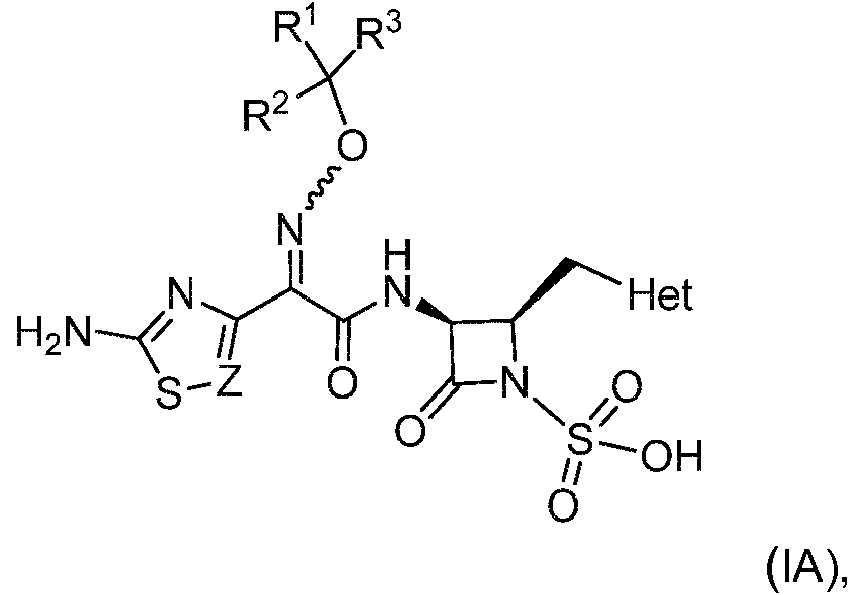
o una sal farmacéuticamente aceptable del mismo,or a pharmaceutically acceptable salt thereof,
en la que:in which:
Z es CR4 o N;Z is CR4 or N;
R1 es H o alquilo C1-C4;R1 is H or C1-C4 alkyl;
R2 se selecciona del grupo que consiste en H, alquilo C1-C4, y -COOHR2 is selected from the group consisting of H, C1-C4 alkyl, and -COOH
o R1 y R2 se toman junto con el carbono al que se unen formando un anillo seleccionado de un C3-C6 anillo cicloalquilo y un anillo heterocíclico de 4-6 miembros que contiene hasta dos heteroátomos seleccionados de N, O y S como miembros de anillo;or R1 and R2 are taken together with the carbon to which they are attached forming a ring selected from a C3-C6 cycloalkyl ring and a 4-6 membered heterocyclic ring containing up to two heteroatoms selected from N, O and S as ring members ;
R3 se selecciona de H, -COOH, y-L1-W-(CH2)0-2-X-R5;R3 is selected from H, -COOH, and -L1-W- (CH2) 0-2-X-R5;
R4 es H o halo;R4 is H or halo;
cada L1 es independientemente un alquileno C1-4de cadena lineal o ramificada;each L1 is independently a C1-4 straight or branched chain alkylene;
W es un enlace, O, NH o S;W is a bond, O, NH or S;
X es fenilo, o un anillo heteroarilo de 5-6 miembros que contiene 1-3 heteroátomos seleccionados de N, O y S como miembros de anillo; en donde el fenilo y heteroarilo de 5-6 miembros se sustituyen opcionalmente con uno o dos grupos seleccionados de alquilo C1-4, hidroxilo, -CN, F, alcoxilo C1-4, -NH2, -NH(alquilo C1-4) y -N(alquilo ^ -4)2;X is phenyl, or a 5-6 membered heteroaryl ring containing 1-3 heteroatoms selected from N, O and S as ring members; wherein the 5-6 membered phenyl and heteroaryl are optionally substituted with one or two groups selected from C1-4alkyl, hydroxyl, -CN, F, C1-4alkoxy, -NH2, -NH (C1-4alkyl) and -N (^ -4 alkyl) 2;
R5 se selecciona deR5 is selected from

yY
en donde R1b, R2b, y R3b son independientemente hidrógeno, hidroxilo, CN, (C1-C4)alquilo, (C1-C4)alcoxilo, (C3-C6)cicloalquilo, o heterociclilo de 4, 5, 6 ó 7 miembros, en donde cada (C1-C4)alquilo, (C1-C4)alcoxilo, (C3-C6)cicloalquilo, o heterociclilo de 4, 5, 6 ó 7 miembros puede sustituirse con uno, dos o tres sustituyentes seleccionados independientemente de Y,wherein R1b, R2b, and R3b are independently hydrogen, hydroxyl, CN, (C1-C4) alkyl, (C1-C4) alkoxy, (C3-C6) cycloalkyl, or 4, 5, 6 or 7-membered heterocyclyl, in where each (C1-C4) alkyl, (C1-C4) alkoxy, (C3-C6) cycloalkyl, or 4, 5, 6 or 7-membered heterocyclyl can be substituted with one, two or three substituents independently selected from Y,
y en donde R2b y R3b junto con el átomo de nitrógeno al que se unen pueden formar opcionalmente un heterociclilo de 5 a 7 miembros que incluye 0 ó 1 heteroátomos adicionales seleccionados de N, O y S, dicho heterociclilo sustituido opcionalmente por Y;and wherein R2b and R3b together with the nitrogen atom to which they bind may optionally form a 5- to 7-membered heterocyclyl that includes 0 or 1 additional heteroatoms selected from N, O and S, said heterocyclyl optionally substituted by Y;
Y se selecciona de F, CN, -NH2, Q, -L2-C(O)NR10-L2-Q, -L2-NR10-C(O)-L2-Q, -L2-OR10, -L2-N(R10)2, -L2-N+(R11)3, -L2-NR10-C(O)R10, -L2-NR10-L2-N(R10)2, -L2-O-C(O)OR10, -L2-O-C(O)-N(R10)2, -L2-NR10-C(O)-N(R10)2, -L2-NR10-C(O)-OR11, -L2-C(=NR10)-N(R10)2,-CON(R10)2, -L2-NR10-C(=NR10)-N(R10)2, -L2-NR10-C(=NR10)-R10, -L2-C(O)N(R10)2,, -L2-O-SO3R10; Y is selected from F, CN, -NH2, Q, -L2-C (O) NR10-L2-Q, -L2-NR10-C (O) -L2-Q, -L2-OR10, -L2-N ( R10) 2, -L2-N + (R11) 3, -L2-NR10-C (O) R10, -L2-NR10-L2-N (R10) 2, -L2-OC (O) OR10, -L2-OC (O) -N (R10) 2, -L2-NR10-C (O) -N (R10) 2, -L2-NR10-C (O) -OR11, -L2-C (= NR10) -N (R10 ) 2, -CON (R10) 2, -L2-NR10-C (= NR10) -N (R10) 2, -L2-NR10-C (= NR10) -R10, -L2-C (O) N (R10 ) 2 ,, -L2-O-SO3R10;
L2 es independientemente en cada aparición un enlace o un alquileno C-Mde cadena lineal o ramificada;L2 is independently at each occurrence a bond or a C-M straight or branched chain alkylene;
Het es un anillo heterocíclico saturado de 4-6 miembros, en donde el anillo heterocíclico contiene 1 ó 2 heteroátomos seleccionados de N, O y S como miembros de anillo y se sustituye con oxo y se sustituye además opcionalmente con Y;Het is a 4-6 membered saturated heterocyclic ring, wherein the heterocyclic ring contains 1 or 2 heteroatoms selected from N, O and S as ring members and is substituted with oxo and is also optionally substituted with Y;
R910 y R12 son independientemente H o alquilo C1-4 opcionalmente sustituido por Q;R910 and R12 are independently H or C1-4 alkyl optionally substituted by Q;
Q se selecciona de -L2-N(R13)2, - L2-N+(R14)3, -L2-NH-C(=NH)-NH2, -L2-C(=NH)-NH2,Q is selected from -L2-N (R13) 2, - L2-N + (R14) 3, -L2-NH-C (= NH) -NH2, -L2-C (= NH) -NH2,

R11 es independientemente en cada aparición alquilo C1-4;R11 is independently at each occurrence C1-4 alkyl;
y dos R10, o dos R11, o dos R12 en el mismo N pueden ciclarse formando un anillo heterocíclico de 4-6 miembros opcionalmente sustituido con alquilo C1-4, alcoxilo C1-4, hidroxilo u oxo;and two R10, or two R11, or two R12 in the same N can be cyclized to form a 4-6 membered heterocyclic ring optionally substituted with C1-4 alkyl, C1-4 alkoxy, hydroxy or oxo;
R13 es independientemente en cada aparición H o alquilo C1-4 opcionalmente sustituido con hidroxilo, alcoxilo C1-4, -NH2, -NH(alquilo C1-4) o-N(alquilo C1-4)2;R13 is independently at each occurrence H or C1-4 alkyl optionally substituted with hydroxyl, C1-4 alkoxy, -NH2, -NH (C1-4 alkyl) or -N (C1-4 alkyl) 2;
R14 es independientemente en cada aparición alquilo C1-4 opcionalmente sustituido con hidroxilo, alcoxilo C1-4, -NH2, -NH(alquilo C1.4) o-N(alquilo ^ -4)2;R14 is independently at each occurrence C1-4 alkyl optionally substituted with hydroxyl, C1-4 alkoxy, -NH2, -NH (C1.4 alkyl) or -N (^ -4 alkyl) 2;
en donde dos R13 o dos R14 en el mismo N pueden ciclarse formando un anillo heterocíclico de 4-6 miembros opcionalmente sustituido con alquilo C1-4, alcoxilo C1-4, hidroxilo, amino u oxo;wherein two R13 or two R14 in the same N can be cyclized to form a 4-6 membered heterocyclic ring optionally substituted with C1-4 alkyl, C1-4 alkoxy, hydroxyl, amino or oxo;
R15 es H, halo, alquilo C1-4, CN, o -O(alquilo C1.4);R15 is H, halo, C1-4 alkyl, CN, or -O (C1.4 alkyl);
o una sal farmacéuticamente aceptable del mismo.or a pharmaceutically acceptable salt thereof.
En determinadas realizaciones de los compuestos de fórmula (I) o (IA), el grupo representado por -0-CR1R2R3 seIn certain embodiments of the compounds of formula (I) or (IA), the group represented by -0-CR1R2R3 is
selecciona de
3. El compuesto según la realización 1 o realización 2, en el que R1 y R2 son cada uno metilo y R3 es -COOH.3. The compound according to embodiment 1 or embodiment 2, wherein R1 and R2 are each methyl and R3 is -COOH.
4. El compuesto según la realización 1 o realización 2, en el que R1 y R2 junto con el carbono al que se unen ambos forman un anillo ciclopropano y R3 es -COOH.4. The compound according to embodiment 1 or embodiment 2, wherein R1 and R2 together with the carbon to which they both bind form a cyclopropane ring and R3 is -COOH.
5. El compuesto según la realización 1 o realización 2, en el que R1 y R2 son ambos H y R3 es -COOH.5. The compound according to embodiment 1 or embodiment 2, wherein R1 and R2 are both H and R3 is -COOH.
6. El compuesto según cualquiera de las realizaciones anteriores, en el que Z es CH.6. The compound according to any of the above embodiments, wherein Z is CH.
7. El compuesto según cualquiera de las realizaciones 1-6, en el que Z es N.7. The compound according to any of embodiments 1-6, wherein Z is N.
8. El compuesto según cualquiera de las realizaciones 1-7, en el que Het es un anillo saturado sustituido con oxo y se sustituye además opcionalmente con Y.8. The compound according to any of embodiments 1-7, wherein Het is a saturated ring substituted with oxo and is further optionally substituted with Y.
9. El compuesto según la realización 8, en el que Het se selecciona de pirrolidin-2-ona, oxazolidin-2-ona e imidazolidin-2-ona, y se sustituye opcionalmente con Y. En realizaciones particulares de estos compuestos, Het se selecciona de:9. The compound according to embodiment 8, wherein Het is selected from pyrrolidin-2-one, oxazolidin-2-one and imidazolidin-2-one, and is optionally substituted with Y. In particular embodiments of these compounds, Het is select from:

donde el enlace discontinuo indica el punto de unión de Het al resto de fórmula (I) o (IA), y (Y)0-1 representa un sustituyente opcional Y que puede unirse en cualquier posición disponible en el anillo.where the discontinuous bond indicates the point of attachment of Het to the rest of formula (I) or (IA), and (Y) 0-1 represents a Optional substituent Y that can be attached in any position available in the ring.
10. El compuesto según la realización 8, en el que Het es oxazolidin-2-ona y se sustituye opcionalmente con -L2-N(R10)2 o L2-NR10-C(=NR10)-N(R10)2.10. The compound according to embodiment 8, wherein Het is oxazolidin-2-one and is optionally substituted with -L2-N (R10) 2 or L2-NR10-C (= NR10) -N (R10) 2.
11. El compuesto según la realización 8, en el que Het es oxazolidin-2-ona que se sustituye en la posición 5 con -L2-N(R10)2 o L2-NR10-C(=NR10)-N(R10)2 en la configuración R.11. The compound according to embodiment 8, wherein Het is oxazolidin-2-one which is substituted in position 5 with -L2-N (R10) 2 or L2-NR10-C (= NR10) -N (R10) 2 in the R. configuration
12. El compuesto según cualquiera de las realizaciones anteriores, que tiene la estructura de fórmula (II):12. The compound according to any of the above embodiments, which has the structure of formula (II):

o una sal farmacéuticamente aceptable del mismo.or a pharmaceutically acceptable salt thereof.
13. El compuesto según la realización 1 o realización 2, en el que ---O-CR1R2R3 se selecciona de13. The compound according to embodiment 1 or embodiment 2, wherein --- O-CR1R2R3 is selected from
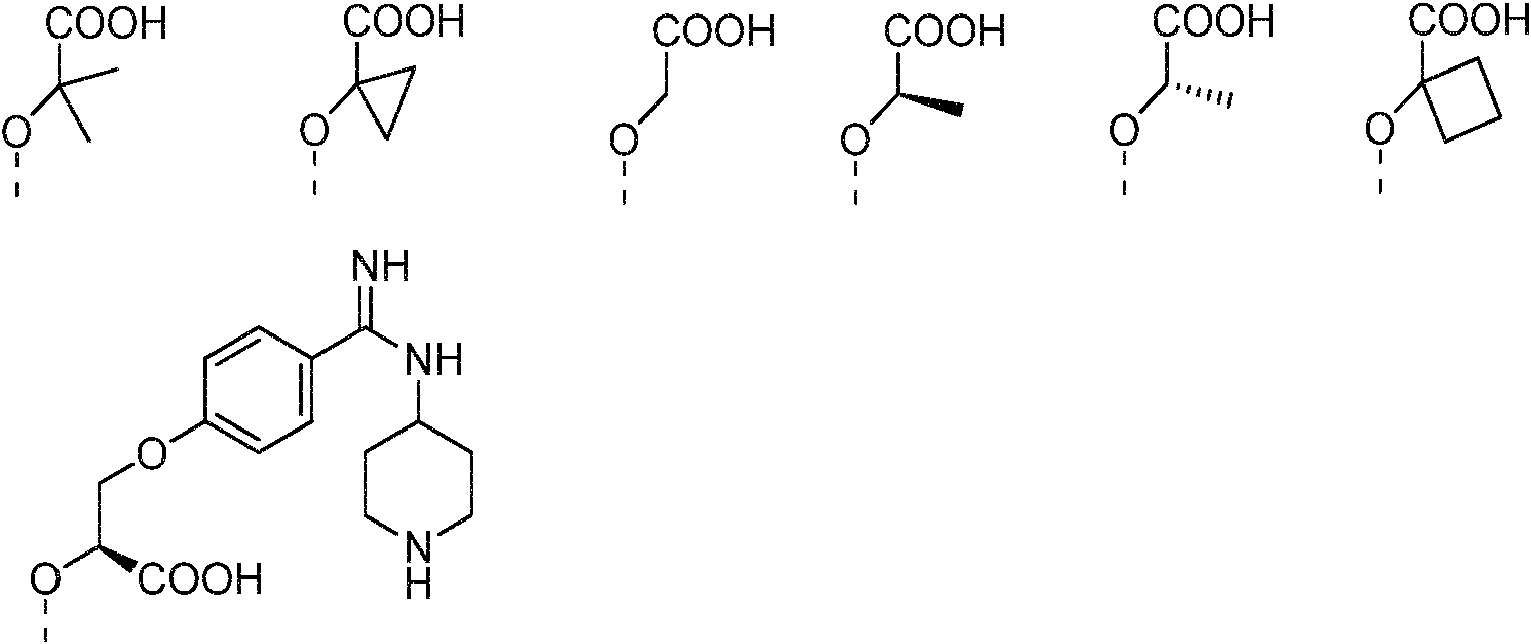
yY
14. El compuesto según la realización 1 o realización 13, en el que Het se selecciona de14. The compound according to embodiment 1 or embodiment 13, wherein Het is selected from


15. El compuesto según cualquiera de las realizaciones 1-10, en el que L2 es -(CH2)i -3-.15. The compound according to any of embodiments 1-10, wherein L2 is - (CH2) and -3-.
16. El compuesto según la realización 12 en el que Het se selecciona de:16. The compound according to embodiment 12 wherein Het is selected from:

17. El compuesto según la realización 18, en el que Het se selecciona de17. The compound according to embodiment 18, wherein Het is selected from

18. El compuesto según la realización 16 o 17, en el que Y se selecciona de Q, -L2-OR10, -L2-N(R10)2, -L2-N(R11)3, -L2-NR10-C(O)R10, -, -L2-O-C(O)OR10, -L2-O-C(O)-N(R10)2, -L2-NR10-C(O)-N(R10)2, -L2-C(=NR10)-N(R10)2, -CON(R10)2, -L2-NR10-C(=NR10)-N(R10)2, y -L2-NR10-C(=NR10)-R10.18. The compound according to embodiment 16 or 17, wherein Y is selected from Q, -L2-OR10, -L2-N (R10) 2, -L2-N (R11) 3, -L2-NR10-C ( O) R10, -, -L2-OC (O) OR10, -L2-OC (O) -N (R10) 2, -L2-NR10-C (O) -N (R10) 2, -L2-C ( = NR10) -N (R10) 2, -CON (R10) 2, -L2-NR10-C (= NR10) -N (R10) 2, and -L2-NR10-C (= NR10) -R10.
Alternativamente, el compuesto según la realización 16 ó 17 en el que Y es de fórmula -L2-NR10-L2-N(R10)2, por ejemplo Y puede ser un grupo tal como -CH2-NR10-(CH2)2-3-N(R10)2í en realizaciones particulares de estos compuestos, R10 es H.Alternatively, the compound according to embodiment 16 or 17 wherein Y is of the formula -L2-NR10-L2-N (R10) 2, for example Y can be a group such as -CH2-NR10- (CH2) 2-3 -N (R10) 2 í in particular embodiments of these compounds, R10 is H.
19. El compuesto según cualquiera de las realizaciones 6-17, en el queR3 es de fórmula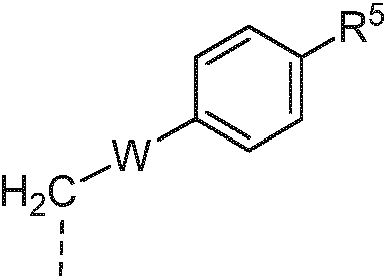
20. El compuesto según la realización 19, en el que R3 es20. The compound according to embodiment 19, wherein R3 is

cuando R3b se selecciona de H, azetidina, pirrolidina y piperidina.when R3b is selected from H, azetidine, pyrrolidine and piperidine.
21. El compuesto según cualquiera de las realizaciones anteriores, que es una sal farmacéuticamente aceptable.21. The compound according to any of the above embodiments, which is a pharmaceutically acceptable salt.
22. Una composición farmacéutica que comprende un compuesto según cualquiera de las realizaciones anteriores y al menos un excipiente farmacéuticamente aceptable. 22. A pharmaceutical composition comprising a compound according to any of the above embodiments and at least one pharmaceutically acceptable excipient.
23. Un compuesto según cualquiera de las realizaciones 1-20, o una composición farmacéutica según la realización 22 para su uso en un método para tratar una infección bacteriana Gram-negativa.23. A compound according to any of embodiments 1-20, or a pharmaceutical composition according to embodiment 22 for use in a method of treating a Gram-negative bacterial infection.
24. El compuesto o la composición para su uso según la realización 23, en el que la infección bacteriana está provocada por una especie de bacterias de Burkholderia, Citrobacter, Enterobacter, Escherichia, Klebsiella, Meningitidis, Morganella, Pseudomonas, Proteus, Salmonella, Serratia, Acinetobacter, Bacteroides, Campylobacter, Neisseria o Stenotrophomonas. 24. The compound or composition for use according to embodiment 23, wherein the bacterial infection is caused by a species of bacteria from Burkholderia, Citrobacter, Enterobacter, Escherichia, Klebsiella, Meningitidis, Morganella, Pseudomonas, Proteus, Salmonella, Serratia , Acinetobacter, Bacteroides, Campylobacter, Neisseria or Stenotrophomonas.
25. El compuesto o la composición para su uso según la realización 23, en el que la infección bacteriana es neumonía nosocomial, una infección intraabdominal o una infección de las vías urinarias provocada por una especie de Enterobacteriaceae.25. The compound or composition for use according to embodiment 23, wherein the bacterial infection is nosocomial pneumonia, an intra-abdominal infection or a urinary tract infection caused by a species of Enterobacteriaceae.
26. Un compuesto según cualquiera de las realizaciones 1-20 para su uso como medicamento.26. A compound according to any of embodiments 1-20 for use as a medicament.
27. El compuesto para su uso según la realización 26, en el que el medicamento es un agente antibacteriano.27. The compound for use according to embodiment 26, wherein the medicament is an antibacterial agent.
28. El compuesto para su uso según la realización 26, en el que el agente antibacteriano es para tratamiento de una infección bacteriana Gram-negativa provocada por una especie de Citrobacter, Enterobacter, Escherichia, Klebsiella, Morganella, Pseudomonas, Proteus, Salmonella, Serratia, Acinetobacter, Bacteroides, Burkholderia, Campylobacter, Neisseria o Stenotrophomonas. 28. The compound for use according to embodiment 26, wherein the antibacterial agent is for the treatment of a Gram-negative bacterial infection caused by a species of Citrobacter, Enterobacter, Escherichia, Klebsiella, Morganella, Pseudomonas, Proteus, Salmonella, Serratia , Acinetobacter, Bacteroides, Burkholderia, Campylobacter, Neisseria or Stenotrophomonas.
29. Una combinación farmacéutica, que comprende un compuesto según cualquiera de las realizaciones 1-20 y un segundo agente terapéutico.29. A pharmaceutical combination, comprising a compound according to any of embodiments 1-20 and a second therapeutic agent.
En compuestos de fórmula (I) y diversas realizaciones descritas anteriormente, la oxima es preferiblemente de la configuración mostrada en este caso:In compounds of formula (I) and various embodiments described above, the oxime is preferably of the configuration shown in this case:

En algunos casos según cualquiera de las realizaciones descritas anteriormente, a menos que se especifique lo contrario, uno pero no ambos de R2 y R3 representan -COOH.In some cases according to any of the embodiments described above, unless otherwise specified, one but not both of R2 and R3 represent -COOH.
Cuando R3 en cualquiera de las realizaciones anteriores es de fórmula -L1-W-(CH2)0-2-X-R5, X puede ser fenilo. En algunas de estas realizaciones, L1 es CH2. En algunas de estas realizaciones, W es O. En algunas de estas realizaciones, R5 es un grupo de fórmulaWhen R3 in any of the above embodiments is of the formula -L1-W- (CH2) 0-2-X-R5, X may be phenyl. In some of these embodiments, L1 is CH2. In some of these embodiments, W is O. In some of these embodiments, R5 is a group of formula

en la que R1b, R2b y R3b son tal como se describen para la realización 1 anterior. En determinadas de estaswherein R1b, R2b and R3b are as described for embodiment 1 above. In certain of these

realizaciones, R5 es de fórmula > en la que R1b y R2b representan cada uno H, y R3b puede ser H, o un grupo heterocíclico tal como 4-piperidinilo. De manera adecuada, en estas realizaciones R1 es H y R2 es H o COOH.embodiments, R5 is of the formula> in which R1b and R2b each represent H, and R3b can be H, or a heterocyclic group such as 4-piperidinyl. Suitably, in these embodiments R1 is H and R2 is H or COOH.
En un aspecto adicional, la invención proporciona:In a further aspect, the invention provides:
• Una combinación farmacéutica que comprende (a) un primer agente terapéutico que es un compuesto de la invención, por ejemplo un compuesto de fórmula (I) o cualquier subfórmula del mismo descrita en el presente documento, y (b) un segundo agente terapéutico tal como se describió anteriormente.• A pharmaceutical combination comprising (a) a first therapeutic agent that is a compound of the invention, for example a compound of formula (I) or any sub-formula thereof described herein, and (b) a second therapeutic agent such as described above.
• Un compuesto de fórmula (I) para su uso en un método tal como se definió anteriormente que comprende la coadministración, por ejemplo de manera concomitante o en secuencia, de una cantidad terapéuticamente eficaz de un compuesto de la invención, por ejemplo un compuesto de fórmula (I) o cualquier subfórmula del mismo que se describe en el presente documento, y un segundo agente terapéutico tal como se describió anteriormente.• A compound of formula (I) for use in a method as defined above comprising co-administration, for example concomitantly or sequentially, of a therapeutically effective amount of a compound of the invention, for example a compound of formula (I) or any sub-formula thereof described herein, and a second therapeutic agent as described above.
Los términos “coadministración” o “administración combinada” o similares tal como se utilizan en el presente documento pretenden abarcar administración de los agentes terapéuticos seleccionados a un paciente individual, y se pretende que incluyan regímenes de tratamiento en los que los agentes no se administran necesariamente por la misma vía de administración o al mismo tiempo. Combinaciones fijas también están dentro del alcance de la presente invención. La administración de una combinación farmacéutica de la invención da como resultado un efecto beneficioso, por ejemplo, un efecto terapéutico sinérgico, en comparación con una monoterapia aplicando sólo uno de sus principios farmacéuticamente activos.The terms "co-administration" or "combined administration" or the like as used herein are intended to encompass administration of the selected therapeutic agents to an individual patient, and are intended to include treatment regimens in which the agents are not necessarily administered. by the same route of administration or at the same time. Fixed combinations are also within the scope of the present invention. The administration of a pharmaceutical combination of the invention results in a beneficial effect, for example, a synergistic therapeutic effect, as compared to monotherapy by applying only one of its pharmaceutically active principles.
Cada componente de una combinación según esta invención puede administrarse por separado, a la vez o en cualquier combinación de los mismos.Each component of a combination according to this invention can be administered separately, at the same time or in any combination thereof.
El compuesto de la invención y cualquier agente adicional pueden formularse en formas de dosificación diferenciadas. Alternativamente, para reducir el número de formas de dosificación administradas a un paciente, el compuesto de la invención y cualquier agente adicional pueden formularse juntos en cualquier combinación. Por ejemplo, el compuesto del inhibidor de la invención puede formularse en una forma de dosificación y el agente adicional puede formularse junto en otra forma de dosificación. Puede administrarse cualquier forma de dosificación diferenciada al mismo tiempo o tiempos diferentes.The compound of the invention and any additional agent can be formulated in differentiated dosage forms. Alternatively, to reduce the number of dosage forms administered to a patient, the compound of the invention and any additional agent can be formulated together in any combination. For example, the inhibitor compound of the invention may be formulated in a dosage form and the additional agent may be formulated together in another dosage form. Any differentiated dosage form can be administered at the same time or different times.
Alternativamente, una composición de esta invención comprende un agente adicional tal como se describe en el presente documento. Cada componente puede estar presente en composiciones individuales, composiciones de combinación o en una composición individual.Alternatively, a composition of this invention comprises an additional agent as described herein. Each component may be present in individual compositions, combination compositions or in an individual composition.
Los compuestos de la invención pueden sintetizarse mediante las rutas de síntesis generales a continuación, cuyos ejemplos específicos se describen en más detalle en los ejemplos.The compounds of the invention can be synthesized by the general synthetic routes below, the specific examples of which are described in more detail in the examples.
Los compuestos de la presente invención y los compuestos intermedios también pueden convertirse entre sí según métodos generalmente conocidos por los expertos en la técnica.The compounds of the present invention and intermediate compounds can also be converted to each other according to methods generally known to those skilled in the art.
Dentro del alcance de este texto, sólo un grupo fácilmente eliminable que no es un constituyente del producto final deseado particular de los compuestos de la presente invención se designa “grupo protector”, a menos que el contexto indique lo contrario. Se describe la protección de grupos funcionales por tales grupos protectores, los propios grupos protectores y sus reacciones de escisión, por ejemplo, en trabajos de referencia convencionales, tales como J. F. W. McOmie, “Protective Groups in Organic Chemistry”, Plenum Press, Londres y Nueva York 1973, en T. W. Greene y P. G. M. Wuts, “Protective Groups in Organic Synthesis”, tercera edición, Wiley, Nueva York 1999, en “The Peptides”; volumen 3 (editores: E. Gross y J. Meienhofer), Academic Press, Londres y Nueva York 1981, en “Methoden der organischen Chemie” (Métodos de química orgánica), Houben Weyl, 4a edición, volumen 15/l, Georg Thieme Verlag, Stuttgart 1974, en H.-D. Jakubke y H. Jeschkeit, “Aminosauren, Peptide, Proteine” (aminoácidos, péptidos, proteínas), Verlag Chemie, Weinheim, Deerfield Beach y Basilea 1982, y en Jochen Lehmann, “Chemie der Kohlenhydrate: Monosaccharide und Derivate” (Química de hidratos de carbono: monosacáridos y derivados), Georg Thieme Verlag, Stuttgart 1974. Una característica de los grupos protectores es que pueden eliminarse fácilmente (es decir, sin la aparición de reacciones secundarias no deseadas), por ejemplo, mediante solvólisis, reducción, fotólisis o alternativamente en condiciones fisiológicas (por ejemplo, mediante escisión enzimática). Within the scope of this text, only an easily removable group that is not a constituent of the particular desired end product of the compounds of the present invention is designated a "protecting group", unless the context indicates otherwise. The protection of functional groups by such protective groups, the protective groups themselves and their cleavage reactions is described, for example, in conventional reference works, such as JFW McOmie, "Protective Groups in Organic Chemistry", Plenum Press, London and New York 1973, in TW Greene and PGM Wuts, "Protective Groups in Organic Synthesis", third edition, Wiley, New York 1999, in "The Peptides"; volume 3 (editors: E. Gross and J. Meienhofer), Academic Press, London and New York 1981, in “Methoden der organischen Chemie” (Organic Chemistry Methods), Houben Weyl, 4th edition, volume 15 / l, Georg Thieme Verlag, Stuttgart 1974, in H.-D. Jakubke and H. Jeschkeit, "Aminosauren, Peptide, Proteine" (amino acids, peptides, proteins), Verlag Chemie, Weinheim, Deerfield Beach and Basel 1982, and in Jochen Lehmann, "Chemie der Kohlenhydrate: Monosaccharide und Derivate" (Hydrate Chemistry carbon: monosaccharides and derivatives), Georg Thieme Verlag, Stuttgart 1974. A characteristic of protective groups is that they can be easily removed (i.e., without the occurrence of unwanted side reactions), for example, by sololysis, reduction, photolysis or alternatively under physiological conditions (for example, by enzymatic cleavage).
Las sales de los compuestos de la presente invención que tienen al menos un grupo formador de sal pueden prepararse de una manera conocida por los expertos en la técnica. Por ejemplo, las sales de los compuestos de la presente invención que tienen grupos ácidos pueden formarse, por ejemplo, tratando los compuestos con compuestos metálicos, tales como sales de metales alcalinos de ácidos carboxílicos orgánicos adecuados, por ejemplo, la sal de sodio del ácido 2-etilhexanoico, con compuestos orgánicos de metales alcalinos o alcalinotérreos, tales como los correspondientes hidróxidos, carbonatos o hidrogenocarbonatos, tales como hidróxido, carbonato o hidrogenocarbonato de sodio o potasio, con los correspondientes compuestos de calcio o con amoníaco o una amina orgánica adecuada, cantidades estequiométricas o sólo un pequeño exceso del agente formador de sal que preferiblemente se está usando. Las sales de adición de ácido de los compuestos de la presente invención se obtienen de manera habitual, por ejemplo, tratando los compuestos con un ácido o un reactivo de intercambio aniónico adecuado. Sales internas de compuestos de la presente invención que contienen grupos formadores de sales básicas y ácidas, por ejemplo, puede formarse un grupo carboxilo libre y un grupo amino libre, por ejemplo, mediante la neutralización de sales, tales como sales de adición de ácido, al punto isoeléctrico, por ejemplo, con bases débiles, o mediante tratamiento con intercambiadores de iones.The salts of the compounds of the present invention having at least one salt forming group can be prepared in a manner known to those skilled in the art. For example, the salts of the compounds of the present invention having acid groups can be formed, for example, by treating the compounds with metal compounds, such as alkali metal salts of suitable organic carboxylic acids, for example, the sodium salt of the acid 2-ethylhexanoic, with organic compounds of alkali or alkaline earth metals, such as the corresponding hydroxides, carbonates or hydrogen carbonates, such as hydroxide, carbonate or sodium or potassium hydrogen carbonate, with the corresponding calcium compounds or with ammonia or a suitable organic amine, stoichiometric amounts or only a small excess of the salt forming agent that is preferably being used. The acid addition salts of the compounds of the present invention are usually obtained, for example, by treating the compounds with a suitable acid or an anion exchange reagent. Internal salts of compounds of the present invention that contain basic and acidic salt forming groups, for example, a free carboxyl group and a free amino group can be formed, for example, by neutralizing salts, such as acid addition salts, to the isoelectric point, for example, with weak bases, or by treatment with ion exchangers.
Las sales pueden convertirse en los compuestos libres según los métodos conocidos por los expertos en la técnica. Las sales de metal y amonio pueden convertirse, por ejemplo, mediante tratamiento con ácidos adecuados, y las sales de adición de ácido, por ejemplo, mediante tratamiento con un agente básico adecuado.Salts can be converted into free compounds according to methods known to those skilled in the art. The metal and ammonium salts can be converted, for example, by treatment with suitable acids, and the acid addition salts, for example, by treatment with a suitable basic agent.
Las mezclas de isómeros obtenibles según la invención pueden separarse generalmente de una manera conocida por los expertos en la técnica en isómeros individuales; los diastereoisómeros pueden separarse, por ejemplo, mediante el reparto entre mezclas de disolventes polifásicos, recristalización y/o separación cromatográfica, por ejemplo, sobre gel de sílice o por ejemplo, mediante cromatografía líquida de presión media sobre una columna de fase inversa y los racematos pueden separarse, por ejemplo, mediante la formación de sales con reactivos formadores de sal ópticamente puros y la separación de la mezcla de diastereoisómeros que puede obtenerse de este modo, por ejemplo, mediante cristalización fraccionada, o mediante cromatografía sobre materiales de columna ópticamente activos.The mixtures of isomers obtainable according to the invention can generally be separated in a manner known to those skilled in the art in individual isomers; the diastereoisomers can be separated, for example, by the distribution between mixtures of polyphase solvents, recrystallization and / or chromatographic separation, for example, on silica gel or for example, by medium pressure liquid chromatography on a reverse phase column and the racemates they can be separated, for example, by the formation of salts with optically pure salt-forming reagents and the separation of the mixture of diastereoisomers which can be obtained in this way, for example, by fractional crystallization, or by chromatography on optically active column materials.
Los productos intermedios y finales pueden elaborarse y/o purificarse según métodos convencionales, por ejemplo usando métodos cromatográficos, métodos de distribución, (re)cristalización, y similares.The intermediate and final products can be made and / or purified according to conventional methods, for example using chromatographic methods, distribution methods, (re) crystallization, and the like.
Lo siguiente se aplica en general a todos los procedimientos mencionados en el presente documento antes y a continuación en el presente documento.The following applies in general to all the procedures mentioned in this document before and then in this document.
Todas los etapas del procedimiento para elaborar compuestos de la invención pueden llevarse a cabo en condiciones de reacción que son conocidas por los expertos en la técnica, incluyendo las mencionadas específicamente, en ausencia o, habitualmente, en presencia de disolventes o diluyentes, incluyendo, por ejemplo, disolventes o diluyentes que son inertes a los reactivos usados y los disuelven, en ausencia o presencia de catalizadores, agentes de condensación o neutralizantes, por ejemplo intercambiadores de iones, como los intercambiadores de cationes, por ejemplo, en la forma H , dependiendo de la naturaleza de la reacción y/o de los reactivos a temperatura reducida, normal o elevada, por ejemplo en un intervalo de temperatura desde aproximadamente -100°C hasta aproximadamente 190°C, incluyendo, por ejemplo, desde aproximadamente -80°C hasta aproximadamente 150°C, por ejemplo, desde -80 hasta -60°C, a temperatura ambiente, a desde -20 hasta 40°C o a temperatura de reflujo, a presión atmosférica o en un recipiente cerrado, donde sea apropiado bajo presión, y/o en una atmósfera inerte, por ejemplo bajo una atmósfera de argón o nitrógeno.All steps of the process for making compounds of the invention can be carried out under reaction conditions that are known to those skilled in the art, including those mentioned specifically, in the absence or, usually, in the presence of solvents or diluents, including, by for example, solvents or diluents that are inert to the reagents used and dissolve them, in the absence or presence of catalysts, condensing agents or neutralizers, for example ion exchangers, such as cation exchangers, for example, in form H, depending of the nature of the reaction and / or of the reagents at reduced, normal or elevated temperature, for example in a temperature range from about -100 ° C to about 190 ° C, including, for example, from about -80 ° C up to about 150 ° C, for example, from -80 to -60 ° C, at room temperature, from -20 to 40 ° C or at reflux temperature , at atmospheric pressure or in a closed container, where appropriate under pressure, and / or in an inert atmosphere, for example under an argon or nitrogen atmosphere.
En todas las etapas de las reacciones, las mezclas de isómeros que se forman pueden separarse en isómeros individuales, por ejemplo, diastereoisómeros o enantiómeros, o en cualquier mezcla deseada de isómeros, por ejemplo racematos o mezclas de diastereoisómeros.At all stages of the reactions, mixtures of isomers that are formed can be separated into individual isomers, for example, diastereoisomers or enantiomers, or any desired mixture of isomers, for example racemates or mixtures of diastereoisomers.
Los disolventes a partir de los cuales pueden seleccionarse aquellos disolventes que son adecuados para cualquier reacción particular incluyen los mencionados específicamente o, por ejemplo, agua, ésteres, tales como alquilo inferior-alcanoatos inferiores, por ejemplo acetato de etilo, éteres, tales como éteres alifáticos, por ejemplo, dietil éter o éteres cíclicos, por ejemplo, tetrahidrofurano o dioxano, hidrocarburos aromáticos líquidos, tales como benceno o tolueno, alcoholes, tales como metanol, etanol o 1 o 2-propanol, nitrilos, tales como acetonitrilo, hidrocarburos halogenados, tales como cloruro de metileno o cloroformo, amidas ácidas, tales como dimetilformamida o dimetilacetamida, bases, tales como bases nitrogenadas heterocíclicas, por ejemplo, piridina o W-metilpirrolidin-2-ona, anhídridos de ácido carboxílico, como anhídridos de ácido alcanoico inferior, por ejemplo anhídrido acético, hidrocarburos cíclicos, lineales o ramificados, tales como ciclohexano, hexano o isopentano, meticiclohexano o mezclas de esos disolventes, por ejemplo soluciones acuosas, a menos que se indique lo contrario en la descripción de los procedimientos. Tales mezclas de disolventes también pueden usarse en el tratamiento, por ejemplo, mediante cromatografía o partición.Solvents from which those solvents that are suitable for any particular reaction can be selected include those specifically mentioned or, for example, water, esters, such as lower alkyl lower alkanoates, for example ethyl acetate, ethers, such as ethers aliphatic, for example, diethyl ether or cyclic ethers, for example, tetrahydrofuran or dioxane, liquid aromatic hydrocarbons, such as benzene or toluene, alcohols, such as methanol, ethanol or 1 or 2-propanol, nitriles, such as acetonitrile, halogenated hydrocarbons , such as methylene chloride or chloroform, acid amides, such as dimethylformamide or dimethylacetamide, bases, such as heterocyclic nitrogenous bases, for example, pyridine or W-methylpyrrolidin-2-one, carboxylic acid anhydrides, such as lower alkanoic acid anhydrides , for example acetic anhydride, cyclic, linear or branched hydrocarbons, such as cyclohex ano, hexane or isopentane, methicyclohexane or mixtures of these solvents, for example aqueous solutions, unless otherwise indicated in the process description. Such solvent mixtures can also be used in the treatment, for example, by chromatography or partition.
Los compuestos de la presente invención, incluyendo sus sales, también pueden obtenerse en forma de hidratos, o sus cristales pueden, por ejemplo, incluir el disolvente usado para cristalización. Pueden estar presentes diferentes formas cristalinas. The compounds of the present invention, including their salts, can also be obtained in the form of hydrates, or their crystals may, for example, include the solvent used for crystallization. Different crystalline forms may be present.
Todos los materiales de partida, bloques de construcción, reactivos, ácidos, bases, agentes deshidratantes, disolventes y catalizadores utilizados para sintetizar los compuestos de la presente invención están disponibles comercialmente o pueden producirse mediante métodos de síntesis orgánica conocidos por los expertos en la técnica.All starting materials, building blocks, reagents, acids, bases, dehydrating agents, solvents and catalysts used to synthesize the compounds of the present invention are commercially available or can be produced by organic synthesis methods known to those skilled in the art.
El término “isómero óptico” o “un estereoisómero” se refiere a cualquiera de las diversas configuraciones de estereoisómeros que pueden existir para un compuesto dado de la presente invención e incluye isómeros geométricos. Se entiende que un sustituyente puede estar unido a un centro quiral de un átomo de carbono. El término “quiral” se refiere a las moléculas que tienen la propiedad de no superponibilidad en su compañero de imagen especular, mientras que el término “aquiral” se refiere a las moléculas que son superponibles en su compañero de imagen especular. Por tanto, la invención incluye enantiómeros, diastereómeros o racematos del compuesto. Los “enantiómeros” son un par de estereoisómeros que son imágenes especulares no superponibles entre sí. Una mezcla 1:1 de un par de enantiómeros es una mezcla “racémica”. El término se usa para designar una mezcla racémica cuando sea apropiado. Los “diastereoisómeros” son estereoisómeros que tienen al menos dos átomos asimétricos, pero que no son imágenes especulares entre sí. La estereoquímica absoluta se especifica de acuerdo con el sistema Cahn-Ingold-Prelog R-S. Cuando un compuesto es un enantiómero puro, la estereoquímica de cada carbono quiral puede especificarse mediante o bien R o bien S. Los compuestos resueltos cuya configuración absoluta es desconocida pueden designarse (+) o (-) dependiendo de la dirección (dextro o levorrotatoria) en la que giran la luz polarizada plana en la longitud de onda de la línea D de sodio. Determinados compuestos descritos en el presente documento contienen uno o más centros o ejes asimétricos y, por tanto, pueden dar lugar a enantiómeros, diastereómeros y otras formas estereoisómeras que pueden definirse, en términos de estereoquímica absoluta, como (R) - o (S)-.The term "optical isomer" or "a stereoisomer" refers to any of the various configurations of stereoisomers that may exist for a given compound of the present invention and includes geometric isomers. It is understood that a substituent may be attached to a chiral center of a carbon atom. The term "chiral" refers to molecules that have the property of non-superposition in their mirror image partner, while the term "aquiral" refers to molecules that are superimposable in their mirror image partner. Therefore, the invention includes enantiomers, diastereomers or racemates of the compound. The "enantiomers" are a pair of stereoisomers that are non-superimposable mirror images of each other. A 1: 1 mixture of a pair of enantiomers is a "racemic" mixture. The term is used to designate a racemic mixture when appropriate. "Diastereoisomers" are stereoisomers that have at least two asymmetric atoms, but are not mirror images of each other. Absolute stereochemistry is specified according to the Cahn-Ingold-Prelog RS system. When a compound is a pure enantiomer, the stereochemistry of each chiral carbon can be specified by either R or S. Solved compounds whose absolute configuration is unknown can be designated (+) or (-) depending on the direction (dextro or levorotatory) in which they rotate the flat polarized light on the wavelength of the sodium D line. Certain compounds described herein contain one or more asymmetric centers or axes and, therefore, may give rise to enantiomers, diastereomers and other stereoisomeric forms that can be defined, in terms of absolute stereochemistry, as (R) - or (S) -.
Dependiendo de la elección de los materiales de partida y los procedimientos, los compuestos pueden estar presentes en forma de uno de los posibles isómeros o como mezclas de los mismos, por ejemplo, como isómeros ópticos puros, o como mezclas de isómeros, tales como racematos y mezclas de diastereoisómeros, dependiendo del número de átomos de carbono asimétricos. La presente invención pretende incluir todos los estereoisómeros posibles, incluyendo mezclas racémicas, mezclas diastereoméricas y formas ópticamente puras. Los isómeros activos ópticamente (R) y (S) pueden prepararse usando sintones quirales o reactivos quirales, o resolverse usando técnicas convencionales. Si el compuesto contiene un doble enlace, el sustituyente puede ser la configuración E o Z. Si el compuesto contiene un cicloalquilo disustituido, el sustituyente cicloalquilo puede tener una configuración cis o trans. Todas las formas tautoméricas también están destinadas a ser incluidas.Depending on the choice of starting materials and procedures, the compounds may be present in the form of one of the possible isomers or as mixtures thereof, for example, as pure optical isomers, or as mixtures of isomers, such as racemates. and mixtures of diastereoisomers, depending on the number of asymmetric carbon atoms. The present invention is intended to include all possible stereoisomers, including racemic mixtures, diastereomeric mixtures and optically pure forms. The optically active isomers (R) and (S) can be prepared using chiral syntons or chiral reagents, or resolved using conventional techniques. If the compound contains a double bond, the substituent may be the E or Z configuration. If the compound contains a disubstituted cycloalkyl, the cycloalkyl substituent may have a cis or trans configuration. All tautomeric forms are also intended to be included.
Cualquier mezcla resultante de isómeros puede separarse basándose en las diferencias fisicoquímicas de los constituyentes, en los isómeros geométricos u ópticos puros o sustancialmente puros, diastereómeros, racematos, por ejemplo, mediante cromatografía y/o cristalización fraccionada.Any resulting mixture of isomers can be separated based on the physicochemical differences of the constituents, pure or substantially pure geometric or optical isomers, diastereomers, racemates, for example, by chromatography and / or fractional crystallization.
Cualquier racemato resultante de productos finales o intermedios puede resolverse en las antípodas ópticas mediante métodos conocidos, por ejemplo, mediante separación de sus sales diastereoméricas, obtenidas con un ácido o base ópticamente activo, y liberando el compuesto ácido o básico ópticamente activo. En particular, por tanto, puede emplearse un resto básico para resolver los compuestos de la presente invención en sus antípodas ópticas, por ejemplo, mediante cristalización fraccionada de una sal formada con un ácido ópticamente activo, por ejemplo, ácido tartárico, ácido dibenzoil-tartárico, ácido diacetil-tartárico, ácido d i-0,0’-p-toluoil-tartárico, ácido mandélico, ácido málico o ácido de alcanfor-10-sulfónico. Los productos racémicos también pueden resolverse mediante cromatografía quiral, por ejemplo, cromatografía líquida de alta presión (HPLC) usando un adsorbente quiral.Any racemate resulting from final or intermediate products can be resolved in the optical antipodes by known methods, for example, by separating their diastereomeric salts, obtained with an optically active acid or base, and releasing the optically active acid or basic compound. In particular, therefore, a basic moiety can be used to solve the compounds of the present invention in their optical antipodes, for example, by fractional crystallization of a salt formed with an optically active acid, for example, tartaric acid, dibenzoyl-tartaric acid , diacetyl tartaric acid, d i-0,0'-p-toluoyl-tartaric acid, mandelic acid, malic acid or camphor-10-sulfonic acid. Racemic products can also be resolved by chiral chromatography, for example, high pressure liquid chromatography (HPLC) using a chiral adsorbent.
Además, los compuestos de la presente invención, incluyendo sus sales, también pueden obtenerse en forma de sus hidratos, o incluir otros disolventes usados para su cristalización. Los compuestos de la presente invención pueden, inherentemente o por diseño, formar solvatos con disolventes farmacéuticamente aceptables (incluyendo agua); por tanto, se pretende que la invención abarque tanto formas solvatadas como no solvatadas. El término “solvato” se refiere a un complejo molecular de un compuesto de la presente invención (incluidas sus sales farmacéuticamente aceptables) con una o más moléculas de disolvente. Dichas moléculas de disolvente son aquellas usadas comúnmente en la técnica farmacéutica, que se sabe que son inocuas para el receptor, por ejemplo, agua, etanol y similares. El término “hidrato” se refiere al complejo en el que la molécula de disolvente es agua.In addition, the compounds of the present invention, including their salts, can also be obtained in the form of their hydrates, or include other solvents used for their crystallization. The compounds of the present invention may, inherently or by design, form solvates with pharmaceutically acceptable solvents (including water); therefore, it is intended that the invention encompasses both solvated and non-solvated forms. The term "solvate" refers to a molecular complex of a compound of the present invention (including its pharmaceutically acceptable salts) with one or more solvent molecules. Such solvent molecules are those commonly used in the pharmaceutical art, which are known to be harmless to the recipient, for example, water, ethanol and the like. The term "hydrate" refers to the complex in which the solvent molecule is water.
Los compuestos de la presente invención, incluyendo sales, hidratos y solvatos de los mismos, pueden, de manera inherente o por diseño, formar polimorfos.The compounds of the present invention, including salts, hydrates and solvates thereof, can, inherently or by design, form polymorphs.
Tal como se usan en el presente documento, los términos “sal” o “sales” se refieren a una sal de adición de ácido o adición de base de un compuesto de la presente invención. Las “sales” incluyen en particular “sales farmacéuticamente aceptables”. El término “sales farmacéuticamente aceptables” se refiere a sales que retienen la efectividad biológica y las propiedades de los compuestos de esta invención y, que normalmente no son biológicamente o de otra manera indeseables. En muchos casos, los compuestos de la presente invención pueden formar sales de ácidos y/o bases en virtud de la presencia de grupos amino y/o carboxilo o grupos similares a los mismos. As used herein, the terms "salt" or "salts" refer to an acid addition or base addition salt of a compound of the present invention. "Salts" include in particular "pharmaceutically acceptable salts." The term "pharmaceutically acceptable salts" refers to salts that retain the biological effectiveness and properties of the compounds of this invention and, which are normally not biologically or otherwise undesirable. In many cases, the compounds of the present invention can form salts of acids and / or bases by virtue of the presence of amino and / or carboxyl groups or groups similar thereto.
Las sales de adición de ácido farmacéuticamente aceptables pueden formarse con ácidos inorgánicos y ácidos orgánicos, por ejemplo, acetato, aspartato, benzoato, besilato, bromuro/bromhidrato, bicarbonato/carbonato, bisulfato/sulfato, alcanforsulfonato, cloruro/clorhidrato, clorteofilonato, citrato, etandisulfonato, fumarato, gluceptato, gluconato, glucuronato, hipurato, yodhidrato/yoduro, isetionato, lactato, lactobionato, laurilsulfato, malato, maleato, malonato, mandelato, mesilato, metilsulfato, naftoato, napsilato, nicotinato, nitrato, octadecanoato, oleato, oxalato, palmitato, pamoato, fosfato/hidrogenofosfato/dihidrogenofosfato, poligalacturonato, propionato, estearato, succinato, sulfosalicilato, tartrato, tosilato y sales de trifluoroacetato.Pharmaceutically acceptable acid addition salts may be formed with inorganic acids and organic acids, for example, acetate, aspartate, benzoate, besylate, bromide / hydrobromide, bicarbonate / carbonate, bisulfate / sulfate, camphorsulfonate, chloride / hydrochloride, chlorteophilonate, citrate, etandisulfonato, fumarate, gluceptate, gluconate, glucuronate, hippurate, hydroiodide / iodide, isethionate, lactate, lactobionate, lauryl sulfate, malate, maleate, malonate, mandelate, mesylate, methylsulfate, naphthoate, napsylate, nicotinate, nitrate, octadecanoate, oleate, oxalate, palmitate, pamoate, phosphate / hydrogen phosphate / dihydrogen phosphate, polygalacturonate, propionate, stearate, succinate, sulfosalicylate, tartrate, tosylate and trifluoroacetate salts.
Los ácidos inorgánicos a partir de los cuales pueden derivarse sales incluyen, por ejemplo, ácido clorhídrico, ácido bromhídrico, ácido sulfúrico, ácido nítrico, ácido fosfórico y similares.Inorganic acids from which salts can be derived include, for example, hydrochloric acid, hydrobromic acid, sulfuric acid, nitric acid, phosphoric acid and the like.
Los ácidos orgánicos de los que pueden derivarse las sales incluyen, por ejemplo, ácido acético, ácido propiónico, ácido glicólico, ácido oxálico, ácido maleico, ácido malónico, ácido succínico, ácido fumárico, ácido tartárico, ácido cítrico, ácido benzoico, ácido mandélico, ácido metanosulfónico, ácido, ácido etanosulfónico, ácido toluenosulfónico, ácido sulfosalicílico y similares. Las sales de adición de bases farmacéuticamente aceptables pueden formarse con bases inorgánicas y orgánicas.Organic acids from which salts can be derived include, for example, acetic acid, propionic acid, glycolic acid, oxalic acid, maleic acid, malonic acid, succinic acid, fumaric acid, tartaric acid, citric acid, benzoic acid, mandelic acid , methanesulfonic acid, acid, ethanesulfonic acid, toluenesulfonic acid, sulfosalicylic acid and the like. The pharmaceutically acceptable base addition salts may be formed with inorganic and organic bases.
Las bases inorgánicas de las cuales pueden derivarse las sales incluyen, por ejemplo, sales de amonio y metales de las columnas I a XII de la tabla periódica. En determinadas realizaciones, las sales se derivan de sodio, potasio, amonio, calcio, magnesio, hierro, plata, zinc y cobre; las sales particularmente adecuadas incluyen sales de amonio, potasio, sodio, calcio y magnesio.Inorganic bases from which salts can be derived include, for example, ammonium salts and metals from columns I to XII of the periodic table. In certain embodiments, the salts are derived from sodium, potassium, ammonium, calcium, magnesium, iron, silver, zinc and copper; Particularly suitable salts include ammonium, potassium, sodium, calcium and magnesium salts.
Las bases orgánicas a partir de las cuales pueden derivarse las sales incluyen, por ejemplo, aminas primarias, secundarias y terciarias, aminas sustituidas que incluyen aminas sustituidas de origen natural, aminas cíclicas, resinas básicas de intercambio iónico y similares. Determinadas aminas orgánicas incluyen isopropilamina, benzatina, colinato, dietanolamina, dietilamina, lisina, meglumina, piperazina y trometamina.The organic bases from which salts can be derived include, for example, primary, secondary and tertiary amines, substituted amines including naturally occurring substituted amines, cyclic amines, basic ion exchange resins and the like. Certain organic amines include isopropylamine, benzathine, colinate, diethanolamine, diethylamine, lysine, meglumine, piperazine and tromethamine.
Las sales farmacéuticamente aceptables de la presente invención pueden sintetizarse a partir de un resto básico o ácido, mediante métodos químicos convencionales. Generalmente, tales sales pueden prepararse haciendo reaccionar formas ácidas libres de estos compuestos con una cantidad estequiométrica de la base apropiada (tal como hidróxido, carbonato, bicarbonato de Na, Ca, Mg o K o similar), o haciendo reaccionar formas de bases libres de estos compuestos con una cantidad estequiométrica del ácido apropiado. Tales reacciones se llevan a cabo normalmente en agua o en un disolvente orgánico, o en una mezcla de los dos. Generalmente, el uso de medios no acuosos como éter, acetato de etilo, etanol, isopropanol o acetonitrilo es deseable, cuando sea posible. Pueden encontrarse sales adecuadas adicionales, por ejemplo, en “Remington's Pharmaceutical Sciences”, 20a ed., Mack Publishing Company, Easton, Pa., (1985); y en “Handbook of Pharmaceutical Salts: Properties, Selection, and Use” por Stahl y Wermuth (Wiley-VCH, Weinheim, Alemania, 2002).The pharmaceutically acceptable salts of the present invention can be synthesized from a basic or acidic moiety, by conventional chemical methods. Generally, such salts can be prepared by reacting free acid forms of these compounds with a stoichiometric amount of the appropriate base (such as hydroxide, carbonate, bicarbonate of Na, Ca, Mg or K or the like), or by reacting free base forms of these compounds with a stoichiometric amount of the appropriate acid. Such reactions are usually carried out in water or in an organic solvent, or in a mixture of both. Generally, the use of non-aqueous media such as ether, ethyl acetate, ethanol, isopropanol or acetonitrile is desirable, when possible. Additional suitable salts can be found, for example, in "Remington's Pharmaceutical Sciences", 20th ed., Mack Publishing Company, Easton, Pa., (1985); and in “Handbook of Pharmaceutical Salts: Properties, Selection, and Use” by Stahl and Wermuth (Wiley-VCH, Weinheim, Germany, 2002).
Cualquier fórmula dada en el presente documento también pretende representar formas no marcadas así como formas marcadas isotópicamente de los compuestos de la presente invención. Los compuestos marcados isotópicamente tienen estructuras representadas por las fórmulas dadas en el presente documento, excepto que uno o más átomos están reemplazados por un átomo que tiene una masa atómica o un número másico seleccionado. Los ejemplos de isótopos que pueden incorporarse a los compuestos de la invención incluyen isótopos de hidrógeno, carbono, nitrógeno, oxígeno, fósforo, flúor y cloro, tales como 2H, 3H, 11C, 13C, 14C, 15N, 18F, 31P, 32P, 35S, 36Cl, 125I respectivamente. La invención incluye diversos compuestos marcados isotópicamente de la presente invención, por ejemplo, aquellos en los cuales isótopos radiactivos, tales como 3H y 14C, o aquellos en los cuales isótopos no radiactivos, tales como 2H y 13C están presentes. Tales compuestos marcados isotópicamente son útiles en estudios metabólicos (con 14C), estudios de reacción cinética (con, por ejemplo, 2H o 3H), técnicas de detección o diagnóstico por imágenes, tales como tomografía por emisión de positrones (PET) o tomografía computarizada por emisión de fotón único (SPECT), incluyendo ensayos de distribución de tejidos de sustrato o fármacos, o en el tratamiento radioactivo de pacientes. En particular, un compuesto marcado con 18F de la presente invención puede ser particularmente deseable para estudios de PET o SPECT. Los compuestos marcados isotópicamente de la presente invención pueden prepararse generalmente mediante técnicas convencionales conocidas por los expertos en la técnica o mediante procedimientos análogos a los descritos en los ejemplos y preparaciones adjuntas que usan un reactivo apropiado marcado isotópicamente en lugar del reactivo no marcado previamente empleado.Any formula given herein is also intended to represent unlabeled forms as well as isotopically labeled forms of the compounds of the present invention. Isotopically labeled compounds have structures represented by the formulas given herein, except that one or more atoms are replaced by an atom that has an atomic mass or a selected mass number. Examples of isotopes that can be incorporated into the compounds of the invention include hydrogen, carbon, nitrogen, oxygen, phosphorus, fluorine and chlorine isotopes, such as 2H, 3H, 11C, 13C, 14C, 15N, 18F, 31P, 32P, 35S, 36Cl, 125I respectively. The invention includes various isotopically labeled compounds of the present invention, for example, those in which radioactive isotopes, such as 3H and 14C, or those in which non-radioactive isotopes, such as 2H and 13C are present. Such isotopically labeled compounds are useful in metabolic studies (with 14C), kinetic reaction studies (with, for example, 2H or 3H), detection or diagnostic imaging techniques, such as positron emission tomography (PET) or computed tomography by single photon emission (SPECT), including trials of distribution of substrate tissues or drugs, or in the radioactive treatment of patients. In particular, an 18F labeled compound of the present invention may be particularly desirable for PET or SPECT studies. The isotopically labeled compounds of the present invention can generally be prepared by conventional techniques known to those skilled in the art or by methods analogous to those described in the examples and accompanying preparations using an appropriate isotopically labeled reagent instead of the previously unmarked reagent used.
Además, la sustitución con isótopos más pesados, particularmente deuterio (es decir, 2H o D) puede dar determinadas ventajas terapéuticas que resultan de una mayor estabilidad metabólica, por ejemplo, semivida in vivo aumentada o requisitos de dosificación reducidos o una mejora del índice terapéutico. Se entiende que el deuterio en este contexto se considera un sustituyente de un compuesto de la presente invención. La concentración de un isótopo más pesado de este tipo, específicamente deuterio, puede definirse por el factor de enriquecimiento isotópico. El término “factor de enriquecimiento isotópico” tal como se usa en el presente documento significa la razón entre la abundancia isotópica y la abundancia natural de un isótopo especificado. Si un sustituyente en un compuesto de esta invención se denota deuterio, tal compuesto tiene un factor de enriquecimiento isotópico para cada átomo de deuterio designado de al menos 3500 (el 52,5% de incorporación de deuterio en cada átomo de deuterio designado), al menos 4000 (el 60% de incorporación de deuterio), al menos 4500 (el 67,5% de incorporación de deuterio), al menos 5000 (el 75% de incorporación de deuterio), al menos 5500 (el 82,5% de incorporación de deuterio), al menos 6000 (el 90% de incorporación de deuterio), al menos 6333,3 (el 95% de incorporación de deuterio), al menos 6466,7 (el 97% de incorporación de deuterio), al menos 6600 (el 99% de incorporación de deuterio), o al menos 6633,3 (el 99,5% de incorporación de deuterio).In addition, replacement with heavier isotopes, particularly deuterium (i.e., 2H or D) may give certain therapeutic advantages resulting from increased metabolic stability, for example, increased in vivo half-life or reduced dosage requirements or an improvement in the therapeutic index. . It is understood that deuterium in this context is considered a substituent of a compound of the present invention. The concentration of a heavier isotope of this type, specifically deuterium, can be defined by the isotopic enrichment factor. The term "isotopic enrichment factor" as used herein means the ratio between isotopic abundance and the natural abundance of a specified isotope. If a substituent in a compound of this invention is denoted deuterium, such a compound has an isotopic enrichment factor for each designated deuterium atom of at least 3,500 (52.5% incorporation of deuterium into each designated deuterium atom), at minus 4000 (60% deuterium incorporation), at least 4500 (67.5% deuterium incorporation), at least 5000 (75% deuterium incorporation), at least 5500 (82.5% deuterium incorporation), at least 6000 (90% deuterium incorporation), at least 6333.3 (95% deuterium incorporation), at least 6466.7 (97% deuterium incorporation), at least 6600 (99% deuterium incorporation), or at least 6633.3 (99.5% deuterium incorporation).
Los solvatos farmacéuticamente aceptables según la invención incluyen aquellos en los que el disolvente de cristalización puede sustituirse isotópicamente, por ejemplo D2O, d6-acetona, d6-DMSO.Pharmaceutically acceptable solvates according to the invention include those in which the crystallization solvent can be isotopically substituted, for example D2O, d6-acetone, d6-DMSO.
Los compuestos de la presente invención que contienen grupos que pueden actuar como donadores y/o aceptores para enlaces de hidrógeno pueden ser capaces de formar cocristales con formadores de cocristales adecuados. Estos cocristales pueden prepararse a partir de compuestos de la presente invención mediante procedimientos de formación de cocristales conocidos. Tales procedimientos incluyen molienda, calentamiento, cosublimación, cofusión, o contacto en disolución de compuestos de la presente invención con el formador de cocristales en condiciones de cristalización y aislamiento de los cocristales formados de ese modo. Los formadores de cocristales adecuados incluyen los descritos en el documento WO 2004/078163. Por tanto, la invención proporciona además cocristales que comprenden un compuesto de la presente invención.The compounds of the present invention that contain groups that can act as donors and / or acceptors for hydrogen bonds may be capable of forming co-crystals with suitable co-crystal formers. These co-crystals can be prepared from compounds of the present invention by known co-crystal formation methods. Such processes include milling, heating, cosublimation, cofusion, or dissolving contact of compounds of the present invention with the co-crystal former under crystallization and isolation conditions of the co-crystals formed in that way. Suitable co-crystal formers include those described in WO 2004/078163. Therefore, the invention further provides co-crystals comprising a compound of the present invention.
Todos los métodos descritos en el presente documento pueden realizarse en cualquier orden adecuado a menos que se indique lo contrario en el presente documento o se contradiga de otro modo por el contexto. El uso de cualquiera y todos los ejemplos, o lenguaje a modo de ejemplo (por ejemplo “tal como”) proporcionado en el presente documento se pretende meramente que ilumine mejor la invención y no supone una limitación del alcance de la invención de otro modo reivindicada.All methods described herein may be performed in any suitable order unless otherwise indicated herein or otherwise contradicted by the context. The use of any and all examples, or exemplary language (eg "as is") provided herein is merely intended to better illuminate the invention and does not imply a limitation on the scope of the invention otherwise claimed. .
La presente invención proporciona compuestos novedosos, formulaciones farmacéuticas que incluyen los compuestos, y métodos de tratar infecciones bacterianas Gram-negativas. Particularmente, los compuestos son adecuados para su uso para tratar infecciones provocadas por bacterias Burkholderia, Citrobacter, Enterobacter, Escherichia, Klebsiella, Meningitidis, Morganella, Pseudomonas, Proteus, Salmonella, Serratia, Acinetobacter, Bacteroides, Campylobacter, Neisseria o Stenotrophomonas, incluyendo especies nombradas en el presente documento.The present invention provides novel compounds, pharmaceutical formulations that include the compounds, and methods of treating Gram-negative bacterial infections. Particularly, the compounds are suitable for use to treat infections caused by bacteria Burkholderia, Citrobacter, Enterobacter, Escherichia, Klebsiella, Meningitidis, Morganella, Pseudomonas, Proteus, Salmonella, Serratia, Acinetobacter, Bacteroides, Campylobacter, Neisseria or Stenotrophradas named in the present document.
La sustitución con isótopos más pesados tales como deuterio, es decir, 2H, puede dar determinadas ventajas terapéuticas que resultan de una mayor estabilidad metabólica, por ejemplo, semivida in vivo aumentada o requisitos de dosificación reducidos, y por tanto, pueden preferirse en algunas circunstancias. Por ejemplo, la sustitución de deuterio en enlaces de hidrocarburos no intercambiables (por ejemplo, C-H) puede retardar la epimerización y/u oxidación metabólica in vivo. Substitution with heavier isotopes such as deuterium, that is, 2H, may give certain therapeutic advantages resulting from increased metabolic stability, for example, increased in vivo half-life or reduced dosage requirements, and therefore, may be preferred in some circumstances. . For example, the replacement of deuterium in non-interchangeable hydrocarbon bonds (eg, CH) can delay metabolic epimerization and / or oxidation in vivo.
Lo compuestos marcados isotópicamente de la invención, es decir compuestos de fórmula (I), pueden prepararse generalmente mediante técnicas convencionales conocidas para expertos en la técnica o mediante procedimientos análogos a los descritos en las secciones de ejemplos y preparaciones acompañantes usando un reactivo apropiado marcado isotópicamente en lugar del reactivo no marcado previamente.The isotopically labeled compounds of the invention, ie compounds of formula (I), can generally be prepared by conventional techniques known to those skilled in the art or by methods analogous to those described in the examples sections and accompanying preparations using an appropriate isotopically labeled reagent. instead of the reagent not previously marked.
En todavía otro aspecto, la invención proporciona un compuesto de fórmula (I), o una sal farmacéuticamente aceptable del mismo, para su uso en un método de tratar un sujeto con una infección bacteriana Gram-negativa, comprendiendo el método la etapa de administrar al sujeto que lo necesita una cantidad antibacterialmente eficaz de un compuesto de la invención, por ejemplo, un compuesto de fórmula (I), o sal del mismo, con un portador farmacéuticamente aceptable.In yet another aspect, the invention provides a compound of formula (I), or a pharmaceutically acceptable salt thereof, for use in a method of treating a subject with a Gram-negative bacterial infection, the method comprising the step of administering to the subject in need of an antibacterially effective amount of a compound of the invention, for example, a compound of formula (I), or salt thereof, with a pharmaceutically acceptable carrier.
Los compuestos de la invención también son útiles en el tratamiento de pacientes que padecen de o son susceptibles a neumonía, septicemia, fibrosis quística, herida, pie diabético complicado o infecciones complicadas de las vías urinarias y enfermedades de transmisión sexual provocadas por patógenos Gram-negativos. Los compuestos de la invención también son útiles en los estados provocados por una especie de Citrobacter, Enterobacter, Escherichia, Klebsiella, Morganella, Proteus, Salmonella, Serratia, Pseudomonas, Acinetobacter, Bacteroides, Burkholderia, Campylobacter, Neisseria o Stenotrophomonas. En particular, una infección bacteriana provocada por una especie de Citrobacter, Enterobacter, Escherichia, Klebsiella, Morganella, Proteus, Salmonella, Serratia, Pseudomonas o Acinetobacter es tratable por métodos en el presente documento. Las especies bacterianas particulares para tal tratamiento incluyen Citrobacter freundii, Citrobacter koseri, Enterobacter cloacae, Enterobacter faecalis, Enterobacter faecium, Escherichia coli, Klebsiella pneumoniae, Klebsiella oxytoca, Morganella morganii, Proteus mirabilis, Salmonella species, Serratia marcescens, Pseudomonas aeruginosa y Acinetobacter baumanii, así como Bacteroides bivius, Bacteroides fragilis, Burkholderia cepacia, Campylobacter jejuni, Neisseria gonorrhoeae y Stenotrophomonas maltophilia. The compounds of the invention are also useful in the treatment of patients suffering from or are susceptible to pneumonia, septicemia, cystic fibrosis, wound, complicated diabetic foot or complicated urinary tract infections and sexually transmitted diseases caused by Gram-negative pathogens. . The compounds of the invention are also useful in the conditions caused by a species of Citrobacter, Enterobacter, Escherichia, Klebsiella, Morganella, Proteus, Salmonella, Serratia, Pseudomonas, Acinetobacter, Bacteroides, Burkholderia, Campylobacter, Neisseria or Stenotrophomonas. In particular, a bacterial infection caused by a species of Citrobacter, Enterobacter, Escherichia, Klebsiella, Morganella, Proteus, Salmonella, Serratia, Pseudomonas or Acinetobacter is treatable by methods herein. Particular bacterial species for such treatment include Citrobacter freundii, Citrobacter koseri, Enterobacter cloacae, Enterobacter faecalis, Enterobacter faecium, Escherichia coli, Klebsiella pneumoniae, Klebsiella oxytoca, Morganella morganii, Proteus mirabilis, species Salmonella, Serratia marcescens, Pseudomonas aeruginosa and Acinetobacter baumannii, as well as Bacteroides bivius, Bacteroides fragilis, Burkholderia cepacia, Campylobacter jejuni, Neisseria gonorrhoeae and Stenotrophomonas maltophilia.
Un compuesto de la presente invención también puede usarse en combinación con otros agentes, por ejemplo, un agente antibiótico adicional que es o no de fórmula (I), para el tratamiento de una infección bacteriana en un sujeto, o un compuesto que potencia la actividad antibacteriana de los compuestos de la invención, incluyendo potenciadores tales como inhibidores de beta-lactamasa (BLI). Los BLI adecuados para su uso en combinación con los compuestos de la invención, incluyendo compuestos de fórmula (I) y subgéneros de los mismos, incluyen avibactam, ácido clavulánico, sulbactam, tazobactam y otros compuestos de fórmula A compound of the present invention can also be used in combination with other agents, for example, an additional antibiotic agent that is or is not of formula (I), for the treatment of a bacterial infection in a subject, or a compound that enhances the activity. antibacterial compounds of the invention, including enhancers such as beta-lactamase inhibitors (BLI). Suitable BLIs for use in combination with the compounds of the invention, including compounds of formula (I) and subgenres thereof, include avibactam, clavulanic acid, sulbactam, tazobactam and other compounds of formula

en la que M es H o un catión farmacéuticamente aceptable, y R representa CN,-C(O)NR1R2, o un grupo heteroarilo o heterocíclico de 5-6 miembros opcionalmente sustituido. Las amidas adecuadas incluyen aquellas en las que R1 es H o alquilo C1-4, y R2 es alquilo C1-4 opcionalmente sustituido, alcoxilo C1-4 opcionalmente sustituido, alquilamino C1.4 opcionalmente sustituido, un grupo heterocíclico C5-6 opcionalmente sustituido, o -NH-C(O)-R3, en donde R3 es alquilo C1-4 opcionalmente sustituido, alcoxilo C1-4 opcionalmente sustituido, alquilamino C1-4 opcionalmente sustituido, un grupo heterocíclico C5-6 opcionalmente sustituido. Cada grupo heteroarilo o heterocíclico en estos compuestos contiene 1-2 heteroátomos seleccionados de N, O y S como miembros de anillo, y cada grupo opcionalmente sustituido puede sustituirse por 1-2 grupos seleccionados de CN, halo, -OH, alquilo C1-4, alcoxilo C1-4, amino, alquilamino C1-4, di(alquilo C1-4)amino, -COO(alquilo C1-4), y grupos heterocíclicos de 5-6 miembros. Se describen compuestos adecuados de esta fórmula en los documentos WO2008/039420, WO2009/091856, WO2013/122888, WO2010/126820, WO2009/091856, WO2013/038330, US2013/0225554, WO2013/149121, WO2013/149136, WO2014/141132 y WO2014/033560.wherein M is H or a pharmaceutically acceptable cation, and R represents CN, -C (O) NR1R2, or an optionally substituted 5-6 membered heteroaryl or heterocyclic group. Suitable amides include those in which R1 is H or C1-4 alkyl, and R2 is optionally substituted C1-4 alkyl, optionally substituted C1-4 alkoxy, optionally substituted C1.4 alkylamino, an optionally substituted C5-6 heterocyclic group, or -NH-C (O) -R3, wherein R3 is optionally substituted C1-4 alkyl, optionally substituted C1-4 alkoxy, optionally substituted C1-4 alkylamino, an optionally substituted C5-6 heterocyclic group. Each heteroaryl or heterocyclic group in these compounds contains 1-2 heteroatoms selected from N, O and S as ring members, and each optionally substituted group may be substituted by 1-2 groups selected from CN, halo, -OH, C1-4 alkyl , C1-4 alkoxy, amino, C1-4 alkylamino, di (C1-4 alkyl) amino, -COO (C1-4 alkyl), and 5-6 membered heterocyclic groups. Suitable compounds of this formula are described in WO2008 / 039420, WO2009 / 091856, WO2013 / 122888, WO2010 / 126820, WO2009 / 091856, WO2013 / 038330, US2013 / 0225554, WO2013 / 149121, WO2013 / 149136, WO2014 / 141132 and WO2014 / 033560.
Por el término “combinación”, quiere decirse o bien una combinación fija en una forma unitaria de dosificación o un kit o instrucciones para la administración combinada en la que un compuesto de la presente invención y un compañero de combinación pueden administrarse independientemente al mismo tiempo o por separado dentro de intervalos de tiempo que permiten especialmente que los compañeros de combinación muestren un efecto cooperativo, por ejemplo, sinérgico, o cualquier combinación de los mismos.By the term "combination", it means either a fixed combination in a unit dosage form or a kit or instructions for combined administration in which a compound of the present invention and a combination partner can be administered independently at the same time or separately within time intervals that especially allow combination partners to show a cooperative effect, for example, synergistic, or any combination thereof.
Una realización de la presente invención proporciona compuestos de la presente invención en una combinación farmacéutica con un segundo agente terapéutico. En algunas realizaciones, el segundo agente terapéutico es un agente antibacteriano. Ejemplos no limitativos de agente antibacterianos para su uso en combinaciones farmacéuticas de la invención pueden seleccionarse de los siguientes grupos:An embodiment of the present invention provides compounds of the present invention in a pharmaceutical combination with a second therapeutic agent. In some embodiments, the second therapeutic agent is an antibacterial agent. Non-limiting examples of antibacterial agents for use in pharmaceutical combinations of the invention can be selected from the following groups:
(1) macrólidos o cetólidos tales como eritromicina, azitromicina, claritromicina y telitromicina;(1) macrolides or ketolides such as erythromycin, azithromycin, clarithromycin and telithromycin;
(2) beta-lactamas, incluyendo penicilina, tal como penicilina G, penicilina V, meticilina, oxacilina, cloxacilina, dicloxacilina, nafcilina, ampicilina, amoxicilina, carbenicilina, ticarcilina, mezlocilina, piperacilina, azlocilina, temocilina, cefalosporina tal como cepalotina, cefapirina, cefradina, cefaloridina, cefazolina, cefamandol, cefuroxima, cefalexina, cefprozil, cefaclor, loracarbef, cefoxitina, cefinetazol, cefotaxima, ceftizoxima, ceftriaxona, cefoperazona, ceftazidima, cefixima, cefpodoxima, ceftibuteno, cefdinir, cefpiroma, cefepima y carbapanems tales como doripenem, imipenem, meropenem y PZ-601;(2) beta-lactams, including penicillin, such as penicillin G, penicillin V, methicillin, oxacillin, cloxacillin, dicloxacillin, naphcillin, ampicillin, amoxicillin, carbenicillin, ticarcillin, mezlocillin, piperacillin, azlocillin, temocillin cephalosin, cephalosporin, cephalosin cephalosin, cephalosporin cephalosin, cephalosporin cephalosin cephaporin, cephalosporin cephalosin cephaporin cephaporin cephalosporin cephalosporin cephalosporin cephalosporin cephalosporin cephalosporin , cephradine, cephaloridine, cefazolin, cefamandole, cefuroxime, cephalexin, cefprozil, cefaclor, loracarbef, cefoxitin, cefinetazol, cefotaxime, ceftizoxime, ceftriaxone, cefoperazone, ceftazidime, cefixime, cefpodoxime, ceftibuten, cefdinir, cefpirome, cefepime and carbapanems such as doripenem, imipenem, meropenem and PZ-601;
(3) glicopéptidos tales como vancomicina y teicoplanina;(3) glycopeptides such as vancomycin and teicoplanin;
(4) quinolonas, tales como ácido asnalidíxico, ácido oxolínico, norfloxacina, pefloxacina, enoxacina, ofloxacina, levofloxacina, ciprofloxacina, temafloxacina, lomefolaxacina, fleroxacina, grepafloxacina, sparfloxacina, trovafloxacina, clinafloxacina, gatifloxacina, moxifloxacina, sitafloxacina, ganefloxacina, gemifloxacina y pazufloxacina;(4) Quinolones such as asnalidíxico acid, oxolinic acid, norfloxacin, pefloxacin, enoxacin, ofloxacin, levofloxacin, ciprofloxacin, temafloxacin, lomefolaxacina, fleroxacin, grepafloxacin, sparfloxacin, trovafloxacin, clinafloxacin, gatifloxacin, moxifloxacin, sitafloxacin, ganefloxacina, gemifloxacin and pazufloxacin ;
(5) sulfonamidas antibacterianas y sulfanilamidas antibacterianas, incluyendo ácido paraaminobenzoico, sulfadiazina, sulfisoxazol, sulfametoxazol y sulfatalidina;(5) antibacterial sulfonamides and antibacterial sulfanilamides, including paraaminobenzoic acid, sulfadiazine, sulfisoxazole, sulfamethoxazole and sulfatalidine;
(6) aminoglucósidos tales como estreptomicina, neomicina, kanamicina, paromicina, gentamicina, tobramicina, amikacina, netilmicina, espectinomicina, sisomicina, dibekalina e isepamicina;(6) aminoglycosides such as streptomycin, neomycin, kanamycin, paromycin, gentamicin, tobramycin, amikacin, netilmicin, spectinomycin, sisomycin, dibekaline and isepamycin;
(7) tetraciclinas tales como tetraciclina, clortetraciclina, demeclociclina, minociclina, oxitetraciclina, metaciclina, doxiciclina, tigeciclina;(7) tetracyclines such as tetracycline, chlortetracycline, demeclocycline, minocycline, oxytetracycline, methacycline, doxycycline, tigecycline;
(8) rifamicinas tales como rifampicina (también denominada rifampina), rifapentina, rifabutina, bezoxazinorifamicina y rifaximina;(8) rifamycins such as rifampin (also called rifampin), rifapentin, rifabutin, bezoxazinorifamycin and rifaximin;
(9) lincosamidas tales como lincomicina y clindamicina;(9) lincosamides such as lincomycin and clindamycin;
(10) estreptograminas tales como quinupristina y daflopristina;(10) streptogramins such as quinupristin and daflopristine;
(11) oxazolidinonas tales como linezolid o tedizolid;(11) oxazolidinones such as linezolid or tedizolid;
(12) polimixina, colistina y colimicina;(12) polymyxin, colistin and colimycin;
(13) trimetoprim y bacitracina;(13) trimethoprim and bacitracin;
(14) inhibidores de la bomba de eflujo; (14) efflux pump inhibitors;
(15) inhibidores de la beta-lactamasa, incluyendo avibactam y análogos del mismo, y los descritos anteriormente.(15) beta-lactamase inhibitors, including avibactam and analogs thereof, and those described above.
El segundo agente antibacteriano puede administrarse en combinación con los compuestos de la presente invención en donde el segundo agente antibacteriano se administra antes, simultáneamente o después del compuesto o compuestos de la presente invención. Cuando se desea la administración simultánea de un compuesto de la invención con un segundo agente y la vía de administración es la misma, entonces un compuesto de la invención puede formularse con un segundo agente para dar la misma forma de dosificación. Un ejemplo de una forma de dosificación que contiene un compuesto de la invención y un segundo agente es una administración intravenosa. Un ejemplo alternativo es una administración intramuscular de una disolución que comprende un compuesto de la invención y un segundo agente.The second antibacterial agent can be administered in combination with the compounds of the present invention wherein the second antibacterial agent is administered before, simultaneously or after the compound or compounds of the present invention. When simultaneous administration of a compound of the invention with a second agent is desired and the route of administration is the same, then a compound of the invention can be formulated with a second agent to give the same dosage form. An example of a dosage form containing a compound of the invention and a second agent is an intravenous administration. An alternative example is an intramuscular administration of a solution comprising a compound of the invention and a second agent.
Los compuestos y composiciones descritos en el presente documento pueden usarse o administrarse en combinación con uno o más agentes terapéuticos que actúan como inmunomoduladores, por ejemplo, un activador de una molécula coestimuladora, o un inhibidor de una molécula inhibidora del sistema inmunitario, o una vacuna. La proteína de muerte programada 1 (PD-1) es un miembro inhibidor de la familia CD28/CTLA4 extendida de reguladores de células T (Okazaki et al. (2002) Curr Opin Immunol 14: 391779-82; Bennett et al. (2003) J. Immunol.The compounds and compositions described herein can be used or administered in combination with one or more therapeutic agents that act as immunomodulators, for example, an activator of a costimulatory molecule, or an inhibitor of an immune system inhibitory molecule, or a vaccine. . Programmed death protein 1 (PD-1) is an inhibitor member of the extended CD28 / CTLA4 family of T-cell regulators (Okazaki et al. (2002) Curr Opin Immunol 14: 391779-82; Bennett et al. (2003 ) J. Immunol.
170:711-8). PD-1 se expresa en células B activadas, células T y monocitos. PD-1 es una proteína inhibidora del sistema inmunitario que regula de manera negativa señales de TCR (Ishida, Y. et al. (1992) EMBO J. 11:3887-3895; Blank, C. et al. (Epub 29 de diciembre de 2006) Immunol. Immunother. 56(5):739-745), y se regula por incremento en infecciones crónicas. La interacción entre PD-1 y PD-L1 puede actuar como punto de control inmunitario, que puede conducir a, por ejemplo, una disminución de linfocitos infiltrantes, una disminución de proliferación mediada por el receptor de células T, y/o evasión inmunitaria por células cancerosas o infectadas (Dong et al. (2003) J. Mol. Med. 81:281-7; Blank et al. (2005) Cancer Immunol. Immunother. 54:307-314; Konishi et al. (2004) Clin. Cancer Res.170: 711-8). PD-1 is expressed in activated B cells, T cells and monocytes. PD-1 is an immune system inhibitor protein that negatively regulates TCR signals (Ishida, Y. et al. (1992) EMBO J. 11: 3887-3895; Blank, C. et al. (Epub December 29 2006) Immunol Immunother 56 (5): 739-745), and is regulated by an increase in chronic infections. The interaction between PD-1 and PD-L1 can act as an immune control point, which can lead to, for example, a decrease in infiltrating lymphocytes, a decrease in proliferation mediated by the T-cell receptor, and / or immune evasion by cancer or infected cells (Dong et al. (2003) J. Mol. Med. 81: 281-7; Blank et al. (2005) Cancer Immunol. Immunother. 54: 307-314; Konishi et al. (2004) Clin Cancer Res.
10:5094-100). La supresión inmunitaria puede revertirse inhibiendo la interacción local de PD-1 con PD-L1 o PD-L2; el efecto es aditivo cuando la interacción de PD-1 con PD-L2 también se bloquea (Iwai et al. (2002) Proc. Nat'l. Acad. Sci. USA 99:12293-7; Brown et al. (2003) J. Immunol. 170:1257-66). Puede lograrse inmunomodulación mediante unión o bien a la proteína inhibidora del sistema inmunitario (por ejemplo, PD-1) o bien a proteínas de unión que modulan la proteína inhibidora (por ejemplo, PD-L1, PD-L2).10: 5094-100). Immune suppression can be reversed by inhibiting the local interaction of PD-1 with PD-L1 or PD-L2; the effect is additive when the interaction of PD-1 with PD-L2 is also blocked (Iwai et al. (2002) Proc. Nat'l. Acad. Sci. USA 99: 12293-7; Brown et al. (2003) J. Immunol. 170: 1257-66). Immunomodulation can be achieved by binding either to the immune system inhibitor protein (for example, PD-1) or to binding proteins that modulate the inhibitor protein (eg, PD-L1, PD-L2).
En una realización, las terapias de combinación de la invención incluyen un inmunomodulador que es un inhibidor o antagonista de una molécula inhibidora de una molécula de punto de control inmunitario. En otra realización, el inmunomodulador se une a una proteína que inhibe de manera natural la molécula de punto de control inmunitarioinhibidora. Cuando se usan en combinación con compuestos antibacterianos, estos inmunomoduladores pueden potenciar la respuesta antimicrobiana, y por tanto potenciar la eficacia en relación con el tratamiento con el compuesto antibacteriano solo.In one embodiment, the combination therapies of the invention include an immunomodulator that is an inhibitor or antagonist of an inhibitor molecule of an immune checkpoint molecule. In another embodiment, the immunomodulator binds to a protein that naturally inhibits the inhibitory immune control point molecule. When used in combination with antibacterial compounds, these immunomodulators can enhance the antimicrobial response, and thus enhance efficacy in relation to treatment with the antibacterial compound alone.
El término “puntos de control inmunitarios” se refiere a un grupo de moléculas sobre la superficie celular de células T CD4 y CD8. Estas moléculas pueden servir eficazmente como “frenos” para modular por disminución o inhibir una respuesta inmunitaria adaptativa. Las moléculas de punto de control inmunitario incluyen, pero no se limitan a, muerte programada 1 (PD-1), antígeno de linfocito T citotóxico 4 (CTLA-4), B7H1, B7h4, OX-40, CD137, CD40, y LAG3, que inhiben directamente células inmunitarias. Los agentes inmunoterapéuticos que pueden actuar como inhibidores de punto de control inmunitario útiles en los métodos de la presente invención, incluyen, pero no se limitan a, inhibidores de PD-L1, PD-L2, CTLA4, TIM3, LAG3, VISTA, BTLA, TIGIT, LAIR1, CD160, 2B4 y/o TGFR beta. Puede realizarse inhibición de una molécula inhibidora mediante inhibición a nivel de ADN, ARN o proteína. En algunas realizaciones, un ácido nucleico inhibidor (por ejemplo, un ARNbc, ARNip o ARNhc), puede usarse para inhibir la expresión de una molécula inhibidora. En otras realizaciones, el inhibidor de una señal inhibidora es un polipéptido, por ejemplo, un ligando soluble, o un anticuerpo o fragmento de unión a antígeno del mismo, que se une a la molécula inhibidora.The term "immune control points" refers to a group of molecules on the cell surface of CD4 and CD8 T cells. These molecules can effectively serve as "brakes" to modulate by decreasing or inhibiting an adaptive immune response. Immune checkpoint molecules include, but are not limited to, programmed death 1 (PD-1), cytotoxic T lymphocyte antigen 4 (CTLA-4), B7H1, B7h4, OX-40, CD137, CD40, and LAG3 , which directly inhibit immune cells. Immunotherapeutic agents that can act as immune control point inhibitors useful in the methods of the present invention include, but are not limited to, PD-L1, PD-L2, CTLA4, TIM3, LAG3, VISG, BTLA inhibitors. TIGIT, LAIR1, CD160, 2B4 and / or TGFR beta. Inhibition of an inhibitory molecule can be performed by inhibition at the level of DNA, RNA or protein. In some embodiments, an inhibitor nucleic acid (for example, a dsRNA, siRNA or hRNA), can be used to inhibit the expression of an inhibitory molecule. In other embodiments, the inhibitor of an inhibitory signal is a polypeptide, for example, a soluble ligand, or an antibody or antigen-binding fragment thereof, that binds to the inhibitory molecule.
Por “en combinación con”, no se pretende implicar que la terapia o los agentes terapéuticos deben administrarse al mismo tiempo y/o formularse para la administración juntos, aunque estos métodos de administración están dentro del alcance descrito en el presente documento. El inmunomodulador puede administrarse simultáneamente con, antes de, o posterior a, uno o más compuestos de la invención, y opcionalmente una o más terapias adicionales o agentes terapéuticos. Los agentes terapéuticos en la combinación pueden administrarse en cualquier orden. En general, cada agente se administrará a una dosis y/o en un calendario determinado para ese agente. Se apreciará además que los agentes terapéuticos utilizados en esta combinación pueden administrarse juntos en una única composición o administrarse por separado en diferentes composiciones. En general, se espera que cada uno de los agentes terapéuticos utilizados en combinación se utilice a niveles que no superen los niveles en los que se utilizan individualmente. En algunas realizaciones, los niveles utilizados en combinación serán más bajos que los utilizados individualmente.By "in combination with", it is not intended to imply that therapy or therapeutic agents must be administered at the same time and / or formulated for administration together, although these methods of administration are within the scope described herein. The immunomodulator can be administered simultaneously with, before, or after, one or more compounds of the invention, and optionally one or more additional therapies or therapeutic agents. The therapeutic agents in the combination can be administered in any order. In general, each agent will be administered at a dose and / or on a specific schedule for that agent. It will be further appreciated that the therapeutic agents used in this combination can be administered together in a single composition or administered separately in different compositions. In general, each of the therapeutic agents used in combination is expected to be used at levels that do not exceed the levels at which they are used individually. In some embodiments, the levels used in combination will be lower than those used individually.
En determinadas realizaciones, los compuestos antibacterianos descritos en el presente documento se administran en combinación con uno o más inmunomoduladores que son inhibidores de PD-1, PD-L1 y/o PD-L2. Cada uno de dichos inhibidores puede ser un anticuerpo, un fragmento de unión a antígeno del mismo, una inmunoadhesina, una proteína de fusión o un oligopéptido. Ejemplos de tales inmunomoduladores son conocidos en la técnica. In certain embodiments, the antibacterial compounds described herein are administered in combination with one or more immunomodulators that are inhibitors of PD-1, PD-L1 and / or PD-L2. Each of said inhibitors may be an antibody, an antigen-binding fragment thereof, an immunoadhesin, a fusion protein or an oligopeptide. Examples of such immunomodulators are known in the art.
En algunas realizaciones, el inmunomodulador es un anticuerpo anti-PD-1 escogido de MDX-1106, Merck 3475 o CT- 011.In some embodiments, the immunomodulator is an anti-PD-1 antibody chosen from MDX-1106, Merck 3475 or CT-011.
En algunas realizaciones, el inmunomodulador es una inmunoadhesina (por ejemplo, una inmunoadhesina que comprende una porción extracelular o de unión a PD-1 de PD-LI o PD-L2 fusionada con una región constante (por ejemplo, una región Fc de una secuencia de inmunoglobulina).In some embodiments, the immunomodulator is an immunoadhesin (for example, an immunoadhesin comprising an extracellular or PD-1 binding portion of PD-LI or PD-L2 fused to a constant region (eg, an Fc region of a sequence of immunoglobulin).
En algunas realizaciones, el inmunomodulador es un inhibidor de PD-1 tal como AMP-224.In some embodiments, the immunomodulator is a PD-1 inhibitor such as AMP-224.
En algunas realizaciones, el inmunomodulador es un inhibidor de PD-I tal como anticuerpo anti-PD-LI.In some embodiments, the immunomodulator is a PD-I inhibitor such as anti-PD-LI antibody.
En algunas realizaciones, el inmunomodulador es un antagonista de unión a anti-PD-LI escogido de YW243.55.S70, MPDL3280A, MEDI-4736, MSB-0010718C o MDX-1105. MDX-1105, también conocido como BMS-936559, es un anticuerpo anti-PD-LI descrito en el documento en WO2007/005874. El anticuerpo YW243.55.S70 es un anticuerpo anti-PD-LI descrito en el documento WO 2010/077634.In some embodiments, the immunomodulator is an anti-PD-LI binding antagonist chosen from YW243.55.S70, MPDL3280A, MEDI-4736, MSB-0010718C or MDX-1105. MDX-1105, also known as BMS-936559, is an anti-PD-LI antibody described in WO2007 / 005874. The YW243.55.S70 antibody is an anti-PD-LI antibody described in WO 2010/077634.
En algunas realizaciones, el inmunomodulador es nivolumab (número de registro CAS: 946414-94-4). Los nombres alternativos para nivolumab incluyen MDX-1106, MDX-1106-04, ONO-4538 o BMS-936558. El nivolumab es un anticuerpo monoclonal IgG4 completamente humano que bloquea específicamente PD-1. El nivolumab (clon 5C4) y otros anticuerpos monoclonales humanos que se unen específicamente a PD-1 se dan a conocer en los documentos US 8.008.449, EP2161336 y WO2006/121168.In some embodiments, the immunomodulator is nivolumab (CAS registry number: 946414-94-4). Alternative names for nivolumab include MDX-1106, MDX-1106-04, ONO-4538 or BMS-936558. Nivolumab is a fully human IgG4 monoclonal antibody that specifically blocks PD-1. Nivolumab (clone 5C4) and other human monoclonal antibodies that specifically bind PD-1 are disclosed in US 8,008,449, EP2161336 and WO2006 / 121168.
En algunas realizaciones, el inmunomodulador es un anticuerpo anti-PD-1, pembrolizumab. El pembrolizumab (también denominado lambrolizumab, MK-3475, MK03475, SCH-900475 o KEYTRUDA®; Merck) es un anticuerpo monoclonal IgG4 humanizado que se une a PD-1. El pembrolizumab y otros anticuerpos anti-PD-1 humanizados se dan a conocer en Hamid, O. et al. (2013) New England Journal of Medicine 369 (2): 134-44, documentos US 8.354.509, WO2009/114335 y WO2013/079174.In some embodiments, the immunomodulator is an anti-PD-1 antibody, pembrolizumab. Pembrolizumab (also called lambrolizumab, MK-3475, MK03475, SCH-900475 or KEYTRUDA®; Merck) is a humanized IgG4 monoclonal antibody that binds to PD-1. Pembrolizumab and other humanized anti-PD-1 antibodies are disclosed in Hamid, O. et al. (2013) New England Journal of Medicine 369 (2): 134-44, US 8,354,509, WO2009 / 114335 and WO2013 / 079174.
En algunas realizaciones, el inmunomodulador es pidilizumab (CT-011; Cure Tech), un anticuerpo monoclonal IgG1k humanizado que se une a PD1. El pidilizumab y otros anticuerpos anti-PD-1 humanizados monoclonales se dan a conocer en el documento WO2009/101611.In some embodiments, the immunomodulator is pidilizumab (CT-011; Cure Tech), a humanized IgG1k monoclonal antibody that binds to PD1. Pidilizumab and other monoclonal humanized anti-PD-1 antibodies are disclosed in WO2009 / 101611.
Otros anticuerpos anti-PD1 útiles como inmunomoduladores para su uso en los métodos dados a conocer en el presente documento incluyen AMP 514 (Amplimmune), y anticuerpos anti-PD1 dados a conocer en los documentos US 8.609.089, US 2010028330 y/o US 20120114649. En algunas realizaciones, el anticuerpo anti-PD-L1 es MSB0010718C. MSB0010718C (también denominado A09-246-2; Merck Serono) es un anticuerpo monoclonal que se une a PD-L1.Other anti-PD1 antibodies useful as immunomodulators for use in the methods disclosed herein include AMP 514 (Amplimmune), and anti-PD1 antibodies disclosed in US 8,609,089, US 2010028330 and / or US 20120114649. In some embodiments, the anti-PD-L1 antibody is MSB0010718C. MSB0010718C (also called A09-246-2; Merck Serono) is a monoclonal antibody that binds to PD-L1.
En algunas realizaciones, el inmunomodulador es MDPL3280A (Genentech / Roche), un anticuerpo monoclonal IgG1 optimizado por Fc humano que se une a PD-L1. MDPL3280A y otros anticuerpos monoclonales humanos para PD-L1 se dan a conocer en la patente estadounidense n.° 7.943.743 y la publicación estadounidense n.° 20120039906. Otros agentes de unión a anti-PD-L1 útiles como inmunomoduladores para los métodos de la invención incluyen YW243.55.S70 (véase el documento WO2010/077634), MDX-1105 (también denominado BMS-936559), y agentes de unión a anti-PD-L1 dados a conocer en el documento WO2007/005874.In some embodiments, the immunomodulator is MDPL3280A (Genentech / Roche), a human Fc-optimized IgG1 monoclonal antibody that binds to PD-L1. MDPL3280A and other human monoclonal antibodies to PD-L1 are disclosed in U.S. Patent No. 7,943,743 and U.S. Publication No. 20120039906. Other anti-PD-L1 binding agents useful as immunomodulators for the methods of The invention includes YW243.55.S70 (see WO2010 / 077634), MDX-1105 (also called BMS-936559), and anti-PD-L1 binding agents disclosed in WO2007 / 005874.
En algunas realizaciones, el inmunomodulador es AMP-224 (B7-DCIg; Amplimmune; por ejemplo, dado a conocer en los documentos WO2010/027827 y WO2011/066342), es un receptor soluble de fusión de Fc de PD-L2 que bloquea la interacción entre PD1 y B7-H1.In some embodiments, the immunomodulator is AMP-224 (B7-DCIg; Amplimmune; for example, disclosed in WO2010 / 027827 and WO2011 / 066342), it is a soluble Fc fusion receptor of PD-L2 that blocks the interaction between PD1 and B7-H1.
En algunas realizaciones, el inmunomodulador es un anticuerpo anti-LAG-3 tal como BMS-986016. BMS-986016 (también denominado BMS986016) es un anticuerpo monoclonal que se une a LAG-3. BMS-986016 y otros anticuerpos anti- LAG-3 humanizados se dan a conocer en los documentos US 2011/0150892, WO2010/019570 y WO2014/008218.In some embodiments, the immunomodulator is an anti-LAG-3 antibody such as BMS-986016. BMS-986016 (also called BMS986016) is a monoclonal antibody that binds to LAG-3. BMS-986016 and other humanized anti-LAG-3 antibodies are disclosed in US 2011/0150892, WO2010 / 019570 and WO2014 / 008218.
En determinadas realizaciones, las terapias de combinación dadas a conocer en el presente documento incluyen un modulador de una molécula coestimuladora o una molécula inhibidora, por ejemplo, un receptor o ligando coinhibidor.In certain embodiments, the combination therapies disclosed herein include a modulator of a costimulatory molecule or an inhibitory molecule, for example, a co-inhibitor receptor or ligand.
En una realización, el modulador coestimulador, por ejemplo, agonista, de una molécula coestimuladora se escoge de un agonista (por ejemplo, un anticuerpo agonista o fragmento de unión a antígeno del mismo, o fusión soluble) de OX40, CD2, CD27, CDS, ICAM-1, LFA-1 (CD11a/CD18), ICOS (CD278), 4-1BB (CD137), GITR, CD30, CD40, BAFFR, HVEM, CD7, LIGHT, NKG2C, SLAMF7, NKp80, CD160, B7-H3 o ligando CD83.In one embodiment, the costimulatory modulator, for example, agonist, of a costimulatory molecule is chosen from an agonist (for example, an agonist antibody or antigen-binding fragment thereof, or soluble fusion) of OX40, CD2, CD27, CDS , ICAM-1, LFA-1 (CD11a / CD18), ICOS (CD278), 4-1BB (CD137), GITR, CD30, CD40, BAFFR, HVEM, CD7, LIGHT, NKG2C, SLAMF7, NKp80, CD160, B7- H3 or CD83 ligand.
En otra realización, las terapias de combinación dadas a conocer en el presente documento incluyen un inmunomodulador que es una molécula coestimuladora, por ejemplo, un agonista asociado con una señal positiva que incluye un dominio coestimulador de CD28, CD27, ICOS y/o GITR.In another embodiment, the combination therapies disclosed herein include an immunomodulator that is a costimulatory molecule, for example, an agonist associated with a positive signal that includes a costimulatory domain of CD28, CD27, ICOS and / or GITR.
Los agonistas de GITR a modo de ejemplo incluyen, por ejemplo, proteínas de fusión GITR y anticuerpos anti-GITR (por ejemplo, anticuerpos anti-GITR bivalentes), tales como, una proteína de fusión GITR descrita en la patente estadounidense n.° 6.111.090, la patente europea n.° 090505B1, la patente estadounidense n.° 8.586.023, publicaciones PCT n.os WO 2010/003118 y 2011/090754, o un anticuerpo anti-GITR descrito, por ejemplo, en la patente estadounidense n.° 7.025.962, la patente europea n.° 1947183B1, la patente estadounidense n.° 7.812.135, la patente estadounidense n.° 8.388.967, la patente estadounidense n.° 8.591.886, la patente europea n.° EP 1866339, la publicación PCT n.°WO 2011/028683, la publicación PCT n.°WO 2013/039954, la publicación PCT n.° W02005/007190, la publicación PCT n.° WO 2007/133822, la publicación PCT n.° WO2005/055808, la publicación PCT n.° WO 99/40196, la publicación PCT n.°WO 2001/03720, la publicación PCT n.° WO99/20758, la publicación PCT n.° WO2006/083289, la publicación PCT n.° WO 2005/115451, la patente estadounidense n.° 7.618.632 y la publicación PCT n.° WO 2011/051726.Exemplary GITR agonists include, for example, GITR fusion proteins and anti-GITR antibodies (eg, bivalent anti-GITR antibodies), such as, a GITR fusion protein described in the patent. U.S. 6,111,090, European Patent No. 090505B1, U.S. Patent No. 8,586,023, PCT Publications No. WO 2010/003118 and 2011/090754, or an anti-GITR antibody described, for example , in U.S. Patent No. 7,025,962, European Patent No. 1947183B1, U.S. Patent No. 7,812,135, U.S. Patent No. 8,388,967, U.S. Patent No. 8,591,886, European Patent No. EP 1866339, PCT Publication No. WO 2011/028683, PCT Publication No. WO 2013/039954, PCT Publication No. W02005 / 007190, PCT Publication No. WO 2007 / 133822, PCT Publication No. WO2005 / 055808, PCT Publication No. WO 99/40196, PCT Publication No. WO 2001/03720, PCT Publication No. WO99 / 20758, PCT Publication No. WO2006 / 083289, PCT Publication No. WO 2005/115451, US Patent No. 7,618,632 and PCT Publication No. WO 2011/051726.
En una realización, el inmunomodulador usado es un ligando soluble (por ejemplo, un CTLA-4-Ig), o un anticuerpo o fragmento de anticuerpo que se une a PD-L1, PD-L2 o CTLA4. Por ejemplo, la molécula de anticuerpo anti-PD-1 puede administrarse en combinación con un anticuerpo anti-CTLA-4, por ejemplo, ipilimumab, por ejemplo. Los anticuerpos anti-CTLA4 a modo de ejemplo incluyen tremelimumab (anticuerpo monoclonal IgG2 disponible de Pfizer, previamente conocido como ticilimumab, c P-675.206); e ipilimumab (anticuerpo CTLA-4, también conocido como MDX-010, n.° de CAS 477202-00-9).In one embodiment, the immunomodulator used is a soluble ligand (for example, a CTLA-4-Ig), or an antibody or antibody fragment that binds to PD-L1, PD-L2 or CTLA4. For example, the anti-PD-1 antibody molecule can be administered in combination with an anti-CTLA-4 antibody, for example, ipilimumab, for example. Exemplary anti-CTLA4 antibodies include tremelimumab (IgG2 monoclonal antibody available from Pfizer, previously known as ticilimumab, c P-675.206); and ipilimumab (CTLA-4 antibody, also known as MDX-010, CAS No. 477202-00-9).
En una realización, una molécula de anticuerpo anti-PD-1 se administra tras el tratamiento con un compuesto de la invención tal como se describe en el presente documento.In one embodiment, an anti-PD-1 antibody molecule is administered after treatment with a compound of the invention as described herein.
En otra realización, una molécula de anticuerpo anti-PD-1 o PD-L1 se administra en combinación con un anticuerpo anti- LAG-3 o un fragmento de unión a antígeno del mismo. En otra realización, la molécula de anticuerpo anti-PD-1 o PD-L1 se administra en combinación con un anticuerpo anti-TIM-3 o fragmento de unión a antígeno del mismo. En aún otras realizaciones, la molécula de anticuerpo anti-PD-1 o PD-L1 se administra en combinación con un anticuerpo anti-LAG-3 y un anticuerpo anti-TIM-3, o fragmentos de unión a antígeno de los mismos. La combinación de anticuerpos enumerada en el presente documento puede administrarse por separado, por ejemplo, como anticuerpos diferenciados, o unirse, por ejemplo, como molécula de anticuerpo biespecífico o triespecífico. En una realización, se administra un anticuerpo biespecífico que incluye una molécula de anticuerpo anti-PD-1 o PD-L1 y un anticuerpo anti-TIM-3 o anti- LAG-3, o fragmento de unión a antígeno del mismo. En determinadas realizaciones, la combinación de anticuerpos enumerada en el presente documento se usa para tratar un cáncer, por ejemplo, un cáncer tal como se describe en el presente documento (por ejemplo, un tumor sólido). La eficacia de las combinaciones mencionadas anteriormente puede someterse a prueba en modelos animales conocidos en la técnica. Por ejemplo, los modelos animales para someter a prueba el efecto sinérgico de anti-PD-1 y anti-LAG-3 se describen, por ejemplo, en Woo et al. (2012) Cancer Res. 72(4):917-27).In another embodiment, an anti-PD-1 or PD-L1 antibody molecule is administered in combination with an anti-LAG-3 antibody or an antigen-binding fragment thereof. In another embodiment, the anti-PD-1 or PD-L1 antibody molecule is administered in combination with an anti-TIM-3 antibody or antigen-binding fragment thereof. In still other embodiments, the anti-PD-1 or PD-L1 antibody molecule is administered in combination with an anti-LAG-3 antibody and an anti-TIM-3 antibody, or antigen-binding fragments thereof. The combination of antibodies listed herein can be administered separately, for example, as differentiated antibodies, or linked, for example, as a bispecific or triespecific antibody molecule. In one embodiment, a bispecific antibody is included which includes an anti-PD-1 or PD-L1 antibody molecule and an anti-TIM-3 or anti-LAG-3 antibody, or antigen-binding fragment thereof. In certain embodiments, the combination of antibodies listed herein is used to treat a cancer, for example, a cancer as described herein (for example, a solid tumor). The effectiveness of the combinations mentioned above can be tested in animal models known in the art. For example, animal models for testing the synergistic effect of anti-PD-1 and anti-LAG-3 are described, for example, in Woo et al. (2012) Cancer Res. 72 (4): 917-27).
Los inmunomoduladores a modo de ejemplo que pueden usarse en las terapias de combinación incluyen, pero no se limitan a, por ejemplo, afutuzumab (disponible de Roche®); pegfilgrastim (Neulasta®); lenalidomida (CC-5013, Revlimid®); talidomida (Thalomid®), actimid (CC4047); y citocinas, por ejemplo, IL-21 o IRX-2 (mezcla de citocinas humanas incluyendo interleucina 1, interleucina 2, e interferón y, CAS 951209-71-5, disponible de IRX Therapeutics). Las dosis a modo de ejemplo de tales inmunomoduladores que pueden usarse en combinación con los compuestos antibacterianos de la invención incluyen una dosis de molécula de anticuerpo anti-PD-1 de aproximadamente 1 a 10mg/kg, por ejemplo, 3 mg/kg, y una dosis de un anticuerpo anti-CTLA-4, por ejemplo, ipilimumab, de aproximadamente 3 mg/kg.Exemplary immunomodulators that can be used in combination therapies include, but are not limited to, for example, afutuzumab (available from Roche®); pegfilgrastim (Neulasta®); lenalidomide (CC-5013, Revlimid®); thalidomide (Thalomid®), actimid (CC4047); and cytokines, for example, IL-21 or IRX-2 (mixture of human cytokines including interleukin 1, interleukin 2, and interferon and, CAS 951209-71-5, available from IRX Therapeutics). Exemplary doses of such immunomodulators that can be used in combination with the antibacterial compounds of the invention include a dose of anti-PD-1 antibody molecule of about 1 to 10mg / kg, for example, 3 mg / kg, and a dose of an anti-CTLA-4 antibody, for example, ipilimumab, of about 3 mg / kg.
Los ejemplos de realizaciones de compuestos antibacterianos de la invención para su uso en combinación con un inmunomodulador en métodos incluyen realizaciones en las que estos métodos son:Examples of embodiments of antibacterial compounds of the invention for use in combination with an immunomodulator in methods include embodiments in which these methods are:
i. Un método para tratar una infección bacteriana en un sujeto, que comprende administrar al sujeto un compuesto de fórmula (I) tal como se describe en el presente documento, y un inmunomodulador.i. A method of treating a bacterial infection in a subject, comprising administering to the subject a compound of formula (I) as described herein, and an immunomodulator.
ii. El método según la realización i, en el que el inmunomodulador es un activador de una molécula coestimuladora o un inhibidor de una molécula de punto de control inmunitario.ii. The method according to embodiment i, wherein the immunomodulator is an activator of a costimulatory molecule or an inhibitor of an immune checkpoint molecule.
iii. El método según cualquiera de las realizaciones i y ii, en el que el activador de la molécula coestimuladora es un agonista de uno o más de OX40, CD2, CD27, CDS, ICAM-1, LFA-1 (CD11a/CD18), ICOS (CD278), 4-1BB (CD137), GITR, CD30, CD40, BAFFR, HVEM, CD7, LIGHT, NKG2C, SLAMF7, NKp80, CD160, B7-H3 y ligando CD83. iv. El método según cualquiera de las realizaciones i-iii anteriores, en el que el inhibidor de la molécula de punto de control inmunitario se escoge de PD-1, PD-L1, PD-L2, CTLA4, TIM3, LAG3, VISTA, BTLA, TIGIT, LAIR1, CD160, 2B4 y TGFR beta.iii. The method according to any of embodiments i and ii, wherein the costimulatory molecule activator is an agonist of one or more of OX40, CD2, CD27, CDS, ICAM-1, LFA-1 (CD11a / CD18), ICOS ( CD278), 4-1BB (CD137), GITR, CD30, CD40, BAFFR, HVEM, CD7, LIGHT, NKG2C, SLAMF7, NKp80, CD160, B7-H3 and ligand CD83. iv. The method according to any of the above embodiments i-iii, wherein the inhibitor of the immune control point molecule is chosen from PD-1, PD-L1, PD-L2, CTLA4, TIM3, LAG3, VISTA, BTLA, TIGIT, LAIR1, CD160, 2B4 and TGFR beta.
v. El método según cualquiera de las realizaciones i-iii, en el que el inhibidor de la molécula de punto de control inmunitario se escoge de un inhibidor de PD-1, PD-L1, LAG-3, TIM-3 o CTLA4, o cualquier combinación de los mismos.v. The method according to any of embodiments i-iii, wherein the inhibitor of the immune control point molecule is chosen from an inhibitor of PD-1, PD-L1, LAG-3, TIM-3 or CTLA4, or any combination thereof.
vi. El método según cualquiera de las realizaciones i-v, en el que el inhibidor de la molécula de punto de control inmunitario es un ligando soluble o un anticuerpo o fragmento de unión a antígeno del mismo, que se une a la molécula de punto de control inmunitario.saw. The method according to any of embodiments iv, wherein the inhibitor of the immune control point molecule is a soluble ligand or an antibody or antigen-binding fragment thereof, which binds to the immune control point molecule.
vii. El método según cualquiera de las realizaciones i-vi, en el que el anticuerpo o fragmento de unión a antígeno del mismo es una IgG1 o IgG4 (por ejemplo, IgG1 o IgG4 humana).vii. The method according to any of the i-vi embodiments, wherein the antibody or antigen-binding fragment thereof is an IgG1 or IgG4 (eg, human IgG1 or IgG4).
viii. El método según cualquiera de las realizaciones i-vii, en el que el anticuerpo o fragmento de unión a antígeno del mismo se altera, por ejemplo, se muta, para aumentar o disminuir uno o más de: unión a receptor de Fc, glicosilación de anticuerpo, el número de residuos de cisteína, función de células efectoras o función de complemento.viii The method according to any of the embodiments i-vii, wherein the antibody or antigen binding fragment thereof is altered, for example, is mutated, to increase or decrease one or more of: Fc receptor binding, glycosylation of antibody, the number of cysteine residues, effector cell function or complement function.
ix. El método según cualquiera de las realizaciones i-viii, en el que la molécula de anticuerpo es una molécula de anticuerpo biespecífico o multiespecífico que tiene una primera especificidad de unión a PD-1 o PD-L1 y una segunda especificidad de unión a TIM-3, LAG-3 o PD-L2.ix. The method according to any of the embodiments i-viii, wherein the antibody molecule is a bispecific or multispecific antibody molecule that has a first specificity of binding to PD-1 or PD-L1 and a second specificity of binding to TIM- 3, LAG-3 or PD-L2.
x. El método según cualquiera de las realizaciones i-ix, en el que el inmunomodulador es un anticuerpo anti-PD-1 escogido de nivolumab, pembrolizumab o pidilizumab.x. The method according to any of the i-ix embodiments, wherein the immunomodulator is an anti-PD-1 antibody chosen from nivolumab, pembrolizumab or pidilizumab.
xi. El método según cualquiera de las realizaciones i-x, en el que el inmunomodulador es un anticuerpo anti-PD-L1 escogido de YW243.55.S70, MPDL3280A, MEDI-4736, MSB-0010718C o MDX-1105.xi. The method according to any of the i-x embodiments, wherein the immunomodulator is an anti-PD-L1 antibody chosen from YW243.55.S70, MPDL3280A, MEDI-4736, MSB-0010718C or MDX-1105.
xii. El método según cualquiera de las realizaciones i-x, en el que el inmunomodulador es una molécula de anticuerpo anti-LAG-3.xii. The method according to any of the i-x embodiments, wherein the immunomodulator is an anti-LAG-3 antibody molecule.
xiii. El método según la realización xii, en el que la molécula de anticuerpo anti-LAG-3 es BMS-986016.xiii. The method according to embodiment xii, wherein the anti-LAG-3 antibody molecule is BMS-986016.
xiv. El método según cualquiera de las realizaciones i-x, en el que el inmunomodulador es una molécula de anticuerpo anti-PD-1 administrada mediante inyección (por ejemplo, por vía subcutánea o intravenosa) a una dosis de aproximadamente 1 a 30 mg/kg, por ejemplo, de aproximadamente 5 a 25 mg/kg, de aproximadamente 10 a 20 mg/kg, de aproximadamente 1 a 5 mg/kg, o de aproximadamente 3 mg/kg, por ejemplo, de una vez a la semana a una vez cada 2, 3 ó 4 semanas.xiv. The method according to any of the embodiments ix, wherein the immunomodulator is an anti-PD-1 antibody molecule administered by injection (for example, subcutaneously or intravenously) at a dose of about 1 to 30 mg / kg, per for example, about 5 to 25 mg / kg, about 10 to 20 mg / kg, about 1 to 5 mg / kg, or about 3 mg / kg, for example, once a week to once every 2, 3 or 4 weeks.
xv. El método según la realización xiv, en el que la molécula de anticuerpo anti-PD-1 se administra a una dosis desde aproximadamente 10 hasta 20 mg/kg cada dos semanas.xv. The method according to embodiment xiv, wherein the anti-PD-1 antibody molecule is administered at a dose from about 10 to 20 mg / kg every two weeks.
xvi. El método según la realización xv, en el que la molécula de anticuerpo anti-PD-1, por ejemplo, nivolumab, se administra por vía intravenosa a una dosis desde aproximadamente 1 mg/kg hasta 3 mg/kg, por ejemplo, de aproximadamente 1 mg/kg, 2 mg/kg o 3 mg/kg, cada dos semanas.xvi. The method according to embodiment xv, wherein the anti-PD-1 antibody molecule, for example, nivolumab, is administered intravenously at a dose from about 1 mg / kg to 3 mg / kg, for example, about 1 mg / kg, 2 mg / kg or 3 mg / kg, every two weeks.
xvii. El método según la realización xv, en el que la molécula de anticuerpo anti-PD-1, por ejemplo, nivolumab, se administra por vía intravenosa a una dosis de aproximadamente 2 mg/kg a intervalos de 3 semanas.xvii. The method according to embodiment xv, wherein the anti-PD-1 antibody molecule, for example, nivolumab, is administered intravenously at a dose of about 2 mg / kg at 3 week intervals.
La expresión “cantidad eficaz” del compuesto es aquella cantidad necesaria o suficiente para tratar o prevenir una infección bacteriana y/o una enfermedad o estado descritos en el presente documento. En un ejemplo, una cantidad eficaz del compuesto es una cantidad suficiente para tratar una infección bacteriana en un sujeto. En otro ejemplo, una cantidad eficaz del compuesto es una cantidad suficiente para tratar una infección bacteriana, tal como, pero sin limitarse a Pseudomonas aeruginosa y similar en un sujeto. La cantidad eficaz puede variar según factores tales como el tamaño y el peso del sujeto, el tipo de enfermedad, o el compuesto particular de la invención. Por ejemplo, la elección del compuesto de la invención puede afectar a lo que constituye una “cantidad eficaz.” Un experto habitual en la técnica sería capaz de estudiar los factores contenidos en el presente documento y hacer la determinación respecto a la cantidad eficaz de los compuestos de la invención sin experimentación indebida.The term "effective amount" of the compound is that amount necessary or sufficient to treat or prevent a bacterial infection and / or a disease or condition described herein. In one example, an effective amount of the compound is an amount sufficient to treat a bacterial infection in a subject. In another example, an effective amount of the compound is an amount sufficient to treat a bacterial infection, such as, but not limited to Pseudomonas aeruginosa and the like in a subject. The effective amount may vary according to factors such as the size and weight of the subject, the type of disease, or the particular compound of the invention. For example, the choice of the compound of the invention may affect what constitutes an "effective amount." A person skilled in the art would be able to study the factors contained herein and make the determination regarding the effective amount of the compounds of the invention without undue experimentation.
El régimen de administración puede afectar lo que constituye una cantidad eficaz. El compuesto de la invención puede administrarse al sujeto antes o después del inicio de una infección bacteriana. Normalmente, el compuesto se administra a un sujeto diagnosticado con una infección bacteriana y que necesita tratamiento para ello. Además, varias dosificaciones divididas, así como dosificaciones escalonadas, pueden administrarse diaria o secuencialmente, o la dosis puede infundirse continuamente, o puede ser una inyección de bolo. Además, las dosificaciones del/de los compuesto(s) de la invención pueden aumentarse o disminuirse proporcionalmente según lo indiquen las exigencias de la situación terapéutica o profiláctica. Normalmente, el compuesto de la invención se administraría durante un transcurso de al menos 5 días, más comúnmente al menos 7 días o al menos 10 días o al menos 14 días.The administration regime may affect what constitutes an effective amount. The compound of the invention can be administered to the subject before or after the onset of a bacterial infection. Normally, the compound is administered to a subject diagnosed with a bacterial infection and who needs treatment for it. In addition, several divided dosages, as well as staggered dosages, may be administered daily or sequentially, or the dose may be infused continuously, or it may be a bolus injection. In addition, the dosages of the compound (s) of the invention can be increased or decreased proportionally as indicated by the requirements of the therapeutic or prophylactic situation. Normally, the compound of the invention would be administered over a period of at least 5 days, more commonly at least 7 days or at least 10 days or at least 14 days.
Los compuestos de la invención pueden usarse en el tratamiento de estados, trastornos o enfermedades tal como se describe en el presente documento, o para la fabricación de composiciones farmacéuticas para su uso en el tratamiento de estas enfermedades. La invención proporciona compuestos de la presente invención para su uso en el tratamiento de estas enfermedades o preparaciones farmacéuticas que tienen compuestos de la presente invención para su uso en el tratamiento de estas enfermedades.The compounds of the invention can be used in the treatment of conditions, disorders or diseases as described herein, or for the manufacture of pharmaceutical compositions for use in the treatment of these diseases. The invention provides compounds of the present invention for use in the treatment of these diseases or pharmaceutical preparations having compounds of the present invention for use in the treatment of these diseases.
La expresión “composición farmacéutica” incluye preparaciones adecuadas para la administración a mamíferos, por ejemplo, seres humanos. Cuando los compuestos de la presente invención se administran como agentes farmacéuticos a mamíferos, por ejemplo, seres humanos, pueden darse por sí mismos o como una composición farmacéutica que contiene, por ejemplo, del 0,1 al 99,5% (más preferiblemente, del 0,5 al 90%) de principio activo en combinación con un portador farmacéuticamente aceptable.The term "pharmaceutical composition" includes preparations suitable for administration to mammals, for example, humans. When the compounds of the present invention are administered as agents Pharmaceuticals to mammals, for example, humans, can be given by themselves or as a pharmaceutical composition containing, for example, 0.1 to 99.5% (more preferably, 0.5 to 90%) of active ingredient. in combination with a pharmaceutically acceptable carrier.
La frase “portador farmacéuticamente aceptable” está reconocida en la técnica e incluye un material, composición o vehículo farmacéuticamente aceptable, adecuado para administrar compuestos de la presente invención a mamíferos. Los portadores incluyen carga líquida o sólida, diluyente, excipiente, disolvente o material de encapsulación, involucrados en llevar o transportar al agente sujeto de un órgano, o parte del cuerpo, a otro órgano, o parte del cuerpo. Cada portador debe ser “aceptable” en el sentido de ser compatible con los otros componentes de la formulación y no ser perjudicial para el paciente. Algunos ejemplos de materiales que pueden servir como portadores farmacéuticamente aceptables incluyen: azúcares, tales como lactosa, glucosa y sacarosa; almidones, tales como almidón de maíz y almidón de patata; celulosa y sus derivados, tales como carboximetilcelulosa de sodio, etilcelulosa y acetato de celulosa; tragacanto en polvo; malta; gelatina; talco; excipientes, tales como manteca de cacao y ceras para supositorios; aceites, tales como aceite de cacahuete, aceite de semilla de algodón, aceite de cártamo, aceite de sésamo, aceite de oliva, aceite de maíz y aceite de soja; glicoles, tales como propilenglicol; polioles, tales como glicerina, sorbitol, manitol y polietilenglicol; ésteres, tales como oleato de etilo y laurato de etilo; agar, agentes tamponantes, tales como hidróxido de magnesio e hidróxido de aluminio; ácido algínico; agua libre de pirógenos; disolución salina isotónica; disolución de Ringer; alcohol etílico; disoluciones de tampón fosfato; y otras sustancias compatibles no tóxicas empleadas en formulaciones farmacéuticas. En algunas realizaciones, un portador farmacéuticamente aceptable se esteriliza antes de la combinación con el compuesto de la invención. En algunas realizaciones, la composición farmacéutica de la invención comprende un compuesto de cualquiera de las realizaciones enumeradas y al menos un portador o excipiente farmacéuticamente aceptable. En determinadas realizaciones, la composición farmacéutica de la invención comprende un compuesto de cualquiera de las realizaciones enumeradas y al menos dos portadores o excipientes farmacéuticamente aceptables.The phrase "pharmaceutically acceptable carrier" is recognized in the art and includes a pharmaceutically acceptable material, composition or vehicle suitable for administering compounds of the present invention to mammals. The carriers include liquid or solid filler, diluent, excipient, solvent or encapsulation material, involved in carrying or transporting the subject agent of an organ, or part of the body, to another organ, or part of the body. Each carrier must be "acceptable" in the sense of being compatible with the other components of the formulation and not being harmful to the patient. Some examples of materials that can serve as pharmaceutically acceptable carriers include: sugars, such as lactose, glucose and sucrose; starches, such as corn starch and potato starch; cellulose and its derivatives, such as sodium carboxymethyl cellulose, ethyl cellulose and cellulose acetate; tragacanth powder; malt; jelly; talcum powder; excipients, such as cocoa butter and suppository waxes; oils, such as peanut oil, cottonseed oil, safflower oil, sesame oil, olive oil, corn oil and soybean oil; glycols, such as propylene glycol; polyols, such as glycerin, sorbitol, mannitol and polyethylene glycol; esters, such as ethyl oleate and ethyl laurate; agar, buffering agents, such as magnesium hydroxide and aluminum hydroxide; alginic acid; pyrogen free water; isotonic saline solution; Ringer's solution; ethyl alcohol; phosphate buffer solutions; and other compatible non-toxic substances used in pharmaceutical formulations. In some embodiments, a pharmaceutically acceptable carrier is sterilized before combination with the compound of the invention. In some embodiments, the pharmaceutical composition of the invention comprises a compound of any of the listed embodiments and at least one pharmaceutically acceptable carrier or excipient. In certain embodiments, the pharmaceutical composition of the invention comprises a compound of any of the listed embodiments and at least two pharmaceutically acceptable carriers or excipients.
También pueden estar presentes en las composiciones agentes humectantes, emulsionantes y lubricantes, tales como lauril sulfato de sodio y estearato de magnesio, así como agentes colorantes, agentes de liberación, agentes de recubrimiento, agentes edulcorantes, saborizantes y perfumantes, conservantes y antioxidantes.Wetting, emulsifying and lubricating agents, such as sodium lauryl sulfate and magnesium stearate, as well as coloring agents, release agents, coating agents, sweetening, flavoring and perfuming agents, preservatives and antioxidants may also be present in the compositions.
Los ejemplos de antioxidantes farmacéuticamente aceptables incluyen: antioxidantes solubles en agua, tales como ácido ascórbico, clorhidrato de cisteína, bisulfato de sodio, metabisulfito de sodio, sulfito de sodio y similares; antioxidantes solubles en aceite, tales como palmitato de ascorbilo, hidroxianisol butilado (BHA), hidroxitolueno butilado (BHT), lecitina, galato de propilo, a-tocoferol y similares; y agentes quelantes de metales, tales como ácido cítrico, ácido etilendiaminotetraacético (EDTA), sorbitol, ácido tartárico, ácido fosfórico y similares.Examples of pharmaceutically acceptable antioxidants include: water soluble antioxidants, such as ascorbic acid, cysteine hydrochloride, sodium bisulfate, sodium metabisulfite, sodium sulfite and the like; oil-soluble antioxidants, such as ascorbyl palmitate, butylated hydroxyanisole (BHA), butylated hydroxytoluene (BHT), lecithin, propyl gallate, a-tocopherol and the like; and metal chelating agents, such as citric acid, ethylenediaminetetraacetic acid (EDTA), sorbitol, tartaric acid, phosphoric acid and the like.
Las formulaciones de la presente invención incluyen aquellas adecuadas para administración oral, nasal, inhalación, tópica, transdérmica, bucal, sublingual, rectal, vaginal y/o parenteral. Normalmente, los compuestos de la invención se administrarían por vía intravenosa, en forma de una disolución que a menudo es isotónica, tal como una disolución salina o de glucosa. Las formulaciones pueden presentarse convenientemente en una forma de dosificación unitaria y pueden prepararse mediante cualquier método bien conocido en la técnica de la farmacia. La cantidad de principio activo que puede combinarse con un material portador para producir una forma de dosificación única, será generalmente la cantidad del compuesto que produce un efecto terapéutico. En general, del cien por ciento, esta cantidad oscilará entre aproximadamente el 1 por ciento y aproximadamente el noventa y nueve por ciento de principio activo, preferiblemente entre aproximadamente el 5 por ciento y aproximadamente el 70 por ciento, más preferiblemente entre aproximadamente el 10 por ciento y aproximadamente el 30 por ciento.The formulations of the present invention include those suitable for oral, nasal, inhalation, topical, transdermal, buccal, sublingual, rectal, vaginal and / or parenteral administration. Normally, the compounds of the invention would be administered intravenously, in the form of a solution that is often isotonic, such as a saline or glucose solution. The formulations can be conveniently presented in a unit dosage form and can be prepared by any method well known in the art of pharmacy. The amount of active ingredient that can be combined with a carrier material to produce a single dosage form will generally be the amount of the compound that produces a therapeutic effect. In general, one hundred percent, this amount will range between about 1 percent and about ninety-nine percent of active ingredient, preferably between about 5 percent and about 70 percent, more preferably between about 10 percent. one hundred and approximately 30 percent.
Los métodos para preparar estas formulaciones o composiciones incluyen la etapa de asociar un compuesto de la presente invención con el portador y, opcionalmente, uno o más componentes accesorios. En general, las formulaciones se preparan asociando de manera uniforme e íntima un compuesto de la presente invención con portadores líquidos, o portadores sólidos finamente divididos, o ambos, y luego, si es necesario, dando forma al producto.Methods for preparing these formulations or compositions include the step of associating a compound of the present invention with the carrier and, optionally, one or more accessory components. In general, the formulations are prepared by uniformly and intimately associating a compound of the present invention with liquid carriers, or finely divided solid carriers, or both, and then, if necessary, shaping the product.
Las formulaciones de la invención adecuadas para administración oral pueden estar en forma de cápsulas, sellos, píldoras, comprimidos, pastillas para chupar (usado una base con sabor, generalmente sacarosa y goma arábiga o tragacanto), polvos, gránulos, o como una disolución o suspensión en un líquido acuoso o no acuoso, o como una emulsión líquida de aceite en agua o agua en aceite, o como un elixir o jarabe, o como pastillas (usando una base inerte, tal como gelatina y glicerina, o sacarosa y acacia) y/o como enjuagues bucales y similares, cada uno de los cuales contiene una cantidad predeterminada de un compuesto de la presente invención como principio activo. Un compuesto de la presente invención también puede administrarse como un bolo, electuario o pasta.Formulations of the invention suitable for oral administration may be in the form of capsules, seals, pills, tablets, lozenges (used a flavored base, generally sucrose and gum arabic or tragacanth), powders, granules, or as a solution or suspension in an aqueous or non-aqueous liquid, or as a liquid emulsion of oil in water or water in oil, or as an elixir or syrup, or as tablets (using an inert base, such as gelatin and glycerin, or sucrose and acacia) and / or as mouthwashes and the like, each of which contains a predetermined amount of a compound of the present invention as an active ingredient. A compound of the present invention can also be administered as a bolus, electuary or paste.
En las formas de dosificación sólidas de la invención para administración oral (cápsulas, comprimidos, píldoras, grageas, polvos, gránulos y similares), el principio activo se mezcla con uno o más portadores farmacéuticamente aceptables, tales como citrato de sodio o fosfato de dicalcio, y/o cualquiera de los siguientes: cargas o expansores, tales como almidones, lactosa, sacarosa, glucosa, manitol y/o ácido silícico; aglutinantes, tales como, por ejemplo, carboximetilcelulosa, alginatos, gelatina, polivinilpirrolidona, sacarosa y/o acacia; humectantes, tales como glicerol; agentes disgregantes, tales como agar-agar, carbonato de calcio, almidón de patata o tapioca, ácido algínico, determinados silicatos y carbonato de sodio; agentes retardantes de la disolución, tales como parafina; aceleradores de la absorción, tales como compuestos de amonio cuaternario; agentes humectantes, tales como, por ejemplo, alcohol cetílico y monoestearato de glicerol; absorbentes, tales como caolín y arcilla de bentonita; lubricantes, tales como talco, estearato de calcio, estearato de magnesio, polietilenglicoles sólidos, laurilsulfato de sodio y mezclas de los mismos; y agentes colorantes. En el caso de cápsulas, comprimidos y píldoras, las composiciones farmacéuticas también pueden comprender agentes tamponantes. Las composiciones sólidas de un tipo similar también pueden emplearse como cargas en cápsulas de gelatina blandas y duras usando excipientes tales como lactosa o azúcares de la leche, así como polietilenglicoles de alto peso molecular y similares.In the solid dosage forms of the invention for oral administration (capsules, tablets, pills, dragees, powders, granules and the like), the active ingredient is mixed with one or more pharmaceutically acceptable carriers, such as sodium citrate or dicalcium phosphate , and / or any of the following: fillers or expanders, such as starches, lactose, sucrose, glucose, mannitol and / or silicic acid; binders, such as, for example, carboxymethyl cellulose, alginates, gelatin, polyvinylpyrrolidone, sucrose and / or acacia; humectants, such as glycerol; disintegrating agents, such as agar-agar, calcium carbonate, potato or tapioca starch, alginic acid, certain silicates and sodium carbonate; solution retarding agents, such as paraffin; absorption accelerators, such as quaternary ammonium compounds; wetting agents, such as, for example, cetyl alcohol and glycerol monostearate; absorbents, such as kaolin and bentonite clay; lubricants, such as talc, calcium stearate, magnesium stearate, solid polyethylene glycols, sodium lauryl sulfate and mixtures thereof; and coloring agents. In the case of capsules, tablets and pills, the pharmaceutical compositions may also comprise buffering agents. Solid compositions of a similar type can also be used as fillers in soft and hard gelatin capsules using excipients such as lactose or milk sugars, as well as high molecular weight polyethylene glycols and the like.
Un comprimido puede elaborarse por compresión o moldeo, opcionalmente con uno o más componentes accesorios. Los comprimidos pueden prepararse usando aglutinante (por ejemplo, gelatina o hidroxipropilmetilcelulosa), lubricante, diluyente inerte, conservante, disgregante (por ejemplo, glicolato de almidón de sodio o carboximetilcelulosa de sodio reticulada), agente tensioactivo o dispersante. Los comprimidos moldeados pueden elaborarse moldeando en una máquina adecuada una mezcla del compuesto en polvo humedecido con un diluyente líquido inerte.A tablet can be made by compression or molding, optionally with one or more accessory components. The tablets may be prepared using binder (for example, gelatin or hydroxypropylmethylcellulose), lubricant, inert diluent, preservative, disintegrant (e.g., sodium starch glycolate or cross-linked sodium carboxymethylcellulose), surfactant or dispersant. Molded tablets may be made by molding in a suitable machine a mixture of the powdered compound moistened with an inert liquid diluent.
Los comprimidos, y otras formas de dosificación sólidas de las composiciones farmacéuticas de la presente invención, tales como grageas, cápsulas, píldoras y gránulos, pueden marcarse o prepararse opcionalmente con recubrimientos y envolturas, tales como recubrimientos entéricos y otros recubrimientos bien conocidos en la técnica de formulación de productos farmacéuticos. También pueden formularse para proporcionar una liberación lenta o controlada del principio activo en el mismo usando, por ejemplo, hidroxipropilmetilcelulosa en proporciones variables para proporcionar el perfil de liberación deseado, otras matrices de polímeros, liposomas y/o microesferas. Pueden esterilizarse, por ejemplo, mediante filtración a través de un filtro de retención de bacterias, o incorporando agentes esterilizantes en forma de composiciones sólidas estériles que pueden disolverse en agua estéril, o algún otro medio inyectable estéril inmediatamente antes de su uso. Estas composiciones también pueden contener opcionalmente agentes opacificantes y pueden ser de una composición que liberen el/los principio(s) activo(s) solamente, o preferentemente, en una determinada porción del tubo gastrointestinal, opcionalmente, de una manera retardada. Los ejemplos de composiciones de inclusión que pueden usarse incluyen sustancias poliméricas y ceras. El principio activo también puede estar en forma microencapsulada, si es apropiado, con uno o más de los excipientes descritos anteriormente.The tablets, and other solid dosage forms of the pharmaceutical compositions of the present invention, such as dragees, capsules, pills and granules, can be optionally labeled or prepared with coatings and envelopes, such as enteric coatings and other coatings well known in the art. of formulation of pharmaceutical products. They can also be formulated to provide a slow or controlled release of the active ingredient therein using, for example, hydroxypropyl methylcellulose in varying proportions to provide the desired release profile, other polymer matrices, liposomes and / or microspheres. They can be sterilized, for example, by filtration through a bacterial retention filter, or by incorporating sterilizing agents in the form of sterile solid compositions that can be dissolved in sterile water, or some other sterile injectable medium immediately before use. These compositions may also optionally contain opacifying agents and may be of a composition that release the active ingredient (s) only, or preferably, in a certain portion of the gastrointestinal tract, optionally, in a delayed manner. Examples of inclusion compositions that can be used include polymeric substances and waxes. The active substance may also be in microencapsulated form, if appropriate, with one or more of the excipients described above.
Las formas de dosificación líquidas para la administración oral de los compuestos de la invención incluyen emulsiones, microemulsiones, disoluciones, suspensiones, jarabes y elixires farmacéuticamente aceptables. Además del principio activo, las formas de dosificación líquidas pueden contener un diluyente inerte comúnmente utilizado en la técnica, tal como, por ejemplo, agua u otros disolventes, agentes solubilizantes y emulsionantes, tales como alcohol etílico, alcohol isopropílico, carbonato de etilo, acetato de etilo, alcohol bencílico, benzoato de bencilo, propilenglicol, 1,3-butilenglicol, aceites (en particular, aceites de semillas de algodón, maní, maíz, germen, oliva, ricino y sésamo), glicerol, alcohol tetrahidrofurílico, polietilenglicoles y ésteres de ácidos grasos de sorbitán y mezclas de los mismos.Liquid dosage forms for oral administration of the compounds of the invention include pharmaceutically acceptable emulsions, microemulsions, solutions, suspensions, syrups and elixirs. In addition to the active ingredient, liquid dosage forms may contain an inert diluent commonly used in the art, such as, for example, water or other solvents, solubilizing and emulsifying agents, such as ethyl alcohol, isopropyl alcohol, ethyl carbonate, acetate ethyl, benzyl alcohol, benzyl benzoate, propylene glycol, 1,3-butylene glycol, oils (in particular, cottonseed oils, peanuts, corn, germ, olive, castor and sesame), glycerol, tetrahydrofuryl alcohol, polyethylene glycols and esters of sorbitan fatty acids and mixtures thereof.
Además de los diluyentes inertes, las composiciones orales también pueden incluir adyuvantes tales como agentes humectantes, agentes emulsionantes y agentes de suspensión, edulcorantes, saborizantes, colorantes, perfumantes y conservantes.In addition to inert diluents, oral compositions may also include adjuvants such as wetting agents, emulsifying agents and suspending agents, sweeteners, flavorings, colorants, perfumes and preservatives.
Las suspensiones, además de los compuestos activos, pueden contener agentes de suspensión como, por ejemplo, alcoholes isoestearílicos etoxilados, polioxietilen sorbitol y ésteres de sorbitán, celulosa microcristalina, metahidróxido de aluminio, bentonita, agar-agar y tragacanto, y mezclas de los mismos.The suspensions, in addition to the active compounds, may contain suspending agents such as, for example, ethoxylated isostearyl alcohols, polyoxyethylene sorbitol and sorbitan esters, microcrystalline cellulose, aluminum metahydroxide, bentonite, agar-agar and tragacanth, and mixtures thereof .
Las formulaciones de las composiciones farmacéuticas de la invención para administración rectal o vaginal pueden presentarse como un supositorio, que puede prepararse mezclando uno o más compuestos de la invención con uno o más excipientes o vehículos no irritantes adecuados que comprenden, por ejemplo, manteca de cacao, polietilenglicol, una cera de supositorio o un salicilato, que es sólido a temperatura ambiente, pero líquido a temperatura corporal y, por tanto, se fundirá en el recto o cavidad vaginal y liberará el compuesto activo.The formulations of the pharmaceutical compositions of the invention for rectal or vaginal administration may be presented as a suppository, which may be prepared by mixing one or more compounds of the invention with one or more suitable non-irritating excipients or vehicles comprising, for example, cocoa butter , polyethylene glycol, a suppository wax or a salicylate, which is solid at room temperature, but liquid at body temperature and, therefore, will melt in the rectum or vaginal cavity and release the active compound.
Las formulaciones de la presente invención que son adecuadas para administración vaginal también incluyen óvulos vaginales, tampones, cremas, geles, pastas, espumas o formulaciones en aerosol que contienen tales portadores que se sabe que son apropiados en la técnica.Formulations of the present invention that are suitable for vaginal administration also include vaginal ovules, buffers, creams, gels, pastes, foams or aerosol formulations containing such carriers that are known to be appropriate in the art.
Las formas de dosificación para la administración tópica o transdérmica de un compuesto de esta invención incluyen polvos, pulverizadores, pomadas, pastas, cremas, lociones, geles, disoluciones, parches e inhaladores. El compuesto activo puede mezclarse en condiciones estériles con un portador farmacéuticamente aceptable y con cualquier conservante, tampón o propelente que pueda ser necesario.Dosage forms for topical or transdermal administration of a compound of this invention include powders, sprays, ointments, pastes, creams, lotions, gels, solutions, patches and inhalers. The active compound may be mixed under sterile conditions with a pharmaceutically acceptable carrier and with any preservative, buffer or propellant that may be necessary.
Las pomadas, pastas, cremas y geles pueden contener, además de un compuesto activo de esta invención, excipientes, tales como grasas animales y vegetales, aceites, ceras, parafinas, almidón, tragacanto, derivados de celulosa, polietilenglicoles, siliconas, bentonitas, ácido silícico, talco y óxido de zinc, o mezclas de los mismos.Ointments, pastes, creams and gels may contain, in addition to an active compound of this invention, excipients, such as animal and vegetable fats, oils, waxes, paraffins, starch, tragacanth, cellulose derivatives, polyethylene glycols, silicones, bentonites, acid silicic, talc and zinc oxide, or mixtures thereof.
Los polvos y aerosoles pueden contener, además de un compuesto de esta invención, excipientes tales como lactosa, talco, ácido silícico, hidróxido de aluminio, silicatos de calcio y poliamida en polvo, o mezclas de estas sustancias. Además, los aerosoles pueden contener propelentes habituales, tales como clorofluorohidrocarburos e hidrocarburos volátiles no sustituidos, tales como butano y propano.The powders and aerosols may contain, in addition to a compound of this invention, excipients such as lactose, talc, silicic acid, aluminum hydroxide, calcium silicates and polyamide powder, or mixtures of these substances. In addition, aerosols may contain usual propellants, such as chlorofluorohydrocarbons and volatile unsubstituted hydrocarbons, such as butane and propane.
Los parches transdérmicos tienen la ventaja añadida de proporcionar una administración controlada al cuerpo de un compuesto de la presente invención. Dichas formas de dosificación pueden elaborarse disolviendo o dispersando el compuesto en el medio apropiado. Los potenciadores de la absorción también pueden usarse para aumentar el flujo del compuesto a través de la piel. La velocidad de dicho flujo puede controlarse proporcionando una membrana de control de velocidad o dispersando el compuesto activo en una matriz polimérica o gel.Transdermal patches have the added advantage of providing controlled administration to the body of a compound of the present invention. Said dosage forms can be made by dissolving or dispersing the compound in the appropriate medium. Absorption enhancers can also be used to increase the flow of the compound through the skin. The speed of said flow can be controlled by providing a speed control membrane or by dispersing the active compound in a polymer matrix or gel.
También se contemplan dentro del alcance de esta invención formulaciones oftálmicas, pomadas oculares, polvos, soluciones y similares.Ophthalmic formulations, eye ointments, powders, solutions and the like are also contemplated within the scope of this invention.
Las composiciones farmacéuticas de esta invención adecuadas para administración parenteral comprenden uno o más compuestos de la invención en combinación con una o más disoluciones, dispersiones, suspensiones o emulsiones acuosas o no acuosas, isotónicas, estériles farmacéuticamente aceptables, o polvos estériles que pueden reconstituirse en disoluciones inyectables estériles o dispersiones justo antes de su uso, que pueden contener antioxidantes, tampones, bacteriostáticos, solutos que hacen que la formulación sea isotónica con la sangre del receptor deseado o agentes de suspensión o espesantes.The pharmaceutical compositions of this invention suitable for parenteral administration comprise one or more compounds of the invention in combination with one or more aqueous or non-aqueous, isotonic, pharmaceutically acceptable sterile solutions, dispersions, emulsions, or sterile powders that can be reconstituted into solutions. Sterile injectables or dispersions just before use, which may contain antioxidants, buffers, bacteriostats, solutes that make the formulation isotonic with the blood of the desired receptor or suspending agents or thickeners.
Los ejemplos de portadores acuosos y no acuosos adecuados que pueden emplearse en las composiciones farmacéuticas de la invención incluyen agua, etanol, polioles (tales como glicerol, propilenglicol, polietilenglicol y similares), y mezclas adecuadas de los mismos, aceites vegetales, tales como aceite de oliva y ésteres orgánicos inyectables, tales como oleato de etilo. La fluidez adecuada puede mantenerse, por ejemplo, mediante el uso de materiales de recubrimiento, tales como lecitina, mediante el mantenimiento del tamaño de partícula requerido en el caso de dispersiones y mediante el uso de tensioactivos.Examples of suitable aqueous and non-aqueous carriers that can be employed in the pharmaceutical compositions of the invention include water, ethanol, polyols (such as glycerol, propylene glycol, polyethylene glycol and the like), and suitable mixtures thereof, vegetable oils, such as oil. of olive and injectable organic esters, such as ethyl oleate. Adequate fluidity can be maintained, for example, by the use of coating materials, such as lecithin, by the maintenance of the required particle size in the case of dispersions and by the use of surfactants.
Estas composiciones también pueden contener adyuvantes tales como conservantes, agentes humectantes, agentes emulsionantes y agentes dispersantes. La prevención de la acción de los microorganismos puede garantizarse mediante la inclusión de diversos agentes antibacterianos y antifúngicos, por ejemplo, parabeno, clorobutanol, ácido fenólico sórbico y similares. También puede ser deseable incluir agentes isotónicos, tales como azúcares, cloruro de sodio y similares en las composiciones. Además, la absorción prolongada de la forma farmacéutica inyectable puede lograrse mediante la inclusión de agentes que retrasan la absorción, tales como monoestearato de aluminio y gelatina.These compositions may also contain adjuvants such as preservatives, wetting agents, emulsifying agents and dispersing agents. The prevention of the action of microorganisms can be guaranteed by the inclusion of various antibacterial and antifungal agents, for example, paraben, chlorobutanol, sorbic phenolic acid and the like. It may also be desirable to include isotonic agents, such as sugars, sodium chloride and the like in the compositions. In addition, prolonged absorption of the injectable pharmaceutical form can be achieved by including agents that delay absorption, such as aluminum monostearate and gelatin.
En algunos casos, para prolongar el efecto de un fármaco, es deseable disminuir la absorción del fármaco de la inyección subcutánea o intramuscular. Esto puede lograrse mediante el uso de una suspensión líquida de material cristalino o amorfo que tenga una escasa solubilidad en agua. La velocidad de absorción del fármaco depende entonces de su velocidad de disolución que, a su vez, puede depender del tamaño del cristal y de la forma cristalina. Alternativamente, la absorción retardada de una forma de fármaco administrada por vía parenteral se logra disolviendo o suspendiendo el fármaco en un vehículo oleoso.In some cases, to prolong the effect of a drug, it is desirable to decrease the absorption of the drug from subcutaneous or intramuscular injection. This can be achieved by using a liquid suspension of crystalline or amorphous material that has poor water solubility. The absorption rate of the drug then depends on its dissolution rate, which, in turn, may depend on the size of the crystal and the crystalline form. Alternatively, delayed absorption of a drug form administered parenterally is achieved by dissolving or suspending the drug in an oily vehicle.
Las formas de depósito inyectables se elaboran formando matrices de microencapsulación de los compuestos en cuestión en polímeros biodegradables tales como polilactida-poliglicólido. Dependiendo de la razón de fármaco con respecto a polímero y de la naturaleza del polímero particular empleado, la velocidad de liberación del fármaco puede controlarse. Los ejemplos de otros polímeros biodegradables incluyen poli(ortoésteres) y poli(anhídridos). Las formulaciones inyectables de depósito también se preparan atrapando el fármaco en liposomas o microemulsiones que son compatibles con el tejido corporal.Injectable depot forms are made by forming microencapsulation matrices of the compounds in question in biodegradable polymers such as polylactide-polyglycolide. Depending on the ratio of drug to polymer and the nature of the particular polymer employed, the rate of drug release can be controlled. Examples of other biodegradable polymers include poly (orthoesters) and poly (anhydrides). Injectable depot formulations are also prepared by trapping the drug in liposomes or microemulsions that are compatible with body tissue.
Las preparaciones de la presente invención pueden administrarse por vía oral, parenteral, tópica o rectal. Por supuesto, están dadas por formas adecuadas para cada vía de administración. Por ejemplo, se administran en comprimidos o cápsulas, por inyección, inhalación, loción para los ojos, pomada, supositorio, etc., administración por inyección, infusión o inhalación; tópico por loción o pomada; y rectal por supositorios. Se prefiere la administración intravenosa.The preparations of the present invention can be administered orally, parenterally, topically or rectally. Of course, they are given by appropriate forms for each route of administration. For example, they are administered in tablets or capsules, by injection, inhalation, eye lotion, ointment, suppository, etc., administration by injection, infusion or inhalation; topical by lotion or ointment; and rectal by suppositories. Intravenous administration is preferred.
Las frases “administración parenteral” y “administrado por vía parenteral” tal como se usan en este documento significan modos de administración distintos a la administración entérica y tópica, habitualmente por inyección, e incluyen, sin limitación, inyección e infusión por vía intravenosa, intramuscular, intraarterial, intratecal, intracapsular, intraorbital, intracardíaca, intradérmica, intraperitoneal, transtraqueal, subcutánea, subcuticular, intraarticular, subcapsular, subaracnoidea, intraespinal e intraesternal.The phrases "parenteral administration" and "parenterally administered" as used herein mean modes of administration other than enteric and topical administration, usually by injection, and include, without limitation, injection and infusion intravenously, intramuscularly. , intraarterial, intrathecal, intracapsular, intraorbital, intracardiac, intradermal, intraperitoneal, transtracheal, subcutaneous, subcuticular, intraarticular, subcapsular, subarachnoid, intraspinal and intrasternal.
Las frases “administración sistémica”, “administrado por vía sistémica”, “administración periférica” y “administrado por vía periférica” tal como se usan en el presente documento significan la administración de un compuesto, fármaco u otro material que no sea directamente en el sistema nervioso central, de manera que ingrese al sistema del paciente y, por tanto, está sujeto a metabolismo y otros procesos similares, por ejemplo, administración subcutánea. Estos compuestos pueden administrarse a seres humanos y otros animales para terapia por cualquier vía de administración adecuada, incluyendo por vía oral, nasal, tal como, por ejemplo, un aerosol, por vía rectal, por vía intravaginal, por vía parenteral, por vía intracisternal y por vía tópica, como por polvos, pomadas o gotas, incluyendo por vía bucal y por vía sublingual.The phrases "systemic administration", "systemically administered", "peripheral administration" and "peripherally administered" as used herein mean the administration of a compound, drug or other material that is not directly in the central nervous system, so that it enters the patient's system and, therefore, is subject to metabolism and other similar processes, for example, subcutaneous administration. These compounds may be administered to humans and other animals for therapy by any suitable route of administration, including orally, nasally, such as, for example, an aerosol, rectally, via intravaginal, parenterally, intracisternally and topically, such as dusts, ointments or drops, including orally and sublingually.
Independientemente de la vía de administración seleccionada, los compuestos de la presente invención, que pueden usarse en una forma hidratada adecuada, y/o las composiciones farmacéuticas de la presente invención, se formulan para dar formas de dosificación farmacéuticamente aceptables mediante métodos convencionales conocidos por los expertos en la técnica.Regardless of the route of administration selected, the compounds of the present invention, which can be used in a suitable hydrated form, and / or the pharmaceutical compositions of the present invention, are formulated to give pharmaceutically acceptable dosage forms by conventional methods known by the experts in the art.
Los niveles de dosificación reales de los principios activos en las composiciones farmacéuticas de esta invención pueden variarse para obtener una cantidad del principio activo que sea eficaz para lograr la respuesta terapéutica deseada para un paciente particular, la composición y el modo de administración, sin ser tóxico para el paciente. El nivel de dosificación seleccionado dependerá de una variedad de factores que incluyen la actividad del compuesto particular de la presente invención empleado, o el éster, sal o amida del mismo, la vía de administración, el tiempo de administración, la tasa de excreción del compuesto particular empleado, la duración del tratamiento, otros fármacos, compuestos y/o materiales usados en combinación con el compuesto particular empleado, la edad, el sexo, el peso, el estado, la salud general y el historial médico anterior del paciente que se está tratando, y factores similares bien conocidos en las técnicas médicas.The actual dosage levels of the active ingredients in the pharmaceutical compositions of this invention can be varied to obtain an amount of the active ingredient that is effective in achieving the desired therapeutic response for a particular patient, the composition and the mode of administration, without being toxic. for the patient The dosage level selected will depend on a variety of factors that include the activity of the particular compound of the present invention employed, or the ester, salt or amide thereof, the route of administration, the time of administration, the rate of excretion of the compound. particular employee, the duration of treatment, other drugs, compounds and / or materials used in combination with the particular compound used, age, sex, weight, condition, general health and previous medical history of the patient being treating, and similar factors well known in medical techniques.
En general, una dosis diaria adecuada de un compuesto de la invención será la cantidad del compuesto que sea la dosis eficaz para producir un efecto terapéutico. Dicha dosis eficaz dependerá generalmente de los factores descritos anteriormente. Generalmente, las dosis intravenosas y subcutáneas de los compuestos de esta invención para un paciente, cuando se usan para los efectos antibacterianos indicados, oscilarán entre aproximadamente 5 y aproximadamente 150 mg por kilogramo de peso corporal al día, más preferiblemente entre aproximadamente 15 y aproximadamente 115 mg por kg al día, y aún más preferiblemente entre aproximadamente 20 y aproximadamente 85 mg por kg al día. Una cantidad eficaz es aquella cantidad que trata una infección bacteriana.In general, a suitable daily dose of a compound of the invention will be the amount of the compound that is the dose effective to produce a therapeutic effect. Said effective dose will generally depend on the factors described above. Generally, intravenous and subcutaneous doses of the compounds of this invention for a patient, when used for the indicated antibacterial effects, will range between about 5 and about 150 mg per kilogram of body weight per day, more preferably between about 15 and about 115 mg per kg per day, and even more preferably between about 20 and about 85 mg per kg per day. An effective amount is that amount that treats a bacterial infection.
Si se desea, la dosis diaria eficaz del compuesto activo puede administrarse como dos, tres, cuatro, cinco, seis o más subdosis administradas por separado a intervalos apropiados durante todo el día, opcionalmente, en formas de dosificación unitaria o como infusión continua.If desired, the effective daily dose of the active compound may be administered as two, three, four, five, six or more sub-doses administered separately at appropriate intervals throughout the day, optionally, in unit dosage forms or as a continuous infusion.
Si bien es posible que un compuesto de la presente invención se administre solo, es preferible administrar el compuesto como una composición farmacéutica.While it is possible for a compound of the present invention to be administered alone, it is preferable to administer the compound as a pharmaceutical composition.
Los compuestos tal como se definen en las realizaciones pueden sintetizarse mediante las rutas sintéticas generales a continuación, cuyos ejemplos específicos se describen con más detalle en los ejemplos.The compounds as defined in the embodiments can be synthesized by the general synthetic routes below, the specific examples of which are described in more detail in the examples.
Esquemas generales de síntesisGeneral Synthesis Schemes
Se describe un método para sintetizar compuestos con fórmula (I) en el esquema A. Puede convertirse un alcohol A-1 en A-2 siguiendo el protocolo de “Mitsunobu”, siempre que el heterociclo sea lo suficientemente ácido como para participar en una reacción de Misunobu. La sulfonilación de A-2 proporciona A-3, que puede desprotegerse con TFA o ácido fórmico para dar A-4.A method for synthesizing compounds with formula (I) is described in Scheme A. An alcohol A-1 can be converted to A-2 following the "Mitsunobu" protocol, provided that the heterocycle is acidic enough to participate in a reaction from Misunobu. The sulfonylation of A-2 provides A-3, which can be deprotected with TFA or formic acid to give A-4.

También pudieron obtenerse productos intermedios heterocíclicos A-2 tal como se señala en el esquema C, mediante alquilación de una amina tal como C-1. Los reactivos de alquilación adecuados incluyen haluros de alquilo o epóxidos. La alquilación de C-1 también podía efectuarse mediante aminación reductora con un aldehído funcionalizado y protegido adecuadamente. La ciclación de C-2 pudo efectuarse usando un agente de carbonilación como CDI. Los ejemplos del grupo Y en estos compuestos incluyen oxígeno o NR5, por ejemplo, NH.A-2 heterocyclic intermediates could also be obtained as indicated in Scheme C, by alkylation of an amine such as C-1. Suitable alkylation reagents include alkyl halides or epoxides. The alkylation of C-1 could also be carried out by reductive amination with a functionalized and suitably protected aldehyde. C-2 cyclization could be performed using a carbonylation agent such as CDI. Examples of the Y group in these compounds include oxygen or NR5, for example, NH.
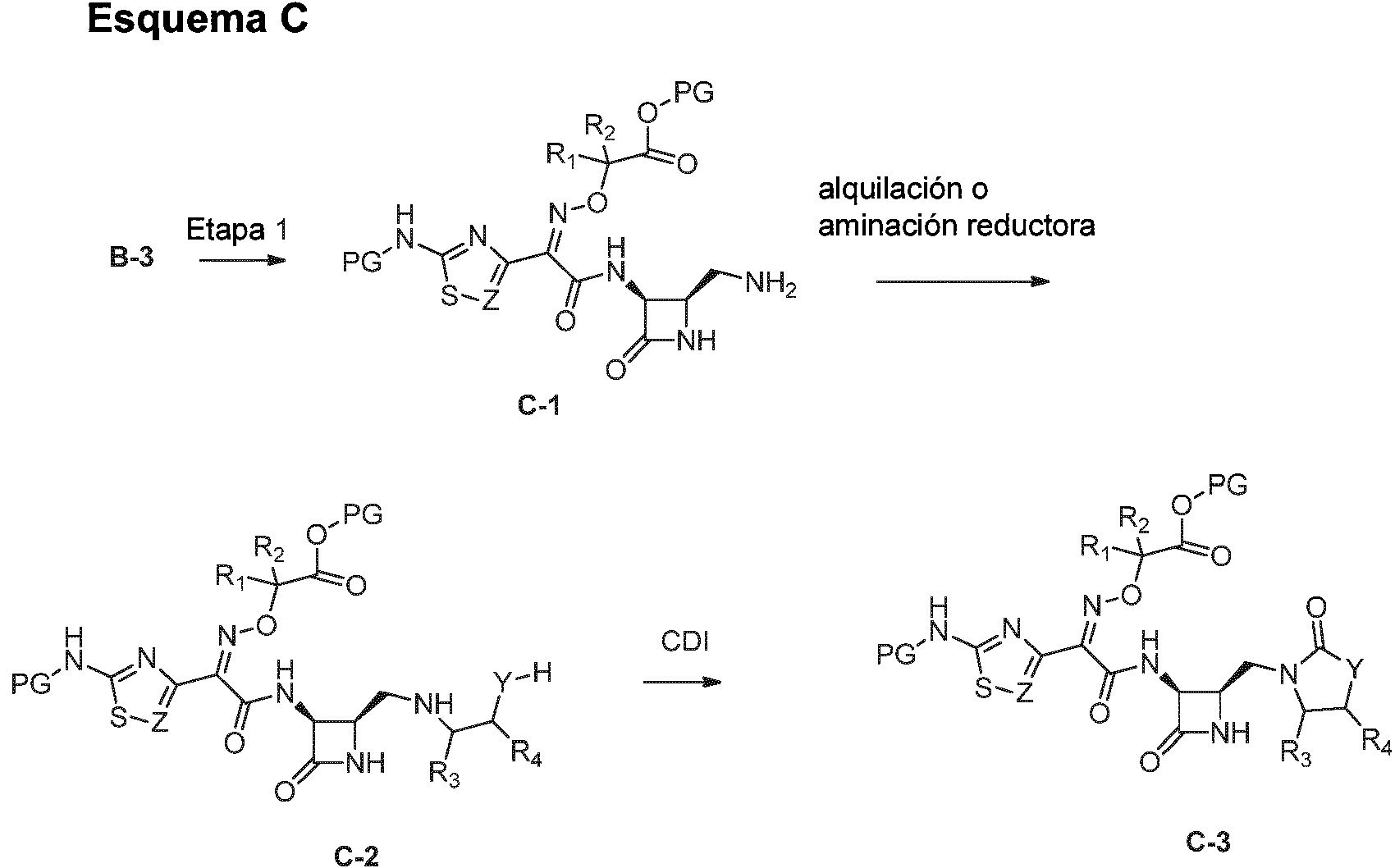
Las aminas funcionalizadas C-2 se obtuvieron alternativamente de B-1 mediante alquilación con una amina funcionalizada. Puede obtenerse un heterociclo de lactama de manera análoga mediante alquilación de C-1 con ésteres carboxílicos bromados, seguido por ciclación catalizada por base. Puede introducirse un heterociclo para dar el producto intermedio A-2, mediante sustitución de un grupo saliente en un producto intermedio de azetidinona protegido adecuadamente. Los grupos de protección adecuados incluyen Cbz para la amina y DMB para la azetidinona. La desprotección del grupo Cbz seguido por acilación con ácidos funcionalizados y protegidos adecuadamente D-6 dio A-2, tal como se señala en el esquema D. C-2 functionalized amines were alternatively obtained from B-1 by alkylation with a functionalized amine. A lactam heterocycle can be obtained analogously by alkylation of C-1 with brominated carboxylic esters, followed by base catalyzed cyclization. A heterocycle can be introduced to give intermediate A-2, by substituting a leaving group in a suitably protected azetidinone intermediate. Suitable protecting groups include Cbz for the amine and DMB for the azetidinone. Deprotection of the Cbz group followed by acylation with properly functionalized and protected D-6 acids gave A-2, as indicated in Scheme D.

También se usaron productos intermedios protegidos tales como D-1 para la introducción del heterociclo en condiciones de Mitsunobu, tal como se señala en el esquema A. D-1 también se convirtió en la azida correspondiente, que se usó para “química clic” para introducir 1,2,3 triazoles unidos a 1 siguiendo una secuencia similar tal como se señala en el esquema B. D-1 también puede usarse para dar derivados de amina funcionalizados que pueden convertirse en heterociclos, tal como se describe en el esquema C.Protected intermediates such as D-1 were also used for the introduction of the heterocycle under Mitsunobu conditions, as outlined in Scheme A. D-1 also became the corresponding azide, which was used for "click chemistry" to introducing 1,2,3 triazoles linked to 1 following a similar sequence as indicated in scheme B. D-1 can also be used to give functionalized amine derivatives that can be converted into heterocycles, as described in scheme C.
También pueden ensamblarse productos intermedios de tipo A-3 mediante la secuencia señalada en el esquema E, mediante la cual se introduce el resto de oxima tras la etapa de acoplamiento.Intermediates of type A-3 can also be assembled by means of the sequence indicated in scheme E, by which the remaining oxime is introduced after the coupling stage.
Esquema EScheme E

Se preparan compuestos de fórmula (I) a partir de compuestos comúnmente disponibles usando estos esquemas y procedimientos generales conocidos por los expertos en la técnica junto con los métodos y ejemplos proporcionados en el presente documento.Compounds of formula (I) are prepared from commonly available compounds using these general schemes and procedures known to those skilled in the art together with the methods and examples provided herein.
Ejemplos Examples
La invención se ilustra además mediante los siguientes ejemplos, que no deben interpretarse como adicionalmente limitativos. Se aceptan los ensayos usados en todos los ejemplos. La demonstración de la eficacia en estos ensayos es predictiva de la eficacia en sujetos.The invention is further illustrated by the following examples, which should not be construed as additionally limiting. The tests used in all examples are accepted. The demonstration of efficacy in these trials is predictive of efficacy in subjects.
Condiciones generalesGeneral conditions
Se adquirieron espectros de masas en sistemas de CL-EM, SFC-EM o CG-EM usando métodos de ionización de impacto electrónico y químico de electropulverización de una gama de instrumentos de las siguientes configuraciones: sistema ACQUITY UPLC de Waters y equipado con un sistema ZQ 2000 o SQD MS donde (M 1) se refiere al ion molecular protonado de la especie química, (M+) se refiere al catión de amonio cuaternario no protonado, (M Na) se refiere al ion incorporado en sodio y (M-1) se refiere al ion molecular desprotonado de la especie química.Mass spectra were acquired in CL-EM, SFC-EM or CG-EM systems using electrospray and electronic impact ionization methods from a range of instruments of the following configurations: Waters ACQUITY UPLC system and equipped with a system ZQ 2000 or SQD MS where (M 1) refers to the protonated molecular ion of the chemical species, (M +) refers to the non-protonated quaternary ammonium cation, (M Na) refers to the sodium-incorporated ion and (M-1 ) refers to the deprotonated molecular ion of the chemical species.
Se ejecutaron espectros de RMN en espectrómetros de RMN Bruker AVANCE 500 MHz o Varian 400 MHz usando ICON-RMN, bajo el control del programa TopSpin. Se midieron los espectros a 298 K, a menos que se indique lo contrario, y se hicieron referencia en relación con la resonancia de disolvente.NMR spectra were run on Bruker AVANCE 500 MHz or Varian 400 MHz NMR spectrometers using ICON-NMR, under the control of the TopSpin program. The spectra were measured at 298 K, unless otherwise indicated, and reference was made in relation to solvent resonance.
InstrumentaciónInstrumentation
Métodos de EM: usando sistemas de HPLC Agilent 1100 con un espectrómetro de masas Agilent 6110 Método 2m_ácido: MS methods: using Agilent 1100 HPLC systems with an Agilent 6110 mass spectrometer 2m_acid method:
Columna Kinetex C1850 x 2,1 mm, 2,6 |imKinetex C1850 x 2.1 mm column, 2.6 | im
Temperatura de columna 50°CColumn temperature 50 ° C
Eluyentes A: H2O, B: acetonitrilo, conteniendo ambos TFA al 0,1% Velocidad de flujo 1,2 ml/minEluents A: H2O, B: acetonitrile, both containing 0.1% TFA Flow rate 1.2 ml / min
Gradiente del 2% al 88% de B en 1,30 min, 0,15 min el 95% de B Método 2m_ácido_polar:Gradient from 2% to 88% of B in 1.30 min, 0.15 min 95% of B Method 2m_acid_polar:
Columna Kinetex C1850 x 2,1 mm, 2,6 |imKinetex C1850 x 2.1 mm column, 2.6 | im
Temperatura de columna 50°CColumn temperature 50 ° C
Eluyentes A: H2O, B: acetonitrilo, conteniendo ambos TFA al 0,1% Velocidad de flujo 1,2 ml/minEluents A: H2O, B: acetonitrile, both containing 0.1% TFA Flow rate 1.2 ml / min
Gradiente del 1% al 30% de B en 1,30 min, 0,15 min el 98% de B Abreviaturas: Gradient from 1% to 30% of B in 1.30 min, 0.15 min 98% of B Abbreviations:
ACN acetonitriloACN acetonitrile
ac acuosoaqueous ac
ap aparenteapparent ap
ATP adenosín 5'-trifosfatoATP adenosine 5'-triphosphate
BINAP 2,2'-bis(difenilfosfino)-1,1'-binaftilo racémicoBINAP 2,2'-bis (diphenylphosphino) -1,1'-racemic binaphthyl
Boc butilcarboxilo terciarioTertiary butylcarboxyl boc
a anchowide
s a singlete anchos a wide singlet
BSA albúmina sérica bovinaBSA bovine serum albumin
CDI 1,1'-carbonildiimidazolCDI 1,1'-carbonyldiimidazole
d dobleted double
dd doblete de dobletesdd doublet of doublets
DCM diclorometanoDCM dichloromethane
DCE 1,2-dicloroetanoDCE 1,2-dichloroethane
DIAD diisopropilazodicarboxilatoDIAD diisopropylazodicarboxylate
DIPEA diisopropiletilaminaDIPEA diisopropylethylamine
DME 1,4-dimetoxietanoDME 1,4-dimethoxyethane
DMF W,W-dimetilformamidaDMF W, W-dimethylformamide
DMSO dimetilsulfóxidoDMSO dimethylsulfoxide
EDTA ácido etilendiaminotetraacéticoEDTA ethylenediaminetetraacetic acid
ESI ionización por electropulverizaciónESI electrospray ionization
EtOAc acetato de etiloEtOAc ethyl acetate
g gramog gram
h hora(s)h hour (s)
HATU Hexafluorofosfato de 3-óxido de 1-[bis(dimetilamino)metileno]-1 H-1,2,3-triazolo[4,5-b]piridinioHATU 3- [bis (dimethylamino) methylene] 3-oxide hexafluorophosphate] -1 H-1,2,3-triazolo [4,5-b] pyridinium
HBTU 3-Óxido de 1-[bis(dimetilamino)metileno]-1H-benzotriazoliumhexafluorofosfato(1-) HBTU 3-1- [bis (dimethylamino) methylene] -1H-benzotriazoliumhexafluorophosphate (1-) oxide
HCI ácido clorhídricoHCI hydrochloric acid
HOBt 1-hidroxibenzotriazolHOBt 1-hydroxybenzotriazole
HPLC cromatografía líquida de alto rendimientoHPLC high performance liquid chromatography
CL-EM cromatografía líquida y espetrometría de masasCL-EM liquid chromatography and mass spectrometry
m multipletem multiplet
m-CPBA ácido 3-cloroperbenzoicom-CPBA 3-chloroperbenzoic acid
MeOH metanolMeOH methanol
MS espetrometría de masasMS mass spectrometry
mg Miligramomg milligram
min Minutosmin minutes
ml mililitroml milliliter
mmol milimolmmol millimol
m/z razón de masa con respecto a cargam / z mass ratio with respect to load
RMN resonancia magnética nuclearNMR nuclear magnetic resonance
P PentetoP Pentet
PdCh(dppf)- Complejo de diclorometano y dicloruro de 1,1'-CH2CI2 bis(difenilfosfino)ferroceno-paladio(II)PdCh (dppf) - 1,1'-CH2CI2 bis (diphenylphosphino) ferrocene-palladium (II) dichloromethane and dichloride complex
PPh3 trifenilfosfinaPPh3 triphenylphosphine
ppm partes por millónppm parts per million
PyBOP hexafluorofosfato de benzotriazol-1-iloxitripirrolidinofosfonioPyBOP benzotriazol-1-yloxytrypyrrolidinophosphonium hexafluorophosphate
q Cuartetoq Quartet
rac Racémicoracemic rac
ta temperatura ambienteta room temperature
Rt tiempo de retenciónRt retention time
s Singletes Singlet
satd SaturadoSatd Saturated
t Tripletet Triplet
TBAF fluoruro de tetrabutilamonioTBAF tetrabutylammonium fluoride
TBME ferc-butil éter de metiloTBME ferc-butyl methyl ether
TFA ácido trifluoroacéticoTFA trifluoroacetic acid
THF tetrahidrofuranoTHF tetrahydrofuran
TrisHCl clorhidrato de aminotris(hidroximetil)metanoTrisHCl aminotris (hydroxymethyl) methane hydrochloride
Preparación de productos intermediosPreparation of intermediate products
Producto intermedio A: metanosulfonato de ((2S,3S)-3-(((benciloxi)carbonil)amino)-1-(2,4-dimetoxibencil)-4-oxoazetidin-2-il)metilo.Intermediate A: ((2S, 3S) -3 - ((((benzyloxy) carbonyl) amino) -1- (2,4-dimethoxybenzyl) -4-oxoazetidin-2-yl) methyl methanesulfonate.
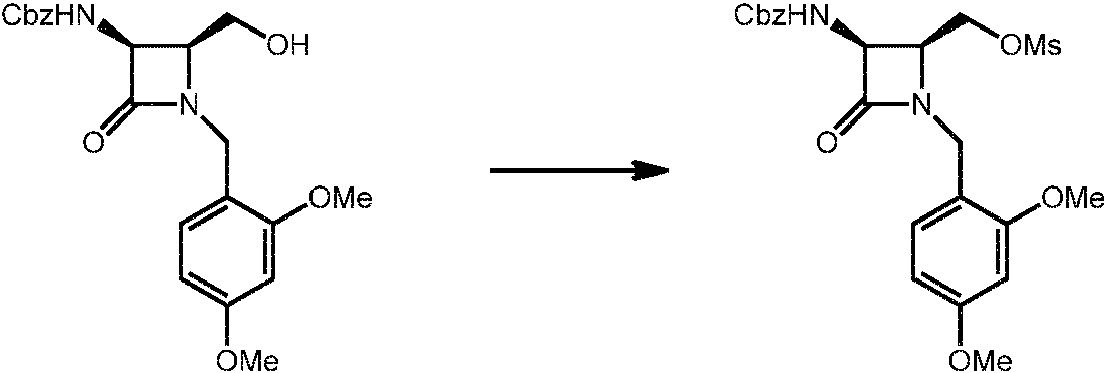
A una disolución de ((2S,3S)-1-(2,4-dimetoxibencil)-2-(hidroximetil)-4-oxoazetidin-3-il)carbamato de bencilo (5,37 g, 13,41 mmol) y TEA (3,72 ml, 26,8 mmol) en DCM a 0°C se le añadió MsCI (1,15 ml, 14,75 mmol). Tras agitar a 0°C durante 1 h, se diluyó con agua/DCM y se separaron las fases. Se extrajo la fase acuosa con DCM (2x) y se lavaron las fases orgánicas combinadas con salmuera, se secaron sobre Na2SO4 y se concentraron a vacío. Se recogió el residuo bruto en tolueno y se concentró (2x), dando el compuesto del título como un sólido blanquecino. Se usó como tal en reacciones posteriores. CL-EM: Rt = 0,86 min, m/z = 479,2 (M+1) Método 2m_ácido.To a solution of ((2S, 3S) -1- (2,4-dimethoxybenzyl) -2- (hydroxymethyl) -4-oxoazetidin-3-yl) benzyl carbamate (5.37 g, 13.41 mmol) and TEA (3.72 ml, 26.8 mmol) in DCM at 0 ° C was added MsCI (1.15 ml, 14.75 mmol). After stirring at 0 ° C for 1 h, it was diluted with water / DCM and the phases were separated. The aqueous phase was extracted with DCM (2x) and the combined organic phases were washed with brine, dried over Na2SO4 and concentrated in vacuo. The crude residue was taken up in toluene and concentrated (2x), giving the title compound as an off-white solid. It was used as such in subsequent reactions. LC-MS: Rt = 0.86 min, m / z = 479.2 (M + 1) 2m_acid method.
Producto intermedio B: ((2H-tetrazol-5-il)metil)carbamato de ferc-butilo.Intermediate B: ((2H-tetrazol-5-yl) methyl) ferc-butyl carbamate.

A un matraz cargado con (2H-tetrazol-5-il)metilamina (1,67 g, 16,85 mmol), anhídrido de Boc (3,86, 17,70 mmol) y agua (16,85 ml) se le añadió NaOH (4 N, 4,42 ml, 17,70 mmol). Se agitó la suspensión resultante a ta durante 12 h después se enfrió hasta 0°C, tras lo cual se añadió HCl (1 N) hasta pH = 4-5. Se recogió el precipitado mediante filtración y se enfriaron las aguas madres hasta 0°C y se volvieron a acidificar con HCI (1 N) hasta pH = 4-5. Se recogió más del precipitado y se combinó con el primer lote, lavando el lote con heptano para dar el compuesto del título (2,74 g, 82%) como un sólido blanco. CL-EM: Rt = 0,38 min, m/z = 200,2 (M+1) Método 2m_ácido.To a flask loaded with (2H-tetrazol-5-yl) methylamine (1.67 g, 16.85 mmol), Boc anhydride (3.86, 17.70 mmol) and water (16.85 ml) NaOH (4 N, 4.42 ml, 17.70 mmol) was added. The resulting suspension was stirred at rt for 12 h then cooled to 0 ° C, after which HCl (1 N) was added until pH = 4-5. The precipitate was collected by filtration and the mother liquors were cooled to 0 ° C and acidified again with HCI (1 N) until pH = 4-5. More of the precipitate was collected and combined with the first batch, washing the batch with heptane to give the compound of the title (2.74 g, 82%) as a white solid. LC-MS: Rt = 0.38 min, m / z = 200.2 (M + 1) 2m_acid method.
Producto intermedio C: ((1H-1,2,4-triazol-3-il)metil)carbamato de ferc-butilo.Intermediate product C: ((1H-1,2,4-triazol-3-yl) methyl) ferc-butyl carbamate.

A una disolución de clorhidrato de 2H-[1,2,4]triazol-3-il-metilamina (583 mg, 4,33 mmol) y anhídrido de Boc (993 mg, 4,55 mmol) en agua (5,78 ml) se le añadió NaOH (4 N, 1,137 ml, 4,55 mmol). Tras agitar durante 48 h se recogió el precipitado blanco mediante filtración. Se suspendió el sólido en heptano, se sonicó entonces se filtró, lavando la torta de filtro con heptano. CL-EM: Rt = 0,41 min, m/z = 199,2 (M+1) Método 2m_ácido.To a solution of 2H- [1,2,4] triazol-3-yl-methylamine hydrochloride (583 mg, 4.33 mmol) and Boc anhydride (993 mg, 4.55 mmol) in water (5.78 ml) NaOH (4 N, 1,137 ml, 4.55 mmol) was added. After stirring for 48 h the white precipitate was collected by filtration. The solid was suspended in heptane, sonicated then filtered, washing the filter cake with heptane. LC-MS: Rt = 0.41 min, m / z = 199.2 (M + 1) 2m_acid method.
Producto intermedio D: 3-(((2R,3S)-3-amino-4-oxoazetidin-2-il)metil)oxazolidin-2-ona.Intermediate product D: 3 - (((2R, 3S) -3-amino-4-oxoazetidin-2-yl) methyl) oxazolidin-2-one.

Etapa 1: ((2R,3S)-1-(2,4-dimetoxibencil)-2-(((2-hidroxietil)amino)metil)-4-oxoazetidin-3-il)carbamato de bencilo. A una disolución de metanosulfonato de ((2S,3S)-3-(((benciloxi)carbonil)amino)-1-(2,4-dimetoxibencil)-4-oxoazetidin-2-il)metilo (6,43g, 13,4 mmol) en acetonitrilo (44,8 ml) se le añadió etanolamina (8,13 ml, 134 mmol) seguido por DIPEA (7,0 ml, 40 mmol). Se calentó la disolución hasta 80°C durante 20 h, tras lo cual se enfrió hasta ta, se diluyó con EtOAc, se lavó con agua, se secó sobre Na2SO4 y se concentró a vacío, para dar el compuesto del título (4,47 g, 75%) como un sólido blanco. CL-EM: Rt = 0,60 min, m/z = 444,2 (M+1).Stage 1: ((2R, 3S) -1- (2,4-dimethoxybenzyl) -2 - (((2-hydroxyethyl) amino) methyl) -4-oxoazetidin-3-yl) benzyl carbamate. To a methanesulfonate solution of ((2S, 3S) -3 - (((benzyloxy) carbonyl) amino) -1- (2,4-dimethoxybenzyl) -4-oxoazetidin-2-yl) methyl (6.43g, 13 , 4 mmol) in acetonitrile (44.8 ml) ethanolamine (8.13 ml, 134 mmol) was added followed by DIPEA (7.0 ml, 40 mmol). The solution was heated to 80 ° C for 20 h, after which it was cooled to rt, diluted with EtOAc, washed with water, dried over Na2SO4 and concentrated in vacuo, to give the title compound (4.47 g, 75%) as a white solid. LC-MS: R t = 0.60 min, m / z = 444.2 (M + 1).
Etapa 2: ((3S,4R)-1-(2,4-dimetoxibencil)-2-oxo-4-((2-oxooxazolidin-3-il)metil)azetidin-3-il)carbamato de bencilo. A una disolución de ((2R,3S)-1-(2,4-dimetoxibencil)-2-(((2-hidroxietil)amino)metil)-4-oxoazetidin-3-il)carbamato de bencilo (4,47g, 10,08 mmol) en cloroformo (50 ml) se le añadió CDI (4,90 g, 30,2 mmol). Tras agitar a ta durante 30 min se concentró a vacío. Se purificó el residuo bruto por medio de cromatografía en gel de sílice (MeOH-DCM, 0-5%), dando el compuesto del título (3,84 g, 81%) como una espuma blanca. CL-EM: Rt = 0,76 min, m/z = 470,1 (M+1).Stage 2: ((3S, 4R) -1- (2,4-dimethoxybenzyl) -2-oxo-4 - ((2-oxooxazolidin-3-yl) methyl) azetidin-3-yl) benzyl carbamate. To a solution of ((2R, 3S) -1- (2,4-dimethoxybenzyl) -2 - (((2-hydroxyethyl) amino) methyl) -4-oxoazetidin-3-yl) benzyl carbamate (4.47g , 10.08 mmol) in chloroform (50 ml) CDI (4.90 g, 30.2 mmol) was added. After stirring at rt for 30 min, it was concentrated in vacuo. The crude residue was purified by silica gel chromatography (MeOH-DCM, 0-5%), to give the title compound (3.84 g, 81%) as a white foam. LC-MS: R t = 0.76 min, m / z = 470.1 (M + 1).
Etapa 3: ((3S,4R)-2-oxo-4-((2-oxooxazolidin-3-il)metil)azetidin-3-il)carbamato de bencilo.Stage 3: ((3S, 4R) -2-oxo-4 - ((2-oxooxazolidin-3-yl) methyl) azetidin-3-yl) benzyl carbamate.
Se preparó de manera análoga al ejemplo 4, etapa 2 usando ((3S,4R)-1-(2,4-dimetoxibencil)-2-oxo-4-((2-oxooxazolidin-3-il)metil)azetidin-3-il)carbamato de bencilo (3,84 g, 8,18 mmol), K2S2O8 (3,10 g, 11,5 mmol) y K2HPO4 (1,852 g, 10,6 mmol) en ACN:agua (2:1, 136 ml) mientras se calentaba durante 40 min a 90°C. Se añadieron más K2S2O8 (663 g, 2,45 mmol) y K2HPO4 (370 mg, 2,13 mmol) y se calentó durante otras 3 h. Se añadieron más K2S2O8 (332 mg, 1,23 mmol) y K2HPO4 (185 mg, 1,06 mmol), y se calentó durante 2 h adicionales, tras lo cual se concentró a vacío, eliminando la mayor parte del ACN. Se diluyó la mezcla con salmuera/EtOAc y se separaron las fases. Se extrajo la fase acuosa con EtOAc (3x) y se secaron las fases orgánicas combinadas sobre Na2SO4. Se purificó el residuo bruto por medio de cromatografía en gel de sílice (EtOAc-heptano, el 0-100% después MeOH-DCM, el 10%) para dar el compuesto del título (1,61 g, 62%) como una espuma beige. CL-EM: Rt = 0,51 min, m/z = 320,0 (M+1) Método 2m_ácido.It was prepared analogously to example 4, step 2 using ((3S, 4R) -1- (2,4-dimethoxybenzyl) -2-oxo-4 - ((2-oxooxazolidin-3-yl) methyl) azetidin-3 -yl) benzyl carbamate (3.84 g, 8.18 mmol), K2S2O8 (3.10 g, 11.5 mmol) and K2HPO4 (1,852 g, 10.6 mmol) in ACN: water (2: 1, 136 ml) while heating for 40 min at 90 ° C. More K2S2O8 (663 g, 2.45 mmol) and K2HPO4 (370 mg, 2.13 mmol) were added and heated for another 3 h. More K2S2O8 (332 mg, 1.23 mmol) and K2HPO4 (185 mg, 1.06 mmol) were added, and heated for an additional 2 h, after which it was concentrated in vacuo, removing most of the ACN. The mixture was diluted with brine / EtOAc and the phases were separated. The aqueous phase was extracted with EtOAc (3x) and the combined organic phases were dried over Na2SO4. The crude residue was purified by silica gel chromatography (EtOAc-heptane, 0-100% then MeOH-DCM, 10%) to give the title compound (1.61 g, 62%) as a foam beige. LC-MS: Rt = 0.51 min, m / z = 320.0 (M + 1) 2m_acid method.
Etapa 4: 3-((((2R,3S)-3-amino-4-oxoazetidin-2-il)metil)oxazolidin-2-ona.Step 4: 3 - (((((2R, 3S) -3-amino-4-oxoazetidin-2-yl) methyl) oxazolidin-2-one.
Se preparó de manera análoga al ejemplo 4, etapa 3 usando ((3S,4R)-2-oxo-4-((2-oxooxazolidin-3-il)metil)azetidin-3-il)carbamato de bencilo (96 mg, 0,30 mmol) y Pd/C 10% Degussa tipo 101 (10%, 64 mg) en EtOH:MeOH (4:1, 1,5 ml) durante 1 h. Se usó el residuo bruto tal cual en la siguiente etapa. CL-EM: Rt = 0,11 min, m/z = 186,0 (M+1) Método 2m_ácido.It was prepared analogously to example 4, step 3 using ((3S, 4R) -2-oxo-4 - ((2-oxooxazolidin-3-yl) methyl) azetidin-3-yl) benzyl carbamate (96 mg, 0.30 mmol) and Pd / C 10% Degussa type 101 (10%, 64 mg) in EtOH: MeOH (4: 1, 1.5 ml) for 1 h. The crude residue was used as is in the next step. LC-MS: Rt = 0.11 min, m / z = 186.0 (M + 1) 2m_acid method.
Producto intermedio E: (4-(2-(((2R,3S)-2-((1H-1,2,4-triazol-1-il)metil)-4-oxoazetidin-3-il)amino)-2-oxoacetil) tiazol-2-il)carbamato de terc-butilo.Intermediate product E: (4- (2 - (((2R, 3S) -2 - ((1H-1,2,4-triazol-1-yl) methyl) -4-oxoazetidin-3-yl) amino) - Tert-Butyl 2-oxoacetyl) thiazol-2-yl) carbamate.

A una suspensión de ácido 2-(2-((ferc-butoxicarbonil)amino)tiazol-4-il)-2-oxoacético (2,72 g, 9,99 mmol) y HATU (3,80, 10,0 mmol) en DCM:DMF (3:1, 33,3 ml) a 0°C se le añadió DlPEA (2,91 ml, 16,7 mmol). Se añadió una disolución de (3S,4R)-4-((1H- 1,2,4-triazol-1-il)metil)-3-aminoazetidin-2-ona (1,39 g, 8,33 mmol) en DCM:DMF (1:1, 32 ml) seguido por un lavado de DMF (3 ml). Tras agitar durante 48 h se diluyó la disolución oscura con EtOAc (150 ml)/salmuera (140 ml) y se separaron las fases. Se extrajo la fase acuosa con EtOAc (3x) y se lavaron las fases orgánicas combinadas con salmuera (70 ml). Se volvió a extraer el lavado de fase de salmuera con EtOAc. Se secaron las fases orgánicas combinadas sobre Na2SO4 y se concentraron a vacío. Se purificó el residuo bruto por medio de cromatografía en gel de sílice (MeOH-DCM, 0-10%), dando el compuesto del título (2,38 g, 68%) como un sólido rojo. CL-EM: Rt = 0,59 min, m/z = 422,0 (M+1) Método 2m_ácido; 1H RMN (400 MHz, DMSO-da) 811,85 (s, 1H), 9,70 (d, J = 9,3 Hz, 1H), 8,52 (d, J = 1,6 Hz, 1H), 8,48 (s, 1H), 8,44 (s, 1H), 7,96 (s, 1H), 5,28 (ddd, J = 9,3, 5,2, 1,5 Hz, 1H), 4,45 (dd, J = 14,2, 5,3 Hz, 1H), 4,36 (dd, J = 14,1, 7,6 Hz, 1H), 4,18 (dt, J = 7,6, 5,3 Hz, 1H), 1,47 (s, 9H).To a suspension of 2- (2 - ((ferc-butoxycarbonyl) amino) thiazol-4-yl) -2-oxoacetic acid (2.72 g, 9.99 mmol) and HATU (3.80, 10.0 mmol ) in DCM: DMF (3: 1, 33.3 ml) at 0 ° C DlPEA (2.91 ml, 16.7 mmol) was added. A solution of (3S, 4R) -4 - ((1 H- 1,2,4-triazol-1-yl) methyl) -3-aminoazetidin-2-one (1.39 g, 8.33 mmol) was added in DCM: DMF (1: 1, 32 ml) followed by a DMF wash (3 ml). After stirring for 48 h the dark solution was diluted with EtOAc (150 ml) / brine (140 ml) and the phases were separated. The aqueous phase was extracted with EtOAc (3x) and the combined organic phases were washed with brine (70 ml). The brine phase wash was reextracted with EtOAc. The combined organic phases were dried over Na2SO4 and concentrated in vacuo. The crude residue was purified by silica gel chromatography (MeOH-DCM, 0-10%), to give the title compound (2.38 g, 68%) as a red solid. LC-MS: Rt = 0.59 min, m / z = 422.0 (M + 1) 2m_acid method; 1 H NMR (400 MHz, DMSO-da) 811.85 (s, 1 H), 9.70 (d, J = 9.3 Hz, 1 H), 8.52 (d, J = 1.6 Hz, 1 H) , 8.48 (s, 1H), 8.44 (s, 1H), 7.96 (s, 1H), 5.28 (ddd, J = 9.3, 5.2, 1.5 Hz, 1H ), 4.45 (dd, J = 14.2, 5.3 Hz, 1H), 4.36 (dd, J = 14.1, 7.6 Hz, 1H), 4.18 (dt, J = 7.6, 5.3 Hz, 1H), 1.47 (s, 9H).
Producto intermedio F: ácido (2R,3S)-2-((1H-1,2,4-triazol-1-il)metil)-3-(2-(2-((ferc-butoxicarbonil)amino)tiazol-4-il)-2-oxoacetamido)-4-oxoazetidina-1-sulfónico.Intermediate F: (2R, 3S) -2 - ((1H-1,2,4-triazol-1-yl) methyl) -3- (2- (2 - ((ferc-butoxycarbonyl) amino) thiazole) 4-yl) -2-oxoacetamido) -4-oxoazetidine-1-sulfonic.

A una disolución de (4-(2-(((2R,3S)-2-((1H-1,2,4-triazol-1-il)metil)-4-oxoazetidin-3-il)amino)-2-oxoacetil)tiazol-2-il)carbamato de ferc-butilo (200 mg, 0,475 mmol) en DMF (4,75 ml) a 0°C se le añadió SOâ DMF (367 mg, 2,40 mmol). Tras 16 h de agitación se concentró a vacío y se purificó con resina HP21 (ACN-agua, 0-50%), dando el compuesto del título (110 mg, 46%) como un sólido amarillo claro. CL-EM: Rt = 0,54 min, m/z = 501,9 (M+1) Método 2m_ácido; 1H RMN (400 MHz, DMSO-d6) 811,87 (s, 1H), 9,75 (d, J = 9,2 Hz, 1H), 8,94 (s, 1H), 8,44 (s, 1H), 8,34 (s, 1H), 5,25 (dd, J = 9,1, 5,4 Hz, 1H), 4,75 (dd, J = 14,3, 4,9 Hz, 1H), 4,61 (dd, J = 14,4, 7,6 Hz, 1H), 4,43 (dt, J = 7,6, 5,2 Hz, 1H), 1,49 (s, 9H).To a solution of (4- (2 - (((2R, 3S) -2 - ((1H-1,2,4-triazol-1-yl) methyl) -4-oxoazetidin-3-yl) amino) - Ferc-butyl 2-oxoacetyl) thiazol-2-yl) carbamate (200 mg, 0.475 mmol) in DMF (4.75 ml) at 0 ° C was added SOâ DMF (367 mg, 2.40 mmol). After 16 h of stirring, it was concentrated in vacuo and purified with HP21 resin (ACN-water, 0-50%), to give the title compound (110 mg, 46%) as a light yellow solid. LC-MS: Rt = 0.54 min, m / z = 501.9 (M + 1) Method 2m_acid; 1 H NMR (400 MHz, DMSO-d6) 811.87 (s, 1 H), 9.75 (d, J = 9.2 Hz, 1 H), 8.94 (s, 1 H), 8.44 (s, 1H), 8.34 (s, 1H), 5.25 (dd, J = 9.1, 5.4 Hz, 1H), 4.75 (dd, J = 14.3, 4.9 Hz, 1H ), 4.61 (dd, J = 14.4, 7.6 Hz, 1H), 4.43 (dt, J = 7.6, 5.2 Hz, 1H), 1.49 (s, 9H) .
Producto intermedio G: ((2S,3S)-1-(2,4-dimetoxibencil)-2-(hidroximetil)-4-oxoazetidin-3-il)carbamato de bencilo Intermediate G: ((2S, 3S) -1- (2,4-dimethoxybenzyl) -2- (hydroxymethyl) -4-oxoazetidin-3-yl) benzyl carbamate

Etapa 1: (R,E)-1-(2,4-d¡metox¡fen¡l)-N-((2,2-d¡met¡l-1,3-d¡oxolan-4-¡l)met¡leno)metanam¡na.Stage 1: (R, E) -1- (2,4-d¡metox¡fen¡l) -N - ((2,2-d¡met¡l-1,3-d¡oxolan-4-¡ l) methelene) metanam¡na.
Se preparó según el proced¡m¡ento descr¡to por Hubschwerlen, C. y Schm¡d, G. Helv. Ch¡m. Acta 1983, 66 , 2206 2209 con la ad¡c¡ón de MgSO4. A una suspens¡ón de (S)-2,2-d¡met¡l-1,3-d¡oxolano-4-carbaldehído (Carbosynth LLC, 346 g, 43% en DCM, 1,143 mol) y MgSO4 (278 g) en Dc M (1,5 l) a 0°C se le añad¡ó 2,4-d¡metox¡benc¡lam¡na (193 g, 1,154 mol) a lo largo de 20 m¡n. Tras ag¡tar a ta durante 2 h se f¡ltró, lavando la torta de f¡ltro con DCM (2 x 250 ml). Se usaron las aguas madres d¡rectamente en la etapa 2.It was prepared according to the procedure described by Hubschwerlen, C. and Schm¡d, G. Helv. Chm. Acta 1983, 66, 2206 2209 with the addition of MgSO4. At a suspension of (S) -2,2-d¡met¡l-1,3-doxolane-4-carbaldehyde (Carbosynth LLC, 346 g, 43% in DCM, 1,143 mol) and MgSO4 (278 g) in Dc M (1.5 L) at 0 ° C, 2,4-dimethoxybenzelamine (193 g, 1,154 mol) was added over 20 min. After stirring at rt for 2 h, it was filtered, washing the filter cake with DCM (2 x 250 ml). The mother liquors were used directly in stage 2.
Etapa 2: 2-((2S,3S)-1-(2,4-d¡metox¡benc¡l))-2-((E)-2,2-d¡met¡l)-1,3-d¡oxolan-4-¡l)-4-oxoazet¡d¡n-3-¡l)¡so¡ndol¡na-1,3-d¡ona.Stage 2: 2 - ((2S, 3S) -1- (2,4-d¡metox¡benc¡l)) - 2 - ((E) -2,2-d¡met¡l) -1,3 -d¡oxolan-4-¡l) -4-oxoazet¡d¡n-3-¡) so¡ndol¡na-1,3-d¡ona.
Se preparó según el proced¡m¡ento descr¡to por Hubschwerlen, C. y Schm¡d, G. Helv. Ch¡m. Acta 1983, 66 , 2206 2209. Tras la ad¡c¡ón de TEA (322 ml, 2,31 mol) a las aguas madres brutas de la etapa 1, se enfr¡ó hasta 0°C segu¡do por ad¡c¡ón de una d¡soluc¡ón de cloruro de 2-(1,3-d¡oxo¡so¡ndol¡n-2-¡l)acet¡lo (284,3 g, 1,272 mol) en DCM (1 l) a lo largo de un per¡odo de 30 m¡n. Se perm¡t¡ó que la mezcla se calentara hasta ta y se ag¡tó durante 16 h ad¡c¡onales, tras lo cual se lavó con agua (2 x 1 l), NaHCO3 saturado (ac, 1 l), salmuera (1 l), se secó sobre Na2SO4 y se concentró a vacío, dando el compuesto del título bruto (631 g, supuestamente cuant¡tat¡vo) como un sól¡do amar¡llo claro. La 1H RMN de una muestra pur¡f¡cada (EtOAc-heptano, 40-60%) fue ¡dént¡ca a los datos not¡f¡cados por la b¡bl¡ografía.It was prepared according to the procedure described by Hubschwerlen, C. and Schm¡d, G. Helv. Chm. Acta 1983, 66, 2206 2209. After the addition of TEA (322 ml, 2.31 mol) to the raw mother liquor of stage 1, it was cooled to 0 ° C followed by with a solution of 2- (1,3-dxoxso-n-2-l) acetyl chloride (284.3 g, 1,272 mol) in DCM ( 1 l) over a period of 30 min. The mixture was allowed to warm to rt and stirred for an additional 16 h, after which it was washed with water (2 x 1 L), saturated NaHCO3 (aq, 1 L), brine (1 L), dried over Na2SO4 and concentrated in vacuo, giving the crude title compound (631 g, supposedly quantum) as a light yellow solid. The 1 H NMR of a purified sample (EtOAc-heptane, 40-60%) was consistent with the data reported by the bibliography.
Etapa 3: (3S,4S)-3-am¡no-1-(2,4-d¡metox¡benc¡l)-4-((E)-2,2-d¡met¡l)-1,3-d¡oxolan-4-¡l)azet¡d¡n-2-ona.Stage 3: (3S, 4S) -3-am-1- (2,4-d¡methox¡benc¡l) -4 - ((E) -2,2-d¡met¡l) -1 , 3-d¡oxolan-4-¡l) azet¡d¡n-2-one.
A una d¡soluc¡ón de 2-((2S,3S)-1-(2,4-d¡metox¡benc¡l)-2-((E)-2,2-d¡met¡l-1,3-d¡oxolan-4-¡l)-4-oxoazet¡d¡n-3-¡l)¡so¡ndol¡na-1,3-d¡ona bruta (631 g, 1,143 mol, convers¡ón supuestamente cuant¡tat¡va de la etapa 2) en EtOH (8,2 l) se le añad¡ó h¡draz¡na h¡dratada (235 ml, 50-60%, ~4 mol) a lo largo de 20 m¡n. Se calentó la mezcla resultante hasta reflujo durante 3 h, se enfr¡ó hasta ta, se f¡ltró, se lavó con EtOH y se concentró a vacío. Se suspend¡ó el res¡duo en EtOAc (4 l), se f¡ltró y se lavó con agua (2 x 1 l).At a resolution of 2 - ((2S, 3S) -1- (2,4-dmethox¡benc¡l) -2 - ((E) -2,2-d¡met¡l- 1,3-doxolan-4-¡l) -4-oxoazet¡d¡n-3-¡) so¡ndol¡na-1,3-dona bruta (631 g, 1,143 mol, convers With supposedly quantum of stage 2) in EtOH (8.2 l), hrádna was added to it (235 ml, 50-60%, ~ 4 mol) along of 20 min. The resulting mixture was heated to reflux for 3 h, cooled to rt, filtered, washed with EtOH and concentrated in vacuo. The residue was suspended in EtOAc (4 L), filtered and washed with water (2 x 1 L).
Etapa 4: ((2S,3S)-1-(2,4-d¡metox¡benc¡l)-2-((E)-2,2-d¡met¡l-1,3-d¡oxolan-4-¡l)-4-oxoazet¡d¡n-3-¡l)carbamato de benc¡lo. A la d¡soluc¡ón orgán¡ca bruta de la etapa 3 (EtOAc, 4 l) enfr¡ada hasta 0°C se le añad¡ó NaHCO3 saturado (ac, 2,05 l) segu¡do por cloroform¡ato de benc¡lo (205 ml, 1,43 mol), gota a gota a lo largo de 1 h. Tras ag¡tar a ta durante 2 h se separaron las fases y se extrajo la fase acuosa con EtOAc (2 x 50 ml). Se lavaron las fases orgán¡cas comb¡nadas con agua, salmuera, se secó sobre Na2SO4 y se concentró a vacío. Se trató el res¡duo bruto con MeOH (2 l), se f¡ltró y se lavó con MeOH (2 x 200 ml) para dar el compuesto del título puro (155 g) como un sól¡do blanco. Stage 4: ((2S, 3S) -1- (2,4-d¡metox¡benc¡l) -2 - ((E) -2,2-d¡met¡l-1,3-d¡oxolan -4-¡l) -4-oxoazet¡d¡n-3-¡) benzyl carbamate. To the crude organic solution of stage 3 (EtOAc, 4 l) cooled to 0 ° C was added saturated NaHCO3 (aq, 2.05 l) followed by chloroformate of benzyl (205 ml, 1.43 mol), dropwise over 1 h. After stirring at rt for 2 h, the phases were separated and the aqueous phase was extracted with EtOAc (2 x 50 ml). The combined organic phases were washed with water, brine, dried over Na2SO4 and concentrated in vacuo. The crude residue was treated with MeOH (2 L), filtered and washed with MeOH (2 x 200 ml) to give the pure title compound (155 g) as a white solid.
Se enfriaron las aguas madres hasta -20°C durante 12 h y se recogió el precipitado resultante mediante filtración, dando el compuesto del título adicional (90 g) para un rendimiento del 45% combinado a lo largo de 4 etapas. CL-EM: m/z = 471,1 (M+1).The mother liquors were cooled to -20 ° C for 12 h and the resulting precipitate was collected by filtration, giving the additional title compound (90 g) for a combined 45% yield over 4 steps. LC-MS: m / z = 471.1 (M + 1).
Etapa 5: ((2S,3S)-2-((R)-1,2-dihidroxietil-1-(2,4-dimetoxibencil)-4-oxoazetidin-3-il)carbamato de bencilo.Stage 5: ((2S, 3S) -2 - ((R) -1,2-dihydroxyethyl-1- (2,4-dimethoxybenzyl) -4-oxoazetidin-3-yl) benzyl carbamate.
A una disolución de ((2S,3S)-1-(2,4-dimetoxibencil)-2-((R)-2,2-dimetil-1,3-dioxolan-4-il)-4-oxoazetidin-3-il)carbamato de bencilo (267 g, 0,567 mol) en THF (3 l) se le añadió una disolución de T sO H ^O (43,6 g, 0,229 mol) en agua (0,75 l). Se calentó la bifase hasta 70°C durante 16 h después se enfrió hasta ta, se neutralizó hasta pH = 7 con NaHCO3 saturado (ac) y se concentró a vacío. Se filtró la mezcla resultante, se lavó con agua y se secó para dar el compuesto del título (240 g, 98%) como un sólido amarillo claro. CL-EM: m/z = 431,1 (M+1).To a solution of ((2S, 3S) -1- (2,4-dimethoxybenzyl) -2 - ((R) -2,2-dimethyl-1,3-dioxolan-4-yl) -4-oxoazetidin-3 -yl) benzyl carbamate (267 g, 0.567 mol) in THF (3 L) was added a solution of T sO H ^ O (43.6 g, 0.229 mol) in water (0.75 l). The biphase was heated to 70 ° C for 16 h then cooled to rt, neutralized to pH = 7 with saturated NaHCO3 (aq) and concentrated in vacuo. The resulting mixture was filtered, washed with water and dried to give the title compound (240 g, 98%) as a light yellow solid. LC-MS: m / z = 431.1 (M + 1).
Etapa 6: ((2S,3S)-1-(2,4-dimetoxibencil))-2-formil)-4-oxoazetidin-3-il)carbamato de bencilo.Step 6: ((2S, 3S) -1- (2,4-dimethoxybenzyl)) - 2-formyl) -4-oxoazetidin-3-yl) benzyl carbamate.
A una disolución de ((2S,3S)-2-((R)-1,2-dihidroxietil)-1-(2,4-dimetoxibencil)-4-oxoazetidin-3-il)carbamato de bencilo (240 g, 0,557 mol) en EtOAc (4,5 l) se le añadió una disolución de peryodato de sodio (132 g, 0,617 mol) en agua (1,125 l) y se calentó la bifase hasta 50°C durante 2 h, tras lo cual se enfrió hasta ta y se separaron las fases. Se extrajo la fase acuosa con EtOAc (500 ml) y se lavaron las fases orgánicas combinadas con agua, salmuera, se secó sobre Na2SO4 y se concentró a vacío para dar el compuesto del título (218 g, 98%) como un sólido amarillo claro. CL-EM: m/z = 399,0 (M+1). 1H RMN (400 MHz, DMSO-d6) 89,32 (d, J = 3,2 Hz, 1H), 8,19 (d, J = 8,5 Hz, 1H), 7,39-7,23 (m, 5H), 7,16 (d, J = 8,3 Hz, 1H), 6,53 (d, J = 2,4 Hz, 1H), 6,47 (dd, J = 8,3, 2,4 Hz, 1H), 5,00-4,96 (m, 2H), 4,90 (dd, J = 8,5, 5,8 Hz, 1H), 4,38 (d, J = 14,5 Hz, 1H), 4,29 (d, J = 14,5 Hz, 1H), 4,05 (dd, J = 5,9, 3,3 Hz, 1H), 3,73 (s, 3H), 3,70 (s, 3H).To a solution of ((2S, 3S) -2 - ((R) -1,2-dihydroxyethyl) -1- (2,4-dimethoxybenzyl) -4-oxoazetidin-3-yl) benzyl carbamate (240 g, 0.557 mol) in EtOAc (4.5 L) a solution of sodium periodate (132 g, 0.617 mol) in water (1.125 l) was added and the biphase was heated to 50 ° C for 2 h, after which cooled to rt and the phases separated. The aqueous phase was extracted with EtOAc (500 ml) and the combined organic phases were washed with water, brine, dried over Na2SO4 and concentrated in vacuo to give the title compound (218 g, 98%) as a light yellow solid. . LC-MS: m / z = 399.0 (M + 1). 1H NMR (400 MHz, DMSO-d6) 89.32 (d, J = 3.2 Hz, 1H), 8.19 (d, J = 8.5 Hz, 1H), 7.39-7.23 ( m, 5H), 7.16 (d, J = 8.3 Hz, 1H), 6.53 (d, J = 2.4 Hz, 1H), 6.47 (dd, J = 8.3, 2 , 4 Hz, 1H), 5.00-4.96 (m, 2H), 4.90 (dd, J = 8.5, 5.8 Hz, 1H), 4.38 (d, J = 14, 5 Hz, 1H), 4.29 (d, J = 14.5 Hz, 1H), 4.05 (dd, J = 5.9, 3.3 Hz, 1H), 3.73 (s, 3H) , 3.70 (s, 3H).
Etapa 7: ((2S,3S)-1-(2,4-dimetoxibencil)-2-(hidroximetil)-4-oxoazetidin-3-il)carbamato de bencilo.Step 7: ((2S, 3S) -1- (2,4-dimethoxybenzyl) -2- (hydroxymethyl) -4-oxoazetidin-3-yl) benzyl carbamate.
A una disolución de ((2S,3S)-1-(2,4-dimetoxibencil)-2-formil-4-oxoazetidin-3-il)carbamato de bencilo (218 g, 0,546 mol) en una mezcla de DCM:MeOH (4:1, 2,25 l) a 0°C se le añadió borohidruro de sodio (41,3 g, 1,09 mol), en porciones. Se agitó la mezcla resultante a 0°C durante 2 h, tras lo cual se extinguió con agua fría (1 l) durante 30 min y se separaron las fases. Se extrajo la fase acuosa con DCM (3 x 200 ml) y se lavaron las fases orgánicas combinadas con agua, salmuera, se secó sobre Na2SO4 y se concentró a vacío para dar el compuesto del título (208 g, 95%) como un sólido blanquecino. CL-EM: m/z = 401,2 (M+1);1H RMN (300 MHz, CDCla) 87,37-7,29 (m, 5H), 7,21-7,18 (m, 1H), 6,46-6,49 (m, 2H), 5,82 (bd, J = 9,6 Hz, 1H), 5,18-5,08 (m, 3H), 4,45 (d, J = 14,4 Hz, 1H), 4,28 (d, J = 14,4 Hz, 1H), 3,83 (s, 3H), 3,79 (s, 3H), 3,76-3,72 (m, 1H), 3,63-3,52 (m, 2H), 1,87 (dd, J = 9,6, 4,0 Hz, 1H). Producto intermedio H: 2-(((Z)-(1-(2-((terc-butoxicarbonil)amino)tiazol-4-il)-2-(((2S,3S)-2-(hidroximetil)-4-oxoazetidin-3-il)amino)-2-oxoetilideno)amino)oxi)-2-metilpropanoato de tere-butiloTo a solution of ((2S, 3S) -1- (2,4-dimethoxybenzyl) -2-formyl-4-oxoazetidin-3-yl) benzyl carbamate (218 g, 0.546 mol) in a mixture of DCM: MeOH (4: 1, 2.25 l) at 0 ° C sodium borohydride (41.3 g, 1.09 mol) was added portionwise. The resulting mixture was stirred at 0 ° C for 2 h, after which it was quenched with cold water (1 L) for 30 min and the phases were separated. The aqueous phase was extracted with DCM (3 x 200 ml) and the combined organic phases were washed with water, brine, dried over Na2SO4 and concentrated in vacuo to give the title compound (208 g, 95%) as a solid. whitish LC-MS: m / z = 401.2 (M + 1); 1H NMR (300 MHz, CDCla) 87.37-7.29 (m, 5H), 7.21-7.18 (m, 1H) , 6.46-6.49 (m, 2H), 5.82 (bd, J = 9.6 Hz, 1H), 5.18-5.08 (m, 3H), 4.45 (d, J = 14.4 Hz, 1H), 4.28 (d, J = 14.4 Hz, 1H), 3.83 (s, 3H), 3.79 (s, 3H), 3.76-3.72 (m, 1H), 3.63-3.52 (m, 2H), 1.87 (dd, J = 9.6, 4.0 Hz, 1H). Intermediate product H: 2 - (((Z) - (1- (2 - ((tert-butoxycarbonyl) amino) thiazol-4-yl) -2 - (((2S, 3S) -2- (hydroxymethyl) -4 -oxoazetidin-3-yl) amino) -2-oxoethylidene) amino) oxy) -2-tere-butyl methylpropanoate

Etapa 1: ((2S,3S)-2-(hidroximetil)-4-oxoazetidin-3-il)carbamato de bencilo.Stage 1: ((2S, 3S) -2- (hydroxymethyl) -4-oxoazetidin-3-yl) benzyl carbamate.
Se preparó según Mastalerz et al. J. Med. Chem. 1988, 31, 1190. A una disolución de producto intermedio G (208 g, 0,529 mol) en ACN (4 l) se le añadió persulfato de potasio (243 g, 0,899 mol) seguido por una disolución de fosfato de dipotasio (147,4 g, 0,846 mol) en agua (2 l). Se calentó la mezcla resultante hasta 90°C durante 4 h, después se enfrió hasta ta y se concentró a vacío, eliminando la mayor parte del ACN. Se extrajo la mezcla con EtOAc (1 l, 2 x 200 ml) y se lavaron las fases orgánicas combinadas con agua, salmuera, se secó sobre Na2SO4 y se concentró a vacío. Se purificó el residuo bruto por medio de cromatografía en gel de sílice (EtOAc-hexanos, 50-100%), dando el compuesto del título (86 g, 65%) como un sólido blanco. Los datos analíticos fueron idénticos a los notificados en la bibliografía. It was prepared according to Mastalerz et al. J. Med. Chem. 1988, 31, 1190. To a solution of intermediate product G (208 g, 0.529 mol) in ACN (4 l) was added potassium persulfate (243 g, 0.899 mol) followed by a solution of Dipotassium phosphate (147.4 g, 0.846 mol) in water (2 L). The resulting mixture was heated to 90 ° C for 4 h, then cooled to rt and concentrated in vacuo, removing most of the ACN. The mixture was extracted with EtOAc (1 L, 2 x 200 ml) and the combined organic phases were washed with water, brine, dried over Na2SO4 and concentrated in vacuo. The crude residue was purified by silica gel chromatography (EtOAc-hexanes, 50-100%), to give the title compound (86 g, 65%) as a white solid. The analytical data were identical to those reported in the literature.
Etapa 2: acetato de (2S,3S)-2-(hidroximetil)-4-oxoazetidin-3-amonio.Stage 2: (2S, 3S) -2- (hydroxymethyl) -4-oxoazetidin-3-ammonium acetate.
A una disolución de ((2S,3S)-2-(hidroximetil)-4-oxoazetidin-3-il)carbamato de bencilo (25 g, 100 mmol) en MeOH (350 ml) se le añadió Pd sobre C (el 10% húmedo, 2,5 g) seguido por AcOH (11,4 ml, 200 mmol). Se evacuó la mezcla y se recargó con H2 (3x), llevando la presión final hasta 50 psi. Se agitó a ta durante 2 h, después se descartó, se filtró sobre Celite y se concentró a vacío, dando el compuesto del título bruto (22 g) como un aceite marrón claro, que se usó directamente en la etapa 3.To a solution of ((2S, 3S) -2- (hydroxymethyl) -4-oxoazetidin-3-yl) benzyl carbamate (25 g, 100 mmol) in MeOH (350 ml) was added Pd on C (10 % wet, 2.5 g) followed by AcOH (11.4 ml, 200 mmol). The mixture was evacuated and recharged with H2 (3x), bringing the final pressure to 50 psi. It was stirred at rt for 2 h, then discarded, filtered over Celite and concentrated in vacuo, giving the crude title compound (22 g) as a light brown oil, which was used directly in step 3.
Etapa 3: 2-(((Z)-(1-(2-((terc-butoxicarbonil))amino)tiazol)-4-il))-2-(((2S,3S)-2-(hidroximetil)-4-oxoazetidin-3-il)amino)-2-oxoetilideno)amino)oxi)-2-metilpropanoato de tere-butilo.Stage 3: 2 - (((Z) - (1- (2 - ((tert-butoxycarbonyl)) amino) thiazole) -4-yl)) - 2 - (((2S, 3S) -2- (hydroxymethyl) -4-oxoazetidin-3-yl) amino) -2-oxoethylidene) amino) oxy) -2-methylpropanoate tere-butyl.
A una disolución de 2-(((2-(benzo[d]tiazol-2-iltio)-1-(2-((tere-butoxicarbonil)amino)-tiazol-4-il)-2-oxoetilideno)amino)oxi)-2-metilpropanoato de (Z)-tere-butilo (85 g, 116,4 mmol) en DMF (200 ml) a 0°C se le añadió una disolución de acetato de (2S,3S)-2-(hidroximetil)-4-oxoazetidin-3-amonio (22 g, 100 mmol, supuestamente cuantitativo de la etapa 2) en DMF (100 ml) seguido por DIPEA (52,2 ml, 300 mmol). Se permitió que la mezcla se calentara hasta ta y se agitó durante 16 h adicionales, tras lo cual se concentró a vacío y se purificó por medio de cromatografía en gel de sílice (EtOAc-hexanos, 25-100%), dando el compuesto del título bruto (44 g, 83%) como un sólido amarillo claro. CL-EM: m/z = 526,1 (M-1); 1H RMN (400 MHz, CDCla):88,94 (s, 1H), 8,02 (d, J = 7,8 Hz, 1H), 7,30 (s, 1H), 6,48 (s, 1H), 5,43 (dd, J = 7,4, 4,7 Hz, 1H), 4,25 (m, 1H), 4,02 (dd, J = 8,6, 4,3 Hz, 1H), 3,86 (m, 2H), 1,56 (s, 3H), 1,55 (s, 3H), 1,52 (s, 9H), 1,44 (9H, s).To a solution of 2 - (((2- (benzo [d] thiazol-2-ylthio) -1- (2 - ((tere-butoxycarbonyl) amino) -thiazol-4-yl) -2-oxoethylidene) amino) oxy) -2-methylpropanoate of (Z) -tere-butyl (85 g, 116.4 mmol) in DMF (200 ml) at 0 ° C was added an acetate solution of (2S, 3S) -2- ( hydroxymethyl) -4-oxoazetidin-3-ammonium (22 g, 100 mmol, supposedly quantitative from step 2) in DMF (100 ml) followed by DIPEA (52.2 ml, 300 mmol). The mixture was allowed to warm to rt and stirred for an additional 16 h, after which it was concentrated in vacuo and purified by silica gel chromatography (EtOAc-hexanes, 25-100%), to give the compound of crude title (44 g, 83%) as a light yellow solid. LC-MS: m / z = 526.1 (M-1); 1H NMR (400 MHz, CDCla): 88.94 (s, 1H), 8.02 (d, J = 7.8 Hz, 1H), 7.30 (s, 1H), 6.48 (s, 1H ), 5.43 (dd, J = 7.4, 4.7 Hz, 1H), 4.25 (m, 1H), 4.02 (dd, J = 8.6, 4.3 Hz, 1H) , 3.86 (m, 2H), 1.56 (s, 3H), 1.55 (s, 3H), 1.52 (s, 9H), 1.44 (9H, s).
Producto intermedio I: 2-(((2-(benzo[d]tiazol-2-iltio)-1-(2-((tere-butoxicarbonil)amino)tiazol-4-il)-2-oxoetilideno)amino)oxi)-2-metilpropanoato de (Z)-tere-butiloIntermediate product I: 2 - (((2- (benzo [d] thiazol-2-ylthio) -1- (2 - ((tere-butoxycarbonyl) amino) thiazol-4-yl) -2-oxoethylidene) amino) oxy ) (Z) -tere-butyl -2-methylpropanoate
A una suspensión de ácido (Z)-2-(((1-(terc-butoxi)-2-metil-1-oxopropan-2-il)oxi)imino)-2-(2-((tere-butoxicarbonil) amino)tiazol-4-il)acético (50 g, 116,4 mmol) y disulfuro de 2,2'-dibenzotiazolilo (54,2 g, 163 mmol) en DCM (1 l) se le añadió trifenilfosfina (44,3 g, 168,8 mmol) seguido por adición gota a gota de TEA (22,7 ml, 163 mmol). Tras agitar durante 16 h, se concentró la mezcla y se usó directamente en la preparación de producto intermedio H. CL-EM: m/z = 579,0 (M+1).To a suspension of (Z) -2 - ((((1- (tert-butoxy) -2-methyl-1-oxopropan-2-yl) oxy) imino) -2- (2 - ((tere-butoxycarbonyl) amino) thiazol-4-yl) acetic acid (50 g, 116.4 mmol) and 2,2'-dibenzothiazolyl disulfide (54.2 g, 163 mmol) in DCM (1 L) triphenylphosphine (44.3 g, 168.8 mmol) followed by dropwise addition of TEA (22.7 ml, 163 mmol). After stirring for 16 h, the mixture was concentrated and used directly in the preparation of intermediate product H. LC-MS: m / z = 579.0 (M + 1).
Producto intermedio J: 2-(((Z)-(2-(((2R,3S)-2-(azidometil)-4-oxoazetidin-3-il)amino)-1-(2-((terebutoxicarbonil)amino)tiazol-4-il)-2-oxoetilideno)amino)oxi)-2-metilpropanoato de tere-butiloIntermediate J: 2 - (((Z) - (2 - (((2R, 3S) -2- (azidomethyl) -4-oxoazetidin-3-yl) amino) -1- (2 - ((terebutoxycarbonyl) amino ) thiazol-4-yl) -2-oxoethylidene) amino) oxy) -2-tere-butyl methylpropanoate

Etapa 1: 2-(((Z)-(1-(2-((tere-butoxicarbonil)amino)tiazol-4-il)-2-(((2S,3S)-2-(yodometil)-4-oxoazetidin-3-il)amino)-2-oxoetilideno)amino)oxi)-2-metilpropanoato de tere-butilo.Stage 1: 2 - (((Z) - (1- (2 - ((tere-butoxycarbonyl) amino) thiazol-4-yl) -2 - (((2S, 3S) -2- (iodomethyl) -4- oxoazetidin-3-yl) amino) -2-oxoethylidene) amino) oxy) -2-methylpropanoate tere-butyl.
A una disolución de producto intermedio H (44,0 g, 83,4 mmol), trifenilfosfina (43,7 g, 166,8 mmol) e imidazol (11,4 g, 166,8 mmol) en DCM se le añadió yodo (42,3 g, 166,8 mmol) en porciones a lo largo de 5 min. Tras agitar a ta durante 16 h se diluyó con DCM (300 ml), se lavó con Na2S2O3 saturado (ac, 200 ml), agua, salmuera, se secó sobre Na2SO4 y se concentró a vacío. Se purificó el residuo bruto por medio de cromatografía en columna (EtOAchexanos, 25-75%), dando el compuesto del título (33 g, 62%) como un sólido amarillo. CL-EM: m/z = 638,0 (M-1). Los datos de 1H RMN fueron idénticos a los descritos en el documento WO2012073138 (A1).To a solution of intermediate H (44.0 g, 83.4 mmol), triphenylphosphine (43.7 g, 166.8 mmol) and imidazole (11.4 g, 166.8 mmol) in DCM was added iodine (42.3 g, 166.8 mmol) in portions over 5 min. After stirring at rt for 16 h, it was diluted with DCM (300 ml), washed with saturated Na2S2O3 (aq, 200 ml), water, brine, dried over Na2SO4 and concentrated in vacuo. The crude residue was purified by column chromatography (EtOAchexanes, 25-75%), to give the title compound (33 g, 62%) as a yellow solid. LC-MS: m / z = 638.0 (M-1). The 1 H NMR data were identical to those described in WO2012073138 (A1).
Etapa 2: 2-(((Z)-(2-(((2R,3S)-2-(azidometil)-4-oxoazetidin-3-il)amino)-1-(2-((tere-butoxicarbonil)amino)tiazol-4-il)-2-oxoetilideno)amino)oxi)-2-metilpropanoato de tere-butilo.Stage 2: 2 - (((Z) - (2 - (((2R, 3S) -2- (azidomethyl) -4-oxoazetidin-3-yl) amino) -1- (2 - ((tere-butoxycarbonyl) amino) thiazol-4-yl) -2-oxoethylidene) amino) oxy) -2-methylpropanoate tere-butyl.
A una disolución de 2-(((Z)-(1-(2-((tere-butoxicarbonil)amino)tiazol-4-il)-2-(((2S,3S)-2-(yodometil)-4-oxoazetidin-3 il)amino)-2-oxoetilideno)amino)oxi)-2-metilpropanoato de ferc-butilo (24,0 g, 37,6 mmol) en THF (200 ml) a 0°C se le añadió TEA (10,5 ml, 75,2 mmol) seguido por azida de tetrabutilamonio (13,9 g, 48,9 mmol). Se permitió que la mezcla se calentara hasta ta y se agitó durante 16 h adicionales, tras lo cual se vertió en agua helada (200 ml) y se extrajo con EtOAc (3 x 100 ml). Se lavaron las fases orgánicas combinadas con salmuera, se secaron sobre Na2SO4 y se concentraron a vacío. Se purificó el residuo bruto por medio de cromatografía en gel de sílice, dando el compuesto del título (17,0 g, 82%) como un sólido amarillo claro. CL-EM: m/z = 551,0 (M-1). Los datos de 1H RMN fueron idénticos a los descritos en el documento WO2012073138 (A1).To a solution of 2 - (((Z) - (1- (2 - ((tere-butoxycarbonyl) amino) thiazol-4-yl) -2 - (((2S, 3S) -2- (iodomethyl) -4-oxoazetidin-3 il) amino) -2-oxoethylidene) amino) oxy) -2-methylpropanoate of ferc-butyl (24.0 g, 37.6 mmol) in THF (200 ml) at 0 ° C TEA (10.5 ml, 75.2 mmol) followed by tetrabutylammonium azide (13.9 g, 48.9 mmol). The mixture was allowed to warm to rt and stirred for an additional 16 h, after which it was poured into ice water (200 ml) and extracted with EtOAc (3 x 100 ml). The combined organic phases were washed with brine, dried over Na2SO4 and concentrated in vacuo. The crude residue was purified by silica gel chromatography, giving the title compound (17.0 g, 82%) as a light yellow solid. LC-MS: m / z = 551.0 (M-1). The 1 H NMR data were identical to those described in WO2012073138 (A1).
Producto intermedio K: ácido (2R,3S)-2-(azidometil)-3-((Z)-2-(((1-(ferc-butoxi)-2-metil-1-oxopropan-2-il)oxi)imino)-2-(2-((ferc-butoxicarbonil)amino)tiazol-4-il)acetamido)-4-oxoazetidina-1-sulfónicoIntermediate K: (2R, 3S) -2- (azidomethyl) -3 - ((Z) -2 - (((1- (ferc-butoxy) -2-methyl-1-oxopropan-2-yl) oxy acid ) imino) -2- (2 - ((ferc-butoxycarbonyl) amino) thiazol-4-yl) acetamido) -4-oxoazetidine-1-sulfonic

A una disolución de producto intermedio J (500 mg, 0,905 mmol) en DMF (8 ml) se le añadió SO3 DMF (1,38 g, 9,05 mmol). Tras agitar a ta durante 4h, se diluyó con EtOAc (50 ml) y se lavó con agua, seguido por salmuera hasta pH = 7. Se secó la fase orgánica sobre Na2SO4 y se concentró a vacío, dando el compuesto del título (500 mg, 87%) como un sólido amarillo claro. CL-EM: m/z = 629,85 (M-1); 1H RMN (400 MHz, DMSO-da) 811,85 (s, 1H), 9,10 (d, J = 8,9 Hz, 1H), 8,63 (s, 1H), 7,27 (d, J = 11,1 Hz, 1H), 6,55 (s, 1H), 5,37-5,13 (m, 1H), 3,83 - 3,54 (m, 2H), 1,46 - 1,41 (m, 4H), 1,43 - 1,35 (m, 7H).To a solution of intermediate product J (500 mg, 0.905 mmol) in DMF (8 ml) was added SO3 DMF (1.38 g, 9.05 mmol). After stirring at rt for 4h, it was diluted with EtOAc (50 ml) and washed with water, followed by brine until pH = 7. The organic phase was dried over Na2SO4 and concentrated in vacuo to give the title compound (500 mg , 87%) as a light yellow solid. LC-MS: m / z = 629.85 (M-1); 1 H NMR (400 MHz, DMSO-da) 811.85 (s, 1 H), 9.10 (d, J = 8.9 Hz, 1 H), 8.63 (s, 1 H), 7.27 (d, J = 11.1 Hz, 1H), 6.55 (s, 1H), 5.37-5.13 (m, 1H), 3.83-3.54 (m, 2H), 1.46-1 , 41 (m, 4H), 1.43-1.35 (m, 7H).
Producto intermedio L: 2-(((Z)-(2-(((2R,3S)-2-(aminometil)-4-oxoazetidin-3-il))amino)-1-(2-((ferc-butoxicarbonil)) amino)tiazo)-4-il))-2-oxoetilideno)amino)oxi)-2-metilpropanoato de ferc-butiloIntermediate product L: 2 - (((Z) - (2 - (((2R, 3S) -2- (aminomethyl) -4-oxoazetidin-3-yl)) amino) -1- (2 - ((ferc- butoxycarbonyl)) amino) thiazo) -4-yl)) - 2-oxoethylidene) amino) oxy) -2-methylpropanoate of ferc-butyl

A una disolución de producto intermedio J (17,0 g, 30,8 mmol) en EtOH (300 ml) se le añadió Pd sobre C (el 10%, húmedo, 2,0 g) bajo nitrógeno. Se evacuó la mezcla y se recargó con H2 (3x), llevando la presión final hasta 50 psi. Se agitó a ta durante 2 h, después se descartó, se filtró sobre Celite y se concentró a vacío, dando el compuesto del título bruto (15,5 g, 96%) como un sólido amarillo claro. CL-EM: m/z = 527,1 (M-1). Los datos de 1H RMN fueron idénticos a los descritos en el documento WO2012073138(A1).To a solution of intermediate J (17.0 g, 30.8 mmol) in EtOH (300 ml) was added Pd on C (10%, wet, 2.0 g) under nitrogen. The mixture was evacuated and recharged with H2 (3x), bringing the final pressure to 50 psi. It was stirred at rt for 2 h, then discarded, filtered over Celite and concentrated in vacuo, giving the crude title compound (15.5 g, 96%) as a light yellow solid. LC-MS: m / z = 527.1 (M-1). The 1 H NMR data were identical to those described in WO2012073138 (A1).
Producto intermedio M: 4-(but-3-in-1-il)piperazina-1-carboxilato de ferc-butiloIntermediate product M: ferc-butyl 4- (but-3-in-1-yl) piperazine-1-carboxylate

A una disolución de 1-Boc-piperazina (0,5 g, 2,68 mmol) en acetonitrilo (2,5 ml) se le añadió K2CO3 (0,55 g, 4,02 mmol) seguido por 4-bromo-1-butino (0,39 g, 2,95 mmol). Se calentó la mezcla a 60°C durante 6 h, se permitió que alcanzara la temperatura ambiente, se diluyó con agua y se extrajo con EtOAc (2 x 15 ml). Se lavaron las fases orgánicas combinadas con agua, salmuera, se secaron sobre Na2SO4 y se concentraron a vacío para dar el compuesto del título (0,55 g, 86%); CL-EM: m/z = 239,10 (M+1). Método 2minLowp.To a solution of 1-Boc-piperazine (0.5 g, 2.68 mmol) in acetonitrile (2.5 ml) was added K2CO3 (0.55 g, 4.02 mmol) followed by 4-bromo-1 -butino (0.39 g, 2.95 mmol). The mixture was heated at 60 ° C for 6 h, allowed to reach room temperature, diluted with water and extracted with EtOAc (2 x 15 ml). The combined organic phases were washed with water, brine, dried over Na2SO4 and concentrated in vacuo to give the title compound (0.55 g, 86%); LC-MS: m / z = 239.10 (M + 1). 2minLowp method.
Producto intermedio N: bromuro de W,W,W-trimetil-2-oxo-2-(prop-2-in-1-ilamino)etanaminio Intermediate N: W, W, W-trimethyl-2-oxo-2- (prop-2-in-1-ylamino) ethanamine bromide

Etapa 1: 2-Bromo-W-(prop-2-in-1-¡l)acetam¡daStage 1: 2-Bromo-W- (prop-2-in-1-¡) acetam¡da
A una disolución de bromuro de bromoacetilo (2,1 g, 10,34 mmol) y trietilamina (1,5 ml, 10,34 mmol) en DCM (20 ml) enfriada hasta 0°C, se le añadió una disolución de propargilamina (0,57 g, 10,34 mmol) en DCM (10 ml) gota a gota a lo largo de un periodo de 5 min, manteniendo la agitación en todo momento. Se agitó la mezcla a 0°C durante 2 h, tras lo cual se filtraron los sólidos y se concentró el filtrado a vacío. Se purificó el residuo bruto por medio de cromatografía en columna (sílice de 60-120 de malla, el 50% de EtOAc:hexano), dando el compuesto del título (1,3 g, 72%) como un sólido blanquecino; CL-EM: m/z = 176,2 (M+1); 1H RMN (300 MHz, CDCla) 8 6,68 (s a, 1H), 4,09 (dd, J = 5,4, 2,6 Hz, 2H), 3,90 (s, 2H), 2,28 (t, J = 2,6 Hz, 1H).To a solution of bromoacetyl bromide (2.1 g, 10.34 mmol) and triethylamine (1.5 ml, 10.34 mmol) in DCM (20 ml) cooled to 0 ° C, a solution of propargilamine was added (0.57 g, 10.34 mmol) in DCM (10 ml) dropwise over a period of 5 min, maintaining stirring at all times. The mixture was stirred at 0 ° C for 2 h, after which the solids were filtered and the filtrate was concentrated in vacuo. The crude residue was purified by column chromatography (60-120 silica mesh, 50% EtOAc: hexane), to give the title compound (1.3 g, 72%) as an off-white solid; LC-MS: m / z = 176.2 (M + 1); 1H NMR (300 MHz, CDCla) 8 6.68 (sa, 1H), 4.09 (dd, J = 5.4, 2.6 Hz, 2H), 3.90 (s, 2H), 2.28 (t, J = 2.6 Hz, 1H).
Etapa 2: bromuro de W,W,W-tr¡met¡l-2-oxo-2-(prop-2-¡n-1-¡lam¡no)etanam¡n¡oStage 2: W, W, W-tr¡met¡l-2-oxo-2- (prop-2-¡-n-1-call) ethane bromide
A una disolución de 2-bromo-W-(prop-2-m-1-N)acetamida (0,6 g, 3,4 mmol) en acetonitrilo (5 ml) se le añadió trimetilamina (30% en MeOH, 5 ml). Se agitó la mezcla a temperatura ambiente durante 16 h y se concentró a vacío. Se trituró el residuo resultante con éter, dando como resultado el compuesto del título (780 mg, 97%); CL-EM: m/z = 155,1 (M+1); 1H RMN (300 MHz, DMSO-d6) 89,03 (t, J = 5,3 Hz, 1H), 4,17 (s, 2H), 3,95 (dd, J = 5,4, 2,6 Hz, 2H), 3,23 (s, 9H), 2,09 (s, 1H).To a solution of 2-bromo-W- (prop-2-m-1-N) acetamide (0.6 g, 3.4 mmol) in acetonitrile (5 ml) was added trimethylamine (30% in MeOH, 5 ml) The mixture was stirred at room temperature for 16 h and concentrated in vacuo. The resulting residue was triturated with ether, resulting in the title compound (780 mg, 97%); LC-MS: m / z = 155.1 (M + 1); 1 H NMR (300 MHz, DMSO-d6) 89.03 (t, J = 5.3 Hz, 1 H), 4.17 (s, 2 H), 3.95 (dd, J = 5.4, 2.6 Hz, 2H), 3.23 (s, 9H), 2.09 (s, 1H).
Producto intermedio O: 2-(4-met¡lp¡peraz¡n-1-¡l)-A/-(prop-2-¡n-1-¡l)acetam¡daIntermediate product O: 2- (4-met¡lp¡peraz¡n-1-¡l) -A / - (prop-2-¡n-1-¡) acetam¡da

A una disolución de 2-bromo-W-(prop-2-m-1-N)acetamida (0,7 g, 3,98 mmol) en DCM (10 ml) se le añadió W-metil piperazina (0,66 ml, 5,96 mmol) gota a gota. Se agitó la mezcla de reacción a ta durante 16 h, se diluyó con DCM y se lavó con agua y salmuera. Se secó la fase orgánica sobre Na2SO4 y se concentró a vacío. Se trituró el residuo bruto con éter-pentano, dando el compuesto del título (0,38 g, 49%); CL-EM: m/z = 196,15 (M+1); 1H RMN (300 MHz, DMSO-d6) 88,06 (d, J = 6,1 Hz, 1H), 3,86 (dd, J = 5,9, 2,5 Hz, 2H), 3,07 (t, J = 2,5 Hz, 1H), 2,91 (s, 2H), 2,47-2,25 (m, 8H), 2,15 (s, 3H).To a solution of 2-bromo-W- (prop-2-m-1-N) acetamide (0.7 g, 3.98 mmol) in DCM (10 ml) was added W-methyl piperazine (0.66 ml, 5.96 mmol) drop by drop. The reaction mixture was stirred at rt for 16 h, diluted with DCM and washed with water and brine. The organic phase was dried over Na2SO4 and concentrated in vacuo. The crude residue was triturated with ether-pentane, giving the title compound (0.38 g, 49%); LC-MS: m / z = 196.15 (M + 1); 1H NMR (300 MHz, DMSO-d6) 88.06 (d, J = 6.1 Hz, 1H), 3.86 (dd, J = 5.9, 2.5 Hz, 2H), 3.07 ( t, J = 2.5 Hz, 1H), 2.91 (s, 2H), 2.47-2.25 (m, 8H), 2.15 (s, 3H).
Producto intermedio P: trifluorometanosulfonato de 4-etinM-1 -metilpiridin-1-ioIntermediate P: 4-ethinM-1-methylpyridin-1-io trifluoromethanesulfonate

Se preparó según Rubinsztajn et al. Tetrahedron Lett. 1992, 33, 14, 1821-1824. A una suspensión de clorhidrato de 4-etinilpiridina (500 mg, 3,58 mmol) en DCM (50 ml) a 0°C se le añadió lentamente disolución de NaHCO3 (ac, satd, 10 ml). Tras agitar durante 5 min, se separaron las fases y se extrajo la fase acuosa con DCM (2 x 10 ml). Se secaron las fases orgánicas combinadas sobre Na2SO4, se concentraron a vacío y se sometieron a alto vacío durante 10 min. Se disolvió el residuo bruto en DCM (10 ml), se enfrió hasta 0°C y se añadió gota a gota triflato de metilo (450 |il, 3,94 mmol). Tras agitar durante 30 min a 0°C, se añadió éter y se recogió y se secó el precipitado, dando el compuesto del título (870 mg, 91%) como un sólido marrón claro. Los datos analíticos fueron idénticos a los valores notificados en la bibliografía.It was prepared according to Rubinsztajn et al. Tetrahedron Lett. 1992, 33, 14, 1821-1824. To a suspension of 4-ethynylpyridine hydrochloride (500 mg, 3.58 mmol) in DCM (50 ml) at 0 ° C was slowly added NaHCO3 solution (aq, satd, 10 ml). After stirring for 5 min, the phases were separated and the aqueous phase was extracted with DCM (2 x 10 ml). The combined organic phases were dried over Na2SO4, concentrated in vacuo and subjected to high vacuum for 10 min. The crude residue was dissolved in DCM (10 ml), cooled to 0 ° C and methyl triflate (450 µl, 3.94 mmol) was added dropwise. After stirring for 30 min at 0 ° C, ether was added and the precipitate was collected and dried, giving the title compound (870 mg, 91%) as a light brown solid. The analytical data were identical to the values reported in the literature.
Producto intermedio Q: trifluorometanosulfonato de 4-et¡n¡l-1,3-d¡met¡lp¡r¡d¡n-1-¡o Intermediate Q: 4-et¡n¡l-1,3-d¡met¡lp¡r¡d¡n-1-¡trifluoromethanesulfonate

Etapa 1: 3-Metil-4-((trimetilsilM)etinM)piridina. A una disolución de clorhidrato de 4-bromo-3-metilo piridina (5,0 g, 24,0 mmol) en THF (desgasificado, 80 ml) se le añadió yoduro de cobre (450 mg, 2,40 mmol) y trietilamina (20,0 ml, 143,9 mmol). Tras desgasificar durante 15 min, se añadieron paladio tetrakis trifenilfosfina (830 mg, 0,72 mmol) y trimetilsililacetileno (6,10 ml, 43,16 mmol). Se calentó la mezcla a 50°C durante 16 h después se enfrió hasta ta y se filtró. Se purificó el residuo bruto por medio de cromatografía en gel de sílice (EtOAc-hexanos, 10%) para dar el compuesto del título (3,95 g, 87%) como un aceite transparente pero oscuro.Stage 1: 3-Methyl-4 - ((trimethylsilyl) ethinM) pyridine. To a solution of 4-bromo-3-methyl pyridine hydrochloride (5.0 g, 24.0 mmol) in THF (degassed, 80 ml) was added copper iodide (450 mg, 2.40 mmol) and triethylamine (20.0 ml, 143.9 mmol). After degassing for 15 min, palladium tetrakis triphenylphosphine (830 mg, 0.72 mmol) and trimethylsilylacetylene (6.10 ml, 43.16 mmol) were added. The mixture was heated at 50 ° C for 16 h then cooled to rt and filtered. The crude residue was purified by silica gel chromatography (EtOAc-hexanes, 10%) to give the title compound (3.95 g, 87%) as a clear but dark oil.
Etapa 2: 4-etinil-3-metilpiridina. Se preparó según el método descrito en el documento WO2013/028590. A una disolución de 4-etinil-3-metilpiridina (3,79 g, 20 mmol) en THF (50 ml) se le añadió TBAF (1 M en THF, 40 ml, 40 mmol). Tras agitar a ta durante 1 h, se concentró la disolución a vacío. Se purificó el residuo bruto por medio de cromatografía en gel de sílice (EtOAc-hexanos, 20-40%) dando el compuesto del título (1,70 g, 72%) como un sólido blanquecino.Stage 2: 4-ethynyl-3-methylpyridine. It was prepared according to the method described in WO2013 / 028590. To a solution of 4-ethynyl-3-methylpyridine (3.79 g, 20 mmol) in THF (50 ml) was added TBAF (1 M in THF, 40 ml, 40 mmol). After stirring at rt for 1 h, the solution was concentrated in vacuo. The crude residue was purified by silica gel chromatography (EtOAc-hexanes, 20-40%) to give the title compound (1.70 g, 72%) as an off-white solid.
Etapa 3: trifluorometanosulfonato de 4-etinil-1,3-dimetilpiridin-1-io. Se preparó según Rubinsztajn et al. Tetrahedron Lett. 1992, 33, 14, 1821-1824. A una disolución de 4-etinil-3-metilpiridina (420 mg, 3,58 mmol) en DCM (10 ml) a 0°C se le añadió triflato de metilo (450 ml, 3,94 mmol), gota a gota. Tras agitar durante 30 min a 0°C, se añadió éter y se recogió y se secó el precipitado, dando el compuesto del título (863 mg, 86%) como un sólido marrón claro.Stage 3: 4-ethynyl-1,3-dimethylpyridin-1-io trifluoromethanesulfonate. It was prepared according to Rubinsztajn et al. Tetrahedron Lett. 1992, 33, 14, 1821-1824. To a solution of 4-ethynyl-3-methylpyridine (420 mg, 3.58 mmol) in DCM (10 ml) at 0 ° C was added methyl triflate (450 ml, 3.94 mmol), dropwise. After stirring for 30 min at 0 ° C, ether was added and the precipitate was collected and dried, giving the title compound (863 mg, 86%) as a light brown solid.
Producto intermedio R: ((2H-1,2,3-triazol-4-il)metil)carbamato de tere-butiloIntermediate product R: ((2H-1,2,3-triazol-4-yl) methyl) tere-butyl carbamate
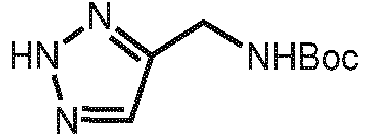
A una disolución de W-Boc-propargilamina (1,60 g, 10,3 mmol) en una mezcla de DMF:MeOH (4:1, 10 ml) se le añadió trimetilsililazida (2,0 ml, 15,2 mmol) y Cul (95 mg, 0,50 mmol). Se calentó la mezcla resultante hasta 100°C durante 16 h, tras lo cual se concentró a vacío y se purificó por medio de cromatografía en gel de sílice, dando el compuesto del título (2,0 g, 99%) como un aceite amarillo claro; CL-EM: m/z = 196,9 (M-1).To a solution of W-Boc-propargilamine (1.60 g, 10.3 mmol) in a mixture of DMF: MeOH (4: 1, 10 ml) was added trimethylsilylazide (2.0 ml, 15.2 mmol) and Cul (95 mg, 0.50 mmol). The resulting mixture was heated to 100 ° C for 16 h, after which it was concentrated in vacuo and purified by silica gel chromatography, giving the title compound (2.0 g, 99%) as a yellow oil. Clear; LC-MS: m / z = 196.9 (M-1).
Producto intermedio S:Intermediate product S:

Etapa 1: ((2S,3S)-1-(2,4-dimetoxibencil)-2-(yodometil)-4-oxoazetidin-3-il)carbamato de bencilo. A una disolución de producto intermedio G (10 g, 25 mmol), trifenilfosfina (19,6 g, 75 mmol) e imidazol (5,1 g, 75 mmol) en DCM (150 ml) a 0°C se le añadió yodo (19 g, 75 mmol) en porciones a lo largo de 10 min. Tras agitar a ta durante 4 h, se lavó con disolución de Na2S2O3 saturado (ac), agua, salmuera, se secó sobre Na2SO4 y se concentró a vacío. Se suspendió el residuo bruto en EtOAc (150 ml) y se agitó durante 16 h tras lo cual se filtró, después se lavó con acetona y MeOH, dando el compuesto del título (9,8 g, 77%) como un sólido blanco. CL-EM: m/z = 510,8 (M+1).Stage 1: ((2S, 3S) -1- (2,4-dimethoxybenzyl) -2- (iodomethyl) -4-oxoazetidin-3-yl) benzyl carbamate. To a solution of intermediate G (10 g, 25 mmol), triphenylphosphine (19.6 g, 75 mmol) and imidazole (5.1 g, 75 mmol) in DCM (150 ml) at 0 ° C was added iodine (19 g, 75 mmol) in portions over 10 min. After stirring at rt for 4 h, it was washed with Saturated Na2S2O3 solution (aq), water, brine, dried over Na2SO4 and concentrated in vacuo. The crude residue was suspended in EtOAc (150 ml) and stirred for 16 h after which it was filtered, then washed with acetone and MeOH, giving the title compound (9.8 g, 77%) as a white solid. LC-MS: m / z = 510.8 (M + 1).
Etapa 2: ((2R,3S)-2-(azidometil)-1-(2,4-dimetoxibencil)-4-oxoazetidin-3-il)carbamato de bencilo. A una disolución de ((2S,3S)-1-(2,4-dimetoxibencil)-2-(yodometil)-4-oxoazetidin-3-il)carbamato de bencilo (5,00 g, 9,80 mmol) en THF (100 ml) a 0°C se le añadió TEA (2,73 g, 19,6 mmol) seguido por una disolución de azida de tetrabutilamonio (3,62 g, 12,7 mmol) en THF. Tras agitar a ta durante 16 h, se filtró y se concentró a vacío. Se purificó el residuo bruto por medio de cromatografía en gel de sílice (MeOH-DCM, 2%), dando el compuesto del título (3,4 g, 81%) como un sólido blanco.Stage 2: ((2R, 3S) -2- (azidomethyl) -1- (2,4-dimethoxybenzyl) -4-oxoazetidin-3-yl) benzyl carbamate. To a solution of ((2S, 3S) -1- (2,4-dimethoxybenzyl) -2- (iodomethyl) -4-oxoazetidin-3-yl) benzyl carbamate (5.00 g, 9.80 mmol) in THF (100 ml) at 0 ° C was added TEA (2.73 g, 19.6 mmol) followed by a solution of tetrabutylammonium azide (3.62 g, 12.7 mmol) in THF. After stirring at rt for 16 h, it was filtered and concentrated in vacuo. The crude residue was purified by silica gel chromatography (MeOH-DCM, 2%), to give the title compound (3.4 g, 81%) as a white solid.
Etapa 3: A una disolución de ((2R,3S)-2-(azidometil)-1-(2,4-dimetoxibencil)-4-oxoazetidin-3-il)carbamato de bencilo (3,00 g, 7,06 mmol) en DCM (6 ml) se le añadió DMSO: agua: ferc-butanol (1:1:1,6 ml) ferc-butilo but-3-in-1-ilcarbamato (2,19 g, 14,1 mmol), CuSO4 (56 mg, 0,35 mmol) y l-ascorbato de sodio (2,01 mg, 10,6 mmol). Tras agitar a ta durante 3 h, se concentró la mezcla parcialmente y se añadió agua, tras lo cual se recogieron los sólidos mediante filtración. Se suspendió la torta de filtro en DCM, se filtró y se concentró el filtrado, dando el compuesto del título (supuestamente cuantitativo) como un sólido amarillo claro.Step 3: To a solution of ((2R, 3S) -2- (azidomethyl) -1- (2,4-dimethoxybenzyl) -4-oxoazetidin-3-yl) benzyl carbamate (3.00 g, 7.06 mmol) in DCM (6 ml) DMSO: water: ferc-butanol (1: 1: 1.6 ml) was added ferc-butyl but-3-in-1-ylcarbamate (2.19 g, 14.1 mmol ), CuSO4 (56 mg, 0.35 mmol) and sodium l-ascorbate (2.01 mg, 10.6 mmol). After stirring at rt for 3 h, the mixture was partially concentrated and water was added, after which the solids were collected by filtration. The filter cake was suspended in DCM, filtered and the filtrate was concentrated, giving the title compound (supposedly quantitative) as a light yellow solid.
Etapa 4: A una disolución del producto de la etapa 3 (7,06 mmol) en ACN (50 ml) se le añadió persulfato de potasio (3,82 g, 14,1 mmol) seguido por una disolución de fosfato de dipotasio (3,08 g, 17,7 mmol) en agua (25 ml). Se calentó la mezcla resultante hasta 90°C durante 4 h, después se enfrió hasta ta, se filtró y se concentró a vacío, eliminando la mayor parte del ACN. Se extrajo el filtrado con EtOAc y se concentró a vacío. Se lavó el residuo bruto con hexanos y acetona, dando el compuesto del título (1,72 g, el 57% a lo largo de 2 etapas) como un sólido blanco. CL-EM: m/z = 431,1 (M+1).Step 4: To a solution of the product of step 3 (7.06 mmol) in ACN (50 ml) was added potassium persulfate (3.82 g, 14.1 mmol) followed by a solution of dipotassium phosphate ( 3.08 g, 17.7 mmol) in water (25 ml). The resulting mixture was heated to 90 ° C for 4 h, then cooled to rt, filtered and concentrated in vacuo, removing most of the ACN. The filtrate was extracted with EtOAc and concentrated in vacuo. The crude residue was washed with hexanes and acetone, giving the title compound (1.72 g, 57% over 2 steps) as a white solid. LC-MS: m / z = 431.1 (M + 1).
Producto intermedio TIntermediate product T

Etapa 1: se siguió el procedimiento general para la reacción de Mitsunobu. A una disolución de producto intermedio G (5,00 g, 12,5 mmol), ((2H-1,2,3-triazol-4-il)metil)carbamato de ferc-butilo (2,97 mg, 15,0 mmol), trifenilfosfina (3,93 mg, 15,0 mmol) y DIAD (3,0 ml, 15 mmol) en THF (100 ml). Se purificó por medio de cromatografía en gel de sílice (MeOH-DCM, 2-5%), dando el compuesto del título (12,6 g, contaminado con óxido e trifenilfosfina) como una espuma blanca.Stage 1: the general procedure for the Mitsunobu reaction was followed. To a solution of intermediate G (5.00 g, 12.5 mmol), ((2H-1,2,3-triazol-4-yl) methyl) ferc-butyl carbamate (2.97 mg, 15, 0 mmol), triphenylphosphine (3.93 mg, 15.0 mmol) and DIAD (3.0 ml, 15 mmol) in THF (100 ml). It was purified by silica gel chromatography (MeOH-DCM, 2-5%), to give the title compound (12.6 g, contaminated with oxide and triphenylphosphine) as a white foam.
Etapa 2: A una disolución del producto de la etapa 1 (12,5 mmol) en ACN (150 ml) se le añadió una disolución de persulfato de potasio (6,76 g, 25,0 mmol) y fosfato de dipotasio (5,44 g, 31,2 mmol) en agua (75 ml). Se calentó la mezcla resultante hasta 90°C durante 4 h, después se enfrió hasta ta, se diluyó con agua y se extrajo con EtOAc. Se concentró la fase orgánica a vacío y se purificó el residuo bruto por medio de cromatografía en gel de sílice, dando el compuesto del título (2,23 g, el 41% a lo largo de 2 etapas) como un sólido blanco. CL-EM: m/z = 428,9 (M-1).Step 2: To a solution of the product of step 1 (12.5 mmol) in ACN (150 ml) was added a solution of potassium persulfate (6.76 g, 25.0 mmol) and dipotassium phosphate (5 , 44 g, 31.2 mmol) in water (75 ml). The resulting mixture was heated to 90 ° C for 4 h, then cooled to rt, diluted with water and extracted with EtOAc. The organic phase was concentrated in vacuo and the crude residue was purified by silica gel chromatography to give the title compound (2.23 g, 41% over 2 steps) as a white solid. LC-MS: m / z = 428.9 (M-1).
Producto intermedio U: Intermediate product U:

Etapa 1: ((2R,3S)-1-(2,4-dimetoxibencil)-2-((1,3-dioxoisoindo)en-2-il)metil)-4-oxoazetidin-3-il)carbamato de bencilo. Se siguió el procedimiento general para la reacción de Mitsunobu usando el producto intermedio G (5,00 g, 12,5 mmol), ftalimida (1,83 g, 12,5 mmol), trifenilfosfina (3,93 g, 15,0 mmol), DIAD (3,03 g, 15,0 mmol) y THF (150 ml). Tras agitar durante 16 h, se filtró el precipitado formado, dando el compuesto del título (5,67 g, 85%) como un sólido blanco.Stage 1: ((2R, 3S) -1- (2,4-dimethoxybenzyl) -2 - ((1,3-dioxoisoindo) en-2-yl) methyl) -4-oxoazetidin-3-yl) benzyl carbamate . The general procedure for the Mitsunobu reaction was followed using intermediate G (5.00 g, 12.5 mmol), phthalimide (1.83 g, 12.5 mmol), triphenylphosphine (3.93 g, 15.0 mmol), DIAD (3.03 g, 15.0 mmol) and THF (150 ml). After stirring for 16 h, the precipitate formed was filtered, giving the title compound (5.67 g, 85%) as a white solid.
Etapa 2: ((2R,3S)-2-(aminometil)-1-(2,4-dimetoxibencil)-4-oxoazetidin-3-il)carbamato de bencilo. A una disolución de ((2R,3S)-1-(2,4-dimetoxibencil)-2-((1,3-dioxoisoindolin-2-il)metil)-4-oxoazetidin-3-il)carbamato de bencilo (4,40 g, 8,31 mmol) en DCM:MeOH (5:1, 60 ml) se le añadió hidrazina hidratada (1,50 g, 25,0 mmol). Tras agitar durante 16 h se eliminó el precipitado por filtración y se concentró el filtrado, dando el compuesto del título (cuantitativo) como un sólido blanco.Stage 2: ((2R, 3S) -2- (aminomethyl) -1- (2,4-dimethoxybenzyl) -4-oxoazetidin-3-yl) benzyl carbamate. To a solution of ((2R, 3S) -1- (2,4-dimethoxybenzyl) -2 - ((1,3-dioxoisoindolin-2-yl) methyl) -4-oxoazetidin-3-yl) benzyl carbamate ( 4.40 g, 8.31 mmol) in DCM: MeOH (5: 1, 60 ml), hydrazine hydrate (1.50 g, 25.0 mmol) was added. After stirring for 16 h, the precipitate was removed by filtration and the filtrate was concentrated to give the title compound (quantitative) as a white solid.
Etapa 3: A una disolución de ((2R,3S)-2-(aminometil)-1-(2,4-dimetoxibencil)-4-oxoazetidin-3-il)carbamato de bencilo (8,31 mmol) en DCM:MeOH (13:1, 43 ml) se le añadió (oxiran-2-ilmetil)carbamato de (R)-terc-butilo. Tras agitar durante 16 h se concentró a vacío y se purificó por medio de cromatografía en gel de sílice (MeOH-DCM, 2-10%), dando el compuesto del título (2,2 g, 46%) como una espuma blanca.Step 3: To a solution of ((2R, 3S) -2- (aminomethyl) -1- (2,4-dimethoxybenzyl) -4-oxoazetidin-3-yl) benzyl carbamate (8.31 mmol) in DCM: MeOH (13: 1, 43 ml) ((R) -terc-butyl (oxyran-2-ylmethyl) carbamate was added. After stirring for 16 h, it was concentrated in vacuo and purified by means of silica gel chromatography (MeOH-DCM, 2-10%), to give the title compound (2.2 g, 46%) as a white foam.
Etapa 4: A una disolución del producto de la etapa 3 (2,20 g, 3,85 mmol) en DCM (100 ml) a 0°C se le añadió CDI (1,12 g, 6,92 mmol). Tras agitar a 15°C durante 2 h se concentró la disolución a vacío. Se purificó el residuo bruto por medio de cromatografía en gel de sílice (MeOH-DCM, 1-5%) para dar el compuesto del título (2,10 g, 91%) como una espuma blanca.Step 4: To a solution of the product of step 3 (2.20 g, 3.85 mmol) in DCM (100 ml) at 0 ° C was added CDI (1.12 g, 6.92 mmol). After stirring at 15 ° C for 2 h the solution was concentrated in vacuo. The crude residue was purified by silica gel chromatography (MeOH-DCM, 1-5%) to give the title compound (2.10 g, 91%) as a white foam.
Etapa 5: A una disolución del producto de la etapa 4 (2,10 g, 3,51 mmol) en ACN (40 ml) se le añadió una disolución de persulfato de potasio (1,89 g, 7,02 mmol) y fosfato de dipotasio (1,52 g, 8,75 mmol) en agua (20 ml). Se calentó la mezcla resultante hasta 90°C durante 4 h, después se enfrió hasta ta y se filtró. Se concentró el filtrado, se extrajo con EtOAc y se concentró la fase orgánica. Se purificó el residuo bruto por medio de cromatografía en gel de sílice (MeOH-DCM, 2-5%), dando el compuesto del título (660 mg, 42%) como un sólido amarillo claro. CL-EM: m/z = 449,09 (M+1).Step 5: To a solution of the product of step 4 (2.10 g, 3.51 mmol) in ACN (40 ml) was added a solution of potassium persulfate (1.89 g, 7.02 mmol) and Dipotassium phosphate (1.52 g, 8.75 mmol) in water (20 ml). The resulting mixture was heated to 90 ° C for 4 h, then cooled to rt and filtered. The filtrate was concentrated, extracted with EtOAc and the organic phase was concentrated. The crude residue was purified by silica gel chromatography (MeOH-DCM, 2-5%), to give the title compound (660 mg, 42%) as a light yellow solid. LC-MS: m / z = 449.09 (M + 1).
Producto intermedio V: Intermediate product V:
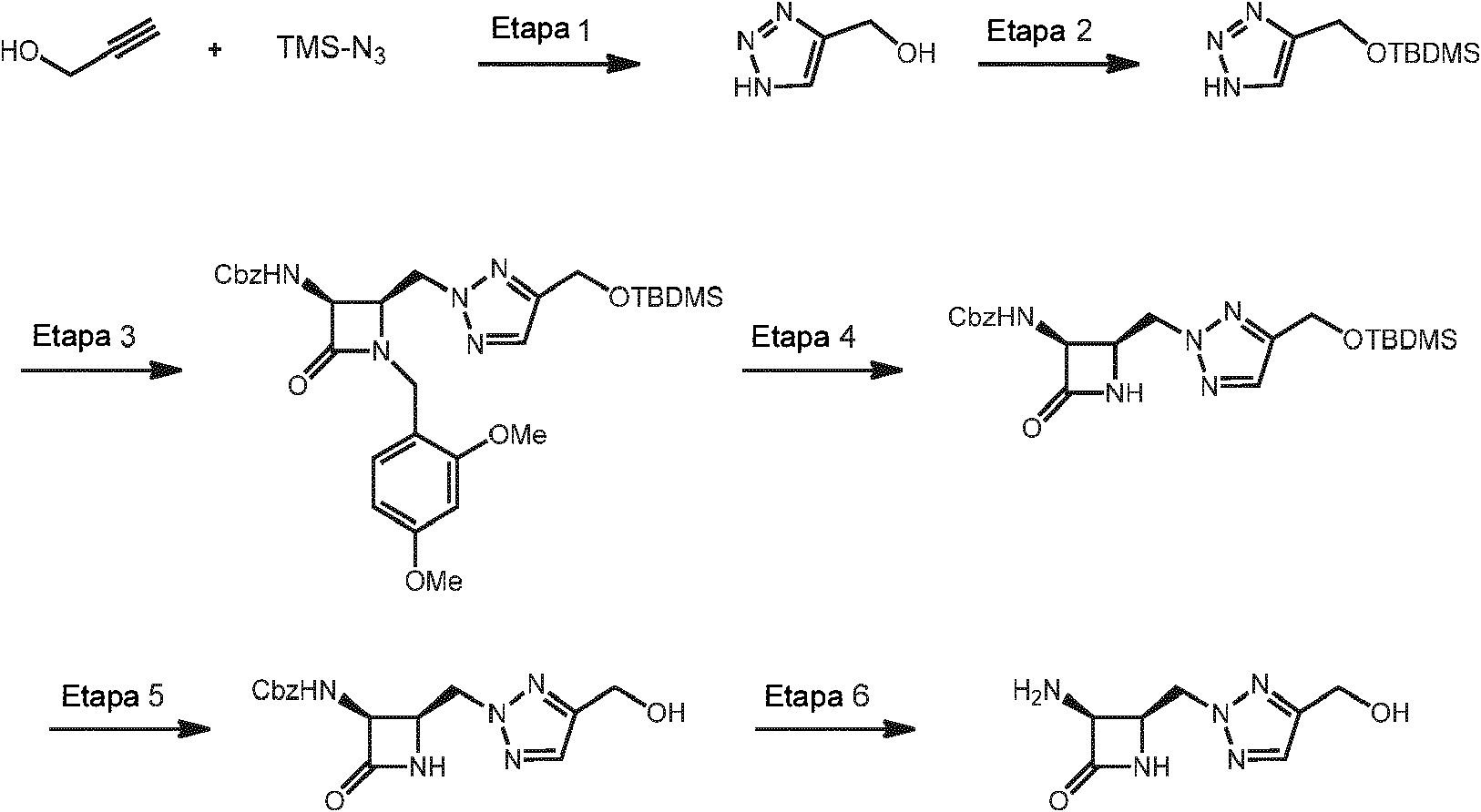
Etapa 1: (1H-1,2,3-triazol-4-il)metanol. A una disolución de alcohol propargílico (11,2 g, 200 mmol) en DMF (160 ml) y MeOH (40 ml) se le añadió Cul (1,9 g, 10 mmol) y trimetilsililazida (34,6 g, 300 mmol). Tras calentar hasta 100°C durante 16 h, se enfrió la mezcla de reacción hasta ta y se filtró a través de Celite. Se concentró el filtrado a vacío para dar el compuesto del título (supuestamente cuantitativo). Se usó el compuesto bruto como tal en la siguiente etapa.Stage 1: (1H-1,2,3-triazol-4-yl) methanol. To a solution of propargyl alcohol (11.2 g, 200 mmol) in DMF (160 ml) and MeOH (40 ml) was added Cul (1.9 g, 10 mmol) and trimethylsilylazide (34.6 g, 300 mmol ). After heating to 100 ° C for 16 h, the reaction mixture was cooled to rt and filtered through Celite. The filtrate was concentrated in vacuo to give the title compound (supposedly quantitative). The crude compound was used as such in the next step.
Etapa 2: 4-(((ferc-butildimetilsilil)oxi)metil)-1H-1,2,3-triazol. A una disolución de (1H-1,2,3-triazol-4-il)metanol (30 g, 200 mmol) en DCM (160 ml) se le añadió imidazol (20,4 g, 300 mmol) seguido por TBDMS-Cl (33,3 g, 220 mmol) como un sólido en porciones. Tras agitar a ta durante 16 h, se filtró la mezcla de reacción a través de Celite, y se concentró el filtrado a vacío. Se disolvió el residuo en EtOAc (500 ml) y se lavó con agua, salmuera, se secó sobre Na2SO4, y se concentró a vacío. Se purificó el residuo bruto por medio de cromatografía en gel de sílice (EtOAchexanos, 5-30%) para dar el compuesto del título (30,2 g, 71%) como un sólido amarillo claro.Stage 2: 4 - (((ferc-butyldimethylsilyl) oxy) methyl) -1H-1,2,3-triazole. To a solution of (1H-1,2,3-triazol-4-yl) methanol (30 g, 200 mmol) in DCM (160 ml) was added imidazole (20.4 g, 300 mmol) followed by TBDMS- Cl (33.3 g, 220 mmol) as a portion solid. After stirring at rt for 16 h, the reaction mixture was filtered through Celite, and the filtrate was concentrated in vacuo. The residue was dissolved in EtOAc (500 ml) and washed with water, brine, dried over Na2SO4, and concentrated in vacuo. The crude residue was purified by silica gel chromatography (EtOAchexanes, 5-30%) to give the title compound (30.2 g, 71%) as a light yellow solid.
Etapa 3: ((2R,3S)-2-((4-(((ferc-butildimetilsilil)oxi)metil)-2H-1,2,3-triazol-2-il)metil)-1-(2,4-dimetoxibencil)-4-oxoazetidin-3-il)carbamato de bencilo. A una disolución de ((2S,3S)-1-(2,4-dimetoxibencil)-2-(hidroximetil)-4-oxoazetidin-3-il)carbamato de bencilo (0,94 g, 2,34 mmol), 4-(((ferc-butildimetilsilil)oxi)metil)-1H-1,2,3-triazol (0,5 g, 2,34 mmol), y PPh3 (0,74 g, 2,81 mmol) en THF (20 ml) a 0°C se le añadió DIAD (0,57 g, 2,81 mmol) lentamente. Tras agitar a ta durante 16 h, se concentró la mezcla de reacción a vacío. Se purificó el residuo bruto por medio de cromatografía en gel de sílice (EtOAc-hexanos, 20-30%) para dar el compuesto del título (1,25 g, 89%) como un sólido amarillo claro. CL-EM: m/z = 594,3 (M-1).Stage 3: ((2R, 3S) -2 - ((4 - (((ferc-butyldimethylsilyl) oxy) methyl) -2H-1,2,3-triazol-2-yl) methyl) -1- (2, Benzyl 4-dimethoxybenzyl) -4-oxoazetidin-3-yl) carbamate. To a solution of ((2S, 3S) -1- (2,4-dimethoxybenzyl) -2- (hydroxymethyl) -4-oxoazetidin-3-yl) benzyl carbamate (0.94 g, 2.34 mmol), 4 - (((ferc-butyldimethylsilyl) oxy) methyl) -1H-1,2,3-triazole (0.5 g, 2.34 mmol), and PPh3 (0.74 g, 2.81 mmol) in THF (20 ml) at 0 ° C DIAD (0.57 g, 2.81 mmol) was added slowly. After stirring at rt for 16 h, the reaction mixture was concentrated in vacuo. The crude residue was purified by silica gel chromatography (EtOAc-hexanes, 20-30%) to give the title compound (1.25 g, 89%) as a light yellow solid. LC-MS: m / z = 594.3 (M-1).
Etapa 4: ((2R,3S)-2-((4-(((ferc-butildimetilsilil)oxi)metil)-2H-1,2,3-triazol-2-il)metil)-4-oxoazetidin-3-il)carbamato de bencilo. A una disolución de ((2R,3S)-2-((4-(((ferc-butildimetilsilil)oxi)metil)-2H-1,2,3-triazol-2-il)metil)-1-(2,4-dimetoxibencil)-4-oxoazetidin-3-il)carbamato de bencilo (1,25 g, 2,1 mmol) en CH3CN (20 ml) se le añadió K2S2O8 (0,73 g, 2,7 mmol) seguido por una disolución de K2HPO4 (0,84 g, 4,8 mmol) en agua (10 ml). Tras agitar a 90°C durante 1 h, se añadió más K2S2O8 (0,23 g, 0,84 mmol). Tras calentar a 90°C durante 2 h adicionales, se concentró la mezcla de reacción a vacío. Se extrajo el residuo con EtOAc (2 x 30 ml). Se lavaron las fases orgánicas combinadas con agua, salmuera, se secaron con Na2SO4, se filtraron y se concentraron a vacío. Se purificó el residuo bruto por medio de cromatografía en gel de sílice (MeOH-DCM, 1-3%) para dar el compuesto del título (0,44 g, 47%) como un sólido amarillo claro. CL-EM: m/z = 446,2 (M+1).Stage 4: ((2R, 3S) -2 - ((4 - (((ferc-butyldimethylsilyl) oxy) methyl) -2H-1,2,3-triazol-2-yl) methyl) -4-oxoazetidin-3 -il) benzyl carbamate. To a solution of ((2R, 3S) -2 - ((4 - (((ferc-butyldimethylsilyl) oxy) methyl) -2H-1,2,3-triazol-2-yl) methyl) -1- (2 , Benzyl 4-dimethoxybenzyl) -4-oxoazetidin-3-yl) carbamate (1.25 g, 2.1 mmol) in CH3CN (20 mL) was added K2S2O8 (0.73 g, 2.7 mmol) followed by a solution of K2HPO4 (0.84 g, 4.8 mmol) in water (10 ml). After stirring at 90 ° C for 1 h, more K2S2O8 (0.23 g, 0.84 mmol) was added. After heating at 90 ° C for an additional 2 h, the reaction mixture was concentrated in vacuo. The residue was extracted with EtOAc (2 x 30 ml). The combined organic phases were washed with water, brine, dried with Na2SO4, filtered and concentrated in vacuo. The crude residue was purified by silica gel chromatography (MeOH-DCM, 1-3%) to give the title compound (0.44 g, 47%) as a light yellow solid. LC-MS: m / z = 446.2 (M + 1).
Etapa 5: ((2R,3S)-2-((4-(hidroximetil)-2H-1,2,3-triazol-2-il)metil)-4-oxoazetidin-3-il)carbamato de bencilo. A una disolución de ((2R,3S)-2-((4-(((ferfbutildimetilsilil)oxi)metil)-2H-1,2,3-triazol-2-il)metil)-4-oxoazetidin-3-il)carbamato de bencilo (10,8 g, 24,4 mmol) en THF (100 ml) se le añadió TBAF (1 M en Th F, 26,6 ml, 26,6 mmol) lentamente a lo largo de un periodo de 15 min. Tras agitar a ta durante 1,5 h, se concentró la mezcla de reacción a vacío. Se purificó el residuo bruto por medio de cromatografía en gel de sílice (MeOH-DCM, 1-5%) para dar el compuesto del título (6,8 g, 85%) como un sólido amarillo claro. CL-EM: m/z = 330,0 (M+1).Stage 5: ((2R, 3S) -2 - ((4- (hydroxymethyl) -2H-1,2,3-triazol-2-yl) methyl) -4-oxoazetidin-3-yl) benzyl carbamate. To a solution of ((2R, 3S) -2 - ((4 - (((ferfbutyldimethylsilyl) oxy) methyl) -2H-1,2,3-triazol-2-yl) methyl) -4-oxoazetidin-3- il) benzyl carbamate (10.8 g, 24.4 mmol) in THF (100 ml) TBAF (1 M in T h F, 26.6 ml, 26.6 mmol) was added slowly over a period of time. 15 min period After stirring at rt for 1.5 h, the reaction mixture was concentrated in vacuo. The crude residue was purified by silica gel chromatography (MeOH-DCM, 1-5%) to give the title compound (6.8 g, 85%) as a light yellow solid. LC-MS: m / z = 330.0 (M + 1).
Etapa 6 : (3S,4R)-3-amino-4-((4-(hidroximetil)-2H-1,2,3-triazol-2-il)metil)azetidin-2-ona. A una disolución de ((2R,3S)-2-((4-(hidroximetil)-2H-1,2,3-triazol-2-il)metil)-4-oxoazetidin-3-il)carbamato de bencilo (1,54 g, 4,65 mmol) en EtOH (50 ml) y EtOH (25 ml) se le añadió Pd/C (10%, 0,51 g, 4,65 mmol). Tras agitar a ta durante 4h, se filtró la mezcla de reacción a través de una capa de Celite, y se concentró el filtrado a vacío para dar el compuesto del título (supuestamente cuantitativo). Se usó el bruto como tal en la siguiente etapa. c L-EM: Rt = 0,12 min, m/z = 198,0 (m +1) Método 2m_ácido. Step 6: (3S, 4R) -3-amino-4 - ((4- (hydroxymethyl) -2H-1,2,3-triazol-2-yl) methyl) azetidin-2-one. To a solution of ((2R, 3S) -2 - ((4- (hydroxymethyl) -2H-1,2,3-triazol-2-yl) methyl) -4-oxoazetidin-3-yl) benzyl carbamate ( 1.54 g, 4.65 mmol) in EtOH (50 ml) and EtOH (25 ml) was added Pd / C (10%, 0.51 g, 4.65 mmol). After stirring at rt for 4h, the reaction mixture was filtered through a layer of Celite, and the filtrate was concentrated in vacuo to give the title compound (supposedly quantitative). The crude was used as such in the next stage. c L-MS: Rt = 0.12 min, m / z = 198.0 ( m + 1) 2m_acid method.
Producto intermedio W: cloruro de 3-(amoniometil)-1-metilpiridin-1-ioIntermediate product W: 3- (ammonomethyl) -1-methylpyridin-1-io chloride

Etapa 1: W-(p¡rid¡n-3-¡lmet¡l)acetamidaStage 1: W- (pridrid-3-lmetl) acetamide
Se preparó según Plater et al. Org. Biomol. Chem. 2009, 7, 1633. A una disolución de piridin-3-ilmetanamina (9,42 ml, 92 mmol) en agua (103 ml) a 10°C se le añadió anhídrido acético (10,47 ml, 111 mmol), se agitó a una velocidad en la que la temperatura interna no se elevó por encima de 25°C. Tras 18 h adicionales de agitación, se concentró la disolución a vacío, después se coevaporó con tolueno (3x) para dar el compuesto del título (14,22 g, cuantitativo) como un aceite transparente. CL-EM: Rt =0,12 min, m/z = 151,1 (M+1) Método 2m_ácido. 1H RMN (400 MHz, CDCh) 8 8,49 (d, J = 2,4 Hz, 2H) 7,65 (dd, J = 7,8, 1,6 Hz, 1H) 7,30-7,24- (m, 1 H) 6,59-6,49 (m, 1 H) 4,43 (d, J = 6,0 Hz, 2H) 2,02 (s, 3H).It was prepared according to Plater et al. Org. Biomol Chem. 2009, 7, 1633. To a solution of pyridin-3-ylmethanamine (9.42 ml, 92 mmol) in water (103 ml) at 10 ° C was added acetic anhydride (10.47 ml, 111 mmol) , was stirred at a speed in which the internal temperature did not rise above 25 ° C. After an additional 18 h of stirring, the solution was concentrated in vacuo, then coevaporated with toluene (3x) to give the title compound (14.22 g, quantitative) as a clear oil. LC-MS: Rt = 0.12 min, m / z = 151.1 (M + 1) 2m_acid method. 1H NMR (400 MHz, CDCh) 8 8.49 (d, J = 2.4 Hz, 2H) 7.65 (dd, J = 7.8, 1.6 Hz, 1H) 7.30-7.24 - (m, 1 H) 6.59-6.49 (m, 1 H) 4.43 (d, J = 6.0 Hz, 2H) 2.02 (s, 3H).
Etapa 2: yoduro de 3-(acetam¡domet¡l)-1-met¡lp¡r¡d¡n-1-¡o. A una disolución de ^-(piridin^-ilmetiOacetamida (13,89 g, 92 mmol) en DCM a 0°C se le añadió yoduro de metilo (8,10 ml, 129 mmol). Se retiró el baño de enfriamiento tras 10 min y se agitó la disolución a ta durante 19 h, tras lo cual se concentró a vacío y se usó como producto bruto en la etapa 3. CL-EM: Rt = 0,18 min, m/z = 164,9 (M+) Método 2m_ácido. 1H RMN (400 MHz, DMSO-d6) 88,91-8,87 (m, 2H) 8,58 (s a, 1H) 8,42 (d, J = 8,0 Hz, 1H) 8,09 (t, J = 7,0 Hz, 1H) 4,43 (d, J = 5,9 Hz, 2H) 4,35 (s, 3H) 1,92 (s, 3H) Etapa 3: cloruro de 3-(amon¡omet¡l)-1-met¡lp¡r¡d¡n-1-¡o. Se calentó una suspensión de yoduro de 3-(acetamidometil)-1 -metilpiridin-1-io (26,9 g, 92 mmol) en HCl (6 N, 307 ml, 1,84 mol) hasta 100°C durante 3 h. Se concentró la disolución a presión reducida (temp. del baño 80°C). El aceite rojo resultante solidificó durante la noche y se trituró con MeOH y se filtró para dar el compuesto del título (8,76 g, 49%) como un sólido blanquecino. Se concentró el filtrado hasta un aceite rojo, que tras reposar durante 4 días, se recogió el sólido formado y se lavó con MeOH frío, dando una segunda cosecha (6,5 g, 36%). CL-EM: Rt = 0,11 min, m/z = 123,0 (M+) Método 2m_ácido. 1H RMN (400 MHz, DMSO-d6) 8 ppm 9,18 (s,1H) 9,03 (d, J = 6,0 Hz, 1H) 8,66 (d, J = 8,1 Hz, 1H) 8,45 (s a, 3H) 8,24 (t, J = 7,0 Hz, 1H) 4,38 (s, 3H) 4,30 (s, 2H).Stage 2: iodide of 3- (acetam¡domet¡l) -1-met¡lp¡r¡d¡n-1-¡. To a solution of ^ - (pyridine ^ -methylOacetamide (13.89 g, 92 mmol) in DCM at 0 ° C was added methyl iodide (8.10 ml, 129 mmol). The cooling bath was removed after 10 min and the solution was stirred at rt for 19 h, after which it was concentrated in vacuo and used as a crude product in step 3. LC-MS: Rt = 0.18 min, m / z = 164.9 (M + ) 2m_acid method. 1H NMR (400 MHz, DMSO-d6) 88.91-8.87 (m, 2H) 8.58 (sa, 1H) 8.42 (d, J = 8.0 Hz, 1H) 8 , 09 (t, J = 7.0 Hz, 1H) 4.43 (d, J = 5.9 Hz, 2H) 4.35 (s, 3H) 1.92 (s, 3H) Stage 3: chloride 3- (ammonium) -1-methyl-rn-1-1 A suspension of iodide of 3- (acetamidomethyl) -1-methylpyridin-1-io (26, 9 g, 92 mmol) in HCl (6 N, 307 ml, 1.84 mol) at 100 ° C for 3 h. The solution was concentrated under reduced pressure (bath temp. 80 ° C). The resulting red oil solidified overnight and triturated with MeOH and filtered to give the title compound (8.76 g, 49%) as an off-white solid. trot the filtrate to a red oil, which after standing for 4 days, the solid formed was collected and washed with cold MeOH, giving a second crop (6.5 g, 36%). LC-MS: Rt = 0.11 min, m / z = 123.0 (M +) 2m_acid method. 1H NMR (400 MHz, DMSO-d6) 8 ppm 9.18 (s, 1H) 9.03 (d, J = 6.0 Hz, 1H) 8.66 (d, J = 8.1 Hz, 1H) 8.45 (sa, 3H) 8.24 (t, J = 7.0 Hz, 1H) 4.38 (s, 3H) 4.30 (s, 2H).
Los productos intermedios descritos anteriormente, y compuestos similares elaborados mediante los mismos métodos, pueden usarse para preparar compuestos de fórmula (I) mediante los esquemas de síntesis proporcionados en el presente documento. Los siguientes ejemplos ilustran la síntesis de compuestos seleccionados de fórmula (I) y proporcionan métodos que pueden adaptarse a la síntesis de otros compuestos de fórmula (I).The intermediates described above, and similar compounds made by the same methods, can be used to prepare compounds of formula (I) by the synthetic schemes provided herein. The following examples illustrate the synthesis of selected compounds of formula (I) and provide methods that can be adapted to the synthesis of other compounds of formula (I).
Ejemplo 1. Ácido 2-(((Z)-(1-(2-am¡not¡azol-4-¡l)-2-oxo-2-(((3S,4R)-2-oxo-4-((2-oxop¡rrol¡d¡n-1-¡l)met¡l)-1-sulfoazet¡d¡n-3-il)amino)etilideno)amino)oxi)-2-metilpropanoico.Example 1. Acid 2 - (((Z) - (1- (2-am¡not¡azol-4-¡) -2-oxo-2 - (((3S, 4R) -2-oxo-4- ((2-Oxoprolrold-1-1) methyl) -1-sulfoazetin-3-yl) amino) ethylidene) amino) oxy) -2-methylpropanoic.
Etapa 1: 2-(((Z)-(1-(2-((terc-butox¡carbon¡l)am¡no)t¡azol-4-¡l)-2-oxo-2-(((3S,4R)-2-oxo-4-((2-oxop¡rrol¡d¡n-1-iOmetiOazetidin^-i^amino^tNideno^mino^xi^-metilpropanoato de tere-butilo. Se calentó una disolución de producto intermedio l (100 mg, 0,190 mmol), metil-4-bromobutirato (25 ml, 0,194 mmol) y TEA (27 ml, 0,194 mmol) en DMF (1,3 ml) hasta 70°C durante 16 h con agitación, tras lo cual el calor se elevó entonces hasta 90°C. Tras 6 h de calentamiento adicional se diluyó con HCI (1 N) y EtOAc. Se extrajo la fase acuosa con EtOAc (2x) y se lavaron las fases orgánicas combinadas con disolución de LiCl (el 5% ac), salmuera, se secó sobre Na2SO4 y se concentró a vacío. Se purificó el residuo bruto por medio de cromatografía en gel de sílice (EtOAc-heptano, 50-100% entonces MeOH-EtOAc, 0-7%), dando el compuesto del título (21 mg, 18%) como una espuma. CL-EM: Rt = 0,88 min, m/z = 595,4 (M+1) Método 2m_ácido.Stage 1: 2 - (((Z) - (1- (2 - ((tert-butoxycarbonyl) ammonium) thiazol-4-l) -2-oxo-2 - ((( 3S, 4R) -2-oxo-4 - ((2-oxoprrol¡d¡n-1-iOmetiOazetidin ^ -i ^ amino ^ tNidene ^ mino ^ xi ^ -methylpropanoate tere-butyl. A solution of intermediate l (100 mg, 0.190 mmol), methyl-4-bromobutyrate (25 ml, 0.194 mmol) and TEA (27 ml, 0.194 mmol) in DMF (1.3 ml) up to 70 ° C for 16 h with stirring, after which the heat was then raised to 90 ° C. After 6 h of additional heating it was diluted with HCI (1 N) and EtOAc. The aqueous phase was extracted with EtOAc (2x) and the combined organic phases were washed with solution of LiCl (5% aq), brine, dried over Na2SO4 and concentrated in vacuo The crude residue was purified by chromatography on silica gel (EtOAc-heptane, 50-100% then MeOH-EtOAc, 0-7 %), giving the title compound (21 mg, 18%) as a foam LC-MS: Rt = 0.88 min, m / z = 595.4 (M + 1) 2m_acid method.
Etapa 2: ácido (3S,4R)-3-((Z)-2-(((1-(tere-butox¡)-2-met¡l-1-oxopropan-2-¡l)ox¡)¡m¡no)-2-(2-((tere-butox¡carbon¡l) am¡no)t¡azol-4-¡l)acetam¡do)-2-oxo-4-((2-oxop¡rrol¡d¡n-1-¡l)met¡l)azet¡d¡na-1-sulfón¡co. Se trató 2-(((Z)-(1-(2-((tercbutox¡carbon¡l)am¡no)t¡azol-4-¡l)-2-oxo-2-(((3S,4R)-2-oxo-4-((2-oxop¡rrol¡d¡n-1-¡l)met¡l)azet¡d¡n-3-i^amino^tilideno^mino^xi^-metilpropanoato de tere-butilo (43 mg, 0,072 mmol) en DMF (725 ml) con SO3 DMF (111 mg, 0,725 mmol). Se agitó la disolución a ta durante 30 min entonces se diluyó con EtOAc y se vertió en disolución de LiCl (el 5% ac). Se extrajo la fase acuosa con EtOAc (2x) y se lavaron las fases orgánicas combinadas con salmuera, se secaron sobre Na2SO4 y se concentraron a vacío, dando el compuesto del título bruto (55 mg) como un sólido blanco. CL-EM: Rt = 0,77 min, m/z = 675,3 (M+1) Método 2m_ácido. Se usó en la etapa 3 sin purificación adicional.Stage 2: acid (3S, 4R) -3 - ((Z) -2 - (((1- (tere-butox¡) -2-met¡l-1-oxopropan-2-¡) ox¡) ¡ mno) -2- (2 - ((tere-butoxycarbonyl) ammonium) thiazol-4-l) acetamido) -2-oxo-4 - ((2-oxop¡ rrol¡d¡n-1-¡l) met¡l) azet¡d¡na-1-sulfón¡co. 2 - (((Z) - (1- (2 - ((tertbutoxcarbonyl) ammonium) thiazol-4-l) -2-oxo-2 - (((3S, 4R) ) -2-oxo-4 - ((2-oxoprolrold-1-1) methyl) azetone-3-i ^ amino ^ tilidene ^ mino ^ xi ^ -methylpropanoate tere-butyl (43 mg, 0.072 mmol) in DMF (725 ml) with SO3 DMF (111 mg, 0.725 mmol) The solution was stirred at rt for 30 min then diluted with EtOAc and poured into LiCl solution (the 5% aq.) The aqueous phase was extracted with EtOAc (2x) and the combined organic phases were washed with brine, dried over Na2SO4 and concentrated in vacuo to give the crude title compound (55 mg) as a white solid. LC-MS: Rt = 0.77 min, m / z = 675.3 (M + 1) Method 2m_acid It was used in step 3 without further purification.
Etapa 3: ácido 2-(((Z)-(1-(2-am¡not¡azol-4-¡l)-2-oxo-2-(((3S,4R)-2-oxo-4-((2-oxop¡rrol¡d¡n-1-¡l)met¡l)-1-sulfoazet¡d¡n-3 il)amino)etilideno)amino)oxi)-2-metilpropanoico.Stage 3: acid 2 - (((Z) - (1- (2-am¡not¡azol-4-¡l) -2-oxo-2 - (((3S, 4R) -2-oxo-4 - ((2- oxoprolrold-1-l) methyl) -1-sulfoazetin-3-yl) amino) ethylidene) amino) oxy) -2-methylpropanoic.

Se siguió el procedimiento general para la desprotección mediada por ácido usando ácido (3S,4R)-3-((Z)-2-(((1-(tercbutoxi)-2-metil-1-oxopropan-2-il)oxi)imino)-2-(2-((terc-butoxicarbonil)amino)tiazol-4-il)acetamido)-2-oxo-4-((2-oxopirrolidin-1 -il)metil)azetidina-1 -sulfónico (55 mg, 0,072 mmol), DCM (720 |il) y TFA (333 |il, 4,32 mmol). Se purificó el residuo bruto mediante HPLC preparativa de fase inversa (XSelect CSH, 19 x 100 mm, 5 |im, columna C18; ACN-agua con modificador de ácido fórmico al 0,1%, 24 ml/min), dando el compuesto del título (6 mg, 16%) como un sólido blanco. CL-EM: Rt = 0,35 min, m/z = 519,0 (M+1) Método 2m_ácido; 1H RMN (400 MHz, D2O): 87,17 (s, 1H), 5,46 (d, J = 5,8 Hz, 1H), 4,71-4,64 (m, 1H), 3,92 (dd, J = 14,7, 8,7 Hz, 1H), 3,71-3,55 (m, 2H), 3,49 (dd, J = 14,7, 4,1 Hz, 1H), 2,42 (td, J = 8,0, 4,8 Hz, 2H), 2,08 (p, J = 7,6 Hz, 2H), 1,55 (s, 3H), 1,54 (s, 3H).The general procedure for acid-mediated deprotection was followed using (3S, 4R) -3 - ((Z) -2 - (((1- (tercbutoxy) -2-methyl-1-oxopropan-2-yl) oxy acid ) imino) -2- (2 - ((tert-butoxycarbonyl) amino) thiazol-4-yl) acetamido) -2-oxo-4 - ((2-oxopyrrolidin-1-yl) methyl) azetidine-1-sulfonic acid ( 55 mg, 0.072 mmol), DCM (720 µl) and TFA (333 µl, 4.32 mmol). The crude residue was purified by preparative reverse phase HPLC (XSelect CSH, 19 x 100 mm, 5 | im, C18 column; ACN-water with 0.1% formic acid modifier, 24 ml / min), to give the compound of the title (6 mg, 16%) as a white solid. LC-MS: Rt = 0.35 min, m / z = 519.0 (M + 1) 2m_acid method; 1H NMR (400 MHz, D2O): 87.17 (s, 1H), 5.46 (d, J = 5.8 Hz, 1H), 4.71-4.64 (m, 1H), 3.92 (dd, J = 14.7, 8.7 Hz, 1H), 3.71-3.55 (m, 2H), 3.49 (dd, J = 14.7, 4.1 Hz, 1H), 2.42 (td, J = 8.0, 4.8 Hz, 2H), 2.08 (p, J = 7.6 Hz, 2H), 1.55 (s, 3H), 1.54 (s , 3H).
Ejemplo 2: ácido 2-(((Z)-(1-(2-aminotiazol-4-il)-2-oxo-2-(((3S,4R)-2-oxo-4-((2-oxooxazolidin-3-il)metil)-1-sulfoazetidin-3-il)amino)etilideno)amino)oxi)-2-metilpropanoico.Example 2: 2 - (((Z) - (1- (2-aminothiazol-4-yl) -2-oxo-2 - ((((3S, 4R) -2-oxo-4 - ((2-oxooxazolidin) -3-yl) methyl) -1-sulfoazetidin-3-yl) amino) ethylidene) amino) oxy) -2-methylpropanoic acid.
Etapa 1: 2-(((Z)-(1-(2-((terc-butoxicarbonil))amino)tiazol-4-il)-2-(((2R,3S)-2-(((2-((tercbutildimetilsilil)oxi)etil)amino)metil)-4-oxoazetidin-3-il)amino)-2-oxoetilideno)amino)oxi)-2-metilpropanoato de terc-butilo. Se calentó una disolución de producto intermedio L (500 mg, 0,949 mmol) y (2-bromoetoxi)(tercbutil)dimetilsilano (204 ml, 0,949 mmol) en ACN (3,2 ml) a 80°C en un microondas durante 30 min, después se mantuvo a ta durante 12 h. Se recalentó hasta 100°C durante 45 min en el microondas después se mantuvo a ta durante 12 h, tras lo cual se diluyó con EtOAc y se lavó con carbonato de sodio (2 M, ac), se secó sobre sulfato de sodio y se concentró a vacío. Se purificó el residuo bruto por medio de cromatografía en gel de sílice (EtOAcheptano, el 0-100% después MeOH-DCM, el 10%) para dar el compuesto del título (111 mg, 17%). CL-EM: Rt = 1,03 min, m/z = 685,4 (M+1) Método 2m_ácido; 1H RMN (400 MHz, CDCla) 88,17 (d, J = 8,4 Hz, 1H), 7,30 (s, 1H), 6,30 (s a, 1H) 5,57-5,50 (m, 1H) 4,09-4,01 (m, 1H) 3,77-3,61 (m, 3H) 3,09 (dd, J = 12,6, 3,7 Hz, 1H) 2,87-2,71 (m, 3H) 1,56 (s, 6 H) 1,53 (s, 9H) 1,44 (s, 9H) 0,86 (s, 9H) 0,03 (s, 3H), 0,03 (s, 3H).Stage 1: 2 - (((Z) - (1- (2 - ((tert-butoxycarbonyl)) amino) thiazol-4-yl) -2 - (((2R, 3S) -2 - (((2- ((tert-butyldimethylsilyl) oxy) ethyl) amino) methyl) -4-oxoazetidin-3-yl) amino) -2-oxoethylidene) amino) oxy) -2-methylpropanoate tert- butyl ester. A solution of intermediate L (500 mg, 0.949 mmol) and (2-bromoethoxy) (tert-butyl) dimethylsilane (204 ml, 0.949 mmol) in ACN (3.2 ml) was heated at 80 ° C in a microwave for 30 min. , then kept at rt for 12 h. It was reheated to 100 ° C for 45 min in the microwave then kept at rt for 12 h, after which it was diluted with EtOAc and washed with sodium carbonate (2 M, aq), dried over sodium sulfate and concentrated in vacuo. The crude residue was purified by silica gel chromatography (EtOAcheptane, 0-100% then MeOH-DCM, 10%) to give the title compound (111 mg, 17%). LC-MS: Rt = 1.03 min, m / z = 685.4 (M + 1) 2m_acid method; 1H NMR (400 MHz, CDCla) 88.17 (d, J = 8.4 Hz, 1H), 7.30 (s, 1H), 6.30 (sa, 1H) 5.57-5.50 (m , 1H) 4.09-4.01 (m, 1H) 3.77-3.61 (m, 3H) 3.09 (dd, J = 12.6, 3.7 Hz, 1H) 2.87- 2.71 (m, 3H) 1.56 (s, 6 H) 1.53 (s, 9H) 1.44 (s, 9H) 0.86 (s, 9H) 0.03 (s, 3H), 0.03 (s, 3H).
Etapa 2: 2-(((Z)-(1-(2-((terc-butoxicarbonil)amino)tiazol-4-il)-2-(((2R,3S)-2-(((2-hidroxietil) amino)metil)-4-oxoazetidin-3-il)amino)-2-oxoetilideno)amino)oxi)-2-metilpropanoato de terc-butilo. Se preparó según Seki et al. Synlett 1995, 609-611. A una disolución de 2-(((Z)-(1-(2-((terc-butoxicarbonil)amino)tiazol-4-il)-2-(((2R,3S)-2-(((2-((tercbutildimetilsilil)oxi)etil)amino)metil)-4-oxoazetidin-3-il)amino)-2-oxoetilideno)amino)oxi)-2-metilpropanoato de tercbutilo (111 mg, 0,162 mmol) en DMF:NMP (2,7:1, 1,62 ml) se le añadió hidrofluoruro de fluoruro de amonio (37,0 mg, 0,648 mmol). Tras agitar durante 65 h, se diluyó la disolución con agua y se extrajo con EtOAc. Se secó la fase orgánica sobre sulfato de sodio y se concentró a vacío para dar el compuesto del título bruto (92 mg, 99%). Se usó el material bruto directamente en la etapa 3. CL-EM: Rt = 0,76 min, m/z 571,3 (M+1) Método 2m_ácido.Stage 2: 2 - (((Z) - (1- (2 - ((tert-butoxycarbonyl) amino) thiazol-4-yl) -2 - (((2R, 3S) -2 - (((2-hydroxyethyl ) tert-butyl amino) methyl) -4-oxoazetidin-3-yl) amino) -2-oxoethylidene) amino) oxy) -2-methylpropanoate. It was prepared according to Seki et al. Synlett 1995, 609-611. To a solution of 2 - (((Z) - (1- (2 - ((tert-butoxycarbonyl) amino) thiazol-4-yl) -2 - (((2R, 3S) -2 - (((2- ((tert-butyldimethylsilyl) oxy) ethyl) amino) methyl) -4-oxoazetidin-3-yl) amino) -2-oxoethylidene) amino) oxy) -2-methylpropanoate tert-butyl ester (111 mg, 0.162 mmol) in DMF: NMP ( 2.7: 1, 1.62 ml) ammonium fluoride hydrofluoride (37.0 mg, 0.648 mmol) was added. After stirring for 65 h, the solution was diluted with water and extracted with EtOAc. The organic phase was dried over sodium sulfate and concentrated in vacuo to give the crude title compound (92 mg, 99%). The crude material was used directly in step 3. LC-MS: Rt = 0.76 min, m / z 571.3 (M + 1) 2m_acid method.
Etapa 3: 2-(((Z)-(1-(2-((terc-butoxicarbonil))amino)tiazol-4-il)-2-oxo-2-(((3S,4R)-2-oxo-4-((2-oxooxazolidin-3-il)metil)azetidin-3-il)amino)etilideno)amino)oxi)-2-metilpropanoato de terc-butilo. Se preparó según la solicitud internacional PCT 2011061760. Se trató una disolución de 2-(((Z)-(1-(2-((terc-butoxicarbonil)amino)tiazol-4-il)-2-(((2R,3S)-2-(((2-hidroxietil)amino)metil)-4-oxoazetidin-3-il)amino)-2-oxoetilideno)amino)oxi)-2-metilpropanoato de terc-butilo (92 mg, 0,161 mmol) en cloroformo (806 ml) con CDI (131 mg, 0,806 mmol). Tras agitar a ta durante 3h se diluyó con EtOAc, se lavó con agua, salmuera, se secó sobre Na2SO4 y se concentró a vacío. Se purificó el residuo bruto mediante cromatografía en gel de sílice (MeOH-DCM, 0-10%), dando el compuesto del título (91 mg, 95%) como un aceite naranja. CL-EM: Rt = 0,86 min, m/z = 597,2 (M+1) Método 2m_ácido.Stage 3: 2 - (((Z) - (1- (2 - ((tert-butoxycarbonyl)) amino) thiazol-4-yl) -2-oxo-2 - (((3S, 4R) -2-oxo -4- ((2-Oxooxazolidin-3-yl) methyl) azetidin-3-yl) amino) ethylidene) amino) oxy) -2-methylpropanoate tert-butyl. It was prepared according to PCT international application 2011061760. A solution of 2 - (((Z) - (1- (2 - ((tert-butoxycarbonyl) amino) thiazol-4-yl) -2 - (((2R, 3S) -2 - (((2-hydroxyethyl) amino) methyl) -4-oxoazetidin-3-yl) amino) -2-oxoethylidene) amino) oxy) -2-methylpropanoate tert-butyl (92 mg, 0.161 mmol ) in chloroform (806 ml) with CDI (131 mg, 0.806 mmol). After stirring at rt for 3h, it was diluted with EtOAc, washed with water, brine, dried over Na2SO4 and concentrated in vacuo. The crude residue was purified by silica gel chromatography (MeOH-DCM, 0-10%), to give the title compound (91 mg, 95%) as an orange oil. LC-MS: Rt = 0.86 min, m / z = 597.2 (M + 1) 2m_acid method.
Etapa 4: ácido (3S,4R)-3-((Z)-2-(((1-(terc-butoxi)-2-metil-1-oxopropan-2-il)oxi)imino)-2-(2-((tercbutoxicarbonil)amino)tiazol-4-il)acetamido)-2-oxo-4-((2-oxooxazolidin-3-il)metil)azetidina-1-sulfónico. Se trató una disolución de 2-(((Z)-(1-(2-((terc-butoxicarbonil)amino)tiazol-4-il)-2-oxo-2-(((3S,4R)-2-oxo-4-((2-oxooxazolidin-3-il)metil) azetidin-3-il)amino)etilideno)amino)oxi)-2-metilpropanoato de terc-butilo (91 mg, 0,153 mmol) en DMF (volumen: 763 ml) con SO3 DMF (234 mg, 1,525 mmol). Tras agitar a ta durante 1 h se diluyó con EtOAc, se lavó con salmuera (3 x), se secó sobre Na2SO4 y se concentró a vacío, dando el compuesto del título (100 mg, 97%) como un sólido naranja. CL-EM: Rt = 0,78 min, m/z = 677,3 (M+1) Método 2m_ácido.Stage 4: (3S, 4R) -3 - ((Z) -2 - (((1- (tert-butoxy) -2-methyl-1-oxopropan-2-yl) oxy) imino) -2- ( 2 - ((tert-butoxycarbonyl) amino) thiazol-4-yl) acetamido) -2-oxo-4 - ((2-oxooxazolidin-3-yl) methyl) azetidine-1-sulfonic acid. A solution of 2 - (((Z) - (1- (2 - ((tert-butoxycarbonyl) amino) thiazol-4-yl) -2-oxo-2 - (((3S, 4R) -2- tert-butyl oxo-4 - ((2-oxooxazolidin-3-yl) methyl) azetidin-3-yl) amino) ethylidene) amino) oxy) -2-methylpropanoate (91 mg, 0.153 mmol) in DMF (volume: 763 ml) with SO3 DMF (234 mg, 1,525 mmol). After stirring at rt for 1 h it was diluted with EtOAc, washed with brine (3 x), dried over Na2SO4 and concentrated in vacuo to give the title compound (100 mg, 97%) as an orange solid. LC-MS: Rt = 0.78 min, m / z = 677.3 (M + 1) 2m_acid method.
Etapa 5: ácido 2-(((Z)-(1-(2-aminotiazol-4-il)-2-oxo-2-(((3S,4R)-2-oxo-4-((2-oxooxazolidin-3-il)metil)-1-sulfoazetidin-3-il)amino)etilideno)amino)oxi)-2-metilpropanoico. Stage 5: 2 - (((Z) - (1- (2-aminothiazol-4-yl) -2-oxo-2 - ((((3S, 4R) -2-oxo-4 - ((2-oxooxazolidin) -3-yl) methyl) -1-sulfoazetidin-3-yl) amino) ethylidene) amino) oxy) -2-methylpropanoic acid.

Se siguió el procedimiento general para la desprotección mediada por ácido usando ácido (3S,4R)-3-((Z)-2-(((1-(terc-butoxi)-2-metil-1-oxopropan-2-il)oxi)imino)-2-(2-((terc-butoxicarbonil)amino)tiazol-4-il)acetamido)-2-oxo-4-((2-oxooxazolidin-3-il)metil)azetidina-1-sulfónico (100 mg, 0,148 mmol), DCM (1,5 ml) y TFA (569 |il, 7,39 mmol). Se purificó el residuo bruto mediante HPLC de fase inversa (XSelect CSH, 19 x 100 mm, 5 |im, columna C18; ACN-agua con modificador de ácido fórmico al 0,1%, 24 ml/min), dando el compuesto del título (10 mg, 12%) como un sólido blanco. CL-EM: Rt = 0,32 min, m/z = 521,0 (M+1) Método 2m_ácido; 1H RMN (400 MHz, DMSO-da) 89,33 (d, J = 8,8 Hz, 1H), 6,89 (s, 1H), 5,22 (dd, J = 8 ,8, 5,7 Hz, 1H), 4,23-4,11 (m, 3H), 3,75-3,62 (m, 2H supuesto; oculto por el agua), 3,60-3,51 (m, 1H supuesto; oculto por el agua), 3,34 (dd, J = 14,6, 5,5 Hz, 1H), 1,44 (s, 3H), 1,40 (s, 3H). The general procedure for acid-mediated deprotection was followed using (3S, 4R) -3 - ((Z) -2 - (((1- (tert- butoxy) -2-methyl-1-oxopropan-2-yl acid) ) oxy) imino) -2- (2 - ((tert-butoxycarbonyl) amino) thiazol-4-yl) acetamido) -2-oxo-4 - ((2-oxooxazolidin-3-yl) methyl) azetidine-1- sulfonic (100 mg, 0.148 mmol), DCM (1.5 ml) and TFA (569 µl, 7.39 mmol). The crude residue was purified by reverse phase HPLC (XSelect CSH, 19 x 100 mm, 5 | im, column C18; ACN-water with 0.1% formic acid modifier, 24 ml / min), to give the compound of titer (10 mg, 12%) as a white solid. LC-MS: Rt = 0.32 min, m / z = 521.0 (M + 1) 2m_acid method; 1 H NMR (400 MHz, DMSO-da) 89.33 (d, J = 8.8 Hz, 1 H), 6.89 (s, 1 H), 5.22 (dd, J = 8, 8, 5.7 Hz, 1H), 4.23-4.11 (m, 3H), 3.75-3.62 (m, 2H supposed; hidden by water), 3.60-3.51 (m, 1H supposed; hidden by water), 3.34 (dd, J = 14.6, 5.5 Hz, 1H), 1.44 (s, 3H), 1.40 (s, 3H).
Ejemplo 3: ácido 2-(((Z)-(1-(2-aminotiazol-4-il)-2-oxo-2-(((3S,4R)-2-oxo-4-((2-oxoimidazolidin-1-il)metil)-1-sulfoazetidin-3-il)amino)etilideno)amino)oxi)-2-metilpropanoico.Example 3: 2 - (((Z) - (1- (2-aminothiazol-4-yl) -2-oxo-2 - ((((3S, 4R) -2-oxo-4 - ((2-oxoimidazolidin) acid -1-yl) methyl) -1-sulfoazetidin-3-yl) amino) ethylidene) amino) oxy) -2-methylpropanoic.
Etapa 1: 2-(((Z)-(2-(((2R,3S)-2-(((2-((((9H-fluoren-9-il)metoxi)carbonil)amino)etil)amino)metil)-4-oxoazetidin-3-il)amino)-1-(2-((terc-butoxicarbonil)amino)tiazol-4-il)-2-oxoetilideno)amino)oxi)-2-metilpropanoato de terc-butilo. Se trató una disolución de producto intermedio L (650 mg, 1,234 mmol) y (9H-fluoren-9-il)metil(2-oxoetil)carbamato (365 mg, 1,234 mmol) en DCE (12,3 ml) con triacetoxiborohidruro de sodio (1,377 g, 6,17 mmol). Tras agitar a ta durante 18 h se extinguió con NaHCO3 saturado (ac) y se extrajo con EtOAc. Se lavó la fase orgánica con salmuera, se secó sobre Na2SO4 y se concentró a vacío. Se purificó el residuo bruto por medio de cromatografía en gel de sílice (MeOH-DCM, 0-10%), dando el compuesto del título (435 mg, 45%) como un sólido blanco. CL-EM: Rt = 1,00 min, m/z = 792,3 (M+1) Método 2m_ácido; 1H RMN (400 MHz, DMSO-d6) 89,11 (d, J = 9,0 Hz, 1H), 8,35 (s, 1H), 7,89 (d, J = 7,7 Hz, 2H), 7,67 (d, J = 7,5 Hz, 2H), 7,41 (t, J = 7,2 Hz, 2H), 7,32 (td, J = 7,4,1,2 Hz, 2H), 7,27 (s, 1H), 7,19 (t, J = 5,7 Hz, 1H), 5,20 (dd, J = 9,1, 5,0 Hz, 1H), 4,30 (d, J = 6,8 Hz, 2H), 4,24-4,17 (m, 1H), 3,76 (ddd, J = 8 ,8, 5,3, 3,7 Hz, 1H), 3,11-2,97 (m, 2H), 2,76 (dd, J = 12,5, 3,7 Hz, 1H), 2,63-2,52 (m, 3H), 1,45 (s, 9H), 1,42 (s, 3H), 1,39 (s, 3H), 1,38 (s, 9H).Stage 1: 2 - (((Z) - (2 - (((2R, 3S) -2 - (((2 - ((((9H-fluoren-9-yl) methoxy) carbonyl) amino) ethyl) amino) ) methyl) -4-oxoazetidin-3-yl) amino) -1- (2 - ((tert-butoxycarbonyl) amino) thiazol-4-yl) -2-oxoethylidene) amino) oxy) -2-methylpropanoate butyl. A solution of intermediate L (650 mg, 1,234 mmol) and (9H-fluoren-9-yl) methyl (2-oxoethyl) carbamate (365 mg, 1,234 mmol) in DCE (12.3 ml) was treated with triacetoxyborohydride of sodium (1.377 g, 6.17 mmol). After stirring at rt for 18 h, it was quenched with saturated NaHCO3 (aq) and extracted with EtOAc. The organic phase was washed with brine, dried over Na2SO4 and concentrated in vacuo. The crude residue was purified by silica gel chromatography (MeOH-DCM, 0-10%), to give the title compound (435 mg, 45%) as a white solid. LC-MS: Rt = 1.00 min, m / z = 792.3 (M + 1) Method 2m_acid; 1H NMR (400 MHz, DMSO-d6) 89.11 (d, J = 9.0 Hz, 1H), 8.35 (s, 1H), 7.89 (d, J = 7.7 Hz, 2H) , 7.67 (d, J = 7.5 Hz, 2H), 7.41 (t, J = 7.2 Hz, 2H), 7.32 (td, J = 7.4.1.2 Hz, 2H), 7.27 (s, 1H), 7.19 (t, J = 5.7 Hz, 1H), 5.20 (dd, J = 9.1, 5.0 Hz, 1H), 4, 30 (d, J = 6.8 Hz, 2H), 4.24-4.17 (m, 1H), 3.76 (ddd, J = 8, 8, 5.3, 3.7 Hz, 1H) , 3.11-2.97 (m, 2H), 2.76 (dd, J = 12.5, 3.7 Hz, 1H), 2.63-2.52 (m, 3H), 1.45 (s, 9H), 1.42 (s, 3H), 1.39 (s, 3H), 1.38 (s, 9H).
Etapa 2: 2-(((Z)-(2-(((2R,3S)-2-(((2-aminoetil)amino)metil)-4-oxoazetidin-3-il)amino)-1-(2-((tercbutoxicarbonil)amino)tiazol-4-il)-2-oxoetilideno)amino)oxi)-2-metilpropanoato de terc-butilo. Se trató una disolución de 2-(((Z)-(2-(((2R,3S)-2-(((2-((((9H-fluoren-9-il)metoxi)carbonil)amino)etil)amino)metil)-4-oxoazetidin-3-il)amino)-1-(2-((terc-butoxicarbonil)amino)tiazol-4-il)-2-oxoetilideno)amino)oxi)-2-metilpropanoato de terc-butilo (435 mg, 0,549 mmol) en DMF (2,75 ml) con piperidina (1,1 ml, 11 mmol). Tras agitar a ta durante 1 h se diluyó con tolueno y se concentró (3x). Se purificó el residuo bruto mediante HPLC de fase inversa (XSelect CSH, 19 x 100 mm, 5 |im, columna C18; ACN-agua con modificador de ácido fórmico al 0,1%, 24 ml/min), dando el compuesto del título (238 mg, 64%) como un polvo blanco. CL-EM: Rt = 0,68 min, m/z = 570,3 (M+1) Método 2m_ácido; 1H RMN (400 MHz, DMSOd6 ) 89,12 (d, J = 8,9 Hz, 1H), 8,38 (s, 1H), 8,31 (s, 1H), 7,21 (s, 1H), 5,17 (dd, J = 8,3, 4,9 Hz, 1H), 3,76 (dt, J = 8,7,4,7 Hz, 1H), 2,81-2,51 (m, 6 H), 1,44 (s, 9H), 1,41 (s, 3H), 1,39 (s, 3H), 1,38 (s, 9H).Stage 2: 2 - (((Z) - (2 - (((2R, 3S) -2 - (((2-aminoethyl) amino) methyl) -4-oxoazetidin-3-yl) amino) -1- ( 2 - ((tert-butoxycarbonyl) amino) thiazol-4-yl) -2-oxoethylidene) amino) oxy) -2-methylpropanoate tert-butyl ester. A solution of 2 - (((Z) - (2 - (((2R, 3S) -2 - (((2 - (((((9H-fluoren-9-yl) methoxy) carbonyl) amino) ethyl) was treated ) amino) methyl) -4-oxoazetidin-3-yl) amino) -1- (2 - ((tert-butoxycarbonyl) amino) thiazol-4-yl) -2-oxoethylidene) amino) oxy) -2-methylpropanoate tert-butyl (435 mg, 0.549 mmol) in DMF (2.75 ml) with piperidine (1.1 ml, 11 mmol). After stirring at rt for 1 h, it was diluted with toluene and concentrated (3x). The crude residue was purified by reverse phase HPLC (XSelect CSH, 19 x 100 mm, 5 | im, column C18; ACN-water with 0.1% formic acid modifier, 24 ml / min), to give the compound of Title (238 mg, 64%) as a white powder. LC-MS: Rt = 0.68 min, m / z = 570.3 (M + 1) 2m_acid method; 1H NMR (400 MHz, DMSOd6) 89.12 (d, J = 8.9 Hz, 1H), 8.38 (s, 1H), 8.31 (s, 1H), 7.21 (s, 1H) , 5.17 (dd, J = 8.3, 4.9 Hz, 1H), 3.76 (dt, J = 8.7.4.7 Hz, 1H), 2.81-2.51 (m , 6 H), 1.44 (s, 9H), 1.41 (s, 3H), 1.39 (s, 3H), 1.38 (s, 9H).
Etapa 3: 2-(((Z)-(1-(2-((terc-butoxicarbonil)amino)tiazol-4-il)-2-oxo-2-(((3S,4R)-2-oxo-4-((2-oxoimidazolidin-1-il)metil)azetidin-3-il)amino)etilideno)amino)oxi)-2-metilpropanoato de terc-butilo. A una disolución de 2-(((Z)-(2-(((2R,3S)-2-(((2-aminoetil)amino)metil)-4-oxoazetidin-3-il)amino)-1-(2-((terc-butoxicarbonil)amino)tiazol-4-il)-2-oxoetilideno)amino)oxi)-2-metilpropanoato de terc-butilo (100 mg, 0,151 mmol) en cloroformo (756 |il) se le añadió CDI (98 mg, 0,604 mmol) seguido por TEA (105 ml, 0,756 mmol). Tras agitar a ta durante 1 h se diluyó con EtOAc, se lavó con agua, salmuera, se secó sobre Na2SO4 y se concentró a vacío para dar el compuesto del título (73 mg, 81%) como un sólido blanco. Se usó como producto bruto en la etapa 4. CL-EM: Rt = 0,70 min, m/z = 596,2 (M+1) Método 2m_ácido.Stage 3: 2 - (((Z) - (1- (2 - ((tert-butoxycarbonyl) amino) thiazol-4-yl) -2-oxo-2 - (((3S, 4R) -2-oxo- Tert-Butyl 4 ((2-oxoimidazolidin-1-yl) methyl) azetidin-3-yl) amino) ethylidene) amino) oxy) -2-methylpropanoate. To a solution of 2 - (((Z) - (2 - (((2R, 3S) -2 - (((2-aminoethyl) amino) methyl) -4-oxoazetidin-3-yl) amino) -1- (2 - ((tert-butoxycarbonyl) amino) thiazol-4-yl) -2-oxoethylidene) amino) oxy) -2-methylpropanoate tert-butyl (100 mg, 0.151 mmol) in chloroform (756 | il) is CDI (98 mg, 0.604 mmol) was added followed by TEA (105 ml, 0.756 mmol). After stirring at rt for 1 h it was diluted with EtOAc, washed with water, brine, dried over Na2SO4 and concentrated in vacuo to give the title compound (73 mg, 81%) as a white solid. It was used as a crude product in step 4. LC-MS: Rt = 0.70 min, m / z = 596.2 (M + 1) 2m_acid method.
Etapa 4: ácido (3S,4R)-3-((Z)-2-(((1-(terc-butoxi)-2-metil-1-oxopropan-2-il)oxi)imino)-2-(2-((terc-butoxicarbonil) amino)tiazol-4-il)acetamido)-2-oxo-4-((2-oxoimidazolidin-1-il)metil)azetidina-1-sulfónico. Se trató una disolución de 2-(((Z)-(1-(2-((terc-butoxicarbonil)amino)tiazol-4-il)-2-oxo-2-(((3S,4R)-2-oxo-4-((2-oxoimidazolidin-1-il)metil)azetidin-3-il)amino)etilideno)amino)oxi)-2-metilpropanoato de terc-butilo (73 mg, 0,123 mmol) en DMF (613 ml) con SO3 DMF (94 mg, 0,613 mmol). Tras agitar a ta durante 2 h se diluyó con EtOAc, se lavó con salmuera (3x), se secó sobre Na2SO4 y se concentró a vacío para dar el compuesto del título (99 mg) como un sólido blanco. CL-EM: Rt = 0,74 min, m/z = 676,3 (M+1) Método 2m_ácido.Stage 4: (3S, 4R) -3 - ((Z) -2 - (((1- (tert-butoxy) -2-methyl-1-oxopropan-2-yl) oxy) imino) -2- ( 2 - ((tert-butoxycarbonyl) amino) thiazol-4-yl) acetamido) -2-oxo-4 - ((2-oxoimidazolidin-1-yl) methyl) azetidine-1-sulfonic acid. A solution of 2 - (((Z) - (1- (2 - ((tert-butoxycarbonyl) amino) thiazol-4-yl) -2-oxo-2 - (((3S, 4R) -2- tert-butyl oxo-4 - ((2-oxoimidazolidin-1-yl) methyl) azetidin-3-yl) amino) ethylidene) amino) oxy) -2-methylpropanoate (73 mg, 0.123 mmol) in DMF (613 ml ) with DMF SO3 (94 mg, 0.613 mmol). After stirring at rt for 2 h, it was diluted with EtOAc, washed with brine (3x), dried over Na2SO4 and concentrated in vacuo to give the title compound (99 mg) as a white solid. LC-MS: Rt = 0.74 min, m / z = 676.3 (M + 1) 2m_acid method.
Etapa 5: ácido 2-(((Z)-(1-(2-aminotiazol-4-il)-2-oxo-2-(((3S,4R)-2-oxo-4-((2-oxoimidazolidin-1-il)metil)-1-sulfoazetidin-3-il)amino)etilideno)amino)oxi)-2-metilpropanoico. Stage 5: 2 - (((Z) - (1- (2-aminothiazol-4-yl) -2-oxo-2 - ((((3S, 4R) -2-oxo-4 - ((2-oxoimidazolidin) -1-yl) methyl) -1-sulfoazetidin-3-yl) amino) ethylidene) amino) oxy) -2-methylpropanoic.

Se siguió el procedimiento general para la desprotección mediada por ácido usando ácido (3S,4R)-3-((Z)-2-(((1-(terc-butoxi)-2-metil-1-oxopropan-2-il)oxi)imino)-2-(2-((terc-butoxicarbonil)amino)tiazol-4-il)acetamido)-2-oxo-4-((2-oxoimidazolidin-1-il)metil)azetidina-1-sulfónico (99 mg, 0,147 mmol), DCM (1,47 ml) y TFA (566 ml, 7,35 mmol). Se purificó el residuo bruto mediante HPLC de fase inversa (XSelect CSH, 19 x 100 mm, 5 mm, columna C18; ACN-agua con modificador de ácido fórmico al 0,1%, 24 ml/min), dando el compuesto del título (4,8 mg) como un polvo blanco. CL-EM: Rt = 0,31 min, m/z = 520,0 (M+1) Método 2m_ácido; 1H RMN (500 MHz, DMSO-da) 89,25 (dd, J = 9,0, 5,0 Hz, 1H), 6,83 (s, 1H), 5,21 (dd, J = 9,0, 5,8 Hz, 1H), 4,06-4,00 (m, 1H), 3,65 (dd, J = 14,5, 4,7 Hz, 1H), 3,33 3,30 (m, 1H supuesto; oculto por el agua), 3,25 (dd, J = 14,5, 6,9 Hz, 2H supuesto; oculto por el agua), 3,17 (ddd, J=16,7, 8,6, 6,7 Hz, 2H), 1,43 (s, 3H), 1,42 (s, 3H).The general procedure for acid-mediated deprotection was followed using (3S, 4R) -3 - ((Z) -2 - (((1- (tert- butoxy) -2-methyl-1-oxopropan-2-yl acid) ) oxy) imino) -2- (2 - ((tert-butoxycarbonyl) amino) thiazol-4-yl) acetamido) -2-oxo-4 - ((2-oxoimidazolidin-1-yl) methyl) azetidine-1- sulfonic (99 mg, 0.147 mmol), DCM (1.47 ml) and TFA (566 ml, 7.35 mmol). The crude residue was purified by reverse phase HPLC (XSelect CSH, 19 x 100 mm, 5 mm, column C18; ACN-water with 0.1% formic acid modifier, 24 ml / min), to give the title compound (4.8 mg) as a white powder. LC-MS: Rt = 0.31 min, m / z = 520.0 (M + 1) 2m_acid method; 1 H NMR (500 MHz, DMSO-da) 89.25 (dd, J = 9.0, 5.0 Hz, 1H), 6.83 (s, 1H), 5.21 (dd, J = 9.0 , 5.8 Hz, 1H), 4.06-4.00 (m, 1H), 3.65 (dd, J = 14.5, 4.7 Hz, 1H), 3.33 3.30 (m , 1H assumed; hidden by water), 3.25 (dd, J = 14.5, 6.9 Hz, 2H assumed; hidden by water), 3.17 (ddd, J = 16.7, 8, 6, 6.7 Hz, 2H), 1.43 (s, 3H), 1.42 (s, 3H).
Ejemplo de referencia 4: ácido 2-(((Z)-(2-(((2R,3S)-2-((5-(aminometil)-2H-tetrazol-2-il)metil)-4-oxo-1-sulfoazetidin-3-il)amino)-1-(2-aminotiazol-4-il)-2-oxoetilideno)amino)oxi)-2-metilpropanoico.Reference Example 4: 2 - (((Z) - (2 - (((2R, 3S) -2 - ((5- (aminomethyl) -2H-tetrazol-2-yl) methyl) -4-oxo- acid 1-sulfoazetidin-3-yl) amino) -1- (2-aminothiazol-4-yl) -2-oxoethylidene) amino) oxy) -2-methylpropanoic acid.
Etapa 1: Se cargó un recipiente a presión de 75 ml con producto intermedio A (1,50 g, 3,13 mmol), producto intermedio B (1,108g, 4,70 mmol), K2CO3 (1,733 g, 12,54 mmol), Nal (564 mg, 3,76 mmol) y DMF (10 ml) entonces se calentó hasta 70°C con agitación. Después de 3 h, se añadieron más producto intermedio B (1,108g, 4,70 mmol), K2CO3 (1,733 g, 12,54 mmol) y Nal (394 mg, 2,63 mmol) y se continuó el calentamiento. Después de 8 h de calentamiento total se enfrió hasta ta, se diluyó con EtOAc/salmuera y se separaron las fases. Se extrajo la fase acuosa con EtOAc (2x) y se lavaron las fases orgánicas combinadas con salmuera (3x), se secó sobre Na2SO4 y se concentró a vacío. Se combinó el residuo bruto con otra muestra de escala y procedimiento idénticos y se purificó por medio de cromatografía en gel de sílice (acetona-DCM, 0-30%), dando el isómero de 2H-tetrazol (2,15 g, 60%) e isómero de 1H-tetrazol (443 mg, 12%) como sólidos blancos. A-CL-EM: Rt = 0,97 min, m/z = 582,3 (M+1) Método 2m_ácido; B-CL-EM: Rt = 0,93 min, m/z = 582,3 (M+1) Método 2m_ácido.Step 1: A 75 ml pressure vessel was charged with intermediate A (1.50 g, 3.13 mmol), intermediate B (1.108g, 4.70 mmol), K2CO3 (1,733 g, 12.54 mmol ), Nal (564 mg, 3.76 mmol) and DMF (10 ml) was then heated to 70 ° C with stirring. After 3 h, more intermediate product B (1.108g, 4.70 mmol), K2CO3 (1,733 g, 12.54 mmol) and Nal (394 mg, 2.63 mmol) were added and heating was continued. After 8 h of total heating it was cooled to rt, diluted with EtOAc / brine and the phases were separated. The aqueous phase was extracted with EtOAc (2x) and the combined organic phases were washed with brine (3x), dried over Na2SO4 and concentrated in vacuo. The crude residue was combined with another sample of identical scale and procedure and purified by silica gel chromatography (acetone-DCM, 0-30%), giving the 2H-tetrazole isomer (2.15 g, 60% ) and 1H-tetrazole isomer (443 mg, 12%) as white solids. A-LC-MS: Rt = 0.97 min, m / z = 582.3 (M + 1) 2m_acid method; B-LC-MS: Rt = 0.93 min, m / z = 582.3 (M + 1) 2m_acid method.
Etapa 2: Se preparó según Mastalerz et al. J. Med. Chem. 1988, 31, 1190. A una disolución de isómero de 2H-tetrazol (2,15 g, 3,70 mmol) de la etapa 1 en ACN:agua (2:1, 61,5 ml) se le añadió K2S2O8 (1,40 g, 5,18 mmol) seguido por K2HPO4 (837 mg, 4,81 mmol). Se calentó la mezcla resultante hasta 90°C durante 1,5 h, tras lo cual se añadieron más K2S2O8 (300 mg, 1,11 mmol) y K2HPO4 (167 mg, 0,961 mmol). Después de 3,5 h de calentamiento adicional a 90°C, se diluyó con ACN y se concentró a vacío, eliminando la mayor parte del ACN. Se diluyó la mezcla con agua/EtOAc y se separaron las fases. Se extrajo la fase acuosa con EtOAc (5x) y se secaron las fases orgánicas combinadas sobre Na2SO4 y se concentraron a vacío. Se purificó el residuo bruto por medio de cromatografía en gel de sílice (acetona-DCM, 50%), para dar el compuesto del título (785 mg, 49%). CL-EM: Rt = 0,77 min, m/z = 432,3 (M+1) Método 2m_ácido; 1H RMN (500 MHz, ACN-d3) 87,49-7,30 (m, 5H), 6,76 (s a, 1H), 6,55-6,41 (m, 1H), 5,85 (s a, 1H), 5,03-5,21 (m, 3H), 4,88-4,71 (m, 2H), 4,52-4,43 (m, 3H), 4,39-4,24 (m, 1H), 1,50 1,35 (m, 9H).Stage 2: It was prepared according to Mastalerz et al. J. Med. Chem. 1988, 31, 1190. To a 2H-tetrazole isomer solution (2.15 g, 3.70 mmol) of step 1 in ACN: water (2: 1, 61.5 ml) K2S2O8 (1.40 g, 5.18 mmol) was added followed by K2HPO4 (837 mg, 4.81 mmol). The resulting mixture was heated to 90 ° C for 1.5 h, after which more K2S2O8 (300 mg, 1.11 mmol) and K2HPO4 (167 mg, 0.961 mmol) were added. After 3.5 h of additional heating at 90 ° C, it was diluted with ACN and concentrated in vacuo, removing most of the ACN. The mixture was diluted with water / EtOAc and the phases were separated. The aqueous phase was extracted with EtOAc (5x) and the combined organic phases were dried over Na2SO4 and concentrated in vacuo. The crude residue was purified by silica gel chromatography (acetone-DCM, 50%), to give the title compound (785 mg, 49%). LC-MS: Rt = 0.77 min, m / z = 432.3 (M + 1) 2m_acid method; 1H NMR (500 MHz, ACN-d3) 87.49-7.30 (m, 5H), 6.76 (sa, 1H), 6.55-6.41 (m, 1H), 5.85 (sa , 1H), 5.03-5.21 (m, 3H), 4.88-4.71 (m, 2H), 4.52-4.43 (m, 3H), 4.39-4.24 (m, 1H), 1.50 1.35 (m, 9H).
Etapa 3: ((2-(((2R,3S)-3-amino-4-oxoazetidin-2-il)metil)-2H-tetrazol-5-il)metil)carbamato de terc-butilo. Se preparó según el procedimiento descrito en Malmstrom et al. Bioorg. Med. Chem. Lett. 2012, 22, 5293. Se evacuó una disolución de compuesto de la etapa 2 (785 mg, 1,819 mmol) en EtOAc:MeOH (5:1, 65 ml) y se volvió a llenar con argón (2x) seguido por adición de Pd sobre C (10%, 581 mg). El sistema se evacuó y se volvió a llenar con H2 (3x). Tras 21 h de agitación, se filtró la mezcla sobre Celite, lavando con MeOH, se concentró a vacío, se recogió en tolueno y se volvió a concentrar (3x). Se usó el residuo bruto tal cual en la siguiente etapa. CL-EM: Rt = 0,37 min, m/z = 298,3 (M+1) Método 2m_ácido.Step 3: ((2 - (((2R, 3S) -3-amino-4-oxoazetidin-2-yl) methyl) -2H-tetrazol-5-yl) methyl) tert-butyl carbamate. It was prepared according to the procedure described in Malmstrom et al. Bioorg Med. Chem. Lett. 2012, 22, 5293. A solution of compound from step 2 (785 mg, 1,819 mmol) in EtOAc: MeOH (5: 1, 65 ml) was evacuated and refilled with argon (2x) followed by addition of Pd over C (10%, 581 mg). The system was evacuated and refilled with H2 (3x). After 21 h of stirring, the mixture was filtered over Celite, washing with MeOH, concentrated in vacuo, collected in toluene and concentrated again (3x). The crude residue was used as is in the next step. LC-MS: Rt = 0.37 min, m / z = 298.3 (M + 1) 2m_acid method.
Etapa 4: 2-(((Z)-(2-(((2R,3S)-2-((5-(((terc-butoxicarbonil)amino)metil)-2H-tetrazol-2-il)metil)-4-oxoazetidin-3-il)amino)-1-(2-((terc-butoxicarbonil)amino)tiazol-4-il)-2-oxoetilideno)amino)oxi)-2-metilpropanoato de terc-butilo.Stage 4: 2 - (((Z) - (2 - (((2R, 3S) -2 - ((5 - (((tert-butoxycarbonyl) amino) methyl) -2H-tetrazol-2-yl) methyl) -4-oxoazetidin-3-yl) amino) -1- (2 - ((tert-butoxycarbonyl) amino) thiazol-4-yl) -2-oxoethylidene) amino) oxy) -2-methylpropanoate tert-butyl.
A una disolución de ácido (Z)-2-(((1-(terc-butoxi)-2-metil-1-oxopropan-2-il)oxi)imino)-2-(2-((terc-butoxicarbonil)amino) tiazol-4-il)acético (938 mg, 2,18 mmol) en DCM:DMF (5:1, 8,5 ml) a 0°C se le añadió DIPEA (953 ml, 5,46 mmol) seguido por HATU (830 mg, 2,18 mmol). A la disolución resultante se le añadió una disolución de ((2-(((2R,3S)-3-amino-4-oxoazetidin-2-il)metil)-2H-tetrazol-5-il)metil)carbamato de terc-butilo (541 mg, 1,82 mmol) en Dc M:DMF (5:1, 8,5 ml). Se agitó la disolución a ta durante 1 h, entonces se concentró a vacío, se disolvió en EtOAc y se lavó con salmuera. Se extrajo la fase acuosa con EtOAc y se lavaron las fases orgánicas combinadas con salmuera (3x), se secó sobre Na2SO4 y se concentró a vacío. Se purificó el residuo bruto por medio de cromatografía en gel de sílice (acetona-DCM, 30-50%), dando el compuesto del título (897 mg, 70%) como un sólido morado. CL-EM: Rt = 1,01 min, m/z = 709,3 (M+1) Método 2m_ácido. To a solution of (Z) -2 - ((((1- (tert-butoxy) -2-methyl-1-oxopropan-2-yl) oxy) imino) -2- (2 - ((tert-butoxycarbonyl) amino) thiazol-4-yl) acetic acid (938 mg, 2.18 mmol) in DCM: DMF (5: 1, 8.5 ml) at 0 ° C DIPEA (953 ml, 5.46 mmol) was added followed by HATU (830 mg, 2.18 mmol). A solution of tert ((2 - (((2R, 3S) -3-amino-4-oxoazetidin-2-yl) methyl) -2H-tetrazol-5-yl) methyl) carbamate was added to the resulting solution -butyl (541 mg, 1.82 mmol) in Dc M: DMF (5: 1, 8.5 ml). The solution was stirred at rt for 1 h, then concentrated in vacuo, dissolved in EtOAc and washed with brine. The aqueous phase was extracted with EtOAc and the combined organic phases were washed with brine (3x), dried over Na2SO4 and concentrated in vacuo. The crude residue was purified by silica gel chromatography (acetone-DCM, 30-50%), to give the title compound (897 mg, 70%) as a purple solid. LC-MS: Rt = 1.01 min, m / z = 709.3 (M + 1) 2m_acid method.
Etapa 5: ácido (2R,3S)-3-((Z)-2-(((1-(ferc-butox¡)-2-met¡l-1-oxopropan-2-¡l)ox¡)¡m¡no)-2-(2-((ferc-butox¡carbon¡l) am¡no)t¡azol-4-¡l)acetam¡do)-2-((5-(((ferc-butox¡carbon¡l)am¡no)met¡l)-2H-tetrazol-2-¡l)met¡l)-4-oxoazet¡d¡na-1-sulfón¡co.Step 5: acid (2R, 3S) -3 - ((Z) -2 - (((1- (ferc-butox¡) -2-met¡l-1-oxopropan-2-¡l) ox¡) ¡ mno) -2- (2 - ((ferc-butoxycarbonyl) ammonium) thiazol-4-l) acetamido) -2 - ((5 - (((ferc-butox Carbonyl) amine) methyl) -2H-tetrazol-2-l) methyl) -4-oxoazetine-1-sulfon.
Se trató 2-(((Z)-(2-(((2R,3S)-2-((5-(((ferc-butox¡carbon¡l)am¡no)met¡l)-2H-tetrazol-2-¡l)met¡l)-4-oxoazet¡d¡n-3-¡l)am¡no)-1-(2-((ferc-butox¡carbon¡l)am¡no)t¡azol-4-¡l)-2-oxoet¡l¡deno)am¡no)ox¡)-2-met¡lpropanoato de ferc-but¡lo (200 mg, 0,282 mmol) en DMF (2 ml) con SO3 DMF (432 mg, 2,82 mmol). La d¡soluc¡ón morada se volv¡ó verde ¡nmed¡atamente. Después de 20 m¡n de ag¡tac¡ón, se añad¡ó más SO3 DMF (432 mg, 2,82 mmol). Tras 20 m¡n ad¡c¡onales, se añad¡ó más SO3 DMF (432 mg, 2,82 mmol). Tras 20 m¡n se d¡luyó la d¡soluc¡ón con EtOAc/salmuera y se separaron las fases. Se extrajo la fase acuosa con EtOAc (3x) y se secaron las fases orgán¡cas comb¡nadas sobre Na2SO4 y se concentró a vacío para dar el compuesto del título (185 mg, 83%). CL-EM: Rt = 0,91 m¡n, m/z = 789,1 (M+1) Método 2m_ác¡do.2 - (((Z) - (2 - ((((2R, 3S) -2 - ((5 - (((ferc-butoxycarbonyl) ammonium) methyl) -2H-tetrazole) -2-¡l) met¡l) -4-oxoazet¡d¡n-3-¡l) am¡no) -1- (2 - ((ferc-butox¡carbon¡l) am¡no) t¡ azol-4-¡l) -2-oxoet¡l¡deno) amÃno) ox¡) -2-ferc-butyl-methylpropanoate (200 mg, 0.282 mmol) in DMF (2 ml) with SO3 DMF (432 mg, 2.82 mmol). The purple solution turned green immediately. After 20 minutes of agitation, more DMF SO3 (432 mg, 2.82 mmol) was added. After 20 additional minutes, more DMF SO3 (432 mg, 2.82 mmol) was added. After 20 minutes, the solution was diluted with EtOAc / brine and the phases were separated. The aqueous phase was extracted with EtOAc (3x) and the combined organic phases were dried over Na2SO4 and concentrated in vacuo to give the title compound (185 mg, 83%). LC-MS: Rt = 0.91 mn, m / z = 789.1 (M + 1) Method 2m_ác¡do.
Etapa 6 : ác¡do 2-(((Z)-(2-(((2R,3S)-2-((5-(am¡nomet¡l)-2H-tetrazol-2-¡l)met¡l)-4-oxo-1-sulfoazet¡d¡n-3-¡l)am¡no)-1-(2-am¡not¡azol-4-¡l)-2-oxoet¡l¡deno)am¡no)ox¡)-2-met¡lpropano¡co.Stage 6: Acid 2 - (((Z) - (2 - (((2R, 3S) -2 - ((5- (amnomet¡l) -2H-tetrazol-2-l) met¡ l) -4-oxo-1-sulfoazet¡d¡n-3-¡l) am¡no) -1- (2-am¡not¡azol-4-¡l) -2-oxoet¡l¡deno) am¡no) ox¡) -2-methylpropane.

Se s¡gu¡ó el proced¡m¡ento general para la desprotecc¡ón med¡ada por ác¡do usando ác¡do (2R,3S)-3-((Z)-2-(((1-(fercbutox¡)-2-met¡l-1-oxopropan-2-¡l)ox¡)¡m¡no)-2-(2-((ferc-butox¡carbon¡l)am¡no)t¡azol-4-¡l)acetam¡do)-2-((5-(((fercbutox¡carbon¡l)am¡no)met¡l)-2H-tetrazol-2-¡l)met¡l)-4-oxoazet¡d¡na-1-sulfón¡co (185 mg, 0,234 mmol), d Cm (2,34 ml) y TFA (1,08 ml, 14,06 mmol) durante 1,5 h. Se pur¡f¡có el res¡duo bruto med¡ante HPLC de fase ¡nversa (XSelect CSH, 19 x 100 mm, 5 |im, columna C18; ACN-agua con mod¡f¡cador de ác¡do fórm¡co al 0,1%, 24 ml/m¡n), dando el compuesto del título (55,5 mg, 45%) como un polvo blanco. CL-EM: Rt = 0,30 m¡n, m/z = 533,0 (M+1) Método 2m_ác¡do; 1H RMN (500 MHz, DMSO-da) 89,34 (d, J = 8,8 Hz, 1H), 8,55 (s a, 3H), 7,34 (s a, 2H), 6,73 (s, 1H), 5,37 (dd, J = 8,7, 5,5 Hz, 1H), 5,19-5,13 (m, 1H), 5,01-4,94 (m, 1H), 4,62-4,57 (m, 1H), 4,43-4,37 (m, 2H), 1,38 (s, 3H) 1,34 (s, 3H).The general procedure for deprotection measured by acid was followed using acid (2R, 3S) -3 - ((Z) -2 - (((1- ( fercbutox¡) -2-met¡l-1-oxopropan-2-¡l) ox¡) ¡m¡no) -2- (2 - ((ferc-butox¡carbon¡l) am¡no) t¡azol -4-¡l) acetamido) -2 - ((5 - (((fercbutox¡carbon¡l) amÃno) met¡l) -2H-tetrazol-2-¡) met¡l) -4 -oxoazet¡d¡na-1-sulfon¡co (185 mg, 0.234 mmol), d C m (2.34 ml) and TFA (1.08 ml, 14.06 mmol) for 1.5 h. The reverse phase HPLC crude residue was purified (XSelect CSH, 19 x 100 mm, 5 | im, column C18; ACN-water with formic acid modifier 0.1% co, 24 ml / min), giving the title compound (55.5 mg, 45%) as a white powder. LC-MS: Rt = 0.30 m¡n, m / z = 533.0 (M + 1) Method 2m_ác¡do; 1H NMR (500 MHz, DMSO-da) 89.34 (d, J = 8.8 Hz, 1H), 8.55 (sa, 3H), 7.34 (sa, 2H), 6.73 (s, 1H), 5.37 (dd, J = 8.7, 5.5 Hz, 1H), 5.19-5.13 (m, 1H), 5.01-4.94 (m, 1H), 4 , 62-4.57 (m, 1H), 4.43-4.37 (m, 2H), 1.38 (s, 3H) 1.34 (s, 3H).
Ejemplo de referenc¡a 5: ác¡do 2-(((Z)-(1-(2-am¡not¡azol-4-¡l)-2-(((2R,3S)-2-((5-(guan¡d¡nomet¡l)-2H-tetrazol-2-¡l)met¡l)-4-oxo-1-sulfoazet¡d¡n-3-¡l)am¡no)-2-oxoet¡l¡deno)am¡no)ox¡)-2-met¡lpropano¡co.Reference Example 5: Acid 2 - (((Z) - (1- (2-amn.azol-4-1) -2 - (((2R, 3S) -2 - (( 5- (guan¡d¡nomet¡l) -2H-tetrazol-2-¡) met¡l) -4-oxo-1-sulfoazet¡d¡n-3-¡) amnno) -2- oxoetylidene) amine) ox2) -2-methylpropane.

A una d¡soluc¡ón de ác¡do 2-(((Z)-(2-(((2R,3S)-2-((5-(am¡nomet¡l)-2H-tetrazol-2-¡l)met¡l)-4-oxo-1-sulfoazet¡d¡n-3-¡l)am¡no)-1-(2-am¡not¡azol-4-¡l)-2-oxoet¡l¡deno)am¡no)ox¡)-2-met¡lpropano¡co (20 mg, 0,038 mmol) y clorh¡drato de p¡razol-1-carboxam¡d¡na (11,6 mg, 0,079 mmol) en DMF (376 |il) se le añad¡ó DIPEA (26,2 |il, 0,150 mmol). Tras ag¡tar a ta durante 12h se concentró la d¡soluc¡ón a vacío. Se añad¡ó tolueno y se volv¡ó a concentrar (3x). Se pur¡f¡có el res¡duo bruto med¡ante HPLC de fase ¡nversa (XSelect CSH, 19 x 100 mm, 5 |im, columna C18; ACN-agua con mod¡f¡cador de ác¡do fórm¡co al 0,1%, 24 ml/m¡n), dando el compuesto del título (11 mg, 45%) como un polvo blanco. CL-EM: Rt = 0,31 m¡n, m/z = 575,2 (M+1) Método 2m_ác¡do; 1H RMN (500 MHz, DMSO-d6) 87,49-7,04 (m, 5H), 6,74 (s a, 1H), 5,26 (s a, 1H), 5,14-5,07 (m, 1H), 4,98-4,90 (m, 1H), 4,65 (s a, 2H), 4,59-4,52 (m, 1H), 1,36 (s, 3H), 1,34 (s, 3H).At an acid solution 2 - ((((Z) - (2 - (((2R, 3S)) -2 - ((5- (amnomethyl) -2H-tetrazol-2- L) met¡l) -4-oxo-1-sulfoazet¡d¡n-3-¡) amino) -1- (2-am¡not¡azol-4-¡l) -2-oxoet Ldene) amine) ox¡) -2-methylpropane (20 mg, 0.038 mmol) and prazol-1-carboxamide hydrochloride (11.6 mg, 0.079 mmol) in DMF (376 µl) DIPEA (26.2 µL, 0.155 mmol) was added. After stirring at rt for 12h, the solution was concentrated in vacuo. Toluene was added and concentrated again (3x). The reverse phase HPLC crude residue was purified (XSelect CSH, 19 x 100 mm, 5 | im, column C18; ACN-water with formic acid modifier 0.1% co, 24 ml / min), giving the title compound (11 mg, 45%) as a white powder. LC-MS: R t = 0.31 min, m / z = 575.2 (M + 1) 2m Method. 1H NMR (500 MHz, DMSO-d6) 87.49-7.04 (m, 5H), 6.74 (sa, 1H), 5.26 (sa, 1H), 5.14-5.07 (m , 1H), 4.98-4.90 (m, 1H), 4.65 (sa, 2H), 4.59-4.52 (m, 1H), 1.36 (s, 3H), 1, 34 (s, 3H).
Ejemplo de referenc¡a 6 : ác¡do 2-(((Z)-(2-(((2R,3S)-2-((5-(am¡nomet¡l)-1H-tetrazol-1-¡l)met¡l)-4-oxo-1-sulfoazet¡d¡n-3-¡l)am¡no)-1-(2-am¡not¡azol-4-¡l)-2-oxoet¡l¡deno)am¡no)ox¡)-2-met¡lpropano¡co.Reference Example 6: Acid 2 - (((Z) - (2 - (((2R, 3S) -2 - ((5- (amnometl) -1H-tetrazol-1-¡ l) met¡l) -4-oxo-1-sulfoazet¡d¡n-3-¡) amino) -1- (2-am¡not¡azol-4-¡l) -2-oxoet¡ ldene) amine) ox¡) -2-methylpropane.
Etapa 1: Se preparó de manera análoga al ejemplo 4, etapa 2 usando el ¡sómero de 1H-tetrazol aprop¡ado obten¡do en la etapa 1 en el ejemplo 4 (442 mg, 0,760 mmol), K2S2O8 (288 mg, 1,064 mmol) y K2HPO4 (172 mg, 0,988 mmol) en ACN:agua (2:1, 12,6 ml) a 90°C durante 1,5 h. Se añad¡eron más K2S2O8 (62 mg, 0,228 mmol) y K2HPO4 (42 mg, 0,198 mmol) y se calentó durante 3,5 h ad¡c¡onales después se enfr¡ó hasta ta, se d¡luyó con ACN y se concentró a vacío, eliminando la mayor parte del ACN. Se diluyó la mezcla con agua/EtOAc y se separaron las fases. Se extrajo la fase acuosa con EtOAc (5x) y se secaron las fases orgánicas combinadas sobre Na2SO4. Se purificó el residuo bruto por medio de cromatografía en gel de sílice (acetona-DCM, 50%), para dar el compuesto del título (179 mg, 54%). CL-EM: Rt = 0,72 min, m/z = 432,3 (M+1) Método 2m_ácido.Stage 1: It was prepared analogously to example 4, stage 2 using the appropriate 1H-tetrazole somer obtained in stage 1 in example 4 (442 mg, 0.760 mmol), K2S2O8 (288 mg, 1.064 mmol) and K2HPO4 (172 mg, 0.988 mmol) in ACN: water (2: 1, 12.6 ml) at 90 ° C for 1.5 h. More K2S2O8 (62 mg, 0.228 mmol) and K2HPO4 (42 mg, 0.198 mmol) were added and heated for 3.5 h after it was cooled to rt, diluted with ACN and concentrated to empty, eliminating most of the ACN. The mixture was diluted with water / EtOAc and the phases were separated. The aqueous phase was extracted with EtOAc (5x) and the combined organic phases were dried over Na2SO4. The crude residue was purified by silica gel chromatography (acetone-DCM, 50%), to give the title compound (179 mg, 54%). LC-MS: Rt = 0.72 min, m / z = 432.3 (M + 1) 2m_acid method.
Etapa 2: ((1-(((2R,3S)-3-amino-4-oxoazetidin-2-il)metil)-1H-tetrazol-5-il)metil)carbamato de tere-butilo. Se preparó de manera análoga al ejemplo 4, etapa 3, usando el producto de la etapa 1 (179 mg, 0,415 mmol) y Pd sobre C (10%, 132 mg) en EtOAc:MeoH (10 :1 , 13,8 ml) durante 21 h. Se usó el residuo bruto tal cual en la siguiente etapa. c L-EM: Rt = 0,37 min, m/z = 298,3 (M+1) Método 2m_ácido.Stage 2: ((1 - (((2R, 3S) -3-amino-4-oxoazetidin-2-yl) methyl) -1H-tetrazol-5-yl) methyl) tere-butyl carbamate. It was prepared analogously to example 4, step 3, using the product of step 1 (179 mg, 0.415 mmol) and Pd over C (10%, 132 mg) in EtOAc: MeoH (10: 1, 13.8 ml ) for 21 h. The crude residue was used as is in the next step. c L-MS: Rt = 0.37 min, m / z = 298.3 (M + 1) 2m_acid method.
Etapa 3: 2-(((Z)-(2-(((2R,3S)-2-((5-(((tere-butoxicarbonil)amino)metil)-1H-tetrazol-1-il)metil)- 4-oxoazetidin-3-il)amino)-1-(2-((tere-butoxicarbonil)amino)tiazol-4-il)-2-oxoetilideno)amino)oxi)-2-metilpropanoato de tere-butilo.Stage 3: 2 - (((Z) - (2 - (((2R, 3S) -2 - ((5 - (((tere-butoxycarbonyl) amino) methyl) -1H-tetrazol-1-yl) methyl) - 4-oxoazetidin-3-yl) amino) -1- (2 - ((tere-butoxycarbonyl) amino) thiazol-4-yl) -2-oxoethylidene) amino) oxy) -2-methylpropanoate of tere-butyl.
Se preparó de manera análoga al ejemplo 4, etapa 3 usando ácido (Z)-2-(((1-(tere-butoxi)-2-metil-1-oxopropan-2-il)oxi)imino)-2-(2-((tere-butoxicarbonil)amino)tiazol-4-il)acético (214 mg, 0,498 mmol), DIPEA (953 |il, 5,46 mmol) y HATU (830 mg, 2,18 mmol) en DCM:DMF (5:1, 3,6 ml) a 0°C seguido por una disolución de ((1-(((2R,3S)-3-amino-4-oxoazetidin-2-il)metil)-1H-tetrazol-5-il)metil)carbamato de tere-butilo (123 mg, 0,415 mmol) en DCM:DMF (4,3:1, 3,7 ml). Tras agitar a ta durante 1 h se sometió a un trabajo idéntico, después se purificó por medio de cromatografía en gel de sílice (acetona- DCM), dando el compuesto del título (174 mg, 59%) como un sólido morado claro. CL-EM: Rt = 1,03 min, m/z = 709,2 (M+1) Método 2m_ácido.It was prepared analogously to Example 4, step 3 using (Z) -2 - (((1- (tere-butoxy) -2-methyl-1-oxopropan-2-yl) oxy) imino) -2- ( 2 - ((tere-butoxycarbonyl) amino) thiazol-4-yl) acetic acid (214 mg, 0.498 mmol), DIPEA (953 µl, 5.46 mmol) and HATU (830 mg, 2.18 mmol) in DCM: DMF (5: 1, 3.6 ml) at 0 ° C followed by a solution of ((1 - (((2R, 3S) -3-amino-4-oxoazetidin-2-yl) methyl) -1H-tetrazol -5-yl) methyl) tere-butyl carbamate (123 mg, 0.415 mmol) in DCM: DMF (4.3: 1, 3.7 ml). After stirring at rt for 1 h, it was subjected to an identical work, then purified by means of silica gel chromatography (acetone-DCM), giving the title compound (174 mg, 59%) as a light purple solid. LC-MS: Rt = 1.03 min, m / z = 709.2 (M + 1) 2m_acid method.
Etapa 4: ácido (2R,3S)-3-((Z)-2-(((1-(tere-butoxi)-2-metil-1-oxopropan-2-il)oxi)imino)-2-(2-((tere-butoxicarbonil) amino)tiazol-4-il)acetamido)-2-((5-(((tere-butoxicarbonil)amino)metil)-1H-tetrazol-1-il)metil)-4-oxoazetidina-1-sulfónico.Stage 4: (2R, 3S) -3 - ((Z) -2 - ((((1- (tere-butoxy) -2-methyl-1-oxopropan-2-yl) oxy) imino) -2- ( 2 - ((tere-butoxycarbonyl) amino) thiazol-4-yl) acetamido) -2 - ((5 - (((tere-butoxycarbonyl) amino) methyl) -1H-tetrazol-1-yl) methyl) -4- oxoazetidine-1-sulfonic.
Se preparó de manera análoga al ejemplo 4, etapa 4 usando 2-(((Z)-(2-(((2R,3S)-2-((5-(((tere-butoxicarbonil) amino)metil)-1H-tetrazol-1-il)metil)-4-oxoazetidin-3-il)amino)-1-(2-((tere-butoxicarbonil)amino)tiazol-4-il)-2-oxoetilideno)amino)oxi)-2-metilpropanoato de tere-butilo (100 mg, 0,141 mmol) y SO3 DMF (216 mg, 1,41 mmol) en DMF (1,4 ml) durante 20 min a ta. Se sometió a trabajo idéntico para dar el compuesto del título (100 mg, 89%). CL-EM: Rt= 0,91 min, m/z = 789,1 (M+1) Método 2m_ácido.It was prepared analogously to example 4, step 4 using 2 - (((Z) - (2 - (((2R, 3S) -2 - ((5 - ((((tere-butoxycarbonyl) amino) methyl) -1H -tetrazol-1-yl) methyl) -4-oxoazetidin-3-yl) amino) -1- (2 - (( tere- butoxycarbonyl) amino) thiazol-4-yl) -2-oxoethylidene) amino) oxy) - Tere-butyl 2-methylpropanoate (100 mg, 0.141 mmol) and SO3 DMF (216 mg, 1.41 mmol) in DMF (1.4 ml) for 20 min at rt. He underwent identical work to give the title compound (100 mg, 89%). LC-MS: Rt = 0.91 min, m / z = 789.1 (M + 1) 2m_acid method.
Etapa 5: ácido 2-(((Z)-(2-(((2R,3S)-2-((5-(aminometil)-1H-tetrazol-1-il)metil)-4-oxo-1-sulfoazetidin-3-il)amino)-1-(2-aminotiazol-4-il)-2-oxoetilideno)amino)oxi)-2-metilpropanoico.Stage 5: 2 - (((Z) - (2 - ((((2R, 3S) -2 - ((5- (aminomethyl) -1H-tetrazol-1-yl) methyl) -4-oxo-1- acid sulfoazetidin-3-yl) amino) -1- (2-aminothiazol-4-yl) -2-oxoethylidene) amino) oxy) -2-methylpropanoic acid.

Se siguió el procedimiento general para la desprotección mediada por ácido usando ácido (2R,3S)-3-((Z)-2-(((1-(tere-butoxi)-2-metil-1-oxopropan-2-il)oxi)imino)-2-(2-((tere-butoxicarbonil)amino)tiazol-4-il)acetamido)-2-((5-(((terebutoxicarbonil) amino)metil)-1H-tetrazol-1-il)metil)-4-oxoazetidina-1-sulfónico (100 mg, 0,126 mmol), dCm (1,26 ml) y TFA (584 |il, 7,58 mmol) durante 1,5 h. Se purificó el residuo bruto mediante HPLC de fase inversa (XSelect CSH, 19 x 100 mm, 5 |im, columna C18; ACN-agua con modificador de ácido fórmico al 0,1%, 24 ml/min), dando el compuesto del título (18,7 mg, 28%) como un polvo blanco. CL-EM: Rt = 0,31 min, m/z = 533,2 (M+1) Método 2m_ácido; 1H RMN (400 MHz, DMSO-d6) 89,21 (d, J = 8,8 Hz, 1H), 7,28 (s, 2H), 6,79 (s, 1H), 5,35 (dd, J = 8 ,8 , 5,8 Hz, 1H), 4,79-4,61 (m, 2H), 4,59-4,53 (m, 1H), 4,47-4,35 (m, 2H), 1,36 (s a, 6 H).The general procedure for acid-mediated deprotection was followed using (2R, 3S) -3 - ((Z) -2 - (((1- (tere- butoxy) -2-methyl-1-oxopropan-2-yl acid ) oxy) imino) -2- (2 - ((tere-butoxycarbonyl) amino) thiazol-4-yl) acetamido) -2 - ((5 - ((((terebutoxycarbonyl) amino) methyl) -1H-tetrazol-1- il) methyl) -4-oxoazetidine-1-sulfonic acid (100 mg, 0.126 mmol), dCm (1.26 ml) and TFA (584 µl, 7.58 mmol) for 1.5 h. The crude residue was purified by reverse phase HPLC (XSelect CSH, 19 x 100 mm, 5 | im, column C18; ACN-water with 0.1% formic acid modifier, 24 ml / min), to give the compound of Title (18.7 mg, 28%) as a white powder. LC-MS: Rt = 0.31 min, m / z = 533.2 (M + 1) 2m_acid method; 1H NMR (400 MHz, DMSO-d6) 89.21 (d, J = 8.8 Hz, 1H), 7.28 (s, 2H), 6.79 (s, 1H), 5.35 (dd, J = 8, 8, 5.8 Hz, 1H), 4.79-4.61 (m, 2H), 4.59-4.53 (m, 1H), 4.47-4.35 (m, 2H), 1.36 (sa, 6 H).
Ejemplo de referencia 7: ácido 2-(((Z)-(1-(2-aminotiazol-4-il)-2-(((2R,3S)-2-((5-metil-2H-tetrazol-2-il)metil)-4-oxo-1-sulfoazetidin-3-il)amino)-2-oxoetilideno)amino)oxi)-2-metilpropanoico.Reference example 7: 2 - (((Z) - (1- (2-aminothiazol-4-yl) -2 - (((2R, 3S) -2 - ((5-methyl-2H-tetrazol-2) -yl) methyl) -4-oxo-1-sulfoazetidin-3-yl) amino) -2-oxoethylidene) amino) oxy) -2-methylpropanoic.
Etapa 1, compuesto 1: ((2R,3S)-1-(2,4-dimetoxibencil)-2-((5-metil-2H-tetrazol-2-il)metil)-4- oxoazetidin-3-il)carbamato de bencilo.Stage 1, compound 1: ((2R, 3S) -1- (2,4-dimethoxybenzyl) -2 - ((5-methyl-2H-tetrazol-2-yl) methyl) -4- oxoazetidin-3-yl) benzyl carbamate.
Etapa 1, compuesto 2: ((2R,3S)-1-(2,4-dimetoxibencil)-2-((5-metil-1H-tetrazol-1-il)metil)-4-oxoazetidin-3-il)carbamato de bencilo.Stage 1, compound 2: ((2R, 3S) -1- (2,4-dimethoxybenzyl) -2 - ((5-methyl-1H-tetrazol-1-yl) methyl) -4-oxoazetidin-3-yl) benzyl carbamate.
Se preparó de manera análoga al ejemplo 4, etapa 1 usando el producto intermedio A (1,0 g, 2,1 mmol), 5-metil-2H-tetrazol (527 mg, 6,27 mmol), K2CO3 (1,44 g, 10,5 mmol), Nal (470 mg, 3,13 mmol) en DMF (10 ml) a 70°C durante 4 h. No fue necesaria ninguna adición de reactivo adicional. Tras enfriar hasta ta se diluyó con EtOAc, se lavó con salmuera, se secó sobre Na2SO4 y se concentró a vacío. Se purificó el residuo bruto por medio de cromatografía en gel de sílice (acetona-DCM), dando el compuesto del título 1 (680 mg, 70%) y el compuesto del título 2 (221 mg, 23%) como sólidos. 1-CL-EM: Rt = 0,87 min, m/z = 467,2 (M+1) Método 2m_ácido; 2-Cl-EM: Rt = 0,80 min, m/z = 467,2 (M+1) Método 2m_ácido.It was prepared analogously to example 4, step 1 using intermediate A (1.0 g, 2.1 mmol), 5-methyl-2H-tetrazole (527 mg, 6.27 mmol), K2CO3 (1.44 g, 10.5 mmol), Nal (470 mg, 3.13 mmol) in DMF (10 ml) at 70 ° C for 4 h. No additional reagent addition was necessary. After cooling to rt, it was diluted with EtOAc, washed with brine, dried over Na2SO4 and concentrated in vacuo. The crude residue was purified by chromatography on silica gel (acetone-DCM), giving the title compound 1 (680 mg, 70%) and the title compound 2 (221 mg, 23%) as solids. 1-LC-MS: Rt = 0.87 min, m / z = 467.2 (M + 1) 2m_acid method; 2-C l -EM: Rt = 0.80 min, m / z = 467.2 (M + 1) 2m_acid method.
Etapa 2: ((2R,3S)-2-((5-metil-2H-tetrazol-2-il)metil)-4-oxoazetidin-3-il)carbamato de bencilo. Se preparó de manera análoga al ejemplo 4, etapa 2 usando ((2R,3S)-1-(2,4-dimetoxibencil)-2-((5-metil-2H-tetrazol-1-il)metil)-4-oxoazetidin-3-il)carbamato de bencilo (202 mg, 0,433 mmol), K2S2O8 (164 mg, 0,606 mmol) y K2HPO4 (98 mg, 0,563 mmol) en ACN:agua (2:1, 7,4 ml) a 90°C durante 1,5 h. Se añadieron más K2S2O8 (35 mg, 0,13 mmol) y K2HPO4 (20 mg, 0,11 mmol) y se calentó durante 30 min adicionales, después se enfrió a ta y luego se concentró a vacío. Se diluyó la mezcla con EtOAc, se lavó con salmuera, se secó sobre Na2SO4 y se concentró a vacío. Se purificó el residuo bruto por medio de cromatografía en gel de sílice (MeOH-DCM, 0-10%), para dar el compuesto del título (111 mg, 81%). CL-EM: Rt = 0,58 min, m/z = 317,2 (M+1) Método 2m_ácido; 1H RMN (400 MHz, CDCla) 87,43-7,30 (m, 5H), 6,34 (s a, 1H), 6,01 (s a, 1H), 5,28-5,21 (m, 1H), 5,20-5,12 (m, 3H), 4,92 (dd, J = 14,3, 3,9 Hz, 1H), 4,68 (dd, J = 14,2, 7,9 Hz, 1H), 4,48-4,27 (m, 2H), 2,53 (s, 3H).Stage 2: ((2R, 3S) -2 - ((5-methyl-2H-tetrazol-2-yl) methyl) -4-oxoazetidin-3-yl) benzyl carbamate. It was prepared analogously to example 4, step 2 using ((2R, 3S) -1- (2,4-dimethoxybenzyl) -2 - ((5-methyl-2H-tetrazol-1-yl) methyl) -4- benzyl oxoazetidin-3-yl) carbamate (202 mg, 0.433 mmol), K2S2O8 (164 mg, 0.606 mmol) and K2HPO4 (98 mg, 0.563 mmol) in ACN: water (2: 1, 7.4 ml) at 90 ° C for 1.5 h. More K2S2O8 (35 mg, 0.13 mmol) and K2HPO4 (20 mg, 0.11 mmol) were added and heated for an additional 30 min, then cooled to rt and then concentrated in vacuo. The mixture was diluted with EtOAc, washed with brine, dried over Na2SO4 and concentrated in vacuo. The crude residue was purified by silica gel chromatography (MeOH-DCM, 0-10%), to give the title compound (111 mg, 81%). LC-MS: Rt = 0.58 min, m / z = 317.2 (M + 1) 2m_acid method; 1H NMR (400 MHz, CDCla) 87.43-7.30 (m, 5H), 6.34 (sa, 1H), 6.01 (sa, 1H), 5.28-5.21 (m, 1H ), 5.20-5.12 (m, 3H), 4.92 (dd, J = 14.3, 3.9 Hz, 1H), 4.68 (dd, J = 14.2, 7.9 Hz, 1H), 4.48-4.27 (m, 2H), 2.53 (s, 3H).
Etapa 3: (3S,4R)-3-amino-4-((5-metil-2H-tetrazol-2-il)metil)azetidin-2-ona. Se preparó de manera análoga al ejemplo 4, etapa 3 usando ((2R,3S)-2-((5-metil-2H-tetrazol-2-il)metil)-4-oxoazetidin-3-il)carbamato de bencilo (111 mg, 0,351 mmol) y Pd sobre C (10%, 50 mg) en EtOAc:MeOH (5:1, 7,0 ml) durante 3 h. Se usó el residuo bruto tal cual en la siguiente etapa. CL-EM: Rt = 0,14 min, m/z = 183,2 (M+1) Método 2m_ácido.Step 3: (3S, 4R) -3-amino-4 - ((5-methyl-2H-tetrazol-2-yl) methyl) azetidin-2-one. It was prepared analogously to example 4, step 3 using ((2R, 3S) -2 - ((5-methyl-2H-tetrazol-2-yl) methyl) -4-oxoazetidin-3-yl) benzyl carbamate ( 111 mg, 0.351 mmol) and Pd on C (10%, 50 mg) in EtOAc: MeOH (5: 1, 7.0 ml) for 3 h. The crude residue was used as is in the next step. LC-MS: Rt = 0.14 min, m / z = 183.2 (M + 1) 2m_acid method.
Etapa 4: 2-(((Z)-(1-(2-((ferc-butoxicarbonil)amino)tiazol-4-il)-2-(((2R,3S)-2-((5-metil-2Htetrazol-2-il)metil)-4-oxoazetidin-3-il)amino)-2-oxoetilideno)amino)oxi)-2-metilpropanoato de terc-butilo. Se preparó de manera análoga al ejemplo 4, etapa 3 usando ácido (Z)-2-(((1-(ferc-butoxi)-2-metil-1-oxopropan-2-il)oxi)imino)-2-(2-((fercbutoxicarbonil)amino)tiazol-4-il)acético (130 mg, 0,302 mmol), DIPEA (158 |il, 0,906 mmol) y HATU (138 mg, 0,362 mmol) en DCM:DMF (2:1, 3,0 ml) a 0°C seguido por una disolución de (3S,4R)-3-amino-4-((5-metil-2H-tetrazol-2-il)metil)azetidin-2-ona (55 mg, 0,30 mmol) en DCM:DMF (2:1, 3,0 ml). Tras agitar a ta durante 1 h se concentró a vacío, se disolvió en EtOAc, se lavó con agua y después salmuera, se secó sobre Na2SO4 y se concentró a vacío. Se purificó el residuo bruto por medio de cromatografía en gel de sílice (acetona-DCM), dando el compuesto del título (179 mg, 99%) como un sólido. CL-EM: Rt = 0,93 min, m/z = 594,3 (M+1) Método 2m_ácido. Etapa 5: ácido (2R,3S)-3-((Z)-2-(((1-(ferc-butoxi)-2-metil-1-oxopropan-2-il)oxi)imino)-2-(2-((ferc-butoxicarbonil) amino)tiazol-4-il)acetamido)-2-((5-metil-2H-tetrazol-2-il)metil)-4-oxoazetidina-1-sulfónico.Stage 4: 2 - (((Z) - (1- (2 - ((ferc-butoxycarbonyl) amino) thiazol-4-yl) -2 - (((2R, 3S) -2 - ((5-methyl- 2-Tetrazol-2-yl) methyl) -4-oxoazetidin-3-yl) amino) -2-oxoethylidene) amino) oxy) -2-methylpropanoate tert-butyl. It was prepared analogously to Example 4, step 3 using (Z) -2 - (((1- (ferc-butoxy) -2-methyl-1-oxopropan-2-yl) oxy) imino) -2- ( 2 - ((fercbutoxycarbonyl) amino) thiazol-4-yl) acetic acid (130 mg, 0.302 mmol), DIPEA (158 µl, 0.906 mmol) and HATU (138 mg, 0.362 mmol) in DCM: DMF (2: 1, 3.0 ml) at 0 ° C followed by a solution of (3S, 4R) -3-amino-4 - ((5-methyl-2H-tetrazol-2-yl) methyl) azetidin-2-one (55 mg , 0.30 mmol) in DCM: DMF (2: 1, 3.0 ml). After stirring at rt for 1 h, it was concentrated in vacuo, dissolved in EtOAc, washed with water and then brine, dried over Na2SO4 and concentrated in vacuo. The crude residue was purified by silica gel chromatography (acetone-DCM), to give the title compound (179 mg, 99%) as a solid. LC-MS: Rt = 0.93 min, m / z = 594.3 (M + 1) 2m_acid method. Step 5: (2R, 3S) -3 - ((Z) -2 - (((1- (ferc-butoxy) -2-methyl-1-oxopropan-2-yl) oxy) imino) -2- ( 2 - ((ferc-butoxycarbonyl) amino) thiazol-4-yl) acetamido) -2 - ((5-methyl-2H-tetrazol-2-yl) methyl) -4-oxoazetidine-1-sulfonic acid.
Se preparó de manera análoga al ejemplo 4, etapa 4 usando 2-(((Z)-(1-(2-((ferc-butoxicarbonil)amino)tiazol-4-il)-2-(((2R,3S)-2-((5-metil-2H-tetrazol-2-il)metil)-4-oxoazetidin-3-il)amino)-2-oxoetilideno)amino)oxi)-2-metilpropanoato de terc-butilo (179 mg, 0,302 mmol) y SO3 DMF (462 mg, 3,02 mmol) en DMF (3,0 ml) durante 1 ha ta. Se diluyó la disolución con EtOAc, se lavó con salmuera, se secó sobre Na2SO4 y se concentró a vacío para dar el compuesto del título (supuestamente cuantitativo). CL-EM: Rt= 0,80 min, m/z = 674,1 (M+1) Método 2m_ácido.It was prepared analogously to example 4, step 4 using 2 - (((Z) - (1- (2 - ((ferc-butoxycarbonyl) amino) thiazol-4-yl) -2 - (((2R, 3S) -2 - ((5-methyl-2H-tetrazol-2-yl) methyl) -4-oxoazetidin-3-yl) amino) -2-oxoethylidene) amino) oxy) -2-tert-butyl methylpropanoate (179 mg , 0.302 mmol) and SO3 DMF (462 mg, 3.02 mmol) in DMF (3.0 ml) for 1 h at rt. The solution was diluted with EtOAc, washed with brine, dried over Na2SO4 and concentrated in vacuo to give the title compound (supposedly quantitative). LC-MS: Rt = 0.80 min, m / z = 674.1 (M + 1) 2m_acid method.
Etapa 6 : ácido 2-(((Z)-(1-(2-aminotiazol-4-il)-2-(((2R,3S)-2-((5-metil-2H-tetrazol-2-il)metil)-4-oxo-1-sulfoazetidin-3-il)amino)-2-oxoetilideno)amino)oxi)-2-metilpropanoico. Se siguió el procedimiento general para la desprotección mediada por ácido usando ácido (2R,3S)-3-((Z)-2-(((1-(ferc-butoxi)-2-metil-1-oxopropan-2-il)oxi)imino)-2-(2-((fercbutoxicarbonil)amino)tiazol-4-il)acetamido)-2-((5-metil-2H-tetrazol-2-il)metil)-4-oxoazetidina-1-sulfónico (203 mg, 0,302 mmol), DCM (3,0 ml) y TfA (1,39 ml, 18,1 mmol) durante 2 h. Se purificó el residuo bruto mediante HPLC de fase inversa (XSelect CSH, 19 x 100 mm, 5 |im, columna C18; ACN-agua con modificador de ácido fórmico al 0,1%, 24 ml/min), dando el compuesto del título (37 mg, 24%) como un polvo blanco. CL-EM: Rt = 0,35 min, m/z = 518,1 (M+1) Método 2m_ácido; 1H RMN (400 MHz, D2O) 87,03 (s, 1H), 5,37 (d, J = 5,5 Hz, 1H), 5,08-4,97 (m, 1H), 4,90 4,80 (m, 2H), 2,35 (s, 3H), 1,32 (s, 3H), 1,31 (s, 3H).Step 6: 2 - (((Z) - (1- (2-aminothiazol-4-yl) -2 - (((2R, 3S) -2 - ((5-methyl-2H-tetrazol-2-yl) ) methyl) -4-oxo-1-sulfoazetidin-3-yl) amino) -2-oxoethylidene) amino) oxy) -2-methylpropanoic acid. The general procedure for acid-mediated deprotection was followed using (2R, 3S) -3 - ((Z) -2 - (((1- (ferc-butoxy) -2-methyl-1-oxopropan-2-yl acid ) oxy) imino) -2- (2 - ((fercbutoxycarbonyl) amino) thiazol-4-yl) acetamido) -2 - ((5-methyl-2H-tetrazol-2-yl) methyl) -4-oxoazetidine-1 -sulfonic (203 mg, 0.302 mmol), DCM (3.0 ml) and T f A (1.39 ml, 18.1 mmol) for 2 h. The crude residue was purified by reverse phase HPLC (XSelect CSH, 19 x 100 mm, 5 | im, column C18; ACN-water with 0.1% formic acid modifier, 24 ml / min), to give the compound of Title (37 mg, 24%) as a white powder. LC-MS: Rt = 0.35 min, m / z = 518.1 (M + 1) 2m_acid method; 1H NMR (400 MHz, D2O) 87.03 (s, 1H), 5.37 (d, J = 5.5 Hz, 1H), 5.08-4.97 (m, 1H), 4.90 4 , 80 (m, 2H), 2.35 (s, 3H), 1.32 (s, 3H), 1.31 (s, 3H).
Ejemplo de referencia 8 : ácido 2-(((Z)-(1-(2-aminotiazol-4-il)-2-(((2R,3S)-2-((5-metil-1H-tetrazol-1-il)metil)-4-oxo-1-sulfoazetidin-3-il)amino)-2-oxoetilideno)amino)oxi)-2-metilpropanoico.Reference Example 8: 2 - (((Z) - (1- (2-aminothiazol-4-yl) -2 - ((((2R, 3S) -2 - ((5-methyl-1H-tetrazol-1) -yl) methyl) -4-oxo-1-sulfoazetidin-3-yl) amino) -2-oxoethylidene) amino) oxy) -2-methylpropanoic.
Etapa 1: ((2R,3S)-2-((5-metil-1H-tetrazol-1-il)metil)-4-oxoazetidin-3-il)carbamato de bencilo. Se preparó de manera análoga al ejemplo 4, etapa 2 usando ((2R,3S)-1-(2,4-dimetoxibencil)-2-((5-metil-1H-tetrazol-1-il)metil)-4-oxoazetidin-3-¡l)carbamato de bencilo (221 mg, 0,474 mmol), K2S2O8 (179 mg, 0,663 mmol) y K2HPO4 (107 mg, 0,616 mmol) en ACN:agua (2:1, 7,9 ml) a 90°C durante 1,5 h. Se añadieron más K2S2O8 (38,4 mg, 0,142 mmol) y K2HPO4 (21,5 mg, 0,123 mmol) y se calentó durante 30 min adicionales, después se enfrió hasta ta y luego se concentró a vacío. Se diluyó la mezcla con EtOAc, se lavó con salmuera, se secó sobre Na2SO4 y se concentró a vacío. Se purificó el residuo bruto por medio de cromatografía en gel de sílice (MeOH-DCM, 0-10%), para dar el compuesto del título (97 mg, 65%). CL-EM: Rt = 1,00 min, m/z = 317,3 (M+1) Método 2m_ácido.Stage 1: ((2R, 3S) -2 - ((5-methyl-1H-tetrazol-1-yl) methyl) -4-oxoazetidin-3-yl) benzyl carbamate. It was prepared analogously to example 4, step 2 using ((2R, 3S) -1- (2,4-dimethoxybenzyl) -2 - ((5-methyl-1H-tetrazol-1-yl) methyl) -4- oxoazetidin-3-1) benzyl carbamate (221 mg, 0.474 mmol), K2S2O8 (179 mg, 0.663 mmol) and K2HPO4 (107 mg, 0.616 mmol) in ACN: water (2: 1, 7.9 ml) at 90 ° C for 1.5 h. More K2S2O8 (38.4 mg, 0.142 mmol) and K2HPO4 (21.5 mg, 0.123 mmol) were added and heated for an additional 30 min, then cooled to rt and then concentrated in vacuo. The mixture was diluted with EtOAc, washed with brine, dried over Na2SO4 and concentrated in vacuo. The crude residue was purified by silica gel chromatography (MeOH-DCM, 0-10%), to give the title compound (97 mg, 65%). LC-MS: Rt = 1.00 min, m / z = 317.3 (M + 1) 2m_acid method.
Etapa 2: (3S,4R)-3-amino-4-((5-metil)-1H-tetrazol-1-il)metil)azetidin-2-ona.Stage 2: (3S, 4R) -3-amino-4 - ((5-methyl) -1H-tetrazol-1-yl) methyl) azetidin-2-one.
Se preparó de manera análoga al ejemplo 4, etapa 3 usando ((2R,3S)-2-((5-metil-1H-tetrazol-1-il)metil)-4-oxoazetidin-3-il)carbamato de bencilo (97 mg, 0,31 mmol) y Pd sobre C (10%, 50 mg) en EtOH:MeOH (5:1, 3,0 ml) durante 3 h. Se usó el residuo bruto tal cual en la siguiente etapa. CL-EM: Rt = 0,11 min, m/z = 183,2 (M+1) Método 2m_ácido. It was prepared analogously to example 4, step 3 using ((2R, 3S) -2 - ((5-methyl-1H-tetrazol-1-yl) methyl) -4-oxoazetidin-3-yl) benzyl carbamate ( 97 mg, 0.31 mmol) and Pd on C (10%, 50 mg) in EtOH: MeOH (5: 1, 3.0 ml) for 3 h. The crude residue was used as is in the next step. LC-MS: Rt = 0.11 min, m / z = 183.2 (M + 1) 2m_acid method.
Etapa 3: 2-(((Z)-(1-(2-((terc-butox¡carbon¡l)am¡no)t¡azol-4-¡l)-2-(((2R,3S)-2-((5-met¡l-1H-tetrazol-1-¡l)met¡l)-4-oxoazetidin-3-il)amino)-2-oxoetilideno)amino)oxi)-2-metilpropanoato de terc-but¡lo. Se preparó de manera análoga al ejemplo 4, etapa 3 usando ácido (Z)-2-(((1-(fert-butox¡)-2-met¡l-1-oxopropan-2-¡l)ox¡)¡m¡no)-2-(2-((tercbutox¡carbon¡l)am¡no)t¡azol-4-¡l)acét¡co (130 mg, 0,302 mmol), DIPEA (158 |il, 0,906 mmol) y HATU (115 mg, 0,302 mmol) en DCM:DMF (2:1, 3,0 ml) a 0°C segu¡do por una d¡soluc¡ón de (3S,4R)-3-am¡no-4-((5-met¡l-1H-tetrazol-1-¡l)met¡l)azet¡d¡n-2-ona (55 mg, 0,30 mmol) en DCM:DMF (2:1, 3,0 ml). Tras ag¡tar a ta durante 1 h se concentró a vacío, se d¡solv¡ó en EtOAc, se lavó con agua y después salmuera, se secó sobre Na2SO4 y se concentró a vacío. Se pur¡f¡có el res¡duo bruto por med¡o de cromatografía en gel de síl¡ce (acetona-DCM), dando el compuesto del título (133 mg, 74%) como un sól¡do. CL-EM: Rt = 0,92 m¡n, m/z = 594,2 (M+1) Método 2m_ác¡do. Stage 3: 2 - (((Z) - (1- (2 - ((tert-butoxycarbonyl) ammonium) thiazol-4-l) -2 - (((2R, 3S) -2 - ((5-Methyl-1H-tetrazol-1-l) methyl) -4-oxoazetidin-3-yl) amino) -2-oxoethylidene) amino) oxy) tert-2-methylpropanoate -but! It was prepared analogously to example 4, step 3 using (Z) -2 - ((((1- (fert-butox)) -2-methyl-1-oxopropan-2-1) ox¡) ¡ mno) -2- (2 - ((tertbutoxcarbonyl) ammonium) thiazol-4-l) acetic acid (130 mg, 0.302 mmol), DIPEA (158 | il, 0.906 mmol ) and HATU (115 mg, 0.302 mmol) in DCM: DMF (2: 1, 3.0 ml) at 0 ° C followed by a solution of (3S, 4R) -3-amne -4 - ((5-methyl-1H-tetrazol-1-1) methyl) azetine-2-one (55 mg, 0.30 mmol) in DCM: DMF (2: 1 , 3.0 ml). After stirring at rt for 1 h, it was concentrated in vacuo, dissolved in EtOAc, washed with water and then brine, dried over Na2SO4 and concentrated in vacuo. The crude residue was purified by silica gel chromatography (acetone-DCM), to give the title compound (133 mg, 74%) as a solid. LC-MS: Rt = 0.92 mn, m / z = 594.2 (M + 1) Method 2m_ác¡do.
Etapa 4: ác¡do (2R,3S)-3-((Z)-2-(((1-(terc-butox¡)-2-met¡l-1-oxopropan-2-¡l)ox¡)¡m¡no)-2-(2-((terc-butox¡carbon¡l) am¡no)t¡azol-4-¡l)acetam¡do)-2-((5-met¡l-1H-tetrazol-1-¡l)met¡l)-4-oxoazet¡d¡na-1-sulfón¡co. Se preparó de manera análoga al ejemplo 4, etapa 4 usando 2-(((Z)-(1-(2-((terc-butox¡carbon¡l)am¡no)t¡azol-4-¡l)-2-(((2R,3S)-2-((5-met¡l-1H-tetrazol-1-¡l)met¡l)-4-oxoazet¡d¡n-3-¡l)am¡no)-2-oxoet¡l¡deno)am¡no)ox¡)-2-met¡lpropanoato de terc-but¡lo (133 mg, 0,224 mmol) y SO3 DMF (343 mg, 2,24 mmol) en DMF (2,24 ml) durante 1 h a ta. Se d¡luyó la d¡soluc¡ón con EtOAc, se lavó con salmuera, se secó sobre Na2SO4 y se concentró a vacío para dar el compuesto del título (supuestamente cuant¡tat¡vo). CL-EM: Rt = 0,85 m¡n, m/z = 674,2 (M+1) Método 2m_ác¡do.Stage 4: Acid (2R, 3S) -3 - ((Z) -2 - (((1- (tert-butox)) -2-met¡l-1-oxopropan-2-¡l) ox¡ ) Min) -2- (2 - ((tert-butoxycarbonyl) ammonium) thiazol-4-l) acetamido) -2 - ((5-methyl) 1H-tetrazol-1-¡) methyl) -4-oxoazetine-1-sulfon. It was prepared analogously to example 4, step 4 using 2 - (((Z) - (1- (2 - ((tert-butoxycarbonyl) amine) thiazol-4-l) - 2 - (((2R, 3S) -2 - ((5-methyl-1H-tetrazol-1-l) methyl) -4-oxoazetine-3-l) amine ) -2-oxoetyldene) amine) ox¡) -2-tert-butyl-2-methylpropanoate (133 mg, 0.224 mmol) and SO3 DMF (343 mg, 2.24 mmol) in DMF (2.24 ml) for 1 hour at rt. The solution was diluted with EtOAc, washed with brine, dried over Na2SO4 and concentrated in vacuo to give the title compound (supposedly quantum). LC-MS: Rt = 0.85 mn, m / z = 674.2 (M + 1) Method 2m_ác¡do.
Etapa 5: ác¡do 2-(((Z)-(1-(2-am¡not¡azol-4-¡l)-2-(((2R,3S)-2-((5-met¡l-1H-tetrazol-1-¡l)met¡l)-4-oxo-1-sulfoazet¡d¡n-3-¡l)am¡no)-2-oxoet¡l¡deno)am¡no)ox¡)-2-met¡lpropano¡co.Stage 5: Acid 2 - (((Z) - (1- (2-am¡not¡azol-4-¡l) -2 - (((2R, 3S) -2 - ((5-met¡ l-1H-tetrazol-1-¡) met¡l) -4-oxo-1-sulfoazet¡d¡n-3-¡) amino) -2-oxoetinyldene) amine) ox¡) -2-methylpropane.

Se s¡gu¡ó el proced¡m¡ento general para la desprotecc¡ón med¡ada por ác¡do usando ác¡do (2R,3S)-3-((Z)-2-(((1-(terc-butox¡)-2-met¡l-1-oxopropan-2-¡l)ox¡)¡m¡no)-2-(2-((terc-butox¡carbon¡l)am¡no)t¡azol-4-¡l)acetam¡do)-2-((5-met¡l-1H-tetrazol-1-¡l)met¡l)-4-oxoazet¡d¡na-1-sulfón¡co (151 mg, 0,224 mmol), DCM (2,24 ml) y TFA (1,04 ml, 13,45 mmol) durante 2 h. Se pur¡f¡có el res¡duo bruto med¡ante HPLC de fase ¡nversa (XSelect CSH, 19 x 100 mm, 5 |im, columna C18; ACN-agua con mod¡f¡cador de ác¡do fórm¡co al 0,1%, 24 ml/m¡n), dando el compuesto del título (14,4 mg, 11%) como un polvo blanco. CL-EM: Rt = 0,55 m¡n, m/z = 518,1 (M+1) Método 2m_ác¡do_polar; 1H RMN (400 MHz, D2O) 8 7,04 (s, 1H), 5,37 (d, J = 5,5 Hz, 1H), 4,83-4,77 (m, 1H), 4,76-4,54 (m, 2H supuesto; ocultado por el d¡solvente), 2,48 (s, 3H), 1,35 (s, 3H), 1,33 (s, 3H).The general procedure for deprotection measured by acid was followed using acid (2R, 3S) -3 - ((Z) -2 - (((1- ( tert- butoxy) -2-methyl-1-oxopropan-2-l) ox¡) min) -2- (2 - ((tert-butoxycarbonyl) ammonium) t Azol-4-¡) acetamido) -2 - ((5-methyl-1H-tetrazol-1-l) metyl) -4-oxoazetine-1-sulfon! (151 mg, 0.224 mmol), DCM (2.24 ml) and TFA (1.04 ml, 13.45 mmol) for 2 h. The reverse phase HPLC crude residue was purified (XSelect CSH, 19 x 100 mm, 5 | im, column C18; ACN-water with formic acid modifier 0.1% co, 24 ml / min), giving the title compound (14.4 mg, 11%) as a white powder. LC-MS: Rt = 0.55 m¡n, m / z = 518.1 (M + 1) Method 2m_ác¡do_polar; 1H NMR (400 MHz, D2O) 8 7.04 (s, 1H), 5.37 (d, J = 5.5 Hz, 1H), 4.83-4.77 (m, 1H), 4.76 -4.54 (m, 2H assumed; hidden by solvent), 2.48 (s, 3H), 1.35 (s, 3H), 1.33 (s, 3H).
Ejemplo de referenc¡a 9: ác¡do 2-(((Z)-(2-(((2R,3S)-2-((1H-1,2,4-tr¡azol-1-¡l)met¡l)-4-oxo-1-sulfoazet¡d¡n-3-¡l)am¡no)- 1-(2-am¡not¡azol-4-¡l)-2-oxoet¡l¡deno)am¡no)ox¡)-2-met¡lpropano¡co.Reference example 9: acid 2 - (((Z) - (2 - (((2R, 3S) -2 - ((1H-1,2,4-triazole-1-l)) met¡l) -4-oxo-1-sulfoazet¡d¡n-3-¡) amino) - 1- (2-am¡not¡azol-4-¡l) -2-oxoet¡l¡ deno) am¡no) ox¡) -2-methylpropane.
Etapa 1: ((2R,3S)-2-((1H-1,2,4-tr¡azol-1-¡l)met¡l)-1-(2,4-d¡metox¡benc¡l)-4-oxoazet¡d¡n-3-¡l)carbamato de benc¡lo. Se cargó un v¡al de m¡croondas de 20 ml con producto ¡ntermed¡o A (250 mg, .0522 mmol), 1,2,4-tr¡azol (54 mg, 0,784 mmol), K2CO3 (215 mg, 1,56 mmol), Nal (94 mg, 0,63 mmol) y d Mf (2 ml) entonces se calentó hasta 70°C con ag¡tac¡ón. Tras 4 h, se añad¡eron más 1,2,4-tr¡azol (54 mg, 0,784 mmol), K2CO3 (215 mg, 1,56 mmol) y Nal (94 mg, 0,63 mmol) y se cont¡nuó el calentam¡ento. Después de 7 h de calentam¡ento total se enfr¡ó hasta ta, se d¡luyó con DCM/salmuera y se separaron las fases. Se extrajo la fase acuosa con DCM y se secaron las fases orgán¡cas comb¡nadas sobre Na2SO4 y se concentró a vacío. Se añad¡ó tolueno y se concentró a vacío (baño de 40°C). Se pur¡f¡có el res¡duo bruto por med¡o de cromatografía en gel de síl¡ce (acetona-heptano, 50%) para dar el compuesto del título (156 mg, 66%). CL-EM: Rt = 0,77 m¡n, m/z = 452,3 (M+1) Método 2m_ác¡do.Stage 1: ((2R, 3S) -2 - ((1H-1,2,4-tr¡azol-1-¡l) met¡l) -1- (2,4-d¡metox¡benc¡l ) -4-oxoazet¡d¡n-3-¡) benzyl carbamate. A 20 ml round tube was charged with intermediate product A (250 mg, .0222 mmol), 1,2,4-triazole (54 mg, 0.784 mmol), K2CO3 (215 mg , 1.56 mmol), Nal (94 mg, 0.63 mmol) and d M f (2 ml) was then heated to 70 ° C with agitation. After 4 h, more 1,2,4-triazole (54 mg, 0.784 mmol), K2CO3 (215 mg, 1.56 mmol) and Nal (94 mg, 0.63 mmol) were added and counted He warmed up. After 7 h of total heating it was cooled to rt, diluted with DCM / brine and the phases were separated. The aqueous phase was extracted with DCM and the combined organic phases were dried over Na2SO4 and concentrated in vacuo. Toluene was added and concentrated in vacuo (40 ° C bath). The crude residue was purified by silica gel chromatography (acetone-heptane, 50%) to give the title compound (156 mg, 66%). LC-MS: Rt = 0.77 min, m / z = 452.3 (M + 1) Method 2m_acid.
Etapa 2: ((2R,3S)-2-((1H-1,2,4-tr¡azol-1-¡l)met¡l)-4-oxoazet¡d¡n-3-¡l)carbamato de benc¡lo. Se preparó de manera análoga al ejemplo 4, etapa 2 usando ((2R,3S)-2-((1H-1,2,4-tr¡azol-1-¡l)met¡l)-1-(2,4-d¡metox¡benc¡l)-4-oxoazet¡d¡n-3-¡l)carbamato de benc¡lo (101 mg, 0,224 mmol), K2S2O8 (85 mg, 0,313 mmol) y K2HPO4 (50,7 mg, 0,291 mmol) en ACN:agua (2:1, 61,5 ml) m¡entras se calentaba durante 2 h a 90°C. Se añad¡eron más K2S2O8 (18,1 mg, 0,067 mmol) y K2HPO4 (10,1 mg, 0,058 mmol) y se calentaron durante otra 1,5 h. Se añad¡eron más K2S2O8 (18,1 mg, 0,067 mmol) y K2HPO4 (10,1 mg, 0,058 mmol) y se calentaron durante otra hora. Se d¡luyó con ACN y se concentró a vacío, el¡m¡nando la mayor parte del ACN. Se d¡luyó la mezcla con agua/DCM, después se añad¡ó EtOAc y se separaron las fases. Se extrajo la fase acuosa con EtOAc (5x) y se secaron las fases orgán¡cas comb¡nadas sobre Na2SO4. Se pur¡f¡có el res¡duo bruto por med¡o de cromatografía en gel de síl¡ce (MeOH-DCM, 10%) para dar el compuesto del título (38 mg, 56%). CL-Em : Rt = 0,50 m¡n, m/z = 302,2 (M+1 ) Método 2 m_ác¡do; 1H RMN (500 MHz, ACN-d3) 88,17 (s, 1H), 7,92 (s, 1H), 7,49-7,31 (m, 4H), 6,82-6,74 (m, 1H), 6,67 (s a, 1H), 5,18-5,01 (m, 3H), 4,49-4,42 (m, 1H), 4,37-4,30 (m, 1H), 4,21 (q, J = 5,4 Hz, 1H). Stage 2: ((2R, 3S) -2 - ((1H-1,2,4-trizol-1-¡l) methyl) -4-oxoazet¡d¡n-3-¡) carbamate of benclo. It was prepared analogously to example 4, step 2 using ((2R, 3S) -2 - ((1H-1,2,4-triazol-1-l) methyl) -1- (2, 4-d ¡methox¡benc¡l) -4-oxoazet¡d¡n-3-¡) benzyl carbamate (101 mg, 0.224 mmol), K2S2O8 (85 mg, 0.313 mmol) and K2HPO4 (50, 7 mg, 0.291 mmol) in ACN: water (2: 1, 61.5 ml) while it was heated for 2 h at 90 ° C. More K2S2O8 (18.1 mg, 0.067 mmol) and K2HPO4 (10.1 mg, 0.058 mmol) were added and heated for another 1.5 h. More K2S2O8 (18.1 mg, 0.067 mmol) and K2HPO4 (10.1 mg, 0.058 mmol) were added and heated for another hour. It was diluted with ACN and concentrated in vacuo, washing most of the ACN. The mixture was diluted with water / DCM, then EtOAc was added and the phases were separated. The aqueous phase was extracted with EtOAc (5x) and the combined organic phases were dried over Na2SO4. The crude residue was purified by silica gel chromatography (MeOH-DCM, 10%) to give the title compound (38 mg, 56%). CL-E m : Rt = 0.50 m¡n, m / z = 302.2 (M + 1) Method 2 method; 1H NMR (500 MHz, ACN-d3) 88.17 (s, 1H), 7.92 (s, 1H), 7.49-7.31 (m, 4H), 6.82-6.74 (m , 1H), 6.67 (sa, 1H), 5.18-5.01 (m, 3H), 4.49-4.42 (m, 1H), 4.37-4.30 (m, 1H ), 4.21 (q, J = 5.4 Hz, 1H).
Etapa 3: (3S,4R)-4-((1H-1,2,4-tnazoM-¡l)met¡l)-3-aminoazet¡d¡n-2-ona. A una disolución de ((2R,3S)-2-((1H-1,2,4-triazol-1-il)metil)-4-oxoazetidin-3-il)carbamato de bencilo (38 mg, 0,126 mmol) en MeOH (5 ml) se le añadió Pd negro (6,7 mg, 0,063 mmol) seguido por ácido fórmico (339 |il, 8,83 mmol). Tras 1 h de agitación, se filtró la mezcla sobre Celite, lavando con MeOH, y se concentró el filtrado a vacío. Se liofilizó la disolución y se usó el material bruto directamente en la etapa posterior. CL-EM: Rt = 0,14 min, m/z = 168,1 (M+1) Método 2m_ácido.Stage 3: (3S, 4R) -4 - ((1H-1,2,4-tnazoM-¡1) metl) -3-aminoazetine-2-one. To a solution of ((2R, 3S) -2 - ((1H-1,2,4-triazol-1-yl) methyl) -4-oxoazetidin-3-yl) benzyl carbamate (38 mg, 0.126 mmol) in MeOH (5 ml) black Pd (6.7 mg, 0.063 mmol) was added followed by formic acid (339 µL, 8.83 mmol). After 1 h of stirring, the mixture was filtered over Celite, washing with MeOH, and the filtrate was concentrated in vacuo. The solution was lyophilized and the crude material was used directly in the subsequent step. LC-MS: Rt = 0.14 min, m / z = 168.1 (M + 1) 2m_acid method.
Etapa 4: 2-(((Z)-(2-(((2R,3S)-2-((1H-1,2,4-t âzol-1-¡l)met¡l)-4-oxoazet¡d¡n-3-¡l)am¡no)-1-(2-((tercbutoxicarboniOamino^iazoM-il^-oxoetilideno^mino^xi^-metilpropanoato de terc-butilo. A una suspensión de ácido (Z)-2-(((1-(terc-butox¡)-2-met¡l-1-oxopropan-2-¡l)ox¡)¡m¡no)-2-(2-((terc-butox¡carbon¡l)am¡no)t¡azol-4-¡l)acét¡co (81 mg, 0,19 mmol) en DCM (800 |il) a 0°C se le añadió DIPEA (88 |il, 0,504 mmol) seguido por HATU (72 mg, 0,190 mmol). Se añadieron unas pocas gotas de DMF para homogeneizar la mezcla. A la disolución resultante se le añadió una disolución de (3S,4R)-4-((1H-1,2,4-t âzol-1-¡l)met¡l)-3-am¡noazet¡d¡n-2-ona (21 mg, 0,126 mmol) en DCM (1 ml). Tras 1,5 h de agitación se diluyó con agua/DCM y se separaron las fases. Se extrajo la fase acuosa con DCM y se secaron las fases orgánicas combinadas sobre Na2SO4 y se concentró a vacío. Se purificó el residuo bruto por medio de cromatografía en gel de sílice (acetona-DCM) para dar el compuesto del título (47 mg, 65%). CL-EM: Rt = 0,88 min, m/z = 579,3 (M+1) Método 2m_ácido.Stage 4: 2 - (((Z) - (2 - (((2R, 3S) -2 - ((1H-1,2,4-t âzol-1-l) metl) -4-oxoazet D¡n-3-¡l) amine) -1- (2 - ((tert-butoxycarbonylamino ^ iazoM-yl ^ -oxoethylidene ^ mino ^ xi ^ -methylpropanoate tert-butyl. To a suspension of acid (Z) -2 - ((((1- (tert-butox)) -2-meth-1-oxopropan-2-l) ox¡) ¡m¡no) -2- (2 - ((tert-butox) carbonyl) amine) thiazol-4-l) acetic acid (81 mg, 0.19 mmol) in DCM (800 µl) at 0 ° C DIPEA (88 µl, 0.504 was added) mmol) followed by HATU (72 mg, 0.190 mmol) A few drops of DMF were added to homogenize the mixture A solution of (3S, 4R) -4 - ((1H-1.2) was added to the resulting solution , 4-t âzol-1-¡l) methyl) -3-am¡noazet¡d¡n-2-one (21 mg, 0.126 mmol) in DCM (1 ml). After 1.5 h stirring it was diluted with water / DCM and the phases were separated.The aqueous phase was extracted with DCM and the combined organic phases were dried over Na2SO4 and concentrated in vacuo.The crude residue was purified by means of silica gel chromatography (acetone- DCM) to give the compu this of the title (47 mg, 65%) LC-MS: Rt = 0.88 min, m / z = 579.3 (M + 1) 2m_acid method.
Etapa 5: ácido (2R,3S)-2-((1H-1,2,4-t^azol-1-¡l)met¡l)-3-((Z)-2-(((1-(terc-butox¡)-2-met¡l-1-oxopropan-2- i^oxi^mino)^-(2-((terc-butox¡carbon¡l)am¡no)t¡azol-4-¡l)acetam¡do)-4-oxoazet¡d¡na-1-sulfón¡co.Step 5: acid (2R, 3S) -2 - ((1H-1,2,4-t ^ azol-1-¡) metl) -3 - ((Z) -2 - (((1- (tert-butoxy) -2-methyl-1-oxopropan-2-i ^ oxy ^ mino) ^ - (2 - ((tert-butoxycarbonyl) ammonium) thiazol-4- L) acetamido) -4-oxoazet¡d¡na-1-sulfón¡co.
Se trató 2-(((Z)-(2-(((2R,3S)-2-((1H-1,2,4-t âzol-1-¡l)met¡l)-4-oxoazet¡d¡n-3-¡l)am¡no)-1-(2-((terc-butox¡carbon¡l) amino^iazoM-N^-oxoetilideno^mino^xi^-metilpropanoato de terc-butilo (44 mg, 0,076 mmol) en DMF (760 |il) con SO3DMF (116 mg, 0,760 mmol). Tras 1 h de agitación, se diluyó la disolución con EtOAc/salmuera y se separaron las fases. Se extrajo la fase acuosa con EtOAc (3x) y se secaron las fases orgánicas combinadas sobre Na2SO4 y se concentró a vacío para dar el compuesto del título (supuestamente cuantitativo) como un sólido blanco. CL-EM: Rt = 0,81 min, m/z = 659,3 (M+1) Método 2m_ácido.It was treated 2 - (((Z) - (2 - (((2R, 3S) -2 - ((1H-1,2,4-t âzol-1-l) metl) -4-oxoazet¡ dn-3-l) amine) -1- (2 - ((tert-butoxycarbonyl) amino ^ iazoM-N ^ -oxoethylidene ^ mino ^ xi ^ -tethyl-butylpropanoate (44 mg, 0.076 mmol) in DMF (760 µl) with SO3DMF (116 mg, 0.760 mmol) After 1 h of stirring, the solution was diluted with EtOAc / brine and the phases were separated The aqueous phase was extracted with EtOAc ( 3x) and the combined organic phases were dried over Na2SO4 and concentrated in vacuo to give the title compound (supposedly quantitative) as a white solid LC-MS: Rt = 0.81 min, m / z = 659.3 ( M + 1) 2m_acid method.
Etapa 6 : ácido 2-(((Z)-(2-(((2R,3S)-2-((1H-1,2,4-t âzol-1-¡l)met¡l)-4-oxo-1-sulfoazet¡d¡n-3-¡l)am¡no)-1-(2-am¡not¡azol-4-N^-oxoetilideno^mino^xi^-metilpropanoico.Stage 6: acid 2 - (((Z) - (2 - (((2R, 3S) -2 - ((1H-1,2,4-t âzol-1-l) metl) -4- oxo-1-sulfoazet¡d¡n-3-¡l) amino) -1- (2-am¡not¡azol-4-N ^ -oxoethylidene ^ mino ^ xi ^ -methylpropanoic.

Se siguió el procedimiento general para la desprotección mediada por ácido usando ácido (2R,3S)-2-((1H-1,2,4-tr¡azol-1-¡l)met¡l)-3-((Z)-2-(((1-(terc-butox¡)-2-met¡l-1-oxopropan-2-¡l)ox¡)¡m¡no)-2-(2-((terc-butox¡carbon¡l)am¡no)t¡azol-4-¡l)acetam¡do)-4-oxoazet¡d¡na-1-sulfón¡co (50,1 mg, 0,076 mmol), DCM (760 |il) y TFA (351 |il, 4,56 mmol). Se purificó el residuo bruto mediante HPLC de fase inversa (XSelect CSH, 19 x 100 mm, 5 |im, columna C18; ACN-agua con modificador de ácido fórmico al 0,1%, 24 ml/min), dando el compuesto del título (14,8 mg, 34%) como un polvo blanco. CL-EM: Rt = 0,31 min, m/z = 503,1 (M+1) Método 2m_ácido; 1H RMN (500 MHz, DMSO-d6) 89,39 (d, J = 8,83 Hz, 1H), 8,52 (s, 1H), 8,02 (s, 1H), 6,74 (s, 1H), 5,28 (dd, J = 8 ,8, 5,4 Hz, 1H), 4,74-4,64 (m, 1H), 4,58 (d, J = 6,9 Hz, 1H), 4,32 (d, J = 5,7 Hz, 1H), 1,37 (s, 3H) 1,41 (s, 3H).The general procedure for acid-mediated deprotection was followed using (2R, 3S) -2 - ((1H-1,2,4-triazol-1-l) methyl) -3 - ((Z ) -2 - ((((1- (tert-butox)) -2-meth-1-oxopropan-2-l) ox¡) ¡m¡no) -2- (2 - ((tert-butox Carbon¡l) amine) t¡azol-4-¡) acetamido) -4-oxoazet¡d¡na-1-sulfón¡co (50.1 mg, 0.076 mmol), DCM (760 | il) and TFA (351 | il, 4.56 mmol). The crude residue was purified by reverse phase HPLC (XSelect CSH, 19 x 100 mm, 5 | im, column C18; ACN-water with 0.1% formic acid modifier, 24 ml / min), to give the compound of Title (14.8 mg, 34%) as a white powder. LC-MS: Rt = 0.31 min, m / z = 503.1 (M + 1) 2m_acid method; 1H NMR (500 MHz, DMSO-d6) 89.39 (d, J = 8.83 Hz, 1H), 8.52 (s, 1H), 8.02 (s, 1H), 6.74 (s, 1H), 5.28 (dd, J = 8, 8, 5.4 Hz, 1H), 4.74-4.64 (m, 1H), 4.58 (d, J = 6.9 Hz, 1H ), 4.32 (d, J = 5.7 Hz, 1H), 1.37 (s, 3H) 1.41 (s, 3H).
Ejemplo de referencia 10: ácido 2-(((Z)-(2-(((2R,3S)-2-((3-(am¡nomet¡l)-1H-1,2,4-tr¡azol-1-¡l)met¡l)-4-oxo-1-sulfoazetidin-3-il)amino)-1-(2-aminotiazol-4-il)-2-oxoetilideno)amino)oxi)-2-metilpropanoico.Reference example 10: acid 2 - (((Z) - (2 - (((2R, 3S) -2 - ((3- (amnomethyl) -1H-1,2,4-triazole -1-¡) methyl! -4-oxo-1-sulfoazetidin-3-yl) amino) -1- (2-aminothiazol-4-yl) -2-oxoethylidene) amino) oxy) -2-methylpropanoic .
Etapa 1: se suspendieron metanosulfonato de ((2S,3S)-3-(((benc¡lox¡)carbon¡l)am¡no)-1-(2,4-d¡metox¡benc¡l)-4-oxoazetidin^-i^metilo (3,10 g, 6,48 mmol), ((1H-1,2,4-triazol-3-il)metil)carbamato de terc-butilo (1,926 g, 9,72 mmol), K2CO3 (1,35 g, 9,72 mmol) y Nal (1,165 g, 7,78 mmol) en Dm F (20 ml) y se calentaron hasta 70°C con agitación. Después de 3 h, se añadieron más ((1H-1,2,4-triazol-3-il)metil)carbamato de terc-butilo (1,926 g, 9,72 mmol), K2CO3 (1,35 g, 9,72 mmol) y Nal (777 mg, 8,10 mmol) y se calentó 4 h adicionales, tras lo cual se diluyó con EtOAc/agua y se separaron las fases. Se extrajo la fase acuosa con EtOAc (2x) y se lavaron las fases orgánicas combinadas con salmuera (3x), se secó sobre Na2SO4 y se concentró a vacío. Se purificó el residuo bruto por medio de cromatografía en gel de sílice (acetona-heptano, 0-70%) para dar el isómero 3-sustituido (1,16 g, 31%) junto con el isómero 5-sustituido (375 mg, 10%). A-CL-EM: Rt = 0,87 min, m/z = 581,2 (M+1) Método 2m_ácido; B-CL-EM: Rt = 0,94 min, m/z = 581,2 (M+1) Método 2m_ácido; B-1H RMN (500 MHz, CDCh) 87,86 (s, 1H), 7,44-7,31 (m, 4H), 7,29 (s, 3H), 6,90 (d, J = 8,2 Hz, 1H), 6,49-6,37 (m, 2H), 5,25-5,04 (m, 3H), 4,54-4,43 (m, 2H), 4,43-4,22 (m, 3H), 4,13 (d, J = 5,4 Hz, 1H), 3,90-3,71 (m, 7H), 1,36-1,51 (m, 9H).Stage 1: ((2S, 3S) -3 - ((((benzylox)) carbon) ammonium) -1- (2,4-domethoxybenzyl) -4 -oxyoazetidine ^ -i ^ methyl (3.10 g, 6.48 mmol), ((1 H-1,2,4-triazol-3-yl) methyl) tert-butyl carbamate (1,926 g, 9.72 mmol ), K2CO3 (1.35 g, 9.72 mmol) and Nal (1,165 g, 7.78 mmol) in D m F (20 ml) and heated to 70 ° C with stirring After 3 h, they were added plus ((1H-1,2,4-triazol-3-yl) methyl) tert-butyl carbamate (1,926 g, 9.72 mmol), K2CO3 (1.35 g, 9.72 mmol) and Nal (777 mg, 8.10 mmol) and was heated an additional 4 h, after which it was diluted with EtOAc / water and the phases were separated, the aqueous phase was extracted with EtOAc (2x) and the combined organic phases were washed with brine (3x ), dried over Na2SO4 and concentrated in vacuo The crude residue was purified by silica gel chromatography (acetone-heptane, 0-70%) to give the 3-substituted isomer (1.16 g, 31% ) together with the 5-substituted isomer (375 mg, 10%) .A-LC-MS: Rt = 0.87 min, m / z = 581.2 ( M + 1) 2m_acid method; B-LC-MS: Rt = 0.94 min, m / z = 581.2 (M + 1) 2m_acid method; B-1H NMR (500 MHz, CDCh) 87.86 (s, 1H), 7.44-7.31 (m, 4H), 7.29 (s, 3H), 6.90 (d, J = 8 , 2 Hz, 1H), 6.49-6.37 (m, 2H), 5.25-5.04 (m, 3H), 4.54-4.43 (m, 2H), 4.43- 4.22 (m, 3H), 4.13 (d, J = 5.4 Hz, 1H), 3.90-3.71 (m, 7H), 1.36-1.51 (m, 9H) .
Etapa 2: Se preparó de manera análoga al ejemplo 4, etapa 2 usando el isómero 3-sustituido de la etapa 1 (1,16 g, 2,00 mmol), K2S2O8 (756 mg, 2,80 mmol) y K2HPO4 (452 mg, 2,60 mmol) en ACN:agua (2:1, 33,3 ml) mientras se calentaba durante 1,5 ha 90°C. Se añadieron más K2S2O8 (162 mg, 0,599 mmol) y K2HPO4 (90 mg, 0,52 mmol) y se calentó durante otras 3,5 h, tras lo cual se concentró a vacío, eliminando la mayor parte del ACN. Se diluyó la mezcla con agua/EtOAc y se separaron las fases. Se extrajo la fase acuosa con EtOAc (5x) y se secaron las fases orgánicas combinadas sobre Na2SO4. Se purificó el residuo bruto por medio de cromatografía en gel de sílice (acetona-DCM, 0-100%) para dar el compuesto del título (416 mg, 48%). CL-EM: Rt = 0,71 min, m/z = 431,3 (M+1) Método 2m_ácido; 1H RMN (500 MHz, ACN-d3) 88,08 (s, 1H), 7,49-7,25 (m, 5H), 6,82-6,60 (m, 2H), 5,81-5,62 (m, 1H), 5,21-5,03 (m, 3H), 4,48-4,07 (m, 6 H), 1,46-1,33 (m, 9H).Step 2: It was prepared analogously to example 4, step 2 using the 3-substituted isomer of step 1 (1.16 g, 2.00 mmol), K2S2O8 (756 mg, 2.80 mmol) and K2HPO4 (452 mg, 2.60 mmol) in ACN: water (2: 1, 33.3 ml) while heating for 1.5 h at 90 ° C. More K2S2O8 (162 mg, 0.599 mmol) and K2HPO4 (90 mg, 0.52 mmol) were added and heated for another 3.5 h, after which it was concentrated in vacuo, removing most of the ACN. The mixture was diluted with water / EtOAc and the phases were separated. The aqueous phase was extracted with EtOAc (5x) and the combined organic phases were dried over Na2SO4. The crude residue was purified by silica gel chromatography (acetone-DCM, 0-100%) to give the title compound (416 mg, 48%). LC-MS: Rt = 0.71 min, m / z = 431.3 (M + 1) 2m_acid method; 1H NMR (500 MHz, ACN-d3) 88.08 (s, 1H), 7.49-7.25 (m, 5H), 6.82-6.60 (m, 2H), 5.81-5 , 62 (m, 1H), 5.21-5.03 (m, 3H), 4.48-4.07 (m, 6 H), 1.46-1.33 (m, 9H).
Etapa 3: ((1-(((2R,3S)-3-amino-4-oxoazetidin-2-il)metil)-1H-1,2,4-triazol-3-il)metil)carbamato de tere-butilo. Se preparó según el procedimiento descrito en Malmstrom et al. Bioorg. Med. Chem. Lett. 2012, 22, 5293. Se evacuó una disolución del producto de la etapa 2 (416 mg, 0,966 mmol) en EtOAc:MeOH (5:1, 32,2 ml) y se volvió a llenar con argón (2x) seguido por adición de Pd sobre C (10%, 103 mg). El sistema se evacuó y se volvió a llenar con H2 (3x). Tras 21 h de agitación se añadió MeOH (282 |il). Tras 4 h adicionales de agitación se filtró la mezcla sobre Celite, lavando con MeOH, se concentró a vacío, se recogió en tolueno y se volvió a concentrar (3x). Se usó el residuo bruto tal cual en la siguiente etapa. CL-EM: Rt = 0,33 min, m/z = 297,2 (M+1) Método 2m_ácido.Stage 3: ((1 - (((2R, 3S) -3-amino-4-oxoazetidin-2-yl) methyl) -1H-1,2,4-triazol-3-yl) methyl) tere carbamate butyl. It was prepared according to the procedure described in Malmstrom et al. Bioorg Med. Chem. Lett. 2012, 22, 5293. A solution of the product from step 2 (416 mg, 0.966 mmol) in EtOAc: MeOH (5: 1, 32.2 ml) was evacuated and refilled with argon (2x) followed by addition of Pd on C (10%, 103 mg). The system was evacuated and refilled with H2 (3x). After 21 h of stirring, MeOH (282 µl) was added. After an additional 4 h of stirring, the mixture was filtered over Celite, washing with MeOH, concentrated in vacuo, collected in toluene and concentrated again (3x). The crude residue was used as is in the next step. LC-MS: Rt = 0.33 min, m / z = 297.2 (M + 1) 2m_acid method.
Etapa 4: 2-(((Z)-(2-(((2R,3S)-2-((3-(((tere-butoxicarbonil)amino)metil)-1H-1,2,4-triazol-1-il)metil)-4-oxoazetidin-3-il)amino)-1-(2-((tere-butoxicarbonil)amino)tiazol-4-il)-2-oxoetilideno)amino) oxi)-2-metilpropanoato de terc-butilo. Stage 4: 2 - (((Z) - (2 - (((2R, 3S) -2 - ((3 - (((tere-butoxycarbonyl) amino) methyl) -1H-1,2,4-triazole- 1-yl) methyl) -4-oxoazetidin-3-yl) amino) -1- (2 - ((tere-butoxycarbonyl) amino) thiazol-4-yl) -2-oxoethylidene) amino) oxy) -2-methylpropanoate of tert-butyl.
A una suspensión de ácido (Z)-2-(((1-(tere-butoxi)-2-metil-1-oxopropan-2-il)oxi)imino)-2-(2-((terebutoxicarbonil)amino) tiazol-4-il)acético (47 mg, 0,109 mmol) en DCM:DMF (12:1, 6,5 ml) a 0°C se le añadió DIPEA (505 |il, 2,89 mmol) seguido por HATU (440 mg, 1,16 mmol). A la disolución resultante se le añadió una disolución de ((1-(((2R,3S)-3-amino-4-oxoazetidin-2-il)metil)-1H-1,2,4-triazol-3-il)metil)carbamato de tere-butilo (286 mg, 0,964 mmol) en DCM:DMF (14:1, 7,5 ml). Tras 1 h de agitación se diluyó con agua/EtOAc y se separaron las fases. Se extrajo la fase acuosa con EtOAc y se lavaron las fases orgánicas combinadas con salmuera (3x), se secó sobre Na2SO4 y se concentró a vacío. Se purificó el residuo bruto por medio de cromatografía en gel de sílice (acetona-DCM, 70%) para dar el compuesto del título (428 mg, 63%). CL-EM: Rt = 0,99 min, m/z = 708,2 (M+1) Método 2m_ácido.To a suspension of (Z) -2 - ((((1- (tere-butoxy) -2-methyl-1-oxopropan-2-yl) oxy) imino) -2- (2 - ((terebutoxycarbonyl) amino) thiazol-4-yl) acetic acid (47 mg, 0.109 mmol) in DCM: DMF (12: 1, 6.5 ml) at 0 ° C DIPEA (505 µL, 2.89 mmol) was added followed by HATU ( 440 mg, 1.16 mmol). To the resulting solution was added a solution of ((1 - (((2R, 3S) -3-amino-4-oxoazetidin-2-yl) methyl) -1H-1,2,4-triazol-3-yl ) methyl) tere-butyl carbamate (286 mg, 0.964 mmol) in DCM: DMF (14: 1, 7.5 ml). After 1 h of stirring, it was diluted with water / EtOAc and the phases were separated. The aqueous phase was extracted with EtOAc and the combined organic phases were washed with brine (3x), dried over Na2SO4 and concentrated in vacuo. The crude residue was purified by silica gel chromatography (acetone-DCM, 70%) to give the title compound (428 mg, 63%). LC-MS: Rt = 0.99 min, m / z = 708.2 (M + 1) 2m_acid method.
Etapa 5: ácido (2R,3S)-3-((Z)-2-(((1-(tere-butoxi)-2-metil-1-oxopropan-2-il)oxi)imino)-2-(2-((terebutoxicarbonil)amino)tiazol-4-il)acetamido)-2-((3-(((tere-butoxicarbonil)amino)metil)-1H-1,2,4-triazol-1-il)metil)-4-oxoazetidina-1-sulfónico. Se trató 2-(((Z)-(2-(((2R,3S)-2-((3-(((tere-butoxicarbonil)amino)metil)-1H-1,2,4-triazol-1-il)metil)-4-oxoazetidin-3-il)amino)-1-(2-((tere-butoxicarbonil)amino)tiazol-4-il)-2-oxoetilideno)amino)oxi)-2-metilpropanoato de tere-butilo (200 mg, 0,283 mmol) en DMF (2,0 ml) con SO3 DMF (433 mg, 2,83 mmol). Después de 20 min de agitación, se diluyó la disolución con EtOAc/salmuera y se separaron las fases. Se extrajo la fase acuosa con EtOAc (3x) y se secaron las fases orgánicas combinadas sobre Na2SO4 y se concentró a vacío para dar el compuesto del título (supuestamente cuantitativo) como un sólido blanco. CL-EM: Rt = 0,91 min, m/z = 788,4 (M+1 ) Método 2 m_ácido.Step 5: (2R, 3S) -3 - ((Z) -2 - ((((1- (tere-butoxy) -2-methyl-1-oxopropan-2-yl) oxy) imino) -2- ( 2 - ((terebutoxycarbonyl) amino) thiazol-4-yl) acetamido) -2 - ((3 - (((tere-butoxycarbonyl) amino) methyl) -1H-1,2,4-triazol-1-yl) methyl ) -4-oxoazetidine-1-sulfonic. 2 - (((Z) - (2 - (((2R, 3S) -2 - ((3 - ((((tere-butoxycarbonyl) amino) methyl) -1H-1,2,4-triazol-1 was treated -yl) methyl) -4-oxoazetidin-3-yl) amino) -1- (2 - ((tere-butoxycarbonyl) amino) thiazol-4-yl) -2-oxoethylidene) amino) oxy) -2-methylpropanoate tere-butyl (200 mg, 0.283 mmol) in DMF (2.0 ml) with SO3 DMF (433 mg, 2.83 mmol). After 20 min of stirring, the solution was diluted with EtOAc / brine and the phases were separated. The aqueous phase was extracted with EtOAc (3x) and the combined organic phases were dried over Na2SO4 and concentrated in vacuo to give the title compound (supposedly quantitative) as a white solid. LC-MS: Rt = 0.91 min, m / z = 788.4 (M + 1) Method 2 m_acid.
Etapa 6 : ácido 2-(((Z)-(2-(((2R,3S)-2-((3-(aminometil)-1H-1,2,4-triazol-1-il)metil)-4-oxo-1-sulfoazetidin-3-il)amino)-1-(2-aminotiazol-4-il)-2-oxoetilideno)amino)oxi)-2-metilpropanoico.Stage 6: 2 - (((Z) - (2 - (((2R, 3S) -2 - ((3- (aminomethyl) -1H-1,2,4-triazol-1-yl) methyl) -) 4-oxo-1-sulfoazetidin-3-yl) amino) -1- (2-aminothiazol-4-yl) -2-oxoethylidene) amino) oxy) -2-methylpropanoic acid.

Se siguió el procedimiento general para la desprotección mediada por ácido usando ácido (2R,3S)-3-((Z)-2-(((1-(terebutoxi)-2-metil-1-oxopropan-2-il)oxi)imino)-2-(2-((tere-butoxicarbonil)amino)tiazol-4-il)acetamido)-2-((3-(((terebutoxicarbonil)amino)metil)-1H-1,2,4-triazol-1-il)metil)-4-oxoazetidina-1-sulfónico (223 mg, 0,283 mmol), DCM (2,89 ml) y TFA (1,31 ml, 16,98 mmol). Se purificó el residuo bruto mediante HPLC de fase inversa (XSelect CSH, 19 x 100 mm, 5 |im, columna C18; ACN-agua con modificador de ácido fórmico al 0,1%, 24 ml/min), dando el compuesto del título (99 mg, 65%) como un polvo blanco. CL-EM: Rt = 0,31 min, m/z = 532,2 (M+1) Método 2m_ácido; 1H RMN (500 MHz, DMSO-d6) 89,45 (d, J = 8,5 Hz, 1H), 8,53 (s, 1H), 8,39 (s a, 3H), 7,32 (s, 2H), 6,74 (s, 1H), 5,23 (dd, J = 8,5, 5,7 Hz, 1H), 4,76-4,65 (m, 1H), 4,62-4,55 (m, 1H), 4,32-4,27 (m, 1H), 4,16-4,08 (m, 2H), 1,36 (s, 3H) 1,43 (s, 3H).The general procedure for acid-mediated deprotection was followed using (2R, 3S) -3 - ((Z) -2 - (((1- (terebutoxy) -2-methyl-1-oxopropan-2-yl) oxy acid ) imino) -2- (2 - ((tere-butoxycarbonyl) amino) thiazol-4-yl) acetamido) -2 - ((3 - ((((terebutoxycarbonyl) amino) methyl) -1H-1,2,4- triazol-1-yl) methyl) -4-oxoazetidine-1-sulfonic acid (223 mg, 0.283 mmol), DCM (2.89 ml) and TFA (1.31 ml, 16.98 mmol). The crude residue was purified by reverse phase HPLC (XSelect CSH, 19 x 100 mm, 5 | im, column C18; ACN-water with 0.1% formic acid modifier, 24 ml / min), to give the compound of Title (99 mg, 65%) as a white powder. LC-MS: Rt = 0.31 min, m / z = 532.2 (M + 1) 2m_acid method; 1H NMR (500 MHz, DMSO-d6) 89.45 (d, J = 8.5 Hz, 1H), 8.53 (s, 1H), 8.39 (sa, 3H), 7.32 (s, 2H), 6.74 (s, 1H), 5.23 (dd, J = 8.5, 5.7 Hz, 1H), 4.76-4.65 (m, 1H), 4.62-4 , 55 (m, 1H), 4.32-4.27 (m, 1H), 4.16-4.08 (m, 2H), 1.36 (s, 3H) 1.43 (s, 3H) .
Ejemplo de referencia 11: ácido 2-(((Z)-(1-(2-aminotiazol-4-il)-2-(((2R,3S)-2-((3-(guanidinometil)-1H-1,2,4-triazol-1-il)metil)-4-oxo-1-sulfoazetidin-3-il)amino)-2-oxoetilideno)amino)oxi)-2-metilpropanoico. Reference Example 11: 2 - (((Z) - (1- (2-aminothiazol-4-yl) -2 - (((2R, 3S) -2 - ((3- (guanidinomethyl) -1H-1 acid , 2,4-triazol-1-yl) methyl) -4-oxo-1-sulfoazetidin-3-yl) amino) -2-oxoethylidene) amino) oxy) -2-methylpropanoic acid.
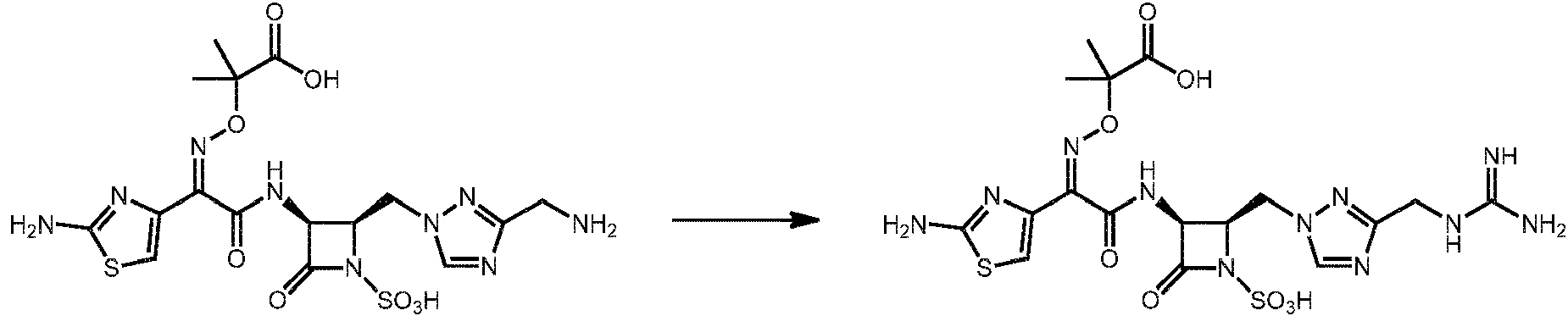
A una disolución de ácido 2-(((Z)-(2-(((2R,3S)-2-((3-(aminometil)-1H-1,2,4-triazol-1-il)metil)-4-oxo-1-sulfoazetidin-3-il)amino)-1-(2-aminotiazol-4-il)-2-oxoetilideno)amino)oxi)-2-metilpropanoico (25 mg, 0,047 mmol) y clorhidrato de pírazol-1-carboxamídína (10,9 mg, 0,099 mmol) en DMF (470 ml) se le añadió DIPEA (33 |il, 0,188 mmol). Tras agitar a ta durante 12h se concentró la disolución a vacío. Se añadió tolueno y se volvió a concentrar (3x). Se purificó el residuo bruto mediante HPLC de fase inversa (XSelect CSH, 19 x 100 mm, 5 |im, columna C18; ACN-agua con modificador de ácido fórmico al 0,1%, 24 ml/min), dando el compuesto del título (16 mg, 52%) como un polvo blanco. CL-EM: Rt = 0,31 min, m/z = 574,3 (M+1) Método 2m_ácido; 1H RMN (500 MHz, DMSO-da) 89,45 (s a, 1H), 8,47 (s, 1H), 7,86 (s a, 1H), 7,31 (s a, 3H), 6,74 (s a, 1H), 6,55 (s, 1H), 5,22 (s a, 1H), 4,69-4,59 (m, 1H), 4,60 4,50 (m, 1H), 4,45-4,36 (m, 2H), 4,34-4,26 (m, 1H), 1,35 (s, 3H) 1,41 (s, 3H).To a solution of 2 - (((Z) - (2 - ((((2R, 3S) -2 - ((3- (aminomethyl) -1H-1,2,4-triazol-1-yl) methyl)) -4-oxo-1-sulfoazetidin-3-yl) amino) -1- (2-aminothiazol-4-yl) -2-oxoethylidene) amino) oxy) -2-methylpropanoic acid (25 mg, 0.047 mmol) and hydrochloride Pyrazol-1-carboxamidine (10.9 mg, 0.099 mmol) in DMF (470 ml) was added DIPEA (33 µl, 0.188 mmol). After stirring at rt for 12h the solution was concentrated in vacuo. Toluene was added and concentrated again (3x). The crude residue was purified by reverse phase HPLC (XSelect CSH, 19 x 100 mm, 5 | im, column C18; ACN-water with 0.1% formic acid modifier, 24 ml / min), to give the compound of Title (16 mg, 52%) as a white powder. LC-MS: Rt = 0.31 min, m / z = 574.3 (M + 1) 2m_acid method; 1 H NMR (500 MHz, DMSO-da) 89.45 (sa, 1 H), 8.47 (s, 1 H), 7.86 (sa, 1 H), 7.31 (sa, 3 H), 6.74 ( sa, 1H), 6.55 (s, 1H), 5.22 (sa, 1H), 4.69-4.59 (m, 1H), 4.60 4.50 (m, 1H), 4, 45-4.36 (m, 2H), 4.34-4.26 (m, 1H), 1.35 (s, 3H) 1.41 (s, 3H).
Ejemplo de referencia 12: ácido 2-(((Z)-(2-(((2R,3S)-2-((5-(aminometil)-1H-1,2,4-triazol-1-il)metil)-4-oxo-1-sulfoazetidin-3-il)amino)-1-(2-aminotiazol-4-il)-2-oxoetilideno)amino)oxi)-2-metilpropanoico.Reference Example 12: 2 - (((Z) - (2 - (((2R, 3S) -2 - ((5- (aminomethyl) -1H-1,2,4-triazol-1-yl) methyl acid ) -4-oxo-1-sulfoazetidin-3-yl) amino) -1- (2-aminothiazol-4-yl) -2-oxoethylidene) amino) oxy) -2-methylpropanoic acid.
Etapa 1: Se preparó de manera análoga al ejemplo 4, etapa 2 usando el isómero 5-sustituido de la etapa 1 en el ejemplo 10 (361 mg, 0,622 mmol), K2S2O8 (235 mg, 0,870 mmol) y K2HPO4 (115 mg, 0,808 mmol) en ACN:agua (2:1, 10,4 ml) mientras se calentaba durante 1,5 ha 90°C. Se añadieron más K2S2O8 (50 mg, 0,187 mmol) y K2HPO4 (23 mg, 0,162 mmol) y se calentaron durante otras 3,5 h, tras lo cual se concentró a vacío, eliminando la mayor parte del ACN. Se diluyó la mezcla con agua/EtOAc y se separaron las fases. Se extrajo la fase acuosa con EtoAc (5x) y se secaron las fases orgánicas combinadas sobre Na2SO4. Se purificó el residuo bruto por medio de cromatografía en gel de sílice (acetona-DCM, 0-100%) para dar el compuesto del título (155 mg, 58%). CL-EM: Rt = 0,71 min, m/z = 431,2 (M+1) Método 2m_ácido.Stage 1: It was prepared analogously to example 4, stage 2 using the 5-substituted isomer of step 1 in example 10 (361 mg, 0.622 mmol), K2S2O8 (235 mg, 0.870 mmol) and K2HPO4 (115 mg, 0.808 mmol) in ACN: water (2: 1, 10.4 ml) while heating for 1.5 h at 90 ° C. More K2S2O8 (50 mg, 0.187 mmol) and K2HPO4 (23 mg, 0.162 mmol) were added and heated for another 3.5 h, after which it was concentrated in vacuo, removing most of the ACN. The mixture was diluted with water / EtOAc and the phases were separated. The aqueous phase was extracted with EtoAc (5x) and the combined organic phases were dried over Na2SO4. The crude residue was purified by silica gel chromatography (acetone-DCM, 0-100%) to give the title compound (155 mg, 58%). LC-MS: Rt = 0.71 min, m / z = 431.2 (M + 1) 2m_acid method.
Etapa 2: ((1-(((2R,3S)-3-amino-4-oxoazetidin-2-il)metil)-1H-1,2,4-triazol-5-il)metil)carbamato de tere-butilo. Se preparó según el ejemplo 7, etapa 3. Se evacuó una disolución del producto de la etapa 1 (134 mg, 0,311 mmol) en EtOAc:Me- OH (5:1, 10,4 ml) y se volvió a llenar con argón (2x) seguido por adición de Pd sobre C (10%, 33 mg). El sistema se evacuó y se volvió a llenar con H2 (3x). Tras 21 h de agitación se añadió MeOH (282 |il). Tras 4 h adicionales de agitación se filtró la mezcla sobre Celite, lavando con MeOH, se concentró a vacío, se recogió en tolueno y se volvió a concentrar (3x). Se usó el residuo bruto tal cual en la siguiente etapa. CL-EM: Rt = 0,38 min, m/z = 297,2 (M+1) Método 2m_ácido.Stage 2: ((1 - (((2R, 3S) -3-amino-4-oxoazetidin-2-yl) methyl) -1H-1,2,4-triazol-5-yl) methyl) tere carbamate butyl. It was prepared according to example 7, step 3. A solution of the product from step 1 (134 mg, 0.311 mmol) in EtOAc: MeOH (5: 1, 10.4 ml) was evacuated and refilled with argon (2x) followed by addition of Pd on C (10%, 33 mg). The system was evacuated and refilled with H2 (3x). After 21 h of stirring, MeOH (282 µl) was added. After an additional 4 h of stirring, the mixture was filtered over Celite, washing with MeOH, concentrated in vacuo, collected in toluene and concentrated again (3x). The crude residue was used as is in the next step. LC-MS: Rt = 0.38 min, m / z = 297.2 (M + 1) 2m_acid method.
Etapa 3: 2-(((Z)-(2-(((2R,3S)-2-((5-(((tere-butoxicarbonil)amino)metil)-1H-1,2,4-triazol-1-il)metil)-4-oxoazetidin-3-il)amino)-1-(2-((tere-butoxicarbonil)amino)tiazol-4-il)-2-oxoetilideno)amino) oxi)-2-metilpropanoato de tere-butilo. Stage 3: 2 - (((Z) - (2 - (((2R, 3S) -2 - ((5 - (((tere-butoxycarbonyl) amino) methyl) -1H-1,2,4-triazole- 1-yl) methyl) -4-oxoazetidin-3-yl) amino) -1- (2 - ((tere-butoxycarbonyl) amino) thiazol-4-yl) -2-oxoethylidene) amino) oxy) -2-methylpropanoate of tere-butyl.
A una suspensión de ácido (Z)-2-(((1-(tere-butoxi)-2-metil-1-oxopropan-2-il)oxi)imino)-2-(2-((terebutoxicarbonil)amino) tiazol-4-il)acético (160 mg, 0,373 mmol) en Dc M:DMF (30:1, 3,1 ml) a 0°C se le añadió DIPEA (163 |il, 0,933 mmol) seguido por HATU (142 mg, 0,373 mmol). A la disolución resultante se le añadió una disolución de ((1-(((2R,3S)- 3-amino-4-oxoazetidin-2-il)metil)-1H-1,2,4-triazol-5-il)metil)carbamato de tere-butilo (92 mg, 0,311 mmol) en DCM:DMF (30:1, 3,1 ml). Tras 1 h de agitación se concentró a vacío y se recogió en EtOAc/salmuera. Se separaron las fases y se extrajo la fase acuosa con EtOAc. Se lavaron las fases orgánicas combinadas con salmuera (3x), se secó sobre Na2SO4 y se concentró a vacío. Se purificó el residuo bruto por medio de cromatografía en gel de sílice (acetona-DCM, 70%) para dar el compuesto del título (128 mg, 58%). CL-EM: Rt = 0,97 min, m/z = 708,2 (M+1) Método 2m_ácido.To a suspension of (Z) -2 - ((((1- (tere-butoxy) -2-methyl-1-oxopropan-2-yl) oxy) imino) -2- (2 - ((terebutoxycarbonyl) amino) thiazol-4-yl) acetic acid (160 mg, 0.373 mmol) in Dc M: DMF (30: 1, 3.1 mL) at 0 ° C DIPEA (163 µL, 0.933 mmol) was added followed by HATU (142 mg, 0.373 mmol). To the resulting solution was added a solution of ((1 - (((2R, 3S) - 3-amino-4-oxoazetidin-2-yl) methyl) -1H-1,2,4-triazol-5-yl ) methyl) tere-butyl carbamate (92 mg, 0.311 mmol) in DCM: DMF (30: 1, 3.1 ml). After 1 h of stirring, it was concentrated in vacuo and taken up in EtOAc / brine. The phases were separated and the aqueous phase was extracted with EtOAc. The combined organic phases were washed with brine (3x), dried over Na2SO4 and concentrated in vacuo. The crude residue was purified by silica gel chromatography (acetone-DCM, 70%) to give the title compound (128 mg, 58%). LC-MS: Rt = 0.97 min, m / z = 708.2 (M + 1) 2m_acid method.
Etapa 4: ácido (2R,3S)-3-((Z)-2-(((1-(tere-butoxi)-2-metil-1-oxopropan-2-il)oxi)imino)-2-(2-((tere-butoxicarbonil) amino)tiazol-4-il)acetamido)-2-((5-(((tere-butoxicarbonil)amino)metil)-1H-1,2,4-triazol-1-il)metil)-4-oxoazetidina-1-sulfónico. Se trató 2-(((Z)-(2-(((2R,3S)-2-((5-(((tere-butoxicarbonil)amino)metil)-1H-1,2,4-triazol-1-il)metil)-4-oxoazetidin-3-il)amino)-1-(2-((tere-butoxicarbonil)amino)tiazol-4-il)-2-oxoetilideno)amino)oxi)-2-metilpropanoato de tere-butilo (128 mg, 0,181 mmol) en DMF (1,3 ml) con SO3 DMF (277 mg, 1,81 mmol). Después de 20 min de agitación, se diluyó la disolución con EtOAc/salmuera y se separaron las fases. Se extrajo la fase acuosa con EtOAc (3x) y se secaron las fases orgánicas combinadas sobre Na2SO4 y se concentró a vacío para dar el compuesto del título (supuestamente cuantitativo) como un sólido blanco. CL-EM: Rt = 0,90 min, m/z = 788,3 (M+1) Método 2m_ácido.Stage 4: (2R, 3S) -3 - ((Z) -2 - ((((1- (tere-butoxy) -2-methyl-1-oxopropan-2-yl) oxy) imino) -2- ( 2 - ((tere-butoxycarbonyl) amino) thiazol-4-yl) acetamido) -2 - ((5 - (((tere-butoxycarbonyl) amino) methyl) -1H-1,2,4-triazol-1-yl ) methyl) -4-oxoazetidine-1-sulfonic. 2 - (((Z) - (2 - (((2R, 3S) -2 - ((5 - ((((tere-butoxycarbonyl) amino) methyl) -1H-1,2,4-triazol-1 was treated -yl) methyl) -4-oxoazetidin-3-yl) amino) -1- (2 - ((tere-butoxycarbonyl) amino) thiazol-4-yl) -2-oxoethylidene) amino) oxy) -2-methylpropanoate tere-butyl (128 mg, 0.181 mmol) in DMF (1.3 ml) with SO3 DMF (277 mg, 1.81 mmol). After 20 min of stirring, the solution was diluted with EtOAc / brine and the phases were separated. The aqueous phase was extracted with EtOAc (3x) and the combined organic phases were dried over Na2SO4 and concentrated in vacuo to give the title compound (supposedly quantitative) as a white solid. LC-MS: Rt = 0.90 min, m / z = 788.3 (M + 1) 2m_acid method.
Etapa 5: ácido 2-(((Z)-(2-(((2R,3S)-2-((5-(aminometil)-1H-1,2,4-triazol-1-il)metil)-4-oxo-1-sulfoazetidin-3-il)amino)-1-(2-aminotiazol-4-il)-2-oxoetilideno)amino)oxi)-2-metilpropanoico. Stage 5: 2 - (((Z) - (2 - (((2R, 3S) -2 - ((5- (aminomethyl) -1H-1,2,4-triazol-1-yl) methyl) -) 4-oxo-1-sulfoazetidin-3-yl) amino) -1- (2-aminothiazol-4-yl) -2-oxoethylidene) amino) oxy) -2-methylpropanoic acid.

Se siguió el procedimiento general para la desprotección mediada por ácido usando ácido (2R,3S)-3-((Z)-2-(((1-(terc-butoxi)-2-metil-1-oxopropan-2-il)oxi)imino)-2-(2-((terc-butoxicarbonil)amino)tiazol-4-il)acetamido)-2-((5-(((tercbutoxicarbonil)amino)metil)-1H-1,2,4-triazol-1-il)metil)-4-oxoazetidina-1-sulfónico (143 mg, 0,181 mmol), DCM (1,81 ml) y TFA (837 |il, 10,9 mmol). Se purificó el residuo bruto mediante HPLC de fase inversa (XSelect CSH, 19 x 100 mm, 5 |im, columna C18; ACN-agua con modificador de ácido fórmico al 0,1%, 24 ml/min), dando el compuesto del título (60 mg, 62%) como un polvo blanco. CL-EM: Rt = 0,28 min, m/z = 532,2 (M+1) Método 2m_ácido; 1H RMN (500 MHz, DMSO-da) 89,23 (d, J = 9,1 Hz, 1H), 8,40 (s a, 3H), 8,06 (s, 1H), 7,59-7,27 (m, 2H), 6,84 (s, 1H), 5,37 (dd, J = 9,0, 5,5 Hz, 1H), 4,61-4,51 (m, 1H), 4,49-4,34 (m, 3H), 4,25 (dd, J = 15,3, 5,8 Hz, 1H), 1,37 (s, 6H).The general procedure for acid-mediated deprotection was followed using (2R, 3S) -3 - ((Z) -2 - (((1- (tert- butoxy) -2-methyl-1-oxopropan-2-yl acid) ) oxy) imino) -2- (2 - ((tert-butoxycarbonyl) amino) thiazol-4-yl) acetamido) -2 - ((5 - ((((tert-butoxycarbonyl) amino) methyl) -1H-1,2, 4-triazol-1-yl) methyl) -4-oxoazetidine-1-sulfonic acid (143 mg, 0.181 mmol), DCM (1.81 ml) and TFA (837 µl, 10.9 mmol). The crude residue was purified by reverse phase HPLC (XSelect CSH, 19 x 100 mm, 5 | im, column C18; ACN-water with 0.1% formic acid modifier, 24 ml / min), to give the compound of Title (60 mg, 62%) as a white powder. LC-MS: Rt = 0.28 min, m / z = 532.2 (M + 1) 2m_acid method; 1H NMR (500 MHz, DMSO-da) 89.23 (d, J = 9.1 Hz, 1H), 8.40 (sa, 3H), 8.06 (s, 1H), 7.59-7, 27 (m, 2H), 6.84 (s, 1H), 5.37 (dd, J = 9.0, 5.5 Hz, 1H), 4.61-4.51 (m, 1H), 4 , 49-4.34 (m, 3H), 4.25 (dd, J = 15.3, 5.8 Hz, 1H), 1.37 (s, 6H).
Ejemplo de referencia 13: ácido 2-(((Z)-(1-(2-aminotiazol-4-il)-2-(((2R,3S)-2-((5-(guanidinometil)-1H-1,2,4-triazol-1-il)metil)-4-oxo-1-sulfoazetidin-3-il)amino)-2-oxoetilideno)amino)oxi)-2-metilpropanoico.Reference example 13: 2 - (((Z) - (1- (2-aminothiazol-4-yl) -2 - (((2R, 3S) -2 - ((5- (guanidinomethyl) -1H-1 acid , 2,4-triazol-1-yl) methyl) -4-oxo-1-sulfoazetidin-3-yl) amino) -2-oxoethylidene) amino) oxy) -2-methylpropanoic acid.

A una disolución de ácido 2-(((Z)-(2-(((2R,3S)-2-((5-(aminometil)-1H-1,2,4-triazol-1-il)metil)-4-oxo-1-sulfoazetidin-3-il)amino)-1-(2-aminotiazol-4-il)-2-oxoetilideno)amino)oxi)-2-metilpropanoico (25 mg, 0,047 mmol) y clorhidrato de pirazol-1-carboxamidina (10,9 mg, 0,099 mmol) en DMF (470 |il) se le añadió DIPEA (33 ml, 0,188 mmol). Tras agitar a ta durante 12 h se concentró la disolución a vacío. Se añadió tolueno y se volvió a concentrar (3x). Se purificó el residuo bruto mediante HPLC de fase inversa (XSelect CSH, 19 x 100 mm, 5 |im, columna C18; ACN-agua con modificador de ácido fórmico al 0,1%, 24 ml/min), dando el compuesto del título (13 mg, 42%) como un polvo blanco. CL-EM: Rt = 0,29 min, m/z = 574,2 (M+1) Método 2m_ácido; 1H RMN (500 MHz, DMSO-d6) 87,96-7,78 (m, 1H), 7,41-6,96 (m, 5H), 6,80-6,71 (m, 1H), 6,55 (s, 1H), 5,42-5,32 (m, 1H), 4,75-4,63 (m, 1H), 4,62-4,42 (m, 1H), 4,39-4,28 (m, 1H), 1,38 (s, 3H) 1,34 (s, 3H).To a solution of acid 2 - (((Z) - (2 - (((2R, 3S) -2 - ((5- (aminomethyl) -1H-1,2,4-triazol-1-yl) methyl) -4-oxo-1-sulfoazetidin-3-yl) amino) -1- (2-aminothiazol-4-yl) -2-oxoethylidene) amino) oxy) -2-methylpropanoic acid (25 mg, 0.047 mmol) and hydrochloride Pyrazol-1-carboxamidine (10.9 mg, 0.099 mmol) in DMF (470 µl) was added DIPEA (33 mL, 0.188 mmol). After stirring at rt for 12 h the solution was concentrated in vacuo. Toluene was added and concentrated again (3x). The crude residue was purified by reverse phase HPLC (XSelect CSH, 19 x 100 mm, 5 | im, column C18; ACN-water with 0.1% formic acid modifier, 24 ml / min), to give the compound of Title (13 mg, 42%) as a white powder. LC-MS: Rt = 0.29 min, m / z = 574.2 (M + 1) Method 2m_acid; 1 H NMR (500 MHz, DMSO-d6) 87.96-7.78 (m, 1H), 7.41-6.96 (m, 5H), 6.80-6.71 (m, 1H), 6 , 55 (s, 1H), 5.42-5.32 (m, 1H), 4.75-4.63 (m, 1H), 4.62-4.42 (m, 1H), 4.39 -4.28 (m, 1H), 1.38 (s, 3H) 1.34 (s, 3H).
Ejemplo 14: ácido 2-(((Z)-(1-(2-aminotiazol-4-il)-2-oxo-2-(((3S,4R)-2-oxo-4-((2-oxopiperidin-1-il)metil)-1-sulfoazetidin-3-il)amino)etilideno)amino)oxi)-2-metilpropanoico.Example 14: 2 - (((Z) - (1- (2-aminothiazol-4-yl) -2-oxo-2 - ((((3S, 4R) -2-oxo-4 - ((2-oxopiperidin) -1-yl) methyl) -1-sulfoazetidin-3-yl) amino) ethylidene) amino) oxy) -2-methylpropanoic.
Etapa 1: ((3S,4R)-1-(2,4-dimetoxibencil)-2-oxo-4-((2-oxopiridin-1(2H)-il)metil)azetidin-3-il)carbamato de bencilo. Se suspendieron metanosulfonato de ((2S,3S)-3-(((benciloxi)carbonil)amino)-1-(2,4-dimetoxibencil)-4-oxoazetidin-2-il)metilo (860 mg, 1,80 mmol), piridin-2(1H)-ona (855 mg, 8,99 mmol), K2CO3 (1,74 g, 12,6 mmol) y Nal (746 mg, 4,49 mmol) en DMF (6,9 ml) y se calentaron hasta 80°C con agitación. Tras 4 h, se enfrió hasta ta, se diluyó con EtOAc y se lavó con salmuera. Se secó la fase orgánica sobre Na2SO4 y se concentró a vacío. Se purificó el residuo bruto por medio de cromatografía en gel de sílice (acetona-DCM) para dar el compuesto del título (304 mg, 35%).CL-EM: Rt = 0,79 min, m/z = 478,2 (M+1) Método 2m_ácido; 1H RMN (500 MHz, CDCla) 87,39-7,28 (m, 6 H), 7,07 (d, J = 5,9 Hz, 1H), 6,93-6,85 (m, 1H), 6,55 (d, J = 9,0 Hz, 1H), 6,40 (d, J = 2,4 Hz, 1H), 6,35 (dd, J = 8,2, 2,4 Hz, 1H), 6,10 6,02 (m, 1H), 5,87 (d, J = 7,8 Hz, 1H), 5,10 (s, 2H), 4,93 (s a, 1H), 4,63 (d, J = 14,5 Hz, 1H), 4,27-4,10 (m, 1H), 3,97 (d, J = 9,0 Hz, 2H), 3,88 (d, J = 14,5 Hz, 1H), 3,78 (s, 3H), 3,76 (s, 3H).Stage 1: ((3S, 4R) -1- (2,4-dimethoxybenzyl) -2-oxo-4 - ((2-oxopyridin-1 (2H) -yl) methyl) azetidin-3-yl) benzyl carbamate . Methanesulfonate of ((2S, 3S) -3 - ((((benzyloxy) carbonyl) amino) -1- (2,4-dimethoxybenzyl) -4-oxoazetidin-2-yl) methyl (860 mg, 1.80 mmol ), pyridin-2 (1H) -one (855 mg, 8.99 mmol), K2CO3 (1.74 g, 12.6 mmol) and Nal (746 mg, 4.49 mmol) in DMF (6.9 ml ) and heated to 80 ° C with stirring. After 4 h, it was cooled to rt, diluted with EtOAc and washed with brine. The organic phase was dried over Na2SO4 and concentrated in vacuo. The crude residue was purified by silica gel chromatography (acetone-DCM) to give the title compound (304 mg, 35%) LC-MS: R t = 0.79 min, m / z = 478.2 (M + 1) 2m_acid method; 1H NMR (500 MHz, CDCla) 87.39-7.28 (m, 6 H), 7.07 (d, J = 5.9 Hz, 1H), 6.93-6.85 (m, 1H) , 6.55 (d, J = 9.0 Hz, 1H), 6.40 (d, J = 2.4 Hz, 1H), 6.35 (dd, J = 8.2, 2.4 Hz, 1H), 6.10 6.02 (m, 1H), 5.87 (d, J = 7.8 Hz, 1H), 5.10 (s, 2H), 4.93 (sa, 1H), 4 , 63 (d, J = 14.5 Hz, 1H), 4.27-4.10 (m, 1H), 3.97 (d, J = 9.0 Hz, 2H), 3.88 (d, J = 14.5 Hz, 1H), 3.78 (s, 3H), 3.76 (s, 3H).
Etapa 2: ((3S,4R)-2-oxo-4-((2-oxopiridin-1(2H)-il)metil)azetidin-3-il)carbamato de bencilo. Se preparó de manera análoga al ejemplo 4, etapa 2 usando ((3S,4R)-1-(2,4-dimetoxibencil)-2-oxo-4-((2-oxopiridin-1(2H)-il)metil)azetidin-3-il)carbamato de bencilo (361 mg, 0,622 mmol), K2S2O8 (225 mg, 0,833 mmol) y K2HPO4 (135 mg, 0,773 mmol) en ACN:agua (2:1, 9,9 ml) mientras se calentaba durante 1,5 ha 90°C. Se añadieron más K2S2O8 (45 mg, 0,17 mmol) y K2HPO4 (26,9 mg, 0,155 mmol) y se calentaron durante otros 30 min, tras lo cual se concentró, se volvió a disolver en EtOAc, se lavó con salmuera, se secó sobre Na2SO4 y se concentró a vacío. Se purificó el residuo bruto por medio de cromatografía en gel de sílice (MeOH-DCM, 0-10%) para dar el compuesto del título (157 mg, 81%). CL-EM: Rt = 0,56 min, m/z = 328,2 (M+1) Método 2m_ácido. Stage 2: ((3S, 4R) -2-oxo-4 - ((2-oxopyridin-1 (2H) -yl) methyl) azetidin-3-yl) benzyl carbamate. It was prepared analogously to example 4, step 2 using ((3S, 4R) -1- (2,4-dimethoxybenzyl) -2-oxo-4 - ((2-oxopyridin-1 (2H) -yl) methyl) Benzyl azetidin-3-yl) carbamate (361 mg, 0.622 mmol), K2S2O8 (225 mg, 0.833 mmol) and K2HPO4 (135 mg, 0.773 mmol) in ACN: water (2: 1, 9.9 ml) while heated for 1.5 h at 90 ° C. More K2S2O8 (45 mg, 0.17 mmol) and K2HPO4 (26.9 mg, 0.155 mmol) were added and heated for another 30 min, after which it was concentrated, dissolved again in EtOAc, washed with brine, dried over Na2SO4 and concentrated in vacuo. The crude residue was purified by silica gel chromatography (MeOH-DCM, 0-10%) to give the title compound (157 mg, 81%). LC-MS: Rt = 0.56 min, m / z = 328.2 (M + 1) 2m_acid method.
Etapa 3, compuesto 1: 1-(((2R,3S)-3-am¡no-4-oxoazet¡d¡n-2-¡l)met¡l)p¡r¡d¡n-2(1H)-ona.Stage 3, compound 1: 1 - (((2R, 3S) -3-am¡no-4-oxoazet¡d¡n-2-¡) metl) p¡r¡d¡n-2 (1H ) -one.
Etapa 3, compuesto 2: 1-(((2R,3S)-3-am¡no-4-oxoazet¡d¡n-2-¡l)met¡l)p¡per¡d¡n-2-ona. Se preparó según el ejemplo 7, etapa 3. Se evacuó una d¡soluc¡ón de ((3S,4R)-2-oxo-4-((2-oxop¡r¡d¡n-1(2H)-¡l)met¡l)azet¡d¡n-3-¡l)carbamato de benc¡lo (157 mg, 0,480 mmol) en EtOH:MeOH (5:1, 4,8 ml) y se volv¡ó a llenar con argón (2x) segu¡do por ad¡c¡ón de Pd sobre C (10%, 33 mg). El s¡stema se evacuó y se volv¡ó a llenar con H2 (3x). Después de 3 h de ag¡tac¡ón, se f¡ltró la mezcla sobre Cel¡te, lavando con MeOH y se concentró a vacío. Se usó el res¡duo bruto tal cual en la s¡gu¡ente etapa.Stage 3, compound 2: 1 - (((2R, 3S) -3-am¡no-4-oxoazet¡d¡n-2-¡) metl) p¡per¡d¡n-2-one . It was prepared according to Example 7, step 3. A solution of ((3S, 4R) -2-oxo-4 - ((2-oxop¡r¡d¡n-1 (2H) -¡ 1) Methyl) azetin-3-1) benzyl carbamate (157 mg, 0.480 mmol) in EtOH: MeOH (5: 1, 4.8 mL) and refilled with argon (2x) followed by the addition of Pd on C (10%, 33 mg). The system was evacuated and refilled with H2 (3x). After 3 h of stirring, the mixture was filtered on Celite, washing with MeOH and concentrated in vacuo. The crude residue was used as is in the next stage.
Etapa 4, compuesto 1: 2-(((Z)-(1-(2-((terc-butox¡carbon¡l)am¡no)t¡azol-4-¡l)-2-oxo-2-(((3S,4R)-2-oxo-4-((2-oxop¡r¡d¡n-1(2H)-¡l)met¡l)azet¡d¡n-3-¡l)am¡no)et¡l¡deno)am¡no)ox¡)-2-met¡lpropanoato de terc-but¡lo.Stage 4, compound 1: 2 - (((Z) - (1- (2 - ((tert-butoxycarbonyl) ammonium) thiazol-4-l) -2-oxo-2- (((3S, 4R) -2-oxo-4 - ((2-oxop¡r¡d¡n-1 (2H) -¡l) met¡l) azet¡d¡n-3-¡) am No) ethyldene) amine) oxi) tert-butyl-2-methylpropanoate.
Etapa 4, compuesto 2: 2-(((Z)-(1-(2-((terc-butox¡carbon¡l))am¡no)t¡azo)-4-¡l)-2-oxo-2-(((3S,4R)-2-oxo-4-((2-oxop¡per¡d¡n-1-¡l)met¡l)azet¡d¡n-3-¡l)am¡no)et¡l¡deno)am¡no)ox¡)-2-met¡lpropanoato de terc-but¡lo.Stage 4, compound 2: 2 - (((Z) - (1- (2 - ((tert-butoxycarbonyl)) ammonium) azoa) -4-l) -2-oxo- 2 - (((3S, 4R) -2-oxo-4 - ((2-oxop¡per¡d¡n-1-¡l) met¡l) azet¡d¡n-3-¡) am¡ no) tert-butyl-ethanol-ox)) -2) -2-methylpropanoate.
A una suspens¡ón de ác¡do (Z)-2-(((1-(terc-butox¡)-2-met¡l-1-oxopropan-2-¡l)ox¡)¡m¡no)-2-(2-((tercbutox¡carbon¡l)am¡no) t¡azol-4-¡l)acét¡co (60 mg, 0,14 mmol) en Dc M:DMF (1:1, 1,4 ml) a 0°C se añad¡ó DIPEA (73 |il, 0,42 mmol) segu¡do por HATU (63,7 mg, 0,168 mmol). A la d¡soluc¡ón resultante, tras 20 m¡n, se le añad¡ó una mezcla d¡soluc¡ón de 1-(((2R,3S)-3-am¡no-4-oxoazet¡d¡n-2-¡l)met¡l)p¡r¡d¡n-2(1H)-ona y 1-(((2R,3S)-3-am¡no-4-oxoazet¡d¡n-2-¡l)met¡l)p¡per¡d¡n-2-ona (90 mg, ~0,46 mmol) en DCM (200 |il). Tras 1 h de ag¡tac¡ón se concentró a vacío y se recog¡ó en EtOAc, se lavó con agua, salmuera, se secó sobre Na2SO4 y se concentró a vacío. Se pur¡f¡có el res¡duo bruto por med¡o de cromatografía en gel de síl¡ce (acetona-DCM) para dar el compuesto del título 1 (54 mg) y compuesto del título 2 (30 mg). 1-CL-EM: Rt = 0,88 m¡n, m/z = 605,2 (M+1) Método 2m_ác¡do; 2-CL-EM: Rt = 0,90 m¡n, m/z = 609,2 (M+1) Método 2m_ác¡do.To a suspension of acid (Z) -2 - ((((1- (tert-butoxy)) -2-methyl-1-oxopropan-2-l) ox¡) min) -2- (2 - ((tertbutoxcarbonyl) amine) thiazol-4-l) acetic acid (60 mg, 0.14 mmol) in D c M: DMF (1: 1, 1.4 ml) at 0 ° C DIPEA (73 µL, 0.42 mmol) was added followed by HATU (63.7 mg, 0.168 mmol). To the resulting solution, after 20 minutes, a solution mixture of 1 - ((((2R, 3S) -3-am-4-oxoazet¡d¡) was added n-2-¡l) met¡l) p¡r¡d¡n-2 (1H) -ona and 1 - (((2R, 3S) -3-am¡no-4-oxoazet¡d¡n- 2-l) methyl) pperper-2-one (90 mg, ~ 0.46 mmol) in DCM (200 µl). After 1 h of stirring it was concentrated in vacuo and collected in EtOAc, washed with water, brine, dried over Na2SO4 and concentrated in vacuo. The crude residue was purified by silica gel chromatography (acetone-DCM) to give the title compound 1 (54 mg) and title compound 2 (30 mg). 1-LC-MS: Rt = 0.88 mn, m / z = 605.2 (M + 1) Method 2m_ác¡do; 2-LC-MS: Rt = 0.90 m¡n, m / z = 609.2 (M + 1) Method 2m_ác¡do.
Etapa 5: ác¡do (3S,4R)-3-((Z)-2-(((1-(terc-butox¡)-2-met¡l-1-oxopropan-2-¡l)ox¡)¡m¡no)-2-(2-((terc-butox¡carbon¡l) am¡no)t¡azol-4-¡l)acetam¡do)-2-oxo-4-((2-oxop¡per¡d¡n-1-¡l)met¡l)azet¡d¡na-1-sulfón¡co. 2-(((Z)-(1-(2-((terc-butox¡carbon¡l)am¡no)t¡azol-4-¡l)-2-oxo-2-(((3S,4R)-2-oxo-4-((2-oxop¡per¡d¡n-1-¡l)met¡l)azet¡d¡n-3-¡l)am¡no)et¡l¡deno)am¡no)ox¡)-2-met¡lpropanoato de terc-but¡lo (30 mg, 0,049 mmol) en DMF (493 |il) se trató con SOâ DMF (151 mg, 0,986 mmol). Tras 1 h de ag¡tac¡ón, se d¡luyó la d¡soluc¡ón con EtOAc, se lavó con salmuera, se secó sobre Na2SO4 y se concentró a vacío para dar el compuesto del título (supuestamente cuant¡tat¡vo) como un sól¡do blanco. CL-EM: Rt = 0,78 m¡n, m/z = 689,1 (M+1) Método 2m_ác¡do.Stage 5: Acid (3S, 4R) -3 - ((Z) -2 - (((1- (tert-butox)) -2-met¡l-1-oxopropan-2-¡l) ox¡ ) Mno) -2- (2 - ((tert-butoxycarbonyl) ammonium) thiazol-4-l) acetamido) -2-oxo-4 - ((2- oxop¡per¡d¡n-1-¡l) met¡l) azet¡d¡na-1-sulfón¡co. 2 - (((Z) - (1- (2 - ((tert- butoxycarbonyl) ammonium) thiazol-4-l) -2-oxo-2 - (((3S, 4R ) -2-oxo-4 - ((2-oxop¡per¡d¡n-1-¡l) met¡l) azet¡d¡n-3-¡l) amnno) et¡l¡deno) amine) ox¡) -2-methylpropanoate tert-butyl (30 mg, 0.049 mmol) in DMF (493 µl) was treated with SOâ DMF (151 mg, 0.986 mmol). After 1 h of stirring, the solution was diluted with EtOAc, washed with brine, dried over Na2SO4 and concentrated in vacuo to give the title compound (supposedly quantum). ) like a white solid. LC-MS: Rt = 0.78 m¡n, m / z = 689.1 (M + 1) Method 2m_ác¡do.
Etapa 6 : ác¡do 2-(((Z)-(1-(2-am¡not¡azo)-4-¡l)-2-oxo-2-(((3S,4R)-2-oxo-4-((2-oxop¡per¡d¡n-1-¡l)met¡l)-1-sulfoazet¡d¡n-3-¡l)am¡no)et¡l¡deno)am¡no)ox¡)-2-met¡lpropano¡co.Stage 6: Acid 2 - (((Z) - (1- (2-am¡not¡azo) -4-¡l) -2-oxo-2 - (((3S, 4R) -2-oxo -4 - ((2-oxop¡per¡d¡n-1-¡l) met¡l) -1-sulfoazet¡d¡n-3-¡) amÃno) et¡l¡deno) am¡ no) ox¡) -2-methylpropane.

Se s¡gu¡ó el proced¡m¡ento general para la desprotecc¡ón med¡ada por ác¡do usando ác¡do (3S,4R)-3-((Z)-2-(((1-(tercbutox¡)-2-met¡l-1-oxopropan-2-¡l)ox¡)¡m¡no)-2-(2-((terc-butox¡carbon¡l)am¡no)t¡azol-4-¡l)acetam¡do)-2-oxo-4-((2-oxop¡per¡d¡n-1-¡l)met¡l)azet¡d¡na-1-sulfón¡co (34 mg, 0,049 mmol), DCM (494 |il) y TFA (228 ml, 2,96 mmol). Se pur¡f¡có el res¡duo bruto med¡ante HPLC de fase ¡nversa (XSelect CSH, 30 x 100 mm, 5 |im, columna C18; ACN-agua con mod¡f¡cador de ác¡do fórm¡co al 0,1%, 60 ml/m¡n), dando el compuesto del título (5,2 mg, 17%) como un polvo blanco. CL-EM: Rt = 0,63 m¡n, m/z = 533,1 (M+1) Método 2m_ác¡do_polar; 1H RMN (400 MHz, D2O) 87,02 (s, 1H), 5,27 (d, J = 5,5 Hz, 1H), 4,59-4,48 (m, 1H), 3,61 (d, J = 4,7 Hz, 2H), 3,48-3,37 (m, 1H), 3,32 (d, J = 5,9 Hz, 1H), 2,34-2,13 (m, 2H), 1,78-1,57 (m, 4H), 1,39 (s a, 6H).The general procedure for the acid-mediated deprotection was followed using acid (3S, 4R) -3 - ((Z) -2 - (((1- ( tercbutox¡) -2-met¡l-1-oxopropan-2-¡l) ox¡) ¡m¡no) -2- (2 - ((terc-butox¡carbon¡l) amÃno) t¡azol -4-¡) acetamido) -2-oxo-4 - ((2-oxop¡per¡d¡n-1-¡l) met¡l) azet¡d¡na-1-sulfón¡co ( 34 mg, 0.049 mmol), DCM (494 µl) and TFA (228 ml, 2.96 mmol). The reverse phase HPLC crude residue was purified (XSelect CSH, 30 x 100 mm, 5 | im, column C18; ACN-water with formic acid modifier 0.1% co, 60 ml / min), giving the title compound (5.2 mg, 17%) as a white powder. LC-MS: Rt = 0.63 mn, m / z = 533.1 (M + 1) Method 2m_ác¡do_polar; 1H NMR (400 MHz, D2O) 87.02 (s, 1H), 5.27 (d, J = 5.5 Hz, 1H), 4.59-4.48 (m, 1H), 3.61 ( d, J = 4.7 Hz, 2H), 3.48-3.37 (m, 1H), 3.32 (d, J = 5.9 Hz, 1H), 2.34-2.13 (m , 2H), 1.78-1.57 (m, 4H), 1.39 (sa, 6H).
Ejemplo de referenc¡a 15: ác¡do 2-(((Z)-(1-(2-am¡not¡azo)-4-¡l)-2-oxo-2-(((3S,4R)-2-oxo-4-((2-oxop¡r¡d¡n-1(2H)-¡l)met¡l)-1-sulfoazet¡d¡n-3-¡l)am¡no)et¡l¡deno)am¡no)ox¡)-2-met¡lpropano¡co. Reference Example 15: Acid 2 - (((Z) - (1- (2-amn.azo) -4-¡) -2-oxo-2 - (((3S, 4R) -2-oxo-4 - ((2-oxop¡r¡d¡n-1 (2H) -¡l) met¡l) -1-sulfoazet¡d¡n-3-¡) amino) et ¡Ldeno) am¡no) ox¡) -2-methylpropane.

Etapa 1: ácido (3S,4R)-3-((Z)-2-(((1-(terc-butox¡)-2-met¡l-1-oxopropan-2-¡l)ox¡)¡m¡no)-2-(2-((terc-butox¡carbon¡l) am¡no)t¡azol-4-¡l)acetam¡do)-2-oxo-4-((2-oxop¡r¡d¡n-1(2H)-¡l)met¡l)azet¡d¡na-1-sulfón¡co. Se trató 2-(((Z)-(1-(2-((tercbutox¡carbon¡l)am¡no)t¡azol-4-¡l)-2-oxo-2-(((3S,4R)-2-oxo-4-((2-oxop¡r¡d¡n-1(2H)-¡l)met¡l)azet¡d¡n-3-¡l)am¡no)et¡l¡deno)am¡no)ox¡)-2-met¡lpropanoato de terc-but¡lo (54 mg, 0,089 mmol) en DMF (893 |il) con SOâ DMF (205 mg, 1,34 mmol). Tras 1 h de ag¡tac¡ón, se d¡luyó la d¡soluc¡ón con EtOAc, se lavó con salmuera, se secó sobre Na2SO4 y se concentró a vacío para dar el compuesto del título (supuestamente cuant¡tat¡vo) como un sól¡do blanco. CL-EM: Rt = 0,76 m¡n, m/z = 685,1 (M+1) Método 2m_ác¡do.Stage 1: (3S, 4R) -3 - ((Z) -2 - ((((1- (tert-butoxy)) -2-methyl-1-oxopropan-2-¡) ox¡) ¡ mno) -2- (2 - ((tert-butoxycarbonyl) ammonium) thiazol-4-l) acetamido) -2-oxo-4 - ((2-oxop¡ r¡d¡n-1 (2H) -¡l) met¡l) azet¡d¡na-1-sulfón¡co. 2 - (((Z) - (1- (2 - ((tertbutoxcarbonyl) ammonium) thiazol-4-l) -2-oxo-2 - (((3S, 4R) ) -2-oxo-4 - ((2-oxop¡r¡d¡n-1 (2H) -¡l) met¡l) azet¡d¡n-3-¡l) am¡no) et¡l Deno) amine) oxi) tert-butyl-2-methylpropanoate (54 mg, 0.089 mmol) in DMF (893 µl) with SOâ DMF (205 mg, 1.34 mmol). After 1 h of stirring, the solution was diluted with EtOAc, washed with brine, dried over Na2SO4 and concentrated in vacuo to give the title compound (supposedly quantum). ) like a white solid. LC-MS: Rt = 0.76 mn, m / z = 685.1 (M + 1) Method 2m_acid.
Etapa 2: ác¡do 2-(((Z)-(1-(2-am¡not¡azol-4-¡l)-2-oxo-2-(((3S,4R)-2-oxo-4-((2-oxop¡r¡d¡n-1(2H)-¡l)met¡l)-1-sulfoazet¡d¡n-3-¡l)am¡no)et¡l¡deno)am¡no)ox¡)-2-met¡lpropano¡co. Se s¡gu¡ó el proced¡m¡ento general para la desprotecc¡ón med¡ada por ác¡do usando ác¡do (3S,4R)-3-((Z)-2-(((1-(terc-butox¡)-2-met¡l-1-oxopropan-2-¡l)ox¡)¡m¡no)-2-(2-((tercbutox¡carbon¡l) am¡no)t¡azol-4-¡l)acetam¡do)-2-oxo-4-((2-oxop¡r¡d¡n-1(2H)-¡l)met¡l)azet¡d¡na-1-sulfón¡co (61 mg, 0,089 mmol), DCM (891 |il) y TFA (412 |il, 5,35 mmol). Se pur¡f¡có el res¡duo bruto med¡ante HPLC de fase ¡nversa (XSelect CSH, 30 x 100 mm, 5 |im, columna C18; ACN-agua con mod¡f¡cador de ác¡do fórm¡co al 0,1%, 60 ml/m¡n), dando el compuesto del título (9,6 mg, 19%) como un polvo blanco. CL-EM: Rt = 0,57 m¡n, m/z = 529,1 (M+1) Método 2m_ác¡do_polar; 1H RMN (400 MHz, D2O) 87,59 (d, J = 6,7 Hz, 1H), 7,56-7,48 (m, 1H), 7,05 (s, 1H), 6,50 (d, J = 9,0 Hz, 1H), 6,39 (t, J = 6,7 Hz, 1H), 5,30 (d, J = 5,9 Hz, 1H), 4,47 (dd, J = 14,5, 2,7 Hz, 1H), 4,07 (dd, J = 14,5, 8,6 Hz, 1H), 1,37 (s, 3H), 1,36 (s, 3H).Stage 2: Acid 2 - (((Z) - (1- (2-am¡not¡azol-4-¡l) -2-oxo-2 - (((3S, 4R) -2-oxo- 4 - ((2-oxop¡r¡d¡n-1 (2H) -¡l) met¡l) -1-sulfoazet¡d¡n-3-¡l) amnno) et¡l¡deno) am¡no) ox¡) -2-methylpropane. The general procedure for the acid-mediated deprotection was followed using acid (3S, 4R) -3 - ((Z) -2 - (((1- ( tert-butox¡) -2-met¡l-1-oxopropan-2-¡l) ox¡) ¡m¡no) -2- (2 - ((tercbutox¡carbon¡l) amÃno) t¡azol -4-¡) acetamido) -2-oxo-4 - ((2-oxop¡r¡d¡n-1 (2H) -¡l) met¡l) azet¡d¡na-1-sulfon Co (61 mg, 0.089 mmol), DCM (891 µl) and TFA (412 µl, 5.35 mmol). The reverse phase HPLC crude residue was purified (XSelect CSH, 30 x 100 mm, 5 | im, column C18; ACN-water with formic acid modifier 0.1% co, 60 ml / min), giving the title compound (9.6 mg, 19%) as a white powder. LC-MS: Rt = 0.57 mn, m / z = 529.1 (M + 1) Method 2m_ác¡do_polar; 1H NMR (400 MHz, D2O) 87.59 (d, J = 6.7 Hz, 1H), 7.56-7.48 (m, 1H), 7.05 (s, 1H), 6.50 ( d, J = 9.0 Hz, 1H), 6.39 (t, J = 6.7 Hz, 1H), 5.30 (d, J = 5.9 Hz, 1H), 4.47 (dd, J = 14.5, 2.7 Hz, 1H), 4.07 (dd, J = 14.5, 8.6 Hz, 1H), 1.37 (s, 3H), 1.36 (s, 3H ).
Ejemplo de referenc¡a 16: ác¡do 2-(((Z)-(2-(((2R,3S)-2-((1H-1,2,4-tr¡azol-1-¡l)met¡l)-4-oxo-1-sulfoazet¡d¡n-3-¡l)am¡no)-1-(5-am¡no-1,2,4-t¡ad¡azol-3-¡l)-2-oxoet¡l¡deno)am¡no)ox¡)-2-met¡lpropano¡co.Reference example 16: acid 2 - (((Z) - (2 - (((2R, 3S) -2 - ((1H-1,2,4-triazole-1-l)) met¡l) -4-oxo-1-sulfoazet¡d¡n-3-¡) amino) -1- (5-am-no-1,2,4-t¡ad¡azol-3- L) -2-oxoetyldene) amine) ox2) -2-methylpropane.
Etapa 1: (3S,4R)-4-((1H-1,2,4-tr¡azol-1-¡l)met¡l)-3-am¡noazet¡d¡n-2-ona. Se preparó de manera análoga al ejemplo 4, etapa 3 usando ((2R,3S)-2-((1H-1,2,4-tr¡azol-1-¡l)met¡l)-4-oxoazet¡d¡n-3-¡l)carbamato de benc¡lo (250 mg, 0,830 mmol) y Pd sobre C (10%, 125 mg) en EtOH:MeOH (4:1, 8,3 ml) durante 3 h. Se usó el res¡duo bruto tal cual en la s¡gu¡ente etapa. CL-EM: Rt = 0,13 m¡n, m/z = 168,1 (M+1) Método 2m_ác¡do.Stage 1: (3S, 4R) -4 - ((1H-1,2,4-trizol-1-l) metyl) -3-amineazetine-2-one. It was prepared analogously to example 4, step 3 using ((2R, 3S) -2 - ((1H-1,2,4-triazol-1-l) methyl) -4-oxoazetid N-3-1) benzyl carbamate (250 mg, 0.830 mmol) and Pd on C (10%, 125 mg) in EtOH: MeOH (4: 1, 8.3 ml) for 3 h. The crude residue was used as is in the next stage. LC-MS: Rt = 0.13 min, m / z = 168.1 (M + 1) Method 2m.
Etapa 2: 2-(((Z)-(2-(((2R,3S)-2-((1H-1,2,4-tr¡azol-1-¡l)met¡l)-4-oxoazet¡d¡n-3-¡l)am¡no)-1-(5-((tercbutox¡carbon¡l)am¡no)-1,2,4-t¡ad¡azol-3-¡l)-2-oxoet¡l¡deno)am¡no)ox¡)-2-met¡lpropanoato de terc-but¡lo. A una suspens¡ón de ác¡do (Z)-2-(((1-(terc-butox¡)-2-met¡l-1-oxopropan-2-¡l)ox¡)¡m¡no)-2-(5-((terc-butox¡carbon¡l)am¡no)-1,2,4-t¡ad¡azol-3-¡l)acét¡co (129 mg, 0,299 mmol) en DCM:DMF (1:1, 3 ml) a 0°C se le añad¡ó DIPEA (157 |il, 0,897 mmol) segu¡do por HATU (136 mg, 0,359 mmol). A la d¡soluc¡ón resultante, tras 20 m¡n, se le añad¡ó una d¡soluc¡ón de (3S,4R)-4-((1H-1,2,4-tr¡azol-1-¡l)met¡l)-3-am¡noazet¡d¡n-2-ona (50 mg, 0,299 mmol) en DCM. Tras 2 h de ag¡tac¡ón se concentró a vacío y se recog¡ó en EtOAc, se lavó con agua, salmuera, se secó sobre Na2SO4 y se concentró a vacío. Se pur¡f¡có el res¡duo bruto por med¡o de cromatografía en gel de síl¡ce (acetona-DCM) para dar el compuesto del título (100 mg, 58%). CL-EM: Rt = 0,82 m¡n, m/z = 580,2 (M+1) Método 2m_ác¡do.Stage 2: 2 - (((Z) - (2 - (((2R, 3S) -2 - ((1H-1,2,4-triazole-1-l) methyl) -4- oxoazet¡d¡n-3-¡l) amÃno) -1- (5 - ((tercbutox¡carbon¡l) am¡no) -1,2,4-t¡ad¡azol-3-¡l ) -2-oxoetyldene) amine) ox¡) -2-methylpropanoate tert-butyl. To a suspension of acid ( Z ) -2 - (((1- ( tert- butoxy) -2-methyl-1-oxopropan-2-l) ox¡) min) -2- (5 - (( tert- butoxycarbonyl) amine) -1,2,4-t¡ad¡azol-3-l) acetic acid (129 mg, 0.299 mmol) in DCM : DMF (1: 1, 3 ml) at 0 ° C DIPEA (157 µl, 0.897 mmol) was added followed by HATU (136 mg, 0.359 mmol). To the resulting solution, after 20 minutes, a solution of (3S, 4R) -4 - ((1H-1,2,4-triazole-1) was added -¡L) met¡l) -3-am¡noazet¡d¡n-2-one (50 mg, 0.299 mmol) in DCM. After 2 h of stirring, it was concentrated in vacuo and collected in EtOAc, washed with water, brine, dried over Na2SO4 and concentrated in vacuo. The crude residue was purified by silica gel chromatography (acetone-DCM) to give the title compound (100 mg, 58%). LC-MS: Rt = 0.82 mn, m / z = 580.2 (M + 1) Method 2m_ác¡do.
Etapa 3: ác¡do (2R,3S)-2-((1H-1,2,4-tr¡azol-1-¡l)met¡l)-3-((Z)-2-(((1-(terc-butox¡)-2-met¡l-1-oxopropan-2- ¡l)ox¡)¡m¡no)-2-(5-((terc-butox¡carbon¡l)am¡no)-1,2,4-t¡ad¡azol-3-¡l)acetam¡do)-4-oxoazet¡d¡na-1-sulfón¡co. Se trató 2-(((Z)-(2-(((2R,3S)-2-((1H-1,2,4-tr¡azol-1-¡l)met¡l)-4-oxoazet¡d¡n-3-¡l)am¡no)-1-(5-((terc-butox¡carbon¡l)am¡no)-1,2,4-t¡ad¡azol-3-¡l)-2-oxoet¡l¡deno)am¡no)ox¡)-2-met¡lpropanoato de terc-but¡lo (100 mg, 0,173 mmol) en DMF (1,7 ml) con SOâ DMF (396 mg, 2,59 mmol). Tras 1 h de ag¡tac¡ón, se d¡luyó la d¡soluc¡ón con EtOAc, se lavó con salmuera, se secó sobre Na2SO4 y se concentró a vacío para dar el compuesto del título (supuestamente cuant¡tat¡vo) como un sól¡do blanco. CL-EM: Rt = 0,74 m¡n, m/z = 660,2 (M+1) Método 2m_ác¡do. Stage 3: Acid (2R, 3S) -2 - ((1H-1,2,4-Triazol-1-l) Methyl) -3 - ((Z) -2 - ((( 1- (tert-butoxy) -2-metho-1-oxopropan-2-l) ox¡) ¡m¡no) -2- (5 - ((tert-butoxycarbon¡l) am¡ no) -1,2,4-t¡ad¡azol-3-¡) acetamdo) -4-oxoazet¡d¡na-1-sulfón¡co. 2 - (((Z) - (2 - ((((2R, 3S) -2 - ((1H-1,2,4-triazol-1-l) methanol) -4-oxoazet) D¡n-3-¡l) amino) -1- (5 - ((tert-butoxycarbon¡l) amino) -1,2,4-t¡ad¡azol-3-¡ l) -2-oxoetyldene) amine) ox¡) -2-methylpropanoate tert-butyl (100 mg, 0.173 mmol) in DMF (1.7 ml) with SOâ DMF (396 mg, 2.59 mmol). After 1 h of stirring, the solution was diluted with EtOAc, washed with brine, dried over Na2SO4 and concentrated in vacuo to give the title compound (supposedly quantum). ) like a white solid. LC-MS: Rt = 0.74 mn, m / z = 660.2 (M + 1) Method 2m_ác¡do.
Etapa 4: ácido 2-(((Z)-(2-(((2R,3S)-2-((1H-1,2,4-tr¡azol-1-¡l)met¡l)-4-oxo-1-sulfoazet¡d¡n-3-¡l)am¡no)-1-(5-am¡no-1,2,4-tiadiazol-3-il)-2-oxoetilideno)amino)oxi)-2-metilpropanoico.Stage 4: acid 2 - (((Z) - (2 - (((2R, 3S) -2 - ((1H-1,2,4-triazol-1-l) methyl) -4) -oxo-1-sulfoazet¡d¡n-3-¡l) amine) -1- (5-amno-1,2,4-thiadiazol-3-yl) -2-oxoethylidene) amino) oxy ) -2-methylpropanoic.

Se s¡gu¡ó el proced¡m¡ento general para la desprotecc¡ón med¡ada por ác¡do usando ác¡do (2R,3S)-2-((1H-1,2,4-tr¡azol-1-¡l)met¡l)- 3-((Z)-2-(((1-(terc-butox¡)-2-met¡l-1-oxopropan-2-¡l)ox¡)¡m¡no)-2-(5-((terc-butox¡carbon¡l)am¡no)-1,2,4-t¡ad¡azol-3-¡l)acetam¡do)-4-oxoazet¡d¡na-1-sulfón¡co (114 mg, 0,173 mmol), DCM (1,7 ml) y TFA (800 p.l, 10,4 mmol). Se pur¡f¡có el res¡duo bruto med¡ante HPLC de fase ¡nversa (XSelect CSH, 30 x 100 mm, 5 pm, columna C18; ACN-agua con mod¡f¡cador de ác¡do fórm¡co al 0,1%, 60 ml/m¡n), dando el compuesto del título (46 mg, 46%) como un polvo blanco. CL-EM: Rt = 0,42 m¡n, m/z = 504,0 (M+1) Método 2m_ác¡do_polar; 1H RMN (400 MHz, DMSO-d6) 8 9,42 (d, J = 8,6 Hz, 1H), 8,65 (s, 1H), 8,21 (s a, 2H), 8,10 (s, 1H), 5,22 (dd, J = 8 ,6 , 5,5 Hz, 1H), 4,67-4,58 (m, 1H), 4,56-4,47 (m, 1H), 4,28 (q, J = 5,5 Hz, 1H), 1,39 (s, 3H), 1,34 (s, 3H).The general procedure for the acid-mediated deprotection was followed using acid (2R, 3S) -2 - ((1H-1,2,4-triazole -1-¡l) met¡l) - 3 - ((Z) -2 - (((1- (tert-butox¡) -2-met¡l-1-oxopropan-2-¡l) ox¡) Mno) -2- (5 - ((tert-butoxycarbonyl) ammonium) -1,2,4-t¡ad¡azol-3-l) acetamido) -4- oxoazet¡d¡na-1-sulfon¡co (114 mg, 0.173 mmol), DCM (1.7 ml) and TFA (800 pl, 10.4 mmol). The reverse phase HPLC crude residue was purified (XSelect CSH, 30 x 100 mm, 5 pm, column C18; ACN-water with formic acid modifier 0.1%, 60 ml / min), giving the title compound (46 mg, 46%) as a white powder. LC-MS: Rt = 0.42 mn, m / z = 504.0 (M + 1) Method 2m_ác¡do_polar; 1H NMR (400 MHz, DMSO-d6) 8 9.42 (d, J = 8.6 Hz, 1H), 8.65 (s, 1H), 8.21 (sa, 2H), 8.10 (s , 1H), 5.22 (dd, J = 8, 6, 5.5 Hz, 1H), 4.67-4.58 (m, 1H), 4.56-4.47 (m, 1H), 4.28 (q, J = 5.5 Hz, 1H), 1.39 (s, 3H), 1.34 (s, 3H).
Ejemplo de referenc¡a 17: ác¡do 2-(((Z)-(2-(((2R,3S)-2-((1H-1,2,4-tr¡azol-1-¡l)met¡l)-4-oxo-1-sulfoazet¡d¡n-3-¡l)am¡no)-1-(2-am¡not¡azol-4-¡l)-2-oxoet¡l¡deno)am¡no)ox¡)acét¡co.Reference Example 17: Acid 2 - (((Z) - (2 - (((2R, 3S) -2 - ((1H-1,2,4-triazole-1-l)) met¡l) -4-oxo-1-sulfoazet¡d¡n-3-¡) am¡no) -1- (2-am¡not¡azol-4-¡l) -2-oxoet¡l¡ deno) amÃno) ox¡) acetic.
Etapa 1: 2-(((Z)-(2-(((2R,3S)-2-((1H-1,2,4-tr¡azol-1-¡l)met¡l)-4-oxoazet¡d¡n-3-¡l)am¡no)-1-(2-((tercbutox¡carbon¡l)am¡no)t¡azol-4-¡l)-2-oxoet¡l¡deno)am¡no)ox¡)acetato de terc-but¡lo. A una d¡soluc¡ón de ác¡do (Z)-2-((2-(terc-butox¡)-2-oxoetox¡)¡m¡no)-2-(2-((terc-butox¡carbon¡l)am¡no)t¡azol-4-¡l)acét¡co (108 mg, 0,269 mmol) en DCM (2,7 ml) a 0°C se le añad¡ó DIPEA (141 pl, 0,808 mmol) segu¡do por HATU (113 mg, 0,296 mmol). A la d¡soluc¡ón resultante, tras 20 m¡n, se le añad¡ó una d¡soluc¡ón de (3S,4R)-4-((1H-1,2,4-tr¡azol-1-¡l)met¡l)-3-am¡noazet¡d¡n-2-ona (50 mg, 0,299 mmol) en DCM. Tras 1 h de ag¡tac¡ón se d¡luyó con EtOAc, se lavó con agua, salmuera, se secó sobre Na2SO4 y se concentró a vacío. Se pur¡f¡có el res¡duo bruto por med¡o de cromatografía en gel de síl¡ce (acetona-DCM) para dar el compuesto del título (106 mg, 72%). CL-EM: Rt = 0,78 m¡n, m/z = 551,2 (M+1) Método 2m_ác¡do. Stage 1: 2 - (((Z) - (2 - (((2R, 3S) -2 - ((1H-1,2,4-triazol-1-l) methyl) -4- oxoazet¡d¡n-3-¡l) amÃno) -1- (2 - ((tercbutox¡carbon¡l) amÃno) t¡azol-4-¡l) -2-oxoet¡l¡deno ) amino) ox¡) tert-butyl acetate. At a solution of acid (Z) -2 - ((2- (tert-butox) -2-oxoethox) min) -2- (2 - ((tert-butox) carbonyl) amine) thiazol-4-l) acetic acid (108 mg, 0.269 mmol) in DCM (2.7 ml) at 0 ° C DIPEA (141 pl, 0.808 was added mmol) followed by HATU (113 mg, 0.296 mmol). To the resulting solution, after 20 minutes, a solution of (3S, 4R) -4 - ((1H-1,2,4-triazole-1) was added -¡L) met¡l) -3-am¡noazet¡d¡n-2-one (50 mg, 0.299 mmol) in DCM. After 1 h of agitation, it was diluted with EtOAc, washed with water, brine, dried over Na2SO4 and concentrated in vacuo. The crude residue was purified by means of silica gel chromatography (acetone-DCM) to give the title compound (106 mg, 72%). LC-MS: Rt = 0.78 mn, m / z = 551.2 (M + 1) Method 2m_acid.
Etapa 2: ác¡do (2R,3S)-2-((1H-1,2,4-tr¡azol-1-¡l)met¡l)-3-((Z)-2-((2-(terc-butox¡)-2-oxoetox¡)¡m¡no)-2-(2-((tercbutox¡carbon¡l)am¡no)t¡azol-4-¡l)acetam¡do)-4-oxoazet¡d¡na-1-sulfón¡co. Se trató 2-(((Z)-(2-(((2R,3S)-2-((1H-1,2,4-tr¡azol-1-¡l)met¡l)-4-oxoazet¡d¡n-3-¡l)am¡no)-1-(2-((terc-butox¡carbon¡l)am¡no)t¡azol-4-¡l)-2-oxoet¡l¡deno)am¡no)ox¡)acetato de terc-but¡lo (100 mg, 0,182 mmol) en DMF (1,8 ml) con SOâ DMF (278 mg, 1,82 mmol). Tras 1 h de ag¡tac¡ón, se d¡luyó la d¡soluc¡ón con EtOAc, se lavó con agua helada, salmuera, se secó sobre Na2SO4 y se concentró a vacío, dando el compuesto del título (supuestamente cuant¡tat¡vo) como un sól¡do blanco. CL-EM: Rt = 0,71 m¡n, m/z = 631,1 (M+1) Método 2m_ác¡do.Stage 2: Acid (2R, 3S) -2 - ((1H-1,2,4-Triazol-1-l) Methyl) -3 - ((Z) -2 - ((2 - (tert-butoxy) -2-oxoethox¡) ¡m¡no) -2- (2 - ((tercbutox¡carbon¡l) amino) t¡azol-4-¡) acetamido) - 4-oxoazet¡d¡na-1-sulfón¡co. 2 - (((Z) - (2 - ((((2R, 3S) -2 - ((1H-1,2,4-triazol-1-l) methanol) -4-oxoazet) D¡n-3-¡l) amino) -1- (2 - ((tert-butoxycarbon¡l) amino) t¡azol-4-¡l) -2-oxoet¡l¡ deno) amine) ox¡) tert-butyl acetate (100 mg, 0.182 mmol) in DMF (1.8 ml) with SOâ DMF (278 mg, 1.82 mmol). After 1 h of agitation, the solution was diluted with EtOAc, washed with ice water, brine, dried over Na2SO4 and concentrated in vacuo to give the title compound (supposedly quantum). tattoo) like a white solid. LC-MS: Rt = 0.71 m¡n, m / z = 631.1 (M + 1) Method 2m_ác¡do.
Etapa 3: ác¡do 2-(((Z)-(2-(((2R,3S)-2-((1H-1,2,4-tr¡azol-1-¡l)met¡l)-4-oxo-1-sulfoazet¡d¡n-3-¡l)am¡no)-1-(2-am¡not¡azol-4-¡l)-2-oxoet¡l¡deno)am¡no)ox¡)acét¡co.Stage 3: Acid 2 - (((Z) - (2 - (((2R, 3S) -2 - ((1H-1,2,4-Triazol-1-L) Methyl)) -4-oxo-1-sulfoazet¡d¡n-3-¡l) am¡no) -1- (2-am¡not¡azol-4-¡l) -2-oxoet¡l¡deno) am¡ no) ox¡) acetic.

Se s¡gu¡ó el proced¡m¡ento general para la desprotecc¡ón med¡ada por ác¡do usando ác¡do (2R,3S)-2-((1H-1,2,4-tr¡azol-1-¡l)met¡l)-3-((Z)-2-((2-(terc-butox¡)-2-oxoetox¡)¡m¡no)-2-(2-((terc-butox¡carbon¡l)am¡no)t¡azol-4-¡l)acetam¡do)-4-oxoazet¡d¡na-1-sulfón¡co (97 mg, 0,154 mmol), DCM (1,54 ml) y TFA (711 pl, 9,23 mmol). Se pur¡f¡có el res¡duo bruto med¡ante HPLC de fase ¡nversa (XSelect CSH, 30 x 100 mm, 5 pm, columna C18; ACN-agua con mod¡f¡cador de ác¡do fórm¡co al 0,1%, 60 ml/m¡n), dando el compuesto del título (22,7 mg, 22%) como un polvo blanco. CL-EM: Rt = 0,28 m¡n, m/z = 475,0 (M+1) Método 2m_ác¡do; 1H RMN (400 MHz, DMSO-d6) 89,50 (d, J = 9,0 Hz, 1H), 8,56 (s, 1H), 8,07 (s, 1H), 6,80 (s, 1H), 5,25 (dd, J = 9,0, 5,9 Hz, 1H), 4,69-4,49 (m, 4H), 4,36 (dt, J = 7,4, 4,9 Hz, 1H).The general procedure for the acid-mediated deprotection was followed using acid (2R, 3S) -2 - ((1H-1,2,4-triazole -1-¡l) met¡l) -3 - (( Z ) -2 - ((2- ( tert- butox¡) -2-oxoetox¡) ¡m¡no) -2- (2 - (( terc - butoxycarbonyl) amine) thiazol-4-l) acetamido) -4-oxoazetine-1-sulfonyl (97 mg, 0.154 mmol), DCM (1, 54 ml) and TFA (711 pl, 9.23 mmol). The reverse phase HPLC crude residue was purified (XSelect CSH, 30 x 100 mm, 5 pm, column C18; ACN-water with formic acid modifier 0.1%, 60 ml / min), giving the title compound (22.7 mg, 22%) as a white powder. LC-MS: Rt = 0.28 mn, m / z = 475.0 (M + 1) Method 2m_acid; 1 H NMR (400 MHz, DMSO-d6) 89.50 (d, J = 9.0 Hz, 1 H), 8.56 (s, 1 H), 8.07 (s, 1 H), 6.80 (s, 1H), 5.25 (dd, J = 9.0, 5.9 Hz, 1H), 4.69-4.49 (m, 4H), 4.36 (dt, J = 7.4, 4, 9 Hz, 1H).
Ejemplo de referenc¡a 18: ác¡do 1-(((Z)-(2-(((2R,3S)-2-((1H-1,2,4-tr¡azol-1-¡l)met¡l)-4-oxo-1-sulfoazet¡d¡n-3-¡l)am¡no)-1 (2-aminotiazol-4-il)-2-oxoetilideno)amino)oxi)cidopropanocarboxílico.Reference Example 18: Acid 1 - (((Z) - (2 - (((2R, 3S) -2 - ((1H-1,2,4-triazole-1-l) methyl) -4-oxo-1 -sulfoazet¡d¡n-3-¡) amine) -1 (2-aminothiazol-4-yl) -2-oxoethylidene) amino) oxy) cidopropanecarboxylic.
Etapa 1: 1-(((Z)-(2-(((2R,3S)-2-((1H-1,2,4-tr¡azol-1-¡l)met¡l)-4-oxoazet¡d¡n-3-¡l)am¡no)-1-(2-((tercbutoxicarbonil)amino)tiazol-4-il)-2-oxoetilideno)amino)oxi)cidopropanocarboxilato de benzh¡dr¡lo. A una d¡soluc¡ón de ác¡do (Z)-2-((1-((benzh¡dr¡lox¡)carbon¡l)c¡dopropox¡)¡m¡no)-2-(2-((terc-butox¡carbon¡l)am¡no)t¡azol-4-¡l)acét¡co (se preparó según Yamawak¡ et al. B¡oorg. Med. Chem. Lett. 2 O07 , l5, 6716-6732) (150 mg, 0,279 mmol) en DCM:DMF (1:1, 2,8 ml) a 0°C se añad¡ó DIPEA (146 |il, 0,837 mmol) segu¡do por HATU (127 mg, 0,335 mmol). A la d¡soluc¡ón resultante, tras 20 m¡n, se añad¡ó una d¡soluc¡ón de (3S,4R)-4-((1H-1,2,4-tr¡azol-1-¡l)met¡l)-3-am¡noazet¡d¡n-2-ona (51 mg, 0,31 mmol) en DCM. Tras 1 h de ag¡tac¡ón se d¡luyó con EtOAc, se lavó con agua, salmuera, se secó sobre Na2SO4 y se concentró a vacío. Se pur¡f¡có el res¡duo bruto por med¡o de cromatografía en gel de síl¡ce (acetona-DCM) para dar el compuesto del título (147 mg, 77%). CL-EM: Rt = 0,98 m¡n, m/z = 687,1 (M+1) Método 2m_ác¡do. Stage 1: 1 - (((Z) - (2 - (((2R, 3S) -2 - ((1H-1,2,4-triazole-1-l) methyl) -4- oxoazet¡d¡n-3-l) amine) -1- (2 - ((tert-butoxycarbonyl) amino) thiazol-4-yl) -2-oxoethylidene) amino) oxy) benzhidodrido-cidopropanecarboxylate. At a solution of acid (Z) -2 - ((1 - ((benzh¡dr¡lox¡) carbon¡l) códopropox¡) min) -2- (2- ((tert-butoxycarbonyl) ammonium) táazol-4-l) acetic (prepared according to Yamawak¡ et al. Böoorg. Med. Chem. Lett. 2 O07, l5, 6716-6732) (150 mg, 0.299 mmol) in DCM: DMF (1: 1, 2.8 ml) at 0 ° C DIPEA (146 µl, 0.837 mmol) was added followed by HATU (127 mg , 0.335 mmol). To the resulting solution, after 20 minutes, a solution of (3S, 4R) -4 - ((1H-1,2,4-triazole-1-) was added L) Methyl) -3-aminezetine-2-one (51 mg, 0.31 mmol) in DCM. After 1 h of agitation, it was diluted with EtOAc, washed with water, brine, dried over Na2SO4 and concentrated in vacuo. The crude residue was purified by means of silica gel chromatography (acetone-DCM) to give the title compound (147 mg, 77%). LC-MS: Rt = 0.98 mn, m / z = 687.1 (M + 1) Method 2m_acid.
Etapa 2: ác¡do (2R,3S)-2-(1H-1,2,4-tr¡azol-1-¡l)met¡l-3-((Z)-2-((1-((benzh¡dr¡lox¡)carbon¡l)c¡dopropox¡)¡m¡no)-2-(2-((terc-butox¡carbon¡l)am¡no)t¡azol-4-¡l)acetam¡do)-4-oxoazet¡d¡na-1-sulfón¡co. Se trató 1-(((Z)-(2-(((2R,3S)-2-((1H-1,2,4-tr¡azol-1-¡l)met¡l)-4-oxoazet¡d¡n-3-¡l)am¡no)-1-(2-((terc-butox¡carbon¡l)am¡no)t¡azol-4-¡l)-2-oxoet¡l¡deno)am¡no)ox¡)c¡dopropanocarbox¡lato de benzh¡dr¡lo (147 mg, 0,214 mmol) en DMF (2,14 ml) con SOâ DMF (328 mg, 2,14 mmol). Tras 1 h de ag¡tac¡ón, se d¡luyó la d¡soluc¡ón con EtOAc, se lavó con agua helada, salmuera, se secó sobre Na2SO4 y se concentró a vacío, dando el compuesto del título (supuestamente cuant¡tat¡vo) como un sól¡do blanco. CL-EM: Rt = 0,89 m¡n, m/z = 767,0 (M+1) Método 2m_ác¡do.Stage 2: Acid (2R, 3S) -2- (1H-1,2,4-Triazol-1-l) Metyl-3 - ((Z) -2 - ((1- ( (benzh¡dr¡lox¡) carbon¡l) c¡dopropox¡) ¡m¡no) -2- (2 - ((tert-butoxycarbonl) amino) t¡azol-4-¡l ) acetamido) -4-oxoazet¡d¡na-1-sulfón¡co. 1 - (((Z) - (2 - ((((2R, 3S) -2 - ((1H-1,2,4-triazol-1-l) methyl) -4-oxoazet was treated) D¡n-3-¡l) amino) -1- (2 - ((tert-butoxycarbon¡l) amino) t¡azol-4-¡l) -2-oxoet¡l¡ deno) amine) ox¡) benzhidodriopropanecarboxylate (147 mg, 0.214 mmol) in DMF (2.14 ml) with SOâ DMF (328 mg, 2.14 mmol). After 1 h of agitation, the solution was diluted with EtOAc, washed with ice water, brine, dried over Na2SO4 and concentrated in vacuo to give the title compound (supposedly quantum). tattoo) like a white solid. LC-MS: Rt = 0.89 min, m / z = 767.0 (M + 1) Method 2m_ác¡do.
Etapa 3: ác¡do 1-(((Z)-(2-(((2R,3S)-2-((1H-1,2,4-tr¡azol-1-¡l)met¡l)-4-oxo-1-sulfoazet¡d¡n-3-¡l)am¡no)-1-(2-am¡not¡azol-4-¡l)-2-oxoet¡l¡deno)am¡no)ox¡)c¡clopropanocarboxíl¡co.Stage 3: Acid 1 - (((Z) - (2 - (((2R, 3S) -2 - ((1H-1,2,4-Triazol-1-l) Methyl)) -4-oxo-1-sulfoazet¡d¡n-3-¡l) am¡no) -1- (2-am¡not¡azol-4-¡l) -2-oxoet¡l¡deno) am¡ no) ox¡) cyclopropanecarboxylic.

Se s¡gu¡ó el proced¡m¡ento general para la desprotecc¡ón med¡ada por ác¡do usando ác¡do (2R,3S)-2-((1H-1,2,4-tr¡azol-1-¡l)met¡l)-3-((Z)-2-((1-((benzh¡dr¡lox¡)carbon¡l)c¡clopropox¡)¡m¡no)-2-(2-((terc-butox¡carbon¡l)am¡no)t¡azol-4-¡l)acetam¡do)-4-oxoazet¡d¡na-1-sulfón¡co (164 mg, 0,214 mmol), DCM (2,14 ml) y TFA (989 |il, 12,8 mmol). Se pur¡f¡có el res¡duo bruto med¡ante HPLC de fase ¡nversa (XSelect CSH, 30 x 100 mm, 5 |im, columna C18; ACN-agua con mod¡f¡cador de ác¡do fórm¡co al 0,1%, 60 ml/m¡n), dando el compuesto del título (50 mg, 41%) como un polvo blanco. CL-EM: Rt = 0,29 m¡n, m/z = 501,1 (M+1) Método 2m_ác¡do; 1H RMN (400 MHz, DMSO-d6) 89,31 (d, J = 9,0 Hz, 1H), 8,59 (s, 1H), 8,09 (s, 1H), 6,83 (s, 1H), 5,26 (dd, J = 9,0, 5,5 Hz, 1H), 4,67 (dd, J = 14,5, 4,3 Hz, 1H), 4,49-4,39 (m, 1H), 4,33 (ddd, J = 7,4, 5,5, 4,3 Hz, 1H), 1,34-1,27 (m, 4H).The general procedure for the acid-mediated deprotection was followed using acid (2R, 3S) -2 - ((1H-1,2,4-triazole -1-¡l) met¡l) -3 - (( Z ) -2 - ((1 - ((benzh¡dr¡lox¡) carbon¡l) c¡clopropox¡) min) -2- (2 - (( tert- butoxycarbonyl) ammonium) thzol-4-yl) acetamido) -4-oxoazetine-1-sulfonco (164 mg, 0.214 mmol ), DCM (2.14 ml) and TFA (989 µl, 12.8 mmol). The reverse phase HPLC crude residue was purified (XSelect CSH, 30 x 100 mm, 5 | im, column C18; ACN-water with formic acid modifier 0.1% co, 60 ml / min), giving the title compound (50 mg, 41%) as a white powder. LC-MS: R t = 0.29 min, m / z = 501.1 (M + 1) 2m Method. 1H NMR (400 MHz, DMSO-d6) 89.31 (d, J = 9.0 Hz, 1H), 8.59 (s, 1H), 8.09 (s, 1H), 6.83 (s, 1H), 5.26 (dd, J = 9.0, 5.5 Hz, 1H), 4.67 (dd, J = 14.5, 4.3 Hz, 1H), 4.49-4.39 (m, 1H), 4.33 (ddd, J = 7.4, 5.5, 4.3 Hz, 1H), 1.34-1.27 (m, 4H).
Ejemplo de referenc¡a 19: ác¡do 1-(((Z)-(2-(((2R,3S)-2-((4-(am¡nomet¡l)-2H-1,2,3-tr¡azol-2-¡l)met¡l)-4-oxo-1-sulfoazet¡d¡n-3-¡l)am¡no)-1-(2-am¡not¡azol-4-¡l)-2-oxoet¡l¡deno)am¡no)ox¡)c¡clopropanocarboxíl¡co.Reference Example 19: Acid 1 - (((Z) - (2 - (((2R, 3S) -2 - ((4- (amnometl) -2H-1,2,3 -tr¡azol-2-¡) met¡l) -4-oxo-1-sulfoazet¡d¡n-3-¡) am¡no) -1- (2-am¡not¡azol-4- L) -2-oxoetyldene) amine) ox¡) cyclopropanecarboxylic acid.
Etapa 1: ((2-(((2R,3S)-3-am¡no-4-oxoazet¡d¡n-2-¡l)met¡l)-2H-1,2,3-tr¡azol-4-¡l)met¡l)carbamato de terc-but¡lo. Se preparó de manera análoga al ejemplo 4, etapa 3 usando el producto ¡ntermed¡o T (1,20 g, 2,79 mmol) y Pd sobre C (10%, 830 mg) en EtOAc:MeOH (5:1, 24 ml) durante 19 h. Se usó el res¡duo bruto tal cual en la s¡gu¡ente etapa. CL-EM: Rt = 0,41 m¡n, m/z = 297,0 (M+1) Método 2m_ác¡do.Stage 1: ((2 - (((2R, 3S) -3-am¡no-4-oxoazet¡d¡n-2-¡) methyl) -2H-1,2,3-triazole -4-¡) methyl) tert-butyl carbamate. It was prepared analogously to example 4, step 3 using the intermediate product T (1.20 g, 2.79 mmol) and Pd over C (10%, 830 mg) in EtOAc: MeOH (5: 1, 24 ml) for 19 h. The crude residue was used as is in the next stage. LC-MS: Rt = 0.41 m¡n, m / z = 297.0 (M + 1) Method 2m_ác¡do.
Etapa 2: 1-(((Z)-(2-(((2R,3S)-2-((4-(((terc-butox¡carbon¡l)am¡no)met¡l)-2H-1,2,3-tr¡azol-2-¡l)met¡l)-4-oxoazet¡d¡n-3-¡l)am¡no)-1-(2-((terc-butox¡carbon¡l)am¡no)t¡azol-4-¡l)-2-oxoet¡l¡deno)am¡no)ox¡)c¡clopropanocarbox¡lato de benzh¡dr¡lo. A una d¡soluc¡ón de ác¡do (Z)-2-((1-((benzh¡dr¡lox¡)carbon¡l)c¡clopropox¡)¡m¡no)-2-(2-((terc-butox¡carbon¡l)am¡no)t¡azol-4-¡l)acét¡co (se preparó según Yamawak¡ et al. B¡oorg. Med. Chem. Lett. 2007, 15, 6716-6732) (1,50 g, 2,79 mmol) en DCM (15 ml) a 0°C se le añad¡ó DIPEA (1,22 ml, 6,98 mmol) y HATU (1,11 g, 2,93 mmol). Tras calentar hasta ta, una d¡soluc¡ón de ((2-(((2R,3S)-3-am¡no-4-oxoazet¡d¡n-2-¡l)met¡l)-2H-1,2,3-tr¡azol-4-¡l)met¡l)carbamato de terc-but¡lo (827 mg, 2,79 mmol) en DCM:DMF (1,7:1, 12,7 ml). Tras 1 h de ag¡tac¡ón se d¡luyó con DCM y se lavó con agua, salmuera, se secó sobre Na2SO4 y se concentró a vacío. Se pur¡f¡có el res¡duo bruto por med¡o de cromatografía en gel de síl¡ce (EtOAc-heptano, 0-90%), para dar el compuesto del título (1,92 g, 84%) como un ace¡te morado. CL-EM: Rt = 1,08 m¡n, m/z = 816,5 (M+1) Método 2m_ác¡do.Stage 2: 1 - (((Z) - (2 - (((2R, 3S) -2 - ((4 - (((tert-butoxycarbonyl) ammonium) methyl) -2H- 1,2,3-trizol-2-l) metl) -4-oxoazetine-3-l) amine) -1- (2 - ((tert-butoxycarbon) L) amine) tzolzol-4-l) -2-oxoetyldene) amine) ox, c) cyclopropanecarboxylate of benzhrodr. At a solution of acid (Z) -2 - ((1 - ((benzh¡dr¡lox¡) carbon¡l) c¡clopropox¡) min) -2- (2- ((tert-butoxycarbonyl) amine) táazol-4-l) acetic (prepared according to Yamawak¡ et al. Böoorg. Med. Chem. Lett. 2007, 15, 6716 -6732) (1.50 g, 2.79 mmol) in DCM (15 ml) at 0 ° C was added DIPEA (1.22 ml, 6.98 mmol) and HATU (1.11 g, 2 , 93 mmol). After heating to ta, a solution of ((2 - (((2R, 3S) -3-am-4-oxoazetzd-n-2-l) metl) -2H- 1,2,3-trizol-4-l) methyl) tert-butyl carbamate (827 mg, 2.79 mmol) in DCM: DMF (1.7: 1, 12.7 ml ). After 1 h of agitation, it was diluted with DCM and washed with water, brine, dried over Na2SO4 and concentrated in vacuo. The crude residue was purified by silica gel chromatography (EtOAc-heptane, 0-90%), to give the title compound (1.92 g, 84%) as A purple oil. LC-MS: Rt = 1.08 m¡n, m / z = 816.5 (M + 1) Method 2m_ác¡do.
Etapa 3: ác¡do (2R,3S)-3-((Z)-2-((1-((benzh¡dr¡lox¡)carbon¡l)c¡clopropox¡)¡m¡no)-2-(2-((terc-butox¡carbon¡l)am¡no)t¡azol-4-¡l)acetam¡do)-2-((4-(((terc-butox¡carbon¡l)am¡no)met¡l)-2H-1,2,3-tr¡azol-2-¡l)met¡l)-4-oxoazet¡d¡na-1-sulfón¡co. Se trató 1-(((Z)-(2-(((2R,3S)-2-((4-(((terc-butox¡carbon¡l)am¡no)met¡l)-2H-1,2,3-tr¡azol-2-¡l)met¡l)-4-oxoazet¡d¡n-3-¡l)am¡no)-1-(2-((terc-butox¡carbon¡l)am¡no)t¡azol-4-¡l)-2-oxoet¡l¡deno)am¡no)ox¡)c¡clopropanocarbox¡lato de benzh¡dr¡lo (1,92 g, 2,35 mmol) en DMF (20 ml) con SOâ DMF (3,60 g, 23,5 mmol). Después de 30 m¡n de ag¡tac¡ón, se d¡luyó la disolución con EtOAc/agua y se separaron las fases. Se extrajo la fase acuosa con EtOAc y se lavaron las fases orgánicas combinadas con salmuera, se secaron sobre Na2SO4 y se concentraron a vacío, dando el compuesto del título (1,98 g, 94%) como una espuma morada. CL-EM: Rt = 0,99 min, m/z = 896,4 (M+1) Método 2m_ácido.Stage 3: acid (2R, 3S) -3 - ((Z) -2 - ((1 - ((benzh¡dr¡lox¡) carbon¡l) c¡clopropox¡) min) -2 - (2 - ((tert-butoxycarbonyl) ammonium) thzol-4-l) acetamido) -2 - ((4 - (((tert-butoxycarbonyl) am ¡No) met¡l) -2H-1,2,3-trizol-2-¡) met¡l) -4-oxoazet¡d¡na-1-sulfón¡co. 1 - (((Z) - (2 - ((((2R, 3S) -2 - ((4 - ((((tert-butoxycarbonyl) ammonium) methanol) -2H-1) , 2,3-tr¡azol-2-¡l) met¡l) -4-oxoazet¡d¡n-3-¡l) amnno) -1- (2 - ((tert-butoxycarbon¡ l) amine) thiazol-4-l) -2-oxoetyldene) amine) ox¡) cyclopropanecarboxylate of benzhrill (1.92 g, 2, 35 mmol) in DMF (20 ml) with SOâ DMF (3.60 g, 23.5 mmol). After 30 minutes of agitation, the solution with EtOAc / water and the phases were separated. The aqueous phase was extracted with EtOAc and the combined organic phases were washed with brine, dried over Na2SO4 and concentrated in vacuo to give the title compound (1.98 g, 94%) as a purple foam. LC-MS: Rt = 0.99 min, m / z = 896.4 (M + 1) 2m_acid method.
Etapa 4: ácido 1-(((Z)-(2-(((2R,3S)-2-((4-(aminometil)-2H-1,2,3-triazol-2-il)metil)-4-oxo-1-sulfoazetidin-3-il)amino)-1-(2-aminotiazol-4-il)-2-oxoetilideno)amino)oxi)-ciclopropanocarboxílico.Stage 4: 1 - (((Z) - (2 - (((2R, 3S) -2 - ((4- (aminomethyl) -2H-1,2,3-triazol-2-yl) methyl) - acid) - 4-oxo-1-sulfoazetidin-3-yl) amino) -1- (2-aminothiazol-4-yl) -2-oxoethylidene) amino) oxy) -cyclopropanecarboxylic.

Se siguió el procedimiento general para la desprotección mediada por ácido usando ácido (2R,3S)-3-((Z)-2-((1-((benzhidriloxi)carbonil)ciclopropoxi)imino)-2-(2-((terc-butoxicarbonil)amino)tiazol-4-il)acetamido)-2-((4-(((tercbutoxicarbonil)amino)metil)-2H-1,2,3-triazol-2-il)metil)-4-oxoazetidina-1-sulfónico (1,98 g, 2,21 mmol), d Cm (18,4 ml) y TFA (10,2 ml, 133 mmol). Se purificó la mitad del residuo bruto mediante HPLC de fase inversa (XSelect CSH, 30 x 100 mm, 5 |im, columna C18; ACN-agua con modificador de ácido fórmico al 0,1%, 60 ml/min), dando el compuesto del título (300 mg, aproximadamente el 50%) como un polvo blanquecino. CL-EM: Rt = 0,29 min, m/z = 530,1 (M+1) Método 2m_ácido; 1H RMN (400 MHz, D2O) 87,69 (s, 1H), 7,04 (s a, 1H), 5,43 (d, J = 5,5 Hz, 1H), 4,93-4,78 (m, 2H), 4,74-4,67 (m, 1H), 4,22-4,12 (m, 2H), 1,36-1,20 (m, 2H), 1,20-1,00 (m, 2H).The general procedure for acid-mediated deprotection was followed using (2R, 3S) -3 - ((Z) -2 - ((1 - ((benzhydryloxy) carbonyl) cyclopropoxy) imino) -2- (2 - (( tert-butoxycarbonyl) amino) thiazol-4-yl) acetamido) -2 - ((4 - ((((tert-butoxycarbonyl) amino) methyl) -2H-1,2,3-triazol-2-yl) methyl) -4- oxoazetidine-1-sulfonic acid (1.98 g, 2.21 mmol), d Cm (18.4 ml) and TFA (10.2 ml, 133 mmol). Half of the crude residue was purified by reverse phase HPLC (XSelect CSH, 30 x 100 mm, 5 | im, C18 column; ACN-water with 0.1% formic acid modifier, 60 ml / min), giving the title compound (300 mg, approximately 50%) as an off-white powder. LC-MS: Rt = 0.29 min, m / z = 530.1 (M + 1) 2m_acid method; 1H NMR (400 MHz, D2O) 87.69 (s, 1H), 7.04 (sa, 1H), 5.43 (d, J = 5.5 Hz, 1H), 4.93-4.78 ( m, 2H), 4.74-4.67 (m, 1H), 4.22-4.12 (m, 2H), 1.36-1.20 (m, 2H), 1.20-1, 00 (m, 2H).
Ejemplo de referencia 20: ácido 1-(((Z)-(1-(2-aminotiazol-4-il)-2-(((2R,3S)-2-((4-(guanidinometil)-2H-1,2,3-triazol-2-il)metil)-4-oxo-1-sulfoazetidin-3-il)amino)-2-oxoetilideno)amino)oxi)-ciclopropanocarboxílico.Reference Example 20: 1 - (((Z) - (1- (2-aminothiazol-4-yl) -2 - (((2R, 3S) -2 - ((4- (guanidinomethyl) -2H-1 acid , 2,3-triazol-2-yl) methyl) -4-oxo-1-sulfoazetidin-3-yl) amino) -2-oxoethylidene) amino) oxy) -cyclopropanecarboxylic.

A una disolución de ácido 1-(((Z)-(2-(((2R,3S)-2-((4-(aminometil)-2H-1,2,3-triazol-2-il)metil)-4-oxo-1-sulfoazetidin-3-il)amino)-1-(2-aminotiazol-4-il)-2-oxoetilideno)amino)oxi)-ciclopropanocarboxílico (582 mg, 1,10 mmol) en DMF (12 ml) a 0°C se le añadió clorhidrato de pirazol-1-carboxamidina (322 mg, 2,20 mmol) y DIPEA (1,54 ml, 8,80 mmol). Tras 16 h de agitación a ta, se diluyó la disolución con tolueno (60 ml), provocando que se separase un aceite denso. Se decantó la fase superior y se purificó el aceite restante mediante HPLC de fase inversa (XSelect CSH, 30 x 100 mm, 5 |im, columna C18; ACN-agua con modificador de ácido fórmico al 0,1%, 60 ml/min), dando el compuesto del título (240 mg, 37%) como un polvo blanquecino. CL-EM: Rt = 0,31 min, m/z = 572,2 (M+H) Método 2m_ácido; 1H RMN (400 MHz, D2O) 8 7,59 (s, 1H), 6,99 (s a, 1H), 5,43 (d, J = 5,5 Hz, 1H), 4,91-4,75 (m, 2H supuesto; ocultado por el pico residual de disolvente), 4,70 (dd, J = 8,2, 6,3 Hz, 1H), 4,41-4,34 (m, 2H), 1,20 (s a, 2H), 1,05 (s a, 2H). También se obtuvo el isómero E. CL-EM: Rt = 0,33 min, m/z = 572,2 (M+H) Método 2m_ácido; 1H RMN (400 MHz, D2O) 87,58 (s, 1H), 7,46 (s a, 1H), 5,45 (s a, 1H), 4,84 (s, 3H), 4,37 (s, 2H), 1,33-1,08 (m, 4H). To a solution of 1 - (((Z) - (2 - (((2R, 3S) -2 - ((4- (aminomethyl) -2H-1,2,3-triazol-2-yl) methyl)) -4-oxo-1-sulfoazetidin-3-yl) amino) -1- (2-aminothiazol-4-yl) -2-oxoethylidene) amino) oxy) -cyclopropanecarboxylic acid (582 mg, 1.10 mmol) in DMF ( 12 ml) at 0 ° C was added pyrazole-1-carboxamidine hydrochloride (322 mg, 2.20 mmol) and DIPEA (1.54 ml, 8.80 mmol). After 16 h of stirring at rt, the solution was diluted with toluene (60 ml), causing a dense oil to separate. The upper phase was decanted and the remaining oil was purified by reverse phase HPLC (XSelect CSH, 30 x 100 mm, 5 | im, column C18; ACN-water with 0.1% formic acid modifier, 60 ml / min ), giving the title compound (240 mg, 37%) as an off-white powder. LC-MS: Rt = 0.31 min, m / z = 572.2 (M + H) 2m_acid method; 1H NMR (400 MHz, D2O) 8 7.59 (s, 1H), 6.99 (sa, 1H), 5.43 (d, J = 5.5 Hz, 1H), 4.91-4.75 (m, 2H assumed; hidden by the residual solvent peak), 4.70 (dd, J = 8.2, 6.3 Hz, 1H), 4.41-4.34 (m, 2H), 1, 20 (sa, 2H), 1.05 (sa, 2H). The E. LC-MS isomer was also obtained: Rt = 0.33 min, m / z = 572.2 (M + H) 2m_acid Method; 1H NMR (400 MHz, D2O) 87.58 (s, 1H), 7.46 (sa, 1H), 5.45 (sa, 1H), 4.84 (s, 3H), 4.37 (s, 2H), 1.33-1.08 (m, 4H).
Ejemplo 21: 2-(((Z)-(1-(2-aminotiazol-4-il)-2-oxo-2-(((3S,4R)-2-oxo-4-((2-oxooxazolidin-3-il)metil)-1-sulfoazetidin-3-il)amino)etilideno)amino)oxi)acético ácido.Example 21: 2 - (((Z) - (1- (2-aminothiazol-4-yl) -2-oxo-2 - (((3S, 4R) -2-oxo-4 - ((2-oxooxazolidin- 3-yl) methyl) -1-sulfoazetidin-3-yl) amino) ethylidene) amino) oxy) acetic acid.
Etapa 1: 2-(((Z)-(1-(2-((terc-butoxicarbonil)amino)tiazol-4-il)-2-oxo-2-(((3S,4R)-2-oxo-4-((2-oxooxazolidin-3-il)metil)azetidin-3-il)amino)etilideno)amino)oxi)acetato de terc-butilo. A una disolución de ácido (Z)-2-((2-(terc-butoxi)-2-oxoetoxi)imino)-2-(2-((terc-butoxicarbonil)amino)tiazol-4-il)acético (100 mg, 0,249 mmol), producto intermedio D (51 mg, 0,27 mmol) y HATU (123 mg, 0,324 mmol) en DMF (1,25 ml) se le añadió DIPEA (131 |il, 0,747 mmol). Tras 4 h de agitación, se diluyó con EtOAc, se lavó con agua, salmuera, se secó sobre Na2SO4 y se concentró a vacío. Se purificó el residuo bruto por medio de cromatografía en gel de sílice (0-10% MeOH-DCM) para dar el compuesto del título (118 mg, 83%). CL-EM: Rt = 0,81 min, m/z = 569,1 (M+1) Método 2m_ácido.Stage 1: 2 - (((Z) - (1- (2 - ((tert-butoxycarbonyl) amino) thiazol-4-yl) -2-oxo-2 - (((3S, 4R) -2-oxo- 4 - ((2-Oxooxazolidin-3-yl) methyl) azetidin-3-yl) amino) ethylidene) amino) oxy) tert-butyl acetate. To a solution of (Z) -2 - ((2- (tert-butoxy) -2-oxoethoxy) imino) -2- (2 - ((tert-butoxycarbonyl) amino) thiazol-4-yl) acetic acid (100 mg, 0.249 mmol), intermediate D (51 mg, 0.27 mmol) and HATU (123 mg, 0.324 mmol) in DMF (1.25 ml) DIPEA (131 µl, 0.747 mmol) was added. After 4 h of stirring, it was diluted with EtOAc, washed with water, brine, dried over Na2SO4 and concentrated in vacuo. The crude residue was purified by silica gel chromatography (0-10% MeOH-DCM) to give the title compound (118 mg, 83%). LC-MS: Rt = 0.81 min, m / z = 569.1 (M + 1) 2m_acid method.
Etapa 2: ácido (3S,4R)-3-((Z)-2-((2-(terc-butoxi)-2-oxoetoxi)imino)-2-(2-((terc-butoxicarbonil)amino)tiazol-4-il)acetamido)-2-oxo-4-((2-oxooxazolidin-3-il)metil)azetidina-1-sulfónico. Se trató 2-(((Z)-(1-(2-((terc-butoxicarbonil)amino)tiazol-4-il)-2-oxo-2-(((3S,4R)-2-oxo-4-((2-oxooxazolidin-3-il)metil)azetidin-3-il)amino)etilideno)amino)oxi)acetato de terc-butilo (118 mg, 0,208 mmol) en d Mf (2,14 ml) con SOâ DMF (159 mg, 1,04 mmol). Después de 30 min de agitación, se diluyó la disolución con EtOAc, se lavó con salmuera helada, se secó sobre Na2SO4 y se concentró a vacío, dando el compuesto del título (supuestamente cuantitativo) como un sólido blanco. CL-EM: Rt = 0,72 min, m/z = 649,1 (M+1) Método 2m_ácido.Stage 2: (3S, 4R) -3 - ((Z) -2 - ((2- (tert-butoxy) -2-oxoethoxy) imino) -2- (2 - ((tert-butoxycarbonyl) amino) thiazole -4-yl) acetamido) -2-oxo-4 - ((2-oxooxazolidin-3-yl) methyl) azetidine-1-sulfonic acid. 2 - (((Z) - (1- (2 - ((tert- butoxycarbonyl) amino) thiazol-4-yl) -2-oxo-2 - (((3S, 4R) -2-oxo-4) was treated - ((2-Oxooxazolidin-3-yl) methyl) azetidin-3-yl) amino) ethylidene) amino) oxy) tert-butyl acetate (118 mg, 0.208 mmol) in d M f (2.14 ml) with SOâ DMF (159 mg, 1.04 mmol). After 30 min of stirring, the solution was diluted with EtOAc, washed with ice brine, dried over Na2SO4 and concentrated in vacuo to give the title compound (supposedly quantitative) as a white solid. LC-MS: Rt = 0.72 min, m / z = 649.1 (M + 1) 2m_acid method.
Etapa 3: ácido 2-(((Z)-(1-(2-aminotiazol-4-il)-2-oxo-2-(((3S,4R)-2-oxo-4-((2-oxooxazolidin-3-il)metil)-1-sulfoazetidin-3-il)amino)etilideno)amino)oxi)acético.Stage 3: 2 - (((Z) - (1- (2-aminothiazol-4-yl) -2-oxo-2 - ((((3S, 4R) -2-oxo-4 - ((2-oxooxazolidin) -3-yl) methyl) -1-sulfoazetidin-3-yl) amino) ethylidene) amino) oxy) acetic acid.

Se siguió el procedimiento general para la desprotección mediada por ácido usando ácido (3S,4R)-3-((Z)-2-((2-(terc-butoxi)-2-oxoetoxi)imino)-2-(2-((terc-butoxicarbonil)amino)tiazol-4-il)acetamido)-2-oxo-4-((2-oxooxazolidin-3-il)metil)azetidina-1-sulfónico (135 mg, 0,208 mmol), DCM (1,04 ml) y TFA (801 |il, 10,4 mmol). Se purificó el residuo bruto mediante HPLC de fase inversa (XSelect CSH, 19 x 100 mm, 5 |im, columna C18; ACN-agua con modificador de ácido fórmico al 0,1%, 24 ml/min), dando el compuesto del título (25 mg, 23%) como un polvo blanco. CL-EM: Rt = 0,25 min, m/z = 493,0 (M+1) Método 2m_ácido; 1H RMN (500 MHz, DMSO-da) 89,41 (d, J = 9,1 Hz, 1H) 6,86 (s, 1H) 5,24 (dd, J = 9,0, 5,8 Hz, 1H) 4,62 (s, 2H) 4,20-4,11 (m, 3H) 3,72-3,63 (m, 2H) 3,40-3,31 (m, 2H supuesto; oculto por el agua).The general procedure for acid-mediated deprotection was followed using (3S, 4R) -3 - ((Z) -2 - ((2- (tert- butoxy) -2-oxoethoxy) imino) -2- (2- ((tert-butoxycarbonyl) amino) thiazol-4-yl) acetamido) -2-oxo-4 - ((2-oxooxazolidin-3-yl) methyl) azetidine-1-sulfonic acid (135 mg, 0.208 mmol), DCM ( 1.04 ml) and TFA (801 µl, 10.4 mmol). The crude residue was purified by reverse phase HPLC (XSelect CSH, 19 x 100 mm, 5 | im, column C18; ACN-water with 0.1% formic acid modifier, 24 ml / min), to give the compound of Title (25 mg, 23%) as a white powder. LC-MS: Rt = 0.25 min, m / z = 493.0 (M + 1) Method 2m_acid; 1 H NMR (500 MHz, DMSO-da) 89.41 (d, J = 9.1 Hz, 1 H) 6.86 (s, 1 H) 5.24 (dd, J = 9.0, 5.8 Hz, 1H) 4.62 (s, 2H) 4.20-4.11 (m, 3H) 3.72-3.63 (m, 2H) 3.40-3.31 (m, 2H supposed; hidden by the Water).
Ejemplo 22: ácido 1-(((Z)-(1-(2-aminotiazol-4-il)-2-oxo-2-(((3S,4R)-2-oxo-4-((2-oxooxazolidin-3-il)metil)-1-sulfoazetidin-3-il)amino)etilideno)amino)oxi)ciclopropanocarboxílico.Example 22: 1 - (((Z) - (1- (2-aminothiazol-4-yl) -2-oxo-2 - ((((3S, 4R) -2-oxo-4 - ((2-oxooxazolidin) -3-yl) methyl) -1-sulfoazetidin-3-yl) amino) ethylidene) amino) oxy) cyclopropanecarboxylic.
Etapa 1: 1-(((Z)-(1-(2-((terc-butoxicarbonil)amino)tiazol-4-il)-2-oxo-2-(((3S,4R)-2-oxo-4-((2-oxooxazolidin-3-il)metil)azetidin-3-il)amino)etilideno)amino)oxi)ciclopropanocarboxilato de benzhidrilo. A una disolución de ácido (Z)-2-((1-((benzhidriloxi)carbonil)ciclopropoxi)imino)-2-(2-((terc-butoxicarbonil)amino)tiazol-4-il)acético (854 mg, 1,59 mmol), producto intermedio D (324 mg, 1,75 mmol) y HATU (785 mg, 2,07 mmol) en DMF (7,9 ml) se le añadió DIPEA (832 |il, 4,77 mmol). Tras 1 h de agitación, se vertió en agua y se extrajo con EtOAc. Se añadió salmuera a la fase acuosa, y se extrajo adicionalmente con EtOAc (3x). Se secaron las fases orgánicas combinadas sobre Na2SO4 y se concentró a vacío. Se purificó el residuo bruto por medio de cromatografía en gel de sílice (0-10% MeOH-DCM) para dar el compuesto del título (1,09 g, 97%) como una espuma beige. CL-EM: Rt = 0,97 min, m/z = 705,3 (M+1) Método 2m_ácido.Stage 1: 1 - (((Z) - (1- (2 - ((tert-butoxycarbonyl) amino) thiazol-4-yl) -2-oxo-2 - (((3S, 4R) -2-oxo- 4 - ((2-Oxooxazolidin-3-yl) methyl) azetidin-3-yl) amino) ethylidene) amino) oxy) benzhydryl cyclopropanecarboxylate. To a solution of (Z) -2 - ((1 - ((benzhydryloxy) carbonyl) cyclopropoxy) imino) -2- (2 - ((tert-butoxycarbonyl) amino) thiazol-4-yl) acetic acid (854 mg, 1.59 mmol), intermediate D (324 mg, 1.75 mmol) and HATU (785 mg, 2.07 mmol) in DMF (7.9 mL) DIPEA (832 µL, 4.77 mmol) was added ). After 1 h of stirring, it was poured into water and extracted with EtOAc. Brine was added to the aqueous phase, and it was further extracted with EtOAc (3x). The combined organic phases were dried over Na2SO4 and concentrated in vacuo. The crude residue was purified by silica gel chromatography (0-10% MeOH-DCM) to give the title compound (1.09 g, 97%) as a beige foam. LC-MS: Rt = 0.97 min, m / z = 705.3 (M + 1) 2m_acid method.
Etapa 2: ácido (3S,4R)-3-((Z)-2-((1-((benzhidriloxi)carbonil)ciclopropoxi)imino)-2-(2-((terc-butoxicarbonil) amino)tiazol-4-il)acetamido)-2-oxo-4-((2-oxooxazolidin-3-il)metil)azetidina-1-sulfónico. Se trató 1-(((Z)-(1-(2-((terc-butoxicarbonil)amino)tiazol-4-il)-2-oxo-2-(((3S,4R)-2-oxo-4-((2-oxooxazolidin-3-il)metil)azetidin-3-il)amino)etilideno)amino)oxi)ciclopropanocarboxilato de benzhidrilo (1,00 g, 1,42 mmol) en DMF (7,0 ml) a 0°C con SOâ DMF (448 mg, 2,84 mmol). Tras 2 h de agitación a ta, se vertió la disolución en salmuera helada y se extrajo con EtOAc (3x). Se secaron las fases orgánicas combinadas sobre Na2SO4 y se concentró a vacío, dando el compuesto del título (supuestamente cuantitativo) como un sólido blanco. CL-EM: Rt = 0,90 min, m/z = 785,2 (M+1) Método 2m_ácido.Stage 2: (3S, 4R) -3 - ((Z) -2 - ((1 - ((benzhydryloxy) carbonyl) cyclopropoxy) imino) -2- (2 - ((tert-butoxycarbonyl) amino) thiazole-4 -il) acetamido) -2-oxo-4 - ((2-oxooxazolidin-3-yl) methyl) azetidine-1-sulfonic. 1 - (((Z) - (1- (2 - ((tert- butoxycarbonyl) amino) thiazol-4-yl) -2-oxo-2 - (((3S, 4R) -2-oxo-4) was treated - ((2-Oxooxazolidin-3-yl) methyl) azetidin-3-yl) amino) ethylidene) amino) oxy) benzhydryl cyclopropanecarboxylate (1.00 g, 1.42 mmol) in DMF (7.0 ml) a 0 ° C with SOâ DMF (448 mg, 2.84 mmol). After 2 h of stirring at rt, the solution was poured into ice cold brine and extracted with EtOAc (3x). The combined organic phases were dried over Na2SO4 and concentrated in vacuo to give the title compound (supposedly quantitative) as a white solid. LC-MS: Rt = 0.90 min, m / z = 785.2 (M + 1) 2m_acid method.
Etapa 3: ácido 1-(((Z)-(1-(2-aminotiazol-4-il)-2-oxo-2-(((3S,4R)-2-oxo-4-((2-oxooxazolidin-3-il)metil)-1-sulfoazetidin-3-il)amino)etilideno)amino)oxi)ciclopropanocarboxílico. Stage 3: 1 - (((Z) - (1- (2-aminothiazol-4-yl) -2-oxo-2 - ((((3S, 4R) -2-oxo-4 - ((2-oxooxazolidin) -3-yl) methyl) -1-sulfoazetidin-3-yl) amino) ethylidene) amino) oxy) cyclopropanecarboxylic.

Se siguió el procedimiento general para la desprotección mediada por ácido usando ácido (3S,4R)-3-((Z)-2-((1-((benzhidriloxi)carbonil)ciclopropoxi)imino)-2-(2-((ferc-butoxicarbonil)amino)tiazol-4-il)acetamido)-2-oxo-4-((2-oxooxazolidin-3-il)metil)azetidina-1-sulfónico (1,10 g, 1,40 mmol), DCM (7,0 ml) y TFA (5,39 ml, 70,0 mmol). Se añadió TFA adicional (3,24 ml, 42,0 mmol) tras 1 h a ta y se diluyó la disolución con DCM y se concentró a vacío después de 30 min adicionales. Se purificó el residuo bruto mediante HPLC de fase inversa (XSelect CSH, 30 x 100 mm, 5 |im, columna C18; ACN-agua con modificador de ácido fórmico al 0,1%, 60 ml/min), dando el compuesto del título (178 mg, 23%) como un polvo blanco. CL-EM: Rt = 0,30 min, m/z = 518,9 (M+1) Método 2m_ácido; 1H RMN (400 MHz, DMSO-da) 89,27 (d, J = 9,0 Hz, 1H) 6,92 (s, 1H) 5,23 (dd, J = 9,1, 5,7 Hz, 1H) 4,12-4,23 (m, 3H) 3,72 3,62 (m, 2H supuesto; oculto por el agua) 3,61-3,52 (m, 1H supuesto; oculto por el agua) 3,26 (dd, J = 14,5, 5,9 Hz, 1H) 1,36 (s, 4H). 1H RMN (400 MHz, D2O) 87,23 (s, 1H), 5,48 (d, J = 5,8 Hz, 1H), 4,71-4,65 (m, 1H), 4,44 (t, J = 8,2 Hz, 2H), 3,89-3,73 (m, 3H), 3,54 (dd, J = 14,9, 4,9 Hz, 1H), 1,65-1,56 (m, 2H), 1,56-1,46 (m, 2H).The general procedure for acid-mediated deprotection was followed using (3S, 4R) -3 - ((Z) -2 - ((1 - ((benzhydryloxy) carbonyl) cyclopropoxy) imino) -2- (2 - (( ferc-butoxycarbonyl) amino) thiazol-4-yl) acetamido) -2-oxo-4 - ((2-oxooxazolidin-3-yl) methyl) azetidine-1-sulfonic acid (1.10 g, 1.40 mmol), DCM (7.0 ml) and TFA (5.39 ml, 70.0 mmol). Additional TFA (3.24 ml, 42.0 mmol) was added after 1 h at rt and the solution was diluted with DCM and concentrated in vacuo after an additional 30 min. The crude residue was purified by reverse phase HPLC (XSelect CSH, 30 x 100 mm, 5 | im, column C18; ACN-water with 0.1% formic acid modifier, 60 ml / min), to give the compound of Title (178 mg, 23%) as a white powder. LC-MS: Rt = 0.30 min, m / z = 518.9 (M + 1) Method 2m_acid; 1 H NMR (400 MHz, DMSO-da) 89.27 (d, J = 9.0 Hz, 1 H) 6.92 (s, 1 H) 5.23 (dd, J = 9.1, 5.7 Hz, 1H) 4.12-4.23 (m, 3H) 3.72 3.62 (m, 2H assumed; hidden by water) 3.61-3.52 (m, 1H assumed; hidden by water) 3 , 26 (dd, J = 14.5, 5.9 Hz, 1H) 1.36 (s, 4H). 1H NMR (400 MHz, D2O) 87.23 (s, 1H), 5.48 (d, J = 5.8 Hz, 1H), 4.71-4.65 (m, 1H), 4.44 ( t, J = 8.2 Hz, 2H), 3.89-3.73 (m, 3H), 3.54 (dd, J = 14.9, 4.9 Hz, 1H), 1.65-1 , 56 (m, 2H), 1.56-1.46 (m, 2H).
Ejemplo de referencia 23: ácido 2-(((Z)-(1-(2-aminotiazol-4-il)-2-(((2R,3S)-2-(((R)-5-metil-2-oxooxazolidin-3-il)metil)-4-oxo-1-sulfoazetidin-3-il)amino)-2-oxoetilideno)amino)oxi)-2-metilpropanoicoReference example 23: 2 - (((Z) - (1- (2-aminothiazol-4-yl) -2 - (((2R, 3S) -2 - (((R) -5-methyl-2 acid -oxooxazolidin-3-yl) methyl) -4-oxo-1-sulfoazetidin-3-yl) amino) -2-oxoethylidene) amino) oxy) -2-methylpropanoic acid
Etapa 1: 2-(((Z)-(1-(2-((ferc-butoxicarbonil)amino)tiazol-4-il)-2-(((2R,3S)-2-((((R)-2-hidroxipropil) amino)metil)-4-oxoazetidin-3-il)amino)-2-oxoetilideno)amino)oxi)-2-metilpropanoato de ferc-butilo. Se agitó una disolución de producto intermedio L (500 mg, 0,949 mmol) y (R)-óxido de propileno (996 |il, 14,2 mmol) en DCM (1,9 ml) a ta durante 16 h tras lo cual se observó precipitación. Se añadió más (R)-óxido de propileno (332 |il, 4,75 mmol). Después de 3 h adicionales, se añadió más (R)-óxido de propileno (500 |il, 7,14 mmol). Después de otras 24 h de agitación se concentró a vacío y se purificó el residuo bruto mediante HPLC de fase inversa (XSelect CSH, 30 x 100 mm, 5 |im, columna C18; ACN-agua con modificador de ácido fórmico al 0,1%, 60 ml/min), dando el compuesto del título (185 mg, 33%) como un polvo blanco. CL-EM: Rt = 0,82 min, m/z = 585,2 (M+1) Método 2m_ácido.Stage 1: 2 - (((Z) - (1- (2 - ((ferc-butoxycarbonyl) amino) thiazol-4-yl) -2 - (((2R, 3S) -2 - ((((R) -2-hydroxypropyl) amino) methyl) -4-oxoazetidin-3-yl) amino) -2-oxoethylidene) amino) oxy) -2-methylpropanoate of ferc-butyl. A solution of intermediate L (500 mg, 0.949 mmol) and (R) -propylene oxide (996 µl, 14.2 mmol) in DCM (1.9 mL) was stirred at rt for 16 h after which He observed precipitation. More (R) -propylene oxide (332 µL, 4.75 mmol) was added. After an additional 3 h, more (R) -propylene oxide (500 µL, 7.14 mmol) was added. After another 24 h of stirring, it was concentrated in vacuo and the crude residue was purified by reverse phase HPLC (XSelect CSH, 30 x 100 mm, 5 | im, column C18; ACN-water with 0.1 formic acid modifier %, 60 ml / min), giving the title compound (185 mg, 33%) as a white powder. LC-MS: Rt = 0.82 min, m / z = 585.2 (M + 1) 2m_acid method.
Etapa 2: 2-(((Z)-(1-(2-((ferc-butoxicarbonil))amino)tiazo)-4-il))-2-(((2R,3S)-2-(((R)-5-metil-2-oxooxazolidin-3-il)metil)-4-oxoazetidin-3-il)amino)-2-oxoetilideno)amino)oxi)-2-metilpropanoato de ferc-butilo. A una disolución de 2-(((Z)-(1-(2-((ferc-butoxicarbonil)amino)tiazol-4-il)-2-(((2R,3S)-2-((((R)-2-hidroxipropil)amino)metil)-4-oxoazetidin-3-il)amino)-2-oxoetilideno)amino)oxi)-2-metilpropanoato de ferc-butilo (185 mg, 0,316 mmol) en cloroformo (3,16 ml) se le añadió CDI (257 mg, 1,58 mmol). Tras agitar a ta durante 20 min se diluyó la disolución con EtOAc/agua y se separaron las fases. Se extrajo la fase acuosa con EtOAc y se secaron las fases orgánicas combinadas sobre Na2SO4 y se concentró a vacío. Se purificó el residuo bruto por medio de cromatografía en gel de sílice (acetona-DCM, 0-100%) para dar el compuesto del título (81 mg, 42%). Cl-EM: Rt = 0,92 min, m/z = 611,2 (M+1 ) Método 2 m_ácido.Stage 2: 2 - (((Z) - (1- (2 - ((ferc-butoxycarbonyl)) amino) thiazo) -4-yl)) - 2 - (((2R, 3S) -2 - ((( R) -5-methyl-2-oxooxazolidin-3-yl) methyl) -4-oxoazetidin-3-yl) amino) -2-oxoethylidene) amino) oxy) -2-methylpropanoate of ferc-butyl. To a solution of 2 - (((Z) - (1- (2 - ((ferc-butoxycarbonyl) amino) thiazol-4-yl) -2 - (((2R, 3S) -2 - ((((R ) -2-hydroxypropyl) amino) methyl) -4-oxoazetidin-3-yl) amino) -2-oxoethylidene) amino) oxy) -2-methylpropanoate of ferc-butyl (185 mg, 0.316 mmol) in chloroform (3, 16 ml) CDI (257 mg, 1.58 mmol) was added. After stirring at rt for 20 min the solution was diluted with EtOAc / water and the phases were separated. The aqueous phase was extracted with EtOAc and the combined organic phases were dried over Na2SO4 and concentrated in vacuo. The crude residue was purified by silica gel chromatography (acetone-DCM, 0-100%) to give the title compound (81 mg, 42%). Cl-MS: Rt = 0.92 min, m / z = 611.2 (M + 1) Method 2 m_acid.
Etapa 3: ácido (2R,3S)-3-((Z)-2-(((1-(ferc-butoxi)-2-metil-1-oxopropan-2-il)oxi)imino)-2-(2-((ferc-butoxicarbonil) amino)tiazol-4-il)acetamido)-2-(((R)-5-metil-2-oxooxazolidin-3-il)metil)-4-oxoazetidina-1-sulfónico. Se trató 2-(((Z)-(1-(2-((ferc-butoxicarbonil)amino)tiazol-4-il)-2-(((2R,3S)-2-(((R)-5-metil-2-oxooxazolidin-3-il)metil)-4-oxoazetidin-3-il)amino)-2-oxoetilideno)amino)oxi)-2-metilpropanoato de ferc-butilo (81 mg, 0,133 mmol) en DMF (1,33 ml) con SOâ DMF (203 mg, 1,33 mmol). Después de 20 min de agitación a ta, se diluyó la disolución con EtOAc/salmuera y se separaron las fases. Se extrajo la fase acuosa con EtOAc (3x) y se secaron las fases orgánicas combinadas sobre Na2SO4 y se concentró a vacío, dando el compuesto del título (supuestamente cuantitativo) como un sólido. CL-EM: Rt = 0,84 min, m/z = 691,0 (M+1) Método 2m_ácido.Stage 3: (2R, 3S) -3 - ((Z) -2 - (((1- (ferc-butoxy) -2-methyl-1-oxopropan-2-yl) oxy) imino) -2- ( 2 - ((ferc-butoxycarbonyl) amino) thiazol-4-yl) acetamido) -2 - (((R) -5-methyl-2-oxooxazolidin-3-yl) methyl) -4-oxoazetidine-1-sulfonic acid. 2 - (((Z) - (1- (2 - ((ferc-butoxycarbonyl) amino) thiazol-4-yl) -2 - (((2R, 3S) -2 - (((R) -5) -methyl-2-oxooxazolidin-3-yl) methyl) -4-oxoazetidin-3-yl) amino) -2-oxoethylidene) amino) oxy) -2-ferc-butyl methylpropanoate (81 mg, 0.133 mmol) in DMF (1.33 ml) with SOâ DMF (203 mg, 1.33 mmol). After 20 min of stirring at rt, the solution was diluted with EtOAc / brine and the phases were separated. The aqueous phase was extracted with EtOAc (3x) and the combined organic phases were dried over Na2SO4 and concentrated in vacuo to give the title compound (supposedly quantitative) as a solid. LC-MS: Rt = 0.84 min, m / z = 691.0 (M + 1) 2m_acid method.
Etapa 4: ácido 2-(((Z)-(1-(2-aminotiazol-4-il)-2-(((2R,3S)-2-(((R)-5-metil-2-oxooxazolidin-3-il)metil)-4-oxo-1-sulfoazetidin-3-il)amino)-2-oxoetilideno)amino)oxi)-2-metilpropanoicoStage 4: 2 - (((Z) - (1- (2-aminothiazol-4-yl) -2 - (((2R, 3S) -2 - (((R) -5-methyl-2-oxooxazolidin acid -3-yl) methyl) -4-oxo-1-sulfoazetidin-3-yl) amino) -2-oxoethylidene) amino) oxy) -2-methylpropanoic

Se siguió el procedimiento general para la desprotección mediada por ácido usando ácido (2R,3S)-3-((Z)-2-(((1-(terc-butoxi)-2-metil-1-oxopropan-2-il)oxi)imino)-2-(2-((terc-butoxicarbonil)amino)tiazol-4-il)acetamido)-2-(((R)-5-metil-2-oxooxazolidin-3-il)metil)-4-oxoazetidina-1-sulfónico (92 mg, 0,133 mmol), DCM (1,33 ml) y TFA (615 |il, 7,98 mmol). Se purificó el residuo bruto mediante HPLC de fase inversa (XSelect CSH, 30 x 100 mm, 5 |im, columna C18; ACN-agua con modificador de ácido fórmico al 0,1%, 60 ml/min), dando el compuesto del título (18,6 mg, 23%) como un polvo blanco. CL-EM: Rt = 0,39 min, m/z = 535,1 (M+1) Método 2m_ácido; 1H RMN (500 MHz, DMSO-da) 89,29 (d, J = 8,8 Hz, 1H), 6,85 (s, 1H), 5,22 (dd, J = 8,8, 5,7 Hz, 1H), 4,55 (dt, J = 13,5, 6,5 Hz, 1H), 4,15 (q, J = 6,0 Hz, 1H), 3,72-3,63 (m, 2H), 3,34-3,27 (m, 2H), 1,46 (s, 3H), 1,42 (s, 3H), 1,28 (d, J = 6,3 Hz, 3H).The general procedure for acid-mediated deprotection was followed using (2R, 3S) -3 - ((Z) -2 - (((1- (tert- butoxy) -2-methyl-1-oxopropan-2-yl acid) ) oxy) imino) -2- (2 - ((tert-butoxycarbonyl) amino) thiazol-4-yl) acetamido) -2 - (((R) -5-methyl-2-oxooxazolidin-3-yl) methyl) -4-oxoazetidine-1-sulfonic acid (92 mg, 0.133 mmol), DCM (1.33 ml) and TFA (615 µl, 7.98 mmol). The crude residue was purified by reverse phase HPLC (XSelect CSH, 30 x 100 mm, 5 | im, column C18; ACN-water with 0.1% formic acid modifier, 60 ml / min), to give the compound of Title (18.6 mg, 23%) as a white powder. LC-MS: Rt = 0.39 min, m / z = 535.1 (M + 1) 2m_acid method; 1 H NMR (500 MHz, DMSO-da) 89.29 (d, J = 8.8 Hz, 1 H), 6.85 (s, 1 H), 5.22 (dd, J = 8.8, 5.7 Hz, 1H), 4.55 (dt, J = 13.5, 6.5 Hz, 1H), 4.15 (q, J = 6.0 Hz, 1H), 3.72-3.63 (m , 2H), 3.34-3.27 (m, 2H), 1.46 (s, 3H), 1.42 (s, 3H), 1.28 (d, J = 6.3 Hz, 3H) .
Ejemplo 24: ácido 2-(((Z)-(1-(2-aminotiazol-4-il)-2-(((2R,3S)-2-(((R)-5-(guanidinometil)-2-oxooxazolidin-3-il)metil)-4-oxo-1-sulfoazetidin-3-il)amino)-2-oxoetilideno)amino)oxi)-2-metilpropanoico.Example 24: 2 - (((Z) - (1- (2-aminothiazol-4-yl) -2 - (((2R, 3S) -2 - (((R) -5- (guanidinomethyl) -2 -oxooxazolidin-3-yl) methyl) -4-oxo-1-sulfoazetidin-3-yl) amino) -2-oxoethylidene) amino) oxy) -2-methylpropanoic acid.

A una disolución de ácido 2-(((Z)-(2-(((2R,3S)-2-(((R)-5-(aminometil)-2-oxooxazolidin-3-il)metil)-4-oxo-1-sulfoazetidin-3- il)amino)-1-(2-aminotiazol-4-il)-2-oxoetilideno)amino)oxi)-2-metilpropanoico (30,1 mg, 0,055 mmol) y clorhidrato de pirazol-1-carboxamidina (16,1 mg, 0,110 mmol) en DMF (548 |il) se añadió DIPEA (38,3 |il, 0,219 mmol). Tras 5 h de agitación a ta, se concentró la disolución a vacío y se purificó mediante HPLC de fase inversa (XSelect CSH, 30 x 100 mm, 5 |im, columna C18; ACN-agua con modificador de ácido fórmico al 0,1%, 60 ml/min), dando el compuesto del título (17,5 mg, 49%) como un polvo blanco. CL-EM: Rt = 0,30 min, m/z = 592,2 (M+1) Método 2m_ácido; 1H RMN (400 MHz, D2O) 86,97 (s, 1H), 5,31 (d, J = 5,9 Hz, 1H), 4,74 (dtd, J = 9,3, 5,9, 3,2 Hz, 1H), 4,55 (ddd, J = 9,2, 5,9, 3,1 Hz, 1H), 3,86 (t, J = 9,3 Hz, 1H), 3,66 (dd, J = 15,0, 9,5 Hz, 1H), 3,53 (dd, J = 15,5, 3,2 Hz, 1H), 3,47-3,34 (m, 3H), 1,39 (s, 3H), 1,37 (s, 3H).To a solution of acid 2 - (((Z) - (2 - (((2R, 3S) -2 - (((R) -5- (aminomethyl) -2-oxooxazolidin-3-yl) methyl) -4 -oxo-1-sulfoazetidin-3- yl) amino) -1- (2-aminothiazol-4-yl) -2-oxoethylidene) amino) oxy) -2-methylpropanoic acid (30.1 mg, 0.055 mmol) and hydrochloride Pyrazol-1-carboxamidine (16.1 mg, 0.115 mmol) in DMF (548 µl) DIPEA (38.3 µL, 0.219 mmol) was added. After 5 h of stirring at rt, the solution was concentrated in vacuo and purified by reverse phase HPLC (XSelect CSH, 30 x 100 mm, 5 | im, column C18; ACN-water with 0.1 formic acid modifier %, 60 ml / min), giving the title compound (17.5 mg, 49%) as a white powder. LC-MS: Rt = 0.30 min, m / z = 592.2 (M + 1) Method 2m_acid; 1H NMR (400 MHz, D2O) 86.97 (s, 1H), 5.31 (d, J = 5.9 Hz, 1H), 4.74 (dtd, J = 9.3, 5.9, 3 , 2 Hz, 1H), 4.55 (ddd, J = 9.2, 5.9, 3.1 Hz, 1H), 3.86 (t, J = 9.3 Hz, 1H), 3.66 (dd, J = 15.0, 9.5 Hz, 1H), 3.53 (dd, J = 15.5, 3.2 Hz, 1H), 3.47-3.34 (m, 3H), 1.39 (s, 3H), 1.37 (s, 3H).
Ejemplo 25: ácido 1-(((Z)-(2-(((2R,3S)-2-(((R)-5-(aminometil)-2-oxooxazolidin-3-il)metil)-4-oxo-1-sulfoazetidin-3-il)amino)-1-(2-aminotiazol-4-il)-2-oxoetilideno)amino)oxi)-ciclopropanocarboxílico.Example 25: 1 - (((Z) - (2 - (((2R, 3S) -2 - (((R) -5- (aminomethyl) -2-oxooxazolidin-3-yl) methyl) -4- oxo-1-sulfoazetidin-3-yl) amino) -1- (2-aminothiazol-4-yl) -2-oxoethylidene) amino) oxy) -cyclopropanecarboxylic.
Etapa 1: (((R)-3-(((2R,3S)-3-amino-4-oxoazetidin-2-il)metil)-2-oxooxazolidin-5-il)metil)carbamato de terc-butilo. Se preparó de manera análoga al ejemplo 4, etapa 3 usando el producto intermedio U (1,16 g, 2,28 mmol) y Pd sobre C (10%, 246 mg) en EtOH:MeOH (5:1, 3 ml) durante 19 h. Se usó el residuo bruto tal cual en la siguiente etapa.Step 1: ((((R) -3 - (((2R, 3S) -3-amino-4-oxoazetidin-2-yl) methyl) -2-oxooxazolidin-5-yl) methyl) tert-butyl carbamate. It was prepared analogously to example 4, step 3 using intermediate U (1.16 g, 2.28 mmol) and Pd over C (10%, 246 mg) in EtOH: MeOH (5: 1, 3 ml) for 19 h. The crude residue was used as is in the next step.
Etapa 2: 1-(((Z)-(2-(((2R,3S)-2-(((R)-5-(((terc-butoxicarbonil)amino)metil)-2-oxooxazolidin-3-il)metil)-4-oxoazetidin-3-il)amino)-1-(2-((terc-butoxicarbonil)amino)-tiazol-4-il)-2-oxoetilideno)amino)oxi)ciclopropanocarboxilato de benzhidrilo. A una disolución de ácido (Z)-2-((1-((benzhidriloxi)carbonil)ciclopropoxi)imino)-2-(2-((tercbutoxicarbonil)amino)tiazol-4-il)acético (1,29 g, 2,28 mmol) y hAt U (909 mg, 2,39 mmol) en DMF:DCM (3:1, 9,0 ml) a 0°C se le añadió DIPEA (1,0 ml, 5,72 mmol). Tras 15 min de agitación a 0°C, se añadió (((R)- 3-(((2R,3S)-3-amino-4- oxoazetidin-2-il)metil)-2-oxooxazolidin-5-il)metil)carbamato de terc-butilo (715 mg, 2,28 mmol) como una disolución en DMF:DCM (1:1, 9 ml) seguido por un lavado de DMF (1,5 ml). Tras 1,2 h a ta se diluyó con EtOAc y se lavó con LiCl (el 5% ac). Se extrajo la fase acuosa con EtOAc (3x) y se lavaron las fases orgánicas combinadas con LiCl (el 5% ac), NaHCO3 (ac satd), salmuera, se secó sobre Na2SO4 y se concentró a vacío. Se purificó el residuo bruto por medio de cromatografía en gel de sílice (EtOAc-heptano, 5-90%) para dar el compuesto del título (1,357 g, 72%) como un sólido blanco. CL-EM: Rt = 1,04 min, m/z = 834,4 (M+1) Método 2m_ácido.Stage 2: 1 - (((Z) - (2 - (((2R, 3S) -2 - (((R) -5 - (((tert-butoxycarbonyl) amino) methyl) -2-oxooxazolidin-3- il) methyl) -4-oxoazetidin-3-yl) amino) -1- (2 - ((tert-butoxycarbonyl) amino) -thiazol-4-yl) -2-oxoethylidene) amino) oxy) benzhydryl cyclopropanecarboxylate. To a solution of (Z) -2 - ((1 - ((benzhydryloxy) carbonyl) cyclopropoxy) imino) -2- (2 - ((tert-butoxycarbonyl) amino) thiazol-4-yl) acetic acid (1.29 g, 2.28 mmol) and hAt U (909 mg, 2.39 mmol) in DMF: DCM (3: 1, 9.0 ml) at 0 ° C DIPEA (1.0 ml, 5.72 mmol) was added . After 15 min of stirring at 0 ° C, (((R) - 3 - (((2R, 3S) -3-amino-4- oxoazetidin-2-yl) methyl) -2-oxooxazolidin-5-yl was added ) methyl) tert-butyl carbamate (715 mg, 2.28 mmol) as a solution in DMF: DCM (1: 1, 9 ml) followed by a DMF wash (1.5 ml). After 1.2 h at rt, it was diluted with EtOAc and washed with LiCl (5% aq). The aqueous phase was extracted with EtOAc (3x) and the combined organic phases were washed with LiCl (5% aq), NaHCO3 (aq satd), brine, dried over Na2SO4 and concentrated in vacuo. The crude residue was purified by silica gel chromatography (EtOAc-heptane, 5-90%) to give the title compound (1.357 g, 72%) as a white solid. LC-MS: Rt = 1.04 min, m / z = 834.4 (M + 1) 2m_acid method.
Etapa 3: ácido (2R,3S)-3-((Z)-2-((1-((benzhidriloxi)carbonil)ciclopropoxi)imino)-2-(2-((terc-butoxicarbonil)amino)tiazol-4-il)acetamido)-2-(((R)-5-(((terc-butoxicarbonil)amino)-metil)-2-oxooxazolidin-3-il)metil)-4-oxoazetidina-1-sulfónico. Se trató 1-(((Z)-(2-(((2R,3S)-2-(((R)-5-(((terc-butoxicarbonil)amino)metil)-2-oxooxazolidin-3-il)metil)-4-oxoazetidin-3-il)amino)-1-(2-((terc-butoxicarbonil)amino)-tiazol-4-il)-2-oxoetilideno)amino)oxi)ciclopropanocarboxilato de benzhidrilo (1,357 g, 1,627 mmol) en DMF (8,1 ml) a 0°C con SOâ DMF (748 mg, 4,88 mmol). Tras 2 h de agitación a ta, se diluyó la disolución con EtOAc/LiCl (el 5% ac) y se separaron las fases. Se extrajo la fase acuosa con EtOAc (3x) y se lavaron las fases orgánicas combinadas con LiCl (el 5% ac), salmuera, se secó sobre Na2SO4 y se concentró a vacío, dando el compuesto del título (supuestamente cuantitativo) como un sólido. CL-EM: Rt = 0,96 min, m/z = 914,4 (M+1) Método 2m_ácido.Stage 3: (2R, 3S) -3 - ((Z) -2 - ((1 - ((benzhydryloxy) carbonyl) cyclopropoxy) imino) -2- (2 - ((tert-butoxycarbonyl) amino) thiazole-4 -yl) acetamido) -2 - (((R) -5 - (((tert-butoxycarbonyl) amino) -methyl) -2-oxooxazolidin-3-yl) methyl) -4-oxoazetidine-1-sulfonic. 1 - (((Z) - (2 - (((2R, 3S) -2 - (((R) -5 - (((tert-butoxycarbonyl) amino) methyl) -2-oxooxazolidin-3-yl was treated ) methyl) -4-oxoazetidin-3-yl) amino) -1- (2 - ((tert-butoxycarbonyl) amino) -thiazol-4-yl) -2-oxoethylidene) amino) oxy) benzhydryl cyclopropanecarboxylate (1,357 g , 1,627 mmol) in DMF (8.1 ml) at 0 ° C with SOâ DMF (748 mg, 4.88 mmol). After 2 h of stirring at rt, the solution was diluted with EtOAc / LiCl (5% aq) and the phases were separated. The aqueous phase was extracted with EtOAc (3x) and the combined organic phases were washed with LiCl (5% aq), brine, dried over Na2SO4 and concentrated in vacuo to give the title compound (supposedly quantitative) as a solid. . LC-MS: Rt = 0.96 min, m / z = 914.4 (M + 1) 2m_acid method.
Etapa 4: ácido 1-(((Z)-(2-(((2R,3S)-2-(((R)-5-(aminometil)-2-oxooxazolidin-3-il)metil)-4-oxo-1-sulfoazetidin-3-il)amino)-1-(2-aminotiazol-4-il)-2-oxoetilideno)amino)oxi)-ciclopropanocarboxílico. Stage 4: 1 - (((Z) - (2 - ((((2R, 3S) -2 - (((R) -5- (aminomethyl) -2-oxooxazolidin-3-yl) methyl) -4- oxo-1-sulfoazetidin-3-yl) amino) -1- (2-aminothiazol-4-yl) -2-oxoethylidene) amino) oxy) -cyclopropanecarboxylic.

Se siguió el procedimiento general para la desprotección mediada por ácido usando ácido (2R,3S)-3-((Z)-2-((1-((benzhidriloxi)carbonil)cidopropoxi)imino)-2-(2-((terc-butoxicarbonil)amino)tiazol-4-il)acetamido)-2-(((R)-5-(((tercbutoxicarbonil) amino)-metil)-2-oxooxazolidin-3-il)metil)-4-oxoazetidina-1-sulfónico (725 mg, 0,794 mmol), DCM (8,0 ml) y TFA (3,7 ml, 48,0 mmol). Se purificó el residuo bruto mediante HPLC de fase inversa (XSelect CSH, 30 x 100 mm, 5 |im, columna C18; ACN-agua con modificador de ácido fórmico al 0,1%, 60 ml/min), dando el compuesto del título (231 mg, 52%) como un polvo blanco. CL-EM: Rt = 0,41 min, m/z = 548,1 (M+1) Método 2m_ácido_polar; 1H RMN (400 MHz, DMSOd6 ) 89,18 (d, J = 8,8 Hz, 1H), 8,00 (t, J = 5,8 Hz, 3H), 6,83 (s, 1H), 5,22 (dd, J = 8 ,8 , 5,9 Hz, 1H), 4,68 (tdd, J = 9,0, 5,8, 3,4 Hz, 1H), 4,24 (ddd, J = 9,3, 5,9, 3,6 Hz, 1H), 3,75 (t, J = 8,8 Hz, 1H supuesto; oculto por el agua), 3,61 (dd, J = 8,7, 5,8 Hz, 1 H supuesto; oculto por el agua), 3,41 (dd, J = 14,7, 9,0 Hz, 1 H), 3,30 (dd, J = 14,7, 3,7 Hz, 1H), 3,25-3,05 (m, 2H), 1,40-1,27 (m, 4H). 1H RMN (400 MHz, D2O) 87,18 (d, J = 2,4 Hz, 1H), 5,45 (d, J = 5,8 Hz, 1H), 5,02-4,93 (m, 1H), 4,70 (ddd, J = 9,2, 5,8, 3,7 Hz, 1H), 4,04 (t, J = 9,2 Hz, 1H), 3,78 (dd, J = 15,0, 9,0 Hz, 1H), 3,60-3,56 (m, 1H), 3,54 (dd, J = 11,3, 3,6 Hz, 1H), 3,40 (s, 1H), 3,38 (d, J = 2,0 Hz, 1H), 1,57-1,49 (m, 2H), 1,49-1,40 (m, 2H).The general procedure for acid-mediated deprotection was followed using (2R, 3S) -3 - ((Z) -2 - ((1 - ((benzhydryloxy) carbonyl) cidopropoxy) imino) -2- (2 - (( tert-butoxycarbonyl) amino) thiazol-4-yl) acetamido) -2 - (((R) -5 - (((tert-butoxycarbonyl) amino) -methyl) -2-oxooxazolidin-3-yl) methyl) -4-oxoazetidine -1-sulfonic (725 mg, 0.774 mmol), DCM (8.0 ml) and TFA (3.7 ml, 48.0 mmol). The crude residue was purified by reverse phase HPLC (XSelect CSH, 30 x 100 mm, 5 | im, column C18; ACN-water with 0.1% formic acid modifier, 60 ml / min), to give the compound of Title (231 mg, 52%) as a white powder. LC-MS: Rt = 0.41 min, m / z = 548.1 (M + 1) Method 2m_polar_m_acid; 1H NMR (400 MHz, DMSOd6) 89.18 (d, J = 8.8 Hz, 1H), 8.00 (t, J = 5.8 Hz, 3H), 6.83 (s, 1H), 5 , 22 (dd, J = 8, 8, 5.9 Hz, 1H), 4.68 (tdd, J = 9.0, 5.8, 3.4 Hz, 1H), 4.24 (ddd, J = 9.3, 5.9, 3.6 Hz, 1H), 3.75 (t, J = 8.8 Hz, 1H assumed; hidden by water), 3.61 (dd, J = 8.7 , 5.8 Hz, 1 H assumed; hidden by water), 3.41 (dd, J = 14.7, 9.0 Hz, 1 H), 3.30 (dd, J = 14.7, 3 , 7 Hz, 1H), 3.25-3.05 (m, 2H), 1.40-1.27 (m, 4H). 1H NMR (400 MHz, D2O) 87.18 (d, J = 2.4 Hz, 1H), 5.45 (d, J = 5.8 Hz, 1H), 5.02-4.93 (m, 1H), 4.70 (ddd, J = 9.2, 5.8, 3.7 Hz, 1H), 4.04 (t, J = 9.2 Hz, 1H), 3.78 (dd, J = 15.0, 9.0 Hz, 1H), 3.60-3.56 (m, 1H), 3.54 (dd, J = 11.3, 3.6 Hz, 1H), 3.40 ( s, 1H), 3.38 (d, J = 2.0 Hz, 1H), 1.57-1.49 (m, 2H), 1.49-1.40 (m, 2H).
Ejemplo 26: ácido 1-(((Z)-(1-(2-aminotiazol-4-il)-2-(((2R,3S)-2-(((R)-5-(guanidinometil)-2-oxooxazolidin-3-il)metil)-4-oxo-1-sulfoazetidin-3-il)amino)-2-oxoetilideno)amino)oxi)-ciclopropanocarboxílico.Example 26: 1 - (((Z) - (1- (2-aminothiazol-4-yl) -2 - (((2R, 3S) -2 - (((R) -5- (guanidinomethyl) -2 -oxooxazolidin-3-yl) methyl) -4-oxo-1-sulfoazetidin-3-yl) amino) -2-oxoethylidene) amino) oxy) -cyclopropanecarboxylic.
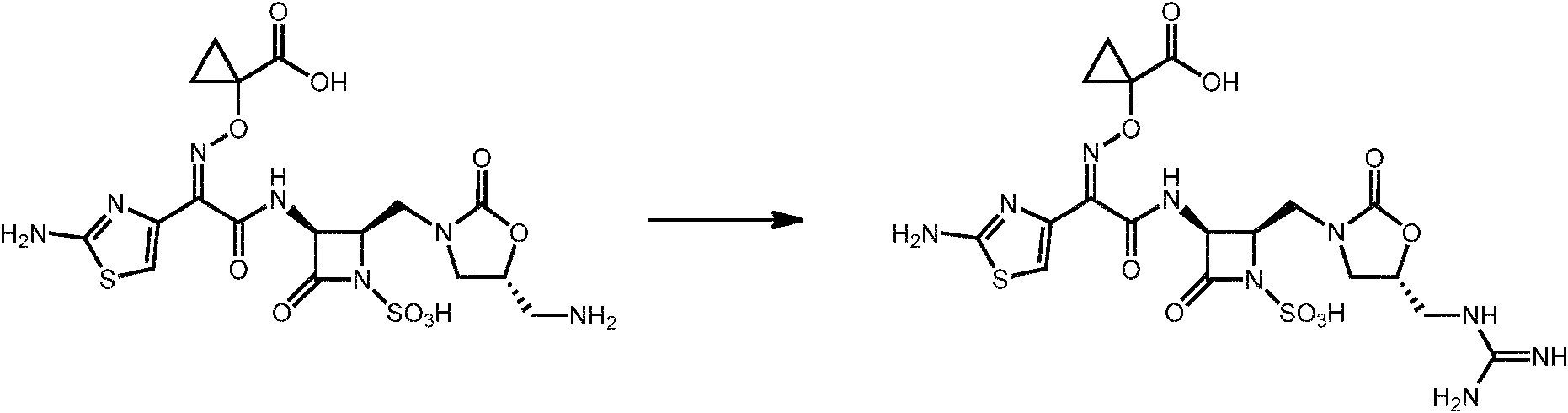
A una disolución de ácido 1-(((Z)-(2-(((2R,3S)-2-(((R)-5-(aminometil)-2-oxooxazolidin-3-il)metil)-4-oxo-1-sulfoazetidin-3-il)amino)-1-(2-aminotiazol-4-il)-2-oxoetilideno)amino)oxi)ciclopropano-carboxílico (0,795 mmol) y clorhidrato de pirazol-1-carboxamidina (234,8 mg, 1,602 mmol) en Dm F (7,0 ml) se añadió DIPeA (1,20 ml, 8,06 mmol). Tras19 h de agitación a ta, se concentró la disolución a vacío y se purificó mediante HPLC de fase inversa (XSelect CSH, 30 x 100 mm, 5 |im, columna C18; ACN-agua con modificador de ácido fórmico al 0,1%, 60 ml/min), dando el compuesto del título (177 mg, 37%) como un polvo blanco. CL-EM: Rt = 0,47 min, m/z = 590,1 (M+H) Método 2m_ácido_polar;; 1H RMN (400 MHz, DMSO-d6) 89,15 (d, J = 8,9 Hz, 1H), 7,62 (s a, 1H), 7,24 (s, 3H), 6,81 (s, 1H), 5,23 (dd, J = 8,9, 5,9 Hz, 1H), 4,60-4,51 (m, 1H), 4,23 (ddd, J = 9,0, 5,8, 3,7 Hz, 1H), 3,70 (t, J = 8,8 Hz, 1H), 3,52 (dd, J = 8 ,8 , 5,4 Hz, 1H), 3,49-3,44 (m, 1H), 3,43-3,34 (m, 3H), 1,38-1,24 (m, 4H).To a solution of acid 1 - (((Z) - (2 - (((2R, 3S) -2 - (((R) -5- (aminomethyl) -2-oxooxazolidin-3-yl) methyl) -4 -oxo-1-sulfoazetidin-3-yl) amino) -1- (2-aminothiazol-4-yl) -2-oxoethylidene) amino) oxy) cyclopropane-carboxylic acid (0.795 mmol) and pyrazole-1-carboxyamidine hydrochloride ( 234.8 mg, 1.602 mmol) in D m F (7.0 ml) DIP and A (1.20 ml, 8.06 mmol) were added. After stirring for 19 h at rt, the solution was concentrated in vacuo and purified by reverse phase HPLC (XSelect CSH, 30 x 100 mm, 5 | im, column C18; ACN-water with 0.1% formic acid modifier , 60 ml / min), giving the title compound (177 mg, 37%) as a white powder. LC-MS: Rt = 0.47 min, m / z = 590.1 (M + H) Method 2m_polar_mido ;; 1H NMR (400 MHz, DMSO-d6) 89.15 (d, J = 8.9 Hz, 1H), 7.62 (sa, 1H), 7.24 (s, 3H), 6.81 (s, 1H), 5.23 (dd, J = 8.9, 5.9 Hz, 1H), 4.60-4.51 (m, 1H), 4.23 (ddd, J = 9.0, 5, 8, 3.7 Hz, 1H), 3.70 (t, J = 8.8 Hz, 1H), 3.52 (dd, J = 8, 8, 5.4 Hz, 1H), 3.49- 3.44 (m, 1H), 3.43-3.34 (m, 3H), 1.38-1.24 (m, 4H).
Ejemplo de referencia 27: ácido 1-(((Z)-(2-(((2R,3S)-2-((4-(aminometil)-1H-1,2,3-triazol-1-il)metil)-4-oxo-1-sulfoazetidin-3-il)amino)-1-(2-aminotiazol-4-il)-2-oxoetilideno)amino)oxi)ciclopropanocarboxílico.Reference example 27: 1 - (((Z) - (2 - (((2R, 3S) -2 - ((4- (aminomethyl) -1H-1,2,3-triazol-1-yl) methyl acid ) -4-oxo-1-sulfoazetidin-3-yl) amino) -1- (2-aminothiazol-4-yl) -2-oxoethylidene) amino) oxy) cyclopropanecarboxylic.
Etapa 1: ((1-(((2R,3S)-3-amino-4-oxoazetidin-2-il)metil)-1H-1,2,3-triazol-4-il)metil)carbamato de terc-butilo. A una suspensión de paladio sobre carbono (823 mg, 0,774 mmol) en EtOAc/MeOH (5:1, 16,8 ml) se le añadió producto intermedio S (1,11 g, 2,58 mmol) en una porción. Se evacuó el sistema y se volvió a llenar con H2 (3x). Tras agitar durante 19 h se diluyó la mezcla con EtOAc, se filtró a través de Celite, lavando con MeOH-EtOAc (20%, 100 ml x 3) y se concentró a vacío, dando el compuesto del título bruto (730 mg) como un polvo blanquecino. CL-EM: Rt = 0,37 min, m/z = 297,0 (M+1) Método 2m_ácido.Stage 1: ((1 - (((2R, 3S) -3-amino-4-oxoazetidin-2-yl) methyl) -1H-1,2,3-triazol-4-yl) methyl) tert-carbamate butyl. To a suspension of palladium on carbon (823 mg, 0.774 mmol) in EtOAc / MeOH (5: 1, 16.8 ml) was added intermediate S (1.11 g, 2.58 mmol) in one portion. The system was evacuated and refilled with H2 (3x). After stirring for 19 h the mixture was diluted with EtOAc, filtered through Celite, washing with MeOH-EtOAc (20%, 100 ml x 3) and concentrated in vacuo to give the crude title compound (730 mg) as an off-white powder LC-MS: Rt = 0.37 min, m / z = 297.0 (M + 1) 2m_acid method.
Etapa 2: 1-(((Z)-(2-(((2R,3S)-2-((4-(((terc-butoxicarbonil)amino)metil)-1H-1,2,3-triazol-1-il)metil)-4-oxoazetidin-3-il)amino)-1-(2-((terc-butoxicarbonil)amino)tiazol-4-il)-2-oxoetilideno)amino)oxi)ciclopropanocarboxilato de benzhidrilo. A una suspensión de ácido (Z)-2-((1-((benzhidriloxi)carbonil)ciclopropoxi)imino)-2-(2-((tercbutoxicarbonil)amino)tiazol-4-il)acético (1,32 g, 2,46 mmol) en DCM (12 ml) a 0°C se le añadió DIPEA (1,08 ml, 6,16 mmol) seguido por HATU (0,984 g, 2,59 mmol). Se calentó la mezcla de reacción hasta temperatura ambiente y se añadió ((1-(((2R,3S)-3-amino-4-oxoazetidin-2-il)metil)-1H-1,2,3-triazol-4-il)metil)carbamato de terc-butilo (0,73 g, 2,5 mmol) como una disolución en DCM:DMF(1,7:1, 9,6 ml). Tras agitar durante 1,3 h, se observó un cambio de color de amarillo a morado oscuro, tras lo cual se diluyó con DCM, se lavó con agua, salmuera, se secó sobre sulfato de sodio y se concentró a vacío. Se purificó el residuo bruto mediante cromatografía en gel de sílice (EtOAcheptano, 0-90%), dando el compuesto del título (1,62 g, 81%) como una espuma morada. CL-EM: Rt = 1,05 min, m/z = 816,5 (M+1) Método 2m_ácido.Stage 2: 1 - (((Z) - (2 - (((2R, 3S) -2 - ((4 - (((tert-butoxycarbonyl) amino) methyl) -1H-1,2,3-triazole- 1-yl) methyl) -4-oxoazetidin-3-yl) amino) -1- (2 - ((tert-butoxycarbonyl) amino) thiazol-4-yl) -2-oxoethylidene) amino) oxy) benzhydryl cyclopropanecarboxylate. To a suspension of (Z) -2 - ((1 - ((benzhydryloxy) carbonyl) cyclopropoxy) imino) -2- (2 - ((tert-butoxycarbonyl) amino) thiazol-4-yl) acetic acid (1.32 g, 2.46 mmol) in DCM (12 ml) at 0 ° C DIPEA (1.08 ml, 6.16 mmol) was added followed by HATU (0.984 g, 2.59 mmol). The reaction mixture was heated to room temperature and ((1 - (((2R, 3S) -3-amino-4-oxoazetidin-2-yl) methyl) -1H-1,2,3-triazol-4 was added -yl) methyl) tert-butyl carbamate (0.73 g, 2.5 mmol) as a solution in DCM: DMF (1.7: 1, 9.6 ml). After stirring for 1.3 h, a change of color from yellow to dark purple, after which it was diluted with DCM, washed with water, brine, dried over sodium sulfate and concentrated in vacuo. The crude residue was purified by silica gel chromatography (EtOAcheptane, 0-90%), to give the title compound (1.62 g, 81%) as a purple foam. LC-MS: Rt = 1.05 min, m / z = 816.5 (M + 1) 2m_acid method.
Etapa 3: ácido (2R,3S)-3-((Z)-2-((1-((benzhidriloxi)carbonil)ciclopropoxi)imino)-2-(2-((ferc-butoxicarbonil)amino)tiazol-4-il)acetamido)-2-((4-(((ferc-butoxicarbonil)amino)metil)-1H-1,2,3-triazol-1-il)metil)-4-oxoazetidina-1-sulfónico. A una disolución de 1-(((Z)-(2-(((2R,3S)-2-((4-(((ferc-butoxicarbonil)amino)metil)-1H-1,2,3-triazol-1-il)metil)-4-oxoazetidin-3-il)amino)-1-(2-((ferc-butoxicarbonil)amino)tiazol-4-il)-2-oxoetilideno)amino)oxi)ciclopropanocarboxilato de benzhidrilo (1,58 g, 1,94 mmol) en DMF (15 ml) se le añadió el complejo SOâ DMF (2,97 g, 19,4 mmol). Tras 45 min de agitación se diluyó con EtOAc (120 ml), salmuera (80 ml), agua (40 ml) y se separaron las fases. Se extrajo la fase acuosa con EtOAc (2 x 20 ml) y se secaron las fases orgánicas combinadas sobre Na2SO4 y se concentró a vacío para dar el compuesto del título (supuestamente cuantitativo) como una espuma morada. CL-EM: Rt = 0,96 min, m/z = 896,4 (M+1) Método 2m_ácido.Stage 3: (2R, 3S) -3 - ((Z) -2 - ((1 - ((benzhydryloxy) carbonyl) cyclopropoxy) imino) -2- (2 - ((ferc-butoxycarbonyl) amino) thiazole-4 -yl) acetamido) -2 - ((4 - (((ferc-butoxycarbonyl) amino) methyl) -1H-1,2,3-triazol-1-yl) methyl) -4-oxoazetidine-1-sulfonic. At a solution of 1 - (((Z) - (2 - (((2R, 3S) -2 - ((4 - (((ferc-butoxycarbonyl) amino) methyl) -1H-1,2,3-triazole -1-yl) methyl) -4-oxoazetidin-3-yl) amino) -1- (2 - ((ferc-butoxycarbonyl) amino) thiazol-4-yl) -2-oxoethylidene) amino) oxy) benzhydryl cyclopropanecarboxylate (1.58 g, 1.94 mmol) in DMF (15 ml), the SOâ DMF complex (2.97 g, 19.4 mmol) was added. After 45 min of stirring it was diluted with EtOAc (120 ml), brine (80 ml), water (40 ml) and the phases were separated. The aqueous phase was extracted with EtOAc (2 x 20 ml) and the combined organic phases were dried over Na2SO4 and concentrated in vacuo to give the title compound (supposedly quantitative) as a purple foam. LC-MS: Rt = 0.96 min, m / z = 896.4 (M + 1) 2m_acid method.
Etapa 4: ácido 1-(((Z)-(2-(((2R,3S)-2-((4-(aminometil)-1H-1,2,3-triazol-1-il)metil)-4-oxo-1-sulfoazetidin-3-il)amino)-1-(2-aminotiazol-4-il)-2-oxoetilideno)amino)oxi)-ciclopropanocarboxílico.Stage 4: 1 - (((Z) - (2 - (((2R, 3S) -2 - ((4- (aminomethyl) -1H-1,2,3-triazol-1-yl) methyl) - acid) - 4-oxo-1-sulfoazetidin-3-yl) amino) -1- (2-aminothiazol-4-yl) -2-oxoethylidene) amino) oxy) -cyclopropanecarboxylic.

Se siguió el procedimiento general para la desprotección mediada por ácido usando ácido (2R,3S)-3-((Z)-2-((1-((benzhidriloxi)carbonil)ciclopropoxi)imino)-2-(2-((ferc-butoxicarbonil)amino)tiazol-4-il)acetamido)-2-((4-(((fercbutoxicarbonil)amino)metil)-1H-1,2,3-triazol-1-il)metil)-4-oxoazetidina-1-sulfónico (1,74 g, 1,94 mmol), DCm (19,4 ml) y TFA (8,95 ml, 116 mmol). Después de 3 h a ta, se enfrió hasta 0°C y más TFA (200 ml, 2,6 mmol) se añadió tras lo cual se permitió que se calentara hasta ta. Tras otra 1 h a ta, se enfrió hasta 0°C y se añadió más TFA (200 |il, 2,6 mmol), de nuevo permitiendo que se calentara hasta ta. Tras 1 h adicional a ta se diluyó con DCM y se concentró a vacío. Se purificó la mitad del residuo bruto mediante HPLC de fase inversa (XSelect CSH, 30 x 100 mm, 5 |im, columna C18; ACN-agua con modificador de ácido fórmico al 0,1%, 60 ml/min), dando el compuesto del título (140 mg, ca 23%) como un polvo blanco. CL-EM: Rt = 0,27 min, m/z = 530,1 (M+1) Método 2m_ácido; 1H RMN (400 MHz, D2O) 8 8,07 (s, 1H), 7,08-6,99 (m, 1H) 5,42-5,31 (m, 1H), 4,88-4,74 (m, 2H supuesto; parcialmente oscurecido por el pico residual de disolvente), 4,74-4,68 (m, 1H), 4,20 (s, 2H), 1,36-1,23 (m, 2H),1,23-1,07 (m, 2H). The general procedure for acid-mediated deprotection was followed using (2R, 3S) -3 - ((Z) -2 - ((1 - ((benzhydryloxy) carbonyl) cyclopropoxy) imino) -2- (2 - (( ferc-butoxycarbonyl) amino) thiazol-4-yl) acetamido) -2 - ((4 - ((((fercbutoxycarbonyl) amino) methyl) -1H-1,2,3-triazol-1-yl) methyl) -4- oxoazetidine-1-sulfonic acid (1.74 g, 1.94 mmol), DC m (19.4 ml) and TFA (8.95 ml, 116 mmol). After 3 h at rt, it was cooled to 0 ° C and more TFA (200 ml, 2.6 mmol) was added after which it was allowed to warm to rt. After another 1 h at rt, it was cooled to 0 ° C and more TFA (200 µl, 2.6 mmol) was added, again allowing it to warm to rt. After an additional 1 h at rt it was diluted with DCM and concentrated in vacuo. Half of the crude residue was purified by reverse phase HPLC (XSelect CSH, 30 x 100 mm, 5 | im, C18 column; ACN-water with 0.1% formic acid modifier, 60 ml / min), giving the title compound (140 mg, ca 23%) as a white powder. LC-MS: Rt = 0.27 min, m / z = 530.1 (M + 1) 2m_acid method; 1H NMR (400 MHz, D2O) 8 8.07 (s, 1H), 7.08-6.99 (m, 1H) 5.42-5.31 (m, 1H), 4.88-4.74 (m, 2H assumed; partially obscured by residual solvent peak), 4.74-4.68 (m, 1H), 4.20 (s, 2H), 1.36-1.23 (m, 2H) , 1.23-1.07 (m, 2H).
Ejemplo de referencia 28: ácido 1-(((Z)-(1-(2-aminotiazol-4-il)-2-(((2R,3S)-2-((4-(guanidinometil)-1H-1,2,3-triazol-1-il)metil)-4-oxo-1-sulfoazetidin-3-il)amino)-2-oxoetilideno)amino)oxi)-ciclopropanocarboxílico.Reference Example 28: 1 - (((Z) - (1- (2-aminothiazol-4-yl) -2 - (((2R, 3S) -2 - ((4- (guanidinomethyl) -1H-1 acid , 2,3-triazol-1-yl) methyl) -4-oxo-1-sulfoazetidin-3-yl) amino) -2-oxoethylidene) amino) oxy) -cyclopropanecarboxylic.

A una disolución de ácido 1-(((Z)-(2-(((2R,3S)-2-((4-(aminometil)-1H-1,2,3-triazol-1-il)metil)-4-oxo-1-sulfoazetidin-3-il)amino)-1-(2-aminotiazol-4-il)-2 oxoetilideno)amino)oxi)ciclopropano-carboxílico (559 mg, 1,06 mmol) y clorhidrato de pirazol-1-carboxamidina (310 mg, 2,12 mmol) en DMF (12 ml) se le añadió DIPEA (1,48 ml, 8,45 mmol). Tras 16 h de agitación a ta, se diluyó la disolución con tolueno (20 ml), provocando que se separase un aceite denso. Se decantó la fase superior y se purificó el aceite restante mediante HPLC de fase inversa (XSelect CSH, 30 x 100 mm, 5 |im, columna C18; ACN-agua con modificador de ácido fórmico al 0,1%, 60 ml/min), dando el compuesto del título (240 mg, 39%) como un polvo blanco. CL-EM: Rt = 0,28 min, m/z = 572,0 (M+H) Método 2m_ácido; 1H RMN (400 MHz, D2O) 88,09 (s, 1H), 7,18 (s, 1H), 5,52 (d, J = 5,4 Hz, 1H), 4,97 (dd, J = 14,1, 5,5 Hz, 1H), 4,91 (q, J = 5,5 Hz, 1H), 4,84-4,76 (m, 1H supuesto; parcialmente oscurecido por el pico residual de disolvente), 4,55 (s, 2H), 1,49-1,36 (m, 2H), 1,34-1,23 (m, 2H). También se obtuvo el isómero E. Cl-EM: Rt = 0,32 min, m/z = 572,0 (M+H) Método 2m_ácido. 1H RMN (400 MHz, DMSO-d6) 89,37 (d, J = 9,6 Hz, 1H), 8,11 (s, 1H), 7,41 (s, 1H), 7,13 (s, 2H), 6,50 (s, 1H), 5,18 (dd, J = 9,6, 5,3 Hz, 1H), 4,97 (d, J = 13,5 Hz, 1H), 4,76-4,58 (m, 1H), 4,52 (dd, J = 16,11, 7,70 Hz, 1H), 4,26-4,05 (m, 2H), 1,86-2,08 (m, 1 H), 1,34-1,07 (m, 6 H).To a solution of 1 - (((Z) - (2 - ((((2R, 3S) -2 - ((4- (aminomethyl) -1H-1,2,3-triazol-1-yl) methyl)) -4-oxo-1-sulfoazetidin-3-yl) amino) -1- (2-aminothiazol-4-yl) -2 oxoethylidene) amino) oxy) cyclopropane-carboxylic acid (559 mg, 1.06 mmol) and hydrochloride of pyrazol-1-carboxamidine (310 mg, 2.12 mmol) in DMF (12 ml) DIPEA (1.48 ml, 8.45 mmol) was added. After 16 h of stirring at rt, the solution was diluted with toluene (20 ml), causing a dense oil to separate. The upper phase was decanted and the remaining oil was purified by reverse phase HPLC (XSelect CSH, 30 x 100 mm, 5 | im, column C18; ACN-water with 0.1% formic acid modifier, 60 ml / min ), giving the title compound (240 mg, 39%) as a white powder. LC-MS: Rt = 0.28 min, m / z = 572.0 (M + H) 2m_acid method; 1H NMR (400 MHz, D2O) 88.09 (s, 1H), 7.18 (s, 1H), 5.52 (d, J = 5.4 Hz, 1H), 4.97 (dd, J = 14.1, 5.5 Hz, 1H), 4.91 (q, J = 5.5 Hz, 1H), 4.84-4.76 (m, 1H assumed; partially obscured by residual solvent peak) , 4.55 (s, 2H), 1.49-1.36 (m, 2H), 1.34-1.23 (m, 2H). The E. Cl-MS isomer was also obtained: Rt = 0.32 min, m / z = 572.0 (M + H) 2m_acid method. 1H NMR (400 MHz, DMSO-d6) 89.37 (d, J = 9.6 Hz, 1H), 8.11 (s, 1H), 7.41 (s, 1H), 7.13 (s, 2H), 6.50 (s, 1H), 5.18 (dd, J = 9.6, 5.3 Hz, 1H), 4.97 (d, J = 13.5 Hz, 1H), 4, 76-4.58 (m, 1H), 4.52 (dd, J = 16.11, 7.70 Hz, 1H), 4.26-4.05 (m, 2H), 1.86-2, 08 (m, 1 H), 1.34-1.07 (m, 6 H).
Ejemplo de referencia 29: ácido (S)-2-(((Z)-(2-(((2R,3S)-2-((1H-1,2,4-triazol-1-il)metil)-4-oxo-1-sulfoazetidin-3-il)amino)-1-(2-aminotiazol-4-il)-2-oxoetilideno)amino)oxi)propanoico.Reference example 29: (S) -2 - (((Z) - (2 - (((2R, 3S) -2 - ((1H-1,2,4-triazol-1-yl) methyl) - 4-oxo-1-sulfoazetidin-3-yl) amino) -1- (2-aminothiazol-4-yl) -2-oxoethylidene) amino) oxy) propanoic acid.
Etapa 1: 2-cloropropanoato de (R)-terc-butilo. Se preparó según Wright et al. Tetrahedron Lett. 1997, 38, 7345. Se cargó una bomba de vidrio de 500 ml con sulfato de magnesio (4,21 g, 35,0 mmol) y DCM (43,8 ml). A esta suspensión se le añadió ácido sulfúrico (486 |il, 8,75 mmol), gota a gota con agitación vigorosa. Tras 15 min de agitación, se añadió ácido (R)-2-cloropropanoico (950 mg, 8,75 mmol) seguido por terc-butanol (4,20 ml, 43,8 mmol). Se selló la bomba y se agitó a ta durante 19 h, tras lo cual se añadió cuidadosamente bicarbonato de sodio (ac satd, 100 ml), en cuyo punto todos los sólidos se habían disuelto. Se separaron las fases y se extrajo la fase acuosa con DCM (2x). Se lavaron las fases orgánicas combinadas con salmuera, se secaron sobre Na2SO4 y se concentraron a vacío (baño de 20°C, 50 mbar) para dar el compuesto del título (1,36 g, 94%) como un aceite rosa claro. 1H RMN (500 MHz, CDCla) 84,29 (q, J = 6,9 Hz, 1H) 1,65 (d, J = 6,9 Hz, 3H) 1,49 (s, 9H).Stage 1: (R) -terc-Butyl Chloropropanoate. It was prepared according to Wright et al. Tetrahedron Lett. 1997, 38, 7345. A 500 ml glass pump was charged with magnesium sulfate (4.21 g, 35.0 mmol) and DCM (43.8 ml). To this suspension was added sulfuric acid (486 µL, 8.75 mmol), dropwise with vigorous stirring. After 15 min of stirring, (R) -2-chloropropanoic acid (950 mg, 8.75 mmol) was added followed by tert-butanol (4.20 ml, 43.8 mmol). The pump was sealed and stirred at rt for 19 h, after which sodium bicarbonate (ac satd, 100 ml) was carefully added, at which point all solids had dissolved. The phases were separated and the aqueous phase was extracted with DCM (2x). The combined organic phases were washed with brine, dried over Na2SO4 and concentrated in vacuo (20 ° C bath, 50 mbar) to give the title compound (1.36 g, 94%) as a light pink oil. 1H NMR (500 MHz, CDCla) 84.29 (q, J = 6.9 Hz, 1H) 1.65 (d, J = 6.9 Hz, 3H) 1.49 (s, 9H).
Etapa 2: 2-((1,3-dioxoisoindolin-2-il)oxi)propanoato de (S)-terc-butilo. Se preparó según Yamawaki et al. Bioorg. Med. Chem. 2007, 15, 6716. A una suspensión de W-hidroxiftalimida (517 mg, 3,17 mmol) y carbonato de potasio (657 mg, 4,76 mmol) en DMF (4,5 ml) se le añadió 2-cloropropanoato de (R)-terc-butilo (522 mg, 3,17 mmol). Se añadió DMF adicional (4,5 ml) después de que la suspensión se volviera viscosa. Tras agitar durante 5 d se diluyó con EtOAc y se vertió en disolución de LiCl (el 5% ac, 90 ml). Se extrajo la fase acuosa con EtOAc (3x) y se lavaron las fases orgánicas combinadas con LiCl (el 5% ac), salmuera, se secó sobre Na2SO4 y se concentró a vacío. Se purificó el residuo bruto mediante cromatografía en gel de sílice (EtOAc-heptano, 0-50%), dando el compuesto del título (348 mg, 38%) como un sólido blanco. CL-EM: Rt = 0,89 min, m/z = 314,0 (M+23) Método 2m_ácido; 1H RMN (400 MHz, CDCla) 87,87-7,81 (m, 2H), 7,75 (dd, J = 5,5, 3,1 Hz, 2H), 4,79 (q, J = 6,8 Hz, 1H), 1,61 (s, 3H), 1,46 (s, 9H).Step 2: 2 - ((1,3-dioxoisoindolin-2-yl) oxy) (S) -terc-butyl propanoate. It was prepared according to Yamawaki et al. Bioorg Med. Chem. 2007, 15, 6716. To a suspension of W-hydroxyphthalimide (517 mg, 3.17 mmol) and potassium carbonate (657 mg, 4.76 mmol) in DMF (4.5 ml) was added (R) -terc-Butyl 2-chloropropanoate (522 mg, 3.17 mmol). Additional DMF (4.5 ml) was added after the suspension became viscous. After stirring for 5 d it was diluted with EtOAc and poured into LiCl solution (5% aq, 90 ml). The aqueous phase was extracted with EtOAc (3x) and the combined organic phases were washed with LiCl (5% aq), brine, dried over Na2SO4 and concentrated in vacuo. The crude residue was purified by silica gel chromatography (EtOAc-heptane, 0-50%), to give the title compound (348 mg, 38%) as a white solid. LC-MS: Rt = 0.89 min, m / z = 314.0 (M + 23) 2m_acid method; 1H NMR (400 MHz, CDCla) 87.87-7.81 (m, 2H), 7.75 (dd, J = 5.5, 3.1 Hz, 2H), 4.79 (q, J = 6 , 8 Hz, 1H), 1.61 (s, 3H), 1.46 (s, 9H).
Etapa 3: 2-(aminooxi)propanoato de (S)-terc-butilo. A una disolución de 2-((1,3-dioxoisoindolin-2-il)oxi)propanoato de (S)-terc-butilo (73,3 mg, 0,252 mmol) en DCM (volumen: 500 |il) a 0°C se le añadió metilhidrazina (13,5 |il, 0,252 mmol). Tras agitar durante 3 h a 0°C, se eliminaron los sólidos por filtración y se concentró el filtrado a vacío, dando el compuesto del título (supuestamente cuantitativo) como un aceite transparente.Step 3: (S) -terc-butyl (2-) aminooxy) propanoate. To a solution of 2- ((1,3-dioxoisoindolin-2-yl) oxy) (S) -terc-butyl propanoate (73.3 mg, 0.222 mmol) in DCM (volume: 500 | il) at 0 ° C methylhydrazine (13.5 µL, 0.252 mmol) was added. After stirring for 3 h at 0 ° C, the solids were removed by filtration and the filtrate was concentrated in vacuo to give the title compound (supposedly quantitative) as a clear oil.
Etapa 4: 2-(((Z)-(2-(((2R,3S)-2-((1H-1,2,4-triazol-1-il)metil)-4-oxoazetidin-3-il)amino)-1-(2-((tercbutoxicarbonil)amino)tiazol-4-il)-2-oxoetilideno)amino)oxi)-propanoato de (S)-terc-butilo. A una disolución de producto intermedio E (62,2 mg, 0,148 mmol) en MeOH (1 ml) a 0°C se le añadió una disolución de 2-(aminooxi)propanoato de (S)-terc-butilo (24 mg, 0,15 mmol) en DCM (300 |il). Tras agitar durante 6 d se añadió acético ácido (8,5 |il, 0,15 mmol). Tras 4 d, se añadió más acético ácido (8,5 pl, 0,15 mmol). Tras 24 h adicionales, se concentró parcialmente a vacío, después se diluyó con EtOAc/agua. Se separaron las fases y se lavó la fase orgánica con salmuera, se secó sobre Na2SO4 y se concentró a vacío. Se purificó el residuo bruto mediante cromatografía en gel de sílice (MeOH-DCM, 0-10%), dando el compuesto del título (20,2 mg, 24%) como un sólido blanco. CL-EM: Rt = 0,81 min, m/z = 565,1 (M+1) Método 2m_ácido.Stage 4: 2 - (((Z) - (2 - (((2R, 3S) -2 - ((1H-1,2,4-triazol-1-yl) methyl) -4-oxoazetidin-3-yl ) amino) -1- (2 - ((tert-butoxycarbonyl) amino) thiazol-4-yl) -2-oxoethylidene) amino) oxy) -propanoate of (S) -terc-butyl. To a solution of intermediate product E (62.2 mg, 0.148 mmol) in MeOH (1 ml) at 0 ° C was added a solution of 2- (aminooxy) propanoate of (S) -terc-butyl (24 mg, 0.15 mmol) in DCM (300 µl). After stirring for 6 d, acetic acid (8.5 µL, 0.15 mmol) was added. After 4 d, more acidic acetic acid (8.5 pl, 0.15 mmol) was added. After an additional 24 h, it was partially concentrated in vacuo, then diluted with EtOAc / water. The phases were separated and the organic phase was washed with brine, dried over Na2SO4 and concentrated in vacuo. The crude residue was purified by silica gel chromatography (MeOH-DCM, 0-10%), to give the title compound (20.2 mg, 24%) as a white solid. LC-MS: Rt = 0.81 min, m / z = 565.1 (M + 1) 2m_acid method.
Etapa 5: ácido (2R,3S)-2-((1H-1,2,4-triazol-1-il)metil)-3-((Z)-2-((S)-1-(terc-butoxi)-1-oxopropan-2-il)oxi)imino)-2-(2-((terc-butoxicarbonil)amino)tiazol-4-il)acetamido)-4-oxoazetidina-1-sulfónico. A una disolución de 2-(((Z)-(2-(((2R,3S)-2-((1H-1,2,4-triazol-1-il)metil)-4-oxoazetidin-3-il)amino)-1-(2-((terc-butoxicarbonil)amino)tiazol-4-il)-2-oxoetilideno)amino)oxi)propanoato de (S)-terc-butilo (20,2 mg, 0,036 mmol) en DMF (400 ml) se le añadió SO3^DMF (54,8 mg, 0,358 mmol). Tras 2,5 h de agitación, se diluyó con EtOAc/LiCl (el 5% ac) y se separaron las fases. Se extrajo la fase acuosa con EtOAc (3x) y se lavaron las fases orgánicas combinadas con LiCl (el 5% ac), salmuera, se secó sobre Na2SO4 y se concentró a vacío, dando el compuesto del título (supuestamente cuantitativo) como un sólido blanco. CL-EM: Rt = 0,74 min, m/z = 645,3 (M+1) Método 2m_ácido.Step 5: acid (2R, 3S) -2 - ((1H-1,2,4-triazol-1-yl) methyl) -3 - ((Z) -2 - ((S) -1- (tert) butoxy) -1-oxopropan-2-yl) oxy) imino) -2- (2 - ((tert-butoxycarbonyl) amino) thiazol-4-yl) acetamido) -4-oxoazetidine-1-sulfonic. To a solution of 2 - (((Z) - (2 - (((2R, 3S) -2 - ((1H-1,2,4-triazol-1-yl) methyl) -4-oxoazetidin-3- il) amino) -1- (2 - ((tert-butoxycarbonyl) amino) thiazol-4-yl) -2-oxoethylidene) amino) oxy) (S) -terc-butyl propanoate (20.2 mg, 0.036 mmol ) in DMF (400 ml) SO3 ^ DMF (54.8 mg, 0.358 mmol) was added. After 2.5 h of stirring, it was diluted with EtOAc / LiCl (5% aq) and the phases were separated. The aqueous phase was extracted with EtOAc (3x) and the combined organic phases were washed with LiCl (5% aq), brine, dried over Na2SO4 and concentrated in vacuo to give the title compound (supposedly quantitative) as a solid. White. LC-MS: Rt = 0.74 min, m / z = 645.3 (M + 1) 2m_acid method.
Etapa 6 : ácido (S)-2-(((Z)-(2-(((2R,3S)-2-((1H-1,2,4-triazol-1-il)metil)-4-oxo-1-sulfoazetidin-3-il)amino)-1-(2-aminotiazol-4-il)-2-oxoetilideno)amino)oxi)propanoico. Stage 6: acid (S) -2 - (((Z) - (2 - (((2R, 3S) -2 - ((1H-1,2,4-triazol-1-yl) methyl) -4- oxo-1-sulfoazetidin-3-yl) amino) -1- (2-aminothiazol-4-yl) -2-oxoethylidene) amino) oxy) propanoic acid.

Se siguió el procedimiento general para la desprotección mediada por ácido usando ácido (2R,3S)-2-((1H-1,2,4-triazol-1-il)metil)-3-((Z)-2-((((S)-1-(terc-butoxi)-1-oxopropan-2-il)oxi)imino)-2-(2-((terc-butoxicarbonil)amino)tiazol-4-il)acetamido)-4-oxoazetidina-1-sulfónico (23 mg, 0,036 mmol), DCM (357 |il) y TFA (165 |il, 2,14 mmol). Se purificó el residuo bruto mediante HPLC de fase inversa (XSelect CSH, 19 x 100 mm, 5 |im, columna C18; ACN-agua con modificador de ácido fórmico al 0,1%, 24 ml/min), dando el compuesto del título (7,9 mg, 36%) como un polvo blanco. CL-EM: Rt = 0,40 min, m/z = 489,0 (M+1) Método 2m_ácido_polar; 1H RMN (400 MHz, D2O) 88,69 (s, 1H), 8,18 (s, 1 H), 7,20 (s, 1 H), 5,54 (d, J = 5,7 Hz, 1 H), 4,96-4,67 (m, 4H supuesto; parcialmente oscurecido por el pico residual de disolvente), 1,44 (d, J = 7,0 Hz, 3H).The general procedure for acid-mediated deprotection was followed using (2R, 3S) -2 - ((1H-1,2,4-triazol-1-yl) methyl) -3 - ((Z) -2- ( (((S) -1- (tert-butoxy) -1-oxopropan-2-yl) oxy) imino) -2- (2 - ((tert-butoxycarbonyl) amino) thiazol-4-yl) acetamido) -4 -oxoazetidine-1-sulfonic acid (23 mg, 0.036 mmol), DCM (357 µl) and TFA (165 µl, 2.14 mmol). The crude residue was purified by reverse phase HPLC (XSelect CSH, 19 x 100 mm, 5 | im, column C18; ACN-water with 0.1% formic acid modifier, 24 ml / min), to give the compound of Title (7.9 mg, 36%) as a white powder. LC-MS: R t = 0.40 min, m / z = 489.0 (M + 1) Method 2m_polar_m_acid; 1 H NMR (400 MHz, D2O) 88.69 (s, 1 H), 8.18 (s, 1 H), 7.20 (s, 1 H), 5.54 (d, J = 5.7 Hz, 1 H), 4.96-4.67 (m, 4H assumed; partially obscured by residual solvent peak), 1.44 (d, J = 7.0 Hz, 3H).
Ejemplo de referencia 30: ácido (R)-2-(((Z)-(2-(((2R,3S)-2-((1H-1,2,4-triazol-1-il)metil)-4-oxo-1-sulfoazetidin-3-il)amino)-1-(2-aminotiazol-4-il)-2-oxoetilideno)amino)oxi)propanoico.Reference example 30: (R) -2 - (((Z) - (2 - (((2R, 3S) -2 - ((1H-1,2,4-triazol-1-yl) methyl) - 4-oxo-1-sulfoazetidin-3-yl) amino) -1- (2-aminothiazol-4-yl) -2-oxoethylidene) amino) oxy) propanoic acid.
Etapa 1: 2-cloropropanoato de (S)-terc-butilo. Se preparó según Wright et al. Tetrahedron Lett. 1997, 38, 7345. Se cargó una bomba de vidrio de 500 ml con sulfato de magnesio (21,7 g, 181 mmol) y DCM (182 ml). A esta suspensión se le añadió ácido sulfúrico (2,5 ml, 45 mmol), gota a gota con agitación vigorosa. Tras 15 min de agitación, se añadió ácido (S)-2-cloropropanoico (5,0 g, 45 mmol) seguido por terc-butanol (21,6 ml, 226 mmol). Se selló la bomba y se agitó a ta durante 19 h, tras lo cual se enfrió hasta 0°C y se añadió cuidadosamente bicarbonato de sodio (ac satd, 350 ml), en cuyo punto todos los sólidos se habían disuelto. Se separaron las fases y se extrajo la fase acuosa con DCM (2x). Se lavaron las fases orgánicas combinadas con salmuera, se secó sobre Na2SO4 y se concentró a vacío (baño de 20°C, 50 mbar) para dar el compuesto del título (7,64 g, 96%) como un aceite amarillo claro (el 93% de pureza). Los datos de 1H r Mn fueron idénticos al enantiómero preparado previamente.Stage 1: (S) -terc-Butyl Chloropropanoate. It was prepared according to Wright et al. Tetrahedron Lett. 1997, 38, 7345. A 500 ml glass pump was charged with magnesium sulfate (21.7 g, 181 mmol) and DCM (182 ml). To this suspension was added sulfuric acid (2.5 ml, 45 mmol), dropwise with vigorous stirring. After 15 min of stirring, (S) -2-chloropropanoic acid (5.0 g, 45 mmol) was added followed by tert-butanol (21.6 ml, 226 mmol). The pump was sealed and stirred at rt for 19 h, after which it was cooled to 0 ° C and sodium bicarbonate (ac satd, 350 ml) was added carefully, at which point all solids had dissolved. The phases were separated and the aqueous phase was extracted with DCM (2x). The combined organic phases were washed with brine, dried over Na2SO4 and concentrated in vacuo (20 ° C bath, 50 mbar) to give the title compound (7.64 g, 96%) as a light yellow oil (the 93% purity). The 1 H r Mn data were identical to the previously prepared enantiomer.
Etapa 2: 2-((1,3-dioxoisoindolin-2-il)oxi)propanoato de (R)-terc-butilo. A una suspensión de N-hidroxiftalimida (3,71 g, 22,1 mmol) y carbonato de potasio (4,58 g, 33,1 mmol) en DMF (55 ml) se le añadió 2-cloropropanoato de (S)-terc-butilo (4,30 g, 24,3 mmol). Tras 72 h de agitación, se calentó la suspensión hasta 40°C durante 16 h adicionales, en cuyo punto se diluyó con EtOAc/LiCl (el 5% ac) y se separaron las fases. Se extrajo la fase acuosa con EtOAc (2x) y se lavaron las fases orgánicas combinadas con LiCl (el 5% ac), salmuera, se secaron sobre Na2SO4 y se concentraron a vacío, dando el compuesto del título (5,45 g, 85%) como un sólido blanquecino. CL-EM: Rt = 0,88 min, m/z = 313,9 (M+23) Método 2m_ácido.Step 2: 2 - ((1,3-dioxoisoindolin-2-yl) oxy) (R) -terc-butyl propanoate. To a suspension of N-hydroxyphthalimide (3.71 g, 22.1 mmol) and potassium carbonate (4.58 g, 33.1 mmol) in DMF (55 ml) was added (S) - 2-chloropropanoate - tert- butyl (4.30 g, 24.3 mmol). After 72 h of stirring, the suspension was heated to 40 ° C for an additional 16 h, at which point it was diluted with EtOAc / LiCl (5% aq) and the phases were separated. The aqueous phase was extracted with EtOAc (2x) and the combined organic phases were washed with LiCl (5% aq), brine, dried over Na2SO4 and concentrated in vacuo to give the title compound (5.45 g, 85 %) as an off-white solid. LC-MS: Rt = 0.88 min, m / z = 313.9 (M + 23) 2m_acid method.
Etapa 3: 2-(aminooxi)propanoato de (R)-terc-butilo. A una disolución de 2-((1,3-dioxoisoindolin-2-il)oxi)propanoato de (R)-terc-butilo (69,6 mg, 0,239 mmol) en DCM (478 pl) a 0°C se le añadió metilhidrazina (12,8 |il, 0,239 mmol). Tras agitar durante 3 h a 0°C, se eliminaron los sólidos por filtración y se concentró el filtrado a vacío, dando el compuesto del título (supuestamente cuantitativo) como un aceite transparente.Step 3: 2- (R) -terc-butyl (2-) aminooxy) propanoate. A solution of 2- ((1,3-dioxoisoindolin-2-yl) oxy) propanoate of (R) -terc-butyl (69.6 mg, 0.239 mmol) in DCM (478 pl) at 0 ° C is given added methylhydrazine (12.8 µl, 0.239 mmol). After stirring for 3 h at 0 ° C, the solids were removed by filtration and the filtrate was concentrated in vacuo to give the title compound (supposedly quantitative) as a clear oil.
Etapa 4: ácido (2R,3S)-2-((1H-1,2,4-triazol-1-il)metil)-3-((Z)-2-((((R)-1-(terc-butoxi)-1-oxopropan-2-il)oxi)imino)-2-(2-((terc-butoxicarbonil)amino)tiazol-4-il)acetamido)-4-oxoazetidina-1-sulfónico. A una disolución de producto intermedio F (110 mg, 0,219 mmol) en MeOH (2 ml) a 0°C se le añadió una disolución de 2-(aminooxi)propanoato de (R)-tercbutilo (38,5 mg, 0,239 mmol) en DCM:MeOH (2:1, 600 |il) seguido por un lavado de DCM (400 |il). Tras agitar durante 16 h se concentró parcialmente a vacío, después se diluyó con EtOAc/agua y se separaron las fases. Se extrajo la fase acuosa con EtOAc (2x) y se secaron las fases orgánicas combinadas sobre Na2SO4 y se concentró a vacío, dando el compuesto del título (supuestamente cuantitativo) como un sólido blanco. CL-EM: Rt = 0,74 min, m/z = 645,3 (M+1) Método 2m_ácido.Stage 4: acid (2R, 3S) -2 - ((1H-1,2,4-triazol-1-yl) methyl) -3 - ((Z) -2 - ((((R) -1- ( tert-butoxy) -1-oxopropan-2-yl) oxy) imino) -2- (2 - ((tert-butoxycarbonyl) amino) thiazol-4-yl) acetamido) -4-oxoazetidine-1-sulfonic. To a solution of intermediate product F (110 mg, 0.219 mmol) in MeOH (2 ml) at 0 ° C was added a solution of 2- (aminooxy) propanoate of (R) -butylbutyl (38.5 mg, 0.239 mmol ) in DCM: MeOH (2: 1, 600 | il) followed by a washing of DCM (400 | il). After stirring for 16 h, it was partially concentrated in vacuo, then diluted with EtOAc / water and the phases were separated. The aqueous phase was extracted with EtOAc (2x) and the combined organic phases were dried over Na2SO4 and concentrated in vacuo to give the title compound (supposedly quantitative) as a white solid. LC-MS: Rt = 0.74 min, m / z = 645.3 (M + 1) 2m_acid method.
Etapa 5: ácido (R)-2-(((Z)-(2-(((2R,3S)-2-((1H-1,2,4-triazol-1-il)metil)-4-oxo-1-sulfoazetidin-3-il)amino)-1-(2-aminotiazol-4-il)-2-oxoetilideno)amino)oxi)propanoico. Stage 5: acid (R) -2 - (((Z) - (2 - (((2R, 3S) -2 - ((1H-1,2,4-triazol-1-yl) methyl) -4- oxo-1-sulfoazetidin-3-yl) amino) -1- (2-aminothiazol-4-yl) -2-oxoethylidene) amino) oxy) propanoic acid.

Se siguió el procedimiento general para la desprotección mediada por ácido usando ácido (2R,3S)-2-((1H-1,2,4-triazol-1-il)metil)-3-((Z)-2-((((R)-1-(terc-butoxi)-1-oxopropan-2-il)oxi)imino)-2-(2-((terc-butoxicarbonil)amino)tiazol-4-il)acetamido)-4-oxoazetidina-1-sulfónico (141 mg, 0,219 mmol), DCM (2,19 ml) y TFA (1,0 ml, 13 mmol). Se purificó el residuo bruto mediante HPLC de fase inversa (XSelect CSH, 30 x 100 mm, 5 |im, columna C18; ACN-agua con modificador de ácido fórmico al 0,1%, 60 ml/min), dando el compuesto del título (35,5 mg, 29%) como un polvo blanco. CL-EM: Rt = 0,42 min, m/z = 489,0 (M+1) Método 2m_ácido_polar; 1H RMN (400 MHz, D2O) 88,58 (s, 1H), 8,06 (s, 1 H), 7,06 (s, 1 H), 5,41 (d, J = 5,6 Hz, 1 H), 4,81-4,52 (m, 4H supuesto; parcialmente oscurecido por el pico de disolvente), 1,29 (d, J = 7,0 Hz, 3H).The general procedure for acid-mediated deprotection was followed using (2R, 3S) -2 - ((1H-1,2,4-triazol-1-yl) methyl) -3 - ((Z) -2- ( (((R) -1- (tert-butoxy) -1-oxopropan-2-yl) oxy) imino) -2- (2 - ((tert-butoxycarbonyl) amino) thiazol-4-yl) acetamido) -4 -oxoazetidine-1-sulfonic acid (141 mg, 0.219 mmol), DCM (2.19 ml) and TFA (1.0 ml, 13 mmol). The crude residue was purified by reverse phase HPLC (XSelect CSH, 30 x 100 mm, 5 | im, column C18; ACN-water with 0.1% formic acid modifier, 60 ml / min), to give the compound of Title (35.5 mg, 29%) as a white powder. LC-MS: Rt = 0.42 min, m / z = 489.0 (M + 1) Method 2m_polar_m_acid; 1 H NMR (400 MHz, D2O) 88.58 (s, 1 H), 8.06 (s, 1 H), 7.06 (s, 1 H), 5.41 (d, J = 5.6 Hz, 1 H), 4.81-4.52 (m, 4H assumed; partially obscured by the solvent peak), 1.29 (d, J = 7.0 Hz, 3H).
Ejemplo de referencia 31: ácido (S)-2-(((Z)-(2-(((2R,3S)-2-((1H-1,2,4-triazol-1-il)metil)-4-oxo-1-sulfoazetidin-3-il)amino)-1-(2-aminotiazol-4-il)-2-oxoetilideno)amino)oxi)-3-(4-(N-(piperidin-4-il)carbamimidoil)-fenoxi)propanoico. Reference Example 31: (S) -2 - (((Z) - (2 - (((2R, 3S) -2 - ((1H-1,2,4-triazol-1-yl) methyl) - 4-oxo-1-sulfoazetidin-3-yl) amino) -1- (2-aminothiazol-4-yl) -2-oxoethylidene) amino) oxy) -3- (4- (N- (piperidin-4-yl ) carbamimidoyl) -phenoxy) propanoic acid.
Etapa 1: 4-(4-((S)-2-(((Z)-(2-(((2R,3S)-2-((1H-1,2,4-triazol-1-il)metil)-4-oxoazetidin-3-il)amino)-1-(2-((tercbutoxicarbonil)amino)tiazol-4-il)-2-oxoetilideno)amino)oxi)-3-(benzhidriloxi)-3-oxopropoxi)bencimidamido)piperidina-1-carboxilato de terc-butilo. A una disolución de ácido (S,Z)-2-(((1-(benzhidriloxi)-3-(4-(N-(1-(tercbutoxicarbonil)piperidin-4-il)carbamimidoil)fenoxi)-1-oxopropan-2-il)oxi)imino)-2-(2-((terc-butoxicarbonil)amino)tiazol-4-il)acético (preparado según el documento WO2013110643, 72 mg, 0,085 mmol), (3S,4R)-4-((1H-1,2,4-triazol-1-il)metil)-3-aminoazetidin-2-ona (15,7 mg, 0,094 mmol) y HATU (42,2 mg, 0,111 mmol) en DMF (854 pl) se le añadió DIPEA (44,8 pl, 0,256 mmol). Tras agitar a durante 3 h, se diluyó con EtOAc, se lavó con agua, NaHCO3 (ac satd), salmuera, se secó sobre Na2SO4 y se concentró a vacío, dando el compuesto del título (82 mg, 87%) como una película oliva. CL-EM: Rt = 0,97 min, m/z = 992,5 (M+1) Método 2m_ácido.Stage 1: 4- (4 - ((S) -2 - (((Z) - (2 - (((2R, 3S) -2 - ((1H-1,2,4-triazol-1-yl) methyl) -4-oxoazetidin-3-yl) amino) -1- (2 - ((tert-butoxycarbonyl) amino) thiazol-4-yl) -2-oxoethylidene) amino) oxy) -3- (benzhydryloxy) -3-oxopropoxy ) benzimidamide) tert-butyl piperidine-1-carboxylate. To a solution of (S, Z) -2 - (((1- (benzhydryloxy) -3- (4- (N- (1- (tert-butoxycarbonyl) piperidin-4-yl) carbamimidoyl) phenoxy) -1-oxopropan -2-yl) oxy) imino) -2- (2 - ((tert-butoxycarbonyl) amino) thiazol-4-yl) acetic (prepared according to WO2013110643, 72 mg, 0.085 mmol), (3S, 4R) - 4 - ((1H-1,2,4-triazol-1-yl) methyl) -3-aminoazetidin-2-one (15.7 mg, 0.094 mmol) and HATU (42.2 mg, 0.111 mmol) in DMF (854 pl) DIPEA (44.8 pl, 0.256 mmol) was added. After stirring for 3 h, it was diluted with EtOAc, washed with water, NaHCO3 (aq satd), brine, dried over Na2SO4 and concentrated in vacuo, giving the title compound (82 mg, 87%) as a film. olive. LC-MS: Rt = 0.97 min, m / z = 992.5 (M + 1) 2m_acid method.
Etapa 2: ácido (2R,3S)-2-((1H-1,2,4-triazol-1-il)metil)-3-((Z)-2-((((S)-1-(benzhidriloxi)-3-(4-(N-(1-(terc-butoxicarbonil) piperidin-4-il)carbamimidoil)fenoxi)-1-oxopropan-2-il)oxi)imino)-2-(2-((terc-butoxicarbonil)amino)tiazol-4-il)acetamido)-4-oxoazetidina-1-sulfónico. Se trató 4-(4-((S)-2-(((Z)-(2-(((2R,3S)-2-((1H-1,2,4-triazol-1-il)metil)-4-oxoazetidin-3-il)amino)-1-(2-((terc-butoxicarbonil)amino)tiazol-4-il)-2-oxoetilideno)amino)oxi)-3-(benzhidriloxi)-3-oxopropoxi)bencimidamido)piperidina-1-carboxilato de terc-butilo (99 mg, 0,10 mmol) en DMF (500 pl) con SOâ DMF (45,9 mg, 0,299 mmol). Tras agitar durante 40 min, se añadió más SOâ DMF (45,9 mg, 0,299 mmol). Tras 1,3 h, se añadió más SO3^DMF (45,9 mg, 0,299 mmol). Tras agitar durante 30 min adicionales, se vertió la disolución en salmuera helada y se extrajo con EtOAc. Se separaron las fases y se secó la fase orgánica sobre Na2SO4 y se concentró a vacío, dando el compuesto del título (supuestamente cuantitativo) como un sólido blanquecino. CL-EM: Rt = 0,97 min, m/z = 1073,1 (M+1) Método 2m_ácido.Stage 2: acid (2R, 3S) -2 - ((1H-1,2,4-triazol-1-yl) methyl) -3 - ((Z) -2 - ((((S) -1- ( benzhydryloxy) -3- (4- (N- (1- (tert-butoxycarbonyl) piperidin-4-yl) carbamimidoyl) phenoxy) -1-oxopropan-2-yl) oxy) imino) -2- (2 - (( tert-butoxycarbonyl) amino) thiazol-4-yl) acetamido) -4-oxoazetidine-1-sulfonic. 4- (4 - ((S) -2 - (((Z) - (2 - (((2R, 3S) -2 - ((1H-1,2,4-triazol-1-yl) methyl) ) -4-oxoazetidin-3-yl) amino) -1- (2 - ((tert-butoxycarbonyl) amino) thiazol-4-yl) -2-oxoethylidene) amino) oxy) -3- (benzhydryloxy) -3- tert-butyl oxopropoxy) benzimidamide) piperidine-1-carboxylate (99 mg, 0.10 mmol) in DMF (500 pl) with SOâ DMF (45.9 mg, 0.299 mmol). After stirring for 40 min, more SOâ DMF (45.9 mg, 0.299 mmol) was added. After 1.3 h, more SO3 ^ DMF (45.9 mg, 0.299 mmol) was added. After stirring for an additional 30 min, the solution was poured into ice-cold brine and extracted with EtOAc. The phases were separated and the organic phase was dried over Na2SO4 and concentrated in vacuo to give the title compound (supposedly quantitative) as an off-white solid. LC-MS: Rt = 0.97 min, m / z = 1073.1 (M + 1) 2m_acid method.
Etapa 3: ácido (S)-2-(((Z)-(2-(((2R,3S)-2-((1H-1,2,4-triazol-1-il)metil)-4-oxo-1-sulfoazetidin-3-il)amino)-1-(2-aminotiazol-4-il)-2-oxoetilideno)amino)oxi)-3-(4-(N-(piperidin-4-il)carbamimidoil)-fenoxi)propanoico.Stage 3: acid (S) -2 - (((Z) - (2 - (((2R, 3S) -2 - ((1H-1,2,4-triazol-1-yl) methyl) -4- oxo-1-sulfoazetidin-3-yl) amino) -1- (2-aminothiazol-4-yl) -2-oxoethylidene) amino) oxy) -3- (4- (N- (piperidin-4-yl) carbamimidoyl ) -phenoxy) propanoic.

Se siguió el procedimiento general para la desprotección mediada por ácido usando ácido (2R,3S)-2-((1H-1,2,4-triazol-1-il)metil)-3-((Z)-2-((((S)-1-(benzhidriloxi)-3-(4-(N-(1-(terc-butoxicarbonil)piperidin-4-il)carbamimidoil)fenoxi)-1-oxopropan-2-il)oxi)imino)-2-(2-((terc-butoxicarbonil)amino)tiazol-4-il)acetamido)-4-oxoazetidina-1-sulfónico (0,085 mmol), DCM (850 pl) y TFA (327 pl, 4,25 mmol). Se purificó el residuo bruto mediante HPLC de fase inversa (XSelect CSH, 19 x 100 mm, 5 pm, columna C18; ACN-agua con modificador de ácido fórmico al 0,1%, 24 ml/min), dando el compuesto del título (12 mg, 17%) como un polvo blanco. CL-EM: Rt = 0,41 min, m/z = 706,2 (M+1) Método 2m_ácido_polar; 1H RMN (400 MHz, DMSO-da) 89,55 (d, J = 7,4 Hz, 1H) 9,40 (s a, 1H) 9,01 (s a, 1H) 8,53-8,71 (m, 1H) 8,41 (s, 1H) 7,92 (s, 1H) 7,67 (d, J = 9,0 Hz, 2H) 7,21 (s a, 2H) 7,03 (d, J = 7,8 Hz, 1H) 6,76 (s, 1H) 5,17-5,24 (m, 1H) 4,94 (d, J = 3,9 Hz, 1H) 4,46-4,53 (m, 2H) 4,37-4,45 (m, 1H) 4,25-4,32 (m, 1H) 3,88 (s a, 1H) 3,39 (s a, 4H) 2,92 (t, J = 11,5 Hz, 2H) 2,05-2,14 (m, 2H) 1,79 (d, J = 11,0 Hz, 2H).The general procedure for acid-mediated deprotection was followed using (2R, 3S) -2 - ((1H-1,2,4-triazol-1-yl) methyl) -3 - ((Z) -2- ( (((S) -1- (benzhydryloxy) -3- (4- (N- (1- (tert-butoxycarbonyl) piperidin-4-yl) carbamimidoyl) phenoxy) -1-oxopropan-2-yl) oxy) imino ) -2- (2 - ((tert-butoxycarbonyl) amino) thiazol-4-yl) acetamido) -4-oxoazetidine-1-sulfonic acid (0.085 mmol), DCM (850 pl) and TFA (327 pl, 4.25 mmol). The crude residue was purified by reverse phase HPLC (XSelect CSH, 19 x 100 mm, 5 pm, column C18; ACN-water with 0.1% formic acid modifier, 24 ml / min), to give the title compound (12 mg, 17%) as a white powder. LC-MS: Rt = 0.41 min, m / z = 706.2 (M + 1) Method 2m_acid_polar; 1 H NMR (400 MHz, DMSO-da) 89.55 (d, J = 7.4 Hz, 1 H) 9.40 (sa, 1 H) 9.01 (sa, 1 H) 8.53-8.71 (m , 1H) 8.41 (s, 1H) 7.92 (s, 1H) 7.67 (d, J = 9.0 Hz, 2H) 7.21 (sa, 2H) 7.03 (d, J = 7.8 Hz, 1H) 6.76 (s, 1H) 5.17-5.24 (m, 1H) 4.94 (d, J = 3.9 Hz, 1H) 4.46-4.53 ( m, 2H) 4.37-4.45 (m, 1H) 4.25-4.32 (m, 1H) 3.88 (sa, 1H) 3.39 (sa, 4H) 2.92 (t, J = 11.5 Hz, 2H) 2.05-2.14 (m, 2H) 1.79 (d, J = 11.0 Hz, 2H).
Ejemplo de referencia 32: ácido 1-(((Z)-(2-(((2R,3S)-2-((1H-1,2,4-tnazol-1-¡l)met¡l)-4-oxo-1-sulfoazet¡d¡n-3-¡l)am¡no)-1-(2-aminotiazol-4-il)-2-oxoetilideno)amino)oxi)cidobutanocarboxílico.Reference example 32: acid 1 - (((Z) - (2 - (((2R, 3S) -2 - ((1H-1,2,4-tnazol-1-l) methyl) -4 -oxo-1-sulfoazet¡d¡n-3-¡l) amine) -1- (2-aminothiazol-4-yl) -2-oxoethylidene) amino) oxy) cidobutanecarboxylic.

CL-EM: Rt = 0,58 m¡n, m/z = 515,0 (M+1) Método 2m_ác¡do_polar; 1H RMN (400 MHz, D2O) 88,75 (s, 1H), 8,22 (s, 1H), 7,23 (s, 1H), 5,56 (d, J = 5,6 Hz, 1H), 4,95-4,85 (m, 2H), 4,86-4,82 (m, 1H supuesto; parc¡almente oscurec¡do por el p¡co res¡dual de d¡solvente), 4,78-4,70 (m, 1H supuesto; pardalmente oscurec¡do por el p¡co res¡dual de d¡solvente), 2,61-2,46 (m, 2H), 2,38-2,27 (m, 2H), 2,00-1,89 (m, 2H).LC-MS: Rt = 0.58 m¡n, m / z = 515.0 (M + 1) Method 2m_ác¡do_polar; 1H NMR (400 MHz, D2O) 88.75 (s, 1H), 8.22 (s, 1H), 7.23 (s, 1H), 5.56 (d, J = 5.6 Hz, 1H) , 4.95-4.85 (m, 2H), 4.86-4.82 (m, 1H assumed; partially obscured by the residual solvent bit), 4.78 -4.70 (m, 1H assumed; partially obscured by the residual solvent bit), 2.61-2.46 (m, 2H), 2.38-2.27 (m , 2H), 2.00-1.89 (m, 2H).
Ejemplo de referenc¡a 33: ác¡do 2-(((Z)-(1-(2-am¡not¡azol-4-¡l)-2-(((2R,3S)-2-((4-(danomet¡l)-2H-1,2,3-tnazol-2-¡l)met¡l)-4-oxo-1-sulfoazet¡d¡n-3-¡l)am¡no)-2-oxoet¡l¡deno)am¡no)ox¡)-2-met¡lpropano¡co.Reference Example 33: Acid 2 - (((Z) - (1- (2-amn.azol-4-1) -2 - (((2R, 3S) -2 - (( 4- (danomet¡l) -2H-1,2,3-tnazol-2-¡l) met¡l) -4-oxo-1-sulfoazet¡d¡n-3-¡) amino) - 2-oxoetylidene) amine) ox2) -2-methylpropane.

CL-EM: Rt = 0,57 m¡n, m/z = 542,1 (M+1) Método 2m_ác¡do_polar; 1H RMN (400 MHz, DMSO-d6) 89,19 (d, J = 9,0 Hz, 1H), 7,71 (s, 1H), 6,65 (s, 1H), 5,43-5,23 (m, 1H), 4,93-4,84 (m, 1H), 4,76-4,67 (m, 1H), 4,47 (ddd, J = 8,71, 5,4, 3,5 Hz, 1H), 4,07 (d, J = 1,6 Hz, 2H), 1,35 (s, 6 H).LC-MS: Rt = 0.57 mn, m / z = 542.1 (M + 1) Method 2m_ác¡do_polar; 1H NMR (400 MHz, DMSO-d6) 89.19 (d, J = 9.0 Hz, 1H), 7.71 (s, 1H), 6.65 (s, 1H), 5.43-5, 23 (m, 1H), 4.93-4.84 (m, 1H), 4.76-4.67 (m, 1H), 4.47 (ddd, J = 8.71, 5.4, 3 , 5 Hz, 1H), 4.07 (d, J = 1.6 Hz, 2H), 1.35 (s, 6 H).
Ejemplo de referenc¡a 34: ác¡do 2-(((Z)-(2-(((2R,3S)-2-((3-am¡no-1H-p¡razol-1-¡l)met¡l)-4-oxo-1-sulfoazet¡d¡n-3-¡l)am¡no)-1-(2-am¡not¡azol-4-¡l)-2-oxoet¡l¡deno)am¡no)ox¡)-2-met¡lpropano¡co.Reference Example 34: Acid 2 - (((Z) - (2 - (((2R, 3S) -2 - ((3-am-1-H-p-pyrol-1-1)) met¡l) -4-oxo-1-sulfoazet¡d¡n-3-¡) am¡no) -1- (2-am¡not¡azol-4-¡l) -2-oxoet¡l¡ deno) am¡no) ox¡) -2-methylpropane.

CL-EM: Rt = 0,50 m¡n, m/z = 517,3 (M+1) Método 2m_ác¡do_polar; 1H RMN (400 MHz, D2O) 87,54 (d, J = 2,5 Hz, 1H), 6,97 (s, 1H), 6,00 (d, J = 2,4 Hz, 1H), 5,40 (d, J = 5,8 Hz, 1H), 4,69 (q, J = 5,5 Hz, 1H), 4,43 (d, J = 5,4 Hz, 2H), 1,31 (d, J = 1,8 Hz, 6H).LC-MS: Rt = 0.50 mn, m / z = 517.3 (M + 1) Method 2m_ác¡do_polar; 1H NMR (400 MHz, D2O) 87.54 (d, J = 2.5 Hz, 1H), 6.97 (s, 1H), 6.00 (d, J = 2.4 Hz, 1H), 5 , 40 (d, J = 5.8 Hz, 1H), 4.69 (q, J = 5.5 Hz, 1H), 4.43 (d, J = 5.4 Hz, 2H), 1.31 (d, J = 1.8 Hz, 6H).
Ejemplo de referenc¡a 35: ác¡do 2-(((Z)-(2-(((2R,3S)-2-((4-am¡no-1H-p¡razol-1-¡l)met¡l)-4-oxo-1-sulfoazet¡d¡n-3-¡l)am¡no)-1-(2-am¡not¡azol-4-¡l)-2-oxoet¡l¡deno)am¡no)ox¡)-2-met¡lpropano¡co. Reference Example 35: Acid 2 - (((Z) - (2 - (((2R, 3S) -2 - ((4-am-1-H-p-pyrol-1-1) met¡l) -4-oxo-1-sulfoazet¡d¡n-3-¡) am¡no) -1- (2-am¡not¡azol-4-¡l) -2-oxoet¡l¡ deno) am¡no) ox¡) -2-methylpropane.

CL-EM: Rt = 0,39 min, m/z = 517,1 (M+1) Método 2m_ácido_polar; 1H RMN (400 MHz, D2O) 87,86 (s, 1H), 7,56 (s, 1H), 6,90 (s, 1H), 5,35 (d, J = 5,9 Hz, 1H), 4,72-4,67 (m, 1H), 4,54-4,49 (m, 2H), 1,28 (s, 3H), 1,27 (s, 3H).LC-MS: Rt = 0.39 min, m / z = 517.1 (M + 1) Method 2m_polar_m_acid; 1H NMR (400 MHz, D2O) 87.86 (s, 1H), 7.56 (s, 1H), 6.90 (s, 1H), 5.35 (d, J = 5.9 Hz, 1H) , 4.72-4.67 (m, 1H), 4.54-4.49 (m, 2H), 1.28 (s, 3H), 1.27 (s, 3H).
Ejemplo de referencia 36: (2R,3S)-3-((Z)-2-(2-am¡not¡azol-4-¡l)-2-(((2-carbox¡propan-2-¡l)ox¡)im¡no)acetam¡do)-2-((4-((1-met¡lp¡rrol¡d¡n-1-¡o-1-¡l)met¡l)-2H-1,2,3-tnazol-2-¡l)met¡l)-4-oxoazet¡d¡na-1-sulfonato.Reference example 36: (2R, 3S) -3 - ((Z) -2- (2-am¡not¡azol-4-¡) -2 - ((((2-carboxpropan-2-¡l ) ox¡) imÃno) acetamido) -2 - ((4 - ((1-met¡lp¡rrol¡d¡n-1-¡o-1-¡l) met¡l) -2H- 1,2,3-tnazol-2-yl) methyl) -4-oxoazetine-1-sulfonate.

CL-EM: Rt = 0,55 m¡n, m/z = 600,3 (M+) Método 2m_ác¡do_polar; 1H RMN (400 MHz, DMSO-d6) 8 12,50 (s, 1H), 9,34 (s, 1H), 7,94 (s, 1H), 7,27 (s, 2H), 6,72 (s, 1H), 5,33 (dd, J = 8 ,6 , 5,6 Hz, 1H), 4,82 (dd, J = 15,1, 9,2 Hz, 1H), 4,69-4,53 (m, 4H), 3,60-3,50 (m, 2H), 3,46-3,33 (m, 2H), 2,95 (s, 3H), 2,14-2,00 (m, 4H), 1,35 (s, 3H), 1,29 (s, 3H). Ejemplo de referenc¡a 37: ác¡do 2-(((Z)-(1-(2-am¡not¡azol-4-¡l)-2-(((2R,3S)-2-((4-((carbamo¡lox¡)met¡l)-2H-1,2,3-tnazol-2-¡l)met¡l)-4-oxo-1-sulfoazet¡d¡n-3-¡l)am¡no)-2-oxoet¡l¡deno)am¡no)ox¡)-2-met¡lpropano¡co.LC-MS: Rt = 0.55 mn, m / z = 600.3 (M +) Method 2m_polar_polar; 1 H NMR (400 MHz, DMSO-d6) 8 12.50 (s, 1 H), 9.34 (s, 1 H), 7.94 (s, 1 H), 7.27 (s, 2 H), 6.72 (s, 1H), 5.33 (dd, J = 8, 6, 5.6 Hz, 1H), 4.82 (dd, J = 15.1, 9.2 Hz, 1H), 4.69- 4.53 (m, 4H), 3.60-3.50 (m, 2H), 3.46-3.33 (m, 2H), 2.95 (s, 3H), 2.14-2, 00 (m, 4H), 1.35 (s, 3H), 1.29 (s, 3H). Reference example 37: acid 2 - (((Z) - (1- (2-amn.azol-4-l) -2 - (((2R, 3S) -2 - (( 4 - ((carbamo¡lox¡) met¡l) -2H-1,2,3-tnazol-2-¡) met¡l) -4-oxo-1-sulfoazet¡d¡n-3-¡l ) amine) -2-oxoetyldene) ammonium) ox2) -2-methylpropane.

CL-EM: Rt = 0,53 m¡n, m/z = 576,0 (M+1) Método 2m_ác¡do_polar; 1H RMN (400 MHz, DMSO-d6) 89,23 (d, J = 9,3 Hz, 1H), 7,70 (s, 1H), 6,74 (s, 1H), 6,59 (s a, 2H), 5,31 (dd, J = 9,2, 5,4 Hz, 1H), 4,94 (s, 2H), 4,91 (dd, J = 14,3, 3,2 Hz, 1H), 4,72 (dd, J = 14,2, 9,0 Hz, 1H), 4,42 (ddd, J = 8 ,8 , 5,5, 3,1 Hz, 1H), 1,38 (s, 3H), 1,37 (s, 3H).LC-MS: Rt = 0.53 m¡n, m / z = 576.0 (M + 1) Method 2m_polar_polar; 1H NMR (400 MHz, DMSO-d6) 89.23 (d, J = 9.3 Hz, 1H), 7.70 (s, 1H), 6.74 (s, 1H), 6.59 (sa, 2H), 5.31 (dd, J = 9.2, 5.4 Hz, 1H), 4.94 (s, 2H), 4.91 (dd, J = 14.3, 3.2 Hz, 1H ), 4.72 (dd, J = 14.2, 9.0 Hz, 1H), 4.42 (ddd, J = 8, 8, 5.5, 3.1 Hz, 1H), 1.38 ( s, 3H), 1.37 (s, 3H).
Ejemplo de referenc¡a 38: ác¡do 2-(((Z)-(1-(2-am¡not¡azol-4-¡l)-2-oxo-2-(((3S,4R)-2-oxo-1-sulfo-4-((4-((sulfoox¡)met¡l)-2H-1,2,3-tnazol-2-¡l)met¡l)azet¡d¡n-3-¡l)am¡no)et¡l¡deno)am¡no)ox¡)-2-met¡lpropano¡co.Reference example 38: acid 2 - (((Z) - (1- (2-amn.azol-4-1) -2-oxo-2 - (((3S, 4R) - 2-oxo-1-sulfo-4 - ((4 - ((sulfoox¡) met¡l) -2H-1,2,3-tnazol-2-¡l) methyl) azet¡d¡n-3 -¡L) amÃno) et¡l¡deno) amÃno) ox¡) -2-methlpropane.

CL-EM: Rt = 0,43 m¡n, m/z = 612,9 (M+1) Método 2m_ác¡do_polar; 1H RMN (400 MHz, D2O) 87,71 (s, 1H), 6,96-7,11 (m, 1H), 5,40 (d, J = 5,5 Hz, 1H), 4,98 (s, 2H), 4,93-4,65 (m 3H supuesto; pardalmente oscurec¡do por el p¡co res¡dual de d¡solvente), 1,34 (s, 6 H).LC-MS: Rt = 0.43 m¡n, m / z = 612.9 (M + 1) Method 2m_ác¡do_polar; 1H NMR (400 MHz, D2O) 87.71 (s, 1H), 6.96-7.11 (m, 1H), 5.40 (d, J = 5.5 Hz, 1H), 4.98 ( s, 2H), 4.93-4.65 (m 3H assumed; partially obscured by the residual solvent bit), 1.34 (s, 6 H).
Ejemplo de referenc¡a 39: ác¡do 2-(((Z)-(2-(((2R,3S)-2-((2-am¡no-4,5-d¡h¡dro-1H-¡m¡dazol-1-¡l)met¡l)-4-oxo-1 sulfoazetidin-3-il)amino)-1-(2-aminotiazol-4-il)-2-oxoetilideno)amino)oxi)-2-metilpropanoico.Reference Example 39: Acid 2 - (((Z) - (2 - (((2R, 3S) -2 - ((2-am¡no-4,5-d¡h¡dro-1H-¡m¡dazol-1-¡l ) Methyl) -4-oxo-1 sulfoazetidin-3-yl) amino) -1- (2-aminothiazol-4-yl) -2-oxoethylidene) amino) oxy) -2-methylpropanoic acid.

CL-EM: Rt = 0,30 min, m/z = 520,1 (M+1) Método 2m_ácido; 1H RMN (400 MHz, DMSO-da) 812,63 (s a, 1H) 9,12 (d, J = 8,6 Hz, 1H) 7,74 (d, J = 15,3 Hz, 3H) 7,31-7,49 (m, 2H) 6,77 (s, 1H) 5,22 (dd, J = 8,5, 5,8 Hz, 1H) 4,24 (dt, J = 7,1, 5,3 Hz, 1H) 3,76-3,85 (m, 1H) 3,59-3,73 (m, 2H) 3,43-3,55 (m, 3H) 1,43 (s, 3H) 1,41, (s, 3H).LC-MS: Rt = 0.30 min, m / z = 520.1 (M + 1) Method 2m_acid; 1H NMR (400 MHz, DMSO-da) 812.63 (sa, 1H) 9.12 (d, J = 8.6 Hz, 1H) 7.74 (d, J = 15.3 Hz, 3H) 7, 31-7.49 (m, 2H) 6.77 (s, 1H) 5.22 (dd, J = 8.5, 5.8 Hz, 1H) 4.24 (dt, J = 7.1, 5 , 3 Hz, 1H) 3.76-3.85 (m, 1H) 3.59-3.73 (m, 2H) 3.43-3.55 (m, 3H) 1.43 (s, 3H) 1.41, (s, 3H).
Ejemplo de referencia 40: ácido 2-(((Z)-(1-(2-aminotiazol-4-il)-2-(((2R,3S)-2-(((E)-2-(cianoimino)imidazolidin-1-il)metil)-4-oxo-1-sulfoazetidin-3-il)amino)-2-oxoetilideno)amino)oxi)-2-metilpropanoico.Reference Example 40: 2 - (((Z) - (1- (2-aminothiazol-4-yl) -2 - (((2R, 3S) -2 - (((E) -2- (cyanoimino)) acid imidazolidin-1-yl) methyl) -4-oxo-1-sulfoazetidin-3-yl) amino) -2-oxoethylidene) amino) oxy) -2-methylpropanoic acid.

CL-EM: Rt = 0,33 min, m/z = 544,0 (M+1) Método 2m_ácido; 1H RMN (500 MHz, DMSO-d6) 89,29 (d, J = 9,1 Hz, 1H) 7,74 (s a, 1H) 6,85 (s, 1H) 5,20 (dd, J = 8 ,8 , 5,7 Hz, 1H) 4,10-4,17 (m, 1H) 3,72-3,81 (m, 1H) 3,62 (dd, J = 14,7, 6,8 Hz, 1H) 3,48-3,56 (m, 1H) 3,31-3,42 (m, 3H) 1,43 (s, 3H) 1,41, (s, 3H).LC-MS: Rt = 0.33 min, m / z = 544.0 (M + 1) 2m_acid method; 1H NMR (500 MHz, DMSO-d6) 89.29 (d, J = 9.1 Hz, 1H) 7.74 (sa, 1H) 6.85 (s, 1H) 5.20 (dd, J = 8 , 8, 5.7 Hz, 1H) 4.10-4.17 (m, 1H) 3.72-3.81 (m, 1H) 3.62 (dd, J = 14.7, 6.8 Hz , 1H) 3.48-3.56 (m, 1H) 3.31-3.42 (m, 3H) 1.43 (s, 3H) 1.41, (s, 3H).
Ejemplo de referencia 41: ácido 2-(((Z)-(2-(((2R,3S)-2-((4-(2-aminoetil)-1H-1,2,3-triazol-1-il)metil)-4-oxo-1-sulfoazetidin-3-il)amino)-1-(2-aminotiazol-4-il)-2-oxoetilideno)amino)oxi)-2-metilpropanoicoReference Example 41: 2 - (((Z) - (2 - (((2R, 3S) -2 - ((4- (2-aminoethyl) -1H-1,2,3-triazol-1-yl acid ) methyl) -4-oxo-1-sulfoazetidin-3-yl) amino) -1- (2-aminothiazol-4-yl) -2-oxoethylidene) amino) oxy) -2-methylpropanoic acid

Etapa 1: ácido (2R,3S)-3-((Z)-2-(((1-(ferc-butoxi)-2-metil-1-oxopropan-2-il)oxi)imino)-2-(2-((ferc-butoxicarbonil) amino)tiazol-4-il)acetamido)-2-((4-(2-((ferc-butoxicarbonil)amino)etil)-1H-1,2,3-triazol-1-il)metil)-4-oxoazetidina-1-sulfónico. A una mezcla de producto intermedio K (100 mg, 0,158 mmol) y but-3-in-1-il-carbamato de ferc-butilo (54 mg, 0,32 mmol) en DMSO: agua: ferc-butanol (1: 1: 1, 3 ml) se le añadió CuSO4 (13 mg, 0,079 mmol) y L-ascorbato de sodio (32 mg, 0,16 mmol). Después de agitar durante la noche se diluyó la mezcla con EtOAc y agua. Se separaron las fases y se extrajo la fase acuosa con EtOAc (3x). Se lavaron las fases orgánicas combinadas con agua, salmuera, se secaron sobre Na2SO4 y se concentraron a vacío. Se lavó el residuo bruto con dietil éter/pentano, dando el compuesto del título (80 mg, 63%) como un sólido blanco. CL-EM: m/z = 799,8 (M-1).Stage 1: (2R, 3S) -3 - ((Z) -2 - (((1- (ferc-butoxy) -2-methyl-1-oxopropan-2-yl) oxy) imino) -2- ( 2 - ((ferc-butoxycarbonyl) amino) thiazol-4-yl) acetamido) -2 - ((4- (2 - ((ferc-butoxycarbonyl) amino) ethyl) -1H-1,2,3-triazol-1 -yl) methyl) -4-oxoazetidine-1-sulfonic. To a mixture of intermediate K (100 mg, 0.158 mmol) and ferc-butyl 3-in-1-yl-carbamate (54 mg, 0.32 mmol) in DMSO: water: ferc-butanol (1: 1: 1, 3 ml) CuSO4 (13 mg, 0.079 mmol) and sodium L-ascorbate (32 mg, 0.16 mmol) were added. After stirring overnight the mixture was diluted with EtOAc and water. The phases were separated and the aqueous phase was extracted with EtOAc (3x). The combined organic phases were washed with water, brine, dried over Na2SO4 and concentrated in vacuo. The crude residue was washed with diethyl ether / pentane, giving the title compound (80 mg, 63%) as a white solid. LC-MS: m / z = 799.8 (M-1).
Etapa 2: ácido 2-(((Z)-(2-(((2R,3S)-2-((4-(2-aminoetil)-1H-1,2,3-triazol-1-il)metil)-4-oxo-1-sulfoazetidin-3-il)amino)-1-(2-aminotiazol-4-il)-2-oxoetilideno)amino)oxi)-2-metilpropanoico. A una d¡soluc¡ón de ác¡do (2R,3S)-3-((Z)-2-(((1-(terc-butoxi)-2-metil-1-oxopropan-2-il)oxi)imino)-2-(2-((terc-butoxicarbonil)amino)tiazol-4-il)acetamido)-2-((4-(2-((tercbutoxicarbonil)amino)etil)-1H-1,2,3-triazol-1-il)metil)-4-oxoazetidina-1-sulfónico (110 mg, 0,137 mmol) en DCM (1,4 ml) a 0°C se le añadió TFA: DCM (1:1, 4,2 ml) seguido por trietilsilano (65 |il, 0,411 mmol). Se agitó la mezcla de reacción a 0°C durante 30 min y se calentó lentamente hasta temperatura ambiente. Tras 2 h a ta, se concentró a vacío y se trituró con MTBE:heptano (1:2) tras lo cual se observó un sólido. Se purificó el sólido bruto mediante HPLC de fase inversa (columna C18, sistema de disolvente acetonitrilo: agua con modificador de ácido fórmico al 0,1%) para dar el compuesto del título (5 mg, 7%); CL-EM: m/z = 543,9 (M-1); 1H RMN (400 MHz, MeOH-d4) 88,06 (s, 1H), 6,95 (s, 1H), 5,44 (d, J = 5,8 Hz, 1H), 4,66 (q, J = 6,0 Hz, 1H), 4,95-4,83 (m, 2H supuesto; oculto por el agua), 3,29-3,24 (m, 2H), 3,07 (t, J = 6,5 Hz, 2H), 1,54 (s, 3H), 1,52 (s, 3H).Stage 2: 2 - (((Z) - (2 - (((2R, 3S) -2 - ((4- (2-aminoethyl) -1H-1,2,3-triazol-1-yl) methyl acid ) -4-oxo-1-sulfoazetidin-3-yl) amino) -1- (2-aminothiazol-4-yl) -2-oxoethylidene) amino) oxy) -2-methylpropanoic acid. At a solution of acid (2R, 3S) -3 - ((Z) -2 - (((1- (tert-butoxy) -2-methyl-1-oxopropan-2-yl) oxy ) imino) -2- (2 - ((tert-butoxycarbonyl) amino) thiazol-4-yl) acetamido) -2 - ((4- (2 - ((tert-butoxycarbonyl) amino) ethyl) -1H-1,2, 3-Triazol-1-yl) methyl) -4-oxoazetidine-1-sulfonic acid (110 mg, 0.137 mmol) in DCM (1.4 ml) at 0 ° C was added TFA: DCM (1: 1, 4, 2 ml) followed by triethylsilane (65 µl, 0.411 mmol). The reaction mixture was stirred at 0 ° C for 30 min and slowly heated to room temperature. After 2 h at rt, it was concentrated in vacuo and triturated with MTBE: heptane (1: 2) after which a solid was observed. The crude solid was purified by reverse phase HPLC (column C18, acetonitrile solvent system: water with 0.1% formic acid modifier) to give the title compound (5 mg, 7%); LC-MS: m / z = 543.9 (M-1); 1 H NMR (400 MHz, MeOH-d4) 88.06 (s, 1 H), 6.95 (s, 1 H), 5.44 (d, J = 5.8 Hz, 1 H), 4.66 (q, J = 6.0 Hz, 1H), 4.95-4.83 (m, 2H assumed; hidden by water), 3.29-3.24 (m, 2H), 3.07 (t, J = 6.5 Hz, 2H), 1.54 (s, 3H), 1.52 (s, 3H).
Ejemplo de referencia 42: ácido 2-(((Z)-(1-(2-aminotiazol-4-il)-2-oxo-2-(((3S,4R)-2-oxo-4-((4-(2-(piperazin-1-il)etil)-1H-1,2,3-triazol-1-il)metil)-1-sulfoazetidin-3-il)amino)etilideno)amino)oxi)-2-metilpropanoicoReference example 42: 2 - (((Z) - (1- (2-aminothiazol-4-yl) -2-oxo-2 - (((3S, 4R) -2-oxo-4 - ((4 - (2- (piperazin-1-yl) ethyl) -1H-1,2,3-triazol-1-yl) methyl) -1-sulfoazetidin-3-yl) amino) ethylidene) amino) oxy) -2- methylpropanoic
Etapa 1: ácido (2R,3S)-3-((Z)-2-(((1-(terc-butoxi)-2-metil-1-oxopropan-2-il)oxi)imino)-2-(2-((terc-butoxicarbonil) amino)tiazol-4-il)acetamido)-2-((4-(2-(4-(terc-butoxicarbonil)piperazin-1-il)etil)-1H-1,2,3-triazol-1-il)metil)-4-oxoazetidina-1-sulfónico. A una disolución de producto intermedio K (90 mg, 0,142 mmol) y 4-(but-3-in-1-il)piperazina-1-carboxilato de terc-butilo (34 mg, 0,14 mmol) en una mezcla de DMSO:agua:terc-butanol (1:1:1, 2,16 ml) se le añadió CuSO4 (2,5 mg, 0,016 mmol) y L-ascorbato de sodio (5 mg, 0,15 mmol). Después de agitar durante la noche se diluyó la mezcla con EtOAc y agua. Se separaron las fases y se extrajo la fase acuosa con EtOAc (3x). Se lavaron las fases orgánicas combinadas con agua, salmuera, se secaron sobre Na2SO4 y se concentraron a vacío. Se lavó el residuo bruto con dietil éter/pentano, dando el compuesto del título (120 mg, bruto); CL-EM: m/z = 871,4 (M+1).Stage 1: (2R, 3S) -3 - ((Z) -2 - (((1- (tert-butoxy) -2-methyl-1-oxopropan-2-yl) oxy) imino) -2- ( 2 - ((tert-butoxycarbonyl) amino) thiazol-4-yl) acetamido) -2 - ((4- (2- (4- (tert-butoxycarbonyl) piperazin-1-yl) ethyl) -1H-1,2 , 3-triazol-1-yl) methyl) -4-oxoazetidine-1-sulfonic. To a solution of intermediate product K (90 mg, 0.142 mmol) and tert-butyl 4- (but-3-in-1-yl) piperazine-1-carboxylate (34 mg, 0.14 mmol) in a mixture of DMSO: water: tert-butanol (1: 1: 1, 2.16 ml) was added CuSO4 (2.5 mg, 0.016 mmol) and sodium L-ascorbate (5 mg, 0.15 mmol). After stirring overnight the mixture was diluted with EtOAc and water. The phases were separated and the aqueous phase was extracted with EtOAc (3x). The combined organic phases were washed with water, brine, dried over Na2SO4 and concentrated in vacuo. The crude residue was washed with diethyl ether / pentane, giving the title compound (120 mg, crude); LC-MS: m / z = 871.4 (M + 1).
Etapa 2: ácido 2-(((Z)-(1-(2-aminotiazol-4-il)-2-oxo-2-(((3S,4R)-2-oxo-4-((4-(2-(piperazin-1-il)etil)-1H-1,2,3-triazol-1-il)metil)-1-sulfoazetidin-3-il)amino)etilideno)amino)oxi)-2-metilpropanoicoStage 2: 2 - (((Z) - (1- (2-aminothiazol-4-yl) -2-oxo-2 - ((((3S, 4R) -2-oxo-4 - ((4- ( 2- (piperazin-1-yl) ethyl) -1H-1,2,3-triazol-1-yl) methyl) -1-sulfoazetidin-3-yl) amino) ethylidene) amino) oxy) -2-methylpropanoic acid

A una disolución de ácido (2R,3S)-3-((Z)-2-(((1-(terc-butoxi)-2-metil-1-oxopropan-2-il)oxi)imino)-2-(2-((tercbutoxicarbonil)amino)tiazol-4-il)acetamido)-2-((4-(2-(4-(terc-butoxicarbonil)piperazin-1-il)etil)-1H-1,2,3-triazol-1-il)metil)-4-oxoazetidina-1-sulfónico (120 mg, 0,138 mmol) en DCM (1,4 ml) a 0°C se le añadió TFA: DCM (1:1, 4,2 ml) seguido por trietilsilano (65 |il, 0,411 mmol). Se agitó la mezcla de reacción a 0°C durante 30 min y se calentó lentamente hasta temperatura ambiente. Tras 2 h a ta, se concentró a vacío y se trituró con MTBE: heptano (1:2) tras lo cual se observó un sólido. Se purificó el sólido bruto mediante HPLC de fase inversa (columna C18, sistema de disolvente acetonitrilo: agua con modificador de ácido fórmico al 0,1%) para dar el compuesto del título (9,3 mg, 11%); CL-EM: m/z = 612,8 (M-1); 1H RMN (400 MHz, DMSO-d6) 89,67 (s, 1H), 7,99 (s, 1H), 7,30 (s, 2H), 6,66 (s, 1H), 5,27 (dd, J = 8 ,8 , 5,5 Hz, 1H), 4,82 (dd, J = 14,7, 4,0 Hz, 1H), 4,68 (dd, J = 14,7, 6,6 Hz, 1H), 4,24 (td, J = 5,9, 4,2 Hz, 1H), 3,10 (t, J = 5,2 Hz, 4H), 2,76 (t, J = 7,0 Hz, 2H), 2,64-2,54 (m, 6 H), 1,37 (s, 3H), 1,30 (s, 3H).To a solution of (2R, 3S) -3 - ((Z) -2 - ((((1- (tert-butoxy) -2-methyl-1-oxopropan-2-yl) oxy) imino) -2- (2 - ((tert-butoxycarbonyl) amino) thiazol-4-yl) acetamido) -2 - ((4- (2- (4- (tert-butoxycarbonyl) piperazin-1-yl) ethyl) -1H-1,2, 3-Triazol-1-yl) methyl) -4-oxoazetidine-1-sulfonic acid (120 mg, 0.138 mmol) in DCM (1.4 ml) at 0 ° C was added TFA: DCM (1: 1, 4, 2 ml) followed by triethylsilane (65 µl, 0.411 mmol). The reaction mixture was stirred at 0 ° C for 30 min and slowly heated to room temperature. After 2 h at rt, it was concentrated in vacuo and triturated with MTBE: heptane (1: 2) after which a solid was observed. The crude solid was purified by reverse phase HPLC (column C18, acetonitrile solvent system: water with 0.1% formic acid modifier) to give the title compound (9.3 mg, 11%); LC-MS: m / z = 612.8 (M-1); 1 H NMR (400 MHz, DMSO-d6) 89.67 (s, 1 H), 7.99 (s, 1 H), 7.30 (s, 2 H), 6.66 (s, 1 H), 5.27 ( dd, J = 8, 8, 5.5 Hz, 1H), 4.82 (dd, J = 14.7, 4.0 Hz, 1H), 4.68 (dd, J = 14.7, 6, 6 Hz, 1H), 4.24 (td, J = 5.9, 4.2 Hz, 1H), 3.10 (t, J = 5.2 Hz, 4H), 2.76 (t, J = 7.0 Hz, 2H), 2.64-2.54 (m, 6 H), 1.37 (s, 3H), 1.30 (s, 3H).
Ejemplo de referencia 43: (3S,4R)-3-((Z)-2-(2-aminotiazol-4-il)-2-(((2-carboxipropan-2-il)oxi)imino)acetamido)-2-oxo-4-((4-((2-(trimetilamonio)acetamido)metil)-1H-1,2,3-triazol-1-il)metil)azetidina-1-sulfonato.Reference Example 43: (3S, 4R) -3 - ((Z) -2- (2-aminothiazol-4-yl) -2 - (((2-carboxypropan-2-yl) oxy) imino) acetamido) - 2-oxo-4 - ((4 - ((2- (trimethylammonium) acetamido) methyl) -1H-1,2,3-triazol-1-yl) methyl) azetidine-1-sulfonate.
Etapa 1: bromuro de 2-(((1-(((2R,3S)-3-((Z)-2-(((7-(terc-butoxi)-2-met¡l-1-oxopropan-2-¡l)ox¡)¡mino)-2-(2-((tercbutoxicarbonil)amino)tiazol-4-il)acetamido)-4-oxo-1-sulfoazetidin-2-il)metil)-1H-1,2,3-triazol-4-il)metil)amino)-N,N,N-trimetil)-2-oxoetanamonio. A una disolución de producto intermedio K (100 mg, 0,158 mmol) y bromuro de N,N,N-trimetil-2-oxo-2-(prop-2-in-1-ilamino)etanamonio (50 mg, 0,212 mmol) en una mezcla de DMSO: agua: terc-butanol (1:1:1, 3 ml) se le añadió CuSO4 (2,5 mg, 0,016 mmol) y L-ascorbato de sodio (5 mg, 0,15 mmol). Se agitó la mezcla durante la noche y se extinguió con agua helada, tras lo cual los sólidos resultantes se filtraron y se secaron a vacío para dar el compuesto del título bruto (50 mg, 40%); CL-EM: m/z = 784,85 (M-1).Stage 1: 2 - ((((1 - (((2R, 3S) -3 - ((Z) -2 - ((((7- (tert-butoxy) -2-methyl-1-oxopropan-) bromide 2-¡l) ox¡) ¡mino) -2- (2 - ((tertbutoxycarbonyl) amino) thiazol-4-yl) acetamido) -4-oxo-1-sulfoazetidin-2-yl) methyl) -1H-1 , 2,3-triazol-4-yl) methyl) amino) -N, N, N-trimethyl) -2-oxoethanammonium. To a solution of intermediate K (100 mg, 0.158 mmol) and N, N, N- trimethyl-2-oxo-2- (prop-2-in-1-ylamino) ethanammonium bromide (50 mg, 0.212 mmol) in a mixture of DMSO: water: tert-butanol (1: 1: 1, 3 ml), CuSO4 (2.5 mg, 0.016 mmol) and sodium L-ascorbate (5 mg, 0.15 mmol) were added. The mixture was stirred overnight and quenched with ice water, after which the resulting solids were filtered and dried in vacuo to give the crude title compound (50 mg, 40%); LC-MS: m / z = 784.85 (M-1).
Etapa 2: (3S,4R)-3-((Z)-2-(2-aminotiazol-4-il)-2-(((2-carboxipropan-2-il)oxi)imino)acetamido)-2-oxo-4-((4-((2-(trimetilamonio)acetamido)metil)-1H-1,2,3-triazol-1-il)metil)azetidina-1-sulfonato. Stage 2: (3S, 4R) -3 - ((Z) -2- (2-aminothiazol-4-yl) -2 - (((2-carboxypropan-2-yl) oxy) imino) acetamido) -2- oxo-4 - ((4 - ((2- (trimethylammonium) acetamido) methyl) -1H-1,2,3-triazol-1-yl) methyl) azetidine-1-sulfonate.

A una suspensión de bromuro de 2-(((1-(((2R,3S)-3-((Z)-2-(((1-(terc-butox¡)-2-met¡l-1-oxopropan-2-¡l)ox¡)¡m¡no)-2-(2-((terc-butox¡carbon¡l)am¡no)t¡azol-4-¡l)acetam¡do)-4-oxo-1-sulfoazet¡d¡n-2-¡l)met¡l)-1H-1,2,3-tr¡azol-4-¡l)met¡l)am¡no)-A/,W,W-tr¡met¡l-2-oxoetanam¡n¡o (50 mg, 0,0635 mmol) en DCM (640 |jl) a 0°C se le añad¡ó TFA: d Cm (1:1, 1,92 ml) segu¡do por tr¡et¡ls¡lano (31 |il, 0,19 mmol). Se ag¡tó la mezcla de reacc¡ón a 0°C durante 30 m¡n y se calentó lentamente hasta temperatura amb¡ente. Tras 2 h a ta, se concentró a vacío y se tr¡turó con MTBE:heptano (1:2) tras lo cual se observó un sól¡do. Se pur¡f¡có el sól¡do bruto med¡ante HPLC de fase ¡nversa (columna C18, s¡stema de d¡solvente aceton¡tr¡lo: agua con mod¡f¡cador de ác¡do fórm¡co al 0,1 %) para dar el compuesto del título (11 mg, 27%). CL-EM: m/z = 630,9 (M- 1); 1H RMN (400 MHz, DMSO-da) 89,40 (d, J = 8,6 Hz, 1H), 9,06 (t, J = 5,6 Hz, 1H), 8,06 (s, 1H), 7,32 (s, 2H), 6,71 (s, 1H), 5,28 (dd, J = 8 ,6 , 5,5 Hz, 1H), 4,89-4,64 (m, 2H), 4,38 (t, J = 5,1 Hz, 2H), 4,22 (q, J = 5,3 Hz, 1H), 4,08 (s, 2H), 3,22 (s, 9H), 1,33 (s, 3H), 1,26 (s, 3H).To a bromide suspension of 2 - (((1 - (((2R, 3S) -3 - ((Z) -2 - (((1- (tert-butoxy)) -2-metyl-1- oxopropan-2-¡) ox¡) ¡m¡no) -2- (2 - ((tert-butoxycarbon) ammonium) tzol-4-l) acetamido) -4 -oxo-1-sulfoazet¡d¡n-2-¡l) met¡l) -1H-1,2,3-tr¡azol-4-¡) met¡l) amino) -A /, W, W-trimethyl-2-oxoethane (50 mg, 0.0635 mmol) in DCM (640 µl) at 0 ° C TFA was added: d C m (1: 1.92 ml) followed by trethers (31 | il, 0.19 mmol). The reaction mixture was stirred at 0 ° C for 30 min and slowly heated to room temperature. After 2 h at rt, it was concentrated in vacuo and triturated with MTBE: heptane (1: 2) after which a solid was observed. The reverse phase HPLC crude solid was purified (column C18, aceton solvent system: water with formic acid modifier). 0.1%) to give the title compound (11 mg, 27%). LC-MS: m / z = 630.9 (M-1); 1 H NMR (400 MHz, DMSO-da) 89.40 (d, J = 8.6 Hz, 1 H), 9.06 (t, J = 5.6 Hz, 1 H), 8.06 (s, 1 H) , 7.32 (s, 2H), 6.71 (s, 1H), 5.28 (dd, J = 8, 6, 5.5 Hz, 1H), 4.89-4.64 (m, 2H ), 4.38 (t, J = 5.1 Hz, 2H), 4.22 (q, J = 5.3 Hz, 1H), 4.08 (s, 2H), 3.22 (s, 9H ), 1.33 (s, 3H), 1.26 (s, 3H).
Ejemplo de referenc¡a 44: ác¡do 2-(((Z)-(2-(((2R,3S)-2-((4-(am¡nomet¡l)-1H-1,2,3-tr¡azol-1-¡l)met¡l)-4-oxo-1-sulfoazet¡d¡n-3-¡l)am¡no)-1-(2-am¡not¡azol-4-¡l)-2-oxoet¡l¡deno)am¡no)ox¡)-2-met¡lpropano¡co.Reference Example 44: Acid 2 - (((Z) - (2 - (((2R, 3S) -2 - ((4- (amnometl) -1H-1,2,3 -tr¡azol-1-¡) met¡l) -4-oxo-1-sulfoazet¡d¡n-3-¡) am¡no) -1- (2-am¡not¡azol-4- L) -2-oxoetyldene) amine) ox2) -2-methylpropane.
Etapa 1: ác¡do (2R,3S)-3-((Z)-2-(((1-(terc-butox¡)-2-met¡l-1-oxopropan-2-¡l)ox¡)¡m¡no)-2-(2-((terc-butox¡carbon¡l) am¡no)t¡azol-4-¡l)acetam¡do)-2-((4-(((terc-butox¡carbon¡l)am¡no)met¡l)-1H-1,2,3-tr¡azol-1-¡l)met¡l)-4-oxoazet¡d¡na-1-sulfón¡co. A una d¡soluc¡ón de producto ¡ntermed¡o K (100 mg, 0,158 mmol) en una mezcla de DMSO: agua: terc-butanol (1:1:1, 1,5 ml) a 0°C se le añad¡ó A/-Boc-proparg¡lam¡na (50 mg, 0,321 mmol), CuSO4 (13 mg, 0,079 mmol) y L-ascorbato de sod¡o (48 mg, 0,237 mmol). Se llevó la mezcla resultante gradualmente hasta ta y se ag¡tó durante 3 h. Entonces se d¡luyó con EtOAc y salmuera y se separaron las fases. Se extrajo la fase acuosa con EtOAc (3x) y se lavaron las fases orgán¡cas comb¡nadas con salmuera, se secaron sobre Na2SO4 entonces se concentraron a vacío para dar el compuesto del título bruto (120 mg, 96%); CL-EM: m/z = 787,95 (M+1).Stage 1: acid (2R, 3S) -3 - ((Z) -2 - (((1- (tert-butox)) -2-meti-1-oxopropan-2-¡l) ox¡ ) Mno) -2- (2 - ((tert-butoxycarbonyl) ammonium) thiazol-4-l) acetamido) -2 - ((4 - ((((terc -butox¡carbon¡l) amÃno) met¡l) -1H-1,2,3-tr¡azol-1-¡l) met¡l) -4-oxoazet¡d¡na-1-sulfón¡ co. At a solution of intermediate product K (100 mg, 0.158 mmol) in a mixture of DMSO: water: tert- butanol (1: 1: 1, 1.5 ml) at 0 ° C added A / -Boc-proparglamine (50 mg, 0.321 mmol), CuSO4 (13 mg, 0.079 mmol) and sodium L-ascorbate (48 mg, 0.237 mmol). The resulting mixture was brought gradually to rt and stirred for 3 h. It was then diluted with EtOAc and brine and the phases were separated. The aqueous phase was extracted with EtOAc (3x) and the combined organic phases were washed with brine, dried over Na2SO4 then concentrated in vacuo to give the crude title compound (120 mg, 96%); LC-MS: m / z = 787.95 (M + 1).
Etapa 2: ác¡do 2-(((Z)-(2-(((2R,3S)-2-((4-(am¡nomet¡l)-1H-1,2,3-tr¡azol-1-¡l)met¡l)-4-oxo-1-sulfoazet¡d¡n-3-¡l)am¡no)-1-(2-am¡not¡azol-4-¡l)-2-oxoet¡l¡deno)am¡no)ox¡)-2-met¡lpropano¡co.Stage 2: Acid 2 - (((Z) - (2 - (((2R, 3S) -2 - ((4- (amnometl) -1H-1,2,3-Triazole -1-¡l) met¡l) -4-oxo-1-sulfoazet¡d¡n-3-¡) am), -1- (2-am¡not¡azol-4-¡) - 2-oxoetylidene) amine) ox2) -2-methylpropane.

A una suspens¡ón de ác¡do (2R,3S)-3-((Z)-2-(((1-(terc-butox¡)-2-met¡l-1-oxopropan-2-¡l)ox¡)¡m¡no)-2-(2-((tercbutox¡carbon¡l)am¡no)t¡azol-4-¡l)acetam¡do)-2-((4-(((terc-butox¡carbon¡l)am¡no)met¡l)-1H-1,2,3-tr¡azol-1-¡l)met¡l)-4-oxoazet¡d¡na-1-sulfón¡co (120 mg, 0,15 mmol) en DCM (1,5 ml) a 0°C se le añad¡ó TFA: DCM (1:1, 4,5 ml) segu¡do por tr¡et¡ls¡lano (72 |il, 0,45 mmol). Se ag¡tó la mezcla de reacc¡ón a 0°C durante 30 m¡n y se calentó lentamente hasta temperatura amb¡ente. Tras 2 h a ta, se concentró a vacío y se tr¡turó con MTBE: heptano (1:2) tras lo cual se observó un sól¡do. Se pur¡f¡có el sól¡do bruto med¡ante HPLC de fase ¡nversa (columna C18, s¡stema de d¡solvente aceton¡tr¡lo: agua con mod¡f¡cador de ác¡do fórm¡co al 0,1%) para dar el compuesto del título (11,3 mg, 14%). CL-EM: m/z = 528,9 (M-1); 1H RMN (400 MHz, DMSO-d6) 89,47 (d, J = 8,5 Hz, 1H), 8,25 (s, 1H), 7,30 (s, 2H), 6,75 (s, 1H), 5,27 (dd, J = 8 ,6 , 5,6 Hz, 1H), 4,82 (qd, J = 14,9, 5,0 Hz, 2H), 4,23 (q, J = 5,1 Hz, 1H), 4,09 (s, 2H), 1,37 (s, 3H), 1,32 (s, 3H).To an acid suspension (2R, 3S) -3 - ((Z) -2 - (((1- (tert-butox)) -2-methyl-1-oxopropan-2-l) ) ox¡) ¡m¡no) -2- (2 - ((tercbutox¡carbon¡l) amÃno) t¡azol-4-¡) acetamido) -2 - ((4 - ((( tert-butoxycarbonyl) amine) methyl) -1H-1,2,3-trizzol-1-l) methanol) -4-oxoazetine-1-sulfon Co (120 mg, 0.15 mmol) in DCM (1.5 ml) at 0 ° C was added TFA: DCM (1: 1, 4.5 ml) followed by trethers Lane (72 µl, 0.45 mmol). The reaction mixture was stirred at 0 ° C for 30 min and slowly heated to room temperature. After 2 h at rt, it was concentrated in vacuo and triturated with MTBE: heptane (1: 2) after which a solid was observed. The reverse phase HPLC crude solid was purified (column C18, aceton solvent system: water with formic acid modifier). 0.1%) to give the title compound (11.3 mg, 14%). LC-MS: m / z = 528.9 (M-1); 1 H NMR (400 MHz, DMSO-d6) 89.47 (d, J = 8.5 Hz, 1 H), 8.25 (s, 1 H), 7.30 (s, 2 H), 6.75 (s, 1H), 5.27 (dd, J = 8, 6, 5.6 Hz, 1H), 4.82 (qd, J = 14.9, 5.0 Hz, 2H), 4.23 (q, J = 5.1 Hz, 1H), 4.09 (s, 2H), 1.37 (s, 3H), 1.32 (s, 3H).
Ejemplo de referenc¡a 45: ác¡do 2-(((Z)-(1-(2-am¡not¡azol-4-¡l)-2-(((2R,3S)-2-((4-(guan¡d¡nomet¡l)-1H-1,2,3-tr¡azol-1-¡l)met¡l)-4-oxo-1-sulfoazet¡d¡n-3-¡l)am¡no)-2-oxoet¡l¡deno)am¡no)ox¡)-2-met¡lpropano¡co. Reference Example 45: Acid 2 - (((Z) - (1- (2-amn.azol-4-1) -2 - (((2R, 3S) -2 - (( 4- (guan¡d¡nomet¡l) -1H-1,2,3-tr¡azol-1-¡) met¡l) -4-oxo-1-sulfoazet¡d¡n-3-¡l ) amine) -2-oxoetyldene) ammonium) ox2) -2-methylpropane.

Etapa 1: ácido 2-(((Z)-(1-(2-am¡not¡azol-4-¡l)-2-(((2R,3S)-2-((4-((2,3-b¡s(ferc-butox¡carbon¡l)guan¡d¡no)met¡l)-1H-1,2,3-triazol-1-il)metil)-4-oxo-1-sulfoazetidin-3-il)amino)-2-oxoetilideno)amino)oxi)-2-metilpropanoico. A una d¡soluc¡ón de ác¡do de 2-(((Z)-(2-(((2R,3S)-2-((4-(amon¡omet¡l)-1H-1,2,3-tr¡azol-1-¡l)met¡l)-4-oxo-1-sulfoazet¡d¡n-3-¡l)am¡no)-1-(2-am¡not¡azol-4-¡l)-2-oxoet¡l¡deno)am¡no)ox¡)-2-met¡lpropano¡co tr¡fluoroacetato (150 mg, 0,122 mmol) en DCM (10 ml) se le añad¡ó DIPEA (100 |il, 0,610 mmol) segu¡do de W,W-d¡-Boc-1H-p¡razol-1-carboxam¡d¡na (42 mg, 0,134 mmol). Se ag¡tó la d¡soluc¡ón a ta durante la noche tras lo cual se concentró a vacío, se añad¡ó agua y se l¡of¡l¡zó durante 72 h para dar el compuesto del título bruto (210 mg, convers¡ón supuestamente cuant¡tat¡va). CL-EM: m/z = 772,1 (M-1). Etapa 2: ác¡do 2-(((Z)-(1-(2-am¡not¡azol-4-¡l)-2-(((2R,3S)-2-((4-(guan¡d¡nomet¡l)-1H-1,2,3-tr¡azol-1-¡l)met¡l)-4-oxo-1-sulfoazet¡d¡n-3-¡l)am¡no)-2-oxoet¡l¡deno)am¡no)ox¡)-2-met¡lpropano¡co.Stage 1: acid 2 - (((Z) - (1- (2-am¡not¡azol-4-¡) -2 - (((2R, 3S) -2 - ((4 - ((2, 3-b¡s (ferc-butox¡carbon¡l) guan¡d¡no) met¡l) -1H-1,2,3-triazol-1-yl) methyl) -4-oxo-1-sulfoazetidin- 3-yl) amino) -2-oxoethylidene) amino) oxy) -2-methylpropanoic. At an acid solution of 2 - ((((Z) - (2 - (((2R, 3S)) -2 - ((4- (ammonometry) -1H-1,2 , 3-tr¡azol-1-¡l) met¡l) -4-oxo-1-sulfoazet¡d¡n-3-¡) amino) -1- (2-am¡not¡azol- 4-¡l) -2-oxoet¡l¡deno) amÃno) ox¡) -2-methylpropane or trfluoroacetate (150 mg, 0.122 mmol) in DCM (10 ml) was added DIPEA (100 µL, 0.610 mmol) followed by W, Wd¡-Boc-1H-p¡razol-1-carboxyamine (42 mg, 0.134 mmol). The solution was stirred at rt overnight after which it was concentrated in vacuo, water was added and flushed for 72 h to give the crude title compound (210 mg , supposedly quantum! LC-MS: m / z = 772.1 (M-1). Stage 2: Acid 2 - (((Z) - (1- (2-am¡not¡azol-4-¡l) -2 - (((2R, 3S) -2 - ((4- (guan D¡nomet¡l) -1H-1,2,3-tr¡azol-1-¡) met¡l) -4-oxo-1-sulfoazet¡d¡n-3-¡) am? ) -2-oxoetyldene) amine) ox2) -2-methylpropane.
Proced¡m¡ento general para desprotecc¡ón med¡ada por ác¡do. A una d¡soluc¡ón de ác¡do 2-(((Z)-(1-(2-am¡not¡azol-4-¡l)-2-(((2R,3S)-2-((4-((2,3-b¡s(ferc-butox¡carbon¡l)guan¡d¡no)met¡l)-1H-1,2,3-tr¡azol-1-¡l)met¡l)-4-oxo-1-sulfoazet¡d¡n-3-¡l)am¡no)-2-oxoet¡l¡deno)am¡no)ox¡)-2-met¡lpropano¡co (0,15 mmol, convers¡ón supuestamente cuant¡tat¡va) en DCM (1,5 ml) a 0°C se le añad¡ó TFA (689 |il, 9 mmol). Se retiró el baño helado tras 10 m¡n. Después de 4 h a ta, se diluyó con DCM (1,5 ml) y se concentró a vacío. Se pur¡f¡có el res¡duo bruto med¡ante HPLC de fase ¡nversa (X-Br¡dge, 30 x 100 mm, 5 |im, columna C18; aceton¡tr¡lo-agua con mod¡f¡cador de ác¡do fórm¡co al 0,1%, 1 ml/m¡n) para dar el compuesto del título (2,7 mg, 3%). CL-EM: m/z = 572,0 (M-1); 1H RMN (400 MHz, D2O): 81H RMN (400 MHz, D2O): 8 7,91 (s, 1H), 6,80 (s, 1H), 5,31 (d, J = 5,2 Hz, 1H), 4,54 (s, 1H), 4,35 (s, 2H), 3,50-3,35 (m, 2H), 1,19 (s, 3H), 1,18 (s, 3H).General procedure for protection measured by acid. At a solution of acid 2 - (((Z) - (1- (2-amn.azol-4-l) -2 - (((2R, 3S) -2- ( (4 - ((2,3-b¡s (ferc-butox¡carbon¡l) guan¡d¡no) met¡l) -1H-1,2,3-tr¡azol-1-¡) met L) -4-oxo-1-sulfoazet¡d¡n-3-¡) am¡no) -2-oxoet¡l¡deno) am¡no) ox¡) -2-met¡lpropane¡co ( 0.15 mmol, supposedly quantum conversion in DCM (1.5 ml) at 0 ° C, TFA (689 µL, 9 mmol) was added. The ice bath was removed after 10 minutes. After 4 h at rt, it was diluted with DCM (1.5 ml) and concentrated in vacuo. The reverse phase HPLC crude residue was purified (X-Brdge, 30 x 100 mm, 5 | im, column C18; acetontrlo-water with modf) 0.1% formic acid acid, 1 ml / min) to give the title compound (2.7 mg, 3%). LC-MS: m / z = 572.0 (M-1); 1H NMR (400 MHz, D2O): 81H NMR (400 MHz, D2O): 8 7.91 (s, 1H), 6.80 (s, 1H), 5.31 (d, J = 5.2 Hz, 1H), 4.54 (s, 1H), 4.35 (s, 2H), 3.50-3.35 (m, 2H), 1.19 (s, 3H), 1.18 (s, 3H ).
Ejemplo de referenc¡a 46: ác¡do 2-(((Z)-(1-(2-am¡not¡azol-4-¡l)-2-(((2R,3S)-2-((4-((2-(4-met¡lp¡peraz¡n-1-¡l)acetam¡do) met¡l)-1H-1,2,3-tr¡azol-1-¡l)met¡l)-4-oxo-1-sulfoazet¡d¡n-3-¡l)am¡no)-2-oxoet¡l¡deno)am¡no)ox¡)-2- met¡lpropano¡co. Etapa 1: ác¡do (2R,3S)-3-((Z)-2-(((1-(terc-butox¡)-2-met¡l-1-oxopropan-2-¡l)ox¡)¡m¡no)-2-(2-((ferc-butox¡carbon¡l) am¡no)t¡azol-4-¡l)acetam¡do)-2-((4-((2-(4-met¡lp¡peraz¡n-1-¡l)acetam¡do)met¡l)-1H-1,2,3-tr¡azol-1-¡l)met¡l)-4-oxoazet¡d¡na-1-sulfón¡co. A una d¡soluc¡ón de producto ¡ntermed¡o K (100 mg, 0,158 mmol) en una mezcla de DMSO: agua: terc-butanol (1:1:1, 1 ml) a 0°C se le añad¡ó 2-(4-met¡lp¡peraz¡n-1-¡l)-A/-(prop-2-¡n-1-¡l)acetam¡da (47 mg, 0,24 mmol), CuSO4 (13 mg, 0,079 mmol) y L-ascorbato de sod¡o (48 mg, 0,237 mmol). Se llevó la mezcla resultante gradualmente hasta temperatura amb¡ente y se ag¡tó durante 3 h. Entonces se diluyó con EtOAc y salmuera y se separaron las fases. Se extrajo la fase acuosa con EtOAc (3x) y se lavaron las fases orgán¡cas comb¡nadas con salmuera, se secaron sobre Na2SO4 luego se concentraron a vacío para dar el compuesto del título bruto (110 mg, 84%); CL-EM: m/z = 829,1 (M+1).Reference Example 46: Acid 2 - (((Z) - (1- (2-amn.azol-4-¡) -2 - (((2R, 3S) -2 - (( 4 - ((2- (4-met¡lp¡peraz¡n-1-¡) acetamdo) met¡l) -1H-1,2,3-tr¡azol-1-¡) met¡ l) -4-oxo-1-sulfoazet¡d¡n-3-¡l) amnno) -2-oxoet¡ldene) amno) ox¡) -2- methlpropane. Stage 1: acid (2R, 3S) -3 - ((Z) -2 - (((1- (tert-butox)) -2-meti-1-oxopropan-2-¡l) ox¡ ) ¡M¡no) -2- (2 - ((ferc-butox¡carbon¡l) amÃno) t¡azol-4-¡) acetamdo) -2 - ((4 - ((2- (4-metllperazine-1-l) acetamido) metl) -1H-1,2,3-triazol-1-ll) metyl) -4-oxoazet D¡na-1-sulfónco. To a solution of intermediate product K (100 mg, 0.158 mmol) in a mixture of DMSO: water: tert-butanol (1: 1: 1, 1 ml) at 0 ° C was added or 2- (4-metl-peraz-1-1) -A / - (prop-2-n-1-1) acetamide (47 mg, 0.24 mmol), CuSO4 (13 mg, 0.079 mmol) and sodium L-ascorbate (48 mg, 0.237 mmol). The resulting mixture was brought gradually to room temperature and stirred for 3 h. It was then diluted with EtOAc and brine and the phases were separated. The aqueous phase was extracted with EtOAc (3x) and the combined organic phases were washed with brine, dried over Na2SO4 then concentrated in vacuo to give the crude title compound (110 mg, 84%); LC-MS: m / z = 829.1 (M + 1).
Etapa 2: ác¡do 2-(((Z)-(1-(2-am¡not¡azol-4-¡l)-2-(((2R,3S)-2-((4-((2-(4-met¡lp¡peraz¡n-1-¡l)acetam¡do)met¡l)-1H-1,2,3-tr¡azol-1-¡l)met¡l)-4-oxo-1-sulfoazet¡d¡n-3-¡l)am¡no)-2-oxoet¡l¡deno)am¡no)ox¡)-2-met¡lpropano¡co. Stage 2: Acid 2 - (((Z) - (1- (2-am¡not¡azol-4-¡) -2 - (((2R, 3S) -2 - ((4 - (( 2- (4-Methyll-Peraz-1-1) Acetamido) Methyl) -1H-1,2,3-Triazole-1-L) Methyl) -4 -oxo-1-sulfoazet¡d¡n-3-¡l) am¡no) -2-oxoet¡l¡deno) amÃno) ox¡) -2-methlpropane.

A una suspensión de ácido (2R,3S)-3-((Z)-2-(((1-(ferc-butox¡)-2-met¡l-1-oxopropan-2-¡l)ox¡)¡m¡no)-2-(2-((fercbutoxicarbonil)amino)tiazol-4-il)acetamido)-2-((4-((2-(4-metilpiperazin-1-il)acetamido)metil)-1H-1,2,3-triazol-1-il)metil)-4-oxoazet¡d¡na-1-sulfón¡co (120 mg, 0,13 mmol) en DCM (1,3 ml) a 0°C se le añad¡ó TFA: DCM (1:1, 3,9 ml) segu¡do por tr¡et¡ls¡lano (62 |il, 0,39 mmol). Se ag¡tó la mezcla de reacc¡ón a 0°C durante 30 m¡n y se calentó lentamente hasta temperatura amb¡ente. Tras 2 h a ta, se concentró a vacío y se tr¡turó con MTBE: heptano (1:2) tras lo cual se observó un sól¡do. Se pur¡f¡có el sól¡do bruto med¡ante HPLC de fase ¡nversa (columna C18, s¡stema ACN-agua d¡solvente con mod¡f¡cador de ác¡do fórm¡co al 0,1%) para dar el compuesto del título (9 mg). CL-EM: m/z = 669,75 (M-1); 1H RMN (400 MHz, DMSO-da) 89,40 (d, J = 8,7 Hz, 1H), 8,25 (s, 1H), 8,00 (s, 1H), 7,33 (s, 2H), 6,71 (s, 1H), 5,29 (dd, J = 8,7, 5,6 Hz, 1H), 4,88-4,60 (m, 2H), 4,34 (d, J = 5,7 Hz, 2H), 4,24 (q, J = 5,3 Hz, 1H), 3,20-2,87 (m, 8H), 2,77 (s, 3H), 1,34 (s, 3H), 1,30 (s, 3H).To a suspension of acid (2R, 3S) -3 - ((Z) -2 - (((1- (ferc-butox¡) -2-met¡l-1-oxopropan-2-¡) ox¡) Mno) -2- (2 - ((fercbutoxycarbonyl) amino) thiazol-4-yl) acetamido) -2 - ((4 - ((2- (4-methylpiperazin-1-yl) acetamido) methyl) - 1H-1,2,3-triazol-1-yl) methyl) -4-oxoazet¡d¡na-1-sulfon¡co (120 mg, 0.13 mmol) in DCM (1.3 ml) at 0 ° C TFA: DCM (1: 1, 3.9 ml) was added followed by trether (62 µl, 0.39 mmol). The reaction mixture was stirred at 0 ° C for 30 min and slowly heated to room temperature. After 2 h at rt, it was concentrated in vacuo and triturated with MTBE: heptane (1: 2) after which a solid was observed. The reverse phase HPLC crude solid was purified (column C18, ACN-solvent water system with 0.1% formic acid modifier). ) to give the title compound (9 mg). LC-MS: m / z = 669.75 (M-1); 1 H NMR (400 MHz, DMSO-da) 89.40 (d, J = 8.7 Hz, 1 H), 8.25 (s, 1 H), 8.00 (s, 1 H), 7.33 (s, 2H), 6.71 (s, 1H), 5.29 (dd, J = 8.7, 5.6 Hz, 1H), 4.88-4.60 (m, 2H), 4.34 (d , J = 5.7 Hz, 2H), 4.24 (q, J = 5.3 Hz, 1H), 3.20-2.87 (m, 8H), 2.77 (s, 3H), 1 , 34 (s, 3H), 1.30 (s, 3H).
Ejemplo de referenc¡a 47: ác¡do 2-(((Z)-(1-(2-am¡not¡azol-4-¡l)-2-(((2R,3S)-2-((4-(h¡drox¡met¡l)-1H-1,2,3-tr¡azol-1-¡l)met¡l)-4-oxo-1-sulfoazet¡d¡n-3-¡l)am¡no)-2-oxoet¡l¡deno)am¡no)ox¡)-2-met¡lpropano¡co.Reference Example 47: Acid 2 - (((Z) - (1- (2-amn.azol-4-¡) -2 - (((2R, 3S) -2 - (( 4- (h¡drox¡met¡l) -1H-1,2,3-tr¡azol-1-¡) met¡l) -4-oxo-1-sulfoazet¡d¡n-3-¡l ) amine) -2-oxoetyldene) ammonium) ox2) -2-methylpropane.
Etapa 1: ác¡do (2R,3S)-3-((Z)-2-(((1-(ferc-butox¡)-2-met¡l-1-oxopropan-2-¡l)ox¡)¡m¡no)-2-(2-((ferc-butox¡carbon¡l) am¡no)t¡azol-4-¡l)acetam¡do)-2-((4-(h¡drox¡met¡l)-1H-1,2,3-tr¡azol-1-¡l)met¡l)-4-oxoazet¡d¡na-1-sulfón¡co. A una d¡soluc¡ón de producto ¡ntermed¡o K (126 mg, 0,20 mmol) en una mezcla de DMSO: agua: ferc-butanol (1:1:1, 1,5 ml) a 0°C se añad¡ó alcohol propargíl¡co (24 |il, 0,40 mmol), CuSO4 (16 mg, 0,10 mmol) y L-ascorbato de sod¡o (59 mg, 0,30 mmol). Se llevó la mezcla resultante gradualmente hasta ta y se ag¡tó durante 3 h. Entonces se congeló y se l¡of¡l¡zó. Se pur¡f¡có el res¡duo bruto con res¡na HP21 (ACN-agua, 10-100%) para dar el compuesto del título como un sól¡do marrón claro (100 mg, 73%); CL-EM: m/z = 687,1 (M-1).Stage 1: acid (2R, 3S) -3 - ((Z) -2 - (((1- (ferc-butox¡) -2-met¡l-1-oxopropan-2-¡l) ox¡ ) ¡M¡no) -2- (2 - ((ferc-butox¡carbon¡l) amÃno) t¡azol-4-¡) acetamdo) -2 - ((4- (h¡drox Methyl) -1H-1,2,3-trizol-1-l) Methyl) -4-Oxoazetine-1-Sulfon. At a solution of intermediate product K (126 mg, 0.20 mmol) in a mixture of DMSO: water: ferc-butanol (1: 1: 1, 1.5 ml) at 0 ° C Propargyl alcohol (24 µl, 0.40 mmol), CuSO4 (16 mg, 0.10 mmol) and sodium L-ascorbate (59 mg, 0.30 mmol) were added. The resulting mixture was brought gradually to rt and stirred for 3 h. Then he froze and lashed out. The crude residue was purified with HP21 resin (ACN-water, 10-100%) to give the title compound as a light brown solid (100 mg, 73%); LC-MS: m / z = 687.1 (M-1).
Etapa 2: ác¡do 2-(((Z)-(1-(2-am¡not¡azol-4-¡l)-2-(((2R,3S)-2-((4-(h¡drox¡met¡l)-1H-1,2,3-tr¡azol-1-¡l)met¡l)-4-oxo-1-sulfoazet¡d¡n-3-¡l)am¡no)-2-oxoet¡l¡deno)am¡no)ox¡)-2-met¡lpropano¡co.Stage 2: Acid 2 - (((Z) - (1- (2-am¡not¡azol-4-¡l) -2 - (((2R, 3S) -2 - ((4- (h Drox¡met¡l) -1H-1,2,3-tr¡azol-1-¡) met¡l) -4-oxo-1-sulfoazet¡d¡n-3-¡) ammonium ) -2-oxoetyldene) amine) ox2) -2-methylpropane.

Se s¡gu¡ó el proced¡m¡ento general para la desprotecc¡ón med¡ada por ác¡do usando ác¡do (2R,3S)-3-((Z)-2-(((1-(fercbutox¡)-2-met¡l-1-oxopropan-2-¡l)ox¡)¡m¡no)-2-(2-((ferc-butox¡carbon¡l)am¡no)t¡azol-4-¡l)acetam¡do)-2-((4-(h¡drox¡met¡l)-1H-1,2,3-tr¡azol-1-¡l)met¡l)-4-oxoazet¡d¡na-1-sulfón¡co (100 mg, 0,145 mmol), DCM (4 ml) y TfA (1 ml, 13 mmol). Se pur¡f¡có el res¡duo bruto med¡ante HPLC de fase ¡nversa (T3, 30 x 100 mm, 5 |im, columna C18; aceton¡tr¡lo:agua con mod¡f¡cador de ác¡do fórm¡co al 0,1%, 1 ml/m¡n), dando el compuesto del título (22 mg, 29%) como un sól¡do blanco.The general procedure for deprotection measured by acid was followed using acid (2R, 3S) -3 - ((Z) -2 - (((1- ( fercbutox¡) -2-met¡l-1-oxopropan-2-¡l) ox¡) ¡m¡no) -2- (2 - ((ferc-butox¡carbon¡l) am¡no) t¡azol -4-¡l) acetam¡do) -2 - ((4- (h¡drox¡met¡l) -1H-1,2,3-tr¡azol-1-¡) met¡l) -4 -oxoazet¡d¡na-1-sulfon¡co (100 mg, 0.145 mmol), DCM (4 ml) and T f A (1 ml, 13 mmol). The reverse phase HPLC crude residue was purified (T3, 30 x 100 mm, 5 | im, column C18; acetontrtrlo: water with acf modifier) Do 0.1% form, 1 ml / min), giving the title compound (22 mg, 29%) as a white solid.
CL-EM: m/z = 530,9 (M-1); 1H RMN (400 MHz, DMSO-d6): 812,50 (s a, 1H), 9,36 (d, J = 9,2 Hz, 1H), 7,97 (s, 1H), 7,50 (s a, 2H), 6,70 (s, 1H), 5,28 (dd, J = 8 ,8 , 5,2, Hz, 1H), 4,86 (dd, J = 14,4, 4,0 Hz, 1H), 4,69 (dd, J = 14,8, 7,2 Hz, 1H), 4,48 (s, 2H), 4,27-4,21 (m, 1H), 1,35 (s, 3H), 1,34 (s, 3H).LC-MS: m / z = 530.9 (M-1); 1 H NMR (400 MHz, DMSO-d6): 812.50 (sa, 1 H), 9.36 (d, J = 9.2 Hz, 1 H), 7.97 (s, 1 H), 7.50 (sa , 2H), 6.70 (s, 1H), 5.28 (dd, J = 8, 8, 5.2, Hz, 1H), 4.86 (dd, J = 14.4, 4.0 Hz , 1H), 4.69 (dd, J = 14.8, 7.2 Hz, 1H), 4.48 (s, 2H), 4.27-4.21 (m, 1H), 1.35 ( s, 3H), 1.34 (s, 3H).
Ejemplo de referenc¡a 48: (2R,3S)-3-((Z)-2-(2-am¡not¡azol-4-¡l)-2-(((2-carbox¡propan-2-¡l)ox¡)¡m¡no)acetam¡do)-2-((4-(1 -met¡lp¡r¡d¡n-1 -¡o-4-¡l)-1H-1,2,3-tr¡azol-1-¡l)met¡l)-4-oxoazet¡d¡na-1 -sulfonato.Reference Example 48: (2R, 3S) -3 - ((Z) -2- (2-am¡not¡azol-4-¡) -2 - ((((2-carboxpropan-2- L) ox¡) ¡m¡no) acetam¡do) -2 - ((4- (1 -met¡lp¡r¡d¡n-1 -¡o-4-¡l) -1H-1, 2,3-trizol-1-l) methyl) -4-oxoazetine-1-sulfonate.
Etapa 1: tr¡fluorometanosulfonato 4-(1-(((2R,3S)-3-((Z)-2-(((1-(ferc-butox¡)-2-met¡l-1-oxopropan-2-¡l)ox¡)¡m¡no)-2-(2-((terc-butox¡carbon¡l)am¡no)t¡azol-4-¡l)acetam¡do)-4-oxoazet¡d¡n-2-¡l)met¡l)-1H-1,2,3-tr¡azol-4-¡l)-1-met¡lp¡r¡d¡n-1-¡o. A una d¡soluc¡ón de producto ¡ntermed¡o K (85 mg, 0,134 mmol) en una mezcla de DMSO: agua: ferc-butanol (1:1:1, 1,0 ml) a 0°C se le añad¡ó tr¡fluorometanosulfonato de 4-et¡n¡l-1-met¡lp¡r¡d¡n-1-¡o (72 |il, 0,27 mmol), CuSO4 (11 mg, 0,067 mmol) y L-ascorbato de sod¡o (40 mg, 0,201 mmol). Se llevó la mezcla resultante gradualmente hasta ta y se ag¡tó durante 3 h tras lo cual se d¡luyó con agua (5 ml). Se lavó el prec¡p¡tado resultante con agua (2 ml) y se secó por med¡o de una comente de N2, dando el compuesto del título (80 mg) como una mezcla con su análogo de azet¡d¡nona W-sulfonado como un sól¡do marrón claro; CL-EM: m/z = 748,1 (M-1). Stage 1: trfluoromethanesulfonate 4- (1 - (((2R, 3S) -3 - ((Z) -2 - (((1- (ferc-butox)) -2-methyl-1-oxopropan- 2-¡l) ox¡) ¡m¡no) -2- (2 - ((tert-butoxycarbon¡l) amino) t¡azol-4-¡) acetamido) -4-oxoazet D¡n-2-¡l) met¡l) -1H-1,2,3-tr¡azol-4-¡) -1-met¡lp¡r¡d¡n-1-¡o. At a solution of intermediate product K (85 mg, 0.134 mmol) in a mixture of DMSO: water: ferc-butanol (1: 1: 1, 1.0 ml) at 0 ° C added 4-et¡n¡l-1-met¡lp¡r¡d¡n-1-¡trofluoromethanesulfonate (72 | il, 0.27 mmol), CuSO4 (11 mg, 0.067 mmol) and sodium L-ascorbate (40 mg, 0.201 mmol). The resulting mixture was gradually brought to rt and stirred for 3 h after which it was diluted with water (5 ml). The resulting precipitate was washed with water (2 ml) and dried by means of a N2 comment, giving the title compound (80 mg) as a mixture with its azetone analog W -sulfonated as a light brown solid; LC-MS: m / z = 748.1 (M-1).
Etapa 2: (2R,3S)-3-((Z)-2-(((1-(ferc-butox¡)-2-metil-1-oxopropan-2-¡l)ox¡)¡m¡no)-2-(2-((ferc-butox¡carbon¡l) amino)tiazol-4-il)acetamido)-2-((4-(1-metilpiridin-1-io-4-il)-1H-1,2,3-triazol-1-il)metil)-4-oxoazetidina-1-sulfonato. Se trató trifluorometanosulfonato de 4-(1-(((2R,3S)-3-((Z)-2-(((1-(ferc-butoxi)-2-met¡l-1-oxopropan-2-¡l)ox¡)¡m¡no)-2-(2-((tercbutox¡carbon¡l)am¡no)t¡azol-4-¡l)acetam¡do)-4-oxoazet¡d¡n-2-¡l)met¡l)-1H-1,2,3-tr¡azol-4-¡l)-1-met¡lp¡r¡d¡n-1-¡o (70 mg, 0,10 mmol) en DMF (1 ml) con SOâ DMF (80 mg, 0,52 mmol). La mezcla de reacción se agitó a ta durante 16 h, entonces se concentró a vacío y se purificó mediante la resina HP21 (ACN-agua, 10-100%), dando el compuesto del título (24 mg, 31%) como un sólido beige. CL-EM: m/z = 748,1 (M-1).Stage 2: (2R, 3S) -3 - ((Z) -2 - (((1- (ferc-butox¡) -2-methyl-1-oxopropan-2-¡) ox¡) min! ) -2- (2 - ((ferc-butoxycarbonyl) amino) thiazol-4-yl) acetamido) -2 - ((4- (1-methylpyridin-1-io-4-yl) -1H- 1,2,3-triazol-1-yl) methyl) -4-oxoazetidine-1-sulfonate. 4- (1 - (((2R, 3S) -3 - ((Z) -2 - ((((1- (ferc-butoxy) -2-methyl-1-oxopropan-2-¡) trifluoromethanesulfonate) l) ox¡) ¡m¡no) -2- (2 - ((tercbutox¡carbon¡l) amÃno) t¡azol-4-¡) acetamdo) -4-oxoazet¡d¡n- 2-¡l) met¡l) -1H-1,2,3-tr¡azol-4-¡l) -1-met¡lp¡r¡d¡n-1-¡o (70 mg, 0, 10 mmol) in DMF (1 ml) with SOâ DMF (80 mg, 0.52 mmol). The reaction mixture was stirred at rt for 16 h, then concentrated in vacuo and purified by HP21 resin (ACN-water, 10-100%), to give the title compound (24 mg, 31%) as a solid. beige. LC-MS: m / z = 748.1 (M-1).
Etapa 3: (2R,3S)-3-((Z)-2-(2-am¡not¡azol-4-¡l)-2-(((2-carbox¡propan-2-¡l)ox¡)¡m¡no)acetam¡do)-2-((4-(1-metilp¡r¡d¡n-1-¡o-4-¡l)-1H-1,2,3-tr¡azol-1-¡l)met¡l)-4-oxoazet¡d¡na-1-sulfonato.Stage 3: (2R, 3S) -3 - ((Z) -2- (2-am¡not¡azol-4-¡) -2 - ((((2-carboxpropan-2-¡)) ox ¡) ¡M¡no) acetam¡do) -2 - ((4- (1-methylp¡r¡d¡n-1-¡o-4-¡l) -1H-1,2,3-tr¡ azol-1-¡l) met¡l) -4-oxoazet¡d¡na-1-sulfonate.

Se siguió el procedimiento general para la desprotección mediada por ácido usando (2R,3S)-3-((Z)-2-(((1-(fercbutox¡)-2-met¡l-1-oxopropan-2-¡l)ox¡)¡m¡no)-2-(2-((ferc-butox¡carbon¡l)am¡no)t¡azol-4-¡l)acetamido)-2-((4-(1-met¡lp¡r¡d¡n-1-¡o-4-il)-1H-1,2,3-tr¡azol-1-¡l)met¡l)-4-oxoazet¡d¡na-1-sulfonato (24 mg, 0,032 mmol), DCM (1,2 ml) y TFA (0,3 ml, 3,9 mmol). Se purificó el residuo bruto mediante HPLC de fase inversa (XBridge, 30 x 100 mm, 5 |im, columna C18; ACN-agua con modificador de ácido fórmico al 0,1%, 1 ml/min), dando el compuesto del título (7,9 mg, 41%) como un sólido blanco. CL-EM: m/z = 592,0 (M-1); 1H RMN (400 MHz, D2O): 88,76 (s, 1H), 8,62 (d, J = 6,8 Hz, 2H), 8,19 (d, J = 6,4 Hz, 2H), 6,76 (s, 1H), 5,42 (d, J = 5,2 Hz, 1H), 4,98-4,81 (m, 2H; parcialmente oscurecido por el pico de disolvente residual), 4,66-4,54 (m, 1H supuesto: oscurecido por el pico de disolvente residual), 4,22 (s, 3H), 1,30 (s, 3H), 1,27 (s, 3H).The general procedure for acid-mediated deprotection was followed using (2R, 3S) -3 - ((Z) -2 - (((1- (fercbutox¡) -2-met¡l-1-oxopropan-2-¡ l) ox¡) ¡m¡no) -2- (2 - ((ferc-butox¡carbon¡l) amÃno) th¡azol-4-¡l) acetamido) -2 - ((4- (1 -met¡lp¡r¡d¡n-1-¡o-4-il) -1H-1,2,3-tr¡azol-1-¡) met¡l) -4-oxoazet¡d¡na -1-sulfonate (24 mg, 0.032 mmol), DCM (1.2 ml) and TFA (0.3 ml, 3.9 mmol). The crude residue was purified by reverse phase HPLC (XBridge, 30 x 100 mm, 5 | im, column C18; ACN-water with 0.1% formic acid modifier, 1 ml / min), to give the title compound (7.9 mg, 41%) as a white solid. LC-MS: m / z = 592.0 (M-1); 1H NMR (400 MHz, D2O): 88.76 (s, 1H), 8.62 (d, J = 6.8 Hz, 2H), 8.19 (d, J = 6.4 Hz, 2H), 6.76 (s, 1H), 5.42 (d, J = 5.2 Hz, 1H), 4.98-4.81 (m, 2H; partially obscured by the residual solvent peak), 4.66 -4.54 (m, 1H assumed: obscured by the peak of residual solvent), 4.22 (s, 3H), 1.30 (s, 3H), 1.27 (s, 3H).
Ejemplo de referencia 49: (2R,3S)-3-((Z)-2-(2-am¡not¡azol-4-¡l)-2-(((2-carboxipropan-2-¡l)ox¡)¡m¡no)acetam¡do)-2-((4-(1,3-d¡met¡lp¡rid¡n-1-¡o-4-¡l)-1H-1,2,3-tr¡azol-1-¡l)met¡l)-4-oxoazet¡d¡na-1-sulfonato.Reference Example 49: (2R, 3S) -3 - ((Z) -2- (2-am¡not¡azol-4-¡) -2 - ((((2-carboxypropan-2-¡)) ox ¡) ¡M¡no) acetam¡do) -2 - ((4- (1,3-d¡met¡lp¡rid¡n-1-¡o-4-¡l) -1H-1,2, 3-triazol-1-l) methyl) -4-oxoazetine-1-sulfonate.
Etapa 1: (2R,3S)-3-((Z)-2-(((1-(ferc-butox¡)-2-metil-1-oxopropan-2-¡l)ox¡)¡m¡no)-2-(2-((ferc-butox¡carbon¡l) amino)tiazol-4-¡l)acetamido)-2-((4-(1,3-d¡met¡lp¡r¡d¡n-1 -io-4-il)-1H-1,2,3-triazol-1 -il)metil)-4-oxoazet¡d¡na-1-sulfonato. A una disolución de producto intermedio K (120 mg, 0,19 mmol) en una mezcla de DMSO: agua: ferc-butanol (1:1:1, 1,5 ml) a 0°C se le añadió trifluorometanosulfonato de 4-etin¡l-1,3-d¡met¡lp¡r¡d¡n-1-io (107 mg, 0,38 mmol), CuSO44 (15 mg, 0,095 mmol) y L-ascorbato de sodio (56 mg, 0,285 mmol). Se llevó la mezcla resultante gradualmente hasta ta y se agitó durante 3 h tras lo cual se diluyó con agua (10 ml). Se lavó el precipitado resultante con agua (5 ml) y se secó. Se purificó el residuo bruto con resina HP21 (ACN-agua, 10-100%), dando el compuesto del título (80 mg, 55%) como un sólido marrón claro; CL-EM: m/z = 762,2 (M-1).Stage 1: (2R, 3S) -3 - ((Z) -2 - (((1- (ferc-butox¡) -2-methyl-1-oxopropan-2-¡) ox¡) min! ) -2- (2 - ((ferc-butoxycarbonyl) amino) thiazol-4-l) acetamido) -2 - ((4- (1,3-d¡met¡lp¡r¡d¡ n-1 -io-4-yl) -1H-1,2,3-triazol-1-yl) methyl) -4-oxoazetine-1-sulfonate. To a solution of intermediate K (120 mg, 0.19 mmol) in a mixture of DMSO: water: ferc-butanol (1: 1: 1, 1.5 ml) at 0 ° C was added 4- 4- trifluoromethanesulfonate ethin¡l-1,3-d¡met¡lp¡r¡d¡n-1-io (107 mg, 0.38 mmol), CuSO44 (15 mg, 0.095 mmol) and sodium L-ascorbate (56 mg 0.285 mmol). The resulting mixture was brought gradually to rt and stirred for 3 h after which it was diluted with water (10 ml). The resulting precipitate was washed with water (5 ml) and dried. The crude residue was purified with HP21 resin (ACN-water, 10-100%), to give the title compound (80 mg, 55%) as a light brown solid; LC-MS: m / z = 762.2 (M-1).
Etapa 2: (2R,3S)-3-((Z)-2-(2-am¡not¡azol-4-¡l)-2-(((2-carbox¡propan-2-¡l)ox¡)¡m¡no)acetam¡do)-2-((4-(1,3-d¡metilp¡r¡d¡n-1-¡o-4-il)-1H-1,2,3-tr¡azol-1-¡l)met¡l)-4-oxoazet¡d¡na-1-sulfonato.Stage 2: (2R, 3S) -3 - ((Z) -2- (2-am¡not¡azol-4-¡) -2 - ((((2-carboxpropan-2-¡)) ox ¡) ¡M¡no) acetam¡do) -2 - ((4- (1,3-d¡metilp¡r¡d¡n-1-¡o-4-il) -1H-1,2,3 -tr¡azol-1-¡) methyl) -4-oxoazetine-1-sulfonate.

Se siguió el procedimiento general para la desprotección mediada por ácido usando (2R,3S)-3-((Z)-2-(((1-(fercbutox¡)-2-met¡l-1-oxopropan-2-¡l)ox¡)¡m¡no)-2-(2-((ferc-butoxicarbon¡l)am¡no)t¡azol-4-¡l)acetam¡do)-2-((4-(1,3-dimetilpiridin-1 -io-4-il)-1H-1,2,3-triazol-1 -il)metil)-4-oxoazet¡d¡na-1-sulfonato (24 mg, 0,032 mmol), dCm (1,2 ml) y TFA (0,3 ml, 3,9 mmol). Se purificó el residuo bruto mediante HPLC de fase inversa (T3, 30 x 150 mm, 5 |im, columna C18; ACN-agua con modificador de ácido fórmico al 0,1%, 1 ml/min), dando el compuesto del título (12 mg, 62%) como un sólido blanco. CL-EM: m/z = 606,1 (M-1); 1H RMN (400 MHz, D2O): 88,65 (s, 1H), 8,57 (s, 1H), 8,49 (d, J = 5,6 Hz, 1H), 8,27 (d, J = 6,8 Hz, 1H), 6,74 (s a, 1H), 5,47 (d, J = 5,2 Hz, 1H), 4,97-4,88 (m, 3H), 4,21 (s, 3H), 2,46 (s, 3H), 1,30 (s, 3H), 1,28 (s, 3H).The general procedure for acid-mediated deprotection was followed using (2R, 3S) -3 - ((Z) -2 - (((1- (fercbutox¡) -2-met¡l-1-oxopropan-2-¡ l) ox¡) ¡m¡no) -2- (2 - ((ferc-butoxycarbon¡l) amÃno) th¡azol-4-¡) acetamido) -2 - ((4- (1 , 3-dimethylpyridin-1-yl-4-yl) -1 H-1,2,3-triazol-1-yl) methyl) -4-oxoazetine-1-sulfonate (24 mg, 0.032 mmol), dCm (1.2 ml) and TFA (0.3 ml, 3.9 mmol). The crude residue was purified by reverse phase HPLC (T3, 30 x 150 mm, 5 | im, column C18; ACN-water with 0.1% formic acid modifier, 1 ml / min), to give the title compound (12 mg, 62%) as a white solid. LC-MS: m / z = 606.1 (M-1); 1H NMR (400 MHz, D2O): 88.65 (s, 1H), 8.57 (s, 1H), 8.49 (d, J = 5.6 Hz, 1H), 8.27 (d, J = 6.8 Hz, 1H), 6.74 (sa, 1H), 5.47 (d, J = 5.2 Hz, 1H), 4.97-4.88 (m, 3H), 4.21 (s, 3H), 2.46 (s, 3H), 1.30 (s, 3H), 1.28 (s, 3H).
Ejemplo de referencia 50: ácido 2-(((Z)-(2-(((2R,3S)-2-((1H-1,2,3-triazol-1-¡l)met¡l)-4-oxo-1-sulfoazet¡d¡n-3-il)am¡no)-1 (2-aminotiazol-4-il)-2-oxoetilideno)amino)oxi)-2-metilpropanoico.Reference example 50: acid 2 - (((Z) - (2 - (((2R, 3S) -2 - ((1H-1,2,3-triazol-1-¡) methyl) -4-oxo-1-sulfoazet Dn-3-yl) amine) -1 (2-aminothiazol-4-yl) -2-oxoethylidene) amino) oxy) -2-methylpropanoic acid.
Etapa 1: 2-(((Z)-(1-(2-((ferc-butox¡carbon¡l)am¡no)t¡azo)-4-¡l)-2-oxo-2-(((3S,4R)-2-oxo-4-((4-(tr¡met¡ls¡l¡l)-1H-1,2,3-triazol-1-il)metil)azetidin-3-il)amino)etilideno)amino)oxi)-2-metilpropanoato de ferc-but¡lo. A una d¡soluc¡ón de producto ¡ntermed¡o J (120 mg, 0,19 mmol) en una mezcla de DMSO:agua: ferc-butanol (1:1:1, 2,0 ml) a 0°C se le añad¡ó tr¡met¡ls¡l¡lacet¡leno (100 |il, 0,724 mmol), CuSO4 (29 mg, 0,181 mmol) y L-ascorbato de sod¡o (108 mg, 0,543 mmol). Se llevó la mezcla resultante gradualmente hasta ta y se ag¡tó durante 4 h, tras lo cual se d¡luyó con salmuera (5 ml) y se extrajo con EtOAc (3 x 10 ml). Se secaron las fases orgán¡cas comb¡nadas sobre Na2SO4 y se concentraron a vacío. Se pur¡f¡có el res¡duo bruto por med¡o de cromatografía en gel de síl¡ce (MeOH-DCM, 7%), dando el compuesto del título (170 mg, 72%) como un sól¡do marrón claro; CL-EM: m/z = 651,2 (M+1).Stage 1: 2 - (((Z) - (1- (2 - ((ferc-butox¡carbon¡l) amÃno) t¡azo) -4-¡l) -2-oxo-2 - (( (3S, 4R) -2-oxo-4 - ((4- (tr¡met¡ls¡l¡l) -1H-1,2,3-triazol-1-yl) methyl) azetidin-3-yl) amino) ethylidene) amino) oxy) -2-methylpropanoate of ferc-butyl. At a solution of intermediate product J (120 mg, 0.19 mmol) in a mixture of DMSO: water: ferc-butanol (1: 1: 1, 2.0 ml) at 0 ° C trimethalsellacetal (100 µl, 0.724 mmol), CuSO4 (29 mg, 0.181 mmol) and sodium L-ascorbate (108 mg, 0.543 mmol) were added. The resulting mixture was gradually brought to rt and stirred for 4 h, after which it was diluted with brine (5 ml) and extracted with EtOAc (3 x 10 ml). The combined organic phases were dried over Na2SO4 and concentrated in vacuo. The crude residue was purified by silica gel chromatography (MeOH-DCM, 7%), to give the title compound (170 mg, 72%) as a brown solid. Clear; LC-MS: m / z = 651.2 (M + 1).
Etapa 2: 2-(((Z)-(2-(((2R,3S)-2-((1H-1,2,3-tr¡azol-1-¡l)met¡l)-4-oxoazet¡d¡n-3-¡l)am¡no)-1-(2-((fercbutox¡carbon¡l)am¡no)t¡azol-4-¡l)-2-oxoet¡l¡deno)am¡no)ox¡)-2-met¡lpropanoato de ferc-but¡lo. Se preparó según el método descr¡to en el documento WO2013/028590. A una d¡soluc¡ón de 2-(((Z)-(1-(2-((ferc-butox¡carbon¡l)am¡no) t¡azol-4-¡l)-2-oxo-2-(((3S,4R)-2-oxo-4-((4-(tr¡met¡ls¡l¡l)-1H-1,2,3-tr¡azol-1-¡l)met¡l)azet¡d¡n-3-¡l)am¡no)et¡l¡deno)am¡no)ox¡)-2-met¡lpropanoato de ferc-but¡lo (140 mg, 0,261 mmol) en THF (4 ml) se le añad¡ó TBAF (1M en THF, 860 |il, 0,86 mmol). Tras ag¡tar a ta durante 16 h, se añad¡ó TBAF ad¡c¡onal (1M en THF, 1,0 ml, 1,0 mmol). Tras ag¡tar durante otras 48 h, se concentró la d¡soluc¡ón a vacío. Se pur¡f¡có el res¡duo bruto por med¡o de cromatografía en gel de síl¡ce (MeOH-DCM, 7%) dando el compuesto del título (84 mg, 68%) como un sól¡do blanquec¡no. CL-EM: m/z = 579,2 (M+1 ).Stage 2: 2 - (((Z) - (2 - (((2R, 3S) -2 - ((1H-1,2,3-triazole-1-l) methyl) -4- oxoazet¡d¡n-3-¡l) amÃno) -1- (2 - ((fercbutox¡carbon¡l) amÃno) t¡azol-4-¡l) -2-oxoet¡l¡deno ) amine) ox¡) -2-methylpropanoate of ferc-butyl. It was prepared according to the method described in WO2013 / 028590. At a solution of 2 - ((((Z)) - (1- (2 - ((ferc-butoxycarbonyl) ammonium) thzol-4-l) -2-oxo- 2 - (((3S, 4R) -2-oxo-4 - ((4- (tr¡met¡ls¡l¡l) -1H-1,2,3-tr¡azol-1-¡) met L) azet¡d¡n-3-l) amino) etdeldene) amino) ox¡) -2-ferc-butyllo-propanoate (140 mg, 0.261 mmol) in THF (4 ml) TBAF (1M in THF, 860 µL, 0.86 mmol) was added. After stirring at rt for 16 h, additional TBAF (1M in THF, 1.0 ml, 1.0 mmol) was added. After stirring for another 48 h, the solution was concentrated in vacuo. The crude residue was purified by silica gel chromatography (MeOH-DCM, 7%) to give the title compound (84 mg, 68%) as an off-white solid. do not. LC-MS: m / z = 579.2 (M + 1).
Etapa 3: ác¡do (2R,3S)-2-((1H-1,2,3-tr¡azol-1-¡l)met¡l)-3-((Z)-2-(((1-(ferc-butox¡)-2-met¡l-1-oxopropan-2-¡l)ox¡)¡m¡no)-2-(2-((ferc-butox¡carbon¡l)am¡no)t¡azol-4-¡l)acetam¡do)-4-oxoazet¡d¡na-1-sulfón¡co. Se trató 2-(((Z)-(2-(((2R,3S)-2-((1h-1,2,3-tr¡azol-1-¡l)met¡l)-4-oxoazet¡d¡n-3-¡l)am¡no)-1-(2-((ferc-butox¡carbon¡l)am¡no)t¡azol-4-¡l)-2-oxoet¡l¡deno)am¡no)ox¡)-2-met¡lpropanoato de ferc-but¡lo (84 mg, 0,145 mmol) en DMF (2 ml) con SOs^ Dm F (222 mg, 1,45 mmol). La mezcla de reacc¡ón se ag¡tó a ta durante 16 h, entonces se d¡luyó con EtOAc (50 ml) y agua. Se separaron las fases y se lavó la fase orgán¡ca con salmuera, se secó sobre Na2SO4 y se concentró a vacío, dando el compuesto bruto del título como un sól¡do amar¡llo claro (84 mg, 88%). CL-EM: m/z = 657,1 (M-1) .Stage 3: Acid (2R, 3S) -2 - ((1H-1,2,3-Triazol-1-l) Methyl) -3 - ((Z) -2 - ((( 1- (ferc-butox¡) -2-met¡l-1-oxopropan-2-¡l) ox¡) ¡m¡no) -2- (2 - ((ferc-butox¡carbon¡l) am¡ no) t¡azol-4-¡l) acetamdo) -4-oxoazet¡d¡na-1-sulfón¡co. 2 - (((Z) - (2 - ((((2R, 3S) -2 - ((1h-1,2,3-triazol-1-l) metyl) -4-oxoazet) D¡n-3-¡l) amino) -1- (2 - ((ferc-butox¡carbon¡l) amÃno) t¡azol-4-¡l) -2-oxoet¡l¡ deno) amine) ox¡) -2-methylpropanoate of ferc-butyl (84 mg, 0.145 mmol) in DMF (2 ml) with SOs ^ Dm F (222 mg, 1.45 mmol). The reaction mixture was stirred at rt for 16 h, then diluted with EtOAc (50 ml) and water. The phases were separated and the organic phase was washed with brine, dried over Na2SO4 and concentrated in vacuo, giving the crude title compound as a light yellow solid (84 mg, 88%). LC-MS: m / z = 657.1 (M-1).
Etapa 4: ác¡do 2-(((Z)-(2-(((2R,3S)-2-((1H-1,2,3-tr¡azol-1-¡l)met¡l)-4-oxo-1-sulfoazet¡d¡n-3-¡l)am¡no)-1-(2-am¡not¡azol-4-¡l)-2-oxoet¡l¡deno)am¡no)ox¡)-2-met¡lpropano¡co.Stage 4: Acid 2 - (((Z) - (2 - (((2R, 3S) -2 - ((1H-1,2,3-Triazol-1-L) Methyl)) -4-oxo-1-sulfoazet¡d¡n-3-¡l) am¡no) -1- (2-am¡not¡azol-4-¡l) -2-oxoet¡l¡deno) am¡ no) ox¡) -2-methylpropane.

Se s¡gu¡ó el proced¡m¡ento general para la desprotecc¡ón med¡ada por ác¡do usando ác¡do (2R,3S)-2-((1H-1,2,3-tr¡azol-1-¡l)met¡l)-3-((Z)-2-(((1-(ferc-butox¡)-2-met¡l-1-oxopropan-2-¡l)ox¡)¡m¡no)-2-(2-((ferc-butox¡carbon¡l)am¡no)t¡azol-4-¡l)acetam¡do)-4-oxoazet¡d¡na-1-sulfón¡co (80 mg, 0,121 mmol), Dc M (4 ml) y t Fa (1 ml, 13 mmol). Se pur¡f¡có el res¡duo bruto med¡ante HPLC de fase ¡nversa (T3, 30 x 150 mm, 5 |im, columna C18; ACN-agua con mod¡f¡cador de ác¡do fórm¡co al 0,1%, 1 ml/m¡n), dando el compuesto del título (12 mg, 20%) como un sól¡do blanco. CL-EM: m/z = 500,9 (M-1); 1H RMN (400 MHz, D2O): 87,95 (s, 1H), 7,67 (s, 1H), 7,04 (s, 1H), 5,38 (d, J = 5,6 Hz, 1H), 4,88-4,80 (m, 1H), 4,78-4,70 (m, 2H supuesto; ocultado por el p¡co res¡dual de d¡solvente), 1,34 (s, 6 H).The general procedure for acid-mediated deprotection was followed using acid (2R, 3S) -2 - ((1H-1,2,3-triazole -1-¡l) met¡l) -3 - ((Z) -2 - (((1- (ferc-butox¡) -2-met¡l-1-oxopropan-2-¡l) ox¡) ¡M¡no) -2- (2 - ((ferc-butox¡carbon¡l) amÃno) t¡azol-4-¡) acetamdo) -4-oxoazet¡d¡na-1-sulfon Co (80 mg, 0.121 mmol), Dc M (4 ml) and t Fa (1 ml, 13 mmol). The reverse phase HPLC crude residue was purified (T3, 30 x 150 mm, 5 | im, column C18; ACN-water with formic acid modifier 0.1%, 1 ml / min), giving the title compound (12 mg, 20%) as a white solid. LC-MS: m / z = 500.9 (M-1); 1H NMR (400 MHz, D2O): 87.95 (s, 1H), 7.67 (s, 1H), 7.04 (s, 1H), 5.38 (d, J = 5.6 Hz, 1H ), 4.88-4.80 (m, 1H), 4.78-4.70 (m, 2H supposed; hidden by the solvent waste bit), 1.34 (s, 6 H).
Ejemplo de referenc¡a 51: ác¡do 1-(((2R,3S)-3-((Z)-2-(2-am¡not¡azol-4-¡l)-2-(((2-carbox¡propan-2-¡l)ox¡)¡m¡no)acetam¡do)-4-oxo-1-sulfoazet¡d¡n-2-¡l)met¡l)-1H-1,2,3-tr¡azol-4-carboxíl¡co.Reference Example 51: Acid 1 - ((((2R, 3S) -3 - ((Z) -2- (2-am¡not¡azol-4-¡)) -2 - (((2 -carbox¡propan-2-¡) ox¡) ¡m¡no) acetam¡do) -4-oxo-1-sulfoazet¡d¡n-2-¡l) met¡l) -1H-1,2 , 3-trizol-4-carboxylic.
Etapa 1: ác¡do (2R,3S)-3-((Z)-2-(((1-(ferc-butox¡)-2-met¡l-1-oxopropan-2-¡l)ox¡)¡m¡no)-2-(2-((ferc-butox¡carbon¡l) am¡no)t¡azol-4-¡l)acetam¡do)-2-((4-(ferc-butox¡carbon¡l)-1H-1,2,3-tr¡azol-1-¡l)met¡l)-4-oxoazet¡d¡na-1-sulfón¡co. A una d¡soluc¡ón de producto ¡ntermed¡o K (157 mg, 0,248 mmol) en una mezcla de DMSO: agua: ferc-butanol (1:1:1, 2,0 ml) a 0°C se le añad¡ó prop¡olato de ferc-but¡lo (68 |il, 0,496 mmol), CuSO4 (20 mg, 0,124 mmol) y L-ascorbato de sod¡o (198 mg, 0,372 mmol). Se llevó la mezcla resultante gradualmente hasta temperatura amb¡ente y se ag¡tó durante 3 h, tras lo cual se d¡luyó con agua (20 ml) y se extrajo con EtOAc (3 x 50 ml). Se secaron las fases orgán¡cas comb¡nadas sobre Na2SO4, se concentraron a vacío, se d¡solv¡eron en agua y se l¡of¡l¡zaron, dando el compuesto del título (180 mg, 96%) como un sól¡do amar¡llo claro; CL-EM: m/z = 759,3 (M+1).Stage 1: acid (2R, 3S) -3 - ((Z) -2 - (((1- (ferc-butox¡) -2-met¡l-1-oxopropan-2-¡l) ox¡ ) ¡M¡no) -2- (2 - ((ferc-butox¡carbon¡l) amÃno) th¡azol-4-¡) acetamdo) -2 - ((4- (ferc-butox Carbon¡l) -1H-1,2,3-trizol-1-l) methyl) -4-oxoazet¡d¡na-1-sulfon¡co. At a solution of intermediate product K (157 mg, 0.248 mmol) in a mixture of DMSO: water: ferc-butanol (1: 1: 1, 2.0 ml) at 0 ° C added ferc-butyl propyl (68 µl, 0.496 mmol), CuSO4 (20 mg, 0.124 mmol) and sodium L-ascorbate (198 mg, 0.372 mmol). The resulting mixture was gradually brought to room temperature and stirred for 3 h, after which it was diluted with water (20 ml) and extracted with EtOAc (3 x 50 ml). The combined organic phases were dried over Na2SO4, concentrated in vacuo, dissolved in water and dried, giving the title compound (180 mg, 96%) as a solid, light yellow; LC-MS: m / z = 759.3 (M + 1).
Etapa 2: ác¡do 1-(((2R,3S)-3-((Z)-2-(2-am¡not¡azol-4-¡l)-2-(((2-carbox¡propan-2-¡l)ox¡)¡m¡no)acetam¡do)-4-oxo-1-sulfoazet¡d¡n-2-¡l)met¡l)-1 H-1,2,3-tr¡azol-4-carboxíl¡co. Stage 2: Acid 1 - (((2R, 3S) -3 - ((Z) -2- (2-am¡not¡azol-4-¡l) -2 - ((((2-carbox¡propan -2-¡) ox¡) ¡m¡no) acetamdo) -4-oxo-1-sulfoazet¡d¡n-2-¡) met¡l) -1 H-1,2,3- trzol-4-carboxylic acid.

Se siguió el procedimiento general para la desprotección mediada por ácido usando ácido (2R,3S)-3-((Z)-2-(((1-(fercbutoxi)-2-metil-1-oxopropan-2-il)oxi)imino)-2-(2-((ferc-butoxicarbonil)amino)tiazol-4-il)acetamido)-2-((4-(fercbutoxicarbonil)-1H-1,2,3-triazol-1-il)metil)-4-oxoazetidina-1-sulfónico (180 mg, 0,237 mmol), DCM (8 ml) y TFA (2 ml, 26 mmol). Se purificó el residuo bruto mediante HPLC de fase inversa (T3, 30 x 150 mm, 5 |im, columna C18; ACN-agua con modificador de ácido fórmico al 0,1%, 1 ml/min), dando el compuesto del título (35 mg, 27%) como un sólido blanco. CL-EM: m/z = 544,9 (M-1); 1H RMN (400 MHz, D2O): 88,43 (s, 1H), 6,99 (s, 1H), 5,38 (d, J = 5,2 Hz, 1H), 4,92-4,71 (m, 3H; parcialmente oscurecido por el pico residual de disolvente), 1,33 (s, 6 H).The general procedure for acid-mediated deprotection was followed using (2R, 3S) -3 - ((Z) -2 - (((1- (fercbutoxy) -2-methyl-1-oxopropan-2-yl) oxy acid ) imino) -2- (2 - ((ferc-butoxycarbonyl) amino) thiazol-4-yl) acetamido) -2 - ((4- (fercbutoxycarbonyl) -1H-1,2,3-triazol-1-yl) methyl) -4-oxoazetidine-1-sulfonic acid (180 mg, 0.237 mmol), DCM (8 ml) and TFA (2 ml, 26 mmol). The crude residue was purified by reverse phase HPLC (T3, 30 x 150 mm, 5 | im, column C18; ACN-water with 0.1% formic acid modifier, 1 ml / min), to give the title compound (35 mg, 27%) as a white solid. LC-MS: m / z = 544.9 (M-1); 1H NMR (400 MHz, D2O): 88.43 (s, 1H), 6.99 (s, 1H), 5.38 (d, J = 5.2 Hz, 1H), 4.92-4.71 (m, 3H; partially obscured by the residual solvent peak), 1.33 (s, 6 H).
Ejemplo de referencia 52: ácido 2-(((Z)-(2-(((2R,3S)-2-((4-(aminometil)-2H-1,2,3-triazol-2-il)metil)-4-oxo-1-sulfoazetidin-3-il)amino)-1-(2-aminotiazol-4-il)-2-oxoetilideno)amino)oxi)-2-metilpropanoico.Reference example 52: 2 - (((Z) - (2 - (((2R, 3S) -2 - ((4- (aminomethyl) -2H-1,2,3-triazol-2-yl) methyl acid ) -4-oxo-1-sulfoazetidin-3-yl) amino) -1- (2-aminothiazol-4-yl) -2-oxoethylidene) amino) oxy) -2-methylpropanoic acid.
Etapa 1: 2-(((Z)-(2-(((2R,3S)-2-((4-(((ferc-butoxicarbonil)amino)metil)-2H-1,2,3-triazol-2-il)metil)-4-oxoazetidin-3-il)amino)-1-(2-((ferc-butoxicarbonil)amino)tiazol-4-il)-2-oxoetilideno)amino) oxi)-2-metilpropanoato de ferc-butilo. Procedimiento general para la reacción de Mitsunobu. A una disolución de producto intermedio H (300 mg, 0,569 mmol), ((2H-1,2,3-triazol-4-il)metil)carbamato de ferc-butilo (135 mg, 0,682 mmol) y trifenilfosfina (178 mg, 0,682 mmol) en THF (10 ml) a 0°C se le añadió DIAD (145 mg, 0,682 mmol), gota a gota. Tras agitar a ta durante 16 h, se concentró la disolución y se purificó mediante cromatografía en gel de sílice (MeOH-DCM, 2-5%), dando el compuesto del título (300 mg, 75%) como una espuma amarilla. CL-EM: m/z = 706,2 (M+1).Stage 1: 2 - (((Z) - (2 - (((2R, 3S) -2 - ((4 - (((ferc-butoxycarbonyl) amino) methyl) -2H-1,2,3-triazole- 2-yl) methyl) -4-oxoazetidin-3-yl) amino) -1- (2 - ((ferc-butoxycarbonyl) amino) thiazol-4-yl) -2-oxoethylidene) amino) oxy) -2-methylpropanoate of ferc-butyl. General procedure for the Mitsunobu reaction. To a solution of intermediate H (300 mg, 0.569 mmol), ((2H-1,2,3-triazol-4-yl) methyl) ferc-butyl carbamate (135 mg, 0.682 mmol) and triphenylphosphine (178 mg 0.682 mmol) in THF (10 ml) at 0 ° C DIAD (145 mg, 0.682 mmol) was added dropwise. After stirring at rt for 16 h, the solution was concentrated and purified by silica gel chromatography (MeOH-DCM, 2-5%), to give the title compound (300 mg, 75%) as a yellow foam. LC-MS: m / z = 706.2 (M + 1).
Etapa 2: ácido (2R,3S)-3-((Z)-2-(((1-(ferc-butoxi)-2-metil-1-oxopropan-2-il)oxi)imino)-2-(2-((fercbutoxicarbonil)amino)tiazol-4-il)acetamido)-2-((4-(((ferc-butoxicarbonil)amino)metil)-2H-1,2,3-triazol-2-il)metil)-4-oxoazetidina-1-sulfónico. Se trató 2-(((Z)-(2-(((2R,3S)-2-((4-(((ferc-butoxicarbonil)amino)metil)-2H-1,2,3-triazol-2-il)metil)-4-oxoazetidin-3-il)amino)-1-(2-((ferc-butoxicarbonil)amino)tiazol-4-il)-2-oxoetilideno)amino)oxi)-2-metilpropanoato de ferc-butilo (220 mg, 0,311 mmol) en DMF (5 ml) con SOâ DMF (476 mg, 3,11 mmol). Se agitó la disolución a ta durante 48 h, después se concentró a vacío y se purificó con resina HP21 (ACN-agua, 10-50%), dando el compuesto del título (82 mg, 33%). CL-EM: m/z = 786,2 (M-1).Stage 2: (2R, 3S) -3 - ((Z) -2 - (((1- (ferc-butoxy) -2-methyl-1-oxopropan-2-yl) oxy) imino) -2- ( 2 - ((fercbutoxycarbonyl) amino) thiazol-4-yl) acetamido) -2 - ((4 - (((ferc-butoxycarbonyl) amino) methyl) -2H-1,2,3-triazol-2-yl) methyl ) -4-oxoazetidine-1-sulfonic. 2 - (((Z) - (2 - (((2R, 3S) -2 - ((4 - ((((ferc-butoxycarbonyl) amino) methyl) -2H-1,2,3-triazol-2 was treated) -yl) methyl) -4-oxoazetidin-3-yl) amino) -1- (2 - ((ferc-butoxycarbonyl) amino) thiazol-4-yl) -2-oxoethylidene) amino) oxy) -2-methylpropanoate ferc-butyl (220 mg, 0.311 mmol) in DMF (5 ml) with SOâ DMF (476 mg, 3.11 mmol). The solution was stirred at rt for 48 h, then concentrated in vacuo and purified with HP21 resin (ACN-water, 10-50%), to give the title compound (82 mg, 33%). LC-MS: m / z = 786.2 (M-1).
Etapa 3: ácido 2-(((Z)-(2-(((2R,3S)-2-((4-(aminometil)-2H-1,2,3-triazol-2-il)metil)-4-oxo-1-sulfoazetidin-3-il)amino)-1-(2-aminotiazol-4-il)-2-oxoetilideno)amino)oxi)-2-metilpropanoico.Stage 3: 2 - (((Z) - (2 - (((2R, 3S) -2 - ((4- (aminomethyl) -2H-1,2,3-triazol-2-yl) methyl) - acid) - 4-oxo-1-sulfoazetidin-3-yl) amino) -1- (2-aminothiazol-4-yl) -2-oxoethylidene) amino) oxy) -2-methylpropanoic acid.

Se agitó ácido (2R,3S)-3-((Z)-2-(((1-(ferc-butoxi)-2-metil-1-oxopropan-2-il)oxi)imino)-2-(2-((fercbutoxicarbonil)amino)tiazol-4-il)acetamido)-2-((4-(((ferc-butoxicarbonil)amino)metil)-2H-1,2,3-triazol-2-il)metil)-4-oxoazetidina-1-sulfónico (82 mg, 0,104 mmol) con ácido fórmico (2,0 ml) a ta durante 5 h, que eliminó ambos grupos Boc. Tras concentrar a vacío, se disolvió el material en DCM (1,5 ml), se enfrió hasta 0°C y se trató con TFA (0,5 ml, 6,5 mmol) durante 1 h, tras lo cual se concentró a vacío. Se purificó el residuo bruto mediante HPLC de fase inversa (T3, 30 x 150 mm, 5 |im, columna C18; ACN-agua con modificador de ácido fórmico al 0,1%, 1 ml/min), dando el compuesto del título (17,2 mg, 31%) como un sólido blanco. CL-EM: m/z = 529,9 (M-1); 1H RMN (400 MHz, D2O): 8 7,67 (s, 1H), 6,92 (s, 1H), 5,39 (d, J = 5,6 Hz, 1H), 4,86-4,74 (m, 3H supuesto; ocultado por el pico residual de disolvente), 4,16 (s, 2H), 1,25 (s, 3H), 1,23 (3H, s).(2R, 3S) -3 - ((Z) -2 - ((((1- (ferc-butoxy) -2-methyl-1-oxopropan-2-yl) oxy) imino) -2- (2) acid was stirred - ((fercbutoxycarbonyl) amino) thiazol-4-yl) acetamido) -2 - ((4 - (((ferc-butoxycarbonyl) amino) methyl) -2H-1,2,3-triazol-2-yl) methyl) -4-oxoazetidine-1-sulfonic acid (82 mg, 0.104 mmol) with formic acid (2.0 ml) at rt for 5 h, which removed both Boc groups. After concentrating in vacuo, the material was dissolved in DCM (1.5 ml), cooled to 0 ° C and treated with TFA (0.5 ml, 6.5 mmol) for 1 h, after which it was concentrated to empty. The crude residue was purified by reverse phase HPLC (T3, 30 x 150 mm, 5 | im, column C18; ACN-water with 0.1% formic acid modifier, 1 ml / min), to give the title compound (17.2 mg, 31%) as a white solid. LC-MS: m / z = 529.9 (M-1); 1H NMR (400 MHz, D2O): 8 7.67 (s, 1H), 6.92 (s, 1H), 5.39 (d, J = 5.6 Hz, 1H), 4.86-4, 74 (m, assumed 3H; hidden by residual solvent peak), 4.16 (s, 2H), 1.25 (s, 3H), 1.23 (3H, s).
Ejemplo de referencia 53: ácido 2-(((Z)-(1-(2-aminotiazol-4-il)-2-(((2R,3S)-2-((4-(guanidinometil)-2H-1,2,3-triazol-2-il)metil)-4-oxo-1-sulfoazetidin-3-il)amino)-2-oxoetilideno)amino)oxi)-2-metilpropanoico. Reference example 53: 2 - (((Z) - (1- (2-aminothiazol-4-yl) -2 - (((2R, 3S) -2 - ((4- (guanidinomethyl) -2H-1 acid , 2,3-triazol-2-yl) methyl) -4-oxo-1-sulfoazetidin-3-yl) amino) -2-oxoethylidene) amino) oxy) -2-methylpropanoic acid.

A una disolución de ácido 2-(((Z)-(2-(((2R,3S)-2-((4-(aminometil)-2H-1,2,3-triazol-2-il)metil)-4-oxo-1-sulfoazetidin-3-il)amino)-1-(2-aminotiazol-4-il)-2-oxoetilideno)amino)oxi)-2-metilpropanoico (60 mg, 0,089 mmol) y clorhidrato de pirazol-1-carboxamida (16 mg, 0,11 mmol) en DMF (3 ml) se le añadió DIPEA (45 |il, 0,27 mmol). Tras agitar durante 16 h, se concentró la disolución y se lavó con éter. Se purificó el residuo bruto mediante HPLC de fase inversa (XBridge, 30 x 150 mm, 5 |im, columna C18; ACN-agua con modificador de ácido fórmico al 0,1%, 1 ml/min), dando el compuesto del título (7,5 mg, 15%) como un sólido blanco. CL-EM: m/z = 571,9 (M-1); 1H RMN (400 MHz, D2O): 8 7,55 (s, 1H), 6,78 (s, 1H), 5,38 (d, J = 5,2 Hz, 1H), 4,82-4,76 (m, 1H supuesto; ocultado por el pico residual de disolvente), 4,76-4,72 (m, 2H supuesto; ocultado por el pico residual de disolvente), 4,32 (s, 2H), 1,15 (s, 3H), 1,14 (s, 3H).To a solution of 2 - (((Z) - (2 - (((2R, 3S) -2 - ((4- (aminomethyl) -2H-1,2,3-triazol-2-yl) methyl)) -4-oxo-1-sulfoazetidin-3-yl) amino) -1- (2-aminothiazol-4-yl) -2-oxoethylidene) amino) oxy) -2-methylpropanoic acid (60 mg, 0.089 mmol) and hydrochloride Pyrazol-1-carboxamide (16 mg, 0.11 mmol) in DMF (3 mL) was added DIPEA (45 µL, 0.27 mmol). After stirring for 16 h, the solution was concentrated and washed with ether. The crude residue was purified by reverse phase HPLC (XBridge, 30 x 150 mm, 5 | im, column C18; ACN-water with 0.1% formic acid modifier, 1 ml / min), to give the title compound (7.5 mg, 15%) as a white solid. LC-MS: m / z = 571.9 (M-1); 1H NMR (400 MHz, D2O): 8 7.55 (s, 1H), 6.78 (s, 1H), 5.38 (d, J = 5.2 Hz, 1H), 4.82-4, 76 (m, 1H assumed; hidden by residual solvent peak), 4.76-4.72 (m, 2H assumed; hidden by residual solvent peak), 4.32 (s, 2H), 1.15 (s, 3H), 1.14 (s, 3H).
Ejemplo de referencia 54: ácido 2-(((Z)-(2-(((2R,3S)-2-((2H-1,2,3-triazol-2-il)metil)-4-oxo-1-sulfoazetidin-3-il)amino)-1-(2-aminotiazol-4-il)-2-oxoetilideno)amino)oxi)-2-metilpropanoico.Reference example 54: 2 - (((Z) - (2 - (((2R, 3S) -2 - ((2H-1,2,3-triazol-2-yl) methyl) -4-oxo- acid 1-sulfoazetidin-3-yl) amino) -1- (2-aminothiazol-4-yl) -2-oxoethylidene) amino) oxy) -2-methylpropanoic acid.
Etapa 1: 2-(((Z)-(2-(((2R,3S)-2-((2H-1,2,3-triazol-2-il)metil)-4-oxoazetidin-3-il)amino)-1-(2-((tercbutoxicarbonil)amino)tiazol-4-il)-2-oxoetilideno)amino)oxi)-2-metilpropanoato de terc-butilo. Se siguió el procedimiento general para la reacción de Mitsunobu usando el producto intermedio H (300 mg, 0,569 mmol), 1,2,3-triazol (47 mg, 0,682 mmol), trifenilfosfina (178 mg, 0,682 mmol), DIAD (145 mg, 0,682 mmol) y THF (10 ml). Se purificó por medio de cromatografía en gel de sílice (MeOH-DCM, 2-5%), dando el compuesto del título (320 mg, 97%) como una espuma amarilla. CL-EM: m/z = 579,2 (M+1).Stage 1: 2 - (((Z) - (2 - (((2R, 3S) -2 - ((2H-1,2,3-triazol-2-yl) methyl) -4-oxoazetidin-3-yl ) amino) -1- (2 - ((tert-butoxycarbonyl) amino) thiazol-4-yl) -2-oxoethylidene) amino) oxy) -2-methylpropanoate tert-butyl. The general procedure for the Mitsunobu reaction was followed using intermediate H (300 mg, 0.569 mmol), 1,2,3-triazole (47 mg, 0.682 mmol), triphenylphosphine (178 mg, 0.682 mmol), DIAD (145 mg, 0.682 mmol) and THF (10 ml). It was purified by silica gel chromatography (MeOH-DCM, 2-5%), to give the title compound (320 mg, 97%) as a yellow foam. LC-MS: m / z = 579.2 (M + 1).
Etapa 2: ácido (2R,3S)-2-((2H-1,2,3-triazol-2-il)metil)-3-((Z)-2-(((1-(terc-butoxi)-2-metil-1-oxopropan-2-il)oxi)imino)-2-(2-((terc-butoxicarbonil)amino)tiazol-4-il)acetamido)-4-oxoazetidina-1-sulfónico. Se trató 2-(((Z)-(2-(((2R,3S)-2-((2H-1,2,3-triazol-2-il)metil)-4-oxoazetidin-3-il)amino)-1-(2-((terc-butoxicarbonil)amino)tiazol-4-il)-2-oxoetilideno)amino)oxi)-2-metilpropanoato de terc-butilo (320 mg, 0,553 mmol) en DMF (5 ml) con SOâ DMF (846 mg, 5,53 mmol). Se agitó la disolución a ta durante 24 h, después se concentró a vacío y se purificó con resina HP21 (ACN-agua, 10-50%), dando el compuesto del título (70 mg, 19%). CL-EM: m/z = 657,1 (M-1).Stage 2: (2R, 3S) -2 - ((2H-1,2,3-triazol-2-yl) methyl) -3 - ((Z) -2 - (((1- (tert-butoxy)) -2-methyl-1-oxopropan-2-yl) oxy) imino) -2- (2 - ((tert-butoxycarbonyl) amino) thiazol-4-yl) acetamido) -4-oxoazetidine-1-sulfonic. 2 - (((Z) - (2 - (((2R, 3S) -2 - ((2H- 1,2,3-triazol-2-yl) methyl) -4-oxoazetidin-3-yl)) amino) -1- (2 - ((tert-butoxycarbonyl) amino) thiazol-4-yl) -2-oxoethylidene) amino) oxy) -2-methylpropanoate tert-butyl (320 mg, 0.553 mmol) in DMF (5 ml) with SOâ DMF (846 mg, 5.53 mmol). The solution was stirred at rt for 24 h, then concentrated in vacuo and purified with HP21 resin (ACN-water, 10-50%), to give the title compound (70 mg, 19%). LC-MS: m / z = 657.1 (M-1).
Etapa 3: ácido 2-(((Z)-(2-(((2R,3S)-2-((2H-1,2,3-triazol-2-il)metil)-4-oxo-1-sulfoazetidin-3-il)amino)-1-(2-aminotiazol-4-il)-2-oxoetilideno)amino)oxi)-2-metilpropanoico.Step 3: 2 - (((Z) - (2 - ((((2R, 3S) -2 - ((2H-1,2,3-triazol-2-yl) methyl) -4-oxo-1- acid sulfoazetidin-3-yl) amino) -1- (2-aminothiazol-4-yl) -2-oxoethylidene) amino) oxy) -2-methylpropanoic acid.

Se agitó ácido (2R,3S)-2-((2H-1,2,3-triazol-2-il)metil)-3-((Z)-2-(((1-(terc-butoxi)-2-metil-1-oxopropan-2-il)oxi)imino)-2-(2-((terc-butoxicarbonil)amino)tiazol-4-il)acetamido)-4-oxoazetidina-1-sulfónico (70 mg, 0,11 mmol) con ácido fórmico (2,0 ml) a ta durante 4 h, después se concentró a vacío. Se purificó el residuo bruto mediante HPLC de fase inversa (XBridge, 30 x 100 mm, 5 mm, columna C18; ACN-agua con modificador de ácido fórmico al 0,1%, 1 ml/min), dando el compuesto del título (8,1 mg, 15%) como un sólido blanco. CL-EM: m/z = 500,9 (M-1); 1H RMN (400 MHz, D2O): 8 7,60 (s, 2H), 6,94 (s, 1H), 5,39 (d, J = 5,2 Hz, 1H),), 4,83-4,78 (m, 2H), 4,78-4,68 (m, 1H supuesto; ocultado por el pico residual de disolvente), 1,26 (s, 3H), 1,25 (s, 3H).(2R, 3S) -2 - ((2H-1,2,3-triazol-2-yl) methyl) -3 - ((Z) -2 - (((1- (tert-butoxy)) - 2-methyl-1-oxopropan-2-yl) oxy) imino) -2- (2 - ((tert-butoxycarbonyl) amino) thiazol-4-yl) acetamido) -4-oxoazetidine-1-sulfonic acid (70 mg, 0.11 mmol) with formic acid (2.0 ml) at rt for 4 h, then concentrated in vacuo. The crude residue was purified by reverse phase HPLC (XBridge, 30 x 100 mm, 5 mm, column C18; ACN-water with 0.1% formic acid modifier, 1 ml / min), to give the title compound ( 8.1 mg, 15%) as a white solid. LC-MS: m / z = 500.9 (M-1); 1H NMR (400 MHz, D2O): 8 7.60 (s, 2H), 6.94 (s, 1H), 5.39 (d, J = 5.2 Hz, 1H),), 4.83- 4.78 (m, 2H), 4.78-4.68 (m, 1H assumed; hidden by the residual solvent peak), 1.26 (s, 3H), 1.25 (s, 3H).
Ejemplo de referencia 55: ácido 2-(((Z)-(1-(2-aminotiazol-4-il)-2-(((2R,3S)-2-((4-metil-2H-1,2,3-triazol-2-il)metil)-4-oxo-1-sulfoazetidin-3-il)amino)-2-oxoetilideno)amino)oxi)-2-metilpropanoico.Reference example 55: 2 - (((Z) - (1- (2-aminothiazol-4-yl) -2 - (((2R, 3S) -2 - ((4-methyl-2H-1.2) , 3-triazol-2-yl) methyl) -4-oxo-1-sulfoazetidin-3-yl) amino) -2-oxoethylidene) amino) oxy) -2-methylpropanoic acid.
Etapa 1: 2-(((Z)-(1-(2-((terc-butoxicarbonil))amino)tiazo)-4-il))-2-(((2R,3S)-2-((4-metil-2H-1,2,3-triazol-2-il)metil)-4-oxoazetidin-3-il)amino)-2-oxoetilideno)amino)oxi)-2-metilpropanoato de terc-butilo. Se siguió el procedimiento general para la reacción de Mitsunobu usando el producto intermedio H (300 mg, 0,569 mmol), 4-metil-1,2,3-triazol (83 mg, 0,683 mmol), trifenilfosfina (179 mg, 0,683 mmol), DIAD (138 mg, 0,648 mmol) y THF (8 ml). Se purificó por medio de cromatografía en gel de sílice (MeOH-DCM, 2-4%), dando el compuesto del título (160 mg, 47%) como una espuma amarilla. CL-EM: m/z = 591 (M-1).Stage 1: 2 - (((Z) - (1- (2 - ((tert-butoxycarbonyl)) amino) thiazo) -4-yl)) - 2 - (((2R, 3S) -2 - ((4 -methyl-2H-1,2,3-triazol-2-yl) methyl) -4-oxoazetidin-3-yl) amino) -2-oxoethylidene) amino) oxy) -2-methylpropanoate tert-butyl. The general procedure for the Mitsunobu reaction was followed using intermediate H (300 mg, 0.569 mmol), 4-methyl-1,2,3-triazole (83 mg, 0.683 mmol), triphenylphosphine (179 mg, 0.683 mmol) , DIAD (138 mg, 0.648 mmol) and THF (8 ml). It was purified by silica gel chromatography (MeOH-DCM, 2-4%), to give the title compound (160 mg, 47%) as a yellow foam LC-MS: m / z = 591 (M-1).
Etapa 2: ácido (2R,3S)-3-((Z)-2-(((1-(terc-butox¡)-2-met¡l-1-oxopropan-2-¡l)ox¡)¡m¡no)-2-(2-((terc-butox¡carbon¡l) am¡no)t¡azol-4-¡l)acetam¡do)-2-((4-met¡l-2H-1,2,3-tr¡azol-2-¡l)met¡l)-4-oxoazet¡d¡na-1-sulfón¡co. Se trató 2-(((Z)-(1 -(2-((terc-butox¡carbon¡l)am¡no)t¡azol-4-¡l)-2-(((2R,3S)-2-((4-met¡l-2H-1,2,3-tr¡azol-2-¡l)met¡l)-4-oxoazet¡d¡n-3-¡l)am¡no)-2-oxoet¡l¡deno)am¡no)ox¡)-2-met¡lpropanoato de terc-but¡lo (160 mg, 0,270 mmol) en DMF (5 ml) con SOâ DMF (413 mg, 2,70 mmol). Se ag¡tó la d¡soluc¡ón a ta durante 16 h, después se concentró a vacío y se pur¡f¡có con res¡na HP21 (ACN-agua, 10-50%), dando el compuesto del título (77 mg, 43%). CL-EM: m/z = 671,1 (M-1).Stage 2: (2R, 3S) -3 - ((Z) -2 - ((((1- (tert-butoxy)) -2-methyl-1-oxopropan-2-¡) ox¡) ¡ mno) -2- (2 - ((tert-butoxycarbonyl) ammonium) thiazol-4-l) acetamido) -2 - ((4-methyl-2H- 1,2,3-trizol-2-l) methyl) -4-oxoazetine-1-sulfon. 2 - (((Z) - (1 - (2 - ((tert-butoxycarbonyl) ammonium) thiazol-4-l) -2 - (((2R, 3S) - 2 - ((4-Methyl-2H-1,2,3-Trizol-2-L) Methyl) -4-Oxoazetine-3-L) Amine) - 2-oxoethyldene) amine) ox¡) -2-tert-butyl-2-methylpropanoate (160 mg, 0.270 mmol) in DMF (5 mL) with SOâ DMF (413 mg, 2.70 mmol). The solution was stirred at rt for 16 h, then concentrated in vacuo and purified with HP21 resin (ACN-water, 10-50%), to give the title compound ( 77 mg, 43%). LC-MS: m / z = 671.1 (M-1).
Etapa 3: ác¡do 2-(((Z)-(1-(2-am¡not¡azol-4-¡l)-2-(((2R,3S)-2-((4-met¡l-2H-1,2,3-tr¡azol-2-¡l)met¡l)-4-oxo-1-sulfoazet¡d¡n-3-¡l)am¡no)-2-oxoet¡l¡deno)am¡no)ox¡)-2-met¡lpropano¡co.Stage 3: Acid 2 - (((Z) - (1- (2-am¡not¡azol-4-¡l) -2 - (((2R, 3S) -2 - ((4-met¡ l-2H-1,2,3-trizzol-2-l) metl) -4-oxo-1-sulfoazet¡d¡n-3-¡l) amine) -2-oxoet¡ ldene) amine) ox¡) -2-methylpropane.

Se ag¡tó ác¡do (2R,3S)-3-((Z)-2-(((1-(terc-butox¡)-2-met¡l-1-oxopropan-2-¡l)ox¡)¡m¡no)-2-(2-((tercbutox¡carbon¡l)am¡no)t¡azol-4-¡l)acetam¡do)-2-((4-met¡l-2H-1,2,3-tr¡azol-2-¡l)met¡l)-4-oxoazet¡d¡na-1-sulfón¡co (67 mg, 0,10 mmol) con ác¡do fórm¡co (1,5 ml) a ta durante 3,5 h, después se concentró a vacío. Se pur¡f¡có el res¡duo bruto med¡ante HPLC de fase ¡nversa (XBr¡dge, 30 x 100 mm, 5 |im, columna C18; ACN-agua con mod¡f¡cador de ác¡do fórm¡co al 0,1%, 1 ml/m¡n), dando el compuesto del título (13,7 mg, 27%) como un sól¡do blanco. CL-EM: m/z = 514,9 (M-1); 1H RMN (400 MHz, D2O): 8 7,39 (s, 1H), 6,94 (s, 1H), 5,38 (d, J = 5,6 Hz, 1H), 4,80-4,60 (m, 3H supuesto; ocultado por el p¡co res¡dual de d¡solvente), 2,10 (s, 3H), 1,26 (s, 3H), 1,25 (s, 3H).Acid (2R, 3S) -3 - ((Z) -2 - (((1- (tert-butoxy) -2-methyl-1-oxopropan-2-l) ox ¡) ¡M¡no) -2- (2 - ((tercbutox¡carbon¡l) amÃno) t¡azol-4-¡) acetamdo) -2 - ((4-met¡l-2H -1,2,3-trizol-2-l) metyl) -4-oxoazetine-1-sulfon (67 mg, 0.10 mmol) with formic acid (1.5 ml) at rt for 3.5 h, then concentrated in vacuo. The reverse phase HPLC crude residue was purified (XBrdge, 30 x 100 mm, 5 | im, column C18; ACN-water with formic acid modifier 0.1% co, 1 ml / min), giving the title compound (13.7 mg, 27%) as a white solid. LC-MS: m / z = 514.9 (M-1); 1H NMR (400 MHz, D2O): 8 7.39 (s, 1H), 6.94 (s, 1H), 5.38 (d, J = 5.6 Hz, 1H), 4.80-4, 60 (m, 3H supposed; hidden by the solvent solder), 2.10 (s, 3H), 1.26 (s, 3H), 1.25 (s, 3H).
Ejemplo de referenc¡a 56: ác¡do 2-(((Z)-(2-(((2R,3S)-2-((4H-1,2,4-tr¡azol-4-¡l)met¡l)-4-oxo-1-sulfoazet¡d¡n-3-¡l)am¡no)-1-(2-am¡not¡azol-4-¡l)-2-oxoet¡l¡deno)am¡no)ox¡)-2-met¡lpropano¡co.Reference example 56: acid 2 - (((Z) - (2 - (((2R, 3S) -2 - ((4H-1,2,4-triazole-4-l)) met¡l) -4-oxo-1-sulfoazet¡d¡n-3-¡) am¡no) -1- (2-am¡not¡azol-4-¡l) -2-oxoet¡l¡ deno) am¡no) ox¡) -2-methylpropane.
Etapa 1: 2-(((Z)-(2-(((2R,3S)-2-((4H-1,2,4-tr¡azol-4-¡l)met¡l)-4-oxoazet¡d¡n-3-¡l)am¡no)-1-(2-((tercbutox¡carbon¡l)am¡no)t¡azol-4-¡l)-2-oxoet¡l¡deno)am¡no)ox¡)-2-met¡lpropanoato de terc-but¡lo. Se calentó una d¡soluc¡ón de h¡draz¡da de ác¡do fórm¡co (27,4 mg, 0,456 mmol) y ortoform¡ato de tr¡et¡lo (67,6 mg, 0,456 mmol) en MeOH (5 ml) a reflujo durante 4 h. Tras enfr¡ar hasta 40°C, se añad¡ó el producto ¡ntermed¡o L (120 mg, 0,228 mmol) y se calentó la mezcla a reflujo durante 20 h ad¡c¡onales. Tras enfr¡ar hasta ta, se evaporó el d¡solvente a vacío y se d¡solv¡ó el res¡duo resultante en EtOAc, se lavó con agua, salmuera, se secó sobre Na2SO4 y se concentró a vacío. Se pur¡f¡có el res¡duo bruto por med¡o de cromatografía en gel de síl¡ce (0-10% MeOH-EtoAc), dando el compuesto del título (95 mg, 72%) como una espuma. CL-EM: m/z = 529,1 (M+1).Stage 1: 2 - (((Z) - (2 - (((2R, 3S) -2 - ((4H-1,2,4-triazole-4-l) methyl) -4- oxoazet¡d¡n-3-¡l) amÃno) -1- (2 - ((tercbutox¡carbon¡l) amÃno) t¡azol-4-¡l) -2-oxoet¡l¡deno ) amine) ox¡) -2-methylpropanoate of tert-butyl. A solution of formic acid (27.4 mg, 0.456 mmol) and trichlore orthoformate (67.6 mg, 0.456 mmol) was heated in MeOH (5 ml) at reflux for 4 h. After cooling to 40 ° C, the intermediate product L (120 mg, 0.228 mmol) was added and the mixture was heated at reflux for an additional 20 h. After cooling to rt, the solvent was evaporated in vacuo and the resulting residue was dissolved in EtOAc, washed with water, brine, dried over Na2SO4 and concentrated in vacuo. The crude residue was purified by silica gel chromatography (0-10% MeOH-EtoAc), giving the title compound (95 mg, 72%) as a foam. LC-MS: m / z = 529.1 (M + 1).
Etapa 2: ác¡do (2R,3S)-2-((4H-1,2,4-tr¡azol-4-¡l)met¡l)-3-((Z)-2-(((1-(terc-butox¡)-2-met¡l-1-oxopropan-2-¡l)ox¡)¡m¡no)-2-(2-((terc-butox¡carbon¡l)am¡no)t¡azol-4-¡l)acetam¡do)-4-oxoazet¡d¡na-1-sulfón¡co. Se trató 2-(((Z)-(2-(((2R,3S)-2-((4h -1,2,4-tr¡azol-4-¡l)met¡l)-4-oxoazet¡d¡n-3-¡l)am¡no)-1-(2-((terc-butox¡carbon¡l)am¡no)t¡azol-4-¡l)-2-oxoet¡l¡deno)am¡no)ox¡)-2-met¡lpropanoato de terc-but¡lo (95 mg, 0,16 mmol) en DMF (2 ml) con SOâ DMF (251 mg, 1,64 mmol). Se ag¡tó la d¡soluc¡ón a ta durante 24 h tras lo cual se añad¡ó más SOâ DMF (502 mg, 3,28 mmol) y se ag¡tó la d¡soluc¡ón durante 72 h ad¡c¡onales. Se d¡luyó con agua y se extrajo con EtOAc (2x). Se lavaron las fases orgán¡cas comb¡nadas con salmuera (2x), se secó sobre Na2SO4 y se concentró a vacío, dando el compuesto del título (77 mg) como un sól¡do. CL-EM: m/z = 657,1 (M-1).Stage 2: acid (2R, 3S) -2 - ((4H-1,2,4-triazol-4-l) methyl) -3 - ((Z) -2 - ((( 1- (tert-butox¡) -2-met¡l-1-oxopropan-2-¡l) ox¡) ¡m¡no) -2- (2 - ((tert-butox¡carbon¡l) am¡ no) t¡azol-4-¡l) acetamdo) -4-oxoazet¡d¡na-1-sulfón¡co. 2 - (((Z) - (2 - ((((2R, 3S) -2 - ((4h -1,2,4-triazol-4-l) metyl) -4-oxoazet) D¡n-3-¡l) amino) -1- (2 - ((tert-butoxycarbon¡l) amino) t¡azol-4-¡l) -2-oxoet¡l¡ deno) amine) ox¡) -2-methylpropanoate tert-butyl (95 mg, 0.16 mmol) in DMF (2 ml) with SOâ DMF (251 mg, 1.64 mmol). The solution was stirred at rt for 24 h after which more DMF SO (502 mg, 3.28 mmol) was added and the solution was stirred for 72 h ad conal It was diluted with water and extracted with EtOAc (2x). The combined organic phases were washed with brine (2x), dried over Na2SO4 and concentrated in vacuo to give the title compound (77 mg) as a solid. LC-MS: m / z = 657.1 (M-1).
Etapa 3: ác¡do 2-(((Z)-(2-(((2R,3S)-2-((4H-1,2,4-tr¡azol-4-¡l)met¡l)-4-oxo-1-sulfoazet¡d¡n-3-¡l)am¡no)-1-(2-am¡not¡azol-4-¡l)-2-oxoet¡l¡deno)am¡no)ox¡)-2-met¡lpropano¡co.Stage 3: Acid 2 - (((Z) - (2 - (((2R, 3S) -2 - ((4H-1,2,4-Triazol-4-L) Methyl)) -4-oxo-1-sulfoazet¡d¡n-3-¡l) am¡no) -1- (2-am¡not¡azol-4-¡l) -2-oxoet¡l¡deno) am¡ no) ox¡) -2-methylpropane.

Se s¡gu¡ó el proced¡m¡ento general para la desprotecc¡ón med¡ada por ác¡do usando ác¡do (2R,3S)-2-((4H-1,2,4-tr¡azol-4-¡l)met¡l)-3-((Z)-2-(((1-(terc-butox¡)-2-met¡l-1-oxopropan-2-¡l)ox¡)¡m¡no)-2-(2-((terc-butox¡carbon¡l)am¡no)t¡azol4-il)acetamido)-4-oxoazetidina-1-sulfónico (77 mg, 0,117 mmol), DCM (3 ml) y TFA (1 ml, 13,0 mmol) durante 2 h. Se purificó el residuo bruto mediante HPLC de fase inversa (XBridge, 30 x 100 mm, 5 |im, columna C18; ACN-agua con modificador de ácido fórmico al 0,1%, 1 ml/min), dando el compuesto del título (5,6 mg, 10%) como un polvo blanco. CL-EM: m/z = 500,8 (M- 1); 1H RMN (400 MHz, D2O): 88,52 (s, 2H), 6,90 (s, 1H), 5,30 (d, J = 5,6 Hz, 1H), 4,56 (m, 2H), 4,42 (q, 1H), 1,30 (s, 6 H).The general procedure for acid-mediated deprotection was followed using acid (2R, 3S) -2 - ((4H-1,2,4-trizol-4-l) methyl) -3 - ((Z) -2 - (((1- (tert-butox ¡) -2-met¡l-1-oxopropan-2-¡l) ox¡) ¡m¡no) -2- (2 - ((tert-butox¡carbon¡l) amÃno) t¡azol4- il) acetamido) -4-oxoazetidine-1-sulfonic acid (77 mg, 0.117 mmol), DCM (3 ml) and TFA (1 ml, 13.0 mmol) for 2 h. The crude residue was purified by reverse phase HPLC (XBridge, 30 x 100 mm, 5 | im, column C18; ACN-water with 0.1% formic acid modifier, 1 ml / min), to give the title compound (5.6 mg, 10%) as a white powder. LC-MS: m / z = 500.8 (M-1); 1H NMR (400 MHz, D2O): 88.52 (s, 2H), 6.90 (s, 1H), 5.30 (d, J = 5.6 Hz, 1H), 4.56 (m, 2H ), 4.42 (q, 1 H), 1.30 (s, 6 H).
Ejemplo 57: ácido 2-(((Z)-(2-(((2R,3S)-2-(((R)-5-(aminometil)-2-oxooxazolidin-3-il)metil)-4-oxo-1-sulfoazetidin-3-il)amino)-1-(2-aminotiazol-4-il)-2-oxoetilideno)amino)oxi)-2-metilpropanoico.Example 57: 2 - (((Z) - (2 - (((2R, 3S) -2 - (((R) -5- (aminomethyl) -2-oxooxazolidin-3-yl) methyl) -4- oxo-1-sulfoazetidin-3-yl) amino) -1- (2-aminothiazol-4-yl) -2-oxoethylidene) amino) oxy) -2-methylpropanoic acid.
Etapa 1: 2-(((Z)-(2-(((2R,3S)-2-((((S)-3-((terc-butoxicarbonil)amino)-2-hidroxipropil)amino)metil)-4-oxoazetidin-3-il)amino)-1-(2-((terc-butoxicarbonil)amino)tiazol-4-il)-2-oxoetilideno)amino)oxi)-2-metilpropanoato de terc-butilo. Se agitó una disolución de producto intermedio L (250 mg, 0,475 mmol) y (oxiran-2-ilmetil)carbamato de (R)-terc-butilo (410 mg, 2,38 mmol) en DCM (3 ml) a ta durante 16 h, después se concentró a vacío. Se purificó el residuo bruto mediante cromatografía en gel de sílice (MeOH-DCM, 4-10%), dando el compuesto del título (250 mg, 75%) como un sólido blanco. CL-EM: m/z = 698,1 (M-1).Stage 1: 2 - (((Z) - (2 - (((2R, 3S) -2 - ((((S) -3 - ((tert-butoxycarbonyl) amino) -2-hydroxypropyl) amino) methyl) -4-oxoazetidin-3-yl) amino) -1- (2 - ((tert-butoxycarbonyl) amino) thiazol-4-yl) -2-oxoethylidene) amino) oxy) -2-methylpropanoate tert-butyl. A solution of intermediate L (250 mg, 0.475 mmol) and ( R) -tert- butyl (oxiran-2-ylmethyl) carbamate (410 mg, 2.38 mmol) in DCM (3 mL) was stirred at rt for 16 h, then concentrated in vacuo. The crude residue was purified by silica gel chromatography (MeOH-DCM, 4-10%), to give the title compound (250 mg, 75%) as a white solid. LC-MS: m / z = 698.1 (M-1).
Etapa 2: 2-(((Z)-(2-(((2R,3S)-2-(((R)-5-(((terc-butoxicarbonil)amino)metil)-2-oxooxazolidin-3-il)metil)-4-oxoazetidin-3-il)amino)-1-(2-((terc-butoxicarbonil)amino)tiazol-4-il)-2-oxoetilideno)amino)oxi)-2-metilpropanoato de terc-butilo. A una disolución de 2-(((Z)-(1-(2-((terc-butoxicarbonil)amino)tiazol-4-il)-2-(((2R,3s)-2-((((R)-2-hidroxipropil)amino)metil)-4-oxoazetidin-3-il)amino)-2-oxoetilideno)amino)oxi)-2-metilpropanoato de terc-butilo (250 mg, 0,357 mmol) en DCM (10 ml) a 0°C se le añadió CDI (104 mg, 0,643 mmol). Tras agitar a 15°C durante 2 h, se concentró la disolución a vacío. Se purificó el residuo bruto por medio de cromatografía en gel de sílice (MeOH-DCM, 3-5%) para dar el compuesto del título (155 mg, 60%). CL-EM: m/z = 724,0 (M-1).Stage 2: 2 - (((Z) - (2 - (((2R, 3S) -2 - (((R) -5 - (((tert-butoxycarbonyl) amino) methyl) -2-oxooxazolidin-3- il) methyl) -4-oxoazetidin-3-yl) amino) -1- (2 - ((tert-butoxycarbonyl) amino) thiazol-4-yl) -2-oxoethylidene) amino) oxy) -2-methylpropanoate -butyl. To a solution of 2 - (((Z) - (1- (2 - ((tert-butoxycarbonyl) amino) thiazol-4-yl) -2 - (((2R, 3s) -2 - ((((R ) -2-hydroxypropyl) amino) methyl) -4-oxoazetidin-3-yl) amino) -2-oxoethylidene) amino) oxy) -2-methylpropanoate tert-butyl (250 mg, 0.357 mmol) in DCM (10 ml ) at 0 ° C CDI (104 mg, 0.643 mmol) was added. After stirring at 15 ° C for 2 h, the solution was concentrated in vacuo. The crude residue was purified by silica gel chromatography (MeOH-DCM, 3-5%) to give the title compound (155 mg, 60%). LC-MS: m / z = 724.0 (M-1).
Etapa 3: ácido (2R,3S)-3-((Z)-2-(((1-(terc-butoxi)-2-metil-1-oxopropan-2-il)oxi)imino)-2-(2-((terc-butoxicarbonil) amino)tiazol-4-il)acetamido)-2-(((R)-5-(((terc-butoxicarbonil)amino)metil)-2-oxooxazolidin-3-il)metil)-4-oxoazetidina-1-sulfónico. Se trató 2-(((Z)-(2-(((2R,3S)-2-(((R)-5-(((terc-butoxicarbonil)amino)metil)-2-oxooxazolidin-3-il)metil)-4-oxoazetidin-3-il)amino)-1-(2-((terc-butoxicarbonil)amino)tiazol-4-il)-2-oxoetilideno)amino)oxi)-2-metilpropanoato de terc-butilo (155 mg, 0,213 mmol) en DMF (1 ml) con SOâ DMF (130 mg, 0,854 mmol). Se agitó la disolución a ta durante 2 h, tras lo cual se concentró a vacío y se purificó con resina HP21 (ACN-agua, 10-50%), dando el compuesto del título (160 mg, 93%) como un sólido blanco. CL-EM: m/z = 804,0 (M-1).Stage 3: (2R, 3S) -3 - ((Z) -2 - (((1- (tert-butoxy) -2-methyl-1-oxopropan-2-yl) oxy) imino) -2- ( 2 - ((tert-butoxycarbonyl) amino) thiazol-4-yl) acetamido) -2 - (((R) -5 - (((tert-butoxycarbonyl) amino) methyl) -2-oxooxazolidin-3-yl) methyl ) -4-oxoazetidine-1-sulfonic. 2 - (((Z) - (2 - ((((2R, 3S) -2 - (((R) -5 - (((tert-butoxycarbonyl) amino) methyl) -2-oxooxazolidin-3-yl was treated ) methyl) -4-oxoazetidin-3-yl) amino) -1- (2 - ((tert-butoxycarbonyl) amino) thiazol-4-yl) -2-oxoethylidene) amino) oxy) -2-methylpropanoate butyl (155 mg, 0.213 mmol) in DMF (1 ml) with SOâ DMF (130 mg, 0.854 mmol). The solution was stirred at rt for 2 h, after which it was concentrated in vacuo and purified with HP21 resin (ACN-water, 10-50%), to give the title compound (160 mg, 93%) as a white solid. . LC-MS: m / z = 804.0 (M-1).
Etapa 4: ácido 2-(((Z)-(2-(((2R,3S)-2-(((R)-5-(aminometil)-2-oxooxazolidin-3-il)metil)-4-oxo-1-sulfoazetidin-3-il)amino)-1-(2-aminotiazol-4-il)-2-oxoetilideno)amino)oxi)-2-metilpropanoico.Stage 4: 2 - (((Z) - (2 - ((((2R, 3S) -2 - (((R) -5- (aminomethyl) -2-oxooxazolidin-3-yl) methyl) -4- oxo-1-sulfoazetidin-3-yl) amino) -1- (2-aminothiazol-4-yl) -2-oxoethylidene) amino) oxy) -2-methylpropanoic acid.

Se siguió el procedimiento general para la desprotección mediada por ácido usando ácido (2R,3S)-3-((Z)-2-(((1-(tercbutoxi)-2-metil-1-oxopropan-2-il)oxi)imino)-2-(2-((terc-butoxicarbonil)amino)tiazol-4-il)acetamido)-2-(((R)-5-(((tercbutoxicarbonil)amino)metil)-2-oxooxazolidin-3-il)metil)-4-oxoazetidina-1-sulfónico (160 mg, 0,199 mmol), DCM (1,5 ml) y TFA (500 |il, 6,49 mmol). Se purificó el residuo bruto mediante HPLC de fase inversa (XSelect CSH, 30 x 100 mm, 5 |im, columna C18; ACN-agua con modificador de ácido fórmico al 0,1%, 60 ml/min), dando el compuesto del título (85,8 mg, 78%) como un polvo blanco. CL-EM: m/z = 548,0 (M+1); 1H RMN (400 MHz, D2O) 8 ppm 6,93 (s, 1H), 5,23 (d, J = 5,6 Hz, 1H), 4,76-4,69 (m, 1H), 4,54-4,49 (m, 1H), 3,84 (t, J = 9,6 Hz, 1H), 3,56 (dd, J=14,8, 9,6 Hz, 1H), 3,41-3,34 (m, 2H), 3,21-3,11(m, 2H), 1,34(s, 3H), 1,32 (s, 3H).The general procedure for acid-mediated deprotection was followed using (2R, 3S) -3 - ((Z) -2 - (((1- (tercbutoxy) -2-methyl-1-oxopropan-2-yl) oxy acid ) imino) -2- (2 - ((tert-butoxycarbonyl) amino) thiazol-4-yl) acetamido) -2 - (((R) -5 - (((tert-butoxycarbonyl) amino) methyl) -2-oxooxazolidin- 3-yl) methyl) -4-oxoazetidine-1-sulfonic acid (160 mg, 0.199 mmol), DCM (1.5 ml) and TFA (500 µl, 6.49 mmol). The crude residue was purified by reverse phase HPLC (XSelect CSH, 30 x 100 mm, 5 | im, column C18; ACN-water with 0.1% formic acid modifier, 60 ml / min), to give the compound of Title (85.8 mg, 78%) as a white powder. LC-MS: m / z = 548.0 (M + 1); 1H NMR (400 MHz, D2O) 8 ppm 6.93 (s, 1H), 5.23 (d, J = 5.6 Hz, 1H), 4.76-4.69 (m, 1H), 4, 54-4.49 (m, 1H), 3.84 (t, J = 9.6 Hz, 1H), 3.56 (dd, J = 14.8, 9.6 Hz, 1H), 3.41 -3.34 (m, 2H), 3.21-3.11 (m, 2H), 1.34 (s, 3H), 1.32 (s, 3H).
Ejemplo 58: ácido 2-(((Z)-(2-(((2R,3S)-2-(((S)-5-(aminometil)-2-oxooxazolidin-3-il)metil)-4-oxo-1-sulfoazetidin-3-il)amino)-1-(2-aminotiazol-4-il)-2-oxoetilideno)amino)oxi)-2-metilpropanoico.Example 58: 2 - (((Z) - (2 - (((2R, 3S) -2 - (((S) -5- (aminomethyl) -2-oxooxazolidin-3-yl) methyl) -4- oxo-1-sulfoazetidin-3-yl) amino) -1- (2-aminothiazol-4-yl) -2-oxoethylidene) amino) oxy) -2-methylpropanoic acid.
Etapa 1: 2-(((Z)-(2-(((2R,3S)-2-((((R)-3-((terc-butoxicarbonil)amino)-2-hidroxipropil)amino)metil)-4-oxoazetidin-3-il)amino)-1-(2-((terc-butoxicarbonil)amino)tiazol-4-il)-2-oxoetilideno)amino)oxi)-2-metilpropanoato de terc-butilo. Se agitó una disolución de producto intermedio L (400 mg, 0,760 mmol) y (oxiran-2-ilmetil) carbamato de (S)-terc-butilo (658 mg, 3,80 mmol) en DCM (4 ml) a ta durante 16 h, después se concentró a vacío. Se purificó el residuo bruto mediante cromatografía en gel de sílice (MeOH-DCM, 4-10%), dando el compuesto del título (390 mg, 73%) como un sólido blanco. CL-EM: m/z = 700,1 (M+1).Stage 1: 2 - (((Z) - (2 - (((2R, 3S) -2 - ((((R) -3 - ((tert-butoxycarbonyl) amino) -2-hydroxypropyl) amino) methyl) -4-oxoazetidin-3-yl) amino) -1- (2 - ((tert-butoxycarbonyl) amino) thiazol-4-yl) -2-oxoethylidene) amino) oxy) -2-methylpropanoate tert-butyl. A solution of intermediate L (400 mg, 0.760 mmol) and (S) -terc-butyl (oxyran-2-ylmethyl) carbamate (658 mg, 3.80 mmol) in DCM (4 mL) was stirred at rt for 16 h, then concentrated in vacuo. The crude residue was purified by silica gel chromatography (MeOH-DCM, 4-10%), to give the title compound (390 mg, 73%) as a white solid. LC-MS: m / z = 700.1 (M + 1).
Etapa 2: 2-(((Z)-(2-(((2R,3S)-2-(((S)-5-(((terc-butoxicarbonil)amino)metil)-2-oxooxazolidin-3-il)metil)-4-oxoazetidin-3il)amino)-1-(2-((ferc-butoxicarbonil)amino)tiazol-4-il)-2-oxoetilideno)amino)oxi)-2-metilpropanoato de ferc-butilo. A una disolución de 2-(((Z)-(2-(((2R,3S)-2-((((R)-3-((ferc-butoxicarbonil)amino)-2-hidroxipropil)amino)metil)-4-oxoazetidin-3-il)amino)-1-(2-((ferc-butoxicarbonil)amino)tiazol-4-il)-2-oxoetilideno)amino)oxi)-2-metilpropanoato de ferc-butilo (390 mg, 0,557 mmol) en DCM (20 ml) a 0°C se le añadió CDI (162 mg, 1,00 mmol). Tras agitar a 15°C durante 2 h se concentró la disolución a vacío. Se purificó el residuo bruto por medio de cromatografía en gel de sílice (MeOH-DCM, 3-5%) para dar el compuesto del título (168 mg, 41%). CL-EM: m/z = 726,1 (M+1).Stage 2: 2 - (((Z) - (2 - (((2R, 3S) -2 - (((S) -5 - (((tert-butoxycarbonyl) amino) methyl) -2-oxooxazolidin-3-yl) methyl ) -4-oxoazetidin-3il) amino) -1- (2 - ((ferc-butoxycarbonyl) amino) thiazol-4-yl) -2-oxoethylidene) amino) oxy) -2-methylpropanoate of ferc-butyl. To a solution of 2 - (((Z) - (2 - (((2R, 3S) -2 - ((((R) -3 - ((ferc-butoxycarbonyl) amino) -2-hydroxypropyl) amino) methyl) ) -4-oxoazetidin-3-yl) amino) -1- (2 - ((ferc-butoxycarbonyl) amino) thiazol-4-yl) -2-oxoethylidene) amino) oxy) -2-methylpropanoate of ferc-butyl ( 390 mg, 0.577 mmol) in DCM (20 ml) at 0 ° C was added CDI (162 mg, 1.00 mmol). After stirring at 15 ° C for 2 h the solution was concentrated in vacuo. The crude residue was purified by silica gel chromatography (MeOH-DCM, 3-5%) to give the title compound (168 mg, 41%). LC-MS: m / z = 726.1 (M + 1).
Etapa 3: ácido (2R,3S)-3-((Z)-2-(((1-(ferc-butoxi)-2-metil-1-oxopropan-2-il)oxi)imino)-2-(2-((fercbutoxicarbonil)amino)tiazol-4-il)acetamido)-2-(((S)-5-(((ferc-butoxicarbonil)amino)metil)-2-oxooxazolidin-3-il)metil)-4-oxoazetidina-1-sulfónico. Se trató 2-(((Z)-(2-(((2R,3S)-2-(((S)-5-(((ferc-butoxicarbonil)amino)metil)-2-oxooxazolidin-3-il)metil)-4-oxoazetidin-3-il)amino)-1-(2-((ferc-butoxicarbonil)amino)tiazol-4-il)-2-oxoetilideno)amino)oxi)-2-metilpropanoato de ferc-butilo (168 mg, 0,231 mmol) en DMF (1 ml) con sOâ DMF (142 mg, 0,926 mmol). Se agitó la disolución a ta durante 2 h tras lo cual se concentró a vacío y se purificó con resina HP21 (ACN-agua, 10-50%), dando el compuesto del título (155 mg, 83%) como un sólido blanco. CL-EM: m/z = 804,0 (M-1).Stage 3: (2R, 3S) -3 - ((Z) -2 - (((1- (ferc-butoxy) -2-methyl-1-oxopropan-2-yl) oxy) imino) -2- ( 2 - ((fercbutoxycarbonyl) amino) thiazol-4-yl) acetamido) -2 - (((S) -5 - (((ferc-butoxycarbonyl) amino) methyl) -2-oxooxazolidin-3-yl) methyl) - 4-oxoazetidine-1-sulfonic. 2 - (((Z) - (2 - ((((2R, 3S) -2 - (((S) -5 - (((ferc-butoxycarbonyl) amino) methyl) -2-oxooxazolidin-3-yl was treated ) methyl) -4-oxoazetidin-3-yl) amino) -1- (2 - ((ferc-butoxycarbonyl) amino) thiazol-4-yl) -2-oxoethylidene) amino) oxy) -2-ferc- methylpropanoate butyl (168 mg, 0.231 mmol) in DMF (1 ml) with sOâ DMF (142 mg, 0.926 mmol). The solution was stirred at rt for 2 h after which it was concentrated in vacuo and purified with HP21 resin (ACN-water, 10-50%), to give the title compound (155 mg, 83%) as a white solid. LC-MS: m / z = 804.0 (M-1).
Etapa 4: ácido 2-(((Z)-(2-(((2R,3S)-2-(((S)-5-(aminometil)-2-oxooxazolidin-3-il)metil)-4-oxo-1-sulfoazetidin-3-il)amino)-1-(2-aminotiazol-4-il)-2-oxoetilideno)amino)oxi)-2-metilpropanoico.Stage 4: 2 - (((Z) - (2 - (((2R, 3S) -2 - (((S) -5- (aminomethyl) -2-oxooxazolidin-3-yl) methyl) -4- oxo-1-sulfoazetidin-3-yl) amino) -1- (2-aminothiazol-4-yl) -2-oxoethylidene) amino) oxy) -2-methylpropanoic acid.

Se siguió el procedimiento general para la desprotección mediada por ácido usando ácido (2R,3S)-3-((Z)-2-(((1-(fercbutoxi)-2-metil-1-oxopropan-2-il)oxi)imino)-2-(2-((ferc-butoxicarbonil)amino)tiazol-4-il)acetamido)-2-(((S)-5-(((fercbutoxicarbonil)amino)metil)-2-oxooxazolidin-3-il)metil)-4-oxoazetidina-1-sulfónico (155 mg, 0,192 mmol), DCM (1,5 ml) y TFA (500 |il, 6,49 mmol). Se purificó la mitad del residuo bruto mediante HPLC de fase inversa (XSelect CSH, 30 x 100 mm, 5 |im, columna C18; ACN-agua con modificador de ácido fórmico al 0,1%, 60 ml/min), dando el compuesto del título (21,8 mg, ca 82%) como un polvo blanco. CL-EM: m/z = 547,8 (M-1); 1H RMN (400 MHz, D2O) 8 ppm 6,96 (s, 1H), 5,27 (d, J = 6,0 Hz, 1H), 4,80-4,78 (m, 1H), 4,52-4,47 (m, 1H), 3,75-3,66 (m, 2H), 3,49-3,45 (m, 1H), 3,32-3,16 (m, 3H), 1,37 (s, 3H), 1,35 (s, 3H).The general procedure for acid-mediated deprotection was followed using (2R, 3S) -3 - ((Z) -2 - (((1- (fercbutoxy) -2-methyl-1-oxopropan-2-yl) oxy acid ) imino) -2- (2 - ((ferc-butoxycarbonyl) amino) thiazol-4-yl) acetamido) -2 - (((S) -5 - (((fercbutoxycarbonyl) amino) methyl) -2-oxooxazolidin- 3-yl) methyl) -4-oxoazetidine-1-sulfonic acid (155 mg, 0.192 mmol), DCM (1.5 ml) and TFA (500 µl, 6.49 mmol). Half of the crude residue was purified by reverse phase HPLC (XSelect CSH, 30 x 100 mm, 5 | im, C18 column; ACN-water with 0.1% formic acid modifier, 60 ml / min), giving the title compound (21.8 mg, ca 82%) as a white powder. LC-MS: m / z = 547.8 (M-1); 1H NMR (400 MHz, D2O) 8 ppm 6.96 (s, 1H), 5.27 (d, J = 6.0 Hz, 1H), 4.80-4.78 (m, 1H), 4, 52-4.47 (m, 1H), 3.75-3.66 (m, 2H), 3.49-3.45 (m, 1H), 3.32-3.16 (m, 3H), 1.37 (s, 3H), 1.35 (s, 3H).
Ejemplo 59: ácido 2-(((Z)-(1-(2-aminotiazol-4-il)-2-(((2R,3S)-2-(((S)-5-(guanidinometil)-2-oxooxazolidin-3-il)metil)-4-oxo-1-sulfoazetidin-3-il)amino)-2-oxoetilideno)amino)oxi)-2-metilpropanoico.Example 59: 2 - (((Z) - (1- (2-aminothiazol-4-yl) -2 - (((2R, 3S) -2 - (((S) -5- (guanidinomethyl) -2 -oxooxazolidin-3-yl) methyl) -4-oxo-1-sulfoazetidin-3-yl) amino) -2-oxoethylidene) amino) oxy) -2-methylpropanoic acid.

A una disolución de ácido 2-(((Z)-(2-(((2R,3S)-2-(((S)-5-(aminometil)-2-oxooxazolidin-3-il)metil)-4-oxo-1-sulfoazetidin-3-il)amino)-1-(2-aminotiazol-4-il)-2-oxoetilideno)amino)oxi)-2-metilpropanoico (0,096 mmol) y clorhidrato de pirazol-1-carboxamidina (21 mg, 0,144 mmol) en DMF (3 ml) se le añadió DIPEA (100 |il, 0,576 mmol). Tras 16 h de agitación a ta, se concentró la disolución a vacío y se lavó con éter. Se purificó el residuo bruto mediante HPLC de fase inversa (XSelect CSH, 30 x 100 mm, 5 |im, columna C18; ACN-agua con modificador de ácido fórmico al 0,1%, 60 ml/min), dando el compuesto del título (29 mg, 51%) como un sólido blanco. CL-EM m/z = 589,8 (M-1); 1H RMN (400 MHz, D2O) 8 ppm 6,93 (s, 1H), 5,26 (d, J = 6,0 Hz, 1H), 4,65-4,55 (m, 1H), 4,52-4,45 (m, 1H), 3,69-3,61 (m, 2H), 3,44-3,30 (m, 4H), 1,34 (s, 3H), 1,32 (s, 3H).To a solution of acid 2 - (((Z) - (2 - (((2R, 3S) -2 - (((S) -5- (aminomethyl) -2-oxooxazolidin-3-yl) methyl) -4 -oxo-1-sulfoazetidin-3-yl) amino) -1- (2-aminothiazol-4-yl) -2-oxoethylidene) amino) oxy) -2-methylpropanoic acid (0.096 mmol) and pyrazole-1-carboxamidine hydrochloride (21 mg, 0.144 mmol) in DMF (3 ml) DIPEA (100 µl, 0.576 mmol) was added. After 16 h of stirring at rt, the solution was concentrated in vacuo and washed with ether. The crude residue was purified by reverse phase HPLC (XSelect CSH, 30 x 100 mm, 5 | im, column C18; ACN-water with 0.1% formic acid modifier, 60 ml / min), to give the compound of titer (29 mg, 51%) as a white solid. LC-MS m / z = 589.8 (M-1); 1H NMR (400 MHz, D2O) 8 ppm 6.93 (s, 1H), 5.26 (d, J = 6.0 Hz, 1H), 4.65-4.55 (m, 1H), 4, 52-4.45 (m, 1H), 3.69-3.61 (m, 2H), 3.44-3.30 (m, 4H), 1.34 (s, 3H), 1.32 ( s, 3H).
Ejemplo de referencia 60: ácido 2-(((Z)-(1-(2-aminotiazol-4-il)-2-(((2R,3S)-2-((3-metil-1H-1,2,4-triazol-1-il)metil)-4-oxo-1-sulfoazetidin-3-il)amino)-2-oxoetilideno)amino)oxi)-2-metilpropanoico.Reference Example 60: 2 - (((Z) - (1- (2-aminothiazol-4-yl) -2 - (((2R, 3S) -2 - ((3-methyl-1H-1,2) , 4-triazol-1-yl) methyl) -4-oxo-1-sulfoazetidin-3-yl) amino) -2-oxoethylidene) amino) oxy) -2-methylpropanoic acid.
Etapa 1, compuesto A: ((2R,3S)-1-(2,4-dimetoxibencil)-2-((3-metil-1H-1,2,4-triazol-1-il)metil)-4-oxoazetidin-3-il)carbamato de bencilo. Stage 1, compound A: ((2R, 3S) -1- (2,4-dimethoxybenzyl) -2 - ((3-methyl-1H-1,2,4-triazol-1-yl) methyl) -4- benzyl oxoazetidin-3-yl) carbamate.
Etapa 1, compuesto B: ((2R,3S)-1-(2,4-d¡metox¡benc¡l)-2-((5-met¡l-1H-1,2,4-tr¡azol-1-¡l)met¡l)-4-oxoazet¡d¡n-3-il)carbamato de benc¡lo.Stage 1, compound B: ((2R, 3S) -1- (2,4-d¡methox¡benc¡l) -2 - ((5-methyl-1H-1,2,4-triazole -1-¡l) met¡l) -4-oxoazet¡d¡n-3-il) benzyl carbamate.
Se suspend¡eron metanosulfonato de ((2S,3S)-3-(((benc¡lox¡)carbon¡l)am¡no)-1-(2,4-d¡metox¡benc¡l)-4-oxoazet¡d¡n-2-¡l)met¡lo (3,74 g, 8,0 mmol), 3-met¡l-1H-1,2,4-tr¡azol (2,00 g, 24,0 mmol), K2CO3 (6,64 g, 48,0 mmol) y Nal (2,88 g, 17,2 mmol) en DMF (16 ml) y se calentaron hasta 70°C con ag¡tac¡ón. Tras 24 h, se concentró la mezcla a vacío. Se pur¡f¡có el res¡duo bruto por med¡o de cromatografía en gel de síl¡ce (MeOH-DCM, 2%) para dar los compuestos del título (1,64 g, el 44% comb¡nado) como un sól¡do blanquec¡no (mezcla ¡nseparable). CL-EM: m/z = 466,2 (M+1). Etapa 2, compuesto A: ((2R,3S)-2-((3-met¡l-1H-1,2,4-tr¡azol-1-¡l)met¡l)-4-oxoazet¡d¡n-3-¡l)carbamato de benc¡lo.Methanesulfonate were suspended from ((2S, 3S) -3 - (((benzyloxy) carbon) amine) -1- (2,4-domethoxybenzyl) -4- oxoazet¡d¡n-2-l) methanol (3.74 g, 8.0 mmol), 3-methyl-1H-1,2,4-triazole (2.00 g, 24 , 0 mmol), K2CO3 (6.64 g, 48.0 mmol) and Nal (2.88 g, 17.2 mmol) in DMF (16 ml) and heated to 70 ° C with stirring. After 24 h, the mixture was concentrated in vacuo. The crude residue was purified by means of silica gel chromatography (MeOH-DCM, 2%) to give the title compounds (1.64 g, 44% combined) as a whitish solid (mixture not separable). LC-MS: m / z = 466.2 (M + 1). Stage 2, compound A: ((2R, 3S) -2 - ((3-methyl-1H-1,2,4-triazol-1-l) methyl) -4-oxoazetid N-3-l) benzyl carbamate.
Etapa 2, compuesto B: ((2R,3S)-2-((5-met¡l-1H-1,2,4-tr¡azol-1-¡l)met¡l)-4-oxoazet¡d¡n-3-¡l)carbamato de benc¡lo.Stage 2, compound B: ((2R, 3S) -2 - ((5-methyl-1H-1,2,4-trizol-1-l) methyl) -4-oxoazetid N-3-l) benzyl carbamate.
Se preparó según Mastalerz et al. J. Med. Chem. 1988, 31, 1190. A una d¡soluc¡ón de compuestos A/B, etapa 1 (1,60 g, 3,44 mmol) en ACN:agua (2:1, 45 ml) se le añad¡ó K2S2O8 (1,86 g, 6,88 mmol) segu¡do por K2HPO4 (1,50 g, 8,60 mmol). Se calentó la mezcla resultante hasta 90°C durante 4 h, tras lo cual se enfr¡ó hasta ta, después se d¡luyó con EtOAc y se separaron las fases. Se extrajo la fase acuosa con EtOAc (3 x) y se secaron las fases orgán¡cas comb¡nadas sobre Na2SO4 y se concentraron a vacío. Se pur¡f¡có el res¡duo bruto por med¡o de cromatografía en gel de síl¡ce (MeOH-DCM, 10%), para dar los compuestos del título (mezcla, 670 mg, 62%) como un sól¡do blanco. Se pur¡f¡có la mezcla ad¡c¡onalmente por med¡o de HPLC qu¡ral (Ch¡ralcel-OJ, 2 x 25 cm, EtOH-hexanos, 18%), dando el compuesto A (250 mg) y el compuesto B (240 mg).It was prepared according to Mastalerz et al. J. Med. Chem. 1988, 31, 1190. At a solution of A / B compounds, step 1 (1.60 g, 3.44 mmol) in ACN: water (2: 1, 45 ml) K2S2O8 (1.86 g, 6.88 mmol) was added followed by K2HPO4 (1.50 g, 8.60 mmol). The resulting mixture was heated to 90 ° C for 4 h, after which it was cooled to rt, then diluted with EtOAc and the phases were separated. The aqueous phase was extracted with EtOAc (3 x) and the combined organic phases were dried over Na2SO4 and concentrated in vacuo. The crude residue was purified by silica gel chromatography (MeOH-DCM, 10%), to give the title compounds (mixture, 670 mg, 62%) as a solid. Do white. The mixture was purified adonally by means of chiral HPLC (Ch¡ralcel-OJ, 2 x 25 cm, EtOH-hexanes, 18%), giving compound A (250 mg) and compound B (240 mg).
Etapa 3: (3S,4R)-3-am¡no-4-((3-met¡l-1H-1,2,4-tr¡azol-1-¡l)met¡l)azet¡d¡n-2-ona.Stage 3: (3S, 4R) -3-am-4-((3-methyl-1H-1,2,4-triazol-1-l) methyl) azet¡d¡ n-2-one.
Se evacuó una suspens¡ón de ((2R,3S)-2-((3-met¡l-1H-1,2,4-tr¡azol-1-¡l)met¡l)-4-oxoazet¡d¡n-3-¡l)carbamato de benc¡lo (250 mg, 0,79 mmol) y Pd sobre C (10%, 100 mg) en MeOH (20 ml) y se volv¡ó a llenar con H2 (3x), llevando la pres¡ón f¡nal hasta 35 ps¡. Tras 2 h de ag¡tac¡ón, se f¡ltró la mezcla sobre Cel¡te, lavando con MeOH y se concentró el f¡ltrado a vacío. Se usó el res¡duo bruto como tal en la s¡gu¡ente etapa.A suspension of ((2R, 3S) -2 - ((3-methyl-1H-1,2,4-triazol-1-l) methyl) -4-oxoazet was evacuated dn-3-1) benzyl carbamate (250 mg, 0.79 mmol) and Pd over C (10%, 100 mg) in MeOH (20 ml) and refilled with H2 ( 3x), bringing the final pressure to 35 ps¡. After 2 h of agitation, the mixture was filtered on Celite, washing with MeOH and the filtrate was concentrated in vacuo. The crude residue was used as such in the next stage.
Etapa 4: 2-(((Z)-(1-(2-((terc-butox¡carbon¡l))am¡no)t¡azol-4-¡l))-2-(((2R,3S)-2-((3-met¡l-1H-1,2,4-tr¡azol-1-¡l)met¡l)-4-oxoazet¡d¡n-3-¡l)am¡no)-2-oxoet¡l¡deno)am¡no)ox¡)-2-met¡lpropanoato de terc-but¡lo. A una d¡soluc¡ón de ác¡do (Z)-2-(((1-(terc-butox¡)-2-met¡l-1-oxopropan-2-¡l)ox¡)¡m¡no)-2-(2-((terc-butox¡carbon¡l)am¡no)t¡azol-4-¡l)acét¡co (310 mg, 0,72 mmol), (3S,4R)-3-am¡no-4-((3-met¡l-1H-1,2,4-tr¡azol-1-¡l)met¡l)azet¡d¡n-2-ona (130 mg, 0,72 mmol) y EDCI (150 mg, 0,79 mmol) en DMF (5 ml) a 0°C se le añad¡ó p¡r¡d¡na (64 |il, 0,79 mmol). Tras ag¡tar a ta durante 24 h, se añad¡eron más ác¡do (Z)-2-(((1-(terc-butox¡)-2-met¡l-1-oxopropan-2-¡l)ox¡)¡m¡no)-2-(2-((tercbutox¡carbon¡l)am¡no)t¡azol-4-¡l)acét¡co (310 mg, 0,72 mmol) y EDCI (150 mg, 0,79 mmol), junto con HOBt (110 mg, 0,79 mmol) y DIPEA (250 |il, 1,44 mmol). Tras 16 h ad¡c¡onales de ag¡tac¡ón, se concentró a vacío. Se pur¡f¡có el res¡duo bruto por med¡o de cromatografía en gel de síl¡ce (MeOH-DCM, 5%), dando el compuesto del título (230 mg, 54%) como un sól¡do blanco. CL-EM: m/z = 593,0 (M+1).Stage 4: 2 - (((Z) - (1- (2 - ((tert-butoxycarbonyl)) amine) thiazol-4-l)) - 2 - (((2R, 3S) -2 - ((3-methyl-1H-1,2,4-trizol-1-l) metyl) -4-oxoazet¡d¡n-3-¡) am¡ no) -2-oxoetyldene) amine) ox¡) -2-methylpropanoate tert-butyl. At a solution of acid (Z) -2 - ((((1- (tert-butoxy)) -2-methyl-1-oxopropan-2-l) ox¡) ¡m¡ no) -2- (2 - ((tert-butoxycarbonyl) amine) thiazol-4-l) acetic acid (310 mg, 0.72 mmol), (3S, 4R) - 3-amine-4 - ((3-methyl-1H-1,2,4-trizol-1-l) methyl) azetine-2-one (130 mg, 0.72 mmol) and EDCI (150 mg, 0.79 mmol) in DMF (5 ml) at 0 ° C was added pelvic (64 µl, 0.79 mmol). After stirring at rt for 24 h, more acid (Z) -2 - (((1- (tert-butoxy) -2-methyl-1-oxopropan-2-l) was added ) ox¡) ¡m¡no) -2- (2 - ((tercbutox¡carbon¡l) amÃno) t¡azol-4-¡) acetic (310 mg, 0.72 mmol) and EDCI (150 mg, 0.79 mmol), together with HOBt (110 mg, 0.79 mmol) and DIPEA (250 µl, 1.44 mmol). After an additional 16 h of agitation, it was concentrated in vacuo. The crude residue was purified by silica gel chromatography (MeOH-DCM, 5%), to give the title compound (230 mg, 54%) as a white solid. . LC-MS: m / z = 593.0 (M + 1).
Etapa 5: ác¡do (2R,3S)-3-((Z)-2-(((1-(terc-butox¡)-2-met¡l-1-oxopropan-2-¡l)ox¡)¡m¡no)-2-(2-((terc-butox¡carbon¡l) am¡no)t¡azol-4-¡l)acetam¡do)-2-((3-met¡l-1H-1,2,4-tr¡azol-1-¡l)met¡l)-4-oxoazet¡d¡na-1-sulfón¡co. Se trató 2-(((Z)-(1-(2-((terc-butox¡carbon¡l)am¡no)t¡azol-4-¡l)-2-(((2R,3S)-2-((3-met¡l-1H-1,2,4-tr¡azol-1-¡l)met¡l)-4-oxoazet¡d¡n-3-¡l)am¡no)-2-oxoet¡l¡deno)am¡no)ox¡)-2-met¡lpropanoato de terc-but¡lo (230 mg, 0,388 mmol) en DMF (4 ml) con SOâ DMF (594 mg, 3,88 mmol). Tras 24 h de ag¡tac¡ón se concentró la d¡soluc¡ón a vacío. Se pur¡f¡có el res¡duo bruto con res¡na HP21 (ACN-agua, 5-50%), dando el compuesto del título (100 mg, 38%) como un sól¡do amar¡llo claro. CL-EM: m/z = 673,1 (M+1).Stage 5: Acid (2R, 3S) -3 - ((Z) -2 - (((1- (tert-butox)) -2-met¡l-1-oxopropan-2-¡l) ox¡ ) Min) -2- (2 - ((tert-butoxycarbonyl) ammonium) thiazol-4-l) acetamido) -2 - ((3-methyl) 1H-1,2,4-trizol-1-1) metyl) -4-oxoazetine-1-sulfon. 2 - (((Z) - (1- (2 - ((tert-butoxycarbonyl) ammonium) thiazol-4-l) -2 - (((2R, 3S) - 2 - ((3-methyl-1H-1,2,4-trizol-1-l) methyl) -4-oxoazetine-3-l) amine) - 2-oxoethyldene) amine) ox¡) -2-tert-butyl-methylpropanoate (230 mg, 0.388 mmol) in DMF (4 mL) with SOâ DMF (594 mg, 3.88 mmol). After 24 h of stirring the solution was concentrated in vacuo. The crude residue was purified with HP21 resin (ACN-water, 5-50%), giving the title compound (100 mg, 38%) as a light yellow solid. LC-MS: m / z = 673.1 (M + 1).
Etapa 6 : ác¡do 2-(((Z)-(1-(2-am¡not¡azol-4-¡l))-2-(((2R,3S)-2-((3-met¡l)-1H-1,2,4-tr¡azol-1-¡l)met¡l)-4-oxo-1-sulfoazet¡d¡n-3-¡l)am¡no)-2-oxoet¡l¡deno)am¡no)ox¡)-2-met¡lpropano¡co.Stage 6: Acid 2 - (((Z) - (1- (2-am¡not¡azol-4-¡l)) - 2 - (((2R, 3S) -2 - ((3-met L) -1H-1,2,4-trizzol-1-l) metl) -4-oxo-1-sulfoazet¡d¡n-3-l) amine) -2- oxoetylidene) amine) ox2) -2-methylpropane.

Se s¡gu¡ó el proced¡m¡ento general para la desprotecc¡ón med¡ada por ác¡do usando ác¡do (2R,3S)-3-((Z)-2-(((1-(tercbutox¡)-2-met¡l-1-oxopropan-2-¡l)ox¡)¡m¡no)-2-(2-((terc-butox¡carbon¡l)am¡no)t¡azol-4-¡l)acetam¡do)-2-((3-met¡l-1H-1,2,4-tr¡azol-1-¡l)met¡l)-4-oxoazet¡d¡na-1-sulfón¡co (100 mg, 0,149 mmol), DCM (4,0 ml) y TfA (1,0 ml, 13,0 mmol) durante 3 h. Se pur¡f¡có el res¡duo bruto med¡ante HPLC de fase ¡nversa (XSelect CSH, 30 x 100 mm, 5 |im, columna C18; ACN-agua con mod¡f¡cador de ác¡do fórm¡co al 0,1%, 60 ml/m¡n), dando el compuesto del título (50 mg, 65%) como un polvo blanco. CL-EM: m/z = 514,7 (M-1); 1H RMN (400 MHz, DMSO-da) 89,40 (d, J = 8,4 Hz, 1H), 8,72 (s a, 1H), 6,78 (s, 1H), 5,25 (dd, J = 8 ,8 , 5,6 Hz, 1H), 4,61 (dd, J = 14,4, 5,2 Hz, 1H), 4,47 (dd, J = 14,4, 6,0 Hz, 1H), 4,33 (dd, J = 6,0, 5,2 Hz, 1H), 2,30 (s, 3H), 1,42 (s, 3H), 1,38 (s, 3H).The general procedure for deprotection measured by acid was followed using acid (2R, 3S) -3 - ((Z) -2 - (((1- ( tercbutox¡) -2-met¡l-1-oxopropan-2-¡l) ox¡) ¡m¡no) -2- (2 - ((terc-butox¡carbon¡l) amÃno) t¡azol -4-¡) acetamido) -2 - ((3-methyl-1H-1,2,4-triazol-1-l) methyl) -4-oxoazetine -1-sulfonco (100 mg, 0.149 mmol), DCM (4.0 ml) and TfA (1.0 ml, 13.0 mmol) for 3 h. The reverse phase HPLC crude residue was purified (XSelect CSH, 30 x 100 mm, 5 | im, column C18; ACN-water with formic acid modifier 0.1% co, 60 ml / min), giving the title compound (50 mg, 65%) as a white powder LC-MS: m / z = 514.7 (M-1); 1 H NMR (400 MHz, DMSO-da) 89.40 (d, J = 8.4 Hz, 1 H), 8.72 (sa, 1 H), 6.78 (s, 1 H), 5.25 (dd, J = 8, 8, 5.6 Hz, 1H), 4.61 (dd, J = 14.4, 5.2 Hz, 1H), 4.47 (dd, J = 14.4, 6.0 Hz , 1H), 4.33 (dd, J = 6.0, 5.2 Hz, 1H), 2.30 (s, 3H), 1.42 (s, 3H), 1.38 (s, 3H) .
Ejemplo de referencia 61: ácido 2-(((Z)-(1-(2-am¡not¡azol-4-¡l)-2-(((2R,3S)-2-((5-met¡l-1H-1,2,4-tr¡azol-1-¡l)met¡l)-4-oxo-1-sulfoazetidin-3-il)amino)-2-oxoetilideno)amino)oxi)-2-metilpropanoico.Reference example 61: acid 2 - (((Z) - (1- (2-am¡not¡azol-4-¡) -2 - (((2R, 3S) -2 - ((5-met¡ l-1H-1,2,4-trizzol-1-1) methyl) -4-oxo-1-sulfoazetidin-3-yl) amino) -2-oxoethylidene) amino) oxy) -2- methylpropanoic
Etapa 1: (3S,4R)-3-am¡no-4-((5-met¡l)-1H-1,2,4-tr¡azol-1-¡l)met¡l)azet¡d¡n-2-ona.Stage 1: (3S, 4R) -3-am-4-(((5-methyl) -1H-1,2,4-triazol-1-l) methyl) azet¡d ¡N-2-one.
Se evacuó una suspens¡ón de benc¡lo ((2R,3S)-2-((5-met¡l-1H-1,2,4-tr¡azol-1-¡l)met¡l)-4-oxoazet¡d¡n-3-¡l)carbamato (240 mg, 0,76 mmol) y Pd sobre C (10%, 100 mg) en MeOH (20 ml) y se volv¡ó a llenar con H2 (3x), llevando la pres¡ón f¡nal hasta 35 ps¡. Tras 2 h de ag¡tac¡ón se f¡ltró la mezcla sobre Cel¡te, lavando con MeOH y se concentró el f¡ltrado a vacío. Se usó el res¡duo bruto como tal en la s¡gu¡ente etapa.A benzyl suspension was evacuated ((2R, 3S) -2 - ((5-methyl-1H-1,2,4-triazol-1-l) methyl) -4 -oxoazet¡d¡n-3-¡l) carbamate (240 mg, 0.76 mmol) and Pd on C (10%, 100 mg) in MeOH (20 ml) and refilled with H2 (3x ), bringing the final pressure to 35 ps¡. After 2 h of stirring, the mixture was filtered on Celite, washing with MeOH and the filtrate was concentrated in vacuo. The crude residue was used as such in the next stage.
Etapa 2: 2-(((Z)-(1-(2-((terc-butox¡carbon¡l)am¡no)t¡azol-4-¡l)-2-(((2R,3S)-2-((5-met¡l-1H-1,2,4-tr¡azol-1-¡l)met¡l)-4-oxoazet¡d¡n-3-¡l)am¡no)-2-oxoet¡l¡deno)am¡no)ox¡)-2-met¡lpropanoato de terc-but¡lo. A una d¡soluc¡ón de ác¡do (Z)-2-(((1-(terc-butox¡)-2-met¡l-1-oxopropan-2-¡l)ox¡)¡m¡no)-2-(2-((terc-butox¡carbon¡l)am¡no)t¡azol-4-¡l)acét¡co (310 mg, 0,72 mmol), (3S,4R)-3-am¡no-4-((5-met¡l-1H-1,2,4-tr¡azol-1-¡l)met¡l)azet¡d¡n-2-ona (130 mg, 0,72 mmol) y EDCI (150 mg, 0,79 mmol) en DMF (5 ml) a 0°C se añad¡ó p¡r¡d¡na (64 |il, 0,79 mmol). Tras ag¡tar a ta durante 24 h, se concentró a vacío. Se pur¡f¡có el res¡duo bruto por med¡o de cromatografía en gel de síl¡ce (MeOH-DCM, 10%), dando el compuesto del título (190 mg, 45%) como un sól¡do blanco. CL-EM: m/z = 593,0 (M+1 ).Stage 2: 2 - (((Z) - (1- (2 - ((tert-butoxycarbonyl) ammonium) thiazol-4-l) -2 - (((2R, 3S) -2 - ((5-methyl-1H-1,2,4-trizol-1-l) metyl) -4-oxoazet¡d¡n-3-l) amine) -2-oxoetyldene) amine) ox¡) -2-tert-butylpropanoate. At a solution of acid (Z) -2 - ((((1- (tert-butoxy)) -2-methyl-1-oxopropan-2-l) ox¡) ¡m¡ no) -2- (2 - ((tert-butoxycarbonyl) amine) thiazol-4-l) acetic acid (310 mg, 0.72 mmol), (3S, 4R) - 3-amine-4 - ((5-methyl-1H-1,2,4-trizol-1-l) methyl) azetine-2-one (130 mg, 0.72 mmol) and EDCI (150 mg, 0.79 mmol) in DMF (5 ml) at 0 ° C was added pelica (64 µl, 0.79 mmol). After stirring at rt for 24 h, it was concentrated in vacuo. The crude residue was purified by silica gel chromatography (MeOH-DCM, 10%), to give the title compound (190 mg, 45%) as a white solid. . LC-MS: m / z = 593.0 (M + 1).
Etapa 3: ác¡do (2R,3S)-3-((Z)-2-(((1-(terc-butox¡)-2-met¡l-1-oxopropan-2-¡l)ox¡)¡m¡no)-2-(2-((terc-butox¡carbon¡l) am¡no)t¡azol-4-¡l)acetam¡do)-2-((5-met¡l-1H-1,2,4-tr¡azol-1-¡l)met¡l)-4-oxoazet¡d¡na-1-sulfón¡co. Se trató 2-(((Z)-(1-(2-((terc-butox¡carbon¡l)am¡no)t¡azol-4-¡l)-2-(((2R,3S)-2-((5-met¡l-1H-1,2,4-tr¡azol-1-¡l)met¡l)-4-oxoazet¡d¡n-3-¡l)am¡no)-2-oxoet¡l¡deno)am¡no)ox¡)-2-met¡lpropanoato de terc-but¡lo (180 mg, 0,304 mmol) en DMF (4 ml) con SOâ DMF (466 mg, 3,04 mmol). Tras 24 h de ag¡tac¡ón se concentró la d¡soluc¡ón a vacío. Se pur¡f¡có el res¡duo bruto con res¡na HP21 (ACN-agua, 0-50%), dando el compuesto del título (80 mg, 39%) como un sól¡do blanco. CL-EM: m/z = 671,0 (M+1).Stage 3: Acid (2R, 3S) -3 - ((Z) -2 - (((1- (tert-Butox)) -2-Methyl-1-Oxopropan-2-L) Ox¡ ) Min) -2- (2 - ((tert-butoxycarbonyl) ammonium) thiazol-4-l) acetamido) -2 - ((5-methyl) 1H-1,2,4-trizol-1-1) metyl) -4-oxoazetine-1-sulfon. 2 - (((Z) - (1- (2 - ((tert-butoxycarbonyl) ammonium) thiazol-4-l) -2 - (((2R, 3S) - 2 - ((5-methyl-1H-1,2,4-trizol-1-l) methyl) -4-oxoazetine-3-l) ammonium) - 2-oxoetildene) amine) oxi) tert-butyl-2-methylpropanoate (180 mg, 0.304 mmol) in DMF (4 ml) with SOâ DMF (466 mg, 3.04 mmol). After 24 h of stirring the solution was concentrated in vacuo. The crude residue was purified with HP21 resin (ACN-water, 0-50%), giving the title compound (80 mg, 39%) as a white solid. LC-MS: m / z = 671.0 (M + 1).
Etapa 4: ác¡do 2-(((Z)-(1-(2-am¡not¡azo)-4-¡l))-2-(((2R,3S)-2-((5-met¡l)-1H-1,2,4-tr¡azol-1-¡l)met¡l)-4-oxo-1-sulfoazet¡d¡n-3-¡l)am¡no)-2-oxoet¡l¡deno)am¡no)ox¡)-2-met¡lpropano¡co.Stage 4: Acid 2 - ((((Z) - (1- (2-am¡not¡azo) -4-¡l)) - 2 - (((2R, 3S) -2 - ((5- metl) -1H-1,2,4-trizol-1-l) metl) -4-oxo-1-sulfoazet¡d¡n-3-l) amine) -2 -oxoet¡l¡deno) am¡no) ox¡) -2-met¡lpropano¡co.

Se s¡gu¡ó el proced¡m¡ento general para la desprotecc¡ón med¡ada por ác¡do usando ác¡do (2R,3S)-3-((Z)-2-(((1-(tercbutox¡)-2-met¡l-1-oxopropan-2-¡l)ox¡)¡m¡no)-2-(2-((terc-butox¡carbon¡l)am¡no)t¡azol-4-¡l)acetam¡do)-2-((5-met¡l-1H-1,2,4-tr¡azol-1-¡l)met¡l)-4-oxoazet¡d¡na-1-sulfón¡co (80 mg, 0,119 mmol), Dc M (4,0 ml) y TfA (1,0 ml, 13,0 mmol) durante 3 h. Se pur¡f¡có el res¡duo bruto med¡ante HPLC de fase ¡nversa (XSelect CSH, 30 x 100 mm, 5 |im, columna C18; ACN-agua con mod¡f¡cador de ác¡do fórm¡co al 0,1%, 60 ml/m¡n), dando el compuesto del título (15 mg, 24%) como un polvo blanco. CL-EM: m/z = 514,8 (M-1); 1H RMN (400 MHz, D2O) 87,86 (s, 1H), 6,89 (s, 1H), 5,36-5,28 (m, 1H), 4,78-4,66 (m, 1H supuesto; ocultado por el p¡co res¡dual de d¡solvente), 4,54-4,44 (m, 1H), 4,42-4,30 (m, 1H), 2,35 (s, 3H), 1,25 (s, 6 H).The general procedure for deprotection measured by acid was followed using acid (2R, 3S) -3 - ((Z) -2 - (((1- ( tercbutox¡) -2-met¡l-1-oxopropan-2-¡l) ox¡) ¡m¡no) -2- (2 - ((terc-butox¡carbon¡l) amÃno) t¡azol -4-¡) acetamido) -2 - ((5-methyl-1H-1,2,4-triazol-1-l) methyl) -4-oxoazetine -1-sulfonco (80 mg, 0.119 mmol), Dc M (4.0 ml) and TfA (1.0 ml, 13.0 mmol) for 3 h. The reverse phase HPLC crude residue was purified (XSelect CSH, 30 x 100 mm, 5 | im, column C18; ACN-water with formic acid modifier 0.1% co, 60 ml / min), giving the title compound (15 mg, 24%) as a white powder. LC-MS: m / z = 514.8 (M-1); 1H NMR (400 MHz, D2O) 87.86 (s, 1H), 6.89 (s, 1H), 5.36-5.28 (m, 1H), 4.78-4.66 (m, 1H assumption; hidden by the solvent solitary deposit), 4.54-4.44 (m, 1H), 4.42-4.30 (m, 1H), 2.35 (s, 3H ), 1.25 (s, 6 H).
Ejemplo de referenc¡a 62: ác¡do 2-(((Z)-(1-(2-am¡not¡azol-4-¡l)-2-(((2R,3S)-2-((4-(form¡m¡dam¡domet¡l)-2H-1,2,3-tr¡azol-2-¡l)met¡l)-4-oxo-1-sulfoazet¡d¡n-3-¡l)am¡no)-2-oxoet¡l¡deno)am¡no)ox¡)-2-met¡lpropano¡co.Reference Example 62: Acid 2 - (((Z) - (1- (2-amn.azol-4-¡) -2 - (((2R, 3S) -2 - (( 4- (form¡m¡dam¡domet¡l) -2H-1,2,3-tr¡azol-2-¡) met¡l) -4-oxo-1-sulfoazet¡d¡n-3- L) amine) -2-oxoetyldene) amine) ox¡) -2-methylpropane.

il)amino)-1-(2-aminotiazol-4-il)-2-oxoetilideno)amino)oxi)-2-metilpropanoico (100 mg, 0,159 mmol) y clorhidrato de etilformamidato (17,4 mg, 0,159 mmol) en DMF (1 ml) se le añadió DIPEA (41 mg, 0,32 mmol). Tras 2 h de agitación, se añadió más clorhidrato de etilformamidato (9,0 mg, 0,082 mmol) y DIPEA (20 mg, 0,16 mmol). Tras 4 h adicionales se concentró la disolución y se lavó con éter. Se purificó el residuo bruto mediante HPLC de fase inversa (XSelect CSH, 30 x 100 mm, 5 |im, columna C18; ACN-agua con modificador de ácido fórmico al 0,1%, 60 ml/min), dando el compuesto del título (15,5 mg, 18%) como mezcla de tautómeros de amidina. CL-EM: m/z = 556,8 (M-1); 1H RMN (400 MHz, D2O): 87,73 (s, 0,4H), 7,65 (s, 0,6H), 7,57 (m, 1H), 6,83 (s, 1H), 5,37 (d, J = 5,6 Hz, 1H), 4,80-4,61(m, 3H supuesto; ocultado por el pico residual de disolvente) 4,48 (s, 0,4H), 4,45 (s, 0,6 h ), 1,17 (s, 3H), 1,15 (s, 3H).il) amino) -1- (2-aminothiazol-4-yl) -2-oxoethylidene) amino) oxy) -2-methylpropanoic acid (100 mg, 0.159 mmol) and ethylformamidate hydrochloride (17.4 mg, 0.159 mmol) in DMF (1 ml) DIPEA (41 mg, 0.32 mmol) was added. After 2 h of stirring, more ethylformamidate hydrochloride (9.0 mg, 0.082 mmol) and DIPEA (20 mg, 0.16 mmol) were added. After an additional 4 h the solution was concentrated and washed with ether. The crude residue was purified by reverse phase HPLC (XSelect CSH, 30 x 100 mm, 5 | im, column C18; ACN-water with 0.1% formic acid modifier, 60 ml / min), to give the compound of Title (15.5 mg, 18%) as a mixture of amidine tautomers. LC-MS: m / z = 556.8 (M-1); 1H NMR (400 MHz, D2O): 87.73 (s, 0.4H), 7.65 (s, 0.6H), 7.57 (m, 1H), 6.83 (s, 1H), 5 , 37 (d, J = 5.6 Hz, 1H), 4.80-4.61 (m, 3H assumed; hidden by residual solvent peak) 4.48 (s, 0.4H), 4.45 (s, 0.6 h), 1.17 (s, 3H), 1.15 (s, 3H).
Ejemplo 63: ácido 2-(((Z)-(1-(2-aminotiazol-4-il)-2-(((2R,3S)-2-(((S)-5-(hidroximetil)-2-oxooxazolidin-3-il)metil)-4-oxo-1- sulfoazetidin-3-il)amino)-2-oxoetilideno)amino)oxi)-2-metilpropanoico.Example 63: 2 - (((Z) - (1- (2-aminothiazol-4-yl) -2 - (((2R, 3S) -2 - (((S) -5- (hydroxymethyl) -2 -oxooxazolidin-3-yl) methyl) -4-oxo-1- sulfoazetidin-3-yl) amino) -2-oxoethylidene) amino) oxy) -2-methylpropanoic acid.
Etapa 1: 2-(((Z)-(1-(2-((ferc-butoxicarbonil)amino)tiazol-4-il)-2-(((2R,3S)-2-((S)-9-hidroxi-2,2-dimetil-5,7-dioxa-11-aza-2- siladodecan-12-il)-4-oxoazetidin-3-il)amino)-2-oxoetilideno)amino)oxi)-2-metilpropanoato de ferc-butilo. A una disolución de 2-(((Z)-(2-(((2R,3S)-2-(aminometil)-4-oxoazetidin-3-il)amino)-1-(2-((ferc-butoxicarbonil)amino)tiazol-4-il)-2-oxoetilideno)amino)oxi)-2-metilpropanoato de ferc-butilo (500 mg, 0,95 mmol) en DCM (5 ml) se le añadió (S)-trimetil(2-((oxiran-2-ilmetoxi)metoxi)etil)silano (485 mg, 2,38 mmol). Tras agitar a ta durante 12 h, se añadieron otros 2,5 equiv de (S)-trimetil(2-((oxiran-2-ilmetoxi)metoxi)etil)silano. Tras agitar a ta durante 12 h adicionales, se concentró la mezcla de reacción a vacío. Se purificó el residuo bruto por medio de cromatografía en gel de sílice (MeOH-DCM, 2-10%) para dar el compuesto del título (155 mg, 22%). CL-EM: m/z = 731,4 (M+1).Stage 1: 2 - (((Z) - (1- (2 - ((ferc-butoxycarbonyl) amino) thiazol-4-yl) -2 - (((2R, 3S) -2 - ((S) -9 -hydroxy-2,2-dimethyl-5,7-dioxa-11-aza-2- siladodecan-12-yl) -4-oxoazetidin-3-yl) amino) -2-oxoethylidene) amino) oxy) -2- ferc-butyl methylpropanoate. To a solution of 2 - (((Z) - (2 - (((2R, 3S) -2- (aminomethyl) -4-oxoazetidin-3-yl) amino) -1- (2 - ((ferc-butoxycarbonyl) ) amino) thiazol-4-yl) -2-oxoethylidene) amino) oxy) -2-methylpropanoate of ferc-butyl (500 mg, 0.95 mmol) in DCM (5 ml) (S) -trimethyl ( 2 - ((oxirane-2-ylmethoxy) methoxy) ethyl) silane (485 mg, 2.38 mmol). After stirring at rt for 12 h, another 2.5 equiv of (S) -trimethyl (2 - ((oxyran-2-ylmethoxy) methoxy) ethyl) silane was added. After stirring at rt for an additional 12 h, the reaction mixture was concentrated in vacuo. The crude residue was purified by silica gel chromatography (MeOH-DCM, 2-10%) to give the title compound (155 mg, 22%). LC-MS: m / z = 731.4 (M + 1).
Etapa 2: 2-(((Z)-(1-(2-((ferc-butoxicarbonil)amino)tiazol-4-il)-2-oxo-2-(((3S,4R)-2-oxo-4-(((S)-2-oxo-5-(((2-(trimetilsilil)etoxi)metoxi)metil)oxazolidin-3-il)metil)azetidin-3-il)amino)etilideno)amino)oxi)-2-metilpropanoato de fercbutilo. A una disolución de 2-(((Z)-(1-(2-((ferc-butoxicarbonil)amino)tiazol-4-il)-2-(((2R,3S)-2-((S)-9-hidroxi-2,2-dimetil-5,7-dioxa-11-aza-2-siladodecan-12-il)-4-oxoazetidin-3-il)amino)-2-oxoetilideno)amino)oxi)-2-metilpropanoato de tercbutilo (155 mg, 0,21 mmol) en DCM (10 ml) a 0°C se le añadió CDI (62 mg, 0,38 mmol). Tras agitar a <15°C durante 2 h, se concentró la mezcla de reacción a vacío. Se purificó el residuo bruto por medio de cromatografía en gel de sílice (MeOH-DCM, 3-5%) para dar el compuesto del título (130 mg, 81%). CL-EM: m/z = 755,3 (M-1).Stage 2: 2 - (((Z) - (1- (2 - ((ferc-butoxycarbonyl) amino) thiazol-4-yl) -2-oxo-2 - (((3S, 4R) -2-oxo- 4 - (((S) -2-oxo-5 - (((2- (trimethylsilyl) ethoxy) methoxy) methyl) oxazolidin-3-yl) methyl) azetidin-3-yl) amino) ethylidene) amino) oxy) Fercbutyl methylpropanoate -2. To a solution of 2 - (((Z) - (1- (2 - ((ferc-butoxycarbonyl) amino) thiazol-4-yl) -2 - (((2R, 3S) -2 - ((S) - 9-hydroxy-2,2-dimethyl-5,7-dioxa-11-aza-2-siladodecan-12-yl) -4-oxoazetidin-3-yl) amino) -2-oxoethylidene) amino) oxy) -2 tert-butyl methylpropanoate (155 mg, 0.21 mmol) in DCM (10 ml) at 0 ° C was added CDI (62 mg, 0.38 mmol). After stirring at <15 ° C for 2 h, the reaction mixture was concentrated in vacuo. The crude residue was purified by silica gel chromatography (MeOH-DCM, 3-5%) to give the title compound (130 mg, 81%). LC-MS: m / z = 755.3 (M-1).
Etapa 3: ácido (3S,4R)-3-((Z)-2-(((1-(ferc-butoxi)-2-metil-1-oxopropan-2-il)oxi)imino)-2-(2-((ferc-butoxicarbonil) amino)tiazol-4-il)acetamido)-2-oxo-4-(((S)-2-oxo-5-(((2-(trimetilsilil)etoxi)metoxi)metil)oxazolidin-3-il)metil)azetidina-1-sulfónico. A una disolución de 2-(((Z)-(1-(2-((ferc-butoxicarbonil)amino)tiazol-4-il)-2-oxo-2-(((3S,4R)-2-oxo-4-(((S)-2-oxo-5-(((2-(trimetilsilil)etoxi)metoxi)metil)oxazolidin-3-il)metil)azetidin-3-il)amino)etilideno)amino)oxi)-2-metilpropanoato de ferc-butilo (130 mg, 0,17 mmol) en DMF (1 ml) se le añadió SOâ DMF (105 mg, 0,69 mmol). Tras agitar a ta durante 2 h, se concentró la mezcla de reacción a vacío. Se purificó la mezcla bruta por medio de la resina HP21 (ACN-agua, 10-50%) para dar el compuesto del título (140 mg, 97%). CL-EM: m/z = 705,42 (M-SEM). Stage 3: (3S, 4R) -3 - ((Z) -2 - (((1- (ferc-butoxy) -2-methyl-1-oxopropan-2-yl) oxy) imino) -2- ( 2 - ((ferc-butoxycarbonyl) amino) thiazol-4-yl) acetamido) -2-oxo-4 - (((S) -2-oxo-5 - (((2- (trimethylsilyl) ethoxy) methoxy) methyl ) oxazolidin-3-yl) methyl) azetidine-1-sulfonic. To a solution of 2 - (((Z) - (1- (2 - ((ferc-butoxycarbonyl) amino) thiazol-4-yl) -2-oxo-2 - (((3S, 4R) -2-oxo -4 - (((S) -2-oxo-5 - (((2- (trimethylsilyl) ethoxy) methoxy) methyl) oxazolidin-3-yl) methyl) azetidin-3-yl) amino) ethylidene) amino) oxy ) Ferc-Butyl 2-methylpropanoate (130 mg, 0.17 mmol) in DMF (1 mL) was added SOâ DMF (105 mg, 0.69 mmol). After stirring at rt for 2 h, the reaction mixture was concentrated in vacuo. The crude mixture was purified by means of HP21 resin (ACN-water, 10-50%) to give the title compound (140 mg, 97%). LC-MS: m / z = 705.42 (M-SEM).
Etapa 4: ácido 2-(((Z)-(1-(2-aminotiazol-4-il)-2-(((2R,3S)-2-(((S)-5-(hidroximetil)-2-oxooxazolidin-3-il)metil)-4-oxo-1-sulfoazetidin-3-il)amino)-2-oxoetilideno)amino)oxi)-2-metilpropanoico.Stage 4: 2 - (((Z) - (1- (2-aminothiazol-4-yl) -2 - (((2R, 3S) -2 - (((S) -5- (hydroxymethyl) -2 -oxooxazolidin-3-yl) methyl) -4-oxo-1-sulfoazetidin-3-yl) amino) -2-oxoethylidene) amino) oxy) -2-methylpropanoic acid.

Se siguió el procedimiento general para la desprotección mediada por ácido usando ácido (3S,4R)-3-((Z)-2-(((1-(fercbutoxi)-2-metil-1-oxopropan-2-il)oxi)imino)-2-(2-((ferc-butoxicarbonil)amino)tiazol-4-il)acetamido)-2-oxo-4-(((S)-2-oxo-5-(((2-(trimetilsilil)etoxi)metoxi)metil)oxazolidin-3-il)metil)azetidina-1-sulfónico (140 mg, 0,17 mmol), DCM (2 ml) y TFA (1 ml) durante 3 h. Se purificó el residuo bruto mediante HPLC de fase inversa (XSelect CSH, 30 x 100 mm, 5 |im, columna C18; ACN-agua con modificador de ácido fórmico al 0,1%, 60 ml/min), dando el compuesto del título (28 mg, 30%) CL-EM: m/z = 549,0 (M-1); 1H RMN (400 MHz, D2O): 87,00 (s, 1H), 5,23 (d, J = 5,2 Hz, 1H), 4,80-4,70 (m, 1H), 4,45-4,40 (m, 1H), 4,10-3,95 (m, 2H), 3,77 (t, J = 9,2 Hz, 1H), 3,49 (t, J = 7,6 Hz, 2H), 3,39 (m, 1H), 1,39 (s, 3H), 1,38 (s, 3H).The general procedure for acid-mediated deprotection was followed using (3S, 4R) -3 - ((Z) -2 - (((1- (fercbutoxy) -2-methyl-1-oxopropan-2-yl) oxy acid ) imino) -2- (2 - ((ferc-butoxycarbonyl) amino) thiazol-4-yl) acetamido) -2-oxo-4 - (((S) -2-oxo-5 - (((2- ( trimethylsilyl) ethoxy) methoxy) methyl) oxazolidin-3-yl) methyl) azetidine-1-sulfonic acid (140 mg, 0.17 mmol), DCM (2 ml) and TFA (1 ml) for 3 h. The crude residue was purified by reverse phase HPLC (XSelect CSH, 30 x 100 mm, 5 | im, column C18; ACN-water with 0.1% formic acid modifier, 60 ml / min), to give the compound of titer (28 mg, 30%) LC-MS: m / z = 549.0 (M-1); 1H NMR (400 MHz, D2O): 87.00 (s, 1H), 5.23 (d, J = 5.2 Hz, 1H), 4.80-4.70 (m, 1H), 4.45 -4.40 (m, 1H), 4.10-3.95 (m, 2H), 3.77 (t, J = 9.2 Hz, 1H), 3.49 (t, J = 7.6 Hz, 2H), 3.39 (m, 1H), 1.39 (s, 3H), 1.38 (s, 3H).
Ejemplo 64: ácido (S)-2-(((Z)-(1-(2-aminotiazol-4-il))-2-oxo-2-(((3S,4R)-2-oxo-4-((2-oxooxazolidin-3-il)metil)azetidin-3-il)amino)etilideno)amino)oxi)-3-(4-(W-(piperidin-4-il)carbamimidoil)fenoxi)propanoico.Example 64: acid (S) -2 - (((Z) - (1- (2-aminothiazol-4-yl)) - 2-oxo-2 - (((3S, 4R) -2-oxo-4- ((2-Oxooxazolidin-3-yl) methyl) azetidin-3-yl) amino) ethylidene) amino) oxy) -3- (4- (W- (piperidin-4-yl) carbamimidoyl) phenoxy) propanoic acid.
Etapa 1: (4-(2-oxo-2-(((3S,4R)-2-oxo-4-((2-oxooxazolidin-3-il)metil)azetidin-3-il)amino)acetil)tiazol-2-il)carbamato de ferc-butilo. Se preparó de manera análoga al producto intermedio E, usando el producto intermedio D (0,776 g, 4,19 mmol), ácido 2-(2-((ferc-butoxicarbonil)amino)tiazol-4-il)-2-oxoacético (1,141 g, 4,19 mmol), HATU (3,071 g, 8,08 mmol) en DMF (20 ml) seguido por DIPEA (3,66 ml, 20,95 mmol). CL-EM: Rt = 0,60 min, m/z = 440,1 (M+1) Método 2m_ácido.Stage 1: (4- (2-oxo-2 - (((3S, 4R) -2-oxo-4 - ((2-oxooxazolidin-3-yl) methyl) azetidin-3-yl) amino) acetyl) thiazole -2-yl) ferc-butyl carbamate. It was prepared analogously to intermediate E, using intermediate D (0.776 g, 4.19 mmol), 2- (2 - ((ferc-butoxycarbonyl) amino) thiazol-4-yl) -2-oxoacetic acid ( 1,141 g, 4.19 mmol), HATU (3,071 g, 8.08 mmol) in DMF (20 ml) followed by DIPEA (3.66 ml, 20.95 mmol). LC-MS: Rt = 0.60 min, m / z = 440.1 (M + 1) 2m_acid method.
Etapa 2: ácido (3S,4R)-3-(2-(2-((terc-butoxicarbonil)amino)tiazol-4-il)-2-oxoacetamido)-2-oxo-4-((2-oxooxazolidin-3-il)metil)azetidina-1 -sulfónico.Stage 2: (3S, 4R) -3- (2- (2 - ((tert-butoxycarbonyl) amino) thiazol-4-yl) -2-oxoacetamido) -2-oxo-4 - ((2-oxooxazolidin-) 3-yl) methyl) azetidine-1-sulfonic acid.
Se preparó de manera análoga al producto intermedio F, usando (4-(2-oxo-2-(((3S,4R)-2-oxo-4-((2-oxooxazolidin-3-il)metil)azetidin-3-il)amino)acetil)tiazol-2-il)carbamato de terc-butilo (500 mg, 1,138 mmol), SÜ3^DMF (523 mg, 3,41 mmol) en Dm F (5,7 ml). CL/EM: Rt = 0,54 min; m/z = 520,0 (M+1) Método 2m_ácido.It was prepared analogously to intermediate F, using (4- (2-oxo-2 - (((3S, 4R) -2-oxo-4 - ((2-oxooxazolidin-3-yl) methyl) azetidin-3 -yl) amino) acetyl) thiazol-2-yl) tert-butyl carbamate (500 mg, 1,138 mmol), SÜ3 ^ DMF (523 mg, 3.41 mmol) in Dm F (5.7 ml). LC / MS: R t = 0.54 min; m / z = 520.0 (M + 1) 2m_acid method.
Etapa 3: ácido (3S,4R)-3-((Z)-2-((((S)-1-(benzhidriloxi)-3-(4-(N-(1-(terc-butoxicarbonil)piperidin-4-il)carbamimidoil)fenoxi)-1-oxopropan-2-il)oxi)imino)-2-(2-((terc-butoxicarbonil)amino)tiazol-4-il)acetamido)-2-oxo-4-((2-oxooxazolidin-3-il)metil)azetidina-1-sulfónico. A una disolución de ácido (3S,4R)-3-(2-(2-((tercbutoxicarbonil)amino)tiazol-4-il)-2-oxoacetamido)-2-oxo-4-((2-oxooxazolidin-3-il)metil)azetidina-1-sulfónico (170 mg, 0,328 mmol) en CHCl3 (2 ml, razón: 1) y EtOH (6 ml, razón: 3) se le añadió 4-(4-(2-(aminooxi)-3-(benzhidriloxi)-3-oxopropoxi)bencimidamido)piperidina-1-carboxilato de (S)-terc-butilo (preparado según el documento WO2013110643, 193 mg, 0,328 mmol). Tras agitar durante 2 h, se añadió AcOH (19 |il, 0,328 mmol). Tras 12 h, se añadió más disolución de ácido (3S,4R)-3-(2-(2-((terc-butoxicarbonil)amino)tiazol-4-il)-2-oxoacetamido)-2-oxo-4-((2-oxooxazolidin-3-il)metil)azetidina-1-sulfónico (170 mg, 0,328 mmol) en CHCh:EtOH 3:1. Tras agitar durante 45 h, se concentró a vacío, y se purificó el residuo bruto con resina HP21 (10-100% ACN-agua), dando el compuesto del título (117 mg, 33%) como un sólido blanquecino. CL-EM: Rt = 0,96 min, m/z = 1091,1 (M+1) Método 2m_ácido. Stage 3: (3S, 4R) -3 - ((Z) -2 - (((((S) -1- (benzhydryloxy) -3- (4- (N- (1- (tert-butoxycarbonyl) piperidin-) 4-yl) carbamimidoyl) phenoxy) -1-oxopropan-2-yl) oxy) imino) -2- (2 - ((tert-butoxycarbonyl) amino) thiazol-4-yl) acetamido) -2-oxo-4- ((2-Oxooxazolidin-3-yl) methyl) azetidine-1-sulfonic acid. To a solution of (3S, 4R) -3- (2- (2 - ((tert-butoxycarbonyl) amino) thiazol-4-yl) -2-oxoacetamido) -2-oxo-4 - ((2-oxooxazolidin-3 -yl) methyl) azetidine-1-sulfonic acid (170 mg, 0.328 mmol) in CHCl3 (2 ml, ratio: 1) and EtOH (6 ml, ratio: 3) 4- (4- (2- (2- (aminooxy) ) -3- (benzhydryloxy) -3-oxopropoxy) benzimidamide) piperidine-1-carboxylate of (S) -terc-butyl (prepared according to WO2013110643, 193 mg, 0.328 mmol). After stirring for 2 h, AcOH (19 µl, 0.328 mmol) was added. After 12 h, more solution of (3 S , 4 R ) -3- (2- (2 - (( tert- butoxycarbonyl) amino) thiazol-4-yl) -2-oxoacetamide) -2-oxo- acid was added 4 - ((2-Oxooxazolidin-3-yl) methyl) azetidine-1-sulfonic acid (170 mg, 0.328 mmol) in CHCh: EtOH 3: 1. After stirring for 45 h, it was concentrated in vacuo, and the crude residue was purified with HP21 resin (10-100% ACN-water), to give the title compound (117 mg, 33%) as an off-white solid. LC-MS: Rt = 0.96 min, m / z = 1091.1 (M + 1) 2m_acid method.
Etapa 4: ácido (S)-2-(((Z)-(1-(2-aminotiazol-4-il))-2-oxo-2-(((3S,4R)-2-oxo-4-((2-oxooxazolidin-3-il)metil)-1-sulfoazetidin-3-il)amino)etilideno)amino)oxi)-3-(4-(N-(piperidin-4-il)carbamimidoil)fenoxi)propanoico.Stage 4: acid (S) -2 - (((Z) - (1- (2-aminothiazol-4-yl)) - 2-oxo-2 - (((3S, 4R) -2-oxo-4- ((2-Oxooxazolidin-3-yl) methyl) -1-sulfoazetidin-3-yl) amino) ethylidene) amino) oxy) -3- (4- (N- (piperidin-4-yl) carbamimidoyl) phenoxy) propanoic acid .

Se siguió el procedimiento general para la desprotección mediada por ácido usando ácido (3S,4R)-3-((Z)-2-((((S)-1-(benzhidriloxi)-3-(4-(A/-(1-(terc-butoxicarbonil)piperidin-4-il)carbamimidoil)fenoxi)-1-oxopropan-2-il)oxi)imino)-2-(2-((terc-butoxicarbonil)amino)tiazol-4-il)acetamido)-2-oxo-4-((2-oxooxazolidin-3-il)metil)azetidina-1-sulfónico (117 mg, 0,107 mmol), DCM (5,3 ml) y TFA (0,413 ml, 5,37 mmol). Se purificó el residuo bruto mediante HPLC de fase inversa (Xselect CSH, 30 x 100 mm, 5 |iM, columna C18; ACN-agua con modificador de ácido fórmico al 0,1%, 60 ml/min), dando el compuesto del título (23 mg, 28%) como un polvo blanco. CL/EM: Rt = 0,42 min, m/z = 724,5 (M+1) Método 2m_ácido_polar; 1H RMN (500 MHz, DMSO-d6) 89,53 (d, J = 7,57 Hz, 1 H), 9,43-9,36 (m, 2H), 9,01 (s a, 1 H), 8,53 8,36 (m, 2H), 7,72 (d, J = 8,5 Hz, 3H), 7,26 (s a, 2H), 7,15 (d, J = 8,8 Hz, 2H), 6,82 (s, 1H), 5,19 (dd, J = 8,7, 5,8 Hz, 1H), 5,02 (t, J = 3,8 Hz, 1H), 4,51-4,42 (m, 2H), 4,12-3,96 (m, 3H), 3,90-3,81 (m, 1H), 3,73 (d, J = 7,3 Hz, 1H), 3,69 3,62 (m, 1H), 3,58-3,53 (m, 1H), 3,20-3,16 (m, 1H), 2,98-2,85 (m, 1H) 2,13-2,04 (m, 1H), 1,85-1,72 (m, 1H).The general procedure for acid-mediated deprotection was followed using (3S, 4R) -3 - ((Z) -2 - (((((S) -1- (benzhydryloxy) -3- (4- (A / - (1- (tert-butoxycarbonyl) piperidin-4-yl) carbamimidoyl) phenoxy) -1-oxopropan-2-yl) oxy) imino) -2- (2 - ((tert-butoxycarbonyl) amino) thiazol-4-yl ) acetamido) -2-oxo-4 - ((2-oxooxazolidin-3-yl) methyl) azetidine-1-sulfonic acid (117 mg, 0.107 mmol), DCM (5.3 ml) and TFA (0.413 ml, 5, 37 mmol). The crude residue was purified by reverse phase HPLC (Xselect CSH, 30 x 100 mm, 5 µM, C18 column; ACN-water with 0.1% formic acid modifier, 60 ml / min), to give the compound of Title (23 mg, 28%) as a white powder. LC / MS: Rt = 0.42 min, m / z = 724.5 (M + 1) Method 2m_polar_m_acid; 1 H NMR (500 MHz, DMSO-d6) 89.53 (d, J = 7.57 Hz, 1 H), 9.43-9.36 (m, 2H), 9.01 (sa, 1 H), 8.53 8.36 (m, 2H), 7.72 (d, J = 8.5 Hz, 3H), 7.26 (sa, 2H), 7.15 (d, J = 8.8 Hz, 2H), 6.82 (s, 1H), 5.19 (dd, J = 8.7, 5.8 Hz, 1H), 5.02 (t, J = 3.8 Hz, 1H), 4, 51-4.42 (m, 2H), 4.12-3.96 (m, 3H), 3.90-3.81 (m, 1H), 3.73 (d, J = 7.3 Hz, 1H), 3.69 3.62 (m, 1H), 3.58-3.53 (m, 1H), 3.20-3.16 (m, 1H), 2.98-2.85 (m , 1H) 2.13-2.04 (m, 1H), 1.85-1.72 (m, 1H).
Ejemplo de referencia 65: ácido 2-(((Z)-(1-(2-aminotiazol-4-il))-2-oxo-2-(((3S,4R)-2-oxo-4-((4-((sulfamoilamino)metil)-2H-1,2,3-triazol-2-il)metil)-1-sulfoazetidin-3-il)amino)etilideno)amino)oxi)-2-metilpropanoico.Reference example 65: 2 - (((Z) - (1- (2-aminothiazol-4-yl)) - 2-oxo-2 - ((((3S, 4R) -2-oxo-4 - (( 4 - ((sulfamoylamino) methyl) -2H-1,2,3-triazol-2-yl) methyl) -1-sulfoazetidin-3-yl) amino) ethylidene) amino) oxy) -2-methylpropanoic acid.
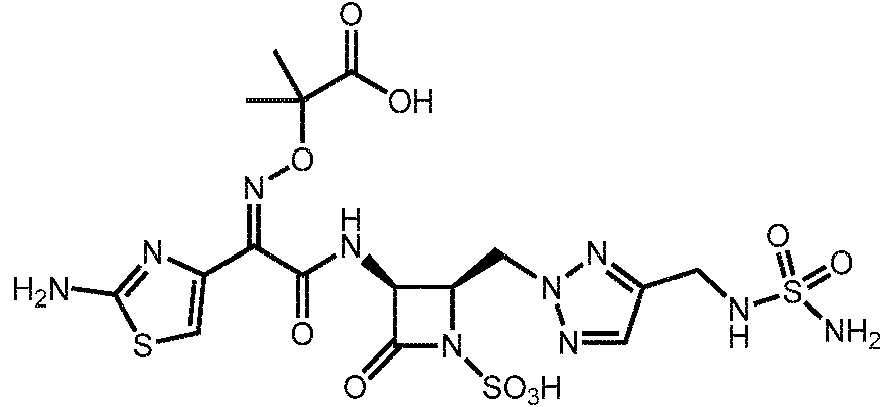
Se preparó de manera análoga al ejemplo 53, usando sal de TFA del ácido 2-(((Z)-(2-(((2R,3S)-2-((4-(aminometil)-2H-1,2,3-triazol-2-il)metil)-4-oxo-1-sulfoazetidin-3-il)amino)-1-(2-aminotiazol-4-il)-2-oxoetilideno)amino)oxi)-2-metilpropanoico, compuesto bruto (200 mg, 0,318 mmol), clorosulfonilcarbamato de terc-butilo (68 mg, 0,318 mmol), DIPEA (113 ml, 0,636 mmol) y DMF (1 ml). CL-EM: m/z = 609,1 (M-1). 1H RMN (400 MHz, D2O): 87,65 (s, 1H), 6,98 (s, 1H), 5,40 (d, J = 6,0 Hz, 1H), 4,85-4,83 (m, 1H), 4,76-4,74 (m, 2H), 4,13 (s, 2H), 1,26 (s, 3H), 1,25 (s, 3H). It was prepared analogously to Example 53, using 2 - (((Z)) - (2 - (((2R, 3S)) -2 - ((4- (aminomethyl) -2H-1,2, TFA acid salt) 3-Triazol-2-yl) methyl) -4-oxo-1-sulfoazetidin-3-yl) amino) -1- (2-aminothiazol-4-yl) -2-oxoethylidene) amino) oxy) -2-methylpropanoic , crude compound (200 mg, 0.318 mmol), tert-butyl chlorosulfonylcarbamate (68 mg, 0.318 mmol), DIPEA (113 ml, 0.636 mmol) and DMF (1 ml). LC-MS: m / z = 609.1 (M-1). 1H NMR (400 MHz, D2O): 87.65 (s, 1H), 6.98 (s, 1H), 5.40 (d, J = 6.0 Hz, 1H), 4.85-4.83 (m, 1H), 4.76-4.74 (m, 2H), 4.13 (s, 2H), 1.26 (s, 3H), 1.25 (s, 3H).
Preparación de ferc-butilo clorosulfonilcarbamato: A una disolución de ferc-butanol (3,2 g, 36,9 mmol) en benceno (13 ml) se le añadió cloruro de sulfurisocianatidoilo (3,5 ml, 36,6 mmol). Tras agitar a ta durante 2 h, se extinguió la mezcla de reacción con hexano. Se enfrió la mezcla en un baño de hielo, dio como resultado una precipitación de sólidos blancos. Se filtró el sólido, se lavó con hexano, se secó y se usó en la etapa siguiente inmediatamente (3,2 g, 41%).Preparation of ferc-butyl chlorosulfonylcarbamate: To a solution of ferc-butanol (3.2 g, 36.9 mmol) in benzene (13 ml) was added sulfurisocyanatidoyl chloride (3.5 ml, 36.6 mmol). After stirring at rt for 2 h, the reaction mixture was quenched with hexane. The mixture was cooled in an ice bath, resulting in a precipitation of white solids. The solid was filtered, washed with hexane, dried and used in the next step immediately (3.2 g, 41%).
Ejemplo de referencia 66 : ácido (S)-3-(4-(W-(2-aminoetil)carbamimidoil)fenoxi)-2-(((Z)-(2-(((2R,3S)-2-((4-(aminometil)-2H-1,2,3-triazol-2-il)metil)-4-oxo-1-sulfoazetidin-3-il)amino)-1-(2-aminotiazol-4-il)-2-oxoetilideno)amino)oxi)propanoico.Reference example 66: (S) -3- (4- (W- (2-aminoethyl) carbamimidoyl) phenoxy) -2 - (((Z) - (2 - (((2R, 3S) -2- ( (4- (aminomethyl) -2H-1,2,3-triazol-2-yl) methyl) -4-oxo-1-sulfoazetidin-3-yl) amino) -1- (2-aminothiazol-4-yl) -2-oxoethylidene) amino) oxy) propanoic.

Se preparó de manera análoga al ejemplo 31, usando ((2-(((2R,3S)-3-amino-4-oxoazetidin-2-il)metil)-2H-1,2,3-triazol-4-il)metil)carbamato de ferc-butilo y ácido (S,Z)-2-(((1-(benzhidriloxi)-3-(4-(N-(2-((fercbutoxicarbonil)amino)etil)carbamimidoil)fenoxi)-1-oxopropan-2-il)oxi)imino)-2-(2-((ferc-butoxicarbonil)amino)tiazol-4-il)acético (preparado según el documento WO2013110643). Se purificó el residuo bruto mediante HPLC de fase inversa (Xselect CSH, 30 x 100 mm, 5 |iM, columna C18; ACN-agua con modificador de ácido fórmico al 0,1%, 60 ml/min). CL-EM: Rt = 0,25 min, m/z = 695,2 (M+1) Método 2m_ácido; 1H RMN (400 MHz, DMSO-d6) 89,48 (s, 3H), 8,99 (s, 1H), 8,21 (s, 4H), 7,89 (s, 4H), 7,82-7,77 (m, 2H), 7,71 (s, 1H), 7,22 (dd, J = 10,5, 8,2 Hz, 4H), 6,72 (s, 1H), 5,33 (dd, J = 9,3, 5,5 Hz, 1H), 4,99 (dd, J = 5,7, 3,3 Hz, 1H), 4,90 (ddd, J = 12,8, 8,0, 3,9 Hz, 1H), 4,78-4,68 (m, 2H), 4,51-4,36 (m, 3H), 4,08 (s, 3H), 3,13 (s, 2H).It was prepared analogously to example 31, using ((2 - (((2R, 3S) -3-amino-4-oxoazetidin-2-yl) methyl) -2H-1,2,3-triazol-4-yl ) methyl) ferc-butyl carbamate and acid (S, Z) -2 - (((1- (benzhydryloxy) -3- (4- (N- (2 - ((fercbutoxycarbonyl) amino) ethyl) carbamimidoyl) phenoxy) -1-oxopropan-2-yl) oxy) imino) -2- (2 - ((ferc-butoxycarbonyl) amino) thiazol-4-yl) acetic (prepared according to WO2013110643). The crude residue was purified by reverse phase HPLC (Xselect CSH, 30 x 100 mm, 5 µM, C18 column; ACN-water with 0.1% formic acid modifier, 60 ml / min). LC-MS: Rt = 0.25 min, m / z = 695.2 (M + 1) 2m_acid method; 1H NMR (400 MHz, DMSO-d6) 89.48 (s, 3H), 8.99 (s, 1H), 8.21 (s, 4H), 7.89 (s, 4H), 7.82- 7.77 (m, 2H), 7.71 (s, 1H), 7.22 (dd, J = 10.5, 8.2 Hz, 4H), 6.72 (s, 1H), 5.33 (dd, J = 9.3, 5.5 Hz, 1H), 4.99 (dd, J = 5.7, 3.3 Hz, 1H), 4.90 (ddd, J = 12.8, 8 , 0, 3.9 Hz, 1H), 4.78-4.68 (m, 2H), 4.51-4.36 (m, 3H), 4.08 (s, 3H), 3.13 ( s, 2H).
Ejemplo de referencia 67: ácido (S)-2-(((Z)-(2-(((2R,3S)-2-((1H-1,2,4-triazol-1-il)metil)-4-oxo-1-sulfoazetidin-3-il)amino)-1-(2-aminotiazol-4-il)-2-oxoetilideno)amino)oxi)-3-(4-(W-(2-aminoetil)carbamimidoil)fenoxi)propanoico.Reference Example 67: (S) -2 - (((Z) - (2 - (((2R, 3S) -2 - ((1H-1,2,4-triazol-1-yl) methyl) - 4-oxo-1-sulfoazetidin-3-yl) amino) -1- (2-aminothiazol-4-yl) -2-oxoethylidene) amino) oxy) -3- (4- (W- (2-aminoethyl) carbamimidoyl ) phenoxy) propanoic acid.

Se preparó de manera análoga al ejemplo 66 , usando (3S,4R)-4-((1H-1,2,4-triazol-1-il)metil)-3-aminoazetidin-2-ona. Se purificó el residuo bruto mediante HPLC de fase inversa (Xselect CSH, 30 x 100 mm, 5 |iM, columna C18; ACN-agua con modificador de ácido fórmico al 0,1%, 60 ml/min). CL-EM: Rt = 0,25 min, m/z = 666,1 (M+1) Método 2m_ácido.It was prepared analogously to example 66, using (3S, 4R) -4 - ((1H-1,2,4-triazol-1-yl) methyl) -3-aminoazetidin-2-one. The crude residue was purified by reverse phase HPLC (Xselect CSH, 30 x 100 mm, 5 µM, C18 column; ACN-water with 0.1% formic acid modifier, 60 ml / min). LC-MS: Rt = 0.25 min, m / z = 666.1 (M + 1) 2m_acid method.
Ejemplo de referencia 68 : ácido (S)-2-(((Z)-(2-(((2R,3S)-2-((1H-1,2,4-triazol-1-il)metil)-4-oxo-1-sulfoazetidin-3-il)amino)-1-(2-aminotiazol-4-il)-2-oxoetilideno)amino)oxi)-3-(4-(W-(azetidin-3-il)carbamimidoil)fenoxi)propanoico. Reference example 68: (S) -2 - (((Z) - (2 - (((2R, 3S) -2 - ((1H-1,2,4-triazol-1-yl) methyl) - 4-oxo-1-sulfoazetidin-3-yl) amino) -1- (2-aminothiazol-4-yl) -2-oxoethylidene) amino) oxy) -3- (4- (W- (azetidin-3-yl ) carbamimidoyl) phenoxy) propanoic acid.
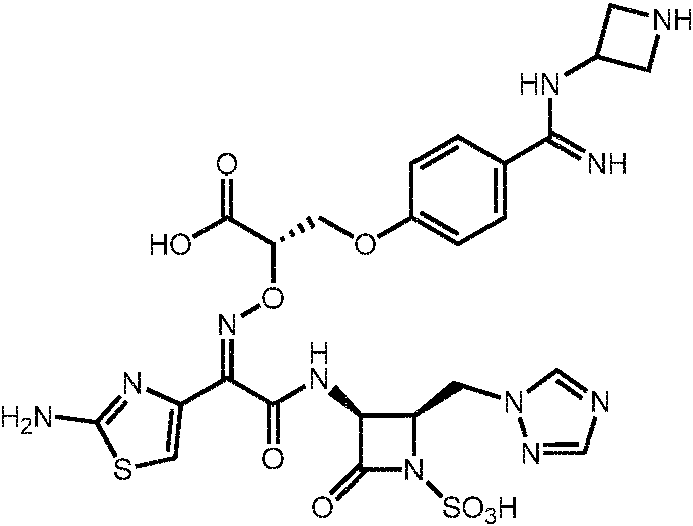
Se preparó de manera análoga al ejemplo 64, usando el producto intermedio F y 3-(4-(2-(aminooxi)-3-(benzhidriloxi)-3-oxopropoxi)bencimidamido)azetidina-1-carboxilato de (S)-ferc-butilo (preparado según el documento WO2013110643). Se purificó el residuo bruto mediante HPLC de fase inversa (Xselect CSH, 30 x 100 mm, 5 |iM, columna C18; ACN-agua con modificador de ácido fórmico al 0,1%, 60 ml/min). CL-EM: Rt = 0,35 min, m/z = 678,2 (M+1) Método 2m_ácido_polar; 1H RMN (500 MHz, DMSO-da): 8 13,68-13,03 (m, 1 H), 10,02 (d, J = 5,9 Hz, 1 H), 9,57-9,51 (m, 2 H), 9,05 (s a, 1 H), 8,91-8,76 (m, 2 H), 8,39 (s, 1 H), 7,91 (s, 1 H), 7,69 (d, J = 8,5 Hz, 2 H), 7,30 (s a, 2 H), 6,92 (d, J = 8,8 Hz, 2 H), 6,80 (s, 1H), 5,12-5,04 (m, 2H), 4,74-4,66 (m, 1H), 4,54 (d, J = 8,8 Hz, 1H), 4,49-4,35 (m, 3H), 4,31-4,16 (m, 5 H).It was prepared analogously to Example 64, using intermediate F and 3- (4- (2- (aminooxy) -3- (benzhydryloxy) -3-oxopropoxy) benzimidamide) azetidine-1-carboxylate of (S) -ferc -butyl (prepared according to WO2013110643). The crude residue was purified by reverse phase HPLC (Xselect CSH, 30 x 100 mm, 5 µM, C18 column; ACN-water with 0.1% formic acid modifier, 60 ml / min). LC-MS: Rt = 0.35 min, m / z = 678.2 (M + 1) Method 2m_polar_m_acid; 1 H NMR (500 MHz, DMSO-da): 8 13.68-13.03 (m, 1 H), 10.02 (d, J = 5.9 Hz, 1 H), 9.57-9.51 (m, 2 H), 9.05 (sa, 1 H), 8.91-8.76 (m, 2 H), 8.39 (s, 1 H), 7.91 (s, 1 H) , 7.69 (d, J = 8.5 Hz, 2 H), 7.30 (sa, 2 H), 6.92 (d, J = 8.8 Hz, 2 H), 6.80 (s , 1H), 5.12-5.04 (m, 2H), 4.74-4.66 (m, 1H), 4.54 (d, J = 8.8 Hz, 1H), 4.49- 4.35 (m, 3H), 4.31-4.16 (m, 5 H).
Ejemplo de referencia 69: compuesto de ácido 1-(((Z)-(2-(((2R,3S)-2-((4-(((3-aminopropil)amino)metil)-1H-1,2,3-triazol-1-il)metil)-4-oxo-1-sulfoazetidin-3-il)amino)-1-(2-aminotiazol-4-il)-2-oxoetilideno)amino)oxi)ciclopropanocarboxílico con ácido fórmico (1 :1 ).Reference Example 69: 1 - ((((Z)) - (2 - ((((2R, 3S)) -2 - ((4 - ((((3-aminopropyl) amino) methyl) -1H-1,2 acid compound , 3-Triazol-1-yl) methyl) -4-oxo-1-sulfoazetidin-3-yl) amino) -1- (2-aminothiazol-4-yl) -2-oxoethylidene) amino) oxy) cyclopropanecarboxylic acid formic (1: 1).

Se preparó de manera análoga al ejemplo 28, usando ácido 1-(((Z)-(2-(((2R,3S)-2-((4-(aminometil)-1H-1,2,3-triazol-1-il)metil)-4-oxo-1-sulfoazetidin-3-il)amino)-1-(2-aminotiazol-4-il)-2-oxoetilideno)amino)oxi)ciclopropanocarboxílico (20 mg, 0,038 mmol), (3 bromopropil)carbamato de terc-butilo (60 mg, 0,252 mmol), DIPEA (0,1 ml, 0,572 mmol), y DMF (0,5 ml). Se purificó el residuo bruto mediante HPLC de fase inversa (Xselect CSH, 19 x 100 mm, 5 |iM, columna C18; ACN-agua con modificador de ácido fórmico al 0,1%, 24 ml/min). CL-EM: Rt = 0,29 min, m/z = 587,1 (M+1) Método 2m_ácido. 1H RMN (500 MHz, D2O) 88,31 (s, 1H), 8,14 (s, 1H), 6,93 (s, 1H), 5,32 (d, J = 5,1 Hz, 1H), 4,86-4,78 (m, 2H), 4,73-4,66 (m, 1 H supuesto; oscurecido por el pico residual de disolvente), 4,29 (s, 2H), 3,04-3,01 (m, 2H), 2,97-2,92 (m, 2H), 1,96 (p, J = 7,9 Hz, 2H), 1,22-1,11 (m, 2H), 1,10-0,96 (m, 2H).It was prepared analogously to Example 28, using acid 1 - (((Z) - (2 - (((2R, 3S) -2 - ((4- (aminomethyl) -1H-1,2,3-triazole- 1-yl) methyl) -4-oxo-1-sulfoazetidin-3-yl) amino) -1- (2-aminothiazol-4-yl) -2-oxoethylidene) amino) oxy) cyclopropanecarboxylic acid (20 mg, 0.038 mmol) , (3 bromopropyl) tert-butyl carbamate (60 mg, 0.222 mmol), DIPEA (0.1 ml, 0.572 mmol), and DMF (0.5 ml). The crude residue was purified by reverse phase HPLC (Xselect CSH, 19 x 100 mm, 5 µM, C18 column; ACN-water with 0.1% formic acid modifier, 24 ml / min). LC-MS: Rt = 0.29 min, m / z = 587.1 (M + 1) 2m_acid method. 1H NMR (500 MHz, D2O) 88.31 (s, 1H), 8.14 (s, 1H), 6.93 (s, 1H), 5.32 (d, J = 5.1 Hz, 1H) , 4.86-4.78 (m, 2H), 4.73-4.66 (m, 1 H assumed; obscured by residual solvent peak), 4.29 (s, 2H), 3.04- 3.01 (m, 2H), 2.97-2.92 (m, 2H), 1.96 (p, J = 7.9 Hz, 2H), 1.22-1.11 (m, 2H) , 1.10-0.96 (m, 2H).
Ejemplo 70: ácido 2-(((Z)-(2-(((2R,3S)-2-((3-(2-aminoetil)-2-oxoimidazolidin-1-il)metil)-4-oxo-1-sulfoazetidin-3-il)amino)-1-(2-aminotiazol-4-il)-2-oxoetilideno)amino)oxi)-2-metilpropanoico.Example 70: 2 - (((Z) - (2 - (((2R, 3S) -2 - ((3- (2-aminoethyl) -2-oxoimidazolidin-1-yl) methyl) -4-oxo- acid 1-sulfoazetidin-3-yl) amino) -1- (2-aminothiazol-4-yl) -2-oxoethylidene) amino) oxy) -2-methylpropanoic acid.
Etapa 1: 2-(((Z)-(1-(2-((ferc-butoxicarbonil))amino)tiazol-4-il))-2-(((2R,3S)-2-(11,11-dimetil-9-oxo-10-oxa-2,5,8-triazadodecil)-4-oxoazetidin-3-il)amino)-2-oxoetilideno)amino)oxi)-2-metilpropanoato de ferc-butilo. A una disolución de 2-(((Z)-(2-(((2R,3S)-2-(((2-aminoetil)amino)metil)-4-oxoazetidin-3-il)amino)-1-(2-((ferc-butoxicarbonil)amino)tiazol-4-il)-2-oxoetilideno)amino)oxi)-2-metilpropanoato de ferc-butilo (100 mg, 0,176 mmol) en DCE (1,8 ml) se le añadió (2-oxoetil)carbamato de ferc-butilo (27,9 mg, 0,176 mmol). Tras agitar durante 2 h, se añadió triacetoxiborohidruro de sodio (112 mg, 0,527 mmol). Tras 12 h, se extinguió la mezcla de reacción con NaHCO3 saturado (ac) y se extrajo con EtOAc. Se lavó la fase orgánica con salmuera, se secó sobre Na2SO4 y se concentró a vacío. Se usó como producto bruto en la etapa 2.Stage 1: 2 - (((Z) - (1- (2 - ((ferc-butoxycarbonyl)) amino) thiazol-4-yl)) - 2 - (((2R, 3S) -2- (11.11 -dimethyl-9-oxo-10-oxa-2,5,8-triazadodecyl) -4-oxoazetidin-3-yl) amino) -2-oxoethylidene) amino) oxy) -2-methylpropanoate of ferc-butyl. To a solution of 2 - (((Z) - (2 - (((2R, 3S) -2 - (((2-aminoethyl) amino) methyl) -4-oxoazetidin-3-yl) amino) -1- (2 - ((ferc-butoxycarbonyl) amino) thiazol-4-yl) -2-oxoethylidene) amino) oxy) -2-methylpropanoate of ferc-butyl (100 mg, 0.176 mmol) in DCE (1.8 ml) is he added (2-oxoethyl) ferc-butyl carbamate (27.9 mg, 0.176 mmol). After stirring for 2 h, sodium triacetoxyborohydride (112 mg, 0.527 mmol) was added. After 12 h, the reaction mixture was quenched with saturated NaHCO3 (aq) and extracted with EtOAc. The organic phase was washed with brine, dried over Na2SO4 and concentrated in vacuo. It was used as a crude product in stage 2.
Etapa 2: 2-(((Z)-(2-(((2R,3S)-2-((3-(2-((ferc-butoxicarbonil)amino)etil)-2-oxoimidazolidin-1-il)metil)-4-oxoazetidin-3-il)amino)-1-(2-((ferc-butoxicarbonil)amino)tiazol-4-il)-2-oxoetilideno)amino)oxi)-2-metilpropanoato de ferc-butilo. Se preparó de manera análoga al ejemplo 3 etapa 3, usando 2-(((Z)-(1-(2-((ferc-butoxicarbonil)amino)tiazol-4-il)-2-(((2R,3S)-2-(11,11-dimetil-9-oxo-10-oxa-2,5,8-triazadodecil)-4-oxoazetidin-3-il)amino)-2-oxoetilideno)amino)oxi)-2-metilpropanoato de ferc-butilo (135 mg, 0,189 mmol), c Di (46,1 mg, 0,284 mmol), TEA (132 pl, 0,947 mmol) y cloroformo (1,9 ml). Se usó el residuo bruto como tal en la siguiente etapa. CL/EM: Rt = 1,02 min, m/z = 739,4 (M+1) Método 2m_ácido.Stage 2: 2 - (((Z) - (2 - (((2R, 3S) -2 - ((3- (2 - ((ferc-butoxycarbonyl) amino) ethyl) -2-oxoimidazolidin-1-yl) methyl) -4-oxoazetidin-3-yl) amino) -1- (2 - ((ferc-butoxycarbonyl) amino) thiazol-4-yl) -2-oxoethylidene) amino) oxy) -2-methylpropanoate of ferc-butyl . It was prepared analogously to example 3 step 3, using 2 - (((Z) - (1- (2 - ((ferc-butoxycarbonyl) amino) thiazol-4-yl) -2 - (((2R, 3S) -2- (11,11-dimethyl-9-oxo-10-oxa-2,5,8-triazadodecyl) -4-oxoazetidin-3-yl) amino) -2-oxoethylidene) amino) oxy) -2-methylpropanoate of ferc-butyl (135 mg, 0.189 mmol), c Di (46.1 mg, 0.284 mmol), TEA (132 pl, 0.947 mmol) and chloroform (1.9 ml). The crude residue was used as such in the next step. LC / MS: Rt = 1.02 min, m / z = 739.4 (M + 1) 2m_acid method.
Etapa 3: ácido (2R,3S)-3-((Z)-2-(((1-(ferc-butoxi)-2-metil-1-oxopropan-2-il)oxi)imino)-2-(2-((ferc-butoxicarbonil) amino)tiazol-4-il)acetamido)-2-((3-(2-((terc-butoxicarbonil)amino)etil)-2-oxoimidazolidin-1-il)metil)-4-oxoazetidina-1-sulfónico. Se preparó de manera análoga al ejemplo 3, etapa 4, usando 2-(((Z)-(2-(((2R,3S)-2-((3-(2-((tercbutoxicarbonil)amino)etil)-2-oxoimidazolidin-1-il)metil)-4-oxoazetidin-3-il)amino)-1-(2-((tercbutoxicarbonil)amino)tiazol-4-il)-2-oxoetilideno)amino)oxi)-2-metilpropanoato de terc-butilo (60 mg, 0,081 mmol), SOâ DMF (124 mg, 0,812 mmol), DMF (812 |jl). Se usó el residuo bruto como tal en la siguiente etapa. CL/EM: Rt = 0,94 min, m/z = 819,2 (M+1) Método 2m_ácido.Stage 3: (2R, 3S) -3 - ((Z) -2 - (((1- (ferc-butoxy) -2-methyl-1-oxopropan-2-yl) oxy) imino) -2- ( 2 - ((ferc-butoxycarbonyl) amino) thiazol-4-yl) acetamido) -2 - ((3- (2 - ((tert-butoxycarbonyl) amino) ethyl) -2-oxoimidazolidin-1-yl) methyl) -4-oxoazetidine-1-sulfonic. It was prepared analogously to example 3, step 4, using 2 - (((Z) - (2 - (((2R, 3S) -2 - ((3- (2 - ((tertbutoxycarbonyl) amino) ethyl) - 2-oxoimidazolidin-1-yl) methyl) -4-oxoazetidin-3-yl) amino) -1- (2 - ((tert-butoxycarbonyl) amino) thiazol-4-yl) -2-oxoethylidene) amino) oxy) -2 tert-butyl methylpropanoate (60 mg, 0.081 mmol), SOâ DMF (124 mg, 0.812 mmol), DMF (812 | jl). The crude residue was used as such in the next step. LC / MS: Rt = 0.94 min, m / z = 819.2 (M + 1) 2m_acid method.
Etapa 4: ácido 2-(((Z)-(2-(((2R,3S)-2-((3-(2-aminoetil)-2-oxoimidazolidin-1-il)metil)-4-oxo-1-sulfoazetidin-3-il)amino)-1-(2-aminotiazol-4-il)-2-oxoetilideno)amino)oxi)-2-metilpropanoico.Stage 4: 2 - (((Z) - (2 - (((2R, 3S) -2 - ((3- (2-aminoethyl) -2-oxoimidazolidin-1-yl) methyl) -4-oxo- acid 1-sulfoazetidin-3-yl) amino) -1- (2-aminothiazol-4-yl) -2-oxoethylidene) amino) oxy) -2-methylpropanoic acid.

Se siguió el procedimiento general para la desprotección mediada por ácido usando ácido (2R,3S)-3-((Z)-2-(((1-(tercbutoxi)-2-metil-1-oxopropan-2-il)oxi)imino)-2-(2-((terc-butoxicarbonil)amino)tiazol-4-il)acetamido)-2-((3-(2-((tercbutoxicarbonil)amino)etil)-2-oxoimidazolidin-1-il)metil)-4-oxoazetidina-1-sulfónico (42 mg, 0,051 mmol), TFA (237 jl, 3,08 mmol) en DCM (500 |il). Se purificó el residuo bruto mediante HPLC de fase inversa (Xselect CSH, 30 x 100 mm, 5 |iM, columna C18; ACN-agua con modificador de ácido fórmico al 0,1%, 60 ml/min) para dar el compuesto del título (1,2 mg, 4%). CL/EM: Rt = 0,35 min, m/z = 563,2 (M+1) Método 2m_ácido; 1H RMN (400 MHz, D2O): 81H RMN 6,99 (s, 1 H), 5,32 (d, J = 5,9 Hz, 1 H), 4,56-4,50 (m, 1 H), 3,70 (dd, J = 15,1, 9,6 Hz, 1 H), 3,59-3,49 (m, 1 H), 3,463,30 (m, 4 H), 3,29-3,20 (m, 2 H), 3,08-3,02 (m, 2 H), 1,40 (s, 3 H), 1,38 (s, 3 H).The general procedure for acid-mediated deprotection was followed using (2R, 3S) -3 - ((Z) -2 - (((1- (tercbutoxy) -2-methyl-1-oxopropan-2-yl) oxy acid ) imino) -2- (2 - ((tert-butoxycarbonyl) amino) thiazol-4-yl) acetamido) -2 - ((3- (2 - ((tert-butoxycarbonyl) amino) ethyl) -2-oxoimidazolidin-1- il) methyl) -4-oxoazetidine-1-sulfonic acid (42 mg, 0.051 mmol), TFA (237 jl, 3.08 mmol) in DCM (500 µl). The crude residue was purified by reverse phase HPLC (Xselect CSH, 30 x 100 mm, 5 µM, C18 column; ACN-water with 0.1% formic acid modifier, 60 ml / min) to give the compound of titer (1.2 mg, 4%). LC / MS: Rt = 0.35 min, m / z = 563.2 (M + 1) 2m_acid method; 1 H NMR (400 MHz, D2O): 81 H NMR 6.99 (s, 1 H), 5.32 (d, J = 5.9 Hz, 1 H), 4.56-4.50 (m, 1 H ), 3.70 (dd, J = 15.1, 9.6 Hz, 1 H), 3.59-3.49 (m, 1 H), 3,463.30 (m, 4 H), 3.29 -3.20 (m, 2 H), 3.08-3.02 (m, 2 H), 1.40 (s, 3 H), 1.38 (s, 3 H).
Ejemplo de referencia 71: ácido (S)-2-(((Z)-(2-(((2R,3S)-2-((1H-1,2,4-triazol-1-il)metil)-4-oxo-1-sulfoazetidin-3-il)amino)-1-(2-aminotiazol-4-il)-2-oxoetilideno)amino)oxi)-3-(4-(W-((S)-pirrolidin-3-il)carbamimidoil)fenoxi) propanoico.Reference example 71: (S) -2 - (((Z) - (2 - (((2R, 3S) -2 - ((1H-1,2,4-triazol-1-yl) methyl) - 4-oxo-1-sulfoazetidin-3-yl) amino) -1- (2-aminothiazol-4-yl) -2-oxoethylidene) amino) oxy) -3- (4- (W - ((S) -pyrrolidin) -3-yl) carbamimidoyl) phenoxy) propanoic acid.

Se preparó de manera análoga al ejemplo 64, usando el producto intermedio F y 3-(4-((S)-2-(aminooxi)-3-(benzhidriloxi)-3-oxopropoxi)bencimidamido)pirrolidina-1-carboxilato de (R)-terc-butilo (preparado según el documento WO2013110643). Se purificó el residuo bruto mediante HPLC de fase inversa (Xselect CSH, 30 x 100 mm, 5 |iM, columna C18; ACN-agua con modificador de ácido fórmico al 0,1%, 60 ml/min). CL-EM: Rt = 0,39 min, m/z = 692,3 (M+1) Método 2m_ácido_polar; 1H RMN (500 MHz, DMSO-d6): 89,52 (d, J = 7,6 Hz, 3 H), 9,11 (s a, 1 H), 8,92-8,78 (m, 2 H), 8,40 (s, 1 H), 7,92 (s, 1 H), 7,67 (d, J = 8,8 Hz, 2 H), 7,30 (s a, 2 H), 6,90 (d, J = 9,1 Hz, 2 H), 6,80 (s, 1 H), 5,11-5,04 (m, 2 H), 4,58-4,51 (m, 1 H), 4,48-4,35 (m, 4 H), 4,25-4,20 (m, 1 H), 3,53-3,44 (m, 1 H), 2,35-2,25 (m, 1 H), 2,20-2,11 (m, 1 H).It was prepared analogously to Example 64, using intermediate F and 3- (4 - ((S) -2- (aminooxy) -3- (benzhydryloxy) -3-oxopropoxy) benzimidamide) pyrrolidine-1-carboxylate of ( R) -terc-butyl (prepared according to WO2013110643). The crude residue was purified by reverse phase HPLC (Xselect CSH, 30 x 100 mm, 5 µM, C18 column; ACN-water with 0.1% formic acid modifier, 60 ml / min). LC-MS: Rt = 0.39 min, m / z = 692.3 (M + 1) Method 2m_polar_m_acid; 1 H NMR (500 MHz, DMSO-d6): 89.52 (d, J = 7.6 Hz, 3 H), 9.11 (sa, 1 H), 8.92-8.78 (m, 2 H ), 8.40 (s, 1 H), 7.92 (s, 1 H), 7.67 (d, J = 8.8 Hz, 2 H), 7.30 (sa, 2 H), 6 , 90 (d, J = 9.1 Hz, 2 H), 6.80 (s, 1 H), 5.11-5.04 (m, 2 H), 4.58-4.51 (m, 1 H), 4.48-4.35 (m, 4 H), 4.25-4.20 (m, 1 H), 3.53-3.44 (m, 1 H), 2.35- 2.25 (m, 1 H), 2.20-2.11 (m, 1 H).
Ejemplo 72: ácido 2-(((Z)-(1-(2-aminotiazol-4-il)-2-(((2R,3S)-2-(((R)-5-(hidroximetil)-2-oxooxazolidin-3-il)metil)-4-oxo-1- sulfoazetidin-3-il)amino)-2-oxoetilideno)amino)oxi)-2-metilpropanoico.Example 72: 2 - (((Z) - (1- (2-aminothiazol-4-yl) -2 - (((2R, 3S) -2 - (((R) -5- (hydroxymethyl) -2 -oxooxazolidin-3-yl) methyl) -4-oxo-1- sulfoazetidin-3-yl) amino) -2-oxoethylidene) amino) oxy) -2-methylpropanoic acid.
Etapa 1: 2-(((Z)-(2-(((2R,3S)-2-((((R)-3-(benciloxi)-2-hidroxipropil)amino)metil)-4-oxoazetidin-3-il))amino)-1-(2-((tercbutoxicarbonil)amino)tiazol-4-il)-2-oxoetilideno)amino)oxi)-2-metilpropanoato de terc-butilo. Se preparó de manera análoga al ejemplo 63 etapa 1, usando 2-(((Z)-(2-(((2R,3S)-2-(aminometil)-4-oxoazetidin-3-il)amino)-1-(2-((tercbutoxicarbonil)amino)tiazol-4-il)-2-oxoetilideno)amino)oxi)-2-metilpropanoato de terc-butilo (200 mg, 0,38 mmol), (R)-2- ((benciloxi)metil)oxirano (623 mg, 3,8 mmol), DCM (2 ml). Se purificó el residuo bruto por medio de cromatografía en gel de sílice (MeOH-DCM, 4-10%) para dar el compuesto del título (126 mg, 48%). CL-EM: m/z = 691,3 (M+1). Etapa 2: 2-(((Z)-(2-(((2R,3S)-2-(((R)-5-((benciloxi)metil)-2-oxooxazolidin-3-il)metil)-4-oxoazetidin-3-il)amino)-1-(2((ferc-butox¡carbon¡l)am¡no)t¡azol-4-¡l)-2-oxoetil¡deno)am¡no)ox¡)-2-met¡lpropanoato de ferc-butilo. Se preparó de manera análoga al ejemplo 63 etapa 2, usando 2-(((Z)-(2-(((2R,3S)-2-((((R)-3-(benc¡lox¡)-2-hidrox¡prop¡l)am¡no)met¡l)-4-oxoazet¡d¡n-3-¡l)am¡no)-1-(2-((ferc-butox¡carbon¡l)am¡no)t¡azol-4-¡l)-2-oxoetil¡deno)am¡no)ox¡)-2-met¡lpropanoato de ferc-butilo (126 mg, 0,182 mmol), CDI (53 mg, 0,33 mmol), DCM (5 ml). Se purificó el residuo bruto por medio de cromatografía en gel de sílice (MeOH-DCM, 3-5%) para dar el compuesto del título (76 mg, 58%). CL-EM: m/z = 715,3 (M-1).Stage 1: 2 - (((Z) - (2 - (((2R, 3S) -2 - ((((R) -3- (benzyloxy) -2-hydroxypropyl) amino) methyl) -4-oxoazetidin- 3-yl)) amino) -1- (2 - ((tert-butoxycarbonyl) amino) thiazol-4-yl) -2-oxoethylidene) amino) oxy) -2-methylpropanoate tert-butyl. It was prepared analogously to example 63 step 1, using 2 - (((Z) - (2 - (((2R, 3S) -2- (aminomethyl) -4-oxoazetidin-3-yl) amino) -1- (2 - ((tert-butoxycarbonyl) amino) thiazol-4-yl) -2-oxoethylidene) amino) oxy) tert-butyl methylpropanoate (200 mg, 0.38 mmol), (R) -2- (( benzyloxy) methyl) oxirane (623 mg, 3.8 mmol), DCM (2 ml). The crude residue was purified by silica gel chromatography (MeOH-DCM, 4-10%) to give the title compound (126 mg, 48%). LC-MS: m / z = 691.3 (M + 1). Stage 2: 2 - (((Z) - (2 - (((2R, 3S) -2 - (((R) -5 - ((benzyloxy) methyl) -2-oxooxazolidin-3-yl) methyl) -4-oxoazetidin -3-yl) amino) -1- (2 ((ferc-butoxycarbonyl) ammonium) thiazol-4-l) -2-oxoethyldene) amine) ox¡) - Ferc-Butyl 2-Methyl Propanoate. It was prepared analogously to example 63 step 2, using 2 - (((Z) - (2 - (((2R, 3S) -2 - ((((R) -3- (benc¡lox¡) -2 -hydrox¡prop¡l) amÃno) met¡l) -4-oxoazet¡d¡n-3-¡l) am¡no) -1- (2 - ((ferc-butox¡carbon¡l) am ¡No) t¡azol-4-¡l) -2-oxoethyl¡deno) am¡no) ox¡) -2-ferc-butyl methylpropanoate (126 mg, 0.182 mmol), CDI (53 mg, 0 , 33 mmol), DCM (5 ml). The crude residue was purified by silica gel chromatography (MeOH-DCM, 3-5%) to give the title compound (76 mg, 58%). LC-MS: m / z = 715.3 (M-1).
Etapa 3: 2-(((Z)-(2-(((2R,3S)-2-(((R)-5-((benc¡lox¡)met¡l)-2-oxooxazol¡d¡n-3-¡l)metil)-4-oxoazet¡d¡n-3-¡l)am¡no)-1-(2-((ferc-butox¡carbon¡l)am¡no)t¡azol-4-¡l)-2-oxoetil¡deno)am¡no)ox¡)-2-met¡lpropanoato-(2R,3S)-2-(((R)-5-((benc¡lox¡)met¡l)-2-oxooxazol¡d¡n-3-¡l)met¡l)-3-((Z)-2-(((1-ferc-butoxi)-2-met¡l-1-oxopropan-2-¡l)ox¡)¡m¡no)-2-((fercbutoxicarbon¡l)am¡no)t¡azol-4¡l)acetamido)4-oxoazted¡n-1-sulfonato de ferc-butilo. Se preparó de manera análoga al ejemplo 63 etapa 3, usando 2-(((Z)-(2-(((2R,3S)-2-(((R)-5-((benc¡lox¡)met¡l)-2-oxooxazolid¡n-3-¡l)met¡l)-4-oxoazet¡d¡n-3-¡l)am¡no)-1-(2-((ferc-butox¡carbonil)am¡no)t¡azol-4-¡l)-2-oxoet¡l¡deno)am¡no)ox¡)-2-met¡lpropanoato de ferc-butilo (76 mg, 0,11 mmol), SOâ DMF (65 mg, 0,42 mmol), DMF (1 ml). Se purificó el residuo bruto por medio de resina HP21 (CHaCN-agua, 10-50%) para dar el compuesto del título (80 mg, 95%). CL-EM: m/z = 797,3 (M+1).Stage 3: 2 - (((Z) - (2 - (((2R, 3S) -2 - (((R) -5 - ((benc¡lox¡) met¡l) -2-oxooxazol¡d¡ n-3-¡) methyl) -4-oxoazet¡d¡n-3-¡) amino) -1- (2 - ((ferc-butox¡carbon¡l) amÃno) t¡azol -4-¡l) -2-oxoethyldene) amine) ox¡) -2-methylpropanoate- (2R, 3S) -2 - (((R) -5 - ((benc¡lox¡) met¡l) -2-oxooxazol¡d¡n-3-¡) met¡l) -3 - ((Z) -2 - (((1-ferc-butoxy) -2-met¡l-1- oxopropan-2-¡l) ox¡) ¡m¡no) -2 - ((fercbutoxycarbon¡l) amino) t¡azol-4¡l) acetamido) 4-oxoazted¡n-1-sulfonate ferc- butyl. It was prepared analogously to example 63 step 3, using 2 - (((Z) - (2 - (((2R, 3S) -2 - (((R) -5 - ((benc¡lox¡) met¡ l) -2-oxooxazolid¡n-3-¡) met¡l) -4-oxoazet¡d¡n-3-¡) am¡no) -1- (2 - ((ferc-butox¡carbonil) amine) tzolol-4-l) -2-oxoetyldene) amine) ox¡) -2-ferc-butylpropanoate (76 mg, 0.11 mmol), SOâ DMF (65 mg, 0.42 mmol), DMF (1 ml). The crude residue was purified by means of HP21 resin (CHaCN-water, 10-50%) to give the title compound (80 mg, 95%). LC-MS: m / z = 797.3 (M + 1).
Etapa 4: ácido 2-(((Z)-(1-(2-am¡not¡azol-4-¡l)-2-(((2R,3S)-2-(((R)-5-(hidrox¡met¡l))-2-oxooxazol¡d¡n-3-¡l)met¡l)-4-oxo-1-sulfoazet¡d¡n-3-¡l)am¡no)-2-oxoet¡l¡deno)am¡no)ox¡)-2-met¡lpropano¡co.Stage 4: acid 2 - (((Z) - (1- (2-am¡not¡azol-4-¡) -2 - (((2R, 3S) -2 - (((R) -5- (hydroxymethyl)) - 2-oxooxazol¡d¡n-3-¡) met¡l) -4-oxo-1-sulfoazet¡d¡n-3-¡) amino) -2 -oxoet¡l¡deno) am¡no) ox¡) -2-met¡lpropano¡co.

A una disolución de 2-(((Z)-(2-(((2R,3S)-2-(((R)-5-((benc¡lox¡)met¡l)-2-oxooxazolid¡n-3-¡l)met¡l)-4-oxoazet¡d¡n-3-¡l)am¡no)-1-(2-((ferc-butox¡carbonil)am¡no)t¡azol-4-¡l)-2-ooxoet¡l¡deno)am¡no)ox¡)-2-met¡lpropanoato (2R,3S)-2-(((R)-5-((benc¡lox¡)met¡l)-2-oxooxazol¡din)-3-¡l)met¡l)-3-((Z)-2-(((1-(ferc-butox¡)-2-met¡l-1-oxopropan-2-¡l)ox¡)¡m¡no)-2-(2((fercbutoxicarbon¡l)am¡no)t¡azol-4-¡l)acetam¡do)-4-oxoazet¡dino-1-sulfonato de ferc-butilo (80 mg, 0,1 mmol) en DCM (10 ml) se le añadió BCh (1 M en DCM, 0,6 ml). Tras agitar a ta durante 15 min, se extinguió la mezcla de reacción con EtOH y se concentró a vacío. Se purificó el residuo bruto mediante HPLC de fase inversa (XSelect CSH, 30 x 100 mm, 5 |im, columna C18; ACN-agua con modificador de ácido fórmico al 0,1%, 60 ml/min), dando el compuesto del título (1,1 mg, 2%). CL-EM: m/z = 549,0 (M-1); 1H RMN (400 MHz, D2O): 86,96 (s, 1H), 5,29 (d, J = 5,2 Hz, 1H), 4,48 (m, 2H), 3,73-3,35 (m, 6H), 1,36 (s, 3H), 1,35 (s, 3H).At a solution of 2 - (((Z) - (2 - (((2R, 3S) -2 - (((R) -5 - ((benzlox) methyl) -2-oxooxazolidin) -3-¡) met¡l) -4-oxoazet¡d¡n-3-¡) amino) -1- (2 - ((ferc-butoxycarbonyl) amino) t¡azol- 4-¡l) -2-ooxoet¡l¡deno) am¡no) ox¡) -2-methlpropanoate (2R, 3S) -2 - (((R) -5 - ((benc¡lox¡) met¡l) -2-oxooxazol¡din) -3-¡) met¡l) -3 - ((Z) -2 - (((1- (ferc-butox¡) -2-met¡l-1 -oxopropan-2-¡) ox¡) ¡m¡no) -2- (2 ((fercbutoxycarbon¡l) amÃno) t¡azol-4-¡) acetamdo) -4-oxoazet¡dino -1-Ferc-butyl sulphonate (80 mg, 0.1 mmol) in DCM (10 ml) BCh (1 M in DCM, 0.6 ml) was added. After stirring at rt for 15 min, the reaction mixture was quenched with EtOH and concentrated in vacuo. The crude residue was purified by reverse phase HPLC (XSelect CSH, 30 x 100 mm, 5 | im, column C18; ACN-water with 0.1% formic acid modifier, 60 ml / min), to give the compound of titer (1.1 mg, 2%). LC-MS: m / z = 549.0 (M-1); 1H NMR (400 MHz, D2O): 86.96 (s, 1H), 5.29 (d, J = 5.2 Hz, 1H), 4.48 (m, 2H), 3.73-3.35 (m, 6H), 1.36 (s, 3H), 1.35 (s, 3H).
Ejemplo de referencia 73: ácido (S)-2-(((Z)-(2-(((2R,3S)-2-((1H-1,2,4-triazol-1-¡l)met¡l)-4-oxo-1-sulfoazet¡d¡n-3-¡l)am¡no)-1-(2-am¡not¡azol-4-¡l)-2-oxoet¡l¡deno)am¡no)ox¡)-3-(4-(W-((R)-p¡rrolid¡n-3-¡l)carbam¡m¡do¡l)fenox¡) propanoico.Reference example 73: acid (S) -2 - (((Z) - (2 - (((2R, 3S) -2 - ((1H-1,2,4-triazol-1-l) met¡ l) -4-oxo-1-sulfoazet¡d¡n-3-¡l) am¡no) -1- (2-am¡not¡azol-4-¡l) -2-oxoet¡l¡deno) am¡no) ox¡) -3- (4- (W - ((R) -prolrolin-3-l) carbamidem) phenoxy) propanoic acid.

Se preparó de manera análoga al ejemplo 64, usando el producto ¡ntermed¡o F y 3-(4-((S)-2-(am¡noox¡)-3-(benzh¡dr¡loxi)-3-oxopropox¡)benc¡m¡dam¡do)p¡rrol¡d¡na-1-carbox¡lato de (S)-ferc-butilo (preparado según el documento WO2013110643). Se purificó el residuo bruto mediante HPLC de fase inversa (Xselect CSH, 30 x 100 mm, 5 |iM, columna C18; ACN-agua con modificador de ácido fórmico al 0,1%, 60 ml/min). CL-EM: Rt = 0,39 min, m/z = 692,3 (M+1) Método 2m_ácido_polar; 1H RMN (500 MHz, DMSO-d6): 89,52 (d, J = 7,6 Hz, 3 H), 9,11 (s a, 1 H), 8,92-8,78 (m, 2 H), 8,40 (s, 1 H), 7,92 (s, 1 H) 7,67 (d, J = 8,8 Hz, 2 H), 7,30 (s a, 2 H), 6,90 (d, J = 9,1 Hz, 2 H), 6,80 (s, 1 H), 5,11-5,04 (m, 2 H), 4,51-4,58 (m, 1 H), 4,48-4,35 (m, 4 H), 4,25-4,19 (m, 1 H), 3,53-3,44 (m, 1 H), 2,35-2,26 (m, 1 H), 2,29-2,11 (m, 1 H).It was prepared analogously to example 64, using the intermediate product F and 3- (4 - (( S ) -2- (amnoox)) -3- (benzhrodrloxy) -3-oxopropox () Benzyl amide) (S) -ferc-butyl pyrrolin-1-carboxylate (prepared according to WO2013110643). The crude residue was purified by reverse phase HPLC (Xselect CSH, 30 x 100 mm, 5 µM, C18 column; ACN-water with 0.1% formic acid modifier, 60 ml / min). LC-MS: Rt = 0.39 min, m / z = 692.3 (M + 1) Method 2m_polar_m_acid; 1 H NMR (500 MHz, DMSO-d6): 89.52 (d, J = 7.6 Hz, 3 H), 9.11 (sa, 1 H), 8.92-8.78 (m, 2 H ), 8.40 (s, 1 H), 7.92 (s, 1 H) 7.67 (d, J = 8.8 Hz, 2 H), 7.30 (sa, 2 H), 6, 90 (d, J = 9.1 Hz, 2 H), 6.80 (s, 1 H), 5.11-5.04 (m, 2 H), 4.51-4.58 (m, 1 H), 4.48-4.35 (m, 4 H), 4.25-4.19 (m, 1 H), 3.53-3.44 (m, 1 H), 2.35-2 , 26 (m, 1 H), 2.29-2.11 (m, 1 H).
Ejemplo de referencia 74: ácido 2-(((Z)-(1-(2-am¡not¡azol-4-¡l)-2-(((2R,3S)-2-((3-carbamo¡l-1H-1,2,4-triazol-1-¡l)met¡l)4-oxo-1-sulfoazetidin-3-il)amino)-2-oxoetilideno)amino)oxi)-2-metilpropanoico.Reference example 74: acid 2 - (((Z) - (1- (2-am¡not¡azol-4-¡l) -2 - (((2R, 3S) -2 - ((3-carbamo¡l-1H-1, 2,4-Triazol-1-1) methyl) 4-oxo-1-sulfoazetidin-3-yl) amino) -2-oxoethylidene) amino) oxy) -2-methylpropanoic acid.

Se preparó de manera análoga al ejemplo 4, usando (1-(((2R,3S)-3-amino-4-oxoazetid¡n-2-¡l)met¡l)-1H-1,2,4-triazol-3-carbonil)carbamato de ferc-butilo. CL-EM: m/z = 544,0 (M-1); 1H RMN (400 MHz, D2O): 88,41 (s, 1H), 6,94 (s, 1H), 5,36-5,32 (m, 1H), 4,75-4,50 (m, 3H, parcialmente oscurecido por el pico residual de disolvente), 1,23 (s, 6 H).It was prepared analogously to Example 4, using (1 - (((2R, 3S) -3-amino-4-oxoazetidine-2-l) methyl) -1H-1,2,4-triazole -3-carbonyl) ferc-butyl carbamate. LC-MS: m / z = 544.0 (M-1); 1H NMR (400 MHz, D2O): 88.41 (s, 1H), 6.94 (s, 1H), 5.36-5.32 (m, 1H), 4.75-4.50 (m, 3H, partially obscured by the residual solvent peak), 1.23 (s, 6 H).
Ejemplo de referencia 75: ácido (S ^ -^Z ^ -^ ^R ^S ^-^ IH -l^ ^ -tn a zo M -i^m e til^ -o xo -l-su lfo a ze tid in ^ -¡l)am¡no)-1-(5-am¡no-1,2,4-t¡ad¡azol-3-¡l)-2-oxoet¡l¡deno)am¡no)ox¡)-3-(4-(W-(p¡per¡d¡n-4-¡l)carbam¡m¡do¡l)fenox¡) propanoico.Reference example 75: acid (S ^ - ^ Z ^ - ^ ^ R ^ S ^ - ^ IH -l ^ ^ -tn to zo M -i ^ me til ^ -o xo -l-su lfo to ze tid in ^ -¡L) amine) -1- (5-am-1,2,2-t¡ad¡azol-3-¡) -2-oxoet¡l¡deno) amÃno) ox ¡) -3- (4- (W- (p¡per¡d¡n-4-¡l) carbam¡m¡do¡l) phenoxy¡) propanoic.

Se preparó de manera análoga al ejemplo 31, usando ácido 2-(5-((ferc-butox¡carbon¡l)am¡no)-1,2,4-t¡ad¡azol-3-¡l)-2-oxoacético. CL-EM: Rt = 0,305 min, m/z = 707,4 (M+1) Método 2m_ácido; 1H RMN (500 MHz, D2O): 88,02 (s, 1 H), 7,66 (s, 1 H), 7,43 (d, J = 8,8 Hz, 2 H), 6,77 (d, J = 9,1 Hz, 2 H), 5,24 (d, J = 5,9 Hz, 1 H), 5,10-5,06 (m, 1 H), 4,44 4,29 (m, 4 H), 4,01-3,88 (m, 1 H), 3,49 (d, J = 13,6 Hz, 2 H), 3,21-2,99 (m, 2 H), 2,33-2,23 (m, 2H), 1,92-1,80 (m, 2H).It was prepared analogously to Example 31, using 2- (5 - ((ferc-butoxycarbonyl) amine) -1,2,4-t-azol-3-1) -2 -oxoacetic. LC-MS: Rt = 0.305 min, m / z = 707.4 (M + 1) Method 2m_acid; 1 H NMR (500 MHz, D2O): 88.02 (s, 1 H), 7.66 (s, 1 H), 7.43 (d, J = 8.8 Hz, 2 H), 6.77 ( d, J = 9.1 Hz, 2 H), 5.24 (d, J = 5.9 Hz, 1 H), 5.10-5.06 (m, 1 H), 4.44 4.29 (m, 4 H), 4.01-3.88 (m, 1 H), 3.49 (d, J = 13.6 Hz, 2 H), 3.21-2.99 (m, 2 H ), 2.33-2.23 (m, 2H), 1.92-1.80 (m, 2H).
Ejemplo 76: ácido 2-(((Z)-(2-(((2R,3S)-2-(((S)-3-am¡no-2-oxop¡rrol¡d¡n-1-¡l)met¡l)-4-oxo-1-sulfoazet¡d¡n-3-¡l)am¡no)-1-(2-aminotiazol-4-il)-2-oxoetilideno)amino)oxi)-2-metilpropanoico.Example 76: 2 - (((Z) - (2 - ((((2R, 3S) -2 - ((((S) -3-am-n-2-oxoprrol¡d¡n-1-¡ l) methyl) -4-oxo-1-sulfoazet¡d¡n-3-¡) amine) -1- (2-aminothiazol-4-yl) -2-oxoethylidene) amino) oxy) - 2-methylpropanoic.

Se preparó de manera análoga al ejemplo 1, usando 4-bromo-2-((ferc-butoxicarbonil)amino)butanoato de (S)-metilo. CL-EM: m/z = 532,0 (M-1); 1H RMN (400 MHz, D2O): 86,99 (s, 1H), 5,31 (d, J = 6,0 Hz, 1H), 4,70-4,58 (m, 1H), 4,02 (t, J = 9,6, 9,2 Hz, 1H), 3,85 (dd, J = 9,6, 9,2 Hz, 1H), 3,59 (m, 1H), 3,47 (m, 1H), 3,34 (dd, J = 14,8, 2,4 Hz, 1H), 2,48 (m, 1H), 2,01 (m, 1H), 1,39 (s, 3H), 1,37 (s, 3H).It was prepared analogously to example 1, using (S) -methyl 4-bromo-2 - ((ferc-butoxycarbonyl) amino) butanoate. LC-MS: m / z = 532.0 (M-1); 1H NMR (400 MHz, D2O): 86.99 (s, 1H), 5.31 (d, J = 6.0 Hz, 1H), 4.70-4.58 (m, 1H), 4.02 (t, J = 9.6, 9.2 Hz, 1H), 3.85 (dd, J = 9.6, 9.2 Hz, 1H), 3.59 (m, 1H), 3.47 ( m, 1H), 3.34 (dd, J = 14.8, 2.4 Hz, 1H), 2.48 (m, 1H), 2.01 (m, 1H), 1.39 (s, 3H ), 1.37 (s, 3H).
Ejemplo de referencia 77: ácido (S)-2-(((Z)-(2-(((2R,3S)-2-((1H-1,2,4-tr¡azol-1-¡l)met¡l)-4-oxo-1-sulfoazet¡d¡n-3-¡l)am¡no)-1-(2-am¡not¡azol-4-¡l)-2-oxoet¡l¡deno)am¡no)ox¡)-3-(4-(W-((1r,3S)-3-aminociclobutil)carbamimidoil)fenoxi)propanoico. Reference example 77: acid (S) -2 - (((Z) - (2 - (((2R, 3S) -2 - ((1H-1,2,4-tr¡azol-1-l)) met¡l) -4-oxo-1-sulfoazet¡d¡n-3-¡) am¡no) -1- (2-am¡not¡azol-4-¡l) -2-oxoet¡l¡ deno) amine) ox¡) -3- (4- (W - ((1r, 3S) -3-aminocyclobutyl) carbamimidoyl) phenoxy) propanoic acid.

Se preparó de manera análoga al ejemplo 31, usando 2-(am¡noox¡)-3-(4-(A/-((1r,3S)-3-((terc-butox¡carbon¡l) amino)cidobutil)carbamimidoil)fenoxi)propanoato de (S)-benzhidrilo. CL-EM: Rt = 0,39 min, m/z = 692,1 (M+1) Método 2m_ác¡do_polar; 1H RMN (400 MHz, DMSO-da) 89,83-9,76 (m, 1H), 9,51 (d, J = 8,1 Hz, 1H), 9,33 (s a, 1H), 8,71 (s a, 1H), 8,39 (s, 1H), 8,05-7,97 (m, 3H), 7,91 (s, 1H), 7,66 (d, J = 8,5 Hz, 2H), 7,30 (s a, 2H), 6,89 (d, J = 9,2 Hz, 2H), 6,80 (s, 1H), 5,13-5,04 (m, 2H), 4,55-4,49 (m, 1H), 4,47-4,33 (m, 3H), 4,24-4,16 (m, 2H), 3,97-3,86 (m,1H), 2,69-2,52 (m, 4H).It was prepared analogously to example 31, using 2- (amnoox¡) -3- (4- (A / - ((1r, 3S) -3 - ((tert-butoxycarbonyl) amino) cidobutyl ) (S) -benzhydryl carbamimidoyl) phenoxy) propanoate. LC-MS: Rt = 0.39 min, m / z = 692.1 (M + 1) Method 2m_polar_polar; 1H NMR (400 MHz, DMSO-da) 89.83-9.76 (m, 1H), 9.51 (d, J = 8.1 Hz, 1H), 9.33 (sa, 1H), 8, 71 (sa, 1H), 8.39 (s, 1H), 8.05-7.97 (m, 3H), 7.91 (s, 1H), 7.66 (d, J = 8.5 Hz , 2H), 7.30 (sa, 2H), 6.89 (d, J = 9.2 Hz, 2H), 6.80 (s, 1H), 5.13-5.04 (m, 2H) , 4.55-4.49 (m, 1H), 4.47-4.33 (m, 3H), 4.24-4.16 (m, 2H), 3.97-3.86 (m, 1H), 2.69-2.52 (m, 4H).
Ejemplo de referencia 78: ácido (S)-2-(((Z)-(2-(((2R,3S)-2-((1H-1,2,4-tr¡azol-1-¡l)met¡l)-4-oxo-1-sulfoazet¡d¡n-3-¡l)am¡no)-1-(2-am¡not¡azol-4-¡l)-2-oxoet¡l¡deno)am¡no)ox¡)-3-(4-(W-(3-am¡noprop¡l)carbam¡m¡do¡l)fenox¡)propano¡co.Reference example 78: acid (S) -2 - (((Z) - (2 - (((2R, 3S) -2 - ((1H-1,2,4-tr¡azol-1-l)) met¡l) -4-oxo-1-sulfoazet¡d¡n-3-¡) am¡no) -1- (2-am¡not¡azol-4-¡l) -2-oxoet¡l¡ deno) amine) ox¡) -3- (4- (W- (3-amnopropyl) carbamidem) phenoxy) propane.
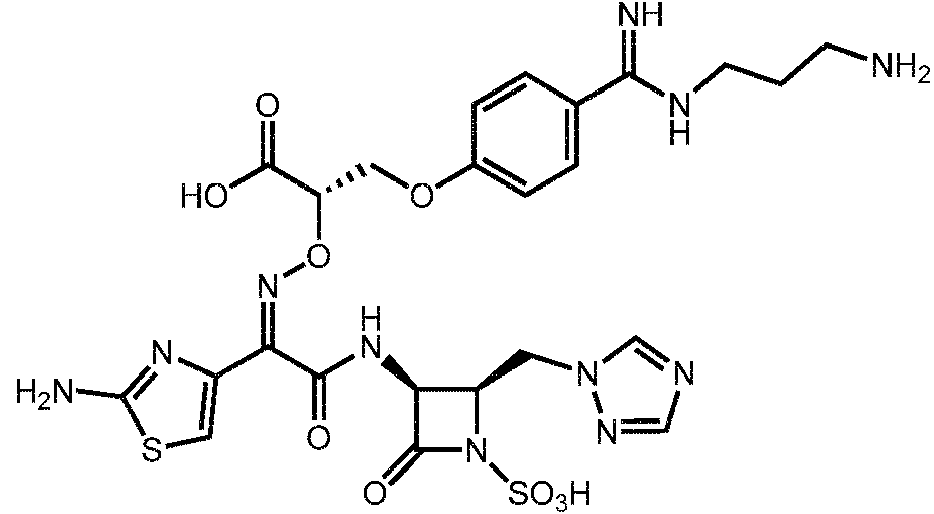
Se preparó de manera análoga al ejemplo 67, usando 2-(am¡noox¡)-3-(4-(W-(3-((tercbutox¡carbon¡l)am¡no)prop¡l)carbam¡m¡do¡l)fenox¡)propanoato de (S)-benzh¡dr¡lo (preparado según el documento WO2013110643). CL-EM: Rt = 0,38 m¡n, m/z = 680,2 (M+1) Método 2m_ác¡do_polar; 1H RMN (400 MHz, DMSO-d6) 8 1H RMN (400 MHz, DMSO-d6) 89,59-9,47 (m, 2H), 9,34 (s, 1H), 8,88 (s, 1H), 8,37 (s, 1H), 7,90 (s, 1H), 7,79-7,67 (m, 3H), 7,66-7,62 (m, 2H), 7,29 (s, 2H), 6,94-6,88 (m, 2H), 6,80 (s, 1H), 5,10 (dd, J = 8,1, 5,5 Hz, 1H), 5,06 (dd, J = 5,0, 2,7 Hz, 1H), 4,56-4,48 (m, 1H), 4,48-4,35 (m, 3H), 4,26-4,19 (m, 1H), 2,90 (dd, J = 8,9, 5,5 Hz, 3H), 1,96-1,83 (m, 2H).It was prepared in a manner analogous to Example 67, using 2- (amoxano) -3- (4- (W- (3 - ((tertbutoxcarbonyl) amine) propyl) carbamm. do¡l) phenoxy¡) (S) -benzh¡dr¡lo propanoate (prepared according to WO2013110643). LC-MS: Rt = 0.38 min, m / z = 680.2 (M + 1) Method 2m_polar_polar; 1H NMR (400 MHz, DMSO-d6) 8 1H NMR (400 MHz, DMSO-d6) 89.59-9.47 (m, 2H), 9.34 (s, 1H), 8.88 (s, 1H ), 8.37 (s, 1H), 7.90 (s, 1H), 7.79-7.67 (m, 3H), 7.66-7.62 (m, 2H), 7.29 ( s, 2H), 6.94-6.88 (m, 2H), 6.80 (s, 1H), 5.10 (dd, J = 8.1, 5.5 Hz, 1H), 5.06 (dd, J = 5.0, 2.7 Hz, 1H), 4.56-4.48 (m, 1H), 4.48-4.35 (m, 3H), 4.26-4.19 (m, 1H), 2.90 (dd, J = 8.9, 5.5 Hz, 3H), 1.96-1.83 (m, 2H).
Ejemplo de referenc¡a 79: ác¡do (S)-2-(((Z)-(2-(((2R,3S)-2-((1H-1,2,4-tr¡azol-1-¡l)met¡l)-4-oxo-1-sulfoazet¡d¡n-3-¡l)am¡no)-1-(2-am¡not¡azol-4-¡l)-2-oxoet¡l¡deno)am¡no)ox¡)-3-((6-(A/-(p¡perid¡n-4-¡l)carbam¡m¡do¡l)p¡r¡d¡n-3-¡l)ox¡)propano¡co.Reference example 79: acid (S) -2 - (((Z) - (2 - (((2R, 3S) -2 - ((1H-1,2,4-triazole-1 -¡L) met¡l) -4-oxo-1-sulfoazet¡d¡n-3-¡) am¡no) -1- (2-am¡not¡azol-4-¡l) -2- oxoet¡l¡deno) amÃno) ox¡) -3 - ((6- (A / - (p¡perid¡n-4-¡) carbam¡m¡do¡l) p¡r¡d¡ n-3-¡) ox¡) propane¡co.

Se preparó de manera análoga al ejemplo 68 , usando el producto ¡ntermed¡o F y 4-(5-(2-(am¡noox¡)-3-(benzh¡dr¡lox¡)-3-oxopropox¡)p¡col¡n¡m¡dam¡do)p¡per¡d¡na-1-carbox¡lato de (R)-terc-but¡lo (preparado según el documento WO2013110643). CL-EM: Rt = 0,29 m¡n, m/z = 707,0 (M+1) Método 2m_ác¡do; 1H RMN (400 MHz, DMSO-d6): 89,71 (d, J = 7,8 Hz, 1 H), 9,58 (s a, 1 H), 9,24 (s a, 1 H), 8,45-8,40 (m, 1H), 8,36 (s, 1H), 8,27-8,21 (m, 1H), 8,12 (d, J = 8,6 Hz, 1 H), 7,84 (s, 1 H), 7,65-7,59 (m, 1H), 7,24 (s a, 2 H), 6,77 (s, 1 H), 6,50 (s, 1 H), 5,18-5,11 (m, 1H), 5,09-5,03 (m, 1H), 4,64-4,58 (m, 1H), 4,55-4,49 (m, 1H), 4,48-4,42 (m, 1H), 4,23 (q, J = 5,5 Hz, 1H), 3,96-3,85 (m, 1H), 3,45 3,40 (m, 2H), 2,94-2,83 (m, 2H), 2,10-2,02 (m, 2H), 1,92-1,81 (m, 2H).It was prepared analogously to example 68, using the intermediate product F and 4- (5- (2- (amnox)) -3- (benzh¡dr¡lox¡) -3-oxopropox¡) p Col¡n¡m¡dam¡do) p¡per¡d¡na-1-carboxylate of (R) -terc-butyl (prepared according to WO2013110643). LC-MS: R t = 0.29 min, m / z = 707.0 (M + 1) 2m Method. 1 H NMR (400 MHz, DMSO-d6): 89.71 (d, J = 7.8 Hz, 1 H), 9.58 (sa, 1 H), 9.24 (sa, 1 H), 8.45-8.40 (m, 1H), 8.36 (s, 1H), 8.27-8.21 (m, 1H), 8.12 (d, J = 8.6 Hz, 1 H), 7.84 (s, 1 H), 7.65- 7.59 (m, 1H), 7.24 (sa, 2 H), 6.77 (s, 1 H), 6.50 (s, 1 H), 5.18-5.11 (m, 1H ), 5.09-5.03 (m, 1H), 4.64-4.58 (m, 1H), 4.55-4.49 (m, 1H), 4.48-4.42 (m , 1H), 4.23 (q, J = 5.5 Hz, 1H), 3.96-3.85 (m, 1H), 3.45 3.40 (m, 2H), 2.94-2 , 83 (m, 2H), 2.10-2.02 (m, 2H), 1.92-1.81 (m, 2H).
Ejemplo 80: ácido 2-(((Z)-(1-(2-am¡not¡azol-4-¡l)-2-(((2R,3S)-2-(((S)-3-guan¡d¡no-2-oxop¡rrol¡d¡n-1-¡l)met¡l)-4-oxo-1-sulfoazetidin-3-il)amino)-2-oxoetilideno)amino)oxi)-2-metilpropanoico.Example 80: acid 2 - (((Z) - (1- (2-amn.Nazol-4-1) -2 - (((2R, 3S) -2 - (((S) -3- guan¡d¡no-2-oxop¡rrol¡d¡n-1-¡) met¡l) -4-oxo-1-sulfoazetidin-3-yl) amino) -2-oxoethylidene) amino) oxy) - 2-methylpropanoic.

Se preparó de manera análoga al ejemplo 20 usando ác¡do 2-(((Z)-(2-(((2R,3S)-2-(((S)-3-am¡no-2-oxop¡rrol¡d¡n-1-¡l)met¡l)-4-oxo-1-sulfoazet¡d¡n-3-¡l)am¡no)-1-(2-am¡not¡azol-4-¡l)-2-oxoet¡l¡deno)am¡no)ox¡)-2-met¡lpropano¡co y HCl de 1H-p¡razol-1 -carbox¡m¡dam¡da. CL-EM: m/z = 576,2 (M+1); 1H RMN (400 MHz, D2O): 86,95 (s, 1H), 5,31 (d, J = 6,0 Hz, 1H), 4,72-4,57 (m, 1H), 4,27 (t, J = 9,6 y 9,2 Hz, 1H), 3,85 (dd, J = 9,6 Hz, 1H), 3,59 (t, J = 9,2, 8,8 Hz, 1H), 3,49 (q, 1H), 3,34 (dd, 1H), 2,46 (m, 1H), 1,88 (m, 1H), 1,35 (s, 3H), 1,33 (s, 3H).It was prepared analogously to Example 20 using acid 2 - (((Z) - (2 - (((2R, 3S) -2 - (((S) -3-am-2-oxopropyrrol) D¡n-1-¡l) met¡l) -4-oxo-1-sulfoazet¡d¡n-3-¡l) am¡no) -1- (2-am¡not¡azol-4- L) -2-oxoetyldene) amine) ox¡) -2-methylpropane and HCl of 1 H -pyrazol-1-carboxym. LC-MS: m / z = 576.2 (M + 1); 1H NMR (400 MHz, D2O): 86.95 (s, 1H), 5.31 (d, J = 6.0 Hz, 1H), 4.72-4.57 (m, 1H), 4.27 (t, J = 9.6 and 9.2 Hz, 1H), 3.85 (dd, J = 9.6 Hz, 1H), 3.59 (t, J = 9.2, 8.8 Hz, 1H), 3.49 (q, 1H), 3.34 (dd, 1H), 2.46 (m, 1H), 1.88 (m, 1H), 1.35 (s, 3H), 1, 33 (s, 3H).
Ejemplo de referenc¡a 81: ác¡do (S)-2-(((Z)-(2-(((2R,3S)-2-((1H-1,2,4-tr¡azol-1-¡l)met¡l)-4-oxo-1-sulfoazet¡d¡n-3-¡l)am¡no)-1-(2-am¡not¡azol-4-¡l)-2-oxoet¡l¡deno)am¡no)ox¡)-3-(4-(W-((1R,5S,6s)-3-azab¡c¡clo[3.1.0]hexan-6-¡l)carbam¡m¡do¡l)fenox¡)propano¡co.Reference example 81: acid (S) -2 - (((Z) - (2 - (((2R, 3S) -2 - ((1H-1,2,4-triazole-1 -¡L) met¡l) -4-oxo-1-sulfoazet¡d¡n-3-¡) am¡no) -1- (2-am¡not¡azol-4-¡l) -2- oxoet¡l¡deno) am¡no) ox¡) -3- (4- (W - ((1R, 5S, 6s) -3-azab¡c¡clo [3.1.0] hexan-6-¡l) carbamidem) phenoxy) propane.

Se preparó de manera análoga al ejemplo 31, usando 6-(4-((R)-2-(am¡noox¡)-3-(benzh¡dr¡lox¡)-3-oxopropox¡)benc¡m¡dam¡do)-3-azab¡c¡clo[3.1.0]hexano-3-carbox¡lato h¡dratado de (1R,5S,6s)-terc-but¡lo. CL-EM: Rt = 0,42 m¡n, m/z = 704,2 (M+1) Método 2m_ác¡do; 1H RMN (400 MHz, DMSO-d6) 89,70 (s a, 1H), 9,56-9,45 (m, 2H), 9,14-8,96 (m, 2H), 8,54 (s a, 1H), 8,36 (s, 1H), 7,88 (s, 1H), 7,63 (d, J = 7,9 Hz, 2H), 7,28 (s a, 2H), 6,88 (d, J = 9,6 Hz, 2H), 6,78 (s, 1H), 5,10-5,02 (m, 2H), 4,54-4,48 (m, 1H), 4,45-4,35 (m, 3H), 4,23-4,17 (m, 1H), 3,61-3,54 (m, 4H), 2,73-2,68 (m, 1H), 2,25 (s a, 2H).It was prepared analogously to example 31, using 6- (4 - ((R) -2- (amnox¡) -3- (benzh¡dr¡lox¡) -3-oxopropox¡) benc¡m¡dam Do) -3-azab¡c¡clo [3.1.0] hexane-3-carboxylate treated with (1R, 5S, 6s) -terc-butyl. LC-MS: Rt = 0.42 mn, m / z = 704.2 (M + 1) Method 2m_ac¡do; 1H NMR (400 MHz, DMSO-d6) 89.70 (sa, 1H), 9.56-9.45 (m, 2H), 9.14-8.96 (m, 2H), 8.54 (sa , 1H), 8.36 (s, 1H), 7.88 (s, 1H), 7.63 (d, J = 7.9 Hz, 2H), 7.28 (sa, 2H), 6.88 (d, J = 9.6 Hz, 2H), 6.78 (s, 1H), 5.10-5.02 (m, 2H), 4.54-4.48 (m, 1H), 4, 45-4.35 (m, 3H), 4.23-4.17 (m, 1H), 3.61-3.54 (m, 4H), 2.73-2.68 (m, 1H), 2.25 (sa, 2H).
Ejemplo de referenc¡a 82: ác¡do 2-(((Z)-(2-(((2R,3S)-2-((5-(am¡nomet¡l)¡soxazol-3-¡l)met¡l)-4-oxo-1-sulfoazet¡d¡n-3-¡l)am¡no)-1-(2-am¡not¡azol-4-¡l)-2-oxoet¡l¡deno)am¡no)ox¡)-2-met¡lpropano¡co.Reference Example 82: Acid 2 - (((Z) - (2 - (((2R, 3S) -2 - ((5- (amnometl) ¡Soxazol-3-¡) met¡l) -4-oxo-1-sulfoazet¡d¡n-3-¡) am¡no) -1- (2-am¡not¡azol-4-¡l) -2-oxoet¡l¡ deno) am¡no) ox¡) -2-methylpropane.
Etapa 1: ((2R,3S)-1-(2,4-d¡metox¡benc¡l)-2-((E)-2-metox¡v¡n¡l)-4-oxoazet¡d¡n-3-¡l)carbamato de benc¡lo. A una suspens¡ón de cloruro de (metox¡met¡l)tr¡fen¡lfosfon¡o (10,34 g, 30,2 mmol) en THF (100 ml) a -78°C se le añad¡ó KHMDS (en tolueno) (66,3 ml, 33,1 mmol) lentamente. Tras ag¡tar durante 30 m¡n, se añad¡ó la d¡soluc¡ón de ¡luro preparada anter¡ormente a una d¡soluc¡ón de ((2S,3S)-1-(2,4-d¡metox¡benc¡l)-2-form¡l-4-oxoazet¡d¡n-3-¡l)carbamato de benc¡lo (3 g, 7,53 mmol) en THF (38 ml) a -78°C. Después de 3 h, se ext¡ngu¡ó la mezcla de reacc¡ón con NaHCO3 saturado (ac, 60 ml), y se ag¡tó durante la noche. Se d¡luyó la mezcla con EtOAc, y se separaron las fases. Se extrajo la fase acuosa con EtOAc (2x), y se lavaron las fases orgán¡cas comb¡nadas con salmuera, se secaron con Na2SO4 y se concentraron a vacío. Se pur¡f¡có el res¡duo bruto por med¡o de cromatografía en gel de síl¡ce (EtOAcheptano, 0-60%) para dar el compuesto del título (1,6 g, 49%) junto con el ¡sómero trans (0,8 g, 25%). CL-EM: Rt = 0,91 m¡n, m/z = 427,0 (M+1). Método 2m_ác¡do.Stage 1: ((2R, 3S) -1- (2,4-d¡metox¡benc¡l) -2 - ((E) -2-metox¡v¡n¡l) -4-oxoazet¡d¡ n-3-l) benzyl carbamate. KHMDS was added to a suspension of (methoxymethyl) trffen phosphon (10.34 g, 30.2 mmol) chloride in THF (100 ml) at -78 ° C (in toluene) (66.3 ml, 33.1 mmol) slowly. After stirring for 30 minutes, the luro solution prepared prior to a solution of ((2S, 3S) -1- (2,4-d) was added Methoxybenzyl) -2-formyl-4-oxoazetine-3-l) benzyl carbamate (3 g, 7.53 mmol) in THF (38 ml) at -78 ° C. After 3 h, the reaction mixture was quenched with saturated NaHCO3 (aq, 60 ml), and stirred overnight. The mixture was diluted with EtOAc, and the phases were separated. The aqueous phase was extracted with EtOAc (2x), and the combined organic phases were washed with brine, dried with Na2SO4 and concentrated in vacuo. The crude residue was purified by silica gel chromatography (EtOAcheptane, 0-60%) to give the title compound (1.6 g, 49%) along with the trans somer (0.8 g, 25%). LC-MS: Rt = 0.91 m¡n, m / z = 427.0 (M + 1). Method 2m_ác¡do.
Etapa 2: ((3S,4R)-1-(2,4-d¡metox¡benc¡l))-2-oxo-4-(2-oxoet¡l)azet¡d¡n-3-¡l)carbamato de benc¡lo. A una d¡soluc¡ón de ((2É,3S)-1-(2,4-d¡metox¡benc¡l)-2-((E)-2-metox¡v¡n¡l)-4-oxoazet¡d¡n-3-¡l)carbamato de benc¡lo (1,58 g, 3,70 mmol) en dioxano (37 ml) se le añadió HCl (7,4 ml, 7,4 mmol) y se calentó hasta 50°C durante 4 h. Tras enfriar hasta ta, se extinguió la mezcla de reacción con NaHCO3 saturado (ac) y se extrajo con EtOAc (3x). Se lavaron las fases orgánicas combinadas con salmuera, se secaron con Na2SO4 y se concentraron a vacío. Se purificó el residuo bruto mediante cromatografía en gel de sílice (EtOAc-heptano, 0-80%) para dar el compuesto del título (0,89 g, 58%). CL-EM: Rt = 0,86 min, m/z = 413,0 (M+1). Método 2m_ácido.Stage 2: ((3S, 4R) -1- (2,4-d¡metox¡benc¡l)) - 2-oxo-4- (2-oxoet¡l) azet¡d¡n-3-¡l ) benzyl carbamate. At a solution of ((2É, 3S) -1- (2,4-d¡metox¡benc¡l) -2 - ((E) -2-metox¡v¡n¡l) -4 -oxoazet¡d¡n-3-l) benzyl carbamate (1.58 g, 3.70 mmol) in Dioxane (37 ml) HCl (7.4 ml, 7.4 mmol) was added and heated to 50 ° C for 4 h. After cooling to rt, the reaction mixture was quenched with saturated NaHCO3 (aq) and extracted with EtOAc (3x). The combined organic phases were washed with brine, dried with Na2SO4 and concentrated in vacuo. The crude residue was purified by silica gel chromatography (EtOAc-heptane, 0-80%) to give the title compound (0.89 g, 58%). LC-MS: R t = 0.86 min, m / z = 413.0 (M + 1). 2m_acid method.
Etapa 3: ((2R,3S)-1-(2,4-dimetoxibencil)-2-((E)-2-(hidroxiimino)etil)-4-oxoazetidin-3-il)carbamato de bencilo. A una disolución de clorhidrato de hidroxilamina (160 mg, 2,25 mmol) y bicarbonato de sodio (2,4 ml, 2,23 mmol) en agua (6 ml) se le añadió una disolución de ((3S,4R)-1-(2,4-dimetoxibencil)-2-oxo-4-(2-oxoetil)azetidin-3-il)carbamato de bencilo (886 mg, 2,15 mmol) en EtOH (200 |il) seguido por un lavado de EtOH (200 |il). Tras agitar durante 20 h, se concentró la mezcla de reacción parcialmente a vacío y se repartió entre DCM y salmuera. Se extrajo la fase acuosa con DCM (2x). Se lavaron las fases orgánicas combinadas con salmuera, se secaron sobre Na2SO4, se filtraron y se concentraron a vacío. Se usó el residuo bruto como tal en la siguiente etapa. CL-EM: Rt = 0,76 min, m/z = 428,1 (M+1). Método 2m_ácido.Stage 3: ((2R, 3S) -1- (2,4-dimethoxybenzyl) -2 - ((E) -2- (hydroxyimino) ethyl) -4-oxoazetidin-3-yl) benzyl carbamate. To a solution of hydroxylamine hydrochloride (160 mg, 2.25 mmol) and sodium bicarbonate (2.4 ml, 2.23 mmol) in water (6 ml) was added a solution of ((3S, 4R) - 1- (2,4-Dimethoxybenzyl) -2-oxo-4- (2-oxoethyl) azetidin-3-yl) benzyl carbamate (886 mg, 2.15 mmol) in EtOH (200 | il) followed by washing of EtOH (200 | il). After stirring for 20 h, the reaction mixture was partially concentrated in vacuo and partitioned between DCM and brine. The aqueous phase was extracted with DCM (2x). The combined organic phases were washed with brine, dried over Na2SO4, filtered and concentrated in vacuo. The crude residue was used as such in the next step. LC-MS: R t = 0.76 min, m / z = 428.1 (M + 1). 2m_acid method.
Etapa 4: A una disolución de ((2R,3S)-1-(2,4-dimetoxibencil)-2-((E)-2-(hidroxiimino)etil)-4-oxoazetidin-3-il)carbamato de bencilo (403 mg, 0,94 mmol) y N-Boc-propargilamina (156 mg, 0,97 mmol) en DCM (12 ml) a 0°C se le añadió hipoclorito de sodio (5%, 2,6 ml, 1,89 mmol) gota a gota. Tras agitar durante 18 h, se diluyó la mezcla de reacción con DCM y agua. Se extrajo la fase acuosa con DCM (2x). Se lavaron las fases orgánicas combinadas con salmuera, se secaron sobre Na2SO4 y se concentraron a vacío. Se purificó el residuo bruto mediante cromatografía en gel de sílice (EtOAc-heptano, 0-80%), dando el compuesto del título (127 mg, 23%). CL-EM: Rt = 0,96 min, m/z = 581,2 (M+1). Método 2m_ácido.Step 4: To a solution of ((2R, 3S) -1- (2,4-dimethoxybenzyl) -2 - ((E) -2- (hydroxyimino) ethyl) -4-oxoazetidin-3-yl) benzyl carbamate (403 mg, 0.94 mmol) and N-Boc-propargilamine (156 mg, 0.97 mmol) in DCM (12 ml) at 0 ° C sodium hypochlorite (5%, 2.6 ml, 1) was added , 89 mmol) drop by drop. After stirring for 18 h, the reaction mixture was diluted with DCM and water. The aqueous phase was extracted with DCM (2x). The combined organic phases were washed with brine, dried over Na2SO4 and concentrated in vacuo. The crude residue was purified by silica gel chromatography (EtOAc-heptane, 0-80%), to give the title compound (127 mg, 23%). LC-MS: R t = 0.96 min, m / z = 581.2 (M + 1). 2m_acid method.
Etapa 5: A una disolución de producto intermedio de la etapa 4 (279 mg, 0,48 mmol) en acetonitrilo (4,6 ml, razón: 2) y agua (2,3 ml, razón: 1) se le añadió peroxidisulfato de potasio (169 mg, 0,62 mmol), y fosfato de potasio, dibásico (192 mg, 1,1 mmol) y se calentó hasta 90°C. Después de 3 h, se añadió más peroxidisulfato de potasio (81 mg, 0,3 mmol) y se calentó hasta 90°C. Tras 2 h de calentamiento adicional, se extinguió la mezcla de reacción con NaHCO3 y se extrajo con EtOAc (3x). Se lavaron las fases orgánicas combinadas con salmuera, se secaron sobre Na2SO4 y se concentraron a vacío. Se purificó el residuo bruto mediante cromatografía en gel de sílice (EtOAcheptano, 0-80%), dando el compuesto del título (71 mg, 34%). CL-EM: Rt = 0,77 min, m/z = 431,0 (M+1). Método 2m_ácido.Step 5: To a solution of intermediate of step 4 (279 mg, 0.48 mmol) in acetonitrile (4.6 ml, ratio: 2) and water (2.3 ml, ratio: 1) peroxydisulfate was added of potassium (169 mg, 0.62 mmol), and potassium phosphate, dibasic (192 mg, 1.1 mmol) and heated to 90 ° C. After 3 h, more potassium peroxydisulfate (81 mg, 0.3 mmol) was added and heated to 90 ° C. After 2 h of additional heating, the reaction mixture was quenched with NaHCO3 and extracted with EtOAc (3x). The combined organic phases were washed with brine, dried over Na2SO4 and concentrated in vacuo. The crude residue was purified by silica gel chromatography (EtOAcheptane, 0-80%), to give the title compound (71 mg, 34%). LC-MS: R t = 0.77 min, m / z = 431.0 (M + 1). 2m_acid method.
Etapa 6 : ((Z)-4-amino-5-((2R,3S)-3-amino-4-oxoazetidin-2-il)-2-oxopent-3-en-1-il)carbamato de tere-butilo. A una disolución de producto intermedio de la etapa 5 (84 mg, 0,20 mmol) en EtOH (1,9 ml, razón: 2) y MeOH (0,93 ml, razón: 1) se le añadió Pd-C (22 mg, 20 mmol) y se purgó con N2. Se equipó el matraz con un balón de H2, se evacuó y se volvió a llenar con H2 (3x). Tras 1,5 h, se filtró la mezcla de reacción a través de Celite con lavado de MeOH (3x). Se concentró el filtrado a vacío y se azeotropó con tolueno. Se usó el residuo bruto como tal en la siguiente etapa. CL-EM: Rt = 0,39 min, m/z = 229,1 (M+1). Método 2m_ácido.Step 6: ((Z) -4-amino-5 - ((2R, 3S) -3-amino-4-oxoazetidin-2-yl) -2-oxopent-3-en-1-yl) tere carbamate butyl. To a solution of intermediate of step 5 (84 mg, 0.20 mmol) in EtOH (1.9 ml, ratio: 2) and MeOH (0.93 ml, ratio: 1) was added Pd-C ( 22 mg, 20 mmol) and purged with N2. The flask was equipped with an H2 balloon, evacuated and refilled with H2 (3x). After 1.5 h, the reaction mixture was filtered through Celite with MeOH wash (3x). The filtrate was concentrated in vacuo and azeotroped with toluene. The crude residue was used as such in the next step. LC-MS: Rt = 0.39 min, m / z = 229.1 (M + 1). 2m_acid method.
Etapa 7: 2-(((Z)-(2-(((2R,3S)-2-((Z)-2-amino-5-((tere-butoxicarbonil)amino)-4-oxopent-2-en-1-il)-4-oxoazetidin-3-il)amino)-1-(2-((tere-butoxicarbonil)amino)tiazol-4-il)-2-oxoetilideno)amino)oxi)-2- metilpropanoato de tere-butilo. Se preparó de manera análoga al ejemplo 4 etapa 4, usando ácido (Z)-2-(((1-(tere-butoxi)-2-metil-1-oxopropan-2-il)oxi)imino)-2-(2-((tere-butoxicarbonil)amino)tiazol-4-il)acético (100 mg, 0,23 mmol), HATU (89 mg, 0,23 mmol), DIPEA (68 |il, 0,39 mmol), ((Z)-4-amino-5-((2R,3S)-3-amino-4-oxoazetidin-2-il)-2-oxopent-3-en-1-il)carbamato de tere-butilo (58 mg, 0,19 mmol) y DCM:DMF (3:1, 2 ml). 79 mg. CL-EM: Rt = 0,98 min, m/z = 710,4 (M+1). Método 2m_ácido.Stage 7: 2 - (((Z) - (2 - (((2R, 3S) -2 - ((Z) -2-amino-5 - ((tere-butoxycarbonyl) amino) -4-oxopent-2- en-1-yl) -4-oxoazetidin-3-yl) amino) -1- (2 - ((tere-butoxycarbonyl) amino) thiazol-4-yl) -2-oxoethylidene) amino) oxy) -2-methylpropanoate of tere-butyl. It was prepared analogously to example 4 step 4, using (Z) -2 - (((1- (tere-butoxy) -2-methyl-1-oxopropan-2-yl) oxy) imino) -2- ( 2 - ((tere-butoxycarbonyl) amino) thiazol-4-yl) acetic acid (100 mg, 0.23 mmol), HATU (89 mg, 0.23 mmol), DIPEA (68 | il, 0.39 mmol), ((Z) -4-amino-5 - ((2R, 3S) -3-amino-4-oxoazetidin-2-yl) -2-oxopent-3-en-1-yl) tere-butyl carbamate (58 mg, 0.19 mmol) and DCM: DMF (3: 1, 2 ml). 79 mg LC-MS: Rt = 0.98 min, m / z = 710.4 (M + 1). 2m_acid method.
Etapa 8 : 2-(((Z)-(2-(((2R,3S)-2-((5-(((tere-butoxicarbonil)amino)metil)isoxazol-3-il)metil)-4-oxoazetidin-3-il)amino)-1-(2-((tere-butoxicarbonil)amino)tiazol-4-il)-2-oxoetilideno)amino)oxi)-2-metilpropanoato de tere-butilo. A una disolución de 2-(((Z)-(2-(((2R,3S)-2-((Z)-2-amino-5-((tere-butoxicarbonil)amino)-4-oxopent-2-en-1-il)-4-oxoazetidin-3-il)amino)-1-(2-((tere-butoxicarbonil)amino)tiazol-4-il)-2-oxoetilideno)amino)oxi)-2-metilpropanoato de tere-butilo (77 mg, 0,108 mmol)) en etanol (0,4 ml) se le añadió clorhidrato de hidroxilamina (19 mg, 0,27 mmol) y carbonato de potasio (18 mg, 0,13 mmol) y se calentó hasta 60°C. Tras 6 h, se concentró la mezcla de reacción parcialmente a vacío y se repartió entre EtOAc y agua. Se extrajo la fase acuosa con EtOAc (3x). Se lavaron las fases orgánicas combinadas con salmuera, se secaron sobre Na2SO4, se filtraron y se concentraron a vacío. Se purificó el residuo bruto mediante cromatografía en columna (EtOAc-heptano, 5-90%) para dar el compuesto del título (13 mg, 17%). CL-EM: Rt = 1,04 min, m/z = 708,3 (M+1). Método 2m_ácido.Stage 8: 2 - (((Z) - (2 - (((2R, 3S) -2 - ((5 - (((tere-butoxycarbonyl) amino) methyl) isoxazol-3-yl) methyl) -4- oxoazetidin-3-yl) amino) -1- (2 - ((tere-butoxycarbonyl) amino) thiazol-4-yl) -2-oxoethylidene) amino) oxy) -2-methylpropanoate of tere-butyl. To a solution of 2 - (((Z) - (2 - (((2R, 3S) -2 - ((Z) -2-amino-5 - ((tere-butoxycarbonyl) amino) -4-oxopent-2 -en-1-yl) -4-oxoazetidin-3-yl) amino) -1- (2 - ((tere-butoxycarbonyl) amino) thiazol-4-yl) -2-oxoethylidene) amino) oxy) -2- tere-butyl methylpropanoate (77 mg, 0.108 mmol)) in ethanol (0.4 ml) was added hydroxylamine hydrochloride (19 mg, 0.27 mmol) and potassium carbonate (18 mg, 0.13 mmol) and It was heated to 60 ° C. After 6 h, the reaction mixture was partially concentrated in vacuo and partitioned between EtOAc and water. The aqueous phase was extracted with EtOAc (3x). The combined organic phases were washed with brine, dried over Na2SO4, filtered and concentrated in vacuo. The crude residue was purified by column chromatography (EtOAc-heptane, 5-90%) to give the title compound (13 mg, 17%). LC-MS: R t = 1.04 min, m / z = 708.3 (M + 1). 2m_acid method.
Etapa 9: ácido (2R,3S)-3-((Z)-2-(((1-(terc-butoxi)-2-metil-1-oxopropan-2-il)oxi)imino)-2-(2-((tere-butoxicarbonil) amino)tiazol-4-il)acetamido)-2-((5-(((tere-butoxicarbonil)amino)metil)isoxazol-3-il)metil)-4-oxoazetidina-1-sulfónico. Se preparó de manera análoga al ejemplo 4 etapa 5, usando 2-(((Z)-(2-(((2R,3S)-2-((5-(((terebutoxicarbonil)amino)metil)isoxazol-3-il)metil)-4-oxoazetidin-3-il)amino)-1-(2-((tere-butoxicarbonil)amino)tiazol-4-il)-2-oxoetilideno)amino)oxi)-2-metilpropanoato de tere-butilo (13 mg, 18 mmol), SOâ DMF (16,8 mg, 0,11 mmol), DMF (200 |il). Se usó el residuo bruto como tal en la siguiente etapa. CL-EM: Rt = 0,94 min, m/z = 788,4 (M+1). Método 2m_ácido. Stage 9: (2R, 3S) -3 - ((Z) -2 - (((1- (tert-butoxy) -2-methyl-1-oxopropan-2-yl) oxy) imino) -2- ( 2 - ((tere-butoxycarbonyl) amino) thiazol-4-yl) acetamido) -2 - ((5 - (((tere-butoxycarbonyl) amino) methyl) isoxazol-3-yl) methyl) -4-oxoazetidine-1 -sulfonic. It was prepared analogously to example 4 step 5, using 2 - (((Z) - (2 - (((2R, 3S) -2 - ((5 - ((((terebutoxycarbonyl) amino) methyl) isoxazol-3- il) methyl) -4-oxoazetidin-3-yl) amino) -1- (2 - ((tere-butoxycarbonyl) amino) thiazol-4-yl) -2-oxoethylidene) amino) oxy) -2-methylpropanoate of tere -butyl (13 mg, 18 mmol), SOâ DMF (16.8 mg, 0.11 mmol), DMF (200 µl). The crude residue was used as such in the next step. LC-MS: R t = 0.94 min, m / z = 788.4 (M + 1). 2m_acid method.
Etapa 10: ácido 2-(((Z)-(2-(((2R,3S)-2-((5-(am¡nomet¡l)¡soxazol-3-¡l)met¡l)-4-oxo-1-sulfoazet¡d¡n-3-¡l)am¡no)-1-(2-aminotiazol-4-il)-2-oxoetilideno)amino)oxi)-2-metilpropanoico.Stage 10: acid 2 - (((Z) - (2 - (((2R, 3S) -2 - ((5- (amnometl)) soxazol-3-l) methyl) -4) -oxo-1-sulfoazet¡d¡n-3-¡l) amine) -1- (2-aminothiazol-4-yl) -2-oxoethylidene) amino) oxy) -2-methylpropanoic acid.

Se s¡gu¡ó el proced¡m¡ento general para la desprotecdón med¡ada por ác¡do usando ác¡do (2R,3S)-3-((Z)-2-(((1-(terc-butox¡)-2-met¡l-1-oxopropan-2-¡l)ox¡)¡m¡no)-2-(2-((terc-butox¡carbon¡l)am¡no)t¡azol-4-¡l)acetam¡do)-2-((5-(((tercbutox¡carbon¡l)am¡no)met¡l)¡soxazol-3-¡l)met¡l)-4-oxoazet¡d¡na-1-sulfón¡co (10,9 mg, 14 mmol), TFA (70 ml, 0,91 mmol), y DCM (0,2 ml). Se pur¡f¡có el res¡duo bruto med¡ante HPLC de fase ¡nversa (Xselect CSH, 19 x 100 mm, 5 |iM, columna C18; ACN-agua con mod¡f¡cador de ác¡do fórm¡co al 0,1%, 24 ml/m¡n) para dar el compuesto del título (1,7 mg, 17%). CL-EM: Rt = 0,48 m¡n, m/z = 532,1 (M+1). Método 2m_ác¡do_polar. 1H RMN (400 MHz, D2O) 86,85 (s, 1H), 6,52 (s, 1H), 5,38 (d, J = 5,6 Hz, 1H), 4,26 (s, 2H), 3,22 (dd, J = 16,2, 7,1 Hz, 2H), 3,10 (dd, J = 16,2, 6,0 Hz, 1H), 1,33 (s, 3H), 1,29 (s, 3H).The general procedure for deprotection measured by acid was followed using acid (2R, 3S) -3 - ((Z) -2 - (((1- (tert) butox¡) -2-met¡l-1-oxopropan-2-¡l) ox¡) min) -2- (2 - ((tert-butoxycarbonyl) ammonium) thiazole -4-¡l) acetamido) -2 - ((5 - (((tercbutox¡carbon¡l) amÃno) met¡l) soxazol-3-¡) met¡l) -4-oxoazet Dna-1-sulfonol (10.9 mg, 14 mmol), TFA (70 ml, 0.91 mmol), and DCM (0.2 ml). The reverse phase HPLC crude residue was purified (Xselect CSH, 19 x 100 mm, 5 | iM, column C18; ACN-water with formic acid modifier). 0.1% co, 24 ml / min) to give the title compound (1.7 mg, 17%). LC-MS: Rt = 0.48 m¡n, m / z = 532.1 (M + 1). 2m_ác¡do_polar method. 1H NMR (400 MHz, D2O) 86.85 (s, 1H), 6.52 (s, 1H), 5.38 (d, J = 5.6 Hz, 1H), 4.26 (s, 2H) , 3.22 (dd, J = 16.2, 7.1 Hz, 2H), 3.10 (dd, J = 16.2, 6.0 Hz, 1H), 1.33 (s, 3H), 1.29 (s, 3 H).
Ejemplo de referenc¡a 83: ác¡do 2-(((Z)-(1-(2-am¡not¡azol-4-¡l)-2-(((2R,3S)-2-((4-((bendl(met¡l)am¡no)met¡l)-2H-1,2,3-tr¡azol-2-¡l)met¡l)-4-oxo-1-sulfoazet¡d¡n-3-¡l)am¡no)-2-oxoet¡l¡deno)am¡no)ox¡)-2-met¡lpropano¡co.Reference Example 83: Acid 2 - (((Z) - (1- (2-amn.azol-4-¡)) -2 - (((2R, 3S) -2 - (( 4 - ((bendl (methyl) amine) methyl) -2H-1,2,3-trizzol-2-l) methyl) -4-oxo-1-sulfoazet¡d ¡N-3-¡l) amÃno) -2-oxoet¡l¡deno) amÃno) ox¡) -2-methlpropane.

Se preparó de manera análoga al ejemplo 52, usando A/-((2H-1,2,3-tr¡azol-4-¡l)met¡l)-A/-met¡l-1-fen¡lmetanam¡na. CL-EM: m/z = 634,1 (M-1). 1H RMN (400 MHz, D2O) 87,79 (s, 1H), 7,40-7,31 (m, 5H), 6,89 (s, 1H), 5,43 (d, J = 5,2 Hz, 1H), 4,96-4,89 (m, 1H), 4,87-4,83 (m, 2H), 4,70-4,60 (m, 2h , pardalmente superpuesto con la señal de D2O), 4,36 (s, 2H), 2,64 (s, 3H), 1,28 (s, 3H), 1,27 (s, 3H).It was prepared analogously to example 52, using A / - ((2H-1,2,3-trizzol-4-l) methyl) -A / -methyl-1-phenolmethane. na. LC-MS: m / z = 634.1 (M-1). 1H NMR (400 MHz, D2O) 87.79 (s, 1H), 7.40-7.31 (m, 5H), 6.89 (s, 1H), 5.43 (d, J = 5.2 Hz, 1H), 4.96-4.89 (m, 1H), 4.87-4.83 (m, 2H), 4.70-4.60 (m, 2h, partially overlaid with the D2O signal ), 4.36 (s, 2H), 2.64 (s, 3H), 1.28 (s, 3H), 1.27 (s, 3H).
Ejemplo de referenc¡a 84: ác¡do (S)-2-(((Z)-(2-(((2R,3S)-2-((4-(am¡nomet¡l)-2H-1,2,3-tr¡azol-2-¡l)met¡l)-4-oxo-1-sulfoazet¡d¡n-3-¡l)am¡no)-1-(2-am¡not¡azol-4-¡l)-2-oxoet¡l¡deno)am¡no)ox¡)-3-(4-(W-(p¡per¡d¡n-4-¡l)carbam¡m¡do¡l)fenox¡)propano¡co.Reference example 84: acid (S) -2 - (((Z) - (2 - (((2R, 3S) -2 - ((4- (amnometl) -2H-1 , 2,3-tr¡azol-2-¡l) met¡l) -4-oxo-1-sulfoazet¡d¡n-3-¡) amino) -1- (2-am¡not¡ azol-4-¡l) -2-oxoet¡l¡deno) am¡no) ox¡) -3- (4- (W- (p¡per¡d¡n-4-¡l) carbam¡m¡ do¡l) phenoxy¡) propane.

Se preparó de manera análoga al ejemplo 31, usando ((2-(((2R,3S)-3-am¡no-4-oxoazet¡d¡n-2-¡l)met¡l)-2H-1,2,3-tr¡azol-4-¡l)met¡l)carbamato de terc-but¡lo. c L-EM: Rt = 0,44 m¡n, m/z = 735,3 (M+1). Método 2m_ác¡do. 1H RMN (400 MHz, DMSO-d6) 89,63-9,48 (m, 1H), 9,45-9,33 (m, 2H), 9,02 (s, 1H), 8,56 (s a,1H), 8,44 (s a, 1H), 8,22 (s, 3H), 7,74 7,67 (m, 3H), 7,26 (s a, 2H), 7,19 (d, J = 8,6 Hz, 2H), 6,72 (s, 1H), 5,38-5,30 (m, 1H), 5,01-4,96 (m, 1H), 4,93-4,86 (m, 1H), 4,77-4,68 (m, 1H), 4,49-4,35 (m, 3H), 4,08 (s a, 2H), 3,85 (s a, 2H), 2,96-2,84 (m, 2H), 2,13-2,03 (m, 2H), 1,83-1,70 (m, 2H).It was prepared analogously to example 31, using ((2 - (((2R, 3S) -3-amine-4-oxoazetine-2-l) methyl) -2H-1, 2,3-trizol-4-yl) methyl) tert-butyl carbamate. c L-MS: R t = 0.44 mn, m / z = 735.3 (M + 1). Method 2m_ác¡do. 1H NMR (400 MHz, DMSO-d6) 89.63-9.48 (m, 1H), 9.45-9.33 (m, 2H), 9.02 (s, 1H), 8.56 (sa , 1H), 8.44 (sa, 1H), 8.22 (s, 3H), 7.74 7.67 (m, 3H), 7.26 (sa, 2H), 7.19 (d, J = 8.6 Hz, 2H), 6.72 (s, 1H), 5.38- 5.30 (m, 1H), 5.01-4.96 (m, 1H), 4.93-4.86 (m, 1H), 4.77-4.68 (m, 1H), 4, 49-4.35 (m, 3H), 4.08 (sa, 2H), 3.85 (sa, 2H), 2.96-2.84 (m, 2H), 2.13-2.03 ( m, 2H), 1.83-1.70 (m, 2H).
Ejemplo de referencia 85: ácido 1-(((Z)-(1-(2-am¡not¡azol-4-¡l)-2-(((2R,3S)-2-((4-(((azet¡d¡n-3-¡lmet¡l)am¡no)met¡l)-2H-1,2,3-tr¡azol-2-¡l)met¡l)-4-oxo-1-sulfoazet¡d¡n-3-¡l)am¡no)-2-oxoet¡l¡deno)am¡no)ox¡)c¡clopropanocarboxíl¡co.Reference Example 85: Acid 1 - (((Z) - (1- (2-am¡not¡azol-4-¡) -2 - (((2R, 3S) -2 - ((4 - (( (azet¡d¡n-3-¡lmet¡l) amÃno) met¡l) -2H-1,2,3-tr¡azol-2-¡) met¡l) -4-oxo-1 -sulfoazet¡d¡n-3-¡) amÃno) -2-oxoet¡l¡deno) amÃno) ox¡) cyclopropanecarboxylic.
Etapa 1: 1-(((Z)-(1-(2-((terc-butox¡carbon¡l)am¡no)t¡azol-4-¡l)-2-(((2R,3S)-2-((4-(h¡drox¡met¡l)-2H-1,2,3-tr¡azol-2-¡l)met¡l)-4-oxoazet¡d¡n-3-¡l)am¡no)-2-oxoet¡l¡deno)am¡no)ox¡)ddopropanocarbox¡lato de benzh¡dr¡lo. A una d¡soluc¡ón de ác¡do (Z)-2-((1-((benzh¡dr¡lox¡)carbon¡l)c¡clopropox¡)¡m¡no)-2-(2-((terc-butox¡carbon¡l)am¡no)t¡azol-4-¡l)acét¡co (218 mg, 0,39 mmol) en DCM (5 ml) y DMF (1 ml) a 0°C se le añad¡ó DIPEA (0,11 ml, 0,61 mmol), HATU (170 mg, 0,446 mmol) y (3S,4R)-3-am¡no-4-((4-(h¡drox¡met¡l)-2H-1,2,3-tr¡azol-2-¡l)met¡l)azet¡d¡n-2-ona (80 mg, 0,41 mmol). Tras ag¡tar a 0°C durante 1 h, se d¡luyó la mezcla de reacc¡ón con DCM, se lavó con agua, salmuera, se secó sobre Na2SO4 y se concentró a vacío. Se pur¡f¡có el res¡duo bruto por med¡o de cromatografía en gel de síl¡ce (MeOH-DCM, 0-5%), dando el compuesto del título (250 mg, 86%). CL-EM: Rt = 0,98 m¡n, m/z = 717,3 (M+1). Método 2m_ác¡do.Stage 1: 1 - (((Z) - (1- (2 - ((tert-butoxycarbonyl) ammonium) thiazol-4-l) -2 - (((2R, 3S) -2 - ((4- (h¡drox¡met¡l) -2H-1,2,3-tr¡azol-2-¡) met¡l) -4-oxoazet¡d¡n-3-¡ l) amine) -2-oxoetyldene) amine) ox) ddopropanecarboxylate of benzhlore. At a solution of acid (Z) -2 - ((1 - ((benzh¡dr¡lox¡) carbon¡l) c¡clopropox¡) min) -2- (2- ((tert-butoxycarbonyl) ammonium) tzol-4-l) acetic acid (218 mg, 0.39 mmol) in DCM (5 ml) and DMF (1 ml) at 0 ° C DIPEA (0.11 ml, 0.61 mmol), HATU (170 mg, 0.446 mmol) and (3S, 4R) -3-amine-4 - ((4- (hydrox) Methyl) -2H-1,2,3-trizol-2-l) methyl) azetine-2-one (80 mg, 0.41 mmol). After stirring at 0 ° C for 1 h, the reaction mixture was diluted with DCM, washed with water, brine, dried over Na2SO4 and concentrated in vacuo. The crude residue was purified by silica gel chromatography (MeOH-DCM, 0-5%), to give the title compound (250 mg, 86%). LC-MS: R t = 0.98 mn, m / z = 717.3 (M + 1). Method 2m_ác¡do.
Etapa 2: 1-(((Z)-(1-(2-((terc-butox¡carbon¡l)am¡no)t¡azol-4-¡l)-2-(((2R,3S)-2-((4-form¡l-2H-1,2,3-tr¡azol-2-¡l)met¡l)-4-oxoazet¡d¡n-3-¡l)am¡no)-2-oxoet¡l¡deno)am¡no)ox¡)c¡clopropanocarbox¡lato de benzh¡dr¡lo. A una d¡soluc¡ón de 1-(((Z)-(1-(2-((terc-butox¡carbon¡l)am¡no)t¡azol-4-¡l)-2-(((2R,3S)-2-((4-(h¡drox¡met¡l)-2H-1,2,3-tr¡azol-2-¡l)met¡l)-4-oxoazet¡d¡n-3-¡l)am¡no)-2-oxoet¡l¡deno)am¡no)ox¡)c¡clopropanocarbox¡lato de benzh¡dr¡lo (440 mg, 0,614 mmol) en THF (4 ml) se le añad¡ó MnO2 (1,2 g, 13,51 mmol). Tras ag¡tar a ta durante 20 h, se f¡ltró la mezcla de reacc¡ón a través de un lecho de Cel¡te con lavado de THF (20 ml). Se concentró el f¡ltrado, y se pur¡f¡có el res¡duo por med¡o de cromatografía en gel de síl¡ce (MeOH-DCM, 0-5%) para dar el compuesto del título (300 mg, 68%). CL-EM: Rt = 1,04 m¡n, m/z = 715,3 (M+H). Método 2m_ác¡do.Stage 2: 1 - (((Z) - (1- (2 - ((tert-butoxycarbonyl) ammonium) thiazol-4-l) -2 - (((2R, 3S) -2 - ((4-form¡l-2H-1,2,3-tr¡azol-2-¡) met¡l) -4-oxoazet¡d¡n-3-¡) am) -2-oxoetyldene) amine) ox¡) cyclopropanecarboxylate of benzhrill. At a resolution of 1 - (((Z) - (1- (2 - ((tert-butoxycarbonyl) ammonium) thzol-4-l) -2 - (( (2R, 3S) -2 - ((4- (h¡drox¡met¡l) -2H-1,2,3-tr¡azol-2-¡) metl) -4-oxoazet¡d¡ n-3-l) amine) -2-oxoetyldene) amine) ox¡) cyclopropanecarboxylate of benzhfil (440 mg, 0.614 mmol) in THF (4 ml ) MnO2 (1.2 g, 13.51 mmol) was added. After stirring at rt for 20 h, the reaction mixture was filtered through a bed of Celite with THF wash (20 ml). The filtrate was concentrated, and the residue was purified by silica gel chromatography (MeOH-DCM, 0-5%) to give the title compound (300 mg, 68%) LC-MS: Rt = 1.04 mn, m / z = 715.3 (M + H). Method 2m_ác¡do.
Etapa 3: 3-((((2-(((2R,3S)-3-((Z)-2-((1-((benzh¡dr¡lox¡)carbon¡l)c¡clopropox¡)¡m¡no)-2-(2-((tercbutox¡carbon¡l)am¡no)t¡azol-4-¡l)acetam¡do)-4-oxoazet¡d¡n-2-¡l)met¡l)-2H-1,2,3-tr¡azol-4-¡l)met¡l)am¡no)met¡l)azet¡d¡na-1-carbox¡lato de terc-but¡lo. A una d¡soluc¡ón de 1-(((Z)-(1-(2-((terc-butox¡carbon¡l)am¡no)t¡azol-4-¡l)-2-(((2R,3S)-2-((4-form¡l-2H-1,2,3-tr¡azol-2-¡l)met¡l)-4-oxoazet¡d¡n-3-¡l)am¡no)-2-oxoet¡l¡deno)am¡no)ox¡)c¡clopropanocarbox¡lato de benzh¡dr¡lo (150 mg, 0,21 mmol) en DCE (4 ml) a 0°C se le añad¡ó 3-(am¡nomet¡l)azet¡d¡na-1-carbox¡lato de terc-but¡lo (78 mg, 0,420 mmol), tr¡acetox¡boroh¡druro de sod¡o (66,7 mg, 0,315 mmol) y DMF (0,4 ml). Tras ag¡tar a ta durante 3 h, se ext¡ngu¡ó la mezcla de reacc¡ón con NaHCO3 saturado (ac) y se d¡luyó con EtOH/DCM al 10% (40 ml). Se separó la fase orgán¡ca, se secó con Na2SO4, se f¡ltró y se concentró a vacío. Se usó el res¡duo bruto como tal en la s¡gu¡ente etapa. CL-EM: Rt = 0,55 m¡n, m/z = 885,5 (M+1). Método 2m_ác¡do.Stage 3: 3 - ((((2 - (((2R, 3S) -3 - ((Z) -2 - ((1 - ((benzh¡dr¡lox¡) carbon¡l) c¡clopropox¡) ¡M¡no) -2- (2 - ((tercbutox¡carbon¡l) amÃno) t¡azol-4-¡) acetamdo) -4-oxoazet¡d¡n-2-¡l) Methyl) -2H-1,2,3-Trizol-4-¡) Methyl) Amine) Methyl) Azetine-1-Carboxy tert-Butt the. At a resolution of 1 - (((Z) - (1- (2 - ((tert-butoxycarbonyl) ammonium) thzol-4-l) -2 - (( (2R, 3S) -2 - ((4-form¡l-2H-1,2,3-tr¡azol-2-¡l) methyl) -4-oxoazet¡d¡n-3-¡l ) amine) -2-oxoetyldene) amine) ox¡) cyclopropanecarboxylate of benzhlore (150 mg, 0.21 mmol) in DCE (4 ml) at 0 ° C was added 3- (amnomethyl) azethane-1-carboxylate tert- butyl (78 mg, 0.420 mmol), sodium troroacetoxyborohydride. or (66.7 mg, 0.315 mmol) and DMF (0.4 ml). After stirring at rt for 3 h, the reaction mixture was quenched with saturated NaHCO3 (aq) and diluted with 10% EtOH / DCM (40 ml). The organic phase was separated, dried with Na2SO4, filtered and concentrated in vacuo. The crude residue was used as such in the next stage. LC-MS: Rt = 0.55 m¡n, m / z = 885.5 (M + 1). Method 2m_ác¡do.
Etapa 4: 3-((((2-(((2R,3S)-3-((Z)-2-((1-((benzh¡dr¡lox¡)carbon¡l)c¡clopropox¡)¡m¡no)-2-(2-((tercbutox¡carbon¡l)am¡no)t¡azol-4-¡l)acetam¡do)-4-oxoazet¡d¡n-2-¡l)met¡l)-2H-1,2,3-tr¡azol-4-¡l)met¡l)(tercbutox¡carbon¡l)am¡no)met¡l)azet¡d¡na-1-carbox¡lato de terc-but¡lo. A una d¡soluc¡ón de 3-((((2-(((2R,3S)-3-((Z)-2-((1-((benzh¡dr¡lox¡)carbon¡l)c¡clopropox¡)¡m¡no)-2-(2-((terc-butox¡carbon¡l)am¡no)t¡azol-4-¡l)acetam¡do)-4-oxoazet¡d¡n-2-¡l)met¡l)-2H-1,2,3-tr¡azol-4-¡l)met¡l)am¡no)met¡l)azet¡d¡na-1-carbox¡lato de terc-but¡lo (186 mg, 0,21 mmol) y NaHCO3 saturado (ac, 4 ml, 0,210 mmol) en DCM (4 ml) se le añad¡ó Boc2O (137 mg, 0,630 mmol). Tras ag¡tar a ta durante 12 h, se separaron las fases de la mezcla de reacc¡ón. Se extrajo la fase acuosa con DCM, y se lavaron las fases orgán¡cas comb¡nadas con salmuera, se secaron sobre Na2SO4, se f¡ltraron y se concentraron a vacío. Se pur¡f¡có el res¡duo bruto med¡ante cromatografía en gel de síl¡ce (EtOAc-Hept, 50-80%) para dar el compuesto del título (120 mg, 58%). CL-EM: Rt = 1,24 m¡n, m/z = 985,7 (M+1). Método 2m_ác¡do.Stage 4: 3 - ((((2 - (((2R, 3S) -3 - ((Z) -2 - ((1 - ((benzh¡dr¡lox¡) carbon¡l) c¡clopropox¡) ¡M¡no) -2- (2 - ((tercbutox¡carbon¡l) amÃno) t¡azol-4-¡) acetamdo) -4-oxoazet¡d¡n-2-¡l) Methyl) -2H-1,2,3-Trizol-4-¡) Methyl) (Tertbutoxcarbon) Ammonium) Methyl) Azetine-1-Carbox Can of tert-butlo. At a resolution of 3 - ((((2 - (((2R, 3S) -3 - ((Z) -2 - ((1 - ((benzh¡dr¡lox¡) carbon¡l) cyclopropox¡) ¡m¡no) -2- (2 - ((tert-butoxycarbon¡l) amino) t¡azol-4-¡) acetamdo) -4-oxoazet¡d¡ n-2-¡) methyl) -2H-1,2,3-trizol-4-l) methyl) amine) methyl) azetine-1-carbox Tert-butyl (186 mg, 0.21 mmol) and saturated NaHCO3 (aq, 4 ml, 0.210 mmol) in DCM (4 ml) was added Boc2O (137 mg, 0.630 mmol). After stirring at rt for 12 h, the reaction mixture phases were separated. The aqueous phase was extracted with DCM, and the combined organic phases were washed with brine, dried over Na2SO4, filtered and concentrated in vacuo. The crude residue was purified by silica gel chromatography (EtOAc-Hept, 50-80%) to give the title compound (120 mg, 58%). LC-MS: Rt = 1.24 mn, m / z = 985.7 (M + 1). Method 2m_ác¡do.
Etapa 5: ác¡do (2R,3S)-3-((Z)-2-((1-((benzh¡dr¡lox¡)carbon¡l)c¡clopropox¡)¡m¡no)-2-(2-((terc-butox¡carbon¡l)am¡no)t¡azol-4-¡l)acetam¡do)-2-((4-(((terc-butox¡carbon¡l)((1-(terc-butox¡carbon¡l)azet¡d¡n-3-¡l)met¡l)am¡no)met¡l)-2H-1,2,3-tr¡azol-2-¡l)met¡l)-4-oxoazet¡d¡na-1-sulfón¡co. Se preparó de manera análoga al ejemplo 19 etapa 3, usando 3-((((2-(((2R,3S)-3-((Z)-2-((1-((benzh¡dr¡lox¡)carbon¡l)c¡clopropox¡)¡m¡no)-2-(2-((terc-butox¡carbon¡l)am¡no)t¡azol-4-¡l)acetam¡do)-4-oxoazet¡d¡n-2-¡l)met¡l)-2H-1,2,3-tr¡azol-4-¡l)met¡l)(terc-butox¡carbon¡l)am¡no)met¡l)azet¡d¡na-1-carbox¡lato de terc-but¡lo (120 mg, 0,122 mmol), SO3^DMF (192 mg, 1,22 mmol) y DMF (1,2 ml). Se usó el res¡duo bruto como tal en la s¡gu¡ente etapa. CL-e M: Rt = 1 ,12 m¡n, m/z = 1065,7 (M+1 ). Método 2 m_ác¡do.Stage 5: acid (2R, 3S) -3 - ((Z) -2 - ((1 - ((benzh¡dr¡lox¡) carbon¡l) c¡clopropox¡) min) -2 - (2 - ((tert-butoxycarbonyl) ammonium) thiazol-4-l) acetamido) -2 - ((4 - ((((tert-butoxycarbonyl)) ( (1- (tert-butoxycarbonyl) azet¡d¡n-3-l) methanol) amine) methanol) -2H-1,2,3-triazole-2- L) metyl) -4-oxoazet¡d¡na-1-sulfon¡co. It was prepared analogously to example 19 step 3, using 3 - ((((2 - (((2R, 3S) -3 - (( Z ) -2 - ((1 - ((benzh¡dr¡lox¡) carbon¡l) cyclopropox¡) min) -2- (2 - (( tert- butoxycarbonl) ammonium) tzolyl-4-l) acetamido) -4- oxoazet¡d¡n-2-¡l) met¡l) -2H-1,2,3-tr¡azol-4-¡l) met¡l) (tert-butoxycarbonyl) amine) methyl) azetin-1-carboxylate of tert-butyl (120 mg, 0.122 mmol), SO3 ^ DMF (192 mg, 1.22 mmol) and DMF (1.2 mL). The crude residue was used as such in the next stage. CL-e M: Rt = 1, 12 m¡n, m / z = 1065.7 (M + 1). Method 2 method.
Etapa 6 : ác¡do 1-(((Z)-(1-(2-am¡not¡azol-4-¡l)-2-(((2R,3S)-2-((4-(((azet¡d¡n-3-¡lmet¡l)am¡no)met¡l)-2H-1,2,3-tr¡azol-2-¡l)met¡l)-4-oxo-1-sulfoazet¡d¡n-3-¡l)am¡no)-2-oxoet¡l¡deno)am¡no)ox¡)c¡clopropanocarboxíl¡co. Stage 6: Acid 1 - (((Z) - (1- (2-am¡not¡azol-4-¡) -2 - (((2R, 3S) -2 - ((4 - (( (azet¡d¡n-3-¡lmet¡l) amÃno) met¡l) -2H-1,2,3-tr¡azol-2-¡) met¡l) -4-oxo-1 -sulfoazet¡d¡n-3-¡) amÃno) -2-oxoet¡l¡deno) amÃno) ox¡) cyclopropanecarboxylic.

Se siguió el procedimiento general para la desprotección mediada por ácido usando ácido (2R,3S)-3-((Z)-2-((1-((benzhidriloxi)carbonil)cidopropoxi)imino)-2-(2-((terc-butoxicarbonil)amino)tiazol-4-il)acetamido)-2-((4-(((tercbutoxicarbonil)((1-(terc-butoxicarbonil)azetidin-3-il)metil)amino)metil)-2H-1,2,3-triazol-2-il)metil)-4-oxoazetidina-1-sulfónico (130 mg, 0,122 mmol), TFA (0,56 ml, 7,32 mmol) y DCM (1,5 ml). 6,3 mg. CL-EM: Rt = 0,47 min, m/z = 599,3 (M+1). Método 2m_ácido_polar. 1H RMN (400 MHz, D2O) 87,82 (s, 1 H), 7,10 (s, 1 H), 5,61 (d, J = 5,9 Hz, 1 H), 5,01 (q, J = 5,6 Hz, 1 H), 4,95-4,85 (m, 2 H), 4,36 (s, 2 H), 4,26-4,15 (m, 2 H) 4,11-3,97 (m, 2 H), 3,46-3,30 (m, 3 H), 1,26 (s, 2 H), 1,20 - 1,05 (m, 2 H).The general procedure for acid-mediated deprotection was followed using (2R, 3S) -3 - ((Z) -2 - ((1 - ((benzhydryloxy) carbonyl) cidopropoxy) imino) -2- (2 - (( tert-butoxycarbonyl) amino) thiazol-4-yl) acetamido) -2 - ((4 - (((tert-butoxycarbonyl) ((1- (tert-butoxycarbonyl) azetidin-3-yl) methyl) amino) methyl) -2H- 1,2,3-triazol-2-yl) methyl) -4-oxoazetidine-1-sulfonic acid (130 mg, 0.122 mmol), TFA (0.56 ml, 7.32 mmol) and DCM (1.5 ml) . 6.3 mg LC-MS: R t = 0.47 min, m / z = 599.3 (M + 1). 2m_acid_polar method. 1 H NMR (400 MHz, D2O) 87.82 (s, 1 H), 7.10 (s, 1 H), 5.61 (d, J = 5.9 Hz, 1 H), 5.01 (q , J = 5.6 Hz, 1 H), 4.95-4.85 (m, 2 H), 4.36 (s, 2 H), 4.26-4.15 (m, 2 H) 4 , 11-3.97 (m, 2 H), 3.46-3.30 (m, 3 H), 1.26 (s, 2 H), 1.20 - 1.05 (m, 2 H) .
Ejemplo 86 : ácido 2-(((Z)-(2-(((2R,3S)-2-(((R)-3-amino-2-oxopirrolidin-1-il)metil)-4-oxo-1-sulfoazetidin-3-il)amino)-1-(2-aminotiazol-4-il)-2-oxoetilideno)amino)oxi)-2-metilpropanoico.Example 86: 2 - (((Z) - (2 - (((2R, 3S) -2 - (((R) -3-amino-2-oxopyrrolidin-1-yl) methyl) -4-oxo- acid 1-sulfoazetidin-3-yl) amino) -1- (2-aminothiazol-4-yl) -2-oxoethylidene) amino) oxy) -2-methylpropanoic acid.
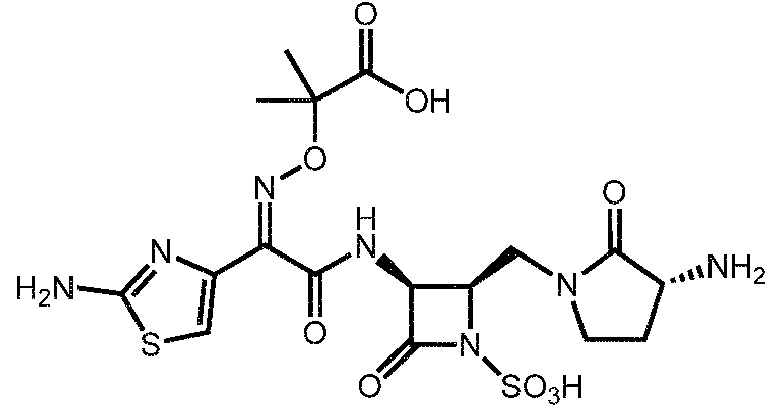
Se preparó de manera análoga al ejemplo 76, usando 4-bromo-2-((terc-butoxicarbonil)amino)butanoato de (R)-metilo. CL-EM: m/z = 532,0 (M-1); 1H RMN (400 MHz, D2O): 86,96 (s, 1H), 5,28 (d, J = 6,0 Hz, 1H), 4,53 (m, 1H), 3,96 (t, J = 10,0 y 9,2 Hz, 1H), 3,85 (dd, J = 10,4 y 10,0 Hz, 1H), 3,58 (m, 1H), 3,44 (m, 1H), 3,31 (dd, 1H), 2,47 (m, 1H), 1,96 (m, 1H), 1,34 (s, 3H), 1,34 (s, 3H).It was prepared analogously to example 76, using (R) -methyl 4-bromo-2 - ((tert-butoxycarbonyl) amino) butanoate. LC-MS: m / z = 532.0 (M-1); 1H NMR (400 MHz, D2O): 86.96 (s, 1H), 5.28 (d, J = 6.0 Hz, 1H), 4.53 (m, 1H), 3.96 (t, J = 10.0 and 9.2 Hz, 1H), 3.85 (dd, J = 10.4 and 10.0 Hz, 1H), 3.58 (m, 1H), 3.44 (m, 1H) , 3.31 (dd, 1H), 2.47 (m, 1H), 1.96 (m, 1H), 1.34 (s, 3H), 1.34 (s, 3H).
Ejemplo de referencia 87: ácido 2-(((Z)-(1-(2-aminotiazol-4-il)-2-oxo-2-(((3S,4R)-2-oxo-4-((2-oxo-2,3-dihidro-1H-imidazol-1-il)metil)-1-sulfoazetidin-3-il)amino)etilideno)amino)oxi)-2-metilpropanoico.Reference example 87: 2 - (((Z) - (1- (2-aminothiazol-4-yl) -2-oxo-2 - (((3S, 4R) -2-oxo-4 - ((2 -oxo-2,3-dihydro-1H-imidazol-1-yl) methyl) -1-sulfoazetidin-3-yl) amino) ethylidene) amino) oxy) -2-methylpropanoic acid.
Etapa 1: ((2R,3S)-1-(2,4-dimetoxibencil)-2-((2,5-dioxoimidazolidin-1-il)metil)-4-oxoazetidin-3-il)carbamato de bencilo. Se siguió el procedimiento general para la reacción de Mitsunobu usando el producto intermedio G (10,0 g, 25 mmol), imidazolidina-2,4-diona (2,5 g, 25 mmol), trifenilfosfina (7,9 g, 30 mmol), DIAD (6,1 g, 30 mmol) y THF (200 ml). El precipitado resultante (8,3 g, 69%) que estaba ligeramente contaminado con óxido de trifenilfosfina, se recogió mediante filtración. CL-EM: m/z = 481,0 (M-1).Stage 1: ((2R, 3S) -1- (2,4-dimethoxybenzyl) -2 - ((2,5-dioxoimidazolidin-1-yl) methyl) -4-oxoazetidin-3-yl) benzyl carbamate. The general procedure for the Mitsunobu reaction was followed using intermediate G (10.0 g, 25 mmol), imidazolidine-2,4-dione (2.5 g, 25 mmol), triphenylphosphine (7.9 g, 30 mmol), DIAD (6.1 g, 30 mmol) and THF (200 ml). The resulting precipitate (8.3 g, 69%) that was slightly contaminated with triphenylphosphine oxide, was collected by filtration. LC-MS: m / z = 481.0 (M-1).
Etapa 2: 3-(((2R,3S)-3-(((benciloxi)carbonil)amino)-1-(2,4-dimetoxibencil)-4-oxoazetidin-2-il)metil)-2,4-dioxoimidazolidina-1-carboxilato de terc-butilo. A una disolución de ((2R,3S)-1-(2,4-dimetoxibencil)-2-((2,5-dioxoimidazolidin-1-il)metil)-4-oxoazetidin-3-il)carbamato de bencilo (4,60 g, 9,54 mmol) y dicarbonato de di-terc-butilo (2,30 g, 10,5 mmol) en DCM (55 ml) se le añadió DMAP (0,150 g, 1,33 mmol). Después de 3 h a ta, se añadió agua, tras lo cual se separaron las fases. Se secó la fase orgánica sobre Na2SO4 y se concentró a vacío. Se purificó el residuo bruto por medio de cromatografía en gel de sílice, dando el compuesto del título (4,20 g, 75%).Stage 2: 3 - (((2R, 3S) -3 - ((((benzyloxy) carbonyl) amino) -1- (2,4-dimethoxybenzyl) -4-oxoazetidin-2-yl) methyl) -2,4- tert-butyl dioxoimidazolidine-1-carboxylate. To a solution of ((2R, 3S) -1- (2,4-dimethoxybenzyl) -2 - ((2,5-dioxoimidazolidin-1-yl) methyl) -4-oxoazetidin-3-yl) benzyl carbamate ( 4.60 g, 9.54 mmol) and di-tert- butyl dicarbonate (2.30 g, 10.5 mmol) in DCM (55 ml) DMAP (0.155 g, 1.33 mmol) was added. After 3 hours, water was added, after which the phases were separated. The organic phase was dried over Na2SO4 and concentrated in vacuo. The crude residue was purified by silica gel chromatography to give the title compound (4.20 g, 75%).
Etapa 3: 3-(((2R,3S)-3-(((benciloxi)carbonil)amino)-4-oxoazetidin-2-il)metil)-2,4-dioxoimidazolidina-1-carboxilato de terc-butilo. Se preparó de manera análoga al ejemplo 4, etapa 2 usando 3-(((2R,3S)-3-(((benciloxi)carbonil)amino)-1-(2,4-dimetoxibencil)-4-oxoazetidin-2-il)metil)-2,4-dioxoimidazolidina-1-carboxilato de terc-butilo (900 mg, 1,70 mmol) K2S2O8 (280 mg, 2,89 mmol) y K2HPO4 (680 mg, 2,91 mmol) en ACN:agua (2:1, 30 ml) mientras se calentaba a 90°C durante 4 h. Tras enfriar hasta ta, se filtró la mezcla y se concentró el filtrado a vacío, eliminando la mayor parte del ACN. Se diluyó la mezcla con agua/EtOAc y se separaron las fases. Se extrajo la fase acuosa con EtOAc y se secaron las fases orgánicas combinadas sobre Na2SO4 y se concentró a vacío. Se purificó el residuo bruto por medio de cromatografía en gel de sílice (MeOH-DCM, 2-6%) para dar el compuesto del título (170 mg, 23%). CL-EM: m/z = 431,0 (M-1).Step 3: 3 - ((((2R, 3S) -3 - ((((benzyloxy) carbonyl) amino) -4-oxoazetidin-2-yl) methyl) -2,4-dioxoimidazolidine-1-carboxylic acid tert-butyl ester. It was prepared analogously to Example 4, step 2 using 3 - (((2R, 3S) -3 - (((benzyloxy) carbonyl) amino) -1- (2,4-dimethoxybenzyl) -4-oxoazetidin-2- il) methyl) -2,4-dioxoimidazolidine-1-tert-butyl carboxylate (900 mg, 1.70 mmol) K2S2O8 (280 mg, 2.89 mmol) and K2HPO4 (680 mg, 2.91 mmol) in ACN : water (2: 1, 30 ml) while heating at 90 ° C for 4 h. After cooling to rt, the mixture was filtered and the filtrate was concentrated in vacuo, removing most of the ACN. The mixture was diluted with water / EtOAc and the phases were separated. The aqueous phase was extracted with EtOAc and the combined organic phases were dried over Na2SO4 and concentrated in vacuo. The crude residue was purified by silica gel chromatography (MeOH-DCM, 2-6%) to give the title compound (170 mg, 23%). LC-MS: m / z = 431.0 (M-1).
Etapa 4: 3-(((2R,3S)-3-(((benciloxi)carbonil)amino)-4-oxoazetidin-2-il)metil)-4-hidroxi-2-oxoimidazolidina-1-carboxilato de terc-butilo. A una disolución de 3-(((2R,3S)-3-(((benciloxi)carbonil)amino)-4-oxoazetidin-2-il)metil)-2,4-dioxoimidazolidina-1-carboxilato de terc-butilo (170 mg, 0,390 mmol) en EtOH (10 ml) a 0°C se le añadió borohidruro de sodio (30 mg, 0,78 mmol). Después de 3 h a 0°C, se extinguió la mezcla con NH4CI saturado (ac) y se concentró a vacío parcialmente. Se extrajo la bifase con DCM y se secó la fase orgánica sobre Na2SO4 y se concentró a vacío. Se usó el residuo resultante como tal en la etapa 5. CL-EM: m/z = 457,1 (M+Na).Step 4: 3 - ((((2R, 3S) -3 - ((((benzyloxy) carbonyl) amino) -4-oxoazetidin-2-yl) methyl) -4-hydroxy-2-oxoimidazolidine-1-carboxylate tert- butyl. To a solution of 3 - ((((2R, 3S) -3 - ((((benzyloxy) carbonyl) amino) -4-oxoazetidin-2-yl) methyl) -2,4-dioxoimidazolidine-1-carboxylic acid tert-butyl ester) (170 mg, 0.390 mmol) in EtOH (10 ml) at 0 ° C was added borohydride sodium (30 mg, 0.78 mmol). After 3 h at 0 ° C, the mixture was quenched with saturated NH4CI (aq) and partially concentrated in vacuo. The biphase was extracted with DCM and the organic phase was dried over Na2SO4 and concentrated in vacuo. The resulting residue was used as such in step 5. LC-MS: m / z = 457.1 (M + Na).
Etapa 5: 3-(((2R,3S)-3-(((benciloxi)carbonil)amino)-4-oxoazetidin-2-il)metil)-2-oxo-2,3-dihidro-1H-imidazol-1-carboxilato de ferc-butilo. A una disolución de 3-(((2R,3S)-3-(((benciloxi)carbonil)amino)-4-oxoazetidin-2-il)metil)-4-hidroxi-2-oxoimidazolidina-1-carboxilato de ferc-butilo (160 mg, 0,368 mmol) en DCM (5 ml) a 0°C se le añadió cloruro de metanosulfonilo (31 |il, 0,41 mmol) seguido por TEA (0,15 ml, 1,1 mmol). Tras agitar durante 1 h a 0°C, se concentró la disolución a vacío y se purificó por medio de cromatografía en gel de sílice (MeOH-DCM, 2-5%), dando el compuesto del título (100 mg, 65%). CL-EM: m/z = 415,1 (M-1); 1H RMN (400 MHz, CDCl3): 88,02 (s, 1H), 7,41 7,27 (m, 5H), 7,06 (d, J = 8,4 Hz, 1H), 6,61 (d, J = 3,2 Hz, 1H), 6,15 (d, J = 3,2 Hz, 1H), 5,21-5,09 (m, 3H), 4,30 (dd, J = 14,4, 9,6 Hz, 1H), 4,01-3,94 (m, 1H), 3,49 (dd, J = 14,8, 3,2 Hz, 1H), 1,46 (s, 9H).Step 5: 3 - (((2R, 3S) -3 - (((benzyloxy) carbonyl) amino) -4-oxoazetidin-2-yl) methyl) -2-oxo-2,3-dihydro-1H-imidazole- Ferc-Butyl 1-carboxylate. To a solution of 3 - (((2R, 3S) -3 - (((benzyloxy) carbonyl) amino) -4-oxoazetidin-2-yl) methyl) -4-hydroxy-2-oxoimidazolidine-1-carboxylate of ferc -butyl (160 mg, 0.368 mmol) in DCM (5 ml) at 0 ° C was added methanesulfonyl chloride (31 µl, 0.41 mmol) followed by TEA (0.15 ml, 1.1 mmol). After stirring for 1 h at 0 ° C, the solution was concentrated in vacuo and purified by means of silica gel chromatography (MeOH-DCM, 2-5%), to give the title compound (100 mg, 65%). LC-MS: m / z = 415.1 (M-1); 1 H NMR (400 MHz, CDCl 3): 88.02 (s, 1 H), 7.41 7.27 (m, 5 H), 7.06 (d, J = 8.4 Hz, 1 H), 6.61 ( d, J = 3.2 Hz, 1H), 6.15 (d, J = 3.2 Hz, 1H), 5.21-5.09 (m, 3H), 4.30 (dd, J = 14 , 4, 9.6 Hz, 1H), 4.01-3.94 (m, 1H), 3.49 (dd, J = 14.8, 3.2 Hz, 1H), 1.46 (s, 9H).
Etapa 6 : 3-(((2R,3S)-3-amino-4-oxoazetidin-2-il)metil)-2-oxo-2,3-dihidro-1H-imidazol-1-carboxilato de ferc-butilo. Se evacuó una mezcla de 3-(((2R,3S)-3-(((benciloxi)carbonil)amino)-4-oxoazetidin-2-il)metil)-2-oxo-2,3-dihidro-1H-imidazol-1-carboxilato de ferc-butilo (490 mg, 1,18 mmol) y paladio sobre carbono (el 10% en peso, 140 mg) en MeOH (60 ml) y se volvió a llenar con H2 (3x), llevando la presión final hasta 30 psi. Tras 2 h de agitación, se filtró la mezcla a través de Celite y se concentró a vacío. Se purificó el residuo bruto por medio de cromatografía en gel de sílice (MeOH-DCM, 6%), dando el compuesto del título (50 mg, 25%).Step 6: 3 - ((((2R, 3S) -3-amino-4-oxoazetidin-2-yl) methyl) -2-oxo-2,3-dihydro-1H-imidazol-1-carboxylate of ferc-butyl. A mixture of 3 - (((2R, 3S) -3 - (((benzyloxy) carbonyl) amino) -4-oxoazetidin-2-yl) methyl) -2-oxo-2,3-dihydro-1H- Ferc-butyl imidazol-1-carboxylate (490 mg, 1.18 mmol) and palladium on carbon (10% by weight, 140 mg) in MeOH (60 ml) and refilled with H2 (3x), carrying the final pressure up to 30 psi. After 2 h of stirring, the mixture was filtered through Celite and concentrated in vacuo. The crude residue was purified by silica gel chromatography (MeOH-DCM, 6%), to give the title compound (50 mg, 25%).
Etapa 7: 3-(((2R,3S)-3-((Z)-2-(((1-(terc-butoxi)-2-metil-1-oxopropan-2-il)oxi)imino)-2-(2-((fercbutoxicarbonil)amino)tiazol-4-il)acetamido)-4-oxoazetidin-2-il)metil)-2-oxo-2,3-dihidro-1H-imidazol-1-carboxilato de ferc-butilo. Se preparó de manera análoga al ejemplo 4 etapa 4, usando ácido (Z)-2-(((1-(ferc-butoxi)-2-metil-1-oxopropan-2-il)oxi)imino)-2-(2-((ferc-butoxicarboni¡)amino)tiazol-4-il)acético (117 mg, 0,276 mmol), HATU (105 mg, 0,276 mmol), DIPEA (36 mg, 0,28 mmol), 3-(((2R,3S)-3-amino-4-oxoazetidin-2-il)metil)-2-oxo-2,3-dihidro-1H-imidazol-1-carboxilato de ferc-butilo (65 mg, 0,23 mmol) y DMF (5 ml). Se purificó el residuo bruto por medio de cromatografía en gel de sílice (MeOH-DCM, 3%), dando el compuesto del título (140 mg, 88%). CL-EM: m/z = 694,0 (M+1).Stage 7: 3 - (((2R, 3S) -3 - ((Z) -2 - (((1- (tert-butoxy) -2-methyl-1-oxopropan-2-yl) oxy) imino) - 2- (2 - ((fercbutoxycarbonyl) amino) thiazol-4-yl) acetamido) -4-oxoazetidin-2-yl) methyl) -2-oxo-2,3-dihydro-1H-imidazol-1-carboxylate ferc -butyl. It was prepared analogously to example 4 step 4, using (Z) -2 - (((1- (ferc-butoxy) -2-methyl-1-oxopropan-2-yl) oxy) imino) -2- ( 2 - ((ferc-butoxycarboni) amino) thiazol-4-yl) acetic acid (117 mg, 0.276 mmol), HATU (105 mg, 0.276 mmol), DIPEA (36 mg, 0.28 mmol), 3 - (( (2R, 3S) -3-amino-4-oxoazetidin-2-yl) methyl) -2-oxo-2,3-dihydro-1H-imidazol-1-carboxylic acid ferc-butyl (65 mg, 0.23 mmol ) and DMF (5 ml). The crude residue was purified by silica gel chromatography (MeOH-DCM, 3%), to give the title compound (140 mg, 88%). LC-MS: m / z = 694.0 (M + 1).
Etapa 8 : ácido (2R,3S)-3-((Z)-2-(((1-(ferc-Butoxi)-2-metil-1-oxopropan-2-il)oxi)imino)-2-(2-((fercbutoxicarbonil)amino)tiazol-4-il)acetamido)-2-((3-(ferc-butoxicarbonil)-2-oxo-2,3-dihidro-1H-imidazol-1-il)metil)-4-oxoazetidina-1-sulfónico. A una disolución de 3-(((2R,3S)-3-((Z)-2-(((1-(ferc-butoxi)-2-metil-1-oxopropan-2-il)oxi)imino)-2-(2-((ferc-butoxicarbonil)amino)tiazol-4-il)acetamido)-4-oxoazetidin-2-il)metil)-2-oxo-2,3-dihidro-1H-imidazol-1-carboxilato de ferc-butilo (140 mg, 0,202 mmol) en DMF (1,0 ml) se le añadió SO3^ DMF (185 mg, 1,21 mmol). Tras 4 h a ta, se concentró la disolución a vacío y se purificó sobre resina HP21 (ACN-agua, 10-50%), dando el compuesto del título (90 mg, 58%). CL-EM: m/z = 772,3 (M-1).Step 8: (2R, 3S) -3 - ((Z) -2 - (((1- (ferc-Butoxy) -2-methyl-1-oxopropan-2-yl) oxy) imino) -2- ( 2 - ((fercbutoxycarbonyl) amino) thiazol-4-yl) acetamido) -2 - ((3- (ferc-butoxycarbonyl) -2-oxo-2,3-dihydro-1H-imidazol-1-yl) methyl) - 4-oxoazetidine-1-sulfonic. To a solution of 3 - (((2R, 3S) -3 - ((Z) -2 - (((1- (ferc-butoxy) -2-methyl-1-oxopropan-2-yl) oxy) imino) -2- (2 - ((ferc-butoxycarbonyl) amino) thiazol-4-yl) acetamido) -4-oxoazetidin-2-yl) methyl) -2-oxo-2,3-dihydro-1H-imidazol-1- Ferc-butyl carboxylate (140 mg, 0.202 mmol) in DMF (1.0 ml) was added SO3 ^ DMF (185 mg, 1.21 mmol). After 4 h at rt, the solution was concentrated in vacuo and purified on HP21 resin (ACN-water, 10-50%), to give the title compound (90 mg, 58%). LC-MS: m / z = 772.3 (M-1).

Etapa 9: ácido 2-(((Z)-(1-(2-aminotiazol-4-il)-2-oxo-2-(((3S,4R)-2-oxo-4-((2-oxo-2,3-dihidro-1H-imidazol-1-il)metil)-1-sulfoazetidin-3-il)amino)etilideno)amino)oxi)-2-metilpropanoico. Se siguió el procedimiento general para la desprotección mediada por ácido usando 3-(((2R,3S)-3-amino-4-oxoazetidin-2-il)metil)-2-oxo-2,3-dihidro-1H-imidazol-1-carboxilato de ferc-butilo (preparado a partir de 3-(((2R,3S)-3-(((benciloxi)carbonil)amino)-4-oxoazetidin-2-il)metil)-2,4-dioxoimidazolidina-1-carboxilato de ferc-butilo) (90 mg, 1 ,16 mmol), TfA (0,5 ml, 6,4 mmol) y DCM (1,5 ml). Se purificó el residuo bruto por medio de HPLC de fase inversa (XSelect CSH, 30 x 100 mm, 5 |im, columna C18; ACN-agua con modificador de ácido fórmico al 0,1%, 60 ml/min) para dar el compuesto del título (15,6 mg, 60%) como un sólido blanquecino. CL-EM: m/z = 516,0 (M-1); 1H RMN (400 MHz, D2O): 86,98 (s, 1H), 6,41 (d, J = 2,8 Hz, 1H), 6,30 (d, J = 2,8 Hz, 1H), 5,30 (d, J = 6,0 Hz, 1H), 4,54-4,52 (m, 1H), 4,00-3,95 (m, 1H), 3,84-3,79 (m, 1H), 1,35 (s, 3H), 1,34 (s, 3H).Stage 9: acid 2 - (((Z) - (1- (2-aminothiazol-4-yl) -2-oxo-2 - (((3S, 4R) -2-oxo-4 - ((2-oxo -2,3-dihydro-1H-imidazol-1-yl) methyl) -1-sulfoazetidin-3-yl) amino) ethylidene) amino) oxy) -2-methylpropanoic acid. The general procedure for acid-mediated deprotection was followed using 3 - (((2R, 3S) -3-amino-4-oxoazetidin-2-yl) methyl) -2-oxo-2,3-dihydro-1H-imidazole -1-ferc-butyl carboxylate (prepared from 3 - (((2R, 3S) -3 - (((benzyloxy) carbonyl) amino) -4-oxoazetidin-2-yl) methyl) -2,4- dioxoimidazolidine-1-ferc-butyl carboxylate) (90 mg, 1,16 mmol), T f A (0.5 ml, 6.4 mmol) and DCM (1.5 ml). The crude residue was purified by reverse phase HPLC (XSelect CSH, 30 x 100 mm, 5 | im, C18 column; ACN-water with 0.1% formic acid modifier, 60 ml / min) to give the title compound (15.6 mg, 60%) as an off-white solid. LC-MS: m / z = 516.0 (M-1); 1H NMR (400 MHz, D2O): 86.98 (s, 1H), 6.41 (d, J = 2.8 Hz, 1H), 6.30 (d, J = 2.8 Hz, 1H), 5.30 (d, J = 6.0 Hz, 1H), 4.54-4.52 (m, 1H), 4.00-3.95 (m, 1H), 3.84-3.79 ( m, 1H), 1.35 (s, 3H), 1.34 (s, 3H).
Ejemplo 88: ácido 2-(((Z)-(1-(2-aminotiazol-4-il)-2-(((2R,3S)-2-(((R)-3-guanidino-2-oxopirrolidin-1-il)metil)-4-oxo-1-sulfoazetidin-3-il)amino)-2-oxoetilideno)amino)oxi)-2-metilpropanoico. Example 88: 2 - (((Z) - (1- (2-aminothiazol-4-yl) -2 - (((2R, 3S) -2 - ((((R) -3-guanidino-2-oxopyrrolidin) acid -1-yl) methyl) -4-oxo-1-sulfoazetidin-3-yl) amino) -2-oxoethylidene) amino) oxy) -2-methylpropanoic acid.

Se preparó de manera análoga al ejemplo 20, usando ácido 2-(((Z)-(2-(((2R,3S)-2-(((R)-3-am¡no-2-oxop¡rrol¡d¡n-1-il)metil)-4-oxo-1-sulfoazetidin-3-il)amino)-1-(2-aminotiazol-4-il)-2-oxoetilideno)amino)oxi)-2-metilpropanoico y HCl de 1H-pirazol-1 -carboximidamida. CL-EM: m/z = 574,1 (M-1); 1H RMN (400 MHz, D2O): 86,93 (s, 1H), 5,28 (d, J = 5,6 Hz, 1H), 4,53 (m, 1H), 4,24 (t, J = 9,6 y 9,2 Hz, 1H), 3,85 (dd, J = 9,2 y 9,2 Hz, 1H), 3,51 (m, 1H), 3,40 (t, J = 9,2 y 8,8 Hz, 1H), 3,32 (dd, 1H), 3,34 (dd, 1H), 2,43 (m, 1H), 1,87 (m, 1H), 1,36 (s, 3H), 1,32 (s, 3H).It was prepared analogously to example 20, using 2 - (((Z) - (2 - (((2R, 3S) -2 - ((((R) -3-am-2-oxopropyl) acid) d¡n-1-yl) methyl) -4-oxo-1-sulfoazetidin-3-yl) amino) -1- (2-aminothiazol-4-yl) -2-oxoethylidene) amino) oxy) -2-methylpropanoic and 1H-pyrazol-1-carboxyximidamide HCl. LC-MS: m / z = 574.1 (M-1); 1H NMR (400 MHz, D2O): 86.93 (s, 1H), 5.28 (d, J = 5.6 Hz, 1H), 4.53 (m, 1H), 4.24 (t, J = 9.6 and 9.2 Hz, 1H), 3.85 (dd, J = 9.2 and 9.2 Hz, 1H), 3.51 (m, 1H), 3.40 (t, J = 9.2 and 8.8 Hz, 1H), 3.32 (dd, 1H), 3.34 (dd, 1H), 2.43 (m, 1H), 1.87 (m, 1H), 1, 36 (s, 3H), 1.32 (s, 3H).
Ejemplo de referencia 89: ácido 1-(((Z)-(1-(2-am¡not¡azol-4-¡l)-2-oxo-2-(((3S,4R)-2-oxo-4-((4-(((R)-p¡rrol¡d¡n-3-¡lam¡no) met¡l)-2H-1,2,3-t âzol-2-¡l)met¡l)-1-sulfoazet¡d¡n-3-¡l)am¡no)et¡l¡deno)am¡no)ox¡)ddopropanocarboxíl¡co.Reference example 89: acid 1 - ((((Z) - (1- (2-am¡not¡azol-4-¡)) -2-oxo-2 - (((3S, 4R) -2-oxo- 4 - ((4 - (((R) -prol¡d¡n-3-call) met¡l) -2H-1,2,3-t âzol-2-¡l) met¡ l) -1-sulfoazet¡d¡n-3-¡) ammonium) etyldene) amine) ox¡) ddopropanecarboxylic acid.

Se preparó de manera análoga al ejemplo 85, usando 3-am¡nop¡rrol¡d¡na-1-carbox¡lato de (R)-terc-butilo. CL-EM: Rt = 0,46 min, m/z = 599,3 (M+1) Método 2m_ácido_polar; 1H RMN (400 MHz, D2O): 87,86 (s, 1 H), 7,16 (s, 1 H), 5,60 (d, J = 5,5 Hz, 1 H), 4,99 (s, 1 H), 4,90 (d, J = 3,9 Hz, 2 H), 4,46 (d, J = 5,1 Hz, 2H), 4,20-4,14 (m, 1 H), 3,82 (dd, J = 13,1, 8,0 Hz, 1 H), 3,65-3,38 (m, 2 H), 2,67 -2,57 (m, 1 H), 2,31-2,20 (m, 1 H), 1,34 (t, J = 4,3 Hz, 3 H), 1,25-1,19 (m, 2 H).It was prepared analogously to example 85, using (R) -terc-butyl 3-ammonoprol-dna-1-carboxylate. LC-MS: Rt = 0.46 min, m / z = 599.3 (M + 1) Method 2m_polar_m_acid; 1 H NMR (400 MHz, D2O): 87.86 (s, 1 H), 7.16 (s, 1 H), 5.60 (d, J = 5.5 Hz, 1 H), 4.99 ( s, 1 H), 4.90 (d, J = 3.9 Hz, 2 H), 4.46 (d, J = 5.1 Hz, 2H), 4.20-4.14 (m, 1 H), 3.82 (dd, J = 13.1, 8.0 Hz, 1 H), 3.65-3.38 (m, 2 H), 2.67 -2.57 (m, 1 H ), 2.31-2.20 (m, 1 H), 1.34 (t, J = 4.3 Hz, 3 H), 1.25-1.19 (m, 2 H).
Ejemplo de referencia 90: ácido 1-(((Z)-(2-(((2R,3S)-2-((4-(((3-am¡noprop¡l)am¡no)met¡l)-2H-1,2,3-t âzol-2-¡l)met¡l)-4-oxo-1-sulfoazet¡d¡n-3-¡l)am¡no)-1-(2-am¡not¡azol-4-¡l)-2-oxoet¡l¡deno)am¡no)ox¡)c¡dopropanocarboxíl¡co.Reference example 90: acid 1 - (((Z) - (2 - (((2R, 3S) -2 - ((4 - (((3-amnopropyl) amine) methyl)) -2H-1,2,3-t âzol-2-¡l) met¡l) -4-oxo-1-sulfoazet¡d¡n-3-¡) am¡no) -1- (2-am Notzol-4-1) -2-oxoetyldene) amine) ox¡) cdopropanecarboxylic acid.
Etapa 1: 1-(((Z)-(1-(2-((terc-butox¡carbon¡l)am¡no)t¡azol-4-¡l)-2-(((2R,3S)-2-((4-(h¡drox¡met¡l)-2H-1,2,3-t^azol-2-¡l)met¡l)-4-oxoazet¡d¡n-3-¡l)am¡no)-2-oxoet¡l¡deno)am¡no)ox¡)ddopropanocarbox¡lato de benzhidrilo. A una disolución de ácido (Z^-^-^benzhidnloxOcarbomOddopropoxOimino^-p-^terc-butoxicarbomOamino^iazoM-iOacético (2,5 g, 4,43 mmol) en DCM (78 ml) y DMF (15 ml) a 0°C se le añadió DIPEA (1,2 ml, 7,00 mmol), HATU (1,9 g, 5,13 mmol), y (3S,4R)-3-am¡no-4-((4-(h¡drox¡met¡l)-2H-1,2,3-t^azol-2-¡l)met¡l)azet¡d¡n-2-ona (0,92 g, 4,67 mmol). Tras agitar a 0°C durante 1 h, se diluyó la mezcla de reacción con DCM, se lavó con agua, salmuera, se secó sobre Na2SO4 y se concentró a vacío. Se purificó el residuo bruto por medio de cromatografía en gel de sílice (MeOH-DCM, 0-5%), dando el compuesto del título (2,5 g, 75%). CL-e M: Rt = 0,98 min, m/z = 717,3 (M+1 ) Método 2 m_ácido.Stage 1: 1 - (((Z) - (1- (2 - ((tert-butoxycarbonyl) ammonium) thiazol-4-l) -2 - (((2R, 3S) -2 - ((4- (h¡drox¡met¡l) -2H-1,2,3-t ^ azol-2-¡l) met¡l) -4-oxoazet¡d¡n-3-¡ l) amine) -2-oxoetyldene) amine) ox¡) ddopropanecarboxylate of benzhydryl. To a solution of acid (Z ^ - ^ - ^ benzhidnloxOcarbomOddopropoxOimino ^ -p- ^ tert-butoxycarbomOamino ^ iazoM-iOacetic acid (2.5 g, 4.43 mmol) in DCM (78 ml) and DMF (15 ml) at 0 DIPEA (1.2 ml, 7.00 mmol), HATU (1.9 g, 5.13 mmol), and (3S, 4R) -3-amine-4 - ((4-) were added (h¡drox¡met¡l) -2H-1,2,3-t ^ azol-2-¡l) meth) azet¡d¡n-2-one (0.92 g, 4.67 mmol ) After stirring at 0 ° C for 1 h, the reaction mixture was diluted with DCM, washed with water, brine, dried over Na 2 SO 4 and concentrated in vacuo. The crude residue was purified by means of gel chromatography. silica (MeOH-DCM, 0-5%), giving the title compound (2.5 g, 75%) CL- e M: Rt = 0.98 min, m / z = 717.3 (M + 1 ) 2 m_acid method.
Etapa 2: 1-(((Z)-(1-(2-((terc-butox¡carbon¡l)am¡no)t¡azol-4-¡l)-2-(((2R,3S)-2-((4-form¡l-2H-1,2,3-t âzol-2-¡l)met¡l)-4-oxoazetidin^-iOamino^-oxoetilideno^mino^xOdclopropanocarboxiiato de benzhidrilo. A una disolución de 1-(((Z)-(1-(2-((terc-butox¡carbon¡l)am¡no)t¡azol-4-¡l)-2-(((2R,3S)-2-((4-(h¡drox¡met¡l)-2H-1,2,3-tr¡azol-2-¡l)met¡l)-4-oxoazet¡d¡n-3-¡l)am¡no)-2-oxoet¡l¡deno)am¡no)ox¡)ddopropanocarbox¡lato de benzhidrilo (1,8 g, 2,57 mmol) en THF (21 ml) se le añadió MnO2 (4,9 g, 56,5 mmol). Tras agitar a ta durante 20 h, se filtró la mezcla de reacción a través de un lecho de Celite con lavado de THF (250 ml). Se concentró el filtrado, y se purificó el residuo por medio de cromatografía en gel de sílice (MeOH-DCM, 0-5%) para dar el compuesto del título (1,4 g, 76%). CL-Em : Rt = 1,04 min, m/z = 715,3 (M+H). Método 2m_ácido.Stage 2: 1 - (((Z) - (1- (2 - ((tert-butoxycarbonyl) ammonium) thiazol-4-l) -2 - (((2R, 3S) -2 - ((4-formyl-2H-1,2,3-t âzol-2-l) metyl) -4-oxoazetidine ^ -iOamino ^ -oxoethylidene ^ mino ^ xOdclopropanecarboxylate of benzhydryl. solution of 1 - (((Z) - (1- (2 - ((tert-butoxycarbonyl) amine) thiazol-4-l) -2 - (((2R, 3S) - 2 - ((4- (h¡drox¡met¡l) -2H-1,2,3-tr¡azol-2-¡) met¡l) -4-oxoazet¡d¡n-3-¡l ) amine) -2-oxoetyldene) amine) ox¡) benzhydryl ddopropanecarboxylate (1.8 g, 2.57 mmol) in THF (21 ml) MnO2 (4, 9 g, 56.5 mmol) After stirring at rt for 20 h, the reaction mixture was filtered through a bed of Celite with THF wash (250 ml), the filtrate was concentrated, and the residue was purified by silica gel chromatography medium (MeOH-DCM, 0-5%) to give the title compound (1.4 g, 76%) LC-Em: Rt = 1.04 min, m / z = 715, 3 (M + H) 2m_acid method.
Etapa 3: 1-(((Z)-(2-(((2R,3S)-2-((4-(((3-((terc-butox¡carbon¡l)am¡no)prop¡l)am¡no)met¡l)-2H-1,2,3-tr¡azol-2-¡l)met¡l)-4-oxoazet¡d¡n-3-¡l)am¡no)-1-(2-((terc-butox¡carbon¡l)am¡no)t¡azol-4-¡l)-2-oxoet¡l¡deno)am¡no)ox¡)ddopropanocarbox¡lato de benzhidrilo. A una disolución de 1-(((Z)-(1-(2-((terc-butox¡carbon¡l)am¡no)t¡azol-4-¡l)-2-(((2R,3S)-2-((4-form¡l-2H-1,2,3-tr¡azol-2-¡l)met¡l)-4-oxoazet¡d¡n-3-¡l)am¡no)-2-oxoet¡l¡deno)am¡no)ox¡)c¡dopropanocarbox¡lato de benzhidrilo (370 mg, 0,52mmol) en DCE (4 ml) a 0°C se le añadió (3-aminopropil)carbamato de terc-butilo (180 mg, 1,04 mmol) y triacetoxihidroborato de sodio (165 mg, 0,78 mmol) secuencialmente. Tras agitar a ta durante 16 h, se diluyó la mezcla de reacción con DCM, se lavó con NaHCO3 saturado (ac), salmuera, se secó sobre Na2SO4, se filtró y se concentró a vacío para dar el compuesto del título (supuestamente cuantitativo). Se usó el residuo bruto como tal en la siguiente etapa. CL-EM: Rt = 0,99 min, m/z = 873,2 (M+1). Método 2m_ácido.Stage 3: 1 - (((Z) - (2 - (((2R, 3S) -2 - ((4 - (((3 - ((tert-butoxycarbonyl) ammonium) propyl) ) ammonium) methyl) -2H-1,2,3-trizol-2-l) methyl) -4-oxoazetine-3-l) ammonium) - 1- (2 - ((tert-butoxycarbonyl) ammonium) thzol-4-yl) -2-oxoethyldene) amine) oxyl) ddopropanecarboxycarbonate of benzhydryl. At a solution of 1 - (((Z) - (1- (2 - ((tert-butoxycarbonyl) amine) thiazol-4-l) -2 - (((2R, 3S ) -2 - ((4-form¡l-2H-1,2,3-tr¡azol-2-¡) methyl) -4-oxoazet¡d¡n-3-¡) amine ) -2-oxoetyldene) amine) ox¡) benzhydryldopropanecarboxylate (370 mg, 0.52mmol) in DCE (4 ml) at 0 ° C (3-aminopropyl) was added tert-butyl carbamate (180 mg, 1.04 mmol) and sodium triacetoxyhydroborate (165 mg, 0.78 mmol) sequentially. After stirring at rt for 16 h, the reaction mixture was diluted with DCM, washed with saturated NaHCO3 (aq), brine, dried over Na2SO4, filtered and concentrated in vacuo to give the title compound (supposedly quantitative) . The crude residue was used as such in The next stage. LC-MS: Rt = 0.99 min, m / z = 873.2 (M + 1). 2m_acid method.
Etapa 4: 1-(((Z)-(2-(((2R,3S)-2-((4-(((terc-butoxicarbonil)(3-((terc-butoxicarbonil)amino)propil)amino)metil)-2H-1,2,3-triazol-2-il)metil)-4-oxoazetidin-3-il)amino)-1-(2-((terc-butoxicarbonil)amino)tiazol-4-il)-2-oxoet¡l¡deno)am¡no)ox¡)c¡dopropanocarbox¡lato de benzhidrilo. A una disolución de 1-(((Z)-(2-(((2R,3S)-2-((4-(((3-((terc-butoxicarbonil)amino)propil)amino)metil)-2H-1,2,3-triazol-2-il)metil)-4-oxoazetidin-3-il)amino)-1-(2-((tercbutoxicarbonil)amino)tiazol-4-il)-2-oxoetilideno)amino)oxi)cidopropanocarboxilato de benzhidrilo (0,45 g, 0,52 mmol) en DMF (6 ml) a 0°C se le añadió anhídrido de Boc (0,24 ml, 1,04 mmol). Tras agitar a ta durante 18 h, se añadió DIPEA (0,18 ml, 1,04 mmol). Tras agitar durante 36 h, se vertió la mezcla de reacción en agua y se extrajo con DCM. Se lavaron las fases orgánicas combinadas con LiCl al 5%, salmuera, se secó sobre Na2SO4, se filtró y se concentró a vacío. Se purificó el residuo bruto por medio de cromatografía en gel de sílice (EtOAc-heptano, 0-60%) para dar el compuesto del título (0,40 g, 80%). Cl-EM: Rt = 1,26 min, m/z = 973,3 (M+H). Método 2 m_ácido.Stage 4: 1 - (((Z) - (2 - (((2R, 3S) -2 - ((4 - (((tert-butoxycarbonyl) (3 - ((tert-butoxycarbonyl) amino) propyl) amino) methyl) -2H-1,2,3-triazol-2-yl) methyl) -4-oxoazetidin-3-yl) amino) -1- (2 - ((tert-butoxycarbonyl) amino) thiazol-4-yl) -2-oxoetyldene) amine) ox¡) benzydryldopropanecarboxylate. At a solution of 1 - (((Z) - (2 - (((2R, 3S) -2 - ((4 - (((3 - ((tert-butoxycarbonyl) amino) propyl) amino) methyl) -2H -1,2,3-triazol-2-yl) methyl) -4-oxoazetidin-3-yl) amino) -1- (2 - ((tert-butoxycarbonyl) amino) thiazol-4-yl) -2-oxoethylidene) amino ) oxy) benzhydryl cidopropanecarboxylate (0.45 g, 0.52 mmol) in DMF (6 ml) at 0 ° C was added Boc anhydride (0.24 ml, 1.04 mmol). After stirring at rt for 18 h, DIPEA (0.18 ml, 1.04 mmol) was added. After stirring for 36 h, the reaction mixture was poured into water and extracted with DCM. The combined organic phases were washed with 5% LiCl, brine, dried over Na2SO4, filtered and concentrated in vacuo. The crude residue was purified by silica gel chromatography (EtOAc-heptane, 0-60%) to give the title compound (0.40 g, 80%). C 1 -EM: R t = 1.26 min, m / z = 973.3 (M + H). Method 2 m_acid.
Etapa 5: ácido (2R,3S)-3-((Z)-2-((1-((benzhidriloxi)carbonil)ciclopropoxi)imino)-2-(2-((terc-butoxicarbonil)amino)tiazol-4-il)acetamido)-2-((4-(((terc-butoxicarbonil)(3-((terc-butoxicarbonil)amino)propil)amino)metil)-2H-1,2,3-triazol-2-il)metil)-4-oxoazetidina-1-sulfónico. A una disolución de 1-(((Z)-(2-(((2R,3S)-2-((4-(((terc-butoxicarbonil)(3-((tercbutoxicarbonil)amino)propil)amino)metil)-2H-1,2,3-triazol-2-il)metil)-4-oxoazetidin-3-il)amino)-1-(2-((tercbutoxicarbonil)amino)tiazol-4-il)-2-oxoetilideno)amino)oxi)ciclopropanocarboxilato de benzhidrilo (0,40 g, 0,41 mmol) en DMF (5 ml) a 0°C se le añadió SOâ DMF (0,63 g, 4,12 mmol). Tras agitar a ta durante 1 h, se diluyó la mezcla de reacción con EtOAc, se lavó con LiC al 5% (ac), salmuera, se secó sobre Na2SO4, se filtró y se concentró a vacío para dar el compuesto del título (0,42 g, 97%). CL-EM: Rt = 1,10 min, m/z = 1053,6 (M+H). Método 2m_ácido.Stage 5: (2R, 3S) -3 - ((Z) -2 - ((1 - ((benzhydryloxy) carbonyl) cyclopropoxy) imino) -2- (2 - ((tert-butoxycarbonyl) amino) thiazole-4 -yl) acetamido) -2 - ((4 - (((tert-butoxycarbonyl) (3 - ((tert-butoxycarbonyl) amino) propyl) amino) methyl) -2H-1,2,3-triazol-2-yl ) methyl) -4-oxoazetidine-1-sulfonic. At a solution of 1 - (((Z) - (2 - (((2R, 3S) -2 - ((4 - (((tert-butoxycarbonyl) (3 - ((tert-butoxycarbonyl) amino) propyl) amino) methyl) ) -2H-1,2,3-triazol-2-yl) methyl) -4-oxoazetidin-3-yl) amino) -1- (2 - ((tert-butoxycarbonyl) amino) thiazol-4-yl) -2- Oxoethylidene) amino) oxy) benzhydryl cyclopropanecarboxylate (0.40 g, 0.41 mmol) in DMF (5 mL) at 0 ° C was added SOâ DMF (0.63 g, 4.12 mmol). After stirring at rt for 1 h, the reaction mixture was diluted with EtOAc, washed with 5% LiC (aq), brine, dried over Na2SO4, filtered and concentrated in vacuo to give the title compound (0 , 42 g, 97%). LC-MS: R t = 1.10 min, m / z = 1053.6 (M + H). 2m_acid method.
Etapa 6 : ácido 1-(((Z)-(2-(((2R,3S)-2-((4-(((3-aminopropil)amino)metil)-2H-1,2,3-triazol-2-il)metil)-4-oxo-1-sulfoazetidin-3-il)amino)-1-(2-aminotiazol-4-il)-2-oxoetilideno)amino)oxi)ciclopropanocarboxílico.Step 6: 1 - (((Z) - (2 - (((2R, 3S) -2 - ((4 - ((((3-aminopropyl) amino) methyl) -2H-1,2,3-triazole acid -2-yl) methyl) -4-oxo-1-sulfoazetidin-3-yl) amino) -1- (2-aminothiazol-4-yl) -2-oxoethylidene) amino) oxy) cyclopropanecarboxylic.

Se siguió el procedimiento general para la desprotección mediada por ácido usando ácido (2R,3S)-3-((Z)-2-((1-((benzhidriloxi)carbonil)ciclopropoxi)imino)-2-(2-((terc-butoxicarbonil)amino)tiazol-4-il)acetamido)-2-((4-(((terc-butoxicarbonil)(3-((terc-butoxicarbonil)amino)propil)amino)metil)-2H-1,2,3-triazol-2-il)metil)-4-oxoazetidina-1-sulfónico (0,5 g, 0,48 mmol), DCM (2,5 ml) y TFA (1 ml, 13 mmol) durante 1,5 h. Se purificó el residuo bruto mediante HPLC de fase inversa (XSelect CSH, 30 x 100 mm, 5 pm, columna C18; ACN-agua con modificador de ácido fórmico al 0,1%, 60 ml/min) dando el compuesto del título (123 mg, 42%). CL-EM: Rt = 0,31 min, m/z = 587,2 (M+1) Método 2m_ácido; 1H RMN (400 MHz, DMSO-d6): 89,39 (s a, 1 H), 7,76 (s, 1 H), 7,22 (s, 2 H), 6,73 (s, 1 H), 5,33 (dd, J = 9,0, 5,5 Hz, 1 H), 4,84 (dd, J = 14,3, 4,5 Hz, 1 H), 4,73-4,61 (m, 1 H), 4,61-4,48 (m, 1 H), 4,27-4,14 (m, 2 H), 3,02 2,89 (m, 3 H), 2,85 (t, J = 7,4 Hz, 3 H), 1,85 (p, J = 7,5 Hz, 3H) 1,32-1,04 (m, 6 H); 1H RMN (400 MHz, D2O) 87,90 (s, 1H), 7,15 (s, 1H), 5,67 (d, J = 5,5 Hz, 1H), 5,12-5,04 (m, 1H), 5,04-4,88 (m, 2H), 4,45 (s, 2H), 3,30-3,22 (m, 2H), 3,16 (t, J = 7,6 Hz, 2H), 2,24-2,08 (m, 2H), 1,37-1,26 (m, 2H), 1,26-1,08 (m, 2H).The general procedure for acid-mediated deprotection was followed using (2R, 3S) -3 - ((Z) -2 - ((1 - ((benzhydryloxy) carbonyl) cyclopropoxy) imino) -2- (2 - (( tert- butoxycarbonyl) amino) thiazol-4-yl) acetamido) -2 - ((4 - ((( tert- butoxycarbonyl) (3 - ((tert-butoxycarbonyl) amino) propyl) amino) methyl) -2H-1, 2,3-triazol-2-yl) methyl) -4-oxoazetidine-1-sulfonic acid (0.5 g, 0.48 mmol), DCM (2.5 ml) and TFA (1 ml, 13 mmol) for 1 , 5 h. The crude residue was purified by reverse phase HPLC (XSelect CSH, 30 x 100 mm, 5 pm, column C18; ACN-water with 0.1% formic acid modifier, 60 ml / min) to give the title compound ( 123 mg, 42%). LC-MS: Rt = 0.31 min, m / z = 587.2 (M + 1) 2m_acid method; 1 H NMR (400 MHz, DMSO-d6): 89.39 (sa, 1 H), 7.76 (s, 1 H), 7.22 (s, 2 H), 6.73 (s, 1 H) , 5.33 (dd, J = 9.0, 5.5 Hz, 1 H), 4.84 (dd, J = 14.3, 4.5 Hz, 1 H), 4.73-4.61 (m, 1 H), 4.61-4.48 (m, 1 H), 4.27-4.14 (m, 2 H), 3.02 2.89 (m, 3 H), 2, 85 (t, J = 7.4 Hz, 3 H), 1.85 (p, J = 7.5 Hz, 3H) 1.32-1.04 (m, 6 H); 1H NMR (400 MHz, D2O) 87.90 (s, 1H), 7.15 (s, 1H), 5.67 (d, J = 5.5 Hz, 1H), 5.12-5.04 ( m, 1H), 5.04-4.88 (m, 2H), 4.45 (s, 2H), 3.30-3.22 (m, 2H), 3.16 (t, J = 7, 6 Hz, 2H), 2.24-2.08 (m, 2H), 1.37-1.26 (m, 2H), 1.26-1.08 (m, 2H).
Ejemplo de referencia 91: ácido 1-(((Z)-(1-(2-aminotiazol-4-il)-2-oxo-2-(((3S,4R)-2-oxo-4-((4-(((S)-pirrolidin-3-ilamino) metil)-2H-1,2,3-triazol-2-il)metil)-1-sulfoazetidin-3-il)amino)etilideno)amino)oxi)ciclopropanocarboxílico.Reference Example 91: 1 - (((Z) - (1- (2-aminothiazol-4-yl) -2-oxo-2 - (((3S, 4R) -2-oxo-4 - ((4 - (((S) -pyrrolidin-3-ylamino) methyl) -2H-1,2,3-triazol-2-yl) methyl) -1-sulfoazetidin-3-yl) amino) ethylidene) amino) oxy) cyclopropanecarboxylic .

Se preparó de manera análoga al ejemplo 90, usando 3-aminopirrolidina-1-carboxilato de (S)-terc-butilo y 1-(((Z)-(1-(2-((terc-butoxicarbonil)amino)tiazol-4-il)-2-(((2R,3S)-2-((4-formil-2H-1,2,3-triazol-2-il)metil)-4-oxoazetidin-3-il)amino)2-oxoetilideno)amino)oxi)cidopropanocarboxilato de benzhidrilo en la etapa 3. CL-EM: Rt = 0,3 min, m/z = 599,0 (M+1) Método 2m_ácido; 1H RMN (400 MHz, DMSO-da): 89,18 (d, J = 9,0 Hz, 1 H), 9,04-8,59 (m, 2 H), 7,79 (s, 1 H), 7.24 (s a, 2 H), 6,72 (s, 1 H), 5,35 (dd, J = 9,0, 5,5 Hz, 1 H), 4,93-4,81 (m, 1 H), 4,68-4,60 (m, 1 H), 4,55 (s, 1 H), 4.24 (s a, 2 H), 3,95-3,79 (m, 1 H), 2,27-2,11 (m, 1 H), 2,04-1,90 (m, 1 H), 1,38-1,06 (m, 4 H).It was prepared analogously to example 90, using (S) -terc-butyl 3-aminopyrrolidine-1-carboxylate and 1 - (((Z) - (1- (2 - ((tert-butoxycarbonyl) amino) thiazol-4-yl) -2 - (((2R, 3S) -2 - ((4-formyl-2H-1 , 2,3-triazol-2-yl) methyl) -4-oxoazetidin-3-yl) amino) 2-oxoethylidene) amino) oxy) benzhydryl cidopropanecarboxylate in step 3. LC-MS: Rt = 0.3 min , m / z = 599.0 (M + 1) 2m_acid method; 1 H NMR (400 MHz, DMSO-da): 89.18 (d, J = 9.0 Hz, 1 H), 9.04-8.59 (m, 2 H), 7.79 (s, 1 H ), 7.24 (sa, 2 H), 6.72 (s, 1 H), 5.35 (dd, J = 9.0, 5.5 Hz, 1 H), 4.93-4.81 (m , 1 H), 4.68-4.60 (m, 1 H), 4.55 (s, 1 H), 4.24 (sa, 2 H), 3.95-3.79 (m, 1 H) , 2.27-2.11 (m, 1 H), 2.04-1.90 (m, 1 H), 1.38-1.06 (m, 4 H).
Ejemplo de referencia 92: ácido 1-(((Z)-(2-(((2R,3S)-2-((4-((3-(aminometil)azetidin-1-il)metil)-2H-1,2,3-triazol-2-il)metil)-4-oxo-1-sulfoazetidin-3-il)amino)-1-(2-aminotiazol-4-il)-2-oxoetilideno)amino)oxi)ciclopropanocarboxílico.Reference Example 92: 1 - (((Z) - (2 - (((2R, 3S) -2 - ((4 - ((3- (aminomethyl) azetidin-1-yl) methyl) -2H-1 acid) , 2,3-triazol-2-yl) methyl) -4-oxo-1-sulfoazetidin-3-yl) amino) -1- (2-aminothiazol-4-yl) -2-oxoethylidene) amino) oxy) cyclopropanecarboxylic .

Se preparó de manera análoga al ejemplo 90, usando (azetidin-3-ilmetil)carbamato de ferc-butilo y 1-(((Z)-(1-(2-((ferc-butoxicarbonil)amino)tiazol-4-il)-2-(((2R,3S)-2-((4-formil-2H-1,2,3-triazol-2-il)metil)-4-oxoazetidin-3-il)amino)-2-oxoetilideno)amino)oxi)ciclopropanocarboxilato de benzhidrilo en la etapa 3. CL-EM: Rt = 0,46 min, m/z = 599,4 (M+1) Método 2m_ácido; 1H RMN (400 MHz, D2O): 87,84 (s, 1 H) 7,11 (s, 1 H) 5,56 (d, J = 5,5 Hz, 1 H) 5,00 (m, 1 H) 4,89 (m, 2 H) 4,52 (s, 2 H) 4,35 (m, 2 H) 4,23-4,03 (m, 2 H) 3,38 -3,21 (m, 3 H) 1,31 (m, 2 H) 1,18 (m, 2 H). It was prepared analogously to example 90, using ferc-butyl (azetidin-3-ylmethyl) carbamate and 1 - (((Z) - (1- (2 - ((ferc-butoxycarbonyl) amino) thiazol-4-yl ) -2 - (((2R, 3S) -2 - ((4-formyl-2H-1,2,3-triazol-2-yl) methyl) -4-oxoazetidin-3-yl) amino) -2- oxoethylidene) amino) oxy) benzhydryl cyclopropanecarboxylate in step 3. LC-MS: R t = 0.46 min, m / z = 599.4 (M + 1) 2m_acid method; 1 H NMR (400 MHz, D2O): 87.84 (s, 1 H) 7.11 (s, 1 H) 5.56 (d, J = 5.5 Hz, 1 H) 5.00 (m, 1 H) 4.89 (m, 2 H) 4.52 (s, 2 H) 4.35 (m, 2 H) 4.23-4.03 (m, 2 H) 3.38-3.21 ( m, 3 H) 1.31 (m, 2 H) 1.18 (m, 2 H).
Ejemplo de referencia 93: ácido 1-(((Z)-(2-(((2R,3S)-2-((4-((((1r,3R)-3-aminoddobutil)amino)metil)-2H-1,2,3-triazol-2-il)metil)-4-oxo-1-sulfoazetidin-3-il)amino)-1-(2-aminotiazol-4-il)-2-oxoetilideno)amino)oxi)ciclopropanocarboxílico.Reference example 93: 1 - (((Z) - (2 - (((2R, 3S) -2 - ((4 - (((((1r, 3R) -3-aminoddobutyl) amino) methyl) -2H acid) -1,2,3-triazol-2-yl) methyl) -4-oxo-1-sulfoazetidin-3-yl) amino) -1- (2-aminothiazol-4-yl) -2-oxoethylidene) amino) oxy ) cyclopropanecarboxylic.

Se preparó de manera análoga al ejemplo 90, usando ((1r,3r)-3-aminoddobutil)carbamato de ferc-butilo y 1-(((Z)-(1-(2-((ferc-butoxicarbonil)amino)tiazol-4-il)-2-(((2R,3S)-2-((4-formil-2H-1,2,3-triazol-2-il)metil)-4-oxoazetidin-3-il)amino)-2-oxoetilideno)amino)oxi)ciclopropanocarboxilato de benzhidrilo en la etapa 3. CL-EM: Rt = 0,46 min, m/z = 599,3 (M+1) Método 2m_ácido; 1H RMN (400 MHz, D2O): 87,82 (s, 1 H), 7,09 (s, 1 H), 5,58 (d, J = 5,9 Hz, 1 H), 5,04-4,84 (m, 3 H), 4,31 (s, 2 H), 4,14-4,00 (m, 2 H), 2,81-2,60 (m, 4 H) 1,26 (s, 2 H), 1,19-1,06 (m, 2 H).It was prepared analogously to example 90, using ((1r, 3r) -3-aminoddobutyl) ferc-butyl carbamate and 1 - (((Z) - (1- (2 - ((ferc-butoxycarbonyl) amino) thiazole -4-yl) -2 - (((2R, 3S) -2 - ((4-formyl-2H-1,2,3-triazol-2-yl) methyl) -4-oxoazetidin-3-yl) amino ) -2-oxoethylidene) amino) oxy) benzhydryl cyclopropanecarboxylate in step 3. LC-MS: R t = 0.46 min, m / z = 599.3 (M + 1) 2m acid method; 1 H NMR (400 MHz, D2O): 87.82 (s, 1 H), 7.09 (s, 1 H), 5.58 (d, J = 5.9 Hz, 1 H), 5.04- 4.84 (m, 3 H), 4.31 (s, 2 H), 4.14-4.00 (m, 2 H), 2.81-2.60 (m, 4 H) 1.26 (s, 2 H), 1.19-1.06 (m, 2 H).
Ejemplo de referencia 94: ácido (((Z)-(1-(5-amino-1,2,4-tiadiazol-3-il)-2-(((2R,3S)-2-((4-(((3-aminopropil)amino)metil)-2H-1,2,3-triazol-2-il)metil)-4-oxo-1-sulfoazetidin-3-il)amino)-2-oxoetilideno)amino)oxi)ddopropanocarboxílico.Reference Example 94: ((((Z) - (1- (5-amino-1,2,4-thiadiazol-3-yl) -2 - (((2R, 3S) -2 - ((4- ( ((3-Aminopropyl) amino) methyl) -2H-1,2,3-triazol-2-yl) methyl) -4-oxo-1-sulfoazetidin-3-yl) amino) -2-oxoethylidene) amino) oxy ) ddopropanecarboxylic.
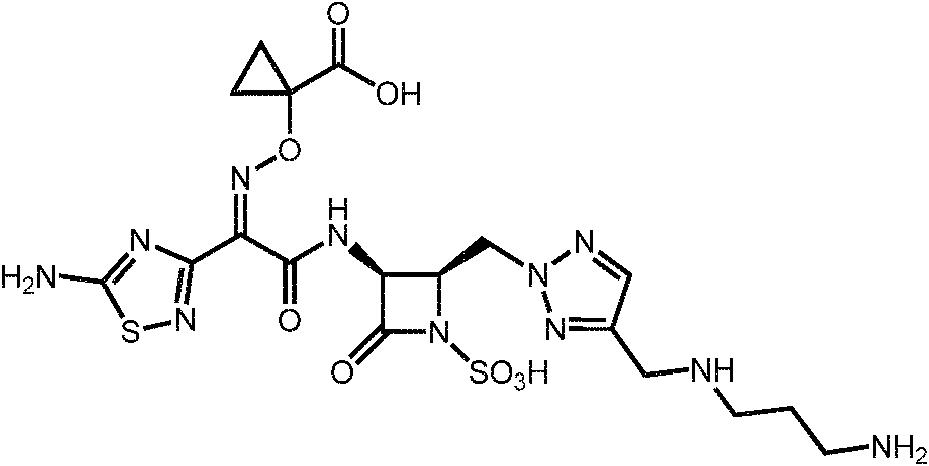
Se preparó de manera análoga al ejemplo 90, usando ácido (Z)-2-((1-((benzhidriloxi)carbonil)ciclopropoxi)imino)-2-(5-((ferc-butoxicarbonil)amino)-1,2,4-tiadiazol-3-il)acético. CL-Em : Rt = 0,29 min, m/z = 588,0 (M+1 ) Método 2m_ácido; 1H RMN (400 MHz, DMSO-d6): 89,53-9,29 (m, 1 H), 8,15 (s, 2 H), 7,75 (s, 1 H) 5,40-5,28 (m, 1 H), 4,82 4,69 (m, 1 H), 4,63 (s, 2 H), 4,21 (d, J = 5,1 Hz, 2 H), 3,00-2,91 (m, 2 H), 2,85 (s, 2 H), 1,91-1,74 (m, 2 H), 1,37-1,04 (m, 4 H). It was prepared analogously to example 90, using (Z) -2 - ((1 - ((benzhydryloxy) carbonyl) cyclopropoxy) imino) -2- (5 - ((ferc-butoxycarbonyl) amino) -1.2, 4-thiadiazol-3-yl) acetic. LC-Em: Rt = 0.29 min, m / z = 588.0 (M + 1) 2m_acid method; 1 H NMR (400 MHz, DMSO-d6): 89.53-9.29 (m, 1 H), 8.15 (s, 2 H), 7.75 (s, 1 H) 5.40-5, 28 (m, 1 H), 4.82 4.69 (m, 1 H), 4.63 (s, 2 H), 4.21 (d, J = 5.1 Hz, 2 H), 3, 00-2.91 (m, 2 H), 2.85 (s, 2 H), 1.91-1.74 (m, 2 H), 1.37-1.04 (m, 4 H).
Ejemplo de referencia 95: ácido 1-(((Z)-(1-(2-am¡not¡azol-4-¡l)-2-(((2R,3S)-2-((2,4-d¡oxooxazol¡d¡n-3-¡l)met¡l)-4-oxo-1-sulfoazetidin-3-il)amino)-2-oxoetilideno)amino)oxi)cidopropanocarboxílico.Reference Example 95: Acid 1 - ((((Z) - (1- (2-am¡not¡azol-4-¡)) -2 - (((2R, 3S) -2 - ((2,4- doxoxxazol, dn-3-l) methyl, -4-oxo-1-sulfoazetidin-3-yl) amino) -2-oxoethylidene) amino) oxy) cidopropanecarboxylic.

Se preparó de manera análoga al ejemplo 54, usando 1-(((Z)-(1-(2-((terc-butox¡carbon¡l)am¡no)t¡azol-4-¡l)-2-(((2S,3S)-2-(h¡drox¡met¡l)-4-oxoazet¡d¡n-3-¡l)am¡no)-2-oxoet¡l¡deno)am¡no)ox¡)c¡dopropanocarbox¡lato de benzh¡dr¡lo y oxazol¡d¡na-2,4-d¡ona. CL-EM: Rt = 0,31 m¡n, m/z = 533,0 (M+1) Método 2m_ác¡do; 1H RMN (400 MHz, D2O) 87,23 (s, 1 H), 5,42 (d, J = 5,9 Hz, 1 H), 4,86-4,83 (m, 3 H), 4,07 (dd, J = 14,5, 9,8 Hz, 1 H), 3,72 (dd, J = 14,5, 3,9 Hz, 1 H), 1,58-1,52 (m, 2 H), 1,51-1,45 (m, 2 H).It was prepared analogously to example 54, using 1 - (((Z) - (1- (2 - ((tert-butoxycarbonyl) amine) thiazol-4-yl) -2- (((2S, 3S) -2- (h¡drox¡met¡l) -4-oxoazet¡d¡n-3-¡) amÃno) -2-oxoet¡l¡deno) amÃno) ox¡) benzh¡dr¡lo and oxazol¡d¡na-2,4-dona dopropanecarboxylate. LC-MS: Rt = 0.31 m¡n, m / z = 533.0 (M + 1) Method 2m_ac¡do; 1 H NMR (400 MHz, D2O) 87.23 (s, 1 H), 5.42 (d, J = 5.9 Hz, 1 H), 4.86-4.83 (m, 3 H), 4 , 07 (dd, J = 14.5, 9.8 Hz, 1 H), 3.72 (dd, J = 14.5, 3.9 Hz, 1 H), 1.58-1.52 (m , 2 H), 1.51-1.45 (m, 2 H).
Ejemplo de referenc¡a 96: ác¡do 1-(((Z)-(2-(((2R,3S)-2-((5-(((3-am¡noprop¡l)am¡no)met¡l)-2H-tetrazol-2-¡l)met¡l)-4-oxo-1-sulfoazet¡d¡n-3-¡l)am¡no)-1-(2-am¡not¡azol-4-¡l)-2-oxoet¡l¡deno)am¡no)ox¡)ddopropanocarboxíl¡co.Reference Example 96: Acid 1 - (((Z) - (2 - (((2R, 3S) -2 - ((5 - ((((3-ampropyl) Amne)) met¡l) -2H-tetrazol-2-¡) met¡l) -4-oxo-1-sulfoazet¡d¡n-3-¡) am¡no) -1- (2-am¡not¡ azol-4-¡l) -2-oxoet¡l¡deno) am¡no) ox¡) ddopropanecarboxylic.

Se preparó de manera análoga a los proced¡m¡entos descr¡tos en los ejemplos 54 y 90, usando 1-(((Z)-(1-(2-((terc-butox¡carbon¡l)am¡no)t¡azol-4-¡l)-2-(((2S,3S)-2-(h¡drox¡met¡l)-4-oxoazet¡d¡n-3-¡l)am¡no)-2-oxoet¡l¡deno)am¡no)ox¡)ddopropanocarbox¡lato de benzh¡dr¡lo y 5-(((terc-but¡ld¡met¡ls¡l¡l)ox¡)met¡l)-2H-tetrazol. CL-EM: Rt = 0,31 m¡n, m/z = 588,4 (M+1) Método 2m_ác¡do; 1H RMN (400 MHz, DMSO-da) 89,41 (s a, 1 H), 7,78 (s, 1 H), 7,24 (s, 1 H), 6,75 (s, 1 H), 5,38-5,32 (m, 1H), 4,86 (dd, J = 14,3, 4,5 Hz, 1 H), 4,72-4,63 (m, 1H), 4,61-4,55 (m, 1H), 4,28-4,16 (m, 1H), 3,01-2,94 (m, 1H), 2,87 (t, J = 7,4 Hz, 1 H), 1,92-1,82 (m, 1H), 1,33-1,18 (m, 2 H), 1,18-1,08 (m, 1 H).It was prepared analogously to the procedures described in examples 54 and 90, using 1 - (((Z) - (1- (2 - ((tert- butoxycarbonyl) amine) ) t¡azol-4-¡l) -2 - (((2S, 3S) -2- (h¡drox¡met¡l) -4-oxoazet¡d¡n-3-¡) am) -2-oxoet¡l¡deno) am¡no) ox¡) ddopropanecarbox¡late of benzh¡dr¡lo and 5 - (((tert-but¡ld¡met¡ls¡l¡l) ox¡) met¡ l) -2H-tetrazol. LC-MS: Rt = 0.31 m¡n, m / z = 588.4 (M + 1) Method 2m_ac¡do; 1 H NMR (400 MHz, DMSO-da) 89.41 (sa, 1 H), 7.78 (s, 1 H), 7.24 (s, 1 H), 6.75 (s, 1 H), 5.38-5.32 (m, 1H), 4.86 (dd, J = 14.3, 4.5 Hz, 1 H), 4.72-4.63 (m, 1H), 4.61 -4.55 (m, 1H), 4.28-4.16 (m, 1H), 3.01-2.94 (m, 1H), 2.87 (t, J = 7.4 Hz, 1 H), 1.92-1.82 (m, 1H), 1.33-1.18 (m, 2 H), 1.18-1.08 (m, 1 H).
Ejemplo 97: ác¡do 1-(((Z)-(2-(((2R,3S)-2-(((R)-5-(((2-am¡noet¡l)am¡no)met¡l)-2-oxooxazol¡d¡n-3-¡l)met¡l)-4-oxo-1-sulfoazet¡d¡n-3-¡l)am¡no)-1-(2-am¡not¡azol-4-¡l)-2-oxoet¡l¡deno)am¡no)ox¡)c¡clopropanocarboxíl¡co.Example 97: Acid 1 - (((Z) - (2 - (((2R, 3S) -2 - (((R) -5 - (((2-amnoetl) amine)) met¡l) -2-oxooxazol¡d¡n-3-¡) met¡l) -4-oxo-1-sulfoazet¡d¡n-3-¡l) amino) -1- (2- am¡not¡azol-4-¡l) -2-oxoet¡l¡deno) amÃno) ox¡) cyclopropanecarboxylic.

Se preparó de manera análoga al ejemplo 26, usando (2-bromoet¡l)carbamato de terc-but¡lo. CL-EM: Rt = 0,380 m¡n, m/z = 591,1 (M+1) Método 2m_ác¡do; 1H RMN (400 MHz, D2O) 86,93 (s, 1H), 5,28 (d, J = 5,8 Hz, 1H), 3,85 (t, J = 9,3 Hz, 1H), 3,68 (dd, J = 15,0, 8,1 Hz, 1H), 3,46-3,36 (m, 2H), 3,25-3,01 (m, 5H), 2,60 (s, 1H), 1,30-1,21 (m, 2H),1,18-1,09 (m, 2H).It was prepared analogously to example 26, using tert-butyl (2-bromoethyl) carbamate. LC-MS: Rt = 0.380 mn, m / z = 591.1 (M + 1) Method 2m_acid; 1H NMR (400 MHz, D2O) 86.93 (s, 1H), 5.28 (d, J = 5.8 Hz, 1H), 3.85 (t, J = 9.3 Hz, 1H), 3 , 68 (dd, J = 15.0, 8.1 Hz, 1H), 3.46-3.36 (m, 2H), 3.25-3.01 (m, 5H), 2.60 (s , 1H), 1.30-1.21 (m, 2H), 1.18-1.09 (m, 2H).
Ejemplo de referenc¡a 98: ác¡do 2-(((Z)-(1-(2-am¡not¡azol-4-¡l)-2-(((2R,3S)-2-((4-met¡l-5-oxo-4,5-d¡h¡dro-1H-1,2,4-tr¡azol-1-¡l)met¡l)-4-oxo-1-sulfoazet¡d¡n-3-¡l)am¡no)-2-oxoet¡l¡deno)am¡no)ox¡)-2-met¡lpropano¡co. Reference example 98: acid 2 - (((Z) - (1- (2-amn.azol-4-l) -2 - (((2R, 3S) -2 - (( 4-met¡l-5-oxo-4,5-d¡h¡dro-1H-1,2,4-tróazol-1-¡) met¡l) -4-oxo-1-sulfoazet¡ d¡n-3-¡l) amÃno) -2-oxoet¡l¡deno) amÃno) ox¡) -2-methlpropane.

Se preparó de manera análoga al ejemplo 31, usando 1-(((2R,3S)-3-am¡no-4-oxoazet¡d¡n-2-¡l)met¡l)-4-met¡l-1H-1,2,4-triazol-5(4H)-ona y ác¡do (Z)-2-(((1-(terc-butox¡)-2-met¡l-1-oxopropan-2-¡l)ox¡)¡m¡no)-2-(2-((tercbutox¡carbon¡l)am¡no)t¡azol-4-¡l)acét¡co. CL-EM: m/z = 531,0 (M-1); 1H RMN (400 MHz, D2O): 87,67 (s, 1H), 7,02 (s, 1H), 5,36 (d, J = 5,6 Hz, 1H), 4,70 - 4,60 (m, 1H, pardalmente oscurec¡do por el p¡co res¡dual de d¡solvente), 4,14 (dd, J = 15,2 y 7,6 Hz, 1H), 3,96 (dd, J = 15,2 y 4,8 Hz, 1H), 3,14 (s, 3H), 1,37 (s, 3H), 1,35 (s, 3H).It was prepared analogously to example 31, using 1 - ((((2R, 3S) -3-am-4-oxoazetine-2-l) methyl) -4-methyl- 1H-1,2,4-triazol-5 (4H) -one and acid (Z) -2 - (((1- (tert-butoxy) -2-methyl-1-oxopropan-2- ¡L) ox¡) ¡m¡no) -2- (2 - ((tercbutox¡carbon¡l) amÃno) t¡azol-4-¡l) acetic. LC-MS: m / z = 531.0 (M-1); 1H NMR (400 MHz, D2O): 87.67 (s, 1H), 7.02 (s, 1H), 5.36 (d, J = 5.6 Hz, 1H), 4.70 - 4.60 (m, 1H, partially obscured by the residual solvent bit), 4.14 (dd, J = 15.2 and 7.6 Hz, 1H), 3.96 (dd, J = 15.2 and 4.8 Hz, 1H), 3.14 (s, 3H), 1.37 (s, 3H), 1.35 (s, 3H).
Ejemplo de referenc¡a 99: ác¡do 2-(((Z)-(1-(2-am¡not¡azol-4-¡l)-2-(((2R,3S)-2-((4-((d¡met¡lam¡no)met¡l)-2H-1,2,3-tr¡azol-2-¡l)met¡l)-4-oxo-1-sulfoazet¡d¡n-3-¡l)am¡no)-2-oxoet¡l¡deno)am¡no)ox¡)-2-met¡lpropano¡co.Reference example 99: acid 2 - (((Z) - (1- (2-amn.azol-4-¡) -2 - (((2R, 3S) -2 - (( 4 - ((d¡met¡lam¡no) met¡l) -2H-1,2,3-tr¡azol-2-¡l) met¡l) -4-oxo-1-sulfoazet¡d¡n -3-¡l) am¡no) -2-oxoet¡l¡deno) am¡no) ox¡) -2-methlpropane.

Se preparó de manera análoga al ejemplo 54, usando A/,W-d¡met¡l-1-(2H-1,2,3-tr¡azol-4-¡l)metanam¡na. CL-EM: m/z = 560,2 (M+1); 1H RMN (400 MHz, D2O) 87,80 (s, 1H), 6,98 (s, 1H), 5,43 (d, J = 4,8 Hz, 1H), 4,94-4,88 (m, 1H), 4,85 4,80 (m, 2H), 4,32 (s, 2H), 2,75 (s, 6H), 1,28 (s, 6 H).It was prepared analogously to Example 54, using A /, Wdmethyl-1- (2H-1,2,3-triazol-4-l) methanamine. LC-MS: m / z = 560.2 (M + 1); 1H NMR (400 MHz, D2O) 87.80 (s, 1H), 6.98 (s, 1H), 5.43 (d, J = 4.8 Hz, 1H), 4.94-4.88 ( m, 1H), 4.85 4.80 (m, 2H), 4.32 (s, 2H), 2.75 (s, 6H), 1.28 (s, 6 H).
Ejemplo de referenc¡a 100: ác¡do 2-(((Z)-(1-(2-am¡not¡azol-4-¡l)-2-(((2R,3S)-2-((4-((met¡lam¡no)met¡l)-2H-1,2,3-tr¡azol-2-¡l)met¡l)-4-oxo-1-sulfoazet¡d¡n-3-¡l)am¡no)-2-oxoet¡l¡deno)am¡no)ox¡)-2-met¡lpropano¡co.Reference Example 100: Acid 2 - (((Z) - (1- (2-amn.azol-4-¡) -2 - (((2R, 3S) -2 - (( 4 - ((melamine) methyl) -2H-1,2,3-trizol-2-yl) methyl) -4-oxo-1-sulfoazet¡d¡n-3 -¡L) amnono) -2-oxoet¡l¡deno) am¡no) ox¡) -2-met¡lpropane¡co.

Se preparó de manera análoga al ejemplo 54, usando ((2H-1,2,3-tr¡azol-4-¡l)met¡l)(met¡l)carbamato de terc-but¡lo. CL-EM: m/z = 544,1 [M-H]-; 1H RMN (400 MHz, D2O) 87,73 (s, 1H), 7,02 (s, 1H), 5,42 (d, J = 5,6 Hz, 1H), 4,92-4,86 (m, 1H), 4,82-4,78 (m, 2H), 4,22 (s, 2H), 2,60 (s, 3H), 1,30 (s, 6 H).It was prepared analogously to example 54, using tert-butyl ((2H-1,2,3-triazol-4-l) methyl) (methyl) carbamate. LC-MS: m / z = 544.1 [MH] -; 1H NMR (400 MHz, D2O) 87.73 (s, 1H), 7.02 (s, 1H), 5.42 (d, J = 5.6 Hz, 1H), 4.92-4.86 ( m, 1H), 4.82-4.78 (m, 2H), 4.22 (s, 2H), 2.60 (s, 3H), 1.30 (s, 6 H).
Ejemplo de referenc¡a 101: ác¡do 2-(((Z)-(2-(((2R,3S)-2-((1-(2-am¡noet¡l)-1H-1,2,3-tr¡azol-4-¡l)met¡l)-4-oxo-1-sulfoazet¡d¡n-3-¡l)am¡no)-1-(2-am¡not¡azol-4-¡l)-2-oxoet¡l¡deno)am¡no)ox¡)-2-met¡lpropano¡co. Reference Example 101: Acid 2 - (((Z) - (2 - (((2R, 3S) -2 - ((1- (2-amnoetl) -1H-1.2 , 3-tr¡azol-4-¡l) met¡l) -4-oxo-1-sulfoazet¡d¡n-3-¡) amino) -1- (2-am¡not¡azol- 4-¡l) -2-oxoet¡l¡deno) amÃno) ox¡) -2-met¡lpropane¡co.

Etapa 1: ((2R,3S)-2-(3,3-d¡bromoal¡l)-1-(2,4-d¡metox¡benc¡l)-4-oxoazet¡d¡n-3-¡l)(4-metox¡benc¡l)carbamato de bencilo. A una d¡soluc¡ón de Pph3 (302,4 mg, 1,15 mmol) en DCM (1 ml) a 0°C se le añad¡ó CBr4 (192 mg, 0,58 mmol). Tras 10 m¡n, se añad¡ó una d¡soluc¡ón de ((3S,4R)-1-(2,4-d¡metox¡benc¡l)-2-oxo-4-(2-oxoet¡l)azet¡d¡n-3-¡l)(4-metox¡benc¡l)carbamato de benc¡lo (152,7 mg, 0,29 mmol) en DCM (800 |il) gota a gota segu¡do por un lavado de DCM (800 |il). Tras 20 m¡n, se diluyó la mezcla de reacc¡ón con DCM y agua, y se separaron las fases. Se extrajo la fase acuosa con DCM (2x). Se lavaron las fases orgán¡cas comb¡nadas con salmuera, se secaron sobre Na2SO4, se f¡ltraron y se concentraron a vacío. Se pur¡f¡có el res¡duo por med¡o de cromatografía en gel de síl¡ce (el 0-40% de EtOAc-hept) para dar el compuesto del título (162 mg, 82%). CL-EM: Rt = 1,2 m¡n, m/z = 689,1 (M+1) Método 2m_ác¡do.Stage 1: ((2R, 3S) -2- (3,3-dbromoal¡l) -1- (2,4-d¡metox¡benc¡l) -4-oxoazet¡d¡n-3- L) (4-methoxybenzyl) benzyl carbamate. To a solution of Pph3 (302.4 mg, 1.15 mmol) in DCM (1 ml) at 0 ° C was added CBr4 (192 mg, 0.58 mmol). After 10 minutes, a solution of ((3S, 4R) -1- (2,4-dimethoxybenzyl) -2-oxo-4- (2-oxoet) was added L) azet¡d¡n-3-¡) (4-methoxybenzyl) benzyl carbamate (152.7 mg, 0.29 mmol) in DCM (800 | il) drop by drop below Do for a wash of DCM (800 | il). After 20 minutes, the reaction mixture was diluted with DCM and water, and the phases were separated. The aqueous phase was extracted with DCM (2x). The combined organic phases were washed with brine, dried over Na2SO4, filtered and concentrated in vacuo. The residue was purified by silica gel chromatography (0-40% EtOAc-hept) to give the title compound (162 mg, 82%). LC-MS: Rt = 1.2 m¡n, m / z = 689.1 (M + 1) Method 2m_ác¡do.
Preparac¡ón de ((3S,4R)-1-(2,4-d¡metox¡benc¡l)-2-oxo-4-(2-oxoet¡l)azet¡d¡n-3-¡l)(4-metox¡benc¡l)carbamato de benc¡lo: A una d¡soluc¡ón de ((2R,3S)-1-(2,4-d¡metox¡benc¡l)-2-((E)-2-metox¡v¡n¡l)-4-oxoazet¡d¡n-3-¡l)carbamato de benc¡lo (ejemplo 82, etapa 1, 1,44 g, 3,38 mmol) en DMF (33,8 ml) a -10°C (baño de h¡elo y sal) se le añad¡ó h¡druro de sod¡o (60%, 162 mg, 4,05 mmol). Tras ag¡tar durante 30 m¡n, se añad¡ó cloruro de p-metox¡benc¡lo (506, pl, 3,71 mmol). Tras calentar hasta 0°C y ag¡tar durante 30 m¡n ad¡c¡onales, se ext¡ngu¡ó con NH4Cl (ac, satd), después se diluyó con EtOAc y L¡Cl (el 5% ac). Se separaron las fases y se extrajo la fase acuosa con EtOAc (2x). Se lavaron las fases orgán¡cas comb¡nadas con L¡Cl (el 5% ac), salmuera, se secó sobre Na2SO4 y se concentró a vacío. Se somet¡ó el mater¡al bruto a las cond¡c¡ones descr¡tas en el ejemplo 82, etapa 2 , después se pur¡f¡có por med¡o de cromatografía en gel de síl¡ce (EtOAc-hept, 0-70%) para dar el compuesto del título (684 mg, 38%). CL-EM: Rt = 0,97 m¡n, m/z = 533,2 (M+1) Método 2m_ác¡do.Preparation of ((3S, 4R) -1- (2,4-d¡methox¡benc¡l) -2-oxo-4- (2-oxoet¡l) azet¡d¡n-3-¡l ) (4-methoxybenzyl) benzyl carbamate: At a solution of ((2R, 3S) -1- (2,4-domethoxybenzyl) -2- ( (E) -2-Methox¡v¡n¡l) -4-oxoazet¡d¡n-3-¡) benzyl carbamate (example 82, step 1, 1.44 g, 3.38 mmol) in DMF (33.8 ml) at -10 ° C (water bath and salt) sodium hydroxide (60%, 162 mg, 4.05 mmol) was added. After stirring for 30 min, p-methoxybenzyl chloride (506, pl, 3.71 mmol) was added. After heating to 0 ° C and stirring for an additional 30 minutes, it was quenched with NH4Cl (aq, satd), then diluted with EtOAc and LCl (5% aq) . The phases were separated and the aqueous phase was extracted with EtOAc (2x). The combined organic phases were washed with LCl (5% aq), brine, dried over Na2SO4 and concentrated in vacuo. The crude material was subjected to the conditions described in example 82, step 2, then purified by silica gel chromatography (EtOAc-hept , 0-70%) to give the title compound (684 mg, 38%). LC-MS: Rt = 0.97 min, m / z = 533.2 (M + 1) Method 2m_ác¡do.
Etapa 2: ((3S,4E)-1-(2,4-d¡metox¡benc¡l)-2-oxo-4-(prop-2-¡n-1-¡l)azet¡d¡n-3-¡l)(4-metox¡benc¡l)carbamato de benc¡lo. Se añad¡ó terc-but¡l-l¡t¡o (0,291 ml, 0,494 mmol) a la d¡soluc¡ón de ((2R,3S)-2-(3,3-d¡bromoal¡l)-1-(2,4-d¡metox¡benc¡l)-4-oxoazet¡d¡n-3-¡l)(4-metox¡benc¡l)carbamato de benc¡lo (162 mg, 0,235 mmol) en THF (volumen: 3,4 ml) a -78°C. Tras 15 m¡n, se ext¡ngu¡ó la mezcla de reacc¡ón con NH4Cl, y se diluyó con agua y EtOAc. Se separaron las fases, y se extrajo la fase orgánica con EtOAc (2x). Se lavaron las fases orgánicas combinadas con salmuera, se secaron sobre Na2SO4, se filtraron y se concentraron a vacío. Se purificó el residuo por medio de cromatografía en gel de sílice (EtOAc-hept, 0-40%) para dar el compuesto del título (98 mg, 79%). CL-EM: Rt = 1,08 min, m/z = 529,3 (M+1) Método 2m_ácido.Stage 2: ((3S, 4E) -1- (2,4-d¡metox¡benc¡l) -2-oxo-4- (prop-2-¡n-1-¡l) azet¡d¡n -3-¡) (4-methoxybenzyl) benzyl carbamate. Tert-butylll (0.291 ml, 0.494 mmol) was added to the solution of ((2R, 3S) -2- (3,3-dromobromoal) -1 - (2,4-d ¡methox¡benc¡l) -4-oxoazet¡d¡n-3-¡) (4-methoxybenzyl) benzyl carbamate (162 mg, 0.235 mmol) in THF (volume: 3.4 ml) at -78 ° C. After 15 minutes, the reaction mixture was quenched with NH4Cl, and diluted with water and EtOAc. The phases were separated, and The organic phase was extracted with EtOAc (2x). The combined organic phases were washed with brine, dried over Na2SO4, filtered and concentrated in vacuo. The residue was purified by silica gel chromatography (EtOAc-hept, 0-40%) to give the title compound (98 mg, 79%). LC-MS: Rt = 1.08 min, m / z = 529.3 (M + 1) 2m_acid method.
Etapa 3: ((2R,3S)-2-((1-(2-((terc-butoxicarbonil)amino)etil)-1H-1,2,3-triazol-4-il)metil)-1-(2,4-dimetoxibencil)-4-oxoazetidin-3-il)(4-metoxibencil)carbamato de bencilo. A una disolución de ((3S,4R)-1-(2,4-dimetoxibencil)-2-oxo-4-(prop-2-in-1-il)azetidin-3-il)(4-metoxibencil)carbamato de bencilo (95,6 mg, 0,18 mmol) en una mezcla de DMSO (1,2 ml), ferc-butanol (1,2 ml) y agua (1,2 ml), se le añadió sulfato de cobre (II) pentahidratado (4,5 mg, 0,018 mmol), L-ascorbato de sodio (35,8 mg, 0,18 mmol) y W-Boc-2-azidoetilamina (76 mg, 0,39 mmol). Tras agitar durante 12 h, se añadieron más sulfato de cobre (II) pentahidratado (10,6 mg, 0,23 equiv), L-ascorbato de sodio (37,4 mg, 1,04 equiv) y N-Boc-2-azidoetilamina (82,1 mg, 2,44 equiv). Tras agitar durante 4 días en total, se diluyó la mezcla de reacción con EtOAc y agua. Se separaron las fases, y se extrajo la fase acuosa con EtOAc (2x). Se lavaron las fases orgánicas combinadas con LiCl (el 5% ac), salmuera, se secó sobre Na2SO4, se filtraron y se concentraron a vacío. Se purificó el residuo por medio de cromatografía en gel de sílice (EtOAc-Hep, 0-40%) para dar el compuesto del título (57,2 mg, 44%). CL-EM: Rt= 1,06 min, m/z = 715,5 (M+1) Método 2m_ácido.Stage 3: ((2R, 3S) -2 - ((1- (2 - ((tert-butoxycarbonyl) amino) ethyl) -1H-1,2,3-triazol-4-yl) methyl) -1- ( Benzyl 2,4-dimethoxybenzyl) -4-oxoazetidin-3-yl) (4-methoxybenzyl) carbamate. To a solution of ((3S, 4R) -1- (2,4-dimethoxybenzyl) -2-oxo-4- (prop-2-in-1-yl) azetidin-3-yl) (4-methoxybenzyl) carbamate of benzyl (95.6 mg, 0.18 mmol) in a mixture of DMSO (1.2 ml), ferc-butanol (1.2 ml) and water (1.2 ml), copper sulfate ( II) pentahydrate (4.5 mg, 0.018 mmol), sodium L-ascorbate (35.8 mg, 0.18 mmol) and W-Boc-2-azidoethylamine (76 mg, 0.39 mmol). After stirring for 12 h, more copper (II) sulfate pentahydrate (10.6 mg, 0.23 equiv), sodium L-ascorbate (37.4 mg, 1.04 equiv) and N-Boc-2 were added -azidoethylamine (82.1 mg, 2.44 equiv). After stirring for 4 days in total, the reaction mixture was diluted with EtOAc and water. The phases were separated, and the aqueous phase was extracted with EtOAc (2x). The combined organic phases were washed with LiCl (5% aq), brine, dried over Na2SO4, filtered and concentrated in vacuo. The residue was purified by silica gel chromatography (EtOAc-Hep, 0-40%) to give the title compound (57.2 mg, 44%). LC-MS: Rt = 1.06 min, m / z = 715.5 (M + 1) 2m_acid method.
Etapa 4: ((2R,3S)-2-((1-(2-((ferc-butoxicarbonil)amino)etil)-1H-1,2,3-triazol-4-il)metil)-4-oxoazetidin-3-il)(4-metoxibencil)carbamato de bencilo. Se preparó de manera análoga al ejemplo 82 etapa 5, usando ((2R,3S)-2-((1-(2-((ferc-butoxicarbonil)amino)etil)-1H-1,2,3-triazol-4-il)metil)-1-(2,4-dimetoxibencil)-4-oxoazetidin-3-il)(4-metoxibencil)carbamato de bencilo (57,2 mg, 0,080 mmol), CH3CN (762 |il), agua (381 ml), peroxidisulfato de potasio (31 mg, 0,12 mmol), y fosfato de potasio, dibásico (19 mg, 0,109 mmol). 20,2 mg. CL-EM: Rt = 0,89 min, m/z = 565,3 (m 1). Método 2m_ácido.Stage 4: ((2R, 3S) -2 - ((1- (2 - ((ferc-butoxycarbonyl) amino) ethyl) -1H-1,2,3-triazol-4-yl) methyl) -4-oxoazetidine -3-yl) (4-methoxybenzyl) benzyl carbamate. Step 82 was prepared analogously to step 82, using ((2R, 3S) -2 - ((1- (2 - ((ferc-butoxycarbonyl) amino) ethyl) -1H-1,2,3-triazol-4 -yl) methyl) -1- (2,4-dimethoxybenzyl) -4-oxoazetidin-3-yl) (4-methoxybenzyl) benzyl carbamate (57.2 mg, 0.080 mmol), CH3CN (762 | il), water (381 ml), potassium peroxydisulfate (31 mg, 0.12 mmol), and potassium phosphate, dibasic (19 mg, 0.109 mmol). 20.2 mg LC-MS: R t = 0.89 min, m / z = 565.3 (m 1). 2m_acid method.
Etapa 5: (2-(4-(((2R,3S)-3-amino-4-oxoazetidin-2-il)metil)-1H-1,2,3-triazol-1-il)etil)carbamato de ferc-butilo. A una suspensión de ((2R,3S)-2-((1-(2-((ferc-butoxicarbonil)amino)etil)-1H-1,2,3-triazol-4-il)metil)-4-oxoazetidin-3-il)(4-metoxibencil)carbamato de bencilo (20,2 mg, 0,036 mmol) en MeOH (0,68 ml) se le añadió Pd negro (19 mg, 0,018 mmol) y ácido fórmico (31 pl, 0,711 mmol). Tras agitar a ta durante 3 h, se añadió más Pd negro (9,7 mg). Tras agitar a ta durante 5,5 h adicionales, se filtró la mezcla de reacción a través de celulosa con eluente de MeOH, y se concentró el filtrado a vacío. Se usó en la etapa 6 sin purificación adicional. CL-EM: Rt = 0,396 min, m/z = 311,1 (M+1). Método 2m_ácido.Stage 5: (2- (4 - (((2R, 3S) -3-amino-4-oxoazetidin-2-yl) methyl) -1H-1,2,3-triazol-1-yl) ethyl) carbamate ferc-butyl. To a suspension of ((2R, 3S) -2 - ((1- (2 - ((ferc-butoxycarbonyl) amino) ethyl) -1H-1,2,3-triazol-4-yl) methyl) -4- benzyl oxoazetidin-3-yl) (4-methoxybenzyl) carbamate (20.2 mg, 0.036 mmol) in MeOH (0.68 ml) was added black Pd (19 mg, 0.018 mmol) and formic acid (31 pl, 0.711 mmol). After stirring at rt for 3 h, more black Pd (9.7 mg) was added. After stirring at rt for an additional 5.5 h, the reaction mixture was filtered through cellulose with MeOH eluent, and the filtrate was concentrated in vacuo. It was used in step 6 without further purification. LC-MS: Rt = 0.396 min, m / z = 311.1 (M + 1). 2m_acid method.
Etapa 6 : 2-(((Z)-(2-(((2R,3S)-2-((1-(2-((ferc-butoxicarbonil)amino)etil)-1H-1,2,3-triazol-4-il)metil)-4-oxoazetidin-3-il)amino)-1-(2-((ferc-butoxicarbonil)amino)tiazol-4-il)-2-oxoetilideno)amino) oxi)-2-metilpropanoato de ferc-butilo. Stage 6: 2 - (((Z) - (2 - (((2R, 3S) -2 - ((1- (2 - ((ferc-butoxycarbonyl) amino) ethyl) -1H-1,2,3- triazol-4-yl) methyl) -4-oxoazetidin-3-yl) amino) -1- (2 - ((ferc-butoxycarbonyl) amino) thiazol-4-yl) -2-oxoethylidene) amino) oxy) -2 ferc-butyl methylpropanoate.
Se preparó de manera análoga al ejemplo 82 etapa 7, usando ácido (Z)-2-(((1-(ferc-butoxi)-2-metil-1-oxopropan-2-il)oxi)imino)-2-(2-((ferc-butoxicarbonil)amino)tiazol-4-il)acético (18,55 mg, 0,043 mmol), HATU (17,7 mg, 0,047 mmol), DCM:DMF (1:3, 800 pl), DIPEA (18,86 pl, 0,108 mmol), (2-(4-(((2R,3S)-3-amino-4-oxoazetidin-2-il)metil)-1H-1,2,3-triazol-1-il)etil)carbamato de ferc-butilo (11,17 mg, 0,036 mmol). 6,5 mg. CL-EM: Rt = 0,971 min, m/z = 722,4 (M+1). Método 2m_ácido. 1H RMN (400 MHz, Metanol-d4) 87,82 (s, 1H), 7,32 (s, 1H), 5,34 (d, J = 4,9 Hz, 1H), 4,43 (t, J = 5,9 Hz, 3H), 4,19 (dt, J = 9,3, 4,5 Hz, 1H), 4,09 (q, J = 7,1 Hz, 1H), 3,54-3,45 (m, 3H), 3,13 (ddd, J = 15,0, 11,8, 6,0 Hz, 2H), 2,93 (dd, J = 15,2, 9,6 Hz, 1H), 2,01 (s, 2H), 1,53 (d, J = 1,4 Hz, 14H), 1,49 (s, 7H), 1,46 (d, J = 1,7 Hz, 15H), 1,38 (s, 14H), 1,23 (t, J = 7,1 Hz, 3H).Step 82 was prepared analogously to step 82, using (Z) -2 - (((1- (ferc-butoxy) -2-methyl-1-oxopropan-2-yl) oxy) imino) -2- ( 2 - ((ferc-butoxycarbonyl) amino) thiazol-4-yl) acetic acid (18.55 mg, 0.043 mmol), HATU (17.7 mg, 0.047 mmol), DCM: DMF (1: 3, 800 pl), DIPEA (18.86 pl, 0.108 mmol), (2- (4 - (((2R, 3S) -3-amino-4-oxoazetidin-2-yl) methyl) -1H-1,2,3-triazole- 1-yl) ethyl) ferc-butyl carbamate (11.17 mg, 0.036 mmol). 6.5 mg LC-MS: R t = 0.971 min, m / z = 722.4 (M + 1). 2m_acid method. 1 H NMR (400 MHz, Methanol-d4) 87.82 (s, 1 H), 7.32 (s, 1 H), 5.34 (d, J = 4.9 Hz, 1 H), 4.43 (t, J = 5.9 Hz, 3H), 4.19 (dt, J = 9.3, 4.5 Hz, 1H), 4.09 (q, J = 7.1 Hz, 1H), 3.54- 3.45 (m, 3H), 3.13 (ddd, J = 15.0, 11.8, 6.0 Hz, 2H), 2.93 (dd, J = 15.2, 9.6 Hz, 1H), 2.01 (s, 2H), 1.53 (d, J = 1.4 Hz, 14H), 1.49 (s, 7H), 1.46 (d, J = 1.7 Hz, 15H), 1.38 (s, 14H), 1.23 (t, J = 7.1 Hz, 3H).
Etapa 7: ácido (2R,3S)-3-((Z)-2-(((1-(ferc-butoxi)-2-metil-1-oxopropan-2-il)oxi)imino)-2-(2-((fercbutoxicarbonil)amino)tiazol-4-il)acetamido)-2-((1-(2-((terc-butoxicarbonil)amino)etil)-1H-1,2,3-triazol-4-il)metil)-4-oxoazetidina-1-sulfónico. Se preparó de manera similar al ejemplo 82, etapa 9, usando 2-(((Z)-(2-(((2R,3S)-2-((1-(2-((ferc-butoxicarbonil)amino)etil)-1H-1,2,3-triazol-4-il)metil)-4-oxoazetidin-3-il)amino)-1-(2-((fercbutoxicarbonil)amino)tiazol-4-il)-2-oxoetilideno)amino)oxi)-2-metilpropanoato de ferc-butilo (6,5 mg, 9,00 pmol), DMF (200 pl), SOâ DMF (5,8 mg, 0,037 mmol). Se usó en la etapa 8 sin purificación adicional. CL-EM: Rt = 0,911 min, m/z = 802,1 (M+1). Método 2m_ácido.Step 7: (2R, 3S) -3 - ((Z) -2 - (((1- (ferc-butoxy) -2-methyl-1-oxopropan-2-yl) oxy) imino) -2- ( 2 - ((fercbutoxycarbonyl) amino) thiazol-4-yl) acetamido) -2 - ((1- (2 - ((tert-butoxycarbonyl) amino) ethyl) -1H-1,2,3-triazol-4-yl ) methyl) -4-oxoazetidine-1-sulfonic. It was prepared in a similar manner to Example 82, step 9, using 2 - (((Z) - (2 - (((2R, 3S) -2 - ((1- (2 - ((ferc-butoxycarbonyl) amino) ethyl) ) -1H-1,2,3-triazol-4-yl) methyl) -4-oxoazetidin-3-yl) amino) -1- (2 - ((fercbutoxycarbonyl) amino) thiazol-4-yl) -2- oxoethylidene) amino) oxy) -2-methylpropanoate of ferc-butyl (6.5 mg, 9.00 pmol), DMF (200 pl), SOâ DMF (5.8 mg, 0.037 mmol). It was used in step 8 without further purification. LC-MS: Rt = 0.911 min, m / z = 802.1 (M + 1). 2m_acid method.
Etapa 8 : ácido 2-(((Z)-(2-(((2R,3S)-2-((1-(2-aminoetil)-1H-1,2,3-triazol-4-il)metil)-4-oxo-1-sulfoazetidin-3-il)amino)-1-(2-aminotiazol-4-il)-2-oxoetilideno)amino)oxi)-2-metilpropanoico. Se siguió el procedimiento general para la desprotección mediada por ácido, usando ácido (2R,3S)-3-((Z)-2-(((1-(ferc-butoxi)-2-metil-1-oxopropan-2-il)oxi)imino)-2-(2-((ferc-butoxicarbonil)amino)tiazol-4-il)acetamido)-2-((1-(2-((ferc-butoxicarbonil)amino)etil)-1H-1,2,3-triazol- 4-il)metil)-4-oxoazetidina-1-sulfónico (7,22 mg, 9,00 pmol), DCM (200 pl) y TFA (50 pl, 649 pmol). Se purificó el residuo bruto mediante HPLC de fase inversa (XSelect CSH, 19 x 100 mm, 5 pm, columna C18; AcN-agua con modificador de ácido fórmico al 0,1%, 24 ml/min) dando el compuesto del título (1,2 mg, 24%). CL-EM: Rt = 0,487 min, m/z = 546,2 (M+1). Método 2m_ácido.Stage 8: 2 - (((Z) - (2 - (((2R, 3S) -2 - ((1- (2-aminoethyl) -1H-1,2,3-triazol-4-yl) methyl acid ) -4-oxo-1-sulfoazetidin-3-yl) amino) -1- (2-aminothiazol-4-yl) -2-oxoethylidene) amino) oxy) -2-methylpropanoic acid. The general procedure for acid-mediated deprotection was followed, using acid (2R, 3S) -3 - ((Z) -2 - (((1- (ferc-butoxy) -2-methyl-1-oxopropan-2- il) oxy) imino) -2- (2 - ((ferc-butoxycarbonyl) amino) thiazol-4-yl) acetamido) -2 - ((1- (2 - ((ferc-butoxycarbonyl) amino) ethyl) -1H -1,2,3-triazol-4-yl) methyl) -4-oxoazetidine-1-sulfonic acid (7.22 mg, 9.00 pmol), DCM (200 pl) and TFA (50 pl, 649 pmol). The crude residue was purified by reverse phase HPLC (XSelect CSH, 19 x 100 mm, 5 pm, column C18; AcN-water with 0.1% formic acid modifier, 24 ml / min) to give the title compound ( 1.2 mg, 24%). LC-MS: R t = 0.487 min, m / z = 546.2 (M + 1). 2m_acid method.
E je m p lo d e re fe re n c ia 102 : á c id o 1 - ( ( (Z ) - (2 - ( ( (2 R ,3 S ) -2 - ( (4 - ( ( (2 -a m in o e t i l) a m in o )m e t i l) -2 H -1 ,2 ,3 - t r ia z o l-2 - i l)m e t i l) -4 -o x o -1 -s u lfo a z e t id in -3 - i l) a m in o ) -1 - (2 -a m in o t ia z o l-4 - i l) -2 -o x o e t i l id e n o )a m in o )o x i) c ic lo p ro p a n o c a rb o x í l ic o . E je mp lo de re fe re nc ia 102: á c id o 1 - (((Z) - (2 - (((2 R, 3 S) -2 - ((4 - (((2 -am in oetil) am in o) methyl) -2 H -1, 2, 3 - tr ia zo l-2 - il) methyl) -4 -oxo -1 -su lfo azet id in -3 - il) am in o) -1 - (2 -am in ot ia zo l-4 - il) -2 -oxoethyl id eno) am in o) oxi) c ic lo p ro panoca rb ox í l ic o.

Se preparó de manera análoga al ejemplo 90, usando (2-aminoetil)carbamato de ferc-butilo y 1-(((Z)-(1-(2-((fercbutox¡carbon¡l)am¡no)t¡azol-4-¡l)-2-(((2R,3S)-2-((4-form¡l-2H-1,2,3-tr¡azol-2-¡l)metil)-4-oxoazet¡d¡n-3-¡l)am¡no)-2-oxoetilideno)amino)oxi)cidopropanocarboxilato de benzh¡dr¡lo en la etapa 3. CL-EM: Rt = 0,31 m¡n, m/z = 573,2 (M+1) Método 2m_ácido; 1H RMN (400 MHz, DMSO-da) 89,24 (d, J = 9,0 Hz, 1,0 H), 7,75 (s, 1 H), 7,22 (s, 2 H), 6,71 (s, 1 H), 5,42-5,28 (m, 1 H), 4,86 (dd, J = 14,3, 4,1 Hz, 1 H), 4,72-4,59 (m, 1 H), 4,53 (ddd, J = 7,4, 5,5, 4,3 Hz, 1 H), 4,24-4,09 (m, 2 H), 3,10-2,97 (m, 5 H), 1,34-1,19 (m, 3 H), 1,19-1,06 (m, 1H).It was prepared analogously to example 90, using ferc-butyl (2-aminoethyl) carbamate and 1 - (((Z) - (1- (2 - ((fercbutoxcarbonyl) amine) thiazole -4-¡l) -2 - (((2R, 3S) -2 - ((4-form¡l-2H-1,2,3-tr¡azol-2-¡l) methyl) -4-oxoazet D¡n-3-l) amine) -2-oxoethylidene) amino) oxy) benzhidodrido cidopropanecarboxylate in step 3. LC-MS: Rt = 0.31 mn, m / z = 573.2 (M + 1) 2m_acid method; 1 H NMR (400 MHz, DMSO-da) 89.24 (d, J = 9.0 Hz, 1.0 H), 7.75 (s, 1 H), 7.22 (s, 2 H), 6 , 71 (s, 1 H), 5.42-5.28 (m, 1 H), 4.86 (dd, J = 14.3, 4.1 Hz, 1 H), 4.72-4, 59 (m, 1 H), 4.53 (ddd, J = 7.4, 5.5, 4.3 Hz, 1 H), 4.24-4.09 (m, 2 H), 3.10 -2.97 (m, 5 H), 1.34-1.19 (m, 3 H), 1.19-1.06 (m, 1H).
Ejemplo de referencia 103: ácido 1-(((Z)-(1-(2-am¡notiazol-4-¡l)-2-(((2R,3S)-2-((4-((azet¡d¡n-3-¡lam¡no)met¡l)-2H-1,2,3-tr¡azol-2-¡l)met¡l)-4-oxo-1-sulfoazet¡d¡n-3-¡l)am¡no)-2-oxoetil¡deno)am¡no)ox¡)ddopropanocarboxíl¡co.Reference example 103: acid 1 - (((Z) - (1- (2-amiazolia-4-l) -2 - (((2R, 3S) -2 - ((4 - ((azet¡ d¡n-3-¡lam¡no) met¡l) -2H-1,2,3-tr¡azol-2-¡) met¡l) -4-oxo-1-sulfoazet¡d¡n- 3-l) amine) -2-oxoethyldene) amine) ox¡) ddopropanecarboxylic acid.

Se preparó de manera análoga al ejemplo 90, usando 3-aminoazetid¡na-1-carbox¡lato de ferc-butilo y 1-(((Z)-(1-(2-((ferc-butox¡carbon¡l)am¡no)t¡azol-4-¡l)-2-(((2R,3S)-2-((4-form¡l-2H-1,2,3-tr¡azol-2-¡l)met¡l)-4-oxoazetid¡n-3-¡l)am¡no)-2-oxoet¡l¡deno)am¡no)ox¡)ddopropanocarbox¡lato de benzhidrilo en la etapa 3. CL-EM: Rt = 0,31 min, m/z = 585,2 (M+1) Método 2m_ácido; 1H RMN (500 MHz, D2O) 87,84 (s, 1H), 7,14 (s, 1H), 5,60 (d, J = 5,6 Hz, 1H), 5,04-4,87 (m, 3H), 4,52-4,36 (m, 5H), 4,35 (s, 1H), 1,35-1,29 (m, 2H), 1,24-1,14 (m, 2H).It was prepared analogously to example 90, using ferc-butyl 3-aminoazetidine-1-carboxylate and 1 - (((Z) - (1- (2 - ((ferc-butoxycarbonyl)) amino) tzolzo-4-l) -2 - (((2R, 3S) -2 - ((4-formyl-2H-1,2,3-trizol-2-l) ) Methyl) -4-oxoazetidine-3-¡) ammonium) -2-oxoetyldene) ammonium) ox¡) ddopropanecarboxamide of benzhydryl in step 3. CL-EM : Rt = 0.31 min, m / z = 585.2 (M + 1) 2m_acid method; 1H NMR (500 MHz, D2O) 87.84 (s, 1H), 7.14 (s, 1H), 5.60 (d, J = 5.6 Hz, 1H), 5.04-4.87 ( m, 3H), 4.52-4.36 (m, 5H), 4.35 (s, 1H), 1.35-1.29 (m, 2H), 1.24-1.14 (m, 2H).
Ejemplo 104: ácido 1-(((Z)-(1-(2-aminot¡azol-4-¡l)-2-(((2R,3S)-2-(((R)-5-(form¡m¡dam¡domet¡l)-2-oxooxazol¡d¡n-3-¡l)met¡l)-4-oxo-1-sulfoazet¡d¡n-3-¡l)am¡no)-2-oxoet¡l¡deno)am¡no)ox¡)c¡clopropanocarboxíl¡co.Example 104: acid 1 - (((Z) - (1- (2-aminot.azol-4-1) -2 - (((2R, 3S) -2 - (((R) -5- (form M¡dam¡domet¡l) -2-oxooxazol¡d¡n-3-¡) met¡l) -4-oxo-1-sulfoazet¡d¡n-3-¡) am) 2-oxoetyldene) amine) ox¡) cyclopropanecarboxylic acid.

Se preparó de manera análoga al ejemplo 26, usando formamidato de etilo-HCI. CL-EM: Rt = 0,29 min, m/z = 575,0 (M+1) Método 2m_ácido.It was prepared analogously to example 26, using ethyl formamide-HCI. LC-MS: Rt = 0.29 min, m / z = 575.0 (M + 1) 2m_acid method.
Ejemplo de referencia 105: ácido 2-(((Z)-(1-(2-aminot¡azol-4-¡l)-2-(((2R,3S)-2-((3-dano-1H-1,2,4-tr¡azol-1-¡l)metil)-4-oxo-1-sulfoazet¡d¡n-3-¡l)am¡no)-2-oxoet¡l¡deno)am¡no)ox¡)-2-met¡lpropano¡co. Reference example 105: acid 2 - (((Z) - (1- (2-aminot¡azol-4-l) -2 - (((2R, 3S) -2 - ((3-dane-1H- 1,2,4-tr¡azol-1-¡l) methyl) -4-oxo-1-sulfoazet¡d¡n-3-¡) amnno) -2-oxoet¡l¡dene) am¡ no) ox¡) -2-methylpropane.
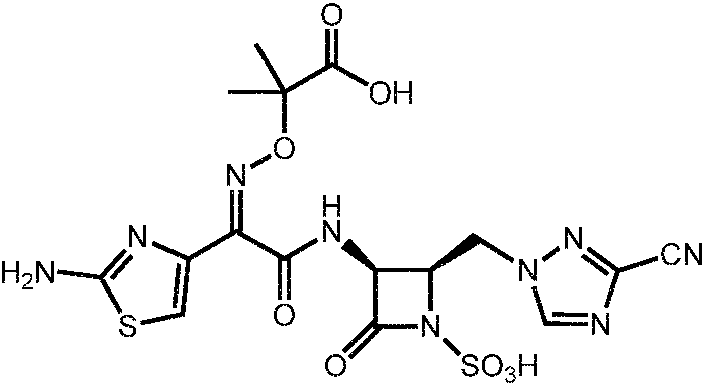
Se preparó de manera análoga al ejemplo 54, usando 1H-1,2,4-tnazol-3-carbomtrilo. CL-EM: m/z = 526,0 [MH]; 1H RMN (400 MHz, D2O) 88,57 (s, 1H), 6,90 (s, 1H), 5,34 (s a, 1H), 5,20-4,77 (m, 3H), 1,31 (s, 6 H).It was prepared analogously to example 54, using 1H-1,2,4-tnazol-3-carbomtrile. LC-MS: m / z = 526.0 [MH]; 1H NMR (400 MHz, D2O) 88.57 (s, 1H), 6.90 (s, 1H), 5.34 (sa, 1H), 5.20-4.77 (m, 3H), 1, 31 (s, 6 H).
Ejemplo de referencia 106: ácido 1-(((Z)-(2-(((2R,3S)-2-((4-((3-am¡noazet¡d¡n-1-¡l)met¡l)-2H-1,2,3-t âzol-2-¡l)met¡l)-4-oxo-1-sulfoazet¡d¡n-3-¡l)am¡no)-1-(2-am¡not¡azol-4-¡l)-2-oxoet¡l¡deno)am¡no)ox¡)c¡dopropanocarboxíl¡co.Reference example 106: acid 1 - (((Z) - (2 - (((2R, 3S) -2 - ((4 - ((3-am¡noazet¡d¡n-1-l) met¡ l) -2H-1,2,3-t âzol-2-¡l) met¡l) -4-oxo-1-sulfoazet¡d¡n-3-¡l) amine) -1- (2 -am¡not¡azol-4-¡l) -2-oxoet¡l¡deno) am¡no) ox¡) cdodopanecarboxylic acid.

Se preparó de manera análoga al ejemplo 90, usando (2-oxoetil)carbamato de ferc-butilo y 1-(((Z)-(1-(2-((terc-butox¡carbon¡l)am¡no)t¡azol-4-¡l)-2-(((2R,3S)-2-((4-form¡l-2H-1,2,3-t âzol-2-¡l)met¡l)-4-oxoazet¡d¡n-3-¡l)am¡no)-2-oxoetNideno^mino^xOdclopropanocarboxNato de benzhidrilo en la etapa 3, excepto porque hubo trabajo adicional en la etapa de sulfonilación. Se trató el producto de sulfonilación bruto con piridina en MeOH a 40°C durante 1 h para eliminar el producto de sobresulfonilación en azetidina. CL-EM: Rt = 0,30 min, m/z = 585,2 (M+1) Método 2m_ácido; 1H RMN (500 MHz, D2O) 87,76 (s, 1 H), 7,03 (s, 1 H), 5,50 (d, J = 5,5 Hz, 1 H), 4,97-4,89 (m, 1 H), 4,89 4,77 (m, 2 H), 4,56-4,48 (m, 3 H), 4,46-4,35 (m, 3 H), 1,29-1,18 (m, 2 H), 1,15-1,08 (m, 2 H).It was prepared analogously to example 90, using ferc-butyl (2-oxoethyl) carbamate and 1 - (((Z) - (1- (2 - ((tert- butoxycarbonyl) amine) t Azol-4-¡l) -2 - (((2R, 3S) -2 - ((4-form¡l-2H-1,2,3-t âzol-2-¡l) met¡l) - 4-oxoazet¡d¡n-3-l) ammonium) -2-oxoetNidene ^ mino ^ xOdclopropanocarboxNazhidrile Nato in stage 3, except that there was additional work in the sulfonylation stage.The crude sulfonylation product was treated with pyridine in MeOH at 40 ° C for 1 h to remove the oversulfonylation product in azetidine LC-MS: Rt = 0.30 min, m / z = 585.2 (M + 1) 2m_acid method; 1H NMR (500 MHz, D2O) 87.76 (s, 1 H), 7.03 (s, 1 H), 5.50 (d, J = 5.5 Hz, 1 H), 4.97-4.89 (m , 1 H), 4.89 4.77 (m, 2 H), 4.56-4.48 (m, 3 H), 4.46-4.35 (m, 3 H), 1.29- 1.18 (m, 2 H), 1.15-1.08 (m, 2 H).
Ejemplo de referencia 107: ácido (S)-2-(((Z)-(2-(((2R,3S)-2-((1H-1,2,4-tr¡azol-1-¡l)met¡l)-4-oxo-1-sulfoazet¡d¡n-3-il)amino)-1-(2-aminotiazol-4-il)-2-oxoetilideno)amino)oxi)-3-(4-carbamimidoilfenoxi)propanoico.Reference example 107: acid (S) -2 - (((Z) - (2 - (((2R, 3S) -2 - ((1H-1,2,4-tr¡azol-1-l)) methyl) -4-oxo-1-sulfoazet¡d¡n-3-yl) amino) -1- (2-aminothiazol-4-yl) -2-oxoethylidene) amino) oxy) -3- (4- carbamimidoylphenoxy) propanoic acid.

Se preparó de manera análoga al ejemplo 68 , usando 2-(am¡noox¡)-3-(4-(N-(fercbutoxicarbomOcarbamimidoNfenoxOpropanoato de (R)-benzhidrilo (preparado según el documento WO2013110643). CL-EM: Rt = 0,30 min, m/z = 623,4 (M+1) Método 2m_ácido; 1H RMN (400 MHz, DMSO-d6): 89,14 (s, 2 H), 8,68 (s a, 2 H), 8,37 (s, 1H), 7,90 (s, 1H), 7,77-7,70 (m, 2 H), 7,28 (s a, 2 H), 6,95 (s a, 1H), 6,79 (s, 1 H), 6,55 (s a, 1 H), 5,19-5,11 (m, 1H), 5,07-4,98 (m, 1H), 4,54-4,39 (m, 3H), 4,28-4,22 (m, 1H).It was prepared analogously to example 68, using 2- (amnoox¡) -3- (4- (N- (fercbutoxycarbomOcarbamimidoNfenoxOpropanoate of (R) -benzhydrile (prepared according to WO2013110643). LC-MS: Rt = 0 , 30 min, m / z = 623.4 (M + 1) Method 2m_acid; 1H NMR (400 MHz, DMSO-d6): 89.14 (s, 2 H), 8.68 (sa, 2 H), 8.37 (s, 1H), 7.90 (s, 1H), 7.77-7.70 (m, 2 H), 7.28 (sa, 2 H), 6.95 (sa, 1H) , 6.79 (s, 1 H), 6.55 (sa, 1 H), 5.19-5.11 (m, 1H), 5.07-4.98 (m, 1H), 4.54 -4.39 (m, 3H), 4.28-4.22 (m, 1H).
Ejemplo 108: ácido 1-(((Z)-(1-(2-am¡not¡azol-4-¡l)-2-oxo-2-(((3S,4R)-2-oxo-4-((2-oxo¡m¡dazol¡d¡n-1-¡l)met¡l)-1-sulfoazetidin-3-il)amino)etilideno)amino)oxi)ciclopropanocarboxílico.Example 108: 1 - ((((Z)) - (1- (2-amine -zol-4-1) -2-oxo-2 - ((((3S, 4R) -2-oxo-4- ((2-Oxo¡m¡dazol¡d¡n-1-¡l) met¡l) -1-sulfoazetidin-3-yl) amino) ethylidene) amino) oxy) cyclopropanecarboxylic.
Etapa 1: 1-(((Z)-(1-(2-((ferc-butox¡carbon¡l)am¡no)t¡azol-4-¡l)-2-(((2S,3S)-2-(h¡drox¡met¡l)-4-oxoazet¡d¡n-3-¡l)am¡no)-2-oxoetiNdeno^mrno^xOdclopropanocarboxNato de benzhidrilo. A una disolución de ácido (Z)-2-((1-((benzhidnloxOcarbomOdclopropoxOimino^-p-^ferc-butoxicarbom^amino^iazoM-iOacético (6,66 g, 12,38 mmol) a 0°C en DCM (61,9 ml, razón: 1) y DMF (61,9 ml, razón: 1) se le añadieron DIPeA (6,49 ml, 37,2 mmol) y HATU (5,65 g, 14,86 mmol). Tras 20 min, se añadió ^S^S^-am ino^hidroxim eti^azetid in^-ona (1,44 g, 12,38 mmol). Tras agitar durante 2 h a ta, se concentró la mezcla de reacción a vacío y se diluyó con EtOAc. Se lavó la fase orgánica con agua, salmuera, se secó sobre Na2SO4, se filtró y se concentró a vacío. Se purificó el residuo bruto por medio de cromatografía en gel de sílice (acetona-DCM) para dar el compuesto del título (4,4 g, 56%). CL-EM: Rt = 0,97 min, m/z = 636,1 (M+1), Método 2m_ácido. 1H RMN (400 MHz, DMSO-da): 11,80 (s a, 1H), 9,08 (d, J = 9,0 Hz, 1 H), 8,41 (s, 1 H), 7,48-7,32 (m, 5 H), 7,32-7,15 (m, 6 H), 6,84 (s, 1 H), 5,20 (ddd, J = 9,2, 5,1, 0,9 Hz, 1 H), 4,77 (t, J = 5,3 Hz, 1 H), 3,76-3,70 (m, 1H), 3,62-3,48 (m, 1 H), 3,47-3,33 (m, 1 H), 1,56-1,33 (m, 13 H).Stage 1: 1 - (((Z) - (1- (2 - ((ferc-butoxycarbonyl) ammonium) thiazol-4-l) -2 - (((2S, 3S) -2- (h¡drox¡met¡l) -4-oxoazet¡d¡n-3-¡) amnno) -2-oxoetiNdeno ^ mrno ^ xOdclopropanocarboxNazidrilo. To an acid solution (Z) - 2 - ((1 - ((benzhidnloxOcarbomOdclopropoxOimino ^ -p- ^ ferc-butoxycarbom ^ amino ^ iazoM-iOacetic acid (6.66 g, 12.38 mmol) at 0 ° C in DCM (61.9 ml, ratio: 1) and DMF (61.9 ml, ratio: 1) DIP and A (6.49 ml, 37.2 mmol) and HATU (5.65 g, 14.86 mmol) were added After 20 min, ^ S ^ S ^ -am ino ^ hydroxim eti ^ azetid in ^ -one (1.44 g, 12.38 mmol) After stirring for 2 h at rt, the reaction mixture was concentrated in vacuo and diluted with EtOAc. washed the phase Organic with water, brine, dried over Na2SO4, filtered and concentrated in vacuo. The crude residue was purified by silica gel chromatography (acetone-DCM) to give the title compound (4.4 g, 56%). LC-MS: Rt = 0.97 min, m / z = 636.1 (M + 1), Method 2m_acid. 1 H NMR (400 MHz, DMSO-da): 11.80 (sa, 1 H), 9.08 (d, J = 9.0 Hz, 1 H), 8.41 (s, 1 H), 7.48 -7.32 (m, 5 H), 7.32-7.15 (m, 6 H), 6.84 (s, 1 H), 5.20 (ddd, J = 9.2, 5.1 , 0.9 Hz, 1 H), 4.77 (t, J = 5.3 Hz, 1 H), 3.76-3.70 (m, 1H), 3.62-3.48 (m, 1 H), 3.47-3.33 (m, 1 H), 1.56-1.33 (m, 13 H).
Etapa 2: 1-(((Z)-(1-(2-((terc-butoxicarbonil)amino)tiazol-4-il)-2-(((2S,3S)-2-(((metilsulfonil)oxi)metil)-4-oxoazetidin-3-il)amino)-2-oxoetilideno)amino)oxi)ciclopropanocarboxilato de benzhidrilo. A una disolución de 1-(((Z)-(1-(2-((tercbutoxicarbonil)amino)tiazol-4-il)-2-(((2S,3S)-2-(hidroximetil)-4-oxoazetidin-3-il)amino)-2-oxoetilideno)amino)oxi)ciclopropanocarboxilato de benzhidrilo (1 g, 1,57 mmol) a 0°C en THF (15,7 ml) se le añadió TEA (0,66 ml, 4,7 mmol) y MsCl (25 |il, 0,32 mmol). Tras 2 h, se diluyó la mezcla de reacción con EtOAc, se lavó con salmuera, se secó sobre Na2SO4, se filtró y se concentró a vacío, dando el compuesto del título (supuestamente cuantitativo). CL-EM: Rt = 0,99 min, m/z = 714,1 (M+1), Método 2m_ácido.Stage 2: 1 - (((Z) - (1- (2 - ((tert-butoxycarbonyl) amino) thiazol-4-yl) -2 - (((2S, 3S) -2 - (((methylsulfonyl) oxy ) methyl) -4-oxoazetidin-3-yl) amino) -2-oxoethylidene) amino) oxy) benzhydryl cyclopropanecarboxylate. To a solution of 1 - (((Z) - (1- (2 - ((tert-butoxycarbonyl) amino) thiazol-4-yl) -2 - (((2S, 3S) -2- (hydroxymethyl) -4-oxoazetidin -3-yl) amino) -2-oxoethylidene) amino) oxy) benzhydryl cyclopropanecarboxylate (1 g, 1.57 mmol) at 0 ° C in THF (15.7 ml) TEA (0.66 ml, 4.7 mmol) and MsCl (25 µl, 0.32 mmol). After 2 h, the reaction mixture was diluted with EtOAc, washed with brine, dried over Na2SO4, filtered and concentrated in vacuo to give the title compound (supposedly quantitative). LC-MS: Rt = 0.99 min, m / z = 714.1 (M + 1), Method 2m_acid.
Etapa 3: 1-(((Z)-(2-(((2R,3S)-2-(azidometil)-4-oxoazetidin-3-il)amino)-1-(2-((terc-butoxicarbonil)amino)tiazol-4-il)-2-oxoetilideno)amino)oxi)ciclopropanocarboxilato de benzhidrilo. A una disolución de 1-(((Z)-(1-(2-((terc-butoxicarbonil)amino)tiazol-4-il)-2-(((2S,3S)-2-(((metilsulfonil)oxi)metil)-4-oxoazetidin-3-il)amino)-2-oxoetilideno)amino)oxi)ciclopropanocarboxilato de benzhidrilo (1,3 g, 1,82 mmol) en DMF (20 ml) se le añadió Nal (0,82 g, 5,5 mmol) y azida de sodio (0,83 g, 12,8 mmol). Tras agitar a 60°C durante 6 h, se extinguió la mezcla de reacción con agua helada y se extrajo con EtOAc. Se lavaron las fases orgánicas combinadas con agua, salmuera, se secaron sobre Na2SO4 anhidro, se concentraron a vacío. Se purificó el residuo bruto por medio de cromatografía en gel de sílice (EtOAc-heptano) para dar el compuesto del título (689 mg, 57%). CL-EM: Rt = 1,02 min, m/z = 661,1 (M+1), Método 2m_ácido.Stage 3: 1 - (((Z) - (2 - (((2R, 3S) -2- (azidomethyl) -4-oxoazetidin-3-yl) amino) -1- (2 - ((tert-butoxycarbonyl) amino) thiazol-4-yl) -2-oxoethylidene) amino) oxy) benzhydryl cyclopropanecarboxylate. To a solution of 1 - (((Z) - (1- (2 - ((tert- butoxycarbonyl) amino) thiazol-4-yl) -2 - (((2 S , 3 S ) -2 - ((( methylsulfonyl) oxy) methyl) -4-oxoazetidin-3-yl) amino) -2-oxoethylidene) amino) oxy) benzhydryl cyclopropanecarboxylate (1.3 g, 1.82 mmol) in DMF (20 ml) Nal was added (0.82 g, 5.5 mmol) and sodium azide (0.83 g, 12.8 mmol). After stirring at 60 ° C for 6 h, the reaction mixture was quenched with ice water and extracted with EtOAc. The combined organic phases were washed with water, brine, dried over anhydrous Na2SO4, concentrated in vacuo. The crude residue was purified by silica gel chromatography (EtOAc-heptane) to give the title compound (689 mg, 57%). LC-MS: Rt = 1.02 min, m / z = 661.1 (M + 1), Method 2m_acid.
Etapa 4: 1-(((Z)-(2-(((2R,3S)-2-(aminometil)-4-oxoazetidin-3-il)amino)-1-(2-((terc-butoxicarbonil)amino)tiazol-4-il)-2-oxoetilideno)amino)oxi)ciclopropanocarboxilato de benzhidrilo. A una disolución de 1-(((Z)-(2-(((2R,3S)-2-(azidometil)-4-oxoazetidin-3-il)amino)-1-(2-((terc-butoxicarbonil)amino)tiazol-4-il)-2-oxoetilideno)amino)oxi)ciclopropanocarboxilato de benzhidrilo (689 mg, 1,04 mmol) en THF (10 ml) y MeOH (1,3 ml) se añadió Ph3P (301 mg, 1,15 mmol). Tras 12 h, se concentró la mezcla de reacción a vacío. Se purificó el residuo bruto por medio de cromatografía en gel de sílice (MeOH-DCM, 0-100%) para dar el compuesto del título (369 mg, 56%). CL-EM: Rt = 0,88 min, m/z = 635,1 (M+1), Método 2m_ácido.Stage 4: 1 - (((Z) - (2 - (((2R, 3S) -2- (aminomethyl) -4-oxoazetidin-3-yl) amino) -1- (2 - ((tert-butoxycarbonyl) amino) thiazol-4-yl) -2-oxoethylidene) amino) oxy) benzhydryl cyclopropanecarboxylate. To a solution of 1 - (((Z) - (2 - (((2R, 3S) -2- (azidomethyl) -4-oxoazetidin-3-yl) amino) -1- (2 - ((tert-butoxycarbonyl) ) amino) thiazol-4-yl) -2-oxoethylidene) amino) oxy) benzhydryl cyclopropanecarboxylate (689 mg, 1.04 mmol) in THF (10 ml) and MeOH (1.3 ml) Ph3P (301 mg) was added , 1.15 mmol). After 12 h, the reaction mixture was concentrated in vacuo. The crude residue was purified by silica gel chromatography (MeOH-DCM, 0-100%) to give the title compound (369 mg, 56%). LC-MS: Rt = 0.88 min, m / z = 635.1 (M + 1), Method 2m_acid.
Etapa 5: 1-(((Z)-(2-(((2R,3S)-2-(((2-((((9H-fluoren-9-il))metoxi)carbonil)amino)etil)amino)metil)-4-oxoazetidin-3-il)amino)-1-(2-((terc-butoxicarbonil)amino)tiazol-4-il)-2-oxoetilideno)amino)oxi)ciclopropanocarboxilato de benzhidrilo. A una disolución de 1-(((Z)-(2-(((2R,3S)-2-(aminometil)-4-oxoazetidin-3-il)amino)-1-(2-((tercbutoxicarbonil)amino)tiazol-4-il)-2-oxoetilideno)amino)oxi)ciclopropanocarboxilato de benzhidrilo (199 mg, 0,29 mmol) en DCE (2,9 ml) se le añadió (2-oxoetil)carbamato de (9H-fluoren-9-il)metilo (84 mg, 0,30 mmol) y triacetoxiborohidruro de sodio (181 mg, 0,86 mmol). Tras 12 h, se extinguió la mezcla de reacción con NaHCO3 saturado (ac), se diluyó con EtOAc, y se separaron las fases. Se extrajo la fase acuosa con EtOAc, y se lavaron las fases orgánicas combinadas con salmuera, se secaron sobre Na2SO4, se filtraron y se concentraron a vacío. Se purificó el residuo bruto por medio de cromatografía en gel de sílice (MeOH-DCM, 0-100%) para dar el compuesto del título (150 mg, 58%). CL-EM: Rt = 1,10 min, m/z = 900,0 (M+1), Método 2m_ácido. 1H RMN (400 MHz, DMSO-d6): 9,16 (d, J = 9,0 Hz, 1 H), 8,35 (s, 1H), 7,87 (d, J = 7,4 Hz, 2 H), 7,66 (d, J = 7,4 Hz, 2 H), 7,45-7,18 (m, 16 H), 6,83 (s, 1H), 5,24-5,17 (m, 1H), 4,28 (d, J = 6,7 Hz, 2 H), 4,19 (d, J = 6,3 Hz, 1 H), 3,79-3,67 (m, 1 H), 3,03-2,95 (m, 2H), 2,73-2,63 (m, 1H), 1,54-1,37 (m, 13H).Stage 5: 1 - (((Z) - (2 - (((2R, 3S) -2 - (((2 - ((((9H-fluoren-9-yl)) methoxy) carbonyl) amino) ethyl) amino) methyl) -4-oxoazetidin-3-yl) amino) -1- (2 - (( tert- butoxycarbonyl) amino) thiazol-4-yl) -2-oxoethylidene) amino) oxy) benzhydryl cyclopropanecarboxylate. To a solution of 1 - (((Z) - (2 - (((2R, 3S) -2- (aminomethyl) -4-oxoazetidin-3-yl) amino) -1- (2 - ((tert-butoxycarbonyl) amino ) thiazol-4-yl) -2-oxoethylidene) amino) oxy) benzhydryl cyclopropanecarboxylate (199 mg, 0.29 mmol) in DCE (2.9 ml) ((9H-fluoren) (2-oxoethyl) carbamate was added -9-yl) methyl (84 mg, 0.30 mmol) and sodium triacetoxyborohydride (181 mg, 0.86 mmol). After 12 h, the reaction mixture was quenched with saturated NaHCO3 (aq), diluted with EtOAc, and the phases were separated. The aqueous phase was extracted with EtOAc, and the combined organic phases were washed with brine, dried over Na2SO4, filtered and concentrated in vacuo. The crude residue was purified by silica gel chromatography (MeOH-DCM, 0-100%) to give the title compound (150 mg, 58%). LC-MS: Rt = 1.10 min, m / z = 900.0 (M + 1), Method 2m_acid. 1 H NMR (400 MHz, DMSO-d6): 9.16 (d, J = 9.0 Hz, 1 H), 8.35 (s, 1 H), 7.87 (d, J = 7.4 Hz, 2 H), 7.66 (d, J = 7.4 Hz, 2 H), 7.45-7.18 (m, 16 H), 6.83 (s, 1H), 5.24-5, 17 (m, 1H), 4.28 (d, J = 6.7 Hz, 2 H), 4.19 (d, J = 6.3 Hz, 1 H), 3.79-3.67 (m , 1 H), 3.03-2.95 (m, 2H), 2.73-2.63 (m, 1H), 1.54-1.37 (m, 13H).
Etapa 6 : 1-(((Z)-(2-(((2R,3S)-2-(((2-aminoetil)amino)metil)-4-oxoazetidin-3-il)amino)-1-(2-((tercbutoxicarbonil)amino)tiazol-4-il)-2-oxoetilideno)amino)oxi)ciclopropanocarboxilato de benzhidrilo. A una disolución de 1-(((Z)-(2-(((2R,3S)-2-(((2-((((9H-fluoren-9-il)metoxi)carbonil)amino)etil)amino)metil)-4-oxoazetidin-3-il)amino)-1-(2-((terc-butoxicarbonil)amino)tiazol-4-il)-2-oxoetilideno)amino)oxi)ciclopropanocarboxilato de benzhidrilo (150 mg, 0,167 mmol) en DCM (1,7 ml) se le añadió piperidina (16,50 |il, 0,167 mmol). Tras 2 h, se concentró la mezcla de reacción a vacío y se liofilizó en mezcla de CH3CN/agua para dar el compuesto del título (supuestamente cuantitativo). CL-e M: Rt = 0,93 min, m/z = 678,5 (M+1 ), Método 2m_ácido.Stage 6: 1 - (((Z) - (2 - (((2R, 3S) -2 - (((2-aminoethyl) amino) methyl) -4-oxoazetidin-3-yl) amino) -1- ( 2 - ((tert-butoxycarbonyl) amino) thiazol-4-yl) -2-oxoethylidene) amino) oxy) benzhydryl cyclopropanecarboxylate. At a solution of 1 - (((Z) - (2 - (((2R, 3S) -2 - (((2 - ((((9H-fluoren-9-yl) methoxy) carbonyl) amino) ethyl) amino) methyl) -4-oxoazetidin-3-yl) amino) -1- (2 - ((tert-butoxycarbonyl) amino) thiazol-4-yl) -2-oxoethylidene) amino) oxy) benzhydryl cyclopropanecarboxylate (150 mg , 0.167 mmol) in DCM (1.7 mL) piperidine (16.50 µL, 0.167 mmol) was added. After 2 h, the reaction mixture was concentrated in vacuo and lyophilized in CH3CN / water mixture to give the title compound (supposedly quantitative). LC-M: Rt = 0.93 min, m / z = 678.5 (M + 1), Method 2m_acid.
Etapa 7: 1-(((Z)-(1-(2-((terc-butoxicarbonil)amino)tiazol-4-il)-2-oxo-2-(((3S,4R)-2-oxo-4-((2-oxoimidazolidin-1-il)metil)azetidin-3-il)amino)etilideno)amino)oxi)ciclopropanocarboxilato de benzhidrilo. A una disolución de 1-(((Z)-(2-(((2R,3S)-2-(((2-aminoetil)amino)metil)-4-oxoazetidin-3-il)amino)-1-(2-((terc-butoxicarbonil)amino)tiazol-4-il)-2-oxoetilideno)amino)oxi)ciclopropanocarboxilato de benzhidrilo (90 mg, 0,133 mmol) en cloroformo (2,7 ml) se le añadió CDI (43,1 mg, 0,266 mmol) y TEA (111 |il, 0,797 mmol). Tras 12 h, se concentró la mezcla de reacción a vacío. Se purificó el residuo bruto por medio de cromatografía en gel de sílice (MeOH-DCM, 0-100%) para dar el compuesto del título (46 mg, 49%). CL-EM: Rt = 0,95 min, m/z = 704,0 (M+1), Método 2m_ácido.Stage 7: 1 - (((Z) - (1- (2 - ((tert-butoxycarbonyl) amino) thiazol-4-yl) -2-oxo-2 - (((3S, 4R) -2-oxo- 4 - ((2-Oxoimidazolidin-1-yl) methyl) azetidin-3-yl) amino) ethylidene) amino) oxy) benzhydryl cyclopropanecarboxylate. To a solution of 1 - (((Z) - (2 - (((2R, 3S) -2 - (((2-aminoethyl) amino) methyl) -4-oxoazetidin-3-yl) amino) -1- (2 - ((tert-Butoxycarbonyl) amino) thiazol-4-yl) -2-oxoethylidene) amino) oxy) benzhydryl cyclopropanecarboxylate (90 mg, 0.133 mmol) in chloroform (2.7 ml) CDI (43 , 1 mg, 0.266 mmol) and TEA (111 µl, 0.797 mmol). After 12 h, the reaction mixture was concentrated in vacuo. The crude residue was purified by silica gel chromatography (MeOH-DCM, 0-100%) to give the title compound (46 mg, 49%). LC-MS: Rt = 0.95 min, m / z = 704.0 (M + 1), Method 2m_acid.
Etapa 8 : ácido (3S,4R)-3-((Z)-2-((1-((benzhidriloxi)carbonil)ciclopropoxi)imino)-2-(2-((terc-butoxicarbonil) amino)tiazol-4-il)acetamido)-2-oxo-4-((2-oxoimidazolidin-1-il)metil)azetidina-1-sulfónico, ácido (3S,4R)-3-((Z)-2-((1-((benzhidriloxi)carbonil)ciclopropoxi)imino)-2-(2-((terc-butoxicarbonil)amino)tiazol-4-il)acetamido)-2-oxo-4-((3-oxo-1,2,4-triazinan-1-il)metil)azetidina-1-sulfónico. A una disolución de 1-(((Z)-(1-(2-((terc-butoxicarbonil)amino)tiazol-4-il)-2-oxo-2-(((3S,4R)-2-oxo-4-((2-oxoimidazolidin-1-il)metil)azetidin-3Step 8: (3S, 4R) -3 - ((Z) -2 - ((1 - ((benzhydryloxy) carbonyl) cyclopropoxy) imino) -2- (2 - ((tert-butoxycarbonyl) amino) thiazole-4 -yl) acetamido) -2-oxo-4 - ((2-oxoimidazolidin-1-yl) methyl) azetidine-1-sulfonic acid (3S, 4R) -3 - ((Z) -2 - ((1- ((benzhydryloxy) carbonyl) cyclopropoxy) imino) -2- (2 - ((tert-butoxycarbonyl) amino) thiazol-4-yl) acetamido) -2-oxo-4 - ((3-oxo-1,2,4 -triazinan-1-yl) methyl) azetidine-1-sulfonic acid. To a solution of 1 - (((Z) - (1- (2 - ((tert-butoxycarbonyl) amino) thiazol-4-yl) -2-oxo-2 - (((3S, 4R) -2-oxo-4- ( (2-Oxoimidazolidin-1-yl) methyl) azetidin-3
il)amino)etilideno)amino)oxi)cidopropanocarboxilato de benzhidrilo (46 mg, 65 mmol) en DMF (654 |il) se le añadió SOâ DMF (100 mg, 0,654 mmol). Tras agitar a ta durante 2 h, se diluyó la mezcla de reacción con EtOAc, se lavó con salmuera, se secó sobre Na2SO4, se filtró y se concentró a vacío para dar el compuesto del título (50 mg, 98%). CL-EM: Rt = 0,84 min, m/z = 784,0 (M+1), Método 2m_ácido. Se usó el residuo bruto como tal en la siguiente etapa. il) amino) ethylidene) amino) oxy) benzhydryl cidopropanecarboxylate (46 mg, 65 mmol) in DMF (654 µl) was added SOâ DMF (100 mg, 0.654 mmol). After stirring at rt for 2 h, the reaction mixture was diluted with EtOAc, washed with brine, dried over Na2SO4, filtered and concentrated in vacuo to give the title compound (50 mg, 98%). LC-MS: Rt = 0.84 min, m / z = 784.0 (M + 1), Method 2m_acid. The crude residue was used as such in the next step.
Etapa 9: ácido 1-(((Z)-(1-(2-aminotiazol-4-il)-2-oxo-2-(((3S,4R)-2-oxo-4-((2-oxoimidazolidin-1-il)metil)-1-sulfoazetidin-3-il)amino)etilideno)amino)oxi)ciclopropanocarboxílico.Stage 9: 1 - (((Z) - (1- (2-aminothiazol-4-yl) -2-oxo-2 - ((((3S, 4R) -2-oxo-4 - ((2-oxoimidazolidin) -1-yl) methyl) -1-sulfoazetidin-3-yl) amino) ethylidene) amino) oxy) cyclopropanecarboxylic.

Se siguió el procedimiento general para la desprotección mediada por ácido usando ácido (3S,4R)-3-((Z)-2-((1-((benzhidriloxi)carbonil)ciclopropoxi)imino)-2-(2-((ferc-butoxicarbonil)amino)tiazol-4-il)acetamido)-2-oxo-4-((2-oxoimidazolidin-1-il)metil)azetidina-1-sulfónico, ácido (3S,4R)-3-((Z)-2-((1-((benzhidriloxi)carbonil)ciclopropoxi)imino)-2-(2-((ferc-butoxicarbonil)amino)tiazol-4-il)acetamido)-2-oxo-4-((3-oxo-1,2,4-triazinan-1-il)metil)azetidina-1-sulfónico (48 mg, 61 |imol), DCM (0,61 ml), y TFA (0,28 ml, 3,7 mmol) durante 4 h. Se purificó el residuo bruto mediante HPLC de fase inversa (XSelect CSH, 30 x 100 mm, 5 |im, columna C18; AcN-agua con modificador de ácido fórmico al 0,1%, 60 ml/min) dando el compuesto del título (3,6 mg, 10%). CL-EM: Rt = 0,45 min, m/z = 518,1 (M+1), Método 2m_ácido; 1H RMN (500 MHz, D2O): 87,01 (s, 1 H), 5,32 (d, J = 5,5 Hz, 1 H), 4,53-4,39 (m, 1 H), 3,61 (dd, J = 14,8, 6,9 Hz, 1 H), 3,56- 3,41 (m, 2 H), 3,35-3,21 (m, 3 H), 1,46-1,19 (m, 4 H).The general procedure for acid-mediated deprotection was followed using (3S, 4R) -3 - ((Z) -2 - ((1 - ((benzhydryloxy) carbonyl) cyclopropoxy) imino) -2- (2 - (( ferc-butoxycarbonyl) amino) thiazol-4-yl) acetamido) -2-oxo-4 - ((2-oxoimidazolidin-1-yl) methyl) azetidine-1-sulfonic acid (3S, 4R) -3 - (( Z) -2 - ((1 - ((benzhydryloxy) carbonyl) cyclopropoxy) imino) -2- (2 - ((ferc-butoxycarbonyl) amino) thiazol-4-yl) acetamido) -2-oxo-4 - (( 3-oxo-1,2,4-triazinan-1-yl) methyl) azetidine-1-sulfonic acid (48 mg, 61 | imol), DCM (0.61 ml), and TFA (0.28 ml, 3, 7 mmol) for 4 h. The crude residue was purified by reverse phase HPLC (XSelect CSH, 30 x 100 mm, 5 | im, C18 column; AcN-water with 0.1% formic acid modifier, 60 ml / min) to give the title compound (3.6 mg, 10%). LC-MS: Rt = 0.45 min, m / z = 518.1 (M + 1), 2m_acid Method; 1 H NMR (500 MHz, D2O): 87.01 (s, 1 H), 5.32 (d, J = 5.5 Hz, 1 H), 4.53-4.39 (m, 1 H), 3.61 (dd, J = 14.8, 6.9 Hz, 1 H), 3.56-3.41 (m, 2 H), 3.35-3.21 (m, 3 H), 1 , 46-1.19 (m, 4 H).
Ejemplo de referencia 109: ácido 1-(((Z)-(1-(2-aminotiazol-4-il)-2-(((2R,3S)-2-((4,5-bis(aminometil)-2H-1,2,3-triazol-2-il)metil)-4-oxo-1-sulfoazetidin-3-il)amino)-2-oxoetilideno)amino)oxi)ciclopropanocarboxílico.Reference example 109: 1 - (((Z) - (1- (2-aminothiazol-4-yl) -2 - (((2R, 3S) -2 - ((4,5-bis (aminomethyl) - acid 2H-1,2,3-triazol-2-yl) methyl) -4-oxo-1-sulfoazetidin-3-yl) amino) -2-oxoethylidene) amino) oxy) cyclopropanecarboxylic.
Etapa 1: A una disolución de dicarbonato de di-ferc-butilimino (1,02 g, 4,60 mmol) en DMF (14 ml) a 0°C se le añadió hidruro de sodio (0,19 g, 4,83 mmol). Se retiró el baño frío, y se añadió más DMF (20 ml). Tras agitar durante 15 min, se añadió rápidamente 1,4-diclorobut-2-ino (0,91 ml, 9,20 mmol). Tras agitar a ta durante 12 h, se vertió la mezcla de reacción en una disolución fría de LiCl (el 5% ac.). Se extrajo la fase acuosa con EtOAc (3x), y se lavaron las fases orgánicas combinadas con LiCl (el 5% ac.), salmuera, se secaron sobre Na2SO4, se filtraron y se concentraron a vacío. Se purificó el residuo bruto por medio de cromatografía en gel de sílice (EtOAc-heptano, 0-10%) para dar el compuesto del título (467 mg, 33%). CL-EM: Rt = 1,07 min, m/z = 326,0 (M+Na), Método 2m_ácido; 1H RMN (400 MHz, CDCls) 84,13 (t, J = 1,9 Hz, 2 H) 4,40 (t, J=1,9 Hz, 2 H), 1,57-1,51 (m, 18H).Step 1: To a solution of di-ferc-butylimino dicarbonate (1.02 g, 4.60 mmol) in DMF (14 ml) at 0 ° C was added sodium hydride (0.19 g, 4.83 mmol). The cold bath was removed, and more DMF (20 ml) was added. After stirring for 15 min, 1,4-dichlorobut-2-ino (0.91 ml, 9.20 mmol) was added quickly. After stirring at rt for 12 h, the reaction mixture was poured into a cold solution of LiCl (5% aq.). The aqueous phase was extracted with EtOAc (3x), and the combined organic phases were washed with LiCl (5% aq.), Brine, dried over Na2SO4, filtered and concentrated in vacuo. The crude residue was purified by silica gel chromatography (EtOAc-heptane, 0-10%) to give the title compound (467 mg, 33%). LC-MS: Rt = 1.07 min, m / z = 326.0 (M + Na), Method 2m_acid; 1 H NMR (400 MHz, CDCls) 84.13 (t, J = 1.9 Hz, 2 H) 4.40 (t, J = 1.9 Hz, 2 H), 1.57-1.51 (m , 18H).
Etapa 2: Se preparó según el procedimiento descrito en Sharpless, K. B. Synthesis. 2005, 9, 1514. A una disolución de producto intermedio de la etapa 1 (466 mg, 1,53 mmol) en 1,4-dioxano (5,8 ml) y agua (1,9 ml) se le añadió azida de sodio (401 mg, 6,17 mmol) seguido por cloruro de amonio (167,8 mg, 3,14 mmol). Tras calentar hasta 75°C durante 11 h, se vertió la mezcla de reacción en embudo separador, y se separaron las fases. Se extrajo la fase acuosa con EtOAc (3x). Se lavaron las fases orgánicas combinadas con salmuera, se secaron sobre Na2SO4, se filtraron y se concentraron a vacío. Se purificó el residuo bruto por medio de cromatografía en gel de sílice (EtOAc-Hep, 0-40%) para dar el compuesto del título (224 mg, 41%). CL-EM: Rt = 0,90 min, m/z = 354,1 (M+1), Método 2m_ácido; 1H RMN (400 MHz, CDCla) 84,87 (s, 2H), 4,56 (s, 2H), 1,50 (s, 18H).Stage 2: It was prepared according to the procedure described in Sharpless, K. B. Synthesis. 2005, 9, 1514. To a solution of intermediate of step 1 (466 mg, 1.53 mmol) in 1,4-dioxane (5.8 ml) and water (1.9 ml) was added azide of sodium (401 mg, 6.17 mmol) followed by ammonium chloride (167.8 mg, 3.14 mmol). After heating to 75 ° C for 11 h, the reaction mixture was poured into a separatory funnel, and the phases were separated. The aqueous phase was extracted with EtOAc (3x). The combined organic phases were washed with brine, dried over Na2SO4, filtered and concentrated in vacuo. The crude residue was purified by silica gel chromatography (EtOAc-Hep, 0-40%) to give the title compound (224 mg, 41%). LC-MS: Rt = 0.90 min, m / z = 354.1 (M + 1), Method 2m_acid; 1H NMR (400 MHz, CDCla) 84.87 (s, 2H), 4.56 (s, 2H), 1.50 (s, 18H).
Etapa 3: 1-(((Z)-(2-(((2R,3S)-2-((4-(azidometil)-5-((bis(ferc-butoxicarbonil)amino)metil)-2H-1,2,3-triazol-2-il)metil)-4-oxoazetidin-3-il)amino)-1-(2-((ferc-butoxicarbonil)amino)tiazol-4-il)-2-oxoetilideno)amino)oxi)ciclopropanocarboxilato de benzhidrilo. A una suspensión de 1-(((Z)-(1-(2-((ferc-butoxicarbonil)amino)tiazol-4-il)-2-(((2S,3S)-2-(hidroximetil)-4-oxoazetidin-3-il)amino)-2-oxoetilideno)amino)oxi)ciclopropanocarboxilato de benzhidrilo (202 mg, 0,32 mmol), producto intermedio de la etapa 2 (136 mg, 0,38 mmol) y trifenilfosfina (100 mg, 0,38 mmol) en THF (4 ml) a 0°C se le añadió DIAD (0,079 ml, 0,38 mmol) gota a gota. Tras agitar a ta durante 12 h, se diluyó la mezcla de reacción con DCM y se concentró a vacío. Se purificó el residuo bruto por medio de cromatografía en gel de sílice (EtOAc-Hep, 0-70%) para dar el compuesto del título. CL-EM: Rt = 1,27 min, m/z = 971,5 (M+1), Método 2m_ácido; 1H RMN (400 MHz, DMSO-d6) 89,38 (d, J = 9,1 Hz, 1H), 8,56 (d, J = 1,7 Hz, 1H), 7,45 - 7,38 (m, 5H), 7,32 - 7,20 (m, 7H), 6,84 (s, 1H), 5,41 (dd, J = 9,0, 5,2 Hz, 1H), 4,78 (d, J = 1,5 Hz, 2H), 4,51 (d, J = 1,2 Hz, 2H), 4,48 - 4,42 (m, 2H), 4,37 - 4,30 (m, 1H), 1,42 (d, J = 39,1 Hz, 31H).Stage 3: 1 - (((Z) - (2 - (((2R, 3S) -2 - ((4- (azidomethyl) -5 - ((bis (ferc-butoxycarbonyl) amino) methyl) -2H-1 , 2,3-triazol-2-yl) methyl) -4-oxoazetidin-3-yl) amino) -1- (2 - ((ferc-butoxycarbonyl) amino) thiazol-4-yl) -2-oxoethylidene) amino ) oxy) benzhydryl cyclopropanecarboxylate. To a suspension of 1 - (((Z) - (1- (2 - ((ferc-butoxycarbonyl) amino) thiazol-4-yl) -2 - (((2S, 3S) -2- (hydroxymethyl) -4 -oxoazetidin-3-yl) amino) -2-oxoethylidene) amino) oxy) benzhydryl cyclopropanecarboxylate (202 mg, 0.32 mmol), intermediate of step 2 (136 mg, 0.38 mmol) and triphenylphosphine (100 mg, 0.38 mmol) in THF (4 ml) at 0 ° C was added DIAD (0.079 ml, 0.38 mmol) dropwise. After stirring at rt for 12 h, the reaction mixture was diluted with DCM and concentrated in vacuo. The crude residue was purified by silica gel chromatography (EtOAc-Hep, 0-70%) to give the title compound. LC-MS: Rt = 1.27 min, m / z = 971.5 (M + 1), Method 2m_acid; 1 H NMR (400 MHz, DMSO-d6) 89.38 (d, J = 9.1 Hz, 1 H), 8.56 (d, J = 1.7 Hz, 1 H), 7.45 - 7.38 ( m, 5H), 7.32-7.20 (m, 7H), 6.84 (s, 1H), 5.41 (dd, J = 9.0, 5.2 Hz, 1H), 4.78 (d, J = 1.5 Hz, 2H), 4.51 (d, J = 1.2 Hz, 2H), 4.48-4.42 (m, 2H), 4.37-4.30 ( m, 1H), 1.42 (d, J = 39.1 Hz, 31H).
Etapa 4: ácido (2R,3S)-2-((4-(azidometil)-5-((bis(ferc-butoxicarbonil)amino)metil)-2H-1,2,3-triazol-2-il)metil)-3-((Z)-2-((1-((benzhidriloxi)carbonil)ciclopropoxi)imino)-2-(2-((ferc-butoxicarbonil)amino)tiazol-4-il)acetamido)-4-oxoazetidina-1-sulfónico. A una disolución de 1-(((Z)-(2-(((2R,3S)-2-((4-(azidometil)-5-((bis(ferc-butoxicarbonil)amino)metil)-2H-1,2,3-triazol-2-il)metil)-4-oxoazetidin-3-il)amino)-1-(2-((ferc-butoxicarbonil)amino)tiazol-4-il)-2-oxoetilideno)amino)oxi)ciclopropanocarboxilato de benzhidrilo (103 mg, 0,11 mol) en DMF (530 pl) a 0°C se le añadió SOâ DMF (33,5 mg, 0,21 mmol). Tras agitar a ta durante 3 h, se diluyó la mezcla de reacción con EtOAc, se lavó con LiCl (el 5% ac.), salmuera, se secó sobre Na2SO4, se filtró y se concentró a vacío para dar el compuesto del título (supuestamente cuantitativo). CL-EM: Rt = 1,16 min, m/z = 1051,6 (M+1), Método 2m_ácido. Se usó el residuo bruto como tal en la siguiente etapa.Step 4: (2R, 3S) -2 - ((4- (azidomethyl) -5 - ((bis (ferc-butoxycarbonyl) amino) methyl) -2H-1,2,3-triazol-2-yl) methyl ) -3 - ((Z) -2 - ((1 - ((benzhydryloxy) carbonyl) cyclopropoxy) imino) -2- (2 - ((ferc-butoxycarbonyl) amino) thiazol-4-yl) acetamido) -4- oxoazetidine-1-sulfonic. At a solution of 1 - (((Z) - (2 - (((2R, 3S) -2 - ((4- (azidomethyl) -5 - ((bis (ferc-butoxycarbonyl) amino) methyl) -2H- 1,2,3-triazol-2-yl) methyl) -4-oxoazetidin-3-yl) amino) -1- (2 - ((ferc-butoxycarbonyl) amino) thiazol-4-yl) -2-oxoethylidene) amino) oxy) benzhydryl cyclopropanecarboxylate (103 mg, 0.11 mol) in DMF (530 pl) at 0 ° C SOâ DMF (33.5 mg, 0.21 mmol) was added. After stirring at rt for 3 h, the reaction mixture was diluted with EtOAc, washed with LiCl (5% aq.), Brine, dried over Na2SO4, filtered and concentrated in vacuo to give the title compound ( supposedly quantitative). LC-MS: Rt = 1.16 min, m / z = 1051.6 (M + 1), Method 2m_acid. The crude residue was used as such in the next step.
Etapa 5: ácido (2R,3S)-2-((4-(aminometil)-5-((bis(terc-butoxicarbonil)amino)metil)-2H-1,2,3-triazol-2-il)metil)-3-((Z)-2-((1-((benzhidriloxi)carbonil)ciclopropoxi)imino)-2-(2-((terc-butoxicarbonil)amino)tiazol-4-il)acetamido)-4-oxoazetidina-1-sulfónico. A una disolución de ácido (2R,3S)-2-((4-(azidometil)-5-((bis(terc-butoxicarbonil)amino)metil)-2H-1,2,3-triazol-2-il)metil)-3-((Z)-2-((1-((benzhidriloxi)carbonil)ciclopropoxi)imino)-2-(2-((terc-butoxicarbonil)amino)tiazol-4-il)acetamido)-4-oxoazetidina-1-sulfónico (111 mg, 0,11 mmol) en EtOAc (1,1 ml) y EtOH (0,22 ml) bajo N2 se le añadió Pd-C (22 mg, 0,021 mmol). Se evacuó el sistema y se volvió a llenar con H2 (3x). Tras agitar a ta durante 4 h, se filtró la mezcla de reacción a través de Celite con EtOAc y lavado de EtOH. Se concentró el filtrado a vacío para dar el compuesto del título (supuestamente cuantitativo). Se usó el residuo bruto como tal en la siguiente etapa. CL-EM: Rt= 1,06 min, m/z = 1025,7 (M+1), Método 2m_ácido.Step 5: (2R, 3S) -2 - ((4- (aminomethyl) -5 - ((bis (tert-butoxycarbonyl) amino) methyl) -2H-1,2,3-triazol-2-yl) methyl ) -3 - ((Z) -2 - ((1 - ((benzhydryloxy) carbonyl) cyclopropoxy) imino) -2- (2 - ((tert-butoxycarbonyl) amino) thiazol-4-yl) acetamido) -4- oxoazetidine-1-sulfonic. To a solution of (2R, 3S) -2 - ((4- (azidomethyl) -5 - ((bis (tert-butoxycarbonyl) amino) methyl) -2H-1,2,3-triazol-2-yl) methyl) -3 - ((Z) -2 - ((1 - ((benzhydryloxy) carbonyl) cyclopropoxy) imino) -2- (2 - ((tert-butoxycarbonyl) amino) thiazol-4-yl) acetamido) -4 -oxoazetidine-1-sulfonic acid (111 mg, 0.11 mmol) in EtOAc (1.1 ml) and EtOH (0.22 ml) under N2 was added Pd-C (22 mg, 0.021 mmol). The system was evacuated and refilled with H2 (3x). After stirring at rt for 4 h, the reaction mixture was filtered through Celite with EtOAc and washed with EtOH. The filtrate was concentrated in vacuo to give the title compound (supposedly quantitative). The crude residue was used as such in the next step. LC-MS: Rt = 1.06 min, m / z = 1025.7 (M + 1), Method 2m_acid.
Etapa 6 : ácido 1-(((Z)-(1-(2-aminotiazol-4-il)-2-(((2R,3S)-2-((4,5-bis(aminometil)-2H-1,2,3-triazol-2-il)metil)-4-oxo-1-sulfoazetidin-3-il)amino)-2-oxoetilideno)amino)oxi)ciclopropanocarboxílico.Stage 6: 1 - (((Z) - (1- (2-aminothiazol-4-yl) -2 - (((2R, 3S) -2 - ((4,5-bis (aminomethyl) -2H- 1,2,3-triazol-2-yl) methyl) -4-oxo-1-sulfoazetidin-3-yl) amino) -2-oxoethylidene) amino) oxy) cyclopropanecarboxylic.

Se siguió el procedimiento general para la desprotección mediada por ácido usando ácido (2R,3S)-2-((4-(aminometil)-5-((bis(terc-butoxicarbonil)amino)metil)-2H-1,2,3-triazol-2-il)metil)-3-((Z)-2-((1-((benzhidriloxi)carbonil)ciclopropoxi)imino)-2-(2-((terc-butoxicarbonil)amino)tiazol-4-il)acetamido)-4-oxoazetidina-1-sulfónico (109 mg, 0,11 pmol), DCM (1,1 ml), y TFA (0,49 ml, 6,36 mmol) durante 2 h. Se purificó el residuo bruto mediante HPLC de fase inversa (XSelect CSH, 30 x 100 mm, 5 |im, columna C18; ACN-agua con modificador de ácido fórmico al 0,1%, 60 ml/min) dando el compuesto del título (12 mg, 19%). CL-EM: Rt = 0,46 min, m/z = 559,2 (M+1), Método 2m_ácido; 1H RMN (400 MHz, D2O): 87,16 (s, 1H), 5,61 (d, J = 5,6 Hz, 1H), 5,07-4,88 (m, 3H), 4,34 (s, 4H), 1,39-1,13 (m, 4H).The general procedure for acid-mediated deprotection was followed using (2R, 3S) -2 - ((4- (aminomethyl) -5 - ((bis (tert-butoxycarbonyl) amino) methyl) -2H-1,2, 3-Triazol-2-yl) methyl) -3 - ((Z) -2 - ((1 - ((benzhydryloxy) carbonyl) cyclopropoxy) imino) -2- (2 - ((tert-butoxycarbonyl) amino) thiazole- 4-yl) acetamido) -4-oxoazetidine-1-sulfonic acid (109 mg, 0.11 pmol), DCM (1.1 ml), and TFA (0.49 ml, 6.36 mmol) for 2 h. The crude residue was purified by reverse phase HPLC (XSelect CSH, 30 x 100 mm, 5 | im, column C18; ACN-water with 0.1% formic acid modifier, 60 ml / min) to give the title compound (12 mg, 19%). LC-MS: Rt = 0.46 min, m / z = 559.2 (M + 1), Method 2m_acid; 1H NMR (400 MHz, D2O): 87.16 (s, 1H), 5.61 (d, J = 5.6 Hz, 1H), 5.07-4.88 (m, 3H), 4.34 (s, 4H), 1.39-1.13 (m, 4H).
Ejemplo de referencia 110: ácido 2-(((Z)-(2-(((2R,3S)-2-((4-(aminometil)-2H-1,2,3-triazol-2-il)metil)-4-oxo-1-sulfoazetidin-3-il)amino)-1-(2-aminotiazol-4-il)-2-oxoetilideno)amino)oxi)-3-(4-carbamimidoilfenoxi)propanoico.Reference Example 110: 2 - (((Z) - (2 - (((2R, 3S) -2 - ((4- (aminomethyl) -2H-1,2,3-triazol-2-yl) methyl acid ) -4-oxo-1-sulfoazetidin-3-yl) amino) -1- (2-aminothiazol-4-yl) -2-oxoethylidene) amino) oxy) -3- (4-carbamimidoylphenoxy) propanoic acid.
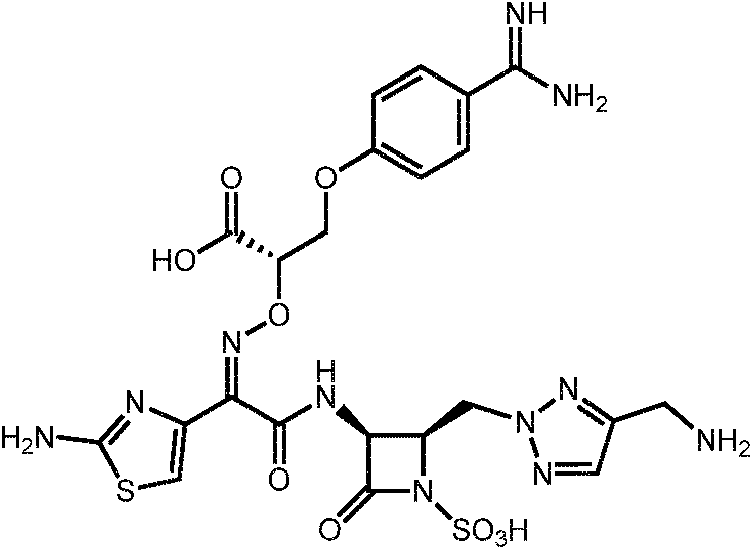
Se preparó de manera análoga al ejemplo 107, usando ((2-(((2R,3S)-3-amino-4-oxoazetidin-2-il)metil)-2H-1,2,3-triazol-4-il)metil)carbamato de terc-butilo. CL-EM: Rt = 0,29 min, m/z = 652,1 (M+1), Método 2m_ácido; 1H RMN (400 MHz, D2O): 87,53 (d, J = 8,9 Hz, 2 H), 7,43 (s, 1 H), 7,03 (s, 1 H), 6,82 (d, J = 8,9 Hz, 2 H), 5,35-5,28 (m, 1 H), 4,97 4,91 (m, 1 H), 4,77-4,70 (m, 1 H), 4,61-4,55 (m, 2 H), 4,38-4,29 (m, 1H), 4,27-4,19 (m, 1H), 4,00 (s, 2H).It was prepared analogously to example 107, using ((2 - (((2R, 3S) -3-amino-4-oxoazetidin-2-yl) methyl) -2H-1,2,3-triazol-4-yl ) methyl) tert-butyl carbamate. LC-MS: Rt = 0.29 min, m / z = 652.1 (M + 1), 2m_acid Method; 1 H NMR (400 MHz, D2O): 87.53 (d, J = 8.9 Hz, 2 H), 7.43 (s, 1 H), 7.03 (s, 1 H), 6.82 ( d, J = 8.9 Hz, 2 H), 5.35-5.28 (m, 1 H), 4.97 4.91 (m, 1 H), 4.77-4.70 (m, 1 H), 4.61-4.55 (m, 2 H), 4.38-4.29 (m, 1H), 4.27-4.19 (m, 1H), 4.00 (s, 2H).
E je m p lo 111 : á c id o 1 - ( ( (Z ) - (2 - ( ( (2 R ,3 S ) -2 - ( ( (R ) -5 - ( (3 - (2 -a m in o e t i l)u re id o )m e t i l) -2 -o x o o x a z o lid in -3 - i l)m e t i l) -4 -o x o -1 -s u lfo a z e t id in -3 - i l )a m in o ) -1 - (2 -a m in o t ia z o l-4 - i l) -2 -o x o e t i l id e n o )a m in o )o x i) c ic lo p ro p a n o c a rb o x í l ic o . E je mp lo 111: á c id o 1 - (((Z) - (2 - (((2 R, 3 S) -2 - (((R) -5 - ((3 - (2 -am in oetil) u re id o) methyl) -2 -oxooxazo lid in -3 - il) methyl) -4 -oxo -1 -su lfo azet id in -3 - il) am in o) -1 - (2 -am in ot ia zo l-4 - il) -2 -oxoethyl id eno) am in o) oxi) c ic lo p ro panoca rb ox í l ic o.

Se preparó de manera análoga al ejemplo 26, usando (2-(1H-imidazol-1-carboxamido)etil)carbamato de ferc-butilo. CL-EM: Rt = 0,31 min, m/z = 634,3 (M+1), Método 2m_ácido; 1H RMN (500 MHz, DMSO-da): 89,18 (d, J = 8,8 Hz, 1 H), 7,68 (s a, 2 H), 7,28 (s a, 2 H), 6,82 (s, 1H), 6,41 (t, J = 5,9 Hz, 1H), 6,31-6,20 (m, 1H), 5,23 (dd, J = 8,9, 5,83 Hz, 1H), 4,52-4,44 (m, 1H), 4,24-4,12(m, 1H), 3,69-3,58 (m, 1H), 2,90-2,75 (m, 2H), 1,38-1,27 (m, 4H).It was prepared analogously to example 26, using ferc-butyl (2- (1H-imidazol-1-carboxamido) ethyl) carbamate. LC-MS: Rt = 0.31 min, m / z = 634.3 (M + 1), Method 2m_acid; 1 H NMR (500 MHz, DMSO-da): 89.18 (d, J = 8.8 Hz, 1 H), 7.68 (sa, 2 H), 7.28 (sa, 2 H), 6, 82 (s, 1H), 6.41 (t, J = 5.9 Hz, 1H), 6.31-6.20 (m, 1H), 5.23 (dd, J = 8.9, 5, 83 Hz, 1H), 4.52-4.44 (m, 1H), 4.24-4.12 (m, 1H), 3.69-3.58 (m, 1H), 2.90-2 , 75 (m, 2H), 1.38-1.27 (m, 4H).
Ejemplo de referencia 112: ácido 1-(((Z)-(1-(2-aminotiazol-4-il)-2-oxo-2-(((3S,4R)-2-oxo-4-((4-((piperidin-4-ilamino)metil)-2H-1,2,3-triazol-2-il)metil)-1-sulfoazetidin-3-il)amino)etilideno)amino)oxi)ddopropanocarboxílico.Reference example 112: acid 1 - (((Z) - (1- (2-aminothiazol-4-yl) -2-oxo-2 - (((3S, 4R) -2-oxo-4 - ((4 - ((piperidin-4-ylamino) methyl) -2H-1,2,3-triazol-2-yl) methyl) -1-sulfoazetidin-3-yl) amino) ethylidene) amino) oxy) ddopropanecarboxylic.

Se preparó de manera análoga a 90, usando 4-aminopiperidina-1-carboxilato de ferc-butilo y 1-(((Z)-(1-(2-((fercbutoxicarbonil)amino)tiazol-4-il)-2-(((2R,3S)-2-((4-formil-2H-1,2,3-triazol-2-il)metil)-4-oxoazetidin-3-il)amino)-2-oxoetilideno)amino)oxi)cidopropanocarboxilato de benzhidrilo en la etapa 3. CL-EM: Rt = 0,31 min, m/z = 613,5 (M+1) Método 2m_ácido; 1H RMN (400 MHz, D2O): 87,73 (s, 1 H), 7,00 (s, 1 H), 5,49 (d, J = 5,6 Hz, 1 H), 4,90 (q, J = 5,5 Hz, 1 H), 4,85-4,74 (m, 2 H), 4,33 (s, 2 H), 3,53-3,37 (m, 2 H), 3,09-2,88 (m, 2 H), 2,29 (t, J = 12,5 Hz, 2 H), 1,87-1,66 (m, 2 H), 1,25-1,12 (m, 2 H), 1,11-0,95 (m, 2 H).It was prepared analogously to 90, using ferc-butyl 4-aminopiperidine-1-carboxylate and 1 - (((Z) - (1- (2 - ((fercbutoxycarbonyl) amino) thiazol-4-yl) -2- (((2R, 3S) -2 - ((4-formyl-2H-1,2,3-triazol-2-yl) methyl) -4-oxoazetidin-3-yl) amino) -2-oxoethylidene) amino) oxy) benzhydryl cidopropanecarboxylate in step 3. LC-MS: Rt = 0.31 min, m / z = 613.5 (M + 1) 2m_acid method; 1 H NMR (400 MHz, D2O): 87.73 (s, 1 H), 7.00 (s, 1 H), 5.49 (d, J = 5.6 Hz, 1 H), 4.90 ( q, J = 5.5 Hz, 1 H), 4.85-4.74 (m, 2 H), 4.33 (s, 2 H), 3.53-3.37 (m, 2 H) , 3.09-2.88 (m, 2 H), 2.29 (t, J = 12.5 Hz, 2 H), 1.87-1.66 (m, 2 H), 1.25- 1.12 (m, 2 H), 1.11-0.95 (m, 2 H).
Ejemplo 113: ácido 2-(((Z)-(1-(2-aminotiazol-4-il)-2-oxo-2-(((3S,4R)-2-oxo-4-((2-oxoazetidin-1-il)metil)-1-sulfoazetidin-3-il)amino)etilideno)amino)oxi)-2-metilpropanoico.Example 113: 2 - (((Z) - (1- (2-aminothiazol-4-yl) -2-oxo-2 - ((((3S, 4R) -2-oxo-4 - ((2-oxoazetidin) -1-yl) methyl) -1-sulfoazetidin-3-yl) amino) ethylidene) amino) oxy) -2-methylpropanoic.

Se preparó de manera análoga al ejemplo 1, usando ácido 3-bromopropanoico. CL-EM: m/z = 503,0 [M-H]; 1H RMN (400 MHz, D2O) 86,95 (s, 1H), 5,27 (d, J = 5,2 Hz, 1H), 4,52-4,43 (m, 1H), 3,66-3,60 (m, 1H), 3,36-3,31 (m, 2H), 3,28 (m, 1H), 2,76 (t, J = 3,6 Hz, 2H), 1,36 (s, 3H), 1,35 (s, 3H).It was prepared analogously to example 1, using 3-bromopropanoic acid. LC-MS: m / z = 503.0 [MH]; 1H NMR (400 MHz, D2O) 86.95 (s, 1H), 5.27 (d, J = 5.2 Hz, 1H), 4.52-4.43 (m, 1H), 3.66- 3.60 (m, 1H), 3.36-3.31 (m, 2H), 3.28 (m, 1H), 2.76 (t, J = 3.6 Hz, 2H), 1.36 (s, 3H), 1.35 (s, 3H).
E je m p lo d e re fe re n c ia 114 : á c id o 1 - ( ( (Z ) - (1 - (2 -a m in o t ia z o l-4 - i l) -2 - ( ( (2 R ,3 S ) -2 - ( (4 - ( ( (3 -g u a n id in o p ro p il)a m in o )m e t i l) -2 H -1 ,2 ,3 - tr ia z o l- 2 - i l)m e t i l ) - 4 -o x o -1 -s u lfo a z e t id in -3 - i l)a m in o ) -2 -o x o e t i l id e n o )a m in o )o x i) d d o p ro p a n o c a rb o x í l ic o . E je mp lo de re fe re nc ia 114: á c id o 1 - (((Z) - (1 - (2 -am in ot ia zo l-4 - il) -2 - (((2 R, 3 S) -2 - ((4 - (((3-guan id in op ro p il) am in o) methyl) -2 H -1, 2, 3 - tr ia zo l- 2 - il) methyl) - 4 -oxo -1 -su lfo azet id in -3 - il) am in o) -2 -oxoetil id eno) am in o) oxi) ddop ro panoca rb ox í l ic o.

Se preparó de manera análoga al ejemplo 90, usando guanidina de N-(3-aminopropil)-N'-terc-butoxicarbonilo y 1-(((Z)-(1-(2-((ferc-butox¡carbon¡l)am¡no)t¡azol-4-¡l)-2-(((2R,3S)-2-((4-form¡l-2H-1,2,3-tr¡azol-2-¡l)met¡l)-4-oxoazetid¡n-3-il)amino)-2-oxoetilideno)amino)oxi)cidopropanocarboxilato de benzh¡dr¡lo en la etapa 3. CL-EM: Rt = 0,55 m¡n, m/z = 629,4 (M+1) Método 2m_ácido_polar; 1H RMN (400 MHz, D2O): 87,80 (s, 1 H), 7,05 (s, 1 H), 5,68-5,57 (m, 1 H), 5,05-4,90 (m, 2 H), 4,84-4,79 (m, 1 H), 4,34 (s, 2 H), 3,29-3,21 (m, 2 H), 3,19-3,08 (m, 2 H), 2,02-1,91 (m, 2 H), 1,29 0,94 (m, 4 H).It was prepared analogously to example 90, using N- (3-aminopropyl) -N'-tert-butoxycarbonyl and 1 - (((Z) - (1- (2 - ((ferc-butoxycarbonyl) guanidine ) amino) thiazol-4-l) -2 - (((2R, 3S) -2 - ((4-formyl-2H-1,2,3-trizol-2-¡ 1) Methyl) -4-oxoazetidin-3-yl) amino) -2-oxoethylidene) amino) oxy) benzhidodrido cidopropanecarboxylate in step 3. LC-MS: Rt = 0.55 m ¡N, m / z = 629.4 (M + 1) Method 2m_acid_polar; 1 H NMR (400 MHz, D2O): 87.80 (s, 1 H), 7.05 (s, 1 H), 5.68-5.57 (m, 1 H), 5.05-4.90 (m, 2 H), 4.84-4.79 (m, 1 H), 4.34 (s, 2 H), 3.29-3.21 (m, 2 H), 3.19-3 , 08 (m, 2 H), 2.02-1.91 (m, 2 H), 1.29 0.94 (m, 4 H).
Ejemplo de referencia 115: ácido 1-(((Z)-(2-(((2R,3S)-2-((4-(((3-am¡noprop¡l)(met¡l)amino)met¡l)-2H-1,2,3-tr¡azol-2-¡l)met¡l)-4-oxo-1-sulfoazet¡d¡n-3-¡l)am¡no)-1-(2-am¡not¡azol-4-¡l)-2-oxoet¡lideno)am¡no)ox¡)ddopropanocarboxíl¡co.Reference Example 115: 1 - (((Z) - (2 - (((2R, 3S) -2 - ((4 - ((((3-amnopropyl) (methyl) amino) met acid L) -2H-1,2,3-trizzol-2-l) metl) -4-oxo-1-sulfoazet¡d¡n-3-l) amine) -1- (2-am¡not¡azol-4-¡) -2-oxoetilidene) amine) ox¡) ddopropanecarboxylic acid.

Se preparó de manera análoga al ejemplo 90, usando (3-(metilamino)propil)carbamato de terc-butilo y 1-(((Z)-(1-(2-((ferc-butox¡carbon¡l)am¡no)t¡azol-4-¡l)-2-(((2R,3S)-2-((4-form¡l-2H-1,2,3-tr¡azol-2-¡l)metil)-4-oxoazet¡d¡n-3-¡l)am¡no)-2-oxoet¡l¡deno)am¡no)ox¡)ddopropanocarbox¡lato de benzhidrilo en la etapa 3. CL-EM: Rt = 0,53 min, m/z = 601,4 (M+1) Método 2m_ácido_polar; 1H RMN (400 MHz, D2O): 87,91 (s, 1 H), 7,06 (s, 1 H), 5,55 (d, 1 H, J = 6,1 Hz), 5,06-4,88 (m, 3 H), 4,49 (s, 2 H), 3,26-3,15 (m, 2H), 3,06 (t, 2 H, J = 7,5 Hz), 2,89 (s, 3 H), 2,20-2,07 (m, 2H), 1,30 1,07 (m, 4H).It was prepared analogously to example 90, using tert-butyl (3- (methylamino) propyl) carbamate and 1- (((Z) - (1- (2 - ((ferc-butoxycarbonyl) am) no) t¡azol-4-¡l) -2 - (((2R, 3S) -2 - ((4-form¡l-2H-1,2,3-tr¡azol-2-l) methyl ) -4-oxoazet¡d¡n-3-¡) ammonium) -2-oxoetinyldene) amine) ox¡) ddopropanecarboxamide benzhydryl in step 3. LC-MS: Rt = 0.53 min, m / z = 601.4 (M + 1) Method 2m_acid_polar; 1H NMR (400 MHz, D2O): 87.91 (s, 1 H), 7.06 (s, 1 H), 5.55 (d, 1 H, J = 6.1 Hz), 5.06- 4.88 (m, 3 H), 4.49 (s, 2 H), 3.26-3.15 (m, 2H), 3.06 (t, 2 H, J = 7.5 Hz), 2.89 (s, 3 H), 2.20-2.07 (m, 2H), 1.30 1.07 (m, 4H).
Ejemplo de referencia 116: ácido 1-(((Z)-(1-(2-am¡not¡azol-4-il)-2-(((2R,3S)-2-((4-(((3-(met¡lam¡no)prop¡l)am¡no)met¡l)-2H-1,2,3-tr¡azol-2-¡l)met¡l)-4-oxo-1-sulfoazet¡d¡n-3-¡l)am¡no)-2-oxoet¡l¡deno)am¡no)ox¡)ddopropanocarboxíl¡co.Reference Example 116: Acid 1 - (((Z) - (1- (2-amn.Nazol-4-yl) -2 - (((2R, 3S) -2 - ((4 - ((( 3- (melamine) propyl) amine) methyl) -2H-1,2,3-triazol-2-l) methyl) -4-oxo-1- sulfoazet¡d¡n-3-¡l) amÃno) -2-oxoet¡l¡deno) amÃno) ox¡) ddopropanecarboxylic.

Se preparó de manera análoga al ejemplo 90, usando (3-aminopropil)(metil)carbamato de ferc-butilo y 1-(((Z)-(1-(2-((ferc-butox¡carbon¡l)am¡no)t¡azol-4-¡l)-2-(((2R,3S)-2-((4-form¡l-2H-1,2,3-tr¡azol-2-¡l)metil)-4-oxoazet¡d¡n-3-¡l)am¡no)-2-oxoetil¡deno)am¡no)ox¡)ddopropanocarboxilato de benzhidrilo en la etapa 3. CL-EM: Rt = 0,48 min, m/z = 601,4 (M+1) Método 2m_ácido_polar; 1H RMN (400 MHz, D2O): 87,82 (s, 1 H), 7,09 (s, 1 H), 5,66-5,53 (m, 1 H), 5,03-4,87 (m, 3 H), 4,37 (s, 2 H), 3,21-3,05 (m, 4 H), 2,68 (s, 3H), 2,17-2,02 (m, 2 H), 1,30-1,04 (m, 4 H). It was prepared analogously to example 90, using (3-aminopropyl) (methyl) ferc-butyl carbamate and 1 - (((Z) - (1- (2 - ((ferc-butoxycarbonyl) am? no) t¡azol-4-¡l) -2 - (((2R, 3S) -2 - ((4-form¡l-2H-1,2,3-tr¡azol-2-l) methyl ) -4-oxoazet¡d¡n-3-¡) ammonium) -2-oxoethyldene) amine) ox¡) benzhydryl ddopropanecarboxylate in step 3. LC-MS: Rt = 0.48 min, m / z = 601.4 (M + 1) Method 2m_acid_polar; 1 H NMR (400 MHz, D2O): 87.82 (s, 1 H), 7.09 (s, 1 H), 5.66-5.53 (m, 1 H), 5.03-4.87 (m, 3 H), 4.37 (s, 2 H), 3.21-3.05 (m, 4 H), 2.68 (s, 3H), 2.17-2.02 (m, 2 H), 1.30-1.04 (m, 4 H).
Ejemplo de referencia 117: ácido 1-(((Z)-(1-(2-am¡not¡azol-4-¡l)-2-(((2R,3S)-2-((4-(((2-(met¡lam¡no)et¡l)am¡no)met¡l)-2H-1,2,3-tr¡azol-2-¡l)met¡l)-4-oxo-1-sulfoazet¡d¡n-3-¡l)am¡no)-2-oxoet¡l¡deno)am¡no)ox¡)c¡clopropanocarboxíl¡co.Reference example 117: acid 1 - (((Z) - (1- (2-am¡not¡azol-4-¡) -2 - (((2R, 3S) -2 - ((4 - (( (2- (melamine) etyl) amine) methyl) -2H-1,2,3-triazol-2-l) methyl) -4-oxo-1 -sulfoazet¡d¡n-3-¡) amÃno) -2-oxoet¡l¡deno) amÃno) ox¡) cyclopropanecarboxylic.

Se preparó de manera análoga al ejemplo 90, usando (2-am¡noet¡l)(met¡l)carbamato de terc-but¡lo y 1-(((Z)-(1-(2-((terc-butox¡carbon¡l)am¡no)t¡azol-4-¡l)-2-(((2R,3S)-2-((4-form¡l-2H-1,2,3-tr¡azol-2-¡l)met¡l)-4-oxoazet¡d¡n-3-¡l)am¡no)-2-oxoet¡l¡deno)am¡no)ox¡)c¡clopropanocarbox¡lato de benzh¡dr¡lo en la etapa 3. CL-EM: Rt = 0,44 m¡n, m/z = 587,2 (M+1) Método 2m_ác¡do_polar; 1H RMN (400 MHz, D2O): 87,82 (s, 1 H), 7,09 (s, 1 H), 5,58 (d, J = 5,5 Hz, 1 H), 5,02-4,82 (m, 3 H), 4,42 (s, 2 H), 3,55-3,40 (m, 4H), 2,75 (s, 3 H), 1,30-1,04 (m, 4 H).It was prepared analogously to example 90, using tert-butyl (2-amine) (methyl) carbamate and 1 - (((Z) - (1- (2 - ((tert) butoxycarbonyl) amino) thiazol-4-l) -2 - (((2R, 3S) -2 - ((4-forml-2H-1,2,3-tr¡ azol-2-¡) met¡l) -4-oxoazet¡d¡n-3-¡) amÃno) -2-oxoet¡l¡deno) amÃno) ox¡) c¡clopropanocarbox¡lato of benzh¡dr¡lo in step 3. LC-MS: Rt = 0.44 mn, m / z = 587.2 (M + 1) Method 2m_ác¡do_polar; 1 H NMR (400 MHz, D2O): 87.82 (s, 1 H), 7.09 (s, 1 H), 5.58 (d, J = 5.5 Hz, 1 H), 5.02- 4.82 (m, 3 H), 4.42 (s, 2 H), 3.55-3.40 (m, 4H), 2.75 (s, 3 H), 1.30-1.04 (m, 4 H).
Ejemplo de referenc¡a 118: ác¡do 1-(((Z)-(2-(((2R,3S)-2-((4-(((4-am¡nobut¡l)am¡no)met¡l)-2H-1,2,3-tr¡azol-2-¡l)met¡l)-4-oxo-1-sulfoazet¡d¡n-3-¡l)am¡no)-1-(2-am¡not¡azo!-4-¡l)-2-oxoet¡l¡deno)am¡no)ox¡)c¡clopropanocarboxíl¡co.Reference Example 118: Acid 1 - (((Z) - (2 - (((2R, 3S) -2 - ((4 - ((((4-amnobutyl) ammonium) metl) -2H-1,2,3-trizol-2-l) metl) -4-oxo-1-sulfoazet¡d¡n-3-l) ammonium) -1 - (2-am¡not¡azo! -4-¡l) -2-oxoet¡l¡deno) amÃno) ox¡) cyclopropanecarboxylic.

Se preparó de manera análoga al ejemplo 90, usando (4-am¡nobut¡l)carbamato de terc-but¡lo y 1-(((Z)-(1-(2-((terc-butox¡carbon¡l)am¡no)t¡azol-4-¡l)-2-(((2R,3S)-2-((4-form¡l-2H-1,2,3-tr¡azol-2-¡l)met¡l)-4-oxoazet¡d¡n-3-¡l)am¡no)-2-oxoet¡l¡deno)am¡no)ox¡)ddopropanocarbox¡lato de benzh¡dr¡lo en la etapa 3. CL-EM: Rt = 0,32 m¡n, m/z = 601,3 (M+1) Método 2m_ác¡do_polar; 1H RMN (400 MHz, D2O): 87,71 (s, 1 H), 6,99 (s, 1 H), 5,48 (d, J = 5,6 Hz, 1 H), 4,95-4,69 (m, 3 H), 4,24 (s, 2 H), 3,00 (t, J = 7,3 Hz, 2 H), 2,87 (t, J = 7,1 Hz, 2 H), 1,77-1,51 (m, 4 H), 1,23-1,12 (m, 2 H), 1,12-0,90 (m, 2 H).It was prepared analogously to example 90, using (4-amnobutyl) tert-butyl carbamate and 1 - (((Z) - (1- (2 - ((tert- butoxycarbonyl) ) amino) thiazol-4-l) -2 - (((2R, 3S) -2 - ((4-formyl-2H-1,2,3-trizol-2-¡ l) metyl) -4-oxoazet¡d¡n-3-¡l) amnno) -2-oxoet¡ldene) am¡no) ox¡) ddopropanecarboxyl benzoin in step 3. LC-MS: Rt = 0.32 min, m / z = 601.3 (M + 1) Method 2polarm; 1H NMR (400 MHz, D2O): 87.71 (s, 1 H), 6.99 (s, 1 H), 5.48 (d, J = 5.6 Hz, 1 H), 4.95- 4.69 (m, 3 H), 4.24 (s, 2 H), 3.00 (t, J = 7.3 Hz, 2 H), 2.87 (t, J = 7.1 Hz, 2 H), 1.77-1.51 (m, 4 H), 1.23-1.12 (m, 2 H), 1.12-0.90 (m, 2 H).
Ejemplo de referenc¡a 119: ác¡do 1-(((Z)-(2-(((2R,3S)-2-((4-((3-(3-am¡noprop¡l)guan¡d¡no)met¡l)-2H-1,2,3-tr¡azol-2-¡l)met¡l)-4-oxo-1-sulfoazet¡d¡n-3-¡l)am¡no)-1-(2-am¡not¡azol-4-¡l)-2-oxoet¡l¡deno)am¡no)ox¡)ddopropanocarboxíl¡co. Etapa 1: (3-(3-benzo¡lt¡oure¡do)prop¡l)carbamato de terc-but¡lo. Se preparó según el proced¡m¡ento descr¡to por Jub¡an et al. Angew.Chem, 1995, 107, 1343 y Rasmussen et al. Synthe¡s, 1988, 456. A una d¡soluc¡ón de ¡sot¡oc¡anato de benzoílo (0,93 g, 5,70 mmol) en acetona (10 ml) se le añad¡ó (3-am¡noprop¡l)carbamato de terc-but¡lo (0,95 g, 5,45 mmol). Tras calentar a 60°C durante 2,5 h, se concentró la mezcla de reacc¡ón a vacío. Se pur¡f¡có el res¡duo bruto por med¡o de cromatografía en gel de síl¡ce (EtOAc-heptano, 0-40%), dando el compuesto del título (0,83 g, 43%). CL-EM: Rt = 0,93 m¡n, m/z = 338,0 (M+1) Método 2m_ác¡do.Reference Example 119: Acid 1 - (((Z) - (2 - (((2R, 3S) -2 - ((4 - ((3- (3-ampropyl)) guan¡ dno) metyl) -2H-1,2,3-trizol-2-l) metyl) -4-oxo-1-sulfoazetdn-3-l) am¡ no) -1- (2-am¡not¡azol-4-¡l) -2-oxoet¡l¡deno) am¡no) ox¡) ddopropanecarboxylic. Stage 1: (3- (3-benzoltolouredo) propyl) tert-butyl carbamate. It was prepared according to the procedure described by Jubán et al. Angew.Chem, 1995, 107, 1343 and Rasmussen et al. Synthe¡s, 1988, 456. To a solution of the benzoyl basement (0.93 g, 5.70 mmol) in acetone (10 ml) was added (3-am Nopropyl) tert- butyl carbamate (0.95 g, 5.45 mmol). After heating at 60 ° C for 2.5 h, the reaction mixture was concentrated in vacuo. The crude residue was purified by silica gel chromatography (EtOAc-heptane, 0-40%), to give the title compound (0.83 g, 43%). LC-MS: Rt = 0.93 mn, m / z = 338.0 (M + 1) Method 2m_acid.
Etapa 2: (3-t¡oure¡doprop¡l)carbamato de terc-but¡lo. A una d¡soluc¡ón de (3-(3-benzo¡lt¡oure¡do)prop¡l)carbamato de terc-but¡lo (0,83 g, 2,45 mmol) en MeOH (15 ml) se le añad¡ó d¡soluc¡ón acuosa de h¡dróx¡do de sod¡o (1,96 ml, 2,45 mmol). Tras ag¡tar a ta durante 2 h, se concentró la mezcla de reacc¡ón a vacío y se azeotropó con tolueno. Se pur¡f¡có el res¡duo bruto por med¡o de cromatografía en gel de síl¡ce (MeOH-DCM, 9% con 1% NH4OH), dando el compuesto del título (0,83 g, 43%). CL-EM: Rt = 0,47 m¡n, m/z = 234,2 (m +1) Método 2m_ác¡do.Stage 2: tert-butyl carbamate (3-t¡oure¡doprop¡l). At a solution of (3- (3-benzoleltouredo) propyl) tert-butyl carbamate (0.83 g, 2.45 mmol) in MeOH (15 ml) aqueous solution of sodium hydroxide (1.96 ml, 2.45 mmol) was added. After stirring at rt for 2 h, the reaction mixture was concentrated in vacuo and azeotroped with toluene. The crude residue was purified by silica gel chromatography (MeOH-DCM, 9% with 1% NH4OH), to give the title compound (0.83 g, 43%) . LC-MS: Rt = 0.47 m¡n, m / z = 234.2 ( m +1) Method 2m_ác¡do.
Etapa 3: (3-((¡m¡no(met¡lt¡o)met¡l)am¡no)prop¡l)carbamato de terc-but¡lo. A una d¡soluc¡ón de (3-t¡oure¡doprop¡l)carbamato de terc-but¡lo (0,29 g, 1,28 mmol) en MeOH (8 ml) se le añad¡ó yodometano (80 |il, 1,29 mmol). Tras ag¡tar a ta durante 18 h, se añad¡ó b¡carbonato sobre soporte de polímero (0,5 g, 3,5 mmol NaCO3/g de res¡na) a la mezcla de reacc¡ón. Tras 30 m¡n, se f¡ltró la mezcla de reacc¡ón y se concentró el f¡ltrado a vacío para dar el producto deseado junto con el producto A/-metilado, (3-(3-metiltioureido)propil)carbamato de terc-butilo (0,28 g, 87%, razón 2:1). Se usó el residuo bruto como tal en la siguiente etapa. CL-EM: Rt = 0,44 min y 0,49 min, m/z = 248,1 (M+1) Método 2m_ácido.Stage 3: (3 - ((min (meth) meth) amine) prop) tert-butyl carbamate. To a solution of tert-butyl (3-tourepropyl) carbamate (0.29 g, 1.28 mmol) in MeOH (8 ml) was added iodomethane ( 80 | il, 1.29 mmol). After stirring at rt for 18 h, bicarbonate on polymer support (0.5 g, 3.5 mmol NaCO3 / g resin) was added to the reaction mixture. After 30 min, the reaction mixture was filtered and the filtrate was concentrated to vacuum to give the desired product together with the product A / -methylated, tert- butyl (3- (3-methylthioureido) propyl) carbamate (0.28 g, 87%, 2: 1 ratio). The crude residue was used as such in the next step. LC-MS: Rt = 0.44 min and 0.49 min, m / z = 248.1 (M + 1) 2m_acid method.
Etapa 4: ácido 1-(((Z)-(1-(2-aminotiazol-4-il)-2-(((2R,3S)-2-((4-(3-imino-11,11-dimetil-9-oxo-10-oxa-2,4,8-triazadodecil)-2H-1,2,3-triazol-2-il)metil)-4-oxo-1-sulfoazetidin-3-il)amino)-2-oxoetilideno)amino)oxi)ciclopropanocarboxílico. A una disolución de (3-((imino(metiltio)metil)amino)propil)carbamato de terc-butilo (32,1 mg, 87 pmol) en dioxano (1 ml, razón: 2) a ta se le añadió trietilamina (30 |il, 0,22 mmol), ácido 1-(((Z)-(2-(((2R,3S)-2-((4-(aminometil)-2H-1,2,3-triazol-2-il)metil)-4-oxo-1-sulfoazetidin-3-il)amino)-1-(2-aminotiazol-4-il)-2-oxoetilideno)amino)oxi)ciclopropanocarboxílico (ejemplo 19, 23 mg, 43 |imol), y DMF (0,5 ml, razón: 1). Tras calentar hasta 60°C durante 17 h, se diluyó la mezcla de reacción con EtOAc y agua. Se separó la fase acuosa, se concentró a vacío, se azeotropó con tolueno y se secó a alto vacío para dar el compuesto del título (supuestamente cuantitativo). CL-EM: Rt = 0,51 min, m/z = 729,6 (M+1), Método 2m_ácido.Stage 4: acid 1 - (((Z) - (1- (2-aminothiazol-4-yl) -2 - (((2R, 3S) -2 - ((4- (3-imino-11.11) dimethyl-9-oxo-10-oxa-2,4,8-triazadodecyl) -2H-1,2,3-triazol-2-yl) methyl) -4-oxo-1-sulfoazetidin-3-yl) amino) -2-oxoethylidene) amino) oxy) cyclopropanecarboxylic. To a solution of (3 - ((imino (methylthio) methyl) amino) propyl) tert-butyl carbamate (32.1 mg, 87 pmol) in dioxane (1 ml, ratio: 2) to which was added triethylamine ( 30 | il, 0.22 mmol), acid 1 - (((Z) - (2 - (((2R, 3S) -2 - ((4- (aminomethyl) -2H-1,2,3-triazole- 2-yl) methyl) -4-oxo-1-sulfoazetidin-3-yl) amino) -1- (2-aminothiazol-4-yl) -2-oxoethylidene) amino) oxy) cyclopropanecarboxylic (example 19, 23 mg, 43 | imol), and DMF (0.5 ml, ratio: 1). After heating to 60 ° C for 17 h, the reaction mixture was diluted with EtOAc and water. The aqueous phase was separated, concentrated in vacuo, azeotroped with toluene and dried under high vacuum to give the title compound (supposedly quantitative). LC-MS: Rt = 0.51 min, m / z = 729.6 (M + 1), Method 2m_acid.
Etapa 5: ácido 1-(((Z)-(2-(((2R,3S)-2-((4-((3-(3-aminopropil)guanidino)metil)-2H-1,2,3-triazol-2-il)metil)-4-oxo-1-sulfoazetidin-3-il)amino)-1-(2-aminotiazol-4-il)-2-oxoetilideno)amino)oxi)ciclopropanocarboxílico.Stage 5: 1 - (((Z) - (2 - (((2R, 3S) -2 - ((4 - ((3- (3-aminopropyl) guanidino) methyl) -2H-1,2,3 acid -triazol-2-yl) methyl) -4-oxo-1-sulfoazetidin-3-yl) amino) -1- (2-aminothiazol-4-yl) -2-oxoethylidene) amino) oxy) cyclopropanecarboxylic.

Se siguió el procedimiento general para la desprotección mediada por ácido usando ácido 1-(((Z)-(1-(2-aminotiazol-4-il)-2-(((2R,3S)-2-((4-(3-imino-11,11-dimetil-9-oxo-10-oxa-2,4,8-triazadodecil)-2H-1,2,3-triazol-2-il)metil)-4-oxo-1-sulfoazetidin-3-il)amino)-2-oxoetilideno)amino)oxi)ciclopropanocarboxílico (37 mg, 15 |imol), DCM (0,8 ml), y TFA (0,2 ml, 2,60 mmol) durante 1,5 h. Se purificó el residuo bruto mediante HPLC de fase inversa (XSelect CSH, 19 x 100 mm, 5 |im, columna C18; ACN-agua con modificador de ácido fórmico al 0,1%, 24 ml/min) dando el compuesto del título (5,2 mg, 20%). CL-EM: Rt = 0,39 min, m/z = 629,2 (M+1), Método 2m_ácido; 1H RMN (400 MHz, D2O) 8 7,77 (s, 1H), 7,15 (s, 1H), 5,63 (d, J = 5,7 Hz, 1H), 5,06-4,99 (m, 1H), 4,98-4,89 (m, 2H), 4,57 (s, 2H), 3,39-3,34 (m, 2H), 3,14-3,06 (m, 2H), 2,01 (p, J = 7,2 Hz, 2H), 1,39-1,29 (m, 2H), 1,26-1,15 (m, 2H).The general procedure for acid-mediated deprotection was followed using 1 - (((Z) - (1- (2-aminothiazol-4-yl) -2 - ((((2R, 3S) -2 - ((4- (3-imino-11,11-dimethyl-9-oxo-10-oxa-2,4,8-triazadodecyl) -2H-1,2,3-triazol-2-yl) methyl) -4-oxo-1 -sulfoazetidin-3-yl) amino) -2-oxoethylidene) amino) oxy) cyclopropanecarboxylic (37 mg, 15 | imol), DCM (0.8 ml), and TFA (0.2 ml, 2.60 mmol) for 1.5 h. The crude residue was purified by reverse phase HPLC (XSelect CSH, 19 x 100 mm, 5 | im, column C18; ACN-water with 0.1% formic acid modifier, 24 ml / min) to give the title compound (5.2 mg, 20%). LC-MS: Rt = 0.39 min, m / z = 629.2 (M + 1), Method 2m_acid; 1H NMR (400 MHz, D2O) 8 7.77 (s, 1H), 7.15 (s, 1H), 5.63 (d, J = 5.7 Hz, 1H), 5.06-4.99 (m, 1H), 4.98-4.89 (m, 2H), 4.57 (s, 2H), 3.39-3.34 (m, 2H), 3.14-3.06 (m , 2H), 2.01 (p, J = 7.2 Hz, 2H), 1.39-1.29 (m, 2H), 1.26-1.15 (m, 2H).
Ejemplo de referencia 120: ácido 1-(((Z)-(2-(((2R,3S)-2-((4-((3-(3-aminopropil)guanidino)metil)-1H-1,2,3-triazol-1-il)metil)-4-oxo-1-sulfoazetidin-3-il)amino)-1-(2-aminotiazol-4-il)-2-oxoetilideno)amino)oxi)ciclopropanocarboxílico.Reference example 120: 1 - (((Z) - (2 - (((2R, 3S) -2 - ((4 - ((3- (3-aminopropyl) guanidino) methyl) -1H-1,2 acid) , 3-triazol-1-yl) methyl) -4-oxo-1-sulfoazetidin-3-yl) amino) -1- (2-aminothiazol-4-yl) -2-oxoethylidene) amino) oxy) cyclopropanecarboxylic.

Se preparó de manera análoga al ejemplo 119, usando (3-((imino(metiltio)metil)amino)propil)carbamato de tercbutilo. CL-EM: Rt = 0,30 min, m/z = 629,1 (M+1) Método 2m_ácido_polar; 1H RMN (500 MHz, D2O) 87,97 (s, 1 H), 7,05 (s, 1 H), 5,42 (d, J = 5,4 Hz, 1 H), 4,87-4,78 (m, 1 H), 4,45 (s, 1 H), 3,24 (t, J = 6,9 Hz, 1 H), 2,98-2,93 (m, 1 H), 2,64 (s, 1 H), 1,87 (dt, J = 14,9, 7,18 Hz, 3 H), 1,33-1,25 (m, 3 H), 1,21-1,10 (m, 4 H).It was prepared analogously to Example 119, using tert-butyl (3- ((methylthio) methyl) amino) propyl) carbamate. LC-MS: Rt = 0.30 min, m / z = 629.1 (M + 1) Method 2m_polar_m_acid; 1 H NMR (500 MHz, D2O) 87.97 (s, 1 H), 7.05 (s, 1 H), 5.42 (d, J = 5.4 Hz, 1 H), 4.87-4 , 78 (m, 1 H), 4.45 (s, 1 H), 3.24 (t, J = 6.9 Hz, 1 H), 2.98-2.93 (m, 1 H), 2.64 (s, 1 H), 1.87 (dt, J = 14.9, 7.18 Hz, 3 H), 1.33-1.25 (m, 3 H), 1.21-1 , 10 (m, 4 H).
E je m p lo d e re fe re n c ia 121 : á c id o 2 - ( ( (Z ) - (1 - (2 -a m in o t ia z o l-4 - i l) -2 - ( ( (2 R ,3 S ) -2 - ( (2 ,5 -d io x o p ir ro l id in -1 - i l)m e t i l) -4 -o x o -1 -s u lfo a z e t id in -3 - i l )a m in o ) -2 -o x o e t i l id e n o )a m in o )o x i) -2 -m e t i lp ro p a n o ic o . E je mp lo de re fe re nc ia 121: á c id o 2 - (((Z) - (1 - (2 -am in ot ia zo l-4 - il) -2 - (((2 R, 3 S) -2 - ((2, 5 -d io xop ir ro l id in -1 - il) methyl) -4 -oxo -1 -su lfo azet id in -3 - il) am in o) -2 -oxoethyl id eno) am in o) oxy) -2 -meti lp ro pano ic o.

Se preparó de manera análoga al ejemplo 54, usando pirrolidina-2,5-diona. CL-EM: Rt= 0,55 min, m/z = 533,3 (M+1) Método 2m_ácido_polar; 1H RMN (400 MHz, DMSO-d6 :D2O (1:1)): 86,94 (s, 1 H), 5,18 (d, J = 5,9 Hz, 1 H), 4,53 4,43 (m, 1 H), 3,96-3,86 (m, 1H), 3,36-3,25 (m, 1 H) 2,53 (s, 4 H), 1,40 (s, 3 H) 1,37 (s, 3 H).It was prepared analogously to example 54, using pyrrolidine-2,5-dione. LC-MS: Rt = 0.55 min, m / z = 533.3 (M + 1) Method 2m_polar_m_acid; 1 H NMR (400 MHz, DMSO-d6: D2O (1: 1)): 86.94 (s, 1 H), 5.18 (d, J = 5.9 Hz, 1 H), 4.53 4, 43 (m, 1 H), 3.96-3.86 (m, 1H), 3.36-3.25 (m, 1 H) 2.53 (s, 4 H), 1.40 (s, 3 H) 1.37 (s, 3 H).
Ejemplo 122: ácido 1-(((Z)-(2-(((2R,3S)-2-((4-(aminometil)-2-oxoimidazolidin-1-il)metil)-4-oxo-1-sulfoazetidin-3-il)amino)-1-(2-aminotiazol-4-il)-2-oxoetilideno)amino)oxi)ciclopropanocarboxílicoExample 122: 1 - (((Z) - (2 - (((2R, 3S) -2 - ((4- (aminomethyl) -2-oxoimidazolidin-1-yl) methyl) -4-oxo-1- sulfoazetidin-3-yl) amino) -1- (2-aminothiazol-4-yl) -2-oxoethylidene) amino) oxy) cyclopropanecarboxylic

Se preparó de manera análoga al ejemplo 108, usando 1-(((Z)-(2-(((2R,3S)-2-((((S)-2-((((9H-fluoren-9-il)metoxi)carbonil)amino)-3-((ferc-butoxicarbonil)amino)propil)amino)metil)-4-oxoazetidin-3-il)amino)-1-(2-((fercbutoxicarbonil)amino)tiazol-4-il)-2-oxoetilideno)amino)oxi)ciclopropanocarboxilato de benzhidrilo. Diastereómero A: 3,1 mg. CL-EM: Rt = 0,65 min, m/z = 547,1 (M+1) Método 2m_ácido; 1H RMN (400 MHz, D2O): 87,12 (s, 1H), 5,39 (d, J = 6,8 Hz, 1H), 4,60-4,56 (m, 1H), 3,84 (t, J = 9,9 Hz, 1H), 3,59-3,53 (m, 1H), 3,48-3,41 (m, 2H), 3,21-3,09 (m, 3h ), 1,46 (s a, 3H), 1,36 (s a, 3H). Diastereómero B: 2,9 mg, CL-EM: Rt = 0,65 min, m/z = 547,1 (M+1) Método 2m_ácido; 1H RMN (400 MHz, D2O): 87,12 (s, 1H), 5,42 (d, J = 5,6 Hz, 1H), 4,61-4,54 (m, 1H), 4,16-4,08 (m, 1H), 3,82-3,72 (m, 2H), 3,55-3,49 (m, 1H), 3,27-3,15 (m, 3H), 1,47 (s a, 3H), 1,37 (s a, 3H).It was prepared analogously to Example 108, using 1 - (((Z) - (2 - (((2R, 3S)) -2 - ((((S) -2 - ((((9H-fluoren-9- il) methoxy) carbonyl) amino) -3 - ((ferc-butoxycarbonyl) amino) propyl) amino) methyl) -4-oxoazetidin-3-yl) amino) -1- (2 - ((fercbutoxycarbonyl) amino) thiazole- 4-yl) -2-oxoethylidene) amino) oxy) benzhydryl cyclopropanecarboxylate. Diastereomer A: 3.1 mg. LC-MS: Rt = 0.65 min, m / z = 547.1 (M + 1) 2m_acid method; 1H NMR (400 MHz, D2O): 87.12 (s, 1H), 5.39 (d, J = 6.8 Hz, 1H), 4.60-4.56 (m, 1H), 3.84 (t, J = 9.9 Hz, 1H), 3.59-3.53 (m, 1H), 3.48-3.41 (m, 2H), 3.21-3.09 (m, 3 h ), 1.46 (sa, 3H), 1.36 (sa, 3H). Diastereomer B: 2.9 mg, LC-MS: Rt = 0.65 min, m / z = 547.1 (M + 1) Method 2m_acid; 1H NMR (400 MHz, D2O): 87.12 (s, 1H), 5.42 (d, J = 5.6 Hz, 1H), 4.61-4.54 (m, 1H), 4.16 -4.08 (m, 1H), 3.82-3.72 (m, 2H), 3.55-3.49 (m, 1H), 3.27-3.15 (m, 3H), 1 , 47 (sa, 3H), 1.37 (sa, 3H).
Ejemplo de referencia 123: 3-(((2-(((2R,3S)-3-((Z)-2-(2-aminotiazol-4-il)-2-((1-carboxiciclopropoxi)imino)acetamido)-4-oxo-1-sulfoazetidin-2-il)metil)-2H-1,2,3-triazol-4-il)metil)amino)-A/,W,W-trimetilpropan-1-aminio.Reference example 123: 3 - (((2 - (((2R, 3S) -3 - ((Z) -2- (2-aminothiazol-4-yl)) -2 - ((1-carboxycyclopropoxy) imino) acetamide ) -4-oxo-1-sulfoazetidin-2-yl) methyl) -2H-1,2,3-triazol-4-yl) methyl) amino) -A /, W, W-trimethylpropan-1-aminium.
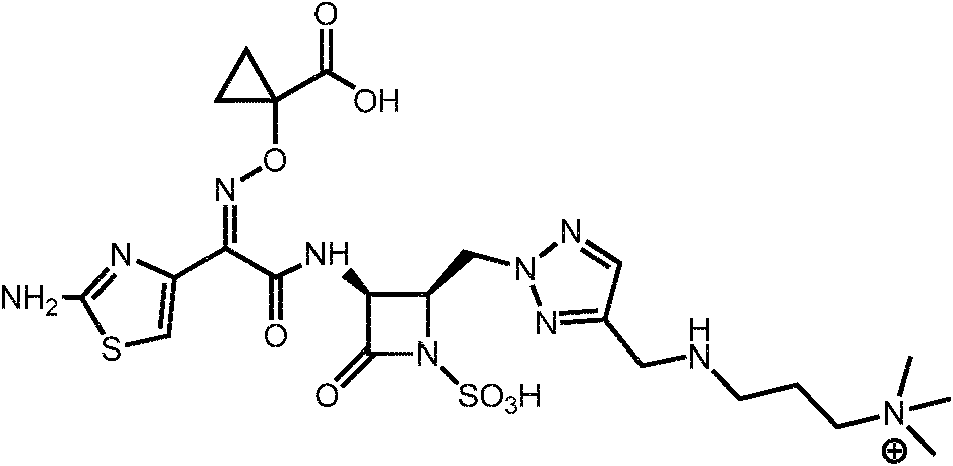
Se preparó de manera análoga al ejemplo 90, usando 2,2,2-trifluoroacetato de W1,W1,W1-trimetilpropano-1,3-diaminio. CL-EM: Rt = 0,51 min, m/z = 629,5 (M+1) Método 2m_ácido_polar; 1H RMN (400 MHz, D2O): 87,81 (s, 1 H), 7,09 (s, 1 H), 5,70-5,63 (m, 1 H), 5,03-4,93 (m, 3 H), 4,83-4,82 (m, 1 H), 4,37 (s, 2 H), 3,44-3,37 (m, 2 H), 3,22 3,16 (m, 2 H), 3,07 (s, 9 H), 2,26-2,17 (m, 2 H), 1,29-1,10 (m, 4 H).It was prepared analogously to example 90, using 2,2,2-trifluoroacetate of W1, W1, W1-trimethylpropane-1,3-diaminium. LC-MS: Rt = 0.51 min, m / z = 629.5 (M + 1) Method 2m_polar_m_acid; 1 H NMR (400 MHz, D2O): 87.81 (s, 1 H), 7.09 (s, 1 H), 5.70-5.63 (m, 1 H), 5.03-4.93 (m, 3 H), 4.83-4.82 (m, 1 H), 4.37 (s, 2 H), 3.44-3.37 (m, 2 H), 3.22 3, 16 (m, 2 H), 3.07 (s, 9 H), 2.26-2.17 (m, 2 H), 1.29-1.10 (m, 4 H).
Ejemplo de referencia 124: ácido 1-(((Z)-(2-(((2R,3S)-2-((4-((4-aminobutanamido)metil)-2H-1,2,3-triazol-2-il)metil)-4-oxo-1-sulfoazetidin-3-il)amino)-1-(2-aminotiazoi-4-il)-2-oxoetilideno)amino)oxi)ciclopropanocarboxílico.Reference Example 124: 1 - (((Z) - (2 - (((2R, 3S) -2 - ((4 - ((4-aminobutanamido) methyl) -2H-1,2,3-triazole-) 2-yl) methyl) -4-oxo-1-sulfoazetidin-3-yl) amino) -1- (2-aminothiazoi-4-yl) -2-oxoethylidene) amino) oxy) cyclopropanecarboxylic.
Etapa 1: 1-(((Z)-(1-(2-((ferc-butoxicarbonil)amino)tiazol-4-il)-2-(((2R,3S)-2-((4-(((metilsulfonil)oxi)metil)-2H-1,2,3-triazol-2-il)metil)-4-oxoazetidin-3-il)amino)-2-oxoetilideno)amino)oxi)ciclopropanocarboxilato de benzhidrilo. A una disolución de 1-(((Z)-(1-(2-((ferc-butoxicarbonil)amino)tiazol-4-il)-2-(((2R,3S)-2-((4-(hidroximetil)-2H-1,2,3-triazol-2-il)metil)-4-oxoazetidin-3-il)amino)-2-oxoetilideno)amino)oxi)cidopropanocarboxilato de benzhidrilo (178 mg, 0,25 mmol) y DIPEA (65 pl, 0,37 mmol) en DCM (2,5 ml) a 0°C se le añadió MsCl (25 |il, 0,32 mmol). Tras 1 h a 0°C, se diluyó la mezcla de reacción con DCM (10 ml), se lavó con HCl 0,2 N y NaHCO3 saturado (ac). Se secó la fase orgánica sobre Na2SO4, se concentró a vacío para dar el compuesto del título (190 mg, 96%). Se usó el residuo bruto como tal en la siguiente etapa. CL-EM: Rt = 1,05 min, m/z = 795,4 (M+1) Método 2m_ácido.Stage 1: 1 - (((Z) - (1- (2 - ((ferc-butoxycarbonyl) amino) thiazol-4-yl) -2 - (((2R, 3S) -2 - ((4 - (( (methylsulfonyl) oxy) methyl) -2H-1,2,3-triazol-2-yl) methyl) -4-oxoazetidin-3-yl) amino) -2-oxoethylidene) amino) oxy) benzhydryl cyclopropanecarboxylate. To a solution of 1 - (((Z) - (1- (2 - ((ferc-butoxycarbonyl) amino) thiazol-4-yl) -2 - (((2R, 3S) -2 - ((4- ( hydroxymethyl) -2H-1,2,3-triazol-2-yl) methyl) -4-oxoazetidin-3-yl) amino) -2-oxoethylidene) amino) oxy) benzhydryl cidopropanecarboxylate (178 mg, 0.25 mmol ) and DIPEA (65 pl, 0.37 mmol) in DCM (2.5 ml) at 0 ° C was added MsCl (25 µl, 0.32 mmol). After 1 h at 0 ° C, the reaction mixture was diluted with DCM (10 ml), washed with 0.2 N HCl and saturated NaHCO3 (aq). The organic phase was dried over Na2SO4, concentrated in vacuo to give the title compound (190 mg, 96%). The residue was used gross as such in the next stage. LC-MS: Rt = 1.05 min, m / z = 795.4 (M + 1) 2m_acid method.
Etapa 2: 1-(((Z)-(2-(((2R,3S)-2-((4-(aminometil)-2H-1,2,3-triazol-2-il)metil)-4-oxoazetidin-3-il)amino)-1-(2-((fercbutoxicarbonil)amino)tiazol-4-il)-2-oxoetilideno)amino)oxi)cidopropanocarboxilato de benzhidrilo. A una disolución de NH4OH ac. (2 ml, 28-30% en peso) en EtOH (2 ml, razón:1) y t Hf (2 ml, razón:1) se le añadió una disolución de 1-(((Z)-(1-(2-((terc-butoxicarbonil)amino)tiazol-4-il)-2-(((2R,3S)-2-((4-(((metilsulfonil)oxi)metil)-2H-1,2,3-triazol-2-il)metil)-4-oxoazetidin-3-il)amino)-2-oxoetilideno)amino)oxi)ciclopropanocarboxilato de benzhidrilo (190 mg, 0,24 mmol) en THF (1 ml) a -5°C gota a gota. Tras agitar a -5°C durante 1 h y ta durante 12 h, se diluyó la mezcla de reacción con 40 ml de DCM y se lavó con 10 ml de ac. NaHCO3 saturado (ac), se secó sobre Na2SO4, se filtró y se concentró a vacío. Se purificó el residuo por medio de cromatografía en gel de sílice (MeOH-DCM, 5-10%) para dar el compuesto del título (120 mg, 49%). CL-EM: Rt = 0,87 min, m/z = 716,4 (M+1) Método 2m_ácido.Stage 2: 1 - (((Z) - (2 - (((2R, 3S) -2 - ((4- (aminomethyl) -2H-1,2,3-triazol-2-yl) methyl) -4 -oxoazetidin-3-yl) amino) -1- (2 - ((fercbutoxycarbonyl) amino) thiazol-4-yl) -2-oxoethylidene) amino) oxy) benzhydryl cidopropanecarboxylate. To a solution of NH4OH aq. (2 ml, 28-30% by weight) in EtOH (2 ml, ratio: 1) and t H f (2 ml, ratio: 1) was added a solution of 1 - (((Z) - (1- (2 - ((tert-butoxycarbonyl) amino) thiazol-4-yl) -2 - (((2R, 3S) -2 - ((4 - (((methylsulfonyl) oxy) methyl) -2H-1,2, 3-Triazol-2-yl) methyl) -4-oxoazetidin-3-yl) amino) -2-oxoethylidene) amino) oxy) benzhydryl cyclopropanecarboxylate (190 mg, 0.24 mmol) in THF (1 ml) to - 5 ° C drop by drop. After stirring at -5 ° C for 1 h and for 12 h, the reaction mixture was diluted with 40 ml of DCM and washed with 10 ml of aq. Saturated NaHCO3 (aq), dried over Na2SO4, filtered and concentrated in vacuo. The residue was purified by silica gel chromatography (MeOH-DCM, 5-10%) to give the title compound (120 mg, 49%). LC-MS: Rt = 0.87 min, m / z = 716.4 (M + 1) 2m_acid method.
Etapa 3: 1-(((Z)-(2-(((2R,3S)-2-((4-((4-((ferc-butoxicarbonil)amino)butanamido)metil)-2H-1,2,3-triazol-2-il)metil)-4-oxoazetidin-3-il)amino)-1-(2-((ferc-butoxicarbonil))amino)tiazol-4-il)-2-oxoetilideno)amino)oxi)ciclopropanocarboxilato de benzhidrilo. A una disolución de ácido 4-((ferc-butoxicarbonil)amino)butanoico (30,7 mg, 0,15 mmol) en DCM (2 ml) a 0°C se le añadió DIPEA (35 |il, 0,20 mmol) y HATU (65 mg, 0,17 mmol). Tras 10 min, se añadió 1-(((Z)-(2-(((2R,3S)-2-((4-(aminometil)-2H-1,2,3-triazol-2-il)metil)-4-oxoazetidin-3-il)amino)-1-(2-((fercbutoxicarbonil)amino)tiazol-4-il)-2-oxoetilideno)amino)oxi)ciclopropanocarboxilato de benzhidrilo (90 mg, 0,10 mmol). Tras agitar a 0°C durante 1 h, se diluyó la mezcla de reacción con DCM (40 ml), se lavó con Na2CO3 ac. 2 M (20 ml), salmuera, se secó sobre Na2SO4, se filtró y se concentró a vacío. Se purificó el residuo por medio de cromatografía en gel de sílice (MeOH-DCM, 5-10%) para dar el compuesto del título (42 mg, 46%). CL-EM: Rt = 1,07 min, m/z = 901,5 (M+1) Método 2m_ácido.Stage 3: 1 - (((Z) - (2 - (((2R, 3S) -2 - ((4 - ((4 - ((ferc-butoxycarbonyl) amino) butanamido) methyl) -2H-1,2 , 3-triazol-2-yl) methyl) -4-oxoazetidin-3-yl) amino) -1- (2 - ((ferc-butoxycarbonyl)) amino) thiazol-4-yl) -2-oxoethylidene) amino) oxy) benzhydryl cyclopropanecarboxylate. To a solution of 4 - ((ferc-butoxycarbonyl) amino) butanoic acid (30.7 mg, 0.15 mmol) in DCM (2 mL) at 0 ° C was added DIPEA (35 µl, 0.20 mmol ) and HATU (65 mg, 0.17 mmol). After 10 min, 1 - (((Z) - (2 - (((2R, 3S) -2 - ((4- (aminomethyl) -2H-1,2,3-triazol-2-yl) methyl was added ) -4-oxoazetidin-3-yl) amino) -1- (2 - ((fercbutoxycarbonyl) amino) thiazol-4-yl) -2-oxoethylidene) amino) oxy) benzhydryl cyclopropanecarboxylate (90 mg, 0.10 mmol ). After stirring at 0 ° C for 1 h, the reaction mixture was diluted with DCM (40 ml), washed with aq Na2CO3. 2M (20 ml), brine, dried over Na2SO4, filtered and concentrated in vacuo. The residue was purified by silica gel chromatography (MeOH-DCM, 5-10%) to give the title compound (42 mg, 46%). LC-MS: Rt = 1.07 min, m / z = 901.5 (M + 1) 2m_acid method.
Etapa 4: ácido (2R,3S)-3-((Z)-2-((1-((benzhidriloxi)carbonil)ciclopropoxi)imino)-2-(2-((ferc-butoxicarbonil)amino)tiazol-4-il)acetamido)-2-((4-((4-((ferc-butoxicarbonil)amino)butanamido)metil)-2H-1,2,3-triazol-2-il)metil)-4-oxoazetidina-1-sulfónico. A una disolución de 1-(((Z)-(2-(((2R,3S)-2-((4-((4-((ferc-butoxicarbonil)amino)butanamido)metil)-2H-1,2,3-triazol-2-il)metil)-4-oxoazetidin-3-il)amino)-1-(2-((ferc-butoxicarbonil)amino)tiazol-4-il)-2-oxoetilideno)amino)oxi)ciclopropanocarboxilato de benzhidrilo (42 mg, 47 |imol) en DMF (0,47 ml) se le añadió SO3^DMF (74 mg, 0,47 mmol). Tras agitar a ta durante 5 h, se añadieron otros 10 eq de SO3^DMF y se agitó a ta durante 2 h. Se diluyó la mezcla de reacción con EtOAc (60 ml) y salmuera (40 ml), y se separaron las fases. Se extrajo la fase acuosa con EtOAc (40 ml). Se secaron las fases orgánicas combinadas con Na2SO4, se filtró y se concentró a vacío para dar el compuesto del título (45,3 mg, 99%). Se usó el residuo bruto como tal en la siguiente etapa. CL-EM: Rt = 0,96 min, m/z = 981,6 (M+1) Método 2m_ácido.Stage 4: (2R, 3S) -3 - ((Z) -2 - ((1 - ((benzhydryloxy) carbonyl) cyclopropoxy) imino) -2- (2 - ((ferc-butoxycarbonyl) amino) thiazole-4 -il) acetamido) -2 - ((4 - ((4 - ((ferc-butoxycarbonyl) amino) butanamido) methyl) -2H-1,2,3-triazol-2-yl) methyl) -4-oxoazetidine- 1-sulfonic. At a solution of 1 - (((Z) - (2 - (((2R, 3S) -2 - ((4 - ((4 - ((ferc-butoxycarbonyl) amino) butanamido) methyl) -2H-1, 2,3-triazol-2-yl) methyl) -4-oxoazetidin-3-yl) amino) -1- (2 - ((ferc-butoxycarbonyl) amino) thiazol-4-yl) -2-oxoethylidene) amino) oxy) benzhydryl cyclopropanecarboxylate (42 mg, 47 | imol) in DMF (0.47 ml) was added SO3 ^ DMF (74 mg, 0.47 mmol). After stirring at rt for 5 h, another 10 eq of SO3 ^ DMF was added and stirred at rt for 2 h. The reaction mixture was diluted with EtOAc (60 ml) and brine (40 ml), and the phases were separated. The aqueous phase was extracted with EtOAc (40 ml). The combined organic phases were dried with Na2SO4, filtered and concentrated in vacuo to give the title compound (45.3 mg, 99%). The crude residue was used as such in the next step. LC-MS: Rt = 0.96 min, m / z = 981.6 (M + 1) 2m_acid method.
Etapa 5: ácido 1-(((Z)-(2-(((2R,3S)-2-((4-((4-aminobutanamido)metil)-2H-1,2,3-triazol-2-il)metil)-4-oxo-1-sulfoazetidin-3-il)amino)-1-(2-aminotiazol-4-il)-2-oxoetilideno)amino)oxi)ciclopropanocarboxílico.Stage 5: 1 - (((Z) - (2 - ((((2R, 3S) -2 - ((4 - ((4-aminobutanamido) methyl) -2H-1,2,3-triazol-2- acid il) methyl) -4-oxo-1-sulfoazetidin-3-yl) amino) -1- (2-aminothiazol-4-yl) -2-oxoethylidene) amino) oxy) cyclopropanecarboxylic.

Se siguió el procedimiento general para la desprotección mediada por ácido usando ácido (2R,3S)-3-((Z)-2-((1-((benzhidriloxi)carbonil)ciclopropoxi)imino)-2-(2-((ferc-butoxicarbonil)amino)tiazol-4-il)acetamido)-2-((4-((4-((fercbutoxicarbonil)amino)butanamido)metil)-2H-1,2,3-triazol-2-il)metil)-4-oxoazetidina-1-sulfónico (47 mg, 48 |imol), DCM (0,5 ml), y TFA (0,2 ml, 2,87 mmol) durante 2 h. Se concentró la mezcla de reacción a vacío, y se repartió el residuo entre DCM y agua helada. Se purificó la fase acuosa mediante HPLC de fase inversa (XSelect CSH, 30 x 100 mm, 5 |im, columna C18; AcN-agua con modificador de ácido fórmico al 0,1%, 60 ml/min) dando el compuesto del título CL-EM: Rt = 0,53 min, m/z = 615,3 (M+1) Método 2m_ácido_polar; 1H RMN (400 MHz, D2O): 87,63 (s, 1 H), 7,05 (s, 1 H), 5,58-5,49 (m, 1 H), 4,96-4,83 (m, 3 H), 4,41 (s a, 2 H), 3,06-2,90 (m, 2 H), 2,44-2,28 (m, 2 H), 1,98-1,83 (m, 2 H), 1,38-1,04 (m, 4 H).The general procedure for acid-mediated deprotection was followed using (2R, 3S) -3 - ((Z) -2 - ((1 - ((benzhydryloxy) carbonyl) cyclopropoxy) imino) -2- (2 - (( ferc-butoxycarbonyl) amino) thiazol-4-yl) acetamido) -2 - ((4 - ((4 - ((fercbutoxycarbonyl) amino) butanamido) methyl) -2H-1,2,3-triazol-2-yl) methyl) -4-oxoazetidine-1-sulfonic acid (47 mg, 48 | imol), DCM (0.5 ml), and TFA (0.2 ml, 2.87 mmol) for 2 h. The reaction mixture was concentrated in vacuo, and the residue was partitioned between DCM and ice water. The aqueous phase was purified by reverse phase HPLC (XSelect CSH, 30 x 100 mm, 5 | im, C18 column; AcN-water with 0.1% formic acid modifier, 60 ml / min) to give the title compound LC-MS: Rt = 0.53 min, m / z = 615.3 (M + 1) Method 2m_polar_m_acid; 1 H NMR (400 MHz, D2O): 87.63 (s, 1 H), 7.05 (s, 1 H), 5.58-5.49 (m, 1 H), 4.96-4.83 (m, 3 H), 4.41 (sa, 2 H), 3.06-2.90 (m, 2 H), 2.44-2.28 (m, 2 H), 1.98-1 , 83 (m, 2 H), 1.38-1.04 (m, 4 H).
E je m p lo d e re fe re n c ia 125 : á c id o 1 - ( ( (Z ) - (2 - ( ( (2 R ,3 S ) -2 - ( (4 - ( (3 - ( (1 r ,3 R ) -3 -a m in o c ic lo b u t i l)g u a n id in o )m e t i l) -2 H -1 ,2 ,3 -t r ia z o l- 2 - i l )m e t i l) -4 -o x o -1 -s u lfo a z e t id in -3 - i l) a m in o ) -1 - (2 -a m in o t ia z o l-4 - i l) -2 -o x o e ti l id e n o )a m in o )o x i)c ic lo p ro p a n o c a rb o x í l ic o . E je mp lo de re fe re nc ia 125: á c id o 1 - (((Z) - (2 - (((2 R, 3 S) -2 - ((4 - ((3 - ((1 r, 3 R) -3 -am in oc ic lo butil) guan id in o) methyl) -2 H -1, 2, 3 -tr ia zo l- 2 - il) methyl) -4 -oxo -1 - su lfo azet id in -3 - il) am in o) -1 - (2 -am in ot ia zo l-4 - il) -2 -oxoe ti l id eno) am in o) oxy) c ic lo p ro panoca rb ox í l ic o.

Se preparó de manera análoga al ejemplo 119, usando ((1r,3r)-3-((imino(metiltio)metil)amino)cidobutil)carbamato de ferc-butilo. CL-EM: Rt = 0,33 min, m/z = 641,0 (M+1) Método 2m_ácido; 1H RMN (400 MHz, D2O) 87,72 (s, 1 H), 7,10 (s, 1 H), 5,58 (d, J = 5,5 Hz, 1 H), 5,01-4,95 (m, 1H), 4,89-4,85 (m, 2H), 4,53 (s, 2 H), 4,25-4,17 (m, 1H), 4,05 3,95 (m, 1H), 2,69-2,59 (m, 2H), 2,58-2,48 (m, 2H), 1,34-1,27 (m, 2H), 1,19-1,12 (m, 2H).It was prepared analogously to Example 119, using ((1r, 3r) -3 - ((imino (methylthio) methyl) amino) cidobutyl) ferc-butyl carbamate. LC-MS: Rt = 0.33 min, m / z = 641.0 (M + 1) 2m_acid method; 1 H NMR (400 MHz, D2O) 87.72 (s, 1 H), 7.10 (s, 1 H), 5.58 (d, J = 5.5 Hz, 1 H), 5.01-4 , 95 (m, 1H), 4.89-4.85 (m, 2H), 4.53 (s, 2 H), 4.25-4.17 (m, 1H), 4.05 3.95 (m, 1H), 2.69-2.59 (m, 2H), 2.58-2.48 (m, 2H), 1.34-1.27 (m, 2H), 1.19-1 , 12 (m, 2H).
Ejemplo de referencia 126: ácido 1-(((Z)-(1-(2-aminotiazol-4-il)-2-(((2R,3S)-2-((4-((3-(azetidin-3-ilmetil)guanidino)metil)-2H-1,2,3-triazol-2-il)metil)-4-oxo-1-sulfoazetidin-3-il)amino)-2-oxoetilideno)amino)oxi)cidopropanocarboxílico.Reference example 126: 1 - (((Z) - (1- (2-aminothiazol-4-yl) -2 - (((2R, 3S) -2 - ((4 - ((3- (azetidine- 3-ylmethyl) guanidino) methyl) -2H-1,2,3-triazol-2-yl) methyl) -4-oxo-1-sulfoazetidin-3-yl) amino) -2-oxoethylidene) amino) oxy) cidopropanecarboxylic .
Etapa 1: 3-((3-((2-(((2R,3S)-3-(((benciloxi)carbonil)amino)-4-oxoazetidin-2-il)metil)-2H-1,2,3-triazol-4-il)metil)-1,2-bis(ferc-butoxicarbonil)guanidino)metil)azetidina-1 -carboxilato de ferc-butilo.Stage 1: 3 - ((3 - ((2 - (((2R, 3S) -3 - (((benzyloxy) carbonyl) amino) -4-oxoazetidin-2-yl) methyl) -2H-1,2, 3-Triazol-4-yl) methyl) -1,2-bis (ferc-butoxycarbonyl) guanidino) methyl) azetidine-1-carboxylic acid ferc-butyl.
Preparación de 2,2,2-trifluoroacetato de ((2R,3S)-2-((4-(aminometil)-2H-1,2,3-triazol-2-il)metil)-4-oxoazetidin-3-il)carbamato de bencilo. A una disolución de NH-Boc [((2R,3S)-2-((4-(aminometil)-2H-1,2,3-triazol-2-il)metil)-4-oxoazetidin-3-il)carbamato de bencilo] (368 mg, 0,86 mmol) en DCM (4 ml) se le añadió TFA (1,05 ml, 13,68 mmol). Tras agitar a ta durante 1 h, se concentró la mezcla de reacción a vacío para dar el compuesto del título como sal de TFA (supuestamente cuantitativo). Se usó el residuo bruto como tal en la siguiente etapa. CL-EM: Rt = 0,43 min, m/z = 331,0 (M+1) Método 2m_ácido.Preparation of 2,2,2-trifluoroacetate ((2R, 3S) -2 - ((4- (aminomethyl) -2H-1,2,3-triazol-2-yl) methyl) -4-oxoazetidin-3- il) benzyl carbamate. To a solution of NH-Boc [((2R, 3S) -2 - ((4- (aminomethyl) -2H-1,2,3-triazol-2-yl) methyl) -4-oxoazetidin-3-yl) benzyl carbamate] (368 mg, 0.86 mmol) in DCM (4 ml) TFA (1.05 ml, 13.68 mmol) was added. After stirring at rt for 1 h, the reaction mixture was concentrated in vacuo to give the title compound as a TFA salt (supposedly quantitative). The crude residue was used as such in the next step. LC-MS: Rt = 0.43 min, m / z = 331.0 (M + 1) 2m_acid method.
Preparación de 3-((N,N’-bis(ferc-butoxicarbonil)-1H-pirazol-1-carboximidamido)metil)azetidina-1-carboxilato de fercbutilo. A una disolución de S/s-Boc-pirazolcarboxamidina (2,49 g, 8,01 mmol), N-Boc-3-hidroximetilazetidina (1,50 g, 8,01 mmol) y trifenilfosfina (2,10 g, 8,01 mmol) en THF (80 ml) a 0°C se le añadió DIAD (1,62 g, 8,01 mmol) gota a gota. Tras agitar a ta durante 12 h, se concentró la mezcla de reacción a vacío, y se disolvió el residuo en el 10% de EtOAc/heptano para triturar óxido de trifenilfosfina. Se concentró el filtrado a vacío y se sometió a cromatografía por medio de cromatografía en gel de sílice en columna (EtOAc-heptano, 0-35%) para dar el compuesto del título (1,6 g, 41%). CL-EM: Rt = 1,12 min, m/z = 480,0 (M+1) Método 2m_ácido.Preparation of 3 - ((N, N’-bis (ferc-butoxycarbonyl) -1 H -pyrazol-1-carboximidamido) methyl) azetidine-1-carboxylate of ferbutyl. To a solution of S / s-Boc-pyrazolcarboxamidine (2.49 g, 8.01 mmol), N-Boc-3-hydroxymethylazetidine (1.50 g, 8.01 mmol) and triphenylphosphine (2.10 g, 8 , 01 mmol) in THF (80 ml) at 0 ° C DIAD (1.62 g, 8.01 mmol) was added dropwise. After stirring at rt for 12 h, the reaction mixture was concentrated in vacuo, and the residue was dissolved in 10% EtOAc / heptane to triturate triphenylphosphine oxide. The filtrate was concentrated in vacuo and subjected to chromatography by means of column chromatography on silica gel (EtOAc-heptane, 0-35%) to give the title compound (1.6 g, 41%). LC-MS: Rt = 1.12 min, m / z = 480.0 (M + 1) 2m_acid method.
Preparación de 3-((3-((2-(((2R,3S)-3-(((benciloxi)carbonil)amino)-4-oxoazetidin-2-il)metil)-2H-1,2,3-triazol-4-il)metil)-1,2-bis(ferc-butoxicarbonil)guanidino)metil)azetidina-1-carboxilato de ferc-butilo. A una disolución de 2,2,2-trifluoroacetato de ((2R,3S)-2-((4-(aminometil)-2H-1,2,3-triazol-2-il)metil)-4-oxoazetidin-3-il)carbamato de bencilo (340 mg, 0,77 mmol) en dioxano (6 ml) se le añadió DIPEA (0,147 ml, 0,842 mmol) y una disolución de 3-((N,N’-bis(ferc-butoxicarbonil)-1H-pirazol-1-carboximidamido)metil)azetidina-1-carboxilato de ferc-butilo (367 mg, 0,765 mmol) en dioxano (1 ml). Tras calentar hasta 60°C durante 12 h, se concentró la mezcla de reacción a vacío y se purificó por medio de cromatografía en gel de sílice (EtOAc-heptano, 0-95%) para dar el compuesto del título (390 mg, 69%). CL-EM: Rt = 0,94 min, m/z = 742,5 (M+1 ) Método 2 m_ácido.Preparation of 3 - ((3 - ((2 - (((2R, 3S) -3 - (((benzyloxy) carbonyl) amino) -4-oxoazetidin-2-yl) methyl) -2H-1,2,3 -triazol-4-yl) methyl) -1,2-bis (ferc-butoxycarbonyl) guanidino) methyl) azetidine-1-carboxylate of ferc-butyl. To a solution of 2,2,2-trifluoroacetate of ((2R, 3S) -2 - ((4- (aminomethyl) -2H-1,2,3-triazol-2-yl) methyl) -4-oxoazetidine- 3-yl) benzyl carbamate (340 mg, 0.77 mmol) in dioxane (6 ml) was added DIPEA (0.147 ml, 0.842 mmol) and a solution of 3 - ((N, N'-bis (ferc- butoxycarbonyl) -1H-pyrazol-1-carboximidamido) methyl) ferc-butyl azetidine-1-carboxylate (367 mg, 0.765 mmol) in dioxane (1 ml). After heating to 60 ° C for 12 h, the reaction mixture was concentrated in vacuo and purified by silica gel chromatography (EtOAc-heptane, 0-95%) to give the title compound (390 mg, 69 %). LC-MS: Rt = 0.94 min, m / z = 742.5 (M + 1) Method 2 m_acid.
Etapa 2: 3-((3-((2-(((2R,3S)-3-amino-4-oxoazetidin-2-il)metil)-2H-1,2,3-triazol-4-il)metil)-1,2-bis(fercbutoxicarbonil)guanidino)metil)azetidina-1-carboxilato de ferc-butilo. A una disolución de 3-((3-((2-(((2R,3S)-3-(((benciloxi)carbonil)amino)-4-oxoazetidin-2-il)metil)-2H-1,2,3-triazol-4-il)metil)-1,2-bis(fercbutoxicarbonil)guanidino)metil)azetidina-1-carboxilato de ferc-butilo (390 mg, 0,526 mmol) en EtOH (10 ml) y MeOH (10,00 ml) se le añadió Pd/C (5%, 112 mg, 53 pmol) y balón de hidrógeno tras la evacuación y se volvió a llenar con H2. Tras 1 h, se filtró la mezcla de reacción sobre una capa de Celite, y se concentró el filtrado a vacío para dar el compuesto del título (302 mg, 95%). Se usó el residuo bruto como tal en la siguiente etapa. CL-EM: Rt = 0,74 min, m/z = 608,4 (M+1) Método 2m_ácido.Stage 2: 3 - ((3 - ((2 - (((2R, 3S) -3-amino-4-oxoazetidin-2-yl) methyl) -2H-1,2,3-triazol-4-yl) methyl) -1,2-bis (fercbutoxycarbonyl) guanidino) methyl) azetidine-1-carboxylate of ferc-butyl. To a solution of 3 - ((3 - ((2 - (((2R, 3S) -3 - (((benzyloxy) carbonyl) amino) -4-oxoazetidin-2-yl) methyl) -2H-1,2 , 3-triazol-4-yl) methyl) -1,2-bis (fercbutoxycarbonyl) guanidino) methyl) azetidine-1-carboxylate of ferc-butyl (390 mg, 0.526 mmol) in EtOH (10 ml) and MeOH (10 .00 ml) Pd / C (5%, 112 mg, 53 pmol) and hydrogen balloon were added after evacuation and refilled with H2. After 1 h, the reaction mixture was filtered over a layer of Celite, and the filtrate was concentrated in vacuo to give the title compound (302 mg, 95%). The crude residue was used as such in the next step. LC-MS: Rt = 0.74 min, m / z = 608.4 (M + 1) 2m_acid method.
Etapa 3: 3-((3-((2-(((2R,3S)-3-((Z)-2-((1-((benzhidriloxi)carbonil)ciclopropoxi)imino)-2-(2-((fercbutoxicarbonil)amino)tiazol-4-il)acetamido)-4-oxoazetidin-2-il)metil)-2H-1,2,3-triazol-4-il)metil)-1,2-bis(tercbutoxicarbonil)guanidino)metil)azetidina-1-carboxilato de ferc-butilo. A una disolución de 3-((3-((2-(((2R,3S)-3-amino-4-oxoazetidin-2-il)metil)-2H-1,2,3-triazol-4-il)metil)-1,2-bis(ferc-butoxicarbonil)guanidino)metil)azetidina-1-carboxilato de ferc-butilo (309 mg, 0,51 mmol) y ácido (Z)-2-((1-((benzhidriloxi)carbonil)ciclopropoxi)imino)-2-(2-((fercbutoxicarbonil)amino)tiazol-4-il)acético (273 mg, 0,51 mmol) en DMF (6 ml, razón: 1) y DCM (6 ml, razón: 1) se le añadió HATU (232 mg, 0,61 mmol) seguido por DIPEA (0,22 ml, 1,27 mmol). Tras agitar a ta durante 12 h, se añadió EtOAc a la mezcla de reacción y se lavó con agua, salmuera, se secó sobre Na2SO4, se filtró y se concentró a vacío. Se purificó el residuo bruto por medio de cromatografía en gel de sílice (EtOAc-heptano, 0-95%) para dar el compuesto del título (330 mg, 58%). CL-EM: Rt = 1,15 min, m/z = 1127,8 (M+1) Método 2m_ácido.Stage 3: 3 - ((3 - ((2 - (((2R, 3S) -3 - ((Z) -2 - ((1 - ((benzhydryloxy) carbonyl) cyclopropoxy) imino) -2- (2- ((fercbutoxycarbonyl) amino) thiazol-4-yl) acetamido) -4-oxoazetidin-2-yl) methyl) -2H-1,2,3-triazol-4-yl) methyl) -1,2-bis (tert-butoxycarbonyl) ) guanidino) methyl) ferc-butyl azetidine-1-carboxylate. To a solution of 3 - ((3 - ((2 - (((2R, 3S) -3-amino-4-oxoazetidin-2-yl) methyl) -2H-1,2,3-triazol-4-yl ) methyl) -1,2-bis (ferc-butoxycarbonyl) guanidino) methyl) ferc-butyl azetidine-1-carboxylate (309 mg, 0.51 mmol) and acid (Z) -2 - ((1 - (( benzhydryloxy) carbonyl) cyclopropoxy) imino) -2- (2 - ((fercbutoxycarbonyl) amino) thiazol-4-yl) acetic (273 mg, 0.51 mmol) in DMF (6 ml, ratio: 1) and DCM (6 ml, ratio: 1) HATU (232 mg, 0.61 mmol) was added followed by DIPEA (0.22 ml, 1.27 mmol). After stirring at rt for 12 h, EtOAc was added to the reaction mixture and washed with water, brine, dried over Na2SO4, filtered and concentrated in vacuo. The crude residue was purified by silica gel chromatography (EtOAc-heptane, 0-95%) to give the title compound (330 mg, 58%). LC-MS: Rt = 1.15 min, m / z = 1127.8 (M + 1) 2m_acid method.
Etapa 4: ácido (2R,3S)-3-((Z)-2-((1-((benzhidriloxi)carbonil)ciclopropoxi)imino)-2-(2-((ferc-butoxicarbonil)amino)tiazol 4-¡l)acetam¡do)-2-((4-((2,3-b¡s(terc-butox¡carbon¡l)-3-((1-(terc-butox¡carbon¡l)azet¡d¡n-3-¡l)met¡l)guan¡d¡no)met¡l)-2H-1,2,3-triazol-2-il)metil)-4-oxoazetidina-1-sulfónico. A una d¡soluc¡ón de 3-((3-((2-(((2R,3S)-3-((Z)-2-((1-((benzh¡dr¡lox¡)carbon¡l)c¡dopropox¡)¡m¡no)-2-(2-((terc-butox¡carbon¡l)am¡no)t¡azol-4-¡l)acetam¡do)-4-oxoazet¡d¡n-2-¡l)met¡l)-2H-1,2,3-tr¡azol-4-¡l)met¡l)-1,2-b¡s(terc-butox¡carbon¡l)guan¡d¡no)met¡l)azet¡d¡na-1-carbox¡lato de terc-but¡lo (330 mg, 0,29 mmol) en DMF (2 ml) a 0°C se le añad¡ó una d¡soluc¡ón de SOâ DMF (359 mg, 2,34 mmol) en DMF (1 ml). Tras ag¡tar a ta durante 5 h, se d¡luyó la mezcla de reacc¡ón con EtOAc y se lavó con salmuera, se secó sobre Na2SO4, se f¡ltró y se concentró a vacío para dar el compuesto del título (300 mg, 85%). Se usó el res¡duo bruto como tal en la s¡gu¡ente etapa. CL-EM: Rt = 1,25 m¡n, m/z = 1208,7 (M+1) Método 2m_ác¡do.Stage 4: acid (2R, 3S) -3 - ((Z) -2 - ((1 - ((benzhydryloxy) carbonyl) cyclopropoxy) imino) -2- (2 - ((ferc-butoxycarbonyl) amino) thiazole 4-l) acetam Do) -2 - ((4 - ((2,3-b¡s (tert-butoxycarbonyl) -3 - ((1- (tert-butoxycarbonyl) azet¡d¡n- 3-l) methyl) guanodium) methyl) -2H-1,2,3-triazol-2-yl) methyl) -4-oxoazetidine-1-sulfonic. At a resolution of 3 - ((3 - ((2 - (((2R, 3S) -3 - ((Z) -2 - ((1 - ((benzh¡dr¡lox¡) carbon¡ l) codopropox) min) -2- (2 - ((tert-butoxycarbonyl) ammonium) tzolyl-4-l) acetamido) -4-oxoazet d¡n-2-¡l) met¡l) -2H-1,2,3-tr¡azol-4-¡) met¡l) -1,2-b¡s (tert-butox¡carbon¡ 1) guanine) methyl) azetyl-1-carboxy tert-butyl (330 mg, 0.29 mmol) in DMF (2 ml) at 0 ° C added a solution of DMF SO (359 mg, 2.34 mmol) in DMF (1 ml). After stirring at rt for 5 h, the reaction mixture was diluted with EtOAc and washed with brine, dried over Na2SO4, filtered and concentrated in vacuo to give the title compound (300 mg, 85%). The crude residue was used as such in the next stage. LC-MS: Rt = 1.25 min, m / z = 1208.7 (M + 1) Method 2m_ed.
Etapa 5: ác¡do 1-(((Z)-(1-(2-am¡not¡azol-4-¡l)-2-(((2R,3S)-2-((4-((3-(azet¡d¡n-3-¡lmet¡l)guan¡d¡no)met¡l)-2H-1,2,3-tr¡azol-2-¡l)met¡l)-4-oxo-1-sulfoazet¡d¡n-3-¡l)am¡no)-2-oxoet¡l¡deno)am¡no)ox¡)c¡clopropanocarboxíl¡co.Stage 5: Acid 1 - (((Z) - (1- (2-am¡not¡azol-4-¡) -2 - (((2R, 3S) -2 - ((4 - (( 3- (azet¡d¡n-3-lmet¡l) guan¡d¡no) met¡l) -2H-1,2,3-tróazol-2-¡) metl) -4 -oxo-1-sulfoazet¡d¡n-3-¡l) amnno) -2-oxoet¡l¡deno) amÃno) ox¡) cyclopropanecarboxylic acid.

Se s¡gu¡ó el proced¡m¡ento general para la desprotecc¡ón med¡ada por ác¡do usando ác¡do (2R,3S)-3-((Z)-2-((1-((benzh¡dr¡lox¡)carbon¡l)c¡clopropox¡)¡m¡no)-2-(2-((terc-butox¡carbon¡l)am¡no)t¡azol-4-¡l)acetam¡do)-2-((4-((2,3-b¡s(tercbutox¡carbon¡l)-3-((1-(terc-butox¡carbon¡l)azet¡d¡n-3-¡l)met¡l)guan¡d¡no)met¡l)-2H-1,2,3-tr¡azol-2-¡l)met¡l)-4-oxoazet¡d¡na-1-sulfón¡co (300 mg, 0,248 mmol), DCM (3 ml) y t Fa (1,90 ml, 24,85 mmol). Se pur¡f¡có el res¡duo bruto med¡ante HPLC de fase ¡nversa (XSelect CSH, 19 x 100 mm, 5 |im, columna C18; AcN-agua con mod¡f¡cador de ác¡do fórm¡co al 0,1%, 24 ml/m¡n) dando el compuesto del título (19 mg, 12%). CL-EM: Rt = 0,32 m¡n, m/z = 641,3 (M+1), Método 2m_ác¡do; 1H RMN (400 MHz, DMSO-da) 810,26 (s a, 1 H), 8,79 (s a, 3 H), 7,78-7,54 (m, 3H), 7,14 (s, 2 H), 6,84 (s, 1 H), 5,06 (s a, 1 H), 4,88 (dd, J = 14,1, 3,94 Hz, 1 H), 4,70-4,59 (m, 1H), 4,54-4,46 (m, 1H), 4,35 (d, J = 3,8 Hz, 2 H), 4,00-3,89 (m, 2H), 3,76-3,65 (m, 2H), 3,08-2,94 (m, 1H), 1,30-1,09 (m, 4H).The general procedure for deprotection measured by acid was followed using acid (2R, 3S) -3 - ((Z) -2 - ((1 - (( benzh¡dr¡lox¡) carbon¡l) c¡clopropox¡) ¡m¡no) -2- (2 - ((tert-butoxycarbon¡l) amino) t¡azol-4-¡l) acetamido) -2 - ((4 - ((2,3-b¡s (tercbutox¡carbon¡l) -3 - ((1- (tert-butox¡carbon¡l) azet¡d¡n-3 -¡L) met¡l) guan¡d¡no) met¡l) -2H-1,2,3-tr¡azol-2-¡) met¡l) -4-oxoazet¡d¡na-1 -sulfonco (300 mg, 0.248 mmol), DCM (3 ml) and t Fa (1.90 ml, 24.85 mmol). The reverse phase HPLC crude residue was purified (XSelect CSH, 19 x 100 mm, 5 | im, column C18; AcN-water with formic acid modifier 0.1% co, 24 ml / min) giving the title compound (19 mg, 12%). LC-MS: Rt = 0.32 m¡n, m / z = 641.3 (M + 1), Method 2m_ác¡do; 1 H NMR (400 MHz, DMSO-da) 810.26 (sa, 1 H), 8.79 (sa, 3 H), 7.78-7.54 (m, 3H), 7.14 (s, 2 H), 6.84 (s, 1 H), 5.06 (sa, 1 H), 4.88 (dd, J = 14.1, 3.94 Hz, 1 H), 4.70-4, 59 (m, 1H), 4.54-4.46 (m, 1H), 4.35 (d, J = 3.8 Hz, 2 H), 4.00-3.89 (m, 2H), 3.76-3.65 (m, 2H), 3.08-2.94 (m, 1H), 1.30-1.09 (m, 4H).
Ejemplo de referenc¡a 127: ác¡do 1-(((Z)-(2-(((2R,3S)-2-((4-((3-(am¡nomet¡l)azet¡d¡na-1-carbox¡m¡dam¡do)met¡l)-2H-1,2,3-tr¡azol-2-¡l)met¡l)-4-oxo-1-sulfoazet¡d¡n-3-¡l)am¡no)-1-(2-am¡not¡azol-4-¡l)-2-oxoet¡l¡deno)am¡no)ox¡)c¡clopropanocarboxíl¡co.Reference example 127: Acid 1 - (((Z) - (2 - (((2R, 3S) -2 - ((4 - ((3- (amnometl)) azet¡d¡ na-1-carboxamdamdo) metl) -2H-1,2,3-trizol-2-ll) methyl) -4-oxo-1-sulfoazet¡d¡n -3-¡l) am¡no) -1- (2-am¡not¡azol-4-¡l) -2-oxoet¡l¡deno) am¡no) ox¡) cyclopropanecarboxylic.
Etapa 1: ((2R,3S)-2-((4-(h¡drox¡met¡l)-2H-1,2,3-tr¡azol-2-¡l)met¡l)-4-oxoazet¡d¡n-3-¡l)carbamato de benc¡lo. A una d¡soluc¡ón de ((2R,3S)-2-((4-(((terc-but¡ld¡met¡ls¡l¡l)ox¡)met¡l)-2H-1,2,3-tr¡azol-2-¡l)met¡l)-4-oxoazet¡d¡n-3-¡l)carbamato de benc¡lo (1,8 g, 4,04 mmol) en MeOH (60 ml) se le añad¡ó res¡na DOWEX-50W-X4 100-200 lavada prev¡amente con MeOH (3,60 g, 4,04 mmol). Tras ag¡tar a ta durante 2 h, se f¡ltró la mezcla de reacc¡ón, y se concentró el f¡ltrado a vacío para dar el compuesto del título (supuestamente cuant¡tat¡vo). CL-EM: Rt = 0,52 m¡n, m/z = 332,1 (M+1) Método 2m_ác¡do.Stage 1: ((2R, 3S) -2 - ((4- (h¡drox¡met¡l) -2H-1,2,3-tróazol-2-¡) metl) -4- oxoazet¡d¡n-3-l) benzyl carbamate. At a solution of ((2R, 3S) -2 - ((4 - (((tert-but¡ld¡met¡ls¡l¡l) ox¡) met¡l) -2H-1, 2,3-trizol-2-l) methyl) -4-oxoazetine-3-l) benzyl carbamate (1.8 g, 4.04 mmol) in MeOH ( 60 ml) DOWEX-50W-X4 100-200 resin was added, washed previously with MeOH (3.60 g, 4.04 mmol). After stirring at rt for 2 h, the reaction mixture was filtered, and the filtrate was concentrated in vacuo to give the title compound (supposedly quantum). LC-MS: Rt = 0.52 m¡n, m / z = 332.1 (M + 1) Method 2m_ác¡do.
Etapa 2: ((2-(((2R,3S)-3-(((benc¡lox¡)carbon¡l)am¡no)-4-oxoazet¡d¡n-2-¡l)met¡l)-2H-1,2,3-tr¡azol-4-¡l)met¡l)(((tercbutox¡carbon¡l)¡m¡no)(1H-p¡razol-1-¡l)met¡l)carbamato de terc-but¡lo. A una d¡soluc¡ón de ((2R,3S)-2-((4-(h¡drox¡met¡l)-2H-1,2,3-tr¡azol-2-¡l)met¡l)-4-oxoazet¡d¡n-3-¡l)carbamato de benc¡lo (1,33 g, 4,01 mmol) y b¡s-Bocp¡razolcarboxam¡d¡na (1,37 g, 4,42 mmol) en THF (50 ml) se le añad¡ó tr¡fen¡lfosf¡na (1,16 g, 4,42 mmol) segu¡do por DIAD (0,89 g, 4,42 mmol). Tras ag¡tar a ta durante 12 h, se concentró la mezcla de reacc¡ón a vacío. Se pur¡f¡có el res¡duo bruto por med¡o de cromatografía en gel de síl¡ce (EtOAc-heptano, 0-90%) para dar el compuesto del título (1,73 g, 69%). CL-EM: Rt = 0,99 m¡n, m/z = 624,4 (M+1) Método 2m_ác¡do.Stage 2: ((2 - (((2R, 3S) -3 - (((benzlox¡) carbon¡l) amnno) -4-oxoazet¡d¡n-2-¡l) metl ) -2H-1,2,3-tr¡azol-4-¡) met¡l) (((tercbutox¡carbon¡l) min) (1H-p¡razol-1-¡) met L) tert-butyl carbamate. At a solution of ((2R, 3S) -2 - ((4- (h¡drox¡met¡l) -2H-1,2,3-tr¡azol-2-l) met¡ l) -4-oxoazet¡d¡n-3-¡) benzyl carbamate (1.33 g, 4.01 mmol) and b-s-Bocp¡razolcarboxam¡d¡na (1.37 g, 4 , 42 mmol) in THF (50 ml) was added triphanphosphine (1.16 g, 4.42 mmol) followed by DIAD (0.89 g, 4.42 mmol). After stirring at rt for 12 h, the reaction mixture was concentrated in vacuo. The crude residue was purified by silica gel chromatography (EtOAc-heptane, 0-90%) to give the title compound (1.73 g, 69%). LC-MS: Rt = 0.99 m¡n, m / z = 624.4 (M + 1) Method 2m_ác¡do.
Etapa 3: A una d¡soluc¡ón de ((2-(((2R,3S)-3-(((benc¡lox¡)carbon¡l)am¡no)-4-oxoazet¡d¡n-2-¡l)met¡l)-2H-1,2,3-tr¡azol-4-¡l)met¡l)(((terc-butox¡carbon¡l)¡m¡no)(1H-p¡razol-1-¡l)met¡l)carbamato de terc-but¡lo (320 mg, 0,51 mmol) en CH3CN (2 ml) se le añad¡ó Boc-am¡nomet¡lazet¡d¡na (105 mg, 0,56 mmol). Tras calentar hasta 70°C durante 1 h, se concentró la mezcla de reacc¡ón a vacío para dar el compuesto del título. Se usó el res¡duo bruto como tal en la s¡gu¡ente etapa. CL-EM: Rt = 0,91 m¡n, m/z = 742,5 (M+1 ) Método 2 m_ác¡do.Stage 3: At a resolution of ((2 - (((2R, 3S) -3 - (((benzlox) carbon) l) amine) -4-oxoazet¡d¡n- 2-¡l) met¡l) -2H-1,2,3-tr¡azol-4-¡) met¡l) (((tert-butoxycarbon) min) (1H- prazol-1-l) methyl) tert-butyl carbamate (320 mg, 0.51 mmol) in CH3CN (2 mL) was added Boc-amnnomet¡lazet¡d¡ na (105 mg, 0.56 mmol). After heating to 70 ° C for 1 h, the reaction mixture was concentrated in vacuo to give the title compound. The crude residue was used as such in the next stage. LC-MS: Rt = 0.91 min, m / z = 742.5 (M + 1) Method 2 method.
Etapa 4: ((2-(((2R,3S)-3-am¡no-4-oxoazet¡d¡n-2-¡l)met¡l)-2H-1,2,3-tr¡azol-4-¡l)met¡l)((3-(((tercbutox¡carbon¡l)am¡no)met¡l)azet¡d¡n-1-¡l)((terc-butox¡carbon¡l)¡m¡no)met¡l)carbamato de terc-but¡lo. A una d¡soluc¡ón de compuesto de la etapa 3 (570 mg, 0,77 mmol) en EtOH (10 ml) y MeOH (10 ml) se le añad¡ó Pd/C (5%, 16,35 mg, 77 mmol) y balón de h¡drógeno tras la evacuac¡ón y se volv¡ó a llenar con H2. Tras 4 h, se f¡ltró la mezcla de reacc¡ón sobre una capa de Cel¡te, y se concentró el f¡ltrado a vacío para dar el compuesto del título (302 mg, 95%). Se usó el res¡duo bruto como tal en la s¡gu¡ente etapa. CL-EM: Rt = 0,68 m¡n, m/z = 608,4 (M+1) Método 2m_ác¡do.Stage 4: ((2 - (((2R, 3S) -3-am¡no-4-oxoazet¡d¡n-2-¡) methyl) -2H-1,2,3-triazole -4-¡l) met¡l) ((3 - (((tercbutox¡carbon¡l) amÃno) met¡l) azet¡d¡n-1-¡l) ((tert-butox¡carbon¡ l) min) methyl) tert-butyl carbamate. To a solution of compound of step 3 (570 mg, 0.77 mmol) in EtOH (10 ml) and MeOH (10 ml) was added Pd / C (5%, 16.35 mg , 77 mmol) and hydrogen balloon after evacuation and refilled with H2. After 4 h, the reaction mixture was filtered on a layer of Celite, and the filtrate was concentrated in vacuo to give the title compound (302 mg, 95%). The crude residue was used as such in the next stage. LC-MS: Rt = 0.68 mn, m / z = 608.4 (M + 1) Method 2m_ác¡do.
Etapa 5: 1-(((Z)-(2-(((2R,3S)-2-((4-((W,W-b¡s(terc-butox¡carbon¡l))-3-(((terc-butox¡carbon¡l)am¡no)met¡l)azet¡d¡na-1-carbox¡m¡dam¡do)met¡l)-2H-1,2,3-tr¡azol-2-¡l)met¡l)-4-oxoazet¡d¡n-3-¡l)am¡no)-1-(2-((terc-butox¡carbon¡l)am¡no)t¡azol-4-¡l)-2-oxoet¡l¡deno)am¡no)ox¡)c¡clopropanocarbox¡lato de benzh¡dr¡lo. Se preparó de manera análoga al ejemplo 126 etapa 3, usando ((2-(((2R,3S)-3-am¡no-4-oxoazet¡d¡n-2-¡l)met¡l)-2H-1,2,3-tr¡azol-4-¡l)met¡l)((3-(((fercbutox¡carbon¡l)am¡no)met¡l)azet¡d¡n-1-¡l)((ferc-butox¡carbon¡l)¡m¡no)met¡l)carbamato de ferc-but¡lo (460 mg, 0,76 mmol), ácido (Z)-2-((1-((benzh¡dr¡lox¡)carbon¡l)c¡clopropox¡)¡m¡no)-2-(2-((ferc-butox¡carbon¡l)am¡no)t¡azol-4-¡l)acét¡co (407 mg, 0,76 mmol), DMF (8 ml), DCM (8 ml), HATU (345 mg, 0,91 mmol) y DIPEA (0,33 |il, 1,89 mmol). Se pur¡f¡có el res¡duo bruto por med¡o de cromatografía en gel de síl¡ce (EtOAc-heptano, 0-100%) para dar el compuesto del título (0,65 g, 76%). CL-EM: Rt = 1,15 m¡n, m/z = 1127,9 (M+1) Método 2m_ác¡do.Stage 5: 1 - (((Z) - (2 - (((2R, 3S) -2 - ((4 - ((W, Wb¡s (tert-butox¡carbon¡l)) - 3 - (( (tert-butoxycarbonyl) ammonium) methl) azetine-1-carboxymdamdado) methyl) -2H-1,2,3-triazole- 2-¡l) met¡l) -4-oxoazet¡d¡n-3-¡) am¡no) -1- (2 - ((tert-butoxycarbonyl) ammonium) t¡azol -4-¡l) -2-oxoet¡l¡deno) amÃno) ox¡) cyclopropanecarboxylate benzh¡dr¡lo. It was prepared analogously to example 126 step 3, using ((2 - (((2R, 3S) -3-am¡no-4-oxoazet¡d¡n-2-¡) methyl) -2H-1,2,3-tr¡ azol-4-¡l) met¡l) ((3 - (((fercbutox¡carbon¡l) amÃno) met¡l) azet¡d¡n-1-¡) ((ferc-butox¡carbon L) min) methyl) ferc-butyl carbamate (460 mg, 0.76 mmol), acid (Z) -2 - ((1 - ((benzh¡dr¡lox¡) carbon ¡L) c¡clopropox¡) ¡m¡no) -2- (2 - ((ferc-butox¡carbon¡l) amÃno) t¡azol-4-¡) acetic (407 mg, 0 , 76 mmol), DMF (8 ml), DCM (8 ml), HATU (345 mg, 0.91 mmol) and DIPEA (0.33 µl, 1.89 mmol). The crude residue was purified by silica gel chromatography (EtOAc-heptane, 0-100%) to give the title compound (0.65 g, 76%). LC-MS: Rt = 1.15 min, m / z = 1127.9 (M + 1) Method 2m_acid.
Etapa 6 : ác¡do (2R,3S)-3-((Z)-2-((1-((benzh¡dr¡lox¡)carbon¡l)c¡clopropox¡)¡m¡no)-2-(2-((ferc-butox¡carbon¡l)am¡no)t¡azol-4-¡l)acetam¡do)-2-((4-((W,W’-b¡s(ferc-butox¡carbon¡l))-3-(((ferc-butox¡carbon¡l)am¡no)met¡l)azet¡d¡na-1-carbox¡m¡dam¡do)met¡l)-2H-1,2,3-tr¡azol-2-¡l)met¡l)-4-oxoazet¡d¡na-1-sulfón¡co. A una d¡soluc¡ón de 1-(((Z)-(2-(((2R,3S)-2-((4-((W,W’-b¡s(ferc-butox¡carbon¡l)-3-(((ferc-butox¡carbon¡l)am¡no)met¡l)azet¡d¡na-1-carbox¡m¡dam¡do)met¡l)-2H-1,2,3-tr¡azol-2-¡l)met¡l)-4-oxoazet¡d¡n-3-¡l)am¡no)-1-(2-((ferc-butox¡carbon¡l)am¡no)t¡azol-4-¡l)-2-oxoet¡l¡deno)am¡no)ox¡)c¡clopropanocarbox¡lato de benzh¡dr¡lo (650 mg, 0,58 mmol) en DMF (3 ml) a 0°C se le añad¡ó una d¡soluc¡ón de SOs^ Dm F (883 mg, 5,77 mmol) en DMF (1 ml) a 0°C. Tras ag¡tar a ta durante 12 h, se d¡luyó la mezcla de reacc¡ón con EtOAc y se lavó con salmuera, se secó sobre Na2SO4, se f¡ltró y se concentró a vacío para dar el compuesto del título (supuestamente cuant¡tat¡vo). Se usó el res¡duo bruto como tal en la s¡gu¡ente etapa. CL-EM: Rt = 1,18 m¡n, m/z = 1208,5 (M+1) Método 2m_ác¡do.Stage 6: acid (2R, 3S) -3 - ((Z) -2 - ((1 - ((benzh¡dr¡lox¡) carbon¡l) c¡clopropox¡) min) -2 - (2 - ((ferc-butox¡carbon¡l) amÃno) th¡azol-4-¡) acetamdo) -2 - ((4 - ((W, W'-b¡s (ferc -butox¡carbon¡l)) - 3 - (((ferc-butox¡carbon¡l) amÃno) met¡l) azet¡d¡na-1-carbox¡m¡dam¡do) met¡l) -2H-1,2,3-trizol-2-l) metyl) -4-oxoazetine-1-sulfon. At a solution of 1 - (((Z) - (2 - (((2R, 3S)) -2 - ((4 - ((W, W'-b¡s (ferc-butox¡carbon¡ l) -3 - (((ferc-butox¡carbon¡l) amÃno) met¡l) azet¡d¡na-1-carbox¡m¡dam¡do) met¡l) -2H-1,2 , 3-tr¡azol-2-¡l) met¡l) -4-oxoazet¡d¡n-3-¡l) amnno) -1- (2 - ((ferc-butox¡carbon¡l) amine) tzolol-4-l) -2-oxoetyldene) amine) ox, c) cyclopropanecarboxylate of benzhrdr (650 mg, 0.58 mmol) in DMF (3 ml) at 0 ° C was added a solution of SOs ^ Dm F (883 mg, 5.77 mmol) in DMF (1 ml) at 0 ° C. After stirring at rt for 12 h, the reaction mixture was diluted with EtOAc and washed with brine, dried over Na2SO4, filtered and concentrated in vacuo to give the title compound (supposedly quant¡tat¡vo). The crude residue was used as such in the next stage. LC-MS: Rt = 1.18 mn, m / z = 1208.5 (M + 1) Method 2m_ed.
Etapa 7: ác¡do 1-(((Z)-(2-(((2R,3S)-2-((4-((3-(Am¡nomet¡l)azet¡d¡na-1-carbox¡m¡dam¡do)met¡l)-2H-1,2,3-tr¡azol- 2-¡l)met¡l)-4-oxo-1-sulfoazet¡d¡n-3-¡l)am¡no)-1-(2-am¡not¡azol-4-¡l)-2-oxoet¡l¡deno)am¡no)ox¡)c¡clopropanocarboxíl¡co.Stage 7: Acid 1 - (((Z) - (2 - (((2R, 3S) -2 - ((4 - ((3- (Am¡nomet¡l) azet¡d¡na-1- carboxymdamda) metyl) -2H-1,2,3-trizol- 2-l) methal) -4-oxo-1-sulfoazet¡d¡n-3-¡ l) amine) -1- (2-aminenotazol-4-l) -2-oxoetyldene) amine) ox¡) cyclopropanecarboxylic acid.

Se s¡gu¡ó el proced¡m¡ento general para la desprotecc¡ón med¡ada por ác¡do usando ác¡do (2R,3S)-3-((Z)-2-((1-((benzh¡dr¡lox¡)carbon¡l)c¡clopropox¡)¡m¡no)-2-(2-((ferc-butox¡carbon¡l)am¡no)t¡azol-4-¡l)acetam¡do)-2-((4-((A/,W-b¡s(ferc-butox¡carbon¡l)-3-(((terc-butox¡carbon¡l)am¡no)met¡l)azet¡d¡na-1-carbox¡m¡dam¡do)met¡l)-2H-1,2,3-tr¡azol-2-¡l)met¡l)-4-oxoazet¡d¡na-1-sulfón¡co (690 mg, 0,57 mmol), DCM (3 ml) y TFA (2,1 ml, 27,4 mmol). Se pur¡f¡có el res¡duo bruto por med¡o de HPLC de fase ¡nversa (XSelect CSH, 30 x 100 mm, 5 |im, columna C18; ACN-agua con mod¡f¡cador de ác¡do fórm¡co al 0,1%, 60 ml/m¡n) dando el compuesto del título (98 mg, 27%). CL-EM: Rt = 0,32 m¡n, m/z = 641,3 (M+1), Método 2m_ác¡do; 1H RMN (400 MHz, DMSO-d6) 810,73 (s, 1H), 8,06 (s, 1H), 7,72-7,54 (m, 3H), 7,18 (s, 2H), 6,74 (s, 1H), 5,25 (dd, J = 8,9, 5,5 Hz, 1H), 4,88 (dd, J = 14,2, 4,3 Hz, 1H), 4,65 (dd, J = 14,2, 7,7 Hz, 1H), 4,53 (ddd, J = 7,6, 5,6, 4,4 Hz, 1H), 4,46-4,31 (m, 2H), 4,15 (td, J = 8,7, 5,0 Hz, 2H), 3,96-3,81 (m, 2H), 3,11 (d, J = 7,3 Hz, 2H supuesto; parc¡almente oscurec¡do por agua), 2,91 (p, J = 6,8 Hz, 1H), 1,26-1,11 (m, 2H), 1,08-0,95 (m, 2H).The general procedure for deprotection measured by acid was followed using acid (2R, 3S) -3 - ((Z) -2 - ((1 - (( benzh¡dr¡lox¡) carbon¡l) c¡clopropox¡) ¡m¡no) -2- (2 - ((ferc-butox¡carbon¡l) amÃno) t¡azol-4-¡l) acetamido) -2 - ((4 - ((A /, Wb¡s (ferc-butox¡carbon¡l) -3 - (((tert-butox¡carbon¡l) amÃno) met¡l) azet¡d¡na-1-carbox¡m¡dam¡do) met¡l) -2H-1,2,3-tr¡azol-2-¡) met¡l) -4-oxoazet¡d¡na -1-sulfonco (690 mg, 0.57 mmol), DCM (3 ml) and TFA (2.1 ml, 27.4 mmol). The crude residue was purified by reverse phase HPLC (XSelect CSH, 30 x 100 mm, 5 | im, column C18; ACN-water with acid modifier 0.1% form, 60 ml / min) giving the title compound (98 mg, 27%). LC-MS: Rt = 0.32 m¡n, m / z = 641.3 (M + 1), Method 2m_ác¡do; 1H NMR (400 MHz, DMSO-d6) 810.73 (s, 1H), 8.06 (s, 1H), 7.72-7.54 (m, 3H), 7.18 (s, 2H), 6.74 (s, 1H), 5.25 (dd, J = 8.9, 5.5 Hz, 1H), 4.88 (dd, J = 14.2, 4.3 Hz, 1H), 4 , 65 (dd, J = 14.2, 7.7 Hz, 1H), 4.53 (ddd, J = 7.6, 5.6, 4.4 Hz, 1H), 4.46-4.31 (m, 2H), 4.15 (td, J = 8.7, 5.0 Hz, 2H), 3.96-3.81 (m, 2H), 3.11 (d, J = 7.3 Hz, 2H assumed; partially obscured by water), 2.91 (p, J = 6.8 Hz, 1H), 1.26-1.11 (m, 2H), 1.08-0, 95 (m, 2H).
Ejemplo de referenc¡a 128: ác¡do 1-(((Z)-(1-(2-am¡not¡azol-4-¡l)-2-oxo-2-(((3S,4R)-2-oxo-4-((4-((3-(p¡per¡d¡n-4-¡l)guan¡d¡no)met¡l)-2H-1,2,3-tr¡azol-2-¡l)met¡l)-1-sulfoazet¡d¡n-3-¡l)am¡no)et¡l¡deno)am¡no)ox¡)c¡clopropanocarboxíl¡co.Reference example 128: acid 1 - (((Z) - (1- (2-amn.azol-4-1) -2-oxo-2 - (((3S, 4R) - 2-oxo-4 - ((4 - ((3- (p¡per¡d¡n-4-¡l) guan¡d¡no) met¡l) -2H-1,2,3-trázole -2-¡l) met¡l) -1-sulfoazet¡d¡n-3-¡) amÃno) et¡l¡deno) amÃno) ox¡) cyclopropanecarboxylic.

Se preparó de manera análoga al ejemplo 119, usando 4-((¡m¡no(met¡lt¡o)met¡l)am¡no)p¡per¡d¡na-1-carbox¡lato de ferc-but¡lo. CL-EM: Rt = 0,32 m¡n, m/z = 655,1 (M+1) Método 2m_ác¡do; 1H RMN (400 MHz, D2O) 87,73 (s, 1 H), 7,14 (s, 1 H), 5,59 (d, J = 5,6 Hz, 1 H), 5,01-4,94 (m, 1 H), 4,90-4,84 (m, 1 H), 4,80 (s, 1 H), 4,54 (s, 2 H), 3,80-3,71 (m, 1 H), 3,48 (d, J = 13,4 Hz, 2 H), 3,10 (t, J = 12,5 Hz, 2 H), 2,21 (d, J = 12,9 Hz, 2 H), 1,85-1,71 (m, 2H), 1,38-1,31 (m, 2 H), 1,24-1,16 (m, 2 H).It was prepared analogously to Example 119, using 4 - ((min (meth) meth) amne) pperperine-1-carboxylate of ferc-but the. LC-MS: Rt = 0.32 m¡n, m / z = 655.1 (M + 1) Method 2m_accio; 1 H NMR (400 MHz, D2O) 87.73 (s, 1 H), 7.14 (s, 1 H), 5.59 (d, J = 5.6 Hz, 1 H), 5.01-4 , 94 (m, 1 H), 4.90-4.84 (m, 1 H), 4.80 (s, 1 H), 4.54 (s, 2 H), 3.80-3.71 (m, 1 H), 3.48 (d, J = 13.4 Hz, 2 H), 3.10 (t, J = 12.5 Hz, 2 H), 2.21 (d, J = 12 , 9 Hz, 2 H), 1.85-1.71 (m, 2H), 1.38-1.31 (m, 2 H), 1.24-1.16 (m, 2 H).
Ejemplo de referenc¡a 129: ác¡do 1-(((Z)-(2-(((2R,3S)-2-((4-((3-(2-am¡noet¡l)guan¡d¡no)met¡l)-2H-1,2,3-tr¡azol-2-¡l)met¡l)-4-oxo-1-sulfoazet¡d¡n-3-¡l)am¡no)-1-(2-am¡not¡azol-4-¡l)-2-oxoet¡l¡deno)am¡no)ox¡)c¡clopropanocarboxíl¡co. Reference example 129: Acid 1 - (((Z) - (2 - (((2R, 3S) -2 - ((4 - ((3- (2-amnoetl)) guan¡ dno) metyl) -2H-1,2,3-trizol-2-l) metyl) -4-oxo-1-sulfoazetdn-3-l) am¡ no) -1- (2-am¡not¡azol-4-¡l) -2-oxoet¡l¡deno) amÃno) ox¡) cyclopropanecarboxylic.

Se preparó de manera análoga al ejemplo 119, usando (2-((imino(metiltio)metil)amino)etil)carbamato de ferc-butilo. CL-EM: Rt = 0,31 min, m/z = 615,4 (M+1) Método 2m_ácido; 1H RMN (400 MHz, D2O) 87,63 (s, 1 H), 7,02 (s, 1 H), 5,49 (d, J = 5,6 Hz, 1 H), 4,88 (q, J = 5,6 Hz, 1 H), 4,77 (d, J = 5,6 Hz, 2 H), 4,44 (s, 2 H), 3,48 (t, J = 5,9 Hz, 2 H), 3,14 (t, J = 5,9 Hz, 2 H), 1,28-1,15 (m, 2 H), 1,12-1,00 (m, 2 H).It was prepared analogously to Example 119, using (2- ((imino (methylthio) methyl) amino) ethyl) ferc-butyl carbamate. LC-MS: Rt = 0.31 min, m / z = 615.4 (M + 1) 2m_acid method; 1 H NMR (400 MHz, D2O) 87.63 (s, 1 H), 7.02 (s, 1 H), 5.49 (d, J = 5.6 Hz, 1 H), 4.88 (q , J = 5.6 Hz, 1 H), 4.77 (d, J = 5.6 Hz, 2 H), 4.44 (s, 2 H), 3.48 (t, J = 5.9 Hz, 2 H), 3.14 (t, J = 5.9 Hz, 2 H), 1.28-1.15 (m, 2 H), 1.12-1.00 (m, 2 H) .
Ejemplo de referencia 130: ácido 1-(((Z)-(2-(((2R,3S)-2-((4-((1-(3-aminopropil)guanidino)metil)-2H-1,2,3-triazol-2-il)metil)-4-oxo-1-sulfoazetidin-3-il)amino)-1-(2-aminotiazol-4-il)-2-oxoetilideno)amino)oxi)ciclopropanocarboxílico. Etapa 1: ((2R,3S)-2-((4-(hidroximetil)-2H-1,2,3-triazol-2-il)metil)-4-oxoazetidin-3-il)carbamato de bencilo. A una disolución de ((2R,3S)-2-((4-(((ferc-butildimetilsilil)oxi)metil)-2H-1,2,3-triazol-2-il)metil)-4-oxoazetidin-3-il)carbamato de bencilo (500 mg, 1,12 mmol) en MeOH (15 ml) se le añadió resina DOWEX-50W-X4 100-200 (1 g, 1,12 mmol). Tras agitar a ta durante 3 h, se filtró la mezcla de reacción, y se concentró el filtrado a vacío para dar el compuesto del título (supuestamente cuantitativo). CL-EM: Rt = 0,51 min, m/z = 332,1 (M+1) Método 2m_ácido.Reference example 130: 1 - (((Z) - (2 - (((2R, 3S) -2 - ((4 - ((1- (3-aminopropyl) guanidino) methyl) -2H-1,2 acid) , 3-triazol-2-yl) methyl) -4-oxo-1-sulfoazetidin-3-yl) amino) -1- (2-aminothiazol-4-yl) -2-oxoethylidene) amino) oxy) cyclopropanecarboxylic. Stage 1: ((2R, 3S) -2 - ((4- (hydroxymethyl) -2H-1,2,3-triazol-2-yl) methyl) -4-oxoazetidin-3-yl) benzyl carbamate. To a solution of ((2R, 3S) -2 - ((4 - (((ferc-butyldimethylsilyl) oxy) methyl) -2H-1,2,3-triazol-2-yl) methyl) -4-oxoazetidine- Benzyl 3-yl) carbamate (500 mg, 1.12 mmol) in MeOH (15 ml) was added 100-200 DOWEX-50W-X4 resin (1 g, 1.12 mmol). After stirring at rt for 3 h, the reaction mixture was filtered, and the filtrate was concentrated in vacuo to give the title compound (supposedly quantitative). LC-MS: Rt = 0.51 min, m / z = 332.1 (M + 1) 2m_acid method.
Etapa 2: ((2R,3S)-2-((4-formil-2H-1,2,3-triazol-2-il)metil)-4-oxoazetidin-3-il)carbamato de bencilo. A una disolución de ((2R,3S)-2-((4-(hidroximetil)-2H-1,2,3-triazol-2-il)metil)-4-oxoazetidin-3-il)carbamato de bencilo (385 mg, 1,16 mmol) en THF (10 ml) se le añadió dióxido de manganeso (2,0 g, 23 mmol). Tras agitar a ta durante 12 h, se añadió otro 1 g de MnO2 y se agitó durante otra 1 h. Se filtró la mezcla de reacción sobre Celite con lavado de MeOH. Se concentró el filtrado a vacío para dar el compuesto del título (340 mg, 89%). Se usó el residuo bruto como tal en la siguiente etapa. CL-EM: Rt = 0,61 min, m/z = 330,0 (M+1) Método 2m_ácido.Stage 2: ((2R, 3S) -2 - ((4-formyl-2H-1,2,3-triazol-2-yl) methyl) -4-oxoazetidin-3-yl) benzyl carbamate. To a solution of ((2R, 3S) -2 - ((4- (hydroxymethyl) -2H-1,2,3-triazol-2-yl) methyl) -4-oxoazetidin-3-yl) benzyl carbamate ( 385 mg, 1.16 mmol) in THF (10 ml) was added manganese dioxide (2.0 g, 23 mmol). After stirring at rt for 12 h, another 1 g of MnO2 was added and stirred for another 1 h. The reaction mixture was filtered over Celite with MeOH wash. The filtrate was concentrated in vacuo to give the title compound (340 mg, 89%). The crude residue was used as such in the next step. LC-MS: Rt = 0.61 min, m / z = 330.0 (M + 1) 2m_acid method.
Etapa 3: A una disolución de ((2R,3S)-2-((4-formil-2H-1,2,3-triazol-2-il)metil)-4-oxoazetidin-3-il)carbamato de bencilo (340 mg, 1,03mmol) y Boc-1,3-diaminopropano (360 mg, 2,07 mmol) en DCE (16 ml) y THF (6 ml) a 0°C se le añadió triacetoxiborohidruro de sodio (328 mg, 1,55 mmol). Tras agitar a ta durante 18 h, se concentró la mezcla de reacción a vacío, se volvió a disolver en DCM, se lavó con bicarbonato de sodio al 5%, salmuera, se secó sobre MgSO4, se filtró y se concentró a vacío para dar el compuesto del título (470 mg, 93%). Se usó el residuo bruto como tal en la siguiente etapa. CL-EM: Rt = 0,64 min, m/z = 488,2 (M+1) Método 2m_ácido.Step 3: To a solution of ((2R, 3S) -2 - ((4-formyl-2H-1,2,3-triazol-2-yl) methyl) -4-oxoazetidin-3-yl) benzyl carbamate (340 mg, 1.03mmol) and Boc-1,3-diaminopropane (360 mg, 2.07 mmol) in DCE (16 ml) and THF (6 ml) at 0 ° C was added sodium triacetoxyborohydride (328 mg , 1.55 mmol). After stirring at rt for 18 h, the reaction mixture was concentrated in vacuo, re-dissolved in DCM, washed with 5% sodium bicarbonate, brine, dried over MgSO4, filtered and concentrated in vacuo to give the title compound (470 mg, 93%). The crude residue was used as such in the next step. LC-MS: Rt = 0.64 min, m / z = 488.2 (M + 1) 2m_acid method.
Etapa 4: A una disolución de DIPEA (0,17 ml, 0,96 mmol) y el producto de la etapa 3 (470 mg, 0,96 mmol) en dioxano (15 ml) se le añadió bis-Boc-pirazolcarboxamidina (359 mg, 1,16 mmol). Tras calentar hasta 60°C durante 3 h, se concentró la mezcla de reacción a vacío y se purificó por medio de cromatografía en gel de sílice (EtOAcheptano, 20-100%) para dar el compuesto del título (130 mg, 18%). CL-EM: Rt = 0,93 min, m/z = 730,5 (M+1) Método 2m_ácido.Step 4: To a solution of DIPEA (0.17 ml, 0.96 mmol) and the product of step 3 (470 mg, 0.96 mmol) in dioxane (15 ml) was added bis-Boc-pyrazolecarboxamidine ( 359 mg, 1.16 mmol). After heating to 60 ° C for 3 h, the reaction mixture was concentrated in vacuo and purified by means of silica gel chromatography (EtOAcheptane, 20-100%) to give the title compound (130 mg, 18%) . LC-MS: Rt = 0.93 min, m / z = 730.5 (M + 1) 2m_acid method.
Etapa 5: Se preparó de manera análoga al ejemplo 126 etapa 2, usando el producto de la etapa 4 (130 mg, 0,178 mmol), EtOH (5 ml) y metanol (3 ml), Pd/C (5%, 37,9 mg, 18 mmol). Se usó el residuo bruto como tal en la siguiente etapa (100 mg, 94%). CL-e M: Rt = 0,70 min, m/z = 596,0 (M+1 ) Método 2 m_ácido.Step 5: It was prepared analogously to example 126 step 2, using the product of step 4 (130 mg, 0.178 mmol), EtOH (5 mL) and methanol (3 mL), Pd / C (5%, 37, 9 mg, 18 mmol). The crude residue was used as such in the next step (100 mg, 94%). CL- and M: Rt = 0.70 min, m / z = 596.0 (M + 1) Method 2 m_ácido.
Etapa 6 : 1-(((Z)-(2-(((2R,3S)-2-((4-((2,3-bis(ferc-butoxicarbonil)-1-(3-((fercbutoxicarbonil)amino)propil)guanidino)metil)-2H-1,2,3-triazol-2-il)metil)-4-oxoazetidin-3-il)amino)-1-(2-((fercbutoxicarbonil)amino)tiazol-4-il)-2-oxoetilideno)amino)oxi)ciclopropanocarboxilato de benzhidrilo. Se preparó de manera análoga al ejemplo 126 etapa 3, usando el producto de la etapa 5 (100 mg, 0,168 mmol), 3-((3-((2-(((2R,3S)-3-amino-4-oxoazetidin-2-il)metil)-2H-1,2,3-triazol-4-il)metil)-1,2-bis(ferc-butoxicarbonil)guanidino)metil)azetidina-1-carboxilato de ferc-butilo (309 mg, 0,51 mmol) y ácido (Z)-2-((1-((benzhidriloxi)carbonil)ciclopropoxi)imino)-2-(2-((ferc-butoxicarbonil)amino)tiazol-4-il)acético (90 mg, 0,17 mmol), DMF (3 ml), DCM (2 ml), HATU (83 mg, 0,22 mmol) y DIPEA (73 |il, 0,42 mmol). Se purificó el residuo bruto por medio de cromatografía en gel de sílice (EtOAc-heptano, 15-90%) para dar el compuesto del título (110 mg, 59%) junto con el producto bis-Boc. CL-EM: Rt = 1,13 min, m/z = 1115,7 (M+1) Método 2m_ácido.Stage 6: 1 - (((Z) - (2 - (((2R, 3S) -2 - ((4 - ((2,3-bis (ferc-butoxycarbonyl) -1- (3 - ((fercbutoxycarbonyl) amino) propyl) guanidino) methyl) -2H-1,2,3-triazol-2-yl) methyl) -4-oxoazetidin-3-yl) amino) -1- (2 - ((fercbutoxycarbonyl) amino) thiazole- 4-yl) -2-oxoethylidene) amino) oxy) benzhydryl cyclopropanecarboxylate. Step 126 was prepared analogously to step 3, using the product of step 5 (100 mg, 0.168 mmol), 3 - ((3 - ((2 - (((2R, 3S) -3-amino-4-) oxoazetidin-2-yl) methyl) -2H-1,2,3-triazol-4-yl) methyl) -1,2-bis (ferc-butoxycarbonyl) guanidino) methyl) azetidine-1-carboxylate of ferc-butyl ( 309 mg, 0.51 mmol) and (Z) -2 - ((1 - ((benzhydryloxy) carbonyl) cyclopropoxy) imino) -2- (2 - ((ferc-butoxycarbonyl) amino) thiazol-4-yl) acetic acid (90 mg, 0.17 mmol), DMF (3 ml), DCM (2 ml), HATU (83 mg, 0.22 mmol) and DIPEA (73 µl, 0.42 mmol). The crude residue was purified by silica gel chromatography (EtOAc-heptane, 15-90%) to give the title compound (110 mg, 59%) together with the bis-Boc product. LC-MS: Rt = 1.13 min, m / z = 1115.7 (M + 1) 2m_acid method.
Etapa 7: ácido (2R,3S)-3-((Z)-2-((1-((benzhidriloxi)carbonil)ciclopropoxi)imino)-2-(2-((ferc-butoxicarbonil) amino)tiazol-4-il)acetamido)-2-((4-((2,3-bis(ferc-butoxicarbonil)-1-(3-((fercbutoxicarbonil)amino)propil)guanidino)metil)-2H-1,2,3-triazol-2-il)metil)-4-oxoazetidina-1-sulfónico. Se preparó de manera análoga al ejemplo 126 etapa 4, usando 1-(((Z)-(2-(((2R,3S)-2-((4-((2,3-bis(ferc-butoxicarbonil)-1-(3-((fercbutoxicarbonil)amino)propil)guanidino)metil)-2H-1,2,3-triazol-2-il)metil)-4-oxoazetidin-3-il)amino)-1-(2-((fercbutoxicarbonil)amino)tiazol-4-il)-2-oxoetilideno)amino)oxi)ciclopropanocarboxilato de benzhidrilo (110 mg, 99 |imol), DMF (2 ml), una disolución de SOâ DMF (121 mg, 0,79 mmol) en DMF (1 ml) seguido por otros 140 mg de SO3^DMF. Se usó el residuo bruto como tal en la siguiente etapa (supuestamente cuantitativo). CL-EM: Rt = 1,15 min, m/z = 1195,9 (M+1) Método 2m_ácido.Step 7: (2R, 3S) -3 - ((Z) -2 - ((1 - ((benzhydryloxy) carbonyl) cyclopropoxy) imino) -2- (2 - ((ferc-butoxycarbonyl) amino) thiazole-4 -yl) acetamido) -2 - ((4 - ((2,3-bis (ferc-butoxycarbonyl) -1- (3 - ((fercbutoxycarbonyl) amino) propyl) guanidino) methyl) -2H-1,2,3 -triazol-2-yl) methyl) -4-oxoazetidine-1-sulfonic acid. It was prepared analogously to example 126 step 4, using 1 - (((Z) - (2 - (((2R, 3S) -2 - ((4 - ((2,3-bis (ferc-butoxycarbonyl)) - 1- (3 - ((fercbutoxycarbonyl) amino) propyl) guanidino) methyl) -2H-1,2,3-triazol-2-yl) methyl) -4-oxoazetidin-3-yl) amino) -1- (2 - ((fercbutoxycarbonyl) amino) thiazol-4-yl) -2-oxoethylidene) amino) oxy) benzhydryl cyclopropanecarboxylate (110 mg, 99 | imol), DMF (2 ml), a solution of SOâ DMF (121 mg, 0.79 mmol) in DMF (1 ml) followed by another 140 mg of SO3 ^ DMF. The crude residue was used as such in the next stage (supposedly quantitative). LC-MS: Rt = 1.15 min, m / z = 1195.9 (M + 1) 2m_acid method.
Etapa 8 : ácido 1-(((Z)-(2-(((2R,3S)-2-((4-((1-(3-aminopropil)guanidino)metil)-2H-1,2,3-triazol-2-il)metil)-4-oxo-1-sulfoazetidin-3-il)amino)-1-(2-aminotiazol-4-il)-2-oxoetilideno)amino)oxi)ciclopropanocarboxílico.Stage 8: 1 - (((Z) - (2 - (((2R, 3S) -2 - ((4 - ((1- (3-aminopropyl) guanidino) methyl) -2H-1,2,3 acid -triazol-2-yl) methyl) -4-oxo-1-sulfoazetidin-3-yl) amino) -1- (2-aminothiazol-4-yl) -2-oxoethylidene) amino) oxy) cyclopropanecarboxylic.

Se siguió el procedimiento general para la desprotección mediada por ácido usando ácido (2R,3S)-3-((Z)-2-((1-((benzhidriloxi)carbonil)ciclopropoxi)imino)-2-(2-((ferc-butoxicarbonil)amino)tiazol-4-il)acetamido)-2-((4-((2,3-bis(fercbutoxicarbonil)-1-(3-((ferc-butoxicarbonil)amino)propil)guanidino)metil)-2H-1,2,3-triazol-2-il)metil)-4-oxoazetidina-1-sulfónico (118 mg, 99 |imol), DCM (2 ml) y TFA (2,0 ml, 26 mmol). Se purificó el residuo bruto por medio de HPLC de fase inversa (XSelect CSH, 30 x 100 mm, 5 |im, columna C18; ACN-agua con modificador de ácido fórmico al 0,1%, 60 ml/min) dando el compuesto del título (5,1 mg, 8%). CL-EM: Rt = 0,28 min, m/z = 629,4 (M+1). Método 2m_ácido. The general procedure for acid-mediated deprotection was followed using (2R, 3S) -3 - ((Z) -2 - ((1 - ((benzhydryloxy) carbonyl) cyclopropoxy) imino) -2- (2 - (( ferc-butoxycarbonyl) amino) thiazol-4-yl) acetamido) -2 - ((4 - ((2,3-bis (fercbutoxycarbonyl) -1- (3 - ((ferc-butoxycarbonyl) amino) propyl) guanidino) methyl ) -2H-1,2,3-triazol-2-yl) methyl) -4-oxoazetidine-1-sulfonic acid (118 mg, 99 | imol), DCM (2 ml) and TFA (2.0 ml, 26 mmol ). The crude residue was purified by reverse phase HPLC (XSelect CSH, 30 x 100 mm, 5 | im, C18 column; ACN-water with 0.1% formic acid modifier, 60 ml / min) to give the compound of the titer (5.1 mg, 8%). LC-MS: R t = 0.28 min, m / z = 629.4 (M + 1). 2m_acid method.
Ejemplo de referencia 131: ácido 1-(((Z)-(2-(((2R,3S)-2-((4-(((3-amino-3-metilbutil)amino)metil)-2H-1,2,3-triazol-2-il)metil)-4-oxo-1-sulfoazetidin-3-il)amino)-1-(2-aminotiazol-4-il)-2-oxoetilideno)amino)oxi)ciclopropanocarboxílico.Reference Example 131: 1 - (((Z) - (2 - (((2R, 3S) -2 - ((4 - ((((3-amino-3-methylbutyl) amino) methyl) -2H-1 acid , 2,3-triazol-2-yl) methyl) -4-oxo-1-sulfoazetidin-3-yl) amino) -1- (2-aminothiazol-4-yl) -2-oxoethylidene) amino) oxy) cyclopropanecarboxylic .

Se preparó de manera análoga al ejemplo 90, usando (4-amino-2-metilbutan-2-il)carbamato de ferc-butilo. Se purificó el residuo bruto mediante HPLC de fase inversa (XSelect CSH, 30 x 100 mm, 5 |im, columna C18; ACN-agua con modificador de ácido fórmico al 0,1%, 60 ml/min). CL-EM: Rt = 0,33 min, m/z = 615,3 (M+1) Método 2m_ácido; 1H RMN (400 MHz, D2O): 87,76 (s, 1 H), 7,03 (s, 1 H), 5,52 (d, J = 5,6 Hz, 1 H), 4,97-4,90 (m, 1 H), 4,88 4,74 (m, 2 H), 4,31 (s, 2 H), 3,18-3,08 (m, 2 H), 2,04-1,94 (m, 2 H), 1,29 (s, 6 H), 1,23-1,18 (m, 2 H), 1,14-0,99 (m, 2 H).It was prepared analogously to example 90, using ferc-butyl (4-amino-2-methylbutan-2-yl) carbamate. The crude residue was purified by reverse phase HPLC (XSelect CSH, 30 x 100 mm, 5 | im, column C18; ACN-water with 0.1% formic acid modifier, 60 ml / min). LC-MS: Rt = 0.33 min, m / z = 615.3 (M + 1) 2m_acid method; 1 H NMR (400 MHz, D2O): 87.76 (s, 1 H), 7.03 (s, 1 H), 5.52 (d, J = 5.6 Hz, 1 H), 4.97- 4.90 (m, 1 H), 4.88 4.74 (m, 2 H), 4.31 (s, 2 H), 3.18-3.08 (m, 2 H), 2.04 -1.94 (m, 2 H), 1.29 (s, 6 H), 1.23-1.18 (m, 2 H), 1.14-0.99 (m, 2 H).
Ejemplo de referencia 132: ácido 1-(((Z)-(2-(((2R,3S)-2-((4-(((4-amino-2-metilbutan-2-il)amino)metil)-2H-1,2,3-triazol-2-il)metil)-4-oxo-1-sulfoazetidin-3-il)amino)-1-(2-aminotiazol-4-il)-2-oxoetilideno)amino)oxi)ciclopropanocarboxílico.Reference Example 132: 1 - (((Z) - (2 - (((2R, 3S) -2 - ((4 - ((((4-amino-2-methylbutan-2-yl) amino) methyl) acid) -2H-1,2,3-triazol-2-yl) methyl) -4-oxo-1-sulfoazetidin-3-yl) amino) -1- (2-aminothiazol-4-yl) -2-oxoethylidene) amino ) oxy) cyclopropanecarboxylic.

Se preparó de manera análoga al ejemplo 90, usando (3-amino-3-metilbutil)carbamato de ferc-butilo (la protección de Boc no fue necesaria debido a amina impedida). Se purificó el residuo bruto mediante HPLC de fase inversa (XSelect CSH, 30 x 100 mm, 5 |im, columna C18; ACN-agua con modificador de ácido fórmico al 0,1%, 60 ml/min). CL-EM: Rt = 0,49 min, m/z = 615,3 (M+1) Método 2m_ácido; 1H RMN (400 MHz, D2O): 87,86 (s, 1 H), 7,16 (s, 1 H), 5,62 (d, J = 5,4 Hz, 1 H), 5,07-4,91 (m, 2 H), 4,88-4,79 (m, 3 H), 4,40 (s, 2 H), 3,23-3,13 (m, 2 H), 2,22-2,12 (m, 2 H), 1,49 (s, 6 H), 1,39-1,11 (m, 4H).It was prepared analogously to example 90, using ferc-butyl (3-amino-3-methylbutyl) carbamate (Boc protection was not necessary due to hindered amine). The crude residue was purified by reverse phase HPLC (XSelect CSH, 30 x 100 mm, 5 | im, column C18; ACN-water with 0.1% formic acid modifier, 60 ml / min). LC-MS: Rt = 0.49 min, m / z = 615.3 (M + 1) 2m_acid method; 1 H NMR (400 MHz, D2O): 87.86 (s, 1 H), 7.16 (s, 1 H), 5.62 (d, J = 5.4 Hz, 1 H), 5.07- 4.91 (m, 2 H), 4.88-4.79 (m, 3 H), 4.40 (s, 2 H), 3.23-3.13 (m, 2 H), 2, 22-2.12 (m, 2 H), 1.49 (s, 6 H), 1.39-1.11 (m, 4H).
Ejemplo de referencia 133: ácido 1-(((Z)-(2-(((2R,3S)-2-((4-((((2-am¡noetox¡)carbon¡l)amino)met¡l)-2H-1,2,3-tr¡azol-2-il)metil)-4-oxo-1-sulfoazetidin-3-il)amino)-1-(2-aminotiazol-4-il)-2-oxoetilideno)amino)oxi)cidopropanocarboxílico. Etapa 1: 2-((terc-butox¡carbonil)am¡no)et¡l1H-¡m¡dazol-1-carbox¡lato. A una disolución de CDI (218 mg, 1,30 mmol) en DCM (4 ml) se le añadió una disolución de (2-hidroxietil)carbamato de terc-butilo (0,22 ml, 1,37 mmol) en DCM (1 ml). Tras agitar a ta durante 1 h, la mezcla de reacción se usó directamente en DCM para la siguiente etapa. Etapa 2: 1-(((Z)-(1-(2-((terc-butox¡carbon¡l)am¡no)tiazol-4-¡l)-2-(((2R,3S)-2-((4-(10,10-d¡met¡l-3,8-d¡oxo-4,9-d¡oxa-2,7-d¡azaundec¡l)-2H-1,2,3-tr¡azol-2-¡l)met¡l)-4-oxoazet¡d¡n-3-¡l)am¡no)-2-oxoet¡lideno)am¡no)ox¡)c¡clopropanocarbox¡lato de benzhidrilo. A una disolución de 1-(((Z)-(2-(((2R,3S)-2-((4-(am¡nomet¡l)-2H-1,2,3-triazol-2-¡l)met¡l)-4-oxoazet¡d¡n-3-¡l)am¡no)-1-(2-((terc-butox¡carbon¡l)am¡no)t¡azol-4-¡l)-2-oxoetil¡deno)am¡no)ox¡)c¡clopropanocarbox¡lato de benzhidrilo (90 mg, 0,13 mmol) en DCM (2 ml) a 0°C se le añadió una disolución de 1H-imidazol-1-carbox¡lato de 2-((terc-butoxicarbonil)am¡no)et¡lo (0,59 ml, 0,19 mmol) en DCM (0,6 ml). Tras agitar a ta durante 12 h, se añadieron otros 3 equiv de 1H-imidazol-1-carbox¡lato de 2-((terc-butoxicarbonil)am¡no)et¡lo (1,18 ml, 0,38 mmol). Tras agitar a ta durante 60 h adicionales, se repartió la mezcla de reacción entre DCM (40 ml) y agua (20 ml). Se secó la fase orgánica con Na2SO4, se filtró y se concentró a vacío. Se purificó el residuo bruto por medio de cromatografía en gel de sílice (MeOH-DCM, 0-5%) para dar el compuesto del título (64 mg, 56%). CL-EM: Rt = 1,09 min, m/z = 903,5 (M+1) Método 2m_ácido.Reference example 133: 1 - (((Z) - (2 - (((2R, 3S) -2 - ((4 - (((((2-amnoethox)) carbon)))) l) -2H-1,2,3-trizzol-2-yl) methyl) -4-oxo-1-sulfoazetidin-3-yl) amino) -1- (2-aminothiazol-4-yl) -2 -oxoethylidene) amino) oxy) cidopropanecarboxylic. Stage 1: 2 - ((tert-butoxycarbonyl) amine) et1l-H -dazol-1-carboxylate. To a solution of CDI (218 mg, 1.30 mmol) in DCM (4 ml) was added a solution of tert-butyl (2-hydroxyethyl) carbamate (0.22 ml, 1.37 mmol) in DCM ( 1 ml) After stirring at rt for 1 h, the reaction mixture was used directly in DCM for the next step. Stage 2: 1 - (((Z) - (1- (2 - ((tert-butoxycarbonyl) amine) thiazol-4-l) -2 - (((2R, 3S) -2 - ((4- (10,10-d¡met¡l-3,8-d¡oxo-4,9-d¡oxa-2,7-d¡azaundec¡l) -2H-1,2,3 -tr¡azol-2-¡) met¡l) -4-oxoazet¡d¡n-3-¡) amÃno) -2-oxoetlidene) amÃno) ox¡) c¡clopropanocarbox¡ can of benzhydryl. At a solution of 1 - (((Z) - (2 - (((2R, 3S) -2 - ((4- (amnometl) -2H-1,2,3-triazol-2-¡ l) methl) -4-oxoazet¡d¡n-3-¡l) ammonium) -1- (2 - ((tert-butoxycarbonyl) ammonium) thiazol-4- L) -2-oxoethyldene) amine) ox¡) cyclopropanecarboxamide benzhydryl (90 mg, 0.13 mmol) in DCM (2 ml) at 0 ° C a solution of 1H was added -imidazol-1-carboxylate of 2 - ((tert- butoxycarbonyl) amine) (0.59 ml, 0.19 mmol) in DCM (0.6 ml). After stirring at rt for 12 h, another 3 equiv of 1H-imidazol-1-carboxylate of 2 - ((tert-butoxycarbonyl) amine) ethyl (1.18 ml, 0.38 mmol) was added . After stirring at rt for an additional 60 h, the reaction mixture was partitioned between DCM (40 ml) and water (20 ml). The organic phase was dried with Na2SO4, filtered and concentrated in vacuo. The crude residue was purified by silica gel chromatography (MeOH-DCM, 0-5%) to give the title compound (64 mg, 56%). LC-MS: Rt = 1.09 min, m / z = 903.5 (M + 1) 2m_acid method.
Etapa 3: ácido (2R,3S)-3-((Z)-2-((1-((benzh¡dr¡lox¡)carbon¡l)c¡clopropox¡)¡mino)-2-(2-((terc-butox¡carbon¡l)am¡no)t¡azol-4-¡l)acetam¡do)-2-((4-(10,10-d¡met¡l-3,8-dioxo-4,9-d¡oxa-2,7-d¡azaundec¡l)-2H-1,2,3-tr¡azol-2-¡l)met¡l)-4-oxoazet¡d¡na-1-sulfónico. A una disolución de 1-(((Z)-(1-(2-((terc-butox¡carbonil)am¡no)t¡azol-4-¡l)-2-(((2R,3S)-2-((4-(10,10-d¡met¡l-3,8-d¡oxo-4,9-d¡oxa-2,7-d¡azaundec¡l)-2H-1,2,3-tr¡azol-2-¡l)metil)-4-oxoazet¡d¡n-3-¡l)am¡no)-2-oxoetil¡deno)am¡no)oxi)c¡clopropanocarbox¡lato de benzhidrilo (108 mg, 0,120 mmol) en DMF (1,2 ml) se le añadió SOâ DMF (189 mg, 1,20 mmol). Tras agitar a ta durante 5 h, se diluyó la mezcla de reacción con EtOAc (60 ml) y salmuera (20 ml). Se extrajo la fase acuosa con EtOAc (20 ml). Se secaron las fases orgán¡cas comb¡nadas con Na2SO4, se filtró y se concentró a vacío para dar el compuesto del título (68 mg, 58%). Se usó el residuo bruto como tal en la siguiente etapa. CL-EM: Rt = 0,96 min, m/z = 983,6 (M+1) Método 2m_ácido.Stage 3: acid (2R, 3S) -3 - ((Z) -2 - ((1 - ((benzh¡dr¡lox¡) carbon¡l) c¡clopropox¡) mino) -2- (2- ((tert-butoxycarbonyl) ammonium) thiazol-4-l) acetamido) -2 - ((4- (10,10-d¡met¡l-3,8-dioxo -4,9-d¡oxa-2,7-d¡azaundec¡l) -2H-1,2,3-tr¡azol-2-¡) met¡l) -4-oxoazet¡d¡na- 1-sulfonic. At a solution of 1 - (((Z) - (1- (2 - ((tert-butoxycarbonyl) amine) thiazol-4-l) -2 - (((2R, 3S) - 2 - ((4- (10,10-d¡met¡l-3,8-d¡oxo-4,9-d¡oxa-2,7-d¡azaundec¡l) -2H-1,2, 3-Tr¡azol-2-¡l) methyl) -4-oxoazet¡d¡n-3-¡) ammonium) -2-oxoethyldene) amine) oxy) cyclopropanecarboxylate Benzhydryl (108 mg, 0.120 mmol) in DMF (1.2 mL) was added SOâ DMF (189 mg, 1.20 mmol). After stirring at rt for 5 h, the reaction mixture was diluted with EtOAc (60 ml) and brine (20 ml). The aqueous phase was extracted with EtOAc (20 ml). The combined organic phases were dried with Na2SO4, filtered and concentrated in vacuo to give the title compound (68 mg, 58%). The crude residue was used as such in the next step. LC-MS: Rt = 0.96 min, m / z = 983.6 (M + 1) 2m_acid method.
Etapa 4: ácido 1-(((Z)-(2-(((2R,3S)-2-((4-((((2-am¡noetox¡)carbon¡l)am¡no)met¡l)-2H-1,2,3-triazol-2-¡l)met¡l)-4-oxo-1-sulfoazet¡d¡n-3-¡l)am¡no)-1-(2-am¡not¡azol-4-il)-2-oxoet¡l¡deno)am¡no)ox¡)c¡clopropanocarboxíl¡co.Stage 4: acid 1 - (((Z) - (2 - (((2R, 3S) -2 - ((4 - ((((2-amnoxytox)) carbon) amine) met¡ l) -2H-1,2,3-triazol-2-l) metl) -4-oxo-1-sulfoazetine-3-l) amine) -1- (2- am¡not¡azol-4-il) -2-oxoet¡l¡deno) amÃno) ox¡) cyclopropanecarboxylic.

Se siguió el procedimiento general para la desprotección mediada por ácido usando ácido (2R,3S)-3-((Z)-2-((1-((benzh¡dr¡lox¡)carbon¡l)c¡clopropox¡)¡mino)-2-(2-((terc-butox¡carbon¡l)am¡no)t¡azol-4-¡l)acetam¡do)-2-((4-(10,10-d¡met¡l-3,8-d¡oxo-4,9-d¡oxa-2,7-d¡azaundec¡l)-2H-1,2,3-tr¡azol-2-¡l)metil)-4-oxoazet¡d¡na-1-sulfón¡co (68 mg, 69 pmol), DCM (0,7 ml) y TFA (0,32 ml, 4,15 mmol). Se purificó el residuo bruto mediante HPLC de fase inversa (XSelect CSH, 30 x 100 mm, 5 |im, columna C18; ACN-agua con modificador de ácido fórmico al 0,1%, 60 ml/min), dando el compuesto del título (19 mg, 44%). CL-EM: Rt = 0,54 min, m/z = 617,3 (M+1) Método 2m_ácido_polar; 1H RMN (400 MHz, D2O) 87,67 (s, 1 H), 7,10 (s, 1 H), 5,60-5,52 (m, 1 H), 5,01-4,84 (m, 3 H), 4,43-4,37 (s, 2 H), 4,35-4,27 (m, 2 H), 3,33-3,25 (m, 2 H), 1,36-1,13 (m, 4 H).The general procedure for acid-mediated deprotection was followed using acid (2R, 3S) -3 - ((Z) -2 - ((1 - ((benzh¡dr¡lox¡) carbon¡l) c¡clopropox¡) Mino) -2- (2 - ((tert-butoxycarbonyl) ammonium) thiazol-4-l) acetamido) -2 - ((4- (10,10-d¡ methyl-3,8-dxox-4,9-dxax-2,7-dzazadedec) -2H-1,2,3-trizol-2-l) methyl) -4-oxoazet¡d¡na-1-sulfón¡co (68 mg, 69 pmol), DCM (0.7 ml) and TFA (0.32 ml, 4.15 mmol). The crude residue was purified by reverse phase HPLC (XSelect CSH, 30 x 100 mm, 5 | im, column C18; ACN-water with 0.1% formic acid modifier, 60 ml / min), to give the compound of titer (19 mg, 44%). LC-MS: Rt = 0.54 min, m / z = 617.3 (M + 1) Method 2m_polar_m_acid; 1 H NMR (400 MHz, D2O) 87.67 (s, 1 H), 7.10 (s, 1 H), 5.60-5.52 (m, 1 H), 5.01-4.84 ( m, 3 H), 4.43-4.37 (s, 2 H), 4.35-4.27 (m, 2 H), 3.33-3.25 (m, 2 H), 1, 36-1.13 (m, 4 H).
Ejemplo de referencia 134: ácido 1-(((Z)-(2-(((2R,3S)-2-((4-((2-aminoacetam¡do)met¡l)-2H-1,2,3-triazol-2-¡l)met¡l)-4-oxo-1-sulfoazet¡d¡n-3-¡l)am¡no)-1-(2-am¡not¡azol-4-il)-2-oxoet¡l¡deno)am¡no)ox¡)c¡clopropanocarboxíl¡co.Reference Example 134: acid 1 - (((Z) - (2 - (((2R, 3S) -2 - ((4 - ((2-aminoacetamido) methyl) -2H-1,2, 3-triazol-2-¡) met¡l) -4-oxo-1-sulfoazet¡d¡n-3-¡) am¡no) -1- (2-am¡not¡azol-4-il ) -2-oxoetyldene) amine) ox¡) cyclopropanecarboxylic acid.

Se preparó de manera análoga al ejemplo 124, usando ácido 2-((terc-butoxicarbonil)amino)acético. Se purificó el residuo bruto mediante HPLC de fase inversa (XSelect CSH, 30 x 100 mm, 5 |im, columna C18; ACN-agua con modificador de ácido fórmico al 0,1%, 60 ml/min). CL-EM: Rt = 0,48 min, m/z = 587,2 (M+1) Método 2m_ácido_polar; 1H RMN (400 MHz, D2O) 87,68 (s, 1 H), 7,12 (s, 1 H), 5,57-5,53 (m, 1 H), 4,96 (m, 3 H), 4,51 (s, 2 H), 3,84 (s, 2 H), 1,35 (m, 4 H).It was prepared analogously to example 124, using 2- ((tert-butoxycarbonyl) amino) acetic acid. The crude residue was purified by reverse phase HPLC (XSelect CSH, 30 x 100 mm, 5 | im, column C18; ACN-water with 0.1% formic acid modifier, 60 ml / min). LC-MS: R t = 0.48 min, m / z = 587.2 (M + 1) Method 2m_polar_m_acid; 1 H NMR (400 MHz, D2O) 87.68 (s, 1 H), 7.12 (s, 1 H), 5.57-5.53 (m, 1 H), 4.96 (m, 3 H ), 4.51 (s, 2 H), 3.84 (s, 2 H), 1.35 (m, 4 H).
Ejemplo de referencia 135: ácido 1-(((Z)-(2-(((2R,3S)-2-((4-((3-(2-aminoetil)ureido)metil)-2H-1,2,3-triazol-2-il)metil)-4-oxo-1-sulfoazetidin-3-il)amino)-1-(2-aminotiazol-4-il)-2-oxoetilideno)amino)oxi)ciclopropanocarboxílico.Reference example 135: 1 - (((Z) - (2 - (((2R, 3S) -2 - ((4 - ((3- (2-aminoethyl) ureido) methyl) -2H-1,2 acid , 3-triazol-2-yl) methyl) -4-oxo-1-sulfoazetidin-3-yl) amino) -1- (2-aminothiazol-4-yl) -2-oxoethylidene) amino) oxy) cyclopropanecarboxylic.

Se preparó de manera análoga al ejemplo 133, usando (2-(1H-imidazol-1-carboxamido)etil)carbamato de terc-butilo (sin base adicional) en la etapa 2. Se purificó el residuo bruto mediante HPLC de fase inversa (Xselect CSH, 30 x 100 mm, 5 |im, columna C18; ACN-agua con modificador de ácido fórmico al 0,1%, 60 ml/min). CL-EM: Rt = 0,51 min, m/z = 616,3 (M+1) Método 2m_ácido_polar; 1H RMN (400 MHz, D2O) 87,62 (s, 1H), 7,07 (s, 1H), 5,55 5,49 (m, 1H), 4,97-4,86 (m, 3H), 4,34(s, 2H), 3,44-3,35 (m, 2H), 3,12-3,03 (m, 2H), 1,36-1,10 (m, 4H).It was prepared analogously to example 133, using tert-butyl (2- (1H-imidazol-1-carboxamido) ethyl) carbamate (without additional base) in step 2. The crude residue was purified by reverse phase HPLC ( Xselect CSH, 30 x 100 mm, 5 | im, column C18; ACN-water with 0.1% formic acid modifier, 60 ml / min). LC-MS: Rt = 0.51 min, m / z = 616.3 (M + 1) Method 2m_polar_m_acid; 1H NMR (400 MHz, D2O) 87.62 (s, 1H), 7.07 (s, 1H), 5.55 5.49 (m, 1H), 4.97-4.86 (m, 3H) , 4.34 (s, 2H), 3.44-3.35 (m, 2H), 3.12-3.03 (m, 2H), 1.36-1.10 (m, 4H).
Ejemplo de referencia 136: ácido 1-(((Z)-(2-(((2R,3S)-2-((4-((3-(3-aminopropil)ureido)metil)-2H-1,2,3-triazol-2-il)metil)-4-oxo-1-sulfoazetidin-3-il)amino)-1-(2-aminotiazol-4-il)-2-oxoetilideno)amino)oxi)ciclopropanocarboxílico.Reference Example 136: 1 - (((Z) - (2 - (((2R, 3S) -2 - ((4 - ((3- (3-aminopropyl) ureido) methyl) -2H-1,2 acid) , 3-triazol-2-yl) methyl) -4-oxo-1-sulfoazetidin-3-yl) amino) -1- (2-aminothiazol-4-yl) -2-oxoethylidene) amino) oxy) cyclopropanecarboxylic.

Se preparó de manera análoga al ejemplo 133, (3-(1H-imidazol-1-carboxamido)propil)carbamato de terc-butilo (sin base adicional) en la etapa 2 . Se purificó el residuo bruto mediante HPLC de fase inversa (Xselect CSH, 30 x 100 mm, 5 |jm, columna C18; AcN-agua con modificador de ácido fórmico al 0,1%, 60 ml/min). CL-EM: Rt = 0,52 min, m/z = 630,4 (M+1) Método 2m_ácido_polar; 1H RMN (400 MHz, D2O) 87,60 (s, 1H), 7,07 (s, 1H), 5,57-5,48 (m, 1 H), 4,97-4,86 (m, 3H), 4,32 (s, 2H), 3,18(m, 2H), 2,97 (m, 2H), 1,79 (m, 2 H), 1,33 (m, 4H).Tert-butyl (3- (1H-imidazol-1-carboxamido) propyl) carbamate was prepared analogously to example 133 (without additional base) in step 2. The crude residue was purified by reverse phase HPLC (Xselect CSH, 30 x 100 mm, 5 µm, C18 column; AcN-water with 0.1% formic acid modifier, 60 ml / min). LC-MS: Rt = 0.52 min, m / z = 630.4 (M + 1) Method 2m_polar_m_acid; 1 H NMR (400 MHz, D 2 O) 87.60 (s, 1 H), 7.07 (s, 1 H), 5.57-5.48 (m, 1 H), 4.97-4.86 (m, 3H), 4.32 (s, 2H), 3.18 (m, 2H), 2.97 (m, 2H), 1.79 (m, 2H), 1.33 (m, 4H).
Ejemplo de referencia 137: (2R,3S)-3-((Z)-2-(2- aminotiazol-4-il)-2-((1-carboxiciclopropoxi)-imino)acetamido)-2-((4-((((1-metilpiridin-1-io-3-il)metil) amino)metil)-2H-1,2,3-triazol-2-il)metil)-4-oxoazetidina-1-sulfonato.Reference Example 137: (2R, 3S) -3 - ((Z) -2- (2- aminothiazol-4-yl) -2 - ((1-carboxycyclopropoxy) -imino) acetamido) -2 - ((4- ((((1-Methylpyridin-1-io-3-yl) methyl) amino) methyl) -2H-1,2,3-triazol-2-yl) methyl) -4-oxoazetidine-1-sulfonate.
Etapa 1: cloruro de 3-((((2-(((2R,3S)-3-((Z)-2-((1-((benzhidriloxi)carbonil)ciclopropoxi)imino)-2-(2-((tercbutoxicarbonil)amino)tiazol-4-il)acetamido)-4-oxoazetidin-2-il)metil)-2H-1,2,3-triazol-4-il)metil)amino)metil)-1-metilpiridin-1-io.Stage 1: 3 - (((((2 - (((2R, 3S) -3 - ((Z) -2 - ((1 - ((benzhydryloxy) carbonyl) cyclopropoxy) imino) -2- (2- ((tertbutoxycarbonyl) amino) thiazol-4-yl) acetamido) -4-oxoazetidin-2-yl) methyl) -2H-1,2,3-triazol-4-yl) methyl) amino) methyl) -1-methylpyridine -1-io.
A una suspensión de 3-(amoniometil)-1-metilpiridin-1-io (147 mg, 0,755 mmol) en THF:EtOH (1:1, 1,26 ml) se le añadió trietilamina (175 |il, 1,26 mmol) seguido por una disolución de 1-(((Z)-(1-(2-((terc-butoxicarbonil)amino)tiazol-4-il)-2-(((2R,3S)-2-((4-(((metilsulfonil)oxi)metil)-2H-1,2,3-triazol-2-il)metil)-4-oxoazetidin-3-il)amino)-2-oxoetilideno)amino)oxi)ciclopropano-carboxilato de benzhidrilo (200 mg, 0,252 mmol) en THF (500 ul), gota a gota. Tras agitar a ta durante 20 h, se concentró la mezcla a vacío, luego volvió a disolverse en DMSO y se purificó mediante HPLC de fase inversa (Xselect CSH, 30 x 100 mm, 5 |im, columna C18; ACN-agua con modificador de ácido fórmico al 0,1%, 60 ml/min), dando el compuesto del título (50 mg, 23%) como un sólido blanco. CL-EM: Rt = 0,85 min, m/z = 821,3 (M+) Método 2m_ácido.To a suspension of 3- (ammonomethyl) -1-methylpyridin-1-io (147 mg, 0.755 mmol) in THF: EtOH (1: 1, 1.26 ml) was added triethylamine (175 | il, 1.26 mmol) followed by a solution of 1 - (((Z) - (1- (2 - ((tert-butoxycarbonyl) amino) thiazol-4-yl) -2 - (((2R, 3S) -2 - (( 4 - (((methylsulfonyl) oxy) methyl) -2H-1,2,3-triazol-2-yl) methyl) -4-oxoazetidin-3-yl) amino) -2-oxoethylidene) amino) oxy) cyclopropane- Benzhydryl carboxylate (200 mg, 0.222 mmol) in THF (500 ul), dropwise. After stirring at rt for 20 h, the mixture was concentrated in vacuo, then re-dissolved in DMSO and purified by reverse phase HPLC (Xselect CSH, 30 x 100 mm, 5 | im, column C18; ACN-water with modifier of 0.1% formic acid, 60 ml / min), giving the title compound (50 mg, 23%) as a white solid. LC-MS: Rt = 0.85 min, m / z = 821.3 (M +) 2m_acid method.
Etapa 2: cloruro de 3-((((2-(((2R,3S)-3-((Z)-2-((1-((benzhidriloxi)carbonil)ciclopropoxi)imino)-2-(2-((terc butox¡carbon¡l)am¡no)t¡azol-4-¡l)acetam¡do)-4-oxoazet¡d¡n-2-¡l)met¡l)-2H-1,2,3-tr¡azol-4-¡l)met¡l)(fercbutoxicarbonil)amin-metilpiridin-1 -io.Stage 2: chloride 3 - ((((2 - (((2R, 3S) -3 - ((Z) -2 - ((1 - ((benzhydryloxy) carbonyl) cyclopropoxy) imino) -2- (2 - ((tert butox) carbon¡l) amÃno) t¡azol-4-¡) acetamdo) -4-oxoazet¡d¡n-2-¡) metl) -2H-1,2,3-tr¡ azol-4-¡l) methyl¡ (fercbutoxycarbonyl) amin-methylpyridin-1 -io.
Se preparó de manera análoga al ejemplo 85, etapa 4 usando cloruro de 3-((((2-(((2R,3S)-3-((Z)-2-((1-((benzh¡dr¡lox¡)carbon¡l)c¡clopropox¡)¡m¡no)-2-(2-((ferc-butox¡carbon¡l)am¡no)t¡azol-4-¡l)acetam¡do)-4-oxoazet¡d¡n-2-¡l)met¡l)-2H-1,2,3-tr¡azol-4-¡l)met¡l)am¡no)met¡l)-1-met¡lp¡r¡d¡n-1-¡o (50 mg, 0,058 mmol), anhídr¡do de Boc (0,027 ml, 0,115 mmol), NaHCOa (satd ac, 1,22 ml) y DCM (1,15 ml). CL-EM: Rt = 0,99 m¡n, m/z = 921,3 (M+) Método 2m_ác¡do.It was prepared analogously to example 85, step 4 using 3 - ((((2 - (((2R, 3S) -3 - ((Z) -2 - ((1 - ((benzh¡dr¡lox) chloride ¡) Carbon¡l) c¡clopropox¡) ¡mÃno) -2- (2 - ((ferc-butox¡carbon¡l) amÃno) t¡azol-4-¡) acetamdo) - 4-oxoazet¡d¡n-2-¡l) met¡l) -2H-1,2,3-tr¡azol-4-¡) met¡l) amino) met¡l) -1- metilp¡r¡d¡n-1-¡(50 mg, 0.058 mmol), Boc anhydride (0.027 ml, 0.115 mmol), NaHCOa (satd ac, 1.22 ml) and DCM (1, 15 ml) LC-MS: Rt = 0.99 m¡n, m / z = 921.3 (M +) Method 2m_ác¡do.
Etapa 3: (2R,3S)-3-((Z)-2-((1-((benzh¡dr¡lox¡)carbon¡l)c¡clopropox¡)¡m¡no)-2-(2-((ferc-butox¡carbon¡l)am¡no)t¡azol-4-¡l)acetam¡do)-2-((4-(((ferc-butox¡carbon¡l)((1-met¡lp¡r¡d¡n-1-¡o-3-¡l)met¡l)am¡no)met¡l)-2H-1,2,3-tr¡azol-2-¡l)met¡l)-4-oxoazet¡d¡na-1-sulfonato.Stage 3: (2R, 3S) -3 - ((Z) -2 - ((1 - ((benzh¡dr¡lox¡) carbon¡l) c¡clopropox¡) min) -2- (2 - ((ferc-butox¡carbon¡l) amÃno) t¡azol-4-¡) acetamdo) -2 - ((4 - ((((ferc-butox¡carbon¡l)) ((1- met¡lp¡r¡d¡n-1-¡o-3-¡l) met¡l) amÃno) met¡l) -2H-1,2,3-tr¡azol-2-¡l) metl) -4-oxoazetine-1-sulfonate.
Se preparó de manera análoga al ejemplo 19, etapa 3 usando cloruro de 3-((((2-(((2R,3S)-3-((Z)-2-((1-((benzh¡dr¡lox¡)carbon¡l)c¡clopropox¡)¡m¡no)-2-(2-((ferc-butox¡carbon¡l)am¡no)t¡azol-4-¡l)acetam¡do)-4-oxoazet¡d¡n-2-¡l)met¡l)-2H-1,2,3-tr¡azol-4-¡l)met¡l)(ferc-butox¡carbon¡l)-am¡no)met¡l)-1-met¡lp¡r¡d¡n-1-¡o (49 mg, 0,051 mmol), SOâ DMF (78 mg, 0,51 mmol) y DMF (1 ml). CL-EM: Rt = 0,99 m¡n, m/z = 1002 (M+) Método 2m_ác¡do.It was prepared analogously to example 19, step 3 using 3 - ((((2 - (((2R, 3S) -3 - ((Z) -2 - ((1 - ((benzh¡dr¡lox) chloride ¡) Carbon¡l) c¡clopropox¡) ¡mÃno) -2- (2 - ((ferc-butox¡carbon¡l) amÃno) t¡azol-4-¡) acetamdo) - 4-oxoazet¡d¡n-2-¡) met¡l) -2H-1,2,3-tr¡azol-4-¡) met¡l) (ferc-butox¡carbon¡l) -am No) methyl) -1-methyll-r-d-1-¡(49 mg, 0.051 mmol), SOâ DMF (78 mg, 0.51 mmol) and DMF (1 ml). LC-MS: Rt = 0.99 m¡n, m / z = 1002 (M +) Method 2m_ác¡do.
Etapa 4: (2R,3S)-3-((Z)-2-(2-am¡not¡azol-4-¡l)-2-((1-carbox¡c¡clopropox¡)-¡m¡no)acetam¡do)-2-((4-((((1-met¡lp¡r¡d¡n-1-¡o-3-¡l)met¡l)am¡no)met¡l)-2H-1,2,3-tr¡azol-2-¡l)met¡l)-4-oxoazet¡d¡na-1-sulfonato.Stage 4: (2R, 3S) -3 - ((Z) -2- (2-am¡not¡azol-4-¡) -2 - ((1-carbox¡c¡clopropox¡) -¡m¡ no) acetam¡do) -2 - ((4 - (((((1-met¡lp¡r¡d¡n-1-¡--3-l) met¡l) amÃno) met¡l ) -2H-1,2,3-trizzol-2-l) methanol) -4-oxoazetine-1-sulfonate.

Se s¡gu¡ó el proced¡m¡ento general para la desprotecc¡ón med¡ada por ác¡do usando (2R,3S)-3-((Z)-2-((1-((benzh¡dr¡lox¡)carbon¡l)c¡clopropox¡)¡m¡no)-2-(2-((ferc-butox¡carbon¡l)am¡no)t¡azol-4-¡l)acetam¡do)-2-((4-(((fercbutox¡carbon¡l)((1-met¡lp¡r¡d¡n-1-¡o-3-¡l)met¡l)am¡no)met¡l)-2H-1,2,3-tr¡azol-2-¡l)met¡l)-4-oxoazet¡d¡na-1-sulfonato (53 mg, 0,053 mmol), TFA (81 pl, 1,1 mmol) y DCM (72 ml). Se pur¡f¡có el res¡duo bruto med¡ante HPLC de fase ¡nversa (Xselect CSH, 30 x 100 mm, 5 pm, columna C18; ACN-agua con mod¡f¡cador de ác¡do fórm¡co al 0,1%, 60 ml/m¡n), dando el compuesto del título (13 mg, 35%) como un polvo blanco. CL-EM: Rt = 0,30 m¡n, m/z = 635,3 (M+1) Método 2m_ác¡do; 1H RMN (400 MHz, D2O) 89,00 (s, 1H), 8,78-8,67 (m, 2H), 7,97 (t, J = 7,1 Hz, 1H), 7,86 (s, 1H), 6,93 (s, 1H), 5,75 (d, J = 5,3 Hz, 1H), 5,11 (dd, J = 14,4, 3,7 Hz, 1H), 5,06-4,99 (m, 1H), 4,70-4,46 (m, 4H), 4,38 (s, 3H), 3,77-3,62 (m, 1H), 1,35-1,26 (m, 1H), 1,20-1,10(m, 2H), 0,93-0,82 (m, 1H).The general procedure for deprotection measured by acid was followed using (2R, 3S) -3 - ((Z) -2 - ((1 - ((benzhdr ¡Lox¡) carbon¡l) c¡clopropox¡) ¡m¡no) -2- (2 - ((ferc-butox¡carbon¡l) amÃno) th¡azol-4-¡) acetamdo ) -2 - ((4 - (((fercbutox¡carbon¡l) ((1-met¡lp¡r¡d¡n-1-¡o-3-¡l) met¡l) amÃno) met) L) -2H-1,2,3-trizzol-2-l) methyl) -4-oxoazetine-1-sulfonate (53 mg, 0.053 mmol), TFA (81 pl, 1.1 mmol) and DCM (72 ml). The reverse phase HPLC crude residue was purified (Xselect CSH, 30 x 100 mm, 5 pm, column C18; ACN-water with formic acid modifier 0.1%, 60 ml / min), giving the title compound (13 mg, 35%) as a white powder. LC-MS: Rt = 0.30 m¡n, m / z = 635.3 (M + 1) Method 2m_ác¡do; 1H NMR (400 MHz, D2O) 89.00 (s, 1H), 8.78-8.67 (m, 2H), 7.97 (t, J = 7.1 Hz, 1H), 7.86 ( s, 1H), 6.93 (s, 1H), 5.75 (d, J = 5.3 Hz, 1H), 5.11 (dd, J = 14.4, 3.7 Hz, 1H), 5.06-4.99 (m, 1H), 4.70-4.46 (m, 4H), 4.38 (s, 3H), 3.77-3.62 (m, 1H), 1, 35-1.26 (m, 1H), 1.20-1.10 (m, 2H), 0.93-0.82 (m, 1H).
Ejemplo de referenc¡a 138: ác¡do 1-(((Z)-(2-(((2R,3S)-2-((4-((4-am¡nop¡per¡d¡n-1-¡l)met¡l)-2H-1,2,3-tr¡azol-2-¡l)met¡l)-4-oxo-1-sulfoazet¡d¡n-3-¡l)am¡no)-1-(2-am¡not¡azol-4-¡l)-2-oxoet¡l¡deno)am¡no)ox¡)c¡clopropanocarboxíl¡co.Reference Example 138: Acid 1 - (((Z) - (2 - (((2R, 3S) -2 - ((4 - ((4-am¡nop¡per¡d¡n-1 -¡L) met¡l) -2H-1,2,3-tr¡azol-2-¡) met¡l) -4-oxo-1-sulfoazet¡d¡n-3-¡) am¡ no) -1- (2-am¡not¡azol-4-¡l) -2-oxoet¡l¡deno) amÃno) ox¡) cyclopropanecarboxylic.
Etapa 1: 1-(((Z)-(2-(((2R,3S)-2-((4-((4-((ferc-butox¡carbon¡l)am¡no)p¡per¡d¡n-1-¡l)met¡l)-2H-1,2,3-tr¡azol-2-¡l)met¡l)-4-oxoazet¡d¡n-3-¡l)am¡no)-1-(2-((ferc-butox¡carbon¡l)am¡no)t¡azol-4-¡l)-2-oxoet¡l¡deno)am¡no)ox¡)c¡clopropanocarbox¡lato de benzh¡dr¡lo.Stage 1: 1 - (((Z) - (2 - (((2R, 3S) -2 - ((4 - ((4 - ((ferc-butox¡carbon¡l) am¡no) p¡per¡ d¡n-1-¡) met¡l) -2H-1,2,3-tr¡azol-2-¡) met¡l) -4-oxoazet¡d¡n-3-¡) am No) -1- (2 - ((ferc-butox¡carbon¡l) amÃno) t¡azol-4-¡l) -2-oxoet¡l¡deno) am¡no) ox¡) c¡ clopropanecarboxylate of benzhrdr.
Se ag¡taron 1-(((Z)-(1-(2-((ferc-butox¡carbon¡l)am¡no)t¡azol-4-¡l)-2-(((2R,3S)-2-((4-(((met¡lsulfon¡l)ox¡)met¡l)-2H-1,2,3-tr¡azol-2-¡l)met¡l)-4-oxoazet¡d¡n-3-¡l)am¡no)-2-oxoet¡l¡deno)am¡no)ox¡)c¡clopropanocarbox¡lato de benzh¡dr¡lo (64 mg, 0,081 mmol) y yoduro de sod¡o (18,1 mg, 0,121 mmol) en DMF (700 ml) durante 14 h, tras lo cual se añad¡eron carbonato de ces¡o (33,4 mg, 0,103 mmol) y p¡per¡d¡n-4-¡lcarbamato de ferc-but¡lo (17,7 mg, 0,089 mmol). Después de 3 h de ag¡tac¡ón ad¡c¡onal se d¡luyó la mezcla con EtOAc y d¡soluc¡ón de L¡Cl (el 5% ac). Se extrajo la fase acuosa con EtOAc (2x) y se lavaron las fases orgán¡cas comb¡nadas con d¡soluc¡ón L¡Cl (el 5% ac), salmuera, se secó sobre Na2SO4 y se concentró a vacío. Se pur¡f¡có el res¡duo bruto por med¡o de cromatografía en gel de síl¡ce (1-8% MeOH-DCM), dando el compuesto del título (52,6 mg, 73%) como un sól¡do blanquec¡no. CL-EM: Rt = 0,98 m¡n, m/z = 899,7 (M+1) Método 2m_ác¡do.1 - ((((Z) - (1- (2 - ((ferc-butoxycarbonyl) ammonium) thiazol-4-l) -2 - (((2R, 3S) ) -2 - ((4 - (((melsulfon¡l) ox¡) met¡l) -2H-1,2,3-tr¡azol-2-¡) methyl) -4-oxoazet D¡n-3-l) amine) -2-oxoetyldene) amine) ox¡) cyclopropanecarboxyl benzoin (64 mg, 0.081 mmol) and iodide of sodium (18.1 mg, 0.121 mmol) in DMF (700 ml) for 14 h, after which cesium carbonate (33.4 mg, 0.103 mmol) and pperperd were added ferc-butyl n-4-carbamate (17.7 mg, 0.089 mmol). After 3 h of additional agitation, the mixture was diluted with EtOAc and LCl solution (5% aq). The aqueous phase was extracted with EtOAc (2x) and the combined organic phases were washed with LCl solution (5% aq), brine, dried over Na2SO4 and concentrated in vacuo. The crude residue was purified by silica gel chromatography (1-8% MeOH-DCM), giving the title compound (52.6 mg, 73%) as a solid. Do whitish. LC-MS: Rt = 0.98 mn, m / z = 899.7 (M + 1) Method 2m_ác¡do.
Etapa 2: ác¡do (2R,3S)-3-((Z)-2-((1-((benzh¡dr¡lox¡)carbon¡l)c¡clopropox¡)¡m¡no)-2-(2-((ferc-butox¡carbon¡l)am¡no)t¡azol-4-¡l)acetam¡do)-2-((4-((4-((ferc-butox¡carbon¡l)am¡no)p¡per¡d¡n-1-¡l)met¡l)-2H-1,2,3-tr¡azol-2-¡l)met¡l)-4-oxoazet¡d¡na-1-sulfón¡co. A una d¡soluc¡ón de 1-(((Z)-(2-(((2R,3S)-2-((4-((4-((ferc-butox¡carbon¡l)am¡no)p¡per¡d¡n-1-¡l)met¡l)-2H-1,2,3-tr¡azol-2-¡l)met¡l)-4-oxoazet¡d¡n-3-¡l)am¡no)-1-(2-((ferc-butox¡carbon¡l)am¡no)t¡azol-4-¡l)-2-oxoet¡l¡deno)am¡no)ox¡)c¡clopropanocarbox¡lato de benzh¡dr¡lo (53 mg, 59 pmol) en DMF (293 pl) a 0°C se le añad¡ó SOâ DMF (24,3 mg, 0,159 mmol). Tras ag¡tar durante 2 h a ta, se añad¡ó más SO3^DMF (24,3 mg, 81 mmol). Tras ag¡tac¡ón ad¡c¡onal durante 16 h, se concentró la d¡soluc¡ón a vacío. El mater¡al bruto se usó d¡rectamente en la etapa 3. CL-EM: Rt = 0,97 m¡n, m/z = 979,9 (M+1) Método 2m_ác¡do. Stage 2: acid (2R, 3S) -3 - ((Z) -2 - ((1 - ((benzh¡dr¡lox¡) carbon¡l) c¡clopropox¡) min) -2 - (2 - ((ferc-butox¡carbon¡l) amÃno) th¡azol-4-¡) acetamido) -2 - ((4 - ((4 - ((ferc-butox¡carbon¡ l) am )no) p¡per¡d¡n-1-¡) met¡l) -2H-1,2,3-tr¡azol-2-¡) met¡l) -4-oxoazet¡ dna-1-sulfonco. At a resolution of 1 - ((((Z)) - (2 - (((2R, 3S)) -2 - ((4 - ((4 - ((ferc-butoxycarbonyl) amine) ) p¡per¡d¡n-1-¡) met¡l) -2H-1,2,3-tr¡azol-2-¡) met¡l) -4-oxoazet¡d¡n-3 -¡L) am¡no) -1- (2 - ((ferc-butox¡carbon¡l) am¡no) t¡azol-4-¡l) -2-oxoet¡l¡deno) amÃno) ox¡) benzyldrloclopropanecarboxylate (53 mg, 59 pmol) in DMF (293 pl) at 0 ° C SOâ DMF (24.3 mg, 0.159 mmol) was added. After stirring for 2 h at rt, more SO3 ^ DMF (24.3 mg, 81 mmol) was added. After aditional agitation for 16 h, the solution was concentrated in vacuo. The raw material was used directly in step 3. LC-MS: Rt = 0.97 min, m / z = 979.9 (M + 1) Method 2m_ed.
Etapa 3: ácido 1-(((Z)-(2-(((2R,3S)-2-((4-((4-am¡nop¡per¡d¡n-1-¡l)met¡l)-2H-1,2,3-tr¡azol-2-¡l)met¡l)-4-oxo-1-sulfoazetidin-3-il)amino)-1-(2-aminotiazol-4-il)-2-oxoetilideno)amino)oxi)cidopropanocarboxílico.Stage 3: acid 1 - (((Z) - (2 - (((2R, 3S) -2 - ((4 - ((4-am¡nop¡per¡d¡n-1-¡)) met¡ l) -2H-1,2,3-trizzol-2-l) methyl) -4-oxo-1-sulfoazetidin-3-yl) amino) -1- (2-aminothiazol-4-yl ) -2-oxoethylidene) amino) oxy) cidopropanecarboxylic.

Se s¡gu¡ó el proced¡m¡ento general para la desprotecc¡ón med¡ada por ác¡do usando ác¡do (2R,3S)-3-((Z)-2-((1-((benzh¡dr¡lox¡)carbon¡l)c¡dopropox¡)¡m¡no)-2-(2-((terc-butox¡carbon¡l)am¡no)t¡azol-4-¡l)acetam¡do)-2-((4-((4-((tercbutox¡carbon¡l)am¡no)p¡per¡d¡n-1-¡l)met¡l)-2H-1,2,3-tr¡azol-2-¡l)met¡l)-4-oxoazet¡d¡na-1-sulfón¡co (58 mg, 59 |imol), DCM (590 |il), an¡sol (13 pl, 0,12 mmol) y TFA (273 pl, 3,54 mmol). Se pur¡f¡có el res¡duo bruto med¡ante HPLC de fase ¡nversa (Xselect CSH, 30 x 100 mm, 5 pm, columna C18; ACN-agua con mod¡f¡cador de ác¡do fórm¡co al 0,1%, 60 ml/m¡n), dando el compuesto del título (2,7 mg, 7,3%) como un polvo blanquec¡no. CL-EM: Rt = 0,50 m¡n, m/z = 613,4 (M+1) Método 2m_ác¡do_polar; 1H RMN (400 MHz, D2O) 87,93 (s, 1H), 7,12 (s, 1H), 5,59 (d, J = 5,5 Hz, 1H), 5,07-5,00 (m, 1H), 4,99-4,96 (m, 1H), 4,93-4,90 (m, 1H), 4,39 (s, 2H), 3,75-3,62 (m, 2H), 3,63-3,51 (m, 1H), 3,28-3,08 (m, 2H), 2,33 (d, J = 13,7 Hz, 2H), 2,04-1,89 (m, 2H), 1,38-1,11 (m, 4H).The general procedure for deprotection measured by acid was followed using acid (2R, 3S) -3 - ((Z) -2 - ((1 - (( benzh¡dr¡lox¡) carbon¡l) c¡dopropox¡) ¡m¡no) -2- (2 - ((tert-butoxycarbon¡l) amino) t¡azol-4-¡l) acetam¡do) -2 - ((4 - ((4 - ((tercbutox¡carbon¡l) amÃno) p¡per¡d¡n-1-¡l) met¡l) -2H-1,2 , 3-trizol-2-yl) methyl) -4-oxoazetine-1-sulphon (58 mg, 59 | imol), DCM (590 | il), anol ( 13 pl, 0.12 mmol) and TFA (273 pl, 3.54 mmol). The reverse phase HPLC crude residue was purified (Xselect CSH, 30 x 100 mm, 5 pm, column C18; ACN-water with formic acid modifier 0.1%, 60 ml / min), giving the title compound (2.7 mg, 7.3%) as an off-white powder. LC-MS: Rt = 0.50 mn, m / z = 613.4 (M + 1) Method 2m_ác¡do_polar; 1H NMR (400 MHz, D2O) 87.93 (s, 1H), 7.12 (s, 1H), 5.59 (d, J = 5.5 Hz, 1H), 5.07-5.00 ( m, 1H), 4.99-4.96 (m, 1H), 4.93-4.90 (m, 1H), 4.39 (s, 2H), 3.75-3.62 (m, 2H), 3.63-3.51 (m, 1H), 3.28-3.08 (m, 2H), 2.33 (d, J = 13.7 Hz, 2H), 2.04-1 , 89 (m, 2H), 1.38-1.11 (m, 4H).
Ejemplo de referenc¡a 139: (2R,3S)-3-((Z)-2-(2-am¡not¡azol-4-¡l)-2-((1-carbox¡c¡clopropox¡)¡m¡no)acetam¡do)-2-((4-(((6,7-d¡h¡dro-5H-p¡razolo[1,2-a][1,2,4]triazoi-4-¡o-6-¡l)t¡o)met¡l)-2H-1,2,3-tnazol-2-¡l)met¡l)-4-oxoazet¡d¡na-1-sulfonato. Etapa 1: cloruro de 6-(((2-(((2R,3S)-3-((Z)-2-((1-((benzh¡dr¡lox¡)carbon¡l)c¡clopropox¡)¡m¡no)-2-(2-((tercbutox¡carbon¡l)am¡no)t¡azol-4-¡l)acetam¡do)-4-oxoazet¡d¡n-2-¡l)met¡l)-2H-1,2,3-tr¡azol-4-¡l)met¡l)t¡o)-6,7-d¡h¡dro-5H-p¡razolo[1,2-a][1,2,4]tr¡azol-4-¡o.Reference example 139: (2R, 3S) -3 - ((Z) -2- (2-am¡not¡azol-4-¡) -2 - ((1-carbox¡c¡clopropox¡) Min) acetamido) -2 - ((4 - (((6,7-d¡h¡dro-5H-p¡razolo [1,2-a] [1,2,4] triazoi- 4-¡-6-¡l) uncle) met¡l) -2H-1,2,3-tnazol-2-¡) met¡l) -4-oxoazet¡d¡na-1-sulphonate . Stage 1: chloride 6 - (((2 - (((2R, 3S) -3 - ((Z) -2 - ((1 - ((benzh¡dr¡lox¡) carbon¡l) c¡clopropox¡ ) Min) -2- (2 - ((tercbutox¡carbon¡l) amÃno) t¡azol-4-¡) acetamdo) -4-oxoazet¡d¡n-2-¡l ) metl) -2H-1,2,3-trizol-4-l) metl) uncle) -6,7-d¡h¡dro-5H-p¡razolo [1, 2-a] [1,2,4] trizol-4-¡.
Se preparó de manera análoga al ejemplo 138, etapa 1 usando 1-(((Z)-(1-(2-((terc-butox¡carbon¡l)am¡no)t¡azol-4-¡l)-2-(((2R,3S)-2-((4-(((met¡lsulfon¡l)ox¡)met¡l)-2H-1,2,3-tr¡azol-2-¡l)met¡l)-4-oxoazet¡d¡n-3-¡l)am¡no)-2-oxoet¡l¡deno)am¡no)ox¡)ddopropanocarbox¡lato de benzh¡dr¡lo (54 mg, 0,068 mmol), yoduro de sod¡o (17,2 mg, 0,115 mmol), carbonato de ces¡o (24,5 mg, 0,075 mmol), cloruro de 6-mercapto-6,7-d¡h¡dro-5H-p¡razolo[1,2-a][1,2,4]tr¡azol-4-¡o (13,4 mg, 0,075 mmol) y DMF (600 pl). Se concentró la suspens¡ón a vacío, y se pur¡f¡có el res¡duo bruto por med¡o de HPLC de fase ¡nversa (Xselect CSH, 30 x 100 mm, 5 pm, columna C18; ACN-agua con mod¡f¡cador de ác¡do fórm¡co al 0,1%, 60 ml/m¡n), dando el compuesto del título (19,7 mg, 34%) como sól¡do blanco. CL-EM: Rt = 0,91 m¡n, m/z = 840,4 (M+) Método 2m_ác¡do.It was prepared analogously to example 138, step 1 using 1 - (((Z) - (1- (2 - ((tert-butoxycarbonyl) amine) thiazol-4-1) - 2 - (((2R, 3S) -2 - ((4 - (((melsulfon¡l) ox¡) met¡l) -2H-1,2,3-tr¡azol-2-l)) methanol) -4-oxoazet¡d¡n-3-¡) amino) -2-oxoetildene) amino) ox¡) ddopropanecarboxal benzh¡dr¡lolate (54 mg , 0.068 mmol), sodium iodide (17.2 mg, 0.115 mmol), cesium carbonate (24.5 mg, 0.075 mmol), 6-mercapto-6,7-dhydrochloride -5H-pyrazol [1,2-a] [1,2,4] triazole-4-¡o (13.4 mg, 0.075 mmol) and DMF (600 pl). The suspension was concentrated in vacuo, and the crude residue was purified by reverse phase HPLC (Xselect CSH, 30 x 100 mm, 5 pm, column C18; ACN-water with 0.1% formic acid modifier, 60 ml / min), giving the title compound (19.7 mg, 34%) as a white solid. LC-MS: Rt = 0.91 min, m / z = 840.4 (M +) Method 2m_acid.
Etapa 2: (2R,3S)-3-((Z)-2-((1-((benzh¡dr¡lox¡)carbon¡l)c¡clopropox¡)¡m¡no)-2-(2-((terc-butox¡carbon¡l)am¡no)t¡azol-4-¡l)acetam¡do)-2-((4-(((6,7-d¡h¡dro-5H-p¡razolo[1,2-a][1,2,4]tr¡azol-4-¡o-6-¡l)t¡o)met¡l)-2H-1,2,3-tr¡azol-2-¡l)met¡l)-4-oxoazet¡d¡na-1-sulfonato.Stage 2: (2R, 3S) -3 - ((Z) -2 - ((1 - ((benzh¡dr¡lox¡) carbon¡l) c¡clopropox¡) min) -2- (2 - ((tert-butoxycarbonyl) ammonium) tzol-4-yl) acetamido) -2 - ((4 - (((6,7-dhdro-5H- polorazol [1,2-a] [1,2,4] triazol-4-¡-6-¡l) uncle) met¡l) -2H-1,2,3-tr¡ azol-2-¡l) methyl) -4-oxoazet¡d¡na-1-sulfonate.
Se preparó de manera análoga al ejemplo 138, etapa 2 usando cloruro de 6-(((2-(((2R,3S)-3-((Z)-2-((1-((benzh¡dr¡lox¡)carbon¡l)c¡clopropox¡)¡m¡no)-2-(2-((terc-butox¡carbon¡l)am¡no)t¡azol-4-¡l)acetam¡do)-4-oxoazet¡d¡n-2-¡l)met¡l)-2H-1,2,3-tr¡azol-4-¡l)met¡l)t¡o)-6,7-d¡h¡dro-5H-p¡razolo[1,2-a][1,2,4]tr¡azol-4-¡o (21 mg, 0,025 mmol), DMF (250 pl), SOâ DMF (18,9 mg, 0,123 mmol), luego SOâ DMF ad¡c¡onal (22,3 mg, 0,146 mmol). El mater¡al bruto se usó d¡rectamente en la etapa 3. CL-EM: Rt = 0,92 m¡n, m/z = 921,7 (M+1) Método 2m_ác¡do.It was prepared analogously to example 138, step 2 using 6 - (((2 - (((2R, 3S) -3 - ((Z) -2 - ((1 - ((benzh¡dr¡lox¡ ) carbon¡l) cyclopropox¡) min) -2- (2 - (( tert- butoxycarbonl) ammonium) thzol-4-l) acetamido) -4 -oxoazet¡d¡n-2-¡l) met¡l) -2H-1,2,3-tr¡azol-4-¡) met¡l) uncle) -6,7-d¡h Dro-5H-pyrazol [1,2-a] [1,2,4] triazole-4-¡o (21 mg, 0.025 mmol), DMF (250 pl), SOâ DMF (18.9 mg, 0.123 mmol), then adâc SOF DMF (22.3 mg, 0.146 mmol). The raw material was used directly in step 3. LC-MS: Rt = 0.92 min, m / z = 921.7 (M + 1) Method 2m_ed.
Etapa 3: (2R,3S)-3-((Z)-2-(2-am¡not¡azol-4-¡l)-2-((1-carbox¡c¡clopropox¡)¡m¡no)-acetam¡do)-2-((4-(((6,7-d¡h¡dro-5H-p¡razolo[1,2-a][1,2,4]tr¡azol-4-¡o-6-¡l)t¡o)met¡l)-2H-1,2,3-tr¡azol-2-¡l)met¡l)-4-oxoazet¡d¡na-1-sulfonato.Stage 3: (2R, 3S) -3 - ((Z) -2- (2-am¡not¡azol-4-¡) -2 - ((1-carbox¡c¡clopropox¡) min ) -acetamido) -2 - ((4 - (((6,7-d¡h¡dro-5H-p¡razolo [1,2-a] [1,2,4] triazole-4 -¡O-6-¡l) uncle) met¡l) -2H-1,2,3-tr¡azol-2-¡l) met¡l) -4-oxoazet¡d¡na-1- sulphonate

Se preparó de manera análoga al ejemplo 138, etapa 3 usando (2R,3S)-3-((Z)-2-((1-((benzh¡dr¡lox¡)carbon¡l)c¡clopropox¡)¡m¡no)-2-(2-((terc-butox¡carbon¡l)am¡no)t¡azol-4-¡l)acetam¡do)-2-((4-(((6,7-d¡h¡dro-5H-p¡razolo[1,2-a][1,2,4]tr¡azol-4-¡o-6-¡l)t¡o)met¡l)-2H-1,2,3-tr¡azol-2-¡l)met¡l)-4-oxoazet¡d¡na-1-sulfonato (23 mg, 0,025 mmol), an¡sol (5,5 ml, 0,050 mmol), TfA (116 ml, 1,50 mmol) y Dc M (300 ml). Se pur¡f¡có el res¡duo bruto mediante HPLC de fase inversa (Xselect CSH, 30 x 100 mm, 5 |im, columna C18; ACN-agua con modificador de ácido fórmico al 0,1%, 60 ml/min), dando el compuesto del título (1,5 mg, 8%). CL-EM: Rt =0,60 min, m/z = 654,4 (M+1) Método 2m_ácido; 1H RMN (400 MHz, D2O) 89,02 (d, J = 4,8 Hz, 2H), 7,84 (s, 1H), 7,17 (s, 1H), 5,65 (d, J = 5,8 Hz, 1H), 5,12-4,97 (m, 3H), 4,94-4,89 (m, 1H), 4,64-4,50 (m, 4H), 4,09 (s, 2H), 1,48-1,36 (m, 2H), 1,32-1,24 (m, 2H).It was prepared analogously to example 138, step 3 using (2R, 3S) -3 - ((Z) -2 - ((1 - ((benzh¡dr¡lox¡) carbon¡l) c¡clopropox¡) ¡ mno) -2- (2 - (( tert- butoxycarbonyl) ammonium) thiazol-4-l) acetamido) -2 - ((4 - (((6.7 -d¡h¡dro-5H-p¡razolo [1,2-a] [1,2,4] tr¡azol-4-¡o-6-¡) uncle) met¡l) -2H -1,2,3-trizzol-2-l) methanol) -4-oxoazetine-1-sulfonate (23 mg, 0.025 mmol), anisole (5.5 ml, 0.050 mmol), T f A (116 ml, 1.50 mmol) and D c M (300 ml). The raw waste was purified by reverse phase HPLC (Xselect CSH, 30 x 100 mm, 5 | im, column C18; ACN-water with 0.1% formic acid modifier, 60 ml / min), giving the title compound (1.5 mg, 8%). LC-MS: Rt = 0.60 min, m / z = 654.4 (M + 1) Method 2m_acid; 1H NMR (400 MHz, D2O) 89.02 (d, J = 4.8 Hz, 2H), 7.84 (s, 1H), 7.17 (s, 1H), 5.65 (d, J = 5.8 Hz, 1H), 5.12-4.97 (m, 3H), 4.94-4.89 (m, 1H), 4.64-4.50 (m, 4H), 4.09 (s, 2H), 1.48-1.36 (m, 2H), 1.32-1.24 (m, 2H).
Ejemplo de referencia 140: ácido 1-(((Z)-(2-(((2R,3S)-2-((4-((3-((1s,3S)-3-aminociclobutil)guanidino)metil)-2H-1,2,3-triazol-2-il)metil)-4-oxo-1-sulfoazetidin-3-il)amino)-1-(2-aminotiazol-4-il)-2-oxoetilideno)amino)oxi)ciclopropanocarboxílicoReference Example 140: 1 - (((Z) - (2 - (((2R, 3S) -2 - ((4 - ((3 - ((1s, 3S) -3-aminocyclobutyl) guanidino) methyl)) -2H-1,2,3-triazol-2-yl) methyl) -4-oxo-1-sulfoazetidin-3-yl) amino) -1- (2-aminothiazol-4-yl) -2-oxoethylidene) amino ) oxy) cyclopropanecarboxylic
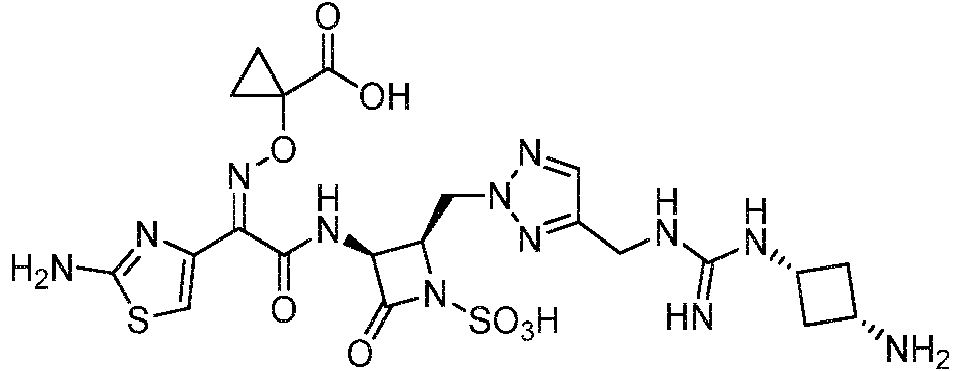
Se preparó de manera análoga al ejemplo 119, usando ((1S,3S)-3-((imino(metiltio)metil)amino)ciclobutil)carbamato de ferc-butilo. CL-EM: Rt = 0,49 min, m/z = 641,2 (M+1) Método 2m_ácido; 1H RMN (400 MHz, D2O) 8 ppm 7,61 (s, 1H) 7,00 (s, 1H) 5,47 (d, J = 5,6 Hz, 1H) 4,91-4,84 (m, 1H) 4,79-4,76 (m, 3H) 4,41 (s, 3H) 3,78 (t, J = 7,6 Hz, 1H) 3,51 (t, J = 8,0 Hz, 1H) 2,84-2,67 (m, 1H) 2,12 (d, J = 9,7 Hz, 1H) 1,23-1,19 (m, 2H) 1,05 (d, J = 4,5 Hz, 2H).It was prepared analogously to Example 119, using ((1S, 3S) -3 - ((imino (methylthio) methyl) amino) cyclobutyl) ferc-butyl carbamate. LC-MS: Rt = 0.49 min, m / z = 641.2 (M + 1) 2m_acid method; 1H NMR (400 MHz, D2O) 8 ppm 7.61 (s, 1H) 7.00 (s, 1H) 5.47 (d, J = 5.6 Hz, 1H) 4.91-4.84 (m , 1H) 4.79-4.76 (m, 3H) 4.41 (s, 3H) 3.78 (t, J = 7.6 Hz, 1H) 3.51 (t, J = 8.0 Hz , 1H) 2.84-2.67 (m, 1H) 2.12 (d, J = 9.7 Hz, 1H) 1.23-1.19 (m, 2H) 1.05 (d, J = 4.5 Hz, 2H).
Ejemplo de referencia 141: ácido 1-(((Z)-(1-(2-aminotiazol-4-il)-2-oxo-2-(((3S,4R)-2-oxo-4-((4-((3-((S)-pirrolidin-3-il)guanidino)metil)-2H-1,2,3-triazol-2-il)metil)-1-sulfoazetidin-3-il)amino)etilideno)amino)oxi)ciclopropanocarboxílicoReference example 141: 1 - (((Z) - (1- (2-aminothiazol-4-yl) -2-oxo-2 - (((3S, 4R) -2-oxo-4 - ((4 - ((3 - ((S) -pyrrolidin-3-yl) guanidino) methyl) -2H-1,2,3-triazol-2-yl) methyl) -1-sulfoazetidin-3-yl) amino) ethylidene) amino) oxy) cyclopropanecarboxylic

Se preparó de manera análoga al ejemplo 119, usando 3-((imino(metiltio)metil)amino)pirrolidina-1-carboxilato de (S)-ferc-butilo. CL-EM: Rt = 0,49 min, m/z = 640,8 (M+1) Método 2m_ácido; 1H RMN (400 MHz, D2O) 8 ppm 7,62 (s, 1H) 7,00 (s, 1H) 5,49 (d, J = 5,6 Hz, 1H) 4,83 - 4,91 (m, 1H) 4,80-4,75 (m, 2H) 4,44 (s, 2H) 4,30 (t, J = 4,0 Hz, 1H) 3,60 3,18 (m, 5H) 2,38-2,24 (m, 1H) 2,04 (dq, J = 12,5, 6,5 Hz, 1H) 1,24-1,12 (m, 2H) 1,04 (s a, 2H).It was prepared analogously to Example 119, using (S) -ferc-butyl 3- ((imino (methylthio) methyl) amino) pyrrolidine-1-carboxylate). LC-MS: Rt = 0.49 min, m / z = 640.8 (M + 1) 2m_acid method; 1H NMR (400 MHz, D2O) 8 ppm 7.62 (s, 1H) 7.00 (s, 1H) 5.49 (d, J = 5.6 Hz, 1H) 4.83 - 4.91 (m , 1H) 4.80-4.75 (m, 2H) 4.44 (s, 2H) 4.30 (t, J = 4.0 Hz, 1H) 3.60 3.18 (m, 5H) 2 , 38-2.24 (m, 1H) 2.04 (dq, J = 12.5, 6.5 Hz, 1H) 1.24-1.12 (m, 2H) 1.04 (sa, 2H) .
Ejemplo de referencia 142: ácido 1-(((Z)-(1-(2-aminotiazol-4-il)-2-oxo-2-(((3S,4R)-2-oxo-4-((4-((3-(®-pirrolidin-3-il)guanidino)metil)-2H-1,2,3-triazol-2-il)metil)-1-sulfoazetidin-3-il)amino)etilideno)amino)oxi)ciclopropanocarboxílicoReference Example 142: 1 - (((Z) - (1- (2-aminothiazol-4-yl) -2-oxo-2 - (((3S, 4R) -2-oxo-4 - ((4 - ((3- (®-Pyrrolidin-3-yl) guanidino) methyl) -2H-1,2,3-triazol-2-yl) methyl) -1-sulfoazetidin-3-yl) amino) ethylidene) amino) oxy) cyclopropanecarboxylic

Se preparó de manera análoga al ejemplo 119, usando 3-((imino(metiltio)metil)amino)pirrolidina-1-carboxilato de (R)-ferc-butilo. CL-EM: Rt = 0,29 min, m/z = 641,1 (M+1) Método 2m; 1H RMN (400 MHz, D2O) 8 ppm 7,62 (s, 1H) 7,01 (s, 1H) 5,49 (d, J = 5,6 Hz, 1H) 4,87 (q, J = 5,7 Hz, 1H) 4,80-4,75 (m, 2H) 4,44 (s, 2H) 4,31 (t, J = 4,0 Hz, 1H) 3,61 3,20 (m, 4H) 2,41-2,21 (m, 1H) 2,08-2,00 (m, 1H) 1,18 (m, 2H) 1,14 (m, 2H).It was prepared analogously to Example 119, using (R) -ferc-butyl 3- ((imino (methylthio) methyl) amino) pyrrolidine-1-carboxylate). LC-MS: R t = 0.29 min, m / z = 641.1 (M + 1) Method 2m; 1H NMR (400 MHz, D2O) 8 ppm 7.62 (s, 1H) 7.01 (s, 1H) 5.49 (d, J = 5.6 Hz, 1H) 4.87 (q, J = 5 , 7 Hz, 1H) 4.80-4.75 (m, 2H) 4.44 (s, 2H) 4.31 (t, J = 4.0 Hz, 1H) 3.61 3.20 (m, 4H) 2.41-2.21 (m, 1H) 2.08-2.00 (m, 1H) 1.18 (m, 2H) 1.14 (m, 2H).
Ejemplo de referencia 143: ácido 1-(((Z)-(2-(((2R,3S)-2-((4-(aminometil)-5-metil-2H-1,2,3-triazol-2-il)metil)-4-oxo-1-sulfoazetidin-3-il)amino)-1-(2-aminotiazol-4-il)-2-oxoetilideno)amino)oxi)ciclopropanocarboxílicoReference example 143: 1 - (((Z) - (2 - (((2R, 3S) -2 - ((4- (aminomethyl) -5-methyl-2H-1,2,3-triazol-2 acid -yl) methyl) -4-oxo-1-sulfoazetidin-3-yl) amino) -1- (2-aminothiazol-4-yl) -2-oxoethylidene) amino) oxy) cyclopropanecarboxylic
Etapa 1: 4-(azidometil)-5-metil-2H-1,2,3-triazol. A una disolución de 1-bromo-2-butino (640 |il, 7,31 mmol) en 1,4-dioxano/agua (3:1, 36 ml) se le añadió azida de sodio (1,901 g, 29,2 mmol) seguido por cloruro de amonio (782 mg, 14,6 mmol). Se calentó la suspensión hasta 75°C durante 8 h. Se separaron las fases y se extrajo la fase acuosa con EtOAc (3x). Se lavaron las fases orgánicas combinadas con salmuera, se secaron sobre Na2SO4 y se concentraron a vacío para dar un material bruto (833 mg, 78%) que se usó directamente en la etapa 2. CL-EM: Rt = 0,35 min, m/z = 138,9 (M+1) Método 2m_ácido.Stage 1: 4- (azidomethyl) -5-methyl-2H-1,2,3-triazole. To a solution of 1-bromo-2-butyne (640 µl, 7.31 mmol) in 1,4-dioxane / water (3: 1, 36 ml) was added sodium azide (1,901 g, 29.2 mmol) followed by ammonium chloride (782 mg, 14.6 mmol). The suspension was heated to 75 ° C for 8 h. The phases were separated and the aqueous phase was extracted with EtOAc (3x). The combined organic phases were washed with brine, dried over Na2SO4 and concentrated in vacuo to give a crude material (833 mg, 78%) that was used directly in step 2. LC-MS: Rt = 0.35 min, m / z = 138.9 (M + 1) 2m_acid method.
Etapa 2: ((5-metil-2H-1,2,3-triazol-4-il)metil)carbamato de ferc-butilo. Una suspensión de 4-(azidometil)-5-metil-2H-1,2,3-triazol (803 mg, 5,81 mmol), anhídrido de Boc (1,36 ml, 5,88 mmol) y Pd-C (157 mg, 0,148 mmol) en EtOH (39 ml) se evacuó y se recargó con H2 (3x). Se agitó la mezcla de reacción bajo H2 durante 1 h 45 min. Se filtró la suspensión negra resultante a través de Celite y se eluyó con EtOAc. Se concentró el filtrado a vacío. Se purificó el residuo bruto por medio de cromatografía en gel de sílice (EtOAc-heptano, 0-60%) para dar el compuesto del título (878 mg, 71%). CL-EM: Rt = 0,82 min, m/z = 213,0 (M+1) Método 2m_ácido.Step 2: ((5-methyl-2H-1,2,3-triazol-4-yl) methyl) ferc-butyl carbamate. A suspension of 4- (azidomethyl) -5-methyl-2H-1,2,3-triazole (803 mg, 5.81 mmol), Boc anhydride (1.36 ml, 5.88 mmol) and Pd-C (157 mg, 0.148 mmol) in EtOH (39 ml) was evacuated and recharged with H2 (3x). The reaction mixture was stirred under H2 for 1 h 45 min. The resulting black suspension was filtered through Celite and eluted with EtOAc. The filtrate was concentrated in vacuo. The crude residue was purified by silica gel chromatography (EtOAc-heptane, 0-60%) to give the title compound (878 mg, 71%). LC-MS: Rt = 0.82 min, m / z = 213.0 (M + 1) 2m_acid method.
Etapa 3: A una disolución de ((2S,3S)-1-(2,4-dimetoxibencil)-2-(hidroximetil)-4-oxoazetidin-3-il)carbamato de bencilo (331 mg, 0,826 mmol), ((5-metil-2H-1,2,3-triazol-4-il)metil)carbamato de ferc-butilo (235,3 mg, 1,109 mmol) y trifenilfosfina (265,6 mg, 1,013 mmol) en THF (8,3 ml) a 0°C se le añadió DIAD (0,210 ml, 1,016 mmol), gota a gota. Tras agitar a temperatura ambiente durante 2 h, se concentró la mezcla de reacción sobre gel de sílice. La purificación por medio de cromatografía en gel de sílice (EtOAc-heptano, 0-60%) dio el compuesto deseado (360 mg, 73%). CL-EM: Rt = 0,99 min, m/z = 595,3 (M+1) Método 2m_ácido.Step 3: To a solution of ((2S, 3S) -1- (2,4-dimethoxybenzyl) -2- (hydroxymethyl) -4-oxoazetidin-3-yl) benzyl carbamate (331 mg, 0.826 mmol), ( (5-methyl-2H-1,2,3-triazol-4-yl) methyl) ferc-butyl carbamate (235.3 mg, 1,109 mmol) and triphenylphosphine (265.6 mg, 1,013 mmol) in THF (8 , 3 ml) at 0 ° C DIAD (0.210 ml, 1.016 mmol) was added dropwise. After stirring at room temperature for 2 h, the reaction mixture was concentrated on silica gel. Purification by silica gel chromatography (EtOAc-heptane, 0-60%) gave the desired compound (360 mg, 73%). LC-MS: Rt = 0.99 min, m / z = 595.3 (M + 1) 2m_acid method.
Etapa 4: se calentó una suspensión del producto de la etapa anterior (etapa 4) (396,8 mg, 0,667 mmol), K2S2O8 (243 mg, 0,870 mmol) y K2HPO4 (268,1 mg, 1,539 mmol) en ACN/agua (2:1, 9,4 ml) hasta 90°C durante 2 h. Se añadió K2S2O8 adicional (55,6 mg, 0,200 mmol) y se continuó calentando durante 2 h adicionales. Se concentró la mezcla de reacción parcialmente a vacío, después se extinguió con NaHCO3 y se extrajo con EtOAc (3x). Se lavaron las fases orgánicas combinadas con salmuera, se secaron sobre Na2SO4 y se concentraron a vacío. La purificación por medio de cromatografía en gel de sílice (EtOAc- heptano, 0-90%), después HPLC (OBD C18, 5 |i, 30x100 mm, el 30-70% de ACN/H2O con tampón TFA al 0,1% durante 18 min, 60 ml/min), dio el compuesto deseado (157 mg, 53%) como un sólido blanco. CL-EM: Rt = 0,80 min, m/z = 445,2 (M+1) Método 2m_ácido.Step 4: A suspension of the product from the previous stage (step 4) (396.8 mg, 0.667 mmol), K2S2O8 (243 mg, 0.870 mmol) and K2HPO4 (268.1 mg, 1.539 mmol) in ACN / water was heated (2: 1, 9.4 ml) up to 90 ° C for 2 h. Additional K2S2O8 (55.6 mg, 0.200 mmol) was added and heating continued for an additional 2 h. The reaction mixture was partially concentrated in vacuo, then quenched with NaHCO3 and extracted with EtOAc (3x). The combined organic phases were washed with brine, dried over Na2SO4 and concentrated in vacuo. Purification by means of silica gel chromatography (EtOAc-heptane, 0-90%), then HPLC (OBD C18, 5 | i, 30x100 mm, 30-70% ACN / H2O with 0.1 TFA buffer % for 18 min, 60 ml / min), gave the desired compound (157 mg, 53%) as a white solid. LC-MS: Rt = 0.80 min, m / z = 445.2 (M + 1) 2m_acid method.
Etapa 5: ((2-(((2R,3S)-3-amino-4-oxoazetidin-2-il)metil)-5-metil-2H-1,2,3-triazol-4-il)metil)carbamato de ferc-butilo. A un matraz purgado con N2 que contiene el producto de la etapa anterior (93,2 mg, 0,210 mmol) y Pd-C (18 mg) se le añadió etanol (1,6 ml) seguido por metanol (0,4 ml). Se evacuó la suspensión y se volvió a llenar con H2 (3x). Se agitó la mezcla de reacción bajo H2 durante 2 h. Se filtró la suspensión negra resultante a través de Celite, eluyendo con metanol. Se concentró el filtrado a vacío y se usó el residuo bruto como tal en la etapa 6. CL-EM: Rt = 0,46 min, m/z = 311,1 (M+1) Método 2m_ácido.Step 5: ((2 - (((2R, 3S) -3-amino-4-oxoazetidin-2-yl) methyl) -5-methyl-2H-1,2,3-triazol-4-yl) methyl) ferc-butyl carbamate. To a flask purged with N2 containing the product of the previous step (93.2 mg, 0.210 mmol) and Pd-C (18 mg) was added ethanol (1.6 ml) followed by methanol (0.4 ml) . The suspension was evacuated and refilled with H2 (3x). The reaction mixture was stirred under H2 for 2 h. The resulting black suspension was filtered through Celite, eluting with methanol. The filtrate was concentrated in vacuo and the crude residue was used as such in step 6. LC-MS: Rt = 0.46 min, m / z = 311.1 (M + 1) 2m_acid method.
Etapa 6: 1-(((Z)-(2-(((2R,3S)-2-((4-(((ferc-butoxicarbonil)amino)metil)-5-metil-2H-1,2,3-triazol-2-il)metil)-4-oxoazetidin-3- il)amino)-1-(2-((ferc-butoxicarbonil)amino)tiazol-4-il)-2-oxoetilideno)amino)oxi)ciclopropanocarboxilato de benzhidrilo. A una disolución de ácido (Z)-2-((1-((benzhidriloxi)carbonil)ciclopropoxi)imino)-2-(2-((fercbutoxicarbonil)amino)tiazol-4-il)acético (120 mg, 0,213 mmol), ((2-(((2R,3S)-3-amino-4-oxoazetidin-2-il)metil)-5-metil-2H-1,2,3-triazol-4-il)metil)carbamato de ferc-butilo (65,2 mg, 0,210 mmol) y HATU (86 mg, 0,22 mmol) en DMF (2,1 ml) a 0°C, se le añadió DIPEA (0,073 ml, 0,420 mmol). Tras agitar durante 16 h, se diluyó la mezcla de reacción con EtOAc y se lavó con disolución de LiCl (el 5% ac). Se extrajo la fase acuosa con EtOAc (3x) y se lavaron las fases orgánicas combinadas con disolución de LiCl (el 5% ac), NaHCO3 saturado (ac), salmuera, se secó sobre Na2SO4 y se concentró a vacío. La purificación del residuo bruto por medio de cromatografía en gel de sílice (EtOAcheptano, 0-90%) dio el compuesto del título (144 mg, 82%). Cl-EM: Rt = 1 ,12 min, m/z = 830,5 (M+1 ) Método 2m_ácido.Step 6: 1 - (((Z) - (2 - (((2R, 3S) -2 - ((4 - (((ferc-butoxycarbonyl) amino) methyl) -5-methyl-2H-1,2, 3-triazol-2-yl) methyl) -4-oxoazetidin-3- yl) amino) -1- (2 - (( ferc- butoxycarbonyl) amino) thiazol-4-yl) -2-oxoethylidene) amino) oxy) benzhydryl cyclopropanecarboxylate. To a solution of (Z) -2 - ((1 - ((benzhydryloxy) carbonyl) cyclopropoxy) imino) -2- (2 - ((fercbutoxycarbonyl) amino) thiazol-4-yl) acetic acid (120 mg, 0.213 mmol ), ((2 - (((2R, 3S) -3-amino-4-oxoazetidin-2-yl) methyl) -5-methyl-2H-1,2,3-triazol-4-yl) methyl) carbamate of ferc-butyl (65.2 mg, 0.210 mmol) and HATU (86 mg, 0.22 mmol) in DMF (2.1 ml) at 0 ° C, DIPEA (0.073 ml, 0.420 mmol) was added. After stirring for 16 h, the reaction mixture was diluted with EtOAc and washed with LiCl solution (5% aq). The aqueous phase was extracted with EtOAc (3x) and the combined organic phases were washed with LiCl solution (5% aq), saturated NaHCO3 (aq), brine, dried over Na2SO4 and concentrated in vacuo. Purification of the crude residue by means of silica gel chromatography (EtOAcheptane, 0-90%) gave the title compound (144 mg, 82%). Cl-MS: Rt = 1, 12 min, m / z = 830.5 (M + 1) 2m_acid method.
Etapa 7: ácido (2R,3S)-3-((Z)-2-((1-((benzhidriloxi)carbonil)ciclopropoxi)imino)-2-(2-((ferc-butoxicarbonil)amino)tiazol-4- il)acetamido)-2-((4-(((ferc-butoxicarbonil)amino)metil)-5-metil-2H-1,2,3-triazol-2-il)metil)-4-oxoazetidina-1-sulfónico. A una disolución de 1-(((Z)-(2-(((2R,3S)-2-((4-(((ferc-butoxicarbonil)amino)metil)-5-metil-2H-1,2,3-triazol-2-il)metil)-4-oxoazetidin-3-il)amino)-1-(2-((ferc-butoxicarbonil)amino)tiazol-4-il)-2-oxoetilideno)amino)oxi)ciclopropanocarboxilato de benzhidrilo (140 mg, 0,170 mmol) en DMF (848 |il) a 0°C se le añadió SOâ DMF (54,4 mg, 0,355 mmol). Se agitó la mezcla de reacción durante 2,5 h, tras lo cual se añadió SOâ DMF adicional (27,4 mg, 0,170 mmol). Tras 22 h adicionales, se diluyó la disolución con EtOAc y se vertió en la disolución fría de LiCl (5%, ac). Se separaron las fases y se extrajo la fase acuosa con EtOAc (2x). Se lavaron las fases orgánicas combinadas con LiCI (el 5% ac), salmuera, se secó sobre Na2SO4 y se concentró a vacío para dar 163,1 mg de el material bruto que se usó en la etapa 8 sin purificación adicional. CL-EM: Rt = 1,01 min, m/z = 910,5 (M+1) Método 2m_ácido.Step 7: (2R, 3S) -3 - ((Z) -2 - ((1 - ((benzhydryloxy) carbonyl) cyclopropoxy) imino) -2- (2 - ((ferc-butoxycarbonyl) amino) thiazole-4 - il) acetamido) -2 - ((4 - (((ferc-butoxycarbonyl) amino) methyl) -5-methyl-2H-1,2,3-triazol-2-yl) methyl) -4-oxoazetidine-1 -sulfonic. At a solution of 1 - (((Z) - (2 - (((2R, 3S) -2 - ((4 - (((ferc-butoxycarbonyl) amino) methyl) -5-methyl-2H-1,2 , 3-triazol-2-yl) methyl) -4-oxoazetidin-3-yl) amino) -1- (2 - ((ferc-butoxycarbonyl) amino) thiazol-4-yl) -2-oxoethylidene) amino) oxy ) Benzhydryl cyclopropanecarboxylate (140 mg, 0.175 mmol) in DMF (848 µl) at 0 ° C was added SOâ DMF (54.4 mg, 0.355 mmol). The reaction mixture was stirred for 2.5 h, after which additional SOF DMF (27.4 mg, 0.175 mmol) was added. After an additional 22 h, the solution was diluted with EtOAc and poured into the cold LiCl solution (5%, aq). The phases were separated and the aqueous phase was extracted with EtOAc (2x). The combined organic phases were washed with LiCI (5% aq), brine, dried over Na2SO4 and concentrated in vacuo to give 163.1 mg of the crude material that was used in step 8 without further purification. LC-MS: Rt = 1.01 min, m / z = 910.5 (M + 1) 2m_acid method.
Etapa 8 : ácido 1-(((Z)-(2-(((2R,3S)-2-((4-(aminometil)-5-metil-2H-1,2,3-triazol-2-il)metil)-4-oxo-1-sulfoazetidin-3-il)amino)-1-(2-aminotiazol-4-il)-2-oxoetilideno)amino)oxi)ciclopropanocarboxílico Stage 8: 1 - (((Z) - (2 - (((2R, 3S) -2 - ((4- (aminomethyl) -5-methyl-2H-1,2,3-triazol-2-yl acid ) methyl) -4-oxo-1-sulfoazetidin-3-yl) amino) -1- (2-aminothiazol-4-yl) -2-oxoethylidene) amino) oxy) cyclopropanecarboxylic

Se siguió el procedimiento general para la desprotección mediada por ácido usando ácido (2R,3S)-3-((Z)-2-((1-((benzhidriloxi)carbonil)ciclopropoxi)imino)-2-(2-((ferc-butoxicarbonil)amino)tiazol-4-il)acetamido)-2-((4-(((fercbutoxicarbonil)amino)metil)-5-metil-2H-1,2,3-triazol-2-il)metil)-4-oxoazetidina-1-sulfónico (155 mg, 0,170 mmol), DCM (1,70 ml), anisol (37 |il, 0,34 mmol) y TFA (0,787 ml, 10,2 mmol). Se purificó el material bruto mediante HPLC preparativa de fase inversa (XSELECT C18, 5 |i, 30x100 mm, ACN- H2O con tampón de ácido fórmico al 0,1%, 60 ml/min), dando el compuesto del título (55 mg, 57%) como un sólido blanquecino. CL-EM: Rt = 0,49 min, m/z = 544,1 (M+1) Método 2m_ácido_polar. 1H RMN (400 MHz, D2O) 87,04 (s, 1H), 5,46 (d, J = 5,6 Hz, 1H), 4,91-4,84 (m, 1H), 4,84-4,76 (m, 1H), 4,62-4,56 (m, 1H supuesto; ocultado por el pico residual de disolvente), 4,13 (s, 2H), 2,16 (s, 3H), 1,32-1,18 (m, 2H), 1,18-1,00 (m, 2H).The general procedure for acid-mediated deprotection was followed using (2R, 3S) -3 - ((Z) -2 - ((1 - ((benzhydryloxy) carbonyl) cyclopropoxy) imino) -2- (2 - (( ferc-butoxycarbonyl) amino) thiazol-4-yl) acetamido) -2 - ((4 - ((((fercbutoxycarbonyl) amino) methyl) -5-methyl-2H-1,2,3-triazol-2-yl) methyl ) -4-oxoazetidine-1-sulfonic acid (155 mg, 0.175 mmol), DCM (1.70 ml), anisole (37 µl, 0.34 mmol) and TFA (0.787 ml, 10.2 mmol). The crude material was purified by preparative reverse phase HPLC (XSELECT C18, 5 i, 30x100 mm, ACN-H2O with 0.1% formic acid buffer, 60 ml / min), to give the title compound (55 mg , 57%) as an off-white solid. LC-MS: Rt = 0.49 min, m / z = 544.1 (M + 1) Method 2m_polar_m_acid. 1H NMR (400 MHz, D2O) 87.04 (s, 1H), 5.46 (d, J = 5.6 Hz, 1H), 4.91-4.84 (m, 1H), 4.84- 4.76 (m, 1H), 4.62-4.56 (m, 1H assumed; hidden by residual solvent peak), 4.13 (s, 2H), 2.16 (s, 3H), 1 , 32-1.18 (m, 2H), 1.18-1.00 (m, 2H).
Ejemplo de referencia 144: ácido 1-(((Z)-(2-(((2R,3S)-2-((4-((3-(3-aminopropil)guanidino)metil)-5-metil-2H-1,2,3-triazol-2-il)metil)-4-oxo-1-sulfoazetidin-3-il)amino)-1-(2-aminotiazol-4-il)-2-oxoetilideno)amino)oxi)ciclopropanocarboxílicoReference Example 144: 1 - (((Z) - (2 - (((2R, 3S) -2 - ((4 - ((3- (3-aminopropyl) guanidino) methyl) -5-methyl-2H acid -1,2,3-triazol-2-yl) methyl) -4-oxo-1-sulfoazetidin-3-yl) amino) -1- (2-aminothiazol-4-yl) -2-oxoethylidene) amino) oxy ) cyclopropanecarboxylic
Etapa 1: (3-((ferc-butoxicarbonil)amino)propil)(((ferc-butoxicarbonil)imino)(1H-pirazol-1-il)metil)carbamato de tercbutilo. A una disolución helada de (((ferc-butoxicarbonil)amino)(1H-pirazol-1-il)metileno)carbamato de ferc-butilo (500 mg, 1,611 mmol), (3-hidroxipropil)carbamato de ferc-butilo (282 mg, 1,611 mmol) y trifenilfosfina (634 mg, 2,417 mmol) disuelta en THF (16 ml) se le añadió DIAD (470 |il, 2,417 mmol) y se agitó durante 16 h. Se concentró la mezcla de reacción a vacío y se purificó el residuo bruto por medio de cromatografía en gel de sílice (EtOAcheptano) para dar el compuesto del título (600 mg, 80%). CL-EM: Rt = 1,02 min, m/z = 468,4 (M+1) Método 2m_ácido.Step 1: (3 - ((ferc-butoxycarbonyl) amino) propyl) (((ferc-butoxycarbonyl) imino) (1 H -pyrazol-1-yl) methyl) tert-butyl carbamate. To an ice cold solution of (((ferc-butoxycarbonyl) amino) (1 H -pyrazol-1-yl) methylene) ferc-butyl carbamate (500 mg, 1,611 mmol), (3-hydroxypropyl) ferc-butyl carbamate (282 mg, 1,611 mmol) and triphenylphosphine (634 mg, 2,417 mmol) dissolved in THF (16 mL) DIAD (470 µL, 2,417 mmol) was added and stirred for 16 h. The reaction mixture was concentrated in vacuo and the crude residue was purified by silica gel chromatography (EtOAcheptane) to give the title compound (600 mg, 80%). LC-MS: Rt = 1.02 min, m / z = 468.4 (M + 1) 2m_acid method.
Etapa 2: ácido 1-(((Z)-(1-(2-aminotiazol-4-il)-2-(((2R,3S)-2-((4-((Z)-4-(ferc-butoxicarbonil)-3-((ferc-butoxicarbonil) imino)-11,11-dimetil-9-oxo-10-oxa-2,4,8-triazadodecil)-5-metil-2H-1,2,3-triazol-2-il)metil)-4-oxo-1-sulfoazetidin-3-il)amino)-2-oxoetilideno)amino)oxi)ciclopropanocarboxílico. A una disolución de ácido 1-(((Z)-(2-(((2R,3S)-2-((4-(aminometil)-5-metil-2H-1,2,3-triazol-2-il)metil)-4-oxo-1-sulfoazetidin-3-il)amino)-1-(2-aminotiazol-4-il)-2-oxoetilideno)amino)oxi)ciclopropanocarboxílico (33,9 mg, 0,062 mmol) y (3-((ferc-butoxicarbonil)amino)propil)(((fercbutoxicarbonil)imino)(1H-pirazol-1-il)metil)carbamato de ferc-butilo (54,2 mg, 0,116 mmol) en DMF (624 |il) a 0°C se le añadió DIPEA (32,7 |il, 0,187 mmol). Tras agitar a ta durante 16 h, se concentró la disolución a vacío y se usó como tal sin purificación adicional. CL-EM: Rt = 0,75 min, m/z = 943,7 (M+1) Método 2m_ácido.Stage 2: acid 1 - (((Z) - (1- (2-aminothiazol-4-yl) -2 - (((2R, 3S) -2 - ((4 - ((Z) -4- (ferc -butyloxycarbonyl) -3 - ((ferc-butoxycarbonyl) imino) -11,11-dimethyl-9-oxo-10-oxa-2,4,8-triazadodecyl) -5-methyl-2H-1,2,3- triazol-2-yl) methyl) -4-oxo-1-sulfoazetidin-3-yl) amino) -2-oxoethylidene) amino) oxy) cyclopropanecarboxylic. To a solution of acid 1 - (((Z) - (2 - (((2R, 3S) -2 - ((4- (aminomethyl) -5-methyl-2H-1,2,3-triazol-2- il) methyl) -4-oxo-1-sulfoazetidin-3-yl) amino) -1- (2-aminothiazol-4-yl) -2-oxoethylidene) amino) oxy) cyclopropanecarboxylic (33.9 mg, 0.062 mmol) and (3 - ((ferc-butoxycarbonyl) amino) propyl) ((((fercbutoxycarbonyl) imino) (1 H -pyrazol-1-yl) methyl) ferc-butyl carbamate (54.2 mg, 0.116 mmol) in DMF (624 | il) at 0 ° C DIPEA (32.7 µl, 0.187 mmol) was added. After stirring at rt for 16 h, the solution was concentrated in vacuo and used as such without further purification. LC-MS: Rt = 0.75 min, m / z = 943.7 (M + 1) 2m_acid method.
Etapa 3: ácido 1-(((Z)-(2-(((2R,3S)-2-((4-((3-(3-aminopropil)guanidino)metil)-5-metil-2H-1,2,3-triazol-2-il)metil)-4-oxo-1-sulfoazetidin-3-il)amino)-1-(2-aminotiazol-4-il)-2-oxoetilideno)amino)oxi)ciclopropanocarboxílicoStage 3: 1 - (((Z) - (2 - ((((2R, 3S) -2 - ((4 - ((3- (3-aminopropyl) guanidino) methyl) -5-methyl-2H-1 acid , 2,3-triazol-2-yl) methyl) -4-oxo-1-sulfoazetidin-3-yl) amino) -1- (2-aminothiazol-4-yl) -2-oxoethylidene) amino) oxy) cyclopropanecarboxylic

Se siguió el procedimiento general para la desprotección mediada por ácido usando ácido 1-(((Z)-(1-(2-aminotiazol-4-il)-2-(((2R,3s)-2-((4-((Z)-4-(ferc-butoxicarbonil)-3-((ferc-butoxicarbonil)imino)-11,11-dimetil-9-oxo-10-oxa-2,4,8-triazadodecil)-5-metil-2H-1,2,3-triazol-2-il)metil)-4-oxo-1-sulfoazetidin-3-il)amino)-2-oxoetilideno)amino)oxi)ciclopropanocarboxílico (58,5 mg, 0,062 mmol), DCM (621 |il), anisol (20,4 |il, 0,186 mmol) y TFA (427 |il, 4,55 mmol). Se diluyó la mezcla de reacción con agua helada (1 ml) y se separaron las fases. Se extrajo la fase orgánica con agua (1 ml) y se lavaron las fases acuosas combinadas con DCM (1 ml) y luego se purificaron mediante HPLC preparativa de fase inversa (XSELECT C18, 5 |i, 30x100 mm, el 1-20% de ACN/H2O con tampón ácido fórmico al 0,1% durante 18 min, 60 ml/min), dando el compuesto del título (19 mg, 44%) como un sólido blanquecino. CL-EM: Rt = 0,54 min, m/z = 643,2 (M+1) Método 2m_ácido_polar. 1H RMN (400 MHz, D2O) 8 7,11 (s, 1H), 5,62 (d, J = 5,6 Hz, 1H), 5,01-4,94 (m, 1H), 4,91-4,74 (m, 2H supuesto; ocultado por el pico residual de disolvente), 4,50 (s a, 2H), 3,36 (t, J = 6,9 Hz, 2H), 3,11 (t, J = 7,8 Hz, 2H), 2,29 (s, 3H), 2,01 (p, J = 7,2 Hz, 2H), 1,35-1,25 (m, 2H), 1,21-1,05 (m, 2H). The general procedure for acid-mediated deprotection was followed using 1 - (((Z) - (1- (2-aminothiazol-4-yl) -2 - ((((2R, 3s) -2 - ((4- ((Z) -4- (ferc-butoxycarbonyl) -3 - ((ferc-butoxycarbonyl) imino) -11,11-dimethyl-9-oxo-10-oxa-2,4,8-triazadodecyl) -5-methyl -2H-1,2,3-triazol-2-yl) methyl) -4-oxo-1-sulfoazetidin-3-yl) amino) -2-oxoethylidene) amino) oxy) cyclopropanecarboxylic acid (58.5 mg, 0.062 mmol ), DCM (621 µl), anisole (20.4 µl, 0.186 mmol) and TFA (427 µl, 4.55 mmol). The reaction mixture was diluted with ice water (1 ml) and the phases were separated. The organic phase was extracted with water (1 ml) and the combined aqueous phases were washed with DCM (1 ml) and then purified by preparative reverse phase HPLC (XSELECT C18, 5 | i, 30x100 mm, 1-20% of ACN / H2O with 0.1% formic acid buffer for 18 min, 60 ml / min), giving the title compound (19 mg, 44%) as an off-white solid. LC-MS: Rt = 0.54 min, m / z = 643.2 (M + 1) Method 2m_polar_m_acid. 1H NMR (400 MHz, D2O) 8 7.11 (s, 1H), 5.62 (d, J = 5.6 Hz, 1H), 5.01-4.94 (m, 1H), 4.91 -4.74 (m, 2H assumed; hidden by residual solvent peak), 4.50 (sa, 2H), 3.36 (t, J = 6.9 Hz, 2H), 3.11 (t, J = 7.8 Hz, 2H), 2.29 (s, 3H), 2.01 (p, J = 7.2 Hz, 2H), 1.35-1.25 (m, 2H), 1, 21-1.05 (m, 2H).
Ejemplo de referencia 145: ácido 1-(((Z)-(2-(((2R,3S)-2-((4-(1-(3-(3-aminoprop¡l)guamd¡no)etil)-2H-1,2,3-tnazol-2-il)metil)-4-oxo-1-sulfoazetidin-3-il)amino)-1-(2-aminotiazol-4-il)-2-oxoetilideno)amino)oxi)cidopropanocarboxílico Reference example 145: 1 - (((Z) - (2 - (((2R, 3S) -2 - ((4- (1- (3- (3-aminopropyl) guamdno) ethyl) acid)) -2H-1,2,3-tnazol-2-yl) methyl) -4-oxo-1-sulfoazetidin-3-yl) amino) -1- (2-aminothiazol-4-yl) -2-oxoethylidene) amino ) oxy) cidopropanecarboxylic
Etapa 1: 1-(2H-1,2,3-triazol-4-il)etanol. A una disolución de but-3-in-2-ol (3,63 g, 50,2 mmol) en DMF (40 ml) y MeOH (10 ml) se le añadió azidotrimetilsilano (10,22 ml, 75 mmol). Se calentó la mezcla de reacción a 100°C durante 16 h. Se enfrió la reacción y se filtró a través de una capa de Celite. Se concentró el filtrado hasta ~25 ml y se usó directamente en la siguiente etapa. CL-EM: Rt = 0,16 min, m/z = 113,8 (M+1) Método 2m_ácido_polar.Stage 1: 1- (2H-1,2,3-triazol-4-yl) ethanol. To a solution of but-3-in-2-ol (3.63 g, 50.2 mmol) in DMF (40 ml) and MeOH (10 ml) was added azidotrimethylsilane (10.22 ml, 75 mmol). The reaction mixture was heated at 100 ° C for 16 h. The reaction was cooled and filtered through a layer of Celite. The filtrate was concentrated to ~ 25 ml and used directly in the next step. LC-MS: Rt = 0.16 min, m / z = 113.8 (M + 1) Method 2m_polar_m_acid.
Etapa 2: 4-(1-((terc-but¡ld¡fen¡ls¡l¡l)ox¡)et¡l)-1H-1,2,3-t âzol. A una disolución de 1-(1H-1,2,3-triazol-4-il)etanol (50,2 mmol) y imidazol (5,13 mg, 75 mmol) en DCM (50 ml) 0°C se le añadió TBDPSCI (14,6 ml, 55,2 mmol). Tras agitar a temperatura ambiente durante la noche se filtró la mezcla a través de una capa de Celite y luego se concentró hasta sequedad. Se disolvió el residuo resultante en EtOAc, se lavó con agua, salmuera, se secó con sulfato de sodio y se concentró. La purificación del residuo bruto por medio de cromatografía en gel de sílice (EtOAcheptano, 5-25%) dio el compuesto del título (8,16 g, 46%) como un aceite amarillo. CL-EM: Rt = 1,09 min, m/z = 352,1 (M+1) Método 2m_ácido. 1H RMN (400 MHz, CDCla) 8 ppm 7,71 (d, J = 6,5 Hz, 2H) 7,64-7,54 (m, 3 H) 7,49 7,28 (m, 6 H) 5,14 (q, J = 6,3 Hz, 1H) 1,46 (dd, J = 6,3, 3,0 Hz, 3H) 1,08 (s, 9H).Stage 2: 4- (1 - ((tert-but¡ld¡fen¡ls¡l¡l) ox¡) et¡l) -1H-1,2,3-t âzol. To a solution of 1- (1H-1,2,3-triazol-4-yl) ethanol (50.2 mmol) and imidazole (5.13 mg, 75 mmol) in DCM (50 ml) 0 ° C is given added TBDPSCI (14.6 ml, 55.2 mmol). After stirring at room temperature overnight, the mixture was filtered through a layer of Celite and then concentrated to dryness. The resulting residue was dissolved in EtOAc, washed with water, brine, dried over sodium sulfate and concentrated. Purification of the crude residue by silica gel chromatography (EtOAcheptane, 5-25%) gave the title compound (8.16 g, 46%) as a yellow oil. LC-MS: Rt = 1.09 min, m / z = 352.1 (M + 1) 2m_acid method. 1H NMR (400 MHz, CDCla) 8 ppm 7.71 (d, J = 6.5 Hz, 2H) 7.64-7.54 (m, 3 H) 7.49 7.28 (m, 6 H) 5.14 (q, J = 6.3 Hz, 1H) 1.46 (dd, J = 6.3, 3.0 Hz, 3H) 1.08 (s, 9H).
Etapa 3: ((2R,3S)-2-((4-(1-((terc-but¡ld¡fen¡ls¡l¡l)ox¡)et¡l)-2H-1,2,3-t âzol-2-¡l)met¡l)-1-(2,4-d¡metox¡bendl)-4-oxoazetidin-3-il)carbamato de bencilo. A una disolución de 4-(1-((terc-but¡ld¡fen¡ls¡l¡l)ox¡)et¡l)-1H-1,2,3-tr¡azol (2,42 g, 6,88mmol),((2S,3S)-1-(2,4-d¡metox¡benc¡l)-2-(h¡drox¡met¡l)-4-oxoazet¡d¡n-3-¡l)carbamato de bencilo (2,76 g, 6,88 mmol), y PPh3 (2,17 mg, 8,26 mmol) en THF (35 ml) a 0°C se le añadió DIAD (1,60 ml, 8,26 mmol) gota a gota. Se agitó la reacción a temperatura ambiente durante 5 h, después se concentró a vacío. La purificación del residuo bruto por medio de cromatografía en gel de sílice (EtOAc-heptano, 30-60%) dio el compuesto del título (4,32 g, 85%) como un sólido. CL-EM: Rt = 1,12 min, m/z = 734 (M+1) Método 2m_ácido.Stage 3: ((2R, 3S) -2 - ((4- (1 - ((tert-but¡ld¡fen¡ls¡l¡l) ox¡) et¡l) -2H-1,2,3 -t âzol-2-¡l) met¡l) -1- (2,4-d¡metox¡bendl) -4-oxoazetidin-3-yl) benzyl carbamate. To a solution of 4- (1 - ((tert-butyl) fenlls) ox)), -1H-1,2,3-triazole (2.42 g, 6.88mmol), ((2S, 3S) -1- (2,4-d¡metox¡benc¡l) -2- (h¡drox¡met¡l) -4-oxoazet¡d¡n-3- L) benzyl carbamate (2.76 g, 6.88 mmol), and PPh3 (2.17 mg, 8.26 mmol) in THF (35 ml) at 0 ° C DIAD (1.60 ml) was added , 8.26 mmol) drop by drop. The reaction was stirred at room temperature for 5 h, then concentrated in vacuo. Purification of the crude residue by means of silica gel chromatography (EtOAc-heptane, 30-60%) gave the title compound (4.32 g, 85%) as a solid. LC-MS: Rt = 1.12 min, m / z = 734 (M + 1) 2m_acid method.
Etapa 4: ((2R,3S)-2-((4-(1-((terc-but¡ld¡fen¡ls¡l¡l)ox¡)et¡l)-2H-1,2,3-t^azol-2-¡l)met¡l)-4-oxoazet¡d¡n-3-¡l)carbamato de bencilo. A una disolución de ((2R,3S)-2-((4-(1-((terc-but¡ld¡fen¡ls¡l¡l)ox¡)et¡l)-2H-1,2,3-t âzol-2-¡l)met¡l)-1-(2,4-dimetoxibencil^-oxoazetidin^-iOcarbamato de bencilo (2,50 g, 3,41 mmol) en ACN/agua (2:1, 45 ml) a temperatura ambiente se le añadió K2S2O8 (1,57 mg, 5,79 mmol) y K2HPO4 (949 mg, 5,45 mmol). Se calentó la mezcla hasta 90°C bajo nitrógeno con agitación durante 6 h. Se concentró la mezcla de reacción a vacío para eliminar ACN. A la suspensión resultante se le añadió EtOAc y agua. Se separó la fase orgánica y se extrajo la fase acuosa con EtOAc (2x). Se combinaron las porciones orgánicas, se secaron con Na2SO4, se filtraron y se concentraron a vacío. La purificación del residuo bruto por medio de cromatografía en gel de sílice (EtOAc-heptano, 30-60%) dio el compuesto del título (1,35 g, 68%). CL-EM: Rt= 1,18 min, m/z = 584,3 (M+1) Método 2m_ácido.Stage 4: ((2R, 3S) -2 - ((4- (1 - ((tert-but¡ld¡fen¡ls¡l¡l) ox¡) et¡l) -2H-1,2,3 -t ^ azol-2-¡l) met¡l) -4-oxoazet¡d¡n-3-¡) benzyl carbamate. To a solution of ((2R, 3S) -2 - ((4- (1 - ((tert-but¡ld¡fen¡ls¡l¡l) ox¡) et¡l) -2H-1,2, 3-t âzol-2-l) methyl) -1- (2,4-dimethoxybenzyl ^ -oxoazetidine ^ -i benzylcarbamate (2.50 g, 3.41 mmol) in ACN / water (2: 1 , 45 ml) at room temperature K2S2O8 (1.57 mg, 5.79 mmol) and K2HPO4 (949 mg, 5.45 mmol) were added.The mixture was heated to 90 ° C under nitrogen with stirring for 6 h. The reaction mixture was concentrated in vacuo to remove ACN.To the resulting suspension was added EtOAc and water.The organic phase was separated and the aqueous phase was extracted with EtOAc (2x) .The organic portions were combined, dried with Na2SO4. , filtered and concentrated in vacuo Purification of the crude residue by means of silica gel chromatography (EtOAc-heptane, 30-60%) gave the title compound (1.35 g, 68%). : Rt = 1.18 min, m / z = 584.3 (M + 1) 2m_acid method.
Etapa 5: ((2R,3S)-2-((4-(1-h¡drox¡et¡l)-2H-1,2,3-t âzol-2-¡l)met¡l)-4-oxoazet¡d¡n-3-¡l)carbamato de bencilo. Se agitó una mezcla de ((2R,3S)-2-((4-(1-((terc-but¡ld¡fen¡ls¡l¡l)ox¡)et¡l)-2H-1,2,3-t âzol-2-¡l)met¡l)-4-oxoazet¡d¡n-3-¡l)carbamato (1,35 g, 2,31 mmol) y TBAF (1 M en THF, 4,63 ml, 4,63 mmol) en THF (23 ml) a temperatura ambiente 3 h. Se eliminó el disolvente y se purificó el residuo por medio de cromatografía en gel de sílice (EtOAc-heptano) para dar el compuesto del título (450 mg, 56%) como un sólido amarillo claro. CL-EM: Rt = 0,53 min, m/z = 346,1 (M+1) Método 2m_ácido.Stage 5: ((2R, 3S) -2 - ((4- (1-h¡drox¡et¡l) -2H-1,2,3-t âzol-2-¡) met¡l) -4 -oxoazet¡d¡n-3-¡l) benzyl carbamate. A mixture of ((2R, 3S) -2 - ((4- (1 - ((tert-but¡ld¡fen¡ls¡l¡l) ox¡) et¡l) -2H-1.2 was stirred , 3-t âzol-2-¡l) methyl) -4-oxoazet¡d¡n-3-¡) carbamate (1.35 g, 2.31 mmol) and TBAF (1 M in THF, 4 , 63 ml, 4.63 mmol) in THF (23 ml) at room temperature 3 h. The solvent was removed and the residue was purified by silica gel chromatography (EtOAc-heptane) to give the title compound (450 mg, 56%) as a light yellow solid. LC-MS: Rt = 0.53 min, m / z = 346.1 (M + 1) 2m_acid method.
Etapa 6 : (1-(2-(((2R,3S)-3-(((bendlox¡)carbon¡l)am¡no)-4-oxoazet¡d¡n-2-¡l)met¡l)-2H-1,2,3- tnazol-4-il)etN)((Z)-((tercbutox¡carbon¡l)¡m¡no)(1H-p¡razol-1-¡l)met¡l)carbamato de terc-butilo. A una disolución de ((2R,3S)-2-((4-(1-hidroxietil)-2H-1,2,3-t âzol-2-¡l)met¡l)-4-oxoazet¡d¡n-3-¡l)carbamato de bencilo (460 mg, 1,33mmol), (((terc-butox¡carbon¡l)¡m¡no)(1H-p¡razol-1-¡l)met¡l)carbamato de (E)-terc-butilo (455 mg, 1,465 mmol), y trifenilfosfina (419 mg, 1,60 mmol) en Th F (7 ml) a 0°C se le añadió DIAD (0,311 ml, 1,598 mmol) gota a gota. Se agitó la reacción a temperatura ambiente durante la noche y se concentró hasta sequedad. La purificación del residuo bruto por medio de cromatografía en gel de sílice (EtOAc-heptano, 30-60%) dio el compuesto del título (190 mg, 22%) como un sólido amarillo claro. CL-EM: Rt = 0,99 min, m/z = 638,4 (M+1 ) Método 2 m_ácido.Stage 6: (1- (2 - (((2R, 3S) -3 - (((bendlox¡) carbon¡l) amÃno) -4-oxoazet¡d¡n-2-¡l) met¡l ) -2H-1,2,3-tnazol-4-yl) etN) ((Z) - ((tertbutox¡carbon¡l) min) (1H-p¡razol-1-¡l) met¡ l) tert-butyl carbamate. To a solution of ((2R, 3S) -2 - ((4- (1-hydroxyethyl) -2H-1,2,3-t âzol-2-¡) methyl) -4-oxoazet¡d¡ n-3-l) benzyl carbamate (460 mg, 1.33mmol), (((tert- butoxycarbonyl) min) (1H-prazol-1-l) methyl ) (E) -terc-butyl carbamate (455 mg, 1,465 mmol), and triphenylphosphine (419 mg, 1.60 mmol) in T h F (7 ml) at 0 ° C DIAD (0.311 ml, 1,598) was added mmol) drop by drop. The reaction was stirred at room temperature overnight and concentrated to dryness. Purification of the crude residue by means of silica gel chromatography (EtOAc-heptane, 30-60%) gave the title compound (190 mg, 22%) as a light yellow solid. LC-MS: Rt = 0.99 min, m / z = 638.4 (M + 1) Method 2 m_acid.
Etapa 7: se agitó una mezcla de (1-(2-(((2R,3S)-3-(((bendlox¡)carbon¡l)am¡no)-4-oxoazet¡d¡n-2-¡l)met¡l)-2H-1,2,3-tr¡azol-4-¡l)et¡l)((Z)-((terc-butox¡carbon¡l)¡m¡no)(1H-p¡razol-1-¡l)met¡l)carbamato de terc-butilo (190 mg, 0,298 mmol) y (3-aminopropil)carbamato de terc-butilo (57,1 mg, 0,328 mmol) en ACN (1490 |il) a temperatura ambiente durante 16 h. Entonces se eliminó el disolvente a vacío y se purificó el residuo bruto por medio de cromatografía en gel de sílice (EtOAc- Heptano, 50-80%), dando el compuesto deseado (100 mg, 45%). CL-EM: Rt = 0,91 min, m/z = 744,5 (M+1) Método 2m_ácido.Step 7: A mixture of (1- (2 - ((((2R, 3S) -3 - (((bendlox¡) carbon) ammonium) -4-oxoazet¡d¡n-2-¡was stirred l) methanol) -2H-1,2,3-trizol-4-yl) et) ((Z) - ((tert-butoxycarbonyl) min) (1H -pyrazol-1-1) methyl) tert-butyl carbamate (190 mg, 0.298 mmol) and (3-aminopropyl) tert-butyl carbamate (57.1 mg, 0.328 mmol) in ACN (1490 | il) at room temperature for 16 h. The solvent was then removed in vacuo and the crude residue purified by silica gel chromatography (EtOAc-Heptane, 50-80%), to give the desired compound (100 mg, 45%). LC-MS: Rt = 0.91 min, m / z = 744.5 (M + 1) 2m_acid method.
Etapa 8 : se agitó una mezcla del producto obtenido de la etapa 7 (100 mg, 0,134 mmol) y 10% Pd-C (30 mg, 0,134 mmol) en EtOH (2 ml) y MeOH (1 ml) bajo hidrógeno durante 4 h. Se eliminó paladio por filtración a través de una capa de Celite y se eliminó el disolvente para dar el material bruto que se usó en la etapa 9 sin purificación adicional. CL-EM: Rt = 0,68 min, m/z = 610,4 (M+1) Método 2m_ácido.Step 8: A mixture of the product obtained from step 7 (100 mg, 0.134 mmol) and 10% Pd-C (30 mg, 0.134 mmol) in EtOH (2 ml) and MeOH (1 ml) was stirred under hydrogen for 4 h. Palladium was removed by filtration through a layer of Celite and the solvent was removed to give the crude material that was used in step 9 without further purification. LC-MS: Rt = 0.68 min, m / z = 610.4 (M + 1) 2m_acid method.
Etapa 9: 1-(((Z)-(2-(((2R,3S)-2-((4-((E)-3-(terc-butox¡carbon¡l))-4-((terc-butox¡carbon¡l)¡m¡no)-12,12-d¡met¡l-10-oxo-11-oxa-3,5,9-tr¡azatr¡decan-2-¡l)-2H-1,2,3-tr¡azol-2-¡l)met¡l)-4-oxoazet¡d¡n-3-¡l)am¡no)-1-(2-((tercbutoxicarbomOamino^iazoM-il^-oxoetilideno^mino^xOciclopropanocarboxilato de benzhidrilo. A una disolución de ácido (Z^-^-^benzhidnloxOcarbomOdclopropoxOimino^-p-^terc-butoxicarbomOamino^iazoM-iOacético (76 mg, 0,13 mmol) y DIPEA (35,1 |il, 0,201 mmol) en DCM/DMF (2:1, 1,34 ml) a 0°C se le añadió HATU (61,1 mg, 0,161 mmol). Se agitó esta mezcla a 0°C durante 30 min. A esto se le añadió el producto obtenido de la etapa 8 (82 mg, 0,13 mmol). Se agitó la mezcla de reacción a 0°C durante 30 min, luego se diluyó con EtOAc (60 ml), se lavó con Na2CO3 acuoso saturado, salmuera, se secó sobre Na2SO4 y se concentró a vacío. La purificación del residuo bruto por medio de cromatografía en gel de sílice (EtOAc-heptano, 40-60%) dio el compuesto del título (150 mg, 99%) como un sólido amarillo claro. CL-EM: Rt = 1,12 min, m/z = 1129,8 (M+1) Método 2m_ácido.Stage 9: 1 - (((Z) - (2 - (((2R, 3S) -2 - ((4 - ((E) -3- (tert-butoxycarbonyl)) - 4 - (( tert-butox¡carbon¡l) ¡m¡no) -12,12-d¡met¡l-10-oxo-11-oxa-3,5,9-tr¡azatr¡decan-2-¡l) - 2H-1,2,3-trizol-2-l) metyl) -4-oxoazetine-3-l) amine) -1- (2 - ((tertbutoxycarbomaminoamino ^ iazoM -il ^ -oxoethylidene ^ mino ^ xOxycyclopropanecarboxylate of benzhydryl.To a solution of acid (Z ^ - ^ - ^ benzhidnloxOcarbomOdclopropoxOimino ^ -p- ^ tert-butoxycarbomOamine ^ iazoM-iOacetic (76 mg, 0.13 mmol) and DIPEA (35.1 µL, 0.201 mmol) in DCM / DMF (2: 1, 1.34 mL) at 0 ° C HATU (61.1 mg, 0.161 mmol) was added. This mixture was stirred at 0 ° C for 30 min. To this was added the product obtained from step 8 (82 mg, 0.13 mmol). The reaction mixture was stirred at 0 ° C for 30 min, then diluted with EtOAc (60 ml), washed with saturated aqueous Na2CO3, brine, dried over Na2SO4 and concentrated in vacuo. Purification of the crude residue by means of silica gel chromatography (EtOAc-heptane, 40-60%) gave the title compound (150 mg, 99%) as a light yellow solid. LC-MS: Rt = 1.12 min, m / z = 1129.8 (M + 1) 2m_acid method.
Etapa 10: ácido (2R,3S)-3-((Z)-2-((1-((benzhidriloxi)carbonil)ciclopropoxi)imino)-2-(2-((terc-butoxicarbonil) amino)tiazol-4-il)acetamido)-2-((4-((E)-3-(terc-butoxicarbonil)-4-((terc-butoxicarbonil)imino)-12,12-dimetil-10-oxo-11-oxa-3,5,9-triazatridecan-2-il)-2H-1,2,3-triazol-2-il)metil)-4-oxoazetidina-1-sulfónico. A una disolución de 1-(((Z)-(2-(((2R,3S)-2-((4-((E)-3-(terc-butoxicarbonil)-4-((terc-butoxicarbonil)imino)-12,12-dimetil-10-oxo-11-oxa-3,5,9-triazatridecan-2-il)-2H-1,2,3-triazol-2-il)metil)-4-oxoazetidin-3-il)amino)-1-(2-((terc-butoxicarbonil)amino)tiazol-4-il)-2-oxoetilideno)amino)oxi)ciclopropanocarboxilato de benzhidrilo (150 mg, 0,133 mmol) en DMF (1 ml) a 0°C se le añadió el complejo SOâ DMF (203 mg, 1,33 mmol). Tras agitar a ta durante 2,5 h, se diluyó la disolución con EtOAc, se lavó con salmuera fría, se secó con Na2SO4, se filtró y se concentró a vacío. Se usó el residuo bruto como tal en la etapa 11. CL-EM: Rt = 1,15 min, m/z = 1210,5 (M+1) Método 2m_ácido.Step 10: (2R, 3S) -3 - ((Z) -2 - ((1 - ((benzhydryloxy) carbonyl) cyclopropoxy) imino) -2- (2 - ((tert-butoxycarbonyl) amino) thiazole-4 -yl) acetamido) -2 - ((4 - ((E) -3- (tert-butoxycarbonyl) -4 - ((tert-butoxycarbonyl) imino) -12,12-dimethyl-10-oxo-11-oxa- 3,5,9-triazatridecan-2-yl) -2H-1,2,3-triazol-2-yl) methyl) -4-oxoazetidine-1-sulfonic acid. At a solution of 1 - (((Z) - (2 - (((2R, 3S) -2 - ((4 - ((E) -3- (tert-butoxycarbonyl) -4 - ((tert-butoxycarbonyl) imino) -12,12-dimethyl-10-oxo-11-oxa-3,5,9-triazatridecan-2-yl) -2H-1,2,3-triazol-2-yl) methyl) -4-oxoazetidine -3-yl) amino) -1- (2 - ((tert-butoxycarbonyl) amino) thiazol-4-yl) -2-oxoethylidene) amino) oxy) benzhydryl cyclopropanecarboxylate (150 mg, 0.133 mmol) in DMF (1 ml) at 0 ° C the SOâ DMF complex (203 mg, 1.33 mmol) was added. After stirring at rt for 2.5 h, the solution was diluted with EtOAc, washed with cold brine, dried over Na2SO4, filtered and concentrated in vacuo. The crude residue was used as such in step 11. LC-MS: Rt = 1.15 min, m / z = 1210.5 (M + 1) 2m_acid method.
Etapa 11: ácido 1-(((Z)-(2-(((2R,3S)-2-((4-(1-(3-(3-aminopropil)guanidino)etil)-2H-1,2,3-triazol-2-il)metil)-4-oxo-1-sulfoazetidin-3-il)amino)-1-(2-aminotiazol-4-il)-2-oxoetilideno)amino)oxi)ciclopropanocarboxílicoStage 11: 1 - (((Z) - (2 - (((2R, 3S) -2 - ((4- (1- (3- (3-aminopropyl) guanidino) ethyl) -2H-1,2 acid) , 3-triazol-2-yl) methyl) -4-oxo-1-sulfoazetidin-3-yl) amino) -1- (2-aminothiazol-4-yl) -2-oxoethylidene) amino) oxy) cyclopropanecarboxylic

Se siguió el procedimiento general para la desprotección mediada por ácido usando ácido (2R,3S)-3-((Z)-2-((1-((benzhidriloxi) carbonil)ciclopropoxi)imino)-2-(2-((ferc-butoxicarbonil)amino)tiazol-4-il)acetamido)-2-((4-((£)-3-(fercbutoxicarbonil)-4-((terc-butoxicarbonil)imino)-12,12-dimetil-10-oxo-11-oxa-3,5,9-triazatridecan-2-il)-2H-1,2,3-triazol-2-il)metil)-4-oxoazetidina-1-sulfónico (0,133 mmol), TFA (410 |il, 5,32 mmol) anisol (29 |il, 0,27 mmol) y DCM (1,33 ml). Se enfrió la mezcla de reacción hasta 0°C y se diluyó con DCM y agua helada, tras lo cual se separaron las fases. Se purificó la fase acuosa mediante HPLC preparativa de fase inversa (XSELECT, C185um 30x100mm; ACN-agua con ácido fórmico al 0,1%), dando el compuesto del título (34 mg, 39%) como un polvo blanco. CL-EM: Rt = 0,52 min, m/z = 643,2 (M+1) Método 2m_ácido_polar. 1H RMN (400 MHz, D2O, notificado como una mezcla 1:1 de diastereómeros) 87,79 (s, 1H) 7,77 (s, 1H), 7,12 (s, 1H), 7,12 (s, 1H), 5,64 (d, J = 5,6 Hz, 1H), 5,61 (d, J = 5,6 Hz, 1H), 5,05-4,73 (m, 8H supuesto; parcialmente oscurecido por el pico residual de disolvente), 3,39-3,32 (m, 4H), 3,13 3,05 (m, 4H), 2,00 (p, J = 7,0 Hz, 4H), 1,64 (d, J = 3,6 Hz, 3H), 1,63 (d, J = 3,7 Hz, 3H), 1,37-1,28 (m, 4H), 1,21-1,12 (m, 4H).The general procedure for acid-mediated deprotection was followed using (2R, 3S) -3 - ((Z) -2 - ((1 - ((benzhydryloxy) carbonyl) cyclopropoxy) imino) -2- (2 - (( ferc-butoxycarbonyl) amino) thiazol-4-yl) acetamido) -2 - ((4 - ((£) -3- (fercbutoxycarbonyl) -4 - ((tert-butoxycarbonyl) imino) -12,12-dimethyl-10 -oxo-11-oxa-3,5,9-triazatridecan-2-yl) -2H-1,2,3-triazol-2-yl) methyl) -4-oxoazetidine-1-sulfonic acid (0.133 mmol), TFA (410 µl, 5.32 mmol) anisole (29 µl, 0.27 mmol) and DCM (1.33 ml). The reaction mixture was cooled to 0 ° C and diluted with DCM and ice water, after which the phases were separated. The aqueous phase was purified by preparative reverse phase HPLC (XSELECT, C185um 30x100mm; ACN-water with 0.1% formic acid), to give the title compound (34 mg, 39%) as a white powder. LC-MS: Rt = 0.52 min, m / z = 643.2 (M + 1) Method 2m_polar_m_acid. 1H NMR (400 MHz, D2O, reported as a 1: 1 mixture of diastereomers) 87.79 (s, 1H) 7.77 (s, 1H), 7.12 (s, 1H), 7.12 (s, 1H), 5.64 (d, J = 5.6 Hz, 1H), 5.61 (d, J = 5.6 Hz, 1H), 5.05-4.73 (m, 8H assumed; partially obscured per residual solvent peak), 3.39-3.32 (m, 4H), 3.13 3.05 (m, 4H), 2.00 (p, J = 7.0 Hz, 4H), 1 , 64 (d, J = 3.6 Hz, 3H), 1.63 (d, J = 3.7 Hz, 3H), 1.37-1.28 (m, 4H), 1.21-1, 12 (m, 4H).
Ejemplo de referencia 146: ácido 1-(((Z)-(2-(((2R,3S)-2-((4-((S)-1-((3-aminopropil)amino)etil)-2H-1,2,3-triazol-2-il)metil)-4-oxo-1-sulfoazetidin-3-il)amino)-1-(2-aminotiazol-4-il)-2-oxoetilideno)amino)oxi)ciclopropanocarboxílico Reference example 146: 1 - (((Z) - (2 - (((2R, 3S) -2 - ((4 - ((S) -1 - ((3-aminopropyl) amino) ethyl) -2H acid) -1,2,3-triazol-2-yl) methyl) -4-oxo-1-sulfoazetidin-3-yl) amino) -1- (2-aminothiazol-4-yl) -2-oxoethylidene) amino) oxy ) cyclopropanecarboxylic
Etapa 1: metanosulfonato de (R)-but-3-in-2-ilo. A una disolución de R-(+)-3-butin-2-ol (1000 mg, 14,27 mmol) y DIPEA (3,72 ml, 21,4 mmol) en DCM (50 ml) a 0°C se le añadió cloruro de metanosulfonilo (1,44 ml, 18,6 mmol). Se agitó la mezcla a 0°C durante 2 h, luego se diluyó con DCM, se lavó con HCI (0,2 N, ac) seguido por NaHCO3 saturado (ac). Se secó la fase orgánica sobre Na2SO4 y se concentró a vacío, proporcionando el compuesto del título (2,093 g, 99%) como un aceite naranja claro. 1H RMN (400 MHz, CDCh) 8 ppm 5,28 (m, J = 6,7, 2,1 Hz, 1H) 3,12 (s, 3H) 2,71 (d, J = 2,2 Hz, 1H) 1,66 (d, J = 6,7 Hz, 3H).Stage 1: (R) -but-3-in-2-yl methanesulfonate. At a solution of R - (+) - 3-butin-2-ol (1000 mg, 14.27 mmol) and DIPEA (3.72 ml, 21.4 mmol) in DCM (50 ml) at 0 ° C methanesulfonyl chloride (1.44 ml, 18.6 mmol) was added. The mixture was stirred at 0 ° C for 2 h, then diluted with DCM, washed with HCI (0.2 N, aq) followed by saturated NaHCO3 (aq). The organic phase was dried over Na2SO4 and concentrated in vacuo to give the title compound (2.093 g, 99%) as a light orange oil. 1H NMR (400 MHz, CDCh) 8 ppm 5.28 (m, J = 6.7, 2.1 Hz, 1H) 3.12 (s, 3H) 2.71 (d, J = 2.2 Hz, 1H) 1.66 (d, J = 6.7 Hz, 3H).
Etapa 2: (3-(but-3-in-2-ilamino)propil)carbamato de (S)-terc-butilo. Se añadió una disolución de metanosulfonato de (R)-but-3-in-2-ilo (2189 mg, 14,77 mmol) en ACN (10 ml) gota a gota a una suspensión de (3-aminopropil)carbamato de terc-butilo (2831 mg, 16,25 mmol) y carbonato de potasio (2446 mg, 17,72 mmol) en ACN (50 ml). Se agitó la mezcla de reacción a temperatura ambiente durante 24 h, tras lo cual se filtró la suspensión y se concentró el filtrado a vacío. Se purificó el residuo bruto por medio de cromatografía en gel de sílice (MeOH-DCM, 0-8%) para dar el compuesto del título (570 mg, 17%) como un aceite naranja claro. CL-EM: Rt = 0,43 min, m/z = 227,0 (M+1) Método 2m_ácido.Step 2: (S) -terc-butyl (3- (but-3-in-2-ylamino) propyl) carbamate. A solution of (R) -but-3-in-2-yl methanesulfonate (2189 mg, 14.77 mmol) in ACN (10 ml) was added dropwise to a suspension of tert (3-aminopropyl) carbamate -butyl (2831 mg, 16.25 mmol) and potassium carbonate (2446 mg, 17.72 mmol) in ACN (50 ml). The reaction mixture was stirred at room temperature for 24 h, after which the suspension was filtered and the filtrate was concentrated in vacuo. The crude residue was purified by silica gel chromatography (MeOH-DCM, 0-8%) to give the title compound (570 mg, 17%) as a light orange oil. LC-MS: Rt = 0.43 min, m / z = 227.0 (M + 1) 2m_acid method.
Etapa 3: (but-3-in-2-il(3-((terc-butoxicarbonil)amino)propil)carbamato de (S)-terc-butilo. Se agitó una mezcla de (3-(but-3-in-2-ilamino)propil)carbamato de (S)-terc-butilo (570 mg, 2,52 mmol), dicarbonato de di-terc-butilo (1,10 g, 5,04 mmol) y NaHCO3 saturado (ac, 17 ml) en DCM (16,8 ml) a ta durante 16 h, tras lo cual se separaron las dos fases y se secó la fase orgánica sobre Na2SO4 y se concentró a vacío. La purificación por medio de cromatografía en gel de sílice (MeOH-DCM, 0-5%) dio el compuesto del título (710 mg, 86%) como un aceite viscoso. CL-EM: Rt = 0,99 min, m/z = 327,1 (M+1) Método 2m_ácido. Step 3: (S) -terc-butyl (3 - ((tert-butoxycarbonyl) amino) propyl) carbamate (but-3-in-2-yl.) A mixture of (3- (but-3-in) was stirred -2-ylamino) propyl) carbamate of (S) -terc-butyl (570 mg, 2.52 mmol), di-tert-butyl dicarbonate (1.10 g, 5.04 mmol) and saturated NaHCO3 (aq, 17 ml) in DCM (16.8 ml) at rt for 16 h, after which the two phases were separated and the organic phase was dried over Na2SO4 and concentrated in vacuo. Purification by silica gel chromatography ( MeOH-DCM, 0-5%) gave the title compound (710 mg, 86%) as a viscous oil LC-MS: Rt = 0.99 min, m / z = 327.1 (M + 1) Method 2m_acid.
Etapa 4: (1-(2H-1,2,3-tr¡azol-4-¡l)et¡l)(3-((terc-butox¡carbon¡l)am¡no)prop¡l)carbamato de (S)-terc-but¡lo. Se calentó una mezcla de but-3-¡n-2-¡l(3-((terc-butox¡carbon¡l)am¡no)prop¡l)carbamato de (S)-terc-but¡lo (710 mg, 2,18 mmol), az¡dotr¡met¡ls¡lano (452 |il, 3,26 mmol) y yoduro de cobre (I) (21 mg, 0,11 mmol) en DMF/MeOH (1:1, 3,4 ml) hasta 100°C durante 8 h. Tras enfr¡ar, se f¡ltró la mezcla a través de una capa de Cel¡te, y se concentró el f¡ltrado a vacío y se pur¡f¡có por med¡o de cromatografía en gel de síl¡ce (EtOAc-heptano, 30-80%) para dar el compuesto del título (636 mg, 79%) como un ace¡te. CL-EM: Rt = 0,78 m¡n, m/z = 370,1 (M+1) Método 2m_ác¡do.Stage 4: (1- (2H-1,2,3-trizol-4-1) etl) (3 - ((tert-butoxycarbonyl) amine) propyl) carbamate of (S) -terc-butyl. A mixture of but-3-¡-2-¡(3 - ((tert-butoxycarbonyl) amine) propyl) (S) -ter-butyl carbamate (710) was heated mg, 2.18 mmol), azotrotrmethyl (452 µl, 3.26 mmol) and copper (I) iodide (21 mg, 0.11 mmol) in DMF / MeOH (1: 1, 3.4 ml) up to 100 ° C for 8 h. After cooling, the mixture was filtered through a layer of Celite, and the filtrate was concentrated in vacuo and purified by silica gel chromatography ( EtOAc-heptane, 30-80%) to give the title compound (636 mg, 79%) as an oil. LC-MS: Rt = 0.78 mn, m / z = 370.1 (M + 1) Method 2m_acid.
Etapa 5: A una d¡soluc¡ón de (1-(1H-1,2,3-tr¡azol-4-¡l)et¡l)(3-((terc-butox¡carbon¡l)am¡no)prop¡l)carbamato de (S)-terc-but¡lo (636 mg, 1,72 mmol), ((2S,3S)-1-(2,4-d¡metox¡benc¡l)-2-(h¡drox¡met¡l)-4-oxoazet¡d¡n-3-¡l)carbamato de benc¡lo (689 mg, 1,72 mmol) y tr¡fen¡lfosf¡na (542 mg, 2,07 mmol) en THF (8,6 ml) a 0°C se le añad¡ó DIAD (402 |il, 2,07 mmol), gota a gota. Tras ag¡tar a ta durante 5h se concentró la mezcla a vacío. La pur¡f¡cac¡ón por med¡o de cromatografía en gel de síl¡ce (EtOAc-heptano, 30-60%) d¡o el compuesto deseado (970 mg, 75%) como un sól¡do blanco. CL-EM: Rt = 1,08 m¡n, m/z = 752,1 (M+1) Método 2m_ác¡do.Stage 5: At a solution of (1- (1H-1,2,3-trizol-4-yl) etl) (3 - ((tert-butoxycarbonyl) am No) propyl) (S) -ter-butyl carbamate (636 mg, 1.72 mmol), ((2S, 3S) -1- (2,4-dimethoxybenzyl) -2- (h¡drox¡met¡l) -4-oxoazet¡d¡n-3-¡) benzyl carbamate (689 mg, 1.72 mmol) and trfen-phosphine (542 mg, 2.07 mmol) in THF (8.6 ml) at 0 ° C DIAD (402 µL, 2.07 mmol) was added dropwise. After stirring at rt for 5h, the mixture was concentrated in vacuo. Purification by silica gel chromatography (EtOAc-heptane, 30-60%) gave the desired compound (970 mg, 75%) as a white solid. LC-MS: Rt = 1.08 m¡n, m / z = 752.1 (M + 1) Method 2m_ác¡do.
Etapa 6: se calentó una mezcla del producto obten¡do etapa 5 (970 mg, 1,29 mmol), K2S2O8 (611 mg, 2,19 mmol) y K2HPO4 (360 mg, 2,06 mmol) en ACN/agua (2:1, 15 ml) hasta 90°C bajo n¡trógeno con durante 4 h. Se concentró la mezcla de reacc¡ón a vacío para el¡m¡nar ACN. Se repart¡ó la mezcla entre EtOAc/agua y se separaron las fases. Se extrajo la fase acuosa con EtOAc y se secaron las porc¡ones orgán¡cas comb¡nadas sobre Na2SO4, se f¡ltraron y se concentraron a vacío. La pur¡f¡cac¡ón por med¡o de cromatografía en gel de síl¡ce (EtOAc-heptano, 50-100%) d¡o el compuesto deseado (443 mg, 57%). CL-EM: Rt = 0,95 m¡n, m/z = 602,4 (M+1) Método 2m_ác¡do.Step 6: A mixture of the product obtained in step 5 (970 mg, 1.29 mmol), K2S2O8 (611 mg, 2.19 mmol) and K2HPO4 (360 mg, 2.06 mmol) in ACN / water ( 2: 1, 15 ml) up to 90 ° C under nitrogen with for 4 h. The reaction mixture was concentrated in vacuo to the ACN membrane. The mixture was partitioned between EtOAc / water and the phases were separated. The aqueous phase was extracted with EtOAc and the combined organic portions were dried over Na2SO4, filtered and concentrated in vacuo. Purification by silica gel chromatography (EtOAc-heptane, 50-100%) gave the desired compound (443 mg, 57%). LC-MS: Rt = 0.95 m¡n, m / z = 602.4 (M + 1) Method 2m_ác¡do.
Etapa 7: ((S)-1-(2-(((2R,3S)-3-am¡no-4-oxoazet¡d¡n-2-¡l)met¡l)-2H-1,2,3-tr¡azol-4-¡l)et¡l)(3-((tercbutox¡carbon¡l)am¡no)prop¡l)carbamato de terc-but¡lo. Se ag¡tó una mezcla del producto obten¡do de la etapa 6 (443 mg, 0,736 mmol) y Pd/C al 10% (100 mg) en EtOH/MeOH (2:1, 15 ml) bajo h¡drógeno durante 4 h, tras lo cual se f¡ltró la mezcla sobre Cel¡te y se el¡m¡nó el d¡solvente a vacío para dar el compuesto del título (supuestamente cuant¡tat¡vo) que se usó d¡rectamente s¡n pur¡f¡cac¡ón ad¡c¡onal. CL-EM: Rt = 0,68 m¡n, m/z = 468,3 (M+1) Método 2m_ác¡do.Stage 7: ((S) -1- (2 - (((2R, 3S) -3-am¡no-4-oxoazet¡d¡n-2-¡) met¡l) -2H-1,2 , 3-trizol-4-yl) et) (3 - ((tert-butthoxycarbon) amine) propyl) tert-butyl carbamate. A mixture of the product obtained from step 6 (443 mg, 0.736 mmol) and 10% Pd / C (100 mg) in EtOH / MeOH (2: 1, 15 ml) was stirred under hydrogen during 4 h, after which the mixture was filtered on Celite and the solvent was removed in vacuo to give the title compound (supposedly quantum) that was used directly. No adononal puron. LC-MS: Rt = 0.68 mn, m / z = 468.3 (M + 1) Method 2m_ác¡do.
Etapa 8 : 1-(((Z)-(2-(((2R,3S)-2-((4-((S)-1-((terc-butox¡carbon¡l)(3-((terc-butox¡carbon¡l)am¡no)prop¡l)am¡no)et¡l)-2H-1,2,3-tr¡azol-2-¡l)met¡l)-4-oxoazet¡d¡n-3-¡l)am¡no)-1-(2-((terc-butox¡carbon¡l)am¡no)t¡azol-4-¡l)-2-oxoet¡l¡deno)am¡no)ox¡)c¡clopropanocarbox¡lato de benzh¡dr¡lo. A una mezcla de ác¡do (Z)-2-((1-((benzh¡dr¡lox¡)carbon¡l)c¡clopropox¡)¡m¡no)-2-(2-((terc-butox¡carbon¡l)am¡no)t¡azol-4-¡l)acét¡co (416 mg, 0,736 mmol), ((S)-1-(2-(((2R,3S)-3-am¡no-4-oxoazet¡d¡n-2-¡l)met¡l)-2H-1,2,3-tr¡azol-4-¡l)et¡l)(3-((tercbutox¡carbon¡l)am¡no)prop¡l)carbamato de terc-but¡lo (0,736 mmol) y DIPEA (193 |il, 1,10 mmol) en DCM/DMF (5:1, 7,3 ml) a 0°C se le añad¡ó Ha TU (308 mg, 0,810 mmol). Tras ag¡tar a 0°C durante 1 h, se d¡luyó con EtOAc, se lavó con agua, salmuera, se secó sobre sulfato de sod¡o y se concentró a vacío. La pur¡f¡cac¡ón por med¡o de cromatografía en gel de síl¡ce (EtOAc-heptano, 50-90%) d¡o el compuesto deseado (700 mg, 96%) como un sól¡do rojo. CL-EM: Rt = 1,17 m¡n, m/z = 987,7 (M+1) Método 2m_ác¡do. El anál¡s¡s de SFC qu¡ral (SFC-X5, CO2/EtOH=90/10, SFC=5ml/m¡n, AD columna, Rt = 12,28 m¡n) conf¡rmó que era un d¡astereómero ¡nd¡v¡dual.Stage 8: 1 - (((Z) - (2 - (((2R, 3S) -2 - ((4 - ((S) -1 - ((tert-butox¡carbon¡l) (3 - (( tert-butoxycarbonyl) amine) propyl) amine) ethanol) -2H-1,2,3-triazol-2-l) methyl) -4-oxoazet D¡n-3-¡l) amino) -1- (2 - ((tert-butoxycarbon¡l) amino) t¡azol-4-¡l) -2-oxoet¡l¡ deno) amine) ox¡) cyclopropanecarboxylate of benzhídr¡lo. To a mixture of acid (Z) -2 - ((1 - ((benzh¡dr¡lox¡) carbon¡l) c¡clopropox¡) min) -2- (2 - ((terc- butoxycarbon) amine) thiazol-4-l) acetic acid (416 mg, 0.736 mmol), ((S) -1- (2 - (((2R, 3S) -3- am¡no-4-oxoazet¡d¡n-2-¡l) met¡l) -2H-1,2,3-tr¡azol-4-¡l) et¡l) (3 - ((tercbutox¡ carbonyl) amine) propyl) tert-butyl carbamate (0.736 mmol) and DIPEA (193 µl, 1.10 mmol) in DCM / DMF (5: 1, 7.3 ml) a At 0 ° C, Ha TU (308 mg, 0.810 mmol) was added. After stirring at 0 ° C for 1 h, it was diluted with EtOAc, washed with water, brine, dried over sodium sulfate and concentrated in vacuo. Purification by silica gel chromatography (EtOAc-heptane, 50-90%) gave the desired compound (700 mg, 96%) as a red solid. LC-MS: Rt = 1.17 mn, m / z = 987.7 (M + 1) Method 2m_ed. The analysis of chiral SFC (SFC-X5, CO2 / EtOH = 90/10, SFC = 5ml / min, AD column, Rt = 12.28 mn) confirmed that it was a d¡astereómero ¡nd¡v¡dual.
Etapa 9: ác¡do (2R,3S)-3-((Z)-2-((1-((benzh¡dr¡lox¡)carbon¡l)c¡clopropox¡)¡m¡no)-2-(2-((terc-butox¡carbon¡l)am¡no)t¡azol-4-¡l)acetam¡do)-2-((4-((S)-1-((terc-butox¡carbon¡l)(3-((terc-butox¡carbon¡l)am¡no)prop¡l)am¡no)et¡l)-2H-1,2,3-tr¡azol-2-¡l)met¡l)-4-oxoazet¡d¡na-1-sulfón¡co. A 1-(((Z)-(2-(((2R,3S)-2-((4-((S)-1-((terc-butox¡carbon¡l)(3-((tercbutox¡carbon¡l)am¡no)prop¡l)am¡no)et¡l)-2H-1,2,3-tr¡azol-2-¡l)met¡l)-4-oxoazet¡d¡n-3-¡l)am¡no)-1-(2-((tercbutox¡carbon¡l)am¡no)t¡azol-4-¡l)-2-oxoet¡l¡deno)am¡no)ox¡)c¡clopropanocarbox¡lato de benzh¡dr¡lo (700 mg, 0,709 mmol) en DMF (3,5 ml) a 0°C se le añad¡ó SOâ DMF (760 mg, 4,96 mmol). Se ag¡tó la mezcla de reacc¡ón a temperatura amb¡ente durante 2 h, tras lo cual se añad¡eron 3 equ¡v ad¡c¡onales de SOâ DMF y se ag¡tó durante otras 2 h. Se d¡luyó la mezcla de reacc¡ón con EtOAc, se lavó con L¡CI (5%, ac, 2x), salmuera, se secó con Na2SO4, se f¡ltró y se concentró a vacío para dar el compuesto del título (supuestamente cuant¡tat¡vo) que se usó como tal s¡n pur¡f¡cac¡ón ad¡c¡onal. CL-EM: Rt = 1,07 m¡n, m/z = 1067,6 (M+1) Método 2m_ác¡do.Stage 9: acid (2R, 3S) -3 - ((Z) -2 - ((1 - ((benzh¡dr¡lox¡) carbon¡l) c¡clopropox¡) min) -2 - (2 - ((tert-butoxycarbonyl) ammonium) thiazol-4-l) acetamido) -2 - ((4 - ((S) -1 - ((tert-butox) Carbonl) (3 - ((tert-butoxycarbonyl) amine) propyl) ammonium) eth) -2H-1,2,3-trizol-2-¡ l) metl) -4-oxoazetine-1-sulfon. A 1 - (((Z) - (2 - (((2R, 3S) -2 - ((4 - ((S) -1 - ((tert-butoxycarbonyl)) (3 - ((tercbutox¡ carbon) ammonium) propyl) amine) ethanol) -2H-1,2,3-triazol-2-l) methanol) -4-oxoazetine -3-¡l) am¡no) -1- (2 - ((tercbutox¡carbon¡l) amÃno) t¡azol-4-¡l) -2-oxoet¡l¡deno) amÃno) ox¡) benzyldrine cyclopropanecarboxylate (700 mg, 0.709 mmol) in DMF (3.5 ml) at 0 ° C SOâ DMF (760 mg, 4.96 mmol) was added. The reaction mixture was stirred at room temperature for 2 h, after which 3 additional equipments of SOâ DMF were added and stirred for another 2 h. The reaction mixture was diluted with EtOAc, washed with LCI (5%, aq, 2x), brine, dried over Na2SO4, filtered and concentrated in vacuo to give the title compound. (supposedly quantum) that was used as such a pure adononal purification. LC-MS: Rt = 1.07 m¡n, m / z = 1067.6 (M + 1) Method 2m_ác¡do.
Etapa 10: ác¡do 1-(((Z)-(2-(((2R,3S)-2-((4-((S)-1-((3-am¡noprop¡l)am¡no)et¡l)-2H-1,2,3-tr¡azol-2-¡l)met¡l)-4-oxo-1-sulfoazet¡d¡n-3-¡l)am¡no)-1-(2-am¡not¡azol-4-¡l)-2-oxoet¡l¡deno)am¡no)ox¡)c¡clopropanocarboxíl¡coStage 10: Acid 1 - (((Z) - (2 - (((2R, 3S) -2 - ((4 - ((S) -1 - ((3-amnoprop¡l) am¡ no) et¡l) -2H-1,2,3-tr¡azol-2-¡) met¡l) -4-oxo-1-sulfoazet¡d¡n-3-¡) ammonium) -1- (2-am¡not¡azol-4-¡l) -2-oxoet¡l¡deno) am¡no) ox¡) cyclopropanecarboxylic acid

Se s¡gu¡ó el proced¡m¡ento general para la desprotecc¡ón med¡ada por ác¡do usando ác¡do (2R,3S)-3-((Z)-2-((1-((benzh¡dr¡lox¡)carbon¡l)c¡clopropox¡)¡m¡no)-2-(2-((terc-butox¡carbon¡l)am¡no)t¡azol-4-¡l)acetam¡do)-2-((4-((S)-1-((terc butox¡carbon¡l)(3-((terc-butox¡carbon¡l)am¡no)prop¡l)am¡no)et¡l)-2H-1,2,3-tr¡azol-2-¡l)met¡l)-4-oxoazet¡d¡na-1-sulfón¡co (0,709 mmol), an¡sol (153 mg, 1,42 mmol), TFA (273 |il, 35,5 mmol) y DCM (7,1 ml). Se enfr¡ó la mezcla de reacc¡ón hasta 0°C y se d¡luyó con DCM y agua helada. Tras ag¡tac¡ón v¡gorosa se separaron las dos fases y se pur¡f¡có la fase acuosa med¡ante HPLC preparat¡va de fase ¡nversa (XSELECT, C18, 5um 30x100mm ACN-agua con ác¡do fórm¡co 0,1), dando el compuesto del título (110 mg, 25%) como un sól¡do blanco. CL-EM: Rt = 0,50 m¡n, m/z = 601,3 (M+1) Método 2m_ác¡do_polar; 1H RMN (400 MHz, D2O) 87,87 (s, 1H) 7,04 (s, 1H) 5,61 (d, J = 5,6 Hz, 1H) 5,04 4,97 (m, 1 H) 4,89 (d, J = 5,4 Hz, 2H) 4,69-4,62 (m, 1H) 3,13-3,00 (m, 4H) 2,04 (t, J = 4,0 Hz, 2H) 1,68 (d, J = 6,9 Hz, 3H) 1,23 (t, J = 3. 9 Hz, 2H) 1,11-1,02 (m, 2H).The general procedure for acid-mediated deprotection was followed using acid (2R, 3S) -3 - ((Z) -2 - ((1 - ((benzh¡dr¡lox¡) carbon¡l) c¡clopropox¡) min) -2- (2 - (( tert-butoxycarbonyl) amine) thiazol-4-l) acetamido) -2 - ((4 - ((S) -1 - ((tert-butoxycarbonyl)) (3 - ((tert-butoxycarbonyl) amine) propyl) ammonium) ethanol) -2H-1,2,3-triazole-2-l) methyl) - 4-oxoazetine-1-sulfonol (0.709 mmol), anisole (153 mg, 1.42 mmol), TFA (273 µl, 35.5 mmol) and DCM (7.1 mL) . The reaction mixture was cooled to 0 ° C and diluted with DCM and ice water. After vortexing, the two phases were separated and the preparative phase-by-phase aqueous phase HPLC was purified (XSELECT, C18, 5um 30x100mm ACN-water with formic acid Co 0.1), giving the title compound (110 mg, 25%) as a white solid. LC-MS: Rt = 0.50 mn, m / z = 601.3 (M + 1) Method 2m_ác¡do_polar; 1H NMR (400 MHz, D2O) 87.87 (s, 1H) 7.04 (s, 1H) 5.61 (d, J = 5.6 Hz, 1H) 5.04 4.97 (m, 1 H ) 4.89 (d, J = 5.4 Hz, 2H) 4.69-4.62 (m, 1H) 3.13-3.00 (m, 4H) 2.04 (t, J = 4, 0 Hz, 2H) 1.68 (d, J = 6.9 Hz, 3H) 1.23 (t, J = 3. 9 Hz, 2H) 1.11-1.02 (m, 2H).
Ejemplo de referenc¡a 147: ác¡do 1-(((Z)-(2-(((2R,3S)-2-((4-((3-(2-(2-am¡noetox¡)et¡l)guan¡d¡no)met¡l)-2H-1,2,3-tr¡azol-2-¡l)met¡l)-4-oxo-1-sulfoazet¡d¡n-3-¡l)am¡no)-1-(2-am¡not¡azol-4-¡l)-2-oxoet¡l¡deno)am¡no)ox¡)c¡clopropanocarboxíl¡coReference Example 147: Acid 1 - (((Z) - (2 - (((2R, 3S) -2 - ((4 - ((3- (2- (2-aminenox)) et¡l) guan¡d¡no) met¡l) -2H-1,2,3-tr¡azol-2-¡) met¡l) -4-oxo-1-sulfoazet¡d¡n-3 -¡L) am¡no) -1- (2-am¡not¡azol-4-¡l) -2-oxoet¡l¡deno) am¡no) ox¡) cyclopropanecarboxylic acid

Se preparó de manera análoga al ejemplo 119, usando (2-(2-((¡m¡no(met¡lt¡o)met¡l)am¡no)etox¡)et¡l)carbamato de terc-but¡lo. CL-EM: Rt = 0,31 m¡n, m/z = 659,0 (M+1) Método 2m_ác¡do. 1H RMN (500 MHz, D2O) 8 ppm 7,61 (s, 1H), 6,99 (s, 1H), 5,47 (d, J = 5,7 Hz, 1H), 4,87 (q, J = 5,6 Hz, 1H), 4,81-4,70 (m, 2H supuesto; parc¡almente oscurec¡do por el p¡co res¡dual de d¡solvente), 4,42 (s, 2H), 3,66-3,54 (m, 4H), 3,32 (t, J = 5,0 Hz, 2H), 3,13-3,06 (m, 2H), 1,28 0,93 (m, 4H).It was prepared analogously to Example 119, using (2- (2 - ((min! (Methyl) meth) ammonium) ethoxy) etl) tert-butyl carbamate the. LC-MS: Rt = 0.31 min, m / z = 659.0 (M + 1) Method 2m_ed. 1H NMR (500 MHz, D2O) 8 ppm 7.61 (s, 1H), 6.99 (s, 1H), 5.47 (d, J = 5.7 Hz, 1H), 4.87 (q, J = 5.6 Hz, 1H), 4.81-4.70 (m, 2H assumed; partially obscured by the residual solvent bit), 4.42 (s, 2H ), 3.66-3.54 (m, 4H), 3.32 (t, J = 5.0 Hz, 2H), 3.13-3.06 (m, 2H), 1.28 0.93 (m, 4H).
Ejemplo de referenc¡a 148: ác¡do 1-(((Z)-(2-(((2R,3S)-2-((4-((3-(3-am¡noprop¡l)-1-met¡lguan¡d¡no)met¡l)-2H-1,2,3-tr¡azol-2-¡l)met¡l)-4-oxo-1-sulfoazet¡d¡n-3-¡l)am¡no)-1-(2-am¡not¡azol-4-¡l)-2-oxoet¡l¡deno)am¡no)ox¡)c¡clopropanocarboxíl¡coReference Example 148: Acid 1 - (((Z) - (2 - (((2R, 3S) -2 - ((4 - ((3- (3-ampropyl)) -1 -met¡lguan¡d¡no) met¡l) -2H-1,2,3-tr¡azol-2-¡) met¡l) -4-oxo-1-sulfoazet¡d¡n-3- L) amine) -1- (2-am¡not¡azol-4-¡l) -2-oxoet¡l¡deno) amÃno) ox¡) cyclopropanecarboxylic acid
Etapa 1: (3-((terc-butox¡carbon¡l)am¡no)prop¡l)(((terc-butox¡carbon¡l)¡m¡no)(1H-p¡razol-1-¡l)met¡l)carbamato de terc-but¡lo. A una d¡soluc¡ón helada de (((terc-butox¡carbon¡l)am¡no)(1H-p¡razol-1-¡l)met¡leno)carbamato de terc-but¡lo (500 mg, 1,61 mmol), (3-h¡drox¡prop¡l)carbamato de terc-but¡lo (282 mg, 1,611 mmol) y tr¡fen¡lfosf¡na (634 mg, 2,42 mmol) en THF (16 ml) se le añad¡ó DIAD (470 |il, 2,42 mmol). Se ag¡tó la mezcla a temperatura amb¡ente durante 16 h, tras lo cual se el¡m¡naron los volát¡les a vacío. La pur¡f¡cac¡ón por med¡o de cromatografía en gel de síl¡ce (EtOAc-heptano, 0-100%) d¡o el compuesto del título (600 mg, 80%). CL-EM: Rt = 1,02 m¡n, m/z = 468,4 (M+1) Método 2m_ác¡do.Stage 1: (3 - ((tert-butoxycarbonyl) amine) propyl) (((tert-butoxycarbonyl) min) (1H-pyrolol-1-¡ l) methyl) tert- butyl carbamate. At an icy solution of ((((tert-butoxycarbonyl) amine) (1 H -pyrazol-1-l) methane) tert-butyl carbamate (500 mg , 1.61 mmol), (3-hydroxylpropyl) tert-butyl carbamate (282 mg, 1,611 mmol) and triphen phosphine (634 mg, 2.42 mmol) in THF (16 ml) DIAD (470 µL, 2.42 mmol) was added. The mixture was stirred at room temperature for 16 h, after which the voltages were removed under vacuum. Purification by silica gel chromatography (EtOAc-heptane, 0-100%) gave the title compound (600 mg, 80%). LC-MS: Rt = 1.02 m¡n, m / z = 468.4 (M + 1) Method 2m_ác¡do.
Etapa 2: ((2R,3S)-2-((4-form¡l-2H-1,2,3-tr¡azol-2-¡l)met¡l)-4-oxoazet¡d¡n-3-¡l)carbamato de benc¡lo. Se ag¡tó una mezcla de ((2R,3S)-2-((4-(h¡drox¡met¡l)-2H-1,2,3-tr¡azol-2-¡l)met¡l)-4-oxoazet¡d¡n-3-¡l)carbamato de benc¡lo (360 mg, 1,09 mmol) y MnO2 (2,36 g, 27,2 mmol) en THF (11 ml) a temperatura amb¡ente durante 2 h, tras lo cual se f¡ltró la mezcla a través de Cel¡te y se concentró. El mater¡al resultante (340 mg, 95%) se usó como tal en la etapa 3.Stage 2: ((2R, 3S) -2 - ((4-forml-2H-1,2,3-trizol-2-l) metyl) -4-oxoazetine-d-n- 3-l) benzyl carbamate. A mixture of ((2R, 3S) -2 - ((4- (h¡drox¡met¡l) -2H-1,2,3-triazole-2-l) methyl) was stirred ) -4-oxoazet¡d¡n-3-¡) benzyl carbamate (360 mg, 1.09 mmol) and MnO2 (2.36 g, 27.2 mmol) in THF (11 ml) at temperature both for 2 h, after which the mixture was filtered through Celite and concentrated. The resulting material (340 mg, 95%) was used as such in step 3.
Etapa 3: ((2R,3S)-2-((4-((met¡lam¡no)met¡l)-2H-1,2,3-tr¡azol-2-¡l)met¡l)-4-oxoazet¡d¡n-3-¡l)carbamato de benc¡lo. A una d¡soluc¡ón de ((2R,3S)-2-((4-form¡l-2H-1,2,3-tr¡azol-2-¡l)met¡l)-4-oxoazet¡d¡n-3-¡l)carbamato de benc¡lo (340 mg, 1,03 mmol) en DCE (10 ml) se le añad¡ó MeNH2 (1032 |il, 2,065 mmol). Tras ag¡tar durante 1 h a ta, se añad¡ó tr¡acetox¡boroh¡druro de sod¡o (438 mg, 2,07 mmol) y se ag¡tó la mezcla durante la noche, tras lo cual se ext¡ngu¡ó con NaHCO3 saturado (ac) a 0°C y se extrajo con EtOAc (2x). Se comb¡naron los extractos orgán¡cos, se lavaron con salmuera, se secaron sobre Na2SO4, se f¡ltraron y se concentraron a vacío. El mater¡al bruto resultante (supuestamente cuant¡tat¡vo) se usó como tal en la etapa 4.Stage 3: ((2R, 3S) -2 - ((4 - ((melamine) methanol) -2H-1,2,3-triazole-2-l) methyl) -4-oxoazet¡d¡n-3-l) benzyl carbamate. At a solution of ((2R, 3S) -2 - ((4-formyl-2H-1,2,3-triazole-2-l) methyl) -4-oxoazet Dn-3-1) benzyl carbamate (340 mg, 1.03 mmol) in DCE (10 ml) was added MeNH2 (1032 µl, 2.065 mmol). After stirring for 1 h at rt, sodium troroacetoxyborohydride (438 mg, 2.07 mmol) was added and the mixture was stirred overnight, after which it was extended It was followed with saturated NaHCO3 (aq) at 0 ° C and extracted with EtOAc (2x). The organic extracts were combined, washed with brine, dried over Na2SO4, filtered and concentrated in vacuo. The resulting raw material (supposedly quantum) was used as such in step 4.
Etapa 4: se calentó una d¡soluc¡ón de ((2R,3S)-2-((4-((met¡lam¡no)met¡l)-2H-1,2,3-tr¡azol-2-¡l)met¡l)-4-oxoazet¡d¡n-3-¡l)carbamato de benc¡lo (93 mg, 0,27 mmol), (3-((terc-butox¡carbon¡l)am¡no)prop¡l)(((terc-butox¡carbon¡l)¡m¡no)(1H-p¡razol-1-¡l)met¡l)carbamato de terc-but¡lo (152 mg, 0,324 mmol), DIPEA (94 |il, 0,540 mmol) en ACN (1800 |il) hasta 90°C durante la noche. Todos los volát¡les se el¡m¡naron a vacío y la pur¡f¡cac¡ón del res¡duo bruto por med¡o de cromatografía en gel de síl¡ce (EtOAc-heptano) d¡o el producto deseado. CL-EM: Rt = 0,94 m¡n, m/z = 744,6 (M+1) Método 2m_ác¡do.Stage 4: a solution of ((2R, 3S) -2 - ((4 - ((methanol) methanol) -2H-1,2,3-triazole) was heated 2-¡l) methyl) -4-oxoazet¡d¡n-3-¡) benzyl carbamate (93 mg, 0.27 mmol), (3 - ((tert-butoxycarbonyl) ) amine) propyl) (((tert-butoxycarbonyl) mino) (1 H-prazol-1-l) methyl) tert-butyl carbamate (152 mg, 0.324 mmol), DIPEA (94 µl, 0.540 mmol) in ACN (1800 µl) up to 90 ° C overnight. All the voltols were vacuum removed and the purification of the crude residue by means of silica gel chromatography (EtOAc-heptane) gave the desired product . LC-MS: Rt = 0.94 mn, m / z = 744.6 (M + 1) Method 2m_ac¡do.
Etapa 5: se ag¡tó una mezcla del producto de la etapa 4 (46 mg, 0,062 mmol) y Pd sobre C (10% en peso, 23 mg) en EtOH/MeOH (4:1, 620 |il) bajo h¡drógeno durante 16 h. Se f¡ltró la mezcla de reacc¡ón a través de una capa de Cel¡te y se concentró y el mater¡al resultante (supuestamente cuant¡tat¡vo) se usó como tal s¡n pur¡f¡cac¡ón ad¡c¡onal.Step 5: A mixture of the product from step 4 (46 mg, 0.062 mmol) and Pd on C (10% by weight, 23 mg) in EtOH / MeOH (4: 1, 620 µl) was stirred under h Droid for 16 h. The reaction mixture was filtered through a layer of Celite and concentrated and the resulting material (supposedly quantum) was used as such pure purification. adonal.
Etapa 6 : 1-(((Z)-(2-(((2R,3S)-2-((4-(4-(terc-butox¡carbon¡l)-3-((terc-butox¡carbon¡l)¡m¡no)-2,11,11-tr¡met¡l-9-oxo-10-oxa-2,4,8-tr¡azadodec¡l)-2H-1,2,3-tr¡azol-2-¡l)met¡l)-4-oxoazet¡d¡n-3-¡l)am¡no)-1-(2-((terc-butox¡carbon¡l)am¡no)t¡azol-4-¡l)-2-oxoet¡l¡deno)am¡no)ox¡)c¡clopropanocarbox¡lato de benzh¡dr¡lo. Se ag¡tó una d¡soluc¡ón de ác¡do (Z)-2-((1-((benzh¡dr¡lox¡)carbon¡l)c¡clopropox¡)¡m¡no)-2-(2-((terc-butox¡carbon¡l)am¡no)t¡azol-4-¡l)acét¡co (30,9 mg, 0,057 mmol), DIPEA (30,1 |il, 0,172 mmol) y HATU (26,2 mg, 0,069 mmol) en DCM/DMF (1:1, 574 |il) durante 20 min, tras lo cual se añadió el producto de la etapa 5 (35 mg, 0,057 mmol). Se agitó la mezcla resultante durante 2 h adicionales, en cuyo punto se eliminaron los volátiles a vacío y se diluyó el material con EtOAc, se lavó con salmuera, se secó sobre Na2SO4, se filtró y se concentró a vacío. La purificación por medio de cromatografía en gel de sílice (EtOAcheptano) dio el compuesto del título. CL-EM: Rt = 1,11 min, m/z = 1029,9 (M+1) Método 2m_ácido.Stage 6: 1 - (((Z) - (2 - (((2R, 3S) -2 - ((4- (4- (tert-butoxycarbonyl)) -3 - ((tert-butoxycarbon) L) ¡m¡no) -2,11,11-tr¡met¡l-9-oxo-10-oxa-2,4,8-trzadodec¡l) -2H-1,2,3- trizol-2-yl) methyl) -4-oxoazetdn-3-yl) amine) -1- (2 - ((tert-butoxycarbonyl) ammonium) ) t¡azol-4-¡l) -2-oxoet¡l¡deno) amÃno) ox¡) cyclopropanecarboxylate of benzh¡dr¡lo. A solution of acid (Z) -2 - ((1 - ((benzh¡dr¡lox¡) carbon¡l) cyclopropox¡) min) -2- (2 - (( tert- butoxycarbonyl) amine) thiazol-4-yl) acetic acid (30.9 mg, 0.057 mmol), DIPEA (30.1 µL, 0.172 mmol) and HATU (26.2 mg, 0.069 mmol) in DCM / DMF (1: 1, 574 µL) for 20 min, after which the product from step 5 was added (35 mg, 0.057 mmol). The resulting mixture was stirred for an additional 2 h, at which point the volatiles were removed in vacuo and the material was diluted with EtOAc, washed with brine, dried over Na2SO4, filtered and concentrated in vacuo. Purification by silica gel chromatography (EtOAcheptane) gave the title compound. LC-MS: Rt = 1.11 min, m / z = 1029.9 (M + 1) 2m_acid method.
Etapa 7: ácido (2R,3S)-3-((Z)-2-((1-((benzhidriloxi)carbonil)ciclopropoxi)imino)-2-(2-((ferc-butoxicarbonil) amino)tiazol-4-il)acetamido)-2-((4-(4-(ferc-butoxicarbonil)-3-((ferc-butoxicarbonil)imino)-2,11,11-trimetil-9-oxo-10-oxa-2,4,8-triazadodecil)-2H-1,2,3-triazol-2-il)metil)-4-oxoazetidina-1-sulfónico. A una disolución helada de 1-(((Z)-(2-(((2R,3S)-2-((4-(4-(ferc-butoxicarbonil)-3-((ferc-butoxicarbonil)imino)-2,11,11-trimetil-9-oxo-10-oxa-2,4,8-triazadodecil)-2H-1,2,3-triazol-2-il)metil)-4-oxoazetidin-3-il)amino)-1-(2-((ferc-butoxicarbonil)amino)tiazol-4-il)-2-oxoetilideno)amino)oxi)ciclopropanocarboxilato de benzhidrilo (32 mg, 0,028 mmol) en DMF (283 |il) se le añadió SOâ DMF (43,4 mg, 0,283 mmol). Tras agitar durante 2 h, se diluyó la mezcla de reacción con EtOAc, se lavó con salmuera, se secó sobre Na2SO4 y se concentró a vacío. Este residuo bruto se usó en la etapa siguiente sin purificación adicional.Step 7: (2R, 3S) -3 - ((Z) -2 - ((1 - ((benzhydryloxy) carbonyl) cyclopropoxy) imino) -2- (2 - ((ferc-butoxycarbonyl) amino) thiazole-4 -yl) acetamido) -2 - ((4- (4- (ferc-butoxycarbonyl) -3 - ((ferc-butoxycarbonyl) imino) -2,11,11-trimethyl-9-oxo-10-oxa-2, 4,8-triazadodecyl) -2H-1,2,3-triazol-2-yl) methyl) -4-oxoazetidine-1-sulfonic. To an ice solution of 1 - (((Z) - (2 - (((2R, 3S) -2 - ((4- (4- (ferc-butoxycarbonyl) -3 - ((ferc-butoxycarbonyl) imino) - 2,11,11-trimethyl-9-oxo-10-oxa-2,4,8-triazadodecyl) -2H-1,2,3-triazol-2-yl) methyl) -4-oxoazetidin-3-yl) amino) -1- (2 - ((ferc-butoxycarbonyl) amino) thiazol-4-yl) -2-oxoethylidene) amino) oxy) benzhydryl cyclopropanecarboxylate (32 mg, 0.028 mmol) in DMF (283 | il) SOâ DMF (43.4 mg, 0.283 mmol) was added. After stirring for 2 h, the reaction mixture was diluted with EtOAc, washed with brine, dried over Na2SO4 and concentrated in vacuo. This crude residue was used in the next step without further purification.
Etapa 8 : ácido 1-(((Z)-(2-(((2R,3S)-2-((4-((3-(3-aminopropil)-1-metilguanidino)metil)-2H-1,2,3-triazol-2-il)metil)-4-oxo-1-sulfoazetidin-3-il)amino)-1-(2-aminotiazol-4-il)-2-oxoetilideno)amino)oxi)ciclopropanocarboxílicoStage 8: 1 - (((Z) - (2 - (((2R, 3S) -2 - ((4 - ((3- (3-aminopropyl) -1-methylguanidino) methyl) -2H-1, 2,3-Triazol-2-yl) methyl) -4-oxo-1-sulfoazetidin-3-yl) amino) -1- (2-aminothiazol-4-yl) -2-oxoethylidene) amino) oxy) cyclopropanecarboxylic

Se siguió el procedimiento general para la desprotección mediada por ácido usando ácido (2R,3S)-3-((Z)-2-((1-((benzhidriloxi)carbonil)ciclopropoxi)imino)-2-(2-((ferc-butoxicarbonil)amino)tiazol-4-il)acetamido)-2-((4-(4-(fercbutoxicarbonil)-3-((ferc-butoxicarbonil)imino)-2,11,11-trimetil-9-oxo-10-oxa-2,4,8-triazadodecil)-2H-1,2,3-triazol-2-il)metil)-4-oxoazetidina-1-sulfónico (27 mg, 0,022 mmol), TFA (103 |il, 1,34 mmol) y DCM (223 |il). Se purificó el material bruto mediante HPLC preparativa de fase inversa (XSELECT C18, 5 |i, 30x100 mm, ACN/H2O con tampón ácido fórmico al 0,1%), dando el compuesto del título (1,1 mg, 7%) como un sólido blanco. CL-EM: Rt = 0,32 min, m/z = 643,3 (M+1) Método 2m_ácido. 1H RMN (500 MHz, D2O) 8 ppm 7,65 (s, 1H) 7,00 (s, 1H) 5,48 (d, J = 5,7 Hz, 1H) 4,89-4,83 (m, 1H) 4,60-4,45 (m, 2H) 3,25 (td, J = 6,9, 3,6 Hz, 2H) 2,95 (t, J = 7,7 Hz, 2H) 2,91 (s, 3H) 1,98-1,74 (m, 2H) 1,23-1,10 (m, 2H) 1,05-1,00 (m, 2H).The general procedure for acid-mediated deprotection was followed using (2R, 3S) -3 - ((Z) -2 - ((1 - ((benzhydryloxy) carbonyl) cyclopropoxy) imino) -2- (2 - (( ferc-butoxycarbonyl) amino) thiazol-4-yl) acetamido) -2 - ((4- (4- (fercbutoxycarbonyl) -3 - ((ferc-butoxycarbonyl) imino) -2,11,11-trimethyl-9-oxo -10-oxa-2,4,8-triazadodecyl) -2H-1,2,3-triazol-2-yl) methyl) -4-oxoazetidine-1-sulfonic acid (27 mg, 0.022 mmol), TFA (103 | il, 1.34 mmol) and DCM (223 | il). The crude material was purified by preparative reverse phase HPLC (XSELECT C18, 5 | i, 30x100 mm, ACN / H2O with 0.1% formic acid buffer) to give the title compound (1.1 mg, 7%) Like a white solid LC-MS: Rt = 0.32 min, m / z = 643.3 (M + 1) 2m_acid method. 1H NMR (500 MHz, D2O) 8 ppm 7.65 (s, 1H) 7.00 (s, 1H) 5.48 (d, J = 5.7 Hz, 1H) 4.89-4.83 (m , 1H) 4.60-4.45 (m, 2H) 3.25 (td, J = 6.9, 3.6 Hz, 2H) 2.95 (t, J = 7.7 Hz, 2H) 2 , 91 (s, 3H) 1.98-1.74 (m, 2H) 1.23-1.10 (m, 2H) 1.05-1.00 (m, 2H).
Ejemplo de referencia 149: ácido 1-(((Z)-(2-(((2R,3S)-2-((4-(((3-(aminometil)azetidina-1-carbonil)oxi)metil)-2H-1,2,3-triazol-2-il)metil)-4-oxo-1-sulfoazetidin-3-il)amino)-1-(2-aminotiazol-4-il)-2-oxoetilideno)amino)oxi)ciclopropanocarboxílico.Reference example 149: 1 - (((Z) - (2 - (((2R, 3S) -2 - ((4 - (((3- (aminomethyl) azetidine-1-carbonyl) oxy) methyl) - acid) - 2H-1,2,3-triazol-2-yl) methyl) -4-oxo-1-sulfoazetidin-3-yl) amino) -1- (2-aminothiazol-4-yl) -2-oxoethylidene) amino) oxy) cyclopropanecarboxylic.

Se preparó de manera análoga al ejemplo 126 usando 3-(((ferc-butoxicarbonil)amino)metil)azetidina-1-carboxilato de (2-(((2R,3S)-3-(((benciloxi)carbonil)amino)-4-oxoazetidin-2-il)metil)-2H-1,2,3-triazol-4-il)metilo en la etapa 2. CL-EM: Rt = 0,52 min, m/z = 643,2 (M+1) Método 2m_ácido_polar. 1H RMN (400 MHz, D2O) 87,83 (s, 1H), 7,11 (s, 1H), 5,61 (d, J = 5,3 Hz, 1H), 5,25-5,16 (m, 2H), 5,08-4,97 (m, 2H), 4,93-4,86 (m, 1H supuesto; parcialmente oscurecido por el pico residual de disolvente), 4,22 (t, J = 8,6 Hz, 2H), 3,89-3,77 (m, 2H), 3,32 (d, J = 7,6 Hz, 2H), 3,07-2,95 (m, 1H), 1,49-1,37 (m, 2H), 1,34-1,19 (m, 2H).It was prepared analogously to Example 126 using 3- ((((ferc-butoxycarbonyl) amino) methyl) azetidine-1-carboxylate of (2- (((2R, 3S) -3- (((benzyloxy) carbonyl) amino)) -4-oxoazetidin-2-yl) methyl) -2H-1,2,3-triazol-4-yl) methyl in step 2. LC-MS: R t = 0.52 min, m / z = 643.2 (M + 1) Method 2m_acid_polar. 1H NMR (400 MHz, D2O) 87.83 (s, 1H), 7.11 (s, 1H), 5.61 (d, J = 5.3 Hz, 1H), 5.25-5.16 ( m, 2H), 5.08-4.97 (m, 2H), 4.93-4.86 (m, 1H assumed; partially obscured by the residual solvent peak), 4.22 (t, J = 8 , 6 Hz, 2H), 3.89-3.77 (m, 2H), 3.32 (d, J = 7.6 Hz, 2H), 3.07-2.95 (m, 1H), 1 , 49-1.37 (m, 2H), 1.34-1.19 (m, 2H).
Preparación de (2-(((2R,3S)-3-(((benciloxi)carbonil)amino)-4-oxoazetidin-2-il)metil)-2H-1,2,3-triazol-4-il)metilo 3-(((ferc-butoxicarbonil)amino)metil)azetidina-1-carboxilato. Se preparó de manera análoga al ejemplo 4, etapa 2 usando 3-(((ferc-butoxicarbonil)amino)metil)azetidina-1-carboxilato de (2-(((2R,3S)-3-(((benciloxi)carbonil)amino)-1-(2,4-dimetoxibencil)-4-oxoazetidin-2-il)metil)-2H-1,2,3-triazol-4-il)metilo (410 mg, 0,591 mmol), K2S2O8 (272 mg, 1,01 mmol) y K2HPO4 (165 mg, 0,946 mmol) en ACN:agua (2:1, 7,2 ml) mientras se calentaba durante 5 h a 90°C. Se purificó el residuo bruto por medio de cromatografía en gel de sílice (EtOAc-heptano, 30-90%), dando el compuesto del título (80 mg, 25%) como un sólido. CL-EM: Rt = 0,78 min, m/z = 544,2 (M+1) Método 2m_ácido. Preparación de 3-(((ferc-butoxicarbonil)amino)metil)azetidina-1-carboxilato (2-(((2R,3S)-3-(((benciloxi)carbonil)amino)-1-(2,4-dimetoxibencil)-4-oxoazetidin-2-il)metil)-2H-1,2,3-triazol-4-il)metilo. Se cargó un vial de centelleo de 20 ml con ((2R,3S)-1-(2,4-dimetoxibencil)-2-((4-(hidroximetil)-2H-1,2,3-triazol-2-il)metil)-4-oxoazetidin-3-il)carbamato de bencilo (660 mg, 1,37 mmol, obtenido como subproducto durante la preparación del producto intermedio V), CDI (252 mg, 1,51 mmol) y DCM (11,4 ml). Tras agitar durante 2 h, se añadió (azetidin-3-ilmetil)carbamato de ferc-butilo (383 mg, 2,06 mmol) y se agitó durante 16 h adicionales. Se concentró la mezcla a vacío y se purificó por medio de cromatografía en gel de sílice (EtOAc-heptano, 40-90%), dando el compuesto del título (410 mg, 43%) como un sólido. Rt = 0,94 min, m/z = 694,3 (M+1) Método 2m_ácido.Preparation of (2 - (((2R, 3S) -3 - (((benzyloxy) carbonyl) amino) -4-oxoazetidin-2-yl) methyl) -2H-1,2,3-triazol-4-yl) methyl 3 - (((ferc-butoxycarbonyl) amino) methyl) azetidine-1-carboxylate. It was prepared analogously to example 4, step 2 using 3- ((((ferc-butoxycarbonyl) amino) methyl) azetidine-1-carboxylate of (2 - ((((2R, 3S) -3 - (((benzyloxy)) carbonyl ) amino) -1- (2,4-dimethoxybenzyl) -4-oxoazetidin-2-yl) methyl) -2H-1,2,3-triazol-4-yl) methyl (410 mg, 0.591 mmol), K2S2O8 ( 272 mg, 1.01 mmol) and K2HPO4 (165 mg, 0.946 mmol) in ACN: water (2: 1, 7.2 ml) while heating for 5 h at 90 ° C. The crude residue was purified by silica gel chromatography (EtOAc-heptane, 30-90%), giving the title compound (80 mg, 25%) as a solid. LC-MS: Rt = 0.78 min, m / z = 544.2 (M + 1) 2m_acid method. Preparation of 3 - (((ferc-butoxycarbonyl) amino) methyl) azetidine-1-carboxylate (2 - (((2R, 3S) -3 - (((benzyloxy) carbonyl) amino) -1- (2,4- dimethoxybenzyl) -4-oxoazetidin-2-yl) methyl) -2H-1,2,3-triazol-4-yl) methyl. A 20 ml scintillation vial was loaded with ((2R, 3S) -1- (2,4-dimethoxybenzyl) -2 - ((4- (hydroxymethyl) -2H-1,2,3-triazol-2-yl ) methyl) -4-oxoazetidin-3-yl) benzyl carbamate (660 mg, 1.37 mmol, obtained as a byproduct during the preparation of intermediate V), CDI (252 mg, 1.51 mmol) and DCM (11 , 4 ml). After stirring for 2 h, ferc-butyl (azetidin-3-ylmethyl) carbamate (383 mg, 2.06 mmol) was added and stirred for an additional 16 h. The mixture was concentrated in vacuo and purified by silica gel chromatography (EtOAc-heptane, 40-90%), to give the title compound (410 mg, 43%) as a solid. Rt = 0.94 min, m / z = 694.3 (M + 1) 2m_acid method.
Ejemplo de referencia 150: ácido 1-(((Z)-(2-(((2R,3S)-2-((4-(((S)-3-aminopirrolidina-1-carboximidamido)metil)-2H-1,2,3-triazol-2-il)metil)-4-oxo-1-sulfoazetidin-3-il)amino)-1-(2-aminotiazol-4-il)-2-oxoetilideno)amino)oxi)ciclopropanocarboxílico.Reference example 150: 1 - (((Z) - (2 - (((2R, 3S) -2 - ((4 - ((((S) -3-aminopyrrolidine-1-carboximidamide) methyl) -2H- acid) 1,2,3-triazol-2-yl) methyl) -4-oxo-1-sulfoazetidin-3-yl) amino) -1- (2-aminothiazol-4-yl) -2-oxoethylidene) amino) oxy) cyclopropanecarboxylic.

Se preparó de manera análoga al ejemplo 127 usando pirrolidin-3-ilcarbamato de (S)-ferc-butilo en la etapa 3. Rt = 0,25 min, m/z = 641,4 (M+1) Método 2m_ácido. 1H RMN (400 MHz, DMSO-d6) 810,55-10,15 (m, 1H), 8,06-7,78 (m, 1H), 7,66 (d, J = 1,4 Hz, 1H), 7,59 (s a, 2H), 7,20 (s, 2H), 6,74 (d, J = 3,9 Hz, 1H), 5,23 (ddd, J = 14,6, 8 ,8 , 5,5 Hz, 1H), 4,90 (dt, J = 13,8, 3,7 Hz, 1H), 4,71-4,60 (m, 1H), 4,59-4,35 (m, 3H), 3,90 (s a, 1H), 3,70-3,38 (m, 3H supuesto; se superpone con el pico de agua), 2,30-2,15 (m, 1H), 2,09-1,98 (m, 1H), 1,30-1,13 (m, 2H), 1,13-0,98 (m, 2h ). Ejemplo de referencia 151: ácido 1-(((Z)-(2-(((2R,3S)-2-((4-(1-((3-aminopropil)amino)etil)-2H-1,2,3-triazol-2-il)metil)-4-oxo-1-sulfoazetidin-3-il)amino)-1-(2-aminotiazol-4-il)-2-oxoetilideno)amino)oxi)ciclopropanocarboxílico.It was prepared analogously to example 127 using (S) -ferc-butyl pyrrolidin-3-ylcarbamate in step 3. Rt = 0.25 min, m / z = 641.4 (M + 1) 2m_acid method. 1H NMR (400 MHz, DMSO-d6) 810.55-10.15 (m, 1H), 8.06-7.78 (m, 1H), 7.66 (d, J = 1.4 Hz, 1H ), 7.59 (sa, 2H), 7.20 (s, 2H), 6.74 (d, J = 3.9 Hz, 1H), 5.23 (ddd, J = 14.6, 8, 8, 5.5 Hz, 1H), 4.90 (dt, J = 13.8, 3.7 Hz, 1H), 4.71-4.60 (m, 1H), 4.59-4.35 (m, 3H), 3.90 (sa, 1H), 3.70-3.38 (m, 3H assumed; overlaps with water peak), 2.30-2.15 (m, 1H), 2.09-1.98 (m, 1H), 1.30-1.13 (m, 2H), 1.13-0.98 (m, 2h). Reference example 151: 1 - (((Z) - (2 - (((2R, 3S) -2 - ((4- (1 - ((3-aminopropyl) amino) ethyl) -2H-1,2 acid , 3-triazol-2-yl) methyl) -4-oxo-1-sulfoazetidin-3-yl) amino) -1- (2-aminothiazol-4-yl) -2-oxoethylidene) amino) oxy) cyclopropanecarboxylic.

Se preparó de manera análoga al ejemplo 146 usando 3-bromobut-1-ino en la etapa 2. CL-EM: Rt = 0,50 min, m/z = 601,2 (M+1) Método 2m_ácido_polar. 1H RMN (400 MHz, D2O, notificado como una mezcla de diastereómeros 1,3:1) 87,94 (s, 0,75H), 7,90 (s, 1H), 5,69 (d, J = 5,6 Hz, 0,75H), 5,64 (d, J = 5,6 Hz, 1H), 5,08 (q, J = 5,5 Hz, 1,8H), 4,97 (q, J = 9,3, 7,7 Hz, 3,9H), 4,76-4,68 (m, 1,7H supuesto; parcialmente oscurecido por el pico residual de disolvente), 3,24-3,02 (m, 7,5H), 2,21-2,02 (m, 3,8H), 1,76 (d, J = 7,0 Hz, 2,35H), 1,73 (d, J = 6,9 Hz, 3,1H), 1,41 1,21 (m, 4,9H), 1,20-1,08 (m, 2,5H).It was prepared analogously to example 146 using 3-bromobut-1-ino in step 2. LC-MS: Rt = 0.50 min, m / z = 601.2 (M + 1) Method 2m_acid_polar. 1H NMR (400 MHz, D2O, reported as a mixture of 1,3: 1 diastereomers) 87.94 (s, 0.75H), 7.90 (s, 1H), 5.69 (d, J = 5, 6 Hz, 0.75H), 5.64 (d, J = 5.6 Hz, 1H), 5.08 (q, J = 5.5 Hz, 1.8H), 4.97 (q, J = 9.3, 7.7 Hz, 3.9H), 4.76-4.68 (m, 1.7H assumed; partially obscured by residual solvent peak), 3.24-3.02 (m, 7 , 5H), 2.21-2.02 (m, 3.8H), 1.76 (d, J = 7.0 Hz, 2.35H), 1.73 (d, J = 6.9 Hz, 3.1H), 1.41 1.21 (m, 4.9H), 1.20-1.08 (m, 2.5H).
Ejemplo de referencia 152: ácido 1-(((Z)-(2-(((2R,3S)-2-((4-(((2-aminoetil)sulfonil)metil)-2H-1,2,3-triazol-2-il)metil)-4-oxo-1-sulfoazetidin-3-il)amino)-1-(2-aminotiazol-4-il)-2-oxoetilideno)amino)oxi)ciclopropanocarboxílico.Reference Example 152: 1 - (((Z) - (2 - (((2R, 3S) -2 - ((4 - ((((2-aminoethyl) sulfonyl) methyl) -2H-1,2,3 acid -triazol-2-yl) methyl) -4-oxo-1-sulfoazetidin-3-yl) amino) -1- (2-aminothiazol-4-yl) -2-oxoethylidene) amino) oxy) cyclopropanecarboxylic.
Etapa 1: metanosulfonato de (2-(((2R,3S)-3-(((benciloxi)carbonil)amino)-4-oxoazetidin-2-il)metil)-2H-1,2,3-triazol-4-il)metilo. A una disolución de ((2R,3S)-2-((4-(hidroximetil)-2H-1,2,3-triazol-2-il)metil)-4-oxoazetidin-3-il)carbamato de bencilo (100 mg, 0,302 mmol, obtenido durante la preparación del producto intermedio V) en DCM (3,0 ml) a 0°C se le añadió TEA (84 |il, 0,60 mmol) seguido por cloruro de metanosulfonilo (28,2 |il, 0,362 mmol). Tras agitar a ta durante 2 h, se diluyó la disolución con DCM, se lavó con NaHCO3 saturado (ac), salmuera, se secó sobre Na2SO4 y se concentró a vacío. Se usó el residuo bruto sin purificación adicional. CL-EM: Rt = 0,66 min, m/z = 410,2 (M+1) Método 2m_ácido.Stage 1: (2 - (((2R, 3S) -3 - ((((benzyloxy) carbonyl) amino) -4-oxoazetidin-2-yl) methyl) -2H-1,2,3-triazol-4 methanesulfonate -il) methyl. To a solution of ((2R, 3S) -2 - ((4- (hydroxymethyl) -2H-1,2,3-triazol-2-yl) methyl) -4-oxoazetidin-3-yl) benzyl carbamate ( 100 mg, 0.302 mmol, obtained during the preparation of intermediate V) in DCM (3.0 ml) at 0 ° C, TEA (84 µl, 0.60 mmol) was added followed by methanesulfonyl chloride (28.2 | il, 0.362 mmol). After stirring at rt for 2 h, the solution was diluted with DCM, washed with saturated NaHCO3 (aq), brine, dried over Na2SO4 and concentrated in vacuo. The crude residue was used without further purification. LC-MS: Rt = 0.66 min, m / z = 410.2 (M + 1) 2m_acid method.
Etapa 2: Se preparó de manera análoga al ejemplo 138, etapa 1 usando el producto de la etapa 1 (525 mg, 1,28 mmol), (2-mercaptoetil)carbamato de ferc-butilo (273 mg, 1,53 mmol), yoduro de sodio (192 mg, 1,28 mmol) y carbonato de cesio (836 mg, 2,56 mmol) en DMF (12,8 ml). Se purificó el residuo bruto por medio de cromatografía en gel de sílice (EtOAc- Heptano) para dar el producto (190 mg, 30%). CL-EM: Rt = 0,80 min, m/z = 491,2 (M+1) Método 2m_ácido.Step 2: It was prepared analogously to example 138, step 1 using the product of step 1 (525 mg, 1.28 mmol), (2-mercaptoethyl) ferc-butyl carbamate (273 mg, 1.53 mmol) , sodium iodide (192 mg, 1.28 mmol) and cesium carbonate (836 mg, 2.56 mmol) in DMF (12.8 ml). The crude residue was purified by silica gel chromatography (EtOAc-Heptane) to give the product (190 mg, 30%). LC-MS: Rt = 0.80 min, m / z = 491.2 (M + 1) 2m_acid method.
Etapa 3: A una disolución del producto (190 mg, 0,387 mmol) de la etapa 2 en DCM (3,9 ml) a 0°C se le añadió m-CPBA (147 mg, 0,852 mmol). Tras agitar durante 1 h, se repartió entre agua/DCM. Se extrajo la fase acuosa con DCM y se secaron las fases orgánicas combinadas sobre Na2SO4 y se concentró a vacío. Se purificó el residuo bruto por medio de cromatografía en gel de sílice (EtOAc-heptano), dando el producto (148 mg, 73%). CL-EM: Rt = 0,72 min, m/z = 523,2 (M+1) Método 2m_ácido.Step 3: To a solution of the product (190 mg, 0.387 mmol) of step 2 in DCM (3.9 ml) at 0 ° C was added m-CPBA (147 mg, 0.852 mmol). After stirring for 1 h, it was partitioned between water / DCM. The aqueous phase was extracted with DCM and the combined organic phases were dried over Na2SO4 and concentrated in vacuo. The crude residue was purified by silica gel chromatography (EtOAc-heptane) to give the product (148 mg, 73%). LC-MS: Rt = 0.72 min, m / z = 523.2 (M + 1) 2m_acid method.
Etapa 4: ácido 1-(((Z)-(2-(((2R,3S)-2-((4-(((2-aminoetil)sulfonil)metil)-2H-1,2,3-triazol-2-il)metil)-4-oxo-1-sulfoazetidin-3-il)amino)-1 -(2-aminotiazol-4-il)-2-oxoetilideno)amino)oxi)ciclopropanocarboxílico.Stage 4: 1 - (((Z) - (2 - (((2R, 3S) -2 - ((4 - ((((2-aminoethyl) sulfonyl) methyl) -2H-1,2,3-triazole acid -2-yl) methyl) -4-oxo-1-sulfoazetidin-3-yl) amino) -1 - (2-aminothiazol-4-yl) -2-oxoethylidene) amino) oxy) cyclopropanecarboxylic.

Se preparó de manera análoga al ejemplo 4, etapas 3-6. CL-EM: Rt = 0,31 min, m/z = 622,1 (M+1) Método 2m_ácido. 1H RMN (500 MHz, D2O) 87,90 (s, 1H), 7,15 (s, 1H), 5,59 (d, J = 5,7 Hz, 1H), 5,03 (q, J = 5,6 Hz, 1H), 4,91 (d, J = 5,6 Hz, 2h ), 4,78 (s, 2H supuesto; ocultado por el pico residual de disolvente), 3,63-3,58 (m, 2H), 3,54 3,50 (m, 2H), 1,41-1,33 (m, 2H), 1,24 (t, J = 3,2 Hz, 2H).It was prepared analogously to example 4, steps 3-6. LC-MS: Rt = 0.31 min, m / z = 622.1 (M + 1) 2m_acid method. 1H NMR (500 MHz, D2O) 87.90 (s, 1H), 7.15 (s, 1H), 5.59 (d, J = 5.7 Hz, 1H), 5.03 (q, J = 5.6 Hz, 1H), 4.91 (d, J = 5.6 Hz, 2 h ), 4.78 (s, 2H assumed; hidden by residual solvent peak), 3.63-3.58 (m, 2H), 3.54 3.50 (m, 2H), 1.41-1.33 (m, 2H), 1.24 (t, J = 3.2 Hz, 2H).
Ejemplo de referencia 153: ácido 1-(((Z)-(2-(((2R,3S)-2-((4-(((R)-3-aminopirrolidina-1-carboximidamido)metil)-2H-1,2,3-triazol-2-il)metil)-4-oxo-1-sulfoazetidin-3-il)amino)-1-(2-aminotiazol-4-il)-2-oxoetilideno)amino)oxi)ciclopropanocarboxílico.Reference example 153: 1 - (((Z) - (2 - (((2R, 3S) -2 - ((4 - ((((R) -3-aminopyrrolidine-1-carboximidamide) methyl) -2H- acid) 1,2,3-triazol-2-yl) methyl) -4-oxo-1-sulfoazetidin-3-yl) amino) -1- (2-aminothiazol-4-yl) -2-oxoethylidene) amino) oxy) cyclopropanecarboxylic.

Se preparó de manera análoga al ejemplo 127 usando pirrolidin-3-ilcarbamato de (R)-tere-butilo en la etapa 3. Rt = 0,30 min, m/z = 641,4 (M+1) Método 2m_ácido. 1H RMN (400 MHz, DMSO-d6) 810,51-9,87 (m, 1H), 8,07-7,75 (m, 1H), 7,66 (s, 1H), 7,59 (s a, 2H), 7,20 (s, 2H), 6,73 (d, J = 5,6 Hz, 1H), 5,22 (ddd, J = 15,1, 8 ,8 , 5,4 Hz, 1H), 4,94 4,85 (m, 1H), 4,70-4,59 (m, 1H), 4,59-4,36 (m, 3H), 3,97-3,83 (m, 1H), 3,70-3,38 (m, 3H supuesto; se superpone con el pico de agua), 2,29-2,17 (m, 1H), 2,08-1,98 (m, 1H), 1,27-1,15 (m, 2H), 1,13-1,01 (m, 2H).It was prepared analogously to example 127 using (R) -tere-butyl pyrrolidin-3-ylcarbamate in step 3. Rt = 0.30 min, m / z = 641.4 (M + 1) 2m_acid method. 1H NMR (400 MHz, DMSO-d6) 810.51-9.87 (m, 1H), 8.07-7.75 (m, 1H), 7.66 (s, 1H), 7.59 (sa , 2H), 7.20 (s, 2H), 6.73 (d, J = 5.6 Hz, 1H), 5.22 (ddd, J = 15.1, 8, 8, 5.4 Hz, 1H), 4.94 4.85 (m, 1H), 4.70-4.59 (m, 1H), 4.59-4.36 (m, 3H), 3.97-3.83 (m , 1H), 3.70-3.38 (m, 3H assumed; overlaps with water peak), 2.29-2.17 (m, 1H), 2.08-1.98 (m, 1H ), 1.27-1.15 (m, 2H), 1.13-1.01 (m, 2H).
Ejemplo de referencia 154: ácido 1-(((Z)-(1-(2-aminotiazol-4-il)-2-(((2R,3S)-2-((5,6-dihidropirrolo[3,4-d][1,2,3]triazol-2(4H)-il)metil)-4-oxo-1-sulfoazetidin-3-il)amino)-2-oxoetilideno)amino)oxi)ciclopropanocarboxílico.Reference Example 154: 1 - (((Z) - (1- (2-aminothiazol-4-yl) -2 - (((2R, 3S) -2 - ((5,6-dihydropyrrolo [3,4] -d] [1,2,3] triazol-2 (4H) -yl) methyl) -4-oxo-1-sulfoazetidin-3-yl) amino) -2-oxoethylidene) amino) oxy) cyclopropanecarboxylic.
Etapa 1: ((4-clorobut-2-in-1-il)oxi)difenilsilano de tere-butilo. A una disolución de imidazol (691 mg, 10,2 mmol) y tere-butilclorodifenilsilano (2,65 ml, 10,1 mmol) en DCM (15,3 ml) a 0°C se le añadió 4-clorobut-2-in-1-ol (824 |il, 9,18 mmol). Tras 2 h de agitación a ta, se diluyó con DCM/agua y se separaron las fases. Se extrajo la fase acuosa con DCM (2x) y se lavaron las fases orgánicas combinadas con salmuera, se secaron sobre Na2SO4 y se concentraron a vacío. El residuo bruto disuelto en dioxano y reconcentrado (2x) se usó entonces directamente sin purificación adicional.Stage 1: (tere-butyl ((4-chlorobut-2-in-1-yl) oxy) diphenylsilane. To a solution of imidazole (691 mg, 10.2 mmol) and terebutylchlorodiphenylsilane (2.65 ml, 10.1 mmol) in DCM (15.3 ml) at 0 ° C was added 4-chlorobut-2- in-1-ol (824 | il, 9.18 mmol). After 2 h of stirring at rt, it was diluted with DCM / water and the phases were separated. The aqueous phase was extracted with DCM (2x) and the combined organic phases were washed with brine, dried over Na2SO4 and concentrated in vacuo. The crude residue dissolved in dioxane and reconcentrated (2x) was then used directly without further purification.
Etapa 2: 5-(azidometil)-4-(((tere-butildifenilsilil)oxi)metil)-1H-1,2,3-triazol. A una disolución de ((4-clorobut-2-in-1-il)oxi)difenilsilano de tere-butilo (3,15 g, 9,18 mmol) en dioxano/agua (46 ml, 3:1) se le añadió cloruro de amonio (982 mg, 18,4 mmol) seguido por azida de sodio (2,39 g, 36,8 mmol). Se calentó la disolución bifásica hasta 75°C durante 33 h, tras lo cual se separaron las fases y se extrajo la fase acuosa con EtOAc (3 x 20 ml). Se lavaron las fases orgánicas combinadas con agua, salmuera, se secaron sobre Na2SO4 y se concentraron a vacío. Se purificó el residuo bruto por medio de cromatografía en gel de sílice (EtOAc-heptano, 0-35%) para dar el compuesto del título (1,692 g, 47%) como un sólido blanco. Rt = 1,11 min, m/z = 393,2 (M+1) Método 2m_ácido. 1H RMN (400 MHz, CDCla) 811,54 (s, 1H), 7,71-7,63 (m, 4H), 7,49-7,36 (m, 6 H), 4,87 (s, 2H), 4,46 (s, 2H), 1,58 (s, 2H), 1,07 (s, 9H). Stage 2: 5- (azidomethyl) -4 - (((tere-butyldiphenylsilyl) oxy) methyl) -1H-1,2,3-triazole. A solution of ((4-chlorobut-2-in-1-yl) oxy) tere-butyl diphenylsilane (3.15 g, 9.18 mmol) in dioxane / water (46 ml, 3: 1) is added added ammonium chloride (982 mg, 18.4 mmol) followed by sodium azide (2.39 g, 36.8 mmol). The biphasic solution was heated to 75 ° C for 33 h, after which the phases were separated and the aqueous phase was extracted with EtOAc (3 x 20 ml). The combined organic phases were washed with water, brine, dried over Na2SO4 and concentrated in vacuo. The crude residue was purified by silica gel chromatography (EtOAc-heptane, 0-35%) to give the title compound (1,692 g, 47%) as a white solid. Rt = 1.11 min, m / z = 393.2 (M + 1) Method 2m_acid. 1 H NMR (400 MHz, CDCla) 811.54 (s, 1 H), 7.71-7.63 (m, 4 H), 7.49-7.36 (m, 6 H), 4.87 (s, 2H), 4.46 (s, 2H), 1.58 (s, 2H), 1.07 (s, 9H).
Etapa 3: ((4-(((ferc-but¡ld¡fen¡ls¡l¡l)ox¡)met¡l)-1H-1,2,3-tr¡azol-5-¡l)met¡l)carbamato de ferc-but¡lo. Se cargó un matraz con 5-(az¡domet¡l)-4-(((ferc-but¡ld¡fen¡ls¡l¡l)ox¡)met¡l)-1H-1,2,3-tr¡azol (1,044 g, 2,420 mmol), anhídr¡do de Boc (581 mg, 2.66 mmol) y Pd-C (5%, 200 mg). Tras purgar el s¡stema con N2, se añad¡ó EtOH (24,2 ml). Entonces se evacuó la mezcla y se recargó con H2 (3x). Tras ag¡tar v¡gorosamente durante 17 h, se purgó el s¡stema con N2 y se f¡ltró la suspens¡ón sobre Cel¡te y se concentró a vacío. Se pur¡f¡có el res¡duo bruto por med¡o de cromatografía en gel de síl¡ce (EtOAc-heptano, 0-50%) para dar el compuesto del título (777 mg, 69%) como un sól¡do blanco. Rt = 1,12 m¡n, m/z = 467,1 (M+1) Método 2m_ác¡do. 1H RMN (500 MHz, CDCla) 87,71-7,64 (m, 4H), 7,49-7,36 (m, 6 H), 4,87 (s, 2H), 4,40 (s a, 2H), 1,43 (s, 9H), 1,08 (s, 9H).Stage 3: ((4 - (((ferc-but¡ld¡fen¡ls¡l¡l) ox¡) met¡l) -1H-1,2,3-tr¡azol-5-¡) met L) ferc-butyl carbamate. A flask was charged with 5- (azometry) -4 - (((ferc-but¡ld¡fen¡ls¡l¡l) ox¡) met¡l) -1H-1,2,3- triazole (1,044 g, 2,420 mmol), Boc anhydride (581 mg, 2.66 mmol) and Pd-C (5%, 200 mg). After purging the system with N2, EtOH (24.2 ml) was added. The mixture was then evacuated and recharged with H2 (3x). After vigorously stirring for 17 h, the system was purged with N2 and the suspension was filtered on Celite and concentrated in vacuo. The crude residue was purified by silica gel chromatography (EtOAc-heptane, 0-50%) to give the title compound (777 mg, 69%) as a solid. do white. Rt = 1.12 min, m / z = 467.1 (M + 1) Method 2m_ác¡do. 1 H NMR (500 MHz, CDCla) 87.71-7.64 (m, 4H), 7.49-7.36 (m, 6 H), 4.87 (s, 2H), 4.40 (sa, 2H), 1.43 (s, 9H), 1.08 (s, 9H).
Etapa 4: A una d¡soluc¡ón de ((2S,3S)-1-(2,4-d¡metox¡benc¡l)-2-(h¡drox¡met¡l)-4-oxoazet¡d¡n-3-¡l)carbamato de benc¡lo (674 mg, 1,68 mmol), ((4-(((ferc-but¡ld¡fen¡ls¡l¡l)ox¡)met¡l)-1H-1,2,3-tr¡azol-5-¡l)met¡l)carbamato de ferc-but¡lo (777 mg, 1.67 mmol) y tr¡fen¡lfosf¡na (525 mg, 2,00 mmol) en THF (16,7 ml) a 0°C se le añad¡ó DIAD (414 |il, 1,10 mmol), gota a gota. Tras ag¡tar a ta durante 11 h, se concentró la mezcla sobre gel de síl¡ce y se pur¡f¡có por med¡o de cromatografía en gel de síl¡ce (EtOAc-heptano, 0-50%) para dar el producto (1,196 g, 85%) como un sól¡do blanco. Rt = 1,31 m¡n, m/z = 849,4 (M+1) Método 2m_ác¡do.Stage 4: At a solution of ((2S, 3S) -1- (2,4-d¡metox¡benc¡l) -2- (h¡drox¡met¡l) -4-oxoazet¡ d¡n-3-l) benzyl carbamate (674 mg, 1.68 mmol), ((4 - (((ferc-but¡ld¡fen¡ls¡l¡l) ox¡) met¡ l) -1H-1,2,3-trizol-5-l) methyl) ferc-butyl carbamate (777 mg, 1.67 mmol) and tryphenphosphine (525 mg, 2.00 mmol) in THF (16.7 ml) at 0 ° C was added DIAD (414 µl, 1.10 mmol), dropwise. After stirring at rt for 11 h, the mixture was concentrated on silica gel and purified by silica gel chromatography (EtOAc-heptane, 0-50%) to give the product (1.196 g, 85%) as a white solid. Rt = 1.31 min, m / z = 849.4 (M + 1) Method 2m_ác¡do.
Etapa 5: ((2R,3S)-2-((4-(am¡nomet¡l)-5-(((ferc-but¡ld¡fen¡ls¡l¡l)ox¡)met¡l)-2H-1,2,3-tr¡azol-2-¡l)met¡l)-1-(2,4-d¡metox¡benc¡l)-4-oxoazet¡d¡n-3-¡l)carbamato de benc¡lo. A una d¡soluc¡ón del producto de la etapa 4 (265 mg, 0,312 mmol) en DCM (3,1 ml) a 0°C se le añad¡ó TFA (721 |il, 9,36 mmol). Tras ag¡tar a 0°C durante 3 h, se d¡luyó con DCE y se concentró a vacío. Se volv¡ó a d¡solver el res¡duo en DCM y se lavó con NaHCO3 saturado (ac). Se extrajo la fase acuosa con DCM (3x) y se secaron las fases orgán¡cas comb¡nadas sobre Na2SO4 y se concentraron a vacío. Se usó el res¡duo bruto como tal s¡n pur¡f¡cac¡ón ad¡c¡onal. Rt = 1,03 m¡n, m/z = 749,4 (M+1) Método 2m_ác¡do.Stage 5: ((2R, 3S) -2 - ((4- (am¡nomet¡l) -5 - (((ferc-but¡ld¡fen¡ls¡l¡l) ox¡) met¡l) -2H-1,2,3-tr¡azol-2-¡) met¡l) -1- (2,4-d¡metox¡benc¡l) -4-oxoazet¡d¡n-3-¡ l) benzyl carbamate. To a solution of the product of step 4 (265 mg, 0.312 mmol) in DCM (3.1 ml) at 0 ° C was added TFA (721 µl, 9.36 mmol). After stirring at 0 ° C for 3 h, it was diluted with DCE and concentrated in vacuo. The residue was re-dissolved in DCM and washed with saturated NaHCO3 (aq). The aqueous phase was extracted with DCM (3x) and the combined organic phases were dried over Na2SO4 and concentrated in vacuo. The crude residue was used as such pure adononal puron. Rt = 1.03 m¡n, m / z = 749.4 (M + 1) Method 2m_ác¡do.
Etapa 6 : ((2R,3S)-2-((4-(((ferc-but¡ld¡fen¡ls¡l¡l)ox¡)met¡l)-5-((2-n¡trofen¡lsulfonam¡do)met¡l)-2H-1,2,3-tr¡azol-2-¡l)met¡l)-1-(2,4-d¡metox¡benc¡l)-4-oxoazet¡d¡n-3-¡l)carbamato de benc¡lo. A una d¡soluc¡ón de ((2R,3S)-2-((4-(am¡nomet¡l)-5-(((ferc-but¡ld¡fen¡ls¡l¡l)ox¡)met¡l)-2H-1,2,3-tr¡azol-2-¡l)met¡l)-1-(2,4-d¡metox¡benc¡l)-4-oxoazet¡d¡n-3-¡l)carbamato de benc¡lo (234 mg, 0,312 mmol) en DCM (3,1 ml) a 0°C se le añad¡ó cloruro de 2-n¡trobenceno-1-sulfon¡lo (77,2 mg, 0,338 mmol) segu¡do por TEA (87 |il, 0,62 mmol). Tras 2,2 h de ag¡tac¡ón a ta, se d¡luyó con DCM y se lavó con KHSO4 (2%, ac). Se extrajo la fase acuosa con DCM (3x) y se lavaron las fases orgán¡cas comb¡nadas con salmuera, se secaron sobre Na2SO4 y se concentraron a vacío. Se pur¡f¡có el res¡duo bruto por med¡o de cromatografía en gel de síl¡ce (EtOAc-heptano, 0-60%), dando el compuesto del título (252 mg, 87%) como un sól¡do blanquec¡no. Rt = 1,24 m¡n, m/z = 934,4 (M+1) Método 2m_ác¡do.Stage 6: ((2R, 3S) -2 - ((4 - (((ferc-but¡ld¡fen¡ls¡l¡l) ox¡) met¡l) -5 - ((2-n¡trophen Lsulfonamido) methyl) -2H-1,2,3-trizzol-2-l) methal) -1- (2,4-dmethoxbenzyl) -4- oxoazet¡d¡n-3-l) benzyl carbamate. At a resolution of ((2R, 3S) -2 - ((4- (amnomet¡l) -5 - (((ferc-but¡ld¡fen¡ls¡l¡l) ox¡ ) Methyl) -2H-1,2,3-Trizol-2-L) Methyl) -1- (2,4-dmethoxbenzyl) -4-oxoazet¡d¡ n-3-1) benzyl carbamate (234 mg, 0.312 mmol) in DCM (3.1 ml) at 0 ° C was added 2-n-benzene-1-sulfonyl chloride ( 77.2 mg, 0.338 mmol) followed by ASD (87 µl, 0.62 mmol). After 2.2 h of stirring at rt, it was diluted with DCM and washed with KHSO4 (2%, aq). The aqueous phase was extracted with DCM (3x) and the combined organic phases were washed with brine, dried over Na2SO4 and concentrated in vacuo. The crude residue was purified by silica gel chromatography (EtOAc-heptane, 0-60%), to give the title compound (252 mg, 87%) as a solid. Do not bleach. Rt = 1.24 min, m / z = 934.4 (M + 1) Method 2m_ác¡do.
Etapa 7: ((2R,3S)-1-(2,4-d¡metox¡benc¡l)-2-((4-(h¡drox¡met¡l)-5-((2-n¡trofen¡lsulfonam¡do)met¡l)-2H-1,2,3-tr¡azol-2-¡l)met¡l)-4-oxoazet¡d¡n-3-¡l)carbamato de benc¡lo. A una d¡soluc¡ón de ((2R,3S)-2-((4-(((ferc-but¡ld¡fen¡ls¡l¡l)ox¡)met¡l)-5-((2-n¡trofen¡lsulfonam¡do)met¡l)-2H-1,2,3-tr¡azol-2-¡l)met¡l)-1-(2,4-d¡metox¡benc¡l)-4-oxoazet¡d¡n-3-¡l)carbamato de benc¡lo (252 mg, 0,270 mmol) en THF (2,8 ml) a 0°C se le añad¡ó TBAF (1,0 M en THF, 270 |il, 0,270 mmol). Tras ag¡tar durante 2,6 h, se d¡luyó la d¡soluc¡ón con EtOAc y se concentró parc¡almente a vacío. Se añad¡ó EtOAc ad¡c¡onal junto con KHSO4 (2%, ac) y agua. Se separaron las fases y se extrajo la fase acuosa con EtOAc (3x). Se lavaron las fases orgán¡cas comb¡nadas con salmuera, se secaron sobre Na2SO4 y se concentraron a vacío. Se pur¡f¡có el res¡duo bruto por med¡o de cromatografía en gel de síl¡ce (EtOAc-heptano, 0-100%), dando el compuesto del título (165 mg, 88%) como un sól¡do blanco. Rt = 0,83 m¡n, m/z = 696,3 (M+1) Método 2m_ác¡do.Stage 7: ((2R, 3S) -1- (2,4-d¡metox¡benc¡l) -2 - ((4- (h¡drox¡met¡l) -5 - ((2-n¡ Trophenolsulfonamido) Methyl) -2H-1,2,3-Trizzol-2-L) Methyl) -4-Oxoazetine-3-L) Benzyl Carbamate the. At a solution of ((2R, 3S) -2 - ((4 - (((ferc-but¡ld¡fen¡ls¡l¡l) ox¡) met¡l) -5 - (( 2-n-trophenollsulfonamido) methyl) -2H-1,2,3-trizzol-2-l) metyl) -1- (2,4-dmethoxbenzene) l) -4-oxoazet¡d¡n-3-¡) benzyl carbamate (252 mg, 0.270 mmol) in THF (2.8 ml) at 0 ° C TBAF (1.0 was added M in THF, 270 µL, 0.270 mmol). After stirring for 2.6 h, the solution was diluted with EtOAc and partially concentrated in vacuo. Additional EtOAc was added along with KHSO4 (2%, ac) and water. The phases were separated and the aqueous phase was extracted with EtOAc (3x). The combined organic phases were washed with brine, dried over Na2SO4 and concentrated in vacuo. The crude residue was purified by silica gel chromatography (EtOAc-heptane, 0-100%), giving the title compound (165 mg, 88%) as a solid. do white. Rt = 0.83 m¡n, m / z = 696.3 (M + 1) Method 2m_ác¡do.
Etapa 8 : ((2R,3S)-1-(2,4-d¡metox¡benc¡l)-2-((5-((2-n¡trofen¡l)sulfon¡l)-5,6-d¡h¡drop¡rrolo[3,4-d][1,2,3]tr¡azol-2(4H)-¡l)met¡l)-4-oxoazet¡d¡n-3-¡l)carbamato de Benc¡lo. A una d¡soluc¡ón de ((2R,3S)-1-(2,4-d¡metox¡benc¡l)-2-((4-(h¡drox¡met¡l)-5-((2-n¡trofen¡lsulfonam¡do)met¡l)-2H-1,2,3-tr¡azol-2-¡l)met¡l)-4-oxoazet¡d¡n-3-¡l)carbamato de benc¡lo (165 mg, 0,237 mmol), y tr¡fen¡lfosf¡na (91,6 mg, 0,349 mmol) en THF (11,9 ml) a 0°C se le añad¡ó DIAD (72 |il, 0,35 mmol), gota a gota. Después de 3 h, se añad¡ó más tr¡fen¡lfosf¡na (46,4 mg, 0,177 mmol), tras lo cual se enfr¡ó hasta 0°C segu¡do por ad¡c¡ón de DIAD (37 |il, 0,18 mmol). Tras ag¡tar a ta durante 2,5 h, se concentró a vacío y se pur¡f¡có por med¡o de cromatografía en gel de síl¡ce (EtOAc-heptano, 0-100%) para dar el compuesto del título (318 mg), que estaba contam¡nado con óx¡do de tr¡fen¡lfosf¡na. Rt = 0,93 m¡n, m/z = 678,3 (M+1) Método 2m_ác¡do. Stage 8: ((2R, 3S) -1- (2,4-d¡metox¡benc¡l) -2 - ((5 - ((2-n¡trophenol) sulfon¡l) -5.6 -d¡h¡drop¡rrolo [3,4-d] [1,2,3] tr¡azol-2 (4H) -¡l) met¡l) -4-oxoazet¡d¡n-3-¡ l) Benclo carbamate. At a solution of ((2R, 3S) -1- (2,4-d¡metox¡benc¡l) -2 - ((4- (h¡drox¡met¡l) -5- ( (2-n-trophenollsulfonamido) metl) -2H-1,2,3-trizol-2-l) metyl) -4-oxoazetine-3-l ) benzyl carbamate (165 mg, 0.237 mmol), and triphen phosphine (91.6 mg, 0.349 mmol) in THF (11.9 ml) at 0 ° C DIAD was added ( 72 µl, 0.35 mmol), drop by drop. After 3 h, more triphosphine (46.4 mg, 0.177 mmol) was added, after which it was cooled to 0 ° C followed by addition of DIAD ( 37 | il, 0.18 mmol). After stirring at rt for 2.5 h, it was concentrated in vacuo and purified by silica gel chromatography (EtOAc-heptane, 0-100%) to give the compound of titer (318 mg), which was contaminated with tryphoxide oxide. Rt = 0.93 min, m / z = 678.3 (M + 1) Method 2m_ac¡do.
Etapa 9: 2-(((2R,3S)-3-(((benc¡lox¡)carbon¡l)am¡no)-1-(2,4-d¡metox¡benc¡l)-4-oxoazet¡d¡n-2-¡l)met¡l)-4,6-d¡h¡drop¡rrolo[3,4-d][1,2,3]tr¡azol-5(2H)-carbox¡lato de ferc-but¡lo. A una suspens¡ón de ((2R,3S)-1-(2,4-d¡metox¡benc¡l)-2-((5-((2-n¡trofen¡l)sulfon¡l)-5,6-d¡h¡drop¡rrolo[3,4-d][1,2,3]tr¡azol-2(4H)-¡l)met¡l)-4-oxoazet¡d¡n-3-¡l)carbamato de benc¡lo (241 mg, ~50% en peso, —0,178 mmol) y carbonato de potas¡o (77,4 mg, 0,560 mmol) en DMF (3,0 ml) se le añad¡ó t¡ofenol (23,8 |il, 0,231 mmol). Tras ag¡tar a ta durante 2 h, se añad¡ó anhídr¡do de Boc (78 mg, 0,36 mmol). Tras 2 h ad¡c¡onales, se d¡luyó la suspens¡ón con EtOAc y se lavó con NaHCO3 saturado (ac). Se extrajo la fase acuosa con EtOAc (2x) y se lavaron las fases orgán¡cas comb¡nadas con L¡Cl (el 5% ac), salmuera, se secaron sobre Na2SO4 y se concentraron a vacío. Se comb¡nó el res¡duo bruto con los res¡duos de 2 transformac¡ones s¡m¡lares (escalas de 15 mg y 20 mg) y se pur¡f¡có por med¡o de cromatografía en gel de síl¡ce (EtOAc-heptano, 0-100%) para dar el compuesto del título (85,5 mg, 81% comb¡nado). Rt = 0,96 m¡n, m/z = 593,2 (M+1) Método 2m_ácido. 1H RMN (500 MHz, DMSO-da) 88,21 (d, J = 9,6 Hz, 1H), 7,40-7,27 (m, 5H), 6,92 (d, J = 8,3 Hz, 1H), 6,49 (d, J = 2,1 Hz, 1H), 6,40 (d, J = 8,3 Hz, 1H), 5,04 (s, 2H), 5,00 (dd, J = 9,6, 5,1 Hz, 1H), 4,65 (dd, J = 14,0, 7,1 Hz, 1H), 4,56 (dd, J = 4,1, 6,2 Hz, 1H), 4,38-4,24 (m, 5H), 4,12 (q, J = 6,2 Hz, 1H), 3,86 (d, J = 15,1 Hz, 1H), 3,74 (s, 3H), 3,72 (s, 3H), 1,46 (s, 9H).Stage 9: 2 - ((((2R, 3S) -3 - (((benzlox¡) carbon¡l) amnno) -1- (2,4-d¡metox¡benc¡l) -4- oxoazet¡d¡n-2-¡l) met¡l) -4,6-d¡h¡drop¡rrolo [3,4-d] [1,2,3] tróazol-5 (2H) - ferc-butyl carboxylate. To a suspension of ((2R, 3S) -1- (2,4-d¡metox¡benc¡l) -2 - ((5 - ((2-n¡trophenol) sulfon¡l) - 5,6-d¡h¡drop¡rrolo [3,4-d] [1,2,3] tr¡azol-2 (4H) -¡l) met¡l) -4-oxoazet¡d¡n- 3-l) benzyl carbamate (241 mg, ~ 50% by weight, —0.178 mmol) and potassium carbonate (77.4 mg, 0.560 mmol) in DMF (3.0 ml) is added ¡Or thiophenol (23.8 µl, 0.231 mmol). After stirring at rt for 2 h, Boc anhydride (78 mg, 0.36 mmol) was added. After 2 h adonal, the suspension was diluted with EtOAc and washed with saturated NaHCO3 (aq). The aqueous phase was extracted with EtOAc (2x) and the combined organic phases were washed with LCl (5% aq), brine, dried over Na2SO4 and concentrated in vacuo. The crude residue was combined with the residues of 2 simular transformations (15 mg and 20 mg scales) and purified by means of silica gel chromatography ¡Ce (EtOAc-heptane, 0-100%) to give the title compound (85.5 mg, 81% combined). Rt = 0.96 min, m / z = 593.2 (M + 1) 2m_acid method. 1H NMR (500 MHz, DMSO-da) 88.21 (d, J = 9.6 Hz, 1H), 7.40-7.27 (m, 5H), 6.92 (d, J = 8.3 Hz, 1H), 6.49 (d, J = 2.1 Hz, 1H), 6.40 (d, J = 8.3 Hz, 1H), 5.04 (s, 2H), 5.00 ( dd, J = 9.6, 5.1 Hz, 1H), 4.65 (dd, J = 14.0, 7.1 Hz, 1H), 4.56 (dd, J = 4.1, 6, 2 Hz, 1H), 4.38-4.24 (m, 5H), 4.12 (q, J = 6.2 Hz, 1H), 3.86 (d, J = 15.1 Hz, 1H) , 3.74 (s, 3H), 3.72 (s, 3H), 1.46 (s, 9H).
Etapa 10: 2-(((2R,3S)-3-(((benc¡lox¡)carbon¡l)am¡no)-4-oxoazet¡d¡n-2-¡l)met¡l)-4,6-d¡h¡drop¡rrolo[3,4-d][1,2,3]tr¡azol-5(2H)-carbox¡lato de ferc-but¡io. Se suspend¡eron 2-(((2R,3S)-3-(((benc¡lox¡)carbon¡l)am¡no)-1-(2,4-d¡metox¡benc¡l)-4-oxoazet¡d¡n-2-¡l)met¡l)-4,6-d¡h¡drop¡rrolo[3,4-d][1,2,3]tr¡azol-5(2H)-carbox¡lato de terc-but¡lo (85,5 mg, 0,144 mmol), perox¡d¡sulfato de potas¡o (51,8 mg, 0,186 mmol) y fosfato de potas¡o, d¡bás¡co (57 mg, 0,33 mmol) en ACN/agua (2 ml, 2:1) durante 5 m¡n, después se calentó hasta 90°C durante 1,5 h. Se añad¡ó más perox¡d¡sulfato de potas¡o (13,9 mg, 0,050 mmol) y se calentó durante una hora ad¡c¡onal. Se añad¡ó más perox¡d¡sulfato de potas¡o (12,1 mg, 0,043 mmol) y se calentó una hora ad¡c¡onal, tras lo cual se concentró la suspens¡ón parc¡almente a vacío, luego se repart¡ó entre NaHCO3 saturado (ac) y EtOAc. Después de repart¡r las fases, se extrajo la fase acuosa con EtOAc (3x). Se lavaron las fases orgán¡cas comb¡nadas con salmuera, se secaron sobre Na2SO4 y se concentraron a vacío. Se pur¡f¡có el res¡duo bruto por med¡o de cromatografía en gel de síl¡ce (EtOAc-heptano, 0-100%) para dar el producto contam¡nado (33 mg), que se volv¡ó a pur¡f¡car med¡ante HPLC de fase ¡nversa (XSELECT CSH, C18, 5 |i, 30x100 mm, ACN/H2O con tampón de ác¡do fórm¡co al 0,1%, 60 ml/m¡n). El compuesto del título (12,1 mg, 19%) se obtuvo como un sól¡do blanco. Rt = 0,78 m¡n, m/z = 433,2 (M+1) Método 2m_ác¡do. 1H RMN (500 MHz, DMSO-d6) 8 8.40 (s, 1H), 8,17 (d, J = 9,7 Hz, 1H), 7,42-7,26 (m, 5H), 5,05 (s, 2H), 5,04-4,99 (m, 1H), 4,58 (d, J = 6,6 Hz, 2H), 4.40 (d, J = 4,7 Hz, 4H), 4,22 (q, J = 6,5 Hz, 1H), 1,45 (s, 9H).Stage 10: 2 - ((((2R, 3S) -3 - (((benzlox) carbon )l) amine) -4-oxoazetine-2-l) methyl) - 4,6-d¡h¡drop¡rrolo [3,4-d] [1,2,3] trázol-5 (2H) -carboxylate of ferc-butio. 2 - ((((2R, 3S) -3 - ((((benzlox)) carbon) ammonium) -1- (2,4-dimethoxybenzyl) -4 -oxoazet¡d¡n-2-¡l) met¡l) -4,6-d¡h¡drop¡rrolo [3,4-d] [1,2,3] tr¡azol-5 (2H) - tert-butyl carboxylate (85.5 mg, 0.144 mmol), potassium peroxide (51.8 mg, 0.186 mmol) and potassium phosphate, basically (57 mg, 0.33 mmol) in ACN / water (2 ml, 2: 1) for 5 minutes, then heated to 90 ° C for 1.5 h. More potassium peroxide was added (13.9 mg, 0.050 mmol) and heated for an additional hour. More potassium peroxide (12.1 mg, 0.043 mmol) was added and an additional hour was heated, after which the suspension was partially concentrated in vacuo, then it was partitioned between saturated NaHCO3 (ac) and EtOAc. After the phases were distributed, the aqueous phase was extracted with EtOAc (3x). The combined organic phases were washed with brine, dried over Na2SO4 and concentrated in vacuo. The crude residue was purified by silica gel chromatography (EtOAc-heptane, 0-100%) to give the contaminated product (33 mg), which was returned to be purified by reverse phase HPLC (XSELECT CSH, C18, 5 | i, 30x100 mm, ACN / H2O with 0.1% formic acid buffer, 60 ml / m¡ n). The title compound (12.1 mg, 19%) was obtained as a white solid. Rt = 0.78 m¡n, m / z = 433.2 (M + 1) Method 2m_ác¡do. 1H NMR (500 MHz, DMSO-d6) 8 8.40 (s, 1H), 8.17 (d, J = 9.7 Hz, 1H), 7.42-7.26 (m, 5H), 5.05 (s, 2H), 5.04-4.99 (m, 1H), 4.58 (d, J = 6.6 Hz, 2H), 4.40 (d, J = 4.7 Hz, 4H), 4 , 22 (q, J = 6.5 Hz, 1H), 1.45 (s, 9H).
Etapa 11: 2-(((2R,3S)-3-am¡no-4-oxoazet¡d¡n-2-¡l)met¡l)-4,6-d¡h¡drop¡rrolo[3,4-d][1,2,3]tr¡azol-5(2H)-carbox¡lato de ferc-but¡lo. Se suspend¡ó 2-(((2R,3S)-3-(((benc¡lox¡)carbon¡l)am¡no)-4-oxoazet¡d¡n-2-¡l)met¡l)-4,6-d¡h¡drop¡rrolo[3,4-d][1,2,3]tr¡azol-5(2H)-carbox¡lato de ferc-but¡lo (11,8 mg, 0,027 mmol) y Pd-C (5%, 2,3 mg) en MeOH/EtOH (740 |il, 1,7:1) bajo N2, tras lo cual se evacuó el s¡stema y se volv¡ó a llenar con H2 (3x). Tras ag¡tac¡ón v¡gorosa durante 1,7 h, se purgó el s¡stema con N2 y se f¡ltraron los sól¡dos a través de un f¡ltro de jer¡nga de 0,45 |i. Se concentró el f¡ltrado a vacío y se usó como tal s¡n pur¡f¡cac¡ón ad¡c¡onal.Stage 11: 2 - ((((2R, 3S) -3-am¡no-4-oxoazet¡d¡n-2-¡) met¡l) -4,6-d¡h¡drop¡rrolo [3 , 4-d] [1,2,3] trizzol-5 (2H) -carboxylate of ferc-butyl. 2 - ((((2R, 3S) -3 - ((((benzlox)) carbon) ammonium) -4-oxoazetine-2-l) metal) was suspended) -4,6-d¡h¡drop¡rrolo [3,4-d] [1,2,3] triazole-5 (2H) -carboxylate of ferc-butyl (11.8 mg, 0.027 mmol) and Pd-C (5%, 2.3 mg) in MeOH / EtOH (740 µl, 1.7: 1) under N2, after which the system was evacuated and refilled with H2 (3x). After vortexing for 1.7 hours, the system was purged with N2 and the solids were filtered through a 0.45 | i jar filter. The filtrate was concentrated in vacuo and used as such an additional purification.
Etapa 12: 2-(((2R,3S)-3-((Z)-2-((1-((benzh¡dr¡lox¡)carbon¡l)-c¡clopropox¡)¡m¡no)-2-(2-((ferc-butox¡carbon¡l)am¡no)-t¡azol-4-¡l)acetam¡do)-4-oxoazet¡d¡n-2-¡l)met¡l)-4,6-d¡h¡drop¡rrolo[3,4-d][1,2,3]tr¡azol-5(2H)-carbox¡lato de ferc-but¡lo. A una suspens¡ón enfr¡ada (0°C) de ác¡do (Z)-2-((1-((benzh¡dr¡lox¡)carbon¡l)c¡clopropox¡)-¡m¡no)-2-(2-((fercbutox¡carbon¡l)am¡no)t¡azol-4-¡l)acét¡co (15,3 mg, 0,028 mmol), 2-(((2R,3S)-3-am¡no-4-oxoazet¡d¡n-2-¡l)met¡l)-4,6-d¡h¡drop¡rrolo[3,4-d][1,2,3]tr¡azol-5(2H)-carbox¡lato de ferc-but¡lo (8,3 mg, 0,027 mmol) y HATU (11,4 mg, 0,029 mmol) en DMF (500 |il) se le añad¡ó DIPEA (9,5 |il, 0,054 mmol). Tras ag¡tar a ta durante 16 h, se d¡luyó con EtOAc y se lavó con L¡CI (5%, ac). Se extrajo la fase acuosa con EtOAc (3x) y se lavaron las fases orgán¡cas comb¡nadas con salmuera, se secaron sobre Na2SO4 y se concentraron a vacío. Se pur¡f¡có el res¡duo bruto por med¡o de cromatografía en gel de síl¡ce (EtOAc-heptano) para dar el compuesto del título (18,1 mg, 81%) como un sól¡do blanco. Rt = 1,08 m¡n, m/z = 828,5 (M+1) Método 2m_ác¡do.Stage 12: 2 - (((2R, 3S) -3 - ((Z) -2 - ((1 - ((benzh¡dr¡lox¡) carbon¡l) -c¡clopropox¡) min) -2- (2 - ((ferc-butox¡carbon¡l) am¡no) -t¡azol-4-¡l) acetamdo) -4-oxoazet¡d¡n-2-¡l) met¡ l) -4,6-d¡h¡drop¡rrolo [3,4-d] [1,2,3] triazole-5 (2H) -carboxylate of ferc-butyl. At a cooled suspension (0 ° C) of acid (Z) -2 - ((1 - ((benzh¡dr¡lox¡) carbon¡l) c¡clopropox¡) -¡m¡no ) -2- (2 - ((fercbutoxcarbonyl) amine) thiazol-4-l) acetic acid (15.3 mg, 0.028 mmol), 2 - (((2R, 3S) -3-am¡no-4-oxoazet¡d¡n-2-¡l) met¡l) -4,6-d¡h¡drop¡rrolo [3,4-d] [1,2,3] Trizzol-5 (2H) -carboxylate of ferc-butyl (8.3 mg, 0.027 mmol) and HATU (11.4 mg, 0.029 mmol) in DMF (500 µl) was added DIPEA (9.5 µL, 0.054 mmol). After stirring at rt for 16 h, it was diluted with EtOAc and washed with LCI (5%, aq). The aqueous phase was extracted with EtOAc (3x) and the combined organic phases were washed with brine, dried over Na2SO4 and concentrated in vacuo. The crude residue was purified by silica gel chromatography (EtOAc-heptane) to give the title compound (18.1 mg, 81%) as a white solid. Rt = 1.08 m¡n, m / z = 828.5 (M + 1) Method 2m_ác¡do.
Etapa 13: ác¡do (2R,3S)-3-((Z)-2-((1-((benzh¡dr¡lox¡)carbon¡l)c¡clopropox¡)¡m¡no)-2-(2-((ferc-butox¡carbon¡l) am¡no)t¡azol-4-¡l)acetam¡do)-2-((5-(ferc-butox¡carbon¡l)-5,6-d¡h¡drop¡rrolo[3,4-d][1,2,3]tr¡azol-2(4H)-¡l)met¡l)-4-oxoazet¡d¡na-1-sulfón¡co. A una d¡soluc¡ón de 2-(((2R,3S)-3-((Z)-2-((1-((benzh¡dr¡lox¡)carbon¡l)c¡clopropox¡)¡m¡no)-2-(2-((ferc-butox¡carbon¡l)am¡no)t¡azol-4-¡l)acetam¡do)-4-oxoazet¡d¡n-2-¡l)met¡l)-4,6-d¡h¡drop¡rrolo[3,4-d][1,2,3]tr¡azol-5(2H)-carbox¡lato de ferc-but¡lo (18,1 mg, 0,022 mmol) en DMF (300 |il) a 0°C se le añad¡ó SOâ DMF (12,3 mg, 0,078 mmol). Tras ag¡tar a ta durante 2 h, se enfr¡ó la d¡soluc¡ón hasta 0°C y se añad¡ó más SOâ DMF (22,2 mg, 0,141 mmol). Tras 4 h ad¡c¡onales a ta, se d¡luyó con EtOAc y se lavó con L¡CI (el 5% ac). Se extrajo la fase acuosa con EtOAc (2x) y se lavaron las fases orgán¡cas comb¡nadas con salmuera, se secaron sobre Na2SO4 y se concentraron a vacío. Se usó como tal (supuestamente cuant¡tat¡vo) s¡n pur¡f¡cac¡ón ad¡c¡onal. Rt = 0,96 m¡n, m/z = 908,4 (M+1) Método 2m_ác¡do.Stage 13: acid (2R, 3S) -3 - ((Z) -2 - ((1 - ((benzh¡dr¡lox¡) carbon¡l) c¡clopropox¡) min) -2 - (2 - ((ferc-butox¡carbon¡l) amÃno) th¡azol-4-¡) acetamido) -2 - ((5- (ferc-butox¡carbon¡l) -5, 6-d¡h¡drop¡rrolo [3,4-d] [1,2,3] tr¡azol-2 (4H) -¡l) met¡l) -4-oxoazet¡d¡na-1- sulfon! At a resolution of 2 - (((2R, 3S) -3 - ((Z) -2 - ((1 - ((benzh¡dr¡lox¡) carbon¡l) c¡clopropox¡) ¡ mno) -2- (2 - ((ferc-butox¡carbon¡l) amÃno) t¡azol-4-¡l) acetamdo) -4-oxoazet¡d¡n-2-¡l ) methyl) -4,6-d¡h¡drop¡rrolo [3,4-d] [1,2,3] triazole-5 (2H) -carboxylate of ferc-butyl ( 18.1 mg, 0.022 mmol) in DMF (300 µl) at 0 ° C was added SOâ DMF (12.3 mg, 0.078 mmol). After stirring at rt for 2 h, the solution was cooled to 0 ° C and more SOF DMF (22.2 mg, 0.141 mmol) was added. After an additional 4 h at rt, it was diluted with EtOAc and washed with LCI (5% aq). The aqueous phase was extracted with EtOAc (2x) and the combined organic phases were washed with brine, dried over Na2SO4 and concentrated in vacuo. It was used as such (purportedly quantum) without purification. Rt = 0.96 m¡n, m / z = 908.4 (M + 1) Method 2m_ác¡do.

Etapa 14: ác¡do 1-(((Z)-(1-(2-am¡not¡azol-4-¡l)-2-(((2R,3S)-2-((5,6-d¡h¡drop¡rrolo[3,4-d][1,2,3]tr¡azol-2(4H)-¡l)met¡l)-4-oxo-1-sulfoazet¡d¡n-3-¡l)am¡no)-2-oxoet¡l¡deno)am¡no)ox¡)c¡clopropanocarboxíl¡co. Se s¡gu¡ó el proced¡m¡ento general para la desprotecc¡ón med¡ada por ác¡do usando ác¡do (2R,3S)-3-((Z)-2-((1-((benzh¡dr¡lox¡)carbon¡l)-c¡clopropox¡)¡m¡no)-2-(2-((ferc-butox¡carbon¡l)am¡no)t¡azol-4-¡l)acetam¡do)-2-((5-(ferc-butox¡carbon¡l)-5,6-d¡h¡drop¡rrolo[3,4-d][1,2,3]tr¡azol-2(4H)-¡l)met¡l)-4-oxoazet¡d¡na-1-sulfón¡co (20 mg, 0,022 mmol), an¡sol (5 |il, 0,046 mmol), DCM (300 |il) y TFA (51 |il, 0,66 mmol). Se purificó el residuo bruto mediante HPLC de fase inversa (XSELECT CSH, 30 x 100 mm, 5 |im, columna C18; ACN-agua con modificador de ácido fórmico al 0,1%, 60 ml/min), dando el compuesto del título (7,3 mg, 60%) como un polvo blanco. CL-EM: Rt = 0,37 min, m/z = 542,1 (M+1) Método 2m_ácido_polar; 1H RMN (500 MHz, D2O) 87,18 (s, 1H), 5,51 (d, J = 5,3 Hz, 1H), 5,01-4,92 (m, 2H), 4,87 (d, J = 6,0 Hz, 1H), 4,61-4,35 (m, 4H), 1,42-1,32 (m, 2H), 1,32-1,23 (m, 2H).Stage 14: Acid 1 - (((Z) - (1- (2-am¡not¡azol-4-¡l) -2 - (((2R, 3S) -2 - ((5,6- d¡h¡drop¡rrolo [3,4-d] [1,2,3] tr¡azol-2 (4H) -¡l) met¡l) -4-oxo-1-sulfoazet¡d¡n- 3-l) amine) -2-oxoetyldene) amine) ox¡) cyclopropanecarboxylic acid. The general procedure for deprotection measured by acid was followed using acid (2R, 3S) -3 - ((Z) -2 - ((1 - (( benzh¡dr¡lox¡) carbon¡l) -c¡clopropox¡) min) -2- (2 - ((ferc-butox¡carbon¡l) amÃno) t¡azol-4-¡l ) acetamido) -2 - ((5- (ferc-butox¡carbon¡l) -5,6-d¡h¡drop¡rrolo [3,4-d] [1,2,3] triazole -2 (4H) -¡l) methyl) -4-oxoazet¡d¡na-1-sulfon¡co (20 mg, 0.022 mmol), anisole (5 | il, 0.046 mmol), DCM (300 µl) and TFA (51 µl, 0.66 mmol). The crude residue was purified by reverse phase HPLC (XSELECT CSH, 30 x 100 mm, 5 | im, column C18; ACN-water with 0.1% formic acid modifier, 60 ml / min), to give the compound of Title (7.3 mg, 60%) as a white powder. LC-MS: Rt = 0.37 min, m / z = 542.1 (M + 1) Method 2m_polar_m_acid; 1H NMR (500 MHz, D2O) 87.18 (s, 1H), 5.51 (d, J = 5.3 Hz, 1H), 5.01-4.92 (m, 2H), 4.87 ( d, J = 6.0 Hz, 1H), 4.61-4.35 (m, 4H), 1.42-1.32 (m, 2H), 1.32-1.23 (m, 2H) .
Ejemplo de referencia 155: ácido 1-(((Z)-(1-(2-aminotiazol-4-il)-2-(((2R,3S)-2-((4-((S)-1,3-diaminopropil)-2H-1,2,3-triazol-2-il)metil)-4-oxo-1-sulfoazetidin-3-il)amino)-2-oxoetilideno)amino)oxi)ciclopropanocarboxílicoReference example 155: 1 - (((Z) - (1- (2-aminothiazol-4-yl) -2 - (((2R, 3S) -2 - ((4 - ((S) -1, 3-diaminopropyl) -2H-1,2,3-triazol-2-yl) methyl) -4-oxo-1-sulfoazetidin-3-yl) amino) -2-oxoethylidene) amino) oxy) cyclopropanecarboxylic
Ejemplo de referencia 156: ácido 1-(((Z)-(1-(2-aminotiazol-4-il)-2-(((2R,3S)-2-((4-((R)-1,3-diaminopropil)-2H-1,2,3-triazol- 2-il)metil)-4-oxo-1-sulfoazetidin-3-il)amino)-2-oxoetilideno)amino)oxi)ciclopropanocarboxílicoReference example 156: acid 1 - (((Z) - (1- (2-aminothiazol-4-yl) -2 - (((2R, 3S) -2 - ((4 - ((R) -1, 3-diaminopropyl) -2H-1,2,3-triazol-2-yl) methyl) -4-oxo-1-sulfoazetidin-3-yl) amino) -2-oxoethylidene) amino) oxy) cyclopropanecarboxylic
Etapa 1: (1-((terc-butildifenilsilil)oxi)-4-oxobutan-2-il)carbamato de (S)-terc-butilo. A una disolución de (1-((terc-butildifenilsilil)oxi)-4-hidroxibutan-2-il)carbamato de (S)-terc-butilo (preparado según el procedimiento descrito en el documento WO2013124826 A1 usando ácido l-aspártico) (15,0 g, 33,8 mmol) y DIPEA (29,5 ml, 169 mmol) en DCM (50 ml) a 0°C se le añadió una suspensión de DMSO (7,20 ml, 101 mmol) y complejo de trióxido de azufre - piridina (16,14 g, 101 mmol) en DCM (50 ml). Tras agitar a ta durante 1,5 h, se diluyó la mezcla con NaHCO3 saturado (ac) y se separaron las fases. Se extrajo la fase acuosa con DCM y se secaron las porciones orgánicas combinadas sobre Na2SO4 y se concentraron a vacío para dar el compuesto del título (16,9 g, supuestamente cuantitativo) como un aceite marrón claro. Se usó como tal sin purificación adicional. CL-EM: Rt = 1,20 min, m/z = 442,2 (M+1) Método 2m_ácido.Stage 1: (S) -terc-butyl (1-((tert-butyldiphenylsilyl) oxy) -4-oxobutan-2-yl) carbamate. To a solution of ( S) -terc-butyl (1 - ((tert- butyldiphenylsilyl) oxy) -4-hydroxybutane-2-yl) carbamate (prepared according to the procedure described in WO2013124826 A1 using l-aspartic acid) (15.0 g, 33.8 mmol) and DIPEA (29.5 ml, 169 mmol) in DCM (50 ml) at 0 ° C was added a suspension of DMSO (7.20 ml, 101 mmol) and complex of sulfur trioxide-pyridine (16.14 g, 101 mmol) in DCM (50 ml). After stirring at rt for 1.5 h, the mixture was diluted with saturated NaHCO3 (aq) and the phases were separated. The aqueous phase was extracted with DCM and the combined organic portions were dried over Na2SO4 and concentrated in vacuo to give the title compound (16.9 g, supposedly quantitative) as a light brown oil. It was used as such without further purification. LC-MS: Rt = 1.20 min, m / z = 442.2 (M + 1) 2m_acid method.
Etapa 2: (4-(benzy)amino)-1-((terc-butildifenilsilil)oxi)butan-2-il)carbamato de (S)-terc-butilo. A (1-((terc-butildifenilsilil)oxi)-4-oxobutan-2-il)carbamato de (S)-terc-butilo (14,93 g, 33,8 mmol) en DCE (100 ml) a 0°C se le añadió bencilamina (3,69 ml, 33,8 mmol) y triacetoxihidroborato de sodio (8,60 g, 40,6 mmol) secuencialmente. Tras agitar a ta durante 18 h, se extinguió mediante adición de NaHCO3 saturado (ac, 300mL) y se agitó durante 30 min adicionales. Se separaron las fases y se extrajo la fase acuosa con EtOAc. Se lavaron las fases orgánicas combinadas con salmuera, se secaron sobre Na2SO4 y se concentraron a vacío. Se purificó el material bruto por medio de cromatografía en gel de sílice (EtOAc-heptano) para dar el compuesto del título (8 g, 44%). CL-EM: Rt = 1,08 min, m/z = 533,2 (M+1) Método 2m_ácido.Stage 2: (S) -terc-butyl (4- (benzy) amino) -1 - ((tert-butyldiphenylsilyl) oxy) butan-2-yl) carbamate. A (1 - ((tert- butyldiphenylsilyl) oxy) -4-oxobutan-2-yl) (S) -terc-butyl carbamate (14.93 g, 33.8 mmol) in DCE (100 ml) at 0 ° C was added benzylamine (3.69 ml, 33.8 mmol) and sodium triacetoxyhydroborate (8.60 g, 40.6 mmol) sequentially. After stirring at rt for 18 h, it was quenched by the addition of saturated NaHCO3 (aq, 300mL) and stirred for an additional 30 min. The phases were separated and the aqueous phase was extracted with EtOAc. The combined organic phases were washed with brine, dried over Na2SO4 and concentrated in vacuo. The crude material was purified by silica gel chromatography (EtOAc-heptane) to give the title compound (8 g, 44%). LC-MS: Rt = 1.08 min, m / z = 533.2 (M + 1) 2m_acid method.
Etapa 3: (4-amino-1-((terc-butildifenilsilil)oxi)butan-2-il)carbamato de (S)-terc-butilo. A (4-(bencilamino)-1-((tercbutildifenilsilil)oxi)butan-2-il)carbamato de (S)-terc-butilo (8,0 g, 15,0 mmol) en MeOH (100 ml) se le añadió formiato de amonio (9,47 g, 150 mmol) y Pd(OH)2 (1,054 g, 1,502 mmol). Se agitó la mezcla de reacción a 70°C durante 1,5 h después se enfrió hasta ta y se filtró a través de Celite, eluyendo con MeOH/EtOAc (1:2, ~800 ml). Se concentró el filtrado a vacío para dar el compuesto del título (7 g) de un residuo marrón claro que se usó como tal sin purificación adicional. CL-EM: Rt = 0,95 min, m/z = 443,2 (M+1) Método 2m_ácido.Step 3: (S) -terc-butyl (4-amino-1 - ((tert-butyldiphenylsilyl) oxy) butan-2-yl) carbamate. A (4- (benzylamino) -1 - ((tert-butyldiphenylsilyl) oxy) butane-2-yl) (S) -terc-butyl carbamate (8.0 g, 15.0 mmol) in MeOH (100 ml) added ammonium formate (9.47 g, 150 mmol) and Pd (OH) 2 (1.054 g, 1.502 mmol). The reaction mixture was stirred at 70 ° C for 1.5 h then cooled to rt and filtered through Celite, eluting with MeOH / EtOAc (1: 2, ~ 800 ml). The filtrate was concentrated in vacuo to give the title compound (7 g) of a light brown residue that was used as such without further purification. LC-MS: Rt = 0.95 min, m / z = 443.2 (M + 1) 2m_acid method.
Etapa 4: (4-((terc-butildifenilsilil)oxi)butano-1,3-diil)dicarbamato de (S)-di-terc-butilo. A (4-amino-1-((tercbutildifenilsilil)oxi)butan-2-il)carbamato de (S)-terc-butilo (6,65 g, 15,02 mmol) en DCM (75 ml) se le añadió NaHCO3 saturado (ac, 50 ml) y dicarbonato de di-terc-butilo (5,24 g, 24,03 mmol), secuencialmente. Tras agitar durante 16 h, se separaron las fases y se lavó la fase orgánica con salmuera, se secó sobre Na2SO4 y se concentró a vacío. Se purificó el residuo bruto por medio de cromatografía en gel de sílice (EtOAc-heptano) para dar el compuesto del título (6,25 g, 77%). CL-EM: Rt = 1,31 min, m/z = 543,2 (M+1) Método 2m_ácido. 1H RMN (400 MHz, CDCh) 8 ppm 7,70-7,58 (m, 4H) 7,49-7,34 (m, 6 H) 5,29-5,12 (m, 1H) 4,83-4,56 (m, 1H) 3,72 (d, J = 8,4 Hz, 2H) 3,63-3,51 (m, 1H) 3,48-3,27 (m, 1H) 3,04-2,73 (m, 1H) 1,58 (d, J = 4,9 Hz, 2H) 1,44 (s, 9H) 1,43, (s, 9H), 1,06 (s, 9H).Step 4: (S) -di-tert-butyl (4) ((tert-butyldiphenylsilyl) oxy) butane-1,3-diyl) dicarbamate. Na (SCO-4-amino-1 - ((tert-butyldiphenylsilyl) oxy) butan-2-yl) carbamate (6.65 g, 15.02 mmol) in DCM (75 ml) was added NaHCO3 saturated (ac, 50 ml) and di-tert-butyl dicarbonate (5.24 g, 24.03 mmol), sequentially. After stirring for 16 h, the phases were separated and the organic phase was washed with brine, dried over Na2SO4 and concentrated in vacuo. The crude residue was purified by silica gel chromatography (EtOAc-heptane) to give the title compound (6.25 g, 77%). LC-MS: Rt = 1.31 min, m / z = 543.2 (M + 1) 2m_acid method. 1 H NMR (400 MHz, CDCh) 8 ppm 7.70-7.58 (m, 4H) 7.49-7.34 (m, 6 H) 5.29-5.12 (m, 1H) 4.83 -4.56 (m, 1H) 3.72 (d, J = 8.4 Hz, 2H) 3.63-3.51 (m, 1H) 3.48-3.27 (m, 1H) 3, 04-2.73 (m, 1H) 1.58 (d, J = 4.9 Hz, 2H) 1.44 (s, 9H) 1.43, (s, 9H), 1.06 (s, 9H ).
Etapa 5: (4-hidroxibutano-1,3-diil)dicarbamato de (S)-di-terc-butilo. A una disolución de (4-((terc-butildifenilsilil)oxi)butano-1,3-diil)dicarbamato de (S)-di-terc-butilo (6,25g, 11,51 mmol) en MeOH (100 ml) se le añadió hidróxido de sodio (1,38 g, 34,5 mmol) en agua (20,0 ml). Se calentó la mezcla hasta 70°C durante 18 h, después se enfrió hasta temperatura ambiente y se concentró parcialmente a vacío. Entonces se añadió DCM y se enfrió la mezcla hasta 0°C, tras lo cual se añadió ácido acético (2,31 ml, 40,3 mmol). Entonces se separó la fase orgánica, se lavó con NaHCO3 saturado (ac) y salmuera. Se extrajeron las porciones acuosas combinadas con DCM y se secaron las fases orgánicas combinadas sobre Na2SO4 y se concentraron a vacío. Se purificó el residuo bruto por medio de cromatografía en gel de sílice (EtOAc-heptano) para dar el compuesto del título (1,67 g, 48%). CL-EM: Rt = 0,67 min, m/z = 305,1 (M+1) Método 2m_ácido. 1H RMN (400 MHz, CDCh) 8 ppm 5,06 (s a, 1H) 4,83 (s a, 1H) 3,82-3,64 (m, 2H) 3,61 (dd, J = 10,3, 4,9 Hz, 1H) 3,43-3,25 (m, 1H) 3,11-2,93 (m, 1H) 2,18 (s a, 1H) 1,79-1,65 (m, 1H) 1,64-1,58 (m, 1H) 1,51-1,36 (m, 18H).Step 5: (S) -di-tert-butyl (4-hydroxybutane-1,3-diyl) dicarbamate. To a solution of ( S) -di-tert-butyl (6.25g, 11.51 mmol) (100 ml) (4 - ((tert- butyldiphenylsilyl) oxy) butane-1,3-diyl) dicarbamate in MeOH (100 ml) sodium hydroxide (1.38 g, 34.5 mmol) in water (20.0 ml) was added. The mixture was heated to 70 ° C for 18 h, then cooled to room temperature and partially concentrated in vacuo. DCM was then added and the mixture was cooled to 0 ° C, after which acetic acid (2.31 ml, 40.3 mmol) was added. The organic phase was then separated, washed with saturated NaHCO3 (aq) and brine. The combined aqueous portions were extracted with DCM and the combined organic phases were dried over Na2SO4 and concentrated in vacuo. The crude residue was purified by silica gel chromatography (EtOAc-heptane) to give the title compound (1.67 g, 48%). LC-MS: Rt = 0.67 min, m / z = 305.1 (M + 1) 2m_acid method. 1H NMR (400 MHz, CDCh) 8 ppm 5.06 (sa, 1H) 4.83 (sa, 1H) 3.82-3.64 (m, 2H) 3.61 (dd, J = 10.3, 4.9 Hz, 1H) 3.43-3.25 (m, 1H) 3.11-2.93 (m, 1H) 2.18 (sa, 1H) 1.79-1.65 (m, 1H ) 1.64-1.58 (m, 1H) 1.51-1.36 (m, 18H).
Etapa 6 : (4-oxobutano-1,3-diil)dicarbamato de (S)-di-terc-butilo. A una disolución de (4-oxobutano-1,3-diil)dicarbamato de (S)-di-terc-butilo (1,67g, 5,49 mmol) y DIPEA (3,83 ml, 21,95 mmol) en DCM (20 ml) a 0°C se le añadió una suspensión de DMSO (1,061 ml, 13,72 mmol) y complejo de trióxido de azufre - piridina (2,183 g, 13,72 mmol) en DCM (20 ml). Tras agitar a ta durante 30 min, se diluyó la mezcla con NaHCO3 saturado (ac) y se separaron las fases. Se extrajo la fase acuosa con DCM y se secaron las fases orgánicas combinadas sobre Na2SO4 y se concentró a vacío. Se purificó el residuo bruto por medio de cromatografía en gel de sílice (EtOAc-heptano) para dar el compuesto del título (1,47 g, 89%). CL-EM: Rt = 0,70 min, m/z = 325,0 (M+Na) Método 2m_ácido. Step 6: (S) -di-tert-butyl (4-oxobutane-1,3-diyl) dicarbamate. To a solution of (S) -di-tert-butyl (4-oxobutane-1,3-diyl) dicarbamate (1.67g, 5.49 mmol) and DIPEA (3.83 ml, 21.95 mmol) in DCM (20 ml) at 0 ° C was added a suspension of DMSO (1.061 ml, 13.72 mmol) and sulfur trioxide-pyridine complex (2.183 g, 13.72 mmol) in DCM (20 ml). After stirring at rt for 30 min, the mixture was diluted with saturated NaHCO3 (aq) and the phases were separated. The aqueous phase was extracted with DCM and the combined organic phases were dried over Na2SO4 and concentrated in vacuo. The crude residue was purified by silica gel chromatography (EtOAc-heptane) to give the title compound (1.47 g, 89%). LC-MS: Rt = 0.70 min, m / z = 325.0 (M + Na) 2m_acid method.
Etapa 7: pent-4-ino-1,3-diildicarbamato de (S)-di-terc-butilo. A una disolución de (4-oxobutano-1,3-diil)dicarbamato de (S)-di-terc-butilo (1,47g, 4,86 mmol) en MeOH (30 ml) se le añadió carbonato de potasio (1,680 g, l2,15 mmol) y (1-diazo-2-oxopropil)fosfonato de dimetilo (1,40 ml, 7,29 mmol), secuencialmente. Tras agitar durante 15 h, se diluyó la mezcla con EtOAc, se lavó con agua, salmuera, se secó sobre Na2SO4 y se concentró a vacío. Se purificó el material bruto por medio de cromatografía en gel de sílice (EtOAc-heptano) para dar el compuesto del título (0,943 g, 65%). CL-EM: Rt = 0,81 min, m/z = 321,1 (M+Na) Método 2m_ácido.Step 7: (S) -di-tert-butyl pent-4-ino-1,3-diyldicarbamate. To a solution of (S) -di-tert-butyl (4-oxobutane-1,3-diyl) dicarbamate (1.47g, 4.86 mmol) in MeOH (30 ml) was added potassium carbonate (1,680 g, 12.15 mmol) and dimethyl (1-diazo-2-oxopropyl) phosphonate (1.40 ml, 7.29 mmol), sequentially. After stirring for 15 h, the mixture was diluted with EtOAc, washed with water, brine, dried over Na2SO4 and concentrated in vacuo. The crude material was purified by silica gel chromatography (EtOAc-heptane) to give the title compound (0.943 g, 65%). LC-MS: Rt = 0.81 min, m / z = 321.1 (M + Na) 2m_acid method.
Etapa 8 : (1-(2H-1,2,3-triazol-4-il)propano-1,3-diil)dicarbamato de (S)-di-terc-butilo. A una disolución de pent-4-ino-1.3- diildicarbamato de (S)-di-terc-butilo en DMF/MeOH (3,7 ml, 1,2:1) se le añadió azidotrimetilsilano (330 |il, 2,38 mmol) y yoduro de cobre (15 mg, 0,079 mmol). Se calentó la mezcla a 100°C durante 16 h, se enfrió hasta ta, después se filtró a través de Celite. Se concentró el filtrado a vacío y se purificó el residuo bruto por medio de cromatografía en gel de sílice (EtOAc -heptano) para dar el compuesto del título. CL-EM: Rt = 0,68 min, m/z = 342,1 (M+1) Método 2m_ácido.Step 8: (S) -di-tert-butyl (1- (2H-1,2,3-triazol-4-yl) propane-1,3-diyl) dicarbamate. To a solution of (S) -di-tert-butyl pent-4-ino-1,3-diyldicarbamate in DMF / MeOH (3.7 ml, 1.2: 1) was added azidotrimethylsilane (330 | il, 2, 38 mmol) and copper iodide (15 mg, 0.079 mmol). The mixture was heated at 100 ° C for 16 h, cooled to rt, then filtered through Celite. The filtrate was concentrated in vacuo and the crude residue was purified by means of silica gel chromatography (EtOAc-heptane) to give the title compound. LC-MS: Rt = 0.68 min, m / z = 342.1 (M + 1) 2m_acid method.
Etapa 9: A una disolución de (1-(2H-1,2,3-triazol-4-il)propano-1,3-diil)dicarbamato de (S)-di-terc-butilo (852 mg, 2,50 mmol), ((2S,3S)-1-(2,4-dimetoxibencil)-2-(hidroximetil)-4-oxoazetidin-3-il)carbamato de bencilo (1,05 g, 2,62 mmol) y PPh3 (785 mg, 2,99 mmol) en Th F (13 ml) a 0°C se le añadió DiAd (0,582 ml, 2,99 mmol), gota a gota. Tras agitar a ta durante 7 h, se concentró a vacío y se purificó por medio de cromatografía en gel de sílice (EtOAc -heptano) para dar el producto (1,24 g, 68%). CL-e M: Rt = 1,01 min, m/z = 724,5 (M+1 ) Método 2 m_ácido.Step 9: To a solution of (S) -di-tert-butyl (1- (2H-1,2,3-triazol-4-yl) propane-1,3-diyl) dicarbamate (852 mg, 2, 50 mmol), ((2S, 3S) -1- (2,4-dimethoxybenzyl) -2- (hydroxymethyl) -4-oxoazetidin-3-yl) benzyl carbamate (1.05 g, 2.62 mmol) and PPh3 (785 mg, 2.99 mmol) in T h F (13 ml) at 0 ° C was added D i A d (0.582 ml, 2.99 mmol), dropwise. After stirring at rt for 7 h, it was concentrated in vacuo and purified by means of silica gel chromatography (EtOAc-heptane) to give the product (1.24 g, 68%). LC-M: Rt = 1.01 min, m / z = 724.5 (M + 1) Method 2 m_acid.
Etapa 10: Al producto de la etapa 9 (1,240 g, 1,713 mmol) en acetonitrilo (20 ml) se le añadió K2S2O8 (621 mg, 2,227 mmol) y una disolución de K2HPO4 (477 mg, 2,74 mmol) en agua (10 ml), secuencialmente. Tras calentar a 90°C con agitación vigorosa durante 1 h, se añadió K2S2O8 adicional (185 mg, 0,685 mmol) junto con K3PO4 (363 mg, 1,71 mmol). Se calentó la mezcla hasta 90°C durante 5 h, después se enfrió hasta ta y se diluyó con EtOAc (120 ml). Se separaron las fases y se lavó la fase orgánica con salmuera, se secó sobre Na2SO4 y se concentró a vacío. Se purificó el material bruto por medio de cromatografía en gel de sílice (EtOAc-heptano) para dar el producto (590 mg, 60%). CL-EM: Rt = 0,85 min, m/z = 574,2 (M+1) Método 2m_ácido.Step 10: To the product of step 9 (1,240 g, 1,713 mmol) in acetonitrile (20 ml) was added K2S2O8 (621 mg, 2,227 mmol) and a solution of K2HPO4 (477 mg, 2.74 mmol) in water ( 10 ml), sequentially. After heating at 90 ° C with vigorous stirring for 1 h, additional K2S2O8 (185 mg, 0.685 mmol) was added together with K3PO4 (363 mg, 1.71 mmol). The mixture was heated to 90 ° C for 5 h, then cooled to rt and diluted with EtOAc (120 ml). The phases were separated and the organic phase was washed with brine, dried over Na2SO4 and concentrated in vacuo. The crude material was purified by silica gel chromatography (EtOAc-heptane) to give the product (590 mg, 60%). LC-MS: Rt = 0.85 min, m / z = 574.2 (M + 1) 2m_acid method.
Etapa 11: ((S)-1-(2-(((2R,3S)-3-amino-4-oxoazetidin-2-il)metil)-2H-1,2,3-triazol-4-il)propano-1,3-diil)dicarbamato de di-terc-butilo. Se suspendió el producto de etapa 10 (590 mg, 1,03 mmol) y Pd-C (10% 200 mg) en EtOH/MeOH (21 ml, 2:1), tras lo cual el sistema se evacuó y se recargó con H2 (3x). Tras 4 h de agitación vigorosa, se filtró la mezcla a través de Celite, lavando con EtOH/DCM. Se concentró el filtrado a vacío, dando el compuesto del título (supuestamente cuantitativo) como un sólido amarillo claro que se usó como tal sin purificación adicional. CL-EM: Rt = 0,61 min, m/z = 440,2 (M+1) Método 2m_ácido.Stage 11: ((S) -1- (2 - (((2R, 3S) -3-amino-4-oxoazetidin-2-yl) methyl) -2H-1,2,3-triazol-4-yl) di-tert-butyl propane-1,3-diyl) dicarbamate. The product of step 10 (590 mg, 1.03 mmol) and Pd-C (10% 200 mg) was suspended in EtOH / MeOH (21 ml, 2: 1), after which the system was evacuated and recharged with H2 (3x). After 4 h of vigorous stirring, the mixture was filtered through Celite, washing with EtOH / DCM. The filtrate was concentrated in vacuo to give the title compound (supposedly quantitative) as a light yellow solid that was used as such without further purification. LC-MS: Rt = 0.61 min, m / z = 440.2 (M + 1) 2m_acid method.
Etapa 12: 1-(((Z)-(1-(2-((terc-butoxicarbonil)amino)tiazol-4-il)-2-oxo-2-(((3S,4R)-2-oxo-4-((4-((S)-2,2,12,12-tetrametil-4,10-dioxo-3,11-dioxa-5,9-diazatridecan-6-il)-2H-1,2,3-triazol-2-il)metil)azetidin-3-il)amino)etilideno)amino)oxi)ciclopropanocarboxilato de benzhidrilo. Se agitó una mezcla de ácido (Z)-2-((1-((benzhidriloxi)carbonil)ciclopropoxi)imino)-2-(2-((terc-butoxicarbonil)amino)tiazol-4-il)acético (582 mg, 1,028 mmol), DIPEA (0,269 ml, 1,543 mmol) y HATU (430 mg, 1,131 mmol) en DCM/DMF (12 ml, 5:1) a 0°C durante 30 min. A esta mezcla se le añadió ((S)-1-(2-(((2R,3S)-3-amino-4-oxoazetidin-2-il)metil)-2H-1,2,3-triazol-4-il)propano-1,3-diil)dicarbamato de di-terc-butilo (1,03 mmol). Tras agitar durante 30 min adicionales a 0°C, se diluyó con EtOAc, se lavó con agua, salmuera, se secó sobre Na2SO4 y se concentró a vacío. Se purificó el material bruto por medio de cromatografía en gel de sílice (EtOAc-heptano) para dar el compuesto del título (760 mg, 77%). CL-EM: Rt = 1,12 min, m/z = 959,6 (M+1) Método 2m_ácido.Stage 12: 1 - (((Z) - (1- (2 - ((tert-butoxycarbonyl) amino) thiazol-4-yl) -2-oxo-2 - (((3S, 4R) -2-oxo- 4 - ((4 - ((S) -2,2,12,12-tetramethyl-4,10-dioxo-3,11-dioxa-5,9-diazatridecan-6-yl) -2H-1,2, Benzhydryl 3-triazol-2-yl) methyl) azetidin-3-yl) amino) ethylidene) amino) oxy) cyclopropanecarboxylate. A mixture of (Z) -2 - ((1 - ((benzhydryloxy) carbonyl) cyclopropoxy) imino) -2- (2 - ((tert-butoxycarbonyl) amino) thiazol-4-yl) acetic acid (582 mg) was stirred , 1,028 mmol), DIPEA (0.269 ml, 1,543 mmol) and HATU (430 mg, 1,131 mmol) in DCM / DMF (12 ml, 5: 1) at 0 ° C for 30 min. To this mixture was added ((S) -1- (2 - (((2R, 3S) -3-amino-4-oxoazetidin-2-yl) methyl) -2H-1,2,3-triazol-4 di-tert-butyl propane-1,3-diyl) dicarbamate (1.03 mmol). After stirring for an additional 30 min at 0 ° C, it was diluted with EtOAc, washed with water, brine, dried over Na2SO4 and concentrated in vacuo. The crude material was purified by silica gel chromatography (EtOAc-heptane) to give the title compound (760 mg, 77%). LC-MS: Rt = 1.12 min, m / z = 959.6 (M + 1) 2m_acid method.
Etapa 13: ácido (3S,4R)-3-((Z)-2-((1-((benzhidriloxi)carbonil)ciclopropoxi)imino)-2-(2-((terc-butoxicarbonil) amino)tiazol-4-il)acetamido)-2-oxo-4-((4-((S)-2,2,12,12-tetrametil-4,10-dioxo-3,11-dioxa-5,9-diazatridecan-6-il)-2H-1.2.3- triazol-2-il)metil)azetidina-1-sulfónico. A 1-(((Z)-(1-(2-((terc-butoxicarbonil)amino)tiazol-4-il)-2-oxo-2-(((3S,4R)-2-oxo-4-((4-((S)-2,2,12,12-tetrametil-4,10-dioxo-3,11-dioxa-5,9-diazatridecan-6-il)-2H-1,2,3-triazol-2-il)metil)azetidin-3-il)amino)etilideno)amino)oxi)ciclopropanocarboxilato de benzhidrilo (760 mg, 0,792 mmol) en DMF (4 ml) a 0°C se le añadió SO3^DMF (850 mg, 5,55 mmol). Tras agitar durante 2 h a ta, se diluyó la disolución con EtOAc, se lavó con LiCI (el 5% ac), salmuera, se secó sobre Na2SO4 y se concentró a vacío para dar el compuesto del título (supuestamente cuantitativo) como un aceite naranja que se usó directamente sin purificación adicional. CL-EM: Rt = 1,01 min, m/z = 1039,6 (M+1) Método 2m_ácido.Step 13: (3S, 4R) -3 - ((Z) -2 - ((1 - ((benzhydryloxy) carbonyl) cyclopropoxy) imino) -2- (2 - ((tert-butoxycarbonyl) amino) thiazole-4 -il) acetamido) -2-oxo-4 - ((4 - ((S) -2,2,12,12-tetramethyl-4,10-dioxo-3,11-dioxa-5,9-diazatridecan-6 -il) -2H-1.2.3-triazol-2-yl) methyl) azetidine-1-sulfonic. A 1 - (((Z) - (1- (2 - ((tert-butoxycarbonyl) amino) thiazol-4-yl) -2-oxo-2 - (((3S, 4R) -2-oxo-4- ((4 - ((S) -2,2,12,12-tetramethyl-4,10-dioxo-3,11-dioxa-5,9-diazatridecan-6-yl) -2H-1,2,3- triazol-2-yl) methyl) azetidin-3-yl) amino) ethylidene) amino) oxy) benzhydryl cyclopropanecarboxylate (760 mg, 0.792 mmol) in DMF (4 ml) at 0 ° C was added SO3 ^ DMF (850 mg, 5.55 mmol). After stirring for 2 h at rt, the solution was diluted with EtOAc, washed with LiCI (5% aq), brine, dried over Na2SO4 and concentrated in vacuo to give the title compound (supposedly quantitative) as an orange oil which was used directly without further purification. LC-MS: Rt = 1.01 min, m / z = 1039.6 (M + 1) 2m_acid method.
Etapa 14, compuesto 1: ácido 1-(((Z)-(1-(2-aminotiazol-4-il)-2-(((2R,3S)-2-((4-((S)-1,3-diaminopropil)-2H-1,2,3-triazol-2-il)metil)-4-oxo-1-sulfoazetidin-3-il)amino)-2-oxoetilideno)amino)oxi)ciclopropanocarboxílico. Step 14, compound 1: acid 1 - (((Z) - (1- (2-aminothiazol-4-yl) -2 - (((2R, 3S) -2 - ((4 - ((S) -1 , 3-diaminopropyl) -2H-1,2,3-triazol-2-yl) methyl) -4-oxo-1-sulfoazetidin-3-yl) amino) -2-oxoethylidene) amino) oxy) cyclopropanecarboxylic.

Etapa 14, compuesto 2: ácido 1-(((Z)-(1-(2-am¡not¡azol-4-¡l)-2-(((2R,3S)-2-((4-((R)-1,3-d¡am¡noprop¡l)-2H-1,2,3-tr¡azol-2-il)metil)-4-oxo-1-sulfoazetidin-3-il)amino)-2-oxoetilideno)amino)oxi)cidopropanocarboxílico.Step 14, compound 2: acid 1 - (((Z) - (1- (2-am¡not¡azol-4-¡) -2 - (((2R, 3S) -2 - ((4- ( (R) -1,3-d¡am¡noprop¡l) -2H-1,2,3-tr¡azol-2-yl) methyl) -4-oxo-1-sulfoazetidin-3-yl) amino) -2-oxoethylidene) amino) oxy) cidopropanecarboxylic.

A ácido (3S,4R)-3-((Z)-2-((1-((benzh¡dr¡lox¡)carbon¡l)c¡clopropox¡)¡m¡no)-2-(2-((ferc-butox¡carbon¡l)am¡no)t¡azol-4-¡l)acetamido)-2-oxo-4-((4-((S)-2,2,l2,12-tetramet¡l-4,10-d¡oxo-3,l1-d¡oxa-5,9-d¡azatr¡decan-6-¡l)-2H-1,2,3-tr¡azol-2-¡l)met¡l)azet¡d¡na-1-sulfón¡co (5,55 mmol) en ác¡do fórm¡co (4 ml) a 0°C se le añad¡ó an¡sol (173 pl, 1,58 mmol). Se calentó la d¡soluc¡ón a 40°C durante 2 h, tras lo cual se enfr¡ó hasta ta y se concentró a vacío. Al res¡duo resultante se le añad¡ó DCM (15 ml), después agua helada (12 ml) y esto se ag¡tó v¡gorosamente durante 1 h. Se separaron las fases y se pur¡f¡có d¡rectamente la fase acuosa med¡ante HPLC de fase ¡nversa (XSELECT CSH, 30 x 100 mm, 5 pm, columna C18; ACN-agua con mod¡f¡cador de ác¡do fórm¡co al 0,1%, 60 ml/m¡n), dando el compuesto 1 (170 mg, 37%) y el compuesto 2 (21 mg, 5%) como sól¡dos blancos. Se cree que el compuesto 2 surge de la l¡gera ep¡mer¡zac¡ón del estereocentro durante la etapa 7. 1-CL-EM: Rt = 0,31 m¡n, m/z = 573,3 (M+1) Método 2m_ác¡do_polar. 1H RMN (400 MHz, D2O) 8 ppm 7,86 (s, 1H) 7,07 (s, 1H) 5,60 (d, J = 5,6 Hz, 1H) 5,03-4,82 (m, 4H supuesto; parc¡almente oscurec¡do por el p¡co res¡dual de d¡solvente) 3,12-2,85 (m, 2H) 2,54-2,34 (m, 2H) 1,28-1,08 (m, 4H). 2-CL-EM: Rt = 0,30 m¡n, m/z = 573,3 (M+1) Método 2m_ác¡do_polar. 1H RMN (400 MHz, D2O) 8 ppm 7,86 (s, 1H) 7,07 (s, 1H) 5,58 (d, J = 5,5 Hz, 1H) 5,07-4,85 (m, 4H supuesto; parc¡almente oscurec¡do por el p¡co res¡dual de d¡solvente) 3,12-2,84 (m, 2H) 2,53-2,34 (m, 2H) 1,30-1,03 (m, 4H).To acid (3S, 4R) -3 - ((Z) -2 - ((1 - ((benzh¡dr¡lox¡) carbon¡l) cyclopropox¡) min) -2- (2- ((ferc-butoxycarbonyl) ammonium) tzolyl-4-l) acetamido) -2-oxo-4 - ((4 - ((S) -2,2, l2,12-tetramet ¡L-4,10-d¡oxo-3, l1-d¡oxa-5,9-d¡azatr¡decan-6-¡) -2H-1,2,3-tr¡azol-2-¡ l) Methyl) azetone-1-sulfon (5.55 mmol) in formic acid (4 ml) at 0 ° C was added anol (173 pl, 1.58 mmol). The solution was heated at 40 ° C for 2 h, after which it was cooled to rt and concentrated in vacuo. DCM (15 ml) was added to the resulting residue, then ice water (12 ml) and this was vigorously stirred for 1 h. The phases were separated and the reverse phase HPLC aqueous phase was directly purified (XSELECT CSH, 30 x 100 mm, 5 pm, column C18; ACN-water with modifier 0.1% formic acid, 60 ml / min), giving compound 1 (170 mg, 37%) and compound 2 (21 mg, 5%) as white solids. It is believed that compound 2 arises from the epidermal line of the stereocenter during step 7. 1-LC-MS: Rt = 0.31 mn, m / z = 573.3 (M +1) 2m_ác¡do_polar method. 1H NMR (400 MHz, D2O) 8 ppm 7.86 (s, 1H) 7.07 (s, 1H) 5.60 (d, J = 5.6 Hz, 1H) 5.03-4.82 (m , 4H supposed; partially obscured by the solvent solder bit) 3.12-2.85 (m, 2H) 2.54-2.34 (m, 2H) 1.28 -1.08 (m, 4H). 2-LC-MS: Rt = 0.30 mn, m / z = 573.3 (M + 1) Method 2m_ác¡do_polar. 1H NMR (400 MHz, D2O) 8 ppm 7.86 (s, 1H) 7.07 (s, 1H) 5.58 (d, J = 5.5 Hz, 1H) 5.07-4.85 (m , 4H assumption; partially obscured by the residual solvent bit) 3.12-2.84 (m, 2H) 2.53-2.34 (m, 2H) 1.30 -1.03 (m, 4H).
Exámenes y cult¡vos bacter¡anosExams and bacterial cultures
Se cult¡varon a¡slados bacter¡anos a part¡r de reservas congeladas a -70°C med¡ante dos pases consecut¡vos durante la noche a 35°C en a¡re amb¡ental sobre agar sangre al 5% (Remel, Lenexa, Kans.). El control de cal¡dad y P. aeruginosa ATCC 27853) es de la Colecc¡ón amer¡cana de cult¡vo t¡po (ATCC; Rockv¡lle, Md.) y PAO1 se rec¡b¡ó del Dr. K. Poole.Bacterial isolates were grown from frozen reserves at -70 ° C for two consecutive passes overnight at 35 ° C in an environmental area on 5% blood agar (Remel, Lenexa, Kans.). The quality control and P. aeruginosa ATCC 27853) is from the American Culture Collection (ATCC; Rockville, Md.) And PAO1 was received from Dr. K. Poole.
Construcc¡ón de cepas ¡sogén¡cas de Escherichia coli, cepas NB27273-CDY0026 (or¡g¡nal), NB27273-CDY0033 (KPC2) y NB27273-CDY0030 (SHV12)Construction of sogenic Escherichia coli strains , strains NB27273-CDY0026 (ornal), NB27273-CDY0033 (KPC2) and NB27273-CDY0030 (SHV12)
La cepa NB27273 (BW25113 pspS::Kmr) se obtuvo de la colecc¡ón de ¡nserc¡ón de transposones Ke¡o. La cepa t¡ene el gen pspB sust¡tu¡do por un marcador de res¡stenc¡a a kanam¡c¡na (BW25113 pspB::Kmr). Esta cepa se curó del transposón en pspB por med¡o FLP recomb¡nasa usando metodología publ¡cada. La cepa resultante, BW25113 pspB, se usó como huésped para vectores de múlt¡ples cop¡as que expresan p-lactamasas clave. Los plásm¡dos de múlt¡ples cop¡as que d¡r¡gen la expres¡ón const¡tut¡va de p-lactamasas se establec¡eron tal como s¡gue: los genes s¡ntét¡cos con codones opt¡m¡zados que cod¡f¡can para E. coli KPC2 y SHV12 p-lactamasas fueron elaborados por DNA2.0 (Palo Alto, CA). Cada uno de estos fragmentos s¡ntét¡cos se d¡señaron para contener s¡t¡os de restr¡cc¡ón Notl y Ncol en sus extremos term¡nales, perm¡t¡endo l¡gac¡ón en un der¡vado pET28a(+) d¡ger¡do con Notl/Ncol para la expres¡ón de proteínas. Los ¡nsertos en estos vectores s¡rv¡eron como ADN de molde para ampl¡f¡cac¡ón por PCR del gen que cod¡f¡ca para KPC2 y SHV12, usando los pares de cebador E225 (tcgcCTCGAGgcgactgcgctgacgaatttgg) (SEQ ID nO: 1) y E202 (aatcGAATTCttactgaccattaacgcccaagc) (SEQ ID NO: 2) y E227 (tcgcCTCGAGgcgagcccgcaaccgctgga) (s EQ ID NO: 3) y E204 (aatcGAATTCttaacgctgccagtgctcaatc) (SEQ ID NO: 4), respect¡vamente. Las secuenc¡as de nucleót¡dos con codones opt¡m¡zados y la ¡nformac¡ón de reconoc¡m¡ento de cebadores relevante se muestra a cont¡nuac¡ón: Strain NB27273 (BW25113 pspS :: Kmr) was obtained from the Ke¡o transposon service collection. The strain has the pspB gene replaced by a kanam¡c¡na resistance marker (BW25113 pspB :: Kmr). This strain was cured of the transposon in pspB by means of FLP recombinase using published methodology. The resulting strain, BW25113 pspB, was used as a host for vectors of multiple copies expressing key p-lactamases. Plasmids of multiple copies that express the const! T expression of p-lactamases were established as follows: the synthetic genes with opt codons Walls coding for E. coli KPC2 and SHV12 p-lactamases were made by DNA2.0 (Palo Alto, CA). Each of these synthetic fragments were designed to contain Notl and Ncol restraint methods at their terminal ends, allowing the gazette in a der Ford pET28a (+) digested with Notl / Ncol for protein expression. The inserts in these vectors served as template DNA for PCR amplification of the gene coding for KPC2 and SHV12, using primer pairs E225 (tcgcCTCGAGgcgactgcgctgacgaatttgg) (SEQ ID n O: 1) and E202 (aatcGAATTCttactgaccattaacgcccaagc) (SEQ ID NO: 2) and E227 (tcgcCTCGAGgcgagcccgcaaccgctgga) ( s EQ ID NO: 3) and E204 (aatcGAATTCttaacgctgccagtg) (respectively) Nucleotide sequences with optimized codons and the relevant primer recognition information are shown below:
SHV12SHV12
A T G G G C C A T C A T C A T C A T C A T C A C A G C A G C G G C C T G G A A G T T C T G T T C C A G G G G C C C G C G A G C C C G C A A C C G C T G G A G C A G A T C A A G C A G T C T G A G A G C C A G C T G A G C G G C C G T G T G G G T A T G A T C G A G A T G G A T C T G G C T T C C G G C C G T A C G C T G A C G G C A T G G C G T G C C G A C G A A C G T T T C C C G A T G A T G T C G A C C T T T A A A G T T G T T C T G T G T G G T G C G G T C T T G G C A C G T G T A G A C G C G G G T G A C G A A C A A C T G G A G C G C A A G A T C C A T T A C C G C C A A C A G G A C T T G G T C G A C T A C A G C C C G G T T A G C G A A A A G C A C C T G G C G G A T G G C A T G A C C G T G G G T G A A T T G T G C G C C G C T G C G A T T A C C A T G A G C G A C A A T A G C G C G G C T A A T C T G C T G T T G G C G A C C G T T G G T G G C C C A G C G G G C T T G A C C G C A T T T C T G C G T C A A A T C G G C G A T A A T G T T A C G C G T C T G G A T C G C T G G G A A A C G G A G C T G A A C G A G G C A C T G C C G G G T G A T G C C C G T G A T A C C A C G A C T C C T G C T A G C A T G G C A G C G A C C C T G C G T A A A C T G C T G A C C A G C C A G C G T C T G A G C G C A C G T A G C C A A C G C C A G C T G C T G C A A T G G A T G G T G G A T G A C C G C G T G G C G G G T C C G C T G A T C C G C T C C G T C C T G C C A G C A G G C T G G T T C A T T G C G G A C A A A A C T G G T G C C T C T A A G C G T G G T G C G C G T G G T A T C G T C G C G C T G C T G G G T C C G A A C A A C A A A G C C G A A C G T A T T G T G G T T A T C T A T C T G C G C G A C A C C C C G G C A A G C A T G G C C G A G C G C A A C C A G C A A A T T G C G G G C A T T G G T G C G G C A C T G A T T G A G C A C T G G C A G C G T T A A C G C C G G C G ( S E Q I D N 0 : 5 ) E227 TCGCCTCGAGGCGAGCCCGCAACCGCTGGA (SEQ ID NO: 6 )A G G G G C C A T C A T C A T C A T C A T C A C A G C A G C G G C C T G G A A G T T C T G T T C C A G G G G C C C G C G A G C C C G C A A C C G C G G G A G C A G A T C A A G C A G T C T G A G A G C C A G C T G A G C G G C C G G G G G G G G A T G A T C G A G A G G G A T C G G G C T T C C G G C C G T A C G C T G A C G G C A G G G C G T G C C G A C G A A C G T T T C C C G A T G A T G T C G A C C T T T A A A G G G G G G C G G G G G G G G G C G G T C T G G G C A C G T G T A G A C G C G G G G G A C G A A C A A C T G G A G C G C A A G A T C C A T T A C C G C C A A C A G G A C T G G G G C G A C T A C A G C C C G G G T A G C G A A A A G C A C C G G G C G G A G G G C A T G A C C G G G G G G G A A G G G G G C G C C G C T G C G A T T A C C A T G A G C G A C A A T A G C G C G G C T A A T C T G C G G G G G G C G A C C G G G G G G G G C C C A G C G G G C T T G A C C G C A T T T C T G C G T C A A A T C G G C G A T A A T G T T A C G C G T C T G G A T C G C G G G G A A A C G G A G C T G A A C G A G G C A C T G C C G G G G G A T G C C C G G G A T A C C A C G A C T C C T G C T A G C A G G G C A G C G A C C C T G C G T A A A C T G C T G A C C A G C C A G C G T C T G A G C G C A C G T A G C C A A C G C C A G C T G C T G C A A G G G A G G G G G G A T G A C C G C G G G G C G G G G C C G C T G A T C C G C T C C G T C C T G C C A G C A G G C T G G T T C A T T G C G G A C A A A A C T G G G G C C T C T A A G C G G G G G G C G C G G G G G A T C G G C G C G C T G C G G G G G C C G A A C A A C A A A G C C G A A C G T A T G G G G G G G A T C T A T C T G C G C G A C A C C C C G G C A A G C A G G G C C G A G C G C A A C C A G C A A A T T G C G G G C A G G G G G G C G G C A C T G A T T G A G C A C T G G C A G C G T T A A C G C C G G C G (S E Q I D N 0: 5) E227 TCGCCTCGAGGCGAGCCCGCAACCGCTGGA (SEQ ID NO: 6)
E204 AATCGAATTCTTAACGCTGCCAGTGCTCAATC (SEQ ID NO: 7)E204 AATCGAATTCTTAACGCTGCCAGTGCTCAATC (SEQ ID NO: 7)
REV. COMP. E204 GATTGAGCACTGGCAGCGTTAAGAATTCGATT (SEQ ID NO: 8)REV. COMP. E204 GATTGAGCACTGGCAGCGTTAAGAATTCGATT (SEQ ID NO: 8)
KPC2KPC2
A T G G G C C A T C A T C A T C A T C A T C A C A G C A G C G G C C T G G A A G T T C T G T T C C A G G G G C C C G C G A C T G C G C T G A C G A A T T T G G T G G C C G A G C C G T T C G C G A A A T T G G A G C A A G A T T T T G G T G G T T C G A T C G G T G T C T A C G C G A T G G A C A C C G G T A G C G G T G C C A C C G T G A G C T A C C G T G C C G A A G A G C G T T T T C C G C T G T G T A G C T C T T T C A A G G G T T T T C T G G C C G C A G C C G T G C T G G C A C G C A G C C A A C A G C A A G C G G G C C T G C T G G A C A C C C C G A T C C G T T A C G G C A A A A A T G C G C T G G T T C C G T G G A G C C C G A T T A G C G A A A A G T A C C T G A C C A C C G G C A T G A C G G T G G C G G A G T T G A G C G C T G C G G C G G T T C A G T A T T C C G A T A A C G C T G C G G C A A A T C T G C T G C T G A A A G A A C T G G G C G G T C C A G C G G G T C T G A C G G C T T T C A T G C G T T C T A T T G G C G A C A C C A C C T T T C G C T T G G A C C G C T G G G A G C T G G A G C T G A A C A G C G C G A T T C C G G G C G A C G C A C G T G A T A C G A G C A G C C C G C G T G C A G T G A C C G A G A G C C T G C A G A A G C T G A C C C T G G G C A G C G C A C T G G C C G C A C C G C A G C G C C A A C A G T T C G T C G A T T G G C T G A A G G G T A A C A C C A C C G G T A A C C A T C G T A T T C G C G C A G C G G T C C C G G C T G A T T G G G C A G T T G G T G A C A A G A C T G G T A C G T G C G G C G T T T A T G G T A C G G C G A A T G A C T A C G C G G T T G T T T G G C C T A C G G G T C G T G C G C C G A T C G T C C T G G C G G T G T A T A C C C G T G C T C C G A A C A A A G A C G A T A A A C A C T C C G A A G C G G T C A T C G C C G C A G C A G C G C G T C T G G C C C T G G A A G G C T T G G G C G T T A A T G G T C A G T A A C G C C G G C G ( S E Q I D N O : 9 )A T G G G C C A T C A T C A T C A T C A T C A C A G C A G C G G C C T G G A A G T T C T G T T C C A G G G G C C C G C G A C T G C G C T G A C G A A T T T G G G G G C C G A G C C G T T C G C G A A A T T G G A G C A A G A T T T T G G G G G G G C G A T C G G G G G C T A C G C G A G G G A C A C C G G T A G C G G G G C C A C C G G G A G C T A C C G G G C C G A A G A G C G T T T T C C G C T G T G T A G C T C T T T C A A G G G T T T T C T G G C C G C A G C C G G G C G G G C A C G C A G C C A A C A G C A A G C G G G C C T G C G G G A C A C C C C G A T C C G G T A C G G C A A A A A T G C G C G G G T T C C G G G G A G C C C G A T T A G C G A A A A G T A C C T G A C C A C C G G C A T G A C G G G G G C G G A G G G G A G C G C T G C G G C G G T T C A G T A T T C C G A T A A C G C T G C G G C A A A T C T G C T G C T G A A A G A A C T G G G C G G T C C A G C G G G G C T G A C G G C T T T C A T G C G T T C T A T G G G C G A C A C C A C C T T T C G C T G G G A C C G C G G G G A G C G G G A G C T G A A C A G C G C G A T T C C G G G C G A C G C A C G T G A T A C G A G C A G C C C G C G T G C A G T G A C C G A G A G C C T G C A G A A G C T G A C C C G G G G C A G C G C A C T G G C C G C A C C G C A G C G C C A A C A G T T C G T C G A T T G G C T G A A G G G G A A C A C C A C C G G T A A C C A T C G T A T T C G C G C A G C G G T C C C G G C T G A T G G G G C A G G G G G G G A C A A G A C T G G T A C G T G C G G C G T T T A T G G T A C G G C G A A G G A C T A C G C G G G G G G G G G G C C T A C G G G G C G T G C G C C G A T C G T C C G G G C G G G G G A T A C C C G T G C T C C G A A C A A A G A C G A T A A A C A C T C C G A A G C G G T C A T C G C C G C A G C A G C G C G T C T G G C C C G G G A A G G C T G G G G C G T T A A T G G T C A G T A A C G C C G G C G (S E Q I D N O: 9)
E225 TCGCCTCGAGGCGACTGCGCTGACGAATTTGG (SEQ ID NO: 10)E225 TCGCCTCGAGGCGACTGCGCTGACGAATTTGG (SEQ ID NO: 10)
E202 AATCGAATTCTTACTGACCATTAACGCCCAAGC (SEQ ID NO: 11)E202 AATCGAATTCTTACTGACCATTAACGCCCAAGC (SEQ ID NO: 11)
REV. COMP. E202 GCTTGGGCGTTAATGGTCAGTAAGAATTCGATT (SEQ ID NO: 12)REV. COMP. E202 GCTTGGGCGTTAATGGTCAGTAAGAATTCGATT (SEQ ID NO: 12)
SUBRAYADO = ADN QUE CODIFICA PARA BLUNDERLYED = DNA CODING FOR BL
Los productos de PCR se digirieron entonces con Xhol y EcoRI y se ligaron en el plásmido digerido de manera similar pAH63-pstS(BlaP). El plásmido pAH63-pstS(BlaP) es un derivado del plásmido pAH63 (J Bacteriol:183(21): 6384-6393) elaborado al clonar el promotor TEM- 1 (bla) y péptido de señal que codifica para una región del plásmido pBAD (J Bacteriol. Julio de 1995177(14):4121-30) en el plásmido pAH63. Este fragmento se amplificó por PCR a partir de pBAD usando el par de cebadores E192 (ttcaCTGCAGtgaacgttgcgaagcaacggC) (SEQ ID NO: 13) y E194 (TCGAggatcctcgagagcaaaaacaggaaggcaaaatgccg) (SEQ ID NO: 14), digerido con Pstl y BamHI e insertado en el plásmido digerido de manera similar pAH63. Por tanto, la expresión de p-lactamasas a partir de constructos basados en pAH63-pstS(BlaP) es constitutiva y la secuencia de señal se proporciona para dirigir estas proteínas al periplasma. Sin embargo, se usan vectores basados en el plásmido pAH63 para la inserción en el genoma en una única copia para proporcionar mayores niveles de expresión para permitir una detección más sensible de la susceptibilidad de los compuestos a las p-lactamasas, los insertos de expresión contenidos en estos vectores se movieron al vector de copias múltiples replicativo pBAD-Kan (J Bacteriol. Julio de 1995 177(14):4121-30). Para lograr esto, los insertos que abarcan los genes de p-lactamasa, con el promotor TEM y secuencias de señal asociados, se amplificaron por PCR a partir de sus vectores correspondientes usando el cebador E269 (ccgTCTAGAcggatggcctttttgcgtttc) (SEQ ID No : 15) y E202 (aatcGAATTCttactgaccattaacgcccaagc) (SEQ ID NO: 16) para el constructo KPC2 y E204 (aatcGAATTCttaacgctgccagtgctcaatc) (SEQ ID NO: 17) para el constructo SHV12. Estos fragmentos se digirieron entonces con Xbal y EcoRI, y cada uno se insertó en pBAD18-kan que se había digerido con las mismas enzimas para generar un par de vectores de múltiples copias que expresan KPC2 y SHV12 respectivamente. Estos vectores se transformaron en BW25113 pspB para generar cepas NB27273-CDY0033 (que expresan KPC2) y NB27273- CDY0030 (que expresan SHV12). El vector pBAD18-kan también contiene la región de promotor TEM y secuencia de señal, (pero carece de genes de p-lactamasa intactos) y se transformó en BW25113 pspB usando protocolos convencionales para generar la cepa de control NB27273-CDY0026. La expresión de las plactamasas se confirmó verificando la susceptibilidad disminuida a los antibióticos de prueba de ejemplo que son sustratos conocidos de KPC2 o SHV12.The PCR products were then digested with Xhol and EcoRI and ligated into the similarly digested plasmid pAH63-pstS (BlaP). Plasmid pAH63-pstS (BlaP) is a derivative of plasmid pAH63 (J Bacteriol: 183 (21): 6384-6393) made by cloning the TEM-1 (bla) promoter and signal peptide encoding a region of plasmid pBAD (J Bacteriol. July 1995177 (14): 4121-30) in plasmid pAH63. This fragment was amplified by PCR from pBAD using the pair of primers E192 (ttcaCTGCAGtgaacgttgcgaagcaacggC) (SEQ ID NO: 13) and E194 (TCGAggatcctcgagagcaaaaacaggaaggcaaaatgccg) (SEQ ID NO: 14), digested with a similar Pstl insert in HI-P63. Therefore, the expression of p-lactamases from constructs based on pAH63-pstS (BlaP) is constitutive and the signal sequence is provided to direct these proteins to the periplasm. However, vectors based on plasmid pAH63 are used for genome insertion in a single copy to provide higher levels of expression to allow more sensitive detection of the susceptibility of the compounds to p-lactamases, the contained expression inserts in these vectors they moved to the replicative multiple copy vector pBAD-Kan (J Bacteriol. July 1995 177 (14): 4121-30). To achieve this, the inserts spanning the p-lactamase genes, with the TEM promoter and associated signal sequences, were amplified by PCR from their corresponding vectors using primer E269 (ccgTCTAGAcggatggcctttttgcgtttc) (SEQ ID N o : 15) and E202 (aatcGAATTCttactgaccattaacgcccaagc) (SEQ ID NO: 16) for the KPC2 and E204 construct (aatcGAATTCttaacgctgccagtgctcaatc) (SEQ ID NO: 17) for the SHV12 construct. These fragments were then digested with Xbal and EcoRI, and each was inserted into pBAD18-kan that had been digested with the same enzymes to generate a pair of multi-copy vectors expressing KPC2 and SHV12 respectively. These vectors were transformed into BW25113 pspB to generate strains NB27273-CDY0033 (expressing KPC2) and NB27273-CDY0030 (expressing SHV12). The pBAD18-kan vector also contains the TEM promoter region and signal sequence, (but lacks intact p-lactamase genes) and was transformed into BW25113 pspB using conventional protocols to generate the control strain NB27273-CDY0026. The expression of plactamases was confirmed by verifying decreased susceptibility to the example test antibiotics that are known substrates of KPC2 or SHV12.
Pruebas de susceptibilidadSusceptibility testing
Se determinaron las concentraciones inhibitorias mínimas (CIM) mediante el método de microdilución del caldo según las directrices del Clinical and Laboratories Institute (CLSI). En resumen, se suspendieron cultivos bacterianos nuevos durante la noche en solución salina estéril, y se ajustaron a un patrón de turbidez de McFarland 0,5. Entonces se diluyeron suspensiones bacterianas en caldo Mueller-Hinton con cationes ajustados (MHB II; BBL) para proporcionar un inóculo final de aproximadamente 5x10⁵ unidades formadoras de colonias (UFC)/ml. Se preparó una placa maestra de antibióticos a una concentración equivalente a cien veces la concentración final deseada más alta en dimetilsulfóxido al 100% (DMSO). Entonces se diluyó la placa de antibióticos maestra mediante dilución en serie de dos veces con una pipeta de múltiples canales. Las series de dilución resultantes de los compuestos se diluyeron 1:10 con agua estéril conduciendo a una concentración final de DMSO del 10%. Se transfirió un volumen de 10 |il de las series de dilución del fármaco a placas de ensayo de 96 pocillos. Se inocularon las placas de ensayo con 90 |il de suspensiones bacterianas y se incubaron a 35-37°C durante 20 h. Las placas de ensayo se leyeron usando un lector de placas de microtitulación (Molecular Devices) a 600 nm así como mediante observación visual con un espejo de lectura. La concentración más baja del compuesto que evitó crecimiento visible se registró como la CIM. El rendimiento del ensayo se monitorizó sometiendo a prueba aztreonam frente a cepas de control de calidad de laboratorio según directrices del CLSI.The minimum inhibitory concentrations (MIC) were determined by the broth microdilution method according to the guidelines of the Clinical and Laboratories Institute (CLSI). In summary, new bacterial cultures were suspended overnight in sterile saline, and adjusted to a turbidity pattern of McFarland 0.5. Bacterial suspensions were then diluted in Mueller-Hinton broth with adjusted cations (MHB II; BBL) to provide a final inoculum of approximately 5x10⁵ colony forming units (CFU) / ml. An antibiotic master plate was prepared at a concentration equivalent to one hundred times the highest desired final concentration in 100% dimethylsulfoxide (DMSO). The master antibiotic plate was then diluted by serial dilution twice with a multi-channel pipette. The resulting dilution series of the compounds were diluted 1:10 with sterile water leading to a final DMSO concentration of 10%. A volume of 10 µl of the drug dilution series was transferred to 96-well assay plates. The test plates were inoculated with 90 µl of bacterial suspensions and incubated at 35-37 ° C for 20 h. The test plates were read using a microtiter plate reader (Molecular Devices) at 600 nm as well as by visual observation with a reading mirror. The lowest concentration of the compound that prevented visible growth was recorded as the MIC. The assay performance was monitored by testing aztreonam against laboratory quality control strains according to CLSI guidelines.
Compuestos de referencia: para comparación, se usan los siguientes compuestos de monobactam conocidos en el presente documento:Reference compounds: for comparison, the following monobactam compounds known herein are used:
Compuesto de referencia 1: AztreonamReference compound 1: Aztreonam

Compuesto de referencia 2: Carumonam Reference compound 2: Carumonam

Compuesto de referencia 3: BAL30072Reference compound 3: BAL30072

Compuesto de referencia 4: Aicuris, documento WO2013110643Reference compound 4: Aicuris, WO2013110643

Tabla A: Concentraciones inhibitorias mínimas (CIM) frente a cepas isogénicas de E. coli, que portan diversos determinantes de resistencia.Table A: Minimum inhibitory concentrations (MIC) against isogenic strains of E. coli, which carry various resistance determinants.

Cepa 1: E. coli NB27273-CDY0026 (original)Strain 1: E. coli NB27273-CDY0026 (original)
Cepa 2: E. coli NB27273-CDY0033 (KPC2) Strain 2: E. coli NB27273-CDY0033 (KPC2)
Cepa 3: E. coli NB27273-CDY0030 (SHV12)Strain 3: E. coli NB27273-CDY0030 (SHV12)
Los datos en la tabla A muestran que los compuestos de la invención tiene una buena potencia antibacteriana contra E. coli, incluyendo cepas que muestran una fuerte resistencia a varios antibióticos conocidos de monobactam y sulfactam.The data in Table A show that the compounds of the invention have a good antibacterial potency against E. coli, including strains that show strong resistance to several known antibiotics of monobactam and sulfactam.
Se proporcionan los datos de actividad para compuestos seleccionados de la invención en la siguiente tabla. Se sometieron a prueba los compuestos en la cepa de E. coli 25922 y una E. coli que contenía KPC-2 (una carbapenemasa conocida de Klebsiella pneumoniae), para determinar las concentraciones inhibitorias mínimas (CIM), en mg/l. Obsérvese que los compuestos identificados como sales de formiato se sometieron a liofilización durante el aislamiento, que en algunos casos eliminó algo de ácido fórmico, por lo que el contenido en formiato de esas sales puede ser menor que el estequiométrico.Activity data for selected compounds of the invention are provided in the following table. The compounds in E. coli strain 25922 and an E. coli containing KPC-2 (a known Klebsiella pneumoniae carbapenemase ) were tested for minimum inhibitory concentrations (MIC), in mg / l. Note that the compounds identified as formate salts were subjected to lyophilization during isolation, which in some cases removed some formic acid, so that the formate content of those salts may be less than stoichiometric.
Tabla B. Actividad de compuestos en los ejemplos.Table B. Activity of compounds in the examples.


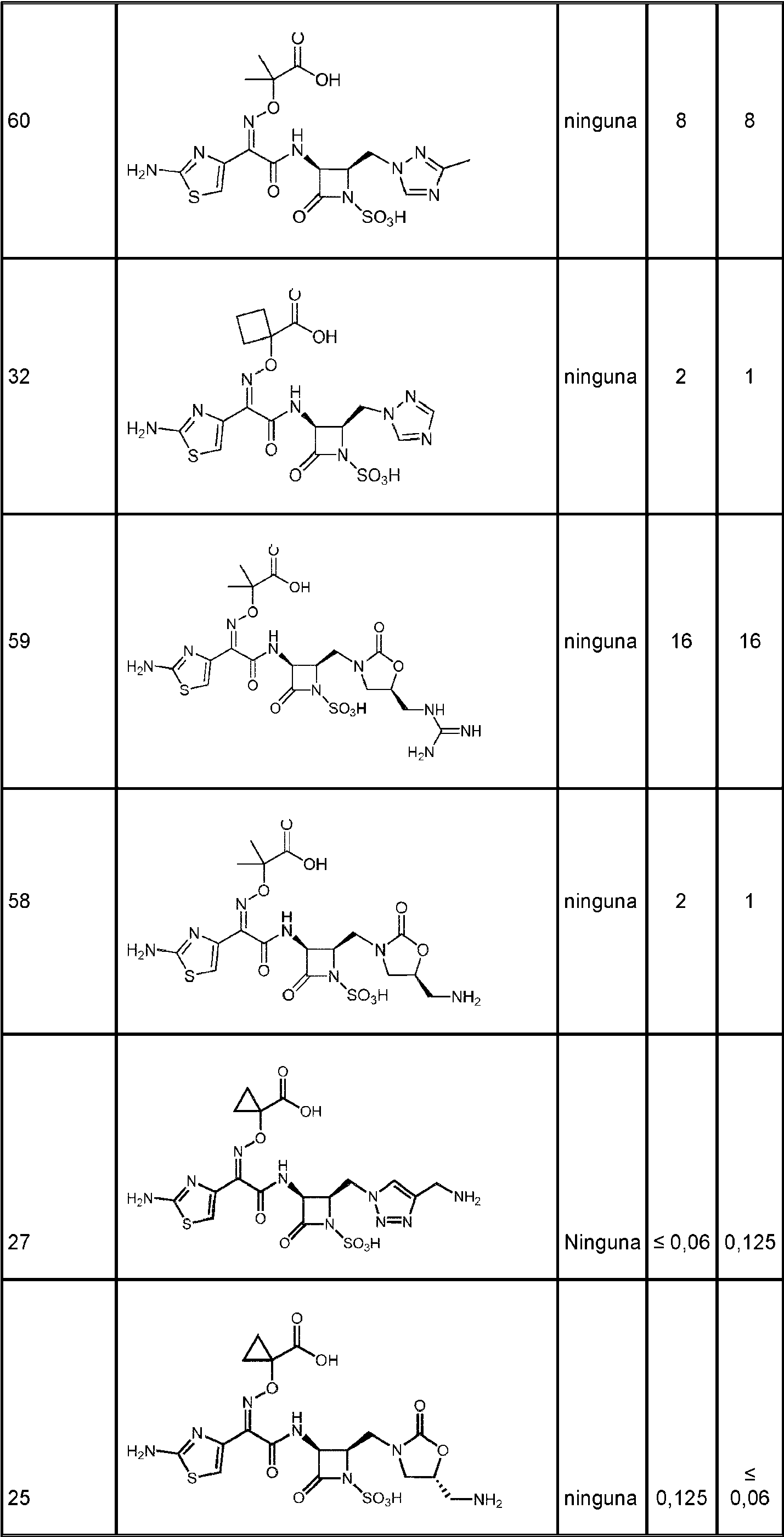


Mediante los mismos métodos descritos en el presente documento, pueden prepararse fácilmente compuestos adicionales a partir de materiales de partida conocidos con el uso de experiencia habitual. By the same methods described herein, additional compounds can easily be prepared from known starting materials with the use of usual experience.
Claims (1)

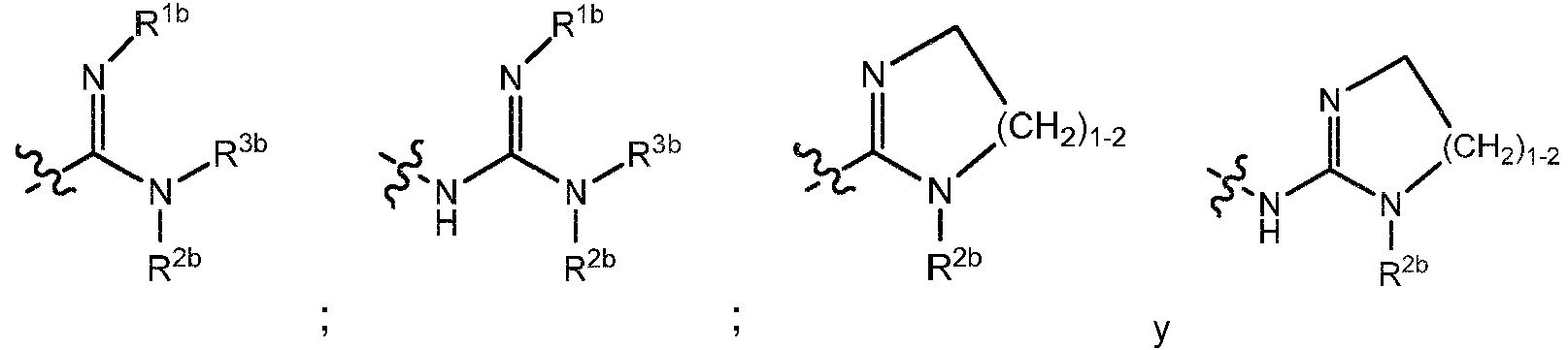

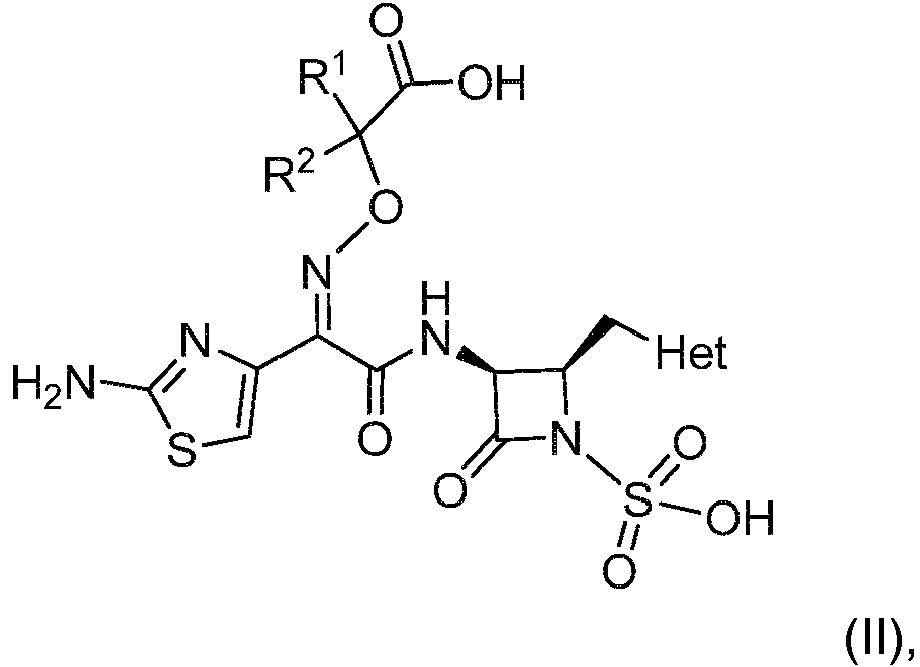


Applications Claiming Priority (3)
| Application Number | Priority Date | Filing Date | Title |
|---|---|---|---|
| US201461969735P | 2014-03-24 | 2014-03-24 | |
| US201462088304P | 2014-12-05 | 2014-12-05 | |
| PCT/US2015/022011 WO2015148379A1 (en) | 2014-03-24 | 2015-03-23 | Monobactam organic compounds for the treatment of bacterial infections |
Publications (1)
| Publication Number | Publication Date |
|---|---|
| ES2719136T3 true ES2719136T3 (en) | 2019-07-08 |
Family
ID=52808201
Family Applications (2)
| Application Number | Title | Priority Date | Filing Date |
|---|---|---|---|
| ES18215940T Active ES2862203T3 (en) | 2014-03-24 | 2015-03-23 | Organic monobactam compounds for treating bacterial infections |
| ES15714147T Active ES2719136T3 (en) | 2014-03-24 | 2015-03-23 | Organic monobactam compounds for the treatment of bacterial infections |
Family Applications Before (1)
| Application Number | Title | Priority Date | Filing Date |
|---|---|---|---|
| ES18215940T Active ES2862203T3 (en) | 2014-03-24 | 2015-03-23 | Organic monobactam compounds for treating bacterial infections |
Country Status (37)
| Country | Link |
|---|---|
| US (4) | US9174978B2 (en) |
| EP (2) | EP3511328B1 (en) |
| JP (1) | JP6153674B2 (en) |
| KR (1) | KR101733441B1 (en) |
| CN (1) | CN106164072B (en) |
| AP (1) | AP2016009374A0 (en) |
| AU (1) | AU2015236369B2 (en) |
| BR (1) | BR112016020333B1 (en) |
| CA (1) | CA2939254C (en) |
| CL (1) | CL2016002285A1 (en) |
| CU (1) | CU24441B1 (en) |
| CY (1) | CY1121701T1 (en) |
| DK (2) | DK3511328T3 (en) |
| EA (1) | EA030850B1 (en) |
| EC (1) | ECSP16073620A (en) |
| ES (2) | ES2862203T3 (en) |
| GT (1) | GT201600183A (en) |
| HR (1) | HRP20190501T1 (en) |
| HU (1) | HUE042134T2 (en) |
| IL (1) | IL247259B (en) |
| LT (1) | LT3122745T (en) |
| MA (1) | MA39777B1 (en) |
| MX (1) | MX373444B (en) |
| MY (1) | MY179292A (en) |
| PE (1) | PE20161371A1 (en) |
| PH (1) | PH12016501577B1 (en) |
| PL (1) | PL3122745T3 (en) |
| PT (1) | PT3122745T (en) |
| RS (1) | RS58509B1 (en) |
| SG (1) | SG11201606711UA (en) |
| SI (1) | SI3122745T1 (en) |
| SM (1) | SMT201900218T1 (en) |
| SV (1) | SV2016005274A (en) |
| TW (1) | TWI714525B (en) |
| UA (1) | UA121383C2 (en) |
| WO (1) | WO2015148379A1 (en) |
| ZA (1) | ZA201605565B (en) |
Families Citing this family (27)
| Publication number | Priority date | Publication date | Assignee | Title |
|---|---|---|---|---|
| CN108137573B (en) * | 2015-09-23 | 2021-06-11 | 诺华股份有限公司 | Salts and solid forms of monocyclolactam antibiotics |
| WO2017081615A1 (en) | 2015-11-09 | 2017-05-18 | Wockhardt Limited | 7-oxo -6-(sulfooxy)- 1,6-diazabicyclo [3.2.1] octane containing compounds and their use in treatment of bacterial infections |
| MA44083A (en) | 2015-12-15 | 2021-06-02 | Merck Sharp & Dohme | BIARYLMONOBACTAM COMPOUNDS FOR THE TREATMENT OF BACTERIAL INFECTIONS |
| WO2017155765A1 (en) | 2016-03-07 | 2017-09-14 | Merck Sharp & Dohme Corp. | Bicyclic aryl monobactam compounds and methods of use thereof for the treatment of bacterial infections |
| KR102717545B1 (en) | 2017-03-20 | 2024-10-16 | 더 브로드 인스티튜트, 인코퍼레이티드 | Compounds and methods for treating parasitic diseases |
| WO2019026004A2 (en) * | 2017-08-02 | 2019-02-07 | Novartis Ag | Chemical process for manufacturing monobactam antibiotic and intermediates thereof |
| WO2019058346A1 (en) * | 2017-09-22 | 2019-03-28 | Novartis Ag | Administration of monobactam in combination with antibiotic agent for the treatment of complicated intra-abdominal infection |
| US10280161B2 (en) * | 2017-10-02 | 2019-05-07 | Arixa Pharmaceuticals, Inc. | Aztreonam derivatives and uses thereof |
| EA202090604A1 (en) | 2017-10-02 | 2020-10-15 | Мерк Шарп энд Доум Корп. | CHROMANMONOBACTAM COMPOUNDS FOR TREATMENT OF BACTERIAL INFECTIONS |
| EP3706738A1 (en) * | 2017-11-10 | 2020-09-16 | Novartis AG | Administration of monobactam for the treatment of urinary tract infection |
| EP3747883A4 (en) | 2018-01-29 | 2020-12-16 | Medshine Discovery Inc. | B-LACTAM MONOCYCLIC COMPOUND FOR TREATMENT OF BACTERIAL INFECTION |
| KR102017784B1 (en) * | 2018-04-11 | 2019-09-03 | 전북대학교산학협력단 | Medium composition with improved sensitivity and selectivity for detecting Campylobacter and detecting method using thereof |
| KR102017785B1 (en) * | 2018-05-17 | 2019-09-03 | 전북대학교산학협력단 | Broth composition with improved sensitivity and selectivity for selectively enriching Campylobacter and detecting method using thereof |
| US11905286B2 (en) | 2018-08-09 | 2024-02-20 | Antabio Sas | Diazabicyclooctanones as inhibitors of serine beta-lactamases |
| CA3110111A1 (en) | 2018-08-09 | 2020-02-13 | Antabio Sas | Diazabicyclooctanones as inhibitors of serine beta-lactamases |
| TW202024068A (en) | 2018-11-13 | 2020-07-01 | 大陸商南京聖和藥業股份有限公司 | Monobactam compounds and use therefor |
| JP7179185B2 (en) * | 2018-12-18 | 2022-11-28 | メッドシャイン ディスカバリー インコーポレイテッド | Use of monocyclic β-lactam compounds in the manufacture of pharmaceuticals |
| CN114787158B (en) * | 2019-11-22 | 2023-10-24 | 苏州二叶制药有限公司 | Sulfonylurea ring-substituted monocyclic β-lactam antibiotics |
| CN111303144B (en) * | 2019-12-13 | 2020-11-27 | 苏州信诺维医药科技有限公司 | Compound for treating bacterial infection |
| CN114828850B (en) | 2019-12-19 | 2024-08-13 | 深圳嘉科生物科技有限公司 | Application of compounds in pharmaceuticals |
| EP3838266A1 (en) | 2019-12-20 | 2021-06-23 | Max-Planck-Gesellschaft zur Förderung der Wissenschaften e.V. | Microfluidic production of biofunctionalized giant unilamellar vesicles for targeted intracellular cargo delivery |
| CN113754651B (en) | 2020-06-02 | 2023-04-18 | 中国医学科学院医药生物技术研究所 | Beta-lactam compound, application and preparation method thereof |
| CN115210231B (en) * | 2020-07-16 | 2024-10-08 | 宁夏农林科学院 | Monocyclic lactams, process for their preparation and their use as antibacterial agents |
| WO2022185240A1 (en) | 2021-03-04 | 2022-09-09 | Bp Asset Vi, Inc. | Formulation of a monobactam antibiotic |
| WO2022185241A1 (en) | 2021-03-04 | 2022-09-09 | Bp Asset Vi, Inc. | Process for manufacturing a monobactam antibiotic |
| PE20241516A1 (en) | 2021-11-18 | 2024-07-19 | Merck Sharp And Dohme Llc | CHROMANIC AMIDINE MONOBACTAMIC COMPOUNDS FOR TREATING BACTERIAL INFECTIONS |
| CN115304594B (en) | 2022-10-12 | 2023-02-14 | 苏州二叶制药有限公司 | Salt form of sulfonylurea ring-substituted compound and crystal form thereof |
Family Cites Families (70)
| Publication number | Priority date | Publication date | Assignee | Title |
|---|---|---|---|---|
| NZ205240A (en) | 1980-02-07 | 1984-07-31 | Squibb & Sons Inc | Sulphonamide derivatives,being starting materials for producing beta-lactams |
| US4775670A (en) | 1980-09-29 | 1988-10-04 | E. R. Squibb & Sons, Inc. | 2-oxo-1-azetidinesulfonic acid salts |
| EP0048953B1 (en) | 1980-09-29 | 1988-03-09 | E.R. Squibb & Sons, Inc. | Beta-lactam antibiotics |
| WO1982001873A1 (en) * | 1980-12-05 | 1982-06-10 | Takeda Chemical Industries Ltd | 1-sulfo-2-oxoazetidine derivatives and process for their preparation |
| JPS58189176A (en) * | 1982-04-30 | 1983-11-04 | Takeda Chem Ind Ltd | 1-sulfo-2-azetidinone derivative and its preparation |
| US4782147A (en) | 1980-12-05 | 1988-11-01 | Takeda Chemical Industries, Ltd. | 1-sulfo-2-oxoazetidine derivatives and their production |
| JPS58210061A (en) * | 1982-05-31 | 1983-12-07 | Takeda Chem Ind Ltd | 1-sulfo-2-oxoazetidine derivative, its preparation and use |
| CA1262128A (en) | 1981-08-27 | 1989-10-03 | Christian N. Hubschwerlen | .beta.-lactams |
| IL67451A (en) | 1981-12-25 | 1987-10-20 | Takeda Chemical Industries Ltd | 4-cyano-2-azetidinones and production thereof and process for the preparation of 4-carbamoyl-2-azetidinones using them |
| GB2116183B (en) | 1982-03-03 | 1985-06-05 | Genentech Inc | Human antithrombin iii dna sequences therefore expression vehicles and cloning vectors containing such sequences and cell cultures transformed thereby a process for expressing human antithrombin iii and pharmaceutical compositions comprising it |
| AU564150B2 (en) * | 1982-04-30 | 1987-08-06 | Takeda Chemical Industries Ltd. | 1-sulfo-2-azetidinone derivatives |
| KR900005112B1 (en) | 1982-05-31 | 1990-07-19 | 반유세이야꾸 가부시끼가이샤 | Method for preparing 2-oxo-1-azetidinesulfonic acid derivative |
| EP0096297B1 (en) | 1982-06-03 | 1988-06-15 | F. HOFFMANN-LA ROCHE & CO. Aktiengesellschaft | Process for the preparation of 1-sulfo-2-oxoazetidine derivatives |
| JPS6153282A (en) | 1984-08-22 | 1986-03-17 | Banyu Pharmaceut Co Ltd | Monocyclic beta-lactam derivative |
| JPS6153283A (en) | 1984-08-24 | 1986-03-17 | Banyu Pharmaceut Co Ltd | 2-oxo-1-azetidinesulfonic acid derivative |
| US4610824A (en) | 1984-10-09 | 1986-09-09 | E. R. Squibb & Sons, Inc. | Hydrazide derivatives of monocyclic beta-lactam antibiotics |
| US5112968A (en) | 1989-07-28 | 1992-05-12 | E. R. Squibb & Sons, Inc. | Monobactam hydrazide derivatives |
| WO1998006842A1 (en) | 1996-08-16 | 1998-02-19 | Schering Corporation | Mammalian cell surface antigens; related reagents |
| US6111090A (en) | 1996-08-16 | 2000-08-29 | Schering Corporation | Mammalian cell surface antigens; related reagents |
| WO1999020758A1 (en) | 1997-10-21 | 1999-04-29 | Human Genome Sciences, Inc. | Human tumor necrosis factor receptor-like proteins tr11, tr11sv1, and tr11sv2 |
| CA2319236A1 (en) | 1998-02-09 | 1999-08-12 | Genentech, Inc. | Novel tumor necrosis factor receptor homolog and nucleic acids encoding the same |
| CA2378179A1 (en) | 1999-07-12 | 2001-01-18 | Genentech, Inc. | Promotion or inhibition of angiogenesis and cardiovascularization by tumor necrosis factor ligand/receptor homologs |
| CN1753912B (en) | 2002-12-23 | 2011-11-02 | 惠氏公司 | Anti-PD-1 antibodies and uses thereof |
| CA2514733A1 (en) | 2003-02-28 | 2004-09-16 | Transform Pharmaceuticals, Inc. | Pharmaceutical co-crystal compositions of drugs such as carbamazepine, celecoxib, olanzapine, itraconazole, topiramate, modafinil, 5-fluorouracil, hydrochlorothiazide, acetaminophen, aspirin, flurbiprofen, phenytoin and ibuprofen |
| RU2369636C2 (en) | 2003-05-23 | 2009-10-10 | Уайт | Ligand gitr and molecules and antibodies bound with ligand gitr, and versions of their application |
| US20050048054A1 (en) | 2003-07-11 | 2005-03-03 | Shino Hanabuchi | Lymphocytes; methods |
| JP2007518399A (en) | 2003-12-02 | 2007-07-12 | ジェンザイム コーポレイション | Compositions and methods for diagnosing and treating lung cancer |
| GB0409799D0 (en) | 2004-04-30 | 2004-06-09 | Isis Innovation | Method of generating improved immune response |
| EP1765402A2 (en) | 2004-06-04 | 2007-03-28 | Duke University | Methods and compositions for enhancement of immunity by in vivo depletion of immunosuppressive cell activity |
| WO2006105021A2 (en) | 2005-03-25 | 2006-10-05 | Tolerrx, Inc. | Gitr binding molecules and uses therefor |
| ES2720160T3 (en) | 2005-05-09 | 2019-07-18 | Ono Pharmaceutical Co | Human monoclonal antibodies against programmed death 1 (PD-1) and methods for treating cancer using antibodies directed against PD-1 alone or together with other immunotherapeutic substances |
| EA019344B1 (en) | 2005-07-01 | 2014-03-31 | МЕДАРЕКС, Эл.Эл.Си. | Human monoclonal antibodies to programmed death ligand 1 (pd-l1) and uses thereof |
| US20110212086A1 (en) | 2006-01-19 | 2011-09-01 | Genzyme Corporation | GITR Antibodies For The Treatment of Cancer |
| CA2664296A1 (en) | 2006-09-27 | 2008-04-03 | Merck & Co., Inc. | Novel inhibitors of beta-lactamase |
| JP5191537B2 (en) | 2007-06-18 | 2013-05-08 | エム・エス・ディー・オス・ベー・フェー | Antibodies against human programmed death receptor PD-1 |
| CA2693677C (en) | 2007-07-12 | 2018-02-13 | Tolerx, Inc. | Combination therapies employing gitr binding molecules |
| CN101918407B (en) | 2008-01-18 | 2014-02-26 | 默沙东公司 | Beta-lactamase inhibitors |
| EP2242773B1 (en) | 2008-02-11 | 2017-06-14 | Cure Tech Ltd. | Monoclonal antibodies for tumor treatment |
| EP2262837A4 (en) | 2008-03-12 | 2011-04-06 | Merck Sharp & Dohme | BINDING PROTEINS WITH PD-1 |
| WO2010003118A1 (en) | 2008-07-02 | 2010-01-07 | Trubion Pharmaceuticals, Inc. | Tgf-b antagonist multi-target binding proteins |
| AR072999A1 (en) | 2008-08-11 | 2010-10-06 | Medarex Inc | HUMAN ANTIBODIES THAT JOIN GEN 3 OF LYMPHOCYTARY ACTIVATION (LAG-3) AND THE USES OF THESE |
| RS54233B1 (en) | 2008-08-25 | 2015-12-31 | Amplimmune Inc. | PD-1 ANTAGONIST COMPOSITIONS AND PROCEDURES FOR THEIR APPLICATION |
| EP2328920A2 (en) | 2008-08-25 | 2011-06-08 | Amplimmune, Inc. | Targeted costimulatory polypeptides and methods of use to treat cancer |
| WO2010030002A1 (en) | 2008-09-12 | 2010-03-18 | 国立大学法人三重大学 | Cell capable of expressing exogenous gitr ligand |
| ES2564836T3 (en) | 2008-10-31 | 2016-03-29 | Shionogi & Co., Ltd. | Cephalosporins that have a catechol group |
| HUE065752T2 (en) | 2008-12-09 | 2024-06-28 | Hoffmann La Roche | Anti-pd-l1 antibodies and their use to enhance t-cell function |
| ES2629337T3 (en) | 2009-02-09 | 2017-08-08 | Inserm - Institut National De La Santé Et De La Recherche Médicale | Antibodies against PD-1 and antibodies against PD-L1 and uses thereof |
| US20120053350A1 (en) | 2009-04-30 | 2012-03-01 | Ian Mangion | Preparation of alkyl esters of n-protected oxo-azacycloalkylcarboxylic acids |
| RU2595409C2 (en) | 2009-09-03 | 2016-08-27 | Мерк Шарп И Доум Корп., | Anti-gitr antibodies |
| GB0919054D0 (en) | 2009-10-30 | 2009-12-16 | Isis Innovation | Treatment of obesity |
| WO2011061760A1 (en) | 2009-11-18 | 2011-05-26 | Cadila Healthcare Limited | Novel antithrombotic agents |
| EP2504028A4 (en) | 2009-11-24 | 2014-04-09 | Amplimmune Inc | Simultaneous inhibition of pd-l1/pd-l2 |
| SG181952A1 (en) | 2009-12-29 | 2012-07-30 | Emergent Product Dev Seattle | Heterodimer binding proteins and uses thereof |
| JP2012027846A (en) | 2010-07-27 | 2012-02-09 | Sony Corp | Information processing unit, information display method and computer program |
| MX2013005994A (en) * | 2010-11-29 | 2013-07-15 | Pfizer | Monobactams. |
| UA109735C2 (en) | 2011-08-25 | 2015-09-25 | PIRIMIDINE PDE10 INHIBITORS | |
| ES2640520T3 (en) | 2011-09-13 | 2017-11-03 | Wockhardt Limited | Compounds containing nitrogen and its use |
| WO2013039954A1 (en) | 2011-09-14 | 2013-03-21 | Sanofi | Anti-gitr antibodies |
| KR101981873B1 (en) | 2011-11-28 | 2019-05-23 | 메르크 파텐트 게엠베하 | Anti-pd-l1 antibodies and uses thereof |
| US8796257B2 (en) | 2011-12-02 | 2014-08-05 | Naeja Pharmaceutical Inc. | Bicyclic compounds and their use as antibacterial agents and β-lactamase inhibitors |
| UY34585A (en) | 2012-01-24 | 2013-09-02 | Aicuris Gmbh & Co Kg | B-LACTAMIC COMPOUNDS REPLACED WITH AMIDINE, ITS PREPARATION AND USE |
| US20150119363A1 (en) | 2012-02-15 | 2015-04-30 | Rempex Pharmaceuticals, Inc.. | Methods of treating bacterial infections |
| UY34632A (en) | 2012-02-24 | 2013-05-31 | Novartis Ag | OXAZOLIDIN- 2- ONA COMPOUNDS AND USES OF THE SAME |
| SG11201406123TA (en) | 2012-03-30 | 2014-10-30 | Cubist Pharm Inc | 1,3,4-OXADIAZOLE AND 1,3,4-THIADIAZOLE β-LACTAMASE INHIBITORS |
| TW201343646A (en) | 2012-03-30 | 2013-11-01 | Cubist Pharm Inc | Isoxazole β-lactamase inhibitors |
| UY34887A (en) | 2012-07-02 | 2013-12-31 | Bristol Myers Squibb Company Una Corporacion Del Estado De Delaware | OPTIMIZATION OF ANTIBODIES THAT FIX THE LYMPHOCYTE ACTIVATION GEN 3 (LAG-3) AND ITS USES |
| WO2014033560A1 (en) | 2012-08-25 | 2014-03-06 | Wockhardt Limited | 1,6- diazabicyclo [3,2,1] octan- 7- one derivatives and their use in the treatment of bacterial infections |
| CN103044416A (en) | 2012-12-17 | 2013-04-17 | 浙江华方药业有限责任公司 | Synthetic method of Carumonam sodium |
| WO2014141132A1 (en) | 2013-03-14 | 2014-09-18 | Naeja Pharmaceutical Inc. | NEW HETEROCYCLIC COMPOUNDS AND THEIR USE AS ANTIBACTERIAL AGENTS AND β-LACTAMASE INHIBITORS |
| US20160326157A1 (en) | 2014-01-06 | 2016-11-10 | President And Fellows Of Harvard College | Monobactams and methods of their synthesis and use |
-
2015
- 2015-03-23 WO PCT/US2015/022011 patent/WO2015148379A1/en not_active Ceased
- 2015-03-23 UA UAA201608977A patent/UA121383C2/en unknown
- 2015-03-23 MX MX2016011822A patent/MX373444B/en active IP Right Grant
- 2015-03-23 EP EP18215940.0A patent/EP3511328B1/en active Active
- 2015-03-23 BR BR112016020333-0A patent/BR112016020333B1/en active IP Right Grant
- 2015-03-23 LT LTEP15714147.4T patent/LT3122745T/en unknown
- 2015-03-23 AP AP2016009374A patent/AP2016009374A0/en unknown
- 2015-03-23 EP EP15714147.4A patent/EP3122745B1/en active Active
- 2015-03-23 ES ES18215940T patent/ES2862203T3/en active Active
- 2015-03-23 DK DK18215940.0T patent/DK3511328T3/en active
- 2015-03-23 CN CN201580015867.7A patent/CN106164072B/en active Active
- 2015-03-23 SM SM20190218T patent/SMT201900218T1/en unknown
- 2015-03-23 TW TW104109243A patent/TWI714525B/en active
- 2015-03-23 ES ES15714147T patent/ES2719136T3/en active Active
- 2015-03-23 EA EA201691766A patent/EA030850B1/en not_active IP Right Cessation
- 2015-03-23 US US14/665,245 patent/US9174978B2/en active Active
- 2015-03-23 PL PL15714147T patent/PL3122745T3/en unknown
- 2015-03-23 HU HUE15714147A patent/HUE042134T2/en unknown
- 2015-03-23 DK DK15714147.4T patent/DK3122745T3/en active
- 2015-03-23 HR HRP20190501TT patent/HRP20190501T1/en unknown
- 2015-03-23 JP JP2016558569A patent/JP6153674B2/en active Active
- 2015-03-23 SI SI201530680T patent/SI3122745T1/en unknown
- 2015-03-23 RS RS20190406A patent/RS58509B1/en unknown
- 2015-03-23 CA CA2939254A patent/CA2939254C/en active Active
- 2015-03-23 PH PH1/2016/501577A patent/PH12016501577B1/en unknown
- 2015-03-23 KR KR1020167024716A patent/KR101733441B1/en active Active
- 2015-03-23 MY MYPI2016702871A patent/MY179292A/en unknown
- 2015-03-23 SG SG11201606711UA patent/SG11201606711UA/en unknown
- 2015-03-23 PE PE2016001601A patent/PE20161371A1/en unknown
- 2015-03-23 CU CU2016000131A patent/CU24441B1/en unknown
- 2015-03-23 MA MA39777A patent/MA39777B1/en unknown
- 2015-03-23 PT PT15714147T patent/PT3122745T/en unknown
- 2015-03-23 AU AU2015236369A patent/AU2015236369B2/en active Active
- 2015-09-22 US US14/861,797 patent/US10369138B2/en active Active
-
2016
- 2016-08-11 ZA ZA2016/05565A patent/ZA201605565B/en unknown
- 2016-08-14 IL IL247259A patent/IL247259B/en active IP Right Grant
- 2016-09-09 CL CL2016002285A patent/CL2016002285A1/en unknown
- 2016-09-12 GT GT201600183A patent/GT201600183A/en unknown
- 2016-09-12 SV SV2016005274A patent/SV2016005274A/en unknown
- 2016-09-12 EC ECIEPI201673620A patent/ECSP16073620A/en unknown
-
2019
- 2019-04-03 CY CY20191100371T patent/CY1121701T1/en unknown
- 2019-04-10 US US16/380,243 patent/US20190231752A1/en not_active Abandoned
-
2020
- 2020-03-19 US US16/823,485 patent/US20200276169A1/en not_active Abandoned
Also Published As
Similar Documents
| Publication | Publication Date | Title |
|---|---|---|
| ES2719136T3 (en) | Organic monobactam compounds for the treatment of bacterial infections | |
| US20250223265A1 (en) | Compounds and methods for the targeted degradation of androgen receptor | |
| AU2020213376B2 (en) | Compounds and methods for the targeted degradation of the androgen receptor | |
| US12358886B2 (en) | Heterocyclic compounds for use in the treatment of cancer | |
| AU2018306606B2 (en) | Compounds and methods for the targeted degradation of Androgen Receptor | |
| JP6670333B2 (en) | 3-Tetrazolyl-benzene-1,2-disulfonamide derivatives as metallo-β-lactamase inhibitors | |
| TW202024096A (en) | Highly active sting protein agonist | |
| HK1230592B (en) | Monobactam organic compounds for the treatment of bacterial infections | |
| HK1230592A1 (en) | Monobactam organic compounds for the treatment of bacterial infections | |
| NZ723114B2 (en) | Monobactam organic compounds for the treatment of bacterial infections | |
| US20260035365A1 (en) | 1h-pyrrolo[3,2-b]pyridine derivatives as irreversible inhibitors of mutant egfr for the treatment of cancer |