EP4583534A1 - Elektronische vorrichtung zur kommunikation mit tws und steuerungsverfahren dafür - Google Patents
Elektronische vorrichtung zur kommunikation mit tws und steuerungsverfahren dafür Download PDFInfo
- Publication number
- EP4583534A1 EP4583534A1 EP24798717.5A EP24798717A EP4583534A1 EP 4583534 A1 EP4583534 A1 EP 4583534A1 EP 24798717 A EP24798717 A EP 24798717A EP 4583534 A1 EP4583534 A1 EP 4583534A1
- Authority
- EP
- European Patent Office
- Prior art keywords
- audio signal
- electronic device
- user
- voice
- signal
- Prior art date
- Legal status (The legal status is an assumption and is not a legal conclusion. Google has not performed a legal analysis and makes no representation as to the accuracy of the status listed.)
- Pending
Links
Images



Classifications
-
- H—ELECTRICITY
- H04—ELECTRIC COMMUNICATION TECHNIQUE
- H04M—TELEPHONIC COMMUNICATION
- H04M1/00—Substation equipment, e.g. for use by subscribers
- H04M1/60—Substation equipment, e.g. for use by subscribers including speech amplifiers
- H04M1/6008—Substation equipment, e.g. for use by subscribers including speech amplifiers in the transmitter circuit
-
- G—PHYSICS
- G06—COMPUTING OR CALCULATING; COUNTING
- G06F—ELECTRIC DIGITAL DATA PROCESSING
- G06F3/00—Input arrangements for transferring data to be processed into a form capable of being handled by the computer; Output arrangements for transferring data from processing unit to output unit, e.g. interface arrangements
- G06F3/16—Sound input; Sound output
- G06F3/165—Management of the audio stream, e.g. setting of volume, audio stream path
-
- G—PHYSICS
- G10—MUSICAL INSTRUMENTS; ACOUSTICS
- G10L—SPEECH ANALYSIS TECHNIQUES OR SPEECH SYNTHESIS; SPEECH RECOGNITION; SPEECH OR VOICE PROCESSING TECHNIQUES; SPEECH OR AUDIO CODING OR DECODING
- G10L21/00—Speech or voice signal processing techniques to produce another audible or non-audible signal, e.g. visual or tactile, in order to modify its quality or its intelligibility
- G10L21/02—Speech enhancement, e.g. noise reduction or echo cancellation
- G10L21/0208—Noise filtering
-
- H—ELECTRICITY
- H04—ELECTRIC COMMUNICATION TECHNIQUE
- H04M—TELEPHONIC COMMUNICATION
- H04M1/00—Substation equipment, e.g. for use by subscribers
- H04M1/60—Substation equipment, e.g. for use by subscribers including speech amplifiers
- H04M1/6033—Substation equipment, e.g. for use by subscribers including speech amplifiers for providing handsfree use or a loudspeaker mode in telephone sets
- H04M1/6041—Portable telephones adapted for handsfree use
- H04M1/6058—Portable telephones adapted for handsfree use involving the use of a headset accessory device connected to the portable telephone
- H04M1/6066—Portable telephones adapted for handsfree use involving the use of a headset accessory device connected to the portable telephone including a wireless connection
-
- G—PHYSICS
- G10—MUSICAL INSTRUMENTS; ACOUSTICS
- G10L—SPEECH ANALYSIS TECHNIQUES OR SPEECH SYNTHESIS; SPEECH RECOGNITION; SPEECH OR VOICE PROCESSING TECHNIQUES; SPEECH OR AUDIO CODING OR DECODING
- G10L21/00—Speech or voice signal processing techniques to produce another audible or non-audible signal, e.g. visual or tactile, in order to modify its quality or its intelligibility
- G10L21/02—Speech enhancement, e.g. noise reduction or echo cancellation
- G10L21/0208—Noise filtering
- G10L2021/02087—Noise filtering the noise being separate speech, e.g. cocktail party
-
- H—ELECTRICITY
- H04—ELECTRIC COMMUNICATION TECHNIQUE
- H04M—TELEPHONIC COMMUNICATION
- H04M2250/00—Details of telephonic subscriber devices
- H04M2250/52—Details of telephonic subscriber devices including functional features of a camera
Definitions
- Various embodiments of the disclosure relate to an electronic device communicating with a TWS and a method for controlling the same.
- Such an electronic device may be connected to an external device such as a notebook computer, an earphone, or a headphone to exchange information using a short-range wireless technology such as Bluetooth.
- the electronic device may be connected to an earphone via Bluetooth to output the sound of music or a video through the earphone.
- the instructions when executed by the at least one processor, cause the electronic device to, based on the voice of the user being included in the first audio signal, change the second audio signal using the voice signal of the user.
- the instructions when executed by the at least one processor, cause the electronic device to, based on an operation of the front camera or the rear camera, emphasize an ambient audio signal included in the second audio signal or control a weight of the second audio signal.
- a method for controlling an electronic device may comprise receiving a first audio signal from an external electronic device through a communication module of the electronic device.
- the method for controlling the electronic device may comprise obtaining a second audio signal through a microphone of the electronic device.
- the method for controlling the electronic device may comprise identifying whether the first audio signal includes a voice of a user wearing the external electronic device.
- the method for controlling the electronic device may comprise, based on the user's voice being included in the first audio signal, extracting the user's voice signal included in the first audio signal.
- the method for controlling the electronic device may comprise, based on the user's voice being included in the first audio signal, changing the second audio signal using the user's voice signal.
- the method for controlling the electronic device may comprise, based on the user's voice being not included in the first audio signal, identifying whether a front camera or a rear camera operates.
- the method for controlling the electronic device may comprise, based on the user's voice being not included in the first audio signal, emphasizing an ambient audio signal included in the second audio signal or controlling a weight of the second audio signal based on an operation of the front camera or the rear camera.
- the one or more programs may store instructions enabling an electronic device to receive a first audio signal from an external electronic device through a communication module of the electronic device.
- the one or more programs may store instructions enabling the electronic device to obtain a second audio signal through a microphone of the electronic device.
- the one or more programs may store instructions enabling the electronic device to identify whether the first audio signal includes a voice of a user wearing the external electronic device.
- the one or more programs may store instructions enabling the electronic device to, based on the voice of the user being included in the first audio signal, extract a voice signal of the user, included in the first audio signal.
- the one or more programs may store instructions enabling the electronic device to, based on the voice of the user being included in the first audio signal, change the second audio signal using the voice signal of the user.
- the one or more programs may store instructions enabling the electronic device to, based on the voice of the user being not included in the first audio signal, identify whether a front camera of the electronic device or a rear camera of the electronic device operates.
- the artificial neural network may be a deep neural network (DNN), a convolutional neural network (CNN), a recurrent neural network (RNN), a restricted Boltzmann machine (RBM), a deep belief network (DBN), a bidirectional recurrent deep neural network (BRDNN), deep Q-network or a combination of two or more thereof but is not limited thereto.
- the artificial intelligence model may, additionally or alternatively, include a software structure other than the hardware structure.
- the power management module 188 may manage power supplied to the electronic device 101.
- the power management module 188 may be implemented as at least part of, for example, a power management integrated circuit (PMIC).
- PMIC power management integrated circuit
- the wireless communication module 192 may support a 5G network, after a 4G network, and next-generation communication technology, e.g., new radio (NR) access technology.
- the NR access technology may support enhanced mobile broadband (eMBB), massive machine type communications (mMTC), or ultra-reliable and low-latency communications (URLLC).
- eMBB enhanced mobile broadband
- mMTC massive machine type communications
- URLLC ultra-reliable and low-latency communications
- the wireless communication module 192 may support a high-frequency band (e.g., the mmWave band) to achieve, e.g., a high data transmission rate.
- the antenna module 197 may form a mmWave antenna module.
- the mmWave antenna module may include a printed circuit board, a RFIC disposed on a first surface (e.g., the bottom surface) of the printed circuit board, or adjacent to the first surface and capable of supporting a designated high-frequency band (e.g., the mmWave band), and a plurality of antennas (e.g., array antennas) disposed on a second surface (e.g., the top or a side surface) of the printed circuit board, or adjacent to the second surface and capable of transmitting or receiving signals of the designated high-frequency band.
- a RFIC disposed on a first surface (e.g., the bottom surface) of the printed circuit board, or adjacent to the first surface and capable of supporting a designated high-frequency band (e.g., the mmWave band)
- a plurality of antennas e.g., array antennas
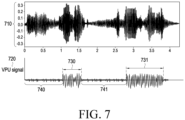
- the electronic device 101 may change the weight for the section in which the voice 820 of the user 10 is identified in the first audio signal received from the external electronic device 104 to emphasize the voice 820 of the user 10, based on the information obtained by the VPU of the external electronic device 104.
- the electronic device may increase the weight to emphasize the ambient audio signal.
- the electronic device may emphasize the ambient audio signal by amplifying a signal other than the user voice section obtained based on the VPU received from the external electronic device in the entire audio signal obtained through the microphone.
- the electronic device may emphasize the ambient audio signal by adding a section other than the user voice in the entire audio signal obtained through the microphone and a corresponding section (or a section that does not include the user voice) of the audio signal obtained from the external electronic device.
- the electronic device may increase the weight for the ambient audio signal included in the second audio signal, based on the user's voice not being included in the first audio signal and the rear camera operating.
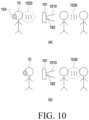
- the electronic device 101 may change the weight for the section in which the voice of the user 10 is not identified in the audio signal received from the external electronic device to emphasizes the ambient sound 1030.
- the electronic device may mix the audio based on the weight changed to emphasize the ambient sound. For example, the electronic device may mix (or merge) the second audio signal obtained through the microphone with the first audio signal obtained by the external electronic device.
- the electronic device may maintain or decrease the weight of the second audio signal.
- the ambient sound 920 may be obtained by the electronic device 101 and the external electronic device without the voice of the user 10.
- the electronic device 101 may maintain the weight of the second audio signal obtained by the electronic device 101. Therefore, the electronic device may provide a high-quality video call function by not intensifying the ambient sound even if the user does not utter during the video call.
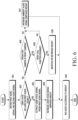
- the electronic device may proceed to operation 605 and mix audio according to the weight.
- the electronic device may store (e.g., record) the mixed audio in memory (e.g., the memory 130 of FIG. 1 ), may synchronize it with video and store (e.g., record) them in the memory (e.g., the memory 130 of FIG. 1 ), or may transmit (e.g., video call) it to the external electronic device.
- memory e.g., the memory 130 of FIG. 1
- video e.g., the memory 130 of FIG. 1
- the electronic device may store (e.g., record) the mixed audio in memory (e.g., the memory 130 of FIG. 1 ), may synchronize it with video and store (e.g., record) them in the memory (e.g., the memory 130 of FIG. 1 ), or may transmit (e.g., video call) it to the external electronic device.
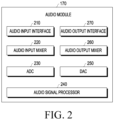
- an electronic device may comprise a front camera 181 (comprised in the camera module 180 of FIG. 1 ), a rear camera 182 (comprised in the camera module 180 of FIG. 1 ), a microphone (e.g., the input module 150 of FIG. 1 ), a communication module (e.g., the communication module 190 of FIG. 1 ) comprising communication circuitry, and at least one processor(e.g., the processor 120 of FIG. 1 ) comprising processing circuitry, and memory (e.g., the memory 130 of FIG. 1 ) storing instructions that, when executed by the at least one processor, cause the electronic device to perform operations below.
- a front camera 181 compact in the camera module 180 of FIG. 1
- a rear camera 182 compact in the camera module 180 of FIG. 1
- a microphone e.g., the input module 150 of FIG. 1
- a communication module e.g., the communication module 190 of FIG. 1
- at least one processor e.g., the processor 120 of FIG. 1
- the instructions when executed by the at least one processor, cause the electronic device to receive a first audio signal from an external electronic device through the communication module.
- the instructions when executed by the at least one processor, cause the electronic device to obtain a second audio signal through the microphone.
- the instructions when executed by the at least one processor, cause the electronic device to identify whether the first audio signal includes a voice of a user wearing the external electronic device.
- the instructions when executed by the at least one processor, cause the electronic device to, based on the voice of the user being included in the first audio signal, extract a voice signal of the user, included in the first audio signal.
- the instructions when executed by the at least one processor, cause the electronic device to, based on the voice of the user being included in the first audio signal, change the second audio signal using the voice signal of the user.
- the instructions when executed by the at least one processor, cause the electronic device to, based on the voice of the user being not included in the first audio signal, identify whether the front camera or the rear camera operates.
- the instructions when executed by the at least one processor, cause the electronic device to, based on an operation of the front camera or the rear camera, emphasize an ambient audio signal included in the second audio signal or control a weight of the second audio signal.
- the instructions when executed by the at least one processor, cause the electronic device to receive information, from the external electronic device, detected by an acceleration sensor of the external electronic device.
- the instructions when executed by the at least one processor, cause the electronic device to identify a first portion including the voice of the user in the first audio signal obtained through the microphone of the external electronic device, based on the information.
- the instructions when executed by the at least one processor, cause the electronic device to extract the voice of the user by removing an audio signal, of a second portion of the first audio signal other than the first portion, from the first audio signal.
- the instructions when executed by the at least one processor, cause the electronic device to increase a weight for a voice signal of the user included in the second audio signal, based on the voice of the user being included in the first audio signal.
- the instructions when executed by the at least one processor, cause the electronic device to increase the weight for the voice signal of the user included in the second audio signal by merging the voice signal of the user of the first audio signal with the second audio signal.
- the instructions when executed by the at least one processor, cause the electronic device to emphasize the ambient audio signal included in the second audio signal by merging the first audio signal with the second audio signal, based on the first audio signal not including the voice of the user and the rear camera operating.
- the instructions when executed by the at least one processor, cause the electronic device to identify that a distortion occurs in a first section of the first audio signal based on a similarity of frequencies over time of the first audio signal.
- the instructions when executed by the at least one processor, cause the electronic device to synchronize the first audio signal and the second audio signal based on a delay generated by receiving of the first audio signal.
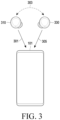
- the external electronic device may include a true wireless stereo (TWS).
- TWS true wireless stereo
- a method for controlling an electronic device may comprise receiving a first audio signal from an external electronic device through a communication module of the electronic device.
- the method for controlling the electronic device may comprise obtaining a second audio signal through a microphone of the electronic device.
- the method for controlling the electronic device may comprise identifying whether the first audio signal includes a voice of a user wearing the external electronic device.
- the method for controlling the electronic device may comprise, based on the user's voice being included in the first audio signal, extracting the user's voice signal included in the first audio signal.
- the method for controlling the electronic device may comprise, based on the user's voice being not included in the first audio signal, emphasizing an ambient audio signal included in the second audio signal or controlling a weight of the second audio signal based on an operation of the front camera or the rear camera.
- the method for controlling the electronic device may further comprise receiving information, from the external electronic device, detected by an acceleration sensor of the external electronic device.
- extracting the user's voice signal included in the first audio signal may include identifying a first portion including the voice of the user in the first audio signal obtained through the microphone of the external electronic device, based on the information.
- extracting the user's voice signal included in the first audio signal may include extracting the voice of the user by removing an audio signal, of a second portion of the first audio signal other than the first portion, from the first audio signal.
- emphasizing the ambient audio signal included in the second audio signal or controlling the weight of the second audio signal may include increasing a weight for a voice signal of the user included in the second audio signal, based on the voice of the user being included in the first audio signal.
- emphasizing the ambient audio signal included in the second audio signal or controlling the weight of the second audio signal may include increasing the weight for the voice signal of the user included in the second audio signal by merging the voice signal of the user of the first audio signal with the second audio signal.
- emphasizing the ambient audio signal included in the second audio signal or controlling the weight of the second audio signal may include emphasizing the ambient audio signal included in the second audio signal by merging the first audio signal with the second audio signal, based on the first audio signal not including the voice of the user and the rear camera operating.
- emphasizing the ambient audio signal included in the second audio signal or controlling the weight of the second audio signal may include reducing or maintaining a weight of the second audio signal based on the first audio signal not including the voice of the user and the front camera operating as a video call function is performed.
- the method for controlling the electronic device may further comprise, based on identifying that a distortion occurs in the first audio signal based on a similarity of frequencies over time of the first audio signal, restoring a section in which the distortion occurs in the first audio signal based on a section other than the section in which the distortion occurs in the first audio signal.
- the method for controlling the electronic device may further comprise synchronizing the first audio signal and the second audio signal based on a delay generated by receiving of the first audio signal.
- the one or more programs may store instructions enabling the electronic device to obtain a second audio signal through a microphone of the electronic device.
- the one or more programs may store instructions enabling the electronic device to identify whether the first audio signal includes a voice of a user wearing the external electronic device.
- the one or more programs may store instructions enabling the electronic device to, based on the voice of the user being included in the first audio signal, extract a voice signal of the user, included in the first audio signal.
- operations performed by the module, the program, or another component may be carried out sequentially, in parallel, repeatedly, or heuristically, or one or more of the operations may be executed in a different order or omitted, or one or more other operations may be added.
Landscapes
- Engineering & Computer Science (AREA)
- Signal Processing (AREA)
- Theoretical Computer Science (AREA)
- Multimedia (AREA)
- Health & Medical Sciences (AREA)
- Audiology, Speech & Language Pathology (AREA)
- Human Computer Interaction (AREA)
- Physics & Mathematics (AREA)
- General Health & Medical Sciences (AREA)
- General Physics & Mathematics (AREA)
- Computational Linguistics (AREA)
- Quality & Reliability (AREA)
- General Engineering & Computer Science (AREA)
- Acoustics & Sound (AREA)
- Computer Networks & Wireless Communication (AREA)
- Telephone Function (AREA)
Applications Claiming Priority (3)
| Application Number | Priority Date | Filing Date | Title |
|---|---|---|---|
| KR20230151689 | 2023-11-06 | ||
| KR1020230189315A KR20250066356A (ko) | 2023-11-06 | 2023-12-22 | Tws와 통신하는 전자 장치 및 이의 제어 방법 |
| PCT/KR2024/016289 WO2025100797A1 (ko) | 2023-11-06 | 2024-10-24 | Tws와 통신하는 전자 장치 및 이의 제어 방법 |
Publications (2)
| Publication Number | Publication Date |
|---|---|
| EP4583534A1 true EP4583534A1 (de) | 2025-07-09 |
| EP4583534A4 EP4583534A4 (de) | 2025-12-24 |
Family
ID=93590593
Family Applications (1)
| Application Number | Title | Priority Date | Filing Date |
|---|---|---|---|
| EP24798717.5A Pending EP4583534A4 (de) | 2023-11-06 | 2024-10-24 | Elektronische vorrichtung zur kommunikation mit tws und steuerungsverfahren dafür |
Country Status (3)
| Country | Link |
|---|---|
| EP (1) | EP4583534A4 (de) |
| CN (1) | CN121925865A (de) |
| WO (1) | WO2025100797A1 (de) |
Family Cites Families (8)
| Publication number | Priority date | Publication date | Assignee | Title |
|---|---|---|---|---|
| US9905216B2 (en) * | 2015-03-13 | 2018-02-27 | Bose Corporation | Voice sensing using multiple microphones |
| US9749766B2 (en) * | 2015-12-27 | 2017-08-29 | Philip Scott Lyren | Switching binaural sound |
| KR102565882B1 (ko) * | 2019-02-12 | 2023-08-10 | 삼성전자주식회사 | 복수의 마이크들을 포함하는 음향 출력 장치 및 복수의 마이크들을 이용한 음향 신호의 처리 방법 |
| US11776555B2 (en) * | 2020-09-22 | 2023-10-03 | Apple Inc. | Audio modification using interconnected electronic devices |
| KR102848738B1 (ko) * | 2020-11-11 | 2025-08-22 | 삼성전자 주식회사 | 전자 장치의 멀티 레코딩 시 무선 오디오 장치에서 마이크 입출력을 제어 하는 방법 및 장치 |
| KR102740848B1 (ko) * | 2020-12-14 | 2024-12-11 | 삼성전자주식회사 | 주변 소리 제어 방법 및 이를 위한 전자 장치 |
| WO2022198234A1 (en) * | 2021-03-18 | 2022-09-22 | Magic Leap, Inc. | Method and apparatus for improved speaker identification and speech enhancement |
| CN117795981A (zh) * | 2021-08-10 | 2024-03-29 | 三星电子株式会社 | 用于校正声音信号的电子设备和用于控制电子设备的方法 |
-
2024
- 2024-10-24 EP EP24798717.5A patent/EP4583534A4/de active Pending
- 2024-10-24 CN CN202480062273.0A patent/CN121925865A/zh active Pending
- 2024-10-24 WO PCT/KR2024/016289 patent/WO2025100797A1/ko active Pending
Also Published As
| Publication number | Publication date |
|---|---|
| EP4583534A4 (de) | 2025-12-24 |
| CN121925865A (zh) | 2026-04-24 |
| WO2025100797A1 (ko) | 2025-05-15 |
Similar Documents
| Publication | Publication Date | Title |
|---|---|---|
| US12363477B2 (en) | Method and device for controlling microphone input/output by wireless audio device during multi-recording in electronic device | |
| US12300211B2 (en) | Electronic device for controlling ambient sound based on audio scene and operating method thereof | |
| US12444430B2 (en) | Electronic device for controlling beamforming and operating method thereof | |
| US12047444B2 (en) | Electronic device and method for recording audio data acquired from multiple devices | |
| KR20230099580A (ko) | 영상 통화 중 영역 별로 노이즈를 처리하는 전자 장치 및 이의 동작 방법 | |
| KR102927604B1 (ko) | 음성 신호를 처리하는 방법 및 이를 이용한 장치 | |
| US12418746B2 (en) | Method for processing audio data and electronic device supporting same | |
| US20240036182A1 (en) | Electronic device and method, in electronic device, for determining whether object is near | |
| US12574676B2 (en) | Audio data processing method and electronic device supporting same | |
| EP4583534A1 (de) | Elektronische vorrichtung zur kommunikation mit tws und steuerungsverfahren dafür | |
| US12081932B2 (en) | Electronic device for reducing internal noise and method thereof | |
| US12062382B2 (en) | Electronic device and method for controlling speech input/output of electronic device | |
| KR20250066356A (ko) | Tws와 통신하는 전자 장치 및 이의 제어 방법 | |
| US12185072B2 (en) | Method and device for recording sound of electronic device using earphones | |
| US20230077324A1 (en) | Electronic device and operating method thereof | |
| KR102886950B1 (ko) | 전자 장치 및 전자 장치의 음성 입출력 제어 방법 | |
| US20250193569A1 (en) | Wearable electronic device comprising microphone module | |
| US20250239252A1 (en) | Electronic device and method for generating vibration sound signal | |
| US20240203437A1 (en) | Electronic device for outputting sound and operating method thereof | |
| US12205571B2 (en) | Electronic device and controlling method thereof | |
| US20250246198A1 (en) | Electronic device for acquiring voice signals and operating method thereof | |
| US20250016501A1 (en) | External noise-based microphone and sensor control method and electronic device | |
| KR20250066989A (ko) | 오디오 신호를 생성 또는 재생하는 전자 장치 및 그의 동작 방법 | |
| KR20240020087A (ko) | 능동형 노이즈 제거를 수행하는 전자 장치 및 그 동작 방법 | |
| KR20250119360A (ko) | 음성 신호를 획득하기 위한 전자 장치 및 그의 동작 방법 |
Legal Events
| Date | Code | Title | Description |
|---|---|---|---|
| STAA | Information on the status of an ep patent application or granted ep patent |
Free format text: STATUS: UNKNOWN |
|
| STAA | Information on the status of an ep patent application or granted ep patent |
Free format text: STATUS: THE INTERNATIONAL PUBLICATION HAS BEEN MADE |
|
| PUAI | Public reference made under article 153(3) epc to a published international application that has entered the european phase |
Free format text: ORIGINAL CODE: 0009012 |
|
| STAA | Information on the status of an ep patent application or granted ep patent |
Free format text: STATUS: REQUEST FOR EXAMINATION WAS MADE |
|
| 17P | Request for examination filed |
Effective date: 20241106 |
|
| AK | Designated contracting states |
Kind code of ref document: A1 Designated state(s): AL AT BE BG CH CY CZ DE DK EE ES FI FR GB GR HR HU IE IS IT LI LT LU LV MC ME MK MT NL NO PL PT RO RS SE SI SK SM TR |
|
| A4 | Supplementary search report drawn up and despatched |
Effective date: 20251121 |
|
| RIC1 | Information provided on ipc code assigned before grant |
Ipc: H04R 3/12 20060101AFI20251117BHEP Ipc: H04R 5/04 20060101ALI20251117BHEP Ipc: G10L 13/02 20130101ALI20251117BHEP Ipc: H04M 1/02 20060101ALI20251117BHEP Ipc: G06F 3/16 20060101ALI20251117BHEP Ipc: H04M 1/60 20060101ALI20251117BHEP Ipc: G10L 21/0208 20130101ALI20251117BHEP |