EP4583506A2 - Verfahren und vorrichtung für high-level-syntax in der videocodierung - Google Patents
Verfahren und vorrichtung für high-level-syntax in der videocodierung Download PDFInfo
- Publication number
- EP4583506A2 EP4583506A2 EP25177597.9A EP25177597A EP4583506A2 EP 4583506 A2 EP4583506 A2 EP 4583506A2 EP 25177597 A EP25177597 A EP 25177597A EP 4583506 A2 EP4583506 A2 EP 4583506A2
- Authority
- EP
- European Patent Office
- Prior art keywords
- flag
- pps
- sps
- weighted
- enabled
- Prior art date
- Legal status (The legal status is an assumption and is not a legal conclusion. Google has not performed a legal analysis and makes no representation as to the accuracy of the status listed.)
- Pending
Links
Images





Classifications
-
- H—ELECTRICITY
- H04—ELECTRIC COMMUNICATION TECHNIQUE
- H04N—PICTORIAL COMMUNICATION, e.g. TELEVISION
- H04N19/00—Methods or arrangements for coding, decoding, compressing or decompressing digital video signals
- H04N19/70—Methods or arrangements for coding, decoding, compressing or decompressing digital video signals characterised by syntax aspects related to video coding, e.g. related to compression standards
-
- H—ELECTRICITY
- H04—ELECTRIC COMMUNICATION TECHNIQUE
- H04N—PICTORIAL COMMUNICATION, e.g. TELEVISION
- H04N19/00—Methods or arrangements for coding, decoding, compressing or decompressing digital video signals
- H04N19/10—Methods or arrangements for coding, decoding, compressing or decompressing digital video signals using adaptive coding
- H04N19/102—Methods or arrangements for coding, decoding, compressing or decompressing digital video signals using adaptive coding characterised by the element, parameter or selection affected or controlled by the adaptive coding
- H04N19/103—Selection of coding mode or of prediction mode
-
- H—ELECTRICITY
- H04—ELECTRIC COMMUNICATION TECHNIQUE
- H04N—PICTORIAL COMMUNICATION, e.g. TELEVISION
- H04N19/00—Methods or arrangements for coding, decoding, compressing or decompressing digital video signals
- H04N19/10—Methods or arrangements for coding, decoding, compressing or decompressing digital video signals using adaptive coding
- H04N19/134—Methods or arrangements for coding, decoding, compressing or decompressing digital video signals using adaptive coding characterised by the element, parameter or criterion affecting or controlling the adaptive coding
- H04N19/157—Assigned coding mode, i.e. the coding mode being predefined or preselected to be further used for selection of another element or parameter
-
- H—ELECTRICITY
- H04—ELECTRIC COMMUNICATION TECHNIQUE
- H04N—PICTORIAL COMMUNICATION, e.g. TELEVISION
- H04N19/00—Methods or arrangements for coding, decoding, compressing or decompressing digital video signals
- H04N19/10—Methods or arrangements for coding, decoding, compressing or decompressing digital video signals using adaptive coding
- H04N19/134—Methods or arrangements for coding, decoding, compressing or decompressing digital video signals using adaptive coding characterised by the element, parameter or criterion affecting or controlling the adaptive coding
- H04N19/157—Assigned coding mode, i.e. the coding mode being predefined or preselected to be further used for selection of another element or parameter
- H04N19/159—Prediction type, e.g. intra-frame, inter-frame or bidirectional frame prediction
Definitions
- the present application generally relates to video data coding and compression, and in particular, to methods and systems of video coding high-level syntax in video bitstream applicable to one or more video coding standards.
- a video frame is partitioned into one or more slices, each slice having multiple video blocks, which may also be referred to as coding tree units (CTUs).
- Each CTU may contain one coding unit (CU) or recursively split into smaller CUs until the predefined minimum CU size is reached.
- Each CU also named leaf CU
- Each CU contains one or multiple transform units (TUs) and each CU also contains one or multiple prediction units (PUs).
- Each CU can be coded in either intra, inter or IBC modes.
- Video blocks in an intra coded (I) slice of a video frame are encoded using spatial prediction with respect to reference samples in neighboring blocks within the same video frame.
- Video blocks in an inter coded (P or B) slice of a video frame may use spatial prediction with respect to reference samples in neighboring blocks within the same video frame or temporal prediction with respect to reference samples in other previous and/or future reference video frames.
- an electronic apparatus includes one or more processing units, memory and a plurality of programs stored in the memory.
- the programs when executed by the one or more processing units, cause the electronic apparatus to perform the method of decoding video data as described above.
- a non-transitory computer readable storage medium stores a plurality of programs for execution by an electronic apparatus having one or more processing units.
- the programs when executed by the one or more processing units, cause the electronic apparatus to perform the method of decoding video data as described above.
- Destination device 14 includes an input interface 28, a video decoder 30, and a display device 34.
- Input interface 28 may include a receiver and/or a modem and receive the encoded video data over link 16.
- the encoded video data communicated over link 16, or provided on storage device 32 may include a variety of syntax elements generated by video encoder 20 for use by video decoder 30 in decoding the video data. Such syntax elements may be included within the encoded video data transmitted on a communication medium, stored on a storage medium, or stored a file server.
- destination device 14 may include a display device 34, which can be an integrated display device and an external display device that is configured to communicate with destination device 14.
- Display device 34 displays the decoded video data to a user, and may comprise any of a variety of display devices such as a liquid crystal display (LCD), a plasma display, an organic light emitting diode (OLED) display, or another type of display device.
- LCD liquid crystal display
- OLED organic light emitting diode
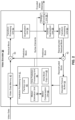
- FIG. 2 is a block diagram illustrating an exemplary video encoder 20 in accordance with some implementations described in the present application.
- Video encoder 20 may perform intra and inter predictive coding of video blocks within video frames. Intra predictive coding relies on spatial prediction to reduce or remove spatial redundancy in video data within a given video frame or picture. Inter predictive coding relies on temporal prediction to reduce or remove temporal redundancy in video data within adjacent video frames or pictures of a video sequence.
- video encoder 20 includes video data memory 40, prediction processing unit 41, decoded picture buffer (DPB) 64, summer 50, transform processing unit 52, quantization unit 54, and entropy encoding unit 56.
- Prediction processing unit 41 further includes motion estimation unit 42, motion compensation unit 44, partition unit 45, intra prediction processing unit 46, and intra block copy (BC) unit 48.
- video encoder 20 also includes inverse quantization unit 58, inverse transform processing unit 60, and summer 62 for video block reconstruction.
- a deblocking filter (not shown) may be positioned between summer 62 and DPB 64 to filter block boundaries to remove blockiness artifacts from reconstructed video.
- Video encoder 20 may take the form of a fixed or programmable hardware unit or may be divided among one or more of the illustrated fixed or programmable hardware units.
- Video data memory 40 may store video data to be encoded by the components of video encoder 20.
- the video data in video data memory 40 may be obtained, for example, from video source 18.
- DPB 64 is a buffer that stores reference video data for use in encoding video data by video encoder 20 (e.g., in intra or inter predictive coding modes).
- Video data memory 40 and DPB 64 may be formed by any of a variety of memory devices.
- video data memory 40 may be on-chip with other components of video encoder 20, or off-chip relative to those components.
- partition unit 45 within prediction processing unit 41 partitions the video data into video blocks.
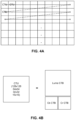
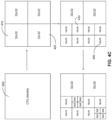
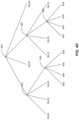
- This partitioning may also include partitioning a video frame into slices, tiles, or other larger coding units (CUs) according to a predefined splitting structures such as quad-tree structure associated with the video data.
- the video frame may be divided into multiple video blocks (or sets of video blocks referred to as tiles).
- Prediction processing unit 41 may select one of a plurality of possible predictive coding modes, such as one of a plurality of intra predictive coding modes or one of a plurality of inter predictive coding modes, for the current video block based on error results (e.g., coding rate and the level of distortion).
- intra prediction processing unit 46 within prediction processing unit 41 may perform intra predictive coding of the current video block relative to one or more neighboring blocks in the same frame as the current block to be coded to provide spatial prediction.
- Motion estimation unit 42 and motion compensation unit 44 within prediction processing unit 41 perform inter predictive coding of the current video block relative to one or more predictive blocks in one or more reference frames to provide temporal prediction.
- Video encoder 20 may perform multiple coding passes, e.g., to select an appropriate coding mode for each block of video data.
- motion estimation unit 42 determines the inter prediction mode for a current video frame by generating a motion vector, which indicates the displacement of a prediction unit (PU) of a video block within the current video frame relative to a predictive block within a reference video frame, according to a predetermined pattern within a sequence of video frames.
- Motion estimation performed by motion estimation unit 42, is the process of generating motion vectors, which estimate motion for video blocks.
- a motion vector may indicate the displacement of a PU of a video block within a current video frame or picture relative to a predictive block within a reference frame (or other coded unit) relative to the current block being coded within the current frame (or other coded unit).
- the predetermined pattern may designate video frames in the sequence as P frames or B frames.
- Intra BC unit 48 may determine vectors, e.g., block vectors, for intra BC coding in a manner similar to the determination of motion vectors by motion estimation unit 42 for inter prediction, or may utilize motion estimation unit 42 to determine the block vector.
- a predictive block is a block of a reference frame that is deemed as closely matching the PU of the video block to be coded in terms of pixel difference, which may be determined by sum of absolute difference (SAD), sum of square difference (SSD), or other difference metrics.
- video encoder 20 may calculate values for sub-integer pixel positions of reference frames stored in DPB 64. For example, video encoder 20 may interpolate values of one-quarter pixel positions, one-eighth pixel positions, or other fractional pixel positions of the reference frame. Therefore, motion estimation unit 42 may perform a motion search relative to the full pixel positions and fractional pixel positions and output a motion vector with fractional pixel precision.
- Motion compensation performed by motion compensation unit 44, may involve fetching or generating the predictive block based on the motion vector determined by motion estimation unit 42.
- motion compensation unit 44 may locate a predictive block to which the motion vector points in one of the reference frame lists, retrieve the predictive block from DPB 64, and forward the predictive block to summer 50.
- Summer 50 then forms a residual video block of pixel difference values by subtracting pixel values of the predictive block provided by motion compensation unit 44 from the pixel values of the current video block being coded.
- the pixel difference values forming the residual vide block may include luma or chroma difference components or both.
- Motion compensation unit 44 may also generate syntax elements associated with the video blocks of a video frame for use by video decoder 30 in decoding the video blocks of the video frame.
- the syntax elements may include, for example, syntax elements defining the motion vector used to identify the predictive block, any flags indicating the prediction mode, or any other syntax information described herein. Note that motion estimation unit 42 and motion compensation unit 44 may be highly integrated, but are illustrated separately for conceptual purposes.
- intra BC unit 48 may generate vectors and fetch predictive blocks in a manner similar to that described above in connection with motion estimation unit 42 and motion compensation unit 44, but with the predictive blocks being in the same frame as the current block being coded and with the vectors being referred to as block vectors as opposed to motion vectors.
- intra BC unit 48 may determine an intra-prediction mode to use to encode a current block.
- intra BC unit 48 may encode a current block using various intra-prediction modes, e.g., during separate encoding passes, and test their performance through rate-distortion analysis. Next, intra BC unit 48 may select, among the various tested intra-prediction modes, an appropriate intra-prediction mode to use and generate an intra-mode indicator accordingly.
- intra BC unit 48 may calculate rate-distortion values using a rate-distortion analysis for the various tested intra-prediction modes, and select the intra-prediction mode having the best rate-distortion characteristics among the tested modes as the appropriate intra-prediction mode to use.
- Rate-distortion analysis generally determines an amount of distortion (or error) between an encoded block and an original, unencoded block that was encoded to produce the encoded block, as well as a bitrate (i.e., a number of bits) used to produce the encoded block.
- Intra BC unit 48 may calculate ratios from the distortions and rates for the various encoded blocks to determine which intra-prediction mode exhibits the best rate-distortion value for the block.
- intra BC unit 48 may use motion estimation unit 42 and motion compensation unit 44, in whole or in part, to perform such functions for Intra BC prediction according to the implementations described herein.
- a predictive block may be a block that is deemed as closely matching the block to be coded, in terms of pixel difference, which may be determined by sum of absolute difference (SAD), sum of squared difference (SSD), or other difference metrics, and identification of the predictive block may include calculation of values for sub-integer pixel positions.
- Intra prediction processing unit 46 may intra-predict a current video block, as an alternative to the inter-prediction performed by motion estimation unit 42 and motion compensation unit 44, or the intra block copy prediction performed by intra BC unit 48, as described above.
- intra prediction processing unit 46 may determine an intra prediction mode to use to encode a current block. To do so, intra prediction processing unit 46 may encode a current block using various intra prediction modes, e.g., during separate encoding passes, and intra prediction processing unit 46 (or a mode select unit, in some examples) may select an appropriate intra prediction mode to use from the tested intra prediction modes.
- Intra prediction processing unit 46 may provide information indicative of the selected intra-prediction mode for the block to entropy encoding unit 56. Entropy encoding unit 56 may encode the information indicating the selected intra-prediction mode in the bitstream.
- summer 50 forms a residual video block by subtracting the predictive block from the current video block.
- the residual video data in the residual block may be included in one or more transform units (TUs) and is provided to transform processing unit 52.
- Transform processing unit 52 transforms the residual video data into residual transform coefficients using a transform, such as a discrete cosine transform (DCT) or a conceptually similar transform.
- DCT discrete cosine transform
- a unit of video decoder 30 may be tasked to perform the implementations of the present application. Also, in some examples, the implementations of the present disclosure may be divided among one or more of the units of video decoder 30.
- intra BC unit 85 may perform the implementations of the present application, alone, or in combination with other units of video decoder 30, such as motion compensation unit 82, intra prediction processing unit 84, and entropy decoding unit 80.
- video decoder 30 may not include intra BC unit 85 and the functionality of intra BC unit 85 may be performed by other components of prediction processing unit 81, such as motion compensation unit 82.
- intra prediction processing unit 84 of prediction processing unit 81 may generate prediction data for a video block of the current video frame based on a signaled intra prediction mode and reference data from previously decoded blocks of the current frame.
- VVC's picture parameter set contains such information which could change from picture to picture.
- the PPS includes information roughly comparable what was part of the PPS in HEVC, including: 1) a self-reference; 2) initial picture control information such as initial quantization parameter (QP), a number of flags indicating the use of, or presence of, certain tools or control information in the slice header; and 3) tiling information.
- initial picture control information such as initial quantization parameter (QP), a number of flags indicating the use of, or presence of, certain tools or control information in the slice header; and 3) tiling information.
- QP initial quantization parameter
- Table 8 How to read the Table 8 is illustrated in the appendix section of this invention which could also be found in the VVC specification. Table 8.
- the size of the slice header may be noticeably bigger than the PPS, particular when there are tile or wavefront entry point offsets in the slice header and RPS, prediction weights, or reference picture list modifications are explicitly signaled.
- the syntax and the associated semantic of the sequence parameter set in the current VVC draft specification are illustrated in Table 10 and Table 11, respectively. How to read Table 10 is illustrated in the appendix section of this invention, which could also be found in the VVC specification. Table 10.
- Picture header structure syntax picture_header_structure( ) ⁇ Descriptor gdr_or_irap_pic_flag u(1) if( gdr_or_irap_pic_flag) gdr_pic_flag u(1) ph_inter_slice_allowed_flag u(1) if( ph_inter_slice_allowed_flag ) ph_intra_slice_allowed_flag u(1) non_reference_picture_flag u(1) ph_pic_parameter_set_id ue(v) ph_pic_order_cnt_lsb u(v) if( gdr_or_irap_pic_flag) no _output_of_prior_pics_flag u(1) if( gdr_pic_flag) recovery_poc_cnt ue(v) for( i 0; i ⁇ NumExtraPh
- the partition constraint syntax elements are grouped by prediction type, with intra prediction related first, followed by inter prediction related.
- the order of the partition constraint syntax elements in SPS is consistent with the order of the partition constraint syntax elements in the picture header.
- FIG. 5 is a flowchart 500 illustrating an exemplary method for decoding a video signal in accordance with some implementations of the present disclosure. The method may be, for example, applied to a decoder.
- the decoder may receive arranged partition constraint syntax elements in SPS level.
- the arranged partition constraint syntax elements are arranged so that intra prediction related syntax elements are defined before inter prediction related syntax elements.
- the decoder may obtain a first reference picture I (0) and a second reference picture I (1) associated with a video block in a bitstream.
- the first reference picture I (0) is before a current picture and the second reference picture I (1) is after the current picture in display order.
- the decoder may obtain first prediction samples I (0) ( i, j ) of the video block from a reference block in the first reference picture I (0) .
- the i and j represent a coordinate of one sample with the current picture.
- the decoder may obtain second prediction samples I (1) ( i, j ) of the video block from a reference block in the second reference picture I (1) .
- the decoder may obtain bi-prediction samples based on the arranged partition constraint syntax elements, the first prediction samples I (0) ( i, j ), and the second prediction samples I (1) ( i, j).
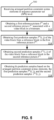
- FIG. 6 is a flowchart 600 illustrating an exemplary method for decoding a video signal in accordance with some implementations of the present disclosure.
- the method may be, for example, applied to a decoder.
- the decoder may receive a bitstream that includes VPS, SPS, PPS, picture header, and slice header for coded video data.
- the decoder may decode the VPS.
- the decoder may decode the SPS and obtain an arranged partition constraint syntax elements in SPS level.
- the decoder may decode the PPS.
- the decoder may decode the picture header.
- the decoder may decode the slice header.
- the decoder may decode the video data based on VPS, SPS, PPS, picture header and slice header.
- VVC intra prediction is allowed in all picture/slice types while inter prediction is not.
- it is designed to add a flag in VVC syntax at a certain coding level to indicate if inter prediction is used or not in a sequence, picture and/or slice.
- inter prediction related syntaxes are not signaled at the corresponding coding level, e.g., sequence, picture and/or slice level.
Landscapes
- Engineering & Computer Science (AREA)
- Multimedia (AREA)
- Signal Processing (AREA)
- Compression Or Coding Systems Of Tv Signals (AREA)
Applications Claiming Priority (3)
| Application Number | Priority Date | Filing Date | Title |
|---|---|---|---|
| US202063008648P | 2020-04-10 | 2020-04-10 | |
| EP21785080.9A EP4128793A4 (de) | 2020-04-10 | 2021-04-12 | Verfahren und vorrichtung für high-level-syntax in der videocodierung |
| PCT/US2021/026881 WO2021207731A1 (en) | 2020-04-10 | 2021-04-12 | Methods and apparatus for high-level syntax in video coding |
Related Parent Applications (1)
| Application Number | Title | Priority Date | Filing Date |
|---|---|---|---|
| EP21785080.9A Division EP4128793A4 (de) | 2020-04-10 | 2021-04-12 | Verfahren und vorrichtung für high-level-syntax in der videocodierung |
Publications (2)
| Publication Number | Publication Date |
|---|---|
| EP4583506A2 true EP4583506A2 (de) | 2025-07-09 |
| EP4583506A3 EP4583506A3 (de) | 2025-09-24 |
Family
ID=78023522
Family Applications (2)
| Application Number | Title | Priority Date | Filing Date |
|---|---|---|---|
| EP21785080.9A Pending EP4128793A4 (de) | 2020-04-10 | 2021-04-12 | Verfahren und vorrichtung für high-level-syntax in der videocodierung |
| EP25177597.9A Pending EP4583506A3 (de) | 2020-04-10 | 2021-04-12 | Verfahren und vorrichtung für high-level-syntax in der videocodierung |
Family Applications Before (1)
| Application Number | Title | Priority Date | Filing Date |
|---|---|---|---|
| EP21785080.9A Pending EP4128793A4 (de) | 2020-04-10 | 2021-04-12 | Verfahren und vorrichtung für high-level-syntax in der videocodierung |
Country Status (4)
| Country | Link |
|---|---|
| US (2) | US12452460B2 (de) |
| EP (2) | EP4128793A4 (de) |
| CN (4) | CN115398919B (de) |
| WO (1) | WO2021207731A1 (de) |
Family Cites Families (7)
| Publication number | Priority date | Publication date | Assignee | Title |
|---|---|---|---|---|
| KR100612015B1 (ko) * | 2004-07-22 | 2006-08-11 | 삼성전자주식회사 | 컨텍스트 적응형 이진 산술 부호화 방법 및 그 장치 |
| JP4442891B2 (ja) * | 2004-11-30 | 2010-03-31 | キヤノン株式会社 | 可変長符号化装置及び可変長符号化方法 |
| US8938009B2 (en) * | 2007-10-12 | 2015-01-20 | Qualcomm Incorporated | Layered encoded bitstream structure |
| KR101712098B1 (ko) * | 2009-09-04 | 2017-03-03 | 삼성전자 주식회사 | 구문 요소에 기초한 비트스트림 생성 방법 및 장치 |
| KR101379188B1 (ko) * | 2010-05-17 | 2014-04-18 | 에스케이 텔레콤주식회사 | 인트라 블록 및 인터 블록이 혼합된 코딩블록을 이용하는 영상 부호화/복호화 장치 및 그 방법 |
| GB2590634B (en) * | 2019-12-20 | 2024-10-02 | Canon Kk | High Level syntax for video coding and decoding |
| JP7460784B2 (ja) * | 2020-02-21 | 2024-04-02 | 北京字節跳動網絡技術有限公司 | スライスおよびタイルを含むピクチャのコーディング |
-
2021
- 2021-04-12 EP EP21785080.9A patent/EP4128793A4/de active Pending
- 2021-04-12 CN CN202180027271.4A patent/CN115398919B/zh active Active
- 2021-04-12 EP EP25177597.9A patent/EP4583506A3/de active Pending
- 2021-04-12 CN CN202510606772.8A patent/CN120475177A/zh active Pending
- 2021-04-12 CN CN202510625582.0A patent/CN120475179A/zh active Pending
- 2021-04-12 CN CN202510612042.9A patent/CN120475178A/zh active Pending
- 2021-04-12 WO PCT/US2021/026881 patent/WO2021207731A1/en not_active Ceased
-
2022
- 2022-10-10 US US17/963,086 patent/US12452460B2/en active Active
-
2025
- 2025-08-22 US US19/307,913 patent/US20250392758A1/en active Pending
Also Published As
| Publication number | Publication date |
|---|---|
| CN120475177A (zh) | 2025-08-12 |
| US12452460B2 (en) | 2025-10-21 |
| CN120475179A (zh) | 2025-08-12 |
| US20250392758A1 (en) | 2025-12-25 |
| EP4128793A4 (de) | 2023-08-02 |
| WO2021207731A1 (en) | 2021-10-14 |
| CN115398919B (zh) | 2025-06-17 |
| CN120475178A (zh) | 2025-08-12 |
| EP4583506A3 (de) | 2025-09-24 |
| US20230064904A1 (en) | 2023-03-02 |
| EP4128793A1 (de) | 2023-02-08 |
| CN115398919A (zh) | 2022-11-25 |
Similar Documents
| Publication | Publication Date | Title |
|---|---|---|
| US12375728B2 (en) | Gradual decoding refresh in video coding | |
| JP7407300B2 (ja) | 適応ループフィルタリング | |
| US10230979B2 (en) | Video decoder with signaling | |
| EP3123724B1 (de) | Generische verwendung von hevc-sei-nachrichten für mehrschichtige codecs | |
| EP3162066B1 (de) | Wiederherstellungspunkt-sei-nachricht in mehrschichtigen video-codecs | |
| US20250016376A1 (en) | Methods and devices for high-level syntax in video coding | |
| KR20220044344A (ko) | 팔레트 모드를 이용한 비디오 코딩의 방법 및 장치 | |
| CA2930446C (en) | Method for coding a reference picture set (rps) in multi-layer coding | |
| US12452460B2 (en) | Methods and apparatus for high-level syntax in video coding | |
| JP2024087742A (ja) | ビデオ符号化においてニューラルネットワークポストフィルタ目的情報をシグナリングするためのシステム及び方法 |
Legal Events
| Date | Code | Title | Description |
|---|---|---|---|
| PUAI | Public reference made under article 153(3) epc to a published international application that has entered the european phase |
Free format text: ORIGINAL CODE: 0009012 |
|
| STAA | Information on the status of an ep patent application or granted ep patent |
Free format text: STATUS: REQUEST FOR EXAMINATION WAS MADE |
|
| 17P | Request for examination filed |
Effective date: 20250520 |
|
| AC | Divisional application: reference to earlier application |
Ref document number: 4128793 Country of ref document: EP Kind code of ref document: P |
|
| AK | Designated contracting states |
Kind code of ref document: A2 Designated state(s): AL AT BE BG CH CY CZ DE DK EE ES FI FR GB GR HR HU IE IS IT LI LT LU LV MC MK MT NL NO PL PT RO RS SE SI SK SM TR |
|
| REG | Reference to a national code |
Ref country code: DE Ref legal event code: R079 Free format text: PREVIOUS MAIN CLASS: H04N0019103000 Ipc: H04N0019700000 |
|
| PUAL | Search report despatched |
Free format text: ORIGINAL CODE: 0009013 |
|
| AK | Designated contracting states |
Kind code of ref document: A3 Designated state(s): AL AT BE BG CH CY CZ DE DK EE ES FI FR GB GR HR HU IE IS IT LI LT LU LV MC MK MT NL NO PL PT RO RS SE SI SK SM TR |
|
| RIC1 | Information provided on ipc code assigned before grant |
Ipc: H04N 19/70 20140101AFI20250820BHEP Ipc: H04N 19/157 20140101ALI20250820BHEP Ipc: H04N 19/103 20140101ALI20250820BHEP |