EP4583431A1 - Digital radio signal receiver - Google Patents
Digital radio signal receiver Download PDFInfo
- Publication number
- EP4583431A1 EP4583431A1 EP24220334.7A EP24220334A EP4583431A1 EP 4583431 A1 EP4583431 A1 EP 4583431A1 EP 24220334 A EP24220334 A EP 24220334A EP 4583431 A1 EP4583431 A1 EP 4583431A1
- Authority
- EP
- European Patent Office
- Prior art keywords
- signal
- receiver
- interference
- model
- training stage
- Prior art date
- Legal status (The legal status is an assumption and is not a legal conclusion. Google has not performed a legal analysis and makes no representation as to the accuracy of the status listed.)
- Pending
Links
Images




Classifications
-
- H—ELECTRICITY
- H04—ELECTRIC COMMUNICATION TECHNIQUE
- H04H—BROADCAST COMMUNICATION
- H04H20/00—Arrangements for broadcast or for distribution combined with broadcast
- H04H20/42—Arrangements for resource management
- H04H20/426—Receiver side
-
- H—ELECTRICITY
- H04—ELECTRIC COMMUNICATION TECHNIQUE
- H04B—TRANSMISSION
- H04B1/00—Details of transmission systems, not covered by a single one of groups H04B3/00 - H04B13/00; Details of transmission systems not characterised by the medium used for transmission
- H04B1/06—Receivers
- H04B1/10—Means associated with receiver for limiting or suppressing noise or interference
-
- G—PHYSICS
- G01—MEASURING; TESTING
- G01R—MEASURING ELECTRIC VARIABLES; MEASURING MAGNETIC VARIABLES
- G01R31/00—Arrangements for testing electric properties; Arrangements for locating electric faults; Arrangements for electrical testing characterised by what is being tested not provided for elsewhere
- G01R31/001—Measuring interference from external sources to, or emission from, the device under test, e.g. EMC, EMI, EMP or ESD testing
-
- G—PHYSICS
- G06—COMPUTING OR CALCULATING; COUNTING
- G06N—COMPUTING ARRANGEMENTS BASED ON SPECIFIC COMPUTATIONAL MODELS
- G06N7/00—Computing arrangements based on specific mathematical models
- G06N7/01—Probabilistic graphical models, e.g. probabilistic networks
-
- H—ELECTRICITY
- H04—ELECTRIC COMMUNICATION TECHNIQUE
- H04B—TRANSMISSION
- H04B17/00—Monitoring; Testing
- H04B17/20—Monitoring; Testing of receivers
- H04B17/29—Performance testing
-
- H—ELECTRICITY
- H04—ELECTRIC COMMUNICATION TECHNIQUE
- H04B—TRANSMISSION
- H04B17/00—Monitoring; Testing
- H04B17/30—Monitoring; Testing of propagation channels
- H04B17/309—Measuring or estimating channel quality parameters
- H04B17/336—Signal-to-interference ratio [SIR] or carrier-to-interference ratio [CIR]
-
- H—ELECTRICITY
- H04—ELECTRIC COMMUNICATION TECHNIQUE
- H04B—TRANSMISSION
- H04B17/00—Monitoring; Testing
- H04B17/30—Monitoring; Testing of propagation channels
- H04B17/309—Measuring or estimating channel quality parameters
- H04B17/345—Interference values
-
- H—ELECTRICITY
- H04—ELECTRIC COMMUNICATION TECHNIQUE
- H04B—TRANSMISSION
- H04B17/00—Monitoring; Testing
- H04B17/30—Monitoring; Testing of propagation channels
- H04B17/391—Modelling the propagation channel
- H04B17/3913—Predictive models, e.g. based on neural network models
-
- H—ELECTRICITY
- H04—ELECTRIC COMMUNICATION TECHNIQUE
- H04H—BROADCAST COMMUNICATION
- H04H20/00—Arrangements for broadcast or for distribution combined with broadcast
- H04H20/53—Arrangements specially adapted for specific applications, e.g. for traffic information or for mobile receivers
- H04H20/57—Arrangements specially adapted for specific applications, e.g. for traffic information or for mobile receivers for mobile receivers
-
- H—ELECTRICITY
- H04—ELECTRIC COMMUNICATION TECHNIQUE
- H04W—WIRELESS COMMUNICATION NETWORKS
- H04W24/00—Supervisory, monitoring or testing arrangements
- H04W24/08—Testing, supervising or monitoring using real traffic
Definitions
- the present specification relates to systems, methods, apparatuses, devices, articles of manufacture and instructions for receiving digital radio signals.
- a digital radio signal receiver comprising: wherein the receiver is configured to be coupled to a device; wherein the device is coupled to receive an RF signal; wherein the RF signal includes a desired signal and interference; wherein the receiver is configured to receive a first signal and interference model from an off-device training stage; an on-device training stage configured to construct a second signal and interference model based on the first signal and interference model and the RF signal received by the device; and a decoder configured to generate a set of data from the RF signal based on the second signal and interference model.
- the digital radio signal receiver is a Digital Audio Broadcasting (DAB) radio receiver.
- DAB Digital Audio Broadcasting
- the off-device training stage is a generic off-device training stage; and the on-device training stage is a device-specific on-device training stage.
- the interference is un-radiated and independent of the RF signal.
- the device is at least one of: an electronic device, a machine, a vehicle, an electric vehicle (EV), a battery EV, a hybrid EV, and a set of vehicle's having a common manufacturer.
- the first and second signal and interference models represent the desired signal and the interference using trellis representations.
- the trellis representations are characterized by transition probability matrices and observation likelihoods.
- the off-device and on-device training stages represent the desired signal using a first trellis diagram and the interference using a second trellis diagram.
- the off-device and on-device training stages create the first and second signal and interference models by a Kronecker product matrix multiplication of the first trellis diagram with the second trellis diagram.
- the off-device training stage is configured to parameterize the first signal and interference model by interpreting the first and second trellis representations as Hidden Markov Models (HMM).
- HMM Hidden Markov Models
- the off-device training stage is configured to parameterize the first signal and interference model by interpreting the first and second trellis representations as a shallow neural network (NN).
- NN shallow neural network
- the first signal and interference model is constructed based on a set of domain knowledge.
- the set of domain knowledge is based on a different set of RF signals received by a different set of digital radio receivers coupled to a different set of devices.
- the first and second signal and interference models are Hidden Markov Models (HMM).
- the off-device training stage is configured to parameterize the first signal and interference model by interpreting the first and second trellis representations as a combination of Hidden Markov Models (HMM) and a shallow neural network (NN).
- HMM Hidden Markov Models
- NN shallow neural network
- Electric Vehicles produce extremely-diverse interference-signals that degrade or even makes the reception of Digital Audio Broadcasting (DAB) data and audio streams impossible.
- Example EV noise sources include the charger, the DC-DC converter, the electric motor powertrain, and any other high-power switching.
- Some DAB-Spatial Noise Cancellation receivers use multiple antennas to improve the DAB reception in the presence of EV interference.
- Other DAB receivers may use an iterative decoding approach where dedicated silicon is implemented to support the iterative decoding architecture; however, these receivers treat the EV interference as noise.
- AI/ML Artificial Intelligence/Machine Learning
- HMM Hidden Markov Models
- the hybrid AI/MI, approach is also applied to further improve the signal and interference model and the likelihood for specific vehicles. Thanks to a less strict latency requirement of the digital broadcasting system and the low-complexity hybrid approach used, on-device training can be performed during the acquisition phase of the reception. Thanks to the good initialization, the on-device training can converge faster.
- the second model is continuously fine-tuned using on-device learning/updates based on real-time operational conditions via a unique iterative decoding architecture.
- a soft-information feedback approach is used to follow the real-time behavior of the system.
- the second model and likelihood are further updated via iterative approaches (e.g. using an iterative decoder) to track real-life and real-time variations of channel (e.g. channel state information (CSI)) and interference conditions. This is performed for the channel that the receiver is tuned to.
- CSI channel state information
- a virtual tuner, or a background tuner can be used to learn/update the HMM model for a different channel in the background.
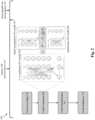
- Figure 1 represents an example of a digital radio system 100.
- the system 100 includes a generic off-DAB-device/receiver portion 102 that performs model construction 108, parameterization and initialization.
- the system 100 also includes a device-specific on-DAB-device/receiver portion 104 that performs model tailoring and continuous finetuning.
- the system 100 uses a hybrid AI/MI, EV interference rejection method in DAB systems.
- the generic off-DAB-device/receiver portion 102 includes a set of domain knowledge 106, model construction 108, model parameterization 110, and model initialization 112.
- the available domain knowledge 106 is utilized by the model construction 108 via graph and Bayesian probability theory for the construction of a first signal and interference model (e.g. an advanced joint signal and EV interference model).
- a first signal and interference model e.g. an advanced joint signal and EV interference model
- the model parameterization 110 parameterizes the first signal and interference model 117, enabling its optimization in a data-driven manner.
- the model initialization 112 initializes the parameterized first model 117 using both synthetic and collected field test data 114 stored in a large augmentation database 116.
- the first model 117 is then transmitted (e.g. deployed) to a digital radio signal receiver 118 in the on-DAB-device/receiver portion 104.
- the digital radio signal receiver 118 is configured to be coupled to a device (not shown) to receive an RF signal 120.
- the RF signal 120 in various example embodiments includes an interference component.
- the device (not shown) in many various example embodiments could be at least one of: an electronic device, a machine, a vehicle, an electric vehicle (EV), a battery EV, a hybrid EV, and a set of vehicle's having a common manufacturer.
- EV electric vehicle
- a battery EV battery EV
- a hybrid EV hybrid EV
- good initialization is crucial for rapid on-DAB-device/receiver 104 convergence and overall system 100 performance, there exists a natural discrepancy between the data used in the generic off-DAB-device/receiver portion 102 and the specific communication scenario for the device where the first model 117 is applied.
- the device-specific on-DAB-device/receiver portion 104 includes a fast data acquisition 122 and model tailoring 124 for tailoring the first model 117 into a second signal and interference model 125 that is device-specific.
- the fast data acquisition 122 is stored in real-time data storage 126. Note, due to less stringent latency requirements in DAB systems, the fast data acquisition 122 stage and storage of the collected data in the real-time data storage 126 at run time can conveniently enable direct adaptation of the initialized model.
- continuous fine-tuning 128 and a decoder 130 receive the RF signal 120 with interference through real-time reception 132.
- the continuous fine-tuning 128 and the decoder 130 perform iterative decoding so that the second model 125 can be continuously fine-tuned, during real-time reception 132, to the changing communication/channel conditions.
- Figure 2 shows an example embodiment 200 of construction 108 of the first signal and interference model 117 for the digital radio system 100.
- the first model 117 construction 108 utilizes graph theory as well as Bayesian probability theory.
- the first model 117 incorporates the domain knowledge 106 using trellis representations of multi-path signal propagation 204 and time-varying interference 206, which is "un-radiated" (i.e. independent of the broadcasted signal).
- the two trellis representations 204 and 206 are characterized by transition probability matrices ( P S and P i ) and corresponding observation likelihoods ( b s ( o t ) and b i ( o t )).
- the first model 117 (e.g. the joint signal and EV interference model) is obtained via a S+I combined model 202, which is a combination (e.g. Kronecker product matrix multiplication operations) of the two constituent models 204, 206.
- the obtained model inherently incorporates all possible (allowed) transitions between joint multi-path and interference states and thus captures a temporal structure of the underlying processes that affect the received RF signal 120.
- Trellis-based multi-path (intersymbol interference) propagation models are also used in wireless communications, and trellis-based interference (impulse noise) models are also used in power-line communications.
- initialization can be performed using Bayesian probability theory via the forward-backward and the expectation maximization algorithms.
- initialization would also involve a gradient descent algorithm.
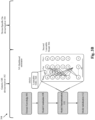
- Figure 5 represents an example embodiment 500 of possible labeling functions 502 for the device-specific on-DAB-device/receiver portion 104.
- the first model 117 is initialized in the generic off-DAB-device/receiver portion 102 and then sent to the device-specific on-DAB-device/receiver portion 104 for use in the specific device (not shown, but introduced above).
- the device-specific on-DAB-device/receiver portion 104 employs fast data acquisition 122 of the received RF signal 120 which is then used to generate the second model 125.
- DAB applications allow for relaxed latency requirements, which can be exploited to collect a small database "on-the-fly" at run time (i.e. the real-time data storage 126).
- a chosen optimization framework for the parameterized joint signal and interference model might require supervised learning and thus labeled data (e.g. when NNs are used).
- frame preambles or short pilot sequences can be utilized.
- the initialized model can be employed in a semi-supervised frameworks, e.g. pseudo-labeling, where the unlabeled data is assigned a label based on the initialized NN model prediction.
- Figure 6 represents an example embodiment 600 of model tailoring 124 the first signal and interference model 117 for the digital radio system 100 into the second signal and interference model 125.
- the first model 117 can be tailored into the second model 125 which is specific to both the device type and a real-time communications environment. Note that when NN is used, this can be done once the necessary labels 502 are available.
- the algorithms for NN/HMM optimization i.e. gradient descent and/or forward-backward algorithm and EM) are reused. Note that while in the generic off-DAB-device/receiver portion 102 learning phase these algorithms can be run for a number of iterations to provide a good starting set of parameters.
- tailoring 124 stage only a small amount of data that needs to be used to rapidly adapt the already optimized first model 117.
- first and second models 117, 125 are built as a trellis diagrams, they can be readily used with signal reception algorithms, such as BCJR and Viterbi.
- This trellis diagram approach is a much lower complexity approach than a full-blown deep learning solution.
- This trellis diagram also specifically captures underlying structures of RF signal 120, propagation effects, as well as any interference.
- the full parameterization of the first and second models 117, 125 using these trellis diagrams allows dynamic adaptations in a data-driven manner.
- Figure 7 represents an operational example 700 of the digital radio signal receiver 100.
- the operational example 700 shows example functionality performed in the generic off-DAB-device/receiver portion 102 and the device-specific on-DAB-device/receiver portion 104.
- Figure 8 represents an example 800 system for hosting instructions for enabling the digital radio signal receiver 100.
- the system 800 shows an input/output data 802 interface with an electronic apparatus 804.
- the electronic apparatus 804 includes a processor 806, a storage device 808, and a non-transitory machine-readable storage medium 810.
- the machine-readable storage medium 810 includes instructions 812 which control how the processor 806 receives input data 802 and transforms the input data into output data 802, using data within the storage device 808.
- Example instructions 812 stored in the machine-readable storage medium 810 are discussed elsewhere in this specification.
- the machine-readable storage medium in an alternate example embodiment is a non-transitory computer-readable storage medium.
- the processor (such as a central processing unit, CPU, microprocessor, application-specific integrated circuit (ASIC), etc.) controls the overall operation of the storage device (such as random access memory (RAM) for temporary data storage, read only memory (ROM) for permanent data storage, firmware, flash memory, external and internal hard-disk drives, and the like).
- the processor device communicates with the storage device and non-transitory machine-readable storage medium using a bus and performs operations and tasks that implement one or more instructions stored in the machine-readable storage medium.
- the machine-readable storage medium in an alternate example embodiment is a computer-readable storage medium.
Landscapes
- Engineering & Computer Science (AREA)
- Signal Processing (AREA)
- Physics & Mathematics (AREA)
- Computer Networks & Wireless Communication (AREA)
- Electromagnetism (AREA)
- Artificial Intelligence (AREA)
- Evolutionary Computation (AREA)
- General Physics & Mathematics (AREA)
- Quality & Reliability (AREA)
- Theoretical Computer Science (AREA)
- Business, Economics & Management (AREA)
- General Business, Economics & Management (AREA)
- Mathematical Analysis (AREA)
- Mathematical Optimization (AREA)
- Pure & Applied Mathematics (AREA)
- Computing Systems (AREA)
- General Engineering & Computer Science (AREA)
- Mathematical Physics (AREA)
- Software Systems (AREA)
- Data Mining & Analysis (AREA)
- Computational Mathematics (AREA)
- Algebra (AREA)
- Probability & Statistics with Applications (AREA)
- Noise Elimination (AREA)
Abstract
The present disclosure relates to a digital radio signal receiver, including: wherein the receiver is configured to be coupled to a device; wherein the device is coupled to receive an RF signal; wherein the RF signal includes a desired signal and interference; wherein the receiver is configured to receive a first signal and interference model from an off-device training stage; an on-device training stage configured to construct a second signal and interference model based on the first signal and interference model and the RF signal received by the device; and a decoder configured to generate a set of data from the RF signal based on the second signal and interference model.
Description
- The present specification relates to systems, methods, apparatuses, devices, articles of manufacture and instructions for receiving digital radio signals.
- According to an example embodiment, a digital radio signal receiver, comprising: wherein the receiver is configured to be coupled to a device; wherein the device is coupled to receive an RF signal; wherein the RF signal includes a desired signal and interference; wherein the receiver is configured to receive a first signal and interference model from an off-device training stage; an on-device training stage configured to construct a second signal and interference model based on the first signal and interference model and the RF signal received by the device; and a decoder configured to generate a set of data from the RF signal based on the second signal and interference model.
- In another example embodiment, the digital radio signal receiver is a Digital Audio Broadcasting (DAB) radio receiver.
- In another example embodiment, the off-device training stage is a generic off-device training stage; and the on-device training stage is a device-specific on-device training stage.
- In another example embodiment, the interference is un-radiated and independent of the RF signal.
- In another example embodiment, the device is at least one of: an electronic device, a machine, a vehicle, an electric vehicle (EV), a battery EV, a hybrid EV, and a set of vehicle's having a common manufacturer.
- In another example embodiment, the first and second signal and interference models represent the desired signal and the interference using trellis representations.
- In another example embodiment, the trellis representations are characterized by transition probability matrices and observation likelihoods.
- In another example embodiment, the off-device and on-device training stages represent the desired signal using a first trellis diagram and the interference using a second trellis diagram.
- In another example embodiment, the off-device and on-device training stages create the first and second signal and interference models by a Kronecker product matrix multiplication of the first trellis diagram with the second trellis diagram.
- In another example embodiment, the off-device training stage is configured to parameterize the first signal and interference model by interpreting the first and second trellis representations as Hidden Markov Models (HMM).
- In another example embodiment, the off-device training stage is configured to parameterize the first signal and interference model by interpreting the first and second trellis representations as a shallow neural network (NN).
- In another example embodiment, the first signal and interference model is constructed based on a set of domain knowledge.
- In another example embodiment, the set of domain knowledge is based on a different set of RF signals received by a different set of digital radio receivers coupled to a different set of devices.
- In another example embodiment, the first and second signal and interference models are Hidden Markov Models (HMM).
- In another example embodiment, the first and second signal and interference models are generated using Bayesian probability theory with message passing.
- In another example embodiment, the second signal and interference model is constructed by the on-device training stage when the device acquires the RF signal.
- In another example embodiment, further comprising an on-device updating stage that includes iteratively updating the second signal and interference model using the decoder.
- In another example embodiment, the updating includes tracking real-time variations of the received RF signal.
- In another example embodiment, the off-device training stage is configured to initialize the first signal and interference model.
- In another example embodiment, the off-device training stage is configured to parameterize the first signal and interference model by interpreting the first and second trellis representations as a combination of Hidden Markov Models (HMM) and a shallow neural network (NN).
- According to an example embodiment, a method for receiving a digital radio signal by a device, comprising: receiving an RF signal that includes a desired signal and interference; constructing a first signal and interference model during an off-device training stage; constructing a second signal and interference model during an on-device training stage based on the first signal and interference model and the RF signal received by the device; and decoding a set of data from the RF signal based on the second signal and interference model.
- The above discussion is not intended to represent every example embodiment or every implementation within the scope of the current or future Claim sets. The Figures and Detailed Description that follow also exemplify various example embodiments.
- Various example embodiments may be more completely understood in consideration of the following Detailed Description in connection with the accompanying Drawings.
-
-
Figure 1 represents an example of a digital radio system. -
Figure 2 shows an example embodiment of construction of a first signal and interference model for the digital radio system. -
Figure 3A represents a first example embodiment of parameterization of the first signal and interference model for the digital radio system. -
Figure 3B represents a second example embodiment of parameterization of the first signal and interference model for the digital radio system. -
Figure 4 represents an example embodiment of initialization of the first signal and interference model for the digital radio system. -
Figure 5 represents an example embodiment of possible labeling functions for the device-specific on-DAB-device/receiver portion. -
Figure 6 represents an example embodiment of model tailoring the first signal and interference model for the digital radio system into the second signal and interference model. -
Figure 7 represents an operational example of the digital radio signal receiver. -
Figure 8 represents an example system for hosting instructions for enabling the digital radio signal receiver. - While the disclosure is amenable to various modifications and alternative forms, specifics thereof have been shown by way of example in the drawings and will be described in detail. It should be understood, however, that other embodiments, beyond the particular embodiments described, are possible as well. All modifications, equivalents, and alternative embodiments falling within the scope of the appended claims are covered as well.
- Electric Vehicles (EVs) produce extremely-diverse interference-signals that degrade or even makes the reception of Digital Audio Broadcasting (DAB) data and audio streams impossible. Example EV noise sources include the charger, the DC-DC converter, the electric motor powertrain, and any other high-power switching.
- Some DAB-Spatial Noise Cancellation receivers use multiple antennas to improve the DAB reception in the presence of EV interference. Other DAB receivers may use an iterative decoding approach where dedicated silicon is implemented to support the iterative decoding architecture; however, these receivers treat the EV interference as noise.
- Now discussed is a hybrid Artificial Intelligence/Machine Learning (AI/ML) EV interference rejection system and method that reduce interference by considering the received signal and EV interference underlying structures. The system and method defines a solution space based on Bayesian probability theory with message passing, such as used in Hidden Markov Models (HMM). Novel probabilistic models for mitigating the detrimental effects of the EV interference are employed using AI/ML approaches for the learning and adaption of these models.
- In some example embodiments, a three-stage AI/ML based interference rejection architecture is used.
- In the first stage, an off-DAB-device/receiver initialization generates/constructs a first joint signal and EV interference model based on graph and Bayesian probability theory. This model is initialized via an off-line optimization using synthetic and field test data to ensure rapid convergence of the on-DAB-device/receiver optimization.
- In some example embodiments, of the off-device training stage, a large training database is gathered via extensive field recordings. A hybrid AI/ML approach is used based on Bayesian probability theory with message passing. This approach is applied to learn the HMM model of the signal and the interference to obtain the likelihood and the transition matrix. The model can be specific for different types (e.g., battery electric vehicle and hybrid vehicle), different brands, and different models of vehicles. The outcome of this stage is a good initialization/prior for the subsequent stages.
- In the second stage, an on-DAB-device/receiver generates a second model that tailors/optimizes the first model to further improve the initialization from the off-device training. The model is first adapted for operation in the DAB scenario during the acquisition phase of the reception and utilizes a short data acquisition period thanks to the less stringent latency requirements of DAB. Tailoring the off-device training results in a faster convergence.
- In some example embodiments, of the on-device training stage, the hybrid AI/MI, approach is also applied to further improve the signal and interference model and the likelihood for specific vehicles. Thanks to a less strict latency requirement of the digital broadcasting system and the low-complexity hybrid approach used, on-device training can be performed during the acquisition phase of the reception. Thanks to the good initialization, the on-device training can converge faster.
- In the third stage, the second model is continuously fine-tuned using on-device learning/updates based on real-time operational conditions via a unique iterative decoding architecture. In some example embodiments, a soft-information feedback approach is used to follow the real-time behavior of the system.
- In some example embodiments, of the on-device learning/update stage, the second model and likelihood are further updated via iterative approaches (e.g. using an iterative decoder) to track real-life and real-time variations of channel (e.g. channel state information (CSI)) and interference conditions. This is performed for the channel that the receiver is tuned to. In some embodiments, a virtual tuner, or a background tuner can be used to learn/update the HMM model for a different channel in the background.
-
Figure 1 represents an example of adigital radio system 100. Thesystem 100 includes a generic off-DAB-device/receiver portion 102 that performsmodel construction 108, parameterization and initialization. Thesystem 100 also includes a device-specific on-DAB-device/receiver portion 104 that performs model tailoring and continuous finetuning. In some example embodiments, thesystem 100 uses a hybrid AI/MI, EV interference rejection method in DAB systems. - In the first stage, the generic off-DAB-device/
receiver portion 102 includes a set ofdomain knowledge 106,model construction 108,model parameterization 110, andmodel initialization 112. - The
available domain knowledge 106 is utilized by themodel construction 108 via graph and Bayesian probability theory for the construction of a first signal and interference model (e.g. an advanced joint signal and EV interference model). - The
model parameterization 110 parameterizes the first signal and interference model 117, enabling its optimization in a data-driven manner. - The
model initialization 112 initializes the parameterized first model 117 using both synthetic and collectedfield test data 114 stored in alarge augmentation database 116. - In the second stage, the first model 117 is then transmitted (e.g. deployed) to a digital
radio signal receiver 118 in the on-DAB-device/receiver portion 104. The digitalradio signal receiver 118 is configured to be coupled to a device (not shown) to receive anRF signal 120. - The RF signal 120 in various example embodiments includes an interference component. The device (not shown) in many various example embodiments could be at least one of: an electronic device, a machine, a vehicle, an electric vehicle (EV), a battery EV, a hybrid EV, and a set of vehicle's having a common manufacturer.
- In many example embodiments, good initialization is crucial for rapid on-DAB-device/
receiver 104 convergence andoverall system 100 performance, there exists a natural discrepancy between the data used in the generic off-DAB-device/receiver portion 102 and the specific communication scenario for the device where the first model 117 is applied. - Thus the device-specific on-DAB-device/
receiver portion 104 includes afast data acquisition 122 and model tailoring 124 for tailoring the first model 117 into a second signal and interference model 125 that is device-specific. - The
fast data acquisition 122 is stored in real-time data storage 126. Note, due to less stringent latency requirements in DAB systems, thefast data acquisition 122 stage and storage of the collected data in the real-time data storage 126 at run time can conveniently enable direct adaptation of the initialized model. - In the third stage, continuous fine-
tuning 128 and adecoder 130 receive the RF signal 120 with interference through real-time reception 132. The continuous fine-tuning 128 and thedecoder 130 perform iterative decoding so that the second model 125 can be continuously fine-tuned, during real-time reception 132, to the changing communication/channel conditions. -
Figure 2 shows anexample embodiment 200 ofconstruction 108 of the first signal and interference model 117 for thedigital radio system 100. - The first model 117
construction 108 utilizes graph theory as well as Bayesian probability theory. The first model 117 incorporates thedomain knowledge 106 using trellis representations ofmulti-path signal propagation 204 and time-varyinginterference 206, which is "un-radiated" (i.e. independent of the broadcasted signal). - The two
trellis representations - Subsequently, the first model 117 (e.g. the joint signal and EV interference model) is obtained via a S+I combined
model 202, which is a combination (e.g. Kronecker product matrix multiplication operations) of the twoconstituent models - The obtained model inherently incorporates all possible (allowed) transitions between joint multi-path and interference states and thus captures a temporal structure of the underlying processes that affect the received
RF signal 120. Trellis-based multi-path (intersymbol interference) propagation models are also used in wireless communications, and trellis-based interference (impulse noise) models are also used in power-line communications. -
Figure 3A represents afirst example embodiment 300 ofparameterization 110 of the first signal and interference model 117 for thedigital radio system 100. The first example 300 employs fully learnable transition matrix and observation likelihoods. - After the first model 117 is constructed using trellis diagrams incorporating the
domain knowledge 106,parameterization 110 generates alearnable model 302, which can then be systematically further optimized into the second model 125.Parameterization 110 ensures that both the observation likelihood function (b(ot)) and the transition matrix (P*) are parameterized and thus available for learning. - In literature, it has been suggested that the likelihoods of a trellis-based model can be learned from data using a (shallow) neural network (NN) trained on a relatively small labeled dataset. However, this NN approach is not directly applicable for learning the transition matrix of the first model 117.
- Therefore, here parameterization 110 views the trellis as representing a Hidden Markov Model (HMM) and uses the available techniques for the optimization of HMM. Namely, both the likelihoods (b(ot)) as well as the transition matrix (P*) can for example be trained via sequences of training data input to the Baum-Welch algorithm for training HMMs, which in turn consists in using forward-backward Bayesian computation of probabilities and expectation maximization (EM).
-
Figure 3B represents asecond example embodiment 304 ofparameterization 110 of the first signal and interference model 117 for thedigital radio system 100. The second example 304 generates a secondlearnable model 306 utilizing a shallow neural network (NN) for the observation likelihood estimation. Alternatively, both the transition matrix and the observation likelihood can be learned using Hidden Markov Model techniques (e.g. the Baum-Welch algorithm). -
Figure 4 represents anexample embodiment 400 ofinitialization 112 of the first signal and interference model 117 for thedigital radio system 100. An example set ofinitialization elements 402 are shown. - At
model initialization 112, the developedlearnable model Formal initialization 112 prevents any random initialization of the first model 117, which could lead to problems in convergence and thus limit the performance duringsystem 100 operations. - Note that if sufficiently accurate and representative model parameters are available as prior knowledge, these can also be utilized before the optimization with synthetic and field test data. Depending on the algorithm choices initialization can be performed using Bayesian probability theory via the forward-backward and the expectation maximization algorithms. Alternatively, if a neural network is employed for computation of the likelihoods, then initialization would also involve a gradient descent algorithm.
- Note that, while in principle the HMM optimization framework can be performed in an un-supervised manner via the Baum-Welch algorithm, using NNs would typically require a labeled dataset for supervised learning. In the case of off-DAB- device/receiver optimization and synthetically generated data labels might often be readily available. On the other hand, during field test data collections, ground truth data (e.g. recording near base stations) needs to be incorporated as well.
-
Figure 5 represents anexample embodiment 500 of possible labeling functions 502 for the device-specific on-DAB-device/receiver portion 104. The first model 117 is initialized in the generic off-DAB-device/receiver portion 102 and then sent to the device-specific on-DAB-device/receiver portion 104 for use in the specific device (not shown, but introduced above). - Naturally, there will be discrepancies between the conditions for which the first model 117 was initialized and the device specific communication scenario and interference signatures. Therefore, as introduced above the device-specific on-DAB-device/
receiver portion 104 employsfast data acquisition 122 of the receivedRF signal 120 which is then used to generate the second model 125. - DAB applications allow for relaxed latency requirements, which can be exploited to collect a small database "on-the-fly" at run time (i.e. the real-time data storage 126).
- A chosen optimization framework for the parameterized joint signal and interference model might require supervised learning and thus labeled data (e.g. when NNs are used). In such a case, frame preambles or short pilot sequences can be utilized. Alternatively, the initialized model can be employed in a semi-supervised frameworks, e.g. pseudo-labeling, where the unlabeled data is assigned a label based on the initialized NN model prediction.
-
Figure 6 represents anexample embodiment 600 of model tailoring 124 the first signal and interference model 117 for thedigital radio system 100 into the second signal and interference model 125. - The first model 117 can be tailored into the second model 125 which is specific to both the device type and a real-time communications environment. Note that when NN is used, this can be done once the
necessary labels 502 are available. The algorithms for NN/HMM optimization (i.e. gradient descent and/or forward-backward algorithm and EM) are reused. Note that while in the generic off-DAB-device/receiver portion 102 learning phase these algorithms can be run for a number of iterations to provide a good starting set of parameters. In the device-specific on-DAB-device/receiver portion 104 model tailoring 124 stage only a small amount of data that needs to be used to rapidly adapt the already optimized first model 117. - As introduced in
Figure 1 , the third stage involves continuous fine-tuning 128 of the second model 125 in real-time during reception of the RF signal 120 using iterative decoding of thedecoder 130. This allows continuous "fine-grained" adaptation to fast varying RF signal 120 and/or environmental/channel conditions which might not be captured by the acquisition stage. - Since the first and second models 117, 125 are built as a trellis diagrams, they can be readily used with signal reception algorithms, such as BCJR and Viterbi. This trellis diagram approach is a much lower complexity approach than a full-blown deep learning solution. This trellis diagram also specifically captures underlying structures of
RF signal 120, propagation effects, as well as any interference. The full parameterization of the first and second models 117, 125 using these trellis diagrams allows dynamic adaptations in a data-driven manner. -
Figure 7 represents an operational example 700 of the digitalradio signal receiver 100. The operational example 700 shows example functionality performed in the generic off-DAB-device/receiver portion 102 and the device-specific on-DAB-device/receiver portion 104. -
Figure 8 represents an example 800 system for hosting instructions for enabling the digitalradio signal receiver 100. Thesystem 800 shows an input/output data 802 interface with an electronic apparatus 804. The electronic apparatus 804 includes aprocessor 806, astorage device 808, and a non-transitory machine-readable storage medium 810. The machine-readable storage medium 810 includesinstructions 812 which control how theprocessor 806 receives input data 802 and transforms the input data into output data 802, using data within thestorage device 808.Example instructions 812 stored in the machine-readable storage medium 810 are discussed elsewhere in this specification. The machine-readable storage medium in an alternate example embodiment is a non-transitory computer-readable storage medium. - The processor (such as a central processing unit, CPU, microprocessor, application-specific integrated circuit (ASIC), etc.) controls the overall operation of the storage device (such as random access memory (RAM) for temporary data storage, read only memory (ROM) for permanent data storage, firmware, flash memory, external and internal hard-disk drives, and the like). The processor device communicates with the storage device and non-transitory machine-readable storage medium using a bus and performs operations and tasks that implement one or more instructions stored in the machine-readable storage medium. The machine-readable storage medium in an alternate example embodiment is a computer-readable storage medium.
- Example embodiments of the material discussed in this specification can be implemented in whole or in part through network, computer, or data based devices and/or services. These may include cloud, internet, intranet, mobile, desktop, processor, look-up table, microcontroller, consumer equipment, infrastructure, or other enabling devices and services. As may be used herein and in the claims, the following non-exclusive definitions are provided.
- It will be readily understood that the components of the embodiments as generally described herein and illustrated in the appended figures could be arranged and designed in a wide variety of different configurations. Thus, the detailed description of various embodiments, as represented in the figures, is not intended to limit the scope of the present disclosure, but is merely representative of various embodiments. While the various aspects of the embodiments are presented in drawings, the drawings are not necessarily drawn to scale unless specifically indicated.
- The present invention may be embodied in other specific forms without departing from its spirit or essential characteristics. The described embodiments are to be considered in all respects only as illustrative and not restrictive. The scope of the invention is, therefore, indicated by the appended claims rather than by this detailed description. All changes which come within the meaning and range of equivalency of the claims are to be embraced within their scope.
- Reference throughout this specification to features, advantages, or similar language does not imply that all of the features and advantages that may be realized with the present invention should be or are in any single embodiment of the invention. Rather, language referring to the features and advantages is understood to mean that a specific feature, advantage, or characteristic described in connection with an embodiment is included in at least one embodiment of the present invention. Thus, discussions of the features and advantages, and similar language, throughout this specification may, but do not necessarily, refer to the same embodiment.
- Furthermore, the described features, advantages, and characteristics of the invention may be combined in any suitable manner in one or more embodiments. One skilled in the relevant art will recognize, in light of the description herein, that the invention can be practiced without one or more of the specific features or advantages of a particular embodiment. In other instances, additional features and advantages may be recognized in certain embodiments that may not be present in all embodiments of the invention.
- Reference throughout this specification to "one embodiment," "an embodiment," or similar language means that a particular feature, structure, or characteristic described in connection with the indicated embodiment is included in at least one embodiment of the present invention. Thus, the phrases "in one embodiment," "in an embodiment," and similar language throughout this specification may, but do not necessarily, all refer to the same embodiment.
Claims (15)
- A digital radio signal receiver, comprising:wherein the receiver is configured to be coupled to a device;wherein the device is coupled to receive an RF signal;wherein the RF signal includes a desired signal and interference;wherein the receiver is configured to receive a first signal and interference model from an off-device training stage;an on-device training stage configured to construct a second signal and interference model based on the first signal and interference model and the RF signal received by the device; anda decoder configured to generate a set of data from the RF signal based on the second signal and interference model.
- The receiver of claim 1:
wherein the digital radio signal receiver is a Digital Audio Broadcasting (DAB) radio receiver. - The receiver of claim 1 or 3:wherein the off-device training stage is a generic off-device training stage; andwherein the on-device training stage is a device-specific on-device training stage.
- The receiver of any of claims 1 to 3:
wherein the interference is un-radiated and independent of the RF signal. - The receiver of any of claims 1 to 4:
wherein the device is at least one of: an electronic device, a machine, a vehicle, an electric vehicle (EV), a battery EV, a hybrid EV, and a set of vehicle's having a common manufacturer. - The receiver of any of claims 1 to 5:
wherein the first and second signal and interference models represent the desired signal and the interference using trellis representations. - The receiver of claim 6:
wherein the trellis representations are characterized by transition probability matrices and observation likelihoods. - The receiver of any of claims 1 to 7:
wherein the off-device and on-device training stages represent the desired signal using a first trellis diagram and the interference using a second trellis diagram. - The receiver of any of claims 1 to 8:
wherein the off-device and on-device training stages create the first and second signal and interference models by a Kronecker product matrix multiplication of the first trellis diagram with the second trellis diagram. - The receiver of any of claims 1 to 8:
wherein the off-device training stage is configured to parameterize the first signal and interference model by interpreting the first and second trellis representations as Hidden Markov Models (HMM). - The receiver of any of claims 1 to 8:
wherein the off-device training stage is configured to parameterize the first signal and interference model by interpreting the first and second trellis representations as a shallow neural network (NN). - The receiver of any of claims 1 to 11:
wherein the first signal and interference model is constructed based on a set of domain knowledge. - The receiver of any of claims 1 to 12:
wherein the set of domain knowledge is based on a different set of RF signals received by a different set of digital radio receivers coupled to a different set of devices. - The receiver of any of claims 1 to 13:
wherein the first and second signal and interference models are Hidden Markov Models (HMM). - A method for receiving a digital radio signal by a device, comprising:receiving an RF signal that includes a desired signal and interference;constructing a first signal and interference model during an off-device training stage;constructing a second signal and interference model during an on-device training stage based on the first signal and interference model and the RF signal received by the device; anddecoding a set of data from the RF signal based on the second signal and interference model.
Applications Claiming Priority (1)
| Application Number | Priority Date | Filing Date | Title |
|---|---|---|---|
| US18/407,039 US12542620B2 (en) | 2024-01-08 | 2024-01-08 | Digital radio signal receiver |
Publications (1)
| Publication Number | Publication Date |
|---|---|
| EP4583431A1 true EP4583431A1 (en) | 2025-07-09 |
Family
ID=93924293
Family Applications (1)
| Application Number | Title | Priority Date | Filing Date |
|---|---|---|---|
| EP24220334.7A Pending EP4583431A1 (en) | 2024-01-08 | 2024-12-16 | Digital radio signal receiver |
Country Status (3)
| Country | Link |
|---|---|
| US (1) | US12542620B2 (en) |
| EP (1) | EP4583431A1 (en) |
| CN (1) | CN120281325A (en) |
Citations (4)
| Publication number | Priority date | Publication date | Assignee | Title |
|---|---|---|---|---|
| WO2020087260A1 (en) * | 2018-10-30 | 2020-05-07 | Nokia Shanghai Bell Co., Ltd. | Method and apparatus for sinr prediction for link adaption |
| US20210367681A1 (en) * | 2020-05-19 | 2021-11-25 | The Aerospace Corporation | Interference Suppression Using Machine Learning |
| CN116032392A (en) * | 2022-12-14 | 2023-04-28 | 北京邮电大学 | Mining and Prediction Method of Uplink Interference Between Wireless Network Users Based on Local Data |
| WO2023212059A1 (en) * | 2022-04-27 | 2023-11-02 | Interdigital Patent Holdings, Inc. | Methods and apparatus for leveraging transfer learning for channel state information enhancement |
Family Cites Families (41)
| Publication number | Priority date | Publication date | Assignee | Title |
|---|---|---|---|---|
| US10361802B1 (en) * | 1999-02-01 | 2019-07-23 | Blanding Hovenweep, Llc | Adaptive pattern recognition based control system and method |
| US20120176237A1 (en) * | 2011-01-12 | 2012-07-12 | Joseph Akwo Tabe | Homeland intelligence systems technology "h-list" and battlefield apparatus |
| DE10026488A1 (en) * | 2000-05-27 | 2002-01-24 | Bosch Gmbh Robert | Process for correcting clock errors in audio data |
| KR100554431B1 (en) * | 2003-11-05 | 2006-02-22 | 기륭전자 주식회사 | Car audio systems with adapters and such adapters for car satellite digital audio radio broadcast receivers |
| US7914468B2 (en) * | 2004-09-22 | 2011-03-29 | Svip 4 Llc | Systems and methods for monitoring and modifying behavior |
| US8086168B2 (en) * | 2005-07-06 | 2011-12-27 | Sandisk Il Ltd. | Device and method for monitoring, rating and/or tuning to an audio content channel |
| BRPI0619388A2 (en) * | 2005-11-29 | 2011-10-04 | Google Inc | social and interactive applications for mass media |
| US20110116515A1 (en) * | 2009-11-16 | 2011-05-19 | Nxp B.V. | System and method for demodulating and decoding a differentially encoded coded orthogonal frequency division multiplexing modulation code using two-dimensional code blocks |
| WO2012175636A1 (en) * | 2011-06-22 | 2012-12-27 | Nxp B.V. | Two-dimensional iterative processing for dab receivers based on trellis-decomposition |
| CN102419999A (en) * | 2011-09-30 | 2012-04-18 | 惠州市德赛西威汽车电子有限公司 | Multi-media system of automobile |
| GB201120328D0 (en) * | 2011-11-24 | 2012-01-04 | Renesas Mobile Corp | Wireless communication apparatus and method |
| US9047540B2 (en) * | 2012-07-19 | 2015-06-02 | Qualcomm Incorporated | Trellis based word decoder with reverse pass |
| DE102013011529B3 (en) * | 2013-07-10 | 2014-10-16 | Audi Ag | Radio receiver |
| US9467255B2 (en) * | 2014-12-23 | 2016-10-11 | Ibiquity Digital Corporation | Systems and methods for digital radio broadcast with cross platform reception |
| US9596044B2 (en) * | 2015-02-13 | 2017-03-14 | Ibiquity Digital Corporation | Method and apparatus for analog and digital audio blend for HD radio receivers |
| US11637612B2 (en) * | 2015-08-25 | 2023-04-25 | Cellium Technologies, Ltd. | Macro-diversity using hybrid transmissions via twisted pairs |
| US11303346B2 (en) * | 2015-08-25 | 2022-04-12 | Cellium Technologies, Ltd. | Systems and methods for transporting signals inside vehicles |
| US11669296B2 (en) * | 2015-10-27 | 2023-06-06 | Super Hi Fi, Llc | Computerized systems and methods for hosting and dynamically generating and providing customized media and media experiences |
| DE102015016334B4 (en) * | 2015-12-15 | 2017-07-06 | Audi Ag | Motor vehicle roof antenna module, motor vehicle and method for operating the roof antenna module |
| CN106877955B (en) * | 2017-03-29 | 2018-12-25 | 西华大学 | Method for recognizing time telling characteristics of frequency modulation broadcast signal based on hidden Markov model |
| KR20190019726A (en) * | 2017-08-18 | 2019-02-27 | 인하대학교 산학협력단 | System and method for hidden markov model based uav sound recognition using mfcc technique in practical noisy environments |
| WO2019043446A1 (en) * | 2017-09-04 | 2019-03-07 | Nng Software Developing And Commercial Llc | A method and apparatus for collecting and using sensor data from a vehicle |
| US10812847B2 (en) * | 2017-12-20 | 2020-10-20 | Rovi Guides, Inc. | Systems and methods for avoiding spoilers in presenting recording prompts relating to a competition |
| US20200389469A1 (en) * | 2017-12-24 | 2020-12-10 | Arilou Information Security Technologies Ltd. | System and method for tunnel-based malware detection |
| US20210356279A1 (en) * | 2018-07-08 | 2021-11-18 | Nng Software Developing And Commercial Llc. | A Method and Apparatus for Optimal Navigation to Multiple Locations |
| CN110768737A (en) * | 2019-03-28 | 2020-02-07 | 苏州东奇信息科技股份有限公司 | Analog-digital mixed amplitude modulation broadcasting system based on MPPSK modulation |
| DE102019209800B4 (en) * | 2019-07-03 | 2021-07-29 | Innovationszentrum für Telekommunikationstechnik GmbH IZT | Receiver for receiving a combination signal taking into account inter-symbol interference, method for receiving a combination signal and computer program |
| KR20190087363A (en) * | 2019-07-15 | 2019-07-24 | 인하대학교 산학협력단 | System and method for hidden markov model based uav sound recognition using mfcc technique in practical noisy environments |
| WO2021195112A1 (en) * | 2020-03-23 | 2021-09-30 | Super Hi Fi, Llc | Computerized systems and methods for hosting and dynamically generating and providing customized media and media experiences |
| WO2022133356A1 (en) * | 2020-12-19 | 2022-06-23 | Abalta Technologies, Inc. | Contactless identification and payment |
| US20220207993A1 (en) * | 2020-12-31 | 2022-06-30 | Here Global B.V. | Method, apparatus, and system for verifying a lane closure using probe data |
| EP4040689A1 (en) * | 2021-02-04 | 2022-08-10 | Nxp B.V. | Receiver system for combining multiple antennas |
| US12381763B2 (en) * | 2021-02-16 | 2025-08-05 | Nvidia Corporation | Technique to perform demodulation of wireless communications signal data |
| US12095781B2 (en) * | 2021-10-26 | 2024-09-17 | King Fahd University Of Petroleum And Minerals | Hidden Markov model based data ranking for enhancement of classifier performance to classify imbalanced dataset |
| CN116150741A (en) * | 2021-11-16 | 2023-05-23 | 南京邮电大学 | An Application Layer DDoS Detection Method Based on Coordinated Detection of Distributed Framework |
| US20230188233A1 (en) * | 2021-12-14 | 2023-06-15 | Intel Corporation | System energy efficiency in a wireless network |
| US12341511B2 (en) * | 2021-12-22 | 2025-06-24 | Altera Corporation | Power management using voltage islands on programmable logic devices |
| CN115438853A (en) * | 2022-09-02 | 2022-12-06 | 广东工业大学 | A Big Data-Based Public Transportation Stop Prediction Method |
| US20250004122A1 (en) * | 2023-06-30 | 2025-01-02 | Samsung Electronics Co., Ltd. | Wireless based presence detection |
| KR20260060404A (en) * | 2023-08-31 | 2026-05-04 | 카팍테크 리미티드 | Magnetic Induction Tomography-based FOD, LOD, and Alignment |
| CN117341712A (en) * | 2023-09-28 | 2024-01-05 | 西安科技大学 | State parameter estimation system for mining electric vehicles based on complex working conditions |
-
2024
- 2024-01-08 US US18/407,039 patent/US12542620B2/en active Active
- 2024-12-16 EP EP24220334.7A patent/EP4583431A1/en active Pending
-
2025
- 2025-01-08 CN CN202510028985.7A patent/CN120281325A/en active Pending
Patent Citations (4)
| Publication number | Priority date | Publication date | Assignee | Title |
|---|---|---|---|---|
| WO2020087260A1 (en) * | 2018-10-30 | 2020-05-07 | Nokia Shanghai Bell Co., Ltd. | Method and apparatus for sinr prediction for link adaption |
| US20210367681A1 (en) * | 2020-05-19 | 2021-11-25 | The Aerospace Corporation | Interference Suppression Using Machine Learning |
| WO2023212059A1 (en) * | 2022-04-27 | 2023-11-02 | Interdigital Patent Holdings, Inc. | Methods and apparatus for leveraging transfer learning for channel state information enhancement |
| CN116032392A (en) * | 2022-12-14 | 2023-04-28 | 北京邮电大学 | Mining and Prediction Method of Uplink Interference Between Wireless Network Users Based on Local Data |
Also Published As
| Publication number | Publication date |
|---|---|
| US20250226901A1 (en) | 2025-07-10 |
| US12542620B2 (en) | 2026-02-03 |
| CN120281325A (en) | 2025-07-08 |
Similar Documents
| Publication | Publication Date | Title |
|---|---|---|
| CN115412416B (en) | Low-complexity OTFS signal detection method for high-speed moving scene | |
| CN111224906A (en) | Approximate message transfer large-scale MIMO signal detection algorithm based on deep neural network | |
| EP3759654A1 (en) | Learning communication systems using channel approximation | |
| CN112104577B (en) | Device and method for compensating channel based on artificial neural network | |
| CN115280679B (en) | Noise Mitigation in Automotive Ethernet Networks | |
| US11146287B2 (en) | Apparatus and method for optimizing physical layer parameter | |
| Fischer et al. | Adaptive NN-based OFDM receivers: Computational complexity vs. achievable performance | |
| US12542620B2 (en) | Digital radio signal receiver | |
| CN103780349B (en) | Randomization sampling lattice decoding method based on limited distance decoding | |
| CN117674767A (en) | A circuit system mismatch quantization filtering method based on dynamic event triggering | |
| CN121508736A (en) | Digital Semantic Communication Methods that Combine Learnable Constellation Mapping and Channel Adaptation | |
| Krishnama Raju et al. | An efficient deep neural networks-based channel estimation and signal detection in ofdm systems | |
| CN119051863B (en) | Parameter optimization method, device, equipment, medium and product | |
| CN110474798B (en) | Method for predicting future signal of wireless communication by using echo state network | |
| JP2023516831A (en) | Method, system and computer program for optimizing communication channel capacity using Dirichlet process | |
| Karanov et al. | Data-driven symbol detection for intersymbol interference channels with bursty impulsive noise | |
| US20250184186A1 (en) | Radio receiver with multi-stage equalization | |
| CN118972205A (en) | A maximum likelihood channel estimation method for visible light communication system | |
| EP4307622A1 (en) | Communication method and communication device thereof | |
| CN116961709A (en) | Signal processing method, non-volatile storage medium and computer equipment | |
| Michon et al. | Learning modified Gated Recurrent Units for information feedback in unfolded turbo VEP MU-MIMO receivers | |
| Qin et al. | Evolutionary Programming: A Population-Based Optimization Algorithm for Coded Multiuser Systems. | |
| CN107888537B (en) | A Signal Detection Method to Improve System Complexity in Large-Scale Antenna Systems | |
| US20250193054A1 (en) | Apparatus comprising at least one processor | |
| CN119583261B (en) | A channel assessment method and related device |
Legal Events
| Date | Code | Title | Description |
|---|---|---|---|
| PUAI | Public reference made under article 153(3) epc to a published international application that has entered the european phase |
Free format text: ORIGINAL CODE: 0009012 |
|
| STAA | Information on the status of an ep patent application or granted ep patent |
Free format text: STATUS: THE APPLICATION HAS BEEN PUBLISHED |
|
| AK | Designated contracting states |
Kind code of ref document: A1 Designated state(s): AL AT BE BG CH CY CZ DE DK EE ES FI FR GB GR HR HU IE IS IT LI LT LU LV MC ME MK MT NL NO PL PT RO RS SE SI SK SM TR |
|
| STAA | Information on the status of an ep patent application or granted ep patent |
Free format text: STATUS: REQUEST FOR EXAMINATION WAS MADE |
|
| 17P | Request for examination filed |
Effective date: 20260109 |