EP4583007A2 - Datenverarbeitungsverfahren und datenverarbeitungsvorrichtung - Google Patents
Datenverarbeitungsverfahren und datenverarbeitungsvorrichtung Download PDFInfo
- Publication number
- EP4583007A2 EP4583007A2 EP24222807.0A EP24222807A EP4583007A2 EP 4583007 A2 EP4583007 A2 EP 4583007A2 EP 24222807 A EP24222807 A EP 24222807A EP 4583007 A2 EP4583007 A2 EP 4583007A2
- Authority
- EP
- European Patent Office
- Prior art keywords
- tensor
- layout
- operator
- equivalent
- neural network
- Prior art date
- Legal status (The legal status is an assumption and is not a legal conclusion. Google has not performed a legal analysis and makes no representation as to the accuracy of the status listed.)
- Pending
Links
Images





Classifications
-
- G—PHYSICS
- G06—COMPUTING OR CALCULATING; COUNTING
- G06N—COMPUTING ARRANGEMENTS BASED ON SPECIFIC COMPUTATIONAL MODELS
- G06N3/00—Computing arrangements based on biological models
- G06N3/02—Neural networks
- G06N3/08—Learning methods
-
- G—PHYSICS
- G06—COMPUTING OR CALCULATING; COUNTING
- G06F—ELECTRIC DIGITAL DATA PROCESSING
- G06F17/00—Digital computing or data processing equipment or methods, specially adapted for specific functions
- G06F17/10—Complex mathematical operations
- G06F17/16—Matrix or vector computation, e.g. matrix-matrix or matrix-vector multiplication, matrix factorization
-
- G—PHYSICS
- G06—COMPUTING OR CALCULATING; COUNTING
- G06F—ELECTRIC DIGITAL DATA PROCESSING
- G06F9/00—Arrangements for program control, e.g. control units
- G06F9/06—Arrangements for program control, e.g. control units using stored programs, i.e. using an internal store of processing equipment to receive or retain programs
- G06F9/46—Multiprogramming arrangements
- G06F9/50—Allocation of resources, e.g. of the central processing unit [CPU]
- G06F9/5005—Allocation of resources, e.g. of the central processing unit [CPU] to service a request
- G06F9/5027—Allocation of resources, e.g. of the central processing unit [CPU] to service a request the resource being a machine, e.g. CPUs, Servers, Terminals
-
- G—PHYSICS
- G06—COMPUTING OR CALCULATING; COUNTING
- G06N—COMPUTING ARRANGEMENTS BASED ON SPECIFIC COMPUTATIONAL MODELS
- G06N3/00—Computing arrangements based on biological models
- G06N3/02—Neural networks
- G06N3/06—Physical realisation, i.e. hardware implementation of neural networks, neurons or parts of neurons
- G06N3/063—Physical realisation, i.e. hardware implementation of neural networks, neurons or parts of neurons using electronic means
-
- G—PHYSICS
- G06—COMPUTING OR CALCULATING; COUNTING
- G06N—COMPUTING ARRANGEMENTS BASED ON SPECIFIC COMPUTATIONAL MODELS
- G06N3/00—Computing arrangements based on biological models
- G06N3/02—Neural networks
- G06N3/08—Learning methods
- G06N3/098—Distributed learning, e.g. federated learning
-
- G—PHYSICS
- G06—COMPUTING OR CALCULATING; COUNTING
- G06N—COMPUTING ARRANGEMENTS BASED ON SPECIFIC COMPUTATIONAL MODELS
- G06N3/00—Computing arrangements based on biological models
- G06N3/02—Neural networks
- G06N3/10—Interfaces, programming languages or software development kits, e.g. for simulating neural networks
Definitions
- This application relates to the field of artificial intelligence, and in particular, to a data processing method and a data processing device.
- a parallelism solution of the deep learning model may be embodied based on tensor layouts of all operators in the model.
- the tensor layout includes a device matrix, a tensor shape, and a tensor map.
- a tensor may be sharded in any dimension, but device matrices of all tensors need to be the same.
- tensor maps have constraints. For example, sample dimensions of all the tensors need to be mapped to a same dimension of the device matrices of all the tensors, which restricts conversion of a plurality of parallelism manners. For example, hybrid parallelism of data parallelism and model parallelism cannot be implemented.
- a device matrix of the first tensor layout is inconsistent with a device matrix of the second tensor layout, and/or a tensor map of the first tensor layout is inconsistent; and the determining a redistribution operator between the first operator and the second operator includes: determining an intermediate tensor layout based on the first tensor layout and the second tensor layout; determining a first reshape operator based on the first tensor layout and the intermediate tensor layout, a tensor layout of an input tensor of the first reshape operator, and a tensor layout of an output tensor of the first reshape operator, where the first reshape operator is used to implement conversion from the first tensor layout to the intermediate tensor layout; and/or determining a second reshape operator based on the second tensor layout and the intermediate tensor layout, a tensor layout, a tens
- the first equivalent tensor layout equivalent to the first tensor layout and the second equivalent tensor layout equivalent to the second tensor layout are found by determining the extended device matrix, the device matrix of the first equivalent tensor layout is consistent with the device matrix of the second equivalent tensor layout, and further the reshape operator is generated based on the first equivalent tensor layout and the second equivalent tensor layout.
- the reshape operator is automatically generated to update the sliced computational graph, so that a workload of designing conversion between tensor layouts by the user can be reduced and the model parallelism training efficiency can be improved.
- the data processing device determines a first tensor map conversion operator sequence, including the one or more tensor map conversion operators used to implement conversion from the tensor map of the first equivalent tensor layout to the tensor map of the second equivalent tensor layout.
- the sliced computational graph is updated by using the one or more generated tensor map conversion operators, so that the workload of designing conversion between tensor layouts by the user can be reduced and the model parallelism training efficiency can be improved.
- the method further includes: normalizing the tensor shapes based on the first equivalent tensor layout and the second equivalent tensor layout, and determining a third equivalent tensor layout equivalent to the first equivalent tensor layout and a fourth equivalent tensor layout equivalent to the second equivalent tensor layout, where a device matrix of the third equivalent tensor layout is consistent with a device matrix of the fourth equivalent tensor layout, and a tensor shape of the third equivalent tensor layout is consistent with a tensor shape of the fourth equivalent tensor layout; and the intermediate tensor layout includes the third equivalent tensor layout and the fourth equivalent tensor layout.
- a tensor map of the third equivalent tensor layout is inconsistent with a tensor map of the fourth equivalent tensor layout; and the method further includes: determining one or more tensor map conversion operators, where the tensor map conversion operator includes a slice operator, a concat operator, or a communication operator, a tensor layout of an input tensor of the one or more tensor map conversion operators is consistent with the third equivalent tensor layout, a tensor layout of an output tensor of the one or more tensor map conversion operators is consistent with the fourth equivalent tensor layout, and the one or more tensor map conversion operators are used to determine the updated sliced computational graph.
- a second tensor map conversion operator sequence further needs to be determined, including the one or more tensor map conversion operators used to implement conversion from the third equivalent tensor layout to the fourth equivalent tensor layout.
- the sliced computational graph is updated by using the one or more generated tensor map conversion operators, so that the workload of designing conversion between tensor layouts by the user can be reduced and the model parallelism training efficiency can be improved.
- the data processing device further determines a third tensor map conversion operator sequence, including the one or more tensor map conversion operators used to implement conversion from the fourth equivalent tensor layout to the fifth equivalent tensor layout.
- the sliced computational graph is updated by using the one or more generated tensor map conversion operators, so that the workload of designing conversion between tensor layouts by the user can be reduced and model parallelism training efficiency can be improved.
- a device matrix of the first tensor layout is consistent with a device matrix of the second tensor layout
- a tensor shape of the first tensor layout is consistent with a tensor shape of the second tensor layout
- a tensor map of the first tensor layout is inconsistent with a tensor map of the second tensor layout
- the determining a redistribution operator between the first operator and the second operator includes: determining one or more tensor map conversion operators, where the tensor map conversion operator includes a slice operator, a concat operator, or a communication operator, and the one or more tensor map conversion operators are used to input the output tensor of the first operator and output the input tensor of the second operator.
- At least one item (piece) of a, b, or c may indicate: a, b, c, a and b, a and c, b and c, or a, b, and c, where a, b, and c may be singular or plural.
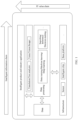
- FIG. 1 is a schematic diagram of an artificial intelligence main framework.
- the main framework describes an overall working procedure of an artificial intelligence system, and is applicable to a requirement of a general artificial intelligence field.
- an "intelligent information chain” (a horizontal axis) and an “IT value chain” (a vertical axis).
- the "intelligent information chain” reflects a series of processes from obtaining data to processing the data.
- the process may be a general process of intelligent information perception, intelligent information representation and formation, intelligent inference, intelligent decision-making, and intelligent execution and output.
- data undergoes a condensation process of "data-information-knowledge-wisdom".
- the "IT value chain” reflects a value brought by artificial intelligence to the information technology industry from an underlying infrastructure and information (providing and processing technology implementation) of human intelligence to an industrial ecological process of a system.
- the infrastructure provides computing capability support for the artificial intelligence system, implements communication with the external world, and implements support by using a base platform.
- a sensor is used to communicate with the outside.
- a computing capability is provided by an intelligent chip (a hardware acceleration chip, for example, a CPU, an NPU, a GPU, an ASIC, or an FPGA).
- the base platform includes related platform assurance and support such as a distributed computing framework and a network, and may include cloud storage and computing, an interconnection and interworking network, and the like.
- the sensor communicates with the outside to obtain data, and the data is provided to an intelligent chip in a distributed computing system for computation, where the distributed computing system is provided by the base platform.
- Data at an upper layer of the infrastructure is used to indicate a data source in the field of artificial intelligence.
- the data relates to a graph, an image, a voice, and text, further relates to internet of things data of a conventional device, and includes service data of an existing system and perception data such as force, displacement, a liquid level, a temperature, and humidity.
- Data processing usually includes manners such as data training, machine learning, deep learning, searching, inference, and decision-making.
- Machine learning and deep learning may mean performing symbolic and formalized intelligent information modeling, extraction, preprocessing, training, and the like on data.
- Inference is a process in which a human intelligent inference manner is simulated in a computer or an intelligent system, and machine thinking and problem resolving are performed by using formal information according to an inference control policy.
- a typical function is searching and matching.
- Decision-making is a process in which a decision is made after intelligent information is inferred, and usually provides functions such as classification, ranking, and prediction.
- a data processing result for example, an algorithm or a general system, such as translation, text analysis, computer vision processing, speech recognition, and image recognition.
- the intelligent product and the industry application are a product and an application of the artificial intelligence system in various fields, and are package of an overall solution of the artificial intelligence, so that decision-making for intelligent information is productized and an application is implemented.
- Application fields mainly include smart manufacturing, smart transportation, smart home, smart health care, smart security protection, autonomous driving, a safe city, a smart terminal, and the like.
- the data processing method provided in embodiments of this application may be applied to parallel training of a deep neural network model in various distributed cluster scenarios.
- a sharding strategy may be independently determined for each operator, a tensor layout is generated, and a slice graph that is of the deep neural network model and that can be executed by a single data processing device is obtained by inserting a redistribution operator.
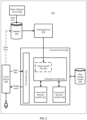
- An embodiment of this application provides a system architecture 200.
- a data collection device 260 is configured to collect data and store the data in a database 230.
- a training device 220 generates a target model/rule 201 based on the data maintained in the database 230.
- the data may be text data, audio data, or image data.
- An image includes a picture and a video.
- a specific data type is not limited herein. The following describes in more detail how the training device 220 obtains the target model/rule 201 based on the data.
- the target model/rule 201 can be used in application scenarios such as text translation, speech recognition, facial recognition, three-dimensional reconstruction, and virtual reality.
- the target model/rule 201 may be obtained based on a deep neural network.
- work at each layer of the deep neural network may be understood as completing transformation from input space to output space (namely, from row space to column space of a matrix) by performing five operations on the input space (a set of input vectors).
- the five operations are as follows: 1. dimension increasing/dimension reduction; 2. scaling up/scaling down; 3. rotation; 4. translation; and 5. "bending”.
- the operation 1, the operation 2, and the operation 3 are performed by W ⁇ x
- the operation 4 is performed by +b
- the operation 5 is performed by a ().
- space is used herein for expression because a classified object is not a single thing, but a type of things. Space refers to a collection of all individuals of such type of things.
- W is a weight vector, and each value in the vector indicates a weight value of one neuron in the neural network at this layer.
- the vector W determines space transformation from the input space to the output space described above. In other words, a weight W at each layer controls how to transform space.
- a purpose of training the deep neural network is to finally obtain a weight matrix (a weight matrix formed by vectors W at a plurality of layers) at all layers of a trained neural network. Therefore, a training process for the neural network is essentially a manner of learning control of space transformation, and more specifically, learning a weight matrix.
- an output of the deep neural network is expected to be as much as possible close to a value that actually wants to be predicted
- a current predicted value of the network and an expected target value are compared, so that a weight vector of each layer of the neural network can be updated based on a difference between the predicted value and the target value (certainly, there is usually an initialization process before first updating, to be specific, a parameter is preconfigured for each layer of the deep neural network). For example, if the predicted value of the network is large, the weight vector is adjusted to obtain a smaller predicted value, and is continuously adjusted until the neural network can predict the expected target value. Therefore, "how to obtain, through comparison, a difference between the predicted value and the target value" needs to be predefined.
- loss function This is a loss function (loss function) or an objective function (objective function).
- the loss function and the objective function are important equations that measure the difference between the predicted value and the target value.
- the loss function is used as an example. A higher output value (loss) of the loss function indicates a larger difference. Therefore, training of the deep neural network is a process of minimizing the loss as much as possible.
- the training device 220 may generate, for different targets, corresponding target models/rules 201 based on different data, to provide a better result for the user.
- the execution device 210 and the client device 240 may alternatively be a same physical device, and the physical device may implement all functions of the execution device 210 and the client device 240.
- the training device 220, the execution device 210, and the client device 240 are a same physical device, and the physical device implements all functions of the training device 220, the execution device 210, and the client device 240.
- a specific scenario architecture in this embodiment of this application is not limited herein.
- sharding may be performed based on any dimension of all tensors in the model, but device matrices of all the tensors need be the same. Because the Mesh-Tensorflow solution requires that the device matrices of all the tensors be the same, tensor maps have constraints. For example, sample dimensions of all the tensors need to be mapped to a same dimension of the device matrices of all the tensors, which restricts conversion of a plurality of parallelism manners. For example, hybrid parallelism of data parallelism and model parallelism cannot be implemented. Tensor sharding cannot be performed for each operator separately, and overall communication efficiency of the parallelism solution is low.
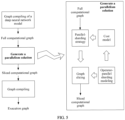
- FIG. 3 is a schematic diagram of a computational graph according to an embodiment of this application.
- FIG. 5 is a schematic diagram of an application scenario according to an embodiment of this application.
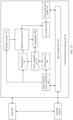
- the data processing method provided in embodiments of this application is mainly used to generate the parallelism solution, and the parallelism solution specifically includes an operator-parallel sharding modeling module, a cost model module, a parallel-sharding strategy, and a graph slicing module.
- the operator-parallel sharding modeling module is configured to generate a plurality of candidate sharding strategies and overall operator tensor layouts of the corresponding deep neural network model.
- the cost model module may determine a target sharding strategy from the plurality of candidate sharding strategies based on overheads.
- the parallel-sharding strategy module is configured to insert a redistribution operator.
- the graph slicing module performs graph slicing based on an updated deep neural network model into which the redistribution operator is inserted and tensor layouts of each operator, to obtain the sliced computational graph.
- a data processing device obtains a deep neural network model and a sharding strategy.
- the data processing device inserts a redistribution operator between consecutive operators having different tensor layouts.
- a first operator and a second operator are two consecutive operators in the full forward graph of the deep neural network model, and a tensor layout (tensor_layout_from) of an output tensor of the first operator is inconsistent with a tensor layout (tensor_layout_to) of an input tensor of the second operator.
- the data processing device cannot perform the tensor slices determined in step 602.
- the redistribution (redistribution) operator is inserted between the first operator and the second operator.
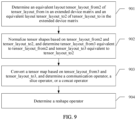
- the data processing device normalizes the device matrices, and determines a first equivalent tensor layout (tensor_layout_from2) of tensor_layout_from and a second equivalent tensor layout (tensor_layout_to2) of tensor_layout_to, where a device arrangement of tensor_layout_from2 is consistent with a device arrangement of tensor_layout_to2.
- Conversion between equivalent tensor layouts can be implemented by using a reshape (reshape) operator. For example, tensor_layout_from is converted into tensor_layout_from2 by using the reshape operator.
- the data processing device normalizes the tensor shapes, and determines a third equivalent tensor layout (tensor_layout_from3) of tensor_layout_from and a fourth equivalent tensor layout (tensor_layout_to3) of tensor_layout_to, where a tensor shape of tensor_layout_from3 is consistent with a tensor shape of tensor_layout_to3.
- Conversion between equivalent tensor layouts can be implemented by using a reshape (reshape) operator.
- tensor_layout_from2 is converted into tensor_layout_from3 by using the reshape operator.
- the tensor shapes are consistent, and tensor maps are inconsistent, or if the device arrangements of tensor_layout_from2 and tensor_layout_to2 are consistent, the tensor shapes are consistent, and tensor maps are inconsistent, or if device arrangements of tensor_layout_from3 and tensor_layout_to3 are consistent, the tensor shapes are consistent, and tensor maps are inconsistent, a tensor map conversion operator such as a slice (slice) operator, a concat (concat) operator, or a communication operator is inserted between tensors whose tensor shapes are inconsistent.
- a tensor map conversion operator such as a slice (slice) operator, a concat (concat) operator, or a communication operator is inserted between tensors whose tensor shapes are inconsistent.
- the communication operator includes an alltoall operator, an allgather operator, and the like.
- the tensor map conversion operator may be used to implement conversion between tensors whose tensor maps are different, for example, conversion from tensor_layout_from3 to tensor_layout_to3. It may be understood that tensor layouts of an operator may be obtained when the communication operator or the slice operator is generated.
- the data processing device Based on a specific case in which tensor_layout_from is inconsistent with tensor_layout_to, the data processing device generates one or more of the reshape operator, the slice operator, the concat operator, the alltoall operator, and the allgather operator.
- the redistribution (redistribution) operator may include a single operator or a redistribution operator sequence including a plurality of operators. A specific quantity of operators and an operator type are not limited herein.
- the redistribution operator may be used to convert tensor_layout_from to tensor_layout_to.
- an executable updated deep neural network model may be determined by inserting redistribution operators between each group of first operators and each group of second operators.
- the data processing device may directly obtain the redistribution operator that needs to be inserted between the first operator and the second operator.
- the redistribution operator may be inserted between the first operator and the second operator in a sequence.
- the data processing device updates the sliced computational graph based on the redistribution operator, and determines an updated sliced computational graph.
- the data processing device updates the sliced computational graph based on the redistribution operator, and then generates a slice execution graph based on a graph compilation procedure by using procedures such as automatic differentiation and graph optimization.
- a single data processing device executes, based on a corresponding slice execution graph, a part of a process of training the deep neural network model.
- each data processing device in the distributed cluster may obtain a sliced computational graph of the data processing device, generate an execution graph by using the sliced computational graph, and execute the part of the process of training the deep neural network model.
- the data processing device obtains the deep neural network model and tensor layouts of all operators in the deep neural network model, including the tensor layout of the input tensor and the tensor layout of the output tensor. If there are two consecutive operators, and the tensor layout of the output tensor of the first operator is inconsistent with the tensor layout of the input tensor of the second operator, the sliced computational graph obtained based on the tensor layouts cannot be performed.
- the data processing device determines the redistribution operator between the first operator and the second operator, and the redistribution operator is used to convert the tensor layout of the output tensor of the first operator into the tensor layout of the input tensor of the second operator. Therefore, the redistribution operator is inserted into the sliced computational graph, and the determined updated sliced computational graph may be executed.
- the solution may be applied to tensor layouts of any given operator. Conversion between parallelism manners is implemented by using the redistribution operator, so that various types of hybrid parallelism can be implemented in the distributed cluster.
- the data processing method provided in this embodiment of this application supports a flexible tensor sharding parallelism manner.
- Each operator is modeled independently and may be sharded in all dimensions of a tensor.
- Tensor layouts of operators are converted by using a redistribution operator sequence.
- An existing Mesh-Tensorflow method is modeled on the entire deep neural network, and cannot support conversion of a parallelism mode between operators.
- a hybrid parallelism manner 1 converting a channel (Channel) model parallelism to batch (batch) data parallelism is a parallel training manner commonly used by a deep learning recommendation model (deep learning recommendation model, DLRM).
- DLRM deep learning recommendation model
- the Mesh-Tensorflow method cannot support free switching of a parallelism mode between operators.
- a redistribution operator generation apparatus is used, so that any redistribution operator required for converting tensor layouts can be generated, and flexible sharding strategy configuration at an operator level can be supported.
- a hybrid parallelism manner 2 superimposing data parallelism and model parallelism is a common parallelism manner of a Transformer network.
- An existing solution cannot support full-dimension tensor sharding. Therefore, this sharding scenario cannot be supported. In this application, tensor sharding in each dimension may be supported.
- Any specified parallelism policy for example, conversion from data parallelism to model parallelism, may be supported by using the method provided in this application.
- FIG. 8 is a schematic diagram of another embodiment of a data processing method according to an embodiment of this application.
- FIG. 12 is a schematic diagram of another embodiment of determining an overall tensor layout according to an embodiment of this application.
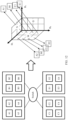
- the tensor M is mapped to D0 and D1 planes. It is assumed that a row of the tensor M is a sample dimension, and the row is mapped to a D0 dimension.
- the sample dimension has a lower requirement on communication.
- data processing devices between servers are arranged in the D0 dimension, and devices inside the servers are arranged in other dimensions.
- A1, B1, C1, and E1 are data processing devices in different servers, and therefore are arranged along a D0 axis of the device matrix.
- A1 and A2 are two data processing devices inside a same server, and therefore are arranged along a D1 axis or a D2 axis.
- the device matrix is used to express a cluster topology relationship, which can flexibly adapt to various hierarchical combined network topology structures. A communication delay is reduced.
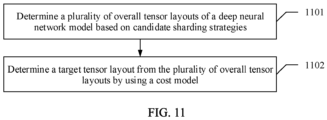
- the sharding strategy is determined from the plurality of candidate sharding strategies, tensor layouts of each operator in the deep neural network model are obtained based on the candidate sharding strategy, and a redistribution operator between consecutive tensors with different tensor layouts is generated. Therefore, the tensor layouts of all the operators in the deep neural network model may be obtained, which are referred to as an overall tensor layout for short. It may be understood that the plurality of overall tensor layouts may be obtained based on the sharding strategies.
- the cost model (cost model) is calculated based on each overall tensor layout.
- the cost model considers operator overheads and redistribution operator overheads. Specifically, the tensor shape is used to approximate measurement of storage overheads, computation overheads, and communication overheads of the operator.
- a weight coefficient is used to control proportions of the computation overheads and the communication overheads in a loss function to adapt to different device platforms.
- a candidate sharding strategy with a minimum cost model is determined from the plurality of candidate sharding strategies as the target sharding strategy, to perform graph slicing.
- the optimal overall tensor layout is determined from the plurality of overall tensor layouts, to perform the embodiment corresponding to FIG. 6 .
- an optimal sharding strategy is determined based on the plurality of overall tensor layouts, and the overall tensor layout is generated based on the optimal sharding strategy and according to the preset rule, to perform the embodiment corresponding to FIG. 6 .
- a complete single-machine forward computational graph is input, a sliced computational forward graph is output, and a redistribution operator is inserted into the sliced forward graph.
- the output sliced computational forward graph generates a backward computational graph through automatic differentiation.
- the candidate sharding strategy with a minimum loss in the plurality of candidate sharding strategies determined by using the cost model is determined based on a value obtained by performing weighted summation on a size of a data tensor in the overall tensor layout, a size of a communication tensor in the overall tensor layout, and a size of a parameter tensor in the overall tensor layout, and a weight coefficient of the size of the data tensor, a weight coefficient of the size of the communication tensor, and a weight coefficient of the size of the parameter tensor.
- the size of the data tensor, the size of the communication tensor, and the size of the parameter tensor are respectively storage space of the data tensor, storage space of the communication tensor, and storage space of the parameter tensor that are required to execute the deep neural network model based on the first candidate sharding strategy.
- Loss function defined by a cost model alpha x size of a data tensor of an input operator + beta x size of a communication tensor + gamma x size of a parameter tensor of the operator, where alpha represents a weight coefficient of the size of the data tensor, beta represents a weight coefficient of the size of the communication tensor, and gamma represents a weight coefficient of the size of the parameter tensor.
- alpha represents a weight coefficient of the size of the data tensor
- beta represents a weight coefficient of the size of the communication tensor
- gamma represents a weight coefficient of the size of the parameter tensor.
- Specific values of alpha, beta, and gamma are not limited herein.
- values of alpha, beta, and gamma may be flexibly set based on different types of data processing devices.
- Operators in a cost model include a redistribution operator sequence. For different sharding strategies, overheads of operators are different, and overheads of redistribution operator sequences between operators are also different.
- the overheads herein include storage overheads and communication overheads.
- a storage overhead upper limit is set based on an actual memory size of a device, and an operator sharding strategy combination with minimum computation overheads is searched for.
- storage overheads and computation overheads are approximately estimated based on shapes of tensors input by forward and reverse operators.
- a proportion relationship between alpha, beta, and gamma is adjusted to adapt to different hardware platforms. For example, increasing beta means increasing a proportion of the communication overheads and reducing a communication volume required by a found policy.
- an operator may be independently modeled, and a tensor layout of an input tensor of the operator and a tensor layout of an output tensor of the operator are configured.
- a redistribution operator generation module generates the redistribution operator required for tensor layout conversion between operators.
- the cost model considers both the operator overheads and the redistribution operator overheads, and uses the tensor shape to approximate the storage overheads, the computation overheads, and the communication overheads of the operator.
- the weight coefficient is used to control the proportions of the computation overheads and the communication overheads in the loss function to adapt to different device platforms.
- the complete single-machine forward computational graph may be input, the sliced computational forward graph may be output, and other operators such as the redistribution operator and an AllReduce operator may be inserted into the sliced forward graph.
- the output sliced computational forward graph generates the backward computational graph through automatic differentiation.
- each operator is independently modeled, and a redistribution operator sequence is inserted between operators.
- This can adapt to requirements of various common networks for hybrid parallelism, and compensate for a disadvantage of supporting a network type in the conventional technology.
- the cost model considers both the operator overheads and the redistribution overheads, and can search for a parallelism solution with minimum overall overheads.
- the tensor shape is used to approximate the computation overheads, and approximate actual overheads without a large number of tests, achieving platform-independent.
- the weight coefficient is used to control the proportion of communication calculation to adapt to different device platforms. There is no need to generate a reverse computing network, and use automatic differentiation and graph optimization functions. Tensor redistribution supports conversion of any tensor layout, and conversion overheads are low. Support of conversion of any tensor layout enables independent and flexible modeling of an operator. Tensor redistribution may be used for distribution and conversion between operators and distributed implementation of reshape operators. In topology-aware scheduling in this application, a device matrix in a Tensor Layout is adjusted, so that batch dimensions that are insensitive to communication delay and bandwidth are placed between servers in parallel, and the model is sharded into slices and the slices are placed inside the servers. The device matrix is configured to easily and flexibly adapt to different cluster topologies.
- FIG. 13 is a schematic diagram of an embodiment of a data processing device according to an embodiment of this application.
- the data processing device provided in this embodiment of this application is applied to a distributed cluster, and the device includes:
- a device matrix of the first tensor layout is inconsistent with a device matrix of the second tensor layout, and/or a tensor map of the first tensor layout is inconsistent; and the determining unit 1302 is specifically configured to:
- the device matrix of the first tensor layout is inconsistent with the device matrix of the second tensor layout; the determining unit 1302 is specifically configured to:
- the tensor shape of the first equivalent tensor layout is consistent with the tensor shape of the second equivalent tensor layout, and a tensor map of the first equivalent tensor layout is inconsistent with a tensor map of the second equivalent tensor layout; and the determining unit 1302 is further configured to determine one or more tensor map conversion operators, where the tensor map conversion operator includes a slice operator, a concat operator, or a communication operator, a tensor layout of an input tensor of the one or more tensor map conversion operators is consistent with the first equivalent tensor layout, a tensor layout of an output tensor of the one or more tensor map conversion operators is consistent with the second equivalent tensor layout, and the one or more tensor map conversion operators are used to determine the updated sliced computational graph.
- the tensor map conversion operator includes a slice operator, a concat operator, or a communication operator
- the determining unit 1302 is further configured to: normalize the tensor shapes based on the first equivalent tensor layout and the second equivalent tensor layout, and determine a third equivalent tensor layout equivalent to the first equivalent tensor layout and a fourth equivalent tensor layout equivalent to the second equivalent tensor layout, where a device matrix of the third equivalent tensor layout is consistent with a device matrix of the fourth equivalent tensor layout, and a tensor shape of the third equivalent tensor layout is consistent with a tensor shape of the fourth equivalent tensor layout; and the intermediate tensor layout includes the third equivalent tensor layout and the fourth equivalent tensor layout.
- a tensor map of the third equivalent tensor layout is inconsistent with a tensor map of the fourth equivalent tensor layout; and the determining unit 1302 is further configured to determine one or more tensor map conversion operators, where the tensor map conversion operator includes a slice operator, a concat operator, or a communication operator, a tensor layout of an input tensor of the one or more tensor map conversion operators is consistent with the third equivalent tensor layout, a tensor layout of an output tensor of the one or more tensor map conversion operators is consistent with the fourth equivalent tensor layout, and the one or more tensor map conversion operators are used to determine the updated sliced computational graph.
- the device matrix of the first tensor layout is consistent with the device matrix of the second tensor layout, and the tensor shape of the first tensor layout is inconsistent with the tensor shape of the second tensor layout; and the determining unit 1302 is specifically configured to determine, based on the first tensor layout and the second tensor layout, a fifth equivalent tensor layout equivalent to the first tensor layout and a sixth equivalent tensor layout equivalent to the second equivalent tensor layout, where a device matrix of the fifth equivalent tensor layout is consistent with a device matrix of the sixth equivalent tensor layout, and a tensor shape of the fifth equivalent tensor layout is consistent with a tensor shape of the sixth equivalent tensor layout; and the intermediate tensor layout includes the fifth equivalent tensor layout and the sixth equivalent tensor layout.
- a tensor map of the fifth equivalent tensor layout is inconsistent with a tensor map of the sixth equivalent tensor layout; and the determining unit 1302 is further configured to determine one or more tensor map conversion operators, where the tensor map conversion operator includes a slice operator, a concat operator, or a communication operator, a tensor layout of an input tensor of the one or more tensor map conversion operators is consistent with the fifth equivalent tensor layout, a tensor layout of an output tensor of the one or more tensor map conversion operators is consistent with the sixth equivalent tensor layout, and the one or more tensor map conversion operators are used to determine the updated sliced computational graph.
- a device matrix of the first tensor layout is consistent with a device matrix of the second tensor layout
- a tensor shape of the first tensor layout is consistent with a tensor shape of the second tensor layout
- a tensor map of the first tensor layout is inconsistent with a tensor map of the second tensor layout
- the determining unit 1302 is specifically configured to: determine one or more tensor map conversion operators, where the tensor map conversion operator includes a slice operator, a concat operator, or a communication operator, and the one or more tensor map conversion operators are used to input the output tensor of the first operator and output the input tensor of the second operator.
- the obtaining unit 1301 is specifically configured to:
- the sharding strategy includes a first sharding strategy and a second sharding strategy; and the determining unit 1302 is specifically configured to:
- a cost model of the first overall tensor layout is less than a cost model of the second overall tensor layout
- the cost model of the first overall tensor layout is a value obtained by performing weighted summation based on a size of a data tensor in the first overall tensor layout, a size of a communication tensor in the first overall tensor layout, and a size of a parameter tensor in the first overall tensor layout, and a weight coefficient of the size of the data tensor, a weight coefficient of the size of the communication tensor, and a weight coefficient of the size of the parameter tensor
- the cost model of the second overall tensor layout is a value obtained by performing weighted summation based on a size of a data tensor in the second overall tensor layout, a size of a communication tensor in the second overall tensor layout, and a size of a parameter tens
- the sharding strategy is a sharding strategy specified by a user.
- the data processing device provided in this embodiment may be a processor, a server, a dedicated data processing device, or the like.
- a specific form of the device is not limited in this embodiment of this application.
Landscapes
- Engineering & Computer Science (AREA)
- Physics & Mathematics (AREA)
- Theoretical Computer Science (AREA)
- General Physics & Mathematics (AREA)
- Mathematical Physics (AREA)
- Data Mining & Analysis (AREA)
- Software Systems (AREA)
- General Engineering & Computer Science (AREA)
- Computing Systems (AREA)
- Biophysics (AREA)
- Biomedical Technology (AREA)
- Life Sciences & Earth Sciences (AREA)
- Health & Medical Sciences (AREA)
- Computational Linguistics (AREA)
- General Health & Medical Sciences (AREA)
- Evolutionary Computation (AREA)
- Artificial Intelligence (AREA)
- Molecular Biology (AREA)
- Computational Mathematics (AREA)
- Mathematical Analysis (AREA)
- Mathematical Optimization (AREA)
- Pure & Applied Mathematics (AREA)
- Databases & Information Systems (AREA)
- Algebra (AREA)
- Neurology (AREA)
- Complex Calculations (AREA)
- Document Processing Apparatus (AREA)
- Machine Translation (AREA)
- Character Discrimination (AREA)
- Information Retrieval, Db Structures And Fs Structures Therefor (AREA)
Applications Claiming Priority (3)
| Application Number | Priority Date | Filing Date | Title |
|---|---|---|---|
| CN202010231450.7A CN113449857B (zh) | 2020-03-27 | 2020-03-27 | 一种数据处理方法和数据处理设备 |
| PCT/CN2021/074108 WO2021190127A1 (zh) | 2020-03-27 | 2021-01-28 | 一种数据处理方法和数据处理设备 |
| EP21776526.2A EP4123515B1 (de) | 2020-03-27 | 2021-01-28 | Datenverarbeitungsverfahren und datenverarbeitungsvorrichtung |
Related Parent Applications (2)
| Application Number | Title | Priority Date | Filing Date |
|---|---|---|---|
| EP21776526.2A Division-Into EP4123515B1 (de) | 2020-03-27 | 2021-01-28 | Datenverarbeitungsverfahren und datenverarbeitungsvorrichtung |
| EP21776526.2A Division EP4123515B1 (de) | 2020-03-27 | 2021-01-28 | Datenverarbeitungsverfahren und datenverarbeitungsvorrichtung |
Publications (2)
| Publication Number | Publication Date |
|---|---|
| EP4583007A2 true EP4583007A2 (de) | 2025-07-09 |
| EP4583007A3 EP4583007A3 (de) | 2025-08-27 |
Family
ID=77808058
Family Applications (2)
| Application Number | Title | Priority Date | Filing Date |
|---|---|---|---|
| EP21776526.2A Active EP4123515B1 (de) | 2020-03-27 | 2021-01-28 | Datenverarbeitungsverfahren und datenverarbeitungsvorrichtung |
| EP24222807.0A Pending EP4583007A3 (de) | 2020-03-27 | 2021-01-28 | Datenverarbeitungsverfahren und datenverarbeitungsvorrichtung |
Family Applications Before (1)
| Application Number | Title | Priority Date | Filing Date |
|---|---|---|---|
| EP21776526.2A Active EP4123515B1 (de) | 2020-03-27 | 2021-01-28 | Datenverarbeitungsverfahren und datenverarbeitungsvorrichtung |
Country Status (4)
| Country | Link |
|---|---|
| US (1) | US20230023101A1 (de) |
| EP (2) | EP4123515B1 (de) |
| CN (4) | CN113449857B (de) |
| WO (1) | WO2021190127A1 (de) |
Families Citing this family (39)
| Publication number | Priority date | Publication date | Assignee | Title |
|---|---|---|---|---|
| JP7657828B2 (ja) | 2020-05-01 | 2025-04-07 | マジック リープ, インコーポレイテッド | 階層正規化がかけられる画像記述子ネットワーク |
| US20240235669A1 (en) * | 2021-03-24 | 2024-07-11 | Tektronix, Inc. | Systems and methods for tuning and measuring a device under test using machine learning |
| CN113961351B (zh) | 2021-10-28 | 2022-12-30 | 北京百度网讯科技有限公司 | 深度学习模型的分布式训练方法、装置、设备及存储介质 |
| CN114004335B (zh) * | 2021-10-28 | 2025-07-01 | 上海商汤科技开发有限公司 | 一种数据处理的方法、装置、电子设备及存储介质 |
| CN114091589B (zh) * | 2021-11-11 | 2022-08-09 | 北京百度网讯科技有限公司 | 模型训练方法、装置、电子设备及介质 |
| CN114186633B (zh) * | 2021-12-10 | 2023-04-07 | 北京百度网讯科技有限公司 | 模型的分布式训练方法、装置、设备以及存储介质 |
| WO2023122854A1 (zh) * | 2021-12-27 | 2023-07-06 | 华为技术有限公司 | 数据处理的方法和装置 |
| CN114491399B (zh) * | 2021-12-30 | 2025-06-13 | 深圳云天励飞技术股份有限公司 | 数据处理方法、装置、终端设备及计算机可读存储介质 |
| CN116501325A (zh) * | 2022-01-17 | 2023-07-28 | 华为技术有限公司 | 一种算子的处理方法及计算机设备 |
| CN116888601A (zh) * | 2022-01-28 | 2023-10-13 | 华为技术有限公司 | 处理计算任务方法及装置 |
| KR20230118486A (ko) * | 2022-02-04 | 2023-08-11 | 주식회사 마키나락스 | 반도체 소자의 배치를 평가하는 방법 |
| CN114429211A (zh) * | 2022-02-07 | 2022-05-03 | 北京百度网讯科技有限公司 | 用于生成信息的方法、装置、设备、介质和产品 |
| US20230259758A1 (en) * | 2022-02-16 | 2023-08-17 | Moffett International Co., Limited | Adaptive tensor compute kernel for sparse neural network |
| CN114186687B (zh) | 2022-02-17 | 2022-05-17 | 之江实验室 | 一种面向神经网络模型计算的中间表示方法和装置 |
| CN114611675B (zh) * | 2022-03-22 | 2025-05-27 | 浙江大学 | 数据处理方法、装置、电子装置和存储介质 |
| US20230315802A1 (en) * | 2022-03-31 | 2023-10-05 | SambaNova Systems, Inc. | Compiler optimization of dataflow applications using mixed integer equations |
| US20230325251A1 (en) * | 2022-04-07 | 2023-10-12 | Micron Technology, Inc. | Partition a Tensor with Varying Granularity Levels in Shuffled Secure Multiparty Computation |
| CN114598631B (zh) | 2022-04-28 | 2022-08-09 | 之江实验室 | 面向神经网络计算的分布式数据路由的建模方法和装置 |
| CN114925830B (zh) * | 2022-05-31 | 2025-08-19 | 展讯通信(天津)有限公司 | 一种算子编译方法、装置和电子设备 |
| CN115033292A (zh) * | 2022-06-16 | 2022-09-09 | 北京火山引擎科技有限公司 | 模型训练方法及装置 |
| CN115186821B (zh) * | 2022-09-13 | 2023-01-06 | 之江实验室 | 面向芯粒的神经网络推理开销估计方法及装置、电子设备 |
| CN117827419A (zh) * | 2022-09-29 | 2024-04-05 | 华为技术有限公司 | 一种基于多裸片的计算方法及相关设备 |
| CN115660049B (zh) * | 2022-11-02 | 2023-07-25 | 北京百度网讯科技有限公司 | 模型处理方法、装置、电子设备以及存储介质 |
| US20240168831A1 (en) * | 2022-11-16 | 2024-05-23 | Nvidia Corporation | Application programming interface to translate a tensor according to a tensor map |
| CN118277711A (zh) * | 2022-12-31 | 2024-07-02 | 北京希姆计算科技有限公司 | 一种算子切分方法、装置和算子编译系统 |
| CN116187387A (zh) * | 2023-02-22 | 2023-05-30 | 哲库科技(上海)有限公司 | 神经网络模型量化方法、装置、计算机设备和存储介质 |
| CN116402089B (zh) * | 2023-03-31 | 2025-12-23 | 芯动微电子科技(武汉)有限公司 | 一种onnx神经网络面向后端部署转换方法与装置 |
| CN116402127A (zh) * | 2023-04-03 | 2023-07-07 | 南京大学 | 一种用于深度学习模型训练的框架系统构建方法 |
| CN116596035A (zh) * | 2023-04-25 | 2023-08-15 | 华东交通大学 | 一种神经网络训练的并行方法 |
| CN116227585B (zh) * | 2023-05-10 | 2023-07-25 | 之江实验室 | 集群任务的并行执行方法、装置、计算机设备和存储介质 |
| CN116467061B (zh) * | 2023-06-19 | 2023-09-19 | 之江实验室 | 一种任务执行的方法、装置、存储介质及电子设备 |
| CN116796289A (zh) * | 2023-07-13 | 2023-09-22 | 上海壁仞智能科技有限公司 | 算子处理方法、装置、电子设备及存储介质 |
| CN117827523B (zh) * | 2024-03-05 | 2024-05-14 | 北京壁仞科技开发有限公司 | 一种模型的异常处理方法、装置、电子设备及存储介质 |
| CN120952087A (zh) * | 2024-05-14 | 2025-11-14 | 华为云计算技术有限公司 | 模型训练的方法、装置以及计算设备 |
| CN118733282B (zh) * | 2024-09-02 | 2025-02-18 | 山东浪潮科学研究院有限公司 | 一种基于异构设备的分布式训练方法、装置、设备及介质 |
| US12361262B1 (en) * | 2024-10-22 | 2025-07-15 | Etched.Ai Inc. | Tensor operations in AI models |
| CN119046123B (zh) * | 2024-11-01 | 2025-02-21 | 上海燧原科技股份有限公司 | 用于分布式系统建模的基准测试生成方法、装置及设备 |
| CN119783812B (zh) * | 2024-12-06 | 2025-10-31 | 湖南大学 | 面向新一代异构超算大模型并行训练与推理适配优化方法 |
| CN121029422B (zh) * | 2025-10-28 | 2026-02-03 | 无锡九方科技有限公司 | 一种并行环境的gpu程序优化方法 |
Family Cites Families (8)
| Publication number | Priority date | Publication date | Assignee | Title |
|---|---|---|---|---|
| US11094029B2 (en) * | 2017-04-10 | 2021-08-17 | Intel Corporation | Abstraction layers for scalable distributed machine learning |
| US12086705B2 (en) * | 2017-12-29 | 2024-09-10 | Intel Corporation | Compute optimization mechanism for deep neural networks |
| CN110321999B (zh) * | 2018-03-30 | 2021-10-01 | 赛灵思电子科技(北京)有限公司 | 神经网络计算图优化方法 |
| US10796225B2 (en) * | 2018-08-03 | 2020-10-06 | Google Llc | Distributing tensor computations across computing devices |
| CN109491784B (zh) * | 2018-10-18 | 2021-01-22 | 北京旷视科技有限公司 | 降低内存占用量的方法、装置、电子设备、可读存储介质 |
| CN110490309B (zh) * | 2019-08-14 | 2022-06-07 | 中科寒武纪科技股份有限公司 | 一种用于神经网络的算子融合方法及其相关产品 |
| CN110689121A (zh) * | 2019-09-24 | 2020-01-14 | 上海寒武纪信息科技有限公司 | 一种用多核处理器实现神经网络模型拆分方法及相关产品 |
| CN110689115B (zh) * | 2019-09-24 | 2023-03-31 | 安徽寒武纪信息科技有限公司 | 神经网络模型处理方法、装置、计算机设备及存储介质 |
-
2020
- 2020-03-27 CN CN202010231450.7A patent/CN113449857B/zh active Active
- 2020-03-27 CN CN202210945896.5A patent/CN115456160A/zh active Pending
- 2020-03-27 CN CN202210945901.2A patent/CN115456161A/zh active Pending
- 2020-03-27 CN CN202210945064.3A patent/CN115456159A/zh active Pending
-
2021
- 2021-01-28 EP EP21776526.2A patent/EP4123515B1/de active Active
- 2021-01-28 WO PCT/CN2021/074108 patent/WO2021190127A1/zh not_active Ceased
- 2021-01-28 EP EP24222807.0A patent/EP4583007A3/de active Pending
-
2022
- 2022-09-26 US US17/952,848 patent/US20230023101A1/en active Pending
Also Published As
| Publication number | Publication date |
|---|---|
| CN113449857B (zh) | 2022-08-19 |
| CN113449857A (zh) | 2021-09-28 |
| US20230023101A1 (en) | 2023-01-26 |
| EP4123515B1 (de) | 2025-08-27 |
| CN115456161A (zh) | 2022-12-09 |
| CN115456159A (zh) | 2022-12-09 |
| EP4583007A3 (de) | 2025-08-27 |
| EP4123515A4 (de) | 2023-06-28 |
| WO2021190127A1 (zh) | 2021-09-30 |
| CN115456160A (zh) | 2022-12-09 |
| EP4123515A1 (de) | 2023-01-25 |
Similar Documents
| Publication | Publication Date | Title |
|---|---|---|
| EP4123515B1 (de) | Datenverarbeitungsverfahren und datenverarbeitungsvorrichtung | |
| CN113449859B (zh) | 一种数据处理方法及其装置 | |
| CN110175671B (zh) | 神经网络的构建方法、图像处理方法及装置 | |
| US20230082597A1 (en) | Neural Network Construction Method and System | |
| EP4152212A1 (de) | Datenverarbeitungsverfahren und -vorrichtung | |
| CN112541159A (zh) | 一种模型训练方法及相关设备 | |
| CN110659667A (zh) | 图片分类模型训练方法、系统和计算机设备 | |
| CN111797970B (zh) | 训练神经网络的方法和装置 | |
| US12511518B2 (en) | Parameter updating method and apparatus and storage medium | |
| US12443823B1 (en) | Neural network processing based on subgraph recognition | |
| WO2023164933A1 (zh) | 一种建筑物建模方法以及相关装置 | |
| CN112163601A (zh) | 图像分类方法、系统、计算机设备及存储介质 | |
| EP4579615A1 (de) | Aktionsvorhersageverfahren und zugehörige vorrichtung dafür | |
| WO2021120177A1 (zh) | 编译神经网络模型的方法和装置 | |
| US20240185573A1 (en) | Image classification method and related device thereof | |
| WO2023122854A1 (zh) | 数据处理的方法和装置 | |
| CN114169393A (zh) | 一种图像分类方法及其相关设备 | |
| CN113869496A (zh) | 一种神经网络的获取方法、数据处理方法以及相关设备 | |
| CN114707643A (zh) | 一种模型切分方法及其相关设备 | |
| WO2024140630A1 (zh) | 一种模型训练方法及其相关设备 | |
| Patil et al. | Artificial intelligence and machine learning techniques for diabetes healthcare: A review | |
| US20250371855A1 (en) | Image processing method and related device thereof | |
| CN116362301A (zh) | 一种模型的量化方法以及相关设备 | |
| CN114821214A (zh) | 一种模型处理方法和装置 | |
| CN113807263B (zh) | 一种图像中字段的处理方法及其相关设备 |
Legal Events
| Date | Code | Title | Description |
|---|---|---|---|
| PUAI | Public reference made under article 153(3) epc to a published international application that has entered the european phase |
Free format text: ORIGINAL CODE: 0009012 |
|
| STAA | Information on the status of an ep patent application or granted ep patent |
Free format text: STATUS: THE APPLICATION HAS BEEN PUBLISHED |
|
| AC | Divisional application: reference to earlier application |
Ref document number: 4123515 Country of ref document: EP Kind code of ref document: P |
|
| AK | Designated contracting states |
Kind code of ref document: A2 Designated state(s): AL AT BE BG CH CY CZ DE DK EE ES FI FR GB GR HR HU IE IS IT LI LT LU LV MC MK MT NL NO PL PT RO RS SE SI SK SM TR |
|
| REG | Reference to a national code |
Ref country code: DE Ref legal event code: R079 Free format text: PREVIOUS MAIN CLASS: G06N0003098000 Ipc: G06F0017160000 |
|
| PUAL | Search report despatched |
Free format text: ORIGINAL CODE: 0009013 |
|
| AK | Designated contracting states |
Kind code of ref document: A3 Designated state(s): AL AT BE BG CH CY CZ DE DK EE ES FI FR GB GR HR HU IE IS IT LI LT LU LV MC MK MT NL NO PL PT RO RS SE SI SK SM TR |
|
| RIC1 | Information provided on ipc code assigned before grant |
Ipc: G06F 17/16 20060101AFI20250718BHEP Ipc: G06N 3/063 20230101ALI20250718BHEP Ipc: G06N 3/098 20230101ALI20250718BHEP Ipc: G06N 3/10 20060101ALI20250718BHEP |