EP4583005A1 - Verfahren und vorrichtung mit ki-modelltraining unter verwendung von domänenähnlichkeit - Google Patents
Verfahren und vorrichtung mit ki-modelltraining unter verwendung von domänenähnlichkeit Download PDFInfo
- Publication number
- EP4583005A1 EP4583005A1 EP25150247.2A EP25150247A EP4583005A1 EP 4583005 A1 EP4583005 A1 EP 4583005A1 EP 25150247 A EP25150247 A EP 25150247A EP 4583005 A1 EP4583005 A1 EP 4583005A1
- Authority
- EP
- European Patent Office
- Prior art keywords
- gradient
- model
- trained
- image
- similarity
- Prior art date
- Legal status (The legal status is an assumption and is not a legal conclusion. Google has not performed a legal analysis and makes no representation as to the accuracy of the status listed.)
- Pending
Links
Images


Classifications
-
- G—PHYSICS
- G06—COMPUTING OR CALCULATING; COUNTING
- G06N—COMPUTING ARRANGEMENTS BASED ON SPECIFIC COMPUTATIONAL MODELS
- G06N3/00—Computing arrangements based on biological models
- G06N3/02—Neural networks
- G06N3/08—Learning methods
- G06N3/084—Backpropagation, e.g. using gradient descent
-
- G—PHYSICS
- G06—COMPUTING OR CALCULATING; COUNTING
- G06N—COMPUTING ARRANGEMENTS BASED ON SPECIFIC COMPUTATIONAL MODELS
- G06N3/00—Computing arrangements based on biological models
- G06N3/02—Neural networks
- G06N3/08—Learning methods
- G06N3/096—Transfer learning
-
- G—PHYSICS
- G06—COMPUTING OR CALCULATING; COUNTING
- G06N—COMPUTING ARRANGEMENTS BASED ON SPECIFIC COMPUTATIONAL MODELS
- G06N20/00—Machine learning
-
- G—PHYSICS
- G06—COMPUTING OR CALCULATING; COUNTING
- G06F—ELECTRIC DIGITAL DATA PROCESSING
- G06F18/00—Pattern recognition
- G06F18/20—Analysing
- G06F18/22—Matching criteria, e.g. proximity measures
-
- G—PHYSICS
- G06—COMPUTING OR CALCULATING; COUNTING
- G06N—COMPUTING ARRANGEMENTS BASED ON SPECIFIC COMPUTATIONAL MODELS
- G06N3/00—Computing arrangements based on biological models
- G06N3/02—Neural networks
- G06N3/04—Architecture, e.g. interconnection topology
- G06N3/045—Combinations of networks
- G06N3/0455—Auto-encoder networks; Encoder-decoder networks
-
- G—PHYSICS
- G06—COMPUTING OR CALCULATING; COUNTING
- G06N—COMPUTING ARRANGEMENTS BASED ON SPECIFIC COMPUTATIONAL MODELS
- G06N3/00—Computing arrangements based on biological models
- G06N3/02—Neural networks
- G06N3/04—Architecture, e.g. interconnection topology
- G06N3/047—Probabilistic or stochastic networks
-
- G—PHYSICS
- G06—COMPUTING OR CALCULATING; COUNTING
- G06N—COMPUTING ARRANGEMENTS BASED ON SPECIFIC COMPUTATIONAL MODELS
- G06N3/00—Computing arrangements based on biological models
- G06N3/02—Neural networks
- G06N3/04—Architecture, e.g. interconnection topology
- G06N3/0475—Generative networks
-
- G—PHYSICS
- G06—COMPUTING OR CALCULATING; COUNTING
- G06N—COMPUTING ARRANGEMENTS BASED ON SPECIFIC COMPUTATIONAL MODELS
- G06N3/00—Computing arrangements based on biological models
- G06N3/02—Neural networks
- G06N3/08—Learning methods
-
- G—PHYSICS
- G06—COMPUTING OR CALCULATING; COUNTING
- G06N—COMPUTING ARRANGEMENTS BASED ON SPECIFIC COMPUTATIONAL MODELS
- G06N3/00—Computing arrangements based on biological models
- G06N3/02—Neural networks
- G06N3/08—Learning methods
- G06N3/0985—Hyperparameter optimisation; Meta-learning; Learning-to-learn
-
- G—PHYSICS
- G06—COMPUTING OR CALCULATING; COUNTING
- G06T—IMAGE DATA PROCESSING OR GENERATION, IN GENERAL
- G06T11/00—2D [Two Dimensional] image generation
-
- G—PHYSICS
- G06—COMPUTING OR CALCULATING; COUNTING
- G06V—IMAGE OR VIDEO RECOGNITION OR UNDERSTANDING
- G06V10/00—Arrangements for image or video recognition or understanding
- G06V10/70—Arrangements for image or video recognition or understanding using pattern recognition or machine learning
- G06V10/74—Image or video pattern matching; Proximity measures in feature spaces
- G06V10/761—Proximity, similarity or dissimilarity measures
-
- G—PHYSICS
- G06—COMPUTING OR CALCULATING; COUNTING
- G06V—IMAGE OR VIDEO RECOGNITION OR UNDERSTANDING
- G06V10/00—Arrangements for image or video recognition or understanding
- G06V10/70—Arrangements for image or video recognition or understanding using pattern recognition or machine learning
- G06V10/82—Arrangements for image or video recognition or understanding using pattern recognition or machine learning using neural networks
Definitions
- Similarities between the first gradient and the second gradient may be determined for the respective layers.
- first,” “second,” and “third”, or A, B, (a), (b), and the like may be used herein to describe various members, components, regions, layers, or sections, these members, components, regions, layers, or sections are not to be limited by these terms.
- Each of these terminologies is not used to define an essence, order, or sequence of corresponding members, components, regions, layers, or sections, for example, but used merely to distinguish the corresponding members, components, regions, layers, or sections from other members, components, regions, layers, or sections.
- a first member, component, region, layer, or section referred to in the examples described herein may also be referred to as a second member, component, region, layer, or section without departing from the teachings of the examples.
- a method of adapting a pre-trained model with a large amount of data to a new target domain through fine-tuning may be used.
- Low-rank adaptation (LoRA) and bias-terms fine-tuning (BitFit) are methods for fine-tuning existing transformer-based large-scale language models.
- Such a method may adapt an artificial intelligence (AI) model to the target domain with less than 1% parameter learning compared to existing models.
- AI artificial intelligence
- a domain may for example relate to a certain type of images, such as images of nature, mountain landscapes, desert landscapes, (types of/specific) plants, (types of) dogs, (types of) architecture, (types of) semiconductors, (types of) playgrounds, (types of) human faces, (types of) interiors, (types of) art, etc.
- images of nature mountain landscapes, desert landscapes, (types of/specific) plants, (types of) dogs, (types of) architecture, (types of) semiconductors, (types of) playgrounds, (types of) human faces, (types of) interiors, (types of) art, etc.
- AI models of the present disclosure may learn at least one task and can be implemented as a computer program executed by a processor.
- the task learned by an AI model may be a problem to be solved through machine learning or a work to be performed through machine learning.
- AI models may be implemented as computer programs that run on computing devices, downloaded over a network, or sold in a product form.
- the AI model may be connected to various devices through a network.
- the AI model may be interoperable with various devices through a network.
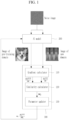
- a training device 100 may perform transfer learning based on the relationship or similarity between a target domain and a pre-training domain of a pre-trained AI model 200.
- the target domain is a different domain from the pre-training domain (meaning a domain trained into the model before the transfer learning is performed, i.e. a domain in which the model was pre-trained/already trained), and the training device 100 may perform the transfer learning on the pre-trained AI model 200 to adapt the pre-trained AI model 200 to the target domain.
- the training device 100 may fine-tune the pre-trained AI model 200 based on a similarity between (i) a gradient of a loss function determined based on an image corresponding to the pre-training domain and (ii) the gradient of the loss function determined based on an image corresponding to the target domain.
- the pre-trained AI model 200 may be a generative diffusion model that generates (infers) images of the pre-training domain from noise images.
- the AI model 200 may be pre-trained through a forward diffusion process and a reverse denoising process.
- the AI model 200 may generate a noise image x T by successively adding random noise to an input image x 0 of the pre-training domain.
- noise sampled from a fixed normal distribution is added to the noised image.
- the noise image x T is inputted to the AI model 200, which in turn may generate a result image x 0 ′ with a probability distribution similar to the input image by removing noise with a normal distribution from the noise image x T .
- noise sampled from a learned normal distribution may be subtracted from the image at each step.
- the AI model 200 may be pre-trained through updating parameters (e.g., average m and standard deviation ⁇ of a normal distribution) that represent the probability distribution from which noise to be subtracted from the image is sampled.
- x t is an image sampled at an arbitrary step t and is represented by Equation 2 below.
- x t ⁇ t ⁇ x 0 + 1 ⁇ ⁇ t ⁇ ⁇ t
- the training device 100 may include a gradient calculator 110, a similarity calculator 120, and a parameter updater 130.
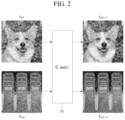
- the gradient calculator 110 may calculate a gradient of a loss function of a first image in the pre-training domain and a gradient of a loss function of a second image in the target domain; the images generated by the pre-trained AI model 200.
- the pre-trained AI model 200 may generate the first image in the pre-training domain and the second image in the target domain through reverse denoising, and transmit the first image and the second image to the gradient calculator 110 of the training device 100.
- the first image in the pre-training domain may have the same semantics as an image in the pre-training domain.
- the second image in the target domain may have the same semantics as an image belonging to the target domain.
- the pre-training domain may be a natural domain corresponding to/comprising/related to images of nature and the target domain may be a semiconductor domain corresponding to/comprising/related to semiconductor images.
- the pre-training domain may contain different types of images than semiconductor images.
- FIG. 2 shows the first image in the pre-training domain (top) and the second image in the target domain (bottom) (both generated by the pre-trained AI model 200) at an arbitrary step of the reverse denoising process as performed by the training device 100 are shown.
- the pre-trained AI model 200 when an image x n,t with noise of step t added to an image x n ,0 belonging to the target domain ("n" standing for "new", as in the new/target domain) is input to the pre-trained AI model 200, the pre-trained AI model 200 generates an image x n,t- 1 in the target domain.
- the similarity calculator 120 may calculate the similarity between the gradient of the loss function calculated from the first image in the pre-training domain and the gradient of the loss function calculated from the second image in the target domain.
- the parameter updater 130 may calculate a reweighted gradient (e.g., update (e.g., apply a weight to) the aforementioned gradient corresponding to the second image) based on the similarity between the gradient of the loss function in the pre-training domain and the gradient of the loss function in the target domain, and may use the reweighted/updated gradient to update parameters (e.g., weights) of the pre-trained AI model 200.
- a reweighted gradient e.g., update (e.g., apply a weight to) the aforementioned gradient corresponding to the second image
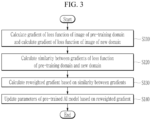
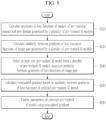
- the gradient calculator 110 of the training device 100 may calculate loss functions of an image x 0 prev in the pre-training domain and an image x 0 new in the target domain generated by the pre-trained AI model 200, respectively, and calculate the gradient of the respective loss functions (S110).
- Equation 3 represents the loss function L prev calculated for the image x 0 prev in the pre-training/previous domain and the loss function L new calculated for the image x 0 new in the target/new domain, respectively.
- the loss function L prev may include a term ⁇ t ⁇ x 0 prev + 1 ⁇ ⁇ t ⁇ ⁇ t , which represents an image of the t-th step in which noise is added to the image x 0 prev in the pre-training domain.
- the loss function L new may include a term ⁇ t ⁇ x 0 prev + 1 ⁇ ⁇ t ⁇ ⁇ t , which represents an image of the t-th step in which noise is added to the image x 0 new in the target domain. Equations 4 and 5 below represent the gradient of the loss function in the pre-training domain and the gradient of the loss function in the target domain.
- Gradient of loss function corresponding to pre ⁇ training domain ⁇ L prev ⁇ ⁇
- Gradient of loss function corresponding to target domain : ⁇ L new ⁇ ⁇
- the gradient calculator 110 may calculate the gradients respectively corresponding to the images of the pre-training domain and the target domain from a partial derivative of the loss functions for the parameters of the layers in the AI model 200. Equation 5 below represents the gradients of the loss functions for the parameter ⁇ l of the layer l determined by the gradient calculator 110. Gradient of loss function for each layer corresponding to pre ⁇ training domain : ⁇ L prev ⁇ ⁇ l Gradient of loss function for each layer corresponding to target domain : ⁇ L new ⁇ ⁇ l
- the similarity calculator 120 may calculate the similarity between the gradient of the loss function calculated from the first image in the pre-training domain and the gradient of the loss function calculated from the second image in the target domain (S 120).
- “for each layer” refers to the gradients being computed on a per-layer basis, that is, the gradient of the loss function of the pre-training domain and the gradient of the loss function of the target domain may be calculated for each layer (not necessarily all) in the AI model.
- the similarity between (i) the gradient of the loss function calculated from the first image in the pre-training domain and (ii) the gradient of the loss function calculated from the second image in the target domain may be used as a numerical indicator representing the relationship (e.g., correlation) between the pre-training domain and the target domain by the training device 100.
- the similarity between the gradient of the loss function calculated from the first image in the pre-training domain and the gradient of the loss function calculated from the second image in the target domain may be determined by cosine similarity, as a non-limiting example. Other similarities may also be used, e.g., Euclidean distance.
- the similarity calculator 120 may determine the similarity for/at each layer based on the gradients of the loss functions related to the parameters of the layers included in the pre-trained AI model 200.
- the loss functions may also be computed for each layer (i.e., loss functions may be layer-specific).
- the update rate (or degree of update) of each layer in the pre-trained AI model 200 may be determined according to the similarities of the respective layers between the gradients of the loss functions in the pre-training domain and the target domain, which are determined by the similarity calculator 120.
- the similarity weight described next, involves a weight, which is a function of similarity, and which is used with respect to the gradients rather than weights of layers of the AI model 200.
- Equation 6 represents the layer-specific similarity weight w l as a function of the similarity between the gradients of the loss functions for the parameter ⁇ l of the layer l .
- w l f Similarity ⁇ L prev ⁇ ⁇ l ⁇ L new ⁇ ⁇ l
- the similarity weight w l (determined according to the SimilarityU function of similarity between the gradients of the loss functions for the parameter ⁇ l of the layer l ) may be determined by the function f to be a relatively small value when the similarity between the gradient of the loss function computed for each layer in the pre-training domain and the gradient of the loss function computed for each layer in the target domain is relatively large (when they are similar).
- the similarity weight w l may be determined by the function f to be a relatively large value when the similarity between the gradient of the loss function for each layer in the pre-training domain and the gradient of the loss function for each layer in the target domain is relatively small (when they are dissimilar).
- target-domain and previous-domain gradients may be computed for each layer in the AI model, similarities (or similarity weights) may be computed for respective layers according to their respective pairs of loss functions.
- the parameter updater 130 may calculate a reweighted gradient (see Equation 7) based on the similarity (or specifically, the similarity weight) between the gradient of the loss function in the pre-training domain and the gradient of the loss function in the target domain (S130) , and update the parameters of the pre-trained AI model 200 using the reweighted gradient (S 140). This may be done for multiple (or all) layers of the pre-trained AI model 200.
- the parameter updater 130 may calculate the reweighted/updated gradients of the respective layers included in the pre-trained AI model 200 based on the similarity weights of the respective layers.
- the reweighted/updated gradient of the l -th layer (in the pre-trained AI model 200) may be determined as the product of (i) the similarity weight w l for the l -th layer and (ii) the gradient of the loss function for the parameters of the l -th layer calculated from the image in the target domain, as shown in Equation 7 below (here, the computations for the l -th layer are representative of the computations of some or all layers of the pre-trained AI model 200).
- the corresponding similarity weights When the similarities for respective layers between the gradients of the loss functions of the respective domains are relatively high, the corresponding similarity weights will be relatively low, and hence the corresponding layers will be updated relatively little, thus reducing memory loss of the pre-trained domain. When the similarities for respective layers between the gradients of the loss functions of the respective domains are relatively low, the corresponding similarity weights will be relatively high, and the corresponding layers will be updated relatively more, thus improving learning of the new domain.
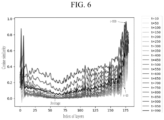
- Table 1 shows the results of transfer learning of the example AI model of FIG. 6 , as pre-trained by using Flickr-Faces-HQ (FFHQ) dataset for domain adaptation to the Animal Faces-HQ (AFHQ) dataset.
- Table 1 Configuration FFHQ ⁇ AFHQ
- Clean FID Indicator steps
- From Scratch 24.92 (300k) Native Fine-tuning 23.25 (3.0k)
- Cosine similarity-based reweighting method 22.65 (1.5k)
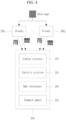
- a defect inspection system 10 for a semiconductor manufacturing process may include a defect detection device 300, a measurement device 400, and a training device 100.
- the defect detection device 300 may detect defects from various images obtained during the semiconductor manufacturing process through inference based on one or more AI models.
- the one or more AI models may include a classification AI model configured to classify images obtained during the manufacturing process and a generative AI model configured to generate images for learning the classification AI model.
- the generative AI model may generate images of a specific domain, and provide the images to the classification AI model, whereas the classification AI model may perform training for classification of images using the images generated by the generative AI model.
- the generative AI model may be an image-to-image (im2im) translation model.
- the training device 100 may determine correlation between the pre-training domain of the pre-trained AI model and the target domain of transfer learning, and may perform tuning to adapt the pre-trained AI model to the target domain based on the quantified correlation.
- a training device 100 may have the pre-trained AI model generate images of the pre-training domain and images of the target domain, and may relatively calculate the gradients of the loss functions based on the images of the pre-training domain and the images of the target domain. Afterwards, the training device 100 may perform the transfer learning on the trained AI model by using the similarity between the gradient of the loss function determined from the image in the pre-training domain and the gradient of the loss function determined from the image in the target domain as the quantified correlation between the pre-training domain and the target domain.
- the training device 100 determines correlation between a pre-training domain of a pre-trained AI model and a target domain for transfer learning and performs layer-by-layer updates of the pre-trained AI model based on the correlation, so that the update rate for each layer of the pre-trained AI model may be optimized and the time required for the transfer learning for the pre-trained AI model may be shortened.
- an encoder 810 and decoder 820 may have a neural network (NN) structure including input layers 8101 and 8201, hidden layers 8102 and 8202, and output layers 8103 and 8203, respectively.
- the encoder 810 may have an encoder structure of the generative AI model described above (e.g., AI model 200).
- the decoder 820 may have a decoder structure of the generative AI model described above.
- the input layers 8101 and 8201, hidden layers 8102 and 8202, and output layers 8103 and 8203 of the encoder 810 and the decoder 820 may each include a respective set of nodes and the strength of connections between each node may correspond to a weight (a connection weight).
- the nodes included in the input layers 8101 and 8201, the hidden layers 8102 and 8202, and the output layers 8103 and 8203 may be connected to each other with a fully connected type of architecture, as a non-limiting example.
- the number of parameters may be equal to the number of connections in the neural network 800.
- the input layers 8101 and 8201 may include input nodes, and the number of input nodes may correspond to the number of independent input variables therefor, respectively.
- the hidden layers 8102 and 8202 may be positioned between the input layers 8101 and 8201 and output layers 8103 and 8203 and may include at least one hidden layer.
- the output layers 8103 and 8203 may include at least one output node.
- An activation function may be used in the hidden layers 8102 and 8202 and output layers 8103 and 8203 to determine node outputs/activations.
- the hidden layers 8102 and 8202 are representative of one or more hidden layers.
- the encoder 810 and the decoder 820 may be trained by updating the weights and/or parameters of the hidden nodes included in the hidden layers 8102 and 8202.
- FIG. 9 illustrates a training device according to one or more embodiments.
- a training device may be implemented as a computer system (for example, a computer-readable medium).
- the computer system 900 includes one or more processors 910 and a memory 920.
- the one or more processors 910 is representative of any single processor or any combination of processors, e.g., a CPU, a GPU, an NPU, an accelerator, etc.
- the memory 920 may be connected to the one or more processors 910 and may store instructions or programs configured to cause the one or more processors 910 to perform a process including any of the methods described above.
- the one or more processors 910 may realize functions, stages, or methods proposed in the embodiment.
- An operation of the computer system 900 according to one or more embodiments may be realized by the one or more processors 910.
- the one or more processors 910 may include a GPU, a CPU, and/or an NPU.
- each task may be divided among the one or more processors 910 according to load.
- the other processors may be a GPU, an NPU, an FPGA, and/or a DSP.
- the memory 920 may be provided inside/outside the processor, and may be connected to the processor through various means known to a person skilled in the art.
- the memory represents a volatile or non-volatile storage medium in various forms (but not a signal per se), and for example, the memory may include a read-only memory (ROM) and a random-access memory (RAM).
- the memory may be a PIM (processing in memory) including a logic unit for performing self-contained operations.
- some functions of the training device for the pre-trained AI model may be provided by a neuromorphic chip including neurons, synapses, and inter-neuron connection modules.
- the neuromorphic chip is a computer device simulating biological neural system structures, and may perform neural network operations.
- the embodiments are not only implemented through the device and/or the method described so far, but may also be implemented through a program that realizes the function corresponding to the configuration of the embodiment or a recording medium on which the program is recorded, and such implementation may be easily implemented by anyone skilled in the art to which this description belongs from the description provided above.
- methods e.g., the method for training a pre-trained AI model, etc.
- the computer readable medium may include program instructions, data files, data structures, etc. alone or in combination.
- the program instructions recorded on the computer readable medium may be specifically designed and configured for the embodiments.
- the computer readable recording medium may include a hardware device configured to store and execute program instructions.
- a computer-readable recording medium includes magnetic media such as hard disks, floppy disks and magnetic tapes, optical recording media such as CD-ROMs and DVDs, and optical disks such as floppy disks. It may be magneto-optical media, ROM, RAM, flash memory, or the like.
- a program instruction may include not only machine language codes such as generated by a compiler, but also high-level language codes that may be executed by a computer through an interpreter or the like.
- the computing apparatuses, the electronic devices, the processors, the memories, the displays, the information output system and hardware, the storage devices, and other apparatuses, devices, units, modules, and components described herein with respect to FIGS. 1-9 are implemented by or representative of hardware components.
- hardware components that may be used to perform the operations described in this application where appropriate include controllers, sensors, generators, drivers, memories, comparators, arithmetic logic units, adders, subtractors, multipliers, dividers, integrators, and any other electronic components configured to perform the operations described in this application.
- one or more of the hardware components that perform the operations described in this application are implemented by computing hardware, for example, by one or more processors or computers.
- a processor or computer may be implemented by one or more processing elements, such as an array of logic gates, a controller and an arithmetic logic unit, a digital signal processor, a microcomputer, a programmable logic controller, a field-programmable gate array, a programmable logic array, a microprocessor, or any other device or combination of devices that is configured to respond to and execute instructions in a defined manner to achieve a desired result.
- a processor or computer includes, or is connected to, one or more memories storing instructions or software that are executed by the processor or computer.
- Hardware components implemented by a processor or computer may execute instructions or software, such as an operating system (OS) and one or more software applications that run on the OS, to perform the operations described in this application.
- OS operating system
- the hardware components may also access, manipulate, process, create, and store data in response to execution of the instructions or software.
- processor or “computer” may be used in the description of the examples described in this application, but in other examples multiple processors or computers may be used, or a processor or computer may include multiple processing elements, or multiple types of processing elements, or both.
- a single hardware component or two or more hardware components may be implemented by a single processor, or two or more processors, or a processor and a controller.
- One or more hardware components may be implemented by one or more processors, or a processor and a controller, and one or more other hardware components may be implemented by one or more other processors, or another processor and another controller.
- One or more processors may implement a single hardware component, or two or more hardware components.
- a hardware component may have any one or more of different processing configurations, examples of which include a single processor, independent processors, parallel processors, single-instruction single-data (SISD) multiprocessing, single-instruction multiple-data (SIMD) multiprocessing, multiple-instruction single-data (MISD) multiprocessing, and multiple-instruction multiple-data (MIMD) multiprocessing.
- SISD single-instruction single-data
- SIMD single-instruction multiple-data
- MIMD multiple-instruction multiple-data
- FIGS. 1-9 that perform the operations described in this application are performed by computing hardware, for example, by one or more processors or computers, implemented as described above implementing instructions or software to perform the operations described in this application that are performed by the methods.
- a single operation or two or more operations may be performed by a single processor, or two or more processors, or a processor and a controller.
- One or more operations may be performed by one or more processors, or a processor and a controller, and one or more other operations may be performed by one or more other processors, or another processor and another controller.
- One or more processors, or a processor and a controller may perform a single operation, or two or more operations.
- Instructions or software to control computing hardware may be written as computer programs, code segments, instructions or any combination thereof, for individually or collectively instructing or configuring the one or more processors or computers to operate as a machine or special-purpose computer to perform the operations that are performed by the hardware components and the methods as described above.
- the instructions or software include machine code that is directly executed by the one or more processors or computers, such as machine code produced by a compiler.
- the instructions or software includes higher-level code that is executed by the one or more processors or computer using an interpreter.
- the instructions or software may be written using any programming language based on the block diagrams and the flow charts illustrated in the drawings and the corresponding descriptions herein, which disclose algorithms for performing the operations that are performed by the hardware components and the methods as described above.
- the instructions or software to control computing hardware for example, one or more processors or computers, to implement the hardware components and perform the methods as described above, and any associated data, data files, and data structures, may be recorded, stored, or fixed in or on one or more non-transitory computer-readable storage media.
- Examples of a non-transitory computer-readable storage medium include read-only memory (ROM), random-access programmable read only memory (PROM), electrically erasable programmable read-only memory (EEPROM), random-access memory (RAM), dynamic random access memory (DRAM), static random access memory (SRAM), flash memory, non-volatile memory, CD-ROMs, CD-Rs, CD+Rs, CD-RWs, CD+RWs, DVD-ROMs, DVD- Rs, DVD+Rs, DVD-RWs, DVD+RWs, DVD-RAMs, BD-ROMs, BD-Rs, BD-R LTHs, BD-REs, blue-ray or optical disk storage, hard disk drive (HDD), solid state drive (SSD), flash memory, a card type memory such as multimedia card micro or a card (for example, secure digital (SD) or extreme digital (XD)), magnetic tapes, floppy disks, magneto-optical data storage devices, optical data storage devices, hard disks, solid
Landscapes
- Engineering & Computer Science (AREA)
- Theoretical Computer Science (AREA)
- Physics & Mathematics (AREA)
- Evolutionary Computation (AREA)
- General Physics & Mathematics (AREA)
- Artificial Intelligence (AREA)
- Software Systems (AREA)
- Computing Systems (AREA)
- Data Mining & Analysis (AREA)
- General Health & Medical Sciences (AREA)
- Health & Medical Sciences (AREA)
- General Engineering & Computer Science (AREA)
- Mathematical Physics (AREA)
- Life Sciences & Earth Sciences (AREA)
- Molecular Biology (AREA)
- Biophysics (AREA)
- Computational Linguistics (AREA)
- Biomedical Technology (AREA)
- Computer Vision & Pattern Recognition (AREA)
- Medical Informatics (AREA)
- Databases & Information Systems (AREA)
- Multimedia (AREA)
- Probability & Statistics with Applications (AREA)
- Evolutionary Biology (AREA)
- Bioinformatics & Computational Biology (AREA)
- Bioinformatics & Cheminformatics (AREA)
- Image Analysis (AREA)
Applications Claiming Priority (1)
| Application Number | Priority Date | Filing Date | Title |
|---|---|---|---|
| KR1020240002289A KR20250107567A (ko) | 2024-01-05 | 2024-01-05 | 도메인 간 유사도를 사용한 사전훈련된 인공지능 모델의 트레이닝 방법 및 장치 |
Publications (1)
| Publication Number | Publication Date |
|---|---|
| EP4583005A1 true EP4583005A1 (de) | 2025-07-09 |
Family
ID=94173651
Family Applications (1)
| Application Number | Title | Priority Date | Filing Date |
|---|---|---|---|
| EP25150247.2A Pending EP4583005A1 (de) | 2024-01-05 | 2025-01-03 | Verfahren und vorrichtung mit ki-modelltraining unter verwendung von domänenähnlichkeit |
Country Status (3)
| Country | Link |
|---|---|
| EP (1) | EP4583005A1 (de) |
| KR (1) | KR20250107567A (de) |
| CN (1) | CN120278293A (de) |
-
2024
- 2024-01-05 KR KR1020240002289A patent/KR20250107567A/ko active Pending
-
2025
- 2025-01-03 EP EP25150247.2A patent/EP4583005A1/de active Pending
- 2025-01-03 CN CN202510009501.4A patent/CN120278293A/zh active Pending
Non-Patent Citations (5)
| Title |
|---|
| CEDRIC RENGGLI ET AL: "Which Model to Transfer? Finding the Needle in the Growing Haystack", ARXIV.ORG, CORNELL UNIVERSITY LIBRARY, 201 OLIN LIBRARY CORNELL UNIVERSITY ITHACA, NY 14853, 13 October 2020 (2020-10-13), XP091168218 * |
| IGARASHI HIROAKI ET AL: "Multi-task Curriculum Learning Based on Gradient Similarity", 31 December 2022 (2022-12-31), XP093277049, Retrieved from the Internet <URL:https://bmvc2022.mpi-inf.mpg.de/0705.pdf> [retrieved on 20250514] * |
| JAAKKOLA TOMMI S ET AL: "Exploiting generative models discriminative classifiers", 1 December 1998 (1998-12-01), XP093277390, Retrieved from the Internet <URL:https://papers.nips.cc/paper/1520-exploiting-generative-models-in-discriminative-classifiers.pdf> [retrieved on 20250514] * |
| JINGYUAN ZHU ET AL: "DomainStudio: Fine-Tuning Diffusion Models for Domain-Driven Image Generation using Limited Data", ARXIV.ORG, CORNELL UNIVERSITY LIBRARY, 201 OLIN LIBRARY CORNELL UNIVERSITY ITHACA, NY 14853, 1 August 2023 (2023-08-01), XP091582215 * |
| YUNSHU DU ET AL: "Adapting Auxiliary Losses Using Gradient Similarity", ARXIV.ORG, CORNELL UNIVERSITY LIBRARY, 201 OLIN LIBRARY CORNELL UNIVERSITY ITHACA, NY 14853, 25 November 2020 (2020-11-25), XP081822618 * |
Also Published As
| Publication number | Publication date |
|---|---|
| CN120278293A (zh) | 2025-07-08 |
| KR20250107567A (ko) | 2025-07-14 |
Similar Documents
| Publication | Publication Date | Title |
|---|---|---|
| US12045723B2 (en) | Neural network method and apparatus | |
| CN109508655B (zh) | 基于孪生网络的不完备训练集的sar目标识别方法 | |
| US20200265307A1 (en) | Apparatus and method with multi-task neural network | |
| US20200210876A1 (en) | Systems and methods for machine learning using adiabatic quantum computers | |
| EP4009239A1 (de) | Verfahren und vorrichtung mit neuronaler architektursuche basierend auf hardware-leistung | |
| US11989656B2 (en) | Search space exploration for deep learning | |
| US11948078B2 (en) | Joint representation learning from images and text | |
| EP3882823A1 (de) | Verfahren und vorrichtung mit softmax-approximation | |
| US20220383103A1 (en) | Hardware accelerator method and device | |
| US20230154173A1 (en) | Method and device with neural network training and image processing | |
| Lim et al. | Automatic artifact detection algorithm in fetal MRI | |
| EP4583005A1 (de) | Verfahren und vorrichtung mit ki-modelltraining unter verwendung von domänenähnlichkeit | |
| US20240144086A1 (en) | Method and apparatus with machine learning | |
| Pardede et al. | Hyperparameter Search for CT-Scan Classification Using Hyperparameter Tuning in Pre-Trained Model CNN With MLP | |
| US20250336183A1 (en) | Method and apparatus with image classification ai model | |
| US20250278074A1 (en) | Method and device with component configuration changing | |
| US20250217255A1 (en) | Method and apparatus with ai model performance measuring using perturbation | |
| US20240232579A1 (en) | Method and device with expanding knowledge graph | |
| EP4365777A1 (de) | Verfahren und elektronische vorrichtung mit adversarial-datenverstärkungshintergrund | |
| US20250148174A1 (en) | Method and device with in-fab wafer yield prediction | |
| US20250086476A1 (en) | Method for performing genetic optimization and a circuit design method using the same | |
| US20250226251A1 (en) | Method and apparatus for determining contribution of factor during manufacturing of wafer | |
| EP4583066A1 (de) | Verfahren, vorrichtung und system mit domänenanpassungsbasierter klassifizierung | |
| US20250225649A1 (en) | Method and apparatus with anomaly detection using anomaly map | |
| US20250045884A1 (en) | Method and device with image-difference reduction preprocessing |
Legal Events
| Date | Code | Title | Description |
|---|---|---|---|
| PUAI | Public reference made under article 153(3) epc to a published international application that has entered the european phase |
Free format text: ORIGINAL CODE: 0009012 |
|
| STAA | Information on the status of an ep patent application or granted ep patent |
Free format text: STATUS: THE APPLICATION HAS BEEN PUBLISHED |
|
| AK | Designated contracting states |
Kind code of ref document: A1 Designated state(s): AL AT BE BG CH CY CZ DE DK EE ES FI FR GB GR HR HU IE IS IT LI LT LU LV MC ME MK MT NL NO PL PT RO RS SE SI SK SM TR |