EP4582940A1 - Benutzervorrichtung und anwendungsausführungsverfahren damit - Google Patents
Benutzervorrichtung und anwendungsausführungsverfahren damit Download PDFInfo
- Publication number
- EP4582940A1 EP4582940A1 EP24812685.6A EP24812685A EP4582940A1 EP 4582940 A1 EP4582940 A1 EP 4582940A1 EP 24812685 A EP24812685 A EP 24812685A EP 4582940 A1 EP4582940 A1 EP 4582940A1
- Authority
- EP
- European Patent Office
- Prior art keywords
- application
- electronic device
- execution
- component
- executed
- Prior art date
- Legal status (The legal status is an assumption and is not a legal conclusion. Google has not performed a legal analysis and makes no representation as to the accuracy of the status listed.)
- Pending
Links
Images




Classifications
-
- G—PHYSICS
- G06—COMPUTING OR CALCULATING; COUNTING
- G06F—ELECTRIC DIGITAL DATA PROCESSING
- G06F9/00—Arrangements for program control, e.g. control units
- G06F9/06—Arrangements for program control, e.g. control units using stored programs, i.e. using an internal store of processing equipment to receive or retain programs
- G06F9/46—Multiprogramming arrangements
- G06F9/48—Program initiating; Program switching, e.g. by interrupt
- G06F9/4806—Task transfer initiation or dispatching
- G06F9/4843—Task transfer initiation or dispatching by program, e.g. task dispatcher, supervisor, operating system
- G06F9/485—Task life-cycle, e.g. stopping, restarting, resuming execution
-
- G—PHYSICS
- G06—COMPUTING OR CALCULATING; COUNTING
- G06F—ELECTRIC DIGITAL DATA PROCESSING
- G06F9/00—Arrangements for program control, e.g. control units
- G06F9/06—Arrangements for program control, e.g. control units using stored programs, i.e. using an internal store of processing equipment to receive or retain programs
- G06F9/44—Arrangements for executing specific programs
- G06F9/451—Execution arrangements for user interfaces
-
- G—PHYSICS
- G06—COMPUTING OR CALCULATING; COUNTING
- G06F—ELECTRIC DIGITAL DATA PROCESSING
- G06F9/00—Arrangements for program control, e.g. control units
- G06F9/06—Arrangements for program control, e.g. control units using stored programs, i.e. using an internal store of processing equipment to receive or retain programs
- G06F9/46—Multiprogramming arrangements
- G06F9/48—Program initiating; Program switching, e.g. by interrupt
- G06F9/4806—Task transfer initiation or dispatching
- G06F9/4843—Task transfer initiation or dispatching by program, e.g. task dispatcher, supervisor, operating system
-
- G—PHYSICS
- G06—COMPUTING OR CALCULATING; COUNTING
- G06F—ELECTRIC DIGITAL DATA PROCESSING
- G06F9/00—Arrangements for program control, e.g. control units
- G06F9/06—Arrangements for program control, e.g. control units using stored programs, i.e. using an internal store of processing equipment to receive or retain programs
- G06F9/46—Multiprogramming arrangements
- G06F9/48—Program initiating; Program switching, e.g. by interrupt
- G06F9/4806—Task transfer initiation or dispatching
- G06F9/4843—Task transfer initiation or dispatching by program, e.g. task dispatcher, supervisor, operating system
- G06F9/4881—Scheduling strategies for dispatcher, e.g. round robin, multi-level priority queues
-
- G—PHYSICS
- G06—COMPUTING OR CALCULATING; COUNTING
- G06F—ELECTRIC DIGITAL DATA PROCESSING
- G06F9/00—Arrangements for program control, e.g. control units
- G06F9/06—Arrangements for program control, e.g. control units using stored programs, i.e. using an internal store of processing equipment to receive or retain programs
- G06F9/46—Multiprogramming arrangements
- G06F9/50—Allocation of resources, e.g. of the central processing unit [CPU]
- G06F9/5005—Allocation of resources, e.g. of the central processing unit [CPU] to service a request
- G06F9/5011—Allocation of resources, e.g. of the central processing unit [CPU] to service a request the resources being hardware resources other than CPUs, Servers and Terminals
- G06F9/5022—Mechanisms to release resources
Definitions
- An embodiment of the disclosure relates to an electronic device and a method for executing an application using the same.
- electronic devices e.g., mobile communication terminals, personal digital assistants (PDAs), electronic notebooks, smartphones, tablets, and personal computers (PCs), etc.
- PDAs personal digital assistants
- PCs personal computers
- Electronic devices are reaching a stage of mobile convergence that does not remain within their own traditional domains but also encompasses the domains of other electronic devices.
- electronic devices may perform various functions such as call functions such as voice and video calls, message transmission and reception functions such as short message service (SMS)/multimedia message service (MMS) and email (e-mail), navigation functions, shooting functions, broadcast playback functions, media (video and music) playback functions, Internet functions, messenger functions, social networking service (SNS) functions and the like.
- SMS short message service
- MMS multimedia message service
- SNS social networking service
- a plurality of programs may be stored or installed in a memory.
- the electronic device may execute each of the plurality of programs individually or execute a second program in connection with the execution of a first program.
- the electronic device may execute a specific program in a foreground or in a background.
- the electronic device may stop a program running in the background (e.g., a kill operation) to improve the performance of the electronic device.
- the electronic device may maintain or stop the operation of another program running in the background, and as the other programs are repeatedly or non-repeatedly re-executed, the performance of the electronic device may be at least partially degraded.
- the electronic device may identify an associative relationship between the execution of each of a plurality of programs and manage the operation of each program.
- the processor of the electronic device may identify a second application linked to a first application in a situation where the first application is running, and determine whether to execute the second application while maintaining execution of the first application.
- the electronic device may manage the second application that is essentially running in the background state and a third application that is unnecessarily running in the background state.
- the electronic device may control the operation of another application that is unnecessarily running in the background (e.g., an application that has little relevance to the execution of the first application).
- the disclosure is to improve the performance of an electronic device while a specific application is running.
- the electronic device may include a memory that store instructions and a processor, wherein the instructions are configured to, when executed by the processor, identify execution of the second application corresponding to the component of the first application in response to the execution of the first application from among a plurality of applications stored in the memory, store chain information indicating an associative relationship between the first application and the second application in the memory, and execute the second application corresponding to the component of the first application based on the chain information stored in the memory in response to the execution of the first application while the chain information between the plurality of applications is stored in the memory.
- a non-transitory computer-readable storage medium (or a computer program product) storing one or more programs for performing an application execution method of an electronic device
- the one or more programs may include instructions, when executed by the processor of the electronic device, to perform: identifying the execution of a second application corresponding to a component of the first application in response to the execution of the first application from among a plurality of applications stored in a memory; storing chain information indicating an associative relationship between the first application and the second application in the memory; and executing the second application corresponding to the component of the first application based on the chain information stored in the memory in response to the execution of the first application in a state in which chain information between the plurality of applications is stored in the memory.
- Fig. 1 is a block diagram illustrating an example electronic device 101 in a network environment 100 according to various embodiments.
- the electronic device 101 in the network environment 100 may communicate with an electronic device 102 via a first network 198 (e.g., a short-range wireless communication network), or at least one of an electronic device 104 or a server 108 via a second network 199 (e.g., a long-range wireless communication network).
- the electronic device 101 may communicate with the electronic device 104 via the server 108.
- the electronic device 101 may include a processor 120, memory 130, an input module 150, a sound output module 155, a display module 160, an audio module 170, a sensor module 176, an interface 177, a connecting terminal 178, a haptic module 179, a camera module 180, a power management module 188, a battery 189, a communication module 190, a subscriber identification module (SIM) 196, or an antenna module 197.
- at least one of the components e.g., the connecting terminal 178) may be omitted from the electronic device 101, or one or more other components may be added in the electronic device 101.
- some of the components e.g., the sensor module 176, the camera module 180, or the antenna module 197) may be implemented as a single component (e.g., the display module 160).
- the processor 120 may execute, for example, software (e.g., a program 140) to control at least one other component (e.g., a hardware or software component) of the electronic device 101 coupled with the processor 120, and may perform various data processing or computation.
- the processor 120 may store a command or data received from another component (e.g., the sensor module 176 or the communication module 190) in volatile memory 132, process the command or the data stored in the volatile memory 132, and store resulting data in non-volatile memory 134.
- the processor 120 may include a main processor 121 (e.g., a central processing unit (CPU) or an application processor (AP)), or an auxiliary processor 123 (e.g., a graphics processing unit (GPU), a neural processing unit (NPU), an image signal processor (ISP), a sensor hub processor, or a communication processor (CP)) that is operable independently from, or in conjunction with, the main processor 121.
- a main processor 121 e.g., a central processing unit (CPU) or an application processor (AP)
- auxiliary processor 123 e.g., a graphics processing unit (GPU), a neural processing unit (NPU), an image signal processor (ISP), a sensor hub processor, or a communication processor (CP)
- the main processor 121 may be adapted to consume less power than the main processor 121, or to be specific to a specified function.
- the auxiliary processor 123 may be implemented as separate from, or as part of the main processor 121.
- the auxiliary processor 123 may control at least some of functions or states related to at least one component (e.g., the display module 160, the sensor module 176, or the communication module 190) among the components of the electronic device 101, instead of the main processor 121 while the main processor 121 is in an inactive (e.g., sleep) state, or together with the main processor 121 while the main processor 121 is in an active state (e.g., executing an application).
- the auxiliary processor 123 e.g., an image signal processor or a communication processor
- the auxiliary processor 123 may include a hardware structure specified for artificial intelligence model processing.
- An artificial intelligence model may be generated by machine learning. Such learning may be performed, e.g., by the electronic device 101 where the artificial intelligence is performed or via a separate server (e.g., the server 108). Learning algorithms may include, but are not limited to, e.g., supervised learning, unsupervised learning, semi-supervised learning, or reinforcement learning.
- the artificial intelligence model may include a plurality of artificial neural network layers.
- the artificial neural network may be a deep neural network (DNN), a convolutional neural network (CNN), a recurrent neural network (RNN), a restricted boltzmann machine (RBM), a deep belief network (DBN), a bidirectional recurrent deep neural network (BRDNN), deep Q-network or a combination of two or more thereof but is not limited thereto.
- the artificial intelligence model may, additionally or alternatively, include a software structure other than the hardware structure.
- the memory 130 may store various data used by at least one component (e.g., the processor 120 or the sensor module 176) of the electronic device 101.
- the various data may include, for example, software (e.g., the program 140) and input data or output data for a command related thereto.
- the memory 130 may include the volatile memory 132 or the non-volatile memory 134.
- the program 140 may be stored in the memory 130 as software, and may include, for example, an operating system (OS) 142, middleware 144, or an application 146.
- OS operating system
- middleware middleware
- application application
- the input module 150 may receive a command or data to be used by another component (e.g., the processor 120) of the electronic device 101, from the outside (e.g., a user) of the electronic device 101.
- the input module 150 may include, for example, a microphone, a mouse, a keyboard, a key (e.g., a button), or a digital pen (e.g., a stylus pen).
- the sound output module 155 may output sound signals to the outside of the electronic device 101.
- the sound output module 155 may include, for example, a speaker or a receiver.
- the speaker may be used for general purposes, such as playing multimedia or playing record.
- the receiver may be used for receiving incoming calls. According to an embodiment, the receiver may be implemented as separate from, or as part of the speaker.
- the display module 160 may visually provide information to the outside (e.g., a user) of the electronic device 101.
- the display module 160 may include, for example, a display, a hologram device, or a projector and control circuitry to control a corresponding one of the display, hologram device, and projector.
- the display module 160 may include a touch sensor adapted to detect a touch, or a pressure sensor adapted to measure the intensity of force incurred by the touch.
- the audio module 170 may convert a sound into an electrical signal and vice versa. According to an embodiment, the audio module 170 may obtain the sound via the input module 150, or output the sound via the sound output module 155 or a headphone of an external electronic device (e.g., an electronic device 102) directly (e.g., wiredly) or wirelessly coupled with the electronic device 101.
- an external electronic device e.g., an electronic device 102
- directly e.g., wiredly
- wirelessly e.g., wirelessly
- the sensor module 176 may detect an operational state (e.g., power or temperature) of the electronic device 101 or an environmental state (e.g., a state of a user) external to the electronic device 101, and then generate an electrical signal or data value corresponding to the detected state.
- the sensor module 176 may include, for example, a gesture sensor, a gyro sensor, an atmospheric pressure sensor, a magnetic sensor, an acceleration sensor, a grip sensor, a proximity sensor, a color sensor, an infrared (IR) sensor, a biometric sensor, a temperature sensor, a humidity sensor, or an illuminance sensor.
- the interface 177 may support one or more specified protocols to be used for the electronic device 101 to be coupled with the external electronic device (e.g., the electronic device 102) directly (e.g., wiredly) or wirelessly.
- the interface 177 may include, for example, a high definition multimedia interface (HDMI), a universal serial bus (USB) interface, a secure digital (SD) card interface, or an audio interface.
- HDMI high definition multimedia interface
- USB universal serial bus
- SD secure digital
- a connecting terminal 178 may include a connector via which the electronic device 101 may be physically connected with the external electronic device (e.g., the electronic device 102).
- the connecting terminal 178 may include, for example, a HDMI connector, a USB connector, a SD card connector, or an audio connector (e.g., a headphone connector).
- the haptic module 179 may convert an electrical signal into a mechanical stimulus (e.g., a vibration or a movement) or electrical stimulus which may be recognized by a user via his tactile sensation or kinesthetic sensation.
- the haptic module 179 may include, for example, a motor, a piezoelectric element, or an electric stimulator.
- the camera module 180 may capture a still image or moving images.
- the camera module 180 may include one or more lenses, image sensors, image signal processors, or flashes.
- the power management module 188 may manage power supplied to the electronic device 101.
- the power management module 188 may be implemented as at least part of, for example, a power management integrated circuit (PMIC).
- PMIC power management integrated circuit
- the battery 189 may supply power to at least one component of the electronic device 101.
- the battery 189 may include, for example, a primary cell which is not rechargeable, a secondary cell which is rechargeable, or a fuel cell.
- the communication module 190 may support establishing a direct (e.g., wired) communication channel or a wireless communication channel between the electronic device 101 and the external electronic device (e.g., the electronic device 102, the electronic device 104, or the server 108) and performing communication via the established communication channel.
- the communication module 190 may include one or more communication processors that are operable independently from the processor 120 (e.g., the application processor (AP)) and supports a direct (e.g., wired) communication or a wireless communication.
- AP application processor
- the communication module 190 may include a wireless communication module 192 (e.g., a cellular communication module, a short-range wireless communication module, or a global navigation satellite system (GNSS) communication module) or a wired communication module 194 (e.g., a local area network (LAN) communication module or a power line communication (PLC) module).
- a wireless communication module 192 e.g., a cellular communication module, a short-range wireless communication module, or a global navigation satellite system (GNSS) communication module
- GNSS global navigation satellite system
- wired communication module 194 e.g., a local area network (LAN) communication module or a power line communication (PLC) module.
- LAN local area network
- PLC power line communication
- a corresponding one of these communication modules may communicate with the external electronic device via the first network 198 (e.g., a short-range communication network, such as BluetoothTM, wireless-fidelity (Wi-Fi) direct, or infrared data association (IrDA)) or the second network 199 (e.g., a long-range communication network, such as a legacy cellular network, a 5G network, a next-generation communication network, the Internet, or a computer network (e.g., LAN or wide area network (WAN)).
- first network 198 e.g., a short-range communication network, such as BluetoothTM, wireless-fidelity (Wi-Fi) direct, or infrared data association (IrDA)
- the second network 199 e.g., a long-range communication network, such as a legacy cellular network, a 5G network, a next-generation communication network, the Internet, or a computer network (e.g., LAN or wide area network (WAN)).
- the wireless communication module 192 may identify and authenticate the electronic device 101 in a communication network, such as the first network 198 or the second network 199, using subscriber information (e.g., international mobile subscriber identity (IMSI)) stored in the subscriber identification module 196.
- subscriber information e.g., international mobile subscriber identity (IMSI)
- the wireless communication module 192 may support a 5G network, after a 4G network, and next-generation communication technology, e.g., new radio (NR) access technology.
- the NR access technology may support enhanced mobile broadband (eMBB), massive machine type communications (mMTC), or ultra-reliable and low-latency communications (URLLC).
- eMBB enhanced mobile broadband
- mMTC massive machine type communications
- URLLC ultra-reliable and low-latency communications
- the wireless communication module 192 may support a high-frequency band (e.g., the mmWave band) to achieve, e.g., a high data transmission rate.
- the wireless communication module 192 may support various technologies for securing performance on a high-frequency band, such as, e.g., beamforming, massive multiple-input and multiple-output (massive MIMO), full dimensional MIMO (FD-MIMO), array antenna, analog beam-forming, or large scale antenna.
- the wireless communication module 192 may support various requirements specified in the electronic device 101, an external electronic device (e.g., the electronic device 104), or a network system (e.g., the second network 199).
- the wireless communication module 192 may support a peak data rate (e.g., 20Gbps or more) for implementing eMBB, loss coverage (e.g., 164dB or less) for implementing mMTC, or U-plane latency (e.g., 0.5ms or less for each of downlink (DL) and uplink (UL), or a round trip of 1ms or less) for implementing URLLC.
- a peak data rate e.g., 20Gbps or more
- loss coverage e.g., 164dB or less
- U-plane latency e.g., 0.5ms or less for each of downlink (DL) and uplink (UL), or a round trip of 1ms or less
- the antenna module 197 may transmit or receive a signal or power to or from the outside (e.g., the external electronic device) of the electronic device 101.
- the antenna module 197 may include an antenna including a radiating element including a conductive material or a conductive pattern formed in or on a substrate (e.g., a printed circuit board (PCB)).
- the antenna module 197 may include a plurality of antennas (e.g., array antennas). In such a case, at least one antenna appropriate for a communication scheme used in the communication network, such as the first network 198 or the second network 199, may be selected, for example, by the communication module 190 (e.g., the wireless communication module 192) from the plurality of antennas.
- the signal or the power may then be transmitted or received between the communication module 190 and the external electronic device via the selected at least one antenna.
- another component e.g., a radio frequency integrated circuit (RFIC)
- RFIC radio frequency integrated circuit
- the antenna module 197 may form a mmWave antenna module.
- the mmWave antenna module may include a printed circuit board, a RFIC disposed on a first surface (e.g., the bottom surface) of the printed circuit board, or adjacent to the first surface and capable of supporting a designated high-frequency band (e.g., the mmWave band), and a plurality of antennas (e.g., array antennas) disposed on a second surface (e.g., the top or a side surface) of the printed circuit board, or adjacent to the second surface and capable of transmitting or receiving signals of the designated high-frequency band.
- the plurality of antennas may include a patch array antenna and/or a dipole array antenna.
- At least some of the above-described components may be coupled mutually and communicate signals (e.g., commands or data) therebetween via an inter-peripheral communication scheme (e.g., a bus, general purpose input and output (GPIO), serial peripheral interface (SPI), or mobile industry processor interface (MIPI)).
- an inter-peripheral communication scheme e.g., a bus, general purpose input and output (GPIO), serial peripheral interface (SPI), or mobile industry processor interface (MIPI)
- commands or data may be transmitted or received between the electronic device 101 and the external electronic device 104 via the server 108 coupled with the second network 199.
- Each of the electronic devices 102 or 104 may be a device of a same type as, or a different type, from the electronic device 101.
- all or some of operations to be executed at the electronic device 101 may be executed at one or more of the external electronic devices 102, 104, or 108. For example, if the electronic device 101 should perform a function or a service automatically, or in response to a request from a user or another device, the electronic device 101, instead of, or in addition to, executing the function or the service, may request the one or more external electronic devices to perform at least part of the function or the service.
- the one or more external electronic devices receiving the request may perform the at least part of the function or the service requested, or an additional function or an additional service related to the request, and transfer an outcome of the performing to the electronic device 101.
- the electronic device 101 may provide the outcome, with or without further processing of the outcome, as at least part of a reply to the request.
- a cloud computing, distributed computing, mobile edge computing (MEC), or client-server computing technology may be used, for example.
- the electronic device 101 may provide ultra low-latency services using, e.g., distributed computing or mobile edge computing.
- the external electronic device 104 may include an internet-of-things (IoT) device.
- the server 108 may be an intelligent server using machine learning and/or a neural network.
- Fig. 2 is a block diagram 200 illustrating the program 140 according to various embodiments.
- the program 140 of FIG.2 may be at least partially similar to the program 140 of FIG. 1 or may further include other embodiments of the program 140.
- the program 140 may include a program stored in a memory (e.g., the memory 130 of FIG. 1 ) of an electronic device (e.g., the electronic device 101 of FIG. 1 ).
- the program 140 may include an operating system (OS) 142 to control one or more resources of the electronic device 101, middleware 144, or an application 146 executable in the OS 142.
- the OS 142 may include, for example, Android TM , iOS TM , Windows TM , Symbian TM , Tizen TM , or Bada TM .
- At least part of the program 140 may be pre-loaded on the electronic device 101 during manufacture, or may be downloaded from or updated by an external electronic device (e.g., the electronic device 102 or 104, or the server 108) during use by a user.
- an external electronic device e.g., the electronic device 102 or 104, or the server 108
- the OS 142 may control management (e.g., allocating or deallocation) of one or more system resources (e.g., process, memory, or power source) of the electronic device 101.
- the OS 142 additionally or alternatively, may include one or more driver programs to drive other hardware devices of the electronic device 101, for example, the input device 150, the sound output device 155, the display device 160, the audio module 170, the sensor module 176, the interface 177, the haptic module 179, the camera module 180, the power management module 188, the battery 189, the communication module 190, the subscriber identification module 196, or the antenna module 197.
- the middleware 144 may provide various functions to the application 146 such that a function or information provided from one or more resources of the electronic device 101 may be used by the application 146.
- the middleware 144 may include, for example, an application manager 201, a window manager 203, a multimedia manager 205, a resource manager 207, a power manager 209, a database manager 211, a package manager 213, a connectivity manager 215, a notification manager 217, a location manager 219, a graphic manager 221, a security manager 223, a telephony manager 225, or a voice recognition manager 227.
- the application manager 201 may manage the life cycle of the application 146.
- the window manager 203 may manage one or more graphical user interface (GUI) resources that are used on a screen.
- the multimedia manager 205 may identify one or more formats to be used to play media files, and may encode or decode a corresponding one of the media files using a codec appropriate for a corresponding format selected from the one or more formats.
- the resource manager 207 may manage the source code of the application 146 or a memory space of the memory 130.
- the power manager 209 may manage the capacity, temperature, or power of the battery 189, and determine or provide related information to be used for the operation of the electronic device 101 based at least in part on corresponding information of the capacity, temperature, or power of the battery 189.
- the power manager 209 may interwork with a basic input/output system (BIOS) (not shown) of the electronic device 101.
- BIOS basic input/output system
- the database manager 211 may generate, search, or change a database to be used by the application 146.
- the package manager 213, for example, may manage installation or update of an application that is distributed in the form of a package file.
- the connectivity manager 215, for example, may manage a wireless connection or a direct connection between the electronic device 101 and the external electronic device.
- the notification manager 217 for example, may provide a function to notify a user of an occurrence of a specified event (e.g., an incoming call, message, or alert).
- the location manager 219 for example, may manage locational information on the electronic device 101.
- the graphic manager 221, for example, may manage one or more graphic effects to be offered to a user or a user interface related to the one or more graphic effects.
- the security manager 223, for example, may provide system security or user authentication.
- the telephony manager 225 for example, may manage a voice call function or a video call function provided by the electronic device 101.
- the voice recognition manager 227 may transmit a user's voice data to the server 108, and receive, from the server 108, a command corresponding to a function to be executed on the electronic device 101 based at least in part on the voice data, or text data converted based at least in part on the voice data.
- the middleware 244 may dynamically delete some existing components or add new components.
- at least part of the middleware 144 may be included as part of the OS 142 or may be implemented as another software separate from the OS 142.
- the application 146 may include, for example, a home 251, dialer 253, short message service (SMS)/multimedia messaging service (MMS) 255, instant message (IM) 257, browser 259, camera 261, alarm 263, contact 265, voice recognition 267, email 269, calendar 271, media player 273, album 275, watch 277, health 279 (e.g., for measuring the degree of workout or biometric information, such as blood sugar), or environmental information 281 (e.g., for measuring air pressure, humidity, or temperature information) application.
- SMS short message service
- MMS multimedia messaging service
- IM instant message
- the application 146 may further include an information exchanging application (not shown) that is capable of supporting information exchange between the electronic device 101 and the external electronic device.
- the information exchange application may include a notification relay application adapted to transfer designated information (e.g., a call, message, or alert) to the external electronic device or a device management application adapted to manage the external electronic device.
- the notification relay application may transfer notification information corresponding to an occurrence of a specified event (e.g., receipt of an email) at another application (e.g., the email application 269) of the electronic device 101 to the external electronic device. Additionally or alternatively, the notification relay application may receive notification information from the external electronic device and provide the notification information to a user of the electronic device 101.
- the device management application may control the power (e.g., turn-on or turn-off) or the function (e.g., adjustment of brightness, resolution, or focus) of the external electronic device or some component thereof (e.g., a display device or a camera module of the external electronic device).
- the device management application additionally or alternatively, may support installation, delete, or update of an application running on the external electronic device.
- the program 140 may include a program configuring the home screen of the electronic device 101.
- the package manager 213 included in the middleware 144 may manage a package file (e.g., a home screen package file) generated based on data and attribute information related to the configuration of the home screen.
- the electronic device 101 may generate a home screen based on a package file related to the configuration of the home screen, and display the generated home screen through a display (e.g., the display module 160 of FIG. 1 ).
- the initialized electronic device 101 when the initialized electronic device 101 performs an initial configuration function (e.g., a configuration function for operation of the electronic device 101 when booting the electronic device 101), the electronic device 101 may implement a home screen based on a package file.
- the program 140 may include a component recognition program to identify based on which component the application 146 is executed.
- a component may be classification information representing the related operation of the application 146 when the application 146 is executed, and may include components corresponding to a plurality of types, such as "activity", “service”, “provider”, and “broadcast”.
- component types may include "activity", “service”, “broadcast receiver” and "content provider”, but the present application is not limited thereto.
- a component may be configured in advance by a developer, and in response to the execution of the application 146, one component may be determined from among a plurality of components.
- the electronic device 101 may determine based on which component the specific application is executed. For example, when executing a specific application, if the execution screen of the specific application is displayed through a display (e.g., the display module 160 of FIG. 1 ), the component of the specific application may be determined to be a specific type of "activity". The electronic device 101 may identify that a specific application is executed based on the component "activity.”
- FIG. 3 is a diagram illustrating an embodiment in which a second application related to a first application is executed when the first application is executed according to an embodiment of the disclosure.
- the electronic device of FIG. 3 may be at least partially similar to the electronic device 101 of FIG. 1 or may further include other embodiments of the electronic device 101.
- the operation illustrated in FIG. 3 may be performed by the electronic device 101.
- the electronic device 101 may identify a component 310 related to execution of the first application 301.
- the component 310 may be classification information indicating a related operation of the first application 301 and may include a plurality of preconfigured components.
- the component 310 in FIG. 3 may include several types of components, such as "activity” 311, "service” 312, "provider” 313, and/or "broadcast” 314.
- the component of the first application 301 may be determined to be a first type of "activity” 311.
- the component of the first application 301 may be determined to be a second type of "service” 312.
- the component of the music playback application may be determined to be a second type of "service" 312.
- the component of the first application 301 may be determined to be a third type of "provider" 313.
- the component of the social application may be determined to be a third type of "provider" 313.
- the component of the first application 301 may be determined to be a fourth type of "broadcast" 314.
- a specific operation e.g., execution of another application
- a specific operation may be performed based on at least one component from among a plurality of components. For example, when a specific application is executed, at least one or more components may be determined substantially simultaneously, and a specific operation configured to correspond to each component may be performed.
- the electronic device 101 may execute a second application (e.g., a second APP 302) corresponding to a first type of component (e.g., "activity" 311) of the first application 301.
- a second application e.g., a second APP 302
- the electronic device 101 may select the second application 302 with a relatively high execution probability from among a plurality of applications (e.g., the second APP 302 and the third APP 303).
- a first list 321 may be implemented based on the execution history (e.g., execution history information) of the application executed in connection.
- the electronic device 101 may select the second application 302 with a relatively high execution probability (e.g., the highest execution probability) from among the applications included in the first list 321.
- the electronic device 101 may generate first chain information 331 indicating the associative relationship between the first type of component (e.g., "activity" 311) of the first application 301 and the second application 302.
- the electronic device 101 may store the generated first chain information 331 in a memory (e.g., the memory 130 of FIG. 1 ).
- the electronic device 101 may execute a fourth application (e.g., a fourth APP 304) corresponding to a third type of component (e.g., "provider" 313) of the first application 301.
- a fourth application e.g., a fourth APP 304
- the electronic device 101 may select the fourth application 304 with a relatively high execution probability (e.g., the highest execution probability) from among a plurality of applications (e.g., the fourth APP 304 and the second APP 302).
- a second list 322 may be implemented based on the execution history (e.g., execution history information) of the application executed in connection.
- the electronic device 101 may select the fourth application 304 with a relatively high execution probability from among the applications included in the second list 322.
- the electronic device 101 may generate second chain information 332 indicating the associative relationship between the third type of component (e.g., "provider” 313) of the first application 301 and the fourth application 304.
- the electronic device 101 may store the generated second chain information 332 in the memory 130.
- the electronic device 101 may execute a third application (e.g., the third APP 303) linked to the fourth component (e.g., "broadcast” 314).
- a third application e.g., the third APP 303 linked to the fourth component (e.g., "broadcast” 314).
- the chain information 331 and 332 may indicate an associative relationship between a plurality of applications.
- chain information 331 and 332 may include a relatively important application in a situation where a specific application is executed.
- the second application 302 may be executed in response to the first application 301 being executed as a first type of component (e.g., "activity" 311).
- the second application 302 may be determined to be an application of relatively high importance (e.g., an application with a relatively high or highest execution probability) with regard to the first type of component.
- the fourth application 304 may be executed in response to the first application 301 being executed as a third type of component (e.g., "provider" 313).
- the fourth application 304 may be determined to be an application of relatively high importance with regard to the third type of component.
- the electronic device 101 may store the chain information 331 and 332 in the memory 130, add other chain information, or delete existing stored chain information. The electronic device 101 may update the chain information 331 and 332 stored in the memory 130.
- the electronic device 101 may identify at least one component 310 corresponding to the first application 301 in response to a situation where the first application 301 is executed, and execute the second application 302 corresponding to another application (e.g., a first type of component (e.g., "activity” 311) configured to correspond to each component and the fourth application 304 corresponding to a third type of component (e.g., "provider” 313).
- the electronic device 101 may identify at least one type of component 310 corresponding to the execution of the first application 301 in response to a situation where the first application 301 is executed, and may execute at least one application corresponding to each type of component 310. For example, if a first component type and a second component type are identified when the first application 301 is executed, a second application corresponding to the first component type, and a third application corresponding to the second component type may be executed.
- the electronic device 101 may execute the second application 302 in response to the first application 301 being executed as a first type component (e.g., "activity" 311). In this case, if the execution state of the first application 301 is continuously maintained, the execution state of the second application 302 may also be maintained the same. In a situation where the first application 301 is executed, the second application 302 may be an application of relatively high importance and may maintain the execution state. According to an embodiment, in a situation where the first application 301 is executed as a first type of component (e.g., "activity" 311), the electronic device 101 may at least partially stop (e.g., kill) the execution of another application being executed in a background state. In this situation, in order to maintain the execution state of the first application 301, the electronic device 101 may maintain the execution state of the second application 302 with a relatively high importance.
- a first type component e.g., "activity" 311
- the electronic device 101 may automatically execute the second application 302 corresponding to a first type of component (e.g., "activity" 311) of the first application 301 based on the first chain information 331 stored in the memory 130.
- the electronic device 101 may automatically execute the fourth application 304 corresponding to a third type of component (e.g., "provider" 313) of the first application 301 based on the second chain information 332 stored in the memory 130.
- the electronic device 101 may identify another application configured based on at least one component and execute the identified application.
- the electronic device 101 may improve the performance of the electronic device by controlling the operation of at least one application based on the associative relationship between applications (e.g., chain information, importance information). For example, in a situation where the first application 301 is executed, the electronic device 101 may maintain the execution of an application configured with a relatively high importance, and may stop (e.g., a kill operation) execution of an application configured with a relatively low importance.
- utilization of the memory 130 of the electronic device 101 may be improved.
- efficiency of the battery (e.g., the battery 189 of FIG. 1 ) of the electronic device 101 may be improved.
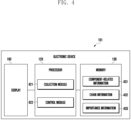
- FIG. 4 is a block diagram of an electronic device according to an embodiment of the disclosure.
- the electronic device of FIG. 4 may be at least partially similar to the electronic device 101 of FIG. 1 or may further include other embodiments of the electronic device 101.
- the electronic device 101 may include a processor (e.g., the processor 120 of FIG. 1 ), a memory (e.g., the memory 130 of FIG. 1 ), and/or a display (e.g., the display 160 of FIG. 1 ).
- the processor 120 may include a collection module 421 that collects data and information and a control module 422 that controls at least one component. According to an embodiment, the operations performed by the collection module 421 and the control module 422 may also be understood as being performed by the processor 120.
- the processor 120 of the electronic device 101 may execute a program (e.g., the program 140 of FIGS. 1 and 2 ) stored in the memory 130 to control at least one other component (e.g., a hardware or software component) and perform various data processing or calculations.
- the processor 120 may include the collection module 421 and the control module 422.
- the collection module 421 may collect data and information and store the same in the memory 130, and the control module 422 may control the operation of at least one other component.
- the processor 120 may be operatively, functionally, and/or electrically connected to the memory 130 and/or the display 160.
- the collection module 421 may collect at least one application component (e.g., the component 310 of FIG. 3 ) determined when an application is executed.
- at least one component 310 may include "activity” (e.g., the "activity” 311 of FIG. 3 ), "service” (e.g., the “service” 312 of FIG. 3 ), "provider” (e.g., the "provider” 313 of FIG. 3 ), and/or “broadcast” (e.g., the "broadcast” 314 of FIG. 3 ).
- the collection module 421 may obtain component-related information to determine whether the specific application is executed based on which component.
- the component type may be defined in the code of the application (e.g. as a class) or may be determined by the electronic device 101 based on the type of operation that is performed.
- the collection module 421 may collect chain information related to the execution of the second application when the second application configured to correspond to the first type component is executed.
- the collection module 421 may collect chain information generated based on a plurality of applications, and store the collected chain information in the chain information 432 of the memory 130.
- control module 422 may at least partially control an operation of at least one application based on the chain information 432 stored in the memory 130. For example, when the first application is executed as a first type of component, the control module 422 may identify the second application corresponding to the first type of component based on the chain information 432, and automatically execute the identified second application. According to an embodiment, the control module 422 may execute the second application operatively connected to the first application (e.g., highly related to the first application, for example based on chain information or execution history information) in a background based on the first application being executed in a foreground.
- the first application e.g., highly related to the first application, for example based on chain information or execution history information
- control module 422 may stop (e.g., kill operation) the execution of the third application that is not operatively connected to the first application in the background (e.g., less relevant to the first application) based on the first application being executed in the foreground.
- the memory 130 may include component-related information 431 for storing component information determined based on the operation of the specific application.
- the component-related information 431 may include a first type of "activity” (e.g., the "activity” 311 of FIG. 3 ), a second type of “service” (e.g., the "service” 312 of FIG. 3 ), a third type of "provider” (e.g., the "provider” 313 of FIG. 3 ), and/or a fourth type of "broadcast” (e.g., the "broadcast” 314 of FIG. 3 ).
- the first application when executed, at least one component corresponding to the first application may be determined based on the component-related information 431.
- the component-related information 431 may include several types of components.
- the memory 130 may include chain information 432 indicating an associative relationship between a plurality of applications.
- the processor 120 may identify the second application having an association with the first type of component according to the execution of the first application based on the chain information 432.
- the electronic device 101 may store the chain information 432 in the memory 130, add other chain information, or delete existing stored chain information. The electronic device 101 may update the chain information 432 stored in the memory 130.
- the memory 130 may include importance information 433 indicating priority and importance between the second applications.
- the processor 120 may identify a plurality of second applications having an association with a first type of component according to the execution of the first application based on the chain information 432.
- the processor 120 may select one second application having a relatively high priority (e.g., a relatively high importance in maintaining execution of the first application) from among a plurality of second applications based on the importance information 433.
- the processor 120 may select one second application having the highest priority/importance from among a plurality of second applications based on the importance information 433.
- the display 160 may be a component on which an execution screen of the first application is displayed.
- the processor 120 may display the execution screen of the first application through the display 160 in response to the execution of the first application.
- the execution screen may be displayed through the display 160.
- the first application may be running in a foreground state.
- the processor 120 may identify that the first application has been executed as a first type of component (e.g., "activity" 311) based on the component-related information 431 of the memory 130.
- the processor 120 may identify at least one second application linked to the first type component.
- the processor 120 may select a second application having a relatively high priority or a relatively high importance from among the at least one identified second application based on the importance information 433 of the memory 130.
- the electronic device 101 may automatically execute the selected second application in response to a situation where the first application is executed as a first type of component (e.g., "activity" 311).
- the second application may be running in a background state.
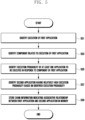
- operations 501 to 509 may be understood as being performed by a processor (e.g., the processor 120 of FIGS. 1 and 4 ) of an electronic device (e.g., the electronic device 101 of FIGS. 1 and 4 ).
- the electronic device 101 of FIG. 5 may be at least partially similar to the electronic device 101 of FIGS. 1 and 4 , or may further include other embodiments of the electronic device 101.
- Table 1 below illustrates an example of the chain information 432.
- second application 302 caller first application 301 component chain code com.android.app.aodservice com.android.calendar provider 13137ce com.android.providers.settings com.android.app.aodservice provider 92bbb7 com.android.app.reminder com.android.calendar provider 13137ce com.android.providers.settings com.android.app.reminder provider 7243566 com.android.scs com.android.calendar provider 13137ce com.android.providers.settings com.android.scs provider 26ef899
- the electronic device 101 may generate chain information 432 including a chain code indicating an associative relationship between the first application 301 and the second application 302, and store the chain information 432 in the memory 130.
- the processor 120 may identify the second application 302 corresponding to the component of the first application 301 based on the chain information 432 stored in the memory 130 in response to the execution of the first application 301, and automatically execute the identified second application 302.
- FIG. 6 is a flowchart illustrating a method of executing an application based on chain information according to an embodiment of the disclosure.
- each operation may be performed sequentially, but is not necessarily performed sequentially.
- the order of each operation may be changed, and at least two operations may be performed in parallel.
- operations 601 to 605 may be understood as being performed by a processor (e.g., the processor 120 of FIGS. 1 and 4 ) of an electronic device (e.g., the electronic device 101 of FIGS. 1 and 4 ).
- the electronic device 101 of FIG. 6 may be at least partially similar to the electronic device 101 of FIGS. 1 and 4 , or may further include other embodiments of the electronic device 101.
- the processor 120 may perform at least some preparation operations (e.g., a preloading operation) performed before the second application 302 is executed in advance.
- the processor 120 may at least partially perform a preloading operation (e.g., a preparation operation) corresponding to the second application 302.
- a preloading operation e.g., a preparation operation
- the processor 120 may at least partially perform a preloading operation (e.g., a preparation operation) corresponding to the second application 302 instead of immediately executing the second application 302.
- the processing speed of the electronic device 101 may be improved by performing the preloading operation of the second application 302. Utilization of the electronic device 101 may be improved.
- FIG. 7 is a flowchart illustrating a method of controlling an application based on chain information according to an embodiment of the disclosure.
- each operation may be performed sequentially, but is not necessarily performed sequentially.
- the order of each operation may be changed, and at least two operations may be performed in parallel.
- operations 701 to 707 may be understood as being performed by a processor (e.g., the processor 120 of FIGS. 1 and 4 ) of an electronic device (e.g., the electronic device 101 of FIGS. 1 and 4 ).
- the electronic device 101 of FIG. 7 may be at least partially similar to the electronic device 101 of FIGS. 1 and 4 , or may further include other embodiments of the electronic device 101.
- the electronic device 101 may be in a state in which chain information (e.g., the chain information 432 of FIG. 4 ) indicating an associative relationship between a first application (e.g., the first application 301 of FIG. 3 ) and a second application (e.g., the second application 302 of FIG. 3 ) is stored in a memory (e.g., the memory 130 of FIG. 4 ).
- chain information e.g., the chain information 432 of FIG. 4
- a first application e.g., the first application 301 of FIG. 3
- a second application e.g., the second application 302 of FIG. 3
- the processor 120 of the electronic device 101 may identify execution of the first application 301.
- the processor 120 may identify a component (e.g., the component 310 of FIG. 3 ) indicating an operation according to the execution of the first application 301.
- the component may be stored as component-related information 431 of the memory 130.
- the processor 120 may identify the second application 302 corresponding to the component of the first application 301 based on the chain information 432 stored in the memory 130 in response to the execution of the first application 301. For example, the processor 120 may identify at least one second application corresponding to the component type of the first application 301 and identify the importance (e.g., the importance information 433 of FIG. 3 ) of the identified at least one second application. The processor 120 may select a second application 302 having a relatively high importance from among the at least one identified second application. The processor 120 may automatically execute the selected second application 302 (e.g., the second application 302 identified to be of relatively high importance).
- the processor 120 may select the second application 302 corresponding to the component of the first application 301 based on the chain information 432, and automatically execute the selected second application 302.
- the second application 302 may include a relatively important application in maintaining the execution state of the first application 301.
- the processor 120 may perform at least some preparation operations (e.g., a preloading operation) performed before the second application 302 is executed in advance.
- the processor 120 may at least partially perform a preloading operation (e.g., a preparation operation) corresponding to the second application 302.
- a preloading operation e.g., a preparation operation
- the processor 120 may at least partially perform a preloading operation (e.g., a preparation operation) corresponding to the second application 302 instead of immediately executing the second application 302.
- the processor 120 may identify at least one third application that does not match the second application 302, which is running in a background state.
- the electronic device 101 may be in a state where a plurality of applications are running in the background state.
- the processor 120 may select a third application that does not match the identified second application 302 from among the plurality of applications.
- at least one third application may include an application with relatively low relevance (e.g., a relatively low importance or a relatively low priority) in a situation where the first application 301 is running.
- the at least one third application may include an application for which no chain information 432 exists between the third application and the first application 301 (or component type of the first application 301).
- the processor 120 may stop (e.g., a kill operation) execution of the at least one identified third application. For example, in order to improve the performance of the electronic device 101, the processor 120 may stop (e.g., a kill operation) the execution of a relatively low-importance third application from among applications running in a background.
- a method may further include identifying execution probability of at least one application corresponding to the component 310 of the first application 301 in response to the execution of the first application 301, determining the second application 302 with a relatively high execution probability based on the identified execution probability, and generating chain information 432 in which an associative relationship between the first application 301 and the second application 302 is configured.
- a method according to an embodiment may further include displaying execution screen of the first application 301 through a display 160 in response to the execution of the first application 301, and executing the second application 302 in a background state.
- a method may further include identifying a request to stop execution of a third application running in a background state while the execution screen of the first application 301 is being displayed through the display 160, and maintaining execution of the third application when an associative relationship between the third application and the first application 301 is identified based on the chain information 432 stored in the memory 130.
- the priority may be determined based on the importance corresponding to the at least one second application 302 in order to maintain execution of the first application 301.
- a method may further include identifying at least one third application being executed in a background, and stopping execution of the at least one third application when the identified at least one third application is not included in the at least one second application.
- the component 310 may include at least one of a first type of component in which an execution screen of the first application 301 is displayed, a second type of component in which the first application 301 is executed in a background state, a third type of component in which account information connected through the first application 301 is shared, and a fourth type of component in which at least one component included in the electronic device 101 is controlled based on the first application 301.
- a method according to an embodiment may further include identifying at least one preparation operation performed before execution of the identified second application 302, and performing at least some of the preparation operations corresponding to the second application 302 in response to the execution of the first application 301.
- a non-transitory computer-readable storage medium (or a computer program product) storing one or more programs for performing an application execution method of an electronic device 101 may be described.
- the one or more programs when executed by the processor 120 of the electronic device 101, may include instructions for performing identifying the execution of a second application 302 corresponding to a component 310 of the first application 301 in response to the execution of the first application 301 from among a plurality of applications stored in a memory 130, storing chain information 432 indicating an associative relationship between the first application 301 and the second application 302 in the memory, executing the second application 302 corresponding to the component 310 of the first application 301 based on the chain information 432 stored in the memory 130 in response to the execution of the first application 301 in a state in which chain information 432 between the plurality of applications is stored in the memory 130, and automatically executing the identified second application 302.
- module may include a unit implemented in hardware, software, or firmware, or any combination thereof, and may interchangeably be used with other terms, for example, “logic,” “logic block,” “part,” or “circuitry”.
- a module may be a single integral component, or a minimum unit or part thereof, adapted to perform one or more functions.
- the module may be implemented in a form of an application-specific integrated circuit (ASIC).
- ASIC application-specific integrated circuit
- the machine-readable storage medium may be provided in the form of a non-transitory storage medium.
- the "non-transitory” storage medium is a tangible device, and may not include a signal (e.g., an electromagnetic wave), but this term does not differentiate between where data is semi-permanently stored in the storage medium and where the data is temporarily stored in the storage medium.
- a method may be included and provided in a computer program product.
- the computer program product may be traded as a product between a seller and a buyer.
- the computer program product may be distributed in the form of a machine-readable storage medium (e.g., compact disc read only memory (CD-ROM)), or be distributed (e.g., downloaded or uploaded) online via an application store (e.g., PlayStore TM ), or between two user devices (e.g., smart phones) directly. If distributed online, at least part of the computer program product may be temporarily generated or at least temporarily stored in the machine-readable storage medium, such as memory of the manufacturer's server, a server of the application store, or a relay server.
- CD-ROM compact disc read only memory
- an application store e.g., PlayStore TM
- two user devices e.g., smart phones
- each component e.g., a module or a program of the above-described components may include a single entity or multiple entities, and some of the multiple entities may be separately disposed in different components. According to various embodiments, one or more of the above-described components may be omitted, or one or more other components may be added. Alternatively or additionally, a plurality of components (e.g., modules or programs) may be integrated into a single component. In such a case, according to various embodiments, the integrated component may still perform one or more functions of each of the plurality of components in the same or similar manner as they are performed by a corresponding one of the plurality of components before the integration.
- operations performed by the module, the program, or another component may be carried out sequentially, in parallel, repeatedly, or heuristically, or one or more of the operations may be executed in a different order or omitted, or one or more other operations may be added.
Landscapes
- Engineering & Computer Science (AREA)
- Software Systems (AREA)
- Theoretical Computer Science (AREA)
- Physics & Mathematics (AREA)
- General Engineering & Computer Science (AREA)
- General Physics & Mathematics (AREA)
- Human Computer Interaction (AREA)
- Telephone Function (AREA)
Applications Claiming Priority (3)
| Application Number | Priority Date | Filing Date | Title |
|---|---|---|---|
| KR20230160349 | 2023-11-20 | ||
| KR1020230190942A KR20250074534A (ko) | 2023-11-20 | 2023-12-26 | 전자 장치 및 이를 이용한 어플리케이션 실행 방법 |
| PCT/KR2024/015995 WO2025110490A1 (ko) | 2023-11-20 | 2024-10-21 | 전자 장치 및 이를 이용한 어플리케이션 실행 방법 |
Publications (2)
| Publication Number | Publication Date |
|---|---|
| EP4582940A1 true EP4582940A1 (de) | 2025-07-09 |
| EP4582940A4 EP4582940A4 (de) | 2026-03-18 |
Family
ID=94129671
Family Applications (1)
| Application Number | Title | Priority Date | Filing Date |
|---|---|---|---|
| EP24812685.6A Pending EP4582940A4 (de) | 2023-11-20 | 2024-10-21 | Benutzervorrichtung und anwendungsausführungsverfahren damit |
Country Status (2)
| Country | Link |
|---|---|
| EP (1) | EP4582940A4 (de) |
| WO (1) | WO2025110490A1 (de) |
Family Cites Families (6)
| Publication number | Priority date | Publication date | Assignee | Title |
|---|---|---|---|---|
| US7484220B2 (en) * | 2004-05-26 | 2009-01-27 | Qualcomm Incorporated | Method, software and apparatus for using application state history information when re-launching applications |
| KR100616157B1 (ko) * | 2005-01-11 | 2006-08-28 | 와이더댄 주식회사 | 애플리케이션 연동 방법 및 그 시스템 |
| US9508040B2 (en) * | 2013-06-12 | 2016-11-29 | Microsoft Technology Licensing, Llc | Predictive pre-launch for applications |
| WO2016026108A1 (zh) * | 2014-08-20 | 2016-02-25 | 华为技术有限公司 | 一种应用程序的切换方法、装置及电子终端 |
| KR102741317B1 (ko) * | 2019-01-28 | 2024-12-12 | 삼성전자주식회사 | 어플리케이션의 상황 정보를 표시하는 전자 장치 및 방법 |
| CN111796747B (zh) * | 2020-06-30 | 2022-02-08 | 维沃移动通信有限公司 | 多开应用的处理方法、装置和电子设备 |
-
2024
- 2024-10-21 EP EP24812685.6A patent/EP4582940A4/de active Pending
- 2024-10-21 WO PCT/KR2024/015995 patent/WO2025110490A1/ko active Pending
Also Published As
| Publication number | Publication date |
|---|---|
| WO2025110490A1 (ko) | 2025-05-30 |
| EP4582940A4 (de) | 2026-03-18 |
Similar Documents
| Publication | Publication Date | Title |
|---|---|---|
| EP3749001B1 (de) | Elektronische vorrichtung und verfahren zum umschalten einer elektronischen vorrichtung zwischen dual-standby-modus und single-standby-modus | |
| EP3738031B1 (de) | Elektronische vorrichtung zur steuerung einer vordefinierten funktion auf basis der antwortzeit einer externen elektronischen vorrichtung auf eine benutzereingabe und verfahren dafür | |
| EP4262175B1 (de) | Verfahren zur bereitstellung einer benutzerschnittstelle und elektronische vorrichtung dafür | |
| EP4293501A1 (de) | Elektronische vorrichtung und betriebsverfahren der elektronischen vorrichtung | |
| US12353894B2 (en) | Electronic device preloading abnormal application in background, and operation method thereof | |
| US20230350730A1 (en) | Electronic device and operation method of electronic device | |
| EP4228234A1 (de) | Elektronische vorrichtung und anwendungsausführungsverfahren für eine elektronische vorrichtung | |
| US12086420B2 (en) | Memory management method and electronic device | |
| US11803294B2 (en) | Electronic device and operation method of electronic device performing capture function | |
| US12489951B2 (en) | Electronic apparatus and operating method of electronic apparatus | |
| US20220224661A1 (en) | Electronic device for receiving or transmitting rcs data and operation method of electronic device | |
| US12541810B2 (en) | Electronic device and operating method thereof | |
| EP4582940A1 (de) | Benutzervorrichtung und anwendungsausführungsverfahren damit | |
| US20240211137A1 (en) | Electronic device for managing memory and operating method thereof | |
| US20220326964A1 (en) | Processor for initializing model file of application and electronic device including the same | |
| EP4325874A1 (de) | Elektronische vorrichtung und betriebsverfahren der elektronischen vorrichtung | |
| US11635885B2 (en) | Electronic device for supporting automation services | |
| KR102927973B1 (ko) | 캡쳐 기능을 수행하는 전자 장치 및 전자 장치의 동작 방법 | |
| EP4443303A1 (de) | Elektronische vorrichtung und verfahren zur erkennung von leistungsänderungen in einer elektronischen vorrichtung | |
| US12135994B2 (en) | Electronic device including multi processor and method for operating the same | |
| US12271295B2 (en) | Electronic device performing method of controlling memory based on temperature and available area of the memory | |
| US20250225005A1 (en) | Electronic device and communication method between applications | |
| US20250208859A1 (en) | Update method and electronic device therefor | |
| US20250175551A1 (en) | Method for performing operation related to notification, and electronic device supporting same | |
| US12105814B2 (en) | Electronic device for providing privacy services |
Legal Events
| Date | Code | Title | Description |
|---|---|---|---|
| STAA | Information on the status of an ep patent application or granted ep patent |
Free format text: STATUS: UNKNOWN |
|
| STAA | Information on the status of an ep patent application or granted ep patent |
Free format text: STATUS: THE INTERNATIONAL PUBLICATION HAS BEEN MADE |
|
| PUAI | Public reference made under article 153(3) epc to a published international application that has entered the european phase |
Free format text: ORIGINAL CODE: 0009012 |
|
| STAA | Information on the status of an ep patent application or granted ep patent |
Free format text: STATUS: REQUEST FOR EXAMINATION WAS MADE |
|
| 17P | Request for examination filed |
Effective date: 20241204 |
|
| AK | Designated contracting states |
Kind code of ref document: A1 Designated state(s): AL AT BE BG CH CY CZ DE DK EE ES FI FR GB GR HR HU IE IS IT LI LT LU LV MC ME MK MT NL NO PL PT RO RS SE SI SK SM TR |
|
| A4 | Supplementary search report drawn up and despatched |
Effective date: 20260212 |
|
| RIC1 | Information provided on ipc code assigned before grant |
Ipc: G06F 9/448 20180101AFI20260206BHEP Ipc: G06F 3/0481 20220101ALI20260206BHEP Ipc: G06F 3/0482 20130101ALI20260206BHEP Ipc: G06F 3/0484 20220101ALI20260206BHEP Ipc: G06F 9/00 20060101ALI20260206BHEP Ipc: G06F 9/06 20060101ALI20260206BHEP Ipc: G06F 9/445 20180101ALI20260206BHEP Ipc: G06F 9/48 20060101ALI20260206BHEP Ipc: G06F 9/451 20180101ALI20260206BHEP Ipc: G06F 9/50 20060101ALI20260206BHEP |