EP4582400A1 - Geopolymer composition, production method therefor, and concrete structure - Google Patents
Geopolymer composition, production method therefor, and concrete structure Download PDFInfo
- Publication number
- EP4582400A1 EP4582400A1 EP23860442.5A EP23860442A EP4582400A1 EP 4582400 A1 EP4582400 A1 EP 4582400A1 EP 23860442 A EP23860442 A EP 23860442A EP 4582400 A1 EP4582400 A1 EP 4582400A1
- Authority
- EP
- European Patent Office
- Prior art keywords
- geopolymer composition
- geopolymer
- molar ratio
- examples
- concrete
- Prior art date
- Legal status (The legal status is an assumption and is not a legal conclusion. Google has not performed a legal analysis and makes no representation as to the accuracy of the status listed.)
- Pending
Links
Images

Classifications
-
- C—CHEMISTRY; METALLURGY
- C04—CEMENTS; CONCRETE; ARTIFICIAL STONE; CERAMICS; REFRACTORIES
- C04B—LIME, MAGNESIA; SLAG; CEMENTS; COMPOSITIONS THEREOF, e.g. MORTARS, CONCRETE OR LIKE BUILDING MATERIALS; ARTIFICIAL STONE; CERAMICS; REFRACTORIES; TREATMENT OF NATURAL STONE
- C04B28/00—Compositions of mortars, concrete or artificial stone, containing inorganic binders or the reaction product of an inorganic and an organic binder, e.g. polycarboxylate cements
- C04B28/006—Compositions of mortars, concrete or artificial stone, containing inorganic binders or the reaction product of an inorganic and an organic binder, e.g. polycarboxylate cements containing mineral polymers, e.g. geopolymers of the Davidovits type
-
- C—CHEMISTRY; METALLURGY
- C04—CEMENTS; CONCRETE; ARTIFICIAL STONE; CERAMICS; REFRACTORIES
- C04B—LIME, MAGNESIA; SLAG; CEMENTS; COMPOSITIONS THEREOF, e.g. MORTARS, CONCRETE OR LIKE BUILDING MATERIALS; ARTIFICIAL STONE; CERAMICS; REFRACTORIES; TREATMENT OF NATURAL STONE
- C04B2111/00—Mortars, concrete or artificial stone or mixtures to prepare them, characterised by specific function, property or use
- C04B2111/00034—Physico-chemical characteristics of the mixtures
- C04B2111/00206—Compositions defined by their elemental analysis
-
- C—CHEMISTRY; METALLURGY
- C04—CEMENTS; CONCRETE; ARTIFICIAL STONE; CERAMICS; REFRACTORIES
- C04B—LIME, MAGNESIA; SLAG; CEMENTS; COMPOSITIONS THEREOF, e.g. MORTARS, CONCRETE OR LIKE BUILDING MATERIALS; ARTIFICIAL STONE; CERAMICS; REFRACTORIES; TREATMENT OF NATURAL STONE
- C04B2111/00—Mortars, concrete or artificial stone or mixtures to prepare them, characterised by specific function, property or use
- C04B2111/20—Resistance against chemical, physical or biological attack
- C04B2111/23—Acid resistance, e.g. against acid air or rain
Definitions
- the present invention relates to a geopolymer composition for use in forming a structure in, for example, civil engineering or construction, a method for producing the same, and a concrete structure.
- FA JIS Type-I fly ash
- BS denotes blast furnace slag fine powder (Blaine's value: 4000 cm 2 /g)
- produced water glass is produced by mixing and dissolving KOH and SiO 2 in water.
- geopolymer concrete is conventionally produced by first charging materials such as a powder (active filler) such as coal ash, blast furnace slag, and metakaolin and aggregate (fine aggregate, coarse aggregate) into a mixer (S1), stirring the resultant for a predetermined time (e.g., 2 minutes) (S2), then adding an alkali solution such as water glass (S3), mixing the resultant in the mixer for a predetermined time (e.g., 5 minutes) (S4), and completing the mixing. Then, the mixed product is poured into a formwork, cured for several hours, and then demolded after hardening to form a structure (see, for example, Patent Literature 1).
- a powder active filler
- S3 an alkali solution
- S4 mixing the resultant in the mixer for a predetermined time (e.g., 5 minutes)
- Patent Literature 1 Japanese Patent No. 5091519
- geopolymer compositions are known to have higher acid resistance than cement, but may not have acid resistance superior to that of cement concrete depending on a combination of its composition, raw material conditions, aggregate compounding conditions, etc. This causes a problem that some of geopolymer compositions are not suitable for structures required to have acid resistance.
- the present invention is directed to a geopolymer composition containing, as a raw material, an active filler and an alkali activator, wherein a molar ratio of a total of sodium and potassium to aluminum ((Na+K)/Al) in the entire geopolymer composition is more than 0.5 and 1.4 or less, a molar ratio of silicon to aluminum (Si/Al) is more than 1.5 and 2.8 or less, a weight ratio of all aggregate to a geopolymer slurry is 0.6 or more and a closest-packing ratio of fine aggregate is higher than that of coarse aggregate, and a molar ratio of water to alumina (H 2 O/Al 2 O 3 ) in the entire geopolymer composition is 15 or less.
- a molar ratio of a total of sodium and potassium to aluminum ((Na+K)/Al) in the entire geopolymer composition is more than 0.5 and 1.4 or less
- a molar ratio of silicon to aluminum (Si/Al)
- the present invention is also directed to a method for producing the geopolymer composition described above, the method including performing heat curing at an accumulated temperature (temperature ⁇ time) of 180°C ⁇ Hr or higher in an environment of 50°C or higher or heat curing at an accumulated temperature of 14400°C ⁇ Hr or higher or for 30 days or longer in an environment of lower than 50°C.
- a test performed by the present inventor confirmed that a geopolymer composition produced by such a production method has high acid resistance even at a young material age.
- the geopolymer composition of the present invention always and stably has high acid resistance, and therefore its lifetime in an acid environment is longer than that of a conventional cement concrete composition or geopolymer concrete having unstable acid resistance, which makes it possible to reduce the frequency of replacement or repair of structures. This makes it possible to reduce environmental load, working hours, and costs due to a reduction in the amounts of materials to be used. Further, a reduction in corrosion allowance makes it possible to reduce not only time and cost required for drilling work at a product installation site but also material costs.
- the geopolymer composition of the present invention can have high acid resistance even at a young material age, which makes it possible to reduce a work period.
- the concrete structure using the geopolymer composition of the present embodiment makes it possible to minimize the amount of the acid-resistant geopolymer composition to be used, which makes it possible to reduce the cost of the entire concrete structure.
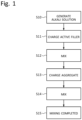
- Figure 1 shows, as an embodiment of the present invention, a method for producing a geopolymer composition for use as a structure in, for example, civil engineering or construction.
- a geopolymer composition of the present embodiment contains, as a raw material, an active filler, an alkali activator, and aggregate, and is formed by adding an active filler to an alkali solution obtained by mixing an alkali activator and water, mixing the resultant, adding aggregate thereto, and mixing the resultant.
- the active filler is a powder activated and solidified by mixing with an alkali activator, and is composed of, for example, an alkali-active amorphous powder, such as fly ash (coal ash), metakaolin, and blast furnace slag.
- an alkali-active amorphous powder such as fly ash (coal ash), metakaolin, and blast furnace slag.
- the aggregate is composed of sand, gravel, artificial aggregate, or the like, and is classified into fine aggregate and coarse aggregate according to the size of particles.
- the geopolymer composition is subjected to heat curing at an accumulated temperature of 180°C ⁇ Hr or higher in a temperature environment of 50°C or higher or heat curing at an accumulated temperature of 14400°C ⁇ Hr or higher or for 30 days in a temperature environment of lower than 50°C.
- a test performed by the present inventor confirmed that such a geopolymer composition has high acid resistance even at a young material age of 10 days or shorter.
- the geopolymer composition of the present embodiment always and stably has high acid resistance by satisfying the above requirements (1) to (3), and therefore its lifetime in an acid environment is longer than that of a conventional cement concrete composition or geopolymer concrete having unstable acid resistance, which makes it possible to reduce the frequency of replacement or repair of structures. This makes it possible to reduce environmental load, work hours, and costs due to a reduction in the amounts of materials to be used. Further, a reduction in corrosion allowance makes it possible to reduce not only time and cost required for drilling work at a product installation site but also material costs.
- heat curing performed after the mixing of raw materials makes it possible for the geopolymer composition to have high acid resistance even at a young material age, thereby reducing a work period.
- Example 1 The temperature of heat curing in Examples 1 to 10 was set to 60°C, that in Comparative Example 1 was set to 45°C, that in Example 11 was set to 20°C, and that in Comparative Example 2 was set to 30°C.
- the time of heat curing in Examples 1 to 10 and Comparative Examples 1 and 2 was set to 68 hours and that in Example 10 was set to 3 hours.
- Example 11 a geopolymer slurry was left to stand at ordinary temperature (20°C).
- test age in Examples 1 and 3 to 9 and Comparative Examples 1 and 2 was set to 10 days or shorter, that in Example 2 was set to 20 days or longer, that in Example 10 was set to 28 days, and that in Example 11 was set to 36 days.
- Geopolymer compositions (concrete solidified bodies) of Examples 1 to 6 and Comparative Example 1 were produced by a method according to the following steps (1) to (7) and were subjected to a performance test.
- Geopolymer compositions (paste solidified bodies) of Examples 7 to 11 and Comparative Example 2 were produced by a method according to the following steps (1) to (5) and were subjected to a performance test.
- Example 3 2.2 1.2 10 0.43 0. 70 60 68 6 days 98.2 5.8
- Example 4 2.2 1 13 0.43 0. 70 60 68 6 days 51.6 4.5
- Example 5 2.8 1 12.4 0.43 0. 70 60 68 6 days 26.1 6.2
- Example 6 2.2 0.6 10 0.43 0. 70 60 68 9 days 72 5.7 Comparative Example 1 2.2 1 10 0.43 0.
- Example 7 2.2 1 10 0 0 60 68 5days 94.4 17.8
- Example 8 1.8 0.8 11.6 0 0 60 68 12days 9.9 12.7
- Example 9 2.2 1.2 10 0 0 60 68 5days 66.5 19.8
- Example 10 2.2 1 10 0 0 60 3 28days 54.1 16.1
- Example 11 2.2 1 10 0 0 20 0 36days 71.6 14.9 Comparative Example 2 2.2 1 10 0 0 30 68 5days 76.9 51.5
Landscapes
- Chemical & Material Sciences (AREA)
- Ceramic Engineering (AREA)
- Engineering & Computer Science (AREA)
- Geochemistry & Mineralogy (AREA)
- Geology (AREA)
- Life Sciences & Earth Sciences (AREA)
- Chemical Kinetics & Catalysis (AREA)
- Inorganic Chemistry (AREA)
- General Life Sciences & Earth Sciences (AREA)
- Environmental & Geological Engineering (AREA)
- Materials Engineering (AREA)
- Structural Engineering (AREA)
- Organic Chemistry (AREA)
- Curing Cements, Concrete, And Artificial Stone (AREA)
- Devices For Post-Treatments, Processing, Supply, Discharge, And Other Processes (AREA)
Abstract
Description
- The present invention relates to a geopolymer composition for use in forming a structure in, for example, civil engineering or construction, a method for producing the same, and a concrete structure.
- Conventionally, in civil engineering, construction, and the like, structures have generally been formed using concrete or mortar. However, geopolymer compositions have received attention in recent years as an alternative material to concrete or mortar, and the application of geopolymer concrete to various structures such as railroad ties and wall materials for buildings has been examined.
- A geopolymer composition is a solidified body obtained by mixing and reacting an alkali-active amorphous powder (active filler) such as fly ash (coal ash), metakaolin, and blast furnace slag, with an alkali solution for activating it (an aqueous sodium silicate solution, an aqueous potassium silicate solution, an aqueous sodium hydroxide solution, an aqueous potassium hydroxide solution). Similarly to cement concrete, geopolymer concrete develops strength comparable to that of cement concrete by adding fine aggregate, coarse aggregate, and the like (see Table 1).
[Table 1] Quantity of material per unit volume of concrete (kg/m3) FA BS KOH SiO2 Water Fine aggregate Coarse aggregate 456 24 140 47 109 659 850 Produced water glass = 296 - It should be noted that in Table 1, FA denotes JIS Type-I fly ash, BS denotes blast furnace slag fine powder (Blaine's value: 4000 cm2/g), and produced water glass is produced by mixing and dissolving KOH and SiO2 in water.
- Generally, as shown in
Figure 2 , geopolymer concrete is conventionally produced by first charging materials such as a powder (active filler) such as coal ash, blast furnace slag, and metakaolin and aggregate (fine aggregate, coarse aggregate) into a mixer (S1), stirring the resultant for a predetermined time (e.g., 2 minutes) (S2), then adding an alkali solution such as water glass (S3), mixing the resultant in the mixer for a predetermined time (e.g., 5 minutes) (S4), and completing the mixing. Then, the mixed product is poured into a formwork, cured for several hours, and then demolded after hardening to form a structure (see, for example, Patent Literature 1). - Geopolymer compositions are free from calcium and are therefore characterized by higher acid resistance than cement. For example, geopolymer compositions are used as a material for sidewalk/roadway boundary blocks in hot spring towns.
- Patent Literature 1:
Japanese Patent No. 5091519 - As described above, geopolymer compositions are known to have higher acid resistance than cement, but may not have acid resistance superior to that of cement concrete depending on a combination of its composition, raw material conditions, aggregate compounding conditions, etc. This causes a problem that some of geopolymer compositions are not suitable for structures required to have acid resistance.
- In light of such a problem, it is an object of the present invention to provide a geopolymer composition always having acid resistance superior to that of cement concrete, a method for producing the same, and a concrete structure.
- In order to achieve the above object, the present invention is directed to a geopolymer composition containing, as a raw material, an active filler and an alkali activator, wherein a molar ratio of a total of sodium and potassium to aluminum ((Na+K)/Al) in the entire geopolymer composition is more than 0.5 and 1.4 or less, a molar ratio of silicon to aluminum (Si/Al) is more than 1.5 and 2.8 or less, a weight ratio of all aggregate to a geopolymer slurry is 0.6 or more and a closest-packing ratio of fine aggregate is higher than that of coarse aggregate, and a molar ratio of water to alumina (H2O/Al2O3) in the entire geopolymer composition is 15 or less.
- A test performed by the present inventor confirmed that such a geopolymer composition stably has high acid resistance.
- Further, in order to achieve the above object, the present invention is also directed to a method for producing the geopolymer composition described above, the method including performing heat curing at an accumulated temperature (temperature × time) of 180°C·Hr or higher in an environment of 50°C or higher or heat curing at an accumulated temperature of 14400°C·Hr or higher or for 30 days or longer in an environment of lower than 50°C. A test performed by the present inventor confirmed that a geopolymer composition produced by such a production method has high acid resistance even at a young material age.
- Further, in order to achieve the above object, the present invention is directed to a concrete structure using the geopolymer composition described above, the concrete structure including: a portion formed of the geopolymer composition, which is to be brought into contact with an acid solution; and a portion formed of cement concrete, which is not to be brought into contact with an acid solution.
- In this case, only the portion to be brought into contact with an acid solution is formed using the geopolymer composition, which makes it possible to minimize the amount of the acid-resistant geopolymer composition to be used.
- The geopolymer composition of the present invention always and stably has high acid resistance, and therefore its lifetime in an acid environment is longer than that of a conventional cement concrete composition or geopolymer concrete having unstable acid resistance, which makes it possible to reduce the frequency of replacement or repair of structures. This makes it possible to reduce environmental load, working hours, and costs due to a reduction in the amounts of materials to be used. Further, a reduction in corrosion allowance makes it possible to reduce not only time and cost required for drilling work at a product installation site but also material costs.
- Further, the geopolymer composition of the present invention can have high acid resistance even at a young material age, which makes it possible to reduce a work period.
- Further, the concrete structure using the geopolymer composition of the present embodiment makes it possible to minimize the amount of the acid-resistant geopolymer composition to be used, which makes it possible to reduce the cost of the entire concrete structure.
-
-
Figure 1 is a diagram showing production steps of a geopolymer composition according to an embodiment of the present invention. -
Figure 2 is a diagram showing production steps of a conventional geopolymer composition. -
Figure 1 shows, as an embodiment of the present invention, a method for producing a geopolymer composition for use as a structure in, for example, civil engineering or construction. - A geopolymer composition of the present embodiment contains, as a raw material, an active filler, an alkali activator, and aggregate, and is formed by adding an active filler to an alkali solution obtained by mixing an alkali activator and water, mixing the resultant, adding aggregate thereto, and mixing the resultant.
- The active filler is a powder activated and solidified by mixing with an alkali activator, and is composed of, for example, an alkali-active amorphous powder, such as fly ash (coal ash), metakaolin, and blast furnace slag.
- The alkali activator is a powder of potassium silicate, sodium metasilicate, sodium hydroxide, potassium hydroxide, or the like.
- The aggregate is composed of sand, gravel, artificial aggregate, or the like, and is classified into fine aggregate and coarse aggregate according to the size of particles.
- Hereinbelow, the method for producing a geopolymer composition of the present embodiment will be described with reference to
Figure 1 . - First, an alkali solution is generated by melting an alkali activator in water (S10). Then, an active filler is charged into the alkali solution generated in step S10 (S11), and the resultant is mixed in a mixer to form a geopolymer slurry (S12). Then, aggregate is charged into the geopolymer slurry formed in step S12 (S13), the resultant is mixed in the mixer (S14), the mixing is completed (S15), and the resultant is poured into a formwork and hardened by heat curing at a temperature higher than 45°C (preferably 60°C) for 24 hours (preferably 68 hours) or longer to form geopolymer concrete.
- In this case, (1) the molar ratio of the total of sodium and potassium to aluminum ((Na+K)/Al) in the entire geopolymer composition is set to more than 0.5 and 1.4 or less, (2) the molar ratio of silicon to aluminum (Si/Al) is set to more than 1.5 and 2.8 or less, and (3) the molar ratio of water to alumina (H2O/Al2O3) in the entire geopolymer composition is set to 15 or less. A test performed by the present inventor confirmed that such a geopolymer composition stably has high acid resistance.
- Further, after the mixing of raw materials, the geopolymer composition is subjected to heat curing at an accumulated temperature of 180°C·Hr or higher in a temperature environment of 50°C or higher or heat curing at an accumulated temperature of 14400°C·Hr or higher or for 30 days in a temperature environment of lower than 50°C. A test performed by the present inventor confirmed that such a geopolymer composition has high acid resistance even at a young material age of 10 days or shorter.
- As described above, the geopolymer composition of the present embodiment always and stably has high acid resistance by satisfying the above requirements (1) to (3), and therefore its lifetime in an acid environment is longer than that of a conventional cement concrete composition or geopolymer concrete having unstable acid resistance, which makes it possible to reduce the frequency of replacement or repair of structures. This makes it possible to reduce environmental load, work hours, and costs due to a reduction in the amounts of materials to be used. Further, a reduction in corrosion allowance makes it possible to reduce not only time and cost required for drilling work at a product installation site but also material costs.
- Further, heat curing performed after the mixing of raw materials makes it possible for the geopolymer composition to have high acid resistance even at a young material age, thereby reducing a work period.
- Further, when a concrete structure is formed using the geopolymer composition of the present embodiment to have a portion formed of the geopolymer composition, which is to be brought into contact with an acid solution and a portion formed of relatively inexpensive cement concrete, which is not to be brought into contact with an acid solution, the amount of the acid-resistant geopolymer composition to be used can be minimized, which makes it possible to reduce the cost of the entire concrete structure.
- It should be noted that the above embodiment is an example of the present invention, and the present invention is not limited to the above embodiment.
- Hereinbelow, Examples 1 to 6 of the present invention and Comparative Examples 1 and 2 will be shown. It should be noted that the present invention is not limited to these examples.
- In geopolymer compositions (concrete solidified bodies) of Examples 1 to 6 and Comparative Example 1, metakaolin and silica fume were used as a binder (active filler) and fine aggregate and coarse aggregate were used as aggregate.
- In geopolymer compositions (paste solidified bodies) of Examples 7 to 11 and Comparative Example 2, used metakaolin and silica fume were used as a binder (active filler).
- Further, in Examples 1 to 11 and Comparative Examples 1 and 2, potassium silicate, sodium metasilicate, and sodium hydroxide were used as an alkali solution, and pure water was used as water.
- In Examples 1 to 11 and Comparative Examples 1 and 2, Si/Al in Examples 1 to 4, 6, 7, and 9 to 11 and Comparative Examples 1 and 2 was set to 2.2, that in Example 5 was set to 2.8, and that in Example 8 was set to 1.8.
- In Examples 1 to 11 and Comparative Examples 1 and 2, (Na+K) /Al in Examples 1, 2, 4, 5, 7, 10, and 11 and Comparative Examples 1 and 2 was set to 1, that in Examples 3 and 9 was set to 1.2, that in Example 6 was set to 0.6, and that in Example 8 was set to 0.8.
- In Examples 1 to 11 and Comparative Examples 1 and 2, H2O/Al2O3 in Examples 1 to 3, 6, 7, and 9 to 11 and Comparative Examples 1 and 2 was set to 10, that in Example 4 was set to 13, that in Example 5 was set to 12.4, and that in Example 8 was set to 11.6.
- In Examples 1 to 6 and Comparative Example 1, the weight ratio of all aggregate to a geopolymer slurry was all set to 0.70.
- The temperature of heat curing in Examples 1 to 10 was set to 60°C, that in Comparative Example 1 was set to 45°C, that in Example 11 was set to 20°C, and that in Comparative Example 2 was set to 30°C. The time of heat curing in Examples 1 to 10 and Comparative Examples 1 and 2 was set to 68 hours and that in Example 10 was set to 3 hours. In Example 11, a geopolymer slurry was left to stand at ordinary temperature (20°C).
- The test age in Examples 1 and 3 to 9 and Comparative Examples 1 and 2 was set to 10 days or shorter, that in Example 2 was set to 20 days or longer, that in Example 10 was set to 28 days, and that in Example 11 was set to 36 days.
- Geopolymer compositions (concrete solidified bodies) of Examples 1 to 6 and Comparative Example 1 were produced by a method according to the following steps (1) to (7) and were subjected to a performance test.
- (1) Potassium silicate, sodium metasilicate, and sodium hydroxide were dissolved in pure water and the resultant was cooled to 20°C or lower.
- (2) The cooled alkali solution obtained in step (1) and a binder (active filler) were mixed using a stand mixer.
- (3) The geopolymer slurry obtained in step (2) and aggregate previously mixed without adding water are mixed using a pan-type mixer.
- (4) The mixed geopolymer concrete is charged into a mold. Deaeration is performed.
- (5) Sealed heat curing is performed in a thermostat.
- (6) After natural cooling, room-temperature curing is performed until a test day.
- Geopolymer compositions (paste solidified bodies) of Examples 7 to 11 and Comparative Example 2 were produced by a method according to the following steps (1) to (5) and were subjected to a performance test.
- (1) Potassium silicate, sodium metasilicate, and sodium hydroxide were dissolved in pure water and the resultant was cooled to 20°C or lower.
- (2) The cooled alkali solution obtained in step (1) and a binder (active filler) were mixed using a stand mixer.
- (3) The mixed geopolymer paste was charged into a mold. Deaeration is performed.
- (4) Sealed heat curing is performed in a thermostat. (Only in Example 11, the geopolymer paste was left to stand at ordinary temperature.)
- (5) Room-temperature curing is performed until a test day.
- The results of a sulfuric acid immersion test of Examples 1 to 6 and Comparative Example 1 and those of Examples 7 to 11 and Comparative Example 2 are respectively shown below in Table 2 and Table 3. The sulfuric acid immersion test was performed using a sample having a diameter of 50 mm and a thickness of 10 mm.
[Table 2] Si/Al Na+K / Al H2O / Al2O3 Ratio of fine aggregate Ratio of all aggregate Heating temperature [°C] Heating time [h] Material age at start of test Compressive strength [Mpa] Mass reduction ratio after 3-w 5wt% sulfuric acid immersion [wt%] Example 1 2.2 1 10 0.43 0. 70 60 68 7 days 75.2 7.8 Example 2 2.2 1 10 0.43 0. 70 60 68 28 days 81 5.5 Example 3 2.2 1.2 10 0.43 0. 70 60 68 6 days 98.2 5.8 Example 4 2.2 1 13 0.43 0. 70 60 68 6 days 51.6 4.5 Example 5 2.8 1 12.4 0.43 0. 70 60 68 6 days 26.1 6.2 Example 6 2.2 0.6 10 0.43 0. 70 60 68 9 days 72 5.7 Comparative Example 1 2.2 1 10 0.43 0. 70 45 68 6 days 76.9 100 [Table 3] Si/Al Na+K / Al H2O / Al2O3 Ratio of fine aggregate Ratio of all aggregate Heating temperature [°C] Heating time [h] Material age at start of test Compressive strength [Mpa] Mass reduction ratio after 3- w 5 wt% sulfuric acid immersion [wt%]Example 7 2.2 1 10 0 0 60 68 5days 94.4 17.8 Example 8 1.8 0.8 11.6 0 0 60 68 12days 9.9 12.7 Example 9 2.2 1.2 10 0 0 60 68 5days 66.5 19.8 Example 10 2.2 1 10 0 0 60 3 28days 54.1 16.1 Example 11 2.2 1 10 0 0 20 0 36days 71.6 14.9 Comparative Example 2 2.2 1 10 0 0 30 68 5days 76.9 51.5 - The test results confirmed that the geopolymer compositions of Examples 1 to 11 had higher acid resistance than cement concrete. Further, the results of Comparative Examples 1 and 2 indicated that even in the case of the geopolymer solidified body, its acid resistance was low when, in the case of a temperature environment of lower than 50°C, heat curing was not performed at an accumulated temperature of 14400°C·H or higher or for 30 days.
Claims (4)
- A geopolymer composition comprising, as a raw material, an active filler and an alkali activator, whereina molar ratio of a total of sodium and potassium to aluminum ((Na+K)/Al) in the entire geopolymer composition is more than 0.5 and 1.4 or less,a molar ratio of silicon to aluminum (Si/Al) in the entire geopolymer composition is more than 1.5 and 2.8 or less, anda molar ratio of water to alumina (H2O/Al2O3) in the entire geopolymer composition is 15 or less.
- The geopolymer composition according to claim 1, wherein the raw material includes aggregate.
- A method for producing a geopolymer composition, the method comprising:
after mixing the raw material, subjecting the geopolymer composition according to claim 1 or 2 to heat curing at an accumulated temperature of 180°C·Hr or higher in a temperature environment of 50°C or higher or heat curing at an accumulated temperature of 14400°C·Hr or higher or for 30 days or longer in a temperature environment of lower than 50°C. - A concrete structure using the geopolymer composition according to claim 1 or 2, comprising:
a portion formed of the geopolymer composition, which is to be brought into contact with an acid solution; and a portion formed of cement concrete, which is not to be brought into contact with an acid solution.
Applications Claiming Priority (2)
| Application Number | Priority Date | Filing Date | Title |
|---|---|---|---|
| JP2022137976 | 2022-08-31 | ||
| PCT/JP2023/031620 WO2024048680A1 (en) | 2022-08-31 | 2023-08-30 | Geopolymer composition, production method therefor, and concrete structure |
Publications (2)
| Publication Number | Publication Date |
|---|---|
| EP4582400A1 true EP4582400A1 (en) | 2025-07-09 |
| EP4582400A4 EP4582400A4 (en) | 2026-02-18 |
Family
ID=90193718
Family Applications (1)
| Application Number | Title | Priority Date | Filing Date |
|---|---|---|---|
| EP23860442.5A Pending EP4582400A4 (en) | 2022-08-31 | 2023-08-30 | GEOPOLYMER COMPOSITION, MANUFACTURING PROCESS FOR IT AND CONCRETE STRUCTURE |
Country Status (2)
| Country | Link |
|---|---|
| EP (1) | EP4582400A4 (en) |
| JP (1) | JP2024035202A (en) |
Family Cites Families (1)
| Publication number | Priority date | Publication date | Assignee | Title |
|---|---|---|---|---|
| US20220340487A1 (en) * | 2019-08-12 | 2022-10-27 | The Regents of the University of Colorado, a body cor | Acid-resistant inorganic composite material and method of forming same |
-
2023
- 2023-08-30 EP EP23860442.5A patent/EP4582400A4/en active Pending
- 2023-08-30 JP JP2023140114A patent/JP2024035202A/en active Pending
Also Published As
| Publication number | Publication date |
|---|---|
| EP4582400A4 (en) | 2026-02-18 |
| JP2024035202A (en) | 2024-03-13 |
Similar Documents
| Publication | Publication Date | Title |
|---|---|---|
| US8460459B2 (en) | Inorganic binder system for the production of chemically resistant construction chemistry products | |
| US10494300B2 (en) | Concrete compositions and method for making same | |
| CN105948649A (en) | 200MPa grade anti-bursting reactive powder concrete under construction site curing conditions and preparation method thereof | |
| CN115304326B (en) | Shrinkage-compensating self-compacting concrete and preparation method thereof | |
| JP2004203733A (en) | Method of producing mortar/concrete, and cement used for producing mortar/concrete | |
| JP2023182466A (en) | Admixtures for hydraulic compositions and hydraulic compositions | |
| EP4563544A1 (en) | Hardening accelerator for hydraulic materials, cement composition and hardened body | |
| JPH0761890B2 (en) | Method for producing a hydraulic binder that cures rapidly after compounding water | |
| CN115557801A (en) | Lightweight high-strength low-shrinkage concrete and preparation method thereof | |
| JPH0920545A (en) | Cement composition, cement cured material using the same and its production | |
| JP2019048742A (en) | High strength concrete and method for producing high strength concrete | |
| CN116813280B (en) | Corrosion-resistant high-fracture-resistance recycled aggregate pervious concrete and preparation method thereof | |
| JP2002179451A (en) | Concrete or mortar using slag aggregate | |
| KR101750830B1 (en) | Low viscosity-low heat generation binder and Low viscosity-low mass concrete composition using the same | |
| CN114262194B (en) | High-temperature-resistant large-flow-state low-loss cement-based grouting material and preparation method thereof | |
| CN110885204B (en) | Anti-cracking reinforcing material for long-life concrete product and preparation method and application thereof | |
| JP2024119386A (en) | Geopolymer composition and concrete structure using same | |
| JP2024035202A (en) | Geopolymer composition, method for producing the same, and concrete structure | |
| WO2024048680A1 (en) | Geopolymer composition, production method therefor, and concrete structure | |
| CN119137084A (en) | Geopolymer composition, geopolymer hardened body and method for producing geopolymer hardened body | |
| US20230192565A1 (en) | Activation system, including at least one alkaline metal salt and calcium and/or magnesium carbonate for activating ground granulated blast furnace slag and binder comprising the same for the preparation of mortar or concrete composition | |
| JP2018177599A (en) | Cement mortal/concrete composition and production method therefor | |
| JP2022057469A (en) | Method of producing ready-mixed concrete | |
| JP6729875B2 (en) | Construction method of support structure | |
| JP7333019B2 (en) | Cement composition and method for producing hardened cement |
Legal Events
| Date | Code | Title | Description |
|---|---|---|---|
| STAA | Information on the status of an ep patent application or granted ep patent |
Free format text: STATUS: THE INTERNATIONAL PUBLICATION HAS BEEN MADE |
|
| PUAI | Public reference made under article 153(3) epc to a published international application that has entered the european phase |
Free format text: ORIGINAL CODE: 0009012 |
|
| STAA | Information on the status of an ep patent application or granted ep patent |
Free format text: STATUS: REQUEST FOR EXAMINATION WAS MADE |
|
| 17P | Request for examination filed |
Effective date: 20250303 |
|
| AK | Designated contracting states |
Kind code of ref document: A1 Designated state(s): AL AT BE BG CH CY CZ DE DK EE ES FI FR GB GR HR HU IE IS IT LI LT LU LV MC ME MK MT NL NO PL PT RO RS SE SI SK SM TR |
|
| DAV | Request for validation of the european patent (deleted) | ||
| DAX | Request for extension of the european patent (deleted) | ||
| A4 | Supplementary search report drawn up and despatched |
Effective date: 20260119 |
|
| RIC1 | Information provided on ipc code assigned before grant |
Ipc: C04B 28/26 20060101AFI20260113BHEP Ipc: B28B 11/24 20060101ALI20260113BHEP Ipc: C04B 12/04 20060101ALI20260113BHEP Ipc: C04B 14/10 20060101ALI20260113BHEP Ipc: C04B 18/14 20060101ALI20260113BHEP Ipc: C04B 22/06 20060101ALI20260113BHEP Ipc: C04B 22/08 20060101ALI20260113BHEP Ipc: C04B 40/02 20060101ALI20260113BHEP |