EP4582245A1 - Resin molding member with excellent scratch resistance and durability - Google Patents
Resin molding member with excellent scratch resistance and durability Download PDFInfo
- Publication number
- EP4582245A1 EP4582245A1 EP23860018.3A EP23860018A EP4582245A1 EP 4582245 A1 EP4582245 A1 EP 4582245A1 EP 23860018 A EP23860018 A EP 23860018A EP 4582245 A1 EP4582245 A1 EP 4582245A1
- Authority
- EP
- European Patent Office
- Prior art keywords
- resin
- resin molded
- molded member
- mold
- temperature
- Prior art date
- Legal status (The legal status is an assumption and is not a legal conclusion. Google has not performed a legal analysis and makes no representation as to the accuracy of the status listed.)
- Pending
Links
Images

Classifications
-
- C—CHEMISTRY; METALLURGY
- C08—ORGANIC MACROMOLECULAR COMPOUNDS; THEIR PREPARATION OR CHEMICAL WORKING-UP; COMPOSITIONS BASED THEREON
- C08F—MACROMOLECULAR COMPOUNDS OBTAINED BY REACTIONS ONLY INVOLVING CARBON-TO-CARBON UNSATURATED BONDS
- C08F10/00—Homopolymers and copolymers of unsaturated aliphatic hydrocarbons having only one carbon-to-carbon double bond
- C08F10/04—Monomers containing three or four carbon atoms
- C08F10/06—Propene
-
- A—HUMAN NECESSITIES
- A47—FURNITURE; DOMESTIC ARTICLES OR APPLIANCES; COFFEE MILLS; SPICE MILLS; SUCTION CLEANERS IN GENERAL
- A47K—SANITARY EQUIPMENT; ACCESSORIES THEREFOR, e.g. TOILET ACCESSORIES
- A47K13/00—Seats or covers for all kinds of closets
-
- B—PERFORMING OPERATIONS; TRANSPORTING
- B29—WORKING OF PLASTICS; WORKING OF SUBSTANCES IN A PLASTIC STATE IN GENERAL
- B29C—SHAPING OR JOINING OF PLASTICS; SHAPING OF MATERIAL IN A PLASTIC STATE, NOT OTHERWISE PROVIDED FOR; AFTER-TREATMENT OF THE SHAPED PRODUCTS, e.g. REPAIRING
- B29C45/00—Injection moulding, i.e. forcing the required volume of moulding material through a nozzle into a closed mould; Apparatus therefor
- B29C45/0001—Injection moulding, i.e. forcing the required volume of moulding material through a nozzle into a closed mould; Apparatus therefor characterised by the choice of material
-
- B—PERFORMING OPERATIONS; TRANSPORTING
- B29—WORKING OF PLASTICS; WORKING OF SUBSTANCES IN A PLASTIC STATE IN GENERAL
- B29C—SHAPING OR JOINING OF PLASTICS; SHAPING OF MATERIAL IN A PLASTIC STATE, NOT OTHERWISE PROVIDED FOR; AFTER-TREATMENT OF THE SHAPED PRODUCTS, e.g. REPAIRING
- B29C45/00—Injection moulding, i.e. forcing the required volume of moulding material through a nozzle into a closed mould; Apparatus therefor
- B29C45/17—Component parts, details or accessories; Auxiliary operations
- B29C45/72—Heating or cooling
- B29C45/73—Heating or cooling of the mould
-
- B—PERFORMING OPERATIONS; TRANSPORTING
- B29—WORKING OF PLASTICS; WORKING OF SUBSTANCES IN A PLASTIC STATE IN GENERAL
- B29C—SHAPING OR JOINING OF PLASTICS; SHAPING OF MATERIAL IN A PLASTIC STATE, NOT OTHERWISE PROVIDED FOR; AFTER-TREATMENT OF THE SHAPED PRODUCTS, e.g. REPAIRING
- B29C70/00—Shaping composites, i.e. plastics material comprising reinforcements, fillers or preformed parts, e.g. inserts
- B29C70/04—Shaping composites, i.e. plastics material comprising reinforcements, fillers or preformed parts, e.g. inserts comprising reinforcements only, e.g. self-reinforcing plastics
- B29C70/28—Shaping operations therefor
- B29C70/40—Shaping or impregnating by compression not applied
- B29C70/42—Shaping or impregnating by compression not applied for producing articles of definite length, i.e. discrete articles
-
- C—CHEMISTRY; METALLURGY
- C08—ORGANIC MACROMOLECULAR COMPOUNDS; THEIR PREPARATION OR CHEMICAL WORKING-UP; COMPOSITIONS BASED THEREON
- C08J—WORKING-UP; GENERAL PROCESSES OF COMPOUNDING; AFTER-TREATMENT NOT COVERED BY SUBCLASSES C08B, C08C, C08F, C08G or C08H
- C08J5/00—Manufacture of articles or shaped materials containing macromolecular substances
- C08J5/04—Reinforcing macromolecular compounds with loose or coherent fibrous material
- C08J5/0405—Reinforcing macromolecular compounds with loose or coherent fibrous material with inorganic fibres
- C08J5/043—Reinforcing macromolecular compounds with loose or coherent fibrous material with inorganic fibres with glass fibres
-
- C—CHEMISTRY; METALLURGY
- C08—ORGANIC MACROMOLECULAR COMPOUNDS; THEIR PREPARATION OR CHEMICAL WORKING-UP; COMPOSITIONS BASED THEREON
- C08K—Use of inorganic or non-macromolecular organic substances as compounding ingredients
- C08K7/00—Use of ingredients characterised by shape
- C08K7/02—Fibres or whiskers
- C08K7/04—Fibres or whiskers inorganic
- C08K7/14—Glass
-
- B—PERFORMING OPERATIONS; TRANSPORTING
- B29—WORKING OF PLASTICS; WORKING OF SUBSTANCES IN A PLASTIC STATE IN GENERAL
- B29C—SHAPING OR JOINING OF PLASTICS; SHAPING OF MATERIAL IN A PLASTIC STATE, NOT OTHERWISE PROVIDED FOR; AFTER-TREATMENT OF THE SHAPED PRODUCTS, e.g. REPAIRING
- B29C2945/00—Indexing scheme relating to injection moulding, i.e. forcing the required volume of moulding material through a nozzle into a closed mould
- B29C2945/76—Measuring, controlling or regulating
-
- B—PERFORMING OPERATIONS; TRANSPORTING
- B29—WORKING OF PLASTICS; WORKING OF SUBSTANCES IN A PLASTIC STATE IN GENERAL
- B29C—SHAPING OR JOINING OF PLASTICS; SHAPING OF MATERIAL IN A PLASTIC STATE, NOT OTHERWISE PROVIDED FOR; AFTER-TREATMENT OF THE SHAPED PRODUCTS, e.g. REPAIRING
- B29C2945/00—Indexing scheme relating to injection moulding, i.e. forcing the required volume of moulding material through a nozzle into a closed mould
- B29C2945/76—Measuring, controlling or regulating
- B29C2945/76494—Controlled parameter
- B29C2945/76531—Temperature
-
- B—PERFORMING OPERATIONS; TRANSPORTING
- B29—WORKING OF PLASTICS; WORKING OF SUBSTANCES IN A PLASTIC STATE IN GENERAL
- B29C—SHAPING OR JOINING OF PLASTICS; SHAPING OF MATERIAL IN A PLASTIC STATE, NOT OTHERWISE PROVIDED FOR; AFTER-TREATMENT OF THE SHAPED PRODUCTS, e.g. REPAIRING
- B29C2945/00—Indexing scheme relating to injection moulding, i.e. forcing the required volume of moulding material through a nozzle into a closed mould
- B29C2945/76—Measuring, controlling or regulating
- B29C2945/76494—Controlled parameter
- B29C2945/76531—Temperature
- B29C2945/76535—Temperature derivative, change thereof
-
- B—PERFORMING OPERATIONS; TRANSPORTING
- B29—WORKING OF PLASTICS; WORKING OF SUBSTANCES IN A PLASTIC STATE IN GENERAL
- B29C—SHAPING OR JOINING OF PLASTICS; SHAPING OF MATERIAL IN A PLASTIC STATE, NOT OTHERWISE PROVIDED FOR; AFTER-TREATMENT OF THE SHAPED PRODUCTS, e.g. REPAIRING
- B29C2945/00—Indexing scheme relating to injection moulding, i.e. forcing the required volume of moulding material through a nozzle into a closed mould
- B29C2945/76—Measuring, controlling or regulating
- B29C2945/76494—Controlled parameter
- B29C2945/76618—Crystallinity
-
- B—PERFORMING OPERATIONS; TRANSPORTING
- B29—WORKING OF PLASTICS; WORKING OF SUBSTANCES IN A PLASTIC STATE IN GENERAL
- B29C—SHAPING OR JOINING OF PLASTICS; SHAPING OF MATERIAL IN A PLASTIC STATE, NOT OTHERWISE PROVIDED FOR; AFTER-TREATMENT OF THE SHAPED PRODUCTS, e.g. REPAIRING
- B29C2945/00—Indexing scheme relating to injection moulding, i.e. forcing the required volume of moulding material through a nozzle into a closed mould
- B29C2945/76—Measuring, controlling or regulating
- B29C2945/76655—Location of control
-
- B—PERFORMING OPERATIONS; TRANSPORTING
- B29—WORKING OF PLASTICS; WORKING OF SUBSTANCES IN A PLASTIC STATE IN GENERAL
- B29C—SHAPING OR JOINING OF PLASTICS; SHAPING OF MATERIAL IN A PLASTIC STATE, NOT OTHERWISE PROVIDED FOR; AFTER-TREATMENT OF THE SHAPED PRODUCTS, e.g. REPAIRING
- B29C2945/00—Indexing scheme relating to injection moulding, i.e. forcing the required volume of moulding material through a nozzle into a closed mould
- B29C2945/76—Measuring, controlling or regulating
- B29C2945/76655—Location of control
- B29C2945/76732—Mould
-
- B—PERFORMING OPERATIONS; TRANSPORTING
- B29—WORKING OF PLASTICS; WORKING OF SUBSTANCES IN A PLASTIC STATE IN GENERAL
- B29C—SHAPING OR JOINING OF PLASTICS; SHAPING OF MATERIAL IN A PLASTIC STATE, NOT OTHERWISE PROVIDED FOR; AFTER-TREATMENT OF THE SHAPED PRODUCTS, e.g. REPAIRING
- B29C2945/00—Indexing scheme relating to injection moulding, i.e. forcing the required volume of moulding material through a nozzle into a closed mould
- B29C2945/76—Measuring, controlling or regulating
- B29C2945/76655—Location of control
- B29C2945/76732—Mould
- B29C2945/76735—Mould cavity
-
- B—PERFORMING OPERATIONS; TRANSPORTING
- B29—WORKING OF PLASTICS; WORKING OF SUBSTANCES IN A PLASTIC STATE IN GENERAL
- B29C—SHAPING OR JOINING OF PLASTICS; SHAPING OF MATERIAL IN A PLASTIC STATE, NOT OTHERWISE PROVIDED FOR; AFTER-TREATMENT OF THE SHAPED PRODUCTS, e.g. REPAIRING
- B29C2945/00—Indexing scheme relating to injection moulding, i.e. forcing the required volume of moulding material through a nozzle into a closed mould
- B29C2945/76—Measuring, controlling or regulating
- B29C2945/76655—Location of control
- B29C2945/76769—Moulded articles
-
- B—PERFORMING OPERATIONS; TRANSPORTING
- B29—WORKING OF PLASTICS; WORKING OF SUBSTANCES IN A PLASTIC STATE IN GENERAL
- B29C—SHAPING OR JOINING OF PLASTICS; SHAPING OF MATERIAL IN A PLASTIC STATE, NOT OTHERWISE PROVIDED FOR; AFTER-TREATMENT OF THE SHAPED PRODUCTS, e.g. REPAIRING
- B29C45/00—Injection moulding, i.e. forcing the required volume of moulding material through a nozzle into a closed mould; Apparatus therefor
- B29C45/17—Component parts, details or accessories; Auxiliary operations
- B29C45/72—Heating or cooling
-
- B—PERFORMING OPERATIONS; TRANSPORTING
- B29—WORKING OF PLASTICS; WORKING OF SUBSTANCES IN A PLASTIC STATE IN GENERAL
- B29K—INDEXING SCHEME ASSOCIATED WITH SUBCLASSES B29B, B29C OR B29D, RELATING TO MOULDING MATERIALS OR TO MATERIALS FOR MOULDS, REINFORCEMENTS, FILLERS OR PREFORMED PARTS, e.g. INSERTS
- B29K2023/00—Use of polyalkenes or derivatives thereof as moulding material
- B29K2023/10—Polymers of propylene
- B29K2023/12—PP, i.e. polypropylene
-
- B—PERFORMING OPERATIONS; TRANSPORTING
- B29—WORKING OF PLASTICS; WORKING OF SUBSTANCES IN A PLASTIC STATE IN GENERAL
- B29K—INDEXING SCHEME ASSOCIATED WITH SUBCLASSES B29B, B29C OR B29D, RELATING TO MOULDING MATERIALS OR TO MATERIALS FOR MOULDS, REINFORCEMENTS, FILLERS OR PREFORMED PARTS, e.g. INSERTS
- B29K2101/00—Use of unspecified macromolecular compounds as moulding material
- B29K2101/12—Thermoplastic materials
-
- B—PERFORMING OPERATIONS; TRANSPORTING
- B29—WORKING OF PLASTICS; WORKING OF SUBSTANCES IN A PLASTIC STATE IN GENERAL
- B29K—INDEXING SCHEME ASSOCIATED WITH SUBCLASSES B29B, B29C OR B29D, RELATING TO MOULDING MATERIALS OR TO MATERIALS FOR MOULDS, REINFORCEMENTS, FILLERS OR PREFORMED PARTS, e.g. INSERTS
- B29K2509/00—Use of inorganic materials not provided for in groups B29K2503/00 - B29K2507/00, as filler
- B29K2509/08—Glass
-
- B—PERFORMING OPERATIONS; TRANSPORTING
- B29—WORKING OF PLASTICS; WORKING OF SUBSTANCES IN A PLASTIC STATE IN GENERAL
- B29K—INDEXING SCHEME ASSOCIATED WITH SUBCLASSES B29B, B29C OR B29D, RELATING TO MOULDING MATERIALS OR TO MATERIALS FOR MOULDS, REINFORCEMENTS, FILLERS OR PREFORMED PARTS, e.g. INSERTS
- B29K2995/00—Properties of moulding materials, reinforcements, fillers, preformed parts or moulds
- B29K2995/0037—Other properties
- B29K2995/0041—Crystalline
-
- B—PERFORMING OPERATIONS; TRANSPORTING
- B29—WORKING OF PLASTICS; WORKING OF SUBSTANCES IN A PLASTIC STATE IN GENERAL
- B29L—INDEXING SCHEME ASSOCIATED WITH SUBCLASS B29C, RELATING TO PARTICULAR ARTICLES
- B29L2031/00—Other particular articles
- B29L2031/769—Sanitary equipment
- B29L2031/7694—Closets, toilets
-
- C—CHEMISTRY; METALLURGY
- C08—ORGANIC MACROMOLECULAR COMPOUNDS; THEIR PREPARATION OR CHEMICAL WORKING-UP; COMPOSITIONS BASED THEREON
- C08J—WORKING-UP; GENERAL PROCESSES OF COMPOUNDING; AFTER-TREATMENT NOT COVERED BY SUBCLASSES C08B, C08C, C08F, C08G or C08H
- C08J2323/00—Characterised by the use of homopolymers or copolymers of unsaturated aliphatic hydrocarbons having only one carbon-to-carbon double bond; Derivatives of such polymers
- C08J2323/02—Characterised by the use of homopolymers or copolymers of unsaturated aliphatic hydrocarbons having only one carbon-to-carbon double bond; Derivatives of such polymers not modified by chemical after treatment
- C08J2323/10—Homopolymers or copolymers of propene
- C08J2323/12—Polypropene
Definitions
- the present invention relates to a resin molded member having excellent scratch resistance and durability, and more particularly to a resin molded member suitable for use as water-related device members, the surface of which is cleaned by scrubbing or the like.
- Various molded members are formed from resin materials, and in many of these, the surfaces are cleaned by rubbing. Members that can be cleaned by such rubbing are required to be scratch-resistant against physical rubbing forces (sliding forces). In particular, the surfaces of the members that are splashed with water and then wiped off and/or that are frequently cleaned with water are required to be scratch-resistant enough to withstand the load caused by cleaning.
- JP2000-308601A discloses a toilet seat member made of a propylene polymerization composition containing 0.05 to 5 parts by weight of a crystal nucleating agent and a resin having a crystallinity of 60% or more in the surface layer measured by reflection X-ray diffraction method, and the member is said to have excellent scratch resistance and stain resistance.
- JP2021-137567A discloses a water-related device member that contains a crystalline resin, has a surface hardness of B or more in pencil hardness, and has a surface roughness of 0.02 ⁇ m or more.
- PHT 2 discloses a water-related device member that contains a crystalline resin, has a surface hardness of B or more in pencil hardness, and has a surface roughness of 0.02 ⁇ m or more.
- the property can be improved by increasing the crystallinity of the resin on the surface of the member, but on the other hand, as the crystallinity of the resin increases, the resin becomes more brittle and there is a possibility that dimensional changes after molding cannot be ignored. Furthermore, molded members must have sufficient properties in terms of strength and durability. From these perspectives, there is still a demand for better molded members.
- the present inventors have now found that by maintaining a specific crystal orientation of the resin in a resin molded member from the surface to a certain depth, a resin molded member which has excellent scratch resistance of the surface as well as various properties required for a resin molded member can be obtained.
- the present invention is based on this finding.
- an object of the present invention is to provide a resin molded member having excellent surface scratch resistance and various properties required of a resin molded member.
- the resin molded member according to the present invention comprises a crystalline resin wherein a signal intensity ratio of peaks which are measured by X-ray diffraction and correspond to two main crystal planes in an outermost layer of the member is maintained up to a depth of at least 9.0 ⁇ m from the outermost layer.
- a resin molded member having excellent surface scratch resistance and various properties required for a resin molded member.
- the molded member according to the present invention is preferably excellent not only in scratch resistance but also in performance such as durability, strength, and dimensional retention, and can be used as a so-called water-related device member.
- the resin molded member according to the present invention contains a crystalline resin, wherein the signal intensity ratio of peaks which are measured by X-ray diffraction and correspond to the two main crystal planes in the outermost layer of the member is maintained up to a depth of at least 9.0 ⁇ m from the outermost layer.
- the "signal intensity ratio of the peaks corresponding to the two crystal planes" is an index reflecting the crystallinity of the crystalline part of the crystalline resin. Therefore, in this specification, the "signal intensity of the peak corresponding to the crystal plane” may be referred to as the "crystallinity" of the crystal plane.
- the "signal intensity ratio of the peaks corresponding to the two crystal planes" is an index reflecting the crystallinity of the crystalline portion of the crystalline resin
- the "signal intensity of the peaks corresponding to the crystal planes” in the present invention can also be defined as follows. That is, the resin molded member is irradiated with X-rays, and the diffraction information obtained corresponding to one of the crystal plane indexes is defined as the value obtained as the ratio of the area of the scattering region derived from that plane index to the area of all the scattering regions.
- the signal intensity value of the peak corresponding to another crystal plane is obtained in the same manner, and then the ratio of the signal intensity values of the peaks corresponding to these two crystal planes is defined as the "signal intensity ratio of the peaks corresponding to the two crystal planes" in the present invention.
- the resin molded member according to the present invention satisfies either the signal intensity ratio based on the area ratio of the scattering regions or the signal intensity ratio of the peaks of the X-ray diffraction signal described above.
- peaks corresponding to two main crystal planes refers to two peaks selected in descending order of intensity from the signal intensities of peaks corresponding to the crystal planes of the crystalline portion of the crystalline resin obtained by irradiating a resin molded member with X-rays and obtaining diffraction information.
- the size of the third or subsequent peak is the peak of which the intensity is not significantly different from that of the first or second peak and the combination of the third or subsequent peak and the first or second peak satisfies the conditions of the present invention, such resin molded member is also included in the scope of the present invention.
- the surface of the member is provided with properties that are resistant to scratches caused by rubbing, and furthermore, the member is provided with various properties required for a resin molded member, namely, excellent strength and durability, and small dimensional change after molding.
- the signal intensity ratio of the outermost layer is maintained to a depth of at least 50 ⁇ m.
- the crystalline resin is a polypropylene (PP) resin
- PP polypropylene
- two large peaks are observed by X-ray diffraction, one corresponding to the plane index (110) of the ⁇ -type crystals and the other corresponding to the plane index (040) of the ⁇ -type crystals. Therefore, these two peaks are regarded as peaks corresponding to the two main crystal planes by X-ray diffraction, and the signal intensity ratio between them can be utilized.
- Examples of crystalline resins that can be used as the molded member according to the present invention include polypropylene (PP), polybutylene terephthalate (PBT), polyethylene (PE), polyamide (PA), polyacetal, polyoxymethylene (POM), polyethylene terephthalate (PET), polyether ether ketone (PEEK), polyphenylene sulfide (PPS), polytetrafluoroethylene (PTFE), and the like.
- PP polypropylene
- PBT polybutylene terephthalate
- PE polyethylene
- PA polyamide
- POM polyoxymethylene
- PET polyethylene terephthalate
- PEEK polyether ether ketone
- PPS polyphenylene sulfide
- PTFE polytetrafluoroethylene
- the molded member according to the present invention is preferably used as a water-related device member.
- the water-related device member means a member that is splashed with water and then wiped off and/or a member that is frequently cleaned with water and then wiped off.
- the molded member according to the present invention has excellent scratch resistance on its surface, so that the occurrence of scratches on the surface caused by the operation of wiping off water from the surface of the member is suppressed. As a result, the molded member can be used for a long period of time without impairing the design of the surface.
- molded members according to the present invention include toilet seats; lids of a toilet bowl; case covers for warm-water washing toilet seats; resin members for remote controls; side panels for toilets; resin members for paper holders; resin members for bathroom counters, bath aprons, wash basins, and around hand-washing basins; resin members such as handles and accessory containers for kitchen storage units; and resin members for hand dryers.
- the resin molded member is a toilet lid.
- a toilet lid has an upper surface portion exposed upward when closed and a lower surface portion exposed downward, and both surfaces are required to be scratch-resistant. Therefore, in this toilet lid, the outermost layer of the member preferably means both the upper surface portion and the lower surface portion, and it is preferable that both surfaces satisfy the conditions of the present invention.
- the resin may contain additives commonly used to improve the properties of resin materials and resin molded members, such as an inorganic filler, preferably glass fiber, to increase the strength of the resin.
- an inorganic filler preferably glass fiber
- the molded member according to the present invention is manufactured by a method capable of controlling the crystallization of the crystalline resin, and is preferably manufactured by the following method.
- the resin heated to the melting temperature is filled into a mold which is heated to a temperature in the range of the crystallization temperature of the resin ⁇ 1 0 °C., and is held in the mold for at least 20 seconds or more, and the mold is cooled to obtain a resin molded member.
- the crystallization temperature of the resin can be derived by the following method, for example, differential scanning calorimetry (DSC measurement).
- DSC measurement differential scanning calorimetry
- the crystalline resin is heated to a temperature above the melting point, and the resin is completely melted, and then the resin is cooled at a temperature decreasing rate of, for example, about 5 °C/min. An exothermic peak associated with crystallization is observed during the temperature decrease, and the temperature of the peak is taken as the crystallization temperature.
- the mold when the resin is a PP resin, the mold is heated to a temperature of 110°C or more and 130°C or less, and the mold is filled with the resin which is heated to a temperature equal to or higher than the temperature of the mold.
- the temperature of the resin is 180°C to 220°C or more, and more preferably about 190°C.
- the mold is heated if necessary to a temperature in the range of 110°C to 130°C, and pressure is maintained for at least 20 seconds or more, preferably 40 seconds or more, and more preferably 60 seconds or less, and then the molded member is obtained after heat dissipation or cooling.
- PP1 was melt-kneaded with glass fiber (GF) in an amount of 10 parts by mass using an extruder to prepare resin pellets of PP2.
- GF glass fiber
- PP1 was melt-kneaded with glass fiber (GF) in an amount of 20 parts by mass using an extruder to prepare resin pellets of PP3.
- GF glass fiber
- PP1 was melt-kneaded with glass fiber (GF) in an amount of 30 parts by mass using an extruder to prepare resin pellets of PP4.
- GF glass fiber
- the resin materials PP1 to PP4 were heated to 190°C and filled into a mold heated to 120°C. The temperature of the mold was then maintained at 120°C for 40 seconds, and the molded body was removed from the mold after cooling. A test piece measuring 180 mm x 180 mm x 3 mm was obtained.
- the resin materials PP1 to PP4 were heated to 190°C and filled into a mold heated to 160° C. The mold was cooled, 10 seconds after filing, in order to cool and harden the resin. The molded body was removed from the mold to obtain a test piece of 180 mm ⁇ 180 mm ⁇ 3 mm.
- Resin materials PP1 to PP4 were heated to 190°C and filled into a mold heated to 40°C. Heating of the mold was then stopped and after 20 seconds the molded body was removed from the mold to obtain a test piece of 180 mm x 180 mm x 3 mm.
- the crystal orientation of the test pieces obtained in the examples and comparative examples was measured using the following measuring device and conditions.
- the X-ray incidence angle ( ⁇ ) was changed from 0.3 to 5 degrees, which corresponds to an analysis depth (X-ray penetration depth) of 2.4 ⁇ m to 46.0 ⁇ m.
- Crystallinity of plane index (%) [(area of crystalline portion of plane index) / (area of crystalline portion + area of non-crystalline portion)] ⁇ 100
- Example 1 two large peaks were observed: one corresponding to the plane index (110) of the ⁇ -type crystals of the PP resin, which indicates crystal orientation, and the other corresponding to the plane index (040) of the ⁇ -type crystals. The depth from the surface and the crystallinity of each plane index were as shown in Figure 1 .
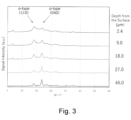
- Comparative Example A1 and Comparative Example B1 a peak corresponding to the plane index (110) of the ⁇ -type crystals of the PP resin and a peak corresponding to the plane index (040) of the ⁇ -type crystals were observed, and the depth from the surface and the crystallinity were as shown in Figures 2 and 3 .
- Example 1 Crystallinity of plane index and Ratio ((110)/(040)) Depth from the Surface ( ⁇ m) 2.4 9.0 18.0 27.0 46.0 (110) 17.1 18.7 21.7 21.8 20.8 (040) 36.5 37.0 36.3 35.6 33.8 Ratio 0.47 0.51 0.60 0.61 0.62
Landscapes
- Chemical & Material Sciences (AREA)
- Health & Medical Sciences (AREA)
- Polymers & Plastics (AREA)
- Organic Chemistry (AREA)
- Chemical Kinetics & Catalysis (AREA)
- Medicinal Chemistry (AREA)
- Engineering & Computer Science (AREA)
- Manufacturing & Machinery (AREA)
- Mechanical Engineering (AREA)
- Inorganic Chemistry (AREA)
- Materials Engineering (AREA)
- Composite Materials (AREA)
- Public Health (AREA)
- Compositions Of Macromolecular Compounds (AREA)
- Laminated Bodies (AREA)
- Toilet Supplies (AREA)
- Manufacture Of Macromolecular Shaped Articles (AREA)
- Reinforced Plastic Materials (AREA)
- Moulding By Coating Moulds (AREA)
Abstract
Description
- The present invention relates to a resin molded member having excellent scratch resistance and durability, and more particularly to a resin molded member suitable for use as water-related device members, the surface of which is cleaned by scrubbing or the like.
- Various molded members are formed from resin materials, and in many of these, the surfaces are cleaned by rubbing. Members that can be cleaned by such rubbing are required to be scratch-resistant against physical rubbing forces (sliding forces). In particular, the surfaces of the members that are splashed with water and then wiped off and/or that are frequently cleaned with water are required to be scratch-resistant enough to withstand the load caused by cleaning.
- Methods for improving the scratch resistance of resin molded members have been proposed in the past. For example,
JP2000-308601A - In addition,
JP2021-137567A - In terms of scratch resistance, the property can be improved by increasing the crystallinity of the resin on the surface of the member, but on the other hand, as the crystallinity of the resin increases, the resin becomes more brittle and there is a possibility that dimensional changes after molding cannot be ignored. Furthermore, molded members must have sufficient properties in terms of strength and durability. From these perspectives, there is still a demand for better molded members.
-
- [PLT 1]
JP 2000-308601A - [PLT 2]
JP 2021-137567A - The present inventors have now found that by maintaining a specific crystal orientation of the resin in a resin molded member from the surface to a certain depth, a resin molded member which has excellent scratch resistance of the surface as well as various properties required for a resin molded member can be obtained. The present invention is based on this finding.
- Therefore, an object of the present invention is to provide a resin molded member having excellent surface scratch resistance and various properties required of a resin molded member.
- The resin molded member according to the present invention comprises a crystalline resin wherein a signal intensity ratio of peaks which are measured by X-ray diffraction and correspond to two main crystal planes in an outermost layer of the member is maintained up to a depth of at least 9.0 µm from the outermost layer.
- According to the present invention, there is provided a resin molded member having excellent surface scratch resistance and various properties required for a resin molded member. The molded member according to the present invention is preferably excellent not only in scratch resistance but also in performance such as durability, strength, and dimensional retention, and can be used as a so-called water-related device member.
-
-
FIG. 1 is a diagram showing, at each depth, the intensities of peaks which are measured by X-ray diffraction, corresponding to the plane index (110) of the α-type crystals and a peak corresponding to the plane index (040) of the α-type crystals of the PP resin of the resin molded member of Example 1. -
FIG. 2 is a a diagram showing, at each depth, the intensities of peaks which are measured by X-ray diffraction, corresponding to the plane index (110) of the α-type crystals and a peak corresponding to the plane index (040) of the α-type crystals of the PP resin of the resin molded member of Comparative Example A1. -
FIG. 3 is a diagram showing, at each depth, the intensities of peaks which are measured by X-ray diffraction, corresponding to the plane index (110) of the α-type crystals and a peak corresponding to the plane index (040) of the α-type crystals of the PP resin of the resin molded member of Comparative Example B1. -
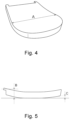
FIG. 4 is a perspective view of a lid of a toilet bowl used in a high-temperature shape retention test in the Examples, showing the measurement position of the maximum width A. -
FIG. 5 is a side view of a toilet lid used in a high-temperature shape retention test in the Examples, showing the gate height B and the position of the tip warp C. - The resin molded member according to the present invention contains a crystalline resin, wherein the signal intensity ratio of peaks which are measured by X-ray diffraction and correspond to the two main crystal planes in the outermost layer of the member is maintained up to a depth of at least 9.0 µm from the outermost layer.
- In the present invention, the "signal intensity of the peak which corresponds to the crystal plane" means the signal intensity of the peak corresponding to a specific crystal plane of the crystalline part of the crystalline resin in the diffraction information obtained by irradiating the resin molded member with X-rays. For example, it means the intensity of the X-ray diffraction signal corresponding to the specific crystal plane observed with respect to the baseline. The ratio of the signal intensities of the peaks corresponding to the two main crystal planes observed in this manner is the "signal intensity ratio of the peaks corresponding to the two crystal planes" in the present invention. In other words, in the present invention, the "signal intensity ratio of the peaks corresponding to the two crystal planes" is an index reflecting the crystallinity of the crystalline part of the crystalline resin. Therefore, in this specification, the "signal intensity of the peak corresponding to the crystal plane" may be referred to as the "crystallinity" of the crystal plane.
- In addition, since the "signal intensity ratio of the peaks corresponding to the two crystal planes" is an index reflecting the crystallinity of the crystalline portion of the crystalline resin, the "signal intensity of the peaks corresponding to the crystal planes" in the present invention can also be defined as follows. That is, the resin molded member is irradiated with X-rays, and the diffraction information obtained corresponding to one of the crystal plane indexes is defined as the value obtained as the ratio of the area of the scattering region derived from that plane index to the area of all the scattering regions. The signal intensity value of the peak corresponding to another crystal plane is obtained in the same manner, and then the ratio of the signal intensity values of the peaks corresponding to these two crystal planes is defined as the "signal intensity ratio of the peaks corresponding to the two crystal planes" in the present invention. The resin molded member according to the present invention satisfies either the signal intensity ratio based on the area ratio of the scattering regions or the signal intensity ratio of the peaks of the X-ray diffraction signal described above.
- In the present invention, "peaks corresponding to two main crystal planes" refers to two peaks selected in descending order of intensity from the signal intensities of peaks corresponding to the crystal planes of the crystalline portion of the crystalline resin obtained by irradiating a resin molded member with X-rays and obtaining diffraction information. In addition, even if the size of the third or subsequent peak is the peak of which the intensity is not significantly different from that of the first or second peak and the combination of the third or subsequent peak and the first or second peak satisfies the conditions of the present invention, such resin molded member is also included in the scope of the present invention.
- In the present invention, "the peak signal intensity ratio is maintained" means that the ratio is the same from the outermost surface of the member to a depth of at least 9.0 µm, and in addition, the change in the signal intensity ratio at the outermost layer to a depth of at least 9.0 µm remains within a range of about ± 35%, preferably ± 20%.
- By maintaining the above signal intensity ratio from the outermost surface of the member to a depth of at least 9.0 µm, the surface of the member is provided with properties that are resistant to scratches caused by rubbing, and furthermore, the member is provided with various properties required for a resin molded member, namely, excellent strength and durability, and small dimensional change after molding.
- According to a preferred embodiment of the present invention, the signal intensity ratio of the outermost layer is maintained to a depth of at least 50 µm.
- In one embodiment of the present invention, when the crystalline resin is a polypropylene (PP) resin, two large peaks are observed by X-ray diffraction, one corresponding to the plane index (110) of the α-type crystals and the other corresponding to the plane index (040) of the α-type crystals. Therefore, these two peaks are regarded as peaks corresponding to the two main crystal planes by X-ray diffraction, and the signal intensity ratio between them can be utilized.
- Examples of crystalline resins that can be used as the molded member according to the present invention include polypropylene (PP), polybutylene terephthalate (PBT), polyethylene (PE), polyamide (PA), polyacetal, polyoxymethylene (POM), polyethylene terephthalate (PET), polyether ether ketone (PEEK), polyphenylene sulfide (PPS), polytetrafluoroethylene (PTFE), and the like.
- The molded member according to the present invention is preferably used as a water-related device member. In the present invention, the water-related device member means a member that is splashed with water and then wiped off and/or a member that is frequently cleaned with water and then wiped off. The molded member according to the present invention has excellent scratch resistance on its surface, so that the occurrence of scratches on the surface caused by the operation of wiping off water from the surface of the member is suppressed. As a result, the molded member can be used for a long period of time without impairing the design of the surface.
- Specific examples of molded members according to the present invention include toilet seats; lids of a toilet bowl; case covers for warm-water washing toilet seats; resin members for remote controls; side panels for toilets; resin members for paper holders; resin members for bathroom counters, bath aprons, wash basins, and around hand-washing basins; resin members such as handles and accessory containers for kitchen storage units; and resin members for hand dryers.
- According to a preferred embodiment of the present invention, the resin molded member is a toilet lid. A toilet lid has an upper surface portion exposed upward when closed and a lower surface portion exposed downward, and both surfaces are required to be scratch-resistant. Therefore, in this toilet lid, the outermost layer of the member preferably means both the upper surface portion and the lower surface portion, and it is preferable that both surfaces satisfy the conditions of the present invention.
- According to another preferred embodiment of the present invention, the resin may contain additives commonly used to improve the properties of resin materials and resin molded members, such as an inorganic filler, preferably glass fiber, to increase the strength of the resin.
- The molded member according to the present invention is manufactured by a method capable of controlling the crystallization of the crystalline resin, and is preferably manufactured by the following method. The resin heated to the melting temperature is filled into a mold which is heated to a temperature in the range of the crystallization temperature of the resin ±1 0 °C., and is held in the mold for at least 20 seconds or more, and the mold is cooled to obtain a resin molded member. The crystallization temperature of the resin can be derived by the following method, for example, differential scanning calorimetry (DSC measurement). The crystalline resin is heated to a temperature above the melting point, and the resin is completely melted, and then the resin is cooled at a temperature decreasing rate of, for example, about 5 °C/min. An exothermic peak associated with crystallization is observed during the temperature decrease, and the temperature of the peak is taken as the crystallization temperature.
- According to one aspect of the present invention, when the resin is a PP resin, the mold is heated to a temperature of 110°C or more and 130°C or less, and the mold is filled with the resin which is heated to a temperature equal to or higher than the temperature of the mold. According to a preferred aspect of the present invention, the temperature of the resin is 180°C to 220°C or more, and more preferably about 190°C. After the resin is filled into the mold, the mold is heated if necessary to a temperature in the range of 110°C to 130°C, and pressure is maintained for at least 20 seconds or more, preferably 40 seconds or more, and more preferably 60 seconds or less, and then the molded member is obtained after heat dissipation or cooling.
- The present invention will be further illustrated by the following examples, but the present invention is not limited to these examples.
- In the following examples and comparative examples, the following polypropylene (PP) resins were used.
- PP resin with an MFR (temperature 230°C, load 2.16 kgf) of 19 g/10min conforming to JIS K-7210 was used.
- PP1 was melt-kneaded with glass fiber (GF) in an amount of 10 parts by mass using an extruder to prepare resin pellets of PP2.
- PP1 was melt-kneaded with glass fiber (GF) in an amount of 20 parts by mass using an extruder to prepare resin pellets of PP3.
- PP1 was melt-kneaded with glass fiber (GF) in an amount of 30 parts by mass using an extruder to prepare resin pellets of PP4.
- The resin materials PP1 to PP4 were heated to 190°C and filled into a mold heated to 120°C. The temperature of the mold was then maintained at 120°C for 40 seconds, and the molded body was removed from the mold after cooling. A test piece measuring 180 mm x 180 mm x 3 mm was obtained.
- The resin materials PP1 to PP4 were heated to 190°C and filled into a mold heated to 160° C. The mold was cooled, 10 seconds after filing, in order to cool and harden the resin. The molded body was removed from the mold to obtain a test piece of 180 mm×180 mm×3 mm.
- Resin materials PP1 to PP4 were heated to 190°C and filled into a mold heated to 40°C. Heating of the mold was then stopped and after 20 seconds the molded body was removed from the mold to obtain a test piece of 180 mm x 180 mm x 3 mm.
- The crystal orientation of the test pieces obtained in the examples and comparative examples was measured using the following measuring device and conditions.
- Analytical equipment: Rigaku Corporation SmartLab
- X-ray source: CuKα (45kV-200mA)
- Optical system: Out-of-plane (angle of incidence: 0.3, 1, 2, 3, 5°)
- Stage: RxRy attachment head
- Detector: HyPix-3000
- Scan mode: 0 dimensions
- Scan speed: 3.5 degree min-1
- Step width: 0.056 degree
- Scan axis: 2θ
- Scan range: 5-40 degree
- Entrance slit box: 0.072 mm
- Length limit slit: 10 mm
- Receiving slit box 1: 1.0 mm
- Receiving slit box 2: 1.1 mm
- The X-ray incidence angle (ω) was changed from 0.3 to 5 degrees, which corresponds to an analysis depth (X-ray penetration depth) of 2.4 µm to 46.0 µm.
- The crystal area and non-crystal area of a plane index were obtained from the X-ray diffraction pattern obtained at each X-ray incidence angle, and the crystallinity of the plane index was calculated using the following formula. The crystallinity of another plane index was calculated from the crystal area and non-crystal area of the other plane index.
Crystallinity of plane index (%) = [(area of crystalline portion of plane index) / (area of crystalline portion + area of non-crystalline portion)] × 100 - In Example 1, two large peaks were observed: one corresponding to the plane index (110) of the α-type crystals of the PP resin, which indicates crystal orientation, and the other corresponding to the plane index (040) of the α-type crystals. The depth from the surface and the crystallinity of each plane index were as shown in
Figure 1 . In the same manner, in Comparative Example A1 and Comparative Example B1, a peak corresponding to the plane index (110) of the α-type crystals of the PP resin and a peak corresponding to the plane index (040) of the α-type crystals were observed, and the depth from the surface and the crystallinity were as shown inFigures 2 and3 . - For Example 1, Comparative Example A1, and Comparative Example B1, the composition ratio of the crystallinity corresponding to the plane index (110) of the α-type crystals of the PP resin and the crystallinity corresponding to the plane index (040) of the α-type crystals, and the relationship with the depth were calculated. The results are shown in the table below.
Table 1 Example 1 Crystallinity of plane index and Ratio ((110)/(040)) Depth from the Surface (µm) 2.4 9.0 18.0 27.0 46.0 (110) 17.1 18.7 21.7 21.8 20.8 (040) 36.5 37.0 36.3 35.6 33.8 Ratio 0.47 0.51 0.60 0.61 0.62 -
Crystallinity of plane index and Ratio ((110)/(040)) Depth from the Surface (µm) 2.4 9.0 18.0 27.0 46.0 (110) 38.2 20.8 16.5 13.7 13.0 (040) 22.7 27.4 28.4 30.0 30.1 Ratio 1.68 0.76 0.58 0.46 0.43 -
Crystallinity of plane index and Ratio ((110)/(040)) Depth from the Surface (µm) 2.4 9.0 18.0 27.0 46.0 (110) 26.8 20.5 14.0 14.3 13.4 (040) 7.5 16.8 26.5 29.9 31.8 Ratio 3.60 1.22 0.53 0.48 0.42 - The pencil hardness test of the test pieces obtained in the examples and comparative examples was carried out in accordance with JIS K 5600-5-4: 1999. For pencil hardness of less than 6B not specified in JIS K 5600-5-4: 1999, the Hi-uni series manufactured by Mitsubishi Pencil Co., Ltd. was used. The results are shown in the table below.
- Three sheets of commercially available toilet paper were stacked and attached to a stainless steel fingernail-shaped jig, and the surface of the test piece obtained in the examples and comparative examples was swept once with this jig at a load of 100 g to 1.400 g. The Rz (µm) was measured for the swept and non-swept areas, respectively, and the difference ΔRz was calculated. If ΔRz is 0.5 or more, the difference between the swept and non-swept areas is clearly recognized as a scratch, and it can be considered that there is a scratch. The scratching speed and other conditions were performed in accordance with JIS K 5600-5-4:1999. The results were as shown in the table below.
Table 2 Pencil Hardness Paper Sweep Test (ΔRz) 100g 300g 500g 700g 1,000g 1.400g Example 1 2B -*1 -*1 0.27 0.23 0.43 0.52 Example 2 (GF10wt%) F -*1 -*1 -0.01 -0.10 0.25 0.52 Comparative Example B1 7B 0 0.51 0.90 -*2 -*2 -*2 Comparative Example B2 (GF10wt%) 4B 0 0.25 0.74 0.93 0.80 1.39 - In the table, -*1: the test was not performed, and -*2: the test was not performed because obvious scratches were recognized by visual inspection.
- The tensile strength of the test pieces obtained in the examples and comparative examples was measured using the following measuring device and conditions.
- Testing machine: Autograph AG-X plus (Shimadzu Corporation)
- Test temperature: Room temperature, Test piece: JIS K7139 Type A1
- Pulling speed: 50mm/min, chuck distance: 115mm
- When a load was applied, the strength increased and the value indicating the maximum stress was taken as the tensile strength. The results are shown in the table below.
Table 3 Tensile Strength (MPa) Example 1 35.6 Example2 ( GF 10 wt%)47.0 Example3 ( GF 20 wt%)68.3 Example4 ( GF 30 wt%)78.5 Comparative Example A1 33.6 Comparative Example B1 32.1 Comparative Example B2 ( GF 10 wt%)42.9 Comparative Example B3 (GF 20w t%) 66.7 Comparative Example B4 ( GF 30 wt%)74.9 - A toilet lid sample with the shape shown in
Figure 1 was manufactured using PP2 under manufacturing conditions similar to those of Example 2 and Comparative Example A2. The shape retention of this sample at high temperatures was evaluated in the following manner, assuming storage (transportation) at high temperatures. First, the maximum width A, gate height B, and tip warpage C shown inFigures 1 and 2 were measured for the sample in a room temperature environment (23±1°C). The sample was then stored in a thermostatic chamber at 50°C, during which the sample was removed after 48 hours, 96 hours, and 240 hours, and the dimensions of the above three points were measured. The sample was placed vertically in the thermostatic chamber. The results, shown in mm as the amount of change from the initial measurement, are as shown in the table below.Table 4 Results of Example 2 (change from the initial, mm) Initial 48 hours 96 hours 240 hours Maximum width 0 -0.34 -0.36 -1.13 Gate height 0 0.68 0.62 0.77 Tip warpage 0 0.16 0.05 0.13 -
Initial 48 hours 96 hours 240 hours Maximum width 0 -2.52 -2.68 -2.68 Gate height 0 -2.22 -2.42 -2.46 Tip warpage 0 0.27 0.24 0.39
Claims (8)
- A resin molded member comprising a crystalline resin,
wherein a signal intensity ratio of peaks which are measured by X-ray diffraction and correspond to two main crystal planes in an outermost layer of the member is maintained up to a depth of at least 9.0 µm from the outermost layer. - The resin molded member according to claim 1, wherein the signal intensity ratio of the outermost layer is maintained to a depth of at least 50 µm.
- The resin molded member according to claim 1 or 2, which is a water-related device member.
- The resin molded member according to any one of claims 1 to 3, wherein the crystalline resin is polypropylene (PP), polybutylene terephthalate (PBT), polyethylene (PE), polyamide (PA), polyacetal, polyoxymethylene (POM), polyethylene terephthalate (PET), polyether ether ketone (PEEK), polyphenylene sulfide (PPS), or polytetrafluoroethylene (PTFE).
- The resin molded member according to any one of claims 1 to 4, wherein the crystalline resin is polypropylene.
- The resin molded member according to any one of claims 1 to 5, further comprising glass fibers.
- The resin molded member according to any one of claims 1 to 7, which is a lid for a toilet bowl, wherein on both the lid upper surface portion exposed upward when the lid is closed and the lid lower surface portion exposed downward, the signal intensity ratio of peaks which are measured by X-ray diffraction and correspond to two main crystal planes in an outermost layer of the member is maintained up to a depth of at least 9.0 µm from the outermost layer.
- A method for producing a resin molded member according to any one of claims 1 to 7, comprising the steps of:heating a mold to a temperature in the range of crystallization temperature of the resin ±10 °C,filling the mold with the resin that has been heated to a temperature equal to or higher than the temperature of the mold,maintaining the temperature of the mold within a range of the crystallization temperature of the resin ±10°C for at least 20 seconds, and then cooing the mold, andobtaining a resin molded member from the mold.
Applications Claiming Priority (2)
| Application Number | Priority Date | Filing Date | Title |
|---|---|---|---|
| JP2022140057A JP2024035536A (en) | 2022-09-02 | 2022-09-02 | Resin molded parts with excellent scratch resistance and durability |
| PCT/JP2023/029361 WO2024048253A1 (en) | 2022-09-02 | 2023-08-10 | Resin molding member with excellent scratch resistance and durability |
Publications (2)
| Publication Number | Publication Date |
|---|---|
| EP4582245A1 true EP4582245A1 (en) | 2025-07-09 |
| EP4582245A4 EP4582245A4 (en) | 2025-11-26 |
Family
ID=90099293
Family Applications (1)
| Application Number | Title | Priority Date | Filing Date |
|---|---|---|---|
| EP23860018.3A Pending EP4582245A4 (en) | 2022-09-02 | 2023-08-10 | Resin molding element with excellent scratch resistance and durability |
Country Status (6)
| Country | Link |
|---|---|
| US (1) | US20250188204A1 (en) |
| EP (1) | EP4582245A4 (en) |
| JP (1) | JP2024035536A (en) |
| CN (1) | CN119654230A (en) |
| TW (1) | TW202411049A (en) |
| WO (1) | WO2024048253A1 (en) |
Family Cites Families (8)
| Publication number | Priority date | Publication date | Assignee | Title |
|---|---|---|---|---|
| JPH1016042A (en) * | 1996-06-28 | 1998-01-20 | Japan Synthetic Rubber Co Ltd | Blow molded product and molding method |
| JP3800716B2 (en) * | 1997-04-08 | 2006-07-26 | Jsr株式会社 | Blow molding method |
| JP2000308601A (en) * | 1999-04-27 | 2000-11-07 | Toto Ltd | Toilet seat parts |
| JP2001088200A (en) * | 1999-09-21 | 2001-04-03 | Idemitsu Petrochem Co Ltd | Molding method for hollow molded products |
| JP2002160275A (en) * | 2000-11-28 | 2002-06-04 | Mitsubishi Heavy Ind Ltd | Injection molding method for crystalline resin moldings |
| JP2008105295A (en) * | 2006-10-26 | 2008-05-08 | Matsushita Electric Ind Co Ltd | Mold for resin molding |
| JP7432142B2 (en) * | 2020-02-07 | 2024-02-16 | Toto株式会社 | Toilet seat and toilet lid |
| JP2021137567A (en) | 2020-02-28 | 2021-09-16 | Toto株式会社 | Water parts, toilet seat, and toilet lid |
-
2022
- 2022-09-02 JP JP2022140057A patent/JP2024035536A/en active Pending
-
2023
- 2023-06-28 TW TW112123989A patent/TW202411049A/en unknown
- 2023-08-10 WO PCT/JP2023/029361 patent/WO2024048253A1/en not_active Ceased
- 2023-08-10 CN CN202380058253.1A patent/CN119654230A/en active Pending
- 2023-08-10 EP EP23860018.3A patent/EP4582245A4/en active Pending
-
2025
- 2025-02-21 US US19/059,979 patent/US20250188204A1/en active Pending
Also Published As
| Publication number | Publication date |
|---|---|
| TW202411049A (en) | 2024-03-16 |
| EP4582245A4 (en) | 2025-11-26 |
| CN119654230A (en) | 2025-03-18 |
| JP2024035536A (en) | 2024-03-14 |
| US20250188204A1 (en) | 2025-06-12 |
| WO2024048253A1 (en) | 2024-03-07 |
Similar Documents
| Publication | Publication Date | Title |
|---|---|---|
| US9416261B2 (en) | Molded articles (including automobile parts) and related filled thermoplastic polyolefin compositions | |
| De Rosa et al. | Crystallization behavior of propylene− butene copolymers: The trigonal form of isotactic polypropylene and form I of isotactic poly (1-butene) | |
| EP2121815A1 (en) | Petg based decorative sheet having forming ability similar with pvc | |
| EP4582245A1 (en) | Resin molding member with excellent scratch resistance and durability | |
| Lee et al. | X‐ray diffraction analysis technique for determining the polymer crystallinity in a polyphenylene sulfide composite | |
| EP2781548A1 (en) | Mineral-filled polypropylene composition | |
| KR20180036513A (en) | Liner polypropylene specimen and foam process of preparing the same | |
| EP4582244A1 (en) | Resin molded member having excellent scratch resistance and durability | |
| Auriemma et al. | Yield behavior of random copolymers of isotactic polypropylene | |
| JP5097745B2 (en) | Propylene-based molded products | |
| EP3587488B1 (en) | Molded article and method for manufacturing same | |
| JP5439293B2 (en) | Propylene-based resin multilayer sheet and package for heat treatment using the same | |
| Baltá Calleja et al. | Recent advances in the study and characterization of polymers by microhardness | |
| KR20170104998A (en) | Laminate, container and manufacturing method thereof, and sheet for use as raw material of laminate | |
| TW200948878A (en) | Polyester resin composition | |
| JP5366122B2 (en) | Double molded resin tableware | |
| US20130281613A1 (en) | Bleed Resistant, Oil-Extended Olefin Block Copolymer Composition with Microcrystalline Wax | |
| JP3839120B2 (en) | Polybutylene terephthalate resin composition and molded article | |
| Yılmaz et al. | Localized thermal analysis of carbon fiber‐reinforced polypropylene composites | |
| JP4778927B2 (en) | Agricultural laminated film | |
| JP7502268B2 (en) | Organic fiber reinforced resin molded body and its manufacturing method | |
| JP2025110085A (en) | Resin molded parts | |
| JP2001170957A (en) | Polypropylene injection molding | |
| JP6980452B2 (en) | Hollow container and its manufacturing method, and polypropylene resin composition for blow fill seal | |
| JP2025110084A (en) | Toilet lid with reduced sink marks |
Legal Events
| Date | Code | Title | Description |
|---|---|---|---|
| STAA | Information on the status of an ep patent application or granted ep patent |
Free format text: STATUS: THE INTERNATIONAL PUBLICATION HAS BEEN MADE |
|
| PUAI | Public reference made under article 153(3) epc to a published international application that has entered the european phase |
Free format text: ORIGINAL CODE: 0009012 |
|
| STAA | Information on the status of an ep patent application or granted ep patent |
Free format text: STATUS: REQUEST FOR EXAMINATION WAS MADE |
|
| 17P | Request for examination filed |
Effective date: 20250402 |
|
| AK | Designated contracting states |
Kind code of ref document: A1 Designated state(s): AL AT BE BG CH CY CZ DE DK EE ES FI FR GB GR HR HU IE IS IT LI LT LU LV MC ME MK MT NL NO PL PT RO RS SE SI SK SM TR |
|
| A4 | Supplementary search report drawn up and despatched |
Effective date: 20251027 |
|
| RIC1 | Information provided on ipc code assigned before grant |
Ipc: B29C 70/42 20060101AFI20251021BHEP Ipc: A47K 13/00 20060101ALI20251021BHEP Ipc: C08J 5/00 20060101ALI20251021BHEP Ipc: C08J 5/04 20060101ALI20251021BHEP Ipc: B29C 45/00 20060101ALI20251021BHEP Ipc: B29C 45/17 20060101ALI20251021BHEP Ipc: B29C 45/72 20060101ALI20251021BHEP Ipc: B29K 23/00 20060101ALN20251021BHEP Ipc: B29K 101/12 20060101ALN20251021BHEP Ipc: B29K 509/08 20060101ALN20251021BHEP Ipc: B29L 31/00 20060101ALN20251021BHEP |
|
| DAV | Request for validation of the european patent (deleted) | ||
| DAX | Request for extension of the european patent (deleted) |