EP4580311A2 - Verfahren und vorrichtung zur frequenzmessung und abstandskonfiguration - Google Patents
Verfahren und vorrichtung zur frequenzmessung und abstandskonfiguration Download PDFInfo
- Publication number
- EP4580311A2 EP4580311A2 EP25170696.6A EP25170696A EP4580311A2 EP 4580311 A2 EP4580311 A2 EP 4580311A2 EP 25170696 A EP25170696 A EP 25170696A EP 4580311 A2 EP4580311 A2 EP 4580311A2
- Authority
- EP
- European Patent Office
- Prior art keywords
- frequency
- frequency measurement
- message
- wireless communication
- maximum number
- Prior art date
- Legal status (The legal status is an assumption and is not a legal conclusion. Google has not performed a legal analysis and makes no representation as to the accuracy of the status listed.)
- Pending
Links
Images


Classifications
-
- H—ELECTRICITY
- H04—ELECTRIC COMMUNICATION TECHNIQUE
- H04W—WIRELESS COMMUNICATION NETWORKS
- H04W76/00—Connection management
- H04W76/10—Connection setup
- H04W76/15—Setup of multiple wireless link connections
- H04W76/16—Involving different core network technologies, e.g. a packet-switched [PS] bearer in combination with a circuit-switched [CS] bearer
-
- H—ELECTRICITY
- H04—ELECTRIC COMMUNICATION TECHNIQUE
- H04W—WIRELESS COMMUNICATION NETWORKS
- H04W24/00—Supervisory, monitoring or testing arrangements
- H04W24/08—Testing, supervising or monitoring using real traffic
-
- H—ELECTRICITY
- H04—ELECTRIC COMMUNICATION TECHNIQUE
- H04W—WIRELESS COMMUNICATION NETWORKS
- H04W24/00—Supervisory, monitoring or testing arrangements
- H04W24/10—Scheduling measurement reports ; Arrangements for measurement reports
-
- H—ELECTRICITY
- H04—ELECTRIC COMMUNICATION TECHNIQUE
- H04W—WIRELESS COMMUNICATION NETWORKS
- H04W36/00—Hand-off or reselection arrangements
- H04W36/0005—Control or signalling for completing the hand-off
- H04W36/0083—Determination of parameters used for hand-off, e.g. generation or modification of neighbour cell lists
- H04W36/0085—Hand-off measurements
-
- H—ELECTRICITY
- H04—ELECTRIC COMMUNICATION TECHNIQUE
- H04W—WIRELESS COMMUNICATION NETWORKS
- H04W36/00—Hand-off or reselection arrangements
- H04W36/0005—Control or signalling for completing the hand-off
- H04W36/0083—Determination of parameters used for hand-off, e.g. generation or modification of neighbour cell lists
- H04W36/0085—Hand-off measurements
- H04W36/0094—Definition of hand-off measurement parameters
-
- H—ELECTRICITY
- H04—ELECTRIC COMMUNICATION TECHNIQUE
- H04W—WIRELESS COMMUNICATION NETWORKS
- H04W72/00—Local resource management
- H04W72/04—Wireless resource allocation
- H04W72/044—Wireless resource allocation based on the type of the allocated resource
- H04W72/0446—Resources in time domain, e.g. slots or frames
-
- H—ELECTRICITY
- H04—ELECTRIC COMMUNICATION TECHNIQUE
- H04W—WIRELESS COMMUNICATION NETWORKS
- H04W72/00—Local resource management
- H04W72/04—Wireless resource allocation
- H04W72/044—Wireless resource allocation based on the type of the allocated resource
- H04W72/0453—Resources in frequency domain, e.g. a carrier in FDMA
-
- H—ELECTRICITY
- H04—ELECTRIC COMMUNICATION TECHNIQUE
- H04W—WIRELESS COMMUNICATION NETWORKS
- H04W72/00—Local resource management
- H04W72/12—Wireless traffic scheduling
- H04W72/1263—Mapping of traffic onto schedule, e.g. scheduled allocation or multiplexing of flows
-
- H—ELECTRICITY
- H04—ELECTRIC COMMUNICATION TECHNIQUE
- H04W—WIRELESS COMMUNICATION NETWORKS
- H04W72/00—Local resource management
- H04W72/20—Control channels or signalling for resource management
- H04W72/23—Control channels or signalling for resource management in the downlink direction of a wireless link, i.e. towards a terminal
-
- H—ELECTRICITY
- H04—ELECTRIC COMMUNICATION TECHNIQUE
- H04W—WIRELESS COMMUNICATION NETWORKS
- H04W72/00—Local resource management
- H04W72/20—Control channels or signalling for resource management
- H04W72/27—Control channels or signalling for resource management between access points
-
- H—ELECTRICITY
- H04—ELECTRIC COMMUNICATION TECHNIQUE
- H04W—WIRELESS COMMUNICATION NETWORKS
- H04W76/00—Connection management
- H04W76/10—Connection setup
- H04W76/15—Setup of multiple wireless link connections
-
- H—ELECTRICITY
- H04—ELECTRIC COMMUNICATION TECHNIQUE
- H04W—WIRELESS COMMUNICATION NETWORKS
- H04W76/00—Connection management
- H04W76/20—Manipulation of established connections
- H04W76/27—Transitions between radio resource control [RRC] states
-
- H—ELECTRICITY
- H04—ELECTRIC COMMUNICATION TECHNIQUE
- H04W—WIRELESS COMMUNICATION NETWORKS
- H04W92/00—Interfaces specially adapted for wireless communication networks
- H04W92/16—Interfaces between hierarchically similar devices
- H04W92/20—Interfaces between hierarchically similar devices between access points
-
- H—ELECTRICITY
- H04—ELECTRIC COMMUNICATION TECHNIQUE
- H04W—WIRELESS COMMUNICATION NETWORKS
- H04W24/00—Supervisory, monitoring or testing arrangements
- H04W24/02—Arrangements for optimising operational condition
-
- H—ELECTRICITY
- H04—ELECTRIC COMMUNICATION TECHNIQUE
- H04W—WIRELESS COMMUNICATION NETWORKS
- H04W36/00—Hand-off or reselection arrangements
- H04W36/0005—Control or signalling for completing the hand-off
- H04W36/0055—Transmission or use of information for re-establishing the radio link
- H04W36/0069—Transmission or use of information for re-establishing the radio link in case of dual connectivity, e.g. decoupled uplink/downlink
Definitions
- This disclosure relates generally to wireless communications and, more particularly, to a method and apparatus for configuring frequency measurement and determining a time reference for gap calculation in New Radio with dual connectivity.
- a wireless communication device with multiple transceivers to simultaneously receive data packet from at least two wireless communication nodes, for example a Master gNodeB (MgNB) and a secondary gNodeB (SgNB).
- MgNB Master gNodeB
- SgNB secondary gNodeB
- a wireless communication device can perform measurement on intra-frequency, inter-frequency and inter-RAT (Radio Access Technology) frequencies. This frequency measurement by the wireless communication device is configured by a Master gNodeB and/or a Secondary gNodeB in order to facilitate mobility management or other radio resource management functions.
- RAT Radio Access Technology
- exemplary embodiments disclosed herein are directed to solving the issues related to one or more problems presented in the prior art, as well as providing additional features that will become readily apparent by reference to the following detailed description when taken in conjunction with the accompany drawings.
- exemplary systems, methods, and computer program products are disclosed herein. It is understood, however, that these embodiments are presented by way of example and not limitation, and it will be apparent to those of ordinary skill in the art who read the present disclosure that various modifications to the disclosed embodiments can be made while remaining within the scope of the invention.
- a wireless communication device may have multiple serving cells belong to different wireless communication nodes (eNBs) which are known as primary eNB (MeNB) and secondary eNB (SeNB), and the primary cell in MeNB is named as PCell and the primary cell in SeNB is named as PSCell.
- eNBs wireless communication nodes
- MeNB primary eNB
- SeNB secondary eNB
- PCell primary cell in SeNB
- PSCell primary cell in SeNB
- MeNB only MeNB can configure and manage frequency measurements for the UE.
- a measured frequency by the UE and a serving cell belong to a same RAT (e.g.
- the frequency is known as "intra-frequency” and a frequency measurement task performed by the UE is an "intra-frequency measurement”. Accordingly, an index of the intra-frequency measurement task is used as an inter-frequency measurement identity.
- the frequency is known as "inter-frequency” and the frequency measurement task is an "inter-frequency measurement”.
- an index of the inter-frequency measurement task is used as an inter-frequency measurement identity.
- MeNB Since only MeNB can conduct measurements configuration, it is simple for MeNB to ensure a maximum number of measured frequency layers and a maximum number of frequency measurement identities are within the capability of the UE, e.g., a maximum number of frequency layers that can be measured by the UE or a maximum number of frequency measurement identities.
- a similar DC architecture can be also introduced.
- a UE can connect to multiple NR nodes (gNodeB or gNB) including at least one master gNB (MgNB) and at least one secondary gNB (SgNB). Serving cells within one of the at least one MgNB are grouped together to form a Master Cell Group (MCG), and serving cells within one of the at least one SgNB are grouped together to form a Secondary Cell Group (SCG).
- MCG Master Cell Group
- SCG Secondary Cell Group
- each of the at least one SgNB in NR-DC is allowed to configure frequency measurement and transmits a configuration of a frequency measurement directly to the UE.
- the configuration of the frequency measurement can be transmitted to the UE via the signal radio bearer directly.
- a configuration of the frequency measurement can be delivered directly from a respective MgNB to the UE.
- the frequency measurements configured by the at least one SgNB and the at least one MgNB to the UE are required to be coordinated to ensure the configuration (e.g., total number of configured frequency measurement identities) is within the capability of the UE.
- an MgNB is also responsible for configuring all types of gap patterns.
- the UE may acquire different synchronization timing from different serving cells of different gNodeBs, a gap calculation in the time domain based on just the gap pattern received from the MgNB is ambiguous and extra interruption of data scheduling is required. Therefore, there exists a need to develop a method and apparatus for accurately configuring frequency measurement and reference timing for gap calculation in New Radio with dual connectivity.
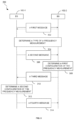
- a method for configuring a frequency measurement by a first wireless communication node includes: transmitting a first message to a second wireless communication node, wherein the first message comprises at least one of the following: a first maximum number of allowed intra-frequency measurement identities and a first maximum number of allowed inter-frequency measurement identities, and wherein the first message is used by the by the second wireless communication node to determine a first configuration of the frequency measurement for a wireless communication device.
- a method for configuring a frequency measurement by a first wireless communication node includes: receiving a first message from a second wireless communication node, and determining a first configuration of the frequency measurement for a wireless communication device according to the first message, wherein the first message comprises at least one of the following: a first maximum number of allowed intra-frequency measurement identities and a first maximum number of allowed inter-frequency measurement identities.
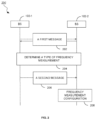
- a method for determining a type of a frequency measurement by a first wireless communication node includes: transmitting a first message to a second wireless communication node, wherein the first message comprises frequency information of all first serving cells of the first wireless communication node, and wherein the frequency information of all first serving cells of the first wireless communication node is used by the second wireless communication node together with frequency information of all second serving cells of the second wireless communication node to determine the type of the frequency measurement.
- method for determining a type of a frequency measurement by a first wireless communication node includes: receiving a first message from a second wireless communication node, wherein the first message comprises frequency information of all first serving cells of the second wireless communication node; and determining the type of the frequency measurement according to at least one of the following: the frequency information of all the first serving cells of the second wireless communication node in the first message and frequency information of all second serving cells of the first wireless communication node.
- a computing device comprising at least one processor and a memory coupled to the processor, the at least one processor configured to carry out the method.
- a non-transitory computer-readable medium having stored thereon computer-executable instructions for carrying out the method.
- FIG. 1A illustrates an exemplary wireless communication network 100, in accordance with some embodiments of the present disclosure.
- a network side communication node or a base station (BS) 102 can be a node B, an E-UTRA Node B (also known as Evolved Node B, eNodeB or eNB), a gNodeB (also known as gNB) in new radio (NR) technology, a pico station, a femto station, or the like.
- E-UTRA Node B also known as Evolved Node B, eNodeB or eNB
- gNodeB also known as gNB
- NR new radio
- a terminal side communication device or a user equipment (UE) 104 can be a long range communication system like a mobile phone, a smart phone, a personal digital assistant (PDA), tablet, laptop computer, or a short range communication system such as, for example a wearable device, a vehicle with a vehicular communication system and the like.
- a network communication node and a terminal side communication device are represented by a BS 102 and a UE 104, respectively, and in all the embodiments in this disclosure hereafter, and are generally referred to as “communication nodes” and “communication device” herein.
- Such communication nodes and communication devices may be capable of wireless and/or wired communications, in accordance with various embodiments of the invention. It is noted that all the embodiments are merely preferred examples, and are not intended to limit the present disclosure. Accordingly, it is understood that the system may include any desired combination of BSs 102 and UEs 104, while remaining within the scope of the present disclosure.
- the wireless communication network 100 includes a first BS 102-1, a second BS 102-2, and a UE 104.
- the UE 104 forms direct communication (i.e., uplink) channels 103-1 and 103-2 with the first BS 102-1 and the second BS 102-2, respectively.
- the UE 104 also forms direct communication (i.e., downlink) channels 105-1 and 105-2 with the first BS 102-1 and the second BS 102-2, respectively.
- the direct communication channels between the UE 104 and the BS 102 can be through interfaces such as an Uu interface, which is also known as E-UTRA air interface.
- the second BS 102-2 configures frequency measurements for the UE 104.
- the method 300 continues with operation 304 in which the second BS 102-2 determines the type of frequency measurement according to some embodiments.
- the second BS 102-2 determine the type of frequency measurement by comparing frequency information (e.g., a frequency set) of all serving cells and a measurement frequency.
- frequency information e.g., a frequency set
- the type of frequency measurement is an intra-frequency measurement.
- the type of frequency measurement is an inter-frequency measurement.
- the second BS 102-2 receives the frequency information (e.g., the first center frequency and the second center frequency) from the first BS 102-1, the frequency information of all the serving cells of the UE 104 is available to the second BS 102-2.
- the second BS 102-2 configures a SSB-based frequency measurement on the first center frequency for the UE 104 which is a subset of the frequency set including the first center frequency, the second center frequency, the third center frequency and the fourth center frequency
- the type of frequency measurement performed by the UE 104 is an intra-frequency measurement.
- the second BS 102-2 configures a SSB-based frequency measurement on a fifth center frequency which is not a subset of the frequency set
- the type of frequency measurement performed by the UE 104 is an inter-frequency measurement.
- the first BS 102-1 when the first message is received by the first BS 102-1, the first BS 102-1 can also determine the type of frequency measurement by comparing the frequency information of all the serving cells from both the first BS 102-1 and the second BS 102-2 and the measurement frequency configured by the first BS 102-1 for the UE 104.
- the method 300 continues with operation 306 in which the first BS 102-1 transmits a second message to the second BS 102-2 according to some embodiments.
- the second message is transmitted from the first BS 102-1 to the second BS 102-2 through a UE-specific inter-node RRC message.
- the second message comprises a frequency measurement configuration.
- the second message transmitted from the first BS 102-1 comprises at least one restriction of the frequency measurement configured by the second BS 102-2 for the UE 104.
- the first BS 102-1 is a master gNB (MgNB), which has a first serving cell operating on a first frequency, and a second serving cell operating on a second frequency.
- the second BS 102-2 is a secondary gNB (SgNB), which has a third serving cell operating on a third frequency and a fourth serving cell operating on a fourth frequency.
- the first BS 102-1 transmits a second message to the second BS 102-2 through an inter-node RRC message (e.g., CG-Configinfo).
- the first BS 102-1 is a primary wireless communication node, which has a first serving cell operating on a first frequency, and a second serving cell operating on a second frequency.
- the second BS 102-2 is a secondary wireless communication node, which has a third serving cell operating on a third frequency and a fourth serving cell operating on a fourth frequency.
- the first BS 102-1 transmits a second message to the second BS 102-2 through an inter-node RRC message (e.g., CG-Configinfo).
- the method 300 continues with operation 308 in which the second BS 102-2 determines a first frequency measurement configuration according to some embodiments.
- the type of a frequency measurement is determined after receiving the first message from the BS 102.
- the configuration of the frequency measurement is determined by the second BS 102-2 according to the at least one restriction received in the second message from the first BS 102-1.
- the configuration of the frequency measurement comprises one of the following: a number of intra-frequency measurement identities or a number of inter-frequency measurement identities according to some embodiments.
- the number of intra-frequency measurement identities and the number of inter-frequency measurement identities each is equal to or less than the first maximum number of allowed intra-frequency measurement identities and the first maximum number of allowed inter-frequency measurement identities received in the second message, respectively.
- a first number of intra-frequency measurement identities for the first frequency is equal to or smaller than X
- a second number of intra-frequency measurement identities for the second frequency is equal to or smaller than X
- a third number of intra-frequency measurement identities for the third frequency is equal to or smaller than X
- a fourth number of intra-frequency measurement identities for the fourth frequency is equal to or smaller than X.
- the second BS 102-2 configures frequency measurements for the UE 104.
- the second BS 102-2 configures frequency measurement for the UE 104.
- the predefined value is preconfigured in the specifications or configured by the system.
- the second BS 102-2 configures frequency measurement for the UE 104.
- a number of inter-frequency measurement identities for the each of all the inter-frequencies is equal to or smaller than Y.
- the method 300 continues with operation 310 in which the first BS 102-1 receives a third message from the second BS 102-2 according to some embodiments.
- the third message comprises a configuration restriction request.
- the configuration restriction request comprises one of the following: a second maximum number of allowed intra-frequency measurement identities and a second maximum number of allowed inter-frequency measurement identities that can be configured by the second BS 102-2 for the UE 104.
- the configuration restriction request in the second message also comprises information of respective frequencies.
- the second maximum number is indicated explicitly in the third message.
- the third message comprises an extended number, wherein the extended number (a) is used to determine the second maximum number, e.g., the second maximum number equals a summation of the extended number (a) and the first maximum number, wherein a is a positive integer.
- the second maximum number of allowed intra-frequency measurement identities that can be configured by BS 102-2 comprises an integer for each of serving frequencies. In some embodiments, the second maximum number of allowed intra-frequency measurement identities that can be configured by BS 102-2 comprises a plurality of integers of a plurality of respective serving frequencies. In some embodiments, the plurality of integers of the plurality of respective serving frequencies may be different.
- the extended number a can be transmitted from the second BS 102-2 to the first BS 102-1 through an inter-node RRC message (e.g., CG-Config).
- the method 300 continues with operation 312 in which the first BS 102-1 evaluates the configuration restriction request received from the second BS 102-2 and determine a second configuration of the frequency measurement according to some embodiments.
- the second configuration of the frequency measurement comprises a third maximum number of one of the following: allowed intra-frequency measurement identities and allowed inter-frequency measurement identities that can be configured by BS 102-2.
- the third maximum number of allowed inter-frequency measurement identities and the third maximum number of allowed intra-frequency measurement identities that can be configured by BS 102-2 are determined according to available numbers of inter-frequency measurement identities and intra-frequency measurement identities.
- the third maximum number can be the same as or different from the second maximum number received in the third message.
- the third maximum number of allowed inter-frequency measurement identities that can be configured by BS 102-2 can be equal to the second maximum number of allowed inter-frequency measurement identities Y', which is then transmitted by the first BS 102-1 to the second BS 102-2.
- the third maximum number of allowed inter-frequency measurement identities that can be configured by BS 102-2 is then used for all the serving frequencies.
- the third maximum number of allowed inter-frequency measurement identities that can be configured by BS 102-2 is then used for all the serving frequencies.
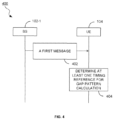
- FIG. 4 illustrates a method 400 for determining at least one reference timing for gap calculation, in accordance with some embodiments of the present disclosure. It is understood that additional operations may be provided before, during, and after the method 400 of Figure 4 , and that some operations may be omitted or reordered.
- the communication system in the illustrated embodiment comprises a first BS 102-1.
- a UE 104 is in one of at least one serving cell covered by the first BS 102-1 and also in one of at least one serving cell covered by the second BS 102-2 (not shown), i.e., the UE 104 is in connection with the first BS 102-1 and the second BS 102-2.
- the first BS 102-1 is a primary wireless communication node. It should be noted that any numbers of BS 102 can be used and are within the scope of this invention.
- the method 400 starts with operation 402 in which the first BS 102-1 transmits a first message to the UE 104 according to some embodiments.
- the first message comprises information of a timing reference.
- the timing reference is also transmitted from the first BS 102-1 to the second BS 102-2.
- the timing reference is an explicit indicator to indicate whether a serving cell of the first BS 102-1 or the second BS 102-2 is used for gap calculation.
- the timing reference is an indicator with a value of TRUE when a serving cell on a specific frequency is in a MCG or a value of FALSE when a serving cell on a specific frequency is in a SCG.
Landscapes
- Engineering & Computer Science (AREA)
- Computer Networks & Wireless Communication (AREA)
- Signal Processing (AREA)
- Mobile Radio Communication Systems (AREA)
- Measurement Of Length, Angles, Or The Like Using Electric Or Magnetic Means (AREA)
- Exposure Of Semiconductors, Excluding Electron Or Ion Beam Exposure (AREA)
- Length Measuring Devices Characterised By Use Of Acoustic Means (AREA)
Priority Applications (1)
| Application Number | Priority Date | Filing Date | Title |
|---|---|---|---|
| EP25170696.6A EP4580311A3 (de) | 2018-11-01 | 2018-11-01 | Verfahren und vorrichtung zur frequenzmessung und abstandskonfiguration |
Applications Claiming Priority (4)
| Application Number | Priority Date | Filing Date | Title |
|---|---|---|---|
| PCT/CN2018/113382 WO2020034426A1 (en) | 2018-11-01 | 2018-11-01 | Method and apparatus for frequency measurement and gap configuration |
| EP25170696.6A EP4580311A3 (de) | 2018-11-01 | 2018-11-01 | Verfahren und vorrichtung zur frequenzmessung und abstandskonfiguration |
| EP18930063.5A EP3874795B1 (de) | 2018-11-01 | 2018-11-01 | Verfahren und vorrichtung zur frequenzmessung und abstandskonfiguration |
| EP21217093.0A EP4021077B1 (de) | 2018-11-01 | 2018-11-01 | Verfahren und vorrichtung zur frequenzmessung und abstandskonfiguration |
Related Parent Applications (3)
| Application Number | Title | Priority Date | Filing Date |
|---|---|---|---|
| EP18930063.5A Division EP3874795B1 (de) | 2018-11-01 | 2018-11-01 | Verfahren und vorrichtung zur frequenzmessung und abstandskonfiguration |
| EP21217093.0A Division EP4021077B1 (de) | 2018-11-01 | 2018-11-01 | Verfahren und vorrichtung zur frequenzmessung und abstandskonfiguration |
| EP21217093.0A Division-Into EP4021077B1 (de) | 2018-11-01 | 2018-11-01 | Verfahren und vorrichtung zur frequenzmessung und abstandskonfiguration |
Publications (2)
| Publication Number | Publication Date |
|---|---|
| EP4580311A2 true EP4580311A2 (de) | 2025-07-02 |
| EP4580311A3 EP4580311A3 (de) | 2025-09-10 |
Family
ID=69524590
Family Applications (3)
| Application Number | Title | Priority Date | Filing Date |
|---|---|---|---|
| EP25170696.6A Pending EP4580311A3 (de) | 2018-11-01 | 2018-11-01 | Verfahren und vorrichtung zur frequenzmessung und abstandskonfiguration |
| EP18930063.5A Active EP3874795B1 (de) | 2018-11-01 | 2018-11-01 | Verfahren und vorrichtung zur frequenzmessung und abstandskonfiguration |
| EP21217093.0A Active EP4021077B1 (de) | 2018-11-01 | 2018-11-01 | Verfahren und vorrichtung zur frequenzmessung und abstandskonfiguration |
Family Applications After (2)
| Application Number | Title | Priority Date | Filing Date |
|---|---|---|---|
| EP18930063.5A Active EP3874795B1 (de) | 2018-11-01 | 2018-11-01 | Verfahren und vorrichtung zur frequenzmessung und abstandskonfiguration |
| EP21217093.0A Active EP4021077B1 (de) | 2018-11-01 | 2018-11-01 | Verfahren und vorrichtung zur frequenzmessung und abstandskonfiguration |
Country Status (11)
| Country | Link |
|---|---|
| US (3) | US11864254B2 (de) |
| EP (3) | EP4580311A3 (de) |
| KR (2) | KR20240148951A (de) |
| CN (4) | CN113596882B (de) |
| AU (1) | AU2018436592B2 (de) |
| DK (1) | DK3874795T3 (de) |
| ES (1) | ES3033813T3 (de) |
| FI (1) | FI3874795T3 (de) |
| HU (1) | HUE062058T2 (de) |
| PT (1) | PT3874795T (de) |
| WO (1) | WO2020034426A1 (de) |
Families Citing this family (3)
| Publication number | Priority date | Publication date | Assignee | Title |
|---|---|---|---|---|
| CN115380558B (zh) * | 2020-04-09 | 2025-02-25 | 瑞典爱立信有限公司 | 主节点和辅节点之间的测量标识协调 |
| WO2022039648A1 (en) * | 2020-08-17 | 2022-02-24 | Telefonaktiebolaget Lm Ericsson (Publ) | Methods for signalling configuration mismatch between network nodes when reporting resource status |
| US20240215014A1 (en) * | 2021-10-21 | 2024-06-27 | Apple Inc. | Fr2 ul gap configuration |
Family Cites Families (39)
| Publication number | Priority date | Publication date | Assignee | Title |
|---|---|---|---|---|
| FR2883694B1 (fr) * | 2005-03-25 | 2007-07-20 | Evolium Sas Soc Par Actions Si | Procede pour le controle de mesures radio dans un systeme cellulaire de radiocommunications mobiles |
| KR20110094163A (ko) * | 2010-02-14 | 2011-08-22 | 엘지전자 주식회사 | 이동통신 시스템에서 측정 결과값 정보의 전달 방법 및 이를 위한 장치 |
| KR101734812B1 (ko) * | 2010-03-29 | 2017-05-12 | 삼성전자 주식회사 | 이동통신시스템 및 그 이동 통신 시스템에서 캐리어 메저먼트 방법 |
| BR112013006930A2 (pt) * | 2010-10-04 | 2016-07-12 | Ericsson Telefon Ab L M | aquisição de informação de célula para melhorar a operação da rede no ambiente heterogêneo |
| US9119102B2 (en) * | 2011-04-04 | 2015-08-25 | Telefonaktiebolaget Lm Ericsson (Publ) | Radio network node and method for using positioning gap indication for enhancing positioning performance |
| US9357417B2 (en) * | 2012-08-17 | 2016-05-31 | Telefonaktiebolaget L M Ericsson | Methods, systems and devices for obtaining system information in a wireless network |
| CN104904292B (zh) | 2012-11-08 | 2019-09-13 | 交互数字专利控股公司 | 用于无线局域网中的统一的多个接入点覆盖的介质访问控制方法和装置 |
| KR20140081118A (ko) * | 2012-12-21 | 2014-07-01 | 삼성전자주식회사 | 이동통신 시스템에서 서빙 셀들의 측정 구간을 제어하기 위한 방법 및 장치 |
| US9137695B2 (en) * | 2013-08-05 | 2015-09-15 | Qualcomm Incorporated | Apparatus and methods for continuous inter-frequency measurement reconfigurations of DC-HSUPA UE |
| CN103748912A (zh) * | 2013-08-28 | 2014-04-23 | 华为技术有限公司 | 频点测量控制方法、终端和基站 |
| KR102369016B1 (ko) * | 2014-01-29 | 2022-03-03 | 삼성전자주식회사 | 이동 통신 시스템에서 복수의 캐리어를 이용하는 데이터 송수신 방법 및 장치 |
| US9516564B2 (en) * | 2014-04-25 | 2016-12-06 | At&T Intellectual Property I, L.P. | Enhancement of a cell reselection parameter in heterogeneous networks |
| US9930535B2 (en) | 2014-08-05 | 2018-03-27 | Cisco Technology, Inc. | Joint scheduler for integrated Wi-Fi and LTE-U wireless access point |
| WO2016021653A1 (ja) * | 2014-08-07 | 2016-02-11 | 株式会社Nttドコモ | ユーザ装置、基地局、及び異周波d2d信号モニタリング方法 |
| EP3281319B1 (de) * | 2015-04-08 | 2020-03-25 | Telefonaktiebolaget LM Ericsson (publ) | Decodierung von nachrichten mit bekanntem oder vermutetem unterschied |
| CN107810605A (zh) * | 2015-04-30 | 2018-03-16 | 瑞典爱立信有限公司 | 消息解码 |
| WO2017022870A1 (en) * | 2015-08-03 | 2017-02-09 | Samsung Electronics Co., Ltd. | Method and apparatus for initial access in wireless communication system |
| CN106454964B (zh) * | 2015-08-13 | 2020-04-28 | 华为技术有限公司 | 一种通信方法及通信设备 |
| CN106470413B (zh) * | 2015-08-14 | 2021-07-30 | 中兴通讯股份有限公司 | 多载波中邻近业务的处理方法及装置 |
| CN107925901B (zh) * | 2015-08-21 | 2021-05-04 | 株式会社Ntt都科摩 | 用户装置、基站、以及间隙设定方法 |
| US10924955B2 (en) | 2016-11-18 | 2021-02-16 | Lg Electronics Inc. | Method for reporting channel information in wireless LAN system and device therefor |
| US11218893B2 (en) * | 2017-04-03 | 2022-01-04 | Telefonaktiebolaget Lm Ericsson (Publ) | Gap sharing under coverage enhancement |
| US11184788B2 (en) * | 2017-04-12 | 2021-11-23 | Htc Corporation | Device and method of handling a measurement gap in a wireless communication system |
| US11758448B2 (en) * | 2017-06-28 | 2023-09-12 | Telefonaktiebolaget Lm Ericsson (Publ) | Method for determination between intra- and inter-frequency operations |
| EP3610689B1 (de) * | 2017-07-31 | 2023-06-07 | Samsung Electronics Co., Ltd. | Verfahren und vorrichtung zur erkennung von pagingindikationsinformationen |
| KR102388350B1 (ko) * | 2017-07-31 | 2022-04-19 | 삼성전자주식회사 | 지시 정보 검출 방법과 장치, 및 전송 중계 방법 및 기기 |
| JP2019033419A (ja) * | 2017-08-09 | 2019-02-28 | シャープ株式会社 | 端末装置、基地局装置、通信方法、および、集積回路 |
| KR102346259B1 (ko) * | 2017-11-09 | 2022-01-03 | 삼성전자 주식회사 | 무선 통신 시스템에서 데이터를 전송하기 위한 전송자원을 요청하기 위한 방법 및 장치 |
| CN109788492A (zh) * | 2017-11-10 | 2019-05-21 | 维沃移动通信有限公司 | 测量间隔的配置方法和设备 |
| CN109788497A (zh) * | 2017-11-10 | 2019-05-21 | 维沃移动通信有限公司 | 测量间隔的指示方法、接收方法、终端及网络设备 |
| EP3711308B1 (de) * | 2017-11-15 | 2025-01-01 | Lenovo (Beijing) Limited | Verfahren und vorrichtung für mobilitätsmechanismus im szenario mit sowohl epc als auch 5gc |
| JP2019092059A (ja) * | 2017-11-15 | 2019-06-13 | シャープ株式会社 | 端末装置、基地局装置、通信方法、および、集積回路 |
| CN117997502A (zh) * | 2017-11-16 | 2024-05-07 | 华为技术有限公司 | 一种参考信号的处理方法和网络设备以及终端设备 |
| CN118201001A (zh) * | 2018-01-11 | 2024-06-14 | 瑞典爱立信有限公司 | 第一基站、第二基站、用户设备以及由它们执行的用于处理一个或多个测量的改变的方法 |
| CN118102371A (zh) * | 2018-02-19 | 2024-05-28 | 瑞典爱立信有限公司 | 解决与nr小区质量推导相关的模糊性的方法和用户设备 |
| KR102450978B1 (ko) * | 2018-03-28 | 2022-10-05 | 삼성전자 주식회사 | 차세대 무선통신 시스템에서 비연속수신모드가 적용시 채널상태보고를 수행하는 방법 및 장치 |
| CN112292877B (zh) * | 2018-06-20 | 2024-07-09 | 上海诺基亚贝尔股份有限公司 | 用于双连接的自动邻居关系增强 |
| CN110650493B (zh) * | 2018-06-26 | 2023-11-17 | 华为技术有限公司 | 一种测量方法和测量装置 |
| US11800415B2 (en) * | 2018-08-02 | 2023-10-24 | Lg Electronics Inc. | Method and communication device for performing measurement |
-
2018
- 2018-11-01 EP EP25170696.6A patent/EP4580311A3/de active Pending
- 2018-11-01 KR KR1020247032824A patent/KR20240148951A/ko active Pending
- 2018-11-01 KR KR1020217012921A patent/KR102715382B1/ko active Active
- 2018-11-01 CN CN202110880890.XA patent/CN113596882B/zh active Active
- 2018-11-01 CN CN201880099298.2A patent/CN113170345A/zh active Pending
- 2018-11-01 DK DK18930063.5T patent/DK3874795T3/da active
- 2018-11-01 CN CN202410717531.6A patent/CN118474815A/zh active Pending
- 2018-11-01 FI FIEP18930063.5T patent/FI3874795T3/fi active
- 2018-11-01 AU AU2018436592A patent/AU2018436592B2/en active Active
- 2018-11-01 PT PT189300635T patent/PT3874795T/pt unknown
- 2018-11-01 ES ES21217093T patent/ES3033813T3/es active Active
- 2018-11-01 HU HUE18930063A patent/HUE062058T2/hu unknown
- 2018-11-01 EP EP18930063.5A patent/EP3874795B1/de active Active
- 2018-11-01 EP EP21217093.0A patent/EP4021077B1/de active Active
- 2018-11-01 CN CN202111109048.2A patent/CN113873553B/zh active Active
- 2018-11-01 WO PCT/CN2018/113382 patent/WO2020034426A1/en not_active Ceased
-
2021
- 2021-04-29 US US17/244,322 patent/US11864254B2/en active Active
- 2021-06-09 US US17/342,934 patent/US11985722B2/en active Active
-
2024
- 2024-04-03 US US18/626,064 patent/US20240267971A1/en active Pending
Also Published As
| Publication number | Publication date |
|---|---|
| KR102715382B1 (ko) | 2024-10-08 |
| EP4580311A3 (de) | 2025-09-10 |
| CN113596882B (zh) | 2024-04-02 |
| US20210298105A1 (en) | 2021-09-23 |
| EP4021077A1 (de) | 2022-06-29 |
| EP3874795B1 (de) | 2023-06-07 |
| CN113873553B (zh) | 2023-05-30 |
| US11985722B2 (en) | 2024-05-14 |
| EP3874795A1 (de) | 2021-09-08 |
| HUE062058T2 (hu) | 2023-09-28 |
| KR20210082459A (ko) | 2021-07-05 |
| WO2020034426A1 (en) | 2020-02-20 |
| EP3874795A4 (de) | 2022-06-29 |
| US11864254B2 (en) | 2024-01-02 |
| US20240267971A1 (en) | 2024-08-08 |
| CN113596882A (zh) | 2021-11-02 |
| ES3033813T3 (en) | 2025-08-08 |
| EP4021077B1 (de) | 2025-05-21 |
| CN118474815A (zh) | 2024-08-09 |
| DK3874795T3 (da) | 2023-06-26 |
| FI3874795T3 (fi) | 2023-08-07 |
| CN113170345A (zh) | 2021-07-23 |
| AU2018436592A1 (en) | 2021-05-20 |
| AU2018436592B2 (en) | 2024-02-08 |
| US20210298061A1 (en) | 2021-09-23 |
| CN113873553A (zh) | 2021-12-31 |
| KR20240148951A (ko) | 2024-10-11 |
| PT3874795T (pt) | 2023-07-05 |
Similar Documents
| Publication | Publication Date | Title |
|---|---|---|
| EP3909286B1 (de) | Verfahren und vorrichtung zur frühzeitigen messkonfiguration | |
| US11997625B2 (en) | Method and apparatus for synchronization in sidelink communications | |
| US11743005B2 (en) | Method and apparatus for allocating muting resources for communications between wireless communication nodes | |
| US20240267971A1 (en) | Method and apparatus for frequency measurement and gap configuration | |
| EP4011150A1 (de) | Rückkopplungskanalzuteilung sowie übertragungsverfahren und vorrichtung | |
| US11917448B2 (en) | Method and apparatus for bearer traffic migration in multi-connectivity systems | |
| US20210345446A1 (en) | Method and apparatus for removing user plan connections in multi-connectivity systems | |
| WO2020034290A1 (en) | Method and apparatus for performing wireless network traffic analysis | |
| CN113039831B (zh) | 获取相邻小区的信息的方法和计算设备 | |
| CA3150268C (en) | Feedback channel allocation and transmission method and device |
Legal Events
| Date | Code | Title | Description |
|---|---|---|---|
| PUAI | Public reference made under article 153(3) epc to a published international application that has entered the european phase |
Free format text: ORIGINAL CODE: 0009012 |
|
| STAA | Information on the status of an ep patent application or granted ep patent |
Free format text: STATUS: THE APPLICATION HAS BEEN PUBLISHED |
|
| AC | Divisional application: reference to earlier application |
Ref document number: 3874795 Country of ref document: EP Kind code of ref document: P Ref document number: 4021077 Country of ref document: EP Kind code of ref document: P |
|
| AK | Designated contracting states |
Kind code of ref document: A2 Designated state(s): AL AT BE BG CH CY CZ DE DK EE ES FI FR GB GR HR HU IE IS IT LI LT LU LV MC MK MT NL NO PL PT RO RS SE SI SK SM TR |
|
| REG | Reference to a national code |
Ref country code: DE Ref legal event code: R079 Free format text: PREVIOUS MAIN CLASS: H04W0092200000 Ipc: H04W0036000000 |
|
| PUAL | Search report despatched |
Free format text: ORIGINAL CODE: 0009013 |
|
| AK | Designated contracting states |
Kind code of ref document: A3 Designated state(s): AL AT BE BG CH CY CZ DE DK EE ES FI FR GB GR HR HU IE IS IT LI LT LU LV MC MK MT NL NO PL PT RO RS SE SI SK SM TR |
|
| RIC1 | Information provided on ipc code assigned before grant |
Ipc: H04W 36/00 20090101AFI20250804BHEP Ipc: H04W 92/20 20090101ALN20250804BHEP |
|
| STAA | Information on the status of an ep patent application or granted ep patent |
Free format text: STATUS: REQUEST FOR EXAMINATION WAS MADE |
|
| 17P | Request for examination filed |
Effective date: 20260310 |