EP4580291A1 - Ressourcenkonfigurationsverfahren und -vorrichtung - Google Patents
Ressourcenkonfigurationsverfahren und -vorrichtung Download PDFInfo
- Publication number
- EP4580291A1 EP4580291A1 EP23870056.1A EP23870056A EP4580291A1 EP 4580291 A1 EP4580291 A1 EP 4580291A1 EP 23870056 A EP23870056 A EP 23870056A EP 4580291 A1 EP4580291 A1 EP 4580291A1
- Authority
- EP
- European Patent Office
- Prior art keywords
- time domain
- configuration parameter
- resource
- cycle
- domain location
- Prior art date
- Legal status (The legal status is an assumption and is not a legal conclusion. Google has not performed a legal analysis and makes no representation as to the accuracy of the status listed.)
- Pending
Links
Images



Classifications
-
- H—ELECTRICITY
- H04—ELECTRIC COMMUNICATION TECHNIQUE
- H04W—WIRELESS COMMUNICATION NETWORKS
- H04W72/00—Local resource management
- H04W72/20—Control channels or signalling for resource management
- H04W72/23—Control channels or signalling for resource management in the downlink direction of a wireless link, i.e. towards a terminal
-
- H—ELECTRICITY
- H04—ELECTRIC COMMUNICATION TECHNIQUE
- H04W—WIRELESS COMMUNICATION NETWORKS
- H04W72/00—Local resource management
- H04W72/04—Wireless resource allocation
- H04W72/044—Wireless resource allocation based on the type of the allocated resource
- H04W72/0446—Resources in time domain, e.g. slots or frames
Definitions
- This application relates to the field of communications, and in particular, to a method and an apparatus for configuring a resource.
- a current DRX active time can only be an integer multiple of 1 millisecond, and cannot match the XR service.
- an active time configuration method also has a problem. Therefore, for the DRX mechanism, how to configure a scheduling resource and configure a parameter of DRX for services such as XR is also a problem that needs to be resolved.
- the current method for configuring a resource is not flexible enough, and can only be applied to a scenario with a fixed cycle.
- This application provides a method and an apparatus for configuring a resource.
- the configuration method is more flexible, and does not need to be limited to a scenario with a fixed cycle.
- a method for configuring a resource includes: sending a resource configuration parameter to user equipment, where the resource configuration parameter includes a first configuration parameter and a second configuration parameter, the first configuration parameter is of a non-sequence structure, the first configuration parameter indicates a first cycle of a resource, and the second configuration parameter indicates a time domain interval and/or a time domain location of the resource in the first cycle; or the resource configuration parameter includes a third configuration parameter, the third configuration parameter is of a sequence structure, and the third configuration parameter indicates a time domain interval and/or a time domain location of a resource.
- one or more resource configuration parameters are mainly configured by using a network device, so that the user equipment may determine the time domain location of the resource based on an indication of the resource configuration parameter sent by the network device.
- the cycle of the resource is not limited to a single fixed cycle, but may be flexibly configured according to an actual scenario, thereby implementing resource configuration in various scenarios and expanding the scope of applicable scenarios of the method for configuring a resource.
- the resource may include a semi-static resource and/or a dynamic scheduling resource.
- the dynamic scheduling resource may include an active time in DRX.
- the active time may include an uplink transmission occasion and/or a downlink transmission occasion.
- the active time may further include a physical downlink control channel monitoring occasion, a physical downlink shared channel receiving occasion, a physical uplink control channel sending occasion, or the like.
- the resource appears at an interval of first cycle, or the resource periodically appears based on the first cycle.
- the second configuration parameter is of the non-sequence structure, and the second configuration parameter indicates a resource to periodically appear based on a first time domain interval and/or a first time domain location in the first cycle; or the second configuration parameter is of the sequence structure, and the second configuration parameter indicates a resource to appear based on a second time domain interval value sequence and/or a second time domain location value sequence in the first cycle. That is, the first configuration parameter is of the non-sequence structure, and the second configuration parameter may be of the non-sequence structure or the sequence structure.
- both the first configuration parameter and the second configuration parameter are of the non-sequence structure. That is, the first configuration parameter indicates the first cycle, and the second configuration parameter indicates the first time domain interval and/or the first time domain location in the first cycle.
- the second configuration parameter specifically indicates the resource to periodically appear based on the first time domain interval and/or the first time domain location in the first cycle. It is assumed that the first cycle indicated by the first configuration parameter is m milliseconds, the first time domain interval indicated by the second configuration parameter is n milliseconds, and n is a terminating decimal or an integer less than m. In this example, the resource appears every m milliseconds, and the resource appears every n milliseconds in each m-millisecond cycle (that is, the first cycle).
- the first configuration parameter is of the non-sequence structure
- the second configuration parameter is of the sequence structure.
- the first configuration parameter indicates the first cycle
- the second configuration parameter indicates a time domain interval value sequence and/or a time domain location value sequence in the first cycle.
- the second configuration parameter indicates a second time domain interval value sequence and/or a second time domain location value sequence in the first cycle.
- the second configuration parameter indicates the resource to appear based on the second time domain interval value sequence and/or the second time domain location value sequence in the first cycle.
- the first cycle indicated by the first configuration parameter is m milliseconds
- the second time domain interval value sequence indicated by the second configuration parameter is ⁇ n1, n2 ⁇
- both n1 and n2 are terminating decimals or integers less than m.
- the resource appears every m milliseconds, and in each m-millisecond cycle, the resource appears based on a time domain interval and/or a time domain location indicated by the second time domain interval value sequence ⁇ n1, n2 ⁇ .
- the second configuration parameter when the second configuration parameter is of the sequence structure, the second configuration parameter is in a sequential value-setting manner or a periodic embedded value-setting manner.
- the resource When the second configuration parameter is in the sequential value-setting manner, the resource appears in the first cycle based on a time domain interval and/or time domain location order indicated by a sequential value of the second configuration parameter.
- An example in which the second time domain interval value sequence is ⁇ n1, n2 ⁇ is used. That is, in each m-millisecond cycle, the resource appears every n1 milliseconds first, and then the resource appears every n2 milliseconds. In other words, the resource appears in an n1 th millisecond and an (n1+n2) th millisecond.
- the second configuration parameter When the second configuration parameter is in the periodic embedded value-setting manner, where the second time domain interval value sequence indicated by the second configuration parameter includes a third time domain interval and a fourth time domain interval, the third time domain interval is a 1 st value of the second time domain interval value sequence, and the fourth time domain interval is a 2 nd value of the second time domain interval value sequence.
- the second configuration parameter indicates the resource to periodically appear based on the third time domain interval and/or the third time domain location in the first cycle, and the resource to periodically appear based on the fourth time domain interval and/or the fourth time domain location in a time domain interval corresponding to the third time domain interval and/or the third time domain location.
- the second time domain interval value sequence is ⁇ n1, n2 ⁇ is used, where n1 is an example of the third time domain interval or the third time domain location, and n2 is an example of the fourth time domain interval or the fourth time domain location. That is, the resource appears every n1 milliseconds in each m-millisecond cycle, and the resource appears every n2 milliseconds in each n1-millisecond cycle.
- time domain interval or time domain location respectively corresponds to a 1 st value and a 2 nd value in the value sequence may be defined.
- the third configuration parameter is in a sequential value-setting manner or a periodic embedded value-setting manner.
- the resource configuration parameter when the resource configuration parameter includes the second configuration parameter, and the second configuration parameter is of the sequence structure, the resource configuration parameter further includes fifth information and/or sixth information.
- the fifth information indicates the value range of the second configuration parameter
- the sixth information indicates the number of values of the second configuration parameter.
- the resource configuration parameter when the resource configuration parameter includes the third configuration parameter, the resource configuration parameter further includes seventh information and/or eighth information.
- the seventh information indicates a value range of the third configuration parameter, and the eighth information indicates the number of values of the third configuration parameter.
- the determining the time domain interval and/or the time domain location of the resource based on the resource configuration parameter may include: determining, based on the first configuration parameter, the time domain location of the resource based on the first cycle from an initial time domain location of the resource. That is, this implementation may be used when the resource configuration parameter includes the first configuration parameter and the second configuration parameter.
- the determining a resource based on the second configuration parameter may include: determining, in the first cycle, a p th time domain interval and/or time domain location of the resource in the first cycle based on a sum of time domain intervals between a 1 st time domain location and a p th time domain location of the resource, where p is a positive integer, and the sum of the time domain intervals between the 1 st time domain location and the p th time domain location is obtained based on the time domain interval and/or the time domain location indicated by the second configuration parameter. That is, a time domain location may be determined through summation of time domain intervals in the first cycle.
- the p th time domain interval and/or time domain location of the resource in the m th first cycle that are/is determined by the UE may satisfy:
- sums of time domain intervals between the 1 st time domain location and the p th time domain location in the foregoing formula may also be different.
- the resource when the second configuration parameter is of the non-sequence structure, the resource periodically appears in the first cycle, and the cycle is a cycle corresponding to the first time domain interval and/or the first time domain location. That is, the resource appears at an interval of first time domain interval and/or first time domain location in the first cycle.
- the resource is determined in the first cycle, the resource is determined at an interval of first time domain interval and/or first time domain location in the first cycle.
- the first cycle indicated by the first configuration parameter is m milliseconds
- the first interval indicated by the second configuration parameter is n milliseconds
- n is a terminating decimal or an integer less than m.
- the resource is determined every n milliseconds in each m milliseconds from the initial time domain location of the resource.
- the p th time domain interval and/or time domain location in the m th first cycle satisfy/satisfies: when the resource appears in a slot, ⁇ first transmitting or receiving slot+[(m-1)*first cycle+sum of time domain intervals between a 1 st time domain location and a p th time domain location in an m th first cycle]*number of slots per frame/10 ⁇ mod (1024*number of slots per frame); or when the resource appears in a symbol, ⁇ first transmitting or receiving symbol+[(m-1)*first cycle+sum of time domain intervals between a 1 st time domain location and a p th time domain location in an m th first cycle] ⁇ mod (1024*number of slots per frame*number of frames per slot); or when the resource appears in a slot, ⁇ first transmitting or receiving slot+[(m-1)*first cycle+sum of time domain intervals between a 1 st time domain location and a p th time domain location in an m th
- the second configuration parameter when the second configuration parameter is of a sequence structure of the sequential value-setting manner, that is, when the second configuration parameter is of the sequence structure, and a value-setting manner of the second configuration parameter is sequential value-setting, the sum of time domain intervals between the 1 st time domain location and the p th time domain location is obtained by using the second time domain interval value sequence and/or the second time domain location value sequence indicated by the second configuration parameter.
- a q th time domain interval and/or time domain location of the resource that are/is determined, based on the fourth time domain interval, in a time domain interval corresponding to an n th third time domain interval and/or third time domain location in the m th first cycle may satisfy:
- the determining the time domain interval and/or the time domain location of the resource based on the resource configuration parameter may include: determining, based on the third configuration parameter, the time domain interval and/or the time domain location of the resource based on a value sequence of the third configuration parameter from an initial time domain location of the resource.
- the third configuration parameter is in a sequential value-setting manner
- the third configuration parameter indicates the resource to appear based on a sequential value of the third configuration parameter and a time domain interval and/or a time domain location corresponding to each value
- the determining, based on the third configuration parameter, the time domain interval and/or the time domain location of the resource based on a value sequence of the third configuration parameter from an initial time domain location of the resource includes: determining the time domain location of the resource based on the sequential value of the third configuration parameter from the initial time domain location of the resource.
- An example in which the value sequence of the third configuration parameter is ⁇ n1, n2 ⁇ is used.
- the resource starts from the initial time domain location of the resource, it is determined the resource appears in a 0 th millisecond, an n1 th millisecond, and an (n1+n2) th millisecond.
- the resource appears in an (n1+n2+n1) th millisecond and an (n1+n2+n1+n2) th millisecond, and the resource sequentially appears based on a sequence of ⁇ n1, n2 ⁇ .
- the third configuration parameter is in a periodic embedded value-setting manner
- the third configuration parameter indicates the resource to appear based on a second cycle and to appear based on a third cycle in the second cycle
- the determining, based on the third configuration parameter, the time domain interval and/or the time domain location of the resource based on a value sequence of the third configuration parameter from an initial time domain location of the resource includes: determining the time domain interval and/or the time domain location of the resource based on the second cycle from the initial time domain location of the resource; and determining the time domain interval and/or the time domain location of the resource based on the third cycle in the second cycle.
- step S202 may include: determining the time domain interval and/or the time domain location of the resource based on the second cycle from the initial time domain location of the resource; and determining the time domain interval and/or the time domain location of the resource based on the third cycle in the second cycle.
- the time domain interval and/or the time domain location determined based on the third configuration parameter may satisfy the following formula: ⁇ first transmitting or receiving slot+(sum of time domain intervals between a 1 st time domain location and a p th time domain location)*number of slots per frame/10 ⁇ mod (1024*number of slots per frame); or (first transmitting or receiving symbol+sum of time domain intervals between a 1 st time domain location and a p th time domain location) mod (1024*number of slots per frame*number of frames per slot).
- sum of time domain intervals between a 1 st time domain location and a p th time domain location ⁇ 1 p t , where t represents a time domain length of each time domain interval.
- an n th time domain interval and/or time domain location of the resource that are/is determined based on the third cycle in an m th second cycle satisfy/satisfies:
- the resource configuration parameter further includes a fourth configuration parameter
- the fourth configuration parameter is in a sequential value-setting manner or a periodic embedded value-setting manner.
- the third configuration parameter indicates a total of x+1 cycles including the first cycle to an x+1 cycle. It should be understood that the first cycle herein is not the first cycle indicated by the first configuration parameter.
- a q th third cycle in an n th second cycle in an m th first cycle satisfies: may satisfy: (m-1)*first cycle+(n-1)*second cycle+(q-1)*third cycle+...+ (x-1) x th cycle+sum ⁇ 1 y f of first y time domain intervals in the last cycle, where f represents a time domain length of each time domain interval in the last cycle.
- an apparatus for configuring a resource includes a unit that includes software and/or hardware and is configured to perform any one of the methods in the first aspect or the second aspect.
- an electronic device including a memory, a processor, and a computer program that is stored in the memory and that can be run on the processor.
- the processor implements the computer program, any one of the methods in the first aspect or the second aspect can be implemented.
- the electronic device when the electronic device is configured to implement any one of the methods in the first aspect, the electronic device may be a network device, and when the electronic device is configured to implement any one of the methods in the second aspect, the electronic device may be user equipment.
- a chip including a processor, where the processor is configured to read and execute a computer program stored in a memory, and when the computer program is executed by the processor, any one of the methods in the first aspect or the second aspect can be implemented.
- the chip further includes a memory, and the memory is electrically connected to the processor.
- the chip may further include a communication interface.
- a computer-readable storage medium stores a computer program, and when the computer program is executed by a processor, any one of the methods in the first aspect or the second aspect can be implemented.
- a computer program product includes a computer program, and when the computer program is executed by a processor, any one of the methods in the first aspect or the second aspect can be implemented.
- FIG. 1 is a schematic diagram of an applicable network scenario according to an embodiment of this application.
- the wireless communication system in this scenario includes at least one network device 110 and at least one user equipment (user equipment, UE) 120.
- the wireless communication system may be a long term evolution (long term evolution, LTE) network, a fifth generation (5G) network, a future sixth generation (6G) network, or various wireless communication systems evolved subsequently.
- LTE long term evolution
- 5G fifth generation
- 6G future sixth generation
- the network device 110 may include an access network (access network, AN) device or a radio access network (radio access network, RAN) device.
- the access network device for example, a base station (for example, an access point), may refer to a device that is in an access network and that communicates with a wireless terminal device over an air interface through one or more cells.
- the base station may be an evolved base station (NodeB, eNB, or e-NodeB, evolved NodeB), or may include a next generation NodeB (next generation NodeB, gNB), a next generation evolved NodeB (next generation evolved NodeB, ng-eNB), or an en-gNB (enhanced next generation NodeB, gNB) in a 5G system: an enhanced next generation base station, or a sixth generation network base station, or a base station of a subsequent evolved wireless communication system; and may also include a centralized unit (centralized unit, CU), a distributed unit (distributed unit, DU), and the like in a cloud radio access network (cloud radio access network, Cloud RAN) system, which are not listed one by one.
- NodeB evolved base station
- eNB evolved NodeB
- gNB next generation NodeB
- ng-eNB next generation evolved NodeB
- en-gNB enhanced next generation NodeB, gNB
- the user equipment may also be referred to as a terminal device, and may be a computer, a mobile phone, a smartwatch, a tablet computer, a notebook computer, an XR terminal, an in-vehicle terminal, or the like.
- the XR terminal may further include a virtual reality (virtual reality, VR) terminal, an augmented reality (augmented reality, AR) terminal, and a mixed reality (mixed reality, MR) terminal.
- VR virtual reality
- AR augmented reality
- MR mixed reality
- a cycle of a current semi-static resource is a fixed cycle (which may also be understood as a single cycle), and a value of the cycle is a terminating decimal or an integer and cannot fully match a transmission cycle of a data frame of an XR service.
- a length of the resource cycle may be changed at an interval of several resource cycles.
- a time domain interval of a new resource is no longer periodic, and currently, there is no solution for configuring such an aperiodic resource.
- the user equipment can determine only a resource with a fixed cycle but cannot determine an aperiodic resource. Consequently, when a resource appears cannot be determined, that is, a time domain location of the resource cannot be determined, and the resource cannot be scheduled at a proper moment (namely, a time domain location).
- a current DRX active time can only be an integer multiple of 1 millisecond, and cannot match the XR service.
- an active time configuration method also has a problem. Therefore, for the DRX mechanism, how to configure a scheduling resource and configure a parameter of DRX for services such as XR is also a problem that needs to be resolved.
- the solution for configuring a resource provided in the embodiments of this application may further be used for the DRX mechanism, to configure a dynamic scheduling resource of DRX, that is, to configure various active times of DRX.
- the resource in the embodiments of this application may be a semi-static resource, may be the dynamic scheduling resource of DRX, or may be another communication resource.
- FIG. 2 is a schematic flowchart of a method for configuring a resource according to an embodiment of this application.
- the resource configuration parameter may be one configuration parameter, or may be a plurality of configuration parameters.
- Each configuration parameter may be in a single-column structure (a non-sequence structure), or may be in a multi-column structure (a sequence structure).
- the resource configuration parameter includes a first configuration parameter and a second configuration parameter, and the first configuration parameter is of the non-sequence structure.
- the first configuration parameter indicates a first cycle of a resource.
- the second configuration parameter indicates a time domain interval and/or a time domain location of the resource in the first cycle.
- the resource appears at an interval of first cycle, or the resource periodically appears based on the first cycle.
- the resource configuration parameter includes a third configuration parameter
- the third configuration parameter is of the sequence structure
- the third configuration parameter indicates a time domain interval and/or a time domain location of a resource.
- the resource may include a semi-static resource and/or a dynamic scheduling resource.
- the dynamic scheduling resource may include an active time (active time) in DRX.
- the active time may include an uplink transmission occasion and/or a downlink transmission occasion.
- the active time may further include a physical downlink control channel (physical downlink control channel, PDCCH) monitoring occasion, a physical downlink shared channel (physical downlink shared channel, PDSCH) receiving occasion, a physical uplink control channel (physical uplink shared channel, PUSCH) sending occasion, or the like.
- PDCCH physical downlink control channel
- PDSCH physical downlink shared channel
- PUSCH physical uplink control channel
- the resource configuration parameter includes the first configuration parameter and the second configuration parameter
- the first configuration parameter is of the non-sequence structure
- the second configuration parameter may be of the non-sequence structure or the sequence structure.
- both the first configuration parameter and the second configuration parameter are of the non-sequence structure. That is, the first configuration parameter indicates the first cycle, and the second configuration parameter indicates the first time domain interval and/or the first time domain location in the first cycle. In this case, the second configuration parameter specifically indicates the resource to periodically appear based on the first time domain interval and/or the first time domain location in the first cycle. It is assumed that the first cycle indicated by the first configuration parameter is m milliseconds, the first time domain interval indicated by the second configuration parameter is n milliseconds, and n is a terminating decimal or an integer less than m. In this example, the resource appears every m milliseconds, and the resource appears every n milliseconds in each m-millisecond cycle
- the first time domain location indicated by the second configuration parameter is an n th millisecond, and n is a terminating decimal or an integer less than m.
- the resource appears every m milliseconds, and the resource appears every n th millisecond in each m-millisecond cycle (that is, the first cycle).
- the first configuration parameter is of the non-sequence structure
- the second configuration parameter is of the sequence structure.
- the first configuration parameter indicates the first cycle
- the second configuration parameter indicates a time domain interval value sequence and/or a time domain location value sequence in the first cycle.
- the second configuration parameter indicates a second time domain interval value sequence and/or a second time domain location value sequence in the first cycle.
- the second configuration parameter indicates the resource to appear based on the second time domain interval value sequence and/or the second time domain location value sequence in the first cycle.
- the first cycle indicated by the first configuration parameter is m milliseconds
- the second time domain interval value sequence indicated by the second configuration parameter is ⁇ n1, n2 ⁇
- both n1 and n2 are terminating decimals or integers less than m.
- the resource appears every m milliseconds, and in each m-millisecond cycle, the resource appears based on a time domain interval and/or a time domain location indicated by the second time domain interval value sequence ⁇ n1, n2 ⁇ .
- a value-setting manner of the second configuration parameter of the sequence structure may be a sequential value-setting manner or a periodic embedded value-setting manner, but it should be understood that the value-setting manner may alternatively be another value-setting manner.
- the sequential value-setting manner and the periodic embedded value-setting manner are mainly used as examples.
- the resource When the second configuration parameter is in the sequential value-setting manner, the resource appears in the first cycle based on a time domain interval and/or time domain location order indicated by a sequential value of the second configuration parameter.
- An example in which the second time domain interval value sequence is ⁇ n1, n2 ⁇ is used. That is, in each m-millisecond cycle, the resource appears every n1 milliseconds first, and then the resource appears every n2 milliseconds. In other words, the resource appears in an n1 th millisecond and an (n1+n2) th millisecond. It should be understood that n1 and n2 may be equal or may not be equal.
- the second configuration parameter When the second configuration parameter is in the periodic embedded value-setting manner, where the second time domain interval value sequence indicated by the second configuration parameter includes a third time domain interval and a fourth time domain interval, the third time domain interval is a 1 st value of the second time domain interval value sequence, and the fourth time domain interval is a 2 nd value of the second time domain interval value sequence.
- the second configuration parameter indicates the resource to periodically appear based on the third time domain interval and/or the third time domain location in the first cycle, and the resource to periodically appear based on the fourth time domain interval and/or the fourth time domain location in a time domain interval corresponding to the third time domain interval and/or the third time domain location.
- the second time domain interval value sequence is ⁇ n1, n2 ⁇ is used, where n1 is an example of the third time domain interval or the third time domain location, and n2 is an example of the fourth time domain interval or the fourth time domain location. That is, the resource appears every n1 milliseconds in each m-millisecond cycle, and the resource appears every n2 milliseconds in each n1-millisecond cycle.
- time domain interval or time domain location respectively corresponds to a 1 st value and a 2 nd value in the second time domain interval value sequence may be defined.
- n1 may also be an example of the fourth time domain interval or the fourth time domain location
- n2 may also be an example of the third time domain interval or the third time domain location. That is, the resource appears every n2 milliseconds in each m-millisecond cycle, and the resource appears every n1 milliseconds in each n2-millisecond cycle.
- the second configuration parameter is the periodic embedded value-setting manner
- a value-setting manner of the third configuration parameter may also be the sequential value-setting manner or the periodic embedded value-setting manner, or may be another value-setting manner.
- the third configuration parameter is in the sequential value-setting manner.
- the third configuration parameter indicates the resource to appear based on sequential values of the third configuration parameter and a time domain interval and/or a time domain location corresponding to each value.
- An example in which the third configuration parameter is ⁇ n1, n2 ⁇ is used. That is, starting from an initial time domain location of the resource, the resource appears in a 0 th millisecond, an n1 th millisecond, and an (n1+n2) th millisecond.
- the resource appears in an (n1+n2+n1) th millisecond and an (n1+n2+n1+n2) th millisecond, and the resource appears based on a sequence of ⁇ n1, n2 ⁇ . It is equivalent to that the resource appears at a cycle of (n1+n2) milliseconds, and the resource appears in an n1 th millisecond in each (n1+n2)-millisecond cycle.
- An example in which the value sequence is ⁇ n1, n2, n3 ⁇ is used.
- the resource appears in a 0 th millisecond, an n1 th millisecond, an (n1+n2) th millisecond, and an (n1+n2+n3) th millisecond in each (n1+n2+n3)-millisecond cycle, and periodically appears by analogy. It is equivalent to that the resource appears at a cycle of (n1+n2+n3) milliseconds, and the resource appears in an n1 th millisecond and an (n1+n2) th millisecond in each (n1+n2+n3)-millisecond cycle.
- the third configuration parameter when the third configuration parameter is in the periodic embedded value-setting manner, indicates the resource to appear based on a second cycle and to appear based on a third cycle in the second cycle.
- the number of cycles specifically indicated by the third configuration parameter is determined by a number of values of the third configuration parameter.
- the resource appears every n1 milliseconds from the initial time domain location, and the resource appears every n2 milliseconds in each n1-millisecond cycle.
- n1 may be an example of the third cycle
- n2 may be an example of the second cycle.
- the resource appears every n2 milliseconds from the initial time domain location, and the resource appears every n1 milliseconds in each n2-millisecond cycle.
- the resource configuration parameter further includes a fourth configuration parameter
- the fourth configuration parameter is of the sequence structure and indicates a time domain interval and/or a time domain location of a resource in a time domain interval corresponding to a last value in a value sequence of the third configuration parameter.
- a value-setting manner of a value sequence of the fourth configuration parameter may also be the sequential value-setting manner or the periodic embedded value-setting manner, or may be another value-setting manner.
- information such as a value range, the number of values, and a data structure type of the resource configuration parameter may be indicated by using indication information. It may be understood as that the value range, the number of values, the data structure type, and the like of the resource configuration parameter may be configured or predefined. Therefore, the information about the resource configuration parameter may be indicated by using the indication information.
- the data structure type may be, for example, an integer type, an enumeration type, or the like.
- the resource configuration parameter further includes indication information.
- the indication information indicates at least one of a value range, the number of values, or a data structure type of the resource configuration parameter.
- the resource configuration parameter when the resource configuration parameter includes the first configuration parameter, the resource configuration parameter further includes first information and/or second information.
- the first information indicates a value range of the first configuration parameter
- the second information indicates a data structure type of the first configuration parameter.
- the resource configuration parameter when the resource configuration parameter includes the second configuration parameter, and the second configuration parameter is of the non-sequence structure, the resource configuration parameter further includes third information and/or fourth information.
- the third information indicates a value range of the second configuration parameter
- the fourth information indicates a data structure type of the second configuration parameter.
- the resource configuration parameter when the resource configuration parameter includes the second configuration parameter, and the second configuration parameter is of the sequence structure, the resource configuration parameter further includes fifth information and/or sixth information.
- the fifth information indicates the value range of the second configuration parameter
- the sixth information indicates the number of values of the second configuration parameter.
- the resource configuration parameter when the resource configuration parameter includes the third configuration parameter, the resource configuration parameter further includes seventh information and/or eighth information.
- the seventh information indicates a value range of the third configuration parameter, and the eighth information indicates the number of values of the third configuration parameter.
- the resource configuration parameter when the resource configuration parameter includes the fourth configuration parameter, the resource configuration parameter further includes ninth information and/or tenth information.
- the ninth information indicates a value range of the fourth configuration parameter, and the tenth information indicates the number of values of the fourth configuration parameter.
- the network device may send the resource configuration parameter to the UE, so that the UE may determine the time domain interval and/or the time domain location of the resource based on the resource configuration parameter. That is, after receiving the resource configuration parameter, the UE may perform step S202.
- S202 The UE determines the time domain interval and/or the time domain location of the resource based on the resource configuration parameter.
- the UE may determine the time domain interval and/or the time domain location of the resource based on the resource configuration parameter.
- step S202 may include: determining, in the first cycle based on the second configuration parameter, the time domain interval and/or the time domain location of the resource based on a time domain interval and/or a time domain location indicated by the second configuration parameter.
- the determining a resource based on the second configuration parameter may include: determining, in the first cycle, a p th time domain interval and/or time domain location of the resource in the first cycle based on a sum of time domain intervals between a 1 st time domain location and a p th time domain location of the resource, where p is a positive integer, and the sum of the time domain intervals between the 1 st time domain location and the p th time domain location is obtained based on the time domain interval and/or the time domain location indicated by the second configuration parameter. That is, a time domain location may be determined through summation of time domain intervals in the first cycle.
- the p th time domain interval and/or time domain location of the resource in the m th first cycle that are/is determined by the UE may satisfy:
- step S202 may include: when the second configuration parameter is of the non-sequence structure, determining, based on the second configuration parameter in the first cycle, the time domain interval and/or the time domain location of the resource based on the first time domain interval and/or the first time domain location indicated by the second configuration parameter, where the second configuration parameter indicates the resource to periodically appear based on the first time domain interval and/or the first time domain location in the first cycle; or when the second configuration parameter is of the sequence structure, determining, based on the second configuration parameter in the first cycle, the time domain interval and/or the time domain location of the resource based on the second time domain interval value sequence and/or the second time domain location value sequence indicated by the second configuration parameter, where the second configuration parameter indicates the resource to periodically appear based on the second time domain interval value sequence and/or the second time domain location value sequence in the first cycle. That is, in two cases in which the second configuration parameter is of the non-sequence structure and the sequence structure, different methods are used to determine the time domain interval and/or
- sums of time domain intervals between the 1 st time domain location and the p th time domain location in the foregoing formula may also be different.
- the resource when the second configuration parameter is of the non-sequence structure, the resource periodically appears in the first cycle, and the cycle is a cycle corresponding to the first time domain interval and/or the first time domain location. That is, the resource appears at an interval of first time domain interval and/or first time domain location in the first cycle.
- the resource is determined in the first cycle, the resource is determined at an interval of first time domain interval and/or first time domain location in the first cycle. It is assumed that the first cycle indicated by the first configuration parameter is m milliseconds, the first interval indicated by the second configuration parameter is n milliseconds, and n is a terminating decimal or an integer less than m. In this case, the resource is determined every n milliseconds in each m milliseconds from the initial time domain location of the resource.
- the p th time domain interval and/or time domain location of the resource in the m th first cycle that are/is determined by the UE based on the second configuration parameter satisfy/satisfies: when the resource appears in a slot, ⁇ first transmitting or receiving slot+[(m-1)*first cycle+sum of time domain intervals between a 1 st time domain location and a p th time domain location in an m th first cycle]*number of slots per frame/10 ⁇ mod (1024*number of slots per frame); or when the resource appears in a symbol, ⁇ first transmitting or receiving symbol+[(m-1)*first cycle+sum of time domain intervals between a 1 st time domain location and a p th time domain location in an m th first cycle] ⁇ mod (1024*number of slots per frame*number of frames per slot), where p is a positive integer.
- p may alternatively start from 0 provided that the 1 st time domain interval is correspondingly replaced with a 0 th time domain location, and p in p*first time domain interval and/or first time domain location is changed to p+1.
- the resource when the second configuration parameter is of the sequence structure, the resource appears in the first cycle based on the second time domain interval value sequence and/or the second time domain location value sequence. Because value-setting manners of the second configuration parameter may be different, the resource may be determined based on different value-setting manners.
- the determining a resource in the first cycle may include: the sum of time domain intervals between the 1 st time domain location and the p th time domain location is obtained based on the second time domain interval value sequence and/or the second time domain location value sequence indicated by the second configuration parameter.
- the p th time domain interval and/or time domain location of the resource in the m th first cycle that are/is determined by the UE satisfy/satisfies:
- the second configuration parameter when the second configuration parameter is of a sequence structure of the periodic embedded value-setting manner, the second time domain interval value sequence includes a third time domain interval and a fourth time domain interval, and second time domain location value sequence includes a third time domain location and a fourth time domain location.
- the second configuration parameter indicates the resource to periodically appear based on the third time domain interval and/or the third time domain location in the first cycle, and the resource to periodically appear based on the fourth time domain interval and/or the fourth time domain location in a time domain interval corresponding to the third time domain interval and/or the third time domain location.
- the resource when the resource is determined in the first cycle, the following may be included: determining, in a time domain interval corresponding to the first cycle, the time domain interval and/or the time domain location of the resource based on the third time domain interval and/or the third time domain location; and determining, in a time domain interval corresponding to the third time domain interval and/or the third time domain location, the time domain interval and/or the time domain location of the resource based on the fourth time domain interval and/or the fourth time domain location.
- a q th time domain interval and/or time domain location of the resource that are/is determined by the UE based on the second time domain interval value sequence and/or the second time domain location value sequence and that are/is determined, based on the fourth time domain interval, in a time domain interval corresponding to an n th third time domain interval and/or third time domain location in the m th first cycle satisfy/satisfies:
- the first transmitting symbol is 2030
- the first cycle is 30 symbols
- the second time domain interval value sequence is ⁇ 16, 6 ⁇ on a per-symbol basis.
- the third time domain interval is 16 symbols
- the fourth time domain interval is 6 symbols.
- a 2 nd time domain interval and/or time domain location of the resource in a 2 nd third time domain interval in a 2 nd first cycle is: 2030+30*1+16*1+6*1.
- a 2 nd time domain interval and/or time domain location of the resource in a 2 nd third time domain interval in a 1 st first cycle is: 2030+30*0+16*1+6*1.
- step S202 may include: determining, based on the third configuration parameter, the time domain interval and/or the time domain location of the resource based on a value sequence of the third configuration parameter from an initial time domain location of the resource.
- a value-setting manner of the third configuration parameter is the sequential value-setting manner.
- Step S202 specifically includes: determining the time domain location of the resource based on the sequential value of the third configuration parameter from the initial time domain location of the resource.
- An example in which the value sequence of the third configuration parameter is ⁇ n1, n2 ⁇ is used. That is, starting from the initial time domain location of the resource, the resource appears in a 0 th millisecond, an n1 th millisecond, and an (n1+n2) th millisecond. By analogy, the resource appears in an (n1+n2+n1) th millisecond and an (n1+n2+n1+n2) th millisecond, and the resource sequentially appears based on ⁇ n1, n2 ⁇ .
- the time domain interval and/or the time domain location determined by the UE may satisfy the following formula: ⁇ first transmitting or receiving slot+(sum of time domain intervals between a 1 st time domain location and a p th time domain location)*number of slots per frame/10 ⁇ mod (1024*number of slots per frame); or (first transmitting or receiving symbol+sum of time domain intervals between a 1 st time domain location and a p th time domain location) mod (1024*number of slots per frame*number of frames per slot).
- sum of time domain intervals between a 1 st time domain location and a p th time domain location f t , where t represents a time domain length of each time domain interval.
- the UE may further first determine the number n of values of the third configuration parameter.
- the summation may be performed based on values from (p (mod) n)*(sum of values of a third configuration parameter)+1 to p (modulo) n.
- the third configuration parameter may indicate the resource to appear based on the second cycle, and appear based on the third cycle in the second cycle.
- step S202 may include: determining the time domain interval and/or the time domain location of the resource based on the second cycle from the initial time domain location of the resource; and determining the time domain interval and/or the time domain location of the resource based on the third cycle in the second cycle.
- the third configuration parameter is ⁇ n1, n2 ⁇ is used, n1 is an example of the second cycle, and n2 is an example of the third cycle.
- step S202 may include: determining the time domain interval and/or the time domain location of the resource based on the second cycle from the initial time domain location of the resource; and determining the time domain interval and/or the time domain location of the resource based on the third cycle in the second cycle.
- n th time domain interval and/or time domain location determined based on the third cycle in an m th second cycle satisfy/satisfies:
- a p th time domain interval and/or time domain location that are/is in an n th third cycle in an m th second cycle determined by the UE and that are/is determined based on the fourth cycle satisfy/satisfies: when the resource appears in a slot, ⁇ first transmitting or receiving slot+[(m-1)*second cycle+(n-1)*third cycle+p*fourth cycle]*number of slots per frame/10 ⁇ mod (1024*number of slots per frame), where m and n are positive integers, mod represents a modulo operation, and the first transmitting or receiving slot is the initial time domain location; or when the resource appears in a symbol, ⁇ first transmitting or receiving symbol+[(m-1)*second cycle+(n-1)*third cycle+p*fourth cycle] ⁇ mod (1024*number of slots per frame*number of frames per slot), where m and n are positive integers, mod represents a modulo operation, the first transmitting or receiving symbol is the initial time domain location, and p is a positive
- the first transmitting symbol is 2030
- the second cycle is 30 symbols
- the third cycle is 16 symbols
- the fourth cycle is 6 symbols.
- a 2 nd time domain interval and/or time domain location of the resource in a 2 nd third cycle in a 2 nd second cycle is: 2030+30*1+16*1+6*1.
- a 2 nd time domain interval and/or time domain location of the resource in a 2 nd third cycle in a 1 st second cycle is: 2030+30*0+16*1+6*1.
- a time domain location of the resource in the 1 st second cycle is: 2030+30*1.
- the resource configuration parameter further includes a fourth configuration parameter
- the fourth configuration parameter is of the sequence structure
- the fourth configuration parameter indicates a time domain interval and/or a time domain location of a resource in a time domain interval corresponding to a last value in a value sequence of the third configuration parameter.
- step S202 may further include: determining the time domain interval and/or the time domain location based on a value sequence of the fourth configuration parameter in the time domain interval corresponding to the last value of the value sequence of the third configuration parameter.
- the third configuration parameter indicates a total of x+1 cycles including the first cycle to an x+1 cycle. It should be understood that the first cycle herein is not the first cycle indicated by the first configuration parameter.
- a first transmitting symbol is 2030
- a first cycle is 30 symbols
- a second cycle is 16 symbols
- a third cycle is 6 symbols.
- a 3 rd cycle is the last cycle.
- a 2 nd time domain interval and/or time domain location of the resource in a 2 nd second cycle in a 2 nd first cycle is: 2030+30*1+16*1+6*1.
- a 2 nd time domain interval and/or time domain location of the resource in a 2 nd second cycle in a 1 st first cycle is: 2030+30*0+16*1+6*1.
- a time domain location of the resource in a 2 nd second cycle in a 1 st first cycle is: 2030+30*0+16*1.
- one or more resource configuration parameters are mainly configured by using the network device, so that the user equipment may determine the time domain location of the resource based on an indication of the resource configuration parameter sent by the network device.
- the cycle of the resource is not limited to a single fixed cycle, but may be flexibly configured according to an actual scenario, thereby implementing resource configuration in various scenarios and expanding the scope of applicable scenarios of the method for configuring a resource.
- FIG. 3 is a schematic diagram of a first configuration parameter and a second configuration parameter that are both of a non-sequence structure according to this application.
- C1 is an example of a first cycle
- J1 is an example of a first time domain interval
- C1 is indicated by using the first configuration parameter
- J1 is indicated by using the second configuration parameter. That is, FIG. 3 is an example in which the resource configuration parameter includes the first configuration parameter and the second configuration parameter, and both the first configuration parameter and the second configuration parameter are of the non-sequence structure.
- UE After receiving the first configuration parameter and the second configuration parameter, UE determines, based on the indicated C1, that a resource appears at an interval of C1, and determines the resource in each C1 based on J1, where the resource appears at an interval of J1 in each C1. It can be learned that J1 in each C1 is periodic. An example in which each C1 includes three J1s is used in the figure, but it should be understood that, in practice, a specific number of J1s is not limited.
- FIG. 4 is a schematic diagram of a second configuration parameter in a sequential value-setting manner according to this application.
- C1 is an example of a first cycle
- a sequence ⁇ J1, J2 ⁇ including J1 and J2 is an example of a second time domain interval value sequence and/or a second time domain location value sequence.
- C1 is indicated by using a first configuration parameter of a non-sequence structure
- ⁇ J1, J2 ⁇ is indicated by using a second configuration parameter of a sequence structure.
- UE After receiving the first configuration parameter and the second configuration parameter, UE determines, based on the indicated C1, that a resource appears at an interval of C1, and determines the resource in each C1 based on ⁇ J1, J2 ⁇ , where the resource appears in a J1 th millisecond and a (n1+n2) th millisecond in each C1.
- FIG. 5 is a schematic diagram of a second configuration parameter in a periodic embedded value-setting manner according to this application.
- C1 is an example of a first cycle
- a sequence ⁇ C2, C3 ⁇ including C2 and C3 is an example of a second time domain interval value sequence and/or a second time domain location value sequence.
- C1 is indicated by using a first configuration parameter
- C2 and C3 are indicated by using a second configuration parameter.
- each C1 includes at least one C2.
- An example in which two C2s are included is used in FIG. 5
- each C2 further includes at least one C3.
- An example in which two C3s are included is used in FIG.
- UE determines, based on the indicated C1, that a resource appears at an interval of C1, and determines the resource in each C1 based on ⁇ J1, J2 ⁇ ; and determines, based on the indicated C2, that the resource appears at an interval of C2 in each C1, and determines, based on the indicated C3, that the resource appears at an interval of C3 in each C2.
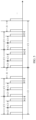
- FIG. 6 is a schematic diagram of a third configuration parameter in a sequential value-setting manner according to this application.
- a sequence ⁇ J1, J2 ⁇ including J1 and J2 is an example of a value sequence of the third configuration parameter.
- C1 is marked in FIG. 6
- C1 herein is naturally formed based on the sequence ⁇ J1, J2 ⁇ , and is not configured by a network device. That is, FIG. 6 is an example of a sequence structure in which a resource configuration parameter includes the third configuration parameter, and the third configuration parameter is in the sequential value-setting manner.
- UE After receiving the third configuration parameter, UE determines, based on ⁇ J1, J2 ⁇ , that the resource appears in a J1 th millisecond, a (J1+J2) th millisecond, a (J1+J2+J1) th millisecond, a (J1+J2+J1+J2) th millisecond, and so on. That is, the resource appears in an order based on intervals of J1 and J2.
- FIG. 7 is a schematic diagram of a third configuration parameter in a periodic embedded value-setting manner according to this application.
- a sequence ⁇ C1, C2 ⁇ including C1 and C2 is an example of a value sequence of the third configuration parameter.
- J1 C1-3*C2.
- UE After receiving the third configuration parameter, UE determines, based on ⁇ C1, C2 ⁇ , that a resource appears at an interval of C1, and the resource appears at an interval of C2 in each C1.
- the resource configuration parameter further includes a fourth configuration parameter
- cases in which the fourth configuration parameter is in two value-setting manners are similar to that in FIG. 6 and FIG. 7 , and an only difference is that the fourth configuration parameter indicates a time domain interval and/or a time domain location in a time domain interval corresponding to a last value. Details are not described herein again.
- FIG. 8 is a schematic diagram of an apparatus for configuring a resource according to an embodiment of this application.
- the apparatus 2000 includes a receiving unit 2001 and a processing unit 2002.
- the apparatus 2000 may be integrated in user equipment.
- the apparatus 2000 can be configured to perform steps that are performed by the user equipment and that are in any one of the methods for configuring a resource.
- the receiving unit 2001 may be configured to perform step S201
- the processing unit 2002 may be configured to perform step S202.
- the apparatus 2000 may further include a storage unit, configured to store data.
- the storage unit may be integrated into the processing unit 2002, or may be a unit that is independent of the receiving unit 2001 and the processing unit 2002.
- the receiving unit 2001 may be further configured to receive any of the foregoing indication information.
- FIG. 9 is a schematic diagram of another apparatus for configuring a resource according to an embodiment of this application.
- the apparatus 3000 includes a sending unit 3001 and a processing unit 3002.
- the apparatus 3000 may be integrated in a network device.
- the apparatus 3000 can be configured to perform steps that are performed by the network device and that are in any one of the methods for configuring a resource.
- the sending unit 3001 may be configured to perform step S201, and the processing unit 3002 may be configured to perform an operation of configuring a resource configuration parameter.
- the sending unit 3001 may be further configured to send any of the foregoing indication information.
- the apparatus 3000 may further include a storage unit, configured to store data.
- the storage unit may be integrated into the processing unit 3002, or may be a unit that is independent of the sending unit 3001 and the processing unit 3002.
- FIG. 10 is a schematic diagram of a hardware structure of an electronic device according to an embodiment of this application.
- the electronic device 4000 includes: at least one processor 4001 (only one is shown in FIG. 10 ), a memory 4002, and a computer program 4003 that is stored in the memory 4002 and that can be run on the at least one processor 4001.
- the processor 4001 implements the computer program 4003 the steps in any one of the foregoing methods are implemented.
- the electronic device 4000 is user equipment, and is configured to perform the steps performed by the user equipment in the foregoing method.
- the electronic device 4000 is a network device, and is configured to perform the steps performed by the network device in the foregoing method.
- FIG. 10 is merely an example of the electronic device, and constitutes no limitation on the electronic device.
- the electronic device may include more or fewer components than those shown in the figure, or have a combination of some components, or have a different component arrangement, for example, may further include an input/output device, a network access device, and the like.
- the processor 4001 may be a central processing unit (central processing unit, CPU), or may be another general-purpose processor, a digital signal processor (digital signal processor, DSP), an application specific integrated circuit (application specific integrated circuit, ASIC), a field-programmable gate array (field-programmable gate array, FPGA), or another programmable logic device, a discrete gate or a transistor logic device, a discrete hardware component, or the like.
- the general-purpose processor may be a microprocessor, or the processor may be any conventional processor or the like.
- the memory 4002 may be an internal storage unit of the electronic device 4000, for example, a hard disk drive or an internal memory of the electronic device 4000. In some other embodiments, the memory 4002 may be alternatively an external storage device of the electronic device 4000, for example, a plug-in hard disk drive, a smart media card (smart media card, SMC), a secure digital (secure digital, SD) card, or a flash card (flash card) that is provided on the electronic device 4000. Optionally, the memory 4002 may include both an internal storage unit and an external storage device of the electronic device 4000.
- the memory 4002 is configured to store an operating system, an application, a bootloader, data, another program, and the like, for example, program code of the computer program.
- the memory 4002 may be further configured to temporarily store data that has been output or that is to be output.
- An embodiment of this application further provides an electronic device, where the electronic device includes: at least one processor, a memory, and a computer program that is stored in the memory and that can be run on the at least one processor.
- the processor implements the computer program, the steps in any one of the foregoing method embodiments are implemented.
- the electronic device may be user equipment, and is configured to perform steps performed by the user equipment; and the electronic device may alternatively be a network device, and is configured to perform steps performed by the network device.
- An embodiment of this application further provides a computer-readable storage medium.
- the computer-readable storage medium stores a computer program.
- the steps in the foregoing method embodiments can be implemented.
- An embodiment of this application further provides a chip, including a processor.
- the processor is configured to read and execute a computer program stored in a memory.
- the computer program is executed by the processor, the steps in the foregoing method embodiments can be implemented.
- the chip further includes a memory, and the memory is electrically connected to the processor.
- the chip may further include a communication interface.
- An embodiment of this application further provides a computer program product.
- the computer program product is executed by the processor, the steps in the foregoing method embodiments can be implemented.
- the integrated unit When the integrated unit is implemented in the form of a software functional unit and sold or used as an independent product, the integrated unit may be stored in a computer-readable storage medium. Based on this understanding, in this application, all or some of the procedures in the methods in the embodiments may be implemented by using a computer program instructing relevant hardware.
- the computer program may be stored in a computer-readable storage medium. When the computer program is executed by a processor, the steps in the foregoing method embodiments can be performed.
- the computer program includes computer program code.
- the computer program code may be in a source code form, an object code form, an executable file, some intermediate forms, or the like.
- the computer-readable medium may include at least any entity or apparatus capable of adding computer program code to a photographing apparatus/terminal device, a recording medium, a computer memory, a read-only memory (read-only memory, ROM), a random access memory (random access memory, RAM), an electrical carrier signal, a telecommunication signal, and a software distribution medium, for example, a USB flash drive, a removable hard disk, a magnetic disk, or an optical disk.
- the computer-readable medium may not be an electrical carrier signal or a telecommunication signal.
- the disclosed apparatus/electronic device and method may be implemented in other manners.
- the apparatus/electronic device embodiments described above are merely examples.
- division into the modules or units is merely a logical function division and there may be other division in actual implementation.
- a plurality of units or components may be combined or integrated into another system, or some features may be ignored or not performed.
- the displayed or discussed mutual couplings or direct couplings or communication connections may be implemented by using some interfaces.
- the indirect couplings or communication connections between the apparatuses or units may be implemented in electric, mechanical, or other forms.
- the units described as separate components may or may not be physically separated, and the components displayed as units may or may not be physical units, and may be located in one place or may be distributed over a plurality of network units. Some or all of the units may be selected according to actual needs to achieve the objectives of the solutions of the embodiments.
- the term “if” may be interpreted based on the context as “when", “once”, “in response to determining”, or “in response to detecting”.
- the phrase “if determining” or “if detecting [a described condition or event]” may be interpreted based on the context as a meaning of "once determining”, “in response to determining”, “once detecting [the described condition or event]", or “in response to detecting [the described condition or event]”.
Landscapes
- Engineering & Computer Science (AREA)
- Computer Networks & Wireless Communication (AREA)
- Signal Processing (AREA)
- Mobile Radio Communication Systems (AREA)
Applications Claiming Priority (2)
| Application Number | Priority Date | Filing Date | Title |
|---|---|---|---|
| CN202211182470.5A CN117793918A (zh) | 2022-09-27 | 2022-09-27 | 配置资源的方法及装置 |
| PCT/CN2023/114388 WO2024066811A1 (zh) | 2022-09-27 | 2023-08-23 | 配置资源的方法及装置 |
Publications (2)
| Publication Number | Publication Date |
|---|---|
| EP4580291A1 true EP4580291A1 (de) | 2025-07-02 |
| EP4580291A4 EP4580291A4 (de) | 2026-03-25 |
Family
ID=90395093
Family Applications (1)
| Application Number | Title | Priority Date | Filing Date |
|---|---|---|---|
| EP23870056.1A Pending EP4580291A4 (de) | 2022-09-27 | 2023-08-23 | Ressourcenkonfigurationsverfahren und -vorrichtung |
Country Status (3)
| Country | Link |
|---|---|
| EP (1) | EP4580291A4 (de) |
| CN (2) | CN117793918A (de) |
| WO (1) | WO2024066811A1 (de) |
Family Cites Families (8)
| Publication number | Priority date | Publication date | Assignee | Title |
|---|---|---|---|---|
| CN120076003A (zh) * | 2017-08-11 | 2025-05-30 | Oppo广东移动通信有限公司 | 无线通信的方法、网络设备和终端设备 |
| CN110035529B (zh) * | 2018-01-12 | 2021-07-16 | 华为技术有限公司 | 一种资源配置的方法和通信装置 |
| CN110167164B (zh) * | 2018-02-14 | 2024-08-09 | 华为技术有限公司 | 随机接入资源配置的方法和通信设备 |
| US11184907B2 (en) * | 2018-11-01 | 2021-11-23 | Lenovo (Singapore) Pte. Ltd. | Method and apparatus for transmitting a transport block in a transmission occasion |
| CN114916077B (zh) * | 2019-01-24 | 2025-09-05 | 华为技术有限公司 | 一种配置资源的确定方法及装置 |
| CN114600516B (zh) * | 2019-11-08 | 2023-11-10 | 华为技术有限公司 | 一种资源指示的方法及装置 |
| CN114765863B (zh) * | 2021-01-13 | 2025-12-02 | 维沃移动通信有限公司 | 传输处理方法及相关设备 |
| CN114980318B (zh) * | 2021-02-24 | 2024-09-20 | 华为技术有限公司 | 一种参考信号可用性的指示方法及通信装置 |
-
2022
- 2022-09-27 CN CN202211182470.5A patent/CN117793918A/zh active Pending
-
2023
- 2023-08-23 WO PCT/CN2023/114388 patent/WO2024066811A1/zh not_active Ceased
- 2023-08-23 EP EP23870056.1A patent/EP4580291A4/de active Pending
- 2023-08-23 CN CN202380061190.5A patent/CN119732157A/zh active Pending
Also Published As
| Publication number | Publication date |
|---|---|
| WO2024066811A1 (zh) | 2024-04-04 |
| EP4580291A4 (de) | 2026-03-25 |
| CN119732157A (zh) | 2025-03-28 |
| CN117793918A (zh) | 2024-03-29 |
Similar Documents
| Publication | Publication Date | Title |
|---|---|---|
| EP4068888B1 (de) | Verfahren und vorrichtung zur ermittlung von ressourcenindikationswerten | |
| CN106793127B (zh) | 微时隙的指示方法及装置 | |
| JP7663713B2 (ja) | サイドリンクフィードバックリソースの決定方法、端末及びネットワーク側機器 | |
| US20210153224A1 (en) | Data transmission method and apparatus | |
| EP3852297A1 (de) | Verfahren, vorrichtung und gerät zum senden und empfangen von informationen | |
| EP3817257A1 (de) | Verfahren und vorrichtung für pdcch-übertragung und blinderkennung | |
| EP3754881A1 (de) | Verfahren und vorrichtung zur bestimmung von informationsbreichswerten in dci | |
| US10342031B2 (en) | Data transmission method and device | |
| EP4311145B1 (de) | Verfahren und vorrichtung für harq-ack-feedback sowie endgerät und speichermedium | |
| EP3927059A1 (de) | Verfahren zur planungszeitbestimmung, endgerät und netzseitige vorrichtung | |
| EP3641174A1 (de) | Übertragungsverfahren für referenzsignalmuster und vorrichtung dafür | |
| US20240179721A1 (en) | Pdcch monitoring method, related device, and readable storage medium | |
| JP7227987B2 (ja) | NR TDD無線フレーム構成およびCLI感度のgNB間Xnシグナリング | |
| US11324029B2 (en) | Data transmission method, terminal and base station | |
| US12581497B2 (en) | Physical downlink control channel transmission method and related apparatus | |
| US12426100B2 (en) | Sequence sending method and apparatus | |
| CN115173889A (zh) | 跳频处理方法、装置及终端 | |
| EP4580291A1 (de) | Ressourcenkonfigurationsverfahren und -vorrichtung | |
| US11343806B2 (en) | Uplink control channel transmission method and device | |
| US11638249B2 (en) | Communication method and wireless apparatus | |
| US12490285B2 (en) | Method and apparatus for identifying reduced capability user equipment type, base station, and user equipment | |
| EP3996396A1 (de) | Synchronisationssignalübertragungsverfahren, endgerät und vorrichtung sowie speichermedium | |
| EP4518390A1 (de) | Ressourcenplanungsverfahren, ressourcennutzungsverfahren, netzwerkvorrichtung, endgerät und medium | |
| EP4683256A1 (de) | Kommunikationsverfahren und kommunikationsvorrichtung | |
| US20240022378A1 (en) | Srs sending method and apparatus, srs receiving method and apparatus, and srs configuration method and apparatus |
Legal Events
| Date | Code | Title | Description |
|---|---|---|---|
| STAA | Information on the status of an ep patent application or granted ep patent |
Free format text: STATUS: THE INTERNATIONAL PUBLICATION HAS BEEN MADE |
|
| PUAI | Public reference made under article 153(3) epc to a published international application that has entered the european phase |
Free format text: ORIGINAL CODE: 0009012 |
|
| STAA | Information on the status of an ep patent application or granted ep patent |
Free format text: STATUS: REQUEST FOR EXAMINATION WAS MADE |
|
| 17P | Request for examination filed |
Effective date: 20250324 |
|
| AK | Designated contracting states |
Kind code of ref document: A1 Designated state(s): AL AT BE BG CH CY CZ DE DK EE ES FI FR GB GR HR HU IE IS IT LI LT LU LV MC ME MK MT NL NO PL PT RO RS SE SI SK SM TR |
|
| RIC1 | Information provided on ipc code assigned before grant |
Ipc: H04W 72/23 20230101AFI20251107BHEP Ipc: H04W 72/0446 20230101ALN20251107BHEP |
|
| DAV | Request for validation of the european patent (deleted) | ||
| DAX | Request for extension of the european patent (deleted) | ||
| A4 | Supplementary search report drawn up and despatched |
Effective date: 20260219 |
|
| RIC1 | Information provided on ipc code assigned before grant |
Ipc: H04W 72/23 20230101AFI20260213BHEP Ipc: H04W 72/0446 20230101ALN20260213BHEP |