EP4580284A2 - Sendevorrichtung, empfangsvorrichtung, sendeverfahren und empfangsverfahren - Google Patents
Sendevorrichtung, empfangsvorrichtung, sendeverfahren und empfangsverfahren Download PDFInfo
- Publication number
- EP4580284A2 EP4580284A2 EP25176978.2A EP25176978A EP4580284A2 EP 4580284 A2 EP4580284 A2 EP 4580284A2 EP 25176978 A EP25176978 A EP 25176978A EP 4580284 A2 EP4580284 A2 EP 4580284A2
- Authority
- EP
- European Patent Office
- Prior art keywords
- interlace
- allocation
- resource
- assignment information
- cluster
- Prior art date
- Legal status (The legal status is an assumption and is not a legal conclusion. Google has not performed a legal analysis and makes no representation as to the accuracy of the status listed.)
- Pending
Links
Images









Classifications
-
- H—ELECTRICITY
- H04—ELECTRIC COMMUNICATION TECHNIQUE
- H04L—TRANSMISSION OF DIGITAL INFORMATION, e.g. TELEGRAPHIC COMMUNICATION
- H04L5/00—Arrangements affording multiple use of the transmission path
- H04L5/003—Arrangements for allocating sub-channels of the transmission path
- H04L5/0053—Allocation of signalling, i.e. of overhead other than pilot signals
-
- H—ELECTRICITY
- H04—ELECTRIC COMMUNICATION TECHNIQUE
- H04L—TRANSMISSION OF DIGITAL INFORMATION, e.g. TELEGRAPHIC COMMUNICATION
- H04L5/00—Arrangements affording multiple use of the transmission path
- H04L5/003—Arrangements for allocating sub-channels of the transmission path
- H04L5/0037—Inter-user or inter-terminal allocation
- H04L5/0039—Frequency-contiguous, i.e. with no allocation of frequencies for one user or terminal between the frequencies allocated to another
-
- H—ELECTRICITY
- H04—ELECTRIC COMMUNICATION TECHNIQUE
- H04L—TRANSMISSION OF DIGITAL INFORMATION, e.g. TELEGRAPHIC COMMUNICATION
- H04L27/00—Modulated-carrier systems
- H04L27/26—Systems using multi-frequency codes
- H04L27/2601—Multicarrier modulation systems
- H04L27/2602—Signal structure
- H04L27/26025—Numerology, i.e. varying one or more of symbol duration, subcarrier spacing, Fourier transform size, sampling rate or down-clocking
-
- H—ELECTRICITY
- H04—ELECTRIC COMMUNICATION TECHNIQUE
- H04L—TRANSMISSION OF DIGITAL INFORMATION, e.g. TELEGRAPHIC COMMUNICATION
- H04L5/00—Arrangements affording multiple use of the transmission path
- H04L5/0001—Arrangements for dividing the transmission path
- H04L5/0003—Two-dimensional division
- H04L5/0005—Time-frequency
- H04L5/0007—Time-frequency the frequencies being orthogonal, e.g. OFDM(A) or DMT
-
- H—ELECTRICITY
- H04—ELECTRIC COMMUNICATION TECHNIQUE
- H04L—TRANSMISSION OF DIGITAL INFORMATION, e.g. TELEGRAPHIC COMMUNICATION
- H04L5/00—Arrangements affording multiple use of the transmission path
- H04L5/003—Arrangements for allocating sub-channels of the transmission path
- H04L5/0044—Allocation of payload; Allocation of data channels, e.g. PDSCH or PUSCH
-
- H—ELECTRICITY
- H04—ELECTRIC COMMUNICATION TECHNIQUE
- H04L—TRANSMISSION OF DIGITAL INFORMATION, e.g. TELEGRAPHIC COMMUNICATION
- H04L5/00—Arrangements affording multiple use of the transmission path
- H04L5/0091—Signalling for the administration of the divided path, e.g. signalling of configuration information
-
- H—ELECTRICITY
- H04—ELECTRIC COMMUNICATION TECHNIQUE
- H04L—TRANSMISSION OF DIGITAL INFORMATION, e.g. TELEGRAPHIC COMMUNICATION
- H04L5/00—Arrangements affording multiple use of the transmission path
- H04L5/0091—Signalling for the administration of the divided path, e.g. signalling of configuration information
- H04L5/0094—Indication of how sub-channels of the path are allocated
-
- H—ELECTRICITY
- H04—ELECTRIC COMMUNICATION TECHNIQUE
- H04W—WIRELESS COMMUNICATION NETWORKS
- H04W72/00—Local resource management
- H04W72/04—Wireless resource allocation
- H04W72/044—Wireless resource allocation based on the type of the allocated resource
- H04W72/0453—Resources in frequency domain, e.g. a carrier in FDMA
-
- H—ELECTRICITY
- H04—ELECTRIC COMMUNICATION TECHNIQUE
- H04W—WIRELESS COMMUNICATION NETWORKS
- H04W74/00—Wireless channel access
- H04W74/08—Non-scheduled access, e.g. ALOHA
- H04W74/0808—Non-scheduled access, e.g. ALOHA using carrier sensing, e.g. carrier sense multiple access [CSMA]
-
- H—ELECTRICITY
- H04—ELECTRIC COMMUNICATION TECHNIQUE
- H04L—TRANSMISSION OF DIGITAL INFORMATION, e.g. TELEGRAPHIC COMMUNICATION
- H04L5/00—Arrangements affording multiple use of the transmission path
- H04L5/0001—Arrangements for dividing the transmission path
- H04L5/0003—Two-dimensional division
- H04L5/0005—Time-frequency
- H04L5/0007—Time-frequency the frequencies being orthogonal, e.g. OFDM(A) or DMT
- H04L5/001—Time-frequency the frequencies being orthogonal, e.g. OFDM(A) or DMT the frequencies being arranged in component carriers
Definitions
- the present disclosure relates to a transmission apparatus, a reception apparatus, a transmission method, and a reception method.
- One non-limiting and exemplary embodiment facilitates providing a transmission apparatus, a reception apparatus, a transmission method, and a reception method each capable of appropriately transmitting/receiving signals in the operation in unlicensed bands.
- a transmission apparatus includes: circuitry, which, in operation, assigns a signal to a resource based on control information indicating allocation of a group among a plurality of the groups resulting from grouping a plurality of blocks into which a frequency band is divided, and allocation of the resource in at least one of the plurality of blocks; and a transmitter, which in operation, transmits the signal.
- the PRB-based block interlace design is used as a frequency resource allocation method for a Physical Uplink Shared Channel (PUSCH), which is an uplink data channel in LTE-LAA.
- PUSCH Physical Uplink Shared Channel
- the PRB-based block interlace design is a method of transmitting signals using a band (i.e., resource) called interlaces that are distributed at certain intervals on the frequency domain in a system band, in order to comply with the limitation of an Occupied Channel Bandwidth (OCB) in unlicensed bands defined by the ETSI and to mitigate the effect of the PSD limitation.
- OCB Occupied Channel Bandwidth
- the cluster means similar to, for example, the "interval" at which the interlaces with the same interlace number are arranged. That is, the interlaces with the same interlace number are evenly distributed on the frequency domain over the plurality of clusters.
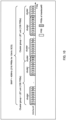
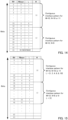
- the frequency resource allocation method for the PUSCH in LTE-LAA uses the PRB-based block interlace design where the number of interlaces (hereinafter, represented as "M") is 10 and the number of PRBs per interlace (hereinafter, represented as "N"; i.e., the number of clusters) is 10 PRBs, as illustrated in FIG. 1 .
- M the number of interlaces
- N the number of PRBs per interlace
- the system bandwidth in LTE-LAA is maximum 20 MHz (100 PRBs)
- SCS subcarrier spacing
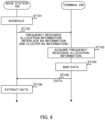
- the frequency resource allocation for the PUSCH for the terminal is determined by, for example, a base station (e.g., also referred to as Node B or gNB).
- the base station indicates the determined frequency resource allocation information (e.g., also referred to as a resource allocation field) to the terminal by including in Downlink Control Information (DCI), for example.
- DCI Downlink Control Information
- the frequency resource allocation information is composed of, for example, a resource indication value (RIV) that is control information uniquely associated with a combination of the interlace number of a starting position (e.g., a starting PRB: RB START ) in the cluster and the contiguous allocation length (i.e., the number of PRBs; e.g., L) from the starting position, as illustrated in FIG. 1 .
- a resource indication value (RIV) that is control information uniquely associated with a combination of the interlace number of a starting position (e.g., a starting PRB: RB START ) in the cluster and the contiguous allocation length (i.e., the number of PRBs; e.g., L) from the starting position, as illustrated in FIG. 1 .
- RIV-based allocation method a method of indicating the frequency resource by the combination of the starting position of the resource and the resource length consecutively used from the starting position.
- the frequency resource allocation method for NR-U needs to take into account the system bandwidth of 20 MHz or more, in contrast to the frequency resource allocation method for LTE-LAA.
- system bandwidth (or BWP) is different for each terminal in NR-U in some cases. It is thus required to be capable of performing flexible frequency multiplexing among the terminals configured with different system bandwidths.
- NR-U supports a plurality of SCSs, it is required to discuss the frequency resource allocation method suitable for each SCS. It is also required to discuss a case of using the RIV-based frequency resource allocation method.
- the communication system includes base station 100 and terminal 200.
- base station 100 (corresponding to a reception apparatus) determines a frequency resource to be allocated to terminal 200, and indicates information indicating the determined resource, by way of example.
- terminal 200 (corresponding to a transmission apparatus) performs signal transmission processing including mapping to the resource based on the indicated information, and transmits the signal to base station 100.
- FIG. 5 is a block diagram illustrating an example of a configuration of a part of terminal 200 according to an embodiment of the present disclosure.
- mapper 207 assigns signals to the resources based on control information indicating the allocation (e.g., cluster RA) of the groups among the plurality of groups (e.g., cluster groups) resulting from grouping the plurality of blocks (e.g., clusters) into which the frequency band is divided, and the allocation (e.g., interlace RA) of the resources (e.g., interlaces) in the blocks.
- Transmitter 209 transmits the signals.
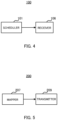
- FIG. 6 is a block diagram illustrating the configuration of base station 100 according to the present embodiment.
- base station 100 includes scheduler 101, holder 102, modulator 103, transmitter 104, antenna 105, receiver 106, Fast Fourier Transformer (FFT) 107, demapper 108, Inverse Discrete Fourier Transformer (IDFT) 109, and demodulator/decoder 110.
- FFT Fast Fourier Transformer
- IDFT Inverse Discrete Fourier Transformer
- Scheduler 101 determines radio resource allocation (e.g., frequency resource allocation, time resource allocation, or transmit power control information) for an uplink data channel (PUSCH) for terminal 200 connected to base station 100.
- Scheduler 101 outputs the determined radio resource allocation information to holder 102 and modulator 103.
- the frequency resource allocation is determined by, for example, frequency resource allocation for the interlaces in a cluster (hereinafter, referred to as interlace resource allocation (interlace RA)) and frequency resource allocation for the cluster groups (hereinafter, referred to as cluster resource allocation (cluster RA)), in accordance with rules to be described later.
- the frequency resource allocation information indicated to terminal 200 is composed of 2 types of frequency resource allocation information, which are the interlace RA information and the cluster RA information.
- cluster group means a band including one or a plurality of contiguous clusters on the frequency domain, for example.
- cluster RA indicates a resource of the allocated cluster groups in the BWP (or system band).
- the cluster RA indicates the cluster group allocation among the plurality of cluster groups for terminal 200.
- the cluster groups may be configured by dividing the LBT subband (e.g., 20 MHz, 106 PRBs) in units of clusters such that the cluster groups have substantially the same number of clusters, for example.
- LBT subband e.g. 20 MHz, 106 PRBs
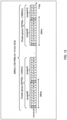
- FIG. 14 includes additional allocation patterns of interlaces for the RIVs 55 to 62, for example.
- the PRB-based block interlace design focuses on the frequency diversity gain.
- the interlace allocation with the contiguous allocation length (L) limited to 1 PRB still causes signals to be distributed throughout the band corresponding to the cluster group, thereby obtaining sufficient frequency diversity gain.
- RIV 63 in FIG. 14
- base station 100 can independently indicate the No transmission in each interlace RA, thereby controlling the frequency resource to be allocated to terminal 200 in units of the cluster groups.
- RIVs 0 to 54 configure the interlace allocation patterns for all clusters in the cluster group allocated by the cluster RA, in FIG. 16 .
- RIVs 55 to 58 configure the interlace allocation patterns for the first half of the clusters (e.g., clusters on a lower frequency side) in the cluster group allocated by the cluster RA, in FIG. 16 .
- the second half of the clusters in the cluster group allocated by the cluster RA are not allocated to terminal 200 by the RIVs 55 to 58 illustrated in FIG. 16 .
- RIVs 59 to 62 configure the interlace allocation patterns for the second half of the clusters (e.g., clusters on a higher frequency side) in the cluster group allocated by the cluster RA, in FIG. 16 .
- the first half of the clusters in the cluster group allocated by the cluster RA are not allocated to terminal 200 by the RIVs 59 to 62 illustrated in FIG. 16 .
- base station 100 to dynamically control (i.e., schedule) the partial interlace allocation in the cluster group allocated to terminal 200 (e.g., the cluster group allocated by the cluster RA), for example. It is also possible to narrow the minimum bandwidth for terminal 200 while preventing the increase in the signaling overhead.
- Configuration Example 4 focuses on a relation between the number of interlaces (M) and the number of signaling bits in the RIV-based allocation method and the bitmap-based allocation method.
- FIG. 17 illustrates exemplary relations between the number of interlaces (M) and the number of signaling bits in the RIV-based allocation method and the bitmap-based allocation method.
- the horizontal axis indicates the number of interlaces (M) and the vertical axis indicates the number of signaling bits in FIG. 17 .
- the allocation pattern of contiguous virtual interlaces is indicated as the interlace RA information.
- the interlace RA information indicates contiguous virtual interlace numbers.
- base station 100 indicates the contiguous interlace allocation pattern of virtual interlace numbers #4 to #6 to terminal 200 by the RIV-based allocation method.
- base station 100 indicates the contiguous interlace allocation pattern of virtual interlace numbers #4 to #6 to terminal 200 by the RIV-based allocation method.
Landscapes
- Engineering & Computer Science (AREA)
- Signal Processing (AREA)
- Computer Networks & Wireless Communication (AREA)
- Physics & Mathematics (AREA)
- Mathematical Physics (AREA)
- Mobile Radio Communication Systems (AREA)
Applications Claiming Priority (3)
| Application Number | Priority Date | Filing Date | Title |
|---|---|---|---|
| JP2019024180 | 2019-02-14 | ||
| PCT/JP2020/002882 WO2020166317A1 (ja) | 2019-02-14 | 2020-01-28 | 送信装置、受信装置、送信方法及び受信方法 |
| EP20756032.7A EP3926908B1 (de) | 2019-02-14 | 2020-01-28 | Sendevorrichtung, empfangsvorrichtung, sendeverfahren und empfangsverfahren |
Related Parent Applications (2)
| Application Number | Title | Priority Date | Filing Date |
|---|---|---|---|
| EP20756032.7A Division-Into EP3926908B1 (de) | 2019-02-14 | 2020-01-28 | Sendevorrichtung, empfangsvorrichtung, sendeverfahren und empfangsverfahren |
| EP20756032.7A Division EP3926908B1 (de) | 2019-02-14 | 2020-01-28 | Sendevorrichtung, empfangsvorrichtung, sendeverfahren und empfangsverfahren |
Publications (2)
| Publication Number | Publication Date |
|---|---|
| EP4580284A2 true EP4580284A2 (de) | 2025-07-02 |
| EP4580284A3 EP4580284A3 (de) | 2025-09-03 |
Family
ID=72044863
Family Applications (2)
| Application Number | Title | Priority Date | Filing Date |
|---|---|---|---|
| EP25176978.2A Pending EP4580284A3 (de) | 2019-02-14 | 2020-01-28 | Sendevorrichtung, empfangsvorrichtung, sendeverfahren und empfangsverfahren |
| EP20756032.7A Active EP3926908B1 (de) | 2019-02-14 | 2020-01-28 | Sendevorrichtung, empfangsvorrichtung, sendeverfahren und empfangsverfahren |
Family Applications After (1)
| Application Number | Title | Priority Date | Filing Date |
|---|---|---|---|
| EP20756032.7A Active EP3926908B1 (de) | 2019-02-14 | 2020-01-28 | Sendevorrichtung, empfangsvorrichtung, sendeverfahren und empfangsverfahren |
Country Status (9)
| Country | Link |
|---|---|
| US (3) | US12010050B2 (de) |
| EP (2) | EP4580284A3 (de) |
| JP (2) | JP7475290B2 (de) |
| KR (1) | KR102825553B1 (de) |
| CN (1) | CN113439422A (de) |
| BR (1) | BR112021013902A2 (de) |
| ES (1) | ES3036182T3 (de) |
| MX (1) | MX2021009773A (de) |
| WO (1) | WO2020166317A1 (de) |
Families Citing this family (7)
| Publication number | Priority date | Publication date | Assignee | Title |
|---|---|---|---|---|
| CN113330797B (zh) | 2019-01-11 | 2024-08-16 | 瑞典爱立信有限公司 | 用于免许可频谱中上行链路传输的资源分配 |
| EP3949238B1 (de) * | 2019-03-29 | 2025-07-16 | Apple Inc. | Ressourcenzuweisung und verbesserungen der benutzermultiplexkapazität für interlace-basierte physikalische uplink-steuerkanalformate in neuem unlizenziertem funk (nr) |
| CN113785648B (zh) * | 2019-03-30 | 2024-10-11 | 韦勒斯标准与技术协会公司 | 在未授权频带中执行传输的资源分配方法及使用其的设备 |
| CN114342530A (zh) * | 2019-07-03 | 2022-04-12 | 瑞典爱立信有限公司 | 针对交错传输的频域资源分配 |
| US11737140B2 (en) * | 2020-02-13 | 2023-08-22 | Qualcomm Incorporated | Long term sensing for exception to medium access restriction |
| CN119054405A (zh) * | 2022-04-28 | 2024-11-29 | 索尼集团公司 | 通信设备和通信方法 |
| WO2023216204A1 (zh) * | 2022-05-12 | 2023-11-16 | 北京小米移动软件有限公司 | 频域资源分配方法/装置/设备及存储介质 |
Citations (1)
| Publication number | Priority date | Publication date | Assignee | Title |
|---|---|---|---|---|
| JP2019024180A (ja) | 2017-07-25 | 2019-02-14 | セイコーエプソン株式会社 | プロジェクター、マルチプロジェクションシステムおよびプロジェクターの制御方法 |
Family Cites Families (21)
| Publication number | Priority date | Publication date | Assignee | Title |
|---|---|---|---|---|
| KR101221821B1 (ko) | 2006-04-21 | 2013-01-14 | 삼성전자주식회사 | 주파수 분할 다중 접속 시스템에서 자원 할당 정보 시그널링 방법 |
| US8923321B2 (en) * | 2006-07-28 | 2014-12-30 | Motorola Mobility Llc | Apparatus and method for handling control channel reception/decoding failure in a wireless VoIP communication system |
| US20080049692A1 (en) * | 2006-08-23 | 2008-02-28 | Motorola, Inc. | Apparatus and Method For Resource Allocation and Data Transmission Using Heterogeneous Modulation Formats in a Wireless Packet Communication System |
| KR101565417B1 (ko) | 2008-08-08 | 2015-11-03 | 엘지전자 주식회사 | 다중 주파수 대역 시스템에서의 자원 할당하는 방법 및 장치 |
| US9055576B2 (en) | 2009-10-08 | 2015-06-09 | Qualcomm Incorporated | Uplink resource allocation for LTE advanced |
| US9276710B2 (en) * | 2009-12-21 | 2016-03-01 | Qualcomm Incorporated | Method and apparatus for resource allocation with carrier extension |
| KR102401006B1 (ko) * | 2011-09-30 | 2022-05-24 | 인터디지탈 패튼 홀딩스, 인크 | 감소된 채널 대역폭을 사용하는 장치 통신 |
| CN103327615B (zh) | 2012-03-20 | 2016-04-20 | 华为技术有限公司 | 资源分配指示方法、资源分配方法及设备 |
| CN108476506B (zh) | 2016-01-20 | 2023-08-15 | 株式会社Ntt都科摩 | 用户终端、无线基站以及无线通信方法 |
| US11419134B2 (en) | 2016-03-25 | 2022-08-16 | Lg Electronics Inc. | Method for transmitting and receiving uplink signal in wireless communication system supporting non-licensed band, and apparatus for supporting same |
| US11057931B2 (en) * | 2016-03-31 | 2021-07-06 | Ntt Docomo, Inc. | User terminal, radio base station and radio communication method |
| JP2019125819A (ja) | 2016-05-12 | 2019-07-25 | シャープ株式会社 | 端末装置、基地局装置、通信方法、および、集積回路 |
| CA3022668C (en) | 2016-05-13 | 2019-07-16 | Telefonaktiebolaget Lm Ericsson (Publ) | Multi-subcarrier system with multiple numerologies |
| ES2822344T3 (es) * | 2016-08-12 | 2021-04-30 | Asustek Comp Inc | Método y aparato para determinar un ancho de banda de numerología en un sistema de comunicación inalámbrica |
| US10506596B2 (en) | 2016-10-28 | 2019-12-10 | Qualcomm Incorporated | Coexistence of interleaved and contiguous uplink transmissions |
| JP6974430B2 (ja) * | 2017-03-21 | 2021-12-01 | エルジー エレクトロニクス インコーポレイティドLg Electronics Inc. | 無線通信システムにおける端末と基地局の間の物理上りリンク制御チャネルの送受信方法及びそれをサポートする装置 |
| CN112737753B (zh) * | 2017-06-09 | 2022-02-15 | 华为技术有限公司 | 一种信号传输方法、相关设备及系统 |
| US10868629B2 (en) * | 2018-04-06 | 2020-12-15 | Mediatek Inc. | Channel multiplexing within interlace for new radio unlicensed spectrum operation |
| WO2020030263A1 (en) * | 2018-08-08 | 2020-02-13 | Huawei Technologies Co., Ltd. | Devices, methods and computer programs for saving frequency resources in wireless communications |
| WO2020032696A1 (ko) * | 2018-08-09 | 2020-02-13 | 엘지전자 주식회사 | 비면허 대역을 지원하는 무선 통신 시스템에서 단말과 기지국의 상향링크 신호 송수신 방법 및 이를 지원하는 장치 |
| CN111148261B (zh) | 2018-11-02 | 2021-08-24 | 维沃移动通信有限公司 | 上行传输方法、用户设备和网络侧设备 |
-
2020
- 2020-01-28 EP EP25176978.2A patent/EP4580284A3/de active Pending
- 2020-01-28 MX MX2021009773A patent/MX2021009773A/es unknown
- 2020-01-28 WO PCT/JP2020/002882 patent/WO2020166317A1/ja not_active Ceased
- 2020-01-28 CN CN202080014433.6A patent/CN113439422A/zh active Pending
- 2020-01-28 JP JP2020572146A patent/JP7475290B2/ja active Active
- 2020-01-28 EP EP20756032.7A patent/EP3926908B1/de active Active
- 2020-01-28 KR KR1020217024957A patent/KR102825553B1/ko active Active
- 2020-01-28 ES ES20756032T patent/ES3036182T3/es active Active
- 2020-01-28 BR BR112021013902-8A patent/BR112021013902A2/pt unknown
- 2020-01-28 US US17/429,264 patent/US12010050B2/en active Active
-
2024
- 2024-04-15 JP JP2024065372A patent/JP7631592B2/ja active Active
- 2024-05-03 US US18/654,764 patent/US12212509B2/en active Active
- 2024-12-18 US US18/986,166 patent/US20250240133A1/en active Pending
Patent Citations (1)
| Publication number | Priority date | Publication date | Assignee | Title |
|---|---|---|---|---|
| JP2019024180A (ja) | 2017-07-25 | 2019-02-14 | セイコーエプソン株式会社 | プロジェクター、マルチプロジェクションシステムおよびプロジェクターの制御方法 |
Non-Patent Citations (2)
| Title |
|---|
| "E-UTRA Physical layer procedures (Release 14", 3GPP TS 36.213 V14.5.0, December 2017 (2017-12-01) |
| "Study on NR-based access to unlicensed spectrum (Release 16", 3GPP TR 38.889 V16.0.0, December 2018 (2018-12-01) |
Also Published As
| Publication number | Publication date |
|---|---|
| US20220131666A1 (en) | 2022-04-28 |
| JPWO2020166317A1 (de) | 2020-08-20 |
| EP3926908C0 (de) | 2025-07-02 |
| EP3926908A1 (de) | 2021-12-22 |
| US12212509B2 (en) | 2025-01-28 |
| EP3926908B1 (de) | 2025-07-02 |
| WO2020166317A1 (ja) | 2020-08-20 |
| US12010050B2 (en) | 2024-06-11 |
| JP7631592B2 (ja) | 2025-02-18 |
| JP7475290B2 (ja) | 2024-04-26 |
| KR102825553B1 (ko) | 2025-06-25 |
| JP2024096878A (ja) | 2024-07-17 |
| KR20210127929A (ko) | 2021-10-25 |
| MX2021009773A (es) | 2021-09-08 |
| ES3036182T3 (en) | 2025-09-15 |
| BR112021013902A2 (pt) | 2021-09-21 |
| EP4580284A3 (de) | 2025-09-03 |
| EP3926908A4 (de) | 2022-04-27 |
| CN113439422A (zh) | 2021-09-24 |
| US20240291605A1 (en) | 2024-08-29 |
| US20250240133A1 (en) | 2025-07-24 |
Similar Documents
| Publication | Publication Date | Title |
|---|---|---|
| US12212509B2 (en) | Transmitting device, receiving device, transmitting method and receiving method | |
| JP7579937B2 (ja) | 移動局、送信方法及び集積回路 | |
| EP2472766B1 (de) | Basisstation für zellulares Funk-Kommunikationssystem und entsprechendes Betriebsverfahren in Mehrträger-Kommunikationssystemen | |
| US20090303944A1 (en) | Radio communication base station apparatus and resource block allocation method | |
| EP4102760A1 (de) | Funkkommunikationsbasisstationsvorrichtung und funkkommunikationsendgerät sowie steuerungsinformationerzeugungsverfahren | |
| JP7728428B2 (ja) | 通信装置、通信方法及び集積回路 | |
| EP3566513B1 (de) | Basisstation, endgerät und kommunikationsverfahren | |
| JP7400794B2 (ja) | 無線通信装置、方法、プログラム、コンピュータに読み取り可能な非一時的記録媒体、及びシステム | |
| RU2801312C9 (ru) | Передающее устройство, приемное устройство, способ передачи и способ приема | |
| RU2801312C2 (ru) | Передающее устройство, приемное устройство, способ передачи и способ приема |
Legal Events
| Date | Code | Title | Description |
|---|---|---|---|
| PUAI | Public reference made under article 153(3) epc to a published international application that has entered the european phase |
Free format text: ORIGINAL CODE: 0009012 |
|
| STAA | Information on the status of an ep patent application or granted ep patent |
Free format text: STATUS: REQUEST FOR EXAMINATION WAS MADE |
|
| 17P | Request for examination filed |
Effective date: 20250516 |
|
| AC | Divisional application: reference to earlier application |
Ref document number: 3926908 Country of ref document: EP Kind code of ref document: P |
|
| AK | Designated contracting states |
Kind code of ref document: A2 Designated state(s): AL AT BE BG CH CY CZ DE DK EE ES FI FR GB GR HR HU IE IS IT LI LT LU LV MC MK MT NL NO PL PT RO RS SE SI SK SM TR |
|
| REG | Reference to a national code |
Ref country code: DE Ref legal event code: R079 Free format text: PREVIOUS MAIN CLASS: H04W0072040000 Ipc: H04L0027260000 |
|
| PUAL | Search report despatched |
Free format text: ORIGINAL CODE: 0009013 |
|
| AK | Designated contracting states |
Kind code of ref document: A3 Designated state(s): AL AT BE BG CH CY CZ DE DK EE ES FI FR GB GR HR HU IE IS IT LI LT LU LV MC MK MT NL NO PL PT RO RS SE SI SK SM TR |
|
| RIC1 | Information provided on ipc code assigned before grant |
Ipc: H04L 27/26 20060101AFI20250729BHEP Ipc: H04L 5/00 20060101ALI20250729BHEP Ipc: H04W 72/04 20230101ALI20250729BHEP Ipc: H04W 72/0453 20230101ALI20250729BHEP |