EP4580221A1 - Verfahren zur fahrzeugsicherheitsauthentifizierung - Google Patents
Verfahren zur fahrzeugsicherheitsauthentifizierung Download PDFInfo
- Publication number
- EP4580221A1 EP4580221A1 EP23856721.8A EP23856721A EP4580221A1 EP 4580221 A1 EP4580221 A1 EP 4580221A1 EP 23856721 A EP23856721 A EP 23856721A EP 4580221 A1 EP4580221 A1 EP 4580221A1
- Authority
- EP
- European Patent Office
- Prior art keywords
- vehicle
- key
- authentication
- mobile terminal
- digital
- Prior art date
- Legal status (The legal status is an assumption and is not a legal conclusion. Google has not performed a legal analysis and makes no representation as to the accuracy of the status listed.)
- Pending
Links
Images










Classifications
-
- B—PERFORMING OPERATIONS; TRANSPORTING
- B60—VEHICLES IN GENERAL
- B60R—VEHICLES, VEHICLE FITTINGS, OR VEHICLE PARTS, NOT OTHERWISE PROVIDED FOR
- B60R25/00—Fittings or systems for preventing or indicating unauthorised use or theft of vehicles
- B60R25/20—Means to switch the anti-theft system on or off
- B60R25/24—Means to switch the anti-theft system on or off using electronic identifiers containing a code not memorised by the user
-
- B—PERFORMING OPERATIONS; TRANSPORTING
- B60—VEHICLES IN GENERAL
- B60R—VEHICLES, VEHICLE FITTINGS, OR VEHICLE PARTS, NOT OTHERWISE PROVIDED FOR
- B60R25/00—Fittings or systems for preventing or indicating unauthorised use or theft of vehicles
- B60R25/20—Means to switch the anti-theft system on or off
- B60R25/25—Means to switch the anti-theft system on or off using biometry
-
- G—PHYSICS
- G07—CHECKING-DEVICES
- G07C—TIME OR ATTENDANCE REGISTERS; REGISTERING OR INDICATING THE WORKING OF MACHINES; GENERATING RANDOM NUMBERS; VOTING OR LOTTERY APPARATUS; ARRANGEMENTS, SYSTEMS OR APPARATUS FOR CHECKING NOT PROVIDED FOR ELSEWHERE
- G07C9/00—Individual registration on entry or exit
- G07C9/00174—Electronically operated locks; Circuits therefor; Nonmechanical keys therefor, e.g. passive or active electrical keys or other data carriers without mechanical keys
- G07C9/00309—Electronically operated locks; Circuits therefor; Nonmechanical keys therefor, e.g. passive or active electrical keys or other data carriers without mechanical keys operated with bidirectional data transmission between data carrier and locks
-
- G—PHYSICS
- G07—CHECKING-DEVICES
- G07C—TIME OR ATTENDANCE REGISTERS; REGISTERING OR INDICATING THE WORKING OF MACHINES; GENERATING RANDOM NUMBERS; VOTING OR LOTTERY APPARATUS; ARRANGEMENTS, SYSTEMS OR APPARATUS FOR CHECKING NOT PROVIDED FOR ELSEWHERE
- G07C9/00—Individual registration on entry or exit
- G07C9/00174—Electronically operated locks; Circuits therefor; Nonmechanical keys therefor, e.g. passive or active electrical keys or other data carriers without mechanical keys
- G07C9/00571—Electronically operated locks; Circuits therefor; Nonmechanical keys therefor, e.g. passive or active electrical keys or other data carriers without mechanical keys operated by interacting with a central unit
-
- G—PHYSICS
- G07—CHECKING-DEVICES
- G07C—TIME OR ATTENDANCE REGISTERS; REGISTERING OR INDICATING THE WORKING OF MACHINES; GENERATING RANDOM NUMBERS; VOTING OR LOTTERY APPARATUS; ARRANGEMENTS, SYSTEMS OR APPARATUS FOR CHECKING NOT PROVIDED FOR ELSEWHERE
- G07C9/00—Individual registration on entry or exit
- G07C9/20—Individual registration on entry or exit involving the use of a pass
- G07C9/22—Individual registration on entry or exit involving the use of a pass in combination with an identity check of the pass holder
-
- H—ELECTRICITY
- H04—ELECTRIC COMMUNICATION TECHNIQUE
- H04L—TRANSMISSION OF DIGITAL INFORMATION, e.g. TELEGRAPHIC COMMUNICATION
- H04L63/00—Network architectures or network communication protocols for network security
- H04L63/04—Network architectures or network communication protocols for network security for providing a confidential data exchange among entities communicating through data packet networks
- H04L63/0428—Network architectures or network communication protocols for network security for providing a confidential data exchange among entities communicating through data packet networks wherein the data content is protected, e.g. by encrypting or encapsulating the payload
- H04L63/0435—Network architectures or network communication protocols for network security for providing a confidential data exchange among entities communicating through data packet networks wherein the data content is protected, e.g. by encrypting or encapsulating the payload wherein the sending and receiving network entities apply symmetric encryption, i.e. same key used for encryption and decryption
-
- H—ELECTRICITY
- H04—ELECTRIC COMMUNICATION TECHNIQUE
- H04L—TRANSMISSION OF DIGITAL INFORMATION, e.g. TELEGRAPHIC COMMUNICATION
- H04L63/00—Network architectures or network communication protocols for network security
- H04L63/08—Network architectures or network communication protocols for network security for authentication of entities
-
- H—ELECTRICITY
- H04—ELECTRIC COMMUNICATION TECHNIQUE
- H04W—WIRELESS COMMUNICATION NETWORKS
- H04W12/00—Security arrangements; Authentication; Protecting privacy or anonymity
- H04W12/06—Authentication
-
- H—ELECTRICITY
- H04—ELECTRIC COMMUNICATION TECHNIQUE
- H04W—WIRELESS COMMUNICATION NETWORKS
- H04W12/00—Security arrangements; Authentication; Protecting privacy or anonymity
- H04W12/60—Context-dependent security
- H04W12/63—Location-dependent; Proximity-dependent
-
- H—ELECTRICITY
- H04—ELECTRIC COMMUNICATION TECHNIQUE
- H04W—WIRELESS COMMUNICATION NETWORKS
- H04W4/00—Services specially adapted for wireless communication networks; Facilities therefor
- H04W4/02—Services making use of location information
- H04W4/029—Location-based management or tracking services
-
- H—ELECTRICITY
- H04—ELECTRIC COMMUNICATION TECHNIQUE
- H04W—WIRELESS COMMUNICATION NETWORKS
- H04W4/00—Services specially adapted for wireless communication networks; Facilities therefor
- H04W4/30—Services specially adapted for particular environments, situations or purposes
- H04W4/40—Services specially adapted for particular environments, situations or purposes for vehicles, e.g. vehicle-to-pedestrians [V2P]
-
- H—ELECTRICITY
- H04—ELECTRIC COMMUNICATION TECHNIQUE
- H04W—WIRELESS COMMUNICATION NETWORKS
- H04W4/00—Services specially adapted for wireless communication networks; Facilities therefor
- H04W4/80—Services using short range communication, e.g. near-field communication [NFC], radio-frequency identification [RFID] or low energy communication
-
- H—ELECTRICITY
- H04—ELECTRIC COMMUNICATION TECHNIQUE
- H04W—WIRELESS COMMUNICATION NETWORKS
- H04W76/00—Connection management
- H04W76/10—Connection setup
- H04W76/14—Direct-mode setup
-
- B—PERFORMING OPERATIONS; TRANSPORTING
- B60—VEHICLES IN GENERAL
- B60R—VEHICLES, VEHICLE FITTINGS, OR VEHICLE PARTS, NOT OTHERWISE PROVIDED FOR
- B60R2325/00—Indexing scheme relating to vehicle anti-theft devices
- B60R2325/10—Communication protocols, communication systems of vehicle anti-theft devices
- B60R2325/101—Bluetooth®
-
- B—PERFORMING OPERATIONS; TRANSPORTING
- B60—VEHICLES IN GENERAL
- B60R—VEHICLES, VEHICLE FITTINGS, OR VEHICLE PARTS, NOT OTHERWISE PROVIDED FOR
- B60R2325/00—Indexing scheme relating to vehicle anti-theft devices
- B60R2325/20—Communication devices for vehicle anti-theft devices
- B60R2325/205—Mobile phones
-
- G—PHYSICS
- G07—CHECKING-DEVICES
- G07C—TIME OR ATTENDANCE REGISTERS; REGISTERING OR INDICATING THE WORKING OF MACHINES; GENERATING RANDOM NUMBERS; VOTING OR LOTTERY APPARATUS; ARRANGEMENTS, SYSTEMS OR APPARATUS FOR CHECKING NOT PROVIDED FOR ELSEWHERE
- G07C9/00—Individual registration on entry or exit
- G07C9/00174—Electronically operated locks; Circuits therefor; Nonmechanical keys therefor, e.g. passive or active electrical keys or other data carriers without mechanical keys
- G07C9/00182—Electronically operated locks; Circuits therefor; Nonmechanical keys therefor, e.g. passive or active electrical keys or other data carriers without mechanical keys operated with unidirectional data transmission between data carrier and locks
- G07C2009/00261—Electronically operated locks; Circuits therefor; Nonmechanical keys therefor, e.g. passive or active electrical keys or other data carriers without mechanical keys operated with unidirectional data transmission between data carrier and locks the keyless data carrier having more than one function
- G07C2009/00301—Electronically operated locks; Circuits therefor; Nonmechanical keys therefor, e.g. passive or active electrical keys or other data carriers without mechanical keys operated with unidirectional data transmission between data carrier and locks the keyless data carrier having more than one function starting ignition
-
- G—PHYSICS
- G07—CHECKING-DEVICES
- G07C—TIME OR ATTENDANCE REGISTERS; REGISTERING OR INDICATING THE WORKING OF MACHINES; GENERATING RANDOM NUMBERS; VOTING OR LOTTERY APPARATUS; ARRANGEMENTS, SYSTEMS OR APPARATUS FOR CHECKING NOT PROVIDED FOR ELSEWHERE
- G07C9/00—Individual registration on entry or exit
- G07C9/00174—Electronically operated locks; Circuits therefor; Nonmechanical keys therefor, e.g. passive or active electrical keys or other data carriers without mechanical keys
- G07C2009/00753—Electronically operated locks; Circuits therefor; Nonmechanical keys therefor, e.g. passive or active electrical keys or other data carriers without mechanical keys operated by active electrical keys
- G07C2009/00769—Electronically operated locks; Circuits therefor; Nonmechanical keys therefor, e.g. passive or active electrical keys or other data carriers without mechanical keys operated by active electrical keys with data transmission performed by wireless means
- G07C2009/00793—Electronically operated locks; Circuits therefor; Nonmechanical keys therefor, e.g. passive or active electrical keys or other data carriers without mechanical keys operated by active electrical keys with data transmission performed by wireless means by Hertzian waves
-
- G—PHYSICS
- G07—CHECKING-DEVICES
- G07C—TIME OR ATTENDANCE REGISTERS; REGISTERING OR INDICATING THE WORKING OF MACHINES; GENERATING RANDOM NUMBERS; VOTING OR LOTTERY APPARATUS; ARRANGEMENTS, SYSTEMS OR APPARATUS FOR CHECKING NOT PROVIDED FOR ELSEWHERE
- G07C2209/00—Indexing scheme relating to groups G07C9/00 - G07C9/38
- G07C2209/60—Indexing scheme relating to groups G07C9/00174 - G07C9/00944
- G07C2209/63—Comprising locating means for detecting the position of the data carrier, i.e. within the vehicle or within a certain distance from the vehicle
Definitions
- an embodiment of the present disclosure provides a system, the system comprising a vehicle and at least one mobile terminal, the vehicle corresponding to at least one digital vehicle key, the at least one digital vehicle key being provided on the at least one mobile terminal, wherein the vehicle is configured to perform the method described above, the system being configured to: provide multiple security authentication models for the vehicle, wherein each security authentication model corresponds to one of second authentication condition described above; extract, by the vehicle, corresponding parameters of the multiple security authentication models; receive, by the vehicle, a connection request from the at least one mobile terminal; obtain, by the vehicle, authentication information of the at least one digital vehicle key on the at least one mobile terminal; obtain, by the vehicle, values of corresponding parameters of the multiple security authentication models from the authentication information of the at least one digital vehicle key; determine, by the vehicle, a matching degree of the at least one digital vehicle key with the multiple security authentication models based on the values of corresponding parameters of the multiple security authentication models, and determine the security authentication model having the highest matching degree with the at least one digital vehicle key, from the
- an embodiment of the present disclosure provides an electronic device, including one or more processors; and one or more memories, in which each of the one or more memories having a computer executable program stored thereon, which, when executed by the processor, causes the processor to perform the method described above.
- an embodiment of the present disclosure provides a computer-readable storage medium having a computer-executable instruction stored thereon, which, when executed by a processor, is used to perform the method described above.
- an embodiment of the present disclosure provides a computer program product or a computer program, the computer program product or computer program includes a computer instruction, which is stored in a computer-readable storage medium.
- a processor of a computing device reads the computer instruction from the computer-readable storage medium, and the processor executes the computer instructions to enable the computing device to perform the method described above.
- the method provided by the embodiments of the present disclosure by obtaining authentication information for a mobile terminal when initiating a connection request, and performing dual security authentication of the digital vehicle key of the mobile terminal based on the authentication information of the digital vehicle key, to perform a control operation to the vehicle by the mobile terminal when the authentication information of the digital vehicle key passes the dual security authentication, enabling the digital vehicle key of the mobile terminal to achieve a higher level of security, thereby improving the experience of the user of the digital vehicle key.
- Mobile terminal (or Mobile intelligent terminal): A mobile terminal capable of accessing a mobile communication network, having an open operation system capable of providing an application program development interface, and capable of installing and running application software.
- Digital vehicle key A technology that integrates vehicle key functions in a mobile terminal device and realizes functions such as opening doors of a vehicle and starting the vehicle using communication technologies such as NFC, Bluetooth, and UWB, based on security capabilities such as SE and TEE.
- Digital vehicle key Framework A digital vehicle key framework shall encapsulate operations related to a digital vehicle key TA in a life cycle of the digital vehicle key, and provide key management services in the form of a unified API to car factory Apps and Native Apps for use.
- the functions include, but are not limited to: device pairing, key life cycle management, key unlocking, locking, sharing, vehicle control and the like.
- the digital vehicle key framework shall ensure the availability of the key functions on a terminal side during an authentication process, to enable the digital vehicle key TA to timely receive and respond to authentication information sent by the vehicle. Specific methods shall be implemented by the mobile terminal manufacturers themselves.
- the digital vehicle key framework shall conduct access control to a key service API and maintain an access control strategy.
- the digital vehicle key framework shall have the ability to perform Bluetooth pairing and establish Bluetooth connection with the vehicle based on common methods and realize parsing and encapsulation of a Bluetooth authentication data packet for interaction with the vehicle.
- Trusted Execution Environment A trusted execution environment is a secure area within a mobile terminal device and separated from a REE, which may be specifically implemented as a security mode of a main processor or a coprocessor isolated from the main processor.
- the trusted execution environment can provide basic security functions, including secure storage, secure startup, isolation mechanism and the like.
- Rich Execution Environment A rich trusted execution environment is a non-secure area that exists within a mobile terminal device, runs common operation systems such as Android, iOS, and Linux, and provides all the functions of the device for an upper layer App and is separated from the TEE.
- a digital vehicle key trusted application TA is a trusted application executed in the TEE.
- a TA shall call the underlying security capability provided by the TEE to realize the construction and storage of key data, and provide the capabilities of encrypting, decrypting and security control of data for key pairing, unlocking, locking, sharing, vehicle control and other traffic functions.
- the TA shall have the ability to verify user identity.
- FIG. 1A shows a schematic diagram of an example framework corresponding to a digital vehicle key according to an embodiment of the present disclosure.
- the example framework corresponding to the digital vehicle key includes a mobile terminal (the mobile terminal optionally includes an owner device, a friend device, etc.), a mobile terminal server (an original equipment manufacturer (OEM) server corresponding to the owner device, an OEM server corresponding to the friend device, etc.), a vehicle, a vehicle server, and the like.
- the mobile terminal may interact with the vehicle via near field communication (NFC), Bluetooth (BLE), and ultra-wideband (UWB) protocols.
- NFC near field communication
- BLE Bluetooth
- UWB ultra-wideband
- One or more of an NFC reader, a BLE module, and an UWB module is (are) deployed on the vehicle. Both NFC and BLE can realize functions of the digital vehicle key, including realizing the functions of the digital vehicle key pairing and use of the digital vehicle key.
- UWB is mainly used to assist in positioning of the digital vehicle key.
- FIG. 1B shows a schematic diagram of a TEE-based Bluetooth digital vehicle key system architecture according to an embodiment of the present disclosure.
- the TEE-based Bluetooth digital vehicle key system architecture mainly includes a vehicle, a vehicle server, a mobile terminal device, a terminal device server, and a mobile service provider.
- a digital vehicle key framework (DKF) encapsulates operations related to a digital vehicle key TA in a life cycle of the digital vehicle key, and provides key management services in the form of a unified API to equipment manufacturer application software and vehicle manufacturer application software.
- the functions include, but are not limited to: device pairing, key life cycle management, key unlocking, locking, sharing, vehicle control and the like.
- the digital vehicle key framework also ensures the availability of the key functions on a terminal side during an authentication process, to enable the digital vehicle key TA to timely receive and respond to authentication information sent by the vehicle.
- the digital vehicle key framework may perform Bluetooth pairing and establish Bluetooth connection with the vehicle based on common methods, and realize interaction with the vehicle.
- the vehicle has a vehicle DK authentication system for digital vehicle key authentication, which may authenticate digital vehicle key authentication information of the mobile terminal obtained from the vehicle server and determine the control to the vehicle.
- FIG. 1C shows a flowchart of use of a digital vehicle key according to an embodiment of the present disclosure.
- the digital vehicle key is provided on a mobile terminal for interaction with a vehicle. After the digital vehicle key of the mobile terminal is paired with the vehicle, a control operation for the vehicle (e.g., a vehicle starting operation) may be subsequently completed using the digital vehicle key.
- a control operation for the vehicle e.g., a vehicle starting operation
- the mobile terminal with the digital vehicle key may interact with the vehicle in the following steps A1 to step A7; the vehicle and the mobile terminal may have the structure of the vehicle and the mobile terminal in the TEE-based Bluetooth digital vehicle key system architecture as shown in FIG. 1B .
- the authentication for the mobile terminal and its digital vehicle key may be performed by, for example, the vehicle DK authentication system in the vehicle, before performing the vehicle control according to an instruction of the mobile terminal.
- the existing security authentication may include the above-mentioned standard authentication and quick authentication, and the processes of standard authentication and quick authentication are illustrated with reference to FIG. 1D and FIG. 1E respectively.
- FIG. 1D shows a flowchart of standard authentication according to an embodiment of the present disclosure.
- FIG. 1E shows a flowchart of quick authentication according to an embodiment of the present disclosure.
- a mobile terminal with a digital vehicle key may interact with a vehicle in the following step B1 to step B15; the vehicle and the mobile terminal may have the structure of the vehicle and the mobile terminal, respectively, in the TEE-based Bluetooth digital vehicle key system architecture shown in FIG. 1B .
- Standard authentication shown in FIG. 1D may be performed by, for example, the vehicle DK authentication system in the vehicle.
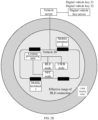
- the vehicle 20 may optionally be provided with a BLE node, and establish Bluetooth communication connections with the mobile terminals 1 and 2 that are provided with the digital vehicle keys 21 and 22 respectively, within an effective range of BLE connection.
- the BLE node optionally includes a Bluetooth master node and a Bluetooth slave node.
- the Bluetooth master node is used in a digital vehicle key system for establishing a Bluetooth communication link between the vehicle and the mobile terminal device, and is responsible for data transmission between the two sides, and moreover, the Bluetooth master node may also be used cooperatively to realize a positioning function.
- the Bluetooth slave node is mainly used in the digital vehicle key system for assisting in realizing the positioning function to enable a vehicle system to obtain the position state of the digital vehicle key.
- the BLE/NFC/UWB node may establish a connection with a central processing unit
- the vehicle may establish a connection with its vehicle server
- the vehicle server may be connected to a digital vehicle key server
- the mobile terminal may save a digital vehicle key of the vehicle in a TEE environment after establishing a communication connection with the vehicle via the BLE/NFC/UWB node
- the digital vehicle key may be backed up at the digital vehicle key server (e.g., the digital vehicle keys 21-24 are backed up in the digital vehicle key server).
- the authentication information of the at least one digital vehicle key may include position information of the corresponding mobile terminal when sending the connection request to the vehicle, motion information of the corresponding mobile terminal when sending the connection request to the vehicle, physiological sign information of the user of the corresponding mobile terminal when sending the connection request to the vehicle, and the like.
- the information may be used to determine various suspicious (or abnormal) states that may occur in practical application scenarios, thus providing more reference information for the choice of whether to trust the digital vehicle key or not.
- the foregoing various authentication information is only used as an example and not a limitation in the embodiments of the present disclosure, and other information that may be used for determining suspicious (or abnormal) states is also applicable to the method of the present disclosure.
- the security authentication for the digital vehicle key in the mobile terminal may include a dual security authentication operation based on the first authentication condition and the second authentication condition, respectively.
- the security authentication operation based on the first authentication condition may be used to authenticate the certificate information of the digital vehicle key
- the security authentication operation based on the second authentication condition may be used for security authentication of various suspicious (or abnormal) states of the practical application scenarios. It should be understood that, unless specifically indicated, in the process of secure authentication of the at least one digital vehicle key in the at least one mobile terminal based on the first authentication condition and the second authentication condition, there is no restriction as to the order of authentication of the two authentication conditions, but rather, they may be specifically set according to actual needs.
- the second authentication condition may be differentially set according to the number of mobile terminals connected to the vehicle. This is because, when only a single mobile terminal is connected to the vehicle, only the security of the digital vehicle key of the mobile terminal needs to be considered, and the second authentication condition may be set only for the individual state information of the mobile terminal; whereas, when there are a plurality of mobile terminals connected to the vehicle, in addition to the individual state information of each of the mobile terminals, relative state information of the mobile terminals also needs to be added to the security authentication of the digital vehicle key as a security consideration element.
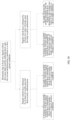
- the second authentication condition may comprise at least one of:
- the second authentication condition may be set in Case 1 (conditions 1 and 2)and Case 2 (conditions 3, 4 and 5) depending on the number of mobile terminals connected to the vehicle.
- FIG. 3A to FIG. 3C correspond to security authentication in the case that at least two mobile terminals are connected to the vehicle.
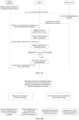
- FIG. 3A shows a schematic flowchart of security authentication in the case that at least two mobile terminals are connected to a vehicle, according to an embodiment of the present disclosure.
- FIG. 3B shows a schematic diagram of possible settings of a second authentication condition in the case that at least two mobile terminals are connected to a vehicle, according to an embodiment of the present disclosure.
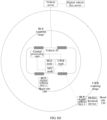
- FIG. 3C shows a schematic diagram of a relationship between two mobile terminals and a vehicle according to an embodiment of the present disclosure.
- the mobile terminals 1 and 2 may correspond to a vehicle owner mobile device and a friend device of the vehicle, respectively.
- the vehicle owner may complete a pairing with the vehicle via the mobile terminal 1 to obtain a digital vehicle key 1 corresponding to the vehicle, and the vehicle owner may also assign a digital vehicle key 2 to the mobile terminal 2 via the mobile terminal 1.
- the digital vehicle keys 1 and 2 assigned in this step may be backed up at a vehicle server.
- the mobile terminal 1 may set, via the vehicle server, a second authentication condition for the vehicle to synchronously obtain the second authentication condition from its vehicle server.
- the vehicle may determine a current security authentication condition to be applied to the digital vehicle key, for example, the conditions 1 and 2 described above.
- the setting of the security authentication conditions for the vehicle is completed, and the vehicle may thereby apply the set security authentication conditions to the mobile terminal and its digital vehicle key that request a communication connection subsequently.
- the second authentication condition may correspond to that at least two digital vehicle keys of the at least one digital vehicle key pass security authentication based on the first authentication condition.
- the time for the at least two digital vehicle keys to pass the security authentication based on the first authentication condition may be limited.
- the second authentication condition may also require that the time for the at least two digital vehicle keys to pass the security authentication based on the first authentication condition is within a predetermined time window. That is, in an embodiment of the present disclosure, in response to the authentication information of the at least two digital vehicle keys satisfying the first authentication condition within the predetermined time window, it may be determined that the authentication information of the at least one digital vehicle key satisfies the second authentication condition.
- the vehicle may comprise a variety of communication nodes, with each type of communication node having a different way of obtaining information for the mobile terminal and obtaining different information, and the at least one mobile terminal may establish a communication connection with the vehicle via a different communication node, respectively, and thus, in this case, the setting of the second authentication condition may be further differentiated based on the type of the communication node that obtains the digital vehicle key. For example, as shown in FIG.
- the second authentication condition may be set based on the types of the communication nodes that obtain digital vehicle keys being the same or different, including the second authentication condition for the digital vehicle keys obtained by at least two nodes (e.g., the same NFC nodes or BLE nodes, or the NFC node and the BLE node) and the second authentication condition for the digital vehicle keys obtained by at least two types of nodes (two nodes of different types (e.g., the NFC node and the BLE node)).
- the second authentication condition for the digital vehicle keys obtained by at least two nodes e.g., the same NFC nodes or BLE nodes, or the NFC node and the BLE node
- the second authentication condition for the digital vehicle keys obtained by at least two types of nodes two nodes of different types (e.g., the NFC node and the BLE node)
- a system of the present disclosure may comprise a vehicle and at least one mobile terminal, the vehicle may correspond to at least one digital vehicle key, and the at least one digital vehicle key may be provided on the at least one mobile terminal, wherein the vehicle may be configured to perform the method corresponding to claim 1, and the system may be configured to: receive, by the vehicle, a connection request from the at least one mobile terminal; obtain, by the vehicle, authentication information of the at least one digital vehicle key on the at least one mobile terminal; in response to authentication information of at least two digital vehicle keys satisfying a first authentication condition within a predetermined time period, and the relative position between mobile terminals corresponding to the at least two digital vehicle keys satisfying a first predetermined condition, determine that the authentication information of the at least one digital vehicle key satisfies a second authentication condition; in response to determining that the authentication information of the at least one digital vehicle key satisfies the second authentication condition, perform an operation corresponding to the at least one digital vehicle key.
Landscapes
- Engineering & Computer Science (AREA)
- Computer Networks & Wireless Communication (AREA)
- Signal Processing (AREA)
- Computer Security & Cryptography (AREA)
- Physics & Mathematics (AREA)
- General Physics & Mathematics (AREA)
- Mechanical Engineering (AREA)
- Computer Hardware Design (AREA)
- Computing Systems (AREA)
- General Engineering & Computer Science (AREA)
- Human Computer Interaction (AREA)
- Lock And Its Accessories (AREA)
Applications Claiming Priority (2)
| Application Number | Priority Date | Filing Date | Title |
|---|---|---|---|
| CN202211038023.2A CN117676468A (zh) | 2022-08-26 | 2022-08-26 | 车辆安全认证方法 |
| PCT/CN2023/114924 WO2024041635A1 (zh) | 2022-08-26 | 2023-08-25 | 车辆安全认证方法 |
Publications (1)
| Publication Number | Publication Date |
|---|---|
| EP4580221A1 true EP4580221A1 (de) | 2025-07-02 |
Family
ID=90012559
Family Applications (1)
| Application Number | Title | Priority Date | Filing Date |
|---|---|---|---|
| EP23856721.8A Pending EP4580221A1 (de) | 2022-08-26 | 2023-08-25 | Verfahren zur fahrzeugsicherheitsauthentifizierung |
Country Status (4)
| Country | Link |
|---|---|
| US (1) | US20260027991A1 (de) |
| EP (1) | EP4580221A1 (de) |
| CN (1) | CN117676468A (de) |
| WO (1) | WO2024041635A1 (de) |
Families Citing this family (1)
| Publication number | Priority date | Publication date | Assignee | Title |
|---|---|---|---|---|
| CN119049160B (zh) * | 2024-11-01 | 2025-03-28 | 上海银基科技股份有限公司 | 基于数字钥匙云平台的数字钥匙激活方法、设备及介质 |
Family Cites Families (4)
| Publication number | Priority date | Publication date | Assignee | Title |
|---|---|---|---|---|
| CN110310389B (zh) * | 2018-08-30 | 2024-11-12 | 林德(中国)叉车有限公司 | 一种基于叉车钥匙的身份认证和信息存储系统及叉车钥匙 |
| CN111835689B (zh) * | 2019-04-22 | 2021-06-15 | 华为技术有限公司 | 数字钥匙的身份认证方法、终端设备及介质 |
| CN113920616B (zh) * | 2020-06-24 | 2023-08-08 | 广州汽车集团股份有限公司 | 车辆与蓝牙钥匙安全连接的方法、蓝牙模块、蓝牙钥匙 |
| CN112995948B (zh) * | 2021-02-03 | 2023-04-07 | 北京小米移动软件有限公司 | 车辆功能控制方法、车辆功能控制装置及存储介质 |
-
2022
- 2022-08-26 CN CN202211038023.2A patent/CN117676468A/zh active Pending
-
2023
- 2023-08-25 US US18/995,995 patent/US20260027991A1/en active Pending
- 2023-08-25 WO PCT/CN2023/114924 patent/WO2024041635A1/zh not_active Ceased
- 2023-08-25 EP EP23856721.8A patent/EP4580221A1/de active Pending
Also Published As
| Publication number | Publication date |
|---|---|
| WO2024041635A1 (zh) | 2024-02-29 |
| CN117676468A (zh) | 2024-03-08 |
| US20260027991A1 (en) | 2026-01-29 |
Similar Documents
| Publication | Publication Date | Title |
|---|---|---|
| EP3215973B1 (de) | Verteilung der biometrischen authentifikation zwischen vorrichtungen in einem ad-hoc-netzwerk | |
| JP7194847B2 (ja) | デジタルキー、端末デバイス、及び媒体の同一性を認証する方法 | |
| KR102476107B1 (ko) | 디바이스 인증 방법 및 장치 | |
| US20220109561A1 (en) | Smart lock unlocking method and related device | |
| US11245523B2 (en) | Method for implementing client side credential control to authorize access to a protected device | |
| EP3469852B1 (de) | Autorisierte steuerung eines eingebetteten systems unter verwendung einer durchgehenden sicheren elementübertragung | |
| CN104821031A (zh) | 蓝牙手机智能锁控系统动态认证方法 | |
| EP4580218A1 (de) | Verfahren zum betreiben eines fahrzeugs | |
| CN103378876A (zh) | 一种基于蓝牙的终端解锁方法 | |
| EP4175339A1 (de) | 5g-authentifizierungsverfahren, 5g-konto-öffnungsverfahren und -system sowie elektronische vorrichtung und computerlesbares speichermedium | |
| WO2023142773A1 (zh) | 一种设备控制方法、设备和分布式数字钥匙系统 | |
| CN112102524A (zh) | 开锁方法和开锁系统 | |
| CN107818622A (zh) | 离线验证方法和系统 | |
| US20260027991A1 (en) | Vehicle security authentication method | |
| TWI739086B (zh) | 可攜式認證裝置與裝置內自行登錄認證資料的方法 | |
| CN115550002A (zh) | 一种基于tee的智能家居远程控制方法及相关装置 | |
| US10063561B1 (en) | Authentication and authorization without the use of supplicants | |
| KR20180132811A (ko) | 사용자와 모바일 단말기 및 추가 인스턴스 간의 보안 상호 작용을 위한 방법 | |
| US20240056306A1 (en) | Intelligent arrangement of unlock notifications | |
| KR101407443B1 (ko) | 근거리무선통신 기능을 이용한 사용자 인증 시스템 및 사용자 인증 방법 | |
| CN114387711A (zh) | 智能钥匙的控制方法、智能钥匙及车辆系统 | |
| BR102018015354A2 (pt) | sistema e método de comunicação segura para veículos automotores | |
| CN120358104B (zh) | 一种基于生物识别及数据同步的安全认证方法及装置 | |
| US12316640B2 (en) | Performing security functions for an in-vehicle internet of things (IoT) network | |
| WO2012151938A1 (zh) | 一种mtc设备实现离线触发的方法及系统 |
Legal Events
| Date | Code | Title | Description |
|---|---|---|---|
| STAA | Information on the status of an ep patent application or granted ep patent |
Free format text: STATUS: THE INTERNATIONAL PUBLICATION HAS BEEN MADE |
|
| PUAI | Public reference made under article 153(3) epc to a published international application that has entered the european phase |
Free format text: ORIGINAL CODE: 0009012 |
|
| STAA | Information on the status of an ep patent application or granted ep patent |
Free format text: STATUS: REQUEST FOR EXAMINATION WAS MADE |
|
| 17P | Request for examination filed |
Effective date: 20250325 |
|
| AK | Designated contracting states |
Kind code of ref document: A1 Designated state(s): AL AT BE BG CH CY CZ DE DK EE ES FI FR GB GR HR HU IE IS IT LI LT LU LV MC ME MK MT NL NO PL PT RO RS SE SI SK SM TR |
|
| DAV | Request for validation of the european patent (deleted) | ||
| DAX | Request for extension of the european patent (deleted) |