EP4580146A1 - Verfahren und vorrichtung zur konfiguration von netzwerk-slices in einem drahtloskommunikationssystem - Google Patents
Verfahren und vorrichtung zur konfiguration von netzwerk-slices in einem drahtloskommunikationssystem Download PDFInfo
- Publication number
- EP4580146A1 EP4580146A1 EP23857623.5A EP23857623A EP4580146A1 EP 4580146 A1 EP4580146 A1 EP 4580146A1 EP 23857623 A EP23857623 A EP 23857623A EP 4580146 A1 EP4580146 A1 EP 4580146A1
- Authority
- EP
- European Patent Office
- Prior art keywords
- tac
- nssmf
- node
- tacs
- nsmf
- Prior art date
- Legal status (The legal status is an assumption and is not a legal conclusion. Google has not performed a legal analysis and makes no representation as to the accuracy of the status listed.)
- Pending
Links
Images





Classifications
-
- H—ELECTRICITY
- H04—ELECTRIC COMMUNICATION TECHNIQUE
- H04W—WIRELESS COMMUNICATION NETWORKS
- H04W24/00—Supervisory, monitoring or testing arrangements
- H04W24/02—Arrangements for optimising operational condition
-
- H—ELECTRICITY
- H04—ELECTRIC COMMUNICATION TECHNIQUE
- H04W—WIRELESS COMMUNICATION NETWORKS
- H04W8/00—Network data management
- H04W8/02—Processing of mobility data, e.g. registration information at HLR [Home Location Register] or VLR [Visitor Location Register]; Transfer of mobility data, e.g. between HLR, VLR or external networks
-
- H—ELECTRICITY
- H04—ELECTRIC COMMUNICATION TECHNIQUE
- H04L—TRANSMISSION OF DIGITAL INFORMATION, e.g. TELEGRAPHIC COMMUNICATION
- H04L41/00—Arrangements for maintenance, administration or management of data switching networks, e.g. of packet switching networks
- H04L41/08—Configuration management of networks or network elements
- H04L41/0893—Assignment of logical groups to network elements
-
- H—ELECTRICITY
- H04—ELECTRIC COMMUNICATION TECHNIQUE
- H04L—TRANSMISSION OF DIGITAL INFORMATION, e.g. TELEGRAPHIC COMMUNICATION
- H04L41/00—Arrangements for maintenance, administration or management of data switching networks, e.g. of packet switching networks
- H04L41/08—Configuration management of networks or network elements
- H04L41/0895—Configuration of virtualised networks or elements, e.g. virtualised network function or OpenFlow elements
-
- H—ELECTRICITY
- H04—ELECTRIC COMMUNICATION TECHNIQUE
- H04L—TRANSMISSION OF DIGITAL INFORMATION, e.g. TELEGRAPHIC COMMUNICATION
- H04L41/00—Arrangements for maintenance, administration or management of data switching networks, e.g. of packet switching networks
- H04L41/40—Arrangements for maintenance, administration or management of data switching networks, e.g. of packet switching networks using virtualisation of network functions or resources, e.g. SDN or NFV entities
Definitions
- the disclosure relates to a method and a device for supporting configuration of a network slice in a wireless communication system.
- the disclosure relates to a method and a device for configuring a network slice independently of synchronization of information between a network slice management function (NSMF) and a network slice subnet management function (NSSMF) in a wireless communication system.
- NSMF network slice management function
- NSSMF network slice subnet management function
- 5G mobile communication technologies define broad frequency bands such that high transmission rates and new services are possible, and can be implemented not only in “Sub 6GHz” bands such as 3.5GHz, but also in “Above 6GHz” bands referred to as mmWave including 28GHz and 39GHz.
- 6G mobile communication technologies referred to as Beyond 5G systems
- THz terahertz
- IIoT Industrial Internet of Things
- IAB Integrated Access and Backhaul
- DAPS Dual Active Protocol Stack
- 5G baseline architecture for example, service based architecture or service based interface
- NFV Network Functions Virtualization
- SDN Software-Defined Networking
- MEC Mobile Edge Computing
- multi-antenna transmission technologies such as Full Dimensional MIMO (FD-MIMO), array antennas and large-scale antennas, metamaterial-based lenses and antennas for improving coverage of terahertz band signals, high-dimensional space multiplexing technology using OAM (Orbital Angular Momentum), and RIS (Reconfigurable Intelligent Surface), but also full-duplex technology for increasing frequency efficiency of 6G mobile communication technologies and improving system networks, AI-based communication technology for implementing system optimization by utilizing satellites and AI (Artificial Intelligence) from the design stage and internalizing end-to-end AI support functions, and next-generation distributed computing technology for implementing services at levels of complexity exceeding the limit of UE operation capability by utilizing ultra-high-performance communication and computing resources.
- FD-MIMO Full Dimensional MIMO
- OAM Organic Angular Momentum
- RIS Reconfigurable Intelligent Surface
- a scheme is required in which a network slice management function (NSMF) of configuring a network slice is able to configure a network slice without synchronizing specific information of individual network slice subnet management functions (NSSMFs).
- NSSMFs network slice subnet management functions
- a method is required in which the NSMF is able to configure a network slice service without information about a tracking area code (TAC) included in each NSSMF or an identification process (e.g., synchronization) of such information.
- TAC tracking area code
- the disclosure is to provide a device and a method capable of providing smooth service efficiency in a wireless communication system.
- the disclosure provides a device and a method in which a network slice management function (NSMF) configures a network slice service in a wireless communication system without information about a tracking area code (TAC) included in each network slice subnet management function (NSSMF) or an identification process (e.g., synchronization) of such information.
- a network slice management function configures a network slice service in a wireless communication system without information about a tracking area code (TAC) included in each network slice subnet management function (NSSMF) or an identification process (e.g., synchronization) of such information.
- TAC tracking area code
- a method performed by a network slice subnet management function (NSSMF) node in a wireless communication system may include receiving a request message including a tracking area code (TAC) list for network slice generation from a network slice management function (NSMF) node, wherein the TAC list corresponds to information on a specific area related to network slice generation, determining at least one TAC corresponding to a TAC supported by the NSSMF node from among TACs included in the TAC list, and transmitting, to the NSMF node, a response message including information on the determined at least one TAC.
- TAC tracking area code
- a method performed by a network slice management function (NSMF) node in a wireless communication system may include transmitting a request message including a tracking area code (TAC) list for network slice generation to a network slice management function (NSMF) node, wherein the TAC list corresponds to information on a specific area related to the network slice generation, receiving, from the NSSMF, a response message including information on at least one TAC corresponding to a TAC supported by the NSSMF node among TACs included in the TAC list, and generating a network slice based on information on the at least one TAC.
- TAC tracking area code
- a network slice subnet management function (NSSMF) node in a wireless communication system may include at least one transceiver, and at least one processor functionally coupled to the at least one transceiver, wherein the at least one processor is configured to receive a request message including a tracking area code (TAC) list for network slice generation from a network slice management function (NSMF) node, wherein the TAC list corresponds to information on a specific area related to network slice generation, determine at least one TAC corresponding to a TAC supported by the NSSMF node from among TACs included in the TAC list, and transmit, to the NSMF node, a response message including information on the determined at least one TAC.
- TAC tracking area code
- a network slice management function (NSMF) node in a wireless communication system may include at least one transceiver, and at least one processor functionally coupled to the at least one transceiver, wherein the at least one processor is configured to transmit a request message including a tracking area code (TAC) list for network slice generation to a network slice management function (NSMF) node, wherein the TAC list corresponds to information on a specific area related to the network slice generation, receive, from the NSSMF, a response message including information on at least one TAC corresponding to a TAC supported by the NSSMF node among TACs included in the TAC list, and generate a network slice based on information on the at least one TAC.
- TAC tracking area code
- Various embodiments of the disclosure can provide a device and a method capable of effectively providing services in a wireless communication system.
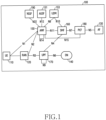
- FIG. 1 illustrates a communication network including core network entities in a wireless communication system according to various embodiments of the disclosure.
- a 5G mobile communication network may include a 5G user equipment (UE) 110, a 5G radio access network (RAN) 120, and a 5G core network.
- UE user equipment
- RAN radio access network
- a user equipment (UE) 110 may perform communication through a wireless channel, that is, an access network, which is established between the UE and a base station (e.g., eNB or gNB).
- a base station e.g., eNB or gNB.
- the UE 110 is a device used by a user, and may be configured to provide a user interface (UI).
- UI user interface
- the UE 110 may be a terminal equipped in a vehicle for driving.
- the UE 110 may be a device of performing machine type communication (MTC) operated without the user's involvement, or an autonomous vehicle.
- MTC machine type communication
- the UE may be referred to as an electronic device, "a terminal”, “a vehicle terminal”, “a mobile station, “a subscriber station”, “a remote terminal”, “a wireless terminal”, “a user device”, or other terms having a technical meaning equivalent thereto.
- a customer-premises equipment (CPE) or a dongle type terminal may be used as well as a UE.
- the CPE may be connected to a NG-RAN node similar to a UE, and provide a network to other communication equipment (e.g., a laptop).
- reference points In 3GPP systems, conceptual links connecting NFs in the 5G system may be referred to as "reference points”. The reference points may also be referred to as "interfaces”. In the following, reference points included in the 5G system architecture described throughout FIG. 1 to FIG. 12 are exemplified below.
- FIG. 2A illustrates a wireless environment including a core network 200 in a wireless communication system according to an embodiment.
- a wireless communication system may include a radio access network (RAN) 120 and a core network (CN) 200.
- RAN radio access network
- CN core network
- the RAN 120 is a network directly connected to a user device, for example, the UE 110, and is an infrastructure that provides wireless access to the UE 110.
- the RAN 120 includes a set of multiple base stations including a base station 125, and the multiple base stations may perform communication through interfaces established therebetween. At least some of the interfaces between the multiple base stations may be wired or wireless.
- the base station 125 may have a structure in which a central unit (CU) and a distributed unit (DU) are separated from each other. In this case, one CU may control multiple DUs.
- CU central unit
- DU distributed unit
- the base station 125 may be referred to, in addition to the base station, as "an access point (AP)", “a gNB (next generation node B)", “a 5th generation node (5G node)”, “a wireless point”, “a transmission/reception point (TRP)”, or other terms having a technical meaning equivalent thereto.
- the UE 110 may access the RAN 120 and communicate with the base station 125 through a wireless channel.
- the UE 110 may be referred to, in addition to a terminal, as "a user equipment (UE)", “a mobile station, “a subscriber station”, “a remote terminal”, “a wireless terminal”, “a user device”, or other terms having a technical meaning equivalent thereto.
- UE user equipment
- the CN 200 is a network of managing the entire system, and controls the RAN 120 and processes data and control signals for the UE 110 which is transmitted or received via the RAN 120.
- the CN 200 may perform various functions including control of a user plane and a control plane, processing of mobility, management of subscriber information, charging, and linkage with a different type of system (e.g., long-term evolution (LTE) system).
- LTE long-term evolution
- the CN 200 may include multiple entities that have different NFs and are functionally separated from each other.
- the CN 200 may include the access and mobility management function (AMF) 150, the session management function (SMF) 160, the user plane function (UPF) 170, the policy and charging function (PCF) 180, a network repository function (NRF) 159, the user data management (UDM) 153, a network exposure function (NEF) 155, and a unified data repository (UDR) 157.
- AMF access and mobility management function
- SMF session management function
- UPF user plane function
- PCF policy and charging function
- NRF network repository function
- UDM user data management
- NEF network exposure function
- UDR unified data repository
- the core network 200 may further include a communication service management function (CSMF), a network slice management function (NSMF), and a network slice subnet management function (NSSMF) for network slice generation and user service identification.
- CSMF communication service management function
- NSMF network slice management function
- NSSMF network slice subnet management function
- the UE 110 may be connected to the RAN 120 to access the AMF 150 that performs a mobility management function for the CN 200.
- the AMF 150 is a device or a function that serves both access to the RAN 120 and mobility management for the UE 110.
- the SMF 160 is an NF that manages a session.
- the AMF 150 is connected to the SMF 160, and routes a session-related message for the UE 110 to the SMF 160.
- the SMF 160 may connect to the UPF 170 to allocate a user plane resource to be provided to the UE 110, and establish a tunnel between the base station 125 and the UPF 170 for data transmission.
- the PCF 180 controls information related to charging and a policy for a session used by the UE 110.
- the NRF 159 stores information on NFs installed in a mobile communication service provider network, and notifies of the stored information.
- the NRF 159 may be connected to all NFs.
- Each NF registers itself in the NRF 159 when starting to be operated by the service provider network, thereby notifying the NRF 159 that the NF is being operated in the network.
- the UDM 153 is an NF that performs a role similar to that of a home subscriber server (HSS) of a 4G network, and stores subscription information of the UE 110 or context used by the UE 110 in the network.
- HSS home subscriber server
- the NEF 155 performs a role of connecting a 3rd party server to an NF in a 5G mobile communication system. Further, the NEF 155 provides data to the UDR 157, and updates data in or obtains data.
- the UDR 157 stores subscription information of the UE 110, policy information, data exposed to the outside, or information required for a 3rd party application.
- the UDR 157 also provides stored data to another NF.
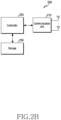
- FIG. 2B illustrates the configuration of a core network object in a wireless communication system according to various embodiments of the disclosure.
- a configuration 200 illustrated in FIG. 2B may be understood as a configuration of a device having at least one function among the entities (including CSMF (not shown), the NSMF (not shown), and NSSMF (not shown)) in the core network of FIG. 1 .
- Terms such as "... unit” and “...er/or” used hereinafter refer to a unit that processes at least one function or operation, which may be implemented through hardware, software, or a combination of hardware and software.
- the communication unit 240 transmits and receives signals as described above. Accordingly, all or part of the communication unit 240 may be referred to as "a transmitter", “a receiver”, or “a transceiver”. In addition, in the following description, transmission and reception performed through a wireless channel are used to mean that the processing as described above is performed by the communication unit 240.
- the core SLA may include requirements related to the core network (e.g., UPF throughput: 100Gbps, latency: 10ms), and the transport SLA may include requirements related to transmission (e.g., link capability: 100Gbps, latency: 10ms).
- the NSSMF 330 is described as a RAN NSSMF requiring service area requirements, but is understood that the NSSMF 330 may include at least one of the core NSSMF and the transport NSSMF depending on the parameters required by the NSSMF 330.
- the NSSMF 330 having received the SLA mapping result including service requirements may identify a target network entity (NE) and generate a slice for each specific domain. For example, the NSSMF 330 may configure a network slice for each NF identified based on service requirements.
- NE target network entity
- procedures for generating or configuring a network slice may be performed based on service requirements.
- the operation of generating or configuring a network slice based on requirements for the service area and transmitting configuration information may be performed as follows.
- the OSS/BSS 300 may transmit parameters related to the service area (e.g., service coverage) to the CMSF 310.
- the service area-related parameters received by the CMSF 310 may include at least one of a generic network slice template (GST) or a network slice type (NEST).
- the GST may include a set of attributes (e.g., availability, energy efficiency, number of UEs, quality of service (QoS)) that may characterize the type of network slice/service, and the NEST may include a GST expressed as a value.
- the CSMF 310 may map service requirements to the attributes included in the GST by using the value generated by the NEST.
- the CSMF 310 may generate (or convert) a service profile, based on the GST or NEST.
- the CSMF 310 may transmit the service profile to the NSMF 320.
- the NSMF 320 may perform the role of managing and orchestrating network slice instance (NSI) and deriving network slice subnet requirements. For example, the NSMF 320 may generate (or convert) a slice profile, which is a requirement for a network slice, based on the service profile received from the CSMF 310.
- NSI network slice instance
- the NSMF 320 may generate (or convert) a slice profile, which is a requirement for a network slice, based on the service profile received from the CSMF 310.
- the NSMF 320 may transfer the slice profile to the NSSMF 330.
- the NSSMF may include a radio access network (RAN)-NSSMF 330, a core network (CN)-NSSMF 332, or a transport network (TN)-NSSMF 334.
- RAN radio access network
- CN core network
- TN transport network
- the NSSMFs described above may include NSSMFs that manage RAN-related slices, core network-related slices, and transport network-related slices, respectively, and each may play a role of processing information about the TAC.
- the NSSMF 330 it is disclosed as the NSSMF 330 below, but the NSSMF of the disclosure is not limited to the RAN-NSSMF, and may include NSSMFs that manage various slices.
- one NSMF 320 may manage multiple NSSMFs 330.
- the NSMF 320 may generally manage information (for example, tracking area code (TAC)) about all areas it serves, but it may not know which areas are managed (or covered) by the individual NSSMF 330. Therefore, the NSMF 320 needs to receive information about an area managed by the individual NSSMF 330 to configure the network slice service, and the synchronization process in accordance therewith may cause delays and unnecessary overhead.
- TAC tracking area code
- the disclosure describes a method in which the NSMF 320 may provide a slice service without information on an area managed by each NSSMF 330 and a specific identification process of the information.
- FIG. 4 illustrates an example of a tracking area code (TAC) for a service profile according to various embodiments of the disclosure.
- the NSMF may require information about TAC, as basic information, among the requirements of the NSSMF (particularly in the case of RAN NSSMF) for the network slice generation.
- the NSSMF may include RAN-NSSMF, CN-NSSMF, or TN-NSSMF.
- the information about TAC may be used when requesting the configuration of a specific slice service in a specific area.
- FIG. 4 an example 400 of a service area of a wireless communication system (5G or 4G/LTE) according to TAC is shown.
- 5G or 4G/LTE 5G or 4G/LTE
- the coverage area of a wireless communication system may be divided into multiple cells 415, 425, 435, and 445, which are typically grouped with one or more base stations.
- the base station may be configured by at least one cell, and handover between base stations or between cells may occur depending on the movement of the UE.
- the base station is shown as an eNB, but this is only an example for convenience, and the base station may include a base station that performs similar functions, including a gNB for a 5G network system.
- a UE located in each of cells 415, 425, 435, and 445 may access a wireless communication system by establishing a wireless communication link, often called a wireless interface, with a base station associated with the corresponding cell.
- a network operator may define tracking area codes (TACs) 410, 420, 430, and 440 by grouping multiple base stations.
- the unit of service area information required by the network slice service may be a TAC.
- base stations of the network operator may be grouped based on the tracking area code (TAC).
- the TAL based on the TAC may be registered on the server of the network operator.
- the NSMF should have information about the NSSMFs that manage the TACs needed for slice generation, and when a new TAC is added, more process may be required to synchronize the new TAC between the NSMF and the NSSMF.
- the NSMF may have configured different TAC values with respect to the same distributed unit (DU) or cell for each operator, and the synchronization process for the TAC information that the NSMF should perform or the information about the TAC that the NSMF should have may cause excessive latency and unnecessary overhead.
- various embodiments of the disclosure provide a method capable of providing a network slice service without requiring TAC information managed by each NSSMF included in the NSMF or an identification process (e.g., synchronization) of the TAC information.
- a method is described in which the NSMF is capable of generating, adding, or changing a network slice independent of the synchronization process and the identification of whether the NSSMF supports the TAC in relation to the service requirements.
- various embodiments may be applied not only to the case in which the NSSMF is linked to an element management system (EMS) to perform procedures, but also to the case in which the NE having a new TAC is added.
- EMS element management system
- Various embodiments provide slice requirements for TAC information, but not limited to this, the same operation can be applied by including any parameter information related to the requirements of the network slice service.
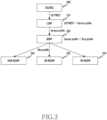
- FIG. 5A illustrates an example of a structure for network slice configuration for allocating an individual TAC list based on a TAC supported by an NSSMF according to various embodiments of the disclosure. Specifically, referring to FIG. 5A , a structure for network slice configuration is shown when an NSMF 520 knows information about a TAC managed by an NSSMF 530-1 or 530-2.
- a CSMF 510 may transfer a service profile based on service requirements to the NSMF 520.
- the service profile transferred by the CSMF 510 to the NSMF 520 may include information indicating that a service area (e.g., coverage area) is a specific area (e.g., Seoul).
- the NSMF 520 may change the service profile received from the CSMF 510 to a slice profile.
- the NSMF 520 may know that TACs covering a specific area included in the service requirement include TAC 3, TAC 4, and TAC 5.
- the NSMF 520 may be aware of TACs associated with individual NSSMF 530-1 or 530-2 managed by the NSMF 520.
- the NSMF 520 may know in advance that RAN NSSMF 1 530-1 is associated with NFs 534-1, 536-1, and 538-1 for TAC 1, TAC 2, and TAC 3, and that RAN NSSMF 2 530-2 is associated with NFs 534-2, 536-2, and 538-2 for TAC 4, TAC 5, and TAC 6.
- the NSMF 520 may further require specific operations of receiving and identifying information about the TACs with which individual NSSMFs are associated.
- the NSMF 520 may identify TACs managed by each NSSMF 530-1 or 530-2, based on a TAC list for a specific area, and may transfer a slice subnet profile including the identified TACs to correspond to each NSSMF 530-1 or 530-2.
- the NSMF 520 may transmit, to the RAN NSSMF 1 530-1, a slice subnet profile including a slice configuration request for TAC 3, and may transmit, to the RAN NSSMF 2 530-2, a slice subnet profile including a slice configuration request for TAC 4 and TAC 5.
- the NSSMF 530-1 or 530-2 may configure a network slice for each NF by using the received slice subnet profile as is.
- the NSMF 520 may receive a response regarding slice subnet configurations from the NSSMF 530-1 or 530-2 associated with the corresponding TAC and, based thereon, may generate a network slice for network service according to detailed parameters.
- the NSMF 520 should know information about a TAC managed by each NSSMF 530-1 or 530-2 in advance, and therefore an operation of receiving or identifying the information about the TAC may be further required.
- an NF with a new TAC value is added to each NSSMF 530-1 or 530-2 or EMS 532-1 or 532-2 related to the NSSMF 530-1 or 530-2, information regarding thereof should be received or identified, and the process of generating a slice subnet profile should be repeated once again accordingly, which may significantly increase delay time and unnecessary overhead.
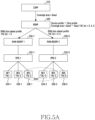
- FIG. 5B shows another example of a structure for network slice configuration by which an NSSMF allocates a TAC list based on area information configured according to various embodiments of the disclosure. Specifically, referring to FIG. 5B , a structure for network slice configuration for the NSMF 520 is shown independent of information about a TAC managed by the NSSMF 530-1 or 530-2.
- the CSMF 510 may transfer a service profile based on service requirements to the NSMF 520.
- the service profile transferred by the CSMF 510 to the NSMF 520 may include information indicating that the service area (e.g., coverage area) is a specific area (e.g., Seoul).
- the NSMF 520 may know that TACs covering a specific area included in the service requirement include TAC 3, TAC 4, and TAC 5. However, the NSMF 520 may not know information about TACs associated with individual NSSMFs 530-1 and 530-2 managed by the NSMF 520. Accordingly, the NSMF 520 may generate a slice subnet profile that includes all TAC values corresponding to a specific area.
- the generated slice subnet profile may be jointly transferred to both NSSMFs 530-1 and 530-2 independent of individual characteristics.
- the NSMF 520 may jointly transmit a slice subnet profile including slice configuration requests for TAC 3, TAC4, and TAC 5 to RAN NSSMF 1 530-1 and RAN NSSMF 2 530-2.
- the NSSMF 530-1 or 530-2 may configure slices only for the TACs associated with the NFs, managed by the NSSMF itself, based on the received slice subnet profile.
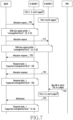
- the NSMF may transmit an allocation request message to the second NSSMF. Similar to operation 605, the allocation request message transmitted by the NSMF may include information about the slice subnet profile, and the slice subnet profile may include information about all TACs required by the slice profile. For example, when the service profile received by the NSMF includes information about a specific area, the NSMF may transmit a slice subnet profile including information about all TACs corresponding to the specific area to the second NSSMF.
- the second NSSMF may include at least one of RAN NSSMF, core NSSMF, or transport NSSMF.
- the NSMF may identify whether it includes information about at least one TAC associated with the NSSMF managed by the NSMF.
- the NSMF may individually identify the TACs associated with each NSSMF in the TAC list of the slice profile, and based on the result of identification, the NSMF may generate a slice subnet profile to be transmitted to each NSSMF.
- the NSMF may transmit an allocation request message to the first NSSMF.
- the allocation request message transmitted by the NSMF may include information about the slice subnet profile, and the slice subnet profile may include information about all TACs required by the slice profile.
- the NSMF may transmit a slice subnet profile including information about all TACs corresponding to the specific area to the first NSSMF.
- the first NSSMF may include at least one of RAN NSSMF, core NSSMF, or transport NSSMF.
- the NSMF may transmit an allocation request message to the second NSSMF. Similar to operation 705, the allocation request message transmitted by the NSMF may include information about the slice subnet profile, and the slice subnet profile may include information about all TACs required by the slice profile. For example, when the service profile received by the NSMF includes information about a specific area, the NSMF may transmit a slice subnet profile including information about all TACs corresponding to the specific area to the second NSSMF.
- the second NSSMF may include at least one of RAN NSSMF, core NSSMF, or transport NSSMF.
- the second NSSMF may determine at least one TAC (e.g., TAC 5) corresponding to a TAC (e.g., TAC 5 to 6) supported by the second NSSMF among the TACs (e.g., TACs 3 to 5) of the slice subnet profile.
- the first NSSMF or the second NSSMF may determine at least one TAC, based on the TACs of the slice subnet profile even when no TAC is supported.
- the NSSMF may determine at least one TAC that is most associated with the TACs in the slice subnet profile, or may determine an indicator indicating that there is no corresponding TAC.
- the first NSSMF and the second NSSMF may compare the TAC list included in the slice subnet profile with the TACs supported by each NSSMF to further identify the most relevant TAC.
- the NSSMF may further identify at least one TAC among the TACs supported by the NSSMF and a difference between values of the at least one TAC and the TACs included in the TAC list does not exceed a threshold value.
- the difference may include a difference in the code values of the TACs, a difference based on geographical location, or a difference in the values of each TAC determined by a predefined table for each TAC.
- the threshold value may be a threshold criterion, may be determined based on a specific geographic distance, or may be preconfigured.
- the first NSSMF and the second NSSMF may store information about the TAC list included in the allocation request message.
- the NSSMF may store information about the TACs included in the TAC list of the slice subnet profile, in addition to the TACs supported by the NSSMF.
- the NSSMF may additionally identify at least one TAC, based on the stored TAC list. Therefore, the first NSSMF and the second NSSMF may adaptively update responses to changes in detailed parameters by storing information on the requirements for generating and configuring network slices without additional signaling.
- the first NSSMF may transmit an allocation response message including information about the determined at least one TAC (e.g., TAC 3) to the NSMF.
- the first NSSMF may configure a network slice based on information about at least one identified TAC.
- the allocation response message received by the NSMF is only an example and may include any information or message having an equivalent or similar function.
- the second NSSMF may transmit an allocation response message including information about the determined at least one TAC (e.g., TAC 4 and TAC 5) to the NSMF.
- the second NSSMF may configure a network slice based on information about at least one identified TAC.
- the allocation response message received by the NSMF may be an example only, and may include any information or message having equivalent or similar function.
- the second NSSMF may identify that a NE with a new TAC has been added.
- the second NSSMF is described as having been added with an NE associated with TAC 4 from the EMS, but this is only an example, and of course includes situations equivalent or similar to the case in which any NSSMF associated with the NSMF supports a new TAC.
- the NSSMF may identify whether a corresponding TAC exists by comparing the added TAC with the prestored TAC list of the slice subnet profile.
- the second NSSMF may support TACs 4 to 6.
- the second NSSMF may identify whether the newly supported TAC 4 is included in the TAC list of the slice subnet profile stored in a previous operation.
- the same procedure may be performed when some of the TACs previously supported by the NSSMF are deleted. For example, among the TACs 1 to 3 supported by the first NSSMF, when NEs associated with TAC 3 are cancelled, the first NSSMF may compare them with the prestored TAC list of the slice subnet profile to identify whether there are corresponding TACs excluding the cancelled TACs.
- the NSSMF in which a change in a supported TAC has occurred may transmit a new response notification message to the NSMF.
- the response notification message transmitted by the NSSMF may be generated based on information about at least one TAC that has been changed (e.g., added or cancelled).
- the NSMF may identify the TAC supported by individual NSSMF and, based on the identification, may generate a network slice according to service requirements.
- the NSMF may transmit a request message for configuration of a network slice to each NSSMF without a procedure for receiving or identifying information about the TAC supported by individual NSSMF, and based on a response message that is scheduled accordingly, may identify the TAC supported by each NSSMF and generate a network slice.
- the NSMF transmits only information that is common to all NSSMFs, and the NSSMF performs identification of the TAC corresponding to the TAC supported by each NSSMF in the TAC list of the slice subnet profile, thereby dramatically reducing unnecessary signaling and complexity.
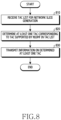
- FIG. 8 illustrates an operation flow of a network slice subnet management function (NSSMF) for network slice configuration according to various embodiments of the disclosure.
- NSSMF network slice subnet management function
- the NSSMF may receive a TAC list for network slice generation from the NSMF.
- the NSSMF may receive an allocation request message from the NSMF.
- the allocation request message received by the NSSMF may include information about a slice subnet profile, and the slice subnet profile may include information about all detailed parameters required by the slice profile received by the NSMF.
- the service profile received by the NSMF includes information about a specific area
- the NSMF may transmit a slice subnet profile including information about all TACs corresponding to the specific area to the NSSMF.
- the NSSMF may include at least one of RAN NSSMF, core NSSMF, or transport NSSMF.
- the NSSMF may determine at least one TAC corresponding to a TAC supported by the NSSMF in the TAC list. Specifically, according to an embodiment, the NSSMF may identify information about the associated TAC, based on the TAC list included in the received allocation request message (e.g., slice subnet profile). According to an embodiment, the NSSMF may determine at least one TAC, based on the TACs of the slice subnet profile even when there is no supported TAC. For example, the NSSMF may determine at least one TAC that is most associated with the TACs in the slice subnet profile, or may determine an indicator indicating that there is no corresponding TAC.
- the NSSMF may determine at least one TAC corresponding to a TAC supported by the NSSMF in the TAC list. Specifically, according to an embodiment, the NSSMF may identify information about the associated TAC, based on the TAC list included in the received allocation request message (e.g., slice subnet profile). According to an embodiment, the NSSMF may determine at least one T
- the NSSMF may further identify the most relevant TAC by comparing the TAC list included in the slice subnet profile with the TAC supported by the NSSMF.
- the NSSMF may further identify at least one TAC may further identify at least one TAC among the TACs supported by the NSSMF and a difference between values of the at least one TAC and the TACs included in the TAC list does not exceed a threshold value.
- the difference may include a difference in the code values of the TACs, a difference based on geographical location, or a difference in the values for each TAC determined by a predefined table.
- the threshold value may be a threshold criterion, may be determined based on a specific geographic distance, or may be preconfigured.
- the NSSMF may store information about the TAC list included in the allocation request message. That is, the NSSMF may store information about TACs included in the TAC list of the slice subnet profile, in addition to the TACs supported by the NSSMF. For example, in a later operation, when information about the TAC managed by the NSSMF changes, the NSSMF may additionally identify at least one TAC based on the stored TAC list. Accordingly, the NSSMF may adaptively update responses to changes in detailed parameters by storing information about the requirements for generating and configuring network slices without additional signaling.
- the NSSMF may transmit an allocation response message including information about the determined at least one TAC to the NSMF.
- the NSSMF may configure a network slice, based on information about at least one identified TAC.
- the allocation response message received by the NSMF is only an example and may include any information or message having an equivalent or similar function.
- the NSSMF may identify that an NE with a new TAC has been added.
- the NSSMF may receive information from the EMS that a new NE associated with a new TAC has been added.
- the NSSMF may identify whether a corresponding TAC exists by comparing the added TAC with the prestored TAC list of the slice subnet profile. For example, when an NE associated with a new TAC is added to the NSSMF, the NSSMF may support the new TAC in addition to the previously supported TAC. The NSSMF may identify whether the newly supported TAC is included in the TAC list of the slice subnet profile stored in the previous operation.
- the same procedure may be performed when some of the TACs previously supported by the NSSMF are deleted. For example, among the TACs supported by the NSSMF, when NEs associated with some TACs are cancelled, the NSSMF compares them with the prestored TAC list of the slice subnet profile to identify whether there are corresponding TACs excluding the cancelled TACs.
- the NSSMF in which a change in the supported TAC has occurred may transmit a new response notification message to the NSMF.
- the response notification message transmitted by the NSSMF may be generated based on information about at least one TAC that has been changed (e.g., added or cancelled).
- the NSMF may identify the TAC supported by individual NSSMF, and based on the identification, may generate a network slice according to service requirements. According to various embodiments of the disclosure, the NSMF may transmit a request message for configuration of a network slice to each NSSMF without a procedure for receiving or identifying information about the TAC supported by individual NSSMF, and based on a response message that is scheduled accordingly, may identify the TAC supported by each NSSMF and generate a network slice.
- the NSMF transmits only information that is common to all NSSMFs, and the NSSMF performs identification of the TAC corresponding to the TAC supported by each NSSMF in the TAC list of the slice subnet profile, thereby dramatically reducing unnecessary signaling and complexity.
- FIG. 9 illustrates an operation flow of a network slice management function (NSMF) for network slice configuration according to various embodiments of the disclosure.
- NSMF network slice management function
- the NSSMF node may be at least one of a radio access network (RAN) NSSMF node, a core NSSMF node, or a transport NSSMF node.
- RAN radio access network
Landscapes
- Engineering & Computer Science (AREA)
- Computer Networks & Wireless Communication (AREA)
- Signal Processing (AREA)
- Databases & Information Systems (AREA)
- Mobile Radio Communication Systems (AREA)
Applications Claiming Priority (3)
| Application Number | Priority Date | Filing Date | Title |
|---|---|---|---|
| KR20220107714 | 2022-08-26 | ||
| KR1020220173501A KR20240029492A (ko) | 2022-08-26 | 2022-12-13 | 무선 통신 시스템에서, 네트워크 슬라이스를 설정하기 위한 방법 및 장치 |
| PCT/KR2023/011873 WO2024043589A1 (ko) | 2022-08-26 | 2023-08-10 | 무선 통신 시스템에서, 네트워크 슬라이스를 설정하기 위한 방법 및 장치 |
Publications (2)
| Publication Number | Publication Date |
|---|---|
| EP4580146A1 true EP4580146A1 (de) | 2025-07-02 |
| EP4580146A4 EP4580146A4 (de) | 2025-12-17 |
Family
ID=90013518
Family Applications (1)
| Application Number | Title | Priority Date | Filing Date |
|---|---|---|---|
| EP23857623.5A Pending EP4580146A4 (de) | 2022-08-26 | 2023-08-10 | Verfahren und vorrichtung zur konfiguration von netzwerk-slices in einem drahtloskommunikationssystem |
Country Status (3)
| Country | Link |
|---|---|
| US (1) | US20250203405A1 (de) |
| EP (1) | EP4580146A4 (de) |
| WO (1) | WO2024043589A1 (de) |
Families Citing this family (1)
| Publication number | Priority date | Publication date | Assignee | Title |
|---|---|---|---|---|
| US20250219918A1 (en) * | 2023-12-27 | 2025-07-03 | Dish Wireless L.L.C. | Tracking area code (tac) audit and search in a 5g cloud-based communication network |
Family Cites Families (3)
| Publication number | Priority date | Publication date | Assignee | Title |
|---|---|---|---|---|
| CN109429274B (zh) * | 2017-09-04 | 2021-10-01 | 华为技术有限公司 | 一种配置方法以及对应装置 |
| CN110324164B (zh) * | 2018-03-29 | 2020-10-16 | 华为技术有限公司 | 一种网络切片的部署方法及装置 |
| KR20210127566A (ko) * | 2020-04-14 | 2021-10-22 | 삼성전자주식회사 | 네트워크 슬라이스를 제공하는 방법 및 장치 |
-
2023
- 2023-08-10 WO PCT/KR2023/011873 patent/WO2024043589A1/ko not_active Ceased
- 2023-08-10 EP EP23857623.5A patent/EP4580146A4/de active Pending
-
2025
- 2025-02-26 US US19/063,882 patent/US20250203405A1/en active Pending
Also Published As
| Publication number | Publication date |
|---|---|
| EP4580146A4 (de) | 2025-12-17 |
| WO2024043589A1 (ko) | 2024-02-29 |
| US20250203405A1 (en) | 2025-06-19 |
Similar Documents
| Publication | Publication Date | Title |
|---|---|---|
| US12389271B2 (en) | Method and device for providing split computing service in wireless communications system | |
| US20230362716A1 (en) | Method and apparatus for determining machine learning model based on network congestion information in wireless communication system | |
| US20230239736A1 (en) | Method and apparatus for supporting change of network slice in wireless communication system | |
| US20220360948A1 (en) | Method and apparatus to support virtual network in wireless communication network | |
| US20240096223A1 (en) | Method and apparatus for reporting flight path of terminal in mobile communication system | |
| US20250203405A1 (en) | Method and device for configuring network slice in wireless communication system | |
| US20250261099A1 (en) | Method and device for providing network slice in wireless communication system | |
| US20250016870A1 (en) | Method and apparatus for providing service function chain in wireless communication system | |
| US20250227645A1 (en) | Method for providing service through alternative slice | |
| US20240224009A1 (en) | Method and apparatus for configuring offloading policy for vplmn edge service in mobile communication system | |
| US20230141745A1 (en) | Method and device for supporting edge application server in wireless communication system supporting edge computing | |
| US20230199484A1 (en) | Method and device for control plane-based registration and remote provisioning in communication system | |
| US20230142532A1 (en) | Method and device for supporting efficient network slicing in wireless communication system | |
| US20230156651A1 (en) | Method and apparatus for selection of user plane or control plane for user equipment remote provisioning | |
| US20230125804A1 (en) | Method and apparatus for supporting available services in wireless communications systems | |
| US12477445B2 (en) | Method and apparatus for supporting monitoring for external services in a wireless communication system | |
| US20250365655A1 (en) | Method and apparatus for selection of network supporting energy control in wireless communication system | |
| EP4546758A1 (de) | Verfahren und vorrichtung zur unterstützung eines föderierten lerndienstes in einem drahtloskommunikationssystem | |
| EP4679932A1 (de) | Verfahren und vorrichtung zur unterstützung der gleichzeitigen verwendung mehrerer benutzerebenen in einem drahtloskommunikationssystem | |
| KR20240029492A (ko) | 무선 통신 시스템에서, 네트워크 슬라이스를 설정하기 위한 방법 및 장치 | |
| US20240340763A1 (en) | Method and device for network slice replacement based on terminal in wireless communication system | |
| US12395895B2 (en) | Method and apparatus for service of ultra-reliable and low-latency communication in a mobile communication system | |
| US20240340721A1 (en) | Method and apparatus for supporting service continuity by considering network slice area in a wireless communication system | |
| US20240056897A1 (en) | Method and apparatus for managing edge computing service session in wireless communication system | |
| US20240155343A1 (en) | Method and device for authorization based on upf in wireless communication system |
Legal Events
| Date | Code | Title | Description |
|---|---|---|---|
| STAA | Information on the status of an ep patent application or granted ep patent |
Free format text: STATUS: THE INTERNATIONAL PUBLICATION HAS BEEN MADE |
|
| PUAI | Public reference made under article 153(3) epc to a published international application that has entered the european phase |
Free format text: ORIGINAL CODE: 0009012 |
|
| STAA | Information on the status of an ep patent application or granted ep patent |
Free format text: STATUS: REQUEST FOR EXAMINATION WAS MADE |
|
| 17P | Request for examination filed |
Effective date: 20250325 |
|
| AK | Designated contracting states |
Kind code of ref document: A1 Designated state(s): AL AT BE BG CH CY CZ DE DK EE ES FI FR GB GR HR HU IE IS IT LI LT LU LV MC ME MK MT NL NO PL PT RO RS SE SI SK SM TR |
|
| REG | Reference to a national code |
Ref country code: DE Ref legal event code: R079 Free format text: PREVIOUS MAIN CLASS: H04L0041089300 Ipc: H04L0041089500 |
|
| DAV | Request for validation of the european patent (deleted) | ||
| DAX | Request for extension of the european patent (deleted) | ||
| A4 | Supplementary search report drawn up and despatched |
Effective date: 20251114 |
|
| RIC1 | Information provided on ipc code assigned before grant |
Ipc: H04L 41/0895 20220101AFI20251110BHEP Ipc: H04L 41/40 20220101ALI20251110BHEP Ipc: H04W 8/02 20090101ALI20251110BHEP |