EP4579782A1 - Cathode for lithium secondary battery, and lithium secondary battery comprising same - Google Patents
Cathode for lithium secondary battery, and lithium secondary battery comprising same Download PDFInfo
- Publication number
- EP4579782A1 EP4579782A1 EP23857601.1A EP23857601A EP4579782A1 EP 4579782 A1 EP4579782 A1 EP 4579782A1 EP 23857601 A EP23857601 A EP 23857601A EP 4579782 A1 EP4579782 A1 EP 4579782A1
- Authority
- EP
- European Patent Office
- Prior art keywords
- cathode
- active material
- metal oxide
- material layer
- oxide particles
- Prior art date
- Legal status (The legal status is an assumption and is not a legal conclusion. Google has not performed a legal analysis and makes no representation as to the accuracy of the status listed.)
- Pending
Links
Images

Classifications
-
- H—ELECTRICITY
- H01—ELECTRIC ELEMENTS
- H01M—PROCESSES OR MEANS, e.g. BATTERIES, FOR THE DIRECT CONVERSION OF CHEMICAL ENERGY INTO ELECTRICAL ENERGY
- H01M4/00—Electrodes
- H01M4/02—Electrodes composed of, or comprising, active material
- H01M4/36—Selection of substances as active materials, active masses, active liquids
- H01M4/48—Selection of substances as active materials, active masses, active liquids of inorganic oxides or hydroxides
- H01M4/52—Selection of substances as active materials, active masses, active liquids of inorganic oxides or hydroxides of nickel, cobalt or iron
- H01M4/525—Selection of substances as active materials, active masses, active liquids of inorganic oxides or hydroxides of nickel, cobalt or iron of mixed oxides or hydroxides containing iron, cobalt or nickel for inserting or intercalating light metals, e.g. LiNiO2, LiCoO2 or LiCoOxFy
-
- C—CHEMISTRY; METALLURGY
- C01—INORGANIC CHEMISTRY
- C01G—COMPOUNDS CONTAINING METALS NOT COVERED BY SUBCLASSES C01D OR C01F
- C01G53/00—Compounds of nickel
- C01G53/40—Complex oxides containing nickel and at least one other metal element
- C01G53/42—Complex oxides containing nickel and at least one other metal element containing alkali metals, e.g. LiNiO2
- C01G53/44—Complex oxides containing nickel and at least one other metal element containing alkali metals, e.g. LiNiO2 containing manganese
- C01G53/50—Complex oxides containing nickel and at least one other metal element containing alkali metals, e.g. LiNiO2 containing manganese of the type (MnO2)n-, e.g. Li(NixMn1-x)O2 or Li(MyNixMn1-x-y)O2
- C01G53/502—Complex oxides containing nickel and at least one other metal element containing alkali metals, e.g. LiNiO2 containing manganese of the type (MnO2)n-, e.g. Li(NixMn1-x)O2 or Li(MyNixMn1-x-y)O2 containing lithium and cobalt
- C01G53/504—Complex oxides containing nickel and at least one other metal element containing alkali metals, e.g. LiNiO2 containing manganese of the type (MnO2)n-, e.g. Li(NixMn1-x)O2 or Li(MyNixMn1-x-y)O2 containing lithium and cobalt with the molar ratio of nickel with respect to all the metals other than alkali metals higher than or equal to 0.5, e.g. Li(MzNixCoyMn1-x-y-z)O2 with x ≥ 0.5
- C01G53/506—Complex oxides containing nickel and at least one other metal element containing alkali metals, e.g. LiNiO2 containing manganese of the type (MnO2)n-, e.g. Li(NixMn1-x)O2 or Li(MyNixMn1-x-y)O2 containing lithium and cobalt with the molar ratio of nickel with respect to all the metals other than alkali metals higher than or equal to 0.5, e.g. Li(MzNixCoyMn1-x-y-z)O2 with x ≥ 0.5 with the molar ratio of nickel with respect to all the metals other than alkali metals higher than or equal to 0.8, e.g. Li(MzNixCoyMn1-x-y-z)O2 with x ≥ 0.8
-
- C—CHEMISTRY; METALLURGY
- C01—INORGANIC CHEMISTRY
- C01G—COMPOUNDS CONTAINING METALS NOT COVERED BY SUBCLASSES C01D OR C01F
- C01G53/00—Compounds of nickel
- C01G53/80—Compounds containing nickel, with or without oxygen or hydrogen, and containing one or more other elements
- C01G53/84—Hydroxides
-
- H—ELECTRICITY
- H01—ELECTRIC ELEMENTS
- H01M—PROCESSES OR MEANS, e.g. BATTERIES, FOR THE DIRECT CONVERSION OF CHEMICAL ENERGY INTO ELECTRICAL ENERGY
- H01M10/00—Secondary cells; Manufacture thereof
- H01M10/05—Accumulators with non-aqueous electrolyte
- H01M10/052—Li-accumulators
-
- H—ELECTRICITY
- H01—ELECTRIC ELEMENTS
- H01M—PROCESSES OR MEANS, e.g. BATTERIES, FOR THE DIRECT CONVERSION OF CHEMICAL ENERGY INTO ELECTRICAL ENERGY
- H01M10/00—Secondary cells; Manufacture thereof
- H01M10/05—Accumulators with non-aqueous electrolyte
- H01M10/052—Li-accumulators
- H01M10/0525—Rocking-chair batteries, i.e. batteries with lithium insertion or intercalation in both electrodes; Lithium-ion batteries
-
- H—ELECTRICITY
- H01—ELECTRIC ELEMENTS
- H01M—PROCESSES OR MEANS, e.g. BATTERIES, FOR THE DIRECT CONVERSION OF CHEMICAL ENERGY INTO ELECTRICAL ENERGY
- H01M4/00—Electrodes
- H01M4/02—Electrodes composed of, or comprising, active material
- H01M4/13—Electrodes for accumulators with non-aqueous electrolyte, e.g. for lithium-accumulators; Processes of manufacture thereof
- H01M4/131—Electrodes based on mixed oxides or hydroxides, or on mixtures of oxides or hydroxides, e.g. LiCoOx
-
- H—ELECTRICITY
- H01—ELECTRIC ELEMENTS
- H01M—PROCESSES OR MEANS, e.g. BATTERIES, FOR THE DIRECT CONVERSION OF CHEMICAL ENERGY INTO ELECTRICAL ENERGY
- H01M4/00—Electrodes
- H01M4/02—Electrodes composed of, or comprising, active material
- H01M4/36—Selection of substances as active materials, active masses, active liquids
- H01M4/362—Composites
- H01M4/364—Composites as mixtures
-
- H—ELECTRICITY
- H01—ELECTRIC ELEMENTS
- H01M—PROCESSES OR MEANS, e.g. BATTERIES, FOR THE DIRECT CONVERSION OF CHEMICAL ENERGY INTO ELECTRICAL ENERGY
- H01M4/00—Electrodes
- H01M4/02—Electrodes composed of, or comprising, active material
- H01M4/36—Selection of substances as active materials, active masses, active liquids
- H01M4/362—Composites
- H01M4/366—Composites as layered products
-
- H—ELECTRICITY
- H01—ELECTRIC ELEMENTS
- H01M—PROCESSES OR MEANS, e.g. BATTERIES, FOR THE DIRECT CONVERSION OF CHEMICAL ENERGY INTO ELECTRICAL ENERGY
- H01M4/00—Electrodes
- H01M4/02—Electrodes composed of, or comprising, active material
- H01M4/36—Selection of substances as active materials, active masses, active liquids
- H01M4/48—Selection of substances as active materials, active masses, active liquids of inorganic oxides or hydroxides
- H01M4/50—Selection of substances as active materials, active masses, active liquids of inorganic oxides or hydroxides of manganese
- H01M4/505—Selection of substances as active materials, active masses, active liquids of inorganic oxides or hydroxides of manganese of mixed oxides or hydroxides containing manganese for inserting or intercalating light metals, e.g. LiMn2O4 or LiMn2OxFy
-
- H—ELECTRICITY
- H01—ELECTRIC ELEMENTS
- H01M—PROCESSES OR MEANS, e.g. BATTERIES, FOR THE DIRECT CONVERSION OF CHEMICAL ENERGY INTO ELECTRICAL ENERGY
- H01M4/00—Electrodes
- H01M4/02—Electrodes composed of, or comprising, active material
- H01M4/62—Selection of inactive substances as ingredients for active masses, e.g. binders, fillers
-
- C—CHEMISTRY; METALLURGY
- C01—INORGANIC CHEMISTRY
- C01P—INDEXING SCHEME RELATING TO STRUCTURAL AND PHYSICAL ASPECTS OF SOLID INORGANIC COMPOUNDS
- C01P2004/00—Particle morphology
- C01P2004/30—Particle morphology extending in three dimensions
- C01P2004/45—Aggregated particles or particles with an intergrown morphology
-
- C—CHEMISTRY; METALLURGY
- C01—INORGANIC CHEMISTRY
- C01P—INDEXING SCHEME RELATING TO STRUCTURAL AND PHYSICAL ASPECTS OF SOLID INORGANIC COMPOUNDS
- C01P2004/00—Particle morphology
- C01P2004/51—Particles with a specific particle size distribution
-
- C—CHEMISTRY; METALLURGY
- C01—INORGANIC CHEMISTRY
- C01P—INDEXING SCHEME RELATING TO STRUCTURAL AND PHYSICAL ASPECTS OF SOLID INORGANIC COMPOUNDS
- C01P2004/00—Particle morphology
- C01P2004/60—Particles characterised by their size
- C01P2004/61—Micrometer sized, i.e. from 1-100 micrometer
-
- C—CHEMISTRY; METALLURGY
- C01—INORGANIC CHEMISTRY
- C01P—INDEXING SCHEME RELATING TO STRUCTURAL AND PHYSICAL ASPECTS OF SOLID INORGANIC COMPOUNDS
- C01P2006/00—Physical properties of inorganic compounds
- C01P2006/40—Electric properties
-
- H—ELECTRICITY
- H01—ELECTRIC ELEMENTS
- H01M—PROCESSES OR MEANS, e.g. BATTERIES, FOR THE DIRECT CONVERSION OF CHEMICAL ENERGY INTO ELECTRICAL ENERGY
- H01M4/00—Electrodes
- H01M4/02—Electrodes composed of, or comprising, active material
- H01M2004/021—Physical characteristics, e.g. porosity, surface area
-
- H—ELECTRICITY
- H01—ELECTRIC ELEMENTS
- H01M—PROCESSES OR MEANS, e.g. BATTERIES, FOR THE DIRECT CONVERSION OF CHEMICAL ENERGY INTO ELECTRICAL ENERGY
- H01M4/00—Electrodes
- H01M4/02—Electrodes composed of, or comprising, active material
- H01M2004/026—Electrodes composed of, or comprising, active material characterised by the polarity
- H01M2004/028—Positive electrodes
-
- Y—GENERAL TAGGING OF NEW TECHNOLOGICAL DEVELOPMENTS; GENERAL TAGGING OF CROSS-SECTIONAL TECHNOLOGIES SPANNING OVER SEVERAL SECTIONS OF THE IPC; TECHNICAL SUBJECTS COVERED BY FORMER USPC CROSS-REFERENCE ART COLLECTIONS [XRACs] AND DIGESTS
- Y02—TECHNOLOGIES OR APPLICATIONS FOR MITIGATION OR ADAPTATION AGAINST CLIMATE CHANGE
- Y02E—REDUCTION OF GREENHOUSE GAS [GHG] EMISSIONS, RELATED TO ENERGY GENERATION, TRANSMISSION OR DISTRIBUTION
- Y02E60/00—Enabling technologies; Technologies with a potential or indirect contribution to GHG emissions mitigation
- Y02E60/10—Energy storage using batteries
Definitions
- a secondary battery is a battery which can be repeatedly charged and discharged, and has been widely applied to portable electronic devices such as a mobile phone, a laptop computer, etc. as a power source thereof.
- a lithium secondary battery has a high operating voltage and a high energy density per unit weight, and is advantageous in terms of a charging speed and light weight.
- the lithium secondary battery has been actively developed and applied to various industrial fields.
- the lithium secondary battery may include: an electrode assembly including a cathode, an anode and a separation membrane interposed between the cathode and the anode; and an electrolyte in which the electrode assembly is impregnated in a case.
- the cathode may include a cathode current collector and a cathode active material layer formed on the cathode current collector.
- the cathode active material layer may include lithium metal oxide particles as the cathode active material.
- cracks may occur in the particles during pressing in a process of preparing the cathode.
- cracks may occur in the particles due to intercalation and deintercalation of lithium ions during repeated charging and discharging of the lithium secondary battery.
- problems such as gas generation due to a side reaction between the lithium metal oxide particles and an electrolyte, a decrease in life-span characteristics of the lithium secondary battery, and the like may occur.
- problems may be further intensified in a high-temperature environment.
- An object of the present disclosure is to provide a cathode active material for a lithium secondary battery having improved electrochemical performance and electrochemical stability.
- Another object of the present disclosure is to provide a lithium secondary battery having improved electrochemical performance and electrochemical stability.
- a lithium secondary battery may include: a cathode current collector; and a cathode active material layer formed on the cathode current collector.
- the cathode active material layer may include: a first cathode active material layer formed on the cathode current collector, and including first lithium metal oxide particles having a form of secondary particles in which primary particles are aggregated; a second cathode active material layer formed on the first cathode active material layer, and including second lithium metal oxide particles having a form of single particles; and a third cathode active material layer formed on the second cathode active material layer, and including third lithium metal oxide particles having a form of secondary particles in which primary particles are aggregated.
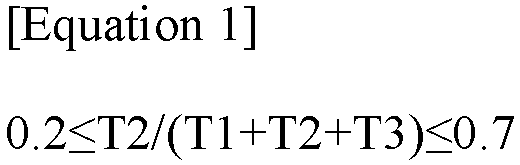
- the cathode may satisfy Equation 1 below: 0.2 ⁇ T 2 / T 1 + T 2 + T 3 ⁇ 0.7
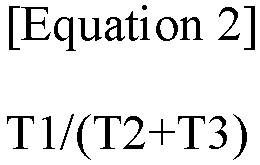
- the cathode may satisfy Equation 2 below: 0.15 ⁇ T 1 / T 2 + T 3 ⁇ 0.85
- the cathode may satisfy Equation 3 below: 0.15 ⁇ T 3 / T 1 + T 2 ⁇ 0.85
- T1 is a thickness of the first cathode active material layer in a cross-sectional image of the cathode measured by SEM ("SEM image")
- T2 is a thickness of the second cathode active material layer in the SEM image
- T3 is a thickness of the third cathode active material layer in the SEM image.
- a sum of a thickness of the first cathode active material layer, a thickness of the second cathode active material layer and a thickness of the third cathode active material layer may be 40 ⁇ m to 180 ⁇ m.
- a content of the first lithium metal oxide particles based on a total weight of the first cathode active material layer may be 90% by weight or more.
- a cathode for a lithium secondary battery having improved output characteristics, life-span characteristics, high-temperature storage characteristics, and resistance characteristics may be provided.
- the cathode active material layer 110 may have a thickness (e.g., a sum of T1, T2 and T3) of 20 ⁇ m to 500 ⁇ m, 30 ⁇ m to 450 ⁇ m, 35 ⁇ m to 300 ⁇ m, 40 ⁇ m to 250 ⁇ m, 40 ⁇ m to 200 ⁇ m, 40 ⁇ m to 180 ⁇ m. 40 ⁇ m to 160 ⁇ m, 50 ⁇ m to 160 ⁇ m, 60 ⁇ m to 160 ⁇ m, or 80 ⁇ m to 160 ⁇ m.
- the output characteristics, life-span characteristics, high-temperature storage characteristics, and resistance characteristics of the lithium secondary battery may be further improved.
- an energy density of the lithium secondary battery may be further improved.
- the conductive material may include a carbon-based conductive material such as graphite, graphene, carbon black, denka black, carbon nanotubes (CNTs), etc.; a metal-based conductive material such as tin, tin oxide, titanium oxide, or a perovskite material such as LaSrCoO 3 , and LaSrMnO 3 , etc.
- a carbon-based conductive material such as graphite, graphene, carbon black, denka black, carbon nanotubes (CNTs), etc.
- CNTs carbon nanotubes
- metal-based conductive material such as tin, tin oxide, titanium oxide, or a perovskite material such as LaSrCoO 3 , and LaSrMnO 3 , etc.
- a content of the first lithium metal oxide particles based on a total weight of the first cathode active material layer 112 may be 70% by weight ("wt%") or more, in one embodiment 80 wt% or more, and in one embodiment 90 wt% or more.
- a particle diameter (D 50 ) of the third lithium metal oxide particles may be smaller than the particle diameter (D 50 ) of the first lithium metal oxide particles.
- the particle diameter (D 50 ) of the first lithium metal oxide particles may be 3 ⁇ m to 20 ⁇ m, in one embodiment 4 ⁇ m to 18 ⁇ m, and in one embodiment 5 ⁇ m to 15 ⁇ m.
- the particle diameter (D 50 ) of the second lithium metal oxide particles may be 1 ⁇ m to 9 ⁇ m, in one embodiment 1 ⁇ m to 7 ⁇ m, and in one embodiment 1 ⁇ m to 5 ⁇ m.
- the particle diameter (D 50 ) of the third lithium metal oxide particles may be 1 ⁇ m to 9 ⁇ m, in one embodiment 1 ⁇ m to 7 ⁇ m, and in one embodiment 1 ⁇ m to 5 ⁇ m. Accordingly, the output characteristics of the lithium secondary battery may be further improved.
- the particle diameter (D 50 ) is a particle diameter based on 50% of volume accumulation in the particle size distribution, and may be measured by a laser diffraction method.
- a ratio of the particle diameter (D 50 ) of the third lithium metal oxide particles to the particle diameter (D 50 ) of the second lithium metal oxide particles may be 0.75 or more and less than 1.4.
- each of the first lithium metal oxide particles, the second lithium metal oxide particles and the third lithium metal oxide particles may contain nickel.
- each of the first lithium metal oxide particles, the second lithium metal oxide particles and the third lithium metal oxide particles may further contain cobalt and manganese.
- each of the first lithium metal oxide particles, the second lithium metal oxide particles and the third lithium metal oxide particles may be represented by Formula 1 below.
- Formula 1 Li x Ni (1-a-b) M1 a M2 b O y
- M1 and M2 may independently be at least one of Co, Mn, Al, Zr, Ti, Cr, B, Mn, Ba, Si, Y, W and Sr, and may be x, y, a and b may satisfy 0.9 ⁇ x ⁇ 1.2, 1.9 ⁇ y ⁇ 2.1, 0 ⁇ a+b ⁇ 0.5.
- x may be in a range of 0.9 ⁇ x ⁇ 1.1.
- a and b may satisfy 0 ⁇ a+b ⁇ 0.4, 0 ⁇ a+b ⁇ 0.3, or 0 ⁇ a+b ⁇ 0.2.
- a concentration of nickel in the first lithium metal oxide particles may be greater than the concentration of nickel in the second lithium metal oxide particles.
- the concentration of nickel may mean a molar ratio of nickel based on the total number of moles of all elements except for lithium and oxygen in the lithium metal oxide particles. In this case, the capacity, life-span characteristics and high-temperature storage characteristics of the lithium secondary battery may be further improved.
- a difference between the concentration of nickel in the first lithium metal oxide particles and the concentration of nickel in the second lithium metal oxide particles may be 0.05 or more, 0.1 or more, 0.2 or more, or 0.3 or more.
- the difference between the concentrations of nickels may be 0.5 or less.
- a concentration of nickel in the third lithium metal oxide particles may be greater than the concentration of nickel in the second lithium metal oxide particles.
- a difference between the concentration of nickel in the second lithium metal oxide particles and the concentration of nickel in the third lithium metal oxide particles may be 0.05 or more, 0.1 or more, 0.2 or more, or 0.3 or more.
- the difference between the concentrations of nickels may be 0.5 or less.
- the first lithium metal oxide particles, the second lithium metal oxide particles and the third lithium metal oxide particles may further contain a doping element.
- the doping element may include Al, Ti, Ba, Zr, Si, B, Mg, P, Sr, W, La and the like.
- coating layers may be formed on the surfaces of the first lithium metal oxide particles, the second lithium metal oxide particles and the third lithium metal oxide particles.
- the coating layer may contain Al, Ti, Ba, Zr, Si, B, Mg, P, Sr, W, La and the like.
- FIG. 2 is a schematic plan view of a lithium secondary battery according to an embodiment of the present disclosure
- FIG. 3 is a cross-sectional view taken on line I-I' of FIG. 2 .
- the lithium secondary battery may include a cathode 100 and an anode 130 disposed to face the cathode 100.
- the cathode 100 may be the above-described cathode for a lithium secondary battery.
- the anode 130 may include an anode current collector 125 and an anode active material layer 120 formed on the anode current collector 125.
- the anode active material layer 120 may be formed on one surface or both surfaces of the anode current collector 125.
- the anode active material layer 120 may include an anode active material.
- the anode active material layer 120 may further include a binder, a conductive material, etc.
- the anode current collector 125 may include gold, stainless steel, nickel, aluminum, titanium, copper or an alloy thereof.
- the anode active material may be a material capable of intercalating and deintercalating lithium ions.
- the anode active material may include a lithium alloy, a carbon-based active material, a silicon-based active material, etc., and these may be used alone or in combination of two or more thereof.
- the lithium alloy may include aluminum, zinc, bismuth, cadmium, antimony, silicon, lead, tin, gallium, indium and the like.
- the carbon-based active material may include crystalline carbon, amorphous carbon, carbon composite, carbon fiber and the like.
- the amorphous carbon may include hard carbon, cokes, mesocarbon microbead, mesophase pitch-based carbon fiber and the like.
- the crystalline carbon may include natural graphite, graphite cokes, graphite MCMB, graphite MPCF or the like.
- the anode active material may include a silicon-based active material.
- the silicon-based active material may include Si, SiO x (0 ⁇ x ⁇ 2), Si/C, SiO/C, Si-metal and the like. In this case, it is possible to implement a lithium secondary battery having a high capacity.
- the anode 130 may have an area greater than that of the cathode 100. Accordingly, lithium ions generated from the cathode 100 may smoothly move to the anode 130 without precipitation in the middle.
- the cathode 100 and the anode 130 may be alternately and repeatedly disposed to form an electrode assembly 150.
- a separation membrane 140 may be interposed between the cathode 100 and the anode 130.
- the electrode assembly 150 may be formed by winding, stacking, z-folding, etc. the separation membrane 140
- the separation membrane 140 may include a porous polymer film made of a polyolefin polymer such as ethylene homopolymer, propylene homopolymer, ethylene-butene copolymer, ethylene-hexene copolymer, ethylene-methacrylate copolymer or the like.
- the separation membrane 140 may include a nonwoven fabric made of glass fiber having a high melting point, polyethylene terephthalate fiber or the like.
- the electrode assembly 150 and the electrolyte may be housed in the case 160 to form a lithium secondary battery.
- the calcined product was cooled to room temperature, then pulverized and classified to obtain lithium metal oxide particles (LiNi 0.5 Co 0.2 Mn 0.3 O 2 ) in the form of single particles.
- the lithium metal oxide particles of Preparation Example 1-2, carbon nanotubes (CNTs) and PVDF were mixed in a weight ratio of 98:1:1, then dispersed in NMP to prepare a third cathode slurry.
- the first cathode slurry, the second cathode slurry and the third cathode slurry were sequentially applied to a region of an aluminum foil having a protrusion part (cathode tab) on one side except for the protrusion part, followed by drying and pressing the same to prepare a cathode including a first cathode active material layer, a second cathode active material layer and a third cathode active material layer.
- the electrode assembly was housed in a pouch so that some regions of the cathode lead and the anode lead were exposed to an outside of the pouch, followed by sealing three sides of the pouch except for a side of an electrolyte injection part.
- a cathode and a lithium secondary battery were manufactured by the same procedures as described in Example 1, except that the lithium metal oxide particles of Preparation Example 1-4 were used when preparing the first cathode slurry, and the lithium metal oxide particles of Preparation Example 1-5 were used when preparing the third cathode slurry.
- the thickness of the first cathode active material layer and the thickness of the second cathode active material layer were adjusted to be 1:1.
- the total thickness of the cathode active material layer was maintained the same as in Example 1.
- an introduction region may be formed between the first cathode active material layer and the second cathode active material layer.
- the thickness of the introduction region was considered as a thickness of the layer (e.g., the first cathode active material layer) into which the lithium metal oxide particles in the form of single particles are introduced.
- Equations 1 to 3 were calculated using the measured T1 to T3.
- Interface resistances resistance between the cathode active material layer and the cathode current collector
- bulk resistances resistance of the cathode active material layer
- the interface resistance and the bulk resistance were measured using a Resistivity Meter from Hioki.
- the lithium secondary batteries were again subjected to CC/CV charge (0.5C 4.2 V 0.05C CUT-OFF).
- the charged lithium secondary batteries were stored at 60°C for 12 weeks, then additionally left at room temperature for 30 minutes, and subjected to CC discharge (0.5C 2.75 V CUT-OFF), then discharge capacities H2 were measured.
- Capacity retention rate % H 2 / H 1 ⁇ 100 %
- the lithium secondary batteries of the examples and comparative examples were subjected to 0.5C CC/CV charge (4.2 V 0.05C CUT-OFF) at 25°C, then 0.5C CC discharge up to state-of-charge (SOC) 60%.
- the lithium secondary batteries were discharged and supplementary charged for 10 seconds, while changing C-rate to 0.2C 0.5C, 1C, 1.5C, 2C, 2.5C and 3.0C at the SOC 60% point, and DCIR R1 was measured, respectively.
- terminal points of the voltage were composed with an equation of a straight line and a slope thereof was adopted as the DCIR.
- the charged lithium secondary batteries were left for 12 weeks under atmospheric exposure conditions at 60°C, then additionally left for 30 minutes at room temperature, and DCIR R2 was measured, respectively, by the same method as described above.
- the lithium secondary batteries of the examples and comparative examples were charged up to 100% SOC (CC/CV 0.33C, 4.3 V, 0.05C CUT OFF).
- the charged lithium secondary batteries were left under atmospheric conditions at 60°C.
- the lithium secondary batteries of the examples and comparative examples were charged at 0.33C up to SOC 8% at 25°C, and charged in steps of 2.5C-2.25C-2C-1.75C-1.5C-1.0C in a section of SOC 8-80%, and again charged at 0.33C (4.3 V, 0.05 C cut-off) in a section of SOC 80-100% for a total of 25 minutes. After setting the time to the same standard, CC discharge was performed at 0.33C up to 2.5 V.
- Discharge capacities S1 were measured at the first cycle, and the charge and discharge were repeated 100 times, and discharge capacities S2 were measured at the 100th cycle.
- the fast charge capacity retention rate was calculated as the following equation.
- Fast charge capacity retention rate % S 2 / S 1 ⁇ 100 %
- the lithium secondary batteries of the examples and comparative examples were subjected to CC/CV charge (0.33C 4.3 V 0.05C CUT-OFF) and CC discharge (0.33C 2.5 V CUT-OFF) at 45°C.
- One charging and discharging was conducted to measure the discharge capacity C1.
- the charging and discharging were repeated 500 times, and discharge capacities C2 at the 500th cycle was measured.
- Cycle capacity retention rate % C 2 / C 1 ⁇ 100 % [TABLE 1] First cathode active material layer Second cathode active material layer Third cathode active material layer T2/(T1+T 2+T3) T1/(T2+ T3) T3/(T1+ T2)
- the lithium secondary batteries of the examples had improved resistance characteristics, life-span characteristics, high-temperature storage characteristics, and/or output characteristics of the cathode compared to the lithium secondary batteries of the comparative examples.
Landscapes
- Chemical & Material Sciences (AREA)
- Chemical Kinetics & Catalysis (AREA)
- Electrochemistry (AREA)
- General Chemical & Material Sciences (AREA)
- Inorganic Chemistry (AREA)
- Organic Chemistry (AREA)
- Engineering & Computer Science (AREA)
- Composite Materials (AREA)
- Materials Engineering (AREA)
- Manufacturing & Machinery (AREA)
- Battery Electrode And Active Subsutance (AREA)
Abstract
Description
- The present disclosure relates to a cathode for a lithium secondary battery and a lithium secondary battery including the same, and more specifically, to a cathode for a lithium secondary battery which includes a cathode active material layer having a multilayer structure and a lithium secondary battery including the cathode.
- A secondary battery is a battery which can be repeatedly charged and discharged, and has been widely applied to portable electronic devices such as a mobile phone, a laptop computer, etc. as a power source thereof.
- A lithium secondary battery has a high operating voltage and a high energy density per unit weight, and is advantageous in terms of a charging speed and light weight. In this regard, the lithium secondary battery has been actively developed and applied to various industrial fields.
- For example, the lithium secondary battery may include: an electrode assembly including a cathode, an anode and a separation membrane interposed between the cathode and the anode; and an electrolyte in which the electrode assembly is impregnated in a case.
- For example, the cathode may include a cathode current collector and a cathode active material layer formed on the cathode current collector. For example, the cathode active material layer may include lithium metal oxide particles as the cathode active material.
- In general, the lithium metal oxide particles have a form of secondary particles in which a plurality of primary particles are aggregated in morphology, and the primary particles have a polycrystalline structure in crystallography.
- However, in the case of the lithium metal oxide particles having the form of the secondary particles and the polycrystalline structure, cracks may occur in the particles during pressing in a process of preparing the cathode. In addition, cracks may occur in the particles due to intercalation and deintercalation of lithium ions during repeated charging and discharging of the lithium secondary battery.
- Accordingly, problems such as gas generation due to a side reaction between the lithium metal oxide particles and an electrolyte, a decrease in life-span characteristics of the lithium secondary battery, and the like may occur. In addition, the above-described problems may be further intensified in a high-temperature environment.
- An object of the present disclosure is to provide a cathode active material for a lithium secondary battery having improved electrochemical performance and electrochemical stability.
- Another object of the present disclosure is to provide a lithium secondary battery having improved electrochemical performance and electrochemical stability.
- A lithium secondary battery according to exemplary embodiments of the present disclosure may include: a cathode current collector; and a cathode active material layer formed on the cathode current collector.
- The cathode active material layer may include: a first cathode active material layer formed on the cathode current collector, and including first lithium metal oxide particles having a form of secondary particles in which primary particles are aggregated; a second cathode active material layer formed on the first cathode active material layer, and including second lithium metal oxide particles having a form of single particles; and a third cathode active material layer formed on the second cathode active material layer, and including third lithium metal oxide particles having a form of secondary particles in which primary particles are aggregated.
- In one embodiment, the cathode may satisfy Equation 1 below:

- In one embodiment, the cathode may satisfy Equation 2 below:

- In one embodiment, the cathode may satisfy Equation 3 below:

- In Equations 1 to 3, T1 is a thickness of the first cathode active material layer in a cross-sectional image of the cathode measured by SEM ("SEM image"), T2 is a thickness of the second cathode active material layer in the SEM image, T3 is a thickness of the third cathode active material layer in the SEM image.
- In one embodiment, a sum of a thickness of the first cathode active material layer, a thickness of the second cathode active material layer and a thickness of the third cathode active material layer may be 40 µm to 180 µm.
- In one embodiment, a content of the first lithium metal oxide particles based on a total weight of the first cathode active material layer may be 90% by weight or more.
- In one embodiment, a content of the second lithium metal oxide particles based on a total weight of the second cathode active material layer may be 90% by weight or more.
- In one embodiment, a content of the third lithium metal oxide particles based on a total weight of the third cathode active material layer may be 90% by weight or more.
- In one embodiment, each of the first lithium metal oxide particles and the second lithium metal oxide particles may contain nickel (Ni), and a concentration of nickel in the first lithium metal oxide particles may be greater than a concentration of nickel in the second lithium metal oxide particles.
- In one embodiment, each of the second lithium metal oxide particles and the third lithium metal oxide particles may contain nickel (Ni), and a concentration of nickel in the third lithium metal oxide particles may be greater than the concentration of nickel in the second lithium metal oxide particles.
- In one embodiment, a particle diameter (D50) of the first lithium metal oxide particles may be greater than a particle diameter (D50) of the second lithium metal oxide particles.
- In one embodiment, a particle diameter (D50) of the third lithium metal oxide particles may be smaller than the particle diameter (D50) of the first lithium metal oxide particles.
- In one embodiment, a ratio of a particle diameter (D50) of the third lithium metal oxide particles to a particle diameter (D50) of the second lithium metal oxide particle may be 0.75 or more and less than 1.4.
- In one embodiment, the first lithium metal oxide particles may have a particle diameter (D50) of 5 µm to 15 µm, and the second lithium metal oxide particles and the third lithium metal oxide particles may have a particle diameter (D50) of 1 µm to 5 µm, respectively.
- A lithium secondary battery according to exemplary embodiments of the present disclosure may include: the cathode for a lithium secondary battery; and an anode disposed to face the cathode.
- According to exemplary embodiments of the present disclosure, a cathode for a lithium secondary battery having improved output characteristics, life-span characteristics, high-temperature storage characteristics, and resistance characteristics may be provided.
- According to exemplary embodiments of the present invention, a lithium secondary battery including the cathode having improved output characteristics, life-span characteristics, high-temperature storage characteristics, and resistance characteristics may be provided.
-
-
FIG. 1 is a schematic cross-sectional view of a cathode for a lithium secondary battery according to exemplary embodiments. -
FIGS. 2 and 3 are a plan view and a cross-sectional view of a lithium secondary battery according to exemplary embodiments, respectively. - According to exemplary embodiments of the present disclosure, a cathode for a lithium secondary battery, which includes lithium metal oxide particles having a predetermined morphology and a cathode active material layer having a multilayer structure, is provided. In addition, a lithium secondary battery including the cathode is provided.
- Hereinafter, a cathode for a lithium secondary battery and a lithium secondary battery according to exemplary embodiments of the present disclosure will be described in detail with reference to the accompanying drawings. However, the drawings and the embodiments are merely an example, and the present disclosure is not limited thereto.
-
FIG. 1 is a cross-sectional view schematically illustrating a cathode for a lithium secondary battery (hereinafter, abbreviated as a cathode) according to an embodiment of the present disclosure. - Referring to
FIG. 1 , acathode 100 may include a cathodecurrent collector 105 and a cathodeactive material layer 110 formed on the cathodecurrent collector 105. The cathodeactive material layer 110 may be formed on one surface or both surfaces of the cathodecurrent collector 105. - The cathode
active material layer 110 may include a first cathodeactive material layer 112, a second cathodeactive material layer 114 and a third cathodeactive material layer 116, which are sequentially formed on the cathodecurrent collector 105. - In one embodiment, the first cathode
active material layer 112 may be formed directly on the cathodecurrent collector 105, the second cathodeactive material layer 114 may be formed directly on the first cathodeactive material layer 112, and the third cathodeactive material layer 116 may be formed directly on the second cathodeactive material layer 114. - The cathode
active material layer 110 may include a cathode active material capable of intercalating and deintercalating lithium ions. For example, the cathode active material may include lithium metal oxide particles. - In one embodiment, the lithium metal oxide particles may include lithium cobalt oxide particles (LCOs), lithium manganese oxide particles (LMOs), lithium nickel oxide particles (LNOs), lithium nickel-manganese oxide particles (LNMOs), lithium nickel-cobalt-manganese oxide particles (NCMs), lithium nickel-cobalt-aluminum oxide particles (NCAs), lithium phosphate-iron particles (LFPs), over-lithiated oxide particles (OLOs) and the like.
- In exemplary embodiments of the present disclosure, the first cathode
active material layer 112 may include first lithium metal oxide particles having a form of secondary particles in which a plurality of primary particles are aggregated. - The second cathode
active material layer 114 may include second lithium metal oxide particles having a single particle form. - The third cathode
active material layer 116 may include third lithium metal oxide particles having a form of secondary particles in which a plurality of primary particles are aggregated. - For example, depending on the combination of the first cathode
active material layer 112, the second cathodeactive material layer 114 and the third cathodeactive material layer 116, the resistance characteristics of the cathode, as well as the output characteristics, life-span characteristics and high-temperature storage characteristics of the lithium secondary battery may be improved. - The secondary particle and the single particle may be distinguished from each other in morphology. For example, the secondary particle and the single particle may be distinguished from each other based on a cross-sectional image of the particle measured by a scanning electron microscope (SEM).
- For example, the secondary particle includes a plurality of primary particles, and a boundary of the primary particles may be observed in the cross-sectional SEM image. For example, the secondary particle may have greater than 10, 30 or more, 50 or more, or 100 or more of primary particles aggregated therein.
- For example, the single particle may mean a monolithic body rather than an aggregate, and the boundary of the primary particles may not be observed in the cross-sectional SEM image, unlike the secondary particle.
- Meanwhile, the single particle may have a form in which fine particles (e.g., particles having a volume of 1/100 or less based on a volume of the single particle) are attached to the surface thereof, and the form is not excluded from the concept of the single particle.
- For example, the single particles may be present in contact with each other. For example, 2 to 10, 2 to 5, or 2 and 3 single particles may be present in contact with each other.
- In one embodiment, the
cathode 100 may satisfy Equation 1 below. Accordingly, the life-span characteristics and high-temperature storage characteristics of the lithium secondary battery may be further improved.
- In some embodiments, T2/(T1+T2+T3) may be 0.2 to 0.5, or 0.25 to 0.4.
- In one embodiment, the
cathode 100 may satisfy Equation 2 below. In this case, the resistance characteristics of the cathode may be further improved.
- In some embodiments, T1/(T2+T3) may be 0.15 to 0.7, 0.2 to 0.65, 0.3 to 0.6, or 0.4 to 0.6.
- In one embodiment, the
cathode 100 may satisfy Equation 3 below. In this case, the output characteristics of the lithium secondary battery may be further improved.
- In some embodiments, T3/(T1+T2) may be 0.15 to 0.7, 0.2 to 0.65, 0.3 to 0.6, or 0.4 to 0.6.
- In Equations 1 to 3, T1 is a thickness of the first cathode
active material layer 112 in a cross-sectional image of the cathode measured by SEM ("SEM image"), T2 is a thickness of the second cathodeactive material layer 114, and T3 is a thickness of the third cathodeactive material layer 116 in the SEM image. - In some embodiments, T2/(T1+T2+T3) may be 0.25 to 0.4, T1/(T2+T3) may be 0.4 to 0.6, and T3/(T1+T2) may be 0.4 to 0.6. Within the above range, the output characteristics, life-span characteristics, high-temperature storage characteristics and resistance characteristics of the lithium secondary battery may be further improved.
- In one embodiment, the cathode
active material layer 110 may have a thickness (e.g., a sum of T1, T2 and T3) of 20 µm to 500 µm, 30 µm to 450 µm, 35 µm to 300 µm, 40 µm to 250 µm, 40 µm to 200 µm, 40 µm to 180 µm. 40 µm to 160 µm, 50 µm to 160 µm, 60 µm to 160 µm, or 80 µm to 160 µm. Within the above range, the output characteristics, life-span characteristics, high-temperature storage characteristics, and resistance characteristics of the lithium secondary battery may be further improved. In addition, an energy density of the lithium secondary battery may be further improved. - In one embodiment, the cathode
active material layer 110 may further include a conductive material and a binder. - In some embodiments, the binder may include an organic binder such as polyvinylidene fluoride (PVDF), vinylidene fluoride-hexafluoropropylene copolymer (PVDF-co-HFP), polyacrylonitrile, polymethyl methacrylate (PMMA), etc.; and an aqueous binder such as styrene-butadiene rubber (SBR), etc. For example, the binder may be used together with a thickener such as carboxymethyl cellulose (CMC).
- In some embodiments, the conductive material may include a carbon-based conductive material such as graphite, graphene, carbon black, denka black, carbon nanotubes (CNTs), etc.; a metal-based conductive material such as tin, tin oxide, titanium oxide, or a perovskite material such as LaSrCoO3, and LaSrMnO3, etc.
- In one embodiment, a content of the first lithium metal oxide particles based on a total weight of the first cathode
active material layer 112 may be 70% by weight ("wt%") or more, in one embodiment 80 wt% or more, and in one embodiment 90 wt% or more. - In one embodiment, a content of the second lithium metal oxide particles based on a total weight of the second cathode
active material layer 114 may be 70 wt% or more, in one embodiment 80 wt% or more, and in one embodiment 90 wt% or more. - In one embodiment, a content of the third lithium metal oxide particles based on a total weight of the third cathode
active material layer 116 may be 70 wt% or more, in one embodiment 80 wt% or more, and in one embodiment 90 wt% or more. - In one embodiment, a particle diameter (D50) of the first lithium metal oxide particles may be larger than a particle diameter (D50) of the second lithium metal oxide particles. Accordingly, the resistance characteristics of the cathode may be further improved.
- In one embodiment, a particle diameter (D50) of the third lithium metal oxide particles may be smaller than the particle diameter (D50) of the first lithium metal oxide particles.
- In one embodiment, the particle diameter (D50) of the first lithium metal oxide particles may be 3 µm to 20 µm, in one embodiment 4 µm to 18 µm, and in one embodiment 5 µm to 15 µm.
- In one embodiment, the particle diameter (D50) of the second lithium metal oxide particles may be 1 µm to 9 µm, in one embodiment 1 µm to 7 µm, and in one embodiment 1 µm to 5 µm.
- In one embodiment, the particle diameter (D50) of the third lithium metal oxide particles may be 1 µm to 9 µm, in one embodiment 1 µm to 7 µm, and in one embodiment 1 µm to 5 µm. Accordingly, the output characteristics of the lithium secondary battery may be further improved.
- For example, the particle diameter (D50) is a particle diameter based on 50% of volume accumulation in the particle size distribution, and may be measured by a laser diffraction method.
- In one embodiment, a ratio of the particle diameter (D50) of the third lithium metal oxide particles to the particle diameter (D50) of the second lithium metal oxide particles may be 0.75 or more and less than 1.4. Within the above range, the resistance characteristics of the cathode, as well as the output characteristics and the rapid charging performance of the lithium secondary battery may be further improved.
- In some embodiments, the ratio of the particle diameter (D50) of the third lithium metal oxide particles to the particle diameter (D50) of the second lithium metal oxide particles may be 0.8 to 1.35, 0.85 to 1.3, 0.9 to 1.25, 0.9 to 1.2, or 0.9 to 1.1.
- In one embodiment, each of the first lithium metal oxide particles, the second lithium metal oxide particles and the third lithium metal oxide particles may contain nickel.
- In some embodiments, each of the first lithium metal oxide particles, the second lithium metal oxide particles and the third lithium metal oxide particles may further contain cobalt and manganese.
- In some embodiments, each of the first lithium metal oxide particles, the second lithium metal oxide particles and the third lithium metal oxide particles may be represented by Formula 1 below.
[Formula 1] LixNi(1-a-b)M1aM2bOy
- In Formula 1, M1 and M2 may independently be at least one of Co, Mn, Al, Zr, Ti, Cr, B, Mn, Ba, Si, Y, W and Sr, and may be x, y, a and b may satisfy 0.9≤x≤1.2, 1.9≤y≤2.1, 0≤a+b≤0.5.
- In some embodiments, x may be in a range of 0.9≤x≤1.1.
- In some embodiments, a and b may satisfy 0<a+b≤0.4, 0<a+b≤0.3, or 0<a+b≤0.2.
- In one embodiment, a concentration of nickel in the first lithium metal oxide particles may be greater than the concentration of nickel in the second lithium metal oxide particles. The concentration of nickel may mean a molar ratio of nickel based on the total number of moles of all elements except for lithium and oxygen in the lithium metal oxide particles. In this case, the capacity, life-span characteristics and high-temperature storage characteristics of the lithium secondary battery may be further improved.
- In some embodiments, a difference between the concentration of nickel in the first lithium metal oxide particles and the concentration of nickel in the second lithium metal oxide particles may be 0.05 or more, 0.1 or more, 0.2 or more, or 0.3 or more. In addition, the difference between the concentrations of nickels may be 0.5 or less.
- In one embodiment, a concentration of nickel in the third lithium metal oxide particles may be greater than the concentration of nickel in the second lithium metal oxide particles.
- In some embodiments, a difference between the concentration of nickel in the second lithium metal oxide particles and the concentration of nickel in the third lithium metal oxide particles may be 0.05 or more, 0.1 or more, 0.2 or more, or 0.3 or more. In addition, the difference between the concentrations of nickels may be 0.5 or less.
- In one embodiment, the first lithium metal oxide particles, the second lithium metal oxide particles and the third lithium metal oxide particles may further contain a doping element. For example, the doping element may include Al, Ti, Ba, Zr, Si, B, Mg, P, Sr, W, La and the like.
- In one embodiment, coating layers may be formed on the surfaces of the first lithium metal oxide particles, the second lithium metal oxide particles and the third lithium metal oxide particles. For example, the coating layer may contain Al, Ti, Ba, Zr, Si, B, Mg, P, Sr, W, La and the like.
-
FIG. 2 is a schematic plan view of a lithium secondary battery according to an embodiment of the present disclosure, andFIG. 3 is a cross-sectional view taken on line I-I' ofFIG. 2 . - Referring to
FIGS. 2 and 3 , the lithium secondary battery may include acathode 100 and ananode 130 disposed to face thecathode 100. - The
cathode 100 may be the above-described cathode for a lithium secondary battery. - The
anode 130 may include an anodecurrent collector 125 and an anodeactive material layer 120 formed on the anodecurrent collector 125. For example, the anodeactive material layer 120 may be formed on one surface or both surfaces of the anodecurrent collector 125. - For example, the anode
active material layer 120 may include an anode active material. In one embodiment, the anodeactive material layer 120 may further include a binder, a conductive material, etc. - For example, the anode
current collector 125 may include gold, stainless steel, nickel, aluminum, titanium, copper or an alloy thereof. - For example, the anode active material may be a material capable of intercalating and deintercalating lithium ions. For example, the anode active material may include a lithium alloy, a carbon-based active material, a silicon-based active material, etc., and these may be used alone or in combination of two or more thereof.
- For example, the lithium alloy may include aluminum, zinc, bismuth, cadmium, antimony, silicon, lead, tin, gallium, indium and the like.
- In some embodiments, the carbon-based active material may include crystalline carbon, amorphous carbon, carbon composite, carbon fiber and the like. For example, the amorphous carbon may include hard carbon, cokes, mesocarbon microbead, mesophase pitch-based carbon fiber and the like. For example, the crystalline carbon may include natural graphite, graphite cokes, graphite MCMB, graphite MPCF or the like.
- In one embodiment, the anode active material may include a silicon-based active material. For example, the silicon-based active material may include Si, SiOx (0<x<2), Si/C, SiO/C, Si-metal and the like. In this case, it is possible to implement a lithium secondary battery having a high capacity.
- In some embodiments, the
anode 130 may have an area greater than that of thecathode 100. Accordingly, lithium ions generated from thecathode 100 may smoothly move to theanode 130 without precipitation in the middle. - For example, the
cathode 100 and theanode 130 may be alternately and repeatedly disposed to form anelectrode assembly 150. - In one embodiment, a
separation membrane 140 may be interposed between thecathode 100 and theanode 130. For example, theelectrode assembly 150 may be formed by winding, stacking, z-folding, etc. theseparation membrane 140 - For example, the
separation membrane 140 may include a porous polymer film made of a polyolefin polymer such as ethylene homopolymer, propylene homopolymer, ethylene-butene copolymer, ethylene-hexene copolymer, ethylene-methacrylate copolymer or the like. Alternatively, for example, theseparation membrane 140 may include a nonwoven fabric made of glass fiber having a high melting point, polyethylene terephthalate fiber or the like. - For example, the
electrode assembly 150 and the electrolyte may be housed in thecase 160 to form a lithium secondary battery. - For example, the lithium secondary battery may be manufactured, for example, in a cylindrical shape, a square shape, a pouch type or a coin shape.
- In one embodiment, the electrolyte may include a lithium salt and an organic solvent.
- In one embodiment, the lithium salt may include Li+X-. For example, X- may be at least one of F-, Cl-, Br-, I-, NO3 -, N(CN)2 -, BF4 -, ClO4 -, PF6 -, (CF3)2PF4 -, (CF3)3PF3 -, (CF3)4PF2 -, (CF3)5PF-, (CF3)6P-, CF3SO3 -, CF3CF2SO3 -, (CF3SO2)2N-, (FSO2)2N-, CF3CF2(CF3)2CO-, (CF3SO2)2CH-, (SF5)3C-, (CF3SO2)3C-, CF3(CF2)7SO3 -, CF3CO2 -, CH3CO2 -, SCN- and (CF3CF2SO2)2N-.
- In some embodiments, the lithium salt may include LiBF4, LiPF6, etc.
- In one embodiment, the organic solvent may include a carbonate solvent, an ester (carboxylate) solvent, an ether solvent, a ketone solvent, an alcohol solvent, an aprotic solvent, etc.
- For example, the carbonate solvent may include dimethyl carbonate (DMC), ethyl methyl carbonate (EMC), diethyl carbonate (DEC), ethylene carbonate (EC), etc.
- For example, the ester solvent may include methyl propionate, ethyl propionate, propyl acetate, butyl acetate, ethyl acetate, butyrolactone, caprolactone, valerolactone, etc.
- For example, the ether solvent may include dibutyl ether, tetraethylene glycol dimethyl ether (TEGDME), diethylene glycol dimethyl ether (DEGDME), dimethoxyethane, tetrahydrofuran (THF), 2-methyltetrahydrofuran, etc.
- For example, the ketone solvent may include cyclohexanone, etc.
- For example, the alcohol solvent may include ethyl alcohol, isopropyl alcohol, etc.
- For example, the aprotic solvent may include a nitrile solvent, an amide solvent (e.g., dimethylformamide), a dioxolane solvent (e.g., 1,3-dioxolane), a sulfolane solvent, etc.
- In one embodiment, the lithium secondary battery may include: a
cathode lead 107 connected to thecathode 100 and protruding outwardly from thecase 160; and ananode lead 127 connected to theanode 130 and protruding outwardly from thecase 160. - For example, the
cathode lead 107 may be electrically connected to the cathodecurrent collector 105. In addition, theanode lead 127 may be electrically connected to the anodecurrent collector 125. - The cathode
current collector 105 may include acathode tab 106 protruding on one side. The cathodeactive material layer 110 may not be formed on thecathode tab 106. Thecathode tab 106 may be integrally formed with the cathodecurrent collector 105, or may be connected thereto by welding, etc. The cathodecurrent collector 105 and thecathode lead 107 may be electrically connected through thecathode tab 106. - The anode
current collector 125 may include ananode tab 126 protruding on one side. The anodeactive material layer 120 may not be formed on theanode tab 126. Theanode tab 126 may be integrally formed with the anodecurrent collector 125, or may be connected thereto by welding, etc. The anodecurrent collector 125 and theanode lead 127 may be electrically connected through theanode tab 126. - Hereinafter, exemplary examples of the present invention will be described. However, the following examples are only examples of the present invention, and the present invention is not limited thereto.
- NiSO4, CoSO4 and MnSO4 were input and mixed in a molar ratio of 5:2:3 in distilled water from which internal dissolved oxygen was removed, to prepare a mixed solution.
- The mixed solution, NaOH (precipitant), and NH4OH (chelating agent) were put into a reactor, followed by performing co-precipitation for 30 hours to prepare metal hydroxide particles (Ni0.5Co0.2Mn0.3(OH)2). The metal hydroxide particles were dried at 80°C for 12 hours and then again dried at 110°C for 12 hours.
- The metal hydroxide particles and lithium hydroxide were put into a dry high-speed mixer so that a molar ratio thereof was 1: 1.03, to prepare a mixture.
- The mixture was put into a calcination furnace, and the temperature of the calcination furnace was increased to 700°C at a rate of 2°C/min, then maintained at 700°C for 15 hours. Oxygen gas was passed through the calcination furnace at a flow rate of 10 mL/min during calcination.
- After the calcination was completed, the calcined product was cooled to room temperature, then pulverized and classified to obtain lithium metal oxide particles (NCM 523; LiNi0.5Co0.2Mn0.3O2) in the form of secondary particles.
- A particle diameter (D50) of the lithium metal oxide particles was measured. The particle diameter (D50) is a particle diameter based on 50% of volume accumulation in the particle size distribution, and was measured according to the laser diffraction method (Microtrac, MT 3000). The measured particle diameter (D50) was 10 µm.
- Lithium metal oxide particles (D50 = 5 µm) having a secondary particle form were prepared by performing the same procedures as described in Preparative Example 1-1 except that the co-precipitation reaction time was changed.
- Lithium metal oxide particles (D50 = 7 µm) having a secondary particle form were prepared by performing the same procedures as described in Preparative Example 1-1 except that the co-precipitation reaction time was changed.
- Lithium metal oxide particles (NCM 811; LiNi0.8Co0.1Mn0.1O2, D50=10 µm) having a secondary particle form were prepared by performing the same procedures as described in Preparative Example 1-1 except that NiSO4, CoSO4 and MnSO4 were used in a molar ratio of 8:1:1.
- Lithium metal oxide particles (D50 = 5 µm) having a secondary particle form were prepared by performing the same procedures as described in Preparative Example 1-4 except that the co-precipitation reaction time was changed.
- NiSO4, CoSO4 and MnSO4 were input and mixed in a molar ratio of 5:2:3 in distilled water from which internal dissolved oxygen was removed, to prepare a mixed solution.
- The mixed solution, NaOH (precipitant), and NH4OH (chelating agent) were put into a reactor, followed by performing co-precipitation for 72 hours to prepare metal hydroxide particles (Ni0.5Co0.2Mn0.3(OH)2). The metal hydroxide particles were dried at 100°C for 12 hours, and then again dried at 120°C for 12 hours.
- The metal hydroxide particles and lithium hydroxide were put into a dry high-speed mixer so that a molar ratio thereof was 1:1.03, to prepare a mixture.
- The mixture was put into a calcination furnace, and the temperature of the calcination furnace was increased to 980°C at a rate of 2°C/min, then maintained at 980°C for 12 hours. Oxygen gas was passed through the calcination furnace at a flow rate of 10 mL/min during calcination.
- After the calcination was completed, the calcined product was cooled to room temperature, then pulverized and classified to obtain lithium metal oxide particles (LiNi0.5Co0.2Mn0.3O2) in the form of single particles.
- A particle diameter (D50) of the lithium metal oxide particles was measured. The particle diameter (D50) is a particle diameter based on 50% of volume accumulation in the particle size distribution, and was measured according to the laser diffraction method (Microtrac, MT 3000). The measured particle diameter (D50) was 5 µm.
- Lithium metal oxide particles (D50 = 7 µm) having a single particle form were prepared by performing the same procedures as described in Preparative Example 2-1 except that the co-precipitation reaction time was changed.
- The lithium metal oxide particles of Preparation Example 1-1, carbon nanotubes (CNTs) and PVDF were mixed in a weight ratio of 98:1:1, then dispersed in N-methyl-2-pyrrolidone (NMP) to prepare a first cathode slurry.
- The lithium metal oxide particles of Preparation Example 2-1, carbon nanotubes (CNTs) and PVDF were mixed in a weight ratio of 98:1:1, then dispersed in NMP to prepare a second cathode slurry.
- The lithium metal oxide particles of Preparation Example 1-2, carbon nanotubes (CNTs) and PVDF were mixed in a weight ratio of 98:1:1, then dispersed in NMP to prepare a third cathode slurry.
- The first cathode slurry, the second cathode slurry and the third cathode slurry were sequentially applied to a region of an aluminum foil having a protrusion part (cathode tab) on one side except for the protrusion part, followed by drying and pressing the same to prepare a cathode including a first cathode active material layer, a second cathode active material layer and a third cathode active material layer.
- A density (i.e., pressing density) of the cathode active material layer was adjusted to 3.5 g/cc. A total thickness of the cathode active material layer was adjusted to 150 µm. Application amounts of the first cathode slurry to the third cathode slurry were adjusted so that the first cathode active material layer to the third cathode active material layer satisfied the thickness relationships described in Table 1.
- Artificial graphite, carbon nanotubes (CNTs), SBR and CMC were mixed in a weight ratio of 95:3:1:1, then dispersed in distilled water to prepare an anode slurry.
- The anode slurry was applied to a region of a copper foil having a protrusion part (anode tab) on one side except for the protrusion part, followed by drying and pressing the same to prepare an anode.
- A polyethylene separation membrane (thickness: 20 µm) was interposed between the cathode and the anode to form an electrode assembly. A cathode lead and an anode lead were welded to the cathode tab and the anode tab, respectively.
- 1 M LiPF6 solution (a mixed solvent of EC and EMC in a ratio of 30:70 v/v) was prepared. An electrolyte was prepared by adding 1 wt% of fluoroethylene carbonate (FEC), 1 wt% of LiPO2F2 (lithium difluorophosphate), 0.5 wt% of 1,3-propane sultone (PS), and 0.5 wt% of prop-1-ene-1,3-sultone (PRS) based on a total weight of the electrolyte.
- The electrode assembly was housed in a pouch so that some regions of the cathode lead and the anode lead were exposed to an outside of the pouch, followed by sealing three sides of the pouch except for a side of an electrolyte injection part.
- A lithium secondary battery was manufactured by injecting the electrolyte into the pouch and sealing the side of the electrolyte injection part.
- Cathodes and lithium secondary batteries were manufactured by the same procedures as described in Example 1, except that the thicknesses of the first cathode active material layer to the third cathode active material layer were adjusted differently, by differently regulating the application amounts of the first cathode slurry to the third cathode slurry.
- However, the total thickness of the cathode active material layer was maintained the same as in Example 1.
- A cathode and a lithium secondary battery were manufactured by the same procedures as described in Example 1, except that the lithium metal oxide particles of Preparation Examples 1-3 were used when preparing the third cathode slurry.
- A cathode and a lithium secondary battery were manufactured by the same procedures as described in Example 1, except that the lithium metal oxide particles of Preparation Example 2-2 were used when preparing the second cathode slurry.
- A cathode and a lithium secondary battery were manufactured by the same procedures as described in Example 1, except that the lithium metal oxide particles of Preparation Example 1-4 were used when preparing the first cathode slurry, and the lithium metal oxide particles of Preparation Example 1-5 were used when preparing the third cathode slurry.
- The first cathode slurry and the second cathode slurry were sequentially applied to an aluminum foil, followed by drying and pressing the same to prepare a cathode including a first cathode active material layer and a second cathode active material layer.
- The thickness of the first cathode active material layer and the thickness of the second cathode active material layer were adjusted to be 1:1. The total thickness of the cathode active material layer was maintained the same as in Example 1.
- A lithium secondary battery was manufactured by the same procedures as described in Example 1, except that the cathode was used.
- The second cathode slurry and the first cathode slurry were sequentially applied to an aluminum foil, followed by drying and pressing the same to prepare a cathode including a first cathode active material layer and a second cathode active material layer.
- The thickness of the first cathode active material layer and the thickness of the second cathode active material layer were adjusted to be 1:1. The total thickness of the cathode active material layer was maintained the same as in Example 1.
- A lithium secondary battery was manufactured by the same procedures as described in Example 1, except that the cathode was used.
- The second cathode slurry, the first cathode slurry and the second cathode slurry were sequentially applied to an aluminum foil, followed by drying and pressing the same to prepare a cathode including a first cathode active material layer, a second cathode active material layer and a third cathode active material layer.
- A lithium secondary battery was manufactured by the same procedures as described in Example 1, except that the cathode was used.
- The cathodes of the examples and Comparative Example 3 were cut in a width direction (i.e., a direction in which a minor axis of the cathode extends), and cross-sections were measured using a scanning electron microscope (SEM).
- In the cross-sectional SEM images, thicknesses T1, T2 and T3 of each of the first cathode active material layer, the second cathode active material layer and the third cathode active material layer were measured.
- However, during pressing, a small amount of lithium metal oxide particles in the form of single particles may be introduced between the lithium metal oxide particles in the form of secondary particles. Accordingly, an introduction region may be formed between the first cathode active material layer and the second cathode active material layer. The thickness of the introduction region was considered as a thickness of the layer (e.g., the first cathode active material layer) into which the lithium metal oxide particles in the form of single particles are introduced.
- Values of Equations 1 to 3 below were calculated using the measured T1 to T3.


- Interface resistances (resistance between the cathode active material layer and the cathode current collector) and bulk resistances (resistance of the cathode active material layer) of the cathodes of the examples were measured.
- The interface resistance and the bulk resistance were measured using a Resistivity Meter from Hioki.
- A current was passed through the surface of the cathode active material layer, and potentials generated at the surface were measured at multiple points. The cathode was modeled as a three-dimensional resistance matrix, and the potentials were calculated by passing a current through the three-dimensional resistance matrix in a computer simulation, and a resistance value when the measured surface potential distribution and the simulated potential distribution matched was taken as the bulk resistance.
- The lithium secondary batteries of the examples and comparative examples were repeatedly subjected to CC/CV charge (0.5C 4.2 V, 0.05C CUT-OFF) and CC discharge (0.5C 2.7 V CUT-OFF) at 25°C three times, and discharge capacities H1 were measured at the third cycle.
- The lithium secondary batteries were again subjected to CC/CV charge (0.5C 4.2 V 0.05C CUT-OFF).
- The charged lithium secondary batteries were stored at 60°C for 12 weeks, then additionally left at room temperature for 30 minutes, and subjected to CC discharge (0.5C 2.75 V CUT-OFF), then discharge capacities H2 were measured.
- The capacity retention rate was calculated by the following equation.

- The lithium secondary batteries of the examples and comparative examples were subjected to 0.5C CC/CV charge (4.2 V 0.05C CUT-OFF) at 25°C, then 0.5C CC discharge up to state-of-charge (SOC) 60%.
- The lithium secondary batteries were discharged and supplementary charged for 10 seconds, while changing C-rate to 0.2C 0.5C, 1C, 1.5C, 2C, 2.5C and 3.0C at the SOC 60% point, and DCIR R1 was measured, respectively.
- When performing charge and supplementary discharge, terminal points of the voltage were composed with an equation of a straight line and a slope thereof was adopted as the DCIR.
- The charged lithium secondary batteries were left for 12 weeks under atmospheric exposure conditions at 60°C, then additionally left for 30 minutes at room temperature, and DCIR R2 was measured, respectively, by the same method as described above.
- The internal resistance increase rate was calculated by the following equation.

- The lithium secondary batteries of the examples and comparative examples were charged up to 100% SOC (CC/CV 0.33C, 4.3 V, 0.05C CUT OFF).
- The charged lithium secondary batteries were left under atmospheric conditions at 60°C.
- The point when a vent occurs at the sealing portion of the pouch was confirmed.
- If the sealing portion was swollen or a separate air release hole occurred, it was evaluated that the vent has occurred.
- The lithium secondary batteries of the examples and comparative examples were charged at 0.33C up to SOC 8% at 25°C, and charged in steps of 2.5C-2.25C-2C-1.75C-1.5C-1.0C in a section of SOC 8-80%, and again charged at 0.33C (4.3 V, 0.05 C cut-off) in a section of SOC 80-100% for a total of 25 minutes. After setting the time to the same standard, CC discharge was performed at 0.33C up to 2.5 V.
- Discharge capacities S1 were measured at the first cycle, and the charge and discharge were repeated 100 times, and discharge capacities S2 were measured at the 100th cycle.
- The fast charge capacity retention rate was calculated as the following equation.

- The lithium secondary batteries of the examples and comparative examples were subjected to CC/CV charge (0.33C 4.3 V 0.05C CUT-OFF) and CC discharge (0.33C 2.5 V CUT-OFF) at 45°C.
- One charging and discharging was conducted to measure the discharge capacity C1. The charging and discharging were repeated 500 times, and discharge capacities C2 at the 500th cycle was measured.
- The cycle capacity retention rate was calculated according to the following equation.

[TABLE 1] First cathode active material layer Second cathode active material layer Third cathode active material layer T2/(T1+T 2+T3) T1/(T2+ T3) T3/(T1+ T2) Example 1 Secondary particle NCM 523D50=10 µm Single particle NCM 523D50=5 µm Secondary particle NCM 523D50=5 µm 0.33 0.5 0.5 Example 2 Secondary particle NCM 523D50=10 µm Single particle NCM 523D50=5 µm Secondary particle NCM 523D50=5 µm 0.18 0.69 0.69 Example 3 Secondary particle NCM 523D50=10 µm Single particle NCM 523D50=5 µm Secondary particle NCM 523D50=5 µm 0.72 0.16 0.16 Example 4 Secondary particle NCM 523D50=10 µm Single particle NCM 523D50=5 µm Secondary particle NCM 523D50=5 µm 0.67 0.11 0.30 Example 5 Secondary particle NCM 523D50=10 µm Single particle NCM 523D50=5 µm Secondary particle NCM 523D50=5 µm 0.33 0.88 0.25 Example 6 Secondary particle NCM 523D50=10 µm Single particle NCM 523D50=5 µm Secondary particle NCM 523D50=5 µm 0.67 0.30 0.11 Example 7 Secondary particle NCM 523D50=10 µm Single particle NCM 523D50=5 µm Secondary particle NCM 523D50=5 µm 0.33 0.25 0.88 Example 8 Secondary particle NCM 523D50=10 µm Single particle NCM 523D50=5 µm Secondary particle NCM 523D50=7 µm 0.33 0.5 0.5 Example 9 Secondary particle NCM 523D50=10 µm Single particle NCM 523D50=7 µm Secondary particle NCM 523D50=5 µm 0.33 0.5 0.5 Example 10 Secondary particle NCM 811D50=10 µm Single particle NCM 523D50=5 µm Secondary particle NCM 811D50=5 µm 0.33 0.5 0.5 Comparative Example 1 Secondary particle NCM523D50 =10 µm Single particle NCM 523D50=5 µm - 0.5 1 - Comparative Example 2 Single particle NCM 523D50=5 µm Secondary particle NCM523D50 =10 µm - 0.5 1 - Comparative Example 3 Single particle NCM 523D50=5 µm Secondary particle NCM523D50 =10 µm Single particle NCM 523D50=5 µm 0.33 0.5 0.5 [TABLE 2] Cathode bulk resistance (Ωcm) Cathode interface resistance (Ωcm2) High-temperatu re storage capacity retention rate (%) High-temperatu re storage DCIR increase rate (%) Vent point (weeks) Fast charge capacity retention rate (%) Cycle capacity retention rate (%) Example 1 3.15 0.03 98 115 24 98 98 Example 2 2.89 0.03 96 114 15 99 98 Example 3 3.32 0.03 99 121 27 92 96 Example 4 3.38 0.03 99 120 26 94 96 Example 5 3.10 0.03 98 116 24 97 97 Example 6 3.31 0.03 99 122 25 90 96 Example 7 3.32 0.03 98 113 23 98 98 Example 8 3.35 0.03 98 117 22 94 98 Example 9 3.30 0.03 98 117 24 96 98 Example 10 3.33 0.03 93 116 18 98 95 Comparative Example 1 3.16 0.03 98 118 22 95 96 Comparative Example 2 4.25 0.13 95 111 19 97 96 Comparative Example 3 4.21 0.12 98 120 24 91 94 - Referring to Tables 1 and 2 above, the lithium secondary batteries of the examples had improved resistance characteristics, life-span characteristics, high-temperature storage characteristics, and/or output characteristics of the cathode compared to the lithium secondary batteries of the comparative examples.
Claims (15)
- A cathode for a lithium secondary battery comprising:a cathode current collector;a first cathode active material layer formed on the cathode current collector, and comprising first lithium metal oxide particles having a form of secondary particles in which primary particles are aggregated;a second cathode active material layer formed on the first cathode active material layer, and comprising second lithium metal oxide particles having a form of single particles; anda third cathode active material layer formed on the second cathode active material layer, and comprising third lithium metal oxide particles having a form of secondary particles in which primary particles are aggregated.
- The cathode for a lithium secondary battery according to claim 1, wherein the cathode satisfies Equation 1 below:
 (in Equation 1, T1 is a thickness of the first cathode active material layer in a cross-sectional image of the cathode measured by SEM ("SEM image"),T2 is a thickness of the second cathode active material layer in the SEM image,T3 is a thickness of the third cathode active material layer in the SEM image).
- The cathode for a lithium secondary battery according to claim 1 or 2, wherein the cathode satisfies Equation 2 below:
 (in Equation 2, T1 is a thickness of the first cathode active material layer in a cross-sectional image of the cathode measured by SEM ("SEM image"),T2 is a thickness of the second cathode active material layer in the SEM image,T3 is a thickness of the third cathode active material layer in the SEM image).
- The cathode for a lithium secondary battery according to any one of claims 1 to 3, wherein the cathode satisfies Equation 3 below:
 (in Equation 3, T1 is a thickness of the first cathode active material layer in a cross-sectional image of the cathode measured by SEM ("SEM image"),T2 is a thickness of the second cathode active material layer in the SEM image,T3 is a thickness of the third cathode active material layer in the SEM image).
- The cathode for a lithium secondary battery according to any one of claims 1 to 4, wherein a sum of a thickness of the first cathode active material layer, a thickness of the second cathode active material layer and a thickness of the third cathode active material layer is 40 µm to 180 µm.
- The cathode for a lithium secondary battery according to any one of claims 1 to 5, wherein a content of the first lithium metal oxide particles based on a total weight of the first cathode active material layer is 90% by weight or more.
- The cathode for a lithium secondary battery according to any one of claims 1 to 6, wherein a content of the second lithium metal oxide particles based on a total weight of the second cathode active material layer is 90% by weight or more.
- The cathode for a lithium secondary battery according to any one of claims 1 to 7, wherein a content of the third lithium metal oxide particles based on a total weight of the third cathode active material layer is 90% by weight or more.
- The cathode for a lithium secondary battery according to any one of claims 1 to 8, wherein each of the first lithium metal oxide particles and the second lithium metal oxide particles contains nickel (Ni), and
a concentration of nickel in the first lithium metal oxide particles is greater than a concentration of nickel in the second lithium metal oxide particles. - The cathode for a lithium secondary battery according to any one of claims 1 to 9, wherein each of the second lithium metal oxide particles and the third lithium metal oxide particles contains nickel (Ni), and
a concentration of nickel in the third lithium metal oxide particles is greater than the concentration of nickel in the second lithium metal oxide particles. - The cathode for a lithium secondary battery according to any one of claims 1 to 10, wherein a particle diameter (D50) of the first lithium metal oxide particles is greater than a particle diameter (D50) of the second lithium metal oxide particles.
- The cathode for a lithium secondary battery according to any one of claims 1 to 11, wherein a particle diameter (D50) of the third lithium metal oxide particles is smaller than the particle diameter (D50) of the first lithium metal oxide particles.
- The cathode for a lithium secondary battery according to any one of claims 1 to 12, wherein a ratio of a particle diameter (D50) of the third lithium metal oxide particles to a particle diameter (D50) of the second lithium metal oxide particle is 0.75 or more and less than 1.4.
- The cathode for a lithium secondary battery according to any one of claims 1 to 13, wherein the first lithium metal oxide particles have a particle diameter (D50) of 5 µm to 15 µm, and
the second lithium metal oxide particles and the third lithium metal oxide particles have a particle diameter (D50) of 1 µm to 5 µm, respectively. - A lithium secondary battery comprising:the cathode for a lithium secondary battery according to any one of claims 1 to 14; andan anode disposed to face the cathode.
Applications Claiming Priority (2)
| Application Number | Priority Date | Filing Date | Title |
|---|---|---|---|
| KR1020220106999A KR20240028797A (en) | 2022-08-25 | 2022-08-25 | Cathode for lithium secondary battery and lithium secondary battery including the same |
| PCT/KR2023/011314 WO2024043566A1 (en) | 2022-08-25 | 2023-08-02 | Cathode for lithium secondary battery, and lithium secondary battery comprising same |
Publications (2)
| Publication Number | Publication Date |
|---|---|
| EP4579782A1 true EP4579782A1 (en) | 2025-07-02 |
| EP4579782A4 EP4579782A4 (en) | 2026-08-26 |
Family
ID=90013487
Family Applications (1)
| Application Number | Title | Priority Date | Filing Date |
|---|---|---|---|
| EP23857601.1A Pending EP4579782A4 (en) | 2022-08-25 | 2023-08-02 | Cathode for lithium secondary battery and lithium secondary battery so that |
Country Status (5)
| Country | Link |
|---|---|
| US (1) | US20260074213A1 (en) |
| EP (1) | EP4579782A4 (en) |
| KR (1) | KR20240028797A (en) |
| CN (1) | CN119768929A (en) |
| WO (1) | WO2024043566A1 (en) |
Families Citing this family (1)
| Publication number | Priority date | Publication date | Assignee | Title |
|---|---|---|---|---|
| KR20260101508A (en) * | 2024-12-23 | 2026-06-30 | 주식회사 엘지에너지솔루션 | Lithium secondary battery |
Family Cites Families (9)
| Publication number | Priority date | Publication date | Assignee | Title |
|---|---|---|---|---|
| JP2009026599A (en) * | 2007-07-19 | 2009-02-05 | Toyota Motor Corp | Positive electrode plate, lithium ion secondary battery, vehicle, and battery-equipped device |
| JP5807749B2 (en) * | 2011-12-08 | 2015-11-10 | ソニー株式会社 | Positive electrode for non-aqueous electrolyte secondary battery, non-aqueous electrolyte secondary battery, battery pack, electric vehicle, power storage system, electric tool, and electronic device |
| KR20200089719A (en) * | 2018-02-05 | 2020-07-27 | 후지필름 가부시키가이샤 | Solid electrolyte-containing sheet, electrode sheet for all-solid-state secondary batteries, all-solid-state secondary batteries, electronic devices and electric vehicles, and methods for manufacturing the same |
| WO2020242138A1 (en) * | 2019-05-24 | 2020-12-03 | 삼성에스디아이주식회사 | Cathode for lithium secondary battery, manufacturing method therefor, and lithium secondary battery comprising same |
| KR20200135060A (en) * | 2019-05-24 | 2020-12-02 | 삼성에스디아이 주식회사 | Positive electrode for lithium secondary battery, preparing method thereof, and lithium secondary battery comprising the same |
| KR102937849B1 (en) | 2020-03-25 | 2026-03-11 | 삼성에스디아이 주식회사 | Positive electrode active material, positive electrode including the same, and lithium secondary battery employing the positive electrode |
| JP7273869B2 (en) * | 2021-01-21 | 2023-05-15 | プライムプラネットエナジー&ソリューションズ株式会社 | Non-aqueous electrolyte secondary battery |
| KR102877668B1 (en) * | 2021-02-16 | 2025-10-27 | 에스케이온 주식회사 | Lithium secondary battery |
| KR20230118401A (en) * | 2022-02-04 | 2023-08-11 | 에스케이온 주식회사 | Positive electrode for lithium secondary battery and lithium secondary battery including same |
-
2022
- 2022-08-25 KR KR1020220106999A patent/KR20240028797A/en active Pending
-
2023
- 2023-08-02 EP EP23857601.1A patent/EP4579782A4/en active Pending
- 2023-08-02 WO PCT/KR2023/011314 patent/WO2024043566A1/en not_active Ceased
- 2023-08-02 CN CN202380062028.5A patent/CN119768929A/en active Pending
- 2023-08-02 US US19/106,214 patent/US20260074213A1/en active Pending
Also Published As
| Publication number | Publication date |
|---|---|
| CN119768929A (en) | 2025-04-04 |
| EP4579782A4 (en) | 2026-08-26 |
| WO2024043566A1 (en) | 2024-02-29 |
| US20260074213A1 (en) | 2026-03-12 |
| KR20240028797A (en) | 2024-03-05 |
Similar Documents
| Publication | Publication Date | Title |
|---|---|---|
| CN111480251B (en) | Negative electrode for lithium secondary battery, preparation method thereof, and lithium secondary battery including the negative electrode for lithium secondary battery | |
| US20100086848A1 (en) | Nonaqueous electrolyte secondary battery and active material for nonaqueous electrolyte secondary battery | |
| JP2001243943A (en) | Non-aqueous electrolyte secondary battery | |
| US20250316692A1 (en) | Cathode for lithium secondary battery and lithium secondary battery including the same | |
| EP4210144A2 (en) | Electrolyte for lithium secondary battery and lithium secondary battery including the same | |
| KR20200097658A (en) | Negative electrode and lithium secondary battery comprising the same | |
| WO2020026487A1 (en) | Positive electrode active material and secondary battery | |
| CN116826022A (en) | Lithium transition metal composite oxide, electrochemical device and electronic device | |
| US20260005232A1 (en) | Cathode for lithium secondary battery and lithium secondary battery including the same | |
| EP4037035A1 (en) | Irreversible additive, cathode material comprising irreversible additive, and lithium secondary battery comprising cathode material | |
| JP2025510855A (en) | Nonaqueous electrolyte and lithium secondary battery containing same | |
| KR20250107149A (en) | Cathode for lithium secondary battery and lithium secondary battery including the same | |
| US20260074213A1 (en) | Cathode for lithium secondary battery, and lithium secondary battery comprising same | |
| EP4280303A1 (en) | Cathode for lithium secondary battery, lithium secondary battery and method of preparing cathode active material for lithium secondary battery | |
| JP4697504B2 (en) | Lithium nickel composite oxide for positive electrode active material of lithium secondary battery and method for producing the same | |
| US8741480B2 (en) | Non-aqueous secondary battery comprising a polyvalent organic lithium salt | |
| KR20230089389A (en) | Cathode active material for lithium secondary battery, methode of manufacturing the same and lithium secondary battery including the same | |
| CN115152075B (en) | Method for charging nonaqueous electrolyte secondary battery | |
| US20260094807A1 (en) | Cathode for secondary battery and lithium secondary battery including the same | |
| EP4629312A1 (en) | Lithium secondary battery | |
| EP4674816A1 (en) | Cathode active material for lithium secondary battery and lithium secondary battery including the same | |
| EP4300620A1 (en) | Cathode for lithium secondary battery and lithium secondary battery including the same | |
| EP4379854A1 (en) | Cathode active material for lithium secondary battery and lithium secondary battery including the same | |
| EP4040541B1 (en) | Positive electrode active material for nonaqueous electrolyte secondary batteries, and nonaqueous electrolyte secondary battery | |
| EP4614587A1 (en) | Anode for lithium secondary battery and lithium secondary battery comprising same |
Legal Events
| Date | Code | Title | Description |
|---|---|---|---|
| STAA | Information on the status of an ep patent application or granted ep patent |
Free format text: STATUS: THE INTERNATIONAL PUBLICATION HAS BEEN MADE |
|
| PUAI | Public reference made under article 153(3) epc to a published international application that has entered the european phase |
Free format text: ORIGINAL CODE: 0009012 |
|
| STAA | Information on the status of an ep patent application or granted ep patent |
Free format text: STATUS: REQUEST FOR EXAMINATION WAS MADE |
|
| 17P | Request for examination filed |
Effective date: 20250324 |
|
| AK | Designated contracting states |
Kind code of ref document: A1 Designated state(s): AL AT BE BG CH CY CZ DE DK EE ES FI FR GB GR HR HU IE IS IT LI LT LU LV MC ME MK MT NL NO PL PT RO RS SE SI SK SM TR |
|
| DAV | Request for validation of the european patent (deleted) | ||
| DAX | Request for extension of the european patent (deleted) | ||
| A4 | Supplementary search report drawn up and despatched |
Effective date: 20260722 |
|
| RIC1 | Information provided on ipc code assigned before grant |
Ipc: H01M 4/131 20100101AFI20260721BHEP Ipc: H01M 4/525 20100101ALI20260721BHEP Ipc: H01M 4/505 20100101ALI20260721BHEP Ipc: H01M 4/36 20060101ALI20260721BHEP Ipc: H01M 4/62 20060101ALI20260721BHEP Ipc: H01M 4/02 20060101ALI20260721BHEP Ipc: H01M 10/0525 20100101ALI20260721BHEP Ipc: C01G 53/504 20250101ALI20260721BHEP Ipc: C01G 53/506 20250101ALI20260721BHEP Ipc: C01G 53/84 20250101ALI20260721BHEP |