EP4579486A1 - Verfahren und vorrichtung zur speicherung von daten sowie computervorrichtung, produkt und speichermedium - Google Patents
Verfahren und vorrichtung zur speicherung von daten sowie computervorrichtung, produkt und speichermedium Download PDFInfo
- Publication number
- EP4579486A1 EP4579486A1 EP23905709.4A EP23905709A EP4579486A1 EP 4579486 A1 EP4579486 A1 EP 4579486A1 EP 23905709 A EP23905709 A EP 23905709A EP 4579486 A1 EP4579486 A1 EP 4579486A1
- Authority
- EP
- European Patent Office
- Prior art keywords
- node
- data
- sub
- vertex
- edge
- Prior art date
- Legal status (The legal status is an assumption and is not a legal conclusion. Google has not performed a legal analysis and makes no representation as to the accuracy of the status listed.)
- Pending
Links
Images



Classifications
-
- G—PHYSICS
- G06—COMPUTING OR CALCULATING; COUNTING
- G06F—ELECTRIC DIGITAL DATA PROCESSING
- G06F16/00—Information retrieval; Database structures therefor; File system structures therefor
- G06F16/90—Details of database functions independent of the retrieved data types
- G06F16/901—Indexing; Data structures therefor; Storage structures
-
- G—PHYSICS
- G06—COMPUTING OR CALCULATING; COUNTING
- G06F—ELECTRIC DIGITAL DATA PROCESSING
- G06F16/00—Information retrieval; Database structures therefor; File system structures therefor
- G06F16/90—Details of database functions independent of the retrieved data types
- G06F16/901—Indexing; Data structures therefor; Storage structures
- G06F16/9024—Graphs; Linked lists
-
- G—PHYSICS
- G06—COMPUTING OR CALCULATING; COUNTING
- G06F—ELECTRIC DIGITAL DATA PROCESSING
- G06F16/00—Information retrieval; Database structures therefor; File system structures therefor
- G06F16/90—Details of database functions independent of the retrieved data types
- G06F16/901—Indexing; Data structures therefor; Storage structures
- G06F16/9027—Trees
-
- G—PHYSICS
- G06—COMPUTING OR CALCULATING; COUNTING
- G06F—ELECTRIC DIGITAL DATA PROCESSING
- G06F3/00—Input arrangements for transferring data to be processed into a form capable of being handled by the computer; Output arrangements for transferring data from processing unit to output unit, e.g. interface arrangements
- G06F3/06—Digital input from, or digital output to, record carriers, e.g. RAID, emulated record carriers or networked record carriers
- G06F3/0601—Interfaces specially adapted for storage systems
- G06F3/0668—Interfaces specially adapted for storage systems adopting a particular infrastructure
- G06F3/0671—In-line storage system
- G06F3/0673—Single storage device
- G06F3/0674—Disk device
- G06F3/0676—Magnetic disk device
Definitions
- the processing module is further configured to construct a plurality of disk blocks in a storage device based on the memory data, and store the data of the root node, the data of each first sub-node, and data of each subtree using a respective second sub-node as a root node into the plurality of disk blocks respectively, to obtain disk data of the tree structure.
- the trie tree is an ordered tree, configured to store an associative array
- a key in the trie tree is usually a character string.
- the key is not stored directly in a node, but is determined by a position of the node in the tree. All descendant nodes of a node have the same prefix, that is, a character string corresponding to the node (namely, an identifier of a node, which may also be referred to as a key of a node).
- a character string corresponding to the node namely, an identifier of a node, which may also be referred to as a key of a node.
- not all nodes have corresponding values, and only keys corresponding to a leaf node and some internal nodes have related values.
- a basic feature of the OLTP is that operation data received by a client can be immediately transmitted to a computing center for processing, and a processing result is given in a short time, which is one of manners of quickly responding to the operation.
- the cloud computing With diversified development of the Internet, real-time data flows, and connected devices, and driving of requirements for search services, social networks, mobile commerce, open collaboration, and the like, the cloud computing develops rapidly. Unlike previous parallel distributed computing, generation of the cloud computing drives revolutionizing of an entire Internet mode and an enterprise management mode from ideas.
- relevant data such as to-be-stored data are involved.
- user permission or consent needs to be obtained, and collection, use, and processing of relevant data need to comply with relevant laws, regulations, and standards of relevant countries and regions.
- each vertex and an edge connected to the vertex can be clearly displayed. For example, that a vertex of a person name A has an edge of a father-son relationship, and attribute information in edge data of the edge are displayed. That the vertex further has an edge of an uncle-nephew relationship, and attribute information in edge data of the edge are displayed. That the vertex further has an edge of a neighbor relationship, and attribute information in edge data of the edge are displayed.
- Edge data of an edge includes index information and attribute information.
- the index information is, for example, an identifier of the edge.
- FIG. 1A (2) the content presented in FIG. 1A (1) cannot be intuitively displayed.
- three I/O operations need to be performed.
- One I/O operation is configured for querying the edge of the father-son relationship of the person name A and the attribute information in the edge data of the edge;
- one I/O operation is configured for querying the edge of the uncle-nephew relationship of the person name A and the attribute information of the edge data of the edge;
- one I/O operation is configured for querying the neighbor relationship edge of the person name A and the attribute information in the edge data of the edge.
- this application provides a data storage method.
- data of a root node and data of at least one first sub-node associated with the root node are generated in a memory based on index information in vertex data of each vertex
- data of at least one second sub-node associated with each first sub-node is generated based on attribute information in the vertex data of the vertex
- data of at least one third sub-node associated with each second sub-node is generated based on index information in edge data of edges and attribute information in the edge data of the edges, to obtain memory data of a tree structure.
- a plurality of disk blocks are established in a disk based on the memory data, and the data of the root node, the data of each first sub-node, and data of a subtree using each second sub-node as a root node are respectively stored into corresponding disk blocks, to obtain disk data of the tree structure.
- the graph data structure includes vertex data of at least one vertex of and edge data of at least one edge.
- the memory data of the tree structure is used for storing the to-be-stored graph data structure in the memory
- the disk data of the tree structure is used for storing the to-be-stored graph data structure in the storage device, e.g., a disk.
- the tree structure may represent associativity between data to some extent, thereby reflecting the local property of the graph data structure (that is, reflecting associativity between the data of the vertex and the data of the edge), to improve the efficiency of the data access.
- the index information in the vertex data of the vertex may be associated with the attribute information in the vertex data of a corresponding vertex, and then associated with the index information and the attribute information in the edge data of the edge connected to the corresponding vertex, so that data of each vertex and data of the edge connected to the vertex in the graph data structure may be stored at an associated position in the memory.
- a number of I/O operations can be reduced during the data access, thereby improving the efficiency of the data access, that is, improving efficiency of inserting data and querying data.
- a second sub-node and a third sub-node corresponding to the vertex may be queried through the index information, to query data of a plurality of edges of the vertex that is stored in association. This is more efficient than querying by traversing a plurality of records (each record including data of one edge) at a plurality of storage positions (for example, a manner shown in FIG. 1A (2)).
- the first sub-node Since a preset storage space of each node in the memory is relatively fixed in size, the first sub-node does not store the attribute information, and only the index information in the vertex data of the vertex is stored.
- the index information in the vertex data of the vertex may be stored as much as possible in each first sub-node, so that an order of a formed tree structure is relatively large. In this way, during data search, more vertexes may be queried in a single first sub-node, thereby reducing a number of to-be-accessed first sub-nodes (one I/O operation is required for accessing each first byte), thereby reducing the I/O operations, to improve data query efficiency.
- data of each vertex and data of a subtree formed by an edge connected to the vertex may be serialized in the same physical space (for example, the same disk).
- the data of the subtree formed by the data of each vertex and the data of the edge connected to the vertex may be serialized in the same physical space (for example, the same disk).
- data related to the same vertex may be sequentially written in the same disk. In this way, during data search, sequential read may be implemented, thereby reducing a number of the I/O operations, to improve data query efficiency.
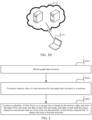
- FIG. 1B is a schematic diagram of an application scenario of a data storage method according to this application.
- the application scenario includes a client 101 and a server side 102.
- the client 101 and the server side 102 may communicate with each other.
- Communication may be performed by using a wired communication technology, for example, communication by connecting a network cable or a serial cable; or the communication may be performed by using a wireless communication technology, for example, communication may be performed by using a technology such as Bluetooth or wireless fidelity (Wi-Fi), which is not specifically limited.
- Wi-Fi wireless fidelity
- data of a subtree that is, a tree using the second sub-node as a root node
- the data query efficiency is improved compared with the manner of randomly storing data of each vertex and data of an edge connected to the vertex (that is, the manner in which the data of each vertex and the data of the edge connected to the vertex may be scattered into a plurality of storage areas).
- the root node may be used only as a start of the tree structure, and does not store any vertex data or edge data, but indicates the storage positions of the first sub-nodes by pointers. That is, the data of the root node includes pointers indicating the storage positions of the first sub-nodes. Then, when the data of the at least one first sub-node associated with the root node is generated in the memory based on the obtained at least one vertex index information group, after the root node is established in the memory, at least one root node pointer may be set for the root node based on a group quantity of the obtained at least one vertex index information group, as the data of the root node.
- the first root node pointer is configured for indicating a storage position A of the first sub-node A
- the second root node pointer is configured for indicating a storage position B of the first sub-node B
- the third root node pointer is configured for indicating a storage position C of the first sub-node C.
- the vertex index information group A is stored into the storage position A indicated by the first root node pointer, that is, the first sub-node A is obtained;
- the vertex index information group B is stored into the storage position B indicated by the second root node pointer, that is, the first sub-node B is obtained;
- the vertex index information group C is stored into the storage position C indicated by the third root node pointer, that is, the first sub-node C is obtained.
- each root node pointer may be determined according to a storage position in an idle state in the memory.
- FIG. 4D shows a memory in a stack form, including a storage position A, a storage position B, ..., and a storage position N. If the storage position B is in an idle state, the root node pointer may indicate the storage position B, and the storage position B may be configured to store the respective first sub-node.
- each root node pointer may alternatively be selected from the memory based on the preset storage volume associated with the respective first sub-node, or the like, which is not specifically limited.
- At least one first node pointer is set for the first sub-node based on a vertex quantity corresponding to the index information in the vertex data of the at least one vertex included in the first sub-node. Specifically, one first node pointer is allocated to each piece of index information in the vertex data of one first sub-node. Each first node pointer is associated with index information in vertex data of one vertex included in the first sub-node, and each first node pointer is configured for indicating a storage position of one second sub-node associated with the first sub-node.
- the attribute information in the vertex data of each of the at least one vertex indicated by the data of the first sub-node is stored into a storage position indicated by a respective first node pointer, to obtain data of at least one second sub-node associated with the first sub-node.
- first node pointers which are a first node pointer A and a first node pointer B, are set for the first sub-node.
- the first node pointer A is associated with the vertex A, and is configured for indicating a storage position A of the second sub-node A; and the first node pointer B is associated with the vertex B, and is configured for indicating a storage position B of the second sub-node B.
- Attribute information of the vertex A is stored into the storage position A indicated by the first node pointer A, that is, the second sub-node A is obtained; and attribute information of the vertex B is stored into the storage position B indicated by the first node pointer B, that is, the second sub-node B is obtained.
- the storage position indicated by each first node pointer may also be determined according to a storage position in an idle state in the memory.
- a preset storage volume may alternatively be set for the second sub-node in association.
- the storage position indicated by each first node pointer may be selected from the memory based on the preset storage volume associated with the second sub-node, or the like. This is not specifically limited.
- statistical information of the edge connected to the respective vertex may be further stored into each storage position.
- the statistical information may be counting a quantity of edges connected to the respective vertex, or may be counting a quantity of edges of different edge categories connected to the respective vertex, or the like, which is not specifically limited.
- the edge category may be an outgoing edge or an incoming edge.
- An outgoing edge of a vertex is an edge using the vertex as a start point
- an incoming edge of a vertex is an edge using the vertex as an end point.
- the edge category may alternatively be set according to a specific usage scenario. For example, when a different edge at a vertex may represent a trigger method and abnormal performance of an abnormal condition, the trigger method and the abnormal performance may be each used as an edge category.
- One vertex indicated by one first sub-node is used as an example below for description. Processes of storing statistical information of an edge connected to each vertex are similar. Details are not described herein.
- an edge quantity of edges belonging to each preset edge category is counted.
- the attribute information in the vertex data of the respective vertex and the counted edge quantity of the edges belonging to each preset edge category is stored into a storage position indicated by the first node pointer corresponding to the respective vertex, to obtain data of a second sub-node associated with the first sub-node.
- the preset edge categories include a category of the outgoing edge and a category of the incoming edge.
- the first sub-node may be associated with a second sub-node A through a storage position A indicated by a first node pointer A corresponding to the first function; and the second sub-node B may be further associated with a storage position B indicated by a first node pointer B corresponding to the second function.
- edges connected to the first function are counted, where an edge quantity of the outgoing edges is 4, and an edge quantity of the incoming edges is 4; and the edges connected to the second function are counted, where an edge quantity of the outgoing edges is 1, and an edge quantity of the incoming edges is 1.
- Attribute information of the first function, and the edge quantity 4 of the outgoing edges and the edge quantity 4 of the incoming edges are stored into the storage position A, to obtain the second sub-node A; and attribute information of the second function, and the edge quantity 1 of the outgoing edges and the edge quantity 1 of the incoming edges are stored into the storage position B, to obtain data of the second sub-node B.
- a second node pointer associated with each of the at least one preset edge category may be set.
- Each second node pointer corresponds to one preset edge category, and is configured for indicating a storage position of data of one third sub-node associated with the respective second sub-node.
- One second sub-node is used as an example below for description. Processes of obtaining at least one third sub-node associated with each second sub-node are similar. Details are not described herein.
- a second node pointer is set for associated with each of at least one preset edge category. For example, a second node pointer is allocated to each preset edge category. In edges connected to the vertex included in the respective second sub-node, an edge belonging to each preset edge category is determined. The index information and the attribute information in the edge data of the edge belonging to the respective preset edge category are stored into a storage position indicated by the respective second node pointer associated with the respective preset edge category, to obtain the data of the at least one third sub-node associated with the second sub-node.
- the second sub-node when the memory data of the tree structure is obtained, if one second sub-node includes the attribute information of the first function, and the edge quantity of outgoing edges and the edge quantity of incoming edges in the edges connected to the first function, that is, two edge quantities, the second sub-node is associated with two third sub-nodes, which are the third sub-node A and the third sub-node B.
- two second node pointers which are a second node pointer A and a second node pointer B, are set for the second sub-node.
- the second node pointer A is associated with an edge quantity of outgoing edges, and is configured for indicating a storage position A of the third sub-node A; and the second node pointer B is associated with an edge quantity of incoming edges, and is configured for indicating a storage position B of the third sub-node B.
- S203 Construct a plurality of disk blocks in a storage device based on the memory data, and store the data of the root node, the data of each first sub-node, and data of each subtree using a respective second sub-node as a root node into the plurality of disk blocks respectively, to obtain disk data of the tree structure.
- a plurality of disk blocks may be constructed in the disk based on the memory data, and the data of the root node, the data of each first sub-node, and the data of the subtree using each second sub-node as the root node are respectively stored in the corresponding disk blocks, to obtain the disk data of the tree structure.
- the seventh disk block is configured to store a subtree using the second sub-node C as a root node, including the second sub-node C, the third sub-node E, and the third sub-node F.
- the eighth disk block is configured to store a subtree using the second sub-node D as a root node, including the second sub-node D, the third sub-node G, and the third sub-node H.
- the ninth disk block is configured to store a subtree using the second sub-node E as a root node, including the second sub-node E, the third sub-node I, and the third sub-node J.
- the tenth disk block is configured to store a subtree using the second sub-node F as a root node, including the second sub-node F, the third sub-node K, and the third sub-node L.
- the data of the subtrees using the second sub-node as the root node is stored in the same disk block, so that a local property of data storage of the graph data structure can be fully represented, thereby causing the data storage to be more flexible, improving efficiency of querying data in the subtree in the same disk block or disk blocks with adjacent logical addresses, and further improving data processing efficiency of the device.
- a root node disk block corresponding to the root node may be first constructed based on a size of a storage space occupied by the data of the root node, and based on a quantity of the first sub-nodes, at least one root node offset address is set for the root node disk block.
- Each root node offset address is configured for an address for storing the data of a respective first sub-node.
- Each root node offset address indicates a address of a disk block for storing the data of a respective first sub-node .
- a disk block is established for each first sub-node.
- At least one first node offset address for the respective first node disk block is constructed based on a size of a storage space occupied by the data of each first sub-node and a respective root node offset address, and based on a quantity of second sub-nodes associated with each first sub-node, at least one first node offset address is set for the respective first node disk block.
- Each first node offset address is configured for indicating an address for storing the data of the subtree using a respective second sub-node as a root node of the subtree.
- a subtree disk block for storing the data of the respective subtree is established.
- the root node is associated with the first sub-node A, the first sub-node B, and the first sub-node C.
- the root node disk block corresponding to the root node may be first established. Since the root node is associated with three first sub-nodes, three root node offset addresses are set for the root node disk block, which are a root node offset address A, a root node offset address B, and a root node offset address C.
- the root node offset address A is configured for indicating an address A of a first node disk block A that stores the first sub-node A
- the root node offset address B is configured for indicating a address B of a first node disk block B that stores the first sub-node B
- the root node offset address C is configured for indicating an address C of a first node disk block C that stores the first sub-node C.
- first sub-node For example, based on the structure shown in FIG. 4E , one first sub-node is used as an example.
- the first sub-node is associated with the second sub-node A and the second sub-node B.
- two first node offset addresses which are a first node offset address A and a first node offset address B, may be set for a first node disk block corresponding to the first sub-node.
- the first node offset address A is configured for indicating to store a address A of a subtree disk block A of a subtree A using the second sub-node A as a root node; and the first node offset address B is configured for indicating to store a address B of a subtree disk block B of a subtree B using the second sub-node B as a root node.
- the size of the storage space occupied by the data of the subtree may be excessively large and exceed a preset maximum storage space amount of the disk block, and it is possible that a corresponding subtree disk block cannot be established for the excessively large subtree.
- the subtree is split according to the maximum storage space amount, to obtain a plurality of data blocks.
- a plurality of second node offset addresses are generated, using a respective first node offset address as a starting address, based on a quantity of the plurality of data blocks.
- Second node disk blocks respectively corresponding to the plurality of data blocks are constructed according to the plurality of second node offset addresses. For example, based on the traversing order of the subtree,the second node disk blocks respectively corresponding to the plurality of data blocks are constructed.
- a first node offset address set in the first node disk block in which the corresponding first sub-node is located is used as a starting address, and two second node offset addresses, which are a second node offset address A and a second node offset address B, are generated.
- the second node offset address A is the first node offset address.
- a traversing order of the two to-be-stored nodes is that the to-be-stored node A is first traversed, and the to-be-stored node B is then traversed. In this way, the first node offset address is configured for indicating the address A of the second node disk block A.
- data in the memory or the disk may be merged regularly or irregularly in a compaction manner, for example, duplicated data is deleted.
- merging processing may be performed on the data in the memory or the disk, which is not specifically limited.
- the first sub-node A associated with the root node, the second sub-node A and the second sub-node B that are associated with the first sub-node A, and the third sub-node A and the third sub-node B that are associated with the second sub-node A may be first generated.
- the third sub-node A is then modified based on adjustment of the to-be-stored graph data structure.
- the data of the specified sub-node is duplicated from the memory data, to obtain data of a duplicated sub-node.
- the data of the duplicated sub-node is modified based on modification content indicated by the modification instruction, to obtain data of a modified sub-node.
- the specified sub-node is replaced with the obtained modified sub-node, to obtain modified memory data.
- the specified sub-node may be modified by using a compare-and-swap (CAS) method and an appending method.
- CAS compare-and-swap
- the second sub-node A is a specified sub-node.
- the second sub-node A is a storage position indicated by the first node pointer set for the first sub-node A.
- the second sub-node A is associated with the third sub-node A and the third sub-node B.
- the second sub-node A includes attribute information A of a vertex A, and further includes an edge quantity A of outgoing edges and an edge quantity B of incoming edges connected to the vertex A.
- the third sub-node A includes index information in edge data of the outgoing edges connected to the vertex A, for example, including e1, e2, e3, and e4, and attribute information in the edge data of the outgoing edges, for example, including e1_prop, e2_prop, e3_prop, and e4_prop.
- the third sub-node B includes index information in edge data of the incoming edges connected to the vertex A, for example, including e5, e6, e7, and e8, and attribute information in the edge data of the incoming edges, for example, including e5_prop, e6_prop, e7_prop, and e8_prop.
- the replacement pointer is further set for the second sub-node A.
- the replacement pointer is null, indicating that the second sub-node A is not configured for replacing content in any storage position.
- the replacement pointer of the modified sub-node also points to the storage position of the data of the second sub-node A, representing that the data of the modified sub-node is used for replacing the data of the specified sub-node.
- the attribute information A of the vertex A included in the duplicated sub-node is then modified into the attribute information B, to obtain the modified sub-node.
- a target pointer indicating the storage position of the data of the second sub-node A is the first node pointer set in the first sub-node A.
- the first node pointer of the first sub-node A is modified from indicating the storage position of the data of the second sub-node A into indicating the storage position of the data of the modified sub-node, so that the modified memory data can be obtained.
- the third sub-node A is a specified sub-node.
- the third sub-node A is a storage position indicated by the second node pointer set by the second sub-node A.
- the second sub-node A includes attribute information A of the vertex A, and further includes an edge quantity A of outgoing edges and an edge quantity B of incoming edges connected to the vertex A.
- the third sub-node A includes index information in edge data of the outgoing edges connected to the vertex A, for example, including e1, e2, e3, and e4, and attribute information in the edge data of the outgoing edges, for example, including e1_prop, e2_prop, e3_prop, and e4_prop.
- the modification instruction for the third sub-node A when the modification instruction for the third sub-node A is received, indicating to modify the attribute information e1_prop of the outgoing edge e1 into e1'_prop, the data of the third sub-node A is duplicated, to obtain the duplicated sub-node.
- the replacement pointer of the duplicated sub-node may be pointed to the storage position (not shown in the figure) of the data of the third sub-node A.
- the replacement pointer of the modified sub-node also points to the storage position of the data of the third sub-node A. Then the attribute information e1_prop of the outgoing edge e1 included in the duplicated sub-node is modified into e1'_prop, and the data of the modified sub-node is obtained.
- Two second node pointers which are the second node pointer E and the second node pointer F, are set for the second sub-node C.
- the second node pointer E is configured for indicating the storage position of the data of the third sub-node E associated with the second sub-node C.
- the second node pointer F is configured for indicating the storage position of the data of the third sub-node F associated with the second sub-node C.
- Index information in edge data of the outgoing edges connected to the first function which are e1, e2, e3, and e4
- attribute information in the edge data of the outgoing edges connected to the first function which are e1_prop, e2_prop, e3_prop, and e4_prop, are stored into the storage position indicated by the second node pointer A, to generate the third sub-node A.
Landscapes
- Engineering & Computer Science (AREA)
- Theoretical Computer Science (AREA)
- Databases & Information Systems (AREA)
- Physics & Mathematics (AREA)
- General Engineering & Computer Science (AREA)
- General Physics & Mathematics (AREA)
- Software Systems (AREA)
- Data Mining & Analysis (AREA)
- Human Computer Interaction (AREA)
- Information Retrieval, Db Structures And Fs Structures Therefor (AREA)
Applications Claiming Priority (2)
| Application Number | Priority Date | Filing Date | Title |
|---|---|---|---|
| CN202211643683.3A CN116975369A (zh) | 2022-12-20 | 2022-12-20 | 一种存储数据的方法、装置、设备及存储介质 |
| PCT/CN2023/136993 WO2024131542A1 (zh) | 2022-12-20 | 2023-12-07 | 存储数据的方法、装置、计算机设备、产品及存储介质 |
Publications (2)
| Publication Number | Publication Date |
|---|---|
| EP4579486A1 true EP4579486A1 (de) | 2025-07-02 |
| EP4579486A4 EP4579486A4 (de) | 2026-01-14 |
Family
ID=88483805
Family Applications (1)
| Application Number | Title | Priority Date | Filing Date |
|---|---|---|---|
| EP23905709.4A Pending EP4579486A4 (de) | 2022-12-20 | 2023-12-07 | Verfahren und vorrichtung zur speicherung von daten sowie computervorrichtung, produkt und speichermedium |
Country Status (4)
| Country | Link |
|---|---|
| US (1) | US20250036685A1 (de) |
| EP (1) | EP4579486A4 (de) |
| CN (1) | CN116975369A (de) |
| WO (1) | WO2024131542A1 (de) |
Families Citing this family (2)
| Publication number | Priority date | Publication date | Assignee | Title |
|---|---|---|---|---|
| CN116975369A (zh) * | 2022-12-20 | 2023-10-31 | 腾讯科技(深圳)有限公司 | 一种存储数据的方法、装置、设备及存储介质 |
| CN117236236B (zh) * | 2023-11-10 | 2024-04-16 | 杭州行芯科技有限公司 | 一种芯片设计数据管理方法、装置、电子设备及存储介质 |
Family Cites Families (6)
| Publication number | Priority date | Publication date | Assignee | Title |
|---|---|---|---|---|
| US10242065B1 (en) * | 2016-06-30 | 2019-03-26 | EMC IP Holding Company LLC | Combining merkle trees in graph databases |
| CN109446362B (zh) * | 2018-09-05 | 2021-07-23 | 深圳神图科技有限公司 | 基于外存的图数据库结构、图数据存储方法、装置 |
| CN111190904B (zh) * | 2019-12-30 | 2023-12-08 | 四川蜀天梦图数据科技有限公司 | 一种图-关系数据库混合存储的方法和装置 |
| CN114254164B (zh) * | 2022-03-01 | 2022-06-28 | 全球能源互联网研究院有限公司 | 一种图数据存储方法及装置 |
| CN115408547A (zh) * | 2022-09-15 | 2022-11-29 | 河南星环众志信息科技有限公司 | 一种字典树构建方法、装置、设备及存储介质 |
| CN116975369A (zh) * | 2022-12-20 | 2023-10-31 | 腾讯科技(深圳)有限公司 | 一种存储数据的方法、装置、设备及存储介质 |
-
2022
- 2022-12-20 CN CN202211643683.3A patent/CN116975369A/zh active Pending
-
2023
- 2023-12-07 WO PCT/CN2023/136993 patent/WO2024131542A1/zh not_active Ceased
- 2023-12-07 EP EP23905709.4A patent/EP4579486A4/de active Pending
-
2024
- 2024-10-14 US US18/914,454 patent/US20250036685A1/en active Pending
Also Published As
| Publication number | Publication date |
|---|---|
| US20250036685A1 (en) | 2025-01-30 |
| WO2024131542A1 (zh) | 2024-06-27 |
| EP4579486A4 (de) | 2026-01-14 |
| CN116975369A (zh) | 2023-10-31 |
Similar Documents
| Publication | Publication Date | Title |
|---|---|---|
| US20250036685A1 (en) | Data storage method and apparatus, computer device, product, and storage medium | |
| US10983972B2 (en) | System and method for slowing changing dimension and metadata versioning in a multidimensional database environment | |
| CN105117417B (zh) | 一种读优化的内存数据库Trie树索引方法 | |
| US12216654B2 (en) | Materialized table refresh using multiple processing pipelines | |
| US10762068B2 (en) | Virtual columns to expose row specific details for query execution in column store databases | |
| US12174845B1 (en) | Analytic query processing using a backup of a database | |
| US10146833B1 (en) | Write-back techniques at datastore accelerators | |
| Bao et al. | Optimizing segmented trajectory data storage with HBase for improved spatio-temporal query efficiency | |
| WO2024187779A1 (zh) | 业务数据存储方法、装置、计算机设备和存储介质 | |
| CN115576947A (zh) | 一种数据管理方法、装置、组合库、电子设备及存储介质 | |
| CN108062314A (zh) | 动态分表数据处理方法和装置 | |
| US11372898B2 (en) | Security of a computer system | |
| Carter et al. | Nanosecond indexing of graph data with hash maps and VLists | |
| CN116595123A (zh) | 多维数据查询方法、装置、计算机设备和存储介质 | |
| Khalil et al. | New approach for implementing big datamart using NoSQL key-value stores | |
| Fu et al. | ICA: An incremental clustering algorithm based on OPTICS | |
| CN115952252B (zh) | 基于动态渲染的语义瓦片数据处理方法、装置和电子设备 | |
| Lewis et al. | G-PICS: A framework for GPU-based spatial indexing and query processing | |
| US12450229B1 (en) | Providing query units to support external analytics queries to a backup of a database | |
| Zhong et al. | Elastic and effective spatio-temporal query processing scheme on hadoop | |
| Paradies et al. | Big graph data analytics on single machines–an overview | |
| CN115269741A (zh) | 用于多维数据的存储方法、查询方法及维护方法 | |
| Khurana | An introduction to temporal graph data management | |
| Bianchi et al. | On the performance and use of spatial OLAP tools | |
| Yulis et al. | Enhancing Relational Database Efficiency through Algorithmic Query Tuning in Virtual Memory Systems |
Legal Events
| Date | Code | Title | Description |
|---|---|---|---|
| STAA | Information on the status of an ep patent application or granted ep patent |
Free format text: STATUS: THE INTERNATIONAL PUBLICATION HAS BEEN MADE |
|
| PUAI | Public reference made under article 153(3) epc to a published international application that has entered the european phase |
Free format text: ORIGINAL CODE: 0009012 |
|
| STAA | Information on the status of an ep patent application or granted ep patent |
Free format text: STATUS: REQUEST FOR EXAMINATION WAS MADE |
|
| 17P | Request for examination filed |
Effective date: 20250327 |
|
| AK | Designated contracting states |
Kind code of ref document: A1 Designated state(s): AL AT BE BG CH CY CZ DE DK EE ES FI FR GB GR HR HU IE IS IT LI LT LU LV MC ME MK MT NL NO PL PT RO RS SE SI SK SM TR |
|
| A4 | Supplementary search report drawn up and despatched |
Effective date: 20251215 |
|
| RIC1 | Information provided on ipc code assigned before grant |
Ipc: G06F 16/901 20190101AFI20251209BHEP |