EP4579484A1 - Kamerabasierte objektsuche im internet der dinge - Google Patents
Kamerabasierte objektsuche im internet der dinge Download PDFInfo
- Publication number
- EP4579484A1 EP4579484A1 EP24215572.9A EP24215572A EP4579484A1 EP 4579484 A1 EP4579484 A1 EP 4579484A1 EP 24215572 A EP24215572 A EP 24215572A EP 4579484 A1 EP4579484 A1 EP 4579484A1
- Authority
- EP
- European Patent Office
- Prior art keywords
- item
- user
- item search
- images
- machine learning
- Prior art date
- Legal status (The legal status is an assumption and is not a legal conclusion. Google has not performed a legal analysis and makes no representation as to the accuracy of the status listed.)
- Pending
Links
Images



Classifications
-
- G—PHYSICS
- G06—COMPUTING OR CALCULATING; COUNTING
- G06F—ELECTRIC DIGITAL DATA PROCESSING
- G06F16/00—Information retrieval; Database structures therefor; File system structures therefor
- G06F16/50—Information retrieval; Database structures therefor; File system structures therefor of still image data
- G06F16/55—Clustering; Classification
-
- G—PHYSICS
- G06—COMPUTING OR CALCULATING; COUNTING
- G06Q—INFORMATION AND COMMUNICATION TECHNOLOGY [ICT] SPECIALLY ADAPTED FOR ADMINISTRATIVE, COMMERCIAL, FINANCIAL, MANAGERIAL OR SUPERVISORY PURPOSES; SYSTEMS OR METHODS SPECIALLY ADAPTED FOR ADMINISTRATIVE, COMMERCIAL, FINANCIAL, MANAGERIAL OR SUPERVISORY PURPOSES, NOT OTHERWISE PROVIDED FOR
- G06Q30/00—Commerce
- G06Q30/06—Buying, selling or leasing transactions
- G06Q30/0601—Electronic shopping [e-shopping]
- G06Q30/0623—Electronic shopping [e-shopping] by investigating goods or services
- G06Q30/0625—Electronic shopping [e-shopping] by investigating goods or services by formulating product or service queries, e.g. using keywords or predefined options
-
- G—PHYSICS
- G06—COMPUTING OR CALCULATING; COUNTING
- G06F—ELECTRIC DIGITAL DATA PROCESSING
- G06F16/00—Information retrieval; Database structures therefor; File system structures therefor
- G06F16/50—Information retrieval; Database structures therefor; File system structures therefor of still image data
- G06F16/58—Retrieval characterised by using metadata, e.g. metadata not derived from the content or metadata generated manually
- G06F16/5866—Retrieval characterised by using metadata, e.g. metadata not derived from the content or metadata generated manually using information manually generated, e.g. tags, keywords, comments, manually generated location and time information
-
- G—PHYSICS
- G06—COMPUTING OR CALCULATING; COUNTING
- G06F—ELECTRIC DIGITAL DATA PROCESSING
- G06F16/00—Information retrieval; Database structures therefor; File system structures therefor
- G06F16/50—Information retrieval; Database structures therefor; File system structures therefor of still image data
- G06F16/53—Querying
- G06F16/538—Presentation of query results
-
- G—PHYSICS
- G06—COMPUTING OR CALCULATING; COUNTING
- G06N—COMPUTING ARRANGEMENTS BASED ON SPECIFIC COMPUTATIONAL MODELS
- G06N20/00—Machine learning
-
- G—PHYSICS
- G16—INFORMATION AND COMMUNICATION TECHNOLOGY [ICT] SPECIALLY ADAPTED FOR SPECIFIC APPLICATION FIELDS
- G16Y—INFORMATION AND COMMUNICATION TECHNOLOGY SPECIALLY ADAPTED FOR THE INTERNET OF THINGS [IoT]
- G16Y40/00—IoT characterised by the purpose of the information processing
-
- H—ELECTRICITY
- H04—ELECTRIC COMMUNICATION TECHNIQUE
- H04L—TRANSMISSION OF DIGITAL INFORMATION, e.g. TELEGRAPHIC COMMUNICATION
- H04L63/00—Network architectures or network communication protocols for network security
- H04L63/08—Network architectures or network communication protocols for network security for authentication of entities
Definitions
- This disclosure is generally directed to an item search service for a premises and, in particular, to an item search service for a premises that is implemented utilizing one or more Internet of Things (IoT) cameras.
- IoT Internet of Things
- An example embodiment performs operations including receiving, via a user interface of the item search service, first user input regarding an item of interest, wherein the first user input comprises one or more of speech input or text input, accessing a plurality of images of the premises captured by the set of IoT cameras, executing a machine learning model to identify one or more images in the plurality of images that include the item of interest based at least on the first user input, generating an item search result based on the identified one or more images, and providing the item search result via the user interface of the item search service.
- the first user input comprises natural language input and the machine learning model comprises a multi-modal machine learning model trained on a set of images and natural language text respectively associated with each image in the set of images.
- the operations further comprise receiving, via the user interface of the item search service, second user input that specifies an image of the item of interest and a label assigned to the item of interest by a user, and utilizing the image of the item of interest and the label assigned to the item of interest to train the machine learning model.
- the receiving, accessing, executing, generating and providing operations are performed by one or more devices located within the premises.
- the operations further comprise selecting the machine learning model from among a plurality of different machine learning models, wherein each machine learning model of the plurality of different machine learning models is trained or fine-tuned for one of a particular premises type or a particular demographic.
- the operations further comprise authenticating a user of the item search service and determining that the user is an authorized user of the item search service based on the authenticating, and one or more of the receiving, accessing, executing, generating and providing operations is performed in response to determining that the user is the authorized user of the item search service.
- the operations further comprise receiving, via the user interface of the item search service, second user input that specifies an item that should not be searchable and, in response to receiving the second user input, applying a content filter that prevents the item search service from searching for the item that should not be searchable or that prevents the item search service from returning an item search result for the item that should not be searchable.
- generating the item search result based on the identified one or more images comprises one or more of generating a speech or text description of a location of the item of interest based on the identified one or more images, or generating an image that shows the location of the item of interest based on the identified one or more images.
- Keeping track of an item within a premises can be challenging, particularly if the item is relatively small and often moved.
- essential or important items such as a wallet, a purse, a bag, keys, a smartphone, a laptop, or a remote control may easily be misplaced, requiring the item owner to physically search throughout the home to recover the item.
- Such physical searching may be inconvenient, time consuming, and stressful.
- Bluetooth tracking devices Some technology exists to help users recover lost or misplaced items.
- battery-operated Bluetooth tracking devices exist that may be attached to an item and then used to track the item's location.
- some significant shortcomings of Bluetooth tracking devices include but are not limited to: a separate Bluetooth tracking device must be purchased for every item a user may wish to track, which can be expensive; some Bluetooth tracking devices don't allow for battery replacement, meaning that the user must buy a whole new tracking device when the battery dies; for Bluetooth tracking devices that do allow battery replacement, having to periodically replace the battery can be expensive and inconvenient; Bluetooth tracking devices can only be used to track items having a form factor that makes attachment of the tracking device thereto feasible; the means of attachment between the Bluetooth tracking device and the item may fail or be broken; the item will only be locatable if it is within range of another Bluetooth device; a Bluetooth tracking device can be dangerous to children if the tracking device is small enough to be ingested, or if the tracking device uses a button or coin battery and the device case isn't secure; and Bluetooth
- some smartphones may be configured to leverage built-in GPS-based and/or WiFi-based tracking technology to help a user locate the smartphone.
- this solution is extremely limited as it only applies to the very narrow class of items that include built-in location tracking technology.
- Providing the item search service may include (i) receiving, via a user interface of the item search service, first user input regarding an item of interest, wherein the first user input comprises one or more of speech input or text input; (ii) accessing a plurality of images of the premises captured by the set of IoT cameras; (iii) executing a machine learning model to identify one or more images in the plurality of images that include the item of interest based at least on the first user input; (iv) generating an item search result based on the identified one or more images; and (v) providing the item search result via the user interface of the item search service.
- the item search service may advantageously utilize various IoT cameras installed in or around a premises to assist a user in locating an item of interest.
- the item search service may leverage various IoT cameras that are already installed in a home as part of a home security system or a home automation system and/or various IoT cameras that are integrated within various user devices located throughout a home, although these are only examples.
- the item search service may utilize the speech input or text input provided by the user as input for a multi-modal machine learning model that is able to utilize such input to identify one or more images collected by the IoT cameras that include the item of interest.
- the machine learning model may provide useful results to a natural language query submitted by a user (e.g., "where did I leave my keys?") even though the machine learning model may not have observed the item that the user is looking for during training.
- the machine learning model used to provide the item search service may be selected from among a plurality of different machine learning models, wherein each machine learning model of the plurality of different machine learning models is trained or fine-tuned for one of a particular type of premises or a particular user demographic.
- Such a feature may enable a machine learning model to be selected that will provide the best item tracking performance for a particular premises and/or a particular user.
- a user can provide input via the user interface of the item search service that specifies an image of the item of interest and a label assigned to the item of interest by the user. For example, a user may say “these are my keys” while holding up the keys in front of an IoT camera, or may tag the keys within an image captured by the IoT camera and say or type "these are my keys”.
- the specified image of the item of interest and the label assigned to the item of interest can then be used to train (e.g., train, retrain, or fine-tune) the machine learning model so that it will associate the image of the item with the label going forward.
- the item search service may infer a label for a particular item based on an association between a user and the particular item. For example, the item search service may label an item as "Bob's smartphone" if the user submitting an image of the smartphone for training purposes is Bob or if the service determines that the user Bob is most often observed holding that particular smartphone. These user-specific item labels can then be used to train (e.g., train, retrain or fine-tune) the machine learning model so that when a particular user (e.g., Bob) says "where did I leave my smartphone", the machine learning model can identify that particular user's smartphone (e.g. Bob's smartphone) in the IoT camera images.
- train e.g., train, retrain or fine-tune
- the machine learning model as well as other components of the item search service may be installed and executed on one or more devices within the premises (e.g., the edge) as opposed to on computing devices external to the premises (e.g., the cloud).
- Such an implementation may serve to protect the privacy and data security of the user, enable the processing demands of the service to be distributed across multiple end user devices, and increase resiliency as, without a cloud dependency, the service may still be capable of operating even when an Internet connection is lost.
- the item search service may include an authentication feature that ensures that only authorized users can use the service and/or search for particular items using the service.
- an authentication feature that ensures that only authorized users can use the service and/or search for particular items using the service.
- Such a feature can advantageously prevent misuse of the system by bad actors (e.g., home intruders) as well as generally prevent certain users from locating certain items within the premises using the service (e.g., preventing a child in a home from accessing certain dangerous or prohibited items).
- Multimedia environment 102 may include one or more media systems 104.
- a media system 104 could represent a family room, a kitchen, a backyard, a home theater, a school classroom, a library, a car, a boat, a bus, a plane, a movie theater, a stadium, an auditorium, a park, a bar, a restaurant, or any other location or space where it is desired to receive and play streaming content.
- User(s) 132 may operate with the media system 104 to select and consume content.
- Each media system 104 may include one or more media devices 106 each coupled to one or more display devices 108. It is noted that terms such as “coupled,” “connected to,” “attached,” “linked,” “combined” and similar terms may refer to physical, electrical, magnetic, logical, etc., connections, unless otherwise specified herein.
- Media device 106 may be a streaming media device, DVD or BLU-RAY device, audio/video playback device, cable box, and/or digital video recording device, to name just a few examples.
- Display device 108 may be a monitor, television (TV), computer, smart phone, tablet, wearable (such as a watch or glasses), appliance, internet of things (IoT) device, and/or projector, to name just a few examples.
- media device 106 can be a part of, integrated with, operatively coupled to, and/or connected to its respective display device 108.
- Each media device 106 may be configured to communicate with network 118 via a communication device 114.
- Communication device 114 may include, for example, a cable modem or satellite TV transceiver.
- Media device 106 may communicate with communication device 114 over a link 116, wherein link 116 may include wireless (such as Wi-Fi) and/or wired connections.
- network 118 can include, without limitation, wired and/or wireless intranet, extranet, Internet, cellular, Bluetooth, infrared, and/or any other short range, long range, local, regional, global communications mechanism, means, approach, protocol and/or network, as well as any combination(s) thereof.
- Media system 104 may include a remote control 110.
- Remote control 110 can be any component, part, apparatus and/or method for controlling media device 106 and/or display device 108, such as a remote control, a tablet, laptop computer, smartphone, wearable, on-screen controls, integrated control buttons, audio controls, or any combination thereof, to name just a few examples.
- remote control 110 wirelessly communicates with media device 106 and/or display device 108 using cellular, Bluetooth, infrared, etc., or any combination thereof.
- Remote control 110 may include a microphone 112, which is further described below.
- Multimedia environment 102 may include a plurality of content servers 120 (also called content providers, channels or sources 120). Although only one content server 120 is shown in FIG. 1 , in practice multimedia environment 102 may include any number of content servers 120. Each content server 120 may be configured to communicate with network 118.
- Each content server 120 may store content 122 and metadata 124.
- Content 122 may include any combination of music, videos, movies, TV programs, multimedia, images, still pictures, text, graphics, gaming applications, advertisements, programming content, public service content, government content, local community content, software, and/or any other content or data objects in electronic form.
- metadata 124 comprises data about content 122.
- metadata 124 may include associated or ancillary information indicating or related to writer, director, producer, composer, artist, actor, summary, chapters, production, history, year, trailers, alternate versions, related content, applications, and/or any other information pertaining or relating to the content 122.
- Metadata 124 may also or alternatively include links to any such information pertaining or relating to content 122.
- Metadata 124 may also or alternatively include one or more indexes of content 122, such as but not limited to a trick mode index.
- Multimedia environment 102 may include one or more system servers 126.
- System servers 126 may operate to support media devices 106 from the cloud. It is noted that the structural and functional aspects of system servers 126 may wholly or partially exist in the same or different ones of system servers 126.
- Media devices 106 may exist in thousands or millions of media systems 104. Accordingly, media devices 106 may lend themselves to crowdsourcing embodiments and, thus, system servers 126 may include one or more crowdsource servers 128.
- crowdsource server(s) 128 may identify similarities and overlaps between closed captioning requests issued by different users 132 watching a particular movie. Based on such information, crowdsource server(s) 128 may determine that turning closed captioning on may enhance users' viewing experience at particular portions of the movie (for example, when the soundtrack of the movie is difficult to hear), and turning closed captioning off may enhance users' viewing experience at other portions of the movie (for example, when displaying closed captioning obstructs critical visual aspects of the movie). Accordingly, crowdsource server(s) 128 may operate to cause closed captioning to be automatically turned on and/or off during future streamings of the movie.
- System servers 126 may also include an audio command processing module 130.
- remote control 110 may include microphone 112.
- Microphone 112 may receive audio data from users 132 (as well as other sources, such as the display device 108).
- media device 106 may be audio responsive, and the audio data may represent verbal commands from user 132 to control media device 106 as well as other components in media system 104, such as display device 108.
- the audio data received by microphone 112 in remote control 110 is transferred to media device 106, which is then forwarded to audio command processing module 130 in system servers 126.
- Audio command processing module 130 may operate to process and analyze the received audio data to recognize user 132's verbal command. Audio command processing module 130 may then forward the verbal command back to media device 106 for processing.
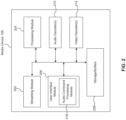
- FIG. 2 illustrates a block diagram of an example media device 106, according to some embodiments.
- Media device 106 may include a streaming module 202, a processing module 204, storage/buffers 208, and a user interface module 206.
- user interface module 206 may include audio command processing module 216.
- Media device 106 may also include one or more audio decoders 212 and one or more video decoders 214.
- Each audio decoder 212 may be configured to decode audio of one or more audio formats, such as but not limited to AAC, HE-AAC, AC3 (Dolby Digital), EAC3 (Dolby Digital Plus), WMA, WAV, PCM, MP3, OGG GSM, FLAC, AU, AIFF, and/or VOX, to name just some examples.
- each video decoder 214 may be configured to decode video of one or more video formats, such as but not limited to MP4 (mp4, m4a, m4v, f4v, f4a, m4b, m4r, f4b, mov), 3GP (3gp, 3gp2, 3g2, 3gpp, 3gpp2), OGG (ogg, oga, ogv, ogx), WMV (wmv, wma, asf), WEBM, FLV, AVI, QuickTime, HDV, MXF (OP1a, OP-Atom), MPEG-TS, MPEG-2 PS, MPEG-2 TS, WAV, Broadcast WAV, LXF, GXF, and/or VOB, to name just some examples.
- MP4 mp4, m4a, m4v, f4v, f4a, m4b, m4r, f4b, mov
- 3GP 3gp, 3g
- Each video decoder 214 may include one or more video codecs, such as but not limited to H.263, H.264, H.265, AVI, HEV, MPEG1, MPEG2, MPEG-TS, MPEG-4, Theora, 3GP, DV, DVCPRO, DVCPRO, DVCProHD, IMX, XDCAM HD, XDCAM HD422, and/or XDCAM EX, to name just some examples.
- video codecs such as but not limited to H.263, H.264, H.265, AVI, HEV, MPEG1, MPEG2, MPEG-TS, MPEG-4, Theora, 3GP, DV, DVCPRO, DVCPRO, DVCProHD, IMX, XDCAM HD, XDCAM HD422, and/or XDCAM EX, to name just some examples.
- user 132 may interact with media device 106 via, for example, remote control 110.
- remote control 110 may interact with user interface module 206 of media device 106 to select content, such as a movie, TV show, music, book, application, game, etc.
- Streaming module 202 of media device 106 may request the selected content from content server(s) 120 over network 118.
- Content server(s) 120 may transmit the requested content to streaming module 202.
- Media device 106 may transmit the received content to display device 108 for playback to user 132.
- streaming module 202 may transmit the content to display device 108 in real time or near real time as it receives such content from content server(s) 120.
- media device 106 may store the content received from content server(s) 120 in storage/buffers 208 for later playback on display device 108.
- FIG. 3 illustrates a block diagram of a system 300 for providing an item search service for a premises comprising a set of IoT cameras, according to some embodiments.
- system 300 includes a premises 302 and an item search service 350. Each of these aspects of system 300 will now be described.
- system 300 includes a premises 302 in which a plurality of IoT devices 306, 308, 310 and 312 are present.
- Premises 302 may comprise, for example and without limitation, a home, an office, a building, a factory, a warehouse, a bar, a restaurant, a movie theater, a stadium, an auditorium, a car, a bus, a boat, or any other structure, location or space in which IoT devices may be present.
- premises 302 may include any number of IoT devices, including tens, hundreds or even thousands of IoT devices.
- IoT device is intended to broadly encompass any device that is capable of engaging in digital communication with another device.
- a device that can digitally communicate with another device can comprise an IoT device, as that term is used herein, even if such communication does not occur over the Internet.
- each IoT device in the set of IoT devices in premises 302 may be directly connected to each of the other IoT devices in the premises such that it can communicate therewith without a router.
- only some of the IoT devices in premises 302 may be directly connected to other ones of the IoT devices, and indirect communication between unconnected IoT device pairs may be carried out through one or more intervening devices.
- a mesh network implementation of LAN 340 may likewise be connected to an external WAN, such as the Internet, via a router. However, these are examples only, and other techniques for implementing LAN 340 may be used.
- IoT device 306 may comprise one or more processors 328, one or more sensors 330, a sensor data collector 332, one or more actuators 334, and one or more communication interfaces 336.
- Processor(s) 328 may comprise one or more central processing units (CPUs), microcontrollers, microprocessors, signal processors, application specific integrated circuits (ASICs), and/or other physical hardware processor circuits for performing tasks such as program execution, signal coding, data processing, input/output processing, power control, and/or other functions.
- Online training module 354 may enable a user to train machine learning model 362 to recognize a particular item. For example, a user may provide via a UI (e.g., item search UI 314 or item search UI 326) user input that specifies an image of the particular item and a label assigned to the particular item. Online training module 354 may then utilize the image of the particular item and the associated label to train (e.g., train, retrain, or fine-tune) machine learning model 362 to recognize the particular item.
- a feature can advantageously enable a user to selectively expand the set of items that item search service 350 can find within premises 302. For example, the set of items can be expanded to include uncommon or even unique items within a premises.
- Such a feature can also advantageously enable a user to assign custom names to objects (e.g., a family pet may be labeled with its name, a child's blanket may be labeled with a nickname assigned to it by the child, or the like).
- the user may upload an image of the item captured using a user device (e.g., user device 104) and also submit speech or text input describing the item.
- the user may present the item within a field of view of an IoT camera (such that an image of the item can be captured by the IoT camera and made accessible to item search service 350) while also providing a speech or text description of the item.
- the user may say "these are my keys" while holding up the keys in front of an IoT camera.
- the user may provide a speech/text description of the item and online training module 354 may cause an image captured by an IoT camera within premises 302 to be presented to the user and may request that the user tag or otherwise indicate the item within the image.
- the user may provide a speech/text description of the item and online training module 354 may then cause multiple images captured by one or more IoT cameras within premises 302 to be presented to the user and may request that the user identify which, if any, of the images include the item.
- these are only some examples and still other methods may be used by which the user may specify the image of the item and the associated label.
- the online training feature may be utilized to distinguish between similarly named items based on item ownership or other user-item associations.
- the online training feature may be used to train machine learning model 362 to distinguish between "Dad's smartphone” and "Mom's smartphone".
- a user may make this distinction explicitly, for example, by providing online training module 354 with an image of Dad's smartphone along with the label "Dad's smartphone” and an image of Mom's smartphone along with the label "Mom's smartphone”.
- this distinction may also be inferred by online training module 354.
- online training module 354 may infer that an image of a smartphone submitted with the label "smartphone” should in fact be labeled "Dad's smartphone” because Dad is submitting the image as part of the online training process or because historically the smartphone being identified has been observed most often being used by Dad (e.g., observed by one or more IoT cameras in premises 302).
- user-specific item labels can be used to train (e.g., train, retrain or fine-tune) machine learning model 362 so that when a particular user says "where did I leave my smartphone?", machine learning model 362 can identify that particular user's smartphone (e.g. Dad's smartphone) in the IoT camera images. That is to say, item search module 352 may execute an item search based both on speech/text input from a user ("where did I leave my smartphone?") and an identity of the user submitting such input (e.g., "Dad”), so that what is really being searched for is "Dad's smartphone".
- train e.g., train, retrain or fine-tune
- online training module 354 may be configured to generate printable QR codes or other fiducial markers that a user can affix to an item of interest to render such item easer to recognize/distinguish when it appears in an image. Such fiducial markers may be attached to the item prior to image capture for the purposes of online training. In further accordance with such an example, online training module 354 may determine one or more aspects of the fiducial marker (e.g., QR code size and/or density) based on a maximum resolution or other feature associated with one or more IoT cameras within premises 302.
- the fiducial marker e.g., QR code size and/or density
- Conducting online training of machine learning model 362 may entail processing an image of an item specified by a user to place it in a form suitable for training machine learning model 362, processing a label of the item provided by the user to place it in a form suitable for training machine learning model 362, and then conducting training of machine learning model 362 using such transformed inputs.
- online training module 354 may return a message or other indication to the UI (e.g., item search UI 314 or item search UI 326) that indicates that online training was successful.
- online training module 354 may be configured to suggest items to a user that the user may wish to add to the default or base set of items through online training. Such suggestions may be made for example based on collaborative filtering techniques keyed off of a premises type of premises 302, a geolocation of premises 302, and/or demographic information associated with the user.
- Content filtering module 356 may enable a user of item search service 350 to specify an item that should not be searchable by item search service 350. Based on the specification of the item, content filtering module 356 may apply a content filter to item search service 350 that prevents item search service 350 from searching for the item or that prevents item search service 350 from providing an item search result about the item. Such a feature can advantageously enable a user of item search service to selectively "hide" certain items from item search service 350 that the user does not wish to be locatable (e.g., a wall safe, a handgun).
- locatable e.g., a wall safe, a handgun
- a user may specify an item that should not be searchable by the item search service by interacting with one of item search UI 314 or item search UI 326.
- the user may interact with the UI to provide a speech or text description of the item that should not be searchable and/or provide or specify an image of the item that should not be searchable.
- content filtering module 356 may activate a content filter that ensures that item search module 352 cannot be used to locate the item of interest.
- a content filter may act on the input side, meaning that if the content filter determines based on a user's item search query that the query is targeting an item that should not be searched, then the content filter will prevent the item search from executing at all.
- such content filter may also operate on the output side, meaning that if the content filter determines that an item search result includes an item that should not be searched for, the content filter can prevent that item search result from being returned to a user.
- Authentication module 358 may implement an authentication feature that ensures that only authorized users can use item search service 350 and/or search for particular items using item search service 350. Such a feature can advantageously prevent misuse of item search service 350 by bad actors (e.g., home intruders) as well as generally prevent certain users from locating certain items within premises 302 using item search service (e.g., preventing a child in a home from accessing certain dangerous or prohibited items).
- bad actors e.g., home intruders
- item search service e.g., preventing a child in a home from accessing certain dangerous or prohibited items.
- Authentication module 358 may be activated when a user attempts to initiate an item search or when a user attempts to initiate an item search for a particular item (e.g., an item on a list of sensitive or restricted items). Authentication may be carried out using any known system or technology for authenticating a user. For example, authentication may be performed based on biometric checks of the user, wherein some or all of the data collected for performing the biometric checks may be obtained by one or more of the IoT devices or user devices within premises 302.
- authentication module 358 may be configured to assign different roles to different users within premises 302 (e.g., parent vs. child, resident vs. guest, or the like) and may implement a role-based access control (RBAC) scheme to determine which users can access which features of item search service service 350 and how such users may use such features.
- RBAC role-based access control
- a parent may be allowed to set or remove content filters for other users and also execute item searches for all items
- a child may not be allowed to set or remove content filters and may be forbidden to execute item searches for certain items.
- a resident may be able to utilize the online training feature to teach machine learning model 362 to recognize additional items but a guest may not.
- item search module 352 generates an item search result based on the identified one or more images.
- generating the item search result comprises one or more of generating a speech or text description of a location of the item of interest based on the identified one or more images, or generating an image that shows the location of the item of interest based on the identified one or more images.
- Method 500 shall be described with reference to FIG. 3 . However, method 500 is not limited to that example embodiment.
- online training module 354 of item search service 350 receives, via a user interface of item search service 350 (e.g., item search UI 314 or item search UI 326), second user input that specifies an image of the item of interest and a label assigned to the item of interest by the user.
- a user interface of item search service 350 e.g., item search UI 314 or item search UI 326
- online training module 354 utilizes the image of the item of interest and the label assigned to the item of interest to train (e.g., train, retrain, or fine tune) machine learning model 362.
- train e.g., train, retrain, or fine tune
- FIG. 6 illustrates a flow diagram of a method 600 for providing a secure item search service for a premises, according to some embodiments.
- Method 600 can be performed by processing logic that can comprise hardware (e.g., circuitry, dedicated logic, programmable logic, microcode, etc.), software (e.g., instructions executing on a processing device), or a combination thereof. It is to be appreciated that not all steps may be needed to perform the disclosure provided herein. Further, some of the steps may be performed simultaneously, or in a different order than shown in FIG. 6 , as will be understood by a person of ordinary skill in the art.
- Method 600 shall be described with reference to FIG. 3 . However, method 600 is not limited to that example embodiment.
- authentication module 358 determines that the user is an authorized user based on the authenticating.
- item search module 352 of item search service 350 performs one or more of the receiving 402, accessing 404, executing 406, generating 408 or providing 410 of method 400 responsive to determining that the user is the authorized user in 604.
- FIG. 7 illustrates a flow diagram of a method 700 for preventing an item search service for a premises from searching for a specified item, according to some embodiments.
- Method 700 can be performed by processing logic that can comprise hardware (e.g., circuitry, dedicated logic, programmable logic, microcode, etc.), software (e.g., instructions executing on a processing device), or a combination thereof. It is to be appreciated that not all steps may be needed to perform the disclosure provided herein. Further, some of the steps may be performed simultaneously, or in a different order than shown in FIG. 7 , as will be understood by a person of ordinary skill in the art.
- Method 700 shall be described with reference to FIG. 3 . However, method 700 is not limited to that example embodiment.
- content filtering module 356 of item search service 350 receives, via a user interface of item search service 350 (e.g., item search UI 314 or item search UI 326), second user input that specifies an item that should not be searchable.
- a user interface of item search service 350 e.g., item search UI 314 or item search UI 326
- content filtering module 356 applies a content filter that prevents item search service 350 from searching for the item that should not be searchable or that prevents item search service 350 from returning an item search result for the item that should not be searchable.
- FIG. 9 Various embodiments may be implemented, for example, using one or more well-known computer systems, such as computer system 900 shown in FIG. 9 .
- one or more of user device 304, IoT device 306, IoT device 308, IoT device 310, IoT device 312, item search service 350, item search module 352, online training module 354, content filtering module 356, authentication module 358, item-based automation/alerts module 360, machine learning model 362, or IoT device sensor data store 364 may be implemented using combinations or sub-combinations of computer system 900.
- one or more computer systems 900 may be used, for example, to implement any of the embodiments discussed herein, as well as combinations and sub-combinations thereof.
- processors 904 may be a graphics processing unit (GPU).
- a GPU may be a processor that is a specialized electronic circuit designed to process mathematically intensive applications.
- the GPU may have a parallel structure that is efficient for parallel processing of large blocks of data, such as mathematically intensive data common to computer graphics applications, images, videos, etc.
- Computer system 900 may also include one or more secondary storage devices or memory 910.
- Secondary memory 910 may include, for example, a hard disk drive 912 and/or a removable storage device or drive 914.
- Removable storage drive 914 may be a floppy disk drive, a magnetic tape drive, a compact disk drive, an optical storage device, tape backup device, and/or any other storage device/drive.
- Removable storage drive 914 may interact with a removable storage unit 918.
- Removable storage unit 918 may include a computer usable or readable storage device having stored thereon computer software (control logic) and/or data.
- Removable storage unit 918 may be a floppy disk, magnetic tape, compact disk, DVD, optical storage disk, and/ any other computer data storage device.
- Removable storage drive 914 may read from and/or write to removable storage unit 918.
- Secondary memory 910 may include other means, devices, components, instrumentalities or other approaches for allowing computer programs and/or other instructions and/or data to be accessed by computer system 900.
- Such means, devices, components, instrumentalities or other approaches may include, for example, a removable storage unit 922 and an interface 920.
- Examples of the removable storage unit 922 and the interface 920 may include a program cartridge and cartridge interface (such as that found in video game devices), a removable memory chip (such as an EPROM or PROM) and associated socket, a memory stick and USB or other port, a memory card and associated memory card slot, and/or any other removable storage unit and associated interface.
- Computer system 900 may be a client or server, accessing or hosting any applications and/or data through any delivery paradigm, including but not limited to remote or distributed cloud computing solutions; local or on-premises software ("on-premise” cloud-based solutions); "as a service” models (e.g., content as a service (CaaS), digital content as a service (DCaaS), software as a service (SaaS), managed software as a service (MSaaS), platform as a service (PaaS), desktop as a service (DaaS), framework as a service (FaaS), backend as a service (BaaS), mobile backend as a service (MBaaS), infrastructure as a service (IaaS), etc.); and/or a hybrid model including any combination of the foregoing examples or other services or delivery paradigms.
- as a service” models e.g., content as a service (CaaS), digital content as a service (DCaaS), software as
- Coupled can also mean that two or more elements are not in direct contact with each other, but yet still co-operate or interact with each other.
Landscapes
- Engineering & Computer Science (AREA)
- Theoretical Computer Science (AREA)
- Physics & Mathematics (AREA)
- General Engineering & Computer Science (AREA)
- General Physics & Mathematics (AREA)
- Data Mining & Analysis (AREA)
- Business, Economics & Management (AREA)
- Computing Systems (AREA)
- Databases & Information Systems (AREA)
- Finance (AREA)
- Accounting & Taxation (AREA)
- Software Systems (AREA)
- Marketing (AREA)
- Development Economics (AREA)
- General Business, Economics & Management (AREA)
- Computer Hardware Design (AREA)
- Computer Security & Cryptography (AREA)
- Computer Networks & Wireless Communication (AREA)
- Strategic Management (AREA)
- Economics (AREA)
- Signal Processing (AREA)
- Evolutionary Computation (AREA)
- Computer Vision & Pattern Recognition (AREA)
- Artificial Intelligence (AREA)
- Mathematical Physics (AREA)
- Medical Informatics (AREA)
- Library & Information Science (AREA)
- Information Retrieval, Db Structures And Fs Structures Therefor (AREA)
Applications Claiming Priority (1)
| Application Number | Priority Date | Filing Date | Title |
|---|---|---|---|
| US18/398,616 US20250217861A1 (en) | 2023-12-28 | 2023-12-28 | Internet of things camera-based item search |
Publications (1)
| Publication Number | Publication Date |
|---|---|
| EP4579484A1 true EP4579484A1 (de) | 2025-07-02 |
Family
ID=93655854
Family Applications (1)
| Application Number | Title | Priority Date | Filing Date |
|---|---|---|---|
| EP24215572.9A Pending EP4579484A1 (de) | 2023-12-28 | 2024-11-26 | Kamerabasierte objektsuche im internet der dinge |
Country Status (3)
| Country | Link |
|---|---|
| US (1) | US20250217861A1 (de) |
| EP (1) | EP4579484A1 (de) |
| CN (1) | CN120234433A (de) |
Citations (1)
| Publication number | Priority date | Publication date | Assignee | Title |
|---|---|---|---|---|
| US20200118400A1 (en) * | 2015-07-25 | 2020-04-16 | Gary M. Zalewski | Methods and systems for identifying actions of shoppers in stores in relation to items provided for sale in cashier-less transactions |
-
2023
- 2023-12-28 US US18/398,616 patent/US20250217861A1/en active Pending
-
2024
- 2024-11-26 EP EP24215572.9A patent/EP4579484A1/de active Pending
- 2024-12-24 CN CN202411912024.4A patent/CN120234433A/zh active Pending
Patent Citations (1)
| Publication number | Priority date | Publication date | Assignee | Title |
|---|---|---|---|---|
| US20200118400A1 (en) * | 2015-07-25 | 2020-04-16 | Gary M. Zalewski | Methods and systems for identifying actions of shoppers in stores in relation to items provided for sale in cashier-less transactions |
Also Published As
| Publication number | Publication date |
|---|---|
| US20250217861A1 (en) | 2025-07-03 |
| CN120234433A (zh) | 2025-07-01 |
Similar Documents
| Publication | Publication Date | Title |
|---|---|---|
| US10847186B1 (en) | Video tagging by correlating visual features to sound tags | |
| US9344773B2 (en) | Providing recommendations based upon environmental sensing | |
| CN111295708B (zh) | 语音识别设备及其操作方法 | |
| US20180286395A1 (en) | Speech recognition devices and speech recognition methods | |
| KR20180064328A (ko) | 홈 자동화 시스템의 음성 제어를 위한 이력 기반 핵심 구 제안 | |
| US20150286719A1 (en) | Recognizing and registering faces in video | |
| US20250392350A1 (en) | Proving physical possession of internet-of-things (iot) devices | |
| US11030479B2 (en) | Mapping visual tags to sound tags using text similarity | |
| US10503776B2 (en) | Image display apparatus and information providing method thereof | |
| US20250104550A1 (en) | Internet of things device-based monitoring and alerting | |
| EP4456576A1 (de) | Kartengenerator zur kartenbasierten geräteverwaltung | |
| EP4579484A1 (de) | Kamerabasierte objektsuche im internet der dinge | |
| EP4506810A1 (de) | Anwendungsspeicher für internet der dinge | |
| US10382692B1 (en) | Digital photo frames with personalized content | |
| US20250095457A1 (en) | Smart doorbell | |
| EP4531381A1 (de) | Überwachung und alarmierung auf mehreren alarmniveaus für gebäude unter verwendung von internet-der-dinge-vorrichtungen | |
| US12536217B2 (en) | Multimedia data search using multi-modal feature embeddings | |
| EP4525433A1 (de) | Verbundenes kameranetzwerk mit gemeinsamen kamerasystemvideoströmen | |
| US20250371954A1 (en) | Configuring the appearance and visibility of electronic devices | |
| US20250111764A1 (en) | Reducing internet of things (iot) camera alerts and network bandwidth with assisted cold/hot zone determination | |
| US20260030890A1 (en) | Dynamic automation of security system using machine learning | |
| US20260087805A1 (en) | Fine-grained video understanding via external memory using neural sampling |
Legal Events
| Date | Code | Title | Description |
|---|---|---|---|
| PUAI | Public reference made under article 153(3) epc to a published international application that has entered the european phase |
Free format text: ORIGINAL CODE: 0009012 |
|
| STAA | Information on the status of an ep patent application or granted ep patent |
Free format text: STATUS: REQUEST FOR EXAMINATION WAS MADE |
|
| 17P | Request for examination filed |
Effective date: 20241126 |
|
| AK | Designated contracting states |
Kind code of ref document: A1 Designated state(s): AL AT BE BG CH CY CZ DE DK EE ES FI FR GB GR HR HU IE IS IT LI LT LU LV MC ME MK MT NL NO PL PT RO RS SE SI SK SM TR |