EP4579480A1 - System und verfahren für gezielte clusterung - Google Patents
System und verfahren für gezielte clusterung Download PDFInfo
- Publication number
- EP4579480A1 EP4579480A1 EP24163447.6A EP24163447A EP4579480A1 EP 4579480 A1 EP4579480 A1 EP 4579480A1 EP 24163447 A EP24163447 A EP 24163447A EP 4579480 A1 EP4579480 A1 EP 4579480A1
- Authority
- EP
- European Patent Office
- Prior art keywords
- samples
- sample
- buckets
- cluster
- container
- Prior art date
- Legal status (The legal status is an assumption and is not a legal conclusion. Google has not performed a legal analysis and makes no representation as to the accuracy of the status listed.)
- Pending
Links
Images










Classifications
-
- G—PHYSICS
- G06—COMPUTING OR CALCULATING; COUNTING
- G06F—ELECTRIC DIGITAL DATA PROCESSING
- G06F16/00—Information retrieval; Database structures therefor; File system structures therefor
- G06F16/20—Information retrieval; Database structures therefor; File system structures therefor of structured data, e.g. relational data
- G06F16/28—Databases characterised by their database models, e.g. relational or object models
- G06F16/284—Relational databases
- G06F16/285—Clustering or classification
Definitions
- This application relates in general to computer security, and more particularly though not exclusively to a system and method for providing targeted clustering of objects.
- a computer-implemented system and method of clustering a universe of featurized objects into micro-clusters includes selecting a vantage point having a feature vector; computing, for the featurized objects in the universe, respective distances from the vantage point, and sorting the featurized objects into a sorted container based on their distances from the vantage point; clustering adjacent objects into a plurality of micro-clusters based on determining that objects have a distance from a next adjacent object less than a maximum distance; and storing the micro-clusters onto a tangible computer-readable medium to modify operation of a computing apparatus based on objects in the micro-clusters.
- Clustering is a machine learning (ML) technique useful for identifying similarities between sample objects.
- a clustering system may start by building a feature vector for each object, wherein various attributes of the object are quantified.
- the feature vector thus provides an array of numerical values (commonly real, floating-point values), with each value representing an attribute of the object.
- the system may then compute the "distance" between two objects by calculating a scalar distance between their feature vectors. Two objects that have a short distance are similar, while two objects that have a long distance are dissimilar. This may provide a more flexible comparison of objects than, for example, hashing, which is best at detecting objects that are identical to one another.
- the clustering system may compute the distances between objects, for example using a location-sensitive hashing (LSH) algorithm such as MinHash or TLSH.
- LSH location-sensitive hashing
- the system can determine which objects are most similar to one another. Those objects can then be "clustered” based on their proximity to one another.
- clustering is based on selecting all samples within a minimum distance (MIN_DISTANCE, sometimes also ⁇ ) of a sample, and then performing the same operation on the selected samples. This can form large data structures of clusters, with hundreds or thousands of objects in a cluster, for example.
- clustering is that, given such a data structure, while objects may have much in common with their immediate neighbors, objects on one extreme end of the cluster may have less in common with objects on another extreme end of the cluster. This can make it difficult to craft a signature that is broad enough to capture all points in the cluster, but narrow enough to avoid large numbers of false positives.
- Clustering has many applications in many different branches of the data sciences. In this specification, detection of malware and other cybersecurity operations is used as an illustrative and nonlimiting example of the clustering method taught herein. However, the method is also applicable to other clustering applications, and those applications are not intended to be excluded from the present specification and the appended claims.
- Sample clustering has multiple applications in cybersecurity and other industries.
- One common use case is clustering samples for the purpose of discovering a common pattern. This common pattern can then be used to achieve different objectives.
- One of these objectives in cybersecurity is to create signatures that can be used to detect all samples within a cluster.
- a cluster can be include several variants of ransomware in a family, even though those variants are not identical and would not be detected by a single hash.
- researches can identify common patterns among samples and author a signature that can capture the variants in the cluster, as well as similar variants that have not yet been encountered.
- micro-clusters usually smaller than those that are found in existing clustering algorithms. These micro-clusters may maintain higher purity and precision, and may require significantly less parameter tuning. This provides an effective method for deriving signatures to proactively detect samples from the cluster and beyond.
- the micro-clustering begins with an arbitrary vantage point called "Moon,” which is expected to be far from all samples in the sample universe (e.g., just as every person on the earth is relatively far from the center of mass of the moon). Samples are sorted into a "sorted container,” based on their distance from the Moon vantage. Samples are then compared only to their adjacent neighbors, and the samples cluster together so long as they do not exceed a distance threshold. Once an adjacent sample exceeds the distance threshold, the micro-cluster is closed out, and other samples in the set may or may not form more micro-clusters.
- the Moon vantage On a next pass, the Moon vantage is not used (because it would yield the same results). Instead a new vantage is selected, and a new sorted container is built, based on distance from the new vantage.
- the new vantage point is not a distant feature vector like Moon, but rather is selected from the set of samples that did not cluster on the first pass. In a specific example, the median remaining sample may be selected. Micro-clustering passes may continue in this manner, until a pass results in no new clusters, or until a threshold of MAX_PASSES. After all passes are complete, any samples that remain are considered unclustered samples.
- the system may use a "laser cutting" strategy that obtains micro-clusters based on adjacent distance measurements, and cuts off a cluster once an adjacent sample is found above a distance threshold. Micro-clustered samples are then removed from the sorted container, and the process repeats with a new vantage point.
- a sorted container may be a simple data structure like a list or a dictionary, which is natively sorted using a distance/comparison criterion.
- the system uses the LSH-compliant value distance, measured between each sample and the vantage point.
- the formed micro-clusters are collected as the output of the method, and the method terminates.
- the present specification also illustrates a system and method for targeted clustering.
- the targeted clustering method uses many of the same concepts as the micro-clustering method.
- An illustrative use case of targeted clustering is determining whether or not an incoming sample should be detonated.
- Sample detonation includes allowing the sample to run in a constrained ("sandboxed") environment so that its behavior can be closely monitored.
- Sample detonation computationally expensive, and many malware samples attempt to determine if they are running in a sandbox, and alter their behavior to avoid detection. Thus, it may be advantageous to appropriately cluster a sample without detonation.
- the system may skip detonation with high confidence that the sample is malware or a "potentially unwanted program” (PUP). This may provide at least a preliminary classification and early detection of potentially malicious programs while preserving compute resources.
- PUP potentially unwanted program
- K-Means may lack precision in its clustering, while a large-scale algorithm such as DBSCAN may scale poorly to a sample space of millions or billions of samples, such as the sample spaces of security services vendors.
- DBSCAN a large-scale algorithm
- it can take several hours to cluster a sample because the individual sample is not clustered by itself, but rather the entire universe of samples must be re-clustered. This large scale re-clustering is also resource intensive, which translates to elevated operational costs for the organization.
- the present specification provides an improved clustering calculation that uses bucketized sorted containers to align the universe of samples against a set of vantage points to obtain a pre-sorted universe.
- multiple vantage points may be used.
- multiple vantage points could also be used in the micro-clustering method illustrated previously.
- the use of multiple vantage points can increase accuracy, particularly for large data sets.
- the universe of samples is compared to a plurality of vantage points, such as three vantage points here called “Moon,” “Sun,” and “Mars.”
- the universe of samples may yield three sorted containers, one for each vantage point.
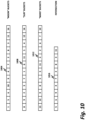
- the sorted containers may then be bucketized across the range of distances. For example, in a universe of samples where the maximum distance from a given vantage point is 1200, samples may be sorted into buckets of distance, such as less than or equal to 200, 200 400, 400 to 900, and 900 to 1200.
- the distance from the sample to the vantage points can be measured, and the new sample can be assigned to an appropriate bucket for each vantage point.
- the assigned per-vantage buckets are used for further analysis of the sample.
- adjacent buckets may also be captured. For example, if the bucket that the sample belongs to is bucket N, then buckets N-1 and N+1 may also be captured.
- three buckets are captured for each vantage point, for a total of nine buckets.
- the buckets from each vantage point are consolidated into a single meta-bucket.
- An intersection sample set may then be computed, comprising only samples that appear in all three meta-buckets.
- This intersection data set may then be sorted into a sorted container, using the new unknown sample as a vantage point.
- a laser cutting method similar to the one used in the micro-clustering algorithm, may be applied to cut off this sample space at the first sample greater than a threshold MAX_DIST from the new unknown sample.
- This provides a reduced target bucket, which can then be used to characterize the new sample. For example, if the target bucket includes exclusively malware samples, or mostly malware samples, then the new sample may also be treated as malware, at least as a preliminary classification until more detailed analysis is performed.
- This method provides advantages over more complex algorithms like DBSCAN and K-Means, which may not scale well when dealing with millions or billions of samples.
- This method may also provide advantages where existing clustering algorithms lack precision.
- Existing algorithms may perform provide some trade-offs between precision and speed.
- K-Means is optimized for speed at the expense of precision.
- DBSCAN is optimized for precision at the expense of scalability.
- binary tree implementations are precise, these often operate in the domain of probabilistic data structures, so that not all neighbors may be found through the traversal of the trees.
- the present method may also provide advantages over algorithms that are difficult to fine tune.
- Existing clustering algorithms may require the configuration of several parameters that are defined via trial and error. These parameters may change when underlying data change. Thus, a specified number of clusters or a maximum distance or number of samples per cluster may be highly data dependent. These parameters may require maintenance when the universe of samples changes. And in the particular case of malware detection, the universe of samples changes very often.
- the present specification may also provide enhanced maintainability over clustering algorithms that assume a static universe of the sample space.
- some existing clustering algorithms require re-computation of the entire data set. This is computationally expensive and inefficient.
- such algorithms may have difficulty updating the universe of samples on demand without re-computing the clusters.
- the present specification may provide scalability that in some cases performs as well as a brute force approach, without requiring as much fine tuning. While it may be desirable to specify a number of buckets, even this parameter may be automatically discovered in software. Underlying structure can be updated (such as adding or removing elements) on the fly without requiring a full re-clustering operation.
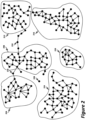
- Outlier 228 is not similar enough to any other sample to cluster, regardless of the value of minPTS. Thus, clusters are not predictive of the properties of outlier 228.
- a security services vendor receives new samples that have been found in the wild, such as a batch of new PEs. These PEs have not yet been characterized, and so they have not yet been assigned reputations. Detailed static analysis, dynamic analysis, and/or sandbox analysis may yield a high-confidence prediction of whether the new objects are safe (green), suspicious (yellow), or malicious (red). However, performing analysis of all the new objects takes time and compute resources, sometimes significantly (e.g., the analysis may take hours or days, depending on the nature of the samples and the number of samples). To provide a medium-confidence intermediate reputation for the new objects, the security services vendor may cluster them in an object space as illustrated.
- FIGURE 3a - 3f are a block diagram illustration of selected elements of a micro-clustering method.
- the system selects a vantage sample 304, referred to here as the "Moon" vantage point.
- the name Moon here is provided to illustrate that it may be desirable that the moon sample is not itself close to any of the samples in the sample universe.
- the system may compute the distance from the center of mass of the moon to each person. As there have been no humans on the moon for several decades, each person enumerated is expected to be far from the moon.
- the feature vector hash for the Moon vantage sample is selected as a string of identical characters, such as hexadecimal F, (the last hexadecimal digit), hexadecimal 7 (the median hexadecimal digit), or hexadecimal 0 or 1 (low hexadecimal digits).
- hexadecimal F the last hexadecimal digit
- hexadecimal 7 the median hexadecimal digit
- hexadecimal 0 or 1 low hexadecimal digits
- the system may compute the distance from vantage sample 304 to each individual sample. This yields a scalar value that can be easily compared.
- the samples may then be sorted according to their distance to the Moon vantage sample 304, forming first pass sorted container 308-1. For example, sample S1 is the closest sample to vantage sample 304, while sample S 12 is the furthest from vantage sample 304.
- the other samples are ordered according to their distance from the moon vantage sample 304.
- a maximum distance of 50 is commonly considered “close.”
- the distance between S1 and S5 is 14, the distance between S5 and S6 is 3, the distance between S6 and S10 is 22. All of these fall within the minimum clustering distance, and so S1, S5, S6, and S10 form a micro-cluster 316-1.
- the distance between S10 and S9 is 78, which is greater than the threshold.
- micro-cluster 316-2 The system then continues scanning the sorted container to identify additional micro-clusters such as micro-cluster 316-2.
- the new vantage sample is a median sample 320-1, or in other words, the sample in the middle of the new sorted container once the micro-clustered samples have been removed. In this case, sample eight will be the median sample once the samples of micro-clusters 316-1 and 316-2 are removed.
- a second pass is performed using median sample 320-1 as the new vantage sample, to create second pass sorted container 308-2. Because median sample 320-1 is different from vantage sample 304, the next pass will yield different results.
- the samples are sorted according to their distance from median sample 320-1, and the system then scans adjacent samples to identify samples that are closer to one another than the threshold.
- a new micro-cluster 316-3 is identified within second pass sorted container 308-2.
- Micro-cluster 316-3 can then be removed from second pass sorted container 308-2 to form yet another new sorted container.
- the median sample of samples left after removing micro-cluster 316-3 is sample 12, identified here as median 320-2.
- third pass vantage sorting is illustrated.
- median sample 320-2 is used as the vantage point.
- the distance between each remaining sample and median sample 320-2 is computed, and the results are sorted and stored in third pass sorted container 308-3. Adjacent samples are then checked for proximity less than the threshold. In this case, a new micro-cluster 316-4 is identified. Micro-cluster 316-4 may then be removed from third pass sorted container 308-3, which now has only three samples left.
- some samples may remain unclustered. For example, after a number of iterations, there may be a iteration where no new samples are formed. Once the system reaches an iteration where no new micro-clusters are formed, then the method may terminate. Furthermore, after a number of passes, there may be diminishing returns in the micro-clustering algorithm. Thus a variable MAX_PASSES may be defined, and iterations continue until either no new micro-clusters are formed, or until MAX_PASSES is reached. At that point, unclustered samples 340 simply remained unclustered.
- DBSCAN While more complex algorithms such as DBSCAN attempt to cluster every sample into a cluster, the method of the present specification need not be concerned with unclustered samples.
- One purpose of the method is to define smaller micro-clusters that can be used to create meaningful signatures for identifying objects that would cluster with these micro-clusters.
- a DBSCAN cluster that has 100 objects may be reduced to a set of three micro-clusters that have 30 objects each. In this case, some outliers will be left unclustered.
- the micro-clustering algorithm may yield more clusters, and thus provide more signatures, while the signatures that are provided may be more useful and practical. Furthermore, the exclusion of certain points that do not cluster may not be problematic, because the signature of clusters that do form is still a useful tool for identifying malicious objects in the wild.
- This method may not, and may not be intended to, form perfect clusters, in the sense that it will form clusters that are smaller than necessary.
- micro-cluster 316-1 might theoretically have incorporated sample 12 using a different clustering algorithm.
- sample 12 never had a chance to be sorted into cluster 316-1, because cluster 316-1 closed out immediately in the first pass, which removed the theoretical possibility of including sample 12 in a later pass.
- the intent of this method is not necessarily to produce the largest possible cluster, but to produce micro-clusters that are precise enough to be used for signature authoring, or other purpose for which two smaller clusters may serve just as well as (or better than) one large cluster.
- FIGURE 4 is a graph illustrating a visual plot of micro-clustering valleys.
- valley 404-1 forms a cluster. These valleys are surrounded by objects that have large distances from one another, while the valleys represent groups of objects that are very near one another. Thus visually, these valleys represent the micro-clusters.
- FIGURE 5 is a flowchart of selected elements of a method 500 of performing micro-clustering.
- Method 500 may be carried out on any suitable hardware platform, such as hardware platform 6 illustrated below, or any other computing architecture. Furthermore, aspects of method 500 may be virtualized as in FIGURE 7 below, or containerized as in FIGURE 8 .
- the system selects a "Moon" vantage point.
- the Moon vantage point is intended to be a point that is dissimilar from all points in the unsorted set of objects in a sample universe.
- Meta-block 510 represents operations that are repeated until MAX_PASSES has been reached, or until micro-clusters no longer form in a pass.
- MAX_PASSES may be on the order of 6 to 10 passes. In some cases, beyond that, diminishing returns are experience.
- the system creates a sorted container including all objects in the sample universe.
- the system sorts each sample using an LSH-compliant value against the vantage point.
- the vantage point is the previously selected "moon" vantage point.
- the vantage point may be a vantage point selected from the remaining objects in the sorted container after a pass.
- Meta-block 515 represents a process that is iterated for each sorted container.
- the system selects a sample (N) and a sample (N-1), representing an adjacent sample.
- the system measures the distance between (N) and (N-1), such as according to an LSH-compliant distance measurement.
- sample (N-1) is added to the micro-cluster that (N) belongs to.
- the system increments N (N++) and control returns to block 516, where the next sample is checked.
- the system determines whether the current micro-cluster is greater than a threshold of minimum samples for a micro-cluster. This is to ensure that micro-clusters are not formed with too few samples (e.g., with two or only a few samples, depending on the design constraints). If the micro-cluster is too small, then in block 512 the system resets the micro-cluster, meaning that the objects that were clustered into that micro-cluster remain unclustered for this pass. N is then incremented (N++), and control returns to block 516.
- the system saves the formed micro-cluster and marks the clustered samples for removal.
- the system removes from the sorted container all samples that were marked for removal (i.e., samples that were clustered in that pass).
- the system selects a new vantage point for the next pass through meta-block 510.
- this may be the median sample in the remaining sample set after clustered samples have been removed.
- control returns to block 508, and another pass is performed on the newly sorted container.
- the system may act on the micro-clusters. For example, an automated system, or a human user may examine the samples and craft a signature that reads on all samples in a micro-cluster. One signature may be crafted per micro-cluster, and these signatures can then be provided to antivirus or other detection software on client machines. These signatures can be used to beneficially identify malicious software that may be encountered in the wild.
- the signatures may be broader than a simple hash of an object, which will only catch identical objects. Signatures are useful because without signatures, malware authors can simply change a few bytes within a file to pass malware scans. But with strong signature matching, it is much more difficult for malware authors to change their products without losing functionality.
- the system may provide more beneficial and targeted malware detection.
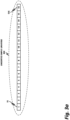
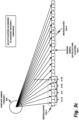
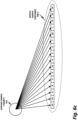
- FIGURES 6a - 8 illustrate selected elements of a first stage of a targeted clustering algorithm.
- This method may begin with a universe of samples represented by an LSH-compliant scheme. The method begins by defining one or more vantage points.
- FIGURE 6a illustrates vantage sample Moon 604.
- FIGURE 6b illustrates vantage sample Sun 612.
- FIGURE 6c illustrates vantage sample Mars 616.
- the vantage samples may be selected with each character being a same digit, a pattern, a random value, or some other sequence that is unlikely to occur in a real-world sample, and thus is expected to be a substantial distance from real-world samples.
Landscapes
- Engineering & Computer Science (AREA)
- Databases & Information Systems (AREA)
- Theoretical Computer Science (AREA)
- Data Mining & Analysis (AREA)
- Physics & Mathematics (AREA)
- General Engineering & Computer Science (AREA)
- General Physics & Mathematics (AREA)
- Information Retrieval, Db Structures And Fs Structures Therefor (AREA)
Applications Claiming Priority (1)
| Application Number | Priority Date | Filing Date | Title |
|---|---|---|---|
| US18/401,180 US20240311174A1 (en) | 2023-03-17 | 2023-12-29 | Targeted clustering system and method |
Publications (1)
| Publication Number | Publication Date |
|---|---|
| EP4579480A1 true EP4579480A1 (de) | 2025-07-02 |
Family
ID=90365620
Family Applications (1)
| Application Number | Title | Priority Date | Filing Date |
|---|---|---|---|
| EP24163447.6A Pending EP4579480A1 (de) | 2023-12-29 | 2024-03-14 | System und verfahren für gezielte clusterung |
Country Status (1)
| Country | Link |
|---|---|
| EP (1) | EP4579480A1 (de) |
-
2024
- 2024-03-14 EP EP24163447.6A patent/EP4579480A1/de active Pending
Non-Patent Citations (1)
| Title |
|---|
| UNO TAKEAKI ET AL: "Micro-Clustering: Finding Small Clusters in Large Diversity", ARXIV.ORG, 11 June 2015 (2015-06-11), pages 1 - 24, XP093194345, Retrieved from the Internet <URL:https://arxiv.org/pdf/1507.03067> [retrieved on 20240812], DOI: 10.48550/arxiv.1507.03067 * |
Similar Documents
| Publication | Publication Date | Title |
|---|---|---|
| US12518013B2 (en) | Analysis of malware | |
| EP4038526B1 (de) | Analyse der priorität von objekten aus querschnittsvarianz | |
| US11089038B2 (en) | Safe sharing of sensitive data | |
| US11443035B2 (en) | Behavioral user security policy | |
| US11461468B2 (en) | Visual identification of malware | |
| US11675901B2 (en) | Malware detection from operating system event tracing | |
| US12231443B2 (en) | Analysis of endpoint detect and response data | |
| US20200050761A1 (en) | Detection and mitigation of fileless security threats | |
| US11531933B2 (en) | Explainability of an unsupervised learning algorithm outcome | |
| US12164634B2 (en) | Object inspection via operating system share function | |
| US11463440B2 (en) | Cloud-based shared security cache | |
| EP4503517A1 (de) | Zustandsbehaftete clustering-verfahren | |
| US20240422129A1 (en) | Website classification via containment queries | |
| US20230171267A1 (en) | Selective security scan to reduce signature candidates | |
| US20240045928A1 (en) | Cluster-based machine learning model validation | |
| US12425425B2 (en) | User-sourced object reputations | |
| WO2022093747A1 (en) | Contextual data security | |
| EP4579480A1 (de) | System und verfahren für gezielte clusterung | |
| US20240311174A1 (en) | Targeted clustering system and method | |
| US20220200941A1 (en) | Reputation Clusters for Uniform Resource Locators |
Legal Events
| Date | Code | Title | Description |
|---|---|---|---|
| PUAI | Public reference made under article 153(3) epc to a published international application that has entered the european phase |
Free format text: ORIGINAL CODE: 0009012 |
|
| STAA | Information on the status of an ep patent application or granted ep patent |
Free format text: STATUS: THE APPLICATION HAS BEEN PUBLISHED |
|
| AK | Designated contracting states |
Kind code of ref document: A1 Designated state(s): AL AT BE BG CH CY CZ DE DK EE ES FI FR GB GR HR HU IE IS IT LI LT LU LV MC ME MK MT NL NO PL PT RO RS SE SI SK SM TR |
|
| STAA | Information on the status of an ep patent application or granted ep patent |
Free format text: STATUS: THE APPLICATION IS DEEMED TO BE WITHDRAWN |