EP4579477A1 - Verteiltes grafikdatenverarbeitungssystem, verfahren, vorrichtung und vorrichtung sowie speichermedium - Google Patents
Verteiltes grafikdatenverarbeitungssystem, verfahren, vorrichtung und vorrichtung sowie speichermedium Download PDFInfo
- Publication number
- EP4579477A1 EP4579477A1 EP23856466.0A EP23856466A EP4579477A1 EP 4579477 A1 EP4579477 A1 EP 4579477A1 EP 23856466 A EP23856466 A EP 23856466A EP 4579477 A1 EP4579477 A1 EP 4579477A1
- Authority
- EP
- European Patent Office
- Prior art keywords
- graph data
- data processing
- graph
- data blocks
- intermediate state
- Prior art date
- Legal status (The legal status is an assumption and is not a legal conclusion. Google has not performed a legal analysis and makes no representation as to the accuracy of the status listed.)
- Pending
Links
Images


Classifications
-
- G—PHYSICS
- G06—COMPUTING OR CALCULATING; COUNTING
- G06F—ELECTRIC DIGITAL DATA PROCESSING
- G06F16/00—Information retrieval; Database structures therefor; File system structures therefor
- G06F16/20—Information retrieval; Database structures therefor; File system structures therefor of structured data, e.g. relational data
- G06F16/22—Indexing; Data structures therefor; Storage structures
-
- G—PHYSICS
- G06—COMPUTING OR CALCULATING; COUNTING
- G06F—ELECTRIC DIGITAL DATA PROCESSING
- G06F16/00—Information retrieval; Database structures therefor; File system structures therefor
- G06F16/90—Details of database functions independent of the retrieved data types
- G06F16/901—Indexing; Data structures therefor; Storage structures
- G06F16/9024—Graphs; Linked lists
-
- G—PHYSICS
- G06—COMPUTING OR CALCULATING; COUNTING
- G06F—ELECTRIC DIGITAL DATA PROCESSING
- G06F9/00—Arrangements for program control, e.g. control units
- G06F9/06—Arrangements for program control, e.g. control units using stored programs, i.e. using an internal store of processing equipment to receive or retain programs
- G06F9/46—Multiprogramming arrangements
- G06F9/50—Allocation of resources, e.g. of the central processing unit [CPU]
- G06F9/5005—Allocation of resources, e.g. of the central processing unit [CPU] to service a request
- G06F9/5011—Allocation of resources, e.g. of the central processing unit [CPU] to service a request the resources being hardware resources other than CPUs, Servers and Terminals
- G06F9/5016—Allocation of resources, e.g. of the central processing unit [CPU] to service a request the resources being hardware resources other than CPUs, Servers and Terminals the resource being the memory
-
- G—PHYSICS
- G06—COMPUTING OR CALCULATING; COUNTING
- G06F—ELECTRIC DIGITAL DATA PROCESSING
- G06F16/00—Information retrieval; Database structures therefor; File system structures therefor
- G06F16/20—Information retrieval; Database structures therefor; File system structures therefor of structured data, e.g. relational data
- G06F16/24—Querying
- G06F16/245—Query processing
- G06F16/2458—Special types of queries, e.g. statistical queries, fuzzy queries or distributed queries
- G06F16/2465—Query processing support for facilitating data mining operations in structured databases
-
- G—PHYSICS
- G06—COMPUTING OR CALCULATING; COUNTING
- G06F—ELECTRIC DIGITAL DATA PROCESSING
- G06F16/00—Information retrieval; Database structures therefor; File system structures therefor
- G06F16/20—Information retrieval; Database structures therefor; File system structures therefor of structured data, e.g. relational data
- G06F16/27—Replication, distribution or synchronisation of data between databases or within a distributed database system; Distributed database system architectures therefor
-
- G—PHYSICS
- G06—COMPUTING OR CALCULATING; COUNTING
- G06F—ELECTRIC DIGITAL DATA PROCESSING
- G06F18/00—Pattern recognition
- G06F18/20—Analysing
- G06F18/29—Graphical models, e.g. Bayesian networks
-
- G—PHYSICS
- G06—COMPUTING OR CALCULATING; COUNTING
- G06F—ELECTRIC DIGITAL DATA PROCESSING
- G06F9/00—Arrangements for program control, e.g. control units
- G06F9/06—Arrangements for program control, e.g. control units using stored programs, i.e. using an internal store of processing equipment to receive or retain programs
- G06F9/46—Multiprogramming arrangements
- G06F9/50—Allocation of resources, e.g. of the central processing unit [CPU]
- G06F9/5061—Partitioning or combining of resources
- G06F9/5066—Algorithms for mapping a plurality of inter-dependent sub-tasks onto a plurality of physical CPUs
-
- G—PHYSICS
- G06—COMPUTING OR CALCULATING; COUNTING
- G06N—COMPUTING ARRANGEMENTS BASED ON SPECIFIC COMPUTATIONAL MODELS
- G06N5/00—Computing arrangements using knowledge-based models
- G06N5/02—Knowledge representation; Symbolic representation
- G06N5/022—Knowledge engineering; Knowledge acquisition
-
- G—PHYSICS
- G06—COMPUTING OR CALCULATING; COUNTING
- G06F—ELECTRIC DIGITAL DATA PROCESSING
- G06F2209/00—Indexing scheme relating to G06F9/00
- G06F2209/50—Indexing scheme relating to G06F9/50
- G06F2209/5017—Task decomposition
-
- G—PHYSICS
- G06—COMPUTING OR CALCULATING; COUNTING
- G06F—ELECTRIC DIGITAL DATA PROCESSING
- G06F2216/00—Indexing scheme relating to additional aspects of information retrieval not explicitly covered by G06F16/00 and subgroups
- G06F2216/03—Data mining
Definitions
- the present disclosure relates to the field of data processing, and in particular, to a distributed graph data processing system and method, an apparatus, a device, and a storage medium.
- the graph data has a large amount of data and high requirements on storage resources, it is necessary to store and manage the graph data during a process of performing graph processing tasks such as graph computing and graph mining based on the distributed graph data processing system.
- the present disclosure provides a distributed graph data processing system.
- the method comprises: a computing node in a distributed architecture, wherein the computing node comprises a computing unit and a persistent storage unit that are in a corresponding relationship, and a storage manager is deployed in the computing unit; the computing unit is configured to receive an assigned graph data processing task, and obtain a graph data slice corresponding to the graph data processing task, and store the graph data slice in a corresponding graph data adjacency list; the storage manager is configured to divide the graph data adjacency list corresponding to the graph data processing task into graph data blocks, determine a key value corresponding to each of the graph data blocks, and record and store a corresponding relationship between key values of the graph data blocks and storage location information of the graph data blocks, wherein the graph data blocks comprise node data and edge data in the graph data adjacency list, and the storage location information of the graph data blocks is configured to obtain the graph data blocks; and the persistent storage unit is configured to persistently store the graph data blocks based on the storage location information,
- the present disclosure provides a distributed graph data processing method.
- the method comprises: receiving a graph data processing task through a computing node in a distributed architecture, and obtaining a graph data slice corresponding to the graph data processing task, and storing the graph data slice in a corresponding graph data adjacency list; controlling a computing unit in the computing node to call a storage manager to divide the graph data adjacency list corresponding to the graph data processing task into graph data blocks, wherein the graph data blocks comprise node data and edge data in the graph data adjacency list, determining a key value corresponding to each of the graph data blocks, and recording and storing a corresponding relationship between key values of the graph data blocks and storage location information of the graph data blocks, wherein the storage location information of the graph data blocks is configured to obtain the graph data blocks; storing the graph data blocks in a persistent storage unit based on the storage location information; and controlling the computing unit in the computing node to read, from the persistent storage unit based on the corresponding relationship between the key values of the
- the present disclosure provides a distributed graph data processing apparatus.
- the apparatus comprises: a first obtaining module, configured to receive a graph data processing task through a computing node in a distributed architecture, and obtain a graph data slice corresponding to the graph data processing task, and store the graph data slice in a corresponding graph data adjacency list; a first storage module, configured to control a computing unit in the computing node to call a storage manager to divide the graph data adjacency list corresponding to the graph data processing task into graph data blocks, wherein the graph data blocks comprise node data and edge data in the graph data adjacency list, determining a key value corresponding to each of the graph data blocks, and recording and storing a corresponding relationship between key values of the graph data blocks and storage location information of the graph data blocks, wherein the storage location information of the graph data blocks is configured to obtain the graph data blocks; a second storage module, configured to store the graph data blocks in a persistent storage unit based on the storage location information; and a graph data processing module, configured
- the present disclosure provides a computer-readable storage medium storing instructions, wherein when the instructions are run on a terminal device, the terminal device is enabled to implement the above method.
- the present disclosure provides a data processing device, comprising: a memory, a processor, and a computer program stored on the memory and executable on the processor, wherein when the processor executes the computer program, the above method is implemented.
- the present disclosure provides a computer program product, wherein the computer program product comprises a computer program/instruction, and when the computer program/instruction is executed by a processor, the above method is implemented.
- FIG. 1 is a schematic diagram of a structure of a distributed graph data processing system according to some embodiments of the present disclosure.
- the distributed graph data processing system 10 comprises computing nodes in a distributed architecture.
- the computing nodes comprise a computing node 101, a computing node 102, and a computing node 103, which respectively belong to computing nodes in a distributed architecture.
- Each computing node comprises a computing unit and a persistent storage unit in a corresponding relationship, and a storage manager is deployed in each computing unit.
- the computing node 101 comprises a computing unit 1011 and a persistent storage unit 1012, and a storage manager 1013 is deployed in the computing unit 1011.
- the computing unit is configured to receive an assigned graph data processing task, and obtain a graph data slice corresponding to the graph data processing task, and store the graph data slice in a corresponding graph data adjacency list.
- an elastic engine 100 is deployed in the distributed graph data processing system 10, and is configured to receive a graph data processing task issued by a user, and allocate computing resources, storage resources, and the like based on a load of the graph data processing task. After a computing node comprising a computing unit and a persistent storage unit is allocated to the graph data processing task, the graph data processing task is performed based on the allocated computing node.
- the computing unit in each computing node After receiving the assigned graph data processing task, the computing unit first obtains, from a remote file system, a graph data slice corresponding to the graph data processing task.
- the remote file system 110 shown in FIG. 1 is configured to store original graph data corresponding to the graph data processing task in a file format.
- the computing unit after obtaining the graph data slice corresponding to the graph data processing task from the remote file system, stores the graph data slice in the corresponding graph data adjacency list.
- the graph data processing task in some embodiments of the present disclosure may be a graph computing task, a graph mining task, or the like.
- the graph computing task may comprise an iterative graph computing task based on a Think Like A Vertex (TLAV) programming paradigm, for example, related graph computing tasks such as a PageRank algorithm and a community detection algorithm.
- TLAV Think Like A Vertex
- the graph mining task refers to a process of discovering information that a user is interested in from graph data such as a social network and a deep web.
- a graph mining result (such as a triangle, a frequent subgraph, and a graph pattern) may be directly used for graph data analysis, or may be indirectly used for another task related to graph data. Therefore, graph mining is widely and practically applied to scenarios in science and business.
- Both the graph computing task and the graph mining task are performed based on graph data stored in a graph data adjacency list.
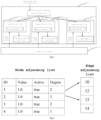
- the graph data in the graph data adjacency list comprises node data and edge data.
- the graph data adjacency list comprises a node adjacency list "Vertex table” and an edge adjacency list "Edge table”.
- the node data is stored based on the node adjacency list "Vertex table”
- the edge data is stored by using the edge adjacency list "Edge table” to store edges of each node in a consecutive manner and to retain an order of nodes in the node adjacency list.
- a simple shared-nothing design is used.
- a node adjacency list is partitioned in a distributed cluster, and each partition is associated with a corresponding edge.
- a system user is allowed to rewrite a graph partitioner, and partition graph data based on a node or an edge of the graph data, to implement division of graph data blocks.
- FIG. 2 is a schematic diagram of a node adjacency list and an edge adjacency list.
- the storage manager is configured to divide the graph data adjacency list corresponding to the graph data processing task into graph data blocks, determine a key value corresponding to each of the graph data blocks, and record and store a corresponding relationship between key values of the graph data blocks and storage location information of the graph data blocks, wherein the graph data blocks comprise node data and edge data in the graph data adjacency list, and the storage location information of the graph data blocks is configured to obtain the graph data blocks.
- the storage manager calculates, based on a preset rule, a key value "key” corresponding to each of the graph data blocks, and the computing unit stores each of the graph data blocks in the persistent storage unit, to implement graph data storage based on the "key".
- the preset rule may be a key value generation rule based on a hash function or the like.
- the storage manager After calculating the corresponding key for each of the graph data blocks, the storage manager records and stores the corresponding relationship between the keys of the graph data blocks and the storage location information of the graph data blocks, so that the graph data blocks can be subsequently read from the persistent storage unit based on the key.
- the persistent storage unit is configured to persistently store the graph data blocks based on the storage location information, to support the computing unit corresponding to the persistent storage unit to perform the graph data processing task.
- the persistent storage unit may be implemented by using a hierarchical structure of a memory and a persistent storage medium (such as an Optane persistent memory (PMEM)), or may be implemented by using a hierarchical structure of a memory, a persistent storage medium, and a hard disk.
- the persistent storage unit is specifically configured to store the graph data blocks in a corresponding storage layer based on a descending order of priorities of three storage layers: the memory, the persistent storage medium, and the hard disk.
- the hard disk may be a solid state drive (SSD) or the like.
- different storage media may be used for storage.
- the graph data when the order of magnitude of the graph data is relatively small, the graph data may be preferentially stored in a memory, to achieve better efficiency of data reading; for medium-sized graph data, most data may be stored in a persistent memory PMEM, and the PMEM has an advantage of a large capacity and performance close to that of the memory, so that a storage requirement of a slightly larger order of graph data can be ensured; and for relatively large-sized graph data, a hard disk (such as an SSD) with a large capacity may be used for storage, and the relatively large-sized graph data is stored in the hard disk through continuous but not too frequent data overflow.
- a hard disk such as an SSD
- the persistent storage unit may be designed based on mixed storage of a memory (which may also be referred to as a main memory, for example, a DRAM), a persistent storage medium (for example, a PMEM), and a hard disk (for example, an SSD).
- a main memory for example, a DRAM
- a persistent storage medium for example, a PMEM
- a hard disk for example, an SSD
- the main memory has an advantage of a fast access speed
- the persistent storage unit preferentially provides the main memory.
- the access speed of the persistent storage medium PMEM is faster than that of the hard disk. Therefore, when the main memory is occupied, the persistent storage unit preferentially provides the persistent storage medium such as the PMEM, and when the PMEM is occupied, the persistent storage unit provides the hard disk (for example, the SSD), to implement the persistent storage unit of hierarchical storage.
- the DRAM is configured to store metadata, for example, a storage index of a graph data block stored in the PMEM layer and the SSD layer, respectively. If not specified, the graph data blocks may be first written into the DRAM layer, and then asynchronously written into the PMEM layer. If idle resources of the PMEM layer are insufficient, the graph data blocks may be flushed from the PMEM layer to the SSD layer, and stored in the SSD layer.
- metadata for example, a storage index of a graph data block stored in the PMEM layer and the SSD layer, respectively.
- the persistent storage unit 102 may be designed based on mixed storage of a memory and a persistent storage medium. Because the persistent storage medium such as the PMEM can ensure both the access speed and a storage space much larger than that of the memory, the above implementation can also ensure both the access speed of the storage space and a large enough storage space.
- the computing unit is further configured to read, from the persistent storage unit based on the corresponding relationship between key values of the graph data blocks and the storage location information of the graph data blocks that is stored in the storage manager, graph data blocks corresponding to the graph data processing task for graph data processing.
- the computing unit reads, through the storage manager, required graph data from the persistent storage unit, to perform the graph data processing task.
- the storage manager generates a key based on a graph data reading request of the computing unit, determines storage location information corresponding to the key, and then reads, from the persistent storage unit based on the computing unit, a corresponding graph data block, to obtain the required graph data.
- the computing unit may comprise a first computing unit and/or a second computing unit.
- the first computing unit is configured to perform a graph computing task
- the second computing unit is configured to perform a graph mining task.
- the distributed graph data processing system unifies two programming paradigms, graph computing and graph mining, into the same graph data processing system, that is, the distributed graph data processing system 10 can process both the graph computing task and the graph mining task.
- graph computing and graph mining engines are different in an underlying computing mode
- the distributed graph data processing system in some embodiments of the present disclosure provides a unified interface, so that they are consistent externally, for example, consistent with a high-level SDK and a low-level component (such as hierarchical storage and a graph data index) for developers.
- the distributed graph data processing system comprises computing nodes in a distributed architecture.
- Each computing node comprises a computing unit and a persistent storage unit in a corresponding relationship, and a storage manager is deployed in each computing unit.
- the computing unit receives a graph data processing task and obtains a graph data slice corresponding to the graph data processing task, the computing unit stores the graph data slice in a corresponding graph data adjacency list.
- the storage manager deployed in the computing unit divides the graph data adjacency list into graph data blocks, and determines a key value corresponding to each of the graph data blocks, and records and stores a corresponding relationship between the key values and storage location information of the graph data blocks.
- the computing unit may read the graph data blocks from the persistent storage unit based on the corresponding relationship between key values of the graph data blocks and the storage location information of the graph data blocks, to perform the graph data processing task.
- the graph data is stored in the persistent storage unit by using the storage manager. Because the persistent storage unit is used as an external storage device and can meet a storage requirement of a large amount of graph data, and has a small impact on efficiency of graph data processing, the distributed graph data processing system provided in some embodiments of the present disclosure can meet a storage requirement of graph data processing on storage resources.
- the computing unit generates intermediate state data in a process of performing the graph data processing task.
- the intermediate state data corresponding to the graph data processing task may also be persistently stored.
- the storage manager is further configured to receive intermediate state data generated in an execution process of the graph data processing task, divide the intermediate state data into intermediate state data blocks, determine a key value corresponding to each intermediate state data block, and store a corresponding relationship between the key values and storage location information of the intermediate state data blocks, wherein the storage location information of the intermediate state data blocks is configured to obtain the intermediate state data blocks.
- the persistent storage unit is further configured to store the intermediate state data blocks based on the storage location information, to support the fault tolerance function of the distributed graph data processing system.
- the intermediate state data generated in the execution process of the graph data processing task may be stored in the persistent storage unit based on a hierarchical storage manner. Reference may be made to the foregoing embodiments for details.
- the graph data processing task is a graph computing task
- the intermediate state data corresponding to the graph data processing task comprises message data and intermediate state snapshot data.
- the intermediate state snapshot data comprises node snapshot data and message snapshot data.
- the intermediate state data corresponding to the graph data processing task may be obtained and stored at a preset frequency. For example, the intermediate state data is obtained once every 100 rounds of graph computing tasks are performed. Subsequently, when it is detected that an exception occurs in the distributed graph data processing system, rollback stop loss of the graph data processing task may be implemented based on the latest round of intermediate state data. In some embodiments, some embodiments of the present disclosure are not limited to an implementation of fault tolerance based on the intermediate state data.
- the graph data processing task is a graph mining task
- the intermediate state data corresponding to the graph data processing task comprises a currently grown hierarchy in a search tree corresponding to the graph data processing task and a current growth position in the currently grown hierarchy.
- FIG. 3 is a schematic diagram of a search tree for mining triangles based on graph data according to some embodiments of the present disclosure.
- a node at a first hierarchy is first determined, for example, a node corresponding to Level-1 shown in FIG. 3 .
- node growth is performed based on the node at the first hierarchy, to obtain a node at a second hierarchy, for example, a node corresponding to Level-2 shown in FIG. 3 .
- node growth is performed based on the node at the second hierarchy, to obtain a node at a third hierarchy, for example, a node corresponding to Level-3 shown in FIG. 3 .
- Whether the node at the third hierarchy meets a triangle condition is determined, to determine a result of the graph mining task.
- the intermediate state data comprises the currently grown hierarchy in the search tree corresponding to the graph data processing task and the current growth position in the currently grown hierarchy. It is assumed that the intermediate state data is recorded when the search tree grows to a growth position 301 at the second hierarchy. In this case, the currently grown hierarchy in the search tree comprised in the intermediate state data refers to the second hierarchy, and the current growth position in the currently grown hierarchy refers to the growth position 301. Because the growth position 301 is at the third growth position at the second hierarchy, the intermediate state data may be recorded as (Level-2; 3).
- FIG. 4 is a schematic diagram of a local architecture of a distributed graph data processing system according to some embodiments of the present disclosure.
- the storage manager comprises two important parts: a rule-based index manager and an index table.
- the rule-based index manager is configured to define an index type, and then combine the index type as a prefix with an index value to obtain an entire key value, to uniquely identify a graph data block or an intermediate state data block.
- the index table may be implemented by using a concurrent hash table, and is configured to store a corresponding relationship between the key values and a storage address of the graph data blocks/intermediate state data blocks.
- the distributed graph data processing method provided in some embodiments of the present disclosure may be applied to a computing unit in a distributed graph data processing system.
- the computing unit is connected to a persistent storage unit.
- the method comprises: S501: receiving a graph data processing task through a computing node in a distributed architecture, and obtaining a graph data slice corresponding to the graph data processing task, and storing the graph data slice in a corresponding graph data adjacency list.
- the graph data adjacency list comprises the graph data slice corresponding to the graph data processing task, and the graph data blocks comprise node data and edge data in the graph data adjacency list.
- the computing unit in some embodiments of the present disclosure is deployed with the storage manager, and the storage manager divides the graph data adjacency list corresponding to the graph data processing task to obtain the graph data blocks.
- S502 Control a computing unit in the computing node to call a storage manager to divide the graph data adjacency list corresponding to the graph data processing task into graph data blocks, wherein the graph data blocks comprise node data and edge data in the graph data adjacency list, determine a key value corresponding to each of the graph data blocks, and record and store a corresponding relationship between key values of the graph data blocks and storage location information of the graph data blocks.
- the storage location information of the graph data blocks is configured to obtain the graph data blocks.
- a key value key corresponding to each of the graph data blocks is determined.
- the key corresponding to each of the graph data blocks is a combination of a prefix and a graph data block ID.
- the prefix may be an index type, and the index type may be determined based on a data type stored in the graph data blocks. For example, an index type corresponding to node data is kVertex, and an index type corresponding to edge data may be kEdge.
- the graph data blocks ID is added after the prefix, to determine different graph data blocks of a same index type.
- operations such as reading of the graph data blocks of the same index type may be performed, which improves efficiency of graph data reading.
- the corresponding relationship between key values of the graph data blocks and the storage location information of the graph data blocks may be persistently stored. Based on the corresponding relationship, the storage location information corresponding to the graph data blocks may be determined through key values of the graph data blocks, and then graph data in the graph data blocks is read based on the storage location information.
- a key value may be generated for each of the graph data blocks based on a hash function, to be used as a storage index of the graph data blocks.
- some embodiments of the present disclosure are not limited to other manners of generating the key value.
- S503 Store the graph data blocks in a persistent storage unit based on the storage location information.
- S504 Control the computing unit in the computing node to read, from the persistent storage unit based on the corresponding relationship between key values of the graph data blocks and the storage location information of the graph data blocks, graph data blocks corresponding to the graph data processing task for graph data processing.
- the storage unit for persistently storing the graph data blocks may be implemented based on a hierarchical structure.
- the hierarchical structure may use a memory, a persistent storage medium such as a PMEM, and a hard disk, or may use a memory and a persistent storage medium such as a PMEM, wherein a storage priority of the memory is higher than that of the persistent storage medium, and a storage priority of the persistent storage medium is higher than that of the hard disk.
- some embodiments of the present disclosure preferentially use the memory to store the graph data blocks based on the storage location information. In response to that idle resources in the memory are insufficient, the graph data blocks are stored by using the persistent storage medium.
- some embodiments of the present disclosure preferentially use the memory to store the graph data blocks based on the storage location information. In response to that idle resources in the memory are insufficient, the graph data blocks are stored by using the persistent storage medium. In response to that idle resources in the persistent storage medium are insufficient, the graph data blocks are stored by using the hard disk.
- the distributed graph data processing method provided in some embodiments of the present disclosure stores graph data in a persistent storage unit that can meet a storage requirement of a large amount of graph data, and has a small impact on efficiency of graph data processing. Therefore, the distributed graph data processing system provided in some embodiments of the present disclosure can meet a storage requirement of graph data processing on storage resources.
- some embodiments of the present disclosure may further perform persistent storage on intermediate state data generated in an execution process of the graph data processing task, so that the intermediate state data can be subsequently used for fault tolerance processing of the distributed graph data processing method.
- the computing unit in the computing node is controlled to call the storage manager to divide the intermediate state data generated in the execution process of the graph data processing task into intermediate state data blocks. Then, a key value corresponding to each of the intermediate state data blocks is determined, and a corresponding relationship between the key values and storage location information of the intermediate state data blocks is stored, wherein the storage location information of the intermediate state data blocks is configured to obtain the intermediate state data blocks. Further, the intermediate state data blocks are persistently stored based on the storage location information. For example, the intermediate state data block may be stored in a persistent memory PMEM in a form of a key value.
- some embodiments of the present disclosure may perform fault tolerance processing on the distributed graph data processing system based on the intermediate state data blocks in the persistent storage unit.
- the intermediate state data blocks are preferentially stored in the PMEM.
- the intermediate state data blocks are stored in the hard disk (such as an SSD), to implement hierarchical storage.
- the graph data processing task may be a graph computing task or a graph mining task.
- the graph data processing task is a graph computing task
- the intermediate state data corresponding to the graph data processing task comprises message data and intermediate state snapshot data.
- the intermediate state snapshot data comprises node snapshot data and message snapshot data.
- the message data refers to a message transmitted between a current computing node and another computing node in an execution process of the graph computing task, and is used for execution of the graph computing task of the current computing node.
- the intermediate state snapshot data refers to snapshot data obtained for node data and message data of a current round when every N rounds of graph computing tasks are performed, and is used for rollback stop loss of a fault tolerance function. N may be set based on requirements.
- the graph data processing task is a graph mining task
- the intermediate state data corresponding to the graph data processing task comprises a currently grown hierarchy in a search tree and a current growth position in the currently grown hierarchy.
- Execution of the graph mining task is a process of search tree growth.
- the computing unit obtains the currently grown hierarchy in the search tree and the current growth position in the currently grown hierarchy at a preset frequency, to implement rollback stop loss of the fault tolerance function.
- FIG. 6 is a schematic diagram of a structure of a distributed graph data processing apparatus according to some embodiments of the present disclosure.
- the apparatus comprises: a first obtaining module 601, configured to receive a graph data processing task through a computing node in a distributed architecture, and obtain a graph data slice corresponding to the graph data processing task, and store the graph data slice in a corresponding graph data adjacency list; a first storage module 602, configured to control a computing unit in the computing node to call a storage manager to divide the graph data adjacency list corresponding to the graph data processing task into graph data blocks, wherein the graph data blocks comprise node data and edge data in the graph data adjacency list, determining a key value corresponding to each of the graph data blocks, and recording and storing a corresponding relationship between key values of the graph data blocks and storage location information of the graph data blocks, wherein the storage location information of the graph data blocks is configured to obtain the graph
- the apparatus further comprises: a dividing module, configured to control the computing unit in the computing node to call the storage manager to divide intermediate state data generated in an execution process of the graph data processing task into intermediate state data blocks; a third storage module, configured to determine a key value corresponding to each intermediate state data block, and record and store a corresponding relationship between the key values and storage location information of the intermediate state data blocks, wherein the storage location information of the intermediate state data blocks is configured to obtain the intermediate state data blocks; and a fourth storage module, configured to store the intermediate state data blocks in the persistent storage unit based on the storage location information.
- a dividing module configured to control the computing unit in the computing node to call the storage manager to divide intermediate state data generated in an execution process of the graph data processing task into intermediate state data blocks
- a third storage module configured to determine a key value corresponding to each intermediate state data block, and record and store a corresponding relationship between the key values and storage location information of the intermediate state data blocks, wherein the storage location information of the intermediate state data blocks is configured to obtain the intermediate
- the graph data processing task is a graph mining task
- the intermediate state data corresponding to the graph data processing task comprises a currently grown hierarchy in a search tree corresponding to the graph data processing task and a current growth position in the currently grown hierarchy.
- the second storage module comprises: a first storage submodule, configured to preferentially use a memory to store the graph data blocks based on the storage location information after receiving the graph data blocks; a second storage submodule, configured to use a persistent storage medium to store the graph data blocks in response to that idle resources in the memory are insufficient; and a third storage submodule, configured to use a hard disk to store the graph data blocks in response to that idle resources in the persistent storage medium are insufficient.
- the second storage module comprises: a fourth storage submodule, configured to preferentially use a memory to store the graph data blocks based on the storage location information after receiving the graph data blocks; and a fifth storage submodule, configured to use a persistent storage medium to store the graph data blocks in response to that idle resources in the memory are insufficient.
Landscapes
- Engineering & Computer Science (AREA)
- Theoretical Computer Science (AREA)
- General Engineering & Computer Science (AREA)
- Physics & Mathematics (AREA)
- Software Systems (AREA)
- General Physics & Mathematics (AREA)
- Databases & Information Systems (AREA)
- Data Mining & Analysis (AREA)
- Evolutionary Computation (AREA)
- Mathematical Physics (AREA)
- Computing Systems (AREA)
- Computational Linguistics (AREA)
- Artificial Intelligence (AREA)
- Life Sciences & Earth Sciences (AREA)
- Bioinformatics & Cheminformatics (AREA)
- Bioinformatics & Computational Biology (AREA)
- Computer Vision & Pattern Recognition (AREA)
- Evolutionary Biology (AREA)
- Fuzzy Systems (AREA)
- Probability & Statistics with Applications (AREA)
- Information Retrieval, Db Structures And Fs Structures Therefor (AREA)
Applications Claiming Priority (2)
| Application Number | Priority Date | Filing Date | Title |
|---|---|---|---|
| CN202211010841.1A CN115391341A (zh) | 2022-08-23 | 2022-08-23 | 分布式图数据处理系统、方法、装置、设备及存储介质 |
| PCT/CN2023/111773 WO2024041376A1 (zh) | 2022-08-23 | 2023-08-08 | 分布式图数据处理系统、方法、装置、设备及存储介质 |
Publications (1)
| Publication Number | Publication Date |
|---|---|
| EP4579477A1 true EP4579477A1 (de) | 2025-07-02 |
Family
ID=84119769
Family Applications (1)
| Application Number | Title | Priority Date | Filing Date |
|---|---|---|---|
| EP23856466.0A Pending EP4579477A1 (de) | 2022-08-23 | 2023-08-08 | Verteiltes grafikdatenverarbeitungssystem, verfahren, vorrichtung und vorrichtung sowie speichermedium |
Country Status (4)
| Country | Link |
|---|---|
| US (1) | US20250284539A1 (de) |
| EP (1) | EP4579477A1 (de) |
| CN (1) | CN115391341A (de) |
| WO (1) | WO2024041376A1 (de) |
Families Citing this family (3)
| Publication number | Priority date | Publication date | Assignee | Title |
|---|---|---|---|---|
| CN115391341A (zh) * | 2022-08-23 | 2022-11-25 | 抖音视界有限公司 | 分布式图数据处理系统、方法、装置、设备及存储介质 |
| CN117349477A (zh) * | 2023-09-28 | 2024-01-05 | 电子科技大学 | 一种基于持久化内存的图数据异构分层存储结构及其方法 |
| CN118069432B (zh) * | 2024-04-19 | 2024-07-05 | 济南浪潮数据技术有限公司 | 分布式块存储卷快照回滚方法、装置、设备和存储介质 |
Family Cites Families (10)
| Publication number | Priority date | Publication date | Assignee | Title |
|---|---|---|---|---|
| CN103336808B (zh) * | 2013-06-25 | 2017-12-15 | 中国科学院信息工程研究所 | 一种基于bsp模型的实时图数据处理系统及方法 |
| CN103885856B (zh) * | 2014-03-10 | 2017-01-25 | 北京大学 | 一种基于消息再生机制的图计算容错方法及系统 |
| CN105426375B (zh) * | 2014-09-22 | 2019-01-18 | 阿里巴巴集团控股有限公司 | 一种关系网络的计算方法及装置 |
| CN106777351B (zh) * | 2017-01-17 | 2019-08-09 | 中国人民解放军国防科学技术大学 | 基于art树分布式系统图存储计算系统及其方法 |
| CN109522428B (zh) * | 2018-09-17 | 2020-11-24 | 华中科技大学 | 一种基于索引定位的图计算系统的外存访问方法 |
| CN110751275B (zh) * | 2019-08-03 | 2022-09-02 | 北京达佳互联信息技术有限公司 | 图训练系统、数据访问方法及装置、电子设备、存储介质 |
| CN110737659A (zh) * | 2019-09-06 | 2020-01-31 | 平安科技(深圳)有限公司 | 图数据存储和查询方法、装置及计算机可读存储介质 |
| CN111881326A (zh) * | 2020-07-24 | 2020-11-03 | 北京浪潮数据技术有限公司 | 一种图数据存储方法、装置、设备及可读存储介质 |
| CN114329096A (zh) * | 2022-03-03 | 2022-04-12 | 深圳市一号互联科技有限公司 | 一种原生图数据库处理方法及系统 |
| CN115391341A (zh) * | 2022-08-23 | 2022-11-25 | 抖音视界有限公司 | 分布式图数据处理系统、方法、装置、设备及存储介质 |
-
2022
- 2022-08-23 CN CN202211010841.1A patent/CN115391341A/zh active Pending
-
2023
- 2023-08-08 WO PCT/CN2023/111773 patent/WO2024041376A1/zh not_active Ceased
- 2023-08-08 EP EP23856466.0A patent/EP4579477A1/de active Pending
- 2023-08-08 US US18/860,603 patent/US20250284539A1/en active Pending
Also Published As
| Publication number | Publication date |
|---|---|
| CN115391341A (zh) | 2022-11-25 |
| WO2024041376A1 (zh) | 2024-02-29 |
| US20250284539A1 (en) | 2025-09-11 |
Similar Documents
| Publication | Publication Date | Title |
|---|---|---|
| EP4579477A1 (de) | Verteiltes grafikdatenverarbeitungssystem, verfahren, vorrichtung und vorrichtung sowie speichermedium | |
| US20200257450A1 (en) | Data hierarchical storage and hierarchical query method and apparatus | |
| US11099937B2 (en) | Implementing clone snapshots in a distributed storage system | |
| US7949839B2 (en) | Managing memory pages | |
| US20190213085A1 (en) | Implementing Fault Domain And Latency Requirements In A Virtualized Distributed Storage System | |
| US8356050B1 (en) | Method or system for spilling in query environments | |
| EP2645259B1 (de) | Verfahren, vorrichtung und system für die zwischenspeicherung von daten in einem mehrknotensystem | |
| CN101968755B (zh) | 一种自适应应用负载变化的快照生成方法 | |
| CN105469001B (zh) | 磁盘数据保护方法及装置 | |
| US20240061712A1 (en) | Method, apparatus, and system for creating training task on ai training platform, and medium | |
| US12072868B1 (en) | Data retention management for partitioned datasets | |
| US8180838B2 (en) | Efficiently managing modular data storage systems | |
| US20250217032A1 (en) | Method and apparatus for recording cold/hot state of memory | |
| US10241716B2 (en) | Global occupancy aggregator for global garbage collection scheduling | |
| CN112835638A (zh) | 一种基于嵌入式应用程序的配置信息管理方法及装置 | |
| CN111930684A (zh) | 基于hdfs的小文件处理方法、装置、设备及存储介质 | |
| CN113485644B (zh) | 一种io数据存储方法和服务器 | |
| CN113687935A (zh) | 一种基于超融合设计的云原生存储调度方式 | |
| US20240086225A1 (en) | Container group scheduling methods and apparatuses | |
| US11748203B2 (en) | Multi-role application orchestration in a distributed storage system | |
| CN112307272B (zh) | 确定对象之间关系信息的方法、装置、计算设备及存储介质 | |
| CN116431336A (zh) | 一种页缓存限制方法、系统、电子设备及存储介质 | |
| CN117290160A (zh) | 数据库读写分离集群的备份方法、存储介质与设备 | |
| CN116610640A (zh) | 用于文件的操作方法、电子设备及存储介质 | |
| US20250193274A1 (en) | Event-based optimal faas connection method and device in a distributed edge cloud environment |
Legal Events
| Date | Code | Title | Description |
|---|---|---|---|
| STAA | Information on the status of an ep patent application or granted ep patent |
Free format text: STATUS: THE INTERNATIONAL PUBLICATION HAS BEEN MADE |
|
| PUAI | Public reference made under article 153(3) epc to a published international application that has entered the european phase |
Free format text: ORIGINAL CODE: 0009012 |
|
| STAA | Information on the status of an ep patent application or granted ep patent |
Free format text: STATUS: REQUEST FOR EXAMINATION WAS MADE |
|
| 17P | Request for examination filed |
Effective date: 20241010 |
|
| AK | Designated contracting states |
Kind code of ref document: A1 Designated state(s): AL AT BE BG CH CY CZ DE DK EE ES FI FR GB GR HR HU IE IS IT LI LT LU LV MC ME MK MT NL NO PL PT RO RS SE SI SK SM TR |
|
| DAV | Request for validation of the european patent (deleted) | ||
| DAX | Request for extension of the european patent (deleted) |