EP4578377A2 - Aktives miniaturisiertes messsystem und verfahren - Google Patents
Aktives miniaturisiertes messsystem und verfahren Download PDFInfo
- Publication number
- EP4578377A2 EP4578377A2 EP25158478.5A EP25158478A EP4578377A2 EP 4578377 A2 EP4578377 A2 EP 4578377A2 EP 25158478 A EP25158478 A EP 25158478A EP 4578377 A2 EP4578377 A2 EP 4578377A2
- Authority
- EP
- European Patent Office
- Prior art keywords
- radiation
- wavelength
- sensor
- wavelength range
- physiological parameter
- Prior art date
- Legal status (The legal status is an assumption and is not a legal conclusion. Google has not performed a legal analysis and makes no representation as to the accuracy of the status listed.)
- Pending
Links
Images









Classifications
-
- A—HUMAN NECESSITIES
- A61—MEDICAL OR VETERINARY SCIENCE; HYGIENE
- A61B—DIAGNOSIS; SURGERY; IDENTIFICATION
- A61B5/00—Measuring for diagnostic purposes; Identification of persons
- A61B5/145—Measuring characteristics of blood in vivo, e.g. gas concentration or pH-value ; Measuring characteristics of body fluids or tissues, e.g. interstitial fluid or cerebral tissue
- A61B5/14532—Measuring characteristics of blood in vivo, e.g. gas concentration or pH-value ; Measuring characteristics of body fluids or tissues, e.g. interstitial fluid or cerebral tissue for measuring glucose, e.g. by tissue impedance measurement
-
- A—HUMAN NECESSITIES
- A61—MEDICAL OR VETERINARY SCIENCE; HYGIENE
- A61B—DIAGNOSIS; SURGERY; IDENTIFICATION
- A61B5/00—Measuring for diagnostic purposes; Identification of persons
- A61B5/145—Measuring characteristics of blood in vivo, e.g. gas concentration or pH-value ; Measuring characteristics of body fluids or tissues, e.g. interstitial fluid or cerebral tissue
- A61B5/14546—Measuring characteristics of blood in vivo, e.g. gas concentration or pH-value ; Measuring characteristics of body fluids or tissues, e.g. interstitial fluid or cerebral tissue for measuring analytes not otherwise provided for, e.g. ions, cytochromes
-
- A—HUMAN NECESSITIES
- A61—MEDICAL OR VETERINARY SCIENCE; HYGIENE
- A61B—DIAGNOSIS; SURGERY; IDENTIFICATION
- A61B5/00—Measuring for diagnostic purposes; Identification of persons
- A61B5/145—Measuring characteristics of blood in vivo, e.g. gas concentration or pH-value ; Measuring characteristics of body fluids or tissues, e.g. interstitial fluid or cerebral tissue
- A61B5/1455—Measuring characteristics of blood in vivo, e.g. gas concentration or pH-value ; Measuring characteristics of body fluids or tissues, e.g. interstitial fluid or cerebral tissue using optical sensors, e.g. spectral photometrical oximeters
-
- A—HUMAN NECESSITIES
- A61—MEDICAL OR VETERINARY SCIENCE; HYGIENE
- A61B—DIAGNOSIS; SURGERY; IDENTIFICATION
- A61B5/00—Measuring for diagnostic purposes; Identification of persons
- A61B5/0059—Measuring for diagnostic purposes; Identification of persons using light, e.g. diagnosis by transillumination, diascopy, fluorescence
- A61B5/0075—Measuring for diagnostic purposes; Identification of persons using light, e.g. diagnosis by transillumination, diascopy, fluorescence by spectroscopy, i.e. measuring spectra, e.g. Raman spectroscopy, infrared absorption spectroscopy
-
- A—HUMAN NECESSITIES
- A61—MEDICAL OR VETERINARY SCIENCE; HYGIENE
- A61B—DIAGNOSIS; SURGERY; IDENTIFICATION
- A61B5/00—Measuring for diagnostic purposes; Identification of persons
- A61B5/68—Arrangements of detecting, measuring or recording means, e.g. sensors, in relation to patient
- A61B5/6801—Arrangements of detecting, measuring or recording means, e.g. sensors, in relation to patient specially adapted to be attached to or worn on the body surface
- A61B5/6813—Specially adapted to be attached to a specific body part
- A61B5/6825—Hand
- A61B5/6826—Finger
Definitions
- determination of blood glucose is mainly based on invasive system and methods, wherein either a blood sample is taken and subsequently subjected to an in vitro test or a sensor is implanted for determining the glucose level in vivo.
- invasive systems and methods are disadvantageous in that they are painful or inconvenient.
- a simple, rapid and reliable determination of a physiological parameter is feasible using non-invasive systems and methods.
- These systems and methods involve irradiation of a body part of a subject, particular a human subject, with visual (VIS)/near-infrared (NIR) radiation in the range of about 400 nm to about 1500 nm or about 500 nm to about 1500 nm and detecting emitted IR radiation from the irradiated body part of said subject in the range of about 5 ⁇ m to about 12 ⁇ m.
- VIS visual
- NIR near-infrared
- a still further aspect of the invention relates to a method for non-invasively determining a physiological parameter, particularly glucose in a bodily fluid of a subject comprising the steps:
- the system is adapted for the non-invasive determination of glucose in blood.
- IR radiation is detected at a glucose-specific wavelength or wavelength range where glucose has a characteristic absorption band and where the intensity of the detected IR radiation is dependent from the concentration of glucose in the blood.
- the glucose-specific wavelength or wavelength range is selected from a wavelength of about 9.2 ⁇ m, a wavelength of about 9.4 ⁇ m, a wavelength of about 9.6 ⁇ m, a wavelength range comprising at least two of the wavelengths of about 9.2 ⁇ m, about 9.4 ⁇ m and about 9.6 ⁇ m, a wavelength range comprising all three of the wavelengths of about 9.2 ⁇ m, about 9.4 ⁇ m and about 9.6 ⁇ m or any combination thereof.
- IR radiation is detected at a reference wavelength or wavelength range where glucose has no characteristic absorption band and particularly an absorption minimum and where the intensity of the detected IR radiation is substantially independent from the concentration of glucose in blood. More particularly, the reference wavelength or wavelength range is selected from a wavelength or wavelength range between about 8.7 ⁇ m to about 9.0 ⁇ m, a wavelength or a wavelength range between about 9.7 ⁇ m to about 10.2 ⁇ m or any combination thereof.
- the invention is based on the irradiation of body tissue with electromagnetic radiation in the wavelength range between about 500 nm to about 1500 nm (VIS/NIR radiation) and detection of electromagnetic radiation emitted from the irradiated body part in the wavelength range between about 5 ⁇ m to about 15 ⁇ m (IR radiation).
- Irradiation of the body part with VIS/NIR radiation results in an enhanced self-emission of IR radiation from said body part due to local energy absorption, which causes a local increase in temperature.
- self-emission of IR radiation from the irradiated body part is increased by previous irradiation of said body part with VIS/NIR radiation.
- Figure 1 shows the penetration depth of electromagnetic radiation into body tissue [mm] depending from the wavelength [nm]. It can be seen that the penetration depth is dependent from the wavelength.
- VIS visual
- NIR near-infrared
- VIS visual
- NIR near-infrared
- a body part irradiated with radiation will absorb electromagnetic energy resulting in a local increase of tissue temperature.
- IR radiation e.g. IR radiation in the wavelength range of about 5 ⁇ m to about 12 ⁇ m
- certain organic compounds present in bodily fluids i.e. physiological parameters, show absorption bands.
- This allows a quantitative or qualitative determination of such parameters according to the above aspects of the present invention.
- the VIS/NIR radiation emitted into the body part is in the range of about 550 nm to about 1000 nm, particularly in the range of about 800 nm to about 820 nm, e.g. about 810 nm, and/or in the range of about 590 nm to about 660 nm, e.g. at about 600 nm, and/or in the range of about 920 nm to about 980 nm, e.g. at about 940 nm. In certain embodiments, the VIS/NIR radiation emitted into the body is in the range of about 450 nm to about 800 nm.
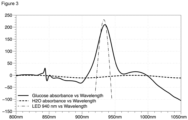
- Figure 2 shows relative absorption coefficients of certain compounds present in the human body depending from the wavelength in the range between 400 nm and 1100 nm.
- the wavelengths of about 600 nm and about 810 nm, at which radiation may be emitted into the body part, are specifically indicated.
- In the wavelength range of about 500 nm to about 1050 nm there is a relatively low absorption of water (H 2 O).
- Hb hemoglobin
- Hboxy oxyhemoglobin
- the skin pigment melamine shows an absorption coefficient which decreases with increasing wavelength.
- the radiation source (a) is adapted for emitting VIS/NIR radiation in the range of about 920 nm to about 960 nm, e.g. about 940 nm into a body part.
- This irradiation wavelength may be used alone or in combination with at least one further irradiation wavelength.
- glucose has an absorption band at a wavelength of 940 nm.
- irradiation at a wavelength of about 940 nm leads to a selective excitation of glucose molecules and may result in a stronger absorption of glucose molecules in the IR wavelength range, particularly in the wavelength range of about 5 ⁇ m to about 12 ⁇ m.
- the radiation source (a) is adapted for emitting VIS/NIR radiation in the range of about 920 nm to about 980 nm, e.g. about 940 nm into a body part of said subject
- the sensing unit (b) is further adapted for detecting VIS/NIR radiation having a wavelength of about 940 nm, where the intensity of the detected VIS/NIR radiation is dependent from the concentration of glucose.
- the measurement signal in the VIS/NIR wavelength range may be combined with the measurement signals in the IR range as described above, e.g. by means of a comparator.
- VIS/NIR irradiation occurs at a combination of at least 2 different wavelengths, particularly at a combination of a first wavelength of about 800 nm to about 820 nm, e.g. about 810 nm, and a second wavelength of about 920 nm to about 980 nm, e.g. about 940 nm.
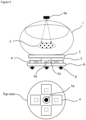
- Figure 4 shows an embodiment of a system of the present invention.
- a body part (1) e.g. a fingertip
- the system which is adapted to irradiate an absorption area (2) within the body part (1).
- the system comprises a cover (3) which is at least partially made of a material, which is optically transparent.
- the cover is at least partially made of CaF 2 and/or BaF 2 or of a plastic material which is transparent in the IR wavelength range of about 5 ⁇ m to about 12 ⁇ m or a sub-range thereof, e.g. of about 8 ⁇ m to about 12 ⁇ m, and which is optionally transparent in the VIS/NIR wavelength range of about 400 nm to about 1500 nm or a sub-range thereof.
- Suitable IR-transparent plastic materials are e.g. the PolyIR plastic materials commercially available from Fresnel Technologies, Fort Worth, Texas, USA.
- the cover may have a thickness of about 0.2 mm to about 2 mm, particularly of about 0.5 mm to about 1.5 mm, more particularly about 1 mm.
- the system further comprises at least one sensor (4) which may be provided with a filter element (5) and optionally a lens element (not shown), which e.g. may be arranged between a sensor (4) and a filter element (5).
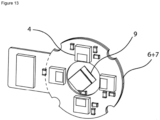
- the sensor (4) may be mounted on a circuit board (6).
- the system comprises at least one radiation source (9, 9a).
- the system may comprise a radiation source (9) located on the same side as the sensor (4) and/or a radiation source (9a) located on an opposite side of the body part (1) with regard to the sensor (4).
- a further sensor (4) may be provided without filter element (5) for monitoring the exact skin temperature of the subject.
- the system contains one or more sensors (4).
- the system comprises four different sensors (4).
- the sensor may be an optical detector, particularly an optical photovoltaic detector, e.g. an InAsSb-based detector, which may be used in combination with a lock-in amplifier, if desired.
- a photovoltaic detector e.g. an InAsSb-based detector has a rise time of only few nanoseconds and is particularly useful in a set-up wherein the body part is irradiated intermittently.
- the sensor may be heat detector, e.g. a thermopile or a bolometer. Suitable sensors include a photovoltaic detector (e.g.
- a sensor (4) may be provided with a filter element (5) capable of selectively transmitting radiation of a desired wavelength or wavelength range.
- the filter element may have narrow bandwidth, e.g. of about 50 to 100 nm, or a broader bandwidth, e.g. of about 400 nm or more.
- a filter may be made from germanium or other filter materials, which are optically transmissive for the respective wavelengths.
- a sensor may be provided with a lens element, e.g. a micro-lens capable of focusing the light falling onto the sensor.
- the sensor surface may be coated with a noble metal such as Au or Ag, particularly Au, in order to increase its sensitivity.
- a noble metal such as Au or Ag, particularly Au
- Such a coating which may be shaped as a Bundt baking-pan is described by Awad (Nature Scientific Reports 9:12197 (2019 )), the content of which is herein incorporated by reference.
- the senor is a miniaturized sensor having an area of about 1 mm 2 to about 10,000 mm 2 , e.g. of about 10 mm 2 to about 1,000 mm 2 .
- the sensor may be even more miniaturized, e.g. an ASIC (application-specific integrated circuit).
- At least one sensor may be an analyte-specific sensor, i.e. a sensor which is adapted for detecting IR radiation having at least one wavelength or wavelength range where the intensity of the detected IR radiation is dependent from the concentration of the physiological parameter in the bodily fluid of said subject, and at least on sensor may be a reference sensor, i.e. a sensor which is adapted for detecting IR radiation having at least one wavelength or wavelength range where the intensity of the detected IR radiation is substantially independent from the concentration of the physiological parameter in the bodily fluid of said subject.
- the sensing unit (b) is adapted for detecting self-emitted IR radiation from the previously irradiated body part, i.e. IR radiation generated by the body heat of the subject without irradiation by an external IR source. Further, the sensing unit (b) may be adapted for detecting emitted IR radiation from an absorption area within the previously irradiated body part wherein the absorption area has a locally increased temperature and exhibits an increased emission of IR radiation in the wavelength range of about 5 ⁇ m to about 12 ⁇ m.
- At least one further sensor may be present, e.g. a sensor which (i) is adapted for detecting unspecific IR radiation, (ii) is adapted for detecting unspecific VIS/NIR radiation, (iii) is adapted for detecting VIS/NIR radiation having a wavelength, where the intensity of the detected VIS/NIR radiation is dependent from the concentration of the physiological parameter in the bodily fluid of said subject, and/or (iv) a temperature sensor for measuring the temperature of the body part.
- a sensor which (i) is adapted for detecting unspecific IR radiation, (ii) is adapted for detecting unspecific VIS/NIR radiation, (iii) is adapted for detecting VIS/NIR radiation having a wavelength, where the intensity of the detected VIS/NIR radiation is dependent from the concentration of the physiological parameter in the bodily fluid of said subject, and/or (iv) a temperature sensor for measuring the temperature of the body part.
- At least one further analyte-specific sensor may be present, i.e. a sensor which is adapted for detecting VIS/NIR radiation having at least one wavelength or wavelength range where the intensity of the detected VIS/NIR radiation is dependent from the concentration of the physiological parameter in the bodily fluid of said subject.
- at least one further sensor adapted for detecting VIR/NIR radiation having a wavelength of about 940 nm may be present.
- the device may comprise a circuit board (7) on which the light source (9) is mounted and an active and/or passive heat sink (8).
- the VIS/NIR radiation source (9, 9a, 9b) may be adapted for emitting collimated radiation, e.g. a laser-based light source, and/or adapted for emitting non-collimated radiation, e.g. an LED-based light source.
- the light source may be selected from an LED, a laser diode, a VCSEL (vertical-cavity surface-emitting laser) or a laser.
- a broadband VIS/NIR radiation emitter which may be adapted for emitting VIS/NIR radiation in the range of about 650 nm to about 950 nm, particularly in the range of about 750 nm to about 850 nm and more particularly in the range of about 780 nm to about 820 nm.
- Suitable VIS/NIR emitters are e.g. the OSLON products from Osram such as OSLON SFH 4763.
- the radiation source is adapted for emitting VIS/NIR radiation in the range of about 400 nm to about 1500 nm, particularly in the range of about 500 nm to about 1500 nm.
- the VIS/NIR radiation may be emitted continuously or intermittently throughout a predetermined time interval.
- the radiation source is adapted to cause a local increase in the temperature of the irradiated body part, e.g. a fingertip, and particularly a local increase in the temperature of the absorption area within the irradiated body part.
- the local increase in temperature may be in the range of between about 1°C to about 15°C, particularly about 2°C to about 10°C, and more particularly in the range of about 3°C to about 5°C.
- the locally increased temperature of the irradiated body part, e.g. a fingertip may be in temperature range up to about 45°C, up to about 40°C or up to about 37°C, for example in the temperature range between about 30°C to about 35°C or about 30°C to about 32°C. This local temperature increase results in an enhanced self-emission of IR radiation from the irradiated body part and particularly from the absorption area within the irradiated body part.
- the radiation source may be adapted for emitting radiation continuously at a power of about 10 mW to about 1 W, particularly for about 20 mW to about 500 mW, more particularly of about 50 mW to about 250 mW, and even more particularly of about 100 mW to about 200 mW, e.g. about 150 mW, for a time interval of about 0.1 to about 20 s, particularly of about 0.2 s to about 5 s, and more particularly of about 0.5 s to about 2 s, e.g. about 1 s.
- the radiation source may be adapted for emitting radiation intermittently at a power of about 10 mW to about 5 W, particularly of about 20 mW to about 1 W, and more particularly of about 50 mW to about 500 mW for a time interval of about 0.1 s to about 20 s, particularly of about 0.2 s to about 5 s, and more particularly of about 0.5 s to about 2 s.
- the radiation may be emitted intermittently with a pulse frequency of about 1 Hz to about 1 MHz.
- the radiation source may be adapted to emit VIS/NIR radiation at a plurality of different wavelengths, e.g. at 2, 3, 4, 5, 6, 7, 8 or even more different wavelengths.
- the radiation source may be multi LED chip.
- the use of a multi-wavelength radiation source allows adjusting a predetermined penetration depth of electromagnetic radiation into the tissue of the irradiated body part depending on specific characteristics of the body part, e.g. pigmentation, skin thickness, presence or absence of horny skin. As shown in Figure 1 , supra, the penetration depth into body tissue varies with the wavelength and the use of VIS/NIR radiation with different wavelengths or with combinations of different wavelengths can be adapted for each subject and/or each body part individually, if desired.
- the radiation source (a) is a multi-wavelength radiation source is adapted to emit VIS/NIR radiation at several different wavelengths or wavelength ranges, for example, between about 400 nm to about 1200 nm, more particularly between about 450 nm and about 900 nm, e.g. at least 2, 3 4, 6 or 8 wavelengths which may be selected from wavelengths at about 470 nm, about 520 nm, about 590 nm, about 650 nm, about 750 nm and about 810 nm.
- a single radiation source (9a) is provided on a side of the body part (1) which is opposite to a sensing unit comprising at least one sensor (4) provided with a filter (5) and a further sensor (4a) provided with a filter (5a).
- sensor (4a) is an optical sensor, e.g. a photodiode. It is adapted for a reference measurement of transmission radiation from radiation source (9a), e.g. for measuring radiation at a wavelength of about 600 nm and/or about 810 nm and/or about 940 nm.
- filter element (5a) may be a bandpass filter at about 600 nm and/or 810 nm and/or 940 nm.
- a radiation source (9b) is provided on a side of the body part (1), e.g. a fingertip, wherein direct access to an absorption area (2) within the body part (1) is provided through the skin of the body part without the radiation passing through a cover structure of the device and/or without passing through a horny structure on the body surface, e.g. a fingernail and/or horny skin.
- interference e.g. interference from the cover structure or from keratinic horny skin or nail material and optionally nail varnish can be reduced or eliminated.
- 2, 3, 4, 6 or 8 radiation sources may be provided at a position around the circumference of the body part (1), e.g. a fingertip. If a plurality of radiation sources is present, they are preferably adapted to emit radiation into a single absorption area (2) within the body part, which may be about 3 mm to about 5 mm below the body surface.
- a cover (3) is provided which is adapted for focusing IR radiation emitted from the body part to the at least one sensor (4) of the sensing unit.
- the cover (3) is made of a material, e.g. plastic, metal, metal oxide or composite material, which is substantially transparent for IR radiation in the wavelength range to be detected on the sensor, particularly for IR radiation in the wavelength range of about 5 ⁇ m to about 12 ⁇ m or a sub-range thereof, e.g. of about 8 ⁇ m to about 12 ⁇ m.
- Suitable materials are e.g. the PolyIR plastic materials, c.f.
- the cover (3) may comprise an IR Fresnel lens, i.e. a lens of large aperture and short focal length capable of efficiently focusing IR radiation passing therethrough, or an array comprising a plurality e.g. up to 10 or more IR Fresnel lenses.
- the array may comprise IR Fresnel micro-lenses, e.g. up to 100 or 1000 micro-lenses, which may have diameters in the range of about 50 nm to about 500 ⁇ m.
- the IR Fresnel lens may have a back focal length of about 3 mm to about 10 mm, e.g. about 5 mm and may be manufactured from an IR-transparent plastic.
- a suitable IR Fresnel lens which is optically transparent in the wavelength range of 8-14 ⁇ m is commercially available from Edmund Optics (product family no. 2042).
- Figure 7 shows a radiation source (9a) provided on the opposite side of the body part with regard to the position of the sensing unit, which comprises a sensor (4). It should be noted, however, that one or more radiation sources may also be arranged in a circumferential arrangement around the body part (1), e.g. as shown in Figure 6 . It should further be noted, that in this embodiment a plurality of different sensors may be present, e.g. as shown in Figures 4 and 5 .
- the system of the invention may comprise a plurality of different sensors (4).
- the system may comprise a plurality of analyte-specific, e.g. glucose-specific sensors wherein a first sensor is adapted for detecting radiation at a first wavelength or wavelength range, e.g. at a wavelength of about 9.2 ⁇ m and at least another first sensor is adapted for detecting IR radiation at a second wavelength range which encompasses the first wavelength or wavelength range and further comprises another wavelength or wavelength range.
- the other first sensor may be adapted for detecting IR radiation at a wavelength of about 9.2 ⁇ m and additionally at a wavelength of about 9.4 ⁇ m and/or about 9.6 ⁇ m, particularly at a wavelength of about 9.4 ⁇ m and a wavelength of about 9.6 ⁇ m.
- the sensing unit may comprise a plurality of reference sensors adapted for detecting reference radiation at different wavelengths or wavelength ranges.
- a reference sensor may be adapted for detecting radiation having a wavelength range between about 8.6 ⁇ m and about 9.0 ⁇ m.
- Another reference sensor is adapted for detecting radiation at a wavelength or wavelength range between about 9.8 ⁇ m and about 10.2 ⁇ m.
- a support (16) for the body part (1) e.g. a fingertip
- said support (16) comprises an opening adapted to receive a portion (15) of the body part (1).
- the support may comprise an annular structure with an opening, e.g. a substantially circular opening, in its center.
- the system is adapted for pressing the body part (1) onto the opening in the support (16) such that a portion (15) of the body part (1), e.g. a portion of the fingertip, is forced into the opening.
- the tissue including the blood vessels within portion (15) is compressed resulting in an enhanced amount of capillary blood within portion (15).
- the signal intensity and thus the sensitivity and/or accuracy of the measurement may be increased.
- the system of Figure 8 includes a cover (3) which may be formed as an IR Fresnel lens as described above in the context of Figure 7 . It should be noted, however, that other covers are also suitable.
- a radiation source (9a) is shown which is provided on the opposite side of the body part with regard to the position of the sensing unit, which comprises a sensor (4). It should be noted, however, that one or more radiation sources may also be arranged in a circumferential arrangement around the body part (1), e.g. as shown in Figure 6 . It should further be noted that in this embodiment a plurality of different sensors may be present, e.g. as shown in Figures 4 and 5 .
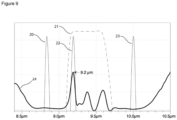
- the absorption signal of glucose (24) has three different peaks at about 9.2 ⁇ m, at about 9.4 ⁇ m and about 9.6 ⁇ m.
- a first glucose-specific sensor may be adapted for measuring only the peak at 9.2 ⁇ m. Such a sensor would be adapted with a filter element capable of transmitting radiation only in a narrow range (22). Thus, the sensor is capable of selectively detecting radiation within this narrow range.
- a further glucose-specific sensor may be adapted for measuring radiation at a broader range between about 9.1 ⁇ m and about 9.7 ⁇ m, thereby encompassing the peaks at about 9.2 ⁇ m, 9.4 ⁇ m and 9.6 ⁇ m. This sensor may be adapted with a filter element capable of transmitting radiation in a broader range (21).
- Two reference sensors may be provided, wherein said reference sensors are provided with filter elements capable of transmission of radiation with a wavelength in the range of about 8.6 ⁇ m and about 9.0 ⁇ m, particularly of about 8.8 ⁇ m - 8.9 ⁇ m (20) and/or radiation with a wavelength in the range of about 9.8 ⁇ m and about 10.2 ⁇ m, particularly of about 9.9 ⁇ m - 10.1 ⁇ m (23), respectively.
- Parallel and separate measurements at a wavelength of about 9.2 ⁇ m on the one hand and at a wavelength range including the peak at 9.2 ⁇ m, but also at least one of the other peaks, particularly the peak at about 9.6 ⁇ m have a further advantage, since they allow determination whether the subject's blood contains ethanol. Since ethanol and other alcohols have an absorption band at a wavelength of about 9.6 ⁇ m, but not at a wavelength of about 9.2 ⁇ m, the ratio between the peak at 9.2 ⁇ m and 9.6 ⁇ m may be used to determine and optionally correct a disturbance caused by blood alcohol.
- a first glucose-specific sensor may be adapted for measuring only the peak at 9.6 ⁇ m.
- Such a sensor would be provided with a filter element capable of transmitting radiation only in a narrow range.
- a further glucose-specific sensor may be adapted for measuring radiation at a broader range between about 9.4 ⁇ m and about 9.6 ⁇ m, thereby encompassing the peaks at about 9.4 ⁇ m and about 9.6 ⁇ m and not encompassing the peak at 9.2 ⁇ m.
- This sensor may be provided with a filter element capable of transmitting radiation in a broader range.
- a reference sensor may be provided, which is provided with a filter element capable of transmission of radiation with a wavelength in the range of about 7.8 ⁇ m and about 8.2 ⁇ m, particularly of about 7.9 ⁇ m - 8.1 ⁇ m, optionally in combination with at least one further reference sensor, which is provided with a filter element capable of transmission of radiation with a wavelength in the range of about 8.8 ⁇ m - 9.2 ⁇ m and/or radiation with a wavelength of about 9.8 ⁇ m - 10.2 ⁇ m, respectively
- the system may comprise a sensor, which is adapted for a time-dependent detection of IR radiation having different wavelengths or wavelength ranges.
- the system may be provided with a sensor comprising a plurality of filters adapted for transmitting IR radiation having different wavelengths or wavelength ranges wherein said filters may be placed on a sensor during different stages of a measurement cycle thereby allowing detection of different wavelengths or wavelength ranges within a measurement cycle.
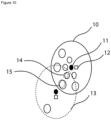
- a system is provided comprising a filter wheel (10) capable of rotating around an axis (11) and a shutter wheel (13) capable of rotating around an axis.
- the filter wheel and the shutter wheel are provided with illumination holes (15) through which light from the radiation source (not shown) may pass into the body part of the subject (not shown). Reflected light from the irradiated body part may pass through different holes (14) of the filter wheel (10) which may be provided with analyte-specific filter elements and/or reference filter elements as described above.
- the filter wheel's (10) and the shutter wheel's (13) position may be monitored with a magnet (12) in combination with a magnetic sensor.
- they may be rotated with predetermined frequencies, thereby allowing time-dependently passing of radiation from the radiation source into the body part and time-dependently passing of radiation emitted from the body part at predetermined time intervals through the different holes (14) of the filter wheel (10) to a sensor (not shown).
- a sensor which is adapted for a time-dependent detection of IR radiation having different wavelengths or wavelength ranges may be a Fabry-Perot interferometer, e.g. a MEMS spectrometer for the desired IR wavelength range (cf. Tuohinieni et al., J. Micromech. Microeng. 22 (2012), 115004 ; Tuohinieni et al., J. Micromech. Microeng. 23 (2013), 075011 ).
- the system comprises a single sensor, which is adapted for a time-dependent detection of IR radiation having different wavelengths or wavelength ranges.
- This sensor may be provided with different filters, e.g. with a filter wheel, or be a Fabry-Perot interferometer as described above.
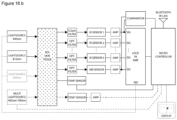
- the system of the present invention further comprises an analyzing unit (c) for the qualitative and/or quantitative determination of a physiological parameter based on the IR radiation detected in the sensing unit (b).
- the analyzing unit may comprise, for example, an A/D converter and a microcontroller.
- the analysis of the measured signal may be based on the intensity and/or the decay time.
- FIG. 11 A still further embodiment of the invention is shown in Figure 11 .
- the system of this embodiment is adapted for being permanently fixed to the subject's body.
- This system is particularly adapted for carrying out a plurality of measurements in predetermined time intervals.
- the system comprises a housing (30) and a strap (31) for fixing the housing around the body (33), e.g. a wrist or forearm.
- the system comprises a radiation source for emitting VIS/NIR light into an absorption area (34) of the body part (33) and sensors for detecting IR radiation emitted from the irradiated body part.
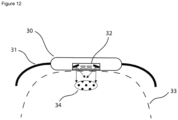
- FIG. 12 A still further embodiment of the invention is shown in Figure 12 .
- the system of this embodiment is adapted for being permanently fixed to the subject's body and particularly adapted for carrying out a plurality of measurements in predetermined time intervals.
- the system comprises a housing (30) and a strap (31) for fixing the housing around the body (33), e.g. a wrist or forearm.
- the system comprises a plurality of radiation sources, e.g. 2 radiation sources, for emitting VIS/NIR light into an absorption area (34) of the body part (33) and sensors for detecting IR radiation emitted from the irradiated body part.
- the light emitted from these sources may fall at angle, e.g. at an angle of about 30° to about 75° onto the surface of the body part (33).
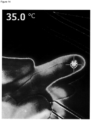
- Figure 14 shows a heat map of a fingertip after irradiation with light of 810 nm for a time period of 2 s.
- Figure 15 is diagram showing the time-dependent thermal power output in addition to the self-emission of a fingertip during intermittent irradiation with light of 810 nm with a power of 2 mW and a frequency of 0.1 Hz.
- a fingertip is optionally focused by a focusing element (72) adapted for focusing IR radiation, e.g. a lens or concave mirror element, and then passed to an spectral splitting or diffracting element (73), e.g. a prism or an transmissive or reflective optical grating, where the IR radiation is split according to its wavelength.
- an spectral sensor or line sensor or sensor array typically a bolometer or thermopile array, where an IR spectrum in the wavelength range of interest, e.g. between 8 ⁇ m and about 20 ⁇ m including analyte-specific wavelengths or wavelength ranges and reference wavelengths or wavelength ranges, e.g. as described above, is detected.
- the amount of the physiological parameter of interest e.g. glucose may be determined by spectral analysis according to the relative intensities of predetermined analyte-specific and reference wavelengths.
- the system and the method of the invention allow qualitative and/or quantitative determination of the physiological parameter to be measured, particularly qualitative and/or quantitative determination of glucose in blood.
- the concentration of the physiological parameter e.g. the concentration of glucose in blood
- the alteration rate of the measured amount of the physiological parameter is determined.
- a non-quantitative measurement e.g. a relative measurement of the alteration of the analyte amount per time unit, i.e. the increase of the analyte amount or the decrease of the analyte amount per time unit.
- the alteration of the analyte amount into a single direction i.e. increase or decrease, exceeds a predetermined level and/or time period
- the system will provide an alert.
- This embodiment is particularly useful for systems as shown in Figure 11 and Figure 12 , which may be permanently fixed at the body of the subject, e.g. around the wrist, forearm or upper arm. This embodiment may be adapted for steady glucose level monitoring.
- the system of the invention is adapted for performing both non-quantitative measurements and quantitative measurements.
- the system may be adapted for performing non-quantitative measurements, e.g. qualitatively measuring the alteration, e.g. the increase or decrease, of the analyte amount over time during standard operation.
- Non-quantitative measurements may e.g. be performed as continuous and/or intermittent monitoring measurements, as required.
- the system is adapted to switch to a quantitative measurement in order to provide more detailed information.
- a system adapted to be permanently fixed to the body e.g. to an arm wrist, or to an ankle, may be used. Specific embodiments of such systems are shown in Figure 11 and Figure 12 .
- the system is adapted to perform non-quantitative measurements, e.g. continuous and/or intermittent monitoring measurements, and quantitative measurements on several different body parts.
- the system may be adapted to perform non-quantitative measurements on a first body part, e.g. a body part to which the system may be permanently fixed, such as an arm wrist or an ankle, and to perform quantitative measurements on a second body part, e.g. a body part where capillary vessels are more accessible, such as an earlobe or a fingertip.
- the system is removed from the first body part and brought into contact, particularly into direct contact with the second body part.
- the system may be removed therefrom and brought again into contact with the first body part, e.g. by fixing the system to the first body part.
- the first body part is an arm wrist and/or the second body part is a fingertip.
- a still further aspect of the invention is a non-invasive system for determining glucose in blood, which allows identification and optional correction of disturbances caused by blood alcohol
- a sensing unit for detecting emitted IR radiation from a body part of said subject in the range of about 5 ⁇ m to about 12 ⁇ m
- said sensing unit is adapted for (i) detecting IR radiation at a wavelength of about 9.2 ⁇ m and separately therefrom for detecting IR radiation at a wavelength of at least about 9.2 ⁇ m and about 9.6 ⁇ m, particularly at a wavelength range encompassing the wavelength of about 9.2 ⁇ m, about 9.4 ⁇ m and about 9.6 ⁇ m, and an analyzing unit for the separate determination of glucose from the above sensing units.
- Still a further aspect of the invention is a method for non-invasively determining glucose in blood of a subject using this system.
- Still a further aspect of the present invention is a system and method for the non-quantitative measurement of glucose involving a plurality of measurements during a predetermined time interval and determining an alteration of the measurement signal indicating an alteration of the amount of analyte and providing an alter if the alteration of the glucose amount to one direction, i.e. increase or decrease, exceeds a certain level in a predetermined time period.
- This system and method may be adapted for steady glucose level monitoring.
Landscapes
- Health & Medical Sciences (AREA)
- Life Sciences & Earth Sciences (AREA)
- Physics & Mathematics (AREA)
- Heart & Thoracic Surgery (AREA)
- Molecular Biology (AREA)
- Pathology (AREA)
- Engineering & Computer Science (AREA)
- Biomedical Technology (AREA)
- Veterinary Medicine (AREA)
- Medical Informatics (AREA)
- Biophysics (AREA)
- Surgery (AREA)
- Animal Behavior & Ethology (AREA)
- General Health & Medical Sciences (AREA)
- Public Health (AREA)
- Optics & Photonics (AREA)
- Spectroscopy & Molecular Physics (AREA)
- Emergency Medicine (AREA)
- Measurement Of The Respiration, Hearing Ability, Form, And Blood Characteristics Of Living Organisms (AREA)
Applications Claiming Priority (7)
| Application Number | Priority Date | Filing Date | Title |
|---|---|---|---|
| US201962887767P | 2019-08-16 | 2019-08-16 | |
| EP19192138.6A EP3777680A1 (de) | 2019-08-16 | 2019-08-16 | Aktives miniaturisiertes erfassungssystem und verfahren |
| EP19195939 | 2019-09-06 | ||
| EP19218195 | 2019-12-19 | ||
| EP20158808 | 2020-02-21 | ||
| EP20754263.0A EP4013304B1 (de) | 2019-08-16 | 2020-08-14 | Aktives miniaturisiertes erfassungssystem und verfahren |
| PCT/EP2020/072885 WO2021032629A1 (en) | 2019-08-16 | 2020-08-14 | Active miniaturized sensing system and method |
Related Parent Applications (1)
| Application Number | Title | Priority Date | Filing Date |
|---|---|---|---|
| EP20754263.0A Division EP4013304B1 (de) | 2019-08-16 | 2020-08-14 | Aktives miniaturisiertes erfassungssystem und verfahren |
Publications (2)
| Publication Number | Publication Date |
|---|---|
| EP4578377A2 true EP4578377A2 (de) | 2025-07-02 |
| EP4578377A3 EP4578377A3 (de) | 2025-08-20 |
Family
ID=74660203
Family Applications (2)
| Application Number | Title | Priority Date | Filing Date |
|---|---|---|---|
| EP20754263.0A Active EP4013304B1 (de) | 2019-08-16 | 2020-08-14 | Aktives miniaturisiertes erfassungssystem und verfahren |
| EP25158478.5A Pending EP4578377A3 (de) | 2019-08-16 | 2020-08-14 | Aktives miniaturisiertes messsystem und verfahren |
Family Applications Before (1)
| Application Number | Title | Priority Date | Filing Date |
|---|---|---|---|
| EP20754263.0A Active EP4013304B1 (de) | 2019-08-16 | 2020-08-14 | Aktives miniaturisiertes erfassungssystem und verfahren |
Country Status (8)
| Country | Link |
|---|---|
| US (1) | US20220287600A1 (de) |
| EP (2) | EP4013304B1 (de) |
| JP (2) | JP7653975B2 (de) |
| KR (1) | KR20220059487A (de) |
| CN (1) | CN114449942A (de) |
| AU (1) | AU2020331683B2 (de) |
| CA (1) | CA3150802A1 (de) |
| WO (1) | WO2021032629A1 (de) |
Families Citing this family (4)
| Publication number | Priority date | Publication date | Assignee | Title |
|---|---|---|---|---|
| CN114449942A (zh) * | 2019-08-16 | 2022-05-06 | 格鲁可玛特有限公司 | 有源小型化感测系统和方法 |
| AU2020360024B2 (en) * | 2019-09-30 | 2025-08-28 | Inspirity Ag | Device and method for the non-invasive determination of analytes |
| EP4658153A1 (de) | 2023-01-31 | 2025-12-10 | Glucomat GmbH | Hochintegrierte glukosesensorvorrichtung |
| GB202409812D0 (en) * | 2024-07-05 | 2024-08-21 | Univ Court Univ Of Glasgow | Blood glucose level sensing device |
Family Cites Families (31)
| Publication number | Priority date | Publication date | Assignee | Title |
|---|---|---|---|---|
| US5222496A (en) * | 1990-02-02 | 1993-06-29 | Angiomedics Ii, Inc. | Infrared glucose sensor |
| US5146091A (en) * | 1990-04-19 | 1992-09-08 | Inomet, Inc. | Body fluid constituent measurement utilizing an interference pattern |
| US5313941A (en) * | 1993-01-28 | 1994-05-24 | Braig James R | Noninvasive pulsed infrared spectrophotometer |
| US5553613A (en) * | 1994-08-17 | 1996-09-10 | Pfizer Inc. | Non invasive blood analyte sensor |
| US6025597A (en) * | 1995-10-17 | 2000-02-15 | Optiscan Biomedical Corporation | Non-invasive infrared absorption spectrometer for measuring glucose or other constituents in a human or other body |
| US6161028A (en) * | 1999-03-10 | 2000-12-12 | Optiscan Biomedical Corporation | Method for determining analyte concentration using periodic temperature modulation and phase detection |
| US5900632A (en) * | 1997-03-12 | 1999-05-04 | Optiscan Biomedical Corporation | Subsurface thermal gradient spectrometry |
| US6285448B1 (en) * | 1997-05-05 | 2001-09-04 | J. Todd Kuenstner | Clinical analyte determination by infrared spectroscopy |
| ATE352252T1 (de) * | 1997-11-12 | 2007-02-15 | Lightouch Medical Inc | Verfahren zur nicht invasiven analytenmessung |
| US6572264B1 (en) * | 1998-12-15 | 2003-06-03 | Citizen Watch Co., Ltd. | Radiation clinical thermometer |
| US6198949B1 (en) * | 1999-03-10 | 2001-03-06 | Optiscan Biomedical Corporation | Solid-state non-invasive infrared absorption spectrometer for the generation and capture of thermal gradient spectra from living tissue |
| US6486474B1 (en) * | 1999-08-13 | 2002-11-26 | Regents Of The University Of Minnesota | Infrared spectrometer for the measurement of isotopic ratios |
| IL136291A0 (en) * | 2000-05-22 | 2001-05-20 | Yatsiv Shaul | Infrared spectral sources |
| NZ527164A (en) * | 2001-01-26 | 2005-07-29 | Sensys Medical Inc | Noninvasive measurement of glucose through the optical properties of tissue |
| WO2005074550A2 (en) | 2004-01-30 | 2005-08-18 | 3Wave Optics, Llc | Non-invasive blood component measurement system |
| GB0501826D0 (en) * | 2005-01-28 | 2005-03-09 | Melys Diagnostics Ltd | Apparatus for measurement of analyte concentration |
| US20090030295A1 (en) * | 2006-03-10 | 2009-01-29 | Masahiko Shioi | Instrument for measuring concentration of living body ingredient |
| EP1905356A4 (de) * | 2006-03-10 | 2008-10-15 | Matsushita Electric Industrial Co Ltd | Instrument zur messung der konzentration eines bestandteiles eines lebenden körpers |
| US20110009720A1 (en) * | 2006-11-02 | 2011-01-13 | Kislaya Kunjan | Continuous whole blood glucose monitor |
| AU2008325237B2 (en) * | 2007-11-05 | 2014-05-01 | Biosensor, Inc. | Optical sensor for determining the concentration of an analyte |
| US8401604B2 (en) * | 2008-04-11 | 2013-03-19 | Glucovista, Llc | Apparatus and methods for non-invasive measurement of a substance within a body |
| US20110004080A1 (en) * | 2008-04-11 | 2011-01-06 | Glucovista, Llc | Method for non-invasive analysis of a substance concentration within a body |
| GB201011459D0 (en) * | 2010-07-07 | 2010-08-25 | Melys Diagnostics Ltd | Optical element, assembly and method for determining analyte concentration |
| US9119529B2 (en) * | 2012-10-30 | 2015-09-01 | Dexcom, Inc. | Systems and methods for dynamically and intelligently monitoring a host's glycemic condition after an alert is triggered |
| DE102013010611A1 (de) * | 2013-06-25 | 2015-01-08 | Sms Swiss Medical Sensor Ag | Messvorrichtung und Messverfahren zum Messen von Rohdaten zur Bestimmung eines Blutparameters, insbesondere zur nichtinvasiven Bestimmung der D-Glucose-Konzentration |
| EP4434457A3 (de) * | 2014-01-07 | 2024-12-18 | Opsolution GmbH | Vorrichtung und verfahren zur bestimmung einer konzentration in einer probe |
| JP2016067394A (ja) * | 2014-09-26 | 2016-05-09 | セイコーエプソン株式会社 | 成分計測装置及び成分計測方法 |
| JP6795516B2 (ja) * | 2014-12-22 | 2020-12-02 | “ブレイン ビート”,リミテッド | 血中グルコース濃度を非侵襲的に決定する方法 |
| WO2018122319A1 (de) * | 2016-12-30 | 2018-07-05 | Swiss Spectral Ag | Vorrichtung und verfahren zur nicht-invasiven bestimmung von analyten |
| EP3443887A1 (de) * | 2017-08-18 | 2019-02-20 | Swiss Spectral AG | Vorrichtung und verfahren zur nicht-invasiven bestimmung von analyten ohne externe strahlungsquelle |
| CN114449942A (zh) * | 2019-08-16 | 2022-05-06 | 格鲁可玛特有限公司 | 有源小型化感测系统和方法 |
-
2020
- 2020-08-14 CN CN202080064848.4A patent/CN114449942A/zh active Pending
- 2020-08-14 EP EP20754263.0A patent/EP4013304B1/de active Active
- 2020-08-14 WO PCT/EP2020/072885 patent/WO2021032629A1/en not_active Ceased
- 2020-08-14 US US17/635,650 patent/US20220287600A1/en active Pending
- 2020-08-14 EP EP25158478.5A patent/EP4578377A3/de active Pending
- 2020-08-14 KR KR1020227008813A patent/KR20220059487A/ko active Pending
- 2020-08-14 AU AU2020331683A patent/AU2020331683B2/en active Active
- 2020-08-14 CA CA3150802A patent/CA3150802A1/en active Pending
- 2020-08-14 JP JP2022510082A patent/JP7653975B2/ja active Active
-
2025
- 2025-03-18 JP JP2025044150A patent/JP2025090832A/ja active Pending
Non-Patent Citations (3)
| Title |
|---|
| NATURE SCIENTIFIC REPORTS, vol. 9, 2019, pages 12197 |
| TUOHINIENI ET AL., J. MICROMECH. MICROENG, vol. 22, 2012, pages 115004 |
| TUOHINIENI ET AL., J. MICROMECH. MICROENG, vol. 23, 2013, pages 075011 |
Also Published As
| Publication number | Publication date |
|---|---|
| KR20220059487A (ko) | 2022-05-10 |
| JP7653975B2 (ja) | 2025-03-31 |
| CA3150802A1 (en) | 2021-02-25 |
| AU2020331683B2 (en) | 2025-08-14 |
| EP4578377A3 (de) | 2025-08-20 |
| EP4013304A1 (de) | 2022-06-22 |
| EP4013304B1 (de) | 2025-02-19 |
| JP2025090832A (ja) | 2025-06-17 |
| CN114449942A (zh) | 2022-05-06 |
| WO2021032629A1 (en) | 2021-02-25 |
| US20220287600A1 (en) | 2022-09-15 |
| JP2022551381A (ja) | 2022-12-09 |
| AU2020331683A1 (en) | 2022-03-31 |
| EP4013304C0 (de) | 2025-02-19 |
Similar Documents
| Publication | Publication Date | Title |
|---|---|---|
| EP4013304B1 (de) | Aktives miniaturisiertes erfassungssystem und verfahren | |
| US12066378B2 (en) | Device and method for analyzing a material | |
| US5460177A (en) | Method for non-invasive measurement of concentration of analytes in blood using continuous spectrum radiation | |
| JP3875798B2 (ja) | 血中成分濃度の無血測定装置の作動方法及び無血測定装置 | |
| US20050043597A1 (en) | Optical vivo probe of analyte concentration within the sterile matrix under the human nail | |
| HK201896A (en) | Process and device for glucose determination in a biological matrix | |
| JP2010540964A (ja) | 光学デバイス構成要素 | |
| EP1460413B1 (de) | Verfahren und Vorrichtung zur in vitro oder in vivo Messung der Konzentration einer Substanz | |
| WO1997019341A1 (en) | Transcutaneous measurement of substance in body tissues or fluid | |
| JPH10325794A (ja) | グルコース濃度の定量方法及びその装置 | |
| WO2012136982A1 (en) | Device and method for the detection of blood analytes | |
| US20240099611A1 (en) | Active Miniaturized Sensing System | |
| JP2009539459A (ja) | 専用特殊照明分光法 | |
| US12364416B2 (en) | Portable device and method for non-invasive blood glucose level estimation | |
| KR100612861B1 (ko) | 체액 성분농도 측정용 가변파장 발생방법 및 장치 | |
| EP3777680A1 (de) | Aktives miniaturisiertes erfassungssystem und verfahren | |
| EP4658153A1 (de) | Hochintegrierte glukosesensorvorrichtung | |
| WO1996013201A1 (en) | Non-invasive measurement of analyte concentration in blood |
Legal Events
| Date | Code | Title | Description |
|---|---|---|---|
| PUAI | Public reference made under article 153(3) epc to a published international application that has entered the european phase |
Free format text: ORIGINAL CODE: 0009012 |
|
| STAA | Information on the status of an ep patent application or granted ep patent |
Free format text: STATUS: THE APPLICATION HAS BEEN PUBLISHED |
|
| AC | Divisional application: reference to earlier application |
Ref document number: 4013304 Country of ref document: EP Kind code of ref document: P |
|
| AK | Designated contracting states |
Kind code of ref document: A2 Designated state(s): AL AT BE BG CH CY CZ DE DK EE ES FI FR GB GR HR HU IE IS IT LI LT LU LV MC MK MT NL NO PL PT RO RS SE SI SK SM TR |
|
| REG | Reference to a national code |
Ref country code: DE Ref legal event code: R079 Free format text: PREVIOUS MAIN CLASS: A61B0005000000 Ipc: A61B0005145000 |
|
| PUAL | Search report despatched |
Free format text: ORIGINAL CODE: 0009013 |
|
| AK | Designated contracting states |
Kind code of ref document: A3 Designated state(s): AL AT BE BG CH CY CZ DE DK EE ES FI FR GB GR HR HU IE IS IT LI LT LU LV MC MK MT NL NO PL PT RO RS SE SI SK SM TR |
|
| RIC1 | Information provided on ipc code assigned before grant |
Ipc: A61B 5/145 20060101AFI20250717BHEP Ipc: A61B 5/1455 20060101ALI20250717BHEP Ipc: A61B 5/00 20060101ALI20250717BHEP |