EP4578291A1 - Method and system for producing a liquid food product - Google Patents
Method and system for producing a liquid food product Download PDFInfo
- Publication number
- EP4578291A1 EP4578291A1 EP24223584.4A EP24223584A EP4578291A1 EP 4578291 A1 EP4578291 A1 EP 4578291A1 EP 24223584 A EP24223584 A EP 24223584A EP 4578291 A1 EP4578291 A1 EP 4578291A1
- Authority
- EP
- European Patent Office
- Prior art keywords
- ammonium content
- ammonium
- mixture
- food product
- liquid food
- Prior art date
- Legal status (The legal status is an assumption and is not a legal conclusion. Google has not performed a legal analysis and makes no representation as to the accuracy of the status listed.)
- Pending
Links
Images



Classifications
-
- A—HUMAN NECESSITIES
- A23—FOODS OR FOODSTUFFS; TREATMENT THEREOF, NOT COVERED BY OTHER CLASSES
- A23L—FOODS, FOODSTUFFS OR NON-ALCOHOLIC BEVERAGES, NOT OTHERWISE PROVIDED FOR; PREPARATION OR TREATMENT THEREOF
- A23L11/00—Pulses, i.e. fruits of leguminous plants, for production of food; Products from legumes; Preparation or treatment thereof
- A23L11/60—Drinks from legumes, e.g. lupine drinks
-
- A—HUMAN NECESSITIES
- A23—FOODS OR FOODSTUFFS; TREATMENT THEREOF, NOT COVERED BY OTHER CLASSES
- A23B—PRESERVATION OF FOODS, FOODSTUFFS OR NON-ALCOHOLIC BEVERAGES; CHEMICAL RIPENING OF FRUIT OR VEGETABLES
- A23B11/00—Preservation of milk or dairy products
- A23B11/10—Preservation of milk or milk preparations
- A23B11/12—Preservation of milk or milk preparations by heating
- A23B11/13—Preservation of milk or milk preparations by heating the materials being loose unpacked
-
- A—HUMAN NECESSITIES
- A23—FOODS OR FOODSTUFFS; TREATMENT THEREOF, NOT COVERED BY OTHER CLASSES
- A23B—PRESERVATION OF FOODS, FOODSTUFFS OR NON-ALCOHOLIC BEVERAGES; CHEMICAL RIPENING OF FRUIT OR VEGETABLES
- A23B11/00—Preservation of milk or dairy products
- A23B11/10—Preservation of milk or milk preparations
- A23B11/12—Preservation of milk or milk preparations by heating
- A23B11/13—Preservation of milk or milk preparations by heating the materials being loose unpacked
- A23B11/133—Preservation of milk or milk preparations by heating the materials being loose unpacked and progressively transported through the apparatus
- A23B11/137—Preservation of milk or milk preparations by heating the materials being loose unpacked and progressively transported through the apparatus in direct contact with the heating medium, e.g. steam
-
- A—HUMAN NECESSITIES
- A23—FOODS OR FOODSTUFFS; TREATMENT THEREOF, NOT COVERED BY OTHER CLASSES
- A23B—PRESERVATION OF FOODS, FOODSTUFFS OR NON-ALCOHOLIC BEVERAGES; CHEMICAL RIPENING OF FRUIT OR VEGETABLES
- A23B2/00—Preservation of foods or foodstuffs, in general
- A23B2/40—Preservation of foods or foodstuffs, in general by heating loose unpacked materials
- A23B2/42—Preservation of foods or foodstuffs, in general by heating loose unpacked materials while they are progressively transported through the apparatus
-
- A—HUMAN NECESSITIES
- A23—FOODS OR FOODSTUFFS; TREATMENT THEREOF, NOT COVERED BY OTHER CLASSES
- A23B—PRESERVATION OF FOODS, FOODSTUFFS OR NON-ALCOHOLIC BEVERAGES; CHEMICAL RIPENING OF FRUIT OR VEGETABLES
- A23B70/00—Preservation of non-alcoholic beverages
- A23B70/30—Preservation of non-alcoholic beverages by heating
-
- A—HUMAN NECESSITIES
- A23—FOODS OR FOODSTUFFS; TREATMENT THEREOF, NOT COVERED BY OTHER CLASSES
- A23B—PRESERVATION OF FOODS, FOODSTUFFS OR NON-ALCOHOLIC BEVERAGES; CHEMICAL RIPENING OF FRUIT OR VEGETABLES
- A23B75/00—Preservation of pulses; Preservation of products from legumes
-
- A—HUMAN NECESSITIES
- A23—FOODS OR FOODSTUFFS; TREATMENT THEREOF, NOT COVERED BY OTHER CLASSES
- A23C—DAIRY PRODUCTS, e.g. MILK, BUTTER OR CHEESE; MILK OR CHEESE SUBSTITUTES; PREPARATION THEREOF
- A23C11/00—Milk substitutes, e.g. coffee whitener compositions
- A23C11/02—Milk substitutes, e.g. coffee whitener compositions containing at least one non-milk component as source of fats or proteins
- A23C11/10—Milk substitutes, e.g. coffee whitener compositions containing at least one non-milk component as source of fats or proteins containing or not lactose but no other milk components as source of fats, carbohydrates or proteins
- A23C11/103—Milk substitutes, e.g. coffee whitener compositions containing at least one non-milk component as source of fats or proteins containing or not lactose but no other milk components as source of fats, carbohydrates or proteins containing only proteins from pulses, oilseeds or nuts, e.g. nut milk
-
- A—HUMAN NECESSITIES
- A23—FOODS OR FOODSTUFFS; TREATMENT THEREOF, NOT COVERED BY OTHER CLASSES
- A23L—FOODS, FOODSTUFFS OR NON-ALCOHOLIC BEVERAGES, NOT OTHERWISE PROVIDED FOR; PREPARATION OR TREATMENT THEREOF
- A23L11/00—Pulses, i.e. fruits of leguminous plants, for production of food; Products from legumes; Preparation or treatment thereof
- A23L11/60—Drinks from legumes, e.g. lupine drinks
- A23L11/65—Soy drinks
-
- A—HUMAN NECESSITIES
- A23—FOODS OR FOODSTUFFS; TREATMENT THEREOF, NOT COVERED BY OTHER CLASSES
- A23L—FOODS, FOODSTUFFS OR NON-ALCOHOLIC BEVERAGES, NOT OTHERWISE PROVIDED FOR; PREPARATION OR TREATMENT THEREOF
- A23L2/00—Non-alcoholic beverages; Dry compositions or concentrates therefor; Preparation or treatment thereof
- A23L2/38—Other non-alcoholic beverages
- A23L2/382—Other non-alcoholic beverages fermented
-
- A—HUMAN NECESSITIES
- A23—FOODS OR FOODSTUFFS; TREATMENT THEREOF, NOT COVERED BY OTHER CLASSES
- A23L—FOODS, FOODSTUFFS OR NON-ALCOHOLIC BEVERAGES, NOT OTHERWISE PROVIDED FOR; PREPARATION OR TREATMENT THEREOF
- A23L33/00—Modifying nutritive qualities of foods; Dietetic products; Preparation or treatment thereof
- A23L33/10—Modifying nutritive qualities of foods; Dietetic products; Preparation or treatment thereof using additives
- A23L33/105—Plant extracts, their artificial duplicates or their derivatives
-
- G—PHYSICS
- G01—MEASURING; TESTING
- G01N—INVESTIGATING OR ANALYSING MATERIALS BY DETERMINING THEIR CHEMICAL OR PHYSICAL PROPERTIES
- G01N33/00—Investigating or analysing materials by specific methods not covered by groups G01N1/00 - G01N31/00
- G01N33/02—Food
- G01N33/14—Beverages
Definitions
- the invention relates to a method of producing a liquid food product.
- the invention also relates to a system for producing a liquid food product.
- UHT ultra-high temperature
- tests may be performed on the end product to ensure the quality of the food, such as the product's smell, taste, and/or colour. If the test indicates that the product does not fulfil the quality requirements, a large batch of the product may need to be discarded or recycled in the process. This implies large costs and ineffective production.
- the cleaning processes of a food production system are often set to be performed at a specific time interval or between two batches.
- Some food materials such as oat and soy, naturally includes certain amounts of ammonia or chemical compounds that naturally may give rise to ammonia.
- the food material is mixed with water, and enzymes may be added into the mixture to hydrolyse the plant-based food material to cut starch and create sugars.
- substances within the food material may induce a chemical reaction with the enzymes, which are added, or present in the specific food material, when they are all mixed with water. In some cases, these chemical reactions result in the creation of ammonia.
- glutamine which is present in oat and soybeans, may react with the enzymes added such that the glutamine and water reacts together with the enzymes such that the product is glutamate and ammonia.
- ammonia when dissolved in water, form ammonium hydroxide, hereafter referred to as ammonium.
- the product quality is not affected. However, if the ammonium content in the liquid food product, and consequently in the water condensate, increases or decreases such that the ammonium content value exceeds or fall below a threshold value, the product quality may be affected.
- Increased levels of ammonium may be caused by: a food material that has started to ferment due to improper storage, the mixture is held within a storage tank for too long such that it starts to ferment, and/or by bacterial build-up in the production system.
- Decreased levels of ammonium may be caused by, e.g., wrong dosage of enzymes in the holding stage.
- An advantage of the present method, and system is that the control of the product's end quality is enhanced. Since the ammonium content is monitored, necessary activities, to ensure high product quality, can be performed in advance, thus preventing the product from being affected and thereby minimising the risk that the finished product must be discarded, or recycled in the process, which in turn ensures a cost-efficient production.
- Another advantage is that the knowledge about the waste of the production process, i.e., the water condensate, is enhanced. By measuring and controlling the waste, suitable actions may be taken to ensure that the waste is handled properly and in accordance with existing governmental restrictions.
- Heat treating the mixture is of importance to partly of fully sterilize the product and deactivating, or kill, harmful microorganisms such that the produced beverage is safe to consume.
- the heat treatment can be done by e.g., an indirect or direct UHT-system.
- the control unit may receive information from at least one sensor which is configured to measure the ammonium content in at least one of the mixture, the condensate and the liquid food product.
- the ammonium content value may be supervised. If the ammonium content value reaches undesirable values, a control signal is provided by the control unit allowing necessary actions to be made to prevent a faulty product.
- the term “exceeds” refers to a value representing the ammonium content value which is above or below a threshold, the threshold being e.g., range of acceptable values based on the nominal ammonium content value. Thus, exceeding the threshold refers to values being too low or too high to be within the range.
- the nominal ammonium content value may be a predetermined value that is associated with the type of food product to which the liquid food product belongs.
- food materials such as oats and soy, naturally includes ammonia, and thereby includes an expected amount of ammonia, and thus the nominal ammonium content can be predetermined based on the expected value.
- the nominal ammonium content value may be determined by measuring the ammonium content in at least one of the mixture, the condensate and the liquid food product, during a first period of time, and determining a set of ammonium content values that represent the ammonium content measured during the first period of time, and thereafter setting the nominal ammonium content value as a mean of the determined ammonium content values.
- the first period of time may be a fixed, predetermined time. Alternatively, or as a complement, the first period of time may be adjusted such that a reasonable steady-state is obtained.
- ammonium content may be measured by at least one sensor.
- the system may comprise one sensor but may alternatively comprise a plurality of sensors, e.g., a first, second, and third sensor.
- the sensor may be a sensor capable of detecting ammonium in a liquid, such as a sensor with ion-selective electrodes.
- the heat treatment arrangement and evaporating arrangement may be an integrated system, such as a falling film evaporator, or a separate system, such as direct heating device and a flash vessel.
- system may comprise any other commonly known heat treatment arrangement and/or evaporating arrangement.
- the term "direct heating device” may be any device capable of increasing a temperature of a liquid or steam in an easy and efficient way, i.e., a device which is configured to heat the liquid or steam.
- the direct heating device may be a steam injector or a steam infuser.
- the flash vessel should be interpreted as a vessel capable of performing flash evaporation (or partial evaporation).
- Flash evaporation is the partial vapor that occurs when a saturated liquid stream, i.e. the stream, undergoes a reduction in pressure by passing through a throttling valve or other throttling device.
- a part of the stream "flashes" into vapor in the flash vessel. Both the vapor and the residual of the stream are cooled to the saturation temperature of the stream at the reduced pressure.
- one purpose of the flash vessel is to expel water from the liquid food.
- the liquid food when the liquid food is introduced via the direct heating device, the liquid food dilutes in the direct heating device.
- the flash vessel is advantageous as it is capable of restoring the liquid food as it was before being diluted in the direct heating device.
- Another purpose of the flash vessel during production is to quickly decrease the temperature of the liquid food.
- the temperature of the liquid food is increased by the steam injector to approximately 140 °C and the temperature of the liquid food is decreased in the flash vessel to approximately 70-80 °C.
- the falling film evaporator should be interpreted as a device capable of evaporating fluid, such as water, from a product mixture.
- a falling film evaporator may advantageously be used when the liquid product is to be a condensate.
- An advantage of the falling film evaporator is that the product does not need to be diluted by e.g., steam, during the process of heat treatment.
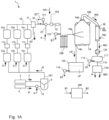
- a flowchart of a system 1, 1' for heat treatment of food product mixture M is illustrated by way of example.
- the system 1, 1' is preferably an ultra-high temperature (UHT) system.
- UHT ultra-high temperature
- the system 1, 1' is illustrated in a highly simplified manner in which only parts relevant for understanding how to perform measurements of the ammonium content A-r1 in the water condensate WC, in the mixture M before, or after, heat treatment, and/or in the liquid food product LP.
- the system 1,1' typically comprises further parts not shown or described in the following disclosure.
- an exemplary system 1 for producing a plant-based liquid food product LP is illustrated, in which the system 1 generally uses plant-based food material F and water W to form a mixture M in a mixer 6.
- the plant-based food material F may be added to the mixer 6 from a container 2, such as a hopper, which may be adapted for conveying dry goods.
- the plant-based food material F may include any suitable type of food material F or combination of food material for making the plant-based liquid food product LP. This includes, but is not limited to, one or more of oat, pea, soy, rice, beans or the like.
- the plant-based food material F may be in any suitable form when added to the mixer 6, such as a dry form, e.g., flour, flake, kernel, groat, seed, grains, pea, bean, nut, or the like, or any combination thereof. Additional ingredients may also be added to the mixer 6 to form the mixture M as may be desired to facilitate processing, taste, nutritional composition or other properties of the final liquid food product LP.
- a dry form e.g., flour, flake, kernel, groat, seed, grains, pea, bean, nut, or the like, or any combination thereof.
- Additional ingredients may also be added to the mixer 6 to form the mixture M as may be desired to facilitate processing, taste, nutritional composition or other properties of the final liquid food product LP.
- the water W may be added from a separate container or other source 4, such as a municipal water source.
- the water W is added to the mixer 6 as a liquid and may be heated prior to entering the mixer 6.
- the mixture M may be heated in the mixer 6, such as with a heater in thermal communication with the mixer 6.
- the temperature of the water W or the mixture M in the mixer 6 may be in a range from 55 °C to 95 °C.
- the amount of water W added to the mixer 6 depends on the desired properties of the mixture M.
- the mixture M may have a solids content in a range from e.g., 10% to 35%, or 16% to 20% by weight, or more, such that the amount of water W added to the mixer 6 may be in a range from 65% to 90% by weight, or less.
- three containers 10a-c are located downstream of the mixer 6 on the line 101 and are configured to receive the mixture M and enabling the mixture M to be treated with enzymes E and/or with heat. That is, the mixture M may be either treated with enzymes, heat, or both. Heat treatment may be done by supplying heat to the containers 10a-c, for example by using a heating jacket that surrounds the containers 10a-c.
- the enzymes E may, if used, hydrolyze the plant-based material in the mixture M to cut starch and create sugars. Following this process, the enzymes may be deactivated, either in the containers 10a-c, or in a separate deactivation container 17a-c which is located downstream of containers 10a-c.
- Enzymes E may be added to the containers 10a-c, however, enzymes E could also be added directly to the mixer 6 at an enzyme inlet 19. In such a case, the containers 10a-c may be used for subsequent processing such as deactivation.
- the treatment with enzymes and/or heat is performed according to known techniques commonly employed for the type of plant material that is used to form the liquid food product LP.
- Each container 10a-c may be fluidly connected with a respective deactivation container 17a-c, or each container 10a-c may be connected to one, or more, common deactivation containers 17a-c.
- a holding container 15a-c is located downstream of the enzyme deactivation container 17a-c, to hold the mixture M before it is further transported into the system 1, 1'.
- each deactivation container 17a-c may be connected to one or more common holding containers 15a-c.
- the deactivation container 17a-c and the holding container 15a-c may be one and the same.
- a separation unit 11 is located downstream of the mixer 6 and is configured to receive the mixture M and separate it into a solid portion SP and a liquid portion of the mixture, of which the solid portion SP may include fibrous material separated from the plant-based material F.
- the solids content in the liquid portion of the mixture M may be in a range from 10% to 30% by weight, for example, with a balance being the water from the food product mixture.
- the separation unit 11 may be a decanter or other suitable device. It is to be noted that the separation unit 11 may be optional, such as, when producing a hole-oat product, separation of the solid portion SP and the liquid portion is not desired and thus no separation unit 11 is present.
- a first sensor 121 for measuring the ammonium content in the mixture Downstream the separator, a first sensor 121 for measuring the ammonium content in the mixture is located.
- the first sensor 121 provides the control unit 129 with a signal S1′′′ comprising information about the measured ammonium.
- the appearance of an increased level of ammonium at this stage of the process may be caused by: fermentation of the food material F due to improper storage conditions, fermentation of the mixture M due to that the mixture M has been stored in the container 10a-c and/or the holding container 15a-c for too long, or the container 10a-c or the holding container 15a-c contain residual from an earlier batch of product, wherein the residual has fermented.
- the mixture M portion is subjected, as shown in Fig. 1A , to direct heating by a direct heating device 12 which is configured to receive the mixture M via a product inlet line 13, and a water steam WS via a steam inlet line 103.
- the direct heating device 12 is configured to create a stream comprising a mixture of the food material mixture M and the water steam WS, and consequently, the temperature of the mixture M is increased.
- the temperature of the stream may be at least 130°C when entering the flash vessel 14.
- the direct heating device 12 itself may be capable of heating the stream to at least 130°C.
- the direct heating device 102 and the heating device 128 may together be capable of heating the stream to at least 130°C.
- the stream containing the mixture M and water steam WS, is fed to the flash vessel 14, via the heating device 128 which is configured to increase the temperature of the stream even further prior to entering the flash vessel 14.
- a second sensor 120 is located in proximity to the heating device 128 to measure the ammonium in the stream and send a signal S1" to the control unit 129. Due to the increased temperatures, substances in the mixture M may decompose which can give rise to increased ammonium levels, about an 10% increase, and thus, the amount of ammonium in the stream may increase. It is to be noted that the second sensor 120 may be located after the heating device 128.
- the stream enters the flash vessel 14 via a flash vessel inlet 14a.
- the stream pressure decreases, and consequently the temperature of the stream decreases, wherein the liquid food product LP is emptied from the flash vessel 14 at a bottom outlet 14c and the liquid food product enters an end product container 125.
- a third sensor 119 is located in the end product container 125. The third sensor 119 measures the ammonium content in the produced liquid food product LP and provides a signal S1' to the control unit 129.
- Liquid food product LP that may not adequately fulfil the quality requirements may be recycled into the process.
- the recycled product R is feed into the system through a recycle inlet line 20 such that the recycled product R can be heat treated once more.
- a flow of water vapour WV is drawn from the flash vessel 14, via an upper outlet 14b of the flash vessel 14, to the condenser 16 where the water vapor WV is condensed to water condensate WC.
- the condenser 16 may be a tube heat exchanger in which a majority of the water vapor become condensate as well as the temperature of the water vapor may be decreased.
- the condenser 16 comprises a fluid outlet 16b and a fluid inlet 16c.
- the water condensate WC is drawn from the condenser 16 to a vacuum pump 126.
- a buffer container 117 is located downstream of the vacuum pump 126 so as to manage the flow from the vacuum pump.
- a fourth sensor 118 is located in the buffer container 117 to measure the ammonium content in the water condensate WC present in the buffer container 117. The sensor 118 sends a signal S1 to the control unit 129.
- the control unit 129 is configured to receive signals S1, S1', S1", S1′′′ from one or more sensors 118, 119, 120, 121 and to determine an ammonium content value A-r2 (see Fig. 3 ) that represents the measured ammonium content A-r1, and determining whether the ammonium content value A-r2 exceeds a threshold ⁇ A-n that is based on a nominal ammonium content value A-n. If the ammonium content value A-r2, at at least one measuring location, exceeds (falls outside of) the threshold value (threshold range) ⁇ A-n, a control signal S2 is provided. In Fig. 3 , the difference between the ammonium content value A-r2 and the nominal ammonium content value A-n is indicated by ⁇ A.
- a water condensate handling arrangement 110 Downstream of the sensor 118, along line 116, a water condensate handling arrangement 110 is located.
- the water condensate handling arrangement 110 may be configured to either separate the water condensate WC' and the contained ammonium A such that water condensate WC' and ammonium A can be recovered or removed separately, or be configured to separate the water condensate WC' and the contained ammonium A such that water WC' can be recovered and e.g., recycled in the process via a reintroducing line, and the ammonium A can be removed, or be configured to remove i.e., drain, the water condensate WC' together with the contained ammonium A.
- the ammonium A may be extracted from the water condensate WC by any commonly known process, e.g., ammonia stripping or air stripping.
- an alternative system 1' is shown.
- the system 1' as shown in Fig. 1B have many similarities to the system 1 as shown in Fig. 1A .
- the alternative system 1' differs in that the heat-treating process and evaporation process is performed in an integrated system of an evaporator 18, such as a falling film evaporator.
- the evaporator 18 is located downstream of the separation unit 11 and is configured to receive and evaporate at least part of the mixture M to produce at least one evaporated portion in form of water vapor WV and at least one concentrated portion in form of the liquid food product LP.
- the water vapor WV is derived from the water W in the initial mixture M.
- the system 1' comprises several sensors 118, 119, 121 which are arranged along the process to measure the ammonium content and send a signal S1, S1', S1′′′ to the at least one control unit 129.
- the temperature of this evaporated water may be in a range from 70 °C to 90 °C.
- About 99% or more of the evaporated portion EP may be evaporated water, with a balance being impurities, such as ammonium.
- FIG. 2 a flowchart illustrating a method 200 for producing a liquid food product LP and measuring the ammonium content A-r1 in at least one of the mixture M, condensate WC, and the liquid food product LP, is shown.
- the method 200 begins with a step of mixing 201 a at least a food material F and water W to form a mixture M.
- the mixture M may be prepared at an elevated temperature, such as by heating the water W or heating the food product mixture M.
- step 202 the mixture M is be treated with heat, as appropriate in view of what type of plant-based liquid food product is prepared.
- step 202 the mixture M is heat treated by e.g., a direct steam injector 12 and the in step 203, the food product mixture is evaporated by e.g., a flash vessel 14 such that the liquid food product LP and water vapor WV is formed.
- step 202 and step 203 are performed simultaneously in e.g., a falling film evaporator 18.
- the water vapor WV is drawn from the evaporator 18 or flash vessel 14 to the condenser 16 to condense the water vapor WV into water condensate WC.
- the ammonium content A-r1 in at least one of the mixture M, the condensate WC, and the liquid food product LP is measured.
- An ammonium content value A-r2 is determined at step 206 and represents the measured ammonium content A-r1.
- the nominal ammonium content value A-n may, as will be described in further detail below, be based on a predetermined target value, or the method may, as shown in Fig. 2 , comprise the steps of measuring 208, determining 209, and setting 210 a nominal content value A-n as a mean of the measured ammonium content A-r1 during a first period of time ⁇ t1.
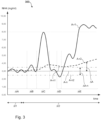
- an exemplified production process 300 of a soy-based liquid food product is shown as a graph.
- the ammonium content is measured in at least the mixture M, the water condensate and/or the liquid food product LP. It has been realized that by measuring the ammonium content value at at least one of these stages of the production process, the control of the end product quality is enhanced, and knowledge about recurring events can be provided such that preventive actions may be taken to avoid, or at least reduce, deterioration of the finished product.
- a preventive action may be to plan more frequent sterilizations cycles and/or reduce the dilution rate when recirculating an already produced product into a new batch.
- the exemplified production process 300 may be equally applicable to a production process of a liquid food product LP based on another type of plant-based material, e.g., oat.
- ammonium content A-r1 measured in mg/l, and shown on the Y-axis, has been measured in the water condensate WC over a period of time, and the ammonium content value A-r2 has been determined.
- the production process 300 extends over a time period of several hours, such as at least 3 hours, at least 10 hours, or even more.
- the nominal ammonium content value A-n may also be referred to as a reference value or a target value.
- the nominal ammonium content value A-n may be based on: an assumption of the ammonia content associated with the specific food material F, a database specifying the ammonia content associated with the specific food material F, and/or by measuring the ammonium content A-r1 in e.g., the water condensate WC, over a first period of time ⁇ t1 to determine a steady state of the ammonium content A-r1.
- the nominal value A-n of ammonium A in the water condensate WC during production of a plant-based beverage may be: 3 mg/l when the beverage is based on organic soy, 6 mg/l when based on non-organic soy, 25 mg/l when based on oat, and 1 mg/l when based on almond.
- the ammonium content value A-r2 represent a mean of measured ammonium contents A-r1 during a period of time.
- mean it intend to refer to one or more numbers or values that best represents a set of set of ammonium content values. It may be the arithmetic mean, geometric mean, harmonic mean, generalized mean, weighted arithmetic, or any other suitable type of mean calculated by using known methods within the fields of mathematics and statistics.
- Time interval ⁇ tA represent a normal production of a soy-based product.
- the ammonium A quantity is fluctuating along the production as it depends on the flow of the mixture M and water condensate WC.
- the upper threshold value A-n1 is set to be 3.5 mg/l and the lower threshold value A-n2 is set to be 2.5 mg/l such that the allowable mean value A-r2 is set to be between 2.5 mg/l and 3.5 mg/l.
- time interval ⁇ tA the ammonium content value A-n2 is within the threshold ⁇ A-n, thus no alarm is activated.
- the system 1, 1' will send an alarm since the ammonium content A-r1 exceeds the threshold ⁇ A-n.
- the alarm is programmed to be activated when the mean value of the measured and determined ammonium content value An2 exceeds the threshold ⁇ A-n, the system 1, 1', in this situation, will not provide an alarm as the mean value A-r2 is within the threshold range.
- a peak of the measured ammonium content A-r1 causes the ammonium content value A-r2 to exceed the threshold value A-n1.
- This large increase may be caused by recirculating an already produced batch of liquid food product LP. Recirculation of a liquid food product LP batch may be performed when the finished product does not pass the quality check, or when an issue with the production process arises such that there is a risk that recently produced products have a deviated quality due to e.g., insufficient sterilization.
- the large increase may also be caused by changing of batch.
- several batches may pass the production system 1, 1' before another cleaning process is initiated.
- One batch generally constitutes 30 000 I of liquid food product LP, which generally represent approximately 3 hours of production. If an increase of ammonium A is detected during the cycle between two cleaning processes, and where the ammonium content A-r1 relatively quick returns to the nominal value A-n, it may be caused by the system being unbalanced due to introduction of a new batch. This will result in that a small portion of the batch will have a slightly different ammonium A concentration than the previous batch. If the ammonium content A-r1 does not return to the nominal value A-n, the liquid food product LP is spoiled either by bacterial growth in the system 1, 1', or by poor food product FP quality.
- the ammonium content level A-r1 in the water condensate WC have decreased such that the value has passed below the lower threshold value A-n2.
- the small drop during time interval ⁇ tD may be linked to process adaptation, as discuses above, or decreased evaporation leading to less concentration in the water condensate.
- a decreased ammonium content value caused by a decreased evaporation may imply that the product is diluted.
- the system 1,1' If the system 1,1' is programmed to provide an alarm based on the instant value, the system 1, 1' will send an alarm since the measured ammonium content A-r1 is below the lower threshold value A-n2. On the other hand, if the system 1,1' is programmed to base the alarm activation on the determined ammonium content value A-r2 based on the mean value of the measured ammonium content A-r1, the system 1,1' will not provide an alarm as the mean value A-r2 is within the acceptable range ⁇ A-n.
- Enzymes E are most often not added in the production of a soy-based beverage since the soybean naturally contain enzymes E in its shell. Thus, wrong dosage of enzymes E is thereby most often not the cause of increased ammonium levels in a soy-based product. However, in a process related to the production of an oat-based beverage, and where a situation similar to the situation occurring during time interval ⁇ tE of process 300, it is most often caused by the wrong dosage of enzymes E, i.e., a too large portion of enzymes E are added, which tend to increase the ammonium content A-r1, and if the dosage is not changed during the cycle, the ammonium content A-r1 will stabilize on a new higher level.
- Another reason for such a large increase of ammonium, relevant for both soy and oat, may be that the raw product, i.e., the food material F, is not stored and/or mixed under proper conditions, and/or within a certain time limit.
- a food material F which has been stored under wrong conditions, e.g., in a humid climate, and/or has been stored for too long may be exposed to bacterial growth which will induce an increase of ammonium.
- a change of the ammonium content A-r1 within the same batch could occur in case of a production failure and/or the system 1,1' is not sterilized often enough which cause bacterial growth in the production system.
- a change of the ammonium contentA-r1 in between two batches may indicate that the second batch has been mixed to early such that it has been stored for too long before being heat treated, and thus such that the mix has started to ferment, and a change of the ammonium content when the raw product is changed may indicate that the plant base quality, or the mixed food product quality, is changed and does not reflect the quality of the previous batch.
Landscapes
- Life Sciences & Earth Sciences (AREA)
- Engineering & Computer Science (AREA)
- Chemical & Material Sciences (AREA)
- Food Science & Technology (AREA)
- Polymers & Plastics (AREA)
- Health & Medical Sciences (AREA)
- Wood Science & Technology (AREA)
- Zoology (AREA)
- Nutrition Science (AREA)
- Botany (AREA)
- Agronomy & Crop Science (AREA)
- Analytical Chemistry (AREA)
- General Health & Medical Sciences (AREA)
- General Physics & Mathematics (AREA)
- Immunology (AREA)
- Pathology (AREA)
- Biochemistry (AREA)
- Mycology (AREA)
- Physics & Mathematics (AREA)
- Oil, Petroleum & Natural Gas (AREA)
- Medicinal Chemistry (AREA)
- General Preparation And Processing Of Foods (AREA)
Abstract
mixing (201) water (W) and a food material (F) to provide a mixture (M),
heat treating (202) the mixture (M) for deactivating harmful microorganisms,
evaporating (203) water from the mixture (M), to provide a stream of water vapor (WV), and a stream of liquid that forms the liquid food product (LP),
condensing (204) the water vapour (WV) to form a condensate (WC),
measuring (205) an ammonium content (A-r1) in at least one of the mixture (M), the condensate (WC) and the liquid food product (LP),
determining (206) an ammonium content value (A-r2) that represents the measured ammonium content, and
determining (207) whether the ammonium content value (A-r2) exceeds a threshold (ΔA-n) that is based on a nominal ammonium content value (A-n). The disclosure also relates to a system.
Description
- The invention relates to a method of producing a liquid food product. The invention also relates to a system for producing a liquid food product.
- Plant-based liquid food products are growing in popularity in recent years. To enhance the shelf-life of such products, it is commonly known to use different types of systems for providing heat treatment of the liquid food in the food processing industry, also known as ultra-high temperature (UHT) systems. These systems are typically used for sterilizing the liquid food, as well as making the liquid food ready for distribution efficiently and safely in relation to requirements related to the food processing industry.
- Commonly, within all food production, tests may be performed on the end product to ensure the quality of the food, such as the product's smell, taste, and/or colour. If the test indicates that the product does not fulfil the quality requirements, a large batch of the product may need to be discarded or recycled in the process. This implies large costs and ineffective production.
- One reason for unsatisfactory product quality can be related to bacterial growth in the system and thus initiation of a cleaning process of the production system is needed. The cleaning processes of a food production system are often set to be performed at a specific time interval or between two batches.
- Moreover, the sustainability requirements for production processes are becoming stricter each year, and producing companies are forced to take more responsibility for their production and the waste that they produce.
- Thus, there is still a need for a production method and system solution that fulfils the requirements related to the food processing industry, while at the same time ensuring good product quality and minimising product that goes to waste or have to be recirculated into the process.
- It is an object of the invention to provide a method and a system addressing at least some of the problems and fulfilling the need of a method that ensures good product quality.
- This object has been achieved by a method of producing a liquid food product, the method comprising
- mixing water and a food material to provide a mixture,
- heat treating the mixture) for deactivating harmful microorganisms,
- evaporating water from the mixture, to provide a stream of water vapor, and a stream of liquid that forms the liquid food product,
- condensing the water vapour to form a condensate,
- measuring an ammonium content in at least one of the mixture, the condensate and the liquid food product,
- determining an ammonium content value that represents the measured ammonium content, and
- determining whether the ammonium content value exceeds a threshold that is based on a nominal ammonium content value.
- This object has also been achieved by a system for producing a liquid food product, the system comprising
- a mixing arrangement configured to mix water and a food material to provide a mixture,
- a heat treatment arrangement configured to heat treat the mixture (M) for deactivating harmful microorganisms,
- a flash vessel or an evaporator configured to evaporate water from the mixture, to provide a stream of water vapor, and a stream of liquid that forms the liquid food product,
- a condenser configured to condense the water vapour to form a condensate,
- a control unit comprising software instructions for
- measuring an ammonium content in at least one of the mixture, the condensate and the liquid food product,
- determining an ammonium content value that represents the measured ammonium content, and
- determining whether the ammonium content value exceeds a threshold that is based on a nominal ammonium content value.
- Some food materials, such as oat and soy, naturally includes certain amounts of ammonia or chemical compounds that naturally may give rise to ammonia. In the process of producing plant-based beverages, the food material is mixed with water, and enzymes may be added into the mixture to hydrolyse the plant-based food material to cut starch and create sugars. In the process of producing the plant-based beverages, substances within the food material may induce a chemical reaction with the enzymes, which are added, or present in the specific food material, when they are all mixed with water. In some cases, these chemical reactions result in the creation of ammonia. As an example, glutamine, which is present in oat and soybeans, may react with the enzymes added such that the glutamine and water reacts together with the enzymes such that the product is glutamate and ammonia. Whereby, ammonia, when dissolved in water, form ammonium hydroxide, hereafter referred to as ammonium.
- As long as the ammonium level in the liquid food product, and thus also in the water condensate, is close to a nominal value, the product quality is not affected. However, if the ammonium content in the liquid food product, and consequently in the water condensate, increases or decreases such that the ammonium content value exceeds or fall below a threshold value, the product quality may be affected.
- Increased levels of ammonium may be caused by: a food material that has started to ferment due to improper storage, the mixture is held within a storage tank for too long such that it starts to ferment, and/or by bacterial build-up in the production system.
- Decreased levels of ammonium may be caused by, e.g., wrong dosage of enzymes in the holding stage.
- An advantage of the present method, and system, is that the control of the product's end quality is enhanced. Since the ammonium content is monitored, necessary activities, to ensure high product quality, can be performed in advance, thus preventing the product from being affected and thereby minimising the risk that the finished product must be discarded, or recycled in the process, which in turn ensures a cost-efficient production.
- Another advantage is that the knowledge about the waste of the production process, i.e., the water condensate, is enhanced. By measuring and controlling the waste, suitable actions may be taken to ensure that the waste is handled properly and in accordance with existing governmental restrictions.
- Moreover, such a method and system are advantageous in that the ammonium content in the condensate is known, and thereby the ammonium may be recovered from the condensate to generate a by-product which may be sold.
- Heat treating the mixture is of importance to partly of fully sterilize the product and deactivating, or kill, harmful microorganisms such that the produced beverage is safe to consume. The heat treatment can be done by e.g., an indirect or direct UHT-system.
- The determining of an ammonium content value and the determining of whether the ammonium content value exceeds the threshold value may be performed by a control unit. The control unit may be a central processing unit, CPU, a memory unit, or any other control unit commonly known.
- The control unit may receive information from at least one sensor which is configured to measure the ammonium content in at least one of the mixture, the condensate and the liquid food product.
- By measuring the ammonium content in at least one of the mixture, the water condensate and the liquid food product and comparing the measured value, or a mean value of the measured values over time, with a nominal ammonium content value, the ammonium content value may be supervised. If the ammonium content value reaches undesirable values, a control signal is provided by the control unit allowing necessary actions to be made to prevent a faulty product.
- It is to be noted that the term "exceeds" refers to a value representing the ammonium content value which is above or below a threshold, the threshold being e.g., range of acceptable values based on the nominal ammonium content value. Thus, exceeding the threshold refers to values being too low or too high to be within the range.
- The nominal ammonium content value may be a predetermined value that is associated with the type of food product to which the liquid food product belongs. As mentioned, food materials such as oats and soy, naturally includes ammonia, and thereby includes an expected amount of ammonia, and thus the nominal ammonium content can be predetermined based on the expected value.
- Alternatively, or additionally, the nominal ammonium content value may be determined by measuring the ammonium content in at least one of the mixture, the condensate and the liquid food product, during a first period of time, and determining a set of ammonium content values that represent the ammonium content measured during the first period of time, and thereafter setting the nominal ammonium content value as a mean of the determined ammonium content values. The first period of time may be a fixed, predetermined time. Alternatively, or as a complement, the first period of time may be adjusted such that a reasonable steady-state is obtained.
- It is to be noted that the ammonium content may be measured by at least one sensor. The system may comprise one sensor but may alternatively comprise a plurality of sensors, e.g., a first, second, and third sensor.
- The sensor may be a sensor capable of detecting ammonium in a liquid, such as a sensor with ion-selective electrodes.
- It is to be noted that the heat treatment arrangement and evaporating arrangement may be an integrated system, such as a falling film evaporator, or a separate system, such as direct heating device and a flash vessel.
- It is to be noted that the system may comprise any other commonly known heat treatment arrangement and/or evaporating arrangement.
- In this context, the term "direct heating device" may be any device capable of increasing a temperature of a liquid or steam in an easy and efficient way, i.e., a device which is configured to heat the liquid or steam. By way of example, the direct heating device may be a steam injector or a steam infuser.
- As readily appreciated by the person skilled in the art, the flash vessel should be interpreted as a vessel capable of performing flash evaporation (or partial evaporation). Flash evaporation (or partial evaporation) is the partial vapor that occurs when a saturated liquid stream, i.e. the stream, undergoes a reduction in pressure by passing through a throttling valve or other throttling device. Preferably, a part of the stream "flashes" into vapor in the flash vessel. Both the vapor and the residual of the stream are cooled to the saturation temperature of the stream at the reduced pressure.
- During production, one purpose of the flash vessel is to expel water from the liquid food. Thus, when the liquid food is introduced via the direct heating device, the liquid food dilutes in the direct heating device. Having the flash vessel which is able to expel water from the liquid food, the flash vessel is advantageous as it is capable of restoring the liquid food as it was before being diluted in the direct heating device. Another purpose of the flash vessel during production is to quickly decrease the temperature of the liquid food. By way of example, the temperature of the liquid food is increased by the steam injector to approximately 140 °C and the temperature of the liquid food is decreased in the flash vessel to approximately 70-80 °C.
- As readily appreciated by the person skilled in the art, the falling film evaporator should be interpreted as a device capable of evaporating fluid, such as water, from a product mixture. A falling film evaporator may advantageously be used when the liquid product is to be a condensate. An advantage of the falling film evaporator is that the product does not need to be diluted by e.g., steam, during the process of heat treatment.
- Generally, all terms used in the claims are to be interpreted according to their ordinary meaning in the technical field, unless explicitly defined otherwise herein. All references to "a/an/the [element, device, component, means, step, etc]" are to be interpreted openly as referring to at least one instance of said element, device, component, means, step, etc., unless explicitly stated otherwise. The steps of any method disclosed herein do not have to be performed in the exact order disclosed, unless explicitly stated.
- Embodiments will now be described, by way of example, with reference to the accompanying schematic drawings, in which
-
Fig. 1A discloses a flowchart illustrating aFig. 1A is a flowchart illustrating a first embodiment of a system for heat treatment of liquid food. -
Fig. 1B disclose a flowchart illustrating a second embodiment of a system for heat treatment of liquid food. -
Fig. 2 is a flowchart illustrating steps of a method for performing producing a liquid food product and measuring the ammonium content value in the condensate. -
Figs. 3-4 discloses different charts reflecting the measured ammonium content in the water condensate over time. - With reference to
Fig. 1A and1B , a flowchart of asystem 1, 1' for heat treatment of food product mixture M is illustrated by way of example. Thesystem 1, 1' is preferably an ultra-high temperature (UHT) system. Thesystem 1, 1' is illustrated in a highly simplified manner in which only parts relevant for understanding how to perform measurements of the ammonium content A-r1 in the water condensate WC, in the mixture M before, or after, heat treatment, and/or in the liquid food product LP. Hence, it is to be understood that thesystem 1,1' typically comprises further parts not shown or described in the following disclosure. - With reference to
Fig. 1A , anexemplary system 1 for producing a plant-based liquid food product LP is illustrated, in which thesystem 1 generally uses plant-based food material F and water W to form a mixture M in amixer 6. The plant-based food material F may be added to themixer 6 from acontainer 2, such as a hopper, which may be adapted for conveying dry goods. The plant-based food material F may include any suitable type of food material F or combination of food material for making the plant-based liquid food product LP. This includes, but is not limited to, one or more of oat, pea, soy, rice, beans or the like. The plant-based food material F may be in any suitable form when added to themixer 6, such as a dry form, e.g., flour, flake, kernel, groat, seed, grains, pea, bean, nut, or the like, or any combination thereof. Additional ingredients may also be added to themixer 6 to form the mixture M as may be desired to facilitate processing, taste, nutritional composition or other properties of the final liquid food product LP. - The water W may be added from a separate container or
other source 4, such as a municipal water source. The water W is added to themixer 6 as a liquid and may be heated prior to entering themixer 6. Alternatively, or additionally, the mixture M may be heated in themixer 6, such as with a heater in thermal communication with themixer 6. The temperature of the water W or the mixture M in themixer 6 may be in a range from 55 °C to 95 °C. The amount of water W added to themixer 6 depends on the desired properties of the mixture M. For example, the mixture M may have a solids content in a range from e.g., 10% to 35%, or 16% to 20% by weight, or more, such that the amount of water W added to themixer 6 may be in a range from 65% to 90% by weight, or less. - As seen in
Figs. 1A-B , threecontainers 10a-c are located downstream of themixer 6 on theline 101 and are configured to receive the mixture M and enabling the mixture M to be treated with enzymes E and/or with heat. That is, the mixture M may be either treated with enzymes, heat, or both. Heat treatment may be done by supplying heat to thecontainers 10a-c, for example by using a heating jacket that surrounds thecontainers 10a-c. The enzymes E may, if used, hydrolyze the plant-based material in the mixture M to cut starch and create sugars. Following this process, the enzymes may be deactivated, either in thecontainers 10a-c, or in aseparate deactivation container 17a-c which is located downstream ofcontainers 10a-c. - Enzymes E may be added to the
containers 10a-c, however, enzymes E could also be added directly to themixer 6 at anenzyme inlet 19. In such a case, thecontainers 10a-c may be used for subsequent processing such as deactivation. The treatment with enzymes and/or heat is performed according to known techniques commonly employed for the type of plant material that is used to form the liquid food product LP. - It is to be noted that there might be more, or less, than three
containers 10a-c. Eachcontainer 10a-c may be fluidly connected with arespective deactivation container 17a-c, or eachcontainer 10a-c may be connected to one, or more,common deactivation containers 17a-c. - A holding
container 15a-c is located downstream of theenzyme deactivation container 17a-c, to hold the mixture M before it is further transported into thesystem 1, 1'. - There may be one holding
container 15a-c for eachdeactivation container 17a-c as shown inFigs. 3-4 , or eachdeactivation container 17a-c may be connected to one or morecommon holding containers 15a-c. Thedeactivation container 17a-c and the holdingcontainer 15a-c may be one and the same. - A
separation unit 11 is located downstream of themixer 6 and is configured to receive the mixture M and separate it into a solid portion SP and a liquid portion of the mixture, of which the solid portion SP may include fibrous material separated from the plant-based material F. The solids content in the liquid portion of the mixture M may be in a range from 10% to 30% by weight, for example, with a balance being the water from the food product mixture. - The
separation unit 11 may be a decanter or other suitable device. It is to be noted that theseparation unit 11 may be optional, such as, when producing a hole-oat product, separation of the solid portion SP and the liquid portion is not desired and thus noseparation unit 11 is present. - Downstream the separator, a
first sensor 121 for measuring the ammonium content in the mixture is located. Thefirst sensor 121 provides thecontrol unit 129 with a signal S1‴ comprising information about the measured ammonium. - The appearance of an increased level of ammonium at this stage of the process may be caused by: fermentation of the food material F due to improper storage conditions, fermentation of the mixture M due to that the mixture M has been stored in the
container 10a-c and/or the holdingcontainer 15a-c for too long, or thecontainer 10a-c or the holdingcontainer 15a-c contain residual from an earlier batch of product, wherein the residual has fermented. - The mixture M portion is subjected, as shown in
Fig. 1A , to direct heating by adirect heating device 12 which is configured to receive the mixture M via aproduct inlet line 13, and a water steam WS via asteam inlet line 103. Thedirect heating device 12 is configured to create a stream comprising a mixture of the food material mixture M and the water steam WS, and consequently, the temperature of the mixture M is increased. The temperature of the stream may be at least 130°C when entering theflash vessel 14. Thus, thedirect heating device 12 itself may be capable of heating the stream to at least 130°C. Additionally, or alternatively, the direct heating device 102 and theheating device 128 may together be capable of heating the stream to at least 130°C. - The stream, containing the mixture M and water steam WS, is fed to the
flash vessel 14, via theheating device 128 which is configured to increase the temperature of the stream even further prior to entering theflash vessel 14. Asecond sensor 120 is located in proximity to theheating device 128 to measure the ammonium in the stream and send a signal S1" to thecontrol unit 129. Due to the increased temperatures, substances in the mixture M may decompose which can give rise to increased ammonium levels, about an 10% increase, and thus, the amount of ammonium in the stream may increase. It is to be noted that thesecond sensor 120 may be located after theheating device 128. - The stream enters the
flash vessel 14 via aflash vessel inlet 14a. In theflash vessel 14, the stream pressure decreases, and consequently the temperature of the stream decreases, wherein the liquid food product LP is emptied from theflash vessel 14 at abottom outlet 14c and the liquid food product enters anend product container 125. In theend product container 125, athird sensor 119 is located. Thethird sensor 119 measures the ammonium content in the produced liquid food product LP and provides a signal S1' to thecontrol unit 129. - Liquid food product LP that may not adequately fulfil the quality requirements may be recycled into the process. The recycled product R is feed into the system through a
recycle inlet line 20 such that the recycled product R can be heat treated once more. - A flow of water vapour WV is drawn from the
flash vessel 14, via anupper outlet 14b of theflash vessel 14, to thecondenser 16 where the water vapor WV is condensed to water condensate WC. Thecondenser 16 may be a tube heat exchanger in which a majority of the water vapor become condensate as well as the temperature of the water vapor may be decreased. - The
condenser 16 comprises afluid outlet 16b and afluid inlet 16c. - Thereafter, the water condensate WC is drawn from the
condenser 16 to avacuum pump 126. Abuffer container 117 is located downstream of thevacuum pump 126 so as to manage the flow from the vacuum pump. Afourth sensor 118 is located in thebuffer container 117 to measure the ammonium content in the water condensate WC present in thebuffer container 117. Thesensor 118 sends a signal S1 to thecontrol unit 129. - The
control unit 129 is configured to receive signals S1, S1', S1", S1‴ from one ormore sensors Fig. 3 ) that represents the measured ammonium content A-r1, and determining whether the ammonium content value A-r2 exceeds a threshold ΔA-n that is based on a nominal ammonium content value A-n. If the ammonium content value A-r2, at at least one measuring location, exceeds (falls outside of) the threshold value (threshold range) ΔA-n, a control signal S2 is provided. InFig. 3 , the difference between the ammonium content value A-r2 and the nominal ammonium content value A-n is indicated by ΔA. - Downstream of the
sensor 118, alongline 116, a watercondensate handling arrangement 110 is located. The watercondensate handling arrangement 110 may be configured to either separate the water condensate WC' and the contained ammonium A such that water condensate WC' and ammonium A can be recovered or removed separately, or be configured to separate the water condensate WC' and the contained ammonium A such that water WC' can be recovered and e.g., recycled in the process via a reintroducing line, and the ammonium A can be removed, or be configured to remove i.e., drain, the water condensate WC' together with the contained ammonium A. - The ammonium A may be extracted from the water condensate WC by any commonly known process, e.g., ammonia stripping or air stripping.
- With reference to
Fig. 1B , an alternative system 1' is shown. The system 1' as shown inFig. 1B , have many similarities to thesystem 1 as shown inFig. 1A . However, the alternative system 1' differs in that the heat-treating process and evaporation process is performed in an integrated system of anevaporator 18, such as a falling film evaporator. Theevaporator 18 is located downstream of theseparation unit 11 and is configured to receive and evaporate at least part of the mixture M to produce at least one evaporated portion in form of water vapor WV and at least one concentrated portion in form of the liquid food product LP. The water vapor WV is derived from the water W in the initial mixture M. Similar to thesystem 1, as shown inFig. 1A , the system 1' comprisesseveral sensors control unit 129. - About 80% to 95%, or more, of the water in the mixture M may be evaporated into water vapour WV. The temperature of this evaporated water may be in a range from 70 °C to 90 °C. About 99% or more of the evaporated portion EP may be evaporated water, with a balance being impurities, such as ammonium.
- With reference to
Fig. 2 , a flowchart illustrating amethod 200 for producing a liquid food product LP and measuring the ammonium content A-r1 in at least one of the mixture M, condensate WC, and the liquid food product LP, is shown. Themethod 200, as shown inFig. 2 , begins with a step of mixing 201 a at least a food material F and water W to form a mixture M. The mixture M may be prepared at an elevated temperature, such as by heating the water W or heating the food product mixture M. - The
step 211 includes extracting nutrients from the food material F to the mixture M. The extracting of nutrients may be performed by treating the mixture M with enzymes E, which hydrolyze the food material F. The enzyme treatment may occur over a time span of 2, 4, 6, or even up to 15 hours. Generally, the amount of enzyme added may be less than 1% by weight of the total mixture M. Following enzyme treatment, the enzymes may be deactivated. - In
step 202, the mixture M is be treated with heat, as appropriate in view of what type of plant-based liquid food product is prepared. - At
step 202, the mixture M is heat treated by e.g., adirect steam injector 12 and the instep 203, the food product mixture is evaporated by e.g., aflash vessel 14 such that the liquid food product LP and water vapor WV is formed. Alternatively,step 202 and step 203 are performed simultaneously in e.g., a fallingfilm evaporator 18. - At
step 204, the water vapor WV is drawn from theevaporator 18 orflash vessel 14 to thecondenser 16 to condense the water vapor WV into water condensate WC. - At
step 205, the ammonium content A-r1 in at least one of the mixture M, the condensate WC, and the liquid food product LP is measured. - An ammonium content value A-r2 is determined at
step 206 and represents the measured ammonium content A-r1. - It is determined in
step 207 whether the ammonium content value A-r2 exceeds a threshold ΔA-n that is based on a nominal ammonium content value (A-n). - The nominal ammonium content value A-n, may, as will be described in further detail below, be based on a predetermined target value, or the method may, as shown in
Fig. 2 , comprise the steps of measuring 208, determining 209, and setting 210 a nominal content value A-n as a mean of the measured ammonium content A-r1 during a first period of time Δt1. - With reference to
Fig. 3 , an exemplifiedproduction process 300 of a soy-based liquid food product is shown as a graph. During the production process the ammonium content is measured in at least the mixture M, the water condensate and/or the liquid food product LP. It has been realized that by measuring the ammonium content value at at least one of these stages of the production process, the control of the end product quality is enhanced, and knowledge about recurring events can be provided such that preventive actions may be taken to avoid, or at least reduce, deterioration of the finished product. A preventive action may be to plan more frequent sterilizations cycles and/or reduce the dilution rate when recirculating an already produced product into a new batch. - It is to be noted that the exemplified
production process 300, as shown inFig.3 , may be equally applicable to a production process of a liquid food product LP based on another type of plant-based material, e.g., oat. - The ammonium content A-r1, measured in mg/l, and shown on the Y-axis, has been measured in the water condensate WC over a period of time, and the ammonium content value A-r2 has been determined.
- The
production process 300, as shown inFig. 3 , extends over a time period of several hours, such as at least 3 hours, at least 10 hours, or even more. - The nominal ammonium content value A-n may also be referred to as a reference value or a target value. The nominal ammonium content value A-n may be based on: an assumption of the ammonia content associated with the specific food material F, a database specifying the ammonia content associated with the specific food material F, and/or by measuring the ammonium content A-r1 in e.g., the water condensate WC, over a first period of time Δt1 to determine a steady state of the ammonium content A-r1. The nominal value A-n of ammonium A in the water condensate WC during production of a plant-based beverage may be: 3 mg/l when the beverage is based on organic soy, 6 mg/l when based on non-organic soy, 25 mg/l when based on oat, and 1 mg/l when based on almond.
- The threshold ΔA-n may be an allowable variation of the ammonium content value A-r2. The threshold ΔA-n has an upper threshold value A-n1 and a lower threshold value A-n2, wherein the threshold values A-n1, A-n2 comprises a range that is offset from the nominal ammonium content value A-n by at least 5 to 20%.
- The ammonium content value A-r2 represent a mean of measured ammonium contents A-r1 during a period of time. By the term "mean" it intend to refer to one or more numbers or values that best represents a set of set of ammonium content values. It may be the arithmetic mean, geometric mean, harmonic mean, generalized mean, weighted arithmetic, or any other suitable type of mean calculated by using known methods within the fields of mathematics and statistics.
- The mean value of the measured ammonium content may be used to minimize the risk of causing false alarms. The term "false alarm" refers to a situation where the alarm is provided due to an isolated exceeding of the threshold value An1, A-n2 which after a short time-period, e.g., a few minutes, returns, by itself, to an acceptable value. Such an isolated exceeding will not noticeably affect the quality of the liquid food product LP, and thus no actions need to be taken. By instead using a mean value A-r2 of the measured ammonium A-r1, an alarm can be provided when the measured and determined ammonium content value A-r2 has exceeded the threshold value A-n1, A-n2 such that an action can be taken to prevent deterioration of the product quality. However, in some processes it might be favourable and desired to obtain an alarm on the instant measured ammonium content A-r1 and not base the alarm set-up on a mean value of the measured ammonium content A-r1.
-
Fig. 3 illustrates different time intervals ΔtA-E which may occur during the production of a soy-based beverage. Note that these situations, which are to be described in further detail below, are equally applicable and realistic for a production process for a beverage based on another plant-base, such as oat. - Time interval ΔtA, as shown in
Fig. 3 , represent a normal production of a soy-based product. The ammonium A quantity is fluctuating along the production as it depends on the flow of the mixture M and water condensate WC. The upper threshold value A-n1 is set to be 3.5 mg/l and the lower threshold value A-n2 is set to be 2.5 mg/l such that the allowable mean value A-r2 is set to be between 2.5 mg/l and 3.5 mg/l. As shown in time interval ΔtA, the ammonium content value A-n2 is within the threshold ΔA-n, thus no alarm is activated. In a case where thesystem 1, 1' is set to provide an alarm based on the instant measured value A-r1, no alarm would be activated since the measured ammonium content A-r1, during time interval ΔtA, also is within the set threshold ΔA-n. - During time interval ΔtB, as shown in
Fig. 3 , there is a peak of ammonium quantity in the water condensate WC. This small peak occurs for a short period of time and may be linked to a process adaptation, food material F quality variation, increased evaporation, or quality of the water and/or steam induced in mixture M. - "Process adaptation" refers to the stage after the machines in the
system 1, 1' have been sterilised and/or where changes may have been made. A process adaptation may cause temporary unbalance in theproduction system 1, 1' which will, after some time, be stabilized. - If the sensors, in this situation, monitor the instant measured ammonium value A-r1, the
system 1, 1' will send an alarm since the ammonium content A-r1 exceeds the threshold ΔA-n. However, if the alarm is programmed to be activated when the mean value of the measured and determined ammonium content value An2 exceeds the threshold ΔA-n, thesystem 1, 1', in this situation, will not provide an alarm as the mean value A-r2 is within the threshold range. - As shown in
Fig. 3 , with reference to time interval ΔtC, a peak of the measured ammonium content A-r1 causes the ammonium content value A-r2 to exceed the threshold value A-n1. This large increase may be caused by recirculating an already produced batch of liquid food product LP. Recirculation of a liquid food product LP batch may be performed when the finished product does not pass the quality check, or when an issue with the production process arises such that there is a risk that recently produced products have a deviated quality due to e.g., insufficient sterilization. It has been realised that when a recirculation of product is performed, the ammonium content increases, and when the recirculation stops, i.e., when a new batch is introduced into the system, the ammonium content A-r1 reverts to a nominal value A-n. - The large increase may also be caused by changing of batch. Commonly, after the
system 1, 1' has been cleaned and sterilised, several batches may pass theproduction system 1, 1' before another cleaning process is initiated. One batch generally constitutes 30 000 I of liquid food product LP, which generally represent approximately 3 hours of production. If an increase of ammonium A is detected during the cycle between two cleaning processes, and where the ammonium content A-r1 relatively quick returns to the nominal value A-n, it may be caused by the system being unbalanced due to introduction of a new batch. This will result in that a small portion of the batch will have a slightly different ammonium A concentration than the previous batch. If the ammonium content A-r1 does not return to the nominal value A-n, the liquid food product LP is spoiled either by bacterial growth in thesystem 1, 1', or by poor food product FP quality. - With reference to time interval ΔtD, as shown in
Fig. 3 , the ammonium content level A-r1 in the water condensate WC have decreased such that the value has passed below the lower threshold value A-n2. The small drop during time interval ΔtD may be linked to process adaptation, as discuses above, or decreased evaporation leading to less concentration in the water condensate. A decreased ammonium content value caused by a decreased evaporation may imply that the product is diluted. - If the
system 1,1' is programmed to provide an alarm based on the instant value, thesystem 1, 1' will send an alarm since the measured ammonium content A-r1 is below the lower threshold value A-n2. On the other hand, if thesystem 1,1' is programmed to base the alarm activation on the determined ammonium content value A-r2 based on the mean value of the measured ammonium content A-r1, thesystem 1,1' will not provide an alarm as the mean value A-r2 is within the acceptable range ΔA-n. - With reference to time interval ΔtE, as shown in
Fig. 3 , a peak of measured ammonium content A-r1 is observed, and the ammonium content A-r1 does not decrease and seems to be stabilizing to a new value. It has been realized that when such a situation occurs, it is most often linked to: wrong dosage of the enzymes E, insufficient heat treatment such that the enzymes E are not deactivated, or food material F spoilage. - If the deactivation of enzymes E does not function properly, remains of enzymes E are still active and will spoil the product.
- Enzymes E are most often not added in the production of a soy-based beverage since the soybean naturally contain enzymes E in its shell. Thus, wrong dosage of enzymes E is thereby most often not the cause of increased ammonium levels in a soy-based product. However, in a process related to the production of an oat-based beverage, and where a situation similar to the situation occurring during time interval ΔtE of
process 300, it is most often caused by the wrong dosage of enzymes E, i.e., a too large portion of enzymes E are added, which tend to increase the ammonium content A-r1, and if the dosage is not changed during the cycle, the ammonium content A-r1 will stabilize on a new higher level. - Another reason for such a large increase of ammonium, relevant for both soy and oat, may be that the raw product, i.e., the food material F, is not stored and/or mixed under proper conditions, and/or within a certain time limit. A food material F which has been stored under wrong conditions, e.g., in a humid climate, and/or has been stored for too long may be exposed to bacterial growth which will induce an increase of ammonium.
- A change of the ammonium content A-r1 within the same batch could occur in case of a production failure and/or the
system 1,1' is not sterilized often enough which cause bacterial growth in the production system. A change of the ammonium contentA-r1 in between two batches may indicate that the second batch has been mixed to early such that it has been stored for too long before being heat treated, and thus such that the mix has started to ferment, and a change of the ammonium content when the raw product is changed may indicate that the plant base quality, or the mixed food product quality, is changed and does not reflect the quality of the previous batch. - With reference to
Fig. 4 , an exemplifiedproduction process 400 of an oat-based liquid food product LP is shown as a graph. During time interval ΔtF, the ammonium content A-r1' in the water condensate WC is fluctuating around the nominal value A-n'. The fluctuation may depend on the flow of the food product mixture M and the water condensate WC. The measured ammonium content A-r1' exceeds the upper threshold value A-n1' during the time interval ΔtG-H, as shown inFig. 4 , this increase may be caused by the same reasons as described in relation to the increased ammonium levels A-r1 during time intervals ΔtB-C inFig. 3 . - During time interval Δtl, as shown in
Fig. 4 , a substantial decrease of the ammonium content A-r1' is observed and the decrease causes the ammonium content value A-r2' to also exceed the lower threshold value A-n2'. This decrease may be caused by a lack of enzymes E or that the enzymes E are missing. - In a production process, not shown, where the nominal ammonium value is based on a data set, the ammonium content value, already from the beginning of the production process, may be far above, or below, the nominal ammonium content value and the threshold value. When producing a product where enzymes E need to be added, increased or decreased values of ammonium may be caused by: enzymes E are not dosed properly, i.e., to small or to large amount of enzymes E are added, the quality of the enzymes E, the deactivation of the enzymes E is malfunctioning, the batch is damaged due to the growth of microorganisms, and/or the food material F does not fulfil the expected quality.
- As shown in
Figs. 3-4 , thesystem 1, 1' will at some points provide a control signal S2 due to that the ammonium content value A-r2 has reached outside the threshold value A-n1, A-n2. When such a control signal S2 is provided there are several actions that can be made, such as: initiating a sterilization process of the production system, test the food material F, test the process water W, test the steam WS which is to be infused in the food product mixture. - An advantage of observing the ammonium content value on the system is that it may provide knowledge about recurring events such that preventive actions may be taken to avoid, or at least reduce, deterioration of the product. A preventive action may be to plan more frequent sterilizations cycles and/or reduce the dilution rate when recirculating an already produced product into a new batch.
- Even though it is preferred that the system is designed in accordance with the disclosure in the detailed disclosure of preferred embodiments and the appended drawings, it should be noted that a specific preferred embodiment of a specific component does not necessarily have to be combined with a specific embodiment of another component. Thus, advantages associated with a specific embodiment, including one or more features, of a specific component may be accomplished even though the other components are designed in accordance with the more general disclosure under the summary of the invention rather than being defined in accordance with the specific embodiment disclosed in the detailed description.
- Additionally, variations to the disclosed embodiments can be understood and effected by the skilled person in practicing the claimed invention, from a study of the drawings, the disclosure, and the appended claims. In the claims, the word "comprising" does not exclude other elements or steps, and the indefinite article "a" or "an" does not exclude a plurality. The mere fact that certain measures are recited in mutually different dependent claims does not indicate that a combination of these measured cannot be used to advantage.
Claims (15)
- A method (200) of producing a liquid food product (LP), the method (200) comprisingmixing (201) water (W) and a food material (F) to provide a mixture (M),heat treating (202) the mixture (M) for deactivating harmful microorganisms,evaporating (203) water from the mixture (M), to provide a stream of water vapor (WV), and a stream of liquid that forms the liquid food product (LP),condensing (204) the water vapour (WV) to form a condensate (WC),measuring (205) an ammonium content (A-r1) in at least one of the mixture (M), the condensate (WC) and the liquid food product (LP),determining (206) an ammonium content value (A-r2) that represents the measured ammonium content, anddetermining (207) whether the ammonium content value (A-r2) exceeds a threshold (ΔA-n) that is based on a nominal ammonium content value (A-n).
- The method (200) according to claim 1, wherein the nominal ammonium content value (A-n) is a predetermined value that is associated with the type of food product to which the liquid food product (LP) belongs.
- The method (200) according to any preceding claim, further comprisingmeasuring (208), during a first period of time (Δt1), an ammonium content in at least one of the mixture (M), the condensate (WC) and the liquid food product (LP),determining (209) a set of ammonium content values (A-r1) that represent the ammonium content measured during the first period of time (Δt1), andsetting (210) the nominal ammonium content value (A-n) as a mean of the determined ammonium content values (A-r1).
- The method (200) according to claim 3, wherein the set nominal ammonium content value (A-n) is, during a second period of time (Δt2) that is subsequent to the first period of time (Δt1), used for the determining (207) of whether the ammonium content value (A-r2) exceeds the threshold (ΔA-n) .
- The method (200) according to any preceding claim, whereinthe measuring (206) of the ammonium content (A-r1) comprises measuring the ammonium content (A-r1) during a period of time,the determining (207) of the ammonium content value (A-r2) comprises setting the ammonium content value (A-r2) as a mean of measured (206) ammonium contents (A-r1) during said period of time.
- The method (200) according to claim 5, further comprisingcleaning at least one component that is used for the producing of the liquid food product (LP), and, in response to said cleaning,measuring the ammonium content (A-r1) during a further period of time, andsetting the ammonium content value (A-r2) as a mean of the measured ammonium contents (A-r1) during said further period of time.
- The method (200) according to any preceding claim, wherein the threshold (ΔA-n) comprises a range that is offset from the nominal ammonium content value (A-n) by at least 10%.
- The method (200) according to any preceding claim, wherein the mixing (201) and the heat treating (202) is performed to produce an ammonium content in the liquid food product (LP) that isin the range from 3 to 150 mg/l,preferably in the range from 25 to 150 mg/l when the food material (F) is oat, andpreferably in the range from 3 to 15 mg/l when the food material (F) is soy.
- The method (200) according to any of the preceding claims, wherein thethe condensing (204) is performed by using a condenser (16), andthe measuring (205) of the ammonium content in the condensate (WC) is performed by using a sensor (118) positioned in or downstream the condenser (16).
- The method (200) according to claim 9, wherein the sensor (118) is a sensor comprising ion-selective electrodes.
- The method (200) according to any preceding claim, wherein the measuring (205) of an ammonium content comprises measuring the ammonium content in the condensate (WC).
- The method (200) according to any preceding claims, further comprising hydrolyzing (211) the food material in the mixture (M) with at least one enzyme (E).
- The method (200) according to claim 12, wherein the at least one enzyme (E) is one or both of amylase and protease.
- The method (200) according to any preceding claims, wherein the food material (M) is a plant-based material, preferably oat, whey, rice, soy, or spelt.
- A system (1, 1') for producing a liquid food product (LP), the system (1. 1') comprisinga mixing arrangement (6) configured to mix water (W) and a food material (F) to provide a mixture (M),a heat treatment arrangement (12,128,18) configured to heat treat the mixture (M) for deactivating harmful microorganisms,a flash vessel (14) or an evaporator (18) configured to evaporate water from the mixture (M), to provide a stream of water vapor (WV), and a stream of liquid that forms the liquid food product (LP),a condenser (16) configured to condense the water vapour (WV) to form a condensate (WC),a control unit (129) comprising software instructions formeasuring an ammonium content (A-r1) in at least one of the mixture (M), the condensate (WC) and the liquid food product (LP),determining an ammonium content value (A-r2) that represents the measured ammonium content, anddetermining whether the ammonium content value (A-r2) exceeds a threshold (ΔA-n) that is based on a nominal ammonium content value (An).
Applications Claiming Priority (1)
| Application Number | Priority Date | Filing Date | Title |
|---|---|---|---|
| EP23220751 | 2023-12-29 |
Publications (1)
| Publication Number | Publication Date |
|---|---|
| EP4578291A1 true EP4578291A1 (en) | 2025-07-02 |
Family
ID=89428816
Family Applications (1)
| Application Number | Title | Priority Date | Filing Date |
|---|---|---|---|
| EP24223584.4A Pending EP4578291A1 (en) | 2023-12-29 | 2024-12-29 | Method and system for producing a liquid food product |
Country Status (2)
| Country | Link |
|---|---|
| EP (1) | EP4578291A1 (en) |
| WO (1) | WO2025141184A1 (en) |
Citations (4)
| Publication number | Priority date | Publication date | Assignee | Title |
|---|---|---|---|---|
| WO2016055292A1 (en) * | 2014-10-08 | 2016-04-14 | Tetra Laval Holdings & Finance S.A. | Method and apparatus for processing a soy beverage product |
| EP2958435B1 (en) * | 2013-02-19 | 2017-11-01 | Tetra Laval Holdings & Finance SA | Process and assembly for recombining a food product |
| EP3257382A1 (en) * | 2016-06-14 | 2017-12-20 | Liquats Vegetals SA | Sterilization process for sterilizing liquid vegetable food products |
| WO2023126061A1 (en) * | 2021-12-30 | 2023-07-06 | Oatly Ab | Liquid oat composition and method for production thereof |
-
2024
- 2024-12-29 EP EP24223584.4A patent/EP4578291A1/en active Pending
- 2024-12-29 WO PCT/EP2024/088608 patent/WO2025141184A1/en active Pending
Patent Citations (4)
| Publication number | Priority date | Publication date | Assignee | Title |
|---|---|---|---|---|
| EP2958435B1 (en) * | 2013-02-19 | 2017-11-01 | Tetra Laval Holdings & Finance SA | Process and assembly for recombining a food product |
| WO2016055292A1 (en) * | 2014-10-08 | 2016-04-14 | Tetra Laval Holdings & Finance S.A. | Method and apparatus for processing a soy beverage product |
| EP3257382A1 (en) * | 2016-06-14 | 2017-12-20 | Liquats Vegetals SA | Sterilization process for sterilizing liquid vegetable food products |
| WO2023126061A1 (en) * | 2021-12-30 | 2023-07-06 | Oatly Ab | Liquid oat composition and method for production thereof |
Also Published As
| Publication number | Publication date |
|---|---|
| WO2025141184A1 (en) | 2025-07-03 |
Similar Documents
| Publication | Publication Date | Title |
|---|---|---|
| Broderick et al. | Sources of variation in rates of in vitro ruminal protein degradation | |
| US11882861B2 (en) | Remediation of toxins in biorefinery process streams | |
| WO2025141184A1 (en) | Method and system for producing a liquid food product | |
| EP4609718A1 (en) | Method and system for producing a liquid food product | |
| JP3813172B2 (en) | Heat-sensitive fluid food processing plant | |
| CN112624819B (en) | Method for treating organic waste | |
| El-Desouky et al. | Occurrence of zearalenone contamination in some cereals in Egypt | |
| Abernethy et al. | Advances in testing for adulteration and authenticity of dairy products | |
| AU746891B2 (en) | A method of imparting an ultra-short, momentaneous heat treatment to a liquid | |
| Witte | Soybean meal processing and utilization | |
| JP4556181B2 (en) | Method for producing fermented milk powder by vacuum spray drying | |
| US6159519A (en) | Method for supplying steam to a grain processor | |
| JP2015501648A (en) | Method and apparatus for pasteurizing and / or sterilizing food products | |
| Peng et al. | Systematic evaluation of food design, treatments, packaging and storage conditions on microplastic concentrations in complex matrices | |
| WO2016055292A1 (en) | Method and apparatus for processing a soy beverage product | |
| US20260096580A1 (en) | Re-use of evaporated product in the preparation of plant-based liquid food concentrate | |
| WO2007077954A1 (en) | Method for production of sterile solid protein for food application | |
| Samsami et al. | Operational Conditions of Micronized Maize Grains Assessed by Modeling Ruminal in vitro Gas Production Data and Three Steps Method. | |
| EP0222965A1 (en) | Method and apparatus for pre-cooking rice and other cereals | |
| EP0614338B1 (en) | Method of treatment of protein materials, products obtained and applications to the animal food industry | |
| CN116530569B (en) | A flash evaporation system for inactivating enzymes in plant milk-based materials | |
| CN209573111U (en) | The device that a kind of rice protein feed liquid high-temperature short-time sterilization and flash distillation are deodorized | |
| US3845229A (en) | Method of preparing soybean products free of antitrypsin | |
| JPS60224478A (en) | Direct sterilization of fluid containing solid things and arrangement therefor | |
| US20250160368A1 (en) | Feed Block Production Method using Vacuum Pressure |
Legal Events
| Date | Code | Title | Description |
|---|---|---|---|
| PUAI | Public reference made under article 153(3) epc to a published international application that has entered the european phase |
Free format text: ORIGINAL CODE: 0009012 |
|
| STAA | Information on the status of an ep patent application or granted ep patent |
Free format text: STATUS: THE APPLICATION HAS BEEN PUBLISHED |
|
| AK | Designated contracting states |
Kind code of ref document: A1 Designated state(s): AL AT BE BG CH CY CZ DE DK EE ES FI FR GB GR HR HU IE IS IT LI LT LU LV MC ME MK MT NL NO PL PT RO RS SE SI SK SM TR |
|
| STAA | Information on the status of an ep patent application or granted ep patent |
Free format text: STATUS: REQUEST FOR EXAMINATION WAS MADE |
|
| 17P | Request for examination filed |
Effective date: 20260102 |
|
| STAA | Information on the status of an ep patent application or granted ep patent |
Free format text: STATUS: EXAMINATION IS IN PROGRESS |
|
| 17Q | First examination report despatched |
Effective date: 20260408 |