EP4576868A1 - Funkknotenpriorisierung - Google Patents
Funkknotenpriorisierung Download PDFInfo
- Publication number
- EP4576868A1 EP4576868A1 EP23219116.3A EP23219116A EP4576868A1 EP 4576868 A1 EP4576868 A1 EP 4576868A1 EP 23219116 A EP23219116 A EP 23219116A EP 4576868 A1 EP4576868 A1 EP 4576868A1
- Authority
- EP
- European Patent Office
- Prior art keywords
- radio
- radio nodes
- qos
- subset
- nodes
- Prior art date
- Legal status (The legal status is an assumption and is not a legal conclusion. Google has not performed a legal analysis and makes no representation as to the accuracy of the status listed.)
- Pending
Links
Images




Classifications
-
- H—ELECTRICITY
- H04—ELECTRIC COMMUNICATION TECHNIQUE
- H04W—WIRELESS COMMUNICATION NETWORKS
- H04W28/00—Network traffic management; Network resource management
- H04W28/16—Central resource management; Negotiation of resources or communication parameters, e.g. negotiating bandwidth or QoS [Quality of Service]
- H04W28/24—Negotiating SLA [Service Level Agreement]; Negotiating QoS [Quality of Service]
-
- H—ELECTRICITY
- H04—ELECTRIC COMMUNICATION TECHNIQUE
- H04W—WIRELESS COMMUNICATION NETWORKS
- H04W24/00—Supervisory, monitoring or testing arrangements
- H04W24/02—Arrangements for optimising operational condition
-
- H—ELECTRICITY
- H04—ELECTRIC COMMUNICATION TECHNIQUE
- H04W—WIRELESS COMMUNICATION NETWORKS
- H04W28/00—Network traffic management; Network resource management
- H04W28/02—Traffic management, e.g. flow control or congestion control
- H04W28/0268—Traffic management, e.g. flow control or congestion control using specific QoS parameters for wireless networks, e.g. QoS class identifier [QCI] or guaranteed bit rate [GBR]
Definitions
- aspects of the present specification relate to a computer implemented method of radio node prioritization in a radio system, an apparatus, a wireless communication system, and a computer program element.
- Open radio access network is a technical concept enabling the improvement of interoperability in the radio access network (RAN).
- O-RAN provides a standardised architecture and open interfaces.
- O-RAN disaggregates the 3GPP architecture, and comprises the main components: Radio Unit (RU), Distributed Unit (DU), Centralized Unit (CU), and RAN Intelligent Controller (RIC).
- RU Radio Unit
- DU Distributed Unit
- CU Centralized Unit
- RIC RAN Intelligent Controller
- QoS assurance Quality of service (QoS) assurance is an important aspect in mobile communication, especially in industrial applications, which often have stringent QoS requirements in terms of packet error rate (PER), throughput, and delay, as examples of QoS requirements.
- PER packet error rate
- QoS assurance plays a critical role because failing to meet the required QoS might slow down a production process or reduce production efficiency. Accordingly, mechanisms to improve QoS provision in the context of an O-RAN network can be further improved.
- the radio resource may not suffice to meet the QoS of all the radio nodes that belong to the a slice with high priority.
- the static QoS class assigned to all radio nodes might not reflect the criticality of a task executed on a given radio node. Accordingly, in one example of the approach of this specification the question is how to prioritise one user node over others when they all belong to the same network slice and have the same QoS requirements, but the resources are not sufficient to meet the QoS requirements of all nodes due to poor channel conditions or an excess of connected radio nodes.
- a similar question can be raised when a radio node level traffic prioritisation is applied.
- each radio node (for example, comprised inside a camera or an automated mobile robot) serves a QoS flow and is assigned to a QoS profile and again there may be situations in which, due to lack of resources, the QoS requirements defined by the assigned QoS profile of one or more of those radio nodes cannot be satisfied.
- the radio nodes may be assigned a quality of service (such as throughput).
- the applications that use the radio node can detect and report that they can survive, or function, with lower QoS provision.
- the applications discover this excess QoS provision using at least the enrichment information, although other network feedback information can supplement the enrichment information.
- the radio node in the second subset of radio nodes can be downgraded for a given, predetermined, or calculated duration.
- the QoS ability (such as extra resource blocks in the time frequency matrix) of the network thus freed can be assigned to other radio nodes.
- the applications that use the radio node can detect and report that they cannot survive, or function, with an existing QoS provision.
- the applications discover this unmet QoS provision using at least the enrichment information, although other network feedback information can supplement the enrichment information.
- radio nodes have an assigned QoS requirement.
- An application may detect that, for some of the radio nodes, the QoS requirements are not met (e.g., uplink or downlink guaranteed flow bit rate is lower that the expected value as per the assigned QoS). This can happen due to the fact that the radio resources are limited and in some situations cannot suffice for all the radio nodes and as a result some of them may have unmet QoS.
- PRBs radio resources
- An effect of the technique according to the first aspect is that a mechanism is provided to enable the automatic reprioritisation of a QoS rating assigned to individual radio nodes (as one example are user equipment, UE).
- UE user equipment
- This enables radio nodes having an urgent need for, for example, better throughput to obtain the required amount of resources in order to meet their QoS requirements since in some situations it may not be possible for the base stations (gNBs, for example) to meet the QoS requirements of all the attached radio nodes.
- radio nodes may fail to meet their QoS requirement to other base stations, if those base stations have sufficient resources to meet the QoS needs of the given radio nodes.
- some radio nodes can be down- prioritised relative to other radio notes, while making sure that the quality of service of the down- prioritised radio nodes remains at an acceptable level.
- the camera frame resolution of an automated mobile robot (AMR) can be reduced while still being on an acceptable level for processing.
- the processor is configured to determine, using the obtained enrichment information, a first subset of radio nodes comprised in the set of radio nodes, wherein each radio node in the first subset has, or is approaching, an unmet QoS state relative to a QoS policy of the each radio node in the first subset, and/or to determine, using the obtained enrichment information, a second subset of radio nodes comprised in the set of radio nodes, wherein each radio node in the second subset has, or is approaching, an excess QoS state relative to a QoS policy of the each radio node in the second subset, wherein an excess QoS state is one in which a given radio node in the second subset can be downgraded or disabled for a duration.
- the processor is configured to update a QoS policy for the plurality of radio nodes comprised in the set of radio nodes based on the determined first subset of radio nodes and/or the determined second subset of radio nodes, wherein the updating comprises improving the QoS policy related to a first radio node in the plurality of radio nodes, and/or downgrading the QoS policy related to a second radio node in the plurality of radio nodes.
- the processor is configured to reconfigure the base station coupled to the radio nodes comprised in the set of radio nodes based on the updated QoS policy.
- the processor is configured to transmit at least one message to a radio node comprised in the set of radio nodes, wherein the at least one message comprises a QoS notification for changing a QoS policy of the radio node comprised in the set of radio nodes.
- a wireless communication system comprising a set of radio nodes, a controller, and a base station communicably coupled to the set of radio nodes and the controller, and a core network communicably coupled to the base station and the controller, wherein the controller is configured to obtain, for the set of radio nodes, enrichment information for a plurality of radio nodes comprised in the set of radio nodes.
- the controller is configured to obtain, for the plurality of radio nodes comprised in the set of radio nodes, corresponding intended QoS profiles.
- the controller is configured to determine,
- the controller is configured to update, via executing the application, a QoS policy for the plurality of radio nodes comprised in the set of radio nodes based on the determined first subset of radio nodes and/or the determined second subset of radio nodes, wherein the updating comprises improving the QoS policy related to a first radio node in the plurality of radio nodes, and/or downgrading the QoS policy related to a second radio node in the plurality of radio nodes.
- the controller is configured to reconfigure the base station coupled to the radio nodes comprised in the set of radio nodes based on the updated QoS policy; and the controller is configured to transmit at least one message to a radio node comprised in the set of radio nodes, wherein the at least one message comprises a QoS notification for changing a QoS policy of the radio node comprised in the set of radio nodes.
- a computer program element comprising machine readable instructions which, when executed by a processor, causes the processor to execute the computer implemented method according to the first aspect, or its embodiments.
- Fig. 1 illustrates a generic open RAN architecture.
- the RAN intelligent controller RIC is the controlling point of the O-RAN architecture.
- the RIC enables better programmability and optimization of the radio Access Network RAN via a non real-time RIC (non-RT RIC) and a near real-time RIC (Near-RT RIC).
- the RIC provides a service- based software platform where applications referred to in the art as "rApps" for Non-RT RIC, and "xApps" for Near RT RIC are running.
- Non-RT and Near-RT RICs support control and management of the RAN with a control loop with E2 nodes.
- An example of E2 nodes is a distributed unit DU or a centralised unit CU.
- Enrichment information or context information is information provided by an O-RAN internal or external information source through a connection with a Near-RT RIC or a Non-RT RIC.
- the external information sources can be one or more of wireless sensors, cameras, autonomous mobile robots (AMRs), automated guided vehicles (AGVs), mobile phones, industrial machines, and others.
- Fig. 2 schematically illustrates a method according to the first aspect.
- a computer implemented method 40 of radio node prioritization in a radio system 80 comprising:
- the performance of the radio nodes can be improved by the method according to the first aspect.
- This method ensures that radio nodes that require a predetermined QoS get a sufficient amount of radio resources to meet their QoS requirements.
- the QoS requirements For each radio node are determined taking into account contextual information (enrichment information) of the radio node, or of a device that the radio node is comprised within or near to.
- the radio node is comprised in an automated mobile robot, it can be considered if the camera stream transmitted by the automated mobile robots is actually needed for a certain period of time, or if the video frame resolution can be reduced, thus enabling the up-prioritization of other radio nodes in the same time period.
- the computer implemented method is executed by a RAN Intelligent Controller, RIC, of an O-RAN network.
- RIC RAN Intelligent Controller
- the QoS profile of a GBR QoS slow has requirements selected from the set of: uplink or downlink guaranteed flow bit rate, uplink or downlink maximum flow bit rate, uplink maximum packet loss rate, or downlink maximum packet loss rate.
- a group of radio nodes may be configured with predetermined uplink and downlink GFBR, MSBR, and MBLR requirements.
- radio node prioritisation of the radio nodes is performed at the radio node level.
- radio node prioritisation of the radio nodes is performed at the user level.
- the re prioritisation of one or more radio nodes is performed using enrichment information of the one or more radio nodes Before, during, and/or after the relevant time period. For example, if the radio node is an automated mobile robot, the priority of execution can be considered.
- the enrichment information may comprise, for example, the presence of a pedestrian or other vehicle in the field of view of the camera.
- the presence of a pedestrian would imply that the camera data should be transmitted with high priority, for example.
- the absence of a pedestrian in the field of view of the camera would imply that the camera data should not be transmitted with a high priority, if at all, for example. Therefore, the presence or not of a pedestrian in the field of view of the camera can be considered to be one example of enrichment information.
- radio resources Physical resource blocks
- radio resources are utilised more efficiently by reducing data rate and latency requirements to a necessary minimum.
- the proposed solution dynamically adjusts the QoS rules as it fulfils the QoS requirements.
- the enrichment information is characterized by one, or more, of a binary flag indicating link health between a respective radio node and the base station 84, an application status of at least one application executing on a radio node, and/or a message from an application executing on a radio node defining a required link quality.
- the enrichment information is received at the RAN intelligent controller via the A1 interface of the O-RAN system.
- the A1 interface may enable communication between at least two RICs and can support generic policy management, data transfer, and the like.
- the enrichment information can be received by the RIC, and use of the A1 interface is one example.
- the enrichment information can be used to assist model training for artificial intelligence.
- the context or enrichment information is sent from the application that one or more radio nodes use to the RIC.
- the radio nodes could support a video application comprising video from each of a plurality of factory robot each comprising radio nodes.
- the enrichment information is a binary indicator that the link resource allocation for the application is healthy or not. If not, then the RIC is requested to step- wise increase the resource allocation for that application until the application sends a message to the RIC that the connection is healthy.
- the video application can indicate that the video quality from one or more factory robots comprising the respective radio nodes is above or below a minimum video quality threshold.
- the video quality threshold may be binary, or quantized amongst a low number of levels, such as four bits.
- the video application sends the enrichment information (based on the video quality measure) to an rApp hosted by a near RT-RIC or an xApp hosted by a non-RT RIC.
- the context or enrichment information is application-detailed.
- the context or enrichment information is based on an application status of at least one application executing on a radio node.
- the application provides detailed information, which is utilised by the xApp or rApp hosted on one of the RICs to prioritise radio nodes. For example, if the radio node is an automated mobile robot with offloaded video processing, the application can provide the RIC with the job execution priority of the automated mobile robot, the desired frame rate and video resolution that such that the xApp or rApp hosted on one of the RICs can estimate the desired throughput and radio node priority relative to other radio nodes that the RIC should service.
- the application which is the source of the enrichment information, is configured to provide more detailed performance information to the RIC so that the r/xApp hosted on the RIC can make a quicker and more goal- driven optimization of the resource allocation.
- the RIC hosts an application, for example an xApp or an rApp, that is configured to determine the first set of radio nodes.
- the RIC hosts an application, for example an xApp or an rApp, that is configured to determine the second set of radio nodes.
- the RIC hosts an application, for example an xApp or an rApp, that is configured to determine both the first and the second set of radio nodes.
- the application (for example, the xApp or the rApp) can provide to the RIC feedback specifying how much the video quality deviation is. Then, the r/xApp hosted on the RIC can interpret the deviation and allocate a more appropriate amount of additional resources to the application in a timely manner.
- the application is considered to have the best information about the resources that it needs.
- the application informs the RIC of its requirements.
- the xApp or rApp collects this information from the RIC and translates the adopted requirement to the configuration of the RAN.
- a robot control application may inform the RIC that for a specific time window, a given end-to-end latency is required.
- an automated robot that is scheduled, via a routefinding application, to drive at high speed for a predefined amount of time may decrease the required end to end latency for this time window.
- the QoS state is characterized by at least one of downlink guaranteed flow bit rate, downlink maximum flow bit rate, downlink maximum packet loss rate, uplink guaranteed flow bit rate, uplink maximum flow bit rate, and/or uplink maximum packet loss rate.
- downlink guaranteed flow bit rate downlink maximum flow bit rate
- downlink maximum packet loss rate downlink guaranteed flow bit rate
- uplink maximum flow bit rate uplink maximum flow bit rate
- uplink maximum packet loss rate uplink maximum packet loss rate
- At least one radio node in the set of radio nodes 82 is comprised in a mobile telephone, an automated mobile robot, or a vehicle.
- determining the first subset of radio nodes based on the set of radio nodes 82 comprises collecting all radio nodes of the set of radio nodes 82 with, or approaching, an unmet QoS state, for each collected radio node, ranking the severity of the unmet QoS state for the corresponding radio node, and generating an ordered list of the radio nodes in the first subset of radio nodes ordered from the highest severity of the unmet QoS state to the lowest severity of the unmet QoS state.
- Fig. 3 schematically illustrates an embodiment of the method 10 according to the first aspect.
- the computer implemented method 10 is initialised at 12. Context or enrichment information of a plurality of radio nodes communicability coupled to the RIC are obtained at 14, as discussed previously.
- an enrichment information job is created by the RIC to collect enrichment information from external sources (such as automated mobile robots or cameras) for these specified radio nodes. This job, once executed, sends the external enrichment information to the RIC.
- external sources such as automated mobile robots or cameras
- This job once executed, sends the external enrichment information to the RIC.
- a skilled person may provide other implementations as well, and the foregoing is a non-limiting example.
- radio nodes with an unmet quality of service requirement are periodically identified.
- programme flow continues so that an operation 20 is performed to find the radio nodes that require a better quality of service. If radio nodes are found that need a better quality of service, the respective radio nodes are prioritised and stored 24 in a database of radio notes that require prioritisation.
- a mechanism is in place to periodically track the KPIs of radio nodes such as throughput, latency, packet error rate in order to detect disparities per radio node of a respective QoS requirement.
- the radio node throughput of a respective radio node may be much lower than the GBR set by the assigned QoS profile.
- the quality of service profile may still be acceptable and therefore not have a significant impact on the performance of applications hosted by such radio nodes. For example, a lower video frame resolution for an automated mobile robot with offloaded video processing may still be acceptable for the automated mobile robot.
- Such radio nodes once discovered, are then prioritised, for example, in a descending order according to the need for improving the quality of service.
- determining the second subset of radio nodes based on the set of radio nodes comprises collecting all radio nodes of the set of radio nodes 82 with an excess QoS state, for each collected radio node, ranking the severity of the excess QoS state for the corresponding radio node, and generating an ordered list of the radio nodes in the second subset of radio nodes ordered from the highest amount of excess QoS state to the lowest amount of excess QoS state.
- an excess QoS state is one in which a given radio node in the second subset can be downgraded or disabled for a duration.
- an excess QoS state is one in which a given radio node in the second subset can be downgraded or disabled for a duration without performance degradation of an application that uses, or is hosted at, the second radio node.
- radio nodes that can be down- prioritised or disabled of are identified.
- a process 30 of prioritising and storing such radio nodes is performed.
- a step 32 the database of radio nodes formed at 24 (radio nodes requiring better quality of service) and the database formed at 30 (radio nodes that can be down prioritised) are compared.
- One, or more radio nodes in the database of radio nodes that can be down- prioritised formed at step 30 are down-prioritized.
- the branch of Fig. 3 showing steps 26, 28, and 30 provides a mechanism that periodically discovers radio nodes that can be down prioritised (for example, assigned a lower quality of service). Or, such radio nodes can be handed over to other radio access technologies or cells, or even disabled in the considered time window.
- radio nodes can be handed over to other radio access technologies or cells, or even disabled in the considered time window.
- an automated mobile robot that is executing a job with a lower priority can be down- prioritised or a mobile- network-connected video camera can be temporarily disabled or switched off for a certain time if its video stream is not required during the considered time window.
- PRBs the available radio resources
- radio nodes Once such radio nodes have been found, they can be ordered, for example, in a descending order according to the number of radio resources (PRBs) that can be freed as a result of QoS down prioritisation, detaching the radio node, or handing over to another RAT or cell.
- PRBs radio resources
- An rApp or an xApp may be developed to collect, for example, the throughput value of all radio nodes of interest in the system. This can be performed by using the "KPM Monitor" RAN function with its REPORT service type (as referenced, for example, in the document O-RAN.WG3.E2SM-KPM-v02.03). More specifically, the r/xApp are configured to subscribe on the base stations (such as the DU, gNB, eNB) for reporting measurements such as throughput, latency, PER, etc for the groups of radio nodes.
- the base stations such as the DU, gNB, eNB
- the r/xApp Is also configured to obtain enrichment information for radio nodes (for example if those radio nodes are AMRs, then the enrichment information could be the job execution priorities Of the automated mobile robot set by the operator of the AMR described at step 14.
- the radio nodes with unmet quality of service requirements, as well as those with a need for a higher QoS allocation, are identified.
- radio nodes that urgently need more radio resource (proportion of PRB) are filtered out in order to satisfy the QoS requirements.
- those radio nodes are then prioritised in relation to the enrichment information received at step 14, for example, in a descending order according to the need for an improved quality of service (such as throughput, latency, or PER).
- the decision is made as to which radio nodes can be down prioritised or handed over to another RAT or cell while still ensuring that those radio nodes obtain an acceptable level of QoS. For example, assuming that the decision is to down prioritise the radio nodes, the radio nodes will then be ordered in a descending order according to the radio resources (PRBs) that can be freed as a result of the QoS down prioritisation and the target QoS profile or flow will be defined for the radio nodes.
- PRBs radio resources
- the r/xApp can be used to enforce the radio node down-prioritisation and/or up-prioritization by defining policies which will then be enforced by the Near-RT RIC onto the target base stations (DU, gNB, eNB).
- the radio node down- or-up prioritisation begins with the first radio node in the ordered list, and the policy is created based on the target QoS profile or value of the radio nodes.
- PRBs radio resource
- the RIC hosting the r/xApp enforces the radio node down- or up- prioritisation by setting the new target quality of service profile for those radio nodes in the core network, if the core network has exposed such APIs to change the QoS profile of the radio nodes.
- the core network will then enforce that change on the base station (such as a DU, eNB, gNB) serving the radio nodes.
- the determination is made that at least one radio node comprised in the third subset of radio node has, or within a predetermined duration will experience, an unmet QoS state, at least one radio node comprised in the third subset of radio node is recategorized into the first subset of radio nodes.
- the examples of the previous three paragraphs define a case in which the current QoS requirement for a radio node is met.
- an even higher QoS may be required within a predetermined duration. This could, for example, occur when a radio node that has been down-prioritized requires up-prioritization at a later time.
- An extra (third) subset of radio nodes tracks radio nodes each having a satisfactory QoS provision.
- the radio node is recategorized into the first subset of radio nodes to enable the radio node with an unsatisfactory QoS provision to be uprated using the technique already described according to the first aspect above.
- reconfiguring the base station coupled to the radio nodes comprised in the set of radio nodes based on the updated QoS policy further comprises computing a set of vacated physical resource blocks based on the ordered list of the radio nodes in the second subset of radio nodes, indicating to the base station 84 the set of vacated physical resource blocks, and indicating to the base station 84 the ordered list of the radio nodes in the first subset of radio nodes.
- the QoS down-prioritisation commences, starting with the first radio node in the ordered list of radio nodes.
- the down- prioritised radio nodes may be up-prioritised again after a predetermined duration, if there is no radio node with a lower than expected KPI. That is an urgent need for obtaining unexpected QoS and there is sufficient amount of radio resource (PRB) at the attached base station.
- PRB radio resource
- an xApp and/or an rApp can be developed for this purpose.
- the new target QoS profiles of the down- prioritised radio nodes are then fed back from the network to those radio nodes.
- the radio node or application can adapt its configuration to the new QoS profile, or if there is a failure in the application, the radio node or application can make a better inference on the cause of failure knowing that its QoS profile has been changed.
- the process of Fig. 3 may be periodically repeated to ensure that the QoS provisioning of radio nodes remains relevant to current conditions.
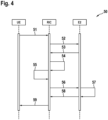
- Fig. 4 schematically illustrates signalling 50 in a radio system according to a first implementation example.
- external enrichment information for example job execution priority of a mobile robot, frame rate or resolution, end to end latency, as described in step 14 of Fig. 3 are sent by at least one radio node (UE) to the RIC.
- UE radio node
- an application for example the r/xApp subscribes on the KPM monitor RAN function of the E2 node, which could be a DU, CU, eNB, or a gNB, specifying the identifiers of the radio nodes whose measurements it would like to obtain.
- the E2 nodes periodically send reports to the application hosted on the RIC including the identifiers of the radio nodes and their measurements.
- the application executing on the RIC discovers the unmet QoS requirements of the respective radio nodes (for example, a low throughput value or high latency).
- the application filters out and prioritises radio nodes that urgently need more PRB resource to reach the target QoS.
- the external enrichment information obtained from different sources (such as cameras, automated mobile robots, mobile phones, industrial machines, sensors, and the like) enables the application also to identify and prioritise the radio nodes that can be down prioritised and specifies the new target QoS profile for the considered time period.
- the radio interface controller also communicates the new target quality of service profile to the core network, which in turn changes the quality of service profile of the specified radio nodes.
- the application hosted on the RIC create policies for the radio nodes whose quality of service needs to be down prioritised.
- the policies received in step 55 send to the target E2 nodes using, for example, the CONTROL service type in the service model E2SM-RC (as defined in O-RAN.WG3.E2SM-RC-v01.03.
- the target E2 nodes receiving the policies implement the changes indicated in the policies for the specified radio nodes (UE1, UE2, UE3).
- the E2 node sends a policy enforcement notification to the RIC.
- the RIC informs the down-prioritized radio nodes about its new QoS value.
- the previously described steps are then periodically executed to improve the quality of service of the radio nodes that cannot obtain their desired QoS due to a lack of radio resource (PRBs).
- PRBs radio resource
- Fig. 5 schematically illustrates signalling in a radio system according to another example.
- the sequence diagram of Fig. 5 illustrates an embodiment in which newly set QoS profiles are enforced by the core network onto the base stations serving the radio nodes.
- Step 61 corresponds to step 51 of Fig. 4 .
- Step 62 corresponds to step 52 of Fig. 4 .
- Step 63 corresponds to step 53 of Fig. 4 .
- Step 64 corresponds to step 54 of Fig. 4 .
- Step 65 comprises the RIC setting the target QoS profiles for the specified radio nodes using core network APIs.
- the RAN can trigger an access network (AN) initiated PDU session modification to adjust the QoS in the core network.
- the newly set QoS profile is enforced by the core network CN onto the base stations serving the radio nodes.
- the E2 node notifies the RIC about the new QoS Profile for the radio nodes.
- the RIC forwards the new QoS profile notification to at least one radio node which has previously been down-prioritized.
- an additional QoS profile is defined by setting its parameters by taking into account the state of the radio node and application, and requirements, in a specified time window.
- the radio access network, the transport network, as well as the core network should be aware of that profile and comply with its requirements.
- the number of such radio node specific QoS profiles would be limited to the total number of QoS profiles that can be defined and would require standardisation of such radio node specific QoS profiles.
- Packet error rate of an existing curious profile can be changed by taking into account the radio node or application state and requirements in the specified time window. This option however also impacts the radio nodes that have assigned the QoS profile whose parameters have been changed.
- additional indicators that can be used by the scheduler to treat the PDU session of specific radio nodes differently without changing the assigned QoS can be provided.
- Fig. 6 schematically illustrates an apparatus according to the second aspect.
- an apparatus 70 comprising: a radio interface 76, a processor 72, and a memory 74.
- the processor 72 is configured to obtain, for a set of radio nodes 82 communicably coupled to a base station 84, enrichment information for a plurality of radio nodes comprised in the set of radio nodes 82, to obtain, for the plurality of radio nodes comprised in the set of radio nodes 82, corresponding intended QoS profiles, to determine a first subset of radio nodes comprised in the set of radio nodes 82, wherein each radio node in the first subset has, or is approaching, an unmet QoS state relative to a QoS policy of the each radio node in the first subset, to determine a second subset of radio nodes comprised in the set of radio nodes 82.
- Each radio node in the second subset has, or is approaching, an excess QoS state relative to a QoS policy of the each radio node in the second subset, wherein an excess QoS state is one in which a given radio node in the second subset can be downgraded or disabled for a duration, to update a QoS policy for the plurality of radio nodes comprised in the set of radio nodes 82.
- Updating comprises improving the QoS policy related to a first radio node in the plurality of radio nodes, and/or downgrading the QoS policy related to a second radio node in the plurality of radio nodes, to reconfigure the base station 84 coupled to the radio nodes comprised in the set of radio nodes 82 based on the updated QoS policy; and transmit at least one message to a radio node comprised in the set of radio nodes 82, wherein the at least one message comprises a QoS notification for changing a QoS policy of the radio node comprised in the set of radio nodes 82.
- the radio interface may comprise a modem, front end, and antenna circuitry for accessing one or more of a fifth generation system, a long term evolution system (LTE), an LTE-advanced system, a high speed packet access system, a universal mobile telecommunications system, an evolved-UTRAN, a global system for mobile communication (GSM), an EDGE system, an IEEE 802.11 system, and the like.
- the mobile communication system may be a V2N network, a C-V2X system.
- the mobile communication system may support at least two communication modes, such as PC5, which is used between vehicles, and Uu, which is used between vehicles and base stations.
- a wireless communication system 80 comprising a set of radio nodes UE1, UE2, UE3, 82, a controller 86, and a base station 84 communicably coupled to the set of radio nodes 82 and the controller 86, and a core network 85 communicably coupled to the base station 84 and the controller 86.
- the controller 86 is configured to obtain, for the set of radio nodes 82, enrichment information for a plurality of radio nodes comprised in the set of radio nodes 84.
- the controller 86 is configured to obtain, for the plurality of radio nodes comprised in the set of radio nodes 82, corresponding intended QoS profiles.
- the controller 86 is configured to execute an application, wherein the application is configured to determine a first subset of radio nodes comprised in the set of radio nodes 82, wherein each radio node in the first subset has, or is approaching, an unmet QoS state relative to a QoS policy of the each radio node in the first subset.
- the controller 86 is configured to determine, via executing the application, a second subset of radio nodes comprised in the set of radio nodes 82, wherein each radio node in the second subset has, or is approaching, an excess QoS state relative to a QoS policy of the each radio node in the second subset, wherein an excess QoS state is one in which a given radio node in the second subset can be downgraded or disabled for a duration.
- the controller 86 is configured to update, via executing the application, a QoS policy for the plurality of radio nodes comprised in the set of radio nodes 82, wherein the updating comprises improving the QoS policy related to a first radio node in the plurality of radio nodes, and/or downgrading the QoS policy related to a second radio node in the plurality of radio nodes.
- the controller 86 is configured to reconfigure the base station 84 coupled to the radio nodes comprised in the set of radio nodes 82 based on the updated QoS policy; and wherein the controller 86 is configured to transmit at least one message to a radio node comprised in the set of radio nodes 82, wherein the at least one message comprises a QoS notification for changing a QoS policy of the radio node comprised in the set of radio nodes 82.
- At least one radio node U E1, U E2, UE3 in the set of radio nodes 82 is comprised in a mobile telephone, an automated mobile robot, or a vehicle, and/or wherein the controller 86 is comprised in an O-RAN network.
- the wireless communication system 80 maybe a third generation partnership project (3GPP) standardised mobile communication network.
- the mobile communication network may correspond to, for example, a fifth generation system, a long term evolution system (LTE), an LTE-advanced system, a high speed packet access system, a universal mobile telecommunications system, an evolved-UTRAN, a global system for mobile communication (GSM), an EDGE system, an IEEE 802.11 system, and the like.
- the mobile communication system may be a V2N network, a C-V2X system.
- the mobile communication system may support at least two communication modes, such as PC5, which is used between vehicles, and Uu, which is used between vehicles and base stations.
- the base station 84 may be a small cell, macro cell, a micro cell, an evolved node B (eNB) or gNodeB
- the base station 84 is communicably coupled to a controller 86.
- the controller 86 comprises at least one RAN intelligent controller.
- the base station 84 coupled to the radio nodes comprised in the set of radio nodes 82 based on the updated QoS policy is further configured to communicate, to the controller (such as the RAN intelligent controller), a set of vacated physical resource blocks based on the ordered list of the radio nodes in the second subset of radio nodes, and the controller (such as the RAN intelligent controller) is configured to indicate to the base station 84 the set of vacated physical resource blocks assigned to one or more radio nodes registered in the first subset of radio nodes.
- the controller such as the RAN intelligent controller
- the base station 84 coupled to the radio nodes comprised in the set of radio nodes 82 is further configured, based on the updated QoS policy, to communicate, to the controller 86, the updated QoS policy of at least one radio node in the set of radio nodes 82, receive, at the base station 84, at least one base station 84 reconfiguration message generated in the core network based on the updated QoS policy, and reconfigure the base station 84 using the base station reconfiguration message to thus enforce the updated QoS policy on the radio nodes comprised in the set of radio nodes 82.
- a computer program element comprising machine readable instructions which, when executed by a processor, causes the processor to execute the computer implemented method according to the first aspect, or its embodiments.
Landscapes
- Engineering & Computer Science (AREA)
- Quality & Reliability (AREA)
- Computer Networks & Wireless Communication (AREA)
- Signal Processing (AREA)
- Mobile Radio Communication Systems (AREA)
Priority Applications (3)
| Application Number | Priority Date | Filing Date | Title |
|---|---|---|---|
| EP23219116.3A EP4576868A1 (de) | 2023-12-21 | 2023-12-21 | Funkknotenpriorisierung |
| DE102024211793.5A DE102024211793A1 (de) | 2023-12-21 | 2024-12-11 | Funkknotenpriorisierung |
| US18/981,745 US20250212064A1 (en) | 2023-12-21 | 2024-12-16 | Radio node prioritization |
Applications Claiming Priority (1)
| Application Number | Priority Date | Filing Date | Title |
|---|---|---|---|
| EP23219116.3A EP4576868A1 (de) | 2023-12-21 | 2023-12-21 | Funkknotenpriorisierung |
Publications (1)
| Publication Number | Publication Date |
|---|---|
| EP4576868A1 true EP4576868A1 (de) | 2025-06-25 |
Family
ID=89308018
Family Applications (1)
| Application Number | Title | Priority Date | Filing Date |
|---|---|---|---|
| EP23219116.3A Pending EP4576868A1 (de) | 2023-12-21 | 2023-12-21 | Funkknotenpriorisierung |
Country Status (3)
| Country | Link |
|---|---|
| US (1) | US20250212064A1 (de) |
| EP (1) | EP4576868A1 (de) |
| DE (1) | DE102024211793A1 (de) |
Citations (3)
| Publication number | Priority date | Publication date | Assignee | Title |
|---|---|---|---|---|
| WO2022046756A1 (en) * | 2020-08-31 | 2022-03-03 | Intel Corporation | Computing workload transport over control plane in next generation cellular networks |
| US20220167236A1 (en) * | 2020-11-25 | 2022-05-26 | Northeastern University | Intelligence and Learning in O-RAN for 5G and 6G Cellular Networks |
| WO2023091664A1 (en) * | 2021-11-19 | 2023-05-25 | Intel Corporation | Radio access network intelligent application manager |
-
2023
- 2023-12-21 EP EP23219116.3A patent/EP4576868A1/de active Pending
-
2024
- 2024-12-11 DE DE102024211793.5A patent/DE102024211793A1/de active Pending
- 2024-12-16 US US18/981,745 patent/US20250212064A1/en active Pending
Patent Citations (3)
| Publication number | Priority date | Publication date | Assignee | Title |
|---|---|---|---|---|
| WO2022046756A1 (en) * | 2020-08-31 | 2022-03-03 | Intel Corporation | Computing workload transport over control plane in next generation cellular networks |
| US20220167236A1 (en) * | 2020-11-25 | 2022-05-26 | Northeastern University | Intelligence and Learning in O-RAN for 5G and 6G Cellular Networks |
| WO2023091664A1 (en) * | 2021-11-19 | 2023-05-25 | Intel Corporation | Radio access network intelligent application manager |
Non-Patent Citations (1)
| Title |
|---|
| "System architecture for the 5G system", 3GPP TS 23.510 |
Also Published As
| Publication number | Publication date |
|---|---|
| US20250212064A1 (en) | 2025-06-26 |
| DE102024211793A1 (de) | 2025-06-26 |
Similar Documents
| Publication | Publication Date | Title |
|---|---|---|
| JP7495069B2 (ja) | サービス品質機能を提供するためのデバイス及び方法 | |
| US20210235277A1 (en) | Method and apparatus for dynamically allocating radio resources in a wireless communication system | |
| US12137414B2 (en) | Method and apparatus for power management in a wireless communication system | |
| EP3229524B1 (de) | Verfahren zur steuerung von funkzugangsressourcen in einem kommunikationsnetzwerk | |
| US9445421B2 (en) | System and method for managing frequency layer priority assignments within mobile wireless network radio interfaces | |
| CN109451534B (zh) | 一种用于5G系统会话管理中QoS流的动态控制方法和装置 | |
| US20060140115A1 (en) | Resource allocation management | |
| US20150271827A1 (en) | Method and apparatuses for individually control a user equipment in order to optimise the quality of experience (qoe) | |
| US12610274B2 (en) | Network cell classification for QoS policy optimization | |
| GB2510345A (en) | Sharing base station resources among plural network operators | |
| JP2024530281A (ja) | セルの構成と制御、及びそれに関連する改善 | |
| WO2016207590A1 (en) | Quality of service in wireless backhauls | |
| US20250071573A1 (en) | Dynamic network slicing for wireless networks using clustering and packet inspection | |
| US20230156514A1 (en) | User equipment, core network node, and methods in a radio communications network | |
| WO2021152629A1 (en) | Method and apparatus for dynamically allocating radio resources in a wireless communication system | |
| US20100062755A1 (en) | Handling of Dynamic Neighbouring Cell Relations Using a TimeToLive Concept | |
| EP4576868A1 (de) | Funkknotenpriorisierung | |
| WO2023042459A1 (ja) | 効率的な負荷分散制御を実行するための制御方法、装置、及びプログラム | |
| US20250097734A1 (en) | Systems and methods for hierarchical orchestration of edge computing devices | |
| EP2625826B1 (de) | Handhabung von teilnehmern in funktelekommunikationsnetzen | |
| WO2024187455A1 (en) | Prioritized bit rate based slicing control | |
| US20250088912A1 (en) | Minimization of inter radio access technology transitions | |
| CA2896229C (en) | Radio access network sharing method, transmit end, and receive end | |
| US12047992B2 (en) | Systems and methods for edge device resource management and coordination based on radio frequency modeling | |
| JP2025513647A (ja) | 無線通信システムによってハンドリングされるユーザ機器の再分割を決定する方法 |
Legal Events
| Date | Code | Title | Description |
|---|---|---|---|
| PUAI | Public reference made under article 153(3) epc to a published international application that has entered the european phase |
Free format text: ORIGINAL CODE: 0009012 |
|
| STAA | Information on the status of an ep patent application or granted ep patent |
Free format text: STATUS: THE APPLICATION HAS BEEN PUBLISHED |
|
| AK | Designated contracting states |
Kind code of ref document: A1 Designated state(s): AL AT BE BG CH CY CZ DE DK EE ES FI FR GB GR HR HU IE IS IT LI LT LU LV MC ME MK MT NL NO PL PT RO RS SE SI SK SM TR |
|
| STAA | Information on the status of an ep patent application or granted ep patent |
Free format text: STATUS: REQUEST FOR EXAMINATION WAS MADE |
|
| 17P | Request for examination filed |
Effective date: 20260102 |