EP4576769A2 - Umgekehrte durchgangsbrille für vorrichtungen für erweiterte realität und virtuelle realität - Google Patents
Umgekehrte durchgangsbrille für vorrichtungen für erweiterte realität und virtuelle realität Download PDFInfo
- Publication number
- EP4576769A2 EP4576769A2 EP25167159.0A EP25167159A EP4576769A2 EP 4576769 A2 EP4576769 A2 EP 4576769A2 EP 25167159 A EP25167159 A EP 25167159A EP 4576769 A2 EP4576769 A2 EP 4576769A2
- Authority
- EP
- European Patent Office
- Prior art keywords
- image
- view
- user
- subject
- headset
- Prior art date
- Legal status (The legal status is an assumption and is not a legal conclusion. Google has not performed a legal analysis and makes no representation as to the accuracy of the status listed.)
- Pending
Links
Images










Classifications
-
- G—PHYSICS
- G02—OPTICS
- G02B—OPTICAL ELEMENTS, SYSTEMS OR APPARATUS
- G02B27/00—Optical systems or apparatus not provided for by any of the groups G02B1/00 - G02B26/00, G02B30/00
- G02B27/01—Head-up displays
- G02B27/017—Head mounted
- G02B27/0172—Head mounted characterised by optical features
-
- G—PHYSICS
- G02—OPTICS
- G02B—OPTICAL ELEMENTS, SYSTEMS OR APPARATUS
- G02B30/00—Optical systems or apparatus for producing three-dimensional [3D] effects, e.g. stereoscopic images
- G02B30/10—Optical systems or apparatus for producing three-dimensional [3D] effects, e.g. stereoscopic images using integral imaging methods
-
- G—PHYSICS
- G06—COMPUTING OR CALCULATING; COUNTING
- G06T—IMAGE DATA PROCESSING OR GENERATION, IN GENERAL
- G06T15/00—Three-dimensional [3D] image rendering
-
- G—PHYSICS
- G06—COMPUTING OR CALCULATING; COUNTING
- G06T—IMAGE DATA PROCESSING OR GENERATION, IN GENERAL
- G06T7/00—Image analysis
- G06T7/80—Analysis of captured images to determine intrinsic or extrinsic camera parameters, i.e. camera calibration
-
- H—ELECTRICITY
- H04—ELECTRIC COMMUNICATION TECHNIQUE
- H04N—PICTORIAL COMMUNICATION, e.g. TELEVISION
- H04N13/00—Stereoscopic video systems; Multi-view video systems; Details thereof
- H04N13/10—Processing, recording or transmission of stereoscopic or multi-view image signals
- H04N13/106—Processing image signals
- H04N13/111—Transformation of image signals corresponding to virtual viewpoints, e.g. spatial image interpolation
- H04N13/117—Transformation of image signals corresponding to virtual viewpoints, e.g. spatial image interpolation the virtual viewpoint locations being selected by the viewers or determined by viewer tracking
-
- H—ELECTRICITY
- H04—ELECTRIC COMMUNICATION TECHNIQUE
- H04N—PICTORIAL COMMUNICATION, e.g. TELEVISION
- H04N13/00—Stereoscopic video systems; Multi-view video systems; Details thereof
- H04N13/20—Image signal generators
- H04N13/204—Image signal generators using stereoscopic image cameras
- H04N13/239—Image signal generators using stereoscopic image cameras using two two-dimensional [2D] image sensors having a relative position equal to or related to the interocular distance
-
- H—ELECTRICITY
- H04—ELECTRIC COMMUNICATION TECHNIQUE
- H04N—PICTORIAL COMMUNICATION, e.g. TELEVISION
- H04N13/00—Stereoscopic video systems; Multi-view video systems; Details thereof
- H04N13/30—Image reproducers
- H04N13/302—Image reproducers for viewing without the aid of special glasses, i.e. using autostereoscopic displays
- H04N13/307—Image reproducers for viewing without the aid of special glasses, i.e. using autostereoscopic displays using fly-eye lenses, e.g. arrangements of circular lenses
-
- H—ELECTRICITY
- H04—ELECTRIC COMMUNICATION TECHNIQUE
- H04N—PICTORIAL COMMUNICATION, e.g. TELEVISION
- H04N13/00—Stereoscopic video systems; Multi-view video systems; Details thereof
- H04N13/30—Image reproducers
- H04N13/332—Displays for viewing with the aid of special glasses or head-mounted displays [HMD]
- H04N13/344—Displays for viewing with the aid of special glasses or head-mounted displays [HMD] with head-mounted left-right displays
-
- H—ELECTRICITY
- H04—ELECTRIC COMMUNICATION TECHNIQUE
- H04N—PICTORIAL COMMUNICATION, e.g. TELEVISION
- H04N13/00—Stereoscopic video systems; Multi-view video systems; Details thereof
- H04N13/30—Image reproducers
- H04N13/366—Image reproducers using viewer tracking
- H04N13/383—Image reproducers using viewer tracking for tracking with gaze detection, i.e. detecting the lines of sight of the viewer's eyes
-
- H—ELECTRICITY
- H04—ELECTRIC COMMUNICATION TECHNIQUE
- H04N—PICTORIAL COMMUNICATION, e.g. TELEVISION
- H04N5/00—Details of television systems
- H04N5/30—Transforming light or analogous information into electric information
- H04N5/33—Transforming infrared radiation
-
- G—PHYSICS
- G06—COMPUTING OR CALCULATING; COUNTING
- G06T—IMAGE DATA PROCESSING OR GENERATION, IN GENERAL
- G06T2207/00—Indexing scheme for image analysis or image enhancement
- G06T2207/20—Special algorithmic details
- G06T2207/20081—Training; Learning
Definitions
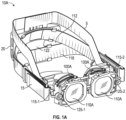
- a device comprising: a near-eye display configured to provide an image to a subject; an eye imaging system configured to collect an image of the subject; and a light field display configured to provide an autostereoscopic image of a three-dimensional model of the subject to an onlooker, wherein the autostereoscopic image includes a perspective-corrected view of the subject from multiple viewpoints within a field of view of the light field display.
- the eye imaging system comprises two cameras to collect a binocular view of the subject.
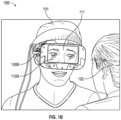
- the near-eye display provides the subject a three-dimensional representation of an environment, including the onlooker.
- the eye imaging system includes an infrared camera that receives the image from the subject in a reflective mode from a dichroic mirror adjacent to the light field display.
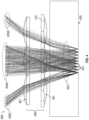
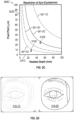
- the light field display comprises a micro lens array having multiple micro lenses arranged in a two-dimensional pattern having a pre-selected pitch to avoid cross-talk between the perspective-corrected view for two viewpoints, for the onlooker.
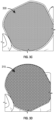
- the light field display includes a pixel array split in multiple active segments, wherein each active segment in the pixel array has a dimension corresponding to a diameter of a refractive element in a multi-lenslet array.
- the device further comprises one or more processors and a memory storing instructions which, when executed by the one or more processors, cause the light field display to split a pixel array into multiple active segments, each active segment configured to provide a portion of the field of view of the light field display at a selected viewpoint for the onlooker.
- a computer-implemented method comprising: receiving, from one or more headset cameras, multiple images having at least two or more fields of view of a subject, wherein the subject is a headset user; extracting multiple image features from the images using a set of learnable weights; forming a three-dimensional model of the subject using the set of learnable weights; mapping the three-dimensional model of the subject onto an autostereoscopic display format that associates an image projection of the subject with a selected observation point for an onlooker; and providing, on a device display, the image projection of the subject when the onlooker is located at the selected observation point.
- extracting image features comprises extracting intrinsic properties of a headset camera used to collect each of the images.
- mapping the three-dimensional model of the subject onto an autostereoscopic display format comprises interpolating a feature map associated with a first observation point with a feature map associated with a second observation point.
- mapping the three-dimensional model of the subject onto an autostereoscopic display format comprises aggregating the image features for multiple pixels along a direction of the selected observation point.
- mapping the three-dimensional model of the subject onto an autostereoscopic display format comprises concatenating multiple feature maps produced by each of the headset cameras in a permutation invariant combination, each of the headset cameras having an intrinsic characteristic.
- providing the image projection of the subject comprises providing, on the device display, a second image projection as the onlooker moves from a first observation point to a second observation point.
- a computer-implemented method for training a model to provide a view of a subject to an auto stereoscopic display in a virtual reality headset comprising: collecting, from a face of multiple users, multiple ground-truth images; rectifying the ground-truth images with stored, calibrated stereoscopic pairs of images; mapping a three-dimensional model of the subject onto an autostereoscopic display format that associates an image projection of the subject with a selected observation point for an onlooker; determining a loss value based on a difference between the ground-truth images and the image projection of the subject; and updating the three-dimensional model of the subject based on the loss value.
- generating multiple synthetic views comprises projecting image features from each of the ground-truth images along a selected observation direction and concatenating multiple feature maps produced by each of the ground-truth images in a permutation invariant combination, each of the ground-truth images having an intrinsic characteristic.
- training the three-dimensional model of the subject comprises updating at least one in a set of learnable weights for each of multiple features based on a value of a loss function indicative of the difference between the ground-truth images and the image projection of the subject.
- Input images 701 are 3D objects having a height ( h ) and a width ( w ) corresponding to the 2D image collected by a camera along direction v i , and a depth of 3 layers for each color pixel R, G, B.
- Feature maps 703 are 3D objects having dimensions h ⁇ w ⁇ d .
- Encoder-decoder network 710A encodes input images 701 using learnable weights 721-1, 721-2...721-n (hereinafter, collectively referred to as "learnable weights 721").
- Ray marching stage 710B performs world to camera projections 723, bilinear interpolations 725, positional encoding 727, and feature aggregation 729.
- a simple permutation invariant function for feature aggregation is the mean of the sampled feature maps 703. This aggregation procedure may be desirable when depth information during training is available. However, in the presence of depth ambiguity (e.g., for points that are projected onto feature map 703 before sampling), the above aggregation may lead to artifacts. To avoid this, some embodiments consider camera information to include effective conditioning in radiant field stage 710C. Accordingly, some embodiments include a conditioning function network N cf : R d+7 ⁇ R d ' that takes the feature vector, f (i) x, and the camera information (ci) and produces a camera summarized feature vector f' (i) x.
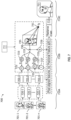
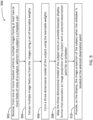
- At least one or more of the steps in a method consistent with method 1100 may be performed by a processor executing instructions stored in a memory wherein at least one of the processor and the memory are remotely located in a cloud server, and the headset device is communicatively coupled to the cloud server via a communications module coupled to a network ( cf. communications module 118).
- method 1100 may be performed using a model including a neural network architecture in a machine learning or artificial intelligence algorithm, as disclosed herein ( e.g., model 650, model architecture 700).
- methods consistent with the present disclosure may include at least one or more steps from method 1100 performed in a different order, simultaneously, quasi-simultaneously, or overlapping in time.
- Step 1104 includes rectifying the ground-truth images with stored, calibrated stereoscopic pairs of images.
- Step 1106 includes generating, with a three-dimensional face model, multiple synthetic views of subjects, wherein the synthetic views of subjects include an interpolation of multiple feature maps projected along different directions corresponding to multiple views of the subjects.
- step 1106 includes projecting image features from each of the ground-truth images along a selected observation direction and concatenating multiple feature maps produced by each of the ground-truth images in a permutation invariant combination, each of the ground-truth images having an intrinsic characteristic.
- Step 1108 includes training the three-dimensional face model based on a difference between the ground-truth images and the synthetic views of subjects.
- step 1108 includes updating at least one in a set of learnable weights for each of multiple features in the feature maps based on a value of a loss function indicative of the difference between the ground-truth images and the synthetic views of subjects.
- step 1108 includes training a background value for each of multiple pixels in the ground-truth images based on a pixel background value projected from the multiple ground-truth images.
- FIG. 12 is a block diagram illustrating an exemplary computer system 1200 with which headsets 10, and methods 900, 1000, and 1100 can be implemented.
- computer system 1200 may be implemented using hardware or a combination of software and hardware, either in a dedicated server, or integrated into another entity, or distributed across multiple entities.
- Computer system 1200 may include a desktop computer, a laptop computer, a tablet, a phablet, a smartphone, a feature phone, a server computer, or otherwise.
- a server computer may be located remotely in a data center or be stored locally.
- Computer system 1200 includes a bus 1208 or other communication mechanism for communicating information, and a processor 1202 (e.g., processor 122) coupled with bus 1208 for processing information.
- processor 1202 may be implemented with one or more processors 1202.
- Processor 1202 may be a general-purpose microprocessor, a microcontroller, a Digital Signal Processor (DSP), an Application Specific Integrated Circuit (ASIC), a Field Programmable Gate Array (FPGA), a Programmable Logic Device (PLD), a controller, a state machine, gated logic, discrete hardware components, or any other suitable entity that can perform calculations or other manipulations of information.
- DSP Digital Signal Processor
- ASIC Application Specific Integrated Circuit
- FPGA Field Programmable Gate Array
- PLD Programmable Logic Device
- the instructions may be stored in the memory 1204 and implemented in one or more computer program products, e.g., one or more modules of computer program instructions encoded on a computer-readable medium for execution by, or to control the operation of, the computer system 1200, and according to any method well known to those of skill in the art, including, but not limited to, computer languages such as data-oriented languages (e.g., SQL, dBase), system languages (e.g., C, Objective-C, C++, Assembly), architectural languages (e.g., Java, .NET), and application languages (e.g., PHP, Ruby, Perl, Python).
- data-oriented languages e.g., SQL, dBase
- system languages e.g., C, Objective-C, C++, Assembly
- architectural languages e.g., Java, .NET
- application languages e.g., PHP, Ruby, Perl, Python.
- Instructions may also be implemented in computer languages such as array languages, aspect-oriented languages, assembly languages, authoring languages, command line interface languages, compiled languages, concurrent languages, curly-bracket languages, dataflow languages, data-structured languages, declarative languages, esoteric languages, extension languages, fourth-generation languages, functional languages, interactive mode languages, interpreted languages, iterative languages, list-based languages, little languages, logic-based languages, machine languages, macro languages, metaprogramming languages, multiparadigm languages, numerical analysis, non-English-based languages, object-oriented class-based languages, object-oriented prototype-based languages, off-side rule languages, procedural languages, reflective languages, rule-based languages, scripting languages, stack-based languages, synchronous languages, syntax handling languages, visual languages, wirth languages, and xml-based languages.
- Memory 1204 may also be used for storing temporary variable or other intermediate information during execution of instructions to be executed by processor 1202.
- a computer program as discussed herein does not necessarily correspond to a file in a file system.
- a program can be stored in a portion of a file that holds other programs or data (e.g., one or more scripts stored in a markup language document), in a single file dedicated to the program in question, or in multiple coordinated files (e.g., files that store one or more modules, subprograms, or portions of code).
- a computer program can be deployed to be executed on one computer or on multiple computers that are located at one site or distributed across multiple sites and interconnected by a communication network.
- the processes and logic flows described in this specification can be performed by one or more programmable processors executing one or more computer programs to perform functions by operating on input data and generating output.
- Computer system 1200 further includes a data storage device 1206 such as a magnetic disk or optical disk, coupled with bus 1208 for storing information and instructions.
- Computer system 1200 may be coupled via input/output module 1210 to various devices.
- Input/output module 1210 can be any input/output module.
- Exemplary input/output modules 1210 include data ports such as USB ports.
- the input/output module 1210 is configured to connect to a communications module 1212.
- Exemplary communications modules 1212 include networking interface cards, such as Ethernet cards and modems.
- input/output module 1210 is configured to connect to a plurality of devices, such as an input device 1214 and/or an output device 1216.
- Exemplary input devices 1214 include a keyboard and a pointing device, e.g., a mouse or a trackball, by which a consumer can provide input to the computer system 1200.
- Other kinds of input devices 1214 can be used to provide for interaction with a consumer as well, such as a tactile input device, visual input device, audio input device, or brain-computer interface device.
- feedback provided to the consumer can be any form of sensory feedback, e.g., visual feedback, auditory feedback, or tactile feedback; and input from the consumer can be received in any form, including acoustic, speech, tactile, or brain wave input.
- Exemplary output devices 1216 include display devices, such as an LCD (liquid crystal display) monitor, for displaying information to the consumer.
- headsets 10 can be implemented, at least partially, using a computer system 1200 in response to processor 1202 executing one or more sequences of one or more instructions contained in memory 1204. Such instructions may be read into memory 1204 from another machine-readable medium, such as data storage device 1206. Execution of the sequences of instructions contained in main memory 1204 causes processor 1202 to perform the process steps described herein. One or more processors in a multi-processing arrangement may also be employed to execute the sequences of instructions contained in memory 1204. In alternative aspects, hard-wired circuitry may be used in place of or in combination with software instructions to implement various aspects of the present disclosure. Thus, aspects of the present disclosure are not limited to any specific combination of hardware circuitry and software.
- a computing system that includes a back end component, e.g., a data server, or that includes a middleware component, e.g., an application server, or that includes a front end component, e.g., a client computer having a graphical consumer interface or a Web browser through which a consumer can interact with an implementation of the subject matter described in this specification, or any combination of one or more such back end, middleware, or front end components.
- the components of the system can be interconnected by any form or medium of digital data communication, e.g., a communication network.
- the communication network can include, for example, any one or more of a LAN, a WAN, the Internet, and the like.
- the communication network can include, but is not limited to, for example, any one or more of the following network topologies, including a bus network, a star network, a ring network, a mesh network, a star-bus network, tree or hierarchical network, or the like.
- the communications modules can be, for example, modems or Ethernet cards.
- Computer system 1200 can include clients and servers.
- a client and server are generally remote from each other and typically interact through a communication network. The relationship of client and server arises by virtue of computer programs running on the respective computers and having a client-server relationship to each other.
- Computer system 1200 can be, for example, and without limitation, a desktop computer, laptop computer, or tablet computer.
- Computer system 1200 can also be embedded in another device, for example, and without limitation, a mobile telephone, a PDA, a mobile audio player, a Global Positioning System (GPS) receiver, a video game console, and/or a television set top box.
- GPS Global Positioning System
- Machine-readable media include, for example, floppy disk, a flexible disk, hard disk, magnetic tape, any other magnetic medium, a CD-ROM, DVD, any other optical medium, punch cards, paper tape, any other physical medium with patterns of holes, a RAM, a PROM, an EPROM, a FLASH EPROM, any other memory chip or cartridge, or any other medium from which a computer can read.
- the machine-readable storage medium can be a machine-readable storage device, a machine-readable storage substrate, a memory device, a composition of matter affecting a machine-readable propagated signal, or a combination of one or more of them.
- the phrase "at least one of” preceding a series of items, with the terms “and” or “or” to separate any of the items, modifies the list as a whole, rather than each member of the list ( e.g., each item).
- the phrase "at least one of” does not require selection of at least one item; rather, the phrase allows a meaning that includes at least one of any one of the items, and/or at least one of any combination of the items, and/or at least one of each of the items.
- phrases “at least one of A, B, and C” or “at least one of A, B, or C” each refer to only A, only B, or only C; any combination of A, B, and C; and/or at least one of each of A, B, and C.
- exemplary is used herein to mean “serving as an example, instance, or illustration.” Any embodiment described herein as “exemplary” is not necessarily to be construed as preferred or advantageous over other embodiments. Phrases such as an aspect, the aspect, another aspect, some aspects, one or more aspects, an implementation, the implementation, another implementation, some implementations, one or more implementations, an embodiment, the embodiment, another embodiment, some embodiments, one or more embodiments, a configuration, the configuration, another configuration, some configurations, one or more configurations, the subject technology, the disclosure, the present disclosure, and other variations thereof and alike are for convenience and do not imply that a disclosure relating to such phrase(s) is essential to the subject technology or that such disclosure applies to all configurations of the subject technology.
- a disclosure relating to such phrase(s) may apply to all configurations, or one or more configurations.
- a disclosure relating to such phrase(s) may provide one or more examples.
- a phrase such as an aspect or some aspects may refer to one or more aspects and vice versa, and this applies similarly to other foregoing phrases.
- Example 1 A device, comprising: a near-eye display configured to provide an image to a subject; an eye imaging system configured to collect an image of the subject; and a light field display configured to provide an autostereoscopic image of a three-dimensional model of the subject to an onlooker, wherein the autostereoscopic image includes a perspective-corrected view of the subject from multiple viewpoints within a field of view of the light field display.
- Example 2 The device of Example 1, wherein the light field display comprises a pixel array and a multi-lenslet array, wherein the pixel array is configured to provide a segmented view of the subject to the multi-lenslet array, the segmented view including multiple portions of the field of view of the light field display at a selected viewpoint.
- Example 3 The device of Example 1 or Example 2, wherein the eye imaging system comprises two cameras to collect a binocular view of the subject.
- Example 4 The device of any of Examples 1 to 3, further comprising one or more processors and a memory storing instructions which, when executed by the one or more processors, generate a three dimensional representation of the subject from the image of the subject; and/or preferably wherein the near-eye display provides the subject a three-dimensional representation of an environment, including the onlooker.
- Example 5 The device of any of Examples 1 to 4, wherein the eye imaging system includes an infrared camera that receives the image from the subject in a reflective mode from a dichroic mirror adjacent to the light field display.
- Example 6 The device of any of Examples 1 to 5, wherein light field display comprises a micro lens array having multiple micro lenses arranged in a two-dimensional pattern having a pre-selected pitch to avoid cross-talk between the perspective-corrected view for two viewpoints, for the onlooker.
- Example 7 The device of any of Examples 1 to 6, wherein the light field display further comprises an immersed stop adjacent to a micro lens array, the immersed stop including multiple apertures such that each aperture is aligned with a center of each micro lens in the micro lens array.
- Example 9 A computer-implemented method, comprising: receiving, from one or more headset cameras, multiple images having at least two or more fields of view of a subject, wherein the subject is a headset user; extracting multiple image features from the images using a set of learnable weights; forming a three-dimensional model of the subject using the set of learnable weights; mapping the three-dimensional model of the subject onto an autostereoscopic display format that associates an image projection of the subject with a selected observation point for an onlooker; and providing, on a device display, the image projection of the subject when the onlooker is located at the selected observation point.
- Example 10 The computer-implemented method of Example 9, wherein extracting image features comprises extracting intrinsic properties of a headset camera used to collect each of the images.
- Example 11 The computer-implemented method of Example 9 or Example 10, wherein mapping the three-dimensional model of the subject onto an autostereoscopic display format comprises interpolating a feature map associated with a first observation point with a feature map associated with a second observation point; or preferably wherein mapping the three-dimensional model of the subject onto an autostereoscopic display format comprises aggregating the image features for multiple pixels along a direction of the selected observation point; or preferably wherein mapping the three-dimensional model of the subject onto an autostereoscopic display format comprises concatenating multiple feature maps produced by each of the headset cameras in a permutation invariant combination, each of the headset cameras having an intrinsic characteristic.
- Example 12 The computer-implemented method of any of Examples 9 to 11, wherein providing the image projection of the subject comprises providing, on the device display, a second image projection as the onlooker moves from a first observation point to a second observation point.
- Example 13 A computer-implemented method for training a model to provide a view of a subject to an auto stereoscopic display in a virtual reality headset including generating multiple synthetic views, comprising: collecting, from a face of multiple users, multiple ground-truth images; rectifying the ground-truth images with stored, calibrated stereoscopic pairs of images; mapping a three-dimensional model of the subject onto an autostereoscopic display format that associates an image projection of the subject with a selected observation point for an onlooker; determining a loss value based on a difference between the ground-truth images and the image projection of the subject; and updating the three-dimensional model of the subject based on the loss value.
- Example 14 The computer-implemented method of Example 13, wherein generating multiple synthetic views comprises projecting image features from each of the ground-truth images along a selected observation direction and concatenating multiple feature maps produced by each of the ground-truth images in a permutation invariant combination, each of the ground-truth images having an intrinsic characteristic; and/or preferably wherein training the three-dimensional model of the subject comprises updating at least one in a set of learnable weights for each of multiple features based on a value of a loss function indicative of the difference between the ground-truth images and the image projection of the subject; or preferably wherein training the three-dimensional model of the subject comprises training a background value for each of multiple pixels in the ground-truth images based on a pixel background value projected from the multiple ground-truth images.
Landscapes
- Engineering & Computer Science (AREA)
- Multimedia (AREA)
- Signal Processing (AREA)
- Physics & Mathematics (AREA)
- General Physics & Mathematics (AREA)
- Optics & Photonics (AREA)
- Theoretical Computer Science (AREA)
- Computer Graphics (AREA)
- Computer Vision & Pattern Recognition (AREA)
- Testing, Inspecting, Measuring Of Stereoscopic Televisions And Televisions (AREA)
- Lenses (AREA)
- Processing Or Creating Images (AREA)
- Studio Devices (AREA)
- Controls And Circuits For Display Device (AREA)
Applications Claiming Priority (5)
| Application Number | Priority Date | Filing Date | Title |
|---|---|---|---|
| US202063129989P | 2020-12-23 | 2020-12-23 | |
| US202163142458P | 2021-01-27 | 2021-01-27 | |
| US17/555,037 US12095975B2 (en) | 2020-12-23 | 2021-12-17 | Reverse pass-through glasses for augmented reality and virtual reality devices |
| PCT/US2021/065054 WO2022140658A2 (en) | 2020-12-23 | 2021-12-23 | Reverse pass-through glasses for augmented reality and virtual reality devices |
| EP21847874.1A EP4260129B1 (de) | 2020-12-23 | 2021-12-23 | Umgekehrte durchgangsbrille für vorrichtungen für erweiterte realität und virtuelle realität |
Related Parent Applications (2)
| Application Number | Title | Priority Date | Filing Date |
|---|---|---|---|
| EP21847874.1A Division EP4260129B1 (de) | 2020-12-23 | 2021-12-23 | Umgekehrte durchgangsbrille für vorrichtungen für erweiterte realität und virtuelle realität |
| EP21847874.1A Division-Into EP4260129B1 (de) | 2020-12-23 | 2021-12-23 | Umgekehrte durchgangsbrille für vorrichtungen für erweiterte realität und virtuelle realität |
Publications (2)
| Publication Number | Publication Date |
|---|---|
| EP4576769A2 true EP4576769A2 (de) | 2025-06-25 |
| EP4576769A3 EP4576769A3 (de) | 2025-10-22 |
Family
ID=79927165
Family Applications (2)
| Application Number | Title | Priority Date | Filing Date |
|---|---|---|---|
| EP21847874.1A Active EP4260129B1 (de) | 2020-12-23 | 2021-12-23 | Umgekehrte durchgangsbrille für vorrichtungen für erweiterte realität und virtuelle realität |
| EP25167159.0A Pending EP4576769A3 (de) | 2020-12-23 | 2021-12-23 | Umgekehrte durchgangsbrille für vorrichtungen für erweiterte realität und virtuelle realität |
Family Applications Before (1)
| Application Number | Title | Priority Date | Filing Date |
|---|---|---|---|
| EP21847874.1A Active EP4260129B1 (de) | 2020-12-23 | 2021-12-23 | Umgekehrte durchgangsbrille für vorrichtungen für erweiterte realität und virtuelle realität |
Country Status (6)
| Country | Link |
|---|---|
| US (1) | US20240406371A1 (de) |
| EP (2) | EP4260129B1 (de) |
| JP (1) | JP7825624B2 (de) |
| KR (1) | KR20230124968A (de) |
| TW (1) | TWI904312B (de) |
| WO (1) | WO2022140658A2 (de) |
Families Citing this family (3)
| Publication number | Priority date | Publication date | Assignee | Title |
|---|---|---|---|---|
| CN115857856A (zh) * | 2022-11-30 | 2023-03-28 | 维沃移动通信有限公司 | 信息提示方法、信息提示装置、电子设备和可读存储介质 |
| US11972526B1 (en) | 2023-03-31 | 2024-04-30 | Apple Inc. | Rendering of enrolled user's face for external display |
| US12159351B2 (en) | 2023-03-31 | 2024-12-03 | Apple Inc. | Rendering of a guest user's face for external display |
Family Cites Families (12)
| Publication number | Priority date | Publication date | Assignee | Title |
|---|---|---|---|---|
| US20130285885A1 (en) * | 2012-04-25 | 2013-10-31 | Andreas G. Nowatzyk | Head-mounted light-field display |
| WO2014041872A1 (ja) * | 2012-09-12 | 2014-03-20 | ソニー株式会社 | 画像表示装置 |
| BR112015004958A8 (pt) * | 2012-09-12 | 2019-08-13 | Sony Corp | dispositivo e método de exibição de imagem, e, mídia de gravação legível por computador. |
| JP6361649B2 (ja) * | 2013-03-29 | 2018-07-25 | ソニー株式会社 | 情報処理装置、通知状態制御方法及びプログラム |
| JP6276170B2 (ja) * | 2014-12-03 | 2018-02-07 | 日本電信電話株式会社 | 表示装置および表示方法 |
| US9740282B1 (en) * | 2015-01-05 | 2017-08-22 | Amazon Technologies, Inc. | Gaze direction tracking |
| GB2534580B (en) * | 2015-01-28 | 2020-06-17 | Sony Interactive Entertainment Europe Ltd | Image processing |
| JP2017069687A (ja) * | 2015-09-29 | 2017-04-06 | ソニー株式会社 | 情報処理装置及び情報処理方法並びにプログラム |
| US10268438B2 (en) * | 2016-06-30 | 2019-04-23 | Sony Interactive Entertainment Inc. | Display screen front panel of HMD for viewing by users viewing the HMD player |
| JP2018142857A (ja) * | 2017-02-28 | 2018-09-13 | セイコーエプソン株式会社 | 頭部装着型表示装置、プログラム、及び頭部装着型表示装置の制御方法 |
| CA3055545A1 (en) * | 2017-03-09 | 2018-09-13 | Arizona Board Of Regents On Behalf Of The University Of Arizona | Head-mounted light field display with integral imaging and waveguide prism |
| US10659771B2 (en) * | 2017-07-13 | 2020-05-19 | Google Llc | Non-planar computational displays |
-
2021
- 2021-12-23 JP JP2023538972A patent/JP7825624B2/ja active Active
- 2021-12-23 WO PCT/US2021/065054 patent/WO2022140658A2/en not_active Ceased
- 2021-12-23 EP EP21847874.1A patent/EP4260129B1/de active Active
- 2021-12-23 TW TW110148342A patent/TWI904312B/zh active
- 2021-12-23 KR KR1020237024223A patent/KR20230124968A/ko active Pending
- 2021-12-23 EP EP25167159.0A patent/EP4576769A3/de active Pending
-
2024
- 2024-08-12 US US18/800,312 patent/US20240406371A1/en active Pending
Also Published As
| Publication number | Publication date |
|---|---|
| TW202238222A (zh) | 2022-10-01 |
| JP2024504012A (ja) | 2024-01-30 |
| EP4576769A3 (de) | 2025-10-22 |
| TWI904312B (zh) | 2025-11-11 |
| US20240406371A1 (en) | 2024-12-05 |
| EP4260129B1 (de) | 2025-05-07 |
| JP7825624B2 (ja) | 2026-03-06 |
| WO2022140658A3 (en) | 2022-08-11 |
| WO2022140658A2 (en) | 2022-06-30 |
| KR20230124968A (ko) | 2023-08-28 |
| EP4260129A2 (de) | 2023-10-18 |
Similar Documents
| Publication | Publication Date | Title |
|---|---|---|
| US11736679B2 (en) | Reverse pass-through glasses for augmented reality and virtual reality devices | |
| US12095975B2 (en) | Reverse pass-through glasses for augmented reality and virtual reality devices | |
| US20240406371A1 (en) | Reverse pass-through glasses for augmented reality and virtual reality devices | |
| US12166955B2 (en) | Reverse pass-through glasses for augmented reality and virtual reality devices | |
| JP6023801B2 (ja) | シミュレーション装置 | |
| US20230334806A1 (en) | Scaling neural representations for multi-view reconstruction of scenes | |
| CN107452031B (zh) | 虚拟光线跟踪方法及光场动态重聚焦显示系统 | |
| US20220198731A1 (en) | Pixel-aligned volumetric avatars | |
| CN116917791A (zh) | 用于增强现实设备和虚拟现实设备的反向透视眼镜 | |
| CN109003297A (zh) | 一种单目深度估计方法、装置、终端和存储介质 | |
| US8934730B2 (en) | Image editing method and associated method for establishing blur parameter | |
| US20250245903A1 (en) | Three-dimensional (3d) scene reconstruction (3dr) refinement and fusion from multiple 3dr algorithm inputs | |
| WO2023200936A1 (en) | Scaling neural representations for multi-view reconstruction of scenes | |
| CN117373019A (zh) | 一种基于立体感知场景的图像语义分割方法及系统 | |
| CN117274383A (zh) | 视点预测方法及装置、电子设备和存储介质 | |
| US20190318449A1 (en) | Imaging method and apparatus for virtual reality device, and virtual reality device | |
| US12423769B2 (en) | Selecting a reprojection distance based on the focal length of a camera | |
| US20240288695A1 (en) | Holographic optical element viewfinder | |
| EP2827589A1 (de) | Anzeigevorrichtung und Vorrichtung zur Anpassung einer Information | |
| TW202609418A (zh) | 頭戴式裝置 | |
| CN116762032A (zh) | 用于增强现实设备和虚拟现实设备的反向透视眼镜 | |
| US9836857B2 (en) | System, device, and method for information exchange | |
| Dutta et al. | Camera and Metaverse: Enhancing User Experience Using AI-Based Imaging | |
| WO2026019419A1 (en) | Systems and methods for extending a depth-of-field based on focus stack fusion | |
| CN121883409A (zh) | 一种全景图像质量评价方法及系统 |
Legal Events
| Date | Code | Title | Description |
|---|---|---|---|
| PUAI | Public reference made under article 153(3) epc to a published international application that has entered the european phase |
Free format text: ORIGINAL CODE: 0009012 |
|
| STAA | Information on the status of an ep patent application or granted ep patent |
Free format text: STATUS: THE APPLICATION HAS BEEN PUBLISHED |
|
| AC | Divisional application: reference to earlier application |
Ref document number: 4260129 Country of ref document: EP Kind code of ref document: P |
|
| AK | Designated contracting states |
Kind code of ref document: A2 Designated state(s): AL AT BE BG CH CY CZ DE DK EE ES FI FR GB GR HR HU IE IS IT LI LT LU LV MC MK MT NL NO PL PT RO RS SE SI SK SM TR |
|
| REG | Reference to a national code |
Ref country code: DE Ref legal event code: R079 Free format text: PREVIOUS MAIN CLASS: H04N0013307000 Ipc: G02B0027010000 |
|
| PUAL | Search report despatched |
Free format text: ORIGINAL CODE: 0009013 |
|
| AK | Designated contracting states |
Kind code of ref document: A3 Designated state(s): AL AT BE BG CH CY CZ DE DK EE ES FI FR GB GR HR HU IE IS IT LI LT LU LV MC MK MT NL NO PL PT RO RS SE SI SK SM TR |
|
| RIC1 | Information provided on ipc code assigned before grant |
Ipc: G02B 27/01 20060101AFI20250917BHEP Ipc: H04N 13/344 20180101ALI20250917BHEP Ipc: H04N 13/383 20180101ALI20250917BHEP Ipc: G06T 17/00 20060101ALI20250917BHEP |
|
| STAA | Information on the status of an ep patent application or granted ep patent |
Free format text: STATUS: REQUEST FOR EXAMINATION WAS MADE |