EP4576321A1 - Überhitzungsdiagnoseverfahren und überhitzungsdiagnosevorrichtung und batteriesystem zur bereitstellung des verfahrens - Google Patents
Überhitzungsdiagnoseverfahren und überhitzungsdiagnosevorrichtung und batteriesystem zur bereitstellung des verfahrens Download PDFInfo
- Publication number
- EP4576321A1 EP4576321A1 EP23912905.9A EP23912905A EP4576321A1 EP 4576321 A1 EP4576321 A1 EP 4576321A1 EP 23912905 A EP23912905 A EP 23912905A EP 4576321 A1 EP4576321 A1 EP 4576321A1
- Authority
- EP
- European Patent Office
- Prior art keywords
- value
- overheating
- temperature
- diagnosis
- battery
- Prior art date
- Legal status (The legal status is an assumption and is not a legal conclusion. Google has not performed a legal analysis and makes no representation as to the accuracy of the status listed.)
- Pending
Links
Images



Classifications
-
- H—ELECTRICITY
- H01—ELECTRIC ELEMENTS
- H01M—PROCESSES OR MEANS, e.g. BATTERIES, FOR THE DIRECT CONVERSION OF CHEMICAL ENERGY INTO ELECTRICAL ENERGY
- H01M10/00—Secondary cells; Manufacture thereof
- H01M10/42—Methods or arrangements for servicing or maintenance of secondary cells or secondary half-cells
- H01M10/48—Accumulators combined with arrangements for measuring, testing or indicating the condition of cells, e.g. the level or density of the electrolyte
- H01M10/486—Accumulators combined with arrangements for measuring, testing or indicating the condition of cells, e.g. the level or density of the electrolyte for measuring temperature
-
- B—PERFORMING OPERATIONS; TRANSPORTING
- B60—VEHICLES IN GENERAL
- B60L—PROPULSION OF ELECTRICALLY-PROPELLED VEHICLES; SUPPLYING ELECTRIC POWER FOR AUXILIARY EQUIPMENT OF ELECTRICALLY-PROPELLED VEHICLES; ELECTRODYNAMIC BRAKE SYSTEMS FOR VEHICLES IN GENERAL; MAGNETIC SUSPENSION OR LEVITATION FOR VEHICLES; MONITORING OPERATING VARIABLES OF ELECTRICALLY-PROPELLED VEHICLES; ELECTRIC SAFETY DEVICES FOR ELECTRICALLY-PROPELLED VEHICLES
- B60L3/00—Electric devices on electrically-propelled vehicles for safety purposes; Monitoring operating variables, e.g. speed, deceleration or energy consumption
- B60L3/0023—Detecting, eliminating, remedying or compensating for drive train abnormalities, e.g. failures within the drive train
- B60L3/0046—Detecting, eliminating, remedying or compensating for drive train abnormalities, e.g. failures within the drive train relating to electric energy storage systems, e.g. batteries or capacitors
-
- B—PERFORMING OPERATIONS; TRANSPORTING
- B60—VEHICLES IN GENERAL
- B60L—PROPULSION OF ELECTRICALLY-PROPELLED VEHICLES; SUPPLYING ELECTRIC POWER FOR AUXILIARY EQUIPMENT OF ELECTRICALLY-PROPELLED VEHICLES; ELECTRODYNAMIC BRAKE SYSTEMS FOR VEHICLES IN GENERAL; MAGNETIC SUSPENSION OR LEVITATION FOR VEHICLES; MONITORING OPERATING VARIABLES OF ELECTRICALLY-PROPELLED VEHICLES; ELECTRIC SAFETY DEVICES FOR ELECTRICALLY-PROPELLED VEHICLES
- B60L58/00—Methods or circuit arrangements for monitoring or controlling batteries or fuel cells, specially adapted for electric vehicles
- B60L58/10—Methods or circuit arrangements for monitoring or controlling batteries or fuel cells, specially adapted for electric vehicles for monitoring or controlling batteries
- B60L58/24—Methods or circuit arrangements for monitoring or controlling batteries or fuel cells, specially adapted for electric vehicles for monitoring or controlling batteries for controlling the temperature of batteries
-
- G—PHYSICS
- G01—MEASURING; TESTING
- G01K—MEASURING TEMPERATURE; MEASURING QUANTITY OF HEAT; THERMALLY-SENSITIVE ELEMENTS NOT OTHERWISE PROVIDED FOR
- G01K3/00—Thermometers giving results other than momentary value of temperature
- G01K3/005—Circuits arrangements for indicating a predetermined temperature
-
- H—ELECTRICITY
- H01—ELECTRIC ELEMENTS
- H01M—PROCESSES OR MEANS, e.g. BATTERIES, FOR THE DIRECT CONVERSION OF CHEMICAL ENERGY INTO ELECTRICAL ENERGY
- H01M10/00—Secondary cells; Manufacture thereof
- H01M10/42—Methods or arrangements for servicing or maintenance of secondary cells or secondary half-cells
- H01M10/425—Structural combination with electronic components, e.g. electronic circuits integrated to the outside of the casing
-
- H—ELECTRICITY
- H01—ELECTRIC ELEMENTS
- H01M—PROCESSES OR MEANS, e.g. BATTERIES, FOR THE DIRECT CONVERSION OF CHEMICAL ENERGY INTO ELECTRICAL ENERGY
- H01M10/00—Secondary cells; Manufacture thereof
- H01M10/42—Methods or arrangements for servicing or maintenance of secondary cells or secondary half-cells
- H01M10/48—Accumulators combined with arrangements for measuring, testing or indicating the condition of cells, e.g. the level or density of the electrolyte
-
- H—ELECTRICITY
- H01—ELECTRIC ELEMENTS
- H01M—PROCESSES OR MEANS, e.g. BATTERIES, FOR THE DIRECT CONVERSION OF CHEMICAL ENERGY INTO ELECTRICAL ENERGY
- H01M10/00—Secondary cells; Manufacture thereof
- H01M10/60—Heating or cooling; Temperature control
- H01M10/63—Control systems
- H01M10/633—Control systems characterised by algorithms, flow charts, software details or the like
-
- B—PERFORMING OPERATIONS; TRANSPORTING
- B60—VEHICLES IN GENERAL
- B60L—PROPULSION OF ELECTRICALLY-PROPELLED VEHICLES; SUPPLYING ELECTRIC POWER FOR AUXILIARY EQUIPMENT OF ELECTRICALLY-PROPELLED VEHICLES; ELECTRODYNAMIC BRAKE SYSTEMS FOR VEHICLES IN GENERAL; MAGNETIC SUSPENSION OR LEVITATION FOR VEHICLES; MONITORING OPERATING VARIABLES OF ELECTRICALLY-PROPELLED VEHICLES; ELECTRIC SAFETY DEVICES FOR ELECTRICALLY-PROPELLED VEHICLES
- B60L2240/00—Control parameters of input or output; Target parameters
- B60L2240/40—Drive Train control parameters
- B60L2240/54—Drive Train control parameters related to batteries
- B60L2240/545—Temperature
-
- G—PHYSICS
- G01—MEASURING; TESTING
- G01R—MEASURING ELECTRIC VARIABLES; MEASURING MAGNETIC VARIABLES
- G01R31/00—Arrangements for testing electric properties; Arrangements for locating electric faults; Arrangements for electrical testing characterised by what is being tested not provided for elsewhere
- G01R31/36—Arrangements for testing, measuring or monitoring the electrical condition of accumulators or electric batteries, e.g. capacity or state of charge [SoC]
- G01R31/392—Determining battery ageing or deterioration, e.g. state of health
-
- H—ELECTRICITY
- H01—ELECTRIC ELEMENTS
- H01M—PROCESSES OR MEANS, e.g. BATTERIES, FOR THE DIRECT CONVERSION OF CHEMICAL ENERGY INTO ELECTRICAL ENERGY
- H01M10/00—Secondary cells; Manufacture thereof
- H01M10/42—Methods or arrangements for servicing or maintenance of secondary cells or secondary half-cells
- H01M10/425—Structural combination with electronic components, e.g. electronic circuits integrated to the outside of the casing
- H01M2010/4271—Battery management systems including electronic circuits, e.g. control of current or voltage to keep battery in healthy state, cell balancing
-
- Y—GENERAL TAGGING OF NEW TECHNOLOGICAL DEVELOPMENTS; GENERAL TAGGING OF CROSS-SECTIONAL TECHNOLOGIES SPANNING OVER SEVERAL SECTIONS OF THE IPC; TECHNICAL SUBJECTS COVERED BY FORMER USPC CROSS-REFERENCE ART COLLECTIONS [XRACs] AND DIGESTS
- Y02—TECHNOLOGIES OR APPLICATIONS FOR MITIGATION OR ADAPTATION AGAINST CLIMATE CHANGE
- Y02E—REDUCTION OF GREENHOUSE GAS [GHG] EMISSIONS, RELATED TO ENERGY GENERATION, TRANSMISSION OR DISTRIBUTION
- Y02E60/00—Enabling technologies; Technologies with a potential or indirect contribution to GHG emissions mitigation
- Y02E60/10—Energy storage using batteries
Definitions
- the present disclosure relates to a method of diagnosing overheating of an object (e.g., battery, etc.), and an overheating diagnosis apparatus and battery system providing the method.
- an object e.g., battery, etc.
- the lithium batteries have little memory effect compared to the nickel-based batteries, the lithium batteries may be freely charged and discharged, have a very low self-discharge rate, and have high energy density, so they are in the spotlight.
- a temperature of the battery is a factor that significantly affects performance of the battery.
- the battery may operate efficiently when the temperature of the battery is distributed at an appropriate temperature. For example, when the temperature of the battery is too high, safety of an anode crystal lattice of the battery may decrease, which may lead to deterioration in the performance of the battery or accidents such as explosion. Therefore, it is necessary to accurately monitor the temperature of the battery.
- the overheating of the battery was diagnosed by comparing the measured temperature of the battery with a preset reference value.
- a time interval between when an overheating event is diagnosed and when the explosion, etc., of the battery occurs is too short, making it difficult to take appropriate measures.
- the related art method has a problem of misdiagnosing an increase in temperature due to aging of the battery as an overheating event.
- the present disclosure attempts to provide an overheating diagnosis method capable of diagnosing abnormal heating behavior (hereinafter referred to as overheating) of an object with high precision, and an overheating diagnosis apparatus and battery system providing the method.
- an overheating diagnosis apparatus may include: a measuring unit configured to measure a temperature of an object, a storage unit configured to store a temperature value measured by the measuring unit, and a control unit configured to extract, at each diagnosis point at which overheating of the object is diagnosed, a plurality of previous diagnosis points corresponding to a predetermined number of samples based on a diagnosis point, calculate a moving average value which is an average of a plurality of temperature values corresponding to each of the plurality of previous diagnosis points, and calculate an standard deviation average value which is an average of a plurality of standard deviations corresponding to each of the plurality of previous diagnosis points.
- control unit is further configured to calculate an overheating reference value by adding the error value to the moving average value, and diagnose an occurrence of an overheating event for the object by comparing the temperature value measured at each diagnosis point with the overheating reference value calculated at each diagnosis point.
- the control unit be further configured to correct the plurality of temperature values as a result of comparing each of the plurality of temperature values corresponding to the plurality of previous diagnosis points and the moving average value when the error value is less than the error reference value, and calculate the overheating reference value based on the plurality of corrected temperature values.
- the control unit may be configured to correct the temperature value by adding a predetermined correction value to the temperature value when the temperature value is greater than the moving average value and subtracting the correction value from the temperature value when the temperature value is less than the moving average value, for each of the plurality of temperature values.
- the control unit may be configured to, when the measured temperature value exceeds the overheating reference value diagnose that the overheating event has occurred in the object.
- a battery system may include a battery including a plurality of battery cells, a measuring unit configured to measure a temperature of the battery, a storage unit configured to store a temperature value measured by the measuring unit, and a control unit configured to extract, at each diagnosis point at which overheating of the battery is diagnosed, a plurality of previous diagnosis points corresponding to a predetermined number of samples based on the diagnosis point, calculate a moving average value which is an average of a plurality of temperature values corresponding to each of the plurality of previous diagnosis points, and calculate an standard deviation average value which is an average of a plurality of standard deviations corresponding to each of the plurality of previous diagnosis points, wherein when an error value calculated by multiplying the standard deviation average value by a predetermined multiple is greater than or equal to a predetermined error reference value, the control unit is further configured to calculate an overheating reference value by adding the error value to the moving average value, and diagnose an occurrence of an overheating event for the battery by comparing the temperature value measured at each diagnosis
- the control unit may be further configured to correct the plurality of temperature values as a result of comparing each of the plurality of temperature values corresponding to the plurality of previous diagnosis points and the moving average value when the error value is less than the error reference value, and calculate the overheating reference value based on the plurality of corrected temperature values.
- the control unit may be configured to correct the temperature value by adding a predetermined correction value to the temperature value when the temperature value is greater than the moving average value and subtracting the predetermined correction value from the temperature value when the temperature value is less than the moving average value, for each of the plurality of temperature values.
- the control unit may be configured to, when the measured temperature value exceeds the overheating reference value, diagnose that the overheating event has occurred in the battery.
- an overheating diagnosis method may include a temperature data collection step of receiving a temperature value, which is a temperature measurement value of a battery, from a measuring unit at a predetermined diagnosis point at which overheating of the battery including a plurality of battery cells is diagnosed, a sample group determination step of extracting a plurality of previous diagnosis points corresponding to the number of samples based on the diagnosis point, an overheating reference value calculation step including calculating a moving average value which is an average of a plurality of temperature values corresponding to each of the plurality of previous diagnosis points, calculating an standard deviation average value which is an average of a plurality of standard deviations corresponding to each of the plurality of previous diagnosis points, calculating an error value by multiplying the standard deviation average value by a predetermined multiple, and when the calculated error value is greater than or equal to a predetermined error reference value, calculating an overheating reference value by adding the error value to the moving average value, and an overheating diagnosis step of diagnosing an occurrence of an overhe
- the overheating reference value calculation step may further includes, when the error value is less than the error reference value, a temperature value correction step of correcting the plurality of temperature values as a result of comparing each of the plurality of temperature values corresponding to the plurality of previous diagnosis points with the moving average value, and the overheating reference value may be calculated based on the plurality of corrected temperature values.
- the temperature value correction step may include extracting the plurality of temperature values corresponding to each of the plurality of previous diagnosis points, comparing each of the plurality of temperature values with the moving average value, a first correction step of correcting the temperature value by adding a predetermined correction value to the temperature value when the temperature value is greater than or equal to the moving average value as a result of the comparison, and a second correction step of correcting the temperature value by subtracting the predetermined correction value from the temperature value when the temperature value is less than the moving average value.
- the overheating diagnosis step may include comparing the measured temperature value and the overheating reference value, a first diagnosis step of diagnosing that the overheating event has occurred in the battery when the measured temperature value exceeds the overheating reference value as a result of the comparison, and a second diagnosis step of diagnosing the battery as a normal state in which no overheating event has occurred when the measured temperature value is less than or equal to the overheating reference value as a result of the comparison.
- an overheating reference value that reflects a temperature trend for an object at each overheating diagnosis point and comparing the calculated overheating reference value with the measured temperature to perform the overheating diagnosis, it is possible to determine whether an overheating event occurs with high precision.
- an overheating reference value based on the moving average value and the standard deviation at each diagnosis point, it is possible to prevent the problem of misdiagnosing an increase in temperature due to aging of an object (ex, battery, etc.) as an occurrence of an overheating event.
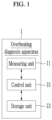
- FIG. 1 is a block diagram illustrating an overheating diagnosis apparatus according to an embodiment.
- an overheating diagnosis apparatus 1 includes a measuring unit 11, a storage unit 13, and a control unit 15.
- the measuring unit 11 may measure a temperature of an object at each point (hereinafter referred to as diagnosis point) at which overheating of the object is diagnosed and transmit a measurement result to the control unit 15.
- diagnosis point a point at which overheating of the object is diagnosed
- the measuring unit 11 may include a temperature sensor that measures the temperature of the object.
- the object may include, but is not limited to, a battery, and may include various devices that need to be predicted in advance before an overheating event occurs.
- the storage unit 13 may store a temperature value of the object measured by the measuring unit 11 at each diagnosis point.
- the storage unit 13 may store a moving average value MA, a standard deviation SD, a standard deviation average value SD_ave, and an overheating reference value Th that are calculated by the control unit 15 at each diagnosis point.
- a temperature value T, the moving average value MA, the standard deviation SD, the standard deviation average value SD_ave, and the overheating reference value Th of the object corresponding to a certain diagnosis point may be stored in the storage unit 13 in the form of a lookup table.
- the control unit 15 calculates the moving average value MA and the overheating reference value Th that has a predetermined value greater than the moving average value.
- the diagnosis point may be a point when charging of the battery starts or a point when discharging of the battery ends.
- the diagnosis point is not limited thereto, and may be variously set.
- the control unit 15 may extract a plurality of diagnosis points included in the preset number of samples SN to determine a sample group.
- the number of samples SN is the number of diagnosis points included in the sample group, and may be determined as the optimal number based on experiments, etc.
- the sample group is a subgroup of a plurality of past diagnosis points, which is a population, and may be a group for calculating the moving average value MA and the standard deviation average value SD_ave, etc., which will be described below.
- Table 1 Diagnosis cycle 1 ...
- Table 1 above shows an example of a lookup table for the temperature value T, the moving average value MA, the standard deviation SD, the standard deviation average value SD_ave, an error value ER, the overheating reference value Th, etc.
- a method of calculating an overheating reference value Th N required for overheating diagnosis at an N-th diagnosis point will be described in detail.
- the number of samples SN is assumed to be 5. However, the number of samples SN is not limited thereto, and may be determined as various positive integers.
- first diagnosis point 1 in Table 1 there is no previous diagnosis point to constitute the sample group, so the moving average value MA, the standard deviation SD, the standard deviation average value SD_ave, and the overheating reference value Th may be difficult to calculate directly (therefore, the corresponding values in Table 1 are blank).
- predetermined diagnosis points e.g. 2, 3, 4, and 5 adjacent to the first diagnosis point 1, it may be difficult to calculate the moving average value MA, the standard deviation SD, the standard deviation average value SD_ave, and the overheating reference value Th.
- a designer may provide values calculated on average according to the experiment to the moving average value MA, the standard deviation SD, the standard deviation average value SD_ave, and the overheating reference value Th at the initial diagnosis point and adjacent diagnosis points (e.g., 1, 2, 3, 4, and 5).
- control unit 15 may extract an N-1-th diagnosis point, an N-2-th diagnosis point, an N-3-th diagnosis point, an N-4-th diagnosis point, and an N-5-th diagnosis point corresponding to 5, which is the number of samples SN, to determine a sample group.
- the object is the battery
- an internal resistance value increases due to aging, and the temperature may gradually rise as the internal resistance value increases.
- Th N the overheating reference value
- the control unit 15 compares a temperature value T N measured at the N-th diagnosis point with the overheating reference value Th N calculated at the N-th diagnosis point to diagnose whether the object is overheated.
- a moving average value MA N and a standard deviation average value SD N_ ave are values required to calculate the overheating reference value Th N .
- the standard deviation SD N is not a value required when diagnosing an overheating condition at the N-th diagnosis point, but is necessary for determining overheating events at subsequent diagnosis points N+1, N+2, ..., and therefore, may be calculated and stored in the storage unit 13.
- MA N T N ⁇ 5 + T N ⁇ 4 + T N ⁇ 3 + T N ⁇ 2 + T N ⁇ 1 N
- the standard deviation SD N corresponding to the N-th diagnosis point is not a value necessary when diagnosing the overheating condition at the N-th diagnosis point, but is necessary when diagnosing whether the overheating event of the object has occurred at the subsequent diagnosis points N+1, N+2, ...
- the standard deviation SD N corresponding to the N-th diagnosis point may be calculated at the N-th diagnosis point and stored in the storage unit 13.
- control unit 15 may calculate the standard deviation average value SD N_ ave (0.07442) corresponding to the N-th diagnosis point based on a plurality of standard deviations SD N-5 , SD N-4 , SD N-3 , SD N-2 , and SD N-1 corresponding to each of the plurality of diagnosis points N-5, N-4, N-3, N-2, and N-1 belonging to the sample group.
- the control unit 15 may calculate the overheating reference value Th N that is a predetermined value larger than the moving average value MA N .
- the control unit 15 may calculate the error value ER N by multiplying the standard deviation average value SD N_ ave by a preset multiple ⁇ according to Equation 2 below.
- the multiple ⁇ is a value to reflect various errors, and may be determined as various values through the experiment.
- ER N SD N _ ave ⁇ ⁇
- control unit 15 may calculate the error value ER N , 0.22326 by multiplying the standard deviation average value SD N_ ave (0.07442) by the multiple ⁇ , 3.
- the error value ER N is a value that reflects errors that may occur in various situations, such as temperature measurement.
- an interval between the moving average value MA N and the overheating reference value Th N may be very narrow. That is, even if no actual overheating event occurred, the misdiagnosis may occur that the overheating event occurs according to an arithmetic calculation in which the temperature value T N measured at the N-th diagnosis point exceeds the overheating reference value Th N calculated at the N-th diagnosis point.
- the error value ER N which is the basis for calculating the overheating reference value Th N , is smaller than the generally expected value, there is a high possibility of misdiagnosis.
- the control unit 15 may calculate the overheating reference value Th N by adding the error value ER N to the moving average value MA N .
- the control unit 15 when the error value ER N is less than the error reference value TH N_ ER, the control unit 15 corrects the temperature value T corresponding to each of the plurality of diagnosis points N-5, N-4, N-3, N-2, and N-1 belonging to the sample group. That is, the control unit 15 may correct temperature data corresponding to each of the plurality of diagnosis points N-5, N-4, N-3, N-2, and N-1 belonging to the sample group.
- the control unit 15 may correct the temperature value T by adding a predetermined correction value ⁇ to the temperature value T when the temperature value T corresponding to each of the plurality of diagnosis points N-5, N-4, N-3, N-2, and N-1 is greater than or equal to the moving average value MA N .
- the temperature value T corresponding to each of the plurality of diagnosis points N-5, N-4, N-3, N-2, and N-1 is less than the moving average value MA N .
- the temperature value may be corrected by subtracting the correction value ⁇ from the temperature value T.
- the correction value ⁇ is assumed to be 2, but is not limited thereto and may be determined as various values.
- the error value ER N (0.22326) is smaller than the reference value TH N _ER (0.2938).
- the moving average value MA N is 29.38°C.
- corrected temperature values T' for each of the plurality of diagnosis points N-5, N-4, N-3, N-2, and N-1 may be 31.4°C, 27.3°C, 31.4°C, 27.3°C, and 31.5°C.
- the control unit 15 may again calculate a moving average value MA N ', a standard average deviation value SD N_ ave', and an error value ER N ' based on Equation 1, Equation 2, etc., based on the corrected temperature values T' 31.4°C, 27.3°C, 31.4°C, 27.3°C, and 31.5°C at each of the plurality of diagnosis points N-5, N-4, N-3, N-2, and N-1.
- control unit 15 may calculate the overheating reference value Th N by adding the error value ER N to the moving average value MA N according to Equation 3 below.
- Th N MA N + ER N
- the control unit 15 may calculate the overheating reference value Th N based on the moving average value MA N ' and the error value ER N ' calculated based on the corrected temperature value T' at each of the plurality of diagnosis points N-5, N-4, N-3, N-2, and N-1.
- the overheating reference value Th N calculated based on the corrected temperature value T' at each of the plurality of diagnosis points N-5, N-4, N-3, N-2, and N-1 is assumed to be 32.5°C.
- control unit 15 may compare the temperature T N value measured at the N-th diagnosis point and the overheating reference value Th N calculated at the N-th diagnosis point to diagnose whether the overheating event has occurred for the object.
- the control unit 15 may diagnose that no overheating event has occurred. That is, the control unit 15 may diagnose that the temperature of the object is in a normal state.
- FIG. 2 is a block diagram for describing a battery system according to another embodiment.
- a battery system 2 includes a battery 10, a relay 20, and a battery management system (BMS) 30.
- BMS battery management system
- the battery 10 may include a plurality of battery cells connected in series and/or in parallel. In FIG. 2 , three battery cells connected in parallel are illustrated, but the present disclosure is not limited thereto, and the battery 10 may include various numbers of battery cells connected in series and/or parallel. In some embodiments, the battery cell may be a rechargeable secondary battery.
- a predetermined number of battery cells are connected in parallel to form a battery bank, and a predetermined number of battery banks are connected in series to form a battery pack, so that desired power may be supplied to an external device.
- a predetermined number of battery cells are connected in parallel to form a battery bank, and a predetermined number of battery banks are connected in parallel to form a battery pack, so that desired power may be supplied to an external device.
- the present disclosure is not limited to this connection, and the battery 10 includes a plurality of battery banks including a plurality of battery cells connected in series and/or parallel, and the plurality of battery banks may also be connected in series and/or parallel.
- the battery 10 is connected between two output terminals OUT1 and OUT2 of the battery system 2.
- a relay 20 is connected between a positive electrode of the battery system 2 and the first output terminal OUT1.
- the relay 20 controls an electrical connection between the battery system 2 and the external device.
- the relay 20 When the relay 20 is turned on, the battery system 2 and the external device are electrically connected to perform the charge or discharge.
- the relay 20 When the relay 20 is turned off, the battery system 2 and the external device are electrically separated.
- the external device may be a charger in a charging cycle in which the battery 10 is charged by supplying power to the battery 10, and may be a load in a discharging cycle in which the battery 10 discharges power to the external device.
- the BMS 30 includes a measuring unit 31, a storage unit 33, and a control unit 35.
- the overheating diagnosis apparatus 1 illustrated in FIG. 1 may correspond to the BMS 30 illustrated in FIG. 2 .
- the functions performed by the measuring unit 11, the storage unit 13, and the control unit 15, respectively, of the overheating diagnosis apparatus 1 may correspond to functions performed by the measuring unit 31, the storage unit 33, and the control unit 35 of the BMS 30.
- the overheating diagnosis apparatus 1 may be configured separately from the battery system 2.
- the BMS 30 may perform the function of the overheating diagnosis apparatus 1.
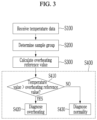
- FIG. 3 is a flowchart describing an overheating diagnosis method according to an embodiment.
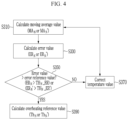
- FIG. 4 is a flowchart describing in detail an overheating reference value determination step (S300) of FIG. 3 .
- FIG. 5 is a flowchart describing in detail a temperature value correction step (S370) of FIG. 4 .
- an overheating diagnosis method, and an overheating diagnosis apparatus 1 and a battery system 2 that provide the method will be described.
- the measuring unit 31, the storage unit 33, and the control unit 35 of the BMS 30 will be described, which will be identically applied to the measuring unit 11, storage unit 13, and control unit 15 of the overheating diagnosis apparatus 1.
- the battery 10 is described, the present disclosure is not limited thereto, and may be identically applied to various objects that require temperature measurement.
- the control unit 35 receives temperature data including information on the measured temperature of the battery 10 from the measuring unit 31 at a predetermined diagnosis point at which the overheating of the battery 10 is diagnosed (S100).
- the measuring unit 31 may measure the temperature of the battery 10 and transmit the measured result to the control unit 35.
- the measuring unit 31 may include a temperature sensor to measure the temperature of the battery 10 at each diagnosis point and transmit the measured results to the control unit 35.
- the measuring unit 31 may receive a temperature value that is a result of the temperature sensor measuring the temperature of the battery 10 at predetermined time intervals or in real time, extract temperature data corresponding to a predetermined diagnosis point, and transmit the extracted temperature data to the control unit 35.
- control unit 35 extracts a plurality of previous diagnosis points corresponding to the number of samples SN based on a current diagnosis point N to determine a sample group (S200).
- control unit 35 may extract an N-5-th diagnosis point, an N-4-th diagnosis point, an N-3-th diagnosis point, an N-2-th diagnosis point, and an N-1-th diagnosis point corresponding to 5, which is the number of samples SN, to determine a sample group.
- control unit 35 calculates the overheating reference value Th N corresponding to the N-th diagnosis point based on the temperature values T N-5 , T N-4 , T N-3 , T N-2 , and T N-1 measured at each of the plurality of diagnosis points N-5, N-2, N-3, N-4, and N-1 belonging to the sample group (S300).
- step S300 the control unit 35 calculates a standard deviation average value SD N_ ave by averaging a plurality of standard deviations corresponding to each of the plurality of diagnosis points belonging to the sample group, and calculates an error value ER N based on the standard deviation average value SD N_ ave (S330).
- the control unit 35 may calculate the error value ER N by multiplying the standard deviation average value SD N_ ave by a preset multiple ⁇ according to Equation 2 above.
- the multiple ⁇ may be determined as various values through experiment.
- the control unit 35 may calculate the error value ER N , 0.22326 by multiplying the standard deviation average value SD N_ ave (0.07442) by the multiple ⁇ , 3.
- step S300 the control unit 35 compares the error value ER N with a predetermined error reference value TH N _ER (S350).
- step S300 when the error value ER N is smaller than the error reference value TH N_ ER, the control unit 35 corrects the temperature value T corresponding to each of the plurality of diagnosis points N-5, N-4, N-3, N-2, and N-1 belonging to the sample group.
- step S370 referring to FIG. 4 , the control unit 35 extracts the plurality of temperature values corresponding to each of the plurality of diagnosis points N-5, N-4, N-3, N-2, and N-1 belonging to the sample group (S371).
- step S370 the control unit 35 compares each of the plurality of temperature values with the moving average value MA N (S373).
- control unit 35 may determine whether the temperature value is greater than or equal to the moving average value MA N .
- step S370 when the temperature value is greater than or equal to the moving average value MA N as a result of the comparison (S372, YES), the control unit 35 corrects the temperature value by adding a predetermined correction value ⁇ to the temperature value (S373).
- step S370 when the temperature value is smaller than the moving average value MA N as a result of the comparison (S372, NO), the control unit 35 corrects the temperature value by subtracting the predetermined correction value ⁇ from the temperature value (S374).
- the control unit 35 may perform steps S310 and S330 again depending on corrected temperature values T' 31.4°C, 27.3°C, 31.4°C, 27.3°C, and 31.5°C at the plurality of diagnosis points N-5, N-4, N-3, N-2, and N-1 to calculate a corrected moving average value MA N ' and a corrected error value ER N ' again.
- the corrected error value ER N ' is greater than a corrected error reference value TH N_ ER' (S350, YES)
- the following step S390 may be performed. That is, steps S370, S310, and S330 may be repeated until the determination result of step S350 is YES.
- the corrected error reference value TH N_ ER' may be calculated as a value corresponding to 1% of the corrected moving average value MA N '.
- step S370 it is determined that the control unit 35 corrects all of the plurality of temperature values corresponding to each of the plurality of diagnosis points N-5, N-4, N-3, N-2, and N-1 belonging to the sample group (S375).
- step S370 when there is an uncorrected temperature value among the plurality of temperature values as a result of the determination (S375, NO), the control unit 35 repeats from step S372.
- step S370 when the correction is completed for all of the plurality of temperature values belonging to the sample group as a result of the determination (S375, YES), the control unit 35 may store, in the storage unit 32, a plurality of corrected temperature values T N-5 ', T N-4 ', T N-3 ', T N-2 ', and T N-1 ' corresponding to each of the plurality of diagnosis points N-5, N-4, N-3, N-2, and N-1, belonging to the sample group and complete the correction (S376).
- the measurement is performed at each of the plurality of diagnosis points N-5, N-4, N-3, N-2, and N-1, so the plurality of temperature values 29.4°C, 29.3°C, 29.4°C, 29.3°C, and 29.5°C already stored in the storage unit 32 may not be corrected. That is, at the N-th diagnosis point, even if the temperature value is corrected according to step S370, only the corrected overheating reference value Th N may be calculated based on the corrected moving average value MA N ' and the corrected error value ER N '.
- the temperature value is measured at each of the plurality of diagnosis points N-5, N-4, N-3, N-2, and N-1, so the plurality of temperature values 29.4°C, 29.3°C, 29.4°C, 29.3°C, and 29.5°C already stored in the storage unit 32 may change to the plurality of corrected temperature values 31.4°C, 27.3°C, 31.4°C, 27.3°C, and 31.5°C. Therefore, when calculating moving average values MA N+1 , MA N+2 , etc. and corrected error values ER N+1 + ER N+2 , etc., at N+1 diagnosis point, N+2 diagnosis point, etc., they may be calculated based on the plurality of temperature values corrected at the N-th diagnosis point.
- step S300 referring back to FIG. 4 , the control unit 35 calculates the overheating reference value Th N or Th N ' by adding the error value ER N or ER N ' to the moving average value MA N or MA N ' (S390).
- the control unit 35 may calculate the corrected overheating reference value Th N by adding the calculated corrected moving average value MA N ' and corrected error value ER N ' calculated based on the corrected temperature value T' of each of the plurality of diagnosis points N-5, N-4, N-3, N-2, and N-1.
- the corrected overheating reference value Th N ' calculated based on the corrected temperature value T' at each of the plurality of diagnosis points N-5, N-4, N-3, N-2, and N-1 is assumed to be 32.5°C.
- the control unit 35 diagnoses whether the overheating event has occurred in the battery 10 by comparing the temperature T N value measured at the N-th diagnosis point and the overheating reference value Th N (S400).
- step S400 the control unit 35 determines whether the temperature T N value measured at the N-th diagnosis point exceeds the overheating reference value Th N (S410).
- step S400 when the temperature T N value exceeds the overheating reference value Th N as a result of the determination (S410, Yes), the control unit 35 diagnoses that the overheating event has occurred in the battery 10 (S420).
- step S400 when the temperature T N value is less than or equal to the overheating reference value Th N as a result of the determination (S400, No), the control unit 35 diagnoses that the temperature of the battery 10 is in a normal state (S430).
- the control unit 35 may diagnose that no overheating event has occurred. That is, the control unit 35 may diagnose that the temperature of the object is in a normal state.
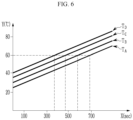
- FIG. 6 is an exemplary diagram illustrating a temperature change of a defect-free battery in a charging mode.
- FIG. 7 is an exemplary diagram illustrating a temperature change of a defective battery in the charging mode.
- an X-axis represents time (sec), and a Y-axis represents temperature (°C).
- FIG. 6 it is an exemplary diagram illustrating a temperature change over time when a defect-free battery is charged at various external temperatures.
- the temperature change of the battery 10 over time may correspond to a first graph T A .
- the temperature change of the battery 10 over time may correspond to a second graph T B .
- the temperature change of the battery 10 may correspond to a third graph T C and a fourth graph T D when the air temperature is 35°C and 40°C, respectively.
- a starting temperature value may be different when the external temperature changes, but as illustrated in FIG. 6 , the temperature change (i.e., slope) over time may be constant.
- FIG. 7 it is an exemplary diagram illustrating the temperature change over time when a defective battery is charged at a predetermined external temperature.
- a solid line FL is an actually measured temperature of the battery
- a dotted line DL drawn close to the solid line (FL) is a baseline.
- the baseline may be constructed by connecting the overheating reference values calculated at each diagnosis point according to the embodiment. Referring to FIGS. 6 and 7 , the temperature change of the defect-free battery may form a straight line graph as illustrated in FIG. 6 , but the temperature change of the defective battery may form a curved graph as illustrated in FIG. 7 .
- the occurrence of the overheating event is diagnosed at that point.
- the occurrence of the overheating event of the battery 10 may be diagnosed for the first time at a second point AD2.
- the occurrence of the overheating event may be diagnosed in advance before the temperature of the battery 10 exceeds the fixed overheating reference value (e.g., 60°C).
- the occurrence of the overheating event for the battery 10 is diagnosed for the first time at a first point AD1.
- the overheating event is continuously diagnosed at each diagnosis point from the first point AD1 at which the solid line FL exceeded the dotted line DL to the second point AD2.
- the experimental results showed a time difference (about 16 minutes) of about 1000 sec between the first point AD1 and the second point AD2.
- the occurrence of the overheating event of the battery 10 may be known in advance, which has the advantage of being able to prepare countermeasures.
Landscapes
- Engineering & Computer Science (AREA)
- Manufacturing & Machinery (AREA)
- Chemical & Material Sciences (AREA)
- Chemical Kinetics & Catalysis (AREA)
- Electrochemistry (AREA)
- General Chemical & Material Sciences (AREA)
- Power Engineering (AREA)
- Sustainable Energy (AREA)
- Life Sciences & Earth Sciences (AREA)
- Sustainable Development (AREA)
- Transportation (AREA)
- Mechanical Engineering (AREA)
- Physics & Mathematics (AREA)
- General Physics & Mathematics (AREA)
- Microelectronics & Electronic Packaging (AREA)
- Automation & Control Theory (AREA)
- Secondary Cells (AREA)
Applications Claiming Priority (3)
| Application Number | Priority Date | Filing Date | Title |
|---|---|---|---|
| KR20220185631 | 2022-12-27 | ||
| KR1020230185646A KR20240103994A (ko) | 2022-12-27 | 2023-12-19 | 과열 진단 방법, 그 방법을 제공하는 과열 진단 장치 및 배터리 시스템 |
| PCT/KR2023/021634 WO2024144230A1 (ko) | 2022-12-27 | 2023-12-26 | 과열 진단 방법, 그 방법을 제공하는 과열 진단 장치 및 배터리 시스템 |
Publications (1)
| Publication Number | Publication Date |
|---|---|
| EP4576321A1 true EP4576321A1 (de) | 2025-06-25 |
Family
ID=91718427
Family Applications (1)
| Application Number | Title | Priority Date | Filing Date |
|---|---|---|---|
| EP23912905.9A Pending EP4576321A1 (de) | 2022-12-27 | 2023-12-26 | Überhitzungsdiagnoseverfahren und überhitzungsdiagnosevorrichtung und batteriesystem zur bereitstellung des verfahrens |
Country Status (4)
| Country | Link |
|---|---|
| EP (1) | EP4576321A1 (de) |
| JP (1) | JP2025532212A (de) |
| CN (1) | CN119923741A (de) |
| WO (1) | WO2024144230A1 (de) |
Family Cites Families (5)
| Publication number | Priority date | Publication date | Assignee | Title |
|---|---|---|---|---|
| JP2996240B1 (ja) * | 1998-10-16 | 1999-12-27 | トヨタ自動車株式会社 | 時間変化率検査方法及び装置 |
| JP4325053B2 (ja) * | 2000-01-28 | 2009-09-02 | 井関農機株式会社 | 穀類乾燥機のバーナ異常判定装置 |
| JP6055149B2 (ja) * | 2015-05-22 | 2016-12-27 | 東海旅客鉄道株式会社 | 温度異常検出システム、温度異常検出方法 |
| KR20200134580A (ko) * | 2019-05-22 | 2020-12-02 | 한국전력공사 | 배터리 진단 장치 및 그것의 배터리 진단 방법 |
| KR102684241B1 (ko) * | 2019-12-26 | 2024-07-12 | 에스엘 주식회사 | 배터리 관리 장치 |
-
2023
- 2023-12-26 EP EP23912905.9A patent/EP4576321A1/de active Pending
- 2023-12-26 CN CN202380067987.6A patent/CN119923741A/zh active Pending
- 2023-12-26 WO PCT/KR2023/021634 patent/WO2024144230A1/ko not_active Ceased
- 2023-12-26 JP JP2025517804A patent/JP2025532212A/ja active Pending
Also Published As
| Publication number | Publication date |
|---|---|
| WO2024144230A1 (ko) | 2024-07-04 |
| JP2025532212A (ja) | 2025-09-29 |
| CN119923741A (zh) | 2025-05-02 |
Similar Documents
| Publication | Publication Date | Title |
|---|---|---|
| EP3961234B1 (de) | Vorrichtung und verfahren zur diagnose einer abnormalen verschlechterung einer batteriezelle | |
| US12253572B2 (en) | Battery diagnosing apparatus and method | |
| EP4163653B1 (de) | Busbardiagnosevorrichtung, batteriepack, energiespeichersystem und busbardiagnoseverfahren | |
| US20240036116A1 (en) | Battery Monitoring Apparatus and Method | |
| US20240266859A1 (en) | Battery management apparatus and method | |
| US12352818B2 (en) | Battery management apparatus and method | |
| US20230184838A1 (en) | Device and method for diagnosing battery | |
| EP4484984A1 (de) | Batteriediagnoseverfahren und batteriediagnosevorrichtung sowie batteriesystem zur bereitstellung des verfahrens | |
| EP4481885A1 (de) | Überhitzungsdiagnoseverfahren und überhitzungsdiagnosevorrichtung und batteriesystem damit | |
| US11959972B2 (en) | Battery diagnosing apparatus and method | |
| EP4576321A1 (de) | Überhitzungsdiagnoseverfahren und überhitzungsdiagnosevorrichtung und batteriesystem zur bereitstellung des verfahrens | |
| EP4239350B1 (de) | Vorrichtung zur messung des isolationswiderstands | |
| US20230266400A1 (en) | Battery Diagnosing Apparatus and Method | |
| KR20240103994A (ko) | 과열 진단 방법, 그 방법을 제공하는 과열 진단 장치 및 배터리 시스템 | |
| EP4675292A1 (de) | Batteriediagnosevorrichtung und betriebsverfahren dafür | |
| EP4597133A1 (de) | Vorrichtung und verfahren zur batteriediagnose | |
| EP4603854A1 (de) | Vorrichtung und verfahren zur erzeugung von batterieinformationen | |
| EP4692825A1 (de) | Batterieverwaltungsvorrichtung und betriebsverfahren dafür | |
| US20250264539A1 (en) | Apparatus and method for estimating capacity of battery | |
| EP4191824A1 (de) | Verfahren zur erkennung einer defekten batteriezelle und batterieverwaltungssystem damit | |
| KR20250097496A (ko) | 배터리 관리 장치 및 그것의 동작 방법 | |
| KR20250162217A (ko) | 배터리 진단 방법 및 장치 | |
| KR20250015227A (ko) | 배터리 관리 장치 및 그것의 동작 방법 | |
| KR20250049037A (ko) | 배터리 팩의 상태 진단 장치 및 그 방법 | |
| CN121443961A (zh) | 用于诊断电池的装置和方法 |
Legal Events
| Date | Code | Title | Description |
|---|---|---|---|
| STAA | Information on the status of an ep patent application or granted ep patent |
Free format text: STATUS: THE INTERNATIONAL PUBLICATION HAS BEEN MADE |
|
| PUAI | Public reference made under article 153(3) epc to a published international application that has entered the european phase |
Free format text: ORIGINAL CODE: 0009012 |
|
| STAA | Information on the status of an ep patent application or granted ep patent |
Free format text: STATUS: REQUEST FOR EXAMINATION WAS MADE |
|
| 17P | Request for examination filed |
Effective date: 20250320 |
|
| AK | Designated contracting states |
Kind code of ref document: A1 Designated state(s): AL AT BE BG CH CY CZ DE DK EE ES FI FR GB GR HR HU IE IS IT LI LT LU LV MC ME MK MT NL NO PL PT RO RS SE SI SK SM TR |