EP4576119A2 - Tragbarer computer mit fitnessmaschinenkonnektivität für verbesserte aktivitätsüberwachung - Google Patents
Tragbarer computer mit fitnessmaschinenkonnektivität für verbesserte aktivitätsüberwachung Download PDFInfo
- Publication number
- EP4576119A2 EP4576119A2 EP25156802.8A EP25156802A EP4576119A2 EP 4576119 A2 EP4576119 A2 EP 4576119A2 EP 25156802 A EP25156802 A EP 25156802A EP 4576119 A2 EP4576119 A2 EP 4576119A2
- Authority
- EP
- European Patent Office
- Prior art keywords
- data
- fitness
- machine
- computer
- wearable computer
- Prior art date
- Legal status (The legal status is an assumption and is not a legal conclusion. Google has not performed a legal analysis and makes no representation as to the accuracy of the status listed.)
- Pending
Links
Images




Classifications
-
- A—HUMAN NECESSITIES
- A63—SPORTS; GAMES; AMUSEMENTS
- A63B—APPARATUS FOR PHYSICAL TRAINING, GYMNASTICS, SWIMMING, CLIMBING, OR FENCING; BALL GAMES; TRAINING EQUIPMENT
- A63B24/00—Electric or electronic controls for exercising apparatus of preceding groups; Controlling or monitoring of exercises, sportive games, training or athletic performances
- A63B24/0062—Monitoring athletic performances, e.g. for determining the work of a user on an exercise apparatus, the completed jogging or cycling distance
-
- A—HUMAN NECESSITIES
- A63—SPORTS; GAMES; AMUSEMENTS
- A63B—APPARATUS FOR PHYSICAL TRAINING, GYMNASTICS, SWIMMING, CLIMBING, OR FENCING; BALL GAMES; TRAINING EQUIPMENT
- A63B22/00—Exercising apparatus specially adapted for conditioning the cardio-vascular system, for training agility or co-ordination of movements
- A63B22/02—Exercising apparatus specially adapted for conditioning the cardio-vascular system, for training agility or co-ordination of movements with movable endless bands, e.g. treadmills
-
- A—HUMAN NECESSITIES
- A63—SPORTS; GAMES; AMUSEMENTS
- A63B—APPARATUS FOR PHYSICAL TRAINING, GYMNASTICS, SWIMMING, CLIMBING, OR FENCING; BALL GAMES; TRAINING EQUIPMENT
- A63B71/00—Games or sports accessories not covered in groups A63B1/00 - A63B69/00
- A63B71/06—Indicating or scoring devices for games or players, or for other sports activities
- A63B71/0619—Displays, user interfaces and indicating devices, specially adapted for sport equipment, e.g. display mounted on treadmills
- A63B71/0622—Visual, audio or audio-visual systems for entertaining, instructing or motivating the user
-
- G—PHYSICS
- G16—INFORMATION AND COMMUNICATION TECHNOLOGY [ICT] SPECIALLY ADAPTED FOR SPECIFIC APPLICATION FIELDS
- G16H—HEALTHCARE INFORMATICS, i.e. INFORMATION AND COMMUNICATION TECHNOLOGY [ICT] SPECIALLY ADAPTED FOR THE HANDLING OR PROCESSING OF MEDICAL OR HEALTHCARE DATA
- G16H20/00—ICT specially adapted for therapies or health-improving plans, e.g. for handling prescriptions, for steering therapy or for monitoring patient compliance
- G16H20/30—ICT specially adapted for therapies or health-improving plans, e.g. for handling prescriptions, for steering therapy or for monitoring patient compliance relating to physical therapies or activities, e.g. physiotherapy, acupressure or exercising
-
- G—PHYSICS
- G16—INFORMATION AND COMMUNICATION TECHNOLOGY [ICT] SPECIALLY ADAPTED FOR SPECIFIC APPLICATION FIELDS
- G16H—HEALTHCARE INFORMATICS, i.e. INFORMATION AND COMMUNICATION TECHNOLOGY [ICT] SPECIALLY ADAPTED FOR THE HANDLING OR PROCESSING OF MEDICAL OR HEALTHCARE DATA
- G16H40/00—ICT specially adapted for the management or administration of healthcare resources or facilities; ICT specially adapted for the management or operation of medical equipment or devices
- G16H40/60—ICT specially adapted for the management or administration of healthcare resources or facilities; ICT specially adapted for the management or operation of medical equipment or devices for the operation of medical equipment or devices
- G16H40/63—ICT specially adapted for the management or administration of healthcare resources or facilities; ICT specially adapted for the management or operation of medical equipment or devices for the operation of medical equipment or devices for local operation
-
- G—PHYSICS
- G16—INFORMATION AND COMMUNICATION TECHNOLOGY [ICT] SPECIALLY ADAPTED FOR SPECIFIC APPLICATION FIELDS
- G16H—HEALTHCARE INFORMATICS, i.e. INFORMATION AND COMMUNICATION TECHNOLOGY [ICT] SPECIALLY ADAPTED FOR THE HANDLING OR PROCESSING OF MEDICAL OR HEALTHCARE DATA
- G16H50/00—ICT specially adapted for medical diagnosis, medical simulation or medical data mining; ICT specially adapted for detecting, monitoring or modelling epidemics or pandemics
- G16H50/30—ICT specially adapted for medical diagnosis, medical simulation or medical data mining; ICT specially adapted for detecting, monitoring or modelling epidemics or pandemics for calculating health indices; for individual health risk assessment
-
- A—HUMAN NECESSITIES
- A63—SPORTS; GAMES; AMUSEMENTS
- A63B—APPARATUS FOR PHYSICAL TRAINING, GYMNASTICS, SWIMMING, CLIMBING, OR FENCING; BALL GAMES; TRAINING EQUIPMENT
- A63B24/00—Electric or electronic controls for exercising apparatus of preceding groups; Controlling or monitoring of exercises, sportive games, training or athletic performances
- A63B24/0062—Monitoring athletic performances, e.g. for determining the work of a user on an exercise apparatus, the completed jogging or cycling distance
- A63B2024/0065—Evaluating the fitness, e.g. fitness level or fitness index
-
- A—HUMAN NECESSITIES
- A63—SPORTS; GAMES; AMUSEMENTS
- A63B—APPARATUS FOR PHYSICAL TRAINING, GYMNASTICS, SWIMMING, CLIMBING, OR FENCING; BALL GAMES; TRAINING EQUIPMENT
- A63B71/00—Games or sports accessories not covered in groups A63B1/00 - A63B69/00
- A63B71/06—Indicating or scoring devices for games or players, or for other sports activities
- A63B71/0619—Displays, user interfaces and indicating devices, specially adapted for sport equipment, e.g. display mounted on treadmills
- A63B71/0622—Visual, audio or audio-visual systems for entertaining, instructing or motivating the user
- A63B2071/0625—Emitting sound, noise or music
-
- A—HUMAN NECESSITIES
- A63—SPORTS; GAMES; AMUSEMENTS
- A63B—APPARATUS FOR PHYSICAL TRAINING, GYMNASTICS, SWIMMING, CLIMBING, OR FENCING; BALL GAMES; TRAINING EQUIPMENT
- A63B71/00—Games or sports accessories not covered in groups A63B1/00 - A63B69/00
- A63B71/06—Indicating or scoring devices for games or players, or for other sports activities
- A63B71/0619—Displays, user interfaces and indicating devices, specially adapted for sport equipment, e.g. display mounted on treadmills
- A63B2071/0658—Position or arrangement of display
-
- A—HUMAN NECESSITIES
- A63—SPORTS; GAMES; AMUSEMENTS
- A63B—APPARATUS FOR PHYSICAL TRAINING, GYMNASTICS, SWIMMING, CLIMBING, OR FENCING; BALL GAMES; TRAINING EQUIPMENT
- A63B2220/00—Measuring of physical parameters relating to sporting activity
- A63B2220/17—Counting, e.g. counting periodical movements, revolutions or cycles, or including further data processing to determine distances or speed
-
- A—HUMAN NECESSITIES
- A63—SPORTS; GAMES; AMUSEMENTS
- A63B—APPARATUS FOR PHYSICAL TRAINING, GYMNASTICS, SWIMMING, CLIMBING, OR FENCING; BALL GAMES; TRAINING EQUIPMENT
- A63B2220/00—Measuring of physical parameters relating to sporting activity
- A63B2220/62—Time or time measurement used for time reference, time stamp, master time or clock signal
-
- A—HUMAN NECESSITIES
- A63—SPORTS; GAMES; AMUSEMENTS
- A63B—APPARATUS FOR PHYSICAL TRAINING, GYMNASTICS, SWIMMING, CLIMBING, OR FENCING; BALL GAMES; TRAINING EQUIPMENT
- A63B2220/00—Measuring of physical parameters relating to sporting activity
- A63B2220/80—Special sensors, transducers or devices therefor
- A63B2220/803—Motion sensors
-
- A—HUMAN NECESSITIES
- A63—SPORTS; GAMES; AMUSEMENTS
- A63B—APPARATUS FOR PHYSICAL TRAINING, GYMNASTICS, SWIMMING, CLIMBING, OR FENCING; BALL GAMES; TRAINING EQUIPMENT
- A63B2220/00—Measuring of physical parameters relating to sporting activity
- A63B2220/80—Special sensors, transducers or devices therefor
- A63B2220/83—Special sensors, transducers or devices therefor characterised by the position of the sensor
- A63B2220/836—Sensors arranged on the body of the user
-
- A—HUMAN NECESSITIES
- A63—SPORTS; GAMES; AMUSEMENTS
- A63B—APPARATUS FOR PHYSICAL TRAINING, GYMNASTICS, SWIMMING, CLIMBING, OR FENCING; BALL GAMES; TRAINING EQUIPMENT
- A63B2225/00—Miscellaneous features of sport apparatus, devices or equipment
- A63B2225/50—Wireless data transmission, e.g. by radio transmitters or telemetry
-
- A—HUMAN NECESSITIES
- A63—SPORTS; GAMES; AMUSEMENTS
- A63B—APPARATUS FOR PHYSICAL TRAINING, GYMNASTICS, SWIMMING, CLIMBING, OR FENCING; BALL GAMES; TRAINING EQUIPMENT
- A63B2230/00—Measuring physiological parameters of the user
- A63B2230/01—User's weight
-
- A—HUMAN NECESSITIES
- A63—SPORTS; GAMES; AMUSEMENTS
- A63B—APPARATUS FOR PHYSICAL TRAINING, GYMNASTICS, SWIMMING, CLIMBING, OR FENCING; BALL GAMES; TRAINING EQUIPMENT
- A63B2230/00—Measuring physiological parameters of the user
- A63B2230/04—Measuring physiological parameters of the user heartbeat characteristics, e.g. ECG, blood pressure modulations
- A63B2230/06—Measuring physiological parameters of the user heartbeat characteristics, e.g. ECG, blood pressure modulations heartbeat rate only
-
- A—HUMAN NECESSITIES
- A63—SPORTS; GAMES; AMUSEMENTS
- A63B—APPARATUS FOR PHYSICAL TRAINING, GYMNASTICS, SWIMMING, CLIMBING, OR FENCING; BALL GAMES; TRAINING EQUIPMENT
- A63B2230/00—Measuring physiological parameters of the user
- A63B2230/75—Measuring physiological parameters of the user calorie expenditure
Definitions
- This disclosure relates generally to activity monitoring using wearable computers.
- Some wearable computers include a fitness application that uses a digital pedometer to track a user's daily movements and provide customized notifications related to progress and workout results, such as distance traveled and calories burned. Some fitness applications also monitor the user's heart rate, which can be used to calculate calories burned.
- a typical digital pedometer relies on accelerometer data from an accelerometer to determine when a step is taken. If the wearable computer is worn on the wrist, accelerations due to arm swing may cause inaccurate step counts, resulting in inaccurate distance traveled measurements.
- the heart rate measurement is often accurate due to the device being worn on the user's wrist where the user's heartbeat can be accurately measured.
- a fitness machine that includes a processor that monitors the workout and generates fitness metrics summarizing the workout.
- a treadmill may display to the user the total distance traveled, elapsed time and total calories burned during the workout.
- the total distance travelled is typically accurate because it is based on rotation of the treadmill motor shaft rather than accelerometer data, but the total calories burned is often an estimate based on a model that does not include the actual heart rate of the user.
- Embodiments are disclosed for a wearable computer with fitness machine connectivity for improved activity monitoring.
- a method comprises: establishing, by a processor of a wireless device, a wireless communication connection with a fitness machine; obtaining, by the processor, machine data from the fitness machine; determining, by the processor, a workout session according to the machine data; initiating the workout session on the wireless device; during the workout session: obtaining, from a sensor of the computing device, physiological data of a user of the fitness machine; determining, by the processor, fitness data for the user based on the physiological data, the machine data and at least one user characteristic; and sending, by the processor, the fitness data to the fitness machine.
- a system comprises: one or more processors; memory coupled to the one or more processors and configured to store instructions, which, when executed by the one or more processors, cause the one or more processors to perform operations comprising: establishing a wireless communication connection with a fitness machine; obtaining machine data from the fitness machine; determining a workout session according to the machine data; initiating the workout session on the wireless device; during the workout session: obtaining physiological data of a user of the fitness machine; determining fitness data for the user based on the physiological data, the machine data and at least one user characteristic; and sending the fitness data to the fitness machine.
- inventions can include an apparatus, computing device and non-transitory, computer-readable storage medium.
- FIG. 1 illustrates an operating environment 100 for an improved activity monitoring system that includes wearable computer 102 wirelessly connected to fitness machine 101, according to an embodiment.
- User 100 is wearing computer 102 on her wrist while she runs on fitness machine 101, which in this example is a treadmill.
- fitness machines include but are not limited to: cross-trainers (elliptical trainers), step/stair climbers, indoor bikes, indoor rowing machines and skiing machines.
- Wearable computer 102 can be a smart watch, fitness band, chest band, headband, earbud, activity/fitness tracker, headset, smart glasses, or any other wearable computer capable of communicating with fitness machine 101 and calculating a fitness metric.
- Wearable computer 102 establishes a bidirectional, wireless communication session 103 with a processor in fitness machine 101 using a wireless communication protocol.
- session 103 can be a Bluetooth session or near field communication (NFC) session, which can be established using a "pairing" process, as described in reference to FIGS. 4 and 5 .
- fitness machine 101 is authenticated and the user's consent to share data is confirmed before bidirectional data sharing is allowed between wearable computer 102 and fitness machine 101.
- Wearable computer 102 includes a processor and memory that includes instructions for running a fitness application that can be executed by the processor.
- the fitness application runs on wearable computer 102 during the user's workout session on fitness machine 101.
- a processor in fitness machine 101 monitors the workout session and computes various data (hereinafter referred to as "machine data") related to the workout session, including but not limited to: total energy used, total distance run, elapsed time, instantaneous speed, average speed, inclination and positive elevation gain.
- the machine data is transferred over link 103 to computer 102 where it is used by the fitness application, together with data known to computer 102 (hereinafter referred to as "wearable computer data”), to calculate one or more fitness metrics, such as calories burned.
- wearable computer 102 can include a heart rate monitor for determining the user's heart rate, which can be combined with machine data to determine calories burned.
- one or more fitness metrics calculated by wearable computer 102 are transferred back to fitness machine 101 where the metrics are displayed on a monitor of fitness machine 101.
- a workout summary including the fitness metrics is transferred to computer 102.
- the user can view the details of the workout session at any time on fitness machine 101, or on wearable computer 102.
- wearable computer 102 displays an in-session view with metrics received from fitness machine 101, as well as heart rate and calories (total/active) computed by wearable computer 102.
- the user can use computer 102 to transfer the workout summary to another device by syncing directly with the other device or indirectly through a network (e.g., the Internet).
- the workout session summary can be shared with other user devices in the gym through a wireless local area network (WLAN) or a multi-peer ad hoc mesh network.
- WLAN wireless local area network
- users can compare their fitness metrics with friends, trainers and other individuals for a particular fitness machine while in the gym.
- anonymous summary data can be processed by a server computer to provide workout statistics for a particular fitness machine over a large sample set. Such statistics can be used by gym operators, fitness machine manufacturers and other interested entities to determine what machines are most popular, the average time spent on a machine and other useful information.
- wearable computer 102 can use machine data to calibrate a digital pedometer running on wearable computer 102. For example, the total distance traveled during a workout session computed by fitness machine 101 can be used with an estimated distance traveled during the workout session based on pedometer step count to determine a calibration factor (e.g., a ratio of the two numbers). The calibration factor can be used to scale the estimated distance traveled calculated by computer 102 to correct out the error in the estimate.
- a calibration factor e.g., a ratio of the two numbers
- FIG. 2 is a block diagram of an example activity monitoring system for improved activity monitoring using wearable computer data combined with fitness machine data, according to an embodiment.
- System 200 can be implemented in wearable computer 102, such as a smartwatch or fitness band.
- System 200 includes wireless interface 201, motion sensor(s) 202 (e.g., accelerometers, gyros, magnetometer), fitness application 203, digital pedometer 204, activity data 205, physiological sensor(s) 206 and pedometer data 207.
- System 200 can be wired or wirelessly coupled to network 212 through WLAN access point 208 (e.g., a Wi-Fi router) to transfer data and/or sync with activity data 211 through network server computers 210.
- WLAN access point 208 e.g., a Wi-Fi router
- wireless interface 201 includes a wireless transceiver and other hardware (e.g., an antenna) and software (e.g., a software communication stack) for establishing, maintaining and ending a wireless communication session with fitness machine 101, as described in reference to FIG. 1 .
- wireless interface 201 can also be configured to establish, maintain and end a wireless communication session with WLAN access point 208, and/or other devices 213 through a multi-peer ad hoc mesh network.
- motion sensors such as accelerometers provide acceleration data that can be used by digital pedometer 204 to determine step count and calculate an estimated distance traveled based on the step count and a stride length of the user.
- the stride length can be based on average stride length for the user given the gender and height of the user, or it can be determined automatically based on sensor data.
- Pedometer data 207 including step count and distance traveled can be stored on wearable computer 102 (e.g., stored in flash memory).
- Fitness application 203 can be a software program that is executed by one or more processors of wearable computer 102.
- Fitness application 203 use pedometer data 207 to track a user's daily movements and provide customize notifications related to progress and workout results, such as distance traveled and calories burned.
- Fitness application 203 also monitors the user's heart rate and other physiology of the user, which can be calculated from sensor data provided by physiological sensor(s) 206.
- physiological sensors 206 include but are not limited to: heart rate (pulse) sensors, blood pressure sensors, skin temperature and/or conductance response sensors and respiratory rate sensors.
- physiological sensor(s) 206 include a heart rate sensor comprising a number of light emitting diodes (LEDs) paired with photodiodes that can sense light.
- LEDs light emitting diodes
- the LEDs emit light toward a user's body part (e.g., the user's wrist), and the photodiodes measure the reflected light.
- the difference between the sourced and reflected light is the amount of light absorbed by the user's body.
- the user's heart beat modulates the reflected light, which can be processed to determine the user's heart rate.
- the measured heart rate can be averaged over time to determine an average heart rate.
- a heart rate monitor does not measure caloric expenditure. Rather, the HRM estimates caloric expenditure during steady-state cardiovascular exercise using a relationship between heart rate and oxygen uptake (VO2).
- VO2 oxygen uptake
- a commonly accepted method for measuring the calories burned for a particular activity is to measure oxygen uptake (VO2).
- oxygen uptake VO2
- VO2 oxygen uptake
- VO2 oxygen uptake
- caloric expenditure can be estimated based on a percentage of their maximum heart rate or a percentage of their heart rate reserve.
- the metabolic equivalent of tasks is the ratio of the rate of energy expended during a specific physical activity to the rate of energy expended at rest.
- the resting metabolic rate is 3.5 ml O 2 ⁇ kg -1 ⁇ min -1
- a look-up table of MET values can be stored as activity data 211.
- MET values and values used by fitness machines for specific physical activities are often averages that are experimentally or statistically derived from a sample of people.
- the level of intensity at which the user performs a specific physical activity e.g., walking pace, running speed
- a more accurate model can be used on wearable computer 102 to calculate caloric expenditure that uses the user's own historical workout data on a particular machine to determine a MET that is personalized to the user.
- the conventional conversion of 3.5 ml O 2 ⁇ kg -1 ⁇ min -1 can be adjusted based on the user's resting metabolic rate (RMR).
- FIG. 3 is an example process flow 300 for connecting a wearable computer with a fitness machine, according to an embodiment.
- Each use case will be described in turn.
- the user visits the gym and finds a fitness machine with a badge (e.g., an RFID tag) indicating the machine can be paired to a wearable computer, which in this example is a smartwatch strapped to the user's wrist.
- a wearable computer e.g., an RFID tag
- the user starts a new workout session (301) by placing their wearable computer near the badge to begin pairing.
- the wearable computer is near the badge (e.g., less 10 cm) its proximity to the badge is detected using, for example, magnetic induction between loop antennas located in the wearable computer and the badge.
- the user is requested to consent to share data (303) with the fitness machine.
- the request for consent can be in the form of a GUI affordance presented on a display of the wearable computer.
- the user will be requested to pair with the fitness machine. Since, in this first use case, the user is not in a current workout session, step 302 is not applicable.
- a pairing/authentication process begins (305). If an error occurs during the pairing/authentication the error is reported to the user (304). An error can be due to a connection failure and/or an authentication failure.
- the wearable computer and fitness machine perform an authentication procedure before sharing of the user's personal fitness data is allowed.
- the fitness machine generates and securely stores a public key-private key pair, which can be in the format of elliptical curve digital signature algorithm (ECDSA) or any other suitable digital signature algorithm.
- EDSA elliptical curve digital signature algorithm
- the fitness machine calculates a message digest (e.g., a SHA256 message digest) using the private key and other data.
- the other data can be, for example, a random number, a connection confirmation value, local name data, etc.
- the fitness machine uses the encoded public key and message digest to perform the authentication process.
- the wearable computer and fitness machine begin pairing.
- the user begins the physical workout on the fitness machine (306) by, for example, starting the machine (e.g., starting the treadmill).
- the wearable computer displays an affordance indicating that the wearable computer and fitness machine are paired and the workout session is active.
- the workout session is active.
- all of the current metrics are displayed by the wearable computer.
- the workout session on the wearable computer is also paused, and the wearable computer displays a GUI stating that the workout on the wearable computer cannot pause.
- the pause is extended (307) (e.g., more than 1.5 minutes)
- the workout session ends (309) and a workout session summary is displayed to the user (310).
- the wearable computer If the wearable computer becomes disconnected from the fitness machine during the workout session, the wearable computer reports to the user that it has disconnected from the fitness machine. If the disconnect is extended (308) (e.g., more than 1.5 minutes), the workout session ends (309) and a workout session summary is displayed to the user (310). In an embodiment, a GUI affordance is displayed by the wearable computer that allows the user to disconnect and end the active workout session on the wearable computer without effecting the workout on the fitness machine.
- the user is already in a workout session on their wearable computer.
- the user may have entered the gym after an outdoor run with a workout session running on their wearable computer.
- the user starts a new workout session (301) by placing the wearable computer near the badge on the fitness machine.
- the user is prompted with an affordance to end and save the current workout session and begin pairing with the fitness machine.
- the current workout session is terminated and saved (302) and the pairing/authentication process begins (305). If the user does not agree, the pairing/authentication is not performed and the current workout session remains active on the wearable computer.
- the current workout session is automatically terminated and saved by the wearable computer, and a pairing screen is displayed on the wearable computer.
- the user After a successful pairing/authentication process, the user begins the physical workout (306).
- the new workout session ends (309) (including by extended pause 307 or extended disconnect 308), data from both the previous and current workout sessions are displayed in a workout session summary (310).
- the user if the user did not consent to share data, the user is prompted with a GUI affordance requesting the user's consent to share data (303), end and save their current workout session and begin the pairing/authentication process. If the user consents to share data, the current workout session is terminated and saved (302) and the pairing/authentication process begins (305). If the user does not consent to share data, the pairing/authentication process ends and the current workout session remains active on the wearable computer. In an embodiment, the current workout session is automatically terminated and saved by the wearable computer, and a pairing screen is displayed on the wearable computer.
- the user starts a new workout session (301) on the fitness machine but not the wearable computer.
- the user notices the badge and places their wearable computer near the badge. If the user already consented to share data, the user is prompted to pair. If the user agrees to pair, the pairing/authentication process begins (305). If the pairing/authentication process is successful, the wearable computer and fitness machine are paired. The user can continue their physical workout on the fitness machine (306). The fitness data accrued by the user on the fitness machine is ingested into the wearable computer so that the user does not lose any data, even though they may have started the workout session on the wearable computer after they started the workout session on the fitness machine.
- the workout session ends (309) including by extended pause 307 or extended disconnect 308)
- a summary of the workout session is displayed (310).
- the user is requested to consent (303). If the user consents, pairing begins (305). If the pairing/authentication process is successful, the wearable computer and fitness machine are paired. The user continues the physical workout on the fitness machine (306). When the workout session ends (309) (including by extended pause 307 or extended disconnect 308) a summary of the workout session is displayed (310). If the user does not consent to share data, pairing/authentication is not performed and the user can continue with the physical workout on the fitness machine without the wearable computer running a workout session.
- the user is simultaneously engaged in a fitness machine workout and a wearable computer workout.
- the user starts a new workout (301) by placing their wearable computer near a badge on the fitness machine.
- the user is prompted to end and save their current workout and begin pairing. If the user agrees, the current workout is terminated and saved (302) and pairing/authentication begins (305). If the user does not agree, the pairing/authentication process is not performed.
- the current workout session is automatically terminated and saved by the wearable computer, and a pairing screen is displayed on the wearable computer. If the pairing/authentication process is successful, the wearable computer and fitness machine are paired.
- the new workout session ends (309) (including by extended pause 307 or extended disconnect 308), both the summary of the previously saved workout session and the new workout session are displayed (310).
- the user is requested to end and save the current workout session (302) and consent to sharing data (303), if the user agrees, the current workout session ends, a summary of the workout session is saved and pairing begins (305). If the pairing/authentication process is successful, the user begins the new workout (306). When the new workout session ends (309) (including by extended pause 307 or extended disconnect 308), a summary of the saved workout session and the new workout session are displayed (310).
- FIG. 4 is a swim lane diagram illustrating example connection establishment procedures using NFC, according to an embodiment.
- the diagram there are three actors including user 401, wearable computer 402 and fitness machine 403. Each step in the diagram is indicated by a letter, starting with the letter "a” and ending with the letter "q".
- connection establishment procedures begin when user 401 signals to fitness machine 403 their intent to pair with fitness machine 403 (step "a") by placing the wearable computer near the badge on the fitness machine.
- fitness machine 403 advertises a fitness machine service (FTMS) and the Session ID (step “e”).
- Wearable computer 402 discovers fitness machine 403 via the advertisement (step “f") and provides a public key and signature request (step “g”).
- Fitness machine 403 sends to wearable computer 402 the public key and a signature response (step “h”).
- Wearable computer 402 sends a consent request to user 401 (step “i"), user 401 grants the request (step “j").
- wearable computer 402 sends an OOB pairing request (step “k") to fitness machine 403 and fitness machine 403 sends an OOB pairing response to wearable computer 402 (step “1").
- wearable computer 402 sends an authentication challenge to fitness machine 403 (step “m") and receives an authentication response from fitness machine 403 (step “n”).
- step "o" Upon successful authentication, user 401 starts the workout (step “o"), machine data (e.g., fitness machine type, total energy used, elapsed time, total distance) is sent to wearable computer 402 (step “p") and fitness data (e.g., instantaneous and average heart rate, active and total calories) is sent from wearable computer 402 to fitness machine 403 (step “q”).
- machine data e.g., fitness machine type, total energy used, elapsed time, total distance
- fitness data e.g., instantaneous and average heart rate, active and total calories
- step “q” The data is communicated using, for example, NFC or Bluetooth standard protocols (e.g., Bluetooth Core Specification version 4.2, NFC Suite B version 1.0).
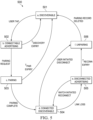
- FIG. 5 is a diagram illustrating an example state machine 500 implemented by a fitness machine processor for connecting and establishing a session with a wearable computer, according to an embodiment. Each state is indicated by a letter, starting from “a” and ending with “f”.
- the fitness machine starts in a discovery state 501 (state "a") where the fitness machine is idle and its NFC reader is ready to rea a user's tag.
- state 501 transitions to connectable advertising state 502 (state “b") and the fitness machine advertises at a timed interval T connectionAdv . Included in the advertising packet is the SessionID and FTMS.
- state 502 transitions to pairing state 503 (state "c").
- the fitness machine responds to an identity verification request, authentication challenge and pairing request.
- state 503 transitions to connected discoverable state 504 (state “d"), where the fitness machine is paired to the wearable computer. If the link is lost, connected discoverable state 504 transitions to a disconnected advertising state 505 (step “e”). In state 505, the fitness machine is no longer able to communicate with the wearable computer and starts advertising as non-discoverable to facilitate reconnection. When a reconnect time T reconnect expires, disconnected advertising state 505 transitions to unpairing state 506 (step “f”). In state 506, the fitness machine deletes its current pairing record.
- the connected discoverable 504 transitions to the unpairing state 506. If the fitness machine is in the disconnected advertising state 505, and the wearable computer initiates a reconnect, the disconnected advertising state 505 transitions to the disconnected discoverable state 504. If the fitness machine is in the pairing state 503, and a pairing time T pair expires, the pairing state 503 transitions to the discoverable state 501. If the fitness machine is in the connectable advertising state 502, and a discovery time T discovery expires, the connectable advertising state 502 transitions to the discoverable state 501.
- the user may determine how pairing will operate on their wearable computer.
- the user can select various pairing options using one or more GUI affordances or hardware input mechanisms.
- a switch can allow the user to turn auto pairing on and off. Auto pairing is where the user does not have to say yes to pairing if they have accepted pairing with a fitness machine in the past.
- Another switch allows the user to select automatic pairing to be always turned on or turned on only when the user has launched the fitness application on the wearable computer. If automatic pairing is only allowed when the workout application is launched, the user will have to launch the workout application to pair with a fitness machine.
- the wearable computer determines that the user has completed at least one workout session on the wearable computer, then automatic pairing remains turned on regardless of whether or not the fitness application is launched. If the user has not completed a workout session, the user will need to launch the fitness application to turn on automatic pairing.
- a GUI affordance or hardware input mechanism can be used to clear a particular fitness machine, or all fitness machines, listed in a pairing record stored on the wearable computer. If, however, the wearable computer was paired with a particular fitness machine in the past, and the user attempts to pair within x days (e.g., 90 days) from the last pairing, the wearable computer will auto-connect with the fitness machine. Otherwise, the user will be prompted to perform a pairing/authentication process with the fitness machine, as described in reference to FIGS. 3-5 .
- FIG. 6 is a flow diagram of an example process performed by a wearable computer for calculating fitness data, according to an embodiment.
- Process 600 can be implemented by architecture 600, as described in reference to FIG. 8 .
- Process 600 can begin by establishing wireless communication with a fitness machine (601). For example, a Bluetooth or NFC session can be established with the fitness machine, as described in reference to FIGS. 3-5 . A unique SessionID and OOB secret data can be calculated on the wearable computer and sent to the fitness machine for use in pairing and authentication.
- Process 600 continues after pairing by obtaining machine data from the fitness machine (602).
- machine data can be transferred to the wearable computer using Bluetooth or NFC session data packets.
- the machine data can include, for example, data that describes the fitness machine, including but not limited to: manufacturer name, model number, hardware revision, software revision, vendor ID, product ID.
- various fitness metrics can be included in the machine data, such as total energy, total distance and elapsed time. Some examples of fitness metrics for different types of fitness machines is described in Table I below.
- Process 600 continues by determining a workout session according to the machine data (603). Based on the machine data, the wearable computer learns the specific physical activity the user will be engaged in during the workout session. For example, if the fitness machine is a treadmill then the wearable computer will know what fitness metrics may be received from the fitness machine and how to calculate fitness data for the workout. This can include adjusting parameters of a calorie model, such as, for example, determining an appropriate MET for calculating calorie expenditure.
- Process 600 continues by initiating a workout session (604). For example, the user starts the fitness machine.
- Process 600 continues by obtaining, during the workout, the user's physiological data (605).
- the physiological data can be any data that measures the physiology of the user during the workout, including but not limited to: heart rate sensors, pulse detectors, blood pressure sensors, skin temperature and/or conductance response sensors, respiratory rate sensors, etc.
- the sensors can be included in any suitable housing, including but not limited to: a smartwatch or watchband, fitness band, chest band, headband, finger clip, ear clip, earbud, strapless heart rate monitor, etc.
- Process 600 continues by determining fitness data, during the workout session, for the user based on the physiological data, machine data and user characteristic(s) (606). For example, calories burned can be calculated using knowledge of the physical activity, the total energy, total distance, elapsed time any other data shown in Table I, that can be used in a calorie expenditure model. Any suitable calorie expenditure model can be used, including models that are dependent on MET and not dependent MET, and models that include any type and combination of user characteristics, such as height, weight, age and gender.
- Process 600 continues by sending the fitness data, during the workout session, to the fitness machine (607).
- the wearable computer After calculating the fitness data, the wearable computer sends the fitness data to the fitness machine where it can be displayed on a monitor of the fitness machine.
- the fitness data is also stored on the wearable computer.
- the stored fitness data can be synced to another device including a network-based server computer and shared with other devices through a client-server architecture.
- the fitness data can be shared directly with other devices (e.g., devices owned by friends, trainers, etc.) in a multi-peer ad hoc mesh network.
- FIG. 7 is a flow diagram of an example process 700 performed by a wearable computer to calibrate a digital pedometer, according to an embodiment.
- Process 700 can be implemented by architecture 700, as described in reference to FIG. 8 .
- Process 700 begins by establishing wireless communication with a fitness machine (701). For example, a Bluetooth or NFC session can be established with the fitness machine, as described in reference to FIGS. 4 and 5 .
- Process 700 continues by launching a pedometer calibration application on the wearable computer (702).
- the pedometer application can measure step counts based on sensor data, such as accelerometer data provided by an accelerometer on the wearable computer.
- Process 700 continues by obtaining machine data from the fitness machine (703). After a successful pairing/authentication process, the fitness machine can send data to the wearable computer that indicates the specific physical activity engaged in by the user during the workout. Additionally, the machine data can include information that can be used to calibrated the digital pedometer, such as total distance data from a treadmill.
- Pedometer data can include step count or distance traveled which can be calculated from the step count and the user's stride length.
- Process 700 continues by determining a pedometer calibration factor based on the machine data and the pedometer data (705). For example, a ratio can be formed from the total distance provided in the machine data over the estimated distance provided by the digital pedometer. The ratio can be used as a calibration scale factor to correct future pedometer measurements by scaling the estimated distance by the ratio. Process 700 continues by storing the calibration factor (706). The calibration can be performed each time the user uses a treadmill.
- FIG. 8 illustrates example wearable computer architecture 800 implementing the features and operations described in reference to FIGS. 1-7 .
- Architecture 800 can include memory interface 802, one or more data processors, image processors and/or processors 804 and peripherals interface 806.
- Memory interface 802, one or more processors 804 and/or peripherals interface 806 can be separate components or can be integrated in one or more integrated circuits.
- Sensors, devices and subsystems can be coupled to peripherals interface 806 to provide multiple functionalities.
- one or more motion sensors 810, light sensor 812 and proximity sensor 814 can be coupled to peripherals interface 806 to facilitate motion sensing (e.g., acceleration, rotation rates), lighting and proximity functions of the wearable computer.
- Location processor 815 can be connected to peripherals interface 806 to provide geo-positioning.
- location processor 815 can be a GNSS receiver, such as the Global Positioning System (GPS) receiver.
- Electronic magnetometer 816 e.g., an integrated circuit chip
- Motion sensor(s) 810 can include one or more accelerometers and/or gyros configured to determine change of speed and direction of movement of the wearable computer.
- Barometer 817 can be configured to measure atmospheric pressure around the mobile device.
- Heart rate monitoring subsystem 820 for measuring the heartbeat of a user who is wearing the computer on their wrist.
- subsystem 820 includes LEDs paired with photodiodes for measuring the amount of light reflected from the wrist (not absorbed by the wrist) to detect a heartbeat.
- wireless communication subsystems 824 can include radio frequency (RF) receivers and transmitters (or transceivers) and/or optical (e.g., infrared) receivers and transmitters.
- RF radio frequency
- the specific design and implementation of the communication subsystem 824 can depend on the communication network(s) over which a mobile device is intended to operate.
- architecture 800 can include communication subsystems 824 designed to operate over a GSM network, a GPRS network, an EDGE network, a Wi-Fi TM network and a Bluetooth TM network.
- the wireless communication subsystems 824 can include hosting protocols, such that the mobile device can be configured as a base station for other wireless devices.
- Audio subsystem 826 can be coupled to a speaker 828 and a microphone 830 to facilitate voice-enabled functions, such as voice recognition, voice replication, digital recording and telephony functions. Audio subsystem 826 can be configured to receive voice commands from the user.
- I/O subsystem 840 can include touch surface controller 842 and/or other input controller(s) 844.
- Touch surface controller 842 can be coupled to a touch surface 846.
- Touch surface 846 and touch surface controller 842 can, for example, detect contact and movement or break thereof using any of a plurality of touch sensitivity technologies, including but not limited to capacitive, resistive, infrared and surface acoustic wave technologies, as well as other proximity sensor arrays or other elements for determining one or more points of contact with touch surface 846.
- Touch surface 846 can include, for example, a touch screen or the digital crown of a smart watch.
- I/O subsystem 840 can include a haptic engine or device for providing haptic feedback (e.g., vibration) in response to commands from processor 804.
- touch surface 846 can be a pressure-sensitive surface.
- Other input controller(s) 844 can be coupled to other input/control devices 848, such as one or more buttons, rocker switches, thumb-wheel, infrared port and USB port
- the one or more buttons can include an up/down button for volume. control of speaker 828 and/or microphone 830.
- Touch surface 846 or other controllers 844 e.g., a button
- a pressing of the button for a first duration may disengage a lock of the touch surface 846; and a pressing of the button for a second duration that is longer than the first duration may turn power to the mobile device on or off.
- the user may be able to customize a functionality of one or more of the buttons.
- the touch surface 846 can, for example, also be used to implement virtual or soft buttons.
- the mobile device can present recorded audio and/or video files, such as MP3, AAC and MPEG files.
- the mobile device can include the functionality of an MP3 player.
- Other input/output and control devices can also be used.
- Memory interface 802 can be coupled to memory 850.
- Memory 850 can include high-speed random access memory and/or non-volatile memory, such as one or more magnetic disk storage devices, one or more optical storage devices and/or flash memory (e.g., NAND, NOR).
- Memory 850 can store operating system 852, such as the iOS operating system developed by Apple Inc. of Cupertino, California.
- Operating system 852 may include instructions for handling basic system services and for performing hardware dependent tasks.
- operating system 852 can include a kernel (e.g., UNIX kernel).
- Memory 850 may also store communication instructions 854 to facilitate communicating with one or more additional devices, one or more computers and/or one or more servers, such as, for example, instructions for implementing a software stack for wired or wireless communications with other devices.
- Memory 850 may include graphical user interface instructions 856 to facilitate graphic user interface processing; sensor processing instructions 858 to facilitate sensor-related processing and functions; phone instructions 860 to facilitate phone-related processes and functions; electronic messaging instructions 862 to facilitate electronic-messaging related processes and functions; web browsing instructions 864 to facilitate web browsing-related processes and functions; media processing instructions 866 to facilitate media processing-related processes and functions; GNSS/Location instructions 868 to facilitate generic GNSS and location-related processes and instructions; and heart rate instructions 870 to facilitate hear rate measurements.
- Memory 850 further includes activity application instructions for performing the features and processes described in reference to FIGS. 1-7 .
- Each of the above identified instructions and applications can correspond to a set of instructions for performing one or more functions described above. These instructions need not be implemented as separate software programs, procedures, or modules. Memory 850 can include additional instructions or fewer instructions. Furthermore, various functions of the mobile device may be implemented in hardware and/or in software, including in one or more signal processing and/or application specific integrated circuits.
- the described features can be implemented advantageously in one or more computer programs that are executable on a programmable system including at least one programmable processor coupled to receive data and instructions from, and to transmit data and instructions to, a data storage system, at least one input device, and at least one output device.
- a computer program is a set of instructions that can be used, directly or indirectly, in a computer to perform a certain activity or bring about a certain result.
- a computer program can be written in any form of programming language (e.g., SWIFT, Objective-C, C#, Java), including compiled or interpreted languages, and it can be deployed in any form, including as a stand-alone program or as a module, component, subroutine, a browser-based web application, or other unit suitable for use in a computing environment.
- programming language e.g., SWIFT, Objective-C, C#, Java
- this gathered data may identify a particular location or an address based on device usage.
- personal information data can include location-based data, addresses, subscriber account identifiers, or other identifying information.
- the present disclosure further contemplates that the entities responsible for the collection, analysis, disclosure, transfer, storage, or other use of such personal information data will comply with well-established privacy policies and/or privacy practices.
- such entities should implement and consistently use privacy policies and practices that are generally recognized as meeting or exceeding industry or governmental requirements for maintaining personal information data private and secure.
- personal information from users should be collected for legitimate and reasonable uses of the entity and not shared or sold outside of those legitimate uses. Further, such collection should occur only after receiving the informed consent of the users.
- such entities would take any needed steps for safeguarding and securing access to such personal information data and ensuring that others with access to the personal information data adhere to their privacy policies and procedures. Further, such entities can subject themselves to evaluation by third parties to certify their adherence to widely accepted privacy policies and practices.
- the present disclosure also contemplates embodiments in which users selectively block the use of, or access to, personal information data. That is, the present disclosure contemplates that hardware and/or software elements can be provided to prevent or block access to such personal information data.
- the present technology can be configured to allow users to select to "opt in'' or "opt out" of participation in the collection of personal information data during registration for services.
- the present disclosure broadly covers use of personal information data to implement one or more various disclosed embodiments, the present disclosure also contemplates that the various embodiments can also be implemented without the need for accessing such personal information data. That is, the various embodiments of the present technology are not rendered inoperable due to the lack of all or a portion of such personal information data.
- content can be selected and delivered to users by inferring preferences based on non-personal information data or a bare minimum amount of personal information, such as the content being requested by the device associated with a user, other non-personal information available to the content delivery services, or publically available information.
Landscapes
- Health & Medical Sciences (AREA)
- Engineering & Computer Science (AREA)
- General Health & Medical Sciences (AREA)
- Physical Education & Sports Medicine (AREA)
- Medical Informatics (AREA)
- Public Health (AREA)
- Epidemiology (AREA)
- Primary Health Care (AREA)
- Life Sciences & Earth Sciences (AREA)
- Biophysics (AREA)
- Biomedical Technology (AREA)
- Human Computer Interaction (AREA)
- Multimedia (AREA)
- Vascular Medicine (AREA)
- Cardiology (AREA)
- Pathology (AREA)
- General Business, Economics & Management (AREA)
- Business, Economics & Management (AREA)
- Databases & Information Systems (AREA)
- Data Mining & Analysis (AREA)
- Measuring Pulse, Heart Rate, Blood Pressure Or Blood Flow (AREA)
- Medical Treatment And Welfare Office Work (AREA)
- Measuring And Recording Apparatus For Diagnosis (AREA)
- Measurement Of The Respiration, Hearing Ability, Form, And Blood Characteristics Of Living Organisms (AREA)
- Measurement And Recording Of Electrical Phenomena And Electrical Characteristics Of The Living Body (AREA)
- Management, Administration, Business Operations System, And Electronic Commerce (AREA)
Applications Claiming Priority (3)
| Application Number | Priority Date | Filing Date | Title |
|---|---|---|---|
| US15/613,131 US10814167B2 (en) | 2017-06-02 | 2017-06-02 | Wearable computer with fitness machine connectivity for improved activity monitoring |
| PCT/US2018/035493 WO2018222936A1 (en) | 2017-06-02 | 2018-05-31 | Wearable computer with fitness machine connectivity for improved activity monitoring |
| EP18750538.3A EP3475950B1 (de) | 2017-06-02 | 2018-05-31 | Wearable-computer mit fitnessmaschinenkonnektivität für verbesserte aktivitätsüberwachung |
Related Parent Applications (1)
| Application Number | Title | Priority Date | Filing Date |
|---|---|---|---|
| EP18750538.3A Division EP3475950B1 (de) | 2017-06-02 | 2018-05-31 | Wearable-computer mit fitnessmaschinenkonnektivität für verbesserte aktivitätsüberwachung |
Publications (2)
| Publication Number | Publication Date |
|---|---|
| EP4576119A2 true EP4576119A2 (de) | 2025-06-25 |
| EP4576119A3 EP4576119A3 (de) | 2025-09-03 |
Family
ID=63113610
Family Applications (2)
| Application Number | Title | Priority Date | Filing Date |
|---|---|---|---|
| EP18750538.3A Active EP3475950B1 (de) | 2017-06-02 | 2018-05-31 | Wearable-computer mit fitnessmaschinenkonnektivität für verbesserte aktivitätsüberwachung |
| EP25156802.8A Pending EP4576119A3 (de) | 2017-06-02 | 2018-05-31 | Tragbarer computer mit fitnessmaschinenkonnektivität für verbesserte aktivitätsüberwachung |
Family Applications Before (1)
| Application Number | Title | Priority Date | Filing Date |
|---|---|---|---|
| EP18750538.3A Active EP3475950B1 (de) | 2017-06-02 | 2018-05-31 | Wearable-computer mit fitnessmaschinenkonnektivität für verbesserte aktivitätsüberwachung |
Country Status (7)
| Country | Link |
|---|---|
| US (4) | US10814167B2 (de) |
| EP (2) | EP3475950B1 (de) |
| JP (1) | JP6878569B2 (de) |
| KR (1) | KR102272207B1 (de) |
| CN (1) | CN109564777B (de) |
| AU (1) | AU2018275691B2 (de) |
| WO (1) | WO2018222936A1 (de) |
Families Citing this family (29)
| Publication number | Priority date | Publication date | Assignee | Title |
|---|---|---|---|---|
| US11874716B2 (en) | 2015-08-05 | 2024-01-16 | Suunto Oy | Embedded computing device management |
| US11137820B2 (en) | 2015-12-01 | 2021-10-05 | Amer Sports Digital Services Oy | Apparatus and method for presenting thematic maps |
| US11144107B2 (en) | 2015-12-01 | 2021-10-12 | Amer Sports Digital Services Oy | Apparatus and method for presenting thematic maps |
| US11215457B2 (en) | 2015-12-01 | 2022-01-04 | Amer Sports Digital Services Oy | Thematic map based route optimization |
| US11210299B2 (en) | 2015-12-01 | 2021-12-28 | Amer Sports Digital Services Oy | Apparatus and method for presenting thematic maps |
| US11541280B2 (en) | 2015-12-21 | 2023-01-03 | Suunto Oy | Apparatus and exercising device |
| US11284807B2 (en) | 2015-12-21 | 2022-03-29 | Amer Sports Digital Services Oy | Engaging exercising devices with a mobile device |
| US11587484B2 (en) | 2015-12-21 | 2023-02-21 | Suunto Oy | Method for controlling a display |
| GB2545668B (en) | 2015-12-21 | 2020-05-20 | Suunto Oy | Sensor based context management |
| US11857842B2 (en) | 2015-12-21 | 2024-01-02 | Suunto Oy | Apparatus and exercising device |
| US11838990B2 (en) | 2015-12-21 | 2023-12-05 | Suunto Oy | Communicating sensor data in wireless communication systems |
| DE102017009171B4 (de) | 2016-10-17 | 2025-05-22 | Suunto Oy | Eingebettete rechenvorrichtung |
| US11703938B2 (en) | 2016-10-17 | 2023-07-18 | Suunto Oy | Embedded computing device |
| US10987006B2 (en) | 2017-06-02 | 2021-04-27 | Apple Inc. | Wearable computer with fitness machine connectivity for improved activity monitoring using caloric expenditure models |
| US10814167B2 (en) | 2017-06-02 | 2020-10-27 | Apple Inc. | Wearable computer with fitness machine connectivity for improved activity monitoring |
| JP7116810B2 (ja) * | 2018-07-12 | 2022-08-10 | アップル インコーポレイテッド | カロリー消費モデルを使用する行動監視を改善するために健康器具との接続性を備えた着用可能コンピュータ |
| FI129678B (en) * | 2019-05-31 | 2022-06-30 | Amer Sports Digital Services Oy | Wristwatch and fitness device |
| KR102862287B1 (ko) | 2019-08-30 | 2025-09-19 | 삼성전자주식회사 | 전자 장치 및 전자 장치에서의 운동 정보 처리 방법 |
| USD949890S1 (en) | 2019-09-05 | 2022-04-26 | Hoffmann-La Roche Inc. | Portion of a display screen with a graphical user interface |
| CN112451910B (zh) * | 2020-11-02 | 2021-07-06 | 江苏科源网络技术有限公司 | 一种基于虚拟现实的康复系统 |
| US12370411B1 (en) * | 2020-12-30 | 2025-07-29 | Meta Platforms Technologies, Llc | Interfaces and methods for representing coordinated objectives |
| KR20230023352A (ko) * | 2021-08-10 | 2023-02-17 | 삼성전자주식회사 | 전자 장치 및 전자 장치의 운동 데이터 제공 방법 |
| KR102593722B1 (ko) * | 2021-08-30 | 2023-10-24 | 연세대학교 산학협력단 | 딥러닝 기반 재실자 맞춤형 대사량 예측시스템 및 예측방법 |
| CN114158025B (zh) * | 2022-02-09 | 2022-06-14 | 荣耀终端有限公司 | 设备回连方法和相关装置 |
| EP4240028B1 (de) * | 2022-03-01 | 2025-01-29 | Polar Electro Oy | System und verfahren zum paaren von geräten in einer fitnessstudio-umgebung |
| TWI911508B (zh) * | 2023-01-31 | 2026-01-11 | 財團法人金屬工業研究發展中心 | 通訊系統以及通訊方法 |
| US12469400B2 (en) | 2023-02-09 | 2025-11-11 | Metal Industries Research & Development Centre | Communication system and communication method |
| KR102672424B1 (ko) | 2024-02-27 | 2024-06-10 | 주식회사 모티 | 디지털 운동 기기의 모터 제어 데이터를 이용한 운동결과 정보 제공 장치 및 방법 |
| WO2026071282A1 (ko) * | 2024-09-25 | 2026-04-02 | 엘지전자 주식회사 | 디스플레이 장치 및 그의 동작 방법 |
Family Cites Families (40)
| Publication number | Priority date | Publication date | Assignee | Title |
|---|---|---|---|---|
| US7156809B2 (en) * | 1999-12-17 | 2007-01-02 | Q-Tec Systems Llc | Method and apparatus for health and disease management combining patient data monitoring with wireless internet connectivity |
| JP2001321370A (ja) * | 2000-05-12 | 2001-11-20 | Ya Man Ltd | 運動器具モニタ |
| US7846067B2 (en) * | 2004-10-22 | 2010-12-07 | Mytrak Health System Inc. | Fatigue and consistency in exercising |
| US8221290B2 (en) | 2007-08-17 | 2012-07-17 | Adidas International Marketing B.V. | Sports electronic training system with electronic gaming features, and applications thereof |
| WO2014153201A1 (en) * | 2013-03-14 | 2014-09-25 | Alterg, Inc. | Method of gait evaluation and training with differential pressure system |
| US8105208B2 (en) | 2009-05-18 | 2012-01-31 | Adidas Ag | Portable fitness monitoring systems with displays and applications thereof |
| US9167991B2 (en) * | 2010-09-30 | 2015-10-27 | Fitbit, Inc. | Portable monitoring devices and methods of operating same |
| US9081889B2 (en) | 2010-11-10 | 2015-07-14 | Apple Inc. | Supporting the monitoring of a physical activity |
| KR101767794B1 (ko) * | 2011-02-17 | 2017-08-11 | 나이키 이노베이트 씨.브이. | 위치 맵핑 |
| US20130245966A1 (en) * | 2011-02-17 | 2013-09-19 | Nike, Inc. | User experience |
| US9147343B2 (en) * | 2011-11-30 | 2015-09-29 | Ecofit Networks Inc. | Exercise usage monitoring system |
| WO2013103660A1 (en) * | 2012-01-06 | 2013-07-11 | Icon Health & Fitness, Inc. | Exercise device with communication linkage for connection with external computing device |
| US9599632B2 (en) * | 2012-06-22 | 2017-03-21 | Fitbit, Inc. | Fitness monitoring device with altimeter |
| CA2883852A1 (en) * | 2012-09-04 | 2014-03-13 | Whoop, Inc. | Systems, devices and methods for continuous heart rate monitoring and interpretation |
| US20140129177A1 (en) * | 2012-11-07 | 2014-05-08 | Motorola Mobility Llc | Systems and Methods for Frequency-Based Stride Length Correction in a Pedometer Device |
| US9098991B2 (en) * | 2013-01-15 | 2015-08-04 | Fitbit, Inc. | Portable monitoring devices and methods of operating the same |
| US9089285B2 (en) | 2013-01-31 | 2015-07-28 | Salutron, Inc. | Energy expenditure computation based on accelerometer and heart rate monitor |
| US20150081210A1 (en) * | 2013-09-17 | 2015-03-19 | Sony Corporation | Altering exercise routes based on device determined information |
| CN103505847B (zh) | 2013-09-26 | 2015-09-30 | 浙江大学城市学院 | 一种基于数据监测实现运动指导的跑步健身系统 |
| US20150100141A1 (en) | 2013-10-07 | 2015-04-09 | Zinc Software Limited | Head Worn Sensor Device and System for Exercise Tracking and Scoring |
| US20150251055A1 (en) | 2014-03-10 | 2015-09-10 | Icon Health & Fitness, Inc. | Wireless Sensor to Provide Parameters to a Fitness Tracking Device |
| KR101933289B1 (ko) | 2014-04-01 | 2018-12-27 | 애플 인크. | 링 컴퓨팅 디바이스를 위한 디바이스 및 방법 |
| US10001386B2 (en) * | 2014-04-03 | 2018-06-19 | Apple Inc. | Automatic track selection for calibration of pedometer devices |
| CN108133742B (zh) * | 2014-09-02 | 2020-04-14 | 苹果公司 | 身体活动和健身监视器 |
| US10154789B2 (en) | 2014-09-02 | 2018-12-18 | Apple Inc. | Latent load calibration for calorimetry using sensor fusion |
| KR102312272B1 (ko) * | 2014-10-15 | 2021-10-12 | 삼성전자주식회사 | 웨어러블 디바이스를 이용한 운동 관리 방법 및 운동 관리 시스템 |
| US10821323B2 (en) * | 2014-10-16 | 2020-11-03 | James M. Abbondanza | All-in-one smart console for exercise machine |
| KR20160121756A (ko) | 2015-04-10 | 2016-10-20 | 김철균 | 운동기구 사용자의 운동정보 취득관리용 단말기 |
| US9962576B2 (en) * | 2015-06-26 | 2018-05-08 | Intel Corporation | System and method for measuring and adjusting physical resistance for athletic activities and fitness equipment |
| US9864844B2 (en) * | 2015-06-26 | 2018-01-09 | Intel Corporation | Wearable device normalization of fitness equipment settings and characteristics |
| KR20170009215A (ko) | 2015-07-16 | 2017-01-25 | 한대수 | 스마트 트레이닝 장치 및 그의 동작 방법 |
| US20170128778A1 (en) | 2015-09-11 | 2017-05-11 | Yang Sun | Smart fitness and exercise equipment |
| KR20170039930A (ko) | 2015-10-02 | 2017-04-12 | 김영선 | 비만관리시스템 |
| WO2017136151A1 (en) * | 2016-02-02 | 2017-08-10 | Gaming Grids Wearables, Llc | Esports fitness and training system |
| US10694994B2 (en) | 2016-03-22 | 2020-06-30 | Apple Inc. | Techniques for jointly calibrating load and aerobic capacity |
| KR101800323B1 (ko) | 2016-03-24 | 2017-12-21 | (주)헬스원 | 다기능 트레드밀과 이를 사용하는 시스템 |
| JP5975502B1 (ja) | 2016-04-16 | 2016-08-23 | 真介 伊藤 | 脳トレーニング運動療法システム |
| US20170333754A1 (en) * | 2016-05-17 | 2017-11-23 | Kuaiwear Limited | Multi-sport biometric feedback device, system, and method for adaptive coaching |
| US10987006B2 (en) | 2017-06-02 | 2021-04-27 | Apple Inc. | Wearable computer with fitness machine connectivity for improved activity monitoring using caloric expenditure models |
| US10814167B2 (en) | 2017-06-02 | 2020-10-27 | Apple Inc. | Wearable computer with fitness machine connectivity for improved activity monitoring |
-
2017
- 2017-06-02 US US15/613,131 patent/US10814167B2/en active Active
-
2018
- 2018-05-31 AU AU2018275691A patent/AU2018275691B2/en not_active Ceased
- 2018-05-31 EP EP18750538.3A patent/EP3475950B1/de active Active
- 2018-05-31 EP EP25156802.8A patent/EP4576119A3/de active Pending
- 2018-05-31 JP JP2019506131A patent/JP6878569B2/ja active Active
- 2018-05-31 CN CN201880003094.4A patent/CN109564777B/zh active Active
- 2018-05-31 WO PCT/US2018/035493 patent/WO2018222936A1/en not_active Ceased
- 2018-05-31 KR KR1020197005166A patent/KR102272207B1/ko active Active
-
2020
- 2020-10-26 US US17/080,783 patent/US11541279B2/en active Active
-
2022
- 2022-11-22 US US17/992,253 patent/US12214258B2/en active Active
-
2025
- 2025-01-17 US US19/030,626 patent/US20250161752A1/en active Pending
Also Published As
| Publication number | Publication date |
|---|---|
| US10814167B2 (en) | 2020-10-27 |
| US12214258B2 (en) | 2025-02-04 |
| KR102272207B1 (ko) | 2021-07-06 |
| KR20190034568A (ko) | 2019-04-02 |
| US20230092927A1 (en) | 2023-03-23 |
| JP6878569B2 (ja) | 2021-05-26 |
| AU2018275691B2 (en) | 2020-05-07 |
| EP4576119A3 (de) | 2025-09-03 |
| EP3475950B1 (de) | 2025-02-26 |
| WO2018222936A1 (en) | 2018-12-06 |
| US20250161752A1 (en) | 2025-05-22 |
| US20180345077A1 (en) | 2018-12-06 |
| EP3475950A1 (de) | 2019-05-01 |
| CN109564777A (zh) | 2019-04-02 |
| AU2018275691A1 (en) | 2019-02-07 |
| US11541279B2 (en) | 2023-01-03 |
| JP2019533216A (ja) | 2019-11-14 |
| CN109564777B (zh) | 2023-07-18 |
| US20210205663A1 (en) | 2021-07-08 |
Similar Documents
| Publication | Publication Date | Title |
|---|---|---|
| US12214258B2 (en) | Wearable computer with fitness machine connectivity for improved activity monitoring | |
| US11857143B2 (en) | Wearable computer with fitness machine connectivity for improved activity monitoring using caloric expenditure models | |
| AU2022263609B2 (en) | Wearable computer with fitness machine connectivity for improved activity monitoring using caloric expenditure models | |
| US9986315B2 (en) | Method and system for monitoring biometric data | |
| US8630586B2 (en) | Intelligent pairing of electronic devices | |
| US9106307B2 (en) | System and method for wireless device pairing | |
| WO2016037012A1 (en) | Measuring health and fitness data using proximity sensors and mobile technologies |
Legal Events
| Date | Code | Title | Description |
|---|---|---|---|
| PUAI | Public reference made under article 153(3) epc to a published international application that has entered the european phase |
Free format text: ORIGINAL CODE: 0009012 |
|
| STAA | Information on the status of an ep patent application or granted ep patent |
Free format text: STATUS: REQUEST FOR EXAMINATION WAS MADE |
|
| 17P | Request for examination filed |
Effective date: 20250509 |
|
| AC | Divisional application: reference to earlier application |
Ref document number: 3475950 Country of ref document: EP Kind code of ref document: P |
|
| AK | Designated contracting states |
Kind code of ref document: A2 Designated state(s): AL AT BE BG CH CY CZ DE DK EE ES FI FR GB GR HR HU IE IS IT LI LT LU LV MC MK MT NL NO PL PT RO RS SE SI SK SM TR |
|
| PUAL | Search report despatched |
Free format text: ORIGINAL CODE: 0009013 |
|
| AK | Designated contracting states |
Kind code of ref document: A3 Designated state(s): AL AT BE BG CH CY CZ DE DK EE ES FI FR GB GR HR HU IE IS IT LI LT LU LV MC MK MT NL NO PL PT RO RS SE SI SK SM TR |
|
| RIC1 | Information provided on ipc code assigned before grant |
Ipc: G16H 50/30 20180101AFI20250725BHEP |