EP4576013A1 - 3d-bilder einer elektrochemischen zelleneinheit, die mit gemessenen physikalischen eigenschaften der elektrochemischen zelleneinheit konsistent sind - Google Patents
3d-bilder einer elektrochemischen zelleneinheit, die mit gemessenen physikalischen eigenschaften der elektrochemischen zelleneinheit konsistent sind Download PDFInfo
- Publication number
- EP4576013A1 EP4576013A1 EP23307266.9A EP23307266A EP4576013A1 EP 4576013 A1 EP4576013 A1 EP 4576013A1 EP 23307266 A EP23307266 A EP 23307266A EP 4576013 A1 EP4576013 A1 EP 4576013A1
- Authority
- EP
- European Patent Office
- Prior art keywords
- image
- electrochemical cell
- cell unit
- labels
- machine learning
- Prior art date
- Legal status (The legal status is an assumption and is not a legal conclusion. Google has not performed a legal analysis and makes no representation as to the accuracy of the status listed.)
- Pending
Links
Images




Classifications
-
- G—PHYSICS
- G06—COMPUTING OR CALCULATING; COUNTING
- G06T—IMAGE DATA PROCESSING OR GENERATION, IN GENERAL
- G06T15/00—Three-dimensional [3D] image rendering
-
- G—PHYSICS
- G06—COMPUTING OR CALCULATING; COUNTING
- G06V—IMAGE OR VIDEO RECOGNITION OR UNDERSTANDING
- G06V20/00—Scenes; Scene-specific elements
- G06V20/60—Type of objects
- G06V20/69—Microscopic objects, e.g. biological cells or cellular parts
-
- G—PHYSICS
- G06—COMPUTING OR CALCULATING; COUNTING
- G06T—IMAGE DATA PROCESSING OR GENERATION, IN GENERAL
- G06T3/00—Geometric image transformations in the plane of the image
- G06T3/40—Scaling of whole images or parts thereof, e.g. expanding or contracting
-
- G—PHYSICS
- G06—COMPUTING OR CALCULATING; COUNTING
- G06T—IMAGE DATA PROCESSING OR GENERATION, IN GENERAL
- G06T3/00—Geometric image transformations in the plane of the image
- G06T3/60—Rotation of whole images or parts thereof
-
- G—PHYSICS
- G06—COMPUTING OR CALCULATING; COUNTING
- G06T—IMAGE DATA PROCESSING OR GENERATION, IN GENERAL
- G06T5/00—Image enhancement or restoration
- G06T5/70—Denoising; Smoothing
-
- G—PHYSICS
- G06—COMPUTING OR CALCULATING; COUNTING
- G06T—IMAGE DATA PROCESSING OR GENERATION, IN GENERAL
- G06T7/00—Image analysis
- G06T7/0002—Inspection of images, e.g. flaw detection
- G06T7/0004—Industrial image inspection
-
- G—PHYSICS
- G06—COMPUTING OR CALCULATING; COUNTING
- G06T—IMAGE DATA PROCESSING OR GENERATION, IN GENERAL
- G06T7/00—Image analysis
- G06T7/10—Segmentation; Edge detection
-
- G—PHYSICS
- G06—COMPUTING OR CALCULATING; COUNTING
- G06T—IMAGE DATA PROCESSING OR GENERATION, IN GENERAL
- G06T7/00—Image analysis
- G06T7/10—Segmentation; Edge detection
- G06T7/11—Region-based segmentation
-
- G—PHYSICS
- G06—COMPUTING OR CALCULATING; COUNTING
- G06T—IMAGE DATA PROCESSING OR GENERATION, IN GENERAL
- G06T7/00—Image analysis
- G06T7/60—Analysis of geometric attributes
- G06T7/62—Analysis of geometric attributes of area, perimeter, diameter or volume
-
- G—PHYSICS
- G06—COMPUTING OR CALCULATING; COUNTING
- G06V—IMAGE OR VIDEO RECOGNITION OR UNDERSTANDING
- G06V10/00—Arrangements for image or video recognition or understanding
- G06V10/70—Arrangements for image or video recognition or understanding using pattern recognition or machine learning
- G06V10/82—Arrangements for image or video recognition or understanding using pattern recognition or machine learning using neural networks
-
- G—PHYSICS
- G06—COMPUTING OR CALCULATING; COUNTING
- G06V—IMAGE OR VIDEO RECOGNITION OR UNDERSTANDING
- G06V10/00—Arrangements for image or video recognition or understanding
- G06V10/98—Detection or correction of errors, e.g. by rescanning the pattern or by human intervention; Evaluation of the quality of the acquired patterns
-
- G—PHYSICS
- G06—COMPUTING OR CALCULATING; COUNTING
- G06V—IMAGE OR VIDEO RECOGNITION OR UNDERSTANDING
- G06V20/00—Scenes; Scene-specific elements
- G06V20/50—Context or environment of the image
- G06V20/52—Surveillance or monitoring of activities, e.g. for recognising suspicious objects
-
- G—PHYSICS
- G06—COMPUTING OR CALCULATING; COUNTING
- G06V—IMAGE OR VIDEO RECOGNITION OR UNDERSTANDING
- G06V20/00—Scenes; Scene-specific elements
- G06V20/70—Labelling scene content, e.g. deriving syntactic or semantic representations
-
- G—PHYSICS
- G06—COMPUTING OR CALCULATING; COUNTING
- G06T—IMAGE DATA PROCESSING OR GENERATION, IN GENERAL
- G06T2207/00—Indexing scheme for image analysis or image enhancement
- G06T2207/10—Image acquisition modality
- G06T2207/10056—Microscopic image
- G06T2207/10061—Microscopic image from scanning electron microscope
-
- G—PHYSICS
- G06—COMPUTING OR CALCULATING; COUNTING
- G06T—IMAGE DATA PROCESSING OR GENERATION, IN GENERAL
- G06T2207/00—Indexing scheme for image analysis or image enhancement
- G06T2207/20—Special algorithmic details
- G06T2207/20081—Training; Learning
-
- G—PHYSICS
- G06—COMPUTING OR CALCULATING; COUNTING
- G06T—IMAGE DATA PROCESSING OR GENERATION, IN GENERAL
- G06T2207/00—Indexing scheme for image analysis or image enhancement
- G06T2207/20—Special algorithmic details
- G06T2207/20084—Artificial neural networks [ANN]
Definitions
- This disclosure pertains to the field of image processing. More specifically, it relates to the processing of 3D images of electrochemical cell units to ensure that the images comply with the physical properties of the electrochemical cell units.
- a microscale simulation refers to a computational modeling method employed to replicate and analyze dynamic processes, phenomena, or systems at an exceptionally localized level, typically within the micrometer to millimeter scale. This simulation technique involves the discrete representation of individual components, entities, or particles, and utilizes algorithms to simulate their interactions, behaviors, and movements over a defined period.
- the primary purpose of microscale simulation is to provide insights and predictions related to the behavior, performance, or characteristics of specific materials, devices, or processes at a highly granular level.
- microscale simulation can be applied to electrochemical cells such as for example batteries, in order to simulate various parameters of operation of electrochemical cells according to microscale models.
- a microscale simulation can be fed with a microscale model of the electrochemical cell, for example in the form of an image of units of the electrochemical cell at the particle level.
- Such simulations may allow for example simulating the operation of the electrochemical cell very precisely.
- the microscale simulation of the electrochemical cells ultimately allows improving the designs of electrochemical cells, for example to increase the lifetime of the electrochemical cells, reduce their size and weight, increase their autonomy, etc.
- 3D images of the electrochemical cell units at a microscale level can be fed to the simulation, in order to simulate their behavior.
- the images that are fed to the electrochemical cell units are not raw images but processed 3D images, for example to segment the particles of material.
- the process of production of 3D images may produce images that are not always consistent with the physical properties of the electrochemical cell unit. This may reduce the reliability of the simulation.
- Such images that are at least in part artificially generated may also represent electrochemical cell units whose physical properties are not consistent with the electrochemical cell unit that is intended to be simulated.
- This disclosure improves the situation.
- a computer-implemented method comprising: obtaining, from a 3D imaging measurement, a 3D image of at least a portion of an electrochemical cell unit, where the intensity of each voxel depends upon an electrochemical cell unit component that the voxel contains ; using a trained supervised machine learning engine to associate, based on intensities of voxels of the 3D image, each of said voxels of the 3D image to labels representative of electrochemical cell unit components, said labels comprising at least a label representative of material, and a label representative of pores ; segmenting said labelled 3D image into elementary particles of material ; calculating, from said segmented 3D image, values of one or more physical property of the electrochemical cell unit; obtaining one or more physical measurements of said one or more physical property of the electrochemical cell unit ; calculating one or more difference between said one or more physical measurements and said calculated values of said one or more physical property; if said one or more difference exceeds a threshold, modifying one or more of said 3D image and
- electrochemical cell we designate a device that is able to generate electrical energy from chemical reactions, such as for example redox (reduction-oxidation) reactions.
- An electrochemical cell may be for example a secondary electrochemical cell of Lithium-ion type such as a Lithium-ion battery.
- the electrochemical cell may be a primary cell.
- electrochemical cell unit we designate a unit, or a part, of an electrochemical cell.
- an electrochemical cell unit may be an electrode, a separator or a membrane of the battery.
- electrochemical cell unit component we designate a material, or pores that constitutes a part of the electrochemical cell unit.
- electrochemical cell components may be positive and negative electrode components, separator components, protection layer components, solid electrolyte membrane components, etc.
- Positive and negative electrode components may for example be active materials, Carbon-Binder Domains, and pores, metallic lithium deposit, and Solid electrolyte interphase.
- material we designate material that form the electrochemical cell unit.
- the material may be active material.
- active material we designate material that participate in the electrochemical charge/discharge reaction of the electrochemical cell unit.
- active material may be lithium hosting materials that contribute to the electrochemical processes necessary for energy storage in the electrochemical cell unit.
- Active material may for example comprise one or more of natural or synthetic graphite, lamellar oxides (e.g., NCA and NMC) and phosphate-based materials (e.g., LFP and LMFP).
- active material may for example be material capable of reacting according to an oxidation-reduction reaction, whereby producing electrons at the origin of the electric current and producing ions which will flow from one electrode to the other via an electrolyte.
- the material may also be non active material.
- polyethylene is a non active material that can form separators.
- a "pore”, or “void” refers to a space within the structure of the electrochemical cell unit material. Pores can take various forms, such as cracks, or spaces between particles. The pores may come from different sources, either between particles of material (intergranular pores), or inside particles (intragranular pores). These pores can be natural features of the material or may result from the manufacturing process Pores can be either empty or filled with liquid. For example, in batteries having a liquid electrolyte, . most of the pores are supposed to be filled by the liquid electrolyte at the end of the filling process. Therefore the presence of pores affects the ease with which ions can move within the electrochemical cell unit.
- CBD Carbon Binder Domain
- the binder material may be a polymer mixture like carboxy-methyl cellulose and styrene butadiene rubber (CMC/SBR), or polyvinylidene fluoride (PVDF). Examples of carbon additives are given by carbon black particles and carbon nanotubes.
- the steps of the method allow obtaining, for each voxel of the 3D image, a label defining which electrochemical cell unit component is present in the voxel.
- the labelling is very accurate due to the use of a supervised machine learning engine.
- the steps of the method therefore allow a precise calculation of the physical properties of an electrochemical cell unit.
- the method further allows obtaining a segmentation of the particles of the electrochemical cell unit that allows determining the granular microstructure of the electrochemical cell unit.
- the detection of the difference allows detecting if the calculated parameters comply with physical measurements of the same parameter, and therefore ensure that the segmented 3D image accurately represents the electrochemical cell unit.
- the subsequent steps allow to modify or replace the 3D image in order to comply with the measured physical properties.
- the steps of the method therefore allow ensuring that the image of the electrochemical cell unit at the output of the method is representative of the measured physical properties.
- using a trained supervised machine learning engine to associate, based on intensities of voxels of the 3D image, each of said voxels of the 3D image to said labels representative of electrochemical cell unit components comprises: using said trained supervised machine learning engine to associate, based on intensities of pixels of a plurality of 2D slices of the 3D image, each of said pixels of said plurality of 2D slices to said labels representative of electrochemical cell unit components; associating each of said labels representative of electrochemical cell unit components to the corresponding voxel of said 3D image to obtain a labelled 3D image.
- said one or more physical property is selected in a group comprising one or more of: a volumic fraction of each electrochemical cell unit component; a distribution of the sizes of particles of material; a distribution of the sizes of pores; a surface of contact between at least two electrochemical cell unit components; a tortuosity of the electrochemical cell unit, a pore network, a porosity gradient and a surface roughness.
- Each of the physical properties in the group is a property of interest for the manufacturing of electrochemical cell units.
- the calculation of one or more of the properties of the group therefore allows determining quality metrics relative to the electrochemical cell units.
- said calculating, from said segmented 3D image, one or more physical property of the electrochemical cell unit comprises: calculating values of said one or more physical property of the electrochemical cell unit for a plurality of window sizes, and for a plurality of distinct windows of each size ; calculating a variance of the one or more properties for each window size ; determining the smallest window size for which the variance is below a predefined threshold ; calculating values of said one or more physical property of the electrochemical cell unit using a window of said determined smallest window size for which the variance is below a predefined threshold.
- the calculation of the physical properties can be performed by windows.
- the highest the window size the more representative of the whole electrochemical cell unit is the window. Therefore, the variance generally decreases when the window size increases.
- increasing the size of the window leads to higher computation requirements.
- the additional method steps therefore allow using a window size as little as possible (and thus reducing the computational resources required by the computation), while ensuring that the variance of the measurements depending of the position of the window will be sufficiently low, which means that the physical property thus obtained is fairly representative of the whole electrochemical cell unit.
- the computer-implemented method further comprises an image cleaning step comprising one or more of: deleting artifacts in the segmented 3D image ; smoothing interfaces between voxels belonging to different labels ; fusing a plurality of particles ; and detecting an isolated particle, and: calculating the volume of the particle, and the distance between the particle and its nearest particle neighbor; deleting said isolated particle if at least one condition is fulfilled in a group of conditions comprising one or more of : the volume is below a predefined volume threshold, and the distance higher than a predefined distance threshold; otherwise, inserting between the isolated particle and its nearest particle neighbor a further particle whose diameter is equal to the distance between the isolated particle and its nearest particle neighbor.
- isolated particle we designate a particle which is connected to none of the other particles in the 3D image.
- the image cleaning steps allow obtaining an image which is more physically realistic. For example, the deletion of isolated particle, or addition of a further particle between the isolated particle and its nearest neighbor, allows removing a physical incoherence, where an isolated particle would be alone.
- the image cleaning step are especially useful if the 3D image is fed to a microscale simulator because the simulation can run on a physically realistic image.
- modifying one or more of said 3D image and one or more parameter of the preceding steps comprises performing one or more of: modifying parameters of data cleaning methods applied to the 3D image ; modifying parameters of segmenting said labelled 3D image into elementary particles of material; increasing a size of a window of the 3D image used for calculating said values of said one or more physical property ; acquiring a further 3D image at a location of the electrochemical cell unit different from the 3D image ; replacing said 3D image by an artificially generated image generated by a generative machine learning engine that exhibits values of said one or more physical property similar to the measurements.
- the artificially generated image may be generated for example by a generative machine learning engine, stochastic geometry or based on Discrete Element Method (DEM).
- a generative machine learning engine stochastic geometry or based on Discrete Element Method (DEM).
- EDM Discrete Element Method
- the method further comprises feeding said segmented 3D image to a micro-scale simulator of a battery comprising the electrochemical cell unit.
- the micro-scale simulator can be fed with images that are consistent with the measured physical properties of the electrochemical cell unit.
- the simulation can therefore be run with an increased confidence that it will be consistent with the physical behavior of the electrochemical cell unit.
- the method comprises, prior to feeding said segmented 3D image to the micro-scale simulator, using a generative machine learning engine to extend the size of said 3D image to a full size of the electrochemical cell unit based on the calculated values of said one or more physical properties.
- generative machine learning engine we designate a machine learning engine that is able to generate images from parameters, which are in the context of the invention 3D images of electrochemical cell units based on one or more physical properties of the electrochemical cell units.
- a generative machine learning engine may be a Variational Auto Encoder (VAE).
- a physically reliable representation of the whole electrochemical cell unit can be obtained from a 3D imaging of a small part of the electrochemical cell unit. This therefore reduces the need for conducting 3D imaging for obtaining a physically reliable 3D image of the electrochemical cell unit, and also reduces the need for conducting destructive measurements on the electrochemical cell unit.
- said segmented 3D image is associated with said calculated one or more physical properties to enrich a training database of a generative machine learning engine ; said computer-implemented method further comprises: training said generative machine learning engine using said training database to generate segmented 3D images of electrochemical cell units based on input values of said one or more physical properties ; feeding said segmented 3D images generated by the machine learning engine to a micro-scale simulator of a battery comprising the electrochemical cell unit
- a generative machine learning engine can be trained by associations between segmented 3D images of electrochemical cell units, and the associated physical properties to generate new 3D images of electrochemical cell units from input values of physical properties.
- said supervised machine learning engine has been previously trained by: obtaining a 3D training image of at least a portion of an electrochemical cell unit, where the intensity of each voxel depends upon an electrochemical cell unit component that the voxel contains ; extracting a 2D training slice from said 3D training image ; displaying said 2D training slice ; receiving, through one or more man-machine interface, labels representative of electrochemical cell unit components associated to pixels of said 2D training slice ; segmenting said 2D training slice into a plurality of pixel tiles associated to received labels ; creating additional pixel tiles associated with additional labels by applying one or more geometrical transformations to said one or more segmented pixel tiles and the associated received labels ; enriching a training database with said segmented pixel tiles associated with the received labels, and said additional pixel tiles associated with the additional labels ; using said training database to train said supervised machine learning engine to associate, based on intensities of pixels of 2D training images, said pixels of 2D training images to labels representative of
- a computer software comprising instructions to implement at least a part of a method as defined here when the software is executed by a processor.
- a computer-implemented method comprising: obtaining a 3D image of at least a portion of an electrochemical cell unit, where the intensity of each voxel depends upon an electrochemical cell unit component that the voxel contains ; extracting a 2D slice from said 3D image ; displaying said 2D slice ; receiving, through one or more man-machine interface, labels representative of electrochemical cell unit components associated to pixels of said 2D slice ; segmenting said 2D slice into a plurality of pixel tiles associated to received labels ; creating additional pixel tiles associated with additional labels by applying one or more geometrical transformations to said one or more segmented pixel tiles and the associated received labels ; enriching a training database with said segmented pixel tiles associated with the received labels, and said additional pixel tiles associated with the additional labels ; using said training database to train a supervised machine learning engine to associate, based on intensities of pixels of 2D images, said pixels of 2D images to labels representative of electrochemical cell unit components.
- MMI Man-Machine Interface
- HMI Human-Machine Interface
- a supervised machine learning engine refers to a computational system or algorithmic framework designed for training and inference tasks in the domain of machine learning. It operates on the principle of supervised learning, wherein the model is trained on labeled input-output pairs to learn the underlying patterns and relationships within the data. The engine utilizes a variety of algorithms and optimization techniques to iteratively adjust its parameters, enabling it to make accurate predictions or classifications on unseen data.
- Supervised machine learning engines may encompass a wide number of different techniques such as for example artificial neural networks, random forests, Bayesian statistics, decision tree learning or support vector machines.
- a geometrical transformation also known as a geometric transformation, refers to a process in which the position, shape, or size of a geometric figure is changed while maintaining its essential properties.
- the application of geometrical transformations to pixel tiles allows performing data augmentation to obtain, from a limited set of labelled data, a large training database.
- the method therefore allows generating a large training database using limited input from an expert user.
- a large training database can be obtained using a limited number of 3D images - in many cases a single 3D image is sufficient.
- 3D imaging being known to be costly, and often destructive, the steps of the method allow performing an effective training of a supervised machine learning engine to automatically identify from an image the components of an electrochemical cell unit, while requiring a limited amount of manual annotation and a limited cost.
- said one or more geometrical transformations comprise one or more of flipping, rotating and rescaling.
- the geometrical transformations of flipping, rotating and rescaling can be deterministically applied with different parameters, and possibly combined, to both the pixels and the associated labels. Therefore, an accurate data augmentation can be obtained, where each pixel of a modified tile is associated to the same received label of the corresponding pixel of the segmented tile. Furthermore, the transformations of flipping, rotating and rescaling preserve the representation of the electrochemical cell unit components in the slice.
- the 3D image can be acquired through a 3D microscopic imaging technique.
- a 3D microscopic imaging technique is a method used in microscopy to capture detailed three-dimensional images of biological or non-biological samples at a microscopic scale.
- Traditional microscopy typically provides two-dimensional images, which only show a flat representation of the sample.
- 3D imaging techniques allow to visualize the structure and features of a sample in three dimensions, providing a more comprehensive understanding of its shape, organization, and spatial relationships.
- the 3D microscopic imaging techniques allow visualizing the sample at a particle level.
- said 3D image is one or more of a Nano-computed tomography image ; a Confocal Microscopy image; a Serial Block-Face Scanning Electron Microscopy (SBF-SEM) image; a X-ray Microtomography (Micro-CT) image; a Focused Ion Beam-Scanning Electron Microscopy (FIB-SEM) image; a Plasma FIB-SEM image; a Time-Of-Flight Secondary Ion Mass Spectrometry (Tof-SIMS) image; a Scanning Electron Microscopy (SEM) image ; a Transmission Electron Microscopy (TEM) image.
- a Nano-computed tomography image a Confocal Microscopy image
- SBF-SEM Serial Block-Face Scanning Electron Microscopy
- Micro-CT X-ray Microtomography
- FIB-SEM Focused Ion Beam-Scanning Electron Microscopy
- SAM Scanning Auger Microscopy
- XPS X-ray Photoelectron Spectroscopy
- the invention is however not restricted to these examples, and the 3D image can be acquired by any 3D microscopic means.
- said supervised machine learning engine is a U-Net convolutive neural network.
- a U-Net convolutive neural network is s a convolutional neural network (CNN) architecture introduced by Ronneberger, O., Fischer, P., & Brox, T. (2015).
- CNN convolutional neural network
- U-net Convolutional networks for biomedical image segmentation.
- the U-Net architecture is characterized by its U-shaped structure, which resembles the letter "U.” It's particularly well-suited for tasks where the input and output have a spatial correspondence.
- said method comprises, prior to obtaining the 3D image of said at least the portion of the electrochemical cell unit, a preliminary step of calculating a window size for obtaining 3D the image comprising: acquiring a greyscale 2D image of the electrochemical cell unit ; for each candidate window size of a plurality of candidate window sizes: calculating a mean gray value for a plurality of windows of the candidate window size at different locations of the 2D image ; calculating a variance of the mean gray values over the plurality of windows of the candidate window size ; selecting the smallest candidate window size having a variance below a variance threshold ; obtaining the 3D image of said at least the portion of the electrochemical cell unit is performed according to said selected candidate window size.
- the computer-implemented method 100 is an example of method to train a supervised machine learning engine according to an embodiment.
- the computer-implemented method 100 is based on a 3D image of an electrochemical cell unit.
- the computer-implemented method 100 comprises a preliminary optional step 110 of determining a representative window size for obtaining a 3D image. This step is described in greater details with reference to figure 11 .
- the method 100 further comprises a step 120 of obtaining a 3D image of at least a portion of an electrochemical cell unit, where the intensity of each voxel depends upon an electrochemical cell unit component that the voxel contains.
- the 3D image may be a pre-existing image that is retrieved from a library, or an image that is acquired during the execution of the method 100.
- the 3D image can be for example acquired, during the execution of the method 100 or previously, using a 3D microscopic imaging technique.
- the 3D image can be an image of the whole electrochemical cell unit, or an image of a portion of the electrochemical cell unit.
- the portion may be either a representative portion of the electrochemical cell unit, a randomly selected portion of the electrochemical cell unit, or a portion selected based on specific criteria (such as for example a portion where the 3D image can be more easily acquired, a portion which is known to be representative, etc.).
- the size of the 3D image may for example be predefined, or determined at step 110.
- the method 100 further comprises a step 130 of extracting a 2D slice from said 3D image.
- Such extraction may for example consist in creating a 2D slice whose pixels have values that correspond to the values of voxels in a plane of the 3D image.
- the method 100 further comprises a step 140 of displaying the 2D slice.
- the step 140 may for example consist in displaying the 2D slice to a user using a display such as for example a screen.
- the method 100 further comprises a step 150 of receiving, through one or more man-machine interface, labels representative of electrochemical cell unit components associated to pixels of said 2D slice.
- the steps 140 and 150 may typically comprise displaying to a user the 2D slice on a display screen of a computing device, then receiving the labels from the user through one or more man-machine interface (for example a mouse and a keyboard) of the same computing device.
- man-machine interface for example a mouse and a keyboard
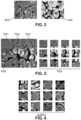
- Figure 2 represents an example of a display of a 2D slice and a reception of labels according to a number of embodiments, that aims at illustrating the steps 140 and 150.
- the 2D slice Slc2 is an example of a 2D slice that can be displayed to the user.
- the pixels of the 2D slice have different intensities that depend upon the electrochemical cell unit component that the pixel contains. For example, the darkest parts represent pores.
- the labelled slice Lbl2 represents the 2D slice as labelled by the user: the user provides a label for each pixel.
- the labelling may be performed for example for each pixel separately, or for regions of pixels.
- additional labels can be used for representing additional components.
- the user may also label certain pixels as CBD, Solid-Electrolyte Interface (SEI), and/or deposit of metallic lithium.
- SEI Solid-Electrolyte Interface
- step 150 an accurate label is provided by an expert user for each pixel of the 2D slice.
- the labels from the expert user can be expanded.
- the CBD is difficult to identify from the 3D images.
- the expert user may provide only labels representative of active material and pores, and the labels representative of CBD may be deduced from the labels provided by the expert user.
- the distribution of CBD can be reconstructed using a stochastic method from the distribution of pores and active material.
- graphite anodes when binder material is present without carbon additives, it is usually present as a film at the surface of graphite. In such case, a surfacic distribution of binder (instead of a volumic distribution of CBD) may be reconstructed.
- the method 100 comprises step 160 of segmenting said 2D slice into a plurality of pixel tiles associated to received labels.
- This step thus allows extracting, from the 2D slice, a plurality of pixel tiles.
- each pixel in the 2D slice is at this stage associated with a label
- each pixel of each pixel tile can also be associated with the same label than in the 2D slice.
- Figure 3 is an example of a segmentation of a 2D slice into pixel tiles according to a number of embodiments.
- a 2D slice Slc3 is segmented into a plurality of pixel tiles, for example pixel tiles Til31, Til32, Til33,Til34, etc.
- the pixel tiles can be rectangles or squares of pixels that represent a portion of the 2D slice.
- the pixel tiles may be of the same or different shape and sizes, may overlap or not.
- the plurality of pixel tiles may cover or not the whole 2D slice.
- the plurality of tiles Til35 shows an example of a plurality of tiles at the output of step 160. As shown in figure 3 , at this stage a large number of different tiles are thus obtained, each pixel of each tile being associated with a label representative of an electrochemical cell unit component provided by an expert user.
- the method 100 further comprises a step 170 of creating additional pixel tiles associated with additional labels by applying one or more geometrical transformations to said one or more segmented pixel tiles and the associated received labels.
- a new pixel tile is created, and is associated with the labels corresponding to the initial pixels. For example, if a rotation of 90° is applied to a pixel tile, a same rotation of 90° can be applied to the corresponding labels. Therefore, a new pixel tile is created, which benefits from the labels defined by the expert user.
- one or more geometrical transformations comprise one or more of flipping, rotating and rescaling.
- Each of these transformations can be applied with different parameters (for example different rotation angles for rotating, different rescale factors, horizontal or vertical flipping, etc.).
- the transformation can be applied alone, or combined.
- an additional tile can be created by combining flipping and rotating, or rotating and rescaling.
- the same or different geometrical transformations can be applied to each of the tiles generated by the segmentation 160.
- the geometrical transformations can be parameter in many different ways. For example, all possible combinations of rotating at a plurality of different angles (for example every 10°), rescaling by different rescaling factors, and horizontal and/or vertical flipping may be applied.
- a pixel in an additional pixel tile does not correspond exactly to one pixel in a segmented pixel tile. For example, a rotation of 10° will not produce an exact matching between the pixels from the segmented and the additional pixel tiles, a pixel in the additional pixel tile will correspond to parts of a plurality of pixels of the segmented tile.
- the pixels and labels of the additional pixel tiles can be defined in different ways:
- Figure 4 is an example of additional pixel tiles obtained by the application of geometrical transformations to segmented pixel tiles according to a number of embodiments.
- the additional tiles AddTil4 represent additional tiles obtained at step 170 by rotating segmented pixel tiles. This example show that additional tiles are obtained, with angles of rotation that are not present in the segmented tiles. Meanwhile, the content of the tiles is similar to the content of the segmented tiles, so that the labels of the segmented tiles can be also rotated and associated with the additional tiles.
- figure 4 is provided by means of example only of geometrical transformations applied to pixel tiles. As already discussed, other transformations, such as for example flipping or rescaling, may be applied, in place of or in combination with rotation.
- the method 100 comprises a step 180 of enriching a training database with said segmented pixel tiles associated with the received labels and said additional pixel tiles associated with the additional labels.
- the training database is a database that contains pixel tiles, or more generally 2D images obtained by slicing 3D microscopic images of electrochemical cell units, and labels that consist, for each pixel, of defining an electrochemical cell unit component that is represented by the pixel.
- step 170 allows widely increasing the size of the training database with accurate annotations using a limited amount of user input, and limited number of 3D imaging.
- Some of the steps of the method may be repeated in order to further increase the size of the database. For example:
- the method 100 further comprises a step 190 of using said training database to train a supervised machine learning engine to associate, based on intensities of pixels of 2D images, said pixels of 2D images to labels representative of electrochemical cell unit components.
- the supervised machine learning engine is a supervised machine learning engine that takes as input a 2D image and associates to each pixel of the 2D image a label representative of the electrochemical cell unit component that is represented by the pixel.
- the supervised machine learning engine can thus be trained using the training database enriched at step 180.
- the training of the machine learning engine may comprise any training step that is adapted to the machine learning engine. It may for example comprise an initialization of a model, and a plurality of training iterations, each iteration comprising a forward pass, the calculation of a loss of the model, and a backpropagation.
- Any machine learning engine that is able to take as input pixel intensities to generate labels of the pixels may be used within the invention.
- the machine learning engine may be a neural network, notably a convolutive neural network, for example a U-Net convolutive neural network. It is however not restricted to this example, the machine learning engine may also belong to other kind of machine learning, for example a random forest.
- the method 100 is provided by means of non-limitative example only of a method to train a supervised machine learning engine in a number of embodiments of the invention. Other methods may be used.
- the training may be based only on the annotations that are performed by one or more expert user, without using geometrical transformations to further expand the training database.
- the figure 1 relates to the training of a supervised machine learning that associates pixels of 2D slices to labels representative of electrochemical cell components.
- the invention is not restricted to supervised machine learning that operate on 2D slices.
- the machine learning may be a 3D labelling machine learning engine that takes as input a 3D image and provides as output a label for each of the voxels of the 3D image.
- the training of the machine learning engine is performed using a training database of 3D images whose voxels are labelled.
- the method 500 is a computer-implemented method used to prepare 3D images of electrochemical cell units for a micro-scale simulation of a battery according to a number of embodiments.
- the computer-implemented method 500 is based on a 3D image of an electrochemical cell unit.
- the computer-implemented method 500 comprises a preliminary optional step 510 of determining a representative window size for obtaining a 3D image. This step, similar to the step 110 of method 100, is described in greater details with reference to figure 11 .
- the method 500 further comprises a step 520 of obtaining a 3D image of at least a portion of an electrochemical cell unit, where the intensity of each voxel depends upon an electrochemical cell unit component that the voxel contains.
- This step is similar to the step 120 of method 100.
- the 3D image may be for example retrieved from a library, or acquired during the execution of the method 500.
- the portion may be either a representative portion of the electrochemical cell unit, a randomly selected portion of the electrochemical cell unit, or a portion selected based on specific criteria (such as for example a portion where the 3D image can be more easily acquired, a portion which is known to be representative, etc.).
- the size of the 3D image may for example be predefined, or determined at step 510.
- the 3D image comprises a plurality of 2D slices.
- the 3D image may for example be acquired in the form of a series of 2D slice, or divided into 2D slices.
- the method 500 further comprises a step 530 of using a trained supervised machine learning engine to associate, based on intensities of voxels of the 3D image, each of said voxels of the 3D image to labels representative of electrochemical cell unit components, said labels comprising at least a label representative of material, and a label representative of pores.
- the labels may comprise, in addition to labels representative of active material and pores, additional labels, such as for example a label representative of CBD, Solid-Electrolyte Interface (SEI), and/or deposit of metallic lithium.
- additional labels such as for example a label representative of CBD, Solid-Electrolyte Interface (SEI), and/or deposit of metallic lithium.
- the step 530 can be performed in different ways.
- the trained supervised machine learning engine may take as input the 3D image to provide a label for each voxel of the 3D image.
- the trained supervised machine learning engine is a 3D labelling machine learning engine that uses knowledge of the whole 3D image to perform the labelling. This ensures that the labelling is as accurate as possible.
- the trained supervised machine learning can be a 2D labelling engine.
- the pixels of each 2D slice of the image are labelled independently of the pixels of the other 2D slices, then the labels of the pixels of the 2D slices are allocated to the corresponding voxels of the 3D image.
- the step 530 thus comprises, when a 2D labelling engine is used, a step 531 of labelling the pixels of 2D slices of the 3D image, then a step 540 of associating the labels to the voxels of the 3D image.
- Using a 2D labelling engine on 2D slices rather than a 3D labelling engine on the whole 3D image reduces the computing needs of the labelling, and allows training the labelling engine with a smaller training database. Meanwhile, the accuracy of the labelling remains satisfactory in most cases.
- the step 531 consists in using the trained supervised machine learning engine to associate, based on intensities of pixels of a plurality of 2D slices of the 3D image, each of said pixels of said plurality of 2D slices to said labels representative of electrochemical cell unit components.
- the supervised machine learning engine defines labels for each 2D slice independently from the other slices.
- the trained supervised machine learning engine may be the supervised machine learning engine discussed with reference to figure 1 . However, as mentioned in figure 1 , other training methods may be used. For example, the supervised machine learning engine may have been trained by methods other than the method of figure 1 . For example, it may be trained using annotations from an expert user, without the application of geometrical transformations to pixel tiles.
- the trained supervised machine learning engine may be any supervised machine learning that is able to associate labels to each pixel.
- the supervised machine learning engine may be a neural network, for example a U-net.
- the step 540 consists in associating each of said labels representative of electrochemical cell unit components to the corresponding voxel of said 3D image to obtain a labelled 3D image.
- this step 540 allows obtaining a labelled 3D image, where each voxel is associated with a label defining to which component the voxel belongs to.
- the association at step 540 can be performed in different ways. For example, the values of labels can be copied directly from 2D to 3D images. In other embodiments, the 2D slices are simply a part of the 3D image, so that the association at step 540 is performed automatically for each pixel/voxel when the values of labels are determined at step 530.
- a 3D image comprising for each voxel a label indicating to which component the voxel belongs.
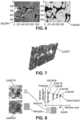
- Figure 6 is an example of labelling of a 2D slice according to a number of embodiments
- figure 7 is an example of labelled 3D image according to a number of embodiments.
- the slice Slc2D6 is a 2D slice of the 3D image obtained at step 520, and the labelled 2D slice Lbl2D6 is a labelled 2D slice obtained at step 530.
- the representation is similar to the representation in figure 2 in the training phase.
- the figure 6 therefore shows a concrete example of labelling in the inference phase.
- the labelled 3D image Lbl3D7 is obtained at step 540 by associating labels of a plurality of 2D slices such as the 2D slice Lbl2D6.
- the figure 7 therefore represents a concrete example of a labelled 3D image, where the labels are associated to each voxel. It can be seen in particular that the particles of active material appear in such a labelled 3D image.
- the method 500 further comprises a step 550 of segmenting said labelled 3D image into elementary particles of active material.
- the step 550 thus allows segmenting a 3D image such as the image Lbl3D7 into a plurality of elementary particles, where the position and shape of elementary particles is ultimately known.
- the voxels have labels representative of electrochemical cell unit components (e.g “material”, “active material”, “pores”, “CBD”, etc.), while, at the output of the step 550, the voxels that belong to a particle have labels representative of a given particle they belong to (e.g "Particle 1", “Particle 2", “Particle 3", etc).
- the step 550 allows identifying elementary particles out of a description of the components.
- the segmentation can be performed, from the labelled 3D images, in different ways. For example, watershed type methods can be used.
- the method 500 further comprises an optional step of image cleaning 560.
- the step 560 of image cleaning aims at modifying the 3D image, in order that it is more physically realistic.
- the step 560 is for example helpful if the 3D image is fed to a microscale simulator, because the 3D image will be more physically realistic for the simulation.
- the step 560 is represented in the figure 5 between the step 550 of particle segmentation, and the step 570 of calculating physical properties, so that the one or more physical property is calculated in the cleaned image.
- This representation if however not limitative, and, in embodiments where the step 560 is executed, it may be for example executed at a later stage of the method, so that the one or more physical property is calculated on the 3D image before cleaning.
- the image cleaning may comprise one or more of the data cleaning steps listed below.
- Artifacts can be deleted from the segmented 3D image. For example, artifacts on particles of active material may be deleted.
- the interfaces between voxels belonging to different labels can be smoothed.
- the surfaces between voxels belonging to labels of active material and pores may be smoothed, in order to represent a smooth surface between particles of active material and pores.
- a plurality of particles can be fused.
- the smallest particles can be fused with adjacent larger particles.
- the fusion of particles can be implemented in different ways. For example, a user may select particles to fuse using a Man Machine Interface. The particles may also be fused automatically based on criteria sizes and distances for example.
- Isolated particles can also be detected and deleted or reconnected to neighboring particles by the insertion of a further particle.
- the step 560 therefore allows ensuring that the 3D image is physically realistic.
- the step 560 is for example useful if the 3D image is fed to a microscale simulator, because the simulator will operate on physically realistic images.
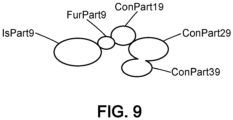
- Figure 9 is an example of a detection of an isolated particle and the addition of a further particle to reconnect the isolated particle to its neighbors according to a number of embodiments.
- one of the possible image cleaning steps consist in detecting isolated particles, and either deleting them or reconnecting them to neighboring particles by the insertion of a further particle.
- an isolated particle i.e a particle that is connected to no other particle
- IsPart9 is detected.
- Neighboring connected particles ConPart19, ConPart29 and ConPart39 are also detected. This situation is not physically realistic, because it would mean that particle IsPart9 is free floating.
- the particle IsPart9 can in this example be deleted is:
- the volume threshold and/or the distance threshold may be obtained in different ways, and for example defined by an expert user.
- an isolated particle can be deleted from the image if it is too small and/or too far from the other particles.
- the isolated particle IsPart9 is both large, and close to the nearest neighbor ConPart19. Therefore, instead of deleting the particle IsPart9, a further particle FurPart9 is inserted between IsPart9 and ConPart19.
- the diameter of FurPart9 is equal to the distance between the isolated particle and its nearest particle neighbor.
- the method 500 further comprises a step 570 of calculating, from said segmented 3D image, values of one or more physical property of the electrochemical cell unit.
- the step 570 therefore comprises analyzing the 3D image to calculate one or more physical property of the electrochemical cell unit.
- the one or more properties that are calculated may be different properties, such as:
- Some properties may be calculated by 3D image analysis. For example, the:
- the tortuosity can encompass different types of tortuosity, and can be calculated accordingly in different ways.
- the geometric tortuosity intuitively corresponds to the minimum path length to cross the electrochemical cell unit in a chosen direction, via a liquid component (electrolyte) filled in the pores for the ions or via a solid component for the electrons.
- Geometric tortuosity can be calculated by minimizing the Euclidean distance associated with the different possible paths, for example using the A-star algorithm or the Eikonal equation.
- a tortuosity of ionic diffusion of type I is associated with a particular process of diffusion of ions in the electrolyte, called “passive diffusion", and can be calculated by solving a Laplace equation on the ionic concentration, with conditions zero flow at the interfaces between the electrolyte and a solid phase of the electrochemical cell unit.
- the tortuosity of ionic diffusion of type I can be physically measured by a method called "polarization-interrupt" (or “restricted diffusion”).
- a tortuosity of ionic diffusion of type II is associated with a diffusion process of the ions of the electrolyte interacting with a solid phase via electric double layer effects. It can be calculated by solving a Laplace equation on the electric potential, with capacitance (or pseudo-capacitance) conditions at the liquid-solid interfaces.
- the tortuosity of ionic diffusion of type II can be measured experimentally using an impedance method on symmetric cells ("Electrical Impedance Spectroscopy on Symmetric cells").
- the tortuosity can more generally be calculated for examples by the methods disclosed by
- Figure 8 is an example of variance of a calculation of a physical property of an electrochemical cell unit depending upon a window size used for the calculation of the physical property.
- the one or more property can be calculated in a window of the 3D image.
- the value of the physical property that is calculated can thus be slightly different depending upon the position of the pixel window where the property is calculated.
- the figure 8 show two examples of window sizes Win18 and Win28.
- the vignette Lbl3D18 show 5 different positions of a window of the size Win18 in a 3D image.
- the calculated value of the physical property will thus be slightly different between the 5 positions.
- the vignette Lbl3D28 show 4 different positions of a window of the size Win18 in a 3D image.
- the calculated value of the physical property will thus be slightly different between the 4 positions.
- the graph Grph8 represents an example of evolution of the variance of the calculated values of a physical property depending upon the size of the pixel window.
- the horizontal axis represents the window size, and the vertical axis the value of the properties.
- the dots Calc18, Calc28, Calc38 and Calc48 represent respectively calculated values of the physical properties for the window sizes Win18, Win28, and two larger window sizes.
- the two dashed lines Upcalc8 and DownCalc8 represent respectively the upper bound and lower bound of the calculated values depending upon the size of the pixel window.
- the difference between the lines Upcalc8 and DownCalc8 thus represents an estimation of the variance of the calculated values of the physical property depending upon the size of the pixel window.
- the figure 8 therefore shows that the variance of the calculated values decreases when the size of the pixel window increases. However, increasing the size of the pixel window renders the calculation more complex. It is therefore desirable to use a window size that represents a good tradeof between a limited variance of the calculated values of a physical property, in order to ensure that the calculated value will be sufficiently reliable, and a limited complexity of calculation of the property.
- the calculation of the one or more physical property of the electrochemical cell unit can therefore comprise:
- Calculating values of said one or more physical property of the electrochemical cell unit using a window of said determined smallest window size for which the variance is below a predefined threshold allows ensuring that the computation will be the least complex (provided that the window size is the smallest possible) while ensuring that the variance of the calculated values is below the predetermined threshold, which means that the calculated values will meet the desired precision requirements.
- the method 500 further comprises a step 580 of obtaining one or more physical measurements of said one or more physical property of the electrochemical cell unit.
- the one or more physical measurements is dependent upon the one or more physical property that is used.
- the physical measurement can be obtained in different ways. For example, a physical measurement can be performed on the electrochemical cell unit during the execution of the method. Alternatively, a physical measurement that has been previously performed can be retrieved. For example, a distribution of the size of particles of active material can be measured on the powder of active material before the manufacturing of the electrochemical cell unit.
- the method 500 further comprises a step 590 of calculating one or more difference between said one or more physical measurements and said calculated values of said one or more physical property.
- a difference or error E i can be calculated between two values.
- a plurality of values can be obtained.
- the properties relative to the distribution of the sizes of pores or particles, the sizes of pores or particles can be discretized according to the same discrete intervals, thus allowing to calculate a value of property for each discrete interval.
- the method 1000 comprises an optional step 1010 of using a generative machine learning engine to extend the size of said 3D image to a full size of the electrochemical cell unit based on the calculated values of said one or more physical properties.
- the step 1010 thus consists in using a generative machine learning, such as for example a VAE to extend the size of the 3D image so that it is representative of the whole electrochemical cell unit, while complying with the calculated values of the one or more physical properties.
- a generative machine learning engine may have been previously trained to generate 3D images having certain physical properties, and can thus be used to extend the 3D image to represent a realistic view of the whole electrochemical cell unit, while requiring only a 3D measurement on a small part of the electrochemical cell unit.
- the method 1000 further comprises a step 1020 of feeding said segmented 3D image to a micro-scale simulator of a battery comprising the electrochemical cell unit.
- the micro-scale simulator can thus simulate the battery based on images of the electrochemical cell units that are consistent with the measured physical properties of the electrochemical cell unit. The reliability of the simulation is therefore increased.
- a plurality of charge cycles of a battery can be simulated in a physically accurate manner. Therefore, the optimal charge cycles can be selected and used for a battery. Therefore, the efficiency and lifetime of a battery can be increased.
- certain parameters and performance metrics of the battery such as the temperature, charging speed, aging of the battery can be measured in real conditions of charging cycles (e.g charge / discharge / relaxation of the battery). Then charging cycle and the resulting performance metrics of the battery can be simulated under new conditions (e;g different conditions of temperature, humidity, charging time, etc.), so that the optimal conditions can be selected and subsequently used.
- the method can also be used to evaluate the uncertainty/precision of the parameters of the input model of the simulation, so that the uncertainty/precision of the output of the simulation can also be assessed.
- Physically realistic microscale simulations can also lead to improved design of the batteries. Indeed, the operation of an existing battery can be simulated at nanoscale. Therefore, the simulation can provide an in-depth understanding and feedback relative to the physical behavior of the batteries, and the design of the batteries can be improved based upon the results of the simulation. For example, a modified design of the battery can be obtained by modifying certain parameters of the input model of the simulation (e.g modification of the thickness of an electrode, the composition of an electrode, the porosity of an electrode, etc.), and then tested, so that an optimal design can be identified.
- certain parameters of the input model of the simulation e.g modification of the thickness of an electrode, the composition of an electrode, the porosity of an electrode, etc.
- the 3D images generated by a method according to the invention may also be input to different processes. For example, they can be displayed to users for analyzing the structure of an electrochemical cell unit.
- the 3D images generated by a method according to the invention can also be associated to the calculated one or more physical properties to enrich a training database of a generative machine learning engine.
- Such training database can then be used to train a generative machine learning engine to generate segmented 3D images of electrochemical cell units based on input values of said one or more physical properties.
- Such a generative machine learning engine can thus be used to extend the size of 3D images for example at step 1010, or generate 3D images that can be fed to a micro-scale simulator.
- the generative machine learning engine is able to generate physically realistic images of electrochemical cell unit having desired properties, without having to physically create the electrochemical cell unit. This greatly improves the simulation capabilities, by allowing a much more efficient simulation of new electrochemical cell units with varying physical properties.
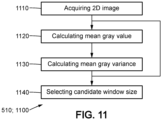
- Figure 11 is an example of steps of calculating a window size for obtaining 3D images in a number of embodiments.
- the figure 11 more specifically represents an embodiment of the steps 110 or 510.
- the step 110 or 510 first comprises a sub-step 1110 of acquiring a 2D grayscale image of the electrochemical cell unit.
- the step 110 or 510 then comprises, for each candidate window size of a plurality of candidate window sizes:
- the steps 1120 and 1130 can be repeated for each candidate window size.
- the step 110 or 510 then comprises a step 1140 of selecting the smallest candidate window size having a variance below a variance threshold.
- the variance threshold can be defined to ensure that the windows of the candidate size are all sufficiently consistent.
- the steps 1110 to 1140 ensures that the 3D image will be fairly representative of the whole electrochemical cell unit.
- the smallest window size that is considered as satisfactory is selected, in order to limit the inconvenience of the 3D imaging. For example, the cost and damages caused by the 3D imaging are lowered.
- the selected candidate window size can thus be used for obtaining the 3D image at step 120 or 520.
- the figure 12 represents an example of windows of a candidate window size in a number of embodiments.
- the image Img12 represents a 2D image of an electrochemical cell unit. It is shown that different levels of gray represented in the image.
- Figure 13 represents an example of variances of mean gray values depending upon candidate window sizes in a number of embodiments.
- the graph Var13 represents the variance of the mean gray value depending upon the window sizes, according to different methods of calculation of the variance.
- the size of the candidate windows is provided in the horizontal axis (increasing values from left to right), and the variance is provided in the vertical axis (increasing values from bottom to top).
- a variance threshold VarThr13 can thus be defined to select the most appropriate candidate window size at step 1140.
- the invention is not restricted to images of electrodes, but may be applied to other kinds of electrochemical cell units.
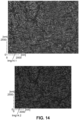
- the image 14 represents an example where the invention is applied to images of a separator of electrochemical cell.
- the image Img14.1 represents a 2D slice of an 3D image of a separator.
Landscapes
- Engineering & Computer Science (AREA)
- Physics & Mathematics (AREA)
- Theoretical Computer Science (AREA)
- General Physics & Mathematics (AREA)
- Computer Vision & Pattern Recognition (AREA)
- Multimedia (AREA)
- Health & Medical Sciences (AREA)
- General Health & Medical Sciences (AREA)
- Quality & Reliability (AREA)
- Evolutionary Computation (AREA)
- Computational Linguistics (AREA)
- Computer Graphics (AREA)
- Geometry (AREA)
- Medical Informatics (AREA)
- Databases & Information Systems (AREA)
- Computing Systems (AREA)
- Software Systems (AREA)
- Artificial Intelligence (AREA)
- Life Sciences & Earth Sciences (AREA)
- Biomedical Technology (AREA)
- Molecular Biology (AREA)
- Image Processing (AREA)
- Image Analysis (AREA)
Priority Applications (2)
| Application Number | Priority Date | Filing Date | Title |
|---|---|---|---|
| EP23307266.9A EP4576013A1 (de) | 2023-12-19 | 2023-12-19 | 3d-bilder einer elektrochemischen zelleneinheit, die mit gemessenen physikalischen eigenschaften der elektrochemischen zelleneinheit konsistent sind |
| US18/988,152 US20250200858A1 (en) | 2023-12-19 | 2024-12-19 | 3d images of an electrochemical cell unit consistent with measured physical properties of the electrochemical cell unit |
Applications Claiming Priority (1)
| Application Number | Priority Date | Filing Date | Title |
|---|---|---|---|
| EP23307266.9A EP4576013A1 (de) | 2023-12-19 | 2023-12-19 | 3d-bilder einer elektrochemischen zelleneinheit, die mit gemessenen physikalischen eigenschaften der elektrochemischen zelleneinheit konsistent sind |
Publications (1)
| Publication Number | Publication Date |
|---|---|
| EP4576013A1 true EP4576013A1 (de) | 2025-06-25 |
Family
ID=89573972
Family Applications (1)
| Application Number | Title | Priority Date | Filing Date |
|---|---|---|---|
| EP23307266.9A Pending EP4576013A1 (de) | 2023-12-19 | 2023-12-19 | 3d-bilder einer elektrochemischen zelleneinheit, die mit gemessenen physikalischen eigenschaften der elektrochemischen zelleneinheit konsistent sind |
Country Status (2)
| Country | Link |
|---|---|
| US (1) | US20250200858A1 (de) |
| EP (1) | EP4576013A1 (de) |
Families Citing this family (1)
| Publication number | Priority date | Publication date | Assignee | Title |
|---|---|---|---|---|
| CN120411103B (zh) * | 2025-07-03 | 2025-09-19 | 宁德时代新能源科技股份有限公司 | 电池sei膜的物相演化分析方法、电子设备以及存储介质 |
-
2023
- 2023-12-19 EP EP23307266.9A patent/EP4576013A1/de active Pending
-
2024
- 2024-12-19 US US18/988,152 patent/US20250200858A1/en active Pending
Non-Patent Citations (8)
| Title |
|---|
| ANDREA GAYON-LOMBARDO ET AL: "Stochastic reconstruction of periodic, three-dimensional multi-phase electrode microstructures using generative adversarial networks", ARXIV.ORG, CORNELL UNIVERSITY LIBRARY, 201 OLIN LIBRARY CORNELL UNIVERSITY ITHACA, NY 14853, 17 February 2020 (2020-02-17), XP081628258 * |
| COOPER, S. J., BERTEI, A., SHEARING, P. R., KILNER, J. A., & BRANDON, N. P.: "An open-source application for calculating tortuosity factors from tomographic data", SOFTWAREX, vol. 5, 2016, pages 203 - 210 |
| MUNCH, B.HOLZER, L.: "Contradicting geometrical concepts in pore size analysis attained with electron microscopy and mercury intrusion", JOURNAL OF THE AMERICAN CERAMIC SOCIETY, vol. 91, no. 12, 2008, pages 4059 - 4067 |
| NGUYEN, T. T.DEMORTIERE, A.FLEUTOT, B.DELOBEL, B.DELACOURT, C.COOPER, S. J.: "The electrochemical cell unit tortuosity factor: why the conventional tortuosity factor is not well suited for quantifying transport in porous Li-ion battery electrochemical cell units and what to use instead", NPJ COMPUTATIONAL MATERIALS, vol. 6, no. 1, 2020, pages 123 |
| RONNEBERGER, O.FISCHER, P.BROX, T.: "U-net: Convolutional networks for biomedical image segmentation", MEDICAL IMAGE COMPUTING AND COMPUTER-ASSISTED INTERVENTION-MICCAI 2015: 18TH INTERNATIONAL CONFERENCE, MUNICH, GERMANY, 5 October 2015 (2015-10-05) |
| SHODIEV, A.PRIMO, E. N.CHOUCHANE, M.LOMBARDO, T.NGANDJONG, A. C.RUCCI, A.FRANCO, A. A.: "4D-resolved physical model for Electrochemical Impedance Spectroscopy of Li (Ni1-x-yMnxCoy) O2-based cathodes in symmetric cells: Consequences in tortuosity calculations", JOURNAL OF POWER SOURCES, vol. 454, 2020, pages 227871, XP086095280, DOI: 10.1016/j.jpowsour.2020.227871 |
| SIMON MÜLLER: "Deep Learning-based Segmentation of Lithium-Ion Battery Microstructures enhanced by artificially generated Electrodes Supplementary Information", 27 October 2021 (2021-10-27), pages 1 - 14, XP093164352, Retrieved from the Internet <URL:https://www.ncbi.nlm.nih.gov/pmc/articles/PMC8551326/bin/41467_2021_26480_MOESM1_ESM.pdf> [retrieved on 20240520] * |
| SIMON MÜLLER: "Deep learning-based segmentation of lithium-ion battery microstructures enhanced by artificially generated electrodes", NATURE COMMUNICATIONS, vol. 12, no. 1, 27 October 2021 (2021-10-27), UK, pages 1 - 12, XP093164326, ISSN: 2041-1723, DOI: 10.1038/s41467-021-26480-9 * |
Also Published As
| Publication number | Publication date |
|---|---|
| US20250200858A1 (en) | 2025-06-19 |
Similar Documents
| Publication | Publication Date | Title |
|---|---|---|
| Ferraro et al. | Electrode mesoscale as a collection of particles: coupled electrochemical and mechanical analysis of NMC cathodes | |
| Usseglio-Viretta et al. | MATBOX: An Open-source Microstructure Analysis Toolbox for microstructure generation, segmentation, characterization, visualization, correlation, and meshing | |
| Tang et al. | Deep learning for full-feature X-ray microcomputed tomography segmentation of proton electron membrane fuel cells | |
| Cooper et al. | TauFactor: An open-source application for calculating tortuosity factors from tomographic data | |
| Gaiselmann et al. | Quantitative relationships between microstructure and effective transport properties based on virtual materials testing | |
| Truong-Hong et al. | Flying voxel method with Delaunay triangulation criterion for façade/feature detection for computation | |
| Hapca et al. | New local thresholding method for soil images by minimizing grayscale intra-class variance | |
| Liu et al. | Split-and-fit: Learning b-reps via structure-aware voronoi partitioning | |
| US20250200858A1 (en) | 3d images of an electrochemical cell unit consistent with measured physical properties of the electrochemical cell unit | |
| Mirzaee et al. | Minireview on porous media and microstructure reconstruction using machine learning techniques: Recent advances and outlook | |
| Abdallah et al. | Morphological modelling of three‐phase microstructures of anode layers using SEM images | |
| US12148138B2 (en) | Process parameter prediction using multivariant structural regression | |
| Stenzel et al. | Graph-based simulated annealing: A hybrid approach to stochastic modeling of complex microstructures | |
| Hsu et al. | High performance modeling of heterogeneous SOFC electrode microstructures using the MOOSE framework: ERMINE (Electrochemical Reactions in MIcrostructural NEtworks) | |
| CN117557564A (zh) | 连接器的接口参数检测方法、装置、设备及存储介质 | |
| Kamrava et al. | End-to-end three-dimensional designing of complex disordered materials from limited data using machine learning | |
| Ishikawa et al. | Simulation to estimate the correlation of porous structure properties of secondary batteries determined through machine learning | |
| Han et al. | Uncovering battery electrochemical mechanisms by artificial intelligence | |
| Kong et al. | Large-scale 3-D building reconstruction in LoD2 from ALS point clouds | |
| Lang et al. | Big data analytics for the inspection of battery materials | |
| CN119648945B (zh) | 一种基于扩散模型生成含多相流固体岩石三维模型的方法、装置及介质 | |
| WO2023166776A1 (ja) | 外観分析システム、外観分析方法、及びプログラム | |
| CN121170287A (zh) | 多尺度异构岩石的扫描图像分割模型构建方法 | |
| CN119579778B (zh) | 一种基于ChemDraw的煤微观孔隙结构表征方法 | |
| CN120673231A (zh) | 一种融合空间扰动机制的类激活映射可解释性方法 |
Legal Events
| Date | Code | Title | Description |
|---|---|---|---|
| PUAI | Public reference made under article 153(3) epc to a published international application that has entered the european phase |
Free format text: ORIGINAL CODE: 0009012 |
|
| STAA | Information on the status of an ep patent application or granted ep patent |
Free format text: STATUS: REQUEST FOR EXAMINATION WAS MADE |
|
| 17P | Request for examination filed |
Effective date: 20231219 |
|
| AK | Designated contracting states |
Kind code of ref document: A1 Designated state(s): AL AT BE BG CH CY CZ DE DK EE ES FI FR GB GR HR HU IE IS IT LI LT LU LV MC ME MK MT NL NO PL PT RO RS SE SI SK SM TR |