EP4575853A1 - Verfahren zur steuerung der ausführung eines computerprogramms - Google Patents
Verfahren zur steuerung der ausführung eines computerprogramms Download PDFInfo
- Publication number
- EP4575853A1 EP4575853A1 EP24222490.5A EP24222490A EP4575853A1 EP 4575853 A1 EP4575853 A1 EP 4575853A1 EP 24222490 A EP24222490 A EP 24222490A EP 4575853 A1 EP4575853 A1 EP 4575853A1
- Authority
- EP
- European Patent Office
- Prior art keywords
- traced
- function
- sequence
- functions
- execution
- Prior art date
- Legal status (The legal status is an assumption and is not a legal conclusion. Google has not performed a legal analysis and makes no representation as to the accuracy of the status listed.)
- Pending
Links
Images


Classifications
-
- G—PHYSICS
- G06—COMPUTING OR CALCULATING; COUNTING
- G06F—ELECTRIC DIGITAL DATA PROCESSING
- G06F21/00—Security arrangements for protecting computers, components thereof, programs or data against unauthorised activity
- G06F21/50—Monitoring users, programs or devices to maintain the integrity of platforms, e.g. of processors, firmware or operating systems
- G06F21/52—Monitoring users, programs or devices to maintain the integrity of platforms, e.g. of processors, firmware or operating systems during program execution, e.g. stack integrity ; Preventing unwanted data erasure; Buffer overflow
-
- G—PHYSICS
- G06—COMPUTING OR CALCULATING; COUNTING
- G06F—ELECTRIC DIGITAL DATA PROCESSING
- G06F21/00—Security arrangements for protecting computers, components thereof, programs or data against unauthorised activity
- G06F21/50—Monitoring users, programs or devices to maintain the integrity of platforms, e.g. of processors, firmware or operating systems
- G06F21/57—Certifying or maintaining trusted computer platforms, e.g. secure boots or power-downs, version controls, system software checks, secure updates or assessing vulnerabilities
-
- G—PHYSICS
- G06—COMPUTING OR CALCULATING; COUNTING
- G06F—ELECTRIC DIGITAL DATA PROCESSING
- G06F21/00—Security arrangements for protecting computers, components thereof, programs or data against unauthorised activity
- G06F21/60—Protecting data
- G06F21/64—Protecting data integrity, e.g. using checksums, certificates or signatures
-
- H—ELECTRICITY
- H04—ELECTRIC COMMUNICATION TECHNIQUE
- H04L—TRANSMISSION OF DIGITAL INFORMATION, e.g. TELEGRAPHIC COMMUNICATION
- H04L9/00—Cryptographic mechanisms or cryptographic arrangements for secret or secure communications; Network security protocols
- H04L9/32—Cryptographic mechanisms or cryptographic arrangements for secret or secure communications; Network security protocols including means for verifying the identity or authority of a user of the system or for message authentication, e.g. authorization, entity authentication, data integrity or data verification, non-repudiation, key authentication or verification of credentials
- H04L9/3234—Cryptographic mechanisms or cryptographic arrangements for secret or secure communications; Network security protocols including means for verifying the identity or authority of a user of the system or for message authentication, e.g. authorization, entity authentication, data integrity or data verification, non-repudiation, key authentication or verification of credentials involving additional secure or trusted devices, e.g. TPM, smartcard, USB or software token
-
- H—ELECTRICITY
- H04—ELECTRIC COMMUNICATION TECHNIQUE
- H04L—TRANSMISSION OF DIGITAL INFORMATION, e.g. TELEGRAPHIC COMMUNICATION
- H04L9/00—Cryptographic mechanisms or cryptographic arrangements for secret or secure communications; Network security protocols
- H04L9/32—Cryptographic mechanisms or cryptographic arrangements for secret or secure communications; Network security protocols including means for verifying the identity or authority of a user of the system or for message authentication, e.g. authorization, entity authentication, data integrity or data verification, non-repudiation, key authentication or verification of credentials
- H04L9/3236—Cryptographic mechanisms or cryptographic arrangements for secret or secure communications; Network security protocols including means for verifying the identity or authority of a user of the system or for message authentication, e.g. authorization, entity authentication, data integrity or data verification, non-repudiation, key authentication or verification of credentials using cryptographic hash functions
Definitions
- the invention relates to a method for controlling the execution of a computer program, in particular by remote certification.
- eBPF extended Berkeley Packet Filter
- eBPF extended Berkeley Packet Filter
- This technology makes it possible to track a wide range of events on monitored computers, to verify the control flow of instructions executed on these computers (control flow attestation). It thus ensures that the operation of the monitored computers remains normal. Monitoring is carried out by executing customized and secure programs within the kernel of the monitored computers, in a Linux environment.
- Intel PT is a registered trademark
- Ref.1 D. Papamartzivanos, SA Menesidou, P. Gouvas and T. Giannetsos, "Towards Efficient Control-Flow Attestation with Software-Assisted Multi-level Execution Tracing," 2021 IEEE International Mediterranean Conference on Communications and Networking (MeditCom), Athens, Greece, 2021, pp. 512-518, doi: 10.1109/MeditCom49071.2021.9647635 .
- TPM module designates a trusted platform module, or “Trusted Platform Module” in English).
- Operation monitoring is performed as follows. First, the instructions transmitted to the particular resource under monitoring are intercepted. In case of an anomaly, a lower-level monitoring is triggered and tracks the instructions executed by the processor, using IntelPT technology. This monitoring determines the different memory addresses used, which makes it possible to verify the normality of the current process.
- RA program execution control methods such as the one briefly mentioned in Ref.1 have undergone various developments to enable universities and industry to improve the security of their computer systems.
- Ref.2 Toffalini, F., Losiouk, E., Biondo, A., Zhou, J., & Conti, M. (2018). “ScaRR: Scalable Runtime Remote Attestation for Complex Systems. » International Symposium on Recent Advances in Intrusion Detection .
- Remote attestation is a procedure that allows the status of a first computer (the prover) to be verified remotely, using a second computer, the verifier.
- the term 'computer' should be understood very broadly here, and in fact refers to any electronic device capable of running a computer program. It can be a personal computer, a mobile phone, a machine with computing resources (for example, part of the Internet of Things), etc.
- the verifier To perform this verification, the verifier first sends a challenge to the prover, which responds with a report. The verifier then analyzes this report to determine whether the prover has been compromised. In known remote attestation methods, Generally static, prover verification allows one to conclude the integrity of specific hardware and software properties (e.g., the prover actually loaded the intended software).
- the ScaRR method proposed by document Ref.2 provides such a method.
- This approach advantageously allows, using a remote verifier, to detect modifications to the execution flow of a program executed by a prover.
- the present invention aims to remedy all or part of the drawbacks of the state of the art cited above.
- a traced function identifier here refers to any data that identifies a traced function.
- a compliant program execution refers to a program execution that conforms to the intended or expected program flow.
- step S50 the evaluation made by the verifier is made on the basis of a sequence of traced functions, called received sequence, consisting only of traced functions.
- the execution control method defined above makes it possible to ensure that the order (or sequence) in which the traced functions are executed by the program (and therefore, the elements are recorded) corresponds to what is expected of the program, without imposing the slightest modification of the executed program.
- This method therefore provides a large measure of assurance that the program execution flow is as expected. It also protects against Return Oriented Programming (ROP) attacks, which modify program execution without modifying the program's source code. If the program's execution is modified, its execution flow (or execution trace) will be different. Thus, there will be a discrepancy between the observed execution and the expected execution.
- ROP Return Oriented Programming
- the method leads to recording the program execution trace, it does not require modifying the source code of the program to be observed.
- the transmitting step S40 comprises transmitting a traced function identifier each time the execution of a traced function has been detected in step S30, and the evaluating step S50 is performed each time a traced function identifier is received by the verifier (except possibly during the one or more first detections of naturally traced functions, in case the small number of detected traced functions does not usefully allow the evaluation step to be carried out).
- the verifier except possibly during the one or more first detections of naturally traced functions, in case the small number of detected traced functions does not usefully allow the evaluation step to be carried out.
- step S50 evaluates whether a received sequence of traced functions corresponds to at least one possible sequence of traced functions. If this verification leads the verifier to conclude that the received sequence does not correspond to any possible sequence, it goes directly to step S90.
- step S90 the verifier concludes that the received sequence of traced functions does not correspond to any possible sequence (i.e., a sequence of traced functions that corresponds to a compliant execution of the program), the verifier triggers an action based on this conclusion: in general, it interrupts the execution of the program, and/or sends an alert message, and more generally any appropriate action following the detection of the fact that the execution flow of the program was not compliant with the expected execution.
- the number of traced functions included in the received sequence verified in step S50 may vary.
- the received sequence verified in step S50 includes at most (and preferably) all of the traced functions executed since the program was launched.
- step S40 the transmission of the identifiers (step S40) and the evaluation (step S50) are performed shortly after each detection of the execution of a traced function
- these steps can be performed at a lesser frequency, for example at regular intervals, or even only once, once the execution of the program is finished.
- the method according to the present disclosure can be implemented with a standard kernel.
- this method does not require the use of a specific processor for the implementation of the invention.
- the predetermined set of prover functions includes or consists of functions selected from system call functions, read/write operations in a prover memory, and functions for executing code stored in a predetermined area of a prover memory.
- the traced functions can thus be system call functions, with/without parameter values, functions for interacting with a communication network to which the prover is connected, operations for writing or reading in memory (possibly in a specific part of memory), the execution of code stored at a specific address, etc.
- the above-mentioned parameter values are input data for executing the plotted functions.
- an identifier may be the identifier of a system call and include at least one value of a parameter of the system call considered.
- the system call can be a write function.
- the input to the traced function, which is therefore the write function must be indicated in which file the result must be written:
- the input function must therefore be provided, as a parameter value, with the name of the directory in which the result must be written.
- the reference beam can thus simply be a list of possible sequences of execution of the traced functions.
- the reference beam has a graph structure, in which each node is associated with a plotted function.
- the verifier can for example evaluate whether the received sequence constitutes a possible sequence of traced functions by verifying that said received sequence corresponds to a possible path of travel of the reference beam.
- the identifier of the parameterized traced function also includes a value of at least one input parameter of said parameterized traced function.
- step S50 when the verifier evaluates whether the received sequence constitutes a possible sequence of traced functions, if at least one identifier received in step S40 is the identifier of a parameterized traced function, that the verifier determines whether the value of said at least one input parameter included in the identifier recorded in step S30 for the execution considered of the parameterized traced function corresponds to the value of said at least one input parameter for the corresponding execution of the parameterized traced function in the possible sequence of traced functions.
- the method is secured by storing the credentials in a TPM module.
- the TPM module provides various security features, including secure storage of information (such as encryption keys, etc.).
- the TPM module can apply a proof function to sequences of identifiers recorded in step S30, thereby creating proofs of execution of traced sequences of functions, which will be used to verify that these sequences have actually been executed.
- the prover comprises a trusted platform module, or TPM module; during step S30, the identifiers of traced functions are recorded by the prover in the TPM module;
- step S60 the proof is calculated by applying a hash function to a name or character string associated with a traced function.
- step S60 the proof is calculated by applying a hash function together with a name or character string associated with a traced function and a previously calculated hash or proof.
- step S60 after a calculation of a first proof, calculated for example from a hash of the binary code of the program, or from the first traced function identifier recorded in step S30, the following proofs are calculated successively from the following traced function identifiers recorded successively in step S30, by applying the hash function jointly to a name or a character string associated with the traced function just executed and to the last previously calculated proof.
- a first proof calculated for example from a hash of the binary code of the program, or from the first traced function identifier recorded in step S30
- the following proofs are calculated successively from the following traced function identifiers recorded successively in step S30, by applying the hash function jointly to a name or a character string associated with the traced function just executed and to the last previously calculated proof.
- the identifier of the parameterized traced function includes a value of at least one input parameter of said parameterized traced function.
- this value of said at least one input parameter will enter into the calculation of the proof by the TPM in step S60 and the verifier in step S80. Consequently, the verification carried out in step S90 will include the verification of the equality of the input parameters, for the one or those of the traced functions which are parameterized.
- the hash of an executable of the program that is to be deployed to the prover is available to the verifier; before executing the program, the prover transmits to the verifier a hash of an executable of the program that is going to be executed; and the method further comprises a verification step S10, in which the verifier checks whether the hash of the executable that is going to be executed received from the prover is equal to the hash of the executable that is to be deployed to the prover.
- the method of controlling program execution according to the present disclosure can be extended to the control of a set of programs, in particular relatively unreliable programs.
- the prover's memory space is divided into user space and kernel space.
- User space is the portion of the system's virtual memory where the user's programs (applications) run.
- Kernel space is the portion of memory reserved for the operating system's kernel - that is, the code that controls direct access to hardware, manages memory and processes, and generally performs the basic functions of the operating system.
- the program whose execution is to be controlled is therefore stored in user space.
- this program When executed, this program performs a number of functions. In the method according to the present disclosure, some of these functions are traced functions. For example, in the example presented here, the system calls are traced functions.
- a system call, or "syscall,” is a request made by a user-space program to the operating system (OS) to perform a specific action that only the operating system kernel can perform.
- Traced functions depend on the implementation mode but typically include system calls, memory read/write operations, and/or execution of code stored in a predetermined area(s) of memory.
- the prover includes a TPM module to record certain information.
- the verifier determines the reference beam of this program, beam which will then be used to verify the correct execution of the program.
- This reference beam can be determined by any suitable method: for example using a source code analysis tool, or by observing a program execution (e.g. with strace (registered trademark)), etc.
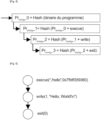
- execution of the program leads to the successive generation of three system calls: "execve” (triggering of the execution of the program), "write” (writing in a file descriptor) and "exit” (end of the execution of the program), which are three traced functions.
- the program has as its call graph the graph of the Fig. 3 This graph has three nodes execve, write and exit, connected by two directed links, namely from execve to write and from write to exit.
- the graph of the Fig. 3 therefore constitutes a reference beam within the meaning of this disclosure.
- the source code of the program to be observed is not available, it may still be possible to generate the reference beam. For example, one can run the program on a trusted system, and record the various traced functions performed by the program.
- step S0 in the example presented, the binary hash H to be installed of the program executable (the executable code) which must be deployed on the prover is calculated and recorded in the verifier. In certain cases, it is also transmitted to the prover, to allow additional verification in step S10 described later.
- step S0 a preliminary step which possibly takes place long before any execution of the program, the execution of the program to be evaluated, the evaluation of its execution, and the launch of an action following this evaluation, then take place in the following manner.
- Step S10 (optional) - Verification of the hash of the program executable
- Step S10 is an optional step that can be performed if the program to be executed has not yet been installed on the prover.
- the prover first calculates the binary_installation hash H of this executable.
- the prover If the prover received the binary H hash to install from the program executable, then the prover verifies that the binary H hash_install is equal to the binary H hash to install of the code that was planned to be deployed to the prover.
- the hash calculated by the prover, H binary_installation is passed to the verifier.
- the verifier who verifies (or will verify) that the hash H binary_installation is equal to the hash H binary to install of the code that was planned to be deployed on the prover and which, if there is a difference between the two hashes, will trigger a corrective action at step S90 described later.
- Steps S20 to S90 are then performed.
- Step S20 (optional) - Request for verification by the verifier
- the verification of the compliant execution of the program is not systematic, and on the contrary is evaluated conditionally.
- step S30 is performed.
- step S20 if for a given execution of the program, the verifier wishes to perform a program execution verification, it transmits a verification request to the prover.
- This verification request can then take place before, during or after the execution of the program; it triggers the execution of steps S40 to S90 of the program.
- the recording step S30 is only carried out if the verification request (step S20) has been carried out before the execution of the program, i.e. only if the request for verification of execution of the program by the verifier has been previously sent to the prover.
- the prover runs the logging application registered in its kernel space.
- This application is configured to trace (i.e., detect) the execution of traced functions, and record the ID of each traced function whose execution was detected.
- Step S30 Recording the identifier Id i of the plotted function Fi
- step S30 (which lasts for the entire duration of program execution), using the recording application, the prover detects any execution of a traced function.
- the prover records in the TPM the identifier Id_i of the detected traced function. This identifier is data that makes it possible to identify the traced function.
- Recording of the traced function identifier can occur immediately after function execution, or can be deferred.
- the identifier Id_i of the traced function F_i is recorded in a file called a 'log file'.
- the recording of traced function identifiers in the log file is done in such a way as to preserve information indicating the order in which the traced functions were performed.
- the sequence of recorded traced function identifiers, or recorded sequence is representative of the order in which these functions were executed.
- the plotted function identifier Id_i can take many forms.
- Such an identifier may be, or at least may include, for example, the name (i.e., any identifier) of the plotted function with which it is associated. Conversely, any data from which the name or any identifier of a plotted function can be obtained may be used as an identifier of the plotted function in question.
- Such an identifier can be clear data, or encrypted, for example in the form of a hash such as a hash of the name of the associated traced function.
- the method according to the present disclosure can be implemented in different ways, by varying the frequency of the checks.
- steps S40 to S90 of the method may be executed either continuously, periodically, or only once when the execution of the program is complete.
- these steps are executed periodically, this usually means that these steps are executed when several traced functions have been executed. These steps can then be triggered either at regular (time) intervals, or when a certain number of traced functions have been executed, or when certain specific, predetermined traced functions are executed, etc.
- step S40 the transmission of the traced function identifiers can be done in a single transmission, in grouped transmissions, or 'continuously'. In the latter case, an identifier is transmitted each time the execution of a traced function is detected.
- Step S40 Transmission to the verifier of the identifier of the traced function
- step S40 the prover transmits to the verifier the identifier Id_i of the traced function which has been detected.
- the identifier (or identifiers) sent by the TPM is or are signed by one or more private keys stored in the TPM.
- Step S50 Conformity evaluation of the received sequence of plotted functions
- the verifier has received the identifiers Id_i of the entire sequence of traced functions that have been detected since the start of program execution.
- the received sequence can be constituted for example by the list of all the executed traced functions whose identifier has been received, or only the last N of these functions, or any other suitable list.
- the identifier of the detected traced function is transmitted signed to the verifier.
- the verifier therefore begins by verifying that the signature associated with the identifier is valid: it deduces that the identifier received has not been modified and indeed comes from the TPM.
- the verifier evaluates whether the received sequence actually corresponds to a possible sequence of traced functions that can be deduced from the reference bundle. In other words, it checks whether the identifiers Id_i received from the prover and corresponding to the received sequence can be associated, in the same order, with a sequence of traced functions successively executed during a compliant execution of the program.
- the verifier does not identify any sequence of traced functions from the reference beam that matches the received sequence, it triggers an error message to signal non-compliant execution of the program.
- Step S60 Calculation and recording of sequence proof by the TPM
- steps S60-S80 The purpose of the optional additional verification of steps S60-S80 is to ensure that the received sequence of traced functions that was taken into account in verification step S50 is indeed the sequence of traced functions that were actually executed. This additional verification is performed using the TPM.
- step S60 the TPM determines among the identifiers recorded in step S30 those which correspond to the received sequence, by applying the same selection rule as in step S50.
- the TPM then calculates a recorded sequence proof Pr enreg .
- This proof will be used to verify that the received sequence from which the verifier performed its evaluation in step S50 is indeed identical to the corresponding recorded sequence which contains the traced functions which were executed by the prover and recorded by the TPM.
- the sequence of traced functions which serves as the basis for calculating the recorded sequence proof Pr enreg by the TPM corresponds to that which serves as the basis for calculating the received sequence proof Pr rec by the verifier (this calculation will be presented later).
- the calculated proof (Pr enreg or Pr rec ) can take into account a sequence of traced functions executed for a more or less long time. This proof can take into account only the last two traced functions recorded. The verification of successive proofs makes it possible to validate the entire observed sequence of functions executed by the program.
- the proof is a function of the set of traced functions executed since the program was launched.
- proof calculation function Any type of proof calculation function can be used to perform step S60.
- the proof calculation function only needs to have the property that the proofs calculated by this function for two different plotted function sequences are different.
- Step S70 Transmission to the verifier of the Pr TPM sequence proof
- step S70 the TPM transmits to the verifier the recorded sequence proof Pr enreg calculated in step S60.
- the evidence can be transmitted only at the end of the execution, or in packets; any transmission rate is possible.
- Step S80 Verification of the sequence by the verifier
- step S80 the verifier calculates the proof Pr rec of the received sequence. It therefore performs the same calculation as that performed by the TPM in step S60, but based as input on the received identifiers ld_i, which could possibly differ from the identifiers recorded by the TPM.
- the verifier then performs the following check to verify that the sequence of operations taken into account to confirm the compliant execution of the program in step S50 is indeed the sequence of traced operations that was actually performed by the prover: it verifies that the recorded sequence proof Pr enreg calculated by the TPM is indeed equal to the proof Pr rec that it calculated. If these proofs are not equal, this means that the sequence of identifiers on which the verifier relied in step S50 to perform the verification is not correct. A corrective action must therefore be launched.
- step S90 the verifier triggers an action based on a result of the conformity assessment carried out in step S50, taking into account, where appropriate, the additional verification carried out in step S80.
- step S80 the verifier concludes that the received sequence of traced functions is not the one that was actually executed by the prover, and triggers an action (for example, emits a message) to take this finding into account.
- the verifier concludes that the program ran normally. It may send a message indicating the correct execution of the program up to the current operation.
- the reference beam has a graph structure.
- the reference beam preferably has a graph structure in which each node is associated with a plotted function.
- the reference beam has the graph structure shown in the Fig. 3
- the nodes of this graph are associated respectively with the plotted functions execve, write and exit.
- steps S40 to S90 are executed.
- step S30 the identifier Id_i of the executed traced function F_i is recorded in the TPM. In step S40, it is transmitted to the verifier.
- step S50 the verifier constitutes the received sequence; using the reference beam, it determines whether there is at least one possible sequence that corresponds to the received sequence.
- the verifier Conversely, if no possible sequence is identified, the verifier produces a negative evaluation result.
- a recorded sequence proof Pr enreg_ i is calculated by the TPM in step S60, as a function of the recorded sequence (i.e. as a function, directly or indirectly, of all the identifiers of the traced functions of the recorded sequence); and on the other hand, a received sequence proof Pr rec_ i is calculated by the verifier in step S80 as a function of the received sequence.
- Pr enreg_ i and Pr rec_ i can be calculated as follows.
- initial proofs Pr enreg 0 (or resp Pr rec 0) are calculated. They can be calculated for example based on the binary code of the installed program P, or for example on the hash H binary_installed of the binary code of the installed program, or other.
- the TPM calculates a new recorded sequence proof Pr enreg i and at step S70 the verifier calculates a new received sequence proof Pr rec_ i.
- Each of these proofs is a function of both the last calculated proof (Pr enreg_ i-1, Pr rec_ i-1) (the calculated proof following the last detection of the execution of a traced function, F_i-1) and the identifier of the traced function F_i.
- the algorithm takes into account all the identifiers of the traced functions which have been detected, to construct the proofs, respectively Pr enreg_ i and Pr rec_ i, from one to the next.
- the TPM or respectively the verifier concatenates the proof, Pr enreg i-1 or respectively Pr rec_ i-1 calculated during the previous iteration with the identifier Id_i associated with the current iteration i.
- the TPM (or respectively the verifier) then calculates the hash of this concatenation to obtain the new proof Pr enreg_ i,resp. Pr rec_ i.
- step S80 the verifier verifies that the proof Pr rec_ i that it calculated corresponds to the proof Pr enreg_ i calculated by the TPM.
- this procedure allows you to confirm the sequence of traced functions executed during program execution.
- FIG.5 An alternative implementation of the evaluation step S50 and/or the verification steps S60-S80 is illustrated by the Fig.5 .
- the reference beam is configured such that, when used to determine whether a sequence of plotted functions is a possible sequence of plotted functions, and if this sequence comprises at least one plotted function itself a function of one or more parameters, it is possible to also determine whether a value of said one or more parameters is a normal value for this or these parameters during the execution of the function considered during the execution of the possible sequence of plotted functions considered.
- step S30 for each traced function depending on one or more parameters, the function identifiers which are recorded contain not only the name of the function, but also contain the value(s) of the input parameter(s) of the function when the traced function in question was executed.
- the identifier recorded for the function contains both the name of the traced function, and the values of the input parameters of the function when it was executed.
- the verifier evaluates whether a received sequence of traced functions, associated with the received traced function identifiers, corresponds to a possible sequence of traced functions that can be deduced from the reference beam.
- the verifier evaluates whether there exists a possible sequence such that each traced function identifier of the received sequence corresponds to a traced function identifier of the possible sequence.
- the verifier verifies not only that the names of the traced function, for the two identifiers, match, but also that the stored parameter values, for the two identifiers, also match.
- the verification of the execution of the program in step S50 includes the verification, for each of the traced functions whose parameters are taken into account, that the value(s) of this(these) parameter(s) during the execution of the traced function in question correspond to the value(s) of these same parameters in a possible execution sequence deduced from the reference beam.
- verification of the values of the input parameters of the executed plotted functions can be done during verification steps S60-S80.
- the verification of two proofs Pr enreg_ i and Pr rec_ i at step S80 can only give a positive result if not only the names of the executed traced functions correspond, but also the values of input parameters, for the considered executions of the executed traced functions, also correspond (are equal).
- the first system call made by the program P is the traced function 'execve'.
- This function takes two parameters as input, namely the name and the memory address of the directory where the code for the execve function is stored.
- the first node, associated with the ⁇ execve' function, which plays the role of the identifier, includes the name of the ⁇ execve' function, but also the values that the two parameters, respectively "./hello" and "0x7ffdff359360", must take during a correct execution of the program.
- Each of the calculated proofs is therefore a function not only of the names of the executed traced functions, but of their input parameters.
- steps S60-S80 makes it possible to verify not only the execution in the desired order of these functions, but also the fact that the values of the input parameters of these functions had values conforming to expectations.
Landscapes
- Engineering & Computer Science (AREA)
- Computer Security & Cryptography (AREA)
- Theoretical Computer Science (AREA)
- Software Systems (AREA)
- General Engineering & Computer Science (AREA)
- Computer Hardware Design (AREA)
- Physics & Mathematics (AREA)
- General Physics & Mathematics (AREA)
- Signal Processing (AREA)
- Computer Networks & Wireless Communication (AREA)
- Bioethics (AREA)
- General Health & Medical Sciences (AREA)
- Health & Medical Sciences (AREA)
- Storage Device Security (AREA)
- Stored Programmes (AREA)
- User Interface Of Digital Computer (AREA)
- Programmable Controllers (AREA)
Applications Claiming Priority (1)
| Application Number | Priority Date | Filing Date | Title |
|---|---|---|---|
| FR2315151A FR3157600A1 (fr) | 2023-12-22 | 2023-12-22 | Méthode de contrôle d’exécution d’un programme d’ordinateur |
Publications (1)
| Publication Number | Publication Date |
|---|---|
| EP4575853A1 true EP4575853A1 (de) | 2025-06-25 |
Family
ID=91617347
Family Applications (1)
| Application Number | Title | Priority Date | Filing Date |
|---|---|---|---|
| EP24222490.5A Pending EP4575853A1 (de) | 2023-12-22 | 2024-12-20 | Verfahren zur steuerung der ausführung eines computerprogramms |
Country Status (2)
| Country | Link |
|---|---|
| EP (1) | EP4575853A1 (de) |
| FR (1) | FR3157600A1 (de) |
-
2023
- 2023-12-22 FR FR2315151A patent/FR3157600A1/fr active Pending
-
2024
- 2024-12-20 EP EP24222490.5A patent/EP4575853A1/de active Pending
Non-Patent Citations (5)
| Title |
|---|
| D. PAPAMARTZIVANOSS. A. MENESIDOUP. GOUVAST. GIANNETSOS: "Towards Efficient Control-Flow Attestation with Software-Assisted Multi-level Execution Tracing", 2021 IEEE INTERNATIONAL MEDITERRANEAN CONFERENCE ON COMMUNICATIONS AND NETWORKING (MEDITCOM), ATHENS, GREECE, 2021, pages 512 - 518, XP034058579, DOI: 10.1109/MeditCom49071.2021.9647635 |
| LIU JINGBIN ET AL: "Log-Based Control Flow Attestation for Embedded Devices", 3 January 2020, 20200103, PAGE(S) 117 - 132, XP047533237 * |
| PAPAMARTZIVANOS DIMITRIOS ET AL: "Towards Efficient Control-Flow Attestation with Software-Assisted Multi-level Execution Tracing", 2021 IEEE INTERNATIONAL MEDITERRANEAN CONFERENCE ON COMMUNICATIONS AND NETWORKING (MEDITCOM), IEEE, 7 September 2021 (2021-09-07), pages 512 - 518, XP034058579, DOI: 10.1109/MEDITCOM49071.2021.9647635 * |
| TIGIST ABERA ET AL: "C-FLAT: Control-FLow ATtestation for Embedded Systems Software", ARXIV.ORG, CORNELL UNIVERSITY LIBRARY, 201 OLIN LIBRARY CORNELL UNIVERSITY ITHACA, NY 14853, 25 May 2016 (2016-05-25), XP080703511 * |
| TOFFALINI, F.LOSIOUK, E.BIONDO, A.ZHOU, J.CONTI, M.: "ScaRR: Scalable Runtime Remote Attestation for Complex Systems", INTERNATIONAL SYMPOSIUM ON RECENT ADVANCES IN INTRUSION DETECTION, 2018 |
Also Published As
| Publication number | Publication date |
|---|---|
| FR3157600A1 (fr) | 2025-06-27 |
Similar Documents
| Publication | Publication Date | Title |
|---|---|---|
| US10382562B2 (en) | Verification of server certificates using hash codes | |
| US10911251B2 (en) | Blockchain ledger authentication | |
| EP2962242B1 (de) | Verfahren zur erkennung von attacken virtuellen maschine | |
| US20130185564A1 (en) | Systems and methods for multi-layered authentication/verification of trusted platform updates | |
| WO2022023671A1 (fr) | Procede mis en oeuvre par ordinateur pour tester la cybersecurite d'un environnement cible | |
| EP3033857B1 (de) | Binärcode-authentifizierung | |
| CN112487084A (zh) | 一种块链式账本的授时认证方法、装置及设备 | |
| EP2077515B1 (de) | Vorrichtung, Systeme und Verfahren zum gesicherten Starten einer IT-Anlage | |
| FR3106914A1 (fr) | Procédé de surveillance de données échangées sur un réseau et dispositif de détection d’intrusions | |
| WO2015063405A1 (fr) | Systeme de detection d'intrusion dans un dispositif comprenant un premier systeme d'exploitation et un deuxieme systeme d'exploitation | |
| JP2020501239A (ja) | 不正なクライアント・アプリケーションからのウェブ・サーバの保護 | |
| FR2867635A1 (fr) | Procede de traitement de donnees securise, base notamment sur un algorithme cryptographique | |
| WO2005073860A2 (fr) | Procede de determination de caracteristiques operationnelles d'un programme | |
| EP4575853A1 (de) | Verfahren zur steuerung der ausführung eines computerprogramms | |
| FR3087022A1 (fr) | Systèmes et procédés cryptographiques résistant à des attaques par défaut | |
| WO2025201931A1 (fr) | Procédé et dispositif de détection et d'identification d'algorithmes cryptographiques dans un réseau de communication | |
| WO2015000967A1 (fr) | Dispositif, système et procédé de sécurisation de transfert de données entre un dispositif de stockage de données portable source et un système informatique destinataire | |
| WO2018224747A1 (fr) | Procede de detection non intrusif des failles de securite d'un programme informatique | |
| WO2020259980A1 (fr) | Procedes et dispositifs de securisation d'un reseau de peripherie a acces multiple | |
| WO2019122241A1 (fr) | Procédé de construction automatique de scénarios d'attaques informatiques, produit programme d'ordinateur et système de construction associés | |
| EP4113898A1 (de) | Verfahren und system zur authentifizierung mittels eines überprüfungsgeräts einer zu überprüfenden vorrichtung, die mit einer puf-schaltung ausgestattet ist | |
| WO2025202824A1 (fr) | Procédé pour sécuriser la mise à jour d'un microprogramme | |
| EP4307143A1 (de) | Verfahren und schaltungsanordnung zur überprüfung der integrität von software | |
| FR3148850A1 (fr) | Protection de l’intégrité | |
| FR3160479A1 (fr) | Processeur autoprotégé contre l’effacement ou la modification d’un microprogramme |
Legal Events
| Date | Code | Title | Description |
|---|---|---|---|
| PUAI | Public reference made under article 153(3) epc to a published international application that has entered the european phase |
Free format text: ORIGINAL CODE: 0009012 |
|
| STAA | Information on the status of an ep patent application or granted ep patent |
Free format text: STATUS: REQUEST FOR EXAMINATION WAS MADE |
|
| 17P | Request for examination filed |
Effective date: 20241220 |
|
| AK | Designated contracting states |
Kind code of ref document: A1 Designated state(s): AL AT BE BG CH CY CZ DE DK EE ES FI FR GB GR HR HU IE IS IT LI LT LU LV MC ME MK MT NL NO PL PT RO RS SE SI SK SM TR |