EP4575835A1 - Komprimierung eines graphenaufmerksamkeitsnetzwerks - Google Patents
Komprimierung eines graphenaufmerksamkeitsnetzwerks Download PDFInfo
- Publication number
- EP4575835A1 EP4575835A1 EP24221787.5A EP24221787A EP4575835A1 EP 4575835 A1 EP4575835 A1 EP 4575835A1 EP 24221787 A EP24221787 A EP 24221787A EP 4575835 A1 EP4575835 A1 EP 4575835A1
- Authority
- EP
- European Patent Office
- Prior art keywords
- matrix
- attention network
- graph attention
- sub
- compressed
- Prior art date
- Legal status (The legal status is an assumption and is not a legal conclusion. Google has not performed a legal analysis and makes no representation as to the accuracy of the status listed.)
- Pending
Links
Images




Classifications
-
- G—PHYSICS
- G06—COMPUTING OR CALCULATING; COUNTING
- G06N—COMPUTING ARRANGEMENTS BASED ON SPECIFIC COMPUTATIONAL MODELS
- G06N3/00—Computing arrangements based on biological models
- G06N3/02—Neural networks
- G06N3/04—Architecture, e.g. interconnection topology
- G06N3/0495—Quantised networks; Sparse networks; Compressed networks
-
- G—PHYSICS
- G06—COMPUTING OR CALCULATING; COUNTING
- G06N—COMPUTING ARRANGEMENTS BASED ON SPECIFIC COMPUTATIONAL MODELS
- G06N3/00—Computing arrangements based on biological models
- G06N3/02—Neural networks
- G06N3/08—Learning methods
- G06N3/082—Learning methods modifying the architecture, e.g. adding, deleting or silencing nodes or connections
-
- G—PHYSICS
- G06—COMPUTING OR CALCULATING; COUNTING
- G06N—COMPUTING ARRANGEMENTS BASED ON SPECIFIC COMPUTATIONAL MODELS
- G06N3/00—Computing arrangements based on biological models
- G06N3/02—Neural networks
- G06N3/04—Architecture, e.g. interconnection topology
-
- G—PHYSICS
- G06—COMPUTING OR CALCULATING; COUNTING
- G06F—ELECTRIC DIGITAL DATA PROCESSING
- G06F16/00—Information retrieval; Database structures therefor; File system structures therefor
- G06F16/90—Details of database functions independent of the retrieved data types
- G06F16/901—Indexing; Data structures therefor; Storage structures
-
- G—PHYSICS
- G06—COMPUTING OR CALCULATING; COUNTING
- G06F—ELECTRIC DIGITAL DATA PROCESSING
- G06F17/00—Digital computing or data processing equipment or methods, specially adapted for specific functions
- G06F17/10—Complex mathematical operations
- G06F17/16—Matrix or vector computation, e.g. matrix-matrix or matrix-vector multiplication, matrix factorization
-
- G—PHYSICS
- G06—COMPUTING OR CALCULATING; COUNTING
- G06N—COMPUTING ARRANGEMENTS BASED ON SPECIFIC COMPUTATIONAL MODELS
- G06N3/00—Computing arrangements based on biological models
- G06N3/02—Neural networks
- G06N3/04—Architecture, e.g. interconnection topology
- G06N3/042—Knowledge-based neural networks; Logical representations of neural networks
-
- G—PHYSICS
- G06—COMPUTING OR CALCULATING; COUNTING
- G06N—COMPUTING ARRANGEMENTS BASED ON SPECIFIC COMPUTATIONAL MODELS
- G06N3/00—Computing arrangements based on biological models
- G06N3/02—Neural networks
- G06N3/04—Architecture, e.g. interconnection topology
- G06N3/045—Combinations of networks
-
- G—PHYSICS
- G06—COMPUTING OR CALCULATING; COUNTING
- G06N—COMPUTING ARRANGEMENTS BASED ON SPECIFIC COMPUTATIONAL MODELS
- G06N3/00—Computing arrangements based on biological models
- G06N3/02—Neural networks
- G06N3/04—Architecture, e.g. interconnection topology
- G06N3/048—Activation functions
-
- G—PHYSICS
- G06—COMPUTING OR CALCULATING; COUNTING
- G06N—COMPUTING ARRANGEMENTS BASED ON SPECIFIC COMPUTATIONAL MODELS
- G06N3/00—Computing arrangements based on biological models
- G06N3/02—Neural networks
- G06N3/06—Physical realisation, i.e. hardware implementation of neural networks, neurons or parts of neurons
- G06N3/063—Physical realisation, i.e. hardware implementation of neural networks, neurons or parts of neurons using electronic means
-
- G—PHYSICS
- G06—COMPUTING OR CALCULATING; COUNTING
- G06N—COMPUTING ARRANGEMENTS BASED ON SPECIFIC COMPUTATIONAL MODELS
- G06N3/00—Computing arrangements based on biological models
- G06N3/02—Neural networks
- G06N3/04—Architecture, e.g. interconnection topology
- G06N3/0464—Convolutional networks [CNN, ConvNet]
Definitions
- a graph attention network comprises one or more graph attention network layers.
- a graph attention network layer is typically arranged to perform a series of operations in dependence on a feature embedding matrix (H), a weight matrix (W), a pair of attention vectors (a 1 and a 2 ) and an adjacency matrix mask (M). The same adjacency matrix mask (M) is used by each of the graph attention network layers of a graph attention network.
- a graph attention network layer outputs a feature embedding matrix (H').
- the feature embedding matrix (H') may be input-directly, or indirectly (e.g. after performing an activation operation on that feature embedding matrix (H')) - to a subsequent graph attention network layer of the graph attention network.
- the feature embedding matrix (H') may be output-directly, or indirectly (e.g. after performing an activation operation on that feature embedding matrix (H')) - from that graph attention network.
- the feature embedding matrix (H) of the first graph attention network layer in a graph attention network represents the features comprised by the nodes of a graph.
- the adjacency matrix mask (M) used by each of the graph attention network layers of a graph attention network represents the connectivity between those nodes of that graph.
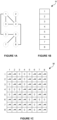
- An undirected edge between node n and node m represents that: node n is connected to node m; and node m is connected to node n.
- the undirected edge between nodes 1 and 3 represents that: node 1 is connected to node 3; and node 3 is connected to node 1.
- Some nodes are not connected.
- node 1 is not connected to node 2. That is, no edge exists between nodes 1 and 2.
- the graph shown in Figure 1A is provided by way of example only. It is to be understood that the graphs operated on by typical graph attention networks often comprise a far greater number of nodes.
- Figure 1B shows an example feature embedding matrix (H).
- the feature embedding matrix (H) has the (row ⁇ column) dimensions N ⁇ F, where N is the number of nodes in the graph represented by the feature embedding matrix (H) and, for the first graph attention network layer in a graph attention network, F is the number of features comprised by each node of that graph.
- the feature embedding matrix (H) shown in Figure 1B represents the features comprised by the nodes of the graph shown in Figure 1A . That is, the feature embedding matrix (H) comprises eight rows - labelled 1 to 8. Each of the rows (e.g.
- rows 1-8 shown in Figure 1B ) of the feature embedding matrix (H) represents the features comprised by a respective one of the nodes (e.g. nodes 1-8 in Figure 1A ) of the graph.
- the features comprised by each one of the nodes can be represented by a respective row vector comprising one or more (e.g. F ) values (e.g. one or more, e.g. F , columns).
- Each of said row vectors forms a row of the feature embedding matrix (H).
- Figure 1C shows an example adjacency matrix mask (M).
- the adjacency matrix mask (M) comprises a plurality of elements, where each element corresponds to a respective pair of nodes of the graph.
- the adjacency matrix mask (M) has the (row ⁇ column) dimensions N ⁇ N, where N is the number of nodes in the graph represented by the adjacency matrix mask (M).
- the adjacency matrix mask (M) shown in Figure 1C represents the connectivity between the nodes of the graph shown in Figure 1A . That is, the adjacency matrix mask (M) comprises eight rows and eight columns - both labelled 1 to 8, respectively. Each of the rows (e.g.
- each of columns (e.g. columns 1 to 8 in Figure 1A ) of the adjacency matrix mask (M) represents a respective one of the nodes (e.g. nodes 1-8 in Figure 1C ) of the graph represented by that adjacency matrix mask (M).
- each of columns (e.g. columns 1 to 8 in Figure 1A ) of the adjacency matrix mask (M) represents a respective one of the nodes (e.g. nodes 1-8 in Figure 1C ) of the graph represented by that adjacency matrix mask (M).
- the adjacency matrix mask (M) is a square matrix.
- the adjacency matrix mask (M) comprises a plurality of elements representative of connected graph nodes.
- each element representative of connected graph nodes comprises a zero (i.e. "0") value - although it is to be understood that in other examples a value other than zero (e.g. a value close to zero) could be used to represent connected graph nodes.
- a zero (i.e. "0") value in the (row, column) position (n, m) can represent a connection between node n and node m of a graph.
- the "0" shown in the (row, column) position (1, 3) in Figure 1C is representative of the connection between nodes 1 and 3 shown in Figure 1A .
- the "0” shown in the (row, column) position (3, 1) in Figure 1C is representative of the connection between nodes 3 and 1 shown in Figure 1A .
- the adjacency matrix mask (M) also comprises a plurality of elements representative of non-connected graph nodes.
- each element representative of non-connected graph nodes comprises a value representative of negative infinity ("- ⁇ ").
- a value representative of negative infinity can be encoded using the most negative value available in the number format used to encode the values of the adjacency matrix mask (M). It is to be understood that in other examples a value other than "- ⁇ " (e.g. a value close to the most negative value available) could be used to represent non-connected graph nodes.
- a "- ⁇ " value in the (row, column) position (n, m) can represent that node n and node m of a graph are not connected.
- the "- ⁇ " value shown in the (row, column) position (1, 2) in Figure 1C is representative of nodes 1 and 2 shown in Figure 1A not being connected.
- the "- ⁇ " value shown in the (row, column) position (2, 1) in Figure 1C is representative of nodes 2 and 1 shown in Figure 1A not being connected.
- the graphs operated on by typical graph attention networks often comprise a large number of nodes, a large proportion of which are not at are not connected to one another.
- adjacency matrix masks often comprise a large proportion of "- ⁇ " values.
- edges in a graph it is possible for edges in a graph to be directed. For example, a directed edge from a node n to a node m would only represent that node n is connected to node m.
- directed graphs In the absence of a directed edge from node m to node n, node m is not connected to node n.
- Graphs that use directed edges are referred to herein as directed graphs.
- An adjacency matrix mask (M) that represents an undirected graph will not necessarily be symmetric - e.g. as the value in the (row, column) position (n, m) is not necessarily equal the value in the (row, column) position (m, n).
- the coefficients of the weight matrix (W) are used to transform the data input to a graph attention network layer.
- the coefficients of the weight matrix (W) can be defined during a training phase. That is, as would be understood by the skilled person, a graph attention network can be trained by, iteratively: processing training data in a forward pass; assessing the accuracy of the output of that forward pass; and updating the weight coefficients of the layers in a backward pass.
- the weight matrix (W) has the (row ⁇ column) dimensions F ⁇ F ', where F is the number of columns of the feature embedding matrix (H) input to that graph attention network layer and F ' is the number of columns of the feature embedding matrix (H') that will be output from that graph attention network layer. That is, the weight matrix (W) can be used to control the "width" (e.g. number of columns) of the output feature embedding matrix (H') formed by a graph attention network layer.
- the pair of attention vectors (a 1 and a 2 ) are used to control how much "attention" the graph attention network layer "pays” to each input value in the data input to that layer.
- the pair of attention vectors (a 1 and a 2 ) cause the graph attention network layer to apply a higher weighting (e.g. closer to 1, assuming a weighting scale from zero to one) to "more important" inputs and a lower weighting (e.g. closer to 0, assuming a weighting scale from zero to one) to "less important inputs”.
- the coefficients of the pair of attention vectors (a 1 and a 2 ) can be defined during a training phase - e.g. as a result of learning during that training phase which inputs are "more” and “less” important. That is, as would be understood by the skilled person, graph attention network can be trained by, iteratively: processing training data in a forward pass; assessing the accuracy of the output of that forward pass; and updating the attention coefficients of the layers in a backward pass.
- Each of the attention vectors (a 1 and a 2 ) are column vectors having the (row ⁇ column) dimensions F' ⁇ 1, where F ' is the number of rows of the weight matrix (W) of that graph attention network layer.
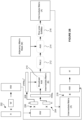
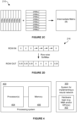
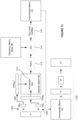
- Figure 2A is a flow diagram showing the series of operations performed by a graph attention network layer of a graph attention network.
- Figure 2B illustrates the series of operations performed by a graph attention network layer of a graph attention network.
- Figures 2A and 2B use the same reference numerals to refer to the same operations.
- the first operation in the series of operations is a multiplication operation 202 (e.g. a matrix multiplication operation 202).
- the multiplication operation 202 comprises multiplying the feature embedding matrix (H) by the weight matrix (W).
- the feature embedding matrix (H) has the dimensions N ⁇ F and the weight matrix (W) has the dimensions F ⁇ F '.
- the multiplication operation 202 outputs an intermediate matrix (HW).
- the intermediate matrix (HW) has the dimensions N ⁇ F'.
- the series of operations comprises a multiplication operation 204 and a multiplication operation 206. Both operations 204 and 206 may be referred to as matrix-vector multiplication operations.
- the multiplication operation 204 comprises multiplying the intermediate matrix (HW) by the first attention vector (a 1 ). As described herein, the intermediate matrix (HW) has the dimensions N ⁇ F ' and the first attention vector (a 1 ) has the dimensions F ' ⁇ 1.
- the multiplication operation 204 outputs an intermediate column vector (HWa 1 ).
- the intermediate column vector (HWa 1 ) has the dimensions N ⁇ 1.
- the multiplication operation 206 comprises multiplying the intermediate matrix (HW) by the second attention vector (a 2 ).
- the intermediate matrix (HW) has the dimensions N ⁇ F ' and the second attention vector (a 2 ) has the dimensions F ' ⁇ 1.
- the multiplication operation 206 outputs an intermediate column vector (HWa 2 ).
- the intermediate column vector (HWa 2 ) has the dimensions N ⁇ 1.
- the series of operations comprises a transpose operation 208.
- the transpose operation 208 comprises transposing the intermediate column vector (HWa 2 ).
- the transpose operation 208 outputs an intermediate row vector ((HWa 2 ) T ).
- the intermediate row vector ((HWa 2 ) T ) has the dimensions 1 ⁇ N .
- the series of operations comprises a broadcast add operation 210.
- the broadcast add operation 210 comprises broadcast adding the intermediate column vector (HWa 1 ) and the intermediate row vector ((HWa 2 ) T ).
- the broadcast add operation 210 is performed in order to form an intermediate matrix (B) having the same dimensions as the adjacency matrix mask (M). That is, the broadcast add operation 210 is performed in order to form an intermediate matrix (B) having the (row ⁇ column) dimensions N ⁇ N.
- the broadcast add operation 210 is illustrated in Figure 2C .
- the broadcast add operation 210 involves: forming a first intermediate matrix comprising a number of columns (e.g.
- N equal to the number of columns of the intermediate row vector ((HWa 2 ) T ), each column comprising the intermediate column vector (HWa 1 ); forming a second intermediate matrix comprising a number of rows (e.g. N ) equal to the number of rows of the intermediate column vector (HWa 1 ), each row comprising the intermediate row vector ((HWa 2 ) T ); and summing said first intermediate matrix and said second intermediate matrix in order to form an intermediate matrix (B) having the dimensions N ⁇ N.
- the intermediate matrix (B) is sometimes referred to as an intermediate "attention" matrix.
- the series of operations can comprise an activation operation 212.
- the activation operation 212 is performed on the intermediate matrix (B).
- the activation operation 212 may comprise applying an activation function, such as a sigmoid function or step function, to each of the values in the intermediate matrix (B).
- the activation operation 212 comprises applying a rectified linear (ReLU) activation function to each of the values in the intermediate matrix (B).
- the activation operation 212 outputs an intermediate matrix (ReLU(B)).
- the intermediate matrix (ReLU(B)) has the dimensions N ⁇ N.
- the series of operations comprises an addition operation 214 (e.g. a matrix addition operation 214).
- the addition operation 214 comprises adding the intermediate matrix (ReLU(B)) and the adjacency matrix mask (M).
- the intermediate matrix (ReLU(B)) has the dimensions N ⁇ N and the adjacency matrix mask (M) also has the dimensions N ⁇ N.
- the respective output values equal their respective values of the intermediate matrix (ReLU(B)).
- the "- ⁇ " values of the adjacency matrix mask (M) are added to the respective values of the intermediate matrix (ReLU(B)
- the respective output values equal "- ⁇ ”.
- the addition operation 214 outputs an intermediate matrix (ReLU(B)+M).
- the intermediate matrix (ReLU(B)+M) has the dimensions N ⁇ N.
- the series of operations comprises a row-wise SoftMax operation 216.
- the row-wise SoftMax operation 216 is performed on the intermediate matrix (ReLU(B)+M).
- the row-wise SoftMax operation 216 comprises scaling the values in each of the rows of the intermediate matrix (ReLU(B)+M) such that the sum of the scaled values in each row equals 1.
- Figure 2D illustrates a row-wise SoftMax operation 216 being performed on a single row of the intermediate matrix (ReLU(B)+M).
- Each of the "- ⁇ " values in a row of the intermediate matrix (ReLU(B)+M) will be scaled to zero (i.e. "0") in the output of the row-wise SoftMax operation 216.
- the other values in that row of the intermediate matrix (ReLU(B)+M) will be scaled such that the sum of those scaled values equals 1.
- the row-wise SoftMax operation 216 is performed separately (e.g. independently) on each of the rows of the intermediate matrix (ReLU(B)+M).
- the row-wise SoftMax operation 216 outputs an intermediate matrix (A).
- the intermediate matrix (A) has the dimensions N ⁇ N .
- Intermediate matrix (A) may be referred to as an intermediate "adjacency-attention" matrix. This is because the intermediate adjacency-attention matrix (A) is representative of the adjacency information (e.g. as derived from the adjacency matrix mask (M) described herein) and the attention information (e.g. as derived from the series of operations 202 to 212 described herein) of the graph attention network layer.
- the adjacency information e.g. as derived from the adjacency matrix mask (M) described herein
- attention information e.g. as derived from the series of operations 202 to 212 described herein
- the series of operations comprises a multiplication operation 218 (e.g. a matrix multiplication operation 218).
- the multiplication operation 218 comprises multiplying the intermediate matrix (A) by the intermediate matrix (HW).
- the multiplication operation 218 can be performed using the intermediate matrix (HW) output by the multiplication operation 202. That is, the intermediate matrix (HW) need not be re-calculated - although, in other examples, it could be.
- the intermediate matrix (A) has the dimensions N ⁇ N and the intermediate matrix (HW) has the dimensions N ⁇ F'.
- the multiplication operation 216 outputs a feature embedding matrix (H').
- the feature embedding matrix (H') has the dimensions N ⁇ F'.
- the feature embedding matrix (H') may be input - directly, or indirectly (e.g. after performing an activation operation on that feature embedding matrix (H')) - to a subsequent graph attention network layer of the graph attention network.
- Said subsequent graph attention network layer can perform the series of operations 202 to 218 described herein in dependence on the feature embedding matrix (H'), a further weight matrix (W), a further pair of attention vectors (a 1 ' and a 2 ') and the same adjacency matrix mask (M).
- the graph attention network layer is the final layer of the graph attention network
- the feature embedding matrix (H') may be output - directly, or indirectly (e.g. after performing an activation operation on that feature embedding matrix (H')) - from that graph attention network as the output of that graph attention network.
- Graph attention networks can become very large.
- the intermediate matrix (A), the feature embedding matrix (H) and the weight matrix (W) may each have millions or even billions of elements.
- the intermediate matrix (A) may be a 4096x4096 matrix
- the feature embedding matrix (H) may be a 4096x512 matrix
- the weight matrix (W) may be a 512x1024 matrix.
- Determining the result of multiplying the A, H and W matrices for this graph attention network layer e.g. by performing multiplication operations 202 and 218 described above) would involve performing billions of multiply-accumulate (MAC) operations.
- MAC multiply-accumulate
- a computer implemented method of compressing a graph attention network comprising: receiving a graph attention network comprising a graph attention network layer, said graph attention network layer being arranged to perform an operation in dependence on an adjacency matrix mask, said adjacency matrix mask comprising a plurality of elements representative of connected graph nodes; rearranging the rows and/or columns of the adjacency matrix mask so as to gather the plurality of elements representative of connected graph nodes into one or more adjacency sub-matrix masks, the one or more adjacency sub-matrix masks having a greater number of elements representative of connected graph nodes per total number of elements of the one or more adjacency sub-matrix masks than the number of elements representative of connected graph nodes per total number of elements of the adjacency matrix mask; and outputting a compressed graph attention network comprising a compressed graph attention network layer arranged to perform a compressed operation in dependence on the one or more adjacency sub-matr
- Each element representative of connected graph nodes may comprise a zero value, such that the adjacency matrix mask may comprise a plurality of zero values and the one or more adjacency sub-matrix masks may have a greater number of zero values per total number of values of the one or more adjacency sub-matrix masks than the number of zero values per total number of values of the adjacency matrix mask.
- Each of the one or more adjacency sub-matrix masks may have a greater number of elements representative of connected graph nodes per total number of elements of that adjacency sub-matrix mask than the number of elements representative of connected graph nodes per total number of elements of the adjacency matrix mask.
- the graph attention network layer of the received graph attention network may be arranged to perform a series of operations in order to form a first intermediate matrix, the first intermediate matrix having the same dimensions as the adjacency matrix mask; and the compressed graph attention network layer of the compressed graph attention network may be configured to perform a compressed series of operations in order to form one or more first intermediate sub-matrices, each of the one or more first intermediate sub-matrices having the same dimensions as a respective one of the one or more adjacency sub-matrix masks.
- the method may further comprise: in order to form one or more concatenated sub-matrices, concatenating at least one set of two or more sub-matrices formed by performing the compressed addition operation using the one or more adjacency sub-matrix masks and the one or more first intermediate sub-matrices; and configuring the compressed graph attention network layer of the compressed graph attention network to perform the compressed row-wise SoftMax operation in dependence on the one or more concatenated sub-matrices.
- the series of operations may comprise a broadcast add operation, the broadcast add operation forming the first intermediate matrix; and the compressed series of operations may comprise a compressed broadcast add operation, the compressed broadcast add operation forming the one or more first intermediate sub-matrices.
- the series of operations may further comprise performing an operation in dependence on a weight matrix and an attention vector
- the method may further comprise: computing, in an offline phase prior to implementing the compressed graph attention network, an attention weight vector in dependence on the weight matrix and the attention vector; and configuring the compressed graph attention network such that the compressed graph attention network layer is configured to perform an operation in dependence on the attention weight vector, said operation being comprised by the compressed series of operations.
- the graph attention network layer of the received graph attention network may be arranged to perform a series of operations, in dependence on the adjacency matrix mask, in order to form a second intermediate matrix having the same dimensions as the adjacency matrix mask; and the compressed graph attention network layer of the compressed graph attention network may be configured to perform a compressed series of operations, in dependence on the one or more adjacency sub-matrix masks, in order to form one or more second intermediate sub-matrices, each of the one or more second intermediate sub-matrices having the same dimensions as a respective one of the one or more adjacency sub-matrix masks.
- the one or more second intermediate sub-matrices may have a greater number of non-zero values per total number of values of the one or more second intermediate sub-matrices than the number of non-zero values per total number of values of the second intermediate matrix.
- the graph attention network layer of the received graph attention network may be arranged to perform multiplication operations in dependence on the second intermediate matrix, a feature embedding matrix, and a weight matrix; and the compressed graph attention network layer of the compressed graph attention network may be configured to perform compressed multiplication operations in dependence on the one or more second intermediate sub-matrices, one or more feature embedding sub-matrices formed in dependence on the feature embedding matrix, and the weight matrix, the output of said compressed multiplication operations being representative of the output of said multiplication operations.
- the method may further comprise: so as to form the one or more feature embedding sub-matrices, permuting and partitioning the rows of the feature embedding matrix to match the permutation and partitioning of the columns of the permuted adjacency matrix mask.
- the columns of the feature embedding matrix may be neither permuted nor partitioned, and the rows and the columns of the weight matrix may be neither permuted nor partitioned.
- the method may comprise: assessing at least one dimension of one or both of the feature embedding matrix and the weight matrix; and in dependence on the dimensions of one or both of the feature embedding matrix and the weight matrix, configuring the compressed graph attention network such that the compressed graph attention network layer is configured to, either: (i) perform a multiplication operation in dependence on the one or more feature embedding sub-matrices and the weight matrix so as to form one or more third intermediate sub-matrices, and subsequently perform a multiplication operation in dependence on the one or more second intermediate sub-matrices and the one or more third intermediate sub-matrices; or (ii) perform a multiplication operation in dependence on the one or more second intermediate sub-matrices and the one or more feature embedding sub-matrices so as to form one or more fourth intermediate sub-matrices, and subsequently perform a multiplication operation in dependence on the one or more fourth intermediate sub-matrices and the weight matrix.
- the method may comprise assessing at least one dimension of one or both of the feature embedding matrix and the weight matrix in order to select, from a plurality of predefined series of operations, the series of operations that causes a compressed graph attention network layer configured to perform that series of operations to incur the fewest multiple-accumulate operations.
- Assessing at least one dimension of one or both of the feature embedding matrix and the weight matrix may comprise: inputting one or both dimensions of each of the feature embedding matrix and the weight matrix into a first function, the first function being indicative of the number of multiply-accumulate operations associated with operations performed in dependence on the feature embedding matrix and the weight matrix that would be incurred by a compressed graph attention network layer configured to perform a first series of operations; inputting one or both dimensions of each of the feature embedding matrix and the weight matrix into a second function, the second function being indicative of the number of multiply-accumulate operations associated with operations performed in dependence on the feature embedding matrix and the weight matrix that would be incurred by a graph attention network layer configured to perform a second series of operations; and determining whether the output of said first function is greater than the output of said second function.
- the compressed graph attention network may be configured such that the graph attention network layer is configured to: perform the first series of operations in response to determining that the output of the first function is less than the output of the second function, the first series of operations comprising (i) performing a multiplication operation in dependence on the one or more feature embedding sub-matrices and the weight matrix so as to form one or more third intermediate sub-matrices, and subsequently perform a multiplication operation in dependence on the one or more second intermediate sub-matrices and the one or more third intermediate sub-matrices; or perform the second series of operations in response to determining that the output of the first function is greater than the output of the second function, the second series of operations comprising (ii) performing a multiplication operation in dependence on the one or more second intermediate sub-matrices and the one or more feature embedding sub-matrices so as to form one or more fourth intermediate sub-matrices, and subsequently perform a multiplication operation in dependence on the one or more fourth intermediate sub-matrices and the weight matrix.
- the graph attention network may comprise a plurality of graph attention network layers, the plurality of graph attention network layers comprising said graph attention network layer and one or more further graph attention network layers; and the compressed graph attention network may comprise a plurality of compressed graph attention network layers, the plurality of compressed graph attention network layers comprising said compressed graph attention network layer and one or more further compressed graph attention network layers.
- the adjacency matrix mask may be the same for all of the plurality of graph attention network layers, and the one or more adjacency sub-matrix masks may be the same for all of the plurality of compressed graph attention network layers.
- the compressed graph attention network may be configured to process an output of a first of the compressed graph attention network layers to determine an input for a second of the compressed graph attention network layers in the compressed graph attention network, and the processing of the output of the first of the compressed graph attention network layers may not comprise performing a permute operation on the output of the first of the compressed graph attention network layers.
- the method may further comprise storing the compressed graph attention network for subsequent implementation.
- the method may further comprise outputting a computer readable description of the compressed graph attention network that, when implemented at a system for implementing a graph attention network, causes the compressed graph attention network to be executed.
- the method may further comprise configuring hardware logic to implement the compressed graph attention network.
- a processing system for compressing a graph attention network comprising at least one processor configured to: receive a graph attention network comprising a graph attention network layer, said graph attention network layer being arranged to perform an operation in dependence on an adjacency matrix mask, said adjacency matrix mask comprising a plurality of elements representative of connected graph nodes; rearrange the rows and/or columns of the adjacency matrix mask so as to gather the plurality of elements representative of connected graph nodes into one or more adjacency sub-matrix masks, the one or more adjacency sub-matrix masks having a greater number of elements representative of connected graph nodes per total number of elements of the one or more adjacency sub-matrix masks than the number of elements representative of connected graph nodes per total number of elements of the adjacency matrix mask; and output a compressed graph attention network comprising a compressed graph attention network layer arranged to perform a compressed operation in dependence on the one or more adjacency
- a computer implemented method of configuring a graph attention network comprising: receiving a graph attention network comprising a graph attention network layer, said graph attention network layer being arranged to perform one or more operations in dependence on a feature embedding matrix and a weight matrix; assessing at least one dimension of one or both of the feature embedding matrix and the weight matrix; and in dependence on the dimensions of one or both of the feature embedding matrix and the weight matrix, configuring the graph attention network such that the graph attention network layer is configured to, either: (i) perform an operation in dependence on the feature embedding matrix and the weight matrix so as to form a first intermediate output, and subsequently perform an operation in dependence on a first intermediate matrix and the first intermediate output; or (ii) perform an operation in dependence on the first intermediate matrix and the feature embedding matrix so as to form a second intermediate output, and subsequently perform an operation in dependence on the second intermediate output and the weight matrix.
- a processing system for configuring a graph attention network comprising at least one processor configured to: receive a graph attention network comprising a graph attention network layer, said graph attention network layer being arranged to perform one or more operations in dependence on a feature embedding matrix and a weight matrix; assess at least one dimension of one or both of the feature embedding matrix and the weight matrix; and in dependence on the dimensions of one or both of the feature embedding matrix and the weight matrix, configure the graph attention network such that the graph attention network layer is configured to, either: (i) perform an operation in dependence on the feature embedding matrix and the weight matrix so as to form a first intermediate output, and subsequently perform an operation in dependence on a first intermediate matrix and the first intermediate output; or (ii) perform an operation in dependence on the first intermediate matrix and the feature embedding matrix so as to form a second intermediate output, and subsequently perform an operation in dependence on the second intermediate output and the weight matrix.
- a computer implemented method of configuring a graph attention network comprising: receiving a graph attention network comprising a graph attention network layer, said graph attention network layer being arranged to perform an operation in dependence on a weight matrix and an attention vector; computing an attention weight vector in dependence on the weight matrix and the attention vector; and configuring the graph attention network such that the graph attention network layer is configured to perform an operation in dependence on the attention weight vector.
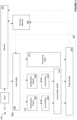
- Two processing elements 314 are shown in Figure 3 but in general there may be any number.
- Each processing element 314 may receive a set of values from input buffer 306. By operating on the sets of input values, the processing elements are operable to perform the multiplication operations of the graph attention network layers of a graph attention network.
- the processing elements 314 of NNA 302 may be independent processing subsystems of the NNA 302 which can operate in parallel.
- Memory 406 may store computer executable instructions for performing a method of compressing and/or configuring a graph attention network in accordance with the principles described herein (e.g. one or more of the methods as will be described herein with reference to Figures 5, 9 and 12 ).
- Memory 406 may store a graph attention network received at the processing system 400 for compressing and/or configuring (e.g. a software model defining that graph attention network, as described herein).
- Memory 406 may store a compressed and/or configured graph attention network output as a result of the at least one processor executing the computer executable instructions stored by the memory 406.
- Memory 406 may store that compressed and/or configured graph attention network for subsequent implementation (e.g. at a system for implementing a graph attention network).
- Processing system 400 can be used to configure a system 300 for implementing graph attention network.
- the system 300 shown in Figure 4 may have the same properties as the system 300 described with reference to Figure 3 . That is, system 300 may comprise hardware logic 302 for implementing a neural network, said hardware logic comprising a neural network accelerator (NNA) and/or a graphics processing unit (GPU).
- the at least one processor 404 may configure the hardware logic to implement a compressed and/or configured graph attention network output as a result of the at least one processor performing a method of compressing and/or configuring a graph attention network in accordance with the principles described herein (e.g. one or more of the methods as will be described herein with reference to Figures 5, 9 and 12 ).
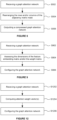
- Figure 5 shows a method of compressing a graph attention network.
- the method of compressing a graph attention network shown in Figure 5 is a computer-implemented method.
- the processing system 400 for compressing a graph attention network shown in Figure 4 may be configured to perform the method of compressing a graph attention network shown in Figure 5 .
- the method of compressing a graph attention network shown in Figure 5 can be used independently, or can be used in combination with one or both of the methods of configuring a graph attention network shown in Figures 9 and 12 , as will be described herein.
- a graph attention network is received.
- the received a graph attention network may be defined by a software model.
- that software model may define the adjacency matrix mask (M) of the received graph attention network, the series of layers of the received graph attention network (e.g. the number of layers, the order of the layers, and the connectivity between those layers), each of the layers in that series in terms of the series of operations it is configured to perform, and the feature embedding matrix (H), weight matrix (W) and pair of attention vectors (a 1 and a 2 ) each graph attention network layer will use.
- the received graph attention network may comprise at least one graph attention network layer arranged to perform the series of operations described herein with reference to Figures 2A to 2D .
- the received graph attention network may be a trained neural network. That is, as would be understood by the skilled person, the received graph attention network may have previously been trained by iteratively: processing training data in a forward pass; assessing the accuracy of the output of that forward pass; and updating the coefficients (e.g. weight and attention coefficients) of the layers in a backward pass.
- the graph attention network e.g. the software model defining that graph attention network
- the graph attention network received in step S502 comprises a graph attention network layer. That graph attention network layer is arranged to perform an operation in dependence on an adjacency matrix mask (M), as described herein.
- the adjacency matrix mask (M) comprises a plurality of elements representative of connected graph nodes. In preferred examples, each element representative of connected graph nodes comprises a zero value, such that the adjacency matrix mask (M) comprises a plurality of zero values.
- step S504 the rows and/or columns of the adjacency matrix mask (M) are rearranged (e.g. reordered, or permuted) so as to gather the plurality of elements representative of connected graph nodes into one or more adjacency sub-matrix masks.
- the one or more adjacency sub-matrix masks have a greater number of elements representative of connected graph nodes per total number of elements of the one or more adjacency sub-matrix masks than the number of elements representative of connected graph nodes per total number of elements of the adjacency matrix mask (M).
- the one or more adjacency sub-matrix masks have a smaller number of elements representative of non-connected graph nodes per total number of elements of the one or more adjacency sub-matrix masks than the number of elements representative of non-connected graph nodes per total number of elements of the adjacency matrix mask (M).
- the one or more adjacency sub-matrix masks comprise a subset of the values comprised by the adjacency matrix mask (M).
- each of the one or more adjacency sub-matrix masks may have a greater number of elements representative of connected graph nodes per total number of elements of that adjacency sub-matrix mask than the number of elements representative of connected graph nodes per total number of elements of the adjacency matrix mask (M) - although this need not be the case.
- the at least one processor 404 shown in Figure 4 can be configured to perform step S504.
- the one or more adjacency sub-matrix masks may have a greater number of zero values per total number of values of the one or more adjacency sub-matrix masks than the number of zero values per total number of values of the adjacency matrix mask (M). That is, the one or more adjacency sub-matrix masks may have a smaller number of "- ⁇ " values per total number of values of the one or more adjacency sub-matrix masks than the number of "- ⁇ " values per total number of values of the adjacency matrix mask (M).
- the "zero density" of the one or more adjacency sub-matrix masks may be greater than the "zero density” of the adjacency matrix mask (M).
- the "zero density” of each and every adjacency sub-matrix mask of the one or more adjacency sub-matrix masks may be greater than the "zero density” of the adjacency matrix mask (M) - although this need not be the case.
- the rearranging of the rows and/or columns of the adjacency matrix mask (M) performed in step S504 may comprise permuting (e.g. rearranging, or reordering) the rows and/or columns of the adjacency matrix mask (M), and then partitioning (e.g. dividing) the rows and/or columns of the permuted adjacency matrix mask in order to form the one or more adjacency sub-matrix masks.
- the rearranging of the rows and/or columns of the adjacency matrix mask (M) may be performed in dependence on a hypergraph model, a hypergraph clustering algorithm, a graph partitioning algorithm, a separator vertex set approach or any other suitable approach for gathering like values within an array of values - as would be understood by the skilled person.
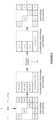
- step S504 is explained with reference to Figures 6A to 6C .
- each element representative of connected graph nodes may comprise a zero (i.e. "0") value, whilst each element representative of non-connected graph nodes may comprise a value representative of negative infinity ("- ⁇ ").
- the adjacency matrix mask 602 shown in Figure 6A is a 7x7 matrix, and it is to be understood that this is a simplified example describing the connection information between nodes in a graph comprising seven nodes. In more realistic examples, the adjacency matrix mask may be much larger than that shown in Figure 6A , e.g. the adjacency matrix mask may be a 4096x4096 matrix describing the connection information between nodes in a graph comprising 4096 nodes.
- the rearranging of the rows and/or columns of the adjacency matrix mask 602 in step S504 may be performed in dependence on a hypergraph model.
- a hypergraph model can be formed in dependence on the respective row and column position of each of the plurality of elements representative of connected graph nodes within the adjacency matrix mask 602.
- Figure 6B shows an example hypergraph model corresponding to the adjacency matrix mask 602 shown in Figure 6A .
- Figure 6C shows an example rearranged adjacency matrix mask 608 comprising a plurality of adjacency sub-matrix masks.
- the hypergraph model can be used to convert the adjacency matrix mask 602 into "doubly-bordered block-diagonal matrix form" as shown in the rearranged adjacency matrix mask 608 of Figure 6C .
- the doubly-bordered block-diagonal matrix form comprises: (i) a plurality of block arrays (e.g. 610 1 and 610 2 ) which are aligned along the diagonal of the rearranged adjacency matrix mask 608, (ii) one or more horizontal border arrays (e.g.
- the corner array 610 5 is a border array and may be considered to be a horizontal border array and/or a vertical border array.
- the one or more block arrays and the border arrays are nonoverlapping.
- the block array 610 1 is an adjacency sub-matrix mask
- the block array 610 2 is an adjacency sub-matrix mask
- the horizontal border array 610 3 comprises two adjacency sub-matrix masks (e.g.
- the horizontal border array 610 3 is partitioned as shown by the vertical dotted line to form two adjacency sub-matrix masks having the same number of columns as the two block arrays 610 1 and 610 2 , respectively);
- the vertical border array 610 4 comprises two adjacency sub-matrix masks (e.g. the vertical border array 610 4 is partitioned as shown by the horizontal dotted line to form two adjacency sub-matrix masks having the same number of rows as the two block arrays 610 1 and 610 2 , respectively);
- the corner array 610 5 is an adjacency sub-matrix mask.
- the rearranged adjacency matrix mask 608 shown in Figure 6C comprises seven adjacency sub-matrix masks.
- the rearrangement of the rows and/or columns of the adjacency matrix mask 602 in step S504 may comprise: performing permutations of the rows and of the columns of the adjacency matrix mask 602; and partitioning the rows and columns of the permuted adjacency matrix mask to determine the set of one or more adjacency sub-matrix masks shown in Figure 6C .
- performing permutations of the rows and of the columns of the adjacency matrix mask 602 in step S504 may comprise performing a symmetric permutation, and the partitioning of the rows of the permuted adjacency matrix mask may be the same as the partitioning of the columns of the permuted adjacency matrix mask.
- the adjacency matrix mask 602 is symmetric, e.g. the adjacency matrix mask 602 may represent an undirected graph. However, in other examples, the adjacency matrix mask may represent a directed graph, and in those examples the adjacency matrix mask might not initially be symmetric. In those examples step S504 may comprise making the adjacency matrix mask symmetric by altering one or more of the values in that adjacency matrix mask.
- the rearranging of the rows and/or columns of the adjacency matrix mask, M , in step S504 may comprise: determining a symmetric adjacency matrix mask, M ', such that, for each of the elements, M [ i , j ], of the adjacency matrix mask: if M [ i,j ] is representative of non-connected graph nodes (e.g. "- ⁇ ") and M [ j,i ] is representative of connected graph nodes (e.g. "0"), the corresponding element of the symmetric adjacency matrix mask, M ' [i,j ] , is representative of connected graph nodes (e.g.
- the hypergraph model can be used to rearrange the symmetric adjacency matrix mask.
- the hypergraph model may be used to reorder and partition the rows and columns of the symmetric adjacency matrix mask into a singly-bordered block-diagonal matrix form which comprises one or more initial border arrays which are either horizontally or vertically aligned across the symmetric adjacency matrix mask.
- all of the one or more initial border arrays may be either horizontally or vertically aligned across the symmetric adjacency matrix mask. Then the column reordering may be applied to the rows, or vice versa, to re-arrange the adjacency matrix mask into the doubly-bordered block-diagonal form matrix.
- the row ordering can be applied to the columns of the singly-bordered block diagonal matrix to thereby determine the adjacency matrix mask in the doubly-bordered block-diagonal matrix form; whereas if the one or more initial border arrays are vertically aligned across the symmetric adjacency matrix mask, the column ordering can be applied to the rows of the singly-bordered block diagonal matrix to thereby determine the adjacency matrix mask in the doubly-bordered block-diagonal matrix form.
- the hypergraph model may be used to reorder and partition the rows and columns of the symmetric adjacency matrix mask directly into a doubly-bordered block-diagonal matrix form.
- hypergraphs may be implemented using a row-net hypergraph model or a column-net hypergraph model.
- a row-net or a column-net hypergraph model may be used in step S504 to re-arrange the adjacency matrix mask 602 into singly-bordered block-diagonal form matrix, before applying the row/column ordering to the columns/rows to determine the adjacency matrix mask 608 in the doubly-bordered block diagonal matrix form.
- the same re-ordered adjacency matrix mask 608 will be produced in step S504 whether a row-net or a column-net hypergraph is used.
- the vertex representative of the column of the adjacency matrix mask 602 comprising that element representative of connected graph nodes is connected to the net representative of the row of the adjacency matrix mask 602 comprising that element representative of connected graph nodes.
- column 4 of the adjacency matrix mask 602 is represented by vertex v 4
- row 1 of the adjacency matrix mask 602 is represented by vertex n 1 . It can be seen in Figure 6A that the element positioned in row 1, column 4 of the adjacency matrix mask 602 is representative of connected graph nodes.
- a rearranged matrix in the doubly-bordered block diagonal matrix form could be obtained directly from a partitioned hypergraph model - i.e. without first forming a rearranged matrix in the singly-bordered block diagonal matrix form.
- nets n 1 and n 6 are connected to vertices in more than one part of the partitioned hypergraph model - and so the horizontal and vertical border arrays can be formed using rows 1 and 6, and columns 1 and 6, respectively.
- Nets n 2 , n 3 and n 4 are connected to vertices within a single part (i.e.
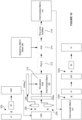
- a compressed graph attention network layer can be configured to perform a compressed series of operations in dependence on one or more feature embedding sub-matrices (h 1-p ) formed in dependence on the feature embedding matrix (H) of the graph attention network layer received in step S502, the weight matrix (W) of the graph attention network layer received in step S502, the pair of attention vectors (a 1 and a 2 ) of the graph attention network layer received in step S502, and the one or more adjacency sub-matrix masks formed in step S504.
- the plurality of feature embedding sub-matrices h 1 , h 2 , h 3 and h 4 may comprise a number of rows equal to the number of columns comprised by, respectively: the plurality of adjacency sub-matrix masks A and G; C and H; E and I; and B, D, F and J.
- the columns of the feature embedding matrix (H) of the graph attention network layer received in step S502 need not be permuted, nor partitioned, when forming the one or more feature embedding sub-matrices (h 1-P ).
- the rows and the columns of the weight matrix (W), and the pair of attention vectors (a 1 and a 2 ), of the graph attention network layer received in step S502 need not be permuted, nor partitioned.
- the first operation in the compressed series of operations may be a multiplication operation 702 (e.g. a matrix multiplication operation 702).
- the multiplication operation 702 comprises multiplying each of the one or more feature embedding sub-matrices (h 1-p ) by the weight matrix (W).
- the multiplication operation 702 may comprise: multiplying feature embedding sub-matrix h 1 by the weight matrix (W); multiplying feature embedding sub-matrix h 2 by the weight matrix (W); multiplying feature embedding sub-matrix h 3 by the weight matrix (W); and multiplying feature embedding sub-matrix h 4 by the weight matrix (W).
- the multiplication operation 702 outputs one or more intermediate sub-matrices (h 1-pW ). For example, referring to Figure 7 , the multiplication operation 702 may output a plurality of intermediate sub-matrices: h 1 W to h 4 W.
- the compressed series of operations comprises a multiplication operation 704 and a multiplication operation 706. Both operations 704 and 706 may be referred to as matrix-vector multiplication operations.
- the multiplication operation 704 comprises multiplying each of the one or more intermediate sub-matrices (h 1-pW ) by the first attention vector (a 1 ).
- the multiplication operation 704 may comprise: multiplying intermediate sub-matrix h 1 W by the first attention vector (a 1 ); multiplying intermediate sub-matrix h 2 W by the first attention vector (a 1 ); multiplying intermediate sub-matrix h 3 W by the first attention vector (a 1 ); and multiplying intermediate sub-matrix h 4 W by the first attention vector (a 1 ).
- the multiplication operation 704 outputs one or more intermediate column sub-vectors (h 1-p Wa 1 ).
- the multiplication operation 704 may output a plurality of intermediate column sub-vectors: h 1 Wa 1 to h 4 Wa 1 .
- the multiplication operation 706 comprises multiplying each of the one or more intermediate sub-matrices (h 1-pW ) by the second attention vector (a 2 ).
- the compressed series of operations comprises a compressed broadcast add operation 710.
- the compressed broadcast add operation 710 comprises broadcast adding pairs of the one or more intermediate column sub-vectors (h 1-p Wa 1 ) and the one or more intermediate row sub-vectors ((h 1-p Wa 2 ) T ).
- the compressed broadcast add operation 710 is performed in order to form one or more intermediate sub-matrices, each of said one or more intermediate sub-matrices having the same dimensions as a respective one of the adjacency sub-matrix masks formed in step S504.
- Said one or more intermediate sub-matrices may be referred to as one or more intermediate "attention" sub-matrices.
- the intermediate "attention" sub-matrix 1 has the same dimensions as the adjacency sub-matrix mask labelled A in Figure 7 .
- the compressed broadcast add operation 710 may comprise broadcast adding the intermediate column sub-vector (h 1 Wa 1 ) and the intermediate row sub-vector ((h 4 Wa 2 ) T ) to form the intermediate "attention" sub-matrix labelled 2 in Figure 7 .
- the intermediate "attention" sub-matrix 2 has the same dimensions as the adjacency sub-matrix mask labelled 8 in Figure 7 .
- the intermediate "attention" sub-matrices labelled 3 to 10 in Figure 7 can be formed in an analogous way using pairs of the intermediate column sub-vectors (h 2-4 Wa 1 ) and the intermediate row sub-vectors ((h 1-4 Wa 2 ) T ).
- Each of the intermediate "attention" sub-matrices labelled 3 to 10 in Figure 7 has the same dimensions as the respective one of adjacency sub-matrix masks labelled C to J in Figure 7 .
- the compressed broadcast add operation 710 (e.g. as shown in Figure 7 ) is less computationally expensive than the broadcast add operation 210 (e.g. as shown in Figure 2B ).
- the one or more intermediate "attention" sub-matrices (e.g. 1 to 10, in Figure 7 ) comprise a subset of the values of the intermediate "attention" matrix (e.g. B, in Figure 2B ) - and so the compressed broadcast add operation 710 is required to perform fewer value additions than the broadcast add operation 210.
- the values of the intermediate "attention" matrix (e.g. B, in Figure 2B ) that are not present in the intermediate "attention" sub-matrices (e.g.
- the compression is lossless compression. That is, the method of compressing a graph attention network described herein is a method of losslessly compressing a graph attention network. In particular, the graph attention network layer is losslessly compressed. As such, the graph attention network is losslessly compressed.
- the compressed series of operations may comprise a compressed activation operation 712.
- the compressed activation operation 712 can be performed on each of the one or more intermediate "attention" sub-matrices.
- the compressed activation operation 712 may comprise applying an activation function, such as a sigmoid function or step function, to each of the values in the one or more intermediate "attention" sub-matrices.
- the compressed activation operation 712 may comprise applying a rectified linear (ReLU) activation function to each of the values in the one or more intermediate "attention" sub-matrices.
- the compressed activation operation 712 outputs one or more intermediate sub-matrices (not shown in Figure 7 ). Each of said one or more intermediate sub-matrices has the same dimensions as a respective one of the adjacency sub-matrix masks formed in step S504.
- the compressed activation operation 712 (e.g. as shown in Figure 7 ) is less computationally expensive than the activation operation 212 (e.g. as shown in Figure 2B ).
- the one or more intermediate "attention" sub-matrices (e.g. 1 to 10, in Figure 7 ) comprise a subset of the values of the intermediate "attention" matrix (e.g. B, in Figure 2B ) - and so the compressed activation operation 712 requires the activation function to be applied to fewer values than the activation operation 212.
- the intermediate sub-matrix output after performing the activation operation 712 on intermediate "attention" sub-matrix 1 can be added to the adjacency sub-matrix mask A;
- the intermediate sub-matrix output after performing the activation operation 712 on intermediate "attention" sub-matrix 2 can be added to the adjacency sub-matrix mask B; and so on, through to the intermediate sub-matrix output after performing the activation operation 712 on intermediate "attention" sub-matrix 10 can be added to the adjacency sub-matrix mask J.
- the compressed addition operation 714 can output one or more intermediate sub-matrices (not shown in Figure 7 , shown in Figure 8 ), each of said one or more intermediate sub-matrices having the same dimensions as a respective one of the adjacency sub-matrix masks formed in step S504.
- the compressed addition operation 714 (e.g. as shown in Figure 7 ) is less computationally expensive than the addition operation 214 (e.g. as shown in Figure 2B ). This is because the one or more intermediate sub-matrices and the one or more adjacency sub-matrix masks added together when performing the compressed addition operation 714 comprise a subset of the values of the intermediate matrix and the adjacency matrix mask (M) added together when performing the addition operation 214 - and so the compressed addition operation 714 requires fewer value additions to be performed than the addition operation 214.
- the values of the matrix output from the addition operation 214 that are not present in the one or more intermediate sub-matrices output from the compressed addition operation 714 are exclusively "- ⁇ " values that would have, in the series of operations shown in Figure 2B , subsequently been converted to a "0" value through the SoftMax operation 216, and then been involved in a multiply-by-zero operation during multiplication operation 218 that inevitably leads to a zero output - and thus no "information" is lost by the compressed addition operation 714 not forming these values.
- the compression is lossless compression. That is, the method of compressing a graph attention network described herein is a method of losslessly compressing a graph attention network. In particular, the graph attention network layer is losslessly compressed. As such, the graph attention network is losslessly compressed.
- the compressed series of operations comprises a compressed row-wise SoftMax operation 716.
- the compressed row-wise SoftMax operation 716 can be performed in dependence on the one or more intermediate sub-matrices output from the compressed addition operation 714.
- the compressed row-wise SoftMax operation 716 may comprise scaling the values in each of the rows of each of the one or more intermediate sub-matrices such that the sum of the scaled values in each row equals 1.
- the compressed row-wise SoftMax operation 716 may output one or more intermediate sub-matrices, each of which has the same dimensions as a respective one of the adjacency sub-matrix masks formed in step S504.
- the one or more intermediate sub-matrices output by the compressed row-wise SoftMax operation 716 comprise a subset of the values of the intermediate matrix (A) that would have been formed by performing the row-wise SoftMax operation 216.
- said one or more intermediate sub-matrices may be referred to as one or more intermediate "adjacency-attention" sub-matrices.
- the one or more intermediate adjacency-attention sub-matrices are representative of the adjacency information (e.g. as derived from the one or more adjacency sub-matrix masks described herein) and the attention information (e.g. as derived from the series of operations 702 to 712 described herein) of the graph attention network layer (e.g. the compressed graph attention network layer).
- At least one set of two or more of the intermediate sub-matrices output from the compressed addition operation 714 comprise a subset of values from the same rows of the intermediate matrix (ReLU(B)+M) that would have been output from the addition operation 214
- said at least one set of two or more intermediate sub-matrices can be row-wise concatenated (e.g. joined together) so as to form one or more concatenated intermediate sub-matrices.
- the compressed row-wise SoftMax operation 716 can be performed on said one or more concatenated intermediate sub-matrices, so as to output one or more concatenated intermediate sub-matrices.
- said one or more concatenated intermediate sub-matrices can be row-wise split (e.g. the concatenation can be "undone") so as to form a plurality of intermediate submatrices, each of which has the same dimensions as a respective one of the adjacency sub-matrix masks formed in step S504.
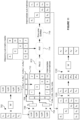
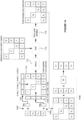
- Figure 8 illustrates an example of the use of concatenation and row-wise split operations within the compressed series of operations illustrated in Figure 7 .
- the one or more intermediate sub-matrices output from the compressed addition operation 714 comprises ten intermediate sub-matrices - labelled in Figure 8 as 1+A, 2+B, 3+C, 4+D, 5+E, 6+F, 7+G, 8+H, 9+I and 10+J.
- Four sets of two or more of these intermediate sub-matrices comprise a subset of values from the same four sets of rows of the intermediate matrix (ReLU(B)+M) that would have been output from the addition operation 214.
- intermediate sub-matrices 1+A and 2+B both comprise a subset of values from the same set of rows of the intermediate matrix (ReLU(B)+M).
- the same can be said of the following sets of intermediate sub-matrices: 3+C and 4+D; 5+E and 6+F; and 7+G, 8+H, 9+I and 10+J.
- Each of these sets of intermediate sub-matrices can be concatenated (e.g. joined) so as to form four concatenated intermediate sub-matrices - labelled in Figure 8 as: 1+A, 2+B; 3+C, 4+D; 5+E, 6+F; and 7+G, 8+H, 9+I, 10+J.
- the compressed row-wise SoftMax operation 716 can be performed on each of said four concatenated intermediate sub-matrices.
- the compressed row-wise SoftMax operation 716 comprises scaling the values in each of the rows of each of the concatenated intermediate sub-matrices such that the sum of the scaled values in each row equals 1.
- the compressed row-wise SoftMax operation 716 shown in Figure 8 outputs four concatenated intermediate sub-matrices, labelled as: d 1 , v 1 ; d 2 , v 2 ; d 3 , v 3 ; and b 1 , b 2 , b 3 , C.
- Said four concatenated intermediate sub-matrices can be row-wise split (e.g.
- the concatenation can be "undone") to form ten intermediate sub-matrices - labelled as d 1 , v 1 , d 2 , v 2 , d 3 , v 3 , b 1 , b 2 , b 3 and C.
- Each of said intermediate sub-matrices has the same dimensions as a respective one of the adjacency sub-matrix masks - labelled A to J in Figure 7 .
- analogous concatenations can be performed earlier during the series of compressed operations, such that the one or more intermediate sub-matrices that are output from the compressed addition operation 714 are one or more concatenated intermediate sub-matrices.
- at least one set of two or more of intermediate sub-matrices output from the compressed activation operation 712 can be concatenated, and at least one set of two or more adjacency sub-matrix masks can be equivalently concatenated, prior to the compressed addition operation 714.
- the compressed multiplication operation 718 outputs one or more feature embedding sub-matrices (h 1-p ').
- the one or more feature embedding sub-matrices (h 1-p ') output by the compressed multiplication operation 718 are representative of the feature embedding matrix (H') that would have been output by the multiplication operation 218. That is, although the rows are ordered differently, the one or more feature embedding sub-matrices (h 1-p '), as a whole, include all of the values of the feature embedding matrix (H').
Landscapes
- Engineering & Computer Science (AREA)
- Physics & Mathematics (AREA)
- Theoretical Computer Science (AREA)
- General Physics & Mathematics (AREA)
- Mathematical Physics (AREA)
- Data Mining & Analysis (AREA)
- Software Systems (AREA)
- General Engineering & Computer Science (AREA)
- Biophysics (AREA)
- Biomedical Technology (AREA)
- Life Sciences & Earth Sciences (AREA)
- Health & Medical Sciences (AREA)
- Computing Systems (AREA)
- Computational Linguistics (AREA)
- Molecular Biology (AREA)
- General Health & Medical Sciences (AREA)
- Evolutionary Computation (AREA)
- Artificial Intelligence (AREA)
- Databases & Information Systems (AREA)
- Mathematical Optimization (AREA)
- Computational Mathematics (AREA)
- Mathematical Analysis (AREA)
- Pure & Applied Mathematics (AREA)
- Neurology (AREA)
- Algebra (AREA)
- Traffic Control Systems (AREA)
- Complex Calculations (AREA)
- Compression, Expansion, Code Conversion, And Decoders (AREA)
- Image Analysis (AREA)
- Image Processing (AREA)
Applications Claiming Priority (1)
| Application Number | Priority Date | Filing Date | Title |
|---|---|---|---|
| GB2319566.2A GB2636727A (en) | 2023-12-19 | 2023-12-19 | Compressing a graph attention network |
Publications (1)
| Publication Number | Publication Date |
|---|---|
| EP4575835A1 true EP4575835A1 (de) | 2025-06-25 |
Family
ID=89662494
Family Applications (1)
| Application Number | Title | Priority Date | Filing Date |
|---|---|---|---|
| EP24221787.5A Pending EP4575835A1 (de) | 2023-12-19 | 2024-12-19 | Komprimierung eines graphenaufmerksamkeitsnetzwerks |
Country Status (4)
| Country | Link |
|---|---|
| US (1) | US20250322203A1 (de) |
| EP (1) | EP4575835A1 (de) |
| CN (1) | CN120181163A (de) |
| GB (3) | GB2636727A (de) |
Family Cites Families (1)
| Publication number | Priority date | Publication date | Assignee | Title |
|---|---|---|---|---|
| US11966832B2 (en) * | 2021-02-05 | 2024-04-23 | Visa International Service Association | Structured graph convolutional networks with stochastic masks for network embeddings |
-
2023
- 2023-12-19 GB GB2319566.2A patent/GB2636727A/en active Pending
-
2024
- 2024-12-17 CN CN202411860858.5A patent/CN120181163A/zh active Pending
- 2024-12-19 GB GB2418705.6A patent/GB2639723A/en active Pending
- 2024-12-19 US US18/987,789 patent/US20250322203A1/en active Pending
- 2024-12-19 EP EP24221787.5A patent/EP4575835A1/de active Pending
- 2024-12-19 GB GB2418704.9A patent/GB2639722A/en active Pending
Non-Patent Citations (1)
| Title |
|---|
| YAN WEIAN ET AL: "FPGAN: An FPGA Accelerator for Graph Attention Networks With Software and Hardware Co-Optimization", IEEE ACCESS, IEEE, USA, vol. 8, 12 September 2020 (2020-09-12), pages 171608 - 171620, XP011811655, [retrieved on 20200925], DOI: 10.1109/ACCESS.2020.3023946 * |
Also Published As
| Publication number | Publication date |
|---|---|
| GB2636727A (en) | 2025-07-02 |
| GB202319566D0 (en) | 2024-01-31 |
| GB2639723A (en) | 2025-10-01 |
| CN120181163A (zh) | 2025-06-20 |
| GB202418704D0 (en) | 2025-02-05 |
| GB202418705D0 (en) | 2025-02-05 |
| GB2639722A (en) | 2025-10-01 |
| US20250322203A1 (en) | 2025-10-16 |
Similar Documents
| Publication | Publication Date | Title |
|---|---|---|
| EP4020324B1 (de) | Komprimierung eines satzes von koeffizienten zur späteren verwendung in einem neuronalen netzwerk | |
| US20250181921A1 (en) | Training a neural network | |
| EP4575835A1 (de) | Komprimierung eines graphenaufmerksamkeitsnetzwerks | |
| US20240320299A1 (en) | Methods and systems for performing a standard deconvolution on a gpu | |
| GB2602296A (en) | Training a neural network comprising a plurality of layers | |
| US20240143986A1 (en) | Methods and systems for executing a neural network on a neural network accelerator | |
| US20250315645A1 (en) | Graph convolutional networks | |
| CN118587078A (zh) | 用于在gpu上执行标准解卷积的方法和系统 | |
| US20240320480A1 (en) | Compressing a neural network | |
| US20250021805A1 (en) | Compressing a neural network | |
| US20250322222A1 (en) | Attention-based neural networks | |
| EP4361891A1 (de) | Implementierung einer streufunktion auf einem beschleuniger eines neuronalen netzwerks | |
| CN118587079A (zh) | 用于在gpu上执行稀疏子流形解卷积的方法和系统 | |
| CN118551813A (zh) | 压缩神经网络 |
Legal Events
| Date | Code | Title | Description |
|---|---|---|---|
| PUAI | Public reference made under article 153(3) epc to a published international application that has entered the european phase |
Free format text: ORIGINAL CODE: 0009012 |
|
| STAA | Information on the status of an ep patent application or granted ep patent |
Free format text: STATUS: THE APPLICATION HAS BEEN PUBLISHED |
|
| AK | Designated contracting states |
Kind code of ref document: A1 Designated state(s): AL AT BE BG CH CY CZ DE DK EE ES FI FR GB GR HR HU IE IS IT LI LT LU LV MC ME MK MT NL NO PL PT RO RS SE SI SK SM TR |
|
| P01 | Opt-out of the competence of the unified patent court (upc) registered |
Free format text: CASE NUMBER: APP_31492/2025 Effective date: 20250701 |
|
| STAA | Information on the status of an ep patent application or granted ep patent |
Free format text: STATUS: REQUEST FOR EXAMINATION WAS MADE |
|
| 17P | Request for examination filed |
Effective date: 20251218 |