EP4575262A1 - Digitally controlled shock absorber and generator-embedded variable-damping valve assembly therefor - Google Patents
Digitally controlled shock absorber and generator-embedded variable-damping valve assembly therefor Download PDFInfo
- Publication number
- EP4575262A1 EP4575262A1 EP23885935.9A EP23885935A EP4575262A1 EP 4575262 A1 EP4575262 A1 EP 4575262A1 EP 23885935 A EP23885935 A EP 23885935A EP 4575262 A1 EP4575262 A1 EP 4575262A1
- Authority
- EP
- European Patent Office
- Prior art keywords
- valve
- channel
- generator
- pressure chamber
- valve assembly
- Prior art date
- Legal status (The legal status is an assumption and is not a legal conclusion. Google has not performed a legal analysis and makes no representation as to the accuracy of the status listed.)
- Pending
Links
Images









Classifications
-
- F—MECHANICAL ENGINEERING; LIGHTING; HEATING; WEAPONS; BLASTING
- F16—ENGINEERING ELEMENTS AND UNITS; GENERAL MEASURES FOR PRODUCING AND MAINTAINING EFFECTIVE FUNCTIONING OF MACHINES OR INSTALLATIONS; THERMAL INSULATION IN GENERAL
- F16F—SPRINGS; SHOCK-ABSORBERS; MEANS FOR DAMPING VIBRATION
- F16F9/00—Springs, vibration-dampers, shock-absorbers, or similarly-constructed movement-dampers using a fluid or the equivalent as damping medium
- F16F9/10—Springs, vibration-dampers, shock-absorbers, or similarly-constructed movement-dampers using a fluid or the equivalent as damping medium using liquid only; using a fluid of which the nature is immaterial
- F16F9/14—Devices with one or more members, e.g. pistons, vanes, moving to and fro in chambers and using throttling effect
- F16F9/16—Devices with one or more members, e.g. pistons, vanes, moving to and fro in chambers and using throttling effect involving only straight-line movement of the effective parts
- F16F9/18—Devices with one or more members, e.g. pistons, vanes, moving to and fro in chambers and using throttling effect involving only straight-line movement of the effective parts with a closed cylinder and a piston separating two or more working spaces therein
- F16F9/19—Devices with one or more members, e.g. pistons, vanes, moving to and fro in chambers and using throttling effect involving only straight-line movement of the effective parts with a closed cylinder and a piston separating two or more working spaces therein with a single cylinder and of single-tube type
-
- F—MECHANICAL ENGINEERING; LIGHTING; HEATING; WEAPONS; BLASTING
- F03—MACHINES OR ENGINES FOR LIQUIDS; WIND, SPRING, OR WEIGHT MOTORS; PRODUCING MECHANICAL POWER OR A REACTIVE PROPULSIVE THRUST, NOT OTHERWISE PROVIDED FOR
- F03B—MACHINES OR ENGINES FOR LIQUIDS
- F03B13/00—Adaptations of machines or engines for special use; Combinations of machines or engines with driving or driven apparatus; Power stations or aggregates
-
- B—PERFORMING OPERATIONS; TRANSPORTING
- B60—VEHICLES IN GENERAL
- B60G—VEHICLE SUSPENSION ARRANGEMENTS
- B60G13/00—Resilient suspensions characterised by arrangement, location or type of vibration dampers
- B60G13/02—Resilient suspensions characterised by arrangement, location or type of vibration dampers having dampers dissipating energy, e.g. frictionally
- B60G13/06—Resilient suspensions characterised by arrangement, location or type of vibration dampers having dampers dissipating energy, e.g. frictionally of fluid type
- B60G13/08—Resilient suspensions characterised by arrangement, location or type of vibration dampers having dampers dissipating energy, e.g. frictionally of fluid type hydraulic
-
- F—MECHANICAL ENGINEERING; LIGHTING; HEATING; WEAPONS; BLASTING
- F03—MACHINES OR ENGINES FOR LIQUIDS; WIND, SPRING, OR WEIGHT MOTORS; PRODUCING MECHANICAL POWER OR A REACTIVE PROPULSIVE THRUST, NOT OTHERWISE PROVIDED FOR
- F03G—SPRING, WEIGHT, INERTIA OR LIKE MOTORS; MECHANICAL-POWER PRODUCING DEVICES OR MECHANISMS, NOT OTHERWISE PROVIDED FOR OR USING ENERGY SOURCES NOT OTHERWISE PROVIDED FOR
- F03G7/00—Mechanical-power-producing mechanisms, not otherwise provided for or using energy sources not otherwise provided for
- F03G7/08—Mechanical-power-producing mechanisms, not otherwise provided for or using energy sources not otherwise provided for recovering energy derived from swinging, rolling, pitching or like movements, e.g. from the vibrations of a machine
- F03G7/081—Mechanical-power-producing mechanisms, not otherwise provided for or using energy sources not otherwise provided for recovering energy derived from swinging, rolling, pitching or like movements, e.g. from the vibrations of a machine recovering energy from moving road or rail vehicles, e.g. collecting vehicle vibrations in the vehicle tyres or shock absorbers
-
- F—MECHANICAL ENGINEERING; LIGHTING; HEATING; WEAPONS; BLASTING
- F16—ENGINEERING ELEMENTS AND UNITS; GENERAL MEASURES FOR PRODUCING AND MAINTAINING EFFECTIVE FUNCTIONING OF MACHINES OR INSTALLATIONS; THERMAL INSULATION IN GENERAL
- F16F—SPRINGS; SHOCK-ABSORBERS; MEANS FOR DAMPING VIBRATION
- F16F9/00—Springs, vibration-dampers, shock-absorbers, or similarly-constructed movement-dampers using a fluid or the equivalent as damping medium
- F16F9/32—Details
- F16F9/3207—Constructional features
-
- F—MECHANICAL ENGINEERING; LIGHTING; HEATING; WEAPONS; BLASTING
- F16—ENGINEERING ELEMENTS AND UNITS; GENERAL MEASURES FOR PRODUCING AND MAINTAINING EFFECTIVE FUNCTIONING OF MACHINES OR INSTALLATIONS; THERMAL INSULATION IN GENERAL
- F16F—SPRINGS; SHOCK-ABSORBERS; MEANS FOR DAMPING VIBRATION
- F16F9/00—Springs, vibration-dampers, shock-absorbers, or similarly-constructed movement-dampers using a fluid or the equivalent as damping medium
- F16F9/32—Details
- F16F9/3207—Constructional features
- F16F9/3214—Constructional features of pistons
-
- F—MECHANICAL ENGINEERING; LIGHTING; HEATING; WEAPONS; BLASTING
- F16—ENGINEERING ELEMENTS AND UNITS; GENERAL MEASURES FOR PRODUCING AND MAINTAINING EFFECTIVE FUNCTIONING OF MACHINES OR INSTALLATIONS; THERMAL INSULATION IN GENERAL
- F16F—SPRINGS; SHOCK-ABSORBERS; MEANS FOR DAMPING VIBRATION
- F16F9/00—Springs, vibration-dampers, shock-absorbers, or similarly-constructed movement-dampers using a fluid or the equivalent as damping medium
- F16F9/32—Details
- F16F9/34—Special valve constructions; Shape or construction of throttling passages
-
- F—MECHANICAL ENGINEERING; LIGHTING; HEATING; WEAPONS; BLASTING
- F16—ENGINEERING ELEMENTS AND UNITS; GENERAL MEASURES FOR PRODUCING AND MAINTAINING EFFECTIVE FUNCTIONING OF MACHINES OR INSTALLATIONS; THERMAL INSULATION IN GENERAL
- F16F—SPRINGS; SHOCK-ABSORBERS; MEANS FOR DAMPING VIBRATION
- F16F9/00—Springs, vibration-dampers, shock-absorbers, or similarly-constructed movement-dampers using a fluid or the equivalent as damping medium
- F16F9/32—Details
- F16F9/36—Special sealings, including sealings or guides for piston-rods
-
- F—MECHANICAL ENGINEERING; LIGHTING; HEATING; WEAPONS; BLASTING
- F16—ENGINEERING ELEMENTS AND UNITS; GENERAL MEASURES FOR PRODUCING AND MAINTAINING EFFECTIVE FUNCTIONING OF MACHINES OR INSTALLATIONS; THERMAL INSULATION IN GENERAL
- F16F—SPRINGS; SHOCK-ABSORBERS; MEANS FOR DAMPING VIBRATION
- F16F9/00—Springs, vibration-dampers, shock-absorbers, or similarly-constructed movement-dampers using a fluid or the equivalent as damping medium
- F16F9/32—Details
- F16F9/44—Means on or in the damper for manual or non-automatic adjustment; such means combined with temperature correction
- F16F9/46—Means on or in the damper for manual or non-automatic adjustment; such means combined with temperature correction allowing control from a distance, i.e. location of means for control input being remote from site of valves, e.g. on damper external wall
- F16F9/461—Means on or in the damper for manual or non-automatic adjustment; such means combined with temperature correction allowing control from a distance, i.e. location of means for control input being remote from site of valves, e.g. on damper external wall characterised by actuation means
-
- F—MECHANICAL ENGINEERING; LIGHTING; HEATING; WEAPONS; BLASTING
- F16—ENGINEERING ELEMENTS AND UNITS; GENERAL MEASURES FOR PRODUCING AND MAINTAINING EFFECTIVE FUNCTIONING OF MACHINES OR INSTALLATIONS; THERMAL INSULATION IN GENERAL
- F16F—SPRINGS; SHOCK-ABSORBERS; MEANS FOR DAMPING VIBRATION
- F16F9/00—Springs, vibration-dampers, shock-absorbers, or similarly-constructed movement-dampers using a fluid or the equivalent as damping medium
- F16F9/32—Details
- F16F9/44—Means on or in the damper for manual or non-automatic adjustment; such means combined with temperature correction
- F16F9/46—Means on or in the damper for manual or non-automatic adjustment; such means combined with temperature correction allowing control from a distance, i.e. location of means for control input being remote from site of valves, e.g. on damper external wall
- F16F9/463—Means on or in the damper for manual or non-automatic adjustment; such means combined with temperature correction allowing control from a distance, i.e. location of means for control input being remote from site of valves, e.g. on damper external wall characterised by electrical connections
-
- F—MECHANICAL ENGINEERING; LIGHTING; HEATING; WEAPONS; BLASTING
- F16—ENGINEERING ELEMENTS AND UNITS; GENERAL MEASURES FOR PRODUCING AND MAINTAINING EFFECTIVE FUNCTIONING OF MACHINES OR INSTALLATIONS; THERMAL INSULATION IN GENERAL
- F16F—SPRINGS; SHOCK-ABSORBERS; MEANS FOR DAMPING VIBRATION
- F16F9/00—Springs, vibration-dampers, shock-absorbers, or similarly-constructed movement-dampers using a fluid or the equivalent as damping medium
- F16F9/32—Details
- F16F9/44—Means on or in the damper for manual or non-automatic adjustment; such means combined with temperature correction
- F16F9/46—Means on or in the damper for manual or non-automatic adjustment; such means combined with temperature correction allowing control from a distance, i.e. location of means for control input being remote from site of valves, e.g. on damper external wall
- F16F9/465—Means on or in the damper for manual or non-automatic adjustment; such means combined with temperature correction allowing control from a distance, i.e. location of means for control input being remote from site of valves, e.g. on damper external wall using servo control, the servo pressure being created by the flow of damping fluid, e.g. controlling pressure in a chamber downstream of a pilot passage
-
- B—PERFORMING OPERATIONS; TRANSPORTING
- B60—VEHICLES IN GENERAL
- B60G—VEHICLE SUSPENSION ARRANGEMENTS
- B60G2300/00—Indexing codes relating to the type of vehicle
- B60G2300/60—Vehicles using regenerative power
Definitions
- the present invention relates to a shock absorber, more particularly to a generator-integrated variable-damping valve assembly that is equipped with a power generator to self-generate the power needed for controlling the valve assembly and a digitally controlled shock absorber that uses such a valve assembly.
- a shock absorber is a component of a vehicle's suspension system and is generally installed between the vehicle body and the axle to dampen shocks caused by the vehicle's movement. Shock absorbers not only improve ride comfort but also reduce tire wear and allow the vehicle to maintain a safe amount of contact area between the tires and the road for improved braking power and easier steering.
- Shock absorbers are especially meaningful in the context of autonomous vehicles. As various levels of autonomous vehicles are developed, the interior of a vehicle is gradually transforming from a space for controlling the driving to a space for relaxing while the vehicle is driven autonomously. Since the passengers in an autonomous vehicle are likely not to actively monitor road conditions or control the vehicle, even slight impacts can cause great discomfort.
- FIG. 1 illustrates a conventional shock absorber.
- the conventional variable-damping shock absorber includes a base shell 12, an inner tube 14, and a separator tube 16, with a piston rod 24 installed within the inner tube 14 such that the piston rod 24 is movable along the longitudinal direction.
- a body valve 27 is installed at the lower end of the inner tube 14 and base shell 12, while a piston valve 25 is installed on the piston rod 24.
- the space inside the inner tube 14 is divided into a rebound chamber 20 above the piston valve 25 and a compression chamber 22 below the piston valve 25.
- a low-pressure chamber PL is formed as a reservoir chamber on the inside of the base shell 12, while a high-pressure chamber PH is formed on the inside of the separator tube 16.
- the variable-damping valve assembly 40 includes a spool 44 that is moved by the operation of an actuator 42.
- the movement of the spool 44 alters the passage between the high-pressure chamber PH and low-pressure chamber PL, thereby adjusting the damping force of the shock absorber.
- the actuator 42 continuously applies a force to keep the spool 44 in a particular position, and when this mode is deactivated, the actuator 42 stops applying the force, allowing the spool 44 to be returned to its original position by way of a spring, etc.
- An aspect of the present invention which was conceived to resolve the problems described above, is to provide a generator-integrated variable-damping valve assembly and a digitally controlled shock absorber in which the control unit communicates wirelessly with the vehicle's control unit and the valve assembly self-generates the power needed for the operation of the control unit.
- Yet another aspect of the invention is to provide a generator-integrated variable-damping valve assembly and a digitally controlled shock absorber that can provide superior damping control performance and high durability.
- a generator-integrated variable-damping valve assembly which is a valve assembly for mounting on a shock absorber, can include: a housing, in which a valve chamber and a control chamber are defined, and which includes a partition wall for separating the valve chamber from the control chamber, where the valve chamber has an opening on one side thereof; a main valve body, which is arranged within the valve chamber to partition a back-pressure chamber on the other side of the valve chamber, and in which are formed an inlet channel, an auxiliary channel, and an outlet channel that communicate with the back-pressure chamber; a main disk spring, which is elastically deformable and is arranged to cover the inlet channel, where the main disk spring is configured to open the inlet channel by being elastically deformed in accordance to a pressure difference between the inlet channel and the back-pressure chamber; a back-pressure chamber body, which is arranged between the main valve body and the partition wall, and in which is formed a bypass channel that communicates with the back-pressure chamber; a control valve, which is
- An embodiment of the present invention having the features above can provide various advantageous effects including the following.
- an embodiment of the present invention may not necessarily exhibit all of the effects below.
- a generator-integrated variable-damping valve assembly can communicate wirelessly with the outside, does not continuously consume power, and can charge a battery using the movement of the fluid itself that occurs during the use of the shock absorber.
- the valve assembly and the shock absorber mounted with the valve assembly can be installed very easily, as they occupy a very small volume of space and do not need to be connected with the control unit or various sensors of the vehicle.
- the compact size of the valve assembly associated with an embodiment of the invention makes it possible to first assemble the valve assembly and then couple the valve assembly onto its designated position on the shock absorber. This means that the manufacture and assembly of the shock absorber can be more readily automated, which in turn provides increased production yields and lower defect rates.
- a generator-integrated variable-damping valve assembly can protect the generator or piezoelectric stack from being subject to excessive forces, can increase the durability of the main valve body, and can increase the sealing performance of the back-pressure chamber. These features can increase the life spans and lower the maintenance costs of the valve assembly and the shock absorber equipped with the valve assembly.
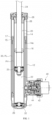
- FIGs. 2A and 2B illustrate a digitally controlled shock absorber 1000 according to an embodiment of the invention, where FIG. 2A is a cross-sectional view from a front of the shock absorber 1000, and FIG. 2B is an elevational view from a side of the shock absorber 1000.
- FIGs. 3A to 3C illustrate the rod guide 100 and the oil seal 136 in the digitally controlled shock absorber 1000 shown in FIGs. 2A and 2B .
- a digitally controlled shock absorber 1000 can include an inner tube 114, a middle tube 116, a base tube 118, an absorber rod 134, a piston valve 135, and a body valve 137.
- the piston valve 135 can be mounted on the absorber rod 134.
- the inner tube 114, middle tube 116, and base tube 118 can have a rod guide 100 and an oil seal 136 mounted at the top and the body valve 137 and a lower cap 139 mounted at the bottom.
- the absorber rod 134 and the piston valve 135 can be placed inside the inner tube 114, the inner tube 114 can be placed inside the middle tube 116, and the middle tube 116 can be placed inside the base tube 118.
- the space within the inner tube 114 may be divided with respect to the piston valve 135 into the rebound chamber 20 above and the compression chamber 50 below.
- the space between the base tube 118 and the middle tube 116 can form a low-pressure chamber 30, and the space between the middle tube 116 and the inner tube 114 can form a high-pressure chamber 10.
- a generator-integrated variable-damping valve assembly can be mounted on the side surface of the base tube 118.
- at least a portion of the base tube 118 can have a flat shape, and the coupling flange 138 of the inner cover 518 of the valve assembly can be coupled to this portion.
- FIGs. 2A and 2B illustrate the shock absorber 1000 mounted with a valve assembly 500 according to the first disclosed embodiment of the invention
- the shock absorber 1000 can be mounted with a valve assembly 500, 800, 900 according to another embodiment of the invention and that a valve assembly according to still another embodiment of the invention can include features that are compatible with a valve assembly 500, 800, 900 according to the first to third disclosed embodiments.
- the descriptions below may use a valve assembly 500 based on the first disclosed embodiment of the invention as an example, the descriptions can also apply to a valve assembly 800, 900 based on another embodiment.
- the fluid of the shock absorber 1000 can enter and exit through an inlet 110 and an outlet 130 formed in one side of the valve assembly 500.
- the valve assembly 500 can be installed such that the inlet 110 is in communication with the high-pressure chamber 10 and the outlet 130 is in communication with the low-pressure chamber 30.
- the valve assembly 500 can adjust the damping force of the shock absorber 1000 by adjusting the resistance to the flow of fluid flowing therein. That is, when the shaft 132 at the top of the absorber rod 134 and the coupling part 150 at the bottom of the lower cap 139 are coupled to the body and the axle of a vehicle, the impact on the vehicle body in relation to the vehicle axle is absorbed by the movement of the absorber rod 134 that moves up and down against the resistance of the fluid.
- the valve assembly 500 adjusts the damping force by adjusting the resistance of the fluid and thus adjusting the resistance applied against the movement of the absorber rod 134.
- a shock absorber 1000 may be structured to allow an easier manufacture and assembly of the inner tube 114, middle tube 116, and base tube 118.
- a protrusion can be formed on the lower cap 139 that protrudes to surround the body valve 137, and one or more curbs can be formed on the protrusion.
- two curbs are formed on the lower cap 139, with the inner tube 114 arranged on one curb and the middle tube 116 arranged on the other curb.
- the base tube 118 is coupled to the outer perimeter of the lower cap 139.
- the protrusion on the lower cap 139 having curbs formed thereon can be configured to seal the bottom of the inner tube 114, seal the bottom of the middle tube 116, and allow fluid to flow only through the body valve 137 as necessary.
- Such a structure can provide the sealing necessary for the high-pressure chamber 10 and the compression chamber 50 while at the same time making it easier to manufacture and assemble the inner tube 114 and the middle tube 116, since the lower ends of the inner tube 114 and the middle tube 116 can maintain a very simple shape, and it is possible to align the inner tube 114 and the middle tube 116 in their correct positions simply by placing the inner tube 114 and middle tube 116 on the curbs of the lower cap 139.
- FIGs. 3A to 3C illustrate the rod guide and the oil seal in the digitally controlled shock absorber shown in FIGs. 2A and 2B , where FIG. 3A is a cross-sectional view of the rod guide 100, FIG. 3B is a bottom view of the rod guide 100, and FIG. 3C is a cross-sectional view of the rod guide 100 coupled with the oil seal 136.
- the rod guide 100 can include an upper support portion 128, which may have an outer diameter corresponding to the inner diameter of the base tube 118; a lower support portion 123, which may extend downward from a lower portion of the rod guide 100 with an outer diameter corresponding to the inner diameter of the inner tube 114, and which may be shaped as a hollow cylinder with a center hole 121 formed in the middle; and a curb portion 126, which may be formed between the upper support portion 128 and the lower support portion 123.
- one or more flow grooves 124 can be formed in the lower support portion 123 and the curb portion 126.
- the inner tube 114 can be coupled to a curb
- the middle tube 116 can be coupled to another curb
- the base tube 118 can be coupled to the upper support portion 128 forming the outer perimeter of the rod guide 100.
- the high-pressure chamber 10 needs to be isolated from the compression chamber 50 formed in the lower portion of the inner tube 114, so that the lower cap 139 may seal the lower end of the middle tube 116
- the high-pressure chamber 10 should be in communication with the rebound chamber 20 formed in the upper portion of the inner tube 114.
- the conventional assembly involved processing an inner hole 14a in the separator tube 16, as illustrated in FIG. 1 .
- the procedure of mounting a guide ring 15 for securing the upper portion of the separator tube 16 to the inner tube 14 and a separate O-ring 17 for sealing the corresponding portion can be omitted, and the procedure of processing an inner hole 14a into the separator tube 16 can likewise be omitted.
- the necessary structure can be completed by simply coupling the upper end of the middle tube 116 in tight contact with the outer perimeter of the curb portion 126 and coupling the upper end of the inner tube 114 in tight contact with the outer perimeter of the lower support portion 123.
- the flow grooves 124 formed in the lower support portion 123 and the curb portion 126 naturally form flow passages between the high-pressure chamber 10 and the rebound chamber 20, so that there is no need for processing an inner hole 14a as in the related art. This can prevent defects that may otherwise easily occur during procedures for processing holes in materials.
- Protrusions 127, 129 can be formed in annular shapes at the top of the upper support portion 128.
- the protrusions 127, 129 can press against the oil seal 136 that is coupled onto the top of the rod guide 100 and increase watertightness at the necessary portions.
- the oil seal 136 can be coupled to an upper portion of the rod guide 100.
- the oil seal 136 can include a ring core 140 that is made from a material having a comparatively high strength, while the remaining portions can be made from a comparatively flexible material to provide a high sealing ability.
- Protrusions 147, 149 can protrude downward at a lower portion of the oil seal 136, and these can press against the protrusions 127, 129 of the rod guide 100 to block any fluid from passing.
- Sealing sleeves 141, 142 can protrude from an upper portion and a lower portion of the oil seal 136.
- the sealing sleeves 141, 142 can press against the absorber rod 134 that passes through the center hole 121 of the rod guide 100 in a manner that permits the movement of the absorber rod 134 but prevents the fluid within the inner tube 114 from leaking out.
- Sealing rings 143, 144 having annular shapes can be added to the sealing sleeves 141, 142, so that the sealing sleeves 141, 142 may more strongly press against the outer perimeter of the absorber rod 134.
- a shock absorber 1000 can be easily assembled by simply coupling the body valve 137 and lower cap 139 and the rod guide 100 and oil seal 136 onto the inner tube 114, middle tube 116, and base tube 118. Since the guide ring 15 and the O-ring 17 required in the relevant art can be omitted, and since there is no need to process an inner hole 14a into the middle tube 116, the manufacture and assembly of the shock absorber 1000 can be performed with simpler procedures.
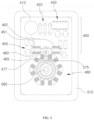
- FIG. 4 is a side view illustrating the other side of a generator-integrated variable-damping valve assembly 500 according to a first disclosed embodiment of the invention, where the outer cover 512 of the housing 510 has been removed.
- the direction in which the inlet 110 is formed in the valve assembly is referred to in the present specification as “one side”, and the opposite direction is referred to as the “other side”.
- the terms “one side” and “other side” can refer to different directions depending on the object being described and the context.
- a control unit 400 and a generator 480 can be housed in the control space 250 (see FIG. 5 ).
- the control unit 400 can be the part that controls the overall operation of the valve assembly 500 and can include a battery 410, a communication unit 420, a circuit part 430, and an actuator 450.
- the battery 410 can be configured to store the electrical power needed for the operation of the control unit 400 and can be charged by the generator 480 described further below.
- the other components of the control unit 400 can be operated by the power stored in the battery 410.
- the communication unit 420 can correspond to the part that allows the control unit 400 to communicate with an entity outside the valve assembly 500.
- the communication unit 420 can communicate with an outside entity wirelessly, for example via Bluetooth, Wi-fi, etc.
- the control unit 400 can communicate, for example, with the central processing unit of the vehicle on which the shock absorber 1000 is installed, a navigation device, sensors installed on various locations of the vehicle, the user's smart phone, an outside device installed on particular locations on the road (for instance, a peripheral device on a traffic light, etc.), and the like.
- the circuit part 430 can correspond to the main part of the control unit 400 and can perform computations associated with the operation of the valve assembly 500. For example, after receiving information through the communication unit 420, the circuit part 430 can determine the damping force required of the shock absorber 1000 and can control the actuator 450 such that the required damping force is provided.
- the actuator 450 may be the part that controls the control valve 570 described further below.
- the valve assembly 500 can adjust the resistance of the fluid applied on the absorber rod 134 of the shock absorber 1000 by adjusting the pressure in the back-pressure chamber 300, and the control valve 570 can serve to adjust the pressure in the back-pressure chamber 300.
- the actuator 450 can manipulate the control valve 570, thereby changing the damping force of the shock absorber 1000. A more detailed description of the operations of the actuator 450 and the control valve 570 is provided further below.
- the generator 480 can provide power to the control unit 400 and, more specifically, can charge the battery 410 of the control unit 400.
- the other end of the shaft 680 which is coupled to the impeller 600 described further below, can be coupled to the generator 480.
- the rotation of the shaft 680 coupled to the impeller 600 can operate the generator 480 to generate electricity.
- Reference to the shaft 680 being coupled to the generator 480 would be readily understood by the person skilled in the art as meaning that the shaft 680 is coupled to the rotor part of the generator and that the rotation of the shaft 680 causes the rotor of the generator 480 to rotate and thus produce electricity by way of the interaction with the stator of the generator 480.
- FIG. 4 illustrates a generator 480 that produces electricity based on a rotating mechanism, it is possible in certain other embodiments for the generator 480 to be implemented in the form of a piezoelectric stack 485 that produces electricity based on a pressing mechanism.
- FIG. 5 is a cross-sectional view illustrating a generator-integrated variable-damping valve assembly 500 according to the first disclosed embodiment of the invention.
- a valve assembly 500 can further include a housing 510, a main valve body 530, a protective disk 540, a main disk spring 550, a back-pressure chamber body 560, a control valve 570, a connector body 580, a guide 590, an impeller 600, a passage member 610, and a shaft 680, in addition to the components described above with reference to FIG. 4 .
- Th housing 510 can form the exterior of the valve assembly 500 and can provide a space in which to install the other components.
- the housing 510 can be provided with a partition wall 520 in which a through-hole 252 is formed, with a valve space formed on one side of the partition wall 520 and the control space 250 formed on the other side.
- the valve space is not assigned a separate reference number in the drawings so as to avoid unnecessary confusion, but in the embodiment shown in FIG. 5 , the space between the inner cover 518 and the partition wall 520 can correspond to the valve space.
- An opening can be formed in one side of the housing 510, and the valve space can thus be open in one side through the opening.
- the opening of the housing 510 can be used to form the inlet 110 and outlet 130 of the valve assembly 500.
- the main valve body 530 can be arranged within the valve space but at a distance from the partition wall 520 of the housing 510 so as to define a back-pressure chamber 300 on the other side of the main valve body 530.
- An inlet channel 260, an auxiliary channel, and an outlet channel 360 that connect the one side with the other side of the valve space can be formed in the main valve body 530.
- a center hole can be formed in the center of the main valve body 530 through which the shaft 680 may pass.
- the gap between the inner perimeter of the center hole and the outer perimeter of the shaft 680 can serve as an auxiliary channel.
- a passage member 610 is mounted in the center hole of the main valve body 530, the center hole 284 of the passage member 610 has an inner diameter that is greater than the outer diameter of the shaft 680, and the gap between the inner perimeter of the center hole 284 of the passage member 610 and the outer perimeter of the shaft 680 serves as an auxiliary channel.
- the protective disk 540 can be coupled to the other side of the main valve body 530 and serve to reinforce the main valve body 530. To this end, the protective disk 540 can be formed from a material having a greater strength than that of the main valve body 530. In certain embodiments, the protective disk 540 can be omitted.
- the main disk spring 550 can be configured such that at least a portion of the main disk spring 550 is elastically deformable.
- the main disk spring 550 can be arranged on the other side of the protective disk 540 or, in cases where the protective disk 540 is omitted, on the other side of the main valve body 530 so as to cover the inlet channel 260 of the main valve body 530. Every time the shock absorber 1000 absorbs an impact, the fluid entering the valve assembly 500 can open the main disk spring 550 and pass through.
- the main disk spring 550 is positioned at the other side of the main valve body 530 and faces the back-pressure chamber 300, the force required by the fluid for opening the main disk spring 550 that is keeping the inlet channel 260 closed may vary depending on the internal pressure of the back-pressure chamber 300.
- the valve assembly 500 can thus adjust the damping force of the shock absorber 1000 by adjusting the pressure of the back-pressure chamber 300.
- the back-pressure chamber body 560 can be arranged between the main valve body 530 and the partition wall 520, and a bypass channel 350 that is in communication with the back-pressure chamber 300 can be formed in the back-pressure chamber body 560.
- a control valve 570 can be mounted in the bypass channel 350, and the control valve 570 can control the degree of opening of the bypass channel 350. A more detailed description of the operation of the control valve 570 is provided further below.
- the connector body 580 can be coupled to one side of the main valve body 530.
- the connector body 580 can form a holding space 220 therein, and the holding space 220 can be open at one side.
- channels that are isolated from each other can be formed on the inner side and the outer side of the connector body 580, and these channels can be used as the inlet 110 and the outlet 130 for the valve assembly 500.
- FIG. 1 In the example illustrated in FIG. 1
- the connector body 580 includes a connector tube 585 that has a relatively smaller outer diameter; the connector tube 585 is inserted through the center hole 380 of the inner cover 518; the connector channel 212 on the inner side of the connector tube 585 forms the inlet 110; and the gap between the outer perimeter of the connector tube 585 and the inner perimeter of the center hole 380 in the inner cover 518 forms the outlet 130.
- the impeller 600 can be arranged on one side of the main valve body 530 and can be configured to be rotated by the fluid passing through.
- the impeller 600 can be coupled to the shaft 680, and as the impeller 600 is rotated, the shaft 680 can be rotated together as well. As described above, the rotation of the shaft 680 can drive the generator 480, which is arranged in the control space 250, to produce electricity.
- the passage member 610 can be mounted in the center hole of the main valve body 530 and can itself have a hollow shape with a center hole 284.
- the passage member 610 can be mounted in the center hole of the main valve body 530 to couple the main valve body 530, the protective disk 540, and the main disk spring 550 to one another from the middle.
- the center hole 284 of the passage member 610 can have an inner diameter that is greater than the outer diameter of the shaft 680, so that the center hole 284 may serve as an auxiliary channel for the main valve body 530. More specifically, a multiple number of flow grooves 282 can be formed in one end of the passage member 610 to connect the holding space 220 with the auxiliary channel 284.
- This structure prevents the auxiliary channel 284 from being blocked, even if a protrusion 606 (see FIG. 10C ) of the impeller 600 contacts the passage member 610.
- the passage member 610 can be implemented in a form that is integrated as a single body with at least one of the main valve body 530, the protective disk 540, and the main disk spring 550.
- the shaft 680 can be coupled to the impeller 600 to rotate together when the impeller 600 is rotated and can transmit the rotational force to the generator 480 to aid the generator 480 in producing electricity.
- the shaft 680 may be coupled to the impeller 600 within the valve space and coupled to the generator 480 within the control space 250.
- the shaft 680 passes through the center hole 284 of the passage member 610, the through-hole of the back-pressure chamber body 560, and the through-hole 252 of the partition wall 520.
- the center hole 284 of the passage member 610 may be used as an auxiliary channel and thus may not require sealing, but sealing may be needed for the through-hole of the back-pressure chamber body 560 and the through-hole 252 of the partition wall 520.
- sealing members such as O-rings, etc., can be added to the portion where the shaft 680 passes through the back-pressure chamber body 560 and the contact portion between the partition wall 520 and the back-pressure chamber body 560, and a portion of the back-pressure chamber body 560 can be inserted in the through-hole 252 of the partition wall 520.
- a bearing 562 for rotatably supporting the shaft 680 can be mounted in the through-hole of the back-pressure chamber body 560, and a sealing member such as an O-ring, etc., can be installed on the other side of the bearing 562.
- a bearing 522 for rotatably supporting the shaft 680 can also be mounted in the through-hole 252 in the partition wall 520 of the housing 510.
- a bearing 592 can be provided on the guide 590 at one end of the shaft 680 to rotatably support the shaft 680. In cases where the guide 590 is omitted, the shaft 680 can be supported on the connector body 580 by way of a bearing or can be configured to rotate freely without being supported by another component.
- FIGs. 6A and 6B are cross-sectional views illustrating the flow paths of the fluid when the control valve 570 in FIG. 5 is closed and open
- FIGs. 7A and 7B illustrate the control valve 570 in the generator-integrated variable-damping valve assembly 500 shown in FIG. 5
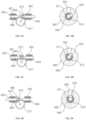
- FIGs. 8A to 8F illustrate the operation of the control valve 570 shown in FIGs. 7A and 7B .
- FIG. 6A illustrates the flow of fluid when the control valve 570 is closed in the valve assembly 500
- FIG. 6B illustrates the flow of fluid when the control valve 570 is open in the valve assembly 500.
- the shock absorber 1000 is operated, and the fluid in the high-pressure chamber 10 moves through the inlet 110 into the valve assembly 500.
- the fluid can pass through the guide 590 and the impeller 600 arranged in the holding space 220 to rotate the shaft 680, and this can drive the generator 480 to charge the battery 410.
- the fluid that has passed the impeller 600 must pass through the inlet channel 260 formed in the main valve body 530 and, to do so, must have a pressure sufficient to open the main valve body 530.
- the fluid can pass only if the fluid enters with a pressure greater than the pressure of the back-pressure chamber 300 pushing the main disk spring 550 against the main valve body 530.
- the auxiliary channel 284 of the main valve body 530 also connects to the holding space 220, the fluid does not enter the auxiliary channel 284, because the bypass channel 350 is completely closed by the control valve 570 and thus forms a cul-de-sac with no exit.
- the control valve 570 is in a completely closed state, a high pressure is created in the back-pressure chamber 300, and the valve assembly 500 provides a strong flow resistance. This consequently makes it harder for the absorber rod 134 to move down in the shock absorber 1000 and allows the shock absorber 1000 to provide a high damping force.
- the fluid that opens the main disk spring 550 to flow into the back-pressure chamber 300 can immediately be discharged back through the outlet channel 360.
- the fluid that passes through the outlet channel 360 can flow to the outlet 130 through the gap 370 between the outer perimeter of the connector body 580 and the inner perimeter of the housing 510 as illustrated in FIG. 5 and FIG. 6A , and the fluid that exits through the outlet 130 can return to the low-pressure chamber 30 of the shock absorber 1000.
- the control valve 570 has opened the bypass channel 350, the fluid that has entered the valve assembly 500 through the inlet 110 can pass through the guide 590 and the impeller 600 arranged in the holding space 220 to rotate the shaft 680, and the fluid that has passed the impeller 600 can move not only through the inlet channel 260 formed in the main valve body 530 but also through the auxiliary channel 284. That is, unlike the configuration in FIG. 6A , the control valve 570 has the bypass channel 350 at least partially open, so that it is possible for the fluid within the back-pressure chamber 300 to be discharged through the bypass channel 350. Therefore, a flow path may be formed, and the fluid within the back-pressure chamber 300 may not remain stagnant.
- the fluid entering through the auxiliary channel 284 can pass through the back-pressure chamber 300 and the bypass channel 350 and then flow through the outlet channel 360 to the outlet 130.
- the pressure within the back-pressure chamber 300 can be lowered depending on the degree of opening of the control valve 570, and the fluid flowing through the inlet channel 260 of the main valve body 530 can also open the main disk spring 550 more easily compared to the case of the control valve 570 being completely blocked.
- the control valve 570 while the control valve 570 is in an open state, the pressure of the back-pressure chamber 300 can be reduced according to the extent to which the control valve 570 is open, and the valve assembly 500 can provide a relatively weak flow resistance. Therefore, the absorber rod 134 in the shock absorber 1000 can move down more easily, and the shock absorber 1000 can provide a relatively lower damping force.
- FIGs. 7A and 7B illustrate the control valve 570 in the generator-integrated variable-damping valve assembly 500 shown in FIG. 5 , where FIG. 7A illustrates the front of the control valve 570, and FIG. 7B illustrates the other side of the control valve 570.
- a control valve 570 can include a valve rod 571, a lever 575, and a rotary plate 577.
- the control valve 570 can adjust the degree to which the bypass channel 350 is opened, as the lever 575 is manipulated by the actuator 450.
- the valve rod 571 can be mounted on the back-pressure chamber body 560 in a position facing the bypass channel 350.
- an insertion channel 340 is formed in the back-pressure chamber body 560 in addition to the bypass channel 350 such that the insertion channel 340 is in communication with the bypass channel 350, and the valve rod 571 is inserted in the insertion channel 340.
- the valve rod 571 can completely close the bypass channel 350 or adjust the degree of opening of the bypass channel 350.
- the valve rod 571 can have a cylindrical shape that extends along a direction parallel to the extending direction of the shaft 680.
- a flange 573 can be provided on the valve rod 571, and the flange 573 can be inserted into a groove formed in the housing 510 with an O-ring, etc., placed in-between.
- the flange 573 can secure the control valve 570 at its correct position while permitting rotation and can help in preventing the fluid from leaking at a position where such leakage is undesired.
- a valve channel 310 and a valve opening 320 can be formed in the valve rod 571.
- the valve channel 310 can be formed along the lengthwise direction of the valve rod 571 and can be in communication with the back-pressure chamber 300 at one side, while the valve opening 320 can be formed such that the valve channel 310 opens into the outer perimeter of the valve rod 571 at a particular location.
- a rotary plate 577 having a particular diameter can be provided on the other side of the valve rod 571, and the lever 575 can be formed on the rotary plate 577.
- a magnet 465 can be coupled to the lever 575 for interaction with the actuator 450.
- the rotary plate 577 allows the lever 575 to be placed at a position separated from the rotational axis of the valve rod 571.
- the size of the rotary plate 577 and the position of the lever 575 can be configured differently depending on the degree by which the actuator 450 moves the lever 575 and on the diameter of the valve rod 571.
- FIGs. 8A to 8F illustrate how the actuator 450 may control the control valve 570 shown in FIGs. 7A and 7B , where FIGs. 8A, 8C, and 8E depict the actuator 450 and the lever 575 together, while FIGs. 8B, 8D, and 8F depict the relative position of the valve rod 571 with respect to the bypass channel 350.
- the actuator 450 can include a first coil 451, a second coil 452, a slide member 460, and a magnet 465.
- the slide member 460 can be an elongated member that is arranged to pass through the centers of the first coil 451 and second coil 452 and can be configured to move along the lengthwise direction while being electrically insulated from the first coil 451 and second coil 452 by insulators 453, 454.
- the first coil 451 can be a coil of conductive material that is wound around one side of the slide member 460.
- the first coil 451 may be configured to receive an electrical current, and the current applied on the first coil 451 is referred to herein as a first current.
- the second coil 452 can be a coil of conductive material that is wound around the other side of the slide member 460.
- the second coil 452 may also be configured to receive an electrical current, and the current applied on the second coil 452 is referred to herein as a second current.
- the magnet 465 can be coupled to the slide member 460 at a position between the first coil 451 and the second coil 452.
- the magnet 465 can be coupled to the slide member 460 such that the N pole faces one of the first coil 451 and second coil 452 and the S pole faces the other of the first coil 451 and second coil 452.
- the lever 575 of the control valve 570 can be coupled to the magnet 465 but coupled in a manner that allows a slight amount of movement along a direction that intersects the lengthwise direction of the slide member 460, so that the linear movement of the slide member 460 can be converted into a rotational movement of the lever 575 and rotary plate 577.
- the magnet 465 coupled to the lever 575 of the control valve 570 can be arranged between the first coil 451 and the second coil 452 and can manipulate the lever 575 by moving between the first coil 451 and second coil 452 according to the first current and second current applied on the first coil 451 and second coil 452.
- the actuator 450 applies a first current and a second current to the first coil 451 and second coil 452 in accordance with the control of the control unit 400, the magnet 465 can be moved to a desired position by the magnetic fields formed around the first coil 451 and second coil 452, and as the direction of the valve opening 320 formed in the valve rod 571 is changed according to the position of the magnet 465 and the lever 575 to which it is coupled, the degree of opening by the control valve 570 can be changed.
- FIGs. 8A to 8F illustrate an example in which the actuator 450 manipulates the lever 575 by applying a current of 0 to 2 amperes to each of the first coil 451 and the second coil 452.
- the actuator 450 has applied a current of 2 amperes to the first coil 451 but has not applied a current to the second coil 452 (i.e., applied a current of 2 amperes as the first current and a current of 0 amperes as the second current).
- the magnet 465 has moved the lever 575 to a first position, which is the position closest to the second coil 452 side, and the valve rod 571 has rotated about its rotational axis within the insertion channel 340 to a corresponding angle.
- the valve opening 320 formed in the valve rod 571 is not aligned with the bypass channel 350, with not even a little overlap, and thus is blocked by the inner perimeter of the insertion channel 340, as illustrated in FIG. 8B .
- This state corresponds to the control valve 570 being completely closed, and since the valve channel 310 is not in communication with the bypass channel 350, the back-pressure chamber 300 can maintain a high pressure.
- the actuator 450 has applied a current of 2 amperes to the first coil 451 and also a current of 2 amperes to the second coil 452 (i.e., applied a current of 2 amperes as the first current and a current of 2 amperes as the second current).
- the lever 575 coupled to the magnet 465 has moved to a middle position between the first coil 451 and the second coil 452, and the valve rod 571 has rotated about its rotational axis within the insertion channel 340 to a corresponding angle.
- valve opening 320 formed in the valve rod 571 partially overlaps the bypass channel 350, so that about a half of the area of the valve opening 320 is in communication with the bypass channel 350, as illustrated in FIG. 8D .
- This state corresponds to the control valve 570 being partially open, and since fluid can pass through the valve channel 310 and the bypass channel 350, the back-pressure chamber 300 can maintain a relatively lower pressure.
- the actuator 450 can obtain the same results by applying currents of 1 ampere or of another value equally to the first and second coils 451, 452.
- the actuator 450 has not applied a current to the first coil 451 but has applied a current of 2 amperes to the second coil 452 (i.e., applied a current of 0 amperes as the first current and a current of 2 amperes as the second current).
- the magnet 465 has moved the lever 575 to a second position, which is the position closest to the first coil 451 side, and the valve rod 571 has rotated about its rotational axis within the insertion channel 340 to a corresponding angle.
- the valve opening 320 formed in the valve rod 571 is fully aligned with the bypass channel 350, as illustrated in FIG. 8F , and the area of overlap between the valve opening 320 and the bypass channel 350 is the greatest.
- This state corresponds to the control valve 570 being completely open, and the back-pressure chamber 300 can maintain the lowest pressure possible in the shock absorber 1000.
- the actuator 450 does not necessarily have to apply currents of 0 or 2 amperes to the first and second coils 451, 452 and can apply currents of any value between 0 and 2 amperes, in response to which the first coil 451 and the second coil 452 can move the magnet 465 and the slide member 460 correspondingly. Since the degree of opening of the control valve 570 may be adjusted according to the first current and second current, a type of continuously variable valve can be obtained.
- the control valve 570 can maintain the corresponding position even if there is no separate force applied.
- the control valve 570 can maintain the corresponding position even if there is no separate force applied.
- the control valve 570 is in a partially open state, the pressure of the fluid may partially be applied on the valve rod 571, but there would not be a force sufficient to rotate the valve rod 571.
- the actuator 450 uses power only momentarily when manipulating the control valve 570 and at normal times does not consume power. This means that the generator 480 for producing the electricity that drives the control unit 400 including the actuator 450, the battery for storing the produced electricity, and overall valve assembly 500 itself can be implemented in small sizes.
- FIGs. 9A and 9B illustrate the guide in the generator-integrated variable-damping valve assembly 500 shown in FIG. 5 , where FIG. 9A is a cross-sectional view from the front of the guide 590, and FIG. 9B is an elevational view from one side of the guide 590.
- the guide 590 can be arranged in the holding space 220 on the inner side of the connector body 580 and can cause the fluid that has entered through the inlet 110 to form a helical flow before passing the impeller 600.
- the circular plate 595 can be formed in the shape of a circular plate having a size corresponding to the inner diameter of the connector body 580, and a multiple number of guide holes 230 can be formed that are arranged in a circular shape.
- the guide holes 230 can have a semi-elliptical shape, for example, and each guide hole 230 can be provided with a guide vane 598 that is open towards one direction with respect to a circumferential direction.
- the guide vanes 598 can protrude and open at the linear portion of the semi-elliptically shaped guide hole 230, with the degree of protrusion reduced at the arc portion, so that the fluid passing through the guide 590 may enter at the linear portions of the guide holes 230 and flow in a direction towards the arc portions. That is, a fluid entering the guide 590 in FIG. 9B head on can form a helical flow rotating in a counter-clockwise direction due to the configuration of the guide holes 230 and guide vanes 598.
- the guide holes 230 and the guide vanes 598 can be formed in positions corresponding to the impeller holes 240 (see FIG. 11A ) of the impeller 600, and the impeller holes 240 can be formed in positions corresponding to the inlet channel 260 of the main valve body 530.
- the boss 596 can be implemented in the form of a cylindrical tube that protrudes towards one side from the center on one side of the circular plate 595.
- a bearing 592 for supporting one end of the shaft 680 can be mounted in the through-hole 232 on the inner side of the circular plate 595. Since the guide 590 is not a rotating member, unlike the impeller 600, the guide 590 can support the end of the shaft 680 in a stable manner.
- the outer rim 597 can be implemented in the form of a rim that protrudes towards the other side from the outer perimeter on the other side of the circular plate 595.
- the outer rim 597 can protrude by a length that is greater than the thickness of the impeller 600 so as to provide a space for the impeller 600 between the circular plate 595 and the main valve body 530.
- the outer perimeter of the outer rim 597 can press against the inner perimeter of the connector body 580, so that the fluid passing through the guide 590 may mainly flow through the guide holes 230 in the circular plate 595.
- a sealing member such as an O-ring, etc., can be provided at each portion where the outer rim 597 contacts the main valve body 530 and/or connector body 580, as illustrated in FIG. 5 .
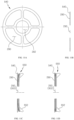
- FIGs. 10A to 10C illustrate the impeller 600 in the generator-integrated variable-damping valve assembly 500 shown in FIG. 5 , where FIG. 10A is an elevational view from one side of the impeller 600, FIG. 10B is an elevational view from below the impeller 600, and FIG. 10C is a cross-sectional view from the front of the impeller 600.
- the impeller 600 can be rotated by the passing fluid and can rotate the shaft 680 so as to drive the generator 480.
- the impeller 600 can mainly include a circular plate 605 and a multiple number of impeller vanes 608 formed in its perimeter portion.
- the circular plate 605 of the impeller 600 can serve to secure the impeller vanes 608 at their required positions.
- a protrusion 606 can protrude towards the other side from the center on the other side of the circular plate 605, where the protrusion 606 can contact the passage member 610 and/or the main valve body 530 to prevent the impeller 600 from departing from its correct position.
- the protrusion 606 can maintain a slight gap between the circular plate 605 and the passage member 610 and/or main valve body 530, and a portion of the fluid can enter through this gap into the auxiliary channel 284 as necessary.
- a through-hole 242 can be formed in the center of the circular plate 605 for coupling with the shaft 680.
- the shaft 680 inserted through the through-hole 242 can be firmly secured such as to be capable of completely transmitting the rotational force of the impeller 600. It should be appreciated that other methods besides using a through-hole 242 can be used for firmly securing the impeller 600 to the shaft 680.
- the multiple impeller vanes 608 can be formed in inclined orientations in a perimeter portion of the circular plate 605, and impeller holes 240 can be formed in-between adjacent impeller vanes 608. Fluid passing through the impeller holes 240 may push the impeller vanes 608, causing the impeller 600 and the shaft 680 to rotate.
- the impeller vanes 608 and the impeller holes 240 can be formed in positions corresponding to the positions where the guide holes 230 are formed in the guide 590. Thus, the fluid that has passed through the guide holes 230 can immediately pass through the impeller holes 240.
- the inclined direction and angle of the impeller vanes 608 can be designed in consideration of the shapes of the guide holes 230 and guide vanes 598.
- the impeller vanes 608 and impeller holes 240 can also be formed in positions corresponding to the inlet channel 260 of the main valve body 530. Thus, the fluid that has passed through the impeller holes 240 can mostly pass through the inlet channel 260.
- the length by which the outer rim 597 of the guide 590 protrudes towards the other side can be greater than the overall thickness of the protrusion 606 and impeller vanes 608 of the impeller 600, so that the impeller 600 can be positioned between the circular plate 595 of the guide 590 and the main valve body 530.
- the impeller 600 can be formed such that portions other than the protrusion 606 do not contact the main valve body 530. This can minimize friction, which inhibits the rotation of the impeller 600, while at the same time ensuring that the flow paths between the impeller holes 240 and the auxiliary channel 284 are not blocked.
- FIGs. 11A to 11D illustrate the protective disk 540 and the main disk spring 550 in the generator-integrated variable-damping valve assembly 500 shown in FIG. 5 , where FIG. 11A is an elevational view from one side of the protective disk 540, and FIG. 11B is a cross-sectional view from the front of the protective disk 540.
- FIG. 11C is a cross-sectional view depicting the protective disk 540 and the main disk spring 550 together
- FIG. 11D is a cross-sectional view depicting the main disk spring 550 in an open state.
- the fluid can open the main disk spring 550 and pass through the inlet channel 260 of the main valve body 530.
- the main valve body 530 is fabricated from a material such as plastic, etc., for convenient manufacture and assembly, the other side (seat surface) of the main valve body 530 can become worn away due to the great forces involved in the repeated opening and closing of the main disk spring 550. This phenomenon can make it difficult for the main disk spring 550 to seal the inlet channel 260 in a watertight manner and may therefore lower the performance of the valve assembly 500 and the shock absorber 1000 itself.
- a valve assembly 500 can further include a protective disk 540 between the main valve body 530 and the main disk spring 550.
- the protective disk 540 can be formed from a material having a higher strength than that of the main valve body 530 and can be coupled to the other side (seat surface) of the main valve body 530. Even though the protective disk 540 is made of a material having high strength, its thickness is not great, so that coupling the protective disk 540 to the passage member 610, etc., is not made much more difficult.
- the protective disk 540 can be shaped as a circular plate having a small thickness, with a center hole 292 formed in the middle and a multiple number of windows 290 formed around the center hole 292.
- the center hole 292 of the protective disk 540 can be formed in the same size and in a corresponding position as the center hole of the main valve body 530, and the windows 290 can be formed in positions that allow communication with the inlet channel 260 of the main valve body 530.
- the main disk spring 550 can be coupled to the other side of the protective disk 540 and can be coupled such that the center hole 302 of the main disk spring 550 is aligned with the center hole 292 of the protective disk 540.
- the main disk spring 550 can cover the inlet channel 260 by covering the windows 290 of the protective disk 540.
- the protective disk 540 and the main disk spring 550 can be coupled to each other by the passage member 610 that is inserted through their center holes 292, 302. As such, when the main disk spring 550 is opened by the fluid, the perimeter portion of the main disk spring 550 can be lifted, while the middle portion of the main disk spring 550 can remain fixed.
- the protective disk 540 can remain coupled to the main valve body 530 to protect the surface on the other side of the main valve body 530 from wear.
- the main disk spring 550 can be provided with a sealing rim 552 on the other side.
- the sealing rim 552 can protrude towards the back-pressure chamber body 560 and have an outer diameter that increases towards the other side so as to always tightly press against the inner perimeter of the back-pressure chamber body 560. Therefore, even if the main disk spring 550 that kept the inlet channel 260 closed is lifted by the inflowing fluid, the sealing rim 552 of the main disk spring 550 can prevent the back-pressure chamber 300 from communicating with the inlet channel 260 and/or outlet channel 360 and can thus prevent the pressure of the back-pressure chamber 300 from being dropped unintentionally due to a loss of fluid from the back-pressure chamber 300.
- the sealing rim 552 of the main disk spring 550 or the main disk spring 550 as a whole can be formed from a flexible material so as to provide a high sealing ability.
- the entire main disk spring 550 can be formed by molding using a material such as rubber, etc.
- the auxiliary channel is formed in the center of the main valve body 530, the outlet channel 360 is formed at the perimeter portion, and the inlet channel 260 is formed in-between, with the main disk spring 550 covering the inlet channel 260 of the main valve body 530.
- fluid that has passed through the inlet 110 rotates the impeller 600 before entering the inlet channel 260.
- the invention is not limited thus, and the positions of the inlet channel 260, auxiliary channel, and outlet channel 360 can be configured differently in various embodiments.
- the fluid does not necessarily have to rotate the impeller 600 before entering the back-pressure chamber 300, and in certain embodiments, the fluid can rotate the impeller 600 before exiting through the outlet 130 (for instance, the space outside the connector tube 585 can serve as the inlet, and the connector channel 212 on the inner side of the connector tube 585 can serve as the outlet).
- the compositions of the main valve body 530, protective disk 540, and main disk spring 550 may be modified for this purpose.
- a generator-integrated variable-damping valve assembly 800 based on the second disclosed embodiment of the invention can have many features in common with a valve assembly 500 based on the first disclosed embodiment described above, and the descriptions below will focus more on the differences of the vale assembly 800 based on the second disclosed embodiment.
- Features described with respect to the first disclosed embodiment can be applied to the second disclosed embodiment, and features described with respect to the second disclosed embodiment can likewise be applied to the first disclosed embodiment.
- Certain reference numerals mentioned in the description of the second disclosed embodiment are intended to refer to corresponding components of the components to which the numerals are assigned in the first disclosed embodiment.
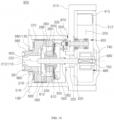
- FIG. 12 is a cross-sectional view illustrating a generator-integrated variable-damping valve assembly 800 according to a second disclosed embodiment of the invention
- FIGs. 13A and 13B illustrate the connector body 780 in the generator-integrated variable-damping valve assembly 800 shown in FIG. 12 .
- a valve assembly 800 can mainly include a control unit 400, a piezoelectric stack 485, a housing 510, a main valve body 530, a protective disk 540, a main disk spring 550, a back-pressure chamber body 560, a control valve 570, a passage member 610, a shaft 680, a piston 700, and a connector body 780.
- valve assembly 500 based on the first disclosed embodiment described above uses a combination of an impeller 600 and a generator 480
- a valve assembly 800 based on the second disclosed embodiment of the invention can use a combination of a piston 700 and a piezoelectric stack 485.
- the piezoelectric stack 485 can provide electrical power to the control unit 400, similarly to the generator 480 of the first disclosed embodiment described above, and more specifically can charge the battery 410 of the control unit 400.
- the piezoelectric stack 485 can include one or more piezoelectric element and can produce electricity from the pushing force of the shaft 680 by using the property of the piezoelectric element of generating electricity when a physical deformation is applied.
- the piezoelectric stack 485 can be mounted on a pressure part 710, and the pressure part 710 can be configured to press the piezoelectric stack 485 when the shaft 680 is moved towards the other side. When the shaft 680 applies pressure on the pressure part 710, the piezoelectric stack 485 can generate an electric current, which can be provided to the battery 410 through wires 487.
- a piston 700 can be used in the present embodiment instead of the impeller 600 of the previously described embodiment, and there may be slight differences in the shaft 680 and the connector body 780. Also, since the piston 700 does not require a helical flow in the inflowing fluid, the guide 590 can be omitted.
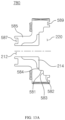
- the connector body 780 can be coupled to one side of the main valve body 530, and the connector tube 585 can be positioned at the opening of the housing 510 to partition the opening into an inlet 110 and an outlet 130, where the holding space 220 defined on the inner side of the connector body 780 can be divided with respect to a first curb 583 into a first diameter portion 581 having a first inner diameter and a second diameter portion 582 having a second inner diameter that is greater than the first inner diameter.
- a second curb 584 can also be formed on the connector body 780, between the connector channel 212, which is located on the inner side of the connector tube 585, and the holding space 220.
- the guide 590 may be omitted in this embodiment, and since the bearing 592 for supporting one end of the shaft 680 cannot be supported on the guide 590, the bearing 592 can be supported by the connector channel 212 of the connector body 780.
- one or more flow grooves 214 can be formed in the connector tube 585 and second curb 584 of the connector body 780.
- the flow grooves 214 can have greater depths towards the holding space and thus be deeper at the other side than at the one side.
- the bearing 592 can be omitted, and the one end of the shaft 680 can either remain unsupported or can be supported by another means. In such cases, the connector channel 212 itself can be implemented in a form that has the inner diameter increasing towards the other side.
- An annular groove 587 can be formed in one side of the connector tube 585, where a sealing member such as an O-ring, etc., can be inserted for sealing the contact portion between the connector body 780 and the middle tube 116 of the shock absorber 1000.
- an annular groove 589 can also be formed in the other side of the connector body 780, where a sealing member such as an O-ring, etc., can be inserted for sealing the contact portion between the connector body 780 and the main valve body 530.
- the piston 700 can be positioned within the holding space 220 while coupled to the shaft 680.
- the piston 700 can have an outer diameter that is smaller than the inner diameter of the second diameter portion 582 of the connector body 780 (i.e., the second inner diameter) and can be arranged in a position adjacent to the first curb 583.
- the piston 700 has an outer diameter corresponding to the inner diameter of the first diameter portion 581 of the connector body 780 (i.e., the first inner diameter) and is arranged on the inner side of the first diameter portion 581.
- the piston 700 can be configured to be pushed by the flow when the fluid enters and thus be moved towards the other side.
- the shaft 680 can include an elastic member 730 arranged on one side of the piston 700.
- the elastic member 730 can support the piston 700 such that the piston 700 does not contact the second curb 584.
- a return disk spring 720 can be provided on the other end of the shaft 680.
- the return disk spring 720 can have a portion thereof coupled to the shaft 680 and/or pressure part 710 and another portion thereof coupled to the housing 510 or another component connected to the housing 510.
- the return disk spring 720 can undergo a slight elastic deformation and absorb a small amount of the applied force.
- the return disk spring 720 can push the shaft 680 back to the one side, so that the piston 700 may return to its original position on the inner side of the first diameter portion 581.
- a stopper member 790 can further be provided on the other side of the pressure part 710. In cases where the fluid enters in a very high speed and thus applies a large pressure on the piston 700, there is a risk of such pressure damaging the piston 700 and/or piezoelectric stack 485. Thus, if the pressure of the fluid entering through the inlet 110 exceeds a predetermined threshold, the return disk spring 720 can be deformed such that the pressure part 710 and/or the shaft 680 contacts the stopper member 790, in response to which the stopper member 790 can apply a resisting force on the shaft 680 to offset the pressure of the fluid.
- the stopper member 790 can be formed from a material capable of elastic deformation and can also be formed from a material having a high strength. The stopper member 790 does not necessarily have to be positioned within the control space 250. The stopper member 790 can, for example, be arranged between the piston 700 and the main valve body 530 to apply a resisting force on the piston 700.
- a generator-integrated variable-damping valve assembly 900 based on the third disclosed embodiment of the invention can have many features in common with a valve assembly 500, 800 based on the first and second disclosed embodiments described above, and the descriptions below will focus more on the differences of the vale assembly 900 based on the third disclosed embodiment.
- Features described with respect to the first and second disclosed embodiments can be applied to the third disclosed embodiment, and features described with respect to the third disclosed embodiment can likewise be applied to the first and second disclosed embodiments.
- Certain reference numerals mentioned in the description of the third disclosed embodiment are intended to refer to corresponding components of the components to which the numerals are assigned in the first and/or second disclosed embodiments.
- a connector body 880 based on this embodiment can be coupled to one side of the main valve body 530 and can have the connector tube 585 positioned at the opening of the housing 510 to partition the opening into an inlet 110 and an outlet 130, where the holding space 220 defined on the inner side of the connector body 880 can be divided with respect to a curb 583 into a first diameter portion 581 having a first inner diameter and a second diameter portion 582 having a second inner diameter that is greater than the first inner diameter.
- the elastic member 740 can be deformed and cause the impeller 600, shaft 680, and generator 480 to move a particular distance towards the other side.
- the impeller 600 and the shaft 680 can move towards the other side, and the generator 480 can remain at its position.
- the impeller 600 When a pressure exceeding the threshold is applied on the impeller 600, the impeller 600 can be moved by the pressure of the fluid towards the other side, and the impeller 600 can be separated from the curb 583 of the connector body 880.
- the fluid arriving at the impeller 600 in addition to passing through the impeller hole 240, can partially flow through the gap between the outer perimeter of the impeller 600 and the curb 583.
- the fluid may not rotate the impeller 600 at an excessively high speed.
- the elastic member 740 can return the impeller 600, shaft 680, and generator 480 (or the impeller 600 and shaft 680) to their original positions.
- a valve assembly 900 based on the present embodiment can include a control valve 870 having a modified structure.
- the following provides a more detailed description on the operation of the control valve 870, with reference to FIG. 14 and FIGs. 15A to 15C.
- FIGs. 15A to 15C illustrate how the actuator 450 controls the control valve 870 shown in FIG. 14 .
- an actuator 450 can include a first coil 451, a second coil 452, a slide member, and a magnet 465, where the slide member can be integrated with the valve rod 572 of the control valve 870. That is, the valve rod 572 may also serve as the slide member. This can be regarded as the slide member being formed by one portion of a member and the valve rod 572 being formed by another portion of the same member.
- the magnet 465 can be arranged between the first coil 451 and the second coil 452. Under the control of the control unit 400, the actuator 450 can apply a first current and a second current to the first coil 451 and the second coil 452, to thereby control the position of the magnet 465 and manipulate the position of the valve rod 572.
- the control valve 870 of a valve assembly 900 based on the present embodiment can include a valve rod 572 and can adjust the degree of opening of the bypass channel 350 by having the actuator 450 adjust the position of the magnet 465 that is coupled to the valve rod 572.
- the valve rod 572 can be mounted on the back-pressure chamber body 560 at a position facing the bypass channel 350. For instance, in the example illustrated in FIG. 14 , a bypass channel 350 and an insertion channel 340 that communicates with the bypass channel 350 but extends in an intersecting direction are formed together in the back-pressure chamber body 560, and the valve rod 572 can be moved along its lengthwise direction within the insertion channel 340 by a manipulation of the lever 575.
- the valve rod 572 can have a cylindrical shape that extends in a direction parallel to the extending direction of the shaft 680 and can have an outer diameter corresponding to the inner diameter of the insertion channel 340.
- the valve rod 572 can be inserted in the insertion channel 340 and can be coupled such that it is movable along the extending direction of the insertion channel 340.
- an air channel 332 can be formed within the valve rod 572.
- the air channel 332 can penetrate through the valve rod 572 along its lengthwise direction. Even if the valve rod 572 is inserted into the narrow insertion channel 340, the air channel 332 makes it possible to form the same pressure at the one side and the other side of the valve rod 572, and the valve rod 572 can thus move easily along the extending direction of the insertion channel 340 without any particular air resistance.
- a valve opening channel 330 can be formed in a particular position of the valve rod 572.
- the valve opening channel 330 can be formed to permit flow along the extending direction of the bypass channel 350.
- the valve opening channel 330 can be implemented in the form of an annular groove formed in the outer perimeter of the valve rod 572, so that the valve opening channel 330 may be separated from the air channel 332 formed in the center of the valve rod 572.
- the valve opening channel 330 can be implemented as a multiple number of annular grooves.
- FIGs. 15A to 15C presents an example in which the actuator 450 manipulates the lever 575 by applying currents between 0 and 2 amperes to each of the first coil 451 and second coil 452.
- the state depicted in FIG. 15A the actuator 450 has applied a current of 2 amperes to the first coil 451 but has not applied a current to the second coil 452 (i.e., applied a current of 2 amperes as the first current and a current of 0 amperes as the second current).
- the magnet 465 has moved to a first position, which is the position closest to the second coil 452 side, and the valve rod 572 has moved to a corresponding position within the insertion channel 340.
- valve opening channels 330 formed in the valve rod 572 are not aligned with the bypass channel 350, with not even a little overlap, and thus are blocked by the inner perimeter of the insertion channel 340.
- This state corresponds to the control valve 870 being completely closed, and since the valve opening channels 330 are not in communication with the bypass channel 350, the back-pressure chamber 300 can maintain a high pressure.
- the actuator 450 has applied a current of 2 amperes to the first coil 451 and also a current of 2 amperes to the second coil 452 (i.e., applied a current of 2 amperes as the first current and a current of 2 amperes as the second current).
- the magnet 465 has moved to a middle position between the first coil 451 and the second coil 452, and the valve rod 572 has moved to a corresponding position within the insertion channel 340.
- the valve opening channels 330 formed in the valve rod 572 partially overlap the bypass channel 350, so that about a half of the valve opening channels 330 are in communication with the bypass channel 350.
- This state corresponds to the control valve 570 being partially open, and since fluid can pass through the valve opening channels 330 and the bypass channel 350, the back-pressure chamber 300 can maintain a relatively lower pressure.
- the actuator 450 can obtain the same results by applying currents of 1 ampere or of another value equally to the first and second coils 451, 452.
- the actuator 450 has not applied a current to the first coil 451 but has applied a current of 2 amperes to the second coil 452 (i.e., applied a current of 0 amperes as the first current and a current of 2 amperes as the second current).
- the magnet 465 has moved to a second position, which is the position closest to the first coil 451 side, and the valve rod 572 has moved to a corresponding position within the insertion channel 340.
- the valve opening channels 330 formed in the valve rod 572 are fully aligned with the bypass channel 350, and the area of overlap between the valve channels 330 and the bypass channel 350 is the greatest.
- This state corresponds to the control valve 570 being completely open, and the back-pressure chamber 300 can maintain the lowest pressure possible in the shock absorber 1000.
- the actuator 450 does not necessarily have to apply currents of 0 or 2 amperes to the first and second coils 451, 452 and can apply currents of any value between 0 and 2 amperes, in response to which the first coil 451 and the second coil 452 can move the magnet 465 and the slide member (valve rod 572) correspondingly.
- the degree of opening of the control valve 870 can be adjusted according to the applied currents, and the number of levels can be more finely adjusted according to the number of valve opening channels 330 formed in the valve rod 572.
- a generator-integrated variable-damping valve assembly 500, 800, 900 can communicate with the outside using wireless communication, does not continuously consume power during its operation, and can charge the battery 410 by using the flow of fluid itself that is obtained during the use of the shock absorber 1000.
- the valve assembly 500, 800, 900 as well as the shock absorber 1000 equipped with the valve assembly can be very easily installed, as they occupy a very small volume of space and do not require connections to the control unit or the various sensors of the vehicle.
- valve assembly 500, 800, 900 makes it possible to first assemble the valve assembly 500, 800, 900 and then couple the assembled valve assembly 500, 800, 900 to the designated position on the shock absorber 1000. This means that the manufacture and assembly of the shock absorber 1000 can be more easily automated, which in turn provides increased production yield and decreased defect rates.
- a generator-integrated variable-damping valve assembly 500, 800, 900 can protect the generator 480 or piezoelectric stack 485 from being subject to excessive forces, can increase the durability of the main valve body 530, and can increase the sealing performance of the back-pressure chamber 300. These features can prolong the life span and lower the maintenance costs of the valve assembly 500, 800, 900 as well as the shock absorber 1000 equipped with the valve assembly.
Landscapes
- Engineering & Computer Science (AREA)
- General Engineering & Computer Science (AREA)
- Mechanical Engineering (AREA)
- Chemical & Material Sciences (AREA)
- Combustion & Propulsion (AREA)
- Fluid-Damping Devices (AREA)
Abstract
Description
- The present invention relates to a shock absorber, more particularly to a generator-integrated variable-damping valve assembly that is equipped with a power generator to self-generate the power needed for controlling the valve assembly and a digitally controlled shock absorber that uses such a valve assembly.
- A shock absorber is a component of a vehicle's suspension system and is generally installed between the vehicle body and the axle to dampen shocks caused by the vehicle's movement. Shock absorbers not only improve ride comfort but also reduce tire wear and allow the vehicle to maintain a safe amount of contact area between the tires and the road for improved braking power and easier steering.
- Shock absorbers are especially meaningful in the context of autonomous vehicles. As various levels of autonomous vehicles are developed, the interior of a vehicle is gradually transforming from a space for controlling the driving to a space for relaxing while the vehicle is driven autonomously. Since the passengers in an autonomous vehicle are likely not to actively monitor road conditions or control the vehicle, even slight impacts can cause great discomfort.
- Designing the damping force provided by a shock absorber requires careful consideration, as a great damping force is generally required in terms of ensuring driving safety and shortening braking distances, while a small damping force is generally desirable in terms of increasing ride comfort.
- To address this issue, the variable-damping valve has been developed, which can vary the damping force provided by the shock absorber.
FIG. 1 illustrates a conventional shock absorber. The conventional variable-damping shock absorber includes abase shell 12, aninner tube 14, and aseparator tube 16, with apiston rod 24 installed within theinner tube 14 such that thepiston rod 24 is movable along the longitudinal direction. Abody valve 27 is installed at the lower end of theinner tube 14 andbase shell 12, while apiston valve 25 is installed on thepiston rod 24. The space inside theinner tube 14 is divided into arebound chamber 20 above thepiston valve 25 and acompression chamber 22 below thepiston valve 25. A low-pressure chamber PL is formed as a reservoir chamber on the inside of thebase shell 12, while a high-pressure chamber PH is formed on the inside of theseparator tube 16. - When a force is applied to the
piston rod 24 to push it down, thepiston rod 24 moves downward within theinner tube 14, causing the fluid in thecompression chamber 22 to flow through thepiston valve 25 into therebound chamber 20, then through aninternal hole 14a formed in theinner tube 14 into the high-pressure chamber PH, and finally into a variable-damping valve assembly 40 that is mounted on one side of thebase shell 12. When thepiston rod 24 moves up again, the fluid in the low-pressure chamber PL is moved into thecompression chamber 22 through alower passage 32 formed in thebody valve 27, and the fluid in therebound chamber 20 flows into the high-pressure chamber PH through theinternal hole 14a to enter the variable-damping valve assembly. - The variable-
damping valve assembly 40 includes aspool 44 that is moved by the operation of anactuator 42. The movement of thespool 44 alters the passage between the high-pressure chamber PH and low-pressure chamber PL, thereby adjusting the damping force of the shock absorber. When the variable-damping valve assembly shown inFIG. 1 is operated in a particular mode, theactuator 42 continuously applies a force to keep thespool 44 in a particular position, and when this mode is deactivated, theactuator 42 stops applying the force, allowing thespool 44 to be returned to its original position by way of a spring, etc. - As such, the conventional shock absorber includes a complicated configuration, which becomes even more complicated as cables for supplying power and circuits and wires for transmitting sensor signals or control signals are added to the variable-
damping valve assembly 40. Even if the variable-damping valve assembly 40 is operated on battery power instead of being connected to an external power source, the continuous power consumption of theactuator 42 during operation necessitates a corresponding battery capacity, which increases the size and requires frequent maintenance for recharging, etc. - An aspect of the present invention, which was conceived to resolve the problems described above, is to provide a generator-integrated variable-damping valve assembly and a digitally controlled shock absorber in which the control unit communicates wirelessly with the vehicle's control unit and the valve assembly self-generates the power needed for the operation of the control unit.
- Another aspect of the invention is to provide a generator-integrated variable-damping valve assembly and a digitally controlled shock absorber that can minimize the power needed for controlling the shock absorber's damping force and can thus reduce the size of the generator and battery, so that the overall size of the valve assembly may be kept small and the shock absorber may be assembled and installed more conveniently.
- Yet another aspect of the invention is to provide a generator-integrated variable-damping valve assembly and a digitally controlled shock absorber that can provide superior damping control performance and high durability.
- Other objectives of the present invention will be more clearly understood from the embodiments set forth below.
- A generator-integrated variable-damping valve assembly according to an aspect of the invention, which is a valve assembly for mounting on a shock absorber, can include: a housing, in which a valve chamber and a control chamber are defined, and which includes a partition wall for separating the valve chamber from the control chamber, where the valve chamber has an opening on one side thereof; a main valve body, which is arranged within the valve chamber to partition a back-pressure chamber on the other side of the valve chamber, and in which are formed an inlet channel, an auxiliary channel, and an outlet channel that communicate with the back-pressure chamber; a main disk spring, which is elastically deformable and is arranged to cover the inlet channel, where the main disk spring is configured to open the inlet channel by being elastically deformed in accordance to a pressure difference between the inlet channel and the back-pressure chamber; a back-pressure chamber body, which is arranged between the main valve body and the partition wall, and in which is formed a bypass channel that communicates with the back-pressure chamber; a control valve, which is coupled to the back-pressure chamber body to control the degree of opening of the bypass channel; a connector body, which is coupled to one side of the main valve body, and a portion of which is positioned at the opening to partition the opening into an inlet communicating with the inlet channel and an outlet communicating with the outlet channel; an impeller, which is arranged on one side of the main valve body and configured to be rotated by a flow of fluid; a shaft, which has one side connected to the impeller and is arranged to pass through a central hole formed in the main valve body and a through-hole formed in the partition wall; a generator, which is arranged within the control chamber and coupled to an other side of the shaft, and which generates electricity by way of a rotation of the impeller; and a control unit, which includes an actuator for manipulating the control valve, where the control unit can be driven by power generated by the generator or by power provided from a battery charged by the generator.
- An embodiment of the present invention having the features above can provide various advantageous effects including the following. However, an embodiment of the present invention may not necessarily exhibit all of the effects below.
- A generator-integrated variable-damping valve assembly according to an embodiment of the invention can communicate wirelessly with the outside, does not continuously consume power, and can charge a battery using the movement of the fluid itself that occurs during the use of the shock absorber. As a result, the valve assembly and the shock absorber mounted with the valve assembly can be installed very easily, as they occupy a very small volume of space and do not need to be connected with the control unit or various sensors of the vehicle.
- Also, whereas the related art involves first welding a portion of the
valve assembly 40 to a side surface of the shock absorber and then assembling and installing the remaining parts, the compact size of the valve assembly associated with an embodiment of the invention makes it possible to first assemble the valve assembly and then couple the valve assembly onto its designated position on the shock absorber. This means that the manufacture and assembly of the shock absorber can be more readily automated, which in turn provides increased production yields and lower defect rates. - A generator-integrated variable-damping valve assembly according to an embodiment of the invention can protect the generator or piezoelectric stack from being subject to excessive forces, can increase the durability of the main valve body, and can increase the sealing performance of the back-pressure chamber. These features can increase the life spans and lower the maintenance costs of the valve assembly and the shock absorber equipped with the valve assembly.
-
-
FIG. 1 is a cross-sectional view illustrating a shock absorber according to the related art. -
FIG. 2A andFIG. 2B illustrate a digitally controlled shock absorber according to an embodiment of the invention. -
FIG. 3A, FIG. 3B, and FIG. 3C illustrate the rod guide and the oil seal in the digitally controlled shock absorber shown inFIGs. 2A and2B . -
FIG. 4 is a side view illustrating the other side of a generator-integrated variable-damping valve assembly according to a first disclosed embodiment of the invention. -
FIG. 5 is a cross-sectional view illustrating a generator-integrated variable-damping valve assembly according to the first disclosed embodiment of the invention. -
FIG. 6A and FIG. 6B are cross-sectional views illustrating the flow paths of the fluid when the control valve inFIG. 5 is closed and open. -
FIG. 7A and FIG. 7B illustrate the control valve in the generator-integrated variable-damping valve assembly shown inFIG. 5 . -
FIG. 8A, FIG. 8B, FIG. 8C, FIG. 8D, FIG. 8E, and FIG. 8F illustrate the operation of the control valve shown inFIGs. 7A and 7B . -
FIG. 9A and FIG. 9B illustrate the guide in the generator-integrated variable-damping valve assembly shown inFIG. 5 . -
FIG. 10A, FIG. 10B, and FIG. 10C illustrate the impeller in the generator-integrated variable-damping valve assembly shown inFIG. 5 . -
FIG. 11A, FIG. 11B, FIG. 11C, and FIG. 11D illustrate the protective disk and the main disk spring in the generator-integrated variable-damping valve assembly shown inFIG. 5 . -
FIG. 12 is a cross-sectional view illustrating a generator-integrated variable-damping valve assembly according to a second disclosed embodiment of the invention. -
FIG. 13A andFIG. 13B illustrate the connector body in the generator-integrated variable-damping valve assembly shown inFIG. 12 . -
FIG. 14 is a cross-sectional view illustrating a generator-integrated variable-damping valve assembly according to a third disclosed embodiment of the invention. -
FIG. 15A, FIG. 15B, and FIG. 15C illustrate the operation of the control valve in the generator-integrated variable-damping valve assembly shown inFIG. 14 . - As the invention allows for various changes and numerous embodiments, particular embodiments will be illustrated in the drawings and described in detail in the written description. However, this is not intended to limit the present invention to particular modes of practice, and it is to be appreciated that all changes, equivalents, and substitutes that do not depart from the spirit and technical scope of the present invention are encompassed by the present invention. In the description of the present invention, certain detailed explanations of the related art are omitted if it is deemed that they may unnecessarily obscure the essence of the invention.
- The terms used in the present specification are merely used to describe particular embodiments and are not intended to limit the present invention. An expression used in the singular encompasses the expression of the plural, unless it has a clearly different meaning in the context. In the present specification, it is to be understood that terms such as "including" or "having," etc., are intended to indicate the existence of the features, numbers, steps, actions, components, parts, or combinations thereof disclosed in the specification and are not intended to preclude the possibility that one or more other features, numbers, steps, actions, components, parts, or combinations thereof may exist or may be added.
- While such terms as "first" and "second," etc., can be used to describe various components, such components are not to be limited by the above terms. The above terms are used only to distinguish one component from another.
- Certain embodiments of the present invention will be described below in more detail with reference to the accompanying drawings. Those components that are the same or are in correspondence are rendered the same reference numeral, and redundant descriptions are omitted.
-
FIGs. 2A and2B illustrate a digitally controlledshock absorber 1000 according to an embodiment of the invention, whereFIG. 2A is a cross-sectional view from a front of theshock absorber 1000, andFIG. 2B is an elevational view from a side of theshock absorber 1000.FIGs. 3A to 3C illustrate therod guide 100 and theoil seal 136 in the digitally controlledshock absorber 1000 shown inFIGs. 2A and2B . - Referring to
FIGs. 2A and2B , a digitally controlledshock absorber 1000 according to the first disclosed embodiment of the invention can include aninner tube 114, amiddle tube 116, abase tube 118, anabsorber rod 134, apiston valve 135, and abody valve 137. Thepiston valve 135 can be mounted on theabsorber rod 134. Also, theinner tube 114,middle tube 116, andbase tube 118 can have arod guide 100 and anoil seal 136 mounted at the top and thebody valve 137 and alower cap 139 mounted at the bottom. - The
absorber rod 134 and thepiston valve 135 can be placed inside theinner tube 114, theinner tube 114 can be placed inside themiddle tube 116, and themiddle tube 116 can be placed inside thebase tube 118. The space within theinner tube 114 may be divided with respect to thepiston valve 135 into therebound chamber 20 above and thecompression chamber 50 below. The space between thebase tube 118 and themiddle tube 116 can form a low-pressure chamber 30, and the space between themiddle tube 116 and theinner tube 114 can form a high-pressure chamber 10. - A generator-integrated variable-damping valve assembly according to an embodiment of the invention can be mounted on the side surface of the
base tube 118. Thus, unlike the remaining portions of thebase tube 118 that form a generally cylindrical shape, at least a portion of thebase tube 118 can have a flat shape, and thecoupling flange 138 of theinner cover 518 of the valve assembly can be coupled to this portion. - While
FIGs. 2A and2B illustrate theshock absorber 1000 mounted with avalve assembly 500 according to the first disclosed embodiment of the invention, it is to be appreciated that theshock absorber 1000 can be mounted with avalve assembly valve assembly valve assembly 500 based on the first disclosed embodiment of the invention as an example, the descriptions can also apply to avalve assembly - The fluid of the
shock absorber 1000 can enter and exit through aninlet 110 and anoutlet 130 formed in one side of thevalve assembly 500. Thevalve assembly 500 can be installed such that theinlet 110 is in communication with the high-pressure chamber 10 and theoutlet 130 is in communication with the low-pressure chamber 30. Thevalve assembly 500 can adjust the damping force of theshock absorber 1000 by adjusting the resistance to the flow of fluid flowing therein. That is, when theshaft 132 at the top of theabsorber rod 134 and thecoupling part 150 at the bottom of thelower cap 139 are coupled to the body and the axle of a vehicle, the impact on the vehicle body in relation to the vehicle axle is absorbed by the movement of theabsorber rod 134 that moves up and down against the resistance of the fluid. Here, thevalve assembly 500 adjusts the damping force by adjusting the resistance of the fluid and thus adjusting the resistance applied against the movement of theabsorber rod 134. - A
shock absorber 1000 according to an embodiment of the invention may be structured to allow an easier manufacture and assembly of theinner tube 114,middle tube 116, andbase tube 118. For example, a protrusion can be formed on thelower cap 139 that protrudes to surround thebody valve 137, and one or more curbs can be formed on the protrusion. In the embodiment illustrated inFIGs. 2A and2B , two curbs are formed on thelower cap 139, with theinner tube 114 arranged on one curb and themiddle tube 116 arranged on the other curb. Thebase tube 118 is coupled to the outer perimeter of thelower cap 139. - The protrusion on the
lower cap 139 having curbs formed thereon can be configured to seal the bottom of theinner tube 114, seal the bottom of themiddle tube 116, and allow fluid to flow only through thebody valve 137 as necessary. Such a structure can provide the sealing necessary for the high-pressure chamber 10 and thecompression chamber 50 while at the same time making it easier to manufacture and assemble theinner tube 114 and themiddle tube 116, since the lower ends of theinner tube 114 and themiddle tube 116 can maintain a very simple shape, and it is possible to align theinner tube 114 and themiddle tube 116 in their correct positions simply by placing theinner tube 114 andmiddle tube 116 on the curbs of thelower cap 139. -
FIGs. 3A to 3C illustrate the rod guide and the oil seal in the digitally controlled shock absorber shown inFIGs. 2A and2B , whereFIG. 3A is a cross-sectional view of therod guide 100,FIG. 3B is a bottom view of therod guide 100, andFIG. 3C is a cross-sectional view of therod guide 100 coupled with theoil seal 136. - The
rod guide 100 can include anupper support portion 128, which may have an outer diameter corresponding to the inner diameter of thebase tube 118; alower support portion 123, which may extend downward from a lower portion of therod guide 100 with an outer diameter corresponding to the inner diameter of theinner tube 114, and which may be shaped as a hollow cylinder with acenter hole 121 formed in the middle; and acurb portion 126, which may be formed between theupper support portion 128 and thelower support portion 123. In the example illustrated inFIGs. 3A to 3C , there are two curbs formed in therod guide 100 as well, due to thecurb portion 126. As illustrated inFIG. 3B , one ormore flow grooves 124 can be formed in thelower support portion 123 and thecurb portion 126. - Similarly to the
lower cap 139, for therod guide 100 also, theinner tube 114 can be coupled to a curb, themiddle tube 116 can be coupled to another curb, and thebase tube 118 can be coupled to theupper support portion 128 forming the outer perimeter of therod guide 100. Whereas the high-pressure chamber 10 needs to be isolated from thecompression chamber 50 formed in the lower portion of theinner tube 114, so that thelower cap 139 may seal the lower end of themiddle tube 116, the high-pressure chamber 10 should be in communication with therebound chamber 20 formed in the upper portion of theinner tube 114. To this end, the conventional assembly involved processing aninner hole 14a in theseparator tube 16, as illustrated inFIG. 1 . - When using a
rod guide 100 according to an embodiment of the invention, however, the procedure of mounting aguide ring 15 for securing the upper portion of theseparator tube 16 to theinner tube 14 and a separate O-ring 17 for sealing the corresponding portion can be omitted, and the procedure of processing aninner hole 14a into theseparator tube 16 can likewise be omitted. According to an embodiment of the invention, the necessary structure can be completed by simply coupling the upper end of themiddle tube 116 in tight contact with the outer perimeter of thecurb portion 126 and coupling the upper end of theinner tube 114 in tight contact with the outer perimeter of thelower support portion 123. Theflow grooves 124 formed in thelower support portion 123 and thecurb portion 126 naturally form flow passages between the high-pressure chamber 10 and therebound chamber 20, so that there is no need for processing aninner hole 14a as in the related art. This can prevent defects that may otherwise easily occur during procedures for processing holes in materials. -
Protrusions upper support portion 128. Theprotrusions oil seal 136 that is coupled onto the top of therod guide 100 and increase watertightness at the necessary portions. - Referring to
FIG. 2A andFIG. 3C , theoil seal 136 can be coupled to an upper portion of therod guide 100. Theoil seal 136 can include aring core 140 that is made from a material having a comparatively high strength, while the remaining portions can be made from a comparatively flexible material to provide a high sealing ability.Protrusions oil seal 136, and these can press against theprotrusions rod guide 100 to block any fluid from passing. - Sealing
sleeves oil seal 136. The sealingsleeves absorber rod 134 that passes through thecenter hole 121 of therod guide 100 in a manner that permits the movement of theabsorber rod 134 but prevents the fluid within theinner tube 114 from leaking out. Sealing rings 143, 144 having annular shapes can be added to the sealingsleeves sleeves absorber rod 134. - As presented above, a
shock absorber 1000 according to an embodiment of the invention can be easily assembled by simply coupling thebody valve 137 andlower cap 139 and therod guide 100 andoil seal 136 onto theinner tube 114,middle tube 116, andbase tube 118. Since theguide ring 15 and the O-ring 17 required in the relevant art can be omitted, and since there is no need to process aninner hole 14a into themiddle tube 116, the manufacture and assembly of theshock absorber 1000 can be performed with simpler procedures. - The following provides a more detailed description of a generator-integrated variable-damping valve assembly according to certain embodiments of the invention.
-
FIG. 4 is a side view illustrating the other side of a generator-integrated variable-dampingvalve assembly 500 according to a first disclosed embodiment of the invention, where theouter cover 512 of thehousing 510 has been removed. For convenience, the direction in which theinlet 110 is formed in the valve assembly is referred to in the present specification as "one side", and the opposite direction is referred to as the "other side". Of course, the terms "one side" and "other side" can refer to different directions depending on the object being described and the context. - Referring to
FIG. 4 , in a generator-integrated variable-dampingvalve assembly 500 based on the first disclosed embodiment of the invention, acontrol unit 400 and agenerator 480 can be housed in the control space 250 (seeFIG. 5 ). - The
control unit 400 can be the part that controls the overall operation of thevalve assembly 500 and can include abattery 410, acommunication unit 420, acircuit part 430, and anactuator 450. - The
battery 410 can be configured to store the electrical power needed for the operation of thecontrol unit 400 and can be charged by thegenerator 480 described further below. The other components of thecontrol unit 400 can be operated by the power stored in thebattery 410. - The
communication unit 420 can correspond to the part that allows thecontrol unit 400 to communicate with an entity outside thevalve assembly 500. Thecommunication unit 420 can communicate with an outside entity wirelessly, for example via Bluetooth, Wi-fi, etc. Through thecommunication unit 420, thecontrol unit 400 can communicate, for example, with the central processing unit of the vehicle on which theshock absorber 1000 is installed, a navigation device, sensors installed on various locations of the vehicle, the user's smart phone, an outside device installed on particular locations on the road (for instance, a peripheral device on a traffic light, etc.), and the like. - The
circuit part 430 can correspond to the main part of thecontrol unit 400 and can perform computations associated with the operation of thevalve assembly 500. For example, after receiving information through thecommunication unit 420, thecircuit part 430 can determine the damping force required of theshock absorber 1000 and can control theactuator 450 such that the required damping force is provided. - The
actuator 450 may be the part that controls thecontrol valve 570 described further below. As described later on, thevalve assembly 500 can adjust the resistance of the fluid applied on theabsorber rod 134 of theshock absorber 1000 by adjusting the pressure in the back-pressure chamber 300, and thecontrol valve 570 can serve to adjust the pressure in the back-pressure chamber 300. Theactuator 450 can manipulate thecontrol valve 570, thereby changing the damping force of theshock absorber 1000. A more detailed description of the operations of theactuator 450 and thecontrol valve 570 is provided further below. - The
generator 480 can provide power to thecontrol unit 400 and, more specifically, can charge thebattery 410 of thecontrol unit 400. The other end of theshaft 680, which is coupled to theimpeller 600 described further below, can be coupled to thegenerator 480. When the movement of the fluid within thevalve assembly 500 rotates theimpeller 600, the rotation of theshaft 680 coupled to theimpeller 600 can operate thegenerator 480 to generate electricity. Reference to theshaft 680 being coupled to thegenerator 480 would be readily understood by the person skilled in the art as meaning that theshaft 680 is coupled to the rotor part of the generator and that the rotation of theshaft 680 causes the rotor of thegenerator 480 to rotate and thus produce electricity by way of the interaction with the stator of thegenerator 480. WhileFIG. 4 illustrates agenerator 480 that produces electricity based on a rotating mechanism, it is possible in certain other embodiments for thegenerator 480 to be implemented in the form of apiezoelectric stack 485 that produces electricity based on a pressing mechanism. -
FIG. 5 is a cross-sectional view illustrating a generator-integrated variable-dampingvalve assembly 500 according to the first disclosed embodiment of the invention. Referring toFIG. 5 , avalve assembly 500 according to this embodiment can further include ahousing 510, amain valve body 530, aprotective disk 540, amain disk spring 550, a back-pressure chamber body 560, acontrol valve 570, aconnector body 580, aguide 590, animpeller 600, apassage member 610, and ashaft 680, in addition to the components described above with reference toFIG. 4 . - Th
housing 510 can form the exterior of thevalve assembly 500 and can provide a space in which to install the other components. Thehousing 510 can be provided with apartition wall 520 in which a through-hole 252 is formed, with a valve space formed on one side of thepartition wall 520 and thecontrol space 250 formed on the other side. The valve space is not assigned a separate reference number in the drawings so as to avoid unnecessary confusion, but in the embodiment shown inFIG. 5 , the space between theinner cover 518 and thepartition wall 520 can correspond to the valve space. An opening can be formed in one side of thehousing 510, and the valve space can thus be open in one side through the opening. The opening of thehousing 510 can be used to form theinlet 110 andoutlet 130 of thevalve assembly 500. - For instance, in the example shown in
FIG. 5 , theinner cover 518 is coupled to the opening of thehousing 510, and aconnector tube 585, which is a part of theconnector body 580, is inserted through a center hole 380 of theinner cover 518. Here, aconnector channel 212 on the inner side of theconnector tube 585 forms theinlet 110, and the gap between the outer perimeter of theconnector tube 585 and the inner perimeter of the center hole 380 in theinner cover 518 forms theoutlet 130. Of course, in other embodiments, the shapes, positions, and sizes of theinlet 110 andoutlet 130 can be configured differently. - The
main valve body 530 can be arranged within the valve space but at a distance from thepartition wall 520 of thehousing 510 so as to define a back-pressure chamber 300 on the other side of themain valve body 530. Aninlet channel 260, an auxiliary channel, and anoutlet channel 360 that connect the one side with the other side of the valve space can be formed in themain valve body 530. - Also, a center hole can be formed in the center of the
main valve body 530 through which theshaft 680 may pass. In cases where the center hole of themain valve body 530 has an inner diameter that is greater than the outer diameter of theshaft 680, the gap between the inner perimeter of the center hole and the outer perimeter of theshaft 680 can serve as an auxiliary channel. In the example illustrated inFIG. 5 , apassage member 610 is mounted in the center hole of themain valve body 530, thecenter hole 284 of thepassage member 610 has an inner diameter that is greater than the outer diameter of theshaft 680, and the gap between the inner perimeter of thecenter hole 284 of thepassage member 610 and the outer perimeter of theshaft 680 serves as an auxiliary channel. - In the example shown in
FIG. 5 , theinlet channel 260 is implemented in a form that penetrates through themain valve body 530, and theoutlet channel 360 is implemented in a form that is defined by grooves formed in the outer perimeter of themain valve body 530 and the inner perimeter of thehousing 510. Of course, in different embodiments, the shapes, positions, and sizes of theinlet channel 260, auxiliary channel, andoutlet channel 360 can be configured differently. - The
protective disk 540 can be coupled to the other side of themain valve body 530 and serve to reinforce themain valve body 530. To this end, theprotective disk 540 can be formed from a material having a greater strength than that of themain valve body 530. In certain embodiments, theprotective disk 540 can be omitted. - The
main disk spring 550 can be configured such that at least a portion of themain disk spring 550 is elastically deformable. Themain disk spring 550 can be arranged on the other side of theprotective disk 540 or, in cases where theprotective disk 540 is omitted, on the other side of themain valve body 530 so as to cover theinlet channel 260 of themain valve body 530. Every time theshock absorber 1000 absorbs an impact, the fluid entering thevalve assembly 500 can open themain disk spring 550 and pass through. Here, since themain disk spring 550 is positioned at the other side of themain valve body 530 and faces the back-pressure chamber 300, the force required by the fluid for opening themain disk spring 550 that is keeping theinlet channel 260 closed may vary depending on the internal pressure of the back-pressure chamber 300. Thevalve assembly 500 can thus adjust the damping force of theshock absorber 1000 by adjusting the pressure of the back-pressure chamber 300. - The back-
pressure chamber body 560 can be arranged between themain valve body 530 and thepartition wall 520, and abypass channel 350 that is in communication with the back-pressure chamber 300 can be formed in the back-pressure chamber body 560. Acontrol valve 570 can be mounted in thebypass channel 350, and thecontrol valve 570 can control the degree of opening of thebypass channel 350. A more detailed description of the operation of thecontrol valve 570 is provided further below. - The
connector body 580 can be coupled to one side of themain valve body 530. Theconnector body 580 can form a holdingspace 220 therein, and the holdingspace 220 can be open at one side. As a result, channels that are isolated from each other can be formed on the inner side and the outer side of theconnector body 580, and these channels can be used as theinlet 110 and theoutlet 130 for thevalve assembly 500. In the example illustrated inFIG. 5 , theconnector body 580 includes aconnector tube 585 that has a relatively smaller outer diameter; theconnector tube 585 is inserted through the center hole 380 of theinner cover 518; theconnector channel 212 on the inner side of theconnector tube 585 forms theinlet 110; and the gap between the outer perimeter of theconnector tube 585 and the inner perimeter of the center hole 380 in theinner cover 518 forms theoutlet 130. - The
guide 590 can be arranged on one side of themain valve body 530 within the holdingspace 220 on the inner side of theconnector body 580 and can be coupled to at least one of thehousing 510,main valve body 530, andconnector body 580. Theguide 590 can help form a helical flow in the fluid that has entered through theinlet 110 before the fluid passes through theimpeller 600. In certain embodiments, theguide 590 can be omitted. - The
impeller 600 can be arranged on one side of themain valve body 530 and can be configured to be rotated by the fluid passing through. Theimpeller 600 can be coupled to theshaft 680, and as theimpeller 600 is rotated, theshaft 680 can be rotated together as well. As described above, the rotation of theshaft 680 can drive thegenerator 480, which is arranged in thecontrol space 250, to produce electricity. - The
passage member 610 can be mounted in the center hole of themain valve body 530 and can itself have a hollow shape with acenter hole 284. Thepassage member 610 can be mounted in the center hole of themain valve body 530 to couple themain valve body 530, theprotective disk 540, and themain disk spring 550 to one another from the middle. Also, thecenter hole 284 of thepassage member 610 can have an inner diameter that is greater than the outer diameter of theshaft 680, so that thecenter hole 284 may serve as an auxiliary channel for themain valve body 530. More specifically, a multiple number offlow grooves 282 can be formed in one end of thepassage member 610 to connect the holdingspace 220 with theauxiliary channel 284. This structure prevents theauxiliary channel 284 from being blocked, even if a protrusion 606 (seeFIG. 10C ) of theimpeller 600 contacts thepassage member 610. In certain embodiments, there may not be aseparate passage member 610 included, and in certain embodiments, thepassage member 610 can be implemented in a form that is integrated as a single body with at least one of themain valve body 530, theprotective disk 540, and themain disk spring 550. - The
shaft 680 can be coupled to theimpeller 600 to rotate together when theimpeller 600 is rotated and can transmit the rotational force to thegenerator 480 to aid thegenerator 480 in producing electricity. As such, theshaft 680 may be coupled to theimpeller 600 within the valve space and coupled to thegenerator 480 within thecontrol space 250. In the example illustrated inFIG. 5 , theshaft 680 passes through thecenter hole 284 of thepassage member 610, the through-hole of the back-pressure chamber body 560, and the through-hole 252 of thepartition wall 520. Thecenter hole 284 of thepassage member 610 may be used as an auxiliary channel and thus may not require sealing, but sealing may be needed for the through-hole of the back-pressure chamber body 560 and the through-hole 252 of thepartition wall 520. To this end, sealing members such as O-rings, etc., can be added to the portion where theshaft 680 passes through the back-pressure chamber body 560 and the contact portion between thepartition wall 520 and the back-pressure chamber body 560, and a portion of the back-pressure chamber body 560 can be inserted in the through-hole 252 of thepartition wall 520. - A bearing 562 for rotatably supporting the
shaft 680 can be mounted in the through-hole of the back-pressure chamber body 560, and a sealing member such as an O-ring, etc., can be installed on the other side of thebearing 562. A bearing 522 for rotatably supporting theshaft 680 can also be mounted in the through-hole 252 in thepartition wall 520 of thehousing 510. A bearing 592 can be provided on theguide 590 at one end of theshaft 680 to rotatably support theshaft 680. In cases where theguide 590 is omitted, theshaft 680 can be supported on theconnector body 580 by way of a bearing or can be configured to rotate freely without being supported by another component. - A more detailed description is provided below of a method of operating a generator-integrated variable-damping
valve assembly 500 according to the first disclosed embodiment of the invention.FIGs. 6A and 6B are cross-sectional views illustrating the flow paths of the fluid when thecontrol valve 570 inFIG. 5 is closed and open,FIGs. 7A and 7B illustrate thecontrol valve 570 in the generator-integrated variable-dampingvalve assembly 500 shown inFIG. 5 , andFIGs. 8A to 8F illustrate the operation of thecontrol valve 570 shown inFIGs. 7A and 7B . -
FIG. 6A illustrates the flow of fluid when thecontrol valve 570 is closed in thevalve assembly 500, whileFIG. 6B illustrates the flow of fluid when thecontrol valve 570 is open in thevalve assembly 500. - Referring to
FIG. 6A , in which thecontrol valve 570 has closed thebypass channel 350 completely, theshock absorber 1000 is operated, and the fluid in the high-pressure chamber 10 moves through theinlet 110 into thevalve assembly 500. The fluid can pass through theguide 590 and theimpeller 600 arranged in the holdingspace 220 to rotate theshaft 680, and this can drive thegenerator 480 to charge thebattery 410. The fluid that has passed theimpeller 600 must pass through theinlet channel 260 formed in themain valve body 530 and, to do so, must have a pressure sufficient to open themain valve body 530. - That is, since the
inlet channel 260 is closed by themain disk spring 550, and since the back-pressure chamber 300 is located on the other side of themain disk spring 550, the fluid can pass only if the fluid enters with a pressure greater than the pressure of the back-pressure chamber 300 pushing themain disk spring 550 against themain valve body 530. Although theauxiliary channel 284 of themain valve body 530 also connects to the holdingspace 220, the fluid does not enter theauxiliary channel 284, because thebypass channel 350 is completely closed by thecontrol valve 570 and thus forms a cul-de-sac with no exit. Thus, while thecontrol valve 570 is in a completely closed state, a high pressure is created in the back-pressure chamber 300, and thevalve assembly 500 provides a strong flow resistance. This consequently makes it harder for theabsorber rod 134 to move down in theshock absorber 1000 and allows theshock absorber 1000 to provide a high damping force. - The fluid that opens the
main disk spring 550 to flow into the back-pressure chamber 300 can immediately be discharged back through theoutlet channel 360. The fluid that passes through theoutlet channel 360 can flow to theoutlet 130 through thegap 370 between the outer perimeter of theconnector body 580 and the inner perimeter of thehousing 510 as illustrated inFIG. 5 andFIG. 6A , and the fluid that exits through theoutlet 130 can return to the low-pressure chamber 30 of theshock absorber 1000. - Referring to
FIG. 6B , in which thecontrol valve 570 has opened thebypass channel 350, the fluid that has entered thevalve assembly 500 through theinlet 110 can pass through theguide 590 and theimpeller 600 arranged in the holdingspace 220 to rotate theshaft 680, and the fluid that has passed theimpeller 600 can move not only through theinlet channel 260 formed in themain valve body 530 but also through theauxiliary channel 284. That is, unlike the configuration inFIG. 6A , thecontrol valve 570 has thebypass channel 350 at least partially open, so that it is possible for the fluid within the back-pressure chamber 300 to be discharged through thebypass channel 350. Therefore, a flow path may be formed, and the fluid within the back-pressure chamber 300 may not remain stagnant. The fluid entering through theauxiliary channel 284 can pass through the back-pressure chamber 300 and thebypass channel 350 and then flow through theoutlet channel 360 to theoutlet 130. - Since the fluid is not stagnant within the back-
pressure chamber 300, the pressure within the back-pressure chamber 300 can be lowered depending on the degree of opening of thecontrol valve 570, and the fluid flowing through theinlet channel 260 of themain valve body 530 can also open themain disk spring 550 more easily compared to the case of thecontrol valve 570 being completely blocked. Thus, while thecontrol valve 570 is in an open state, the pressure of the back-pressure chamber 300 can be reduced according to the extent to which thecontrol valve 570 is open, and thevalve assembly 500 can provide a relatively weak flow resistance. Therefore, theabsorber rod 134 in theshock absorber 1000 can move down more easily, and theshock absorber 1000 can provide a relatively lower damping force. -
FIGs. 7A and 7B illustrate thecontrol valve 570 in the generator-integrated variable-dampingvalve assembly 500 shown inFIG. 5 , whereFIG. 7A illustrates the front of thecontrol valve 570, andFIG. 7B illustrates the other side of thecontrol valve 570. - Referring to
FIGs. 7A and 7B , acontrol valve 570 according to an embodiment of the invention can include avalve rod 571, alever 575, and arotary plate 577. Thecontrol valve 570 can adjust the degree to which thebypass channel 350 is opened, as thelever 575 is manipulated by theactuator 450. - The
valve rod 571 can be mounted on the back-pressure chamber body 560 in a position facing thebypass channel 350. For instance, in the example illustrated inFIG. 5 , aninsertion channel 340 is formed in the back-pressure chamber body 560 in addition to thebypass channel 350 such that theinsertion channel 340 is in communication with thebypass channel 350, and thevalve rod 571 is inserted in theinsertion channel 340. Depending on the manipulation applied to thelever 575, thevalve rod 571 can completely close thebypass channel 350 or adjust the degree of opening of thebypass channel 350. - According to the present embodiment, the
valve rod 571 can have a cylindrical shape that extends along a direction parallel to the extending direction of theshaft 680. Aflange 573 can be provided on thevalve rod 571, and theflange 573 can be inserted into a groove formed in thehousing 510 with an O-ring, etc., placed in-between. Theflange 573 can secure thecontrol valve 570 at its correct position while permitting rotation and can help in preventing the fluid from leaking at a position where such leakage is undesired. - A
valve channel 310 and avalve opening 320 can be formed in thevalve rod 571. Thevalve channel 310 can be formed along the lengthwise direction of thevalve rod 571 and can be in communication with the back-pressure chamber 300 at one side, while thevalve opening 320 can be formed such that thevalve channel 310 opens into the outer perimeter of thevalve rod 571 at a particular location. - A
rotary plate 577 having a particular diameter can be provided on the other side of thevalve rod 571, and thelever 575 can be formed on therotary plate 577. Amagnet 465 can be coupled to thelever 575 for interaction with theactuator 450. Therotary plate 577 allows thelever 575 to be placed at a position separated from the rotational axis of thevalve rod 571. The size of therotary plate 577 and the position of thelever 575 can be configured differently depending on the degree by which theactuator 450 moves thelever 575 and on the diameter of thevalve rod 571. -
FIGs. 8A to 8F illustrate how theactuator 450 may control thecontrol valve 570 shown inFIGs. 7A and 7B , whereFIGs. 8A, 8C, and 8E depict theactuator 450 and thelever 575 together, whileFIGs. 8B, 8D, and 8F depict the relative position of thevalve rod 571 with respect to thebypass channel 350. - According to the present embodiment, the
actuator 450 can include afirst coil 451, asecond coil 452, aslide member 460, and amagnet 465. Theslide member 460 can be an elongated member that is arranged to pass through the centers of thefirst coil 451 andsecond coil 452 and can be configured to move along the lengthwise direction while being electrically insulated from thefirst coil 451 andsecond coil 452 byinsulators - The
first coil 451 can be a coil of conductive material that is wound around one side of theslide member 460. Thefirst coil 451 may be configured to receive an electrical current, and the current applied on thefirst coil 451 is referred to herein as a first current. Thesecond coil 452 can be a coil of conductive material that is wound around the other side of theslide member 460. Thesecond coil 452 may also be configured to receive an electrical current, and the current applied on thesecond coil 452 is referred to herein as a second current. - The
magnet 465 can be coupled to theslide member 460 at a position between thefirst coil 451 and thesecond coil 452. Themagnet 465 can be coupled to theslide member 460 such that the N pole faces one of thefirst coil 451 andsecond coil 452 and the S pole faces the other of thefirst coil 451 andsecond coil 452. Thelever 575 of thecontrol valve 570 can be coupled to themagnet 465 but coupled in a manner that allows a slight amount of movement along a direction that intersects the lengthwise direction of theslide member 460, so that the linear movement of theslide member 460 can be converted into a rotational movement of thelever 575 androtary plate 577. - As illustrated in
FIGs. 8A to 8F , themagnet 465 coupled to thelever 575 of thecontrol valve 570 can be arranged between thefirst coil 451 and thesecond coil 452 and can manipulate thelever 575 by moving between thefirst coil 451 andsecond coil 452 according to the first current and second current applied on thefirst coil 451 andsecond coil 452. That is, when theactuator 450 applies a first current and a second current to thefirst coil 451 andsecond coil 452 in accordance with the control of thecontrol unit 400, themagnet 465 can be moved to a desired position by the magnetic fields formed around thefirst coil 451 andsecond coil 452, and as the direction of thevalve opening 320 formed in thevalve rod 571 is changed according to the position of themagnet 465 and thelever 575 to which it is coupled, the degree of opening by thecontrol valve 570 can be changed. -
FIGs. 8A to 8F illustrate an example in which theactuator 450 manipulates thelever 575 by applying a current of 0 to 2 amperes to each of thefirst coil 451 and thesecond coil 452. In the state depicted inFIG. 8A , theactuator 450 has applied a current of 2 amperes to thefirst coil 451 but has not applied a current to the second coil 452 (i.e., applied a current of 2 amperes as the first current and a current of 0 amperes as the second current). As a result, themagnet 465 has moved thelever 575 to a first position, which is the position closest to thesecond coil 452 side, and thevalve rod 571 has rotated about its rotational axis within theinsertion channel 340 to a corresponding angle. At this corresponding angle, thevalve opening 320 formed in thevalve rod 571 is not aligned with thebypass channel 350, with not even a little overlap, and thus is blocked by the inner perimeter of theinsertion channel 340, as illustrated inFIG. 8B . This state corresponds to thecontrol valve 570 being completely closed, and since thevalve channel 310 is not in communication with thebypass channel 350, the back-pressure chamber 300 can maintain a high pressure. - In the state depicted in
FIG. 8C , theactuator 450 has applied a current of 2 amperes to thefirst coil 451 and also a current of 2 amperes to the second coil 452 (i.e., applied a current of 2 amperes as the first current and a current of 2 amperes as the second current). As a result, thelever 575 coupled to themagnet 465 has moved to a middle position between thefirst coil 451 and thesecond coil 452, and thevalve rod 571 has rotated about its rotational axis within theinsertion channel 340 to a corresponding angle. At this corresponding angle, thevalve opening 320 formed in thevalve rod 571 partially overlaps thebypass channel 350, so that about a half of the area of thevalve opening 320 is in communication with thebypass channel 350, as illustrated inFIG. 8D . This state corresponds to thecontrol valve 570 being partially open, and since fluid can pass through thevalve channel 310 and thebypass channel 350, the back-pressure chamber 300 can maintain a relatively lower pressure. In the state depicted inFIG. 8C , theactuator 450 can obtain the same results by applying currents of 1 ampere or of another value equally to the first andsecond coils - In the state depicted in
FIG. 8E , theactuator 450 has not applied a current to thefirst coil 451 but has applied a current of 2 amperes to the second coil 452 (i.e., applied a current of 0 amperes as the first current and a current of 2 amperes as the second current). As a result, themagnet 465 has moved thelever 575 to a second position, which is the position closest to thefirst coil 451 side, and thevalve rod 571 has rotated about its rotational axis within theinsertion channel 340 to a corresponding angle. At this corresponding angle, thevalve opening 320 formed in thevalve rod 571 is fully aligned with thebypass channel 350, as illustrated inFIG. 8F , and the area of overlap between thevalve opening 320 and thebypass channel 350 is the greatest. This state corresponds to thecontrol valve 570 being completely open, and the back-pressure chamber 300 can maintain the lowest pressure possible in theshock absorber 1000. - The
actuator 450 does not necessarily have to apply currents of 0 or 2 amperes to the first andsecond coils first coil 451 and thesecond coil 452 can move themagnet 465 and theslide member 460 correspondingly. Since the degree of opening of thecontrol valve 570 may be adjusted according to the first current and second current, a type of continuously variable valve can be obtained. - After the
actuator 450 has moved thecontrol valve 570 to a particular position as necessary, it is no longer necessary for theactuator 450 to keep applying currents to the first andsecond coils control valve 570 has been placed as in the states depicted inFIG. 8A, 8C, or 8E or to any one of numerous states between the first position and second position, thecontrol valve 570 can maintain the corresponding position even if there is no separate force applied. Of course, when thecontrol valve 570 is in a partially open state, the pressure of the fluid may partially be applied on thevalve rod 571, but there would not be a force sufficient to rotate thevalve rod 571. - As presented above, the
actuator 450 uses power only momentarily when manipulating thecontrol valve 570 and at normal times does not consume power. This means that thegenerator 480 for producing the electricity that drives thecontrol unit 400 including theactuator 450, the battery for storing the produced electricity, andoverall valve assembly 500 itself can be implemented in small sizes. -
FIGs. 9A and 9B illustrate the guide in the generator-integrated variable-dampingvalve assembly 500 shown inFIG. 5 , whereFIG. 9A is a cross-sectional view from the front of theguide 590, andFIG. 9B is an elevational view from one side of theguide 590. As described above, theguide 590 can be arranged in the holdingspace 220 on the inner side of theconnector body 580 and can cause the fluid that has entered through theinlet 110 to form a helical flow before passing theimpeller 600. - Referring to
FIGs. 9A and 9B , theguide 590 can mainly include acircular plate 595, aboss 596, and anouter rim 597. - The
circular plate 595 can be formed in the shape of a circular plate having a size corresponding to the inner diameter of theconnector body 580, and a multiple number of guide holes 230 can be formed that are arranged in a circular shape. The guide holes 230 can have a semi-elliptical shape, for example, and eachguide hole 230 can be provided with aguide vane 598 that is open towards one direction with respect to a circumferential direction. - As illustrated in the drawings, the
guide vanes 598 can protrude and open at the linear portion of the semi-elliptically shapedguide hole 230, with the degree of protrusion reduced at the arc portion, so that the fluid passing through theguide 590 may enter at the linear portions of the guide holes 230 and flow in a direction towards the arc portions. That is, a fluid entering theguide 590 inFIG. 9B head on can form a helical flow rotating in a counter-clockwise direction due to the configuration of the guide holes 230 and guidevanes 598. As in the example illustrated inFIG. 5 , the guide holes 230 and theguide vanes 598 can be formed in positions corresponding to the impeller holes 240 (seeFIG. 11A ) of theimpeller 600, and the impeller holes 240 can be formed in positions corresponding to theinlet channel 260 of themain valve body 530. - The
boss 596 can be implemented in the form of a cylindrical tube that protrudes towards one side from the center on one side of thecircular plate 595. A bearing 592 for supporting one end of theshaft 680 can be mounted in the through-hole 232 on the inner side of thecircular plate 595. Since theguide 590 is not a rotating member, unlike theimpeller 600, theguide 590 can support the end of theshaft 680 in a stable manner. - The
outer rim 597 can be implemented in the form of a rim that protrudes towards the other side from the outer perimeter on the other side of thecircular plate 595. In cases where theguide 590 is coupled to themain valve body 530, theouter rim 597 can protrude by a length that is greater than the thickness of theimpeller 600 so as to provide a space for theimpeller 600 between thecircular plate 595 and themain valve body 530. In a preferred embodiment, the outer perimeter of theouter rim 597 can press against the inner perimeter of theconnector body 580, so that the fluid passing through theguide 590 may mainly flow through the guide holes 230 in thecircular plate 595. A sealing member such as an O-ring, etc., can be provided at each portion where theouter rim 597 contacts themain valve body 530 and/orconnector body 580, as illustrated inFIG. 5 . -
FIGs. 10A to 10C illustrate theimpeller 600 in the generator-integrated variable-dampingvalve assembly 500 shown inFIG. 5 , whereFIG. 10A is an elevational view from one side of theimpeller 600,FIG. 10B is an elevational view from below theimpeller 600, andFIG. 10C is a cross-sectional view from the front of theimpeller 600. As described above, theimpeller 600 can be rotated by the passing fluid and can rotate theshaft 680 so as to drive thegenerator 480. - Referring to
FIGs. 10A to 10C , theimpeller 600 can mainly include acircular plate 605 and a multiple number ofimpeller vanes 608 formed in its perimeter portion. - The
circular plate 605 of theimpeller 600 can serve to secure theimpeller vanes 608 at their required positions. Aprotrusion 606 can protrude towards the other side from the center on the other side of thecircular plate 605, where theprotrusion 606 can contact thepassage member 610 and/or themain valve body 530 to prevent theimpeller 600 from departing from its correct position. Theprotrusion 606 can maintain a slight gap between thecircular plate 605 and thepassage member 610 and/ormain valve body 530, and a portion of the fluid can enter through this gap into theauxiliary channel 284 as necessary. A through-hole 242 can be formed in the center of thecircular plate 605 for coupling with theshaft 680. Theshaft 680 inserted through the through-hole 242 can be firmly secured such as to be capable of completely transmitting the rotational force of theimpeller 600. It should be appreciated that other methods besides using a through-hole 242 can be used for firmly securing theimpeller 600 to theshaft 680. - The
multiple impeller vanes 608 can be formed in inclined orientations in a perimeter portion of thecircular plate 605, andimpeller holes 240 can be formed in-betweenadjacent impeller vanes 608. Fluid passing through the impeller holes 240 may push theimpeller vanes 608, causing theimpeller 600 and theshaft 680 to rotate. - The
impeller vanes 608 and the impeller holes 240 can be formed in positions corresponding to the positions where the guide holes 230 are formed in theguide 590. Thus, the fluid that has passed through the guide holes 230 can immediately pass through the impeller holes 240. The inclined direction and angle of theimpeller vanes 608 can be designed in consideration of the shapes of the guide holes 230 and guidevanes 598. Theimpeller vanes 608 andimpeller holes 240 can also be formed in positions corresponding to theinlet channel 260 of themain valve body 530. Thus, the fluid that has passed through the impeller holes 240 can mostly pass through theinlet channel 260. - As described above, the length by which the
outer rim 597 of theguide 590 protrudes towards the other side can be greater than the overall thickness of theprotrusion 606 andimpeller vanes 608 of theimpeller 600, so that theimpeller 600 can be positioned between thecircular plate 595 of theguide 590 and themain valve body 530. In particular, theimpeller 600 can be formed such that portions other than theprotrusion 606 do not contact themain valve body 530. This can minimize friction, which inhibits the rotation of theimpeller 600, while at the same time ensuring that the flow paths between the impeller holes 240 and theauxiliary channel 284 are not blocked. -
FIGs. 11A to 11D illustrate theprotective disk 540 and themain disk spring 550 in the generator-integrated variable-dampingvalve assembly 500 shown inFIG. 5 , whereFIG. 11A is an elevational view from one side of theprotective disk 540, andFIG. 11B is a cross-sectional view from the front of theprotective disk 540.FIG. 11C is a cross-sectional view depicting theprotective disk 540 and themain disk spring 550 together, andFIG. 11D is a cross-sectional view depicting themain disk spring 550 in an open state. - As described above, when the
shock absorber 1000 is in use, the fluid can open themain disk spring 550 and pass through theinlet channel 260 of themain valve body 530. However, since themain valve body 530 is fabricated from a material such as plastic, etc., for convenient manufacture and assembly, the other side (seat surface) of themain valve body 530 can become worn away due to the great forces involved in the repeated opening and closing of themain disk spring 550. This phenomenon can make it difficult for themain disk spring 550 to seal theinlet channel 260 in a watertight manner and may therefore lower the performance of thevalve assembly 500 and theshock absorber 1000 itself. - To resolve this problem, a
valve assembly 500 according to an embodiment of the invention can further include aprotective disk 540 between themain valve body 530 and themain disk spring 550. Theprotective disk 540 can be formed from a material having a higher strength than that of themain valve body 530 and can be coupled to the other side (seat surface) of themain valve body 530. Even though theprotective disk 540 is made of a material having high strength, its thickness is not great, so that coupling theprotective disk 540 to thepassage member 610, etc., is not made much more difficult. - Referring to
FIG. 11A and FIG. 11B , theprotective disk 540 can be shaped as a circular plate having a small thickness, with acenter hole 292 formed in the middle and a multiple number ofwindows 290 formed around thecenter hole 292. Thecenter hole 292 of theprotective disk 540 can be formed in the same size and in a corresponding position as the center hole of themain valve body 530, and thewindows 290 can be formed in positions that allow communication with theinlet channel 260 of themain valve body 530. - Referring to
FIG. 11C and FIG. 11D , themain disk spring 550 can be coupled to the other side of theprotective disk 540 and can be coupled such that thecenter hole 302 of themain disk spring 550 is aligned with thecenter hole 292 of theprotective disk 540. Themain disk spring 550 can cover theinlet channel 260 by covering thewindows 290 of theprotective disk 540. - The
protective disk 540 and themain disk spring 550 can be coupled to each other by thepassage member 610 that is inserted through their center holes 292, 302. As such, when themain disk spring 550 is opened by the fluid, the perimeter portion of themain disk spring 550 can be lifted, while the middle portion of themain disk spring 550 can remain fixed. Here, theprotective disk 540 can remain coupled to themain valve body 530 to protect the surface on the other side of themain valve body 530 from wear. - The
main disk spring 550 can be provided with a sealingrim 552 on the other side. The sealingrim 552 can protrude towards the back-pressure chamber body 560 and have an outer diameter that increases towards the other side so as to always tightly press against the inner perimeter of the back-pressure chamber body 560. Therefore, even if themain disk spring 550 that kept theinlet channel 260 closed is lifted by the inflowing fluid, the sealingrim 552 of themain disk spring 550 can prevent the back-pressure chamber 300 from communicating with theinlet channel 260 and/oroutlet channel 360 and can thus prevent the pressure of the back-pressure chamber 300 from being dropped unintentionally due to a loss of fluid from the back-pressure chamber 300. - The sealing
rim 552 of themain disk spring 550 or themain disk spring 550 as a whole can be formed from a flexible material so as to provide a high sealing ability. For example, in a preferred embodiment of the invention, the entiremain disk spring 550 can be formed by molding using a material such as rubber, etc. - In the example illustrated in
FIG. 2A through FIG. 11D , the auxiliary channel is formed in the center of themain valve body 530, theoutlet channel 360 is formed at the perimeter portion, and theinlet channel 260 is formed in-between, with themain disk spring 550 covering theinlet channel 260 of themain valve body 530. Here, fluid that has passed through theinlet 110 rotates theimpeller 600 before entering theinlet channel 260. However, the invention is not limited thus, and the positions of theinlet channel 260, auxiliary channel, andoutlet channel 360 can be configured differently in various embodiments. Also, the fluid does not necessarily have to rotate theimpeller 600 before entering the back-pressure chamber 300, and in certain embodiments, the fluid can rotate theimpeller 600 before exiting through the outlet 130 (for instance, the space outside theconnector tube 585 can serve as the inlet, and theconnector channel 212 on the inner side of theconnector tube 585 can serve as the outlet). Of course, the compositions of themain valve body 530,protective disk 540, andmain disk spring 550 may be modified for this purpose. - The following provides a more detailed description of a generator-integrated variable-damping
valve assembly 800 according to a second disclosed embodiment of the invention. A generator-integrated variable-dampingvalve assembly 800 based on the second disclosed embodiment of the invention can have many features in common with avalve assembly 500 based on the first disclosed embodiment described above, and the descriptions below will focus more on the differences of thevale assembly 800 based on the second disclosed embodiment. Features described with respect to the first disclosed embodiment can be applied to the second disclosed embodiment, and features described with respect to the second disclosed embodiment can likewise be applied to the first disclosed embodiment. Certain reference numerals mentioned in the description of the second disclosed embodiment are intended to refer to corresponding components of the components to which the numerals are assigned in the first disclosed embodiment. -
FIG. 12 is a cross-sectional view illustrating a generator-integrated variable-dampingvalve assembly 800 according to a second disclosed embodiment of the invention, andFIGs. 13A and13B illustrate theconnector body 780 in the generator-integrated variable-dampingvalve assembly 800 shown inFIG. 12 . - Referring to
FIG. 12 andFIGs. 13A and13B , avalve assembly 800 according to the present embodiment can mainly include acontrol unit 400, apiezoelectric stack 485, ahousing 510, amain valve body 530, aprotective disk 540, amain disk spring 550, a back-pressure chamber body 560, acontrol valve 570, apassage member 610, ashaft 680, apiston 700, and aconnector body 780. - Whereas a
valve assembly 500 based on the first disclosed embodiment described above uses a combination of animpeller 600 and agenerator 480, avalve assembly 800 based on the second disclosed embodiment of the invention can use a combination of apiston 700 and apiezoelectric stack 485. - The
piezoelectric stack 485 can provide electrical power to thecontrol unit 400, similarly to thegenerator 480 of the first disclosed embodiment described above, and more specifically can charge thebattery 410 of thecontrol unit 400. Thepiezoelectric stack 485 can include one or more piezoelectric element and can produce electricity from the pushing force of theshaft 680 by using the property of the piezoelectric element of generating electricity when a physical deformation is applied. Thepiezoelectric stack 485 can be mounted on apressure part 710, and thepressure part 710 can be configured to press thepiezoelectric stack 485 when theshaft 680 is moved towards the other side. When theshaft 680 applies pressure on thepressure part 710, thepiezoelectric stack 485 can generate an electric current, which can be provided to thebattery 410 throughwires 487. - Since a translational force is required for driving the
piezoelectric stack 485 instead of a rotational force, apiston 700 can be used in the present embodiment instead of theimpeller 600 of the previously described embodiment, and there may be slight differences in theshaft 680 and theconnector body 780. Also, since thepiston 700 does not require a helical flow in the inflowing fluid, theguide 590 can be omitted. - Referring to
FIGs. 13A and13B , theconnector body 780 can be coupled to one side of themain valve body 530, and theconnector tube 585 can be positioned at the opening of thehousing 510 to partition the opening into aninlet 110 and anoutlet 130, where the holdingspace 220 defined on the inner side of theconnector body 780 can be divided with respect to afirst curb 583 into afirst diameter portion 581 having a first inner diameter and asecond diameter portion 582 having a second inner diameter that is greater than the first inner diameter. Asecond curb 584 can also be formed on theconnector body 780, between theconnector channel 212, which is located on the inner side of theconnector tube 585, and the holdingspace 220. - The
guide 590 may be omitted in this embodiment, and since thebearing 592 for supporting one end of theshaft 680 cannot be supported on theguide 590, the bearing 592 can be supported by theconnector channel 212 of theconnector body 780. In order that thebearing 592 does not block the flow of fluid through theconnector channel 212, one ormore flow grooves 214 can be formed in theconnector tube 585 andsecond curb 584 of theconnector body 780. Theflow grooves 214 can have greater depths towards the holding space and thus be deeper at the other side than at the one side. In certain embodiments, the bearing 592 can be omitted, and the one end of theshaft 680 can either remain unsupported or can be supported by another means. In such cases, theconnector channel 212 itself can be implemented in a form that has the inner diameter increasing towards the other side. - An
annular groove 587 can be formed in one side of theconnector tube 585, where a sealing member such as an O-ring, etc., can be inserted for sealing the contact portion between theconnector body 780 and themiddle tube 116 of theshock absorber 1000. Similarly, anannular groove 589 can also be formed in the other side of theconnector body 780, where a sealing member such as an O-ring, etc., can be inserted for sealing the contact portion between theconnector body 780 and themain valve body 530. - Referring again to
FIG. 12 , thepiston 700 can be positioned within the holdingspace 220 while coupled to theshaft 680. Thepiston 700 can have an outer diameter that is smaller than the inner diameter of thesecond diameter portion 582 of the connector body 780 (i.e., the second inner diameter) and can be arranged in a position adjacent to thefirst curb 583. In the example illustrated inFIG. 12 , thepiston 700 has an outer diameter corresponding to the inner diameter of thefirst diameter portion 581 of the connector body 780 (i.e., the first inner diameter) and is arranged on the inner side of thefirst diameter portion 581. Thepiston 700 can be configured to be pushed by the flow when the fluid enters and thus be moved towards the other side. - The
shaft 680 can include anelastic member 730 arranged on one side of thepiston 700. Theelastic member 730 can support thepiston 700 such that thepiston 700 does not contact thesecond curb 584. - When the fluid enters through the
inlet 110, the fluid can push thepiston 700 and cause thepiston 700, as well as theshaft 680 to which it is coupled, to move towards the other side, whereby theshaft 680 can push thepressure part 710 and cause thepiezoelectric stack 485 to produce electricity. Since the depths of theflow grooves 214 in theconnector body 780 increase or the inner diameter of theconnector channel 212 increases at the holdingspace 220 side, and since theelastic member 730 supports thepiston 700 at a position separated from thesecond curb 584, the fluid can contact thepiston 700 over a large area, and the pressure of the fluid can be effectively transmitted to thepiston 700 and theshaft 680. - When the fluid presses the
piston 700, thepiston 700 may be pushed towards the other side and consequently be moved beyond thefirst diameter portion 581 of theconnector body 780 and into the inner side of thesecond diameter portion 582. As the outer diameter of thepiston 700 is smaller than the inner diameter of the second diameter portion 582 (i.e., the second inner diameter), the fluid can flow through the gap between thepiston 700 and thesecond diameter portion 582 and thus flow through a path similar to that illustrated inFIGs. 6A and 6B . - A
return disk spring 720 can be provided on the other end of theshaft 680. Thereturn disk spring 720 can have a portion thereof coupled to theshaft 680 and/orpressure part 710 and another portion thereof coupled to thehousing 510 or another component connected to thehousing 510. When the fluid presses thepiston 700 such that thepiston 700 is pushed towards the other side, thereturn disk spring 720 can undergo a slight elastic deformation and absorb a small amount of the applied force. Afterwards, when there is no fluid entering to press thepiston 700, there would no longer be any pressure on thepiston 700, and thereturn disk spring 720 can push theshaft 680 back to the one side, so that thepiston 700 may return to its original position on the inner side of thefirst diameter portion 581. - A
stopper member 790 can further be provided on the other side of thepressure part 710. In cases where the fluid enters in a very high speed and thus applies a large pressure on thepiston 700, there is a risk of such pressure damaging thepiston 700 and/orpiezoelectric stack 485. Thus, if the pressure of the fluid entering through theinlet 110 exceeds a predetermined threshold, thereturn disk spring 720 can be deformed such that thepressure part 710 and/or theshaft 680 contacts thestopper member 790, in response to which thestopper member 790 can apply a resisting force on theshaft 680 to offset the pressure of the fluid. Thestopper member 790 can be formed from a material capable of elastic deformation and can also be formed from a material having a high strength. Thestopper member 790 does not necessarily have to be positioned within thecontrol space 250. Thestopper member 790 can, for example, be arranged between thepiston 700 and themain valve body 530 to apply a resisting force on thepiston 700. - Although the descriptions above use an example in which the holding
space 220 of theconnector body 780 where thepiston 700 is located is connected with theinlet 110, through which the fluid enters thevalve assembly 800, so that thepiston 700 is manipulated by inflowing the fluid, it is also possible, as already described above, for the holdingspace 220 to be connected to theoutlet 130, with thepiston 700 manipulated by outflowing fluid. In such cases, thefirst diameter portion 581 andsecond diameter portion 582 defining the holdingspace 220 can have different positions. - The following provides a more detailed description of a generator-integrated variable-damping
valve assembly 900 according to a third disclosed embodiment of the invention. A generator-integrated variable-dampingvalve assembly 900 based on the third disclosed embodiment of the invention can have many features in common with avalve assembly vale assembly 900 based on the third disclosed embodiment. Features described with respect to the first and second disclosed embodiments can be applied to the third disclosed embodiment, and features described with respect to the third disclosed embodiment can likewise be applied to the first and second disclosed embodiments. Certain reference numerals mentioned in the description of the third disclosed embodiment are intended to refer to corresponding components of the components to which the numerals are assigned in the first and/or second disclosed embodiments. -
FIG. 14 is a cross-sectional view illustrating a generator-integrated variable-dampingvalve assembly 900 according to a third disclosed embodiment of the invention. - Referring to
FIG. 14 , avalve assembly 900 according to the present embodiment can mainly include acontrol unit 400, agenerator 480, ahousing 510, amain valve body 530, aprotective disk 540, amain disk spring 550, a back-pressure chamber body 560, animpeller 600, apassage member 610, ashaft 680, acontrol valve 870, and aconnector body 880. - A
connector body 880 based on this embodiment can be coupled to one side of themain valve body 530 and can have theconnector tube 585 positioned at the opening of thehousing 510 to partition the opening into aninlet 110 and anoutlet 130, where the holdingspace 220 defined on the inner side of theconnector body 880 can be divided with respect to acurb 583 into afirst diameter portion 581 having a first inner diameter and asecond diameter portion 582 having a second inner diameter that is greater than the first inner diameter. - The
impeller 600 can be positioned in the holdingspace 220 while coupled to theshaft 680. Theimpeller 600 can have an outer diameter corresponding to the inner diameter of thefirst diameter portion 581 of the connector body 880 (i.e., the first inner diameter) and can be arranged in a position adjacent to thecurb 583. When the fluid does not exceed a predetermined threshold, theimpeller 600 can be positioned adjacent to thecurb 583, and the fluid arriving at theimpeller 600 can flow only through theimpeller hole 240 of theimpeller 600. A multiple number offlow grooves 216 can be formed in thecurb 583 of theconnector body 880, in order that the fluid arriving at the holdingspace 220 may easily reach theimpeller hole 240. - The
valve assembly 900 can further include anelastic member 740 that elastically supports theshaft 680 such that theshaft 680 is movable along its extending direction in relation to thehousing 510. Theelastic member 740 can be provided as a disk spring, for example, or in another form capable of elastic deformation and can be coupled to theshaft 680 by way of abearing 750. - In cases where the fluid enters in a very high speed in passing through the
impeller 600, there is a risk of the resulting pressure damaging theimpeller 600 and rotating the generator at an excessively high speed. Thegenerator 480 can produce electricity in a stable manner and maintain a long life span when operated at speeds within a designed range, and as such, it is not desirable for theimpeller 600 and the coupledshaft 680 to rotate at an excessively high speed. - Thus, if the pressure of the fluid entering through the
inlet 110 exceeds a predetermined threshold, theelastic member 740 can be deformed and cause theimpeller 600,shaft 680, andgenerator 480 to move a particular distance towards the other side. In another embodiment not shown in the drawings, only theimpeller 600 and theshaft 680 can move towards the other side, and thegenerator 480 can remain at its position. - When a pressure exceeding the threshold is applied on the
impeller 600, theimpeller 600 can be moved by the pressure of the fluid towards the other side, and theimpeller 600 can be separated from thecurb 583 of theconnector body 880. Thus, the fluid arriving at theimpeller 600, in addition to passing through theimpeller hole 240, can partially flow through the gap between the outer perimeter of theimpeller 600 and thecurb 583. As a portion of the fluid avoids theimpeller 600, the fluid may not rotate theimpeller 600 at an excessively high speed. Afterwards, when the pressure of the fluid is reduced again, theelastic member 740 can return theimpeller 600,shaft 680, and generator 480 (or theimpeller 600 and shaft 680) to their original positions. - In cases where the
guide 590 is omitted as in the present embodiment, it would not be possible to have abearing 592 supported on theguide 590, and as such, abearing 612 for supporting theshaft 680 can be mounted in thecenter hole 284 of thepassage member 610. In order that thecenter hole 284 of thepassage member 610, which serves as an auxiliary channel in themain valve body 530, is not blocked by thebearing 612, one ormore flow grooves 286 can be formed in thepassage member 610. Theflow grooves 286 can connect the holdingspace 220 with thecenter hole 284 of thepassage member 610, so that thecenter hole 284 may function as the auxiliary channel. - A
valve assembly 900 based on the present embodiment can include acontrol valve 870 having a modified structure. The following provides a more detailed description on the operation of thecontrol valve 870, with reference toFIG. 14 andFIGs. 15A to 15C. FIGs. 15A to 15C illustrate how theactuator 450 controls thecontrol valve 870 shown inFIG. 14 . - Similarly to the embodiment described above, an
actuator 450 according to this embodiment can include afirst coil 451, asecond coil 452, a slide member, and amagnet 465, where the slide member can be integrated with thevalve rod 572 of thecontrol valve 870. That is, thevalve rod 572 may also serve as the slide member. This can be regarded as the slide member being formed by one portion of a member and thevalve rod 572 being formed by another portion of the same member. - The
magnet 465 can be arranged between thefirst coil 451 and thesecond coil 452. Under the control of thecontrol unit 400, theactuator 450 can apply a first current and a second current to thefirst coil 451 and thesecond coil 452, to thereby control the position of themagnet 465 and manipulate the position of thevalve rod 572. - The
control valve 870 of avalve assembly 900 based on the present embodiment can include avalve rod 572 and can adjust the degree of opening of thebypass channel 350 by having theactuator 450 adjust the position of themagnet 465 that is coupled to thevalve rod 572. - The
valve rod 572 can be mounted on the back-pressure chamber body 560 at a position facing thebypass channel 350. For instance, in the example illustrated inFIG. 14 , abypass channel 350 and aninsertion channel 340 that communicates with thebypass channel 350 but extends in an intersecting direction are formed together in the back-pressure chamber body 560, and thevalve rod 572 can be moved along its lengthwise direction within theinsertion channel 340 by a manipulation of thelever 575. According to this embodiment, thevalve rod 572 can have a cylindrical shape that extends in a direction parallel to the extending direction of theshaft 680 and can have an outer diameter corresponding to the inner diameter of theinsertion channel 340. Thevalve rod 572 can be inserted in theinsertion channel 340 and can be coupled such that it is movable along the extending direction of theinsertion channel 340. - In order that the
valve rod 572 may move easily within theinsertion channel 340, anair channel 332 can be formed within thevalve rod 572. Theair channel 332 can penetrate through thevalve rod 572 along its lengthwise direction. Even if thevalve rod 572 is inserted into thenarrow insertion channel 340, theair channel 332 makes it possible to form the same pressure at the one side and the other side of thevalve rod 572, and thevalve rod 572 can thus move easily along the extending direction of theinsertion channel 340 without any particular air resistance. - A
valve opening channel 330 can be formed in a particular position of thevalve rod 572. Thevalve opening channel 330 can be formed to permit flow along the extending direction of thebypass channel 350. Thevalve opening channel 330 can be implemented in the form of an annular groove formed in the outer perimeter of thevalve rod 572, so that thevalve opening channel 330 may be separated from theair channel 332 formed in the center of thevalve rod 572. Of course, in cases where theair channel 332 is not formed in the center of thevalve rod 572 or in cases where theair channel 332 is omitted, it is possible to form avalve opening channel 330 that penetrates through the middle of thevalve rod 572. As illustrated inFIGs. 15A to 15C , thevalve opening channel 330 can be implemented as a multiple number of annular grooves. -
FIGs. 15A to 15C presents an example in which theactuator 450 manipulates thelever 575 by applying currents between 0 and 2 amperes to each of thefirst coil 451 andsecond coil 452. the state depicted inFIG. 15A , theactuator 450 has applied a current of 2 amperes to thefirst coil 451 but has not applied a current to the second coil 452 (i.e., applied a current of 2 amperes as the first current and a current of 0 amperes as the second current). As a result, themagnet 465 has moved to a first position, which is the position closest to thesecond coil 452 side, and thevalve rod 572 has moved to a corresponding position within theinsertion channel 340. At this corresponding position, thevalve opening channels 330 formed in thevalve rod 572 are not aligned with thebypass channel 350, with not even a little overlap, and thus are blocked by the inner perimeter of theinsertion channel 340. This state corresponds to thecontrol valve 870 being completely closed, and since thevalve opening channels 330 are not in communication with thebypass channel 350, the back-pressure chamber 300 can maintain a high pressure. - In the state depicted in
FIG. 15B , theactuator 450 has applied a current of 2 amperes to thefirst coil 451 and also a current of 2 amperes to the second coil 452 (i.e., applied a current of 2 amperes as the first current and a current of 2 amperes as the second current). As a result, themagnet 465 has moved to a middle position between thefirst coil 451 and thesecond coil 452, and thevalve rod 572 has moved to a corresponding position within theinsertion channel 340. At this corresponding position, thevalve opening channels 330 formed in thevalve rod 572 partially overlap thebypass channel 350, so that about a half of thevalve opening channels 330 are in communication with thebypass channel 350. This state corresponds to thecontrol valve 570 being partially open, and since fluid can pass through thevalve opening channels 330 and thebypass channel 350, the back-pressure chamber 300 can maintain a relatively lower pressure. In the state depicted inFIG. 15B , theactuator 450 can obtain the same results by applying currents of 1 ampere or of another value equally to the first andsecond coils - In the state depicted in
FIG. 15C , theactuator 450 has not applied a current to thefirst coil 451 but has applied a current of 2 amperes to the second coil 452 (i.e., applied a current of 0 amperes as the first current and a current of 2 amperes as the second current). As a result, themagnet 465 has moved to a second position, which is the position closest to thefirst coil 451 side, and thevalve rod 572 has moved to a corresponding position within theinsertion channel 340. At this corresponding position, thevalve opening channels 330 formed in thevalve rod 572 are fully aligned with thebypass channel 350, and the area of overlap between thevalve channels 330 and thebypass channel 350 is the greatest. This state corresponds to thecontrol valve 570 being completely open, and the back-pressure chamber 300 can maintain the lowest pressure possible in theshock absorber 1000. - Similarly to the first disclosed embodiment described above, the
actuator 450 does not necessarily have to apply currents of 0 or 2 amperes to the first andsecond coils first coil 451 and thesecond coil 452 can move themagnet 465 and the slide member (valve rod 572) correspondingly. The degree of opening of thecontrol valve 870 can be adjusted according to the applied currents, and the number of levels can be more finely adjusted according to the number ofvalve opening channels 330 formed in thevalve rod 572. - After the
actuator 450 has moved thecontrol valve 570 to a particular position, it is no longer necessary to keep applying currents to the first andsecond coils control valve 870 is in a partially open state, the flow of fluid does not apply a force that can move thevalve rod 572, since the fluid flows in a direction that intersects the extending direction of thevalve rod 572. - A generator-integrated variable-damping
valve assembly battery 410 by using the flow of fluid itself that is obtained during the use of theshock absorber 1000. Thus, thevalve assembly shock absorber 1000 equipped with the valve assembly can be very easily installed, as they occupy a very small volume of space and do not require connections to the control unit or the various sensors of the vehicle. - Also, whereas the related art requires welding a portion of the
valve assembly 40 to a side surface of the shock absorber before assembling and installing the remaining parts, the small size associated with thevalve assembly valve assembly valve assembly shock absorber 1000. This means that the manufacture and assembly of theshock absorber 1000 can be more easily automated, which in turn provides increased production yield and decreased defect rates. - A generator-integrated variable-damping
valve assembly generator 480 orpiezoelectric stack 485 from being subject to excessive forces, can increase the durability of themain valve body 530, and can increase the sealing performance of the back-pressure chamber 300. These features can prolong the life span and lower the maintenance costs of thevalve assembly shock absorber 1000 equipped with the valve assembly. - While the foregoing provides a description with reference to an embodiment of the present invention, it should be appreciated that a person having ordinary skill in the relevant field of art would be able to make various modifications and alterations to the present invention without departing from the spirit and scope of the present invention set forth in the scope of claims below.
Claims (19)
- A generator-integrated variable-damping valve assembly for mounting on a shock absorber, the valve assembly comprising:a housing defining a valve chamber and a control chamber therein and including a partition wall for separating the valve chamber from the control chamber, the valve chamber having an opening on one side thereof;a main valve body arranged within the valve chamber to partition a back-pressure chamber on an other side of the valve chamber, the main valve body having an inlet channel and an outlet channel formed therein, the inlet channel and the outlet channel communicating with the back-pressure chamber;a main disk spring configured to be elastically deformable and arranged to cover the inlet channel, the main disk spring configured to open the inlet channel by being elastically deformed in accordance to a pressure difference between the inlet channel and the back-pressure chamber;a back-pressure chamber body arranged between the main valve body and the partition wall, the back-pressure chamber body having a bypass channel formed therein, the bypass channel communicating with the back-pressure chamber;a control valve coupled to the back-pressure chamber body to control a degree of opening of the bypass channel;a connector body coupled to one side of the main valve body, the connector body having a portion thereof positioned at the opening to partition the opening into an inlet and an outlet, the inlet communicating with the inlet channel and the outlet communicating with the outlet channel;an impeller arranged on one side of the main valve body and configured to be rotated by a flow of fluid;a shaft having one side thereof connected to the impeller and arranged to pass through a central hole formed in the main valve body and a through-hole formed in the partition wall;a generator arranged within the control chamber and coupled to an other side of the shaft, the generator configured to generate electricity by way of a rotation of the impeller; anda control unit including an actuator for manipulating the control valve,wherein the control unit is driven by power generated by the generator or by power provided from a battery charged by the generator.
- The generator-integrated variable-damping valve assembly of claim 1, further comprising a guide arranged on one side of the impeller and coupled to at least one of the housing, the main valve body, and the connector body, the guide configured to cause a fluid entering through the inlet to form a helical flow,
wherein the impeller is arranged on an inner side of the connector body, and the fluid entering through the inlet passes through the guide before passing through the impeller to rotate the impeller. - The generator-integrated variable-damping valve assembly of claim 2, wherein the one side of the shaft is supported by a bearing mounted on the guide.
- The generator-integrated variable-damping valve assembly of claim 1, further comprising a protective disk coupled to the other side of the main valve body between the main valve body and the main disk spring and having a window formed therein communicating with the inlet channel,
wherein the main disk spring is configured to cover the inlet channel by covering the window. - The generator-integrated variable-damping valve assembly of claim 1, wherein a sealing rim protruding toward the back-pressure chamber body is formed on the other side of the main disc spring,
and wherein the sealing rim maintains contact with the back-pressure chamber body even while the main disc spring is keeping the inlet channel open. - The generator-integrated variable-damping valve assembly of claim 1, wherein a central hole formed in the main valve body has an inner diameter greater than an outer diameter of the shaft.
- The generator-integrated variable-damping valve assembly of claim 1, wherein the actuator comprises:an elongated slide member;a first coil wound around the slide member at one side of the slide member and configured to receive a first current;a second coil wound around the slide member at an other side of the slide member and configured to receive a second current; anda magnet coupled to the slide member at a position between the first coil and the second coil, the magnet coupled such that an N pole faces either one of the first coil and the second coil and an S pole faces another of the first coil and the second coil,and wherein the control valve completely closes the bypass channel when the magnet is in a first position, completely opens the bypass channel when the magnet is in a second position, and partially opens the bypass channel when the magnet is between the first position and the second position, andthe control unit manipulates the control valve by controlling the first current and the second current applied respectively to the first coil and the second coil.
- The generator-integrated variable-damping valve assembly of claim 7, wherein the control valve comprises:a lever coupled to the magnet; anda valve rod having a control valve channel formed therein to form a shape of a hollow cylinder, the control valve channel communicating with the back-pressure chamber,and wherein a valve opening communicating with the control valve channel is formed in a particular position on an outer perimeter of the valve rod, the valve rod is coupled to at least one of the housing and the back-pressure chamber body so as to be rotatable about a rotation axis, the lever is formed at a position separated from the rotation axis such that the valve rod is rotated about the rotation axis by a movement of the magnet, and an area of overlap between the valve opening and the bypass channel is greatest when the magnet is at the second position.
- The generator-integrated variable-damping valve assembly of claim 7, wherein an insertion channel is formed in the back-pressure chamber body, the insertion channel extending in a direction intersecting the bypass channel,the control valve further comprises a valve rod, the valve rod having an outer diameter corresponding to an inner diameter of the insertion channel and inserted into the insertion channel such that the valve rod is movable along an extending direction of the insertion channel, the valve rod integrated with the slide member,a valve opening channel is formed in a particular position of the valve rod, the valve rod is moved within the insertion channel by a movement of the magnet, and an area of overlap between the insertion channel and the bypass channel is greatest when the magnet is at the second position.
- The generator-integrated variable-damping valve assembly of claim 9, wherein the valve opening channel is formed in an outer perimeter of the valve rod, an air channel penetrating the valve rod along a lengthwise direction of the valve rod is formed within the valve rod, and the air channel does not communicate with the valve opening channel.
- The generator-integrated variable-damping valve assembly of claim 1, further comprising an elastic member elastically supporting the shaft such that the shaft is movable in relation to the housing along an extending direction of the shaft,
wherein the elastic member is configured to elastically deform and allow the shaft to move toward the other side when the fluid pressure of a fluid entering the inlet exceeds a predetermined threshold. - The generator-integrated variable-damping valve assembly of claim 11, wherein an inner side of the connector body is divided with respect to a curb into a first diameter portion and a second diameter portion, the first diameter portion having a first inner diameter and the second diameter portion having a second inner diameter greater than the first inner diameter,the impeller has an outer diameter smaller than the second inner diameter, andthe impeller is position adjacent to the curb when a degree of elastic deformation of the elastic member does not exceed a predetermined threshold, and the impeller is positioned away from the curb when the degree of elastic deformation of the elastic member does exceed a predetermined threshold.
- A generator-integrated variable-damping valve assembly for mounting on a shock absorber, the valve assembly comprising:a housing defining a valve chamber and a control chamber therein and including a partition wall for separating the valve chamber from the control chamber, the valve chamber having an opening on one side;a main valve body arranged within the valve chamber to partition a back-pressure chamber on an other side of the valve chamber, the main valve body having an inlet channel and an outlet channel formed therein, the inlet channel and the outlet channel communicating with the back-pressure chamber;a main disk spring configured to be elastically deformable and arranged to cover the inlet channel, the main disk spring configured to open the inlet channel by being elastically deformed in accordance to a pressure difference between the inlet channel and the back-pressure chamber;a back-pressure chamber body arranged between the main valve body and the partition wall, the back-pressure chamber body having a bypass channel formed therein, the bypass channel communicating with the back-pressure chamber;a control valve coupled to the back-pressure chamber body to control a degree of opening of the bypass channel;a connector body coupled to one side of the main valve body, the connector body having a portion thereof positioned at the opening to partition the opening into an inlet and an outlet, the inlet communicating with the inlet channel and the outlet communicating with the outlet channel, the connector body having a holding space defined on an inner side thereof, the holding space divided with respect to a curb into a first diameter portion and a second diameter portion, the first diameter portion having a first inner diameter and the second diameter portion having a second inner diameter greater than the first inner diameter;a piston having an outer diameter smaller than the second inner diameter, the piston arranged adjacent to a first curb of the connector body and configured to be moved along a linear direction by a passing fluid;a shaft having one side thereof connected to the impeller and arranged to pass through a central hole formed in the main valve body and a through-hole formed in the partition wall;a piezoelectric stack arranged within the control chamber and arranged at an other side of the shaft, the piezoelectric stack configured to generate electricity when pressed by a linear movement of the piston; anda control unit including an actuator for manipulating the control valve,wherein the control unit is driven by power generated by the piezoelectric stack or by power provided from a battery charged by the piezoelectric stack.
- The generator-integrated variable-damping valve assembly of claim 13, wherein the connector body comprises a connector tube defining a connector channel therein, the connector tube is inserted into the opening of the housing,
either one of the inlet and the outlet is formed by the connector channel, and an other of the inlet and the outlet is formed by a gap between an outer perimeter of the connector tube and the opening. - The generator-integrated variable-damping valve assembly of claim 14, wherein an inner side of the connector body is divided with respect to a second curb into the holding space and the connector channel,the piston has an outer diameter corresponding to the first inner diameter, andthe shaft comprises an elastic member that supports the piston such that the piston does not contact the second curb.
- The generator-integrated variable-damping valve assembly of claim 14, wherein an inner diameter of the connector channel at an other side of the connector channel increases towards the other side.
- The generator-integrated variable-damping valve assembly of claim 14, wherein a bearing configured to support one end of the shaft is mounted in the connector channel.
- The generator-integrated variable-damping valve assembly of claim 13, further comprising a stopper member configured to limit a movement of the shaft,
wherein the stopper member is configured to apply resistance to at least one of the piston and the shaft when the fluid pressure of a fluid entering the inlet exceeds a predetermined threshold. - A digitally controlled shock absorber comprising the generator-integrated variable-damping valve assembly of any one of claim 1 to claim 18.
Applications Claiming Priority (2)
| Application Number | Priority Date | Filing Date | Title |
|---|---|---|---|
| KR1020220143365A KR102518343B1 (en) | 2022-11-01 | 2022-11-01 | Digitally controlled shock absorber and variable damping valve assembly equipped with a power generator therefor |
| PCT/KR2023/009091 WO2024096238A1 (en) | 2022-11-01 | 2023-06-29 | Digitally controlled shock absorber and generator-embedded variable-damping valve assembly therefor |
Publications (2)
| Publication Number | Publication Date |
|---|---|
| EP4575262A1 true EP4575262A1 (en) | 2025-06-25 |
| EP4575262A4 EP4575262A4 (en) | 2025-12-17 |
Family
ID=85884769
Family Applications (1)
| Application Number | Title | Priority Date | Filing Date |
|---|---|---|---|
| EP23885935.9A Pending EP4575262A4 (en) | 2022-11-01 | 2023-06-29 | DIGITALLY CONTROLLED SHOCK ABSORBER AND GENERATOR INTEGRATED VARIABLE DAMPING VALVE ARRANGEMENT FOR THIS |
Country Status (5)
| Country | Link |
|---|---|
| EP (1) | EP4575262A4 (en) |
| JP (1) | JP2025531460A (en) |
| KR (1) | KR102518343B1 (en) |
| CN (1) | CN117989263A (en) |
| WO (1) | WO2024096238A1 (en) |
Families Citing this family (3)
| Publication number | Priority date | Publication date | Assignee | Title |
|---|---|---|---|---|
| KR102518343B1 (en) * | 2022-11-01 | 2023-04-05 | 주식회사 인게이지 | Digitally controlled shock absorber and variable damping valve assembly equipped with a power generator therefor |
| CN118979931B (en) * | 2024-10-22 | 2024-12-17 | 江苏科曼赛特减振器有限公司 | Magneto-rheological damper |
| KR102819186B1 (en) * | 2024-11-14 | 2025-06-11 | 주식회사 인게이지 | Electronically controlled shock absorber having a directly connected flow path and variable valve for use therein |
Family Cites Families (6)
| Publication number | Priority date | Publication date | Assignee | Title |
|---|---|---|---|---|
| JP5789131B2 (en) * | 2011-05-31 | 2015-10-07 | 日立オートモティブシステムズ株式会社 | Shock absorber and suspension device |
| KR101337957B1 (en) * | 2011-11-14 | 2013-12-09 | 현대자동차주식회사 | Self generating device using muffler valve |
| US9481221B2 (en) * | 2013-01-08 | 2016-11-01 | Tenneco Automotive Operating Company Inc. | Passive and active suspension with optimization of energy usage |
| KR20180106202A (en) * | 2017-03-17 | 2018-10-01 | 주식회사 만도 | Shock absober for vehicle |
| KR102890423B1 (en) * | 2021-01-18 | 2025-11-24 | 에이치엘만도 주식회사 | Suspension system |
| KR102518343B1 (en) * | 2022-11-01 | 2023-04-05 | 주식회사 인게이지 | Digitally controlled shock absorber and variable damping valve assembly equipped with a power generator therefor |
-
2022
- 2022-11-01 KR KR1020220143365A patent/KR102518343B1/en active Active
-
2023
- 2023-06-29 EP EP23885935.9A patent/EP4575262A4/en active Pending
- 2023-06-29 JP JP2025517841A patent/JP2025531460A/en active Pending
- 2023-06-29 WO PCT/KR2023/009091 patent/WO2024096238A1/en not_active Ceased
- 2023-07-19 CN CN202310890984.4A patent/CN117989263A/en active Pending
Also Published As
| Publication number | Publication date |
|---|---|
| JP2025531460A (en) | 2025-09-19 |
| EP4575262A4 (en) | 2025-12-17 |
| CN117989263A (en) | 2024-05-07 |
| KR102518343B1 (en) | 2023-04-05 |
| WO2024096238A1 (en) | 2024-05-10 |
Similar Documents
| Publication | Publication Date | Title |
|---|---|---|
| EP4575262A1 (en) | Digitally controlled shock absorber and generator-embedded variable-damping valve assembly therefor | |
| US8051961B2 (en) | Magneto-rheological damper | |
| US7273138B2 (en) | Damping force variable valve and shock absorber using same | |
| US20100001217A1 (en) | Damping force variable valve of shock absorber | |
| EP1820996B1 (en) | Damping force control valve and shock absorber using the same | |
| WO2003029687A1 (en) | Dual rate air spring | |
| US20080251982A1 (en) | Variable damper | |
| KR101944990B1 (en) | Switchable solenoid valve assembly for air spring for changing drive mode in suspension system | |
| US10415663B2 (en) | Valve piston arrangement for a vibration damper | |
| US4686863A (en) | Rotary actuator | |
| KR101045051B1 (en) | Electro pneumatic regulator | |
| US5551540A (en) | Vibration damper and a vibration damper with a valve actuation device | |
| CN102076987A (en) | Electrically controlled valve arrangement for a shock absorber | |
| CN102506208A (en) | Gas electromagnetic valve | |
| KR20190114163A (en) | Solenoid valve assembly for switching drive mode in suspension system | |
| JP2000186736A (en) | Air suspension device | |
| CN220540419U (en) | Solenoid valve, shock absorber and vehicle | |
| KR101944974B1 (en) | Switchable solenoid valve assembly for air spring for changing drive mode in suspension system | |
| KR102890423B1 (en) | Suspension system | |
| JP7356623B1 (en) | rear cushion unit | |
| KR101944993B1 (en) | Switchable solenoid valve assembly for air spring for changing drive mode in suspension system | |
| CN220151784U (en) | Electromagnetic valve piston rod for automobile shock absorber | |
| JPH10169695A (en) | Variable damping force control type shock absorber | |
| KR100842933B1 (en) | Power steering | |
| CN119914642B (en) | Valve device, damping controller, suspension damping control system and vehicle |
Legal Events
| Date | Code | Title | Description |
|---|---|---|---|
| STAA | Information on the status of an ep patent application or granted ep patent |
Free format text: STATUS: THE INTERNATIONAL PUBLICATION HAS BEEN MADE |
|
| PUAI | Public reference made under article 153(3) epc to a published international application that has entered the european phase |
Free format text: ORIGINAL CODE: 0009012 |
|
| STAA | Information on the status of an ep patent application or granted ep patent |
Free format text: STATUS: REQUEST FOR EXAMINATION WAS MADE |
|
| 17P | Request for examination filed |
Effective date: 20250318 |
|
| AK | Designated contracting states |
Kind code of ref document: A1 Designated state(s): AL AT BE BG CH CY CZ DE DK EE ES FI FR GB GR HR HU IE IS IT LI LT LU LV MC ME MK MT NL NO PL PT RO RS SE SI SK SM TR |
|
| A4 | Supplementary search report drawn up and despatched |
Effective date: 20251113 |
|
| RIC1 | Information provided on ipc code assigned before grant |
Ipc: F16F 9/346 20060101AFI20251107BHEP Ipc: F16F 9/46 20060101ALI20251107BHEP Ipc: F03G 7/08 20060101ALI20251107BHEP Ipc: F03B 13/00 20060101ALI20251107BHEP |
|
| DAV | Request for validation of the european patent (deleted) | ||
| DAX | Request for extension of the european patent (deleted) | ||
| REG | Reference to a national code |
Ref country code: DE Ref legal event code: R079 Free format text: PREVIOUS MAIN CLASS: F16F0009346000 Ipc: B60G0013080000 |
|
| GRAP | Despatch of communication of intention to grant a patent |
Free format text: ORIGINAL CODE: EPIDOSNIGR1 |
|
| STAA | Information on the status of an ep patent application or granted ep patent |
Free format text: STATUS: GRANT OF PATENT IS INTENDED |