EP4574877A1 - Synthèse de résine époxy-anhydride vitrimère activée - Google Patents
Synthèse de résine époxy-anhydride vitrimère activée Download PDFInfo
- Publication number
- EP4574877A1 EP4574877A1 EP24220671.2A EP24220671A EP4574877A1 EP 4574877 A1 EP4574877 A1 EP 4574877A1 EP 24220671 A EP24220671 A EP 24220671A EP 4574877 A1 EP4574877 A1 EP 4574877A1
- Authority
- EP
- European Patent Office
- Prior art keywords
- epoxy
- activated
- vitrimer
- anhydride
- resin
- Prior art date
- Legal status (The legal status is an assumption and is not a legal conclusion. Google has not performed a legal analysis and makes no representation as to the accuracy of the status listed.)
- Pending
Links
Images

Classifications
-
- C—CHEMISTRY; METALLURGY
- C08—ORGANIC MACROMOLECULAR COMPOUNDS; THEIR PREPARATION OR CHEMICAL WORKING-UP; COMPOSITIONS BASED THEREON
- C08G—MACROMOLECULAR COMPOUNDS OBTAINED OTHERWISE THAN BY REACTIONS ONLY INVOLVING UNSATURATED CARBON-TO-CARBON BONDS
- C08G59/00—Polycondensates containing more than one epoxy group per molecule; Macromolecules obtained by polymerising compounds containing more than one epoxy group per molecule using curing agents or catalysts which react with the epoxy groups
- C08G59/18—Macromolecules obtained by polymerising compounds containing more than one epoxy group per molecule using curing agents or catalysts which react with the epoxy groups ; e.g. general methods of curing
- C08G59/40—Macromolecules obtained by polymerising compounds containing more than one epoxy group per molecule using curing agents or catalysts which react with the epoxy groups ; e.g. general methods of curing characterised by the curing agents used
- C08G59/42—Polycarboxylic acids; Anhydrides, halides or low molecular weight esters thereof
- C08G59/4284—Polycarboxylic acids; Anhydrides, halides or low molecular weight esters thereof together with other curing agents
-
- C—CHEMISTRY; METALLURGY
- C08—ORGANIC MACROMOLECULAR COMPOUNDS; THEIR PREPARATION OR CHEMICAL WORKING-UP; COMPOSITIONS BASED THEREON
- C08G—MACROMOLECULAR COMPOUNDS OBTAINED OTHERWISE THAN BY REACTIONS ONLY INVOLVING UNSATURATED CARBON-TO-CARBON BONDS
- C08G59/00—Polycondensates containing more than one epoxy group per molecule; Macromolecules obtained by polymerising compounds containing more than one epoxy group per molecule using curing agents or catalysts which react with the epoxy groups
- C08G59/18—Macromolecules obtained by polymerising compounds containing more than one epoxy group per molecule using curing agents or catalysts which react with the epoxy groups ; e.g. general methods of curing
- C08G59/40—Macromolecules obtained by polymerising compounds containing more than one epoxy group per molecule using curing agents or catalysts which react with the epoxy groups ; e.g. general methods of curing characterised by the curing agents used
- C08G59/42—Polycarboxylic acids; Anhydrides, halides or low molecular weight esters thereof
- C08G59/4223—Polycarboxylic acids; Anhydrides, halides or low molecular weight esters thereof aromatic
-
- C—CHEMISTRY; METALLURGY
- C08—ORGANIC MACROMOLECULAR COMPOUNDS; THEIR PREPARATION OR CHEMICAL WORKING-UP; COMPOSITIONS BASED THEREON
- C08G—MACROMOLECULAR COMPOUNDS OBTAINED OTHERWISE THAN BY REACTIONS ONLY INVOLVING UNSATURATED CARBON-TO-CARBON BONDS
- C08G59/00—Polycondensates containing more than one epoxy group per molecule; Macromolecules obtained by polymerising compounds containing more than one epoxy group per molecule using curing agents or catalysts which react with the epoxy groups
- C08G59/18—Macromolecules obtained by polymerising compounds containing more than one epoxy group per molecule using curing agents or catalysts which react with the epoxy groups ; e.g. general methods of curing
- C08G59/40—Macromolecules obtained by polymerising compounds containing more than one epoxy group per molecule using curing agents or catalysts which react with the epoxy groups ; e.g. general methods of curing characterised by the curing agents used
- C08G59/62—Alcohols or phenols
- C08G59/64—Amino alcohols
-
- C—CHEMISTRY; METALLURGY
- C08—ORGANIC MACROMOLECULAR COMPOUNDS; THEIR PREPARATION OR CHEMICAL WORKING-UP; COMPOSITIONS BASED THEREON
- C08G—MACROMOLECULAR COMPOUNDS OBTAINED OTHERWISE THAN BY REACTIONS ONLY INVOLVING UNSATURATED CARBON-TO-CARBON BONDS
- C08G59/00—Polycondensates containing more than one epoxy group per molecule; Macromolecules obtained by polymerising compounds containing more than one epoxy group per molecule using curing agents or catalysts which react with the epoxy groups
- C08G59/18—Macromolecules obtained by polymerising compounds containing more than one epoxy group per molecule using curing agents or catalysts which react with the epoxy groups ; e.g. general methods of curing
- C08G59/68—Macromolecules obtained by polymerising compounds containing more than one epoxy group per molecule using curing agents or catalysts which react with the epoxy groups ; e.g. general methods of curing characterised by the catalysts used
- C08G59/686—Macromolecules obtained by polymerising compounds containing more than one epoxy group per molecule using curing agents or catalysts which react with the epoxy groups ; e.g. general methods of curing characterised by the catalysts used containing nitrogen
-
- C—CHEMISTRY; METALLURGY
- C08—ORGANIC MACROMOLECULAR COMPOUNDS; THEIR PREPARATION OR CHEMICAL WORKING-UP; COMPOSITIONS BASED THEREON
- C08J—WORKING-UP; GENERAL PROCESSES OF COMPOUNDING; AFTER-TREATMENT NOT COVERED BY SUBCLASSES C08B, C08C, C08F, C08G or C08H
- C08J5/00—Manufacture of articles or shaped materials containing macromolecular substances
- C08J5/04—Reinforcing macromolecular compounds with loose or coherent fibrous material
-
- C—CHEMISTRY; METALLURGY
- C08—ORGANIC MACROMOLECULAR COMPOUNDS; THEIR PREPARATION OR CHEMICAL WORKING-UP; COMPOSITIONS BASED THEREON
- C08J—WORKING-UP; GENERAL PROCESSES OF COMPOUNDING; AFTER-TREATMENT NOT COVERED BY SUBCLASSES C08B, C08C, C08F, C08G or C08H
- C08J5/00—Manufacture of articles or shaped materials containing macromolecular substances
- C08J5/24—Impregnating materials with prepolymers which can be polymerised in situ, e.g. manufacture of prepregs
- C08J5/241—Impregnating materials with prepolymers which can be polymerised in situ, e.g. manufacture of prepregs using inorganic fibres
- C08J5/244—Impregnating materials with prepolymers which can be polymerised in situ, e.g. manufacture of prepregs using inorganic fibres using glass fibres
-
- Y—GENERAL TAGGING OF NEW TECHNOLOGICAL DEVELOPMENTS; GENERAL TAGGING OF CROSS-SECTIONAL TECHNOLOGIES SPANNING OVER SEVERAL SECTIONS OF THE IPC; TECHNICAL SUBJECTS COVERED BY FORMER USPC CROSS-REFERENCE ART COLLECTIONS [XRACs] AND DIGESTS
- Y02—TECHNOLOGIES OR APPLICATIONS FOR MITIGATION OR ADAPTATION AGAINST CLIMATE CHANGE
- Y02W—CLIMATE CHANGE MITIGATION TECHNOLOGIES RELATED TO WASTEWATER TREATMENT OR WASTE MANAGEMENT
- Y02W30/00—Technologies for solid waste management
- Y02W30/50—Reuse, recycling or recovery technologies
- Y02W30/62—Plastics recycling; Rubber recycling
Definitions
- the present invention relates to the reshaping of waste composite material parts based on glass fibers and epoxy-anhydride resin.
- the invention relates to an activated vitrimer epoxy-anhydride resin, intended to facilitate the reshaping of these composite material parts. It further provides a method for manufacturing such a resin and a method for reshaping said composite material parts.
- Composite materials of fiberglass and epoxy resin are notably used as structural materials to replace metals and allow a significant reduction in weight for a wide range of applications: sports (cycles, board sports), transport (structure of cars, trains), aerospace (structure of airplanes, space shuttles). These systems are made up of a thermosetting polymer resin, crosslinked during the shaping of the material, and a fiber armor, which can be of variable nature (mainly carbon fibers and glass fibers) and organization (woven according to different models, non-woven).
- thermosetting resins offer high mechanical performance and chemical resistance, thanks in particular to the high crosslinking of the network.
- this aspect prohibits any recycling outside of incineration, because these crosslinked networks cannot be melted or dissolved, preventing the use of conventional recycling techniques.
- thermosets The use of reversible chemistries for the synthesis and use of reversible networks constitutes a new area of research in polymer engineering.
- Research in this field is rich in innovations and numerous covalent and reversible chemical systems have been studied.
- epoxy-amines In the field of epoxy resins, there are three main types: epoxy-amines, epoxy-vinylesters and epoxy-anhydrides (or epoxy-esters).
- epoxy-anhydride resins have reversible chemical properties by nature, thanks to available ester functions and hydroxyl groups, which makes it possible to consider recycling this resin by transforming it into vitrimer.
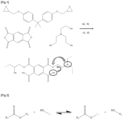
- ester functions in the presence of free reactive sites and under certain conditions (by heating for example), can be exchanged step by step via a trans-esterification reaction, and result in a topological reorganization of the material at the molecular level (refer to the Figure 2 below).
- activators and catalysts are introduced into these materials to accelerate the exchange chemistry.
- the first generation of vitrimer epoxy esters described in the literature sees the exchange reaction activated by activators mixed into the polymer as an additive. But the quantity required is generally around 5 to 10% by mass, which can lead to a loss of material performance.
- these activator molecules are free in the material, they can, like many other additives used in the plastics industry, migrate out of the material, leading to a loss of performance as well as exposure of users and the environment to unwanted or even dangerous molecules.
- vitrimeric epoxy esters known to date consists of the integration of molecules directly into the polymer structure, in a covalent manner.
- the reagents used still need to be optimized to lead to resins with more relevant thermomechanical properties as well as higher reshaping kinetics.
- the process of the invention leads to the production of an activated vitrimer epoxy-anhydride resin in that it contains judiciously chosen functions, in a determined conformation allowing the activation of the kinetics of ester exchanges and rapid reshaping.
- the process consists of the advantageous use of a selection of three chemical species: a poly-epoxy, a poly-anhydride and an amino-alcohol. These three species are capable of reacting with each other to form a covalent crosslinked network comprising a large number of esters.
- a poly-anhydride allows the formation of carboxylic acid in the beta position relative to the ester (or in the ortho position when the anhydride is arranged on an aromatic cycle), which increases the kinetics of ester exchange.
- the use of an amino alcohol also allows the formation of an amine in the beta position relative to the ester, and this configuration also increases the kinetics of ester exchange.
- the use of a polyepoxy allows the formation of hydroxyl groups during the crosslinking reaction. These OH groups act as free reactive sites during ester exchange. The combination of carboxylic acid, tertiary amine, and hydroxyl groups near the ester allows for very rapid exchange chemistry and very efficient reformatting.
- polyanhydride instead of anhydride and a polyepoxy as conventionally used makes it possible to obtain a resin with a higher glass transition temperature than that of existing vitrimeric epoxy resins.
- the combination of these reagents makes it possible to form stable covalent bonds, making it possible to do without the addition of an additional catalyst that could migrate outside the material.
- poly-epoxy is understood herein to mean a molecule comprising at least two epoxy functions.
- poly-anhydride is understood herein to mean a molecule comprising at least two anhydride functions.
- the precursor mixture of the activated vitrimer epoxy anhydride resin is a mixture of the three precursor components having partially crosslinked.
- the resin can be either ground or directly hot-compressed to form plates.
- the resin in the form of plates or ground, can be used in a mixture with waste composite parts to obtain a recycled composite by compression and heating and re-shaping.
- the polyanhydride is selected from aromatic components. This contributes to generating high stress in the molecule which leads to a high glass transition temperature.
- the polyanhydride is selected from dianhydrides and trianhydrides, such as pyromellitic acid dianhydride (PDMA), bisphenol A dianhydride (BPA), 3,3'4,4'-benzophenonetetracarboxylic dianhydride (BTDA), mellitic anhydride, or a mixture of these polyanhydrides.
- PDMA pyromellitic acid dianhydride
- BPA bisphenol A dianhydride
- BTDA 3,3'4,4'-benzophenonetetracarboxylic dianhydride
- mellitic anhydride or a mixture of these polyanhydrides.
- the polyepoxy is selected from bisphenol A diglycidyl ether (DGEBA), Tris(4-hydroxyphenyl)methane triglycidyl ether, 4,4'-Methylenebis(N,N-diglycidylaniline), N,N-Diglycidyl-4-glycidyloxyaniline, 1,4-butanediol diglycidyl ether, and Bisphenol F diglycidyl ether or a mixture of these compounds.
- DGEBA bisphenol A diglycidyl ether
- Tris(4-hydroxyphenyl)methane triglycidyl ether 4,4'-Methylenebis(N,N-diglycidylaniline), N,N-Diglycidyl-4-glycidyloxyaniline, 1,4-butanediol diglycidyl ether
- Bisphenol F diglycidyl ether or a mixture of these compounds bisphenol A diglycidyl ether
- the polyepoxy is chosen so as to have functions and a geometric conformation close to that of the epoxy resin of the composite material to be reshaped, so as to have similar properties and facilitate interactions.
- the amino alcohol is chosen from tertiary amines comprising at least two hydroxyl functions, such as triethanolamine (TEthA), diethanolmethylamine (DEthA), tetrahydroxyethylenediamine (THEED) or a mixture of these amines.
- TEthA triethanolamine
- DEthA diethanolmethylamine
- THEED tetrahydroxyethylenediamine
- Tertiary amines are preferred because the presence of primary (NH2) or secondary (NH) amine allows the addition reaction of these amines with the epoxy and the formation of permanent non-reversible bonds, which in this case are parasitic reactions because they are non-exchangeable.
- step a) comprises first diluting the polyanhydride in a liquid monoanhydride, such as hexahydro-4-methylphthalic anhydride (HHMPA), methyl nadic anhydride (MNA) or a mixture of these monoanhydrides.
- a liquid monoanhydride such as hexahydro-4-methylphthalic anhydride (HHMPA), methyl nadic anhydride (MNA) or a mixture of these monoanhydrides.
- crosslinking step d) comprises the application of a heat treatment at a temperature between 110°C and 140°C, in particular between 120°C and 130°C. This temperature is determined to optimize the crosslinking speed and minimize unwanted reactions.
- crosslinking step d) comprises the application of a vacuum, in particular a pressure less than or equal to -0.2 bar, and for example a pressure less than or equal to -0.5 bar.
- the molar ratio in the solution prepared in step a) of the anhydride, epoxide and hydroxyl functions are in a range between 1:1:1 and 3:1:1, and in particular a molar ratio of approximately 2:1:1. This configuration ensures that a maximum of anhydride functions are modified into ester to promote exchanges and a reformation with high kinetics.
- the invention provides an activated vitrimer epoxy-anhydride resin, intended for the reshaping of composite material parts comprising an epoxy-anhydride resin and glass fibers, the activated vitrimer epoxy anhydride resin comprising a covalent crosslinked network comprising ester functions, carboxylic acid functions, hydroxyl functions and tertiary amine functions making it possible to activate the kinetics of the exchange reactions, the activated vitrimer epoxy anhydride resin originating from the crosslinking of at least one polyanhydride so as to generate a maximum of esters in the resin.
- the presence of these functions makes it possible to carry out activated trans-esterification reactions, resulting in an easy and rapid topological reorganization of the material and the possibility of also rapid reshaping on a macroscopic scale.
- the activated vitrimer epoxy anhydride resin is obtained from the reaction between at least one polyepoxy, at least one polyanhydride and at least one amino alcohol.
- said activated vitrimer epoxy anhydride resin has a glass transition temperature Tg greater than or equal to 130°C, in particular between 130°C and 250°C, for example between 150°C and 200°C.
- the glass transition temperature Tg of the activated vitrimer epoxy anhydride resin can be determined by differential scanning calorimetry (“DSC” in English which is the acronym for Differential Scanning Calorimetry) according to the international standard ISO 11357-2.
- This high glass transition temperature Tg is achieved in particular by using a polyanhydride with a constrained chemical structure, solid at room temperature and having a high melting temperature. This allows the use of said activated vitrimeric epoxy anhydride resin as a structural material at a higher temperature than that of the vitrimeric epoxy anhydrides known to date.
- This process thus advantageously uses the activated vitrimer resin of the invention for a reaction with epoxy-anhydride/glass fiber composite materials giving rise to the formation of a new covalent network allowing the transformation of waste into a composite material into a material that is intrinsically recyclable thereafter.
- the epoxy-anhydride vitrimer resin present in the composite material is capable of the same chemical exchanges as the resin of the invention, but with much lower kinetics because these reactions are not activated in this case.
- the two resin networks form, via the trans-esterification reaction, a single, crosslinked network. This makes it possible to integrate the composite material at the end of its life into a recyclable vitrimer resin, giving rise to a material that is itself recyclable.
- the temperature applied in step q) is independent of the preheating temperature of the mold.
- the present invention provides the synthesis of an activated anhydride epoxy-vitrimer resin from three specific components, allowing the increase of the kinetics of a trans-esterification reaction as illustrated in the Figure 2 .
- the method of the invention proposes to form a reaction mixture from three solutions of precursor components.
- a first container is prepared a first solution from 1 g of pyromellitic acid dianhydride PDMA in 40 ml of THF ( Figure 2 ).
- a second solution is prepared from 0.817 g of DGBEA resin ( Figure 4 ) in 40 ml of THF and in a third container is prepared a third solution from 0.228 g of triethanolamine TEthA ( Figure 3 ) in 40 ml of THF.
- the three solutions are mixed to prepare the solution according to step a) which is stirred at room temperature according to step b) for a fairly short time (between 30 seconds and 2 minutes) to prevent the solution from solidifying in the container of step b).
- the molar ratio of the anhydride, epoxide and hydroxyl functions is approximately 2:1:1.
- the THF solvent is evaporated in the open air according to step c) so as to obtain a precursor mixture of said final resin in which the three components are pre-crosslinked.
- the mixture being viscous, it is placed in an oven heated to 60°C so as to complete the evaporation of the solvent.
- a heat treatment according to step d) is applied at 130°C for 15 hours under a pressure of less than 1 bar so as to finalize the crosslinking and obtain the activated vitrimer epoxy-anhydride resin ( Figure 1 ).
- Said activated resin is formed from a covalent network comprising determined functions and a specific conformation allowing a double activation of the exchange reactions so as to increase the kinetics of reshaping.
- said activated resin comprises carboxylic acid functions arranged in the ortho position of the ester functions when the carboxylic acid functions and the ester functions are substituents of an aromatic cycle (refer to the Figure 1 and to molecules 1a and 1d respectively on the Figures 6 and 7 ), tertiary amine functions arranged in the beta position of ester functions (refer to the Figure 1 and to 1d molecules on the Figure 7 ) so that the exchange sites are doubly activated. Hydroxyl functions are also present on the covalent network and act as free reactive sites during ester exchanges.
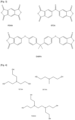
- the polyanhydride component is chosen from BPA, BTDA, mellitic anhydride, or a mixture of these compounds ( Figure 2 ).
- the amino alcohol component is chosen from tertiary amines comprising at least two hydroxyl functions, such as DEthA, THEED or a mixture of these amines.
- the polyanhydride is dissolved in a monoanhydride ( Figure 6 ). THF can be added to this solution depending on the solubility characteristics of the polyanhydride.
- the invention also proposes a method for recycling parts made of composite material based on epoxy-anhydride resin and glass fibers by integrating said activated resin (not shown).
- An exemplary embodiment of the recycling method according to the invention firstly comprises the provision of 60g of an activated vitrimer epoxy-anhydride resin as previously described, previously ground if necessary to present a powdery form (step m). To this powder is added 50g of particles from parts to be recycled of said composite material (step n). Once a homogeneous mixture is obtained following vigorous stirring (step o), it is placed in a mold previously heated to Tm (180°C - step p). The assembly is then pressed with a pressure of 70 bars for 30 min at 180°C (step q). The reshaped part is then demolded.
- It is formed from a composite material comprising glass fibers and an epoxy-anhydride resin comprising a covalent network in which the activated vitrimer epoxy anhydride resin is integrated, so that it can be quickly reshaped or locally repaired several times, without adding new material, by the same compression/heating process.
- the present invention uses the properties of vitrimer resins and judiciously chooses components entering into the composition of the activated resin to improve the exchange kinetics, promote the reshaping, repair and recyclability of parts made of composite materials, without degradation of its mechanical properties of the composite materials nor the resistance to water, solvent, etc., while increasing the glass transition temperature and thus the field of application of these parts.
Landscapes
- Chemical & Material Sciences (AREA)
- Medicinal Chemistry (AREA)
- Organic Chemistry (AREA)
- Polymers & Plastics (AREA)
- Health & Medical Sciences (AREA)
- Chemical Kinetics & Catalysis (AREA)
- Materials Engineering (AREA)
- Engineering & Computer Science (AREA)
- Manufacturing & Machinery (AREA)
- Inorganic Chemistry (AREA)
- Reinforced Plastic Materials (AREA)
- Processes Of Treating Macromolecular Substances (AREA)
- Epoxy Resins (AREA)
Abstract
Procédé de fabrication d'une résine époxy-anhydride vitrimère activée, destinée à la remise en forme de pièces en matériau composite comprenant une résine époxy-anhydride et des fibres de verre, le procédé de fabrication comprenant les étapes suivantes :- a) préparation d'une solution à partir d'un mélange de trois composants précurseurs comprenant un poly-anhydride, un aminoalcool, un poly-époxy et un solvant,- b) agitation de la solution,- c) évaporation du solvant de sorte à obtenir un mélange précurseur de la résine époxy-anhydride vitrimère activée, et- d) réticulation par application d'un traitement thermique de sorte à obtenir la résine époxy-anhydride vitrimère activée.
Description
- La présente invention se rapporte à la remise en forme de déchets de pièces en matériau composite à base de fibres de verre et de résine époxy-anhydride. En particulier, l'invention concerne une résine époxy-anhydride vitrimère activée, destinée à faciliter la remise en forme de ces pièces de matériaux composites. Elle propose en outre un procédé de fabrication d'une telle résine et un procédé de remise en forme desdites pièces en matériau composite.
- Les matériaux composites de fibre de verre et de résine époxy sont notamment utilisés comme matériaux de structure en remplacement de métaux et permettent un allègement notable pour une large gamme d'application : le sport (cycles, sport de glisse), le transport (structure de voitures, de trains), l'aérospatial (structure d'avions, de navettes spatiales). Ces systèmes sont constitués d'une résine polymère thermodurcissable, réticulée pendant la mise en forme du matériau, et d'une armure de fibres, pouvant être de nature (principalement, fibres de carbone et fibres de verre) et d'organisation (tissées selon différents modèles, non-tissés) variables.
- Ces résines thermodurcissables présentent des performances mécaniques ainsi qu'une résistance chimique élevées, grâce notamment à la haute réticulation du réseau. Mais cet aspect interdit tout recyclage en dehors de l'incinération, car ces réseaux réticulés ne peuvent être ni fondus, ni solubilisés, empêchant d'utiliser les techniques de recyclage classiques.
- L'utilisation de chimies réversibles pour la synthèse et l'utilisation de réseaux réversibles constitue un nouveau domaine de recherche dans l'ingénierie des polymères. L'utilisation de réseaux réversibles permet de pallier le défaut de recyclabilité des thermodurcissables. La recherche dans ce domaine est riche d'innovations et de nombreux systèmes chimiques covalents et réversibles ont font l'objet d'étude.
- Dans le domaine des résines époxy, il existe trois grands types : époxy-amines, époxy-vinylester et époxy-anhydrides (ou époxy-esters). Parmi elles, seule les résines époxy-anhydrides présentent des propriétés de chimie réversible par nature, grâce à des fonctions esters et des groupements hydroxyles disponibles, ce qui permet d'envisager le recyclage de cette résine en la transformant en vitrimère. En effet, les fonctions esters, en présence de site réactifs libres et sous certaines conditions (en chauffant par exemple), peuvent s'échanger de proche en proche via une réaction de trans-esterification, et avoir pour conséquence une réorganisation topologique du matériau à l'échelle moléculaire (se rapporter à la
figure 2 ci-dessous). Lorsque la fréquence de ces échanges est assez importante, la mise sous contrainte du matériau donne lieu à une déformation à l'échelle macroscopique, qui peut être mise à profit pour réparer ou changer la forme des pièces constituées dudit matériau. Cela ouvre la porte au recyclage des résines dans des pièces de matériaux composites endommagées ou en fin de vie. - L'utilisation de la trans-esterification dans des résines époxy-polyester a déjà fait l'objet de publications et de nombreux travaux. Les travaux actuels visent surtout à améliorer ce système sur plusieurs points : la rapidité et la température à laquelle les échanges se font, ainsi que les performances thermomécaniques des matériaux et leur résistance à l'eau et autres solvants. En effet, l'introduction de liaisons chimiques réversibles amène de nouvelles problématiques. Ces liaisons peuvent être moins stables, les matériaux les incorporant ne présentent pas les mêmes propriétés en fonction de la température ou en présence de certains solvants. Aussi, la vitesse de remise en forme du matériau est directement lié à l'efficacité de la chimie réversible utilisée. L'objectif général est d'obtenir des matériaux performants dans les conditions d'utilisation normales mais se remettant en forme rapidement.
- Pour cela, des activateurs et catalyseurs sont introduits dans ces matériaux pour accélérer la chimie d'échange. La première génération d'époxy-esters vitrimères décrits dans la littérature voit la réaction d'échange activées par des activateurs mélangés dans le polymère à la manière d'un additif. Mais la quantité nécessaire se situe en général autour de 5 à 10% en masse, ce qui peut engendrer des pertes de performances du matériau. De plus, ces molécules activatrices étant libres dans le matériau, elles peuvent, à l'image de nombreux autres additifs utilisés dans l'industrie des matière plastiques, être amenées à migrer hors du matériau, amenant des pertes de performances ainsi qu'une exposition des utilisateurs et de l'environnement à des molécules indésirables, voire dangereuses.
- La seconde génération d'époxy-esters vitrimères connue à ce jour consiste en l'intégration de molécules directement dans la structure de polymère, de manière covalente. Toutefois, même si des améliorations sont observées avec cette technique, il reste encore à optimiser les réactifs utilisés pour conduire à des résines aux propriétés thermomécaniques plus pertinentes ainsi qu'à une cinétique de remise en forme plus élevée.
- Un des buts de la présente invention vise à pallier au moins l'un des inconvénients précités. A cet effet, l'invention propose un procédé de fabrication d'une résine époxy-anhydride vitrimère activée, destinée à la remise en forme de pièces en matériaux composites comprenant une résine époxy-anhydride et des fibres de verre, le procédé de fabrication comprenant les étapes suivantes :
- a) préparation d'une solution à partir d'un mélange de trois composants précurseurs comprenant un poly-anhydride, un aminoalcool, un poly-époxy et un solvant,
- b) agitation de la solution,
- c) évaporation du solvant de sorte à obtenir un mélange précurseur de la résine époxy-anhydride vitrimère activée, et
- d) réticulation par application d'un traitement thermique de sorte à obtenir la résine époxy-anhydride vitrimère activée.
- Ainsi, le procédé de l'invention conduit à l'obtention d'une résine epoxy-anhydridre vitrimère activée en ce qu'elle contient des fonctions judicieusement choisies, dans une conformation déterminée permettant d'activer la cinétique des échanges d'ester et une remise en forme rapide. En effet, le procédé consiste en l'utilisation avantageuse d'une sélection de trois espèces chimiques : un poly-époxy, un poly-anhydride et un amino-alcool. Ces trois espèces sont capables de réagir entre elles pour former un réseau réticulé covalent comportant un grand nomdre d'esters. De plus, l'utilisation d'un poly-anhydride permet la formation d'acide carboxylique en position beta par rapport à l'ester (ou en position ortho lorsque l'anhydride est disposé sur un cycle aromatique), ce qui augmente la cinétique d'échange des esters. L'utilisation d'un amino-alcool, permet en outre, la formation d'une amine en position beta par rapport à l'ester et cette configuration augmente également la cinétique d'échange des esters. Enfin, l'utilisation d'un poly-époxy permet la formation de groupements hydroxyles lors de la réaction de réticulation. Ces groupements OH jouent le rôle de sites réactifs libres lors des échanges d'esters. La combinaison des groupements acides carboxyliques, amine tertiaire et hydroxyles à proximité de l'ester permet une chimie d'échange très rapide et une remise en forme très efficace.
- Par ailleurs, l'utilisation de poly-anhydride en lieu et place d'anhydride et d'un poly-époxy comme classiquement utilisé permet d'obtenir une résine présentant une température de transition vitreuse plus élevée que celle de résines époxy vitrimères déjà existantes. De plus, la combinaison de ces réactifs permet de former des liaisons covalentes stables permettant de se passer de l'ajout d'un catalyseur supplémentaire qui pourrait migrer en dehors du matériau.
- Par le terme «poly-époxy », on entend dans le présent document une molécule comprenant au moins deux fonctions époxy. Par le terme « poly-anhydride », on entend dans le présent document une molécule comprenant au moins deux fonctions anhydrides.
- Selon une possibilité, le mélange précurseur de la résine époxy-anhydride vitrimère activée est un mélange des trois composants précurseurs ayant partiellement réticulés.
- Ainsi, une fois ladite résine réticulée et durcie, elle peut être soit broyée, soit compressée à chaud directement pour former des plaques. La résine, sous forme de plaques ou broyée, peut être utilisée en mélange avec des déchets de pièces en matériau composite en vue d'obtenir un composite recyclé par compression et chauffage et une nouvelle mise en forme.
- Selon une disposition, le poly-anhydride est choisi parmi des composants aromatiques. Ceci contribue à engendrer une grande contrainte dans la molécule ce qui conduit à une température de transition vitreuse élevée.
- Selon une possibilité, le poly-anhydride est choisi parmi les dianhydrides et les trianhydrides, tels que le dianhydride d'acide pyromellitique (PDMA), le dianhydride de bisphénol A (BPA), le dianhydride 3,3'4,4'-benzophénonététracarboxylique (BTDA), l'anhydride mellitique, ou un mélange de ces poly-anhydrides.
- Selon une possibilité, le poly-époxy est choisi parmi le diglycidyl éther de bisphénol A (DGEBA), le Tris(4-hydroxyphenyl)methane triglycidyl ether, la 4,4'-Methylenebis(N,N-diglycidylaniline), la N,N-Diglycidyl-4-glycidyloxyaniline, l'éther diglycidylique de 1,4-butanédiol, et le Bisphenol F diglycidyl ether ou un mélange de ces composés.
- Selon une disposition, le poly-époxy est choisi de sorte à présenter des fonctions et une conformation géométrique proches de celle de la résine époxy du matériau composite à remettre en forme, de sorte à présenter des propriétés similaires et faciliter les interactions.
- Selon une possibilité, l'aminoalcool est choisi parmi des amines tertiaires comprenant au moins deux fonctions hydroxyles, tels que la triéthanolamine (TEthA), la diéthanolmethylamine (DEthA), la tétrahydroxyéthylènediamine (THEED) ou un mélange de ces amines. Les amines tertiaires sont préférées car la présence d'amine primaire (NH2) ou secondaire (NH) permet la réaction d'addition de ces amines avec l'époxy et la formation de liaisons permanentes non réversibles, qui dans ce cas sont des réaction parasites car non-échangeables.
- Selon un mode de réalisation, l'étape a) comprend au préalable la dilution du poly-anhydride dans un mono-anhydride liquide, tel que l'anhydride hexahydro-4-methylphthalique (HHMPA), l'anhydride nadique de méthyle (MNA) ou un mélange de ces mono-anhydrides.
- Selon une disposition, l'étape d) de réticulation comprend l'application d'un traitement thermique à une température comprise entre 110°C et 140°C, notamment entre 120°C et 130°C. Cette température est déterminée pour optimiser la vitesse de réticulation et minimiser les réactions parasites.
- Selon une possibilité, l'étape d) de réticulation comprend l'application d'un vide, notamment une pression inférieure ou égale à - 0,2 bar, et par exemple une pression inférieure ou égale à -0,5 bar.
- Selon une possibilité, le rapport molaire dans la solution préparée à l'étape a) des fonctions anhydride, époxyde et hydroxyle sont compris dans une plage entre 1:1:1 et 3:1:1, et notamment un rapport molaire d'environ 2 : 1 :1. Cette configuration permet d'assurer qu'un maximum de fonctions anhydrides soit modifié en ester pour favoriser les échanges et une remise en forme avec une cinétique élevée.
- Selon un deuxième aspect, l'invention propose une résine époxy-anhydride vitrimère activée, destinée à la remise en forme de pièces en matériau composite comprenant une résine époxy-anhydride et des fibres de verre, la résine époxy-anhydride vitrimère activée comprenant un réseau réticulé covalent comprenant des fonctions esters, des fonctions acides carboxyliques, des fonctions hydroxyles et des fonctions amines tertiaires permettant d'activer la cinétique des réactions d'échange, la résine époxy-anhydride vitrimère activée provenant de la réticulation d'au moins un poly-anhydride de sorte à générer un maximum d'esters dans la résine. La présence de ces fonctions permet de réaliser des réactions de trans-esterification activées, ayant pour conséquence une réorganisation topologique du matériau facile et rapide et la possibilité de remise en forme également rapide à l'échelle macroscopique.
- Selon une disposition, la résine époxy-anhydride vitrimère activée provient de la réaction entre au moins un poly-époxy, au moins un poly-anhydride et au moins un aminoalcool.
- Selon une possibilité, ladite résine époxy-anhydride vitrimère activée présente une température de transition vitreuse Tg supérieure ou égale à 130°C, notamment comprise entre à 130°C et 250°C, par exemple comprise entre 150°C et 200°C. Dans le cadre de la présente invention, la température de transition vitreuse Tg de la résine époxy-anhydride vitrimère activée peut être déterminée par calorimétrie différentielle à balayage (« DSC » en anglais qui est l'acronyme pour Differential Scanning Calorimetry) selon la norme internationale ISO 11357-2.
- Cette température élevée de transition vitreuse Tg est notamment obtenue grâce à l'utilisation d'un poly-anhydride à structure chimique contrainte, solide à température ambiante et présentant une température de fusion élevée. Cela permet l'utilisation de ladite résine époxy-anhydride vitrimère activée en tant que matériau de structure à une température plus élevée que celle des époxy-anhydride vitrimères connues à ce jour.
- Selon une disposition, la résine époxy-anhydride vitrimère activée comprend une majorité de fonctions acides carboxyliques disposée en position beta des fonctions esters ou en position ortho lorsque les fonctions acides carboxyliques et les fonctions esters sont des substituants de cycles aromatiques, une majorité de fonctions amines tertiaires est disposée en position beta des fonctions esters et une majorité de fonctions hydroxyles sont disposées en position beta des fonctions esters. Ainsi, lesdites fonctions acides carboxyliques et lesdites fonctions amines tertiaires jouent le rôle d'activateur de la cinétique d'échange des esters et les fonctions hydroxyles jouent le rôle de sites réactifs libres dans les échanges d'esters. Ceci permet une double activation ou une double catalyse de la chimie d'échange très rapide et une remise en forme optimale. Cette résine époxy-anhydride vitrimère activée comporte des caractéristiques qui permettent un traitement de recyclage par remise en forme efficace et rapide de pièces en matériaux composites à base de résine époxy-anhydride comme cela sera décrit ci-dessous. Selon un troisième aspect, l'invention propose un procédé de recyclage de pièces en matériau composite à base de résine époxy-anhydride et de fibres de verre, le procédé comprenant les étapes de :
- m) fournir une résine époxy-anhydride vitrimère activée telle que précédemment décrite, la résine époxy-anhydride vitrimère activée se présentant sous forme pulvérulente,
- n) fournir des particules issues d'au moins une pièce en matériau composite à base de fibres de verre dans une résine époxy-anhydride,
- o) mélanger la poudre de résine époxy-anhydride vitrimère activée et les particules de matériau composite de sorte à obtenir un mélange homogène,
- p) placer le mélange homogène dans un moule préalablement chauffé à une température Tm supérieure ou égale à la température de transition vitreuse Tg de la résine époxy-anhydride vitrimère activée, telle qu'une température Tm supérieure ou égale à 130°C, notamment une température comprise entre 130°C et 250°C, par exemple 200°C, et
- q) appliquer une pression supérieure ou égale à 60 bars, notamment une pression comprise entre 60 et 80 bars, et par exemple environ 70 bars, pendant quelques dizaines de minutes, notamment entre 20 et 30 min, à une température supérieure ou égale à la température de transition vitreuse Tg de la résine époxy-anhydride vitrimère activée, de sorte à réaliser la remise en forme du matériau composite.
- Ce procédé utilise ainsi avantageusement la résine vitrimère activée de l'invention pour une réaction avec des matériaux composites époxy-anhydride/fibres de verre donnant lieu à la formation d'un nouveau réseau covalent permettant la transformation de déchet en matériau composite en un matériau intrinsèquement recyclable par la suite. En effet, la résine époxy-anhydride vitrimère présente dans le matériau composite est capable des mêmes échanges chimiques que la résine de l'invention, mais avec une cinétique bien plus faible car ces réactions sont non activées dans ce cas. Lors de leur mélange puis compression à chaud, les deux réseaux de résines forment, via la réaction de trans-esterification, un réseau unique et réticulé. Cela permet d'intégrer le matériau composite en fin de vie dans une résine vitrimère recyclable, donnant naissance à un matériau lui-même recyclable. Notons que la température appliquée à l'étape q) est indépendante de la température de préchauffage du moule.
- Selon d'autres caractéristiques, le procédé de fabrication de l'invention comporte une ou plusieurs des caractéristiques optionnelles suivantes considérées seules ou en combinaison :
- Le nombre de fonctions anhydrides est de préférence inférieur ou égal au nombre cumulé de fonctions époxydes et hydroxyles dans la solution de l'étape a).
- Le solvant utilisé à l'étape a) de préparation d'une solution est choisi parmi les solvants organiques polaires tel que le THF, anisole, diméthylacetamide, diméthylformamide, DMSO, acétonitrile, acétone, acétate d'éthyle,...
- L'étape b) d'agitation de la solution est réalisée entre la température ambiante et 50°C.
- L'étape c) d'évaporation du solvant est réalisé à une température comprise entre l'ambiante et environ 60°C de sorte à pallier la viscosité du mélange précurseur de la résine.
- Le traitement de réticulation de l'étape d) est réalisé pendant plusieurs heures, notamment pendant 10 à 20 heures, par exemple 15 heures.
- D'autres caractéristiques et avantages apparaitront à la lecture de la description détaillée ci-après, d'un exemple de mise en oeuvre non limitatif, faite en référence aux figures annexées dans lesquelles :
- [
Fig. 1 ] illustre le schéma réactionnel entre les trois composants conduisant à la résine époxy-anhydride vitrimère activée selon un mode de réalisation de l'invention. - [
Fig. 2 ] représente une vue schématique du principe de trans-estérification qui est appliqué dans l'invention. - [
Fig. 3 ] représente des exemples de poly-anhydride, utilisés comme l'un des trois composants de l'invention. - [
Fig. 4 ] représente des exemples d'aminoalcool, utilisés comme l'un des trois composants de l'invention. - [
Fig. 5 ] représente un exemple de poly-époxy, utilisé comme l'un des trois composants de l'invention. - [
Fig. 6 ] illustre le schéma réactionnel entre un poly-anhydride, un alcool et un époxy selon l'invention. - [
Fig. 7 ] illustre le schéma réactionnel entre un poly-anhydride et un aminoalcool selon l'invention. - Comme illustré en
figure 1 , la présente invention propose la synthèse d'une résine époxy-vitrimère anhydride activée à partir de trois composants spécifiques, permettant l'augmentation de la cinétique d'une réaction de trans-estérification telle qu'illustrée sur lafigure 2 . Pour ce faire, le procédé de l'invention propose de former un mélange réactionnel à partir de trois solutions de composants précurseurs. Ainsi, dans un premier contenant est préparée une première solution à partir de 1 g d'acide dianhydride d'acide pyromellitique PDMA dans 40 ml de THF (figure 2 ). Dans un deuxième contenant est préparée une deuxième solution à partir de 0.817 g de résine DGBEA (figure 4 ) dans 40 ml de THF et dans un troisième contenant est préparé une troisième solution à partir de 0.228 g de triéthanolamine TEthA (figure 3 ) dans 40 ml de THF. Les trois solutions sont mélangées pour préparer la solution selon l'étape a) qui est agitée à température ambiante selon l'étape b) sur un délai assez court (entre 30 secondes et 2 minutes) pour éviter que la solution prenne en masse dans le récipient de l'étape b). Le rapport molaire des fonctions anhydrides, époxydes et hydroxyles est d'environ 2 : 1 :1. Puis, le solvant THF est évaporé l'air libre selon l'étape c) de sorte à obtenir un mélange précurseur de ladite résine finale dans lequel les trois composants sont pré-réticulés. Le mélange étant visqueux, il est placé dans une étuve chauffée à 60°C de sorte à compléter l'évaporation du solvant. Puis un traitement thermique selon l'étape d) est appliqué à 130°C pendant 15 heures sous une pression inférieure à 1 bar de sorte à finaliser la réticulation et obtenir la résine époxy-anhydride vitrimère activée (figure 1 ). Ladite résine activée est formée d'un réseau covalent comprenant des fonctions déterminées et une conformation spécifique permettant une double activation des réactions d'échanges de sorte à augmenter la cinétique de remise en forme. Notamment, ladite résine activée comprend des fonctions acides carboxyliques disposés en position ortho des fonctions esters lorsque les fonctions acides carboxyliques et les fonctions esters sont des substituants d'un cycle aromatique (se référer à lafigure 1 et aux molécules 1a et 1d respectivement sur lesfigures 6 et 7 ), des fonctions amines tertiaires disposées en position beta de fonctions esters (se référer à lafigure 1 et aux molécules 1d sur lafigure 7 ) de sorte que les sites d'échanges sont doublement activés. Des fonctions hydroxyles sont également présentes sur le réseau covalent et jouent le rôle de sites réactifs libres lors des échanges d'esters. - Selon d'autres modes de réalisation de l'invention, le composant poly-anhydride est choisi parmi le BPA, le BTDA, un l'anhydride mellitique, ou un mélange de ces composés (
figure 2 ). Le composant aminoalcool est choisi parmi des amines tertiaires comprenant au moins deux fonctions hydroxyles, tels que la DEthA, la THEED ou un mélange de ces amines. - Selon également un autre mode de réalisation de l'invention, le poly-anhydride est dissout dans un mono-anhydride (
figure 6 ). Du THF peut être ajouté à cette solution selon les caractéristiques de solubilité du poly-anhydride. - L'invention propose également un procédé de recyclage de pièces en matériau composite à base de résine époxy-anhydride et de fibres de verre grâce à l'intégration de ladite résine activée (non illustré). Un exemple de réalisation du procédé de recyclage selon l'invention comprend tout d'abord la fourniture de 60g d'une résine époxy-anhydride vitrimère activée telle que précédemment décrite, préalablement broyée si nécessaire pour présenter une forme pulvérulente (étape m). A cette poudre est ajoutée 50g de particules en provenance de pièces à recycler dudit matériau composite (étape n). Une fois un mélange homogène obtenu suite à une agitation vigoureuse (étape o), il est placé dans un moule préalablement chauffé à Tm (180°C- étape p). L'ensemble est ensuite pressé avec une pression de 70 bars pendant 30 min à 180°C (étape q). La pièce remise en forme est ensuite démoulée. Elle est formée d'un matériau composite comportant des fibres de verre et une résine époxy-anhydride comprenant un réseau covalent dans lequel la résine époxy-anhydride vitrimère activée est intégrée, de sorte à pouvoir être remise en forme rapidement ou réparée localement à plusieurs reprises, sans ajout de matière nouvelle, par le même procédé de compression/chauffage.
- Ainsi, la présente invention utilise les propriétés de résines vitrimères et choisit judicieusement des composants entrant dans la composition de la résine activée pour améliorer les cinétiques d'échange, favoriser la remise en forme, la réparation et la recyclabilité de pièce en matériaux composites, sans dégradation de ses propriétés mécaniques des matériaux composites ni la tenue à l'eau, au solvant, ...etc, tout en augmentant la température de transition vitreuse et ainsi le champ d'application de ces pièces.
Claims (10)
- Procédé de fabrication d'une résine époxy-anhydride vitrimère activée, destinée à la remise en forme de pièces en matériau composite comprenant une résine époxy-anhydride et des fibres de verre, le procédé de fabrication comprenant les étapes suivantes :- a) préparation d'une solution à partir d'un mélange de trois composants précurseurs comprenant un poly-anhydride, un aminoalcool, un poly-époxy et un solvant,- b) agitation de la solution,- c) évaporation du solvant de sorte à obtenir un mélange précurseur de la résine époxy-anhydride vitrimère activée, et- d) réticulation par application d'un traitement thermique de sorte à obtenir la résine époxy-anhydride vitrimère activée.
- Procédé de fabrication selon la revendication 1, dans lequel le poly-anhydride est choisi parmi les dianhydrides et les trianhydrides, tels que le dianhydride d'acide pyromellitique (PDMA), le dianhydride de bisphénol A (BPA), le dianhydride 3,3'4,4'-benzophénonététracarboxylique (BTDA), l'anhydride mellitique ou un mélange de ces poly-anhydrides.
- Procédé de fabrication selon la revendication 1 ou 2, dans lequel le poly-époxy est choisi parmi le diglycidyl éther de bisphénol A (DGEBA), le Tris(4-hydroxyphenyl)methane triglycidyl ether, la 4,4'-Methylenebis(N,N-diglycidylaniline), la N,N-Diglycidyl-4-glycidyloxyaniline, l'éther diglycidylique de 1,4-butanédiol, et le Bisphenol F diglycidyl ether ou un mélange de ces composés.
- Procédé de fabrication selon l'une des revendications 1 à 3, dans lequel l'aminoalcool est choisi parmi des amines tertiaires comprenant au moins deux fonctions hydroxyles, tels que la triéthanolamine (TEthA), la diéthanolmethylamine (DEthA), la tétrahydroxyéthylènediamine THEED) ou un mélange de ces amines.
- Procédé de fabrication selon l'une des revendications 1 à 4, dans lequel l'étape a) comprend au préalable la dilution du poly-anhydride dans un mono-anhydride liquide, tel que l'anhydride hexahydro-4-methylphthalique (HHMPA), l'anhydride nadique de méthyle (MNA) ou un mélange de ces mono-anhydrides.
- Procédé de fabrication selon l'une des revendications 1 à 5, dans lequel l'étape d) de réticulation comprend l'application d'un traitement thermique à une température comprise entre 110°C et 140°C.
- Procédé de fabrication selon l'une des revendications 1 à 6, dans lequel le rapport molaire dans la solution préparée à l'étape a) des fonctions anhydride, époxyde et hydroxyle sont compris dans une plage entre 1:1:1 et 3:1:1, et notamment un rapport molaire d'environ 2 : 1 :1.
- Résine époxy-anhydride vitrimère activée, destinée à la remise en forme de pièces en matériau composite comprenant une résine époxy-anhydride et des fibres de verre, la résine époxy-anhydride activée comprenant un réseau réticulé covalent comprenant des fonctions esters, des fonctions acides carboxyliques, des fonctions hydroxyles et des fonctions amines tertiaires permettant d'activer la cinétique des réactions d'échange, la résine époxy-anhydride activée provenant de la réticulation d'au moins un poly-anhydride de sorte à générer un maximum d'esters dans la résine.
- Résine époxy-anhydride vitrimère activée selon la revendication 8, dans laquelle une majorité de fonctions acides carboxyliques est disposée en position beta des fonctions esters ou en position ortho lorsque les fonctions acides carboxyliques et les fonctions esters sont des substituants d'un cycle aromatique, une majorité de fonctions amines tertiaires est disposée en position beta de fonctions esters et une majorité de fonctions hydroxyles est disposée en position beta des fonctions esters.
- Procédé de recyclage de pièces en matériau composite à base de résine époxy-anhydride et de fibres de verre, le procédé comprenant les étapes de :m) fournir une résine époxy-anhydride vitrimère activée selon l'une des revendications 8 ou 9 et/ou fabriquée selon le procédé de fabrication des revendications 1 à 7, la résine époxy-anhydride vitrimère activée se présentant sous forme pulvérulente,n) fournir des particules issues d'au moins une pièce en matériau composite à base de fibres de verre dans une résine époxy-anhydride,o) mélanger la poudre de résine époxy-anhydride vitrimère activée et les particules en matériau composite de sorte à obtenir un mélange homogène,p) placer le mélange homogène dans un moule préalablement chauffé à une température Tm supérieure à la température de transition vitreuse Tg de la résine époxy-anhydride vitrimère activée, etq) appliquer une pression supérieure ou égale à 60 bars, pendant quelques dizaines de minutes, à une température supérieure ou égale à la température de transition vitreuse Tg de la résine époxy-anhydride vitrimère activée de sorte à réaliser la remise en forme du matériau composite.
Applications Claiming Priority (1)
| Application Number | Priority Date | Filing Date | Title |
|---|---|---|---|
| FR2314471A FR3156785A1 (fr) | 2023-12-19 | 2023-12-19 | Synthèse de résine époxy-anhydride vitrimère activée |
Publications (1)
| Publication Number | Publication Date |
|---|---|
| EP4574877A1 true EP4574877A1 (fr) | 2025-06-25 |
Family
ID=90904630
Family Applications (1)
| Application Number | Title | Priority Date | Filing Date |
|---|---|---|---|
| EP24220671.2A Pending EP4574877A1 (fr) | 2023-12-19 | 2024-12-17 | Synthèse de résine époxy-anhydride vitrimère activée |
Country Status (2)
| Country | Link |
|---|---|
| EP (1) | EP4574877A1 (fr) |
| FR (1) | FR3156785A1 (fr) |
Cited By (1)
| Publication number | Priority date | Publication date | Assignee | Title |
|---|---|---|---|---|
| CN121086472A (zh) * | 2025-11-10 | 2025-12-09 | 中国人民解放军国防科技大学 | 可重复赋型环氧树脂基复合材料、制备及重复赋型方法 |
Citations (2)
| Publication number | Priority date | Publication date | Assignee | Title |
|---|---|---|---|---|
| US20170044361A1 (en) * | 2014-04-24 | 2017-02-16 | Arkema France | Composition for manufacturing vitrimer resins of epoxy/anhydride type comprising a polyol |
| CN116444768A (zh) * | 2023-04-19 | 2023-07-18 | 华北电力大学(保定) | 高效损伤自修复可降解的双重动态交联Vitrimer树脂 |
-
2023
- 2023-12-19 FR FR2314471A patent/FR3156785A1/fr active Pending
-
2024
- 2024-12-17 EP EP24220671.2A patent/EP4574877A1/fr active Pending
Patent Citations (2)
| Publication number | Priority date | Publication date | Assignee | Title |
|---|---|---|---|---|
| US20170044361A1 (en) * | 2014-04-24 | 2017-02-16 | Arkema France | Composition for manufacturing vitrimer resins of epoxy/anhydride type comprising a polyol |
| CN116444768A (zh) * | 2023-04-19 | 2023-07-18 | 华北电力大学(保定) | 高效损伤自修复可降解的双重动态交联Vitrimer树脂 |
Non-Patent Citations (1)
| Title |
|---|
| LI WENBIN ET AL: "Bio-based epoxy vitrimer for recyclable and carbon fiber reinforced materials: Synthesis and structure-property relationship", COMPOSITES SCIENCE AND TECHNOLOGY, ELSEVIER, AMSTERDAM, NL, vol. 227, 6 June 2022 (2022-06-06), XP087124263, ISSN: 0266-3538, [retrieved on 20220606], DOI: 10.1016/J.COMPSCITECH.2022.109575 * |
Cited By (1)
| Publication number | Priority date | Publication date | Assignee | Title |
|---|---|---|---|---|
| CN121086472A (zh) * | 2025-11-10 | 2025-12-09 | 中国人民解放军国防科技大学 | 可重复赋型环氧树脂基复合材料、制备及重复赋型方法 |
Also Published As
| Publication number | Publication date |
|---|---|
| FR3156785A1 (fr) | 2025-06-20 |
Similar Documents
| Publication | Publication Date | Title |
|---|---|---|
| Yang et al. | Strong interface construction of carbon fiber–reinforced PEEK composites: an efficient method for modifying carbon fiber with crystalline PEEK | |
| Memon et al. | Vanillin-based epoxy vitrimer with high performance and closed-loop recyclability | |
| Zhang et al. | Hempseed oil-based covalent adaptable epoxy-amine network and its potential use for room-temperature curable coatings | |
| Liu et al. | Nitrogen-free tetrafunctional epoxy and its DDS-cured high-performance matrix for aerospace applications | |
| Zolghadr et al. | Self‐healing semi‐IPN materials from epoxy resin by solvent‐free furan–maleimide Diels–Alder polymerization | |
| Meylemans et al. | Synthesis, characterization, and cure chemistry of renewable bis (cyanate) esters derived from 2-methoxy-4-methylphenol | |
| Reddy et al. | Degradation of thermal-mechanically stable epoxy thermosets, recycling of carbon fiber, and reapplication of the degraded products | |
| Sangermano et al. | Biobased vitrimeric epoxy networks | |
| He et al. | Conversion of a biorenewable plant oil (anethole) to a new fluoropolymer with both low dielectric constant and low water uptake | |
| Karami et al. | Bio-based thermo-healable non-isocyanate polyurethane DA network in comparison with its epoxy counterpart | |
| EP3134456B1 (fr) | Utilisation d'une composition de resine thermodurcissable de type vitrimere pour la fabrication de pieces d'isolation electrique | |
| Chen et al. | Recyclable flame-retardant thermosets and their fiber-reinforced composites | |
| EP3408179B1 (fr) | Résine durcissable substitut aux résines phénoliques et ses applications | |
| FR3156785A1 (fr) | Synthèse de résine époxy-anhydride vitrimère activée | |
| FR2967371A1 (fr) | Procede de fabrication de materiau fibreux pre-impregne de polymere thermodurcissable | |
| WO2012066244A1 (fr) | Melange maitre de nanotubes de carbone et de durcisseur pour les resines thermodurcissables | |
| Faggio et al. | Fully bio-based furan/maleic anhydride epoxy resin with enhanced adhesive properties | |
| CN119570199A (zh) | 可降解环氧树脂系统料及其用途、本体、复合材料及其回收方法 | |
| EP3134454B1 (fr) | Composition pour la fabrication de resines vitrimeres de type epoxy/anhyride comprenant un catalyseur organique | |
| EP2935349B1 (fr) | Systemes catalytiques pour resines thermodurcissables deformables a l'etat thermodurci | |
| FR3020368A1 (fr) | Composition pour la fabrication de resines vitrimeres de type epoxy/anhyride comprenant un polyol | |
| Li et al. | Facile approach for the synthesis of performance-advantaged degradable bio-based thermoset via ring-opening metathesis polymerization from epoxidized soybean oil | |
| FR2580654A1 (fr) | Poudre de polyimide et procede de preparation | |
| EP3559086B1 (fr) | Poudre de particules spheriques de polyamide reticulable, procede de preparation et utilisation avec la technique de frittage par laser selectif | |
| Zhao et al. | Simple and mild method for the recycling of carbon-fiber-reinforced bismaleimide resin composite waste |
Legal Events
| Date | Code | Title | Description |
|---|---|---|---|
| PUAI | Public reference made under article 153(3) epc to a published international application that has entered the european phase |
Free format text: ORIGINAL CODE: 0009012 |
|
| STAA | Information on the status of an ep patent application or granted ep patent |
Free format text: STATUS: REQUEST FOR EXAMINATION WAS MADE |
|
| 17P | Request for examination filed |
Effective date: 20241217 |
|
| AK | Designated contracting states |
Kind code of ref document: A1 Designated state(s): AL AT BE BG CH CY CZ DE DK EE ES FI FR GB GR HR HU IE IS IT LI LT LU LV MC ME MK MT NL NO PL PT RO RS SE SI SK SM TR |
|
| STAA | Information on the status of an ep patent application or granted ep patent |
Free format text: STATUS: EXAMINATION IS IN PROGRESS |
|
| 17Q | First examination report despatched |
Effective date: 20260206 |