EP4574304A1 - Method of manufacturing precious metal pellets with reduced contamination - Google Patents
Method of manufacturing precious metal pellets with reduced contamination Download PDFInfo
- Publication number
- EP4574304A1 EP4574304A1 EP24220720.7A EP24220720A EP4574304A1 EP 4574304 A1 EP4574304 A1 EP 4574304A1 EP 24220720 A EP24220720 A EP 24220720A EP 4574304 A1 EP4574304 A1 EP 4574304A1
- Authority
- EP
- European Patent Office
- Prior art keywords
- rod
- wire
- metal
- skiving
- diameter
- Prior art date
- Legal status (The legal status is an assumption and is not a legal conclusion. Google has not performed a legal analysis and makes no representation as to the accuracy of the status listed.)
- Pending
Links
Images
Classifications
-
- B—PERFORMING OPERATIONS; TRANSPORTING
- B21—MECHANICAL METAL-WORKING WITHOUT ESSENTIALLY REMOVING MATERIAL; PUNCHING METAL
- B21C—MANUFACTURE OF METAL SHEETS, WIRE, RODS, TUBES, PROFILES OR LIKE SEMI-MANUFACTURED PRODUCTS OTHERWISE THAN BY ROLLING; AUXILIARY OPERATIONS USED IN CONNECTION WITH METAL-WORKING WITHOUT ESSENTIALLY REMOVING MATERIAL
- B21C1/00—Manufacture of metal sheets, wire, rods, tubes or like semi-manufactured products by drawing
- B21C1/003—Drawing materials of special alloys so far as the composition of the alloy requires or permits special drawing methods or sequences
-
- B—PERFORMING OPERATIONS; TRANSPORTING
- B21—MECHANICAL METAL-WORKING WITHOUT ESSENTIALLY REMOVING MATERIAL; PUNCHING METAL
- B21F—WORKING OR PROCESSING OF METAL WIRE
- B21F11/00—Cutting wire
-
- B—PERFORMING OPERATIONS; TRANSPORTING
- B21—MECHANICAL METAL-WORKING WITHOUT ESSENTIALLY REMOVING MATERIAL; PUNCHING METAL
- B21C—MANUFACTURE OF METAL SHEETS, WIRE, RODS, TUBES, PROFILES OR LIKE SEMI-MANUFACTURED PRODUCTS OTHERWISE THAN BY ROLLING; AUXILIARY OPERATIONS USED IN CONNECTION WITH METAL-WORKING WITHOUT ESSENTIALLY REMOVING MATERIAL
- B21C37/00—Manufacture of metal sheets, rods, wire, tubes, profiles or like semi-manufactured products, not otherwise provided for; Manufacture of tubes of special shape
- B21C37/04—Manufacture of metal sheets, rods, wire, tubes, profiles or like semi-manufactured products, not otherwise provided for; Manufacture of tubes of special shape of rods or wire
-
- B—PERFORMING OPERATIONS; TRANSPORTING
- B21—MECHANICAL METAL-WORKING WITHOUT ESSENTIALLY REMOVING MATERIAL; PUNCHING METAL
- B21C—MANUFACTURE OF METAL SHEETS, WIRE, RODS, TUBES, PROFILES OR LIKE SEMI-MANUFACTURED PRODUCTS OTHERWISE THAN BY ROLLING; AUXILIARY OPERATIONS USED IN CONNECTION WITH METAL-WORKING WITHOUT ESSENTIALLY REMOVING MATERIAL
- B21C37/00—Manufacture of metal sheets, rods, wire, tubes, profiles or like semi-manufactured products, not otherwise provided for; Manufacture of tubes of special shape
- B21C37/04—Manufacture of metal sheets, rods, wire, tubes, profiles or like semi-manufactured products, not otherwise provided for; Manufacture of tubes of special shape of rods or wire
- B21C37/042—Manufacture of coated wire or rods
-
- B—PERFORMING OPERATIONS; TRANSPORTING
- B22—CASTING; POWDER METALLURGY
- B22D—CASTING OF METALS; CASTING OF OTHER SUBSTANCES BY THE SAME PROCESSES OR DEVICES
- B22D11/00—Continuous casting of metals, i.e. casting in indefinite lengths
- B22D11/001—Continuous casting of metals, i.e. casting in indefinite lengths of specific alloys
-
- B—PERFORMING OPERATIONS; TRANSPORTING
- B22—CASTING; POWDER METALLURGY
- B22D—CASTING OF METALS; CASTING OF OTHER SUBSTANCES BY THE SAME PROCESSES OR DEVICES
- B22D11/00—Continuous casting of metals, i.e. casting in indefinite lengths
- B22D11/04—Continuous casting of metals, i.e. casting in indefinite lengths into open-ended moulds
- B22D11/041—Continuous casting of metals, i.e. casting in indefinite lengths into open-ended moulds for vertical casting
-
- B—PERFORMING OPERATIONS; TRANSPORTING
- B22—CASTING; POWDER METALLURGY
- B22D—CASTING OF METALS; CASTING OF OTHER SUBSTANCES BY THE SAME PROCESSES OR DEVICES
- B22D11/00—Continuous casting of metals, i.e. casting in indefinite lengths
- B22D11/10—Supplying or treating molten metal
- B22D11/11—Treating the molten metal
- B22D11/113—Treating the molten metal by vacuum treating
-
- C—CHEMISTRY; METALLURGY
- C22—METALLURGY; FERROUS OR NON-FERROUS ALLOYS; TREATMENT OF ALLOYS OR NON-FERROUS METALS
- C22B—PRODUCTION AND REFINING OF METALS; PRETREATMENT OF RAW MATERIALS
- C22B1/00—Preliminary treatment of ores or scrap
- C22B1/14—Agglomerating; Briquetting; Binding; Granulating
- C22B1/24—Binding; Briquetting ; Granulating
- C22B1/2406—Binding; Briquetting ; Granulating pelletizing
Definitions
- This disclosure relates to a method of manufacturing precious metal pellets with reduced contamination.
- this disclosure relates to a method of manufacturing precious metal pellets with reduced carbonaceous contamination.
- Thin film coatings can be deposited on substrates by employing evaporation as a form of physical vapor deposition (PVD).
- PVD physical vapor deposition
- Gold, precious metals, and alloys thereof are commonly melted and evaporated in a crucible via resistive thermal heating or with an electron beam (e-beam).
- e-beam electron beam
- the evaporation process is conducted in a vacuum chamber.
- the source materials such as gold, are commonly in the form of cylindrical pellets, also known as slugs.
- An evaporative coating system comprises a vacuum chamber, a coating material (in this case, gold pellets), a substrate to be coated, and a power supply. The entire process takes place in a vacuum chamber to create a low-pressure environment. This is crucial for preventing gas interference and ensuring a coating that is devoid of impurities.
- the process for manufacturing pellets includes multiple iterations of drawing wire or rod to a desirable final dimension before pelletizing the wire.
- the process of drawing wire uses lubricants that result in the mechanical smearing of both organic and inorganic compounds into the very soft and workable surfaces of gold, embedding carbon within the gold grain boundaries, and within the roughened physical texture of the gold surfaces.
- High purity gold is very soft, pliable, and mechanical working or drawing of the gold embeds microscopic organic compounds into the surface much like one might imagine grains of microscopic sand pressed into soft taffy.
- the organics float to the top of the melt pool and contribute to "spitting" or ejection of tiny droplets from the melt pool in the evaporation crucible, resulting in yield loss in the coated end product.
- the method comprises skiving a metal rod to produce a wire that is substantially devoid of carbonaceous contamination. A circumferential surface layer of the wire that contains embedded carbon contamination is removed during the skiving.
- the metal rod and the wire comprise a precious metal.
- the method comprises casting a precious metal into a mold to form a rod, rolling the rod in a lubricant-free process, minimal drawing the rod to form drawn rod of a diameter proximate to the final desired diameter, and skiving the drawn rod to remove its entire circumferential surface to produce a wire with a final diameter.
- the skived wire is then pelletized to form precious metal pellets.
- the casting comprises a vertical casting process that is conducted in a vacuum. Additionally, the bulk of the reduction in the diameter of the rod is achieved by rolling the rod without the use of lubricants. This avoids the embedding of organic contaminants on and below the surface of the wire.
- the rolled rod is then drawn in a single pass with minimum reduction to near net cylindrical shape, prior to skiving the complete circumference of the rod to the final diameter.
- This skiving step to achieve a final diameter symmetrically shaves off the outer layer of the rod in the process of achieving the final diameter.
- Subsequent final cleaning steps employ water as the cleaning agent.
- the precious metals include gold, silver, platinum, palladium, rhodium, iridium, ruthenium, osmium, or a combination thereof.
- the precious metal may comprise a precious metal alloy. Alloys of the foregoing precious metals with other metals may also be processed in the manner described herein.
- non-ferrous metals e.g., aluminum, copper, lead, zinc, and the like
- alkali metals e.g., lithium, sodium potassium, and the like
- alkaline earth metals e.g., magnesium, calcium, strontium barium, and the like
- transition metals e.g., iron, nickel, cobalt, scandium, titanium, vanadium, chromium, manganese, zinc, yttrium, zirconium, niobium, cadmium, hafnium, tin, tantalum, tungsten, rhenium, and the like
- metalloids boron, silicon, germanium, arsenic, antimony, tellurium, and the like
- Combinations of any of the non-ferrous metals, alkali metals, alkaline earth metals, transition metals and metalloids with the precious metals may be used to form pellets in the manner described herein. It is to be noted that additional metals added to a main metal to form an alloy are not considered to be contaminants even when added in trace amounts.
- the skived wire and pellets derived therefrom are substantially devoid of any carbonaceous matter or other contaminants.
- the skived wire and the pellets derived therefrom have a purity of greater than 99.99%, preferably greater than 99.999%, based on a total weight of the skived wire or the pellets.
- the purity of the wire or pellets after skiving is made with reference to the presence of contaminants such as carbonaceous and oxidative contaminants. It does not refer to additional metals that are used when the wire or pellets comprise an alloy. For example, the term purity does not apply to a second metal or a third metal that are added to a main first metal to form an alloy.
- a casting process is typically used to produce a variety of metal shapes that are used to eventually produce the disclosed pellets.
- a continuous vertical casting process is used to produce metal shapes, especially long lengths of rods, bars, tubes, or other profiles, by continuously casting the material in a vertical direction.
- the volumetric flow rate of the molten metal is equal to the product of the cross-sectional area of the casting and the casting speed.
- maintaining a stable and controlled flow of molten metal is useful for the quality and efficiency of the casting process.
- the mold into which the molten metal is cast does not necessarily have a circular cross-section. It can be square, polygonal (e.g., pentagonal, hexagonal, octagonal, or the like).
- the mold into which the molten metal is cast (to form the rod) typically has a diameter of 0.5 to 4 inches, preferably 0.75 to 3 inches and has a length of 5 inches to 4 feet, preferably 5 inches to 18 inches.
- the mold has an aspect ratio (length to diameter) of 3:1 to 150:1, with the length arranged to be parallel to the vertical.
- the rod upon being removed from the mold will therefore have a diameter of about 0.5 to about 4 inches, preferably about 0.75 to about 3 inches and has a length of about 5 inches to about 4 feet, preferably about 5 inches to about 18 inches.
- the largest dimension (e.g., the length) of the mold is oriented vertically.
- the diameter discussed above does not necessarily mean that the rod has a circular cross-sectional area. Though the term "diameter" typically applies to a circular cross-sectional area, in this particular case, it is meant to reflect the largest cross-sectional dimension of the rod.
- the pouring of the metal is preferably conducted in a vacuum.
- the presence of a vacuum minimizes oxidation and ambient contaminants from being incorporated into the surface or the bulk of the rod.
- the vacuum continuous casting of the rod produces a clean gold casting with a minimum of slag and carbon that rise to the top of the cast ingot and are easily cut off. It is also beneficial from the standpoint of ease and efficiency of process.
- other casting processes including those employed without vacuum are capable of producing a circular rod or a near polygonal rod that would also be amenable for further use in this disclosure.
- the rod itself may or may not be surface machined prior to rolling it.
- the rod is then cold rolled in a rolling mill (that may comprise a series of rolls) in a lubricant free process to form a rolled rod.
- Cold rolling is a metal forming process that involves reducing the diameter of the rod by passing it through a series of rolls at ambient temperature. The rolls reduce the thickness of the rod through a combination of compression and elongation in a lubricant free process. This process minimizes surface contamination from being worked into the surface and bulk of the rolled rod.
- the rolling process is conducted to reduce the diameter of the rod by 50 to 90%, preferably 60 to 75% of the original rod diameter.
- the length of the rod increases correspondingly depending upon the Poisson's ratio of the material.
- the rolled rod may have a cross-sectional area that is square with rounded corners or have a polygonal cross-sectional area (e.g., an octagon). In other words, the rolled rod may not have a perfectly circular cross-sectional area after the rolling process.
- the rolled rod is then subjected to a single pass drawing process to achieve a cylindrical shape and reduce its diameter to a near final diameter that is slightly larger than the final product diameter.
- the rolled rod after drawing is referred to as a drawn rod.
- the draw ratio may be adjusted as desired to arrive at the diameter that is close to the final product diameter. Only water is employed as a coolant during the drawing process.
- the rolled rod is not subjected to multiple passes through the rolls during the drawing process.
- the process of drawing the rolled rod comprises pulling the rolled rod through a drawing die to reduce its diameter and increase its length.
- the end of the rolled rod or wire is usually pointed to facilitate entry into the drawing die. This can be done through processes such as tapering or reducing the diameter at one end of the rolled rod.
- a drawing die is a shaped orifice through which the rolled rod is pulled. The die imparts the desired shape and dimensions to the drawn material. Drawing dies can have various shapes depending on the final product geometry and dimensions.
- the pointed end of the rolled rod is inserted through the drawing die, and the other end is attached to a drawing machine. The drawing machine applies force to pull the rolled rod through the die. As the rolled rod passes through the die, its diameter is reduced, and its length is increased. The amount of reduction in diameter depends on the design of the die and the desired final dimensions of the drawn product.
- the drawing of the rolled rod reduces the diameter of the rolled rod by 0.5 to 10%, preferably 1 to 4%, based on a final diameter of the rolled rod.
- the drawn rod is then skived to final diameter by physically removing the entire rod surface and any contaminants contained therein.
- the drawn rod after skiving is referred to herein as a wire.
- Skiving is a metalworking process used to shave off an outer circumferential surface of a cylindrical workpiece, such as a rod or tube.
- the drawn rod is securely mounted on a draw board and pulled through skiving dies, shaving off the complete circumferential surface of the rod.
- the skiving dies have a knife edge that contacts the entire outer circumferential surface of the rod.
- the skiving removes the entire outer circumferential surface and any embedded contamination with it.
- the skiving removes carbonaceous and oxidative contamination that may get embedded into the surface during rolling of the rod.
- the skiving of the drawn rod reduces the diameter of the drawn rod by 0.4 to 5%, preferably 0.5 to 1.2%, based on the starting diameter of the rod to be skived.
- Pelletizing wire is a process in which a continuous wire is cut or chopped into smaller, discrete pellets or pieces, also known in industry jargon as slugs.
- the wire is fed into a pelletizing machine, which is designed to cut the wire into pellets of a specific length.
- the machine typically consists of a feed mechanism to guide the wire, cutting blades, and a mechanism to control the length of the pellets.
- the pellets may be sorted to remove any defective pellets.
- the pellets may be washed with water, dried and packaged for transportation.
- This method of manufacturing pellets is advantageous in that it can be used to produce precious metal pellets that are substantially devoid of carbonaceous or oxidative contamination. It does not require using some of the time-consuming manufacturing processes that are detailed above.
- the precious metal pellets obtained from this process are typically more than 99.99% pure, preferably more than 99.999% pure, based on a total weight of the skived wire or the pellets.
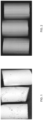
- FIG. 1 and FIG. 2 are scanning electron micrographs that depict the surface of pellets manufactured by a conventional method and by the method disclosed herein prior to cleaning them. The images compare gold pellets produced with a conventional process in FIG. 1 , which then requires extensive and often chemical etching methods to clean the surface and embedded impurities.
- FIG. 2 depicts the gold pellets produced with this novel process as per the claims, also prior to cleaning. The pellets with the novel process in FIG. 2 are markedly and remarkably cleaner that those in FIG. 1 .
Landscapes
- Engineering & Computer Science (AREA)
- Mechanical Engineering (AREA)
- Metal Extraction Processes (AREA)
Abstract
Disclosed herein is a method of manufacturing a wire. The method comprises skiving a metal rod to produce a wire that is substantially devoid of carbonaceous contamination. A circumferential surface layer of the wire that contains embedded carbon contamination is removed during the skiving. The metal rod and the wire comprise a precious metal.
Description
- This application claims priority to
U.S. Provisional Application No. 63/611,490, filed on December 18, 2023 - This disclosure relates to a method of manufacturing precious metal pellets with reduced contamination. In particular, this disclosure relates to a method of manufacturing precious metal pellets with reduced carbonaceous contamination.
- Thin film coatings can be deposited on substrates by employing evaporation as a form of physical vapor deposition (PVD). This process is commonly used in the semiconductor industry in a variety of applications. Gold, precious metals, and alloys thereof are commonly melted and evaporated in a crucible via resistive thermal heating or with an electron beam (e-beam). The evaporation process is conducted in a vacuum chamber. The source materials such as gold, are commonly in the form of cylindrical pellets, also known as slugs.
- An evaporative coating system comprises a vacuum chamber, a coating material (in this case, gold pellets), a substrate to be coated, and a power supply. The entire process takes place in a vacuum chamber to create a low-pressure environment. This is crucial for preventing gas interference and ensuring a coating that is devoid of impurities.
- In the manufacturing of gold pellets (used for coating a substrate in an evaporative PVD process), it is desirable to minimize and avoid the incorporation of carbon into the bulk of the pellet and in particular, the surface of the pellet. The process for manufacturing pellets includes multiple iterations of drawing wire or rod to a desirable final dimension before pelletizing the wire. The process of drawing wire uses lubricants that result in the mechanical smearing of both organic and inorganic compounds into the very soft and workable surfaces of gold, embedding carbon within the gold grain boundaries, and within the roughened physical texture of the gold surfaces. High purity gold is very soft, pliable, and mechanical working or drawing of the gold embeds microscopic organic compounds into the surface much like one might imagine grains of microscopic sand pressed into soft taffy. Upon melting of the gold pellets, the organics float to the top of the melt pool and contribute to "spitting" or ejection of tiny droplets from the melt pool in the evaporation crucible, resulting in yield loss in the coated end product.
- To mitigate "spitting" and resulting yield loss a variety of different procedures are employed. Extensive chemical etching and other cleaning efforts are conducted to remove the carbon embedded within and in contact with the surface of the gold pellets. Alternative purification methods include remelting the gold to bring the carbon to the surface, presumably followed by a chemical etching or cleaning process to remove the carbon that is brought to the surface. Yet another carbon-removal process attempts to combust carbon present on the surface or near the surface of the pellets in a reducing atmosphere.
- These additional purification processes increase production time and costs to varying degrees. It is therefore desirable to develop a process to avoid carbonaceous contamination into gold or other precious metals during the manufacturing of pellets. Further, it is desirable to be able to remove surface and near surface carbon quickly, cost efficiently, and with minimal environmental impact.
- Disclosed herein is a method of manufacturing a wire. The method comprises skiving a metal rod to produce a wire that is substantially devoid of carbonaceous contamination. A circumferential surface layer of the wire that contains embedded carbon contamination is removed during the skiving. The metal rod and the wire comprise a precious metal.
-
-
FIG. 1 is a scanning electron micrograph that depicts the surface of pellets manufactured by a conventional method prior to cleaning them; and -
FIG. 2 is a scanning electron micrograph that depicts the surface of pellets manufactured by the method disclosed them prior to cleaning them. - Disclosed herein is a process for manufacturing precious metal pellets with reduced carbonaceous contamination. The method comprises casting a precious metal into a mold to form a rod, rolling the rod in a lubricant-free process, minimal drawing the rod to form drawn rod of a diameter proximate to the final desired diameter, and skiving the drawn rod to remove its entire circumferential surface to produce a wire with a final diameter. The skived wire is then pelletized to form precious metal pellets. In an embodiment, the casting comprises a vertical casting process that is conducted in a vacuum. Additionally, the bulk of the reduction in the diameter of the rod is achieved by rolling the rod without the use of lubricants. This avoids the embedding of organic contaminants on and below the surface of the wire. The rolled rod is then drawn in a single pass with minimum reduction to near net cylindrical shape, prior to skiving the complete circumference of the rod to the final diameter. This skiving step to achieve a final diameter symmetrically shaves off the outer layer of the rod in the process of achieving the final diameter. Subsequent final cleaning steps employ water as the cleaning agent.
- The precious metals include gold, silver, platinum, palladium, rhodium, iridium, ruthenium, osmium, or a combination thereof. The precious metal may comprise a precious metal alloy. Alloys of the foregoing precious metals with other metals may also be processed in the manner described herein. Some of the other metals include non-ferrous metals (e.g., aluminum, copper, lead, zinc, and the like), alkali metals (e.g., lithium, sodium potassium, and the like), alkaline earth metals (e.g., magnesium, calcium, strontium barium, and the like), transition metals (e.g., iron, nickel, cobalt, scandium, titanium, vanadium, chromium, manganese, zinc, yttrium, zirconium, niobium, cadmium, hafnium, tin, tantalum, tungsten, rhenium, and the like), metalloids (boron, silicon, germanium, arsenic, antimony, tellurium, and the like), or a combination thereof. Combinations of any of the non-ferrous metals, alkali metals, alkaline earth metals, transition metals and metalloids with the precious metals may be used to form pellets in the manner described herein. It is to be noted that additional metals added to a main metal to form an alloy are not considered to be contaminants even when added in trace amounts.
- The skived wire and pellets derived therefrom are substantially devoid of any carbonaceous matter or other contaminants. In an embodiment, the skived wire and the pellets derived therefrom have a purity of greater than 99.99%, preferably greater than 99.999%, based on a total weight of the skived wire or the pellets. The purity of the wire or pellets after skiving is made with reference to the presence of contaminants such as carbonaceous and oxidative contaminants. It does not refer to additional metals that are used when the wire or pellets comprise an alloy. For example, the term purity does not apply to a second metal or a third metal that are added to a main first metal to form an alloy.
- A casting process is typically used to produce a variety of metal shapes that are used to eventually produce the disclosed pellets. In an embodiment, a continuous vertical casting process is used to produce metal shapes, especially long lengths of rods, bars, tubes, or other profiles, by continuously casting the material in a vertical direction. In an embodiment, the volumetric flow rate of the molten metal is equal to the product of the cross-sectional area of the casting and the casting speed. In continuous casting, maintaining a stable and controlled flow of molten metal is useful for the quality and efficiency of the casting process. The mold into which the molten metal is cast does not necessarily have a circular cross-section. It can be square, polygonal (e.g., pentagonal, hexagonal, octagonal, or the like).
- The mold into which the molten metal is cast (to form the rod) typically has a diameter of 0.5 to 4 inches, preferably 0.75 to 3 inches and has a length of 5 inches to 4 feet, preferably 5 inches to 18 inches. The mold has an aspect ratio (length to diameter) of 3:1 to 150:1, with the length arranged to be parallel to the vertical. The rod upon being removed from the mold will therefore have a diameter of about 0.5 to about 4 inches, preferably about 0.75 to about 3 inches and has a length of about 5 inches to about 4 feet, preferably about 5 inches to about 18 inches. The largest dimension (e.g., the length) of the mold is oriented vertically. The diameter discussed above does not necessarily mean that the rod has a circular cross-sectional area. Though the term "diameter" typically applies to a circular cross-sectional area, in this particular case, it is meant to reflect the largest cross-sectional dimension of the rod.
- The pouring of the metal is preferably conducted in a vacuum. The presence of a vacuum minimizes oxidation and ambient contaminants from being incorporated into the surface or the bulk of the rod. The vacuum continuous casting of the rod produces a clean gold casting with a minimum of slag and carbon that rise to the top of the cast ingot and are easily cut off. It is also beneficial from the standpoint of ease and efficiency of process. However, other casting processes, including those employed without vacuum are capable of producing a circular rod or a near polygonal rod that would also be amenable for further use in this disclosure. The rod itself may or may not be surface machined prior to rolling it.
- The rod is then cold rolled in a rolling mill (that may comprise a series of rolls) in a lubricant free process to form a rolled rod. Cold rolling is a metal forming process that involves reducing the diameter of the rod by passing it through a series of rolls at ambient temperature. The rolls reduce the thickness of the rod through a combination of compression and elongation in a lubricant free process. This process minimizes surface contamination from being worked into the surface and bulk of the rolled rod.
- As the rod passes through the rolls, it undergoes plastic deformation. The compression from the rollers reduces the diameter of the rod, while the elongation increases its length. The repeated passes through the rolls help achieve the desired dimensional tolerances.
- The rolling process is conducted to reduce the diameter of the rod by 50 to 90%, preferably 60 to 75% of the original rod diameter. The length of the rod increases correspondingly depending upon the Poisson's ratio of the material. In an embodiment, the rolled rod may have a cross-sectional area that is square with rounded corners or have a polygonal cross-sectional area (e.g., an octagon). In other words, the rolled rod may not have a perfectly circular cross-sectional area after the rolling process.
- The rolled rod is then subjected to a single pass drawing process to achieve a cylindrical shape and reduce its diameter to a near final diameter that is slightly larger than the final product diameter. The rolled rod after drawing is referred to as a drawn rod. The draw ratio may be adjusted as desired to arrive at the diameter that is close to the final product diameter. Only water is employed as a coolant during the drawing process. The rolled rod is not subjected to multiple passes through the rolls during the drawing process.
- In an embodiment, the process of drawing the rolled rod comprises pulling the rolled rod through a drawing die to reduce its diameter and increase its length. The end of the rolled rod or wire is usually pointed to facilitate entry into the drawing die. This can be done through processes such as tapering or reducing the diameter at one end of the rolled rod. A drawing die is a shaped orifice through which the rolled rod is pulled. The die imparts the desired shape and dimensions to the drawn material. Drawing dies can have various shapes depending on the final product geometry and dimensions. The pointed end of the rolled rod is inserted through the drawing die, and the other end is attached to a drawing machine. The drawing machine applies force to pull the rolled rod through the die. As the rolled rod passes through the die, its diameter is reduced, and its length is increased. The amount of reduction in diameter depends on the design of the die and the desired final dimensions of the drawn product.
- In an embodiment, the drawing of the rolled rod reduces the diameter of the rolled rod by 0.5 to 10%, preferably 1 to 4%, based on a final diameter of the rolled rod.
- The drawn rod is then skived to final diameter by physically removing the entire rod surface and any contaminants contained therein. The drawn rod after skiving is referred to herein as a wire. Skiving is a metalworking process used to shave off an outer circumferential surface of a cylindrical workpiece, such as a rod or tube. The drawn rod is securely mounted on a draw board and pulled through skiving dies, shaving off the complete circumferential surface of the rod. The skiving dies have a knife edge that contacts the entire outer circumferential surface of the rod. The skiving removes the entire outer circumferential surface and any embedded contamination with it. The skiving removes carbonaceous and oxidative contamination that may get embedded into the surface during rolling of the rod.
- In an embodiment, the skiving of the drawn rod reduces the diameter of the drawn rod by 0.4 to 5%, preferably 0.5 to 1.2%, based on the starting diameter of the rod to be skived.
- After the skiving, the wire with a machined outer surface is subjected to pelletization. Pelletizing wire is a process in which a continuous wire is cut or chopped into smaller, discrete pellets or pieces, also known in industry jargon as slugs. The wire is fed into a pelletizing machine, which is designed to cut the wire into pellets of a specific length. The machine typically consists of a feed mechanism to guide the wire, cutting blades, and a mechanism to control the length of the pellets.
- The pellets may be sorted to remove any defective pellets. The pellets may be washed with water, dried and packaged for transportation.
- This method of manufacturing pellets is advantageous in that it can be used to produce precious metal pellets that are substantially devoid of carbonaceous or oxidative contamination. It does not require using some of the time-consuming manufacturing processes that are detailed above. The precious metal pellets obtained from this process are typically more than 99.99% pure, preferably more than 99.999% pure, based on a total weight of the skived wire or the pellets.
- Scanning electron microscopy (SEM) and Energy Dispersive X-ray Analysis (EDAX) (also sometimes referred to as Energy Dispersive Spectroscopy (EDS) chemical analysis was performed. High resolution mosaics were taken of each set of samples by stitching together backscattered images. EDS chemical maps of multiple regions of each pellet showed that the dark particles on the surface were primarily carbon-rich.
FIG. 1 and FIG. 2 are scanning electron micrographs that depict the surface of pellets manufactured by a conventional method and by the method disclosed herein prior to cleaning them. The images compare gold pellets produced with a conventional process inFIG. 1 , which then requires extensive and often chemical etching methods to clean the surface and embedded impurities.FIG. 2 depicts the gold pellets produced with this novel process as per the claims, also prior to cleaning. The pellets with the novel process inFIG. 2 are markedly and remarkably cleaner that those inFIG. 1 . - While the invention has been described with reference to some embodiments, it will be understood by those skilled in the art that various changes may be made and equivalents may be substituted for elements thereof without departing from the scope of the invention. In addition, many modifications may be made to adapt a particular situation or material to the teachings of the invention without departing from essential scope thereof. Therefore, it is intended that the invention not be limited to the particular embodiments disclosed as the best mode contemplated for carrying out this invention, but that the invention will include all embodiments falling within the scope of the appended claims.
Claims (15)
- A method of manufacturing a wire, the method comprising:
skiving a metal rod to produce a wire that is substantially devoid of carbonaceous contamination; where a circumferential surface layer of the wire that contains embedded carbon contamination is removed during the skiving; and where the metal rod and the wire comprise a precious metal. - The method of Claim 1, where an outer circumference of the wire is substantially removed by the skiving of the metal rod.
- The method of Claim 1, further comprising casting a molten metal into a mold to produce the metal rod; where the mold has a length to diameter ratio of 3:1 to 150:1.
- The method of Claim 3, where the casting comprises a continuous vertical casting of the molten metal, optionally where the continuous vertical casting is conducted in a vacuum.
- The method of Claim 3, further comprising rolling the metal rod in a lubricant free process to produce a rolled rod.
- The method of Claim 5, where the rolling of the metal rod results in a diameter reduction of 50 to 90% of an original rod diameter.
- The method of Claim 5, further comprising drawing the rolled rod to produce a drawn rod in a single pass.
- The method of Claim 7, where the drawing results in a diameter reduction of 0.4 to 10%, preferably 1 to 4 %, based on a final diameter of the rolled rod.
- The method of Claim 7, where the skiving comprises mounting the drawn rod on a draw board and pulling the drawn rod through a skiving die that shaves off a complete outer circumferential surface of the rod to produce the wire, optionally where:(a) the skiving die has a knife edge that contacts the entire outer circumferential surface of the rod to remove the complete outer circumferential surface and any embedded contamination with it; or(b) the wire and its outer circumference is substantially devoid of carbonaceous or oxidative contamination.
- The method of any one of Claims 1 through 9, where the precious metal comprises a precious metal alloy, optionally where the precious metal includes gold, silver, platinum, palladium, rhodium, iridium, ruthenium, osmium, or a combination thereof.
- The method of any one of Claims 1 through 10, where the metal rod and the wire further comprise a non-ferrous metal, an alkali metal, an alkaline earth metal, a transition metal, a metalloid, or a combination thereof.
- The method of any one of Claims 1 through 11, where the metal rod and wire further comprise iron, nickel, cobalt, scandium, titanium, vanadium, chromium, manganese, zinc, yttrium, zirconium, niobium, cadmium, hafnium, tantalum, tungsten, rhenium, boron, silicon, germanium, tin, arsenic, antimony, tellurium, aluminum, or a combination thereof.
- The method of any one of Claims 1 through 12, where the wire has a purity of greater than 99%, based on a total weight of the wire.
- The method of any one of Claims 1 through 13, where the wire has a purity of greater than 99.99%, based on a total weight of the wire.
- The method of Claim 1, further comprising chopping the wire to form a pellet.
Applications Claiming Priority (1)
| Application Number | Priority Date | Filing Date | Title |
|---|---|---|---|
| US202363611490P | 2023-12-18 | 2023-12-18 |
Publications (1)
| Publication Number | Publication Date |
|---|---|
| EP4574304A1 true EP4574304A1 (en) | 2025-06-25 |
Family
ID=93926318
Family Applications (1)
| Application Number | Title | Priority Date | Filing Date |
|---|---|---|---|
| EP24220720.7A Pending EP4574304A1 (en) | 2023-12-18 | 2024-12-17 | Method of manufacturing precious metal pellets with reduced contamination |
Country Status (2)
| Country | Link |
|---|---|
| US (1) | US20250196220A1 (en) |
| EP (1) | EP4574304A1 (en) |
Citations (3)
| Publication number | Priority date | Publication date | Assignee | Title |
|---|---|---|---|---|
| US3355796A (en) * | 1965-05-26 | 1967-12-05 | Texas Instruments Inc | Manufacture of clad rods, wires and the like |
| US20030135971A1 (en) * | 1997-11-12 | 2003-07-24 | Michael Liberman | Bundle draw based processing of nanofibers and method of making |
| US20150213921A1 (en) * | 2012-08-31 | 2015-07-30 | Mitsubishi Materials Corporation | Copper wire rod and magnet wire |
-
2024
- 2024-12-17 EP EP24220720.7A patent/EP4574304A1/en active Pending
- 2024-12-18 US US18/985,113 patent/US20250196220A1/en active Pending
Patent Citations (3)
| Publication number | Priority date | Publication date | Assignee | Title |
|---|---|---|---|---|
| US3355796A (en) * | 1965-05-26 | 1967-12-05 | Texas Instruments Inc | Manufacture of clad rods, wires and the like |
| US20030135971A1 (en) * | 1997-11-12 | 2003-07-24 | Michael Liberman | Bundle draw based processing of nanofibers and method of making |
| US20150213921A1 (en) * | 2012-08-31 | 2015-07-30 | Mitsubishi Materials Corporation | Copper wire rod and magnet wire |
Also Published As
| Publication number | Publication date |
|---|---|
| US20250196220A1 (en) | 2025-06-19 |
Similar Documents
| Publication | Publication Date | Title |
|---|---|---|
| US20240278314A1 (en) | Fabrication of metallic parts by additive manufacturing | |
| JP4652574B2 (en) | Products such as high purity tantalum and sputter targets containing it | |
| EP1287172B1 (en) | High purity niobium and products containing the same, and methods of making the same | |
| US8231744B2 (en) | Tantalum and niobium billets and methods of producing the same | |
| KR102170006B1 (en) | Aluminum alloy products and methods for producing same | |
| KR20140015487A (en) | Method for production of alloyed titanium welding wire | |
| US20220347746A1 (en) | Method for refining large-particle-size pure copper or copper alloy particles by high-energy ball milling | |
| CN104704139B (en) | Cu Ga alloy sputtering targets and its manufacture method | |
| US20250196220A1 (en) | Method of manufacturing precious metal pellets with reduced contamination | |
| CN113614262A (en) | Aluminum alloy, aluminum alloy wire, and method for producing aluminum alloy | |
| CN109848409B (en) | A kind of liquid metal wire for 3D printing and preparation method thereof | |
| JP3405069B2 (en) | Electrode wire for electric discharge machining | |
| JPH0995743A (en) | Method for producing molten metal-based material, molten metal-based material, and electronic beam melting facility | |
| JP7078070B2 (en) | Copper alloys, copper alloy plastic processed materials, parts for electronic and electrical equipment, terminals, bus bars, lead frames | |
| JP3765475B2 (en) | Ti-Si alloy-based target material, method for producing the same, and film coating method | |
| JP7652973B1 (en) | Vapor deposition material, its manufacturing method, and die | |
| CN119173350A (en) | Method for producing a solidified light aluminum or magnesium alloy | |
| JPH03162544A (en) | High melting point metal material that can be plasticized | |
| KR20200104808A (en) | Molded article made of a molybdenum-aluminum-titanium alloy | |
| Slamova et al. | Accumulative Roll Bonding Of Continuously Cast Al Sheets | |
| KR20070122443A (en) | Magnesium Alloy Case | |
| Zhang et al. | INVESTIGATION ON MICROSTRUCTURE AND MECHANICAL BEHAVIOUR OF ONE WROUGHT NICKEL BASED SUPERALLOY OBTAINED BY SELECTIVE LASER MELTING PROCESS | |
| GB2393450A (en) | Method of Manufacture of Metal Alloy Stock | |
| TH55720A (en) | High-purity niobium and the products containing it, and how these are produced. |
Legal Events
| Date | Code | Title | Description |
|---|---|---|---|
| PUAI | Public reference made under article 153(3) epc to a published international application that has entered the european phase |
Free format text: ORIGINAL CODE: 0009012 |
|
| STAA | Information on the status of an ep patent application or granted ep patent |
Free format text: STATUS: THE APPLICATION HAS BEEN PUBLISHED |
|
| AK | Designated contracting states |
Kind code of ref document: A1 Designated state(s): AL AT BE BG CH CY CZ DE DK EE ES FI FR GB GR HR HU IE IS IT LI LT LU LV MC ME MK MT NL NO PL PT RO RS SE SI SK SM TR |
|
| STAA | Information on the status of an ep patent application or granted ep patent |
Free format text: STATUS: REQUEST FOR EXAMINATION WAS MADE |
|
| 17P | Request for examination filed |
Effective date: 20251223 |