EP4574153A2 - Kinase inhibitors for the treatment of central and peripheral nervous system disorders - Google Patents
Kinase inhibitors for the treatment of central and peripheral nervous system disorders Download PDFInfo
- Publication number
- EP4574153A2 EP4574153A2 EP24223406.0A EP24223406A EP4574153A2 EP 4574153 A2 EP4574153 A2 EP 4574153A2 EP 24223406 A EP24223406 A EP 24223406A EP 4574153 A2 EP4574153 A2 EP 4574153A2
- Authority
- EP
- European Patent Office
- Prior art keywords
- mmol
- fluoro
- benzamido
- compound
- solution
- Prior art date
- Legal status (The legal status is an assumption and is not a legal conclusion. Google has not performed a legal analysis and makes no representation as to the accuracy of the status listed.)
- Pending
Links
Images

Classifications
-
- A—HUMAN NECESSITIES
- A61—MEDICAL OR VETERINARY SCIENCE; HYGIENE
- A61K—PREPARATIONS FOR MEDICAL, DENTAL OR TOILETRY PURPOSES
- A61K31/00—Medicinal preparations containing organic active ingredients
- A61K31/185—Acids; Anhydrides, halides or salts thereof, e.g. sulfur acids, imidic, hydrazonic or hydroximic acids
- A61K31/19—Carboxylic acids, e.g. valproic acid
- A61K31/192—Carboxylic acids, e.g. valproic acid having aromatic groups, e.g. sulindac, 2-aryl-propionic acids, ethacrynic acid
-
- A—HUMAN NECESSITIES
- A61—MEDICAL OR VETERINARY SCIENCE; HYGIENE
- A61K—PREPARATIONS FOR MEDICAL, DENTAL OR TOILETRY PURPOSES
- A61K31/00—Medicinal preparations containing organic active ingredients
- A61K31/33—Heterocyclic compounds
- A61K31/395—Heterocyclic compounds having nitrogen as a ring hetero atom, e.g. guanethidine or rifamycins
- A61K31/435—Heterocyclic compounds having nitrogen as a ring hetero atom, e.g. guanethidine or rifamycins having six-membered rings with one nitrogen as the only ring hetero atom
- A61K31/44—Non condensed pyridines; Hydrogenated derivatives thereof
- A61K31/4427—Non condensed pyridines; Hydrogenated derivatives thereof containing further heterocyclic ring systems
- A61K31/4439—Non condensed pyridines; Hydrogenated derivatives thereof containing further heterocyclic ring systems containing a five-membered ring with nitrogen as a ring hetero atom, e.g. omeprazole
-
- A—HUMAN NECESSITIES
- A61—MEDICAL OR VETERINARY SCIENCE; HYGIENE
- A61P—SPECIFIC THERAPEUTIC ACTIVITY OF CHEMICAL COMPOUNDS OR MEDICINAL PREPARATIONS
- A61P25/00—Drugs for disorders of the nervous system
-
- A—HUMAN NECESSITIES
- A61—MEDICAL OR VETERINARY SCIENCE; HYGIENE
- A61P—SPECIFIC THERAPEUTIC ACTIVITY OF CHEMICAL COMPOUNDS OR MEDICINAL PREPARATIONS
- A61P25/00—Drugs for disorders of the nervous system
- A61P25/14—Drugs for disorders of the nervous system for treating abnormal movements, e.g. chorea, dyskinesia
- A61P25/16—Anti-Parkinson drugs
-
- A—HUMAN NECESSITIES
- A61—MEDICAL OR VETERINARY SCIENCE; HYGIENE
- A61P—SPECIFIC THERAPEUTIC ACTIVITY OF CHEMICAL COMPOUNDS OR MEDICINAL PREPARATIONS
- A61P25/00—Drugs for disorders of the nervous system
- A61P25/18—Antipsychotics, i.e. neuroleptics; Drugs for mania or schizophrenia
-
- A—HUMAN NECESSITIES
- A61—MEDICAL OR VETERINARY SCIENCE; HYGIENE
- A61P—SPECIFIC THERAPEUTIC ACTIVITY OF CHEMICAL COMPOUNDS OR MEDICINAL PREPARATIONS
- A61P25/00—Drugs for disorders of the nervous system
- A61P25/22—Anxiolytics
-
- A—HUMAN NECESSITIES
- A61—MEDICAL OR VETERINARY SCIENCE; HYGIENE
- A61P—SPECIFIC THERAPEUTIC ACTIVITY OF CHEMICAL COMPOUNDS OR MEDICINAL PREPARATIONS
- A61P25/00—Drugs for disorders of the nervous system
- A61P25/24—Antidepressants
-
- A—HUMAN NECESSITIES
- A61—MEDICAL OR VETERINARY SCIENCE; HYGIENE
- A61P—SPECIFIC THERAPEUTIC ACTIVITY OF CHEMICAL COMPOUNDS OR MEDICINAL PREPARATIONS
- A61P25/00—Drugs for disorders of the nervous system
- A61P25/28—Drugs for disorders of the nervous system for treating neurodegenerative disorders of the central nervous system, e.g. nootropic agents, cognition enhancers, drugs for treating Alzheimer's disease or other forms of dementia
-
- C—CHEMISTRY; METALLURGY
- C07—ORGANIC CHEMISTRY
- C07D—HETEROCYCLIC COMPOUNDS
- C07D207/00—Heterocyclic compounds containing five-membered rings not condensed with other rings, with one nitrogen atom as the only ring hetero atom
- C07D207/02—Heterocyclic compounds containing five-membered rings not condensed with other rings, with one nitrogen atom as the only ring hetero atom with only hydrogen or carbon atoms directly attached to the ring nitrogen atom
- C07D207/04—Heterocyclic compounds containing five-membered rings not condensed with other rings, with one nitrogen atom as the only ring hetero atom with only hydrogen or carbon atoms directly attached to the ring nitrogen atom having no double bonds between ring members or between ring members and non-ring members
- C07D207/10—Heterocyclic compounds containing five-membered rings not condensed with other rings, with one nitrogen atom as the only ring hetero atom with only hydrogen or carbon atoms directly attached to the ring nitrogen atom having no double bonds between ring members or between ring members and non-ring members with hetero atoms or with carbon atoms having three bonds to hetero atoms with at the most one bond to halogen, e.g. ester or nitrile radicals, directly attached to ring carbon atoms
- C07D207/14—Nitrogen atoms not forming part of a nitro radical
-
- C—CHEMISTRY; METALLURGY
- C07—ORGANIC CHEMISTRY
- C07D—HETEROCYCLIC COMPOUNDS
- C07D213/00—Heterocyclic compounds containing six-membered rings, not condensed with other rings, with one nitrogen atom as the only ring hetero atom and three or more double bonds between ring members or between ring members and non-ring members
- C07D213/02—Heterocyclic compounds containing six-membered rings, not condensed with other rings, with one nitrogen atom as the only ring hetero atom and three or more double bonds between ring members or between ring members and non-ring members having three double bonds between ring members or between ring members and non-ring members
- C07D213/04—Heterocyclic compounds containing six-membered rings, not condensed with other rings, with one nitrogen atom as the only ring hetero atom and three or more double bonds between ring members or between ring members and non-ring members having three double bonds between ring members or between ring members and non-ring members having no bond between the ring nitrogen atom and a non-ring member or having only hydrogen or carbon atoms directly attached to the ring nitrogen atom
- C07D213/60—Heterocyclic compounds containing six-membered rings, not condensed with other rings, with one nitrogen atom as the only ring hetero atom and three or more double bonds between ring members or between ring members and non-ring members having three double bonds between ring members or between ring members and non-ring members having no bond between the ring nitrogen atom and a non-ring member or having only hydrogen or carbon atoms directly attached to the ring nitrogen atom with hetero atoms or with carbon atoms having three bonds to hetero atoms with at the most one bond to halogen, e.g. ester or nitrile radicals, directly attached to ring carbon atoms
- C07D213/78—Carbon atoms having three bonds to hetero atoms, with at the most one bond to halogen, e.g. ester or nitrile radicals
- C07D213/81—Amides; Imides
-
- C—CHEMISTRY; METALLURGY
- C07—ORGANIC CHEMISTRY
- C07D—HETEROCYCLIC COMPOUNDS
- C07D401/00—Heterocyclic compounds containing two or more hetero rings, having nitrogen atoms as the only ring hetero atoms, at least one ring being a six-membered ring with only one nitrogen atom
- C07D401/02—Heterocyclic compounds containing two or more hetero rings, having nitrogen atoms as the only ring hetero atoms, at least one ring being a six-membered ring with only one nitrogen atom containing two hetero rings
- C07D401/12—Heterocyclic compounds containing two or more hetero rings, having nitrogen atoms as the only ring hetero atoms, at least one ring being a six-membered ring with only one nitrogen atom containing two hetero rings linked by a chain containing hetero atoms as chain links
-
- C—CHEMISTRY; METALLURGY
- C07—ORGANIC CHEMISTRY
- C07D—HETEROCYCLIC COMPOUNDS
- C07D401/00—Heterocyclic compounds containing two or more hetero rings, having nitrogen atoms as the only ring hetero atoms, at least one ring being a six-membered ring with only one nitrogen atom
- C07D401/14—Heterocyclic compounds containing two or more hetero rings, having nitrogen atoms as the only ring hetero atoms, at least one ring being a six-membered ring with only one nitrogen atom containing three or more hetero rings
-
- C—CHEMISTRY; METALLURGY
- C07—ORGANIC CHEMISTRY
- C07D—HETEROCYCLIC COMPOUNDS
- C07D403/00—Heterocyclic compounds containing two or more hetero rings, having nitrogen atoms as the only ring hetero atoms, not provided for by group C07D401/00
- C07D403/02—Heterocyclic compounds containing two or more hetero rings, having nitrogen atoms as the only ring hetero atoms, not provided for by group C07D401/00 containing two hetero rings
- C07D403/12—Heterocyclic compounds containing two or more hetero rings, having nitrogen atoms as the only ring hetero atoms, not provided for by group C07D401/00 containing two hetero rings linked by a chain containing hetero atoms as chain links
-
- C—CHEMISTRY; METALLURGY
- C07—ORGANIC CHEMISTRY
- C07D—HETEROCYCLIC COMPOUNDS
- C07D471/00—Heterocyclic compounds containing nitrogen atoms as the only ring hetero atoms in the condensed system, at least one ring being a six-membered ring with one nitrogen atom, not provided for by groups C07D451/00 - C07D463/00
- C07D471/02—Heterocyclic compounds containing nitrogen atoms as the only ring hetero atoms in the condensed system, at least one ring being a six-membered ring with one nitrogen atom, not provided for by groups C07D451/00 - C07D463/00 in which the condensed system contains two hetero rings
- C07D471/04—Ortho-condensed systems
Definitions
- SCI spinal cord injury
- CNS central nervous system
- Developing drugs to treat SCI is complicated by the existence of two mechanisms that inhibit axon growth: 1) a loss of the intrinsic regenerative capacity of CNS neurons, and 2) the inhibitory CNS microenvironment confronting damaged axons. It is hypothesized that effective cures may be based upon simultaneously treat both sources of regeneration failure in order to induce clinically meaningful axon regrowth after injury.
- ring A comprises a 5-6-membered monocyclic heteroaryl ring or a 8-11-membered bicyclic heteroaryl ring having 1, 2, or 3 nitrogen ring atoms
- L 1 is null or C 1-2 alkylene
- X 1 is -NH-, -CH 2 NH-, -NHCH 2 -, -CH 2 CH 2 NH-, or -NHCH 2 CH 2 -
- X 2 is NR 2 or O
- X 3 is NR 2 or O
- L 2 is C(O), O, CH 2 , or CHOH
- R 1 is H or halo
- each R 2 is independently H or C 1-3 alkyl
- R 3 is H, C 1-3 alky, C 3-6 cycloalkyl, aryl, C(O)C 1-3 alkyl, C(O)C 3-6 cycloalkyl, or C(O)aryl
- R 4 is H, OH,
- ROCK Rho kinasae
- S6K ribosomal protein S6 kinase
- PKC ribosomal protein S6 kinase
- the CNS disorder is paralysis, spinal cord injury, optic nerve injury, glaucoma, multiple sclerosis, traumatic brain injury, diffuse axonal injury, stroke, or a degenerative disease (such as Parkinson's disease).
- PNS peripheral nervous system
- the PNS disorder is peripheral nerve trauma, repetitive stress, amyotrophic lateral sclerosis (ALS), erectile dysfunction, a disorder associated with an organ transplant, neurofibromatosis, blood vessel disease, diabetes, an autoimmune disorder, a disorder associated with chemical toxicity, or kidney disease.
- ALS amyotrophic lateral sclerosis
- erectile dysfunction a disorder associated with an organ transplant, neurofibromatosis, blood vessel disease, diabetes, an autoimmune disorder, a disorder associated with chemical toxicity, or kidney disease.
- ring A comprises a 5-6-membered monocyclic heteroaryl ring or a 8-11-membered bicyclic heteroaryl ring having 1, 2, or 3 nitrogen ring atoms
- L 1 is null or C 1-2 alkylene
- X 1 is - NH-, -CH 2 NH-, -NHCH 2 -, -CH 2 CH 2 NH-, or -NHCH 2 CH 2 -
- X 2 is NR 2 or O
- X 3 is NR 2 or O
- L 2 is C(O), O, or CHOH
- R 1 is H or halo
- each R 2 is independently H or C 1-3 alkyl
- R 3 is H, C 1-3 alky, C 3-6 cycloalkyl, aryl, C(O)C 1-3 alkyl, C(O)C 3-6 cycloalkyl, or C(O)aryl
- R 4 is H,
- ROCK Rho Kinase
- PLC protein kinase C
- S6K ribosomal protein S6 kinase
- RO48 (A92) was tested in a second model of spinal cord regeneration (pyramidatomy), and it was found that delivering RO48 to the CSF of injured animals enhanced compensatory sprouting from spared axons.
- a preliminary experiment using a third model of CNS injury (optic nerve crush) was performed, and it was found found that injecting RO40 into the eye of animals enhanced regeneration of optic nerve axons.
- the disclosed compounds can also inhibit 2 other kinases that were determined by to be potential targets for promoting neurite outgrowth. These are PKG and PKX.
- the compounds disclosed herein can inhibit one or more kinases, e.g., Rho kinase (ROCK), ribosomal protein S6 kinase (S6K), and/or protein kinase C. inhibition of one or more of these kinases can promote neurite outgrowth and/or axon growth in the central nervous system (CNS).
- kinases e.g., Rho kinase (ROCK), ribosomal protein S6 kinase (S6K), and/or protein kinase C.
- ring A comprises a 5-6-membered monocyclic heteroaryl ring or a 8-11-membered bicyclic heteroaryl ring having 1, 2, or 3 nitrogen ring atoms
- L 1 is null or C 1-2 alkylene
- X 1 is - NH-, -CH 2 NH-, -NHCH 2 -, -CH 2 CH 2 NH-, or -NHCH 2 CH 2 -
- X 2 is NR 2 or O
- X 3 is NR 2 or O
- L 2 is C(O), O, or CHOH
- R 1 is H or halo
- each R 2 is independently H or C 1-3 alkyl
- R 3 is H, C 1-3 alky, C 3-6 cycloalkyl, aryl, C(O)C 1-3 alkyl, C(O)C 3-6 cycloalkyl, or C(O)aryl
- R 4 is H
- X 1 is -NH-, -CH 2 NH-, or -NHCH 2 -.
- R 4 is H, OH, halo, C 1-4 alkyl, C 1-4 alkoxy, C(O)C 1-4 alkoxy, C 3-6 cycloalkyl, aryl, -OC 3-6 cycloalkyl, -Oaryl, C(O)OC 3-6 cycloalkyl, C(O)Oaryl; and R 5 is H, halo, C 1-4 alkyl, or C 1-4 alkoxy.
- alkyl refers to straight chained and branched saturated hydrocarbon groups.
- C n means the alkyl group has "n" carbon atoms.
- C 4 alkyl refers to an alkyl group that has 4 carbon atoms.
- C 1 -C 7 alkyl refers to an alkyl group having a number of carbon atoms encompassing the entire range (i.e., 1 to 7 carbon atoms), as well as all subgroups (e.g., 1-6, 2-7, 1-5, 3-6, 1, 2, 3, 4, 5, 6, and 7 carbon atoms).
- alkyl groups include, methyl, ethyl, n-propyl, isopropyl, n-butyl, sec-butyl (2-methylpropyl), t-butyl (1,1-dimethylethyl), 3,3-dimethylpentyl, and 2-ethylhexyl.
- an alkyl group can be an unsubstituted alkyl group or a substituted alkyl group.
- Non-limiting examples of substituted alkyl groups include haloalkyl groups (i.e., alkyl groups substituted with one or more halo groups), hydroxyalkyl groups (i.e., alkyl groups substituted with one or more hydroxy groups), and the like.
- alkylene used herein refers to an alkyl group having a substituent.
- alkylenearyl refers to an alkyl group substituted with an aryl group.
- an alkylene group can be -CH 2 CH 2 - or -CH 2 -.
- C n means the alkylene group has "n" carbon atoms.
- C 1-6 alkylene refers to an alkylene group having a number of carbon atoms encompassing the entire range, as well as all subgroups, as previously described for "alkyl” groups. Unless otherwise indicated, an alkylene group can be an unsubstituted alkylene group or a substituted alkylene group.
- Nonlimiting examples of cycloalkyl groups include cyclopropyl, cyclobutyl, cyclopentyl, and cyclohexyl. Unless otherwise indicated, a cycloalkyl group can be an unsubstituted cycloalkyl group or a substituted cycloalkyl group.
- the cycloalkyl groups described herein can be isolated or fused to another cycloalkyl group, a heterocycloalkyl group, an aryl group and/or a heteroaryl group.
- Example 23 N-((3R,4R)-4-(4-(2-hydroxy-5-methylbenzoyl)benzamido)pyrrolidin-3-yl)isonicotinamide .
- Example 24 N-((3R,4R)-4-(4-(2-hydroxy-5-methoxybenzoyl)benzamido)pyrrolidin-3-yl)isonicotinamide .
- Example 25 2-amino-N-((3R,4R)-4-(4-(2-hydroxy-5-methoxybenzoyl)benzamido)pyrrolidin-3-yl)pyrimidine-4-carboxamide .
- Example 28 N-((3R,4R)-4-(4-(2-hydroxy-3-methoxybenzoyl)benzamido)pyrrolidin-3-yl)isonicotinamide .
- Example 33 2-amino-N-((3R,4R)-4-(4-(2-hydroxybenzoyl)-2-methoxybenzamido)pyrrolidin-3-yl)pyrimidine-4-carboxamide .
- Example 35 2-amino-N-((3R,4R)-4-(3-chloro-4-(2-hydroxybenzoyl)benzamido)pyrrolidin-3-yl)pyrimidine-4-carboxamide.
- Example 36 N-((3R,4R)-4-(2-chloro-4-(2-hydroxybenzoyl)benzamido)pyrrolidin-3-yl)isonicotinamide .
- Example 37 N-((3R,4R)-4-(4-(2-hydroxybenzoyl)-3-methylbenzamido)pyrrolidin-3-yl)isonicotinamide .
- Example 38 4-(ethoxymethoxy)-2-fluoro-1-methoxybenzene.
- Example 39 N-(2-(4-(2-fluoro-6-hydroxy-3-methoxybenzoyl)benzamido)ethyl)isonicotinamide.
- Example 40 N-(2-(4-(2-fluoro-3,6-dimethoxybenzoyl)benzamido)ethyl)isonicotinamide.
- Example 41 N-((1R,2R)-2-(4-(2-fluoro-6-hydroxy-3-methoxybenzoyl)benzamido)cycloheptyl)isonicotinamide.
- HATU 114 mg, 0.300 mmol
- tert-butyl ((1R,2R)-2-aminocycloheptyl)carbamate 69 mg, 0.300 mmol
- isonicotinic acid 37 mg, 0.300 mmol
- triethyl amine 84 ⁇ L, 0.600 mmol
- acetonitrile 1.5 mL
- the solution was quenched with water and extracted with EtOAc.
- the organic extract was thrice washed with water and concentrated in vacuo. The residue was then dissolved in 4 N HCl in dioxane (2 mL) which formed a precipitate.
- Example 42 N-((1R,2R)-2-(4-(2-fluoro-3,6-dimethoxybenzoyl)benzamido)cycloheptyl)isonicotinamide.
- N-((1R,2R)-2-(4-(2-fluoro-6-hydroxy-3-methoxybenzoyl)benzamido)cycloheptyl) isonicotinamide 5.0 mg
- DMF 0.5 mL
- the solution was treated with iodomethane (0.6 ⁇ L, added as a DMF solution) and excess potassium carbonate.
- the solution was stirred for 2 h, quenched with water and purified directly on HPLC to give N-((1R,2R)-2-(4-(2-fluoro-3,6-dimethoxybenzoyl)benzamido)cycloheptyl)isonicotinamide.
- Example 43 N-((1R,2R)-2-(4-benzoylbenzamido)cycloheptyl)isonicotinamide.
- N-((1R,2R)-2-aminocycloheptyl) isonicotinamide (0.100 mmol) thus formed was dissolved in a mixture of acetonitrile (1.0 mL) and DMF (1.0 mL). Triethylamine (84 ⁇ L, 0.6 mmol) was added, followed by 4-(benzoyl)benzoic acid (23 mg, 0.100 mmol) and HATU (38 mg, 0.100 mmol). The resulting solution was stirred at room temperature for 120 min and then quenched with water.
- Example 44 N-((1R,2R)-2-(4-(2-fluoro-6-hydroxy-3-methoxybenzoyl)benzamido)cyclohexyl)isonicotinamide.
- HATU 114 mg, 0.300 mmol
- tert-butyl ((1R,2R)-2-aminocyclohexyl)carbamate 64 mg, 0.300 mmol
- isonicotinic acid 37 mg, 0.300 mmol
- triethyl amine 84 ⁇ L, 0.600 mmol
- acetonitrile 1.5 mL
- the solution was quenched with water and extracted with EtOAc.
- the organic extract was thrice washed with water and concentrated in vacuo. The residue was then dissolved in 4 N HCl in dioxane (4 mL) and stirred for 20 min.
- Example 45 N-((1R,2R)-2-(4-(2-fluoro-3,6-dimethoxybenzoyl)benzamido)cyclohexyl)isonicotinamide.
- Example 46 N-((1R,2R)-2-(4-benzoylbenzamido)cyclohexyl)isonicotinamide.
- N-((1R,2R)-2-aminocyclohexyl) isonicotinamide (0.150 mmol) was dissolved in DMF (1.5 mL). Triethylamine (84 ⁇ L, 0.60 mmol) was added, followed by 4-(benzoyl)benzoic acid (34 mg, 0.150 mmol) and HATU (57 mg, 0.150 mmol). The resulting solution was stirred at room temperature for 15 min and then quenched with water.
- Example 47 N-((1R,2R)-2-(4-(2-fluoro-6-hydroxy-3-methoxybenzoyl)benzamido)cyclopentyl)isonicotinamide.
- HATU 114 mg, 0.300 mmol
- tert-butyl ((1R,2R)-2-aminocyclopentyl)carbamate 60 mg, 0.300 mmol
- isonicotinic acid 37 mg, 0.300 mmol
- triethyl amine 84 ⁇ L, 0.600 mmol
- acetonitrile 1.5 mL
- the solution was quenched with water and extracted with EtOAc.
- the organic extract was thrice washed with water and concentrated in vacuo. The residue was then dissolved in 4 N HCl in dioxane (2 mL) and stirred for 18 h.
- Example 48 N-((1R,2R)-2-(4-(2-fluoro-3,6-dimethoxybenzoyl)benzamido)cyclopentyl)isonicotinamide.
- Example 49 N-((1R,2R)-2-(4-benzoylbenzamido)cyclopentyl)isonicotinamide.
- N-((1R,2R)-2-aminocyclopentyl) isonicotinamide (0.100 mmol) was dissolved in DMF (1.5 mL). Triethylamine (84 ⁇ L, 0.60 mmol) was added, followed by 4-(benzoyl)benzoic acid (23 mg, 0.100 mmol) and HATU (38 mg, 0.100 mmol). The resulting solution was stirred at room temperature for 70 min and then quenched with water.
- Example 50 N-((1R,2R)-1-(4-(2-fluoro-6-hydroxy-3-methoxybenzoyl)benzamido)-2,3-dihydro-1H-inden-2-yl)isonicotinamide.
- HATU 114 mg, 0.300 mmol
- tert-butyl ((1R,2R)-2-amino-2,3-dihydro-1H-inden-1-yl)carbamate 75 mg, 0.300 mmol
- isonicotinic acid 37 mg, 0.300 mmol
- triethyl amine 84 ⁇ L, 0.600 mmol
- acetonitrile 1.5 mL
- Example 51 N-((1R,2R)-1-(4-(2-fluoro-3,6-dimethoxybenzoyl)benzamido)-2,3-dihydro-1H-inden-2-yl)isonicotinamide.
- Example 52 N-((1R,2R)-1-(4-benzoylbenzamido)-2,3-dihydro-1H-inden-2-yl)isonicotinamide.
- N-((1R,2R)-1-amino-2,3-dihydro-1H-inden-2-yl)isonicotinamide (0.100 mmol) was dissolved in DMF (1.5 mL). Triethylamine (84 ⁇ L, 0.60 mmol) was added, followed by 4-(benzoyl)benzoic acid (23 mg, 0.100 mmol) and HATU (38 mg, 0.100 mmol). The resulting solution was stirred at room temperature for 60 min and then quenched with water.
- Example 53 (4-(4-(2-fluoro-6-hydroxy-3-methoxybenzoyl)benzoyl)piperazin-1-yl)(pyridin-4-yl)methanone.
- HATU 114 mg, 0.300 mmol
- tert-butyl piperazine-1-carboxylate 56 mg, 0.300 mmol
- isonicotinic acid 37 mg, 0.300 mmol
- triethyl amine 84 ⁇ L, 0.600 mmol
- acetonitrile 1.5 mL
- the solution was quenched with water and extracted with EtOAc.
- the organic extract was thrice washed with water and concentrated in vacuo. The residue was then dissolved in 4 N HCl in dioxane (1 mL) and stirred for 30 min. Concentration in vacuo gave a solid which was used without further purification.
- Example 54 (4-(4-(2-fluoro-3,6-dimethoxybenzoyl)benzoyl)piperazin-1-yl)(pyridin-4-yl)methanone.
- Example 57 N-(2-(4-(2-fluoro-6-hydroxy-3-methoxybenzoyl)benzamido)phenyl)isonicotinamide.
- Example 58 N-(2-(4-(2-fluoro-3,6-dimethoxybenzoyl)benzamido)phenyl)isonicotinamide.
- a stock solution was prepared from 0.20 mL iodomethane and 20 mL of N,N-dimethylformamide.
- a portion of N-(2-(4-(2-fluoro-6-hydroxy-3-methoxybenzoyl)benzamido)phenyl)isonicotinamide (11.9 mg, 0.025 mmol, synthesis described above) was charged with potassium carbonate (10.4 mg, 0.075 mmol), 0.8 mL DMF, and 0.2 mL of the stock solution to deliver 2 ⁇ L of iodomethane (0.032 mmol). After 3 days, the mixture was diluted with 8 mL water and extracted with 2, 1, and 1 mL portions of 20% methanol / chloroform.
- Example 59 N-(2-(4-benzoylbenzamido)phenyl)isonicotinamide.
- Example 60 N-(4-(4-(2-fluoro-6-hydroxy-3-methoxybenzoyl)benzamido)pyridin-3-yl)isonicotinamide.
- Example 61 N-(4-(4-(2-fluoro-3,6-dimethoxybenzoyl)benzamido)pyridin-3-yl)isonicotinamide.
- a stock solution was prepared from 0.20 mL iodomethane and 20 mL of N,N-dimethylformamide.
- a portion of N-(4-(4-(2-fluoro-6-hydroxy-3-methoxybenzoyl)benzamido)pyridin-3-yl)isonicotinamide (21.1 mg, 0.0434 mmol, synthesis described above) was charged with potassium carbonate (18 mg, 0.13 mmol), 0.8 mL DMF, and 0.27 mL of the stock solution to deliver 2.7 ⁇ L of iodomethane (0.043 mmol). After 3 days, the mixture was diluted with 8 mL water and extracted with 2, 1, and 1 mL portions of 20% methanol / chloroform.
- Example 62 N-(4-(4-benzoylbenzamido)pyridin-3-yl)isonicotinamide.
- Example 63 N-((3R,4R)-4-(4-(2-fluoro-6-hydroxy-3-methoxybenzoyl)benzamido)pyrrolidin-3-yl)-1H-pyrazole-4-carboxamide.
- Example 64 N-((3R,4R)-4-(4-(2-fluoro-6-hydroxy-3-methoxybenzoyl)benzamido)pyrrolidin-3-yl)-1H-indazole-5-carboxamide.
- Example 65 N-((3R,4R)-4-(4-(2-fluoro-6-hydroxy-3-methoxybenzoyl)benzamido)pyrrolidin-3-yl)pyrimidine-4-carboxamide.
- Example 66 N-((3R,4R)-4-(4-(2-fluoro-6-hydroxy-3-methoxybenzoyl)benzamido)pyrrolidin-3-yl)-2-hydroxyisonicotinamide.
- Example 67 N-((3R,4R)-4-(4-(2-fluoro-6-hydroxy-3-methoxybenzoyl)benzamido)pyrrolidin-3-yl)-6-hydroxynicotinamide.
- Example 68 N-((3R,4R)-4-(4-(2-fluoro-6-hydroxy-3-methoxybenzoyl)benzamido)pyrrolidin-3-yl)nicotinamide.
- Example 69 4-(2-fluoro-6-hydroxy-3-methoxybenzoyl)-N-((3R,4R)-4-(4-hydroxybenzamido)pyrrolidin-3-yl)benzamide.
- Example 70 2-amino-N-((3R,4R)-4-(4-(2-fluoro-6-hydroxy-3-methoxybenzoyl)benzamido)pyrrolidin-3-yl)pyrimidine-4-carboxamide.
- Example 71 N-((3R,4R)-4-(4-(2-fluoro-6-hydroxy-3-methoxybenzoyl)benzamido)pyrrolidin-3-yl)-2-oxoindoline-5-carboxamide.
- Example 72 N-((3S,4S)-4-(4-(2-fluoro-6-hydroxy-3-methoxybenzoyl)benzamido)pyrrolidin-3-yl)isonicotinamide.
- Example 73 N-((3R,4R)-4-(4-(2-fluoro-3,6-dimethoxybenzoyl)benzamido)-1-methylpyrrolidin-3-yl)isonicotinamide.
- Example 75 (3R,4R)-3-(isonicotinamido)piperidin-4-yl 4-(2-fluoro-6-hydroxy-3-methoxybenzoyl)benzoate.
- Example 77 (3R,4R)-4-(isonicotinamido)pyrrolidin-3-yl 4-(2-fluoro-6-hydroxy-3-methoxybenzoyl)benzoate.
- Example 78 (3R,4R)-4-(isonicotinamido)-1-methylpyrrolidin-3-yl 4-(2-fluoro-3,6-dimethoxybenzoyl)benzoate.
- Example 79 N-((3R,4R)-4-(4-((2-fluoro-6-hydroxy-3-methoxyphenyl)(hydroxy)methyl)benzamido)pyrrolidin-3-yl)isonicotinamide.
- Example 80 N-((3R,4R)-4-(4-(2-fluoro-6-hydroxy-3-methoxybenzoyl)benzamido)pyrrolidin-3-yl)-1H-benzo[d][1,2,3]triazole-5-carboxamide.
- Example 81 N-((3R,4R)-4-(4-(2-fluoro-6-hydroxy-3-methoxybenzoyl)benzamido)pyrrolidin-3-yl)-1H-indazole-6-carboxamide.
- Example 82 N-((3R,4R)-4-(4-(2-fluoro-6-hydroxy-3-methoxybenzoyl)benzamido)pyrrolidin-3-yl)-1H-pyrrolo[2,3-b]pyridine-4-carboxamide.
- Example 83 N-((3R,4R)-4-(4-(2-fluoro-6-hydroxy-3-methoxybenzyl)benzamido)pyrrolidin-3-yl)isonicotinamide.
- Example 84 2-amino-N-((3R,4R)-4-(4-(2-fluoro-6-hydroxy-3-methoxybenzoyl)benzamido)pyrrolidin-3-yl)isonicotinamide.
- Example 85 N-((3R,4R)-4-(4-(2-fluoro-6-hydroxy-3-methoxybenzoyl)benzamido)pyrrolidin-3-yl)-1-methyl-1H-indazole-5-carboxamide.
- Example 86 N-((3R,4R)-4-(4-(2-fluoro-6-hydroxy-3-methoxybenzoyl)benzamido)pyrrolidin-3-yl)-1H-benzo[d]imidazole-5-carboxamide.
- Example 87 4-(2-(ethoxymethoxy)-6-fluorobenzoyl)benzoic acid.
- Example 88 N-((3R,4R)-4-(4-(2-fluoro-6-hydroxybenzoyl)benzamido)pyrrolidin-3-yl)isonicotinamide.
- Example 90 N-((3R,4R)-4-(4-(2-fluoro-6-hydroxybenzoyl)benzamido)pyrrolidin-3-yl)-1H-indazole-5-carboxamide.
- Example 91 N-((3R,4R)-4-(4-(2-fluoro-6-hydroxy-3-methoxybenzoyl)benzamido)pyrrolidin-3-yl)-3H-imidazo[4,5-b]pyridine-7-carboxamide.
- Example 92 N-((3R,4R)-4-(2-(1H-pyrazol-4-yl)acetamido)pyrrolidin-3-yl)-4-(2-fluoro-6-hydroxy-3-methoxybenzoyl) benzamide.
- Example 93 4-(2-fluoro-6-hydroxy-3-methoxybenzoyl)-N-((3R,4R)-4-(2-(pyridin-3-yl)acetamido)pyrrolidin-3-yl)benzamide.
- Example 94 2-amino-N-((3R,4R)-4-(4-(2-fluoro-6-hydroxy-3-methoxybenzyl)benzamido)pyrrolidin-3-yl)pyrimidine-4-carboxamide.
- Dissociation media was prepared by combining 4.5 mL of Hibernate E (without SM1) with 0.5 mL of trypsin and 100 ⁇ l of DNAse solution. The medium over the hippocampi was carefully removed and replaced with dissociation solution, then incubated at 37 °C for 15-20 minutes, occasionally swirling the tube.
- the final rinse media was removed from the tube and 1 pipette-full (1-2 mL) of Hibernate E with SM1 was added. Using the flame-polished Pasteur pipette (pre-wetted with rinse media), the tube was triturated until all cells had dissociated and no visible chunks of tissue remained. Fewer than ten triturations were typically performed. The volume was adjusted to 8-12 mL using Hibernate E containing SM1, the well was mixed and cell concentration was determined.
- PLATING The cells were diluted in culture media (NbActiv4 Cell-culture media) to a final concentration of 10,000 cells/mL.
- the HBSS was aspirated from PDL coated plates, and 150 ⁇ L of cell solution was loaded in the middle 48 wells at 1500 cells per well. Water was loaded in the outer wells to decrease evaporation from edge wells. Cells were allowed to adhere for 2 hours in tissue culture incubator prior to treatment.
- TREATMENT Compounds were diluted to various concentrations to provide 9 dose response concentrations of 20 ⁇ M, 10 ⁇ M, 5, ⁇ M, 2.5 ⁇ M, 1.25 ⁇ M, 0.625 ⁇ M, 0.3125 ⁇ M, 0.15625 ⁇ M, and 0.078125 ⁇ M. The plates were cultured for 48 hours, exposed to the compound at the various dose response concentrations.
- FIXING THE CULTURES The culture medium was removed from the plates and immediately replaced with 100-200 ⁇ l of warm (37 °C) 4% paraformaldehyde (PFA) solution in phosphate-buffered saline (PBS). The cells were fixed for 15-20 minutes at room temperature, and then rinsed with PBS (200 ⁇ l /well ⁇ 3).
- PFA paraformaldehyde
- the plate was imaged using a Cellomics ArrayScan VTI in 2 different channels for nuclear staining (Hoechst) and cell body/neurite staining ( ⁇ III-tubulin). Typically, nine fields per well were imaged with a 5X objective and automatically traced by the Neuronal Profiling Bioapplication. To get reproducible results, at least 200-300 valid neurons were measured per condition.
- Table 1 The data for each compound as assessed in the above assay are presented in Table 1, below, showing the neurite growth length (%NTL) upon exposure to the compound at each concentration.
- Table 1 20 ⁇ M %NTL 10 ⁇ M %NTL 5 ⁇ M %NTL 2.5 ⁇ M %NTL 1.25 ⁇ M %NTL 625 nM %NTL 312 nM %NTL 156 nM %NTL 78 nM %NTL A1 84.59 86.99 92.91 85.81 93.47 90.99 89.64 88.96 89.92 A2 100.38 93.37 94.12 91.10 88.92 93.05 84.59 96.16 93.76 A3 96.62 92.90 93.64 95.07 96.65 92.57 96.28 99.86 98.31 A4 160.62 132.08 113.83 114.28 105.00 93.21 110.
- the unilateral pyramidotomy model was employed, in which the pyramid in the ventral brainstem was severed unilaterally, rostral to the decussation of corticospinal tract (CST) axons.
- CST corticospinal tract
- the animals then received bilateral cortical injections of a compound described herein (or DMSO) mixed 1:1 with AAV8-UbC-GFP or AAV8-UbC-TdTomato (5x10 13 GC/mL) for a final concentration of 2mM (2 animals (mice) for each condition).
Landscapes
- Chemical & Material Sciences (AREA)
- Organic Chemistry (AREA)
- Health & Medical Sciences (AREA)
- Engineering & Computer Science (AREA)
- Bioinformatics & Cheminformatics (AREA)
- Neurosurgery (AREA)
- Biomedical Technology (AREA)
- Neurology (AREA)
- Pharmacology & Pharmacy (AREA)
- Life Sciences & Earth Sciences (AREA)
- Veterinary Medicine (AREA)
- Public Health (AREA)
- Medicinal Chemistry (AREA)
- General Health & Medical Sciences (AREA)
- Animal Behavior & Ethology (AREA)
- Nuclear Medicine, Radiotherapy & Molecular Imaging (AREA)
- General Chemical & Material Sciences (AREA)
- Chemical Kinetics & Catalysis (AREA)
- Psychiatry (AREA)
- Hospice & Palliative Care (AREA)
- Epidemiology (AREA)
- Pain & Pain Management (AREA)
- Psychology (AREA)
- Pharmaceuticals Containing Other Organic And Inorganic Compounds (AREA)
- Pyrrole Compounds (AREA)
- Pyridine Compounds (AREA)
- Plural Heterocyclic Compounds (AREA)
- Nitrogen Condensed Heterocyclic Rings (AREA)
Abstract
Description
- Recovery from spinal cord injury (SCI) is limited by the inability of central nervous system (CNS) neurons to regenerate their damaged axons. Developing drugs to treat SCI is complicated by the existence of two mechanisms that inhibit axon growth: 1) a loss of the intrinsic regenerative capacity of CNS neurons, and 2) the inhibitory CNS microenvironment confronting damaged axons. It is hypothesized that effective cures may be based upon simultaneously treat both sources of regeneration failure in order to induce clinically meaningful axon regrowth after injury.
- Provided herein are compounds of Formula (I), or pharmaceutically acceptable salts thereof:

- Further provided are methods of using compounds as disclosed herein or salts thereof to inhibit Rho kinasae (ROCK) or ribosomal protein S6 kinase (S6K) or PKC. Also provided are methods of inhibiting each of ROCK and S6K with a compound as disclosed herein or salt thereof.
- Also provided are methods of inducing neurite growth by contacting neurites with a compound as disclosed herein or salt thereof. Further provided are methods of treating a CNS disorder associated with neuronal and/or axonal damage in a subject by administering a compound as disclosed herein or salt thereof in an amount effective to repair neuronal and/or axonal damage and thereby treat the CNS disorder. In some cases, the CNS disorder is paralysis, spinal cord injury, optic nerve injury, glaucoma, multiple sclerosis, traumatic brain injury, diffuse axonal injury, stroke, or a degenerative disease (such as Parkinson's disease).
- Further provided are methods of treating a peripheral nervous system (PNS) disorder associated with neuronal and/or axonal damage in a subject by administering a compound as disclosed herein or salt thereof in an amount effective to repair neuronal and/or axonal damage and thereby treat the PNS disorder. In some cases, the PNS disorder is peripheral nerve trauma, repetitive stress, amyotrophic lateral sclerosis (ALS), erectile dysfunction, a disorder associated with an organ transplant, neurofibromatosis, blood vessel disease, diabetes, an autoimmune disorder, a disorder associated with chemical toxicity, or kidney disease.
- Also provided are methods of treating nerve degeneration in a subject undergoing cancer therapy, comprising administering a compound as disclosed herein or a salt thereof in an amount effective to treat the nerve degeneration.
-
-
Figure 1 shows the structure of RO480500-002 and its amide derivative, RO4367842-001, and a graph showing that both compounds promote neurite outgrowth in primary CNS neurons. -
Figure 2 shows the effect of a selective ROCK inhibitor (H-1152) and a selective S6K inhibitor (PF-4708761) on neurite outgrowth in primary CNS neurons. Combining the inhibitors of ROCK and S6K synergistically promotes neurite outgrowth. -
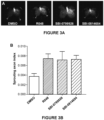
Figure 3 shows that treatment with kinase inhibitor compounds RO48 (A92), SBI-0799926 (A-16) and SBI-0814654 (A88) promotes CST axon sprouting in the spinal cord. A) Transverse sections of cervical spinal cord 5 weeks after unilateral right pyramidotomy and coinjection of AAV8-GFP and compounds into motor cortex show more GFP+ axons sprouting into the denervated grey matter in animals treated with RO48 (A92), SBI-0799926 (A-16) and SBI-0814654 (A88). B) Graph represents averages of sprouting axon index across two animals treated with indicated compounds. Error bars indicate range of data points. N=2 animals (mice). - Provided herein are compounds, or pharmaceutically acceptable salts thereof, having a structure of Formula (I):

- Kinases known to mediate extrinsic inhibition of axon growth, such as Rho Kinase (ROCK) and protein kinase C (PKC). These kinases suppress axon growth in the presence of inhibitory molecules within the CNS microenvironment. Kinases known to mediate intrinsic inhibition of axon growth, such as ribosomal protein S6 kinase (S6K). These kinases suppress the intrinsic regenerative state of neurons. Treating cultured primary neurons with selective inhibitors of ROCK and/or S6K induced neurite outgrowth. Further, co-treating the cultured primary neurons with inhibitors of both kinases had a strong synergistic effect on neurite outgrowth. Treating cultured neurons with a dual inhibitor of ROCK and S6K induces an increase in neurite outgrowth (400% relative to controls). In a mouse model of SCI, dual inhibition of ROCK and S6K, via a single cortical injection, was sufficient to induce robust axon regeneration following injury (dorsal hemisection). This regeneration was accompanied by significant recovery of sensorimotor functions. RO48 (A92) was tested in a second model of spinal cord regeneration (pyramidatomy), and it was found that delivering RO48 to the CSF of injured animals enhanced compensatory sprouting from spared axons. A preliminary experiment using a third model of CNS injury (optic nerve crush) was performed, and it was found found that injecting RO40 into the eye of animals enhanced regeneration of optic nerve axons.
- Based upon these results, a medicinal chemistry program was initiated, and derivatives were prepared. Several derivatives showed a strong effect on neurite outgrowth promotion in culture (some approaching 700% of controls).
- Note: In addition to inhibiting ROCK, PKC, and S6K, the disclosed compounds can also inhibit 2 other kinases that were determined by to be potential targets for promoting neurite outgrowth. These are PKG and PKX.
- The compounds disclosed herein can inhibit one or more kinases, e.g., Rho kinase (ROCK), ribosomal protein S6 kinase (S6K), and/or protein kinase C. inhibition of one or more of these kinases can promote neurite outgrowth and/or axon growth in the central nervous system (CNS).
- Disclosed herein are compounds, or pharmaceutically acceptable salts thereof, having a structure of Formula (I):

- As used herein, the term "alkyl" refers to straight chained and branched saturated hydrocarbon groups. The term Cn means the alkyl group has "n" carbon atoms. For example, C4 alkyl refers to an alkyl group that has 4 carbon atoms. C1-C7 alkyl refers to an alkyl group having a number of carbon atoms encompassing the entire range (i.e., 1 to 7 carbon atoms), as well as all subgroups (e.g., 1-6, 2-7, 1-5, 3-6, 1, 2, 3, 4, 5, 6, and 7 carbon atoms). Non-limiting examples of alkyl groups include, methyl, ethyl, n-propyl, isopropyl, n-butyl, sec-butyl (2-methylpropyl), t-butyl (1,1-dimethylethyl), 3,3-dimethylpentyl, and 2-ethylhexyl. Unless otherwise indicated, an alkyl group can be an unsubstituted alkyl group or a substituted alkyl group. Non-limiting examples of substituted alkyl groups include haloalkyl groups (i.e., alkyl groups substituted with one or more halo groups), hydroxyalkyl groups (i.e., alkyl groups substituted with one or more hydroxy groups), and the like.
- The term "alkylene" used herein refers to an alkyl group having a substituent. For example, the term "alkylenearyl" refers to an alkyl group substituted with an aryl group. For example, an alkylene group can be -CH2CH2- or -CH2-. The term Cn means the alkylene group has "n" carbon atoms. For example, C1-6 alkylene refers to an alkylene group having a number of carbon atoms encompassing the entire range, as well as all subgroups, as previously described for "alkyl" groups. Unless otherwise indicated, an alkylene group can be an unsubstituted alkylene group or a substituted alkylene group.
- The term "alkoxy" refer to an alkyl group substituted with an oxygen, e.g., alkyl-O-.
- As used herein, the term "cycloalkyl" refers to an aliphatic cyclic hydrocarbon group. The term Cn means the cycloalkyl group has "n" carbon atoms. For example, C5 cycloalkyl refers to a cycloalkyl group that has 5 carbon atoms in the ring. C3-C6 cycloalkyl refers to cycloalkyl groups having a number of carbon atoms encompassing the entire range (i.e., 3 to 6 carbon atoms), as well as all subgroups (e.g., 3-5, 4-6, 5-6, 3, 4, 5, and 6 carbon atoms). Nonlimiting examples of cycloalkyl groups include cyclopropyl, cyclobutyl, cyclopentyl, and cyclohexyl. Unless otherwise indicated, a cycloalkyl group can be an unsubstituted cycloalkyl group or a substituted cycloalkyl group. The cycloalkyl groups described herein can be isolated or fused to another cycloalkyl group, a heterocycloalkyl group, an aryl group and/or a heteroaryl group.
- As used herein, the term "aryl" refers to a monocyclic or polycyclic aromatic group, preferably a monocyclic or bicyclic aromatic group having 6 to 10 carbon ring atoms, e.g., phenyl or naphthyl. Unless otherwise indicated, an aryl group can be unsubstituted or substituted with one or more, and in particular one to four groups independently selected from, for example, halo, alkyl, alkenyl, OCF3, NO2, CN, NC, OH, alkoxy, amino, CO2H, CO2alkyl, aryl, and heteroaryl. Aryl groups can be isolated or fused to another aryl group, a cycloalkyl group, a heterocycloalkyl group, and/or a heteroaryl group. Exemplary aryl groups include, but are not limited to, phenyl, naphthyl, tetrahydronaphthyl, chlorophenyl, methylphenyl, methoxyphenyl, trifluoromethylphenyl, nitrophenyl, 2,4-methoxychlorophenyl, and the like.
- As used herein, "heteroaryl" refers to a 5-6 membered monocyclic aromatic ring having 1, 2, or 3 heteroatoms selected from N, S, and O, or a 8-11 membered bicyclic aromatic ring having 1, 2, 3, or 4 heteroatoms selected from N, S, and O. In some embodiments, the heteroaryl ring comprises at least 1 ring nitrogen, or 1, 2, or 3 ring nitrogens. Examples of contemplated heteroaryl groups include, but are not limited to, thienyl, furyl, pyridyl, pyrrolyl, oxazolyl, quinolyl, thiophenyl, isoquinolyl, indolyl, triazinyl, triazolyl, isothiazolyl, isoxazolyl, imidazolyl, benzothiazolyl, pyrazinyl, pyrimidinyl, thiazolyl, and thiadiazolyl. In some cases, the heteroaryl can be pyrrolyl, pyrazolyl, imidazolyl, triazolyl, pyridyl, pyrazinyl, pyrimidinyl, indolyl, indazolyl, benzotriazolyl, benzoimidazolyl, pyrrolopyridinyl, or imidazopyrindinyl. In various cases, the heteroaryl can be pyridyl, pyrimidinyl, pyrrolopyridinyl, indazolyl, or imidazopyrindinyl.
- The term "halo" refers to fluoro, chloro, bromo, and iodo.
- Specifically contemplated compounds of the disclosure include those in the below Table.
Cpd ID IUPAC Name Structure A1 N-{4-[4-(2-fluoro-3,6-dimethoxybenzoyl)benzamido]pyridin-3-yl}pyridine-4-carboxamide 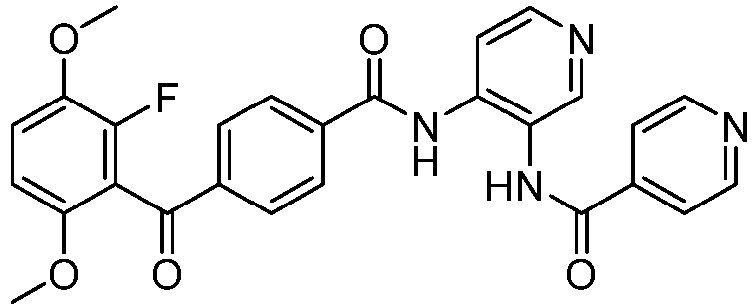
A2 N-{4-[4-(2-fluoro-6-hydroxy-3-methoxybenzoyl)benzamido]pyridin-3-yl}pyridine-4-carboxamide 
A3 N-[4-(4-benzoylbenzamido)pyridin-3-yl]pyridine-4-carboxamide 
A4 N-{2-[4-(2-fluoro-3,6-dimethoxybenzoyl)benzamido]phenyl}pyridine-4-carboxamide 
A5 N-{2-[4-(2-fluoro-6-hydroxy-3-methoxybenzoyl)benzamido]phenyl}pyridine-4-carboxamide 
A6 N-[2-(4-benzoylbenzamido)phenyl]pyridine-4-carboxamide 
A7 1-(4-benzoylbenzoyl)-4-(pyridine-4-carbonyl)piperazine 
A8 1-[4-(2-fluoro-3,6-dimethoxybenzoyl)benzoyl]-4-(pyridine-4-carbonyl)piperazine 
A9 3-fluoro-4-methoxy-2-{4-[4-(pyridine-4-carbonyl)piperazine-1-carbonyl]benzoyl}phenol 
A10 N-[(3R,4R)-4-(pyridine-4-amido)pyrrolidin-3-yl]pyridine-4-carboxamide 
A11 N-[(1R,2R)-1-(4-benzoylbenzamido)-2,3-dihydro-1H-inden-2-yl]pyridine-4-carboxamide 
A12 N-[(1R,2R)-1-[4-(2-fluoro-3,6-dimethoxybenzoyl)benzamido]-2,3-dihydro-1H-inden-2-yl]pyridine-4-carboxamide 
A13 N-[(3R,4R)-4-(4-benzoylbenzamido)pyrrolidin-3-yl]pyridine-4-carboxamide 
A14 N-[(1R,2R)-1-[4-(2-fluoro-6-hydroxy-3-methoxybenzoyl)benzamido]-2,3-dihydro-1H-inden-2-yl]pyridine-4-carboxamide 
A15 N-[(1R,2R)-2-(4-benzoylbenzamido)cyclopentyl]pyridine-4-carboxamide 
A16 N-[(3R,4R)-4-[4-(2-fluoro-6-hydroxy-3-methoxybenzoyl)benzamido]pyrrolidin-3-yl]pyridine-4-carboxamide 
A17 N-[(1R,2R)-2-[4-(2-fluoro-3,6-dimethoxybenzoyl)benzamido]cyclopentyl]pyri dine-4-carboxamide 
A18 N-[(1R,2R)-2-[4-(2-fluoro-6-hydroxy-3-methoxybenzoyl)benzamido]cyclopentyl]pyridi ne-4-carboxamide 
A19 N-[(1R,2R)-2-(4-benzoylbenzamido)cyclohexyl]pyridine-4-carboxamide 
A20 N-[(3R,4R)-4-benzamidopyrrolidin-3-yl]pyridine-4-carboxamide 
A21 N-[(1R,2R)-2-[4-(2-fluoro-3,6-dimethoxybenzoyl)benzamido]cyclohexyl]pyrid ine-4-carboxamide 
A22 N-[(1R,2R)-2-[4-(2-fluoro-6-hydroxy-3-methoxybenzoyl)benzamido]cyclohexyl]pyridin e-4-carboxamide 
A23 N-[(1R,2R)-2-(4-benzoylbenzamido)cycloheptyl]pyridine-4-carboxamide 
A24 N-[(1R,2R)-2-[4-(2-fluoro-3,6-dimethoxybenzoyl)benzamido]cycloheptyl]pyri dine-4-carboxamide 
A25 N-[(1R,2R)-2-[4-(2-fluoro-6-hydroxy-3-methoxybenzoyl)benzamido]cycloheptyl]pyridi ne-4-carboxamide 
A26 4-(2-fluoro-3,6-dimethoxybenzoyl)-N-{2-[(pyridin-4-yl)formamido]ethyl}benzamide 
A27 4-(2-fluoro-6-hydroxy-3-methoxybenzoyl)-N-{2-[(pyridin-4-yl)formamido]ethyl}benzamide 
A28 (3R,4R)-1-methyl-4-(pyridine-4-amido)pyrrolidin-3-yl 4-(2-fluoro-3,6-dimethoxybenzoyl)benzoate 
A29 (3R,4R)-4-(pyridine-4-amido)pyrrolidin-3-yl 4-(2-fluoro-6-hydroxy-3-methoxybenzoyl)benzoate 
A30 (3R,4R)-1-methyl-3-(pyridine-4-amido)piperidin-4-yl 4-(2-fluoro-3,6-dimethoxybenzoyl)benzoate 
A31 (3R,4R)-3-(pyridine-4-amido)piperidin-4-yl 4-(2-fluoro-6-hydroxy-3-methoxybenzoyl)benzoate 
A32 N-[(3R,4S)-4-[4-(2-fluoro-6-hydroxy-3-methoxybenzoyl)benzamido]pyrrolidin-3-yl]pyridine-4-carboxamide 
A33 N-[(3R,4R)-4-[4-(2-fluoro-3,6-dimethoxybenzoyl)benzamido]-1-methylpyrrolidin-3-yl]pyridine-4-carboxamide 
A34 N-[(3S,4S)-4-[4-(2-fluoro-6-hydroxy-3-methoxybenzoyl)benzamido]pyrrolidin-3-yl]pyridine-4-carboxamide 
A35 N-[(3R,4R)-4-[4-(2-fluoro-6-hydroxy-3-methoxybenzoyl)benzamido]pyrrolidin-3-yl]-2-oxo-2,3-dihydro-1H-indole-5-carboxamide 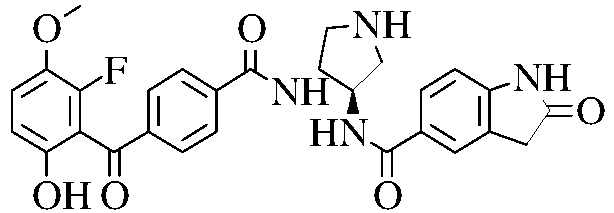
A36 2-amino-N-[(3R,4R)-4-[4-(2-fluoro-6-hydroxy-3-methoxybenzoyl)benzamido]pyrrolidin-3-yl]pyrimidine-4-carboxamide 
A37 N-[(3R,4R)-4-[4-(2-fluoro-6-hydroxy-3-methoxybenzoyl)benzamido]pyrrolidin-3-yl]-4-hydroxybenzamide 
A38 N-[(3R,4R)-4-[4-(2-fluoro-6-hydroxy-3-methoxybenzoyl)benzamido]pyrrolidin-3-yl]pyridine-3-carboxamide 
A39 N-[(3R,4R)-4-[4-(2-fluoro-6-hydroxy-3-methoxybenzoyl)benzamido]pyrrolidin-3-yl]-6-hydroxypyridine-3-carboxamide 
A40 N-[(3R,4R)-4-[4-(2-fluoro-6-hydroxy-3-methoxybenzoyl)benzamido]pyrrolidin-3-yl]-2-hydroxypyridine-4-carboxamide 
A41 N-[(3R,4R)-4-[4-(2-fluoro-6-hydroxy-3-methoxybenzoyl)benzamido]pyrrolidin-3-yl]pyrimidine-4-carboxamide 
A42 N-[(3R,4R)-4-[4-(2-fluoro-6-hydroxy-3-methoxybenzoyl)benzamido]pyrrolidin-3-yl]-1H-indazole-5-carboxamide 
A43 N-[(3R,4R)-4-[4-(2-fluoro-6-hydroxy-3-methoxybenzoyl)benzamido]pyrrolidin-3-yl]-1H-pyrazole-4-carboxamide 
A44 2-amino-N-[(3R,4R)-4-{4-[(2-fluoro-6-hydroxy-3-methoxyphenyl)(hydroxy)methyl]benzamido}py rrolidin-3-yl]pyrimidine-4-carboxamide 
A45 2-amino-N-[(3R,4R)-4-{4-[(2-fluoro-6-hydroxy-3-methoxyphenyl)methyl]benzamido}pyrrolidin-3-yl]pyrimidine-4-carboxamide 
A46 4-(2-fluoro-6-hydroxy-3-methoxybenzoyl)-N-[(3R,4R)-4-[2-(pyridin-3-yl)acetamido]pyrrolidin-3-yl]benzamide 
A47 4-(2-fluoro-6-hydroxy-3-methoxybenzoyl)-N-[(3R,4R)-4-[2-(1H-pyrazol-4-yl)acetamido]pyrrolidin-3-yl]benzamide 
A48 N-[(3R,4R)-4-[4-(2-fluoro-6-hydroxy-3-methoxybenzoyl)benzamido]pyrrolidin-3-yl]-3H-imidazo[4,5-b]pyridine-7-carboxamide 
A49 N-[(3R,4R)-4-[4-(2-fluoro-6-hydroxybenzoyl)benzamido]pyrrolidin-3-yl]-1H-indazole-5-carboxamide 
A50 2-amino-N-[(3R,4R)-4-[4-(2-fluoro-6-hydroxybenzoyl)benzamido]pyrrolidin-3-yl]pyrimidine-4-carboxamide 
A51 N-[(3R,4R)-4-[4-(2-fluoro-6-hydroxybenzoyl)benzamido]pyrrolidin-3-yl]pyridine-4-carboxamide 
A52 N-[(3R,4R)-4-[4-(2-fluoro-6-hydroxy-3-methoxybenzoyl)benzamido]pyrrolidin-3-yl]-1H-1,3-benzodiazole-5-carboxamide 
A53 N-[(3R,4R)-4-[4-(2-fluoro-6-hydroxy-3-methoxybenzoyl)benzamido]pyrrolidin-3-yl]-1-methyl-1H-indazole-5-carboxamide 
A54 2-amino-N-[(3R,4R)-4-[4-(2-fluoro-6-hydroxy-3-methoxybenzoyl)benzamido]pyrrolidin-3-yl]pyridine-4-carboxamide 
A55 N-[(3R,4R)-4-{4-[(2-fluoro-6-hydroxy-3-methoxyphenyl)methyl]benzamido}pyrrolidin-3-yl]pyridine-4-carboxamide 
A56 N-[(3R,4R)-4-[4-(2-fluoro-6-hydroxy-3-methoxybenzoyl)benzamido]pyrrolidin-3-yl]-1H-pyrrolo[2,3-b]pyridine-4-carboxamide 
A57 N-[(3R,4R)-4-[4-(2-fluoro-6-hydroxy-3-methoxybenzoyl)benzamido]pyrrolidin-3-yl]-1H-indazole-6-carboxamide 
A58 N-[(3R,4R)-4-[4-(2-fluoro-6-hydroxy-3-methoxybenzoyl)benzamido]pyrrolidin-3-yl]-1H-1,2,3-benzotriazole-5-carboxamide 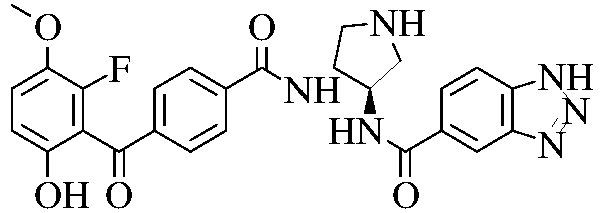
A59 N-[(3R,4R)-4-{4-[(2-fluoro-6-hydroxy-3-methoxyphenyl)(hydroxy)methyl]benzamido}py rrolidin-3-yl]pyridine-4-carboxamide 
A60 2-amino-N-[(3R,4R)-4-[4-(2-methoxyphenoxy)benzamido]pyrrolidin-3-yl]pyrimidine-4-carboxamide 
A61 N-[(3R,4R)-4-[4-(2-methoxyphenoxy)benzamido]pyrrolidin-3-yl]pyridine-4-carboxamide 
A62 2-amino-N-[(3R,4R)-4-[1-(2-hydroxy-5-methoxybenzoyl)piperidine-4-amido]pyrrolidin-3-yl]pyrimidine-4-carboxamide 
A63 N-[(3R,4R)-4-[1-(2-hydroxy-5-methoxybenzoyl)piperidine-4-amido]pyrrolidin-3-yl]pyridine-4-carboxamide 
A64 N-[(3R,4R)-4-[4-(2-hydroxybenzoyl)-3-methylbenzamido]pyrrolidin-3-yl]pyridine-4-carboxamide 
A65 N-[(3R,4R)-4-[2-chloro-4-(2-hydroxybenzoyl)benzamido]pyrrolidin-3-yl]pyridine-4-carboxamide 
A66 2-amino-N-[(3R,4R)-4-[3-chloro-4-(2-hydroxybenzoyl)benzamido]pyrrolidin-3-yl]pyrimidine-4-carboxamide 
A67 N-[(3R,4R)-4-[3-chloro-4-(2-hydroxybenzoyl)benzamido]pyrrolidin-3-yl]pyridine-4-carboxamide 
A68 2-amino-N-[(3R,4R)-4-[4-(2-hydroxybenzoyl)-2-methoxybenzamido]pyrrolidin-3-yl]pyrimidine-4-carboxamide 
A69 N-[(3R,4R)-4-[4-(2-hydroxybenzoyl)-2-methoxybenzamido]pyrrolidin-3-yl]pyridine-4-carboxamide 
A70 2-amino-N-[(3R,4R)-4-[4-(3-chloro-2-hydroxybenzoyl)benzamido]pyrrolidin-3-yl]pyrimidine-4-carboxamide 
A71 N-[(3R,4R)-4-[4-(3-chloro-2-hydroxybenzoyl)benzamido]pyrrolidin-3-yl]pyridine-4-carboxamide 
A72 2-amino-N-[(3R,4R)-4-[4-(2-hydroxy-3-methoxybenzoyl)benzamido]pyrrolidin-3-yl]pyrimidine-4-carboxamide 
A73 N-[(3R,4R)-4-[4-(2-hydroxy-3-methoxybenzoyl)benzamido]pyrrolidin-3-yl]pyridine-4-carboxamide 
A74 2-amino-N-[(3R,4R)-4-[4-(2-hydroxy-3-methylbenzoyl)benzamido]pyrrolidin-3-yl]pyrimidine-4-carboxamide 
A75 N-[(3R,4R)-4-[4-(2-hydroxy-3-methylbenzoyl)benzamido]pyrrolidin-3-yl]pyridine-4-carboxamide 
A76 2-amino-N-[(3R,4R)-4-[4-(2-hydroxy-5-methoxybenzoyl)benzamido]pyrrolidin-3-yl]pyrimidine-4-carboxamide 
A77 N-[(3R,4R)-4-[4-(2-hydroxy-5-methoxybenzoyl)benzamido]pyrrolidin-3-yl]pyridine-4-carboxamide 
A78 N-[(3R,4R)-4-[4-(2-hydroxy-5-methylbenzoyl)benzamido]pyrrolidin-3-yl]pyridine-4-carboxamide 
A79 N-[(3R,4R)-4-[4-(4-chloro-2-hydroxybenzoyl)benzamido]pyrrolidin-3-yl]pyridine-4-carboxamide 
A80 2-amino-N-[(3R,4R)-4-[4-(2-hydroxy-4-methylbenzoyl)benzamido]pyrrolidin-3-yl]pyrimidine-4-carboxamide 
A81 N-[(3R,4R)-4-[4-(2-hydroxy-4-methylbenzoyl)benzamido]pyrrolidin-3-yl]pyridine-4-carboxamide 
A82 2-amino-N-[(3R,4R)-4-[4-(2-hydroxy-4-methoxybenzoyl)benzamido]pyrrolidin-3-yl]pyrimidine-4-carboxamide 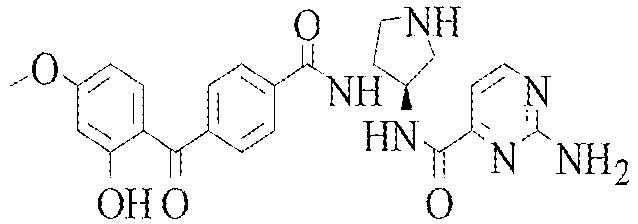
A83 N-[(3R,4R)-4-[4-(2-hydroxy-4-methoxybenzoyl)benzamido]pyrrolidin-3-yl]pyridine-4-carboxamide 
A84 2-amino-N-[(3R,4R)-4-[4-(5-chloro-2-hydroxybenzoyl)benzamido]pyrrolidin-3-yl]pyrimidine-4-carboxamide 
A85 N-[(3R,4R)-4-[4-(5-chloro-2-hydroxybenzoyl)benzamido]pyrrolidin-3-yl]pyridine-4-carboxamide 
A86 N-[(3R,4R)-4-[4-(2-hydroxybenzoyl)benzamido]pyrrolidin-3-yl]pyridine-4-carboxamide 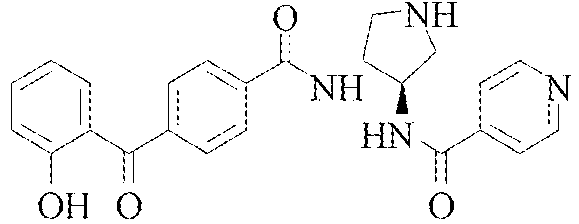
A87 2-(4-(((3R,4R)-4-(isonicotinamido)pyrrolidin-3-yl)carbamoyl)benzoyl)-4-methoxyphenyl benzoate A88 N-((3R,4R)-4-(4-(5-bromo-2-hydroxybenzoyl)benzamido)pyrrolidin-3-yl)isonicotinamide A89 2-(4-(((3R,4R)-4-(isonicotinamido)pyrrolidin-3-yl)carbamoyl)benzoyl)-4-methoxyphenyl acetate A90 N-((3R,4R)-4-(4-(5-ethoxy-2-hydroxybenzoyl)benzamido)pyrrolidin-3-yl)isonicotinamide 
A91 N-((3R,4R)-4-(4-(5-fluoro-2-hydroxybenzoyl)benzamido)pyrrolidin-3-yl)isonicotinamide 
A92 (3R,4R)-3-(isonicotinamido)azepan-4-yl 4-(2-fluoro-6-hydroxy-3-methoxybenzoyl)benzoate 
A93 N-((3R,4R)-4-(4-(4-hydroxy-[1,1'-biphenyl]-3-carbonyl)benzamido)pyrrolidin-3-yl)isonicotinamide 
A94 N-((3R,4R)-4-(4-(2-fluoro-6-hydroxy-3-methoxybenzoyl)benzamido)azepan-3-yl)isonicotinamide 
A95 N-((3R,4R)-4-(4-(5-ethyl-2-hydroxybenzoyl)benzamido)pyrrolidin-3-yl)isonicotinamide 
A96 N-((3R,4R)-4-(4-(2-hydroxy-5-(trifluoromethoxy)benzoyl)benzamido)pyrrolidi n-3-yl)isonicotinamide 
A97 N-((3R,4R)-4-(4-(5-(benzyloxy)-2-hydroxybenzoyl)benzamido)pyrrolidin-3-yl)isonicotinamide 
A98 N-((3R,4R)-4-(4-(5-(tert-butoxy)-2-hydroxybenzoyl)benzamido)pyrrolidin-3-yl)isonicotinamide 
A99 N-((3R,4R)-4-(4-(2-hydroxy-5-(trifluoromethyl)benzoyl)benzamido)pyrrolidin-3-yl)isonicotinamide 
- In some cases, the compound is a compound or salt selected from A1-A86.
- In some cases, the compounds of the disclosure include those listed in Table A, or a pharmaceutically acceptable salt thereof:


- In some cases, the compound is one as listed in Table B, or a pharmaceutically acceptable salt thereof:


- In some cases, the compound is one as listed in Table C, or a pharmaceutically acceptable salt thereof:


- The compounds disclosed herein can be as a pharmaceutically acceptable salt. As used herein, the term "pharmaceutically acceptable salt" refers to those salts which are, within the scope of sound medical judgment, suitable for use in contact with the tissues of humans and lower animals without undue toxicity, irritation, allergic response and the like, and are commensurate with a reasonable benefit/risk ratio. Pharmaceutically acceptable salts are well known in the art. For example, S. M. Berge et al. describe pharmaceutically acceptable salts in detail in J. Pharmaceutical Sciences, 1977, 66, 1-19, which is incorporated herein by reference. Pharmaceutically acceptable salts of the compounds of this invention include those derived from suitable inorganic and organic acids and bases. Examples of pharmaceutically acceptable, nontoxic acid addition salts are salts of an amino group formed with inorganic acids such as hydrochloric acid, hydrobromic acid, phosphoric acid, sulfuric acid and perchloric acid or with organic acids such as acetic acid, trifluoroacetic acid, oxalic acid, maleic acid, tartaric acid, citric acid, succinic acid or malonic acid or by using other methods used in the art such as ion exchange. Other pharmaceutically acceptable salts include adipate, alginate, ascorbate, aspartate, benzenesulfonate, benzoate, bisulfate, borate, butyrate, camphorate, camphorsulfonate, citrate, cyclopentanepropionate, digluconate, dodecylsulfate, ethanesulfonate, formate, fumarate, glucoheptonate, glycerophosphate, gluconate, glutamate, hemisulfate, heptanoate, hexanoate, hydroiodide, 2-hydroxy-ethanesulfonate, lactobionate, lactate, laurate, lauryl sulfate, malate, maleate, malonate, methanesulfonate, 2-naphthalenesulfonate, nicotinate, nitrate, oleate, oxalate, palmitate, pamoate, pectinate, persulfate, 3-phenylpropionate, phosphate, picrate, pivalate, propionate, stearate, succinate, sulfate, tartrate, thiocyanate, p-toluenesulfonate, undecanoate, valerate salts, and the like. Salts of compounds containing a carboxylic acid or other acidic functional group can be prepared by reacting with a suitable base. Such salts include, but are not limited to, alkali metal, alkaline earth metal, aluminum salts, ammonium, N+(C1-4alkyl)4 salts, and salts of organic bases such as trimethylamine, triethylamine, morpholine, pyridine, piperidine, picoline, dicyclohexylamine, N,N'-dibenzylethylenediamine, 2-hydroxyethylamine, bis-(2-hydroxyethyl)amine, tri-(2-hydroxyethyl)amine, procaine, dibenzylpiperidine, dehydroabietylamine, N,N'-bisdehydroabietylamine, glucamine, N-methylglucamine, collidine, quinine, quinoline, and basic amino acids such as lysine and arginine. This invention also envisions the quaternization of any basic nitrogen-containing groups of the compounds disclosed herein. Water or oil-soluble or dispersible products may be obtained by such quaternization. Representative alkali or alkaline earth metal salts include sodium, lithium, potassium, calcium, magnesium, and the like. Further pharmaceutically acceptable salts include, when appropriate, nontoxic ammonium, quaternary ammonium, and amine cations formed using counterions such as halide, hydroxide, carboxylate, sulfate, phosphate, nitrate, lower alkyl sulfonate and aryl sulfonate.
- Compounds disclosed herein can be synthesized by any means available to the synthetic organic chemist. Guidance for the synthesis of compounds are shown in the Examples.
- For example, a compound of Formula (I) can be prepared by selection of the appropriate starting materials and reagents in line with the below synthetic scheme:

- Further provided are pharmaceutical formulations comprising a compound as described herein (e.g., compounds of Formula (I), or pharmaceutically acceptable salts thereof) and a pharmaceutically acceptable excipient.
- The compounds described herein can be administered to a subject in a therapeutically effective amount (e.g., in an amount sufficient to inhibit ROCK, S6K, and/or PKC). The compounds can be administered alone or as part of a pharmaceutically acceptable composition or formulation. In addition, the compounds can be administered all at once, multiple times, or delivered substantially uniformly over a period of time. It is also noted that the dose of the compound can be varied over time.
- A particular administration regimen for a particular subject will depend, in part, upon the compound, the amount of compound administered, the route of administration, and the cause and extent of any side effects. The amount of compound administered to a subject (e.g., a mammal, such as a human) in accordance with the disclosure should be sufficient to effect the desired response over a reasonable time frame. Dosage typically depends upon the route, timing, and frequency of administration. Accordingly, the clinician titers the dosage and modifies the route of administration to obtain the optimal therapeutic effect, and conventional range-finding techniques are known to those of ordinary skill in the art.
- Purely by way of illustration, the method comprises administering, e.g., from about 0.1 mg/kg up to about 100 mg/kg of compound or more, depending on the factors mentioned above. In other embodiments, the dosage ranges from 1 mg/kg up to about 100 mg/kg; or 5 mg/kg up to about 100 mg/kg; or 10 mg/kg up to about 100 mg/kg. Some conditions require prolonged treatment, which may or may not entail administering lower doses of compound over multiple administrations. If desired, a dose of the compound is administered as two, three, four, five, six or more sub-doses administered separately at appropriate intervals throughout the day, optionally, in unit dosage forms. The treatment period will depend on the particular condition and type of pain, and may last one day to several months.
- Suitable methods of administering a physiologically-acceptable composition, such as a pharmaceutical composition comprising the compounds disclosed herein (e.g., compounds of Formula (I)), are well known in the art. Although more than one route can be used to administer a compound, a particular route can provide a more immediate and more effective reaction than another route. Depending on the circumstances, a pharmaceutical composition comprising the compound is applied or instilled into body cavities, absorbed through the skin or mucous membranes, ingested, inhaled, and/or introduced into circulation. For example, in certain circumstances, it will be desirable to deliver a pharmaceutical composition comprising the agent orally, through injection by intravenous, intraperitoneal, intracerebral (intra-parenchymal), intracerebroventricular, intramuscular, intra-ocular, intraarterial, intraportal, intralesional, intramedullary, intrathecal, intraventricular, transdermal, subcutaneous, intraperitoneal, intranasal, enteral, topical, sublingual, urethral, vaginal, or rectal means, by sustained release systems, or by implantation devices. If desired, the compound is administered regionally via intrathecal administration, intracerebral (intra-parenchymal) administration, intracerebroventricular administration, or intraarterial or intravenous administration feeding the region of interest. Alternatively, the composition is administered locally via implantation of a membrane, sponge, or another appropriate material onto which the desired compound has been absorbed or encapsulated. Where an implantation device is used, the device is, in one aspect, implanted into any suitable tissue or organ, and delivery of the desired compound is, for example, via diffusion, timed-release bolus, or continuous administration.
- To facilitate administration, the compound is, in various aspects, formulated into a physiologically-acceptable composition comprising a carrier (i.e., vehicle, adjuvant, or diluent). The particular carrier employed is limited only by chemico-physical considerations, such as solubility and lack of reactivity with the compound, and by the route of administration. Physiologically- acceptable carriers are well known in the art. Illustrative pharmaceutical forms suitable for injectable use include sterile aqueous solutions or dispersions and sterile powders for the extemporaneous preparation of sterile injectable solutions or dispersions (for example, see
U.S. Patent No. 5,466,468 ). Injectable formulations are further described in, e.g., Pharmaceutics and Pharmacy Practice, J. B. Lippincott Co., Philadelphia. Pa., Banker and Chalmers, eds., pages 238-250 (1982), and ASHP Handbook on Injectable Drugs, Toissel, 4th ed., pages 622-630 (1986)). A pharmaceutical composition comprising the compound is, in one aspect, placed within containers, along with packaging material that provides instructions regarding the use of such pharmaceutical compositions. Generally, such instructions include a tangible expression describing the reagent concentration, as well as, in certain embodiments, relative amounts of excipient ingredients or diluents (e.g., water, saline or PBS) that may be necessary to reconstitute the pharmaceutical composition. - Compositions suitable for parenteral injection may comprise physiologically acceptable sterile aqueous or nonaqueous solutions, dispersions, suspensions, or emulsions, and sterile powders for reconstitution into sterile injectable solutions or dispersions. Examples of suitable aqueous and nonaqueous carriers, diluents, solvents, or vehicles include water, ethanol, polyols (propylene glycol, polyethylene glycol, glycerol, and the like), suitable mixtures thereof, vegetable oils (such as olive oil) and injectable organic esters such as ethyl oleate. Proper fluidity can be maintained, for example, by the use of a coating such as lecithin, by the maintenance of the required particle size in the case of dispersions, and by the use of surfactants.
- These compositions may also contain adjuvants such as preserving, wetting, emulsifying, and dispersing agents. Microorganism contamination can be prevented by adding various antibacterial and antifungal agents, for example, parabens, chlorobutanol, phenol, sorbic acid, and the like. It may also be desirable to include isotonic agents, for example, sugars, sodium chloride, and the like. Prolonged absorption of injectable pharmaceutical compositions can be brought about by the use of agents delaying absorption, for example, aluminum monostearate and gelatin.
- Solid dosage forms for oral administration include capsules, tablets, powders, and granules. In such solid dosage forms, the active compound is admixed with at least one inert customary excipient (or carrier) such as sodium citrate or dicalcium phosphate or (a) fillers or extenders, as for example, starches, lactose, sucrose, mannitol, and silicic acid; (b) binders, as for example, carboxymethylcellulose, alginates, gelatin, polyvinylpyrrolidone, sucrose, and acacia; (c) humectants, as for example, glycerol; (d) disintegrating agents, as for example, agar-agar, calcium carbonate, potato or tapioca starch, alginic acid, certain complex silicates, and sodium carbonate; (a) solution retarders, as for example, paraffin; (f) absorption accelerators, as for example, quaternary ammonium compounds; (g) wetting agents, as for example, cetyl alcohol and glycerol monostearate; (h) adsorbents, as for example, kaolin and bentonite; and (i) lubricants, as for example, talc, calcium stearate, magnesium stearate, solid polyethylene glycols, sodium lauryl sulfate, or mixtures thereof. In the case of capsules, and tablets, the dosage forms may also comprise buffering agents. Solid compositions of a similar type may also be used as fillers in soft and hard filled gelatin capsules using such excipients as lactose or milk sugar, as well as high molecular weight polyethylene glycols, and the like.
- Solid dosage forms such as tablets, dragees, capsules, pills, and granules can be prepared with coatings and shells, such as enteric coatings and others well known in the art. The solid dosage forms may also contain opacifying agents. Further, the solid dosage forms may be embedding compositions, such that they release the active compound or compounds in a certain part of the intestinal tract in a delayed manner. Examples of embedding compositions that can be used are polymeric substances and waxes. The active compound can also be in micro-encapsulated form, optionally with one or more excipients.
- Liquid dosage forms for oral administration include pharmaceutically acceptable emulsions, solutions, suspensions, syrups, and elixirs. In addition to the active compounds, the liquid dosage form may contain inert diluents commonly used in the art, such as water or other solvents, solubilizing agents and emulsifiers, as for example, ethyl alcohol, isopropyl alcohol, ethyl carbonate, ethyl acetate, benzyl alcohol, benzyl benzoate, propylene glycol, 1,3-butylene glycol, dimethylformamide, oils, in particular, cottonseed oil, groundnut oil, corn germ oil, olive oil, castor oil, and sesame seed oil, glycerol, tetrahydrofurfuryl alcohol, polyethylene glycols and fatty acid esters of sorbitan, or mixtures of these substances, and the like.
- Besides such inert diluents, the composition can also include adjuvants, such as wetting agents, emulsifying and suspending agents, sweetening, flavoring, and perfuming agents. Suspensions, in addition to the active compound, may contain suspending agents, as for example, ethoxylated isostearyl alcohols, polyoxyethylene sorbitol and sorbitan esters, microcrystalline cellulose, aluminum metahydroxide, bentonite, agar-agar, and tragacanth, or mixtures of these substances, and the like.
- Compositions for rectal administration are preferably suppositories, which can be prepared by mixing the compounds of the disclosure with suitable non-irritating excipients or carriers such as cocoa butter, polyethylene glycol or a suppository wax, which are solid at ordinary room temperature, but liquid at body temperature, and therefore, melt in the rectum or vaginal cavity and release the active component.
- When appropriate, the compound is administered in combination with other substances (e.g., therapeutics) and/or other therapeutic modalities to achieve an additional (or augmented) biological effect. These other therapeutics/co-treatments include, for example, surgery, radiation treatment, chemotherapy, anti-angiogenic factors (for instance, soluble growth factor receptors (e.g., sflt), growth factor antagonists (e.g., angiotensin), etc.), antibiotics, hormone therapy, anti-inflammatory agents (e.g., Non-Steroidal Anti-Inflammatory Drugs (NSAIDs) or steroidal anti-inflammatory substances), antiviral agents, anti-bacterial agents, cough suppressant, decongestant, or expectorant, pain relievers, and the like. Optionally, the compound is administered in combination with an agent that facilitates transport across the blood-brain barrier and/or an agent that blocks efflux from the brain. Additional combination therapies not specifically listed herein are also within the scope of the present disclosure.
- The disclosure thus includes administering to a subject the compound in combination with one or more additionally suitable substances(s), each being administered according to a regimen suitable for that medicament. This aspect includes concurrent administration (i.e., substantially simultaneous administration) and non-concurrent administration (i.e., administration at different times, in any order, whether overlapping or not) of the agent and one or more additionally suitable agents(s). It will be appreciated that different components are, in certain aspects, administered in the same or in separate compositions, and by the same or different routes of administration.
- In jurisdictions that forbid the patenting of methods that are practiced on the human body, the meaning of "administering" of a composition to a human subject shall be restricted to prescribing a controlled substance that a human subject will self-administer by any technique (e.g., orally, inhalation, topical application, injection, insertion, etc.). The broadest reasonable interpretation that is consistent with laws or regulations defining patentable subject matter is intended. In jurisdictions that do not forbid the patenting of methods that are practiced on the human body, the "administering" of compositions includes both methods practiced on the human body and also the foregoing activities.
- The compounds disclosed herein can inhibit one or more of ROCK, S6K, and PKC. In some cases, the compound inhibits ROCK, PKC, and S6K. In some cases, the compound inhibits each of ROCK, S6K, and PKC.
- The co-inhibition of ROCK and S6K synergistically promotes neurite outgrowth in primary neurons. This synergy is likely due to the simultaneous modulation of mechanisms that mediate both extrinsic and intrinsic suppression of neurite outgrowth.
- The inhibitory activity of a compound disclosed herein can be assessed using an assay as described in the examples. In some cases, the IC50 of the compound against ROCK is 0.1 to 3000 nM, 0.1 to 1000 nM, 0.1 to 500 nM, 0.1 to 100 nM, 0.1 to 50 nM, 0.1 to 25 nM, 0.1 to 10 nM, 0.1 to 5 nM, 0.1 to 1 nM, 0.1 to 0.5 nM, 1000 to 2000 nM, 100 to 1000 nM, 10 or 100 nM, 5 to 50 nM, or 1 to 10 nM. In some cases, the IC50 of the compound against S6K is 0.1 to 3000 nM, 0.1 to 1000 nM, 0.1 to 500 nM, 0.1 to 100 nM, 0.1 to 50 nM, 0.1 to 25 nM, 0.1 to 10 nM, 0.1 to 5 nM, 0.1 to 1 nM, 0.1 to 0.5 nM, 1000 to 2000 nM, 100 to 1000 nM, 10 or 100 nM, 5 to 50 nM, or 1 to 10 nM. In some cases, the IC50 of the compound against PKC is 0.1 to 3000 nM, 0.1 to 1000 nM, 0.1 to 500 nM, 0.1 to 100 nM, 0.1 to 50 nM, 0.1 to 25 nM, 0.1 to 10 nM, 0.1 to 5 nM, 0.1 to 1 nM, 0.1 to 0.5 nM, 1000 to 2000 nM, 100 to 1000 nM, 10 or 100 nM, 5 to 50 nM, or 1 to 10 nM.
- The compounds disclosed herein can induce neurite outgrowth. In some cases, the compounds disclosed herein can treat a CNS disorder associated with neuronal and/or axonal damage. For example, the compounds disclosed herein can treat a CNS disorder such as paralysis, spinal cord injury, optic nerve injury, glaucoma, multiple sclerosis, traumatic brain injury, diffuse axonal injury, stroke, or a degenerative disease (such as Parkinson's disease).
- In some cases, the compounds disclosed herein can treat a peripheral nervous system (PNS) disorder associated with neuronal and/or axonal damage. In some cases, the PNS disorder is peripheral nerve trauma, repetitive stress, amyotropic lateral sclerosis (ALS), erectile dysfunction, a disorder associated with an organ transplant, neurofibromatosis, blood vessel disease, diabetes, an autoimmune disorder, a disorder associated with chemical toxicity, or kidney disease.
- In some cases, the compounds disclosed herein can treat nerve degeneration in a subject undergoing cancer therapy.
- The compounds disclosed herein can be useful in the therapy of, for example, (i) disorders of the nervous system (e.g., neurodegenerative diseases), (ii) conditions of the nervous system that are secondary to a disease, condition, or therapy having a primary effect outside of the nervous system, (iii) injuries to the nervous system caused by physical, mechanical, or chemical trauma, (iv) memory loss, and (v) psychiatric disorders.
- Examples of neurodegenerative diseases and conditions that can be prevented or treated by promoting neurite outgrowth according to the invention include amyotrophic lateral sclerosis (ALS), trigeminal neuralgia, glossopharyngeal neuralgia, Bell's palsy, myasthenia gravis, muscular dystrophy, progressive muscular atrophy, primary lateral sclerosis (PLS), pseudobulbar palsy, progressive bulbar palsy, spinal muscular atrophy, progressive bulbar palsy, inherited muscular atrophy, invertebrate disk syndromes (e.g., herniated, ruptured, and prolapsed disk syndromes), cervical spondylosis, plexus disorders, thoracic outlet destruction syndromes, peripheral neuropathies, prophyria, mild cognitive impairment, Alzheimer's disease, Huntington's disease, Parkinson's disease, Parkinson-plus syndromes (e.g., multiple system atrophy, progressive supranuclear palsy, and corticobasal degeneration), dementia with Lewy bodies, frontotemporal dementia, demyelinating diseases (e.g., Guillain-Barre syndrome and multiple sclerosis), Charcot-Marie-Tooth disease (CMT; also known as Hereditary Motor and Sensory Neuropathy (HMSN), Hereditary Sensorimotor Neuropathy (HSMN), and Peroneal Muscular Atrophy), prion disease (e.g., Creutzfeldt-Jakob disease, Gerstmann-Straussler-Scheinker syndrome (GSS), fatal familial insomnia (FFI), and bovine spongiform encephalopathy (BSE, commonly known as mad cow disease)), Pick's disease, epilepsy, and AIDS demential complex (also known as HIV dementia, HIV encephalopathy, and HIV-associated dementia).
- Certain diseases and conditions having primary effects outside of the nervous system can lead to damage to the nervous system, which can be treated using compounds as disclosed herien. Examples of such conditions include peripheral neuropathy and neuralgia caused by, for example, diabetes, cancer, AIDS, hepatitis, kidney dysfunction, Colorado tick fever, diphtheria, HIV infection, leprosy, lyme disease, polyarteritis nodosa, rheumatoid arthritis, sarcoidosis, Sjogren syndrome, syphilis, systemic lupus erythematosus, and amyloidosis.
- In addition, the compounds disclosed herein can be used in the treatment of nerve damage, such as peripheral neuropathy, which is caused by exposure to toxic compounds, including heavy metals (e.g., lead, arsenic, and mercury) and industrial solvents, as well as drugs including chemotherapeutic agents (e.g., vincristine and cisplatin), dapsone, HIV medications (e.g., Zidovudine, Didanosine, Stavudine, Zalcitabine, Ritonavir, and Amprenavir), cholesterol lowering drugs (e.g., Lovastatin, Indapamid, and Gemfibrozil), heart or blood pressure medications (e.g., Amiodarone, Hydralazine, Perhexiline), and Metronidazole.
- The compounds disclosed herein can also be used to treat injury to the nervous system caused by physical, mechanical, or chemical trauma. Thus, the methods can be used in the treatment of peripheral nerve damage caused by physical injury (associated with, e.g., burns, wounds, surgery, and accidents), ischemia, prolonged exposure to cold temperature (e.g., frost-bite), chemical trauma (e.g., due to chemotherapy as a cancer treatment) as well as damage to the central nervous system due to, for example, stroke or intracranial hemorrhage (such as cerebral hemorrhage).
- Further, the compounds disclosed herein can be used in the prevention or treatment of memory loss such as, for example, age-related memory loss. Types of memory that can be affected by loss include episodic memory, semantic memory, short-term memory, and long-term memory. Examples of diseases and conditions associated with memory loss include mild cognitive impairment, Alzheimer's disease, Parkinson's disease, Huntington's disease, chemotherapy, stress, stroke, and traumatic brain injury (e.g., concussion).
- The compounds disclosed herein can also be used in the treatment of psychiatric disorders including, for example, schizophrenia, delusional disorder, schizoaffective disorder, schizopheniform, shared psychotic disorder, psychosis, paranoid personality disorder, schizoid personality disorder, borderline personality disorder, anti-social personality disorder, narcissistic personality disorder, obsessive-compulsive disorder, delirium, dementia, mood disorders, bipolar disorder, depression, stress disorder, panic disorder, agoraphobia, social phobia, post-traumatic stress disorder, anxiety disorder, and impulse control disorders (e.g., kleptomania, pathological gambling, pyromania, and trichotillomania).
-

- General Procedure 1: A vial was charged with a salicylaldehyde (1.0 equiv) and DMF (0.25 M) at room temperature. (4-(methoxycarbonyl) phenyl)boronic acid (1.2 equiv) was then added, followed by [RhCl2Cp*]2 (0.04 equiv) and Cu(OAc)2 (1.2 equiv). The resulting suspension was warmed to 80 °C for 3-4 h. The mixture was cooled to room temperature and filtered to remove the insoluble salts. The solution was then diluted with EtOAc and washed twice with water. The organic portion was concentrated to give the crude intermediate methyl 4-(2-hydroxybenzoyl)benzoate which could be used without further purification. This solid was dissolved in CH2Cl2 (0.5 M) and treated with diisoproplyethylamine (1.5 equiv) and (chloromethoxy)ethane (1.5 equiv). This solution was stirred at room temperature until protection of the phenol was complete by LCMS. The reaction was then diluted with CH2Cl2 and thrice washed with water. Concentration of the organic portion and purification on silica gel (hexane/EtOAc gradient) gave the methyl 4-(2-(ethoxymethoxy)benzoyl)benzoate derivatives. This ester (1.0 equiv) was dissolved in THF (0.25 M) and H2O (0.5 M) and treated with LiOH (4.0 equiv). The mixture was stirred at room temperature until saponification was complete, then was diluted with EtOAc and washed with a 10% citric acid solution and then water. Concentration of the organic portion gave the 4-(2-(ethoxymethoxy)benzoyl)benzoic acid derivatives.

- General Procedure 2: A vial was charged with a 4-(2-(ethoxymethoxy)benzoyl)benzoic acid (1 equiv), Et3N (1 equiv) and DMF (0.5 M) at room temperature. To this solution was then added HATU (1 equiv) and the mixture was stirred for 5 min. This solution was then added to a second vial containing a freshly prepared mixture of tert-butyl (3R,4S)-3,4-diaminopyrrolidine-1-carboxylate (1 equiv) and HCl (4.0 M dioxane solution, 2 equiv) in DMF (0.5 M). The resulting solution was stirred at room temperature for 18 h to give a tert-butyl (3R,4R)-3-amino-4-(4-(2-(ethoxymethoxy)benzoyl)benzamido)pyrrolidine-1-carboxylate analog which could be directly used in situ. To this solution was added heteroarylcarboxcylic acid (1 equiv), Et3N (2 equiv) and HATU (1 equiv). The mixture was stirred at room temperature for 1 h, then quenched with water and extracted with EtOAc. The organic portion was concentrated in vacuo and then redissolved in THF (0.2 M) and aqueous 1N HCl (0.1 M). The solution was warmed to 65 °C and stirred until the carbamate and acetal protecting groups were fully removed by LCMS. The solution was then purified via HPLC to give the final product as a formate salt.
-

- Prepared according to the general procedure 1. 1H NMR (500 MHz, Chloroform-d) δ 8.15 (d, J = 7.8 Hz, 2H), 7.88 (d, J = 7.4 Hz, 2H), 7.49 (t, J = 8.1 Hz, 1H), 7.43 (d, J = 7.6 Hz, 1H), 7.13 (t, J = 7.4 Hz, 1H), 5.07 (s, 2H), 3.49 (m, 2H), 1.12 (t, J = 7.1 Hz, 3H).
-

- Prepared according to the general procedure 1. 1H NMR (500 MHz, Chloroform-d) δ 8.16 (d, J = 8.9 Hz, 2H), 7.87 (d, J = 8.0 Hz, 2H), 7.44 (dd, J = 8.9, 2.7 Hz, 1H), 7.39 (d, J = 2.8 Hz, 1H), 7.22 (d, J = 8.9 Hz, 1H), 5.04 (s, 2H), 3.48 (q, J = 6.9 Hz, 2H), 1.12 (t, J = 7.0 Hz, 3H).
-

- Prepared according to the general procedure 1. 1H NMR (500 MHz, Chloroform-d) δ 8.15 (d, J = 8.5 Hz, 2H), 7.88 (d, J = 8.4 Hz, 2H), 7.28 (dd, J = 8.6, 2.4 Hz, 1H), 7.23 (d, J = 2.3 Hz, 1H), 7.14 (d, J = 8.5 Hz, 1H), 5.02 (s, 2H), 3.47 (q, J = 7.1 Hz, 2H), 2.34 (s, 3H), 1.11 (t, J = 7.1 Hz, 3H).
-
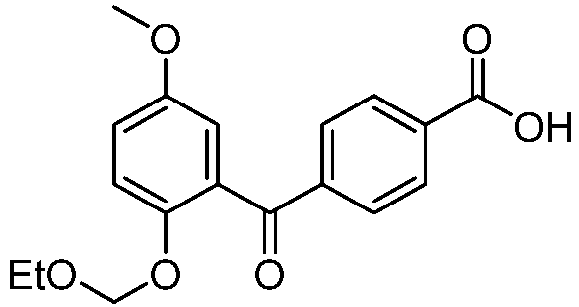
- Prepared according to the general procedure 1. 1H NMR (500 MHz, Chloroform-d) δ 8.16 (d, J = 8.4 Hz, 2H), 7.89 (d, J = 8.2 Hz, 2H), 7.19 (d, J = 9.0 Hz, 1H), 7.03 (dd, J = 9.1, 3.1 Hz, 1H), 6.96 (d, J = 3.1 Hz, 1H), 4.97 (s, 2H), 3.81 (s, 3H), 3.48 (q, J = 7.0 Hz, 2H), 1.12 (t, J = 7.1 Hz, 3H).
-

- Prepared according to the general procedure 1. 1H NMR (500 MHz, Chloroform-d) δ 8.14 (d, J = 8.1 Hz, 2H), 7.86 (d, J = 8.1 Hz, 2H), 7.36 (d, J = 7.7 Hz, 1H), 7.05 (s, 1H), 6.93 (d, J = 7.8 Hz, 1H), 5.04 (s, 2H), 3.49 (q, J = 7.0 Hz, 2H), 2.42 (s, 3H), 1.13 (t, J = 7.1 Hz, 3H).
-

- Prepared according to the general procedure 1. 1H NMR (500 MHz, Chloroform-d) δ 8.09 (d, J = 8.4 Hz, 2H), 7.82 (d, J = 8.3 Hz, 2H), 7.36 (d, J = 8.2 Hz, 1H), 7.27 (d, J = 1.8 Hz, 1H), 7.10 (dd, J = 8.1, 1.8 Hz, 1H), 5.04 (s, 2H), 3.94 (s, 3H), 3.48 (q, J = 7.1 Hz, 2H), 1.13 (t, J = 7.1 Hz, 3H).
-
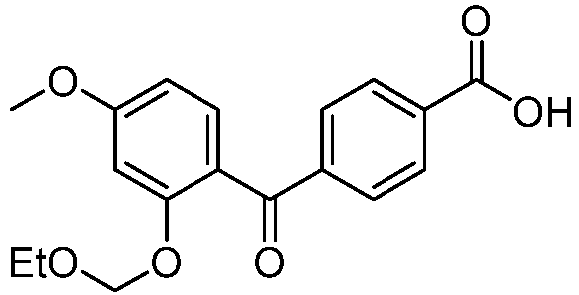
- Prepared according to the general procedure 1. 1H NMR (500 MHz, Chloroform-d) δ 8.14 (d, J = 8.4 Hz, 2H), 7.83 (d, J = 8.3 Hz, 2H), 7.49 (d, J = 8.5 Hz, 1H), 6.79 (d, J = 2.2 Hz, 1H), 6.65 (dd, J = 8.6, 2.3 Hz, 1H), 5.03 (s, 2H), 3.87 (s, 3H), 3.49 (q, J = 7.1 Hz, 2H), 1.13 (t, J = 7.1 Hz, 3H).
-

- Prepared according to the general procedure 1. 1H NMR (500 MHz, Chloroform-d) δ 8.16 (d, J = 8.0 Hz, 2H), 7.91 (d, J = 8.2 Hz, 2H), 7.39 (d, J = 7.5 Hz, 1H), 7.23 (d, J = 7.4 Hz, 1H), 7.14 (t, J = 7.5 Hz, 1H), 4.87 (s, 2H), 3.46 (q, J = 7.0 Hz, 2H), 2.37 (s, 3H), 1.01 (t, J = 7.0 Hz, 3H).
-

- Prepared according to the general procedure 1. 1H NMR (500 MHz, Chloroform-d) δ 8.17 (d, J = 8.1 Hz, 2H), 7.91 (d, J = 8.1 Hz, 2H), 7.60 (d, J = 7.9 Hz, 1H), 7.31 (d, J = 7.7 Hz, 1H), 7.20 (t, J = 7.9 Hz, 1H), 5.01 (s, 2H), 3.44 (q, J = 7.0 Hz, 2H), 1.05 - 0.93 (m, 3H).
-

- Prepared according to the general procedure 1. 1H NMR (500 MHz, Chloroform-d) δ 8.15 (d, J = 8.3 Hz, 2H), 7.93 (d, J = 8.3 Hz, 2H), 7.19 (t, J = 7.9 Hz, 1H), 7.10 (dd, J = 8.4, 1.4 Hz, 1H), 6.98 (dd, J = 7.7, 1.5 Hz, 1H), 5.01 (s, 2H), 3.91 (s, 3H), 3.38 (q, J = 7.1 Hz, 2H), 0.98 (t, J = 7.0 Hz, 3H).
-

- Prepared according to the general procedure 1. 1H NMR (500 MHz, Chloroform-d) δ 8.02 (d, J = 8.1 Hz, 1H), 7.87 (d, J = 1.5 Hz, 1H), 7.77 - 7.72 (m, 1H), 7.51 (t, J = 7.7 Hz, 1H), 7.45 (d, J = 7.6 Hz, 1H), 7.28 (m, 1H), 7.14 (t, J = 7.6 Hz, 1H), 5.08 (s, 2H), 3.52 (q, J = 7.1 Hz, 2H), 1.15 (t, J = 7.1 Hz, 3H).
-

- Prepared according to the general procedure 1. 1H NMR (500 MHz, Chloroform-d) δ 8.21 (d, J = 8.0 Hz, 1H), 7.66 (d, J = 1.3 Hz, 1H), 7.53 - 7.48 (m, 1H), 7.42 (dd, J = 7.5, 1.7 Hz, 1H), 7.39 - 7.35 (m, 1H), 7.28 (m, 1H), 7.13 (dd, J = 8.0, 6.9 Hz, 1H), 5.08 (s, 2H), 4.15 (s, 3H), 3.51 (q, J = 7.1 Hz, 2H), 1.14 (t, J = 7.1 Hz, 3H).
-
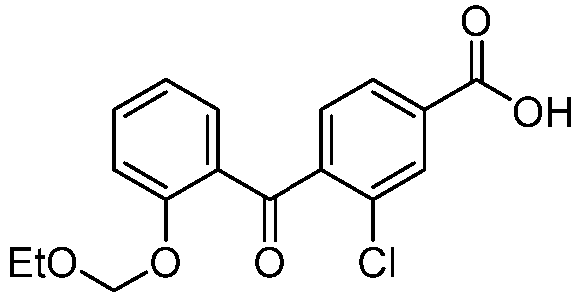
- Prepared according to the general procedure 1. LCMS indicated some loss of chlorine.
-

- Prepared according to the general procedure 1 with pinacol boronate in place of boronic acid. This compound contained impurities and was used without further purification. 1H NMR (500 MHz, Chloroform-d) δ 8.00 (s, 1H), 7.91 (d, J = 8.2 Hz, 1H), 7.61 (dd, J = 7.6, 1.6 Hz, 1H), 7.52 - 7.46 (m, 1H), 7.38 (d, J = 8.0 Hz, 1H), 7.18 (d, J = 8.4 Hz, 1H), 7.10 (t, J = 7.6 Hz, 1H), 4.98 (s, 2H), 3.39 (q, J = 7.0 Hz, 2H), 2.48 (s, 3H), 1.09 (t, J = 7.1 Hz, 3H).
-

- Prepared according to the general procedure 2. 1H NMR (400 MHz, Methanol-d 4) δ 8.76 - 8.66 (m, 2H), 8.37 (s, 2H), 8.00 (d, J = 8.0 Hz, 2H), 7.85 - 7.77 (m, 4H), 7.61 - 7.47 (m, 2H), 7.04 (d, J = 8.4 Hz, 1H), 6.94 (t, J = 7.8 Hz, 1H), 4.75 (m, 2H), 3.85 (m, 2H), 3.47 (m, 2H). LCMS (ESI+) for C24H22N4O4 [M+H] expected = 431.17, found = 431.53.
-

- Prepared according to the general procedure 2. 1H NMR (500 MHz, Methanol-d 4) δ 8.72 (s, 2H), 8.37 (d, J = 4.1 Hz, 2H), 8.00 (t, J = 5.7 Hz, 2H), 7.82 (t, J = 5.3 Hz, 4H), 7.50 (dt, J = 8.4, 2.8 Hz, 1H), 7.42 (t, J = 2.8 Hz, 1H), 7.03 (dd, J = 8.9, 4.5 Hz, 1H), 4.74 (s, 2H), 3.90 - 3.81 (m, 2H), 3.50 - 3.41 (m, 2H). LCMS (ESI+) for C24H21ClN4O4 [M+H] expected = 465.13, found = 465.52.
-

- Prepared according to the general procedure 2. 1H NMR (500 MHz, Methanol-d 4) δ 7.99 (m, 2H), 7.82 (s, 2H), 7.50 (m, 1H), 7.43 (m, 1H), 7.21 (s, 1H), 7.04 (m, 1H), 4.67 (m, 2H), 3.76 (m, 2H), 3.35 (m, 2H). LCMS (ESI+) for C23H21ClN6O4 [M+H] expected = 481.13, found = 481.57.
-

- Prepared according to the general procedure 2. 1H NMR (500 MHz, Methanol-d 4) δ 8.71 (d, J = 5.2 Hz, 2H), 8.48 (s, 1H), 7.99 (d, J = 8.0 Hz, 2H), 7.84 - 7.78 (m, 2H), 7.73 (d, J = 7.9 Hz, 2H), 7.46 (d, J = 9.0 Hz, 1H), 6.56 (d, J = 2.4 Hz, 1H), 6.49 (dd, J = 9.0, 2.5 Hz, 1H), 4.67 (m, 2H), 3.88 (s, 3H), 3.77 - 3.68 (m, 2H). LCMS (ESI+) for C25H24N4O5 [M+H] expected = 461.18, found = 461.55.
-

- Prepared according to the general procedure 2. 1H NMR (500 MHz, Methanol-d 4) δ 8.49 (s, 1H), 8.46 (d, J = 5.0 Hz, 1H), 7.98 (d, J = 8.4 Hz, 2H), 7.73 (d, J = 8.0 Hz, 2H), 7.46 (d, J = 9.0 Hz, 1H), 7.21 (d, J = 5.0 Hz, 1H), 6.56 (d, J = 2.4 Hz, 1H), 6.49 (dd, J = 9.0, 2.5 Hz, 1H), 4.64 (m, 2H), 3.88 (s, 3H), 3.76 - 3.64 (m, 2H), 3.26 (m, 2H). LCMS (ESI+) for C24H24N6O5 [M+H] expected = 477.18, found = 477.58.
-

- Prepared according to the general procedure 2. 1H NMR (500 MHz, Methanol-d 4) δ 8.72 (d, J = 6.1 Hz, 2H), 8.44 (s, 1H), 7.99 (d, J = 8.1 Hz, 2H), 7.81 (d, J = 6.1 Hz, 2H), 7.76 (d, J = 8.0 Hz, 2H), 7.41 (d, J = 8.2 Hz, 1H), 6.88 (s, 1H), 6.77 (d, J = 8.2 Hz, 1H), 4.73 - 4.66 (m, 2H), 3.74 (dd, J = 12.1, 6.9 Hz, 2H), 2.38 (s, 3H). LCMS (ESI+) for C25H24N4O4 [M+H] expected = 445.18, found = 445.55.
-

- Prepared according to the general procedure 2. 1H NMR (500 MHz, Methanol-d 4) δ 8.46 (d, J = 4.9 Hz, 1H), 8.40 (s, 4H), 7.99 (d, J = 8.3 Hz, 2H), 7.76 (d, J = 8.2 Hz, 2H), 7.40 (d, J = 8.2 Hz, 1H), 7.22 (d, J = 4.9 Hz, 1H), 6.88 (s, 1H), 6.78 - 6.75 (m, 1H), 4.72 (m, 2H), 3.84 (dd, J = 11.8, 7.5 Hz, 2H), 3.49 - 3.41 (m, 2H), 2.37 (s, 3H). LCMS (ESI+) for C24H24N6O4 [M+H] expected = 461.19, found = 461.78.
-

- Prepared according to the general procedure 2. 1H NMR (500 MHz, Methanol-d 4) δ 8.76 - 8.67 (m, 2H), 8.50 (s, 1H), 7.99 (d, J = 8.1 Hz, 2H), 7.83 - 7.78 (m, 4H), 7.50 (d, J = 8.5 Hz, 1H), 7.08 (d, J = 2.0 Hz, 1H), 6.96 (dd, J = 8.5, 2.1 Hz, 1H), 4.74 - 4.68 (m, 2H), 3.74 (dd, J = 12.0, 7.0 Hz, 2H), 3.33 (m, 2H). LCMS (ESI+) for C24H21ClN4O4 [M+H] expected = 465.13, found = 465.52.
-

- Prepared according to the general procedure 2. 1H NMR (500 MHz, Methanol-d 4) δ 8.72 (d, J = 6.0 Hz, 2H), 8.37 (s, 3H), 8.00 (d, J = 8.1 Hz, 2H), 7.82 (d, J = 6.1 Hz, 2H), 7.78 (d, J = 8.1 Hz, 2H), 7.38 (dd, J = 8.5, 2.2 Hz, 1H), 7.27 (d, J = 2.1 Hz, 1H), 6.94 (d, J = 8.5 Hz, 1H), 4.72 (d, J = 7.4 Hz, 2H), 3.84 (dd, J = 12.0, 6.8 Hz, 2H), 3.48 - 3.40 (m, 2H), 2.24 (s, 3H). LCMS (ESI+) for C25H24N4O4 [M+H] expected = 445.18, found = 445.55.
-

- Prepared according to the general procedure 2. 1H NMR (500 MHz, Methanol-d 4) δ 8.76 - 8.69 (m, 2H), 8.45 (s, 1H), 8.00 (d, J = 8.1 Hz, 2H), 7.87 - 7.77 (m, 4H), 7.19 (dd, J = 9.0, 3.1 Hz, 1H), 6.99 (s, 1H), 6.98 - 6.95 (m, 1H), 4.73 - 4.66 (m, 2H), 3.75 (dd, J = 12.1, 7.1 Hz, 2H), 3.70 (s, 3H). LCMS (ESI+) for C25H24N4O5 [M+H] expected = 461.18, found = 461.45.
-

- Prepared according to the general procedure 2. 1H NMR (500 MHz, Methanol-d 4) δ 8.48 - 8.43 (m, 1H), 7.99 (d, J = 8.1 Hz, 2H), 7.82 (d, J = 8.1 Hz, 2H), 7.22 (d, J = 4.9 Hz, 1H), 7.19 (dd, J = 9.1, 3.1 Hz, 1H), 7.01 - 6.95 (m, 2H), 4.67 (dq, J = 19.9, 6.9 Hz, 2H), 3.81 - 3.73 (m, 2H), 3.69 (s, 3H), 3.39 - 3.33 (m, 2H). LCMS (ESI+) for C24H24N6O5 [M+H] expected = 477.18, found = 477.44.
-

- Prepared according to the general procedure 2. 1H NMR (500 MHz, Methanol-d 4) δ 8.75 - 8.68 (m, 2H), 8.46 (s, 1H), 8.00 (d, J = 7.9 Hz, 2H), 7.85 - 7.79 (m, 2H), 7.77 (d, J = 8.0 Hz, 2H), 7.46 (d, J = 7.3 Hz, 1H), 7.37 (d, J = 8.1 Hz, 1H), 6.83 (t, J = 7.7 Hz, 1H), 4.73 - 4.65 (m, 2H), 3.73 (dd, J = 12.0, 7.0 Hz, 2H), 3.29 (s, 2H), 2.30 (s, 3H). LCMS (ESI+) for C25H24N4O4 [M+H] expected = 445.18, found = 445.44.
-

- Prepared according to the general procedure 2. 1H NMR (500 MHz, Methanol-d 4) δ 8.49 (s, 2H), 8.46 (d, J = 4.9 Hz, 1H), 7.99 (d, J = 8.0 Hz, 2H), 7.76 (d, J = 7.9 Hz, 2H), 7.45 (d, J = 7.3 Hz, 1H), 7.37 (d, J = 8.0 Hz, 1H), 7.22 (d, J = 4.9 Hz, 1H), 6.83 (t, J = 7.7 Hz, 1H), 4.66 (dq, J = 22.0, 7.0 Hz, 2H), 3.78 - 3.67 (m, 2H), 3.27 (m, 2H), 2.30 (s, 3H). LCMS (ESI+) for C24H24N6O4 [M+H] expected = 461.19, found = 461.42.
-

- Prepared according to the general procedure 2. 1H NMR (500 MHz, Methanol-d 4) δ 8.75 - 8.68 (m, 2H), 8.45 (s, 1H), 7.97 (d, J = 7.9 Hz, 2H), 7.85 - 7.77 (m, 4H), 7.22 (d, J = 8.0 Hz, 1H), 7.05 (d, J = 8.0 Hz, 1H), 6.90 (t, J = 8.0 Hz, 1H), 4.67 (s, 2H), 3.91 (s, 3H), 3.73 (s, 2H). LCMS (ESI+) for C25H24N4O5 [M+H] expected = 461.18, found = 461.55.
-

- Prepared according to the general procedure 2. 1H NMR (500 MHz, Methanol-d 4) δ 8.48 (s, 2H), 8.46 (d, J = 5.0 Hz, 1H), 7.96 (d, J = 7.9 Hz, 2H), 7.81 (d, J = 7.9 Hz, 2H), 7.22 (m, 2H), 7.06 (d, J = 8.0 Hz, 1H), 6.91 (t, J = 8.0 Hz, 1H), 4.67 (s, 2H), 3.92 (s, 3H), 3.71 (s, 2H), 3.27 (s, 1H). LCMS (ESI+) for C24H24N6O5 [M+H] expected = 477.18, found = 477.58.
-

- Prepared according to the general procedure 2. 1H NMR (500 MHz, Methanol-d 4) δ 8.74 - 8.69 (m, 2H), 8.47 (s, 1H), 8.01 (dd, J = 8.3, 1.6 Hz, 2H), 7.85 - 7.79 (m, 4H), 7.67 (d, J = 7.8 Hz, 1H), 7.49 (d, J = 7.9 Hz, 1H), 6.95 (dd, J = 8.7, 7.2 Hz, 1H), 4.71 (d, J = 6.4 Hz, 2H), 3.76 (dd, J = 12.0, 6.8 Hz, 2H), 3.35 (d, J = 6.3 Hz, 2H). LCMS (ESI+) for C24H21ClN4O4 [M+H] expected = 465.13, found = 465.52.
-

- Prepared according to the general procedure 2. 1H NMR (500 MHz, Methanol-d 4) δ 8.48 (s, 1H), 8.46 (d, J = 4.9 Hz, 1H), 7.99 (d, J = 7.9 Hz, 2H), 7.81 (d, J = 7.9 Hz, 2H), 7.71 - 7.64 (m, 1H), 7.49 (dd, J = 7.9, 1.5 Hz, 1H), 7.21 (d, J = 5.0 Hz, 1H), 6.95 (t, J = 8.0 Hz, 1H), 4.63 (m, 2H), 3.69 (s, 2H), 3.25 (m, 2H). LCMS (ESI+) for C23H21ClN6O4 [M+H] expected = 481.13, found = 481.51.
-

- Prepared according to the general procedure 2. 1H NMR (500 MHz, Methanol-d 4) δ 8.76 - 8.69 (m, 2H), 8.51 (s, 1H), 7.96 (d, J = 7.8 Hz, 1H), 7.86 - 7.79 (m, 2H), 7.55 (dd, J = 8.9, 7.4 Hz, 2H), 7.43 (d, J = 1.4 Hz, 1H), 7.33 (d, J = 7.9 Hz, 1H), 7.04 (d, J = 8.4 Hz, 1H), 6.94 (t, J = 7.6 Hz, 1H), 4.69 (q, J = 7.3 Hz, 1H), 4.60 (q, J = 7.2 Hz, 1H), 4.01 (s, 3H), 3.71 (dd, J = 11.8, 7.8 Hz, 1H), 3.65 (dd, J = 11.9, 7.8 Hz, 1H), 3.22 (td, J = 8.0, 3.8 Hz, 2H). LCMS (ESI+) for C25H24N4O5 [M+H] expected = 461.18, found = 461.60.
-

- Prepared according to the general procedure 2. 1H NMR (500 MHz, Methanol-d 4) δ 8.48 (s, 1H), 8.47 (d, J = 5.0 Hz, 1H), 7.97 (d, J = 7.9 Hz, 1H), 7.55 (t, J = 8.1 Hz, 2H), 7.43 (s, 1H), 7.33 (d, J = 8.1 Hz, 1H), 7.23 (d, J = 5.1 Hz, 1H), 7.04 (d, J = 8.2 Hz, 1H), 6.94 (t, J = 7.6 Hz, 1H), 4.64 (dt, J = 22.6, 7.3 Hz, 2H), 4.01 (s, 3H), 3.73 (ddd, J = 31.3, 11.9, 7.8 Hz, 2H), 3.26 (m, 2H). LCMS (ESI+) for C24H24N6O5 [M+H] expected = 477.18, found = 477.61.
-
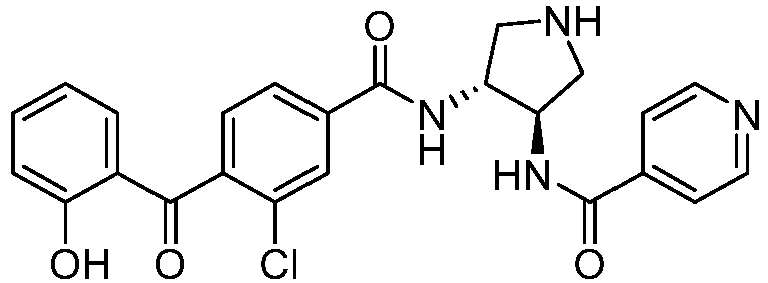
- Prepared according to the general procedure 2. 1H NMR (500 MHz, Methanol-d 4) δ 8.75 - 8.69 (m, 2H), 8.48 (s, 1H), 8.04 (d, J = 1.6 Hz, 1H), 7.94 (d, J = 7.8 Hz, 1H), 7.83 - 7.79 (m, 2H), 7.63 - 7.53 (m, 2H), 7.22 (d, J = 7.9 Hz, 1H), 7.05 (d, J = 8.4 Hz, 1H), 6.89 (t, J = 7.6 Hz, 1H), 4.66 (t, J = 5.7 Hz, 2H), 3.68 (dd, J = 12.4, 6.4 Hz, 2H), 3.28 - 3.21 (m, 2H). LCMS (ESI+) for C24H21ClN4O4 [M+H] expected = 465.13, found = 465.52.
-

- Prepared according to the general procedure 2. 1H NMR (500 MHz, Methanol-d 4) δ 8.49 (s, 1H), 8.46 (d, J = 4.8 Hz, 1H), 8.04 (s, 1H), 7.93 (d, J = 8.0 Hz, 1H), 7.63 - 7.54 (m, 2H), 7.22 (d, J = 5.9 Hz, 2H), 7.05 (d, J = 8.4 Hz, 1H), 6.89 (t, J = 7.6 Hz, 1H), 4.68 - 4.60 (m, 2H), 3.67 (m, 2H), 3.25 (m, 2H). LCMS (ESI+) for C23H21ClN6O4 [M+H] expected = 481.13, found = 481.54. LCMS (ESI+) for C25H24N4O4 [M+H] expected = 445.18, found = 445.55.
-

- Prepared according to the general procedure 2. 1H NMR (500 MHz, Methanol-d 4) δ 8.74 - 8.69 (m, 2H), 8.46 (s, 1H), 7.86 - 7.79 (m, 2H), 7.78 (d, J = 1.4 Hz, 1H), 7.69 (d, J = 7.7 Hz, 1H), 7.63 (d, J = 7.9 Hz, 1H), 7.55 (dd, J = 8.6, 6.9 Hz, 1H), 7.49 (d, J = 8.0 Hz, 1H), 7.03 (d, J = 8.4 Hz, 1H), 6.96 (t, J = 7.6 Hz, 1H), 4.66 (dq, J = 25.7, 7.2 Hz, 2H), 3.65 (ddd, J = 30.6, 11.9, 7.4 Hz, 2H), 3.23 - 3.15 (m, 2H). LCMS (ESI+) for C24H21ClN4O4 [M+H] expected = 465.13, found = 465.52.
-

- Prepared according to the general procedure 2. 1H NMR (500 MHz, Methanol-d 4) δ 8.72 (d, J = 5.2 Hz, 2H), 8.48 (s, 1H), 7.86 - 7.76 (m, 4H), 7.57 (t, J = 7.7 Hz, 1H), 7.41 (d, J = 7.9 Hz, 1H), 7.23 (d, J = 8.1 Hz, 1H), 7.05 (d, J = 8.4 Hz, 1H), 6.87 (t, J = 7.5 Hz, 1H), 4.65 (d, J = 7.5 Hz, 2H), 3.68 (dd, J = 12.6, 6.7 Hz, 2H), 3.26 - 3.20 (m, 2H), 2.33 (s, 3H).
-

- A round bottom flask was charged with 3-fluoro-4-methoxyphenol (5.0 g, 0.035 mol) and CH2Cl2 (50 mL) at room temperature. This solution was cooled to 0 °C and then diisopropylethylamine (12.2 mL, 0.070 mol) was added followed by (chloromethoxy)ethane (6.52 mL, 0.070 mol). The resulting solution was warmed to room temperature and monitored by LC-MS. After 24 h, the solution was sequentially washed with water and NaHCO3. The organic portion was concentrated and purified on silica gel (40 g, hexane/
EtOAc gradient 0%-20%) to give 4-(ethoxymethoxy)-2-fluoro-1-methoxybenzene which was used without further purification. 1H NMR (500 MHz, Chloroform-d) δ 6.93 - 6.81 (m, 2H), 6.80 - 6.72 (m, 1H), 5.14 (s, 2H), 3.85 (s, 3H), 3.72 (q, J = 7.1 Hz, 2H), 1.23 (t, J= 7.1 Hz, 3H). - A flame-dried round bottom flask was charged with 4-(ethoxymethoxy)-2-fluoro-1-methoxybenzene (1.5 g, 7.49 mmol) and anhydrous THF (25 mL) under an atmosphere of N2. The solution was cooled in a dry ice/acetone bath and then treated slowly with nBuLi (4.48 mL of a 2.5 M hexane solution, 11.2 mmol). After two hours of stirring cold, the solution was slowly treated with a solution of methyl 4-formylbenzoate (1.85 mL, 11.2 mmol) in anhydrous THF (5 mL). The resulting mixture was allowed to warm to room temperature slowly and monitored by LC-MS. Upon completion, the solution was diluted with ethyl acetate and sequentially washed with water and brine. Concentration gave 3.36 g of a yellow oil, which was then purified on silica gel (40 g, hexane/EtOAc gradient 12%-100%) to give methyl 4-((6-(ethoxymethoxy)-2-fluoro-3-methoxyphenyl)(hydroxy)methyl)benzoate. 1H NMR (500 MHz, Chloroform-d) δ 7.97 (d, J = 8.5 Hz, 2H), 7.43 (d, J = 8.1 Hz, 2H), 6.86 (m, 2H), 6.25 (d, J = 11.2 Hz, 1H), 5.08 (d, J = 6.9 Hz, 1H), 4.98 (d, J = 6.9 Hz, 1H), 3.89 (s, 3H), 3.87 (s, 3H), 3.53 - 3.29 (m, 2H), 1.09 (t, J = 7.0 Hz, 3H).
- A round bottom flask was charged with methyl 4-((6-(ethoxymethoxy)-2-fluoro-3-methoxyphenyl)(hydroxy)methyl)benzoate (2.13 g, 5.85 mmol) and CH2Cl2 (40 mL) at room temperature. Dess-Martin Periodinane (3.72 g, 8.77 mmol) was then added and the resulting pale yellow suspension was stirred for 30 min. The solution was diluted with dichloromethane and washed with NaHCO3. Concentration and purification on silica gel (40 g, hexane/EtOAc gradient 6%-50%) gave methyl 4-(6-(ethoxymethoxy)-2-fluoro-3-methoxybenzoyl)benzoate. 1H NMR (500 MHz, Chloroform-d) δ 8.11 (d, J = 8.5 Hz, 2H), 7.91 (d, J = 8.5 Hz, 2H), 7.07 - 6.95 (m, 2H), 5.05 (s, 2H), 3.95 (s, 3H), 3.89 (s, 3H), 3.51 (q, J = 7.1 Hz, 2H), 1.11 (t, J = 7.1 Hz, 3H).
- A vial was charged with methyl 4-(6-(ethoxymethoxy)-2-fluoro-3-methoxybenzoyl)benzoate (1.0 g, 2.76 mmol), THF (9 mL), and water (3 mL). LiOH (264 mg, 11.0 mmol) was added and the resulting mixture was stirred at 60 °C for 30 min. The solution was then diluted with ethyl acetate and washed with a 10% citric acid solution. Concentration of the organic portion resulted in 4-(6-(ethoxymethoxy)-2-fluoro-3-methoxybenzoyl)benzoic acid. 1H NMR (500 MHz, DMSO-d 6) δ 8.10 (d, J = 8.4 Hz, 2H), 7.88 (d, J = 8.3 Hz, 2H), 7.32 (t, J = 9.5 Hz, 1H), 7.08 (dd, J = 9.2, 1.4 Hz, 1H), 5.11 (s, 2H), 3.86 (s, 3H), 3.36 (obscured by solvent, m, 2H), 0.98 (t, J = 7.1 Hz, 3H).
-

- A reaction vial was charged with 4-(6-(ethoxymethoxy)-2-fluoro-3-methoxybenzoyl)benzoic acid (75 mg, 0.215 mmol) and MeCN (2 mL) at room temperature. To this solution was sequentially added triethylamine (60 µL, 0.430 mmol), tert-butyl (2-aminoethyl)carbamate (35 mg, 0.215 mmol), and HATU (82 mg, 0.215 mmol). Upon completion by LCMS, the solution was diluted with water and twice extracted with EtOAc. The solution was concentrated in vacuo, and then dissolved in THF (3 mL). This solution was then treated with 1 N HCl (3 mL) and warmed to 65 °C. Upon completion by LCMS, the solution was cooled to room temperature and diluted with EtOAc. The organic portion was then washed with water, NaHCO3 and brine solutions. The EtOAc solution was dried over sodium sulfate and concentrated to give 131 mg of N-(2-aminoethyl)-4-(2-fluoro-6-hydroxy-3-methoxybenzoyl)benzamide as an oil which was used directly without further purification. This oil was dissolved in DMF (2 mL) and treated with triethylamine (90 µL, 0.645 mmol) at room temperature. Isonicotinic acid (32 mg, 0.258 mmol), followed by HATU (98 mg, 0.258 mmol) were added and stirred for 15 min. LCMS indicated some acylation of the phenol, so LiOH (20 mg in 1 mL H2O) was added and stirred for 2 h. The aqueous solution was purified directly on HPLC to give N-(2-(4-(2-fluoro-6-hydroxy-3-methoxybenzoyl)benzamido)ethyl)isonicotinamide. 1H NMR (500 MHz, Methanol-d 4) δ 8.98 (s, 1H), 8.81 (s, 1H), 8.72 (d, J = 6.3 Hz, 2H), 7.90 (m, 4H), 7.85 - 7.80 (m, 2H), 7.13 (t, J = 9.3 Hz, 1H), 6.68 (dd, J = 9.0, 1.7 Hz, 1H), 3.84 (s, 3H), 3.68 - 3.63 (m, 4H). LCMS (ESI+) for C23H20FN3O5 [M+H] expected = 438.14, found = 438.36.
-

- A vial was charged with N-(2-(4-(2-fluoro-6-hydroxy-3-methoxybenzoyl)benzamido)ethyl)isonicotinamide (4.4 mg) and DMF (1 mL) at room temperature. The solution was treated with iodomethane (0.6 µL, added as a DMF solution) and excess potassium carbonate. The solution was stirred for 18 h, quenched with water and purified directly on HPLC to give N-(2-(4-(2-fluoro-3,6-dimethoxybenzoyl)benzamido)ethyl)isonicotinamide. 1H NMR (500 MHz, Chloroform-d) δ 8.75 (d, J = 5.1 Hz, 2H), 7.92 (d, J = 8.2 Hz, 2H), 7.86 (d, J = 8.3 Hz, 2H), 7.68 (d, J = 5.1 Hz, 2H), 7.54 (s, 1H), 7.08 - 7.00 (m, 2H), 6.69 (dd, J = 9.1, 1.5 Hz, 1H), 3.88 (s, 3H), 3.80 - 3.71 (m, 4H), 3.68 (s, 3H). LCMS (ESI+) for C24H22FN3O5 [M+H] expected = 452.16, found = 452.39.
-

- HATU (114 mg, 0.300 mmol) was added to a room temperature solution of tert-butyl ((1R,2R)-2-aminocycloheptyl)carbamate (69 mg, 0.300 mmol), isonicotinic acid (37 mg, 0.300 mmol), and triethyl amine (84 µL, 0.600 mmol) in acetonitrile (1.5 mL). After 5 min, the solution was quenched with water and extracted with EtOAc. The organic extract was thrice washed with water and concentrated in vacuo. The residue was then dissolved in 4 N HCl in dioxane (2 mL) which formed a precipitate. Concentration gave a solid which was used without further purification. The N-((1R,2R)-2-aminocycloheptyl)isonicotinamide (0.200 mmol) thus formed was dissolved in a mixture of acetonitrile (1.5 mL) and DMF (1.0 mL). Triethylamine (167 µL, 1.2 mmol) was added, followed by 4-(6-(ethoxymethoxy)-2-fluoro-3-methoxybenzoyl)benzoic acid (70 mg, 0.200 mmol) and HATU (76 mg, 0.200 mmol). The resulting solution was stirred at room temperature for 30 min and then quenched with water. The solution was twice extracted with EtOAc and then concentrated in vacuo. Dissolution in THF (1 mL) and 1N HCl (1 mL) was followed by warming to 55 °C for 3 h. The solution was then cooled to room temperature and partitioned between aqueous NaHCO3 and EtOAc. The organic portion was concentrated and purified on silica gel (12 g, hexane/EtOAc gradient 25%-100%) to give N-((1R,2R)-2-(4-(2-fluoro-6-hydroxy-3-methoxybenzoyl)benzamido)cycloheptyl)isonicotinamide. 1H NMR (500 MHz, Chloroform-d) δ 10.23 (s, 1H), 8.70 (d, J = 5.5 Hz, 2H), 7.76 (d, J = 8.2 Hz, 2H), 7.71 (dd, J = 8.5, 2.3 Hz, 2H), 7.67 (s, 2H), 7.21 (t, J = 9.2 Hz, 1H), 6.83 (dd, J = 9.2, 1.8 Hz, 1H), 6.66 (s, 1H), 4.18 (m, 2H), 3.84 (s, 3H), 2.06 (m, 2H), 1.88 - 1.72 (m, 4H), 1.60 (m, 4H). LCMS (ESI+) for C28H28FN3O5 [M+H] expected = 506.20, found = 506.42.
-

- A vial was charged with N-((1R,2R)-2-(4-(2-fluoro-6-hydroxy-3-methoxybenzoyl)benzamido)cycloheptyl) isonicotinamide (5.0 mg) and DMF (0.5 mL) at room temperature. The solution was treated with iodomethane (0.6 µL, added as a DMF solution) and excess potassium carbonate. The solution was stirred for 2 h, quenched with water and purified directly on HPLC to give N-((1R,2R)-2-(4-(2-fluoro-3,6-dimethoxybenzoyl)benzamido)cycloheptyl)isonicotinamide. 1H NMR (500 MHz, Chloroform-d) δ 8.73 - 8.65 (m, 2H), 7.86 (d, J = 8.4 Hz, 2H), 7.75 (d, J = 8.4 Hz, 2H), 7.61 (d, J = 5.5 Hz, 2H), 7.21 (d, J = 7.6 Hz, 1H), 7.02 (t, J = 9.2 Hz, 1H), 6.71 (d, J = 8.2 Hz, 1H), 6.68 (dd, J = 9.0, 1.6 Hz, 1H), 4.25 - 4.06 (m, 2H), 3.88 (s, 3H), 3.66 (s, 3H), 2.03 (m, 2H), 1.75 (m, 8H). LCMS (ESI+) for C29H30FN3O5 [M+H] expected = 520.22, found = 520.47.
-

- The N-((1R,2R)-2-aminocycloheptyl) isonicotinamide (0.100 mmol) thus formed was dissolved in a mixture of acetonitrile (1.0 mL) and DMF (1.0 mL). Triethylamine (84 µL, 0.6 mmol) was added, followed by 4-(benzoyl)benzoic acid (23 mg, 0.100 mmol) and HATU (38 mg, 0.100 mmol). The resulting solution was stirred at room temperature for 120 min and then quenched with water. The solution was purified directly on HPLC to give N-((1R,2R)-2-(4-benzoylbenzamido)cycloheptyl)isonicotinamide. 1H NMR (500 MHz, Chloroform-d) δ 8.69 (d, J = 6.1 Hz, 2H), 7.80 (q, J = 8.4 Hz, 4H), 7.77 - 7.73 (m, 2H), 7.65 - 7.56 (m, 3H), 7.48 (t, J = 7.8 Hz, 2H), 7.32 (d, J = 7.6 Hz, 1H), 6.95 (d, J = 8.0 Hz, 1H), 4.24 - 4.06 (m, 2H), 2.11 - 1.98 (m, 2H), 1.86 - 1.66 (m, 4H), 1.62 (m, 4H). LCMS (ESI+) for C27H27N3O3 [M+H] expected = 442.21, found = 442.46.
-

- HATU (114 mg, 0.300 mmol) was added to a room temperature solution of tert-butyl ((1R,2R)-2-aminocyclohexyl)carbamate (64 mg, 0.300 mmol), isonicotinic acid (37 mg, 0.300 mmol), and triethyl amine (84 µL, 0.600 mmol) in acetonitrile (1.5 mL). After 5 min, the solution was quenched with water and extracted with EtOAc. The organic extract was thrice washed with water and concentrated in vacuo. The residue was then dissolved in 4 N HCl in dioxane (4 mL) and stirred for 20 min. Concentration gave a white solid (152 mg) which was used without further purification. The N-((1R,2R)-2-aminocyclohexyl)isonicotinamide (0.150 mmol) thus formed was dissolved in DMF (1.5 mL). Triethylamine (84 µL, 0.60 mmol) was added, followed by 4-(6-(ethoxymethoxy)-2-fluoro-3-methoxybenzoyl)benzoic acid (52 mg, 0.150 mmol) and HATU (57 mg, 0.150 mmol). The resulting solution was stirred at room temperature for 30 min and then quenched with water. The solution was twice extracted with EtOAc and then concentrated in vacuo. Dissolution in THF (2 mL) and 1N HCl (2 mL) was followed by warming to 55 °C for 2 h. The solution was then cooled to room temperature and partitioned between aqueous NaHCO3 and EtOAc. The organic portion was concentrated and purified on reverse phase HPLC to give N-((1R,2R)-2-(4-(2-fluoro-6-hydroxy-3-methoxybenzoyl)benzamido)cyclohexyl)isonicotinamide. 1H NMR (500 MHz, Chloroform-d) δ 10.25 (s, 1H), 8.71 (d, J = 5.2 Hz, 2H), 7.79 (d, J = 8.3 Hz, 2H), 7.76 - 7.71 (m, 2H), 7.67 (s, 2H), 7.21 (t, J = 9.1 Hz, 1H), 6.83 (dd, J = 9.2, 1.9 Hz, 1H), 6.57 (s, 1H), 4.01 (m, 2H), 3.84 (s, 3H), 2.31 (m, 1H), 2.21 (m, 1H), 1.89 (m, 2H), 1.48 (m, 4H). LCMS (ESI+) for C27H26FN3O5 [M+H] expected = 492.19, found = 492.43.
-

- A vial was charged with N-((1R,2R)-2-(4-(2-fluoro-6-hydroxy-3-methoxybenzoyl)benzamido)cyclohexyl) isonicotinamide (4.5 mg) and DMF (0.5 mL) at room temperature. The solution was treated with iodomethane (1 eq added as a DMF solution) and excess potassium carbonate. The solution was stirred for 18 h, quenched with water and purified directly on HPLC to give N-((1R,2R)-2-(4-(2-fluoro-3,6-dimethoxybenzoyl)benzamido)cyclohexyl)isonicotinamide. 1H NMR (500 MHz, Chloroform-d) δ 8.70 (s, 2H), 7.87 (d, J = 8.3 Hz, 2H), 7.76 (d, J = 8.4 Hz, 2H), 7.60 (s, 2H), 7.11 (d, J = 7.5 Hz, 1H), 7.02 (t, J = 9.2 Hz, 1H), 6.68 (dd, J = 9.1, 1.6 Hz, 1H), 6.60 (d, J = 8.0 Hz, 1H), 4.00 (m, 2H), 3.88 (s, 3H), 3.66 (s, 3H), 2.32 - 2.15 (m, 2H), 1.87 (m, 2H), 1.44 (m, 4H). LCMS (ESI+) for C28H28FN3O5 [M+H] expected = 506.20, found = 506.45.
-

- The N-((1R,2R)-2-aminocyclohexyl) isonicotinamide (0.150 mmol) was dissolved in DMF (1.5 mL). Triethylamine (84 µL, 0.60 mmol) was added, followed by 4-(benzoyl)benzoic acid (34 mg, 0.150 mmol) and HATU (57 mg, 0.150 mmol). The resulting solution was stirred at room temperature for 15 min and then quenched with water. Extraction with EtOAc (twice) followed by concentration gave a residue which was purified on silica gel (12 g hexane/EtOAc gradient 15%-100%) to yield N-((1R,2R)-2-(4-benzoylbenzamido)cyclohexyl)isonicotinamide. 1H NMR (500 MHz, Chloroform-d) δ 8.72 (d, J = 6.1 Hz, 2H), 7.81 (s, 4H), 7.79 - 7.73 (m, 2H), 7.67 (d, J = 5.2 Hz, 2H), 7.61 (t, J = 7.5 Hz, 1H), 7.48 (t, J = 7.7 Hz, 2H), 7.19 (d, J = 7.4 Hz, 1H), 6.60 (d, J = 8.0 Hz, 1H), 4.11 - 3.92 (m, 2H), 2.38 - 2.18 (m, 2H), 1.89 (m, 2H), 1.47 (m, 4H). LCMS (ESI+) for C26H25N3O3 [M+H] expected = 428.19, found = 428.43.
-

- HATU (114 mg, 0.300 mmol) was added to a room temperature solution of tert-butyl ((1R,2R)-2-aminocyclopentyl)carbamate (60 mg, 0.300 mmol), isonicotinic acid (37 mg, 0.300 mmol), and triethyl amine (84 µL, 0.600 mmol) in acetonitrile (1.5 mL). After 30 min, the solution was quenched with water and extracted with EtOAc. The organic extract was thrice washed with water and concentrated in vacuo. The residue was then dissolved in 4 N HCl in dioxane (2 mL) and stirred for 18 h. Concentration in vacuo gave a solid which was used without further purification. The N-((1R,2R)-2-aminocyclopentyl)isonicotinamide (0.200 mmol) thus formed was dissolved in DMF (1.5 mL). Triethylamine (111 µL, 0.80 mmol) was added, followed by 4-(6-(ethoxymethoxy)-2-fluoro-3-methoxybenzoyl)benzoic acid (70 mg, 0.200 mmol) and HATU (76 mg, 0.200 mmol). The resulting solution was stirred at room temperature for 3 h and then quenched with water. The solution was twice extracted with EtOAc and then concentrated in vacuo. Dissolution in THF (1 mL) and 1N HCl (2 mL) was followed by warming to 60 °C for 2 h. The solution was then cooled to room temperature and partitioned between aqueous NaHCO3 and EtOAc. The organic portion was concentrated and purified on silica gel (12 g, hexane/EtOAc gradient 25%-100%) to give N-((1R,2R)-2-(4-(2-fluoro-6-hydroxy-3-methoxybenzoyl)benzamido)cyclopentyl)isonicotinamide. 1H NMR (500 MHz, Chloroform-d) δ 10.26 (s, 1H), 8.74 (d, J = 6.2 Hz, 2H), 7.87 (d, J = 8.5 Hz, 2H), 7.76 (dd, J = 8.4, 2.4 Hz, 2H), 7.73 - 7.68 (m, 2H), 7.62 (d, J = 5.6 Hz, 1H), 7.21 (t, J = 9.2 Hz, 1H), 6.93 (d, J = 6.5 Hz, 1H), 6.83 (dd, J = 9.2, 1.9 Hz, 1H), 4.41 - 4.29 (m, 1H), 4.18 (m, 1H), 3.83 (s, 3H), 2.42 (ddq, J = 58.7, 13.5, 6.8 Hz, 2H), 1.92 (m, 2H), 1.72 - 1.59 (m, 2H). LCMS (ESI+) for C26H24FN3O5 [M+H] expected = 478.17, found = 478.44.
-

- A vial was charged with N-((1R,2R)-2-(4-(2-fluoro-6-hydroxy-3-methoxybenzoyl)benzamido)cyclopentyl) isonicotinamide (6.2 mg) and DMF (1.0 mL) at room temperature. The solution was treated with iodomethane (1 eq added as a DMF solution) and excess potassium carbonate. The solution was stirred for 23 h, quenched with water and purified directly on HPLC to give N-((1R,2R)-2-(4-(2-fluoro-3,6-dimethoxybenzoyl)benzamido)cyclopentyl)isonicotinamide. 1H NMR (500 MHz, Chloroform-d) δ 8.74 (d, J = 6.1 Hz, 2H), 7.91 (d, J = 8.4 Hz, 2H), 7.85 (d, J = 8.4 Hz, 2H), 7.65 (d, J = 6.1 Hz, 2H), 7.51 (d, J = 5.7 Hz, 1H), 7.03 (t, J = 9.2 Hz, 1H), 6.93 (d, J = 6.4 Hz, 1H), 6.68 (dd, J = 9.0, 1.7 Hz, 1H), 4.32 (ddd, J = 17.5, 10.4, 7.3 Hz, 1H), 4.23 - 4.12 (m, 1H), 3.88 (s, 3H), 3.67 (s, 3H), 2.46 (dq, J = 13.3, 6.8 Hz, 1H), 2.35 (dq, J = 13.4, 6.8 Hz, 1H), 1.97 - 1.86 (m, 2H), 1.74 - 1.55 (m, 4H). LCMS (ESI+) for C27H26FN3O5 [M+H] expected = 492.19, found = 492.45.
-

- The N-((1R,2R)-2-aminocyclopentyl) isonicotinamide (0.100 mmol) was dissolved in DMF (1.5 mL). Triethylamine (84 µL, 0.60 mmol) was added, followed by 4-(benzoyl)benzoic acid (23 mg, 0.100 mmol) and HATU (38 mg, 0.100 mmol). The resulting solution was stirred at room temperature for 70 min and then quenched with water. Extraction with EtOAc (twice) followed by concentration gave a residue which was purified on silica gel (12 g hexane/EtOAc gradient 25%-80%) to yield N-((1R,2R)-2-(4-benzoylbenzamido)cyclopentyl) isonicotinamide. 1H NMR (500 MHz, Chloroform-d) δ 8.75 (d, J = 5.1 Hz, 2H), 7.89 (d, J = 8.4 Hz, 2H), 7.84 (d, J = 8.4 Hz, 2H), 7.81 - 7.75 (m, 2H), 7.75 - 7.67 (m, 2H), 7.65 - 7.57 (m, 2H), 7.49 (t, J = 7.7 Hz, 2H), 6.96 (d, J = 6.5 Hz, 1H), 4.36 (m, 1H), 4.25 - 4.12 (m, 1H), 2.47 (dq, J = 13.3, 6.8 Hz, 1H), 2.37 (dq, J = 13.4, 6.8 Hz, 1H), 1.91 (m, 2H), 1.67 (m, 2H). LCMS (ESI+) for C25H23N3O3 [M+H] expected = 414.18, found = 414.40.
-

- HATU (114 mg, 0.300 mmol) was added to a room temperature solution of tert-butyl ((1R,2R)-2-amino-2,3-dihydro-1H-inden-1-yl)carbamate (75 mg, 0.300 mmol), isonicotinic acid (37 mg, 0.300 mmol), and triethyl amine (84 µL, 0.600 mmol) in acetonitrile (1.5 mL). After 30 min, the solution was quenched with water and extracted with EtOAc. The organic extract was thrice washed with water and concentrated in vacuo. The residue was then dissolved in 4 N HCl in dioxane (2 mL) and stirred for 18 h. Concentration in vacuo gave a solid which was used without further purification. The N-((1R,2R)-1-amino-2,3-dihydro-1H-inden-2-yl)isonicotinamide (0.200 mmol) thus formed was dissolved in MeCN (2.0 mL) and DMF (1.5 mL). Triethylamine (111 µL, 0.80 mmol) was added, followed by 4-(6-(ethoxymethoxy)-2-fluoro-3-methoxybenzoyl)benzoic acid (70 mg, 0.200 mmol) and HATU (76 mg, 0.200 mmol). The resulting solution was stirred at room temperature for 3 h and then quenched with water. The solution was twice extracted with EtOAc and then concentrated in vacuo. Dissolution in THF (1 mL) and 1N HCl (2 mL) was followed by warming to 60 °C for 2 h. The solution was then cooled to room temperature and partitioned between aqueous NaHCO3 and EtOAc. The organic portion was concentrated and purified on silica gel (5 g, hexane/EtOAc gradient 20%-100%) to give N-((1R,2R)-1-(4-(2-fluoro-6-hydroxy-3-methoxybenzoyl)benzamido)-2,3-dihydro-1H-inden-2-yl)isonicotinamide. 1H NMR (500 MHz, Chloroform-d) δ 10.30 (s, 1H), 8.85 - 8.74 (m, 2H), 8.13 (s, 1H), 7.94 (d, J = 8.3 Hz, 2H), 7.88 - 7.75 (m, 4H), 7.34 (m, 4H), 7.22 (t, J = 9.1 Hz, 1H), 6.90 - 6.82 (m, 2H), 5.76 (t, J = 8.5 Hz, 1H), 4.48 (q, J = 9.5, 6.7 Hz, 1H), 3.84 (s, 3H), 3.79 (dd, J = 15.3, 7.7 Hz, 1H), 2.99 - 2.86 (m, 1H). LCMS (ESI+) for C30H24FN3O5 [M+H] expected = 526.17, found = 526.45.
-

- A vial was charged with N-((1R,2R)-1-(4-(2-fluoro-6-hydroxy-3-methoxybenzoyl)benzamido)-2,3-dihydro-1H-inden-2-yl)isonicotinamide (5.0 mg) and DMF (1.0 mL) at room temperature. The solution was treated with iodomethane (1 eq added as a DMF solution) and excess potassium carbonate. The solution was stirred for 2 h, quenched with water and purified directly on HPLC to give N-((1R,2R)-2-(4-(2-fluoro-3,6-dimethoxybenzoyl)benzamido)cyclopentyl)isonicotinamide. 1H NMR (500 MHz, Chloroform-d) δ 8.78 (d, J = 5.6 Hz, 2H), 8.09 (s, 1H), 7.95 (d, J = 8.3 Hz, 2H), 7.92 (d, J = 8.4 Hz, 2H), 7.80 (d, J = 5.1 Hz, 2H), 7.39 - 7.29 (m, 4H), 7.04 (t, J = 9.2 Hz, 1H), 6.85 (d, J = 7.7 Hz, 1H), 6.69 (dd, J = 9.1, 1.6 Hz, 1H), 5.74 (t, J = 8.5 Hz, 1H), 4.53 - 4.43 (m, 1H), 3.89 (s, 3H), 3.78 (dd, J = 15.5, 7.6 Hz, 1H), 3.68 (s, 3H), 2.91 (dd, J = 15.5, 9.9 Hz, 1H). LCMS (ESI+) for C31H26FN3O5 [M+H] expected = 540.19, found = 540.48.
-

- The N-((1R,2R)-1-amino-2,3-dihydro-1H-inden-2-yl)isonicotinamide (0.100 mmol) was dissolved in DMF (1.5 mL). Triethylamine (84 µL, 0.60 mmol) was added, followed by 4-(benzoyl)benzoic acid (23 mg, 0.100 mmol) and HATU (38 mg, 0.100 mmol). The resulting solution was stirred at room temperature for 60 min and then quenched with water. Extraction with EtOAc (twice) followed by concentration gave a residue which was purified on silica gel (5 g hexane/EtOAc gradient 25%-100%) to yield N-((1R,2R)-1-(4-benzoylbenzamido)-2,3-dihydro-1H-inden-2-yl)isonicotinamide. 1H NMR (500 MHz, Chloroform-d) δ 8.71 (d, J = 6.1 Hz, 2H), 8.12 (d, J = 5.3 Hz, 1H), 7.96 (d, J = 8.3 Hz, 2H), 7.81 (d, J = 8.3 Hz, 2H), 7.79 - 7.75 (m, 2H), 7.71 - 7.67 (m, 2H), 7.65 - 7.59 (m, 1H), 7.49 (t, J = 7.8 Hz, 2H), 7.36 (d, J = 7.9 Hz, 1H), 7.31 (t, J = 6.6 Hz, 1H), 7.29 - 7.27 (m, 1H), 7.24 (d, J = 7.2 Hz, 1H), 5.75 (t, J = 8.6 Hz, 1H), 4.48 (tdd, J = 9.6, 7.6, 5.3 Hz, 1H), 3.62 (dd, J = 15.4, 7.6 Hz, 1H), 2.88 (dd, J = 15.4, 9.9 Hz, 1H). LCMS (ESI+) for C29H23N3O3 [M+H] expected = 462.18, found = 462.43.
-

- HATU (114 mg, 0.300 mmol) was added to a room temperature solution of tert-butyl piperazine-1-carboxylate (56 mg, 0.300 mmol), isonicotinic acid (37 mg, 0.300 mmol), and triethyl amine (84 µL, 0.600 mmol) in acetonitrile (1.5 mL). After 30 min, the solution was quenched with water and extracted with EtOAc. The organic extract was thrice washed with water and concentrated in vacuo. The residue was then dissolved in 4 N HCl in dioxane (1 mL) and stirred for 30 min. Concentration in vacuo gave a solid which was used without further purification. The piperazin-1-yl(pyridin-4-yl)methanone (0.200 mmol) thus formed was dissolved in MeCN (2.0 mL) and DMF (1.0 mL). Triethylamine (111 µL, 0.80 mmol) was added, followed by 4-(6-(ethoxymethoxy)-2-fluoro-3-methoxybenzoyl)benzoic acid (70 mg, 0.200 mmol) and HATU (76 mg, 0.200 mmol). The resulting solution was stirred at room temperature for 18 h and then quenched with water. The solution was twice extracted with EtOAc and then concentrated in vacuo. Dissolution in THF (1 mL) and 1N HCl (2 mL) was followed by warming to 60 °C for 0.5 h. The solution was then cooled to room temperature and partitioned between aqueous NaHCO3 and EtOAc. The organic portion was concentrated and purified on silica gel (5 g, EtOAc/
MeOH gradient 0%-20%) to give (4-(4-(2-fluoro-6-hydroxy-3-methoxybenzoyl)benzoyl)piperazin-1-yl)(pyridin-4-yl)methanone. 1H NMR (500 MHz, Chloroform-d) δ 10.23 (s, 1H), 8.73 (s, 2H), 7.77 (s, 2H), 7.50 (d, J = 7.8 Hz, 2H), 7.30 (d, J = 5.0 Hz, 2H), 7.22 (t, J = 9.2 Hz, 1H), 6.84 (dd, J = 9.2, 1.8 Hz, 1H),3.85 (s, 3H), 3.84 (br, 4H), 3.48 (br, 4H). LCMS (ESI+) for C25H22FN3O5 [M+H] expected = 464.16, found = 464.39. -

- A vial was charged with (4-(4-(2-fluoro-6-hydroxy-3-methoxybenzoyl)benzoyl)piperazin-1-yl)(pyridin-4-yl) methanone (5.0 mg) and DMF (1.0 mL) at room temperature. The solution was treated with iodomethane (1 eq added as a DMF solution) and excess potassium carbonate. The solution was stirred for 2 h, quenched with water and purified directly on HPLC to give (4-(4-(2-fluoro-3,6-dimethoxybenzoyl)benzoyl)piperazin-1-yl)(pyridin-4-yl)methanone. 1H NMR (500 MHz, Chloroform-d) δ 8.73 (s, 2H), 7.91 (s, 2H), 7.48 (d, J = 7.6 Hz, 2H), 7.30 (s, 2H), 7.03 (t, J= 9.2 Hz, 1H), 6.69 (d, J = 8.8 Hz, 1H), 3.88 (s, 3H), 3.75 (br, 4H), 3.70 (s, 3H), 3.49 (br, 4H). LCMS (ESI+) for C26H24FN3O5 [M+H] expected = 478.17, found = 478.41.
-

- The piperazin-1-yl(pyridin-4-yl) methanone (0.100 mmol) was dissolved in DMF (1.5 mL). Triethylamine (84 µL, 0.60 mmol) was added, followed by 4-(benzoyl)benzoic acid (23 mg, 0.100 mmol) and HATU (38 mg, 0.100 mmol). The resulting solution was stirred at room temperature for 85 min and then quenched with water. Extraction with EtOAc (twice) followed by concentration gave a residue which was purified on reverse phase to yield (4-(4-benzoylbenzoyl)piperazin-1-yl)(pyridin-4-yl)methanone. 1H NMR (500 MHz, Chloroform-d) δ 8.74 (s, 2H), 7.85 (s, 2H), 7.80 (d, J = 7.6 Hz, 2H), 7.62 (t, J = 7.4 Hz, 1H), 7.51 (m, 4H), 7.34 (d, J= 4.8 Hz, 2H), 3.79 (br, 4H), 3.49 (br, 4H). LCMS (ESI+) for C24H21N3O5 [M+H] expected = 400.16, found = 400.38.
-

- 4-benzoylbenzoic acid and HATU were weighed in a 20 mL vial and 2 ml dry MeCN was added followed by triethylamine and the mixture was stirred at 23 °C for 10 min. A solution of tert-butyl (3R,4R)-3,4-diaminopyrrolidine-1-carboxylate in 2ml dry MeCN was added and the mixture allowed to stir at 23 °C for 1 h. LCMS analysis of an aliquot showed complete conversion of starting acid and mono and bis-acylation products. The reaction mixture was diluted with ethyl acetate and extracted with sat. sodium bicarbonate solution and brine. The organic layer was concentrated and the residue was purified by prep. TLC and elution with methanol/ethyl acetate (0-20 %) to obtain amine, tert-butyl (3R,4R)-3-amino-4-(4-benzoylbenzamido)pyrrolidine-1-carboxylate (25 mg, 28 %).1H NMR (400 MHz, Methanol-d 4) δ 8.68 (d, J = 6.1 Hz, 2H), 8.27 (s, 1H), 7.94 (d, J = 8.4 Hz, 2H), 7.82 (d, J= 8.4 Hz, 2H), 7.79 - 7.75 (m, 4H), 7.69 - 7.62 (m, 1H), 7.53 (t, J = 7.7 Hz, 2H), 4.80 - 4.68 (m, 2H), 3.98 - 3.86 (m, 2H), 3.42 - 3.33 (m, 2H). To tert-butyl (3R,4R)-3-amino-4-(4-benzoylbenzamido)pyrrolidine-1-carboxylate (25 mg, 61.06 µmol) in 2 ml dry dichloromethane, triethylamine, DMAP, and isonicotinoyl chloride hydrochloride (16.3 mg, 91.6 µmol) were added and the mixture was stirred at 23 °C for 2 h. The reaction mixture was diluted with 2 ml dichloromethane and washed thrice with sat. sodium bicarbonate. The organic layers were combined and evaporated and the residue was purified by RP-HPLC to obtain product tert-butyl (3R,4R)-3-(4-benzoylbenzamido)-4-(isonicotinamido)pyrrolidine-1-carboxylate as a colorless oil (7 mg, 22%). To tert-butyl (3R,4R)-3-(4-benzoylbenzamido)-4-(isonicotinamido)pyrrolidine-1-carboxylate, was added 1 ml 0.5 M HCl and the mixture was heated at 70 °C for 1 h. The solvent was evaporated and 0.5 mL methanol added and evaporated (2x) and the hydrochloride salt of the product N-((3R,4R)-4-(4-benzoylbenzamido)pyrrolidin-3-yl)isonicotinamide was obtained as a white solid (6 mg, 98 %) after drying under vacuum; 1H NMR (500 MHz, Methanol-d 4) δ 8.92 (d, J = 6.6 Hz, 2H), 8.62 (d, J = 6.7 Hz, 2H), 8.06 (d, J = 8.3 Hz, 2H), 7.81 (d, J = 8.4 Hz, 2H), 7.74 (d, J = 6.9 Hz, 2H), 7.62 - 7.58 (m, 2H), 7.47 (t, J = 7.8 Hz, 2H), 4.91 - 4.81 (m, 2H), 3.94 (ddd, J = 12.6, 7.2, 1.8 Hz, 2H), 3.65 (dt, J = 12.4, 4.3 Hz, 2H); LCMS (ESI+) calculated for C24H22N4O3 [M+H] = 415.17, found = 415.44.
-

- Isonicotinic acid (48 mg, 0.39 mmol) was charged with 2 mL acetonitrile, 0.11 mL (0.78 mmol) triethylamine, 177 mg (0.47 mmol) HATU, and then 81 mg (0.39 mmol) 2-BOC-aminoaniline (CAS# 146551-75-4). After 1.5 h, LCMS suggested good conversion and the mixture was concentrated. The residue was treated with 1 mL dichloromethane and 1 mL trifluoroacetic acid. After 15 minutes, LCMS suggested good conversion and the mixture was concentrated to an orange liquid. This sample was divided into two halves, one of which was used in the synthesis of N-(2-(4-benzoylbenzamido)phenyl)isonicotinamide described below. The remaining portion (ca. 0.2 mmol) was combined with 1 mL acetonitrile, 0.27 mL (2 mmol) triethylamine, 91 mg (0.24 mmol) HATU, and 70 mg (0.2 mmol) 4-(6-(ethoxymethoxy)-2-fluoro-3-methoxybenzoyl)benzoic acid. After stirring 18 h, the mixture was diluted with 5 mL water and extracted with three 2 mL portions of ethyl acetate. The organics were passed through a plug of magnesium sulfate and concentrated to a brown oil (332 mg) which was partially purified by flash chromatography (25 mL silica gel, 50% ethyl acetate / hexane, ethyl acetate, 5% methanol / ethyl acetate) to return 128 mg of a yellow film. This sample was dissolved in 2 mL tetrahydrofuran and treated with 1 mL 1N HCl. After stirring 17 h, LCMS suggested 50% conversion so the temperature was increased to 60°C. After 6.5 h, the mixture was diluted with 8 mL water and the pH adjusted to ~8 with 3.75 N NaOH. The resulting white solid in yellow solution was concentrated and extracted with three 2 mL portions of 20% methanol / chloroform. The organics were filtered and the yellow filtrate concentrated to a yellow solid, 127 mg. This sample was purified by reverse phase preparative HPLC to give the desired compound, 20.8 mg. 1H NMR (500 MHz, Methanol-d 4) δ 8.79 - 8.65 (m, 2H), 8.04 (d, J = 8.1 Hz, 2H), 7.92 (d, J = 8.3 Hz, 2H), 7.89 - 7.79 (m, 2H), 7.67 (ddd, J = 22.5, 6.2, 3.7 Hz, 2H), 7.38 (dd, J = 6.1, 3.5 Hz, 2H), 7.13 (t, J = 9.3 Hz, 1H), 6.68 (dd, J = 9.0, 1.7 Hz, 1H), 3.84 (s, 3H). LCMS (ESI+) for C27H20FN3O5 [M+H] expected = 486.14, found = 486.39.
-

- A stock solution was prepared from 0.20 mL iodomethane and 20 mL of N,N-dimethylformamide. A portion of N-(2-(4-(2-fluoro-6-hydroxy-3-methoxybenzoyl)benzamido)phenyl)isonicotinamide (11.9 mg, 0.025 mmol, synthesis described above) was charged with potassium carbonate (10.4 mg, 0.075 mmol), 0.8 mL DMF, and 0.2 mL of the stock solution to deliver 2 µL of iodomethane (0.032 mmol). After 3 days, the mixture was diluted with 8 mL water and extracted with 2, 1, and 1 mL portions of 20% methanol / chloroform. The organics were filtered through a plug of magnesium sulfate and concentrated to 70 mg of orange oil. This sample was purified by reverse phase preparative HPLC to give the desired compound as the formate salt, a white film, 2.3 mg. 1H NMR (500 MHz, Methanol-d4) δ 8.77 - 8.65 (m, 2H), 8.49 (s, 1H), 8.10 - 7.98 (m, 2H), 7.96 - 7.79 (m, 4H), 7.68 (dd, J = 6.1, 3.5 Hz, 1H), 7.64 (dt, J = 7.4, 3.7 Hz, 1H), 7.38 (dd, J = 6.0, 3.6 Hz, 2H), 7.22 (t, J = 9.4 Hz, 1H), 6.88 (dd, J = 9.1, 1.6 Hz, 1H), 3.88 (s, 3H), 3.67 (s, 3H). LCMS (ESI+) for C28H22FN3O5 [M+H] expected = 500.15, found = 500.43.
-

- The remaining portion (ca. 0.2 mmol) of the intermediate derived from isonicotinic acid in the synthesis of N-(2-(4-(2-fluoro-6-hydroxy-3-methoxybenzoyl)benzamido)phenyl)isonicotinamide was combined with 1 mL acetonitrile, 0.27 mL (2 mmol) trimethylamine, 91 mg (0.24 mmol) HATU, and 45 mg (0.2 mmol) of 4-(benzoyl)benzoic acid. LCMS suggested completion after 1 h; thus, after 1.3 h the mixture was charged with 4 mL water. After stirring overnight, a yellow solid (81 mg) was collected and purified by reverse phase preparitve HPLC to give 13.4 mg of the desired compound. 1H NMR (500 MHz, Methanol-d 4) δ 8.16 (d, J = 8.1 Hz, 4H), 7.81 (dd, J = 19.6, 7.9 Hz, 8H), 7.70 (t, J = 7.4 Hz, 2H), 7.57 (t, J = 7.7 Hz, 4H). LCMS (ESI+) for C26H19N3O3 [M+H] expected = 422.14, found = 422.38.
-

- Isonicotinic acid (49 mg, 0.40 mmol) was charged with 2 mL acetonitrile, 0.11 mL (0.80 mmol) triethylamine, 183 mg (0.48 mmol) HATU, and then 84.1 mg (0.40 mmol) 3-amino-4-BOC-aminopyridine (CAS# 183311-28-6). After 30 minutes, LCMS suggested ca. 75% conversion and the mixture was concentrated after 1 h. The residue was treated with 1 mL dichloromethane and 1 mL trifluoroacetic acid. After 17 h, LCMS suggested good conversion and the mixture was concentrated to an orange suspension, 1 gram. This sample was divided into two halves, one of which was used in the synthesis of N-(2-(4- N-(4-(4-benzoylbenzamido)pyridin-3-yl)isonicotinamide described below. The remaining portion (ca. 0.2 mmol) was combined with 1 mL acetonitrile, 0.28 mL (2 mmol) triethylamine, 91 mg (0.24 mmol) HATU, and 70 mg (0.2 mmol) 4-(6-(ethoxymethoxy)-2-fluoro-3-methoxybenzoyl)benzoic acid. LCMS after 4 and 24 h suggested the reaction stalled at around 50% conversion, so another 0.28 mL of trimethylamine and 91 mg of HATU were added. After 4 additional hours, LCMS indicated good conversion, and the mixture was diluted with 10 mL water and extracted with three 2 mL portions of ethyl acetate. The organics were passed through a plug of magnesium sulfate and concentrated to an orange oil (294 mg) which was partially purified by flash chromatography (25 mL silica gel, 2% to 5% methanol / chloroform) to return 73 mg of a yellow oil. This sample was dissolved in 1 mL tetrahydrofuran and treated with 1 mL 1N HCl. After stirring at 60°C for 1.25 h, the mixture was diluted with 8 mL water and the pH adjusted to ~7 with ca. 0.3 mL 3.75 N NaOH. The resulting yellow solid was collected, 122 mg, and purified by reverse phase preparative HPLC to give the desired compound, 49.2 mg yellow film, as the diformate salt. 1H NMR (400 MHz, Methanol-d4) δ 8.82 - 8.65 (m, 3H), 8.46 (d, J = 5.6 Hz, 1H), 8.21 (s, 2H), 8.14 - 7.99 (m, 3H), 7.99 - 7.84 (m, 4H), 7.13 (t, J = 9.3 Hz, 1H), 6.68 (dd, J = 8.9, 1.7 Hz, 1H), 3.84 (s, 3H). LCMS (ESI+) for C26H19FN4O5 [M+H] expected = 487.13, found = 487.36.
-

- A stock solution was prepared from 0.20 mL iodomethane and 20 mL of N,N-dimethylformamide. A portion of N-(4-(4-(2-fluoro-6-hydroxy-3-methoxybenzoyl)benzamido)pyridin-3-yl)isonicotinamide (21.1 mg, 0.0434 mmol, synthesis described above) was charged with potassium carbonate (18 mg, 0.13 mmol), 0.8 mL DMF, and 0.27 mL of the stock solution to deliver 2.7 µL of iodomethane (0.043 mmol). After 3 days, the mixture was diluted with 8 mL water and extracted with 2, 1, and 1 mL portions of 20% methanol / chloroform. The organics were filtered through a plug of magnesium sulfate and concentrated to 110 mg of yellow oil. This sample was purified by reverse phase preparative HPLC to give the desired compound as the diformate salt, a yellow solid, 10.2 mg. 1H NMR (500 MHz, Methanol-d4) δ 9.24 (d, J = 1.8 Hz, 1H), 8.81 - 8.63 (m, 3H), 8.40 (dd, J = 7.0, 1.8 Hz, 1H), 8.24 (s, 2H), 8.12 (d, J = 8.5 Hz, 2H), 8.02 - 7.83 (m, 4H), 7.13 (t, J = 9.3 Hz, 1H), 6.69 (dd, J = 9.0, 1.6 Hz, 1H), 4.24 (s, 3H), 3.84 (s, 3H). LCMS (ESI+) for C27H21FN4O5 [M+H] expected = 501.15, found = 501.40.
-

- The remaining portion (ca. 0.2 mmol) of the intermediate derived from isonicotinic acid in the synthesis of N-(4-(4-(2-fluoro-6-hydroxy-3-methoxybenzoyl)benzamido)pyridin-3-yl)isonicotinamide described above was combined with 1 mL acetonitrile, 0.28 mL (2 mmol) trimethylamine, 91 mg (0.24 mmol) HATU, and 45 mg (0.2 mmol) of 4-(benzoyl)benzoic acid. LCMS suggested completion after 3.5 h. The mixture was charged with 8 mL water and extracted with 2, 1, and 1 mL portions of ethyl acetate. The organics were filtered through a plug of magnesium sulfate and concentrated to a yellow oil, 254 mg, which was purified by reverse phase preparative HPLC to deliver the desired compound as the formate salt, 26.8 mg of white solid. 1H NMR (500 MHz, Methanol-d4) δ 8.84 - 8.67 (m, 3H), 8.48 (d, J = 5.6 Hz, 1H), 8.13 (d, J = 5.6 Hz, 1H), 8.08 (d, J = 8.7 Hz, 3H), 8.02 - 7.92 (m, 2H), 7.92 - 7.84 (m, 2H), 7.86 - 7.74 (m, 2H), 7.73 - 7.62 (m, 1H), 7.55 (t, J = 7.8 Hz, 2H). LCMS (ESI+) for C25H18N4O3 [M+H] expected = 423.14, found = 423.34.
-

- A vial was charged with 4-(6-(ethoxymethoxy)-2-fluoro-3-methoxybenzoyl)benzoic acid (138 mg, 0.397 mmol), Et3N (55 µL, 0.397 mmol) and DMF (2.0 mL) at room temperature. To this solution was then added HATU (151 mg, 0.397 mmol) and the mixture was stirred for 5 min. This solution was then added to a second vial containing a freshly prepared mixture of tert-butyl (3R,4R)-3,4-diaminopyrrolidine-1-carboxylate (80 mg, 0.397 mmol) and HCl (4.0 M dioxane solution, 200 µL) in DMF (2.0 mL). The resulting solution was stirred at room temperature for 18 h to give tert-butyl (3R,4R)-3-amino-4-(4-(6-(ethoxymethoxy)-2-fluoro-3-methoxybenzoyl)benzamido)pyrrolidine-1-carboxylate which could be isolated or directly used in situ.
- A vial was charged with tert-butyl (3R,4R)-3-amino-4-(4-(6-(ethoxymethoxy)-2-fluoro-3-methoxybenzoyl)benzamido)pyrrolidine-1-carboxylate (30 mg, 0.056 mmol), 1H-pyrazole-4-carboxylic acid (6.3 mg, 0.056 mmol), Et3N (16 µL, 0.112 mmol) and DMF (500 µL). HATU (22 mg, 0.056 mmol) was added and the mixture was stirred at room temperature for 1 h. The solution was quenched with water and extracted with EtOAc. The organic portion was concentrated in vacuo and then redissolved in THF (1 mL) and aqueous HCl (1.0 M, 1 mL). The solution was warmed to 50°C and stirred until the carbamate and acetal protecting groups were fully removed by LCMS. The solution was then purified via HPLC to give N-((3R,4R)-4-(4-(2-fluoro-6-hydroxy-3-methoxybenzoyl)benzamido)pyrrolidin-3-yl)-1H-pyrazole-4-carboxamide. 1H NMR (500 MHz, Methanol-d 4) δ 8.53 (s, 1H), 8.09 (s, 2H), 7.97 (d, J = 8.4 Hz, 2H), 7.92 (d, J = 8.2 Hz, 2H), 7.15 (t, J = 9.3 Hz, 1H), 6.70 (dd, J= 9.0, 1.7 Hz, 1H), 4.66 (h, J = 6.4 Hz, 2H), 3.86 (s, 3H), 3.76 (td, J = 11.8, 7.4 Hz, 2H) formate salt. LCMS (ESI+) for C23H22FN5O5 [M+H] expected = 468.16, found = 468.45.
-

- A vial was charged with tert-butyl (3R,4R)-3-amino-4-(4-(6-(ethoxymethoxy)-2-fluoro-3-methoxybenzoyl)benzamido)pyrrolidine-1-carboxylate (30 mg, 0.056 mmol), 1H-indazole-6-carboxylic acid (9.0 mg, 0.056 mmol), Et3N (32 µL, 0.22 mmol) and DMF (500 µL). HATU (22 mg, 0.056 mmol) was added and the mixture was stirred at room temperature for 1 h. The solution was quenched with water and extracted with EtOAc. The organic portion was concentrated in vacuo and then redissolved in THF (0.5 mL) and aqueous HCl (1.0 M, 0.5 mL). The solution was warmed to 50°C and stirred until the carbamate and acetal protecting groups were fully removed by LCMS. The solution was then purified via HPLC to give N-((3R,4R)-4-(4-(2-fluoro-6-hydroxy-3-methoxybenzoyl)benzamido)pyrrolidin-3-yl)-1H-indazole-5-carboxamide as a formate salt. 1H NMR (500 MHz, Methanol-d 4) δ 8.37 (s, 1H), 8.18 (s, 1H), 7.97 (d, J = 8.2 Hz, 2H), 7.94 - 7.88 (m, 3H), 7.60 (d, J = 8.9 Hz, 1H), 7.13 (t, J = 9.2 Hz, 1H), 6.68 (dd, J = 9.0, 1.7 Hz, 1H), 4.71 (m, 2H), 3.84 (s, 3H), 3.79 (m, 2H), 3.35 (m, 2H). LCMS (ESI+) for C27H24FN5O5 [M+H] expected = 518.18, found = 518.46.
-

- A vial was charged with tert-butyl (3R,4R)-3-amino-4-(4-(6-(ethoxymethoxy)-2-fluoro-3-methoxybenzoyl)benzamido)pyrrolidine-1-carboxylate (30 mg, 0.056 mmol), pyrimidine-4-carboxylic acid (7.0 mg, 0.056 mmol), Et3N (32 µL, 0.22 mmol) and DMF (500 µL). HATU (22 mg, 0.056 mmol) was added and the mixture was stirred at room temperature for 1 h. The solution was quenched with water and extracted with EtOAc. The organic portion was concentrated in vacuo and then redissolved in THF (0.75 mL) and aqueous HCl (1.0 M, 0.75 mL). The solution was warmed to 50°C and stirred until the carbamate and acetal protecting groups were fully removed by LCMS. The solution was then purified via HPLC to give N-((3R,4R)-4-(4-(2-fluoro-6-hydroxy-3-methoxybenzoyl)benzamido)pyrrolidin-3-yl)pyrimidine-4-carboxamide as a formate salt. 1H NMR (500 MHz, Methanol-d 4) δ 9.29 (s, 1H), 9.03 (d, J = 5.1 Hz, 1H), 8.09 (d, J = 5.0 Hz, 1H), 7.95 (d, J = 8.2 Hz, 2H), 7.89 (d, J = 8.3 Hz, 2H), 7.13 (t, J = 9.3 Hz, 1H), 6.69 (d, J= 8.9 Hz, 1H), 4.77 (m, 2H), 3.84 (m, 5H), 3.47 (ddd, J = 16.6, 12.1, 6.7 Hz, 2H). LCMS (ESI+) for C24H22FN5O5 [M+H] expected = 480.16, found = 480.42.
-

- A vial was charged with tert-butyl (3R,4R)-3-amino-4-(4-(6-(ethoxymethoxy)-2-fluoro-3-methoxybenzoyl)benzamido)pyrrolidine-1-carboxylate (30 mg, 0.056 mmol), 2-hydroxyisonicotinic acid (7.8 mg, 0.056 mmol), Et3N (32 µL, 0.22 mmol) and DMF (500 µL). HATU (22 mg, 0.056 mmol) was added and the mixture was stirred at room temperature for 1 h. The solution was quenched with water and extracted with EtOAc. The organic portion was concentrated in vacuo and then redissolved in THF (0.75 mL) and aqueous HCl (1.0 M, 0.75 mL). The solution was warmed to 50°C and stirred until the carbamate and acetal protecting groups were fully removed by LCMS. The solution was then purified via HPLC to give N-((3R,4R)-4-(4-(2-fluoro-6-hydroxy-3-methoxybenzoyl)benzamido)pyrrolidin-3-yl)-2-hydroxyisonicotinamide as a formate salt. 1H NMR (500 MHz, Methanol-d 4) δ 7.95 (d, J = 8.3 Hz, 2H), 7.90 (d, J = 8.1 Hz, 2H), 7.53 (d, J = 6.8 Hz, 1H), 7.14 (t, J = 9.3 Hz, 1H), 6.90 (s, 1H), 6.73 - 6.65 (m, 2H), 4.67 - 4.63 (m, 2H), 3.84 (s, 3H), 3.75 (m, 2H), 3.38 - 3.33 (m, 2H). LCMS (ESI+) for C25H23FN4O6 [M+H] expected = 495.16, found = 495.42.
-

- A vial was charged with tert-butyl (3R,4R)-3-amino-4-(4-(6-(ethoxymethoxy)-2-fluoro-3-methoxybenzoyl)benzamido)pyrrolidine-1-carboxylate (30 mg, 0.056 mmol), 6-hydroxynicotinic acid (7.8 mg, 0.056 mmol), Et3N (32 µL, 0.22 mmol) and DMF (500 µL). HATU (22 mg, 0.056 mmol) was added and the mixture was stirred at room temperature for 1 h. The solution was quenched with water and extracted with EtOAc. The organic portion was concentrated in vacuo and then redissolved in THF (0.75 mL) and aqueous HCl (1.0 M, 0.75 mL). The solution was warmed to 50°C and stirred until the carbamate and acetal protecting groups were fully removed by LCMS. The solution was then purified via HPLC to give N-((3R,4R)-4-(4-(2-fluoro-6-hydroxy-3-methoxybenzoyl)benzamido)pyrrolidin-3-yl)-6-hydroxynicotinamide as a formate salt. 1H NMR (500 MHz, Methanol-d 4) δ 8.10 (d, J = 2.6 Hz, 1H), 7.99 (dd, J = 9.6, 2.7 Hz, 1H), 7.96 (d, J = 8.3 Hz, 2H), 7.90 (d, J = 8.2 Hz, 2H), 7.13 (t, J = 9.3 Hz, 1H), 6.69 (d, J = 9.0 Hz, 1H), 6.54 (d, J = 9.6 Hz, 1H), 4.70 - 4.66 (m, 2H), 3.84 (s, 3H), 3.82 (m, 2H), 3.42 (td, J = 11.8, 6.3 Hz, 2H). LCMS (ESI+) for C25H23FN4O6 [M+H] expected = 495.16, found = 495.45.
-

- A vial was charged with tert-butyl (3R,4R)-3-amino-4-(4-(6-(ethoxymethoxy)-2-fluoro-3-methoxybenzoyl)benzamido)pyrrolidine-1-carboxylate (20 mg, 0.038 mmol), nicotinic acid (4.6 mg, 0.038 mmol), Et3N (21 µL, 0.15 mmol) and DMF (500 µL). HATU (15 mg, 0.038 mmol) was added and the mixture was stirred at room temperature for 1 h. The solution was quenched with water and extracted with EtOAc. The organic portion was concentrated in vacuo and then redissolved in THF (0.75 mL) and aqueous HCl (1.0 M, 0.75 mL). The solution was warmed to 50°C and stirred until the carbamate and acetal protecting groups were fully removed by LCMS. The solution was then purified via HPLC to give N-((3R,4R)-4-(4-(2-fluoro-6-hydroxy-3-methoxybenzoyl)benzamido)pyrrolidin-3-yl)nicotinamide as a formate salt. 1H NMR (500 MHz, Methanol-d 4) δ 9.00 (s, 1H), 8.71 (d, J = 4.9 Hz, 1H), 8.28 (d, J = 8.0 Hz, 1H), 7.96 (d, J = 8.2 Hz, 2H), 7.90 (d, J = 8.3 Hz, 2H), 7.57 (dd, J = 8.0, 4.9 Hz, 1H), 7.14 (t, J = 9.3 Hz, 1H), 6.69 (d, J = 9.0 Hz, 1H), 4.76 - 4.72 (m, 2H), 3.93 - 3.81 (m, 5H), 3.46 (dd, J = 13.3, 5.9 Hz, 2H). LCMS (ESI+) for C25H23FN4O5 [M+H] expected = 479.17, found = 479.41.
-

- A vial was charged with tert-butyl (3R,4R)-3-amino-4-(4-(6-(ethoxymethoxy)-2-fluoro-3-methoxybenzoyl)benzamido)pyrrolidine-1-carboxylate (20 mg, 0.038 mmol), 4-hydroxybenzoic acid (5.2 mg, 0.038 mmol), Et3N (21 µL, 0.15 mmol) and DMF (500 µL). HATU (15 mg, 0.038 mmol) was added and the mixture was stirred at room temperature for 1 h. The solution was quenched with water and extracted with EtOAc. The organic portion was concentrated in vacuo and then redissolved in THF (0.75 mL) and aqueous HCl (1.0 M, 0.75 mL). The solution was warmed to 50°C and stirred until the carbamate and acetal protecting groups were fully removed by LCMS. The solution was then purified via HPLC to give 4-(2-fluoro-6-hydroxy-3-methoxybenzoyl)-N-((3R,4R)-4-(4-hydroxybenzamido)pyrrolidin-3-yl)benzamide as a formate salt. 1H NMR (500 MHz, Methanol-d 4) δ 7.95 (d, J = 8.3 Hz, 2H), 7.90 (d, J = 8.4 Hz, 2H), 7.73 (d, J = 8.7 Hz, 2H), 7.13 (t, J = 9.3 Hz, 1H), 6.83 (d, J= 8.7 Hz, 2H), 6.68 (dd, J = 8.9, 1.7 Hz, 1H), 4.59 (d, J = 6.2 Hz, 2H), 3.84 (s, 3H), 3.63 (m, 2H), 3.22 - 3.16 (m, 2H). LCMS (ESI+) for C26H24FN3O6 [M+H] expected = 494.17, found = 494.44.
-

- A vial was charged with tert-butyl (3R,4R)-3-amino-4-(4-(6-(ethoxymethoxy)-2-fluoro-3-methoxybenzoyl)benzamido)pyrrolidine-1-carboxylate (20 mg, 0.038 mmol), 2-aminopyrimidine-4-carboxylic acid (5.3 mg, 0.038 mmol), Et3N (21 µL, 0.15 mmol) and DMF (500 µL). HATU (15 mg, 0.038 mmol) was added and the mixture was stirred at room temperature for 1 h. The solution was quenched with water and extracted with EtOAc. The organic portion was concentrated in vacuo and then redissolved in THF (0.75 mL) and aqueous HCl (1.0 M, 0.75 mL). The solution was warmed to 50°C and stirred until the carbamate and acetal protecting groups were fully removed by LCMS. The solution was then purified via HPLC to give 2-amino-N-((3R,4R)-4-(4-(2-fluoro-6-hydroxy-3-methoxybenzoyl)benzamido)pyrrolidin-3-yl)pyrimidine-4-carboxamide as a formate salt. 1H NMR (500 MHz, Methanol-d 4) δ 8.45 (d, J = 5.0 Hz, 1H), 7.94 (d, J = 8.5 Hz, 2H), 7.90 (d, J = 8.2 Hz, 2H), 7.20 (d, J = 5.0 Hz, 1H), 7.13 (t, J = 9.3 Hz, 1H), 6.68 (dd, J = 9.0, 1.7 Hz, 1H), 4.63 (dq, J = 24.7, 6.9 Hz, 2H), 3.84 (s, 3H), 3.70 (dd, J = 12.0, 7.8 Hz, 2H), 3.27 (m, 2H). LCMS (ESI+) for C24H23FN6O5 [M+H] expected = 495.17, found = 495.42.
-

- A vial was charged with tert-butyl (3R,4R)-3-amino-4-(4-(6-(ethoxymethoxy)-2-fluoro-3-methoxybenzoyl)benzamido)pyrrolidine-1-carboxylate (20 mg, 0.038 mmol), 2-oxoindoline-5-carboxylic acid (6.7 mg, 0.038 mmol), Et3N (21 µL, 0.15 mmol) and DMF (500 µL). HATU (15 mg, 0.038 mmol) was added and the mixture was stirred at room temperature for 1 h. The solution was quenched with water and extracted with EtOAc. The organic portion was concentrated in vacuo and then redissolved in THF (0.75 mL) and aqueous HCl (1.0 M, 0.75 mL). The solution was warmed to 65°C and stirred until the carbamate and acetal protecting groups were fully removed by LCMS. The solution was then purified via HPLC to give N-((3R,4R)-4-(4-(2-fluoro-6-hydroxy-3-methoxybenzoyl)benzamido)pyrrolidin-3-yl)-2-oxoindoline-5-carboxamide as a formate salt. 1H NMR (500 MHz, Methanol-d 4) δ 7.95 (d, J = 8.5 Hz, 2H), 7.90 (d, J = 8.4 Hz, 2H), 7.78 - 7.73 (m, 2H), 7.13 (t, J = 9.3 Hz, 1H), 6.95 (d, J = 8.1 Hz, 1H), 6.68 (dd, J = 9.0, 1.7 Hz, 1H), 4.69 - 4.60 (m, 2H), 3.84 (s, 3H), 3.74 (dt, J = 11.8, 7.0 Hz, 2H), 3.57 (d, J = 10.7 Hz, 1H). LCMS (ESI+) for C28H25FN4O6 [M+H] expected = 533.18, found = 533.45.
-

- A vial was charged with 4-(6-(ethoxymethoxy)-2-fluoro-3-methoxybenzoyl)benzoic acid (86 mg, 0.248 mmol), Et3N (35 µL, 0.248 mmol) and DMF (2.0 mL) at room temperature. To this solution was then added HATU (94 mg, 0.248 mmol) and the mixture was stirred for 5 min. This solution was then added to a second vial containing a freshly prepared mixture of tert-butyl (3S,4S)-3,4-diaminopyrrolidine-1-carboxylate (50 mg, 0.248 mmol) and HCl (4.0 M dioxane solution, 124 µL) in DMF (2.0 mL). The resulting solution was stirred at room temperature for 18 h, then partitioned between EtOAc and NaHCO3. The organic portion was washed with water and concentrated. Purification on silica gel (5 g, CH2Cl2/MeOH gradient) gave tert-butyl (3S,4S)-3-amino-4-(4-(6-(ethoxymethoxy)-2-fluoro-3-methoxybenzoyl)benzamido)pyrrolidine-1-carboxylate (81 mg). This material was then dissolved in DMF (2.0 mL) and sequentially treated with Et3N (84 µL, 0.60 mmol) and isonicotinic acid (18 mg, 0.15 mmol) at room temperature. After 20 min, the solution was diluted with EtOAc and twice washed with water. The organic portion was concentrated in vacuo and then redissolved in THF (1.0 mL) and aqueous HCl (1.0 M, 1.0 mL). The solution was warmed to 65°C and stirred until the carbamate and acetal protecting groups were fully removed by LCMS. The solution was then purified via HPLC to give N-((3S,4S)-4-(4-(2-fluoro-6-hydroxy-3-methoxybenzoyl)benzamido)pyrrolidin-3-yl)isonicotinamide as a formate salt. 1H NMR (500 MHz, Methanol-d 4) δ 8.71 (d, J = 5.8 Hz, 2H), 7.96 (d, J = 8.2 Hz, 2H), 7.90 (d, J = 8.3 Hz, 2H), 7.81 (d, J = 5.8 Hz, 2H), 7.14 (t, J = 9.3 Hz, 1H), 6.69 (d, J = 8.9 Hz, 1H), 4.73 - 4.70 (m, 2H), 3.84 (s, 3H), 3.80 (dd, J = 12.8, 6.9 Hz, 2H), 3.39 (dd, J = 12.2, 6.6 Hz, 2H). LCMS (ESI+) for C25H23FN4O5 [M+H] expected = 479.17, found = 479.41.
-

- A vial was charged with N-((3R,4R)-4-(4-(2-fluoro-6-hydroxy-3-methoxybenzoyl)benzamido)pyrrolidin-3-yl)isonicotinamide (16.0 mg, 0.033 mmol) and DMF (1 mL) at room temperature. The solution was treated with iodomethane (10 µL, 0.16 mmol) and excess potassium carbonate. The solution was stirred for 18 h, quenched with water and purified directly on HPLC to give N-((3R,4R)-4-(4-(2-fluoro-3,6-dimethoxybenzoyl)benzamido)-1-methylpyrrolidin-3-yl)isonicotinamide as a formate salt. 1H NMR (500 MHz, Methanol-d 4) δ 8.72 (s, 2H), 7.96 (s, 2H), 7.91 (d, J = 8.2 Hz, 2H), 7.81 (s, 2H), 7.13 (t, J = 9.3 Hz, 1H), 6.68 (d, J = 9.1 Hz, 1H), 5.10 (m, 2H), 4.22 (m, 2H), 3.84 (m, 5H), 3.45 (br, 3H). Peak missing, possibly obscured by MeOD. LCMS (ESI+) for C27H27FN4O5 [M+H] expected = 507.20, found = 507.50.
-

- A vial was charged with 4-(6-(ethoxymethoxy)-2-fluoro-3-methoxybenzoyl)benzoic acid (86 mg, 0.248 mmol), Et3N (35 µL, 0.248 mmol) and DMF (2.0 mL) at room temperature. To this solution was then added HATU (94 mg, 0.248 mmol) and the mixture was stirred for 5 min. This solution was then added to a second vial containing a freshly prepared mixture of tert-butyl tert-butyl (3R,4S)-3,4-diaminopyrrolidine-1-carboxylate (50 mg, 0.248 mmol) and HCl (4.0 M dioxane solution, 124 µL) in DMF (2.0 mL). The resulting solution was stirred at room temperature for 18 h to give tert-butyl (3R,4S)-3-amino-4-(4-(6-(ethoxymethoxy)-2-fluoro-3-methoxybenzoyl)benzamido)pyrrolidine-1-carboxylate which could be directly used in situ. To this solution was added isonicotinic acid (31 mg, 0.248 mmol), Et3N (139 µL, 0.992 mmol) and HATU (94 mg, 0.248 mmol). The mixture was stirred at room temperature for 1 h, diluted with water and then purified on HPLC to give tert-butyl (3S,4R)-3-(4-(6-(ethoxymethoxy)-2-fluoro-3-methoxybenzoyl)benzamido)-4-(isonicotinamido)pyrrolidine-1-carboxylate (50 mg). This material was then dissolved in THF (1 mL) and aqueous HCl (1.0 M, 0.5 mL). The solution was warmed to 65°C and stirred until the carbamate and acetal protecting groups were fully removed by LCMS. The solution was then purified via HPLC to give N-((3R,4S)-4-(4-(2-fluoro-6-hydroxy-3-methoxybenzoyl)benzamido)pyrrolidin-3-yl)isonicotinamide as a formate salt. 1H NMR (500 MHz, Methanol-d 4) δ 8.62 (d, J = 6.2 Hz, 2H), 7.91 - 7.80 (m, 4H), 7.71 - 7.62 (m, 2H), 7.13 (t, J = 9.3 Hz, 1H), 6.67 (dd, J = 8.9, 1.7 Hz, 1H), 4.83 (s, 2H), 3.84 (s, 3H), 3.66 (m, 2H), 3.59 (m, 2H). LCMS (ESI+) for C25H23FN4O5 [M+H] expected = 479.17, found = 479.46.
-

- A vial was charged with tert-butyl (3R,4R)-3-amino-4-hydroxypiperidine-1-carboxylate (50 mg, 0.23 mmol), isonicotinic acid (28 mg, 0.23 mmol), Et3N (64 µL, 0.46 mmol) and DMF (1.5 mL). HATU (87 mg, 0.23 mmol) was then added and stirred at room temperature for 45 min to give tert-butyl (3R,4R)-4-hydroxy-3-(isonicotinamido)piperidine-1-carboxylate. To this solution was then added Et3N (64 µL, 0.46 mmol), 4-(6-(ethoxymethoxy)-2-fluoro-3-methoxybenzoyl)benzoic acid (80 mg, 0.23 mmol) and lastly HATU (87 mg, 0.23 mmol). The solution was stirred at room temperature for 18 h, then diluted with EtOAc and twice washed with water. The organic portion was concentrated and then redissolved in THF (1.0 mL) and HCl (1.0 N, 1.0 mL) and warmed to 65 °C for 1 h. The solution was then purified via HPLC to give (3R,4R)-3-(isonicotinamido)piperidin-4-yl 4-(2-fluoro-6-hydroxy-3-methoxybenzoyl)benzoate as a formate salt. 1H NMR (500 MHz, Methanol-d 4) δ 8.67 - 8.60 (m, 2H), 8.09 (d, J = 8.4 Hz, 2H), 7.87 (d, J = 8.3 Hz, 2H), 7.71 - 7.60 (m, 2H), 7.13 (t, J= 9.3 Hz, 1H), 6.67 (dd, J= 9.0, 1.7 Hz, 1H), 5.30 (td, J= 10.3, 4.6 Hz, 1H), 4.56 (td, J = 10.8, 4.7 Hz, 1H), 3.84 (s, 3H), 3.56 (dd, J = 12.9, 4.6 Hz, 1H), 3.50 - 3.41 (m, 1H), 3.20 - 3.01 (m, 2H), 2.47 (m, 1H), 2.00 (m, 1H). LCMS (ESI+) for C26H24FN3O6 [M+H] expected = 494.17, found = 494.47.
-

- A vial was charged with (3R,4R)-3-(isonicotinamido)piperidin-4-yl 4-(2-fluoro-6-hydroxy-3-methoxybenzoyl) benzoate (23 mg, 0.047 mmol) and DMF (1 mL) at room temperature. The solution was treated with iodomethane (20 µL, 0.33 mmol) and excess potassium carbonate. The solution was stirred for 1 h, quenched with water and purified directly on HPLC to give (3R,4R)-3-(isonicotinamido)-1-methylpiperidin-4-yl 4-(2-fluoro-3,6-dimethoxybenzoyl)benzoate as a formate salt. 1H NMR (500 MHz, Methanol-d 4) δ 8.67 - 8.60 (m, 2H), 8.12 (d, J = 8.5 Hz, 2H), 7.88 (d, J = 8.3 Hz, 2H), 7.68 - 7.59 (m, 2H), 7.14 (t, J = 9.3 Hz, 1H), 6.67 (dd, J = 9.0, 1.7 Hz, 1H), 5.37 (td, J = 10.8, 5.2 Hz, 1H), 5.01 - 4.92 (m, 1H), 3.83 (m, 4H), 3.73 (d, J = 8.5 Hz, 2H), 3.50 (t, J = 12.5 Hz, 1H), 3.44 (s, 3H), 3.33 (s, 3H), 2.61 - 2.45 (m, 2H). LCMS (ESI+) for C28H28FN3O6 [M+H] expected = 522.20, found = 522.51.
-

- A vial was charged with tert-butyl (3R,4R)-3-amino-4-hydroxypyrrolidine-1-carboxylate (50 mg, 0.247 mmol), isonicotinic acid (30 mg, 0.247 mmol), Et3N (138 µL, 0.988 mmol) and MeCN (1.5 mL). HATU (94 mg, 0.247 mmol) was then added and stirred at room temperature for 20 min to give tert-butyl (3R,4R)-3-hydroxy-4-(isonicotinamido)pyrrolidine-1-carboxylate. To this solution was then added 4-(6-(ethoxymethoxy)-2-fluoro-3-methoxybenzoyl)benzoic acid (86 mg, 0.247 mmol) and HATU (94 mg, 0.247 mmol). The solution was stirred at room temperature for 18 h, then diluted with EtOAc and twice washed with water. The organic portion was concentrated and then redissolved in THF (1.0 mL) and HCl (1.0 N, 1.0 mL) and warmed to 65 °C for 4 h. The solution was then purified via HPLC to give (3R,4R)-4-(isonicotinamido)pyrrolidin-3-yl 4-(2-fluoro-6-hydroxy-3-methoxybenzoyl)benzoate as a formate salt. 1H NMR (500 MHz, Methanol-d 4) δ 8.73 - 8.68 (m, 2H), 8.18 (d, J = 8.4 Hz, 2H), 7.92 (d, J = 8.2 Hz, 2H), 7.84 - 7.77 (m, 2H), 7.14 (t, J = 9.2 Hz, 1H), 6.68 (d, J = 9.0 Hz, 1H), 5.49 (m, 1H), 4.60 (m, 1H), 3.84 (s, 3H), 3.52 (m, 1H), 3.48 - 3.40 (m, 1H), 3.35 (s, 3H), 3.17 (m, 1H), 2.96 (m, 1H). LCMS (ESI+) for C25H22FN3O6 [M+H] expected = 480.15, found = 480.43.
-

- A vial was charged with (3R,4R)-4-(isonicotinamido)pyrrolidin-3-yl 4-(2-fluoro-6-hydroxy-3-methoxybenzoyl) benzoate (13 mg) and DMF (1 mL) at room temperature. The solution was treated with iodomethane (20 µL) and excess potassium carbonate. The solution was stirred for 1 h, quenched with water and purified directly on HPLC to give (3R,4R)-4-(isonicotinamido)-1-methylpyrrolidin-3-yl 4-(2-fluoro-3,6-dimethoxybenzoyl)benzoate as a formate salt. 1H NMR (500 MHz, Methanol-d 4) δ 8.74 (d, J = 5.0 Hz, 2H), 8.21 (d, J = 8.2 Hz, 2H), 7.94 (d, J = 8.1 Hz, 2H), 7.84 (d, J = 5.0 Hz, 2H), 7.15 (t, J = 9.3 Hz, 1H), 6.69 (dd, J = 9.0, 1.7 Hz, 1H), 5.95 (s, 1H), 5.01 (m, 1H), 4.38 (m, 1H), 4.28 (m, 1H), 4.16 (m, 1H), 3.90 (s, 1H), 3.84 (s, 3H), 3.45 (s, 3H), 3.43 (s, 3H). LCMS (ESI+) for C27H26FN3O6 [M+H] expected = 508.18, found = 508.47.
-

- A vial was charged with tert-butyl (3R,4R)-3-(4-(6-(ethoxymethoxy)-2-fluoro-3-methoxybenzoyl)benzamido)-4-(isonicotinamido)pyrrolidine-1-carboxylate (20 mg, 0.031 mmol) and CH2Cl2 (1.0 mL) at room temperature. To this solution was then added NaBH4 (4 mg, 0.11 mmol) followed by trifluoroactic acid (0.5 mL), which turned the colorless solution a red color which faded over 10 min. After 4 h the solution was concentrated and purified on HPLC to give N-((3R,4R)-4-(4-((2-fluoro-6-hydroxy-3-methoxyphenyl)(hydroxy)methyl)benzamido)pyrrolidin-3-yl)isonicotinamide as a formate salt. 1H NMR (500 MHz, Methanol-d 4) δ 8.70 (d, J = 6.2 Hz, 2H), 8.32 (s, 1H), 7.84 - 7.77 (m, 4H), 7.52 (d, J = 8.2 Hz, 2H), 6.88 (t, J = 9.2 Hz, 1H), 6.55 (dd, J = 9.0, 1.7 Hz, 1H), 6.29 (s, 1H), 4.69 (q, J = 6.9 Hz, 2H), 3.84 (dt, J = 14.3, 7.5 Hz, 2H), 3.76 (s, 3H), 3.49 - 3.40 (m, 2H). LCMS (ESI+) for C25H25FN4O5 [M+H] expected = 481.18, found = 481.27.
-

- A vial was charged with tert-butyl (3R,4R)-3-amino-4-(4-(6-(ethoxymethoxy)-2-fluoro-3-methoxybenzoyl)benzamido)pyrrolidine-1-carboxylate (52 mg, 0.099 mmol), 1H-benzo[d][1,2,3]triazole-5-carboxylic acid (16 mg, 0.099 mmol), HATU (38 mg, 0.099 mmol) and DMF (1 mL). Et3N (40 µL, 0.29 mmol) was added and the mixture was stirred at room temperature for 1 h. The solution was quenched with water and extracted with EtOAc. The organic portion was concentrated in vacuo and then redissolved in THF (1.0 mL) and aqueous HCl (1.0 M, 1.0 mL). The solution was warmed to 60°C and stirred until the carbamate and acetal protecting groups were fully removed by LCMS. The solution was then purified via HPLC to give N-((3R,4R)-4-(4-(2-fluoro-6-hydroxy-3-methoxybenzoyl)benzamido)pyrrolidin-3-yl)-1H-benzo[d][1,2,3]triazole-5-carboxamide as a formate salt. 1H NMR (500 MHz, Methanol-d 4) δ 8.56 - 8.47 (m, 3H), 7.99 (d, J = 8.3 Hz, 3H), 7.93 (dd, J = 8.5, 3.3 Hz, 3H), 7.15 (t, J = 9.3 Hz, 1H), 6.70 (d, J = 8.9 Hz, 1H), 4.74 (s, 2H), 3.86 (s, 3H), 3.84 - 3.76 (m, 2H), 3.40 (d, J = 7.7 Hz, 2H). LCMS (ESI+) for C26H23FN6O5 [M+H] expected = 519.17, found = 519.28.
-

- A vial was charged with tert-butyl (3R,4R)-3-amino-4-(4-(6-(ethoxymethoxy)-2-fluoro-3-methoxybenzoyl)benzamido)pyrrolidine-1-carboxylate (52 mg, 0.099 mmol), 1H-indazole-6-carboxylic acid (16 mg, 0.099 mmol), HATU (38 mg, 0.099 mmol) and DMF (1 mL). Et3N (40 µL, 0.29 mmol) was added and the mixture was stirred at room temperature for 1 h. The solution was quenched with water and extracted with EtOAc. The organic portion was concentrated in vacuo and then redissolved in THF (1.0 mL) and aqueous HCl (1.0 M, 1.0 mL). The solution was warmed to 60°C and stirred until the carbamate and acetal protecting groups were fully removed by LCMS. The solution was then purified via HPLC to give N-((3R,4R)-4-(4-(2-fluoro-6-hydroxy-3-methoxybenzoyl)benzamido)pyrrolidin-3-yl)-1H-indazole-6-carboxamide as a formate salt. 1H NMR (500 MHz, Methanol-d 4) δ 8.15 - 8.10 (m, 3H), 7.99 (d, J = 8.0 Hz, 2H), 7.92 (d, J = 8.1 Hz, 2H), 7.91 - 7.78 (m, 2H), 7.63 (d, J = 8.5 Hz, 1H), 7.15 (t, J = 9.2 Hz, 1H), 6.70 (d, J = 9.0 Hz, 1H), 3.91 (m, 2H), 3.86 (s, 3H), 3.52 (s, 1H), 2.75 - 2.70 (m, 1H). LCMS (ESI+) for C27H24FN5O5 [M+H] expected = 518.18, found = 518.30.
-

- A vial was charged with tert-butyl (3R,4R)-3-amino-4-(4-(6-(ethoxymethoxy)-2-fluoro-3-methoxybenzoyl)benzamido)pyrrolidine-1-carboxylate (52 mg, 0.099 mmol), 1H-pyrrolo[2,3-b]pyridine-4-carboxylic acid (16 mg, 0.099 mmol), HATU (38 mg, 0.099 mmol) and DMF (1 mL). Et3N (40 µL, 0.29 mmol) was added and the mixture was stirred at room temperature for 1 h. The solution was quenched with water and extracted with EtOAc. The organic portion was concentrated in vacuo and then redissolved in THF (1.0 mL) and aqueous HCl (1.0 M, 1.0 mL). The solution was warmed to 60°C and stirred until the carbamate and acetal protecting groups were fully removed by LCMS. The solution was then purified via HPLC to give N-((3R,4R)-4-(4-(2-fluoro-6-hydroxy-3-methoxybenzoyl)benzamido)pyrrolidin-3-yl)-1 H-pyrrolo[2,3-b]pyridine-4-carboxamide as a formate salt. 1H NMR (500 MHz, Methanol-d 4) δ 8.32 (s, 1H), 7.99 (s, 2H), 7.93 (d, J = 8.0 Hz, 2H), 7.55 (s, 1H), 7.43 (s, 1H), 7.15 (t, J = 9.3 Hz, 1H), 6.88 (d, J = 16.4 Hz, 1H), 6.70 (d, J = 9.0 Hz, 1H), 3.93 (m, 2H), 3.86 (s, 3H), 3.55 (m, 2H), 3.22 (d, J = 7.8 Hz, 2H). LCMS (ESI+) for C27H24FN5O5 [M+H] expected = 518.18, found = 518.25.
-

- A vial was charged with tert-butyl (3R,4R)-3-(4-(6-(ethoxymethoxy)-2-fluoro-3-methoxybenzoyl)benzamido)-4-(isonicotinamido)pyrrolidine-1-carboxylate (20 mg, 0.031 mmol) and CH2Cl2 (1.0 mL) at room temperature. To this solution was then added trifluoroactic acid (0.5 mL) followed by Et3SiH (148 µL, 10 equiv). After 20 h the solution was concentrated and purified on HPLC to give N-((3R,4R)-4-(4-(2-fluoro-6-hydroxy-3-methoxybenzyl)benzamido)pyrrolidin-3-yl)isonicotinamide as a formate salt. 1H NMR (500 MHz, Methanol-d 4) δ 8.72 (d, J = 4.5 Hz, 2H), 8.44 (s, 2H), 7.85 - 7.78 (m, 2H), 7.75 (d, J = 7.7 Hz, 2H), 7.37 (d, J = 7.9 Hz, 2H), 6.85 - 6.79 (m, 1H), 6.57 (d, J = 8.8 Hz, 1H), 4.70 (q, J = 6.7 Hz, 2H), 4.04 (s, 2H), 3.84 (d, J = 9.8 Hz, 2H), 3.79 (d, J = 2.1 Hz, 3H), 3.46 (d, J= 14.8 Hz, 2H). LCMS (ESI+) for C25H25FN4O4 [M+H] expected = 465.19, found = 465.27.
-

- A vial was charged with tert-butyl (3R,4R)-3-amino-4-(4-(6-(ethoxymethoxy)-2-fluoro-3-methoxybenzoyl)benzamido)pyrrolidine-1-carboxylate (52 mg, 0.099 mmol), 2-((tert-butoxycarbonyl)amino)isonicotinic acid (24 mg, 0.099 mmol), HATU (38 mg, 0.099 mmol) and DMF (1 mL). Et3N (40 µL, 0.29 mmol) was added and the mixture was stirred at room temperature for 1 h. The solution was quenched with water and extracted with EtOAc. The organic portion was concentrated in vacuo and then redissolved in THF (1.0 mL) and aqueous HCl (1.0 M, 0.5 mL). The solution was warmed to 65°C and stirred until the carbamate and acetal protecting groups were fully removed by LCMS. The solution was then purified via HPLC to give 2-amino-N-((3R,4R)-4-(4-(2-fluoro-6-hydroxy-3-methoxybenzoyl)benzamido)pyrrolidin-3-yl)isonicotinamide as a formate salt. 1H NMR (500 MHz, Methanol-d 4) δ 8.05 - 7.89 (m, 5H), 7.20 - 7.13 (m, 1H), 7.01 - 6.91 (m, 2H), 6.71 (d, J = 9.0 Hz, 1H), 4.72 (t, J = 5.4 Hz, 2H), 3.94 - 3.79 (m, 5H), 3.53 - 3.39 (m, 2H). LCMS (ESI+) for C25H24FN5O5 [M+H] expected = 494.18, found = 494.26.
-

- A vial was charged with tert-butyl (3R,4R)-3-amino-4-(4-(6-(ethoxymethoxy)-2-fluoro-3-methoxybenzoyl)benzamido)pyrrolidine-1-carboxylate (52 mg, 0.099 mmol), 1-methyl-1H-indazole-5-carboxylic acid (18 mg, 0.099 mmol), HATU (38 mg, 0.099 mmol) and DMF (1 mL). Et3N (40 µL, 0.29 mmol) was added and the mixture was stirred at room temperature for 1 h. The solution was quenched with water and extracted with EtOAc. The organic portion was concentrated in vacuo and then redissolved in THF (1.0 mL) and aqueous HCl (1.0 M, 0.5 mL). The solution was warmed to 65°C and stirred until the carbamate and acetal protecting groups were fully removed by LCMS. The solution was then purified via HPLC to give N-((3R,4R)-4-(4-(2-fluoro-6-hydroxy-3-methoxybenzoyl)benzamido)pyrrolidin-3-yl)-1-methyl-1H-indazole-5-carboxamide as a formate salt. 1H NMR (500 MHz, Methanol-d 4) δ 8.45 (s, 3H), 8.37 (s, 1H), 8.15 (s, 1H), 8.03 - 7.89 (m, 5H), 7.70 - 7.61 (m, 1H), 7.15 (t, J = 9.3 Hz, 1H), 6.70 (d, J = 9.1 Hz, 1H), 4.75 (d, J = 5.0 Hz, 2H), 4.12 (d, J = 3.4 Hz, 3H), 3.86 (d, J = 3.1 Hz, 5H), 3.47 (s, 2H). LCMS (ESI+) for C28H26FN5O5 [M+H] expected = 532.20, found = 532.34.
-

- A vial was charged with tert-butyl (3R,4R)-3-amino-4-(4-(6-(ethoxymethoxy)-2-fluoro-3-methoxybenzoyl)benzamido)pyrrolidine-1-carboxylate (52 mg, 0.099 mmol), 1H-benzo[d]imidazole-5-carboxylic acid (16 mg, 0.099 mmol), HATU (38 mg, 0.099 mmol) and DMF (1 mL). Et3N (40 µL, 0.29 mmol) was added and the mixture was stirred at room temperature for 1 h. The solution was quenched with water and extracted with EtOAc. The organic portion was concentrated in vacuo and then redissolved in THF (1.0 mL) and aqueous HCl (1.0 M, 0.5 mL). The solution was warmed to 65°C and stirred until the carbamate and acetal protecting groups were fully removed by LCMS. The solution was then purified via HPLC to give N-((3R,4R)-4-(4-(2-fluoro-6-hydroxy-3-methoxybenzoyl)benzamido)pyrrolidin-3-yl)-1H-benzo[d]imidazole-5-carboxamide as a formate salt. 1H NMR (500 MHz, Methanol-d 4) δ 8.52 (s, 1H), 8.33 (d, J = 3.5 Hz, 1H), 8.21 (s, 1H), 7.99 (d, J = 7.3 Hz, 2H), 7.93 (d, J = 7.5 Hz, 2H), 7.83 (d, J = 8.3 Hz, 1H), 7.70 (t, J = 5.7 Hz, 1H), 7.15 (t, J = 9.4 Hz, 1H), 6.70 (d, J = 9.1 Hz, 1H), 4.77 - 4.69 (m, 2H), 3.86 (d, J = 3.3 Hz, 3H), 3.84 - 3.75 (m, 2H), 3.39 (dd, J = 11.6, 5.7 Hz, 2H). LCMS (ESI+) for C27H24FN5O5 [M+H] expected = 518.18, found = 518.29.
-
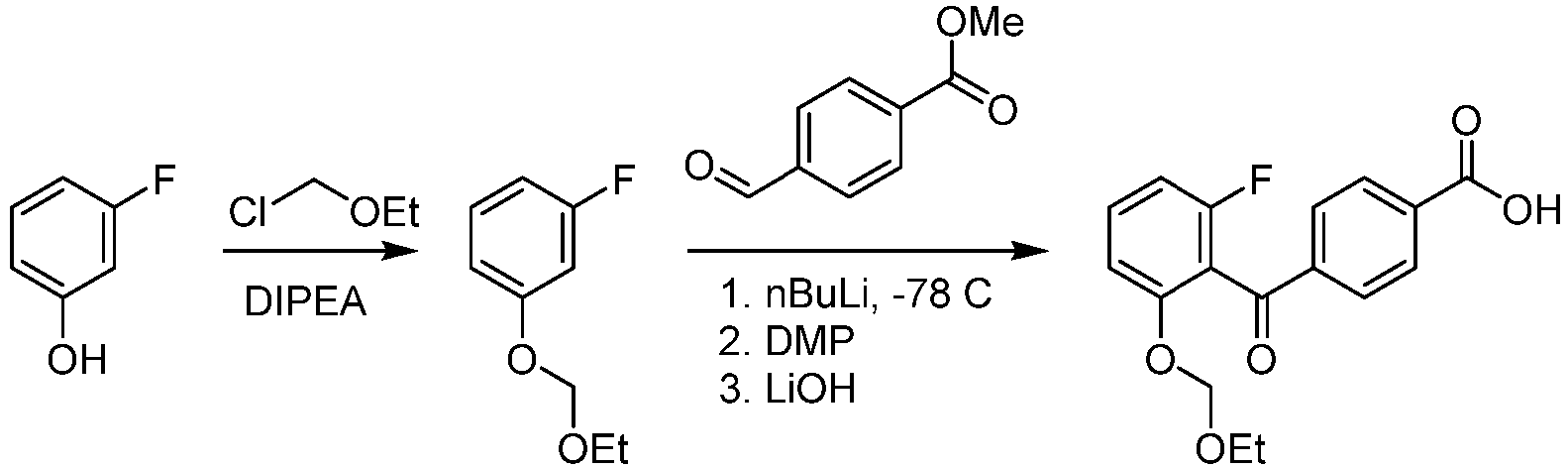
- A round bottom flask was charged with 3-fluorophenol (1.0 g, 8.92 mmol) and CH2Cl2 (10 mL) at room temperature. To this solution was then added diisopropylethylamine (3.10 mL, 17.8 mmol) followed by (chloromethoxy)ethane (1.65 mL, 17.8 mmol). The resulting solution was stirred at room temperature until complete by LC-MS (18 h). The solution was washed twice with water, and the organic portion was concentrated and purified on silica gel (20 g, hexane/EtOAc gradient 2%-25%) to give 1-(ethoxymethoxy)-3-fluorobenzene. 1H NMR (500 MHz, Chloroform-d) δ 7.26 - 7.18 (m, 1H), 6.82 (dd, J = 8.3, 2.2 Hz, 1H), 6.79 (dd, J = 10.8, 2.3 Hz, 1H), 6.74 - 6.65 (m, 1H), 5.21 (d, J = 1.8 Hz, 2H), 3.73 (qd, J = 7.1, 1.8 Hz, 2H), 1.23 (t, J = 7.1 Hz, 3H).
- A flame-dried round bottom flask was charged with 1-(ethoxymethoxy)-3-fluorobenzene (1.08 g, 6.35 mmol) and anhydrous THF (20 mL) under an atmosphere of N2. The solution was cooled in a dry ice/acetone bath and then treated slowly with nBuLi (3.80 mL of a 2.5 M hexane solution, 9.51 mmol). After two hours of stirring cold, the solution was slowly treated with a solution of methyl 4-formylbenzoate (1.56 mL, 9.51 mmol) in anhydrous THF (4 mL). The resulting mixture was allowed to warm to room temperature slowly and monitored by LC-MS. Upon completion, the solution was diluted with ethyl acetate and sequentially washed with water and brine. Concentration gave an oil, which was then purified on silica gel (20 g, hexane/
EtOAc gradient 10%-100%) to give methyl 4-((2-(ethoxymethoxy)-6-fluorophenyl)(hydroxy)methyl)benzoate. 1H NMR (500 MHz, Chloroform-d) δ 8.01 - 7.94 (m, 2H), 7.43 (d, J = 7.9 Hz, 2H), 7.25 - 7.19 (m, 1H), 6.93 (d, J = 8.5 Hz, 1H), 6.81 (t, J = 9.1 Hz, 1H), 6.26 (d, J = 11.0 Hz, 1H), 5.21 - 5.14 (m, 1H), 5.14 - 5.04 (m, 1H), 3.90 (s, 3H), 3.72 (dd, J= 11.1, 2.3 Hz, 1H), 3.46 (m, 1H), 3.41 - 3.29 (m, 1H), 1.08 (td, J = 7.1, 2.0 Hz, 3H). - A round bottom flask was charged with methyl 4-((2-(ethoxymethoxy)-6-fluorophenyl)(hydroxy)methyl)benzoate (1.93 g, 5.77 mmol) and CH2Cl2 (40 mL) at room temperature. Dess-Martin Periodinane (3.67 g, 8.66 mmol) was then added and the resulting pale yellow suspension was stirred for 30 min. The solution was diluted with dichloromethane and washed with NaHCO3. Concentration and purification on silica gel (20 g, hexane/EtOAc gradient 5%-40%) gave methyl 4-(2-(ethoxymethoxy)-6-fluorobenzoyl)benzoate. 1H NMR (500 MHz, Chloroform-d) δ 8.11 (d, J = 6.8 Hz, 2H), 7.91 (d, J = 7.49 Hz, 2H), 7.40 (q, J = 8.8, 8.2 Hz, 1H), 7.06 (d, J = 8.6, 1H), 6.88 - 6.80 (m, 1H), 5.12 (s, 2H), 3.95 (s, 3H), 3.57 - 3.47 (m, 2H), 1.16 - 1.07 (t, J = 7.3, 3H).
- A vial was charged with methyl 4-(6-(ethoxymethoxy)-2-fluoro-3-methoxybenzoyl)benzoate (300 mg, 0.903 mmol), THF (3 mL), and water (1 mL). LiOH (86 mg, 3.6 mmol) was added and the resulting mixture was stirred at room temperature for 2 h. The solution was then diluted with ethyl acetate and washed with a 10% citric acid solution. Concentration of the organic portion resulted in 4-(2-(ethoxymethoxy)-6-fluorobenzoyl)benzoic acid. 1H NMR (500 MHz, Chloroform-d) δ 8.23 - 8.14 (d, J= 7.7 Hz, 2H), 7.95 (d, J = 7.5 Hz, 2H), 7.44 - 7.37 (m, 1H), 7.06 (dd, J = 8.7, 2.9 Hz, 1H), 6.85 (t, J= 8.6 Hz, 1H), 5.13 (s, 1H), 3.52 (q, J = 6.9, 5.1 Hz, 2H), 1.16 - 1.08 (m, 3H).
-

- A vial was charged with 4-(2-(ethoxymethoxy)-6-fluorobenzoyl)benzoic acid (32 mg, 0.099 mmol), Et3N (14 µL, 0.099 mmol) and DMF (1.0 mL) at room temperature. To this solution was then added HATU (38 mg, 0.099 mmol) and the mixture was stirred for 5 min. This solution was then added to a second vial containing a freshly prepared mixture of tert-butyl (3R,4S)-3,4-diaminopyrrolidine-1-carboxylate (20 mg, 0.099 mmol) and HCl (4.0 M dioxane solution, 50 µL) in DMF (0.5 mL). The resulting solution was stirred at room temperature for 18 h to give tert-butyl (3R,4R)-3-amino-4-(4-(2-(ethoxymethoxy)-6-fluorobenzoyl)benzamido)pyrrolidine-1-carboxylate which could be directly used in situ. To this solution was added isonicotinic acid (12 mg, 0.099 mmol), Et3N (42 µL, 0.298 mmol) and HATU (38 mg, 0.099 mmol). The mixture was stirred at room temperature for 1 h, then quenched with water and extracted with EtOAc. The organic portion was concentrated in vacuo and then redissolved in THF (1.0 mL) and aqueous HCl (1.0 M, 0.5 mL). The solution was warmed to 65°C and stirred until the carbamate and acetal protecting groups were fully removed by LCMS. The solution was then purified via HPLC to give N-((3R,4R)-4-(4-(2-fluoro-6-hydroxybenzoyl)benzamido)pyrrolidin-3-yl)isonicotinamide as a formate salt. 1H NMR (500 MHz, Methanol-d 4) δ 8.78 - 8.69 (m, 2H), 8.50 (s, 1H), 7.97 (d, J = 7.3 Hz, 2H), 7.91 (d, J = 7.8 Hz, 2H), 7.82 (d, J = 4.5 Hz, 2H), 7.39 (d, J = 8.0 Hz, 1H), 6.82 - 6.76 (m, 1H), 6.72 (t, J = 9.0 Hz, 1H), 4.73 - 4.65 (m, 2H), 3.75 (d, J = 11.1 Hz, 2H), 3.32 (s, 2H). LCMS (ESI+) for C24H21FN4O4 [M+H] expected = 449.16, found = 449.26.
-

- A vial was charged with 4-(2-(ethoxymethoxy)-6-fluorobenzoyl)benzoic acid (32 mg, 0.099 mmol), Et3N (14 µL, 0.099 mmol) and DMF (1.0 mL) at room temperature. To this solution was then added HATU (38 mg, 0.099 mmol) and the mixture was stirred for 5 min. This solution was then added to a second vial containing a freshly prepared mixture of tert-butyl (3R,4S)-3,4-diaminopyrrolidine-1-carboxylate (20 mg, 0.099 mmol) and HCl (4.0 M dioxane solution, 50 µL) in DMF (0.5 mL). The resulting solution was stirred at room temperature for 18 h to give tert-butyl (3R,4R)-3-amino-4-(4-(2-(ethoxymethoxy)-6-fluorobenzoyl)benzamido)pyrrolidine-1-carboxylate which could be directly used in situ. To this solution was added 2-aminopyrimidine-4-carboxylic acid (14 mg, 0.099 mmol), Et3N (42 µL, 0.298 mmol) and HATU (38 mg, 0.099 mmol). The mixture was stirred at room temperature for 1 h, then quenched with water and extracted with EtOAc. The organic portion was concentrated in vacuo and then redissolved in THF (1.0 mL) and aqueous HCl (1.0 M, 0.5 mL). The solution was warmed to 65°C and stirred until the carbamate and acetal protecting groups were fully removed by LCMS. The solution was then purified via HPLC to give 2-amino-N-((3R,4R)-4-(4-(2-fluoro-6-hydroxybenzoyl)benzamido)pyrrolidin-3-yl)pyrimidine-4-carboxamide as a formate salt. 1H NMR (500 MHz, Methanol-d 4) δ 8.51 (s, 1H), 8.47 (d, J = 5.2 Hz, 1H), 7.96 (s, 2H), 7.91 (d, J = 8.9 Hz, 2H), 7.39 (d, J = 8.1 Hz, 1H), 7.22 (d, J = 5.3 Hz, 1H), 6.78 (d, J = 8.6 Hz, 1H), 6.73 (d, J = 9.4 Hz, 1H), 4.66 (d, J = 24.8 Hz, 3H), 3.73 (t, J = 10.0 Hz, 2H). LCMS (ESI+) for C23H21FN6O4 [M+H] expected = 465.16, found = 465.25.
-

- A vial was charged with 4-(2-(ethoxymethoxy)-6-fluorobenzoyl)benzoic acid (32 mg, 0.099 mmol), Et3N (14 µL, 0.099 mmol) and DMF (1.0 mL) at room temperature. To this solution was then added HATU (38 mg, 0.099 mmol) and the mixture was stirred for 5 min. This solution was then added to a second vial containing a freshly prepared mixture of tert-butyl (3R,4S)-3,4-diaminopyrrolidine-1-carboxylate (20 mg, 0.099 mmol) and HCl (4.0 M dioxane solution, 50 µL) in DMF (0.5 mL). The resulting solution was stirred at room temperature for 18 h to give tert-butyl (3R,4R)-3-amino-4-(4-(2-(ethoxymethoxy)-6-fluorobenzoyl)benzamido)pyrrolidine-1-carboxylate which could be directly used in situ. To this solution was added 1H-indazole-5-carboxylic acid (16 mg, 0.099 mmol), Et3N (42 µL, 0.298 mmol) and HATU (38 mg, 0.099 mmol). The mixture was stirred at room temperature for 1 h, then quenched with water and extracted with EtOAc. The organic portion was concentrated in vacuo and then redissolved in THF (1.0 mL) and aqueous HCl (1.0 M, 0.5 mL). The solution was warmed to 65°C and stirred until the carbamate and acetal protecting groups were fully removed by LCMS. The solution was then purified via HPLC to give N-((3R,4R)-4-(4-(2-fluoro-6-hydroxybenzoyl)benzamido)pyrrolidin-3-yl)-1H-indazole-5-carboxamide as a formate salt. 1H NMR (500 MHz, Methanol-d 4) δ 8.54 (s, 1H), 8.38 (s, 1H), 8.20 (s, 1H), 8.03 - 7.95 (m, 2H), 7.91 (d, J = 8.7 Hz, 3H), 7.62 (d, J = 8.5 Hz, 1H), 7.39 (s, 1H), 6.78 (d, J = 7.9 Hz, 1H), 6.71 (d, J = 12.3 Hz, 1H), 4.68 (s, 2H), 3.69 (d, J= 9.0 Hz, 2H), 3.25 (s, 2H). LCMS (ESI+) for C26H22FN5O4 [M+H] expected = 488.17, found = 488.27.
-

- A vial was charged with tert-butyl (3R,4R)-3-amino-4-(4-(6-(ethoxymethoxy)-2-fluoro-3-methoxybenzoyl)benzamido)pyrrolidine-1-carboxylate (66 mg, 0.124 mmol), 3H-imidazo[4,5-b]pyridine-7-carboxylic acid (20 mg, 0.124 mmol), HATU (47 mg, 0.124 mmol) and DMF (1 mL). Et3N (52 µL, 0.372 mmol) was added and the mixture was stirred at room temperature for 2 h. The solution was quenched with water and extracted with EtOAc. The organic portion was concentrated in vacuo and then redissolved in THF (1.0 mL) and aqueous HCl (1.0 M, 0.3 mL). The solution was warmed to 65°C and stirred until the carbamate and acetal protecting groups were fully removed by LCMS. The solution was then purified via HPLC to give N-((3R,4R)-4-(4-(2-fluoro-6-hydroxy-3-methoxybenzoyl)benzamido)pyrrolidin-3-yl)-3H-imidazo[4,5-b]pyridine-7-carboxamide as a formate salt. 1H NMR (500 MHz, Methanol-d 4) δ 8.55 (d, J = 5.1 Hz, 1H), 8.53 (s, 1H), 8.50 (s, 2H), 7.98 (d, J = 8.2 Hz, 2H), 7.92 (d, J = 8.2 Hz, 2H), 7.81 (d, J = 5.1 Hz, 1H), 7.15 (t, J = 9.3 Hz, 1H), 6.70 (dd, J = 9.0, 1.6 Hz, 1H), 4.84 - 4.71 (m, 2H), 3.92 - 3.81 (m, 5H), 3.48 (dd, J = 12.3, 6.3 Hz, 1H), 3.41 (dd, J = 12.1, 6.6 Hz, 1H). LCMS (ESI+) for C26H23FN6O5 [M+H] expected = 519.17, found = 519.32.
-

- A vial was charged with tert-butyl (3R,4R)-3-amino-4-(4-(6-(ethoxymethoxy)-2-fluoro-3-methoxybenzoyl)benzamido)pyrrolidine-1-carboxylate (66 mg, 0.124 mmol), 2-(1H-pyrazol-4-yl)acetic acid (16 mg, 0.124 mmol), HATU (47 mg, 0.124 mmol) and DMF (1 mL). Et3N (52 µL, 0.372 mmol) was added and the mixture was stirred at room temperature for 2 h. The solution was quenched with water and extracted with EtOAc. The organic portion was concentrated in vacuo and then redissolved in THF (1.0 mL) and aqueous HCl (1.0 M, 0.3 mL). The solution was warmed to 65°C and stirred until the carbamate and acetal protecting groups were fully removed by LCMS. The solution was then purified via HPLC to give N-((3R,4R)-4-(2-(1H-pyrazol-4-yl)acetamido)pyrrolidin-3-yl)-4-(2-fluoro-6-hydroxy-3-methoxybenzoyl)benzamide as a formate salt. 1H NMR (400 MHz, Methanol-d 4) δ 8.39 (d, J = 1.6 Hz, 2H), 7.92 (s, 4H), 7.55 (s, 1H), 7.15 (t, J = 9.3 Hz, 1H), 6.70 (d, J = 9.0 Hz, 1H), 4.53 (dq, J = 27.9, 7.2 Hz, 2H), 3.86 (d, J = 1.6 Hz, 3H), 3.82 - 3.69 (m, 2H), 3.47 (s, 2H), 3.30 - 3.21 (m, 2H). LCMS (ESI+) for C24H24FN5O5 [M+H] expected = 482.18, found = 482.30.
-

- A vial was charged with tert-butyl (3R,4R)-3-amino-4-(4-(6-(ethoxymethoxy)-2-fluoro-3-methoxybenzoyl)benzamido)pyrrolidine-1-carboxylate (66 mg, 0.124 mmol), 2-(pyridin-3-yl)acetic acid (17 mg, 0.124 mmol), HATU (47 mg, 0.124 mmol) and DMF (1 mL). Et3N (52 µL, 0.372 mmol) was added and the mixture was stirred at room temperature for 2 h. The solution was quenched with water and extracted with EtOAc. The organic portion was concentrated in vacuo and then redissolved in THF (1.0 mL) and aqueous HCl (1.0 M, 0.3 mL). The solution was warmed to 65°C and stirred until the carbamate and acetal protecting groups were fully removed by LCMS. The solution was then purified via HPLC to give 4-(2-fluoro-6-hydroxy-3-methoxybenzoyl)-N-((3R,4R)-4-(2-(pyridin-3-yl)acetamido)pyrrolidin-3-yl)benzamide as a formate salt. 1H NMR (500 MHz, Methanol-d 4) δ 8.48 (d, J = 2.2 Hz, 1H), 8.41 (dd, J = 5.0, 1.5 Hz, 1H), 8.38 (s, 2H), 7.90 (s, 3H), 7.80 - 7.76 (m, 1H), 7.35 (dd, J = 7.9, 4.9 Hz, 1H), 7.16 (t, J = 9.3 Hz, 1H), 6.71 (dd, J = 9.0, 1.6 Hz, 1H), 4.56 (dq, J = 37.2, 7.3 Hz, 2H), 3.87 (s, 3H), 3.75 (ddd, J = 12.0, 10.1, 7.8 Hz, 2H), 3.63 (s, 2H), 3.28 (dd, J = 12.1, 7.5 Hz, 1H). LCMS (ESI+) for C26H25FN4O5 [M+H] expected = 493.18, found = 493.28.
-

- A vial was charged with 2-amino-N-((3R,4R)-4-(4-(2-fluoro-6-hydroxy-3-methoxybenzoyl)benzamido)pyrrolidin-3-yl)pyrimidine-4-carboxamide (8 mg, 0.016 mmol) and CH2Cl2 (1.0 mL) at room temperature. To this solution was then added trifluoroactic acid (0.5 mL) followed by Et3SiH (30 µL). After 20 h the solution was concentrated and purified on HPLC to give both the partially reduced carbinol and the fully reduced methylene compounds. 2-amino-N-((3R,4R)-4-(4-(2-fluoro-6-hydroxy-3-methoxybenzyl)benzamido)pyrrolidin-3-yl)pyrimidine-4-carboxamide: 1H NMR (500 MHz, Methanol-d 4) δ 8.50 (s, 2H), 8.47 (d, J = 5.1 Hz, 1H), 7.74 (d, J = 7.9 Hz, 2H), 7.37 (d, J = 7.9 Hz, 2H), 7.22 (d, J = 5.0 Hz, 1H), 6.82 (t, J = 9.2 Hz, 1H), 6.57 (d, J = 8.9 Hz, 1H), 4.65 (dq, J = 31.2, 7.2 Hz, 2H), 4.04 (s, 2H), 3.79 (s, 5H), 3.38 (s, 2H). LCMS (ESI+) for C24H25FN6O4 [M+H] expected = 481.20, found = 481.29. 2-amino-N-((3R,4R)-4-(4-((2-fluoro-6-hydroxy-3-methoxyphenyl)(hydroxy)methyl)benzamido) pyrrolidin-3-yl)pyrimidine-4-carboxamide: 1H NMR (500 MHz, Methanol-d 4) δ 8.47 (d, J = 5.0 Hz, 1H), 8.39 (s, 8H), 7.81 (d, J = 8.1 Hz, 2H), 7.53 (d, J = 8.0 Hz, 2H), 7.22 (d, J = 4.9 Hz, 1H), 6.90 (t, J = 9.2 Hz, 1H), 6.57 (d, J = 8.7 Hz, 1H), 6.30 (s, 1H), 4.68 (dd, J = 24.2, 7.0 Hz, 2H), 3.85 (q, J = 8.9 Hz, 2H), 3.78 (s, 3H), 3.45 (d, J = 11.6 Hz, 2H). LCMS (ESI+) for C24H25FN6O5 [M+H] expected = 497.19, found = 497.27.
- Other disclosed compounds for which a synthesis is not explicitly shown can be prepared by analogous methods to those shown in the above examples.
- PRE-COATING CULTURE PLATES: On the day before the experiment, 96-well plates were pre-coated by plating 50 µl of Poly-D-lysine solution (PDL, 0.5 mg/mL) in each well. The next morning, the plates were washed four or five times with HBSS or PBS (150 µl/rinse), then left in buffer until cell plating
- PREPARING THE CELLS: A timed pregnant rat carrying E18 embryos was euthanized using an IACUC approved method. In a laminar flow hood, the embryos were removed and placed in a petri dish containing Hank's Balanced Salt Solution (HBSS) with 20 mM HEPES, pH 7.3. Pup brains were dissected (see Meberg et al., 2003) and hippocampi were collected in 15 mL a conical tube containing Hibernate E with SM1 (2% v/v).
- Dissociation media was prepared by combining 4.5 mL of Hibernate E (without SM1) with 0.5 mL of trypsin and 100 µl of DNAse solution. The medium over the hippocampi was carefully removed and replaced with dissociation solution, then incubated at 37 °C for 15-20 minutes, occasionally swirling the tube.
- Using flame polished cotton plugged Pasteur pipettes, the dissociation media was removed, and then 5 mL of Hibernate E containing SM1 were added. The tube was swirled to thoroughly wash the tissue. The tissue was allowed to settle to the bottom of the tube, and the rinse solution was carefully removed. This step was repeated 5 times to dilute out trypsin and DNAse and remove any debris from lysed cells.
- The final rinse media was removed from the tube and 1 pipette-full (1-2 mL) of Hibernate E with SM1 was added. Using the flame-polished Pasteur pipette (pre-wetted with rinse media), the tube was triturated until all cells had dissociated and no visible chunks of tissue remained. Fewer than ten triturations were typically performed. The volume was adjusted to 8-12 mL using Hibernate E containing SM1, the well was mixed and cell concentration was determined.
- PLATING: The cells were diluted in culture media (NbActiv4 Cell-culture media) to a final concentration of 10,000 cells/mL. The HBSS was aspirated from PDL coated plates, and 150 µL of cell solution was loaded in the middle 48 wells at 1500 cells per well. Water was loaded in the outer wells to decrease evaporation from edge wells. Cells were allowed to adhere for 2 hours in tissue culture incubator prior to treatment.
- TREATMENT: Compounds were diluted to various concentrations to provide 9 dose response concentrations of 20 µM, 10 µM, 5, µM, 2.5 µM, 1.25 µM, 0.625 µM, 0.3125 µM, 0.15625 µM, and 0.078125 µM. The plates were cultured for 48 hours, exposed to the compound at the various dose response concentrations.
- FIXING THE CULTURES: The culture medium was removed from the plates and immediately replaced with 100-200 µl of warm (37 °C) 4% paraformaldehyde (PFA) solution in phosphate-buffered saline (PBS). The cells were fixed for 15-20 minutes at room temperature, and then rinsed with PBS (200 µl /well × 3).
- STAINING AND IMAGING: The PBS was removed and replaced with 100 µl of blocking/permeabilization buffer (PBS, 0.2% fish gelatin, 0.03% Triton X-100, 0.02% NaN3), then incubated overnight at 4 °C. To this was added 100 µl of primary antibody solution (mouse anti-Beta III tubulin in blocking buffer) and incubate overnight at 4 °C. The wells were rinsed with PBS (200 µl × 3), which was then removed and replaced with 100 µl of secondary antibody solution (Goat anti-mouse Alexa 488, 10µg/ml Hoechst 33342, 0.2% fish gelatin, 0.02% azide, in PBS). The plate was shaken gently on a rotating shaker for 2 hours, then rinsed with PBS (200 µl × 5).
- The plate was imaged using a Cellomics ArrayScan VTI in 2 different channels for nuclear staining (Hoechst) and cell body/neurite staining (βIII-tubulin). Typically, nine fields per well were imaged with a 5X objective and automatically traced by the Neuronal Profiling Bioapplication. To get reproducible results, at least 200-300 valid neurons were measured per condition.
- The data for each compound as assessed in the above assay are presented in Table 1, below, showing the neurite growth length (%NTL) upon exposure to the compound at each concentration.
Table 1 20 µM %NTL 10 µM %NTL 5 µM %NTL 2.5 µM %NTL 1.25 µM %NTL 625 nM %NTL 312 nM %NTL 156 nM %NTL 78 nM %NTL A1 84.59 86.99 92.91 85.81 93.47 90.99 89.64 88.96 89.92 A2 100.38 93.37 94.12 91.10 88.92 93.05 84.59 96.16 93.76 A3 96.62 92.90 93.64 95.07 96.65 92.57 96.28 99.86 98.31 A4 160.62 132.08 113.83 114.28 105.00 93.21 110.09 98.98 101.99 A5 131.55 123.89 116.01 113.00 101.74 102.12 97.21 102.00 97.83 A6 121.20 107.24 105.41 92.86 94.12 95.38 83.05 105.56 94.65 A7 91.80 86.42 91.99 88.34 90.82 91.24 95.70 94.76 97.03 A8 81.61 93.23 93.82 94.37 92.86 98.98 96.40 98.70 99.15 A9 89.14 89.62 98.35 98.89 88.00 96.63 90.69 91.54 94.49 A10 92.60 86.03 85.88 82.94 83.65 88.19 87.46 91.19 91.73 A11 110.10 109.70 94.60 98.47 91.67 93.85 87.41 102.21 103.85 A12 119.02 98.61 105.72 90.99 90.64 93.14 91.17 90.73 96.59 A13 147.40 129.01 120.42 113.46 106.05 102.90 97.66 101.26 99.51 A14 174.99 153.54 140.04 125.97 126.71 118.56 117.90 110.84 105.26 A15 136.04 121.85 109.99 107.46 109.99 114.21 111.29 105.50 98.50 A16 660.88 573.73 403.74 228.24 167.31 144.99 125.17 117.55 117.21 A17 119.03 120.74 111.62 113.43 103.19 99.84 103.50 100.18 99.73 A18 140.11 130.60 130.17 133.32 121.01 120.24 119.39 115.01 112.57 A19 91.20 87.39 79.44 78.45 75.70 74.96 68.74 93.71 90.07 A20 103.31 93.83 90.74 90.24 88.40 86.06 77.66 81.49 86.16 A21 107.94 106.78 102.39 91.52 86.78 81.75 79.75 83.27 84.72 A22 94.65 91.08 88.74 85.47 85.50 86.23 92.28 91.77 89.30 A23 144.40 116.62 104.71 100.79 96.98 93.58 95.61 101.78 98.34 A24 168.53 130.98 113.84 101.49 91.75 96.90 93.41 96.83 96.27 A25 163.32 146.22 134.45 121.94 120.29 111.16 109.64 97.54 98.93 A26 117.38 97.77 102.47 99.91 93.51 99.28 94.24 99.25 93.29 A27 150.50 141.32 117.42 105.14 110.42 118.35 107.37 101.33 103.27 A28 139.00 137.19 132.96 118.22 102.88 83.66 102.99 113.43 97.76 A29 269.49 226.69 172.95 151.95 123.67 121.54 119.66 117.83 123.24 A30 117.38 107.23 103.00 94.79 93.78 83.52 90.55 89.72 93.11 A31 137.38 142.13 150.97 140.22 135.94 114.65 118.44 120.15 122.27 A32 86.59 82.90 88.24 90.59 81.36 84.61 88.20 86.89 98.72 A33 207.05 159.35 141.98 129.36 114.66 106.63 99.34 106.08 107.83 A34 130.91 118.29 110.06 105.94 95.84 92.27 92.06 102.77 102.90 A35 106.81 96.69 97.19 95.04 86.88 89.26 86.33 90.06 91.75 A36 470.23 480.45 516.37 358.08 238.96 149.25 130.71 126.39 115.57 A37 211.85 154.55 132.14 123.52 113.19 107.07 113.37 109.29 99.97 A38 87.68 100.44 106.01 99.97 100.40 96.60 103.22 101.57 107.67 A39 100.58 98.87 98.03 87.33 82.95 80.49 85.55 92.99 96.28 A40 121.39 106.33 100.73 107.86 94.11 86.22 86.15 91.18 86.29 A41 190.30 152.00 124.40 102.24 95.91 86.95 86.20 88.45 91.35 A42 368.85 431.35 402.61 255.45 169.05 117.86 126.44 109.72 115.00 A43 173.26 154.98 143.76 135.87 123.55 113.63 115.41 117.86 117.56 A44 105.09 102.87 103.74 96.16 99.37 76.36 78.84 87.12 94.04 A45 111.39 97.19 89.06 93.34 84.84 86.95 83.72 90.16 96.49 A46 90.20 100.33 88.09 86.76 93.08 77.54 90.83 94.95 95.62 A47 161.73 128.27 121.79 111.68 104.25 96.82 99.67 99.28 100.42 A48 421.47 460.51 331.77 219.41 144.30 120.02 116.40 117.05 108.76 A49 206.59 321.91 298.34 200.44 138.61 111.70 101.33 99.50 106.71 A50 457.37 561.20 431.11 285.18 193.50 135.55 118.09 113.45 112.84 A51 420.94 506.09 361.80 260.12 191.35 157.66 134.95 128.52 129.32 A52 100.15 115.27 120.18 112.62 93.31 101.62 99.51 99.93 104.15 A53 70.00 91.90 90.14 88.53 85.81 76.28 79.27 82.49 90.02 A54 227.71 151.47 120.06 105.05 94.72 84.11 84.31 79.92 83.12 A55 96.04 98.77 93.58 90.13 81.96 76.79 80.06 77.96 85.02 A56 488.07 374.82 267.31 196.25 165.48 132.68 130.54 136.70 127.78 A57 111.06 107.49 105.35 93.54 97.27 93.92 95.07 97.82 92.24 A58 88.58 89.45 85.34 84.80 76.29 75.71 79.27 87.57 88.35 A59 105.80 110.70 95.38 91.20 76.68 82.32 73.56 82.81 91.90 A60 91.78 100.82 88.88 98.45 84.35 69.75 80.81 79.69 88.95 A61 152.19 108.17 97.02 91.67 95.68 91.52 92.77 91.78 94.56 A62 133.49 96.18 93.93 93.64 92.12 94.16 92.63 90.36 88.98 A63 223.87 143.60 117.99 104.27 91.93 103.77 96.44 96.30 100.17 A64 126.26 120.74 124.31 129.41 116.10 105.44 106.93 99.78 91.33 A65 160.83 149.93 127.75 128.51 126.01 112.65 122.60 116.94 108.46 A66 161.12 144.82 129.09 128.72 121.97 111.17 122.31 107.02 112.95 A67 128.29 119.57 108.09 106.24 112.46 104.43 103.63 97.87 94.15 A68 94.26 102.28 96.78 101.06 101.75 91.25 94.76 95.73 101.04 A69 117.28 119.25 111.98 111.87 109.93 106.76 96.04 96.20 94.29 A70 144.96 135.12 121.56 117.33 123.15 121.97 115.07 106.96 102.89 A71 123.56 116.78 118.60 109.30 102.26 109.02 104.56 98.98 94.77 A72 156.98 126.65 113.38 104.86 106.49 107.88 97.65 94.01 96.38 A73 158.80 135.55 120.66 117.34 125.11 104.94 101.50 109.85 96.70 A74 NA 137.17 121.40 118.91 105.43 105.75 102.97 102.69 101.11 A75 140.29 146.47 119.26 119.03 116.01 106.00 105.30 93.67 97.09 A76 691.89 557.77 317.48 207.35 168.56 155.84 139.87 120.88 130.68 A77 653.37 469.06 263.06 186.81 158.86 144.33 132.84 125.06 117.77 A78 502.56 409.68 255.55 175.58 152.11 143.39 133.21 120.99 121.64 A79 94.65 106.94 111.85 115.71 111.13 117.86 117.37 109.21 115.72 A80 155.49 159.73 202.94 220.71 178.49 157.67 141.08 124.09 124.98 A81 116.43 112.57 129.67 125.18 128.34 128.45 126.73 120.48 123.64 A82 116.60 130.66 119.93 120.02 122.06 123.85 116.69 115.44 106.90 A83 117.46 123.49 126.83 127.43 123.58 118.28 109.99 104.76 105.67 A84 564.48 492.48 269.85 164.51 152.70 139.22 124.79 117.61 114.61 A85 426.16 533.51 376.48 218.99 176.87 152.65 140.15 144.13 133.69 A86 379.35 270.94 184.87 157.50 136.32 133.66 125.73 135.37 123.89 - To assess the role of the compounds described herein in axon growth in vivo, the unilateral pyramidotomy model was employed, in which the pyramid in the ventral brainstem was severed unilaterally, rostral to the decussation of corticospinal tract (CST) axons. The animals then received bilateral cortical injections of a compound described herein (or DMSO) mixed 1:1 with AAV8-UbC-GFP or AAV8-UbC-TdTomato (5x10¹³ GC/mL) for a final concentration of 2mM (2 animals (mice) for each condition). Five injections (500nl each) were made into the sensorimotor cortex on each hemisphere at a depth of 0.5mm and at the following coordinates: 2mm/±1.5mm, 1.25mm/±1.5mm, 0.5mm/±1.5mm, -0.25mm/±1mm, and -1mm/±1mm (anteroposterior/mediolateral to bregma). Axon growth in the cervical spinal cord was assessed after 5 weeks. Cervical sections of the spinal cord were stained with antibodies against PKCγ (to assess completeness of lesion), and GFP (to amplify the signal from the virus). For analyses, GFP+ axons sprouting into the denervated gray matter were counted at 0, 500, 1000 µm lateral to the central canal, and normalized to the number of GFP+ fibers at the level of the brainstem (sprouting axon index). In animals treated with RO48 (A92) or its derivatives (SBI-0799926- Compound A16, and SBI-0814654- Compound A88), there was nearly a two-fold increase in sprouting, measured by the sprouting axon index graph (
Figure 3 ). These results confirm that RO48 can promote CST axon growth following a single administration of the compound (Al-Ali et al., ACS Chem Biol. 2015;10(8):1939-512015), and indicate that the derivative compounds are also able to promote axon growth in an in vivo setting. - To assess the ability of the compounds to promote neurite outgrowth, an HCS assay was performed using the protocol as described in Al-Ali, et al., "High Content Screening with Primary Neurons" in Assay Guidance Manual [Internet], Sittampalam et al., eds., Bethesda (MD): Eli Lilly & Company and the National Center for Advancing Translational Sciences; 2004. 2013 Oct 15 [updated 2014 Oct 1]. The results of this assay are presented in Table 2, below.
Table 2 COMPOUND NO. EC50 (µM) A1 9.34 A2 1.81 A3 0.7985 A4 9.64 A5 10.44 A6 1.67 A7 1.665 A8 - A9 4.9205 A10 0.93 A11 5.58 A12 - A13 4.96 A14 - A15 7.84 A16 5.505 A17 1.83 A18 6.6085 A19 2.2355 A20 9.49 A21 2.915 A22 2.612 A23 16.8 A24 16.1 A25 - A26 - A27 7.895 A28 4.72 A29 5.21 A30 4.92 A31 1.1505 A32 - A33 - A34 13.025 A35 0.163 A36 1.835 A37 - A38 3.15 A39 3.76 A40 9.62 A41 11.045 A42 2.45 A43 3.11 A44 2.05 A45 - A46 1.646 A47 7.43 A48 6.075 A49 2.46 A50 3.605 A51 4.9 A52 2.06 A53 0.814 A54 - A55 4.74 A56 8.54 A57 - A58 5.27 A59 7.13 A60 1.25 A61 - A62 16 A63 - A64 0.593 A65 7.11 A66 2.33 A67 - A68 1.24 A69 0.401 A70 - A71 2.15 A72 - A73 - A74 4.5 A75 6.565 A76 8.37 A77 10.42 A78 7.765 A79 - A80 0.534 A81 5.22 A82 0.154 A83 0.486 A84 6.86 A85 3.82 A86 11.9 A87 13.1 A88 1.165 A89 8.08 A90 1.795 A91 3.41 A92 0.711 A93 13.35 A94 0.813 A95 9.7735 A96 1.4475 A97 11.3 A98 9.975 A99 2.36 "-" indicates activity of >20 - The invention further relates to the following embodiments:
- 1. A compound, or pharmaceutically acceptable salt thereof, having a structure of Formula (I):

- ring A comprises a 5-6-membered monocyclic heteroaryl ring or a 8-11-membered bicyclic heteroaryl ring having 1, 2, or 3 nitrogen ring atoms;
- L1 is null or C1-2alkylene;
- X1 is -NH-, -CH2NH-, -NHCH2-, -CH2CH2NH-, or -NHCH2CH2-;
- X2 is NR2 or O;
- X3 is NR2 or O;
- L2 is C(O), O, CH2, or CHOH;
- R' is H or halo;
- each R2 is independently H or C1-3alkyl;
- R3 is H, C1-3alky, C3-6cycloalkyl, aryl, C(O)C1-3alkyl, C(O)C3-6cycloalkyl, or C(O)aryl;
- R4 is H, OH, halo, C1-4alkyl, C1-4alkoxy, C(O)C1-4alkoxy, C3-6cycloalkyl, aryl, -OC3-6cycloalkyl, -Oaryl, C1-4alkoxy-aryl, C(O)OC3-6cycloalkyl, or C(O)Oaryl; and
- R5 is H, halo, C1-4alkyl, or C1-4alkoxy.
- 2. The compound or salt of embodiment 1, wherein ring A comprises pyrrolyl, pyrazolyl, imidazolyl, triazolyl, pyridyl, pyrazinyl, pyrimidinyl, indolyl, indazolyl, benzotriazolyl, benzoimidazolyl, pyrrolopyridinyl, or imidazopyrindinyl.
- 3. The compound or salt of embodiment 1, wherein ring A comprises pyridyl, pyrimidinyl, pyrrolopyridinyl, indazolyl, or imidazopyrindinyl.
- 4. The compound or salt of embodiment 1, wherein ring A comprises


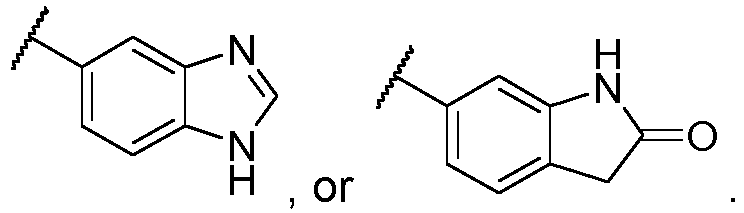
- 5. The compound of any one of embodiments 1 to 4, wherein ring A is substituted with one or two groups selected from NH2, OH, and C1-3alkyl.
- 6. The compound of any one of embodiments 1 to 4, wherein ring A is unsubstituted.
- 7. The compound or salt of any one of embodiments 1 to 6, wherein L1 is null.
- 8. The compound or salt of any one of embodiments 1 to 6, wherein L1 is CH2.
- 9. The compound or salt of any one of embodiments 1 to 8, wherein X1 is NH-, -CH2NH-,or -NHCH2.
- 10. The compound or salt of embodiment 9, wherein X1 is NH.
- 11. The compound or salt of embodiment 9, wherein X1 is CH2NH or NHCH2.
- 12. The compound or salt of any one of embodiments 1 to 8, wherein X1 is -CH2CH2NH-, or -NHCH2CH2-.
- 13. The compound or salt of any one of embodiments 1 to 12, wherein X2 is NR2.
- 14. The compound or salt of embodiment 13, wherein R2 is H or Me.
- 15. The compound or salt of any one of embodiments 1 to 12, wherein X2 is O.
- 16. The compound or salt of any one of embodiments 1 to 15, wherein X3 is NR2.
- 17. The compound or salt of embodiment 16, wherein R2 is H or Me.
- 18. The compound or salt of any one of embodiments 1 to 15, wherein X3 is O.
- 19. The compound or salt of any one of embodiments 1 to 18, wherein R1 is H.
- 20. The compound or salt of any one of embodiments 1 to 18, wherein R1 is halo.
- 21. The compound or salt of embodiment 20, wherein R1 is fluoro.
- 22. The compound or salt of any one of embodiments 1 to 21, wherein L2 is C(O).
- 23. The compound or salt of any one of embodiments 1 to 21, wherein L2 is O or CHOH.
- 24. The compound or salt of any one of embodiments 1 to 23, wherein R3 is H.
- 25. The compound or salt of any one of embodiments 1 to 23, wherein R3 is Me.
- 26. The compound or salt of any one of embodiments 1 to 23, wherein R3 is C(O)C1-3alkyl.
- 27. The compound or salt of embodiment 26, wherein R4 is OMe, OH, F, Cl, or Me.
- 28. The compound or salt of any one of embodiments 1 to 26, wherein R4 is H, OH, halo, C1-4alkyl, C1-4alkoxy, C(O)C1-4alkoxy, C3-6cycloalkyl, aryl, -OC3-6cycloalkyl, -Oaryl, C(O)OC3-6cycloalkyl, or C(O)Oaryl.
- 29. The compound or salt of any one of embodiments 1 to 28, wherein R5 is H.
- 30. The compound or salt of any one of embodiments 1 to 28, wherein R5 is F, OMe, Cl, or Me.
- 31. The compound of any one of embodiments 1 to 28 and 30, wherein R5 is ortho to R4.
- 32. A compound or pharmaceutically acceptable salt thereof having a structure as listed in Table A.
- 33. A compound or pharmaceutically acceptable salt thereof having a structure as listed in Table B.
- 34. A compound or pharmaceutically acceptable salt thereof having a structure as listed in Table C.
- 35. A composition comprising the compound or salt of any one of embodiments 1 to 34 and a pharmaceutically acceptable excipient.
- 36. A method of inhibiting Rho kinase (ROCK) or ribosomal protein S6 kinase (S6K) or PKC, comprising contacting ROCK or S6K or protein kinase C (PKC) with the compound or salt of any one of embodiments 1 to 34 in an amount effective to inhibit ROCK or S6K or PKC.
- 37. A method of inhibiting Rho kinase (ROCK) and ribosomal protein S6 kinase (S6K) comprising contacting ROCK and S6K with the compound or salt of any one of embodiments 1 to 34 in an amount effective to inhibit ROCK and S6K.
- 38. A method of inducing neurite outgrowth comprising contacting neurons with the compound or salt of any one of embodiments 1 to 34 in an amount effective to increase neurite outgrowth.
- 39. A method of treating a central nervous system (CNS) disorder associated with neuronal and/or axonal damage in a subject in need thereof, comprising administering to the subject the compound or salt of any one of embodiments 1 to 34 in an amount effective to repair neuronal and/or axonal damage and treat the CNS disorder.
- 40. The method of embodiment 39, where in the CNS disorder is paralysis, spinal cord injury, optic nerve injury, glaucoma, multiple sclerosis, traumatic brain injury, diffuse axonal injury, stroke, or a degenerative disease (such as Parkinson's disease).
- 41. A method of treating a peripheral nervous system (PNS) disorder associate with neuronal and/or axonal damage in a subject in need thereof, comprising administering to the subject the compound of any one of embodiments 1 to 34 in an amount effective to repair the neuronal and/or axonal damage and treat the PNS disorder.
- 42. The method of embodiment 41, wherein the PNS disorder is peripheral nerve trauma, repetitive stress, amyotrophic lateral sclerosis (ALS), erectile dysfunction, a disorder associated with an organ transplant, neurofibromatosis, blood vessel disease, diabetes, an autoimmune disorder, a disorder associated with chemical toxicity, or kidney disease.
- 43. A method of treating nerve degeneration in a subject undergoing cancer therapy, comprising administering to the subject the compound or salt of any one of embodiments 1 to 34 in an amount effective to treat the nerve degeneration.
Claims (15)
- A compound, or pharmaceutically acceptable salt thereof, having a structure of Formula (I):
 ring A comprises a 5-6-membered monocyclic heteroaryl ring or a 8-11-membered bicyclic heteroaryl ring having 1, 2, or 3 nitrogen ring atoms;L1 is null or C1-2alkylene;L2 is C(O), O, CH2, or CHOH;R1 is H or halo;each R2 is independently H or C1-3alkyl;R3 is H, C1-3alky, or C(O)C1-3alkyl;R4 is C1-4alkyl or C3-6cycloalkyl; andR5 is halo.
 - The compound or salt of claim 1, wherein ring A comprises pyrrolyl, pyrazolyl, imidazolyl, triazolyl, pyridyl, pyrazinyl, pyrimidinyl, indolyl, indazolyl, benzotriazolyl, benzoimidazolyl, pyrrolopyridinyl, or imidazopyrindinyl, optionally wherein ring A comprises pyridyl, pyrimidinyl, pyrrolopyridinyl, indazolyl, or imidazopyrindinyl.
- The compound or salt of claim 1, wherein ring A comprises


- The compound of any one of claims 1 to 3, wherein ring A is substituted with one or two groups selected from NH2, OH, and C1-3alkyl.
- The compound of any one of claims 1 to 3, wherein ring A is unsubstituted.
- The compound or salt of any one of claims 1 to 5, wherein L1 is null or -CH2-.
- The compound or salt of any one of claims 1 to 6, wherein at least one R2 is H or Me, optionally wherein each R2 is H or Me.
- The compound or salt of any one of claims 1 to 7, wherein R1 is H or fluoro.
- The compound or salt of any one of claims 1 to 8, wherein L2 is C(O).
- The compound or salt of any one of claims 1 to 9, wherein R3 is H or Me, optionally wherein R3 is H.
- The compound or salt of any one of claims 1 to 10, wherein R4 is C1-4alkyl, optionally wherein R4 is methyl or ethyl.
- The compound or salt of any one of claims 1 to 10, wherein R4 is C3-6cycloalkyl, optionally wherein R4 is cyclopropyl.
- The compound or salt of any one of claims 1 to 12, wherein R5 is F.
- A composition comprising the compound or salt of any one of claims 1 to 13 and a pharmaceutically acceptable excipient.
- The compound or salt of any one of claims 1 to 13 or the composition of claim 14 for use in treating a central nervous system (CNS) disorder associated with neuronal and/or axonal damage in a subject in need thereof, a peripheral nervous system (PNS) disorder associate with neuronal and/or axonal damage in a subject in need thereof, and/or nerve degeneration in a subject undergoing cancer therapy, optionally wherein the CNS disorder is selected from the group consisting of paralysis, spinal cord injury, optic nerve injury, glaucoma, multiple sclerosis, traumatic brain injury, diffuse axonal injury, stroke, or a degenerative disease, and Parkinson's disease, or the PNS disorder is selected from the group consisting of peripheral nerve trauma, repetitive stress, amyotrophic lateral sclerosis (ALS), erectile dysfunction, a disorder associated with an organ transplant, neurofibromatosis, blood vessel disease, diabetes, an autoimmune disorder, a disorder associated with chemical toxicity, and kidney disease.
Applications Claiming Priority (3)
| Application Number | Priority Date | Filing Date | Title |
|---|---|---|---|
| US201762579368P | 2017-10-31 | 2017-10-31 | |
| EP18811401.1A EP3704103B1 (en) | 2017-10-31 | 2018-10-31 | Kinase inhibitors for the treatment of central and peripheral nervous system disorders |
| PCT/US2018/058411 WO2019089729A1 (en) | 2017-10-31 | 2018-10-31 | Kinase inhibitors for the treatment of central and peripheral nervous system disorders |
Related Parent Applications (1)
| Application Number | Title | Priority Date | Filing Date |
|---|---|---|---|
| EP18811401.1A Division EP3704103B1 (en) | 2017-10-31 | 2018-10-31 | Kinase inhibitors for the treatment of central and peripheral nervous system disorders |
Publications (2)
| Publication Number | Publication Date |
|---|---|
| EP4574153A2 true EP4574153A2 (en) | 2025-06-25 |
| EP4574153A3 EP4574153A3 (en) | 2025-07-23 |
Family
ID=64557124
Family Applications (2)
| Application Number | Title | Priority Date | Filing Date |
|---|---|---|---|
| EP18811401.1A Active EP3704103B1 (en) | 2017-10-31 | 2018-10-31 | Kinase inhibitors for the treatment of central and peripheral nervous system disorders |
| EP24223406.0A Pending EP4574153A3 (en) | 2017-10-31 | 2018-10-31 | Kinase inhibitors for the treatment of central and peripheral nervous system disorders |
Family Applications Before (1)
| Application Number | Title | Priority Date | Filing Date |
|---|---|---|---|
| EP18811401.1A Active EP3704103B1 (en) | 2017-10-31 | 2018-10-31 | Kinase inhibitors for the treatment of central and peripheral nervous system disorders |
Country Status (8)
| Country | Link |
|---|---|
| US (2) | US11926613B2 (en) |
| EP (2) | EP3704103B1 (en) |
| JP (1) | JP7329509B2 (en) |
| KR (1) | KR102805772B1 (en) |
| CN (1) | CN111801322B (en) |
| AU (1) | AU2018359413B2 (en) |
| IL (1) | IL274067B2 (en) |
| WO (1) | WO2019089729A1 (en) |
Families Citing this family (3)
| Publication number | Priority date | Publication date | Assignee | Title |
|---|---|---|---|---|
| CN116375746B (en) * | 2021-12-23 | 2025-08-05 | 上海馨远医药科技有限公司 | A preparation method of potassium (2-fluoro-6-hydroxyphenyl) trifluoroborate |
| WO2023122325A2 (en) * | 2021-12-23 | 2023-06-29 | Regents Of The University Of Michigan | Meta anilide compounds and methods for use of the same to treat diseases and disorders |
| CN114605325A (en) * | 2022-03-23 | 2022-06-10 | 天方药业有限公司 | Preparation method of medical intermediate pyrazole-4-acetic acid hydrochloride |
Citations (1)
| Publication number | Priority date | Publication date | Assignee | Title |
|---|---|---|---|---|
| US5466468A (en) | 1990-04-03 | 1995-11-14 | Ciba-Geigy Corporation | Parenterally administrable liposome formulation comprising synthetic lipids |
Family Cites Families (7)
| Publication number | Priority date | Publication date | Assignee | Title |
|---|---|---|---|---|
| WO1994020062A2 (en) | 1993-03-03 | 1994-09-15 | Eli Lilly And Company | Balanoids as protein kinase c inhibitors |
| AU686691B2 (en) * | 1994-01-12 | 1998-02-12 | F. Hoffmann-La Roche Ag | Novel azepanes and homologs thereof |
| US6887864B2 (en) * | 2002-03-12 | 2005-05-03 | Hoffmann-La Roche Inc. | Azepane derivatives |
| US8846742B2 (en) * | 2006-02-14 | 2014-09-30 | The Trustees Of Columbia University In The City Of New York | Neuronal pain pathway modulators |
| WO2014210167A1 (en) * | 2013-06-26 | 2014-12-31 | The Trustees Of Columbia University In The City Of New York | Labeled pkg-1-alpha-binding compounds and their use in imaging and quantifying pain |
| CN105693520B (en) * | 2013-11-04 | 2018-06-26 | 天津键凯科技有限公司 | Compound with higher protein kinase G inhibitory activity and preparation method thereof |
| US20170147743A1 (en) * | 2015-11-23 | 2017-05-25 | University Of Miami | Rapid identification of pharmacological targets and anti-targets for drug discovery and repurposing |
-
2018
- 2018-10-31 CN CN201880084890.5A patent/CN111801322B/en active Active
- 2018-10-31 WO PCT/US2018/058411 patent/WO2019089729A1/en not_active Ceased
- 2018-10-31 EP EP18811401.1A patent/EP3704103B1/en active Active
- 2018-10-31 US US16/760,365 patent/US11926613B2/en active Active
- 2018-10-31 KR KR1020207014843A patent/KR102805772B1/en active Active
- 2018-10-31 EP EP24223406.0A patent/EP4574153A3/en active Pending
- 2018-10-31 IL IL274067A patent/IL274067B2/en unknown
- 2018-10-31 JP JP2020524043A patent/JP7329509B2/en active Active
- 2018-10-31 AU AU2018359413A patent/AU2018359413B2/en active Active
-
2024
- 2024-03-11 US US18/601,218 patent/US20250145586A1/en active Pending
Patent Citations (1)
| Publication number | Priority date | Publication date | Assignee | Title |
|---|---|---|---|---|
| US5466468A (en) | 1990-04-03 | 1995-11-14 | Ciba-Geigy Corporation | Parenterally administrable liposome formulation comprising synthetic lipids |
Non-Patent Citations (5)
| Title |
|---|
| "Pharmaceutics and Pharmacy Practice", 1982, J. B. LIPPINCOTT CO., pages: 238 - 250 |
| AL-ALI ET AL., ACS CHEM BIOL., vol. 10, no. 183311-28-6, 2015, pages 1939 - 512015 |
| AL-ALI ET AL.: "Assay Guidance Manual", 15 October 2013, ELI LILLY & COMPANY, article "High Content Screening with Primary Neurons" |
| S. M. BERGE ET AL., J. PHARMACEUTICAL SCIENCES, vol. 66, 1977, pages 1 - 19 |
| TOISSEL: "ASHP Handbook on Injectable Drugs", 1986, pages: 622 - 630 |
Also Published As
| Publication number | Publication date |
|---|---|
| US11926613B2 (en) | 2024-03-12 |
| KR102805772B1 (en) | 2025-05-14 |
| WO2019089729A1 (en) | 2019-05-09 |
| EP3704103B1 (en) | 2025-01-01 |
| KR20200080273A (en) | 2020-07-06 |
| AU2018359413B2 (en) | 2023-11-23 |
| EP3704103A1 (en) | 2020-09-09 |
| AU2018359413A1 (en) | 2020-05-07 |
| JP2021503442A (en) | 2021-02-12 |
| CN111801322A (en) | 2020-10-20 |
| IL274067B2 (en) | 2023-03-01 |
| IL274067B (en) | 2022-11-01 |
| US20250145586A1 (en) | 2025-05-08 |
| EP4574153A3 (en) | 2025-07-23 |
| JP7329509B2 (en) | 2023-08-18 |
| US20210163444A1 (en) | 2021-06-03 |
| CN111801322B (en) | 2024-03-15 |
| IL274067A (en) | 2020-06-30 |
Similar Documents
| Publication | Publication Date | Title |
|---|---|---|
| KR102534962B1 (en) | 8,9-dihydroimidazole[1,2-a]pyrimido[5,4-e]pyrimidine-5(6H)-ketone compound | |
| JP7239554B2 (en) | TLR7/8 antagonists and their uses | |
| EP3322711B1 (en) | Hpk1 inhibitors and methods of using same | |
| EP3068784B1 (en) | Substituted 4,5,6,7-tetrahydropyrazolo[1,5-a]pyrazine derivatives as casein kinase 1 d/e inhibitors | |
| CN106255679B (en) | Heterocyclic compounds as NAV channel inhibitors and uses thereof | |
| KR102653190B1 (en) | Highly active STING protein agonist compounds | |
| US20250145586A1 (en) | Kinase inhibitors for the treatment of central and peripheral nervous system disorders | |
| EP2780332B1 (en) | Morpholinylbenzotriazines for use in cancer therapy | |
| RS65319B1 (en) | 8-cyano-5-piperidino-quinolines as tlr7/8 antagonists and their uses for treating immune disorders | |
| JP5073655B2 (en) | Pyrrotriazine useful as a kinase inhibitor and method for treating kinase-related diseases using the same | |
| ES2927529T3 (en) | condensed heterocyclic compound | |
| CA3178129A1 (en) | Pyridopyrimidinone derivatives and their use as aryl hydrocarbon receptor modulators | |
| EP2807162B1 (en) | Substituted phenylimidazopyrazoles and use thereof | |
| EP3842437A1 (en) | High activity sting protein agonist | |
| US20190062274A1 (en) | Heterocyclic compound | |
| EP3383865B1 (en) | Furane derivatives as inhibitors of atad2 | |
| CA3181351A1 (en) | Nampt modulators | |
| EP3013804B1 (en) | Phthalazine derivatives | |
| EP4671239A1 (en) | Arylsubstituten-containing degrading agent for CDK12/13, manufacturing process therefor, pharmaceutical composition and use thereof | |
| EP3878841B1 (en) | Indazole kinase inhibitor and use thereof | |
| EP4495111A1 (en) | Novel compound and use thereof for inhibiting checkpoint kinase 2 | |
| WO2024227026A1 (en) | Heterocyclic compounds as parp1 inhibitors | |
| HK40087766A (en) | Receptor-interacting protein 1 inhibitors including piperazine heterocyclic amide ureas | |
| HK40044966A (en) | High activity sting protein agonist |
Legal Events
| Date | Code | Title | Description |
|---|---|---|---|
| PUAI | Public reference made under article 153(3) epc to a published international application that has entered the european phase |
Free format text: ORIGINAL CODE: 0009012 |
|
| STAA | Information on the status of an ep patent application or granted ep patent |
Free format text: STATUS: THE APPLICATION HAS BEEN PUBLISHED |
|
| REG | Reference to a national code |
Ref country code: DE Ref legal event code: R079 Free format text: PREVIOUS MAIN CLASS: A61K0031506000 Ipc: C07D0401120000 |
|
| PUAL | Search report despatched |
Free format text: ORIGINAL CODE: 0009013 |
|
| AC | Divisional application: reference to earlier application |
Ref document number: 3704103 Country of ref document: EP Kind code of ref document: P |
|
| AK | Designated contracting states |
Kind code of ref document: A2 Designated state(s): AL AT BE BG CH CY CZ DE DK EE ES FI FR GB GR HR HU IE IS IT LI LT LU LV MC MK MT NL NO PL PT RO RS SE SI SK SM TR |
|
| AK | Designated contracting states |
Kind code of ref document: A3 Designated state(s): AL AT BE BG CH CY CZ DE DK EE ES FI FR GB GR HR HU IE IS IT LI LT LU LV MC MK MT NL NO PL PT RO RS SE SI SK SM TR |
|
| RIC1 | Information provided on ipc code assigned before grant |
Ipc: C07D 401/12 20060101AFI20250617BHEP Ipc: C07D 403/12 20060101ALI20250617BHEP Ipc: C07D 207/14 20060101ALI20250617BHEP Ipc: C07D 213/81 20060101ALI20250617BHEP Ipc: C07D 471/04 20060101ALI20250617BHEP Ipc: A61P 25/00 20060101ALI20250617BHEP Ipc: A61P 25/16 20060101ALI20250617BHEP Ipc: A61P 25/18 20060101ALI20250617BHEP Ipc: A61P 25/22 20060101ALI20250617BHEP Ipc: A61P 25/24 20060101ALI20250617BHEP Ipc: A61P 25/28 20060101ALI20250617BHEP Ipc: A61K 31/4439 20060101ALI20250617BHEP Ipc: A61K 31/455 20060101ALI20250617BHEP Ipc: A61K 31/506 20060101ALI20250617BHEP |
|
| STAA | Information on the status of an ep patent application or granted ep patent |
Free format text: STATUS: REQUEST FOR EXAMINATION WAS MADE |
|
| STAA | Information on the status of an ep patent application or granted ep patent |
Free format text: STATUS: EXAMINATION IS IN PROGRESS |
|
| 17P | Request for examination filed |
Effective date: 20260123 |
|
| 17Q | First examination report despatched |
Effective date: 20260212 |