EP4572384A1 - Endgerät, drahtloskommunikationsverfahren und basisstation - Google Patents
Endgerät, drahtloskommunikationsverfahren und basisstation Download PDFInfo
- Publication number
- EP4572384A1 EP4572384A1 EP22954983.7A EP22954983A EP4572384A1 EP 4572384 A1 EP4572384 A1 EP 4572384A1 EP 22954983 A EP22954983 A EP 22954983A EP 4572384 A1 EP4572384 A1 EP 4572384A1
- Authority
- EP
- European Patent Office
- Prior art keywords
- csi
- information
- report
- present disclosure
- base station
- Prior art date
- Legal status (The legal status is an assumption and is not a legal conclusion. Google has not performed a legal analysis and makes no representation as to the accuracy of the status listed.)
- Pending
Links
Images





Classifications
-
- H—ELECTRICITY
- H04—ELECTRIC COMMUNICATION TECHNIQUE
- H04B—TRANSMISSION
- H04B7/00—Radio transmission systems, i.e. using radiation field
- H04B7/02—Diversity systems; Multi-antenna system, i.e. transmission or reception using multiple antennas
- H04B7/04—Diversity systems; Multi-antenna system, i.e. transmission or reception using multiple antennas using two or more spaced independent antennas
- H04B7/06—Diversity systems; Multi-antenna system, i.e. transmission or reception using multiple antennas using two or more spaced independent antennas at the transmitting station
- H04B7/0613—Diversity systems; Multi-antenna system, i.e. transmission or reception using multiple antennas using two or more spaced independent antennas at the transmitting station using simultaneous transmission
- H04B7/0615—Diversity systems; Multi-antenna system, i.e. transmission or reception using multiple antennas using two or more spaced independent antennas at the transmitting station using simultaneous transmission of weighted versions of same signal
- H04B7/0619—Diversity systems; Multi-antenna system, i.e. transmission or reception using multiple antennas using two or more spaced independent antennas at the transmitting station using simultaneous transmission of weighted versions of same signal using feedback from receiving side
- H04B7/0621—Feedback content
- H04B7/0626—Channel coefficients, e.g. channel state information [CSI]
-
- H—ELECTRICITY
- H04—ELECTRIC COMMUNICATION TECHNIQUE
- H04L—TRANSMISSION OF DIGITAL INFORMATION, e.g. TELEGRAPHIC COMMUNICATION
- H04L1/00—Arrangements for detecting or preventing errors in the information received
- H04L1/0001—Systems modifying transmission characteristics according to link quality, e.g. power backoff
- H04L1/0023—Systems modifying transmission characteristics according to link quality, e.g. power backoff characterised by the signalling
- H04L1/0026—Transmission of channel quality indication
-
- H—ELECTRICITY
- H04—ELECTRIC COMMUNICATION TECHNIQUE
- H04L—TRANSMISSION OF DIGITAL INFORMATION, e.g. TELEGRAPHIC COMMUNICATION
- H04L5/00—Arrangements affording multiple use of the transmission path
- H04L5/003—Arrangements for allocating sub-channels of the transmission path
- H04L5/0053—Allocation of signalling, i.e. of overhead other than pilot signals
- H04L5/0057—Physical resource allocation for CQI
-
- H—ELECTRICITY
- H04—ELECTRIC COMMUNICATION TECHNIQUE
- H04L—TRANSMISSION OF DIGITAL INFORMATION, e.g. TELEGRAPHIC COMMUNICATION
- H04L5/00—Arrangements affording multiple use of the transmission path
- H04L5/0091—Signalling for the administration of the divided path, e.g. signalling of configuration information
- H04L5/0094—Indication of how sub-channels of the path are allocated
-
- H—ELECTRICITY
- H04—ELECTRIC COMMUNICATION TECHNIQUE
- H04W—WIRELESS COMMUNICATION NETWORKS
- H04W24/00—Supervisory, monitoring or testing arrangements
- H04W24/08—Testing, supervising or monitoring using real traffic
-
- H—ELECTRICITY
- H04—ELECTRIC COMMUNICATION TECHNIQUE
- H04W—WIRELESS COMMUNICATION NETWORKS
- H04W24/00—Supervisory, monitoring or testing arrangements
- H04W24/10—Scheduling measurement reports ; Arrangements for measurement reports
Definitions
- the present disclosure relates to a terminal, a radio communication method, and a base station in next-generation mobile communication systems.
- LTE Long Term Evolution
- 5G 5th generation mobile communication system
- 6G 6th generation mobile communication system
- NR New Radio
- 3GPP Rel. 15 3GPP Rel. 15 (or later versions),” and so on
- Non-Patent Literature 1 3GPP TS 36.300 V8.12.0 "Evolved Universal Terrestrial Radio Access (E-UTRA) and Evolved Universal Terrestrial Radio Access Network (E-UTRAN); Overall description; Stage 2 (Release 8)," April, 2010
- E-UTRA Evolved Universal Terrestrial Radio Access
- E-UTRAN Evolved Universal Terrestrial Radio Access Network
- CSI channel state information
- UE User Equipment
- the present disclosure has one object to provide a terminal, a radio communication method, and a base station that appropriately perform measurement/reporting related to influence on movement.
- a terminal includes a control section that determines a channel state information (CSI) report including one or more pieces of CSI in one or more time occasions in a window, and a transmitting section that transmits the CSI report.
- CSI channel state information
- measurement/reporting related to influence on movement can be appropriately performed.
- a terminal (also referred to as a user terminal, a User Equipment (UE), and the like) generates (also referred to as determines, calculates, estimates, measures, and the like) channel state information (CSI), based on a reference signal (RS) (or a resource for the RS), and transmits (also referred to as reports, feeds back, and the like) the generated CSI to a network (for example, a base station).
- the CSI may be transmitted to the base station by using an uplink control channel (for example, a Physical Uplink Control Channel (PUCCH)) or an uplink shared channel (for example, Physical Uplink Shared Channel (PUSCH)), for example.
- PUCCH Physical Uplink Control Channel
- PUSCH Physical Uplink Shared Channel
- the RS used for the generation of the CSI may be at least one of a channel state information reference signal (CSI-RS), a synchronization signal/broadcast channel (Synchronization Signal/Physical Broadcast Channel (SS/PBCH)) block, a synchronization signal (SS), a demodulation reference signal (DMRS), and the like, for example.
- CSI-RS channel state information reference signal
- SS/PBCH Synchronization Signal/Physical Broadcast Channel
- SS synchronization Signal/Physical Broadcast Channel
- DMRS demodulation reference signal
- the CSI-RS may include at least one of a non-zero power (NZP) CSI-RS and CSI-Interference Management (CSI-IM).
- the SS/PBCH block is a block including the SS and the PBCH (and a corresponding DMRS), and may be referred to as an SS block (SSB) or the like.
- the SS may include at least one of a primary synchronization signal (PSS) and a secondary synchronization signal (SSS).
- the CSI may include at least one of a channel quality indicator (CQI), a precoding matrix indicator (PMI), a CSI-RS resource indicator (CRI), an SS/PBCH block resource indicator (SSBRI), a layer indicator (LI), a rank indicator (RI), L1-RSRP (reference signal received power in Layer 1 (Layer 1 Reference Signal Received Power)), L1-RSRQ (Reference Signal Received Quality), an L1-SINR (Signal to Interference plus Noise Ratio), an L1-SNR (Signal to Noise Ratio), and the like.
- CQI channel quality indicator
- PMI precoding matrix indicator
- CRI CSI-RS resource indicator
- SSBRI SS/PBCH block resource indicator
- LI layer indicator
- RI rank indicator
- L1-RSRP reference signal received power in Layer 1 (Layer 1 Reference Signal Received Power)
- L1-RSRQ Reference Signal Received Quality
- L1-SINR Signal Received Quality
- the UE may receive information related to a CSI report (report configuration information), and may control, based on the report configuration information, CSI reporting.
- the report configuration information may be, for example, an information element (IE) "CSI-ReportConfig" of radio resource control (RRC).
- IE information element
- RRC radio resource control
- the RRC IE may be interchangeably interpreted as an RRC parameter, a higher layer parameter, and the like.
- the report configuration information (for example, the RRC IE "CSI-ReportConfig") may include at least one of the following, for example.
- the report type information may indicate a periodic CSI (P-CSI) report, an aperiodic CSI (A-CSI) report, or a semi-persistent (semi-permanent) CSI report (SP-CSI) report.
- P-CSI periodic CSI
- A-CSI aperiodic CSI
- SP-CSI semi-persistent CSI report
- the report quantity information may indicate at least one combination of the above CSI parameters (for example, CRI, RI, PMI, CQI, LI, L1-RSRP, and the like).
- the resource information may be an ID of the resource for the RS.
- the resource for the RS may include, for example, a non-zero power CSI-RS resource or SSB, and a CSI-IM resource (for example, a zero power CSI-RS resource).
- the frequency domain information may indicate frequency granularity of the CSI report.
- the frequency granularity may include, for example, a wideband and a subband.
- the wideband is the entire CSI reporting band.
- the wideband may be the entire certain carrier (component carrier (CC), cell, serving cell), or may be the entire bandwidth part (BWP) in a certain carrier.
- the wideband may be interpreted as CSI reporting band, the entire CSI reporting band, and the like.
- the subband may be part of the wideband and constituted of one or more resource blocks (RBs or physical resource blocks (PRBs)).
- the size of the subband may be determined according to the size of the BWP (the number of PRBs).
- the frequency domain information may indicate a PMI of which of the wideband or the subband is to be reported (frequency domain information may include, for example, an RRC IE "pmi-FormatIndicator" used for determination of one of wideband PMI reporting and subband PMI reporting).
- the UE may determine, based on at least one of the report quantity information and the frequency domain information, frequency granularity of the CSI report (that is, one of the wideband PMI report or the subband PMI report).
- one wideband PMI may be reported for the entire CSI reporting band.
- single wideband indication i1 may be reported for the entire CSI reporting band, and subband indication (one subband indication) i2 for each of one or more subbands in the entire CSI reporting (for example, subband indication for each subband) may be reported.
- the UE performs channel estimation by using a received RS to estimate a channel matrix H.
- the UE feeds back an index (PMI) determined based on the estimated channel matrix.
- the PMI may indicate a precoder matrix (also simply referred to as a precoder) that the UE considers appropriate for the use for downlink (DL) transmission to the UE.
- a precoder matrix also simply referred to as a precoder
- Each value of the PMI may correspond to one precoder matrix.
- a set of values of the PMI may correspond to a different set of precoder matrices referred to as a precoder codebook (also simply referred to as a codebook).
- the CSI report may include CSI of one or more types.
- the CSI may include at least one of a first type (type 1 CSI) used for selection of a single beam, and a second type (type 2 CSI) used for selection of multi-beam.
- the single beam may be interpreted as a single layer, and the multi-beam may be interpreted as a plurality of beams.
- the type 1 CSI may not assume multi-user multiple input multiple output (MIMO), and the type 2 CSI may assume multi-user MIMO.
- the above codebook may include a codebook for the type 1 CSI (also referred to as a type 1 codebook or the like) and a codebook for the type 2 CSI (also referred to as a type 2 codebook or the like).
- the type 1 CSI may include type 1 single-panel CSI and type 1 multi-panel CSI, and different codebooks (type 1 single-panel codebook, type 1 multi-panel codebook) may be defined.
- Type 1 and Type I may be interchangeably interpreted.
- Type 2 and Type II may be interchangeably interpreted.
- An uplink control information (UCI) type may include at least one of a Hybrid Automatic Repeat reQuest ACKnowledgement (HARQ-ACK), a scheduling request (SR), and CSI.
- UCI may be delivered on a PUCCH, or may be delivered on a PUSCH.
- the UCI can include one CSI part for wideband PMI feedback.
- CSI report #n includes, if reported, PMI wideband information.
- the UCI can include two CSI parts for subband PMI feedback.
- CSI part 1 includes wideband PMI information.
- CSI part 2 includes one piece of wideband PMI information and some pieces of subband PMI information.
- CSI part 1 and CSI part 2 are separately coded.
- the UE is configured with N (N ⁇ 1) report settings for CSI report configuration and M (M ⁇ 1) resource settings for CSI resource configuration, by a higher layer.
- the CSI report configuration (CSI-ReportConfig) includes a resource setting for channel measurement (resourcesForChannelMeasurement), a CSI-IM resource setting for interference (csi-IM-ResourceForInterference), an NZP-CSI-RS setting for interference (nzp-CSI-RS-ResourceForInterference), a report quantity (reportQuantity), and the like.
- Each of the resource setting for channel measurement, the CSI-IM resource setting for interference, and the NZP-CSI-RS setting for interference is associated with a CSI resource configuration (CSI-ResourceConfig, CSI-ResourceConfigId).
- the CSI resource configuration includes a list of CSI-RS resource sets (csi-RS-ResourceSetList, for example, NZP-CSI-RS resource set or CSI-IM resource set).
- the UE is configured with a codebook-related parameter (codebook configuration (CodebookConfig)) by higher layer signaling (RRC signaling).
- codebook configuration codebookConfig
- RRC signaling higher layer signaling
- the codebook configuration is included in a CSI report configuration (CSI-ReportConfig) of a higher layer (RRC) parameter.
- At least one codebook of a type 1 single panel (typeI-SinglePanel), type 1 multi-panel (typeI-MultiPanel), type 2 (typeII), and type 2 port selection (typeII-PortSelection) is selected.
- the codebook parameter includes a parameter related to codebook subset restriction (CBSR) (...Restriction).
- Configuration of the CBSR is a bit indicating, for a precoder associated with a CBSR bit, which PMI report is allowed ("1") and which PMI report is not allowed ("0").
- 1 bit of a CBSR bitmap corresponds to one codebook index / antenna port.
- CSI report configuration (CSI-ReportConfig) of Rel. 16 includes CSI-RS resources for channel measurement (resourcesForChannelMeasurement (CMRs)), CSI-RS resources for interference measurement (csi-IM-ResourcesForInterference (ZP-IMRs), nzp-CSI-RS-ResourcesForInterference (NZP-IMRs)), and the like, in addition to a codebook configuration (CodebookConfig).
- CMRs channel measurement
- ZP-IMRs CSI-RS resources for interference measurement
- ZP-IMRs csi-IM-ResourcesForInterference
- NZP-IMRs nzp-CSI-RS-ResourcesForInterference
- the parameters of CSI-ReportConfig excluding codebookConfig-r16 are also included in CSI report configuration of Rel. 15.
- enhanced CSI report configuration for multi-TRP CSI measurement/reporting using NCJT is under study.
- CSI report configuration two CMR groups corresponding to two respective TRPs are configured.
- CMRs in the CMR groups may be used for measurement of at least one of multi-TRP using NCJT and a single TRP.
- N CMR pairs for NCJT are configured by RRC signaling. Whether CMRs of a CMR pair are to be used for single TRP measurement may be configured for the UE by RRC signaling.
- X 2
- two pieces of CSI are associated with two different single TRP measurements using CMRs of different CMR groups.
- the UE may be configured to report one piece of CSI associated with the best measurement result of measurement hypotheses for NCJT and a single TRP.
- CBSR is configured for each codebook configuration for each CSI report configuration.
- the CBSR is applied to all the CMRs and the like in corresponding CSI reporting configuration.
- a type 1 single-panel codebook and a type 1 multi-panel codebook are defined for a base station panel.
- an antenna model of a CSI antenna port array (logical configuration) is defined for the number P CSI-RS of CSI-RS antenna ports and (N 1 , N 2 ).
- an antenna model of a CSI antenna port array (logical configuration) is defined for the number P CSI-RS of CSI-RS antenna ports and (N g , N 1 , N 2 ).
- a higher layer parameter of a codebook type (subType in type1 in codebookType in CodebookConfig) is set to a type 1 single panel ('typeI-SinglePanel') for the UE.
- PMI values correspond to three codebook indices i 1,1 , i 1,2 , i 2 .
- PMI values correspond to four codebook indices i 1,1 , i 1,2 , i 1,3 , i 2 .
- composite codebook index i 1 [i 1,1 , i 1,2 ].
- composite codebook index i 1 [i 1,1 , i 1,2 , i 1,3 ].
- (N 1 , N 2 ) indicates the number of two-dimensional antenna elements, and is configured by n1-n2 in moreThanTwo in nrOfAntennaPorts in typeI-SinglePanel.
- (O 1 , O 2 ) is a two-dimensional oversampling factor. i 1,1 corresponding to a horizontal beam is ⁇ 0, 1, ..., N 1 O 1 -1 ⁇ . i 1,2 corresponding to a vertical beam is ⁇ 0, 1, ..., N 2 O 2 -1 ⁇ .
- i 2 is ⁇ 0, 1, 2, 3 ⁇ .
- the number N g of panels is configured in addition to N 1 , N 2 .
- inter-panel co-phasing phase compensation between panels, phasing / phase difference between panels
- i, 1,4 is additionally reported.
- the same SD beam (precoding matrix W l ) is selected for each panel, and only inter-panel co-phasing is additionally reported.
- a matrix for a 1-layer CSI report codebook using antenna ports 3000 to 2999+P CSI-RS is W_i 1,1 ,i 1,2 , i 1,4 ,i 2 ⁇ (1).
- W l,m,p,n (1) W l,m,p,n ⁇ 1,N g ,1.
- ⁇ n e j ⁇ n/2 .
- ⁇ _p 1 , and ⁇ _p 3 indicate inter-panel co-phasing.
- the same beam (SD beam matrix, precoding matrix W 1 ) is selected for panels 0, 1, 2, and 3, and ⁇ _p 1 , ⁇ _p 2 , and ⁇ _p 3 indicate phase compensation for panel 1, phase compensation for panel 2, and phase compensation for panel 3 relative to panel 0, respectively.
- CJT coherent joint transmission
- matrix Z with X rows and Y columns is sometimes expressed as Z(X ⁇ Y).
- N t is the number of antennas/ports.
- N 3 is a total number of precoding (beamforming) matrices (precoders) (number of subbands) indicated by a PMI.
- W 1 (N t ⁇ 2L) is a matrix (SD beam matrix) formed by L ⁇ 2, 4 ⁇ (oversampled) spatial domain (SD) two-dimensional (2D) DFT vectors (SD beams, 2D-DFT vectors).
- W 2,k (2L ⁇ N 3 ) is a subband complex linear combination (LC) coefficient (combination coefficients) matrix for layer k.
- W 2,k indicates beam selection and co-phasing between two polarizations.
- two W 2,k are c i and c j .
- Feedback overhead is primarily caused by LC coefficient matrix W 2,k .
- the type 2 CSI of Rel. 15 supports only ranks 1 and 2.
- Type 2 CSI of Rel. 16 reduces overhead related to W 2,k by using frequency domain (FD) compression.
- the type 2 CSI of Rel. 16 supports ranks 3 and 4 in addition to ranks 1 and 2.
- W 2,k is approximated by W ⁇ k W f,k H .
- Matrix W ⁇ may be expressed by adding ⁇ to the top of W (tilde on w).
- Matrix W f,k H is an adjugate matrix of W f,k .
- the UE may be configured with one of two subband sizes.
- the subband (CQI subband) may be defined as N PRB SB consecutive PRBs, and may depend on a total number of PRBs in a BWP.
- the number R of PMI subbands per CQI subband is configured by an RRC IE (numberOfPMI-SubbandsPerCQI-Subband).
- R controls a total number N 3 of precoding matrices indicated by a PMI, as a function of the number of subbands configured in csi-ReportingBand, a subband size configured by subbandSize, and a total number of PRBs in a BWP.
- W 1 (N t ⁇ 2L) is a matrix formed by a plurality of (oversampled) spatial domain (SD) 2D-DFT (vectors, beams).
- SD spatial domain
- 2D-DFT two-dimensional discrete Fourier transform
- 2D-DFT two-dimensional over-sampling factor
- W ⁇ k (2L ⁇ M v ) is a matrix formed by combination coefficients (subband complex linear combination (LC) coefficients). For this matrix, up to K 0 non-zero coefficients (NZCs) are reported. The report is formed by two parts: a bitmap for identifying an NZC location, and a quantized NZC.
- W f,k (N 3 ⁇ M v ) is a matrix formed by a plurality of frequency domain (FD) bases (vectors) for layer k.
- M v FD bases (FD DFT bases) are present for each layer.
- N 3 > 19 M v DFTs from an intermediate subset (InS) of size N 3 ' ( ⁇ N 3 ) are selected.
- N 3 ⁇ 19 log2(C(N 3 -1, M v -1)) bits are reported.
- C(N 3 -1, M v -1) is the number of combinations to select M v -1 from N 3 -1, and is also referred to as binomial coefficients.
- Response/distribution (frequency response) of a frequency domain indicated by an FD base vector and linear combination of combination coefficients may be referred to as an FD beam.
- the FD beam may correspond to a delay profile (time response).
- a subset of FD bases is given as ⁇ f 1 , ..., f Mv ⁇ .
- f i is the i-th FD base for the k-th layer, and i ⁇ ⁇ 1, ..., M v ⁇ .
- a PMI subband size is given by a CQI subband size / R, and R ⁇ ⁇ 1, 2 ⁇ .
- the number M v of FD bases for given rank v is given by ceil (p v ⁇ N 3 /R).
- the number of FD bases is the same for all the layers k ⁇ ⁇ 1, 2, 3, 4 ⁇ .
- p v is configured by a higher layer.
- Each row of matrix W 2,k indicates channel frequency response of a specific SD beam.
- a channel tap per beam is limited (power delay profile becomes sparse in the time domain).
- channel frequency response for each SD beam has high correlation (becomes close to a flat form in the frequency domain).
- M v FD bases are selected for the highest gain. With M v ⁇ N 3 , overhead of W ⁇ k is much smaller than overhead of W 2,k . All or some of the M v FD bases are used to approximate frequency response of each SD beam. A bitmap is used to report only an FD base selected for each SD beam. If no bitmap is reported, all the FD bases are selected for each SD beam. In this case, non-zero (nonzero) coefficients (NZCs) of all the FD bases are reported for each SD beam.
- NZCs non-zero (nonzero) coefficients
- ⁇ is configured by a higher layer.
- Each reported complex coefficient in W ⁇ k is separately quantized amplitude and phase.
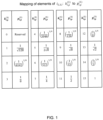
- Polarization-specific reference amplitude is 16-level quantization using a table of FIG. 1 (mapping of a plurality of elements of amplitude coefficient indicator i 2,3,l : mapping from element k l,p (1) to amplitude coefficient p l,p (1) ). All the other coefficients are 8-level quantization using a table of FIG. 2 (mapping of a plurality of elements of amplitude coefficient indicator i 2,4,l : mapping from element k l,i,f (2) to amplitude coefficient p l,i,f (2) ).
- ⁇ l,i exp(j2 ⁇ c l,i /16), c l,i ⁇ ⁇ 0, ..., 15 ⁇ .
- c l,i is a phase coefficient reported by the UE (using 4 bits) for associated phase value ⁇ l,i .
- Type 2 CSI feedback on a PUSCH in Rel. 16 includes two parts.
- CSI part 1 has a fixed payload size, and is used to identify the number of information bits in CSI part 2.
- a size of part 2 is variable (UCI size depends on the number of non-zero amplitude coefficients (NZCs) that is not recognized the base station).
- NZCs non-zero amplitude coefficients
- the UE reports the number of NZCs that determines the size of CSI part 2.
- the base station recognizes the size of CSI part 2.
- CSI part 1 In enhanced type 2 CSI feedback, CSI part 1 includes an RI, a CQI, and an indication of a total number of non-zero amplitudes over a plurality of layers for enhanced type 2 CSI. Fields of Part 1 are separately coded.
- CSI part 2 includes a PMI of enhanced type 2 CSI. Parts 1 and 2 are separately coded.
- CSI part 2 includes at least one of an oversampling factor, an index of a 2D-DFT base, an index M initial of an initial DFT base (start offset) of a selected DFT window, a DFT base selected for each layer, a non-zero LC coefficient (NZC, amplitude and phase) per layer, a strongest (maximum strength) coefficient indicator (SCI) per layer, and amplitude of the strongest coefficient per layer / per polarization.
- NZC non-zero LC coefficient
- SCI strongest coefficient indicator
- a plurality of PMI indices (PMI values, codebook indices) associated with different pieces of CSI part 2 information may follow the following for the k-th layer.
- i 1,5 and i 1,6,k are PMI indices for DFT base reporting. i 1,5 is reported only when N 3 > 19.
- PMI information is grouped into three groups (groups 0 to 2). This is important for a case where CSI omission is performed.
- Each reported element of indices i 2,4,l , i 2,5,l , and i 1,7,l is associated with a specific priority rule. Groups 0 to 2 follow the following.
- type 1 CSI an SD beam indicated by an SD DFT vector is transmitted to the UE.
- type 2 CSI L SD beams are linearly coupled and transmitted to the UE.
- Each SD beam can be associated with a plurality of FD beams.
- channel frequency response can be obtained by using linear combination of FD base vectors for the SD beams. The channel frequency response corresponds to the power delay profile.
- a type 2 PS codebook does not require the UE to derive an SD beam in consideration of 2D-DFT in a normal type 2 CB.
- a base station transmits CSI-RSs by using K CSI-RS ports beamformed in consideration of a set of SD beams. The UE identifies the best L ( ⁇ K) CSI-RS ports, and reports indices of these ports in W 1 .
- Q(N t ⁇ K) indicates K SD beams used for CSI-RS beamforming.
- W 1 (K ⁇ 2L) is a block diagonal matrix.
- W ⁇ k (2L ⁇ M) is an LC coefficient matrix.
- W f,k (N 3 ⁇ M) is formed by N 3 DFT base vectors (FD base vectors).
- K is configured by a higher layer.
- L is configured by a higher layer.
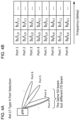
- each CSI-RS port #i is associated with an SD beam (b i ) ( FIGS. 3A and 3B ).
- each CSI-RS port #i is associated with an SD-FD beam pair (pair of SD beam b i and FD beam f i,j (where j is a frequency index)) in place of an SD beam ( FIGS. 4A and 4B ).
- ports 3 and 4 are associated with the same SD beam and are associated with different FD beams.
- Frequency selectivity of channel frequency response observed by the UE, based on an SD beam-FD beam pair can be reduced by delay pre-compensation more than frequency selectivity of channel frequency response observed by the UE, based on an SD beam.
- a primary scenario for the type 2 port selection codebook of Rel. 17 is FDD.
- Channel reciprocity based on SRS measurement is not perfect, but the base station can obtain some pieces of partial information.
- the base station can obtain CSI for determination of a DL MIMO precoder. In this case, some CSI reports may be omitted to reduce CSI overhead.
- each CSI-RS port is beamformed by using an SD beam and an FD base vector. Each port is associated with an SD-FD pair.
- each matrix block is formed by L columns of a K ⁇ K identity matrix.
- the base station transmits K beamformed CSI-RS ports. Each port is associated with an SD-FD pair.
- the UE selects L ports from K ports, and reports, as part of PMI(W 1,k ), the selected ports to the base station. In Rel. 16, each port is associated with an SD beam.
- W ⁇ k (2L ⁇ M v ) is a matrix formed by combination coefficients (subband complex LC coefficients). Up to K 0 NZCs are reported. The report is formed by two parts: a bitmap for identifying an NZC location, and a quantized NZC. In a specific case, the bitmap can be omitted. In Rel. 16, the bitmap for the NZC location is always reported.
- W f,k (N 3 ⁇ M v ) is a matrix formed by N 3 FD base (FD DFT base) vectors. M v FD bases are present for each layer. The base station may delete W f,k . When W f,k is ON, M v additional FD bases are reported. When W f,k is OFF, no additional FD bases are reported. In Rel. 16, W f,k is always reported.
- a relationship between the CSI-RS resources and the CSI report is configured by a CSI measurement configuration (CSI-MeasConfig) configured for each cell, a CSI resource configuration (CSI-ResourceConfig) configured for each BWP, and a CSI report configuration (CSI-ReportConfig).
- CSI-MeasConfig CSI measurement configuration
- CSI-ResourceConfig CSI resource configuration
- CSI-ReportConfig CSI report configuration
- CSI-MeasConfig includes at least one of a non-zero power (NZP) CSI-RS resource configuration nzp-CSI-RS-Resource, an NZP-CSI-RS resource set configuration nzp-CSI-RS-ResourceSet, a CSI-interference measurement (IM) resource configuration csi-IM-Resource, a CSI-IM resource set configuration csi-IM-ResourceSet, a CSI SSB resource set configuration csi-SSB-ResourceSet, a CSI resource configuration CSI-ResouceConfig, and a CSI report configuration CSI-ReportConfig.
- NZP non-zero power
- IM CSI-interference measurement
- CSI-ResouceConfig includes at least one of nzp-CSI-RS-ResourceSet, csi-SSB-ResourceSet, csi-IM-ResourceSet, and a resource type resourceType (periodic (P)/semi-persistent (SP)/aperiodic (A)).
- CSI-ReportConfig includes at least one of a resource configuration ID resourceConfigId, a report configuration type reportConfigType (P/SP/A), report quantity, a frequency domain configuration, a time constraint of each of channel measurement/interference measurement, a group-based beam report, a CQI table, a subband size, and a non-PMI port indication.
- a resource configuration ID resourceConfigId includes at least one of a resource configuration ID resourceConfigId, a report configuration type reportConfigType (P/SP/A), report quantity, a frequency domain configuration, a time constraint of each of channel measurement/interference measurement, a group-based beam report, a CQI table, a subband size, and a non-PMI port indication.
- Channel coherent time is dependent upon a maximum Doppler shift.
- the channel coherent time is time in which the measured channel characteristics are available or time until the measured channel characteristics become no longer available (channel aging).
- the maximum Doppler shift is estimated based on a relative speed between a transmitting device and a receiving device.
- the channel coherent time T c is approximated by 1/ ⁇ f max .
- ⁇ f max v/ ⁇ .
- the channel coherent time is shorter. For example, in a carrier frequency of 4.5 GHz, when the moving speed exceeds approximately 25 km/h, the channel coherent time falls below 10 ms. How to address such a high moving speed and a short channel coherent time poses a problem.
- the TRS To follow the Doppler shift, the TRS is supported.
- the TRS has the following problems.
- the TRS is mapped to time domain and frequency domain resources.
- a plurality of RSs in the time domain are required in specific frequency domain resources.
- the RS used for measurement is dependent upon implementation of the UE.
- W 1 W 2 W 1 W 2 is reported by the UE via a CSI codebook (PMI).
- PMI CSI codebook
- W 1 is wideband property, and indicates a spatial beam.
- W 2 is subband property, and indicates a coefficient of amplitude/phase for each spatial beam.
- case 1 in which the UE performs measurement based on the CSI-RS and case 2 in which the base station performs measurement based on the SRS are considered.
- determination of influence related to the Doppler shift case 1-1 in which the UE performs determination based on CSI-RS measurement results, case 1-2 in which the base station performs determination based on CSI-RS measurement results reported by the UE, and case 2-1 in which the base station performs determination based on SRS measurement results are considered.
- a CSI-RS measurement window and a CSI reporting window are under study.
- the CSI-RS measurement window one or more CSI-RS occasions may be measured.
- a reported CSI may be associated with the CSI reporting window.
- the length of the base vector in the Doppler domain/time domain may be represented by N 4 .
- the CSI measurement window of slot[k, k + W meas - 1] one or more CSI occasions for calculation of the CSI report may be measured.
- k may be a slot index
- W meas may be a measurement window length (the number of slots).
- the CSI occasion may be configured in CSI-ReportConfig.
- the CSI reporting window of slot[l, l + W CSI - 1] may be associated with the CSI report in the slot n.
- l may be a slot index
- W CSI may be a reporting window length (the number of slots).
- the position of a CSI reference resource may be represented by n ref .
- the CSI report and measurement may follow at least one of some of the following alternatives.
- n ref n - n ref
- l n ref
- W CSI 1, k ⁇ n ref
- W meas 1.
- the CSI reporting window overlaps a CSI-RS occasion, it can be interpreted that the reported CSI is obtained through actual measurement.
- the CSI reporting window does not overlap a CSI-RS occasion, it can be interpreted that the reported CSI is obtained through prediction in the UE. It can be interpreted that the CSI report is (alternatives 1.C and 3.C) having CSI (measured CSI) obtained through actual measurement and CSI (predicted CSI) obtained through prediction in the UE.
- W is a matrix having N Tx N 3 rows and N 4 columns.
- W f is a matrix having N 3 rows and M columns (similar to Rel. 16).
- W 1 is a matrix having N Tx rows and 2L columns (similar to Rel. 16).
- W 2 is a matrix having 2LM rows and D columns.
- W f is a matrix having N 4 rows and D columns.
- W is a matrix having N Tx N 3 rows and N 4 columns.
- W f is a matrix having N 3 rows and M columns (similar to Rel. 16).
- W 1 is a matrix having N Tx rows and 2L columns (similar to Rel. 16).
- W 2 is a matrix having 2L rows and MD columns.
- W d is a matrix having N 4 rows and D columns.
- N 4 is the number of time domain units (time domain bases).
- D is the number of compressed/selected time domain units (time domain bases).
- the inventors of the present invention came up with the idea of a method of measuring/reporting CSI.
- A/B and “at least one of A and B” may be interchangeably interpreted.
- A/B/C may mean “at least one of A, B, and C.”
- activate, deactivate, indicate, select, configure, update, determine, and the like may be interchangeably interpreted.
- support may be interchangeably interpreted.
- radio resource control RRC
- RRC parameter RRC parameter
- RRC message RRC message
- IE information element
- a configuration e.g., a configuration
- MAC Control Element CE
- update command e.g., an update command, an activation/deactivation command, and the like
- the higher layer signaling may be, for example, any one or combinations of Radio Resource Control (RRC) signaling, Medium Access Control (MAC) signaling, broadcast information, and the like.
- RRC Radio Resource Control
- MAC Medium Access Control
- the MAC signaling may use, for example, a MAC control element (MAC CE), a MAC Protocol Data Unit (PDU), or the like.
- the broadcast information may be, for example, a master information block (MIB), a system information block (SIB), minimum system information (Remaining Minimum System Information (RMSI)), other system information (OSI), or the like.
- MIB master information block
- SIB system information block
- RMSI Remaining Minimum System Information
- OSI system information
- the physical layer signaling may be, for example, downlink control information (DCI), uplink control information (UCI), or the like.
- DCI downlink control information
- UCI uplink control information
- an index, an identifier (ID), an indicator, a resource ID, and the like may be interchangeably interpreted.
- a sequence, a list, a set, a group, a cluster, a subset, and the like may be interchangeably interpreted.
- SRI spatial
- time domain resource allocation and time domain resource assignment may be interchangeably interpreted.
- a base, a DFT base, a base vector, and a DFT base vector may be interchangeably interpreted.
- a beam, an SD beam, an SD vector, and an SD 2D-DFT vector may be interchangeably interpreted.
- L the number of SD beams, the number of beams, and the number of SD 2D-DFT vectors may be interchangeably interpreted.
- an FD base, an FD DFT base, a DFT base, and f i may be interchangeably interpreted.
- an FD beam, an FD vector, an FD base vector, an FD DFT base vector, and a DFT base vector may be interchangeably interpreted.
- TD time domain
- DD Doppler domain
- a combination coefficient, an LC coefficient, a subband complex LC coefficient, and a combination coefficient matrix may be interchangeably interpreted.
- a panel, a base station (gNB) panel, and a TRP may be interchangeably interpreted.
- phase compensation phasing
- phase difference phase difference
- phase relationship a phase relationship
- layer k and layer l may be interchangeably interpreted.
- a CSI-RS, a TRS, an NZP-CSI-RS resource set with TRS information (trs-Info), and NZP-CSI-RS resources having the same port for all of the NZP-CSI-RS resources may be interchangeably interpreted.
- a window, a CSI-RS measurement window, one or more CSI-RS occasions, one or more time occasions, and a CSI reporting window may be interchangeably interpreted.
- the CSI report may include the measured CSI/predicted CSI in one or more time occasions in the CSI reporting window.
- the measured CSI may be measurement results in one or more time occasions in the CSI-RS measurement window.
- the predicted CSI may be prediction results in one or more time occasions in the CSI reporting window.
- the UE may determine a CSI report including one or more pieces of CSI (measured CSI/predicted CSI) in one or more time occasions in a window (for example, the CSI reporting window), and transmit the CSI report.
- a CSI report including one or more pieces of CSI (measured CSI/predicted CSI) in one or more time occasions in a window (for example, the CSI reporting window), and transmit the CSI report.
- the UE may determine a plurality of parts of a CSI report including a plurality of pieces of CSI (measured CSI/predicted CSI) respectively corresponding to a plurality of time occasions (for example, a plurality of slots), and transmit the plurality of parts.
- the present embodiment relates to problem #0.
- the window may be defined for the slot n of the CSI report ( FIG. 7 ).
- the window may be the CSI reporting window, for example.
- the length of the CSI reporting window may be determined.
- the length of the CSI reporting window may be determined.
- the configuration/indication may be one of some of the following options. According to option 1, ambiguity related to the CSI reporting window length can be avoided between the base station and the UE, without further rules being made.
- the length of the CSI reporting window may be determined.
- the determination may be one of some of the following options.
- the start of the CSI reporting window may be based on option 1/2 of Embodiment #0-2.
- the end of the CSI reporting window may be based on option 1/2 of Embodiment #0-2.
- a restriction on the CSI reporting window may be at least one of some of the following options.
- Embodiment #3 to be described later may be unnecessary.
- the UE can appropriately determine a window such as the CSI reporting window.
- the present embodiment relates to problem #1.
- the CSI in the CSI report associated with more than one slot or more than one time occasion may be divided into a plurality of parts/segments.
- the UE may transmit/report each of the plurality of parts/segments in more than one slot or more than one time occasion.
- the payload size can be optimized, and the base station and the UE can share the same recognition related to the payload size.
- the plurality of parts may follow at least one of some of the following options.
- the number of segments may be one of some of the following alternatives.
- One or more segments may correspond to CSI part 1 and CSI part 2.
- At least one of the plurality of segments may correspond to report quantity in the time domain/Doppler domain.
- the payload size may be one of some of the following alternatives.
- information in the segment having a fixed payload size may be taken into account to determine the actual payload size of the segment having a variable payload size.
- the information taken into account to determine the actual payload size of the segment having a variable payload size may be the number of pieces of/quantity of information in the time domain/Doppler domain for the report.
- Usage (or a usage combination) of each part/segment of the CSI report may be at least one of some of the following options.
- the maximum size/number of base vectors in the time domain/Doppler domain may be configured by the base station.
- the CSI part having a fixed payload size may include at least one of the number of bases in the time domain/Doppler domain and base candidates in the time domain/Doppler domain. When the number of bases (candidates) in the time domain/Doppler domain is 1, the reported CSI may have the same structure as the enhanced type 2 CSI codebook (of Rel. 16) or the enhanced type 2 port selection CSI codebook (of Rel. 17).
- Each layer in the CSI part having a fixed payload size may include information related to actual bases in the time domain/Doppler domain.
- the information may be at least one of start of a base index in the time domain/Doppler domain used for each layer and a plurality of indices of the bases in the time domain/Doppler domain, for example.
- the information may be a coefficient (amplitude and phase, for example, W 2 ) for the 2D DFT base associated with each base in the time domain/Doppler domain for each layer, for example.
- the size/number of base vectors in the time domain/Doppler domain may be configured by the base station.
- the CSI part having a fixed payload size may include positions/indicators of the base vectors in the time domain/Doppler domain.
- the position/indicator may be start of the base vector within the range/size configured for the base vectors in the time domain/Doppler domain, or may be a bitmap indicating each base vector in the time domain/Doppler domain.
- the part having a fixed payload size may include a bitmap indicating the position of each non-zero coefficient (NZC) for each layer.
- NZC non-zero coefficient
- the bitmap size may be 2LM ⁇ D.
- the bitmap size may be 2L ⁇ MD.
- the part having a variable payload size may include a non-zero coefficient for each layer.
- the UE can determine a report including appropriate CSI.
- the present embodiment relates to problem #2.
- At least one of some of the following UE capabilities may be defined.
- the configuration of the CSI reporting window may be restricted.
- the CSI reporting window may entirely overlap the CSI-RS measurement window or the CSI-RS occasion for the UE supporting the CSI report of a plurality of pieces of CSI in the time domain/Doppler domain without prediction.
- the CSI reporting window may be a subset of CSI-RS measurement windows.
- the CSI reporting window may include time domain resources not overlapping the CSI-RS measurement window or the CSI-RS occasion for the UE supporting the CSI report of a plurality of pieces of CSI in the time domain/Doppler domain with prediction.
- a default configuration for the CSI reporting window may be defined.
- the UE may, by default, assume that the CSI reporting window is the same as the CSI-RS measurement window. If there is no configuration/signaling of the CSI reporting window, the UE may assume that the CSI reporting window is the same as the CSI-RS occasion, based on the same rule as the type 2 CSI of Rel. 15/16/17. If there is no configuration/signaling of the CSI reporting window, it may be assumed that the start of the CSI reporting window is equal to the CSI reporting slot n (slot in which the CSI is reported). If there is no configuration/signaling of the CSI reporting window, it may be assumed that the length of the CSI reporting window is equal to X.
- X may be a fixed value provided in a specification, or may be associated with a configuration of the CSI-RS resources.
- the UE can appropriately report the CSI with/without prediction.
- the present embodiment relates to problem #3.
- the CSI report may have one or more pieces of CSI including both of the measured CSI and the predicted CSI.
- the UE may report information necessary (for the base station) to distinguish/identify the measured CSI and the predicted CSI.
- the base station can recognize which report is based on actual measurement.
- the base station can recognize reliability of the CSI.
- the information may follow at least one of some of the following options.
- the information may be a factor for distinguishing the measured CSI and the predicted CSI.
- the factor may be at least one of some of the following options.
- the information may be a threshold of the time domain base.
- the UE may report the index of the time domain base.
- the CSI corresponding to the time domain base with an index smaller (or larger) than a reported index may be regarded as the measured CSI.
- Other CSI may be regarded as the predicted CSI.
- the CSI related to the time domain base having an index smaller than a threshold td_thre may be the measured CSI
- the CSI related to the time domain base having an index equal to or more than the threshold td_thre may be the predicted CSI.
- the information may be a threshold of the Doppler domain base.
- the UE may report the index of the Doppler domain base.
- the CSI corresponding to the Doppler domain base with an index smaller (or larger) than a reported index may be regarded as the measured CSI.
- Other CSI may be regarded as the predicted CSI.
- the CSI related to the Doppler domain base having an index smaller than the threshold td_thre may be the measured CSI
- the CSI related to the Doppler domain base having an index equal to or more than the threshold td_thre may be the predicted CSI.
- the information may be a group of bases in the time domain/Doppler domain.
- the UE may report the group of bases in the time domain/Doppler domain.
- the CSI corresponding to the bases in the group may be regarded as the measured CSI (or the predicted CSI).
- Other CSI may be regarded as the predicted CSI (or the measured CSI).
- the group of bases in the time domain/Doppler domain may be configured/indicated by an RRC IE/MAC CE/DCI.
- the information may be a bitmap of bases in the time domain/Doppler domain.
- the UE may report the bitmap indicating the bases in the time domain/Doppler domain.
- the CSI corresponding to the base indicated by the bitmap (for example, a bit position of value 1 in the bitmap) may be regarded as the measured CSI (or the predicted CSI).
- Other CSI may be regarded as the predicted CSI (or the measured CSI).
- the length of the bitmap may be associated with the number of bases in the time domain/Doppler domain, or may be reported by the UE in the part having a fixed payload size in UCI.
- the information may indicate a restriction on the report of the predicted CSI.
- the part including the predicted CSI may be the same as the part including the measured CSI.
- the predicted CSI may be CSI associated with the last base in the time domain/Doppler domain for the measured CSI.
- the CSI part common to the measured CSI and the predicted CSI need not be reported as the predicted CSI.
- the part including the measured CSI may be referenced to interpret the predicted CSI.
- Distinguishing/identifying the measured CSI and the predicted CSI may be taken into account in a limited case.
- the limited case may be a case in which the CSI reporting window (partially or entirely) overlaps the CSI-RS measurement window, or may be a case in which the CSI reporting window (partially or entirely) overlaps the CSI-RS occasion previous to the CSI reference resource slot.
- the CSI report may include one or more pieces of measured CSI in one or more measurement time occasions, and one or more pieces of predicted CSI in one or more prediction time occasions subsequent thereto.
- the order of one or more measurement time occasions and one or more prediction time occasions is not limited to this.
- the measured CSI may be calculated based on the CSI-RS occasion in the CSI-RS measurement window.
- the predicted CSI may be calculated based on the CSI-RS occasion outside the CSI-RS measurement window, or may be calculated based on the CSI-RS occasion inside the CSI-RS measurement window.
- one or more measurement time occasions may be replaced by the prediction time occasion(s).
- the UE can appropriately report the measured CSI and the predicted CSI.
- the present embodiment relates to CSI prediction.
- the UE may be configured/indicated with operation related to UE-side CSI prediction (CSI prediction performed by the UE).
- the form of the configuration/indication may follow one of some of the following options.
- the form of the configuration/indication may be explicit information.
- the explicit information may be 1 bit indicating whether the UE-side CSI prediction is enabled (on) or disabled (off).
- the form of the configuration/indication may be implicit information.
- the UE-side CSI prediction may be disabled (off).
- the UE-side CSI prediction may be disabled (off).
- the UE-side CSI prediction may be disabled (off).
- the start of the CSI reporting window is subsequent to the CSI reference resources, the UE-side CSI prediction may be disabled (off).
- the UE-side CSI prediction may be disabled (off).
- UE operation due to the configuration/indication may follow at least one of some of the following options.
- the UE reports only the measured CSI.
- the reported CSI may be included in a form of the (enhanced) type 2 CSI codebook of Rel. 16/17.
- the UE reports only the predicted CSI.
- the UE reports both of the measured CSI and the predicted CSI.
- configuration/indication #A is configured/indicated
- the UE reports only the measured CSI (option 2-1).
- configuration/indication #B is configured/indicated, the UE reports the measured CSI and the predicted CSI (option 2-3).
- Embodiment #3 may be applied. In other words, a factor for distinguishing the measured CSI and the predicted CSI may be reported.
- configuration/indication #A is configured/indicated, the UE reports only the measured CSI (option 2-1). If configuration/indication #B is configured/indicated, the UE reports only the predicted CSI (option 2-2). In the case of configuration/indication #B, the UE may select whether to report the measured CSI or report the predicted CSI. In this case, in addition to Embodiment #4, whether the report includes the measured CSI or includes the predicted CSI may be reported from the UE, may be included in CSI part 1, or may be included in the CSI part having a fixed payload size.
- Both of example 1 and example 2 may be supported. Which example is applied may be determined based on an explicit configuration dependent upon the base station, or may be dependent upon implementation of the UE. When which example is applied is dependent upon implementation of the UE, it may be reported in the CSI part having a fixed payload size.
- a method of the configuration/indication may follow at least one of some of the following options.
- the UE can be appropriately configured/indicated with the measured CSI/predicted CSI.
- Notification of any piece of information (from the network (NW) (for example, the base station (BS))) to the UE (i.e., reception of any piece of information in the UE from the BS) in the above-described embodiments may be performed using physical layer signaling (for example, DCI), higher layer signaling (for example, RRC signaling, a MAC CE), a specific signal/channel (for example, a PDCCH, a PDSCH, a reference signal), or a combination of these.
- physical layer signaling for example, DCI
- higher layer signaling for example, RRC signaling, a MAC CE
- a specific signal/channel for example, a PDCCH, a PDSCH, a reference signal
- the MAC CE may be identified by a new logical channel ID (LCID) not provided in existing standards being included in a MAC subheader.
- LCID logical channel ID
- the notification may be performed using a specific field in the DCI, a radio network temporary identifier (RNTI) used to scramble cyclic redundancy check (CRC) bits added to the DCI, a format of the DCI, or the like.
- RNTI radio network temporary identifier
- CRC cyclic redundancy check
- Notification of any piece of information to the UE in the above-described embodiments may be periodically, semi-persistently, or aperiodically performed.
- Notification of any piece of information from the UE (to the NW) may be performed using physical layer signaling (for example, UCI), higher layer signaling (for example, RRC signaling, a MAC CE), a specific signal/channel (for example, a PUCCH, a PUSCH, a PRACH, a reference signal), or a combination of these.
- physical layer signaling for example, UCI
- higher layer signaling for example, RRC signaling, a MAC CE
- a specific signal/channel for example, a PUCCH, a PUSCH, a PRACH, a reference signal
- the MAC CE may be identified by a new LCID not provided in existing standards being included in a MAC subheader.
- the notification When the notification is performed using UCI, the notification may be transmitted using a PUCCH or a PUSCH.
- Notification of any piece of information from the UE in the above-described embodiments may be periodically, semi-persistently, or aperiodically performed.
- At least one of the above-described embodiments may be applied when a specific condition is satisfied.
- the specific condition may be provided in a standard, or may be notified to the UE/BS using higher layer signaling/physical layer signaling.
- At least one of the above-described embodiments may be applied only to the UE that has reported a specific UE capability or that supports the specific UE capability.
- the specific UE capability may indicate at least one of the following:
- the specific UE capability may be capability applied over all the frequencies (commonly irrespective of frequency), may be capability per frequency (for example, one or a combination of a cell, a band, a band combination, a BWP, a component carrier, and the like), may be capability per frequency range (for example, Frequency Range 1 (FR1), FR2, FR3, FR4, FR5, FR2-1, FR2-2), may be capability per subcarrier spacing (SCS), or may be capability per Feature Set (FS) or Feature Set Per Component-carrier (FSPC).
- FR1 Frequency Range 1
- FR2 FR2, FR3, FR4, FR5, FR2-1, FR2-2
- SCS subcarrier spacing
- FS Feature Set
- FSPC Feature Set Per Component-carrier
- the specific UE capability may be capability applied over all the duplex schemes (commonly irrespective of duplex scheme) or capability per duplex scheme (for example, time division duplex (TDD) or frequency division duplex (FDD)).
- duplex schemes commonly irrespective of duplex scheme
- capability per duplex scheme for example, time division duplex (TDD) or frequency division duplex (FDD)
- At least one of the above-described embodiments may be applied when specific information related to the above-described embodiments (or performing operation of the above-described embodiments) is configured/activated/triggered for the UE by higher layer signaling/physical layer signaling.
- the specific information may be information indicating enabling of the functions of each embodiment, any RRC parameter for specific release (for example, Rel. 18/19), or the like.
- the UE may apply operation of Rel. 15/16, for example.
- a terminal including:
- the terminal according to any one of supplementary notes 1 to 3, wherein one or more parts of the plurality of parts have a variable payload size.
- a terminal including:
- the terminal according to supplementary note 1, wherein the transmitting section transmits capability information related to a report of a plurality of pieces of CSI in a time domain or a Doppler domain.
- control section predicts at least one of the one or more pieces of CSI, based on an indication.
- radio communication system a structure of a radio communication system according to one embodiment of the present disclosure will be described.
- the radio communication method according to each embodiment of the present disclosure described above may be used alone or may be used in combination for communication.
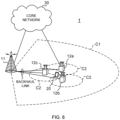
- FIG. 8 is a diagram to show an example of a schematic structure of the radio communication system according to one embodiment.
- the radio communication system 1 (which may be simply referred to as a system 1) may be a system implementing a communication using Long Term Evolution (LTE), 5th generation mobile communication system New Radio (5G NR), and so on, whose specifications have been drafted by the Third Generation Partnership Project (3GPP).
- LTE Long Term Evolution
- 5G NR 5th generation mobile communication system New Radio
- 3GPP Third Generation Partnership Project
- the radio communication system 1 may support dual connectivity (multi-RAT dual connectivity (MR-DC)) between a plurality of Radio Access Technologies (RATs).
- the MR-DC may include dual connectivity (E-UTRA-NR Dual Connectivity (EN-DC)) between LTE (Evolved Universal Terrestrial Radio Access (E-UTRA)) and NR, dual connectivity (NR-E-UTRA Dual Connectivity (NE-DC)) between NR and LTE, and so on.
- a base station (eNB) of LTE (E-UTRA) is a master node (MN), and a base station (gNB) of NR is a secondary node (SN).
- a base station (gNB) of NR is an MN
- a base station (eNB) of LTE (E-UTRA) is an SN.
- the radio communication system 1 may support dual connectivity between a plurality of base stations in the same RAT (for example, dual connectivity (NR-NR Dual Connectivity (NN-DC)) where both of an MN and an SN are base stations (gNB) of NR).
- dual connectivity NR-NR Dual Connectivity (NN-DC)
- gNB base stations
- the radio communication system 1 may include a base station 11 that forms a macro cell C1 of a relatively wide coverage, and base stations 12 (12a to 12c) that form small cells C2, which are placed within the macro cell C1 and which are narrower than the macro cell C1.
- the user terminal 20 may be located in at least one cell.
- the arrangement, the number, and the like of each cell and user terminal 20 are by no means limited to the aspect shown in the diagram.
- the base stations 11 and 12 will be collectively referred to as "base stations 10," unless specified otherwise.
- the user terminal 20 may be connected to at least one of the plurality of base stations 10.
- the user terminal 20 may use at least one of carrier aggregation (CA) and dual connectivity (DC) using a plurality of component carriers (CCs).
- CA carrier aggregation
- DC dual connectivity
- CCs component carriers
- Each CC may be included in at least one of a first frequency band (Frequency Range 1 (FR1)) and a second frequency band (Frequency Range 2 (FR2)).
- the macro cell C1 may be included in FR1
- the small cells C2 may be included in FR2.
- FR1 may be a frequency band of 6 GHz or less (sub-6 GHz)
- FR2 may be a frequency band which is higher than 24 GHz (above-24 GHz). Note that frequency bands, definitions and so on of FR1 and FR2 are by no means limited to these, and for example, FR1 may correspond to a frequency band which is higher than FR2.
- the user terminal 20 may communicate using at least one of time division duplex (TDD) and frequency division duplex (FDD) in each CC.
- TDD time division duplex
- FDD frequency division duplex
- the plurality of base stations 10 may be connected by a wired connection (for example, optical fiber in compliance with the Common Public Radio Interface (CPRI), the X2 interface and so on) or a wireless connection (for example, an NR communication).
- a wired connection for example, optical fiber in compliance with the Common Public Radio Interface (CPRI), the X2 interface and so on
- a wireless connection for example, an NR communication
- IAB Integrated Access Backhaul
- relay station relay station
- the base station 10 may be connected to a core network 30 through another base station 10 or directly.
- the core network 30 may include at least one of Evolved Packet Core (EPC), 5G Core Network (5GCN), Next Generation Core (NGC), and so on.
- EPC Evolved Packet Core
- 5GCN 5G Core Network
- NGC Next Generation Core
- the core network 30 may include network functions (NFs), such as a User Plane Function (UPF), an Access and Mobility management Function (AMF), a Session Management Function (SMF), Unified Data Management (UDM), an Application Function (AF), a Data Network (DN), a Location Management Function (LMF), and Operation, Administration and Maintenance (Management) (OAM), for example.
- NFs network functions
- UPF User Plane Function
- AMF Access and Mobility management Function
- SMF Session Management Function
- UDM Unified Data Management
- AF Application Function
- DN Data Network
- LMF Location Management Function
- OAM Operation, Administration and Maintenance
- the user terminal 20 may be a terminal supporting at least one of communication schemes such as LTE, LTE-A, 5G, and so on.
- an orthogonal frequency division multiplexing (OFDM)-based wireless access scheme may be used.
- OFDM Orthogonal frequency division multiplexing
- DL downlink
- UL uplink
- DFT-s-OFDM Discrete Fourier Transform Spread OFDM
- OFDMA Orthogonal Frequency Division Multiple Access
- SC-FDMA Single Carrier Frequency Division Multiple Access
- the wireless access scheme may be referred to as a "waveform.”
- another wireless access scheme for example, another single carrier transmission scheme, another multi-carrier transmission scheme
- a downlink shared channel (Physical Downlink Shared Channel (PDSCH)), which is used by each user terminal 20 on a shared basis, a broadcast channel (Physical Broadcast Channel (PBCH)), a downlink control channel (Physical Downlink Control Channel (PDCCH)) and so on, may be used as downlink channels.
- PDSCH Physical Downlink Shared Channel
- PBCH Physical Broadcast Channel
- PDCCH Physical Downlink Control Channel
- an uplink shared channel (Physical Uplink Shared Channel (PUSCH)), which is used by each user terminal 20 on a shared basis, an uplink control channel (Physical Uplink Control Channel (PUCCH)), a random access channel (Physical Random Access Channel (PRACH)) and so on may be used as uplink channels.
- PUSCH Physical Uplink Shared Channel
- PUCCH Physical Uplink Control Channel
- PRACH Physical Random Access Channel
- SIBs System Information Blocks
- PBCH Master Information Blocks
- Lower layer control information may be communicated on the PDCCH.
- the lower layer control information may include downlink control information (DCI) including scheduling information of at least one of the PDSCH and the PUSCH.
- DCI downlink control information
- DCI for scheduling the PDSCH may be referred to as "DL assignment,” “DL DCI,” and so on, and DCI for scheduling the PUSCH may be referred to as "UL grant,” “UL DCI,” and so on.
- DL assignment DL DCI
- UL grant UL DCI
- the PDSCH may be interpreted as “DL data”
- the PUSCH may be interpreted as "UL data.”
- a control resource set (CORESET) and a search space may be used.
- the CORESET corresponds to a resource to search DCI.
- the search space corresponds to a search area and a search method of PDCCH candidates.
- One CORESET may be associated with one or more search spaces.
- the UE may monitor a CORESET associated with a certain search space, based on search space configuration.
- One search space may correspond to a PDCCH candidate corresponding to one or more aggregation levels.
- One or more search spaces may be referred to as a "search space set.” Note that a "search space,” a “search space set,” a “search space configuration,” a “search space set configuration,” a “CORESET,” a “CORESET configuration” and so on of the present disclosure may be interchangeably interpreted.
- Uplink control information including at least one of channel state information (CSI), transmission confirmation information (for example, which may be referred to as Hybrid Automatic Repeat reQuest ACKnowledgement (HARQ-ACK), ACK/NACK, and so on), and scheduling request (SR) may be communicated by means of the PUCCH.
- CSI channel state information
- HARQ-ACK Hybrid Automatic Repeat reQuest ACKnowledgement
- ACK/NACK ACK/NACK
- SR scheduling request
- downlink may be expressed without a term of "link.”
- various channels may be expressed without adding "Physical” to the head.
- a synchronization signal (SS), a downlink reference signal (DL-RS), and so on may be communicated.
- a cell-specific reference signal (CRS), a channel state information-reference signal (CSI-RS), a demodulation reference signal (DMRS), a positioning reference signal (PRS), a phase tracking reference signal (PTRS), and so on may be communicated as the DL-RS.
- CRS cell-specific reference signal
- CSI-RS channel state information-reference signal
- DMRS demodulation reference signal
- PRS positioning reference signal
- PTRS phase tracking reference signal
- the synchronization signal may be at least one of a primary synchronization signal (PSS) and a secondary synchronization signal (SSS).
- a signal block including an SS (PSS, SSS) and a PBCH (and a DMRS for a PBCH) may be referred to as an "SS/PBCH block,” an "SS Block (SSB),” and so on.
- SS/PBCH block an "SS Block (SSB),” and so on.
- SSB SS Block
- a sounding reference signal (SRS), a demodulation reference signal (DMRS), and so on may be communicated as an uplink reference signal (UL-RS).
- SRS sounding reference signal
- DMRS demodulation reference signal
- UL-RS uplink reference signal
- DMRS may be referred to as a "user terminal specific reference signal (UE-specific Reference Signal).”
- FIG. 9 is a diagram to show an example of a structure of the base station according to one embodiment.
- the base station 10 includes a control section 110, a transmitting/receiving section 120, transmitting/receiving antennas 130 and a communication path interface (transmission line interface) 140.
- the base station 10 may include one or more control sections 110, one or more transmitting/receiving sections 120, one or more transmitting/receiving antennas 130, and one or more communication path interfaces 140.
- the present example primarily shows functional blocks that pertain to characteristic parts of the present embodiment, and it is assumed that the base station 10 may include other functional blocks that are necessary for radio communication as well. Part of the processes of each section described below may be omitted.
- the control section 110 controls the whole of the base station 10.
- the control section 110 can be constituted with a controller, a control circuit, or the like described based on general understanding of the technical field to which the present disclosure pertains.
- the control section 110 may control generation of signals, scheduling (for example, resource allocation, mapping), and so on.
- the control section 110 may control transmission and reception, measurement and so on using the transmitting/receiving section 120, the transmitting/receiving antennas 130, and the communication path interface 140.
- the control section 110 may generate data, control information, a sequence and so on to transmit as a signal, and forward the generated items to the transmitting/receiving section 120.
- the control section 110 may perform call processing (setting up, releasing) for communication channels, manage the state of the base station 10, and manage the radio resources.
- the transmitting/receiving section 120 may include a baseband section 121, a Radio Frequency (RF) section 122, and a measurement section 123.
- the baseband section 121 may include a transmission processing section 1211 and a reception processing section 1212.
- the transmitting/receiving section 120 can be constituted with a transmitter/receiver, an RF circuit, a baseband circuit, a filter, a phase shifter, a measurement circuit, a transmitting/receiving circuit, or the like described based on general understanding of the technical field to which the present disclosure pertains.
- the transmitting/receiving section 120 may be structured as a transmitting/receiving section in one entity, or may be constituted with a transmitting section and a receiving section.
- the transmitting section may be constituted with the transmission processing section 1211, and the RF section 122.
- the receiving section may be constituted with the reception processing section 1212, the RF section 122, and the measurement section 123.
- the transmitting/receiving antennas 130 can be constituted with antennas, for example, an array antenna, or the like described based on general understanding of the technical field to which the present disclosure pertains.
- the transmitting/receiving section 120 may transmit the above-described downlink channel, synchronization signal, downlink reference signal, and so on.
- the transmitting/receiving section 120 may receive the above-described uplink channel, uplink reference signal, and so on.
- the transmitting/receiving section 120 may form at least one of a transmit beam and a receive beam by using digital beam forming (for example, precoding), analog beam forming (for example, phase rotation), and so on.
- digital beam forming for example, precoding
- analog beam forming for example, phase rotation
- the transmitting/receiving section 120 may perform the processing of the Packet Data Convergence Protocol (PDCP) layer, the processing of the Radio Link Control (RLC) layer (for example, RLC retransmission control), the processing of the Medium Access Control (MAC) layer (for example, HARQ retransmission control), and so on, for example, on data and control information and so on acquired from the control section 110, and may generate bit string to transmit.
- PDCP Packet Data Convergence Protocol
- RLC Radio Link Control
- MAC Medium Access Control
- the transmitting/receiving section 120 may perform transmission processing such as channel coding (which may include error correction coding), modulation, mapping, filtering, discrete Fourier transform (DFT) processing (as necessary), inverse fast Fourier transform (IFFT) processing, precoding, digital-to-analog conversion, and so on, on the bit string to transmit, and output a baseband signal.
- transmission processing such as channel coding (which may include error correction coding), modulation, mapping, filtering, discrete Fourier transform (DFT) processing (as necessary), inverse fast Fourier transform (IFFT) processing, precoding, digital-to-analog conversion, and so on, on the bit string to transmit, and output a baseband signal.
- the transmitting/receiving section 120 may perform modulation to a radio frequency band, filtering, amplification, and so on, on the baseband signal, and transmit the signal of the radio frequency band through the transmitting/receiving antennas 130.
- the transmitting/receiving section 120 may perform amplification, filtering, demodulation to a baseband signal, and so on, on the signal of the radio frequency band received by the transmitting/receiving antennas 130.
- the transmitting/receiving section 120 may apply reception processing such as analog-digital conversion, fast Fourier transform (FFT) processing, inverse discrete Fourier transform (IDFT) processing (as necessary), filtering, de-mapping, demodulation, decoding (which may include error correction decoding), MAC layer processing, the processing of the RLC layer and the processing of the PDCP layer, and so on, on the acquired baseband signal, and acquire user data, and so on.
- reception processing such as analog-digital conversion, fast Fourier transform (FFT) processing, inverse discrete Fourier transform (IDFT) processing (as necessary), filtering, de-mapping, demodulation, decoding (which may include error correction decoding), MAC layer processing, the processing of the RLC layer and the processing of the PDCP layer, and so on, on the acquired baseband signal, and acquire user data, and so on.
- FFT fast Fourier transform
- IDFT inverse discrete Fourier transform
- filtering de-mapping
- demodulation which
- the transmitting/receiving section 120 may perform the measurement related to the received signal.
- the measurement section 123 may perform Radio Resource Management (RRM) measurement, Channel State Information (CSI) measurement, and so on, based on the received signal.
- the measurement section 123 may measure a received power (for example, Reference Signal Received Power (RSRP)), a received quality (for example, Reference Signal Received Quality (RSRQ), a Signal to Interference plus Noise Ratio (SINR), a Signal to Noise Ratio (SNR)), a signal strength (for example, Received Signal Strength Indicator (RSSI)), channel information (for example, CSI), and so on.
- the measurement results may be output to the control section 110.
- the communication path interface 140 may perform transmission/reception (backhaul signaling) of a signal with an apparatus (for example, a network node that provides NFs) included in the core network 30, other base stations 10, and so on, and, for example, acquire or transmit user data (user plane data), control plane data, and so on for the user terminal 20.
- an apparatus for example, a network node that provides NFs
- user data user plane data
- control plane data control plane data
- the transmitting section and the receiving section of the base station 10 in the present disclosure may be constituted with at least one of the transmitting/receiving section 120, the transmitting/receiving antennas 130, and the communication path interface 140.
- the control section 110 may control configuration of a channel state information (CSI) report including a plurality of pieces of CSI respectively corresponding to a plurality of time occasions.
- the transmitting/receiving section 120 may receive a plurality of parts of the CSI report.
- CSI channel state information
- the control section 110 may control configuration of a channel state information (CSI) report including one or more pieces of CSI in one or more time occasions in a window.
- the transmitting/receiving section 120 may receive the CSI report.
- CSI channel state information
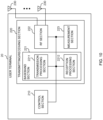
- FIG. 10 is a diagram to show an example of a structure of the user terminal according to one embodiment.
- the user terminal 20 includes a control section 210, a transmitting/receiving section 220, and transmitting/receiving antennas 230. Note that the user terminal 20 may include one or more control sections 210, one or more transmitting/receiving sections 220, and one or more transmitting/receiving antennas 230.
- the present example primarily shows functional blocks that pertain to characteristic parts of the present embodiment, and it is assumed that the user terminal 20 may include other functional blocks that are necessary for radio communication as well. Part of the processes of each section described below may be omitted.
- the control section 210 controls the whole of the user terminal 20.
- the control section 210 can be constituted with a controller, a control circuit, or the like described based on general understanding of the technical field to which the present disclosure pertains.
- the control section 210 may control generation of signals, mapping, and so on.
- the control section 210 may control transmission/reception, measurement and so on using the transmitting/receiving section 220, and the transmitting/receiving antennas 230.
- the control section 210 generates data, control information, a sequence and so on to transmit as a signal, and may forward the generated items to the transmitting/receiving section 220.
- the transmitting/receiving section 220 may include a baseband section 221, an RF section 222, and a measurement section 223.
- the baseband section 221 may include a transmission processing section 2211 and a reception processing section 2212.
- the transmitting/receiving section 220 can be constituted with a transmitter/receiver, an RF circuit, a baseband circuit, a filter, a phase shifter, a measurement circuit, a transmitting/receiving circuit, or the like described based on general understanding of the technical field to which the present disclosure pertains.
- the transmitting/receiving section 220 may be structured as a transmitting/receiving section in one entity, or may be constituted with a transmitting section and a receiving section.
- the transmitting section may be constituted with the transmission processing section 2211, and the RF section 222.
- the receiving section may be constituted with the reception processing section 2212, the RF section 222, and the measurement section 223.
- the transmitting/receiving antennas 230 can be constituted with antennas, for example, an array antenna, or the like described based on general understanding of the technical field to which the present disclosure pertains.
- the transmitting/receiving section 220 may receive the above-described downlink channel, synchronization signal, downlink reference signal, and so on.
- the transmitting/receiving section 220 may transmit the above-described uplink channel, uplink reference signal, and so on.
- the transmitting/receiving section 220 may form at least one of a transmit beam and a receive beam by using digital beam forming (for example, precoding), analog beam forming (for example, phase rotation), and so on.
- digital beam forming for example, precoding
- analog beam forming for example, phase rotation
- the transmitting/receiving section 220 may perform the processing of the PDCP layer, the processing of the RLC layer (for example, RLC retransmission control), the processing of the MAC layer (for example, HARQ retransmission control), and so on, for example, on data and control information and so on acquired from the control section 210, and may generate bit string to transmit.
- the transmitting/receiving section 220 may perform transmission processing such as channel coding (which may include error correction coding), modulation, mapping, filtering, DFT processing (as necessary), IFFT processing, precoding, digital-to-analog conversion, and so on, on the bit string to transmit, and output a baseband signal.
- transmission processing such as channel coding (which may include error correction coding), modulation, mapping, filtering, DFT processing (as necessary), IFFT processing, precoding, digital-to-analog conversion, and so on, on the bit string to transmit, and output a baseband signal.
- the transmitting/receiving section 220 may perform, for a certain channel (for example, PUSCH), the DFT processing as the above-described transmission processing to transmit the channel by using a DFT-s-OFDM waveform if transform precoding is enabled, and otherwise, does not need to perform the DFT processing as the above-described transmission processing.
- a certain channel for example, PUSCH
- the transmitting/receiving section 220 may perform modulation to a radio frequency band, filtering, amplification, and so on, on the baseband signal, and transmit the signal of the radio frequency band through the transmitting/receiving antennas 230.
- the transmitting/receiving section 220 may perform amplification, filtering, demodulation to a baseband signal, and so on, on the signal of the radio frequency band received by the transmitting/receiving antennas 230.
- the transmitting/receiving section 220 may apply reception processing such as analog-digital conversion, FFT processing, IDFT processing (as necessary), filtering, de-mapping, demodulation, decoding (which may include error correction decoding), MAC layer processing, the processing of the RLC layer and the processing of the PDCP layer, and so on, on the acquired baseband signal, and acquire user data, and so on.
- reception processing such as analog-digital conversion, FFT processing, IDFT processing (as necessary), filtering, de-mapping, demodulation, decoding (which may include error correction decoding), MAC layer processing, the processing of the RLC layer and the processing of the PDCP layer, and so on, on the acquired baseband signal, and acquire user data, and so on.
- the transmitting/receiving section 220 may perform the measurement related to the received signal.
- the measurement section 223 may perform RRM measurement, CSI measurement, and so on, based on the received signal.
- the measurement section 223 may measure received power (for example, RSRP), received quality (for example, RSRQ, SINR, SNR), signal strength (for example, RSSI), channel information (for example, CSI), or the like.
- the measurement results may be output to the control section 210.
- the transmitting section and the receiving section of the user terminal 20 in the present disclosure may be constituted with at least one of the transmitting/receiving section 220 and the transmitting/receiving antennas 230.
- the control section 210 may determine a plurality of parts of a channel state information (CSI) report including a plurality of pieces of CSI respectively corresponding to a plurality of time occasions.
- the transmitting/receiving section 220 may transmit the plurality of parts.
- CSI channel state information
- One or more parts of the plurality of parts may include information related to number of base vectors in a time domain or a Doppler domain.
- One or more parts of the plurality of parts may have a fixed payload size.
- One or more parts of the plurality of parts may have a variable payload size.
- the control section 210 may determine a channel state information (CSI) report including one or more pieces of CSI in one or more time occasions in a window.
- the transmitting/receiving section 220 may transmit the CSI report.
- CSI channel state information
- the transmitting/receiving section 220 may transmit capability information related to a report of a plurality of pieces of CSI in a time domain or a Doppler domain.
- the one or more pieces of CSI may include at least one of measured CSI and predicted CSI.
- the control section 210 may predict at least one of the one or more pieces of CSI, based on an indication.
- each functional block may be realized by one piece of apparatus that is physically or logically coupled, or may be realized by directly or indirectly connecting two or more physically or logically separate apparatuses (for example, via wire, wireless, or the like) and using these apparatuses.
- the functional blocks may be implemented by combining software into the apparatus described above or the plurality of apparatuses described above.
- functions include judgment, determination, decision, calculation, computation, processing, derivation, investigation, search, confirmation, reception, transmission, output, access, resolution, selection, designation, establishment, comparison, assumption, expectation, considering, broadcasting, notifying, communicating, forwarding, configuring, reconfiguring, allocating (mapping), assigning, and the like, but functions are by no means limited to these.
- a functional block (component) to implement a function of transmission may be referred to as a "transmitting section (transmitting unit)", a “transmitter”, or the like.
- the method for implementing each component is not particularly limited as described above.
- a base station, a user terminal, and so on may function as a computer that executes the processes of the radio communication method of the present disclosure.
- FIG. 11 is a diagram to show an example of a hardware structure of the base station and the user terminal according to one embodiment.
- the above-described base station 10 and user terminal 20 may each be formed as a computer apparatus that includes a processor 1001, a memory 1002, a storage 1003, a communication apparatus 1004, an input apparatus 1005, an output apparatus 1006, a bus 1007, and so on.
- the words such as an apparatus, a circuit, a device, a section, a unit, and so on can be interchangeably used.
- the hardware structure of the base station 10 and the user terminal 20 may be configured to include one or more of apparatuses shown in the drawings, or may be configured not to include part of apparatuses.
- processor 1001 may be implemented with one or more chips.
- Each function of the base station 10 and the user terminal 20 is implemented, for example, by allowing certain software (programs) to be read on hardware such as the processor 1001 and the memory 1002, and by allowing the processor 1001 to perform calculations to control communication via the communication apparatus 1004 and control at least one of reading and writing of data in the memory 1002 and the storage 1003.
- the processor 1001 controls the whole computer by, for example, running an operating system.
- the processor 1001 may be configured with a central processing unit (CPU), which includes interfaces with peripheral apparatus, control apparatus, computing apparatus, a register, and so on.
- CPU central processing unit
- control section 110 210
- transmitting/receiving section 120 220
- so on may be implemented by the processor 1001.
- the processor 1001 reads programs (program codes), software modules, data, and so on from at least one of the storage 1003 and the communication apparatus 1004, into the memory 1002, and executes various processes according to these.
- programs programs to allow computers to execute at least a part of the operations explained in the above-described embodiments are used.
- the control section 110 (210) may be implemented by control programs that are stored in the memory 1002 and that operate on the processor 1001, and other functional blocks may be implemented likewise.
- the memory 1002 is a computer-readable recording medium, and may be constituted with, for example, at least one of a Read Only Memory (ROM), an Erasable Programmable ROM (EPROM), an Electrically EPROM (EEPROM), a Random Access Memory (RAM), and other appropriate storage media.
- ROM Read Only Memory
- EPROM Erasable Programmable ROM
- EEPROM Electrically EPROM
- RAM Random Access Memory
- the memory 1002 may be referred to as a "register”, a "cache”, a “main memory (primary storage apparatus)” and so on.
- the memory 1002 can store executable programs (program codes), software modules, and the like for implementing the radio communication method according to one embodiment of the present disclosure.
- the storage 1003 is a computer-readable recording medium, and may be constituted with, for example, at least one of a flexible disk, a floppy (registered trademark) disk, a magneto-optical disk (for example, a compact disc (Compact Disc ROM (CD-ROM) and so on), a digital versatile disc, a Blu-ray (registered trademark) disk), a removable disk, a hard disk drive, a smart card, a flash memory device (for example, a card, a stick, and a key drive), a magnetic stripe, a database, a server, and other appropriate storage media.
- the storage 1003 may be referred to as "auxiliary storage apparatus".
- the communication apparatus 1004 is hardware (transmitting/receiving device) for allowing inter-computer communication via at least one of wired and wireless networks, and may be referred to as, for example, a "network device”, a “network controller”, a “network card”, a “communication module”, and so on.
- the communication apparatus 1004 may be configured to include a high frequency switch, a duplexer, a filter, a frequency synthesizer, and so on in order to realize, for example, at least one of frequency division duplex (FDD) and time division duplex (TDD).
- FDD frequency division duplex
- TDD time division duplex
- the transmitting/receiving section 120 (220), the transmitting/receiving antenna 130 (230), and so on may be implemented by the communication apparatus 1004.
- the transmitting section 120a (220a) and the receiving section 120b (220b) can be implemented while being separated physically or logically.
- the input apparatus 1005 is an input device that receives input from the outside (for example, a keyboard, a mouse, a microphone, a switch, a button, a sensor or the like).
- the output apparatus 1006 is an output device that allows sending output to the outside (for example, a display, a speaker, a Light Emitting Diode (LED) lamp or the like). Note that the input apparatus 1005 and the output apparatus 1006 may be provided in an integrated structure (for example, a touch panel).
- bus 1007 for communicating information.
- the bus 1007 may be formed with a single bus, or may be formed with buses that vary between apparatuses.
- the base station 10 and the user terminal 20 may be structured to include hardware such as a microprocessor, a Digital Signal Processor (DSP), an Application Specific Integrated Circuit (ASIC), a Programmable Logic Device (PLD), a Field Programmable Gate Array (FPGA), and so on, and a part or all of the functional blocks may be implemented by the hardware.
- the processor 1001 may be implemented with at least one of these pieces of hardware.
- a term used in the present disclosure and a term required for understanding of the present disclosure may be replaced by a term having the same or similar meaning.
- a channel, a symbol, and a signal may be interchangeably used.
- a signal may be a message.
- a reference signal may be abbreviated as an RS, and may be referred to as a pilot, a pilot signal or the like, depending on which standard applies.
- a component carrier CC may be referred to as a cell, a frequency carrier, a carrier frequency and so on.
- a radio frame may be constituted of one or a plurality of periods (frames) in the time domain.
- Each of one or a plurality of periods (frames) constituting a radio frame may be referred to as a "subframe".
- a subframe may be constituted of one or a plurality of slots in the time domain.
- a subframe may be a fixed time length (for example, 1 ms) independent of numerology.
- numerology may be a communication parameter applied to at least one of transmission and reception of a certain signal or channel.
- numerology may indicate at least one of a subcarrier spacing (SCS), a bandwidth, a symbol length, a cyclic prefix length, a transmission time interval (TTI), the number of symbols per TTI, a radio frame structure, a specific filter processing performed by a transceiver in the frequency domain, a specific windowing processing performed by a transceiver in the time domain, and so on.
- SCS subcarrier spacing
- TTI transmission time interval
- a slot may be constituted of one or a plurality of symbols in the time domain (Orthogonal Frequency Division Multiplexing (OFDM) symbols, Single Carrier Frequency Division Multiple Access (SC-FDMA) symbols, and so on). Furthermore, a slot may be a time unit based on numerology.
- OFDM Orthogonal Frequency Division Multiplexing
- SC-FDMA Single Carrier Frequency Division Multiple Access
- a slot may include a plurality of mini-slots. Each mini-slot may be constituted of one or a plurality of symbols in the time domain. A mini-slot may be referred to as a "sub-slot”. A mini-slot may be constituted of symbols in number less than the slot.
- a PDSCH (or PUSCH) transmitted in a time unit larger than a mini-slot may be referred to as "PDSCH (PUSCH) mapping type A”.
- a PDSCH (or PUSCH) transmitted using a mini-slot may be referred to as "PDSCH (PUSCH) mapping type B".
- a radio frame, a subframe, a slot, a mini-slot, and a symbol all express time units in signal communication.
- a radio frame, a subframe, a slot, a mini-slot, and a symbol may each be called by other applicable terms.
- time units such as a frame, a subframe, a slot, mini-slot, and a symbol in the present disclosure may be interchangeably used.
- one subframe may be referred to as a "TTI”
- a plurality of consecutive subframes may be referred to as a "TTI”
- one slot or one mini-slot may be referred to as a "TTI”.
- at least one of a subframe and a TTI may be a subframe (1 ms) in existing LTE, may be a period shorter than 1 ms (for example, 1 to 13 symbols), or may be a period longer than 1 ms.
- a unit expressing TTI may be referred to as a "slot", a "mini-slot", or the like, instead of a "subframe”.
- a TTI refers to the minimum time unit of scheduling in radio communication, for example.
- a base station performs, for user terminals, scheduling of allocating of radio resources (such as a frequency bandwidth and transmit power that are available for each user terminal) in TTI units.
- radio resources such as a frequency bandwidth and transmit power that are available for each user terminal
- the TTI may be a transmission time unit for channel-encoded data packets (transport blocks), code blocks, codewords, or the like, or may be a unit of processing in scheduling, link adaptation, or the like. Note that, when a TTI is given, a time interval (for example, the number of symbols) to which transport blocks, code blocks, codewords, or the like are actually mapped may be shorter than the TTI.
- one or more TTIs may be the minimum time unit of scheduling. Furthermore, the number of slots (the number of mini-slots) constituting the minimum time unit of the scheduling may be controlled.
- a TTI having a time length of 1 ms may be referred to as a "normal TTI” (TTI in 3GPP Rel. 8 to Rel. 12), a "long TTI", a “normal subframe”, a “long subframe”, a “slot” and so on.
- a TTI that is shorter than a normal TTI may be referred to as a "shortened TTI”, a “short TTI”, a “partial or fractional TTI”, a "shortened subframe”, a “short subframe”, a “mini-slot”, a "sub-slot”, a “slot” and so on.
- a long TTI (for example, a normal TTI, a subframe, and so on) may be interpreted as a TTI having a time length exceeding 1 ms
- a short TTI (for example, a shortened TTI and so on) may be interpreted as a TTI having a TTI length shorter than the TTI length of a long TTI and equal to or longer than 1 ms.
- a resource block is the unit of resource allocation in the time domain and the frequency domain, and may include one or a plurality of consecutive subcarriers in the frequency domain.
- the number of subcarriers included in an RB may be the same regardless of numerology, and, for example, may be 12.
- the number of subcarriers included in an RB may be determined based on numerology.
- an RB may include one or a plurality of symbols in the time domain, and may be one slot, one mini-slot, one subframe, or one TTI in length.
- One TTI, one subframe, and so on each may be constituted of one or a plurality of resource blocks.
- one or a plurality of RBs may be referred to as a "physical resource block (Physical RB (PRB))", a “sub-carrier group (SCG)", a “resource element group (REG)”, a “PRB pair”, an “RB pair” and so on.
- PRB Physical resource block
- SCG sub-carrier group
- REG resource element group
- a resource block may be constituted of one or a plurality of resource elements (REs).
- REs resource elements
- one RE may correspond to a radio resource field of one subcarrier and one symbol.
- a bandwidth part (which may be referred to as a "fractional bandwidth", and so on) may represent a subset of contiguous common resource blocks (common RBs) for certain numerology in a certain carrier.
- a common RB may be specified by an index of the RB based on the common reference point of the carrier.
- a PRB may be defined by a certain BWP and may be numbered in the BWP.
- the BWP may include a UL BWP (BWP for UL) and a DL BWP (BWP for DL).
- BWP for UL UL
- BWP for DL DL
- One or a plurality of BWPs may be configured in one carrier for a UE.
- At least one of configured BWPs may be active, and a UE may not need to assume to transmit/receive a certain signal/channel outside the active BWP(s).
- a "cell”, a “carrier”, and so on in the present disclosure may be used interchangeably with a "BWP”.
- radio frames, subframes, slots, mini-slots, symbols, and so on are merely examples.
- structures such as the number of subframes included in a radio frame, the number of slots per subframe or radio frame, the number of mini-slots included in a slot, the numbers of symbols and RBs included in a slot or a mini-slot, the number of subcarriers included in an RB, the number of symbols in a TTI, the symbol length, the cyclic prefix (CP) length, and so on can be variously changed.
- CP cyclic prefix
- a radio resource may be specified by a certain index.
- the information, signals, and so on described in the present disclosure may be represented by using any of a variety of different technologies.
- data, an instruction, a command, information, a signal, a bit, a symbol, a chip, and so on, described throughout the description of the present application may be represented by a voltage, an electric current, electromagnetic waves, magnetic fields, a magnetic particle, optical fields, a photon, or any combination thereof.
- information, signals, and so on can be output at least one of from a higher layer to a lower layer and from a lower layer to a higher layer.
- Information, signals, and so on may be input and/or output via a plurality of network nodes.
- the information, signals, and so on that are input and/or output may be stored in a specific location (for example, a memory) or may be managed by using a management table.
- the information, signals, and so on to be input and/or output can be overwritten, updated, or added.
- the information, signals, and so on that has been output may be deleted.
- the information, signals, and so on that has been input may be transmitted to another apparatus.
- notification of information in the present disclosure may be implemented by using physical layer signaling (for example, downlink control information (DCI), uplink control information (UCI)), higher layer signaling (for example, Radio Resource Control (RRC) signaling, broadcast information (master information block (MIB), system information block (SIB), and so on), Medium Access Control (MAC) signaling and so on), and other signals or combinations of these.
- physical layer signaling for example, downlink control information (DCI), uplink control information (UCI)
- RRC Radio Resource Control
- MIB master information block
- SIB system information block
- MAC Medium Access Control
- RRC signaling may be referred to as an "RRC message”, and can be, for example, an RRC connection setup message, an RRC connection reconfiguration message, and so on.
- MAC signaling may be notified using, for example, MAC control elements (MAC CEs).
- notification of certain information does not necessarily have to be performed explicitly, and can be performed implicitly (by, for example, not reporting this certain information or reporting another piece of information).
- a decision may be realized by a value (0 or 1) represented by one bit, by a boolean value (true or false), or by comparison of numerical values (e.g., comparison with a certain value).
- Software irrespective of whether referred to as “software”, “firmware”, “middleware”, “microcode”, or “hardware description language”, or called by other terms, should be interpreted broadly to mean instructions, instruction sets, codes, code segments, program codes, programs, subprograms, software modules, applications, software applications, software packages, routines, subroutines, objects, executable files, execution threads, procedures, functions, and the like.
- software, instructions, information, and the like may be transmitted and received via a transmission medium.
- a transmission medium For example, when software is transmitted from a website, a server, or other remote sources by using at least one of wired technologies (coaxial cable, fiber optic cable, twisted-pair cable, digital subscriber line (DSL), and so on) and wireless technologies (infrared radiation, microwaves, and so on), at least one of these wired technologies and wireless technologies is also included in the definition of the transmission medium.
- wired technologies coaxial cable, fiber optic cable, twisted-pair cable, digital subscriber line (DSL), and so on
- wireless technologies infrared radiation, microwaves, and so on
- the terms “system” and “network” used in the present disclosure may be used interchangeably.
- the “network” may mean an apparatus (for example, a base station) included in the network.
- precoding a "precoder”, a “weight (precoding weight)", “quasi-co-location (QCL)", a "Transmission Configuration Indication state (TCI state)", a "spatial relation”, a “spatial domain filter”, a “transmit power”, “phase rotation”, an "antenna port”, an “antenna port group”, a “layer”, “the number of layers”, a “rank”, a “resource”, a “resource set”, a “resource group”, a “beam”, a “beam width”, a “beam angular degree”, an “antenna”, an “antenna element”, a “panel”, and so on may be used interchangeably.
- the base station may be referred to as the terms such as a “macro cell”, a “small cell”, a “femto cell”, a “pico cell”, and so on.
- a base station can accommodate one or a plurality of (for example, three) cells.
- the entire coverage area of the base station can be partitioned into multiple smaller areas, and each smaller area can provide communication services through base station subsystems (for example, indoor small base stations (Remote Radio Heads (RRHs))).
- RRHs Remote Radio Heads
- the term "cell” or “sector” refers to part of or the entire coverage area of at least one of a base station and a base station subsystem that provides communication services within this coverage.
- transmitting information to the terminal by the base station may be interchangeably interpreted as instructing the terminal to perform control/operation based on the information by the base station.
- MS mobile station
- UE user equipment
- terminal terminal
- a mobile station may be referred to as a "subscriber station”, “mobile unit”, “subscriber unit”, “wireless unit”, “remote unit”, “mobile device”, “wireless device”, “wireless communication device”, “remote device”, “mobile subscriber station”, “access terminal”, “mobile terminal”, “wireless terminal”, “remote terminal”, “handset”, “user agent”, “mobile client”, “client”, or some other appropriate terms in some cases.
- At least one of a base station and a mobile station may be referred to as a "transmitting apparatus", a “receiving apparatus", a “radio communication apparatus” or the like.
- a base station and a mobile station may be a device mounted on a moving object or a moving object itself, and so on.
- the moving object is a movable object with any moving speed, and naturally, it also includes a moving object stopped.
- the moving object include a vehicle, a transport vehicle, an automobile, a motorcycle, a bicycle, a connected car, a loading shovel, a bulldozer, a wheel loader, a dump truck, a fork lift, a train, a bus, a trolley, a rickshaw, a ship and other watercraft, an airplane, a rocket, a satellite, a drone, a multicopter, a quadcopter, a balloon, and an object mounted on any of these, but these are not restrictive.
- the moving object may be a moving object that autonomously travels based on a direction for moving.
- the moving object may be a vehicle (for example, a car, an airplane, and the like), may be a moving object which moves unmanned (for example, a drone, an automatic operation car, and the like), or may be a robot (a manned type or unmanned type).
- a base station and a mobile station also includes an apparatus which does not necessarily move during communication operation.
- at least one of a base station and a mobile station may be an Internet of Things (IoT) device such as a sensor.
- IoT Internet of Things
- FIG. 12 is a diagram to show an example of a vehicle according to one embodiment.
- a vehicle 40 includes a driving section 41, a steering section 42, an accelerator pedal 43, a brake pedal 44, a shift lever 45, right and left front wheels 46, right and left rear wheels 47, an axle 48, an electronic control section 49, various sensors (including a current sensor 50, a rotational speed sensor 51, a pneumatic sensor 52, a vehicle speed sensor 53, an acceleration sensor 54, an accelerator pedal sensor 55, a brake pedal sensor 56, a shift lever sensor 57, and an object detection sensor 58), an information service section 59, and a communication module 60.
- various sensors including a current sensor 50, a rotational speed sensor 51, a pneumatic sensor 52, a vehicle speed sensor 53, an acceleration sensor 54, an accelerator pedal sensor 55, a brake pedal sensor 56, a shift lever sensor 57, and an object detection sensor 58
- an information service section 59 including a communication module 60.
- the driving section 41 includes, for example, at least one of an engine, a motor, and a hybrid of an engine and a motor.
- the steering section 42 includes at least a steering wheel (also referred to as a handle), and is configured to steer at least one of the front wheels 46 and the rear wheels 47, based on operation of the steering wheel operated by a user.
- the electronic control section 49 includes a microprocessor 61, a memory (ROM, RAM) 62, and a communication port (for example, an input/output (IO) port) 63.
- the electronic control section 49 receives, as input, signals from the various sensors 50 to 58 provided in the vehicle.
- the electronic control section 49 may be referred to as an Electronic Control Unit (ECU).
- ECU Electronic Control Unit
- Examples of the signals from the various sensors 50 to 58 include a current signal from the current sensor 50 for sensing current of a motor, a rotational speed signal of the front wheels 46/rear wheels 47 acquired by the rotational speed sensor 51, a pneumatic signal of the front wheels 46/rear wheels 47 acquired by the pneumatic sensor 52, a vehicle speed signal acquired by the vehicle speed sensor 53, an acceleration signal acquired by the acceleration sensor 54, a depressing amount signal of the accelerator pedal 43 acquired by the accelerator pedal sensor 55, a depressing amount signal of the brake pedal 44 acquired by the brake pedal sensor 56, an operation signal of the shift lever 45 acquired by the shift lever sensor 57, and a detection signal for detecting an obstruction, a vehicle, a pedestrian, and the like acquired by the object detection sensor 58.
- the information service section 59 includes: various devices for providing (outputting) various pieces of information such as driving information, traffic information, and entertainment information, such as a car navigation system, an audio system, a speaker, a display, a television, and a radio; and one or more ECUs that control these devices.
- the information service section 59 provides various pieces of information/services (for example, multimedia information/multimedia service) to an occupant of the vehicle 40, using information acquired from an external apparatus via the communication module 60 and the like.
- the information service section 59 may include an input device (for example, a keyboard, a mouse, a microphone, a switch, a button, a sensor, a touch panel, and the like) for receiving input from the outside, or may include an output device (for example, a display, a speaker, an LED lamp, a touch panel, and the like) for implementing output to the outside.
- an input device for example, a keyboard, a mouse, a microphone, a switch, a button, a sensor, a touch panel, and the like
- an output device for example, a display, a speaker, an LED lamp, a touch panel, and the like
- a driving assistance system section 64 includes: various devices for providing functions for preventing an accident and reducing a driver's driving load, such as a millimeter wave radar, Light Detection and Ranging (LiDAR), a camera, a positioning locator (for example, a Global Navigation Satellite System (GNSS) and the like), map information (for example, a high definition (HD) map, an autonomous vehicle (AV) map, and the like), a gyro system (for example, an inertial measurement apparatus (inertial measurement unit (IMU)), an inertial navigation apparatus (inertial navigation system (INS)), and the like), an artificial intelligence (AI) chip, and an AI processor; and one or more ECUs that control these devices.
- the driving assistance system section 64 transmits and receives various pieces of information via the communication module 60, and implements a driving assistance function or an autonomous driving function.
- the communication module 60 can communicate with the microprocessor 61 and the constituent elements of the vehicle 40 via the communication port 63.
- the communication module 60 transmits and receives data (information), via the communication port 63, to and from the driving section 41, the steering section 42, the accelerator pedal 43, the brake pedal 44, the shift lever 45, the right and left front wheels 46, the right and left rear wheels 47, the axle 48, the microprocessor 61 and the memory (ROM, RAM) 62 in the electronic control section 49, and the various sensors 50 to 58, which are included in the vehicle 40.
- the communication module 60 is a communication device that can be controlled by the microprocessor 61 of the electronic control section 49 and that can perform communication with an external apparatus. For example, the communication module 60 performs transmission and reception of various pieces of information to and from the external apparatus via radio communication.
- the communication module 60 may be either inside or outside the electronic control section 49.
- the external apparatus may be, for example, the base station 10, the user terminal 20, or the like described above.
- the communication module 60 may be, for example, at least one of the base station 10 and the user terminal 20 described above (may function as at least one of the base station 10 and the user terminal 20).
- the communication module 60 may transmit at least one of signals input from the various sensors 50 to 58 to the electronic control section 49, information obtained based on the signals, and information based on an input from the outside (a user) obtained via the information service section 59, to the external apparatus via radio communication.
- the electronic control section 49, the various sensors 50 to 58, the information service section 59, and the like may be referred to as input sections that receive input.
- the PUSCH transmitted by the communication module 60 may include information based on the input.
- the communication module 60 receives various pieces of information (traffic information, signal information, inter-vehicle distance information, and the like) transmitted from the external apparatus, and displays the received information on the information service section 59 included in the vehicle.
- the information service section 59 may be referred to as an output section that outputs information (for example, outputs information to devices, such as a display and a speaker, based on the PDSCH received by the communication module 60 (or data/information decoded from the PDSCH)).
- the communication module 60 stores the various pieces of information received from the external apparatus in the memory 62 that can be used by the microprocessor 61. Based on the pieces of information stored in the memory 62, the microprocessor 61 may control the driving section 41, the steering section 42, the accelerator pedal 43, the brake pedal 44, the shift lever 45, the right and left front wheels 46, the right and left rear wheels 47, the axle 48, the various sensors 50 to 58, and the like provided in the vehicle 40.
- the base station in the present disclosure may be interpreted as a user terminal.
- each aspect/embodiment of the present disclosure may be applied to the structure that replaces a communication between a base station and a user terminal with a communication between a plurality of user terminals (for example, which may be referred to as "Device-to-Device (D2D)", “Vehicle-to-Everything (V2X)", and the like).
- user terminals 20 may have the functions of the base stations 10 described above.
- the words such as "uplink” and “downlink” may be interpreted as the words corresponding to the terminal-to-terminal communication (for example, "sidelink”).
- an uplink channel, a downlink channel and so on may be interpreted as a sidelink channel.
- the user terminal in the present disclosure may be interpreted as a base station.
- the base station 10 may have the functions of the user terminal 20 described above.
- Operations which have been described in the present disclosure to be performed by a base station may, in some cases, be performed by an upper node of the base station.
- a network including one or a plurality of network nodes with base stations it is clear that various operations that are performed to communicate with terminals can be performed by base stations, one or more network nodes (for example, Mobility Management Entities (MMEs), Serving-Gateways (S-GWs), and so on may be possible, but these are not limiting) other than base stations, or combinations of these.
- MMEs Mobility Management Entities
- S-GWs Serving-Gateways
- Each aspect/embodiment described in the present disclosure may be used independently, may be used in combination, or may be switched depending on the mode of implementation.
- the order of processes, sequences, flowcharts, and so on that have been used to describe the aspects/embodiments in the present disclosure may be re-ordered as long as inconsistencies do not arise.
- various methods have been illustrated in the present disclosure with various components of steps in exemplary orders, the specific orders that are illustrated herein are by no means limiting.
- LTE Long Term Evolution
- LTE-A LTE-Advanced
- LTE-B LTE-Beyond
- SUPER 3G IMT-Advanced
- 4th generation mobile communication system 4th generation mobile communication system
- 5G 5th generation mobile communication system
- 6G 6th generation mobile communication system
- xG xth generation mobile communication system (where x is, for example, an integer or a decimal)
- Future Radio Access FAA
- RAT New-Radio Access Technology
- NR New Radio
- NX New radio access
- FX Future generation radio access
- GSM registered trademark
- CDMA 2000 Ultra Mobile Broadband
- UMB Ultra Mobile Broadband
- IEEE 802.11 Wi-Fi (registered trademark)
- IEEE 802.16 WiMAX (registered trademark)
- IEEE 802.20 Ultra-WideBand (UWB), Bluetooth (registered trademark), systems that use other adequate radio communication methods and next-generation systems that are enhanced, modified, created, or
- phrase “based on” (or “on the basis of”) as used in the present disclosure does not mean “based only on” (or “only on the basis of”), unless otherwise specified.
- the phrase “based on” (or “on the basis of”) means both “based only on” and “based at least on” (“only on the basis of” and “at least on the basis of”).
- references to elements with designations such as “first”, “second”, and so on as used in the present disclosure does not generally limit the quantity or order of these elements. These designations may be used in the present disclosure only for convenience, as a method for distinguishing between two or more elements. Thus, reference to the first and second elements does not imply that only two elements may be employed, or that the first element must precede the second element in some way.
- deciding (determining) may encompass a wide variety of actions. For example, “deciding (determining)” may be interpreted to mean making “decisions(determinations)” about judging, calculating, computing, processing, deriving, investigating, looking up, search and inquiry (for example, searching a table, a database, or some other data structures), ascertaining, and so on.
- deciding (determining) may be interpreted to mean making “decisions(determinations)” about receiving (for example, receiving information), transmitting (for example, transmitting information), input, output, accessing (for example, accessing data in a memory), and so on.
- deciding (determining) as used herein may be interpreted to mean making “decisions(determinations)” about resolving, selecting, choosing, establishing, comparing, and so on. In other words, “deciding (determining)” may be interpreted to mean making “decisions (determinations)” about some action.
- the maximum transmit power described in the present disclosure may mean a maximum value of the transmit power, may mean the nominal maximum transmit power (the nominal UE maximum transmit power), or may mean the rated maximum transmit power (the rated UE maximum transmit power).
- connection means any direct or indirect connections or coupling between two or more elements, and may include the presence of one or more intermediate elements between two elements that are “connected” or “coupled” to each other.
- the coupling or connection between the elements may be physical, logical, or a combination thereof. For example, “connection” may be interpreted as "access”.
- the two elements when two elements are connected, the two elements may be considered “connected” or “coupled” to each other by using one or more electrical wires, cables and printed electrical connections, and, as some non-limiting and non-inclusive examples, by using electromagnetic energy having wavelengths in radio frequency regions, microwave regions, (both visible and invisible) optical regions, or the like.
- phrase "A and B are different” may mean that "A and B are different from each other”. It should be noted that the phrase may mean that "A and B are each different from C”.
- the terms "separate”, “coupled”, and so on may be interpreted similarly to "different”.
- the present disclosure may include that a noun after the article is in a plural form.
- expressions obtained by adding "i-th” (i is any integer) to words such as “good”, “bad”, “large”, “small”, “high”, “low”, “early”, “late”, “wide”, “narrow”, and the like may be used interchangeably irrespective of positive degree, comparative degree, and superlative degree (for example, “best” may be used interchangeably with “i-th best", and vice versa).
Landscapes
- Engineering & Computer Science (AREA)
- Signal Processing (AREA)
- Computer Networks & Wireless Communication (AREA)
- Quality & Reliability (AREA)
- Mobile Radio Communication Systems (AREA)
Applications Claiming Priority (1)
| Application Number | Priority Date | Filing Date | Title |
|---|---|---|---|
| PCT/JP2022/030590 WO2024034066A1 (ja) | 2022-08-10 | 2022-08-10 | 端末、無線通信方法及び基地局 |
Publications (1)
| Publication Number | Publication Date |
|---|---|
| EP4572384A1 true EP4572384A1 (de) | 2025-06-18 |
Family
ID=89851224
Family Applications (1)
| Application Number | Title | Priority Date | Filing Date |
|---|---|---|---|
| EP22954983.7A Pending EP4572384A1 (de) | 2022-08-10 | 2022-08-10 | Endgerät, drahtloskommunikationsverfahren und basisstation |
Country Status (2)
| Country | Link |
|---|---|
| EP (1) | EP4572384A1 (de) |
| WO (1) | WO2024034066A1 (de) |
Family Cites Families (1)
| Publication number | Priority date | Publication date | Assignee | Title |
|---|---|---|---|---|
| WO2018061168A1 (ja) * | 2016-09-29 | 2018-04-05 | 富士通株式会社 | 無線通信装置、無線通信システムおよび無線通信方法 |
-
2022
- 2022-08-10 EP EP22954983.7A patent/EP4572384A1/de active Pending
- 2022-08-10 WO PCT/JP2022/030590 patent/WO2024034066A1/ja not_active Ceased
Also Published As
| Publication number | Publication date |
|---|---|
| WO2024034066A1 (ja) | 2024-02-15 |
Similar Documents
| Publication | Publication Date | Title |
|---|---|---|
| US20250106667A1 (en) | Terminal, radio communication method, and base station | |
| US20250274799A1 (en) | Terminal, radio communication method, and base station | |
| US20250158765A1 (en) | Terminal, radio communication method, and base station | |
| US20250324309A1 (en) | Terminal, radio communication method, and base station | |
| EP4546858A1 (de) | Endgerät, drahtloskommunikationsverfahren und basisstation | |
| EP4503718A1 (de) | Endgerät, drahtloskommunikationsverfahren und basisstation | |
| US20250219696A1 (en) | Terminal, radio communication method, and base station | |
| EP4510686A1 (de) | Endgerät, drahtloskommunikationsverfahren und basisstation | |
| EP4580076A1 (de) | Endgerät, drahtloskommunikationsverfahren und basisstation | |
| EP4597856A1 (de) | Endgerät, drahtloskommunikationsverfahren und basisstation | |
| EP4472281A1 (de) | Endgerät, drahtloskommunikationsverfahren und basisstation | |
| EP4468776A1 (de) | Endgerät, drahtloskommunikationsverfahren und basisstation | |
| WO2024209550A1 (ja) | 端末、無線通信方法及び基地局 | |
| WO2024161536A1 (ja) | 端末、無線通信方法及び基地局 | |
| CN120202622A (zh) | 终端、无线通信方法以及基站 | |
| EP4572384A1 (de) | Endgerät, drahtloskommunikationsverfahren und basisstation | |
| US20260052415A1 (en) | Terminal, radio communication method, and base station | |
| US20260122521A1 (en) | Terminal, radio communication method, and base station | |
| EP4622128A1 (de) | Endgerät, drahtloskommunikationsverfahren und basisstation | |
| EP4651552A1 (de) | Endgerät, drahtloskommunikationsverfahren und basisstation | |
| EP4472280A1 (de) | Endgerät, drahtloskommunikationsverfahren und basisstation | |
| EP4554276A1 (de) | Endgerät, drahtloskommunikationsverfahren und basisstation | |
| EP4676146A1 (de) | Endgerät, drahtloskommunikationsverfahren und basisstation | |
| EP4614827A1 (de) | Endgerät, drahtloskommunikationsverfahren und basisstation | |
| EP4686293A1 (de) | Endgerät, drahtloskommunikationsverfahren und basisstation |
Legal Events
| Date | Code | Title | Description |
|---|---|---|---|
| STAA | Information on the status of an ep patent application or granted ep patent |
Free format text: STATUS: THE INTERNATIONAL PUBLICATION HAS BEEN MADE |
|
| PUAI | Public reference made under article 153(3) epc to a published international application that has entered the european phase |
Free format text: ORIGINAL CODE: 0009012 |
|
| STAA | Information on the status of an ep patent application or granted ep patent |
Free format text: STATUS: REQUEST FOR EXAMINATION WAS MADE |
|
| 17P | Request for examination filed |
Effective date: 20250224 |
|
| AK | Designated contracting states |
Kind code of ref document: A1 Designated state(s): AL AT BE BG CH CY CZ DE DK EE ES FI FR GB GR HR HU IE IS IT LI LT LU LV MC MK MT NL NO PL PT RO RS SE SI SK SM TR |
|
| DAV | Request for validation of the european patent (deleted) | ||
| DAX | Request for extension of the european patent (deleted) |