EP4572166A1 - Endgerätevorrichtung, basisstationsvorrichtung und kommunikationsverfahren - Google Patents
Endgerätevorrichtung, basisstationsvorrichtung und kommunikationsverfahren Download PDFInfo
- Publication number
- EP4572166A1 EP4572166A1 EP23852413.6A EP23852413A EP4572166A1 EP 4572166 A1 EP4572166 A1 EP 4572166A1 EP 23852413 A EP23852413 A EP 23852413A EP 4572166 A1 EP4572166 A1 EP 4572166A1
- Authority
- EP
- European Patent Office
- Prior art keywords
- pusch
- terminal apparatus
- information
- resource
- srs
- Prior art date
- Legal status (The legal status is an assumption and is not a legal conclusion. Google has not performed a legal analysis and makes no representation as to the accuracy of the status listed.)
- Pending
Links
Images




Classifications
-
- H—ELECTRICITY
- H04—ELECTRIC COMMUNICATION TECHNIQUE
- H04B—TRANSMISSION
- H04B7/00—Radio transmission systems, i.e. using radiation field
- H04B7/02—Diversity systems; Multi-antenna system, i.e. transmission or reception using multiple antennas
- H04B7/04—Diversity systems; Multi-antenna system, i.e. transmission or reception using multiple antennas using two or more spaced independent antennas
- H04B7/06—Diversity systems; Multi-antenna system, i.e. transmission or reception using multiple antennas using two or more spaced independent antennas at the transmitting station
- H04B7/0613—Diversity systems; Multi-antenna system, i.e. transmission or reception using multiple antennas using two or more spaced independent antennas at the transmitting station using simultaneous transmission
- H04B7/0615—Diversity systems; Multi-antenna system, i.e. transmission or reception using multiple antennas using two or more spaced independent antennas at the transmitting station using simultaneous transmission of weighted versions of same signal
- H04B7/0619—Diversity systems; Multi-antenna system, i.e. transmission or reception using multiple antennas using two or more spaced independent antennas at the transmitting station using simultaneous transmission of weighted versions of same signal using feedback from receiving side
- H04B7/0621—Feedback content
- H04B7/0628—Diversity capabilities
-
- H—ELECTRICITY
- H04—ELECTRIC COMMUNICATION TECHNIQUE
- H04B—TRANSMISSION
- H04B7/00—Radio transmission systems, i.e. using radiation field
- H04B7/02—Diversity systems; Multi-antenna system, i.e. transmission or reception using multiple antennas
- H04B7/04—Diversity systems; Multi-antenna system, i.e. transmission or reception using multiple antennas using two or more spaced independent antennas
- H04B7/0404—Diversity systems; Multi-antenna system, i.e. transmission or reception using multiple antennas using two or more spaced independent antennas the mobile station comprising multiple antennas, e.g. to provide uplink diversity
-
- H—ELECTRICITY
- H04—ELECTRIC COMMUNICATION TECHNIQUE
- H04B—TRANSMISSION
- H04B7/00—Radio transmission systems, i.e. using radiation field
- H04B7/02—Diversity systems; Multi-antenna system, i.e. transmission or reception using multiple antennas
- H04B7/04—Diversity systems; Multi-antenna system, i.e. transmission or reception using multiple antennas using two or more spaced independent antennas
- H04B7/0413—MIMO systems
- H04B7/0456—Selection of precoding matrices or codebooks, e.g. using matrices antenna weighting
- H04B7/046—Selection of precoding matrices or codebooks, e.g. using matrices antenna weighting taking physical layer constraints into account
-
- H—ELECTRICITY
- H04—ELECTRIC COMMUNICATION TECHNIQUE
- H04W—WIRELESS COMMUNICATION NETWORKS
- H04W8/00—Network data management
- H04W8/22—Processing or transfer of terminal data, e.g. status or physical capabilities
- H04W8/24—Transfer of terminal data
Definitions
- the present invention relates to a terminal apparatus, a base station apparatus, and a communication method.
- LTE Long Term Evolution
- EUTRA Evolved Universal Terrestrial Radio Access
- a base station apparatus is also referred to as an evolved NodeB (eNodeB) and a terminal apparatus is also referred to as a User Equipment (UE).
- UE User Equipment
- LTE is a cellular communication system in which multiple areas covered by base station apparatuses are arranged in a form of cells. A single base station apparatus may manage multiple serving cells.
- NPL 1 New Radio or NR
- IMT International Mobile Telecommunication
- ITU International Telecommunication Union
- eMBB enhanced Mobile BroadBand
- mMTC massive Machine Type Communication
- URLLC Ultra Reliable and Low Latency Communication
- NPL 2 extension of services supported by NR has been studied.
- An aspect of the present invention provides a terminal apparatus that efficiently performs communication, a communication method used in the terminal apparatus, a base station apparatus that efficiently performs communication, and a communication method used in the base station apparatus.
- the terminal apparatus can efficiently perform communication.
- the base station apparatus can efficiently perform communication.
- floor(C) may be a floor function for a real number C.
- floor(C) may be a function that outputs a maximum integer in a range of not exceeding the real number C.
- ceil(D) may be a ceiling function for a real number D.
- ceil(D) may be a function that outputs a minimum integer in a range of not falling below the real number D.
- mod(E, F) may be a function that outputs a remainder obtained by dividing E by F.
- mod(E, F) may be a function that outputs a value corresponding to the remainder obtained by dividing E by F.
- exp(G) e ⁇ G.
- e is a Napier's constant.
- H ⁇ I represents H to the power of I.
- max(J, K) is a function that outputs a maximum value out of J and K.
- max(J, K) is a function that outputs J or K.
- min(L, M) is a function that outputs a maximum value out of L and M.
- min(L, M) is a function that outputs L or M.
- round(N) is a function that outputs an integer value of a value closest to N. " ⁇ " represents multiplication.
- At least Orthogonal Frequency Division Multiplex is used.
- the OFDM symbol is a time domain unit of the OFDM.
- the OFDM symbol includes at least one or multiple subcarriers.
- the OFDM symbol is converted into a time-continuous signal in baseband signal generation.
- CP-OFDM Cyclic Prefix-Orthogonal Frequency Division Multiplex
- DFT-s-OFDM Discrete Fourier Transform-spread-Orthogonal Frequency Division Multiplex
- DFT-s-OFDM may be given by applying Transform precoding to the CP-OFDM.
- the OFDM symbol may be a term including a CP added to the OFDM symbol. That is, a certain OFDM symbol may include the certain OFDM symbol and the CP added to the certain OFDM symbol.
- FIG. 1 is a conceptual diagram of a radio communication system according to an aspect of the present embodiment.
- the radio communication system includes at least terminal apparatuses 1A to 1C and a base station apparatus 3 (Base station #3 (BS #3)).
- the terminal apparatuses 1A to 1C are also referred to as a terminal apparatus 1 (User Equipment #1 (UE #1)).
- UE #1 User Equipment #1
- the base station apparatus 3 may include one or multiple transmission apparatuses (or transmission points, transmission and/or reception apparatuses, transmission and/or reception points). In a case that the base station apparatus 3 includes multiple transmission apparatuses, the multiple transmission apparatuses may be arranged at different positions.
- the base station apparatus 3 may provide one or multiple serving cells. Each serving cell may be defined as a set of resources used for radio communication. In addition, the serving cell is also referred to as a cell.
- the serving cell may include one or both of one downlink component carrier (downlink carrier) and one uplink component carrier (uplink carrier).
- the serving cell may include either or both of two or more downlink component carriers, and/or two or more uplink component carriers.
- the downlink component carrier and the uplink component carrier are also collectively referred to as a component carrier (carrier).
- one resource grid may be given for each component carrier.
- one resource grid may be given for each set of one component carrier and a certain subcarrier spacing configuration ⁇ .
- the subcarrier spacing configuration ⁇ is also referred to as numerology.
- a certain antenna port p for a set of a certain antenna port p, a certain subcarrier spacing configuration ⁇ , and a certain transmission direction x, one resource grid may be given.
- the resource grid includes N size, ⁇ grid, x N RB sc subcarriers.
- the resource grid starts from a common resource block N start, ⁇ grid, x .
- the common resource block N start, ⁇ grid, x is also referred to as a reference point of the resource grid.
- the resource grid includes N subframe, ⁇ symb OFDM symbols.
- the subscript x added to the parameter associated with the resource grid indicates the transmission direction.
- the subscript x may be used to indicate either of downlink or uplink.
- N size, ⁇ grid, x is an offset configuration indicated by a parameter provided by the RRC layer (e.g., parameter CarrierBandwidth).
- N start, ⁇ grid, x is a band configuration indicated by a parameter provided by the RRC layer (e.g., parameter, OffsetToCarrier).
- the offset configuration and the band configuration are configurations used for configuring an SCS-specific carrier.
- the subcarrier spacing configuration ⁇ may indicate one of 0, 1, 2, 3, or 4.
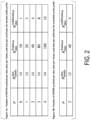
- FIG. 2 is an example illustrating a relationship between the subcarrier spacing configuration ⁇ , the number of OFDM symbols per slot N slot symb , and a cyclic Prefix (CP) configuration according to an aspect of the present embodiment.
- CP cyclic Prefix
- the time unit T c may be used to represent the length of the time domain.
- ⁇ f max 480 kHz.
- N f 4096.
- ⁇ f ref is 15 kHz.
- N f, ref is 2048.
- Transmission of a signal in the downlink and/or transmission of a signal in the uplink may be organized into a radio frame (system frame, frame) having the length T f .
- the radio frame includes 10 subframes.
- the OFDM symbol is a time domain unit of one communication scheme.
- the OFDM symbol may be a time domain unit of CP-OFDM.
- the OFDM symbol may be a time domain unit of DFT-s-OFDM.
- the slot may include multiple OFDM symbols.
- N slot symb continuous OFDM symbols may constitute one slot.
- N slot symb may be 14.
- N slot symb may be 12.
- the number and index of a slot included in the subframe may be given.
- slot indices n ⁇ s may be given in ascending order in the subframe with integer values within a range of 0 to N subframe, ⁇ slot - 1.
- the number and index of a slot included in the radio frame may be given.
- slot indices n ⁇ s, f may be given in ascending order in the radio frame with integer values within a range of 0 to N frame, ⁇ slot - 1.
- FIG. 3 is a diagram illustrating an example of a configuration method of a resource grid according to an aspect of the present embodiment.
- the horizontal axis of FIG. 3 represents a frequency domain.
- FIG. 3 illustrates a configuration example of a resource grid of a subcarrier spacing ⁇ 1 in a component carrier 300, and a configuration example of a resource grid of a subcarrier spacing ⁇ 2 in the certain component carrier.
- ⁇ 1 ⁇ 2 - 1
- the component carrier 300 is a band having a predetermined width in the frequency domain.
- a point 3000 is an identifier for identifying a certain subcarrier.
- the point 3000 is also referred to as a point A.
- a common resource block (CRB) set 3100 is a set of common resource blocks for the configuration of the subcarrier spacing ⁇ 1 .
- a common resource block (solid black block in the common resource block set 3100 in FIG. 3 ) including the point 3000 is also referred to as a reference point of the common resource block set 3100.
- the reference point of the common resource block set 3100 may be a common resource block having an index 0 in the common resource block set 3100.
- An offset 3011 is an offset from the reference point of the common resource block set 3100 to a reference point of a resource grid 3001.
- the offset 3011 is represented by the number of common resource blocks for the configuration of the subcarrier spacing ⁇ 1 .
- the resource grid 3001 includes N size, ⁇ grid1 , x common resource blocks starting from the reference point of the resource grid 3001.
- An offset 3013 is an offset from the reference point of the resource grid 3001 to a reference point (N start, ⁇ BWP, i1 ) of a bandwidth part (BWP) 3003 having an index i1.
- a common resource block set 3200 is a set of common resource blocks for the configuration of the subcarrier spacing ⁇ 2 .
- a common resource block (solid black block in the common resource block set 3200 in FIG. 3 ) including the point 3000 is also referred to as a reference point of the common resource block set 3200.
- the reference point of the common resource block set 3200 may be a common resource block having an index 0 in the common resource block set 3200.
- An offset 3012 is an offset from the reference point of the common resource block set 3200 to a reference point of a resource grid 3002.
- the offset 3012 is represented by the number of common resource blocks for the subcarrier spacing ⁇ 2 .
- the resource grid 3002 includes N size, ⁇ ⁇ grid2, x common resource blocks starting from the reference point of the resource grid 3002.
- An offset 3014 is an offset from the reference point of the resource grid 3002 to a reference point (N start, ⁇ BWP, i2 ) of a BWP 3004 having an index i2.
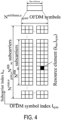
- FIG. 4 is a diagram illustrating a configuration example of the resource grid 3001 according to an aspect of the present embodiment.
- the horizontal axis corresponds to an OFDM symbol index l sym
- the vertical axis corresponds to a subcarrier index k sc .
- the resource grid 3001 includes N size, ⁇ grid1, x N RB sc subcarriers, and N subframe, ⁇ symb OFDM symbols.
- a resource identified by the subcarrier index k sc and the OFDM symbol index l sym is also referred to as a resource element (RE).
- RE resource element
- the resource block (RB) includes N RB sc consecutive subcarriers.
- the resource block is a general term for a common resource block, a physical resource block (PRB), and a virtual resource block (VRB).
- N RB sc is 12.
- a resource block unit is a set of resources corresponding to one OFDM symbol in one resource block. That is, one resource block unit includes 12 resource elements corresponding to one OFDM symbol in one resource block.
- the common resource blocks for the configuration of a certain subcarrier spacing ⁇ are assigned indices (indexing) in ascending order from 0 in the frequency domain in a certain common resource block set.
- the common resource block having the index 0 for the configuration of a certain subcarrier spacing ⁇ includes (collides with or matches) the point 3000.
- Physical resource blocks for the configuration of the certain subcarrier spacing ⁇ are assigned indices in ascending order from 0 in the frequency domain in a certain BWP.
- N start, ⁇ BWP, i indicates a reference point of the BWP having an index i.
- the BWP is defined as a subset of common resource blocks included in the resource grid.
- the BWP includes N size, ⁇ BWP, i common resource blocks starting from the reference point N start, ⁇ BWP, i of the BWP.
- a BWP configured for a downlink carrier is also referred to as a downlink BWP.
- a BWP configured for an uplink component carrier is also referred to as an uplink BWP.
- An antenna port may be defined such that the channel over which a symbol on the antenna port is conveyed can be inferred from the channel over which another symbol on the same antenna port is conveyed.
- the channel may correspond to a physical channel.
- the symbol may correspond to an OFDM symbol.
- the symbol may correspond to a resource block unit.
- the symbol may correspond to a resource element.
- the large scale property may include at least long term property of a channel.
- the large scale property may include at least a part or all of delay spread, Doppler spread, Doppler shift, an average gain, an average delay, and a beam parameter (spatial Rx parameters).
- the fact that the first antenna port and the second antenna port are QCL with respect to a beam parameter may mean that a reception beam assumed by a reception side for the first antenna port and a reception beam assumed by the reception unit side for the second antenna port are the same (or the reception beams correspond to each other).
- the fact that the first antenna port and the second antenna port are QCL with respect to a beam parameter may mean that a transmission beam assumed by a reception side for the first antenna port and a transmission beam assumed by the reception side for the second antenna port are the same (or the transmission beams correspond to each other).
- the terminal apparatus 1 may assume that the two antenna ports are QCL.
- the fact that two antenna ports are QCL may mean that the two antenna ports are assumed to be QCL.
- Carrier aggregation may mean that communication is performed by using multiple serving cells being aggregated. In addition, carrier aggregation may mean that communication is performed by using multiple component carriers being aggregated. In addition, carrier aggregation may mean that communication is performed by using multiple downlink component carriers being aggregated. In addition, carrier aggregation may mean that communication is performed by using multiple uplink component carriers being aggregated.
- FIG. 5 is a schematic block diagram illustrating a configuration example of the base station apparatus 3 according to an aspect of the present embodiment.
- the base station apparatus 3 includes at least a part or all of a radio transmission and/or reception unit (physical layer processing unit) 30 and/or a higher layer processing unit 34.
- the radio transmission and/or reception unit 30 includes at least a part or all of an antenna unit 31, a radio frequency (RF) unit 32, and a baseband unit 33.
- the higher layer processing unit 34 includes at least a part or all of a medium access control layer processing unit 35 and a radio resource control (RRC) layer processing unit 36.
- RRC radio resource control
- the radio transmission and/or reception unit 30 includes at least a part or all of a radio transmission unit 30a and a radio reception unit 30b.
- apparatus configurations of the baseband unit included in the radio transmission unit 30a and the baseband unit included in the radio reception unit 30b may be the same or different from each other.
- apparatus configurations of the RF unit included in the radio transmission unit 30a and the RF unit included in the radio reception unit 30b may be the same or different from each other.
- apparatus configurations of the antenna unit included in the radio transmission unit 30a and the antenna unit included in the radio reception unit 30b may be the same or different from each other.
- the radio transmission unit 30a may generate and transmit a baseband signal of a PDSCH.
- the radio transmission unit 30a may generate and transmit a baseband signal of a PDCCH.
- the radio transmission unit 30a may generate and transmit a baseband signal of a PBCH.
- the radio transmission unit 30a may generate and transmit a baseband signal of a synchronization signal.
- the radio transmission unit 30a may generate and transmit a baseband signal of a PDSCH DMRS.
- the radio transmission unit 30a may generate and transmit a baseband signal of a PDCCH DMRS.
- the radio transmission unit 30a may generate and transmit a baseband signal of a CSI-RS.
- the radio transmission unit 30a may generate and transmit a baseband signal of a DL PTRS.
- the radio reception unit 30b may receive a PRACH.
- the radio reception unit 30b may receive and demodulate a PUCCH.
- the radio reception unit 30b may receive and demodulate a PUSCH.
- the radio reception unit 30b may receive a PUCCH DMRS.
- the radio reception unit 30b may receive a PUSCH DMRS.
- the radio reception unit 30b may receive a UL PTRS.
- the radio reception unit 30b may receive an SRS.
- the higher layer processing unit 34 outputs downlink data (a transport block) to the radio transmission and/or reception unit 30 (or the radio transmission unit 30a).
- the higher layer processing unit 34 performs processing operations of a Medium Access Control (MAC) layer, a Packet Data Convergence Protocol (PDCP) layer, a Radio Link Control (RLC) layer, and an RRC layer.
- MAC Medium Access Control
- PDCP Packet Data Convergence Protocol
- RLC Radio Link Control
- RRC Radio Link Control
- the medium access control layer processing unit 35 included in the higher layer processing unit 34 performs processing of the MAC layer.
- the radio resource control layer processing unit 36 included in the higher layer processing unit 34 performs processing of the RRC layer.
- the radio resource control layer processing unit 36 manages various pieces of configuration information/parameters (RRC parameters) of the terminal apparatus 1.
- the radio resource control layer processing unit 36 sets the parameter based on an RRC message received from the terminal apparatus 1.
- the radio transmission and/or reception unit 30 (or the radio transmission unit 30a) performs processing such as modulation and encoding.
- the radio transmission and/or reception unit 30 (or the radio transmission unit 30a) generates a physical signal through modulation, encoding, and baseband signal generation (conversion into the time-continuous signal) on downlink data, and transmits the physical signal to the terminal apparatus 1.
- the radio transmission and/or reception unit 30 (or the radio transmission unit 30a) may map the physical signal to a certain component carrier and transmit the physical signal to the terminal apparatus 1.
- the radio transmission and/or reception unit 30 (or the radio reception unit 30b) performs processing such as demodulation and decoding.
- the radio transmission and/or reception unit 30 (or the radio reception unit 30b) separates, demodulates, and decodes the received physical signal, and outputs the decoded information to the higher layer processing unit 34.
- the radio transmission and/or reception unit 30 (or the radio reception unit 30b) may perform a channel access procedure prior to transmission of the physical signal.
- the RF unit 32 converts (down-converts) a signal received via the antenna unit 31 into a baseband signal by means of quadrature demodulation and removes unnecessary frequency components.
- the RF unit 32 outputs a processed analog signal to the baseband unit.
- the baseband unit 33 converts an analog signal input from the RF unit 32 into a digital signal.
- the baseband unit 33 removes a portion corresponding to a cyclic prefix (CP) from the converted digital signal, performs a Fast Fourier Transform (FFT) on the signal from which the CP has been removed, and extracts a signal in the frequency domain.
- CP cyclic prefix
- FFT Fast Fourier Transform
- the baseband unit 33 performs Inverse Fast Fourier Transform (IFFT) on the data to generate an OFDM symbol, adds a CP to the generated OFDM symbol, generates a baseband digital signal, and converts the baseband digital signal into an analog signal.
- IFFT Inverse Fast Fourier Transform
- the baseband unit 33 outputs the converted analog signal to the RF unit 32.
- the RF unit 32 removes an unnecessary frequency component from the analog signal input from the baseband unit 33 by using a low-pass filter, up-converts the analog signal into a signal having a carrier frequency, and transmits the signal via the antenna unit 31.
- the RF unit 32 may have a function of controlling transmission power.
- the RF unit 32 is also referred to as a transmission power control unit.
- one or multiple serving cells may be configured.
- Each of the serving cells configured for the terminal apparatus 1 may be one of a Primary cell (PCell), a Primary SCG cell (PSCell), or a Secondary Cell (SCell).
- PCell Primary cell
- PSCell Primary SCG cell
- SCell Secondary Cell
- the PCell is a serving cell included in a Master Cell Group (MCG).
- MCG Master Cell Group
- the PCell is a cell in which an initial connection establishment procedure or a connection re-establishment procedure is performed (has been performed) by the terminal apparatus 1.
- the PSCell is a serving cell included in a Secondary Cell Group (SCG).
- SCG Secondary Cell Group
- the PSCell is a serving cell in which random access is performed by the terminal apparatus 1.
- the SCell may be included in either of the MCG or the SCG.
- a serving cell group is a term at least including an MCG and an SCG.
- the serving cell group may include one or multiple serving cells (or component carriers).
- One or multiple serving cells (or component carriers) included in the serving cell group may be operated by means of carrier aggregation.
- One or multiple downlink BWPs may be configured for each of the serving cells (or downlink component carriers).
- One or multiple uplink BWPs may be configured for each of the serving cells (or uplink component carriers).
- one downlink BWP may be configured as an active downlink BWP (or one downlink BWP may be activated).
- one uplink BWP may be configured as an active uplink BWP (or one uplink BWP may be activated).
- the PDSCH, the PDCCH, and the CSI-RS may be received in the active downlink BWP.
- the terminal apparatus 1 may attempt to receive the PDSCH, the PDCCH, and the CSI-RS in the active downlink BWP.
- the PUCCH and the PUSCH may be transmitted in the active uplink BWP.
- the terminal apparatus 1 may transmit the PUCCH and the PUSCH in the active uplink BWP.
- the active downlink BWP and the active uplink BWP are also collectively referred to as active BWPs.
- the PDSCH, the PDCCH, and the CSI-RS need not be received in downlink BWPs (inactive downlink BWPs) other than the active downlink BWP.
- the terminal apparatus 1 need not attempt to receive the PDSCH, the PDCCH, and the CSI-RS in downlink BWPs that are not active downlink BWPs.
- the PUCCH and the PUSCH need not be transmitted in uplink BWPs (inactive uplink BWPs) that are not active uplink BWPs.
- the terminal apparatus 1 need not transmit the PUCCH and the PUSCH in uplink BWPs that are not active uplink BWPs.
- the inactive downlink BWPs and the inactive uplink BWPs are also collectively referred to as inactive BWPs.
- Downlink BWP switch is a procedure for deactivating one active downlink BWP of a certain serving cell and activating any one of the inactive downlink BWPs of the certain serving cell.
- the downlink BWP switch may be controlled by a BWP field included in downlink control information.
- the downlink BWP switch may be controlled based on a higher layer parameter.
- Uplink BWP switch is used for deactivating one active uplink BWP and activating any one of the inactive uplink BWPs that are not the one active uplink BWP.
- the uplink BWP switch may be controlled by a BWP field included in downlink control information.
- the uplink BWP switch may be controlled based on a higher layer parameter.
- two or more downlink BWPs need not be configured for an active downlink BWP.
- one downlink BWP may be active.
- two or more uplink BWPs need not be configured for an active uplink BWP.
- one uplink BWP may be active.
- FIG. 6 is a schematic block diagram illustrating a configuration example of the terminal apparatus 1 according to an aspect of the present embodiment.
- the terminal apparatus 1 includes at least one or all of a radio transmission and/or reception unit (physical layer processing unit) 10 and a higher layer processing unit 14.
- the radio transmission and/or reception unit 10 includes at least a part or all of an antenna unit 11, an RF unit 12, and a baseband unit 13.
- the higher layer processing unit 14 includes at least a part or all of a medium access control layer processing unit 15 and a radio resource control layer processing unit 16.
- the radio transmission and/or reception unit 10 includes at least a part or all of a radio transmission unit 10a and a radio reception unit 10b.
- apparatus configurations of the baseband unit 13 included in the radio transmission unit 10a and the baseband unit 13 included in the radio reception unit 10b may be the same or different from each other.
- apparatus configurations of the RF unit 12 included in the radio transmission unit 10a and the RF unit 12 included in the radio reception unit 10b may be the same or different from each other.
- apparatus configurations of the antenna unit 11 included in the radio transmission unit 10a and the antenna unit 11 included in the radio reception unit 10b may be the same or different from each other.
- the radio transmission unit 10a may generate and transmit a baseband signal of a PRACH.
- the radio transmission unit 10a may generate and transmit a baseband signal of a PUCCH.
- the radio transmission unit 10a may generate and transmit a baseband signal of a PUSCH.
- the radio transmission unit 10a may generate and transmit a baseband signal of a PUCCH DMRS.
- the radio transmission unit 10a may generate and transmit a baseband signal of a PUSCH DMRS.
- the radio transmission unit 10a may generate and transmit a baseband signal of a UL PTRS.
- the radio transmission unit 10a may generate and transmit a baseband signal of an SRS. Generating the baseband signal of the SRS may be generating an SRS sequence.
- the radio reception unit 10b may receive and demodulate a PDSCH.
- the radio reception unit 10b may receive and demodulate a PDCCH.
- the radio reception unit 10b may receive and demodulate a PBCH.
- the radio reception unit 10b may receive a synchronization signal.
- the radio reception unit 10b may receive a PDSCH DMRS.
- the radio reception unit 10b may receive a PDCCH DMRS.
- the radio reception unit 10b may receive a CSI-RS.
- the radio reception unit 10b may receive a DL PTRS.
- the higher layer processing unit 14 outputs uplink data (a transport block) to the radio transmission and/or reception unit 10 (or the radio transmission unit 10a).
- the higher layer processing unit 14 performs processing operations of the MAC layer, a packet data convergence protocol layer, a radio link control layer, and the RRC layer.
- the medium access control layer processing unit 15 included in the higher layer processing unit 14 performs processing of the MAC layer.
- the radio resource control layer processing unit 16 included in the higher layer processing unit 14 performs processing of the RRC layer.
- the radio resource control layer processing unit 16 manages various pieces of configuration information/parameters (RRC parameters) of the terminal apparatus 1.
- the radio resource control layer processing unit 16 sets the RRC parameters based on an RRC message received from the base station apparatus 3.
- the radio transmission and/or reception unit 10 (or the radio transmission unit 10a) performs processing such as modulation and encoding.
- the radio transmission and/or reception unit 10 (or the radio transmission unit 10a) generates a physical signal through modulation, encoding, and baseband signal generation (conversion into a time-continuous signal) on uplink data and transmits the physical signal to the base station apparatus 3.
- the radio transmission and/or reception unit 10 (or the radio transmission unit 10a) may map the physical signal to a certain BWP (an active uplink BWP) and transmit the physical signal to the base station apparatus 3.
- the radio transmission and/or reception unit 10 (or the radio reception unit 10b) performs processing such as demodulation and decoding.
- the radio transmission and/or reception unit 10 (or the radio reception unit 30b) may receive a physical signal in a certain BWP (active downlink BWP) of a certain serving cell.
- the radio transmission and/or reception unit 10 (or the radio reception unit 10b) separates, demodulates, and decodes the received physical signal and outputs the decoded information to the higher layer processing unit 14.
- the radio transmission and/or reception unit 10 may perform the channel access procedure prior to the transmission of the physical signal.
- the RF unit 12 converts (down-converts) a signal received via the antenna unit 11 into a baseband signal by means of quadrature demodulation and removes unnecessary frequency components.
- the RF unit 12 outputs a processed analog signal to the baseband unit 13.
- the baseband unit 13 converts the analog signal input from the RF unit 12 into a digital signal.
- the baseband unit 13 removes a portion corresponding to a cyclic prefix (CP) from the converted digital signal, performs a Fast Fourier Transform (FFT) on the signal from which the CP has been removed, and extracts a signal of the frequency domain.
- CP cyclic prefix
- FFT Fast Fourier Transform
- the baseband unit 13 performs an Inverse Fast Fourier Transform (IFFT) on the uplink data to generate an OFDM symbol, adds a CP to the generated OFDM symbol, generates a baseband digital signal, and converts the baseband digital signal into an analog signal.
- IFFT Inverse Fast Fourier Transform
- the RF unit 12 removes unnecessary frequency components from the analog signal input from the baseband unit 13 through a low-pass filter, up-converts the analog signal into a signal having a carrier frequency, and transmits the signal via the antenna unit 11.
- the RF unit 12 may have a function of controlling transmission power.
- the RF unit 12 is also referred to as a transmission power control unit.
- a physical signal (signal) will be described below.
- a physical signal is a general term for a downlink physical channel, a downlink physical signal, an uplink physical channel, and an uplink physical channel.
- a physical channel is a general term for a downlink physical channel and an uplink physical channel.
- a physical signal is a general term for a downlink physical signal and an uplink physical signal.
- An uplink physical channel may correspond to a set of resource elements for conveying information that is generated in a higher layer.
- An uplink physical channel may be a physical channel used in an uplink component carrier.
- An uplink physical channel may be transmitted by the terminal apparatus 1.
- the uplink physical channel may be received by the base station apparatus 3.
- at least a part or all of the following uplink physical channels may be used:
- the PUCCH may be used to transmit Uplink Control Information (UCI).
- UCI Uplink Control Information
- the PUCCH may be transmitted for conveying (delivering or transmitting) uplink control information.
- the uplink control information may be mapped to the PUCCH.
- the terminal apparatus 1 may transmit the PUCCH to which the uplink control information is mapped.
- the base station apparatus 3 may receive the PUCCH to which the uplink control information is mapped.
- the uplink control information (uplink control information bit, uplink control information sequence, or uplink control information type) includes at least a part or all of Channel State Information (CSI), a Scheduling Request (SR), and Hybrid Automatic Repeat request ACKnowledgement (HARQ-ACK) information.
- CSI Channel State Information
- SR Scheduling Request
- HARQ-ACK Hybrid Automatic Repeat request ACKnowledgement
- the channel state information is also referred to as a channel state information bit or a channel state information sequence.
- the scheduling request is also referred to as a scheduling request bit or a scheduling request sequence.
- the HARQ-ACK information is also referred to as a HARQ-ACK information bit or a HARQ-ACK information sequence.
- the HARQ-ACK information may include at least a HARQ-ACK corresponding to a transport block (TB).
- the HARQ-ACK may indicate an acknowledgement (ACK) or a negative- acknowledgement (NACK) corresponding to the transport block.
- the ACK may indicate that decoding of the transport block has been decoded successfully.
- the NACK may indicate that decoding of the transport block has not been decoded successfully.
- the HARQ-ACK information may include a HARQ-ACK codebook including one or multiple HARQ-ACK bits.
- the transport block is a sequence of information bits delivered from a higher layer.
- the sequence of information bits is also referred to as a bit sequence.
- the transport block may be delivered through an uplink-shared channel (UL-SCH) of a transport layer.
- UL-SCH uplink-shared channel
- a HARQ-ACK for the transport block may be referred to as a HARQ-ACK for a PDSCH.
- the "HARQ-ACK for the PDSCH" indicates a HARQ-ACK for a transport block included in a PDSCH.
- the HARQ-ACK may indicate an ACK or a NACK corresponding to one code block group (CBG) included in the transport block.
- CBG code block group
- a scheduling request may be at least used for requesting a resource of the UL-SCH for new transmission.
- a scheduling request bit may be used for indicating either of a positive SR or a negative SR.
- the scheduling request bit indicating the positive SR is also referred to as a "positive SR being conveyed".
- the positive SR may indicate that the terminal apparatus 1 requests resources of the UL-SCH for new transmission.
- the positive SR may indicate that a scheduling request is triggered by a higher layer.
- the positive SR may be conveyed in a case that the higher layer indicates the scheduling request.
- the scheduling request bit indicating the negative SR is also referred to as a "negative SR being transmitted”.
- the negative SR may indicate that the terminal apparatus 1 requests no resources of the UL-SCH for new transmission.
- the negative SR may indicate that the scheduling request is not triggered by a higher layer.
- the negative SR may be conveyed in a case that the higher layer indicates no scheduling request.
- Channel state information may include at least a part or all of a Channel Quality Indicator (CQI), a Precoder Matrix Indicator (PMI), and a Rank Indicator (RI).
- CQI is an indicator related to the quality (for example, propagation strength) of a propagation path or the quality of a physical channel
- PMI is an indicator related to a precoder
- the RI is an indicator related to a transmission rank (or the number of transmission layers).
- the channel state information is an indicator related to a reception state of a physical signal (for example, CSI-RS) at least used for channel measurement.
- a value of the channel state information may be determined by the terminal apparatus 1 based on the reception state assumed by a physical signal at least used for channel measurement.
- Channel measurement may include interference measurement.
- the PUCCH may correspond to a PUCCH format.
- the PUCCH may be a set of resource elements used for conveying the PUCCH format.
- the PUCCH may include the PUCCH format.
- the PUCCH may be transmitted in a certain PUCCH format. Note that the PUCCH format may be interpreted as a form of information. In addition, the PUCCH format may be interpreted as a set of information set in a certain form of information.
- the PUSCH may be used for conveying one or both of a transport block and uplink control information.
- the transport block may be mapped to the PUSCH.
- the transport block delivered on the UL-SCH may be mapped to the PUSCH.
- the uplink control information may be mapped to the PUSCH.
- the terminal apparatus 1 may transmit the PUSCH to which one or both of the transport block and the uplink control information are mapped.
- the base station apparatus 3 may receive the PUSCH to which one or both of the transport block and the uplink control information are mapped.
- the PRACH may be transmitted for conveying a random access preamble.
- the terminal apparatus 1 may transmit the PRACH.
- the base station apparatus 3 may receive the PRACH.
- x u is a Zadoff Chu (ZC) sequence.
- j is an imaginary unit.
- ⁇ is the ratio of the circumference of a circle to its diameter.
- C v corresponds to a cyclic shift of the PRACH sequence.
- L RA corresponds to the length of the PRACH sequence.
- L RA is 839, or 139.
- i is an integer in the range from 0 to L RA - 1.
- u is a sequence index for the PRACH sequence.
- each PRACH occasion 64 random access preambles are defined.
- the random access preambles are identified based on the cyclic shift C v of the PRACH sequence and the sequence index u for the PRACH sequence.
- Each of the 64 identified random access preambles may be assigned an index.
- Uplink physical signals may correspond to a set of resource elements.
- the uplink physical signals need not be used to convey information generated in a higher layer.
- the uplink physical signals may be used to convey information generated in the physical layer.
- the uplink physical signals may be physical signals used in an uplink component carrier.
- the terminal apparatus 1 may transmit the uplink physical signals.
- the base station apparatus 3 may receive the uplink physical signals. In the radio communication system according to an aspect of the present embodiment, at least a part or all of the following uplink physical signals may be used:
- a UL DMRS is a general term for a DMRS for a PUSCH and a DMRS for a PUCCH.
- a set of antenna ports of the DMRS for the PUSCH may be given based on a set of antenna ports for the PUSCH.
- the set of antenna ports of the DMRS for the PUSCH may be the same as a set of antenna ports of the PUSCH.
- Transmission of the PUSCH and transmission of the DMRS for the PUSCH may be indicated (or may be scheduled) in one DCI format.
- the PUSCH and the DMRS for the PUSCH may be collectively referred to as a PUSCH.
- Transmission of the PUSCH may mean transmission of the PUSCH and the DMRS for the PUSCH.
- a propagation path of the PUSCH may be inferred from the DMRS for the PUSCH.
- a set of antenna ports of the DMRS for the PUCCH may be the same as a set of antenna ports of the PUCCH.
- Transmission of the PUCCH and transmission of the DMRS for the PUCCH may be indicated (or may be triggered) in one DCI format.
- One or both of resource element mapping of the PUCCH and resource element mapping of the DMRS for the PUCCH may be given in one PUCCH format.
- the PUCCH and the DMRS for the PUCCH may be collectively referred to as a PUCCH. Transmission of the PUCCH may mean transmission of the PUCCH and the DMRS for the PUCCH.
- a propagation path of the PUCCH may be inferred from the DMRS for the PUCCH.
- a downlink physical channel may correspond to a set of resource elements for conveying information generated in a higher layer.
- a downlink physical channel may be a physical channel used in a downlink component carrier.
- the base station apparatus 3 may transmit a downlink physical channel.
- the terminal apparatus 1 may receive a downlink physical channel.
- at least a part or all of the following downlink physical channels may be used:
- the PBCH may be transmitted for conveying one or both of a Master Information Block (MIB) and physical layer control information.
- the physical layer control information is information generated in the physical layer.
- the MIB is a set of parameters mapped to a Broadcast Control CHannel (BCCH) that is a logical channel of the MAC layer.
- BCCH Broadcast Control CHannel
- the BCCH is mapped to a BCH that is a channel of a transport layer.
- the BCH may be mapped to the PBCH.
- the terminal apparatus 1 may receive the PBCH to which one or both of the MIB and the physical layer control information are mapped.
- the base station apparatus 3 may transmit the PBCH to which one or both of the MIB and/or the physical layer control information are mapped.
- the physical layer control information may include 8 bits.
- the physical layer control information may include at least a part or all of the following 0A to 0D.
- the radio frame bit is used for indicating a radio frame in which the PBCH is transmitted (radio frame including a slot in which the PBCH is transmitted).
- the radio frame bit includes 4 bits.
- the radio frame bit may include 4 bits out of a 10-bit radio frame indicator.
- the radio frame indicator may be at least used for identifying radio frames from index 0 to index 1023.
- the half radio frame bit is used for indicating, out of the radio frame in which the PBCH is transmitted, which of the first five subframes or the last five subframes is used for transmission of the PBCH.
- the half radio frame may include five subframes.
- the half radio frame may include the first five subframes out of the 10 subframes included in the radio frame.
- the half radio frame may include the last five subframes out of the 10 subframes included in the radio frame.
- An SS/PBCH block index bit is used for indicating an SS/PBCH block index.
- the SS/PBCH block index bit includes 3 bits.
- the SS/PBCH block index bit may include 3 bits out of a 6-bit SS/PBCH block index indicator.
- the SS/PBCH block index indicator may be at least used for identifying SS/PBCH blocks of the index 0 to index 63.
- a subcarrier offset bit is used for indicating a subcarrier offset.
- the subcarrier offset may be used for indicating a difference between the leading subcarrier to which the PBCH is mapped and the leading subcarrier to which the control resource set having the index 0 is mapped.
- the PDCCH may be transmitted for transmitting Downlink Control Information (DCI).
- DCI Downlink Control Information
- the downlink control information may be mapped to the PDCCH.
- the terminal apparatus 1 may receive the PDCCH to which the downlink control information is mapped.
- the base station apparatus 3 may transmit the PDCCH to which the downlink control information is mapped.
- the downlink control information may be transmitted in a DCI format.
- the DCI format may also be interpreted to be in the format of downlink control information.
- the DCI format may be interpreted as a set of downlink control information set to the format of certain downlink control information.
- a DCI format 0_0, a DCI format 0_1, a DCI format 1_0, and a DCI format 1_1 are DCI formats.
- An uplink DCI format is a general term for the DCI format 0_0 and the DCI format 0_1.
- a downlink DCI format is a general term for the DCI format 1_0 and the DCI format 1_1.
- the DCI format 0_0 is at least used for scheduling of the PUSCH mapped to a certain cell.
- the DCI format 0_0 includes at least a part or all of fields listed from 1A to 1E.
- An identifier field for DCI formats may indicate whether the DCI format including the identifier field for DCI formats is an uplink DCI format or a downlink DCI format.
- an identifier field for DCI formats may be included in each of the uplink DCI format and the downlink DCI format.
- the identifier field for DCI formats included in the DCI format 0_0 may indicate 0.
- a frequency domain resource assignment field included in the DCI format 0_0 may be used for indicating assignment of frequency resources for the PUSCH.
- a time domain resource assignment field included in the DCI format 0_0 may be used for indicating assignment of time resources for the PUSCH.
- a frequency hopping flag field may be used for indicating whether frequency hopping is applied to the PUSCH.
- An MCS field included in the DCI format 0_0 may be at least used for indicating one or both of a modulation scheme for the PUSCH and a target encoding rate.
- the target encoding rate may be a target encoding rate for the transport block mapped to the PUSCH.
- a transport block size (TBS) mapped to the PUSCH may be determined based on one or both of the target encoding rate and the modulation scheme for the PUSCH.
- the DCI format 0_0 need not include a field used for a CSI request.
- the DCI format 0_0 need not include a carrier indicator field.
- the serving cell to which the uplink component carrier to which the PUSCH scheduled in the DCI format 0_0 is mapped belongs may be the same as the serving cell of the uplink component carrier to which the PDCCH including the DCI format 0_0 is mapped.
- the terminal apparatus 1 may recognize that the PUSCH scheduled in the DCI format 0_0 is mapped to the uplink component carrier of the certain serving cell.
- the DCI format 0_0 need not include a BWP field.
- the DCI format 0_0 may be a DCI format for scheduling the PUSCH without changing an active uplink BWP.
- the terminal apparatus 1 may recognize that the PUSCH is transmitted without switching the active uplink BWP based on detection of the DCI format 0_0 used for the scheduling of the PUSCH.
- the DCI format 0_1 is at least used for scheduling of the PUSCH mapped to a certain cell.
- the DCI format 0_1 includes at least a part or all of fields listed from 2A to 2H.
- the identifier field for DCI formats included in the DCI format 0_1 may indicate 0.
- the frequency domain resource assignment field included in the DCI format 0_1 may be used for indicating assignment of frequency resources for the PUSCH.
- the time domain resource assignment field included in the DCI format 0_1 may be used for indicating assignment of time resources for the PUSCH.
- the MCS field included in the DCI format 0_1 may be at least used for indicating a part or all of a modulation scheme for the PUSCH and/or a target encoding rate.
- the BWP field of the DCI format 0_1 may be used for indicating an uplink BWP to which the PUSCH scheduled in the DCI format 0_1 is mapped.
- the DCI format 0_1 may be accompanied by a change in the active uplink BWP.
- the terminal apparatus 1 may recognize the uplink BWP to which the PUSCH is mapped based on detection of the DCI format 0_1 used for scheduling of the PUSCH.
- the DCI format 0_1 not including the BWP field may be a DCI format for scheduling the PUSCH without changing the active uplink BWP.
- the terminal apparatus 1 may recognize that the PUSCH is transmitted without switching the active uplink BWP based on detection of the DCI format D0_1 which is the DCI format 0_1 used for the scheduling of the PUSCH and does not include the BWP field.
- the terminal apparatus 1 may ignore the BWP field. In other words, the terminal apparatus 1 which does not support the function of switching the BWP may recognize that the PUSCH is transmitted without switching the active uplink BWP based on detection of the DCI format 0_1 which is the DCI format 0_1 used for the scheduling of the PUSCH and includes the BWP field.
- the terminal apparatus 1 may report, in a function information reporting procedure of the RRC layer, that "the terminal apparatus 1 supports the function of switching the BWP".
- the CSI request field is used for indicating a report of CSI.
- the carrier indicator field may be used for indicating the uplink component carrier to which the PUSCH is mapped.
- the uplink component carrier to which the PUSCH is mapped may be the same as the uplink component carrier to which the PDCCH including the DCI format 0_1 used for scheduling of the PUSCH is mapped.
- the number of bits of the carrier indicator field included in the DCI format 0_1 used for scheduling of the PUSCH mapped to the certain serving cell group may be 1 bit or more (for example, 3 bits).
- the number of bits of the carrier indicator field included in the DCI format 0_1 used for scheduling of the PUSCH mapped to the certain serving cell group may be 0 bits (or the carrier indicator field may not be included in the DCI format 0_1 used for scheduling of the PUSCH mapped to the certain serving cell group).
- the DCI format 1_0 is at least used for scheduling of the PDSCH mapped to a certain cell.
- the DCI format 1_0 includes at least a part or all of 3A to 3F:
- the identifier field for DCI formats included in the DCI format 1_0 may indicate 1.
- the frequency domain resource assignment field included in the DCI format 1_0 may be at least used for indicating assignment of frequency resources for the PDSCH.
- the time domain resource assignment field included in the DCI format 1_0 may be at least used for indicating assignment of time resources for the PDSCH.
- the MCS field included in the DCI format 1_0 may be at least used for indicating one or both of the modulation scheme for the PDSCH and the target encoding rate.
- the target encoding rate may be a target encoding rate for a transport block mapped to the PDSCH.
- the size of a transport block (Transport Block Size or TBS) mapped to the PDSCH may be determined based on one or both of the target encoding rate and the modulation scheme for the PDSCH.
- the PDSCH_HARQ feedback timing indicator field may be used for indicating an offset from the slot including the last OFDM symbol of the PDSCH to the slot including the first OFDM symbol of the PUCCH.
- the PUCCH resource indicator field may be a field indicating an index of any of one or multiple PUCCH resources included in a PUCCH resource set.
- the PUCCH resource set may include one or multiple PUCCH resources.
- the DCI format 1_0 may not include the carrier indicator field.
- the downlink component carrier to which the PDSCH scheduled by using the DCI format 1_0 is mapped may be the same as the downlink component carrier to which the PDCCH including the DCI format 1_0 is mapped.
- the terminal apparatus 1 may recognize that the PDSCH scheduled in the DCI format 1_0 is mapped to the downlink component carrier.
- the DCI format 1_0 may not include a BWP field.
- DCI format 1_0 may be a DCI format for scheduling the PDSCH without changing the active downlink BWP.
- the terminal apparatus 1 may recognize that the PDSCH is received without switching the active downlink BWP based on detection of the DCI format 1_0 used in scheduling of the PDSCH.
- the DCI format 1_1 is at least used for scheduling of the PDSCH mapped to a certain cell.
- the DCI format 1_1 includes at least some or all of 4A to 4I:
- the identifier field for DCI formats included in the DCI format 1_1 may indicate 1.
- the frequency domain resource assignment field included in the DCI format 1_1 may be at least used for indicating assignment of frequency resources for the PDSCH.
- the time domain resource assignment field included in the DCI format 1_1 may be at least used for indicating assignment of time resources for the PDSCH.
- the MCS field included in the DCI format 1_1 may be at least used for indicating one or both of the modulation scheme for the PDSCH and the target encoding rate.
- the PDSCH_HARQ feedback timing indicator field may be at least used for indicating an offset from the slot including the last OFDM symbol of the PDSCH to the slot including the first OFDM symbol of the PUCCH.
- an offset from the slot including the last OFDM symbol of the PDSCH to the slot including the first OFDM symbol of the PUCCH may be identified by a higher layer parameter.
- the PUCCH resource indicator field may be a field indicating an index of any of one or multiple PUCCH resources included in a PUCCH resource set.
- the BWP field of the DCI format 1_1 may be used to indicate the downlink BWP to which the PDSCH scheduled in the DCI format 1_1 is mapped.
- the DCI format 1_1 may be accompanied by a change in the active downlink BWP.
- the terminal apparatus 1 may recognize the downlink BWP to which the PUSCH is mapped based on detection of the DCI format 1_1 used for the scheduling of the PDSCH.
- the DCI format 1_1 not including the BWP field may be a DCI format for scheduling the PDSCH without changing the active downlink BWP.
- the terminal apparatus 1 may recognize that the PDSCH is received without switching the active downlink BWP based on detection of the DCI format 1_1 which is used for the scheduling of the PDSCH and the DCI format 1_1 not including the BWP field.
- the terminal apparatus 1 may ignore the BWP field. In other words, the terminal apparatus 1 which does not support the function of switching the BWP may recognize that the PDSCH is received without switching the active downlink BWP based on detection of the DCI format 1_1 which is used for the scheduling of the PDSCH and the DCI format 1_1 including the BWP field.
- the terminal apparatus 1 may report, in a function information reporting procedure of the RRC layer, that "the terminal apparatus 1 supports the function of switching the BWP".
- the carrier indicator field may be used for indicating the downlink component carrier to which the PDSCH is mapped.
- the downlink component carrier to which the PDSCH is mapped may be the same as the downlink component carrier to which the PDCCH including the DCI format 1_1 used for scheduling of the PDSCH is mapped.
- the number of bits of the carrier indicator field included in the DCI format 1_1 used for scheduling of the PDSCH mapped to the certain serving cell group may be 1 bit or more (for example, 3 bits).
- the number of bits of the carrier indicator field included in the DCI format 1_1 used for scheduling of the PDSCH mapped to the certain serving cell group may be 0 bits (or the carrier indicator field may not be included in the DCI format 1_1 used for scheduling of the PDSCH mapped to the certain serving cell group).
- the PDSCH may be transmitted for conveying a transport block.
- the PDSCH may be used for transmitting a transport block delivered on the DL-SCH.
- the PDSCH may be used for conveying a transport block.
- a transport block may be mapped to the PDSCH.
- the transport block corresponding to the DL-SCH may be mapped to the PDSCH.
- the base station apparatus 3 may transmit the PDSCH.
- the terminal apparatus 1 may receive the PDSCH.
- a downlink physical signal may correspond to a set of resource elements.
- the downlink physical signal may not carry information generated in a higher layer.
- the downlink physical signal may be a physical signal used in a downlink component carrier.
- the downlink physical signal may be transmitted by the base station apparatus 3.
- the downlink physical signal may be transmitted by the terminal apparatus 1.
- at least some or all of the following downlink physical signals may be used:
- the synchronization signal may be used for the terminal apparatus 1 to take synchronization in one or both of the frequency domain and the time domain in downlink.
- the synchronization signal is a general term for a primary synchronization signal (PSS) and a secondary synchronization signal (SSS).
- FIG. 7 is a diagram illustrating a configuration example of the SS/PBCH block according to an aspect of the present embodiment.
- the horizontal axis corresponds to a time axis (OFDM symbol index l sym ), and the vertical axis represents the frequency domain.
- a block 700 represents a set of resource elements for a PSS.
- a block 720 represents a set of resource elements for an SSS.
- four blocks (blocks 710, 711, 712, and 713) represent a set of resource elements for a PBCH and a DMRS for the PBCH (DMRS related to the PBCH, DMRS included in the PBCH, or DMRS corresponding to the PBCH).
- the SS/PBCH block includes a PSS, an SSS, and a PBCH.
- the SS/PBCH block includes four consecutive OFDM symbols.
- the SS/PBCH block includes 240 subcarriers.
- the PSS is mapped to the 57th to 183rd subcarriers in the first OFDM symbol.
- the SSS is mapped to the 57th to 183rd subcarriers in the third OFDM symbol. Zero may be set to the 1st to 56th subcarriers of the first OFDM symbol.
- Zero may be set to the 184th to 240th subcarriers of the first OFDM symbol.
- Zero may be set to the 49th to 56th subcarriers of the third OFDM symbol.
- the PBCH is mapped to subcarriers which are the 1st to 240th subcarriers of the second OFDM symbol and to which a DMRS for the PBCH is not mapped.
- the PBCH is mapped to subcarriers which are the 1st to 48th subcarriers of the third OFDM symbol and to which a DMRS for the PBCH is not mapped.
- the PBCH is mapped to subcarriers which are the 193rd to 240th subcarriers of the third OFDM symbol and to which a DMRS for the PBCH is not mapped.
- the PBCH is mapped to subcarriers which are the 1st to 240th subcarriers of the fourth OFDM symbol and to which a DMRS for the PBCH is not mapped.
- the antenna ports of the PSS, the SSS, the PBCH, and the DMRS for the PBCH may be the same.
- the PBCH over which the symbol of the PBCH on a certain antenna port is conveyed may be inferred from the DMRS for the PBCH mapped to the slot to which the PBCH is mapped and the DMRS for the PBCH included in the SS/PBCH block including the PBCH.
- the DL DMRS is a general term for a DMRS for the PBCH, a DMRS for the PDSCH, and a DMRS for the PDCCH.
- a set of antenna ports of the DMRS for the PDSCH may be given based on a set of antenna ports for the PDSCH.
- the set of antenna ports of the DMRS for the PDSCH may be the same as the set of antenna ports for the PDSCH.
- Transmission of the PDSCH and transmission of the DMRS for the PDSCH may be indicated (or may be scheduled) in one DCI format.
- the PDSCH and the DMRS for the PDSCH may be collectively referred to as a PDSCH.
- Transmission of the PDSCH may be transmission of the PDSCH and the DMRS for the PDSCH.
- a propagation path of the PDSCH may be inferred from the DMRS for the PDSCH.
- the PDSCH over which the symbol of the PDSCH on a certain antenna port is conveyed may be inferred from the DMRS for the PDSCH.
- the antenna port of the DMRS for the PDCCH (the DMRS related to the PDCCH, the DMRS included in the PDCCH, or the DMRS corresponding to the PDCCH) may be the same as the antenna port for the PDCCH.
- the PDCCH may be inferred from the DMRS for the PDCCH.
- a propagation path of the PDCCH may be inferred from the DMRS for the PDCCH.
- the PDCCH over which the symbol of the PDCCH on a certain antenna port is conveyed may be inferred from the DMRS for the PDCCH.
- a Broadcast CHannel (BCH), an Uplink-Shared CHannel (UL-SCH), and a Downlink-Shared CHannel (DL-SCH) are transport channels.
- a transport channel defines the relationship between a physical layer channel and a MAC layer channel (also referred to as a logical channel).
- a BCH of the transport layer is mapped to the PBCH of the physical layer.
- a transport block passing through the BCH of the transport layer is delivered to the PBCH of the physical layer.
- the UL-SCH of the transport layer is mapped to the PUSCH of the physical layer.
- the transport block passing through the UL-SCH of the transport layer is delivered to the PUSCH of the physical layer.
- the DL-SCH of the transport layer is mapped to the PDSCH of the physical layer.
- a transport block passing through the DL-SCH of the transport layer is delivered to the PDSCH of the physical layer.
- One UL-SCH and one DL-SCH may be given to each serving cell.
- the BCH may be given to a PCell.
- the BCH may not be given to a PSCell and an SCell.
- control over a Hybrid Automatic Repeat reQuest (HARQ) is performed for each transport block.
- HARQ Hybrid Automatic Repeat reQuest
- a Broadcast Control CHannel (BCCH), a Common Control CHannel (CCCH), and a Dedicated Control CHannel (DCCH) are logical channels.
- the BCCH is a channel of the RRC layer used for transmitting an MIB or system information.
- a Common Control CHannel (CCCH) may be used for transmitting a common RRC message in multiple terminal apparatuses 1.
- the CCCH may be, for example, used for a terminal apparatus 1 that is not in a state of RRC connection.
- a Dedicated Control CHannel (DCCH) may be at least used for transmitting an RRC message dedicated to a terminal apparatus 1.
- the DCCH may be, for example, used for the terminal apparatus 1 that is in a state of RRC connection.
- a higher layer parameter common to multiple terminal apparatuses 1 is also referred to as a common higher layer parameter.
- the common higher layer parameter may be defined as a parameter specific to a serving cell.
- a parameter specific to a serving cell may be a parameter common to terminal apparatuses configured with the serving cell (for example, terminal apparatuses 1-A, 1-B, and 1-C).
- an RRC message delivered to the BCCH may include the common higher layer parameter.
- an RRC message delivered on the DCCH may include the common higher layer parameter.
- a higher layer parameter different from the common higher layer parameter is also referred to as a dedicated higher layer parameter.
- the dedicated higher layer parameter can provide a dedicated RRC parameter to the terminal apparatus 1-A configured with the serving cell.
- the dedicated RRC parameter is a higher layer parameter capable of providing a unique configuration to each of the terminal apparatuses 1-A, 1-B, and 1-C.
- the BCCH of the logical channel may be mapped to the BCH or the DL-SCH of the transport layer.
- a transport block including information of an MIB is delivered to the BCH of the transport layer.
- a transport block including system information other than the MIB is delivered to the DL-SCH of the transport layer.
- the CCCH is mapped to the DL-SCH or the UL-SCH.
- a transport block mapped to the CCCH is delivered to the DL-SCH or the UL-SCH.
- the DCCH is mapped to the DL-SCH or the UL-SCH.
- a transport block mapped to the DCCH is delivered to the DL-SCH or the UL-SCH.
- An RRC message includes one or multiple parameters managed in the RRC layer.
- the parameters managed in the RRC layer are also referred to as RRC parameters.
- the RRC message may include the MIB.
- the RRC message may include system information.
- the RRC message may include a message corresponding to the CCCH.
- the RRC message may include a message corresponding to the DCCH.
- An RRC message including a message corresponding to the DCCH is also referred to as an individual RRC message.
- a higher layer parameter is an RRC parameter or a parameter included in a Medium Access Control Control Element (MAC CE).
- the higher layer parameter is a general term for the MIB, the system information, a message corresponding to the CCCH, a message corresponding to the DCCH, and a parameter included in a MAC CE.
- the parameter included in the MAC CE is transmitted by using a MAC Control Element (CE) command.
- CE MAC Control Element
- Procedures performed by the terminal apparatus 1 include at least some or all of the following 5A to 5C:
- the cell search is a procedure used for the terminal apparatus 1 synchronizing with a certain cell related to the time domain and the frequency domain and detecting a physical cell identity (physical cell ID).
- the terminal apparatus 1 may perform synchronization with a certain cell in the time domain and the frequency domain and detect a physical cell ID.
- a sequence of the PSS is given based at least on the physical cell ID.
- a sequence of the SSS is given based at least on the physical cell ID.
- An SS/PBCH block candidate indicates a resource allowed to (possible to, scheduled to, configured to, defined to, having a possibility to) transmit the SS/PBCH block.
- a set of SS/PBCH block candidates in a certain half radio frame is also referred to as an SS burst set.
- the SS burst set is also referred to as a transmission window (transmissionwindow), an SS transmission window, or a Discovery Reference Signal transmission window (DRS transmission window).
- the SS burst set is a general term including at least a first SS burst set and a second SS burst set.
- the base station apparatus 3 transmits SS/PBCH blocks with one or multiple indices at prescribed intervals.
- the terminal apparatus 1 may detect at least one SS/PBCH block out of the SS/PBCH blocks with one or multiple indices and attempt decoding of the PBCH included in the SS/PBCH block.
- the random access is a procedure including at least some or all of a message 1, a message 2, a message 3, and a message 4.
- the message 1 is a procedure in which the PRACH is transmitted by the terminal apparatus 1.
- the terminal apparatus 1 transmits the PRACH in one PRACH occasion selected out of one or multiple PRACH occasions based at least on the index of the SS/PBCH block candidate detected based on the cell search.
- Each of the PRACH occasions is defined based at least on resources in the time domain and the frequency domain.
- the terminal apparatus 1 transmits one random access preamble selected out of the PRACH occasions corresponding to the indices of the SS/PBCH block candidates in which the SS/PBCH block is detected.
- the message 2 is a procedure of attempting to detect a DCI format 1_0 with a Cyclic Redundancy Check (CRC) scrambled by a Random Access-Radio Network Temporary Identifier (RA-RNTI) by the terminal apparatus 1.
- the terminal apparatus 1 attempts detection of the PDCCH including the DCI format in a control resource set given based on the MIB, which is included in the PBCH included in the SS/PBCH block detected based on a cell search, and in resources indicated based on a configuration of a search space set.
- the message 2 is also referred to as a random access response.
- the message 3 is a procedure of transmitting the PUSCH scheduled by using a random access response grant included in the DCI format 1_0 detected through the procedure of the message 2.
- the random access response grant (random access responsegrant) is indicated by the MAC CE included in the PDSCH scheduled by using the DCI format 1_0.
- the PUSCH scheduled based on the random access response grant is either a message 3 PUSCH or a PUSCH.
- the message 3 PUSCH includes a contention resolution identifier (contention resolution ID) MAC CE.
- the contention resolution ID MAC CE includes a contention resolution ID.
- Retransmission of the message 3 PUSCH is scheduled by using the DCI format 0_0 with a CRC scrambled based on a Temporary Cell-Radio Network Temporary Identifier (TC-RNTI).
- TC-RNTI Temporary Cell-Radio Network Temporary Identifier
- the message 4 is a procedure of attempting to detect the DCI format 1_0 with a CRC scrambled based on either of a Cell-Radio Network Temporary Identifier (C-RNTI) or a TC-RNTI.
- the terminal apparatus 1 receives a PDSCH scheduled based on the DCI format 1_0.
- the PDSCH may include a contention resolution ID.
- Data communication is a general term for downlink communication and uplink communication.
- the terminal apparatus 1 attempts detection of the PDCCH (monitors the PDCCH or supervises the PDCCH) in a control resource set and resources identified based on a search space set.
- the control resource set is a set of resources including a certain number of resource blocks and a certain number of OFDM symbols.
- the control resource set may include continuous resources (non-interleaved mapping) or may include distributed resources (interleaver mapping).
- a set of resource blocks constituting the control resource set may be indicated by a higher layer parameter.
- the number of OFDM symbols constituting the control resource set may be indicated by a higher layer parameter.
- the terminal apparatus 1 attempts detection of the PDCCH in a search space set.
- an attempt to detect the PDCCH in the search space set may be an attempt to detect a candidate of the PDCCH in the search space set, may be an attempt to detect a DCI format in the search space set, may be an attempt to detect the PDCCH in the control resource set, may be an attempt to detect a candidate of the PDCCH in the control resource set, or may be an attempt to detect a DCI format in the control resource set.
- the search space set is defined as a set of candidates of the PDCCH.
- the search space set may be a Common Search Space (CSS) set or may be a UE-specific Search Space (USS) set.
- the terminal apparatus 1 attempts detection of candidates of the PDCCH in some or all of a Type 0 PDCCH common search space set, a Type 0a PDCCH common search space set, a Type 1 PDCCH common search space set, a Type 2 PDCCH common search space set, a Type 3 PDCCH common search space set, and/or a UE-specific PDCCH search space set (UE-specific search space set).
- the Type 0 PDCCH common search space set may be used as a common search space set having the index 0.
- the Type 0 PDCCH common search space set may be a common search space set having the index 0.
- a CSS set is a general term for the Type 0 PDCCH common search space set, the Type 0a PDCCH common search space set, the Type 1 PDCCH common search space set, the Type 2
- a USS set is also referred to as a UE-specific PDCCH search space set.
- a certain search space set is related to (included in or corresponds to) a certain control resource set.
- the index of the control resource set related to the search space set may be indicated by a higher layer parameter.
- 6A to 6C may be indicated by at least a higher layer parameter: 6A) a PDCCH monitoring periodicity;
- the monitoring occasion of a certain search space set may correspond to the OFDM symbol to which the first OFDM symbol of a control resource set related to the certain search space set is mapped.
- the monitoring occasion of a certain search space set may correspond to a resource of a control resource set starting from the first OFDM symbol of the control resource set related to the certain search space set.
- the monitoring occasion of the search space set is given based at least on some or all of the monitoring periodicity of the PDCCH, the monitoring pattern of the PDCCH in a slot, and a monitoring offset of the PDCCH.
- FIG. 8 is a diagram illustrating an example of the monitoring occasions for the search space sets according to an aspect of the present embodiment.
- search space sets 91 and search space sets 92 are configured in a primary cell 301
- search space sets 93 are configured in a secondary cell 302
- search space sets 94 are configured in a secondary cell 303.
- solid white blocks in the primary cell 301 represent the search space sets 91
- solid black blocks in the primary cell 301 represent the search space sets 92
- blocks in the secondary cell 302 represent the search space sets 93
- blocks in the secondary cell 303 represent the search space sets 94.
- the monitoring periodicity of the search space sets 91 is set to one slot, the monitoring offset of the search space sets 91 is set to zero slots, and the monitoring pattern of the search space sets 91 is set to [1, 0, 0, 0, 0, 0, 0, 1, 0, 0, 0, 0, 0, 0].
- the monitoring occasions for the search space sets 91 correspond to the first OFDM symbol (OFDM symbol #0) and the 8th OFDM symbol (OFDM symbol #7) in each of the slots.
- the monitoring periodicity of the search space sets 92 is set to two slots, the monitoring offset of the search space sets 92 is set to zero slots, and the monitoring pattern of the search space sets 92 is set to [1, 0, 0, 0, 0, 0, 0, 0, 0, 0, 0, 0].
- the monitoring occasion for the search space sets 92 corresponds to the first OFDM symbol (OFDM symbol #0) in each of the even-numbered slots.
- the monitoring periodicity of the search space sets 93 is set to two slots, the monitoring offset of the search space sets 93 is set to zero slots, and the monitoring pattern of the search space sets 93 is set to [0, 0, 0, 0, 0, 0, 0, 1, 0, 0, 0, 0, 0, 0].
- the monitoring occasion for the search space sets 93 corresponds to the 8th OFDM symbol (OFDM symbol #7) in each of the even-numbered slots.
- the monitoring periodicity of the search space sets 94 is set to two slots, the monitoring offset of the search space sets 94 is set to one slot, and the monitoring pattern of the search space sets 94 is set to [1, 0, 0, 0, 0, 0, 0, 0, 0, 0, 0, 0].
- the monitoring occasion for the search space sets 94 corresponds to the first OFDM symbol (OFDM symbol #0) in each of the odd-numbered slots.
- the Type 0 PDCCH common search space set may be at least used for the DCI format with a Cyclic Redundancy Check (CRC) sequence scrambled by a System Information-Radio Network Temporary Identifier (SI-RNTI).
- CRC Cyclic Redundancy Check
- SI-RNTI System Information-Radio Network Temporary Identifier
- the Type 0a PDCCH common search space set may be at least used for the DCI format with a Cyclic Redundancy Check (CRC) sequence scrambled by a System Information-Radio Network Temporary Identifier (SI-RNTI).
- CRC Cyclic Redundancy Check
- SI-RNTI System Information-Radio Network Temporary Identifier
- the Type 1 PDCCH common search space set may be at least used for the DCI format with a CRC sequence scrambled by a Random Access-Radio Network Temporary Identifier (RA-RNTI) and/or a CRC sequence scrambled by a Temporary Cell-Radio Network Temporary Identifier (TC-RNTI).
- RA-RNTI Random Access-Radio Network Temporary Identifier
- TC-RNTI Temporary Cell-Radio Network Temporary Identifier
- the Type 2 PDCCH common search space set may be used for the DCI format with a CRC sequence scrambled by a Paging- Radio Network Temporary Identifier (P-RNTI).
- P-RNTI Paging- Radio Network Temporary Identifier
- the Type 3 PDCCH common search space set may be used for the DCI format with a CRC sequence scrambled by a Cell-Radio Network Temporary Identifier (C-RNTI).
- C-RNTI Cell-Radio Network Temporary Identifier
- the UE-specific PDCCH search space set may be at least used for the DCI format with a CRC sequence scrambled by C-RNTI.
- the terminal apparatus 1 detects a downlink DCI format.
- the detected downlink DCI format is at least used for resource assignment of the PDSCH.
- the detected downlink DCI format is also referred to as downlink assignment.
- the terminal apparatus 1 attempts reception of the PDSCH.
- a HARQ-ACK corresponding to the PDSCH (HARQ-ACK corresponding to the transport block included in the PDSCH) is reported to the base station apparatus 3 based on PUCCH resources indicated based on the detected downlink DCI format.
- the terminal apparatus 1 detects an uplink DCI format.
- the detected DCI format is at least used for resource assignment of the PUSCH.
- the detected uplink DCI format is also referred to as an uplink grant.
- the terminal apparatus 1 performs transmission of the PUSCH.
- the uplink grant for scheduling the PUSCH is configured for each transmission periodicity of the PUSCH.
- a part or all of pieces of information indicated by an uplink DCI format in a case that the PUSCH is scheduled by the uplink DCI format may be indicated by the uplink grant configured in a case of the configured scheduling.
- a UL slot may be a slot including a UL symbol.
- a special slot may be a slot including a UL symbol, a flexible symbol, and a DL symbol.
- a DL slot may be a slot including a DL symbol.
- the UL symbol may be an OFDM symbol configured or indicated for uplink in time division duplex.
- the UL symbol may be an OFDM symbol configured or indicated for the PUSCH, the PUCCH, the PRACH, or the SRS.
- the UL symbol may be provided by a higher layer parameter tdd-UL-DL-ConfigurationCommon.
- the UL symbol may be provided by a higher layer parameter tdd-UL-DL-ConfigurationDedicated.
- the UL slot may be provided by the higher layer parameter tdd-UL-DL-ConfigurationCommon.
- the UL slot may be provided by the higher layer parameter tdd-UL-DL-ConfigurationDedicated.
- the DL symbol may be an OFDM symbol configured or indicated for downlink in time division duplex.
- the DL symbol may be an OFDM symbol configured or indicated for the PDSCH or the PDCCH.
- the DL symbol may be provided by the higher layer parameter tdd-UL-DL-ConfigurationCommon.
- the DL symbol may be provided by the higher layer parameter tdd-UL-DL-ConfigurationDedicated.
- the DL slot may be provided by the higher layer parameter tdd-UL-DL-ConfigurationCommon.
- the DL slot may be provided by the higher layer parameter tdd-UL-DL-ConfigurationDedicated.
- the flexible symbol may be an OFDM symbol that is not configured or indicated as a UL symbol or a DL symbol among the OFDM symbols within a certain periodicity.
- the certain periodicity may be a periodicity given by a higher layer parameter dl-UL-TransmissionPeriodicity.
- the flexible symbol may be an OFDM symbol configured or indicated for the PDSCH, the PDCCH, the PUSCH, the PUCCH, or the PRACH.
- the higher layer parameter tdd-UL-DL-ConfigurationCommon may be a parameter for configuring one of a UL slot, a DL slot, and a special slot for each of one or multiple slots.
- the higher layer parameter tdd-UL-DL-ConfigurationDedicated may be a parameter for configuring any one of a UL symbol, a DL symbol, and a flexible symbol for a flexible symbol in each of the one or multiple slots.
- tdd-UL-DL-ConfigurationCommon may be a common higher layer parameter.
- tdd-UL-DL-ConfigurationDedicated may be a dedicated higher layer parameter.
- PUSCH-Config may be a dedicated higher layer parameter.
- PUSCH-ConfigCommon may be a common higher layer parameter.
- PUSCH-Config may be configured per BWP for PUSCH transmission.
- PUSCH-Config may include multiple higher layer parameters related to PUSCH transmission.
- PUSCH-Config may be a UE-specific configuration. For example, PUSCH-Config for the terminal apparatus 1A, the terminal apparatus 1B, and the terminal apparatus 1C in one cell, or multiple higher layer parameters included in PUSCH-Config may vary.
- PUSCH-ConfigCommon may be configured per BWP for PUSCH transmission.
- PUSCH-ConfigCommon may include multiple higher layer parameters related to PUSCH transmission.
- PUSCH-ConfigCommon may be a cell-specific configuration.
- PUSCH-ConfigCommon for the terminal apparatus 1A, the terminal apparatus 1B, and the terminal apparatus 1C in one cell may be common.
- PUSCH-ConfigCommon may be provided in system information.
- Repetitive transmission may be applied to the PUSCH.
- repetitive transmission may be applied to the PUSCH scheduled by the DCI.
- repetitive transmission may be applied to the PUSCH scheduled by a configured uplink grant.
- a PUSCH repetition type may be one of a PUSCH repetition type A and a PUSCH repetition type B.
- the PUSCH repetition type may be configured by a higher layer parameter.
- the PUSCH repetition type may be based on a DCI format. For example, the first PUSCH repetition type for the PUSCH scheduled in the DCI format 0_1 may be different from the second PUSCH repetition type for the PUSCH scheduled in the DCI format 0_2.
- the number of repetitions for PUSCH repetitive transmission may be configured by a higher layer parameter.
- the higher layer parameter numberOfRepetitioins may be a parameter including the number of repetitions for the PUSCH repetitive transmission.
- the number of repetitions for the PUSCH repetitive transmission may be determined based on the value of the higher layer parameter numberOfRepetitions.
- the number of repetitions may be equal to numberOfRepetitions.
- the higher layer parameter numberOfRepetitions may be configured for each PUSCH-Allocation.
- PUSCH-TimeDomainResourceAllocation may be referred to as a resource assignment table.
- the higher layer parameter pusch-AggregationFactor may be a parameter indicating the number of repetitions for PUSCH repetitive transmission.
- the number of repetitions for the PUSCH repetitive transmission may be determined based on the value of the higher layer parameter pusch-AggregationFactor.
- the PUSCH repetition type A in a case that pusch-AggregationFactor is configured for the PUSCH on which transmission is indicated by the DCI format with the CRC scrambled by any one of C-RNTI, MCS-C-RNTI, and CS-RNTI, the number of repetitions may be equal to pusch-AggregationFactor.
- pusch-AggregationFactor may be configured for PUSCH-Config.
- the number of repetitions corresponding to the PUSCH repetition type A may be the number of slots for PUSCH repetitive transmission.
- one TB may be repeated in one or multiple slots. Assignment of the same OFDM symbol may be applied to PUSCH repetitions transmitted in different slots.
- the PUSCH repetitive transmission corresponding to the PUSCH repetition type B may be based on a nominal repetition and an actual repetition.
- a frequency hopping scheme may be configured by a higher layer parameter.
- the higher layer parameters frequencyHopping, frequencyHoppingDCI-0-1, and frequencyHoppingDCI-0-2 may be parameters providing frequency hopping schemes for the PUSCH.
- the frequency hopping scheme corresponding to the frequency hopping for the PUSCH may be configured by frequencyHoppingDCI-0-2 in PUSCH-Config.
- the frequency hopping scheme corresponding to the frequency hopping for the PUSCH may be configured by frequencyHopping in PUSCH-Config.
- the frequency hopping scheme corresponding to the frequency hopping for PUSCH transmission configured by frequencyHopping in configuredGrantConfig may be configured.
- the frequency hopping scheme may be any one of intra-slot frequency hopping, inter-slot frequency hopping, and inter-repetition frequency hopping.
- the frequency hopping interval corresponding to intra-slot frequency hopping may be one slot or less.
- the frequency hopping interval corresponding to inter-slot frequency hopping may be one slot or multiple slots.
- the frequency hopping interval corresponding to inter-repetition frequency hopping may be based on the nominal repetition.
- the hopping interval may be provided by a higher layer parameter.
- the higher layer parameter may be a dedicated higher layer parameter.
- Whether to perform frequency hopping may be determined based at least on DCI. Whether to apply frequency hopping for the PUSCH on which transmission is indicated by the DCI format may be determined based at least on the value of a frequency hopping flag field included in the DCI format. Whether to apply frequency hopping for the PUSCH on which transmission is indicated by a random access response grant may be determined based at least on the value of the frequency hopping flag field included in the random access response grant. For example, the frequency hopping for the PUSCH may be performed based at least on the value of the frequency hopping flag field being 1.
- the intra-slot frequency hopping may be applied to PUSCH transmission in one or multiple slots.
- the intra-slot frequency hopping may be applied to PUSCH repetitive transmission.
- mapping may be switched for every one or multiple OFDM symbols.
- switching may be performed for every one or multiple OFDM symbols to determine whether mapping of a resource block corresponds to a first hop or a second hop.
- switching between the first hop and the second hop may be performed for every one or multiple OFDM symbols.
- RB offset may be a difference of between the position in the first resource block of the first hop and the position of the first resource block in the second hop.
- RB offset may be configured by a higher layer parameter.
- the one or multiple OFDM symbols may be one slot or less.
- the one or multiple OFDM symbols may be half the number of OFDM symbols for the PUSCH in one slot.
- the intra-slot frequency hopping may be applied to the PUSCH corresponding to the PUSCH repetition type A.
- the inter-slot frequency hopping may be applied to PUSCH transmission in multiple slots.
- mapping of resource blocks may be switched for each slot.
- inter-slot frequency hopping may be applied to the PUSCH repetitive transmission.
- switching may be performed for every slot to determine whether the mapping of the resource blocks corresponds to the first hop or the second hop. For example, in a case that a certain slot has a slot index n ⁇ s, f that is even-numbered, PUSCH transmission in the slot may correspond to the first hop.
- PUSCH transmission in the slot may correspond to the second hop.
- Inter-slot frequency hopping may be applied to the PUSCH corresponding to either of the PUSCH repetition type A and the PUSCH repetition type B.
- Inter-repetition frequency hopping may be applied to the PUSCH corresponding to the PUSCH repetition type B.
- switching between the first hop and the second hop may be performed based on nominal repetition.
- pusch-TransCoherence may define the support of uplink codebook subsets for PUSCH transmission.
- the UE indicating the support of partial coherent codebook subsets may also support non-coherent codebook subsets.
- the UE indicating support of fully coherent codebook subsets may also support partial coherent and non-coherent codebook subsets.
- pusch-TransCoherence-r18 may define support of uplink codebook subsets for PUSCH transmission.
- the UE indicating the support of 2-ports partial coherent codebook subsets may also support non-coherent codebook subsets.
- the UE indicating support of 4-ports partial coherent codebook subsets may also support 2-ports partial coherent and non-coherent codebook subsets.
- the UE indicating support of fully coherent codebook subsets may also support 4-ports partial coherent, 2-ports partial coherent, and non-coherent codebook subsets.
- pusch-TransCoherence-r18 may be used as UE capability supporting 8Tx transmission.
- pusch-TransCoherence-r18 may define support of uplink codebook subsets for PUSCH transmission.
- the UE indicating the support of non-coherent codebook subsets may support only non-coherent codebook subsets.
- the UE indicating the support of 2-ports partial coherent codebook subsets may support only 2-ports partial coherent codebook subsets.
- the UE indicating the support of 2-ports partial coherent codebook subsets may support only 2-ports partial coherent codebook subsets.
- the UE indicating the support of fully coherent codebook subsets may support only fully coherent codebook subsets.
- codebook-based transmission may be one of the transmission schemes for the PUSCH.
- non-codebook-based transmission may be one of the transmission schemes for the PUSCH.
- a higher layer parameter may provide one of codebook-based transmission and non-codebook-based transmission.
- codebook is set for the higher layer parameter
- the terminal apparatus 1 may be configured with codebook-based transmission.
- nonCodebook is set for the higher layer parameter
- the terminal apparatus 1 may be configured with non-codebook-based transmission.
- the higher layer parameter may be txConfig. The higher layer parameter may be usage.
- the terminal apparatus 1 may not expect scheduling to be performed in either of the DCI format 0_1 and the DCI format 0_2.
- transmission of the PUSCH may be performed based at least on one antenna port.
- the PUSCH may be scheduled in a DCI format.
- the DCI format may be any one of the DCI format 0_0, the DCI format 0_1, and the DCI format 0_2.
- the PUSCH is configured to be transmitted semi-statically.
- the terminal apparatus 1 may determine one or multiple precoders for PUSCH transmission.
- the precoder may be determined based at least on some or all of an SRS resource indicator (SRI), a transmitted precoding matrix indicator (TPMI), and a transmission rank (or rank).
- SRI SRS resource indicator
- TPMI transmitted precoding matrix indicator
- TPMI transmitted precoding matrix indicator
- the SRI may be provided by a DCI field of one or two SRS resource indicators.
- the TPMI may be provided by a DCI field of one or two pieces of precoding information.
- the transmission rank may be provided by a DCI field of the number of layers (the number of transmission layers).
- the SRI may be provided by a first higher layer parameter.
- the TPMI and the transmission rank may be provided by a second higher layer parameter.
- the first higher layer parameter may be srs-ResourceIndicator or srs-ResourceIndicator2.
- the second higher layer parameter may be precodingAndNumberOfLayers or precodingAndNumberOfLayers2.
- An SRS resource set applied to the PUSCH may be determined based on the higher layer parameter.
- the PUSCH may be scheduled by the DCI format 0_1 or the DCI format 0_2.
- the higher layer parameter may be srs-ResourceSetToAddModList or srs-ResourceSetToAddModeListDCI-0-2.
- the higher layer parameter may be a higher layer parameter configured in SRS-Config.
- one or two SRS resource sets may be configured in srs-ResourceSetToAddModList or srs-ResourceSetToAddModListDCI-0-2.
- the higher layer parameter usage may be configured in the higher layer parameter SRS-ResourceSet.
- the SRI and the TPMI may be given by the DCI field.
- the TPMI may be used to indicate a precoder.
- the precoder may be applied across v layers.
- one SRS resource may be selected by the SRI.
- a transmission precoder (precoder) may be selected from a codebook (uplink codebook).
- the codebook may have the number of antenna ports. The number of antenna ports may be the same as the higher layer parameter nrofSRS-Ports.
- "codebook" is set for the higher layer parameter txConfig
- the terminal apparatus 1 may be configured with at least one SRS resource.
- the indicated SRI may relate to transmission of the SRS resource identified by the SRI.
- one or two SRIs and one or two TPMIs may be given by the DCI field.
- the DCI field may be one or both of a DCI field for SRS resource indication and a DCI field for precoding information and number of layers.
- the terminal apparatus 1 may apply the indicated SRI and TPMI to one or multiple PUSCH repetitions.
- the TPMI may be used to indicate the precoder based on a code point for SRS resource set indication.
- the precoder may be applied to the 0th layer to (v - 1)-th layer.
- the precoder may correspond to the SRS resource selected by the SRI. Multiple SRS resources may be configured for an applicable SRS resource set.
- a transmission precoder may be selected from a codebook (uplink codebook).
- codebook uplink codebook
- the terminal apparatus 1 may expect the numbers of antenna ports for the indicated two SRS resources to be equal. The number of antenna ports may be provided by a higher layer parameter.
- the terminal apparatus 1 may determine a codebook subset.
- the codebook subset may be determined based at least on a TPMI.
- the codebook subset may be determined in response to reception of a certain higher layer parameter.
- the certain higher layer parameter may be codebookSubset, codebookSubset-r18, or codebookSubsetDCI-0-2.
- the certain higher layer parameter may be determined based at least on the number of SRS ports. For example, in a case that the number of SRS ports is 4 or less, the certain higher layer parameter may be codebookSubset or codebookSubsetDCI-0-2. For example, in a case that the number of SRS ports is greater than 4, the certain higher layer parameter may be codebookSubset-r18.
- any of “fullyAndPartialAndNonCoherent”, “partialAndNonCoherent”, “nonCoherent”, “fullyCoherent”, “partialCoherent”, “4portsPartialCoherent”, and “2portsPartialCoherent” may be set for the certain higher layer parameter.
- the codebook subset associated with a 2-port SRS resource an SRS resource with two ports
- the codebook may include at least one SRS resource with four ports and at least one SRS resource with two ports.
- the codebook subset associated with a 4-ports SRS resource may be "fullyAndPartialAndNonCoherent".
- the codebook subset associated with a 2-ports SRS resource (an SRS resource with 2 ports) may be "partialAndNonCoherent”.
- the codebook may include at least one SRS resource with eight ports and at least one SRS resource with four ports.
- the terminal apparatus 1 may not expect the codebook subset with "fullyAndPartialAndNonCoherent" to be configured.
- the terminal apparatus 1 may not expect the codebook subset with "fullyAndPartialAndNonCoherent” or “partialAndNonCoherent” to be configured.
- the terminal apparatus 1 may not expect the codebook subset with "partialCoherent” or “nonCoherent” to be configured.
- the terminal apparatus 1 may not expect the codebook subset with "fullyCoherent” or “nonCoherent” to be configured.
- the terminal apparatus 1 may not expect the codebook subset with "fullyCoherent” or “partialCoherent” to be configured.
- the terminal apparatus 1 may not expect the codebook subset with "2portsPartialCoherent,” “4portsPartialCoherent”, or "nonCoherent" to be configured.
- the terminal apparatus 1 may not expect the codebook subset with "fullyCoherent", “2portsPartialCoherent”, or "nonCoherent” to be configured.
- the terminal apparatus 1 may not expect the codebook subset with "fullyCoherent”, “4portsPartialCoherent”, or "nonCoherent” to be configured.
- the terminal apparatus 1 may not expect the codebook subset with "fullyCoherent”, “4portsPartialCoherent”, or “2portsPartialCoherent” to be configured.
- the terminal apparatus 1 may not expect the higher layer parameter set to "partialAndNonCoherent" to be configured.
- the higher layer parameter may be codebookSubset or codebookSubsetForDCI-Format0-2.
- the number of antenna ports may be determined by the higher layer parameter nrofSRS-Ports.
- the terminal apparatus 1 may not expect the higher layer parameter set to "fullyCoherent" to be configured.
- the higher layer parameter may be codebookSubset-r18 or codebookSubsetForDCI-Format0-2-r18.
- the number of antenna ports may be determined by the higher layer parameter nrofSRS-Ports.
- the terminal apparatus 1 may not expect the higher layer parameter set to "fullyCoherent" or "4portsPartialCoherent" to be configured.
- the higher layer parameter may be codebookSubset-r18 or codebookSubsetForDCI-Format0-2-r18.
- the number of antenna ports may be determined by the higher layer parameter nrofSRS-Ports.
- the terminal apparatus 1 may not expect the higher layer parameter set to "fullyCoherent" or "2portsPartialCoherent" to be configured.
- the higher layer parameter may be codebookSubset-r18 or codebookSubsetForDCI-Format0-2-r18.
- the number of antenna ports may be determined by the higher layer parameter nrofSRS-Ports.
- one SRS resource may be determined based on the SRI from the SRS resource set. Except the case that a first higher layer parameter is set to "fullpowerMode2", the maximum number of configured SRS resources for codebook-based transmission may be 2.
- the first higher layer parameter may be ul-FullPowerTransmission.
- the DCI may indicate transmission of the SRS resource. For example, in a case that an aperiodic SRS is configured, the SRS request field in the DCI may indicate transmission of aperiodic SRS resources.
- the terminal apparatus 1 may not expect that the first higher layer parameter for which "fullpowerMode1" is set and the second higher layer parameter for which "fullAndPartialAndNonCoherent" is set are configured.
- the terminal apparatus 1 may transmit the PUSCH by using the same one or multiple antenna ports as one or multiple SRS ports in the SRS resource indicated by the DCI format or the higher layer parameter.
- the SRS ports may be the same as the antenna ports for PUSCH transmission.
- a DMRS antenna port may be determined according to ordering of a DMRS port.
- the terminal apparatus 1 may expect the higher layer parameter nrofSRS-Ports with the same value for these SRS resources to be configured.
- the SRS resource set may be the higher layer parameter SRS-ResourceSet with the higher layer parameter usage for which "codebook" is set.
- the higher layer parameter is set to "fullpowerMode2”
- one or multiple SRS resources with the same number or different numbers of SRS ports may be configured in one SRS resource set.
- up to two different spatial relations may be configured for all SRS resources in one SRS resource set.
- up to two or four SRS resources may be configured in one SRS resource set.
- up to eight SRS resources may be configured in one SRS resource set.
- the SRS resource set may be an SRS resource set with the higher layer parameter usage for which "codebook" is set.
- the PUSCH may be scheduled by the DCI format 0_0, the DCI format 0_1, or the DCI format 0_2.
- the terminal apparatus 1 may determine the precoder and the transmission rank of the PUSCH based on the SRI. For example, in a case that multiple SRS resources are configured, the SRI may be given by one or two SRS resource indications in the DCI. For example, the SRI may be given by the higher layer parameter.
- the SRS resource set applied to the PUSCH may be defined by an entry of the higher layer parameter.
- the higher layer parameter may be srs-ResourceSetToAddModList or srs-ResourceSetToAddModListDCI-0-2.
- the terminal apparatus 1 may use one or multiple SRS resources for SRS transmission.
- the maximum number of SRS resources in one SRS resource set may be transmitted to the base station apparatus 3 as UE capability.
- SRS resources may be configured for simultaneous transmission in the same OFDM symbol. Multiple SRS resources transmitted at the same time may occupy the same resource block.
- One SRS port may be configured in each SRS resource.
- One or two SRS resource sets may be configured in the higher layer parameter srs-ResourceSetToAddModList where the higher layer parameter usage in the higher layer parameter SRS-ResourceSet is set to "nonCodebook".
- the DCI field may be a DCI field of two SRS resource indications.
- the terminal apparatus 1 may apply the indicated SRI to one or multiple PUSCH repetitions. For example, in accordance with the SRS resource set of the PUSCH repetition, the terminal apparatus 1 may apply the indicated SRI to one or multiple PUSCH repetitions.
- the maximum number of SRS resources per SRS resource set configured for non-codebook-based transmission may be 4.
- the maximum number of SRS resources per SRS resource set configured for non-codebook-based transmission may be 8.
- Each of the indicated one or two SRIs may be associated with the latest transmission of an SRS resource in the SRS resource set identified by the SRI.
- the SRS transmission may be before the PDCCH carrying the SRI.
- the terminal apparatus 1 may not expect that the different numbers of SRS resources are configured in the two SRS resource sets.
- PDCCH candidate (s) In a case that multiple PDCCH candidates (PDCCH candidate (s)) are associated with a search space set configured by a higher layer parameter, one PDCCH candidate is used.
- the one PDCCH candidate may be one of two PDCCH candidates that starts earlier.
- the higher layer parameter may be a searchSpaceLinking.
- the UE may calculate a precoder.
- a precoder used for SRS transmission may be calculated based on measurement of an NZP CSI-RS resource.
- One NZP CSI-RS resource may be configured for one SRS resource set.
- one SRS resource set may be an SRS resource set with the higher layer parameter set to "nonCodebook".
- the NZP-CSI RS may be indicated through the SRS request field.
- the SRS request field may be one of the DCI fields in any one of the DCI format 0_1, the DCI format 0_2, the DCI format 1_1, and the DCI format 1_2.
- the first higher layer parameter may indicate an association between an aperiodic SRStriggerting state (SRS) and an SRS resource set.
- the first higher layer parameter, a triggered SRS resource, srs-ResourceSetId, and csi-RS may be configured in the higher layer parameter SRS-ResourceSet.
- the higher layer parameter csi-RS may indicate NZP-CSI-RS-ResourceId.
- the higher layer parameter SRS-ResourceSet associated with the SRS request may be defined by an entry in a list that is a higher layer parameter.
- the list that is a higher layer parameter may be the higher layer parameter srs-ResourceSetToAddModList or srs-ResourceSetToAddModListDCI-0-2.
- the terminal apparatus 1 may not expect to update the precoding information (SRS precoding information). For example, in a case that the gap between the last OFDM symbol in reception of the aperiodic NZP-CSI-RS resource and the first OFDM symbol in transmission of the aperiodic SRS is equal to or less than the 42 OFDM symbols, the terminal apparatus 1 may not expect to update the precoding information.
- the presence of the CSI-RS may be indicated by the SRS request field.
- the value of the SRS request field is not "00" and the scheduling DCI is not used for cross carrier scheduling or cross BWP scheduling (cross bandwidth partscheduling)
- the presence of the CSI-RS may be indicated by the SRS request field.
- the terminal apparatus 1 may perform one to-one mapping.
- One to-one mapping may be mapping from an SRI to a PUSCH layer corresponding to a DMRS port.
- the 0th to a (v - 1)-th PUSCH layers may be provided.
- v may be the number of layers.
- the number of layers may be configured by the higher layer parameter.
- the terminal apparatus 1 may transmit the PUSCH by using the same antenna port as the SRS port.
- the SRS port in the (i + 1)-th SRS resource may be pi.
- the SRS port in the (i + 1)-th SRS resource may also be indexed as pi.
- the terminal apparatus 1 may not expect both spatial relation information (info) for the SRS resource and the higher layer parameter associatedCSI-RS in the higher layer parameter SRS-ResourceSet for the SRS resource set to be configured.
- the spatial relation information may be determined by a higher layer parameter.
- the spatial relation information may be a higher layer parameter spatialRelationInfo.
- the terminal apparatus 1 in a case that at least one SRS resource is configured in the SRS resource set with the higher layer parameter set to "nonCodebook", the terminal apparatus 1 may be scheduled by the DCI format 0_1 or the DCI format 0_2.
- a CQI index and its interpretation for reporting a CQI may be indicated based on the modulation scheme.
- the terminal apparatus 1 may derive the highest CQI index satisfying the following condition for each CQI value reported in an uplink slot n based on a time-unrestricted observation interval and a frequency-unrestricted observation interval.
- a modulation scheme, a target coding rate, and a transport block size corresponding to a CQI indicator a single PDSCH transport block occupying a group of downlink physical resource blocks called a CSI reference resource can be received without exceeding a transport block error probability, which may be a condition.
- the terminal apparatus 1 may derive the channel measurement for calculating the CSI value reported in the UL slot n based on only the NZP CSI-RS which is not later than the CSI reference resource associated with the CSI resource configuration.
- the terminal apparatus 1 may derive the channel measurement for CSI calculation to be reported in the UL slot n based on only the latest opportunity of the NZP CSI-RS related to the CSI resource configuration and not later than the CSI reference resource.
- the terminal apparatus 1 may derive the interference measurement value for calculating the CSI value reported in the UL slot n based on only the CSI-IM and/or the NZP CSI-RS so as not to be later than the CSI reference resource associated with the CSI resource configuration.
- the terminal apparatus 1 may derive the interference measurement value for calculating the CSI value to be reported in the UL slot n based on the latest opportunity of the CSI-IM for interference measurement and/or the NZP CSI-RS related to the CSI resource configuration which is not later than the CSI reference resource.
- a combination of a modulation scheme and a transport block size may correspond to a CQI index in the following cases.
- the transport block size in a case that the CSI reference resource may be signaled for transmission on the PDSCH and the modulation scheme is indicated by a CQI index and the combination of the transport block size and the modulation scheme is applied to a reference resource, an effective channel coding rate closest to the coding rate indicated by the CQI index may be obtained.
- there are a plurality of combinations of transport block sizes and modulation schemes and the effective channel coding rates are equally close to the coding rate indicated by the CQI index, only the combination with the smallest transport block size may be associated.
- each PMI value may correspond to a codebook index as follows.
- the terminal apparatus 1 may be configured with a higher layer parameter twoTX-CodebookSubsetRestriction.
- the bitmap parameter twoTX-CodebookSubsetRestriction may form a bit sequence a 5 , ..., a 1 , a 0 , in which a 0 is the LSB and as is the MSB.
- the bit value 0 may indicate that a PMI report is not allowed to correspond to the precoder associated with that bit.
- Bits from 0 through 3 may be associated with codebook indices 0 through 3, respectively, having the number of layers being one, and bits 4 and 5 may be associated with codebook indices 0 and 1, respectively, having the number of layers being two.
- each PMI or TPMI value may correspond to a codebook index as follows.
- each PMI value may correspond to three codebook indices i 1,1 , i 1, 2 , and i 2 .
- each PMI value may correspond to four codebook indices i 1,1 , i 1,2 , i 1,3 , and i 2 .
- a composite codebook index i 1 may be composed of some or all of i 1,1 , i 1,2 , and i 1,3 .
- k 1 and k 2 may be determined as 0 or a multiple of O 1 or O 2 based on i 1, 3 , the number of layers v, and the antenna configurations N 1 and N 2 of the terminal apparatus 1.
- N 1 and N 2 may be the numbers of horizontal and vertical antennas arranged on the antenna panel of the terminal apparatus 1.
- O 1 and O 2 may be the numbers of oversampling operations for determining the beam sweeping steps of the terminal apparatus 1 in the horizontal and vertical directions.
- the supported combinations (N 1 , N 2 ) and (O 1 , O 2 ) may be determined based on the number of CSI-RS ports P CSI-RS of the terminal apparatus 1.
- N 1 and N 2 may be configured with a higher layer parameter n1 - n2.
- the number of CSI-RS ports, P CSI-RS may be given by 2N 1 N 2 .
- a bitmap parameter n1 - n2 may form a bit sequence a Ac-1 , ..., a 1 , a 0 , in which a 0 is the LSB and a Ac-1 is the MSB.
- the bit value 0 may indicate that a PMI report is not allowed to correspond to any precoder associated with that bit.
- the PMI report may not correspond to any precoder based on v l, m .
- the bitmap parameter typeI-SinglePanel-ri-Restriction may form a bit sequence r 7 , ..., r 1 , r 0 in which r 0 is the LSB and r 7 is the MSB.
- the bitmap parameter typeI-SinglePanel-codebookSubsetRestriction-i2 may form a bit sequence of b 15 , ..., b 1 , b 0 in which b 0 is the LSB and b 15 is the MSB.
- a precoding matrix W may be determined based on the number of CSI-RS ports P CSI-RS and some or all of the quantities ⁇ n , ⁇ p , u m , v l, m , and v ⁇ l, m . Furthermore, each of the quantities may be determined based on some or all of l, m, n, and p, and l, m, n, and p may be determined based on some or all of i 1 and i 2 .
- the values of N g , N 1 , and N 2 may be set to the higher layer parameter ng-n1-n2.
- the number of CSI-RS ports P CSI-RS may be given by 2N g N 1 N 2 .
- the supported combinations (N g , N 1 , N 2 ) and (O 1 , O 2 ) may be determined based on the number of CSI-RS ports P CSI-RS of the terminal apparatus 1.
- codebookMode may be configured to 1 or 2.
- codebookMode may be configured to 1.
- N g may be the number of panels constituting the antenna panel of the terminal apparatus 1.
- the bitmap parameter ng - n1 - n2 may form a bit sequence a Ac - 1 , ..., a 1 , a 0 , in which a 0 is the LSB and a Ac - 1 is the MSB.
- a bit value of 0 may indicate that the PMI report cannot correspond to any precoder associated with that bit.
- the number of bits Ac may be given by N 1 O 1 N 2 O 2 .
- the bitmap parameter ri-Restriction may form a bit sequence r 3 , ..., r 1 , r 0 in which r 0 is the LSB and r 3 is the MSB.
- Each PMI value may correspond to a codebook index i 1 and i 2 .
- i 1 may include some or all of i 1 , 1 , i 1, 2 , and i 1, 4 .
- i 1 may include some or all of i 1, 1 , i 1, 2 , i 1, 3 , and i 1, 4 .
- v may be associated with an RI value.
- i 1, 4 may include i 1, 4, 1 .
- i 1, 4 may include some or all of i 1, 4, 1 , i 1, 4, 2 , and i 1, 4, 3 .
- codebookMode is configured to 2
- i 1, 4 may include some or all of i 1, 4, 1 and i 1, 4, 2
- i 2 may include some or all of i 2, 0 , i 2, 1 , and i 2, 2 .
- k 1 and k 2 may be determined as 0 or a multiple of O 1 or O 2 based on i 1, 3 , the number of layers v, and the antenna configurations N g , N 1 , and N 2 of the terminal apparatus 1.
- N 2 1
- Precoding matrix W (v) l, m, p, n may include some or all of W 1, 2, 1 l, m, p, n , W 2, 2, 1 l,m,p,n , W 1, 4, 1 l, m, p, n , W 2, 4, 1 l, m, p, n , W 1, 2, 2 l, m, p, n , W 2, 2, 2 l, m, p, n .
- W 1, 2, 1 l, m, p, n , W 2, 2, 1 l, m, p, n , W 1, 4, 1 l, m, p, n , W 2, 4, 1 l, m, p, n , W 1, 2, 2 l, m, p, n , W 2, 2, 2 l, m, p, n may be determined based on some or all of the number of CSI-RS ports P CSI-RS and the quantities ⁇ n, a p, b n , u m , and v l, m .
- each of the quantities may be determined based on some or all of l, m, n, and p, and l, m, n, and p may be determined based on some or all of i 1 and i 2 .
- p may include some or all of p 1 , p 2 , and p 3
- n may include some or all of n 0 , n 1 , and n 2 .
- FIG. 9 is a diagram illustrating an example of an application method of a precoding matrix according to an aspect of the present embodiment.
- W represents a precoding matrix
- precoding for the PUSCH is performed based on the precoding matrix W.
- the vectors d 1 , d 2 , ..., d K are subjected to precoding based on the precoding matrix W to be converted into vectors x 1 , x 2 , ..., x M .
- the vectors d 1 , d 2 , ..., d K may be PUSCH data of the number of layers K.
- the vectors x 1 , x 2 , ..., x M may be transmission data of the number of transmission-side antenna ports M. In this case, conversion from d 1 , d 2 , ..., d K to x 1 , x 2 , ..., x M is obtained by multiplication by the precoding matrix W.
- the size of the precoding matrix W may be determined based on the number of layers K and the number of transmission-side antenna ports M.
- the vectors x 1 , x 2 , ..., x M are received over the propagation channel H as vectors y 1 , y 2 , ..., y N .
- the vectors y 1 , y 2 , ..., y N may be reception data of the number of reception-side antenna ports N.
- the size of the propagation channel H may be determined based on the number of transmission-side antenna ports M and the number of reception-side antenna ports N.
- the precoding matrix W may be equal to a unit matrix.
- the antenna configuration of the terminal apparatus 1 may be given based on n1-n2-codebookSubsetRestriction, n1-n2-codebookSubsetRestriction-r16, and n1-n2-codebookSubsetRestriction-r18.
- the terminal apparatus 1 may edit capability information of the terminal.
- the terminal apparatus 1 may transfer the capability information of the terminal.
- the terminal apparatus 1 may edit and transfer the capability information of the terminal (UE capability information).
- a notification of the capability information of the terminal may be performed according to the following procedure.
- a procedure may be initiated for the terminal in RRC_CONNECTED.
- the capability of the UE may be acquired only after activation of AS security.
- the capability of the UE acquired before AS security activation may not be forwarded to a CN.
- the terminal apparatus 1 may configure the content of a UECapabilityInformation message as follows.
- UE-CapabilityRAT-Container whose type is UE-NR-Capability and nr is configured to rat-Type may be included in ue-CapabilityRAT-ContainerList.
- supportedBandCombinationList, featureSets and featureSetCombinations may be included.
- the terminal apparatus 1 may configure the content of a UECapabilityInformation message as follows.
- UE-CapabilityRAT-Container whose type is UE-MRDC-Capability and eutra-nr is configured to rat-Type may be included in ue-CapabilityRAT-ContainerList.
- supportedBandCombinationList and featureSetCombinations may be included.
- the terminal apparatus 1 may configure the content of a UECapabilityInformation message as follows.
- ue-CapabilityRAT-Container configured with received type UE-EUTRA-Capability and eutra configured to rat-Type may be included in ue-CapabilityRAT-ContainerList.
- the terminal apparatus 1 may configure the content of a UECapabilityInformation message as follows.
- UE radio access capability for UTRA-FDD with utra-fdd configured to rat-Type may be included in ue-CapabilityRAT-Container.
- the terminal apparatus 1 may configure the content of a UECapabilityInformation message as follows. A UL message segment transfer procedure may be initiated.
- the terminal apparatus 1 may configure the content of the UECapabilityInformation message as follows.
- the UECapabilityInformation message may be transmitted to lower layers, at which point the procedure may be terminated.
- the terminal apparatus 1 may invoke the procedure in a case that the NR or E-UTRA network requires the capability of the UE for nr, eutra-nr or eutra. This procedure may be invoked once for each requested rat-Type.
- the terminal apparatus 1 may ensure that a feature set ID is consistent in a feature set, a combination of the feature sets, and a combination of bands in all the three UE capability containers in which the network inquires the same field with the same value.
- the UE capability containers may be fields of UE-CapabilityRequestFilterNR, UE-CapabilityRequestFilterCommon, and UECapabilityEnquiry messages.
- a gNB may require capabilities of RAT types nr and eutra-nr.
- featureSets in UE-NR-Capability may be used to determine the NR UE capability for a combination of supported MRDC bands.
- an eNB may require capabilities for RAT types eutra and eutra-nr.
- featureSetsEUTRA in UE-EUTRA-Capability may also be used together with featuresSetCombinations in UE-MRDC-Capability to determine the E-UTRA UE capability for a combination of supported MRDC bands. IDs used in featureSets may match the ID referenced in featureSetCombinations in all three containers. A requirement for consistency may mean that there are no combinations of undefined feature sets and feature sets.
- which feature sets and feature set combinations should be prioritized may be up to UE implementation.
- the terminal apparatus 1 may create a list of "band combination candidates" including only bands included in frequencyBandListFilter in accordance with the filter criterion of capabilityRequestFilterCommon (if included). In addition, priorities of frequencyBandListFilter may also be assigned.
- the prioritization may be configured in a method in which a combination of bands including a first listed band is included first and then a combination of remaining bands including a second listed band is included, and the like.
- the parameter of the band may not exceed any received one of maxBandwidthRequestedDL, maxBandwidthRequestedUL, maxCarriersRequestedDL, maxCarriersRequestedUL, ca-BandwidthClassDL-EUTRA, or ca-BandwidthClassUL-EUTRA.
- the terminal apparatus 1 may delete the band combination of only NR from the list of "band combination candidates".
- nr may be requested by the E-UTRA network, not including a combination of NR bands in UE-NR-Capability may be indicated by an eutra-nr-only flag.
- the above procedure may remove all NR-only band combinations from the candidate list, thereby also avoiding inclusion of the combination of corresponding feature sets and the following feature sets.
- the terminal apparatus 1 may delete the band combination from the list of "candidate band combinations" in a case that the band combination is regarded as the combination of the reserved bands having the same capability as that of the other band combination included in the list of "band combination candidates" or in a case that a combination of the reserved bands is generated by releasing at least one SCell or the uplink configuration of the SCell.
- An E-UTRA band number may be included in frequencyBandListFilter so that even in a case that only nr functionality is requested by the network, the UE will then include all feature sets required for the requested eutra-nr functionality.
- the list of "band combination candidates" may include all NR- and/or E-UTRA-NR band combinations that match the filter (frequencyBandListFilter) provided by the NW and that match the eutra-nr only flag (in a case that RAT-Type nr is requested by E-UTRA).
- this candidate list may be used to derive band combinations, feature set combinations, and feature sets to be reported in the requested capability container.
- the terminal apparatus 1 may include as many NR-only band combinations as possible from the list of "band combination candidates" in supportedBandCombinationList from the first entry.
- srs-SwitchingTimeRequest is received and SRS carrier switching is supported
- srs-SwitchingTimesListNR may be included for each band combination. At this time, srs-SwitchingTimeRequested may be configured to true.
- the terminal apparatus 1 may include a feature set combination referred to from the corresponding band combination included in supportedBandCombinationList in featureSetCombinations.
- the list of "candidate feature set combinations" referred to from the list of “candidate band combinations” may be compiled except for entries (rows of feature set combinations) having the same or lower capabilities.
- the terminal apparatus 1 may include the band combination of only NR supporting UL TX switching in supportedBandCombinationList-UplinkTxSwitch as much as possible from the first entry from the list of the "candidate band combinations". Thereafter, in a case that srs-SwitchingTimeRequest is received and SRS carrier switching is supported, srs-SwitchingTimesListNR may be included for each band combination. At this time, srs-SwitchingTimeRequested may be configured to true.
- the terminal apparatus 1 may include the feature set combination referred to from the support band combination included in supportedBandCombinationList-UplinkTxSwitch in featureSetCombinations.
- the list of "feature set combination candidates" may include not only a combination of E-UTRA-NR bands but also a combination of feature sets used exclusively for NR.
- the list may be used to derive a list of NR feature sets referred to from the combination of feature sets in UE-NR-Capability and the combination of feature sets in the UE-MRDC-Capability container.
- the terminal apparatus 1 may include the feature set referred to from the "combination of candidate feature sets" in featureSets.
- feature sets having parameters exceeding any of maxBandwidthRequestedDL, maxBandwidthRequestedUL, maxCarriersRequestedDL, and maxCarriersRequestedUL may be received or excluded.
- the terminal apparatus 1 may sequentially insert as many E-UTRA-NR band combinations as possible from the list of "band combination candidates" into supportedBandCombinationList and/or supportedBandCombinationListNEDC-Only from the first entry.
- srs-SwitchingTimeRequest is received and SRS carrier switching is supported
- srs-SwitchingTimesListNR and srs-SwitchingTimesListEUTRA may be included for each band combination. At this time, srs-SwitchingTimeRequested may be configured to true.
- the terminal apparatus 1 may include a feature set combination referred to from the corresponding band combination included in supportedBandCombinationList in featureSetCombinations in accordance with the preceding section.
- the list of "candidate feature set combinations" referred to from the list of "candidate band combinations” may be compiled except for entries (rows of feature set combinations) having the same or lower capabilities.
- the terminal apparatus 1 may include the combination of bands exclusive to NR supporting the UL TX switching from the list of the "band combination candidates" in the supportedBandCombinationList-UplinkTxSwitch as many as possible from the first entry.
- srs-SwitchingTimeRequest is received and SRS carrier switching is supported
- srs-SwitchingTimesListNR may be included for each band combination. At this time, srs-SwitchingTimeRequested may be configured to true.
- the terminal apparatus 1 may include the feature set combination referred to from the support band combination included in supportedBandCombinationList-UplinkTxSwitch in featureSetCombinations.
- the terminal apparatus 1 may compile the list of "feature set combination candidates" referred to from the list of "band combination candidates" except for entries (rows of feature set combinations) having capabilities equal to or less than those of the aforementioned list.
- the list of "feature set combination candidates" may include combination of feature sets used in combinations of the E-UTRA-NR band.
- the list may be used to derive a list of E-UTRA feature sets referred to from the combination of feature sets in the UE-MRDC-Capability container.
- the terminal apparatus 1 may include the feature set referred to from the "candidate feature set combinations" in the featureSetsEUTRA (in the UE-EUTRA-Capability).
- feature sets of parameters exceeding ca-BandwidthClassDL-EUTRA or ca-BandwidthClassUL-EUTRA may be received or excluded.
- the terminal apparatus 1 may include the received frequencyBandListFilter in the field appliedFreqBandListFilter of the requested UE capability except for a case that the requested rat-Type is nr and the eutra-nr-only field is included in the network.
- the terminal apparatus 1 may include the received ue-CapabilityEnquiryExt in the receivedFilters field.
- the terminal apparatus 1 transmits first information, receives second information for determining a precoding matrix for the PUSCH, determines the precoding matrix based on DCI for scheduling the PUSCH and the second information for determining the precoding matrix for the PUSCH, and performs precoding for the PUSCH based on the precoding matrix.
- the terminal apparatus 1 may transmit the first information.
- the terminal apparatus 1 may receive the second information.
- the second information may be used to determine a precoding matrix for the PUSCH.
- the precoding matrix may be used in precoding for the PUSCH.
- a precoding matrix may be determined based at least on the DCI and the second information.
- the DCI may schedule the PUSCH.
- the terminal apparatus 1 may perform precoding for the PUSCH based on the precoding matrix. Precoding may be performed based at least on the precoding matrix.
- the second information may be information for calculating a pre-coding matrix.
- the first information may be capability information of the terminal apparatus 1.
- the first information may be the number of antenna ports.
- the first information may be information indicating the number of one or multiple antenna ports.
- the first information may be information indicating the number of two antenna ports and the number of one panel.
- the first information may be information indicating the number of first antenna ports of a first dimension and a second dimension.
- the first information may be determined based on an antenna configuration of the terminal apparatus 1.
- the first information may be a UE capability determined based on an antenna configuration of the terminal apparatus 1.
- the first information may be transmitted (reported) to the base station apparatus 3 as the UE capability.
- the first information may be assistance information determined based on an antenna configuration of the terminal apparatus 1.
- the first information may be an RRC parameter determined based on the antenna configuration of the terminal apparatus 1.
- the first information may be determined based on channel state information.
- the first information may be a UE capability determined based on channel state information.
- the first information may be assistance information determined based on channel state information.
- the first information may be an RRC parameter determined based on channel state information.
- the first information may be the number of antennas (physical antennas) of the terminal apparatus 1.
- the first information may be information related to one or both of the number of antennas and the arrangement of the antennas.
- the first information may be some or all of nrOfAntennaPorts, twoTX-CodebookSubsetRestriction, n1-n2, typeI-SinglePanel-codebookSubsetRestriction-i2, typeI-SinglePanel-ri-Restriction, ng-n1-n2, ri-Restriction, codebookMode, n1-n2-codebookSubsetRestriction, typeII-RI-Restriction, portSelectionSamplingSize, typeII-PortSelectionRI-Restriction, phaseAlphabetSize, subbandAmplitude, numberOfBeams, n1-n2-codebookSubsetRestriction-r16, typeII-RI-Restriction-r16, portSelectionSamplingSize-r16, typeII-PortSelectionRI-Restriction-r16, numberOfPMI-SubbandsPerCQI-Sub
- the second information may be an RRC parameter.
- the second information may be an RRC parameter for determining a codebook used in precoding for the PUSCH.
- the second information may be the number of antenna ports.
- the second information may be information indicating the number of one or multiple antenna ports.
- the second information may be information indicating the number of two antenna ports and the number of one panel.
- the second information may be information indicating the number of second antenna ports of a first dimension and a second dimension.
- the number of first antenna ports indicated by the first information may be different from the number of second antenna ports indicated by the second information.
- the number of the second antenna ports may be the same as the number of the first antenna ports or less than the number of the first antenna ports.
- the first number of panels indicated by the first information may be different from the second number of panels indicated by the second information.
- the second information may be determined based on an antenna configuration of the terminal apparatus 1.
- the second information may be a UE capability determined based on the antenna configuration of the terminal apparatus 1.
- the second information may be transmitted (reported) to the base station apparatus 3 as the UE capability.
- the second information may be assistance information determined based on the antenna configuration of the terminal apparatus 1.
- the second information may be an RRC parameter determined based on the antenna configuration of the terminal apparatus 1.
- the second information may be determined based on channel state information.
- the second information may be a UE capability determined based on channel state information.
- the second information may be assistance information determined based on channel state information.
- the second information may be an RRC parameter determined based on channel state information.
- the second information may be information for codebook subset restriction.
- the second information may be information for restricting codebook subsets.
- a codebook subset may be determined based at least
- the second information may be some or all of nrOfAntennaPorts, twoTX-CodebookSubsetRestriction, n1-n2, typeI-SinglePanel-codebookSubsetRestriction-i2, typeI-SinglePanel-ri-Restriction, ng-n1-n2, ri-Restriction, codebookMode, n1-n2-codebookSubsetRestriction, typeII-RI-Restriction, portSelectionSamplingSize, typeII-PortSelectionRI-Restriction, phaseAlphabetSize, subbandAmplitude, numberOfBeams, n1-n2-codebookSubsetRestriction-r16, typeII-RI-Restriction-r16, portSelectionSamplingSize-r16, typeII-PortSelectionRI-Restriction-r16, numberOfPMI-SubbandsPerCQI-Sub
- the information for determining a codebook matrix from the restricted codebook subset based on the first information may be indicated in the DCI.
- the information for determining a codebook matrix from the restricted codebook subset based on the second information may be indicated in the DCI.
- the information for determining the codebook matrix may be i1 and i2.
- i 1 and i 2 may be indicated by the DCI.
- Each value of the TPMI field in the DCI may be associated with i1 and i2.
- the information indicating the number of antenna ports of the first dimension and the second dimension may be N 1 and N 2 .
- the information indicating the number of antenna ports of the first dimension and the second dimension may be some or all of N g , N 1 , and N 2 .
- the information indicating the number of first antenna ports of the first dimension and the second dimension and the information indicating the number of second antenna ports of the first dimension and the second dimension may be the same or different information.
- the information indicating the number of first antenna ports of the first dimension and the second dimension and the information indicating the number of second antenna ports of the first dimension and the second dimension may be determined by comparison.
- the terminal apparatus 1 receives a PDCCH in which DCI for scheduling a PUSCH is mapped and transmits the PUSCH, a first RRC parameter and a second RRC parameter are configured, the first RRC parameter is information for defining a first codebook subset for the PUSCH, the previous-period second RRC parameter is information for defining a second codebook subset for the PUSCH, a third RRC parameter is configured, the third RRC parameter is information for determining the number of SRS ports of an SRS resource indicated by the DCI, a precoding matrix for the PUSCH is determined based at least on the DCI and the first codebook subset in a case that the number of SRS ports is 4 or less, and the precoding matrix for the PUSCH is determined based at least on the DCI and the second codebook subset when the number of SRS ports is greater than 4.
- the terminal apparatus 1 may receive the PDCCH in which the DCI for scheduling the PUSCH is mapped.
- the terminal apparatus 1 may transmit the PUSCH.
- the first RRC parameter and the second RRC parameter may be configured.
- the first RRC parameter may be information for defining a first codebook subset for the PUSCH.
- the previous-period second RRC parameter may be information for defining a second codebook subset for the PUSCH.
- the third RRC parameter may be configured.
- the third RRC parameter may be information for determining the number of SRS ports of the SRS resource indicated by the DCI. In a case that the number of SRS ports is equal to or less than 4, a precoding matrix for the PUSCH may be determined based at least on the DCI and the first codebook subset. In a case that the number of SRS ports is greater than 4, a precoding matrix for the PUSCH may be determined based at least on the DCI and the second codebook subset.
- the first RRC parameter may be codebookSubset.
- the first RRC parameter may correspond to some or all of a full coherent capability, a partial coherent capability, and a non-coherent capability. Any of fullyAndPartialAndNonCoherent, partialAndNonCoherent, and nonCoherent may be configured for the first RRC parameter.
- the second RRC parameter may be codebookSubset-r18.
- the second RRC parameter may correspond to some or all of the full coherent capability, the partial coherent capability, and the non-coherent capability. Any of fullyCoherent, partial Coherent, and nonCoherent may be configured for the second RRC parameter. Any of fullyCoherent, 4portsPartialCoherent, 2portsPartialCoherent, and nonCoherent may be configured for the second RRC parameter.
- the third RRC parameter may be nrofSRS-Ports.
- the third RRC parameter may be nrOfAntennaPorts.
- the terminal apparatus 1 receives a PDCCH in which DCI for scheduling a PUSCH is mapped, transmits the PUSCH, and transmits capability information of a terminal, the capability information of the terminal is capability information for defining support of an uplink codebook subset by the terminal apparatus, and the capability information of the terminal may include information of at least two transmission antenna ports partial-coherent and four transmission antenna ports partial-coherent.
- the terminal apparatus 1 may receive the PDCCH in which the DCI for scheduling the PUSCH is mapped.
- the terminal apparatus 1 may transmit the PUSCH.
- the terminal apparatus 1 may transmit capability information of a first terminal.
- the capability information of the first terminal may be capability information for defining support of an uplink codebook subset by the terminal apparatus.
- the capability information of the first terminal may include information of at least two transmission antenna ports partial-coherent and four transmission antenna ports partial-coherent.
- the terminal apparatus 1 may transmit capability information of a second terminal.
- the capability information of the second terminal may be capability information for defining support of an uplink codebook subset by the terminal apparatus.
- the capability information of the second terminal may include information of at least two transmission antenna ports partial-coherent and four transmission antenna ports partial-coherent.
- the terminal apparatus 1 may transmit either or both of the capability information of the first terminal and the capability information of the second terminal.
- the capability information of the first terminal may be pusch-TransCoherence.
- the capability information of the first terminal may indicate support of fully coherent.
- the capability information of the first terminal may indicate support of partial coherent.
- the capability information of the first terminal may indicate support of non-coherent.
- the capability information of the first terminal may indicate support of 4-ports partial coherent.
- the capability information of the first terminal may indicate support of 2-ports partial coherent.
- the capability information of the second terminal may be pusch-TransCoherence-r18.
- the capability information of the second terminal may indicate support of fully coherent.
- the capability information of the second terminal may indicate support of partial coherent.
- the capability information of the second terminal may indicate support of non-coherent.
- the capability information of the second terminal may indicate support of 4-ports partial coherent.
- the capability information of the second terminal may indicate support of 2-ports partial coherent.
- the terminal apparatus 1 may receive a PDCCH in which DCI for scheduling a PUSCH is mapped and transmit the PUSCH, and a first RRC parameter and a second RRC parameter are configured, the first RRC parameter may be information for determining the number of SRS ports of an SRS resource indicated by the DCI, the second RRC parameter may be information for defining a codebook subset for the PUSCH, a first codebook type may be selected in a case that the number of SRS ports is greater than 4 and the second RRC parameter is a first coherent type, a second codebook type may be selected in a case that the number of SRS ports is greater than 4 and the second RRC parameter is a second coherent type, a third codebook type may be selected in a case that the number of SRS ports is greater than 4 and the second RRC parameter is a third coherent type, the second codebook type may be selected in a case that the number of SRS ports is equal to or less than 4, and a precoding matrix for the PUSCH may be determined based at
- the terminal apparatus 1 may receive the PDCCH in which the DCI for scheduling the PUSCH is mapped.
- the terminal apparatus 1 may transmit the PUSCH.
- the first RRC parameter and the second RRC parameter may be configured.
- the first RRC parameter may be information for determining the number of SRS ports of the SRS resource indicated by the DCI.
- the second RRC parameter may be information for defining a codebook subset for the PUSCH.
- the first codebook type may be selected in a case that the number of SRS ports is greater than 4 and the second RRC parameter is the first coherent type.
- the second codebook type may be selected in a case that the number of SRS ports is greater than 4 and the second RRC parameter is the second coherent type.
- the third codebook type may be selected in a case that the number of SRS ports is greater than 4 and the second RRC parameter is the third coherent type. In a case that the number of SRS ports is equal to or less than 4, the second codebook type may be selected.
- a precoding matrix for the PUSCH may be determined based at least on the DCI and the selected codebook type.
- the first RRC parameter may be nrofSRS-Ports.
- the first RRC parameter may be nrOfAntennaPorts.
- the second RRC parameter may be codebookSubset.
- the second RRC parameter may correspond to some or all of the full coherent capability, the partial coherent capability, and the non-coherent capability. Any of fullyAndPartialAndNonCoherent, partialAndNonCoherent, and nonCoherent may be configured for the second RRC parameter.
- the second RRC parameter may be codebookSubset-r18.
- the second RRC parameter may correspond to some or all of the full coherent capability, the partial coherent capability, and the non-coherent capability. Any of fullyCoherent, partialCoherent, and nonCoherent may be configured for the second RRC parameter. Any of fullyCoherent, 4portsPartialCoherent, 2portsPartialCoherent, and nonCoherent may be configured for the second RRC parameter.
- the first coherent type may be either or both of fullyAndPartialAndNonCoherent and fullyCoherent.
- the second coherent type may be some or all of partialAndNonCoherent, partial Coherent, 4TxPartialCoherent, and 2TxPartialCoherent.
- the third coherent type may be nonCoherent.
- the first codebook type may include some or all of Type I Single-Panel Codebook, Type I Multi-Panel Codebook, Type II Codebook, Type II Port Selection Codebook, Enhanced Type II Codebook, Enhanced Type II Port Selection Codebook, and Further enhanced Type II port selection codebook.
- the first codebook type may be a formula-based codebook determined based at least on i 1 and i 2 .
- the first codebook type may be a codebook in which i 1 and i 2 are determined corresponding to a value of the TPMI field.
- the first codebook type may be a codebook based on a downlink codebook.
- the second codebook type may be a table-based codebook determined based at least on some or all of the number of layers, the number of antenna ports, and a configuration of transform precoding.
- the second codebook type may be a codebook determined based on a plurality of TPMIs.
- the second codebook type may be a codebook based on a combination of a plurality of codebooks.
- the second codebook type may be a codebook based on a combination of uplink codebooks used when the number of SRS ports is equal to or less than 4.
- the third codebook type may be a codebook determined based at least on a vector for selecting a port.
- the third codebook type may be a codebook including only the values of 0 and 1.
- the third codebook type may be a codebook represented by an identity matrix.
- Each program running on the base station apparatus 3 and the terminal apparatus 1 may be a program that controls a central processing unit (CPU) and the like (a program causing a computer to function) to realize the functions of the above-described embodiment according to an aspect of the present invention.
- the information handled in these apparatuses is temporarily loaded into a Random Access Memory (RAM) while being processed, is then stored in a Hard Disk Drive (HDD) and various types of Read Only Memory (ROM) such as a Flash ROM, and is read, modified, and written by the CPU, as necessary.
- RAM Random Access Memory
- HDD Hard Disk Drive
- ROM Read Only Memory
- terminal apparatus 1 and the base station apparatus 3 may be partially implemented by a computer.
- this configuration may be implemented by recording a program for implementing such control functions on a computer-readable recording medium and causing a computer system to read the program recorded on the recording medium for execution.
- the "computer system” mentioned here refers to a computer system built into the terminal apparatus 1 or the base station apparatus 3, and the computer system includes an OS and hardware components such as peripheral devices.
- the "computer-readable recording medium” refers to a portable medium such as a flexible disk, a magneto-optical disk, a ROM, and a CD-ROM, and a storage apparatus such as a hard disk built into the computer system.
- the "computer-readable recording medium” may include a medium that dynamically stores a program for a short period of time, such as a communication line in a case that the program is transmitted over a network such as the Internet or over a communication line such as a telephone line, and may also include a medium that stores the program for a certain period of time, such as a volatile memory included in the computer system functioning as a server or a client in such a case.
- the above-described program may be one for implementing some of the above-described functions, and also may be one capable of implementing the above-described functions in combination with a program already recorded in a computer system.
- the base station apparatus 3 according to the aforementioned embodiment may be implemented as an aggregation (apparatus group) including multiple apparatuses.
- Each of the apparatuses included in such an apparatus group may include a part or all of each function or each functional block of the base station apparatus 3 according to the aforementioned embodiment.
- the apparatus group it is only necessary to have all of functions or functional blocks of the base station apparatus 3.
- the terminal apparatus 1 according to the aforementioned embodiment can also communicate with the base station apparatus as the aggregation.
- the base station apparatus 3 may be an Evolved Universal Terrestrial Radio Access Network (EUTRAN) and/or a NextGen RAN (NG-RAN or NR RAN). Moreover, the base station apparatus 3 according to the aforementioned embodiment may have a part or all of the functions of a higher node for an eNodeB and/or a gNB.
- EUTRAN Evolved Universal Terrestrial Radio Access Network
- NG-RAN NextGen RAN
- NR RAN NextGen RAN
- each of the terminal apparatus 1 and the base station apparatus 3 may be implemented as an LSI, which is typically an integrated circuit, or may be implemented as a chip set.
- the functional blocks of each of the terminal apparatus 1 and the base station apparatus 3 may be individually implemented as a chip, or a part or all of the functional blocks may be integrated into a chip.
- a circuit integration technique is not limited to the LSI and may be implemented with a dedicated circuit or a general-purpose processor.
- a circuit integration technology that substitutes an LSI appears with the advance of the semiconductor technology, it is also possible to use an integrated circuit based on the technology.
- the present invention is not limited to such a terminal apparatus, and is also applicable to a terminal apparatus or a communication apparatus that is a stationary type or a non-movable type electronic apparatus installed indoors or outdoors, for example, such as an AV device, a kitchen device, a cleaning or washing machine, an air-conditioning device, office equipment, a vending machine, and other household appliances.
- a terminal apparatus or a communication apparatus that is a stationary type or a non-movable type electronic apparatus installed indoors or outdoors, for example, such as an AV device, a kitchen device, a cleaning or washing machine, an air-conditioning device, office equipment, a vending machine, and other household appliances.
- An aspect of the present invention can be utilized, for example, in a communication system, communication equipment (for example, a cellular phone apparatus, a base station apparatus, a wireless LAN apparatus, or a sensor device), an integrated circuit (for example, a communication chip), or a program.
- communication equipment for example, a cellular phone apparatus, a base station apparatus, a wireless LAN apparatus, or a sensor device
- an integrated circuit for example, a communication chip
Landscapes
- Engineering & Computer Science (AREA)
- Computer Networks & Wireless Communication (AREA)
- Signal Processing (AREA)
- Mobile Radio Communication Systems (AREA)
Applications Claiming Priority (2)
| Application Number | Priority Date | Filing Date | Title |
|---|---|---|---|
| JP2022125991A JP2025135033A (ja) | 2022-08-08 | 2022-08-08 | 端末装置、基地局装置、および、通信方法 |
| PCT/JP2023/027909 WO2024034441A1 (ja) | 2022-08-08 | 2023-07-31 | 端末装置、基地局装置、および、通信方法 |
Publications (2)
| Publication Number | Publication Date |
|---|---|
| EP4572166A1 true EP4572166A1 (de) | 2025-06-18 |
| EP4572166A4 EP4572166A4 (de) | 2026-03-04 |
Family
ID=89851567
Family Applications (1)
| Application Number | Title | Priority Date | Filing Date |
|---|---|---|---|
| EP23852413.6A Pending EP4572166A4 (de) | 2022-08-08 | 2023-07-31 | Endgerätevorrichtung, basisstationsvorrichtung und kommunikationsverfahren |
Country Status (4)
| Country | Link |
|---|---|
| EP (1) | EP4572166A4 (de) |
| JP (1) | JP2025135033A (de) |
| CN (1) | CN119678381A (de) |
| WO (1) | WO2024034441A1 (de) |
Family Cites Families (3)
| Publication number | Priority date | Publication date | Assignee | Title |
|---|---|---|---|---|
| US10749584B2 (en) * | 2016-12-22 | 2020-08-18 | Samsung Electronics Co., Ltd. | Uplink MIMO codebook for advanced wireless communication systems |
| CN113711528A (zh) * | 2019-08-15 | 2021-11-26 | Oppo广东移动通信有限公司 | 一种码本子集的确定方法及装置、用户设备 |
| JP2022125991A (ja) | 2021-02-17 | 2022-08-29 | 王子ホールディングス株式会社 | 金属化フィルム及び素子幅金属化フィルム |
-
2022
- 2022-08-08 JP JP2022125991A patent/JP2025135033A/ja active Pending
-
2023
- 2023-07-31 WO PCT/JP2023/027909 patent/WO2024034441A1/ja not_active Ceased
- 2023-07-31 EP EP23852413.6A patent/EP4572166A4/de active Pending
- 2023-07-31 CN CN202380057911.5A patent/CN119678381A/zh active Pending
Also Published As
| Publication number | Publication date |
|---|---|
| CN119678381A (zh) | 2025-03-21 |
| EP4572166A4 (de) | 2026-03-04 |
| JP2025135033A (ja) | 2025-09-18 |
| WO2024034441A1 (ja) | 2024-02-15 |
Similar Documents
| Publication | Publication Date | Title |
|---|---|---|
| EP3860269A1 (de) | Endgerätevorrichtung, basisstationsvorrichtung und kommunikationsverfahren | |
| US20240236996A1 (en) | Terminal apparatus, base station apparatus, and communication method | |
| US20230093299A1 (en) | Terminal apparatus, base station apparatus, and communication method | |
| WO2024096105A1 (ja) | 端末装置、基地局装置、および、通信方法 | |
| US20240049234A1 (en) | Terminal apparatus, base station apparatus, and communication method | |
| US12457614B2 (en) | Terminal apparatus, base station apparatus, and communication method | |
| US20240406973A1 (en) | Terminal apparatus, base station apparatus, and communication method | |
| EP4280553A1 (de) | Endgerätevorrichtung, basisstationsvorrichtung und kommunikationsverfahren | |
| US20230300893A1 (en) | Terminal apparatus, base station apparatus, and communication method | |
| EP4507350A1 (de) | Endgerätevorrichtung, basisstationsvorrichtung und kommunikationsverfahren | |
| EP4568398A1 (de) | Endgerätevorrichtung, basisstationsvorrichtung und kommunikationsverfahren | |
| EP4543124A1 (de) | Endgerätevorrichtung, basisstationsvorrichtung und kommunikationsverfahren | |
| EP4543125A1 (de) | Endgerätevorrichtung, basisstationsvorrichtung und kommunikationsverfahren | |
| EP4503529A1 (de) | Endgerätevorrichtung und basisstationsvorrichtung | |
| EP4546924A1 (de) | Endgerätevorrichtung, basisstationsvorrichtung und kommunikationsverfahren | |
| US20240137935A1 (en) | Terminal apparatus, base station apparatus, and communication method | |
| US20240260088A1 (en) | Terminal apparatus, base station apparatus, and communication method | |
| EP4572166A1 (de) | Endgerätevorrichtung, basisstationsvorrichtung und kommunikationsverfahren | |
| US12355482B2 (en) | Terminal apparatus, base station apparatus, and communication method | |
| EP4593497A1 (de) | Endgerätevorrichtung und basisstationsvorrichtung | |
| EP4593445A1 (de) | Endgerätevorrichtung und basisstationsvorrichtung | |
| US20240155610A1 (en) | Terminal apparatus and communication method | |
| US20240349301A1 (en) | Terminal apparatus, base station apparatus, and communication method | |
| WO2024034443A1 (ja) | 端末装置、基地局装置、および、通信方法 | |
| WO2024034447A1 (ja) | 端末装置、基地局装置、および、通信方法 |
Legal Events
| Date | Code | Title | Description |
|---|---|---|---|
| STAA | Information on the status of an ep patent application or granted ep patent |
Free format text: STATUS: THE INTERNATIONAL PUBLICATION HAS BEEN MADE |
|
| PUAI | Public reference made under article 153(3) epc to a published international application that has entered the european phase |
Free format text: ORIGINAL CODE: 0009012 |
|
| STAA | Information on the status of an ep patent application or granted ep patent |
Free format text: STATUS: REQUEST FOR EXAMINATION WAS MADE |
|
| 17P | Request for examination filed |
Effective date: 20250130 |
|
| AK | Designated contracting states |
Kind code of ref document: A1 Designated state(s): AL AT BE BG CH CY CZ DE DK EE ES FI FR GB GR HR HU IE IS IT LI LT LU LV MC ME MK MT NL NO PL PT RO RS SE SI SK SM TR |
|
| DAV | Request for validation of the european patent (deleted) | ||
| DAX | Request for extension of the european patent (deleted) | ||
| A4 | Supplementary search report drawn up and despatched |
Effective date: 20260203 |
|
| RIC1 | Information provided on ipc code assigned before grant |
Ipc: H04B 7/0456 20170101AFI20260128BHEP Ipc: H04B 7/0413 20170101ALI20260128BHEP Ipc: H04W 8/24 20090101ALI20260128BHEP Ipc: H04W 16/28 20090101ALI20260128BHEP Ipc: H04B 7/0404 20170101ALI20260128BHEP Ipc: H04B 7/06 20060101ALI20260128BHEP |