EP4571963A2 - Zylindrische batterie und batteriepack und fahrzeug damit - Google Patents
Zylindrische batterie und batteriepack und fahrzeug damit Download PDFInfo
- Publication number
- EP4571963A2 EP4571963A2 EP24803601.4A EP24803601A EP4571963A2 EP 4571963 A2 EP4571963 A2 EP 4571963A2 EP 24803601 A EP24803601 A EP 24803601A EP 4571963 A2 EP4571963 A2 EP 4571963A2
- Authority
- EP
- European Patent Office
- Prior art keywords
- cylindrical battery
- electrode
- bent
- battery
- present disclosure
- Prior art date
- Legal status (The legal status is an assumption and is not a legal conclusion. Google has not performed a legal analysis and makes no representation as to the accuracy of the status listed.)
- Pending
Links
Images



Classifications
-
- H—ELECTRICITY
- H01—ELECTRIC ELEMENTS
- H01M—PROCESSES OR MEANS, e.g. BATTERIES, FOR THE DIRECT CONVERSION OF CHEMICAL ENERGY INTO ELECTRICAL ENERGY
- H01M50/00—Constructional details or processes of manufacture of the non-active parts of electrochemical cells other than fuel cells, e.g. hybrid cells
- H01M50/20—Mountings; Secondary casings or frames; Racks, modules or packs; Suspension devices; Shock absorbers; Transport or carrying devices; Holders
- H01M50/204—Racks, modules or packs for multiple batteries or multiple cells
- H01M50/207—Racks, modules or packs for multiple batteries or multiple cells characterised by their shape
- H01M50/213—Racks, modules or packs for multiple batteries or multiple cells characterised by their shape adapted for cells having curved cross-section, e.g. round or elliptic
-
- H—ELECTRICITY
- H01—ELECTRIC ELEMENTS
- H01M—PROCESSES OR MEANS, e.g. BATTERIES, FOR THE DIRECT CONVERSION OF CHEMICAL ENERGY INTO ELECTRICAL ENERGY
- H01M50/00—Constructional details or processes of manufacture of the non-active parts of electrochemical cells other than fuel cells, e.g. hybrid cells
- H01M50/10—Primary casings; Jackets or wrappings
- H01M50/102—Primary casings; Jackets or wrappings characterised by their shape or physical structure
- H01M50/107—Primary casings; Jackets or wrappings characterised by their shape or physical structure having curved cross-section, e.g. round or elliptic
-
- H—ELECTRICITY
- H01—ELECTRIC ELEMENTS
- H01M—PROCESSES OR MEANS, e.g. BATTERIES, FOR THE DIRECT CONVERSION OF CHEMICAL ENERGY INTO ELECTRICAL ENERGY
- H01M50/00—Constructional details or processes of manufacture of the non-active parts of electrochemical cells other than fuel cells, e.g. hybrid cells
- H01M50/10—Primary casings; Jackets or wrappings
- H01M50/147—Lids or covers
- H01M50/148—Lids or covers characterised by their shape
- H01M50/152—Lids or covers characterised by their shape for cells having curved cross-section, e.g. round or elliptic
-
- H—ELECTRICITY
- H01—ELECTRIC ELEMENTS
- H01M—PROCESSES OR MEANS, e.g. BATTERIES, FOR THE DIRECT CONVERSION OF CHEMICAL ENERGY INTO ELECTRICAL ENERGY
- H01M50/00—Constructional details or processes of manufacture of the non-active parts of electrochemical cells other than fuel cells, e.g. hybrid cells
- H01M50/10—Primary casings; Jackets or wrappings
- H01M50/147—Lids or covers
- H01M50/166—Lids or covers characterised by the methods of assembling casings with lids
- H01M50/167—Lids or covers characterised by the methods of assembling casings with lids by crimping
-
- H—ELECTRICITY
- H01—ELECTRIC ELEMENTS
- H01M—PROCESSES OR MEANS, e.g. BATTERIES, FOR THE DIRECT CONVERSION OF CHEMICAL ENERGY INTO ELECTRICAL ENERGY
- H01M50/00—Constructional details or processes of manufacture of the non-active parts of electrochemical cells other than fuel cells, e.g. hybrid cells
- H01M50/20—Mountings; Secondary casings or frames; Racks, modules or packs; Suspension devices; Shock absorbers; Transport or carrying devices; Holders
- H01M50/249—Mountings; Secondary casings or frames; Racks, modules or packs; Suspension devices; Shock absorbers; Transport or carrying devices; Holders specially adapted for aircraft or vehicles, e.g. cars or trains
-
- H—ELECTRICITY
- H01—ELECTRIC ELEMENTS
- H01M—PROCESSES OR MEANS, e.g. BATTERIES, FOR THE DIRECT CONVERSION OF CHEMICAL ENERGY INTO ELECTRICAL ENERGY
- H01M50/00—Constructional details or processes of manufacture of the non-active parts of electrochemical cells other than fuel cells, e.g. hybrid cells
- H01M50/30—Arrangements for facilitating escape of gases
- H01M50/342—Non-re-sealable arrangements
- H01M50/3425—Non-re-sealable arrangements in the form of rupturable membranes or weakened parts, e.g. pierced with the aid of a sharp member
-
- H—ELECTRICITY
- H01—ELECTRIC ELEMENTS
- H01M—PROCESSES OR MEANS, e.g. BATTERIES, FOR THE DIRECT CONVERSION OF CHEMICAL ENERGY INTO ELECTRICAL ENERGY
- H01M50/00—Constructional details or processes of manufacture of the non-active parts of electrochemical cells other than fuel cells, e.g. hybrid cells
- H01M50/50—Current conducting connections for cells or batteries
- H01M50/531—Electrode connections inside a battery casing
- H01M50/538—Connection of several leads or tabs of wound or folded electrode stacks
-
- H—ELECTRICITY
- H01—ELECTRIC ELEMENTS
- H01M—PROCESSES OR MEANS, e.g. BATTERIES, FOR THE DIRECT CONVERSION OF CHEMICAL ENERGY INTO ELECTRICAL ENERGY
- H01M2220/00—Batteries for particular applications
- H01M2220/20—Batteries in motive systems, e.g. vehicle, ship, plane
-
- Y—GENERAL TAGGING OF NEW TECHNOLOGICAL DEVELOPMENTS; GENERAL TAGGING OF CROSS-SECTIONAL TECHNOLOGIES SPANNING OVER SEVERAL SECTIONS OF THE IPC; TECHNICAL SUBJECTS COVERED BY FORMER USPC CROSS-REFERENCE ART COLLECTIONS [XRACs] AND DIGESTS
- Y02—TECHNOLOGIES OR APPLICATIONS FOR MITIGATION OR ADAPTATION AGAINST CLIMATE CHANGE
- Y02E—REDUCTION OF GREENHOUSE GAS [GHG] EMISSIONS, RELATED TO ENERGY GENERATION, TRANSMISSION OR DISTRIBUTION
- Y02E60/00—Enabling technologies; Technologies with a potential or indirect contribution to GHG emissions mitigation
- Y02E60/10—Energy storage using batteries
Definitions
- the present disclosure relates to a cylindrical battery, and a battery pack and vehicle including the same, and more specifically, it relates to a cylindrical battery having a structure that is less subject to deformation due to crimping pressure during a crimping process in a battery manufacturing process, and a battery pack and vehicle including the same.
- Secondary batteries which are easy to apply depending on the product group and have electrical features such as high energy density and the like, are generally used in electric vehicles (EVs) or hybrid electric vehicles (HEVs) that are driven by an electrical drive source, as well as in portable devices.
- EVs electric vehicles
- HEVs hybrid electric vehicles
- a battery pack may be configured by connecting a plurality of battery cells in series.
- a battery pack may be configured by connecting multiple battery cells in parallel depending on the charge/discharge capacity required for the battery pack. Accordingly, the number of battery cells included in the battery pack may be set in various ways depending on the required output voltage or charge/discharge capacity.
- cylindrical, prismatic, and pouch-type batteries are known as types of secondary battery cells.
- a positive electrode and a negative electrode are wound while a separator, as an insulator, is interposed therebetween, to form a j elly-roll-type electrode assembly, and the electrode assembly is stored in a battery housing together with an electrolyte.
- a crimping process is performed so that the upper end of the battery housing is bent to surround the edge of a top cap.
- a crimping portion is formed through the crimping process so as to fix the top cap to the top of the battery.
- the present disclosure has been designed to solve the problems of the related art, and therefore the present disclosure aims to minimize deformation caused by crimping pressure during the crimping process.
- a cylindrical battery may include an electrode assembly having a first electrode and a second electrode, a battery housing configured to receive the electrode assembly through an opening formed at the top, and a top cap configured to cover the opening and including an edge area, a central area positioned further inward than the edge area, and a bent area that is positioned between the edge area and the central area and has a first bent portion shaped to be convexly bent downward.
- the central area may be positioned higher than the edge area.
- the upper end of the battery housing may be positioned higher than the upper end of the central area.
- the lower end of the first bent portion may be positioned lower than the lower end of the central area and the lower end of the edge area.
- the bent area may include a second bent portion shaped to be convexly bent upward.
- the central area may include a second bent portion shaped to be convexly bent upward.
- the upper end of the second bent portion may be positioned at the same height as the upper end of the battery housing.
- the top cap may include a venting portion that is configured to be more vulnerable than the surrounding area.
- the venting portion may be thinner than the surrounding area.
- the venting portion may be provided in the central area.
- the top cap may be configured not to have polarity.
- the cylindrical battery may include a first collector that is positioned between the electrode assembly and the top cap and includes a first electrode coupling portion electrically coupled to the first electrode tap, and a housing coupling portion coupled onto the inner surface of the battery housing.
- the first bent portion may be positioned on the housing coupling portion.
- a battery pack according to the present disclosure may include the cylindrical battery according to the present disclosure.
- a vehicle according to the present disclosure may include the battery pack according to the present disclosure.
- the pressure may be buffered through the bent portion.
- pressure is applied toward the center and bottom of the top cap, only a slight deformation occurs in the bent portion because the bent portion is shaped to be bent, and no deformation occurs or the deformation is minimized in the edge area and the central area that are roughly flat. Therefore, even if the crimping process is performed, the deformation of the top cap is small, thereby improving the stability and durability of the battery.
- the central area is configured to collect gas generated inside the battery, compared to the case where the central area is positioned lower than the edge area. Therefore, the central area may be more subject to the pressure by the gas. If the internal pressure of the battery housing increases to a certain level due to abnormalities in the battery, the central area may rupture or the crimping portion may loosen, causing gas to be released.
- the bottom of the battery housing may touch the ground or the bottom surface of the housing for the module or pack, but the top cap may not touch the ground or the bottom surface of the housing for the module or pack. Therefore, the risk of scratching or damage to the top cap may be reduced.
- This configuration may also prevent the pressure for rupture of the venting portion formed on the top cap from differing from a design value.
- the total height of the top cap may be reduced. Therefore, the height of the electrode assembly may be increased by the height reduced due to the top cap, thereby improving the energy density.
- the movement of the collector in the Z-axis direction may be controlled. Therefore, the collector may be stably coupled to the battery housing.
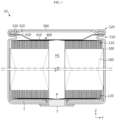
- FIG. 1 is a cross-sectional view of a cylindrical battery according to the present disclosure.
- FIG. 2 is a drawing illustrating the appearance of a cylindrical battery according to the present disclosure.
- FIG. 3 is a drawing illustrating a cylindrical battery prior to a crimping process according to the present disclosure.
- a cylindrical battery 10 may include an electrode assembly 100, a battery housing 200, and a top cap 300.
- the electrode assembly 100 may include a first electrode tap 110 and a second electrode tap 120.
- the electrode assembly 100 includes a first electrode having a first polarity, a second electrode having a second polarity, and a separator interposed between the first electrode and the second electrode.
- the first electrode is a negative electrode or a positive electrode
- the second electrode corresponds to an electrode having a polarity opposite that of the first electrode.
- the electrode assembly 100 may be manufactured by winding a stack, in which the first electrode, the separator, the second electrode, and the separator are sequentially stacked, at least once. That is, the electrode assembly 100 applied to the present disclosure may be a jelly-roll-type electrode assembly 100.
- the first electrode may be a positive electrode or a negative electrode
- the second electrode may be an electrode having an opposite polarity of the first electrode.
- the jelly-roll-type electrode assembly 100 may have a winding center hole H1 formed approximately at the center thereof and extending in the height direction (the direction parallel to the Z axis).
- the first electrode may include a first electrode plate and a first electrode active material layer formed by applying a first electrode active material onto at least one surface of the first electrode plate.
- the second electrode may include a second electrode plate and a second active material layer formed by applying a second electrode active material onto at least one surface of the second electrode plate.
- the first electrode may include a first uncoated portion on which a positive electrode active material or a negative electrode active material is not applied to the electrode plate.
- the second electrode may include a second uncoated portion on which a positive electrode active material or a negative electrode active material is not applied to the electrode plate.
- the first uncoated portion may be provided at the top of the electrode assembly 100, and the second uncoated portion may be provided at the bottom of the electrode assembly 100.
- At least a portion of the first uncoated portion may function as the first electrode tap 110, and at least a portion of the second uncoated portion may function as the second electrode tap 120.
- the electrode taps 110 and 120 are not limited to at least portions of the uncoated portions. That is, the electrode taps 110 and 120 may be provided separately and coupled to the uncoated portion.
- the battery housing 200 may receive the electrode assembly 100 through an opening O formed at the top.
- the battery housing 200 may be a substantially cylindrical container with an opening O formed at the top, and may be made of a conductive metal material.
- the side surface of the battery housing 200 and the lower surface (the surface located in the negative Z-axis direction) located opposite to the opening O may be formed integrally. That is, the battery housing 200 may have an open top and a closed bottom in the height direction.
- the lower surface of the battery housing 200 may be shaped to be substantially flat.
- the battery housing 200 may also receive an electrolyte through the opening O.
- the battery housing 200 of the present disclosure is not limited thereto.
- the battery housing 200 may include a recessed portion 210 and a crimping portion 220.
- the recessed portion 210 may be formed at an end adjacent to the opening O so as to be pressed inward.
- the recessed portion 210 may be configured such that the outer circumferential surface of the battery housing 200 is pressed to a predetermined depth.
- the recessed portion 210 may be formed at the top of the electrode assembly 100.
- the inner diameter of the battery housing 200 may be formed smaller than the diameter of the electrode assembly 100 in the area where the recessed portion 210 is formed.
- the crimping portion 220 may be formed at the top of the recessed portion 210.
- the crimping portion 220 may be configured to extend and bend so as to surround the edge area S1 of the top cap 300, which will be described later.
- the top cap 300 may be fixed onto the recessed portion 210 by the shape of the crimping portion 220.
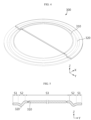
- FIG. 4 is a drawing illustrating a top cap, which is partially cut away, included in a cylindrical battery according to the present disclosure.
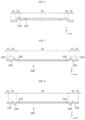
- FIGS. 5 to 10 are cross-sectional views of a top cap included in a cylindrical battery according to the present disclosure.
- the top cap 300 may be configured to cover the opening O.
- the top cap 300 may include an edge area S1, a central area S3, and a bent area S2.
- the edge area S1 may be located at the outermost portion of the top cap 300.
- the edge area S1 may be surrounded by the battery housing 200 during the crimping process.
- the central area S3 may be located further inward than the edge area S1.
- the bent area S2 may be located between the central area S3 and the edge area S1.
- the bent area S2 may have a first bent portion 320 shaped to be convexly bent downward. However, as shown in FIG. 6 , the first bent portion 320 may also be shaped to be convexly bent upward.
- the top cap 300 may be configured not to have polarity. That is, in the present disclosure, the top cap 300 may be configured not to be electrically connected to the electrode assembly 100.
- the top cap 300 may be made of, for example, a metal material to secure rigidity, but may not have polarity even in this case.
- the top cap 300 may include an insulating material.
- the present disclosure is not limited to the configuration in which the top cap 300 does not have polarity, and it may have the same polarity as the battery housing 200.
- the pressure may be buffered through the first bent portion 320.
- first bent portion 320 When pressure is applied toward the center and bottom of the top capable of 300, only a slight deformation may occur in the first bent portion 320 because the first bent portion 320 is shaped to be bent, and no deformation may occur or the deformation may be minimized in the edge area S1 and the central area S3 that are roughly flat. Therefore, even if the crimping process is performed, the deformation of the top cap 300 may be small, thereby improving the stability and durability of the battery.
- the central area S3 may be positioned higher than the edge area S1.
- the central area S3 may collect gas generated inside the battery. Therefore, the central area S3 may be more subject to the pressure by the gas. If the internal pressure of the battery housing 200 increases to a certain level due to abnormalities in the battery, the central area S3 may rupture or the crimping portion 220 may loosen, causing the gas to be released.
- the upper end of the battery housing 200 may be positioned higher than the upper end of the central area S3.
- the top cap 300 in the case where the opening O is located at the bottom, even if the bottom of the battery housing 200 touches the ground or the bottom surface of the housing for the module or pack, the top cap 300 does not touch the ground or the bottom surface of the housing for the module or pack. Therefore, the risk of scratching or damage to the top cap 300 may be reduced.
- the venting portion 310 described below is provided on the top cap 300, since the venting portion 310 does not touch the ground or the bottom surface of the housing for the module or pack, it is possible to prevent the pressure required for the rupture of the venting portion 310 from differing from the design value due to the weight of the cylindrical battery 10, thereby securing the smooth rupture of the venting portion 310.
- the lower end of the first bent portion 320 may be positioned lower than the lower end of the central area S3 and the lower end of the edge area S1.
- the lower end of the first bent portion 320 bent downward may be positioned lower than the lower end of the central area S3 and the lower end of the edge area S1.
- the total height of the top cap 300 may be reduced, compared to the case where the first bent portion 320 is shaped to be convex upward or where the lower end of the first bent portion 320 is positioned equal to or higher than the lower end of the central area S3 and the lower end of the edge area S1. Therefore, the height of the electrode assembly 100 may be increased by the height reduced by the top cap 300, thereby improving the energy density.
- the bent area S2 may include a second bent portion 330 that is bent convexly upward.
- the central area S3 may include a second bent portion 330 that is bent convexly upward. That is, the second bent portion 330 that is bent convexly upward may be provided in the bent area S2 and/or the central area S3.
- the second bent portion 330 may also be shaped to be bent convexly downward.
- bent area S2 and/or the central area S3 may further include two or more additional bent portions that are bent downward or upward.
- the upper end of the second bent portion 330 may be positioned at the same height as the upper end of the battery housing 200.
- the upper end of the second bent portion 330 bent upward may be positioned at the same height as the upper end of the battery housing 200.
- the opening O in the case where the opening O is located at the bottom, since the battery is supported by the second bent portion 330, as well as the battery housing 200, it may be supported more stably.
- the venting portion 310 described below is provided in the top cap 300, and if this venting portion 310 is formed further inward from the center than the second bent portion 330, the crimping pressure may be absorbed by the second bent portion 330, so it is possible to prevent the pressure required for the breakage or rupture of the venting portion 310 by the force applied to the venting portion 310 from differing from the design value.
- the crimping pressure that the top cap may absorb may be increased.
- the top cap 300 may have a venting portion 310 that is configured to be more vulnerable than the surrounding area.
- the venting portion 310 may have a thickness less than the surrounding area.
- the venting portion 310 may be provided in the central area S3.
- the venting portion 310 may be formed by notching one side or both sides of the top cap 300 to partially reduce the thickness of the top cap 300.
- the venting portion 310 may rupture, so that gas may be discharged.
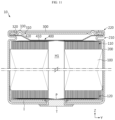
- the cylindrical battery 10 may include a first collector 400.
- the first collector 400 may be positioned between the electrode assembly 100 and the top cap 300.
- the first collector 400 may have a first tab-coupling portion 410 electrically coupled to the first electrode tap 110.
- the first collector 400 may have a housing coupling portion 420 coupled onto the inner surface of the battery housing 200.
- the first bent portion 320 may be positioned on the housing coupling portion 420.
- the first bent portion 320 may be positioned to be in contact with the housing coupling portion 420 and be seated thereon. However, even if they are not in contact with each other, the first bent portion 320 may be positioned to overlap the housing coupling portion 420 in the extension direction along the Z axis.
- the top cap is configured not to have polarity
- at least the first bent portion 320 in contact with the housing coupling portion 420 may be insulated.
- the housing coupling portion 420 may be stably coupled to the battery housing 200.
- the cylindrical battery 10 may include a terminal T, a second collector P, and an insulator I.
- the terminal T may be electrically connected to the second electrode tap 120.
- the terminal T may be electrically connected to the second electrode tap 120 by passing through the closed portion of the battery housing 200 provided on the opposite side of the opening O of the battery housing 200.
- the terminal T may pass through approximately the center of the lower surface of the battery housing 200.
- the terminal T may be electrically connected to the electrode assembly 100 by being coupled to the second collector P to be described below.
- the second collector P may be electrically coupled to the second electrode tap 120.
- the second collector P may be electrically coupled to the terminal T.
- the second collector P may have a terminal-coupling portion coupled with the terminal T, and a second tab-coupling portion coupled with the second electrode tap 120.
- the insulator I may be positioned on the second electrode tap 120 for insulation between the battery housing 200 and the second electrode tap 120.
- the insulator I may be interposed between the closed portion of the battery housing 200 and the electrode assembly 100 or between the closed portion of the battery housing 200 and the second collector P.
- the insulator I may include, for example, a resin material having insulating properties.
- the insulator I may have a hole approximately at the center so that the terminal T may be electrically connected to the second electrode tap 120.
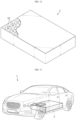
- FIG. 12 is a drawing illustrating a battery pack 2 according to the present disclosure.
- the battery pack 2 may include a cylindrical battery 10.
- the battery pack 2 may further include various components of the battery pack 2 known at the time of filing the present disclosure, in addition to the cylindrical battery 10, such as a BMS, a bus-bar, a pack case, a relay, a current sensor, and the like
- the battery housing 200 functioning as the first electrode terminal and the terminal T functioning as the second electrode terminal are positioned at the top. This may facilitate electrical connection performed at the top.
- the venting portion 310 does not touch the ground or the bottom surface of the housing for the module or pack, it is possible to prevent the pressure required for the rupture of the venting portion 310 from differing from the design value due to the weight of the cylindrical battery 10, thereby securing the smooth rupture of the venting portion 310.
- FIG. 13 is a drawing illustrating a vehicle 1 according to the present disclosure.
- the vehicle 1 according to the present disclosure may include a battery pack 2.
- the vehicle 1 may be a hybrid vehicle 1 or an electric vehicle 1.
- the vehicle 1 according to the present disclosure may further include various other components included in the vehicle 1, in addition to the battery pack 2.
- the vehicle 1 according to the present disclosure may further include a car body, a motor, a control device such as an ECU (electronic control unit), or the like, in addition to the battery pack 2 according to the present disclosure.
- ECU electronic control unit
Landscapes
- Chemical & Material Sciences (AREA)
- Chemical Kinetics & Catalysis (AREA)
- Electrochemistry (AREA)
- General Chemical & Material Sciences (AREA)
- Engineering & Computer Science (AREA)
- Aviation & Aerospace Engineering (AREA)
- Sealing Battery Cases Or Jackets (AREA)
- Battery Mounting, Suspending (AREA)
- Gas Exhaust Devices For Batteries (AREA)
- Connection Of Batteries Or Terminals (AREA)
Applications Claiming Priority (2)
| Application Number | Priority Date | Filing Date | Title |
|---|---|---|---|
| KR1020230059395A KR20240162376A (ko) | 2023-05-08 | 2023-05-08 | 원통형 배터리, 그리고 이를 포함하는 배터리 팩 및 자동차 |
| PCT/KR2024/004440 WO2024232545A2 (ko) | 2023-05-08 | 2024-04-04 | 원통형 배터리, 그리고 이를 포함하는 배터리 팩 및 자동차 |
Publications (1)
| Publication Number | Publication Date |
|---|---|
| EP4571963A2 true EP4571963A2 (de) | 2025-06-18 |
Family
ID=93430605
Family Applications (1)
| Application Number | Title | Priority Date | Filing Date |
|---|---|---|---|
| EP24803601.4A Pending EP4571963A2 (de) | 2023-05-08 | 2024-04-04 | Zylindrische batterie und batteriepack und fahrzeug damit |
Country Status (5)
| Country | Link |
|---|---|
| EP (1) | EP4571963A2 (de) |
| JP (1) | JP2025535969A (de) |
| KR (1) | KR20240162376A (de) |
| CN (1) | CN120500768A (de) |
| WO (1) | WO2024232545A2 (de) |
Family Cites Families (12)
| Publication number | Priority date | Publication date | Assignee | Title |
|---|---|---|---|---|
| US5532081A (en) * | 1994-08-24 | 1996-07-02 | Duracell Inc. | Upward deflecting support disk for electrochemical cell seal |
| KR100683042B1 (ko) * | 2005-09-27 | 2007-02-15 | 주식회사 비츠로셀 | 전지의 케이스 |
| KR101218370B1 (ko) * | 2012-11-09 | 2013-01-03 | 주식회사 비츠로셀 | 안전성이 우수한 리튬 전지 |
| KR101666552B1 (ko) * | 2015-02-13 | 2016-10-14 | 주식회사 일광엠씨티 | 원통형 전지의 캡 조립체 제조방법 |
| KR102821618B1 (ko) * | 2020-12-24 | 2025-06-16 | 주식회사 엘지에너지솔루션 | 이차전지 및 이의 제조 방법 |
| CN217788661U (zh) * | 2021-02-19 | 2022-11-11 | 株式会社Lg新能源 | 二次电池、应用于其的集电板、包括其的电池组及汽车 |
| JP7523664B2 (ja) * | 2021-09-30 | 2024-07-26 | 寧徳時代新能源科技股▲分▼有限公司 | 電池セル、その製造方法及び製造システム、電池並びに電力消費装置 |
| KR102672597B1 (ko) | 2021-10-26 | 2024-06-05 | (주)일지테크 | 상부 냉각방식 전기 자동차용 배터리 모듈 케이스 |
| CN216563457U (zh) * | 2021-12-29 | 2022-05-17 | 远景动力技术(江苏)有限公司 | 电池、电池包和电子设备 |
| CN217182299U (zh) * | 2022-04-30 | 2022-08-12 | 远景动力技术(江苏)有限公司 | 壳体和圆柱电池 |
| CN217182288U (zh) * | 2022-04-30 | 2022-08-12 | 远景动力技术(江苏)有限公司 | 壳体和圆柱电池 |
| CN115275539B (zh) * | 2022-08-12 | 2024-01-23 | 郑州比克电池有限公司 | 一种圆柱锂电池绝缘结构 |
-
2023
- 2023-05-08 KR KR1020230059395A patent/KR20240162376A/ko active Pending
-
2024
- 2024-04-04 WO PCT/KR2024/004440 patent/WO2024232545A2/ko not_active Ceased
- 2024-04-04 EP EP24803601.4A patent/EP4571963A2/de active Pending
- 2024-04-04 CN CN202480003070.4A patent/CN120500768A/zh active Pending
- 2024-04-04 JP JP2025525100A patent/JP2025535969A/ja active Pending
Also Published As
| Publication number | Publication date |
|---|---|
| CN120500768A (zh) | 2025-08-15 |
| JP2025535969A (ja) | 2025-10-30 |
| KR20240162376A (ko) | 2024-11-15 |
| WO2024232545A2 (ko) | 2024-11-14 |
| WO2024232545A3 (ko) | 2025-08-14 |
Similar Documents
| Publication | Publication Date | Title |
|---|---|---|
| US7364817B2 (en) | Secondary battery and method of manufacturing the same | |
| EP2498318B1 (de) | Batteriepack | |
| US9627677B2 (en) | Rechargeable battery | |
| US9136523B2 (en) | Rechargeable battery | |
| CN101826629A (zh) | 可再充电电池 | |
| US20170062795A1 (en) | Battery module | |
| KR20240101310A (ko) | 배터리 셀, 배터리 팩 및 이를 포함하는 자동차 | |
| EP2602841A1 (de) | Batterie | |
| US12438228B2 (en) | Battery cell, battery pack, and vehicle including same | |
| EP4187662B1 (de) | Batterie | |
| EP4311016A1 (de) | Sekundärbatterie mit verbesserter anschlussstruktur | |
| EP4468495A1 (de) | Batteriezelle, batteriepack und fahrzeug damit | |
| EP4571963A2 (de) | Zylindrische batterie und batteriepack und fahrzeug damit | |
| EP4572000A1 (de) | Batterie und batteriepack sowie fahrzeug damit | |
| EP2330660B1 (de) | Wiederaufladbare Batterie | |
| EP4191754A1 (de) | Sekundärbatterie | |
| EP4664665A1 (de) | Zylindrische batteriezelle, batteriepack und fahrzeug damit sowie stromabnehmerplatte | |
| EP4654375A1 (de) | Zylindrische batteriezelle und batteriepack und fahrzeug damit | |
| EP4539197A1 (de) | Zylindrische batterie und batteriepack und fahrzeug damit | |
| EP4675732A1 (de) | Elektrodenanordnung und batterie und batteriepack damit | |
| EP4572078A1 (de) | Batteriezellenlade- und -entladevorrichtung und damit hergestellte batteriezelle sowie batteriepack und fahrzeug mit batteriezellen | |
| EP4668451A1 (de) | Batterie und batteriepack sowie fahrzeug damit | |
| EP4629360A1 (de) | Dorn für elektrodenanordnung und damit hergestellte zylindrische batteriezelle sowie batteriepack und fahrzeug mit zylindrischer batteriezelle | |
| EP4468507A1 (de) | Batteriezelle, batteriemodul mit der batteriezelle und batteriepack mit dem batteriemodul | |
| EP4730500A1 (de) | Batteriezelle und batteriepack und elektrisches zweiradfahrzeug mit der batteriezelle |
Legal Events
| Date | Code | Title | Description |
|---|---|---|---|
| STAA | Information on the status of an ep patent application or granted ep patent |
Free format text: STATUS: THE INTERNATIONAL PUBLICATION HAS BEEN MADE |
|
| PUAI | Public reference made under article 153(3) epc to a published international application that has entered the european phase |
Free format text: ORIGINAL CODE: 0009012 |
|
| STAA | Information on the status of an ep patent application or granted ep patent |
Free format text: STATUS: REQUEST FOR EXAMINATION WAS MADE |
|
| 17P | Request for examination filed |
Effective date: 20250314 |
|
| AK | Designated contracting states |
Kind code of ref document: A2 Designated state(s): AL AT BE BG CH CY CZ DE DK EE ES FI FR GB GR HR HU IE IS IT LI LT LU LV MC ME MK MT NL NO PL PT RO RS SE SI SK SM TR |
|
| PUAK | Availability of information related to the publication of the international search report |
Free format text: ORIGINAL CODE: 0009015 |