EP4570856A1 - Compositions de copolymère statistique de polypropylène présentant une résistance aux chocs améliorée pour des applications de tuyau - Google Patents
Compositions de copolymère statistique de polypropylène présentant une résistance aux chocs améliorée pour des applications de tuyau Download PDFInfo
- Publication number
- EP4570856A1 EP4570856A1 EP23216758.5A EP23216758A EP4570856A1 EP 4570856 A1 EP4570856 A1 EP 4570856A1 EP 23216758 A EP23216758 A EP 23216758A EP 4570856 A1 EP4570856 A1 EP 4570856A1
- Authority
- EP
- European Patent Office
- Prior art keywords
- propylene copolymer
- copolymer component
- polypropylene composition
- propylene
- bimodal
- Prior art date
- Legal status (The legal status is an assumption and is not a legal conclusion. Google has not performed a legal analysis and makes no representation as to the accuracy of the status listed.)
- Granted
Links
Images


Classifications
-
- C—CHEMISTRY; METALLURGY
- C08—ORGANIC MACROMOLECULAR COMPOUNDS; THEIR PREPARATION OR CHEMICAL WORKING-UP; COMPOSITIONS BASED THEREON
- C08L—COMPOSITIONS OF MACROMOLECULAR COMPOUNDS
- C08L23/00—Compositions of homopolymers or copolymers of unsaturated aliphatic hydrocarbons having only one carbon-to-carbon double bond; Compositions of derivatives of such polymers
- C08L23/02—Compositions of homopolymers or copolymers of unsaturated aliphatic hydrocarbons having only one carbon-to-carbon double bond; Compositions of derivatives of such polymers not modified by chemical after-treatment
- C08L23/10—Homopolymers or copolymers of propene
- C08L23/14—Copolymers of propene
-
- C—CHEMISTRY; METALLURGY
- C08—ORGANIC MACROMOLECULAR COMPOUNDS; THEIR PREPARATION OR CHEMICAL WORKING-UP; COMPOSITIONS BASED THEREON
- C08L—COMPOSITIONS OF MACROMOLECULAR COMPOUNDS
- C08L2205/00—Polymer mixtures characterised by other features
- C08L2205/02—Polymer mixtures characterised by other features containing two or more polymers of the same C08L -group
- C08L2205/025—Polymer mixtures characterised by other features containing two or more polymers of the same C08L -group containing two or more polymers of the same hierarchy C08L, and differing only in parameters such as density, comonomer content, molecular weight, structure
-
- C—CHEMISTRY; METALLURGY
- C08—ORGANIC MACROMOLECULAR COMPOUNDS; THEIR PREPARATION OR CHEMICAL WORKING-UP; COMPOSITIONS BASED THEREON
- C08L—COMPOSITIONS OF MACROMOLECULAR COMPOUNDS
- C08L2205/00—Polymer mixtures characterised by other features
- C08L2205/03—Polymer mixtures characterised by other features containing three or more polymers in a blend
-
- C—CHEMISTRY; METALLURGY
- C08—ORGANIC MACROMOLECULAR COMPOUNDS; THEIR PREPARATION OR CHEMICAL WORKING-UP; COMPOSITIONS BASED THEREON
- C08L—COMPOSITIONS OF MACROMOLECULAR COMPOUNDS
- C08L2205/00—Polymer mixtures characterised by other features
- C08L2205/03—Polymer mixtures characterised by other features containing three or more polymers in a blend
- C08L2205/035—Polymer mixtures characterised by other features containing three or more polymers in a blend containing four or more polymers in a blend
Definitions
- the present invention relates to propylene compositions comprising a nucleated propylene copolymer having an improved balance of properties in regard of mechanical properties including stiffness and toughness which are particularly suitable for pipe applications.
- the invention further relates to respective processes for the production of such polypropylene compositions, an article comprising the polypropylene compositions and the use of the polypropylene compositions for the production of an article.
- Polypropylene materials are frequently used for various pipe and pipe fitting applications, such as fluid transport, e.g. water or natural gas, during which the fluid is pressurized and/or heated.
- fluid transport e.g. water or natural gas
- polypropylene materials are used in applications for plumbing and heating, such as in-house hot and cold water pressure pipes and fittings, floor and wall heating systems and radiator connections.
- propylene random copolymers are especially suitable for pressure pipe applications for hot water and industrial pipes as the random copolymers have inter alia good impact performance, stiffness, creep resistance and slow crack properties and long term pressure resistance.
- polypropylene random copolymers for hot and cold water applications require a good balance of stiffness (resistance to static loads - hydrostatic pressure) and toughness (resistance to dynamic loads - impact at low temperatures).
- pressure pipe used herein refers to a pipe which, when used, is subjected to a positive pressure, that is the pressure inside the pipe being higher than the pressure outside the pipe.
- block copolymers in which ethylene rich rubber particles are dispersed in a homopolypropylene matrix.
- block copolymers are not preferred since the rubber particles are weak domains against internal pressure leading to insufficient pressure resistance of the pipes.
- Stiffness/toughness balance of bimodal PPRC materials were significantly improved with multimodal reactor design, where comonomer rich material produced in a second reactor improves the toughness of the material without significantly sacrificing the stiffness.
- impact modifiers such as for example polyethylene (PE) or Styrene-EthyleneButylene-Styrene (SEBS) can be added to the propylene random copolymers to improve the impact performance which, however, also has a negative effect on the stiffness and, therefore, the pressure resistance.
- PE polyethylene
- SEBS Styrene-EthyleneButylene-Styrene
- the instant invention relates to a polypropylene composition
- a polypropylene composition comprising
- the polypropylene composition according to the invention has an advantageous property balance between stiffness and impact as can be seen from the Flexural Modulus, the Tensile Modulus for stiffness and from the Charpy Notched Impact Strength at cold temperature 0°C and also at room temperature.
- the balance between the Flexural Modulus, the Tensile Modulus and the Charpy Notched Impact Strength provides sufficient stiffness and good impact properties to the polypropylene composition of the invention which balance preferably contribute to pressure resistance as shown in experimental part making it highly suitable for pipe applications, more preferably for hot and cold water pressure pipe applications.
- the present polypropylene composition provides advantageous pressure resistance of pipes obtained which is required for pressure pipe applications both at room temperature (20°C) as well as elevated temperature (95°C).
- the present polypropylene composition has preferably also an advantageous processing behavior in terms of pipe extrusion processability as can be seen from the rheological properties in particular from the complex viscosity at 300 rad/s, eta* 300 .
- the invention is further directed to a process for producing a polypropylene composition wherein the bimodal propylene copolymer (PP) with at least one comonomer being ethylene is polymerized in a multistage polymerization process in the presence of
- PP bimodal propylene copolymer
- the invention further provides a polypropylene composition obtainable by said process.
- the invention is further directed to an article comprising the polypropylene composition according to the invention.
- the invention is further directed to the use of the polypropylene composition according to the invention for the production of an article.
- a polypropylene composition according to the invention denotes a polymer derived from at least 50 mol-% propylene monomer units and additional comonomer units.
- a propylene copolymer denotes a polymer consisting of propylene monomer units and comonomer units in an amount of at least 0.1 mol%. In a propylene random copolymer the comonomer units are randomly distributed in the polymer chain.
- a ethylene copolymer denotes a polymer consisting of ethylene monomer units and comonomer units in an amount of at least 0.1 mol%.
- An ethylene homopolymer denotes a polymer consisting essentially of ethylene monomer units. Due to the requirements of large-scale polymerization it may be possible that the ethylene homopolymer includes minor amounts of comonomer units, which usually is below 0.1 mol%, preferably below 0.05 mol%, most preferably below 0.01 mol% of the ethylene homopolymer.
- 'different' denotes that a polymeric component differs from another polymeric component in at least one measurable property.
- Suitable properties for differentiating polymeric components are weight average molecular weight, melt flow rate MFR 2 , density or comonomer content.
- base resin (A)' denotes the polymeric component of the composition.
- the base resin (A) comprises i) a bimodal propylene copolymer (PP) and ii) a polyethylene (PE), more particularly 90.0 to 99.9 wt.% of a bimodal propylene copolymer (PP) with at least one comonomer being ethylene (referred herein also as propylene copolymer) based on the total weight of the base resin (A) and ii) 0.1 to 10 wt.% of a polyethylene (PE) having a density of equal or below 940 kg/m 3 based on the total weight of the base resin (A).
- PP bimodal propylene copolymer
- PE polyethylene
- PE polyethylene
- the bimodal propylene copolymer (PP) comprises (PP1) a first propylene copolymer component and (PP2) a second propylene copolymer component, wherein the first propylene copolymer component (PP1) is different from the second propylene copolymer component (PP2), and wherein the weight ratio of the first propylene copolymer component (PP1) including an optional prepolymer component to the second propylene copolymer component (PP2) is from 30:70 to 70:30.
- the bimodal propylene copolymer (PP) and the polyethylene (PE) are further described below.
- the base resin (A) comprises 92.0 to 99.5 wt.%, more preferably 95.0 to 99.0 wt.%, most preferably 96.0 to 98.0 wt.% of the propylene random copolymer (PP) based on the total weight of the base resin (A) and 0.5 to 8.0 wt.%, more preferably 1.0 to 5.0 wt.%, most preferably 2.0 to 4.0 wt.% of a polyethylene having a density of equal or below 940 kg/m 3 based on the total weight of the base resin (A).
- PP propylene random copolymer
- the base resin (A) comprises the propylene random copolymer (PP) and the polyethylene (PE) in a weight ratio of 92.0:8.0 to 99.5:0.5, more preferably in a weight ratio of 95.0:5.0 to 99.0:1.0, still more preferably in a 96.0:4.0 to 98.0:2.0.
- PP propylene random copolymer
- PE polyethylene
- the amount of the sum of the propylene random copolymer (PP) and the polyethylene (PE) is at least 90 wt.%, more preferably at least 95 wt.%, still more preferably at least 98 wt.% and up to 100 wt.%, based on the total amount of the base resin (A).
- the base resin consists of the bimodal propylene copolymer (PP) and the polyethylene (PE) as defined above and further below.
- the base resin may further comprise further polymer components different to the bimodal propylene copolymer (PP) and the polyethylene (PE) as defined above and further below. It is preferred that the base resin (A) of the present invention does - apart from the propylene random copolymer (PP) and the polyethylene (PE) - not contain any further polymeric material in an amount exceeding 10 wt.%, preferably in an amount exceeding 5.0 wt.%, more preferably in an amount exceeding 2.5 wt.%, still more preferably in an amount exceeding 1.5 wt.%, based on the overall weight of the base resin (A).
- the base resin of the present invention consists of the bimodal propylene copolymer (PP) and the polyethylene (PE) as described above and further defined below.
- Polymeric material excludes herein any carrier polymer(s) of optional additive, e.g. master batche(s) of additive(s) together with the carrier polymer, optionally present in the polymer composition. Such optional carrier polymer(s) are calculated to the amount of the respective additive based on the amount (100 %) of the polymer composition. Polymers which are part of additive mixtures, e.g. carrier polymers in masterbatches, are excluded from the definition of "polymeric material”.
- the base resin (A) has a total ethylene content of 5.0 to 12.0 wt.%, preferably 5.1 to 10.0 wt.%, more preferably 5.5 to 9.0 wt.% based on the total weight of the base resin (A) determined as described below.
- the polymer composition comprises a nucleating agent (B), and may comprise and preferably comprises usual additives for utilization with polyolefins.
- a nucleating agent denotes herein a compound or composition which is added on purpose to increase the crystallization rate within the solid polymer and lead to an increased degree of crystallinity (and often to a smaller crystal size) of the solid polymer.
- the nucleating agent (B) used in the polypropylene composition of the invention is preferably a polymeric nucleating agent, preferably a polymer of vinyl compound, more preferably a polymeric nucleating agent obtainable by polymerizing vinylcycloalkane monomers or vinylalkane monomers.
- the polymeric nucleating agent is selected from: vinyl cycloalkane polymer, preferably vinyl cyclohexane (VCH) polymer, vinyl cyclopentane polymer, 3-methyl-1-butene polymer and vinyl-2-methyl cyclohexane polymer.
- VCH vinyl cyclohexane
- the most preferred nucleating agent is vinyl cyclohexane (VCH) polymer.
- nucleating agent is a polymeric nucleating agent, more preferably a polymer of vinyl compound according to the formula (BI) as defined above, even more preferably vinyl cyclohexane (VCH) polymer.
- the amount of nucleating agent preferably is not more than 10000 ppm by weight (means parts per million based on the total weight of the polypropylene composition (100 wt.%), also abbreviated herein shortly as ppm), more preferably not more than 6000 ppm, even more preferably not more than 5000 ppm, based on the total weight of the bimodal propylene copolymer (PP) (100 wt.%).
- the amount of the nucleating agent still more preferably is not more than 500 ppm, preferably is from 0.025 to 200 ppm, and more preferably is from 0.1 to 200 ppm, more preferably is from 0.3 to 200 ppm, most preferably is from 0.3 to 100 ppm, based on the total weight of the bimodal propylene copolymer (PP) (100 wt.%).
- the nucleating agent is a polymeric nucleating agent, most preferably a polymer of vinyl compound according to formula (BI) as defined above, even more preferably vinyl cyclohexane (VCH) polymer as defined above, and the amount of said nucleating agent (B) is not more than 200 ppm, more preferably is from 0.025 to 200 ppm, and more preferably is from 0.1 to 200 ppm, more preferably is from 0.3 to 200 ppm, most preferably is from 0.3 to 100 ppm, based on the total weight of the bimodal propylene copolymer (PP) (100 wt.%).
- a polymeric nucleating agent most preferably a polymer of vinyl compound according to formula (BI) as defined above, even more preferably vinyl cyclohexane (VCH) polymer as defined above, and the amount of said nucleating agent (B) is not more than 200 ppm, more preferably is from 0.025 to 200 ppm, and more preferably is from
- the nucleating agent may be introduced to the propylene random copolymer (PP) e.g. during the polymerization process of the propylene random copolymer (PP) or may be incorporated to the propylene random copolymer (PP) by mechanical blending with a nucleated polymer, containing the polymeric nucleating agent (so-called master batch technology) or by mechanical blending of the bimodal propylene copolymer (PP) with the nucleating agent as such.
- the nucleating agent can be introduced to the bimodal propylene copolymer (PP) during the polymerization process of the bimodal propylene copolymer (PP).
- the nucleating agent is preferably introduced to the bimodal propylene copolymer (PP) by first polymerizing the above defined vinyl compound according to formula (BI) as defined above, even more preferably vinyl cyclohexane (VCH), in the presence of a catalyst system as described above, comprising a solid Ziegler Natta catalyst component, a cocatalyst and optional external donor, and the obtained reaction mixture of the polymer of the vinyl compound according to formula (BI) as defined above, even more preferably vinyl cyclohexane (VCH) polymer, and the catalyst system is then used for producing the bimodal propylene copolymer (PP).
- a catalyst system as described above, comprising a solid Ziegler Natta catalyst component, a cocatalyst and optional external donor
- the polymeric nucleating agent is added with the so called masterbatch technology, where an already nucleated polymer, preferably a propylene homopolymer, containing the polymeric nucleating agent (masterbatch) is blended with the bimodal propylene copolymer (PP).
- masterbatch is preferably prepared by polymerizing propylene in a sequential polymerization process.
- Usual additives are acid scavengers, antioxidants, colorants, light stabilisers, plasticizers, slip agents, anti-scratch agents, dispersing agents, processing aids, lubricants, pigments, fillers, and the like.
- Each additive can be used e.g. in conventional amounts, the total amount of additives present in the propylene composition being preferably as defined below.
- the total amount of optional further additives is preferably between 0.0001 and 10 wt%, preferably 0.0001 and 5.0 wt%, preferably 0.0001 and 2.5 wt%, more preferably between 0.0001 and 1.5 wt%, still more preferably between 0.0001 and 1.0 wt%, based on the total weight of the polypropylene composition (100 wt%).
- the carrier material, e.g. carrier polymer, of the additive is calculated to the (total) amount of the additive(s), based on the total weight of the polypropylene composition (100 wt%).
- Part or all of the optional additives may be incorporated to the base resin, in particular to bimodal propylene copolymer (PP), by the base resin producer during the production of base resin, e.g. during the pelletizing step of the base resin powder obtained from the polymerization reactor or by the article producer during the compounding step of the polymer composition.
- PP bimodal propylene copolymer
- the polypropylene composition of the invention comprises, preferably consists of, the base resin (A) as the polymeric component(s) comprising a bimodal propylene copolymer (PP) and a polyethylene (PE) as described above and further defined below, a nucleating agent (B) and optional further additives.
- the base resin (A) as the polymeric component(s) comprising a bimodal propylene copolymer (PP) and a polyethylene (PE) as described above and further defined below, a nucleating agent (B) and optional further additives.
- the polypropylene composition of the invention is a bimodal polypropylene composition.
- the composition comprises, preferably consists of, a base resin (A) and a nucleating agent (B), wherein the base resin (A) comprises, preferably consists of, i) 90.0 to 99.9 wt.% of a bimodal propylene copolymer (PP) with at least one comonomer being ethylene (referred herein also as propylene copolymer) based on the total weight of the base resin (A) and ii) 0.1 to 10 wt.% of a polyethylene having a density of equal or below 940 kg/m 3 based on the total weight of the base resin (A), and optional further additives, as defined below.
- PP bimodal propylene copolymer
- the inventive polypropylene composition comprises at least 90 wt.%, more preferably at least 95 wt.%, even more preferably at least 98 wt.% and up to 99.9 wt.% of the base resin (A), based on the total weight of the inventive polypropylene composition. It is especially preferred that polypropylene composition according to the invention consists of the base resin (A) as described above, a nucleating agent (B) and optional further additives, as defined above.
- the base resin consists of the bimodal propylene copolymer (PP) and the polyethylene (PE) as described above and further defined below and thereby the polypropylene composition according to the invention preferably consists of the bimodal propylene copolymer (PP), the nucleating agent (B), the polyethylene (PE) and optional further additives, as defined above or below.
- the polypropylene composition of the invention has a melt flow rate MFR 2 (2.16 kg, 230°C) of from 0.15 to 0.5 g/10 min, preferably of from 0.17 to 0.4 g/10 min, more preferably of from 0.20 to 0.35 g/10 min, determined according to ISO 1133 at 230 °C and a load of 2.16 kg.
- the polypropylene composition of the invention has a total ethylene content of 5.0 to 12.0 wt. %, preferably 5.5 to 10 wt%, more preferably 6.0 to 8.0 wt%, based on the total weight of the composition determined as described below.
- the polypropylene composition of the invention has a content of xylene cold solubles (XCS) of equal to or below 10.0 wt%, preferably of 4.0 to 9.7 wt%, more preferably of 5.0 to 9.4 wt.%, based on the total weight of the polypropylene composition determined according to ISO 16152 at 25°C.
- XCS xylene cold solubles
- the polypropylene composition has a Charpy Notched Impact Strength at 23°C of 50.0 kJ/m 2 to 100.0 kJ/m 2 , preferably of 55.0 to 95.0 kJ/m 2 more preferably of 60.0 to 90.0 kJ/m 2 , determined according to ISO 179/1eA:2000 using notched injection moulded type 1A specimens.
- the polypropylene composition has a Charpy Notched Impact Strength at 0°C of at least 5.0 kJ/m 2 , preferably of at least 5.5 kJ/m 2 and more preferably of at least 6.0 kJ/m 2 , determined according to ISO 179/1eA:2000 using notched injection moulded type 1A specimens.
- the upper limit of the Charpy Notched Impact Strength at 0°C is usually not higher than 15 kJ/m 2 .
- the polypropylene composition preferably has a flexural modulus of 700 to 1400 MPa, more preferably 740 to 1200 MPa and most preferably 780 to 1100 MPa determined according to ISO 178 using injection moulded 80 ⁇ 10 ⁇ 4.0 mm 3 (length ⁇ width ⁇ thickness) specimens.
- the polypropylene composition preferably has a tensile modulus of from 700 to 1200 MPa, preferably 750 to 1100 MPa, more preferably 800 to 1000 MPa determined according to ISO 527-2 using injection molded type 1A specimens.
- the polypropylene composition preferably has a melting temperature T m of from 135°C to 155°C, preferably 137° C to 152° C, preferably 140° C to 150° C determined according to ISO 11357-3.
- the polypropylene composition preferably has a crystallization temperature T c of not less than 100° C, preferably 105° C to 130° C, preferably 107° C to 127° C, preferably 110° C to 125° C determined according to ISO 11357 -3.
- the polypropylene composition preferably has a complex viscosity at 300 rad/s eta* 300 of 400 Pa ⁇ s to 1000 Pa ⁇ s, more preferably 450 Pa ⁇ s to 900 Pa ⁇ s, most preferably 500 Pa ⁇ s to 800 Pas determined according to ISO 6721-1 and 6721-10.
- the polypropylene composition preferably has a complex viscosity at 0.05 rad/s eta* 0.05 of 60,000 Pa ⁇ s to 100,000 Pas, more preferably 70,000 Pa ⁇ s to 95,000 Pas, most preferably 75,000 Pa ⁇ s to 90,000 Pa ⁇ s determined according to ISO 6721-1 and 6721-10.
- the polypropylene composition preferably has a shear thinning index SHI (2.7/210) of 80 to 200, more preferably 100 to 180, more preferably 110 to 160 determined according to ISO 6721-1 and 6721-10.
- the polypropylene composition preferably has a weight average molecular weight Mw of 400 kg/mol to 800 kg/mol determined according to ISO 16014-1:2003 and ISO 16014-4:2003.
- the polypropylene composition preferably has a number average molecular weight Mn of 30 kg/mol to 60 kg/mol determined according to ISO 16014-1:2003 and ISO 16014-4:2003
- Mn the number average molecular weight
- Mw the weight average molecular weight
- the polypropylene composition preferably has a pressure resistance of at least 100 h, more preferably 500 h, most preferably of at least 1100 h, determined according to ISO 1167-1:2006 at a hoop stress of 4.5 MPa and 95 °C.
- the upper limit is usually not higher than 10,000 hours.
- the polypropylene composition preferably has a pressure resistance of at least 50 h, more preferably of at least 100 h, most preferably of at least 400 h, determined according to ISO 1167-1:2006 at a hoop stress of 14 MPa and 20 °C.
- the upper limit is usually not higher than 10,000 hours.
- the polypropylene composition preferably has a pressure resistance of at least 1 h, more preferably of at least 2 h, most preferably of at least 5 h, determined according to ISO 1167-1:2006 at a hoop stress of 16 MPa and 20 °C.
- the upper limit is usually not higher than 2,000 hours.
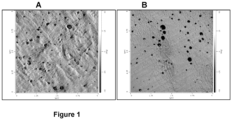
- the polypropylene composition preferably comprises a continuous matrix phase and a dispersed phase distributed in the matrix phase, wherein the dispersed phase is a particle comprising a core and a shell determined using Atomic Force Microscopy (AFM) imaging coupled with NanoIR analysis as described below.
- the mean particle size of the dispersed phase particles is 50 to 600 nm, more preferably 80 to 550 nm, even more preferably 100 to 500 nm determined using AFM imaging coupled with NanoIR analysis as described below.
- the mean inter-particle distance is 20 to 200 nm, more preferably 30 to 190 nm, even more preferably 40 to 180 nm determined using AFM imaging coupled with NanoIR analysis as described below.
- the matrix phase comprises polypropylene copolymer and the dispersed phase comprise a mixture of polypropylene and polyethylene.
- the bimodal propylene copolymer (PP) with at least one comonomer being ethylene is a propylene random copolymer.
- the bimodal propylene random copolymer (PP) is the major component of the inventive polypropylene composition.
- a propylene random copolymer denotes a copolymer of propylene monomer units and comonomer units in which the comonomer units are randomly distributed in the polymeric chain.
- a propylene random copolymer includes a fraction, which is insoluble in xylene - xylene cold insoluble (XCU) fraction, in an amount of at least 70 wt%, more preferably of at least 80 wt%, still more preferably of at least 85 wt% and most preferably of at least 91.8 wt%, based on the total amount of the propylene random copolymer.
- a random copolymer is different from heterophasic polypropylene which is a propylene copolymer comprising a propylene homo or random copolymer matrix component (1) and an elastomeric copolymer component (2) of propylene with one or more of ethylene and C4-C8 alpha-olefin copolymers, wherein the elastomeric (amorphous) copolymer component (2) is dispersed in said propylene homo or random copolymer matrix polymer (1).
- the presence of elastomeric phase or the so called inclusions are for instance visible by high resolution microscopy, like electron microscopy or atomic force microscopy.
- the bimodal random propylene copolymer (PP) according to the invention does not contain an elastomeric polymer phase.
- the term bimodal propylene copolymer (PP) according to the present invention excludes all heterophasic systems.
- the bimodal propylene random copolymer (PP) according to the invention does not comprise an elastomeric phase.
- the bimodal propylene random copolymer (PP) is a monophasic propylene random copolymer.
- a bimodal propylene polymer comprising at least two propylene polymer fractions (components), which have been produced under different polymerization conditions resulting in different (weight average) molecular weights and/or different comonomer contents for the fractions, preferably produced by polymerizing in multiple polymerization stages with different polymerization conditions, is referred to as "multimodal".
- multi relates to the number of different polymer fractions the propylene polymer is consisting of.
- a propylene polymer consisting of two fractions only is called "bimodal”
- a propylene polymer consisting of three fractions only is called "trimodal".
- the term "different" means that the propylene polymer fractions differ from each other in at least one property, preferably in the weight average molecular weight or comonomer content or both, more preferably at least in the weight average molecular weight.
- the form of the molecular weight distribution curve i.e. the appearance of the graph of the polymer weight fraction as function of its molecular weight, of such a multimodal propylene polymer is at least distinctly broadened in comparison with the curves for the individual fractions.
- the bimodal propylene copolymer (PP) used in the present invention is a bimodal propylene random copolymer comprising a first propylene copolymer component (PP1) and a second propylene copolymer component (PP2).
- the bimodal propylene random copolymer (PP) consists of the two propylene random copolymer fractions (PP1) and (PP2).
- the propylene random copolymer (PP) used in the polypropylene composition of the invention comprises at least one comonomer being ethylene.
- the propylene random copolymer (PP) may comprise only ethylene as comonomer but may further comprise one or more further types of comonomers.
- Such further comonomers of said propylene random copolymer (PP) may preferably be selected from C 2 and C 4 to C 6 alpha-olefins.
- the propylene random copolymer (PP) comprises only ethylene as comonomer.
- Both fractions (PP1) and (PP1) are propylene random copolymer fractions, wherein the first propylene copolymer component (PP1) is different from the second propylene copolymer component (PP2).
- the bimodal propylene random copolymer (PP), which is preferably the propylene random copolymer with only ethylene as comonomer, comprises, preferably consists of, at least a propylene random copolymer having a low molecular weight (low molecular weight (LMW) fraction) and a propylene random copolymer having a high molecular weight (high molecular weight (HMW) fraction).
- LMW low molecular weight
- HMW high molecular weight
- melt flow rate (MFR) of a polymer is an indication of the weight average molecular weight (Mw) of the polymer, the higher the MFR the lower the Mw of the polymer and, respectively, the lower the MFR the higher the Mw of the polymer. Accordingly, the MFR of the low molecular weight fraction is higher than the MFR of the high molecular weight fraction.
- the first propylene copolymer component (PP1) has a higher MFR 2 than the second propylene copolymer component (PP2). Accordingly, preferably the first propylene copolymer component (PP1) is the low molecular weight (LMW) fraction and the second propylene copolymer component (PP2) is the high molecular weight (HMW) fraction.
- LMW low molecular weight
- HMW high molecular weight
- the first propylene copolymer component (PP1) has a melt flow rate MFR 2 of 0.4 to 2.0 g/10 min, more preferably 0.5 to 1.5 g/10 min determined according to ISO 1133 at 230 °C and a load of 2.16 kg.
- the bimodal propylene copolymer (PP) has preferably a melt flow rate MFR 2 of 0.15 to 0.50 g/10 min, more preferably 0.17 to 0.40 g/10 min, most preferably 0.20 to 0.35 g/10 min determined according to ISO 1133 at 230 °C and a load of 2.16 kg.
- the MFR 2 and thus the molecular weight of the of the first propylene random copolymer component (PP1) and the second propylene random copolymer component (PP2) as well as the bimodal propylene random copolymer (PP) may be controlled by the amount of chain transfer agent and the amount of (PP1) and (PP2) in the final polymer, i.e. the split.
- the MFR 2 of the first and second propylene random copolymer components (PP1) and (PP2) and the MFR 2 of the bimodal propylene random copolymer (PP) have a certain ratio. More preferably the ratio of the MFR 2 of the bimodal propylene random copolymer (PP) to the MFR 2 of the first propylene copolymer component (PP1), MFR 2 PP /MFR 2 PP1 is 0.15 to 0.50, more preferably 0.20 to 0.48.
- the first propylene copolymer component (PP1) and the second propylene copolymer component (PP2) are propylene random copolymers which may have essentially the same or different comonomer content. It is thereby preferred that the comonomer content of the high molecular weight fraction, i.e. the second propylene copolymer component (PP2) is equal to or higher than, preferably higher than, the comonomer content of the low molecular weight fraction, i.e. the first propylene copolymer component (PP1). It is further preferred that the comonomer content of the obtained bimodal propylene random copolymer (PP) is higher than the comonomer content of the first propylene copolymer component (PP1).
- the comonomer content of first propylene copolymer component (PP1) is preferably 1.0 to 4.0 wt%, more preferably 1.5 to 3.5 wt%, even more preferably 1.7 to 3.1 wt%, most preferably 1.9 to 3.0 wt%, based on the total weight of the first propylene copolymer component (PP1).
- the comonomer content of the second propylene copolymer component (PP2) is preferably 4.0 to 9.0 wt.%, more preferably 4.2 to 8.0 wt%, most preferably 4.5 to 7.5 wt% based on the total weight of the second propylene copolymer component (PP2).
- the comonomer content of the first propylene copolymer component (PP1) is preferably 1.5 to 6.0 mol%, more preferably 2.3 to 5.5 mol%, still more preferably 2.5 to 5.0 mol%, most preferably 3.0 to 4.8 mol%, based on the total content of monomeric units in the first propylene copolymer component (PP1).
- the comonomer content of the second propylene copolymer component (PP2) is preferably 6.1 to 15.0 mol%, more preferably 6.5 to 12.0 mol%, most preferably 6.8 to 11.0 mol%, , based on the total content of monomeric units in the second propylene copolymer component (PP2).
- the first propylene random copolymer component (PP1) has a lower molecular weight than the second propylene random copolymer component (PP2), i.e. the first propylene random copolymer component (PP1) is the low molecular weight (LMW) fraction and the second propylene random copolymer component (PP2) is the high molecular weight (HMW) fraction and the second propylene random copolymer component (PP2) has higher content of comonomer, preferably ethylene comonomer, than the the first propylene random copolymer component (PP1).
- LMW low molecular weight
- HMW high molecular weight
- the content of the comonomer, preferably ethylene comonomer, in the first and second propylene copolymer components (PP1) and (PP2) is within the preferred ranges as defined above, and preferably ethylene is the only comonomer used in both (PP1) and (PP2), i.e. no further comonomer is present.
- the content of ethylene comonomer in the first and second propylene copolymer components (PP1) and (PP2) is within the preferred ranges as defined above.
- the total comonomer content of the bimodal propylene random copolymer (PP) is preferably 3.0 to 5.0 wt%, more preferably 3.5 to 4.8 wt% based on the total weight of the bimodal propylene copolymer (PP).
- the total comonomer content of the bimodal propylene random copolymer (PP) is preferably 4.0 to 9.5 mol%, more preferably 5.0 to 9.0 mol%, based on the total molar content of the propylene random copolymer (PP).
- the comonomer content of the first propylene random copolymer component (PP1) and the second propylene random copolymer component (PP2) as well as the bimodal propylene random copolymer (PP) may be controlled by the amount of comonomer in (PP1) and (PP2) and the amount of (PP1) and (PP2) in the final polymer, i.e. the split.
- first and second propylene copolymer components (PP1) and (PP2) and the total comonomer content of the bimodal propylene random copolymer (PP) have a certain ratio.
- the weight ratio of the comonomer content of the first propylene random copolymer component (PP1) to the comonomer content of the bimodal propylene copolymer (PP), both expressed in wt%, Co PP1 /Co PP is 0.35 to 0.70, more preferably 0.40 to 0.65, most preferably 0.52 to 0.62.
- the weight ratio of the comonomer content of the first propylene random copolymer component (PP1) to the comonomer content of the second propylene random copolymer component (PP2), both expressed in wt%, Co PP1 /Co PP2 is 0.30 to 0.55, more preferably 0.32 to 0.52, even more preferably 0.34 to 0.50, most preferably 0.36 to 0.50.
- the weight ratio of the first propylene random copolymer component (PP1) including an optional prepolymer component to the second propylene random copolymer component (PP2) is from 30:70 to 70:30.
- the weight ratio of the first propylene random copolymer component (PP1) including an optional prepolymer component to the second propylene random copolymer component (PP2) is from 38:62 to 60:40, preferably from 40:60 to 50:50, most preferably from 42:58 to 46:54 .
- the first propylene random copolymer component (PP1) is preferably present in the bimodal propylene copolymer in an amount of 30 to 70 wt%, more preferably in an amount of 38 to 60 wt%, more preferably in an amount of 40 to 50 wt%, and most preferably in an amount of 42 to 46 wt%, based on the total amount of the propylene random copolymer (PP) (100wt%).
- the second propylene random copolymer component (PP2) is preferably present in the propylene random copolymer in an amount of 70 to 30 wt%, more preferably in an amount of 62 to 40 wt%, more preferably in an amount of 60 to 50 wt% and most preferably in an amount of 58 to 54 wt%, based on the total amount of the propylene random copolymer (PP) (100 wt%).
- the bimodal propylene random copolymer (PP) may further comprise a prepolymer fraction.
- a prepolymer fraction In case of the presence of a prepolymer fraction, said fraction is calculated to the amount (wt%) of the low molecular weight fraction or high molecular weight fraction, preferably to the amount of low molecular weight fraction.
- the prepolymer fraction can be a propylene homopolymer or copolymer.
- the bimodal propylene random copolymer (PP) preferably has a density of 890 to 910 kg/m 3 , preferably 895 to 905 kg/m 3 .
- the bimodal propylene random copolymer (PP) preferably has a content of xylene cold solubles (XCS) of 4.0 to 9.5 wt%, more preferably of 5.0 to 8.0 wt.% based on the total weight of the bimodal propylene random copolymer (PP) determined according to ISO 16152 at 25°C.
- XCS xylene cold solubles
- the polypropylene composition of the invention is preferably produced in a continuous multistage process in a conventional manner. It is to be understood that as soon as the inventors have found the advantageous property balance resulting to the polypropylene composition, then for industrial scale production it is within the skills of a skilled person to adjust process parameters and controls to obtain the properties of the polypropylene composition.
- the process preferably comprises at least two polymerisation stages.
- the invention relates to a process for producing a polypropylene composition wherein the bimodal propylene random copolymer (PP) with at least one comonomer being ethylene is polymerized in a multistage polymerization process in the presence of
- PP bimodal propylene random copolymer
- the polyethylene (PE) may be mixed with the bimodal propylene random copolymer before extrusion or may be melt blended with the bimodal random propylene copolymer pellets in a further step after the extrusion step (e).
- the polyethylene (PE) is mixed with the bimodal propylene random copolymer before extrusion.
- the bimodal propylene random copolymer is extruded together with the polyethylene (PE) and optionally with additives into pellets which have a melt flow rate MFR 2 , (2.16kg; 230°C; ISO 1133) of 0.15 to 0.5 g/10min.
- the process according to the present invention includes the following process steps: (aa) polymerising a vinyl compound of the formula (BI) as defined above or below, preferably vinyl cyclohexane (VCH), in the presence of a catalyst system comprising the solid catalyst component (I) to obtain a modified catalyst system which is the reaction mixture comprising the solid catalyst component (I) and the produced polymer of the vinyl compound of formula (BI), preferably, and wherein, the weight ratio (g) of the polymer of the vinyl compound of the formula (BI) to the solid catalyst component (I) is up to 5 (5:1), preferably up to 3 (3:1) most preferably is from 0.5 (1:2) to 2 (2:1), and the obtained modified catalyst system is fed to polymerisation step (a) of the multistage process for producing the bimodal propylene copolymer (PP).
- VCH vinyl cyclohexane
- a combination of slurry (or bulk) and at least one gas phase reactor is often preferred for the polymerisation of the bimodal propylene random copolymer (PP). It is further preferred that the reactor order is slurry (or bulk) then one or more gas phase reactors.
- the reaction temperature will generally be in the range 60 to 110°C, e.g. 60 to 85 °C
- the reactor pressure will generally be in the range 5 to 80 bar, e.g. 20 to 60 bar
- the residence time will generally be in the range 0.1 to 5 hours, e.g. 0.3 to 2 hours.
- the monomer is usually used as reaction medium.
- the reaction temperature used will generally be in the range 60 to 115 °C, e.g. 70 to 110 °C
- the reactor pressure will generally be in the range 10 to 25 bar
- the residence time will generally be 0.5 to 8 hours, e.g. 0.5 to 4 hours.
- the gas used will be the monomer optionally as mixture with a non-reactive gas such as nitrogen or propane.
- the process can contain any additional polymerisation steps, like prepolymerisation step, and any further after reactor handling steps as known in the art.
- the bimodal propylene random copolymer (PP) is produced in a sequential polymerization process comprising at least two polymerization zones operating at different conditions to produce the bimodal propylene random copolymer (PP).
- the polymerization zones may operate in slurry, solution, or gas phase conditions or their combinations. Suitable processes are disclosed, among others, in WO-A-98/58975 , WO-A-98/58976 , EP-A-887380 and WO-A-98/58977 .
- the prepolymerization is conducted in a continuous manner as bulk slurry polymerization in liquid propylene, i.e. the liquid phase mainly comprises propylene, with minor amount of other reactants and optionally inert components dissolved therein.
- the prepolymerization is conducted in a continuous stirred tank reactor or a loop reactor, preferably in a loop reactor.
- the prepolymerization reaction is typically conducted at a temperature of 0 to 60 °C, preferably from 10 to 50 °C, and more preferably from 20 to 45 °C.
- the pressure in the prepolymerization reactor is not critical but must be sufficiently high to maintain the reaction mixture in liquid phase.
- the pressure may be from 20 to 100 bar, for example 30 to 70 bar.
- reaction conditions are well known in the art as disclosed, among others, in GB 1580635 .
- comonomers are ethylene or alpha-olefins having from 4 to 8 carbon atoms.
- suitable comonomers are ethylene, 1-butene, 1-hexene, 1-octene or their mixtures.
- ethylene as comonomer is especially preferred.
- the first propylene random copolymer component (PP1) is preferably produced in a first polymerization stage.
- Said first propylene random copolymer component (PP1) most preferably reflects the low molecular weight (LMW) fraction of the bimodal propylene random copolymer (PP) as defined above.
- the first propylene random copolymer component (PP1) is produced by introducing a polymerization catalyst, optionally through the prepolymerization stage as disclosed above, into the first polymerization stage together with a first monomer mixture containing propylene and a comonomer selected from ethylene and alpha-olefins containing 4 to 8 carbon atoms.
- the content of the comonomers is controlled to obtain a desired comonomer content in the first propylene random copolymer.
- the comonomer content of said first propylene random copolymer component (PP1) preferably reflects the comonomer content of the low molecular weight (LMW) fraction of the bimodal propylene random copolymer (PP) as defined above.
- the first propylene random copolymer component (PP1) produced in the first polymerization stage has preferably a MFR 2 of from 0.4 to 2.0 g/10 min. More preferably, the MFR 2 of the first propylene random copolymer component (PP1), preferably of the low molecular weight (LMW) fraction of the bimodal propylene random copolymer (PP), is 0.5 to 1.5 g/10 min. It is preferred that the MFR 2 of the first propylene random copolymer component (PP1) remains within these limits.
- MMW low molecular weight
- the polymerization in the first polymerization zone is preferably conducted in slurry in a loop reactor.
- first polymerization stage and “loop reactor” may be used interchangeably within the context of the present invention.
- the polymer particles formed in the polymerization, together with the catalyst fragmented and dispersed within the particles are suspended in the fluid hydrocarbon.
- the slurry is agitated to enable the transfer of reactants from the fluid into the particles.
- loop reactors the slurry is circulated with a high velocity along a closed pipe by using a circulation pump.
- Loop reactors are generally known in the art and examples are given, for instance, in US-A-4582816 , US-A-3405109 , US-A-3324093 , EP-A-479186 and US-A-5391654 .
- Slurry polymerization is preferably a so called bulk polymerization.
- bulk polymerization is meant a process where the polymerization is conducted in a liquid monomer essentially in the absence of an inert diluent.
- the monomers used in commercial production are never pure but always contain aliphatic hydrocarbons as impurities.
- the propylene monomer may contain up to 5 % of propane as an impurity.
- the inert components tend to accumulate, and thus the reaction medium may comprise up to 40 wt-% of other compounds than monomer. It is to be understood, however, that such a polymerization process is still within the meaning of "bulk polymerization", as defined above.
- the temperature in the slurry polymerization is typically from 50 to 110 °C, preferably from 60 to 80 °C and more preferably from 65 to 75 °C.
- the pressure is from 1 to 150 bar, preferably from 10 to 100 bar and most preferably from 30 to 65 bar.
- the slurry may be withdrawn from the reactor either continuously or intermittently.
- a preferred way of intermittent withdrawal is the use of settling legs where the solids concentration of the slurry is allowed to increase before withdrawing a batch of the concentrated slurry from the reactor.
- the use of settling legs is disclosed, among others, in US-A-3374211 , US-A-3242150 and EP-A-1310295 .
- Continuous withdrawal is disclosed, among others, in EP-A-891990 , EP-A-1415999 , EP-A-1591460 and EP-A-1860125 .
- the continuous withdrawal may be combined with a suitable concentration method, as disclosed in EP-A-1860125 and EP-A-1591460 .
- the ratio of comonomer to propylene in the first polymerization stage is 0.2 to 20 mol/kmol, more preferably 0.3 to 15 mol/kmol, still more preferably 0.4 to 10 mol/kmol and most preferably 0.5 to 10 mol/kmol.
- the ratio of hydrogen to propylene in the first polymerization stage is 0.1 to 5.0 mol/kmol, more preferably 0.1 to 4.5 mol/kmol, still more preferably 0.2 to 4.0 mol/kmol and most preferably 0.3 to 3.0 mol/kmol.
- the slurry is preferably conducted directly into a second polymerization stage, which preferably is a gas phase polymerization stage, to produce the second propylene random copolymer.
- a second polymerization stage which preferably is a gas phase polymerization stage
- directly it is meant that the slurry is introduced from the loop reactor into the gas phase reactor without a flash step between the slurry and gas phase polymerization stages for removing at least a part of the reaction mixture from the polymer. Thereby, substantially the entire slurry stream withdrawn from the first polymerization stage is directed to the second polymerization stage.
- This kind of direct feed is described in EP-A-887379 , EP-A-887380 , EP-A-887381 and EP-A-991684 .
- the whole slurry stream withdrawn from the loop reactor is directed into the gas phase reactor without any separation step in between.
- the volume of such sample streams is small compared to the total slurry stream withdrawn from the loop reactor and typically much lower than 1 % by weight of the total stream, such as at most 0.1 % or 0.01% or even 0.001 % by weight.
- propylene and comonomer are introduced into the second polymerization stage from the first polymerization stage. However, this is generally not sufficient to maintain desired propylene and comonomer concentrations in the second polymerization stage. Therefore additional propylene and comonomer are typically introduced into the second polymerization stage. They are introduced to maintain a desired propylene concentration and to reach a desired ratio of comonomer to propylene in the fluidization gas.
- the composition of the monomer and comonomer feeds is suitably adjusted so that the fluidization gas has a ratio of comonomer to propylene of about 10 to 100 mol/kmol, preferably from 15 to 70 mol/kmol. Such ratios have been found to yield good results for some catalysts.
- the hydrogen feed is controlled to maintain constant hydrogen to propylene ratio in the fluidization gas.
- the actual ratio depends on the catalyst. Good results have been obtained by maintaining the ratio within the range of from 0.1 to 3 mol/kmol, preferably from 0.2 to 2.5 mol/kmol.
- olefins are polymerized in the presence of a polymerization catalyst in an upwards moving gas stream.
- the reactor typically contains a fluidized bed comprising the growing polymer particles containing the active catalyst, said fluidized bed having its base above a fluidization grid.
- the polymer bed is fluidized with the help of the fluidization gas comprising the olefin monomer, eventual comonomer(s), eventual chain growth controllers or chain transfer agents, such as hydrogen, and eventual inert gas.
- the fluidization gas is introduced into an inlet chamber at the bottom of the reactor.
- the inlet pipe may be equipped with a flow dividing element as known in the art, e.g. US-A-4933149 and EP-A-684871 .
- One or more of the above-mentioned components may be continuously added into the fluidization gas to compensate for losses caused, among other, by reaction or product withdrawal.
- the gas flow is passed upwards through a fluidization grid into the fluidized bed.
- the purpose of the fluidization grid is to divide the gas flow evenly through the cross-sectional area of the bed.
- the fluidization grid may be arranged to establish a gas stream to sweep along the reactor walls, as disclosed in WO-A-2005/087361 .
- Other types of fluidization grids are disclosed, among others, in US-A-4578879 , EP 600414 and EP-A-721798 .
- An overview is given in Geldart and Bayens: The Design of Distributors for Gas-fluidized Beds, Powder Technology, Vol. 42, 1985 .
- the fluidization gas passes through the fluidized bed.
- the superficial velocity of the fluidization gas must be higher that minimum fluidization velocity of the particles contained in the fluidized bed, as otherwise no fluidization would occur.
- the velocity of the gas should be lower than the terminal velocity, as otherwise the whole bed would be entrained with the fluidization gas.
- the minimum fluidization velocity and the terminal velocity can be calculated when the particle characteristics are known by using common engineering practise. An overview is given, among others in Geldart: Gas Fluidization Technology, J.Wiley & Sons, 1986 .
- the reactive components of the gas such as monomers and chain transfer agents, react in the presence of the catalyst to produce the polymer product.
- the gas is heated by the reaction heat.
- the unreacted fluidization gas is removed from the top of the reactor and cooled in a heat exchanger to remove the heat of reaction.
- the gas is cooled to a temperature which is lower than that of the bed to prevent the bed from heating because of the reaction. It is possible to cool the gas to a temperature where a part of it condenses.
- the liquid droplets enter the reaction zone they are vaporised.
- the vaporisation heat then contributes to the removal of the reaction heat.
- This kind of operation is called condensed mode and variations of it are disclosed, among others, in WO-A-2007/025640 , US-A-4543399 , EP-A-699213 and WO-A-94/25495 .
- condensing agents are non-polymerizable components, such as n-pentane, isopentane, n-butane or isobutane, which are at least partially condensed in the cooler.
- the gas is then compressed and recycled into the inlet chamber of the reactor.
- fresh reactants Prior to the entry into the reactor fresh reactants are introduced into the fluidization gas stream to compensate for the losses caused by the reaction and product withdrawal. It is generally known to analyze the composition of the fluidization gas and introduce the gas components to keep the composition constant. The actual composition is determined by the desired properties of the product and the catalyst used in the polymerization.
- the polymeric product may be withdrawn from the gas phase reactor either continuously or intermittently. Combinations of these methods may also be used. Continuous withdrawal is disclosed, among others, in WO-A-00/29452 . Intermittent withdrawal is disclosed, among others, in US-A-4621952 , EP-A-188125 , EP-A-250169 and EP-A-579426 .
- the top part of the gas phase reactor may include a so called disengagement zone.
- the diameter of the reactor is increased to reduce the gas velocity and allow the particles that are carried from the bed with the fluidization gas to settle back to the bed.
- the bed level may be observed by different techniques known in the art. For instance, the pressure difference between the bottom of the reactor and a specific height of the bed may be recorded over the whole length of the reactor and the bed level may be calculated based on the pressure difference values. Such a calculation yields a time-averaged level. It is also possible to use ultrasonic sensors or radioactive sensors. With these methods instantaneous levels may be obtained, which of course may then be averaged over time to obtain a time-averaged bed level.
- antistatic agent(s) may be introduced into the gas phase reactor if needed. Suitable antistatic agents and methods to use them are disclosed, among others, in US-A-5026795 , US-A-4803251 , US-A-4532311 , US-A-4855370 and EP-A-560035 . They are usually polar compounds and include, among others, water, ketones, aldehydes and alcohols.
- the reactor may also include a mechanical agitator to further facilitate mixing within the fluidized bed.
- a mechanical agitator to further facilitate mixing within the fluidized bed.
- An example of suitable agitator design is given in EP-A-707513 .
- the fluidized bed polymerization reactor is operated at a temperature within the range of from 50 to 100 °C, preferably from 70 to 90 °C.
- the pressure is suitably from 10 to 40 bar, preferably from 10 to 30 bar.
- a copolymer mixture comprising the first propylene random copolymer component (PP1) and a second copolymer component (PP2) is formed.
- Said first propylene random copolymer component (PP1) preferably reflects the low molecular weight (LMW) fraction of the bimodal propylene random copolymer (PP) and said second propylene random copolymer component (PP2) preferably reflects the high molecular weight (HMW) fraction of the bimodal propylene random copolymer (PP) as defined above.
- the copolymer mixture comprising the first propylene random copolymer component (PP1) and a second propylene random copolymer component (PP2) preferably reflects a mixture of the low molecular weight (LMW) fraction and the high molecular weight (HMW) fraction of the bimodal propylene random copolymer (PP) as defined above.
- the amount of any prepolymer fraction thereby preferably adds to the amount of the low molecular weight fraction.
- the copolymer mixture is formed by introducing the particles of the first propylene random copolymer component (PP1), containing active catalyst dispersed therein, together with additional propylene and comonomer into the second polymerization stage. This causes the second copolymer component (PP2) to form on the particles containing the first propylene random copolymer.
- the second polymerization stage is preferably conducted in a fluidized bed gas phase reactor. For this reason the terms "second polymerization stage” and “gas phase reactor” may be used interchangeably within the context of the present invention.
- the comonomer is selected from ethylene and alpha-olefins containing 4 to 8 carbon atoms.
- the comonomer used in the second polymerization stage may be the same as or different from the comonomer used in the first polymerization stage with the proviso that ethylene is used as comonomer in at least one polymerization stage.
- the same comonomer is used in the first and the second polymerization stage.
- ethylene is used as comonomer in the first and the second polymerization stage.
- the content of the comonomers is controlled to obtain the desired comonomer content of the copolymer mixture.
- the obtained reaction mixture is the polymer of bimodal propylene random copolymer (PP).
- the comonomer content of first propylene random copolymer component (PP1) is preferably 1.0 to 4.0 wt%, more preferably 1.5 to 3.5 wt%, even more preferably 1.7 to 3.1 wt%, most preferably 1.9 to 3.0 wt%, based on the total weight of the first propylene random copolymer component (PP1).
- the comonomer content of the second propylene random copolymer component (PP2) is preferably 4.0 to 9.0 wt.%, more preferably 4.2 to 8.0 wt%, most preferably 4.5 to 7.5 wt% based on the total weight of the second propylene random copolymer component (PP2).
- the comonomer content of the first propylene random copolymer component (PP1) is preferably 1.5 to 6.0 mol%, more preferably 2.3 to 5.5 mol%, still more preferably 2.5 to 5.0 mol%, most preferably 3.0 to 4.8 mol%, based on the total content of monomeric units in the first propylene random copolymer component (PP1).
- the comonomer content of the second propylene random copolymer component (PP2) is preferably 6.1 to 15.0 mol%, more preferably 6.5 to 12.0 mol%, most preferably 6.8 to 11.0 mol%, based on the total content of monomeric units in the second propylene random copolymer component (PP2).
- the obtained bimodal propylene random copolymer (PP) has a total comonomer content of 3.0 to 5.0 wt% based on the total weight of the propylene random copolymer (PP), and preferably as further defined above or in the claims.
- the comonomer content of the obtained bimodal propylene random copolymer (PP) is higher than the comonomer content of the first propylene random copolymer component (PP1).
- the ratio of the comonomer content of the first propylene random copolymer component (PP1) to the comonomer content of the obtained bimodal propylene random copolymer (PP) (both expressed in wt%), Co PP1 /Co PP is 0.35 to 0.70, more preferably 0.40 to 0.65, preferably 0.52 to 0.62.
- the comonomer content of the second propylene random copolymer component (PP2) is higher than the comonomer content of the first propylene random copolymer component (PP1).
- the ratio of the comonomer content of the first propylene random copolymer component (PP1) to the comonomer content of the second propylene random copolymer component (PP2) (both expressed in wt%), Co PP1 /Co PP2 is 0.30 to 0.55, more preferably 0.32 to 0.52, most preferably 0.34 to 0.50
- the MFR 2 of the obtained bimodal propylene random copolymer (PP) is from 0.15 to 0.50 g/10 min, more preferably 0.17 to 0.40 g/10 min, most preferably 0.20 to 0.35 g/10 min.
- the MFR of the obtained bimodal propylene random copolymer (PP) is lower than the MFR of the first propylene random copolymer (PP1).
- the ratio of the MFR 2 of the obtained bimodal propylene random copolymer (PP) to the MFR 2 of the first propylene random copolymer component (PP1), MFR 2 PP /MFR 2 PP1 is 0.15 to 0.50, most preferably 0.20 to 0.48.
- the ratio Co PP1 /Co PP is 0.35 to 0.70, more preferably 0.40 to 0.65, most preferably 0.52 to 0.62 and the ratio MFR 2(PP) /MFR 2(PP1) is 0.15 to 0.50, most preferably 0.20 to 0.48.
- the obtained bimodal propylene random copolymer (PP) comprises the first propylene random copolymer component (PP1) including an optional prepolymer component and the second propylene random copolymer component (PP2) in a weight ratio of from 30:70 to 70:30, and preferably as further defined above or in the claims. Respective amounts and preferred amounts of (PP1) and (PP2) are defined above.
- the bimodal propylene random copolymer (PP) can be produced by polymerisation in the presence of any conventional coordination catalyst system including Ziegler-Natta, chromium and single site (like metallocene catalyst), preferably in the presence of a Ziegler-Natta catalyst system.
- a Ziegler-Natta catalyst system typically comprises a solid catalyst component, preferably a solid transition metal component, and a cocatalyst, and optionally an external donor.
- the solid catalyst component comprises most preferably a magnesium halide, a titanium halide and an internal electron donor.
- Such catalysts are well known in the art.
- nucleating agent (B) is introduced to the bimodal propylene random copolymer (PP) during the polymerisation process of the bimodal propylene random copolymer (PP).
- a vinyl compound of the formula (BI) as defined above or below is polymerised in the presence of a catalyst system comprising the solid catalyst component, preferably a solid Ziegler Natta catalyst component, to obtain a modified catalyst system which is the reaction mixture comprising the solid catalyst component and the produced polymer of the vinyl compound of formula (BI).
- a catalyst system comprising the solid catalyst component, preferably a solid Ziegler Natta catalyst component
- the weight ratio (g) of the polymer of the vinyl compound of the formula (BI), to the solid catalyst component is preferably up to 5 (5:1), preferably up to 3 (3:1) most preferably is from 0.5 (1:2) to 2 (2:1).
- the obtained modified catalyst system is then used for the polymerisation of the bimodal propylene random copolymer (PP) of the invention as described above.
- said catalyst component comprises preferably a transition metal component which preferably is a titanium halide and a magnesium halide.
- a transition metal component which preferably is a titanium halide and a magnesium halide.
- These compounds may be supported on a particulate support, such as inorganic oxide, like silica or alumina, or, usually, the magnesium halide to form above said solid support.
- a particulate support such as inorganic oxide, like silica or alumina, or, usually, the magnesium halide to form above said solid support.
- examples of such solid catalyst components are disclosed, among others, in WO 87/07620 , WO 92/21705 , WO 93/11165 , WO 93/11166 , WO 93/19100 , WO 97/36939 , WO 98/12234 , WO 99/33842 .
- the solid catalyst components for polymerising the bimodal propylene random copolymer (PP) typically comprise, in addition to the magnesium halide and transition metal compound, an electron donor (internal electron donor).
- Suitable electron donors are, among others, esters of carboxylic acids, like phthalates, citraconates, and succinates. Also oxygen- or nitrogen-containing silicon compounds may be used. Examples of suitable compounds are shown in WO 92/19659 , WO 92/19653 , WO 92/19658 , US 4,347,160 , US 4,382,019 , US 4,435,550 , US 4,465,782 , US 4,473,660 , US 4,530,912 and US 4,560,671 .
- said solid catalyst components are preferably used in combination with well known external electron donors, including without limiting to, ethers, ketones, amines, alcohols, phenols, phosphines and silanes, for example organosilane compounds containing Si-OCOR, Si-OR, or Si-NR 2 bonds, having silicon as the central atom, and R is an alkyl, alkenyl, aryl, arylalkyl or cycloalkyl with 1-20 carbon atoms; and well known cocatalysts, which preferably comprise an aluminium alkyl compound as known in the art, to polymerise the bimodal propylene random copolymer (PP).
- ethers including without limiting to, ethers, ketones, amines, alcohols, phenols, phosphines and silanes, for example organosilane compounds containing Si-OCOR, Si-OR, or Si-NR 2 bonds, having silicon as the central atom, and R is an alkyl, alken
- the amount of nucleating agent (B) present in the bimodal propylene random copolymer (PP) is preferably not more than 500 ppm, more preferably is 0.025 to 200 ppm, still more preferably is 1 to 100 ppm, and most preferably is 5 to 100 ppm, based on the bimodal propylene random copolymer (PP) and the nucleating agent (B), preferably based on the total weight of the polypropylene composition (100 wt%).
- the invention thus further relates to a polypropylene composition obtainable by the process as defined above.
- the polymer When the polymer has been removed from the last polymerisation stage, it is preferably subjected to process steps for removing the residual hydrocarbons from the polymer. Such processes are well known in the art and can include pressure reduction steps, purging steps, stripping steps, extraction steps and so on. Also combinations of different steps are possible.
- the second propylene copolymer composition is preferably mixed with additives as it is well known in the art. Such additives include antioxidants, process stabilizers, neutralisers, lubricating agents, nucleating agents, pigments and so on.
- additives include antioxidants, process stabilizers, neutralisers, lubricating agents, nucleating agents, pigments and so on.
- the polymer particles are then extruded to pellets as it is known in the art.
- co-rotating twin screw extruder is used for the extrusion step.
- extruders are manufactured, for instance, by Coperion (Werner & Pfleiderer) and Japan Steel Works.
- PE Polyethylene
- the inventive polypropylene composition further comprises a polyethylene having a density of equal or below 940 kg/m 3 .
- the PE component is preferably a low density polyethylene (LDPE) or a multimodal linear low density polyethylene (LLDPE), having a density of 910 to 940 kg/m 3 and a melt flow rate MFR 2 of 0.05 to 2.0 g/10 min, determined according to ISO 1133.
- LDPE low density polyethylene
- LLDPE multimodal linear low density polyethylene
- the PE component is preferably a multimodal linear low density polyethylene (LLDPE), having a density of 910 to 940 kg/m 3 and a melt flow rate MFR 2 of 0.05 to 2.0 g/10 min, determined according to ISO 1133.
- LLDPE multimodal linear low density polyethylene
- LLDPE Linear low density polyethylenes
- the LLDPE may a conventional LLDPE polymer which can be commercially available or be prepared in a polymerization process using a catalyst.
- the processes, conditions and process control are well described in the literature and a skilled person can choose the conditions depending on the desired LLDPE.
- the multimodal LLDPE is a bimodal linear low density ethylene (LLDPE) copolymer (PE1) having a density of 915 to 940 kg/m 3 and a melt flow rate MFR 2 of 0.05 to 0.50 g/10 min, determined according to ISO 1133.
- LLDPE bimodal linear low density ethylene copolymer
- Such multimodal LLDPE and their production are, for example, described in WO 2004/000933 A1 , p. 9 to 12 to which it is referred.
- the bimodal LLDPE (PE1) preferably has a density of 915 to 930 kg/m 3 , more preferably of 918 to 928 kg/m 3 , more preferably of 920 to 925 kg/m 3 .
- the comonomer of the bimodal LLDPE can be alpha-olefins having 4 to 12 carbon atoms, e.g. 1-butene, 4-methyl-I-pentene, 1-hexene, 1-octene, 1-decene. More preferably, the LLDPE is a copolymer of ethylene and 1-butene or 1-hexene, most preferred is 1-butene.
- the total amount of comonomers present in the bimodal LLDPE (PE1) is of 2.0 to 6.0 mol%, more preferably of 2.5 to 5.5 mol%, and most preferably 3.0 to 5.2 mol%.
- the bimodal LLDPE (PE1) has a MFR 2 of 0.1 to 0.45 g/10min, more preferably of 0.15 to 0.4 g/10min, and most preferably 0.20 to 0.30 g/10min.
- the bimodal LLDPE (PE1) has a MFR 2 of 0.20 to 0.30 g/10 min, and/or an MFR 5 of 0.80 to 1.2 g/10 min and/or a MFR 21 of 18 to 26 g/10 min, and/or a density of 920 to 925 kg/m 3 , and/or a molecular weight distribution (MWD) of 10 to 20, and/or a M n of 10 to 15 kg/mol, and/or a M w of 150 to 250 kg/mol, and/or a MFR 21 /MFR 2 ratio (FRR 21/2 ) of 80 to 110 and/or a MFR 21 /MFR 5 ratio (FRR 21/5 ) of 18 to 26.
- MFR 2 MFR 2 of 0.20 to 0.30 g/10 min
- MFR 5 0.80 to 1.2 g/10 min and/or a MFR 21 of 18 to 26 g/10 min
- a density of 920 to 925 kg/m 3 and/or a molecular weight distribution (MW
- PE1 bimodal LLDPE
- resin Borstar FB2230 as produced by Borealis or Borouge may be used.
- the multimodal LLDPE is a multimodal linear low density polyethylene (LLDPE) terpolymer (PE2) of ethylene with two different comonomers selected from alpha-olefins having from 4 to 10 carbon atoms, having a density of from 910 to 930 kg/m 3 and an MFR 2 of from 0.5 to 2.5 g/10min.
- LLDPE linear low density polyethylene
- PE2 polyethylene terpolymer
- the multimodal LLDPE terpolymer (PE2) preferably is a multimodal polymer of ethylene with at least two different comonomers selected from alpha-olefins having from 4 to 10 carbon atoms, which has a ratio MFR 21 /MFR 2 of from 13 to 30 and an MWD of 5 or less.
- Such multimodal LLDPE terpolymers are disclosed, for example, in WO 2016/083208 .
- definitions such as for the "modality" of a polymer
- production methods for these ethylene terpolymers are concerned it is referred to WO 2016/083208 .
- all embodiments and preferred embodiments of such LLDPE terpolymers as described in WO 2016/083208 which have a density in the range a density of from 910 to 925 kg/m 3 are also preferred embodiments of the multimodal LLDPE terpolymer (PE2) in the present application, whether or not explicitly described herein.
- the multimodal LLDPE terpolymer (PE2) preferably has an MFR 2 in the range of from 0.6 to 2.0 g/10min, preferably 0.7 to 1.8 g/10 min, and particularly preferred from 0.8 to 1.8 g/10min.
- the multimodal LLDPE terpolymer has a density of from 910 to 925 kg/m 3 , more preferably of from 913 to 922 kg/m 3 , and particularly preferred of from 915 to 920 kg/m 3 .
- the multimodal LLDPE terpolymer (PE2) preferably has a ratio MFR 21 /MFR 2 of from 13 to 30, more preferably of from 15 to 25.
- the at least two alpha-olefin comonomers having from 4 to 10 carbon atoms of the multimodal LLDPE terpolymer (PE2) are preferably 1-butene and 1-hexene.
- the total amount of comonomers present in the multimodal LLDPE terpolymer (PE2) is from 0.5 to 10 mol%, preferably from 1.0 to 8 mol%, more preferably from 1.0 to 5 mol%, still more preferably from 1.5 to 5.0 mol% and most preferably from 2.5 to 4.0 mol%.
- the multimodal ethylene terpolymer (PE2) which preferably is a bimodal terpolymer, preferably comprises, or consists of, an ethylene polymer component (A) and an ethylene polymer component (B), wherein the ethylene polymer component (A) has higher MFR 2 than the ethylene polymer component (B).
- the ethylene polymer component (A) has an MFR 2 of from 1 to 50 g/10min, preferably of from 1 to 40 g/10min, more preferably of from 1 to 30 g/10min, even more preferably of from 2 to 20 g/10min, still more preferably of from 2 to 15 g/10min and most preferably of from 2 to 10 g/10min.
- the ratio of the MFR 2 of ethylene polymer component (A) to the MFR 2 of the ethylene polymer component (B) is from 2 to 50, preferably from 5 to 40, more preferably from 10 to 30, still more preferably from 10 to 25 and most preferably from 11 to 25.
- the ethylene polymer component (A) comprises a different comonomer than the ethylene polymer (B).
- the ethylene polymer component (A) has lower amount (mol%) of comonomer than ethylene polymer component (B), more preferably, the ratio of [the amount (mol%) of alpha-olefin comonomer having from 4 to 10 carbon atoms comonomer present in ethylene polymer component (A)] to [the amount (mol%) of at least two alpha-olefin comonomers having from 4 to 10 carbon atoms of the final multimodal ethylene terpolymer] is of from 0.10 to 0.60, preferably of from 0.15 to 0.50.
- the alpha-olefin comonomer having from 4 to 10 carbon atoms of ethylene polymer component (A) is 1-butene and the alpha-olefin comonomer having from 4 to 10 carbon atoms of ethylene polymer component (B) is 1-hexene.
- the ethylene polymer component (A) has different, preferably higher, density than the density of the ethylene polymer component (B).
- the density of the ethylene polymer component (A) is preferably from 925 to 950 kg/m 3 , more preferably from 930 to 945 kg/m 3 .
- the multimodal LLDPE terpolymer (PE2) comprises the ethylene polymer component (A) in an amount of from 30 to 70 wt.%, preferably from 40 to 60 wt.%, more preferably from 35 to 50 wt.%, still more preferably from 40 to 50 wt.%; and the ethylene polymer component (B) in an amount of from 70 to 30 wt.%, preferably from 60 to 40 wt.%, more preferably from 50 to 65 wt.%, still more preferably from 50 to 60 wt.%, based on the total amount (100 wt.%) of the multimodal ethylene terpolymer (PE2).
- PE2 the ethylene polymer component (A) in an amount of from 30 to 70 wt.%, preferably from 40 to 60 wt.%, more preferably from 35 to 50 wt.%, still more preferably from 40 to 50 wt.%
- the ethylene polymer component (B) in an amount of from 70 to 30 wt
- the multimodal LLDPE terpolymer (PE2) consists of the ethylene polymer components (A) and (B) as the sole polymer components. Accordingly, the split between ethylene polymer component (A) to ethylene polymer component (B) is (30 to 70):(70 to 30), preferably (40 to 60):(60 to 40), more preferably (35 to 50):(65 to 50) and most preferably (40 to 50):(50 to 60).
- the multimodal LLDPE terpolymer is a bimodal terpolymer, i.e. comprises a low molecular weight and a high molecular weight component, and has an MFR 2 of from 0.8 to 1.8 g/10min, and/or an MFR 5 of from 3.0 to 5.0 g/10min and/or an MFR 21 of from 20 to 40 g/10min, and/or a density of from 915 to 920 kg/m 3 , and/or a molecular weight distribution (MWD) of from 3.0 to 5.0, and/or an M n of from 15 to 25 kg/mol, and/or an M w of from 80 to 115 kg/mol, and/or an MFR 21 /MFR 2 ratio (FRR 21/2 ) of from 15 to 25 and/or an MFR 21 /MFR 5 ratio (FRR 21/5 ) of from 6 to 9.
- PE2 is a bimodal terpolymer, i.e. comprises a low molecular weight and a high
- Preferred as multimodal LLDPE terpolymers are also such commercially available as Anteo TM from Borealis or Borouge having the properties as required herein, especially Anteo TM FK1828 or Anteo TM FK1820.
- An especially preferred multimodal LLDPE terpolymer is Anteo TM FK1820.
- the invention relates to an article comprising the polypropylene composition according to the invention as defined above.
- the article comprises the polypropylene composition in an amount of more than 80 wt.%, more preferably at least 90 wt.-%, even more preferably at least 95 wt.-%, still more preferably 98 wt.-%, like 99 wt.-% of the polypropylene composition. It is especially preferred that the article consists of the polypropylene composition.
- said article is a moulded article, preferably an injection moulded (IM) or a blown moulded article, preferably an extrusion blow moulded article, more preferably an injection moulded article, preferably for pipe applications including fittings for a pipe, an article required for pipe connections such as couplers, or pipes.
- IM injection moulded
- blown moulded article preferably an extrusion blow moulded article
- injection moulded article preferably for pipe applications including fittings for a pipe, an article required for pipe connections such as couplers, or pipes.
- Such fittings for a pipe, articles required for pipe connections, or pipes produced from the polypropylene composition according to the invention preferably have the advantageous properties as described above and shown below in the experimental part.
- the pipe according to the invention preferably qualifies as pressure pipe, more preferably as a hot and cold water pressure pipe.
- Pipe of the invention can be any pipe of the invention.
- the preferred pipe of the invention has at least one layer comprising, preferably consisting of, the multimodal polypropylene composition of the invention More preferably, the pipe is for pressure pipe applications, preferably a pressure pipe for hot and cold water pipe applications.
- a pipe further preferably has a pressure resistance of at least 100 h, more preferably 500 h, most preferably of at least 1100 h, determined according to ISO 1167-1:2006 at a hoop stress of 4.5 MPa and 95 °C.
- the upper limit is usually not higher than 10000 h.
- a pipe further preferably has a pressure resistance of at least 50 h, more preferably of at least 100 h, most preferably of at least 400 h, determined according to ISO 1167-1:2006 at a hoop stress of 14 MPa and 20 °C.
- the upper limit is usually not higher than 10000 h.
- a pipe further preferably has a pressure resistance of at least 1 h, more preferably of at least 2 h, most preferably of at least 5 h, determined according to ISO 1167-1:2006 at a hoop stress of 16 MPa and 20 °C.
- the upper limit is usually not higher than 2000 h.
- Fitting of the invention preferably consists of the multimodal polypropylene composition of the invention.
- the invention further relates to the use of a polypropylene composition according to the invention for the production of an article as defined above.
- Pipes can be produced from the bimodal polypropylene composition according to the present invention according to the methods known in the art.
- the polypropylene composition is extruded through an annular die to a desired internal diameter, after which the polypropylene composition is cooled.
- the pipe extruder preferably operates at a relatively low temperature and therefore excessive heat build-up should be avoided.
- Extruders having a high length to diameter ratio LID more than 15, preferably of at least 20 and in particular of at least 25 are preferred.
- the modern extruders typically have an LID ratio of from about 30 to 35.
- the polymer melt is extruded through an annular die, which may be arranged either as end-fed or side-fed configuration.
- the side-fed dies are often mounted with their axis parallel to that of the extruder, requiring a right-angle turn in the connection to the extruder.
- the advantage of side-fed dies is that the mandrel can be extended through the die and this allows, for instance, easy access for cooling water piping to the mandrel.
- the extrudate is directed into a metal tube (calibration sleeve).
- the inside of the extrudate is pressurised so that the plastic is pressed against the wall of the tube.
- the extrudate leaving the die is directed into a tube having a perforated section in the centre.
- a slight vacuum is drawn through the perforation to hold the pipe against the walls of the sizing chamber.
- Fittings of the invention can be produced from the bimodal polypropylene composition according to the invention using the methods and equipment known in the art.
- the polypropylene composition is moulded, preferably injection moulded or blown moulded, more preferably injection moulded, in a conventional manner using conventional moulding equipment, to a shape of a fitting for a pipe.
- the melt flow rate is determined according to ISO 1133 and is indicated in g/10 min.
- the MFR is an indication of the flowability, and hence the processability, of the polymer.
- the MFR 2 of polypropylene is measured at a temperature 230 °C and a load of 2.16 kg.
- the melt index MFR 2 is herein assumed to follow the following mixing rule (equation 1):
- MI is the melt index MFR 2 and subscripts b, 1 and 2 refer to the mixture (PP), component 1 (PP1) and component 2 (PP2), respectively.
- Density of the polymer was measured according to ISO 1183-1:2004 Method A on compression moulded specimen prepared according to EN ISO 1872-2 or ISO 19069-2 and is given in kg/m 3 .
- the comonomer content was determined by quantitative Fourier transform infrared spectroscopy (FTIR) after basic assignment calibrated via quantitative 13 C nuclear magnetic resonance (NMR) spectroscopy in a manner well known in the art. Thin films are pressed to a thickness of between 100-500 micrometer and spectra recorded in transmission mode.
- FTIR quantitative Fourier transform infrared spectroscopy
- NMR quantitative 13 C nuclear magnetic resonance
- the ethylene content of a polypropylene-co-ethylene copolymer is determined using the baseline corrected peak area of the quantitative bands found at 720-722 and 730-733 cm -1 .
- the butene or hexene content of a polypropylene copolymer is determined using the baseline corrected peak area of the quantitative bands found at 1377-1379 cm -1 . Quantitative results are obtained based upon reference to the film thickness.
- C is the content of comonomer in weight-%
- w is the weight fraction of the component in the mixture
- subscripts b, 1 and 2 refer to the overall mixture (PP), component 1 (PP1) and component 2 (PP2), respectively.
- the comonomer content in weight basis in a binary copolymer can be converted to the comonomer content in mole basis by using the following equation where c m is the mole fraction of comonomer units in the copolymer, c w is the weight fraction of comonomer units in the copolymer, MW c is the molecular weight of the comonomer (such as ethylene) and MW m is the molecular weight of the main monomer (i.e., propylene).
- Xylene cold solubles (XCS, wt.-%) content was determined at 25 °C according ISO 16152; first edition; 2005-07-01.
- XS is the content of xylene soluble polymer in weight-%
- w is the weight fraction of the component in the mixture
- subscripts b, 1 and 2 refer to the overall mixture (PP), component 1 (PP1) and component 2 (PP2), respectively.
- the flexural modulus was determined according to ISO 178.
- the test specimens having a dimension of 80 ⁇ 10 ⁇ 4.0 mm 3 (length ⁇ width ⁇ thickness) were prepared by injection molding according to EN ISO 1873-2 or ISO 19069-2.
- the length of the span between the supports was 64 mm, the test speed was 2 mm/min.
- Tensile Modulus was determined according to ISO 527-2 on test specimen of type 1A molded specimen having a thickness of 4 mm at 1 mm/min and 23°C, the Injection moulding carried out according to ISO 1873-2:2007 or ISO 19069-2.
- Charpy notched impact strength was determined according to ISO 179/eA:2000 on notched injection moulded type 1A specimens. Testing temperature is 23 ⁇ 2°C for Charpy NIS at 23°C and 0 ⁇ 2°C for Charpy NIS at 0°C. Injection moulding carried out according to ISO 1873-2:2007 or ISO 19069-2 and samples were conditioned for 24 hrs after injection molding.
- the crystallization temperature T c and the melting temperature T m were measured with a Mettler TA820 differential scanning calorimetry device (DSC) on 10 ⁇ 3 mg samples according to ISO 11357-3:1999. Crystallization temperature was obtained during 10 °C/min cooling and heating scans between 30 °C and 225 °C.
- DSC differential scanning calorimetry device
- the melting temperatures were taken as the peaks of endotherms.
- the characterization of polymer melts by dynamic shear measurements complies with ISO standards 6721-1 and 6721-10.
- the measurements were performed on an Anton Paar MCR501 stress controlled rotational rheometer, equipped with a 25 mm parallel plate geometry. Measurements were undertaken on compression moulded plates, using nitrogen atmosphere and setting a strain within the linear viscoelastic regime. The oscillatory shear tests were done at T 200°C applying a frequency range between 0.01 and 600 rad/s and setting a gap of 1.3 mm.
- the SHI (0.1/100) is defined by the value of the complex viscosity, in Pa s, determined for a value of G* equal to 0.1 kPa, divided by the value of the complex viscosity, in Pa s, determined for a value of G* equal to 100 kPa.
- n* 300 (eta* 300 ) is used as abbreviation for the complex viscosity at the frequency of 300 rad/s and ⁇ * 0.05 (eta* 0.05 ) is used as abbreviation for the complex viscosity at the frequency of 0.05 rad/s.
- the values are determined by means of a single point interpolation procedure, as defined by Rheoplus software. In situations for which a given G* value is not experimentally reached, the value is determined by means of an extrapolation, using the same procedure as before. In both cases (interpolation or extrapolation), the option from Rheoplus "Interpolate y-values to x-values from parameter" and the "logarithmic interpolation type" were applied.
- a Waters Alliance GPCV 2000 instrument equipped with refractive index detector and online viscosimeter was used with 3 ⁇ TSK-gel columns (GMHXL-HT) from TosoHaas and 1,2,4-trichlorobenzene (TCB, stabilized with 200 mg/L 15 2,6-Di tert butyl-4-methyl-phenol) as solvent at 145 °C and at a constant flow rate of 1 ml/min.
- the resistance to internal pressure has been determined in a pressure test on pressure test on un-notched 32 mm ⁇ 3mm SDR 11 pipes having a length of 450 mm is carried out in water-inside and water-outside environment according to ISO 1167-1:2006. End caps of type A were used. The time to failure is determined in hours. A hoop stress of 4.5 MPa at a temperature of 95°C, a hoop stress of 14 MPa at a temperature of 20°C or a hoop stress of 16 MPa at a temperature of 20°C was applied.
- Atomic Force Microscopy (AFM) imaging coupled with NanoIR analysis was carried out on selected samples.
- a Bruker Anasys NanoIR2 TM equipment (Anasys Instruments Inc) was used, which enables high resolution AFM imaging together with the nano-IR analysis.
- tapping mode also known as dynamic contact mode or intermittent contact mode.
- the probe is mechanically oscillated by creating an AC Deflection signal, at or near its resonant frequency.
- the amplitude of the probe is used to generate the height value (z) of the sample at each x and y position.
- the cantilever's oscillation is driven by a small piezo under the probe mount that is vibrated at the resonant frequency of the cantilever.
- AFM probes that have a fundamental resonance frequency of at least 50 kHz were used.
- test specimen represents the original test material.
- the test specimen used in this study were pellets.
- a flat surface required for AFM analysis was prepared from the pellet sample using a Leica UC7 ultra-microtome with FC7 cryo-attachment, and the sample preparation temperature used was -80°C.
- the mean particle size of the dispersed phase particles is determined from the images using the Carl Zeiss Axiovision SE64 version 4.9 software.
- the mean inter-particle distance is determined from the images using the Carl Zeiss Axiovision SE64 version 4.9 software.
- the mixture was heated to 60 - 65 °C and allowed to react until the content of the unreacted vinylcyclohexane in the reaction mixture was less than 1000 ppm.
- Catalyst concentration in the final oil-catalyst slurry was 10 - 20 wt-%.
- the slurry from the prepolymerization stage was directly fed to a loop reactor. Propylene, hydrogen and ethylene were further added to the loop reactor.
- the polymerization conditions and feeds are listed in Table 1.
- the slurry from loop reactor was introduced to a gas phase reactor via direct feed line, i.e. without monomer flashing in-between the reactors.
- Propylene, ethylene and hydrogen were fed to the gas phase reactor.
- the polymerization conditions and feeds are listed in Table 1.
- the final Poly-VCH content in the obtained final polymers of Examples IE1 to IE4 was 200 ppm or less.
- the bimodal propylene copolymer (PP) component of Examples IE1 to IE4 as well as in the Comparative Example CE1 to CE3 the low molecular weight fraction of the propylene random copolymer is polymerized in the loop reactor whereas the high molecular weight fraction of the propylene random copolymer is polymerized in the subsequent gas phase reactor in the presence of the low molecular weight fraction.
- the polymerization conditions of the bimodal propylene random copolymer (PP) component of IE1 to IE4 and Comparative Example CE1 to CE3 are shown in Table 1 and Table 2.
- the bimodal propylene copolymer (PP polymer) of Inventive Examples IE1 to IE4 and Comparative Examples CE1 to CE3 emerging from the gas phase reactor (identified as reactor PP-powder) were compounded together with conventional antioxidants and Ca-stearate and/or polyethylene component (PE), were pelletized in a W&P ZSK 70 twin-screw extruder (Coperion) at a melt temperature of 250°C and an extruder throughput of 200 kg/h.
- the final content of antioxidant and Ca-stearate in the obtained final polymers of Examples IE1 to IE4 and CE1 to CE3 was 0.8000 wt%.
- LLDPE in Inventive Examples 2 and 3 is the commercial linear low density polyethylene FB2230 by Borealis or Borouge having a density of 923 kg/m 3 , a melt flow rate MFR 2 (190 °C) of 0.25 g/10 min, MFR 5 (190 °C) of 0.95 g/10 min and a melting temperature in the range of 120 to 125 °C.
- LLDPE in Inventive Examples 1 and 4 is the commercial linear low density polyethylene Anteo TM FK1820 by Borealis or Borouge having a density of 918 kg/m 3 , a melt flow rate MFR 2 (190 °C) of 1.5 g/10 min and a melting temperature in the range of 118 to 124 °C.
- Comparative Examples 2 to 3 LDPE in Comparative Examples 2 to 3 is the commercial low density polyethylene FT5230 by Borealis having a density of 923 kg/m 3 , a melt flow rate MFR 2 (190 °C) of 0.75 g/10 min and a melting temperature of 112 °C.
- Comparative Compositions CE2 and CE3 For preparing Comparative Compositions CE2 and CE3, the bimodal propylene copolymers (PP for CE2 and CE3) as indicated in Table 1 were melt blended with the low density polyethylene (LDPE) in amounts as indicated in Tables 3.
- LDPE low density polyethylene
- Comparative Composition CE1 the bimodal propylene copolymers (PP for CE1) as indicated in Table 1 was used without any blending of polyethylene.
- the polymer pellets of Inventive Compositions IE1 to IE4 as well as in the Comparative Compositions CE1 to CE3 were prepared to test specimens for the tests as listed or were extruded to pipes in order to test the pressure resistance and processability of the compositions.
- the test pipes from the polymers of Inventive Compositions IE1 to IE4 as well as from the Comparative Compositions CE1 to CE3 were extruded by using a Krauss Maffei pipe extruder. Output of the extruder was 50 to 60 kg/h, melt pressure was 100 to 120 barg and the melt temperature was 220 to 230 °C.
- the test pipes had a diameter of 32.3 mm and wall thickness of 3 mm. The shrinkage of the produced test pipes was clearly less than 5 %.
- compositions IE1 to CE3 and Inventive Compositions IE1 to IE4 are summarized in Tables 3 and 4.
- Table 3 Composition and physical properties for the inventive and comparative examples composition IE1 IE2 IE3 IE4 CE1 CE2 CE3 PP polymer (wt.%) 97 97 98 98 100 98 95 FB2230 LLDPE (wt.%) 0 3 2 0 0 0 0 FK1820 LLDPE (wt.%) 3 0 0 2 0 0 0 FT5230 LDPE (wt.%) - - - - - 2 5 MFR 2 (g/10min) 0.27 0.23 0.28 0.30 0.30 0.30 0.30 0.32 C 2 total (wt.%)* 6.7 6.9 6.3 6.6 4.6 6.2 9.0 XCS (wt.%) 7.1 7.4 9.2 8.7 8.2 7.0 6.6 T m (°C) 146.7 146.6 145.3 145.2 141.4 142.1 142.1 T c
- compositions IE1 to IE4 according to the invention show an improved balance of properties in terms of charpy notched impact strength at room temperature (23°C) and charpy notched impact at cold temperature (0°C), flexural modulus, tensile modulus and eta* 300 .
- All inventive examples show superior charpy impact strength at room temperature (23°C) and cold temperature (0°C) while flexural modulus and tensile modulus at least remain at a high level, and provides superior pipe performance in Hydrostatic Pressure Test (HPT).
- HPT Hydrostatic Pressure Test
- the invention is based on the surprising finding that such advantageous balance between stiffness and impact may in particular be achieved by carefully selecting the PE in a small amount, and also by designing the bimodal propylene copolymer (PP) suitable for incorporating these PE's together. This can be seen by the morphology analysis as described below.
- the inventive compositions and comparative compositions show two-phase morphology composed of a continuous matrix phase, within which, softer sub-micron domains are seen as a dispersed phase. All samples show uniform / homogenous distribution of the dispersed phase in the matrix polymer phase.
- compositions IE3 and CE1 are given in Table 5.
- the inventive compositions show an increase in the mean domain size (and the range of domain size) of the dispersed phase, as well as shorter inter-particle distance as compared to the comparative compositions.
- the matrix phase comprises polypropylene copolymer and the dispersed phase comprise a mixture of polypropylene and polyethylene.
- Table 5 Summary of particle size analysis of compositions Parameter IE3 CE1 Mean (nm) 184 143 Max (nm) 430 350 Min (nm) 90 40 Mean inter-particle distance (nm) 128 203
- the dispersed phase in the bimodal polypropylene compositions are in general considered to be "ethylene rich domains".
Landscapes
- Chemical & Material Sciences (AREA)
- Health & Medical Sciences (AREA)
- Chemical Kinetics & Catalysis (AREA)
- Medicinal Chemistry (AREA)
- Polymers & Plastics (AREA)
- Organic Chemistry (AREA)
- Compositions Of Macromolecular Compounds (AREA)
Priority Applications (5)
| Application Number | Priority Date | Filing Date | Title |
|---|---|---|---|
| EP23216758.5A EP4570856B1 (fr) | 2023-12-14 | 2023-12-14 | Compositions de copolymère statistique de polypropylène présentant une résistance aux chocs améliorée pour des applications de tuyau |
| IL329022A IL329022A (en) | 2023-12-14 | 2024-12-13 | Polypropylene random copolymer compositions with improved impact resistance for piping applications |
| PCT/EP2024/086289 WO2025125602A1 (fr) | 2023-12-14 | 2024-12-13 | Compositions de copolymère aléatoire de polypropylène présentant une meilleure résistance au choc pour des applications de tuyau |
| CN202480079277.XA CN122422428A (zh) | 2023-12-14 | 2024-12-13 | 用于管道应用的具有改进抗冲击性的聚丙烯无规共聚物组合物 |
| AU2024396936A AU2024396936A1 (en) | 2023-12-14 | 2024-12-13 | Polypropylene random copolymer compositions with improved impact resistance for pipe applications |
Applications Claiming Priority (1)
| Application Number | Priority Date | Filing Date | Title |
|---|---|---|---|
| EP23216758.5A EP4570856B1 (fr) | 2023-12-14 | 2023-12-14 | Compositions de copolymère statistique de polypropylène présentant une résistance aux chocs améliorée pour des applications de tuyau |
Publications (2)
| Publication Number | Publication Date |
|---|---|
| EP4570856A1 true EP4570856A1 (fr) | 2025-06-18 |
| EP4570856B1 EP4570856B1 (fr) | 2026-07-29 |
Family
ID=89223020
Family Applications (1)
| Application Number | Title | Priority Date | Filing Date |
|---|---|---|---|
| EP23216758.5A Active EP4570856B1 (fr) | 2023-12-14 | 2023-12-14 | Compositions de copolymère statistique de polypropylène présentant une résistance aux chocs améliorée pour des applications de tuyau |
Country Status (5)
| Country | Link |
|---|---|
| EP (1) | EP4570856B1 (fr) |
| CN (1) | CN122422428A (fr) |
| AU (1) | AU2024396936A1 (fr) |
| IL (1) | IL329022A (fr) |
| WO (1) | WO2025125602A1 (fr) |
Citations (65)
| Publication number | Priority date | Publication date | Assignee | Title |
|---|---|---|---|---|
| US3242150A (en) | 1960-03-31 | 1966-03-22 | Phillips Petroleum Co | Method and apparatus for the recovery of solid olefin polymer from a continuous path reaction zone |
| US3324093A (en) | 1963-10-21 | 1967-06-06 | Phillips Petroleum Co | Loop reactor |
| US3374211A (en) | 1964-07-27 | 1968-03-19 | Phillips Petroleum Co | Solids recovery from a flowing stream |
| US3405109A (en) | 1960-10-03 | 1968-10-08 | Phillips Petroleum Co | Polymerization process |
| GB1580635A (en) | 1976-09-02 | 1980-12-03 | Mitsui Petrochemical Ind | Process for preparing -olefin polymers or copolymers |
| US4347160A (en) | 1980-06-27 | 1982-08-31 | Stauffer Chemical Company | Titanium halide catalyst system |
| US4382019A (en) | 1981-09-10 | 1983-05-03 | Stauffer Chemical Company | Purified catalyst support |
| US4435550A (en) | 1981-03-19 | 1984-03-06 | Ube Industries, Ltd. | Method for polymerizing α-olefin |
| US4465782A (en) | 1981-08-07 | 1984-08-14 | Imperial Chemistry Industries PLC | Supported transition metal composition |
| US4473660A (en) | 1982-02-12 | 1984-09-25 | Montedison S.P.A. | Catalysts for the polymerization of olefins |
| US4530912A (en) | 1981-06-04 | 1985-07-23 | Chemplex Company | Polymerization catalyst and method |
| US4532311A (en) | 1981-03-26 | 1985-07-30 | Union Carbide Corporation | Process for reducing sheeting during polymerization of alpha-olefins |
| US4543399A (en) | 1982-03-24 | 1985-09-24 | Union Carbide Corporation | Fluidized bed reaction systems |
| US4560671A (en) | 1983-07-01 | 1985-12-24 | Union Carbide Corporation | Olefin polymerization catalysts adapted for gas phase processes |
| US4578879A (en) | 1983-11-08 | 1986-04-01 | Mitsui Engineering And Shipbuilding Co., Ltd. | Fluidizing apparatus |
| US4582816A (en) | 1985-02-21 | 1986-04-15 | Phillips Petroleum Company | Catalysts, method of preparation and polymerization processes therewith |
| EP0188125A2 (fr) | 1984-12-31 | 1986-07-23 | Mobil Oil Corporation | Recyclage dans une boucle fermée du gaz d'évent d'un procédé de polymérisation |
| US4621952A (en) | 1981-07-28 | 1986-11-11 | Union Carbide Corporation | Fluidized bed discharge process |
| WO1987007620A1 (fr) | 1986-06-09 | 1987-12-17 | Neste Oy | Procede de fabrication de constituants catalytiques pour la polymerisation d'olefines |
| EP0250169A2 (fr) | 1986-06-16 | 1987-12-23 | BP Chemicals Limited | Dispositif de décharge d'un lit fluidifié |
| US4803251A (en) | 1987-11-04 | 1989-02-07 | Union Carbide Corporation | Method for reducing sheeting during polymerization of alpha-olefins |
| US4855370A (en) | 1986-10-01 | 1989-08-08 | Union Carbide Corporation | Method for reducing sheeting during polymerization of alpha-olefins |
| US4933149A (en) | 1984-08-24 | 1990-06-12 | Union Carbide Chemicals And Plastics Company Inc. | Fluidized bed polymerization reactors |
| US5026795A (en) | 1987-02-24 | 1991-06-25 | Phillips Petroleum Co | Process for preventing fouling in a gas phase polymerization reactor |
| EP0479186A2 (fr) | 1990-10-01 | 1992-04-08 | Phillips Petroleum Company | Appareil et méthode de préparation de polymères d'éthylène |
| EP0491566A2 (fr) | 1990-12-19 | 1992-06-24 | Borealis A/S | Procédé de modification de catalyseurs de polymérisation d'oléfines |
| WO1992019653A1 (fr) | 1991-05-09 | 1992-11-12 | Neste Oy | Procatalyseur pour la polymerisation d'olefines contenant un produit de transesterification entre un alcool inferieur et un ester d'acide phtalique |
| WO1992019658A1 (fr) | 1991-05-09 | 1992-11-12 | Neste Oy | Polyolefine a gros grains, production de cette polyolefine et procatalyseur contenant un produit de transesterification entre un alcool inferieur et du dioctylphtalate utilise a cet effet |
| WO1992019659A1 (fr) | 1991-05-09 | 1992-11-12 | Neste Oy | Polyolefine a pores larges, procede de production de cette polyolefine et procatalyseur contenant un produit de transesterification entre un alcool inferieur et un ester d'acide phtalique |
| WO1992021705A1 (fr) | 1991-05-31 | 1992-12-10 | Neste Oy | Procede de preparation de particules porteuses solides d'egale grosseur pour un catalyseur de polymerisation, et consistant a utiliser des elements de pulverisation rotatifs |
| WO1993011166A1 (fr) | 1991-11-29 | 1993-06-10 | Neste Oy | Procede de preparation d'un support particulaire pour un catalyseur de polymerisation |
| WO1993011165A1 (fr) | 1991-11-29 | 1993-06-10 | Neste Oy | Preparation d'un catalyseur solide de ziegler a l'aide d'un reacteur multifonctionnel, pivotant et inclinable, et materiel associe |
| EP0560035A1 (fr) | 1992-01-31 | 1993-09-15 | Montell Technology Company bv | Procédé de polymérisation d'alpha-oléfines en phase gazeuse |
| WO1993019100A1 (fr) | 1992-03-24 | 1993-09-30 | Neste Oy | Support de catalyseur de polymerisation prepare par cristallisation par atomisation |
| EP0579426A1 (fr) | 1992-07-16 | 1994-01-19 | BP Chemicals Limited | Procédé de polymérisation |
| EP0600414A1 (fr) | 1992-11-30 | 1994-06-08 | Sumitomo Chemical Company, Limited | Distributeur de gaz pour un dispositif de polymérisation en phase gazeuse |
| WO1994025495A1 (fr) | 1993-05-20 | 1994-11-10 | Exxon Chemical Patents Inc. | Procede de polymerisation de monomeres dans des lits fluidises |
| US5391654A (en) | 1990-12-28 | 1995-02-21 | Neste Oy | Method for homo- or copolymerizing ethene |
| EP0684871A1 (fr) | 1993-12-27 | 1995-12-06 | Borealis Polymers Oy | Reacteur a lit fluidise |
| EP0696293A1 (fr) | 1993-04-26 | 1996-02-14 | Exxon Chemical Patents Inc. | Procede de polymerisation de monomeres dans des lits fluidifies |
| EP0699213A1 (fr) | 1993-05-20 | 1996-03-06 | BP Chemicals Limited | Procede de polymerisation |
| EP0707513A1 (fr) | 1993-07-05 | 1996-04-24 | Borealis Polymers Oy | Procede de polymerisation d'olefines dans un reacteur a lit fluidise |
| EP0721798A2 (fr) | 1994-12-28 | 1996-07-17 | Mitsui Petrochemical Industries, Ltd. | Plaque de distribution des gaz pour réacteurs de polymérisation en phase gazeuse |
| WO1997036939A1 (fr) | 1996-03-29 | 1997-10-09 | Borealis A/S | Nouvelle composition, sa preparation et son utilisation |
| WO1998012234A1 (fr) | 1996-09-19 | 1998-03-26 | Borealis Polymers Oy | PROCEDE DE POLYMERISATION D'α-OLEFINES, CATALYSEUR UTILISE DANS LA POLYMERISATION ET SA PREPARATION |
| WO1998058976A1 (fr) | 1997-06-24 | 1998-12-30 | Borealis A/S | Procede permettant de preparer des polymeres de propylene |
| EP0887381A1 (fr) | 1997-06-24 | 1998-12-30 | Borealis A/S | Procédé de préparation d' homopolymères de propylène et de polymères modifiés résistant aux chocs |
| EP0887380A1 (fr) | 1997-06-24 | 1998-12-30 | Borealis A/S | Procédé de préparation de copolymères de propylène |
| WO1998058975A1 (fr) | 1997-06-24 | 1998-12-30 | Borealis A/S | Procede et dispositif permettant de preparer des homopolymeres et des copolymeres de propylene |
| WO1998058977A1 (fr) | 1997-06-24 | 1998-12-30 | Borealis A/S | Procede permettant de preparer des melanges de polypropylene |
| EP0891990A2 (fr) | 1997-07-15 | 1999-01-20 | Phillips Petroleum Company | Polymérisation en suspension à haute teneur en solide |
| WO1999033842A1 (fr) | 1997-12-23 | 1999-07-08 | Borealis Technology Oy | Produit contenant du magnesium, de l'halogene et de l'alcoxy |
| WO2000006831A1 (fr) | 1998-07-31 | 2000-02-10 | Ennio Truono | Dispositif de nettoyage automatique pour les reflecteurs places le long des routes et des autoroutes |
| WO2000029452A1 (fr) | 1998-11-12 | 2000-05-25 | Borealis Technology Oy | Procede et dispositif de decharge des reacteurs de polymerisation |
| EP1028984A1 (fr) | 1997-11-07 | 2000-08-23 | Borealis A/S | Procede de preparation de polypropylene |
| EP1310295A1 (fr) | 2001-10-30 | 2003-05-14 | Borealis Technology Oy | Réacteur de polymérisation |
| WO2004000933A1 (fr) | 2002-06-20 | 2003-12-31 | Borealis Technology Oy | Films permeables a l'air |
| EP1415999A1 (fr) | 2002-10-30 | 2004-05-06 | Borealis Technology Oy | Procédé et dispositif pour la production de polymères d' oléfines |
| WO2005087361A1 (fr) | 2004-03-15 | 2005-09-22 | Borealis Technology Oy | Procede et appareil de production de polymeres |
| EP1591460A1 (fr) | 2004-04-29 | 2005-11-02 | Borealis Technology Oy | Procédé de production de polyéthylène |
| WO2007025640A1 (fr) | 2005-09-02 | 2007-03-08 | Borealis Technology Oy | Procédé de polymérisation d’oléfines en présence d'un catalyseur de polymérisation d'oléfines |
| EP1860125A1 (fr) | 2006-05-22 | 2007-11-28 | Borealis Technology Oy | Procédé de production de polyoléfins ayant une teneur d'impurités extra faible |
| WO2016083208A1 (fr) | 2014-11-26 | 2016-06-02 | Borealis Ag | Composition de polyéthylène pour une couche de film |
| EP3303469B1 (fr) * | 2015-05-29 | 2020-11-04 | Borealis AG | Composition de copolymère de propylène |
| EP3645628B1 (fr) * | 2017-06-27 | 2022-04-13 | Abu Dhabi Polymers Co. Ltd (Borouge) LLC. | Composition de polypropylène pour la production de conduites haute pression |
-
2023
- 2023-12-14 EP EP23216758.5A patent/EP4570856B1/fr active Active
-
2024
- 2024-12-13 CN CN202480079277.XA patent/CN122422428A/zh active Pending
- 2024-12-13 IL IL329022A patent/IL329022A/en unknown
- 2024-12-13 WO PCT/EP2024/086289 patent/WO2025125602A1/fr active Pending
- 2024-12-13 AU AU2024396936A patent/AU2024396936A1/en active Pending
Patent Citations (69)
| Publication number | Priority date | Publication date | Assignee | Title |
|---|---|---|---|---|
| US3242150A (en) | 1960-03-31 | 1966-03-22 | Phillips Petroleum Co | Method and apparatus for the recovery of solid olefin polymer from a continuous path reaction zone |
| US3405109A (en) | 1960-10-03 | 1968-10-08 | Phillips Petroleum Co | Polymerization process |
| US3324093A (en) | 1963-10-21 | 1967-06-06 | Phillips Petroleum Co | Loop reactor |
| US3374211A (en) | 1964-07-27 | 1968-03-19 | Phillips Petroleum Co | Solids recovery from a flowing stream |
| GB1580635A (en) | 1976-09-02 | 1980-12-03 | Mitsui Petrochemical Ind | Process for preparing -olefin polymers or copolymers |
| US4347160A (en) | 1980-06-27 | 1982-08-31 | Stauffer Chemical Company | Titanium halide catalyst system |
| US4435550A (en) | 1981-03-19 | 1984-03-06 | Ube Industries, Ltd. | Method for polymerizing α-olefin |
| US4532311A (en) | 1981-03-26 | 1985-07-30 | Union Carbide Corporation | Process for reducing sheeting during polymerization of alpha-olefins |
| US4530912A (en) | 1981-06-04 | 1985-07-23 | Chemplex Company | Polymerization catalyst and method |
| US4621952A (en) | 1981-07-28 | 1986-11-11 | Union Carbide Corporation | Fluidized bed discharge process |
| US4465782A (en) | 1981-08-07 | 1984-08-14 | Imperial Chemistry Industries PLC | Supported transition metal composition |
| US4382019A (en) | 1981-09-10 | 1983-05-03 | Stauffer Chemical Company | Purified catalyst support |
| US4473660A (en) | 1982-02-12 | 1984-09-25 | Montedison S.P.A. | Catalysts for the polymerization of olefins |
| US4543399A (en) | 1982-03-24 | 1985-09-24 | Union Carbide Corporation | Fluidized bed reaction systems |
| US4560671A (en) | 1983-07-01 | 1985-12-24 | Union Carbide Corporation | Olefin polymerization catalysts adapted for gas phase processes |
| US4578879A (en) | 1983-11-08 | 1986-04-01 | Mitsui Engineering And Shipbuilding Co., Ltd. | Fluidizing apparatus |
| US4933149A (en) | 1984-08-24 | 1990-06-12 | Union Carbide Chemicals And Plastics Company Inc. | Fluidized bed polymerization reactors |
| EP0188125A2 (fr) | 1984-12-31 | 1986-07-23 | Mobil Oil Corporation | Recyclage dans une boucle fermée du gaz d'évent d'un procédé de polymérisation |
| US4582816A (en) | 1985-02-21 | 1986-04-15 | Phillips Petroleum Company | Catalysts, method of preparation and polymerization processes therewith |
| WO1987007620A1 (fr) | 1986-06-09 | 1987-12-17 | Neste Oy | Procede de fabrication de constituants catalytiques pour la polymerisation d'olefines |
| EP0250169A2 (fr) | 1986-06-16 | 1987-12-23 | BP Chemicals Limited | Dispositif de décharge d'un lit fluidifié |
| US4855370A (en) | 1986-10-01 | 1989-08-08 | Union Carbide Corporation | Method for reducing sheeting during polymerization of alpha-olefins |
| US5026795A (en) | 1987-02-24 | 1991-06-25 | Phillips Petroleum Co | Process for preventing fouling in a gas phase polymerization reactor |
| US4803251A (en) | 1987-11-04 | 1989-02-07 | Union Carbide Corporation | Method for reducing sheeting during polymerization of alpha-olefins |
| EP0479186A2 (fr) | 1990-10-01 | 1992-04-08 | Phillips Petroleum Company | Appareil et méthode de préparation de polymères d'éthylène |
| EP0491566A2 (fr) | 1990-12-19 | 1992-06-24 | Borealis A/S | Procédé de modification de catalyseurs de polymérisation d'oléfines |
| US5391654A (en) | 1990-12-28 | 1995-02-21 | Neste Oy | Method for homo- or copolymerizing ethene |
| WO1992019659A1 (fr) | 1991-05-09 | 1992-11-12 | Neste Oy | Polyolefine a pores larges, procede de production de cette polyolefine et procatalyseur contenant un produit de transesterification entre un alcool inferieur et un ester d'acide phtalique |
| WO1992019658A1 (fr) | 1991-05-09 | 1992-11-12 | Neste Oy | Polyolefine a gros grains, production de cette polyolefine et procatalyseur contenant un produit de transesterification entre un alcool inferieur et du dioctylphtalate utilise a cet effet |
| EP0591224A1 (fr) | 1991-05-09 | 1994-04-13 | Borealis A/S | Procatalyseur pour la polymerisation d'olefines contenant un produit de transesterification entre un alcool inferieur et un ester d'acide phtalique |
| WO1992019653A1 (fr) | 1991-05-09 | 1992-11-12 | Neste Oy | Procatalyseur pour la polymerisation d'olefines contenant un produit de transesterification entre un alcool inferieur et un ester d'acide phtalique |
| EP0586390A1 (fr) | 1991-05-09 | 1994-03-16 | Neste Oy | Polyolefine a gros grains, production de cette polyolefine et procatalyseur contenant un produit de transesterification entre un alcool inferieur et du dioctylphtalate utilise a cet effet. |
| WO1992021705A1 (fr) | 1991-05-31 | 1992-12-10 | Neste Oy | Procede de preparation de particules porteuses solides d'egale grosseur pour un catalyseur de polymerisation, et consistant a utiliser des elements de pulverisation rotatifs |
| WO1993011166A1 (fr) | 1991-11-29 | 1993-06-10 | Neste Oy | Procede de preparation d'un support particulaire pour un catalyseur de polymerisation |
| WO1993011165A1 (fr) | 1991-11-29 | 1993-06-10 | Neste Oy | Preparation d'un catalyseur solide de ziegler a l'aide d'un reacteur multifonctionnel, pivotant et inclinable, et materiel associe |
| EP0560035A1 (fr) | 1992-01-31 | 1993-09-15 | Montell Technology Company bv | Procédé de polymérisation d'alpha-oléfines en phase gazeuse |
| WO1993019100A1 (fr) | 1992-03-24 | 1993-09-30 | Neste Oy | Support de catalyseur de polymerisation prepare par cristallisation par atomisation |
| EP0579426A1 (fr) | 1992-07-16 | 1994-01-19 | BP Chemicals Limited | Procédé de polymérisation |
| EP0600414A1 (fr) | 1992-11-30 | 1994-06-08 | Sumitomo Chemical Company, Limited | Distributeur de gaz pour un dispositif de polymérisation en phase gazeuse |
| EP0696293A1 (fr) | 1993-04-26 | 1996-02-14 | Exxon Chemical Patents Inc. | Procede de polymerisation de monomeres dans des lits fluidifies |
| WO1994025495A1 (fr) | 1993-05-20 | 1994-11-10 | Exxon Chemical Patents Inc. | Procede de polymerisation de monomeres dans des lits fluidises |
| EP0699213A1 (fr) | 1993-05-20 | 1996-03-06 | BP Chemicals Limited | Procede de polymerisation |
| EP0707513A1 (fr) | 1993-07-05 | 1996-04-24 | Borealis Polymers Oy | Procede de polymerisation d'olefines dans un reacteur a lit fluidise |
| EP0684871A1 (fr) | 1993-12-27 | 1995-12-06 | Borealis Polymers Oy | Reacteur a lit fluidise |
| EP0721798A2 (fr) | 1994-12-28 | 1996-07-17 | Mitsui Petrochemical Industries, Ltd. | Plaque de distribution des gaz pour réacteurs de polymérisation en phase gazeuse |
| WO1997036939A1 (fr) | 1996-03-29 | 1997-10-09 | Borealis A/S | Nouvelle composition, sa preparation et son utilisation |
| WO1998012234A1 (fr) | 1996-09-19 | 1998-03-26 | Borealis Polymers Oy | PROCEDE DE POLYMERISATION D'α-OLEFINES, CATALYSEUR UTILISE DANS LA POLYMERISATION ET SA PREPARATION |
| WO1998058976A1 (fr) | 1997-06-24 | 1998-12-30 | Borealis A/S | Procede permettant de preparer des polymeres de propylene |
| EP0887381A1 (fr) | 1997-06-24 | 1998-12-30 | Borealis A/S | Procédé de préparation d' homopolymères de propylène et de polymères modifiés résistant aux chocs |
| EP0887380A1 (fr) | 1997-06-24 | 1998-12-30 | Borealis A/S | Procédé de préparation de copolymères de propylène |
| WO1998058975A1 (fr) | 1997-06-24 | 1998-12-30 | Borealis A/S | Procede et dispositif permettant de preparer des homopolymeres et des copolymeres de propylene |
| WO1998058977A1 (fr) | 1997-06-24 | 1998-12-30 | Borealis A/S | Procede permettant de preparer des melanges de polypropylene |
| EP0887379A1 (fr) | 1997-06-24 | 1998-12-30 | Borealis A/S | Procédé et dispositif pour la préparation d'homopolymères ou de copolymères de propylène |
| EP0991684A1 (fr) | 1997-06-24 | 2000-04-12 | Borealis A/S | Procede permettant de preparer des melanges de polypropylene |
| EP0891990A2 (fr) | 1997-07-15 | 1999-01-20 | Phillips Petroleum Company | Polymérisation en suspension à haute teneur en solide |
| EP1028984A1 (fr) | 1997-11-07 | 2000-08-23 | Borealis A/S | Procede de preparation de polypropylene |
| WO1999033842A1 (fr) | 1997-12-23 | 1999-07-08 | Borealis Technology Oy | Produit contenant du magnesium, de l'halogene et de l'alcoxy |
| WO2000006831A1 (fr) | 1998-07-31 | 2000-02-10 | Ennio Truono | Dispositif de nettoyage automatique pour les reflecteurs places le long des routes et des autoroutes |
| WO2000029452A1 (fr) | 1998-11-12 | 2000-05-25 | Borealis Technology Oy | Procede et dispositif de decharge des reacteurs de polymerisation |
| EP1310295A1 (fr) | 2001-10-30 | 2003-05-14 | Borealis Technology Oy | Réacteur de polymérisation |
| WO2004000933A1 (fr) | 2002-06-20 | 2003-12-31 | Borealis Technology Oy | Films permeables a l'air |
| EP1415999A1 (fr) | 2002-10-30 | 2004-05-06 | Borealis Technology Oy | Procédé et dispositif pour la production de polymères d' oléfines |
| WO2005087361A1 (fr) | 2004-03-15 | 2005-09-22 | Borealis Technology Oy | Procede et appareil de production de polymeres |
| EP1591460A1 (fr) | 2004-04-29 | 2005-11-02 | Borealis Technology Oy | Procédé de production de polyéthylène |
| WO2007025640A1 (fr) | 2005-09-02 | 2007-03-08 | Borealis Technology Oy | Procédé de polymérisation d’oléfines en présence d'un catalyseur de polymérisation d'oléfines |
| EP1860125A1 (fr) | 2006-05-22 | 2007-11-28 | Borealis Technology Oy | Procédé de production de polyoléfins ayant une teneur d'impurités extra faible |
| WO2016083208A1 (fr) | 2014-11-26 | 2016-06-02 | Borealis Ag | Composition de polyéthylène pour une couche de film |
| EP3303469B1 (fr) * | 2015-05-29 | 2020-11-04 | Borealis AG | Composition de copolymère de propylène |
| EP3645628B1 (fr) * | 2017-06-27 | 2022-04-13 | Abu Dhabi Polymers Co. Ltd (Borouge) LLC. | Composition de polypropylène pour la production de conduites haute pression |
Non-Patent Citations (6)
| Title |
|---|
| "Definition of terms relating to the non-ultimate mechanical properties of polymers", PURE & APPL. CHEM., vol. 70, no. 3, 1998, pages 701 - 754 |
| GELDART: "Gas Fluidization Technology", 1986, J.WILEY & SONS |
| GELDARTBAYENS, THE DESIGN OF DISTRIBUTORS FOR GAS-FLUIDIZED BEDS, POWDER TECHNOLOGY, vol. 42, 1985 |
| HANS ZWEIFEL: "Plastic Additives Handbook", 2009, pages: 1141 - 1190 |
| HEINO, E.L.: "The influence of molecular structure on some rheological properties of polyethylene", ANNUAL TRANSACTIONS OF THE NORDIC RHEOLOGY SOCIETY, 1995 |
| HEINO, E.L.LEHTINEN, A.TANNER J.SEPPALA, J.: "Rheological characterization of polyethylene fractions", THEOR. APPL. RHEOL., PROC. INT. CONGR. RHEOL, vol. 1, 1992, pages 360 - 362, XP008137571 |
Also Published As
| Publication number | Publication date |
|---|---|
| EP4570856B1 (fr) | 2026-07-29 |
| WO2025125602A1 (fr) | 2025-06-19 |
| IL329022A (en) | 2026-08-01 |
| CN122422428A (zh) | 2026-07-17 |
| AU2024396936A1 (en) | 2026-06-11 |
Similar Documents
| Publication | Publication Date | Title |
|---|---|---|
| EP2989160B1 (fr) | Composition de copolymère aléatoire de propylène pour applications de tuyau | |
| EP2989157B1 (fr) | Composition de polypropylène multimodal pour applications de tuyau | |
| EP2989159B1 (fr) | Composition de polypropylène présentant une résistance aux chocs améliorée pour applications de tuyau | |
| EP2796498B1 (fr) | Composition de polypropylène multimodal pour applications de tuyau | |
| EP2989158B1 (fr) | Composition de copolymère aléatoire de propylène pour applications de tuyau | |
| EP2796472A1 (fr) | Procédé en deux étapes pour la fabrication de compositions de polypropylène | |
| WO2025125602A1 (fr) | Compositions de copolymère aléatoire de polypropylène présentant une meilleure résistance au choc pour des applications de tuyau | |
| EP4389820A1 (fr) | Compositions de copolymère statistique de polypropylène présentant une résistance aux chocs améliorée pour des applications de tuyau |
Legal Events
| Date | Code | Title | Description |
|---|---|---|---|
| PUAI | Public reference made under article 153(3) epc to a published international application that has entered the european phase |
Free format text: ORIGINAL CODE: 0009012 |
|
| STAA | Information on the status of an ep patent application or granted ep patent |
Free format text: STATUS: THE APPLICATION HAS BEEN PUBLISHED |
|
| AK | Designated contracting states |
Kind code of ref document: A1 Designated state(s): AL AT BE BG CH CY CZ DE DK EE ES FI FR GB GR HR HU IE IS IT LI LT LU LV MC ME MK MT NL NO PL PT RO RS SE SI SK SM TR |
|
| RAP3 | Party data changed (applicant data changed or rights of an application transferred) |
Owner name: BOREALIS GMBH Owner name: ABU DHABI POLYMERS CO. LTD (BOROUGE) - SOLEPROPRIETORSHIP L.L.C. |
|
| STAA | Information on the status of an ep patent application or granted ep patent |
Free format text: STATUS: REQUEST FOR EXAMINATION WAS MADE |
|
| 17P | Request for examination filed |
Effective date: 20251208 |
|
| GRAP | Despatch of communication of intention to grant a patent |
Free format text: ORIGINAL CODE: EPIDOSNIGR1 |
|
| STAA | Information on the status of an ep patent application or granted ep patent |
Free format text: STATUS: GRANT OF PATENT IS INTENDED |
|
| INTG | Intention to grant announced |
Effective date: 20260507 |
|
| GRAS | Grant fee paid |
Free format text: ORIGINAL CODE: EPIDOSNIGR3 |
|
| P01 | Opt-out of the competence of the unified patent court (upc) registered |
Free format text: CASE NUMBER: UPC_APP_0016012_4570856/2026 Effective date: 20260520 |
|
| GRAA | (expected) grant |
Free format text: ORIGINAL CODE: 0009210 |
|
| STAA | Information on the status of an ep patent application or granted ep patent |
Free format text: STATUS: THE PATENT HAS BEEN GRANTED |
|
| AK | Designated contracting states |
Kind code of ref document: B1 Designated state(s): AL AT BE BG CH CY CZ DE DK EE ES FI FR GB GR HR HU IE IS IT LI LT LU LV MC ME MK MT NL NO PL PT RO RS SE SI SK SM TR |
|
| REG | Reference to a national code |
Ref country code: CH Ref legal event code: F10 Free format text: ST27 STATUS EVENT CODE: U-0-0-F10-F00 (AS PROVIDED BY THE NATIONAL OFFICE) Effective date: 20260729 |