EP4570222A1 - Absorbent sheet - Google Patents
Absorbent sheet Download PDFInfo
- Publication number
- EP4570222A1 EP4570222A1 EP23865323.2A EP23865323A EP4570222A1 EP 4570222 A1 EP4570222 A1 EP 4570222A1 EP 23865323 A EP23865323 A EP 23865323A EP 4570222 A1 EP4570222 A1 EP 4570222A1
- Authority
- EP
- European Patent Office
- Prior art keywords
- sheet
- absorbent
- base sheet
- covering
- base
- Prior art date
- Legal status (The legal status is an assumption and is not a legal conclusion. Google has not performed a legal analysis and makes no representation as to the accuracy of the status listed.)
- Pending
Links
Images




Classifications
-
- A—HUMAN NECESSITIES
- A61—MEDICAL OR VETERINARY SCIENCE; HYGIENE
- A61F—FILTERS IMPLANTABLE INTO BLOOD VESSELS; PROSTHESES; DEVICES PROVIDING PATENCY TO, OR PREVENTING COLLAPSING OF, TUBULAR STRUCTURES OF THE BODY, e.g. STENTS; ORTHOPAEDIC, NURSING OR CONTRACEPTIVE DEVICES; FOMENTATION; TREATMENT OR PROTECTION OF EYES OR EARS; BANDAGES, DRESSINGS OR ABSORBENT PADS; FIRST-AID KITS
- A61F13/00—Bandages or dressings; Absorbent pads
- A61F13/15—Absorbent pads, e.g. sanitary towels, swabs or tampons for external or internal application to the body; Supporting or fastening means therefor; Tampon applicators
- A61F13/53—Absorbent pads, e.g. sanitary towels, swabs or tampons for external or internal application to the body; Supporting or fastening means therefor; Tampon applicators characterised by the absorbing medium
- A61F13/531—Absorbent pads, e.g. sanitary towels, swabs or tampons for external or internal application to the body; Supporting or fastening means therefor; Tampon applicators characterised by the absorbing medium having a homogeneous composition through the thickness of the pad
- A61F13/532—Absorbent pads, e.g. sanitary towels, swabs or tampons for external or internal application to the body; Supporting or fastening means therefor; Tampon applicators characterised by the absorbing medium having a homogeneous composition through the thickness of the pad inhomogeneous in the plane of the pad
-
- A—HUMAN NECESSITIES
- A61—MEDICAL OR VETERINARY SCIENCE; HYGIENE
- A61F—FILTERS IMPLANTABLE INTO BLOOD VESSELS; PROSTHESES; DEVICES PROVIDING PATENCY TO, OR PREVENTING COLLAPSING OF, TUBULAR STRUCTURES OF THE BODY, e.g. STENTS; ORTHOPAEDIC, NURSING OR CONTRACEPTIVE DEVICES; FOMENTATION; TREATMENT OR PROTECTION OF EYES OR EARS; BANDAGES, DRESSINGS OR ABSORBENT PADS; FIRST-AID KITS
- A61F13/00—Bandages or dressings; Absorbent pads
- A61F13/15—Absorbent pads, e.g. sanitary towels, swabs or tampons for external or internal application to the body; Supporting or fastening means therefor; Tampon applicators
- A61F13/53—Absorbent pads, e.g. sanitary towels, swabs or tampons for external or internal application to the body; Supporting or fastening means therefor; Tampon applicators characterised by the absorbing medium
- A61F13/534—Absorbent pads, e.g. sanitary towels, swabs or tampons for external or internal application to the body; Supporting or fastening means therefor; Tampon applicators characterised by the absorbing medium having an inhomogeneous composition through the thickness of the pad
-
- A—HUMAN NECESSITIES
- A61—MEDICAL OR VETERINARY SCIENCE; HYGIENE
- A61F—FILTERS IMPLANTABLE INTO BLOOD VESSELS; PROSTHESES; DEVICES PROVIDING PATENCY TO, OR PREVENTING COLLAPSING OF, TUBULAR STRUCTURES OF THE BODY, e.g. STENTS; ORTHOPAEDIC, NURSING OR CONTRACEPTIVE DEVICES; FOMENTATION; TREATMENT OR PROTECTION OF EYES OR EARS; BANDAGES, DRESSINGS OR ABSORBENT PADS; FIRST-AID KITS
- A61F13/00—Bandages or dressings; Absorbent pads
- A61F13/15—Absorbent pads, e.g. sanitary towels, swabs or tampons for external or internal application to the body; Supporting or fastening means therefor; Tampon applicators
- A61F13/53—Absorbent pads, e.g. sanitary towels, swabs or tampons for external or internal application to the body; Supporting or fastening means therefor; Tampon applicators characterised by the absorbing medium
- A61F13/539—Absorbent pads, e.g. sanitary towels, swabs or tampons for external or internal application to the body; Supporting or fastening means therefor; Tampon applicators characterised by the absorbing medium characterised by the connection of the absorbent layers with each other or with the outer layers
Definitions
- the present invention relates to an absorbent sheet, and more specifically, relates to an absorbent sheet used for absorbing liquid by paper diapers and the like.
- Absorbent sheets for absorbing liquid are used for paper diapers, incontinence pads, sanitary napkins and the like.
- an absorbent sheet 1 shown in Figs. 9 and 10 has a superabsorbent polymer resin disposed on a base sheet.
- Fig. 9 is a partial cutaway perspective view of the absorbent sheet 1
- Fig. 10 is a cross-sectional schematic view thereof.
- first hot melt adhesive layers S1 are provided in such a manner as to be separated into right and left parts on a first nonwoven fabric 2
- absorbent resin powder layers 3 formed of superabsorbent polymer resin powder are provided in such a manner as to be separated into right and left parts on the right and left first hot melt adhesive layers S1
- a second hot melt adhesive layer S2 is provided substantially on the entire surface of the first nonwoven fabric 2.
- a second nonwoven fabric 4 having substantially the same area and the same configuration as the first nonwoven fabric 2 is provided on the second hot melt adhesive layer S2 (for example, see Patent Literature 1).
- the second nonwoven fabric 4 is recessed in an intermediate region 2b between absorbent resin powder existing areas 2c where the absorbent resin powder layers 3 are provided. This forms a channel. When fluid flows along the channel, the area widens where liquid is absorbed by the superabsorbent polymer resin.
- a problem to be solved by the present invention is to provide an absorbent sheet capable of preventing channel crushing.
- the present invention provides an absorbent sheet configured as follows:
- An absorbent sheet is provided with: a base sheet; a plurality of absorbent layers disposed with spacing in between on a main surface of the base sheet and containing a superabsorbent polymer resin; and a covering sheet covering the main surface of the base sheet and the absorbent layers, and is configured so that, when the superabsorbent polymer resin in the absorbent layers swells, the base sheet is more easily deformed than the covering sheet.
- channels are formed between the adjoining absorbent layers.
- the spacings between the adjoining absorbent layers do not easily change because the covering sheet covering the absorbent layers is less deformable than the base sheet. Consequently, channel crushing can be prevented.
- the absorbent sheet is configured so that, when the superabsorbent polymer resin in the absorbent layers swells, the base sheet is compressed in a thickness direction and deformed.
- the base sheet has a lower rebound than the covering sheet.
- channel crushing can be prevented by configuring the absorbent sheet so that, when the superabsorbent polymer resin in the absorbent layers swells, the base sheet is compressed in the thickness direction and deformed.
- the covering sheet is bonded to an area of the main surface of the base sheet where the superabsorbent polymer resin is substantially absent.
- the lateral stress on the base sheet at 5% swelling is lower than the lateral stress on the covering sheet at 5% swelling.
- lateral stress at swelling refers to “shrinkage stress acting in a lateral direction orthogonal to the swelling direction at swelling and the thickness direction” or “tension in the swelling direction per unit length in the lateral direction orthogonal to the swelling direction at swelling and the thickness direction.”
- the absorbent sheet can be configured so that, when the superabsorbent polymer resin in the absorbent layers swells, the base sheet is more easily deformed than the covering sheet.
- the base sheet has a bulky structure where pores are formed between fibers.
- the absorbent sheet can be configured so that, when the superabsorbent polymer resin in the absorbent layers swells, the base sheet is more easily deformed than the covering sheet.
- the bulk density of the bulky structure of the base sheet is lower than the bulk density of the covering sheet.
- the absorbent sheet can be configured so that the base sheet is more easily deformed than the covering sheet.
- the thickness of the covering sheet is equal to the thickness of the base sheet or is smaller than the thickness of the base sheet.
- the entire absorbent sheet can be made thin compared with when the thickness of the covering sheet is larger than that of the base sheet.
- the absorbent sheet of the present invention is capable of preventing channel crushing.
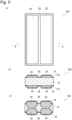
- FIG. 1(a) is a plan view of the absorbent sheet 10
- Fig. 1(b) is a schematic cross-sectional view taken along the line B-B of Fig. 1(a)
- Fig. 1(c) is a schematic cross-sectional view at swelling.
- the absorbent sheet 10 is provided with: a base sheet 12; a plurality of absorbent layers 21 to 23 disposed apart from each other on one main surface 12s of the base sheet 12 and containing a superabsorbent polymer resin; a covering sheet 14 covering the main surface 12s of the base sheet 12 and the absorbent layers 21 to 23; and a core wrap sheet 18 wrapping the base sheet 12 and the covering sheet 14.
- the base sheet 12 is rectangular, and extends in the length direction (the vertical direction in Fig. 1(a) ).
- the absorbent layers 21 to 23 are formed of a powdery or granular superabsorbent polymer resin disposed so as to have a predetermined thickness in predetermined areas of the one main surface 12s of the base sheet 12.
- the absorbent layers 21 to 23 are disposed with spacing in between in a width direction intersecting with the length direction of the base sheet 12, and extends in the length direction in parallel to each other.
- the absorbent layers 21 to 23 are disposed in such a manner that a gap is left between them and edges 12p and 12q and edges 12m and 12n of the base sheet 12.
- the covering sheet 14 is formed of a liquid-permeable sheet material, and parts thereof covering the absorbent layers 21 to 23 are raised higher than the part covering the surrounding area of the absorbent layers 21 to 23. This forms groove-like channels 26 and 27 extending in the length direction between the adjoining absorbent layers 21 and 22, and 22 and 23.
- the core wrap sheet 18 covers the other main surface 12t and side surfaces 12u and 12v of the base sheet 12, and overlaps with the covering sheet 14 so that the channels 26 and 27 are exposed, thereby wrapping the base sheet 12 and the covering sheet 14 in a C shape.
- the core wrap sheet 18 may be bonded to the base sheet 12 and/or the covering sheet 14 by an adhesive such as hot melt, supersonic bonding, thermal fusion bonding or the like.
- the absorbent sheet 10 is configured so that, when the superabsorbent polymer resin in the absorbent layers 21 to 23 swells, the base sheet 12 is more easily deformed than the covering sheet 14.
- the absorbent sheet 10 is configured so that, when the superabsorbent polymer resin in the absorbent layers 21 to 23 of the absorbent sheet 10 absorbs liquid and swells, the base sheet 12 is compressed in the thickness direction and deformed.
- the base sheet 12 is a nonwoven fabric sheet having a bulky structure where pores are formed between fibers along the one main surface 12s
- the covering sheet 14 is a nonwoven fiber sheet having no bulky structure
- the bulk density of the bulky structure of the base sheet 12 is lower than that of the covering sheet 14.
- the base sheet 12 may be configured so as to have a lower rebound than the covering sheet 14. In this case, when the superabsorbent polymer resin in the absorbent layers 21 to 23 swells, the base sheet 12 is easily deformed in the thickness direction compared with the covering sheet 14 and the spacings between the adjoining absorbent layers 21 and 22 and between 22 and 23 do not easily change, so that channel crushing can be prevented.
- the lateral stress on the base sheet 12 at 5% swelling is made lower than that on the covering sheet 14 at 5% swelling.
- the thickness of the covering sheet 14 is made equal to that of the base sheet 12 or smaller than that of the base sheet 12.
- the basis weight of the covering sheet 14 is made equal to that of the base sheet 12, or is made smaller than that of the base sheet 12.
- the lateral stress at 5% swelling is set so as to decrease in the order of the core wrap sheet 18, the covering sheet 14 and the base sheet 12.
- the base sheet 12 is the most deformable and the core wrap sheet 18 is the least deformable.
- the deformation of the base sheet 12 in the plane direction is restrained by the core wrap sheet 18 and this makes the base sheet 12 easily deformed in the thickness direction, and the spacings between the adjoining absorbent layers 21 and 22, and 22 and 23 do not easily change, so that crushing of the channels 26 and 27 can be prevented.
- the lateral stress on the core wrap sheet 12 at 5% swelling is made lower than that on the core wrap sheet 18 at 5% swelling.
- the core wrap sheet 14 is more deformable than the base sheet 12.
- the base sheet 12 becomes vulnerable to deformation in the plane direction and the spacings between the adjoining absorbent layers 21 to 23 easily increase. Consequently, crushing of the channels 26 and 27 can be prevented.
- the thickness of the core wrap sheet 18 is made smaller than that of the base sheet 12.
- the basis weight of the core wrap sheet 18 is made smaller than that of the base sheet 12.
- the basis weight of the core wrap sheet 18 is made within the range of not less than 20g/m 2 and not more than 70g/m 2 .
- an air-through nonwoven fabric is used for the base sheet 12
- a spun lace nonwoven fabric is used for the covering sheet 14
- an SMS nonwoven fabric is used for the core wrap sheet.
- the SMS nonwoven fabric refers to a three-layered nonwoven fabric where a melt-blown nonwoven fabric is sandwiched between spunbond nonwoven fabrics.
- the covering sheet 14 and the base sheet 12 are not bonded
- the covering sheet 14 and the base sheet 12 are bonded.
- the covering sheet 14 is bonded to, of the one main surface 12s of the base sheet 12, the surrounding area of the absorbent layers 21 to 23 (area where the superabsorbent polymer resin is substantially absent) by an adhesive such as hot melt, supersonic bonding, thermal fusion bonding or the like.
- an adhesive such as hot melt, supersonic bonding, thermal fusion bonding or the like.
- the covering sheet 14 may be bonded to the base sheet 12 by applying hot melt to the entire area of the one main surface 12s of the base sheet 12 from above the absorbent layers 21 to 23.
- a configuration may be adopted such that the core wrap sheet 18 wrapping the base sheet 12 and the covering sheet 14 is eliminated from the absorbent sheet 10 of the first embodiment like an absorbent sheet 10a of a first modification shown in Fig. 2 .
- the absorbent sheet 10a is configured so that, when the superabsorbent polymer resin in the absorbent layers 21 to 23 swells, the base sheet 12 is compressed in the thickness direction and deformed. This prevents crushing of the channels 26 and 27.
- the absorbent sheet 10b is configured so that the absorbent layers 21 to 23 are disposed on the one main surface 12s of the base sheet 12, the one main surface 12s of the base sheet 12 and the absorbent layers 21 to 23 are covered by the covering sheet 14 and the groove-like channels 26 and 27 are formed between the adjoining absorbent layers 21 and 22, and 22 and 23.
- the absorbent sheet 10b is further provided with: a plurality of absorbent layers 31 to 33 disposed apart from each other on the other main surface 12t of the base sheet 12 and containing the superabsorbent polymer resin; and a covering sheet 16 covering the other main surface 12t of the base sheet 12 and the absorbent layers 31 to 33.
- the absorbent layers 31 to 33 and the covering sheet 16 on the other main surface 12t side of the base sheet 12 are formed of similar materials and configured similarly to the absorbent layers 21 to 23 and the covering sheet 14 on the one main surface side 12s of the base sheet 12, and groove-like channels 36 and 37 are formed between the adjoining absorbent layers 31 and 32, and 32 and 33.
- the absorbent sheet 10b is configured so that, when the superabsorbent polymer resin in the absorbent layers 21 to 23 and 31 to 33 swells, the base sheet 12 is compressed in the thickness direction and deformed, so that crushing of the channels 26 and 27, and 36 and 37 can be prevented.
- the covering sheet 16 of the second modification may be changed to a core wrap sheet 19.
- the core wrap sheet 19 covers the other main surface 12t of the base sheet 12 and the absorbent layers 31 to 33 like the covering sheet 16 of the second modification, covers the side surfaces 12u and 12v of the base sheet 12 like the core wrap sheet 18 of the first modification, and overlaps with the covering sheet 14 so that the channels 26 and 27 are exposed, thereby wrapping the base sheet 12 and the covering sheet 14 in a C shape.
- the core wrap sheet 19 may be bonded to the base sheet 12 and/or the covering sheet 14 by an adhesive such as hot melt, supersonic bonding, thermal fusion bonding or the like.
- the absorbent sheet 10c is configured so that, when the superabsorbent polymer resin in the absorbent layers 21 to 23 and 31 to 33 swells, the base sheet 12 is compressed in the thickness direction and deformed, so that crushing o the channels 26 and 27, and 36 and 37 can be prevented.
- one channel 28 may be provided on the one main surface 12s side of the base sheet 12, and one channel 38 may be provided on the other main surface 12t side of the base sheet 12.
- two absorbent layers 24 and 25 are disposed on the one main surface 12s of the base sheet 12 and the channel 28 is formed between the absorbent layers 24 and 25.
- two absorbent layers 34 and 35 are disposed on the other main surface 12t of the base sheet 12, and the channel 38 is formed between the absorbent layers 34 and 35.
- the absorbent sheet 10d is configured so that, when the superabsorbent polymer resin in the absorbent layers 24 and 25, and 34 and 35 swells, the base sheet 12 is compressed in the thickness direction and deformed, so that crushing of the channels 28 and 38 can be prevented.
- the covering sheet 16 of the fourth modification may be changed to the core wrap sheet 19 as in the third modification.
- the absorbent sheet 10e is configured so that, when the superabsorbent polymer resin in the absorbent layers 24 and 25, and 34 and 35 swells, the base sheet 12 is compressed in the thickness direction and deformed, so that crushing of the channels 28 and 38 can be prevented.
- Fig. 7(a) is a perspective view where the covering sheet 14 and the absorbent layers 21 to 23 disposed on the one main surface side of the base sheet 12 of the absorbent sheet of a sixth modification are viewed through
- Fig. 7(b) is a plan view of the base sheet 12
- Fig. 7(c) is a perspective view where the covering sheet 16 and the absorbent layers 31 to 33 disposed on the other main surface side of the base sheet 12 are viewed through.
- the absorbent layers 21 to 23 and 31 to 33 may be disposed without any gap between them and the edges 12p and 12q of the base sheet 12.
- FIG. 8(a) is a perspective view where the covering sheet 14 and absorbent layers 41 to 45 disposed on the one main surface side of the base sheet 12 of the absorbent sheet of a seventh modification are viewed through
- Fig. 8(b) is a plan view of the base sheet 12
- Fig. 8(c) is a perspective view where the covering sheet 16 and absorbent layers 51 to 55 disposed on the other main surface side of the base sheet 12 are viewed through.
- a plurality of absorbent layers 41 to 45 and 51 to 55 having different sizes and configurations may be disposed on the main surfaces of the base sheet 12. Moreover, a plurality of absorbent layers 41 to 45 and 51 to 55 may be disposed with spacing in between in the length direction of the base sheet 12 to form channels extending in the width direction intersecting with the length direction.
- the absorbent sheet may be configured by appropriately selecting and combining the configurations disclosed in the first embodiment and the first to seventh modifications. For example, a configuration may be adopted such that only the absorbent layer disposed on one of the one main surface 12s and the other main surface 12t of the base sheet 12 of the absorbent sheets 10b to 10e of the second to fifth modifications is changed as in the seventh modification.
- the absorbent sheet described above is capable of preventing channel crushing.
- the shapes of the base sheet and the absorbent layers are not limited to the rectangular form.
Landscapes
- Health & Medical Sciences (AREA)
- Epidemiology (AREA)
- Engineering & Computer Science (AREA)
- Biomedical Technology (AREA)
- Heart & Thoracic Surgery (AREA)
- Vascular Medicine (AREA)
- Life Sciences & Earth Sciences (AREA)
- Animal Behavior & Ethology (AREA)
- General Health & Medical Sciences (AREA)
- Public Health (AREA)
- Veterinary Medicine (AREA)
- Absorbent Articles And Supports Therefor (AREA)
Abstract
Description
- The present invention relates to an absorbent sheet, and more specifically, relates to an absorbent sheet used for absorbing liquid by paper diapers and the like.
- Absorbent sheets for absorbing liquid are used for paper diapers, incontinence pads, sanitary napkins and the like.
- For example, an
absorbent sheet 1 shown inFigs. 9 and 10 has a superabsorbent polymer resin disposed on a base sheet.Fig. 9 is a partial cutaway perspective view of theabsorbent sheet 1, andFig. 10 is a cross-sectional schematic view thereof. As shown inFigs. 9 and 10 , first hot melt adhesive layers S1 are provided in such a manner as to be separated into right and left parts on a firstnonwoven fabric 2, absorbent resin powder layers 3 formed of superabsorbent polymer resin powder are provided in such a manner as to be separated into right and left parts on the right and left first hot melt adhesive layers S1, and further, a second hot melt adhesive layer S2 is provided substantially on the entire surface of the firstnonwoven fabric 2. Further, a second nonwoven fabric 4 having substantially the same area and the same configuration as the firstnonwoven fabric 2 is provided on the second hot melt adhesive layer S2 (for example, see Patent Literature 1). - [Patent Literature 1]
JP 4795612 B2 - The second nonwoven fabric 4 is recessed in an
intermediate region 2b between absorbent resinpowder existing areas 2c where the absorbent resin powder layers 3 are provided. This forms a channel. When fluid flows along the channel, the area widens where liquid is absorbed by the superabsorbent polymer resin. - However, if the superabsorbent polymer resin swells to crush the channel and this narrows or cuts off the flow path, the liquid absorbing performance deteriorates.
- In view of such circumstances, a problem to be solved by the present invention is to provide an absorbent sheet capable of preventing channel crushing.
- To solve the above-mentioned problem, the present invention provides an absorbent sheet configured as follows:
- An absorbent sheet is provided with: a base sheet; a plurality of absorbent layers disposed with spacing in between on a main surface of the base sheet and containing a superabsorbent polymer resin; and a covering sheet covering the main surface of the base sheet and the absorbent layers, and is configured so that, when the superabsorbent polymer resin in the absorbent layers swells, the base sheet is more easily deformed than the covering sheet.
- According to the above-described configuration, channels are formed between the adjoining absorbent layers. When the superabsorbent polymer resin in the absorbent layers swells, the spacings between the adjoining absorbent layers do not easily change because the covering sheet covering the absorbent layers is less deformable than the base sheet. Consequently, channel crushing can be prevented.
- Preferably, the absorbent sheet is configured so that, when the superabsorbent polymer resin in the absorbent layers swells, the base sheet is compressed in a thickness direction and deformed.
- In this case, when the superabsorbent polymer resin in the absorbent layers swells, the spacings between the adjoining absorbent layers do not easily change. Consequently, channel crushing can be prevented.
- Preferably, the base sheet has a lower rebound than the covering sheet.
- In this case, channel crushing can be prevented by configuring the absorbent sheet so that, when the superabsorbent polymer resin in the absorbent layers swells, the base sheet is compressed in the thickness direction and deformed.
- Preferably, the covering sheet is bonded to an area of the main surface of the base sheet where the superabsorbent polymer resin is substantially absent.
- In this case, when the superabsorbent polymer resin in the absorbent layers swells, the spacings between the adjoining absorbent layers are less likely to change compared with when the covering sheet and the base sheet are not bonded. Consequently, channel crushing can be more reliably prevented.
- Preferably, the lateral stress on the base sheet at 5% swelling is lower than the lateral stress on the covering sheet at 5% swelling. Here, "lateral stress at swelling" refers to "shrinkage stress acting in a lateral direction orthogonal to the swelling direction at swelling and the thickness direction" or "tension in the swelling direction per unit length in the lateral direction orthogonal to the swelling direction at swelling and the thickness direction."
- In this case, the absorbent sheet can be configured so that, when the superabsorbent polymer resin in the absorbent layers swells, the base sheet is more easily deformed than the covering sheet.
- Preferably, the base sheet has a bulky structure where pores are formed between fibers.
- In this case, since the base sheet is easily deformed, the absorbent sheet can be configured so that, when the superabsorbent polymer resin in the absorbent layers swells, the base sheet is more easily deformed than the covering sheet.
- Preferably, the bulk density of the bulky structure of the base sheet is lower than the bulk density of the covering sheet.
- In this case, the absorbent sheet can be configured so that the base sheet is more easily deformed than the covering sheet.
- Preferably, the thickness of the covering sheet is equal to the thickness of the base sheet or is smaller than the thickness of the base sheet.
- In this case, the entire absorbent sheet can be made thin compared with when the thickness of the covering sheet is larger than that of the base sheet.
- The absorbent sheet of the present invention is capable of preventing channel crushing.
-
- [
Fig. 1] Fig. 1(a) is a plan view of an absorbent sheet,Fig. 1(b) is a schematic cross-sectional view taken along the line B-B ofFig. 1(a), and Fig. 1(c) is a schematic cross-sectional view at swelling (first embodiment). - [
Fig. 2] Fig. 2(a) is a plan view of an absorbent sheet,Fig. 2(b) is a schematic cross-sectional view taken along the line B-B ofFig. 2(a), and Fig. 2(c) is a schematic cross-sectional view at swelling (first modification). - [
Fig. 3] Fig. 3(a) is a plan view of an absorbent sheet,Fig. 3(b) is a schematic cross-sectional view taken along the line B-B ofFig. 3(a), and Fig. 3(c) is a schematic cross-sectional view at swelling (second modification). - [
Fig. 4] Fig. 4(a) is a plan view of an absorbent sheet,Fig. 4(b) is a schematic cross-sectional view taken along the line B-B ofFig. 4(a), and Fig. 4(c) is a schematic cross-sectional view at swelling (third modification). - [
Fig. 5] Fig. 5(a) is a plan view of an absorbent sheet,Fig. 5(b) is a schematic cross-sectional view taken along the line B-B ofFig. 5(a), and Fig. 5(c) is a schematic cross-sectional view at swelling (fourth modification). - [
Fig. 6] Fig. 6(a) is a plan view of an absorbent sheet,Fig. 6(b) is a schematic cross-sectional view taken along the line B-B ofFig. 6(a), and Fig. 6(c) is a schematic cross-sectional view at swelling (fifth modification). - [
Fig. 7] Fig. 7(a) is a perspective view of an absorbent sheet on the opposite side of a base sheet relative to one main surface of the base sheet,Fig. 7(b) is a perspective view of the base sheet of the absorbent sheet, andFig. 7(c) is a perspective view of the absorbent sheet on the opposite side of the base sheet relative to the other main surface of the base sheet (sixth modification). - [
Fig. 8] Fig. 8(a) is a perspective view of an absorbent sheet on the opposite side of a base sheet relative to one main surface of the base sheet,Fig. 8(b) is a perspective view of the base sheet of the absorbent sheet, andFig. 8(c) is a perspective view of the absorbent sheet on the opposite side of the base sheet relative to the other main surface of the base sheet (seventh modification). - [
Fig. 9] Fig. 9 is a partial cutaway perspective view of the absorbent sheet (first conventional example). - [
Fig. 10] Fig. 10 is a cross-sectional schematic view taken along the line X-X ofFig. 9 (first conventional example). - Hereinafter, an embodiment of the present invention will be described with reference to the drawings.
- [First embodiment] An
absorbent sheet 10 of a first embodiment will be described with reference toFig. 1. Fig. 1(a) is a plan view of theabsorbent sheet 10,Fig. 1(b) is a schematic cross-sectional view taken along the line B-B ofFig. 1(a), and Fig. 1(c) is a schematic cross-sectional view at swelling. - As shown in
Fig. 1 , theabsorbent sheet 10 is provided with: abase sheet 12; a plurality ofabsorbent layers 21 to 23 disposed apart from each other on onemain surface 12s of thebase sheet 12 and containing a superabsorbent polymer resin; acovering sheet 14 covering themain surface 12s of thebase sheet 12 and theabsorbent layers 21 to 23; and acore wrap sheet 18 wrapping thebase sheet 12 and thecovering sheet 14. - The
base sheet 12 is rectangular, and extends in the length direction (the vertical direction inFig. 1(a) ). - The
absorbent layers 21 to 23 are formed of a powdery or granular superabsorbent polymer resin disposed so as to have a predetermined thickness in predetermined areas of the onemain surface 12s of thebase sheet 12. Theabsorbent layers 21 to 23 are disposed with spacing in between in a width direction intersecting with the length direction of thebase sheet 12, and extends in the length direction in parallel to each other. Theabsorbent layers 21 to 23 are disposed in such a manner that a gap is left between them andedges edges base sheet 12. - The covering
sheet 14 is formed of a liquid-permeable sheet material, and parts thereof covering theabsorbent layers 21 to 23 are raised higher than the part covering the surrounding area of theabsorbent layers 21 to 23. This forms groove-like channels absorbent layers - The
core wrap sheet 18 covers the othermain surface 12t andside surfaces base sheet 12, and overlaps with thecovering sheet 14 so that thechannels base sheet 12 and thecovering sheet 14 in a C shape. Thecore wrap sheet 18 may be bonded to thebase sheet 12 and/or the coveringsheet 14 by an adhesive such as hot melt, supersonic bonding, thermal fusion bonding or the like. - The
absorbent sheet 10 is configured so that, when the superabsorbent polymer resin in theabsorbent layers 21 to 23 swells, thebase sheet 12 is more easily deformed than the coveringsheet 14. - For example, as conceptually shown in
Fig. 1(c) , theabsorbent sheet 10 is configured so that, when the superabsorbent polymer resin in theabsorbent layers 21 to 23 of theabsorbent sheet 10 absorbs liquid and swells, thebase sheet 12 is compressed in the thickness direction and deformed. - Specifically, the
base sheet 12 is a nonwoven fabric sheet having a bulky structure where pores are formed between fibers along the onemain surface 12s, the coveringsheet 14 is a nonwoven fiber sheet having no bulky structure, and the bulk density of the bulky structure of thebase sheet 12 is lower than that of the coveringsheet 14. In this case, when the superabsorbent polymer resin in theabsorbent layers 21 to 23 swells, thebase sheet 12 is easily deformed in the length direction compared with the coveringsheet 14 and the spacings between the adjoiningabsorbent layers - The
base sheet 12 may be configured so as to have a lower rebound than the coveringsheet 14. In this case, when the superabsorbent polymer resin in theabsorbent layers 21 to 23 swells, thebase sheet 12 is easily deformed in the thickness direction compared with the coveringsheet 14 and the spacings between the adjoiningabsorbent layers - The lateral stress on the
base sheet 12 at 5% swelling is made lower than that on thecovering sheet 14 at 5% swelling. - The thickness of the covering
sheet 14 is made equal to that of thebase sheet 12 or smaller than that of thebase sheet 12. - The basis weight of the covering
sheet 14 is made equal to that of thebase sheet 12, or is made smaller than that of thebase sheet 12. - As an example, the lateral stress at 5% swelling is set so as to decrease in the order of the
core wrap sheet 18, the coveringsheet 14 and thebase sheet 12. In this case, when the superabsorbent polymer resin in theabsorbent layers 21 to 23 swells to press thebase sheet 12, the coveringsheet 14 and thecore wrap sheet 18, thebase sheet 12 is the most deformable and thecore wrap sheet 18 is the least deformable. For this reason, the deformation of thebase sheet 12 in the plane direction is restrained by thecore wrap sheet 18 and this makes thebase sheet 12 easily deformed in the thickness direction, and the spacings between the adjoiningabsorbent layers channels - In another example, the lateral stress on the
core wrap sheet 12 at 5% swelling is made lower than that on thecore wrap sheet 18 at 5% swelling. In this case, when the superabsorbent polymer resin in theabsorbent layers 21 to 23 swells to press thebase sheet 12, the coveringsheet 14 and thecore wrap sheet 18, thecore wrap sheet 14 is more deformable than thebase sheet 12. For this reason, thebase sheet 12 becomes vulnerable to deformation in the plane direction and the spacings between the adjoiningabsorbent layers 21 to 23 easily increase. Consequently, crushing of thechannels - The thickness of the
core wrap sheet 18 is made smaller than that of thebase sheet 12. - The basis weight of the
core wrap sheet 18 is made smaller than that of thebase sheet 12. - The basis weight of the
core wrap sheet 18 is made within the range of not less than 20g/m2 and not more than 70g/m2. - For example, an air-through nonwoven fabric is used for the
base sheet 12, a spun lace nonwoven fabric is used for the coveringsheet 14, and an SMS nonwoven fabric is used for the core wrap sheet. Here, the SMS nonwoven fabric refers to a three-layered nonwoven fabric where a melt-blown nonwoven fabric is sandwiched between spunbond nonwoven fabrics. - Although a configuration may be adopted such that the covering
sheet 14 and thebase sheet 12 are not bonded, preferably, the coveringsheet 14 and thebase sheet 12 are bonded. Specifically, the coveringsheet 14 is bonded to, of the onemain surface 12s of thebase sheet 12, the surrounding area of theabsorbent layers 21 to 23 (area where the superabsorbent polymer resin is substantially absent) by an adhesive such as hot melt, supersonic bonding, thermal fusion bonding or the like. When the coveringsheet 14 and thebase sheet 12 are bonded, the spacings between the adjoiningabsorbent layers sheet 14 and thebase sheet 12 are not bonded, so that crushing of thechannels sheet 14 may be bonded to thebase sheet 12 by applying hot melt to the entire area of the onemain surface 12s of thebase sheet 12 from above theabsorbent layers 21 to 23. - Next, first to seventh modifications will be described with reference to
Figs. 2 to 8 . In the following, component parts similar to those of the first embodiment will be denoted by the same reference numerals as those of the first embodiment and differences from the first embodiment will be mainly described. - [First modification] A configuration may be adopted such that the
core wrap sheet 18 wrapping thebase sheet 12 and the coveringsheet 14 is eliminated from theabsorbent sheet 10 of the first embodiment like anabsorbent sheet 10a of a first modification shown inFig. 2 . - For example, as shown in
Fig. 2(c) , theabsorbent sheet 10a is configured so that, when the superabsorbent polymer resin in theabsorbent layers 21 to 23 swells, thebase sheet 12 is compressed in the thickness direction and deformed. This prevents crushing of thechannels - [Second modification] A configuration may be adopted such that
channels base sheet 12 like anabsorbent sheet 10b of a second modification shown inFig. 3 . - As in the first embodiment, the
absorbent sheet 10b is configured so that theabsorbent layers 21 to 23 are disposed on the onemain surface 12s of thebase sheet 12, the onemain surface 12s of thebase sheet 12 and theabsorbent layers 21 to 23 are covered by the coveringsheet 14 and the groove-like channels absorbent layers - Unlike the first embodiment, the
absorbent sheet 10b is further provided with: a plurality ofabsorbent layers 31 to 33 disposed apart from each other on the othermain surface 12t of thebase sheet 12 and containing the superabsorbent polymer resin; and acovering sheet 16 covering the othermain surface 12t of thebase sheet 12 and theabsorbent layers 31 to 33. Theabsorbent layers 31 to 33 and the coveringsheet 16 on the othermain surface 12t side of thebase sheet 12 are formed of similar materials and configured similarly to theabsorbent layers 21 to 23 and the coveringsheet 14 on the onemain surface side 12s of thebase sheet 12, and groove-like channels absorbent layers - For example, as shown in
Fig. 3(c) , theabsorbent sheet 10b is configured so that, when the superabsorbent polymer resin in theabsorbent layers 21 to 23 and 31 to 33 swells, thebase sheet 12 is compressed in the thickness direction and deformed, so that crushing of thechannels - [Third modification] Like an
absorbent sheet 10c of a third modification shown inFig. 4 , the coveringsheet 16 of the second modification may be changed to acore wrap sheet 19. - The
core wrap sheet 19 covers the othermain surface 12t of thebase sheet 12 and theabsorbent layers 31 to 33 like thecovering sheet 16 of the second modification, covers theside surfaces base sheet 12 like thecore wrap sheet 18 of the first modification, and overlaps with the coveringsheet 14 so that thechannels base sheet 12 and the coveringsheet 14 in a C shape. Thecore wrap sheet 19 may be bonded to thebase sheet 12 and/or thecovering sheet 14 by an adhesive such as hot melt, supersonic bonding, thermal fusion bonding or the like. - For example, as shown in
Fig. 4(c) , theabsorbent sheet 10c is configured so that, when the superabsorbent polymer resin in theabsorbent layers 21 to 23 and 31 to 33 swells, thebase sheet 12 is compressed in the thickness direction and deformed, so that crushing o thechannels - [Fourth modification] Like an
absorbent sheet 10d of a fourth modification shown inFig. 5 , onechannel 28 may be provided on the onemain surface 12s side of thebase sheet 12, and onechannel 38 may be provided on the othermain surface 12t side of thebase sheet 12. - On the
absorbent sheet 10d, twoabsorbent layers main surface 12s of thebase sheet 12 and thechannel 28 is formed between theabsorbent layers absorbent layers main surface 12t of thebase sheet 12, and thechannel 38 is formed between theabsorbent layers - For example, as shown in
Fig. 5(c) , theabsorbent sheet 10d is configured so that, when the superabsorbent polymer resin in theabsorbent layers base sheet 12 is compressed in the thickness direction and deformed, so that crushing of thechannels - [Fifth modification] Like an
absorbent sheet 10e of a fifth modification shown inFig. 6 , the coveringsheet 16 of the fourth modification may be changed to thecore wrap sheet 19 as in the third modification. - For example, as shown in
Fig. 6(c) , theabsorbent sheet 10e is configured so that, when the superabsorbent polymer resin in theabsorbent layers base sheet 12 is compressed in the thickness direction and deformed, so that crushing of thechannels - [Sixth modification]
Fig. 7(a) is a perspective view where the coveringsheet 14 and theabsorbent layers 21 to 23 disposed on the one main surface side of thebase sheet 12 of the absorbent sheet of a sixth modification are viewed through,Fig. 7(b) is a plan view of thebase sheet 12, andFig. 7(c) is a perspective view where the coveringsheet 16 and theabsorbent layers 31 to 33 disposed on the other main surface side of thebase sheet 12 are viewed through. - As shown in
Fig. 7 , theabsorbent layers 21 to 23 and 31 to 33 may be disposed without any gap between them and theedges base sheet 12. - [Seventh modification]
Fig. 8(a) is a perspective view where the coveringsheet 14 andabsorbent layers 41 to 45 disposed on the one main surface side of thebase sheet 12 of the absorbent sheet of a seventh modification are viewed through,Fig. 8(b) is a plan view of thebase sheet 12, andFig. 8(c) is a perspective view where the coveringsheet 16 andabsorbent layers 51 to 55 disposed on the other main surface side of thebase sheet 12 are viewed through. - As shown in
Fig. 8 , a plurality ofabsorbent layers 41 to 45 and 51 to 55 having different sizes and configurations may be disposed on the main surfaces of thebase sheet 12. Moreover, a plurality ofabsorbent layers 41 to 45 and 51 to 55 may be disposed with spacing in between in the length direction of thebase sheet 12 to form channels extending in the width direction intersecting with the length direction. - The absorbent sheet may be configured by appropriately selecting and combining the configurations disclosed in the first embodiment and the first to seventh modifications. For example, a configuration may be adopted such that only the absorbent layer disposed on one of the one
main surface 12s and the othermain surface 12t of thebase sheet 12 of theabsorbent sheets 10b to 10e of the second to fifth modifications is changed as in the seventh modification. - [Summary] The absorbent sheet described above is capable of preventing channel crushing.
- The present invention is not limited to the above-described embodiment but may be carried out with various modifications being added.
- For example, the shapes of the base sheet and the absorbent layers are not limited to the rectangular form.
-
- 10, 10a to 10e Absorbent sheet
- 12 Base sheet
- 12s, 12t Main surface
- 14, 16 Covering sheet
- 21 to 25 Absorbent layer
- 31 to 35 Absorbent layer
- 41 to 45 Absorbent layer
- 51 to 55 Absorbent layer
Claims (8)
- An absorbent sheet comprising:a base sheet;a plurality of absorbent layers disposed with spacing in between on a main surface of the base sheet and containing a superabsorbent polymer resin; anda covering sheet covering the main surface of the base sheet and the absorbent layers,wherein when the superabsorbent polymer resin in the absorbent layers swells, the base sheet is more easily deformed than the covering sheet.
- The absorbent sheet according to claim 1, wherein when the superabsorbent polymer resin in the absorbent layers swells, the base sheet is compressed in a thickness direction and deformed.
- The absorbent sheet according to claim 1 or 2, wherein the base sheet has a lower rebound than the covering sheet.
- The absorbent sheet according to any one of claims 1 to 3, wherein the covering sheet is bonded to an area of the main surface of the base sheet where the superabsorbent polymer resin is substantially absent.
- The absorbent sheet according to any one of claims 1 to 4, wherein the lateral stress on the base sheet at 5% swelling is lower than the lateral stress on the covering sheet at 5% swelling.
- The absorbent sheet according to any one of claims 1 to 5, wherein the base sheet has a bulky structure where pores are formed between fibers.
- The absorbent sheet according to claim 6, wherein the bulk density of the bulky structure of the base sheet is lower than the bulk density of the covering sheet.
- The absorbent sheet according to any one of claims 1 to 7, wherein the thickness of the covering sheet is equal to the thickness of the base sheet or is smaller than the thickness of the base sheet.
Applications Claiming Priority (2)
| Application Number | Priority Date | Filing Date | Title |
|---|---|---|---|
| JP2022148212 | 2022-09-16 | ||
| PCT/JP2023/031979 WO2024057968A1 (en) | 2022-09-16 | 2023-08-31 | Absorbent sheet |
Publications (2)
| Publication Number | Publication Date |
|---|---|
| EP4570222A1 true EP4570222A1 (en) | 2025-06-18 |
| EP4570222A4 EP4570222A4 (en) | 2025-12-03 |
Family
ID=90275141
Family Applications (1)
| Application Number | Title | Priority Date | Filing Date |
|---|---|---|---|
| EP23865323.2A Pending EP4570222A4 (en) | 2022-09-16 | 2023-08-31 | ABSORBENT FILM |
Country Status (4)
| Country | Link |
|---|---|
| EP (1) | EP4570222A4 (en) |
| JP (1) | JPWO2024057968A1 (en) |
| CN (1) | CN119816277A (en) |
| WO (1) | WO2024057968A1 (en) |
Family Cites Families (6)
| Publication number | Priority date | Publication date | Assignee | Title |
|---|---|---|---|---|
| JP3190761B2 (en) * | 1993-03-16 | 2001-07-23 | ユニ・チャーム株式会社 | Body fluid treatment article and method of manufacturing the same |
| JP3732320B2 (en) * | 1997-09-26 | 2006-01-05 | ユニ・チャーム株式会社 | Disposable liquid absorbent article |
| WO2001089439A1 (en) | 2000-05-23 | 2001-11-29 | Toyo Eizai Kabushiki Kaisha | Ultra-thin absorbing sheet body, disposable absorbent article provided with ultra-thin absorbing sheet body and production device for ultra-thin absorbing sheet body |
| JP2007130819A (en) * | 2005-11-08 | 2007-05-31 | Kao Corp | Composite sheet and manufacturing method thereof |
| JP6038228B1 (en) * | 2015-05-22 | 2016-12-07 | ユニ・チャーム株式会社 | Absorbent articles |
| JP5963987B1 (en) * | 2016-02-29 | 2016-08-03 | ユニ・チャーム株式会社 | Absorbent articles |
-
2023
- 2023-08-31 JP JP2024546861A patent/JPWO2024057968A1/ja active Pending
- 2023-08-31 EP EP23865323.2A patent/EP4570222A4/en active Pending
- 2023-08-31 WO PCT/JP2023/031979 patent/WO2024057968A1/en not_active Ceased
- 2023-08-31 CN CN202380062853.5A patent/CN119816277A/en active Pending
Also Published As
| Publication number | Publication date |
|---|---|
| CN119816277A (en) | 2025-04-11 |
| EP4570222A4 (en) | 2025-12-03 |
| WO2024057968A1 (en) | 2024-03-21 |
| JPWO2024057968A1 (en) | 2024-03-21 |
Similar Documents
| Publication | Publication Date | Title |
|---|---|---|
| US8237012B2 (en) | Absorbent article | |
| US4307721A (en) | Non-woven fabric for sanitary napkin | |
| US8912384B2 (en) | Absorbent article and manufacturing apparatus for absorbent article | |
| US20030139719A1 (en) | Absorbent body and absorbent article having the absorbent body | |
| US20100179494A1 (en) | Absorptive article | |
| US20050147810A1 (en) | Absorber including by-pass channel member and absorber product therefrom | |
| EP0140560A1 (en) | Absorbent product with color contrasted cover pattern | |
| SG175101A1 (en) | Absorbent article | |
| JP2001129018A (en) | Absorbent articles | |
| US4615696A (en) | Sanitary napkin with folded cover | |
| TWI719088B (en) | Absorbent articles | |
| JP3548027B2 (en) | Absorbent articles | |
| CN101129281B (en) | Absorption articles | |
| US20060069366A1 (en) | Core for an absorbent article | |
| US11135102B2 (en) | Absorbent article for securely absorbing body fluid | |
| CN119816277A (en) | Absorbent sheet | |
| JP5132798B2 (en) | Absorbent articles | |
| US20260076842A1 (en) | Absorbent article | |
| JP4912069B2 (en) | Absorbent articles | |
| US12616621B2 (en) | Absorbent product | |
| JP4919779B2 (en) | Sanitary napkin | |
| JP4804309B2 (en) | Absorbent articles | |
| JP4771912B2 (en) | Absorbent articles | |
| WO2025175103A1 (en) | Absorbent product | |
| JP2019201870A (en) | Folded absorbent article and absorbent article package |
Legal Events
| Date | Code | Title | Description |
|---|---|---|---|
| STAA | Information on the status of an ep patent application or granted ep patent |
Free format text: STATUS: THE INTERNATIONAL PUBLICATION HAS BEEN MADE |
|
| PUAI | Public reference made under article 153(3) epc to a published international application that has entered the european phase |
Free format text: ORIGINAL CODE: 0009012 |
|
| STAA | Information on the status of an ep patent application or granted ep patent |
Free format text: STATUS: REQUEST FOR EXAMINATION WAS MADE |
|
| 17P | Request for examination filed |
Effective date: 20250313 |
|
| AK | Designated contracting states |
Kind code of ref document: A1 Designated state(s): AL AT BE BG CH CY CZ DE DK EE ES FI FR GB GR HR HU IE IS IT LI LT LU LV MC ME MK MT NL NO PL PT RO RS SE SI SK SM TR |
|
| RAP3 | Party data changed (applicant data changed or rights of an application transferred) |
Owner name: ZUIKO CORPORATION |
|
| A4 | Supplementary search report drawn up and despatched |
Effective date: 20251103 |
|
| RIC1 | Information provided on ipc code assigned before grant |
Ipc: A61F 13/532 20060101AFI20251028BHEP Ipc: A61F 13/534 20060101ALI20251028BHEP Ipc: A61F 13/539 20060101ALI20251028BHEP |
|
| DAV | Request for validation of the european patent (deleted) | ||
| DAX | Request for extension of the european patent (deleted) |