EP4568331A2 - Zeitliche gleichrichtung von hochfrequenzsignalen - Google Patents
Zeitliche gleichrichtung von hochfrequenzsignalen Download PDFInfo
- Publication number
- EP4568331A2 EP4568331A2 EP25172080.1A EP25172080A EP4568331A2 EP 4568331 A2 EP4568331 A2 EP 4568331A2 EP 25172080 A EP25172080 A EP 25172080A EP 4568331 A2 EP4568331 A2 EP 4568331A2
- Authority
- EP
- European Patent Office
- Prior art keywords
- signal
- machine learning
- emitter
- soft
- dtw
- Prior art date
- Legal status (The legal status is an assumption and is not a legal conclusion. Google has not performed a legal analysis and makes no representation as to the accuracy of the status listed.)
- Pending
Links
Images



Classifications
-
- G—PHYSICS
- G06—COMPUTING OR CALCULATING; COUNTING
- G06N—COMPUTING ARRANGEMENTS BASED ON SPECIFIC COMPUTATIONAL MODELS
- G06N3/00—Computing arrangements based on biological models
- G06N3/02—Neural networks
- G06N3/08—Learning methods
- G06N3/09—Supervised learning
-
- H—ELECTRICITY
- H04—ELECTRIC COMMUNICATION TECHNIQUE
- H04B—TRANSMISSION
- H04B17/00—Monitoring; Testing
- H04B17/30—Monitoring; Testing of propagation channels
- H04B17/391—Modelling the propagation channel
- H04B17/3913—Predictive models, e.g. based on neural network models
-
- G—PHYSICS
- G01—MEASURING; TESTING
- G01S—RADIO DIRECTION-FINDING; RADIO NAVIGATION; DETERMINING DISTANCE OR VELOCITY BY USE OF RADIO WAVES; LOCATING OR PRESENCE-DETECTING BY USE OF THE REFLECTION OR RERADIATION OF RADIO WAVES; ANALOGOUS ARRANGEMENTS USING OTHER WAVES
- G01S5/00—Position-fixing by co-ordinating two or more direction or position line determinations; Position-fixing by co-ordinating two or more distance determinations
- G01S5/02—Position-fixing by co-ordinating two or more direction or position line determinations; Position-fixing by co-ordinating two or more distance determinations using radio waves
-
- G—PHYSICS
- G06—COMPUTING OR CALCULATING; COUNTING
- G06N—COMPUTING ARRANGEMENTS BASED ON SPECIFIC COMPUTATIONAL MODELS
- G06N20/00—Machine learning
-
- H—ELECTRICITY
- H04—ELECTRIC COMMUNICATION TECHNIQUE
- H04W—WIRELESS COMMUNICATION NETWORKS
- H04W12/00—Security arrangements; Authentication; Protecting privacy or anonymity
- H04W12/60—Context-dependent security
- H04W12/69—Identity-dependent
- H04W12/79—Radio fingerprint
-
- G—PHYSICS
- G06—COMPUTING OR CALCULATING; COUNTING
- G06N—COMPUTING ARRANGEMENTS BASED ON SPECIFIC COMPUTATIONAL MODELS
- G06N3/00—Computing arrangements based on biological models
- G06N3/02—Neural networks
- G06N3/04—Architecture, e.g. interconnection topology
-
- H—ELECTRICITY
- H04—ELECTRIC COMMUNICATION TECHNIQUE
- H04W—WIRELESS COMMUNICATION NETWORKS
- H04W12/00—Security arrangements; Authentication; Protecting privacy or anonymity
- H04W12/12—Detection or prevention of fraud
- H04W12/121—Wireless intrusion detection systems [WIDS]; Wireless intrusion prevention systems [WIPS]
- H04W12/122—Counter-measures against attacks; Protection against rogue devices
-
- H—ELECTRICITY
- H04—ELECTRIC COMMUNICATION TECHNIQUE
- H04W—WIRELESS COMMUNICATION NETWORKS
- H04W4/00—Services specially adapted for wireless communication networks; Facilities therefor
- H04W4/02—Services making use of location information
Definitions
- the present disclosure relates to analysis of wireless signals such as radio frequency signals.
- Radio signals For example, communications radios, emergency safety beacons, radars, television broadcast towers, wireless access points, cellular towers, cellular phones, satellite phones, and satellites, among other radio emitters, transmit radio signals that can be received by other devices.
- communications radios emergency safety beacons, radars, television broadcast towers, wireless access points, cellular towers, cellular phones, satellite phones, and satellites, among other radio emitters, transmit radio signals that can be received by other devices.
- the present disclosure describes a method that includes training a machine learning network using, as input training data, a plurality of time series representing sampled radio frequency (RF) signals, and a plurality of labels.
- Each label is associated with at least one time series of the plurality of time series, and the labels describe one or more characteristics of emitters of the sampled RF signals.
- the machine learning network includes, for each label of the plurality of labels, a corresponding soft dynamic time warping (soft-DTW) terminal associated with the label.
- the soft-DTW terminals include weights, and a value of each soft-DTW terminal is based on a soft-DTW loss function based on the weights of the soft-DTW terminal.
- Training the machine learning network includes iteratively adjusting the weights of the soft-DTW terminals so as to reduce a value of at least one loss function; obtaining, as a result of the training, a machine learning model configured to classify new RF signal sequences by label; and providing the machine learning model to an RF sensing device.
- Implementations of this and other disclosed methods can have any one or more of at least the following characteristics.
- the at least one loss function whose value is reduced includes an additional loss function having a value that depends jointly on the values of the soft-DTW terminals.
- the additional loss function includes a cross-entropy loss function.
- iteratively adjusting the weights of the soft-DTW terminals includes adjusting the weights so as to, for each label of the plurality of labels, (i) reduce a value of a soft-DTW loss function corresponding to the label when the soft-DTW loss function is based on a time series of the plurality of time series that is associated with the label, and (ii) increase the value of the soft-DTW loss function corresponding to the label when the soft-DTW loss function is based on a time series of the plurality of time series that is not associated with the label.
- the soft-DTW loss function of the soft-DTW terminal characterizes a difference between (i) a sequence of the weights of the soft-DTW terminal and (ii) one or more derived sequences obtained by processing time series of the plurality of time series.
- the method includes upsampling the one or more derived sequences prior to characterization of the difference between the sequence of the weights and the one or more derived sequences.
- the machine learning network includes a machine learning component including a plurality of additional weights.
- the machine learning component is configured to determine the one or more derived sequences based on the plurality of additional weights, and training the machine learning network includes adjusting the plurality of additional weights.
- the machine learning component includes one of a multi-layer perceptron (MLP), a recurrent neural net (RNN), a convolutional neural net (CNN), or a transformer network.
- MLP multi-layer perceptron
- RNN recurrent neural net
- CNN convolutional neural net
- transformer network a transformer network
- the machine learning model includes, for each label of the plurality of labels, a corresponding barycenter.
- the barycenter corresponding to the label includes weights of the soft-DTW terminal corresponding to the label.
- the machine learning network includes a soft-DTW terminal corresponding to an open set of the input training data.
- the method includes: providing, as input to the machine learning model, a detected RF signal; determining, as an output of the machine learning model, a sequence corresponding to the detected RF signal; and determining, based on the sequence, a mapping corresponding to a signal transform that acted on the detected RF signal.
- the mapping includes an alignment matrix between the sequence and a barycenter.
- the barycenter corresponds to a label of the plurality of labels with which the detected RF signal is classified.
- the method includes determining, based on the mapping, data characterizing an RF channel between an emitter of the detected RF signal and a sensing device that sensed the detected RF signal .
- the method includes determining, based on the mapping, a transform-stripped version of the detected RF signal.
- the method includes determining, as an output of the machine learning model, information characterizing an emitter of the detected RF signal.
- the method includes determining, as an output of the machine learning model, an identity of an emitter of the detected RF signal.
- the plurality of labels include a label indicating a pseudorandom noise (PRN) code associated with an emitter.
- PRN pseudorandom noise
- the at least one time series associated with the label includes sampled RF signals received from the emitter.
- the plurality of labels include a label indicating a maritime mobile service identity (MMSI) identifier associated with a nautical vessel.
- MMSI maritime mobile service identity
- the at least one time series associated with the label includes sampled radar signals received from the nautical vessel.
- providing the machine learning model to the RF sensing device includes transmitting the machine learning model from a ground station to the RF sensing device.
- training the machine learning network includes iteratively adjusting the weights of the soft-DTW terminals simultaneously.
- the method includes receiving, at a sensing device, a radio-frequency (RF) signal; inputting a sampled time series of the RF signal into a machine learning model trained using a soft dynamic time warping (soft-DTW) loss function; and determining, based on the machine learning model, an identity of an emitter of the RF signal.
- RF radio-frequency
- Implementations of this and other methods can have any one or more of at least the following characteristics.
- the method includes determining, based on the machine learning model, a mapping corresponding to a signal transform that acted on the RF signal; and determining, based on the mapping, data characterizing an RF channel between the emitter of the RF signal and the sensing device .
- the signal transform includes at least one of a Doppler shift or a time shift.
- the data characterizing the RF channel includes a location of the emitter.
- the data characterizing the RF channel includes a probability that the emitter is located in a particular region.
- the data characterizing the RF channel includes at least one of time-of-arrival data or frequency-of-arrival data of the RF signal received at the sensing device.
- the mapping includes a mapping between (i) a sequence derived from the sampled time series of the RF signal and (ii) a barycenter corresponding to the identity of the emitter.
- the mapping includes an alignment matrix.
- the method includes determining, based on the mapping, a transform-stripped version of the RF signal.
- determining the identity of the emitter includes determining the identity of one of a particular ship, a particular satellite, or a type of radar system.
- the sensing device includes an aerial vehicle.
- the aerial vehicle is one of a satellite or an aerial drone.
- the machine learning model is stored on the sensing device, and inputting the sampled time series into the machine learning model and determining the identity are performed by a computing system on board the sensing device.
- the machine learning model is trained using, as input training data, a plurality of time series representing sampled radio frequency (RF) signals, and a plurality of labels, each label associated with at least one time series of the plurality of time series, the labels describing one or more characteristics of emitters of the sampled RF signals.
- RF radio frequency
- the machine learning model includes a sequence representing a barycenter corresponding to the identity of the emitter.
- these and other methods can be implemented using non-transitory, computer-readable media storing instructions that, when executed by one or more processors, cause the one or more processors to perform the methods.
- these and other methods can be implemented using systems that include one or more computers; and one or more storage devices storing instructions that, when executed by the one or more computers, cause the one or more computers to perform the method.
- the systems and techniques described herein are used to analyze received radio signals, and/or to construct machine learning models that are useful in analyzing received radio signals.
- the machine learning models employ a soft-dynamic time warping (soft-DTW) loss function, which is differentiable and suitable for use in training machine learning networks.
- the signal analyses which can provide information about emitters of the signals and about Doppler effects on the signals, can be less computationally intensive than alternative methods such as Cross Ambiguity Function (CAF) processing, reducing consumption of computer resources and power resources.
- CAF Cross Ambiguity Function
- the signal analyses can be performed on signals sensed at a single sensing device, as opposed to alternative methods that require multiple sensing devices for emitter identification/geolocation.
- This disclosure relates to signal processing of Doppler-shifted and time-shifted signals, and in particular to signal processing of Doppler-shifted and time-shifted radio-frequency signals received at mobile sensing devices such as satellites, aerial drones, or other aerial vehicles.
- Recovery of original, un-shifted radio signals from Doppler-shifted and time-shifted radio signals, and identification/geolocation of emitters that transmitted the radio signals typically involve computationally-demanding processes that, in some cases, require receiving the signals at multiple sensing devices at different locations and/or different times.
- This disclosure describes methods and systems that can recover transform-stripped signals (e.g., Doppler shift-stripped and time shift-stripped signals), identify signal emitters, and geolocate emitters (processes that can be collectively referred to as "temporal rectification") using less computationally-demanding processing.
- the methods and systems are applicable to signals received at a plurality of sensing devices. In some implementations, the methods and systems are applicable to signals received at a single sensing device.
- a system 100 in an environment includes a plurality of signal emitters, such as signal emitters 102a, 102b, and 102c (collectively referred to as signal emitters 102); and a plurality of sensing devices, such as sensing devices 104a and 104b (collectively referred to as sensing devices 104).
- Signal emitter 102b emits radio-frequency (RF) signals 108.
- RF radio-frequency
- the signal emitters 102 are sources of RF signals.
- the one or more of the signal emitters 102a, 102b, and 102c are ships, ground vehicles, planes, satellites, satellite telephones, cellular towers, cellular phones, emergency safety beacons, television broadcast towers, radar stations/sensors, other transmission/sensing stations, or other sources of radio-frequency (RF) signals.
- Each emitter 102 has a set of trajectory parameters. For example, emitter 102b has position r e , velocity v e , acceleration a e , and jerk j e .
- Trajectory parameters in some implementations can include higher derivatives of motion such as snap, but such higher-derivative terms may not impact signal sensing, processing, or geolocation applications substantially.
- Position can be expressed in a global coordinate system, e.g., World Geodetic System (WGS 84) or in a local coordinate system that maps a particular region/area of the Earth's surface.
- GSS 84 World Geodetic System
- velocity, acceleration, and higher-order trajectory parameters of the emitters can be expressed with respect to local rotation of the Earth or can be expressed with respect to a global reference frame.
- the Emitter 102b emits RF signals 108 ( C e ). These RF signals 108 are detected using the sensing devices 104a and 104b.
- the sensing devices 104 are mobile apparatuses, such as spacecraft, aerial vehicles, terrestrial vehicles, or another suitable mobile platform.
- the sensing devices 104 are satellites.
- the sensing devices 104 can be cars or trucks.
- the sensing devices 104 can be aerial vehicles such as airplanes, or unmanned aerial vehicles (UAVs) such as drones or balloons.
- UAVs unmanned aerial vehicles
- the sensing devices 104 can be boats or ships that travel on water (e.g., on the oceans).
- the sensing device 104a is a first type of mobile platform
- the sensing device 104b is a second type of mobile platform that is different from the first type of mobile platform.
- the sensing devices 104a and104b are mobile and move with respective trajectories.
- the trajectories can be in space, in atmosphere, or on the terrestrial surface.
- the sensing devices 104 are satellites or other space vehicles, the trajectories can be orbital trajectories with respect to the Earth's surface.
- the sensing devices 104 are terrestrial vehicles, the trajectories are ground trajectories, e.g., on marked roads or in unmarked areas.
- the trajectories can be characterized by respective trajectory parameters r s1 , v s1 , a s1 , j s1 and r s2 , v s2 , a s2 , j s2 .
- These parameters can be defined in various coordinate systems/reference frames depending on the type(s) of the sensing devices 104.
- trajectory parameters of satellites can be expressed in an Earth-centered inertial (ECI) reference frame.
- Sensing of the RF signals 108 can be used for various purposes.
- the sensing is used to identify and geolocate "dark” entities such as dark ships, meaning maritime vessels that are not broadcasting their positions/identities using the automatic identification system (AIS).
- Dark ships are often involved in smuggling (e.g., sanctions violations), illegal fishing, and other illicit activities, such that identifying and tracking them is useful for information-gathering and enforcement purposes.
- This process is sometimes referred to as "unidentified signal recognition” (USR).
- USR can instead or additionally be performed for other emitter types, such as satellites, ground vehicles, and transiently-emitting terrestrial entities like radar stations.
- dark entities often do broadcast other types of detectable signals. For example, dark ships use maritime radar for navigation, and the maritime radar signals can be detected at sensing devices such as satellites.
- a sensing device 104 that is closer to the emitter 102b will receive the signal before a sensing device 104 that is further from the emitter 102b.
- Doppler transformation can modify the perceived frequency of a signal or, for a time-sampled received signal, modify relative times at which sampled values of the signal (e.g., intensities and signal peaks) are detected at respective sensing devices 104a and 104b (e.g., the as-received signal will appear compressed or elongated).
- Implementations according to this disclosure can relate to all of or subsets of the combined effects of the RF channel between the signal emitter and sensing devices, including those resulting from relative motion between the emitter and sensing devices (e.g., Doppler shifting and time shifting).
- the subset of channel effects considered by temporal rectification processing are denoted in the above equation by transformation ST and are collectively referred to herein as "signal transformation.”
- Signal transformation in some implementations does not include effects such as free-space path loss and multipath frequency selective fading. In some implementations, these and other effects that are not included in signal transformation can be accounted for by other portions of the analysis process.
- the machine learning component 302 (described in further detail below) can generate D such that free-space path loss, multipath frequency selective fading, and/or other channel effects are accounted for (e.g., have their effect reduced in D compared to in C).
- Inversion of the signal transformation can be performed to recover a signal C e ' that represents the received signal C i with effects of the signal transformation removed, e.g., that represents the transmitted signal C e acted on by any other channel effects not included in the signal transformation function ST.
- signals C e that represents the received signal C i with effects of the signal transformation removed, e.g., that represents the transmitted signal C e acted on by any other channel effects not included in the signal transformation function ST.
- signal recovery is described as recovering the "as-emitted” or "transform-stripped" signal C e .
- This recovery process along with determination of other data related to the emitter (e.g., performing USR and geolocating the emitter 102), can be referred to as “temporal rectification.”
- computationally intensive processing such as cross-ambiguity function (CAF) processing can be applied based on signals received at two or more sensing devices or on signals received at one sensing device and compared to a matched filter.
- CAF processing seeks to cross-correlate arbitrary received signals based on propagation delay and Doppler shifts of the signals (or, with increased complexity, transforms related to higher derivatives of relative motion).
- a peak in the CAF corresponds to maximum cross-correlation between received signals and, accordingly, to a time-difference-of-arrival (TDOA) and frequency-difference-of-arrival (FDOA) between sensing devices. Given this information, one can recover (to within some degree of precision) both the as-emitted signal and the location of the emitter.
- the transform-stripped signal can include elements/signatures that indicate a type/identity of the emitter, for USR and other purposes. For example, a string of digits modulated onto a digital radio signal can be an identifier of the emitter.
- elements/signatures may also be present in transformed signals; however, in some implementations, the elements/signatures are more evident in transform-stripped signals (e.g., are less distorted and/or conform more closely to established standards), such that analysis of the transform-stripped signals can be more accurate and/or reliable than analysis of transformed signals.
- CAF processing tends to be computationally intensive. For processing systems with limited processing resources, such as systems typically included in sensing devices such as satellites, this implies a long processing time or an inability to use those processing resources to perform other tasks while dedicating them to CAF processing. Processing results may be out-of-date or otherwise less useful when they are finally obtained.
- the computationally intensive processing may instead or additionally be associated with high power consumption which can strain the sometimes-limited power resources of sensing devices.
- received signals can be provided to a system with more powerful processing capabilities (such as a ground station 110), but this (i) can itself lead to slower processing times due to transmission to the ground station and associated processing, (ii) is associated with additional power consumption from transmission of the signals from the sensing device to the ground station, and (iii) requires the availability of a ground station positioned to receive signals from the sensing devices.
- CAF processing relies on multiple sensing devices, for example, a satellite cluster. This adds significant cost and complexity to the detection system.
- CAF processing generally takes into account position and velocity of emitters and sensing devices, but neglects higher-order terms such as acceleration and jerk.
- CAF processing taking into account higher-order terms requires exponentially more processing resources, compounding the processing burden noted above. Neglecting to account for higher-order terms can provide acceptable results for ground-based systems and certain other systems but may fail for systems (which can include emitters, sensing devices, or both) that have high accelerations and jerks, and/or for high-precision estimates such as those desired for precise geolocation.
- This disclosure describes systems and methods that can, in some implementations, alleviate some or all of these drawbacks, allowing for computationally efficient transform-stripped signal recovery, emitter identification, and emitter geolocation based on signals received at one or multiple sensing devices.
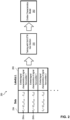
- labeled data 200 is used to train (201) a machine learning network into an Emitter Characteristics Model (ECM) 202 that can classify input data by label (predict one or more labels corresponding to the input data).
- ECM Emitter Characteristics Model
- the training of the ECM makes use of soft dynamic time warping (soft-DTW), and the ECM can subsequently be applied in an inference process (described in further detail below) to recover transform-stripped signal data and signal transformation data indicative of sensing device trajectory parameters relative to the emitter.
- the training data 204 used to train the ECM 202 includes sequences of time-sampled signals (e.g., RF signals) as received at sensing devices, such as the sensing devices described above.
- the training data 204 can include GPS signal sequences that include 2MHz sampled data representing 1ms of collection downconverted from a nominal L1 GPS center frequency.
- the training data 204 can include 10MHz sampled data of radar pulses, downconverted from a maritime radar band.
- the sequences are finite continuously sampled segments that, in some implementations, are taken from longer or more rapidly sampled sequences of RF data collection (e.g., regularly sampled I/Q data encoded as a series of complex numbers).
- the sequences making up the training data are detected within longer or more rapidly sampled sequences by finding time- and/or frequency-bounded subsets of the collection with increased signal intensity/power values above the noise floor.
- a training data sequence C i is denoted ( C i,t1 , C i,t2 ,... C i,tn ), where t n for different sequences C need not be the same.
- each training data sequence C i will not be of the same length, in which case shorter sequences can be zero-padded or padded with sequences of sample data consistent with background noise characteristic of the sensing device at which the training data sequence C i was received, and/or longer sequences can be truncated.
- different-length sequences can be used without length alteration for training.
- Labels 206 (in a set of labels L ) corresponding to each sequence of training data 204 can include various types of data.
- the labels 206 characterize a type of the emitter that emitted the signal represented in the training data 204 (e.g., the make or model of the device emitting the signal). These labels are obtained from previously-performed processing of the training data 204, including, in some cases, CAF processing and/or geolocation processing.
- labels for training sequences may be known because the data is collected under controlled circumstances such as in a laboratory or other testing facility. In the example of FIG.
- training data sequences 204a, 204b were received, respectively, at two different sensing devices from the same emitter, and CAF processing was performed to recover a transform-stripped version of the training data sequences 204a, 204b and/or to geolocate the emitter and thereby determine the emitter's identity using other information relating that identity to the emitter's positions at different times.
- the transform-stripped signal can include an encoded sequence that indicates an identity of the emitter, such as a Gold code.
- PRN code sequences indicate an identity of the emitting satellite.
- PRN codes generally are each associated with a distinct emitter in a code division multiple access (CDMA) network, such as that corresponding to satellites.
- CDMA code division multiple access
- Each PRN code sequence in the training corpus (or, equivalently, an indicator of the identity of the satellite corresponding to each PRN code sequence) is a label.
- geolocation e.g., TDOA/FDOA analysis using multiple sensing devices
- MMSI maritime mobile service identity
- the MMSI identifier corresponds to a ship that emitted both the AIS message and the radar signal.
- the label for the radar signal sequence in the training data 204 can be the MMSI identifier or another identifier of the ship.
- Labels can instead or additionally identify classes of emitters, such as models/types of radar systems, models/types of satellites, models/types of RF signal transceivers, models/types of other types of device(s), and/or other data. Labels can instead or additionally qualitatively describe the training data sequences themselves, such as a type of RF signal (e.g., radar signal, satellite telephone signal, GPS signal, cellular signal, among others), type(s) of encoding, encryption and/or compression applied to the signal, and/or elements in the signal besides the emitter identifiers noted above.
- a type of RF signal e.g., radar signal, satellite telephone signal, GPS signal, cellular signal, among others
- type(s) of encoding e.g., encryption and/or compression applied to the signal, and/or elements in the signal besides the emitter identifiers noted above.
- an "open set" of training data (e.g., training data not corresponding to any of the labels L ) is included with a corresponding open set soft-DTW terminal.
- the open set is included to account for lack of representation of one or more labeled classes in the training set. For example, some MMSIs may be unrepresented or underrepresented among the labels in the training set, e.g., if the MMSI corresponds to a new ship from which no radar signals have been received. Absent an open set terminal in the ECM 202, classification of signals corresponding to labels for which the ECM 202 has not been trained may be incorrect and lead to poor temporal rectification results. Using the open set, the ECM 202 is trained to identify input signals that do not correspond to any of the labels provided during training. These input signals, when identified, can be discarded or passed to an alternative processing module.
- a machine learning network 300 is trained to classify new input data by labels in the set of labels L included in the labeled data 200.
- the machine learning network 300 includes a machine learning component 302 ( ⁇ f ⁇ ⁇ ), representing a family of functions parametrized by weights and hyperparameters ( ⁇ ).
- the machine learning component 302 can have various forms depending on the implementation, such as a multi-layer perceptron (MLP), a recurrent neural net (RNN), a convolutional neural net (CNN), or a transformer network.
- MLP multi-layer perceptron
- RNN recurrent neural net
- CNN convolutional neural net
- the machine learning component 302 is connected to the rest of the machine learning network 300 by backpropagation, meaning, for example, that weights and hyperparameters of the machine learning component 302 are adjusted based, e.g., on gradient descent relative to a loss function computed in another portion of the machine learning network 300.
- the output sequence D represents a cleaned version of the input sequence C that is more useful for subsequent soft-DTW-based processing.
- D may have less noise than C (e.g., represent a noise-filtered version of C ) , or may be smoothed compared to C .
- the machine learning component 302 learns to output D such that channel effects separate from Doppler-shifting and time-shifting (e.g., free space path loss and/or multipath interference) are reduced/stripped compared to C.
- Doppler-shifting and time-shifting e.g., free space path loss and/or multipath interference
- D can be real- or complex-valued, and in some implementations p ⁇ n, though typically (but not always) p ⁇ n.
- a corresponding soft-DTW terminal 304 is included in the network and associated with a soft-DTW loss function.
- weights can be initialized randomly or can be set to targeted values (e.g., a matched filter for a particular GPS PRN sequence that corresponds to a label or a barycenter pre-calculated based on output sequences D corresponding to label L i ), and in some cases m ⁇ p and/or m ⁇ n. In some implementations, m > n . In some implementations (e.g., when m > n ) , D is upsampled prior to use in a soft-DTW terminal in order for processes involving soft-DTW to work with higher resolution, which can improve weight determination and signal analysis based on the weights.
- targeted values e.g., a matched filter for a particular GPS PRN sequence that corresponds to a label or a barycenter pre-calculated based on output sequences D corresponding to label L i
- m > n e.g., when m > n ) , D is upsampled prior to use
- the use of an appropriate matched filter as a starting point for training can speed up the training process and/or reduce the occurrence of the network 300 converging to undesirable local minima during training.
- the machine learning network 300 evolves to reduce (e.g., reduce compared to an initial value, minimize absolutely, and/or minimize subject to one or more other constraints) a k-state cross-entropy loss function 310 that depends on values of soft-DTW loss functions of the soft-DTW terminals 304, where k is the number of soft-DTW terminals 304.
- a loss functions that depends on fewer than all of the soft-DTW loss functions of the soft-DTW terminals 304 can be used.
- the weights of at least some of the soft-DTW terminals 304 are trained separately from other weights, without being associated with a shared loss function such as the cross-entropy loss function 310.
- the set of weights W i evolves to approximate a barycenter for output sequences D corresponding to the label L i that (i) reduces (e.g., minimizes) the soft-DTW loss function for output sequences D corresponding to the label L i , and (ii) increases (e.g., maximizes) the soft-DTW loss function for output sequences D corresponding to other labels in L. In some implementations, this is different from optimizing only for in-label comparisons.
- a determined barycenter W for a label L may minimize the value of the loss function corresponding to L, but this W may not perform well at separating its soft-DTW terminal from other soft-DTW terminals (e.g., at determining which D sequence characteristics most indicate an association with L compared to other labels).
- Simultaneous terminal training can allow for more accurate classification (e.g., emitter identification for USR) across the range of emitters corresponding to different L .
- each sequence D output by the machine learning component 302 is input to each soft-DTW terminal 304 and compared to weights W in each terminal using the soft-DTW loss function.
- a drop-out procedure is used so that for any sequence D, there is some probability for each index i that the sequence D is not input to the soft-DTW terminal corresponding to label L i .
- a single training iteration can use only a strict subset of the possible labels plus the "open set".
- the resulting cross-entropy loss function is a binary cross-entropy loss function
- the soft-DTW terminals 304 are trained non-simultaneously.
- Training for the machine learning network 300 may progress according to different schedules where any iteration may proceed according to any of the general descriptions above (e.g., the iteration may involve all labels, selective dropout, a strict subset of the possible labels together with or without the open set, or a single label together with the open set). The following iteration may proceed according to a description different from the former iteration.
- the set of soft-DTW terminals represents a machine learning network configuration tuned for the specific application of signal classification.
- the simultaneous optimization is provided by the k-state cross-entropy loss function 310, the value of which during each training iteration is based on values of the soft-DTW loss functions of the soft-DTW terminals 304.
- the k -state cross-entropy loss function 310 is preceded by multiplicative inversion (1/ x ) to translate minimization against soft-DTW outputs into maximization against a maximization input used by the k -state cross-entropy loss function 310.
- value(s) of each soft-DTW terminal during training are based on soft-DTW( W , D ) . Because D are determined based on weights and hyperparameters of the machine learning component 302, training based on the soft-DTW terminals 304 can simultaneously train not only the weights W of the soft-DTW terminals 304 but also the weights and hyperparameters of the machine learning component 302, for a cohesive and effective overall learning process that improves both D determination and barycenter determination.
- Soft-DTW a Differentiable Loss Function for Time-Series, available at https://arxiv.org/abs/1703.01541 .
- Soft-DTW is a modification of standard DTW, which defines a loss function between two sequences X and Y, for example, to determine how well X matches Y up to certain, time-related transformations on one or both sequences.
- Such a loss function has applications in, for example, sequence prediction: to determine how well a prediction function f predicts an end portion X of a sequence (given a beginning portion of the sequence) compared to the actual end portion Y of the sequence, one must define a loss function between X and Y.
- loss functions e.g., Euclidean distance
- DTW defines a matrix transformation A between X and Y, in which A is a matrix having 0s everywhere, except that A has 1s in a path through A from top-left ( x 1 , y 1 ) to bottom-right ( x n , y p ), where X is a sequence of length n and Y is a sequence of length p.
- the path through A is continuous and monotonic: for each 1 in A, the next 1 must be right, down, or down-right compared to the previous 1.
- A is the matrix for which the inner product of A and the pairwise distance matrix of X and Y is minimized, where this inner product is the "DTW loss function.”
- A is sometimes referred to as an "alignment matrix” because it represents a mapping (alignment) between elements of X and elements of Y that preserves the order of the elements within X and Y, thereby "warping" X and Y while preserving their internal structures.
- the DTW loss function is non-differentiable. Intuitively, this can be understood as resulting from the sudden, discontinuous changes in the DTW loss function that result from changes in A as X and Y are varied.
- the gradient of the DTW loss function accordingly exhibits "jumps" during optimization/learning processes, such that the DTW loss function is problematic to use in optimization/learning processes such as gradient-based optimization.
- Soft-DTW modifies DTW to use a "soft minimum," a smooth, differentiable approximation of the min function. This change results in the soft-DTW loss function being differentiable.
- a differentiable loss function is more suitable than non-differentiable loss functions for use in gradient-based processes such as some implementations of the machine learning network 300.
- the barycenters W i are trained simultaneously to incentivize separation between input classes (labels) for the purposes of classification via cross-entropy.
- the barycenters W i for each L i evolve to (i) reduce (e.g., minimize) the soft-DTW loss function for output sequences D corresponding to the label L i , and (ii) increase (e.g., maximize) the soft-DTW loss function for output sequences D corresponding to other labels in L.
- Each C i (and, correspondingly, D i ) is based on a signal that shares characteristics with the signals on which the other C i / D i corresponding to the same label L i are based (e.g., the signals include a matching code sequence, encoding characteristic, signal shape, and/or other characteristic), but the C i / D i themselves have been warped in different ways due to signal transformation ST and other channel effects.
- W i accordingly, approximates (up to different dynamic time warping transformations) the sequences with label L i in total (as a group).
- W i approximates a representative sequence corresponding to label L i of the set of transform-stripped versions of sequences D i (e.g., versions of D i before Doppler shifting and time-shifting), modified by applying a fixed signal transformation ST i .
- L i corresponds to a PRN code sequence
- W i can approximate a group of GPS signals as emitted by a satellite corresponding to that PRN code sequence.
- L i corresponds to an MMSI identifier
- W i can approximate the radar emissions of a ship having that MMSI identifier.
- the trained ECM 202 includes the trained barycenters W i 403 that allow for determination of alignments, as described in further detail below .
- C can be a signal detected at a sensing device, for example, from an unknown source and having unknown characteristics.
- the ECM 202 allows determination of emitter characteristics and, in some implementations, approximate transform-stripping of C and determination of an alignment between C and transform-stripped (as-transmitted) C .
- the alignment carries information about Doppler transformation, TDOA, and FDOA, which can, for example, allow for determination of a position of the emitter.
- Training of the ECM 202 is typically computationally intensive and, accordingly, is often performed by a computing system with significant resources, such as a computing system of the ground station 110.
- using the trained ECM 202 for inference is less computationally intensive, such that analysis operations can be performed by a computing system of a sensing device, such as a computing system of a satellite or drone.
- Using the trained ECM 202 for inference may also be less computationally intensive than other means of processing (such as by using CAF processing) to obtain approximately similar results.
- Using the trained ECM 202 for inference may be performed by a computing system of a sensing device, such as a computing system of a satellite or drone, whereas other means of processing to obtain approximately similar results may be feasible only when performed by a computing system with significant resources, such as a computing system of the ground station 110. Accordingly, processing results can be obtained more quickly than if signal processing is performed at a ground station, because it is not necessary to transmit the received signal to a ground station for processing. These processing results can be used to determine subsequent operations of the sensing device, such as to monitor a particular frequency band or to monitor signals from a particular location/region. Also, transmission bandwidth can be saved by not transmitting the received signal to a ground station, and/or by transmitting the received signal after performing the analysis, at a time when transmission can be carried out more efficiently.
- Classification is, by itself, useful. For example, depending on the type of the label L, the classification can identify a particular emitter that emitted C (a particular ship, satellite, or ground radar station), a particular type of emitter that emitted C (e.g., a class of ship, class/cluster of satellites, or model of radar emitter), or another type of data.
- a particular emitter that emitted C a particular ship, satellite, or ground radar station
- a particular type of emitter that emitted C e.g., a class of ship, class/cluster of satellites, or model of radar emitter
- information that can be determined about a received signal can include a spreading code of the signal, (e.g., a gold code PRN sequence for signals from GPS satellites), a modulation type of the signal, network membership of the signal, radio parts manufacturer of a radio device emitting the signal, a forward channel correction coding/channel coding protocol to which the signal conforms, content of a message carried by the signal, pulse shaping characteristics of the signal, or link utilization of a signal.
- a spreading code of the signal e.g., a gold code PRN sequence for signals from GPS satellites
- modulation type of the signal e.g., a modulation type of the signal
- network membership of the signal e.g., radio parts manufacturer of a radio device emitting the signal
- a forward channel correction coding/channel coding protocol e.g., a forward channel correction coding/channel coding protocol to which the signal conforms, content of a message carried by the signal, pulse shaping characteristics of the signal, or link utilization of a signal.
- a DTW algorithm (which need not be a soft-DTW algorithm) is used to construct the alignment matrix A.
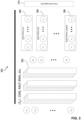
- a pairwise distance matrix 500, ⁇ is determined between D 501 ( f ⁇ ( C )) and W i .
- ⁇ q,j ⁇ ( D q , W i,j ) for 1 ⁇ q ⁇ p and 1 ⁇ j ⁇ m, where ⁇ is the Euclidean distance.
- a path 502 is determined through the distance matrix 500 from ⁇ 1,1 to ⁇ p,m ; the path 502 minimizes a sum of the ⁇ ( D q , W i,j ) along the path 502.
- W i approximates a group of as-emitted (transform-stripped) signals having label L i up to a fixed transformation ST i .
- D' accordingly, is an analogue for a transform-stripped version of C (e.g., is a transform-stripped version of C , modified by a fixed signal transform ST i , excepting any differences between C and D associated with determination of D by the machine learning model), such that D' can be used in subsequent analysis processes to determine information about C.
- D ' is analyzed to determine information about C, for example, to perform USR for C based on an identifier included in D', to determine a type of encoding/encryption used when transmitting C based on as evinced in D', to perform a decryption operation on D' to obtain information about a decrypted version of C , to determine, for C and based on information in D ', any one or more of the classification characteristics described above in association with the label L , and/or for other analysis operations.
- the alignment matrix A also carries significant information and can be analyzed accordingly. Because A transforms D into D' (e.g., transforms D into a transform-stripped sequence modified by fixed signal transformation ST i ), A carries information about the Doppler-shifting and time-shifting that acted on the emitted signal received as C . For example, A can be indicative of a series of time offsets corresponding to time compression ("bunching up") of time points, based on which it can be concluded that the emitter was moving towards the sensing device when emitting the signal received as C. Alternatively, A can be indicative of a series of time offsets corresponding to time-extension ("stretching out”) of time points, based on which it can be concluded that the emitter was moving away from the sensing device when emitting the signal received as C .
- a transforms D into D' e.g., transforms D into a transform-stripped sequence modified by fixed signal transformation ST i
- A carries information about the Doppler-shifting and time
- one or more machine learning models which can be (but need not be) distinct from the ECM 202, are trained to analyze alignment matrices A to estimate trajectory parameters of emitters, such as position r e , velocity v e , acceleration a e , and/or jerk j e of emitter 102b of FIG. 1 (e.g., in reference to a sensing device), and/or trajectory parameters of sensing devices (e.g., in reference to an emitter).
- training data 600 includes alignment matrices A.
- At least some of the alignment matrices in the training data 600 can be derived from the same corpus that provides the training data 204. For example, for each C i corresponding to a D i ( f ⁇ ( C )) in the training data 204, an alignment matrix A exists between D i and the barycenter W i of ⁇ D i ⁇ , where ⁇ D i ⁇ is the set of sequences corresponding to the same label L i as C i , and where the barycenter W i is determined through adjustment of weights in the training process described above.
- the alignment matrix A can be provided as a portion of the training data 600.
- Label(s) 602 corresponding to each A in the training data 600 include data describing transmission of the signal C i corresponding to A (e.g., the signal for which A i characterizes time-warping between D i and barycenter W i corresponding to label L i ).
- the labels 602 can include trajectory parameters of the sensing devices relative to the emitter that emitted the signal to which A corresponds; time of arrival (TOA) and/or frequency of arrival (FOA) data describing the signal as-received at two or more sensing devices; attenuation effects applied to the signal; and/or other types of data.
- This data used as training labels can be obtained through known geolocation and emitter-identification techniques.
- the matched filter and a signal are used an input into a binary CAF operator, and an output of the CAF operator includes time offset and frequency offset between the matched filter and the signal, based on which TOA and FOA data can be determined.
- the known trajectory parameters can be used as a label, and/or a TOA/FOA corresponding to the known trajectory parameters can be used as a label.
- a signal transformation model (STM) 604 is obtained.
- the STM 604 can include a CNN, an RNN, an MLP, a transformer network, or another type of learning network.
- the STM 604 is configured to receive, as input, an alignment matrix A (610) and to determine, as output, information describing emission of the signal, such as TOA (612), FOA (614), and/or trajectory parameter(s) of the sensing devices relative to the emitter or vice-versa (616).
- separate STMs are trained to output different types of these or other data (single-output regression), while in other implementations an STM is trained to output multiple types of these or other data (e.g., dual-output or triple-output regression).
- the output of the STM 604 can be used to perform tests related to the trajectory parameter(s). These tests can provide less-precise motion information than would be provided by an exact geolocation estimate.
- a test result can indicate whether an emitter is airborne or on the ground, whether the emitter is in a particular region (e.g., a land, sea, air, or orbital region), whether the emitter is more likely to be in a first region or a second region, and/or whether the emitter is traveling with a velocity within a particular velocity range, among other testable characteristics.
- the region is a particular portion of the Earth's surface.
- the Earth's surface can be tiled into multiple regions (e.g., hexagonal or square regions, such as 10° by 10° regions) associated with a geospatial indexing system.
- a test result includes a probability that a particular hypothesis is true.
- test results are determined based on TOA/FOA data output by the STM 604.
- the TOA/FOA data are compared to predicted values of TOA/FOA for signals emitted from a hypothesized location (e.g., a region) at a hypothesized time.
- a degree of match between the determined TOA/FOA and the predicted TOA/FOA indicates a likelihood of emission from the hypothesized location at the hypothesized time. Further details on determination of signal emission parameters are provided in U.S. Patent No. 10,466,336 .
- the ECM 202 and the STM 604 can be implemented as a combined machine learning network, trained using a soft-DTW loss function, that performs the functionalities described above with respect to both models, e.g., a combined machine learning model that is trained as described for ECM 202 and STM 604.
- the combined machine learning model receives, as input, a signal received at a sensing device and provides, as output, a transform-stripped analogue of the signal (e.g., D'), TOA/FOA data characterizing the signal, trajectory parameters of the emitter and/or test results that describe position/motion information of the emitter, a classification of the emitter by a label used for training (e.g., an identity of the emitter), or a combination of these results.
- a transform-stripped analogue of the signal e.g., D'
- TOA/FOA data characterizing the signal
- trajectory parameters of the emitter e.g., trajectory parameters of the emitter and/or test results that describe position/motion information of the emitter
- a classification of the emitter by a label used for training e.g., an identity of the emitter
- a trained machine learning model (e.g., a trained machine learning model on a sensing device) is updated based on newly-received signals (e.g., signals detected at the sensing device). For example, determinations based on one or more machine learning model outputs, such as labels determined to correspond to a received signal or TOA/FOA data determined for the signal, can be compared to known true information characterizing the signal. The known true information can be obtained from a separate analysis, such as by cross-referencing with a third-party data source or based on CAF processing (e.g., CAF processing performed at a ground station).
- CAF processing e.g., CAF processing performed at a ground station.
- the machine learning model can be retrained, e.g., using the signal as training data and using the known true information as a label for the training data.
- the machine learning model can be retrained over time such that newer training data is emphasized more than older training data, e.g., weighted more heavily in calculation of the cross-entropy loss function.
- the ECM 202 and the STM 604 described above can be stored on and run on sensing devices such as satellites, UAVs, and other mobile sensors. Local computing power on these sensing devices is typically limited, such that performing alternative signal analysis methods, such as CAF processing, can result in overburdened processing systems and, accordingly, slow obtaining of processing results such as emitter identities, trajectory parameters, and transform-stripped signals.
- CAF processing alternative signal analysis methods
- running a trained machine learning model such as the ECM 202 and the STM 604 is typically less computationally-intensive than performing CAF processing, such that processing can be performed onboard a sensing device to analyze detected signals without having to transfer the detected signals to another processing system, such as a ground station.
- the machine learning models need not be run on a sensing device but, rather, can be run on one or more other computing systems, such as a ground station or a cloud computing system. Training of the machine learning networks can be performed on a sensing device, at a ground station, on a cloud computing system, or on another computer device. Because the training tends to be computationally intensive and to rely on large amounts of data, in some implementations it is preferable to perform the training on a computing system besides a sensing device, and to subsequently transfer an already-trained machine learning model to a sensing device (e.g., by remote transmission).
- the methods described in this disclosure can recover transform-stripped signals and emitter information based on signals received at a single sensing device ("one-ball geolocation"). This can allow for reduced network usage (e.g., reduced usage of radio links between ground stations and sensing devices or between sensing devices) compared to alternative methods that are based on detection at multiple sensing devices, because sensed signal data need not be transferred between sensing devices or to a common processing location.
- sensing security can be improved by removing the shared signal data as a possible vector for detection of the sensing devices.
- a sensing device 700 such as a satellite or a UAV such as sensing devices 104, includes one or more processors 702, one or more sensors 704, a memory and/or storage 706, and one or more communications transponders 708.
- the processors 702 are configured to perform operations based on instructions stored in the memory/storage 706. For example, the processors 702 are configured to obtain, from the sensors 704, data indicative of signals sensed by the sensors 704 (e.g., sampled time series of the signals).
- the memory/storage 706 includes one or more machine learning models, such as the ECM 202 and/or the STM 604, and the processors 702 are configured to input time series of the signals into the machine learning models to determine, as output of the machine learning models, information about emitters of the signals.
- the memory/storage 706 can include algorithms (e.g., TOA/FOA algorithms) that can be applied to outputs of the machine learning models to determine information about emitters of the signals.
- the sensors 704 can include, for example one or more RF antennas.
- the sensors 704 can include auxiliary signal-processing elements such as receivers, tuners, and/or filters, that process signals received at the sensors 704.
- the sensors 704 include one or more digitizers, e.g., an analog to digital (A/D) converter that convers received analog emitter signals into a digital time series for processing by the processors 702.
- A/D analog to digital
- the communications transponders 708 communicate with other sensing devices, and/or with ground stations.
- the communications transponders 708 can include downlink/uplink communications transponders, which communicate with a ground station for command and control instructions, to transmit signals received at the sensing device 700, and/or to transmit processed information about the signals following processing performed onboard the sensing device 700.
- the communications transponders 708 can receive, from a ground station, machine learning models for storage on the memory/storage 706, the machine learning models having been trained at the ground station and/or by another computing system.
- the communications transponders 708 include crosslink communications transponders which communicate with other nearby sensing devices to coordinate command and control functions, tasking, synchronous observation, sharing received signals, and computing information about multi-channel recordings, among other possible operations.
- an example ground station 800 (e.g., ground station 110) includes one or more processors 802, a memory/storage 804, and one or more communications transponders 806.
- the processors 802 are configured to perform operations based on instructions stored on the memory/storage 804.
- the processors are configured to access training data stored on the memory/storage 804 (e.g., training data 204 and/or training data 600) and apply the training data to train one or more machine learning networks using soft-DTW loss functions.
- the processors are configured to provide trained machine learning models to sensing devices using the communications transponders 806. Operations can include, among others, processing signals received from sensing devices, and transmitting command and control signals to the sensing devices.
- the communications transponders 806 communicate with the sensing devices.
- the communications transponders 806 can include downlink/uplink communications transponders that are used to transmit command and control instructions, trained machine learning models, analysis algorithms, and updates thereof, to the sensing devices, and to receive results of analyses from the sensing devices (e.g., outputs of machine learning models run on the sensing devices).
- the memory/storage 706, 804 store instructions that are executed by the processor.
- the memory/storage 706, 804 can store signals detected by the sensors 704, and/or results of computations performed by the processors (e.g., outputs of machine learning models, or trained machine learning models themselves).
- the memory/storage 706, 804 include one or more of random access memory (RAM), various types of read-only memory (ROM), other long-term storage memory, such as non-volatile flash memory, hard disk storage, storage disks, or other suitable storage media.
- the processors 702, 802 are general purpose multiprocessors. In some implementations, the processors 702, 802 include digital signal processing (DSP) features, general-purpose pre-processors (GPP), general-purpose graphics processing units (GPGPU), or field-programmable gate arrays (FPGA), or a suitable combination of these. In some implementations, the processors 702, 802 include parallel processing capabilities, such as using included GPU hardware.
- DSP digital signal processing
- GPP general-purpose pre-processors
- GPGPU general-purpose graphics processing units
- FPGA field-programmable gate arrays
- the processors 702, 802 include parallel processing capabilities, such as using included GPU hardware.
- the method 900 can be performed by any suitable computing system, such as by processors (e.g., processors 702) of a sensing device (e.g., sensing devices 104/700), processors (e.g., processors 802) of a ground station (e.g., ground station 110/800), another computing system such as a distributed/cloud-based computing system, or a combination thereof.
- processors e.g., processors 702 of a sensing device (e.g., sensing devices 104/700), processors (e.g., processors 802) of a ground station (e.g., ground station 110/800), another computing system such as a distributed/cloud-based computing system, or a combination thereof.
- a machine learning network is trained using, as input training data, a plurality of time series representing sampled radio frequency (RF) signals, and a plurality of labels (902). Each label is associated with at least one time series of the plurality of time series.
- the labels describe one or more characteristics of emitters of the sampled RF signals.
- the training is based on a soft dynamic time warping (soft-DTW) loss function.
- the machine learning network includes, for each label of the plurality of labels, a corresponding soft dynamic time warping (soft-DTW) terminal associated with the label.
- each soft-DTW terminal 304 is associated with a corresponding label L .
- the soft-DTW terminals include weights, and a value of each soft-DTW terminal is based on a soft-DTW loss function based on the weights of the soft-DTW terminal.
- each soft-DTW terminal 304 includes weights W ; a value of the soft-DTW terminal 304 is based on a soft-DTW loss function of the weights W .
- Training the machine learning network can include iteratively adjusting the weights of the soft-DTW terminals so as to reduce a value of at least one loss function.
- the at least one loss function has a value that depends on values of the soft-DTW terminals, e.g., based on values of multiple soft-DTW loss functions corresponding to multiple soft-DTW terminals.
- the at least one loss function includes a cross-entropy loss function, such as the k-state cross-entropy loss function 310.
- the weights can be adjusted so as to, for each label of the plurality of labels, (i) reduce a value of a soft-DTW loss function corresponding to the label when the soft-DTW loss function is based on a time series of the plurality of time series that is associated with the label, and (ii) increase the value of the soft-DTW loss function corresponding to the label when the soft-DTW loss function is based on a time series of the plurality of time series that is not associated with the label.
- a shared loss function such as the cross-entropy loss function allows for simultaneous training of weights of different soft-DTW terminals to incentivize separation between input classes (labels) for the purposes of classification.
- the soft-DTW loss function of the soft-DTW terminal characterizes a difference between (i) a sequence of the weights of the soft-DTW terminal and (ii) one or more derived sequences obtained by processing time series of the plurality of time series.
- derived sequences D are determined for each C used for training of machine learning network 300, and values of soft-DTW loss functions can be calculated as soft-DTW(D, W ), where W is a sequence of weights of a soft-DTW terminal corresponding to a label L associated with C .
- the machine learning network trained in process 902 includes a machine learning component containing multiple additional weights.
- the machine learning component can be configured to determine the one or more derived sequences based on the plurality of additional weights, and training the machine learning network can include adjusting the plurality of additional weights.
- machine learning network 300 includes machine learning component 302.
- a machine learning model configured to classify new RF signal sequences by label (904).
- ECM 202 can be used to determine a classification by a set of labels L , where any label L can identify an emitter or other characteristic of the new RF signal sequence C .
- the machine learning model includes a sequence of weights W corresponding to the label.
- the sequence of weights W forms a barycenter corresponding to the label L, and the barycenter is included in the machine learning model.
- the machine learning model is provided to an RF sensing device (906).
- the machine learning model is transmitted from a ground station to a sensing device such as a satellite or an aerial vehicle.
- the method 900 includes providing a detected RF signal to the machine learning model; determining, as an output of the machine learning model, a sequence corresponding to the detected RF signal; and determining, based on the sequence, a mapping corresponding to a signal transform that acted on the detected RF signal. For example, based on a detected RF signal C , a corresponding sequence D is determined based on the ECM 202. An alignment matrix A is determined between D and a barycenter W corresponding to a label L with which C was classified by the ECM 202. The alignment matrix A is an example of the mapping.
- the mapping includes information about the signal transform, such that various information about emission of C can be determined, such as a transform-stripped analogue of C (e.g., D '), trajectory/location information of an emitter of C , and/or other information as described above.
- a transform-stripped analogue of C e.g., D '
- trajectory/location information of an emitter of C e.g., D '
- other information about the signal transform such that various information about emission of C can be determined, such as a transform-stripped analogue of C (e.g., D '), trajectory/location information of an emitter of C , and/or other information as described above.
- a sampled time series of the RF signal is input into a machine learning model trained using a soft-DTW loss function (1004). For example, as shown in FIG. 4 , C is input into ECM 202.
- a mapping corresponding to a signal transform (e.g., Doppler-shift and/or time-shift) that acted on the RF signal is determined.
- D is determined based on ECM 202
- an alignment matrix A is determined between D and a barycenter W corresponding to the L with which C was classified.
- the alignment matrix A is an example of the mapping.
- Data characterizing an RF channel between the emitter of the RF signal and the sensing device can be determined.
- A can be provided into STM 604 (where STM 604 can be trained as shown in FIG. 6A ), to obtain trajectory parameters 616, TOA data 612, and/or FOA data 614.
- the mapping can be used to determine a transform-stripped analogue of the RF signal.
- D' can be determined based on D and the alignment matrix A, where D' is a transform-stripped analogue of C.
- the disclosed and other examples can be implemented as one or more computer program products, for example, one or more modules of computer program instructions encoded on a computer readable medium for execution by, or to control the operation of, data processing apparatus.
- the implementations can include single or distributed processing of algorithms.
- the computer readable medium can be a machine-readable storage device, a machine-readable storage substrate, a memory device, or a combination of one or more them.
- data processing apparatus encompasses all apparatus, devices, and machines for processing data, including by way of example a programmable processor, a computer, or multiple processors or computers.
- the apparatus can include, in addition to hardware, code that creates an execution environment for the computer program in question, e.g., code that constitutes processor firmware, a protocol stack, a database management system, an operating system, or a combination of one or more of them.
- a system may encompass all apparatus, devices, and machines for processing data, including by way of example a programmable processor, a computer, or multiple processors or computers.
- a system can include, in addition to hardware, code that creates an execution environment for the computer program in question, e.g., code that constitutes processor firmware, a protocol stack, a database management system, an operating system, or a combination of one or more of them.
- a computer program (also known as a program, software, software application, script, or code) can be written in any form of programming language, including compiled or interpreted languages, and the computer program can be deployed in any form, including as a standalone program or as a module, component, subroutine, or other unit suitable for use in a computing environment.
- a computer program does not necessarily correspond to a file in a file system.
- a program can be stored in a portion of a file that holds other programs or data (e.g., one or more scripts stored in a markup language document), in a single file dedicated to the program in question, or in multiple coordinated files (e.g., files that store one or more modules, sub programs, or portions of code).
- a computer program can be deployed for execution on one computer or on multiple computers that are located at one site or distributed across multiple sites and interconnected by a communications network.
- the processes and logic flows described in this document can be performed by one or more programmable processors executing one or more computer programs to perform functions by operating on input data and generating output.
- the processes and logic flows can also be performed by, and apparatus can also be implemented as, special purpose logic circuitry, e.g., an FPGA (field programmable gate array) or an ASIC (application specific integrated circuit).
- processors suitable for the execution of a computer program include, by way of example, both general and special purpose microprocessors, and any one or more processors of any kind of digital computer.
- a processor will receive instructions and data from a read only memory or a random access memory or both.
- the essential elements of a computer can include a processor for performing instructions and one or more memory devices for storing instructions and data.
- a computer can also include, or be operatively coupled to receive data from or transfer data to, or both, one or more mass storage devices for storing data, e.g., magnetic, magneto optical disks, or optical disks.
- mass storage devices for storing data, e.g., magnetic, magneto optical disks, or optical disks.
- a computer need not have such devices.
- Computer readable media suitable for storing computer program instructions and data can include all forms of nonvolatile memory, media and memory devices, including by way of example semiconductor memory devices, e.g., EPROM, EEPROM, and flash memory devices; magnetic disks, e.g., internal hard disks or removable disks; magneto optical disks; and CD ROM and DVD-ROM disks.
- semiconductor memory devices e.g., EPROM, EEPROM, and flash memory devices
- magnetic disks e.g., internal hard disks or removable disks
- magneto optical disks e.g., CD ROM and DVD-ROM disks.
- the processor and the memory can be supplemented by, or incorporated in, special purpose logic circuitry.
Landscapes
- Engineering & Computer Science (AREA)
- Physics & Mathematics (AREA)
- Artificial Intelligence (AREA)
- Theoretical Computer Science (AREA)
- Evolutionary Computation (AREA)
- Software Systems (AREA)
- General Physics & Mathematics (AREA)
- Signal Processing (AREA)
- Computer Networks & Wireless Communication (AREA)
- Data Mining & Analysis (AREA)
- Electromagnetism (AREA)
- Computing Systems (AREA)
- General Engineering & Computer Science (AREA)
- Mathematical Physics (AREA)
- Computer Security & Cryptography (AREA)
- Computer Vision & Pattern Recognition (AREA)
- Medical Informatics (AREA)
- Remote Sensing (AREA)
- Radar, Positioning & Navigation (AREA)
- Health & Medical Sciences (AREA)
- Life Sciences & Earth Sciences (AREA)
- Biomedical Technology (AREA)
- Biophysics (AREA)
- Computational Linguistics (AREA)
- General Health & Medical Sciences (AREA)
- Molecular Biology (AREA)
- Radar Systems Or Details Thereof (AREA)
- Selective Calling Equipment (AREA)
Applications Claiming Priority (3)
| Application Number | Priority Date | Filing Date | Title |
|---|---|---|---|
| US202263320006P | 2022-03-15 | 2022-03-15 | |
| EP23771319.3A EP4494370A4 (de) | 2022-03-15 | 2023-03-14 | Zeitliche gleichrichtung von hochfrequenzsignalen |
| PCT/US2023/015185 WO2023177664A1 (en) | 2022-03-15 | 2023-03-14 | Temporal rectification of radio frequency signals |
Related Parent Applications (1)
| Application Number | Title | Priority Date | Filing Date |
|---|---|---|---|
| EP23771319.3A Division EP4494370A4 (de) | 2022-03-15 | 2023-03-14 | Zeitliche gleichrichtung von hochfrequenzsignalen |
Publications (2)
| Publication Number | Publication Date |
|---|---|
| EP4568331A2 true EP4568331A2 (de) | 2025-06-11 |
| EP4568331A3 EP4568331A3 (de) | 2025-08-06 |
Family
ID=88024247
Family Applications (2)
| Application Number | Title | Priority Date | Filing Date |
|---|---|---|---|
| EP25172080.1A Pending EP4568331A3 (de) | 2022-03-15 | 2023-03-14 | Zeitliche gleichrichtung von hochfrequenzsignalen |
| EP23771319.3A Pending EP4494370A4 (de) | 2022-03-15 | 2023-03-14 | Zeitliche gleichrichtung von hochfrequenzsignalen |
Family Applications After (1)
| Application Number | Title | Priority Date | Filing Date |
|---|---|---|---|
| EP23771319.3A Pending EP4494370A4 (de) | 2022-03-15 | 2023-03-14 | Zeitliche gleichrichtung von hochfrequenzsignalen |
Country Status (4)
| Country | Link |
|---|---|
| US (1) | US20250211348A1 (de) |
| EP (2) | EP4568331A3 (de) |
| CA (1) | CA3243822A1 (de) |
| WO (1) | WO2023177664A1 (de) |
Citations (1)
| Publication number | Priority date | Publication date | Assignee | Title |
|---|---|---|---|---|
| US10466336B2 (en) | 2017-06-30 | 2019-11-05 | HawkEye 360, Inc. | Detecting radio signal emitter locations |
Family Cites Families (14)
| Publication number | Priority date | Publication date | Assignee | Title |
|---|---|---|---|---|
| US7103222B2 (en) * | 2002-11-01 | 2006-09-05 | Mitsubishi Electric Research Laboratories, Inc. | Pattern discovery in multi-dimensional time series using multi-resolution matching |
| WO2007008195A1 (en) * | 2004-10-28 | 2007-01-18 | University Of Maryland | Navigation system and method using modulated celestial radiation sources |
| US8515473B2 (en) * | 2007-03-08 | 2013-08-20 | Bae Systems Information And Electronic Systems Integration Inc. | Cognitive radio methodology, physical layer policies and machine learning |
| US8805292B1 (en) * | 2013-03-15 | 2014-08-12 | DGS Global Systems, Inc. | Systems, methods, and devices for electronic spectrum management for identifying signal-emitting devices |
| US9439168B2 (en) * | 2014-05-22 | 2016-09-06 | Qualcomm Incorporated | Use of RF signatures to detect moved wireless transmitters |
| US9945928B2 (en) * | 2014-10-30 | 2018-04-17 | Bastille Networks, Inc. | Computational signal processing architectures for electromagnetic signature analysis |
| WO2020068176A2 (en) * | 2018-05-18 | 2020-04-02 | Battelle Energy Alliance, Llc | Spectrum monitoring and analysis, and related methods, systems, and devices |
| US11190944B2 (en) * | 2017-05-05 | 2021-11-30 | Ball Aerospace & Technologies Corp. | Spectral sensing and allocation using deep machine learning |
| KR102310001B1 (ko) * | 2017-06-19 | 2021-10-08 | 버지니아 테크 인터렉추얼 프라퍼티스, 인크. | 다중 안테나 송수신기를 이용한 무선 송신을 위한 정보의 인코딩 및 디코딩 |
| CA3078435A1 (en) * | 2017-10-20 | 2019-04-25 | HawkEye 360, Inc. | Metadata-based emitter localization |
| US11604287B2 (en) * | 2018-08-09 | 2023-03-14 | Apple Inc. | Machine learning assisted satellite based positioning |
| EP4018560A1 (de) * | 2019-08-22 | 2022-06-29 | Qualcomm Incorporated | Drahtlosen kommunikation mit erhöhter einhaltung der maximalen zulässigen exposition (mpe) |
| US10924308B1 (en) * | 2020-01-16 | 2021-02-16 | Raytheon Applied Signal Technology, Inc. | Smart receiver with compressive sensing and machine learning |
| CN111985567B (zh) * | 2020-08-21 | 2022-11-22 | 河北先河环保科技股份有限公司 | 一种基于机器学习的污染源类型自动识别方法 |
-
2023
- 2023-03-14 EP EP25172080.1A patent/EP4568331A3/de active Pending
- 2023-03-14 EP EP23771319.3A patent/EP4494370A4/de active Pending
- 2023-03-14 US US18/847,103 patent/US20250211348A1/en active Pending
- 2023-03-14 CA CA3243822A patent/CA3243822A1/en active Pending
- 2023-03-14 WO PCT/US2023/015185 patent/WO2023177664A1/en not_active Ceased
Patent Citations (1)
| Publication number | Priority date | Publication date | Assignee | Title |
|---|---|---|---|---|
| US10466336B2 (en) | 2017-06-30 | 2019-11-05 | HawkEye 360, Inc. | Detecting radio signal emitter locations |
Also Published As
| Publication number | Publication date |
|---|---|
| EP4494370A4 (de) | 2026-01-28 |
| EP4568331A3 (de) | 2025-08-06 |
| WO2023177664A1 (en) | 2023-09-21 |
| US20250211348A1 (en) | 2025-06-26 |
| EP4494370A1 (de) | 2025-01-22 |
| CA3243822A1 (en) | 2023-09-21 |
Similar Documents
| Publication | Publication Date | Title |
|---|---|---|
| US11882540B2 (en) | Determining emitter locations | |
| Basak et al. | Drone classification from RF fingerprints using deep residual nets | |
| CA3067545C (en) | Detecting radio signal emitter locations | |
| US10739436B2 (en) | Metadata-based emitter localization | |
| WO2020209918A2 (en) | Detection of cyber attacks targeting avionics systems | |
| US10805022B2 (en) | Method of using time domain subspace signals and spatial domain subspace signals for location approximation through orthogonal frequency-division multiplexing | |
| Gu et al. | Multimodality in mmWave MIMO beam selection using deep learning: Datasets and challenges | |
| Zou et al. | Vision-assisted 3-D predictive beamforming for green UAV-to-vehicle communications | |
| US20210001981A1 (en) | Position determination of mobile objects | |
| CN119962337A (zh) | 基于多模态信息智能筛选机制的无人机波束预测方法及装置 | |
| EP4568331A2 (de) | Zeitliche gleichrichtung von hochfrequenzsignalen | |
| CN111669248A (zh) | 无人机信号压制方法、装置、电子设备与存储介质 | |
| US10801841B1 (en) | Trajectory prediction via a feature vector approach | |
| US20240393421A1 (en) | Geolocation method for detection and tracking of maneuvering emitters | |
| US20230110788A1 (en) | Learning device, learning method, recording medium, and radar device | |
| KR102716658B1 (ko) | 컴퓨터 비전 기반 채널 추정을 위한 네트워크 모델 학습 방법 및 장치 | |
| CN116295404A (zh) | 具备抗干扰能力的高精度无人机导航系统及导航方法 | |
| US12276744B2 (en) | Method and system for selectively applying deep learning for classification of platforms carrying radio frequency emitters | |
| Tian et al. | GNSS Spoofing Identification with Receiver Motion-Induced Doppler (GSIR-MID) | |
| Chen et al. | Data Driven GNSS Based Interference Signal Detection Technology | |
| KABIRI | 5G-Enhanced Indoor UAV Localization and SLAM through Sensor Fusion | |
| US20230068500A1 (en) | Method, device and system of prediction of direction of arrival of a signal | |
| CN116996826A (zh) | 基于无人机的定位方法与系统 | |
| CN120692520A (zh) | 一种无线射频指纹数据增强与定位方法、装置及存储介质 | |
| CN119547519A (zh) | 用于信道分类的数据高效更新 |
Legal Events
| Date | Code | Title | Description |
|---|---|---|---|
| PUAI | Public reference made under article 153(3) epc to a published international application that has entered the european phase |
Free format text: ORIGINAL CODE: 0009012 |
|
| STAA | Information on the status of an ep patent application or granted ep patent |
Free format text: STATUS: THE APPLICATION HAS BEEN PUBLISHED |
|
| AC | Divisional application: reference to earlier application |
Ref document number: 4494370 Country of ref document: EP Kind code of ref document: P |
|
| AK | Designated contracting states |
Kind code of ref document: A2 Designated state(s): AL AT BE BG CH CY CZ DE DK EE ES FI FR GB GR HR HU IE IS IT LI LT LU LV MC ME MK MT NL NO PL PT RO RS SE SI SK SM TR |
|
| PUAL | Search report despatched |
Free format text: ORIGINAL CODE: 0009013 |
|
| AK | Designated contracting states |
Kind code of ref document: A3 Designated state(s): AL AT BE BG CH CY CZ DE DK EE ES FI FR GB GR HR HU IE IS IT LI LT LU LV MC ME MK MT NL NO PL PT RO RS SE SI SK SM TR |
|
| RIC1 | Information provided on ipc code assigned before grant |
Ipc: H04W 24/08 20090101AFI20250701BHEP Ipc: G01S 5/02 20100101ALI20250701BHEP Ipc: H04W 4/02 20180101ALI20250701BHEP Ipc: H04W 12/79 20210101ALI20250701BHEP Ipc: G06N 3/09 20230101ALI20250701BHEP Ipc: G06N 3/04 20230101ALI20250701BHEP Ipc: H04B 17/391 20150101ALI20250701BHEP |
|
| STAA | Information on the status of an ep patent application or granted ep patent |
Free format text: STATUS: REQUEST FOR EXAMINATION WAS MADE |