EP4568281A1 - Enhanced sound performance - Google Patents
Enhanced sound performance Download PDFInfo
- Publication number
- EP4568281A1 EP4568281A1 EP23214404.8A EP23214404A EP4568281A1 EP 4568281 A1 EP4568281 A1 EP 4568281A1 EP 23214404 A EP23214404 A EP 23214404A EP 4568281 A1 EP4568281 A1 EP 4568281A1
- Authority
- EP
- European Patent Office
- Prior art keywords
- vehicle
- data
- audio device
- output
- audio
- Prior art date
- Legal status (The legal status is an assumption and is not a legal conclusion. Google has not performed a legal analysis and makes no representation as to the accuracy of the status listed.)
- Pending
Links
Images


Classifications
-
- H—ELECTRICITY
- H04—ELECTRIC COMMUNICATION TECHNIQUE
- H04R—LOUDSPEAKERS, MICROPHONES, GRAMOPHONE PICK-UPS OR LIKE ACOUSTIC ELECTROMECHANICAL TRANSDUCERS; ELECTRIC HEARING AIDS; PUBLIC ADDRESS SYSTEMS
- H04R3/00—Circuits for transducers
- H04R3/04—Circuits for transducers for correcting frequency response
-
- G—PHYSICS
- G01—MEASURING; TESTING
- G01S—RADIO DIRECTION-FINDING; RADIO NAVIGATION; DETERMINING DISTANCE OR VELOCITY BY USE OF RADIO WAVES; LOCATING OR PRESENCE-DETECTING BY USE OF THE REFLECTION OR RERADIATION OF RADIO WAVES; ANALOGOUS ARRANGEMENTS USING OTHER WAVES
- G01S11/00—Systems for determining distance or velocity not using reflection or reradiation
- G01S11/14—Systems for determining distance or velocity not using reflection or reradiation using ultrasonic, sonic or infrasonic waves
-
- H—ELECTRICITY
- H04—ELECTRIC COMMUNICATION TECHNIQUE
- H04R—LOUDSPEAKERS, MICROPHONES, GRAMOPHONE PICK-UPS OR LIKE ACOUSTIC ELECTROMECHANICAL TRANSDUCERS; ELECTRIC HEARING AIDS; PUBLIC ADDRESS SYSTEMS
- H04R3/00—Circuits for transducers
- H04R3/12—Circuits for transducers for distributing signals to two or more loudspeakers
-
- H—ELECTRICITY
- H04—ELECTRIC COMMUNICATION TECHNIQUE
- H04W—WIRELESS COMMUNICATION NETWORKS
- H04W4/00—Services specially adapted for wireless communication networks; Facilities therefor
- H04W4/80—Services using short range communication, e.g. near-field communication [NFC], radio-frequency identification [RFID] or low energy communication
-
- H—ELECTRICITY
- H04—ELECTRIC COMMUNICATION TECHNIQUE
- H04R—LOUDSPEAKERS, MICROPHONES, GRAMOPHONE PICK-UPS OR LIKE ACOUSTIC ELECTROMECHANICAL TRANSDUCERS; ELECTRIC HEARING AIDS; PUBLIC ADDRESS SYSTEMS
- H04R2420/00—Details of connection covered by H04R, not provided for in its groups
- H04R2420/07—Applications of wireless loudspeakers or wireless microphones
-
- H—ELECTRICITY
- H04—ELECTRIC COMMUNICATION TECHNIQUE
- H04R—LOUDSPEAKERS, MICROPHONES, GRAMOPHONE PICK-UPS OR LIKE ACOUSTIC ELECTROMECHANICAL TRANSDUCERS; ELECTRIC HEARING AIDS; PUBLIC ADDRESS SYSTEMS
- H04R2430/00—Signal processing covered by H04R, not provided for in its groups
- H04R2430/03—Synergistic effects of band splitting and sub-band processing
-
- H—ELECTRICITY
- H04—ELECTRIC COMMUNICATION TECHNIQUE
- H04R—LOUDSPEAKERS, MICROPHONES, GRAMOPHONE PICK-UPS OR LIKE ACOUSTIC ELECTROMECHANICAL TRANSDUCERS; ELECTRIC HEARING AIDS; PUBLIC ADDRESS SYSTEMS
- H04R2499/00—Aspects covered by H04R or H04S not otherwise provided for in their subgroups
- H04R2499/10—General applications
- H04R2499/11—Transducers incorporated or for use in hand-held devices, e.g. mobile phones, PDA's, camera's
-
- H—ELECTRICITY
- H04—ELECTRIC COMMUNICATION TECHNIQUE
- H04R—LOUDSPEAKERS, MICROPHONES, GRAMOPHONE PICK-UPS OR LIKE ACOUSTIC ELECTROMECHANICAL TRANSDUCERS; ELECTRIC HEARING AIDS; PUBLIC ADDRESS SYSTEMS
- H04R2499/00—Aspects covered by H04R or H04S not otherwise provided for in their subgroups
- H04R2499/10—General applications
- H04R2499/13—Acoustic transducers and sound field adaptation in vehicles
-
- H—ELECTRICITY
- H04—ELECTRIC COMMUNICATION TECHNIQUE
- H04R—LOUDSPEAKERS, MICROPHONES, GRAMOPHONE PICK-UPS OR LIKE ACOUSTIC ELECTROMECHANICAL TRANSDUCERS; ELECTRIC HEARING AIDS; PUBLIC ADDRESS SYSTEMS
- H04R29/00—Monitoring arrangements; Testing arrangements
- H04R29/001—Monitoring arrangements; Testing arrangements for loudspeakers
- H04R29/002—Loudspeaker arrays
Definitions
- the current disclosure relates to a method for playing audio.
- the disclosure relates further to a vehicle audio system for playing audio and to a vehicle comprising such an apparatus.
- Portable audio devices often have a limited performance in the low frequencies due to its limited size which does not provide a good sound quality. Increasing the size of the portable audio device could provide a better performance in the low frequencies but it would make cumbersome to transport the portable audio device.
- the disclosure relates to a method, by a vehicle audio system, for playing audio, comprising receiving data for being output through a portable audio device located outside a vehicle and one or more internal speakers mounted inside the vehicle, determining a distance and/or a position of the portable audio device with respect to the vehicle, processing the data based on the determined distance and/or position of the portable audio device and controlling the one or more internal speakers to output the processed data, wherein the data is processed such that a frequency response of an output of the one or more internal speakers is adjusted based on a frequency response of the portable audio device.
- This allows to use for audio playing the vehicle audio system together with the portable audio device. In this way, a higher dynamic range and broader frequency range can be achieved.
- the portable audio device has a wireless connection to the vehicle and can playback music both as a portable audio device itself as well as a part of the vehicle audio system inside and outside of the vehicle.
- the vehicle audio system can be used to complement the low-frequency range of the portable audio device with the internal speakers of the vehicle.
- a microphone integrated in the portable audio device can be used to determine its position around the vehicle and optimize the audio performance as desired.
- Determining the position and/or distance of the portable audio device may comprise outputting a first audio signal through the one or more internal speakers, receiving a second audio signal transmitted by the portable audio device as a response to the first audio signal, and determining the location and/or distance based on the first and second audio signals.
- the location and/or distance may be determined based on a difference between a first time at which the first audio signal is transmitted and a second time at which the second audio signal is received.
- the portable audio device may comprise an integrated microphone.
- the tuning can be adapted to the current position of the portable audio device. This allows to improve the audio performance of the portable audio device at the outside of the vehicle.
- Processing the audio data further may comprise applying a time delay to the data based on the determined location and/or distance.
- the method may further comprise establishing a connection between the vehicle audio system and the portable audio device.
- the connection may be established via a Bluetooth, a WiFi or an access network.
- the vehicle audio system may comprise one or more filters and the frequency response of the output of the one or more internal speakers may be adjusted by selecting a filter among the one or more filters and/or creating a new filter, wherein the data may be processed based on the selected and/or new filter.
- the frequency response of the output of the one or more internal speakers may be adjusted by selecting a configuration for the one or more selected filter and/or new filter, and the method may further comprise configuring the selected one or more filters and/or new filter and processing the data with the configured selected and/or new filter.
- the vehicle audio system may comprise a user interface such as a screen, voice interface or any other suitable user interface allowing a user to indicate the current sub-area.
- the one or more speakers may comprise a plurality of speakers located at different positions inside of the vehicle, wherein the frequency response of the output of each of the plurality of speakers may be adjusted based on the determined distance or location of the portable audio device.
- the frequency response may be adjusted based on prestored data comprising a plurality of filters, wherein each of the plurality of filters may be generated by measuring, during a calibration phase, a frequency response of the output of each of the one or more speakers at different positions around the vehicle. For instance, individual transfer functions from each internal speaker to the different positions around the vehicle may be measured during the calibration phase by placing microphones at the different positions. The measured transfer functions will show the performance of each internal speaker for each different position.
- the transfer function of the portable audio device may be also known. Based on that, filters for each position can be created which are then stored in the audio vehicle system and applied when audio is played back. In this way, several tuning profiles are provided to optimize the music playback to different positions of the portable audio device around the vehicle.
- the disclosure further relates to a vehicle audio system comprising a memory connected to a controller, wherein the controller is configured to perform the method.
- the vehicle audio system may comprise the one or more internal speakers.
- the vehicle audio system may also comprise the portable audio device, and the portable audio device may comprise a receiver arranged to receive sound.
- FIG. 1A illustrates a block diagram of a vehicle audio system 102 according to the disclosure.
- the vehicle audio system 102 may comprise a head unit 104, an amplifier 106, an antenna 108, and a plurality of speakers 110.
- the head unit 104 or the amplifier 106 may comprise a digital signal processing unit and a memory.
- the vehicle audio system 102 may transmit and receive information via Bluetooth, through a wireless communication network, for example, a 4G network, and/or using any other suitable communication technology.
- the antenna 110 may be arranged to transmit or receive information from a portable audio device.
- the vehicle audio system 102 may comprise a plurality of speakers.
- One of the plurality of speakers of the vehicle audio system may be an internal speaker mounted inside of a vehicle wherein the vehicle audio system 102 is also installed.
- the plurality of speakers may comprise an external speaker mounted on the outside of the vehicle.
- the vehicle audio system 102 may be configured to send data to the plurality of speakers and/or to the portable audio device wherein the data may be previously processed by the processing unit 104 to be played by the plurality of speakers and by the portable audio device based on a distance or location of the portable audio device with respect to the plurality of speakers.
- the portable audio device may further comprise also a digital signal processing unit to further process the data to be played.
- Figure 2 illustrates a flowchart schematically depicting a method for playing audio according to the disclosure.
- the method of Figure 2 may be performed by the vehicle audio system 102 of Figure 1A .
- the vehicle audio system 102 receives data for being output through a portable audio device located outside a vehicle and one or more internal speakers mounted inside the vehicle.
- step 204 the vehicle audio system 102 determines a distance and/or a position of the portable audio device with respect to the vehicle.
- step 206 the data is processed based on the determined distance and/or position of the portable audio device.
- step 208 the vehicle audio system 102 controls the one or more internal speakers to output the processed data.
- the data is processed such that a frequency response of an output of the one or more internal speakers is adjusted based on a frequency response of the portable audio device.
- the data maybe any kind of data that can be output by a speaker.
- the vehicle audio system 102 may comprise any number of speakers.
- Figure 1B shows schematically a vehicle comprising a vehicle audio system according to the disclosure wherein the vehicle audio system can output audio through one or more internal speakers 100 mounted in different locations inside a cabin of the vehicle and through a portable audio device 200 outside of the vehicle at a certain location. This is a non-limiting example and the method of Figure 2 can be used with any combination of speakers located in any part of the vehicle.
- the speakers 100 may be mounted in any of the doors, in the trunk, in the floor beneath the front and rear seat, in the footwell area, in the cowl area (under the windshield wipers), under the dashboard, on the outside of the firewall lower A-pillar area playing into the cabin of the vehicle, etc...
- the portable audio device 200 has a wireless connection to the vehicle and can playback music both as a portable audio device itself as well as a part of the vehicle audio system inside and outside of the vehicle.
- the speakers 100 can be used to complement the low-frequency range of the portable audio device 200.
- the position and/or distance of the portable audio device 200 may be determined in step 204 by outputting a first audio signal through the internal speakers 100 that will be received by the portable device 200.
- the portable device 200 will transmit a second audio signal as a response to the first audio signal which will be received by the speakers 100 and can be used to determine the location and/or distance of the portable audio device 200 in relation to the speakers 100.
- the location and/or distance may be determined based on a difference between a first time at which the first audio signal is transmitted and a second time at which the second audio signal is received.
- Processing the data in step 206 may comprise applying a time delay to the data based on the determined location and/or distance.
- the response of the vehicle audio system is synced with the portable audio device providing a much broader frequency range, higher dynamic range and a true hi-fi experience outside of the vehicle.
- the method of Figure 2 may comprise establishing a connection between the vehicle audio system and the portable audio device wherein the connection may be established via a Bluetooth, a WiFi or an access network.
- the method may comprise in step 206 selecting a filter among one or more filters of the vehicle audio system or creating a new filter, and processing the data based on the selected or new filter.
- the frequency response of the output of the one or more internal speakers may be adjusted by selecting a configuration for the one or more selected filter and/or new filter, and the method may further comprise in step 206 configuring the selected one or more filters and/or new filter and processing the data with the configured selected and/or new filter.
- An area surrounding the vehicle may be divided into a plurality of sub-areas and step 204 may comprise determining a current sub-area wherein the portable audio device 200 is located. Then in step 206, the data may be processed based on the current sub-area.
- the vehicle audio system may comprise a user interface such as a screen, voice interface or any other suitable user interface allowing a user to indicate the current sub-area where the portable audio device 200 is located.
- the frequency response of the output of each of the one or more speakers may be adjusted based on the determined distance or location of the portable audio device.
- the frequency response of the output of each of the one or more internal speakers may also be adjusted based on prestored data comprising a plurality of filters, wherein each of the plurality of filters may be generated by measuring, during a calibration phase, a frequency response of the output of each of the one or more internal speakers at different positions around the vehicle. For instance, individual transfer functions from each internal speaker to the different positions around the vehicle may be measured during the calibration phase by placing microphones at the different positions. The measured transfer functions will show the performance of each internal speaker for each different position.
- the transfer function of the portable audio device may be also known. Based on that, filters for each position can be created which are then stored in the audio vehicle system and applied when audio is played back.
- the filters may be stored in a memory of the vehicle audio system, in an external database that can be accessed by the vehicle audio system 102 or in any other suitable storage place.
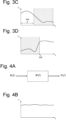
- Figure 3A-3D and 4A-4B illustrate an example of how to generate filters for a different positions of the portable audio device based on transfer functions measured during a calibration phase for a number n of speakers according to the disclosure.
- each of the n speakers will output sound at different times and a microphone located in the different positions outside the vehicle will receive the output sound from each of the n speakers.
- X(f) is a frequency representation of the signal to be output by each of the n speakers
- Y k (f) is a frequency representation of the signal received at the microphone for the k speaker
- Figures 3B-3D respectively show Y 1 (f), Y 2 (f) and Y 3 (f).
- each of the n speakers might have a very different frequency response. Some of the n speakers will behave better in certain frequency ranges than others of the n speakers.
- the transfer function H k (f) can be adjusted by selecting the best frequency range for the corresponding k speaker.
- the best frequency range may be selected as the frequency range which has the best transmission to the outside of the vehicle such that, for a given input voltage, maximum output may be achieved, which mau be determined by the sensitivity of the speaker installation.
- the best frequency range may be selected as a frequency range with higher amplitudes than other frequencies.
- the frequency ranges of several speakers may be selected in such a way that they complement each other as much as possible. For instance, in Figure 3B , the frequency ranges 302 may be selected for the first speaker. In Figure 3C , the frequency ranges 304 may be selected for the second speaker. And in Figure 3C , the frequencies above frequency 306 may be selected for the third speaker.
- This operation of selecting the best frequency ranges may be performed for all the n speakers to created adjusted transfer functions H' k (f) by taking only the selected parts of each transfer function.
- This calibration operation may be performed for several positions and/or distances such that a different set of filters is stored for each of these positions and/or distances and, when one of those positions and/or distances is where the portable device audio is located, the vehicle audio system 102 will process the data using the corresponding stored set of filters.
- processors e.g., one or more microprocessors including central processing units (CPU)
- memory which may include stored operating system software, firmware and/or application software executable by the processor(s) for controlling operation thereof and/or for performing the particular algorithms represented by the various functions and/or operations described herein, including interaction between and/or cooperation with each other as well as transmitters and receivers.
- processors may be included in a single ASIC (Application-Specific Integrated Circuitry), or several processors and various digital hardware may be distributed among several separate components, whether individually packaged or assembled into a SoC (System-on-a-Chip).
- ASIC Application-Specific Integrated Circuitry
- SoC System-on-a-Chip
- the systems, methods and components described, and/or any other arrangement, unit, system, device or module described herein may for instance be implemented in one or several arbitrary nodes comprised in the host vehicle and/or one or more separate devices.
- a node may comprise an electronic control unit (ECU) or any suitable electronic device, which may be a main or central node.
- ECU electronice control unit
- the these may further comprise or be arranged or configured to cooperate with any type of storage device or storage arrangement known in the art, which may for example be used for storing input or output data associated with the functions and/or operations described herein.
- the systems, components and methods described herein may further comprise any computer hardware and software and/or electrical hardware known in the art configured to enable communication therebetween.
Landscapes
- Engineering & Computer Science (AREA)
- Signal Processing (AREA)
- Physics & Mathematics (AREA)
- Acoustics & Sound (AREA)
- Otolaryngology (AREA)
- General Health & Medical Sciences (AREA)
- Health & Medical Sciences (AREA)
- General Physics & Mathematics (AREA)
- Radar, Positioning & Navigation (AREA)
- Remote Sensing (AREA)
- Computer Networks & Wireless Communication (AREA)
- Fittings On The Vehicle Exterior For Carrying Loads, And Devices For Holding Or Mounting Articles (AREA)
- Circuit For Audible Band Transducer (AREA)
Abstract
A method, by a vehicle audio system, for playing audio comprising receiving data for being output through at least an internal speaker mounted inside the vehicle and at least another speaker, wherein the at least another speaker comprises one of an external speaker mounted on an outside of the vehicle and another internal speaker mounted inside the vehicle, receiving first data comprising an indication that a target listening area is outside the vehicle, processing the data based on the first data; and controlling the at least internal speaker and the at least another speaker to output the processed data, wherein the data is processed such that a frequency response of an output of the at least external speaker and/or a frequency response of an output of the at least another speaker is adjusted for audio playing outside the vehicle.
Description
- The current disclosure relates to a method for playing audio. The disclosure relates further to a vehicle audio system for playing audio and to a vehicle comprising such an apparatus.
- Portable audio devices often have a limited performance in the low frequencies due to its limited size which does not provide a good sound quality. Increasing the size of the portable audio device could provide a better performance in the low frequencies but it would make cumbersome to transport the portable audio device.
- The disclosure relates to a method, by a vehicle audio system, for playing audio, comprising receiving data for being output through a portable audio device located outside a vehicle and one or more internal speakers mounted inside the vehicle, determining a distance and/or a position of the portable audio device with respect to the vehicle, processing the data based on the determined distance and/or position of the portable audio device and controlling the one or more internal speakers to output the processed data, wherein the data is processed such that a frequency response of an output of the one or more internal speakers is adjusted based on a frequency response of the portable audio device. This allows to use for audio playing the vehicle audio system together with the portable audio device. In this way, a higher dynamic range and broader frequency range can be achieved.
- The portable audio device has a wireless connection to the vehicle and can playback music both as a portable audio device itself as well as a part of the vehicle audio system inside and outside of the vehicle. The vehicle audio system can be used to complement the low-frequency range of the portable audio device with the internal speakers of the vehicle. A microphone integrated in the portable audio device can be used to determine its position around the vehicle and optimize the audio performance as desired.
- Determining the position and/or distance of the portable audio device may comprise outputting a first audio signal through the one or more internal speakers, receiving a second audio signal transmitted by the portable audio device as a response to the first audio signal, and determining the location and/or distance based on the first and second audio signals.
- The location and/or distance may be determined based on a difference between a first time at which the first audio signal is transmitted and a second time at which the second audio signal is received.
- In order to merge the internal speakers mounted on the vehicle with the portable audio device in the outside, the distance of the portable audio device to the internal speakers of the vehicle audio system needs to be known to apply the correct filters to the audio signal to be played. As said, to determine the position of the portable audio device, the portable audio device may comprise an integrated microphone. In this way, the tuning can be adapted to the current position of the portable audio device. This allows to improve the audio performance of the portable audio device at the outside of the vehicle.
- Processing the audio data further may comprise applying a time delay to the data based on the determined location and/or distance. With more advanced dedicated filter tunings, the response of the vehicle audio system is synced with the portable audio device providing a much broader frequency range, higher dynamic range and a true hi-fi experience outside of the vehicle.
- The method may further comprise establishing a connection between the vehicle audio system and the portable audio device. The connection may be established via a Bluetooth, a WiFi or an access network.
- The vehicle audio system may comprise one or more filters and the frequency response of the output of the one or more internal speakers may be adjusted by selecting a filter among the one or more filters and/or creating a new filter, wherein the data may be processed based on the selected and/or new filter.
- The frequency response of the output of the one or more internal speakers may be adjusted by selecting a configuration for the one or more selected filter and/or new filter, and the method may further comprise configuring the selected one or more filters and/or new filter and processing the data with the configured selected and/or new filter.
- An area surrounding the vehicle may be divided into a plurality of sub-areas. Determining a position and/or distance of the portable audio device may comprise determining a current sub-area wherein the portable device is located among the plurality of sub-areas, and the data may be processed based on the current sub-area. The vehicle audio system may comprise a user interface such as a screen, voice interface or any other suitable user interface allowing a user to indicate the current sub-area.
- The one or more speakers may comprise a plurality of speakers located at different positions inside of the vehicle, wherein the frequency response of the output of each of the plurality of speakers may be adjusted based on the determined distance or location of the portable audio device.
- The frequency response may be adjusted based on prestored data comprising a plurality of filters, wherein each of the plurality of filters may be generated by measuring, during a calibration phase, a frequency response of the output of each of the one or more speakers at different positions around the vehicle. For instance, individual transfer functions from each internal speaker to the different positions around the vehicle may be measured during the calibration phase by placing microphones at the different positions. The measured transfer functions will show the performance of each internal speaker for each different position. The transfer function of the portable audio device may be also known. Based on that, filters for each position can be created which are then stored in the audio vehicle system and applied when audio is played back. In this way, several tuning profiles are provided to optimize the music playback to different positions of the portable audio device around the vehicle.
- The disclosure further relates to a vehicle audio system comprising a memory connected to a controller, wherein the controller is configured to perform the method. The vehicle audio system may comprise the one or more internal speakers. The vehicle audio system may also comprise the portable audio device, and the portable audio device may comprise a receiver arranged to receive sound.
-
-
Figure 1A illustrates a block diagram of a vehicle audio system according to the disclosure. -
Figure 1B illustrates a vehicle comprising the vehicle audio system ofFigure 1A . -
Figure 2 illustrates a flowchart schematically depicting a method for playing audio according to the disclosure. -
Figure 3A-3D and4A-4B illustrate an example of how to generate a new filters based on transfer functions for several speakers according to the disclosure. -
Figure 1A illustrates a block diagram of avehicle audio system 102 according to the disclosure. Thevehicle audio system 102 may comprise ahead unit 104, anamplifier 106, anantenna 108, and a plurality ofspeakers 110. Thehead unit 104 or theamplifier 106 may comprise a digital signal processing unit and a memory. Thevehicle audio system 102 may transmit and receive information via Bluetooth, through a wireless communication network, for example, a 4G network, and/or using any other suitable communication technology. Theantenna 110 may be arranged to transmit or receive information from a portable audio device. As said, thevehicle audio system 102 may comprise a plurality of speakers. One of the plurality of speakers of the vehicle audio system may be an internal speaker mounted inside of a vehicle wherein thevehicle audio system 102 is also installed. Optionally, the plurality of speakers may comprise an external speaker mounted on the outside of the vehicle. Thevehicle audio system 102 may be configured to send data to the plurality of speakers and/or to the portable audio device wherein the data may be previously processed by theprocessing unit 104 to be played by the plurality of speakers and by the portable audio device based on a distance or location of the portable audio device with respect to the plurality of speakers. The portable audio device may further comprise also a digital signal processing unit to further process the data to be played. -
Figure 2 illustrates a flowchart schematically depicting a method for playing audio according to the disclosure. The method ofFigure 2 may be performed by thevehicle audio system 102 ofFigure 1A . - In
step 202 of the method, thevehicle audio system 102 receives data for being output through a portable audio device located outside a vehicle and one or more internal speakers mounted inside the vehicle. - In
step 204, thevehicle audio system 102 determines a distance and/or a position of the portable audio device with respect to the vehicle. - In
step 206, the data is processed based on the determined distance and/or position of the portable audio device. - In
step 208, thevehicle audio system 102 controls the one or more internal speakers to output the processed data. The data is processed such that a frequency response of an output of the one or more internal speakers is adjusted based on a frequency response of the portable audio device. - The data maybe any kind of data that can be output by a speaker. The
vehicle audio system 102 may comprise any number of speakers.Figure 1B shows schematically a vehicle comprising a vehicle audio system according to the disclosure wherein the vehicle audio system can output audio through one or moreinternal speakers 100 mounted in different locations inside a cabin of the vehicle and through aportable audio device 200 outside of the vehicle at a certain location. This is a non-limiting example and the method ofFigure 2 can be used with any combination of speakers located in any part of the vehicle. For instance, thespeakers 100 may be mounted in any of the doors, in the trunk, in the floor beneath the front and rear seat, in the footwell area, in the cowl area (under the windshield wipers), under the dashboard, on the outside of the firewall lower A-pillar area playing into the cabin of the vehicle, etc... - The
portable audio device 200 has a wireless connection to the vehicle and can playback music both as a portable audio device itself as well as a part of the vehicle audio system inside and outside of the vehicle. Thespeakers 100 can be used to complement the low-frequency range of theportable audio device 200. - The position and/or distance of the
portable audio device 200 may be determined instep 204 by outputting a first audio signal through theinternal speakers 100 that will be received by theportable device 200. Theportable device 200 will transmit a second audio signal as a response to the first audio signal which will be received by thespeakers 100 and can be used to determine the location and/or distance of theportable audio device 200 in relation to thespeakers 100. For instance, the location and/or distance may be determined based on a difference between a first time at which the first audio signal is transmitted and a second time at which the second audio signal is received. - Processing the data in
step 206 may comprise applying a time delay to the data based on the determined location and/or distance. With more advanced dedicated filter tunings, the response of the vehicle audio system is synced with the portable audio device providing a much broader frequency range, higher dynamic range and a true hi-fi experience outside of the vehicle. - The method of
Figure 2 may comprise establishing a connection between the vehicle audio system and the portable audio device wherein the connection may be established via a Bluetooth, a WiFi or an access network. - The method may comprise in
step 206 selecting a filter among one or more filters of the vehicle audio system or creating a new filter, and processing the data based on the selected or new filter. The frequency response of the output of the one or more internal speakers may be adjusted by selecting a configuration for the one or more selected filter and/or new filter, and the method may further comprise instep 206 configuring the selected one or more filters and/or new filter and processing the data with the configured selected and/or new filter. - An area surrounding the vehicle may be divided into a plurality of sub-areas and step 204 may comprise determining a current sub-area wherein the
portable audio device 200 is located. Then instep 206, the data may be processed based on the current sub-area. The vehicle audio system may comprise a user interface such as a screen, voice interface or any other suitable user interface allowing a user to indicate the current sub-area where theportable audio device 200 is located. - The frequency response of the output of each of the one or more speakers may be adjusted based on the determined distance or location of the portable audio device.
- The frequency response of the output of each of the one or more internal speakers may also be adjusted based on prestored data comprising a plurality of filters, wherein each of the plurality of filters may be generated by measuring, during a calibration phase, a frequency response of the output of each of the one or more internal speakers at different positions around the vehicle. For instance, individual transfer functions from each internal speaker to the different positions around the vehicle may be measured during the calibration phase by placing microphones at the different positions. The measured transfer functions will show the performance of each internal speaker for each different position. The transfer function of the portable audio device may be also known. Based on that, filters for each position can be created which are then stored in the audio vehicle system and applied when audio is played back. In this way, several tuning profiles are provided to optimize the music playback to different positions of the portable audio device around the vehicle. The filters may be stored in a memory of the vehicle audio system, in an external database that can be accessed by the
vehicle audio system 102 or in any other suitable storage place. -
Figure 3A-3D and4A-4B illustrate an example of how to generate filters for a different positions of the portable audio device based on transfer functions measured during a calibration phase for a number n of speakers according to the disclosure. During the calibration phase, each of the n speakers will output sound at different times and a microphone located in the different positions outside the vehicle will receive the output sound from each of the n speakers. InFigure 3A , X(f) is a frequency representation of the signal to be output by each of the n speakers, Yk(f) is a frequency representation of the signal received at the microphone for the k speaker and Hk(f) represents the transfer function for the k speaker wherein Hk(f) = Yk(f)/ Xk(f) and k = 1, ..., n.Figures 3B-3D respectively show Y1(f), Y2(f) and Y3(f). As it can be appreciated fromFigures 3B-3D , each of the n speakers might have a very different frequency response. Some of the n speakers will behave better in certain frequency ranges than others of the n speakers. The transfer function Hk(f) can be adjusted by selecting the best frequency range for the corresponding k speaker. The best frequency range may be selected as the frequency range which has the best transmission to the outside of the vehicle such that, for a given input voltage, maximum output may be achieved, which mau be determined by the sensitivity of the speaker installation. The best frequency range may be selected as a frequency range with higher amplitudes than other frequencies. Furthermore, the frequency ranges of several speakers may be selected in such a way that they complement each other as much as possible. For instance, inFigure 3B , the frequency ranges 302 may be selected for the first speaker. InFigure 3C , the frequency ranges 304 may be selected for the second speaker. And inFigure 3C , the frequencies abovefrequency 306 may be selected for the third speaker. This operation of selecting the best frequency ranges may be performed for all the n speakers to created adjusted transfer functions H'k(f) by taking only the selected parts of each transfer function. A new transfer function H(f) may be created by combining all the adjusted transfer functions H'k(f). For instance, H(f) may be equal to
Figures 4A and 4B , by combining the adjusted transfer functions having the best frequency response, the output Y(f) resulting from the outputs of the n speakers has a broader frequency response than the outputs of the individual speakers. Filters corresponding to H(f) may be created then and stored associated to the corresponding position and/or distance. This calibration operation may be performed for several positions and/or distances such that a different set of filters is stored for each of these positions and/or distances and, when one of those positions and/or distances is where the portable device audio is located, thevehicle audio system 102 will process the data using the corresponding stored set of filters. - Those skilled in the art will appreciate that the methods, systems and components described herein may comprise, in whole or in part, a combination of analog and digital circuits and/or one or more appropriately programmed processors (e.g., one or more microprocessors including central processing units (CPU)) and associated memory, which may include stored operating system software, firmware and/or application software executable by the processor(s) for controlling operation thereof and/or for performing the particular algorithms represented by the various functions and/or operations described herein, including interaction between and/or cooperation with each other as well as transmitters and receivers. One or more of such processors, as well as other digital hardware, may be included in a single ASIC (Application-Specific Integrated Circuitry), or several processors and various digital hardware may be distributed among several separate components, whether individually packaged or assembled into a SoC (System-on-a-Chip).
- Furthermore, the systems, methods and components described, and/or any other arrangement, unit, system, device or module described herein may for instance be implemented in one or several arbitrary nodes comprised in the host vehicle and/or one or more separate devices. In that regard, such a node may comprise an electronic control unit (ECU) or any suitable electronic device, which may be a main or central node. It should also be noted that the these may further comprise or be arranged or configured to cooperate with any type of storage device or storage arrangement known in the art, which may for example be used for storing input or output data associated with the functions and/or operations described herein. The systems, components and methods described herein may further comprise any computer hardware and software and/or electrical hardware known in the art configured to enable communication therebetween.
- While the disclosure has been described with reference to exemplary embodiments, it will be understood by those skilled in the art that various changes may be made and equivalents may be substituted for elements thereof without departing from the scope of the disclosure. In addition, many modifications may be made to adapt a particular situation or material to the teachings of the disclosure without departing from the essential scope thereof. Therefore, it is intended that the disclosure not be limited to the particular embodiments disclosed, but that the disclosure will include all embodiments falling within the scope of the appended claims.
Claims (15)
- A method, by a vehicle audio system (102), for playing audio, comprising:receiving (202) data for being output through a portable audio device (200) located outside a vehicle and one or more internal speakers (100) mounted inside the vehicle;determining (204) a distance and/or a position of the portable audio device with respect to the vehicle;processing (206) the data based on the determined distance and/or position of the portable audio device; andcontrolling (208) the one or more internal speakers to output the processed data;wherein the data is processed such that a frequency response of an output of the one or more internal speakers is adjusted based on a frequency response of the portable audio device.
- The method according to claim 1, wherein determining (204) the position and/or distance of the portable audio device (200) comprises:outputting a first audio signal through the one or more internal speakers (100);receiving a second audio signal transmitted by the portable audio device (200) as a response to the first audio signal; anddetermining the location and/or distance based on the first and second audio signals.
- The method according to claim 2, wherein the location and/or distance is determined based on a difference between a first time at which the first audio signal is transmitted and a second time at which the second audio signal is received.
- The method according to any of claims 2 and 3, wherein processing (206) the audio data further comprises applying a time delay to the data based on the determined location and/or distance.
- The method according to any of the preceding claims, further comprising establishing a connection between the vehicle audio system (102) and the portable audio device (200).
- The method according to claim 5, wherein the connection is established via a Bluetooth, a WiFi or an access network.
- The method according to any of the preceding claims, wherein the vehicle audio system (102) comprises one or more filters and the frequency response of the output of the one or more internal speakers (100) is adjusted by selecting a filter among the one or more filters and/or creating a new filter; and wherein the data is processed based on the selected and/or new filter.
- The method according to claim 7, wherein the frequency response of the output of the one or more internal speakers (100) is adjusted by selecting a configuration for the one or more selected filter and/or new filter, and wherein the method further comprises configuring the selected one or more filters and/or new filter and processing the data with the configured selected and/or new filter.
- The method according to any of the preceding claims, wherein an area surrounding the vehicle is divided into a plurality of sub-areas; wherein determining a position and/or distance of the portable audio device (200) comprises determining a current sub-area wherein the portable device (200) is located among the plurality of sub-areas; and wherein the data is processed based on the current sub-area.
- The method according to any of the preceding claims, wherein the one or more internal speakers (100) comprise a plurality of speakers located at different positions inside of the vehicle; and wherein the frequency response of the output of each of the one or more internal speakers (100) is adjusted based on the determined distance or location of the portable audio device (200).
- The method according to any of the preceding claims, wherein the frequency response is adjusted based on prestored data comprising a plurality of filters; and wherein each of the plurality of filters is generated by measuring, during a calibration phase, a frequency response of the output of each of the one or more internal speakers (100) at different positions around the vehicle.
- A vehicle audio system (102) comprising a memory connected to a controller, wherein the controller is configured to perform the method of any of claims 1-11.
- The vehicle audio system (102) according to claim 12, further comprising the one or more internal speakers (100).
- The vehicle audio system (102) according to any of claims 12 and 13, and further comprising the portable audio device (200); wherein the portable audio device comprises a receiver arranged to receive sound.
- A vehicle comprising the vehicle audio system (102) according to any of claims 12-14.
Priority Applications (2)
| Application Number | Priority Date | Filing Date | Title |
|---|---|---|---|
| EP23214404.8A EP4568281A1 (en) | 2023-12-05 | 2023-12-05 | Enhanced sound performance |
| US18/967,841 US20250184664A1 (en) | 2023-12-05 | 2024-12-04 | Enhanced sound performance |
Applications Claiming Priority (1)
| Application Number | Priority Date | Filing Date | Title |
|---|---|---|---|
| EP23214404.8A EP4568281A1 (en) | 2023-12-05 | 2023-12-05 | Enhanced sound performance |
Publications (1)
| Publication Number | Publication Date |
|---|---|
| EP4568281A1 true EP4568281A1 (en) | 2025-06-11 |
Family
ID=89119665
Family Applications (1)
| Application Number | Title | Priority Date | Filing Date |
|---|---|---|---|
| EP23214404.8A Pending EP4568281A1 (en) | 2023-12-05 | 2023-12-05 | Enhanced sound performance |
Country Status (2)
| Country | Link |
|---|---|
| US (1) | US20250184664A1 (en) |
| EP (1) | EP4568281A1 (en) |
Citations (4)
| Publication number | Priority date | Publication date | Assignee | Title |
|---|---|---|---|---|
| WO2015123001A1 (en) * | 2014-02-12 | 2015-08-20 | Qualcomm Incorporated | Establishing a connection between a mobile device and a hands-free system of a vehicle based on their distance |
| US20180063640A1 (en) * | 2016-08-26 | 2018-03-01 | Hyundai Motor Company | Method and apparatus for controlling sound system included in at least one vehicle |
| CN114885258A (en) * | 2022-04-22 | 2022-08-09 | 中国第一汽车股份有限公司 | Method and system for cooperatively playing music by mobile Bluetooth sound in vehicle and vehicle |
| EP4235207A2 (en) * | 2016-09-29 | 2023-08-30 | Dolby Laboratories Licensing Corporation | Automatic discovery and localization of speaker locations in surround sound systems |
-
2023
- 2023-12-05 EP EP23214404.8A patent/EP4568281A1/en active Pending
-
2024
- 2024-12-04 US US18/967,841 patent/US20250184664A1/en active Pending
Patent Citations (4)
| Publication number | Priority date | Publication date | Assignee | Title |
|---|---|---|---|---|
| WO2015123001A1 (en) * | 2014-02-12 | 2015-08-20 | Qualcomm Incorporated | Establishing a connection between a mobile device and a hands-free system of a vehicle based on their distance |
| US20180063640A1 (en) * | 2016-08-26 | 2018-03-01 | Hyundai Motor Company | Method and apparatus for controlling sound system included in at least one vehicle |
| EP4235207A2 (en) * | 2016-09-29 | 2023-08-30 | Dolby Laboratories Licensing Corporation | Automatic discovery and localization of speaker locations in surround sound systems |
| CN114885258A (en) * | 2022-04-22 | 2022-08-09 | 中国第一汽车股份有限公司 | Method and system for cooperatively playing music by mobile Bluetooth sound in vehicle and vehicle |
Also Published As
| Publication number | Publication date |
|---|---|
| US20250184664A1 (en) | 2025-06-05 |
Similar Documents
| Publication | Publication Date | Title |
|---|---|---|
| US8325931B2 (en) | Detecting a loudspeaker configuration | |
| US8063698B2 (en) | Bypassing amplification | |
| JP5313549B2 (en) | Acoustic information providing system and in-vehicle acoustic device | |
| US20190208322A1 (en) | Low frequency sound field in a listening environment | |
| US11950090B2 (en) | In-car adaptive sound quality output method, device, storage medium and car audio system | |
| US11654835B2 (en) | Rear seat display device | |
| JPH10307592A (en) | Data distributing system for on-vehicle audio device | |
| JP2005086686A (en) | Electronic equipment | |
| US10609505B1 (en) | Method and apparatus for automated tuning of vehicle sound system | |
| RU2682422C2 (en) | Vehicle sound system and methods of adjusting receiver equaliser settings in vehicle | |
| JP7061037B2 (en) | Sound field reproduction system, sound field reproduction method and sound field reproduction program | |
| CN114501234A (en) | Intelligent cabin domain multi-tone zone Bluetooth audio playing method and device | |
| US20070036364A1 (en) | Sound field compensating apparatus and sound field compensating method | |
| EP1933596A1 (en) | Multi-channel audio signal correction device | |
| KR101500177B1 (en) | Audio system of vehicle | |
| US20250184664A1 (en) | Enhanced sound performance | |
| EP4568280A1 (en) | Enhanced exterior sound performance in vehicles | |
| US12156013B2 (en) | Method and system for determining sound equalising filters of an audio system | |
| US10552117B1 (en) | Vehicle audio settings management | |
| JP2021164109A (en) | Sound field correction method, sound field correction program and sound field correction system | |
| CN117750271A (en) | Intelligent cabin system and method for playing sound by using vehicle-mounted sound equipment | |
| CN114400020A (en) | Method, device and equipment for testing vehicle-mounted audio system and storage medium | |
| CN115214503A (en) | In-vehicle sound control method and device and automobile | |
| KR20240158523A (en) | Method and Apparatus for Controlling Audio Volume of Vehicle based on Sound Loudness of Each Seat | |
| JPH10248097A (en) | Sound processing device |
Legal Events
| Date | Code | Title | Description |
|---|---|---|---|
| PUAI | Public reference made under article 153(3) epc to a published international application that has entered the european phase |
Free format text: ORIGINAL CODE: 0009012 |
|
| STAA | Information on the status of an ep patent application or granted ep patent |
Free format text: STATUS: THE APPLICATION HAS BEEN PUBLISHED |
|
| AK | Designated contracting states |
Kind code of ref document: A1 Designated state(s): AL AT BE BG CH CY CZ DE DK EE ES FI FR GB GR HR HU IE IS IT LI LT LU LV MC ME MK MT NL NO PL PT RO RS SE SI SK SM TR |
|
| STAA | Information on the status of an ep patent application or granted ep patent |
Free format text: STATUS: REQUEST FOR EXAMINATION WAS MADE |
|
| 17P | Request for examination filed |
Effective date: 20251211 |