EP4568241A2 - Räumlich variierende transformation mit adaptivem transformationstyp - Google Patents
Räumlich variierende transformation mit adaptivem transformationstyp Download PDFInfo
- Publication number
- EP4568241A2 EP4568241A2 EP25165045.3A EP25165045A EP4568241A2 EP 4568241 A2 EP4568241 A2 EP 4568241A2 EP 25165045 A EP25165045 A EP 25165045A EP 4568241 A2 EP4568241 A2 EP 4568241A2
- Authority
- EP
- European Patent Office
- Prior art keywords
- transform
- block
- svt
- type
- residual block
- Prior art date
- Legal status (The legal status is an assumption and is not a legal conclusion. Google has not performed a legal analysis and makes no representation as to the accuracy of the status listed.)
- Pending
Links
Images

Classifications
-
- H—ELECTRICITY
- H04—ELECTRIC COMMUNICATION TECHNIQUE
- H04N—PICTORIAL COMMUNICATION, e.g. TELEVISION
- H04N19/00—Methods or arrangements for coding, decoding, compressing or decompressing digital video signals
- H04N19/10—Methods or arrangements for coding, decoding, compressing or decompressing digital video signals using adaptive coding
- H04N19/102—Methods or arrangements for coding, decoding, compressing or decompressing digital video signals using adaptive coding characterised by the element, parameter or selection affected or controlled by the adaptive coding
- H04N19/119—Adaptive subdivision aspects, e.g. subdivision of a picture into rectangular or non-rectangular coding blocks
-
- H—ELECTRICITY
- H04—ELECTRIC COMMUNICATION TECHNIQUE
- H04N—PICTORIAL COMMUNICATION, e.g. TELEVISION
- H04N19/00—Methods or arrangements for coding, decoding, compressing or decompressing digital video signals
- H04N19/10—Methods or arrangements for coding, decoding, compressing or decompressing digital video signals using adaptive coding
- H04N19/102—Methods or arrangements for coding, decoding, compressing or decompressing digital video signals using adaptive coding characterised by the element, parameter or selection affected or controlled by the adaptive coding
- H04N19/12—Selection from among a plurality of transforms or standards, e.g. selection between discrete cosine transform [DCT] and sub-band transform or selection between H.263 and H.264
- H04N19/122—Selection of transform size, e.g. 8x8 or 2x4x8 DCT; Selection of sub-band transforms of varying structure or type
-
- H—ELECTRICITY
- H04—ELECTRIC COMMUNICATION TECHNIQUE
- H04N—PICTORIAL COMMUNICATION, e.g. TELEVISION
- H04N19/00—Methods or arrangements for coding, decoding, compressing or decompressing digital video signals
- H04N19/10—Methods or arrangements for coding, decoding, compressing or decompressing digital video signals using adaptive coding
- H04N19/134—Methods or arrangements for coding, decoding, compressing or decompressing digital video signals using adaptive coding characterised by the element, parameter or criterion affecting or controlling the adaptive coding
- H04N19/136—Incoming video signal characteristics or properties
-
- H—ELECTRICITY
- H04—ELECTRIC COMMUNICATION TECHNIQUE
- H04N—PICTORIAL COMMUNICATION, e.g. TELEVISION
- H04N19/00—Methods or arrangements for coding, decoding, compressing or decompressing digital video signals
- H04N19/10—Methods or arrangements for coding, decoding, compressing or decompressing digital video signals using adaptive coding
- H04N19/134—Methods or arrangements for coding, decoding, compressing or decompressing digital video signals using adaptive coding characterised by the element, parameter or criterion affecting or controlling the adaptive coding
- H04N19/167—Position within a video image, e.g. region of interest [ROI]
-
- H—ELECTRICITY
- H04—ELECTRIC COMMUNICATION TECHNIQUE
- H04N—PICTORIAL COMMUNICATION, e.g. TELEVISION
- H04N19/00—Methods or arrangements for coding, decoding, compressing or decompressing digital video signals
- H04N19/10—Methods or arrangements for coding, decoding, compressing or decompressing digital video signals using adaptive coding
- H04N19/169—Methods or arrangements for coding, decoding, compressing or decompressing digital video signals using adaptive coding characterised by the coding unit, i.e. the structural portion or semantic portion of the video signal being the object or the subject of the adaptive coding
- H04N19/17—Methods or arrangements for coding, decoding, compressing or decompressing digital video signals using adaptive coding characterised by the coding unit, i.e. the structural portion or semantic portion of the video signal being the object or the subject of the adaptive coding the unit being an image region, e.g. an object
-
- H—ELECTRICITY
- H04—ELECTRIC COMMUNICATION TECHNIQUE
- H04N—PICTORIAL COMMUNICATION, e.g. TELEVISION
- H04N19/00—Methods or arrangements for coding, decoding, compressing or decompressing digital video signals
- H04N19/10—Methods or arrangements for coding, decoding, compressing or decompressing digital video signals using adaptive coding
- H04N19/169—Methods or arrangements for coding, decoding, compressing or decompressing digital video signals using adaptive coding characterised by the coding unit, i.e. the structural portion or semantic portion of the video signal being the object or the subject of the adaptive coding
- H04N19/17—Methods or arrangements for coding, decoding, compressing or decompressing digital video signals using adaptive coding characterised by the coding unit, i.e. the structural portion or semantic portion of the video signal being the object or the subject of the adaptive coding the unit being an image region, e.g. an object
- H04N19/172—Methods or arrangements for coding, decoding, compressing or decompressing digital video signals using adaptive coding characterised by the coding unit, i.e. the structural portion or semantic portion of the video signal being the object or the subject of the adaptive coding the unit being an image region, e.g. an object the region being a picture, frame or field
-
- H—ELECTRICITY
- H04—ELECTRIC COMMUNICATION TECHNIQUE
- H04N—PICTORIAL COMMUNICATION, e.g. TELEVISION
- H04N19/00—Methods or arrangements for coding, decoding, compressing or decompressing digital video signals
- H04N19/10—Methods or arrangements for coding, decoding, compressing or decompressing digital video signals using adaptive coding
- H04N19/169—Methods or arrangements for coding, decoding, compressing or decompressing digital video signals using adaptive coding characterised by the coding unit, i.e. the structural portion or semantic portion of the video signal being the object or the subject of the adaptive coding
- H04N19/17—Methods or arrangements for coding, decoding, compressing or decompressing digital video signals using adaptive coding characterised by the coding unit, i.e. the structural portion or semantic portion of the video signal being the object or the subject of the adaptive coding the unit being an image region, e.g. an object
- H04N19/176—Methods or arrangements for coding, decoding, compressing or decompressing digital video signals using adaptive coding characterised by the coding unit, i.e. the structural portion or semantic portion of the video signal being the object or the subject of the adaptive coding the unit being an image region, e.g. an object the region being a block, e.g. a macroblock
-
- H—ELECTRICITY
- H04—ELECTRIC COMMUNICATION TECHNIQUE
- H04N—PICTORIAL COMMUNICATION, e.g. TELEVISION
- H04N19/00—Methods or arrangements for coding, decoding, compressing or decompressing digital video signals
- H04N19/10—Methods or arrangements for coding, decoding, compressing or decompressing digital video signals using adaptive coding
- H04N19/169—Methods or arrangements for coding, decoding, compressing or decompressing digital video signals using adaptive coding characterised by the coding unit, i.e. the structural portion or semantic portion of the video signal being the object or the subject of the adaptive coding
- H04N19/179—Methods or arrangements for coding, decoding, compressing or decompressing digital video signals using adaptive coding characterised by the coding unit, i.e. the structural portion or semantic portion of the video signal being the object or the subject of the adaptive coding the unit being a scene or a shot
-
- H—ELECTRICITY
- H04—ELECTRIC COMMUNICATION TECHNIQUE
- H04N—PICTORIAL COMMUNICATION, e.g. TELEVISION
- H04N19/00—Methods or arrangements for coding, decoding, compressing or decompressing digital video signals
- H04N19/10—Methods or arrangements for coding, decoding, compressing or decompressing digital video signals using adaptive coding
- H04N19/169—Methods or arrangements for coding, decoding, compressing or decompressing digital video signals using adaptive coding characterised by the coding unit, i.e. the structural portion or semantic portion of the video signal being the object or the subject of the adaptive coding
- H04N19/18—Methods or arrangements for coding, decoding, compressing or decompressing digital video signals using adaptive coding characterised by the coding unit, i.e. the structural portion or semantic portion of the video signal being the object or the subject of the adaptive coding the unit being a set of transform coefficients
-
- H—ELECTRICITY
- H04—ELECTRIC COMMUNICATION TECHNIQUE
- H04N—PICTORIAL COMMUNICATION, e.g. TELEVISION
- H04N19/00—Methods or arrangements for coding, decoding, compressing or decompressing digital video signals
- H04N19/44—Decoders specially adapted therefor, e.g. video decoders which are asymmetric with respect to the encoder
-
- H—ELECTRICITY
- H04—ELECTRIC COMMUNICATION TECHNIQUE
- H04N—PICTORIAL COMMUNICATION, e.g. TELEVISION
- H04N19/00—Methods or arrangements for coding, decoding, compressing or decompressing digital video signals
- H04N19/60—Methods or arrangements for coding, decoding, compressing or decompressing digital video signals using transform coding
- H04N19/61—Methods or arrangements for coding, decoding, compressing or decompressing digital video signals using transform coding in combination with predictive coding
-
- H—ELECTRICITY
- H04—ELECTRIC COMMUNICATION TECHNIQUE
- H04N—PICTORIAL COMMUNICATION, e.g. TELEVISION
- H04N19/00—Methods or arrangements for coding, decoding, compressing or decompressing digital video signals
- H04N19/60—Methods or arrangements for coding, decoding, compressing or decompressing digital video signals using transform coding
- H04N19/62—Methods or arrangements for coding, decoding, compressing or decompressing digital video signals using transform coding by frequency transforming in three dimensions
-
- H—ELECTRICITY
- H04—ELECTRIC COMMUNICATION TECHNIQUE
- H04N—PICTORIAL COMMUNICATION, e.g. TELEVISION
- H04N19/00—Methods or arrangements for coding, decoding, compressing or decompressing digital video signals
- H04N19/60—Methods or arrangements for coding, decoding, compressing or decompressing digital video signals using transform coding
- H04N19/625—Methods or arrangements for coding, decoding, compressing or decompressing digital video signals using transform coding using discrete cosine transform [DCT]
-
- H—ELECTRICITY
- H04—ELECTRIC COMMUNICATION TECHNIQUE
- H04N—PICTORIAL COMMUNICATION, e.g. TELEVISION
- H04N19/00—Methods or arrangements for coding, decoding, compressing or decompressing digital video signals
- H04N19/70—Methods or arrangements for coding, decoding, compressing or decompressing digital video signals characterised by syntax aspects related to video coding, e.g. related to compression standards
Definitions
- the present disclosure relates to video decoding technologies, and specifically, to a video decoding method and a related apparatus employing spatially varying transform with adaptive transform type.
- Video coding like H.265 is based on a prediction plus transform framework.
- an image block (containing a plurality of pixels) may be decomposed into a prediction block and a residual block, and the prediction information (e.g., prediction mode and motion vector information) and residual information (e.g., transform mode, transform coefficients and quantization parameter) are coded into a bitstream.
- prediction information and residual information are parsed. According to the prediction information, intra or inter prediction is conducted to generate the prediction samples. According to the residual information, inverse quantization and inverse transform are conducted sequentially to generate residual samples. The prediction samples and the residual samples are added to obtain the reconstructed samples.
- SVT spatialally varying transform
- the size and position information of the transform block is coded into the video bitstream, and thus the decoder can reconstruct the transform block and compose it to the right place of the prediction block associated with the residual block.
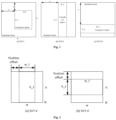
- three types of SVT block can be used for a residual block, as illustrated in Fig. 1 .
- the type information of the SVT block are coded into bitstream.
- the position of the transform block is represented by a position offset (x, y) to the top left corner of the residual block, where x means the horizontal distance between the top left corner of the transform block and that of the residual block in the unit of pixel, and y means the vertical distance between the top left corner of the transform block and that of the residual block in the unit of pixel.
- Each position that makes the transform block inside the residual block is a candidate position.
- the number of candidate positions is (w-w_t+1) ⁇ (h-h_t+1) for a type of SVT. More specifically, for a 16 ⁇ 16 residual block, when SVT-I is used, there are 81 candidate positions; when SVT-II or SVT-III is used, there are 13 candidate positions.
- the x and y values are coded into bitstream. To reduce complexity for SVT-I, a subset of 32 positions are selected from the 81 candidate positions as the allowed candidate positions for SVT-I.
- One drawback of the SVT scheme is the heavy signaling overhead of the position information.
- the encoder complexity may be significantly increased with the number of positions tested in Rate-Distortion Optimization (RDO). Since the number of candidate positions increases with the size of the residual block, the overhead can be even bigger for larger residual blocks, like 32 ⁇ 32 or 64 ⁇ 128.
- RDO Rate-Distortion Optimization
- SVT-H Two types of SVT blocks are used for residual coding, denoted as SVT-H and SVT-V, as shown in Fig. 2 .
- SVT-V is similar to SVT-II and SVT-H is similar to SVT-III.
- the transform block in SVT-V and SVT-H is enlarged to half of the residual block, which can cover more residual in the residual block.
- Candidate positions are decided by a Candidate Position Step Size (CPSS). Accordingly, candidate positions are separated with an equal space specified by the CPSS. The number of candidate positions is reduced to no more than 5, which mitigates the overhead of position information as well as the encoder complexity for deciding the best transform block position.
- CPSS Candidate Position Step Size
- the present disclosure discloses a video decoding method and a related apparatus employing spatially varying transform with adaptive transform type, to improve decoding quality.
- the disclosure relates to a video decoding method.
- the method is performed by a video decoding apparatus.
- the method includes: determining the usage of spatially varying transform (SVT) for a residual block; determining a SVT type for the residual block when SVT is used for the residual block, wherein the SVT type for the residual block is either SVT-V or SVT-H; determining a transform block position of a transform block of the residual block; determining a transform type of the transform block, wherein the transform type indicates a horizontal transform and a vertical transform for the transform block, wherein at least one of the horizontal transform and the vertical transform is DST-7; and reconstructing the residual block based on the transform type, the transform block position and transform coefficients of the transform block.
- SVT spatially varying transform
- the horizontal transform is DCT-8
- the vertical transform is DST-7.
- the horizontal transform is DST-7
- the vertical transform is DST-7
- the horizontal transform is DST-7
- the vertical transform is DCT-8.
- the horizontal transform is DST-7
- the vertical transform is DST-7
- the disclosure relates to a video decoding apparatus, comprising: a unit configured to determine the usage of spatially varying transform (SVT) for a residual block; a unit configured to determine a SVT type for the residual block when SVT is used for the residual block, wherein the SVT type for the residual block is either SVT-V or SVT-H; a unit configured to determine a transform block position of a transform block of the residual block; a unit configured to determine a transform type of the transform block, wherein the transform type indicates a horizontal transform and a vertical transform for the transform block, wherein at least one of the horizontal transform and the vertical transform is DST-7; and a unit configured to reconstruct the residual block based on the transform type, the transform block position and transform coefficients of the transform block.
- SVT spatially varying transform
- the horizontal transform is DCT-8
- the vertical transform is DST-7.
- the horizontal transform is DST-7
- the vertical transform is DST-7
- the horizontal transform is DST-7
- the vertical transform is DCT-8.
- the horizontal transform is DST-7
- the vertical transform is DST-7
- the disclosure relates to a video decoding apparatus, comprising: one or more processors; and a non-transitory computer-readable storage medium coupled to the processors and storing programming for execution by the processors, wherein the programming, when executed by the processors, configures the decoder to perform the method according to the first aspect.
- the disclosure relates to a non- volatile computer-readable storage medium storing computer instructions, that when executed by one or more processors, cause the one or more processors to perform the steps of the method according to the first aspect.
- the present disclosure adaptively uses multiple transform types for transform block based on the SVT type and position information, thus can improve decoding quality and decoding efficiency; further, the quantity of the transform algorithm are limited in some embodiments, thus can simplify the realization of the decoding apparatus.
- the present disclosure introduces an improved SVT scheme.
- the improvement is that the type of horizontal transform and the type of vertical transform of a SVT block are determined based on the SVT type and SVT block position.
- the horizontal transform can be different from the vertical transform.
- a first embodiment describes the process of decoding a residual block.
- a bitstream containing at least one picture of video data is decoded.
- a picture is split into a plurality of rectangular image regions and each region corresponds to a Coding Tree Unit (CTU).
- CTU Coding Tree Unit
- a CTU is partitioned into a plurality of blocks, such as the coding units in HEVC, according to block partition information contained in the bitstream.
- the coding information of the blocks is parsed from the bitstream and pixels of the blocks are reconstructed based on the coding information.
- SVT is restricted to being used for inter-predicted blocks. In another embodiment, SVT may also be used for intra-predicted blocks.
- SVT may be allowed for blocks using a specific inter prediction method (e.g., translation model based motion compensation) but not allowed for blocks using some other inter prediction methods (e.g., affine model based motion compensation).
- SVT may be allowed for prediction blocks using Merge mode or AMVP (advanced motion vector prediction) mode with 1/4-pel motion vector difference precision, but not allowed for prediction blocks using affine merge mode, affine inter mode or AMVP mode with 1-pel or 4-pel motion vector difference precision.
- SVT may be allowed for prediction blocks using Merge mode with a merge index smaller than 2, but not allowed for prediction blocks using Merge mode with a merge index not smaller than 2.
- the Merge mode and AMVP mode can be referred to in H.265/HEVC standard.
- Affine merge mode and affine inter mode can be referred to in JEM (Joint Exploration Model) codec from JVET (Joint Video Exploration Team).
- a block may refer to a coding unit, where the coding unit may contain one prediction block and one residual block.
- the prediction block may contain all prediction samples of the coding unit
- the residual block may contain all residual samples of the coding unit
- the prediction block is of the same size as the residual block.
- a block may refer to a coding unit, a coding unit may contain two prediction blocks and one residual block, each prediction block may contain a part of prediction samples of the coding unit, and a residual block may contain all residual samples of the coding unit.
- a block may refer to a coding unit, a coding unit may contain two prediction blocks and four residual blocks.
- the partition pattern of residual blocks in a coding unit may be signaled in the bitstream, such as the Residual Quad-Tree (RQT) in HEVC.
- RQT Residual Quad-Tree
- a block may contain only Y component (luma) of image samples (or pixels), or it may contain Y, U (chrominance) and V (chrominance) components of image samples.
- a residual block Ro of size w ⁇ h can be reconstructed by the following steps.
- Step 1 Determine the transform block size of the residual block Ro.
- Whether a block has non-zero transform coefficients of a color component may be indicated by a coded block flag (cbf) of the color component, as used in HEVC. Whether a block has non-zero transform coefficients of any color component may be indicated by a root coded block flag (root cbf), as used in HEVC.
- cbf coded block flag
- root cbf root coded block flag
- a block is allowed to use SVT if the following conditions are satisfied:
- a block is allowed to use SVT if the following conditions are satisfied:
- Step 1.2 is applied to decide the transform size.
- Step 1.2 Determine the type of SVT according to a syntax element, and derive the transform block size according to the SVT type. Allowed SVT types for the residual block are decided based on the width and height of the residual block. SVT-V is allowed if w is in the range [a1, a2] and h is not greater than a3; SVT-H is allowed if h is in the range [a1, a2] and w is not greater than a3. SVT may be only used for the Y component, or it may be used for all three components, i.e., Y component, U component and V component. When SVT is only used for the Y component, the Y component residual is transformed by SVT and the U and V components are transformed according to the size of the residual block.
- the svt_type_flag When only SVT-V is allowed or only SVT-H is allowed, the svt_type_flag is not parsed from the bitstream, and the transform block size is set according to the allowed SVT type.
- Step 2 Determine the transform block position according to a syntax element, and determine the transform type for the transform block based on the type of SVT and the transform block position information.
- Step 2.1 Determine the transform block position according to a syntax element.
- the value of P is among 0, 1, ..., w ⁇ w _ t s if SVT-V is used, or the value of P is among 0, 1, ..., h ⁇ h _ t s if SVT-H is used. More specifically, let (0, 0) represent the coordinate of the top left corner of the residual block, the coordinate of the top left corner of the transform block is (Z, 0) for SVT-V or (0, Z) for SVT-H.
- the number of candidate positions for SVT-H or SVT-V may further depend on the aspect ratio of the residual block.
- the position index P may be binarized into one or more bins using truncated unary code. For example, if the P value is in the range of 0 to 4, P value 0, 4, 2, 3 and 1 are binarized as 0, 01, 001, 0001 and 0000, respectively; if the P value is in the range of 0 to 1, P value 0 and 1 are binarized as 0 and 1, respectively.
- the position index P may be binarized into one or more bins using one most probable position and several remaining positions.
- the most probable position may be set as the position covering the bottom-right corner of the residual block.
- P value 4 0, 1, 2 and 3 are binarized as 1, 000, 001, 010 and 011, respectively; if the P value is in the range of 0 to 2 and position 2 is set as the most probable position, P value 2, 0 and 1 are binarized as 1, 01 and 00, respectively.
- Step 2.2 determine the transform type for the transform block based on the type of SVT and transform block position information.
- the transform type includes the horizontal transform and vertical transform of a 2-D separable transform.
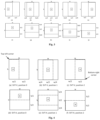
- Position 0 covers the top-left corner
- position 2 covers the bottom-right corner
- Position 1 is at the middle of the residual block.
- Position 0 covers the top-left corner
- position 1 covers the bottom-right corner (the same as position 2 in Fig. 4 ). That is, there are two positions for both SVT-V and SVT-H.
- a two-dimensional transform may be separable into one-dimensional horizontal transform and vertical transform.
- a forward 2D transform which turns residual into transform coefficients may be realized by first applying horizontal transform on a residual block to generate a block TA and then applying vertical transform on the block TA to generate a transform coefficient block, as implemented in JEM codec.
- an inverse 2D transform which turns transform coefficients back to residual may be realized by first applying inverse vertical transform on a transform coefficient block to generate a block TB and then applying inverse horizontal transform on the block TB to generate a residual block, as implemented in JEM codec.
- the horizontal and vertical transforms for SVT-V position 0 are DCT-8 and DST-7; the horizontal and vertical transforms for SVT-V position 1 are DST-1 and DST-7; the horizontal and vertical transforms for SVT-V position 2 are DST-7 and DST-7; the horizontal and vertical transforms for SVT-H position 0 are DST-7 and DCT-8; the horizontal and vertical transforms for SVT-H position 1 are DST-7 and DST-1; the horizontal and vertical transforms for SVT-H position 2 are DST-7 and DST-7, as listed in Table I.
- the vertical transform for SVT-V and the horizontal transform for SVT-H are set as DST-7, and the other transform is based on SVT position. Table I.
- SVT type position horizontal transform vertical transform SVT-V
- position 0 DCT-8 DST-7 SVT-V position 1 DST-1 DST-7 SVT-V
- position 2 DST-7 DST-7 SVT-H position 0 DST-7 DCT-8 SVT-H
- position 1 DST-7 DST-1 SVT-H position 2 DST-7 DST-7 DST-7 DST-7 DST-7 DST-7
- the horizontal transform and vertical transform for different SVT types and positions are listed in Table II.
- the vertical transform for SVT-V and the horizontal transform for SVT-H are set as DCT-2, and the other transform is based on SVT position.
- Table II An example of 1-D horizontal and vertical transforms for different SVT types and positions. SVT type, position horizontal transform vertical transform SVT-V, position 0 DCT-8 DCT-2 SVT-V, position 1 DST-1 DCT-2 SVT-V, position 2 DST-7 DCT-2 SVT-H, position 0 DCT-2 DCT-8 SVT-H, position 1 DCT-2 DST-1 SVT-H, position 2 DCT-2 DST-7
- the horizontal transform and vertical transform for different SVT types and positions are listed in Table III.
- the horizontal transform and vertical transform are decided only by SVT position.
- Table III An example of 1-D horizontal and vertical transforms for different SVT types and positions. SVT type, position horizontal transform vertical transform SVT-V, position 0 DCT-8 DCT-8 SVT-V, position 1 DST-1 DST-1 SVT-V, position 2 DST-7 DST-7 SVT-H, position 0 DCT-8 DCT-8 SVT-H, position 1 DST-1 DST-1 SVT-H, position 2 DST-7 DST-7
- the horizontal transform and vertical transform for different SVT types and positions are listed in Table IV.
- Table IV. An example of 1-D horizontal and vertical transforms for different SVT types and positions. SVT type, position horizontal transform vertical transform SVT-V, position 0 DST-7 DCT-8 SVT-V, position 1 DST-7 DST-1 SVT-V, position 2 DST-7 DST-7 SVT-H, position 0 DCT-8 DST-7 SVT-H, position 1 DST-1 DST-7 SVT-H, position 2 DST-7 DST-7
- the horizontal transform and vertical transform for different SVT types and positions are listed in Table V.
- Table V An example of 1-D horizontal and vertical transforms for different SVT types and positions. SVT type, position horizontal transform vertical transform SVT-V, position 0 DCT-8 DST-7 SVT-V, position 1 DCT-2 DST-7 SVT-V, position 2 DST-7 DST-7 SVT-H, position 0 DST-7 DCT-8 SVT-H, position 1 DST-7 DCT-2 SVT-H, position 2 DST-7 DST-7
- the horizontal transform and vertical transform for different SVT types and positions are listed in Table VI.
- Table VI An example of 1-D horizontal and vertical transforms for different SVT types and positions. SVT type, position horizontal transform vertical transform SVT-V, position 0 DCT-8 DCT-2 SVT-V, position 1 DCT-2 DCT-2 SVT-V, position 2 DST-7 DCT-2 SVT-H, position 0 DCT-2 DCT-8 SVT-H, position 1 DCT-2 DCT-2 SVT-H, position 2 DCT-2 DST-7
- the position-dependent multiple transforms may be applied to luma transform block only, and the corresponding chroma transform blocks always use inverse DCT-2 in the inverse transform process.
- Step 3 Parse transform coefficients of the transform block based on the transform block size.
- transform coefficients parsing in HEVC or H.264/AVC.
- the transform coefficients may be coded using run-length coding or coded more sophisticated as a set of transform coefficient groups (CG).
- CG transform coefficient groups
- Step 3 may be conducted before Step 2.
- Step 4 Reconstruct the residual block Ro based on the transform coefficients and the transform block position and the type of inverse transform.
- Inverse quantization and inverse transform of size w_t ⁇ h_t are applied to the transform coefficients to recover residual samples.
- the size of the residual samples is w_t ⁇ h_t, which is the same to the transform block size.
- the inverse transform is a 2-D separable transform.
- the dequantized transform coefficient block is first transformed by an inverse vertical transform to generate a block TC and then the block TC is transformed by an inverse horizontal transform, in which the inverse horizontal transform and inverse vertical transform are decided in Step 2.2 based on transform block position or based on both transform block position and SVT type of the transform block.
- the residual samples are assigned to a corresponding region inside the residual block Ro, according to the transform block position, and the rest samples inside the residual block are set to be zero. For example, if SVT-V is used and the number of candidate position is 5 and the position index is 4, the reconstructed residual samples are assigned to region A in Fig. 3(e) and the region of size (w/2) ⁇ h to the left of region A has zero residual.
- the reconstructed residual block may be composed with a prediction block to generate the reconstructed samples in a coding unit.
- a filtering process may be applied on the reconstructed samples later, such as deblocking filter and sample adaptive offset (SAO) processing in HEVC.
- the present disclosure adaptively uses multiple transform types for transform block based on the SVT type and position information.
- FIG. 5 is a flowchart of an example method of video decoding employing spatially varying transform with adaptive transform type.
- the method may be initiated at a decoder upon receiving a bitstream.
- the method employs the bitstream to determine prediction blocks and transformed residual blocks.
- the method may also determine transform blocks, which is employed to determine residual blocks.
- the residual blocks and the prediction blocks are then employed to reconstruct image blocks. It should be noted that while method is described from the perspective of the decoder, a similar method may be employed (e.g., in reverse) to encode the video by employing SVT. Where the method includes:
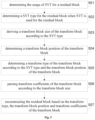
- Step 501 determining the usage of SVT for a residual block.
- the specific process of the determining is similar to step 1.1.
- Step 502 determining a SVT type for the residual block when SVT is used for the residual block, wherein the SVT type for the residual block is either a SVT-V type or a SVT-H type, where the SVT-V type indicates that the width of a transform block of the residual block is the half size of the width of the residual block, and the height of the transform block is the same size of the height of the residual block (as shown in Fig. 4 ); where the SVT-H type indicates that the width of the transform block is the same size of the width of the residual block, and the height of the transform block is the half size of the height of the residual block (as shown in Fig. 4 ).
- the specific process of the determining is similar to step 1.2.
- Step 503 deriving a transform block size of the transform block according to the SVT type.
- the specific process of the deriving is similar to step 1.2.
- Step 504 determining a transform block position of the transform block.
- the specific process of the determining may similar to step 2.1.
- a one bit flag may be employed to indicate the transform block position of the transform block of the residual block. For example, when only positions 0 and 2 of Fig. 4 are employed for SVT-V, a one bit flag is enough to indicate whether the transform block position is position 0 or position 2. When only positions 0 and 2 of Fig. 4 are employed for SVT-H, a one bit flag is enough to indicate whether the transform block position is position 0 or position 2.
- Step 505 determining a transform type of the transform block according to the SVT type and the transform block position of the transform block, wherein the transform type indicates a horizontal transform and a vertical transform for the transform block, wherein at least one of the horizontal transform and the vertical transform is DST-7.
- the specific process of the determining may similar to step 2.2.
- the specific transform type can be any transform type of any one of the tables I, IV and V as described above, or may be any transform type that includes DST-7 of any one of the tables II, III and VI as described above.
- the transform block position of the transform block is a position covers the top-left corner of the residual block(that is, position 0 of Fig. 4 )
- the horizontal transform is DCT-8
- the vertical transform is DST-7.
- the transform block position of the transform block is a position covers the right-bottom corner of the residual block (that is, position 2 of Fig. 4 )
- the horizontal transform is DST-7
- the vertical transform is DST-7.
- the transform block position of the transform block is a position covers the top-left corner of the residual block(that is, position 0 of Fig. 4 )
- the horizontal transform is DST-7
- the vertical transform is DCT-8.
- the SVT type for the residual block is the SVT-H type
- the transform block position of the transform block is a position covers the right-bottom corner of the residual block(that is, position 2 of Fig. 4 )
- the horizontal transform is DST-7
- the vertical transform is DST-7.
- Step 506 parsing transform coefficients of the transform block according to the transform block size.
- the specific process of the parsing may similar to step 3.
- Step 507 reconstructing the residual block based on the transform type, the transform block position and transform coefficients of the transform block.
- the specific process of the determining may similar to step 4.
- the present disclosure adaptively uses multiple transform types for transform block based on the SVT type and position information, thus can improve decoding quality and decoding efficiency; further, the quantity of the transform algorithm are limited in some embodiments, thus can simplify the realization of the decoding apparatus.
- the present disclosure discloses a video decoding apparatus that is configured to implement the techniques of the present application, the video decoding apparatus including:
- the specific transform type can be any transform type of any one of the tables I, IV and V as described above, or may be any transform type that includes DST-7 of any one of the tables II, III and VI as described above.
- the transform block position of the transform block is a position covers the top-left corner of the residual block(that is, position 0 of Fig. 4 )
- the horizontal transform is DCT-8
- the vertical transform is DST-7.
- the transform block position of the transform block is a position covers the right-bottom corner of the residual block (that is, position 2 of Fig. 4 )
- the horizontal transform is DST-7
- the vertical transform is DST-7.
- the transform block position of the transform block is a position covers the top-left corner of the residual block(that is, position 0 of Fig. 4 )
- the horizontal transform is DST-7
- the vertical transform is DCT-8.
- the SVT type for the residual block is the SVT-H type
- the transform block position of the transform block is a position covers the right-bottom corner of the residual block(that is, position 2 of Fig. 4 )
- the horizontal transform is DST-7
- the vertical transform is DST-7.
- the present disclosure discloses another video decoding apparatus that is configured to implement the techniques of the present application, the video decoding apparatus including: one or more processors; and a non-volatile computer-readable storage medium coupled to the processors and storing programming for execution by the processors, wherein the programming, when executed by the processors, configures the video decoding apparatus to process any of the methods as stated above.
- the present disclosure discloses a non- volatile computer-readable storage medium storing computer instructions, that when executed by one or more processors, cause the one or more processors to perform the steps of any of the methods as stated above.
- FIG. 9 is a schematic diagram of a coding device 900 according to an embodiment of the disclosure.
- the coding device 900 is suitable for implementing the disclosed embodiments as described herein.
- the coding device 900 comprises ingress ports 910 and receiver units (Rx) 920 for receiving data; a processor, logic unit, or central processing unit (CPU) 930 to process the data; transmitter units (Tx) 940 and egress ports 950 for transmitting the data; and a memory 960 for storing the data.
- Rx receiver units
- CPU central processing unit
- the coding device 900 may also comprise optical-to-electrical (OE) components and electrical-to-optical (EO) components coupled to the ingress ports 910, the receiver units 920, the transmitter units 940, and the egress ports 950 for egress or ingress of optical or electrical signals.
- OE optical-to-electrical
- EO electrical-to-optical
- the processor 930 is implemented by hardware and software.
- the processor 930 may be implemented as one or more CPU chips, cores (e.g., as a multi-core processor), field-programmable gate arrays (FPGAs), application specific integrated circuits (ASICs), and digital signal processors (DSPs).
- the processor 930 is in communication with the ingress ports 910, receiver units 920, transmitter units 940, egress ports 950, and memory 960.
- the processor 930 comprises a coding module 970.
- the coding module 970 implements the disclosed embodiments described above. For instance, the coding module 970 implements, processes, parses, prepares, or provides the various graphics processes and calculations.
- the inclusion of the coding module 970 therefore provides a substantial improvement to the functionality of the device 900 and effects a transformation of the device 900 to a different state.
- the coding module 970 is implemented as instructions stored in the memory 960 and executed by the processor 930.
- the memory 960 comprises one or more disks, tape drives, and solid-state drives and may be used as an overflow data storage device, to store programs when such programs are selected for execution, and to store instructions and data that are read during program execution.
- the memory 960 may be volatile and/or non-volatile and may be read-only memory (ROM), random-access memory (RAM), ternary content-addressable memory (TCAM), and/or static random-access memory (SRAM).
Landscapes
- Engineering & Computer Science (AREA)
- Multimedia (AREA)
- Signal Processing (AREA)
- Physics & Mathematics (AREA)
- Discrete Mathematics (AREA)
- General Physics & Mathematics (AREA)
- Compression Or Coding Systems Of Tv Signals (AREA)
Applications Claiming Priority (4)
| Application Number | Priority Date | Filing Date | Title |
|---|---|---|---|
| US201862678738P | 2018-05-31 | 2018-05-31 | |
| PCT/CN2019/088751 WO2019228332A1 (en) | 2018-05-31 | 2019-05-28 | Spatially varying transform with adaptive transform type |
| EP23185053.8A EP4250730B1 (de) | 2018-05-31 | 2019-05-28 | Räumlich variierende transformation mit adaptiver transformationsart |
| EP19810692.4A EP3782361B1 (de) | 2018-05-31 | 2019-05-28 | Räumlich variierende transformation mit adaptiver transformationsart |
Related Parent Applications (3)
| Application Number | Title | Priority Date | Filing Date |
|---|---|---|---|
| EP19810692.4A Division EP3782361B1 (de) | 2018-05-31 | 2019-05-28 | Räumlich variierende transformation mit adaptiver transformationsart |
| EP23185053.8A Division-Into EP4250730B1 (de) | 2018-05-31 | 2019-05-28 | Räumlich variierende transformation mit adaptiver transformationsart |
| EP23185053.8A Division EP4250730B1 (de) | 2018-05-31 | 2019-05-28 | Räumlich variierende transformation mit adaptiver transformationsart |
Publications (2)
| Publication Number | Publication Date |
|---|---|
| EP4568241A2 true EP4568241A2 (de) | 2025-06-11 |
| EP4568241A3 EP4568241A3 (de) | 2025-08-20 |
Family
ID=68697832
Family Applications (3)
| Application Number | Title | Priority Date | Filing Date |
|---|---|---|---|
| EP25165045.3A Pending EP4568241A3 (de) | 2018-05-31 | 2019-05-28 | Räumlich variierende transformation mit adaptivem transformationstyp |
| EP23185053.8A Active EP4250730B1 (de) | 2018-05-31 | 2019-05-28 | Räumlich variierende transformation mit adaptiver transformationsart |
| EP19810692.4A Active EP3782361B1 (de) | 2018-05-31 | 2019-05-28 | Räumlich variierende transformation mit adaptiver transformationsart |
Family Applications After (2)
| Application Number | Title | Priority Date | Filing Date |
|---|---|---|---|
| EP23185053.8A Active EP4250730B1 (de) | 2018-05-31 | 2019-05-28 | Räumlich variierende transformation mit adaptiver transformationsart |
| EP19810692.4A Active EP3782361B1 (de) | 2018-05-31 | 2019-05-28 | Räumlich variierende transformation mit adaptiver transformationsart |
Country Status (20)
| Country | Link |
|---|---|
| US (4) | US11252426B2 (de) |
| EP (3) | EP4568241A3 (de) |
| JP (3) | JP7160948B2 (de) |
| KR (4) | KR102532021B1 (de) |
| CN (1) | CN111989913A (de) |
| AU (2) | AU2019277966B9 (de) |
| BR (1) | BR112020024218B1 (de) |
| CA (1) | CA3099323A1 (de) |
| CL (1) | CL2020003084A1 (de) |
| DK (1) | DK3782361T3 (de) |
| ES (2) | ES2962364T3 (de) |
| HU (1) | HUE063475T2 (de) |
| IL (1) | IL279095B2 (de) |
| NZ (1) | NZ769880A (de) |
| PH (1) | PH12020551872A1 (de) |
| PL (1) | PL3782361T3 (de) |
| PT (1) | PT3782361T (de) |
| UA (1) | UA127899C2 (de) |
| WO (1) | WO2019228332A1 (de) |
| ZA (1) | ZA202006882B (de) |
Families Citing this family (7)
| Publication number | Priority date | Publication date | Assignee | Title |
|---|---|---|---|---|
| SG11202008036TA (en) * | 2018-02-23 | 2020-09-29 | Huawei Technologes Co Ltd | Position dependent spatial varying transform for video coding |
| TWI714153B (zh) * | 2018-06-29 | 2020-12-21 | 大陸商北京字節跳動網絡技術有限公司 | 零單元的定義 |
| KR102633714B1 (ko) * | 2018-09-02 | 2024-02-06 | 엘지전자 주식회사 | 다중 변환 선택에 기반한 영상 코딩 방법 및 그 장치 |
| WO2020236723A1 (en) * | 2019-05-19 | 2020-11-26 | Bytedance Inc. | Transform bypass coded residual blocks in digital video |
| CN112969067B (zh) * | 2021-05-18 | 2021-08-03 | 浙江华创视讯科技有限公司 | 一种视频编码方法、装置、设备和可读存储介质 |
| KR20240000457U (ko) | 2022-08-31 | 2024-03-07 | 김재동 | 착용감과 내구성이 향상된 덧신 양말 |
| KR20240000458U (ko) | 2022-08-31 | 2024-03-07 | 김재동 | 착용감과 내구성이 향상된 덧신 양말 |
Family Cites Families (36)
| Publication number | Priority date | Publication date | Assignee | Title |
|---|---|---|---|---|
| CN101448162B (zh) * | 2001-12-17 | 2013-01-02 | 微软公司 | 处理视频图像的方法 |
| JP4610195B2 (ja) | 2001-12-17 | 2011-01-12 | マイクロソフト コーポレーション | スキップマクロブロックコード化 |
| KR101403338B1 (ko) | 2007-03-23 | 2014-06-09 | 삼성전자주식회사 | 영상의 부호화, 복호화 방법 및 장치 |
| WO2010017837A1 (en) * | 2008-08-12 | 2010-02-18 | Nokia Corporation | Video coding using spatially varying transform |
| GB0906058D0 (en) | 2009-04-07 | 2009-05-20 | Nokia Corp | An apparatus |
| EP2452499A1 (de) * | 2009-07-06 | 2012-05-16 | Thomson Licensing | Verfahren und vorrichtung zur räumlichen veränderung der reststoffcodierung |
| CN101668205B (zh) * | 2009-09-25 | 2011-04-20 | 南京邮电大学 | 基于残差宏块自适应下采样立体视频压缩编码方法 |
| KR101457894B1 (ko) | 2009-10-28 | 2014-11-05 | 삼성전자주식회사 | 영상 부호화 방법 및 장치, 복호화 방법 및 장치 |
| KR101487687B1 (ko) | 2010-01-14 | 2015-01-29 | 삼성전자주식회사 | 큰 크기의 변환 단위를 이용한 영상 부호화, 복호화 방법 및 장치 |
| US8885714B2 (en) | 2010-01-14 | 2014-11-11 | Texas Instruments Incorporated | Method and system for intracoding in video encoding |
| KR101791078B1 (ko) | 2010-04-16 | 2017-10-30 | 에스케이텔레콤 주식회사 | 영상 부호화/복호화 장치 및 방법 |
| US9661338B2 (en) | 2010-07-09 | 2017-05-23 | Qualcomm Incorporated | Coding syntax elements for adaptive scans of transform coefficients for video coding |
| US8885701B2 (en) | 2010-09-08 | 2014-11-11 | Samsung Electronics Co., Ltd. | Low complexity transform coding using adaptive DCT/DST for intra-prediction |
| KR101756442B1 (ko) * | 2010-11-29 | 2017-07-11 | 에스케이텔레콤 주식회사 | 인트라예측모드의 중복성을 최소화하기 위한 영상 부호화/복호화 방법 및 장치 |
| PL3905680T3 (pl) | 2011-01-13 | 2022-10-31 | Canon Kabushiki Kaisha | Urządzenie do kodowania obrazu, sposób kodowania obrazu i program, oraz urządzenie do dekodowania obrazu, sposób dekodowania obrazu i program |
| CN105791875B (zh) | 2011-06-10 | 2018-12-11 | 联发科技股份有限公司 | 可伸缩视频编码方法及其装置 |
| KR101943049B1 (ko) | 2011-06-30 | 2019-01-29 | 에스케이텔레콤 주식회사 | 영상 부호화/복호화 방법 및 장치 |
| JP5711098B2 (ja) | 2011-11-07 | 2015-04-30 | 日本電信電話株式会社 | 画像符号化方法,画像復号方法,画像符号化装置,画像復号装置およびそれらのプログラム |
| KR20130050404A (ko) | 2011-11-07 | 2013-05-16 | 오수미 | 인터 모드에서의 복원 블록 생성 방법 |
| US9549182B2 (en) | 2012-07-11 | 2017-01-17 | Qualcomm Incorporated | Repositioning of prediction residual blocks in video coding |
| CN103581676B (zh) | 2012-08-10 | 2016-12-28 | 联发科技股份有限公司 | 视频编码变换系数的解码方法及装置 |
| US20140056347A1 (en) | 2012-08-23 | 2014-02-27 | Microsoft Corporation | Non-Transform Coding |
| GB2516824A (en) | 2013-07-23 | 2015-02-11 | Nokia Corp | An apparatus, a method and a computer program for video coding and decoding |
| CN103716623B (zh) * | 2013-12-17 | 2017-02-15 | 北京大学深圳研究生院 | 基于加权量化的视频压缩编解码方法及编解码器 |
| CN104935927A (zh) | 2014-03-17 | 2015-09-23 | 上海京知信息科技有限公司 | 一种基于流水线的hevc视频序列编解码加速方法 |
| CN103997650B (zh) | 2014-05-30 | 2017-07-14 | 华为技术有限公司 | 一种视频解码的方法和视频解码器 |
| CN104125466B (zh) | 2014-07-10 | 2017-10-10 | 中山大学 | 一种基于gpu的hevc并行解码方法 |
| CN105530518B (zh) | 2014-09-30 | 2019-04-26 | 联想(北京)有限公司 | 一种视频编码、解码方法及装置 |
| CN110855988B (zh) | 2014-11-28 | 2021-09-07 | 联发科技股份有限公司 | 用于视频编码的替代变换的方法及装置 |
| US10306229B2 (en) | 2015-01-26 | 2019-05-28 | Qualcomm Incorporated | Enhanced multiple transforms for prediction residual |
| CN106254870B (zh) | 2015-06-08 | 2020-08-18 | 财团法人工业技术研究院 | 采用自适性色彩转换的视频编码方法、系统和计算机可读取记录介质 |
| US10491922B2 (en) | 2015-09-29 | 2019-11-26 | Qualcomm Incorporated | Non-separable secondary transform for video coding |
| WO2017131233A1 (ja) | 2016-01-28 | 2017-08-03 | 日本放送協会 | 符号化装置、復号装置及びプログラム |
| ES2710807B1 (es) | 2016-03-28 | 2020-03-27 | Kt Corp | Metodo y aparato para procesar senales de video |
| EP4456536A3 (de) * | 2016-10-04 | 2024-11-27 | B1 Institute of Image Technology, Inc. | Verfahren und vorrichtung zur kodierung/dekodierung von bilddaten |
| WO2019076138A1 (en) | 2017-10-16 | 2019-04-25 | Huawei Technologies Co., Ltd. | Encoding method and apparatus |
-
2019
- 2019-05-28 KR KR1020207033786A patent/KR102532021B1/ko active Active
- 2019-05-28 NZ NZ769880A patent/NZ769880A/en unknown
- 2019-05-28 BR BR112020024218-7A patent/BR112020024218B1/pt active IP Right Grant
- 2019-05-28 PL PL19810692.4T patent/PL3782361T3/pl unknown
- 2019-05-28 DK DK19810692.4T patent/DK3782361T3/da active
- 2019-05-28 EP EP25165045.3A patent/EP4568241A3/de active Pending
- 2019-05-28 EP EP23185053.8A patent/EP4250730B1/de active Active
- 2019-05-28 JP JP2020566562A patent/JP7160948B2/ja active Active
- 2019-05-28 IL IL279095A patent/IL279095B2/en unknown
- 2019-05-28 KR KR1020237015726A patent/KR102656221B1/ko active Active
- 2019-05-28 PH PH1/2020/551872A patent/PH12020551872A1/en unknown
- 2019-05-28 AU AU2019277966A patent/AU2019277966B9/en active Active
- 2019-05-28 ES ES19810692T patent/ES2962364T3/es active Active
- 2019-05-28 EP EP19810692.4A patent/EP3782361B1/de active Active
- 2019-05-28 WO PCT/CN2019/088751 patent/WO2019228332A1/en not_active Ceased
- 2019-05-28 PT PT198106924T patent/PT3782361T/pt unknown
- 2019-05-28 CA CA3099323A patent/CA3099323A1/en active Pending
- 2019-05-28 KR KR1020247011386A patent/KR102764598B1/ko active Active
- 2019-05-28 ES ES23185053T patent/ES3036067T3/es active Active
- 2019-05-28 CN CN201980024809.9A patent/CN111989913A/zh active Pending
- 2019-05-28 HU HUE19810692A patent/HUE063475T2/hu unknown
- 2019-05-28 UA UAA202008441A patent/UA127899C2/uk unknown
- 2019-05-28 KR KR1020257003289A patent/KR20250022246A/ko active Pending
-
2020
- 2020-11-04 ZA ZA2020/06882A patent/ZA202006882B/en unknown
- 2020-11-25 US US17/104,866 patent/US11252426B2/en active Active
- 2020-11-27 CL CL2020003084A patent/CL2020003084A1/es unknown
-
2021
- 2021-12-23 US US17/561,049 patent/US11601663B2/en active Active
-
2022
- 2022-10-13 JP JP2022164888A patent/JP2022189870A/ja active Pending
-
2023
- 2023-02-09 US US18/166,890 patent/US12022100B2/en active Active
-
2024
- 2024-05-21 US US18/670,305 patent/US12470735B2/en active Active
- 2024-10-30 JP JP2024190526A patent/JP2025010311A/ja active Pending
- 2024-12-09 AU AU2024278220A patent/AU2024278220A1/en active Pending
Also Published As
Similar Documents
| Publication | Publication Date | Title |
|---|---|---|
| US12470735B2 (en) | Spatially varying transform with adaptive transform type | |
| KR102826288B1 (ko) | 비디오 코딩 시스템에서 신택스 시그널링 및 참조 제약의 방법 및 장치 | |
| US11368696B2 (en) | Picture encoder, picture decoder and corresponding methods of encoding and decoding | |
| KR20220045955A (ko) | 위치 기반 계수 스케일링 | |
| WO2022218280A1 (en) | Transforms and sign prediction | |
| RU2781213C2 (ru) | Пространственно изменяющееся преобразование с типом адаптивного преобразования | |
| RU2799905C2 (ru) | Пространственно изменяющееся преобразование с типом адаптивного преобразования | |
| RU2819359C2 (ru) | Пространственно изменяющееся преобразование с типом адаптивного преобразования | |
| US20250330655A1 (en) | Encoding method and apparatus, decoding method and apparatus, encoding device, decoding device, and storage medium | |
| WO2025218682A1 (en) | Video decoder and methods for decoding and signaling a video bit stream for performing a dual-tree partitioning technology | |
| WO2025072627A1 (en) | Signalling improvement for in-loop filtering in video coding | |
| WO2025085531A1 (en) | On processing video of different colour formats for in-loop filtering in video coding |
Legal Events
| Date | Code | Title | Description |
|---|---|---|---|
| PUAI | Public reference made under article 153(3) epc to a published international application that has entered the european phase |
Free format text: ORIGINAL CODE: 0009012 |
|
| STAA | Information on the status of an ep patent application or granted ep patent |
Free format text: STATUS: THE APPLICATION HAS BEEN PUBLISHED |
|
| AC | Divisional application: reference to earlier application |
Ref document number: 3782361 Country of ref document: EP Kind code of ref document: P Ref document number: 4250730 Country of ref document: EP Kind code of ref document: P |
|
| AK | Designated contracting states |
Kind code of ref document: A2 Designated state(s): AL AT BE BG CH CY CZ DE DK EE ES FI FR GB GR HR HU IE IS IT LI LT LU LV MC MK MT NL NO PL PT RO RS SE SI SK SM TR |
|
| REG | Reference to a national code |
Ref country code: DE Ref legal event code: R079 Free format text: PREVIOUS MAIN CLASS: H04N0019119000 Ipc: H04N0019122000 |
|
| PUAL | Search report despatched |
Free format text: ORIGINAL CODE: 0009013 |
|
| AK | Designated contracting states |
Kind code of ref document: A3 Designated state(s): AL AT BE BG CH CY CZ DE DK EE ES FI FR GB GR HR HU IE IS IT LI LT LU LV MC MK MT NL NO PL PT RO RS SE SI SK SM TR |
|
| RIC1 | Information provided on ipc code assigned before grant |
Ipc: H04N 19/122 20140101AFI20250717BHEP Ipc: H04N 19/147 20140101ALI20250717BHEP Ipc: H04N 19/61 20140101ALI20250717BHEP Ipc: H04N 19/60 20140101ALI20250717BHEP Ipc: H04N 19/12 20140101ALI20250717BHEP Ipc: H04N 19/17 20140101ALI20250717BHEP |